
An excursion refund policy is the set of rules that decides who gets money back, how much, and by when, if a guest excursion tied to your wedding weekend is cancelled, moved or abandoned. This guide gives you a provider-by-provider tracker that shows which bookings depend on which, so one change to the wedding does not turn into a pile of lost deposits.
Do not write one excursion refund policy for the whole weekend. Write one line per provider in a dependency tracker: who was paid, by whom, through which payment route, which clock runs out first, what triggers a refund, what form the excursion refund takes, and which other bookings fall over if this one does. When plans change, sort the lines by the earliest cutoff and act in that order. Decide in advance who absorbs a non-refundable loss, and tell guests that rule before anyone pays.
Excursions look simple while you are planning them. A snorkeling morning, a vineyard lunch, a sunset sail, a half-day city walk. Each one is a booking with a price and a date. The trouble starts when the date moves, the guest count drops, a storm closes the harbor, or a relative cancels a flight. Suddenly five bookings with five different cancellation rules, three different payment routes and two shared vans all need answers on the same afternoon.
Most couples find out at that moment that they never had one excursion refund policy. They had a collection of vendor policies, some of them read, some of them skimmed, and none of them connected to each other. The tour operator’s terms said one thing. The resort concierge, who took the money, said another. The guests who paid you by app had been told “we’ll sort it out.” That gap is where money and goodwill disappear.
This article is about closing that gap with a tool you build before you need it. It sits underneath the bigger decision about which experiences to offer at all, which which is a separate planning question, and it assumes you already have a destination weekend or a travel-heavy wedding in motion. It does not repeat how to choose excursions or how to price them. It focuses on the part nobody enjoys: what happens to the money and the schedule when something shifts.
A note on scope. This is general information, not legal, tax or financial advice. Refund rights depend on the provider’s written terms, the country and state involved, the payment method and the facts of each case, and they change. Where a rule matters, the article points you to the agency or the document that sets it, so you can check the current version yourself.
What an excursion refund policy has to cover
When people say “excursion refund policy” they usually mean the sentence in a booking confirmation: “Cancel 72 hours ahead for a full refund.” That sentence is one layer out of three, and relying on it alone is how couples get surprised.
Layer one is the provider’s own terms. Every operator, boat captain, guide service, winery or transport company has written conditions: the cancellation window, the deposit rule, what happens if they cancel, what happens in bad weather, minimum headcounts, and how an excursion refund is paid. These are the only terms that bind the provider, so they are the starting point for every line in the tracker.
Layer two is the payment path. The provider’s terms describe what the provider will do. They say nothing about the money that passed through someone else. If a resort concierge collected payment, if a booking platform took a fee, if you paid on a personal card and guests reimbursed you by app, each hand-off adds a rule, a delay and sometimes a fee that the provider will never refund. The excursion refund you actually receive is the provider’s refund minus whatever the path keeps.
Layer three is your own group rule. This is the part only you can write: what you tell guests about who is responsible if they cancel, who covers a provider’s cancellation fee, whether deposits are collected at all, and what happens when the excursion itself is cancelled by weather or by you. Without a stated rule, guests assume the most generous version, and the couple ends up covering the gap quietly.

A complete excursion refund policy therefore has three parts that must agree with each other. If your group rule promises a full excursion refund within seven days but the operator’s terms are fourteen days, you have promised money you may not be able to recover. The tracker in this guide exists to make those mismatches visible before a guest points them out.
The two jobs of an excursion refund policy: recover money and protect the schedule
Recovering money is the obvious job. The less obvious job is protecting the schedule, because excursions do not exist alone. A sunset sail may depend on a shuttle that also serves the rehearsal dinner. A cooking class may be booked for exactly the number of guests who chose it, and below that number the host cancels. A private guide may be hired for the day with a fixed transport window that must match the ferry timetable.
If you treat each booking as an isolated purchase, you will recover the money from the easy ones and then discover that the hard ones cannot run. A refund that arrives while the schedule is broken is only half a solution. That is why the tracker records dependencies as well as dollar amounts, and why the response order in later sections is driven by clocks and links rather than by which vendor you like best.
There is a third, quieter job: keeping guests from feeling like customers of the couple. Guests who paid for an optional excursion are doing you a favor by attending. Your excursion refund rules should be clear enough that nobody has to ask for their money back with an apology. When a rule is written and shared in advance, an excursion refund becomes a routine event instead of a negotiation between friends.
How this differs from your overall vendor contracts
Your main wedding contracts are covered by your general vendor terms. The guide to the wedding vendor contract explains deposits, cancellation clauses and what to ask a venue or caterer. Excursions behave differently in three ways that justify their own tracker.
First, they are mostly booked with small operators who write short terms and apply them by judgment. A family-run boat company may refund a guest in full because it likes the couple, or refuse because the captain already turned down another group for that slot. You cannot assume the generous reading, so you record exactly what the document says and separately record anything the operator promises in writing.
Second, they are weather-dependent and season-dependent more than most wedding services. A ballroom is rarely cancelled by wind. A catamaran frequently is. The provider’s right to cancel, and what it owes you when it does, matters as much as your right to cancel.
Third, excursions are often paid by many different people. The couple, parents, individual guests and sometimes a group coordinator each hold part of the money. A single contract refund therefore has to be split among payers, and the split is where most bad feelings begin. Your wedding budget may track the couple’s share, as the wedding budget guide describes, but the guest-paid portion needs its own record.
When this tracker is worth the effort
Not every wedding needs a full tracker. If you offer one optional activity, paid by each guest directly to the operator, a single note in the guest information page is enough. The tracker earns its time when any of these is true.
You are paying deposits for several excursions yourselves. Guests are paying you rather than the operator. Two or more bookings share transport, a guide, a venue or a meal. The destination is far enough that guests have booked non-refundable flights around the excursion dates. Or the weekend runs across a season where weather closures are normal. If two or more of those apply, an hour spent building the tracker now is cheaper than a day of phone calls later.
The sections that follow build the tracker in order. First, the kinds of change that trigger refund questions. Then the tracker itself, field by field. Then how to classify dependencies, read provider terms, route the money, compare ways of running the group policy, and work through a full example. The final sections give scripts, edge cases, measurable checks and a closing routine.
Six changes that set off an excursion refund question
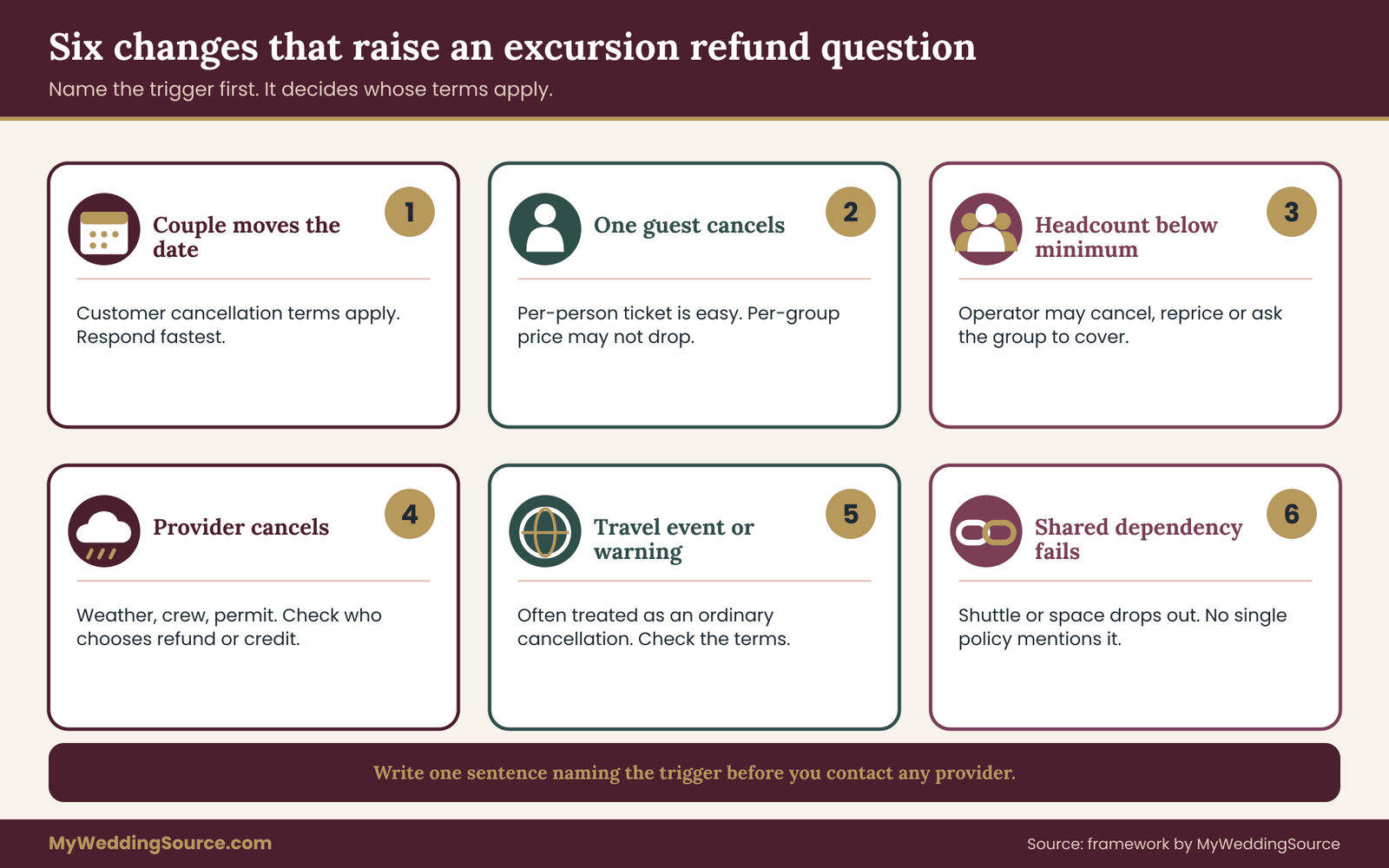
Refund questions do not arrive at random. They come from a short list of events, and each event pulls on a different part of the booking chain. Knowing which one you are dealing with tells you whose terms apply and who owes whom. Here are the six, in the order they usually appear as a wedding gets closer.
The couple moves or shortens the wedding. A venue falls through, a date changes, the ceremony shifts from Saturday to Friday. Every excursion tied to the old dates is now a rescheduling problem or a cancellation, and the cause is yours, not the provider’s. Provider terms for a customer-initiated change are usually the least generous, so this event needs the fastest response. The guide to choosing a wedding date explains how date changes ripple through the rest of the plan; here, the effect on excursions is what matters.
A single guest cancels. One person drops out, perhaps because of illness, a work conflict or a flight problem. The question is whether the booking is priced per person or per group. A per-person ticket is easy: the guest cancels under the operator’s window. A per-group charter priced at a minimum is not, because one fewer guest may not reduce the bill at all.
Headcount drops below a minimum. Cooking classes, small boats, guided hikes and private tastings often have minimum participants. Below the minimum, the operator may cancel, raise the per-person price or ask the group to pay the difference. This is the event that quietly breaks optional excursions, because it does not require anyone to cancel; it only requires a few people not to sign up.
The provider cancels. Weather, a mechanical problem, a permit, a staffing gap or a closure. When a provider cancels, most terms promise either an excursion refund, a credit or a reschedule, but the choice may belong to the provider. This is also the one case where a guest has the strongest claim, because the guest did nothing. Your tracker should record what the operator owes in this case separately from what you owe if you cancel.
A travel warning, strike, airport disruption or health event. Events outside everyone’s control affect flights, ground transport and sometimes access to a site. Providers often treat these as ordinary customer cancellations unless their terms say otherwise, and travel insurance may or may not respond. The State Department publishes travel advisories at travel.state.gov, and a change in an advisory is a fact you can point to. It is not, on its own, an excursion refund right, so the tracker records what the provider’s terms say about it.
A shared dependency fails. A shuttle company drops the weekend, a venue closes the terrace the lunch was planned on, a guide is double-booked. The excursion itself did not change, but something it depends on did. This is the event most couples miss entirely, because no single provider’s terms mention it.
Why the trigger matters more than the amount
It is tempting to sort refund problems by dollar value and start with the biggest. That is usually the wrong order, for two reasons.
First, the trigger decides the rule. If you cancel, the provider’s customer-cancellation schedule applies, and the percentage you lose grows as the date approaches. If the provider cancels, the provider’s own-excursion cancellation terms apply, which are usually kinder. If the cause is weather, a separate weather clause may apply. Two identical bookings with identical prices can have completely different outcomes depending only on who initiates the change and why. Writing the trigger down first prevents arguments later about whether an excursion refund was “owed.”
Second, the clock decides the order. A small booking with a cutoff tomorrow matters more than a large booking with a cutoff next month, because the small one becomes unrecoverable first. A good response to a change sorts by cutoff, not by size, and recovers what is recoverable before it becomes a loss. The tracker has a field for this, and the sorting rule appears again in the response routine later.
There is a practical habit that helps here: when a change happens, write one sentence naming the trigger before you contact anyone. “We are moving the wedding one day later” is a trigger. “Plans are shifting” is not. The sentence keeps your messages to different providers consistent, and it avoids the common mistake of telling one provider the cause is weather and another that it is a date change.
The one-sentence cause statement
For every provider you contact, you will end up needing a cause statement. It should say who is changing what, from when to when, and whether the change is a cancellation or a reschedule. For example: “The wedding has moved from Saturday the fourteenth to Sunday the fifteenth, so the Saturday afternoon excursion needs to move to Sunday morning or be cancelled.” That is specific enough for a provider to apply their terms. A statement such as “we may need to change some things” invites a response that applies the strictest reading.
Do not state a cause you cannot support. If a travel warning is raised but the operator is still running, “the operator cancelled” is untrue and will damage the relationship. If you are uncertain, say so and ask what the provider’s terms say about the circumstance. Honest uncertainty protects your standing with a small operator better than an overstated claim.
Moving versus cancelling
A reschedule is the most underused tool. Many operators prefer to move a booking rather than refund it, and many terms say a one-time change is free if requested before the cutoff. The condition is usually that availability exists on the new date. In peak season it may not.
So an excursion refund policy should treat “reschedule first, refund second” as a decision, not a default. Rescheduling keeps the money with the provider, which is good for the relationship and sometimes good for the price, but it commits guests to the new date. If half of them cannot attend, you have turned an excursion refund into a smaller problem plus a new one. The tracker’s next-action field is where you record which route you are choosing and why.
A short rule helps. If at least most of the guests who signed up can attend the new date and the provider confirms availability in writing, reschedule. If not, cancel under the terms and move on. Do not leave an in-between booking open because it feels kinder; an open booking keeps its cutoff clock running.
Who gets the first call
When several providers are affected, the first call should go to the one whose cancellation window closes soonest, not the one you trust most. The second call goes to any provider whose service others depend on, such as the shared transport. The third goes to the providers that are least flexible, because they need the longest lead time to respond. Only after those three do you contact the flexible, friendly providers who will probably say yes whenever you ask.
This ordering feels backwards to people who naturally start with their favorites. But it reflects how losses actually happen: through expired clocks and broken dependencies, not through unfriendly vendors. Later sections turn this into a repeatable response with specific steps.
In short, an excursion refund is never only about the amount. It is the result of a trigger, a clock and a payment route, and each of the three can be read off the tracker before you pick up the phone.
What the guests should hear, and when
Guests should hear about changes only after you know what the excursion refund route is. A message that says “the sunset sail is cancelled” without saying what happens to their money creates a flood of questions. A message that says “the sunset sail is cancelled; the operator will refund each guest to the original payment method within the period in its terms, and we will confirm once it is processed” answers the next question in advance.
That does not mean waiting for every answer. Send an early, short notice that something is changing, and tell guests when you will send details. The calm tone matters more than the speed. A guest who knows the money is safe will tolerate a change in plans far better than one who is left guessing.
The excursion refund dependency tracker, field by field
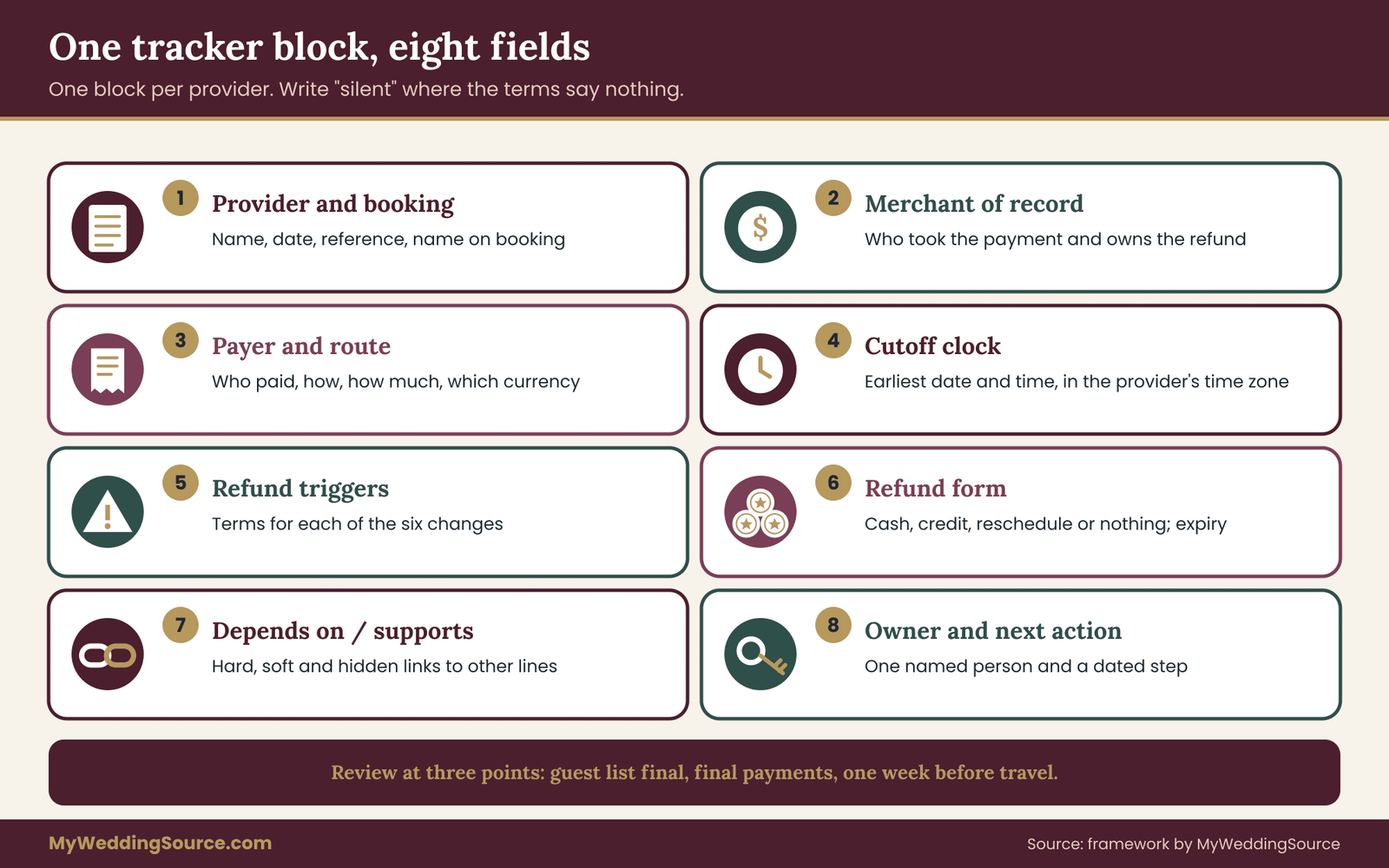
The tracker is a plain document, a spreadsheet or a shared note, with one block per provider. It is not a table of prices. It is a record of what each booking needs from the others and what it owes back. Each block has eight fields. Fill them in when you book, and revisit them whenever something changes. Keeping the fields short matters more than keeping them pretty.
Field one: provider and booking reference. The name of the business, the date and time of the service, the confirmation number, and the name on the booking. This sounds trivial until a provider asks which reservation you mean and three of them are under different names.
Field two: merchant of record. Who actually took the payment and therefore owns the excursion refund. It may be the operator, the resort’s concierge desk, a booking platform, a travel agent or the venue. This field decides whom you call. If the concierge collected the money, the operator may say it has nothing to refund, and it may be right. Write the merchant name exactly as it appears on the receipt or statement.
Field three: payer and payment route. Who paid, how, and how much. Couple on a credit card, guest on a debit card, guest by transfer to the couple, parent by check. The route matters because card payments and transfers have different recovery options and timelines. The Consumer Financial Protection Bureau explains how card billing disputes and refunds work, and it is the source to check for current consumer rules. Record the last four digits of the card only if you are keeping the tracker private; otherwise write “card A” and “card B.”
Field four: cutoff clock. The earliest date and time after which the excursion refund shrinks or disappears, written with the time zone of the provider, not yours. Operators abroad often state cutoffs in local time and count days differently, so “48 hours” may mean two calendar days or forty-eight hours before the start. Write the interpretation you confirmed, not the one you assumed.
Field five: refund triggers. What the terms say for each of the six events: you cancel, a guest cancels, headcount drops below the minimum, the provider cancels, weather or a travel event, and a shared dependency failing. If the terms are silent on one, write “silent” rather than leaving it blank. A blank looks like something you forgot; “silent” is a question you now know to ask.
Field six: excursion refund form. Cash back to the original payment method, a credit valid for a period, a reschedule only, or nothing. Credits expire, and credits belong to the person named on the booking, not necessarily to the guests who paid. Record the expiry date and who holds the credit.
Field seven: depends on and supports. The other lines in the tracker that this booking needs, and the lines that need this one. A sunset sail might depend on the shuttle and support nothing. The shuttle might support three excursions and the welcome dinner. This field is the heart of the tool, and the next section explains how to fill it.
Field eight: owner and next action. One named person responsible for this provider, and the next step with a date. Shared responsibility means nobody picks up the phone. If you hire a planner or a destination coordinator, they may own some lines, but the couple should still own the money decisions.
Building the tracker in about an hour
You do not need special software. Open a shared document and create one block per provider, using the eight fields as headings. Then go through your inbox and booking confirmations in this order: payments first, terms second, dependencies last.
Start with the payments, because they tell you the merchant of record and the route. Search for receipts, card statements and transfer confirmations, and fill fields two and three. This takes the longest, and it often reveals a booking nobody remembered, such as a deposit paid to a driver or a guide who was added late.
Then read the terms for each provider and fill in fields four, five and six. Do not rely on summaries or on what a phone representative said. If the terms are not written anywhere, ask the provider to confirm the cancellation, weather and minimum-headcount rules in an email. A written answer is a reference you can point to later; a phone call is not.
Finally, read the whole tracker top to bottom and fill in field seven. This is where the picture emerges. Look for any provider that appears under “depends on” more than once; that is a shared dependency, and it needs extra protection. Look for any provider with no dependencies at all; it is the easiest one to move or cancel.
Keeping the tracker alive
A tracker that is correct in March and stale in June is worse than none, because it gives false confidence. Set three review points: when the guest list is final, when final payments are due, and one week before travel. At each point, check three things: whether any cutoff clock has passed, whether any provider has changed its terms, and whether the dependency lines still match reality.
When a provider updates its terms, record the date you saw the new version and keep a copy of the old one. If a dispute comes up, the version that applied when you booked is usually the one that matters, and having both on file saves a long conversation. The guide on keeping wedding records after the event describes how to store contracts and proofs of payment so they can be found years later.
Field seven asks what each booking depends on. Not all dependencies are equal, and treating them as equal is how people end up protecting the wrong things. Sort them into three kinds.
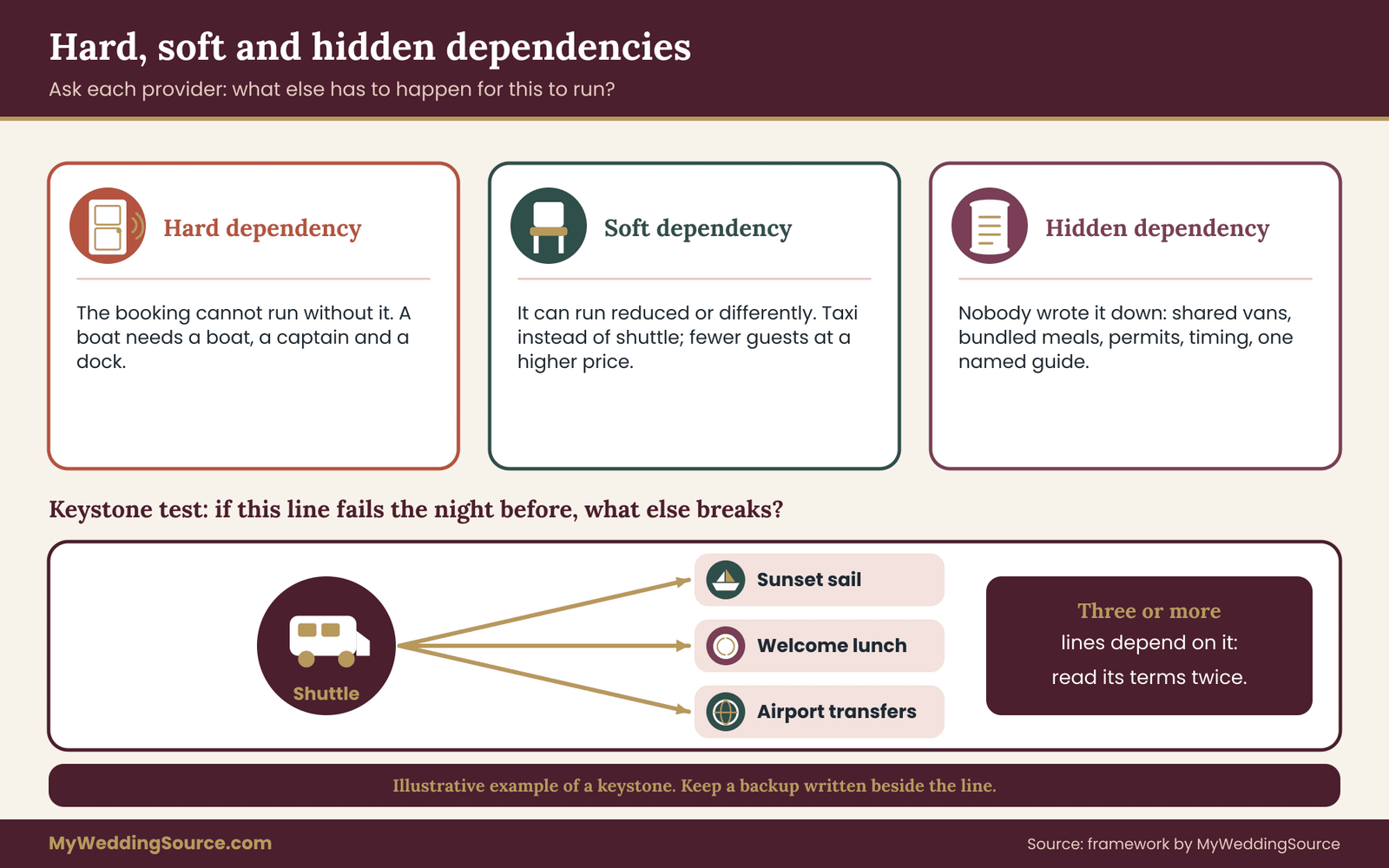
Hard dependencies. The booking cannot run without the other element. A boat excursion needs the boat, the captain and a departure dock. A private guide for a hike needs the trailhead to be open and the permit to be valid. If a hard dependency fails, the excursion is cancelled, and the cancellation is the provider’s or an outside party’s, not the guest’s. Your tracker should mark hard dependencies in a way you will notice, such as a bold “HARD” at the start of the line.
Soft dependencies. The booking can run in a reduced or different form without the other element. A vineyard lunch might depend on a shuttle, but guests could arrive by taxi at some cost. A cooking class might depend on a minimum of eight guests, but could run with six at a higher per-person price. Soft dependencies are negotiable, and they are where creative solutions live. Record the fallback beside each one.
Hidden dependencies. The ones nobody wrote down. They tend to hide in five places.
The first is shared transport. One van contract can serve several events, and if you cancel one trip the operator may reprice the rest. The second is bundled meals: a resort that includes lunch in an excursion price may not refund the meal if the excursion is cancelled late.
The third is permits and access: parks, private beaches and historic sites may require advance permits tied to group size or to a named organizer. The fourth is timing: an excursion scheduled in the gap between ceremony and reception depends on the ceremony’s start time, and a delay in one pushes the other. The fifth is people: a single bilingual guide, a named photographer joining the group or a family member acting as host.
Finding hidden dependencies takes a short conversation with each provider. Ask: “What else has to happen for this to run?” The answers are often surprisingly specific and rarely appear in the written terms.
A simple test for dependency risk
Pick any line in the tracker and imagine it fails the night before. Then count what else breaks. If nothing else breaks, it is an independent line, and its refund can be handled alone. If one other line breaks, it is a pair, and the two should be handled together. If three or more lines break, you have found a keystone, and the keystone gets the earliest attention and the most careful terms.
Keystones are usually transport, a venue space or a single guide. Their terms are worth reading twice. Ask whether the keystone provider can cancel individual legs without repricing the rest, whether a substitute vehicle or guide is promised in writing if the first is unavailable, and what the provider owes if it fails at the last minute.
If the answers are weak, consider splitting the dependency: book two smaller vehicles from different companies instead of one large one, so a single failure does not take everything with it. That costs something in convenience and sometimes in price; decide based on how many guests rely on the keystone.
Marking dependencies visually
When you look at the tracker as a long document, dependencies hide. A simple fix is to give every provider a short code, such as A for the sail, B for the shuttle, C for the cooking class, and write the codes in field seven. Then a quick scan shows that B appears in the dependency lines for A, C and the welcome dinner, which tells you immediately that B is a keystone.
Some couples draw the tracker as a small map with arrows from each booking to the things it needs. Either form works. The point is to be able to answer, in under a minute, “If this provider disappears, what else do we lose?” If you cannot answer it quickly, the tracker is not yet doing its job.
A tracker that shows dependencies at a glance makes every later excursion refund decision faster, because you already know which line to protect first.
Reading provider terms for the clauses that decide an excursion refund
Provider terms are short, but a handful of clauses carry nearly all the weight. Read the terms with a highlighter and look for these eight, in roughly this order of importance. Where a clause is missing, that is information too.
The cancellation schedule. Usually a ladder: full excursion refund until a date, partial refund until a later date, nothing after that. Note the exact boundary, the time zone, and whether the ladder counts from the booking, from payment or from the start time. A schedule that counts “days” without saying whether weekends or local holidays count leaves room for argument, so ask.
The deposit rule. Some operators keep the deposit under all circumstances and refund only the balance. Others treat the deposit like any other payment. If a deposit is called non-excursion refundable, ask whether it can be applied to a future date or to a different guest. Credit toward another booking is a common middle ground.
The provider-cancellation clause. What does the provider owe if it cancels? The usual options are a full excursion refund, a credit, a rescheduled date or a combination chosen by the provider. Note who chooses. If the provider chooses, and you would prefer cash, say so in writing as soon as you are notified. Do not assume your preference will be followed.
The weather clause. Many terms give the operator sole discretion to cancel for weather, safety or sea conditions. Some refund fully; some offer only a reschedule; some treat borderline conditions as the customer’s problem if the operator still sails. Also note who decides and by when. A decision made two hours before departure is different from one made the evening before, because guests may already have prepaid transport or skipped other plans.
The minimum-headcount rule. The number of guests needed for the trip to run, the date by which the minimum must be met, and what happens if it is not met. Ask whether the operator will cancel, raise the price or run with fewer guests. An operator that holds the right to cancel below the minimum but does not say when it will decide is a risk you should price in.
The no-show and late-arrival rule. A guest who misses departure usually forfeits everything. A guest who arrives late may be refused boarding. These rules matter on wedding weekends, because the schedule is crowded and delays are common. If the terms treat a no-show as a full forfeiture, plan your group communications around it.
The change and transfer rule. Can a booking be moved to another date, and can the name be changed? A name change often makes the difference between losing a spot and giving it to someone else. Operators vary widely; some allow free swaps until the day before, some charge a fee, some forbid them.
The excursion refund method and timing. How the refund is paid, in what currency, and how long it takes. Some providers return funds to the original card within a stated number of business days. Others issue a bank transfer, a credit note or a voucher. A refund in a foreign currency may differ from what you paid because of exchange rate movement, so ask in which currency the original charge was made.
Questions to put in writing
Where the terms are vague, send a short email with specific questions. Short messages get answered. A useful set is: “If we cancel on date X, what is refunded? If you cancel for weather, what do we receive and who chooses? What is the minimum headcount and when do you decide? Can the booking move to date Y at no charge before date Z? Can names be changed, and until when?” Five questions, five answers, kept on file.
Ask for the answer in the same thread as the booking confirmation so everything sits in one place. If the provider replies by phone or message, write a one-line summary and send it back: “Confirming what we discussed: a one-time reschedule is free until the fourteenth.” If the provider does not correct you, you have a record that is worth more than a memory.
Do not argue about the terms before something goes wrong. Your goal at booking time is to learn what they say and to decide whether you can live with them, not to renegotiate. If a clause is too risky, the fix is to adjust your plan, reduce your commitment or choose a different provider, not to hope for flexibility later. The vendor due diligence checklist lists checks to run before paying any deposit, and the same discipline applies to a small excursion operator.
Quoting terms accurately
When you write to guests about excursion refund rules, repeat the provider’s terms accurately and do not improve on them. If the operator refunds fully until seventy-two hours before departure, tell guests exactly that, with the cutoff written in their local time. Do not round it to “three days” or “the weekend before.” Rounding is how a friendly summary turns into a broken promise.
Where the terms are the operator’s and not yours, say so: “The operator’s rule is X; ours is Y.” If your group rule differs, because you are covering a fee or setting an earlier internal deadline, state both. Guests can then see that the couple is acting in good faith and what, if anything, they may lose.
Who pays whom: payment routes and excursion refund routing
Once you know the terms, the next question is how the money moves. Refunds follow the payment path backwards, so understanding the path in advance tells you where the excursion refund will come from and what might block it. There are five common paths on an excursion booking.
Guest pays operator directly. The simplest. The guest holds the booking and the terms, and the guest receives the excursion refund. The couple’s role is to share the rules and, if useful, a link. This route has the cleanest excursion refund outcome and the least work for you, but you also have the least visibility into who has booked.
Couple pays operator and collects from guests. The couple is the customer, the merchant sees only the couple, and the guests have paid the couple through an app, a transfer or cash. If the operator refunds, it refunds the couple, and the couple must pass the money on. Any fee the app charged on the way in is usually not returned, and the couple must decide whether to absorb it. Keep a list of who paid how much and when, because excursion refunds need to match.
Couple pays operator and covers guests as a gift. The couple is the only payer. Refunds return to the couple, and the question is whether guests ever see money, which is only relevant if a guest paid a portion. Keep this simple: if guests did not pay, there is nothing to refund to them, only a loss or a credit to the couple.
A third party collects. A resort concierge, a destination management company, a travel agent or a booking platform takes payment and pays the operator. The excursion refund then has two steps: the operator refunds the third party, which refunds you. The third party’s own terms apply to its step, often including a service fee, a processing delay or a shorter cutoff than the operator’s. Always ask the third party which terms govern and who is responsible if the operator fails.
A group deposit or pooled fund. A coordinator or a group account collects a lump sum for several excursions. This is the hardest to unwind, because excursion refunds are per booking but money is pooled. If you use this route, keep a ledger that shows each guest’s share and which bookings it was applied to.

Refund paths and their typical friction
Each path has predictable weak points, and knowing them lets you set expectations about every excursion refund that follows.
With direct guest payment, the weak point is visibility. If a guest cancels with the operator without telling you, the group headcount changes without your knowledge, and a minimum may be missed. Ask guests to tell you when they cancel, and ask the operator to share headcounts at agreed dates.
With couple-collects, the weak point is the gap between the operator’s refund and what guests expect. A guest who paid by an app expects the same amount back. If the app kept a fee, or if the operator kept a cancellation charge, the amounts differ. Decide before collecting whether the couple covers fees, and tell guests.
With third-party collection, the weak point is the extra layer. Delays are common, terms may conflict, and the third party may say it has refunded while the operator says it never received the funds. Ask for the excursion refund to be confirmed in writing by both parties.
With a pooled fund, the weak point is the ledger. If the ledger is incomplete, an excursion refund can go to the wrong person or be impossible to calculate. Close the ledger after each payment and reconcile it before and after any change.
Cards, transfers and cash
The method of payment affects what recourse you have. Card payments generally leave a record and, in the United States, come with dispute rights set by federal and card-network rules; the Consumer Financial Protection Bureau and the Federal Trade Commission publish plain-language guidance on how disputes and refunds work. Disputes are a last step, not a first one, and they require that you first tried to resolve the problem with the merchant. Bank transfers and cash payments leave less recourse, so use them only where the amount is small and the provider is known.
Foreign payments add currency conversion and sometimes extra fees. If the excursion is abroad and billed in a foreign currency, an excursion refund may come back as a different amount than you paid, because the exchange rate has moved and some card issuers charge conversion fees that are not returned. Record the original currency and the amount charged in field three, so you can explain a difference in any excursion refund.
For larger sums, consider whether to pay the deposit through the couple’s card even when a guest will reimburse you. A card on your name makes it easier to recover a deposit when a provider fails, though you then carry the float until guests pay. The wedding cash-flow planning guide explains how to schedule deposits and reserves so that carrying a float does not strain the budget.
Who holds credits
A credit or voucher is a promise to provide future service, and it has its own life. Check who holds it, whether it can be transferred, when it expires and whether the provider can refuse it if the service is not available. A credit that expires before anyone can use it is often a loss in disguise, so decide quickly whether to accept a credit or insist on cash if the terms allow a choice.
If guests paid and the provider issues a credit to the couple, you have a choice: keep the credit, or reimburse the guests and keep the credit as your own. The fair approach is usually to reimburse guests in cash and treat the credit as the couple’s, unless the group rule said otherwise. Whichever you choose, tell guests what happened and when.
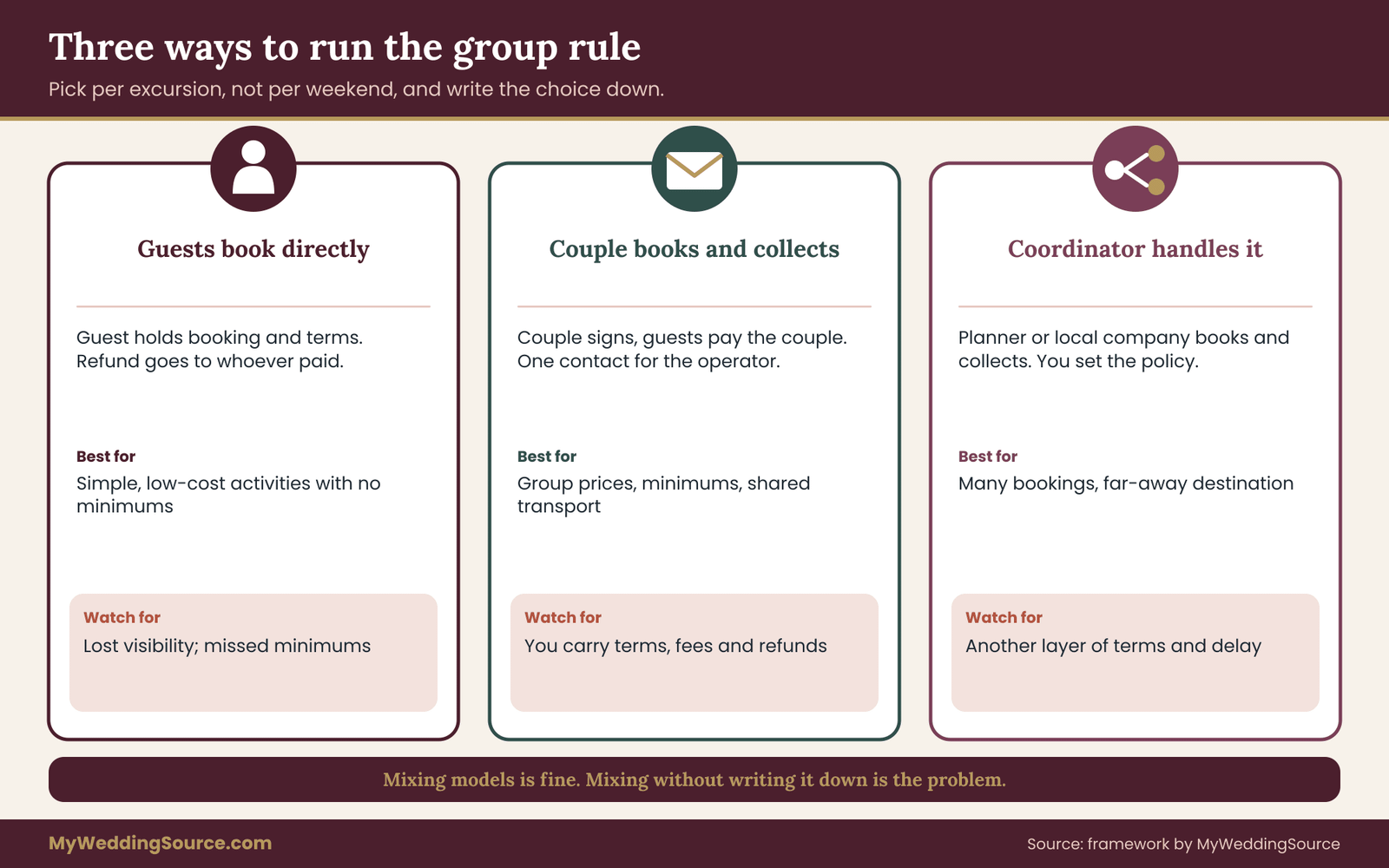
Three ways to run the group rule, compared
Layer three of the policy, your own group rule, can take several shapes. Three models cover most weddings, and each trades control against workload and goodwill. None is right for everyone, so the comparison is about fit.
Model one: guests book and pay directly. Each guest books with the operator and holds the terms. You publish a list of recommended excursions with the cutoff dates and the operator’s excursion refund terms, and you stay out of the money. The advantages are obvious: you hold no deposits, you do not chase reimbursements, and a refund goes to whoever paid.
The costs are less obvious. You lose visibility, so minimums can be missed without warning. You also lose leverage, because operators serve individual customers and have little reason to treat the group as a unit. Group discounts disappear, and a keystone provider such as shared transport becomes hard to coordinate.
This model suits two situations: low-stakes excursions with no minimums, and weddings where guests are comfortable booking for themselves. The excursion refund rule is then short: “Each excursion is booked and paid for directly; excursion refunds follow the provider’s terms.”
Model two: the couple books and collects. You sign with the operator, guests pay you, and you carry the relationship. This is the most common arrangement for group excursions, because it lets you negotiate a group price, set a minimum and give the operator a single contact. It also makes you responsible for everything the guest would have handled: terms, deadlines, excursion refunds and fees. If the operator cancels or a guest drops out, the couple is the party in the middle.
The model needs a clear written rule about what happens to non-excursion refundable portions, and it needs careful records. It suits excursions that need a headcount commitment, where the savings or the access depend on booking as a group. If you choose it, set an internal sign-up deadline well before the provider’s cutoff, so you have room to adjust.
Model three: a coordinator or destination company handles it. A planner, a destination management company or a resort concierge books and collects, and you set the policy. This reduces your workload and often gives you someone local who knows how operators behave. The cost is another layer: the coordinator’s own terms, fees and delays sit between guests and the operator. A coordinator may also hold the money for a period and apply their own cancellation schedule.
If you use a coordinator, read their terms as carefully as an operator’s. Ask what they refund if an operator cancels, what they keep if you cancel, how long excursion refunds take and whether guest payments are held separately from their own funds. A coordinator with clear answers is an asset. One who is vague about refunds is a risk you can see early.
Choosing by three questions
A fast way to choose is to ask three questions about each excursion, not about the weekend as a whole.
First, does the excursion need a minimum headcount or a group price to exist? If yes, model one will probably fail, because nobody will be committed. Models two or three fit better.
Second, how much money is at stake per person, and who is comfortable carrying it? A low-cost walking tour does not justify the complexity of couple-collected payments. A private charter at a meaningful per-person price might. If you cannot carry a deposit comfortably, avoid model two for that booking, however convenient it seems.
Third, how many other bookings depend on it? A keystone such as shared transport should be booked by someone who can negotiate its terms and handle a failure, which usually means the couple or a coordinator, not individual guests.
You can mix models. A weekend might have guests booking a free-time activity directly, the couple collecting for a group dinner cruise and a coordinator managing the transport. The tracker handles this easily, because field three records the payer and route for each line. The problem is not mixing; it is mixing without writing it down.
Writing the group rule in plain words
Whatever model you pick, the guest-facing rule should fit in a short paragraph. A useful structure covers five points. Who books and who pays. The cutoff dates for guests, stated before the operator’s cutoffs. What happens if a guest cancels before and after those dates. What happens if the operator cancels or the weather closes the activity. And who absorbs any non-refundable amount.
An example in plain words: “We are collecting payment for the sunset sail. Please confirm by the fifteenth of the month; the operator refunds in full until the first of the following month, and we will refund you in full if you cancel before the fifteenth. After that, refunds depend on whether we can fill your place. If the operator cancels or the weather closes the trip, you will receive a full excursion refund. If you cancel late and the operator keeps the fee, that cost is yours.”
That paragraph names the dates, the triggers and the loss rule, and it is written so a guest can act on it without asking.
Avoid vague generosity. “Don’t worry, we’ll sort it out” is kind and costly. It makes no promise you can keep, and it leaves the couple absorbing losses no one agreed to. A clear excursion refund rule is kinder in practice, because it lets guests make informed choices.
A worked example: a four-excursion weekend when the date moves
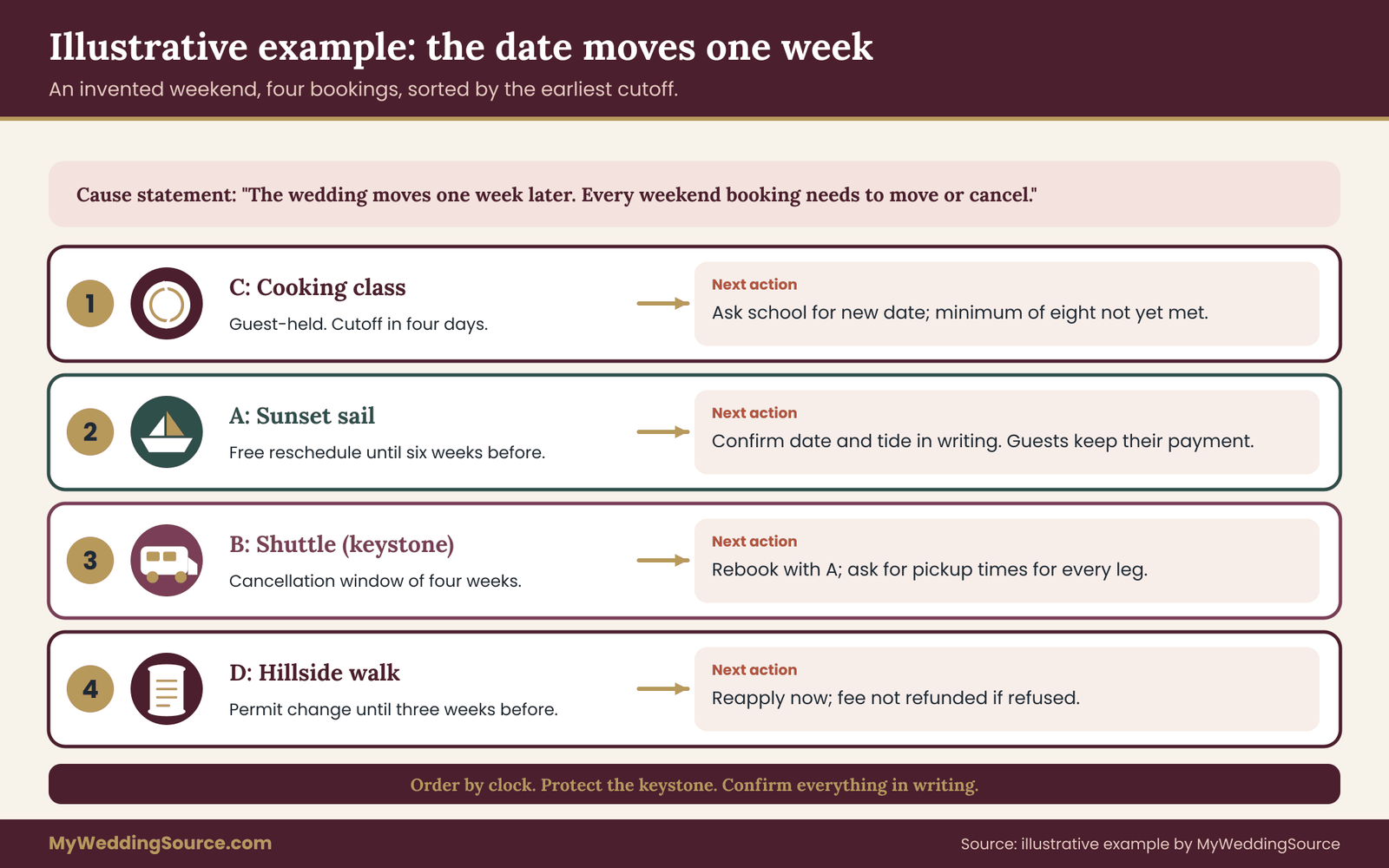
This is an invented example, built to show how the tracker is used. The names and amounts are illustrative, not drawn from a real event, and real terms will differ.
Marisol and Theo are planning a three-day coastal wedding weekend for about forty guests. Ten weeks before the event, their venue tells them the terrace will be closed for repairs on their date, and the couple decides to move the wedding to the following weekend. They have four excursions in the tracker.
Line A is a sunset sail on a small catamaran, booked by the couple with a deposit, with guests paying them by app. Line B is a shuttle company that serves the welcome lunch, the sail and the airport. Line C is a cooking class with a minimum of eight guests, booked directly by guests with the school. Line D is a private hillside walk with a local guide, booked by the couple, requiring a permit for groups over ten.
Step one: write the cause statement. “The wedding is moving one week later, from the fourteenth to the twenty-first. All weekend bookings need to move or cancel.” This is a customer-initiated change, so each operator’s customer-excursion cancellation terms apply.
Step two: sort by clock. Marisol reads the cutoff field for each line. The cooking class has a cutoff in four days, because the school’s schedule is tight. The permit for the walk can be changed until three weeks before. The sail has a free one-time reschedule until six weeks before. The shuttle’s cancellation window is the longest, at four weeks. So the order by clock is C, then A, then B, then D, with a note that B is the keystone and must be decided together with A before either is finalized.
Step three: check dependencies. Line B supports A and the airport transfers, so cancelling the shuttle for the old date and rebooking for the new date must happen together. Line D depends on the permit and on a guide who may not be free on the new weekend. Line A depends on B for guest transport and on tide and daylight, which are different on the new date. Line C depends on eight guests, and only five have signed up.
Step four: act in order. Because Line C is booked directly by guests, the couple cannot move it. They write to the guests who signed up and to the school, asking whether the school can offer the new date. The school replies that it can, if at least eight attend. With five signed up, the couple decides to open sign-ups to others and, if the minimum is still not met by the school’s decision date, to let guests cancel under the school’s terms, which refund in full before the cutoff.
Line A: the operator allows a free one-time reschedule, and the new date has space. The couple confirms in writing and notes that guest payments do not need to be refunded, since the booking moved. They tell guests the new date and ask them to confirm by the original cutoff.
Line B: the shuttle can rebook the new date. The couple confirms and asks the company to confirm the pickup times for each leg in writing.
Line D: the guide is free, but the permit must be reapplied for. The guide says the application takes two weeks. The couple files immediately and records the fee as non-refundable if the permit is refused.
What the example shows
Nothing in the example required a dispute or a clever argument. It required reading the clocks in the right order, noticing that one line was a keystone, and being clear about who held each booking. The couple could not move Line C themselves, so they recorded it as “guest-held; communicate and support,” and avoided the mistake of promising an excursion refund they did not control.
The example also shows why the tracker records the form of the refund. The reschedule on Line A kept the money with the operator, which was cheaper and simpler than an excursion refund followed by a rebooking. But it only worked because the couple confirmed availability and the new terms in writing first. Had the operator been full, they would have moved to the cancellation schedule, and the amount recovered would have depended on the cutoff.
Finally, it shows that the tracker does its work in advance, long before any excursion refund is requested. Marisol did not discover on the day of the change that Line B was a keystone. She had marked it as one months earlier, so the decision to confirm it first, and in writing, was already made.
What to say: scripts for providers and guests
Clear messages shorten every excursion refund conversation. The scripts below are templates in plain words. Adapt them to your own tone, and fill in the specifics from your tracker. Each one states the cause, the request and the next step, because those three things are what a busy operator needs.
To a provider when the wedding date changes
“Hello, we have a booking for [service] on [date], reference [number], under [name]. Our wedding has moved by one week, so we need to change that booking. Could you tell us whether you can move it to [new date] at no charge under your terms, and if not, what you would refund if we cancel today? We would like to decide by [date]. Thank you for your help.”
This works because it gives the reference, states the cause in one sentence, asks a specific question and sets a decision date without pressure. Notice that it asks about both options. If the operator can reschedule, you learn it. If it cannot, you learn what cancellation costs, and you have a record dated before the cutoff.
To a provider when you suspect the provider may cancel
“We are planning around your [service] on [date]. The weather forecast shows a risk of closures. Could you tell us when you decide whether to run, how you will notify us, and what the excursion refund or rebooking options are if you cancel? We would like to tell our guests in advance.”
This is a request for process, not an accusation. It surfaces the weather decision time and the notification route, and it prepares you to tell guests what to expect. Operators generally prefer this question to a panicked call at departure time.
To a provider when a guest cancels
“One of our guests, [name], is no longer able to join the [service] on [date]. Under your terms, could you tell us whether they can transfer the booking to another guest, move it to another date or receive an excursion refund, and what the deadline is?”
Name changes are often free well before the date, and a transfer is better for everyone than a refund. Offer it first, and consider asking whether the guest can propose a replacement.
To guests when an excursion is cancelled by the provider
“The [service] on [date] has been cancelled by the operator because of [reason]. The operator will refund the amount paid to the original payment method, normally within [period] according to its terms. If you paid us by [app], we will send your excursion refund to you as soon as we receive it, and we will confirm once it is done. We are checking whether the activity can be moved to another time and will update you by [date].”
Keep the reason brief and factual, and avoid blaming the operator. Name the excursion refund route and the timing. If you do not know the timing yet, say what you will do to find out and when you will write again.
To guests when the couple changes the plan
“We have changed [what], so the [service] is moving from [date] to [new date]. If the new date works for you, you do not need to do anything; your booking will move with it. If it does not work, please tell us by [date], and we will cancel your place and refund you according to [the rule]. Thank you for being flexible.”
Be explicit about the choice and the date. Guests should never have to guess whether silence means yes or no. A cut-off date on the response solves this.
To a third party, such as a concierge or booking platform
“Our guests’ payments for [service] on [date] went through your service under reference [number]. We need to understand how an excursion refund works if the operator cancels or if we cancel. Please confirm in writing: whose terms apply, what fees are kept, how long a refund takes and how it will be returned. Thank you.”
Third parties often answer with generalities. Ask for the answer in writing, and ask which terms govern if the operator’s and the third party’s differ. A clear answer protects you; a vague one tells you to hold the money back from the next booking.
Tone and timing
Write messages as if you are talking to a person who has a full inbox and no obligation to be generous. That means short, specific, polite and early. An email sent weeks before a cutoff gets different treatment from one sent the afternoon before. When you ask a provider for help in a hard situation, thank them in advance and mean it; small operators remember that.
Keep copies of every message in the same place as the tracker. If an excursion refund is later disputed, the dates and the wording will matter more than anyone’s memory. If you speak to someone by phone, send a short email afterward summarizing what was agreed.
Edge cases that break simple excursion refund rules
Most excursions follow the common patterns. These do not, and each one can change an excursion refund outcome, so they are worth thinking through while there is no pressure.
Weather that is borderline. The operator says conditions are fine; a guest feels unsafe. Terms often leave the operator in charge of the decision, and a guest who stays home usually receives no refund. Decide your group rule in advance: some couples say a guest who chooses not to go in conditions the operator considers safe forfeits the fee, while others let the couple cover it as a courtesy. Whichever you choose, write it down and apply it the same way to everyone.
A guest who becomes ill. Illness is the most common reason for a late cancellation and the one most terms treat as a normal cancellation. Travel insurance may respond, but only under the policy’s own conditions, and the state insurance regulators, through the National Association of Insurance Commissioners, publish consumer information on how travel insurance works. If you want a policy, read it before you buy it, not after. Your group rule should say whether the couple will try to find a replacement for an ill guest, since that is often the cheapest fix.
Mobility, age and children. An excursion that looks simple can be unsuitable for an older guest or a family with a baby. If a guest discovers this after booking, the operator may not treat it as a reason to excursion refund. When you share the excursion details, include the physical demands and the age rules, so guests choose with full information. The guide on guest hotels across budgets and mobility needs covers similar planning for lodging, and the same mindset applies here.
A guest with a flight problem. If a guest’s flight is cancelled or delayed, they may miss an excursion through no fault of their own. Airline refund rights are set by the U.S. Department of Transportation for flights to and from the United States, and the rules for other countries differ. The excursion operator’s terms are separate, so a missed flight does not automatically unlock an excursion refund. Ask the operator in advance whether a documented flight disruption changes the no-show rule.
Permits and closures. Parks, protected areas and historic sites may change access rules at short notice. If an excursion depends on a permit, record the issuing authority, the validity dates and the group size covered. A cancelled permit is a hard dependency failure, and the operator may or may not refund. Ask what the operator will do if a permit is revoked.
Travel warnings and health notices. The State Department publishes travel advisories and the Centers for Disease Control and Prevention publishes travel health notices. A change in one of them can affect flights and insurance. It does not automatically oblige an operator to refund. Read the operator’s terms on force majeure and government restrictions, and keep a screenshot of the advisory with its date if you plan to rely on it.
Currency and fees. A guest pays you in dollars for a booking in euros. The operator refunds in euros, and the exchange rate has moved. Decide whether the couple covers the difference or the guest receives the excursion refunded amount at the new rate. A short sentence in the group rule saves a confusing exchange later.
No-shows and late arrivals. Weddings run late, and guests are tired. A late arrival to an excursion may be refused boarding, and the guest loses the fee. Build a margin into the schedule and share the departure time as a firm time, not a rough one.
Shared deposits that cannot be split. A single deposit may cover a group booking where each guest’s share is not tracked by the operator. If one guest cancels, the operator may refuse a partial excursion refund. If you see this in the terms, ask whether a headcount reduction is allowed up to a date and how the deposit changes.
When a refund is not possible
Sometimes the answer is that the money is gone: the deposit is non-refundable, the cutoff passed, the cause is not covered. At that point, the useful questions are different. Can the booking be used by someone else? Can it be converted to a credit, even a partial one? Can the operator offer a different service of equal value? Operators with empty seats often prefer a credit to a loss.
If none of those work, decide who absorbs the loss, using the rule you wrote in advance. If you did not write one, decide now and be fair; a couple absorbing a loss for a guest who cancelled for a good reason is generous, but it sets a precedent. Write down what you did and why, so the next case is consistent.
When to escalate
Escalation is for cases where a provider has not honored its own terms. The order is: ask politely in writing, cite the specific clause, set a reasonable date, and then, if there is no response, consider a card dispute or a complaint to the relevant consumer agency. The Federal Trade Commission and the Consumer Financial Protection Bureau both explain how to report a problem and how disputes work. A card dispute for a billing error generally needs to be raised in writing within a limited period of the statement date, so do not wait.
Escalation should rarely be necessary. Most excursion operators are small, depend on reputation and will honor reasonable requests that follow their terms. The aim of the tracker is to make sure that when you ask, you can point to a clause and a date.
Put differently, a calm excursion refund request with a clause, a date and a reference number is the version of escalation that works most often.
Measurable checks before you commit to any excursion
A tracker is only useful if you can tell whether it is complete and whether your exposure is acceptable. These checks use numbers you can count yourself. They are not industry benchmarks; they are tests of your own plan, and you can set the thresholds that suit your budget and your guests.
Completeness check. Every provider block has all eight fields filled, with “silent” written where the terms say nothing. Count the blocks with at least one blank field. The target is zero before the first deposit is paid.
Source check. Every cutoff and excursion refund rule in the tracker is traceable to a written document or an email reply. Count the lines that rest only on a phone call or a memory. Anything that cannot be traced should be confirmed in writing before the guest-facing rule is published.
Buffer check. Your internal deadline for guests is earlier than the provider’s cutoff, by enough days to act. For excursions with a minimum headcount or a permit, a longer buffer makes sense, because you need time to try alternatives. Write the buffer next to each cutoff and look for lines where the two dates are the same. Those are lines where a late reply from one guest becomes a loss.
Exposure check. Add up the amounts that would be lost if you cancelled every excursion today. Write the total as “money at risk now.” Then add up what you would lose if you cancelled everything one week before travel. The difference between the two shows how much a change costs you as the date approaches. Compare the total to the amount the couple has decided it can absorb. If it is higher, change something: pay less in deposits, choose operators with gentler terms, shift to guest-booked excursions or use a smaller commitment.
Keystone check. Count how many lines depend on each provider. Any provider supporting three or more lines needs a second look at its terms and, where possible, a backup option. Write the backup beside the line, even if it is only “taxi companies near the harbor.”
Guest-rule check. Read the guest-facing rule as if you were a guest who has never seen the operator’s terms. Can you tell who to pay, by when, what happens if you cancel and what happens if the operator cancels? If any answer is unclear, the rule is not finished.
Thirty-second drill. Pick any line at random and answer five questions without looking at anything but the tracker: who holds the money, what is the next cutoff, what triggers an excursion refund, what form does the refund take, and what depends on this line? If you cannot answer in half a minute, the line is not usable under pressure, and the fields need clearer wording.
Pricing the risk instead of ignoring it
Many couples treat non-refundable deposits as a fixed cost of doing business. That is reasonable if the amount is small and you have chosen it knowingly. The measurable checks help you see when it is not small. A deposit of a few hundred dollars on one excursion may be fine; the same terms across six excursions, a shuttle and a permit add up.
When you compare two operators for the same activity, include the excursion cancellation terms in the comparison, not just the price. An operator charging a little more but offering a one-time free reschedule and a clear weather excursion refund may cost less in expectation than a cheaper one with a firm non-refundable deposit. You do not need a probability for this. You only need to ask whether you would be comfortable if the worst realistic event happened, and choose the terms that keep that outcome acceptable.
Your main contracts deserve the same reading. The clauses in the wedding vendor contract guide for deposits and cancellation apply to the venue, caterer and planner, and a change to the wedding can trigger them at the same time as the excursions. Review both sets together when a major change happens, rather than handling excursions in isolation.
Set the same review habit for every excursion refund promise you make to guests, so the rule you published matches what the contracts allow.
Closing out: records, reconciliation and what to keep
After the weekend, or after a cancelled excursion, close each line properly. Closing is short, and it protects you from surprises on a statement months later.
Confirm that each refund promised has been received, with the date and amount. Match it against the payment it reverses. If an excursion refund is partial, record the reason in the provider’s words. Confirm that any credit has been used, transferred or recorded with its expiry date. Settle with guests: confirm the amount each paid, what each received back, and whether anything remains. Send a brief note to any guest who is still waiting, with the date you expect to resolve it.
Then update the tracker: mark each line closed, note any term that surprised you, and keep the final version with your other records. The purchase order checklist shows a similar discipline for documenting what each vendor was ordered to deliver, and it pairs well with a closing review. If any item remains open, such as a pending refund, set a dated reminder to follow up, and keep the correspondence with it.
Finally, spend ten minutes writing down what you would change next time: a clause you wish you had asked about, a provider whose terms were clearer than others, a point where the guest rule was unclear. Wedding weekends rarely repeat, but the habits carry into other group trips, family reunions and anniversaries.
Your next steps
Start with the smallest version of the work, and build from there.
- List every excursion, transfer, meal and permit connected to the wedding weekend, one line each.
- For each line, find the receipt and write down the merchant of record, the payer and the payment route.
- Read the written terms for each provider and record the cutoff, the triggers and the excursion refund form. Write “silent” where the terms say nothing.
- Send one short email to any provider whose weather, minimum or change rule is unclear, and file the reply.
- Fill in the dependency field and mark any keystone providers.
- Choose a model for each excursion: guests book, the couple collects, or a coordinator handles it.
- Write the guest-facing rule in a short paragraph and share it before anyone pays.
- Run the measurable checks, and adjust deposits or providers until the exposure is acceptable.
- Set three review dates: final guest list, final payments and one week before travel.
FAQ
What should a wedding excursion refund policy include?
It should cover three layers: the provider’s written terms, the payment route the money took, and your own rule for guests. State who books and pays, the guest cutoff dates, what happens if a guest cancels, what happens if the provider cancels or weather closes the trip, and who absorbs any non-excursion refundable amount. Write it in plain words and share it before anyone pays.
Who is responsible for an excursion refund if guests paid the couple?
Usually the couple, because the couple is the customer in the provider’s records and the only party the provider will refund. Guests who paid you by app or transfer look to you, not the operator. That is why the tracker records the payer and payment route for each line, and why a written group rule should say how and when you pass excursion refunds along.
Can I get an excursion refund if the weather cancels the trip?
It depends on the provider’s weather clause, which often leaves the decision to the operator. Many operators offer an excursion refund, a credit or a reschedule when they cancel for weather, but the choice may be theirs. Ask in advance when they decide and what you would receive, and ask for the answer in writing so it applies to the whole group.
What if one guest cancels and the booking is priced per group?
A per-group price may not fall when one guest drops out, so a single cancellation may not reduce the bill at all. Check whether the operator allows a headcount reduction before a set date, a name swap or a replacement guest. Your guest rule should say whether late cancellations are covered by the couple, the guest or the group.
How do I handle a non-refundable deposit when the wedding date moves?
Ask the provider first whether the deposit can transfer to the new date, another guest or a credit. Many operators prefer that to keeping money for a service not delivered. If nothing works, decide who absorbs the loss using the rule you wrote in advance, record the decision and tell guests what happened and why.
Does travel insurance cover excursion cancellations?
Sometimes, but only under the policy’s own wording, covered reasons and deadlines. Illness, travel disruption and weather are treated differently across policies, and many exclude changing your mind or a date change by the couple. Read the policy before buying, and check consumer guidance from your state insurance regulator. Insurance does not replace the provider’s terms; it sits beside them.
Should the couple or the guests book the excursions?
It depends on the excursion. Guest-booked activities keep your workload low and suit simple, low-cost options with no minimums. Couple-booked activities suit anything needing a group price, a headcount minimum or shared transport, but they put the excursion refund responsibility on you. A mix is fine, provided the tracker records who holds each booking.
When should I use a card dispute for an excursion refund?
Only after you have asked the provider in writing, cited the specific clause and given a reasonable date for a reply. Card disputes generally have time limits measured from the statement date, so do not wait too long. The Consumer Financial Protection Bureau and the Federal Trade Commission explain the current process and your options.
Sources
- U.S. Department of State, Bureau of Consular Affairs, travel advisories and international travel information: travel.state.gov
- Consumer Financial Protection Bureau, consumer guidance on credit card billing disputes and refunds: consumerfinance.gov
- Federal Trade Commission, consumer advice on travel, refunds and reporting problems: consumer.ftc.gov
- Federal Trade Commission, main site: ftc.gov
- U.S. Department of Transportation, Aviation Consumer Protection, airline refund rights: transportation.gov
- Centers for Disease Control and Prevention, Travelers’ Health notices: cdc.gov/travel
- National Association of Insurance Commissioners, consumer information on travel insurance: naic.org
- National Weather Service, forecasts and marine weather information: weather.gov
- USAGov, consumer protection and how to file a complaint: usa.gov