

Second wedding planning is the same event with a different set of questions: which legal steps your earlier marriage changes, which family members need a conversation before they need a role, and which traditions you want to repeat, skip or rewrite. This guide gives you a three-lane decision workbook that keeps those questions apart so none of them quietly decides the others.
Split second wedding planning into three lanes: legal choices (documents, waiting periods, names, money, benefits), family choices (children, parents, former partners, who stands where) and celebration choices (ceremony format, scale, invitations, gifts). Settle the legal lane first because it has hard deadlines, talk to each person in the family lane before you assign anything, and let the celebration lane be as large or small as the first two allow. Write every decision on a five-field card so you can see its owner, its default, and the point where it fails.
Second wedding planning, whether it is your second marriage, your third, or the first for one partner and the second for the other, rarely feels like doing the first one again. You probably know what a deposit is and how a seating chart works. What you do not have is a script. Most wedding advice assumes two people who have never been married, two sets of parents who have never hosted this event, and guests who have never been asked to celebrate a marriage for this particular person before.
Second wedding planning breaks those assumptions in small ways, and the small ways add up. A document you never needed the first time is now required. A child has opinions about walking down an aisle. A parent who gave a large wedding years ago does not know whether to offer again. A guest list has to decide what to do with people who attended an earlier wedding and people connected to an earlier marriage. None of this is a crisis. It is a set of decisions that deserve to be made on purpose rather than by default.
This second wedding planning guide is organized so you can work through it in order or jump to the lane you are stuck in. It stays with the choices unique to this situation, and it points to other guides on this site for the parts that are the same as any wedding, such as the twelve-month wedding checklist and the broader wedding budget planning.
A note on scope. This is general information, not legal, tax or financial advice. Marriage rules, benefit rules and tax treatment differ by state, by country and by personal circumstances, and they change, so confirm anything that affects you with the issuing office or a qualified professional.
What second wedding planning is, and what it is not
The phrase covers more ground than it first seems to. Some people come to second wedding planning after a divorce. Some are planning after the death of a spouse. For some, one partner is marrying for the first time and the other is not. Some have children from earlier relationships, some have adult children, some have none, and some have a household that is already fully furnished and funded.
Second wedding planning is not one situation. It is a family of situations that share three features: a prior marriage exists in someone’s history, the people around the couple have prior expectations, and the couple usually has less patience for a ceremony built on someone else’s template.
It is worth saying what second wedding planning is not. It is not a smaller version of a first wedding. Some second weddings are larger than the first ones were, and some are far smaller, and neither choice needs defending. Second wedding planning is not preparation for a lesser event that needs an apology in the invitation.
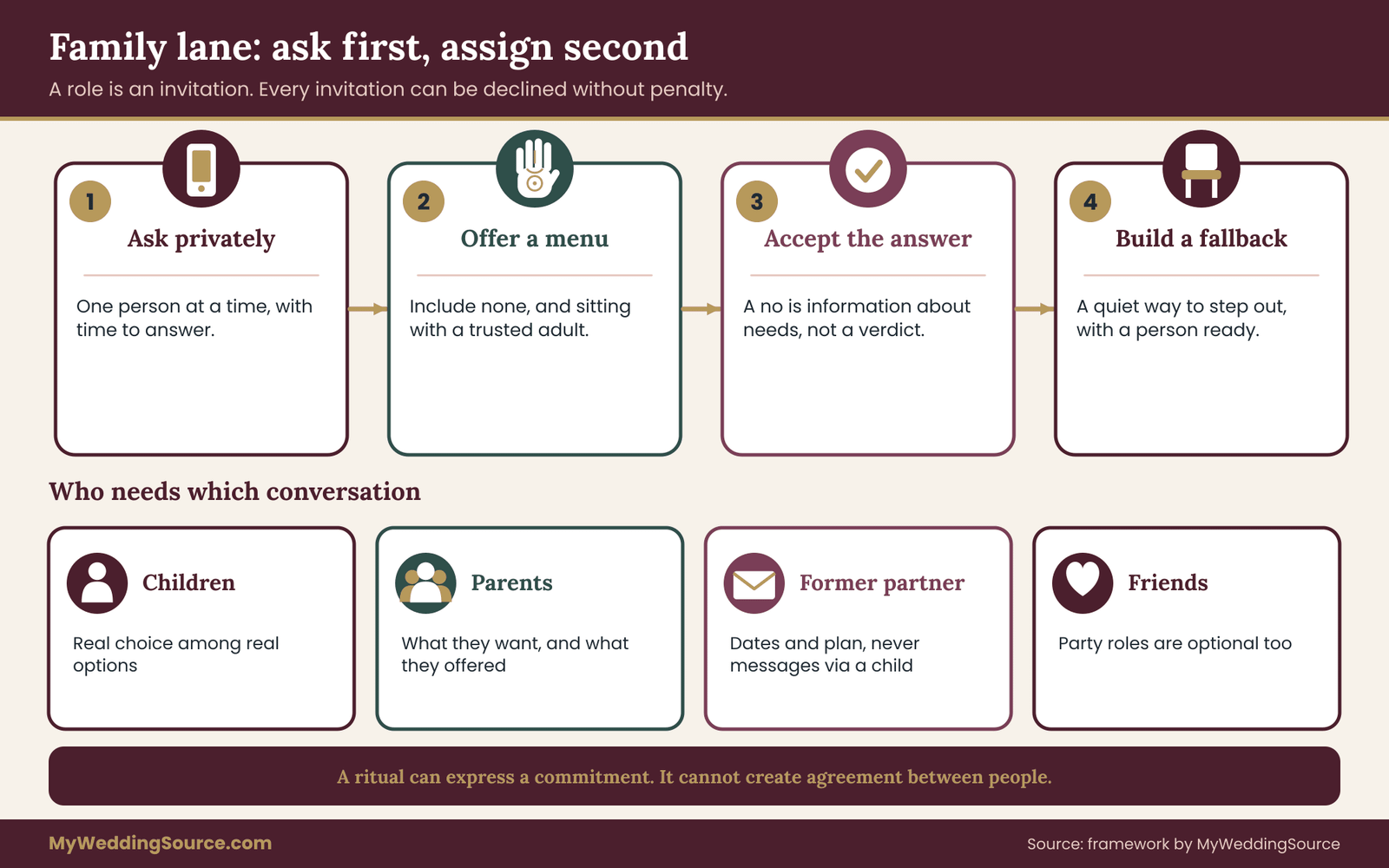
It is not an occasion where tradition is off-limits, and it is not one where tradition is required. A bride in a long white dress is as valid as a couple at a courthouse followed by a dinner. It is also not a project where the right amount of ceremony will fix a hard family relationship. A ritual can express a commitment. It cannot create agreement among people who have not agreed.
Why second wedding planning needs its own framework
A general planning checklist assumes the order of operations: set a budget, pick a date, pick a venue, build a guest list. In second wedding planning, that order sometimes breaks. If you are waiting on a divorce decree or a name decision, the date may depend on a legal step.
If you have children whose schedules are set by a custody arrangement, the date may depend on a calendar you do not control. If a parent might contribute but has not said so, the budget may be a range rather than a number. A second wedding planning framework that separates the kinds of decision lets you move on the lanes that are ready while the others wait.
That is the practical point of the three lanes in second wedding planning. They are not categories for their own sake. Each one has a different kind of deadline, a different set of people who must be consulted, and a different cost of getting it wrong.
The three-lane workbook for second wedding planning
Here is the whole structure of the workbook before the details.
The legal lane holds choices that change your rights or obligations or require paperwork: the marriage license, proof that earlier marriages have ended, the officiant’s authority, name decisions, agreements about property and debt, and the way your marriage interacts with benefits, insurance, taxes and estate documents. These are the choices with hard deadlines and official answers, so they come first.
The family lane holds choices about people: how children are included, what roles parents, siblings and friends take, how former partners and in-laws are handled, and how much say anyone outside the couple has. These choices carry the most emotional weight and the least official guidance, so they are better made through conversation than through a form.
The celebration lane holds choices about the event itself: ceremony format, venue and scale, who is invited, what the invitation says, what you want guests to bring or not bring, attire, food, music and keepsakes. This is the lane most planning content covers, and it is also the one that should flex the most, because it can be resized to fit whatever the other two lanes decide.
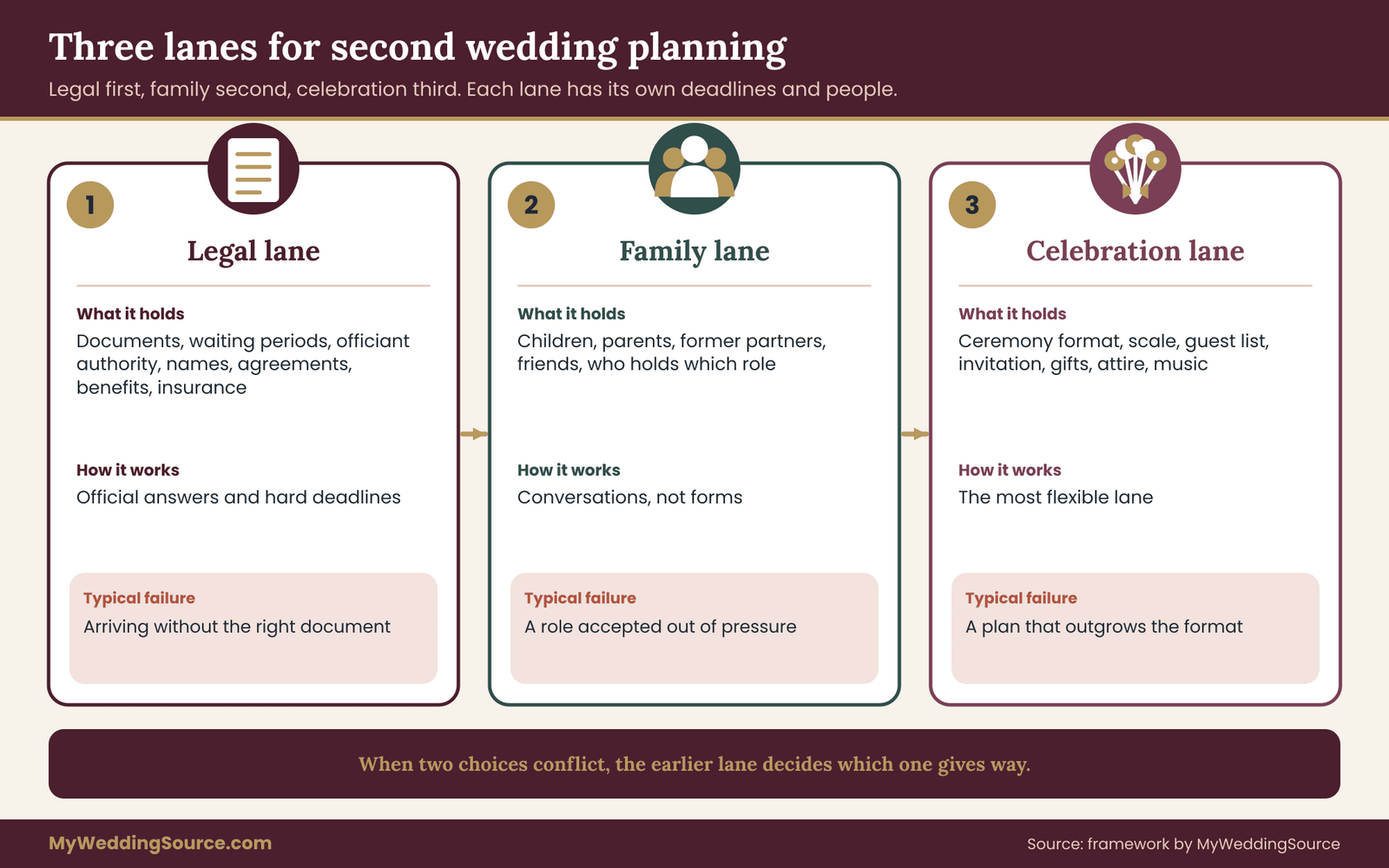
The order matters in second wedding planning. Legal first, because a mistake there can invalidate the thing you are planning around, and because some steps take weeks. Family second, because the answers shape the ceremony. Celebration third, because it is the easiest to adjust once the first two are known. In practice you will work on all three at once, but when two choices conflict, the order tells you which one gives way.
The five-field decision card
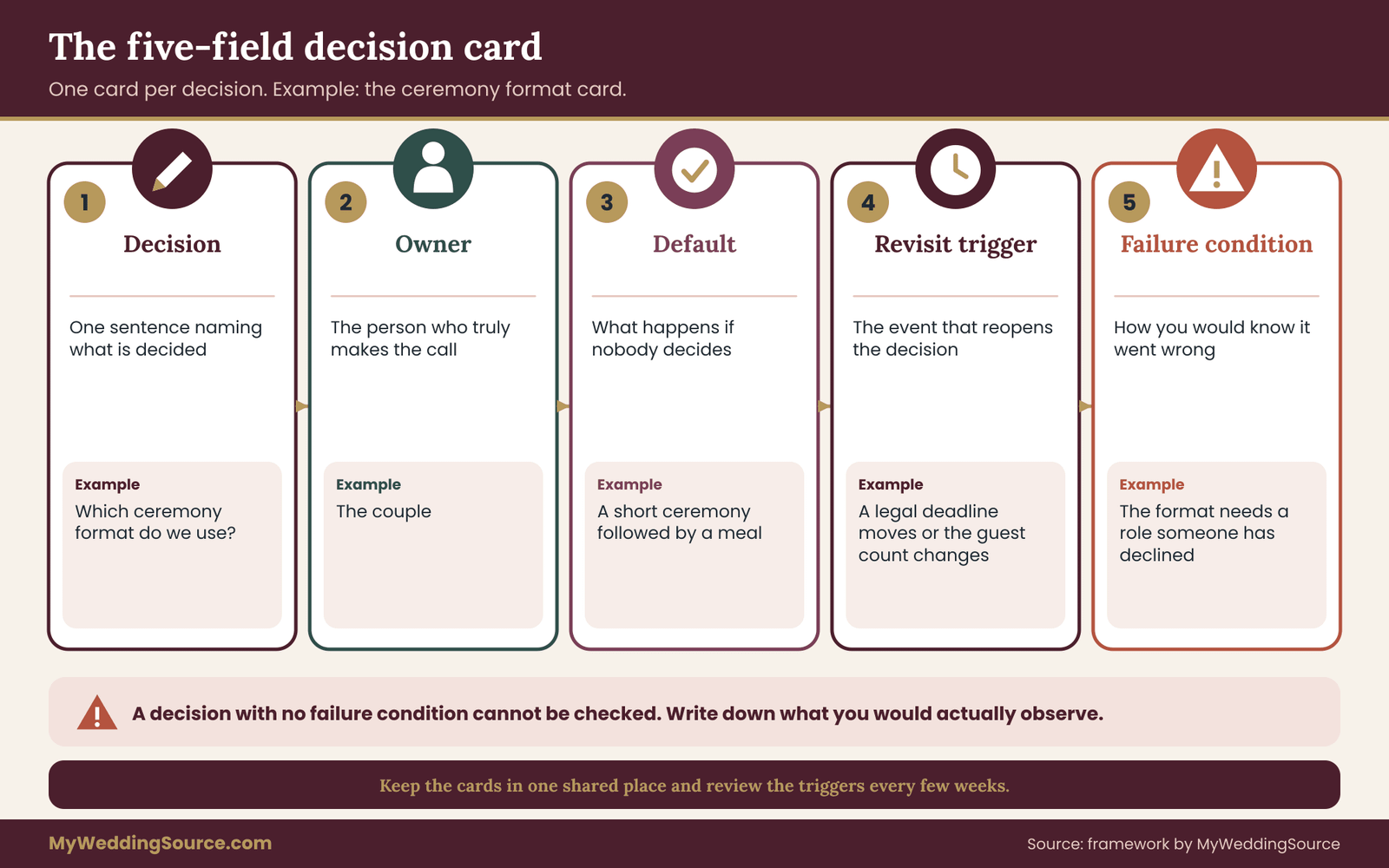
Every decision in the workbook goes on a card with five fields. The format is deliberately plain so you can keep the cards in a notes app, a shared document or an index card box.
Decision. One sentence stating what is being decided, such as “Which ceremony format do we use?” If a card needs two sentences, split it into two cards.
Owner. The person who makes the call. For most cards the owner is the couple. For a few the owner is someone else, such as an adult child deciding whether to take a role, or an officiant deciding what the officiant will and will not say. Naming the true owner prevents the common problem of people deciding things that are not theirs.
Default. What happens if nobody decides. Writing down the default is what keeps a quiet decision from becoming an accidental one. “If we do not decide on a processional, the officiant seats everyone and the couple enters together” is a default you can live with or change on purpose.
Revisit trigger. The event that should reopen the decision, such as a change in guest count, a new family circumstance, or a vendor’s answer.
Failure condition. The specific way you would know the decision went wrong. This is the field most planners skip, and it is the one that makes the others honest. A decision with no failure condition cannot be checked.
How to run the second wedding planning workbook in practice
Second wedding planning goes better when you start with a single sitting of about ninety minutes where the two of you list every decision you can think of and sort them into lanes. Do not solve anything yet. You are building the list. Then fill in only the owner and the default for each card. That alone usually exposes the real disagreements, because a default that one of you finds fine and the other finds unacceptable is a disagreement worth having early.
After that, work the lanes in order. Spend one session on the legal lane, which should end with a short list of documents and offices. Spend another on the family lane, which should end with a list of conversations to have and the person responsible for each. Spend a third on the celebration lane once the first two have produced constraints. Revisit the revisit triggers every few weeks, and keep a short log of what changed and why.
The rest of this second wedding planning guide goes through each lane in detail, adds a worked case, lays out alternatives when a plan runs into a wall, and ends with a list of failure conditions and a timeline.
Lane one of second wedding planning: the legal choices to confirm first
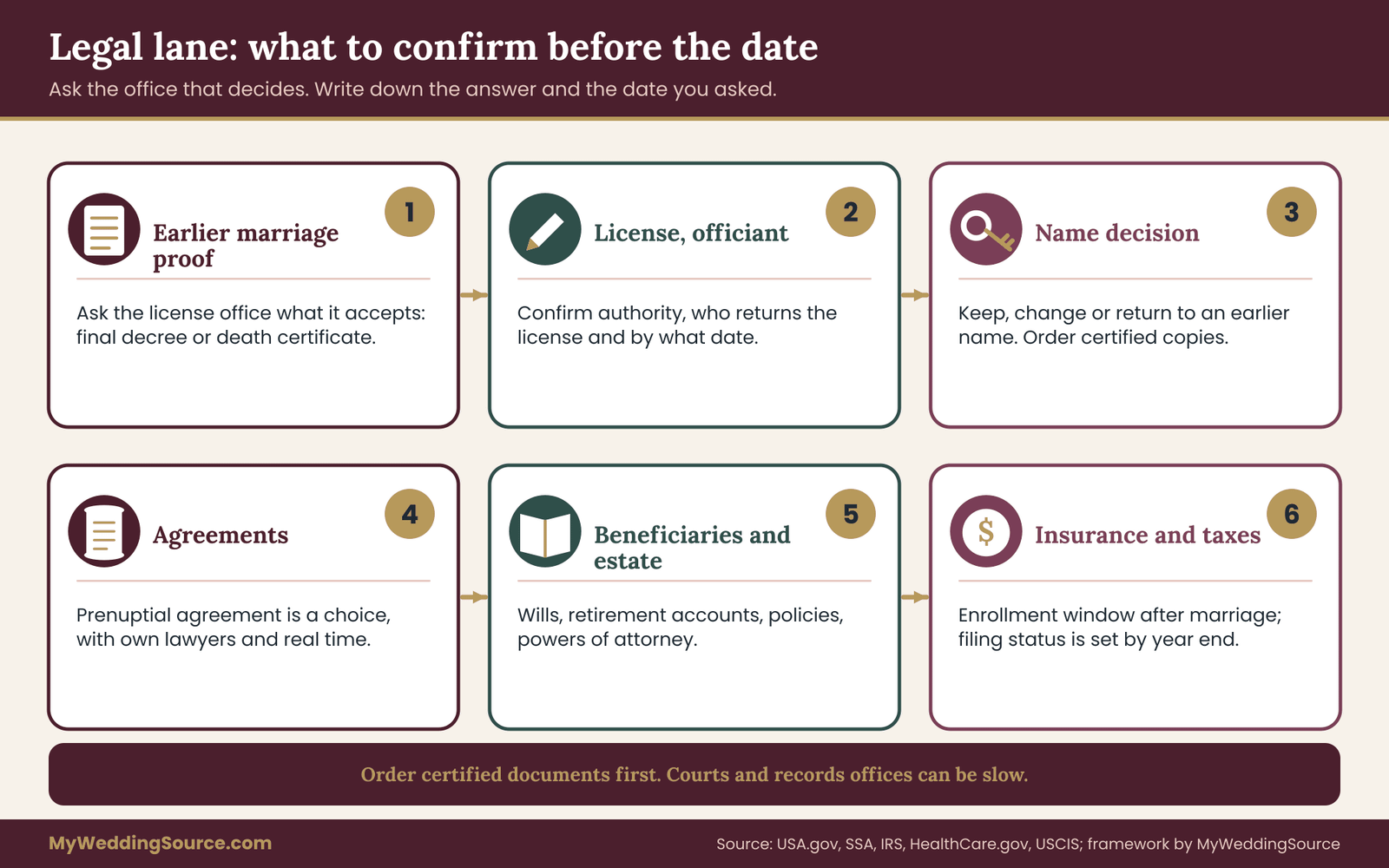
The legal lane of second wedding planning is the one with answers that are not up to you. It is also the one that most often surprises people, because a first marriage rarely asks you to prove anything about your past. A second marriage can. Treat this part of second wedding planning as a research task: find the office that decides, ask the exact question, and write the answer on the card with the date you asked.
Proving that earlier marriages have ended
Many marriage license offices ask each applicant whether they have been married before, and some ask how the most recent marriage ended and when. Some ask for a copy of a divorce decree or a death certificate. Others ask only for a date and a place. The rules differ by state and by county, and sometimes by clerk, so the useful question is not “what do I need?” in general. It is “I was divorced in another state; what do I bring to apply here?”
If you hold a decree, check that it is the final one rather than a preliminary order. Courts can issue several documents in a case, and the one that states the marriage has ended is the one a license office cares about.
If the decree is old or from another county, ordering a certified copy can take days or weeks, so this is the first thing to put on the calendar. If a prior spouse has died, a certified death certificate is the usual proof, and a funeral home or the vital records office can tell you how to get extra copies.
Some jurisdictions impose a waiting period after a divorce before a person can remarry, and some licenses expire after a set window. These details are exactly the kind that change, so confirm them with the issuing office rather than with a friend who married in another state. For second wedding planning purposes, put the answers on a card with the owner set to whichever of you is the one with the prior marriage.
The license, the officiant, and who can legally marry you
The license is the legal permission to marry, and the ceremony is the event at which it is signed. In second wedding planning those two sometimes come apart on purpose, for example when a couple signs paperwork at a clerk’s office and holds a ceremony months later. Neither order is wrong, but you need to know which date is your legal wedding date, because that is the date that appears on records, benefits forms and tax filings.
The person who officiates must be authorized under the rules of the place where the wedding happens. Some states allow a friend to be ordained or deputized for the day, and some do not. Some require registration before the ceremony.
The guide to officiant requirements covers how to check an officiant’s authority, and the same checks apply here with one addition: if you want an officiant who is comfortable with a family blended from earlier marriages, ask about their experience before you sign anything. An officiant who has only ever read one script may not know how to handle a child’s role or a pause for a former in-law.
The officiant also usually returns the signed license to the issuing office within a deadline. Ask who is responsible for that, and when the certified copies you will need later can be ordered. That timing matters for the name and records changes described below.
Names, and the order of changes in second wedding planning
If either of you is considering a name change, second wedding planning adds a layer. One partner may already have changed a name once and be deciding whether to change it again, return to an earlier name, or keep the current one. Children may have a surname that differs from either parent’s. A professional name may carry years of recognition.
There is no right answer, only a set of consequences. Changing a name means a sequence of updates: records at the Social Security Administration, the driver’s license office, the passport office, employers, banks and others. Keeping a name changes none of that. A name that differs from a child’s can create small inconveniences at school and travel, which families handle in different ways. Put the decision on a card, name the owner as the person whose name it is, and set a default of “no change until we decide,” which is a perfectly acceptable default.
If you plan to change a name, order several certified copies of the marriage certificate, because agencies commonly want to see a certified copy and may keep it for a time. The Social Security Administration, the U.S. Department of State and your state’s licensing office each publish current steps on their own sites.
Money, property and agreements
In second wedding planning, the money side often joins two financial lives that have each been running for years. Each of you may own a home, hold retirement accounts, carry debts, owe or receive support payments, or have an estate plan that names someone from the earlier marriage. These facts do not make second wedding planning a worse idea. They make a short, calm review a good one.
Agreements before marriage. Some couples sign a prenuptial agreement to define how property, debts and income will be treated. These are legal documents that generally work best when each person has their own lawyer and enough time to read them, and some jurisdictions have formal requirements. Raising the topic is not an accusation.
It is a way of making sure that what each of you wants to protect, perhaps for children from an earlier relationship, is protected on purpose. If you decide to pursue one, treat it as a scheduled item with a deadline well before the wedding, not a conversation in the last week.
Estate and beneficiary documents. Wills, trusts, retirement account beneficiaries, life insurance beneficiaries and powers of attorney often name a former spouse or a person who may no longer be the right choice. Marriage does not always automatically update them, and in some cases may change how they are treated. This is a job for a lawyer or financial professional, and the right moment to book it is while the license is still weeks away.
Support obligations and benefits. Some court orders and settlement agreements contain terms that change on remarriage, such as spousal support. Some benefits, including certain survivor benefits, also have rules about remarriage. The details vary widely and depend on specific documents, so the safe step is to read your own agreement or ask the agency that pays the benefit before you set a date.
Health insurance. Marriage is typically a qualifying event for adding a spouse to coverage, and the window to do so is short. HealthCare.gov and your employer’s benefits office publish the current windows. If your household includes children from earlier relationships, check how coverage for them is affected by any court order and by the new household.
Taxes. Marital status on the last day of the tax year generally determines filing status, and a wedding date near year end can change a tax situation. Ask a tax professional, or consult the IRS, rather than relying on a general rule.
Immigration and international elements in second wedding planning
If either of you is not a U.S. citizen, or if you plan to marry abroad, the legal lane gets longer. Prior marriages usually need documented proof that they ended, sometimes with translations and official certification, and agencies publish detailed requirements. U.S. Citizenship and Immigration Services and the U.S. Department of State are the places to confirm current requirements. Do not guess in second wedding planning, and do not plan a date until you have the document list in hand.
Putting the legal lane of second wedding planning on cards
By the end of a legal session you should have a short list of cards. Here is how a few might read.
Card: Proof of earlier marriage ending. Owner: the partner with the earlier marriage. Default: bring the certified decree or death certificate. Revisit trigger: the license office says something different. Failure condition: we arrive at the clerk’s office without the document the office requires.
Card: Legal wedding date. Owner: the couple. Default: the date the license is signed. Revisit trigger: we decide to hold the ceremony months after a courthouse signing. Failure condition: our benefits or tax forms show a different date than we assumed.
Card: Beneficiary review. Owner: each partner with their own advisor. Default: no changes until reviewed. Revisit trigger: the license is issued. Failure condition: an account or policy still names someone we no longer intend to benefit after the wedding.
Notice how the failure conditions describe something you could actually observe. “It goes wrong” is not a failure condition. “We arrive without the document” is. The same discipline applies in the next lane, where the cards are less about paper and more about people, and where the ceremony step-by-step guide can help you see where each family role fits in the order of events.
Lane two of second wedding planning: family roles without assumptions
The family lane has no forms and no offices. It has people, and each person has a history with at least one of you. The first rule of second wedding planning in this lane is the one everything else rests on: do not assign a role before you have asked. A role is an invitation, and an invitation can be declined.
Ask first, assign second
Imagine two ways to handle a ten-year-old who is about to gain a stepparent. In the first, the couple decides the child will carry the rings, tells the child the week before, and is surprised when the child freezes at the aisle. In the second, the couple describes two or three possible roles, including “none, and you sit with your grandmother,” asks which sounds best, and accepts the answer without comment. The second approach takes a little longer and produces fewer surprises, because the child chose.
The same pattern works for adults. A mother, a brother, an old friend or a grown child can be offered a role the way you would offer a gift: with room to say no and no penalty for saying it. In second wedding planning, offer in private, one person at a time, and give a day or two to answer. Avoid group messages that announce roles as settled facts. When a person declines, thank them and move on. The decline is information about what they need, not a verdict on the marriage.
The guide on wedding decision rights describes how couples and families can share input without losing control. In second wedding planning, that idea matters more than usual, because a larger number of people have a plausible claim to an opinion: parents who have already hosted a wedding, adult children with their own households, former in-laws who are still family to your children, and friends who were there for the first marriage.
Children and teenagers
If either of you has children, they are not guests. They are participants in a change to their own family, and the planning is better when they are treated that way. That does not mean giving a child a veto, which can be an unfair weight to put on anyone. It means giving them honest information, a real choice among real options, and a way to step back.
Offer a menu, not a mandate. Roles can range from the visible to the invisible: walking with a parent, standing with the couple, reading a short passage, handing out programs, lighting a candle, or simply sitting in the front row. Some children want the spotlight and some want to disappear, and a few change their minds on the day. Build in a quiet fallback so that a child who cannot go through with a role can sit down without anyone noticing.
Mind the age. A toddler needs a caregiver within reach, not a performance. A school-age child may enjoy a clear, short job with a rehearsal. A teenager may want to opt out of ritual and still want to be in the photos. An adult child may be happy to attend and wary of being asked to stand beside a new stepparent. Ask each of them separately.
Do not make a ritual carry the weight of a conversation. Some couples plan a ceremony element for the children, such as a pledge or a gift, hoping it will settle a difficult adjustment. A ritual can acknowledge a new family. It cannot make a reluctant child feel differently, and an unwanted ritual can make the day harder. If the relationship between a child and a new stepparent is still tense, have the conversation separately and plan a smaller acknowledgement, or none.
Parents, grandparents and older relatives
Parents of a second-time bride or groom are in an unusual position in second wedding planning. They may have helped fund or host an earlier wedding. They may feel a pull to repeat, to make up for something, or to step back entirely. Some are delighted, some are cautious, and a few are openly unhappy. None of those reactions tells you what role to offer.
Start with the question of what they would like, and what they would not. A parent who gave the first wedding may be relieved to be a guest this time, or may want to host a rehearsal dinner. A parent who was not at the first wedding may want a visible role. If a parent offers money, ask what the offer comes with, in plain terms, before it becomes a plan. A gift with unspoken expectations about the guest list or the ceremony is better discovered in a conversation than in a vendor meeting.
Grandparents and older relatives may need practical help more than a role: a seat near the aisle, an arm on the way in, a quiet room. These are small details that make a big difference, and they cost almost nothing to arrange in advance.
Former partners and their families
The question of whether a former spouse has any place at the wedding has no universal answer, and in most cases the answer is no. Where there are shared children, however, contact is likely to continue after the wedding, and the way you handle the day can affect how easy that contact is.
Several approaches exist. You may keep the day completely separate and arrange childcare and transport through the other parent in advance. You may inform the other parent of the date and the plan so that children are not caught between households. In some families, former in-laws such as a child’s grandparents remain close and are invited as family of the child, not as family of the former marriage. And in others, any contact would be distressing, in which case the plan should simply avoid it.
Whatever you choose, tell each affected adult early and plainly what the plan is. Do not leave a child to carry messages between households. If a custody schedule governs the date, check it before you commit, because a wedding that falls on the other parent’s time may need advance arrangement. If there is a court order, read it rather than rely on memory.
Your own former in-laws and shared history
Some people have kept a warm relationship with a former spouse’s relatives, especially if a spouse has died. Second wedding planning after a death is a different emotional landscape than planning after a divorce. Family members of the late spouse may be grieving again, may be glad for you, or may feel both. A conversation before the invitation goes out is kinder than a surprise, and a quiet acknowledgement, such as a short moment of remembrance chosen by you, may be welcome or unwelcome depending on the people involved.
Friends and the wedding party
Second wedding planning often ends with a smaller wedding party or none at all. Some couples ask a best friend and nobody else. Some ask the children. Some ask the same people who stood up the first time. There is no rule against that last one, and no rule requiring it. If a friend stood with you at the earlier wedding and is asked again, tell them plainly that they are welcome to decline. If a friend is not asked and has expectations, a kind sentence explaining the size of the party is usually enough.
The family cards for second wedding planning
Here are two example cards in the family lane, written the way you would write them for your own situation.
Card: Roles for the children. Owner: each child, with each parent present for the conversation. Default: every child sits with a trusted adult and has no required role. Revisit trigger: a child expresses interest in a role. Failure condition: a child is standing in front of guests who is visibly unwilling to be there.
Card: Parent contribution. Owner: the parent who is offering. Default: no contribution is assumed. Revisit trigger: a parent offers money or hosting. Failure condition: a vendor deposit is paid on money that comes with expectations we have not discussed.
The next section turns these second wedding planning decisions into ceremony choices, where the people you have asked become real roles in a real order of events.
Ceremony choices in second wedding planning
With the legal lane mapped and the family conversations underway, you can design the ceremony. This is the lane where second wedding planning feels most like a blank page, because the usual script has several lines you may not want. The task is not to find the correct format. It is to pick one that fits your constraints and to know in advance which parts you are rewriting.
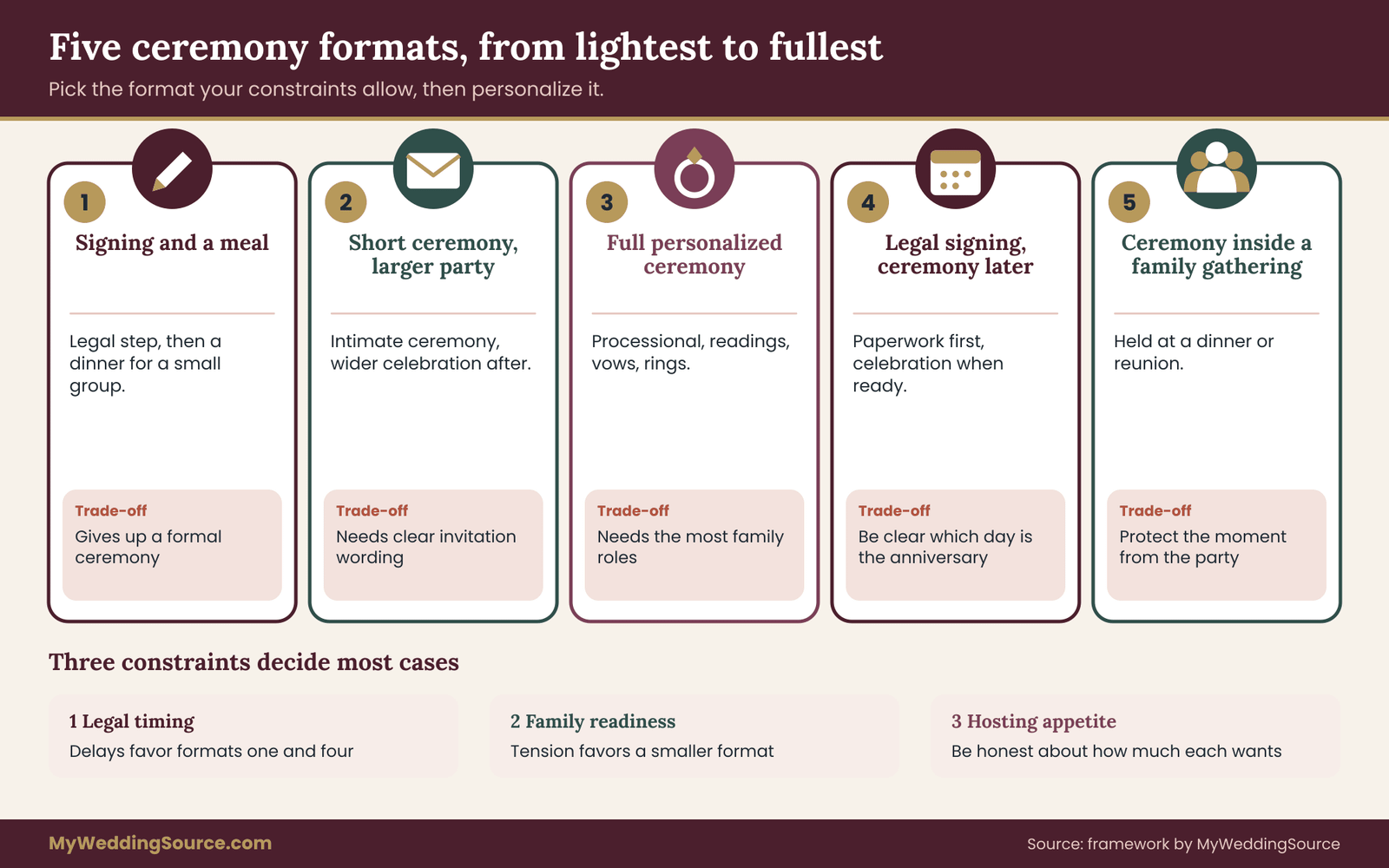
Five ceremony formats in second wedding planning
Think of the formats as a ladder from the lightest to the most elaborate. None is better. Each trades something for something else.
Format one: a signing and a meal. You complete the legal steps at a clerk’s office or with an authorized officiant and go to a restaurant or a home with a small group. It asks for very little second wedding planning, which is its appeal when the legal lane is demanding or the family lane is delicate. It gives up a formal ceremony and often some of the guest list. The pattern is straightforward: book a private table or room, confirm the headcount and the minimum spend, and let the meal do the work of a reception.
Format two: a short ceremony with a larger party. You hold a ten to twenty minute ceremony for a small group, followed by a larger gathering where more guests arrive. This keeps the ceremony intimate and the celebration inclusive. It asks you to explain the two-part structure in the invitation, which is a topic for the guest section later in this guide.
Format three: a full ceremony, personalized. A processional, readings, vows, rings and a pronouncement, with each part chosen by you. This format asks the most of the family lane, because every role in it needs a person. It also gives you the most room to mark what is special about this marriage.
Format four: a separate legal signing, then a ceremony later. You complete the paperwork first, perhaps because of a deadline for insurance or immigration, and hold the ceremony when the family and venue are ready. It removes a legal deadline from the celebration lane. It asks you to be clear about which day is your anniversary, a topic where couples vary widely.
Format five: a ceremony integrated into a family gathering. The ceremony happens at a family dinner, a holiday weekend or a reunion, with the gathering already in place. It is efficient and warm for blended families, and it asks you to protect the moment from being absorbed into the gathering.
Choosing a format with three second wedding planning constraints
Rather than ask which format you want, ask which one your constraints permit. Three constraints decide most cases.
Constraint one: time on the legal lane. If a document is delayed, a waiting period applies or an immigration step is open, formats one and four give you room, because they let the legal step happen when it can and the celebration when you are ready.
Constraint two: family readiness. If the family lane has unresolved tensions, a smaller format reduces the number of relationships that have to be managed on the day. If the family is ready and eager, formats three and five let them take part.
Constraint three: how much you want to host. Some people have already done the large wedding and do not want to run another one. Others never had one and want it. Both are reasonable. Be honest about which describes each of you, because a mismatch shows up around month four as an argument about the guest list.
If two constraints in second wedding planning point to different formats, the legal lane wins first, the family lane second, and your own preference third. That ordering is not a ranking of what matters. It is a ranking of what can be changed late. A legal deadline cannot move, a family conversation can be delayed only so long, and your own preferences can almost always be met in some form within whichever format the others allow.
The processional and who stands where
The traditional processional assumes a parent gives a bride away and a groom waits. Many people in second wedding planning change this, and several alternatives are in common use. Both partners can walk in together. Each can walk in alone. Each can be accompanied by children, a friend or a parent. The ceremony can begin with the couple already at the front, greeting guests as they arrive. The underlying logic is simple: decide where the guests face, where the couple will stand, and how each person reaches their place without a long walk that creates stress.
If someone is giving a partner away, think about the meaning of that phrase for you. Some people like the tradition and some find it uncomfortable at a second marriage. Alternatives include a parent walking beside you, a parent offering a blessing from their seat, or no escort at all. If a parent is hoping to take the traditional role and you are not, tell them in advance, offer something else, and keep the conversation private.
Vows, readings and what to leave out
Vows in second wedding planning often carry a different kind of weight. People who have been married before sometimes want to speak to what they have learned, to the children in the room, or to the particular promises they are making this time. Others prefer short traditional language. Either is fine, and a pair can mix: one partner uses traditional words, the other writes their own.
Three guidelines are useful. First, keep personal vows short enough to be said without notes, which is usually two or three minutes at most. Second, avoid language that compares the new marriage to the earlier one, since a comparison can sting in a room that includes people from both periods of your life. Third, avoid promises you do not control, such as promises about how children will feel. A vow to be present, patient and honest is easier to keep than a vow that the family will be happy.
For the structure of the ceremony as a whole, the step-by-step ceremony guide shows where vows, rings and readings usually sit, and you can move them to suit your plan.
Rings and unity rituals
Rings raise practical questions in second wedding planning. You may keep an earlier ring, store it, pass it to a child or have it reworked, but that is a family and financial decision for its own card and has no place in the ceremony itself. New rings can be exchanged in the usual way.
Some couples exchange rings with children present, placing a third ring or a small token on a chain for each child. If you do, check that every child wants it, that the token is appropriate for the child’s age, and that nobody is left out by an unequal gesture.
In second wedding planning, unity rituals such as lighting candles, pouring sand, braiding cords or sharing a cup, are common in blended-family ceremonies because they give the children a visible part. They are also easy to overdo. A ritual works when it is short, understandable to guests without explanation and optional for those taking part. It fails when it takes longer than the vows, when a child is expected to perform emotion, or when it is added only because it is a familiar thing to add. If you are unsure, choose one ritual or none.
Some faith communities have their own requirements and conversations about earlier marriages, and they can be lengthy. If a religious ceremony matters to either of you, speak to the clergy before you set a date, ask what documents or steps their tradition requires, and treat their answer as part of the legal lane for scheduling purposes. If you are marrying across faiths, decide early who owns each ritual and who explains it to guests, so that neither tradition feels like a guest in its own ceremony.
Music, length and tone
A ceremony in second wedding planning is often shorter than at a first wedding. Fifteen to twenty minutes is common and entirely adequate. Music can be live or recorded, traditional or personal, and a song that means something to the family can do more than a classic processional. Think about the voices in the room. If a young child is going to be part of the ceremony, keep the music cues simple and rehearse once. If an older relative has difficulty hearing, ask the officiant to speak clearly and consider a microphone.
Tone is mostly a matter of what the officiant says. Some officiants lean toward humor, some toward ceremony and some toward a quiet reading of the vows. Before you hire, read through what an officiant needs to handle beyond the script, ask to hear a sample of their style, and tell them plainly which topics you want to avoid, such as references to “first love” or “starting a family” that may not fit your situation. The officiant should follow your wishes, and a good one will ask before improvising.
Ceremony cards for second wedding planning
Two sample cards close this lane.
Card: Ceremony format. Owner: the couple. Default: a short ceremony followed by a meal. Revisit trigger: a legal deadline moves or the family conversation changes the guest count. Failure condition: the format requires a role that a family member has declined.
Card: Escort or entrance. Owner: each partner for their own entrance. Default: walk in together. Revisit trigger: a parent expresses a strong wish to take part. Failure condition: someone learns of the plan for the first time in the rehearsal.
Guest expectations in second wedding planning
Guests arrive with assumptions. Some are about what a wedding is, some about what a second wedding is, and some about what they personally are expected to do. Your job is not to manage every assumption. It is to decide which expectations you want to set on purpose and to say them plainly, early, and in a tone that does not apologize.
The three kinds of guest expectation
Guest expectations fall into three groups, and each is handled differently.
Expectations about the event. Is it a ceremony, a party, a dinner, or all three? How formal is it? Are children welcome? Where and when does it start and end? Is it adults-only, or a family event? These are answered by the invitation, the website and a few direct words.
Expectations about the guest. Are they expected to travel, to give a gift, to stand in a photo, to give a toast, to bring a date? Are they expected to attend if they came to an earlier wedding? These are answered by wording and, sometimes, by a conversation.
Expectations about the history. Do guests who were close to a former spouse feel awkward? Will a guest who attended the earlier wedding feel obliged to attend again, or to give again? Will a relative ask a question about the earlier marriage in the receiving line? These cannot be fully answered. They can be softened by choosing a tone, by having a plan for the small number of awkward moments, and by telling the people closest to you what you would like them to say if asked.
Building the guest list in second wedding planning
The guest list in second wedding planning is shaped by different forces than in a first wedding. Some people have fewer relatives and friends in common than they did a decade ago. Some have larger families through children and stepchildren. Some want a quiet day and some want to include every person who has supported them.
The usual guides to list-building still apply, and the guide to wedding guest list planning walks through tiers and cutoffs. Add three questions that are specific to this situation.
Who knows both of us as a couple? The people who know you as partners, not only as individuals, tend to be the ones who belong at the ceremony itself. A coworker who has never met your partner may belong at a party but not a ceremony.
Who is part of the family that is being formed? This includes children, stepchildren, their other parents’ families if that is relevant, and the people who will be in your daily life afterward. A grandparent who is now grandparent to your partner’s children may belong on the list even if the connection is recent.
Who attended an earlier wedding? You do not owe a repeat invitation to everyone who came before, and a person who came to the first wedding is not entitled to a seat at the second. You also should not assume they will resent being left off. Judge each person by the same tiers you use for everyone else.
Explaining a small ceremony and a larger party
If you choose format two, a short ceremony for a few and a bigger gathering for more, the invitation has a job to do. It needs to say two things clearly: what the event is, and who is invited to which part. Guests are rarely upset by a small ceremony. They are upset when they learn about it from someone else.
In second wedding planning, a short, neutral line is enough. For the ceremony-only group, the invitation can state the time and place of the ceremony and mention a gathering afterward. For the party-only group, the invitation can state the time and place of the celebration, and say that the ceremony will be a small private moment earlier in the day. Avoid long explanations, avoid apologizing, and avoid describing the choice as a reaction to anything. The guide to wedding invitation etiquette covers the basic elements of wording, and it fits well with the two-part structure.
Gifts, registries and what guests may ask
Many couples in second wedding planning already own what a first-time couple would register for. That is a normal reason to let guests know that gifts are not expected, or to suggest alternatives such as a donation to a charity, a contribution to a shared project, or experiences. How you say this matters. A plain line on the website, such as “Your presence is the gift, and if you would like to give something, here are a few ideas,” is generally better than a list of instructions.
Be ready for guests to give anyway. Some will, out of habit and affection. Accept gifts graciously and send notes, even if you said no gifts were needed. For guests who ask directly what you would like, have one or two answers ready, and keep them realistic. The wedding etiquette guide covers the common expectations on both sides of the exchange.
If children from earlier relationships are part of the family, think about whether a gift for them, a small keepsake or a shared family moment, is a better use of your attention than a registry. This is a family decision and does not belong on a guest page.
Attire and the day itself
Dress code deserves a line on the invitation. Second wedding planning leads to everything from black tie to jeans, and guests are much more comfortable when they know. Be specific: “dressy casual, outdoors, wear shoes you can stand in on grass” is more useful than “semi-formal.” Say what you and your partner plan to wear if it helps guests calibrate.
For couples, attire decisions are personal. Some choose a traditional gown or tuxedo, some choose a dress in color, some choose a suit, and some choose what they already own. None of these needs to be defended. If either of you wears a white dress, expect no particular reaction from guests who care about you, and ignore any from those who do not.
Plus-ones, children and awkward questions
Decide in advance who may bring a guest and say so on the invitation by addressing it clearly. Decide whether children from other households are welcome, and if the event is adults only, remember that your own children and stepchildren are not guests and will need to be included in the plan. If child care is needed, arrange it in advance rather than expecting guests to solve it.
Awkward questions deserve a plan, not a script. A relative may ask whether you are happy this time. A coworker may ask about a former spouse. A grandparent may ask where a child’s parent is. Prepare a short, calm sentence you are comfortable saying, such as “We are glad you are here,” and give a trusted person the job of redirecting a conversation that is going somewhere unkind. You do not owe anyone an explanation of your history, and you can say so politely.
Who speaks, who photographs, who is remembered
Toasts and speeches in second wedding planning can be tender or tense. Speakers who were close to a former spouse may not know what to leave out. Ask each speaker to keep remarks to the present and to the couple, to keep them short and to avoid jokes about previous relationships. Share this request kindly and in advance, not at the microphone.
Photographs deserve a plan as well. A family photo list that assumes two sets of parents and one set of siblings may need to be rewritten for a blended family. Ask each person in advance which groupings they are comfortable with, and keep the list short. A child who dreads a long photo session will remember it for years.
If someone who has died is important to either of you, a small, optional way of remembering them can be a quiet addition, such as a framed photograph, a reserved seat or a short mention. Check with the people closest to that person first, and make the gesture optional for guests.
The guest cards for second wedding planning
Card: Invitation structure. Owner: the couple. Default: one invitation, clear about the event and who is invited. Revisit trigger: the guest count changes enough to alter the format. Failure condition: a guest learns they were invited only to the party by overhearing a conversation.
Card: Gifts. Owner: the couple. Default: a short line saying gifts are not expected. Revisit trigger: guests keep asking what you want. Failure condition: a guest feels pressured or embarrassed about a gift.
Money and contributions in second wedding planning
Budget conversations in second wedding planning carry history. Someone may have paid for a first wedding and have feelings about it. A parent may offer help and mean it generously or conditionally. A partner may have obligations, such as support payments or education costs, that limit what is available. Treat this as a legal-lane-adjacent topic, because the cleanest way to handle it is to be explicit.
Set a range, not a number
For second wedding planning, start with a range that has a floor you can afford without strain and a ceiling you would accept only for something that clearly matters. The wedding budget guide is useful for category structure, and the cost logic here is simple: a smaller guest list lowers nearly every per-person cost, while a larger celebration can often be simplified by dropping a category rather than shrinking everything.
Ask each partner to name two categories that matter most and two that matter least. A couple who both care about food and photography and neither about flowers has found the place where money should flow. Do not use prices from a friend’s wedding. Request current quotes from vendors in your area and compare them on the same terms.
Contributions in second wedding planning and what comes with them
If a parent, a child with an income, or another relative offers to contribute, treat the offer as a conversation. Ask three plain questions. How much, and when will it arrive? Is it a gift or a loan? Does it come with preferences? Preferences are not always a problem. A parent who wants to host the rehearsal dinner may have good ideas. But a preference about the guest list or the ceremony that you did not know about until the deposit cleared is a failure condition worth avoiding.
If you accept a contribution, write down what was agreed in a short message that both parties can read. It does not need to be formal. It should state the amount, the timing and what it is meant for. If the contribution is a loan or involves the sale of an asset, consult a financial professional.
Who pays for what when two households merge
Some couples keep finances separate at first and some merge them immediately, and both approaches are common. For the wedding itself, a simple rule works: each partner contributes in proportion to their means, and any shared account is opened and funded before deposits are paid. This reduces the chance of arguments over who spent what.
If either of you has debts or obligations that a wedding would strain, say so in the first money conversation. Surprises in this area are the ones that damage trust. A smaller wedding is not a failure. A wedding that leaves one partner worried about rent is.
Cost traps particular to second wedding planning
A few costs show up more often in second wedding planning. Multiple legal documents, such as certified decrees, certificates and translations, add small fees that accumulate. Professional advice on agreements and estate documents has a cost, and it is worth budgeting for it separately from the event. Travel for family who live in different places can grow, because the guest list may include people from several earlier chapters. Child care, which a couple without children would not need, can be a real line item.
Keep a contingency reserve for the unexpected. The guide to twelve months of wedding planning shows how deposits and balances are usually timed, and a reserve held back for the final month prevents a late surprise from becoming a debt.
A worked case: Dana and Marcus
The following example is invented to show second wedding planning and the workbook in use. It is not a real couple or a report of a real wedding, and the details are chosen to show common decision points, not typical outcomes.
Dana was divorced several years ago and has two children, ages nine and fourteen, who live with her most of the time and spend alternating weekends with their other parent. Marcus is a widower with one adult daughter, who lives in another city. They have been together for three years, share a household, and want a wedding that feels warm and unhurried, with about forty people.
Their legal lane
Dana’s divorce took place in a different state. She asked the county clerk where they planned to apply what documents were needed. The clerk said a certified copy of the final decree would be required, and Dana’s decree was in an attic folder as an uncertified copy. Ordering a certified copy from the other state’s court took about three weeks, which would not have been a problem except that they had planned to apply for the license only a month before the wedding. They moved the application earlier.
Marcus’s late wife’s death certificate was in a filing box and he had several certified copies. They each booked an appointment with an estate lawyer to review beneficiary designations and their wills, and decided against a prenuptial agreement after discussing it, with each stating clearly what they wanted to protect for their own children. They both asked about health insurance windows and put the date on a calendar.
Dana decided to keep her name, and Marcus did not change his. The default on that card never changed.
Their family lane
Dana asked her fourteen-year-old what kind of role he would like. He said none, and Dana said that was fine. Her nine-year-old said she wanted to hand out flowers, and they agreed on a short, rehearsed job with a fallback. Marcus’s daughter said she would be glad to read a short passage and stand with her father, which they accepted.
Dana’s mother expected to walk her down the aisle. Dana said she preferred to walk with Marcus, and offered her mother a place beside them at the front and a short blessing during the ceremony. Her mother was disappointed at first and then agreed. The conversation took ten minutes and was held at Dana’s mother’s kitchen table, not by message.
The weekend they had chosen turned out to fall on the other parent’s time. Dana called the other parent, explained the date and asked whether the children could attend. The other parent agreed to adjust the schedule. If the answer had been no, Dana would have changed the date, because it was the children’s presence that mattered most to her.
Marcus’s late wife’s sister was important to Marcus’s daughter. Marcus told her about the wedding by phone before the invitation arrived, and she said she would attend. They placed a small framed photograph on a side table without announcement.
Their celebration lane
With the first two lanes sketched, the celebration lane resolved quickly. Format three, a short personalized ceremony, fit the family’s readiness. They chose a venue that could hold forty with a covered area in case of rain. The ceremony ran about eighteen minutes, with a reading by Marcus’s daughter, short personal vows, and no unity ritual. Dinner followed, with brief toasts from two people who were asked in advance to keep them short and forward-looking.
The invitation said “no gifts are needed” and offered a short list of charities. Several guests gave gifts anyway, and Dana and Marcus wrote notes to all of them.
What went wrong, and what the workbook caught
Not everything went smoothly, which is the point of including it. The caterer asked for a final count a week earlier than the couple expected, and one guest changed their reply after the deadline. They had written “vendor deadlines” as a revisit trigger on the guest card, and so they caught the question before it became a cost.
The nine-year-old, on the day, asked to skip her job at the last minute. Because the fallback was already on the card, her aunt took her to her seat and a cousin handed out the flowers, and nobody in the audience noticed.
One card did fail. They had listed a toast by a friend who knew Marcus’s late wife, and the friend’s remarks, though affectionate, included a story that made Marcus’s daughter cry. Their failure condition for toasts said “a speaker’s remarks leave a family member visibly upset.” That condition was met, and in review the couple noted that they had asked the speaker for a short toast but not for a preview. Next time they would ask for the outline in advance.
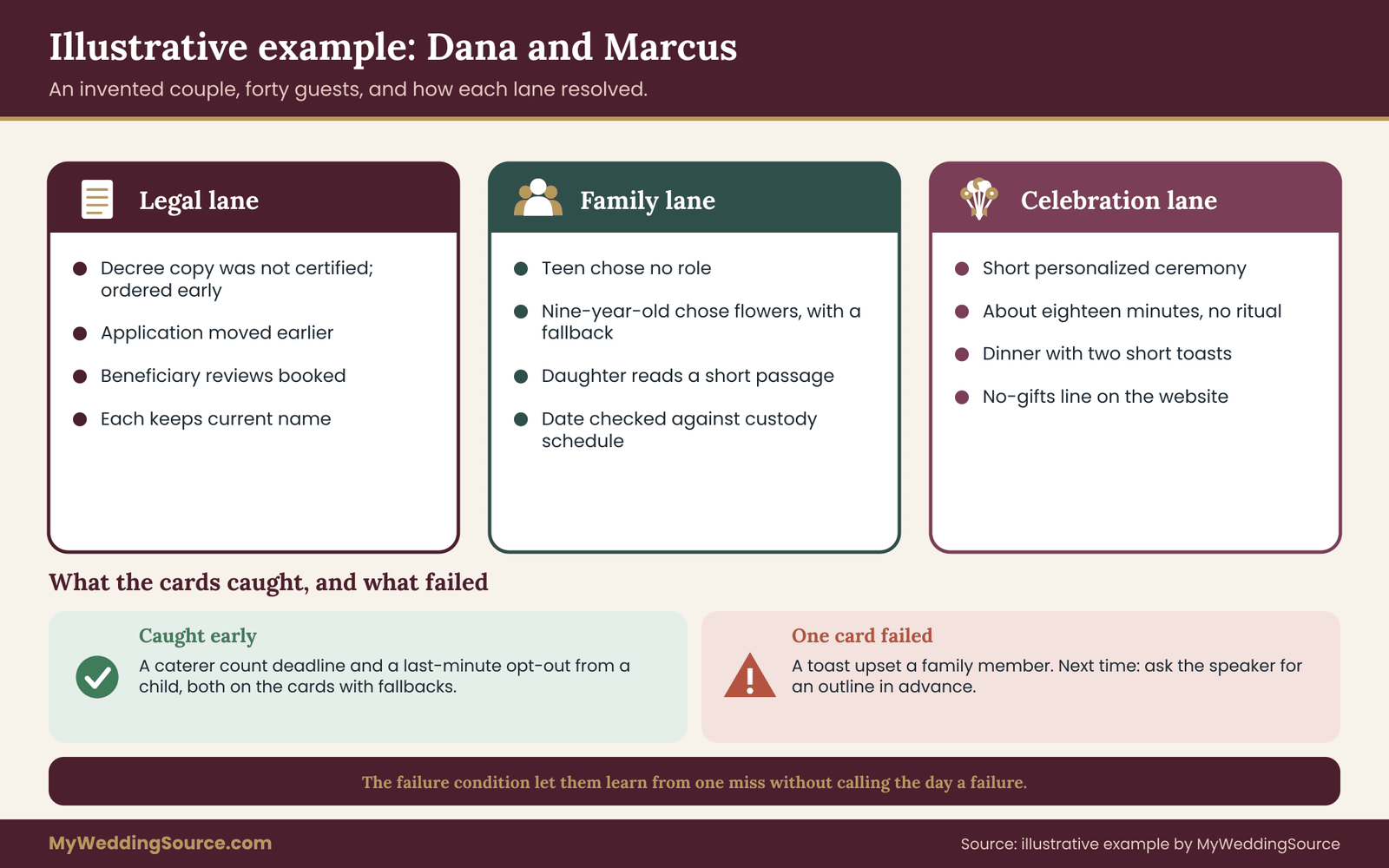
The case shows three things about second wedding planning. The lanes kept legal deadlines from being crowded out by family talk. The defaults caught decisions that would otherwise have been made by accident. And the failure conditions gave the couple a way to learn from the one thing that did not work without deciding the whole day had failed.
Alternatives when second wedding planning runs into a wall
Every second wedding planning effort meets a wall. The workbook helps most when you can step sideways instead of pushing harder. The alternatives below are options for common walls, not rankings.
When the legal lane delays the date
If a document is late or a waiting period applies, you can hold the celebration on your chosen date as a commitment ceremony, complete the legal signing when you are able, and treat the later date as the legal date. Or you can move the celebration.
The first option keeps the family gathering; the second keeps the legal and ceremonial date the same. Pick based on how much the date matters to the family and how soon the legal step will be done. Be clear with your officiant and guests which event is which, so no one believes you are legally married before you are.
When the family lane cannot agree
If two relatives cannot agree on a role, you can split the role, shorten the ceremony or remove the contested element. For example, if two people each want to do the closing blessing, you can ask one to open and the other to close. If a child and a parent disagree about the child’s role, the child’s preference generally should lead, with the parent’s reasons heard privately. If no solution fits, a smaller ceremony with fewer roles often resolves it, and the larger party can follow.
When the budget will not stretch
Reduce the guest list before you reduce quality, because per-person costs dominate most budgets. Choose a weekday or a shoulder-season date for lower venue cost where this is available. Consider a restaurant or a family home for the dinner. Drop a category that neither partner values. Resist the temptation to cut the legal and advice items, since they protect more than the party does.
When a guest or relative objects
Some people object to second weddings on principle. You are not required to persuade them. You can decline to debate, thank them for their concern and continue. A short pattern works well: acknowledge the concern, decline to debate it, and change the subject. If an objection comes from someone whose role you were counting on, release them from the role and offer a seat.
When the day itself goes sideways
Rain, illness, a late arrival or an upset child can disturb any wedding. The ordinary tools apply, such as a backup plan for weather, a quiet room, a trusted person assigned to handle problems. In a blended family, add one tool: a person who knows the children well and has permission to step in without asking the couple. That person can take a child out for a snack or a walk and return them when ready.
Failure conditions in second wedding planning, and how to catch them early
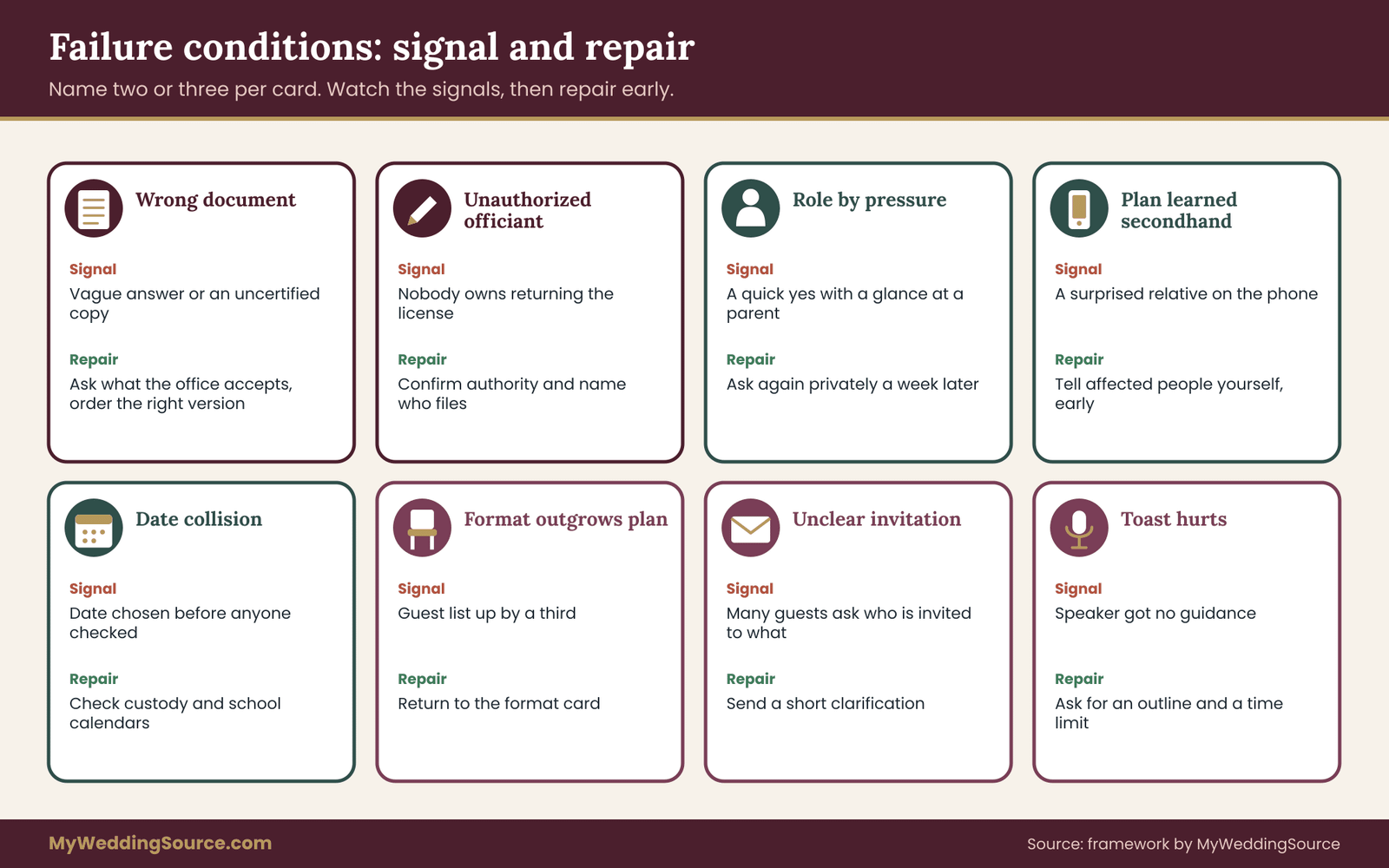
The failure-condition field of each card is a prediction about how a decision could go wrong. This section gathers the most common ones and pairs each with an early signal and a repair. Use it as a review checklist at the midpoint of your second wedding planning and again a month before the wedding.
Legal failures
The document does not match what the office wants. The signal is a vague answer from the clerk or a document that is a copy rather than a certified record. The repair is to ask the office to list exactly what it accepts, and to order the right version at once, since courts and vital records offices can be slow.
The officiant is not authorized, or the license is not returned. The signal is an officiant who has not asked about registration, or who cannot say who files the paperwork. The repair is to confirm authority in writing and to name the person responsible for returning the license, along with the date by which it should be filed.
A benefit or an agreement changes in a way you did not expect. The signal is a document you have not read since the divorce or the death of a spouse. The repair is to read it now, ask the issuing agency or a professional, and do it before the date is set.
Family failures
A role is accepted out of pressure. The signal is a quick yes with no questions, or a yes from a child who looks at a parent before answering. The repair is to ask again privately a week later and to offer a way out that sounds easy.
Someone learns a plan from another person. The signal is a relative who sounds surprised in a phone call. The repair is to tell the people who are most affected yourself, before the invitation goes out and before the information spreads.
A ritual becomes a test. The signal is a family member who says they will do it but wishes the ritual were smaller. The repair is to shorten it, make it optional, or replace it with a spoken sentence.
The schedule collides with a custody arrangement or a school calendar. The signal is a date chosen before anyone checked. The repair is to confirm with the other household and the school calendar before booking the venue, and to keep a backup date in mind.
Celebration failures
The format outgrows the plan. The signal is a guest list that has grown by a third and a venue that can no longer hold it. The repair is to return to the format card and ask which format now fits, rather than squeezing more people in.
The invitation raises more questions than it answers. The signal is a run of similar messages from guests asking who is invited to what. The repair is to send a short clarification and add the answer to the website.
A toast hurts someone. The signal is a speaker who has not been given guidance. The repair is to ask for a short outline in advance, and to give the speaker a clear time limit and a topic.
The day is too long for the children. The signal is a schedule that keeps young children in formal clothes for many hours without a break. The repair is to build in a quiet period and a plain snack, and to plan an early exit for the family that needs it.
Using the failure list well
A list like this can make second wedding planning feel like an anxious checklist, which is not the goal. The point is to name a few failure conditions per card, to keep the signals in view, and to leave the rest. A second wedding planning effort that anticipates every possible problem is one nobody can carry out. Choose the two or three that would hurt most for your family and watch those.
A timeline for second wedding planning
The timeline below is arranged by lane and by distance from the date. The exact lengths of second wedding planning will vary, and some couples will compress it into a few months while others will stretch it. If you are planning a small event on a short schedule, keep the order and shrink the intervals.
Six to twelve months out in second wedding planning
Settle the legal lane questions first. Contact the license office, confirm the documents, and order certified copies of anything you do not have. Book appointments with a lawyer or financial professional for agreements and beneficiary reviews. Have the first money conversation and set a range. Hold the first workbook session, list every decision, and write the owner and default for each card.
Begin the family conversations that shape the guest count and the ceremony. Speak to children, parents and any family member whose role may be large. Check custody and school calendars before you choose a date. Choose a format using the three constraints, and then choose a date and a venue.
Three to six months out in second wedding planning
Hire the officiant and share your preferences, including topics to avoid. Book core vendors based on the format you chose, and request written quotes on the same terms. Draft the guest list in tiers and decide on any children’s roles. Send save-the-dates if the event involves travel. Check that the legal lane items are on track, including any waiting periods and the expiry of the license, if there is one.
Draft the ceremony outline and share it with the people who have roles. Ask each reader and speaker to keep remarks short. Plan how the photographs will handle the family groupings. Decide how gifts will be addressed on the website.
One to three months out
Send invitations with a clear structure and a dress code. Finalize the ceremony script. Hold a rehearsal if the format has roles for children or older relatives, and keep it short. Confirm child care and transportation for family who need it. Review the card list for failure conditions that have been triggered.
Apply for the license within the window that the office allows. Confirm who will return it. Finish the estate and beneficiary updates that you decided to make, and make sure the health insurance window is on your calendar.
The final two weeks
Confirm final counts with vendors. Send the schedule to the people who have roles, including the person assigned to step in for children. Hand out printed copies of the ceremony to anyone who is reading. Make sure any rented items and decorations have a collection plan. Have one last short conversation with each person who has a role and offer them a way out.
After the wedding
Return the license if it is yours to return, order certified copies, and begin any name changes in the order the agencies recommend. Update beneficiary and insurance documents if you have not done so. Send thank-you notes, including for gifts you said were not expected. Keep your cards and notes, because the review of what worked is useful if you ever help a friend plan a wedding.
Your next steps
You do not need to finish second wedding planning in one week. A reasonable start looks like this.
- Set aside ninety minutes with your partner and list every decision you can think of. Sort them into the three lanes. Do not solve anything yet.
- Call the license office and ask what you need if one or both of you were married before. Write down the answer and the date.
- Choose the three family conversations that matter most and decide who will have each one. Offer roles privately and leave room to decline.
- Write the owner and the default for the ceremony format card. If you disagree, that is the first conversation to have.
- Book one appointment with a lawyer or financial professional to review beneficiary documents and agreements, and set a date before the license is applied for.
- After the first three lanes have produced some answers, set the celebration size and begin the guest list in tiers.
If you already have a date and are partway through, begin with the failure conditions list and check each lane against it. If you are early, begin with the legal questions, because they take the longest to answer.
FAQ
Do we need a divorce decree or a death certificate to get a marriage license?
It depends on the issuing office. Many offices ask whether you have been married before and when and how that marriage ended, and some require a certified copy of the decree or death certificate. Others accept a statement. Rules vary by state and county, so call the office where you will apply and ask exactly what to bring, then order any certified copies early.
Should our children have a role in the ceremony?
Offer, do not assign. Describe a few options, including having no role and sitting with a trusted adult, and let each child choose. Younger children do better with a short, rehearsed job and a quiet fallback. Teenagers and adult children may prefer to attend without a task. A role that a child accepts freely tends to go better than one that is announced.
Who should walk each of us down the aisle at a second wedding?
There is no required answer. Many couples walk in together, some walk in alone, and some choose a parent, a child or a friend. If a parent hopes for the traditional role and you want something different, tell them privately in advance and offer another way to take part, such as a blessing or a place at the front.
Is it appropriate to have a registry for a second wedding?
Yes, if you want one, though many couples already own what a registry usually covers. Some say gifts are not needed, suggest charities or experiences, or register for a specific project. Say it briefly on the website rather than on the invitation. Guests may give gifts regardless, so plan to accept them graciously and send notes.
Do we have to invite guests who attended an earlier wedding?
No. Use the same tiers you use for everyone else: who knows you as a couple, who is part of the family being formed, and who you want in the room. Someone who attended an earlier wedding has no special claim to a seat, and you should not assume they will be upset by not being invited.
Should a former spouse be invited?
In most cases no, though it depends on the family. Where children are shared, tell the other parent the date and the plan so the children are not caught between households, and arrange any scheduling and transport through the parents. If a court order governs parenting time, read it before you choose a date.
How do we explain a small ceremony and a larger party?
Keep it short and plain. The invitation for the ceremony group states the ceremony time and mentions a gathering afterward. The invitation for the party group states the party time and says the ceremony is a small private moment earlier in the day. Avoid apologies and long explanations, and tell close family yourself before invitations go out.
When should we start second wedding planning?
Start the legal lane first, ideally six to twelve months before the date, because documents, waiting periods and professional appointments take time. Begin family conversations soon after, since they shape the guest count and the ceremony. A small event can be planned in a few months if you keep the order and shorten the intervals.
Sources
- USA.gov: government guidance on marriage licenses, name changes and life events
- Social Security Administration: name change and records updates after marriage
- Internal Revenue Service: filing status and tax treatment of marital status
- HealthCare.gov: special enrollment after marriage and coverage changes
- U.S. Citizenship and Immigration Services: documentation of prior marriages in immigration cases
- U.S. Department of State, Travel: passport name changes and international marriage information
- Consumer Financial Protection Bureau: consumer guidance on money, contracts and disputes
- U.S. Census Bureau: data on marriage and remarriage in the United States
- U.S. Department of Veterans Affairs: benefit rules that can change after remarriage
- The Knot: wedding planning etiquette and industry reference