
A predictable wedding schedule is a day plan in which every change of place, crowd, noise level and task is named in advance, given its own time buffer, and previewed to the people it affects. This guide gives you a four-line block card, a three-tier time system and a buffer-sizing method you can use to build one, plus a worked example and the conditions under which it breaks.
Start by listing the transitions between events, not the events. Give each block of the day a card with four lines: what happens, where and with whom, the buffer after it, and the exit option. Sort every block into a fixed anchor, a soft window or a floating item, and protect the anchors first. Size each buffer by the kind of change it covers. Share a short version with each person, and write down in advance what gets cut if the day runs late.
Most wedding timelines are built from the point of view of the vendors. The photographer needs golden light, the caterer needs the kitchen to hit a plating time, the DJ needs the first dance before the cake cutting, and the venue needs everyone out by a certain hour. The result is a list of start times.
It looks orderly, but it hides the part that tends to wear a person down: the gaps between the start times, where you walk across a lawn, change rooms, switch from being looked at to being left alone, and try to work out what is supposed to happen next.
A predictable wedding schedule treats those gaps as the main design problem. It does not mean a slower wedding, a smaller wedding or a wedding with fewer parts, and nobody has to justify a predictable wedding schedule to anyone. It means a wedding in which the sequence is knowable, the transitions are padded, and nobody, including you, has to improvise the handoff from one part of the day to another.
Many autistic people say that uncertainty and abrupt change cost them more than the events themselves. Plenty of people with ADHD, anxiety, chronic fatigue or sensory sensitivities describe something similar. You do not need a diagnosis to want a predictable wedding schedule, which is simply a day that behaves the way the paper said it would.
This article is about one task: turning a wedding day into a sequence of clearly named blocks with built-in transition time. It is not a full guide to neurodivergent wedding planning, and it does not tell you what you need. Needs differ between people and between days.
Two autistic partners can want opposite things, and the same person can want different things at nine in the morning and at nine at night. The method for a predictable wedding schedule is a way to find your own settings and write them down, not a set of rules about how an autistic couple ought to marry.
A note on scope. This is general planning information, not medical, legal or financial advice. If you are weighing how to disclose needs to a venue or vendor, or what accommodations a business must provide, the U.S. Department of Justice ADA site and a qualified professional are the places to confirm the current rules. The guide also assumes a typical American wedding with a ceremony, a photo window and a reception, and you will adapt it to your own format.
What a predictable wedding schedule is, and what it is not
Start with a plain definition so the rest has something to hang on. A predictable wedding schedule has three properties. First, the sequence is stable: the order of the blocks is set, and any change to the order goes through a named person.
Second, the transitions are explicit: each change of location, audience or activity is written down as its own item with its own length, instead of being absorbed into the end of the previous event. Third, the predictable wedding schedule is previewed: the people who will live through it can see what comes next, at a level of detail that suits them, before it happens.
That is a narrow definition on purpose. It does not require a rigid schedule, because rigidity and predictability are different things. A rigid schedule breaks when a delay hits, because every block is packed against the next. A predictable one can absorb a delay because the buffers are real, the soft windows can slide and the predictable wedding schedule already says what to drop. You are aiming for the second, and the difference shows up on the day when something runs twenty minutes long.
It also helps to say what it is not. It is not a minute-by-minute script that you recite to yourself. It is not a document that must be shown to every guest. It is not an accommodation request in disguise that you have to justify to a vendor.
And it is not the same as a standard wedding-day timeline with extra padding, although it may start from one. If you already have a vendor timeline, the guide on building a wedding vendor timeline covers how to assemble it across suppliers. This article picks up where that one stops, at the question of what happens in the spaces between the lines.
Think of the usual timeline as a list of nouns: hair and makeup, first look, portraits, ceremony, cocktail hour, dinner. A predictable wedding schedule adds the verbs and the in-betweens: walk from the suite to the garden, wait behind the doors, move from the quiet courtyard into the cocktail crowd, sit down at the head table and eat while forty people watch. Those in-betweens are where most of the surprise lives.
Who benefits, and why it is not only for autistic couples
The phrase “autism friendly” is a useful search term, and the approach here grows out of what autistic people and their families have described about transitions, sensory load and uncertainty. But the method does not depend on any single profile. A couple where one partner has ADHD may use the buffers to deal with time blindness.
A couple where one partner has social anxiety may lean on the exit options. A couple where one partner is recovering from illness may care mostly about the energy cost of each block. A couple where neither has any label may simply be tired of weddings that run like airports.
What matters is that you decide the settings yourselves. A partner who is autistic does not automatically need a quiet room, and a partner who is not autistic may need one badly. The method asks questions about the day, not about the person. That is also the safest way to talk to vendors, who respond better to a clear instruction (“we need ten minutes between the last portrait and the ceremony, in a room with the door closed”) than to a category.
Why transitions, not events, cause most of the trouble
If you look back at wedding days that went badly for a neurodivergent partner, the trouble is rarely located inside a single event. The ceremony itself, the toasts, the dinner, the dance floor each have a clear shape, and a person can prepare for them.
The trouble tends to be located at the seams. The seam between getting ready and being photographed. The seam between a private first look and a crowd. The seam between a quiet ceremony and a loud cocktail hour. The seam between dinner and the first dance, when the lights drop and the music jumps.
There are a few reasons these seams hurt more than the events. They are usually unscheduled, so nobody has said how long they will last. They involve a change in several things at once: place, noise, number of people, expectations and the kind of task. They often come with an instruction from someone else (“okay, everybody, over here!”) that arrives without warning.
And they leave no room to recover, because the next block starts as soon as the last one ends. A person who copes well with each event can still run out of capacity by the middle of the evening, because the cost of the changes has been adding up the whole time.
Occupational therapy resources and autistic self-advocacy organizations describe a similar pattern in ordinary life: sudden shifts between activities are harder than the activities, and a visual or verbal preview of what comes next reduces the difficulty. You do not need to cite research to apply the idea. You only need to notice, in your own past, which changes of plan were harder than the thing the predictable wedding schedule was about, and let that guide where you put your buffers.
Five kinds of change that happen at once
It is useful to split a transition into the kinds of change it contains, because each kind needs a different fix. There are five.
Place. You move from one room, building or outdoor area to another. This needs travel time, a route someone has checked and, where the surface or distance is awkward, a plan for the way you move.
Crowd. The number or type of people around you changes, for example from two people to forty, or from family to a mixed room of strangers. This needs a buffer in which you are not expected to talk, and sometimes a person whose job is to stand between you and the crowd for a few minutes.
Sensory load. Noise, light, smell, temperature or touch changes sharply. Walking from a quiet church into a bright hall with a live band is a sensory transition even if the place and the crowd barely change. This needs a ramp, such as a few minutes of lower volume or dimmer light before the full level.
Role. You move from being a guest to being the center of attention, or the reverse. Being introduced, being photographed, giving a toast and cutting a cake are role changes. These need a preview and, where you can, a rehearsal.
Task. The kind of effort changes, from standing still to moving, from listening to speaking, from eating to dancing. These are the cheapest changes to manage and the easiest to forget.
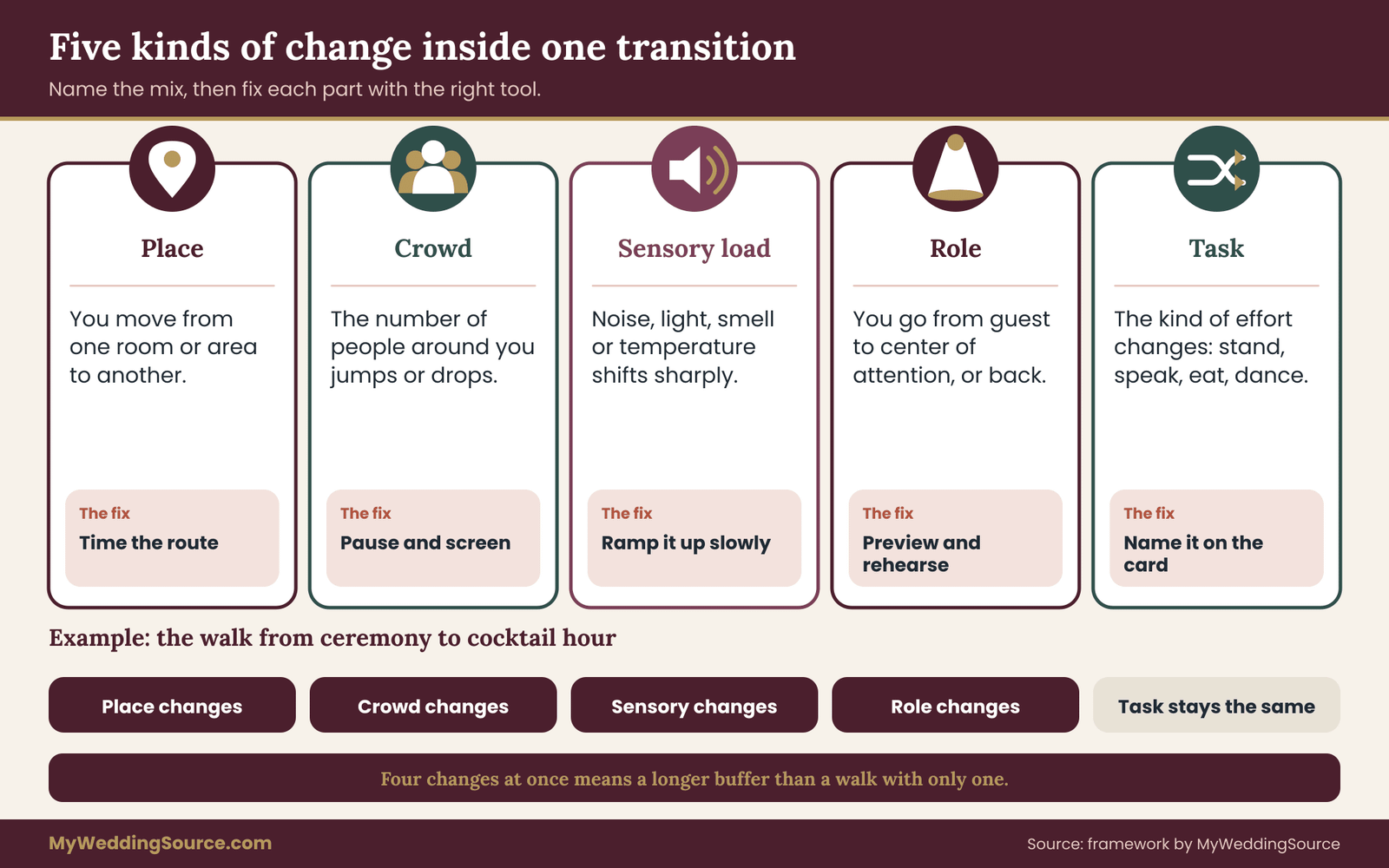
Most of the hard seams in a wedding day combine three or four of these. The walk from the ceremony to the cocktail hour changes place, crowd, sensory load and role all at once, which is why it deserves more padding than the walk from the dressing room to the car.
Once you can name the mix in a given transition, the fix for it usually becomes obvious. A pure place change needs minutes. A crowd change needs a screen and a pause. A sensory change needs a ramp. A role change needs a preview.
The sections that follow build the tool in steps. First comes the four-line block card, the unit you will use to describe each part of the day. Then the three tiers of time, which let you decide what must stay fixed and what can move.
Then the buffer rules, the backward-planning method that places everything against the ceremony, the preview layer, the vendor handoff and a worked example with an invented couple. The last sections cover alternatives when a full schedule is too much, the conditions under which the approach fails and a rehearsal plan.
You do not have to use every part. A couple who only need three buffers on the day can take the buffer rules and stop. A couple who are worried about vendors changing things can focus on the handoff sections. If you are still deciding how many blocks the day can hold at all, the site’s wedding planning checklist is a good place to settle the overall shape first, and this guide then handles the sequence inside it.
The four-line block card
The basic unit of a predictable wedding schedule is not an event. It is a block, and each block gets a small card with exactly four lines. Keeping it to four lines is the point. A card with fifteen fields will not be filled in, will not be read and will not survive contact with the day.
Line one: what happens, in plain words. Write the label as a description of the experience, not as the vendor’s jargon. “Reveal” tells you little. “Walk down the aisle with your dad while guests stand and film” tells you what the next ten minutes will feel like. Use the same label everywhere the block appears, on the card, on the sheet you give the planner and on the shortened version you hand out. Changing the name of a block mid-process is how two people end up believing they agreed to different things.
Line two: where, and with whom. Name the place and the people who will be present, including anyone whose job is to interact with you. “Garden terrace; photographer and her assistant, both of us, no guests.” This line is where you catch crowd changes. If the people column suddenly jumps from three to a hundred, the card has just shown you a transition that needs a buffer.
Line three: the buffer after. State, in minutes, how long you have between the end of this block and the start of the next, and what the buffer is for. “Fifteen minutes, door closed, water and a snack, nobody speaks to us unless it is about the next block.” A buffer without a purpose gets eaten. A buffer with a purpose has a defender.
Line four: the exit and the preview. Two short items. The exit says what you can do if this block is not working, and who you tell. “If this is too loud, we signal the coordinator and leave through the side door to the courtyard.” The preview says what comes next and where, in one sentence. “Next: ten minutes in the courtyard, then family photos by the fountain.”
That is the entire card. The reason a predictable wedding schedule uses four lines instead of two or six is practical. Two lines lose the buffer and the exit, which are the parts that protect you. Six lines start to include things that belong elsewhere, such as vendor notes, music cues and staffing, and the card becomes a second master timeline that has to be kept in sync with the first.
Writing the line-one label so it does work
Labels do more than name a block. They set an expectation. If you call a block “portraits” and the photographer plans a mix of couple shots, family groupings and wedding party lineups, the label has misled you. Split it into the pieces that feel different and name each: “Couple portraits, 20 minutes, just us”, “Immediate family photos, 15 minutes, eight people”, “Wedding party photos, 15 minutes, twelve people”. Each of those now has its own crowd size, its own buffer and its own exit.
A useful test is to read the label to someone who has never seen the venue and ask them to describe what they expect. If they imagine something different from what you mean, the label needs more detail. For the family and group formations specifically, the site’s family photo list guide shows how to count and order the groupings so the block has a known length before the day starts.
Writing line two so it exposes crowd changes
When you fill in the people on each card, add a number. Do not write “family”. Write “family, about thirty”. Then look down the column of numbers across the whole day. Sharp rises in that column are the crowd transitions.
A day that goes two, two, eight, eight, forty, two hundred, two hundred has an obvious pair of steps at the ceremony and the cocktail hour. You can then decide whether to soften the climb, for example by having a small cluster of family arrive early to the cocktail hour so you do not walk into a full room.
The column also shows you where your predictable wedding schedule is gentler than you thought. If your highest-density blocks are short and surrounded by buffers, you can relax about them. If three high-density blocks are stacked back to back, you have found the part of the day to rework before anything else.
Writing line three so the buffer has an owner
Every buffer needs a person who defends it. On a wedding day, free time looks like a gap that other people will fill: a relative wants a photo, a vendor wants a signature, the DJ wants to confirm the playlist. If nobody is assigned to protect the buffer, it vanishes in the first half hour.
Name the defender on the card, a coordinator, a friend or a family member who is comfortable saying no politely. The wording for what they say should be short and unapologetic: “They are taking a few minutes and will be right out.”
Writing line four so the exit is usable
An exit that requires you to explain yourself is not an exit. The best exits are physical and silent: a particular door, a particular room, a hand signal or a word the defender recognizes. Decide in advance who sees the signal and what they do.
And decide whether leaving a block also changes the predictable wedding schedule, because if you leave the cocktail hour early, someone has to decide whether the next block moves up or stays put. Put that decision on the card too: “Exit does not move the next start time.”

Fixed anchors, soft windows and floating items
Once every block has a card, sort the cards into three tiers. This is where a predictable wedding schedule differs from a plain list with padding. The tiers tell you what to protect, what to let slide and what to drop.
Fixed anchors are blocks tied to something you cannot move: the ceremony start set by the officiant or the venue, a meal service time set by the caterer’s kitchen, the venue’s load-out time, a sunset you want in the photos, the arrival of an elderly relative who cannot wait. Anchors are the skeleton of a predictable wedding schedule. Everything else is arranged around them. There should be few of them, usually between four and seven.
Soft windows are blocks with a start and end that can shift within a range. Couple portraits can happen anywhere between two and four in the afternoon. Cocktail hour can start when the last family photo ends, within a limit. Soft windows are where a predictable wedding schedule absorbs a delay without touching an anchor. Each one should have a written range: “any time between 2:30 and 4:00, 20 minutes long”.
Floating items are things you want but that have no fixed place: the quiet five minutes with your partner, the toast from a college friend, the dance with a grandparent, the group photo with coworkers. Floating items fill gaps. They are also the first things to drop when the day runs late, which is why they need a written order of priority.
How to sort a block
Ask three questions for each card. Does something outside our control set this time? If yes, it is an anchor. If no, does its time have to fall within a range for a reason, such as light, food or a person’s schedule? If yes, it is a soft window. If neither, it floats.
Be strict with the anchors. People tend to label too many blocks as fixed because fixing them feels safe. A predictable wedding schedule with fourteen anchors has no slack and cannot recover from anything. If you have more than seven, look at each extra one and ask whether the constraint is real. Often it is a preference that could move, for example “we want the cake cutting at eight” when nothing forces eight.
Be generous with soft windows. They are where predictability and flexibility meet. A soft window with a stated range gives you a known outer limit: you do not know exactly when portraits will start, but you know they will not start before 2:30 and will be over by 4:00. That is a kind of certainty. That is far better than a single time that is bound to slip, and it is the kind of certainty a predictable wedding schedule can honestly offer.
Protecting the anchors first
Build the day from the anchors outward. Place each anchor on a timeline, then set the buffer before it and after it. The buffer before an anchor is usually the larger one, because arriving late to an anchor is where stress peaks. A ceremony that cannot start until you are at the doors needs a “doors” buffer that is real, not a hopeful five minutes.
Where two anchors are close together, check whether the space between them can hold the transition they need. Ceremony at four and a hard venue transition at four-thirty cannot hold a family photo block, a walk to a different building and a pause. If it cannot, one anchor has to move, or one block has to leave the day. It is better to find that on paper than on the day.
The order of drop
For the floating items and the soft windows, write down the order in which you would cut them if the day ran an hour late. It is an uncomfortable exercise, which is why most people skip it, and it is the single most useful part of the tiering.
In a predictable wedding schedule, a written order of drop means that when something goes wrong, nobody has to negotiate under pressure. The coordinator checks the list and says “we are skipping the coworker photo and shortening cocktail hour by ten minutes.” You have already agreed.

Sizing buffers for each kind of transition
Every predictable wedding schedule needs buffers, and a flat rule such as “add ten minutes between everything” is better than nothing and worse than a rule that matches the transition. Ten minutes is far too much for walking from the car to the door and far too little for moving from a private first look into a full cocktail hour. A predictable wedding schedule sizes each buffer by what the transition contains.
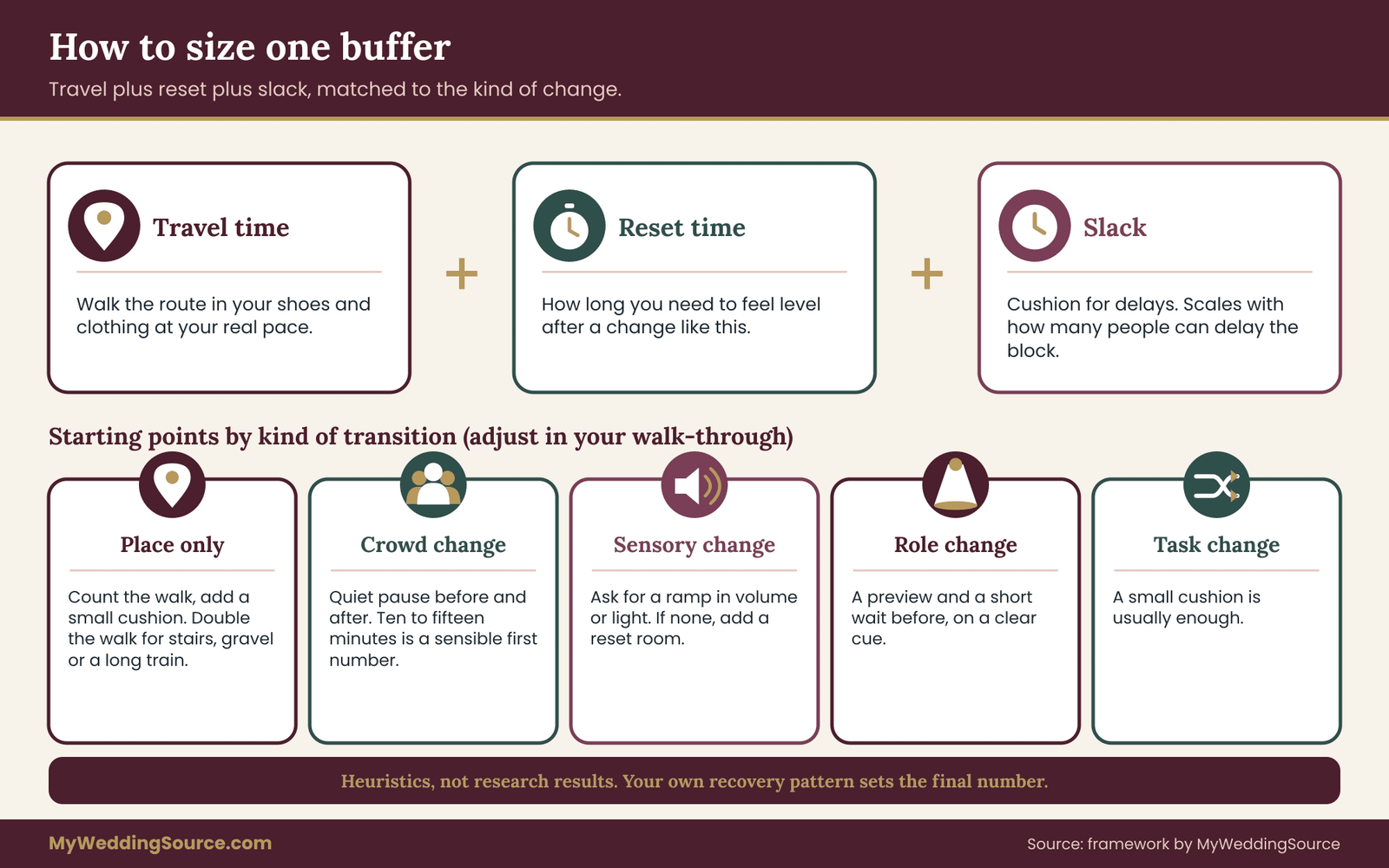
Sizing a buffer for a predictable wedding schedule has three parts that add together: travel time, reset time and slack. You work out each part separately and then sum them.
Travel time is the physical cost of getting from one block to the next. Walk the route yourself, or ask the venue coordinator to do it, in the shoes and clothing you will wear. Time it at the pace you will actually move, not the pace of a healthy person in running shoes.
If one of you uses a mobility aid, is wearing a long train, or is carrying a bouquet and a hand-held fan, add time. Count stairs, gravel, doors that need to be held open and elevators that have to be called. The site’s guide to spotting accessible venue red flags lists the physical features that quietly add minutes, such as long carries, steps without a ramp and doors that do not stay open.
Reset time is the time you need to settle after the change. It depends on how heavy the transition is, which depends on how many of the five kinds of change it contains. A pure place change needs almost no reset. A crowd plus sensory change needs a few minutes of quiet.
A role change that includes being on display needs a few more. You know your own pattern better than anyone, so ask yourself honestly how long it takes to feel level after something similar, such as a busy party or a work presentation, and use that as a starting number. If you do not know, use a range and test it in the rehearsal.
Slack is the extra cushion for things that run over. Slack is not the same as reset. Reset is time you will use. Slack is time you hope not to use, which is why it is easy to cut. Slack in your predictable wedding schedule should scale with how many people or vendors can delay the block. A transition that depends on a guest finding their seat has more slack than one that depends only on the two of you.
Starting points by transition type
Use these as starting points for your first draft, then adjust after you have walked the routes and talked to your own body about how you recover. They are planning heuristics, not research findings, and they change with your own settings.
For a pure place change with a short, flat route, count the walking time and add a small cushion of a few minutes. For a place change with stairs, gravel, a long train or a mobility aid, double the walking time first and then add the cushion.
For a crowd change from a small group to a large one, allow a pause before the transition, as well as after. The pause before lets you prepare, and the pause after lets you see what the room is like before you are expected to talk. Ten to fifteen minutes in a quiet place is a sensible first number.
For a sensory change, such as moving from a quiet ceremony to a loud space, ask whether the venue or the DJ can ramp the sound and light. A ramp of a few minutes at lower volume costs the vendor nothing and removes the jolt. If a ramp is not possible, add a reset buffer in a quiet room before you go in.
For a role change that puts you on display, such as an entrance or a toast, put a preview and a short wait immediately before, with a defined cue. For the rest of the cue structure, the guide on ceremony cue sheets shows how to write the signals that tell each person when to move.
For a task change inside the same room and the same crowd, such as sitting down after standing, a small cushion is usually enough.
The stacking problem
Buffers are not independent. If three transitions in a row each have a modest buffer, the total can still be too short, because the capacity you spend in the first one is not available for the second. Think of reset as a bank account. Each high-load block withdraws from it and each buffer deposits. If the day has a long run of withdrawals with small deposits, the account goes negative somewhere in the middle, and it often goes negative around the time of the reception entrance.
To check a predictable wedding schedule for stacking, look at each stretch of the day that includes more than two blocks without a break of at least fifteen minutes. Mark it. If the stretch also has two or more crowd or role changes, mark it again. Any twice-marked stretch needs a longer buffer in the middle, or one block moved out of it.
What to do when buffers collide with vendor needs
A photographer may say that the buffer you have planned eats light they need. A caterer may say the buffer delays service. These are real constraints, and the answer is not always to hold your ground. It is to see which block can give. Often the buffer can move rather than shrink: a fifteen-minute rest before portraits can become a fifteen-minute rest after, if the light matters more. What you want to avoid is the buffer disappearing without anyone deciding to remove it.
A useful phrase for these conversations is “which block should lose time instead?” It treats the buffer as fixed and asks the vendor to help find the trade, which tends to produce better answers than asking whether they can “work with” your needs.
Building the predictable wedding schedule backward from the ceremony
With cards, tiers and buffer sizes in hand, you can assemble the actual predictable wedding schedule. The most reliable way is to build backward from the earliest anchor you cannot move, usually the ceremony or the first meal service. Working forward from the morning produces a predictable wedding schedule that looks fine until it hits the anchor and discovers it is forty minutes short. Working backward shows the shortfall immediately.
The process has six steps.
Step one: place the anchors. Put each fixed anchor on a timeline with its time. Check for conflicts, such as two anchors with too little space between them.
Step two: add the doors buffer before each anchor. This is the time you must be physically at the starting point of the anchor, quiet and ready. For a ceremony it is the time you are waiting out of sight. Make it a named block with a card, not an empty space.
Step three: work backward through the blocks that must happen before the anchor. Getting dressed, photos, first look, transport. For each, place its card with its length, then its buffer after. The buffer after sits between this block and the next one in the sequence, and it is the one that tends to get squeezed.
Step four: check the morning against your energy. If you place everything and discover that you must start at six in the morning, ask whether that is a day you want to live. If not, cut blocks or move an anchor. The day should fit inside a start time you could actually tolerate.
Step five: work forward from the anchor. Place the blocks after the ceremony, with their cards and buffers, up to the next anchor or to the venue’s end time.
Step six: draw the soft windows as ranges. Show the earliest and latest start and the length of each. Put the floating items in a separate list with their order of drop.

An example of the backward calculation
Imagine a ceremony anchored at four in the afternoon, with a doors buffer of fifteen minutes, so the couple needs to be at the ceremony entrance at 3:45. Before that, a family photo block of twenty minutes and a buffer of ten minutes to reach the entrance. That puts the family photo start at about 3:15 and the end at 3:35, with the ten-minute buffer running to 3:45.
Before that, a couple portrait block of twenty minutes with a twenty-minute reset buffer, because it comes after a private first look and before a larger crowd. That places the portrait block at roughly 2:35 to 2:55, with the reset to 3:15. Before that, the first look, then dressing, and so on back to the morning.
This calculation takes a few minutes with a pencil and shows at once whether the predictable wedding schedule is reasonable. If a block has to start before you can wake up, you know where to cut. If the day grows an hour longer than the venue allows, you know which soft windows to compress.
Checking the result against the day’s length
After the backward pass, add up the day your predictable wedding schedule describes. Count the hours from your first scheduled block to the last. Count how many of those hours are blocks with people, how many are buffers and how many are transport. A day that is almost all blocks, with few buffers, is brittle.
A day with roughly a third of its time in buffers and transitions is much more forgiving. You do not need to hit an exact ratio, but if buffers are under a tenth of the day, the predictable wedding schedule is probably not as predictable as it looks, because any delay will land directly on your recovery time.
When the venue sets the shape
Some venues impose a structure that limits a predictable wedding schedule: a ceremony window, a mandatory cocktail hour, a fixed dinner service, a hard end time. If the venue sets most of the anchors, you have less room, and the work becomes finding the buffers inside the structure.
Ask early which times are firm and which are the venue’s defaults. Many defaults can be changed with a request made well before the day. For help judging what to ask and what to put in writing, the guide to reading a wedding vendor contract explains which timing terms are worth confirming in the agreement itself.
The preview layer: telling people what comes next
A predictable wedding schedule that lives in a spreadsheet only the planner can read is not much use to the person who has to live through it. The next step is to decide how the predictable wedding schedule reaches the people it affects, at a level of detail that fits each of them. This is the preview layer, and it is what makes the predictable wedding schedule feel predictable from the inside, as opposed to merely tidy on paper.
There are four audiences, and each needs a different version.
You and your partner. You need the full card for each block, plus a one-page overview. You may also want a visual version: a strip of boxes in order, each with a short label and an icon, like the ones used in many classroom and therapy settings. Some people prefer a list on their phone. Some want a printed card in a pocket. The right format is whichever one you will actually look at when your attention is stretched.
The people who support you. The coordinator, the person defending your buffers and a close family member or friend need the blocks that involve you, the exits and the order of drop. They do not need the caterer’s staffing plan. Give them a single page, with your name for each block, and review it with them once, aloud.
Vendors. They need their own timing, the buffers that affect them and any change in sequence that touches their work. Give each vendor a trimmed version with only the lines that concern them. A florist does not need the quiet room details, and sending them makes the document harder to read.
Guests. Most guests need very little: when the ceremony starts, where to go afterward and roughly when dinner is. A short, friendly guest-facing version is enough, and for some weddings it is only a line or two on the invitation or website. If you want guests to understand a pause, such as a gap between the ceremony and the reception entrance, a sentence on a printed program can explain it without detail: “We will join you at the cocktail hour after a short break.”
Three layers of detail
Think of the preview as three layers, each shorter than the last.
The full layer is the card set. It is for you, your partner and the people closest to the predictable wedding schedule.
The working layer is a one-page sequence with times, locations and buffers. It is for the coordinator and key vendors.
The glance layer is a strip of three to six upcoming blocks, with no times other than the next one. It is what you look at on the day. It answers one question: what is next, and where?
Most of the value of the predictable wedding schedule on the day comes from the glance layer. During a long day nobody reads a full timeline. They look at a card or a phone, take in one line and move. If the glance layer is clean, you can set aside the rest.
Previewing in the moment
There is also a preview that happens live. A short verbal cue from the coordinator before each transition, in the same words each time, can do a lot. “In five minutes we will walk to the terrace. Photographer first, then us.” The wording matters less than the consistency. If the coordinator uses the same format for each handoff, you learn to expect it and it becomes a signal in itself.
You can make this part of your briefing. Tell the coordinator what you want to hear, how early you want it and in what tone. Some people want a countdown. Others find a countdown stressful and prefer one clear prompt at the moment. Decide ahead which is you, and tell them.
What to do about the unexpected announcement
DJs and emcees tend to announce things. “Ladies and gentlemen, please welcome…” is a normal tool of the trade, and it can land very hard on someone who has been promised a quiet entrance. This is a place where the preview layer and the vendor handoff meet. Tell the DJ what you want announced and what you do not.
Give them the exact wording you want, including the order of names, so the moment does not depend on how they choose to improvise. The site’s guide to the cocktail hour is a useful reference for how that stretch of the day usually flows, so you can see where an announcement would normally fall and decide whether you want it.
Getting a predictable wedding schedule through the vendor chain
A predictable wedding schedule only survives if the people who run the day agree to it. Vendors are not enemies of the plan. Most of them want a smooth day, and many have worked with couples who need a quieter or more structured event. But they work on their own timelines, with their own staff and their own habits, and the buffers you have carefully sized can disappear if nobody tells them why they matter.
The goal of the vendor handoff is simple: each vendor should know which of their moments are anchors, which are soft, which are yours to protect and what they are not to change without asking.
Start with the person who holds the master timeline
If you have a planner or day-of coordinator, that person is the channel. Give them the card set and the working layer and ask them to treat the buffers as blocks, not as gaps. If you have no planner, someone has to play the role: a friend, a family member or a venue coordinator who is willing to take it on. Do not leave it to the photographer, who has their own job, or to the DJ, who is busy with the sound.
Ask the coordinator to be the only person who changes the sequence on the day. This is the single most useful rule. When multiple people can reshuffle the order, the predictable wedding schedule becomes unpredictable regardless of how well it was planned. The rule can be stated simply: changes go through the coordinator, and the coordinator checks the order of drop.
What to say to each vendor
Keep the requests small and specific. Vendors respond to concrete instructions much better than to general descriptions of a need.
To the photographer: ask for the portrait block to be split into named pieces, each with a start, an end and a stated number of people. Ask them to tell you, at the start of each piece, how long it will take and what comes next. Ask them not to add informal shots in the buffer. If they need more time, they ask the coordinator, who decides what moves.
To the DJ or band: ask for the exact running order of announcements, the volume ramp at the start of the reception and a warning before any loud effect, such as a sparkler exit or a song with a sudden start. Ask for a quiet playlist during the buffers, if the buffers happen in the reception space.
To the caterer: ask when the kitchen needs the final headcount and the seating chart, when service starts and whether the buffers around dinner affect the plating time. If you want to eat in a quieter space before joining the room, ask whether the kitchen can plate for you separately.
To the venue: ask who holds the keys to the quiet space, who can unlock it and when, and what the hard times are. Ask whether the route between blocks is available when you need it, and whether other events or staff will be in the way.
To the officiant: ask for the exact structure of the ceremony, how long it will last and what they will say at each step. For the ceremony’s own flow, the site’s walkthrough of the ceremony step by step shows the usual order so you can decide which parts to keep.
Put it in writing, in a form vendors will read
Verbal agreements fade. Put each vendor’s version of the predictable wedding schedule in an email or a shared document, and ask them to reply with a one-line confirmation. Do not send a long document with a request to “review it”. Send the one page that concerns them and a single question: “Can you work with this timing and the notes on the buffers?” Replies tend to be fast and specific.
If a vendor pushes back, listen for what is behind it. Often the objection is about one block, not the whole plan. A photographer who cannot give you twenty minutes alone may be able to give fifteen with a wider window. A DJ who cannot lower the volume at the start may be able to open with a mellow track. Treat the pushback as information about where the predictable wedding schedule is tight.
Where a signed agreement helps
Not every request belongs in a contract. A buffer between portraits and the ceremony is probably better handled through the coordinator. But timing terms that affect cost or access, such as overtime charges, access hours, quiet space availability and the order of services, are worth confirming in writing. If a venue’s contract allows only ninety minutes for the ceremony and cocktail setup together, that affects the predictable wedding schedule you can build, and it is better to know before you sign.
When a vendor cannot or will not accommodate
Sometimes a vendor says no. Maybe a photographer insists on a single long block of portraits. Maybe a venue will not open the quiet room until late. At that point you have three choices. You can adapt the predictable wedding schedule to the constraint, for example by moving the portraits to before the ceremony so the long block happens in a quieter setting.
You can change the vendor, if the date allows. Or you can accept the constraint and add a buffer elsewhere to compensate. None of these is a failure. They are the usual give-and-take of putting a day together.
A worked example: building the day for Ines and Theo
The example that follows is invented, to show the method working end to end. Ines and Theo are not real people and the numbers are illustrative, not a recommendation. Ines is autistic and finds sudden changes and crowded, loud rooms draining. Theo has ADHD and tends to lose track of time when he is busy.
They are marrying at a small venue with a garden, an indoor hall and a side courtyard, with about eighty guests, a ceremony at four in the afternoon and a venue end time at ten at night. They have a day-of coordinator named in their contract and a photographer who works alone.
They did not start with a timeline. They wanted a predictable wedding schedule, and that meant starting with cards. They started by listing the blocks of the day and writing a card for each.
Step one: list the blocks and their crowds
They wrote the blocks in the order they expected them, with the number of people present. Getting ready at the venue suite, two people plus a hair and makeup artist. A private first look, two plus the photographer at a distance. Couple portraits, two plus the photographer. Family photos, eight family members.
Wedding party photos, ten people. Waiting at the ceremony doors, two plus the coordinator. The ceremony, eighty. A walk from the garden to the courtyard, two plus the photographer. Cocktail hour, eighty. Reception entrance, eighty. Dinner with toasts, eighty. First dance, eighty. Cake, eighty. Open dancing, eighty, with the option to leave.
Looking down the people column, they saw what they already suspected. The day went from two to eighty at the ceremony and stayed at eighty for the rest of it. There was no step down. That told them where to concentrate: the transitions into the ceremony, out of it and into the reception.
Step two: sort into tiers
They asked who or what controlled each time. The ceremony at four was set by the officiant, who had another event that evening, so it was an anchor. Dinner service at six-thirty was set by the kitchen, another anchor. The venue’s end time of ten was an anchor.
The sunset photo window, which Ines cared about, was an anchor in the sense that it could not move, but they decided to accept losing it if the day slipped, so they marked it as a floating item with a high priority. They ended up with three true anchors, which is a good number for a predictable wedding schedule.
Couple portraits, family photos and wedding party photos became soft windows between one and three-thirty. Cocktail hour was a soft window that had to end before six-thirty. The first dance, cake and open dancing were soft windows after dinner. Floating items: a quiet five minutes together after the ceremony, a toast from Theo’s sister, a photo with Ines’s coworkers and the sunset portraits.
Step three: size the buffers
For each transition they counted the kinds of change. The walk from the garden ceremony to the courtyard involved a change of place, crowd and role, but they decided it should happen while the guests moved to the cocktail space, so the crowd change was delayed. Ines wanted a longer reset there than anywhere else, since the ceremony ends with a loud reaction and a lot of attention.
They walked the route with the coordinator and timed it at an actual walking pace with Ines’s dress and Theo’s slower pace on gravel. Walking took four minutes. They added a twenty-minute reset in the courtyard, a closed door, water, a snack and nobody allowed in. They wrote the coordinator’s name on the card as defender. They then added five minutes of slack and ended up with a thirty-minute block between the end of the ceremony and the start of the cocktail hour.
For the entrance to the reception, the problem was sensory and role-based, with a loud introduction and dimmed lights. They asked the DJ to skip the announcement and use a gentle instrumental entrance at low volume, ramping up over the first fifteen minutes. They added a ten-minute reset before the entrance in the courtyard, with a preview from the coordinator.
For the portraits they chose to do the first look early, followed by twenty minutes of couple photos, then fifteen-minute buffers between each of the photo blocks, with a shorter ten-minute buffer at the end for the walk to the garden doors. The buffers were deliberate: Ines would be around more people in each block, so the pauses came after the heavier ones.
Step four: build backward
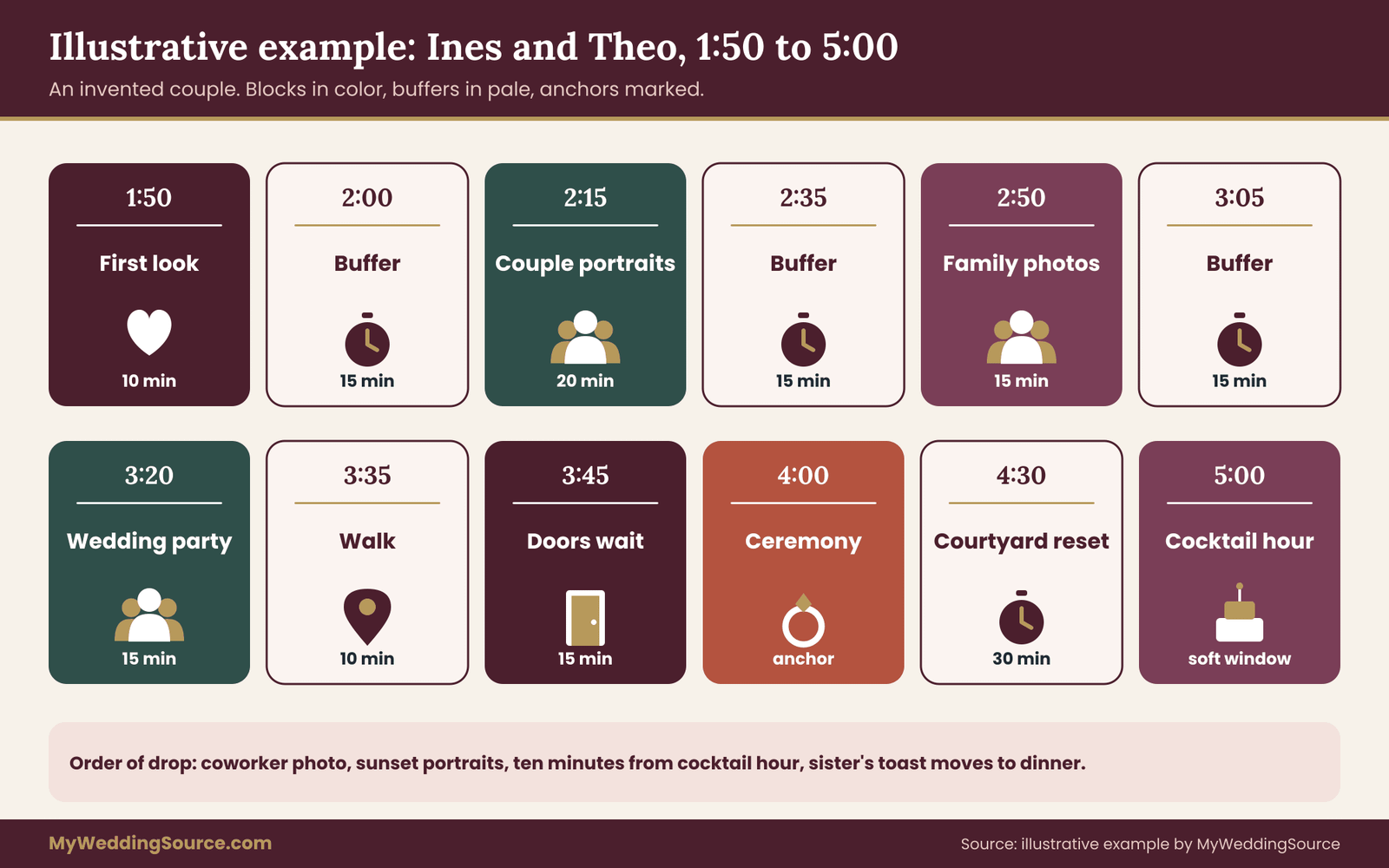
With the ceremony at four, they set the doors buffer at fifteen minutes, so they needed to be at the garden doors at 3:45 and the walk there took the ten minutes before that. Wedding party photos ran 3:20 to 3:35. A fifteen-minute buffer before them put the end of family photos at 3:05, and family photos ran 2:50 to 3:05.
Another buffer, 2:35 to 2:50, came before that, after couple portraits at 2:15 to 2:35. A fifteen-minute buffer sat before the portraits, and the ten-minute first look ran 1:50 to 2:00. Getting dressed had to be finished by 1:35, which meant hair and makeup began at nine in the morning, a start time both of them found acceptable.
They checked the predictable wedding schedule against their energy. Theo noticed the morning had a long unscheduled gap, because hair and makeup would be done by half past eleven and dressing would not start until about twelve-thirty. Rather than leave it empty, they made it a named block with a card: “Quiet lunch in the suite, only the two of us, phones on do-not-disturb.” They included it so the gap would be a decision, not a drift.
Step five: add the preview and exits
They made a glance strip with six boxes for the afternoon, labeled in their own words: “First look”, “Photos with just us”, “Family”, “Wedding party”, “Wait at doors”, “Ceremony”. They asked the coordinator to give a verbal cue five minutes before each handoff in the same format. They gave Theo a phone alarm for each block that was not on the coordinator’s cue, because he knew his sense of time slipped.
For exits, the courtyard became their quiet room throughout the evening, and a hand signal, a touch to the ear, told the coordinator that one of them needed to step out. They agreed that leaving a block would not move the next start time unless the coordinator decided to use the order of drop.
Step six: order of drop
They wrote the order in which to cut things if the day ran an hour late. First, the coworker photo. Second, the sunset portraits. Third, shorten cocktail hour by ten minutes. Fourth, the toast from Theo’s sister moves into the dinner service. The first dance and cake were not in the order of drop, because they had been placed in soft windows that could slide without losing anything. The buffer before the reception entrance was marked “protected, last to cut.”
What the example shows about a predictable wedding schedule
Three things stand out. First, most of the work was not in the predictable wedding schedule itself but in the cards and the counts. Once Ines and Theo knew the crowd numbers and the kinds of change, the buffers sized themselves. Second, the predictable wedding schedule had no more than three anchors, and everything else could move, which made the day more resilient than a long list of fixed times.
Third, they wrote the plan for the day running late at the same time as the plan for the day going well. That was the single change that most reduced the sense of dread, because it replaced “what if it goes wrong?” with a short list.
Notice also what they did not do to get a predictable wedding schedule. They did not ask the venue to close the doors to guests or change the format of the wedding. They did not announce a theme or explain themselves to every vendor. They made a handful of specific requests, each tied to a card. And they did not build a predictable wedding schedule for a version of themselves that could handle anything. They built it for the people they were.
Adapting the example to a different day
If you shift the example, the same method gives different answers. A morning ceremony changes the energy curve: the day front-loads its high-density blocks and leaves a long, lower-density afternoon. A destination day with a drive between ceremony and reception adds a place change that dominates the predictable wedding schedule, and the buffer there is mostly travel plus reset in a car.
A very small wedding of ten people may have no crowd transitions at all, and the buffers can shrink to cover only task and sensory changes. A larger wedding of two hundred makes the crowd change before the cocktail hour more intense, which argues for a longer reset and a staggered entrance. The cards do not change. Only the numbers inside them do.
For the part of the day after the ceremony, where Ines and Theo made some of their most important choices, the site’s guide to reception guest flow covers how entries, seating and food service usually sequence, which helps you see where the sensory and crowd changes will land in your own venue.
Alternatives when a full schedule is too much
The four-line cards, the tiers and the buffer sums are a lot of work. For some couples that work is itself the stress. Planning in detail can feel like rehearsing every way the day might go wrong. Before you commit to the full method, it is worth knowing the lighter versions and when each one fits. A predictable wedding schedule can be built at several levels of detail, and a smaller version that you use is better than a larger one that you abandon.
The anchors-only version
In this version you write down only the fixed anchors and the buffer before each. The rest of the day is a loose sequence with no times. It works for small weddings, relaxed venues and couples who find too many times stressful. Its weakness is that soft blocks drift, and the day can lose the buffers without anyone noticing. If you choose it, add one rule: the coordinator tells you before each block starts, and you can say “not yet” once.
The visual strip
Some people do not read schedules at all but respond well to pictures. A strip of labeled icons or photos in order, with no times at all, shows the sequence without the pressure of a clock. The strip can be printed on a card or kept on a phone.
The weakness is that it shows what happens but not how long it lasts, so it works best when paired with a coordinator who handles timing. A strip also needs updating if the order changes, which is why the rule about changes going through one person matters so much here.
The two-day split
If the density of one day is the main problem, move some blocks to another day. A private signing or small ceremony on one day and a larger gathering on another turns one very high-density day into two moderate ones. The transitions shrink because each day has fewer blocks.
This is a bigger decision than a scheduling tweak, and it has costs, including a second venue booking and guests who need to be told which events they are invited to. But for some couples it makes the whole thing possible. The site’s guide to planning a wedding is the place to think about the overall shape before choosing it.
The short day
A shorter wedding has fewer transitions by definition. A ceremony followed by a meal, ending by early evening, can eliminate the entrance, the first dance, the cake cutting and open dancing. If the part of a wedding that wears you out is the long stretch of high-stimulus evening, ask whether you want it at all. Some couples end the formal part after dinner and let guests continue without them, which is a legitimate way to leave.
Working without a coordinator
If you have no planner or coordinator, the full method puts a lot on a friend. In that case reduce what you ask. Choose the three or four transitions that matter most, such as the walk to the ceremony, the move into the cocktail hour and the reception entrance, and write cards for those only. Give one trusted person that short list. A small, well-held plan is more predictable than a large one that nobody owns.
Choosing among them
Pick the version by looking at where you lose energy. If it is the planning itself, choose the anchors-only version or the visual strip. If it is the density of the day, think about the short day or the two-day split. If it is the people who might interfere, put the effort into the vendor handoff and a strong coordinator. The full method is the one to choose when you have a long day, many vendors and the capacity to prepare. Otherwise a lighter version is a good answer.
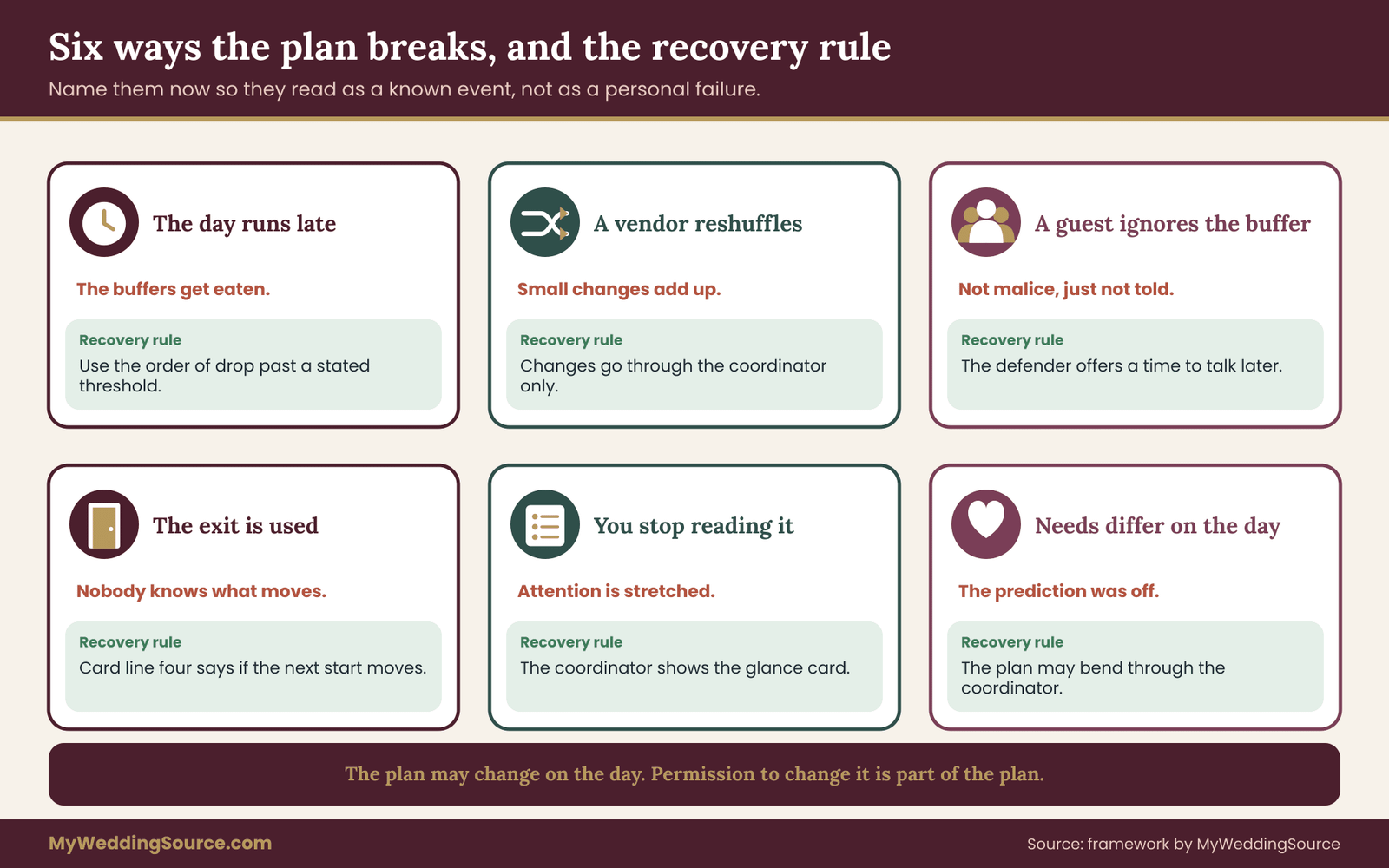
Failure conditions: when the plan breaks and what to do
Any schedule can fail. A predictable wedding schedule fails in specific, recognizable ways, and it helps to name them before the day so that you can recognize them as they happen instead of reading them as personal failure. There are six common conditions, each with a recovery rule.
Condition one: the day runs late and the buffers disappear
The most common failure is that an early block runs over and every later block is pushed. Nobody decides to cut the buffer. It just gets eaten. The recovery rule is the order of drop. When any block runs more than a stated amount over, say ten minutes, the coordinator consults the order of drop and cuts floating items first, then soft windows, never the protected buffers. The threshold should be written on the card set. Without a number, “running a little late” becomes the permanent state.
Condition two: a vendor changes the sequence
A photographer wants to add shots, a DJ moves the toasts up or the caterer plates early. Each change is reasonable by itself and together they undo the predictable wedding schedule. The recovery rule is that changes go through the coordinator and the coordinator checks them against the cards. A vendor who wants a change should say what it costs in time and which block gives it back. If the coordinator cannot be found, the default is that the written plan stands.
Condition three: a guest or relative ignores the buffer
An uncle wants a photo during the reset. A parent wants to talk about the toast. This is not malice. It is people who have not been told. The recovery rule is that the defender intercepts and offers a time: “They will find you at the cocktail hour.” The defender needs to have been given that script and to feel entitled to use it. If you suspect a particular person will be a problem, brief them earlier, in a calm moment, with a short explanation.
Condition four: the exit gets used and nobody knows what happens next
One of you leaves a block through the exit and the predictable wedding schedule has no rule for what the coordinator does. Does the block wait? Does the next one start? The recovery rule is written on card line four: “Exit does not move the next start time” or “Exit pauses the next block for up to ten minutes”. Decide which for each block. The default for most is that the predictable wedding schedule continues, and the person who stepped out rejoins at the next transition.
Condition five: you stop reading the schedule
On the day, people stop looking at the card. They get busy, they rely on what the coordinator says and they lose track. This is normal, and the glance layer is built for it.
The recovery rule is a standing agreement with the coordinator: when you seem lost, they show you the glance card and say the next block aloud. If you have a phone alarm, it carries the same function. The aim is to make the predictable wedding schedule available at the moment you need it, not to make you the permanent keeper.
Condition six: your needs on the day differ from your needs on paper
The predictable wedding schedule was built from a prediction about how you would feel, and the prediction was wrong. You are more tired than you expected, or less. A buffer that looked generous feels thin, or a quiet room you planned to use is the last place you want to be. The recovery rule is that the predictable wedding schedule is allowed to change, through the coordinator, in either direction.
A wedding day is not an exam. Treat the predictable wedding schedule as a tool that serves you, and let the coordinator know you can change a buffer, skip a block or add a reset at any point. If you decide ahead of time that you may do this, using the permission feels like part of the predictable wedding schedule.
How to tell if the method is not working
Some warning signs suggest the whole approach needs rethinking, not just one block. If you cannot finish the cards because every block feels equally heavy, the day may have too many blocks. If the buffers add up to a day longer than the venue allows, the day needs to shrink.
If you find yourself writing more rules to prevent anxiety than you are writing descriptions of the day, the predictable wedding schedule may have become a way to try to control things that cannot be controlled, and a lighter version may serve you better. And if the predictable wedding schedule relies on every person doing exactly what they are told, it will fail the first time somebody does not.
Keeping a short failure log during planning
A simple habit helps. As you plan, keep a short list of things you are worried about, written as conditions: “If the photographer runs over, then…” For each, write the response. The list rarely runs past ten items, and writing it is often enough to settle the worry. The list also becomes the briefing for your coordinator, who can read it and see where you expect the pressure.
Rehearsing and owning the predictable wedding schedule on the day
A schedule on paper is a hypothesis. A rehearsal tests it. You do not need a full run-through with a cast of dozens. A few short tests, done in the weeks before the day, will tell you most of what you need to know and give you the benefit of having done each transition once before.
Test the routes
Visit the venue with the coordinator and walk each route in the order of the predictable wedding schedule, in the shoes you will wear and at the pace you will move. Time each leg and compare it with your card. Open the doors you will use and check that they open easily.
Find out where the quiet room is, who has the key and whether it has a chair, water and a place to put your things. If the venue allows, stand in the room at the time of day the block will happen and notice the light and the noise. A room that is calm at noon can be loud at six.
Test the buffers
Spend a buffer’s worth of time in the quiet space, doing what you plan to do there, and see whether it works. If you plan to sit in silence for fifteen minutes, try fifteen minutes of silence, without your phone. Some people find that ten minutes is plenty and fifteen is too long. Others find the opposite. Adjust the numbers on the cards after the test.
Test the previews
Ask the coordinator to give you the verbal cue as they would on the day, in the words they plan to use. Notice whether you want more warning or less. Try the glance card in the format you will carry, and check that you can read it at arm’s length, in a dress or jacket with no pockets, at a quick look. If you plan to use phone alarms, set them up and check that they work in the venue’s signal conditions.
Run one hard transition end to end
Pick the transition that worries you most, often the entrance to the reception or the walk from the ceremony, and run it in full with the people involved: you, your partner, the coordinator and, if possible, the DJ. Do it once at the pace of the day, with the same words and the same cues. Afterward, tell each other what felt wrong and fix it. A single run-through of the hardest transition does more than a dozen readings of the predictable wedding schedule.
Brief the people who defend the plan
Meet with the coordinator and any other defenders and read the card set aloud together. Cover the buffers, the exits, the order of drop and the signal. Tell them the three things that matter most and the thing you would least like to happen. Ask each of them to repeat back what they will do in one situation, such as “if a relative stops us during the reset”. The repeat-back catches misunderstandings that would otherwise show up on the day.
The morning of the day
On the day itself, keep the routine light. Look at the glance layer once, in the morning, and put it where you will find it. Remind the coordinator of the three rules: changes go through them, the buffers are protected and the order of drop applies.
Then let the predictable wedding schedule carry the day. If you have built it well, the predictable wedding schedule holds the sequence so that you do not have to. For a quiet moment, look back at the cards and remind yourself that every transition has been walked, timed and named.
After the day
If you want to improve the plan for other events, such as a reception on a different day or a family gathering, note what worked. Which buffer was too short? Which exit did you use? Which preview made the most difference? A short note a few days after the wedding is enough. Your plan for the next large event can start from there.
Your next steps
Work through these in order. Each takes one sitting.
- List every block of your day in order, with the number of people present in each. Look down the column and mark the sharp rises.
- Write a four-line card for each block: what happens, where and with whom, the buffer after and its defender, and the exit and preview.
- Sort the cards into fixed anchors, soft windows and floating items. Keep the anchors to seven or fewer.
- Size each buffer by adding travel, reset and slack, based on the kinds of change in the transition. Walk the routes to check.
- Build the day backward from the first anchor you cannot move. Check that the start time is one you could live with.
- Write the order of drop and the threshold that triggers it.
- Make the three layers of preview: the full cards, the one-page working sheet and the glance strip. Send each vendor only their lines.
- Run one hard transition with the coordinator, adjust the numbers and brief the people who will defend the buffers.
FAQ
What is a predictable wedding schedule?
It is a day plan in which every change of place, crowd, noise level and task is written down as its own block, given a buffer and previewed to the people affected. The order of blocks is stable, changes go through one named person, and the predictable wedding schedule includes what gets cut if the day runs late. It is not a rigid script. It is a plan that can absorb a delay without breaking.
Is this approach only for autistic couples?
No. The ideas draw on what autistic people describe about transitions and uncertainty, but anyone can use them. Couples with ADHD, anxiety, sensory sensitivities, chronic illness or simply a dislike of chaos often find the buffers and previews useful. The method asks questions about the day, not about the person, so you set the settings yourselves without needing a label or explaining one.
How long should the buffers be?
There is no single number. Add travel time, reset time and slack for each transition, and size them by the kinds of change involved: place, crowd, sensory load, role and task. A short flat walk needs minutes. A move from a small group into a large crowd needs a quiet pause before and after. Test your numbers in a walk-through and adjust, since people recover at different speeds.
Will vendors agree to work around this?
Most will, if the requests are small, specific and tied to a block. Ask the photographer to split portraits into named pieces, the DJ for the order of announcements and a volume ramp, and the caterer for service timing. Give each vendor only the lines that concern them, and ask for a one-line written confirmation. If one pushes back, find out which block is the problem and adjust it.
Do I need a planner or day-of coordinator?
You need someone who holds the predictable wedding schedule on the day and is the only person allowed to change it. That can be a planner, a venue coordinator or a trusted friend. If you have no one, reduce the predictable wedding schedule to the three or four transitions that matter most, and give that short list to one person. A small plan with an owner is better than a large plan with none.
What if the day runs late?
Use the order of drop you wrote in advance. Cut floating items first, then compress soft windows, and leave the protected buffers alone. Set a threshold, such as ten minutes over, at which the coordinator consults the list. Without a stated threshold and order, delays accumulate and the buffers disappear one by one. The point is that the decision has already been made when pressure arrives.
How do I explain my needs to vendors or family without oversharing?
Describe the task, not the reason. “We need fifteen minutes alone with the door closed before the ceremony” is clear and complete. You decide how much more to say, if anything. Use a disclosure ladder: vendors hear the instruction, close helpers hear a little more, and only people you choose hear the whole picture. For questions about what a business must provide, check the ADA site.
Can I change the schedule on the day?
Yes. A wedding is not an exam, and the predictable wedding schedule serves you. Tell the coordinator in advance that you may lengthen a buffer, skip a block or add a reset, and that changes go through them. Having that permission written down makes it easier to use. If your needs on the day differ from your prediction on paper, the predictable wedding schedule should bend, and the order of drop shows what moves.
Sources
- ADA.gov, U.S. Department of Justice Americans with Disabilities Act information and technical assistance
- ADA National Network, information and guidance on the Americans with Disabilities Act
- Centers for Disease Control and Prevention, autism spectrum disorder information
- National Institute of Mental Health, autism spectrum disorder and ADHD overviews
- National Institute on Deafness and Other Communication Disorders, hearing and sound sensitivity information
- American Occupational Therapy Association, resources on sensory processing and daily routines
- Autistic Self Advocacy Network, resources written by and for autistic people
- Job Accommodation Network, guidance on accommodation planning
- Autism Society of America, support and information for autistic people and families