
Neurodivergent wedding planning is the work of building a wedding around how your two minds actually work, instead of around the default timeline, the default crowd and the default expectations about what a happy couple looks like. This guide gives you a decision method, a sensory inventory, a communication plan and a one-page accommodations sheet you can adapt for vendors, family and each other.
Start with needs, not labels. Write down what drains you, what helps and what you want to protect, then sort every wedding decision into one of three lanes: decide now, decide by default, or hand off. Keep each personal need under your control with a disclosure ladder, so a florist hears only the task and a cousin hears only what you choose. Put the result on a one-page accommodations sheet, rehearse the hard moments once, and write a fallback for each. A wedding that fits you is a valid wedding.
Weddings are an unusual project. They compress a year of decisions into a few visible hours, they involve strangers who have never met each other, and they come wrapped in rules that nobody wrote down. For a couple where one or both partners are autistic, have ADHD, dyslexia, dyspraxia, Tourette syndrome, sensory processing differences or another form of neurodivergence, those features can hit unevenly. Some parts will feel easy. Others will demand far more energy than the checklist suggests. That pressure is the reason neurodivergent wedding planning deserves its own method.
This article is about the planning itself, not the day alone. The decisions come first, the sensory environment second, and the conversations with vendors and family third. Each section ends in something you can use: a rule, a script, a worksheet in prose or a question to ask. If you only have an evening, read the quick answer above, then jump to the accommodations sheet section and fill in the first three rows. Think of it as a working manual for neurodivergent wedding planning rather than a list of ideas to admire.
A note on scope. This is general planning information, not medical, legal or financial advice, and it does not diagnose anything or assume that two neurodivergent people need the same things. Where a rule matters, such as disability rights at a public venue, the article points to the agency that publishes it so you can confirm the current version yourself.
What neurodivergent wedding planning actually covers
The word neurodivergent describes people whose brains work differently from what is considered typical. It is a broad, practical umbrella rather than a diagnosis. It can include autistic people, people with ADHD, dyslexia, dyscalculia, dyspraxia, Tourette syndrome, and others. Some people use the term for themselves without any formal evaluation, and some have a diagnosis and prefer other words. You do not need to settle the vocabulary to plan well. You only need to know your own patterns.
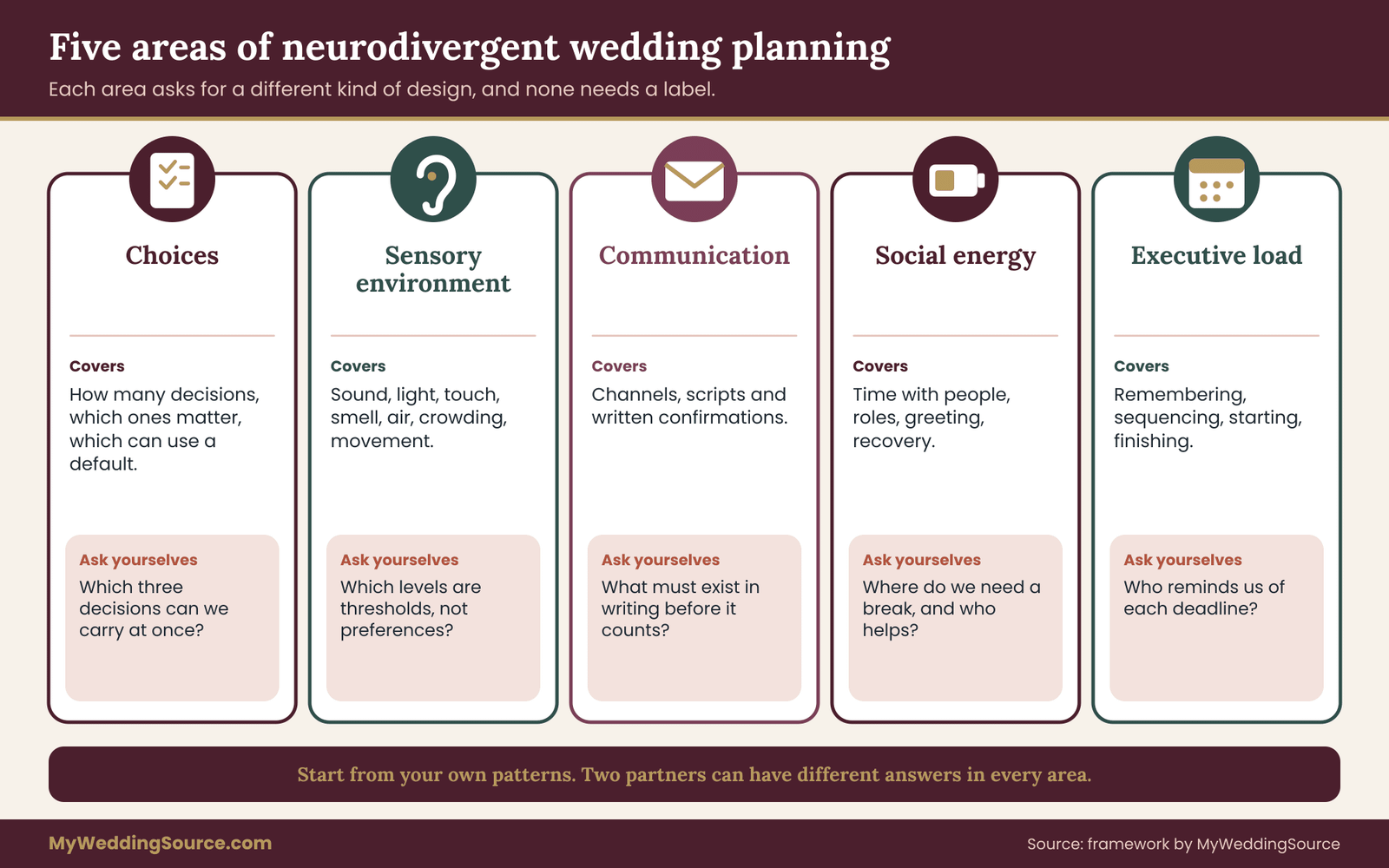
Neurodivergent wedding planning, as this guide uses the term, covers five areas of work. Each one has its own section later.
Choices. How many decisions a wedding asks for, which ones matter to you, and how to stop the rest from consuming months of energy. Decision fatigue is real for most people. For some neurodivergent people it arrives sooner and lasts longer, especially when options are vague or the cost of a wrong choice feels high.
Sensory environment. Sound, light, touch, smell, temperature, crowding and movement. A venue that looks lovely in photos can be exhausting in person, and the reverse is also true. The point is to know your own thresholds, not to follow someone else’s list.
Communication. How information moves between you and the people you hire or love. Many couples find that written, specific, confirmable messages cost less than phone calls and improvised conversations. Others are the opposite and prefer talking. Both are fine, as long as you choose deliberately.
Social energy and roles. Who you talk to, for how long, in what order, and who steps in when you need space. A reception line, a receiving line and a full-room toast each ask for something different.
Executive load. The invisible work of remembering, sequencing, starting and finishing tasks. Weddings are made of deadlines that depend on other deadlines. Making that structure visible, and sharing it, is often the single most useful change.
Notice what is not on the list: a required look, a required level of eye contact, or a rule about how much you must enjoy yourself. Planning for neurodivergent wedding needs is about removing friction, not about performing a version of the day that someone else imagined. Good neurodivergent wedding planning leaves those expectations out unless you choose them.
Why the default wedding script can be a poor fit
Most weddings follow a script that nobody describes out loud. Guests arrive early, mingle with people they barely know, sit through speeches, move to a loud room, eat on a schedule they do not control, dance, and leave at a vague signal. The script is so familiar that vendors, families and even couples forget it is a set of choices. When part of it does not suit you, it is easy to assume the problem is you.
It helps to name where the friction usually appears, because naming it turns a vague dread into a plannable item.
Unstructured time. Cocktail hours and open mingling have no task, no end time and no clear exit. Some people thrive in that space. Others find it the hardest part of the day. A planned alternative, such as a short hosted introduction followed by seating, is a legitimate design.
Surprise. Surprise toasts, flash mobs, a guest grabbing a microphone, a sudden change of music. Surprise is often sold as a gift. If sudden change is costly for you, you can write a no-surprises rule into the plan and share it with the people most likely to improvise.
Layered sensory input. Live music, a photographer’s flash, strong floral scent, crowded sightlines and clinking glasses can all stack in the same ten minutes. Each element may be tolerable alone. Together they can push someone past a threshold.
Implied rules. Who stands where, who speaks when, who touches whom, how long a hug lasts. Written order and clear cues replace guesswork.
Performance pressure. Being watched while you do something once and cannot redo it, such as vows, a first dance or a receiving line. The pressure is not unique to neurodivergent people. It may be heavier for some.
The default script also tends to assume a stable amount of energy across a long day. Many people, neurodivergent or not, run on a budget that spends faster than expected. We return to that budget in the section on social energy. Neurodivergent wedding planning treats that energy as something to budget, not something to assume.
None of this means a neurodivergent couple should avoid traditions. Some traditions are the part of the wedding people love most, and predictable rituals can be comforting precisely because they follow a known order. The goal is to choose, one element at a time, instead of inheriting the whole bundle. Neurodivergent wedding planning keeps the traditions you love and drops the ones you do not.
Three principles that keep the plan honest
Before the tools, three principles. They sound simple, and they prevent most of the problems described later.
Principle one: needs are specific, labels are optional. A sentence like “we are autistic” tells a vendor very little they can act on. A sentence like “we need the ceremony to start within ten minutes of the stated time and we need to know the order in writing” is something a coordinator can do. You can share the label if you want to, but the useful part is the need.
Principle two: the two of you may differ. In a neurodivergent wedding planning process, partners may have different sensory thresholds, different communication preferences and different views on disclosure. One partner may love a long guest list and the other may want twenty people. A plan that only fits one of you is not finished. The method later in this guide gives each partner their own column.
Principle three: every accommodation needs a fallback. Plans fail on the day for ordinary reasons, such as weather, a late vendor or a rushed hour. If a need depends on a single person remembering one thing, it is fragile. For each need you will write what happens if the first plan breaks. That one habit does more than any other to lower anxiety, because the day stops depending on perfection.
These principles also protect you from advice that sounds helpful but does not fit. Lists of sensory-friendly wedding ideas are useful as prompts. They are not a diagnosis of your needs, and they cannot tell you which ideas matter to the two of you. In neurodivergent wedding planning, a tip is only as good as its fit with your own thresholds.
Who this guide is for, and what it leaves out
This guide is written for couples where at least one partner identifies as neurodivergent, and for the planners, friends and family members who support them. It is also useful for couples who do not use the word but recognize their own patterns in the descriptions.
It covers planning decisions, sensory and communication design, disclosure, vendor briefing, a worked example and a set of alternatives and failure conditions. It does not cover clinical topics, therapy or medication, and it does not tell you how to feel about the day. For the broad structure of a wedding timeline and checklist, the wedding planning checklist on this site walks through the standard order of tasks, and this article assumes you will use something like it as the backbone. Together these pieces make a complete approach to neurodivergent wedding planning.
It also does not rank vendors, venues or products. Any claim about what a particular supplier allows should be confirmed with that supplier in writing before you rely on it, because policies change and the details differ by location.
One practical suggestion before you move on. Start a single shared note, in whatever format you both can open easily. Title it with today’s date. As you read the sections that follow, add a line whenever something resonates, even if you are not sure it matters. That raw list becomes the source material for the accommodations sheet. Without a place to capture ideas, they tend to evaporate by the time you sit down with a vendor, which is exactly when you need them.
Finally, a word about pacing. A cornerstone guide like this one can feel like a lot of homework. You do not need to apply every tool. Pick the two or three that address your hardest moments, apply those well, and ignore the rest. A short, honest plan beats an ambitious plan you abandon in week three. Small, steady use of these tools is how neurodivergent wedding planning works in real life.
Neurodivergent wedding planning starts with a choice budget
A wedding asks for hundreds of small decisions: font, napkin color, appetizer, chair type, toast order, who rides in which car. Nobody makes all of them well. The couples who finish planning with energy left are usually the ones who decided early which choices deserve attention and which do not. Neurodivergent wedding planning begins by admitting that nobody needs to make all of them.
A choice budget is a simple way to do that. You decide in advance how many open decisions you can carry at the same time, and you refuse to open more until one closes. Many people find that three open decisions is a workable ceiling. Your number may be two, or five. The exact figure matters less than having one.
The three lanes
Every decision goes into one of three lanes. Write the lane next to the item in your shared note.
Lane one: decide now. These are decisions that shape everything else or that you care about. The venue, the date, the rough guest count, the ceremony format and the main sensory constraints belong here. They are also the ones with the longest lead times and the highest cost of changing later. Give them real attention, in your best hours of the day.
Lane two: decide by default. These are decisions where almost any reasonable answer works, so you pick the first option that meets a stated rule and move on. Napkin color, welcome sign wording, the order of readings, favor type. The rule might be “the first option under our cap that nobody dislikes.” The point is to cut off the endless comparison, not to be careless.
Lane three: hand off. These are decisions someone else makes within boundaries you set. A trusted friend picks the playlist from your yes and no lists. A coordinator chooses the table layout inside your rules. A parent chooses the favors from three pre-approved choices. Handing off is not a loss of control. It is control through constraints.

The same item can move between lanes. Flowers might be lane three for you and lane one for your partner. That is useful information. Put the owner’s initials next to the item, so each decision has a name attached. Flexible lanes are what make neurodivergent wedding planning workable over many months.
Sorting decisions in practice
Take a plain list of what a typical wedding contains, and sort it in about thirty minutes, together. Do not argue over a single item for more than two minutes. If you disagree, mark it “talk later” and keep going. The first pass is about shape, not perfection.
Questions that help with sorting:
- Does this decision affect how I feel during the ceremony or reception, or only how a photo looks?
- Would I notice in a year if we chose the other option?
- Is there a deadline, and does it depend on another decision?
- Does anyone else rely on this answer to do their job?
- Would a default save us money, time or arguments?
Most couples find that fewer than a dozen items belong in lane one. A common surprise is how many visual details end up in lane two once the question is “would I notice in a year.” Another surprise is how many items that seem small, such as the timing of dinner or where you will be when the band starts, deserve a lane one decision because they decide your sensory load. This sorting step is the quickest win in neurodivergent wedding planning.
The wedding decision rights guide on this site covers how couples and families share input. That framework fits neatly here: it helps to settle early who has a vote and who has a voice, so lane two decisions do not reopen every weekend because an aunt has a preference.
Setting defaults that actually save effort
A default only helps if it is written down and specific. “We’ll keep it simple” is a mood, not a default. A default is a rule you can apply without thinking. Written defaults are a quiet pillar of neurodivergent wedding planning.
Examples of defaults that work for many couples:
- Menu: choose from the caterer’s standard packages, and select the first one that covers our stated allergies and dietary needs.
- Flowers: one color family and one type of container, ordered from a single supplier.
- Music: a short list of songs we love, plus a longer list of artists we are fine with, and a short list of no-play songs.
- Seating: a rule such as “families together, then by shared interest,” with a single person finalizing it.
- Stationery: one template, one proof round, no custom layout.
- Transportation: one pickup point and one drop-off, scheduled in writing.
A default will occasionally produce an option you would not have picked on a perfect day. That is the cost. The benefit is that your attention stays available for the lane one choices, which matter more. The trade is worth it in neurodivergent wedding planning, because attention is the scarce resource.
Making deadlines visible
Neurodivergent wedding planning often goes wrong not because of the decision itself but because of the deadline that hides behind it. A hotel block releases rooms on a date. A caterer needs a final headcount. A printer needs proofs. A marriage license has a validity window in many states. Each of these can be invisible until it is urgent.
Two habits help. First, write every deadline into one shared calendar, with an alert far enough ahead that you can respond without panic. A week before is often better than a day before. Second, for each deadline, write the name of the person who will remind you if you forget. That may be a coordinator, a sibling or an automated email. A deadline with no reminder is a risk. Make those reminders part of your neurodivergent wedding planning calendar from the first week.
Some people with ADHD find that body doubling works: sitting with another person, in person or on a video call, while each of you handles your own tasks. It does not require the other person to help. Their presence makes it easier to start and to stay with a task. If this works for you, schedule it like any other appointment, with a start time and an end time. Treat it as a scheduled support in your neurodivergent wedding planning routine, not a favor you have to ask for each time.
People with dyslexia or other reading differences often prefer to receive contracts and proposals in a form they can listen to or scan. Ask vendors for a plain-text summary of the key terms alongside the contract, and ask whether you can have a call to go through it.
A reasonable vendor will agree. If they will not, that is information about how they will treat you after you sign. The wedding vendor contract guide explains which terms to look for, which helps when you only have the energy to read the important parts.
The two-option rule
Open-ended questions are expensive. “What do you want for dinner?” asks a person to search an endless space. “Do you prefer the plated chicken or the plated vegetarian lasagna?” asks them to compare two things. This small habit saves hours across a neurodivergent wedding planning timeline.
You can use this in two directions. When you receive a vendor proposal, ask them for no more than two or three options per decision, with the differences in plain words. When you delegate, offer the same: “Pick one of these three.” If a vendor sends twelve options, you can say, “Please narrow it to your top two and tell me why.” This is a normal request in a service business, and it protects your energy.
A quick test for regret
For lane one decisions, a short regret test helps you finish. Imagine a year from now. Ask which choice you would regret more: choosing the first workable option or spending another month on research. For most items, the first workable option wins. For a few, such as a venue with a hard sensory problem, more research is worth it. A short test like this keeps neurodivergent wedding planning moving instead of circling.
If the decision still feels stuck, set a time box. Give it thirty minutes with your partner, pick the option that scores higher on your top two criteria, write it down, and mark it closed. Reopening a closed decision requires a written reason, such as new information or a changed cost. “I’m still not sure” is not a reason. It is a feeling, and it usually fades once the decision is no longer open.
When partners decide differently
Neurodivergent wedding planning often involves two people with different styles. One of you may decide quickly and want to move on. The other may need to think and return to the question. Neither style is wrong. The practical fix is to agree on how a decision closes. A workable rule is that the slower decider gets a set window, such as forty-eight hours, to raise concerns, and after that the decision stands unless something material changes. The faster decider, in return, does not push for an answer before the window opens.
Put these rules in writing. It feels formal, and it removes a surprising amount of friction, because everyone knows what the process is. Clear process rules are one of the kindest tools in neurodivergent wedding planning.
Sensory needs in neurodivergent wedding planning: build an inventory first
A venue visit tends to be a short, curated experience. The room is clean and quiet, the lights are set to flattering, nobody is vacuuming and the sales coordinator is on their best behavior. The wedding day will be none of those things. Sensory planning is the habit of asking what the room will be like in the conditions you actually care about.
The first step is not a venue tour. It is a sensory inventory, a short written description of how you respond to input. You can build it in an evening. This is the first real task of sensory neurodivergent wedding planning, and it costs nothing.
How to build the inventory
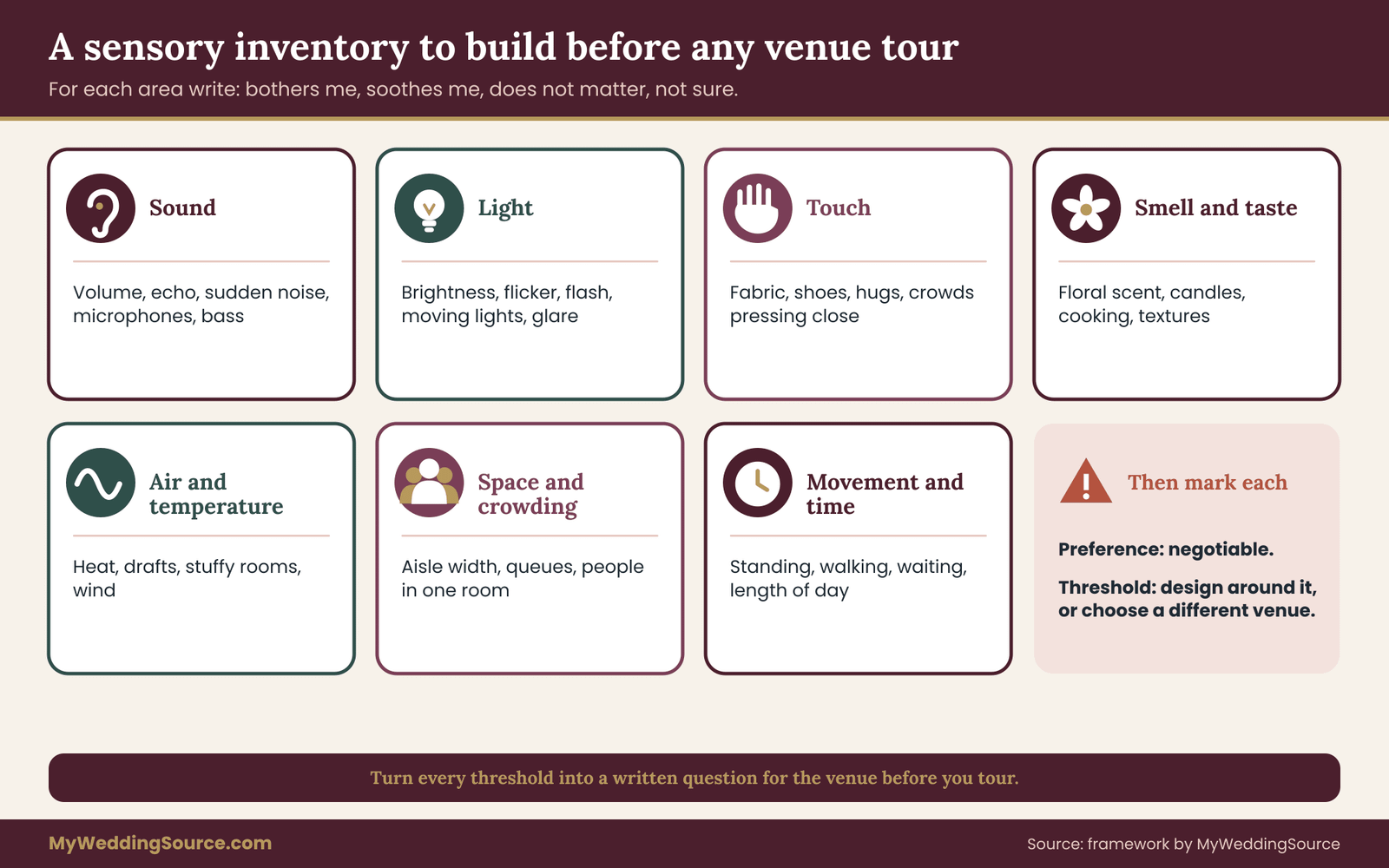
Go through the senses and a few related factors one at a time, and for each one write four short things: what bothers you, what soothes you, what you do not mind, and what you are not sure about. Do this separately first, then compare. It is common for partners to find differences they had not named.
Sound. Think about volume, sudden noise, overlapping conversations, echo, feedback from microphones, clinking cutlery, bass from speakers and the sound of a crowded room. Note whether predictable loud sound, such as a band you chose, is easier than unpredictable sound, such as a crowd. For many people it is.
Light. Think about brightness, flicker, flash photography, strobe or moving lights on a dance floor, direct sun in the face during a ceremony and the difference between candlelight and overhead fluorescents. Note whether you need to be able to dim or turn off particular lights.
Touch. Think about fabric on skin, tags, tight waistbands, shoes, hugging, handshakes, hair pins, a heavy veil, a crowd pressing close and unexpected contact. Note what you can plan around, such as clothing choices, and what depends on other people, such as hugs.
Smell and taste. Think about floral scent, candles, perfume, cooking smells, cleaning products, food textures and strong flavors. Smell is often overlooked in planning and is among the easiest to change, because florists and caterers can usually adjust it if asked early.
Temperature and air. Think about heat, cold, drafts, stuffy rooms, wind and humidity. Outdoor weddings add variables that do not respond to requests.
Space and crowding. Think about how close people stand, narrow aisles, long lines, the number of people in one room at once and sightlines. Note how much open space you need around you to feel settled.
Movement and time. Think about standing for a long time, walking in formal shoes, sitting on hard chairs, waiting, rushing between locations and the length of the day. Note how much rest you need, and where it needs to happen.
Add a seventh category for anything else. Some people are affected by interoception, the sense of internal states such as hunger, thirst or needing the restroom, and may notice these signals late. If that sounds familiar, plan food, water and restroom breaks into the schedule, instead of relying on the body to ask. Include these signals in your neurodivergent wedding planning notes, because they affect food, water and timing.
Thresholds, not preferences
A useful distinction is between a preference and a threshold. A preference is something you like. A threshold is a level past which you stop functioning well. You can often accept a lot of things you dislike, but you cannot reliably work past a threshold.
In neurodivergent wedding planning, mark each inventory item as a preference or a threshold. Thresholds are the constraints you design around. Preferences are what you negotiate. If a venue cannot meet a threshold, it is not the right venue, however beautiful. If it cannot meet a preference, you can weigh that against other benefits.
This is also where the two of you will see differences. A bright room might be a threshold for one partner and a preference for the other. Write both. The plan should satisfy both thresholds, and then trade off preferences with a clear head. Differences between partners are normal in neurodivergent wedding planning, and they are worth discovering early.
Turning the inventory into venue questions
Once you have the inventory, turn each threshold into a question you can ask a venue, in writing, before you tour. Written questions have two advantages. They create a record, and they let the venue answer thoughtfully instead of improvising.
Examples:
- Sound: Is there a sound limiter or a maximum decibel level? Which speakers will the band or DJ be allowed to use? Where is the quietest indoor space, and is it available during the event?
- Light: Can the overhead lights be dimmed independently? Are there any flashing or moving lights included in the package? Does the ceremony space face the sun at our start time?
- Space: What is the capacity of the room, and what is the recommended capacity for comfortable movement? How wide are the aisles between tables?
- Air and temperature: How is the room heated and cooled, and can it be controlled during the event? Is there a ventilation system that can handle a full room?
- Smell: Does the venue use scented products, air fresheners or cleaning products on event days? Can they avoid them?
- Movement: Where are seating and restrooms in relation to the main spaces? How far is the walk between the ceremony and reception?
For more on accessibility red flags in general, the accessible wedding venue red flags guide covers physical access issues such as steps, doorways and restrooms. Sensory design overlaps with that, but it asks different questions, and it is worth treating separately. Use both guides together when neurodivergent wedding planning includes a physical access question.
The visit, with the inventory in hand
When you do tour, go at a time that resembles your event. If your reception is at night, visit at night. If you cannot, ask to see the room with the evening lighting on. Bring your inventory. Stand in the spot where you will be for the ceremony and for the reception head table. Listen. Notice the air. Ask what the room sounds like when it is full, and whether you can hear another event in the building.
Ask to see the quietest room in the building and the route to it. A retreat space is one of the most useful features a venue can have, and it is often unused. Even a corridor, a bridal suite or a small office can work, as long as it is predictable, available and reachable without crossing the whole party.
If a visit overwhelms you, that is data. Leave early, and note which part caused it. It does not mean the venue is wrong, but it tells you what to ask for. You may also bring a friend or coordinator on the visit, so one person handles conversation while another observes the room. Treat each reaction as evidence in your neurodivergent wedding planning file.
Venue types and sensory tradeoffs
No category of venue is automatically right. Each has typical strengths and typical risks, and the differences can help you narrow the search.
A small restaurant or private dining room can offer controlled lighting and a predictable layout, but sound can bounce off hard surfaces and the room may be shared with other diners. A backyard or family property can be familiar and flexible, but it usually needs rentals, power and weather plans, and the bathrooms and quiet spaces have to be created. A large ballroom offers space and staff, yet it often brings high ceilings, echo, strong lighting and a long walk between areas.
An outdoor garden or park gives air and light but also wind, insects, sun and noise from outside, plus rules from the local authority. A courthouse or small civil ceremony can be short and structured, which suits some couples well, and may be followed by a separate, quieter celebration.
The point is not that one of these is better. It is that the inventory tells you which risks matter to you, and the venue type tells you which risks you are signing up for. Matching risks to thresholds is a core step in neurodivergent wedding planning.
Designing the room after you choose it
Once the venue is chosen, sensory design continues. You can influence a surprising amount: the order of events, the type of lighting, the music volume, whether there is a microphone and where, the layout of tables, the number of guests per table, the location of the dance floor relative to the quiet corner, and the schedule of loud moments. Room design is where neurodivergent wedding planning becomes visible to guests.
A few examples of design moves, not all of which will suit you:
- Place the band or DJ at the far end of the room from the head table, and leave a quieter zone.
- Ask for warm, dimmable lighting instead of fixed overhead lights, and avoid moving lights on the dance floor.
- Seat the two of you with a wall or a window behind, so nobody approaches from behind.
- Choose a ceremony time when the sun is not in your eyes, and provide shade or sunglasses for guests.
- Put a clear exit path from the head table to the quiet room.
- Use unscented flowers or low-scent varieties, and ask the caterer to keep strong smells in the kitchen.
- Schedule a quiet break between the ceremony and the reception, even fifteen minutes, with water and a snack.
The wedding reception guest flow guide covers entry, seating, food and exit in more detail. It pairs well with the sensory inventory, because flow decides where crowds form and when the loud moments arrive.
Sensory tools you can bring
Some people use tools to manage input: noise-reducing earplugs designed for music events, tinted glasses, a soft fabric in a pocket, a fidget item, a weighted wrap, a preferred snack or a familiar scent. Which of these help is individual. The planning step is to decide what you will carry, where it will be on the day, and who holds it if your outfit has no pockets.
Test any tool before the day. A new item that feels odd in a quiet room may feel worse in a loud one. If you plan to wear earplugs during a toast or dance, practice in a similar setting. If you plan to wear tinted lenses for photography, check with the photographer about the effect on eye visibility, and decide in advance which photos you want without them. Rehearsal is cheap, and it belongs in every neurodivergent wedding planning schedule.
Guests may also have sensory needs. A short, kind note on the wedding website saying where the quieter spaces are, when loud music begins and whether flash photography is used can help everyone, not only neurodivergent guests. It tells people what to expect and leaves the choice with them. Guest-facing notes like this fit neatly into neurodivergent wedding planning without announcing anything private.
The disclosure ladder: deciding who knows what
Many neurodivergent people spend years deciding when to share, and with whom. A wedding forces the question, because you suddenly need dozens of people to cooperate with you. The temptation is to either say nothing and absorb the cost, or to explain everything to everyone. A disclosure ladder gives you something in between.
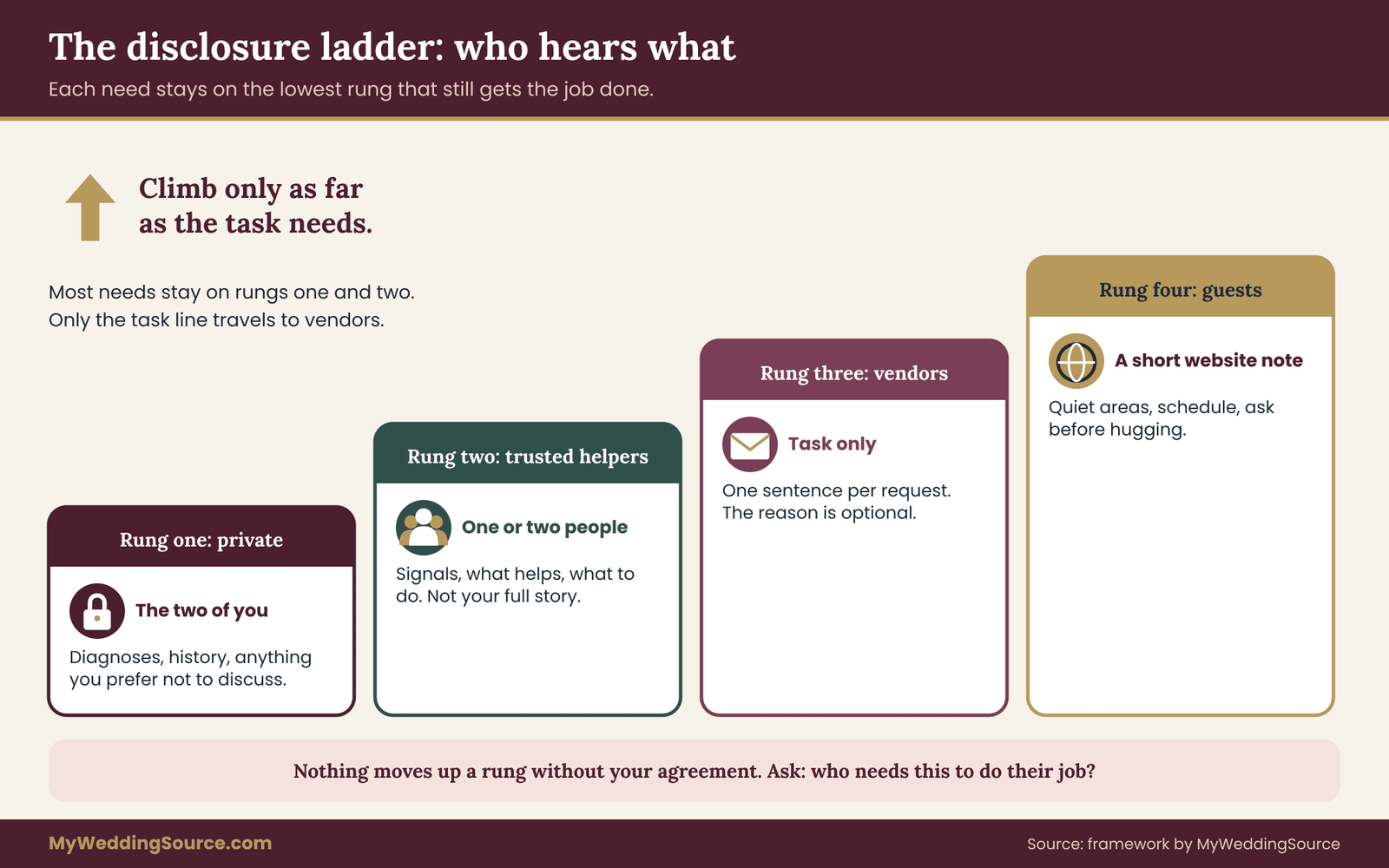
The idea is simple. Information about your needs moves through four rungs. You decide, for each need, which rung it stays on. Nothing goes up the ladder without your agreement, and what goes up is only the part that is useful. Privacy is not a side issue in neurodivergent wedding planning; it shapes who hears what.
The four rungs
Rung one: private. Only the two of you know. This includes diagnoses, history, medications and anything you do not want to discuss. Most of what is on the sensory inventory starts here. It stays here unless there is a reason to move it.
Rung two: trusted helpers. One or two people who may need context to support you on the day: a coordinator, a sibling, a best friend, a parent. They need to know what helps and what to do if something goes wrong. They do not need your full story. They need your preferences and your signals.
Rung three: vendors, task only. The people you hire hear what to do, not why. “Please keep the music below a set level during dinner” is enough for a DJ. “Please send everything in writing” is enough for a florist. You can add a reason if you want to, but you never have to.
Rung four: guests. The wider group hears only what they need to enjoy the day. That may be a line on the website about quiet areas, the order of events or a request not to touch the couple without asking. It can be framed as a general feature of the day, not a statement about you.
Moving something up a rung
Before you move any need up a rung, run it through three questions.
First, who needs to know this to do their job? A photographer who needs to avoid flash needs to know that, but not why. Second, what is the smallest piece of information that makes the need actionable? Third, what do we lose if we say nothing? Sometimes the answer is nothing, and the need can stay private.
You can also set a rule about timing. Information to vendors goes in the contract stage, because verbal promises disappear. Information to helpers goes a few weeks before. Information to guests goes in the invitation or website, close enough to the date that it is useful and far enough ahead that people can adjust. Good timing rules protect your privacy in neurodivergent wedding planning without slowing anyone down.
Choosing to disclose a label
Sometimes sharing the label is the easiest route. A parent may be more flexible when they understand that a no-surprises rule comes from a real need. A venue may take a request more seriously when it hears the word disability. Some couples want to be open as a matter of principle. Others prefer privacy.
Both are legitimate. If you do share, you control the framing. A short, factual sentence usually works: “One of us is autistic, so we are building the schedule to avoid sudden changes. Here is what that means in practice.” The second part matters more than the first. People respond to specific requests better than to broad statements. How you frame disclosure is part of neurodivergent wedding planning, and you can revise it at any point.
It is also fair to share unevenly. A partner may be fully comfortable disclosing, while the other is not. Agree on what you will say as a pair, and keep each person’s private information private, even from the other’s family, unless that person says otherwise.
What helpers should know
A helper is not a caretaker. They are a person who can reduce friction. Give them a short, clear briefing, written down and shared a week or two before the wedding. Include:
- The signals that show you need a break, in plain words, such as “If I go quiet and stop answering, I need a few minutes alone.”
- The action you want them to take, such as “Walk me to the quiet room and bring water,” and the actions you do not want.
- The people who should not be given information, or who tend to push.
- What to say to someone who asks why you left the room. A short line is enough: “They are taking a few minutes. They’ll be back soon.”
- A backup helper if the first one is unavailable.
It also helps to rehearse once. Five minutes in the venue or at home, walking through the signal and the response, makes the plan real. Helpers often feel anxious about getting it wrong. A rehearsal removes that. Rehearsals turn neurodivergent wedding planning from an idea into a routine people can follow.
Protecting privacy with vendors
Vendors collect information. Photographers keep images, planners keep notes, and apps store messages. A privacy habit is worth building: share needs in a task form, store them in a document you control and avoid putting diagnoses in vendor intake forms that ask open questions.
If a vendor’s form asks for medical or personal information, you are allowed to leave it blank or answer in general terms. If you do share something sensitive, ask how it will be stored and who will see it. A reasonable vendor will tell you. If you want a longer view on how images and guest data move, the wedding photography consent guide explains how to set boundaries for guests and image use, which overlaps with disclosure in important ways.
Keep a short record of who has been told what. A simple list with the name, the rung and the date is enough. It stops the same conversation from happening twice and lets you correct a mistake, such as a family member who has shared something you meant to keep private. A disclosure log is a small habit that makes neurodivergent wedding planning easier to audit.
When disclosure goes wrong
Even with a plan, information can travel. A helper mentions it to someone, a relative tells a cousin, a vendor makes a comment. When that happens, do not try to rebuild the wall. Decide what you want to happen next. A short message works: “We prefer to share this ourselves. Please do not pass it on.” Most people respond well to a clear, calm request.
If someone is dismissive or unkind about a need, you do not have to argue the point. A plain boundary is enough: “This is what we need for the day. If it does not work for you, we understand.” Some relationships shift as you plan a wedding. Planning for neurodivergent wedding needs sometimes shows you who will adapt and who will not, which is difficult and also useful. Boundaries like this are part of neurodivergent wedding planning, even though no checklist mentions them.
Communication that holds up: channels, scripts and written confirmations
Many wedding problems are communication problems. A date misunderstood, a deposit missed, a change that never reached the right person. For neurodivergent couples, the typical wedding communication style, a mix of phone calls, texts, social media messages and in-person chats, can be a poor fit. You can change it. Neurodivergent wedding planning treats communication as a design choice, not a personality test.
Choose your channels
Decide, together, how you want to communicate with each group. Write it down.
With vendors. Many couples prefer email or a shared planning platform, because it leaves a record and avoids the cost of a live call. Others prefer a short call followed by a written summary. A workable rule is: any decision or change must exist in writing before it counts. If a vendor prefers phone, you can say, “I’ll send a summary of what we agreed, so please correct me if I missed anything.”
With family. Pick one channel, such as a group email or a shared document, and ask people to use it. A single point of contact, such as a sibling who relays updates, can also reduce the number of conversations you have to manage.
Between the two of you. Set a regular planning time, such as thirty minutes twice a week, instead of letting wedding talk spill into every moment. Many couples find that boundaries around wedding talk protect the relationship. Agree on a phrase that means “I’m at my limit for wedding topics tonight.” Protect that boundary, since neurodivergent wedding planning can otherwise take over the relationship.
Writing messages that get results
In neurodivergent wedding planning, a good vendor message has four parts: the context, the request, the deadline and the response format. For example: “We’re booked for June 14 at the garden venue. We need the final run-of-show in writing by May 1. Please reply by email and let us know if anything is unclear.” Short sentences, one request per message and one subject line that says what it is about.
If you find writing difficult, use a template. Keep a few ready: one for asking a question, one for confirming a decision, one for requesting a change and one for saying no. Save them in your notes. Adapting a template takes far less energy than starting from scratch.
If you have trouble starting, set a timer for ten minutes, write the message badly, then edit it. A rough draft is easier to improve than a blank page. Some people use a trusted friend to read messages before sending. Others use text-to-speech to hear the message back. Use whatever works. Drafting tricks like these keep neurodivergent wedding planning from stalling at the first sentence.
Scripts for common moments
These are starting points. Change the words to sound like you.
Asking a vendor to communicate in writing. “We work best with written details. Could you send any changes by email, and could we confirm timing and costs in writing before we decide?”
Asking for a plain summary of a contract. “Could you send a short summary of the main terms, such as dates, amounts, cancellation and what is included? We will read the full contract, and the summary helps us check we understood.”
Asking about noise or lighting. “We have a sensitivity to sudden loud sound and flashing light. Could you tell us what is possible for the sound level and the lighting during the ceremony and dinner?”
Declining a surprise. “Thank you for the idea. We prefer to know the full order of events, so please do not plan anything unannounced. We would love to hear the idea and decide together.”
Setting a call limit. “I can do a fifteen-minute call on Thursday. Please send the agenda ahead so I can prepare.”
Asking for time. “I need until Friday to decide. I’ll reply by noon.”
Responding to pressure. “I hear that this feels urgent. I’m going to take twenty-four hours and I’ll reply tomorrow.”
Confirmations and the paper trail
Close every important conversation with a written confirmation. State what was decided, who is responsible and the date it is due. Keep these messages in a labeled folder or tag. When a vendor says one thing and later claims another, the written note ends the dispute quickly. Written confirmations are the backbone of neurodivergent wedding planning with vendors.
For the final two weeks, ask each vendor for a confirmation message that lists arrival time, setup location, contact person on the day and what they will need from you. If a vendor does not send one, send your own version and ask them to reply “confirmed.” Your goal is to avoid any day-of conversation that depends on memory. This final-two-weeks routine is the safety net of neurodivergent wedding planning.
Communicating with family members
Families often mean well and act in ways that create stress. A parent may assume you want a larger party than you do. A sibling may plan a toast that ignores your preferences. A relative may offer unsolicited advice about how to cope.
You do not need to win these debates. You need a boundary and a replacement. Boundary: “We are keeping the guest list at about sixty.” Replacement: “We would love your help with the welcome table.” Offering a clear, useful role often shifts a pushy relative into a helper. Offering a role is a practical move in neurodivergent wedding planning when family opinions pile up.
For more on balancing family input, the wedding decision rights guide offers language for sharing input without losing control. It is a good companion when family conversations are the main source of strain.
The neurodivergent wedding planning accommodations and briefing sheet
This is the core tool in the guide. It is a single page, written by you, that records what you need, who is allowed to know, what you want people to do and what happens if the plan fails. It is opt-in in two senses. You choose every entry, and you choose, entry by entry, who ever sees it. A couple can use the same master sheet to produce different vendor versions, each trimmed to the task.
The sheet is not a legal document and it does not need to be formal. It is a planning aid. Its job is to turn feelings and sensory facts into instructions that a stranger can follow. It is the most portable tool in neurodivergent wedding planning, and you can build it in an evening.
The six fields of one entry
Each need gets one entry with six fields. Keep entries short, ideally two or three lines each.
Field one: the need, in plain words. Describe the need as an observable fact, not a label. “Sudden loud sound causes me to lose the ability to talk for a while” is clearer than “sensory sensitivity.” Write it for yourselves first.
Field two: the moment it appears. Name when in the day it is most likely to matter: the processional, the toast, the dance floor, the group photos, the receiving line. This lets you link needs to the schedule.
Field three: what helps. Write the action that prevents or reduces the problem. “Music at moderate volume until the first dance, with a warning before it goes louder” is concrete. “Be considerate” is not.
Field four: who may know. Write the rung from the disclosure ladder: private, helper, vendor task only, or guest-facing. Add the names. This field is what makes the sheet opt-in.
Field five: the task line for the vendor. The one sentence you will actually send, without the reason. “Please keep volume below the agreed level during dinner and tell us before changing it.”
Field six: the fallback. What happens if the first plan fails. “If the music gets too loud, the helper takes us to the quiet room, and the DJ is told to lower the volume by the helper, not by us.”
An optional seventh field is the owner: who is responsible for making sure the entry happens. A need without an owner tends to disappear. Owners keep neurodivergent wedding planning from relying on memory alone.
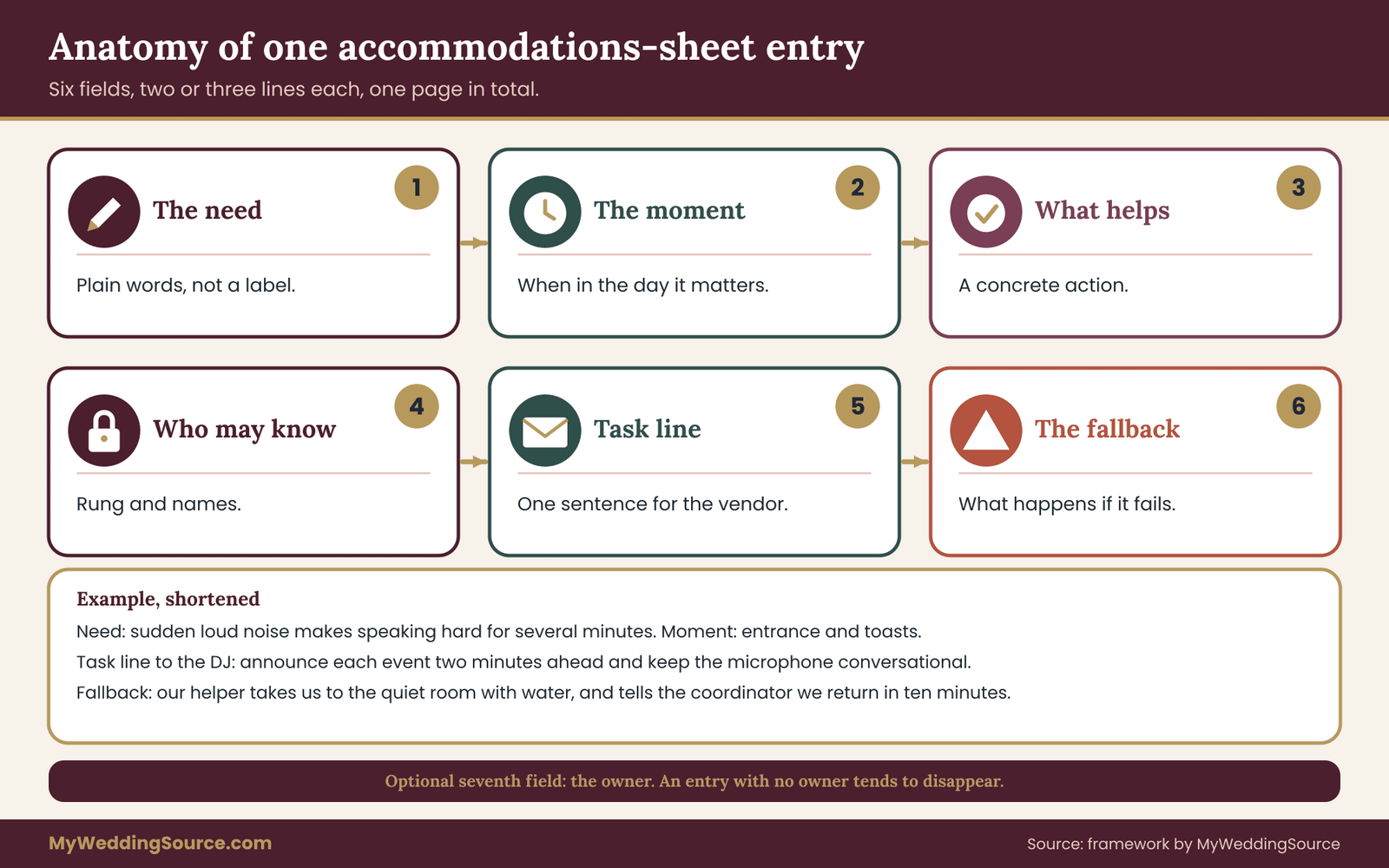
An example entry, fully written
Here is one entry for an invented couple, shown in prose so you can see how the fields fit together.
The need: sudden loud noise makes it hard to think and speak for several minutes, especially in a room full of voices. The moment: the grand entrance and the first toast. What helps: the DJ announces the entrance in advance and uses a normal speaking volume, and any cheering or clapping cue is given by a person we trust, not by a surprise. Who may know: the DJ and the coordinator, task only; our sister, with context.
The task line: “Please announce each event two minutes before it happens and keep the microphone at a conversational volume.” The fallback: if the room gets too loud, our sister walks us to the quiet room, brings water and tells the coordinator we will be back in ten minutes. The owner: the coordinator.
Notice that the vendor sees the task line, the DJ sees a limit and a warning, and the sister sees the context. No one is told more than they need. This is the opt-in logic of neurodivergent wedding planning in action.
Building your sheet in five steps
Step one: draft from the inventory. Use your sensory inventory and your choice budget notes. Make a rough list of every need you would like to be accommodated, one line each. Do not edit yet.
Step two: attach each need to the schedule. Put each one next to the moment it matters. If you do not have a schedule yet, use a simple sequence: getting ready, ceremony, photos, cocktail hour, dinner, speeches, dancing, departure. You will find that needs cluster, which means a single fix, such as a quiet break after the ceremony, may cover several entries.
Step three: write the fix and the fallback. For each need, write what helps and what happens if it fails. If you cannot write a fallback, the need is not yet planned.
Step four: choose the rung and the owner. Decide who may know, and who is responsible. Remove any entry where the owner would be you on the day. The point of the sheet is to move work off you.
Step five: trim to a page. If the master sheet is longer than a page, cut. Merge similar needs, remove low-priority items and keep the thresholds. A sheet that is too long will not be read. Seven or eight entries is a good ceiling for a single day. Brevity is a rule of neurodivergent wedding planning, because long documents go unread.
Producing vendor versions
Take the master sheet and create a short version for each vendor, using only the task lines that apply to them. A photographer’s sheet might have three lines: no flash during the ceremony, a request to photograph from a distance during the first few minutes of the reception and a shot list that avoids a particular posed situation. A caterer’s sheet might ask for the menu in writing with ingredient notes, a plan for a quiet meal service and a food option available at all times for you.
Name the version with the vendor’s name and the date. Send it as an email attachment or paste it into the message. Ask for a reply that confirms they have read it and can meet each line, or tells you which ones they cannot. A reply of “noted” is not enough. A reply that says “confirmed” next to each line is better. Asking for line-by-line confirmation is standard in neurodivergent wedding planning and ordinary in business.
For reference, here is what each type of vendor usually needs from the sheet.
Venue. Quiet room access, lighting control, sound limits, setup times, parking and drop-off routes, the contact on the day and the process for last-minute changes.
Planner or day-of coordinator. The full master sheet, if you are comfortable, plus the signals and fallbacks. This is the person who runs the system.
Photographer and videographer. Flash and lighting preferences, the shot list, the policy on directing poses, the preferred distance, how to approach you and what to do if you need a pause.
DJ or band. Volume limits, announcement timing, no surprise participation, the do-not-play list, a plan for breaks and who has authority to change the set.
Caterer. Menu details in writing, service timing, ingredient and texture notes, a food option you know will be available for you and the timing of any loud service moments such as plates being cleared.
Officiant. The ceremony script in advance, any spoken parts you want to change or shorten, cues that do not rely on eye contact, and the plan if you need a pause.
Florist. Scent preferences, allergy notes, delivery times and the process for substitutions.
Transportation. Pickup times, the exact location, who is in the vehicle and the plan if there is a delay.
For help with the ceremony timing and roles that the officiant and coordinator will use, the wedding ceremony cue sheet guide shows how to structure cues, and it works well alongside the sheet. Cue sheets and the accommodations sheet cover different ground in neurodivergent wedding planning, so keep both.
Which asks are free and which cost money
Cost logic helps you choose what to push for in neurodivergent wedding planning. Some asks cost a vendor nothing: written confirmation, a warning before a loud moment, a quieter background level, a schedule shared in advance, a slower pace in a conversation. Others require extra work or equipment and may carry a charge: a separate quiet room that must be staffed, extra rentals, additional staff time, a longer venue booking, a second location. Ask early, ask in writing and ask for any extra cost to be itemized, so you can decide whether it is worth it.
Do not assume an accommodation is expensive. Many cost nothing but a change of habit. Also do not assume a vendor will adjust without being asked. Put the asks in the contract or in a signed addendum where possible. Adding terms to a contract is covered in the vendor contract guide linked earlier. Asking early is the habit that makes neurodivergent wedding planning affordable.
Common problems with the sheet
The sheet is too long. Cut it to one page. A page that is read beats three that are not.
The vendor ignores it. Ask them to confirm each line, and follow up by phone only if needed. If a vendor still ignores key lines, treat that as a risk and decide whether to replace them.
The sheet reveals too much. Check each line against the ladder. If a line includes a reason you do not want to share, delete the reason.
You and your partner disagree on an entry. Mark it “pending” and return to it at your next planning time. Do not send a vendor a line that only one of you supports.
The plan changes. Update the sheet, change the date and resend only the changed lines. Ask for confirmation again.
You do not know what you need yet. Start with three entries and add as you learn. You can build the sheet over weeks.
Reviewing the sheet before the day
Two weeks before the wedding, read the sheet again, line by line, with your coordinator or helper. Ask: is each need still true, is each fix still possible, does each person know what to do, and is the fallback realistic? Remove anything that has no owner. Print one copy and keep a digital copy on your phone. Give your helper a copy of the lines they need.
The final check happens a few days before. Confirm with each vendor, and check that any equipment, such as earplugs or a quiet room key, is in place. Then stop editing. Last-minute changes to a plan that has been rehearsed usually cause more stress than they solve. Stopping on time is part of neurodivergent wedding planning, not a failure of ambition.
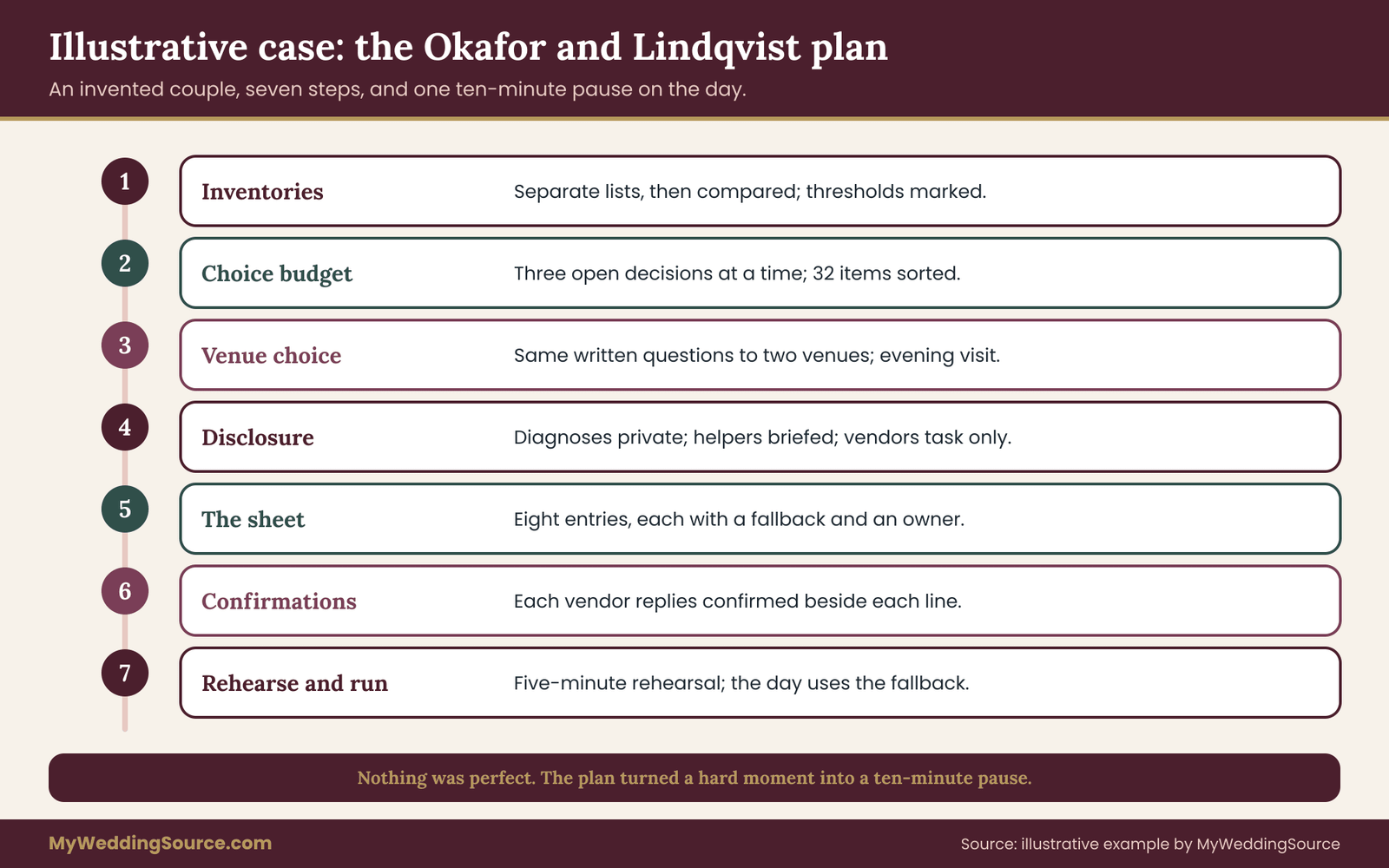
A worked case: the Okafor and Lindqvist plan, start to finish
The following is an invented example. It is not a real couple, not a case study and not a claim about what neurodivergent couples are like. It exists to show the tools working together, and every number and name is made up for illustration. Your own needs will differ, and that is the point of building your own sheet. Neurodivergent wedding planning is easier to understand when you watch the steps run in order.
Imagine two partners, Tobi Okafor and Sam Lindqvist. Tobi has ADHD and finds long, open-ended tasks hard to start and finish. Sam is autistic and finds sudden noise, crowds and unplanned changes costly. They are planning a wedding for about seventy guests in the fall, eight months out. They are comfortable sharing their needs with close family and unsure about the rest.
Step one: inventories and thresholds
They each write a sensory and executive inventory in a separate document, then compare. Sam’s thresholds: sudden loud noise, flashing lights, long periods of unstructured socializing and being touched without warning. Sam’s preferences: dim warm light, a quiet place to eat and a written order of events. Tobi’s thresholds: tasks with no deadline, long phone calls and being asked to choose between many options. Tobi’s preferences: music, a lively room and a visible checklist.
They notice a difference. Tobi would enjoy a loud dance floor and Sam would not. They do not treat this as a conflict to resolve with one answer. They treat it as a design problem: how can there be a lively space and a quiet space at the same wedding? This kind of difference is common in neurodivergent wedding planning, and it points to a design question.
Step two: the choice budget
They agree on three open decisions at a time. They sort the first thirty-two items into lanes. Lane one gets six items: venue, date, ceremony format, guest count, reception length and the quiet-room question. Lane two gets fourteen, including invitation design, favors and flower colors, each with a written default. Lane three gets twelve, delegated to Sam’s sister, Tobi’s friend and the coordinator.
They set a decision window of forty-eight hours for any lane one item, so that Sam, who needs time to think, can raise concerns, and Tobi, who decides quickly, does not push. They enter all deadlines in one shared calendar with a reminder one week ahead, assigned to Tobi’s friend, who has offered to act as a prompt. Their neurodivergent wedding planning rules are simple enough to remember under stress.
Step three: choosing between two venues
They narrow to two venues. Venue A is a restored warehouse with high ceilings and large windows. Venue B is a small inn with a separate ceremony room, a private dining room and a library.
Using their inventory, they send each venue the same written questions about sound, lighting and quiet spaces. Venue A replies that the room echoes when full and the lighting is mostly overhead, with limited dimming. Venue B replies that the dining room has dimmable lamps, the library is available all evening and the house sound system can be limited to a set volume. Venue B costs more per guest in their quote, which they weigh openly.
They visit Venue B on a weekday evening, sit in the dining room at dinner time and note the sound level, and they choose it. Venue A fails a threshold. Venue B meets all of them and some preferences. Cost is a tradeoff they accept after checking the budget, and they cut the guest list slightly to offset it.
Notice what happened. The decision came from written answers and a visit in conditions like the event, not from photos or from which venue felt more romantic. That is the practical meaning of evidence in neurodivergent wedding planning.
Step four: the disclosure ladder
They decide on rungs. Diagnoses stay private, rung one. Sam’s sister and Tobi’s friend, rung two, get a briefing. Vendors, rung three, get task lines only. Guests, rung four, get a short note on the website about the quiet library, the schedule and a request for no surprise announcements.
They tell Tobi’s mother directly, because they expect her to plan a surprise toast otherwise. They use a short sentence: “We would like to know the full order of events, so please do not plan anything unannounced. We’d love to hear your ideas first.” Direct conversations like this one are a normal part of neurodivergent wedding planning.
Step five: the sheet, with eight entries
They write eight entries. Here are four, shortened.
Entry one: sudden noise. Moment: entrance and toasts. Fix: announce events two minutes ahead, and keep the microphone at conversational volume. Rung: DJ task only, sister with context. Fallback: sister walks Sam to the library with water.
Entry two: unstructured time. Moment: cocktail hour. Fix: a hosted introduction of fifteen minutes, then seating, with name cards and a written seating chart at the door. Rung: coordinator and venue. Fallback: the couple goes to the library for ten minutes and the coordinator starts the dinner service on time.
Entry three: decision load for Tobi. Moment: the week of the wedding. Fix: all last-week decisions go to the coordinator and the friend, with a written list and a rule that new ideas wait until after the wedding. Rung: helpers. Fallback: if Tobi is overloaded, the friend takes the list for the afternoon.
Entry four: touch. Moment: the receiving line and dancing. Fix: no receiving line; the couple stands at the door of the dining room and greets guests with a wave or a handshake as they prefer, and the website says guests should ask before hugging. Rung: guests and coordinator. Fallback: the coordinator steps in if someone persists.
The remaining four cover photography without flash during the ceremony, a menu in writing with a dependable meal for Sam, a lighting plan for the dance floor and a departure plan with a time and a ride.
Step six: vendor versions and confirmations
For the DJ, they send three task lines by email with a request to confirm each. For the photographer, they send the flash request, a shot list and a note about the distance during the first minutes of the reception. For the venue, they send the full lighting and quiet room lines and ask for them to be added as a written addendum. Each vendor replies with a confirmation. The photographer replies “noted” and they ask again, politely, until the reply says “confirmed” next to each line.
Step seven: the rehearsal and the day
Two weeks before, they rehearse the signal with the sister and the coordinator, a five-minute walk from the dining room to the library. On the day, the toasts run slightly long and a guest begins an unplanned chant during dinner. Sam goes quiet. The sister sees the signal, the pair goes to the library, the coordinator tells the DJ to lower the music and delays the next item by ten minutes.
They return, eat and dance for the last hour. Tobi enjoys the dance floor, Sam spends the time near the quieter edge with friends and the two of them leave when planned.
Nothing about the day was perfect. The plan did what it was meant to do: it turned a difficult moment into a ten-minute pause. That is the realistic goal of neurodivergent wedding planning.
What the example shows, and what it does not
It shows that a short sheet, a handful of rungs and a rehearsed fallback are enough to change the day. It shows that venue choice, the largest decision, can be made on evidence. It also shows tradeoffs: a more expensive venue, a smaller guest list, a mother who needed a direct conversation.
It does not show that your plan should look like this. A couple with different needs might choose a courthouse ceremony and a dinner at home. Another might keep a large guest list and use a coordinator heavily. The method transfers. The answers do not. Neurodivergent wedding planning transfers as a method, not as a set of answers.
Alternatives to the full approach, and when each fits
The sheet is one tool. It is a good fit when you work with several vendors, share a day with many guests and want your needs to be reliably met. It is not required, and sometimes it is too much. Here are the main alternatives and the situations where each makes sense. Choosing among these is a decision for you in neurodivergent wedding planning, not for a template.
A light version: three rules
If a full sheet feels like too much, write three rules for the whole day. For example: “We get the full schedule in writing a week ahead. Nothing loud starts without warning. We always have access to a quiet room.” Share the rules with your coordinator and your helper. This approach works for couples with a short guest list, few vendors and needs that are mostly about predictability. It fails when your needs are many and specific, because three rules cannot hold them.
Hiring a coordinator or planner
A day-of or full-service coordinator can carry much of the executive load. Look for someone who is comfortable working in writing, who is willing to follow a sheet and who does not treat your needs as a problem to be fixed. Ask for examples of how they have handled a change on the day, and ask how they prefer to communicate.
Experience with neurodivergent clients can help, but it is not a guarantee of fit, and a calm, organized person who listens is more important than a credential. The wedding planning guide explains what different levels of planning support include, which helps you decide what to buy.
A smaller or split wedding
Many couples doing neurodivergent wedding planning find that splitting the wedding reduces load. A short ceremony with a few people, followed by a dinner, and a larger casual gathering on another day, lets you control sensory input in each setting. It costs additional time and sometimes extra money, and it requires you to manage guest expectations about who is invited to what. It works when a single large event would exceed your thresholds. It fails when the split creates hurt feelings that you then have to manage.
Eloping or a courthouse ceremony
A very small ceremony removes most vendor and guest variables. It can be the right choice when the wedding itself is the problem and the marriage is what you want. Check local rules for licenses and ceremonies with the issuing office. A later celebration, if you want one, can be informal and on your terms.
Designing for everyone instead of disclosing
Some couples prefer not to disclose at all. Instead they design a wedding that is quieter, calmer and more predictable for everyone: clear schedules, moderate volume, a quiet space labeled as a space for anyone who needs a break, written programs and no surprises. This approach protects privacy and benefits many guests. It can fail if a vendor will not follow the design, because you have no leverage to ask for a specific accommodation. A hybrid is common: design for everyone, then add private task lines for key vendors.
Choosing between them
Use a few decision rules. If your needs are many and specific, use the full sheet. If your needs are mostly about predictability and your event is small, use the three rules. If executive load is your main difficulty, add a coordinator. If sensory load from a crowd is your main difficulty, shrink or split the event.
If privacy is your main concern, design for everyone and share only task lines. If the wedding as an event is draining and the marriage is the goal, consider the smallest version you can imagine, and add to it only if you want to.
These are not exclusive. Most couples use a mix, and the mix often changes as the date gets closer and you learn what you actually need. Mixing approaches is normal in neurodivergent wedding planning.
Social energy and the wedding day: a schedule that protects you
Everything so far leads to the day. A wedding is long, social and public, and social energy is a limited resource for many people, neurodivergent or not. Planning the day around a budget of energy, not around an assumption of endless stamina, is one of the most practical moves in neurodivergent wedding planning. Neurodivergent wedding planning for the day itself starts with that realism.
Think in energy blocks
Divide the day into blocks, a core habit of neurodivergent wedding planning, and label each one by how much it costs you: high cost, medium or low. A ceremony may be high cost because everyone is watching. Group photos may be medium. Dinner at a table with close friends may be low. A dance floor may be high or low, depending on you. A drive away may be low.
Then arrange the blocks so that high-cost items are followed by recovery. If the ceremony is high cost, schedule a quiet fifteen minutes afterward, not an immediate cocktail hour in a crowded room. If group photos are medium and cocktail hour is high, separate them. If you know you tend to fade after four hours, plan the main events before that and let the rest of the evening be optional.
Many couples are surprised to learn that they can shorten a reception without anyone minding. A three-hour reception with a clear end beats a five-hour event that drags. Guests often appreciate a defined finish. If you want a longer party for people who like it, you can hand it to a trusted host and leave when you choose. Short, defined events are common in neurodivergent wedding planning for good reason.
The ceremony
A ceremony is short, structured and visible, which suits some people and not others. The questions to settle in advance are about order, cues, roles and what you will say.
Ask the officiant for the full script, and read it together. Decide whether you want to speak vows aloud, read them from a card, share them privately or use a shorter, fixed form. Many couples are comfortable using a card, and it is acceptable. Decide who gives cues and how: a nod from the officiant, a written order or a coordinator at the door. If eye contact is difficult, you can arrange the position of the officiant and the guests so that you face each other without strain.
Decide how you will enter. Some couples walk together, some enter from different sides and some are already in place when guests arrive. A processional with music and applause is one pattern among many. Most ceremonies follow a familiar order of welcome, readings, vows, rings and recessional, and you can adjust each step to suit you.
Plan a pause option. A line in the script, such as “We will take a moment,” can give you a few seconds, and you can agree with the officiant that you may signal for a break. Rehearse it once, so it is not a surprise. Pause options are small features that make neurodivergent wedding planning feel safer.
Photos
Photography can be one of the heaviest parts of the day, because it combines attention, touch, direction and time. Options that many couples find helpful: a private first look, a written shot list so there are no extra poses, a limit on the number of group photos and a time cap. A photographer who works from a distance and does not direct constantly can be easier. Ask in the interview how they handle couples who want a quiet style, and ask to see a gallery that reflects it.
Family photos are a common source of stress, because they involve many people and fixed timing. A written list of groups, with a helper calling names, keeps the process short. Build the list with your photographer ahead of time.
The reception
The reception is where social demands are widest. Consider these design choices.
Greeting. Replace a receiving line with a brief walk through the room or a table visit, or skip greeting entirely and let guests find you during the evening. Each is acceptable.
Seating. Seat yourselves where you can see the room and where you have a wall or window behind. Place friends who are easy to be with close by.
Food. Eat early. Many people skip the meal because they are busy and then crash. Ask the caterer to serve you first and to hold a plate if you step away.
Speeches. Limit the number, set a time cap, ask speakers to share their text in advance and ask them to avoid surprises such as audience participation. If toasts are difficult, you can skip the microphone and have someone speak on your behalf.
Dancing. Offer a short first dance or none. Set a defined dance period, and have a separate area for conversation.
Exit. Plan a clear, quick exit. Say your goodbyes to a few people, ask a helper to announce the end and leave. A planned departure is often easier than a long, uncertain one.
Signals and the helper in practice
Your helper, the person who knows your signals, is the center of the day-of plan. Their job is to notice, act and communicate. They may be the one who tells a vendor to change something, so that you do not have to. They keep your water, snacks, earplugs or other items. They hold the sheet. They know the route to the quiet room and the code for the door.
Agree on a small number of signals: a phrase, a gesture or a text. Keep them simple and private, and keep the response simple too. The goal is a short break and a return, not a crisis plan. Keep the signals light, because neurodivergent wedding planning should lower pressure, not add a procedure.
For guests who need support, such as older relatives or children, the wedding guest care planning guide offers a framework for assigning care duties, which can free your helper to focus on you.
Afterward
Plan for the days after as well. Many people feel a crash after a big social event, and may need quiet time, routine and rest. If you are traveling, build in a buffer. If you are going on a honeymoon, consider a slow first day. If family visits afterward, set a time limit. Planning recovery is part of the plan. Recovery time belongs in neurodivergent wedding planning from the start.
Venue rules, rights and what neurodivergent wedding planning cannot assume
Planning is easier if you understand where rights and policies come in. Rules differ by place and change over time, so check the official sources listed at the end. Knowing what applies to you keeps neurodivergent wedding planning realistic.
In the United States, the Americans with Disabilities Act sets rules for many businesses that serve the public. The act’s Title III generally covers places of public accommodation, such as hotels, restaurants and many event venues, and the U.S. Department of Justice publishes plain-language guidance at ada.gov. Among other things, covered businesses are generally expected to make reasonable changes to policies when needed to serve people with disabilities, unless the change would fundamentally alter what they offer, and to communicate effectively with people who have disabilities.
What this means in planning terms is limited and specific. It does not mean a venue must restructure its building or provide a staffed quiet room at no cost. It does not mean a private home or a purely private event is covered in the same way. It does not guarantee that a vendor will agree to every request. Whether a particular request is a reasonable change depends on the facts, and an attorney or the relevant agency can answer a question about your situation.
It does mean that a clear, polite, written request is within what many venues already handle, and it gives you a framework for a conversation if a venue is rigid. You might say, “We have a disability-related need for a quiet space during the event. Could you tell us what is available?” Keep the record. This is how neurodivergent wedding planning uses rights without turning every request into a dispute.
Service animals are a separate matter. Under the ADA, a service animal is generally a dog individually trained to do work or perform tasks for a person with a disability. Emotional support animals are not service animals under the ADA definition, although other rules, such as venue policies or other laws, may apply. If a service dog will be at your wedding, tell the venue and caterer early and ask about their policies.
Beyond the law, venue and vendor policies matter more in daily neurodivergent wedding planning. Contracts may restrict sound levels, vendor access, hours or decor. Read them with your inventory in hand, and ask for changes in writing. When a venue says “that’s not our policy,” ask whether an exception is possible and what it would cost. Many venues will accommodate a reasonable request, especially when it is specific and made early.
Finally, do not assume that a vendor labeled “sensory-friendly” or “inclusive” meets your needs. Those words are marketing, and they have no standard meaning. Ask what exactly they do, in writing. A vendor who can describe specific practices, such as lighting control, volume limits and quiet space, has probably thought about it. A vendor who only repeats the label may not have.
When the plan fails: failure conditions and what to do
Plans fail. Knowing the common failure conditions in advance lets you spot them early, respond calmly and avoid blaming yourselves. Here are the main ones, with a signal and a response for each. Naming the risks early is part of honest neurodivergent wedding planning.
Failure one: the sheet is never read. The signal: vendors reply with “noted” or do not reply. The response: ask for line-by-line confirmation, move key asks into the contract and decide before the final payment whether a vendor who will not confirm is worth keeping.
Failure two: the helper is unavailable or overwhelmed. The signal: the helper is stuck in conversation, late or pulled into another task. The response: name a backup, give the coordinator the same signals and keep the quiet room route simple enough for anyone to follow.
Failure three: decision overload returns. The signal: open decisions exceed your limit, deadlines slip and planning feels like dread. The response: stop, count open items, close the smallest ones with defaults and hand off two items. Pause new decisions for a week if needed.
Failure four: disagreement between partners. The signal: repeated arguments about the same item. The response: return to thresholds. Decide whose threshold is at stake and honor it first. If needed, consider a neutral third person, such as a coordinator or a counselor, to help you talk it through.
Failure five: family overrides the plan. The signal: a relative adds surprise elements, ignores boundaries or reopens closed decisions. The response: one calm message, a clear boundary and a replacement role. If it continues, give your coordinator authority to decline on your behalf.
Failure six: the venue cannot meet a threshold. The signal: written answers reveal a problem that cannot be fixed. The response: leave early if you can. Losing a deposit is painful, but a venue that violates a threshold is costly in a different way. Check the cancellation terms in the contract before you decide.
Failure seven: a sensory event on the day. The signal: a sudden noise, a crowd or a delay pushes you over a threshold. The response: use the fallback, take the break, accept that the schedule slides and return when ready. A ten-minute delay is rarely noticed by guests.
Failure eight: the plan itself becomes a burden. The signal: maintaining the sheet, the lanes and the confirmations feels like another job. The response: cut. Keep the thresholds, the fallbacks and the written confirmations, and drop the rest. A smaller plan used well is better than a perfect plan abandoned.
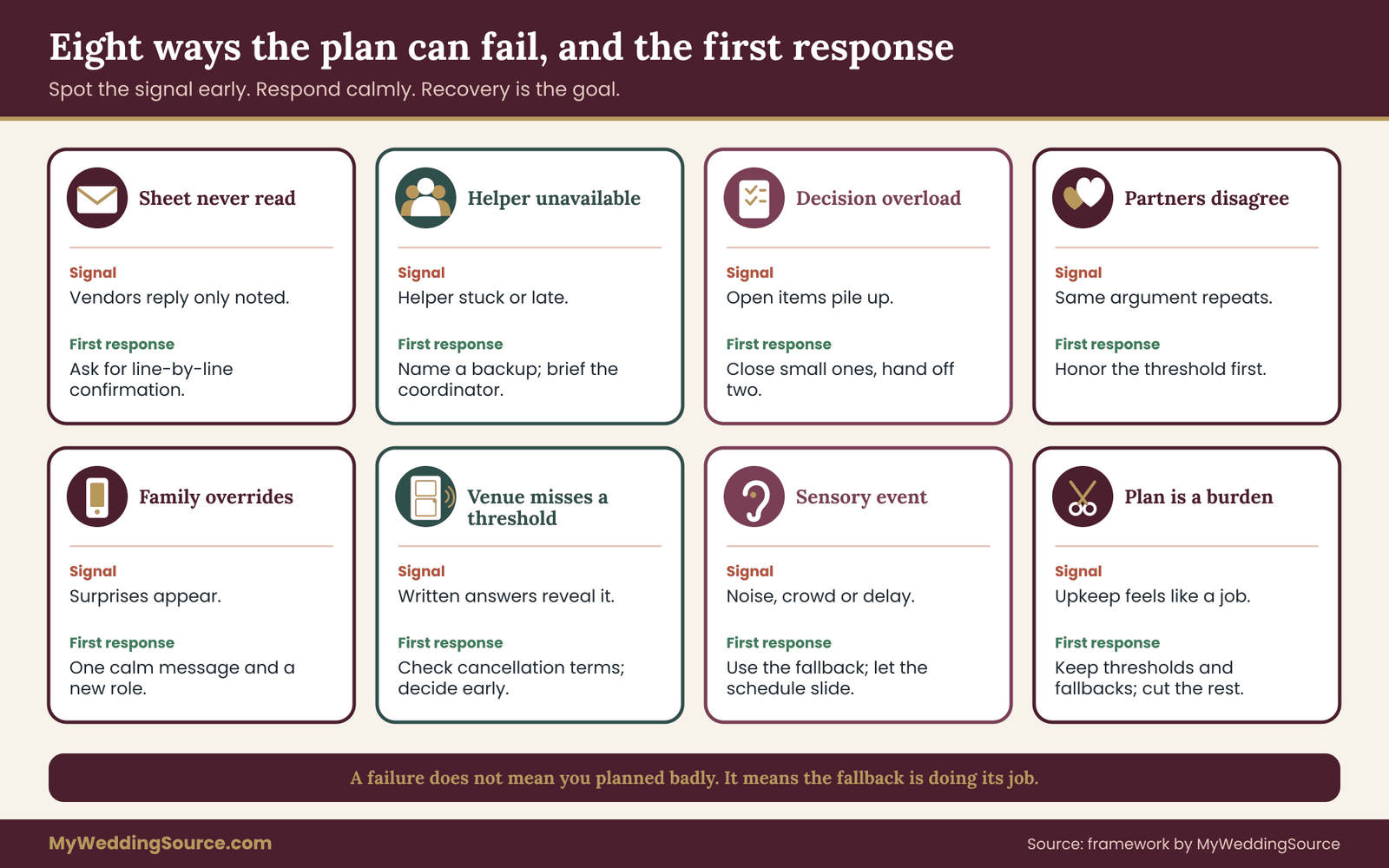
One last point on failure. If something goes wrong, it does not mean you planned badly. Weddings are complex events with many moving parts, and even carefully planned ones have surprises. The point of the system is to make recovery quick, not to prevent all problems. Neurodivergent wedding planning succeeds when recovery is fast, even if the day is imperfect.
Your next steps
Pick three actions for this week.
- Write your sensory and executive inventory, separately, then compare. Mark each item as a preference or a threshold.
- Sort your first thirty decisions into the three lanes, and set your limit of open decisions.
- Draft three entries of the accommodations sheet: the need, the fix and the fallback for the moments that worry you most.
Then, over the next month: choose your disclosure rungs, name your helper, send written questions to venues and begin building the vendor versions of the sheet. Book a rehearsal of your signals once the venue is set. Return to a standard checklist when you need the usual order of tasks. You can adjust it, or you can ignore parts of it. What matters is that the wedding you build fits the two of you. Revisit the list every few weeks, since neurodivergent wedding planning changes as the date approaches.
FAQ
Do we have to disclose a diagnosis to get accommodations?
No. You can describe needs as tasks, such as quieter music or a written schedule, without naming a diagnosis. Many vendors respond well to specific requests. Disclosure is your choice, entry by entry. Venues covered by disability rules may ask general questions about a request, but you can answer in terms of what you need, and an attorney or the agency can explain your rights in your situation.
What if only one of us is neurodivergent?
Plan around both partners. The partner who is not neurodivergent may still have sensory thresholds, a different pace or strong preferences. Use separate inventories and separate columns in your notes, compare them, and treat each partner’s thresholds as constraints. The same tools work for any couple who wants a wedding that fits two different people.
How do we handle relatives who say we are overreacting?
Keep to a calm, specific boundary, and offer a replacement. For example, say you will keep the schedule written and ask them to host the welcome table. You do not need to win the argument or explain a diagnosis. If pressure continues, give your coordinator or helper authority to decline on your behalf, so you are not the one repeating it.
Is a quiet room realistic at a small venue?
Often yes, and it need not be large. A hallway, library, office, bridal suite or even a parked car can work if it is predictable, reachable and available. Ask the venue early, in writing, which space could serve, and visit it at an event-like time. If nothing suitable exists, plan a short break outdoors or in a separate building.
Should we hire a coordinator who has experience with neurodivergent clients?
Experience can help, but fit matters more. Look for someone who works well in writing, follows a sheet, stays calm and treats your needs as design inputs. Ask how they handled a change on the day and how they prefer to communicate. A well-organized coordinator who listens may serve you better than a credential alone.
How long should the accommodations sheet be?
One page. Seven or eight entries is usually enough for one day. Each entry should state the need, the moment, what helps, who may know, a one-line task for the vendor and a fallback. If it grows past a page, merge similar items, drop low-priority preferences and keep the thresholds. A short sheet gets read.
Can we skip parts of the wedding, such as the first dance or a receiving line?
Yes. Traditions are choices, not requirements. Many couples skip or change the receiving line, first dance, bouquet toss or long toasts. Tell your coordinator and key vendors in advance, so nobody improvises. If a family member cares about a ritual, offer a different role or a shorter version that you can manage comfortably.
What if a vendor refuses a reasonable request?
Ask for the reason and whether a smaller version is possible. Put your request and their reply in writing. If the request is central, such as a lighting or sound limit, consider whether this vendor can meet your threshold. Check the cancellation terms in your contract before deciding, and replace the vendor if the gap is too large.
Sources
- Americans with Disabilities Act, U.S. Department of Justice
- Service animals, ADA.gov
- Effective communication, ADA.gov
- Disability rights, USAGov
- Civil rights and disability, U.S. Department of Health and Human Services
- Autism spectrum disorder, Centers for Disease Control and Prevention
- Attention-deficit/hyperactivity disorder, National Institute of Mental Health
- Noise-induced hearing loss, National Institute on Deafness and Other Communication Disorders
- Occupational noise exposure, Occupational Safety and Health Administration
- Job Accommodation Network, U.S. Department of Labor