
Bilingual wedding planning is the work of making sure every guest can follow the invitation, the ceremony and the practical details of the weekend in a language they actually read or hear. This guide gives you a coverage map by guest touchpoint, a way to decide how much support each touchpoint needs, one worked case and the conditions under which the whole thing breaks.
Do not translate everything equally. List every moment where a guest receives information (save-the-date, invitation, website, RSVP, travel details, ceremony, program, signs, toasts, thank-you notes). Give each one a coverage level from one to four: one language only, key facts in the second language, full parallel text, or live human support. Spend the most effort where a misunderstanding costs money, safety or the meaning of the ceremony. Use machine translation only for drafts, and have a qualified person check anything printed, spoken from a stage or tied to a legal step.
Most advice about bilingual wedding planning begins with design: which two fonts to pair, whether the second language goes below or beside the first. That is the last step, not the first. The earlier questions are about people. Who needs which language? For what? At which point in the weekend? What happens to a guest who misses it?
A couple who plans for two languages is usually not choosing between them. They are trying to make one wedding work for two or more groups of relatives and friends who may not share a language, and who will sit at the same tables. That is a coordination problem. It has inputs (a guest list with language information), a set of touchpoints (the moments where words reach people) and a limited budget of time, money and goodwill. In bilingual wedding planning, that coordination problem is the whole job.
This guide treats it that way. It does not repeat the details of any single touchpoint. Where a touchpoint deserves its own full treatment, such as invitation layout, ceremony programs, signs or a DJ set, the guide describes the decision that belongs to the overall plan and leaves the craft to a dedicated article. Think of this as the map, and the others as the street-level directions. Good bilingual wedding planning keeps the map small and the decisions visible.
A note on scope. This is general planning information, not legal, tax or financial advice, and rules for marriage licenses, interpreters and accessibility differ by state and venue, so confirm the current version with the office or agency that sets them.
What bilingual wedding planning covers
Bilingual wedding planning covers three different kinds of language work, and mixing them up is the most common source of wasted money. A planner, a venue or a relative who offers to “handle the language” may mean any of them.
Translation turns written text into another language. It applies to invitations, websites, programs, signs, menus and the thank-you notes written after the event. A translator works at a desk, can ask questions, can revise and can be checked by someone else. In bilingual wedding planning, translation is usually the largest line of work and the easiest to schedule.
Interpretation turns spoken language into another language in real time. It applies to a ceremony, a speech, a welcome toast, a family meeting before the day or a conversation between a guest and the venue manager. An interpreter works live, cannot revise and needs preparation, a clear view of the speaker and a way to be heard. Interpretation is the part of bilingual wedding planning that most needs a person booked, not a tool.
Localization adjusts the details around the words so they work for the reader: date formats, time formats, address order, currency, the way a name is written, which words for relatives or titles are used, and which customs need a short explanation. A perfectly translated invitation can still fail if the date reads as a different day. Skipping localization is a common gap in bilingual wedding planning, since a translator may not be asked about it.
Beyond those three there is a fourth category that people forget: access for guests who are deaf or hard of hearing, who may use a signed language or captioning instead of a spoken or written one. Signed languages are languages in their own right, and a sign language interpreter is a different professional from a spoken-language interpreter. The Americans with Disabilities Act website explains the idea of effective communication, and the later section on ceremony formats comes back to it.
Two languages, three languages, or one language and a few phrases
The phrase “bilingual wedding planning” suggests exactly two languages, and that is the common case. Real weddings are often messier. A couple may share one language with each other, use a second with one family and a third with the other. A grandmother may read a language that is not the one she speaks at home. A group of college friends may need nothing but English, while a set of cousins arriving from abroad needs the details in a language that is not either partner’s first.
The coverage map in this guide works for any number of languages, but cost and error rise with each one added. A useful rule is to name a primary pair, the two languages that carry the most guests and the most meaning, and then decide separately whether any third language gets only the essentials.
The section on failure conditions and alternatives explains when a third language is worth it and when a short, well-made fallback sheet does the job. Every added language adds a full copy of the work in bilingual wedding planning.
What this guide is not
It is not a language lesson, and it does not tell you which language should come first on a card. That decision belongs to the couple and their families, and it is cultural as much as practical. The guide also does not promise that any two-language approach will be seamless. Some guests will still miss a joke or a nuance. The aim is narrower and more achievable: no guest should miss a fact they needed, a request that applied to them or the meaning of a moment that mattered to their family.
Start with a guest language profile
Before you decide anything about layout, price or format, you need data. The most useful piece of data in bilingual wedding planning is a column in your guest spreadsheet that most couples never add: what each household needs, in practice, in order to follow the wedding.
Do not guess from names, countries of origin or accents. A guest with a surname from one country may have grown up reading another language, and a guest who has lived abroad for forty years may still be most comfortable in the language of their childhood. Ask the household, or ask the relative who knows them best. The same caution applies throughout bilingual wedding planning: ask, do not assume.
The household address spreadsheet you build for mailing invitations is the natural place to hold this. The federal language access site LEP.gov uses the term limited English proficiency for people who have a limited ability to read, speak or understand English, which is a useful reminder that ability varies by skill. If you are still setting that up, the guide on household and address tracking covers the guest list itself, and the language column simply sits beside it.
Four questions that give you a usable profile
For each household, capture four short facts. Four is enough; more makes the survey a chore and the answers go stale.
What do they read comfortably? A guest can read a full page of a language, read a short notice, or recognize only names and numbers. Those are three different needs. Someone who reads short notices comfortably does not need a full translated program, but does need clear signs.
What do they understand when spoken? This is separate from reading. Many older relatives understand spoken language well and read little, and many younger family members the other way around. A guest who follows conversation but not formal speech may need the ceremony summarized.
What do they prefer? Preference is not the same as ability. Someone may read both languages and still feel more welcome when the details are written in the language of their family. Count preference as a tiebreaker, not as the main driver.
Is there any access need? This includes guests who use a signed language, guests who rely on captions, guests with low vision who need large print in a given script and guests who use a screen reader. These needs shape the format of the touchpoints, not only the language.
Five profiles that cover most households
After a first pass through the list, most guest lists sort into five profiles. You do not need to label guests this way in the spreadsheet; the profiles simply help you read the data and size the work. Reading the survey data this way keeps bilingual wedding planning tied to real households instead of assumptions.
The first is the single-language guest in language A, who needs everything in A and nothing in B. The second is the single-language guest in language B, the mirror image. The third is the comfortable bilingual guest, who can use either and needs the details once. The fourth is the partial reader, who understands one language well in speech but reads it only in short notices, and needs the key facts written in plain words plus a person to ask.
The fifth is the access-dependent guest, whose primary need is a format (sign language, captions, large print) rather than a language.
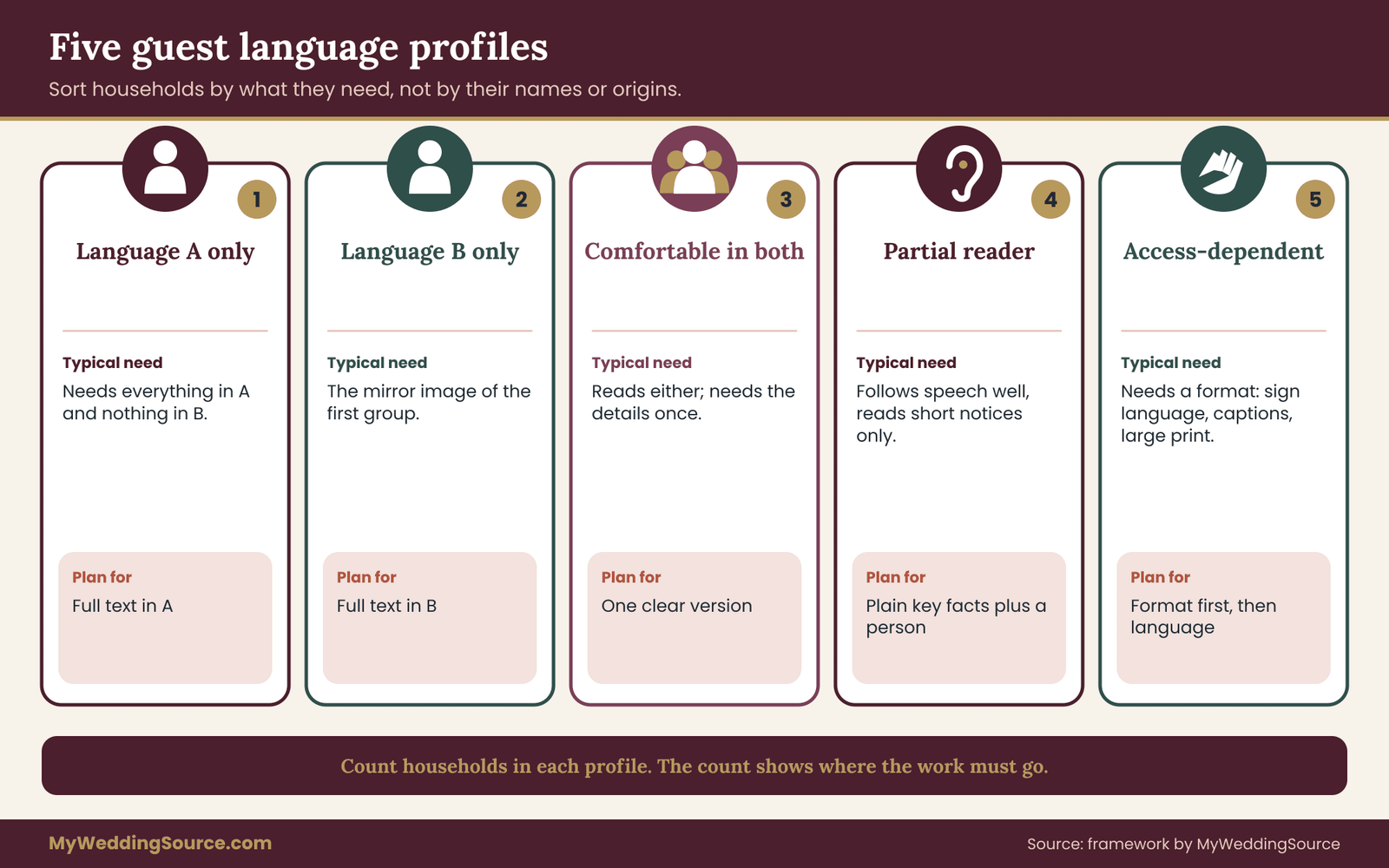
Count the households in each profile. The count tells you where the work has to go. If nearly everyone is in the first or third profile, a light touch is enough. If a quarter of the list sits in the second or fourth, the weekend needs real structure: written text in both languages, a named person at the welcome desk for each language and a plan for the ceremony. That count is the first real number in bilingual wedding planning, and everything later is sized by it.
How to ask without making it awkward
Some guests may feel embarrassed to say that they need a translation, especially older relatives. Ask in a way that treats the question as logistics, not as a test.
“We are preparing the invitation and the program, and we want to print what is most useful for you. Which language should we use for the main details, and is there anything that would make the weekend easier to follow?”
Send the question to the person in each family who already organizes communication, such as a parent or an older sibling, and let them gather answers for their branch. Record the answer exactly as given. If two relatives in one household disagree, record both and treat the household as a comfortable bilingual or partial-reader profile, because the safest fix is to provide both.
One more habit saves trouble later: write down who answered and when. Guests’ needs can change between the survey and the wedding, and a note such as “asked by aunt in March” makes it easy to confirm with one message instead of starting over.
The language coverage map for bilingual wedding planning
A coverage map is a one-page list of every guest touchpoint with a decision beside each one. It answers a single question: for this moment, how much language support does this audience need? It replaces the vague goal of “make everything bilingual” with a set of specific choices you can defend, price and assign to a person. A bilingual wedding planning map of this kind takes an evening to draft and saves weeks of rework.
The map has two parts. The first is the list of touchpoints. The second is a coverage level for each one. Both are short enough to fit on a single sheet, which is the point. If your map needs a binder, it has stopped being a map.
The ten touchpoints
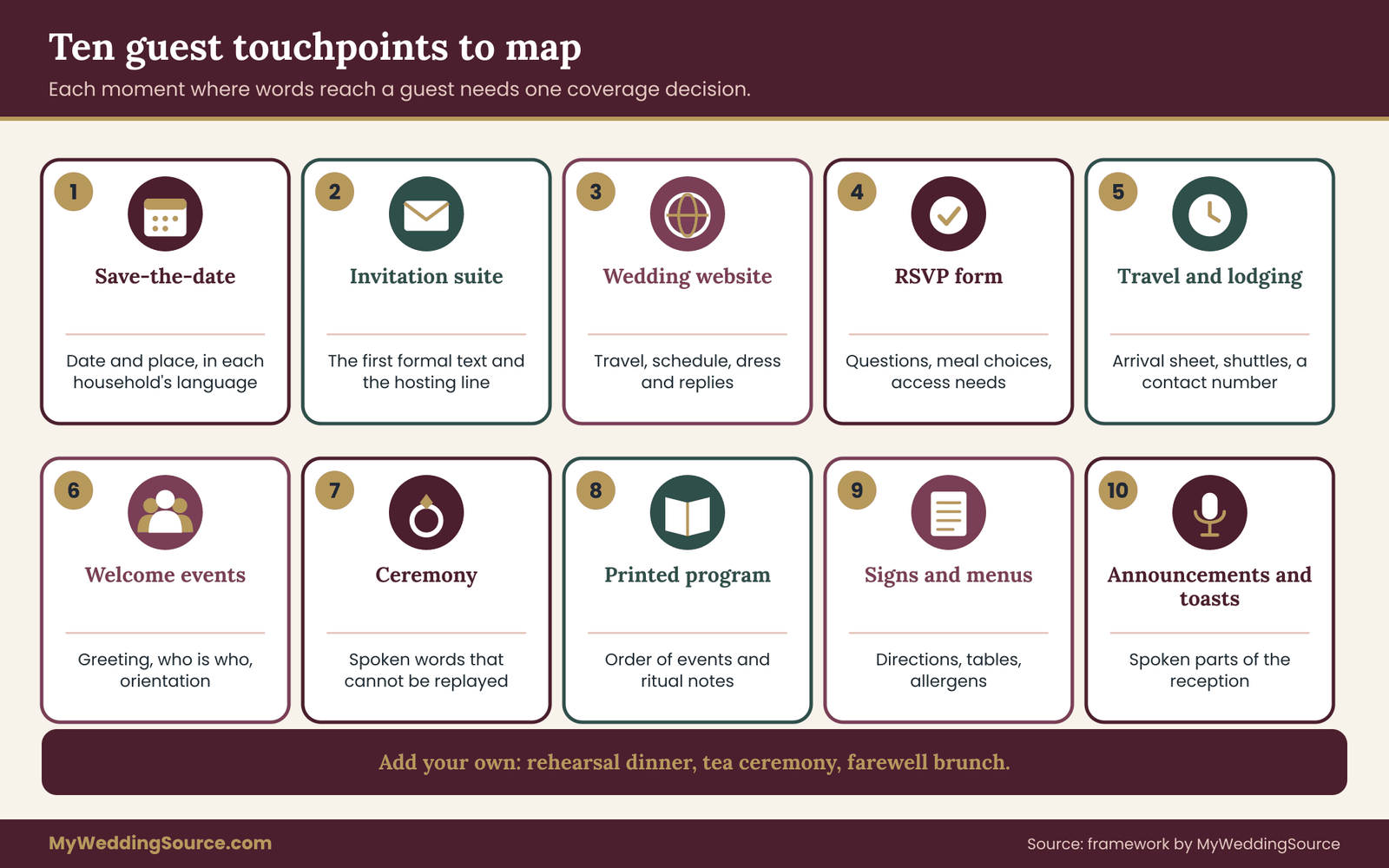
A guest meets the wedding through a predictable sequence of moments. Some are written, some spoken, some visual. In order, they are the save-the-date, the invitation suite, the wedding website, the RSVP form, the travel and lodging information, the welcome events before the day, the ceremony itself, the printed program, the signs and menus at the reception, and the spoken parts of the reception such as announcements and toasts.
After the event, the thank-you notes make an eleventh, but they are personal and follow the guest’s own language, so they do not need a coverage decision.
Not every wedding has every touchpoint, and some weddings add their own, such as a rehearsal dinner, a tea ceremony or a farewell brunch. Add whatever your weekend contains. The rule is that a touchpoint belongs on the map if a guest could be confused, excluded or put at a disadvantage by not understanding it. Every touchpoint you add makes the bilingual wedding planning map more accurate, and the short ones take a minute each.
The four coverage levels
Each touchpoint gets one of four levels. The levels describe how much of the second language the touchpoint carries, and they are ordered by effort.
Level one: a single language. The touchpoint appears in one language only. This is the right level when the audience for it is uniform, when the content is trivial, or when a second language would add clutter without value. A cocktail menu aimed at the groom’s college friends is level one.
Level two: key facts in the second language. The touchpoint is mainly in one language, with the details that matter, such as date, time, place, dress and deadlines, repeated in the other. This is the workhorse level. It costs far less than full translation and protects guests from missing the information that has consequences.
Level three: full parallel text. Everything is available in both languages, at equal weight and with equal care. This is right for invitations, programs and websites when the guest list truly divides into two groups that cannot read each other’s language. It costs the most in translation, proofing and layout.
Level four: live human support. A person provides the language in real time, whether by interpreting a ceremony, standing at a welcome desk or briefing the DJ. A written level can usually be handled by a translator; a live level needs scheduling, preparation and a position in the room.
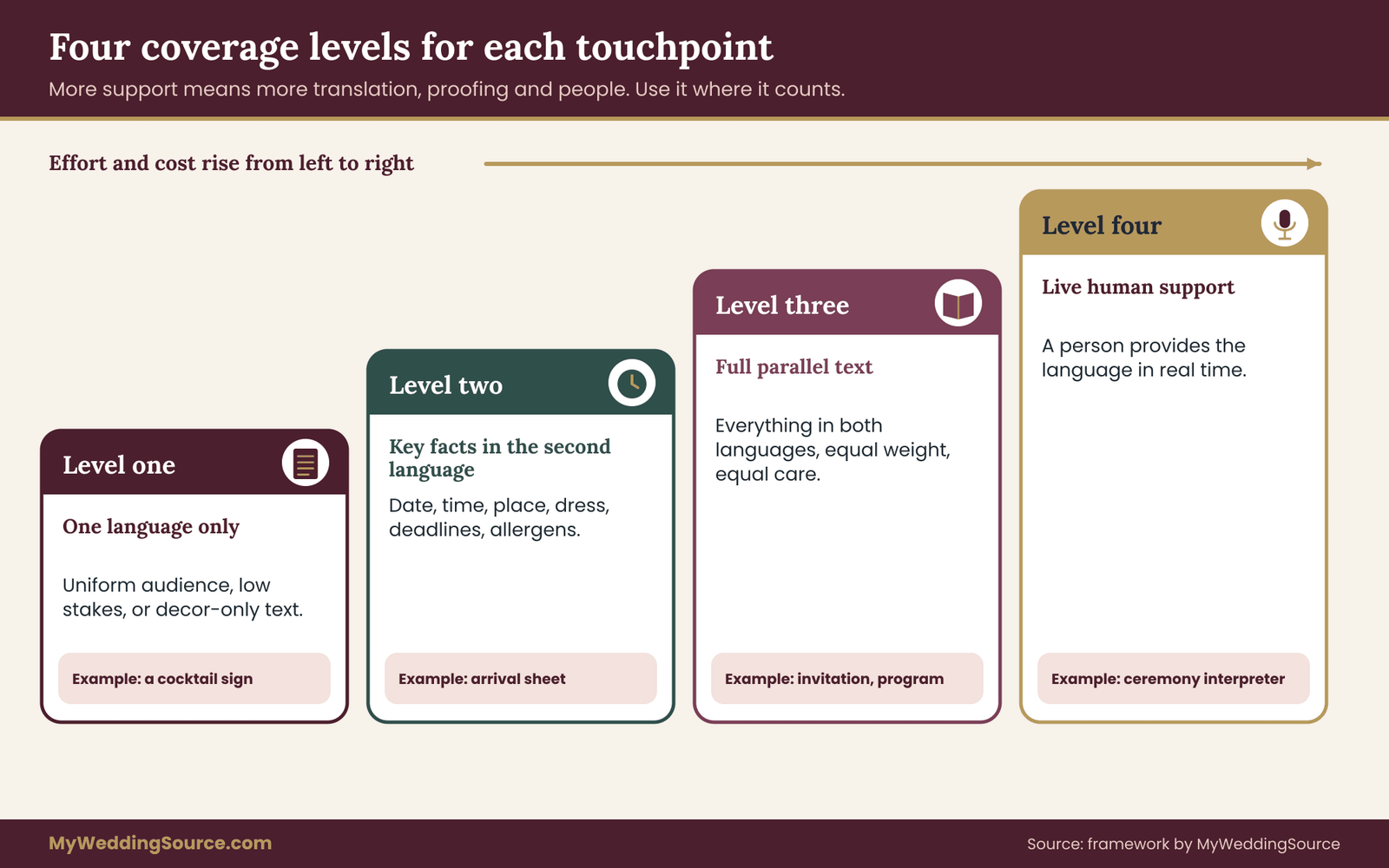
Levels are cumulative in the sense that a level-four touchpoint usually sits on top of a written level as well. A ceremony with an interpreter still benefits from a printed program, and the interpreter benefits from a script to work from.
Three questions that set the level
Assigning levels is easy to do badly by feel. Use three questions for each touchpoint, in order.
What does a misunderstanding cost? If a guest who misses this touchpoint would lose money, miss a flight, show up at the wrong place, be unable to respond or be left out of a moment their family cares about, the cost is high and the level should be higher. If the worst result is that a guest does not get a joke, the cost is low.
Can the guest recover? Some touchpoints can be repaired in the moment. A sign that someone cannot read can be answered by asking a neighbor. A spoken ceremony cannot be replayed. A deadline missed because the RSVP page was unclear cannot be undone. Touchpoints that do not allow recovery need more support. Recoverability is the question most often skipped in bilingual wedding planning.
Who will actually use it? A touchpoint nobody reads in a given language is wasted work in that language. The profiles from the guest language survey give you the answer. If only three households read language B, a full level-three website may not be worth it, but a level-two summary on the front page and a printed insert for those households probably is. This third question keeps bilingual wedding planning from spreading effort evenly across touchpoints that do not matter equally.
Reading the map as a budget
Once every touchpoint has a level, the map doubles as a budget. Count how many touchpoints sit at level three or four. Those are where translation fees, proofing time, interpreter fees and design hours will go. A map with nine level-three entries is a signal to ask whether level two would serve most of them. Used this way, bilingual wedding planning becomes a budget conversation rather than a vague aspiration.
A reasonable pattern for a wedding with two real language groups is level three for the invitation and the program, level two for the website and signs, level four for the ceremony or a short ceremony summary, level two for announcements and level one for decor-only items. That pattern is not a rule; it is a starting point that your own survey should overturn whenever the data says so. Treat the pattern as a first draft of your bilingual wedding planning map.
Before the wedding: invitations, website, RSVP and guest information
The first four written touchpoints do the most work in bilingual wedding planning, because they arrive when guests are deciding whether to come, how to travel and what to wear. Errors here are the expensive ones. Most of what goes wrong at the ceremony can be forgiven; a wrong date on an invitation cannot.
Save-the-date and invitation
The save-the-date has one job: date, place and a promise of more. It almost always works at level two. Print or send it in the main language of each household, with the date and location written clearly in both. The date format deserves attention, and the section on names, scripts and dates deals with it in detail.
The invitation is the first formal document and usually deserves level three if the list divides into two reading groups. Wording, hosting lines and etiquette are covered in the invitation etiquette and wording guide, and layout and translation review deserve their own treatment. In a plan, the invitation decision is limited to a few questions: which languages, at what level, which version each household gets, and who signs off on the final text.
A useful option is to send different versions to different households instead of a double-language card for everyone. A household that reads only language B receives a card in B with a short line in A. This reduces clutter, keeps the text readable and gives each household its own tone. The cost is that you now manage two print runs and must be careful that both say exactly the same thing. A short change log, one line per edit, prevents drift.
Wedding website
A website is the best place for level three because it has no page limit, it can be changed, and a language switch costs the reader one tap. It is also the touchpoint most often left half-done: the home page is bilingual, and the travel page is not. The map helps here, since you decide page by page.
The pages guests depend on most are travel, lodging, schedule, dress and the RSVP. Give those full parallel treatment. The story page and the registry can sit at level two or level one. Keep a visible, consistent language switch at the top of every page, label it in the language it switches to (for example, the name of each language written in that language) and make sure the switch keeps the guest on the same page. These pages are the heart of bilingual wedding planning online.
Do not rely on a browser’s built-in translate button as your language plan. It may work well enough for a quick look, but it changes names, mistranslates addresses and cannot be proofed. If you want guests to have a translation, make one and check it.
RSVP
An RSVP form is a decision touchpoint, so it deserves attention beyond its length. A guest who does not understand a question may skip it, answer wrongly or send a note that you cannot interpret. The RSVP is also the best place to collect language needs a second time, because guests who have received the invitation can now answer a precise question.
Write the RSVP in the language of each household’s invitation, and keep the questions short and parallel. Offer fixed choices wherever possible, since a check box is the same in every language. Use a free-text line only for dietary notes and access needs, and decide in advance who will read replies in each language. If you cannot read a reply, you cannot act on it. The broader etiquette of replies, deadlines and follow-ups is covered in the RSVP etiquette guide.
Travel and lodging information
Guest information is where level two shines. A one-page arrival sheet can carry the airport, the hotel name and address, the check-in date, the shuttle times, the venue address and a phone number for a person who speaks the guest’s language. Keep sentences short and put numbers and place names in plain digits and the original spelling.
Guests traveling from abroad may also have questions about entry requirements. You cannot answer those on their behalf, and you should not try to. The U.S. Department of State publishes visa and entry information for visitors, and your guests should consult it or their own consulate. An invitation letter can help a guest explain the purpose of a visit, but it does not guarantee approval, and you should not suggest that it does. Give guests an early date to arrange documents and let them decide.
Whatever the format, test it with one reader from each language group before you finalize. Ask them to find the check-in date and the venue address without any help. If they hesitate, the page needs work. This five-minute test catches more problems than a second round of editing. It is the simplest quality check in bilingual wedding planning.
The ceremony in two languages: what must be understood
The ceremony is where bilingual wedding planning carries the most emotional weight and the least room for error. It is spoken, it happens once, and each person in the room is listening for something different. The couple wants their promises to land. The parents want the blessing or ritual they care about to be recognized. A guest who does not understand the language wants to know what is going on well enough to feel part of it.
A useful starting point is to separate what must be understood from what only needs to be witnessed. Not every spoken line in a ceremony has the same job. Bilingual wedding planning for the ceremony starts from that distinction.
Sorting the ceremony into three kinds of speech
Legal and declarative words. These are the parts that create or record the marriage: the declaration of intent, the vows if they are the legal vows, and the pronouncement. Rules about their wording and language differ by state and by officiant. If the ceremony is conducted in a language that the officiant does not use professionally, ask the office that issues the marriage license and the officiant what is required.
Some jurisdictions expect the legal words in a particular form or expect an interpreter for a party who does not speak the language of the proceeding. Do not assume; ask early, and ask in writing.
Ritual and religious words. Prayers, blessings, readings and ritual formulas may belong to a tradition and a particular language. Translating them can change their meaning or their standing, and families may feel strongly about hearing them in the original. The usual compromise is to keep the words in the original and provide an understanding aid: a summary before the ritual, a printed translation or a short explanation by the officiant. For the planning side of mixed traditions, the guide to interfaith ceremony planning covers who owns which ritual.
Personal and conversational words. Welcome remarks, personal vows, readings chosen by friends and the officiant’s story about the couple are free to be in whatever language serves the people in the room. These are the best candidates for alternating languages or for a bilingual officiant.
Sorting the script this way gives you a structure for the later choices. Legal words need accuracy first. Ritual words need respect first. Personal words need warmth first. That ranking carries through the rest of bilingual wedding planning for the ceremony.
The script is the first deliverable
Whatever format you choose, the ceremony needs a written script that every language contributor works from. A ceremony without a script means improvised interpretation, which means variation, which means two guests in the same row hearing different versions of the same moment. A single script is the most useful document in ceremony-related bilingual wedding planning.
Build the script in two columns of intent, not two columns of text. For each beat, write what happens, who speaks, in what language and how long it should last. Then attach the translation to each beat. A cue sheet in this format helps the officiant, the interpreter and any readers. The guide on wedding ceremony cue sheets shows how to structure the timing and the handoffs, and the language layer simply adds a line to each cue.
Share the script with every person who will speak or interpret at least two weeks before the ceremony, and ask each to read their part aloud in a rehearsal. Reading aloud finds problems that silent reading hides: a phrase that is awkward to say, a name the reader is unsure how to pronounce, a line that runs long in translation. A rehearsal is the cheapest quality control in bilingual wedding planning.
Who says what: officiant, readers and the couple
The officiant is the key person. A bilingual officiant can carry the ceremony in both languages, but being fluent in two languages is not the same as being comfortable performing a ceremony in both. Ask the officiant to describe the last time they led a ceremony in each language, and ask for a short sample of the script in each language read aloud.
If you hire an officiant who is not bilingual, plan for a separate interpreter and agree on pauses. Ask early, because officiant availability shapes the rest of bilingual wedding planning for the ceremony.
Readers and family members who speak at the ceremony are a smaller but real issue. A grandmother who will read a passage in her language should have it printed in large type in that language and should not be asked to read the translation. A friend who reads in the other language should have the same treatment. Each reader reads in the language they are most at home in. The summary or translation belongs to the printed program or to the officiant.
Vows deserve special care. Many couples write personal vows in their own languages, and if the partners do not share a first language, each partner may hear the other’s vows only partly. The options are simple: each partner says their vows in their own language and provides a printed translation; each says them in the other’s language; or each says them in both. The right choice depends on what the vows are for, and it is usually a conversation between the partners rather than a technical decision.
Ceremony formats compared
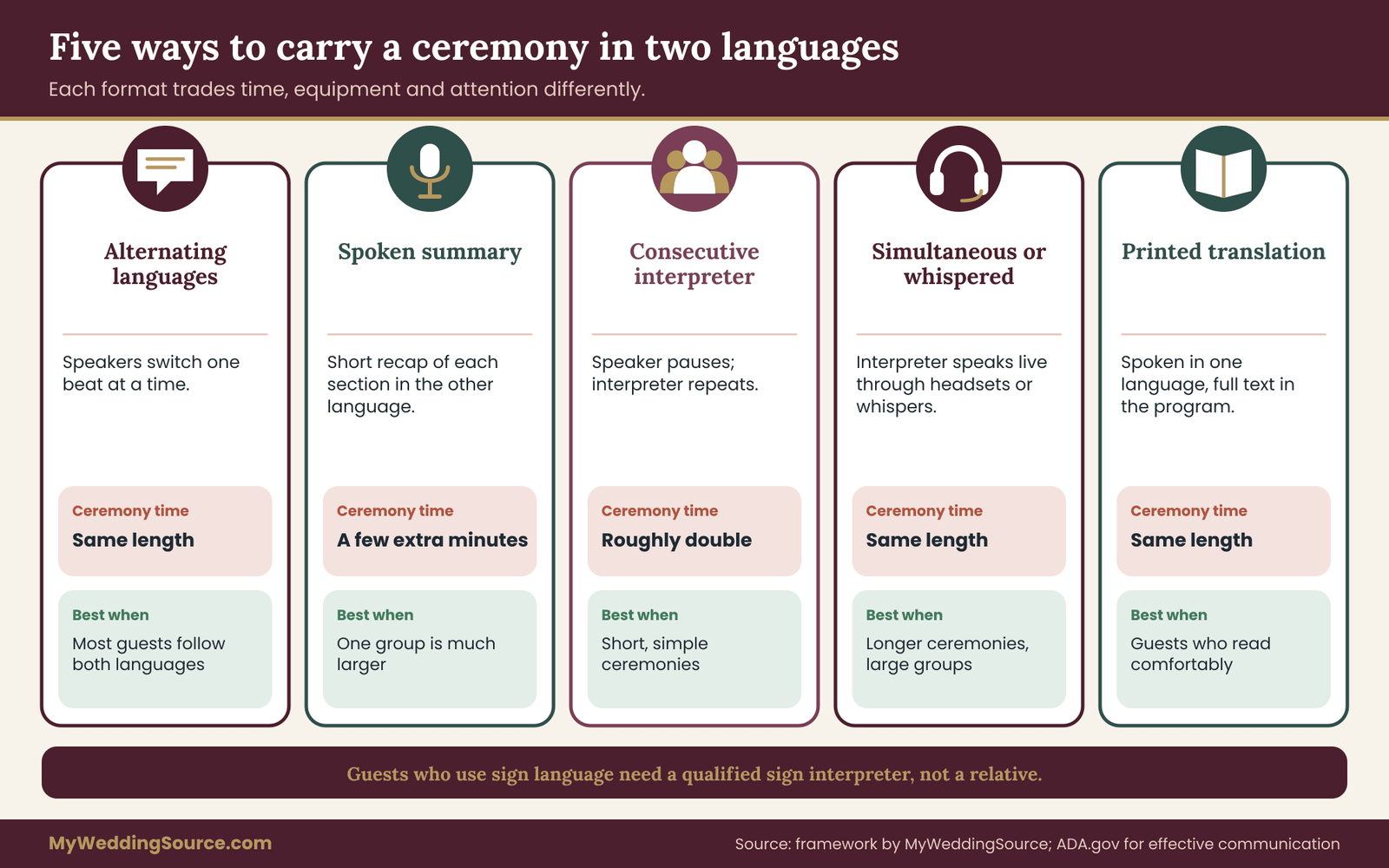
Once the script is sorted, you choose a format. There are five that come up repeatedly, and each has a clear cost in time, equipment and attention. This section compares them in prose so you can pick the one that matches your map. The comparison below belongs in any bilingual wedding planning worksheet.
Alternating languages
The officiant or speakers move between languages, one beat at a time. This keeps the ceremony the same length and gives each language equal presence. It works best when most guests understand at least part of both languages, or when the sequence is predictable enough that guests can follow from the program. It works poorly when large groups understand only one language, because they will be lost for half of every exchange. Alternating is the lightest format in bilingual wedding planning terms, since it needs no extra person.
Summary in the second language
The ceremony runs mainly in one language, and a short summary of each section is spoken in the other, either before the ceremony as an orientation or between sections. This adds a few minutes and fits when one language group is much larger than the other. A written summary in the program does the same work silently, and the two can be combined.
Consecutive interpretation
A speaker says a sentence or two, pauses, and an interpreter repeats it in the other language. Everyone hears everything in their language, but the speaking time roughly doubles. A ten-minute ceremony in one language becomes closer to twenty, and a long reading becomes heavy for both sides. Consecutive interpretation suits a short ceremony or a ceremony in which the key moments are short. Test the pacing before you commit to it in your bilingual wedding planning.
It also has a feel that some couples love and others find stiff. The pauses give each sentence weight, but they also break the rhythm of vows. If you choose consecutive interpretation, shorten the script. Cut the optional readings. Trim any piece where a sentence would be hard to split.
Simultaneous or whispered interpretation
An interpreter speaks at the same time as the speaker, either by whispering to nearby guests or through a transmitter and headsets. The ceremony keeps its normal length, and guests who need the other language hear it live. The cost is equipment, a trained interpreter, often a second interpreter for rests, and a quiet corner of the room for the booth or the listeners.
For a larger group, this is the only format that does not slow the ceremony. For a small group, whispering by a trusted bilingual relative can work, but only if that relative can sit with the guests who need it and still feel free to enjoy the moment. This is the heaviest option in bilingual wedding planning for equipment and staffing.
Printed translation with a spoken original
The ceremony runs in one language, and a full translation is printed in the program. Guests follow along in their own language. This is the lowest-cost live option and works best when the guests who need the translation read comfortably and the ceremony has a clear structure. It does not help guests who cannot read or cannot see the page, and it asks guests to look down during the moments they might want to look up.
Matching the format to the guests
A short decision rule helps. Count the households in the profiles that do not understand the main spoken language. If it is fewer than a handful, use a printed translation and a short spoken summary. If it is a meaningful minority, use alternating languages for the personal parts and a printed translation for the ritual parts.
If it is a large group or half the room, plan for interpretation, consecutive if the ceremony is short and simultaneous if it is longer than a quarter of an hour. Write the chosen format at the top of the ceremony page of your bilingual wedding planning map.
If you have guests who use a signed language, plan for a qualified sign language interpreter, not a relative who knows a few signs. The Registry of Interpreters for the Deaf publishes standards and lists of certified interpreters, and the National Association of the Deaf offers guidance on working with them. The ADA website explains effective communication for people with hearing disabilities, including when a venue or event host may be responsible for providing it.
A good interpreter will also want the script, a place to stand where the guest can see both the interpreter and the ceremony, and good lighting. Ask about those needs in advance. If you are unsure about legal obligations, ask the venue and consult the ADA resources or a lawyer, and do not rely on a general web page.
The program as a safety net
Whatever format you choose, a printed or digital program provides a second route to meaning. For ceremonies with ritual elements, it can explain what each element is and why it is done, in both languages, in a few sentences. The guide to wedding ceremony step-by-step planning outlines the order of events that the program can follow. Keep the program text short; its job is to orient, not to repeat the ceremony. Think of it as the quiet backup in bilingual wedding planning.
The wedding day: signs, announcements, toasts and staff
After the ceremony, the day moves from a single script to many small interactions, and bilingual wedding planning shifts from translation to coordination. The reception touchpoints are easier to fix on the spot than the ceremony, but they are also where couples most often hand the whole load to one person. Day-of bilingual wedding planning is mostly about people being in the right place with the right script.
Signs and printed items at the venue
Signs are level two in most weddings. Direction signs, the seating chart, the bar menu, the guest book sign and the restroom signs do not need full parallel text. They need the words a guest needs to act: the table number, the name of the dish, the direction to the ceremony space. A short label in each language, set in the same typeface at the same size, is enough. Signs show bilingual wedding planning to every guest at once, so they get noticed first.
The trap is hierarchy. If one language is large and the other is small and gray, you have told half the room which language is the real one. The test from the guide on signage applies here: stand at the distance a guest will read from, with the lighting of the room, and check that both labels are readable. The wedding signage system guide covers placement, size and permissions, and its readability rules apply to both languages equally.
Menus and food labels carry a safety dimension. If a guest has an allergy and cannot read the label, the cost is not embarrassment. Name each major allergen in both languages on the buffet or station card, and give the catering manager a printed list in both languages so that staff can answer questions. Do not rely on a guest’s partner to translate an allergy warning in the middle of a dinner service. Safety content is the one place bilingual wedding planning should never economize.
Announcements and the master of ceremonies
Announcements at a reception are short, frequent and often rushed: the couple’s entrance, the cake cutting, a dance, a request for people to move to another room. The simplest approach is to write each announcement in both languages before the event and assign each language to a speaker. Two voices, one after the other, each at a calm pace, will carry more than one person trying to say everything twice. Short written scripts keep bilingual wedding planning from turning into improvisation.
If you have a DJ or a band leader, the briefing matters. The DJ needs the names of the family members who will be introduced, written the way they are pronounced and the way they are spelled, a short script for each announcement and the order of languages. Give the DJ the audio of at least one family member saying hard names, if you can.
A DJ who guesses at a name in front of the family does more damage than a DJ who says nothing. A DJ briefing is a small but telling part of bilingual wedding planning.
Request lists and music choices are another place where language shows up. If a song has lyrics in a language the DJ does not understand, ask for a quick review of the content before the day. The topic belongs to the music-planning side of the weekend, but the language layer is simply this: someone who reads the lyrics checks them.
Toasts and speeches
Speeches are the touchpoint that most reliably runs long. A toast in one language followed by a full retelling in the other doubles the time, and the second half is often the one that loses the audience. Agree on a few rules in advance and share them with every speaker.
Ask each speaker to keep to a set time, shorter than they would otherwise use. Ask them to pause at natural breaks, so that an interpreter or a bilingual friend can summarize. Offer a printed copy of the speech to the interpreter ahead of time, if the speaker is willing.
Consider letting the speaker give the toast in their own language, with a one-sentence English summary at the end, and a printed card on the table for guests who need more. A toast is a gift; guests do not need a complete transcript to receive it.
Do not ask a guest to interpret a speech on the spot unless they have agreed in advance. A relative who happens to speak both languages is not automatically ready to interpret a ten-minute story with jokes. If they are willing, give them the speaker’s notes. If not, the written summary does the job.
A named person for each language
The simplest protection on the day is a short list of named people. For each language, one person is the contact for guests who have a question. The person wears something visible, or stands at the welcome desk, and has a phone with the day’s schedule. This person is not the interpreter and is not the couple.
They are a friendly point of contact who can answer “where do I go now?” and “what did he say?” at a basic level, and who can find a more qualified helper if something bigger comes up. It is the most reliable safety net in bilingual wedding planning for the day itself.
Tell the venue and the main vendors who these people are. A catering manager who knows that a guest at table six reads only one language and has a food allergy will say so to the right person. A language contact can sit at the welcome desk for the first hour.
Who does the work, what it costs and when to start
A bilingual wedding needs a few roles that a single-language wedding does not. The people who fill them can be professionals, volunteers or a mix, and the choice has to be made deliberately, because relatives who volunteer are often the least available on the day itself. Naming them is a core step of bilingual wedding planning.
Translator, interpreter, coordinator and volunteer
A translator works with written text. A professional translator, such as a member of the American Translators Association, can provide credentials, ask about context and take responsibility for accuracy. For invitations, programs and websites, a translator is the standard choice, and for ritual or legal text a translator who works in that field is worth finding. A second person reads the translation independently, ideally another translator or at least a careful native reader of the target language.
An interpreter works live. The most important question is whether they have experience in a ceremony or event setting. Conference interpreters and community interpreters have different training, and a medical interpreter is not necessarily right for a ritual. Ask about preparation: a good interpreter will ask for the script, a list of names and a walk through the room.
A bilingual event coordinator holds the whole map. They know which touchpoints exist, who is assigned to each, and what the deadlines are. If your wedding planner is bilingual, ask about their experience with multi-language events. If they are not, you can hire a coordinator for the language layer alone, or assign a trusted friend to track the map. Not every wedding can afford one, but every bilingual wedding planning map needs someone who holds it.
Volunteers are valuable for small jobs and risky for large ones. A cousin who speaks both languages can read a welcome in one language, sit with grandparents and answer questions. A cousin should not be the only reviewer of a printed invitation, the sole interpreter of a ceremony or the only person who knows the language plan. When the cousin is also a guest, family member and bridesmaid, there is no time left to do the job well.
A verification chain for anything printed or spoken from a stage
Any text that will be printed, posted or spoken from a stage passes through the same chain, in the same order. The chain is a process, not a person.
First, the translator produces the text from the source. Second, an independent reader who has not seen the source reads the translation cold and reports anything that does not sound right. Third, the couple or the host compares both versions for meaning, especially names, dates, titles and any ritual terms.
Fourth, a typeset check by someone who reads the language looks at the actual printed proof, because errors appear at the layout stage: missing accents, broken characters, lines that wrapped badly. Fifth, a final sign-off records who approved which version on what date.
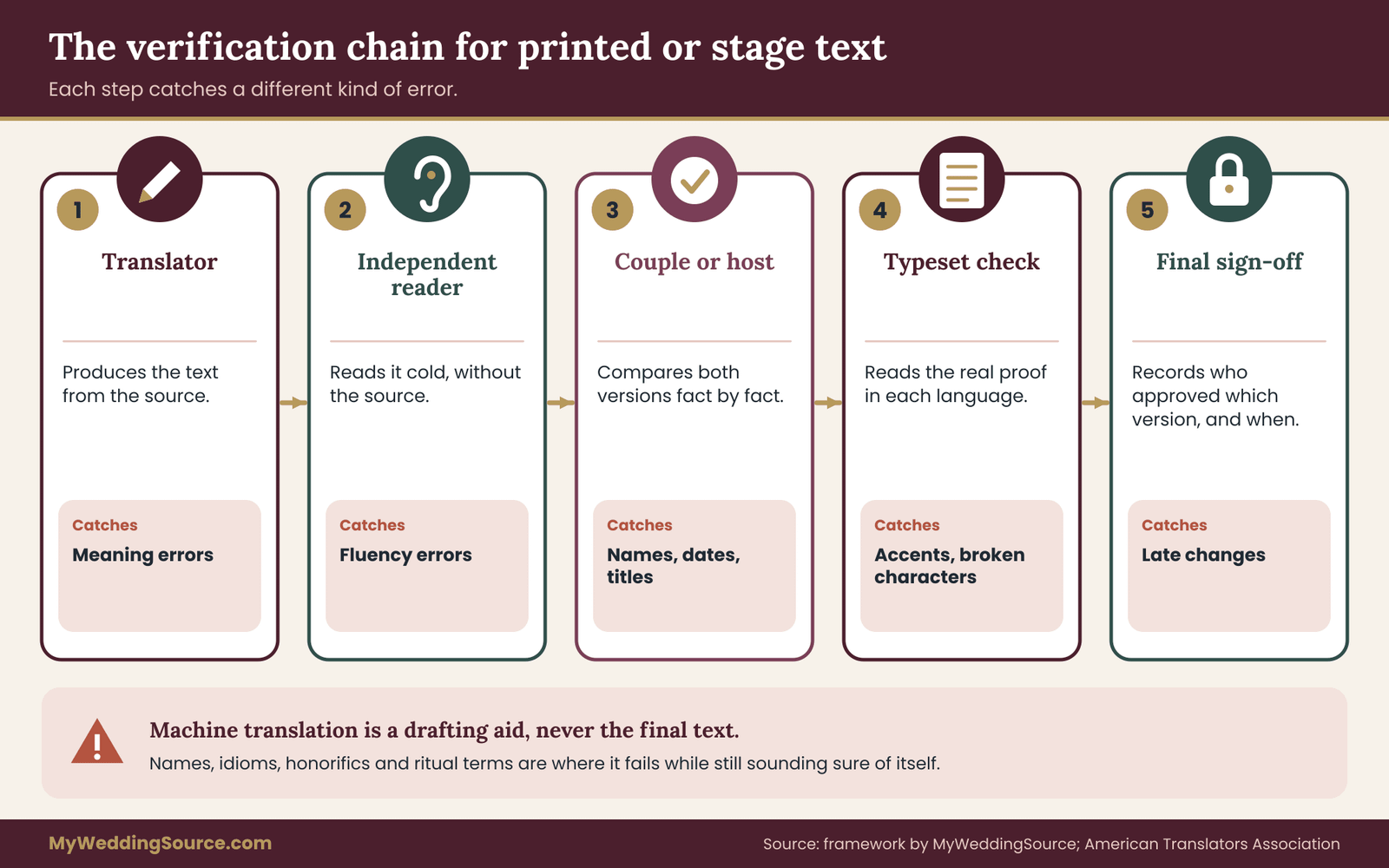
The chain is not about distrust. Each step catches a different kind of error. The translator catches meaning errors, the reader catches fluency errors, the couple catches fact errors, and the typesetter catches format errors. A short written record of each pass costs little and gives you something to point to if a printer or vendor makes a change later. Build the chain into your bilingual wedding planning calendar with real dates.
Machine translation: a draft tool, not an authority
Machine translation can be useful in a narrow way. It can help a couple understand what a relative wrote, get a rough draft to discuss with a translator or check the gist of a vendor’s reply in another language. It should not produce text that is printed, spoken or relied on for a ceremony, a legal step or a safety warning without review by a qualified person. Used within those limits, machine translation has a place in bilingual wedding planning.
The reasons are practical. Machine output can sound confident while being wrong, especially with names, idioms, honorifics, religious terms and any sentence where the source is ambiguous. It also does not know your family’s preferences, such as which form of address a grandmother expects. If you use it, say so to the reviewer, so they know to read carefully, and never present a machine-made version to a guest as authoritative.
What it costs, without pretending to know the numbers
Prices vary by language, by region, by the length of the text and by the professional’s experience, and they change, so this guide does not quote figures. What you can do is understand how the cost scales so that you can ask for the right quotes.
Translation is usually priced by word or by project, and revision and proofing are separate. Ask whether the quote includes a second reader. Interpreting is usually priced by time, often with a minimum, plus preparation and sometimes travel. Equipment for simultaneous interpretation is a separate line item.
A coordinator may charge by hour or by package. Ask every provider for a written scope that states what is delivered, by when, and what happens if the text changes. Ask every provider for the same scope, so that quotes in bilingual wedding planning are comparable.
Changes are where costs creep. A guest list that grows, a date that moves or a venue that changes forces the same text through the chain again. The best protection is a freeze date: after a certain day, the text does not change except for a correction. Tell every provider the freeze date and price a re-run if it happens. For general guidance on scope and contract language, see the wedding vendor contract guide. A freeze date is the best cost control in bilingual wedding planning.
A timeline that works backward from the invitation
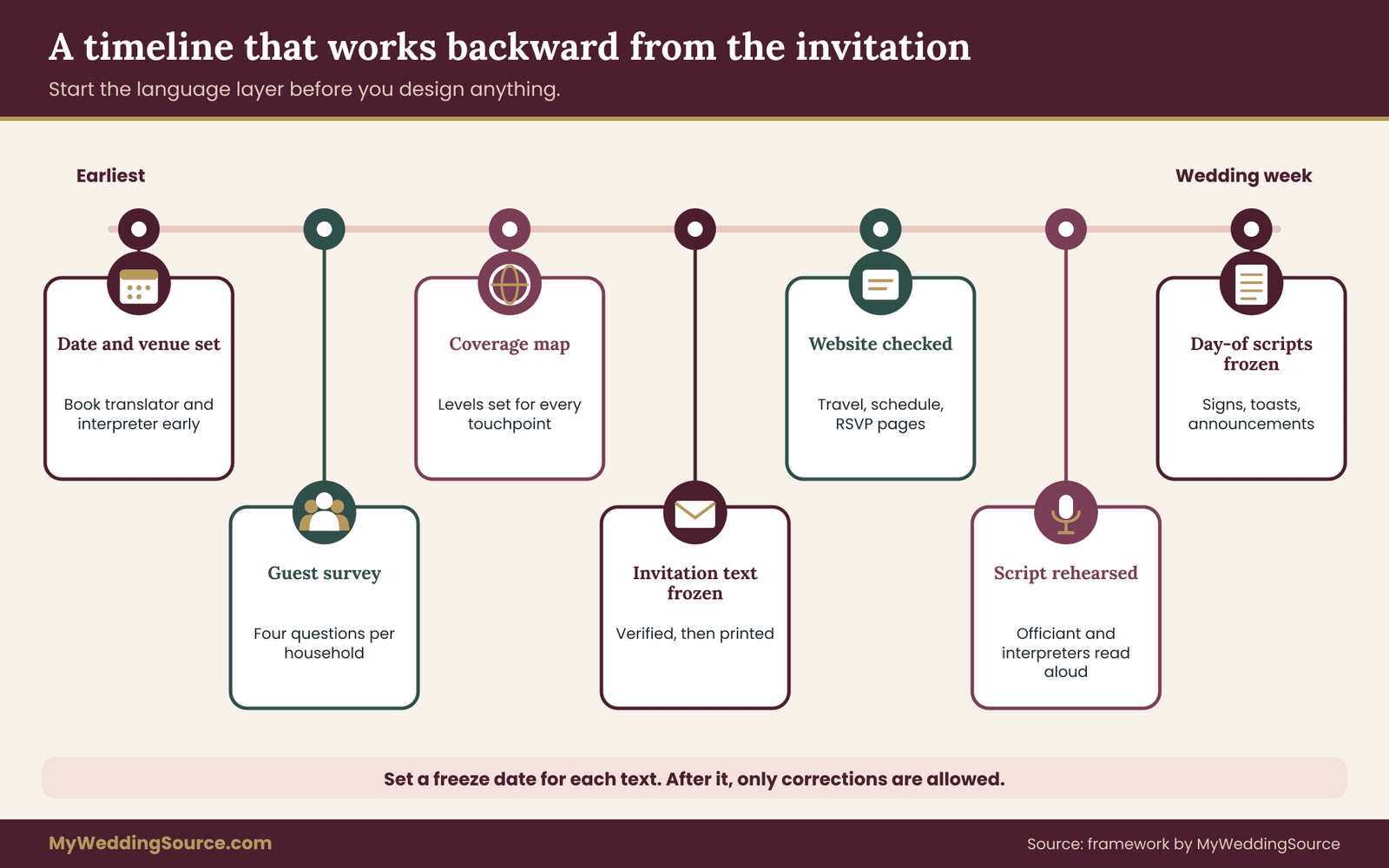
Start the language layer earlier than seems necessary. The guest language survey belongs at the start of the guest list work, many months out. The coverage map should be done before invitations are designed, because it decides how many versions you need. Translators and interpreters often have limited availability, particularly for less common language pairs or for popular wedding dates, so contact them as soon as the date and venue are set.
A workable sequence: survey and map first; translator and interpreter booked next; invitation text translated, checked and frozen before printing; website translated and checked before the invitations go out; ceremony script and program translated and rehearsed in the final weeks; day-of scripts and signs finalized before the printing deadline for signs. Each step has a dependency on the one before, and the schedule for each belongs on your shared vendor calendar. That sequence is the backbone of bilingual wedding planning for the months before the event.
Names, scripts, dates and other details that break
Many problems in bilingual wedding planning have nothing to do with fluency. They come from small mechanical details that do not survive the move from one language to another. They are cheap to fix if you look for them and expensive to fix after printing.
Names come first
A name is not translated. It is spelled, and the spelling in each script is a decision that belongs to the person who owns the name. Before any text goes to a translator, build a short name sheet: each guest or family member who appears in print, written exactly as they want it in each script they use, with the pronunciation noted where it is not obvious. Names are the first test of any bilingual wedding planning process.
Diacritics matter. A missing accent, a dropped mark or a replaced character can change a name into a different name, and family members notice. Ask your printer and designer to confirm that the typeface contains every character on the name sheet. A font that lacks a character will quietly substitute another, and a proof that looks fine to a reader of only one language can hide the problem.
The Internationalization pages of the World Wide Web Consortium explain how personal names vary across cultures, and the guidance is a good reminder that a form with “first name” and “last name” fields does not fit everyone.
Titles and forms of address also vary. A guest may expect a formal title in one language and a first name in the other. Honorifics in some languages carry age and relationship. Decide once, in the style sheet, how you will address elders and keep the same form across invitations, programs and announcements. If you are unsure, ask the family member who knows the guest best. Settle these choices once in your bilingual wedding planning style sheet.
The same applies to the order of names. In some traditions the family name comes first. If your invitation uses a different order in each language, check that each guest is listed in the order they use, and that the couple’s names appear in the same order in both versions unless the families have agreed otherwise.
Dates, times and numbers
Dates are a hazard. A date written as day, month and year in one convention reads as month, day and year in another, and for many dates both readings are valid. A card that says 04/05 can mean April 5 or May 4. The fix is simple: write the month as a word in each language and never use all-numeric dates on anything printed.
The Unicode Common Locale Data Repository documents how formats differ by language and region, and it is useful for a quick check of what a given reader expects. Dates are the most common slip in bilingual wedding planning for paper goods.
Times need the same treatment. Some readers use a twenty-four-hour clock and some a twelve-hour clock with a morning or evening marker. Write the time in the form your venue and vendors use, and add the other form if the audience needs it. For events that cross midnight or involve time zones, name the zone for guests who travel.
Numbers, currency and units can also trip a reader. Decimal separators, thousands separators and the order of address elements differ. If you give a travel cost, name the currency. If you mention a distance or a temperature, use the unit the guest will be familiar with, or give both.
Phone numbers should include the country code for guests who may call from abroad, and each contact should be tagged with the language the person speaks. A contact number labeled only by name is not much use to a guest who needs a specific language.
Scripts, direction and fonts
If your two languages use different scripts, the design carries more risk. Some scripts are written right to left, and mixing them with left-to-right text in the same line or the same column can reverse punctuation, numbers and parentheses. Some scripts need more line height or a larger point size to be readable.
A typeface that looks elegant in one script may be unreadable in another. Ask your designer to pick fonts that cover both scripts, set them at sizes that read comfortably and avoid decorative styles for the translated text. Raise it with the designer at the start of bilingual wedding planning for stationery.
Reading order is a social decision as well as a layout one. Which language goes first, above or to the left, reads as a statement of priority. Some families will see it that way, and some will not care. Raise the question openly, decide with the people involved and keep the same order across every touchpoint, or swap it deliberately and consistently, for example by letting each household’s own language lead.
The W3C guidance on language declarations also reminds web designers to tag each language on a page properly, which helps screen readers pronounce text correctly, and guests who use a screen reader will notice if the tag is wrong. Whichever way you decide, write it into the bilingual wedding planning style sheet.
Addresses and the mail
If you mail invitations to guests abroad, keep the delivery address in the form the postal service expects. The United States Postal Service publishes addressing standards for domestic mail and information on international mail, including how to address items going abroad. The destination country’s postal service decides how it reads an address, so confirm with the postal service or a local contact what form works.
A second-language version of the address can go inside, on the card or on a note, but it is not a substitute for the address that the carrier reads.
Return addresses, response cards and prepaid reply envelopes deserve a thought of their own. A reply envelope mailed from abroad may need different postage, and a guest who cannot easily reply by post should be offered an online alternative. The point is that a response is part of the guest information, and the language plan should cover how it travels back. Replies are part of bilingual wedding planning, not an afterthought.
Plain language is a translation aid
One of the best ways to reduce cost and error is to write the source text in plain language. Short sentences, common words, one idea per sentence and no idioms. The federal plain language guidelines at plainlanguage.gov describe the approach, and although they are written for government writing, they apply well to wedding text. A sentence like “Dress code: garden formal, flat shoes recommended for grass” translates cleanly. A sentence like “come as you are, but make it fancy” does not.
Plain does not mean cold. You can write a warm invitation and a clear schedule at the same time. The only text you should keep complex is the text where complexity is the point, such as a poem a family member wrote. Mark those items for a translator who works with literary text and give them more time. Plain source text makes bilingual wedding planning cheaper without making it colder.
A worked case: one invented couple, one coverage map
An example makes the framework concrete. The couple below is invented for illustration. The numbers are chosen to show the reasoning, not to represent any real wedding or any average one. The case follows the order of a normal bilingual wedding planning process.
The situation
Lucia and Tomas are planning a wedding for about one hundred and twenty guests. Lucia’s family reads Spanish at home and English as a second language. Tomas’s family reads English, with a few relatives who read Spanish from school or from earlier years. Their friends are mostly English-speaking, and a few of Lucia’s friends are most comfortable in Spanish. The ceremony will be led by an officiant who speaks both languages, and the reception will be at a venue with a DJ and a catered dinner.
They send a short survey through the relatives who run each family branch. After the first pass, they sort the households into the five profiles. About thirty households need Spanish for anything important, about fifty need English, about twenty can use both, and a handful of older relatives follow spoken Spanish but read little in either language. Two guests are deaf and use a signed language. That sorting step is the data foundation of bilingual wedding planning.
The map they draw
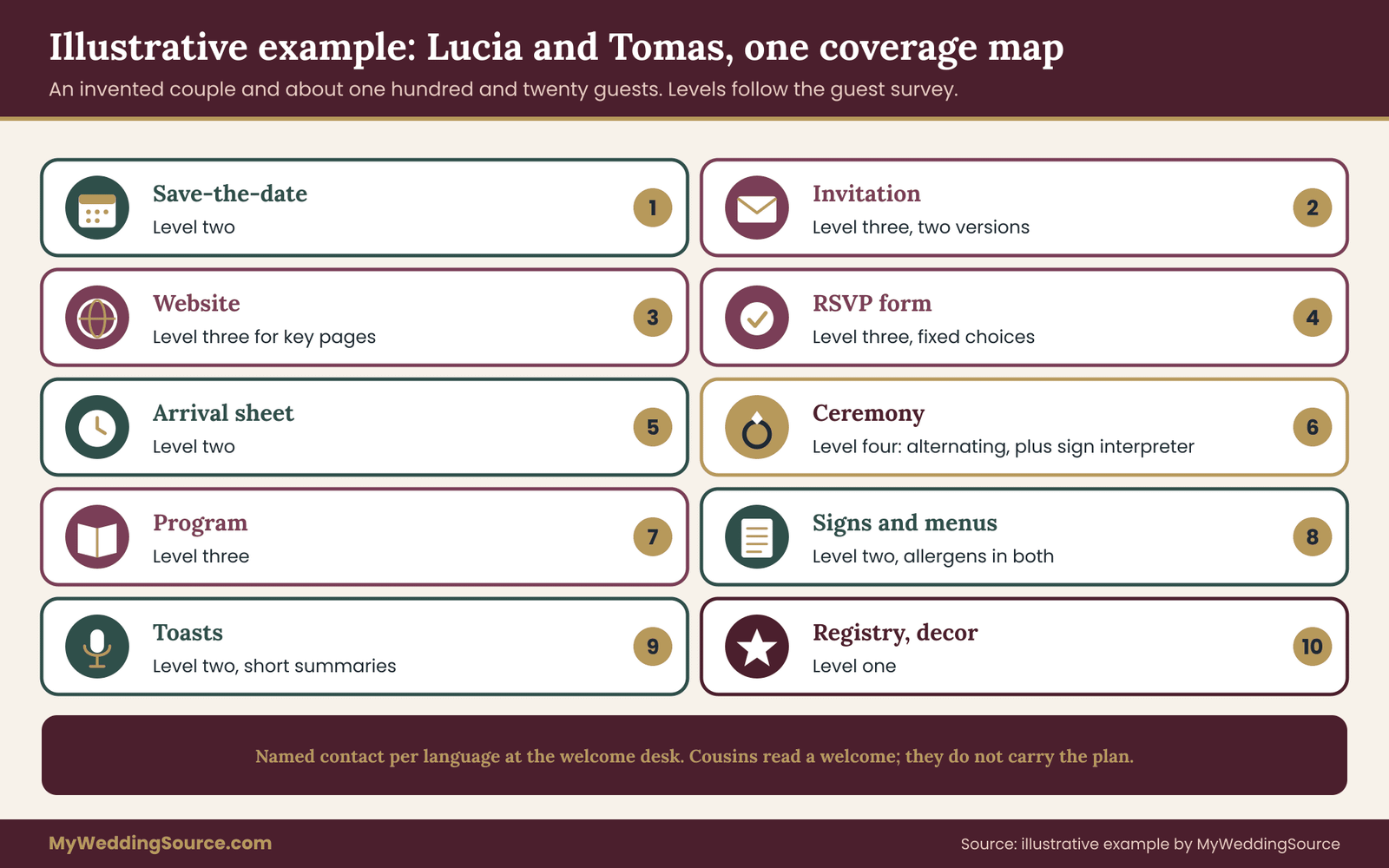
The couple writes the ten touchpoints on a page and assigns a level to each one.
The save-the-date goes to level two, with date and place in both languages. The invitation goes to level three, as two versions: one led by Spanish and one led by English, each with a short line in the other language, and both going through the full verification chain. The website goes to level three for the travel, schedule and RSVP pages and level two for the rest. The RSVP form is level three, with fixed choices and a free-text line read by a named person in each language.
Travel and lodging go to level two, as a one-page arrival sheet. The welcome event is level two, with a bilingual host at the door. The ceremony is level four: an officiant who runs the personal parts in alternating languages, a printed program with a full translation of the ritual elements and a sign language interpreter booked for the two deaf guests, who will sit near the front.
The program is level three. Signs and menus are level two, with allergen names in both languages. Announcements and toasts are level two, with a short summary of each toast spoken in the other language and a printed card for the dinner tables.
The decisions behind the map
Three of their decisions illustrate the framework. First, they chose different invitation versions for different households instead of a double-language card for all. The survey showed two clear groups, and a household-specific version kept the text short and each household’s own language prominent. They accepted the cost of managing two print runs and added a change log. Each one is a typical bilingual wedding planning trade-off.
Second, they limited the ceremony to a length that suited alternating languages. Because most guests understood at least part of both languages, they did not need full interpretation, but the handful of older relatives who follow only spoken Spanish needed to follow the ritual elements. The printed program and a short spoken summary before the ritual covered them. They shortened the optional readings so that the interpreter’s pauses would not make the ceremony too long for the sign interpreter to keep pace.
Third, they decided that a cousin who is a guest would not be the language backup for the whole day. Instead, they named one contact person for each language at the welcome desk and booked an hourly coordinator for the reception. Cousins were thanked for small jobs, such as reading a welcome in Spanish, and were not asked to carry the plan. It kept bilingual wedding planning from resting on one relative.
What they did not do
The omissions matter as much as the choices. They did not translate the registry page, since it was already usable in either language through the store. They did not translate decor signs such as a “photos” label. They did not make the thank-you notes bilingual by default, but wrote each in the language of the recipient. They did not hand the ceremony script to a free translation tool. Each omission saved time and money for the touchpoints where it counted. Leaving things out is a legitimate part of bilingual wedding planning.
How the schedule worked
Working backward from the invitation mailing date, they ran the survey right after setting the date, finished the map a few weeks later and booked the translator and the sign language interpreter as soon as the map was done. The invitation text went through the chain and was frozen before printing, and the website followed after the invitations were out.
The ceremony script was drafted in the weeks that followed and rehearsed with the officiant and the interpreters before the final fitting of the program. The day-of scripts and signs were frozen on a date set before the sign printer’s deadline.
Nothing in the example is special. It is the same process any couple can run with their own numbers, and it works because each decision is tied to a touchpoint and a guest profile rather than to a general feeling that “everything should be bilingual.”
Failure conditions and alternatives in bilingual wedding planning
A plan is only useful if you know how it fails. The conditions below are the ones that most often undo a bilingual wedding, along with the signal that tells you it is happening and a repair that works. They are not meant to scare anyone. Most of them are visible weeks before the wedding, and all of them are cheaper to fix early. Each is a risk worth checking in your own bilingual wedding planning.
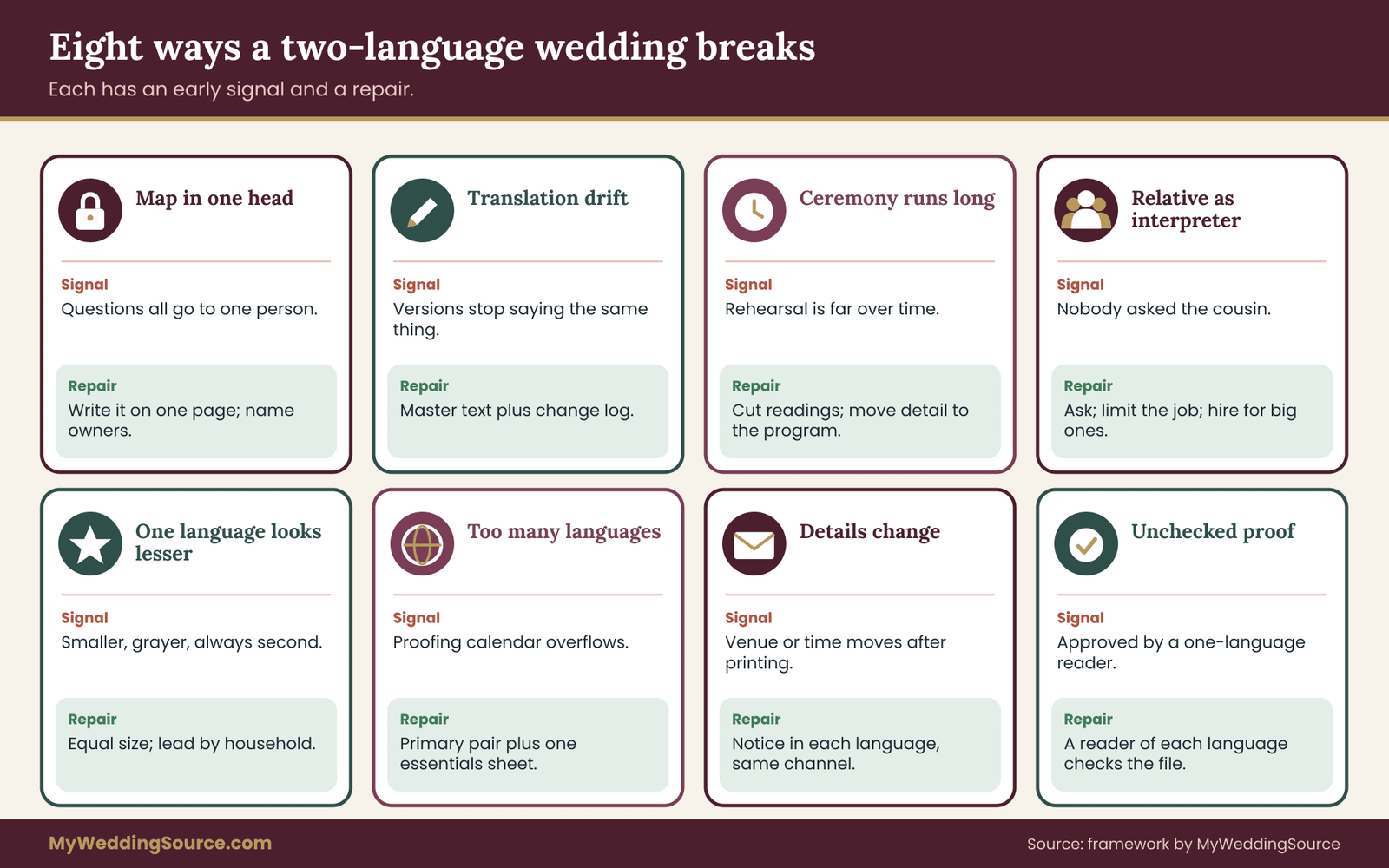
Failure one: the map exists only in one person’s head
The signal is that questions about languages all go to the same person, usually one of the partners or a relative. When that person is busy, tired or unavailable, everything stalls. The repair is to write the map down on a single page, share it with the coordinator, the officiant and the people on the language contact list, and to give each touchpoint a named owner and a date. Bilingual wedding planning works only when more than one person can run it.
Failure two: translation drift
The signal is that the two versions of a text no longer say the same thing. It usually starts with a small change, such as a new time or a changed dress code, made in one language and forgotten in the other. The repair is a master text and a change log. Make every change in the source first, record it, then update every other version from the log, then check that both versions match. Never fix a typo in only one file. Drift is the quietest failure in bilingual wedding planning.
Failure three: the ceremony runs long
The signal is a rehearsal that takes much longer than the planned ceremony. With consecutive interpretation or full alternation, the length can double without anyone noticing until the rehearsal. The repair is to cut, not to hurry. Remove optional readings, shorten the speeches, move explanatory text to the printed program and keep only the moments that need to be spoken. A rehearsal with a timer is the cheapest diagnostic you have. Time is a hidden cost in bilingual wedding planning.
Failure four: a relative becomes the interpreter by default
The signal is that “my cousin will help” has been said several times and nobody has asked the cousin. The cousin may be willing, but they may also want to enjoy the wedding, may not know the ritual vocabulary or may be nervous about speaking in front of family. The repair is a direct conversation: ask what role they are comfortable with, give them a clear and limited job and hire a professional for anything that needs one.
Thank them in a way that is not a task assignment. This failure is common in bilingual wedding planning because the offer is kind.
Failure five: one language reads as the “real” one
The signal is a reaction from a family member that the other language looks smaller, comes second or seems like an afterthought. It might be a layout issue, a font size or a speaking order. The repair is a short conversation with the people affected, a review of reading order and sizes across touchpoints and a decision made with them rather than for them.
Sometimes the fix is as simple as swapping the order on one touchpoint or leading each household’s version with its own language. Equal treatment is a design goal of bilingual wedding planning, not a side effect.
Failure six: too many languages
The signal is that the map has grown to three or four languages at level three and the proofing calendar is full of unfinished texts. The repair is triage. Choose the primary pair, give the others level two or a one-page essentials sheet and make clear to those households that the sheet is a courtesy and a person is available to help on the day.
A well-made essentials sheet serves a guest better than a rushed full translation that nobody has had time to check. Restraint is part of good bilingual wedding planning.
Failure seven: the details change after printing
The signal is a venue change, a time change or a new shuttle plan after invitations have gone out. The repair is a short change notice, issued in each language, sent through the same channel as the original and posted on the website. Keep the wording short, factual and polite. In a bilingual plan, the added step is to verify that each language version is sent to the right households and that nobody receives a notice in a language they do not read.
Failure eight: nobody checks the printed proof
The signal is a printed proof that has been approved by someone who cannot read the second language. Typesetting errors can turn a name or a word into something else, and a reader of the first language will not see them. The repair is a rule: no proof is approved until a person who reads each language has read the actual file. This is the cheapest rule in the whole plan, and it saves the most embarrassment. If you do one thing in bilingual wedding planning for printed goods, do this.
Alternatives: when to scale back, and when to scale up
Not every wedding with two languages needs the full map at high levels. Sometimes a lighter approach serves guests better and leaves more energy for the people. The alternatives below are legitimate choices, not compromises. Choosing less support can be sound bilingual wedding planning.
One main language with strong support
If the guest list is mostly one language and a few households need another, keep the main materials in one language and provide a short bilingual essentials sheet, a named helper at the venue and a spoken summary at the ceremony. This level of support is often enough to make those guests comfortable, and it does not make the main materials harder to read for everyone else. This is the leanest version of bilingual wedding planning that still protects guests.
Two events, two emphases
Some couples hold a second event, such as a family gathering or a dinner, in the language of one family, and keep the main wedding mostly in the other. This divides the language load across events and gives each family a space where its language leads. The cost is the extra event. For couples who already plan a welcome dinner or a farewell meal, the language emphasis of each event can be part of the design.
A short ceremony, a longer program
A short ceremony with a rich printed program is an effective way to cover meaning without interpretation. Keep the spoken parts to what matters most, and let the program explain the rest. This works well for ceremonies with many symbolic elements, since the program can carry the explanation in both languages. This approach suits bilingual wedding planning for ritual-heavy ceremonies.
Adding a third language for essentials only
If a few guests need a third language, you do not need to translate everything. Make a one-page sheet with the date, venue, schedule, lodging, a contact and any safety information. Offer it as a printed card at the welcome desk and as a page on the website. Have a named contact. If a guest needs more, they can ask.
Hiring support for the whole weekend
For larger weddings, or those with many guests who need live language support, a bilingual coordinator or a small interpreter team for the weekend is a better investment than a mix of volunteers. It costs more, but it takes the language load off the family and lets the couple be guests at their own wedding. Ask providers to describe how they split the work between preparation and the live event, and how they handle breaks and changes. It is the most complete form of bilingual wedding planning.
Scaling up for a large or multi-day event
If the wedding has several events across several days, apply the map to each event separately. A rehearsal dinner, a ceremony and a brunch may have different audiences, and the levels may differ. The overall coverage plan stays the same; the map simply has more rows, and the language contacts and schedule for each event should be listed on the day’s cue sheet. Multi-day bilingual wedding planning is just the same map repeated.
What to do when a guest is confused
Even a well-built plan will leave a guest confused at some point. Prepare for it by deciding what the response will be. The best response is simple: the guest asks the nearest language contact or any staff member, and a person helps. Tell the venue staff and the vendors that guests may ask for help in a language they do not speak, and give them the contact list. A guest who is helped kindly in the moment will not remember the gap. Include this step in your bilingual wedding planning day-of notes.
After the event, ask a few guests from each language group what worked and what did not, and keep the notes. They are useful if you host another event, and they make a thoughtful gesture in themselves. The same notes help any family member who plans a later celebration, since language plans tend to be reused within families.
Your next steps
You do not need to do everything at once. A sensible order for the first month of bilingual wedding planning looks like this.
- Add a language column to your guest spreadsheet and send the four-question survey through the person in each family who organizes communication.
- Sort households into the five profiles and count each one.
- Write the touchpoint list for your own weekend and assign a coverage level to each, using the three questions about cost, recovery and use.
- Pick the ceremony format from the five options and ask your officiant and the license office what rules apply to the language of the legal words.
- Build the name sheet, with each name spelled as its owner wants it in each script.
- Request quotes from a translator and, if the ceremony needs one, an interpreter, with a written scope and a freeze date.
- Name one contact person for each language on the wedding day, and tell the venue who they are.
Revisit the map at each major step: when invitations are final, when the guest list closes and two weeks before the wedding. For the wider set of etiquette questions around invitations and replies, the invitation etiquette guide is the natural next read, and the broader wedding planning checklist shows where the language layer fits in the full timeline.
FAQ
How many languages can a wedding reasonably support?
Two is manageable for most couples at a high level of support. A third language is realistic if it gets only the essentials: date, venue, schedule, lodging, a named contact and any safety information. Beyond that, each added language multiplies the proofing, the printing and the day-of coordination. Name a primary pair first, and decide the level for every other language separately.
Can I use machine translation for my invitations?
Use it for drafts and for understanding messages, not for the final text. Machine output can be wrong about names, idioms, titles and religious terms while sounding confident. Anything printed, spoken from a stage or tied to a ceremony or a safety warning should be reviewed by a qualified translator and read by a second person who knows the language well.
Who should interpret the ceremony: a relative or a professional?
It depends on length and stakes. A short ceremony with a printed program can work with a trusted bilingual relative, if that person agrees and has the script in advance. A long ceremony, one with ritual terms or one where a guest relies on the interpretation should have a professional. Ask the relative what role they are comfortable with before assuming.
Which language should come first on the invitation?
There is no rule. The choice is cultural and personal, so decide it with the families involved. A practical option is to send each household a version led by its own language, with a short line in the other. If you use a single double-language card, keep the order consistent across every touchpoint and make sure sizes and type are equal.
What about guests who use a sign language?
Treat a signed language as its own language, not as an add-on. Ask guests in advance what they need, and book a qualified sign language interpreter if requested. The Registry of Interpreters for the Deaf and the National Association of the Deaf offer guidance, and the ADA website explains effective communication. Share the script with the interpreter and seat the guest where they can see both.
How do I stop the two versions of a text from drifting apart?
Keep a master text and a change log. Every change is made in the source first, logged, and then applied to each other version. Before printing or posting, have a reader of each language compare the final files line by line against the log. Set a freeze date so changes after it need an explicit decision.
How much does language support cost?
It varies by language pair, region, text length and the professional, and prices change, so ask for written quotes. Translation is often priced by word or project, interpreting by time with preparation, and equipment separately. Ask what is included, whether a second reader is part of the price and what happens if the text changes after the freeze date.
Do I need to translate the website, signs and menus too?
Not all of them equally. Give the website pages that guests depend on, such as travel, schedule and RSVP, full parallel text. Signs and menus usually need only short labels in each language, with allergens named in both. Decor-only items and registry pages can often stay in one language. Use your map and your guest profiles to decide.
Sources
- ADA.gov: U.S. Department of Justice Americans with Disabilities Act
- LEP.gov: Federal Interagency Website on Limited English Proficiency
- PlainLanguage.gov: Federal plain language guidelines
- American Translators Association
- Registry of Interpreters for the Deaf
- National Association of the Deaf
- W3C Internationalization Activity
- Unicode Common Locale Data Repository
- United States Postal Service
- U.S. Department of State: Travel.State.Gov