
Flash photography changes two things in a wedding photo that couples rarely think to ask about: the color of the light on skin, fabric and walls, and the mood of the room. This guide gives you a mixed-light sample set to request from a photographer, a scoring method to judge it, and a guest comfort briefing so flash never surprises the people in the room.
Do not ask whether a photographer uses flash photography. Ask to see the same scene shot with and without it, in a room that looks like yours. Request a six-frame mixed-light sample set, score it on five visible checks (skin tone, white fabric, background warmth, shadow edges, eye comfort), and agree on a short guest comfort briefing that names where flash is welcome, where it is limited and who to tell if it bothers someone.
Most wedding galleries look good in the first hour. The bride is by a window, the light is soft, and almost any approach works. The trouble starts at six in the evening, when the sun drops, the venue turns on its warm bulbs, the uplights glow magenta and the photographer has to decide how to light a room that no longer lights itself. That decision is where flash photography earns its keep, and it is also where a gallery can quietly drift away from the atmosphere you remember.
This article is about that decision. It does not rank photographers or tell you to love or avoid flash. It explains what flash does to color and atmosphere in plain terms, shows you how to test a photographer’s flash photography work before you sign, and gives you a way to prepare your guests, your venue and your officiant so the day runs without friction.
A note on scope. This is general information, not legal advice. Venue rules, copyright terms and accessibility duties differ by place and by contract, so where a rule matters, confirm it with the venue, the photographer or the agency that issues it.
What flash photography actually does to a wedding photo
A camera records light, and flash adds a second source of light that the photographer controls. That is the whole idea. A small, fast burst of light is fired at the moment the shutter opens, and it adds brightness, freezes motion and changes the balance between the subject and the room.
Three properties of that burst matter to you as a couple.
The first is its color. Most flash units produce light that is close to daylight, which looks neutral and slightly cool compared with the warm bulbs, candles and string lights common at receptions.
The second is its direction. Light that travels straight from the camera to a face looks flat and bright, while light that bounces off a ceiling or a wall arrives softer and from above. The third is its strength relative to the room. A little flash fills in shadows and keeps the room’s glow. A lot of flash overwhelms the room and replaces its mood with the flash’s own.
None of this is good or bad on its own. A documentary photographer working fast in a dark church may use a small amount of bounced flash so faces are readable. An editorial photographer may use off-camera flash on purpose to create a dramatic, high-contrast portrait. A film photographer may use flash because the film needs far more light than a candlelit hall provides. The question is never “flash or no flash.” It is “which kind, how much, and does the result still look like our wedding.”
This is why the style label on a photographer’s website tells you little about flash. Two people who both call themselves documentary photographers can produce very different evening galleries. If you want to compare labels first, a style comparison can tell you what each label tends to mean, and this article picks up where that comparison stops.
Why color and atmosphere shift when flash enters the room
Think of a reception hall at nine at night. The ceiling has warm recessed bulbs. The tables have candles. The dance floor has colored uplighting chosen months ago from a wedding color palette. The windows are black mirrors. That is at least four different kinds of light at once, and the human eye blends them into a single pleasant impression of warmth.
A camera does not blend them. It has to pick one color setting for the whole frame, and any light that does not match that setting shifts. If the photographer sets the camera for the flash, the candles and bulbs look more orange than you remember. If the photographer sets the camera for the bulbs, the flash-lit faces look pale and slightly blue. Skilled photographers manage this by placing a colored filter over the flash, called a gel, so its color matches the room, or by deliberately letting the background go warm while keeping skin natural.
Atmosphere shifts for a related reason. Without flash, a dim room shows up as soft, warm, a little grainy and often slightly blurred, because the camera must use a slow shutter or a high sensitivity setting. With flash, the faces become sharp and bright, the background falls to near black unless the photographer slows the shutter to let the room’s light in, and the shadows behind people become crisp edges on walls.
Neither result is wrong. The soft version feels like candlelight. The flash version feels like an event photo. Many couples want both, in different parts of the evening, and they can only get that if the photographer knows which to use and when.
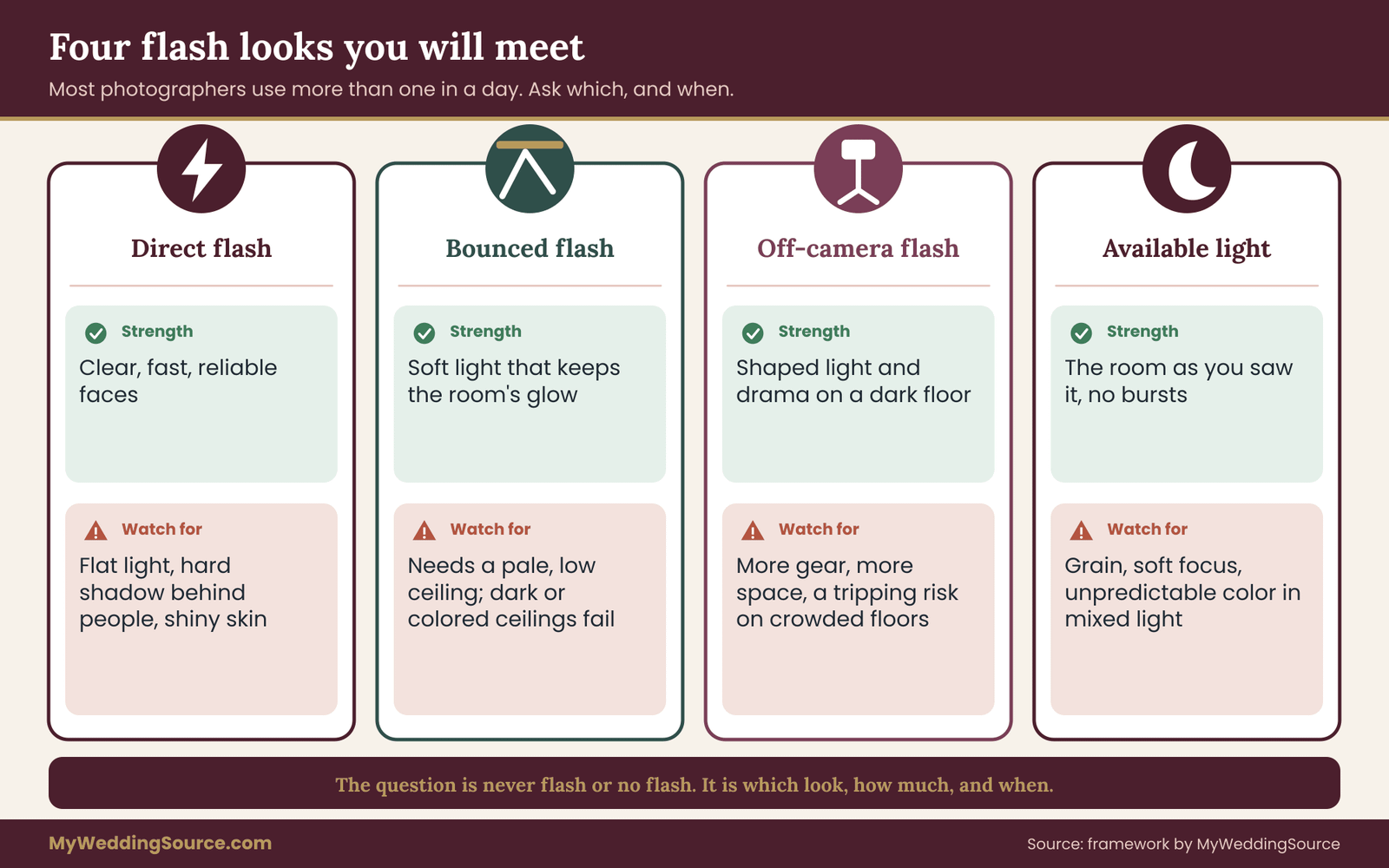
The graphic above shows the four looks you will meet most often. The rest of this article uses them as a shared vocabulary, so it helps to know them by name before you look at any sample.
The four looks you are choosing between
Direct flash. The flash points straight at the subject from the camera. It is bright, fast and reliable. It also flattens faces, adds a hard shadow behind people and can produce shiny skin and red eyes. Some photographers use it deliberately for a candid, party-snapshot feel, and some couples love that.
Bounced flash. The flash points at a ceiling or wall so that the light reflects onto the subject. It is softer and more flattering, and it keeps more of the room’s mood. It depends on the room, though. A low white ceiling is ideal. A tall dark ceiling, a wood-beam barn or a ceiling painted a strong color can send the light away or tint it.
Off-camera flash. The flash is on a stand or held by an assistant, aimed from the side or behind. It can sculpt a face, separate people from a dark background and add drama. It takes more equipment, more space and more skill, and an unprepared dance floor can turn it into a tripping hazard.
Available light, no flash. The photographer relies on the room’s own light, a fast lens and a high sensitivity setting. It protects the atmosphere and avoids any guest discomfort from flash. It also produces grain, softer focus and unpredictable color when the room’s lights are mixed, and it can fail entirely in a very dark space.
Most photographers use more than one flash photography look in a day. Your job is not to pick a winner. It is to find out which looks they use for which moments, and whether the results suit the way you want your evening remembered.
A short example of the same moment, four ways
Picture a first dance in a ballroom with warm bulbs overhead and a soft blue uplight on the walls. The couple is moving slowly, and the room is lit at a level that looks comfortable to the eye but is dark for a camera.
With direct flash, the couple’s faces are bright and sharp. The blue wall behind them nearly disappears, and a hard shadow lands on the floor. The photo reads as a clear record of the moment, and it feels like a snapshot.
With bounced flash, the faces are softer, the ceiling adds a gentle glow, and some of the room’s blue survives at the edges. The photo feels more like a portrait of the evening.
With off-camera flash from behind and to the side, the couple is outlined in light against a darker room. It looks cinematic, and any guest standing behind the flash may find the burst brighter than expected.
With no flash, the photo shows the room as the couple saw it, warm and blue, but with grain and a little blur from the slow dance. If the camera’s color setting favors the bulbs, the blue turns gray.
Four frames of one moment. Four honest results. The only way to know which of them your photographer produces well is to see them.
Where this guide fits, and where it does not
Flash photography is one thread in a longer set of choices about your photo coverage. If you are still working out who will photograph guests, how images may be shared and what boundaries to set, the guide to wedding photography consent covers that side. If you want a list of the family groupings to be photographed, start with a family group list before you think about lighting. This article stays focused on one narrow question: how artificial light changes the color and mood of what you receive, and how to check it before you commit.
The method has two pieces. The first is the mixed-light sample set, which is a way of asking a photographer to prove their flash photography work in conditions like yours. The second is the guest comfort briefing, which is a short plan for telling guests, the venue and your officiant how flash will be used. Both pieces are cheap to do, and both are much easier before the contract is signed than on the wedding day.
How flash photography changes color and skin tone
Skin tone under flash photography
Skin is the first thing a family checks in a wedding photo, and it is where flash photography helps and hurts most. Flash photography gives the camera enough light to render skin cleanly. It can also strip warmth from faces, add a shine to foreheads and noses, and make people with deeper skin tones look gray or washed out if the exposure is pushed too far.
Three habits separate careful flash photography work from careless flash photography work. The first is exposure restraint. A photographer who sets flash power just high enough to fill shadows leaves natural color in the face. A photographer who sets it high to be safe blows out highlights, and highlights that clip to pure white cannot be repaired later.
The second is consistency across skin tones. In a group of people with a wide range of complexions, a single flash setting can suit some faces and not others, so a good photographer checks the back of the camera and adjusts. The third is the editing pass. Color corrections applied to a whole batch of frames can fix the average and still leave one person looking orange.
When you look at samples, pick one person who appears in several frames and follow their face. Does it look like the same person in the same health from frame to frame? Is there a visible glare patch on the forehead? Do the eyes have a small, clean spark of light, or two red dots? Those are the fastest signs of whether the flash photography was controlled.
Spend a few extra minutes on frames with more than one skin tone in them. Ask yourself whether anyone looks noticeably lighter, darker or grayer than they do in daylight frames. If the answer is yes for the same person, the photographer’s flash and editing choices are showing.
White dresses, dark suits and the problem of dynamic range
A white dress next to a black suit is one of the hardest lighting problems at a wedding. The camera has to hold detail in both at once, and flash photography can make the problem better or worse.
Strong direct flash tends to blow out the dress, turning lace and beading into a flat white shape. It can also turn the suit into a featureless dark block. Bounced flash holds more detail in both, because the light arrives softer and from a wider area. Off-camera flash photography can hold detail if it is placed with care.
White is also the color where casts show most. A dress lit by flash and warm bulbs can pick up a yellow or peach edge on one side and a faint blue on the other. That is not always a flaw. A slight warmth on a dress in a candlelit room reads as natural. A strong yellow or green cast on the whole dress does not.
For a simple check, look for something in the frame that should be white or neutral gray: a shirt collar, a printed program, a napkin, a cake tier. If that object looks clearly yellow, blue or green, the room’s light and the flash were not matched. If it looks close to neutral while the room around it still feels warm, the photographer handled the mixed light well.
Beaded and sequined fabric is a special case. Flash photography makes sequins sparkle and can make heavy beading look glittery or hot. If your dress is heavily beaded, ask to see a sample with similar fabric. How a flash lights that fabric is a photography question, not a garment-care one.
Colored uplighting, candles and mixed light
Mixed light means that more than one color of light is falling on the same scene. Weddings are close to the worst case. A dinner might have warm bulbs, candles, window light at dusk, a rented uplight system in a color you chose and the camera’s own flash, all in one frame.
Uplighting is the one most often misjudged. Saturated colors such as magenta, purple or teal are lovely on a wall and difficult on a face. When a photographer uses flash, the flash light is mostly neutral, so faces look natural, and the colored wall behind them looks the way you chose. When the photographer does not use flash, the colored light falls on faces too, and the camera may render skin as pink, purple or green. Both outcomes can be acceptable if you know about them in advance.
If your venue or your decorator is planning strong colored lighting, bring that into the conversation with your photographer early. The lighting plan also belongs on the sheet your vendors share, which the venue technical walkthrough guide treats as part of site logistics. Tell your photographer the color, where the uplights will sit and when they will turn on.
Candles are a gentler version of the same problem. Their light is very warm, and photographed by itself it looks orange. Flash photography can ruin a candlelit table by washing out the candle glow, or it can preserve it if the photographer uses low-power bounced flash and a slower shutter so the flames still register. Ask how the photographer treats candles specifically. A good answer includes a technique, not just a promise.
How the camera decides what color the scene is
You do not need to become a lighting technician, but a basic picture of how the camera chooses color makes sample frames easier to read.
A camera sets a white balance, which is its assumption about the color of the light. Set to daylight, it records a flash-lit face correctly and makes warm bulbs look orange. Set to a warm bulb setting, it makes the bulbs look neutral and flash-lit faces look blue. Set to automatic, it guesses, and its guess can change from frame to frame, which is why an automatic setting in mixed light can produce a gallery where the same wall changes color across consecutive photos.
Professionals handle this in a few ways. They can lock the white balance and place a gel on the flash so it matches the bulbs. They can use the flash as the main light and let the background go warm. They can shoot in a raw format that lets them correct color afterward, at the cost of more editing time.
For you, the practical point is consistency. In a good set, the same room should look like the same room across frames. If the wall changes from cream to gray to green within a few minutes, the photographer was not controlling color, and the editing may not fix it.
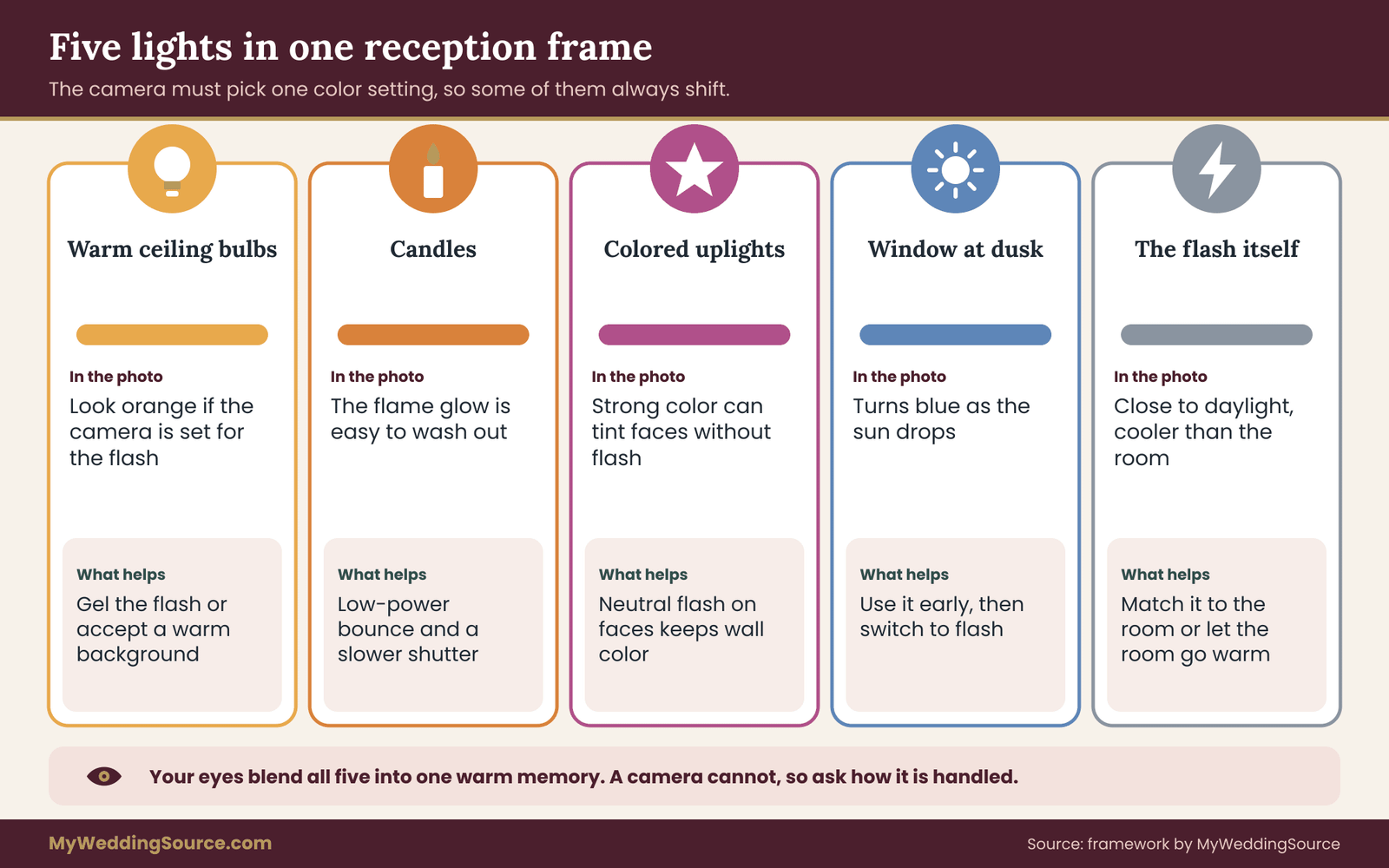
The second graphic maps where each light source in a reception comes from and what it does to a flash photograph. Use it as a checklist when you walk the venue.
An eyedropper test you can run at home
If you want a measurable check rather than a gut reaction, you can do one with free tools. Open a sample image in any photo viewer or editor that includes a color picker, often called an eyedropper. Click on something that should be white or light gray, such as a collar or a printed program, and read the three color values it reports, usually red, green and blue.
On a neutral object, the three numbers should be close to one another. If blue is far above red, the object has a cool cast. If red is far above blue, it has a warm cast. As a working rule of thumb, and not a published standard, treat a difference of more than about a tenth of the brightest value as a visible cast worth asking about.
Run the same test on a face. Skin is never neutral, but you can compare the same person across frames. If the red-to-blue balance on a forehead swings widely between frames shot minutes apart, color was not locked.
This test has limits. A screen shows colors differently from one device to another, a compressed web image has already lost some color information, and a photographer may have intentionally warmed an image. Treat the numbers as a prompt for a question, not a verdict. “I noticed the dress looks warm in this frame. Was that intentional?” is a fair and useful question, and a good photographer will have an answer.
Surfaces that bounce color back
Bounced flash photography borrows the color of whatever it bounces from. A white ceiling returns neutral light. A cream or beige ceiling returns a warm tint. A dark wood ceiling absorbs most of the light and wastes power. A colored wall, a red brick surface or a painted barn board adds its color to the faces below.
This is why the room matters so much. Barn venues, historic halls, churches with colored plaster and ballrooms with dark ceilings each create different problems. If your photographer has worked in your venue before, ask to see those frames. If not, ask what they do when the ceiling is too high, too dark or too colored to bounce from.
Mirrors and glass add reflection problems. Flash photography aimed at a mirror or a large window produces a bright hot spot, and in a room with mirrored walls it can fire back into the lens. A professional will angle the flash to avoid it, and may ask you to move a guest or a decor piece a few feet. The same logic applies to acrylic and mirrored signs, and readability problems with glossy signs overlap with this one. Glossy signs show glare under flash as often as they do under a spotlight.
What to take from the color question
Color problems in flash photography nearly always come from mismatch, not from flash itself. The light of the flash does not match the light of the room, the ceiling does not match the tool, or the edit does not match the capture. When the photographer is aware of the mismatch and has a plan for it, flash photography is a controlled, predictable tool. When the photographer is not aware, you get a gallery that looks inconsistent.
That is why the sample set matters more than any list of questions. You can ask a hundred questions and still not know whether the work will look right in your room. A set of frames shot in a room like yours shows you in about ten minutes.
The mixed-light sample set for flash photography: what to ask for
A normal portfolio shows a photographer’s best frames in their best light. That is useful for style and nearly useless for judging flash photography, because the best frames are usually the ones that were easy. The mixed-light sample set is a different request. You ask for a small, specific group of frames that show how the photographer handles light that is not ideal, and you ask for them from a room that resembles yours.
The set has six frames. They are described here as slots, so you can ask for them by name.
Slot one: the same moment with and without flash. Two frames of the same scene, taken seconds apart, one with flash and one with available light. This is the most revealing pair, because everything else stays constant. You can see what flash adds and what it takes away.
Slot two: a mixed-light table or room. A frame of a dinner, cocktail hour or dance floor where at least two colors of light are visible, such as warm bulbs and colored uplights. Check whether the background keeps its character.
Slot three: a white garment and a dark garment in one frame. A person in a white dress or shirt standing near someone in dark clothing. This tests highlight and shadow detail.
Slot four: a skin-tone range. A group frame with a wide range of complexions, or two frames from the same event of people with different skin tones. This tests whether exposure was set for one face or for all.
Slot five: a ceremony or quiet moment in dim light. A frame from a candlelit, dim or restricted-flash moment. This shows how the photographer works when flash photography is not allowed.
Slot six: a moving moment. A dance, a toast or a sparkler exit. This tests how motion looks, whether blur is soft and pleasant or messy, and whether the flash freezes people in awkward poses.
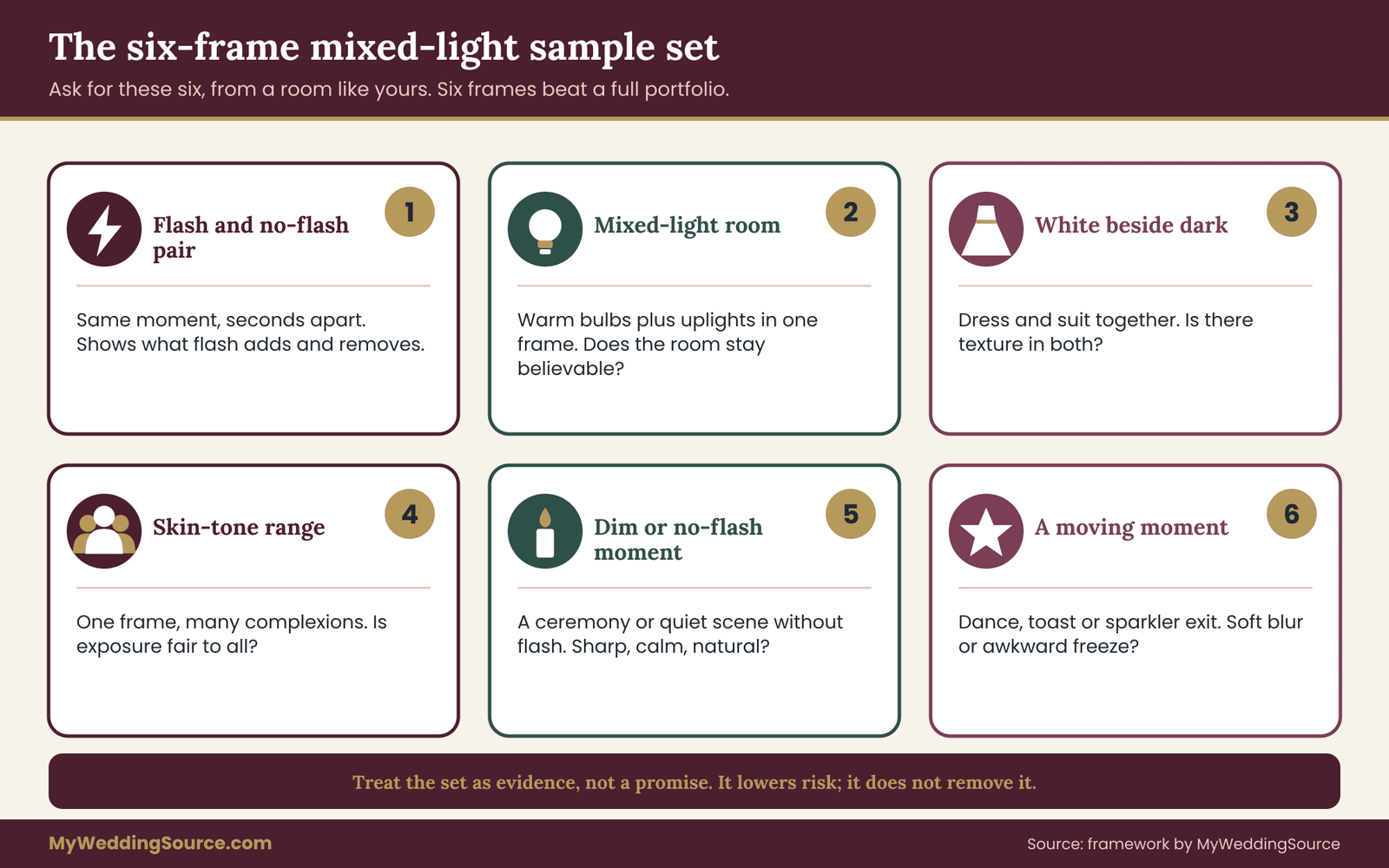
The graphic above lays out the six slots as a shot list. You can send it to a photographer as it is, or copy the six names into an email.
How to request the set without being difficult
Photographers are asked for samples constantly, and many are happy to provide them. A request about flash photography goes better when it is specific, small and respectful of their work.
Ask for six frames, not a full gallery. Ask for frames from real weddings, shot in rooms similar to yours in ceiling height, lighting and size. Ask that at least a few be unedited or lightly edited versions, because heavy editing can hide capture problems. Offer to look at them on a call or in a private online gallery, whichever is easier.
A message that works is plain and short. For instance: “We’re deciding between a few photographers. Because our reception will be indoors in the evening with warm bulbs and some colored uplighting, could you share six frames that show how you handle mixed light? A flash and no-flash pair of the same moment would help most. We’re happy to view them in a private gallery.”
If a photographer has little evening or flash photography work, they may say so. That is useful information. A photographer who says, “I mostly shoot daytime and I would borrow equipment for the reception,” is being honest, and you can decide whether to hire a second photographer for the evening or choose someone else.
If the photographer declines to share any frames beyond the public portfolio, treat that as a data point, not an insult. Some have contract reasons or client privacy reasons. You can ask for a short conversation about their approach instead, using the vendor questions in a later section, and look at whether public galleries from full weddings are available.
Samples, copyright and your own use
A sample set of flash photography work raises a rights question that is easy to overlook. The photographer owns the copyright in their images by default in the United States, unless a written agreement transfers it. The U.S. Copyright Office explains the basics on its website. That means sample frames are the photographer’s to share, and you are not free to post, forward or reuse them without permission.
In practice this has three consequences.
First, treat any sample set as private and for evaluation only. Do not post the frames online or send them to people outside your decision circle without asking. Second, if the frames show real couples and guests, the photographer may have used their consent or may have removed identifying details. Respect that, and do not try to identify people in them.
Third, when you receive your own gallery, your contract decides what you may do with it, including printing, sharing and editing. Guest boundaries and image use are a separate subject that pairs naturally with this section.
Be careful, too, with images you find elsewhere. A flash sample from a magazine or a social media post is not a licensed example you can reuse. If you want to share inspiration with a photographer, share a link to where it lives or describe it in words rather than copying the file into your own materials.
If you commission or receive custom sample frames, for example a styled shoot done for a fee, ask for the usage rights in writing before you pay. A paid test shoot is rare and often unnecessary, but if you do one, the same rule applies: put the terms on paper.
Reading a pair: with flash and without
The first slot is the one that does the most work, so it deserves a careful look when you judge flash photography. Put the two frames side by side on a screen of reasonable size, and ask five questions in order.
What did flash add? Look at faces first. Are they clearer, more even and better separated from the background? That is flash doing its job.
What did flash remove? Look at the background. Did the warm glow of the room, the candle flames, the colored walls and the soft shadows survive or flatten? If the no-flash frame has a feeling the flash frame lacks, that is the cost.
What did flash invent? Look for hard shadows on walls, bright spots on skin or glass, a halo on a veil, a reflection in a window, or a dark empty background where there used to be a room. These are the side effects.
Does the flash frame look like a better version of the room or a different room? A good flash photograph still belongs to the place it was taken.
Which would you frame? This last question is subjective and fine. If you prefer the no-flash frame, tell the photographer, and they may suggest using flash more lightly. If you prefer the flash frame, tell them that too.
Reading the mixed-light frames
The second slot, the mixed-light room, answers a different question: when several colors of light compete, does the photographer keep the scene believable?
Look for three things. First, background color. If the room had colored uplights, they should still be visible and look like the color you would expect. A magenta wall that has turned gray means flash overpowered it. Second, skin color relative to the background. Skin should not look the same color as the wall. If everyone looks purple, the uplight spilled onto faces. Third, consistency across the set. If the sample includes three frames from the same event, the room’s color should stay roughly the same across them.
Then check the table or dance floor itself. Are table surfaces glaring? Is a glass, a cake knife or a vase producing a hot white spot? Is a mirror reflecting a bright flash back at the lens? Small flaws are normal. A frame full of them signals that the photographer did not look for them.
The third and fourth slots, white against dark and a range of skin tones, ask whether exposure was balanced. In the third, look for texture in the white dress, such as lace and folds, and texture in the dark suit, such as lapels and buttons. In the fourth, look at the lightest and darkest faces and ask whether detail survives in both.
The fifth and sixth slots: dim and moving
Slot five shows what the photographer does when flash photography is not an option. Many ceremonies restrict it, and many couples prefer it that way. If the frame is a candlelit ceremony or a dim chapel, check sharpness, color and mood. Soft focus and grain are normal in very dim light. Excessive blur, heavy orange color and muddy shadows may mean the photographer relies on flash and struggles without it.
Slot six shows movement. Dance floors, toasts and sparkler exits are fast and dark. Flash photography freezes the action and can produce crisp, lively frames. It can also freeze guests in unflattering mid-motion poses, with open mouths and awkward limbs. Photographers who drag the shutter, meaning they use a slower exposure along with flash photography, create a mix of a frozen subject and a streaky, glowing background, which many couples find more atmospheric. If you like that look, ask whether they use it. If you dislike motion streaks, say so.
This slot is also where you can learn about the photographer’s judgment. A photographer who keeps flash off during a quiet toast and uses it on the dance floor is making sensible choices. One who fires at the same power in every setting is not adapting.
What a good set tells you, and what it cannot
A good sample set of flash photography shows range, control and judgment. It shows that the photographer can make skin look natural, keep the room recognizable and adapt to the moment. It does not guarantee your gallery. Your venue is different, your guests are different, and conditions on the day will change.
Treat the set as evidence, not a promise. It lowers your risk. It does not remove it. The scoring method in the next section turns what you see into a rough, comparable result, so that two photographers can be compared without relying on memory or on which one was more charming in an email.
Scoring flash photography: the five-check method
Once you have a set of frames, you need a way to compare. Memory and charm are poor tools. A simple scoring method makes your reaction visible and lets two partners, or two parents who disagree, compare notes without arguing about taste.
The five-check method uses visible features only. Each check is scored zero, one or two. Zero means a clear problem. One means acceptable with a question. Two means a clear strength. The maximum is ten.
Check one: skin tone. Does the same person look natural and consistent across frames, with detail in both light and dark faces? Score two if yes across all frames, one if it varies but stays believable, zero if faces look gray, orange, shiny or clipped.
Check two: white and dark fabric. Is there visible texture in the white dress or shirt and in the dark suit? Score two for detail in both, one for detail in one, zero for a blown-out dress or a featureless suit.
Check three: background warmth. Does the room still feel like the room? Score two if candles, bulbs and uplights keep their character, one if they are muted, zero if the background has gone black, gray or wrong in color.
Check four: shadow edges. Are shadows soft and natural, or hard and distracting? Score two for soft or deliberate shadows, one for some hard edges that do not distract, zero for harsh outlines on walls or faces.
Check five: eye comfort. Do eyes look relaxed and open, with a small clean highlight, or squinting, closed or red? Score two for comfortable eyes in most frames, one for some squints, zero for frequent red-eye, closed eyes or harsh stares.
Add the five scores. Nine or ten is a strong result. Seven or eight is good with some questions. Five or six means look more closely or ask for different frames. Four or below means this style of lighting may not suit what you want. These thresholds are a working guide of our own, not an industry standard, so adjust them to your comfort.
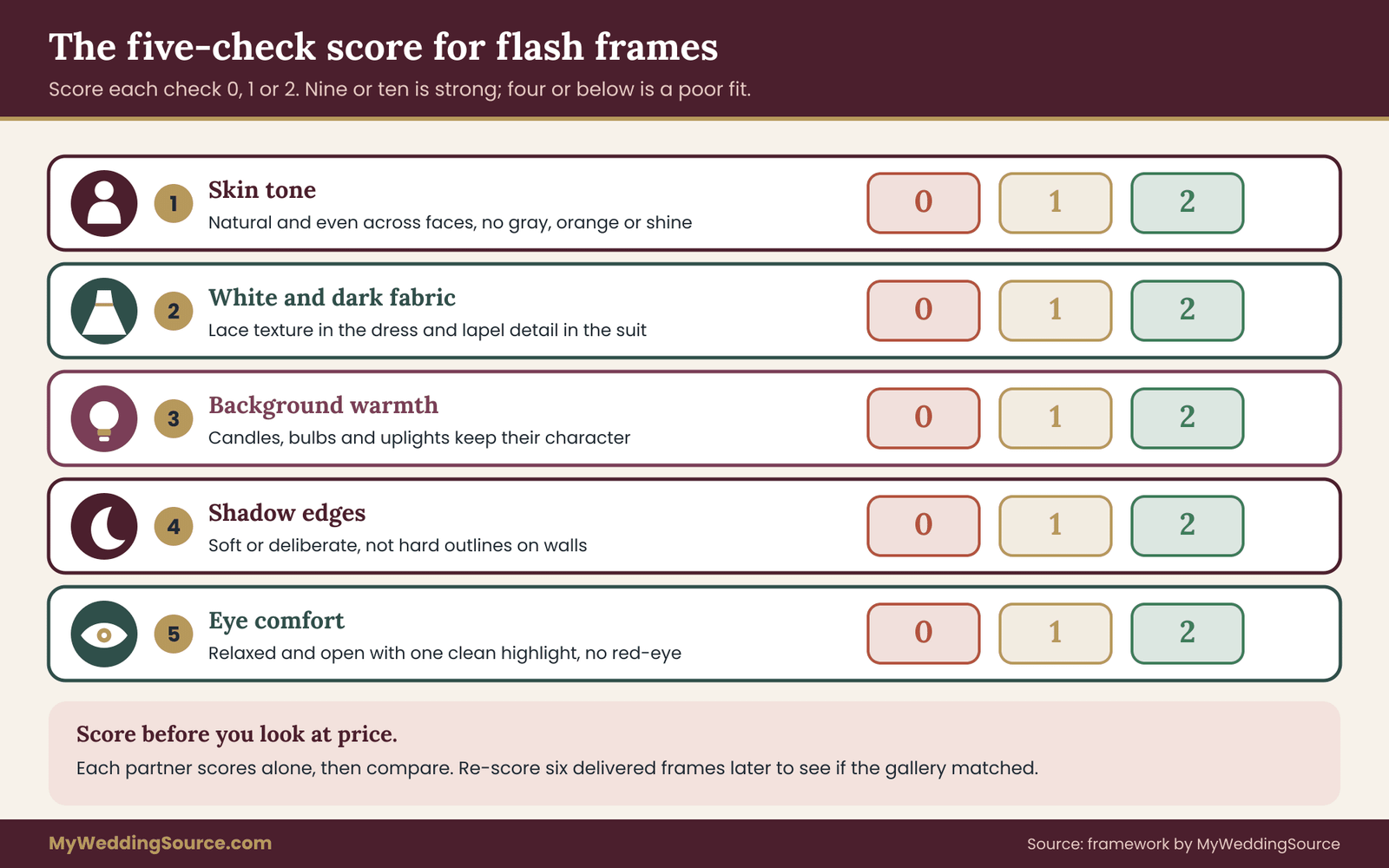
The graphic shows the five checks as meters. Print it or keep it open while you review frames, and score each photographer separately, ideally before you look at prices.
Why scoring before pricing helps
Price is a strong anchor. If you see a quote first, you tend to find reasons to like the cheaper work or to excuse the expensive work. Scoring the frames first keeps your judgment cleaner.
Do the review with your partner in the same sitting, each scoring privately, then compare. Differences are useful. If one of you scores skin tone a two and the other a zero, you have found something real, such as a difference in what each of you notices. Talk it through before moving on.
If a parent or family member is paying and wants input, bring them in at this stage, with the same sheet and the same frames. Disagreement about flash photography is much easier to resolve when everyone looks at the same six pictures than when each person describes a different memory of a different wedding.
Keep the scores. When the gallery arrives, you can score a handful of those frames again and see whether the delivered work matched the samples. That gives you evidence if there is a gap, and it supports a calm conversation with the photographer instead of a vague complaint.
A worked example, with invented people
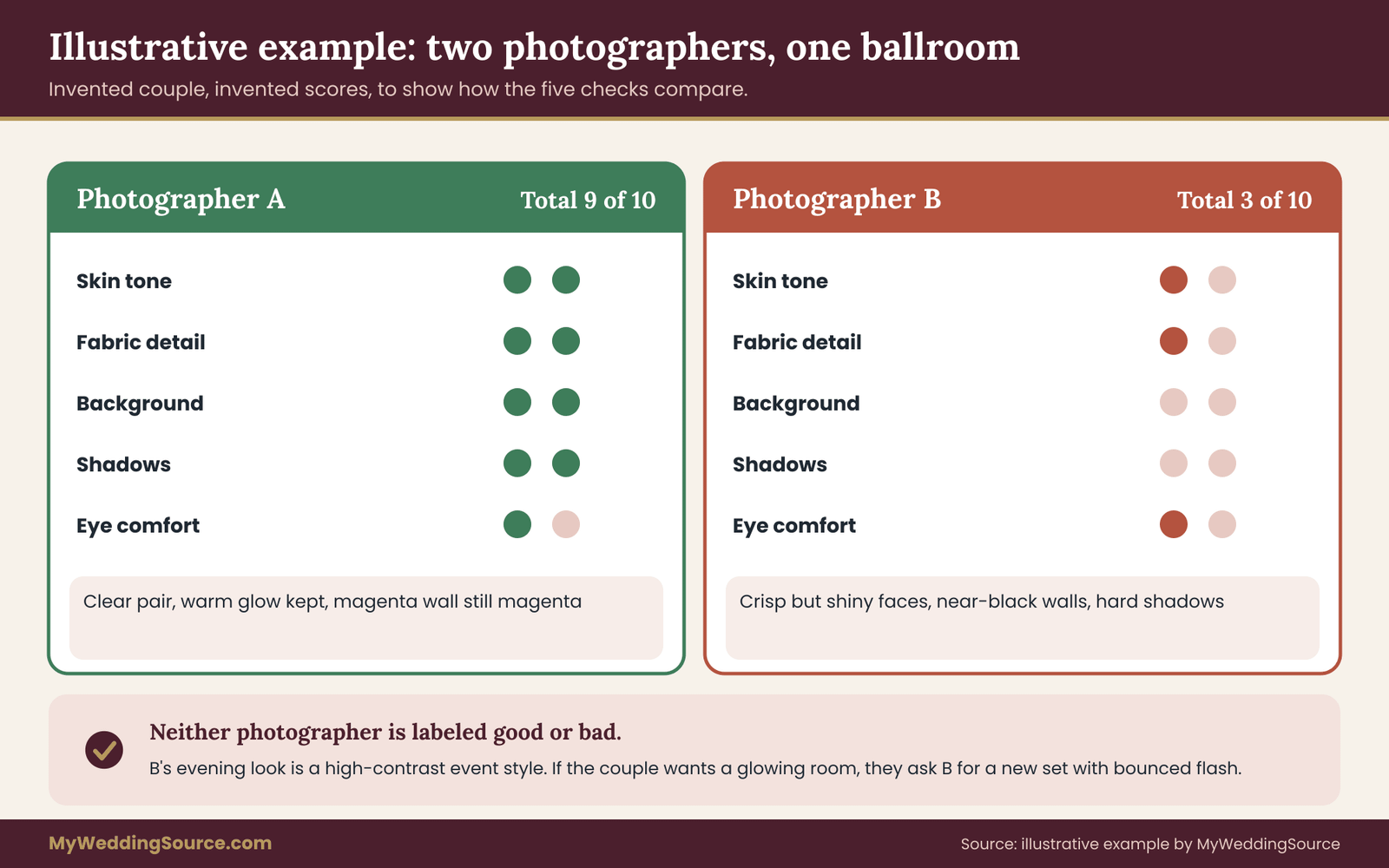
The following example is invented to show how the method works. The couple, the venue and the scores are made up for illustration and are not from a real wedding.
Dana and Priya are planning an evening reception in a hotel ballroom with warm ceiling bulbs, a white ceiling about fifteen feet up and magenta uplights on the walls. They have two photographers in mind, whom we will call Photographer A and Photographer B. They ask each for the six-frame set.
Photographer A sends six frames, including a clean flash and no-flash pair from a similar ballroom. In the pair, the flash frame shows clear faces and keeps a visible warm glow from the ceiling. The no-flash frame is grainy but atmospheric. Skin looks natural across a mixed group. The white dress in slot three has lace detail. The magenta uplight keeps its color. Shadows are soft. Eyes look relaxed. The scores: skin two, fabric two, background two, shadows two, eyes one. Total nine.
Photographer B sends five frames, with no no-flash pair, saying the evening work is mostly direct flash. The faces are crisp but shiny, the walls in the background are nearly black, and the dress has little lace texture. Shadows on the walls are hard. Eyes are open but flat. The scores: skin one, fabric one, background zero, shadows zero, eyes one. Total three.
Dana and Priya do not conclude that Photographer B is bad. They notice that B’s evening look is a high-contrast event style that does not match the glowing room they imagine. If B is cheaper or a better personality fit, they could ask whether B would use bounced flash and a slower shutter and request a new set from a room like theirs. If B says yes and sends frames that show it, the score may change.
The result is a decision grounded in what they saw. It also gives them one concrete question to ask Photographer A, who left out the dance-floor frame: “Do you have a sparkler or dance-floor frame with flash?”
Alternatives to compare, in plain language
Flash photography is not the only way to light an evening. The options below are the ones couples ask about most, and each has trade-offs.
Available light with a fast lens. The photographer uses a lens that gathers a lot of light and a high sensitivity setting. It keeps the room’s atmosphere and avoids bursts of light. It adds grain, can soften focus and depends on the room being bright enough. It works well in a bright, warm ballroom or a venue with large windows, and poorly in a dark barn.
Continuous video-style lights. Small constant lights, often LED panels, are kept on during a moment. They show exactly what the light will look like and cause no sudden bursts. They are less powerful than flash, can look flat and may be distracting if pointed at guests. They are sometimes shared with a videographer.
Bounced flash with a wide aperture. A common hybrid. The flash is used gently from a ceiling, and the lens lets in extra ambient light. It is a middle path that keeps atmosphere and adds clarity.
Off-camera flash for portraits only. The photographer uses a stand or assistant for set-up portraits and dance-floor drama, and shoots the rest with available light. It adds control and skill demands.
Flash only at specific moments. The photographer agrees to use no flash photography during the ceremony and toasts and uses it during dancing and portraits. This is the most common arrangement, and it is easy to write into the shot plan.
You do not need to choose one. The most useful conversation is one that matches the look to the moment, which the later section on the timeline takes up.
What the choice can cost, in logic rather than numbers
Prices for photography vary by region, experience and coverage, so this guide does not give figures. The cost logic is more useful than any single number.
Flash photography adds equipment, setup time and skill. A photographer who uses off-camera flash typically carries more gear and may bring a second shooter or assistant, which can raise the price of coverage. A photographer who shoots only with available light travels lighter but may spend more time editing grain and color, which can affect delivery time.
Hidden costs matter more. If a photographer’s flash photography work does not suit your room, you may pay for a reshoot of portraits, extra retouching or, at the extreme, a second photographer for the evening. Those costs are easier to avoid with a sample set than to recover afterward.
Hybrid arrangements also have a price effect. If you want available light for the ceremony, flash for the dance floor and a second photographer to cover guests, you are buying more coverage and more skill. Ask for an itemized quote so you can see what each element costs, and compare quotes by what they include, not just the total. The wedding vendor contract guide explains what a clear scope of services looks like and how to compare like with like.
Pitfalls that show up in the scoring
A few patterns in flash photography samples come up often enough to name.
The first is the single great frame. A photographer sends one stunning flash photograph and nothing else, and it carries the whole impression. Ask for a set, not a trophy.
The second is the over-edited sample. Heavy editing can hide capture problems, and a set of frames with the same strong color grade can look consistent when the original light was not. Ask for at least a couple of lightly edited frames.
The third is a mismatched venue. A frame from a white-ceilinged ballroom says little about a dark barn. Always ask for a similar room.
The fourth is the flash and no-flash pair that were not the same moment. If the two frames are from different parts of the evening, you cannot compare them. Check the pair for the same people and the same scene.
The fifth is judging by taste alone. Taste matters, but color casts, clipped highlights and hard shadows are partly objective. Scoring helps you separate “I would not choose this look” from “this frame has a flaw.”
Keeping these in mind makes the method sharper and keeps the result from resting on one charming message or one lovely picture.
The guest comfort briefing for flash photography
Everything so far has been about the pictures. This section is about the people in the room. Flash photography is a sudden burst of light aimed in the direction of guests, and a small number of them will care a great deal about it. A short guest comfort briefing keeps those guests safe and comfortable, and it protects the photographer from complaints and awkward moments.
The briefing is not a legal document or a formal policy. It is a one-page plan that answers five questions: who might be affected, what you will do about it, when and where flash will and will not be used, how guests will find out, and who guests should tell if something bothers them.
Make it before the day, and share the relevant parts with your photographer, your venue contact, your officiant, your planner if you have one and a trusted family member who can act as a point person. It takes about an hour to write and saves a lot of improvisation.
Who might be affected by flash
People react to bursts of light for many reasons. Some are medical, some are sensory and some are practical. You do not need to diagnose anyone, and you should never ask guests to prove anything. You only need to leave room for a quiet request.
Guests with photosensitive conditions. Some people with epilepsy have seizures triggered by flashing or flickering light. The Epilepsy Foundation explains photosensitivity and its triggers, and the pattern that tends to matter is rapid, repeated flashing, which differs from a single camera flash. Still, a guest with this condition is the best judge of their own risk, and many will appreciate a heads-up. If you know of such a guest, ask them privately what would help, and pass along what they tell you.
Guests prone to migraine or light sensitivity. Bright bursts and strobing lights can be uncomfortable or can trigger symptoms for some people. A seat away from the dance floor or a flash-free zone helps.
Guests with sensory sensitivities. Autistic guests, children with sensory processing differences and others may find sudden light stressful. A quiet space and advance notice go a long way.
Infants and young children. Parents have views about flash near babies. Pediatric guidance is the domain of a child’s doctor, and the American Academy of Pediatrics publishes parent resources. Rather than make claims, let parents decide and give them an easy way to say so.
Older guests and guests with eye conditions. Some eye conditions make bright light painful or leave afterimages. The American Academy of Ophthalmology publishes patient information on eye conditions.
Guests who simply dislike it. Some people hate being photographed, or hate flash in their face. That is reason enough for a quiet request to be honored where possible.
What to put in the briefing
The briefing has six short parts. Keep each to a couple of sentences.
One: the plan in one line. Describe how flash photography will be used, for example: “Our photographer will use no flash photography during the ceremony and toasts, soft bounced flash during dinner, and brighter flash during dancing.”
Two: the quiet zones. Name where flash will not be used. This might be the ceremony, a quiet corner, a nursing room, a table of guests who asked, or a seating area near an exit.
Three: the warning moments. List the moments when flash gets brighter or more frequent, such as the first dance, the dance floor, a sparkler exit or a bouquet toss. Say whether guests will get a cue first.
Four: the signal. Decide how a guest can ask for help. It could be a quiet word to a named family member, a card at the table or a note on the program. Pick something easy and private.
Five: the photographer’s instructions. Give the photographer the quiet zones, the warning moments and the names of any guests who have asked for specific accommodations, with only the information they need and nothing more.
Six: the venue and officiant rules. Write down what the venue and officiant allow, which the next section covers.
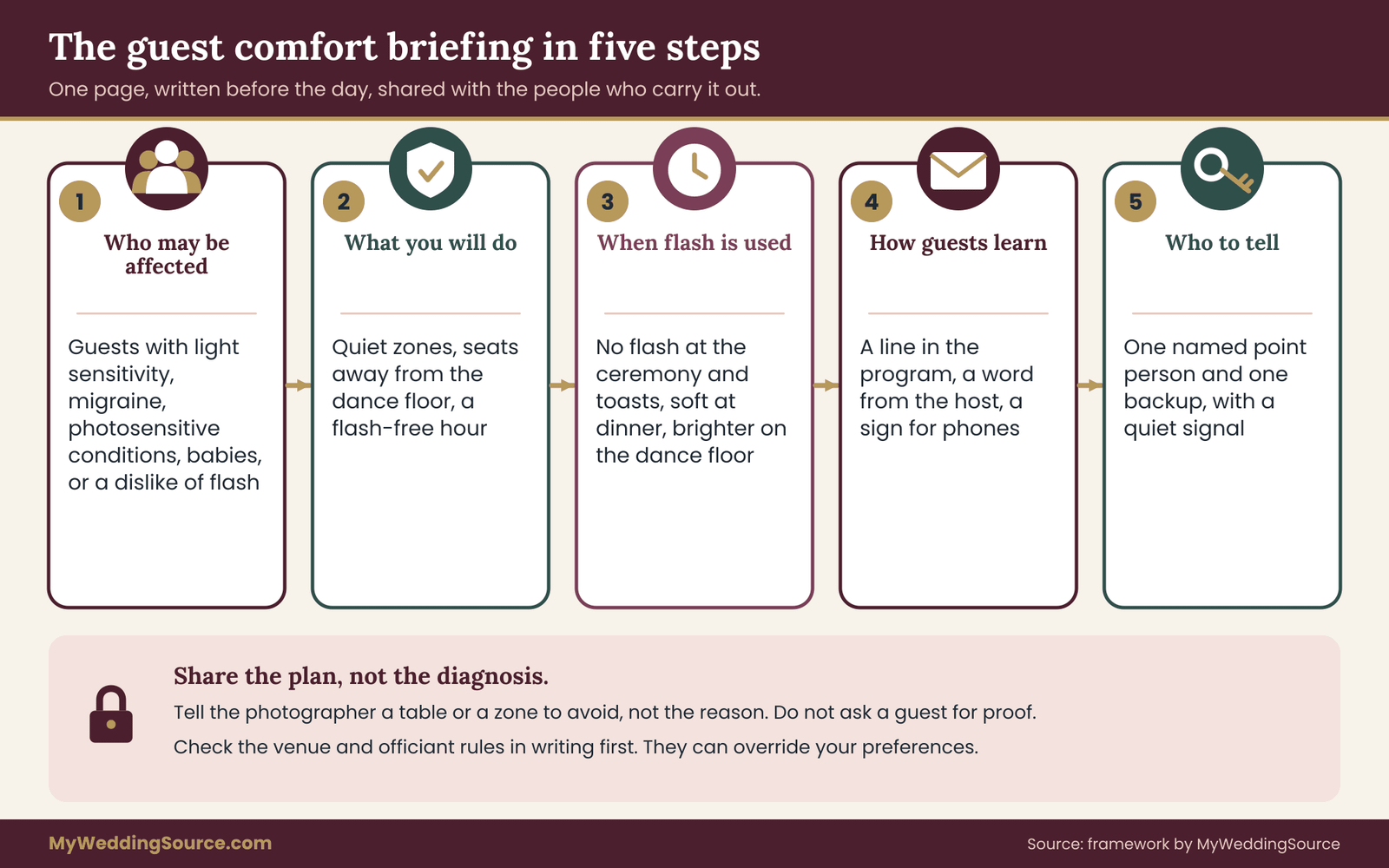
The graphic shows the briefing as a flow, from the people who might be affected through the actions you take and the people who carry them out. You can use it as a one-page outline.
Privacy: share the plan, not the diagnosis
A guest who asks you to avoid flash near them is trusting you with something personal. Do not turn that into a list that circulates. The photographer needs to know where and when to adjust, not why.
In practice, give the photographer a seat number or a table, or a zone on the floor plan, and say “no flash toward this area.” You do not need to say “because of a seizure condition” or “because of a migraine.” If the guest wants to explain, they will.
Likewise, do not announce a guest’s name to the room. A subtle approach works better: a small sign at a quiet table, a word with a server, a seat placement. The wedding guest care planning guide goes further on how to handle comfort needs for older guests and children without singling anyone out, and its approach applies here.
If a guest raises a concern at the event, handle it on the spot, calmly and in private. Your point person speaks to the photographer, who adjusts. A guest should not have to explain a medical issue to a dance floor.
Do not ask for documentation. You are not a medical office. A polite “Is there anything we can do to make the evening easier for you?” is enough, and the answer might be “no, thank you.”
Venue and officiant rules come first
Flash photography rules often come from places you do not control. Houses of worship, courthouses, museums, historic buildings and some venues restrict or ban flash photography during ceremonies. The officiant may have their own standards, and some set them based on the nature of the ritual. Venue contracts sometimes restrict photographers’ equipment, positions and lighting.
Do not assume. Ask the officiant and the venue in writing what is allowed, and for which parts of the day. A ceremony with a no-flash rule is common, and it simply means the photographer will plan for ambient light, a faster lens and careful positions. The key is to know early, so the photographer can prepare and you can see sample frames in similar conditions.
Add the rules to the wedding-day plan that your vendors share. The wedding ceremony cue sheet is a good place to note when the processional starts, when the vows happen and when flash photography is allowed, because the photographer reads that sheet closely.
Record who said what and when. An email from the officiant saying “no flash photography during the ceremony” is clearer than a memory of a phone call. If the rule is a house rule and cannot be changed, tell the photographer, and move on. If it is a preference and you can ask for an exception, decide whether you want one before you ask.
Telling guests without scolding them
Most guests are cheerful about flash photography and photography in general, and a heavy-handed policy can make a wedding feel like a rulebook. The tone of the briefing matters as much as the content.
A line in the program can do most of the work: “Our photographer will use flash during parts of the evening. If bright light is a problem for you, please tell [name] and we will help.” This puts no one on the spot and gives a clear contact.
For the ceremony, the guidance usually belongs next to your request about phones. If you ask guests to keep phones away, the note about flash photography can be a sentence in the same message, and the guide to wedding photography consent covers how to word guest requests so they sound warm rather than stern. Guests who use their phones with the flash on are a bigger source of unexpected bursts than the professional, so address them in the same note.
For the reception, a card on each table is overkill, but a quiet word with the DJ or emcee works. A line from the host such as “Photographers will be around with flash during dancing. If you need a quieter spot, ask any of us” signals that the couple has thought about it.
Avoid language that sounds like a warning, a threat or an apology. “We apologize in advance for any inconvenience” tells guests to expect an inconvenience. “Here is how the evening will look” is friendlier.
Guest phones: the flash you did not plan for
A professional can manage flash photography. A hundred guests with phones cannot be managed in the same way. Phones with flash turned on can cause sudden bursts, spoil a candlelit moment and bounce off glasses and mirrors.
You cannot fully control guest phones, and you may not want to. What you can do is ask. A short, kind request works better than a ban: “Please turn off your phone flash during the ceremony and toasts, so the room stays soft and everyone is comfortable.” Place it in the program, on a sign at the entrance and in the officiant’s opening words if they agree.
During the reception, accept that guests will take pictures. If your photographer plans to use bright flash on the dance floor, mention it so that guests are not startled by two kinds of bursts at once.
Ask the photographer whether they can work alongside guest photography. Some find it a nuisance, and some do not. If a guest repeatedly steps into the aisle or the frame, your point person can quietly redirect them.
A short script for the photographer and the point person
Scripts make conversations easier. Here are two to adapt.
For the photographer, a message might read: “Here is our flash photography plan. No flash during the ceremony and toasts. Bounced flash only during dinner. Direct or off-camera flash is fine on the dance floor. Please avoid flash toward the table in the corner by the window and the nursing room. [Name] is our point person if a guest asks for help.”
For the point person, a short note: “If anyone tells you bright light bothers them, thank them, ask what would help, and tell the photographer quietly. Please do not ask for details.”
Both scripts are short because they need to be remembered under pressure. Print them, put one in the planner’s folder and one in the point person’s pocket.
What the briefing does not do
The briefing makes the day smoother. It does not remove every risk, and it does not replace the advice of a doctor for a guest with a medical condition. If someone tells you they have a serious light-triggered condition, take it seriously, ask what they need, and consider asking the photographer to avoid flash near them for the whole event.
The briefing also does not obligate you to ban flash for everyone. Most couples find a balance between the pictures they want and the comfort of the room. The goal is a plan that is known, written down and easy to follow.
Flash photography across the wedding day, moment by moment
A flash photography decision is easier when it is tied to a moment rather than to the whole day. The following walk-through is a starting point, not a rule. Each moment has a typical approach, a reason and a question to settle with your photographer.
Getting ready. This is usually daylight or room light, and flash is rarely needed. Window light is soft and flattering. If the room is dim, a small amount of bounced flash may be used. Settle whether you are comfortable with a photographer working in a small room with a flash and how close they will stand. Ask the person getting ready, not just the photographer.
First look and portraits. If these happen in daylight, off-camera flash photography can add a little polish and balance bright backgrounds, and many photographers prefer none. If they happen at dusk, flash photography can bring skin back to life as the sun drops. Ask whether the photographer plans to use flash for portraits and what it will look like.
The ceremony. This is the moment most likely to carry rules. Many venues and officiants restrict flash, and many couples prefer a quiet, natural look. A photographer who is skilled in available light will manage with a fast lens. Confirm the rule in writing, tell the photographer, and look at slot five of the sample set before you sign.
Family formals. These are posed groups, often in the same location, and flash photography can keep faces even and shadows clean. They are short and predictable, so they suit controlled lighting. Use the wedding family photo list to keep the grouping quick, and the less time you spend, the less repeated flash the older and younger guests experience.
Cocktail hour. Light is mixed, people move around and the mood is relaxed. Many photographers use light bounced flash or none. A flash-free hour is a gentle way to let guests settle, and it also shows the room in its natural color. The wedding cocktail hour guide covers pacing and layout, which affect where the photographer can stand.
Dinner. Guests are seated and eating, and flash photography in a face over a plate is the one many dislike most. Bounced or low-power flash is gentler, and some photographers shoot dinner in available light and save flash for the dance floor. Agree on a middle path.
Toasts. These are quiet, emotional moments, and a flash going off during a heartfelt speech can feel intrusive. Many couples choose no flash for toasts. If the room is dark, the photographer may use a very soft bounce or switch to a lens and settings that handle low light.
First dance and dance floor. This is where flash is most helpful. Dance floors are dark and fast, and flash gives sharp, lively frames. Dragging the shutter keeps some of the room’s color. Because brightness and frequency go up, this is also the time guests with light sensitivity may want to be elsewhere.
Cake and sparkler exit. The cake cutting is short and well suited to a few flash frames. A sparkler exit is a special case, because the sparklers provide their own light, and flash photography can overpower the glow. A photographer may use a slow shutter and a small amount of flash to catch both.
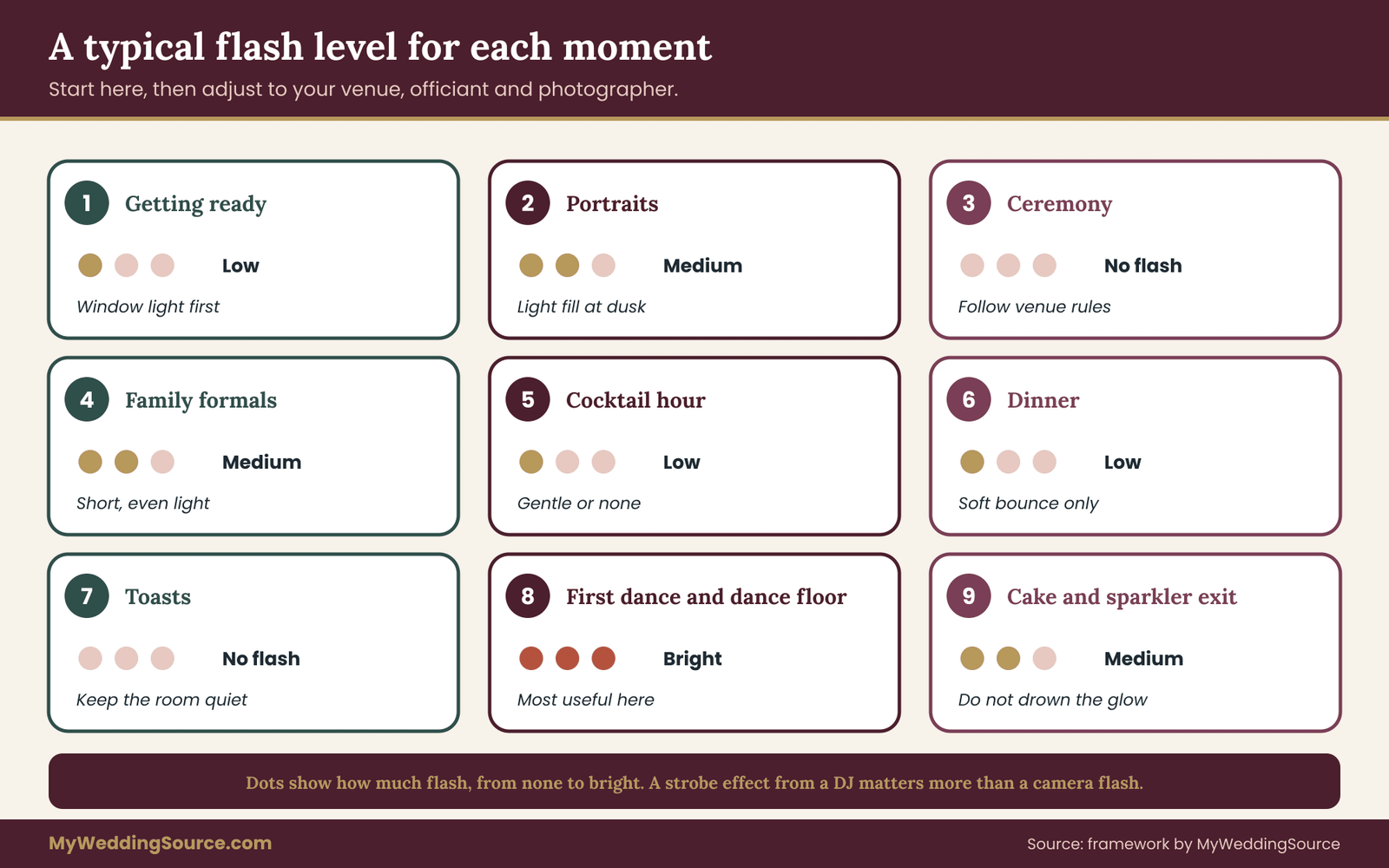
The graphic above shows the day as a timeline with a typical flash level for each moment, from none to bright. Treat the levels as a conversation starter and adjust them to your wedding and your photographer’s judgment.
Edge cases that change the plan
Most weddings fit the pattern above. Some do not, and a few common situations deserve their own thinking.
A candlelit or lantern-lit ceremony. Warm, low light is beautiful and difficult. Flash photography can erase the glow, and using no flash can produce heavy grain and orange skin. Photographers who do this well often use a very fast lens and a slightly higher sensitivity, and they may use a tiny amount of bounced flash when allowed. Ask to see slot five from a similar scene.
A venue with a tall, dark or colored ceiling. Bounce flash needs a surface to bounce from. A high ceiling or dark wood swallows the light, and a colored ceiling tints it. In those rooms, off-camera flash, a portable bounce card or a different approach may be needed. This is the most common reason a photographer’s samples from one venue do not predict results in another. Rustic barn spaces are the classic bounce problem.
Strong colored uplighting. If the room is lit in saturated color, decide whether you want faces lit neutrally with flash or tinted by the room. Many couples want a mix: neutral faces and colored walls. Tell the lighting vendor and photographer together so the plan matches.
Outdoor evening or golden hour. Flash photography can fill in shadows on faces when the sun is behind the couple. Done lightly, it keeps the sky’s color and the couple’s faces visible. Done heavily, it looks pasted on. If you love backlit golden-hour portraits, ask how the photographer balances them.
A shared venue or multiple events. If the venue hosts another event nearby, a bright burst can be noticeable. Ask about timing and rooms.
A videographer in the room. Video lights and flash photography can interfere, and flash is visible in video as bright flickers. Ask the photographer and videographer to agree on a plan, especially during the ceremony and speeches. Agree in advance which vendor does what and when.
Guests with cameras. At a very casual wedding, many guests may take photographs with flash photography, and your professional’s lighting and theirs will mix. Decide how much of that you want to manage.
A pet or a young child in the ceremony. Animals and small children can startle at a sudden flash. Keep flash off near them, and let the photographer know in advance.
Glass, mirrors and shiny surfaces. Windows, glass doors, glossy signs, champagne flutes and the bride’s jewelry can produce glare. A photographer should move or angle the flash, and you may be asked to adjust a sign or a decor item.
The same room, a different photographer
It is worth saying plainly that two professionals can handle flash photography in the same room very differently, and both can be right.
One may treat the evening as documentary and aim to keep the room’s feeling, using small amounts of bounced flash, a slower shutter and an edit that preserves warmth. Faces are a little softer, backgrounds glow and the gallery feels cohesive.
Another may treat the evening as an event to be recorded clearly. They use stronger flash, keep faces crisp and bright, and accept a darker background. The gallery feels lively and sharp, and some couples love it.
A third may treat the evening as a creative project, with off-camera lights, colored gels and dramatic contrast. The gallery feels stylized.
None of these is the correct answer for every couple. The sample set shows which of them you are actually hiring. If you want the second and receive the first, or the other way around, the mismatch is no one’s fault except the gap in what was discussed.
What to do when the day does not match the plan
Even with preparation, some things change. A ceremony runs late and the light drops. A rain delay moves the party indoors. The DJ turns on strobe-style effects that the lighting plan did not mention. A guest is unexpectedly bothered.
Have a few simple fallbacks. For the photographer, agree that when flash photography rules and conditions change, they will tell you or the point person, and make a judgment call. For guests, the point person is a single, known contact. For the venue, ask what lighting effects are used by the DJ or band in advance, including any strobes or lasers, because those matter more than camera flash for guests with photosensitive conditions.
Keep the briefing short enough that a replacement person could follow it. If your point person is called away, a second name on the sheet fills the gap.
After the event, a quick debrief is useful. Did flash photography bother anyone? Did the photographer follow the plan? Did the evening frames match the sample set? Write down two lines and keep them with your vendor file. Keep those notes with the rest of your vendor paperwork.
When a photographer says no to a request
Occasionally a photographer will resist a flash photography request. They may say they need flash during the ceremony, or that they cannot work in a dark venue without it. That is not necessarily a red flag. It may be a technical limit of their equipment or style.
Respond with questions rather than demands. What would you do if flash were not allowed? Can you show me an example? Is there a different setting that works? If the answers are vague, or the photographer insists on flash where the officiant forbids it, you may need a different photographer. If the answers are specific and the examples are good, you can build the plan around them.
The reverse also happens. A photographer may recommend against flash photography in a place where you assumed it would be used. They may say the room’s light is lovely and flash would wreck it. Look at their evidence. If the sample frames from similar rooms look good, trust the judgment. If they do not, ask for more.
A calm conversation settles most of these. The method in this guide gives you something concrete to talk about, which is far easier than debating taste in the abstract.
Vendor questions about flash photography
You have the sample set, the scores and the briefing. The last piece is a short conversation with each finalist. These questions are written so that the answers are specific. Vague answers are a signal in themselves.
About approach. Which looks do you use for the ceremony, dinner, toasts and dancing? What do you do when flash photography is not allowed? How do you keep the color of a room with colored uplights? Do you drag the shutter at receptions, and can you show me an example?
About equipment. Do you use on-camera flash, off-camera flash or both? Do you bring stands, an assistant or a second shooter for the evening? What happens to your lighting if the room is very dark or has a tall ceiling?
About fit. Have you photographed in this venue or in a similar one? Can you share the six-frame set from a room like ours? How do you handle guests who prefer not to have flash aimed at them?
About rules. How do you handle a no-flash ceremony? Who do you speak to if a guest raises a concern? Will you review our guest comfort briefing and tell us if anything is unrealistic?
About delivery. Do you apply the same color treatment to an entire evening, or edit each frame? Will you deliver both flash and no-flash frames of key moments when you shot both? Can we see how a lightly edited frame compares with a finished one?
About the contract. Does the agreement list the number of photographers, hours, lighting equipment and any restrictions on flash? Does it say who owns the images and how we may use them?
Write down the answers, even briefly. A short note per vendor lets you compare later without trying to remember who said what. The wedding vendor due diligence checklist gives a broader set of checks for any vendor, including insurance and references.
Contract terms that protect your flash photography plan
A conversation is useful, and a written term is better. The contract is where your flash photography plan and your briefing become something both sides can point to. You do not need legal language. Plain statements are fine.
Coverage and hours. The agreement should state the hours of coverage, the number of photographers and which events are covered. If you are paying for evening coverage, make sure the contract says so, since flash matters most in the evening.
Lighting equipment. If you have agreed that the photographer will use off-camera lights, stands or an assistant, say so. If a second lighting person is billed separately, list it.
Restrictions. Note any no-flash photography rules from the venue or officiant, and add that the photographer will follow them. If you have asked for flash-free moments such as the ceremony and toasts, include them.
Style references. Some couples attach two or three sample frames, including the flash and no-flash pair, as an example of the intended look. A contract cannot guarantee a creative result, and a reference gives both sides something to measure against. It is evidence of your expectation, not a promise of outcome.
Image ownership and use. The photographer holds the copyright unless the agreement says otherwise. Check what license you receive for printing and sharing, and whether the photographer may use your images in their marketing. The U.S. Copyright Office explains how copyright works. If you have guests who do not want to appear in marketing, mention it.
Delivery. Confirm the delivery date, the format, the number of images and how long the online gallery stays available. If you want unedited frames or raw files, ask, and note that many photographers do not provide them.
Reshoots and corrections. Ask what happens if the evening frames show a serious problem. Some photographers will fix editing issues. Few will reshoot an event, so do not count on that.
If a clause is unclear, ask the photographer to explain it in plain words and put the explanation in writing. The vendor contract guide linked earlier is a good companion for comparing clauses and scopes across vendors.
Budget logic: where flash photography changes the quote
You can ask for a quote that makes the flash photography decision visible. Ask for an itemized price that separates base coverage, evening coverage, second shooter or assistant, lighting equipment and editing time. If a photographer offers a package, ask what is in it.
Then ask three what-if questions. What would change if the ceremony were no-flash? What would change if you added a second photographer for the evening? What would change if you asked for flash and no-flash versions of key moments? Each answer shows where the cost sits.
If the budget is tight, the cheapest path is usually to match the approach to the room. A bright, white-ceilinged ballroom can often be handled by one skilled photographer with bounce. A dark barn may need more equipment or a second person. Spending a little on a pre-wedding visit to the venue, which some photographers offer, can reduce the risk of a poor result and the cost of fixing it.
Do not pay for flash photography equipment you do not need. A dramatic off-camera setup is wonderful for the right wedding and wasted on one that wants a soft, natural look.
Your own checks when the gallery arrives
When your photographs come back, spend an hour comparing the flash photography in them with the sample set. Choose six frames that match the six slots, score them with the same five checks and compare the totals. If the delivered scores are close to the sample scores, the work matches the promise.
If there is a gap, write down what is different and show examples to the photographer, politely and quickly. Most photographers want to fix real problems, especially color issues that a small edit can solve. If the problem is that the venue was darker than expected or the schedule changed, say so and ask what is possible.
Keep the scores and the frames with your vendor file. They are useful if you later need to explain a concern, and they are useful when you recommend or review the photographer. A fair, specific review is more helpful to future couples than a vague one.
Your next steps
You do not need to do all of this at once. A sensible order is below.
- Write one paragraph describing your reception room: ceiling height and color, the lighting you expect, and any colored uplights.
- Ask your venue and officiant in writing what they allow for flash photography, and for which parts of the day.
- Send each finalist photographer the six-slot request with your room description.
- Review each set with your partner, score the five checks separately and compare.
- Ask the vendor questions, take notes and ask for an itemized quote.
- Draft the guest comfort briefing with quiet zones, warning moments, a point person and a signal.
- Put the flash photography rules and moments in the written plan that your vendors share.
- After the wedding, score six delivered frames against the sample set and keep the notes.
FAQ
Is flash photography bad for wedding photos?
No. Flash photography is a tool, and its effect depends on how it is used. Bounced, low-power flash photography can keep a room’s warmth while making faces clearer, while strong direct flash photography can flatten faces and darken backgrounds. The useful question is whether the results look like your wedding. A mixed-light sample set from a room like yours shows you the answer before you hire anyone.
Why do wedding photos with flash look different from what I remember?
Your eyes blend warm bulbs, candles and colored lights into one pleasant impression. A camera must choose one color setting, and flash adds a neutral light that does not match the warm room. The result can be pale faces and a dark or gray background. A photographer who matches the flash to the room, or drags the shutter, keeps the memory closer to the photo.
Should I ask for a ceremony without flash?
Often yes, and many venues and officiants require it anyway. A no-flash ceremony keeps the room quiet and natural, and a skilled photographer can work with a fast lens and available light. Confirm the rule in writing, tell your photographer early, and look at a dim-light sample frame before you sign so you know what to expect.
How do I protect a guest who is sensitive to flashing light?
Ask them privately what would help, and do not request proof. Give the photographer a table or zone to avoid, not the reason. Offer a seat away from the dance floor and tell them in advance about brighter moments. The Epilepsy Foundation explains photosensitivity, and the guest’s own doctor is the best source of advice for their situation.
Can I see unedited frames to judge flash photography?
You can ask, and some photographers will share a few lightly edited frames. Many do not hand over unedited files because of their working practice. A good compromise is two or three frames that show the original capture beside the finished edit. That tells you whether the look comes from the lighting or from heavy editing afterward.
How many sample frames should I ask for?
Six is enough. The mixed-light sample set covers a flash and no-flash pair, a mixed-light room, a white and dark garment, a range of skin tones, a dim moment and a moving moment. More frames mostly add noise. If a photographer has little evening work, ask for what they have and decide whether you need a second shooter.
Who owns the sample frames and my own gallery?
In the United States the photographer usually owns the copyright unless a written agreement says otherwise. Samples are for your private evaluation, and you should not post or share them without permission. For your gallery, the contract decides what you may print, share and edit, so read that clause and ask for plain-language clarification if needed.
What if my photographer’s flash photography does not match the samples?
Score six delivered frames with the same five checks and compare them with the sample scores. Then show the photographer specific examples, politely and soon. Many color and exposure problems can be improved in editing. Keep your notes and the original sample frames with your vendor file in case you need to explain the gap later.
Sources
- U.S. Copyright Office – how copyright applies to photographs and who owns them by default.
- Epilepsy Foundation – information on photosensitivity and flashing-light triggers.
- American Academy of Ophthalmology – patient information on eye conditions and light sensitivity.
- American Academy of Pediatrics – parent resources on infants and young children.
- ADA.gov, U.S. Department of Justice – accessibility and reasonable accommodation information.
- Federal Trade Commission – consumer protection guidance on clear terms and endorsements.
- Professional Photographers of America – professional standards and business resources for photographers.
- Wedding and Portrait Photographers International – education resources for wedding photographers.
- International Commission on Illumination (CIE) – standards and terminology for light and color.
- National Institute of Standards and Technology – measurement science, including color and light measurement.