
Courthouse wedding photography is the work of getting good pictures of a short civil ceremony inside a building that was designed for court business, not for weddings. This guide gives you a four-zone permission and location map, so you know who can say yes, when the light and the schedule allow it, and where the portraits can happen.
Split the building and its surroundings into four zones: the ceremony room, the interior public areas, the grounds and steps, and nearby public spots. Each zone has a different owner and a different rule. For courthouse wedding photography, ask the clerk’s office who controls each zone, get the answer in writing, then build a photo clock around your appointment slot. Plan the ceremony photos for the few minutes the office allows, the interior photos for the buffer before and after, and the real portraits for a location with a clear permission and good light.
Most couples who marry at a courthouse expect the photographs to sort themselves out. The ceremony is short, the room is plain, and a friend will probably hold a phone. Then the appointment gets closer and small questions start to appear. May a photographer stand inside the room at all?
Does the officiant mind a camera? Will security hold up a tripod at the front door? Can you take pictures on the steps, or does the county need a form first? Is there any decent light in a hallway lit by tubes in the ceiling?
None of these questions is difficult. They are just easy to leave until the morning of the appointment, when the person who could answer them is busy with a line of other people.
This guide is about courthouse wedding photography and nothing wider. It does not walk through the marriage license, which depends on your state and county, and it does not plan the party that may follow the appointment. It also does not tell you what to wear; clothing choices have their own guide. What it covers is narrower: permission, timing and portrait locations. Those three things decide whether you leave with a handful of pictures you love or a camera roll of blurred hallway shots.
A note on scope. This is general information, not legal advice. Courthouse rules, clerk’s office policies and local permit requirements differ from one county and city to the next, and they change, so confirm each rule with the office that issues it before you rely on it.
What courthouse wedding photography covers
Courthouse wedding photography has three parts, and it helps to keep them apart because different people control each one.
Permission. Whether anyone may take pictures where you plan to take them, with what equipment, for how long and under what conditions. This is mostly a question of who owns or runs each space, and it is almost never answered by a general rule you can look up. It is answered by a person at the court, the clerk’s office or the building’s management.
Timing. The minutes you actually have. A civil ceremony appointment is a slot on a schedule. Your photographer, your guests and the people booked before and after you all depend on it. Courthouse wedding photography fails more often because of the clock than because of the camera.
Portrait locations. The places where you stop, breathe and take real pictures of the two of you, with time to adjust and try again. Sometimes those places are in the building. Often they are not.
If you are comparing this with the rest of your plan, it helps to see where courthouse wedding photography sits. The clerk’s office decides the legal appointment. Your officiant, or the person who performs the ceremony, decides how that moment is run; the guide to officiant requirements explains who is allowed to perform a ceremony and what that person typically controls.
Courthouse wedding photography sits on top of both of those and borrows their rules. A photographer can only work where the clerk and the officiant agree to have one.
What this guide leaves out
It leaves out the celebration that may follow your appointment, meaning the meal, the guests and the party. It leaves out courthouse outfits, which have their own security and weather logic. And it leaves out general guidance on photography styles, shot lists and albums, because those apply to every wedding and are covered elsewhere on the site. The guide to the family photo list is a good companion if you want to decide which groups to photograph.
Keeping courthouse wedding photography this narrow is deliberate. If you spend your time on the three parts above, you will have solved the problems that are particular to a courthouse.
Why courthouses are different from other venues
At most venues, you rent the space. The venue’s contract states what photographers may do, the coordinator knows the answer, and the rules are written down. A courthouse is a working government building. It hosts traffic matters, jury duty, family court and criminal hearings, and its first duty is to keep those proceedings fair and safe. Rules for courthouse wedding photography exist mostly to protect witnesses, jurors, defendants and the court’s operations.
That has a few practical consequences for courthouse wedding photography, and each one is manageable.
First, the people who run the building are not wedding vendors. A deputy at the front door may have a very clear view of what is allowed in the lobby and no idea what the clerk’s office promised you by phone. A courtroom may have a standing rule against photography that applies even when the room is empty, because the rule was written for the proceedings, not for the moment.
Second, the rules may change with the room. The ceremony may take place in a dedicated marriage room, a small chapel space, an ordinary courtroom or an office. Each of those can have a different policy.
Third, the building is public and busy. Other people use the hallways, and they have not agreed to appear in your photographs. A good plan keeps strangers out of the frame, not only because it makes better pictures but because courthouses are places where people can have very good reasons not to be photographed.
Fourth, there is often no one whose job it is to help you. A wedding venue has a coordinator. A courthouse has a clerk who is processing licenses, answering questions about other matters and keeping a line moving. You will get better answers if you ask clear, short questions at the right time, and the rest of this guide shows you how.
The four-zone permission and location map for courthouse wedding photography
The core idea of this guide is a map with four zones, built for courthouse wedding photography. You use it before the appointment, and you can finish it in about an hour of phone calls and a short visit. For each zone, you answer three questions: who controls it, what the rule is, and where the answer is written down.
The four zones are these.
Zone one: the ceremony room. The space where the vows or the statement of marriage take place. It might be a courtroom, a chamber, a small marriage room or a counter area. The person who controls it is usually the officiant, the judge, the magistrate or the clerk, depending on who performs the ceremony and where. This zone is the most tightly controlled, and the one where a quick question to the right person matters most.
Zone two: interior public areas. Lobbies, hallways, stairwells, atriums, rotundas and waiting areas. These are controlled by the court administration, the building’s management or a security office. Interior public areas often have the best architecture and the worst rules, because they are full of people who did not choose to be there.
Zone three: the grounds and steps. The exterior of the building, including the entrance, steps, plaza, lawn or garden that belongs to the building owner. The owner might be the county, the city, the state or, for certain buildings, the federal government. Courthouse wedding photography on these grounds is often allowed for personal use, but conditions can apply for professional photographers, staging, equipment and blocking foot traffic.
Zone four: nearby public spots. Parks, plazas, bridges, streets, historic squares and other places within a short trip of the courthouse. Each has its own owner and its own permit rules, usually set by a city parks or special-events office. This zone is where most of the unhurried portraits end up, because it is outside the pressure of the courthouse schedule.

The map is useful because it turns a vague worry (“can we take pictures there?”) into four specific questions with four specific owners. It also tells you where to put effort. If zone one is tightly restricted, you adjust your expectations for the ceremony itself and put more weight on zones three and four. If zone three is open and zone four is full of permit requirements, you stay on the steps and in the lobby and skip the park.
The three answers you want for each zone
For every zone, aim to leave with three things.
An owner. A name or a title and a phone number or office. “The clerk said it should be fine” is not an owner. “The marriage bureau supervisor told me on this date that photographers are allowed in the room” is.
A rule. What is allowed and what is not, stated plainly. Are still photographs allowed? Video? Flash? Tripods or stands? Does the photographer need to be counted as a guest, or as a witness? Is there a limit on the number of people in the room? Is there a fee?
Proof. A short written note, such as an email reply or a line in your confirmation, or at least your own written record of a phone call with the date, the person’s name and what they said. The proof matters because the person at the door on the day may not know what someone else told you, and a calm, specific reference to a written answer ends many awkward moments.
You will use the same three answers again in the permission log described later, so keep them in one place from the first call.
How the map changes the way you plan
Without a map, couples planning courthouse wedding photography tend to do two things. They either assume everything is forbidden and bring only a phone, or they assume everything is fine and show up with a full camera bag. Both approaches waste something. The first leaves good options unused. The second risks being turned away at the metal detector or asked to stop in the middle of the ceremony.
With the map, you can make a courthouse wedding photography plan that is matched to the building. You might learn that the marriage room allows a single photographer without flash, the lobby does not allow photography at all, the front steps are fine for personal pictures, and the riverside park two blocks away needs no permit for a couple and a photographer.
That is a good outcome, and it is a reasonably common shape for a result, though only your own building can tell you whether it is yours.
Who gives permission for courthouse wedding photography
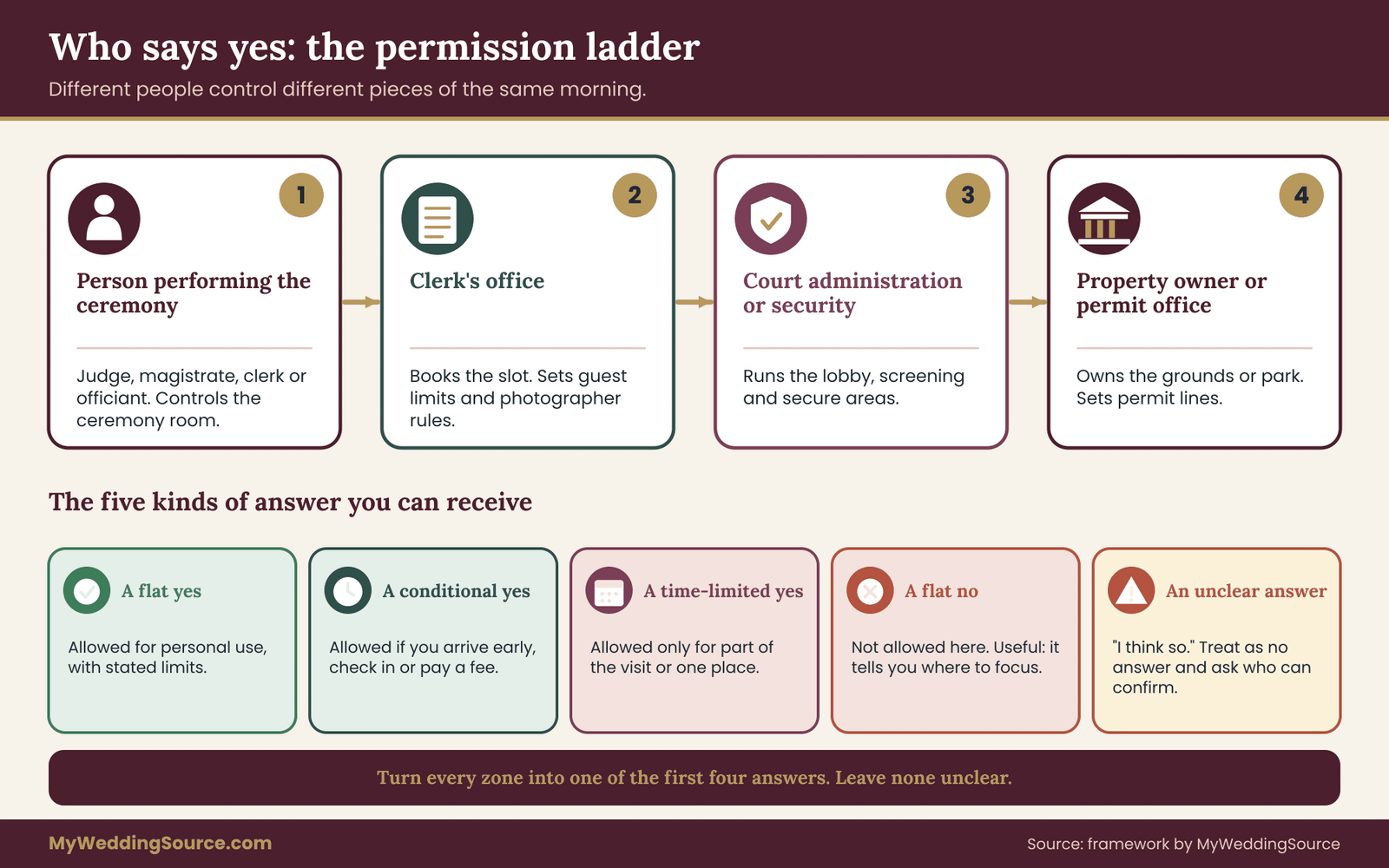
The hardest part of courthouse wedding photography is not the camera work. It is finding the person who has the authority to say yes, because authority is split across several offices. Think of the permission for courthouse wedding photography as a ladder with four rungs, and expect to climb as many as your building requires.
Rung one: the person performing the ceremony. This may be a judge, a magistrate, a clerk or deputy clerk, a justice of the peace or another authorized officiant. This person decides how the ceremony is run in the room. Some are glad to have a photographer; some prefer no cameras at all during the vows; some will agree to pictures only before and after the words are spoken. Their answer governs zone one.
Rung two: the clerk’s office or marriage bureau. The office that books appointments usually writes the practical rules: how many guests may attend, whether a photographer counts as a guest, whether professional equipment is allowed, and how early you may arrive. Many offices publish these rules on a county web page or in a short information sheet. When a page exists, read it first and use the call only to fill gaps.
Rung three: court administration or building security. This is the office or team that runs the building. They set the rules for lobbies, hallways and screening. They may restrict photography in the secure areas of the building entirely, and they are the people who decide whether a camera bag, a tripod or a light stand gets through the front door.
Rung four: the property owner or a permit office. For zone three and zone four, the question is who owns the ground. A county courthouse lawn belongs to the county. A public park belongs to a city or county parks department. A plaza may be run by a downtown district. These owners decide whether a permit is needed, usually through a parks, recreation or special-events office.
The ladder explains why a single phone call about courthouse wedding photography so often leaves you half-informed. The clerk may be certain about the marriage room and unsure about the lobby. Security may be certain about the lobby and unaware that the marriage room has its own policy. The parks office may know nothing about the courthouse. You are not being given the runaround; you are speaking to different owners of different pieces of the same morning.
Why the answer is rarely one general rule
It is tempting to look for a rule such as “photography is allowed in courthouses” or “photography is not allowed in courthouses.” Neither statement is dependable. Court rules about cameras and recording are written mainly for proceedings. State and local courts set their own, and building rules for lobbies and grounds are set by whoever runs the building. The result is a patchwork. Two courthouses in the same state can have different policies on photographers in the marriage room.
Federal property adds another layer. Federal courthouses and federal buildings have their own regulations about photography on the premises, and the federal courts set their own rules about courtroom cameras. Most civil ceremonies are held in county or municipal buildings, not federal ones, but if your appointment is in a building that houses federal offices, ask.
The usa.gov page on marriage certificates, listed in the sources, is a reasonable starting point for finding the state or local office that handles your marriage records; from there, that office can point you to the right person for building rules.
The practical rule is simple: treat each zone as having its own answer, and do not carry an answer from one zone to another.
What permission can look like
Permission comes in a few forms, and it helps to know which one you have.
A flat yes. Courthouse wedding photography is allowed in the zone for personal use, with stated limits such as no flash or no stands.
A conditional yes. Photography is allowed if the photographer arrives early, checks in with security, counts as a guest, wears a badge or pays a small fee.
A time-limited yes. Photography is allowed in the room only for the ceremony, or only for a few minutes afterward, and not in the lobby.
A flat no. Courthouse wedding photography is not allowed in the zone. This is not a failure; it is useful information, and it tells you where to put your effort.
An unclear answer. “I think that’s fine” or “you can try.” Treat this as no answer and ask who can confirm it.
The goal of every call about courthouse wedding photography is to turn each zone into one of the first four and leave nothing in the last category.
Asking for permission: calls, wording and the permission log
Most people dislike making the calls that courthouse wedding photography requires, so the task tends to wait. It does not need to. You can finish it in three short calls or messages if you prepare the questions in advance. Plan to make them two to three weeks before the appointment, which leaves time for a reply and a second try. If your appointment is sooner than that, call anyway and expect a faster, shorter answer.
The order of the calls
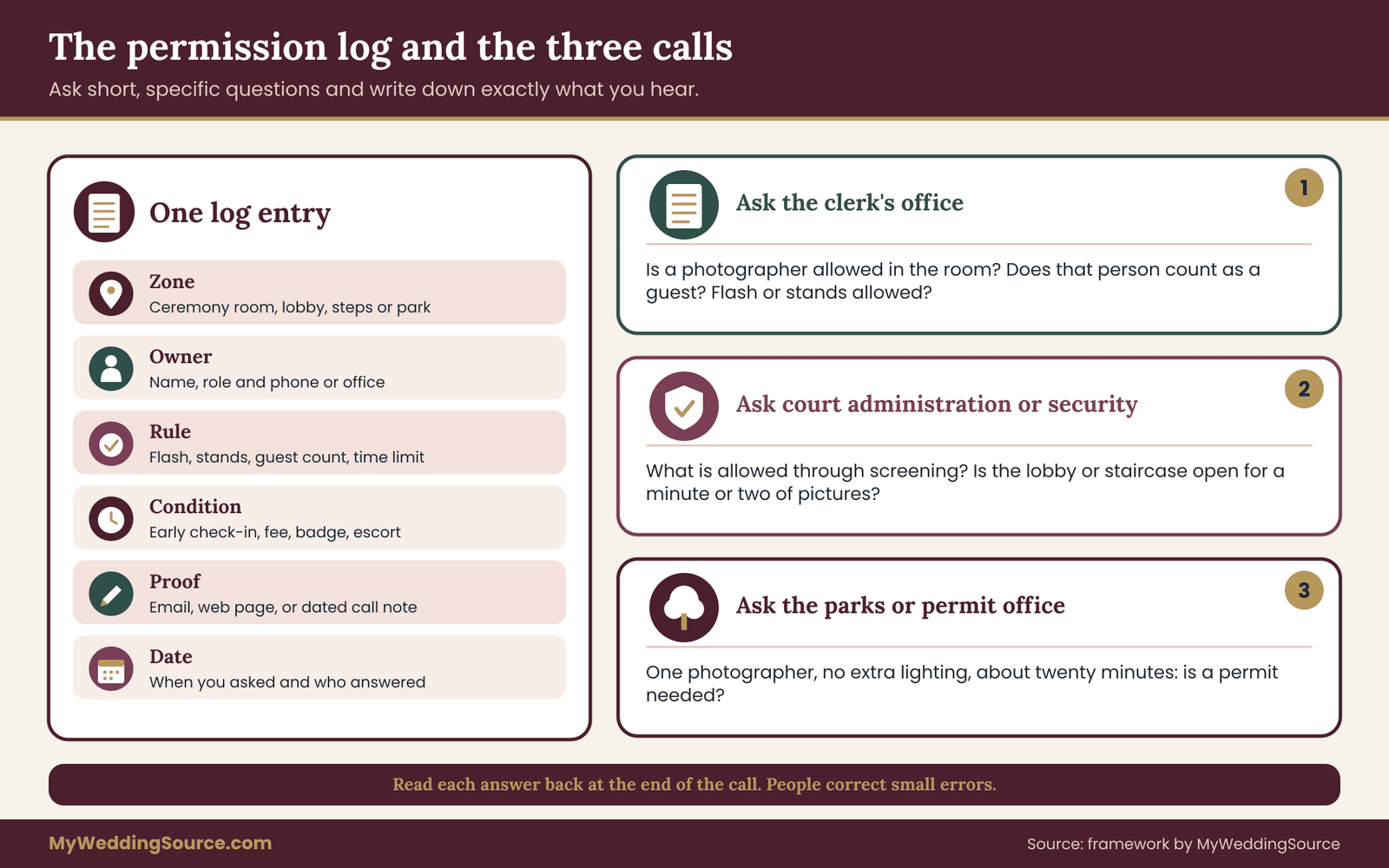
Start with the clerk’s office or marriage bureau, because it knows the appointment and often knows the building. Then call building security or court administration if the clerk cannot answer questions about lobbies and screening. Then, if you plan portraits outside the building, contact the owner of the place, whether that is a county facilities office or a city parks office.
Your photographer, if you have hired one, should be part of this. A professional who works in courthouses regularly may already know the building and its rules. Ask what they have been told in the past, but still confirm with the building, because policies change and a photographer’s memory is a second-hand source.
What to say to the clerk’s office
Keep the first message about courthouse wedding photography short and specific. You are not asking for favors; you are asking for the rules.
“We have a marriage appointment on a date in the coming month. We would like a photographer to attend. Could you tell us whether a photographer may be in the room, whether they count toward the guest limit, and whether flash or a tripod is allowed?”
Then ask the second set of questions, which concern the building:
“Are photographs allowed in the lobby or hallway before and after the ceremony? Is there a place near the building where couples usually take photos? Whom should we contact about the front steps or the grounds?”
Notice what the wording avoids. It does not ask “Is it okay if we take photos?” which invites a quick, general reply. It asks four concrete questions that each need a concrete answer.
What to say to security or court administration
Security answers a different set of questions. They care about what comes through the door.
“Our photographer will arrive with a small camera bag. Is there anything that would not be allowed through screening, such as a tripod, a light stand, a flash or a second camera body? Is there a particular entrance, or a time when the line is shorter?”
If the answer is a list, write it down exactly as given. If the answer is “bring only a phone,” ask whether that applies to a professional photographer working with the clerk’s office, or only to the public. These can differ, and the difference can save a trip.
What to say to a parks or permit office
For nearby public spots, the question is whether your plan counts as something that needs a permit. The words that matter are “personal photos” and “hired photographer.”
“We are getting married at the courthouse nearby and would like to take portraits at a public spot afterward, with one photographer, no extra lighting and about twenty minutes. Does that need a permit, or is there a size or equipment limit where a permit starts?”
Many offices draw the line by group size, equipment or commercial intent rather than by the simple fact of a photographer being present. You want the office’s line in its own words, so you can plan on the safe side of it.
Keeping a permission log
A permission log is a one-page record that you build as you call. It has one entry per zone and one per contact, and it gives you the three answers described earlier: owner, rule and proof.
For each entry, record the date and time of the call or message, the name and role of the person, the exact words of the answer as closely as you can, any condition such as an early arrival or a fee, and what you were told to bring. If someone gives you an email address or a web page, note which one. Save any written reply in the same folder as the log.
Two habits make the log useful. First, read the log back to the person at the end of a call: “So the photographer may be in the room, does not count toward the limit, and may not use flash. Is that right?” People correct small errors when they hear them back. Second, bring the log, on paper or on a phone, to the appointment.
If you are asked at the door about a rule you were told, you can show the entry instead of arguing from memory. The guide to wedding vendor contracts explains why written terms matter for any vendor, and the same principle applies to a photographer you hire for courthouse wedding photography.
Questions for the photographer you may hire
Not everyone hires a photographer, but those who do should ask a handful of questions that are specific to a courthouse, beyond the usual questions about style and price.
Ask whether the photographer has worked at this courthouse before, and whether they know its rules for the room and the lobby. Ask what equipment they would bring and what they would leave behind if the building required a minimal kit. Ask how they handle a “no” in the room: do they still cover the arrival and the exit? Ask whether coverage can start earlier than the appointment, and whether it can continue at a second location.
Ask how many edited pictures you receive and when, and how a delay is handled. Ask for the terms in writing, including what happens if the courthouse refuses the photographer entry on the day. That last question is the one most often skipped, and the one that matters most, because it is a risk you cannot control.
The answers will tell you whether the photographer understands courthouse wedding photography or is simply willing to try it.
Courthouse wedding photography inside the ceremony room
Zone one is small and strict. The ceremony itself may last only a few minutes, the room may be shared with the next couple’s guests waiting outside, and the person performing the ceremony is in charge. Success in courthouse wedding photography here is about being useful and quiet, and about knowing in advance which three or four images you actually want.
Find out what the room is
Before you decide anything about courthouse wedding photography, learn what kind of room you will be in. A dedicated marriage room tends to be small, with plain walls, a table or lectern and a few chairs. A courtroom is larger, with fixed benches, wood paneling, a raised bench for the judge and often a rule about where people may stand.
An office or a counter area is not a room for photographs at all, and you may only get a picture of the two of you at the window.
Each type changes the picture, and it changes how you approach courthouse wedding photography. In a marriage room, the photographer is usually close, within a couple of steps, and a wide lens is the practical choice. In a courtroom, the photographer may be restricted to the gallery and may need a longer lens to reach the couple at the front. At a counter, the best plan may be to take the ceremony as it comes and put the weight of courthouse wedding photography on the zones outside.
Ask for a description when you call, or look at the clerk’s office web page, which sometimes has a photo of the room. A short visit before the appointment is better, if it is possible, because it shows you the lighting, the distance and the doorway.
The permission questions for the room
When you ask about the ceremony room, you want answers to these questions.
Is a photographer allowed in the room during the ceremony? If yes, may they move around, or must they stay in one place? Is video allowed, or only still pictures? Is flash allowed? Are tripods, monopods or stands allowed? Does the photographer count toward the guest limit or count as a witness?
May the officiant or judge be photographed, or should they stay out of frame? Is there a time limit before or after the ceremony for pictures in the room? And is there anything the room itself restricts, such as the bench, the seal or the flag?
The answers vary, and a surprising number of the useful ones are small. A rule against flash is common because a flash can startle people in a formal space. A rule against moving during the ceremony is common because movement is distracting. A rule that the officiant should not be in the frame is not unusual and costs you very little.
Choosing the three or four moments
With little time and limited movement, a short list keeps courthouse wedding photography from turning into chaos. For a typical civil ceremony, the images worth planning are these.
The arrival at the door of the room. You walk in, together or separately, and the photographer gets a clean shot of the entrance before the formal part starts. This often can be taken before the officiant begins, which makes it a safe request even in a strict room.
The exchange of words and rings. If the officiant allows it, the photographer takes a few frames of the vows, the ring exchange and the pronouncement. These are the moments with the least flexibility, so the photographer should know the order in advance. The guide to the step-by-step wedding ceremony lays out the usual sequence, and a short civil ceremony follows a compressed version of it.
The signing. The signing of the license or certificate is easy to overlook and is, for many couples, the most legally meaningful moment. A single picture of the pen, the document and the two signatures, taken in a way that does not expose personal details such as numbers or addresses, is a good keepsake. Check with the clerk whether the document may be photographed at all, and crop or blur identifying details if you share it.
The first look back at the room. After the pronouncement, the couple turns toward their guests or toward the camera. This takes a few seconds and makes a better closing image than a posed group.
That is four images. It is enough. A longer list invites the officiant’s impatience and leaves the couple looking at a camera instead of each other.
Equipment for a restricted room
A small room with fixed rules favors a small kit for courthouse wedding photography. A single camera body with a wide or standard lens, a spare battery, a spare card and a quiet shutter setting is usually enough. Flash is often off the table, so the camera should perform at a higher sensitivity setting in modest light; a photographer who relies entirely on flash may struggle in a room like this.
A tripod, a light stand and a second camera body are items that might be turned away at the door, and a plan that depends on them is a plan that may fail.
If the photographer is a friend using a phone, the same principles apply. Turn off the flash, turn off any shutter sound, lock focus on the couple, and decide where to stand before the ceremony starts. Keep the phone steady with both hands and avoid zooming digitally, which degrades the image.
What to do when the answer is no
A flat no in the room is not the end of courthouse wedding photography, only a change of plan. It means the ceremony itself will be recorded differently, or not at all, and the rest of the plan has to carry more weight.
You still have several options. The photographer can cover the arrival outside the room, the walk to the door, the moment after the ceremony when the room allows a brief group picture, and everything that happens in the zones where photography is permitted. A friend can write down the words, or you can record your own voices afterward, speaking the vows to each other at home, which is a gentle and private alternative to a camera in the room.
You can also ask whether a short time after the ceremony, with the officiant still present, can be used for a single posed picture. Many officiants agree to that even when they decline during the ceremony.
The important thing is to decide this courthouse wedding photography fallback in advance, not in the hallway.
Hallways, lobbies and screening
Zone two is where most couples take the pictures they imagine: the staircase, the marble floor, the tall doors, the old clock. It is also where the rules are most likely to be inconsistent, and where the building’s purpose is most visible.
Why interior areas are more sensitive
A lobby is not a studio. It is a place where people line up for screening, wait for hearings and meet their lawyers. Some of those people are there for painful or frightening reasons, and a camera pointed in their direction may be unwelcome or even prohibited. Building rules for courthouse wedding photography in interior public areas usually exist to protect those people and the work of the court.
That is a good reason to follow them closely and to keep your photographer’s lens pointed at the two of you and away from anyone else.
A practical way to respect this is to choose a spot where the background is a wall, a door or a window and not the screening line. Another is to shoot in the buffer time before the building gets busy, if the clerk’s office opens early or your appointment is first in the day.
What the security desk cares about
Security staff care about three things: what comes through the door, who is carrying it and whether anything about the visit is unusual. In courthouse wedding photography, a photographer with a large bag, several lenses, a stand and a flash unit is more likely to draw attention than one with a single small bag. Weapons and certain items are prohibited in every courthouse, and a list of other items varies, so ask what is allowed and bring only that.
Plan extra time for screening. A line at a courthouse can be a minute or fifteen, depending on the hour and the day. If your photographer needs to arrive before you, ask whether they can be screened early, whether they can wait inside, and whether the clerk’s office can confirm their purpose to the security desk. It can help to give your photographer a short note stating the appointment time, the clerk’s office name and the person who approved the photographer’s presence.
The lobby and hallway questions
For interior public areas, you want answers to these.
May we take photographs in the lobby, the hallway or the staircase before and after the ceremony? Is there a part of the building where photography is not allowed at all? May the photographer set up a tripod, or use any lighting equipment, in public areas? Is there a limit on time, or is the request about blocking the way?
Is there a particular spot, such as a staircase or a window, where couples usually take pictures? Whom should we ask if we want to stop for a few minutes in a particular place?
Notice the last question. In many buildings, someone at the front desk or in security can authorize a short stop that a general rule would not. Asking by name, with a specific place in mind, is more likely to get a yes than asking whether photography is allowed in general.
Three interior habits for courthouse wedding photography
First, keep the equipment small and the time short. Two or three minutes in a hallway is a reasonable ask. Twenty is not.
Second, never move a barrier, rope or sign, and never step into a restricted area. If a place looks good but is roped off, it is off limits for courthouse wedding photography, however good the light.
Third, follow staff instructions immediately and politely. If a deputy or a clerk asks you to stop, stop. Argue later, by phone, with the office that can change the rule. Arguing in the hallway costs you the goodwill that makes the rest of the day go smoothly.
When the interior is plain
Some courthouses are ornate. Many are not. A lobby with drop ceilings, bright fluorescent tubes and gray carpet is not a place for portraits, even if the rules allow them. In that case, the interior is for documentation: the entry, the signing, a simple picture at the door. Save the portrait work for the grounds or a nearby spot, where the light is better and no one is waiting behind you. The next sections explain how to find that spot and when to use it.
Timing courthouse wedding photography: the photo clock
A civil ceremony slot is short and fixed. Timing is the one thing in courthouse wedding photography that you can plan with real precision, because every minute is either inside the appointment, before it or after it. The tool for this is a photo clock: a simple backward schedule that starts at your appointment time and ends at your first portraits.
Start with the slot, not the photographs
Find out three numbers from the clerk’s office before you plan courthouse wedding photography. The first is the length of your slot, which is the time between your appointment and the next one. The second is how early you may arrive and be admitted to the waiting area. The third is how long you may stay after the ceremony before the room is needed again.
Many offices run appointments on a tight rotation, and some couples find that the ceremony takes only a few minutes while the whole slot is considerably longer. Others find that the room is cleared as soon as the pronouncement is made.
Everything else in the clock depends on these three numbers. If the slot is tight, the photographs inside the building shrink, and the weight of courthouse wedding photography shifts to the buffer before and the portraits after.
The photo clock, step by step
Build the clock backward from the appointment time. The durations below are planning allowances for you to adjust, not rules; your building, your line and your photographer will change them.
Portraits, after the appointment. Decide when you want to start portraits and where. This is the part you control most. Leave a gap between the end of the ceremony and the start of portraits for the walk, the parking and a drink of water.
The ceremony itself. The appointment time and the length of the ceremony. Write down the earliest time the officiant could begin, because ceremonies sometimes start a few minutes late.
Check-in and waiting. The time between entering the building and being called into the room. This includes the check-in at the clerk’s window and the waiting area.
Screening. The time between arriving at the entrance and being cleared. Allow more if you have a photographer with a bag and a wedding party that includes several guests.
Parking and the walk. The time between your car and the front door. It is easy to underestimate this, especially in a downtown area where parking may be a block or two away and a meter or a garage is involved.
Arrival buffer. A deliberate cushion in front of everything else. It is the extra time that absorbs a late train, a slow elevator or a missed turn.

A useful starting allowance
As a starting point for planning, many couples set the arrival buffer at somewhere between half an hour and forty-five minutes before the appointment, and the photographer’s arrival at about the same time or a little earlier. The ceremony is the fixed block in the middle. After it, a portrait window of twenty to thirty minutes is a reasonable size for a first try, with the option to extend if the light is good and the spot is quiet.
These figures are examples of how to size the blocks, not advice about your particular building; the clerk’s rules and your own line decide the real numbers.
Whatever numbers you choose, write them on one page, each with a clock time, and give the page to your photographer and your witnesses.
What goes wrong with the clock
The common failures in courthouse wedding photography timing are predictable.
The walk takes longer than expected. A building with several entrances, a distant garage or a long approach can add minutes that were never on the plan. Walk the route once, with a timer, before the day.
The line is longer than expected. Screening is the most variable block in the schedule. If your appointment is in the morning on a busy day, such as the first day after a holiday weekend, the line may be long. Allow for it.
The photographer arrives at the same time as the couple. If the photographer needs time to check the room, test the light and meet the officiant, they should be early. A photographer who arrives with you has no time to set up and ends up reacting.
The ceremony runs late. The appointment before yours may have gone over. Expect a few minutes of drift and do not plan portraits to start the moment the ceremony ends.
The portraits start too late. If portraits begin after a long gap, the light may have changed, guests may have drifted off and the energy may be low. A short delay is better than a long one.
Different shapes of the day
The photo clock for courthouse wedding photography changes with the shape of your day. There are three common ones.
The appointment only. You arrive, marry and leave. Courthouse wedding photography is concentrated in the buffer, the ceremony and a short portrait window. Keep the plan simple: one photographer, one location and a short list.
The appointment plus a meal. You have a reservation after the ceremony, with a fixed time. The portrait window has to fit between the building and the restaurant. Ask whether the meal location has a good photo spot so that a few pictures can happen on the way.
The appointment plus a longer session. You plan a second session later in the day or on another day, at a place you choose. In this case the courthouse needs only the basics, and the best light and the best locations are on a schedule that you control. Many couples find this the most relaxed form of courthouse wedding photography, because the legal appointment and the portrait session stop competing with each other.
Light, season and the building’s orientation
Timing is not only about minutes. It is also about the sun. A building that faces east gets its light on the front steps in the morning. One that faces west gets it in the afternoon. A building on a narrow street may be in shade for most of the day, and one with a tall neighbor may lose its light early.
For a November wedding, the sun sets early and sits low, which can give warm, directional light for a short stretch of the afternoon. In summer, midday light is high and hard, and the front steps may be in glare. You do not need to be an expert to use this in courthouse wedding photography. You need two pieces of information and a way to check them.
First, which way does the entrance face? A map application can show you, and a visit on a similar day and hour shows you more. Second, when is the sunrise and sunset on your date? The National Oceanic and Atmospheric Administration provides sunrise and sunset calculators for any location, and the National Weather Service provides forecasts. Both are listed in the sources.
With those two facts, decide whether the steps will be bright, shaded or backlit at the time you plan to use them. If the steps are in harsh sun at the appointment hour, it may be better to go to a shaded spot nearby, or to shoot the steps with the couple turned so the sun is behind the photographer. If the steps are in shade, check that the light is not so low that the pictures turn muddy.
Weather and courthouse wedding photography timing
Rain, wind and cold shorten the portrait window in any courthouse wedding photography plan. A courthouse lobby is a dry fallback, but it may be restricted. If rain is likely, ask the clerk’s office in advance whether a few minutes of photography in a covered entrance is allowed, and keep a plan for a brief session under an overhang or in a nearby covered space.
A compact umbrella, held by a friend and out of frame, is often the cheapest and most flexible tool for a short outdoor stop.
Cold weather affects people more than cameras. A portrait window that is comfortable for ten minutes may be unpleasant at twenty. Sensible planning gives the couple a coat to wear between pictures, a place to warm up and a firm stop time.
The one-page schedule
When the clock is built, put it on one page that shows, in clock times, the arrival, screening, check-in, ceremony, portraits and departure. Share it with the photographer and the person who is driving. The guide to the wedding vendor timeline explains how to give a vendor a schedule they can use, and the same format works for courthouse wedding photography with a single photographer.
Portrait locations for courthouse wedding photography: steps, grounds and nearby spots
If the ceremony is a few minutes and the lobby is busy, the portraits will mostly happen outside. The question is where. This section covers the two outdoor zones: the grounds and steps of the courthouse, and the public spots nearby.
Zone three: the steps and the grounds
The front of a courthouse is often the most recognizable part of the building, and the usual setting for courthouse wedding photography. Columns, stairs, tall doors, a flag, a fountain or a lawn can all make strong settings for courthouse wedding photography. They are also the parts of the building that the public passes through, which has two consequences.
First, other people use these steps. They are walking in and out, often in a hurry or under stress. A couple posed in the middle of the main stairs may be in the way. Choose a corner, a side landing or a wide section of the plaza, and keep the walkway clear. If someone needs to pass, pause and let them through.
Second, the owner of the grounds may have a policy. For personal photographs, many public grounds are open without a permit. For a hired photographer, staging or equipment, a permit or permission may apply. Ask the clerk’s office or the building owner. The question is the same as in the other zones: who owns this, what is the rule, and where is the answer written?
What makes a courthouse exterior work for portraits
You do not need a dramatic building. A plain one can work for courthouse wedding photography, if you choose with a few simple tests in mind.
Background. Look at what is behind you. A clean wall, a row of columns, a hedge or a tree line is better than a parking lot, a dumpster or a sign. Turn around in a circle and notice what you would like to leave out.
Light. Check where the sun is at your time, and whether the spot is bright, shaded or mixed. Mixed light, with strips of sun and shadow across faces, is the hardest to manage and is worth avoiding.
Space. Can the photographer step back? A narrow landing with a wall behind the photographer leaves no room to frame two people and some background. A wider spot gives more choice.
Foot traffic. How often do people walk through the frame? A side door that few people use is better than the main entrance during the morning rush.
Sound and wind. A busy street makes it hard to hear each other. A windy plaza makes veils, hair and paper a problem. Choose accordingly.
Safety and accessibility. Steps can be slippery when wet or icy, and a long staircase may not suit everyone in your group. An accessible route, such as a ramp or a level side path, is both kinder and more practical for photography with older relatives. If someone in your party uses a mobility aid, find the accessible entrance in advance, because it is not always the main one.
Zone four: nearby public spots
When the building does not give you what you need, a nearby public spot may. This is the zone where courthouse wedding photography becomes a normal portrait session, with time and calm.
Candidates include a small park, a riverfront path, a historic square, a footbridge, a garden belonging to a library or a museum, a quiet street with trees or a rooftop that is open to the public. Each one has an owner, and each one has a different rule.
For city and county parks, the usual starting point is the parks or recreation department, which often publishes a permit policy for photography. The policies commonly distinguish between casual photography and commercial or large-group photography, and the lines are set by each office. Some national parks and other federal lands also have rules for photographers, which the National Park Service explains on its website.
Private property, including some plazas and gardens that look public, may require permission from the owner. A museum garden, for example, is not necessarily a free-for-all.
The safe approach is the same as before. Choose a spot, find its owner, ask the question in plain words and write down the answer. If the answer is that no permit is needed for a couple and a photographer with a small kit, you have your location. If a permit is needed, ask whether it is practical for a short session, or choose another spot.
How to scout a spot in fifteen minutes
You can evaluate a courthouse wedding photography location with a short visit, ideally at the same time of day and on a similar kind of day as your plan. Bring a phone and a friend.
Walk the route from the courthouse door to the spot and time it. Stand where you would pose and look in all directions. Check the light on your faces, using the phone’s camera to see how it looks. Count the people who pass in two minutes. Look for a restroom, a bench and a place to get out of the weather.
Check the ground for stairs, gravel and mud. Look for signs that state a rule, and photograph them, because a sign at the entrance of a park is part of your proof.
Scoring locations against each other
A simple scoring approach for courthouse wedding photography helps when you have two or three candidate spots. Rate each from one to five on five measures: permission, light at your time, distance from the courthouse, crowd level and comfort. Permission matters most; a beautiful spot that you may not use scores low. Then add the numbers, and choose the spot that is good on all five instead of excellent on one and poor on another.
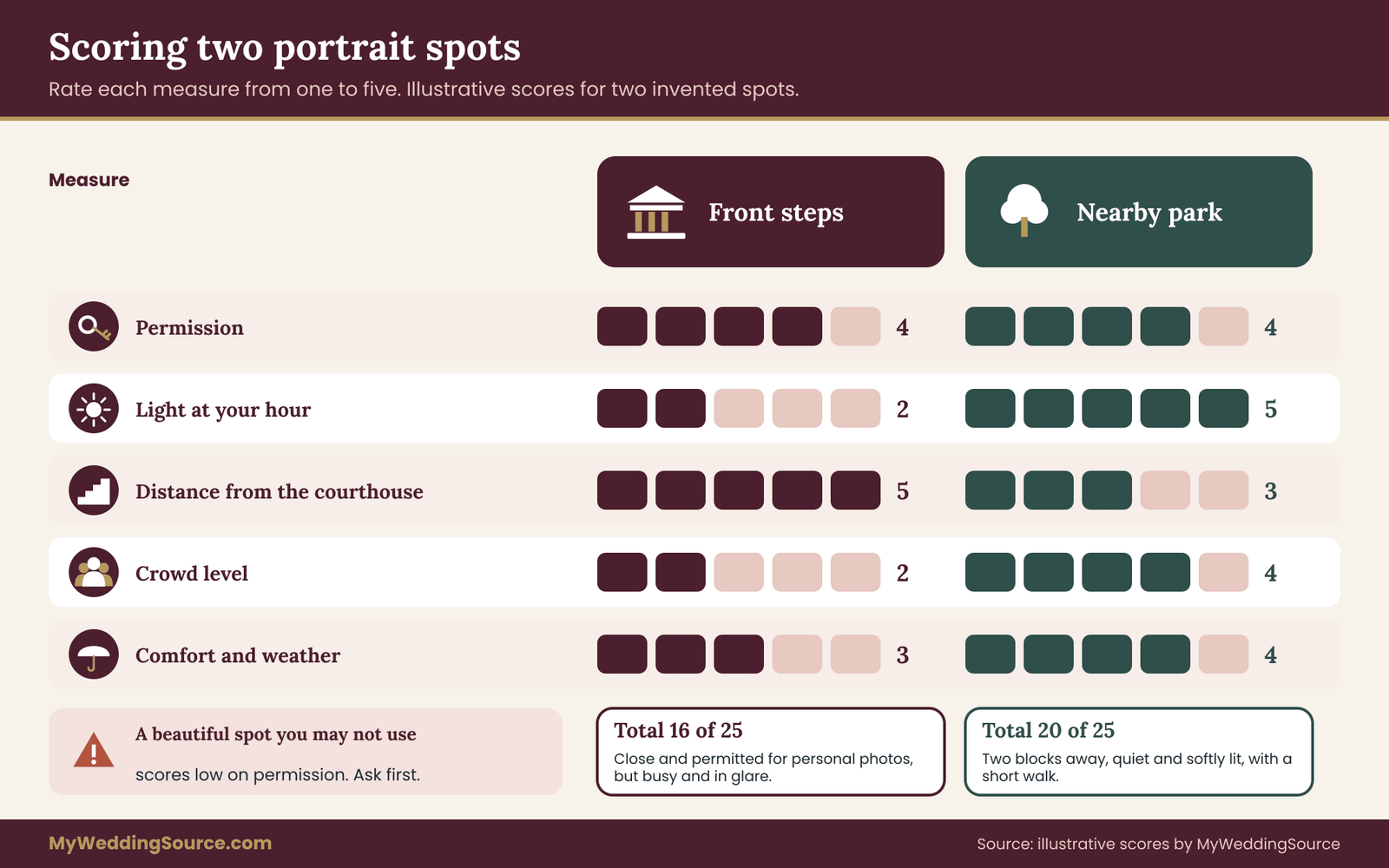
The scoring for courthouse wedding photography is meant to be rough. Its purpose is to make the trade-offs visible. A spot that is a ten-minute walk away may score well on light and crowd and poorly on distance, and you may decide that the walk is worth it or not. A spot on the courthouse steps may score well on distance and permission and poorly on crowd, and you may decide to shoot it early.
Location types for courthouse wedding photography
Instead of a list of named places, which would only apply to a particular city, here are the location types that most often work and what to check for each.
The courthouse steps. Check permission for a hired photographer, the traffic on the steps and the light at your hour.
A side entrance or a courtyard. Often quieter than the main entrance. Check that it is open to the public and not part of a secure area.
A nearby park or garden. Check the owner, the permit rules and whether the area is busy with other events.
A historic or architectural feature nearby. A monument, a fountain, a clock tower or an old bank building. Check whether the property is public and whether photography is welcome.
A street with good background. A tree-lined street, a brick wall or a mural. Check that you are not blocking traffic or a business entrance, and be especially careful about mural artists’ rights if you plan to use the pictures widely, since some murals are protected as artwork.
A location at home or at the meal venue. If the day continues elsewhere, a small garden or a doorway at the next place may be the most relaxed spot of all, with no permit and no time pressure.
A second session as an alternative
If the courthouse and its surroundings do not work for courthouse wedding photography, or if the weather does not cooperate, consider separating the portraits from the appointment. A second session, on the same day or another day, at a spot of your choosing, removes the clock and the building’s rules. It gives you a choice of light, a choice of clothing and the freedom to stop when you want.
Many couples treat the courthouse photographs as documentation and the second session as the portraits. That is a legitimate way to approach courthouse wedding photography, and it takes pressure off the one morning that matters most legally.
Choosing who takes the pictures for courthouse wedding photography
Courthouse wedding photography does not require a professional, and it does not rule one out. The right choice depends on your building’s rules, your budget and what you want to hold in your hands afterward. This section compares the realistic alternatives in prose, so you can match one to your situation.
A hired photographer for a short session
In courthouse wedding photography, a professional brings skill with light, experience with fast-moving moments and calm under pressure. For a courthouse, the strongest case for hiring is when the building allows a photographer in the room or the lobby, when the portrait locations need judgment, or when you want a set of edited pictures delivered on a schedule.
The costs are money and coordination. A photographer needs the clock, the permission log and a clear view of the building’s limits. Some photographers offer short elopement-style sessions for a flat fee, and some charge by the hour; the details differ by photographer and by region, so ask for a written quote and read the terms. Do not rely on a price you remember from a friend or a web page.
The risk is the one you cannot control. If the building turns the photographer away at the door, you may have paid for coverage that cannot happen as planned. Reduce the risk by confirming the rules in advance and by agreeing, in writing, what the photographer does if access is refused: a shorter session, a second session, a partial refund or a rescheduled time. The guide to vendor due diligence covers how to check a vendor’s record and terms before you commit, and the same steps apply here.
A friend or relative with a good camera
A friend can be a thoughtful choice for courthouse wedding photography, particularly if they already take pictures you like. They are comfortable with you, they know the people in your life and they cost little.
The trade-offs are practical. A friend may be a witness or a guest and will not want to miss the ceremony behind a lens. They may not know the courthouse’s rules and may have no experience with low light. They may feel awkward asking a deputy a question.
If you choose a friend, give them the permission log, the clock and the short list of moments, and tell them plainly that you want a few good images, not complete coverage. Agree beforehand on how and when they will send the files.
Phones, held by guests
A phone is the lowest-barrier option for courthouse wedding photography and often the only one allowed. Modern phones take good pictures in decent light, and they pass through security without comment. A guest with a phone is the safest choice if the building is strict.
Phones struggle in dim rooms, at a distance and with moving subjects. If the room is dim, a phone may produce soft, noisy images. If a guest holds it, a shaky hand adds to the problem. Decide in advance who will take the pictures with which phone, set the camera to avoid flash, and agree that the person will hold still during the vows and take several frames. Also decide who sends what to whom, so that files do not scatter across six phones.
The clerk’s office or a building photographer, if one exists
Some offices have an arrangement for photographs, or a staff member who will take a picture on request, or a set backdrop for couples. Do not assume this exists. Ask whether it does, what it costs, who owns the pictures and how they are delivered. If the answer is yes, the arrangement can be a simple, permitted way to get a few images, and it removes the question of equipment and permission, since the building is providing it.
A tripod and a timer
A self-timer on a small tripod or a stable surface can work for a picture of the two of you on the steps or in a park, when no one else is available. It is not suitable inside the building if tripods are restricted, and it may not be appropriate in a busy public spot, where an unattended device can attract attention or be knocked over. Treat it as an outdoor option for a quiet moment, with a person nearby to watch the camera.
A mix
The most common practical answer is a mix: a hired photographer or a skilled friend for the arrival and portraits, a guest with a phone for the ceremony if the room restricts professional cameras, and a second session later for the unhurried pictures. A mix needs a little management. Agree on who covers what, so that the same moment is not photographed three times and another is missed.
Deciding between the courthouse wedding photography options
Use these rules to decide.
If the building allows a photographer in the room and you want strong ceremony pictures, hire a professional and confirm the access terms in writing.
If the building restricts the room and you want strong portraits, hire a professional for a second location and use phones for the ceremony.
If the budget is limited and the building is strict, use a friend or a phone for the day and plan a small portrait session later when you can afford it.
If you want only a few simple pictures, a friend with a good phone and a written short list is enough.
The kit for courthouse wedding photography
If you or your photographer wants to bring equipment, a minimal kit is the one most likely to pass screening and least likely to draw questions. It has a single camera body, one or two lenses, a spare battery and a spare card, in one small bag. It leaves at home the things most often questioned: light stands, large flashes, extra camera bodies, drones and anything that looks like staging equipment.
Drones deserve a specific word. Flying a drone near a government building or over a crowd can violate local and federal rules, and the Federal Aviation Administration sets the national rules for flying. A drone is not a courthouse wedding photography tool, and it is not a good idea to plan one without clear, written permission from the owner of the ground and an understanding of the aviation rules.

Who owns the courthouse wedding photography pictures
Whoever takes the pictures usually holds the copyright by default, unless an agreement says otherwise, and the U.S. Copyright Office explains the basics. For a hired photographer, the contract should state what you may do with the pictures: print, share online and so on. For a friend, a simple note is enough, such as “you can use them however you like; we will share the best ones with you.”
Privacy is part of this. Courthouses are places where strangers appear in the background, and where some people have good reasons not to be photographed. Crop or choose frames that do not show them, and do not post pictures that identify other people without their consent. The guide to wedding photography consent covers how to handle guest boundaries and image use, and its advice applies to a small courthouse party as much as to a large wedding.
Backing up courthouse wedding photography files
A short courthouse ceremony may produce only a few dozen good frames, and each one matters more than any single picture from a long wedding day. Copy the files to a second location the same day, and send a set to a trusted person. The guide to wedding records after the event explains a simple three-copy habit for photos, which works equally well for a small set of courthouse pictures.
A worked example: one couple and four zones
The following example is invented. The names, the county and the numbers are illustrative, and your own building will differ. Its purpose is to show the map, the log and the clock working together.
Dana and Marcus have a civil ceremony booked at a county courthouse on a Friday in late autumn. They want a photographer for the ceremony and a short set of portraits, and they will have lunch with six guests afterward. Their appointment is at 10:30 in the morning.
Step one: the four zones
They start by writing the four zones on a page, with a question mark beside each. Zone one is the marriage room on the second floor. Zone two is the lobby and the staircase. Zone three is the front steps and the plaza. Zone four is a small park they noticed two blocks away.
Step two: the courthouse wedding photography calls
Dana calls the clerk’s office about three weeks before. The deputy clerk says that a photographer may be in the marriage room during the ceremony without flash, that the photographer counts toward the guest limit and that tripods are not allowed. Dana asks about the lobby; the clerk says that is a security question and gives the name of the court administration office.
Marcus calls court administration. The answer is that photography in the lobby is allowed for a minute or two without equipment beyond a camera and one lens, that no photography is allowed past the screening line on other floors and that the front steps are fine for personal pictures as long as the walkway is clear. He asks about the plaza and is told that the county owns it and that no permit is needed for a couple and one photographer for a short time.
Dana then calls the city parks office about the park. The answer is that a permit is needed only for groups above a certain size or for equipment such as stands, and that a couple with a photographer and a handheld camera does not need one. She writes down the name of the person who told her, the date, and the wording.
Step three: the log and the clock
Dana writes all four answers into the permission log. She then builds the clock backward from 10:30. The photographer will arrive at 9:45 to be screened and meet the clerk. The couple will arrive at 10:00, which gives them half an hour of buffer, and the guests will arrive at 10:10.
The ceremony will take about ten minutes, the check-in and wait will take about fifteen minutes, and the room is booked for the next couple at 11:00. Portraits on the steps will start at 10:50, and a walk to the park will start at 11:15.
Step four: the courthouse wedding photography portrait locations
The couple visits the courthouse and the park the previous week, at the same hour. They find that the front steps are in shade at 10:50, the plaza is bright and the park is quiet and lit by low sun. They score the three spots on permission, light, distance, crowd and comfort, and choose the plaza for a few quick frames and the park for the main portraits.
Step five: the backup plan
If the marriage room refuses the photographer on the day, Dana has already agreed with the photographer that coverage will begin outside the room, with the arrival and the first portraits on the steps. A friend with a phone has a short list: the entrance, the rings and the signing. If it rains, the photographer will use the covered entrance for a few minutes, and the park session will move to the following Sunday.

What the example shows
The example shows that a courthouse wedding photography plan is mostly questions. Each zone received a clear owner, a clear rule and a clear proof. The clock then turned those rules into times, and the scouting visit turned the locations into choices. None of this took expensive equipment or special skill. It took about an hour of calls, a short visit and one page of notes. That is the real work of courthouse wedding photography, and it is the part most couples skip.
Edge cases and common mistakes in courthouse wedding photography
Most courthouse wedding photography appointments go smoothly. The ones that do not tend to fail in a handful of familiar ways, and most of them can be anticipated. Here are the edge cases that change the plan, followed by the mistakes that cause the most avoidable trouble.
The ceremony is held in a working courtroom
Some courthouses hold civil ceremonies in an ordinary courtroom, in the gaps between other business. Rules about cameras in courtrooms are usually stricter than those for a dedicated marriage room, because they exist to protect proceedings. A court may allow a single photographer, no photographers or photographs only when the court is not in session. Ask specifically whether the rule applies when the room is empty, and who can give an exception. If the answer is no, put the weight of courthouse wedding photography on the zones outside.
Two or more couples at once
On busy days, an office may marry several couples in a row, or in the same room with a shared waiting area. Other couples have the same right to privacy as you, and a photographer who keeps wandering into their frame can cause friction. Ask whether the room is shared, ask the photographer to stay out of other couples’ pictures, and keep your portrait time away from the waiting area.
A photographer who is also a witness
Some places require witnesses at a civil ceremony, and some do not. Rules differ by state and sometimes by county, and the clerk’s office can tell you which applies to you. If witnesses are required and you want a friend to photograph, ask whether that friend can serve as both, or whether you need two other people.
If the photographer is a hired professional, ask whether they may serve as a witness or must stay in the role of photographer. Do not assume; this is a question for the clerk.
Photographing the marriage license or certificate
A picture of the signed document is a nice keepsake. It is also a document with personal information. Ask the clerk whether it may be photographed in the office, and keep the file private. Do not post a picture of an official document with numbers, dates of birth or signatures that could be copied. The official certificate comes from the issuing office, and the usa.gov page listed in the sources explains how to get certified copies of marriage records; the pictures are keepsakes, not substitutes.
Accessibility needs
If a member of your party uses a wheelchair, a cane or another mobility aid, the best photo spot is the one that everyone can reach. Courthouses are covered by accessibility requirements, and the Americans with Disabilities Act website explains the general standards. Ask the clerk’s office about the accessible entrance and route in advance, and plan portraits at spots on that route. A photograph in which everyone can take part is worth more than a better backdrop that excludes someone.
Guests who are not allowed in the room
Some rooms hold only a few people. If your photographer takes one of the spots, a guest may have to wait outside. Decide in advance who gets the places, and explain the plan to the guests before the day. The unplanned version of this, with a guest turned away at the door, is one of the saddest outcomes of a poorly planned courthouse morning.
Language and communication needs
If you or a family member needs an interpreter or a translated form, ask the clerk’s office how that works and whether the photographer may stay in the room during the translation. A ceremony conducted partly in another language may take longer than the usual slot, and the photo clock should reflect that.
Common courthouse wedding photography mistakes
These are the mistakes that appear again and again.
Assuming a single yes covers the whole building. A clerk’s yes for the marriage room says nothing about the lobby. Ask zone by zone.
Leaving the calls to the last week. Offices answer slowly in busy seasons, and a last-minute call may reach a person who does not know. Make the calls three weeks ahead.
Bringing too much equipment. A large bag may mean a long delay at screening, or a refusal. Bring the minimal kit.
Planning portraits on the clock of the appointment. If the slot ends and the next couple is waiting, the room and the hallway are not yours. Move outside, or to a different time.
Ignoring other people. Strangers do not owe you a clear background. Choose frames and times that do not require them to move or to be photographed.
Skipping the scouting visit. A spot that looks lovely in a web search may be a loading zone, a construction site or a place with a posted ban on photography. Ten minutes on site settles it.
Not agreeing on the backup. The day may not go to plan. Decide in advance what happens if the room says no, if it rains or if the line is long.
Forgetting to back up. Files on a single phone are one dropped phone from gone. Copy them the same day.
Measurable courthouse wedding photography checks before the appointment
Good courthouse wedding photography planning produces things you can check. Use the following list a few days before the appointment; each item has a yes-or-no answer, and a no is a prompt to act.
You have a named owner and a stated rule for each of the four zones, and you have written proof of each. You have measured the walking time from your parking place to the door, and from the door to the room, with a timer. You have a screening allowance written into the clock, and your photographer knows it.
You know the length of your slot, the earliest arrival and how long you may stay. You have confirmed the sun and weather for your hour and chosen a shaded or sunlit spot on purpose.
You have scored at least two portrait spots and chosen one. You have a written backup for each of three events: the room refuses the photographer, it rains and the line is long. You have agreed who takes which pictures and who sends the files to whom. You have a copy-and-backup plan for the same day. You have told your guests the plan, including who is allowed in the room.
If you can say yes to each, you are ready. If you cannot, the check shows you exactly where to spend your remaining time.
Your next steps
Courthouse wedding photography becomes manageable when you turn it into a short sequence of actions. Here is the order that works for most couples.
First, write the four zones on a page and leave room for an owner, a rule and a proof under each. Second, call the clerk’s office with the four short questions about the ceremony room and the building. Third, contact court administration or security about the lobby, the screening and the grounds. Fourth, if you plan portraits nearby, contact the owner or the parks office.
Fifth, record everything in the permission log. Sixth, build the photo clock backward from the appointment. Seventh, scout the portrait locations at the same hour and score them. Eighth, choose who takes the pictures and write down the backup. Ninth, send the one-page schedule to everyone involved. Tenth, copy the files the same day.
If you are still deciding who will perform the ceremony, start with the guide to officiant requirements, because the person performing the ceremony controls the room, and their answer shapes everything else.
FAQ
Can I take photos inside a courthouse wedding ceremony room?
It depends on the room and the person performing the ceremony. Many offices allow still photos without flash, some allow them only before or after the vows, and some allow none. Ask the clerk’s office before the appointment, ask whether the photographer counts toward the guest limit, and get the answer in writing so you can show it at the door.
Do I need a permit for courthouse wedding photography outside the building?
Often not for a couple with one photographer and a small camera, but it depends on who owns the ground and how large your setup is. County and city parks offices set their own lines for group size and equipment. Ask the owner of the specific place, in plain words, and write down the answer and the name of the person.
Can a friend photograph instead of a hired photographer?
Yes, if the building allows cameras, and a phone often works where a professional kit does not. A friend should receive the permission log, the schedule and a short list of moments. Be realistic about low light and distance, agree who sends which files, and plan for the friend to also enjoy the ceremony.
How early should we arrive for photos?
Many couples plan about half an hour to forty-five minutes before the appointment, with the photographer a little earlier. Screening, parking and check-in vary widely by building and day, so walk the route once with a timer. Ask the clerk when you may enter, and treat the arrival buffer as protection against a long line.
What equipment will security allow?
Rules differ by building. A small camera bag with one body and one or two lenses is most likely to pass, while stands, large flashes, extra bodies and drones are most likely to be refused. Ask security directly what is allowed, and ask whether a professional photographer is treated differently from the general public.
Where are good portrait locations near a courthouse?
Common choices are the front steps or plaza, a side courtyard, a nearby park or garden, a historic feature or a quiet tree-lined street. Judge each by permission, light at your time, distance, crowd and comfort. A short visit at the same hour tells you more than a web search.
What if the courthouse says no photographers at all?
Plan the pictures around the building. Cover the arrival and exit where photography is allowed, ask whether a single posed picture is possible after the ceremony, and move the portraits to the grounds or a nearby spot. Phones held by guests, a private vow reading at home and a second portrait session later can fill the gap.
Can the photographer also be our witness?
That depends on the clerk’s office and on your state, because witness rules vary. Some places require witnesses and some do not. Ask the clerk whether a photographer may serve as one, and if not, arrange two other people so the photographer can stay focused on the pictures.
Sources
- USAGov: Marriage certificates and records
- U.S. Courts: Federal Judiciary
- National Center for State Courts
- U.S. General Services Administration
- Americans with Disabilities Act (ADA.gov)
- National Park Service
- Federal Aviation Administration: Drones
- U.S. Copyright Office
- National Oceanic and Atmospheric Administration
- National Weather Service