

A wedding family photo list is a short, named and ordered document that tells your photographer who stands in which group, and who is responsible for gathering them, so the formal portraits usually take 20 to 40 minutes instead of an hour of wandering the lawn.
Your photographer has asked for the family photo list, and you are staring at a blank page with a dozen unanswered questions. Does “family” include your mom’s three siblings and their kids? Do your divorced parents appear together, apart, or both? Who in your family can actually recognize your great-aunt from Tucson? Those questions feel small until they show up on the wedding day as a 25-minute scavenger hunt during cocktail hour, with your grandfather waiting on his feet and your photographer calling “Is there a Linda here?” across a patio.
This guide is about the list itself, not the whole photography plan. It explains who belongs on the list and how to write each line so a photographer can use it in a hurry, then covers the order that moves a crowd fastest, how long the groups really take, and how to choose a wrangler who does the gathering. It then works through divorced parents, blended families, estrangement, loved ones who have died, and accessibility, before showing what to hand your photographer, what the minutes cost in coverage time, and which contract questions touch family portraits.
For the wider planning view, our guides to the wedding photographer shot list and the wedding photography timeline cover priorities and scheduling, so this one stays focused on the family groups.
A caution before we start: the minutes-per-group figures below come from individual photographers’ published guidance and from surveys that are not about your family. They are planning ranges to compare with your own photographer’s numbers, and the sample lists are templates, not quotes or rules.
What a Wedding Family Photo List Is and What Belongs on It
Before you write a single row, it helps to agree on what this document is for and how long it should be. A family photo list is a working tool for one specific stretch of the day, and its success is measured in minutes saved and relatives who are in the right place. This section defines the list, separates it from the broader photography plan, and gives you tests for deciding which groups earn a spot.
What is a family photo list, exactly?
How is a family photo list different from a shot list or a timeline?
A family photo list covers one job: the posed group portraits of you and your relatives. A shot list is the wider wish list of moments across the day, a photography timeline is the schedule that decides when each block happens, and the family list sits between them as the part that depends most on other people showing up. Susan Stripling Photography’s worksheet puts it plainly, calling the family-formal section the most important part of the form, because it determines how much time the photographer needs to budget.
Think of the family list as the one piece your photographer cannot invent: they can find good light on their own, but they cannot know that your stepdad raised you or that Grandma Rosa leaves at 6:00 p.m. Keep it as its own document or its own page so it can be handed to a helper without everything else attached.
What counts as “family” on the list?
You decide, and the list should say so explicitly instead of leaving it to each relative’s assumptions. Genevieve Nisly Photography suggests deciding before you build the list whether extended family belongs in the photos at all, and asking both sets of parents directly, since some families treat aunts, uncles and cousins as essential and others skip them entirely. Megan Noll Photography in Cincinnati, quoted by The Knot, tells couples to focus on immediate family: parents, siblings, grandparents and their significant partners when applicable.
A workable definition is to write one sentence at the top of the page, such as “Family means parents, stepparents, siblings and their spouses and children, plus all four grandparents; aunts and uncles appear only in the two big side groups.” That sentence heads off the cousin who asks to be added at 4:45 p.m. and gives your wrangler something to point to.
How many groups does your list need?
What do photographers say about the right number of groups?
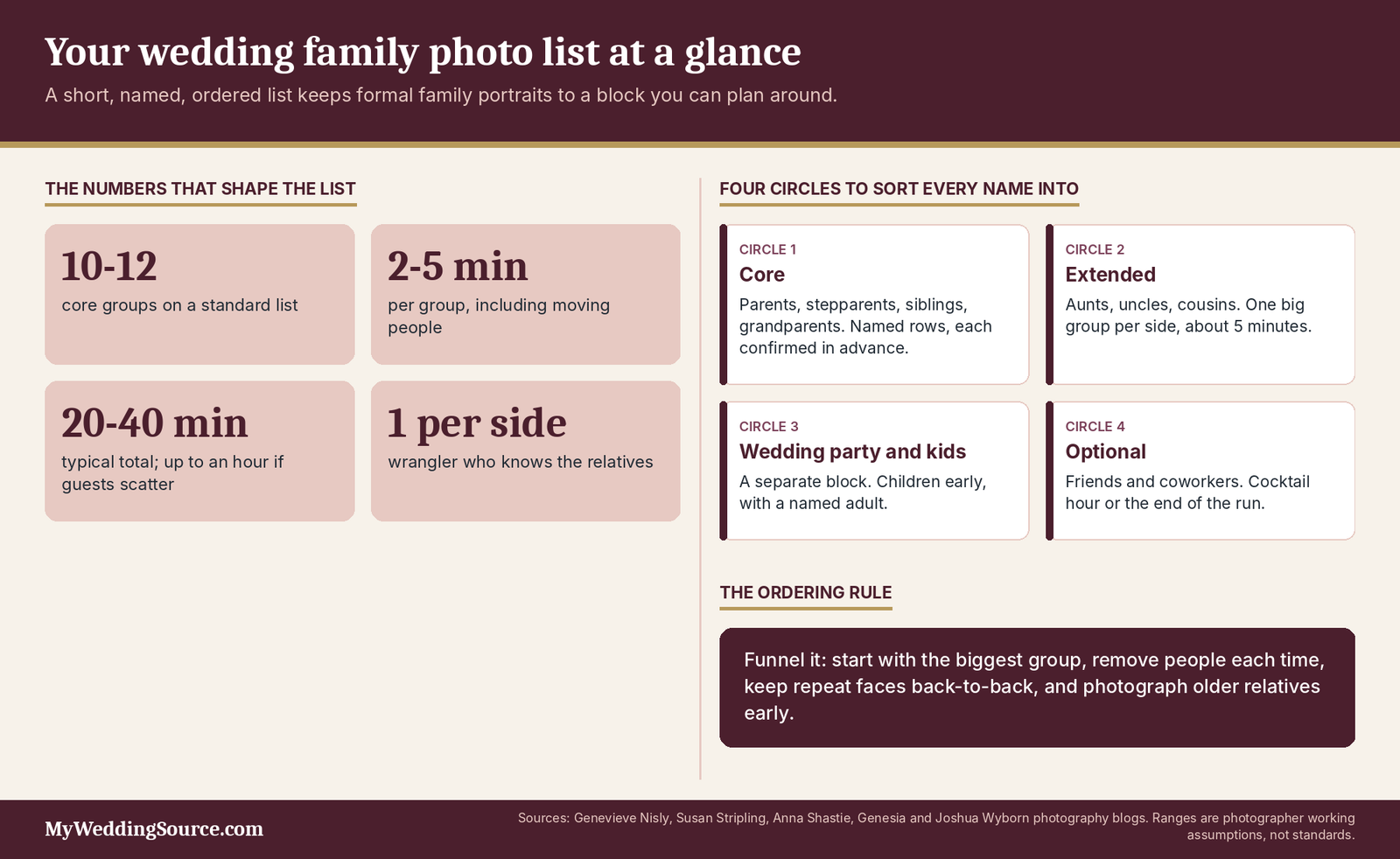
Published guidance clusters around 10 to 12 groups, with a stretch to about 15 for families with extra households. Genevieve Nisly Photography calls nine to twelve a standard list and says that past about 20 groups the extra time comes out of your reception or cocktail hour. Joshua Wyborn Photographic, a United Kingdom photographer whose method is useful even though the market differs, starts at 10 to 12 core groups and says there is no magic number, and Genesia Photography in northern Minnesota says most couples aim for 10 to 20 groupings.
Anna Shastie Photography in Orlando warns that more than 15 to 20 combinations can feel overwhelming unless you add time. The pattern across all of them: fewer than a dozen is comfortable, 15 is a stretch that needs a plan, and 20 or more is a decision to protect other parts of the day.
How can you test whether a group earns its place?
Use the “frame it” and “five years” tests. Anna Shastie Photography suggests that if you would frame the photo or want it in your wedding album, it belongs on the formal list, and Joshua Wyborn Photographic asks whether you would miss the photo in five or ten years. Genesia Photography adds a third question: do you have a specific use for it, and if the honest answer is “probably not,” skip it.
Wyborn also recommends cutting groups that differ by only one person, since “couple with Mom and Dad” and “couple with Mom, Dad and Aunt Jo” rarely need to both exist. Apply the tests to every row, and when a group fails, move it to the “candids at cocktail hour” bucket rather than deleting the relationship. A list that survives those questions tends to land between 10 and 14 rows without much effort.
How to Decide Who Is on Your Wedding Family Photo List
Deciding the circle is the part that takes conversations, not typing. This section sorts people into core, extended and optional rings and then handles the groups that cause surprising delays: wedding party members, children and pets. The goal is to leave this section with a short list of names you could say out loud to both sets of parents without a fight.
Which relatives are core, and which are extended?
Who belongs in the core circle?
The core circle is the people whose absence from the album you would notice: you and your partner, parents and stepparents, siblings and their partners, and grandparents. The Knot’s family-portrait guide, which quotes Megan Noll Photography, describes the traditional set as the couple alone, the couple with all parents, with each side’s immediate family, with grandparents, with siblings and their spouses, and each partner separately with parents, stepparents and grandparents. The core circle is also where family history shows up, because “parents” may mean two households, three adults or one.
Write the core circle first, by name, and ask each person quietly whether they are comfortable with the groupings you have in mind. Doing it at this stage costs one text message per person; doing it on the day costs time with the whole crowd watching.
How should extended family be handled?
Photographing aunts, uncles and cousins one household at a time is where lists balloon, so most photographers recommend a single large group per side instead. Megan Noll Photography suggests a big group photo with each side right after the ceremony, with each person told in advance, and Anna Shastie Photography recommends saving casual extended-family and friend photos for cocktail hour or the reception. A single “everyone on Partner A’s side” group takes about five minutes and replaces eight small ones.
If a specific uncle or cousin matters a great deal to you, give them one named row in the core circle instead of expanding the whole ring. Our piece on real wedding guest list problems covers the harder question of who is invited at all, which is worth settling before you decide who is photographed.
What about the wedding party, kids and pets?
Where do the wedding party and friends belong?
Wedding party portraits are usually a separate list, scheduled separately, and they add time on top of the family groups. Megan Noll Photography says the wedding party adds at least 30 more minutes to a family-photo block, and Joshua Wyborn Photographic places the couple with the full party near the end of a family run so that relatives are already released. Keep the two lists distinct so your wrangler is not trying to gather bridesmaids and great-uncles at the same moment.
If someone is both family and a wedding party member, such as your sister, mark them with a note like “also in wedding party” so they are not photographed twice or missed. Friends groups, such as college roommates or coworkers, are optional extras that fit best at the end of the sequence or during cocktail hour.
How do you handle children, flower girls and pets?
Children are the most unpredictable members of any group, so the list should put them where their patience is highest and their attendance is most useful. Megan Noll Photography lists the flower girl and ring bearer as their own groupings with each partner and with the full party. In practice that means photographing small children early in the sequence, then releasing them to a parent or caregiver instead of keeping them in line for the long middle of the list.
Mark each child with their age and the adult who will hold their hand afterward, because photographers will otherwise ask the nearest person to help. If a pet is part of the family, add it as its own row with a named handler, since an animal that has to wait in the background is a distraction for everyone.
| Circle | Who is in it | Practical handling | Planning minutes (editorial estimate) |
|---|---|---|---|
| Core | Parents, stepparents, siblings and partners, grandparents | Named rows, each confirmed with the people involved | 2 to 4 per group |
| Extended | Aunts, uncles, cousins and their children | One large group per side, or one named household | About 5 for the big group |
| Wedding party | Attendants, flower girl, ring bearer | Separate list and separate block, family released first | 30 or more extra |
| Children and pets | Young relatives, family animals | Early in the sequence, with a named adult or handler | 1 to 2 extra per group |
| Optional | Friends, coworkers, family friends | Cocktail hour or the end of the run | 2 to 5 per group |
How to Write the List So a Photographer Can Use It in Ten Seconds
Photographers read these lists in a hurry, often on a phone, standing in a parking lot or a hallway. A list that is clear on a glance saves minutes, and a list that needs interpretation costs them. This section covers the wording of each row, the “who’s who” key that helps a stranger recognize your relatives, and the order that keeps a crowd moving.
What should each line of the list say?
How do you word each group so nobody is confused?
Use the names and roles photographers actually call out. Genevieve Nisly Photography recommends titles and last names, such as “Bride and Groom with the Bride’s Parents,” instead of first names, and Genesia Photography says to write “Couple with Bride’s parents (John & Linda)” instead of “Bride’s family.” Abide Imagery suggests shorthand to keep each line short, such as BG for the couple, B for one partner and G for the other, with every person listed by name.
Because not every couple is a bride and a groom, you can use “Partner A” and “Partner B,” initials, or your own first names, as long as you define them once at the top. Number the rows so a wrangler can say “we’re on number seven” and everyone knows how much is left.
What is a “who’s who” key, and why add one?
A who’s-who key is a short companion sheet with each relative’s name, relationship and, if possible, a photo, so the photographer can find people without asking an audience. Megan Noll Photography, quoted by The Knot, recommends giving the photographer a shot list that includes photos of family members so they know who to look for. A phone screenshot of a family picture, labeled with names left to right, is enough.
Add a line for anyone who is hard to recognize: the uncle who just grew a beard, the cousin who has not been seen in ten years, the great-grandmother who will be in a wheelchair. This key is also the sheet your wrangler will lean on most, since they are the one calling names.
In what order should the groups be photographed?
What is the funnel method?
The funnel starts with the largest group and removes people at each step, so each person stands in the frame only as long as they need to. Anna Shastie Photography recommends starting with the largest group and removing people for each smaller combination, and Abide Imagery describes the same funnel, with the couple in every photo and the same people kept nearby as long as possible. Joshua Wyborn Photographic spells out a run of “start big, step smaller, bridge families, swap to Partner B, step smaller again, finish with the fun stuff.”
The practical effect is that cousins and great-aunts are done in the first five minutes and can head to the bar, which also thins the crowd your wrangler has to manage. It is one of the few places in wedding planning where a simple rule really does save time.
What other ordering rules prevent wasted minutes?
Three small rules do most of the work. Abide Imagery says to shoot anyone who appears more than once back-to-back so they can leave once they are done. Joshua Wyborn Photographic says to photograph older relatives early so they can sit down and leave, and to take group photos soon after the ceremony or early in the drinks reception, before guests disperse. KG Photography recommends staying in one location, ideally near the ceremony site, so no time is lost moving around. Put together, the rules say: one spot, biggest groups first, repeaters in a row, and elders before anyone else who will be standing for 30 minutes.
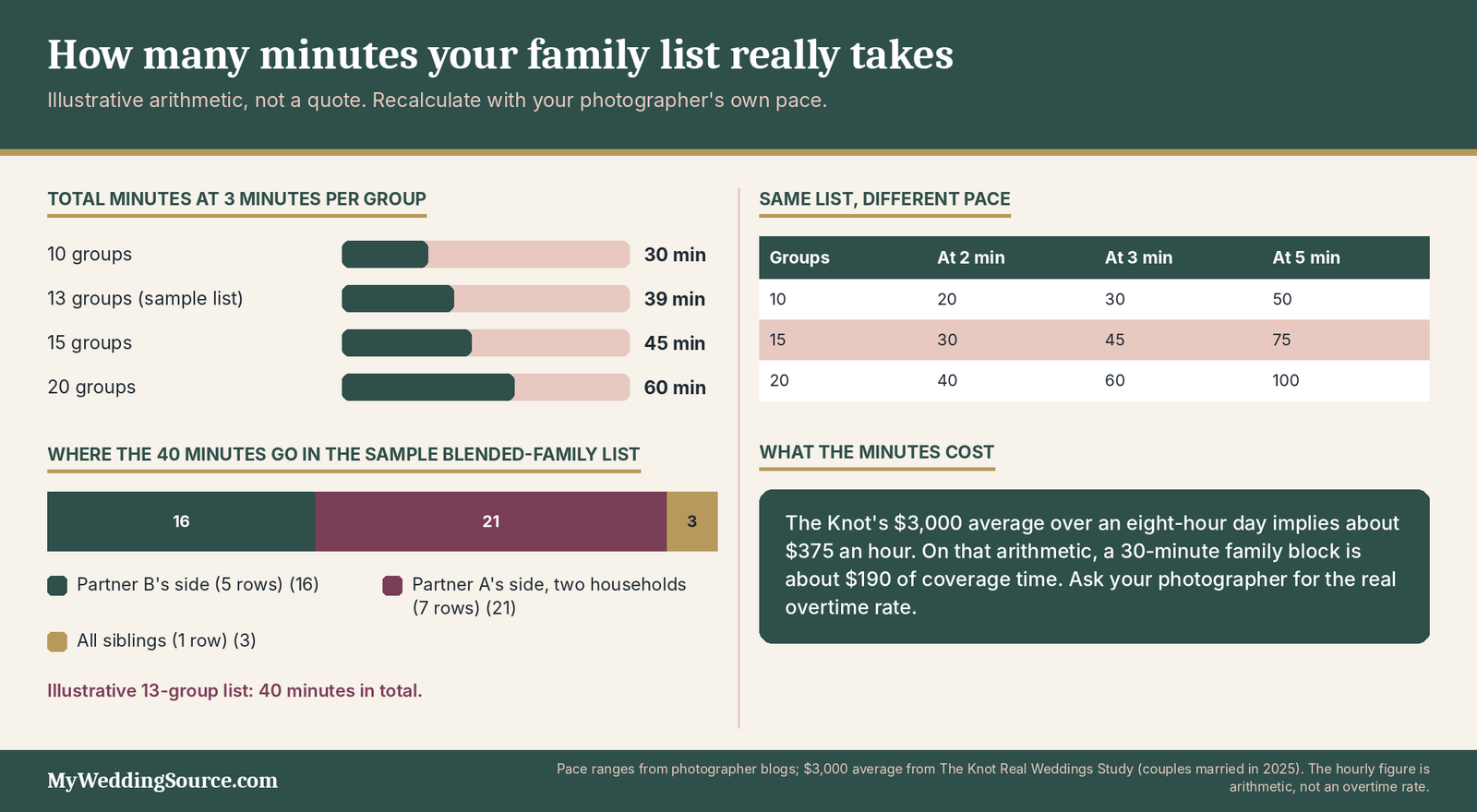
Here is an illustrative list for a family where Partner A’s parents are divorced and Partner A has a stepparent, and Partner B’s parents are married. It uses the funnel order, keeps divorced parents in separate groups unless the couple asks otherwise, and shows who can leave after each row. The minutes are editorial estimates drawn from the 2-to-5-minute ranges above, not a quote or an industry standard.
| # | Group (couple in every photo) | Minutes | Who is released afterward |
|---|---|---|---|
| 1 | Everyone on Partner B’s side, extended family | 5 | Aunts, uncles, cousins (B side) |
| 2 | Partner B’s grandparents, parents and siblings | 4 | Grandparents (B side) |
| 3 | Partner B’s parents and siblings | 3 | Siblings, unless in a later row |
| 4 | Partner B’s parents | 2 | Parents (B side) |
| 5 | Partner B’s siblings | 2 | B siblings |
| 6 | Everyone on Partner A’s side, extended family | 5 | Aunts, uncles, cousins (A side) |
| 7 | Partner A’s grandparents, parent A1, stepparent and siblings | 4 | Grandparents (A side) |
| 8 | Parent A1, stepparent and siblings | 3 | Stepparent |
| 9 | Parent A1 only | 2 | Parent A1 |
| 10 | Parent A2 and siblings | 3 | Parent A2 |
| 11 | Parent A2 only | 2 | Parent A2 |
| 12 | Partner A’s siblings | 2 | A siblings |
| 13 | All siblings, both sides | 3 | Everyone |
How Long Do Wedding Family Photos Take, and Where Should They Go in the Day?
The question every couple asks is how many minutes to give the family list, and the honest answer is a range with a reason attached. This section lays out what photographers publish, explains why identical lists can take twice as long, and then looks at where the block fits relative to the ceremony and cocktail hour.
How many minutes should you plan?
What range do photographers publish?
The published figures are consistent enough to plan with, if you remember they come from individual photographers and not from a standard. Genevieve Nisly Photography says to plan about three minutes per group, including movement, with immediate-family combinations taking 20 to 30 minutes and long extended-family lists up to an hour. Susan Stripling Photography plans four to five minutes for groupings of more than four people and about half an hour for the basic list.
Megan Noll Photography plans about 20 minutes for a small immediate family and roughly 2 minutes for each additional combination, while Genesia Photography puts each grouping at 2 to 4 minutes and suggests keeping formal family time at or under around 30 minutes.
| Source | Published estimate | What it covers |
|---|---|---|
| Genevieve Nisly Photography | About 3 min per group; 20 to 30 min for immediate family; up to 1 hour for long lists | Groups including movement time |
| Susan Stripling Photography | 4 to 5 min for groups over four people; about 30 min for the basic list | Basic list, plus 2 to 5 min per extra group |
| Megan Noll Photography (via The Knot) | About 20 min for small immediate family; about 2 min per extra combination | Excludes at least 30 min for the wedding party |
| Anna Shastie Photography | 20 to 40 min; 30 to 40 for larger or blended families | A 25-combination list can reach 40 min or more |
| Genesia Photography | 2 to 4 min per group; keep total near 30 min | 10 to 20 groupings |
| Abide Imagery | 15 to 25 min depending on size | Family portraits after the ceremony |
Why do the same 12 groups take 25 minutes for one family and 60 for another?
The groups are the same, but readiness is not. Joshua Wyborn Photographic says 10 to 12 groups take about 20 to 30 minutes when the family is organized and ready, and up to about an hour when guests are scattered. The multiplier is the time spent finding, gathering and arranging people: a grandfather who has wandered to the bar, a toddler who needs a diaper change, a cousin who parked a block away.
That is why this article puts so much weight on the wrangler and on telling relatives where to be, since those steps change the clock more than the number on the list does. Large groups, young children and mobility needs also stretch the time, so build in a buffer if any apply.
| Number of groups | At 2 min each | At 3 min each | At 5 min each |
|---|---|---|---|
| 10 groups | 20 min | 30 min | 50 min |
| 13 groups | 26 min | 39 min | 65 min |
| 15 groups | 30 min | 45 min | 75 min |
| 20 groups | 40 min | 60 min | 100 min |
Where does the block fit in the day?
Before the ceremony, after it, or split?
The decision hinges on whether you do a first look. Alex Gordias’s family-formal guide says to take all family photos before the ceremony if you are doing a first look, and without one to split the list or shoot part of it during cocktail hour. KG Photography adds that a first look lets you take several family portraits early, leaving only “a handful of group shots” after the ceremony.
If you skip the first look, family photos happen right after the ceremony while guests are still seated nearby, which is why the list needs to be short and the wrangler needs to be ready. Our guide to wedding first look photos covers how to decide; here the point is that the answer decides whether your family is dressed, calm and nearby for the portraits or already heading to the bar.
What should you do about cocktail hour and early light?
Cocktail hour is the usual victim of a long family list, so protect it by deciding in advance what gets cut. Alex Gordias suggests extending cocktail hour by 30 minutes if the list needs that long, and Genevieve Nisly Photography warns that past about 20 groups the extra time comes out of your cocktail hour or reception. If your ceremony is close to sunset, as in late fall, the light adds pressure of its own, and our piece on a November wedding timeline around earlier sunsets explains how to protect daylight for couple portraits.
A tight family block that wraps in 25 minutes lets you reach golden hour; a 60-minute block can swallow it. Put the family list first when daylight is scarce, and let the optional friend groups slide to the reception.
Who Gathers Everyone? Choosing and Briefing Your Wrangler
The best written list still fails if nobody can find the people on it. A wrangler is the person who turns names into bodies standing in the right spot, and the choice matters as much as the list’s contents. This section covers who to pick, what to put in their hands and how to tell relatives what to expect.
Who should be the wrangler?
What qualities and roles make a good wrangler?
Pick someone who knows both families, is calm under pressure and is not one of the people being photographed in every group. Abide Imagery says the point person should know both families and the wedding party well, and should not be the photographer or either spouse-to-be. Joshua Wyborn Photographic suggests one or two people who know the families, one per side for larger weddings, and says to choose someone calm and confident, not necessarily the loudest guest. Anna Shastie Photography proposes a sibling, cousin, planner or family friend, since the photographer may not know everyone.
If you have a day-of coordinator, they can run the schedule while a relative does the face recognition, which is a division of labor that works well.
Why one per side beats one for everyone?
A single wrangler for 80 relatives has to know all of them, and a wrangler who knows your side may not recognize your partner’s grandmother. Anna Shastie Photography asks for one person from each side to help gather relatives, and Genesia Photography makes the same recommendation. The wranglers can then work in parallel: while the photographer shoots group four, one wrangler is rounding up group five on their own side. Briefly agree who handles groups that cross sides, such as “all siblings,” so that two helpers are not hunting the same person while one group stands waiting.
If you can only recruit one person, choose the one who knows more of the harder-to-find relatives and use your who’s-who key to fill in the rest.
How do you tell relatives where to be?
What should guests hear before the wedding day?
Tell relatives well ahead, because a surprise request at 4:30 p.m. is a request to someone who has already ordered a drink. Susan Stripling Photography advises sharing the list with everyone who needs to be there and padding the start time, for example telling people to arrive at 11:45 for a noon session. Genevieve Nisly Photography recommends an email blast the week of the wedding and a reminder at the rehearsal dinner, plus telling family to arrive early if photos are before the ceremony or to stay put afterward if they are after it.
A short message to the people in the core circle usually is enough: where, when, what to wear, and who is meeting them. Keep it kind and direct, since relatives are more cooperative when they know the job will be short.
What should happen at the moment of the photos?
Make one clear announcement as the ceremony ends, from the officiant, the wrangler or the emcee, telling named groups to stay and everyone else where cocktail hour is. Abide Imagery flags a common pitfall: people leaving for cocktail hour without realizing they are still needed. Genevieve Nisly Photography adds that the list should be agreed on before the wedding and that new requests should not be taken during the shoot, which gives your wrangler a clear answer for the relative who says “can we just get one more with the cousins?”
The polite response is “Let’s put that in the cocktail hour candids.” Guests rarely mind a clear plan, and your photographer will be grateful for the backup.
Divorced Parents, Blended Families, Estrangement and Loved Ones Who Have Died
Most families have at least one complication, and the formal list is where those complications become logistics. The aim is not to explain your family to a photographer, but to give them the three or four facts that prevent an awkward moment. This section covers divorce and stepfamilies, tension between relatives, honoring someone who has died and guests who would rather not be photographed.
How do you handle divorce, stepfamilies and tension?
What is the usual approach to divorced or separated parents?
Treat each parent’s household as its own group and decide in advance whether anyone is posed together. Genevieve Nisly Photography reports that its planning form asks about parents’ marital status, that couples can choose separate portraits with each parent or one with both biological parents, and that parents who are no longer married are typically not posed together unless the couple asks. Megan Noll Photography says to involve family in the picture decisions several weeks ahead to set expectations, and to skip photos that pose parents together if they are not on speaking terms.
Expect more rows: separate photos with each parent and with each stepparent mean more combinations and more minutes, as Noll notes. The 13-group list earlier shows how Partner A’s two households add three or four rows without breaking the funnel.
How should stepparents, half-siblings and chosen family appear on the list?
Name them, state the relationship the way your family describes it, and ask them before the list is final. If a stepparent raised you, write “Stepdad Marcus, raised Partner A from age 8” and place him in the main parent group; if a stepparent is newer and you are unsure whether they want to be in portraits, ask them and the relevant parent privately. Anna Shastie Photography suggests creating separate combinations for each parent, stepparent, sibling group or side of the family and sharing the list in advance so no one is surprised.
Chosen family, such as an aunt-figure or a mentor who has been like a parent, can have their own row or join a larger one. A short line next to each name prevents the photographer from guessing and getting it wrong in front of everyone.
What if two relatives should not stand together?
Put the arrangement in writing, and design the order around it instead of managing it live. Joshua Wyborn Photographic says not to force two people who should not stand together, and to use opposite sides of the group, separate versions or extra groups. The Wediquette Wednesday column in My New Orleans, written by Melanie Warner Spencer, advises telling the photographer about sensitive family matters such as a difficult divorce so they are not caught off guard.
In practice, that might mean photographing the two relatives in different groups at opposite ends of the sequence, with your wrangler quietly keeping them apart. You do not need to explain the history, only the instruction.
How do you include loved ones who have died, and people who opt out?
How can you honor someone who has died in your family photos?
There is no single right answer, and some couples prefer to leave the moment unmarked. For those who want a visible tribute, published suggestions from wedding publications include a framed portrait or photo collage on a table, tiny photo frames attached to the bouquet, a reserved chair with a framed photo and a flower, and small frames on the shoes. EquallyWed’s list of six ways to honor late loved ones includes framed portraits and bouquet charms, and Beach Bride’s article suggests an empty chair with a framed picture or a memorial table with candles.
For the family portrait itself, one gentle option is to hold a framed photo or a small keepsake in the picture, while another is to take a quiet photo of the memorial display. Ask the relatives who were closest to the person before deciding, because what feels comforting to you may land differently for a parent or a sibling.
What should you put on the list about a loss?
Say what you want in one plain sentence so the photographer neither ignores it nor makes a fuss. For example: “Dad’s photo will be held by Partner A during the group with Grandma and Aunt Lin,” or “Please leave the space beside Grandma open; no tribute needed.” Keep the note short and tell the wrangler too, because a relative who is in tears is often the one who gets rounded up for the next group.
If a loss is recent, consider a quiet pause before the formal photos, offering a few minutes before the first group, since photographers can schedule a gentle start. The photographer’s job is to follow your lead without commentary, and a good one will.
How do you respect guests who would rather not be photographed?
Some people are camera-shy, some have a personal reason to stay out of photos, and others are minors whose parents prefer that they are not shared online. Handle this on the list by adding a “please do not photograph” or “do not share online” note next to the name, and ask your photographer how they treat those requests in their galleries and portfolio. Our guide to the wedding photographer portfolio contract explains how to check whether your photographer may publish your images and how to limit that use.
A relative who is quietly excused from a group is a smaller problem than a relative who feels pressured to stand in it.
| Situation | What to write on the list | Who to talk to before the day |
|---|---|---|
| Divorced parents | “Parents are photographed in separate groups; not together” | Each parent, several weeks ahead |
| Stepparent or partner | Name, relationship, and which groups they join | The stepparent and the related parent |
| Tension between relatives | “[Name] and [Name] are in different groups, opposite ends” | The wrangler and the photographer |
| Loved one who has died | One sentence on a photo, keepsake or leaving space | Closest relatives, then the photographer |
| Guest prefers no photos | “Please do not include” or “do not share online” | That guest, then the photographer |
Accessibility, Comfort and Weather: Making the Family Photos Doable for Everyone
The people in your family photos range from toddlers to great-grandparents, and the formal portraits are often the longest stretch anyone stands during the day. A list that plans for comfort is shorter, calmer and kinder. This section covers mobility, hearing and stamina, then clothing, weather and location.
How do you plan for mobility, hearing and stamina?
How should seating and location be handled?
Choose a spot with a flat, step-free approach and keep chairs nearby, then tell the photographer who needs them. The Wediquette Wednesday column in My New Orleans advises talking with the photographer in advance about any guest with limited mobility and bringing an attractive chair, or a set of them, for use during the photos or for breaks. Picbackman’s guide to photographing senior citizens also says to keep chairs handy. Joshua Wyborn Photographic adds that couples should share practical needs, such as mobility, hearing and early departures, along with any family dynamics that affect placement, and keep it brief.
Walk the likely photo spot beforehand or ask the venue about it, since a lawn that looks lovely can be difficult with a walker or a cane.
How do you keep older relatives comfortable?
Photograph older relatives early, keep their groups short and give them a place to sit before and after. Wyborn recommends photographing older relatives early so they can sit down and leave, and Picbackman suggests working quickly and proficiently, favoring natural poses, and being considerate of slower movement, hearing loss or poor eyesight. Mark anyone who needs a seat, extra time or a clear verbal cue on the who’s-who key, and ask the wrangler to walk with them from the ceremony. A small amount of humor helps too, as Picbackman notes, because light moments make the experience less stressful.
None of this requires a conversation about age, only a note beside a name.
What about weather, clothing and logistics?
What is the plan if it rains or the day is very hot or cold?
Have a sheltered or indoor option and a shorter list ready before you need it. Joshua Wyborn Photographic recommends planning for rain with sheltered or indoor options, or smaller groups, and keeping the list flexible for weddings where a new person appears on the day. Ask your venue which covered spots can hold a group of 15 to 20 people, and whether a lobby, porch or ballroom corner is available. In hot or cold weather, move the large groups first so people spend less time standing in the sun or wind, and keep water or coats handy.
A “rain list” of five or six core groups, written ahead of time, saves the day-of debate.
How do gowns, shoes and children affect the plan?
Clothing affects speed more than most couples expect. Abide Imagery notes that a large or structured gown can make it physically demanding to move in and out of photos, so keep the couple in place and bring the families to you. High heels on grass, stiff suits and long trains all slow things down, so choose a surface that works for the whole group. For children, schedule the formal photos before nap time or snack time if you can, and have a parent on standby with a quick snack or a quiet toy. These are editorial suggestions rather than studies, but each one addresses a delay that photographers describe repeatedly.
Handing the List to Your Photographer
A finished list only helps if it reaches the right person in a form they can use. The hand-off is a short exchange of documents and answers, and it is worth doing a few weeks out so that your photographer can build the family block into their own plan. This section covers when to send it, what to put in the packet and what to ask in return.
When and what should you send?
When should the list reach your photographer?
Sooner than the last minute, with a final confirmation the week of the wedding. Susan Stripling Photography sends its Wedding Day Worksheet about six weeks ahead, and the worksheet asks about the wedding party, parents, siblings, extended family and any relevant family situations. Genesia Photography asks for the finished list at least a week before the wedding so the photographer can plan the flow and location.
Because those two figures differ, treat them as a floor and a target: aim to send a near-final list two to four weeks ahead, which is an editorial suggestion, then confirm any changes in the final week. If your photographer sends a worksheet, fill it in first and attach your own list as a supplement.
What goes in the hand-off packet?
Four items cover almost everything: the numbered list, the who’s-who key, the sensitive-situations note and the logistics page. The logistics page states the time and place of the family block, the wrangler’s name and phone number, the rain plan and the definition of “family” you wrote at the top of the list. Send the packet as a PDF and as a shared document, so the photographer has a stable copy and you can update the live one. Give a copy to your wrangler and your planner or day-of coordinator, since the three of them will make the plan work.
Our wedding day timeline failure points article explains why missing hand-offs are such a common source of delay.
What should you ask your photographer in return?
How does your photographer handle family formals?
Ask what their process is before assuming it matches yours. Some photographers have a standard template with basic groupings and space for additions, as Susan Stripling Photography describes, and some call names themselves while others expect a family member to do it. Ask how many groups their usual list includes, how many minutes they allow, whether they bring an assistant or second shooter to help line people up and what they do when relatives drift off.
You can learn a lot from the answer to “How long does it usually take with a family this size?” because it shows whether their estimate lines up with the ranges above. If their numbers are far from yours, adjust the list or the schedule, not the photographer’s pace.
What happens when someone asks for an extra group on the day?
Settle that rule before the day so no one has to improvise it. Genevieve Nisly Photography says the final list should be agreed before the wedding and that new requests should not be opened up during the shoot, a policy you can adopt as written. Tell your photographer who has authority to approve an addition, ideally you or your wrangler, and what to do with requests from guests, which is to point them to cocktail hour candids.
Alex Gordias’s guide notes that delays can ripple through the rest of the timeline, which is the reason the “no new groups” rule is worth stating firmly. If a request is truly important, such as a relative who is traveling, you can add it in advance.
What a Wedding Family Photo List Costs and the Contract Questions to Ask
The list does not have its own price tag, but it affects the number of coverage hours you need and the questions that belong in your agreement. Pricing is complicated, not secretive, and the useful move is to connect minutes on your list to hours in your contract. This section shows the benchmarks, the arithmetic and the clauses to clarify, as general education and not legal advice.
How does the list affect what you pay?
What do photographers charge on average?
The Knot’s Real Weddings Study of couples married in 2025 reports an average of $3,000 for a photographer, with a lower quartile of $1,500, a median of $2,800 and an upper quartile of $4,700. By region the averages run from $2,600 in the Southwest to $3,800 in the Mid-Atlantic, and by guest count from $2,000 for 1 to 50 guests to $3,500 for 101 or more. Zola’s Wedding Cost Index, in an article updated in February 2026, puts the national average at $4,400, with most couples spending $3,500 to $5,300, roughly 9% of the total budget.
The two sources use different samples, which is why they differ, and neither is a quote for your wedding. Zola also describes packages of 6 to 8 hours for basic, 8 to 10 for standard and 10 or more for premium, which helps you see where a long family list fits.
What does a 30-minute family block cost in coverage time?
Start with the arithmetic and then ask for the real overtime rate. The Knot’s article estimates an average hourly rate of about $375, assuming an eight-hour day, and that is simply $3,000 divided by eight. On that illustrative math, a 30-minute family block is about $190 of coverage time and a 60-minute block is about $375, but your photographer’s overtime rate may be different. The point is not to put a price on your grandmother’s portrait; it is to see that a list which runs 25 minutes long can use up an hour’s worth of cocktail-hour buffer.
Ask your photographer what an extra hour costs, how much notice they need and whether the overtime is billed in full hours.
| Question to ask | Why it matters for the family list |
|---|---|
| Does the contract or timeline mention the family-formal block and its length? | Connects the minutes on your list to the hours you pay for |
| How many hours are included, and what does an extra hour cost? | A long list can use buffer or trigger overtime |
| Who will gather people, and does a second shooter or assistant help? | Gathering is the slowest part of the block |
| Who owns the copyright, and what can we do with the files? | Determines printing for relatives and sharing online |
| Does the print release cover prints for family members? | Relatives often ask for copies of the group portraits |
| Can the photographer publish family photos, and can we exclude someone? | Protects guests who prefer privacy |
| What is the backup plan if the photographer is ill or equipment fails? | A missed formal block cannot be repeated later |
What belongs in the contract?
Who owns the photos, and can relatives print them?
The default rule favors the photographer. The U.S. Copyright Office says the author and initial owner of a photograph is the person who takes it, with an exception for a “work made for hire” when a photographer is an employee or works under an express agreement that fits the statute. Federal law also says a transfer of copyright ownership is not valid unless it is in writing and signed by the owner, so most couples receive a license or print release instead.
The Professional Photographers of America describes a print release as permission to make prints for personal use, including sharing with family to a certain extent, and recommends consulting local counsel because sample contracts may not fit every state. In practice, ask in writing whether relatives may print the group portraits themselves or order them through the gallery. Our wedding vendor contract guide shows how to check the rest of the agreement.
Which clauses protect the family portraits themselves?
Look for four things: coverage hours that fit the timeline your list creates, a clear statement of who delivers what, a backup plan and any language about specific shots. Many photographers will not guarantee specific shots, and that is reasonable, but the contract can reference the timeline and the list as a plan. Ask what happens if the photographer cannot attend, how quickly backup coverage can be arranged, how images are backed up and how long the gallery stays online. If a second shooter is part of the package, ask whether they will be present for the family block.
None of this is legal advice, and a local attorney can review your actual agreement if something feels unclear.

FAQ: Wedding Family Photo List Questions Couples Ask
These are the questions couples most often raise once the list is on paper. Each answer is general guidance, so check it against your photographer’s process and your family’s needs.
Questions about building the list
Should divorced parents be in the same photo?
Only if both parents are comfortable and you want it. Genevieve Nisly Photography says parents who are no longer married are typically not posed together unless the couple asks, and Megan Noll Photography says to skip photos that pose parents together if they are not on speaking terms. The usual solution is a separate group with each parent and any stepparent, which adds rows but avoids tension. Ask each parent privately several weeks ahead, and write the result on the list so the photographer does not have to guess. If one parent is open to a combined photo and the other is not, choose the separate version.
How many family groups should we ask for?
Start with 10 to 12 and cut or add based on your family and your time. Published guidance from photographers ranges from nine to twelve as a standard list to 10 to 20 for some couples, and Genevieve Nisly Photography warns that past about 20 the time comes out of your reception. Use the “would we frame it” test for each row. If your list reaches 15, plan for 45 minutes at three minutes per group and make sure your wrangler is ready.
Do we need a list if our photographer is experienced?
Yes, because experience does not give a photographer your family tree. They know how to pose a group, but they cannot know who is divorced, who is a stepparent or who needs a chair. A short list with names, roles and notes is the one piece of information only you can supply. Many photographers also have a worksheet, so ask for it first and use it as the starting point.
Questions about the day and the contract
What if a relative is missing when their group is called?
Skip ahead and come back, and let the wrangler find the person while the photographer works on the next group. This is one reason the list should have numbered rows and a who’s-who key: the photographer can move to the next group without losing track. Tell core relatives to stay nearby after the ceremony and give the wrangler their phone numbers. If the person cannot be found, a photographer can sometimes add them to another group or take a quick portrait later in the evening, though that is not guaranteed, so it is worth asking your photographer how they handle it.
Who owns the family photos, and can relatives order prints?
The photographer usually owns the copyright, and you receive a license or print release that spells out what you can do. The U.S. Copyright Office says the person who takes a photograph is its initial owner, with a work-made-for-hire exception, and a transfer of ownership must be in writing and signed. Ask your photographer whether relatives can print the group photos or order them from the gallery, and whether there is a fee. Terms and state laws vary, so read the clause before you sign.
Your Next Steps
The list takes a few evenings to build and one short conversation to confirm. These steps are ordered so that the hard questions come first, when there is still time for everyone to adjust.
This week
Draft the circle and the sentence that defines it
Write the one-sentence definition of family, then list the names in the core circle. Ask both sets of parents whether extended family should be photographed and how, and settle whether the big group per side is a yes. Add the divorce, stepfamily and loss notes you already know. This first draft should fit on one page and take about an hour.
Choose and ask your wranglers
Pick one calm person per side, ask them directly and confirm they will be at the ceremony and nearby for the family block. Give them the draft list and tell them what the job involves. If a wrangler says no, ask for a suggestion; a person who knows the family often knows who else does.
Before you pay a deposit or sign
Ask your photographer how they handle family formals
Before you book, ask for their template, their usual group count and minutes, whether they call names themselves and what their policy is on extra requests. Compare their numbers to the ranges in this guide, and compare their coverage hours to your timeline. If you are deciding between photographers, this answer tells you a lot about how they work with families.
Match the contract to the list
Read the contract for the coverage hours, overtime, second shooter, backup plan, print release and publication rights. Add a line that references your timeline and the family-formal block, and ask for it in writing if it is missing. For the rest of your planning sequence, the wedding planning hub shows what else to settle at the same time, and keep a copy of every email that changes the plan.
Sources & methodology
- The Knot: Real Weddings Study — study scope: couples married in 2025, page dated February 2026
- The Knot: Average cost of a wedding photographer — $3,000 average, quartiles, region and guest-count figures, eight-hour hourly-rate estimate
- Zola: Wedding photographer cost — $4,400 average from the Zola Wedding Cost Index, package tiers, seasonal pricing
- Zola: 2025 First Look Report — first look prevalence among close to 6,000 couples
- The Knot: Family wedding photos with Megan Noll Photography — traditional groupings, 20-minute and 2-minute estimates, divorced-parent advice
- Genevieve Nisly Photography: Planning family photos — three minutes per group, nine to twelve groups, ordering, divorced parents, no new requests on the day
- Susan Stripling Photography: Planning family photos — four to five minutes per group, worksheet timing, padding the start time
- Joshua Wyborn Photographic: Wedding group photo list — running order, wrangler advice, rain and mobility planning (United Kingdom photographer; method only)
- Anna Shastie Photography: Family formal shot list — 20 to 40 minute range, funnel order, one helper per side, the frame-it test
- Abide Imagery: How to create a family shot list — shorthand format, point-person role, gown and cocktail-hour pitfalls
- Genesia Photography: Family photo list — 10 to 20 groupings, two to four minutes each, naming and sending the list
- KG Photography: Family photo requests — single location and first look effect on the post-ceremony list
- Alex Gordias: Family formal photo guide — family coordinator, before or after ceremony, extending cocktail hour
- My New Orleans: Group photos with mobility-challenged attendants — seating and telling the photographer about mobility and family conflict
- Picbackman: Photographing senior citizens — chairs, pacing and comfort for older guests
- EquallyWed: Six ways to honor late loved ones — framed photos, bouquet charms and other tributes
- Beach Bride: Ways to include loved ones who have passed on — bouquet frames, reserved chair and memorial table ideas
- U.S. Copyright Office: What photographers should know — initial ownership and work made for hire
- U.S. Copyright Office: 17 U.S.C. chapter 2 — written, signed transfer requirement (sections 201 and 204)
- PPA: Sample contracts — print releases, licensing and the advice to consult local counsel
Methodology: Price figures are survey findings from The Knot (couples married in 2025) and Zola’s Wedding Cost Index, and they differ because the samples differ. Minutes-per-group figures come from individual photographers’ published guidance, so they are working assumptions and not industry standards; the funnel list, the time model and the cost arithmetic are editorial illustrations. Copyright and contract statements are general education, not legal advice, and terms and state laws vary. Suggestions on grief, privacy and accessibility are editorial judgment informed by the cited articles, and some sources are photographer or publication blogs whose practices reflect their own workflows.
Freshness note: Recheck The Knot and Zola photographer figures when their next annual studies publish, usually in early to mid-year, and confirm your own photographer’s hourly rate and overtime policy at booking. Confirm any venue rules about group photo locations, and review your contract’s wording with your photographer and, if needed, a local attorney before you sign. Several sources are individual photographer blogs that can change or disappear, so verify the quotes cited here if you plan to rely on them.