
A gelato cart wedding works or fails on two things guests never see: whether the cart stays cold from the vendor’s freezer to the last spoon, and whether the line keeps moving while the dance floor fills. This guide gives you a cold-chain and queue worksheet to size a gelato cart, plan its power, and question the vendor before you sign.
Treat a gelato cart as a small mobile kitchen with two numbers to protect. First, power or stored cold: find out how the gelato cart stays frozen (compressor, dry ice, or pre-frozen plates), what it draws, and which circuit it will use. Second, throughput: divide the servings you need by what one server can really scoop in the time the line is open. Test both with the vendor before the contract is final, and keep a written plan for heat, rain and a power loss.
Gelato carts photograph well, and that is part of the trouble. A pretty cart parked in the wrong spot, plugged into a circuit that already feeds the DJ, with one server and a hundred and fifty hungry guests, produces soft gelato and a long, irritated line. Neither problem shows up in the vendor’s portfolio. Both show up at 9 p.m. in front of your family.
This article is narrow on purpose. It does not argue whether you should serve gelato instead of cake, and it does not try to count dessert portions across a mixed buffet. For the wider decision of what to serve, the wedding menu planning guide is the better starting point. Here the decision has already been made, or is close, and the question is how to run a gelato cart without surprises.
A short scope note: this is general planning information, not legal, tax or financial advice, and food-safety, permit and electrical rules vary by city, county and venue, so confirm the current ones with the local health department and the venue.
What a gelato cart wedding really involves
Strip away the umbrella and the chalkboard menu and a gelato cart is a freezer on wheels with a person attached. It has to do four jobs in sequence: arrive cold, stay cold, serve quickly, and leave without a mess. Each job belongs to a different part of your planning, which is why gelato carts slip between the cracks of caterers, venues and decor teams.
The vendor usually owns the product and the cart. The venue owns the power, the floor, the load-in route and the rules about outside food. The caterer may own the plates, the dessert timing and the dessert allergy plan. You own the money and the schedule. When nobody writes down who owns what, the gelato cart ends up at the end of an extension cord that three people each assumed somebody else had approved.
Most guests will remember the gelato for one reason: either it was lovely, or the line was long. Very few will remember the flavor list. So the work in this guide is mostly about the boring parts of the service, and the flavor choices come last.
The three questions that decide everything
Before looking at any vendor, answer three questions on paper. They are quick, and they change which carts are even worth considering.
First: where will the cart physically stand, and is there a legal, safe, shaded place with access to power? Second: how many people will realistically take a serving, and in what window? Third: who is responsible for the cold, meaning the vendor, the venue’s kitchen, or nobody yet?
If you cannot answer the first, read the venue technical walkthrough guide and book a site visit, because power points, loading routes and surface type are things you measure, not assume. If you cannot answer the second, you need a guest count and a plan for when dessert happens. The third gets answered through the vendor questions later in this article.
What counts as a gelato cart here
Vendors use the word loosely, so define it before comparing quotes. In this guide a gelato cart is any mobile serving unit where guests receive scooped gelato or sorbetto from an attendant. That covers a pushcart with a built-in compressor, a cart that uses frozen cold plates or dry ice instead of a plug, a stainless dipping cabinet on a stand, and a table setup where tubs sit in a portable freezer. Pre-packaged novelty bars from a cooler belong to a different category with different logistics.
The categories matter because they fail differently. A compressor cart fails when power is wrong. A cold-plate cart fails when the plates were not frozen long enough or the event runs longer than the plates allow. A dipping cabinet fails when the cabinet and the tubs are not held at the right temperature before the doors open. The sections below take each in turn.
Why a gelato cart is a cold-chain problem
The phrase “cold chain” sounds industrial, but the idea is simple. Every time the gelato changes hands or location, it can warm up, and warmth that has already happened does not come back out. The product leaves the production freezer, travels in a vehicle, waits at the venue, sits in the gelato cart, gets scooped, and reaches a guest’s hand. That is six links, and the weakest one sets the quality.
Gelato is more sensitive than people expect. It is typically served at a warmer temperature than standard ice cream and often carries less air, which is part of why it tastes so dense and silky. It is also why a slightly warm cart produces a slumping, soupy scoop within minutes. A vendor who knows their own product will have a target serving temperature in mind and a way to check it. Ask for it.
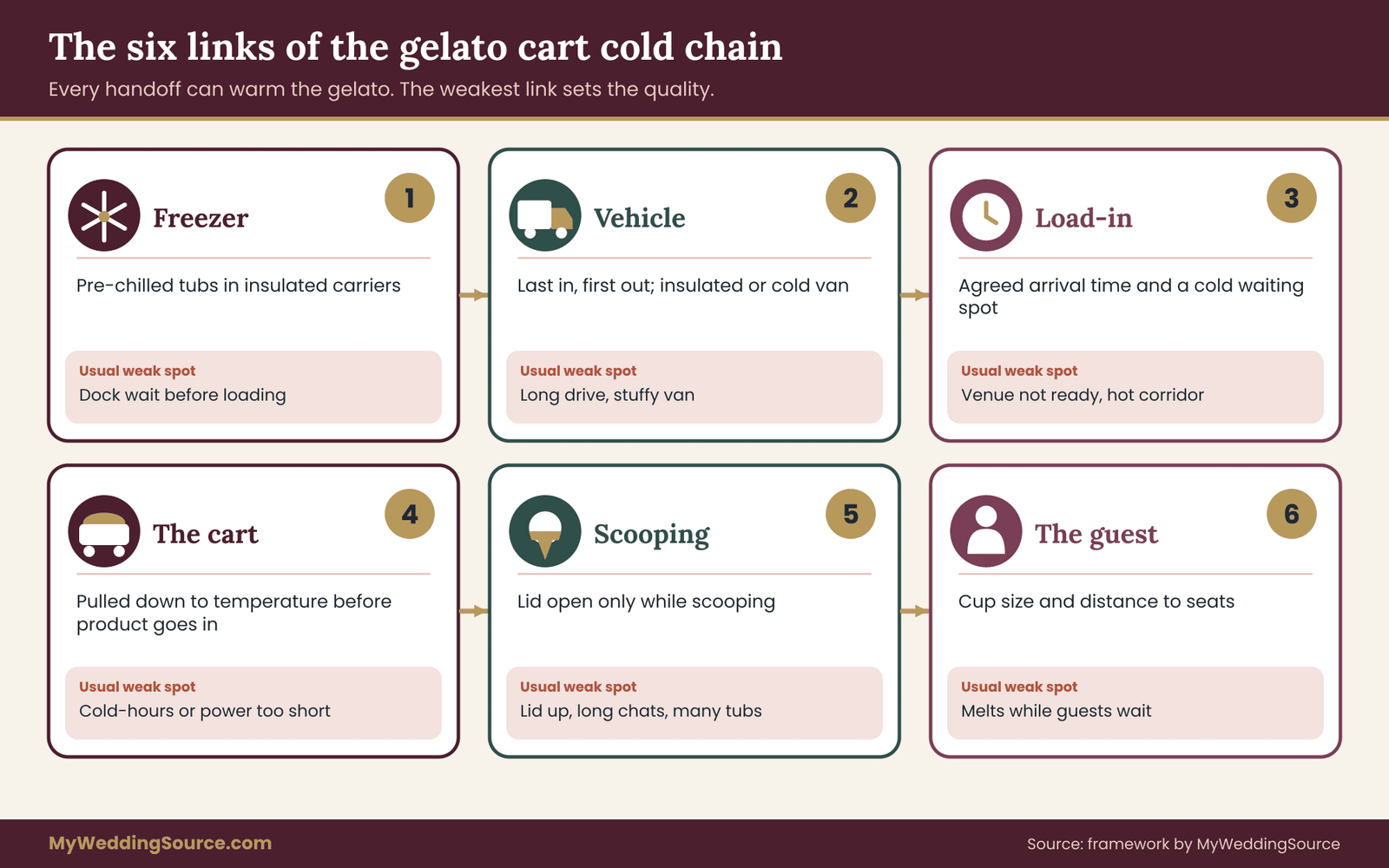
The six links, with the usual weak spot in each
Production freezer to vehicle. Product that sits on a loading dock while the van is arranged starts warming before the trip begins. Ask whether the tubs are pre-chilled, packed in insulated carriers, and loaded last-in, first-out so the first tubs needed are on top.
The drive. A refrigerated or well-insulated vehicle matters more on a summer afternoon than a spring morning, and distance matters. Ask how long the drive is, not just whether the van is cold. A long trip in a stuffy vehicle can undo a lot of careful production.
Load-in and waiting. This is the link couples forget. The van arrives two hours early, the venue is not ready, and the tubs wait in a hot service corridor. Agree on an arrival time that matches the cart’s actual setup needs, and agree where the product waits if the gelato cart cannot be placed yet.
The cart itself. Whether it is a compressor, cold plates or dry ice, the cart is only as good as its starting condition. A compressor cart needs time to pull its cabinet down to temperature after being switched on, and that wait is on the vendor’s setup schedule, not on your timeline.
Scooping. Each time the lid opens, warm air enters. A server who opens the lid wide and leaves it up while chatting costs more cold than a server who works quickly and closes it. This is a training and staffing issue, and it is also a design issue: a menu with fewer flavors means fewer tubs open at once.
The guest. Once gelato is in a cup, it starts melting in a warm room. Cup size, spoon design and the distance between the gelato cart and the seats decide how much of it gets eaten while still good.
Why a cold link matters more outdoors
Indoors, the room temperature is stable and the cart sits under a ceiling. Outdoors, the gelato cart sits in a changing environment: direct sun on stainless steel, hot pavement under the wheels, a breeze that carries the cold off the cabinet opening, and a long queue standing near the lid.
For an outdoor setup, plan for shade over the cart itself, not just for the guests. A cart under an umbrella that leaves half the cabinet in sun is a half-measure. If the venue has a tent, ask whether the gelato cart can sit under the edge of it, with enough room for a line that does not block a walkway.
The National Weather Service publishes heat guidance and forecasts, and checking the forecast a few days before is more useful than trusting a vendor’s general confidence. Our wedding rental planning checklist covers how to rent shade, tenting and extra tables so a gelato cart has what it needs, and the vendor can tell you which of those they bring themselves.
What good looks like, in plain terms
A good plan has a named person responsible for each link. It has a target temperature the vendor can describe. It has a setup window, a service window and a teardown window written down, and it has a place for the cart that was checked in person. It also has a fallback, because every link above can break on a hot day.
None of this requires technical knowledge. It requires asking the questions in the right order, and the rest of this article is organized around those questions, starting with the type of cart, since the type decides what can go wrong.
Choosing the type of gelato cart: plug, plates or cabinet
Quotes for a gelato cart often arrive with a photo and a price and very little else. Underneath the photo, the carts fall into four working types, and the type decides your power needs, your serving speed and your risk on a hot day.

Compressor carts
A compressor cart has a built-in refrigeration unit, like a small freezer, that holds the tubs at serving temperature as long as it has power. The advantage is steadiness: the cold does not run out at the two-hour mark. The cost is dependency. If the gelato cart loses power, the cabinet begins to warm and the clock starts, and the length of that clock depends on the cabinet’s insulation and how often the lid opens.
Compressor carts need you to know the circuit. Ask for the running draw and the starting draw, and ask which is listed on the unit’s rating plate. The running figure is what the cart uses while holding temperature. The start-up surge, when the compressor kicks in, can be several times higher for a moment. The plan in the next section handles that.
Cold-plate or eutectic carts
These carts hold gelato against plates or panels that were frozen solid beforehand, often at a much lower temperature than the serving temperature. They need no plug at the event, which is the reason people book them for gardens, beaches and rooftops with no spare outlets.
The trade-off is a time limit. Plates only hold their cold for a certain number of hours, and the number depends on how cold they started, how full the cabinet is, the outdoor temperature and how often the lid opens. Ask the vendor how long the gelato cart has been tested for in conditions like yours, and how many hours from “plates out of the freezer” to “last scoop” the plan assumes. A cart that is fine for a two-hour cocktail window may be marginal for a five-hour reception where it is opened at intervals.
Dry-ice carts
Some mobile carts use dry ice, which is solid carbon dioxide, to hold temperature. Dry ice is much colder than ordinary ice and does not leave water behind. It also releases carbon dioxide gas as it warms, and the gas collects in closed spaces.
Safety agencies such as OSHA publish handling guidance for dry ice, and the common points are consistent: use insulated gloves rather than bare hands, never seal it in an airtight container, and ventilate any enclosed space where it is stored or transported. If a vendor uses dry ice, ask how it is stored in the vehicle, how it is handled at the venue, and whether guests can ever come into direct contact with it. A well-run vendor will answer without hesitation. A vague answer is a reason to ask more questions.
Dipping cabinets and freezer tables
A dipping cabinet looks like a pastry or deli case with lids over the tubs, sitting on a table or stand. It usually has a compressor, so it behaves like a compressor cart in terms of power, but it is not wheeled and it may stand in a tent or kitchen rather than in the open.
This arrangement suits a caterer or venue that already works with commercial equipment, and it often allows a larger flavor count. It is also the usual choice when gelato is plated in the kitchen and not served from an attractive cart on the dance floor. The look is less photogenic, but the cold is easier to protect.
Which type fits which situation
Use a quick decision rule rather than guessing. If the venue has a dedicated outlet within a short run of the cart’s spot and the load is confirmed, a compressor cart is the least fragile option. If there is no power and the event is short, a cold-plate cart is workable, with a clear service window. If there is neither power nor a short event, a hybrid approach is better: a larger pre-chilled cabinet in a kitchen or vehicle, restocked into a small cart.
A pattern worth knowing: vendors sometimes bring two systems at once, a plug-in cabinet as the main store and a small cart for show. If a quote mentions a “display cart”, ask whether the gelato actually in service is held in the display cart or in a separate freezer behind it. Both are legitimate arrangements, and they change what can fail.
Power for a gelato cart: amps, circuits and generators
Power is the most common practical failure with a plug-in gelato cart, and the one most easily checked in advance. You do not need to become an electrician. You need three numbers and two conversations.
The three numbers
The first number is the gelato cart’s draw. A rating plate on the unit usually lists voltage and amperage, and sometimes wattage. If the plate gives amps, multiply by volts to get watts. A cart marked for 4.5 amps at 120 volts uses roughly 540 watts while running. That figure is an example of the arithmetic, not a claim about any real cart. Always use the actual plate.
The second number is the circuit’s capacity. A standard household-style circuit rated at 15 amps and 120 volts can supply up to 1,800 watts at its limit. Electricians commonly plan for continuous loads at a lower share of that, often cited as around 80 percent, which leaves about 1,440 watts. The National Fire Protection Association publishes the electrical code that sets these planning rules, and the venue’s electrician or facilities manager can tell you what applies on site.
The third number is what else already uses that circuit. A circuit does not belong to the cart just because the gelato cart is plugged in. The DJ, a coffee station, a bar refrigerator, string lights and a phone-charging table may all be on the same breaker, and the breaker adds them up.

The two conversations
The first conversation is with the venue. Ask which outlets are on which circuits, whether any are dedicated, and who can reset a breaker during the event. Ask whether outside equipment must be tested or tagged, and whether the venue requires a certificate of insurance from the vendor. Some venues limit what may be plugged into guest-area outlets and will direct vendors to a service outlet instead.
The second conversation is with the gelato vendor. Ask for the rating plate figures in writing. Ask whether the unit needs a dedicated circuit. Ask what gauge and length of extension cord they bring, and whether they bring a spare. Ask what happens if the circuit trips: how long the cabinet holds before the product is at risk, and what the vendor will do about it.
Extension cords and why they are not an afterthought
A thin or very long extension cord can overheat or drop voltage under load, and some compressors dislike low voltage. The usual guidance is to use a heavy-duty cord rated for the load, keep it as short as possible, and never daisy-chain several cords or run them through a wet area. The Occupational Safety and Health Administration publishes electrical safety guidance, including notes on extension cord use and ground-fault protection, and its electrical pages are a reliable reference if a venue or vendor disagrees.
Cords also create a physical hazard. A cord running across a guest path is a trip risk, and a cord across a doorway gets crushed by a door or a wheel. If the cord must cross a walkway, ask the vendor or venue about a cord cover that lies flat and is rated for foot traffic. Better still, move the cart so the cord does not cross anything.
Generators
A generator solves the outlet problem and introduces four new ones: noise, exhaust, fuel and venue rules. Many venues, especially historic or indoor ones, prohibit gasoline generators entirely. Others allow only quiet inverter-type units placed away from guests, and some require a fuel-storage plan.
If a vendor proposes a generator, treat it as a topic for the venue, not just the vendor. Ask the venue whether generators are permitted, where one may stand, and how exhaust will be kept away from tents and seating. Carbon monoxide from engine exhaust is a real hazard in enclosed or semi-enclosed spaces, and a generator should never run inside a tent or building.
A battery-based power station is a quieter option for small loads, but whether it can run a particular compressor cart through a full service depends on the capacity of the battery and the start-up surge of the compressor. Make the vendor show the arithmetic, in hours, rather than saying it will be fine.
A simple power plan you can write on one page
Write down five lines. The gelato cart’s running and start-up draw. The outlet or circuit assigned to it. Everything else on that circuit and its total. The extension cord length and rating. And the fallback if the cart loses power, including a named person who knows where the breaker panel is and has the key.
That page goes into the file you share with the vendor, the venue and the person running the day. It takes ten minutes to write and removes most of the electrical risk. The same page also helps a planner or coordinator who was not part of the earlier conversations and needs to know why the gelato cart cannot move six feet to the left.
The cold and queue worksheet for a gelato cart
This is the core tool of the article. It is a single worksheet with six lines, labelled A to F, that turns a guest count into a number of servers, tubs and amps. Each line has an input you gather and a result you calculate. You fill it in once with estimates, again with the vendor’s real numbers, and a third time after a trial scoop if you can arrange one.

The worksheet is built on one idea: a gelato cart has a cold budget and a time budget, and both run down while the line stands there. Everything else in the planning is an attempt to spend those two budgets on guests rather than on waiting.
Line A: how many servings
Start with the guest count, then ask what share will actually take gelato. Not everyone does. Some guests are full, some avoid dairy, some are on the dance floor, and some arrive late or leave early. When gelato is the only dessert, the take rate is higher than when cake and a dessert table also compete. If gelato is the main dessert, plan for most guests. If it sits beside a cake and cookies, plan for fewer.
Then decide the serving unit and stick to it. A “serving” is one cup or cone with a fixed number of scoops, such as one or two small scoops. Mixing units is how counts go wrong. Add a buffer for seconds, children who want a second go, and the odd guest who takes two. A buffer in the range of one in ten is a reasonable start, and the vendor can adjust it from experience.
Line A result: servings needed.
Line B: how long the line is open
The window is not the length of the reception. It is the stretch when a line can actually form and be served. Typical choices are a cocktail-hour start, a window after dinner while cake is cut, or a late-evening snack during dancing. A window of an hour is common, and a long window spreads arrivals out and shortens the line.
Deduct the opening and closing minutes. The first few minutes are setup and an introduction, and the last few are for the stragglers and for closing the cabinet. What is left is the active window.
Line B result: active service minutes.
Line C: the real scoop rate
This is where most plans guess, so be honest about it. The scoop rate is the number of finished servings one server can hand over per minute while the line is long. It depends on the cup or cone, the number of scoops, whether toppings are offered, whether payment or tickets are involved, and the server’s experience. A one-flavor cup with no toppings moves faster than a two-scoop cone with a sauce and a topping.
Do not take the figure from a website. Ask the vendor what rate their servers reach at an event of your size, and ask how they know. If you can arrange a tasting that includes a timed practice round with your planned menu, use that, and write down the result with the conditions. The worked example in the next section uses an invented rate so you can see the arithmetic. It is not a benchmark.
Line C result: servings per minute per server.
Line D: servers and access points
Servers needed is the servings in Line A divided by the product of Line B and Line C. A hundred and twenty servings over sixty active minutes at one and a half per minute per server is just over one server, and since you cannot hire a fraction, you plan two. But two servers need two places to work. A cart with a single lid opening, or a cabinet that two people cannot stand beside, does not serve twice as fast with a second person. It serves a little faster with a lot of collision.
So Line D has a companion question: how many access points does the setup have? Two servers at two lids, two carts, or one server scooping while another handles cups, toppings and payment, are all workable. Two people at one small lid is the usual failure.
Line D result: servers and access points.
Line E: tubs and cold reserve
Now convert servings to scoops, and scoops to tubs. Ask the vendor how many scoops a tub or pan yields at the scoop size you chose, because it varies with the scoop and with how the gelato is packed. Divide your scoop total by that yield, then round up per flavor, because you cannot serve half a tub of a flavor that runs out first.
Add a reserve. Popular flavors run out unevenly: one flavor may go three times faster than another. A reserve of extra tubs in the vendor’s backup freezer, with a plan to swap them into the cart, protects against an empty flavor at the wrong moment. Ask whether the vendor carries reserve stock on site and where it waits.
Line E result: tubs per flavor and reserve tubs.
Line F: power or cold-hours
The last line depends on the type. For a compressor cart, Line F is the running draw, the start-up surge, and the circuit load from the power plan. For a cold-plate or dry-ice cart, it is the hours of cold the gelato cart can promise, compared with the hours from setup to the last scoop, plus a margin.
Write the margin down. A cart rated for three hours of cold does not give you three hours of service if setup took thirty minutes and the lid is open every ten seconds. The honest reading is the test number, minus setup, minus the heat penalty for the weather, and compared with the service window.
Line F result: power approved, or cold-hours with margin.
Reading the worksheet as a whole
When all six lines are filled in, check the pattern, not just the numbers. If Line D says two servers but the cart has one lid, the plan fails on Line D. If Line E says eight tubs but the cabinet holds six, it fails on Line E. If Line F says the cold lasts two hours and the window plus setup is three, it fails on Line F.
The value of the worksheet is that a failure shows up on paper in November, not on a warm evening in June. If a vendor cannot or will not supply the inputs, that tells you something about the vendor’s own planning. The vendor due diligence checklist helps you decide how much to ask of any vendor before you commit.
A worked example: a gelato cart for one hundred forty guests
The figures below are invented to show the arithmetic. They are not averages, not vendor data and not recommendations. Swap in your own.
A couple plans a reception with one hundred forty guests and a single dessert course: a small cutting cake plus a gelato cart, served after dinner. The venue is a garden with a covered pavilion, and the pavilion has one service outlet.
Filling in the lines
Line A. Because cake is also offered, the couple estimates that eighty percent of guests will take gelato, which is one hundred twelve people. They define a serving as one cup with up to two small scoops and add about ten percent for seconds, giving roughly one hundred twenty-three servings, which they round to one hundred twenty-five.
Line B. Dinner ends and the cake is cut at a set time. The line opens right after the cake cutting and is planned to run seventy-five minutes. Taking out ten minutes for setup and closing, the active window is sixty-five minutes.
Line C. The vendor says its servers usually reach about one and a half cups a minute on a four-flavor menu with no toppings, and says this is based on its own events. The couple writes “vendor estimate, not tested” in the margin.
Line D. One hundred twenty-five servings over sixty-five minutes is about 1.9 servings per minute needed. One server at 1.5 per minute cannot meet that. Two servers can, at a combined three per minute. The vendor’s cart has two lid openings, so two servers have room.
The queue check
Averages hide the real problem, which is the first ten minutes. Suppose forty percent of the takers arrive in the first ten minutes, as guests who were waiting for dessert head over together. That is about forty-five people in ten minutes, or four and a half per minute, against a service capacity of three. The line grows by about one and a half people per minute and reaches roughly fifteen people at the ten-minute mark. At three per minute, that last person waits about five minutes before being served.
Five minutes is tolerable. If the couple had chosen two-scoop cones with a topping and the pace dropped to one per minute per server, capacity would fall to two per minute, the line would reach twenty-five people, and the wait would climb past twelve minutes. The same cart, the same crowd, a different menu. The next section looks at which menu changes help most.
Lines E and F
Line E. Two hundred fifty scoops are needed, since each serving holds up to two. The vendor says a tub yields about forty small scoops, which is an assumption they confirm in writing. That is about six and a quarter tubs, so with four flavors the couple plans for two tubs of each, eight in total, and asks for two reserve tubs of the two likely favorites. The cabinet holds eight, and the reserve waits in the vendor’s freezer.
Line F. The gelato cart is a compressor model. Its plate says 4.5 amps at 120 volts, about 540 watts running, and the vendor says the start-up surge is higher but short. The pavilion outlet is on a circuit shared with the DJ’s equipment, which the DJ lists at about 600 watts, and with string lights. The couple asks the venue for a different outlet. The venue offers a separate service circuit with nothing else on it, and the plan moves there, with a short, heavy-duty cord along the edge of the pavilion.
What the example shows
The cart type was fine from the start. The problems were the number of servers and access points, the pace assumption, the first-ten-minutes surge, and the shared circuit. All of them were fixable on paper. None of them would have been visible in a portfolio photo, which is why the worksheet comes before the booking decision rather than after it.
Once the worksheet shows how many servers you need, the cheapest way to improve the result is to change the menu, not add staff. Menu design sets the pace. Each choice you hand a guest at the cart costs seconds, and seconds multiply across a hundred people.

Fewer flavors, clearer choices
A cart with twelve flavors looks generous and serves slowly. Guests read the list, ask what is in each one, ask for a taste, change their mind and then ask for a second flavor in the same cup. Every one of those steps happens at the front of the line, with everyone behind them watching.
A smaller menu of three to five flavors, chosen to cover different tastes, keeps people moving. One creamy classic, one fruit-forward option, one chocolate or nut flavor and one dairy-free sorbetto cover most of a crowd. If there is a signature flavor tied to the couple, make it one of the four and not an extra.
Fewer flavors also help the cold. Each open tub is a warm opening, and fewer tubs in rotation mean less time with lids up. They also make allergen labeling easier, which matters in the next section.
Cups, cones and what each costs in seconds
A cup is faster than a cone. A cone has to be held, loaded and handed over carefully, and it can break or drip. A cup goes straight into a hand with a spoon. Cones also melt down the arm in warm weather, which creates its own cleanup line at the napkin station.
If you want cones for the photographs, offer them as an option with a limit: perhaps a single scoop, with cups as the default for two scoops. Alternatively, have the gelato cart serve cups and keep cones for a photographer’s set of shots early in the service, when the line has not formed yet.
Tasting spoons
Tasting spoons slow a line and raise hygiene questions, since each spoon is a new contact with a guest’s mouth and then possibly a shared container. A line of fifty people with fifty tastes is a line of a hundred transactions. Many professionals handle this by posting clear flavor cards with a short description and offering one or two tastes only to people who are truly unsure, using fresh spoons each time.
Ask the vendor how they handle tastes, and agree on a policy in advance. A good policy is one sentence on a sign: ask a server if you are unsure between two flavors.
Pre-scooping and holding
Some vendors pre-scoop servings into cups and hold them in a cold cabinet during the first surge. This is the single biggest speed boost, because the server hands over a cup in seconds instead of scooping it fresh. The trade-off is quality and cold: pre-scooped gelato held too long loses its texture, and the cabinet that holds the cups needs enough capacity.
A common compromise is to pre-scoop a modest batch for the first ten minutes, when the surge arrives, then switch to scooping to order. Ask the vendor whether they do this and what they put in the cabinet. If they pre-scoop, ask which flavors and how long the cups wait.
Handling payment, tickets and toppings
At a wedding, guests should not pay, so no payment step should slow the line. But two other steps sometimes appear: tickets or tokens, used to limit servings, and toppings. Tickets add handling and make guests search their pockets. Toppings add choices.
If you want to limit servings, a better approach is to set the quantity at the booking stage and let the cart run until the gelato is gone, rather than adding a ticket system that creates friction. If toppings matter to you, offer a single topping station next to the gelato cart, run by a separate person or self-served with tongs, so the server never stops scooping.
How many servers and where they stand
Return to the worksheet. A second server helps only if the cart can use a second server. Check where each person stands, who touches the cup, and who closes the lid. A typical efficient layout has one person scooping and another handing cups and napkins to guests, with the cups pre-set on a tray at arm’s reach.
Two scoopers at separate lids give the highest throughput. A scooper and a runner at one lid give a smaller but cleaner gain. A scooper with an unprepared helper standing nearby gives almost no gain at all. Ask the vendor to describe, not just count, the staffing.
The line itself
A line is a physical object. It needs somewhere to stand, a direction and a boundary. If the gelato cart sits against a wall in a corner, the line folds back on itself and blocks the path to the bar. If the cart sits in a doorway, the line blocks the exit. If it sits in the middle of the dance floor, you have a new dance floor problem.
Place the gelato cart so the line can extend at least a dozen feet in one direction without crossing a main route, a power cord or the entrance to the restrooms. The reception guest flow guide walks through how guests move between food, seating and the dance floor, and the same thinking applies to a single cart: give the line a straight path and an obvious end.
Signage that saves seconds
A short sign beside the cart helps more than a long speech. It should name the flavors, mark dairy, nuts and dairy-free options clearly, state how many scoops a serving includes, and tell guests where the napkins and the return trash bins are. Place it where people read it while waiting, not at the gelato cart, where reading holds up the person being served.
Large type matters, since guests read signs at a distance and in dim light. If the cart is lit only by string lights, a dark sign is useless. Ask the vendor whether they bring a lit or high-contrast menu board, and check that the board lists no flavor they do not intend to bring.
Height, reach and accessible service
A cart with a high lid or a tall counter is hard for a guest who uses a wheelchair or has limited reach. The ADA site from the Department of Justice explains the idea of accessible service counters, and the practical version is simple: leave clear floor space at the front, and have the server step around to hand a cup over. Mention it to the vendor when you book.
Speed versus experience
None of this means a cart should feel like a cafeteria. The point of a gelato cart is the small ritual: a friendly server, a choice, a cold treat. The aim is to make the necessary choices simple and quick, so the ritual survives the crowd. If a plan sacrifices every pleasant moment for throughput, the gelato cart has lost the reason you booked it.
A good balance is a short menu, a default cup size and one optional upgrade, with a server who greets everyone and keeps the line moving without hurrying anyone. If you want some flexibility, create a second, slower service later in the evening when the line has gone and there is time for a custom order or a second flavor.
A speed checklist in sentences
Before signing, you should be able to say: how many flavors the cart will carry; whether servings are cups, cones or both; whether tastes are offered and how; whether any cups are pre-scooped and for how long; how many servers work and at how many lids; where the line forms and which way it points; and where the menu board stands. If the vendor can answer each in a sentence, the gelato cart is probably well run.
If you want to go further, ask the vendor for a timed trial at a tasting, using your actual menu. A few minutes with a stopwatch gives you Line C with a name on it, and it costs far less than discovering the pace in the middle of your reception.
Food safety, allergens and permits for a gelato cart
A gelato cart is a food business on wheels, and it carries the same obligations as any other food vendor. Your part is not to inspect it. Your part is to ask for the evidence a careful couple would ask for and to know who is responsible if something is missing.
Permits and licenses
Mobile and temporary food vendors usually need a permit from the local health department, and many places also require a business license. The rules differ widely by city and county, and by whether the cart operates from a commissary kitchen, what it sells and whether it prepares anything on site. The FDA Food Code is a model code that many state and local agencies adopt in some form, and the FDA’s food pages explain the framework. But the code that counts is your local one.
Ask the vendor for a copy of its current health permit and the name of the inspecting agency. Ask whether the permit covers events in the county where your wedding is held, because some permits are tied to a location or a jurisdiction. If the vendor says the permit is “in the van”, ask to see it in advance.
If a caterer or venue holds the food service license for the event, ask whether an outside gelato vendor is allowed at all, and whether the caterer wants to approve the vendor’s paperwork. Some venues have an exclusive caterer who treats outside desserts as a rule exception, and the answer shapes your booking. Ask this question early, before the gelato vendor is booked.
Cold holding and what to ask about it
The FDA Food Code sets cold-holding expectations for foods that need temperature control, and frozen desserts are handled differently from refrigerated foods. A fully frozen product served from a freezer is not treated like cut melon in a cooler. But gelato that has melted and been held warm is a different story, and many food-safety authorities advise against refreezing thawed frozen desserts.
You do not need to memorize the rules. You need to ask the vendor a few things. How do you check the temperature of the gelato cart during service? Do you carry a thermometer, and do you log readings? What do you do with product that has softened past what you consider acceptable? What happens to leftovers? A confident vendor answers with a procedure, not a shrug.
Hygiene at the cart
Look for a few concrete signs. Servers should wash hands before service and between tasks, with a handwashing setup if the gelato cart operates for long periods. Scoops should be rinsed or held in a clean water well or a dipper well, and a scoop should not be put back into a tub after touching a hand or a cup. Servers should not handle money and food without a change of gloves or a handwash. Hair should be restrained, and anyone who is sick should not work the event.
These points matter for the same reason they matter in a restaurant: one careless step can affect a hundred servings. Federal food-safety resources, such as FoodSafety.gov and the CDC’s food safety pages, explain the basics in plain language, and a vendor who has read them will usually say so.
Allergens at a gelato cart
Gelato contains milk. Many flavors contain nuts, eggs or other major allergens, and even a sorbetto that has no dairy in its recipe can be scooped with a shared scoop or held next to a flavor that does. For guests with allergies, cross-contact is the issue.
U.S. food-allergen rules identify nine major allergens: milk, eggs, fish, crustacean shellfish, tree nuts, peanuts, wheat, soy and sesame. A vendor should be able to tell you which of these appear in each flavor, in the ingredients and in the shared equipment. The FDA’s food allergen pages describe the framework.
Ask for an ingredient and allergen sheet for each flavor, in writing, ahead of time. Then decide with the vendor how the cart handles a guest with an allergy. A good practice is a dedicated scoop and a clean tub for a dairy-free or nut-free option, a fresh scoop pulled from a clean container, and a server who is trained to say “I’m not sure” rather than guess.
Be cautious about promises. A vendor who calls a flavor “allergy-safe” has made a claim you cannot check at the event. A better description is “made without nuts, scooped with a dedicated scoop, produced in a facility that also handles nuts”, and a guest with a serious allergy can decide for themselves. If the caterer collects dietary information from guests, share the dessert plan with them so the same list covers the gelato cart.
Labeling and the guest who needs details
Guests with allergies often want to read an ingredient list, and a cart that has only a chalkboard menu cannot provide one. Print a small card for each flavor with its main ingredients and allergens, and keep a set at the cart. The cards can also be kept behind the gelato cart for guests who ask, so they do not clutter the display.
For a guest with a severe allergy, the safest option is often a pre-packaged, individually sealed dessert from a source the guest trusts, held separately. Gelato cart service is not always the right solution for every guest. The aim is to include people, not to pretend that a shared scoop can be made risk-free.
Insurance and liability
Most venues ask outside vendors for a certificate of insurance listing the venue as additional insured. A food vendor typically carries general liability coverage, and some carry product liability. Ask your vendor whether they can provide a certificate and how long it takes, because venues often require it days before the event.
Do not treat this as a legal conclusion. Insurance wording is technical, and the venue’s requirements are the ones that matter. If you are unsure, ask the venue to send its vendor insurance requirements in writing, and forward them to the gelato vendor. The vendor contract guide covers what the contract should say about insurance, indemnity and who pays if something goes wrong.
Waste, leftovers and what happens to the rest
At the end of service there will be leftover gelato, some of it melted. The vendor owns the product unless the contract says otherwise. A reputable vendor takes unused tubs back, and discards anything that has been out of temperature control. They should not leave open tubs for the venue staff to deal with.
If a couple wants leftovers, ask beforehand, and expect the answer to be that unopened tubs may be available while opened ones are not. Food donation rules differ by place, and a food bank may accept packaged, still-frozen product under specific conditions but not scooped product from an event. Do not promise guests or staff a take-home treat unless the vendor has agreed in writing.
Used cups, spoons and napkins add up. Provide clearly marked bins close to the cart, and agree on who empties them. If you prefer compostable or reusable serviceware, tell the vendor early, because the gelato cart’s cups and spoons are usually bought in advance.
Heat, rain and venue limits for a gelato cart
Weather is the variable you cannot negotiate, and a gelato cart is more exposed to it than most dessert formats. A cake sits in a room. A cart stands in the open with its lid up, in front of a line.
Planning for heat
Heat attacks three things at once: the cabinet, the product in the scoop and the server. The cabinet works harder in direct sun, a compressor cart cycles more often and draws power for longer, and a cold-plate cart gives up its cold faster. The scooped gelato melts faster in the cup, which pushes guests to eat quickly and creates drips. And servers working in the sun tire and slow down.
Practical steps are not complicated. Put the cart in the shade, or provide shade it can stand under. Keep the gelato cart away from heat sources such as dark pavement, a grill or a heat lamp. Open the lids only when scooping. Offer a small water station near the line, because guests who are hot want a drink too. And have the vendor store reserve tubs in a cooler or vehicle, not in the sun behind the cart.
Check the forecast a few days before and again the morning of the wedding. The National Weather Service posts forecasts and heat alerts by location. If the forecast calls for unusual heat, call the vendor and ask what changes: an earlier start, a smaller cup, a shorter window, or a switch from cones to cups. Vendors who work hot weather events regularly have answers.
Rain, wind and the covered fallback
Rain affects a gelato cart less than people expect, provided the gelato cart is covered and the power is dry. The risks are electrical connections in wet areas, an uncovered line of guests and the loss of the outdoor location. Cords and connections should not sit in puddles, and outdoor outlets should be protected. OSHA’s electrical safety pages explain why ground-fault protection and dry connections matter, and a venue can tell you what its outdoor outlets provide.
Wind is less obvious. A strong breeze carries cold off an open cabinet, tips umbrellas and can knock a menu board over. A tent with sides, or a spot sheltered by a building, helps. Ask the vendor how the cart is secured and what the wind limit is for its umbrella or canopy.
Write a weather fallback and agree on it before the day. A reasonable version names the covered alternate location, who decides to move, and the time by which the decision must be made. The reception weather delay guide is not part of this plan, but the same logic applies: decide in advance who moves what and by when.
Venue rules to check in writing
Venues differ in what they allow, and many of the rules are written for caterers, not couples. Ask the venue the following and get the answers in writing. May outside food vendors operate on the property? Is there a fee for outside vendors, or a requirement that vendors use a particular loading dock or door? Are there floor protection rules, such as wheels on a wood or stone floor? What are the hours for load-in and load-out? Are open flames, generators or dry ice restricted?
The venue loading dock rules guide goes deeper on access, and our rental planning checklist covers items the venue may expect you to rent. For a gelato cart specifically, the questions with the most consequences are power access, floor surface and whether the gelato cart can pass through the doors with its umbrella down.
Distances and surfaces
Carts have wheels, and wheels dislike gravel, grass, cobblestones and steps. A cart that must cross twenty yards of lawn needs a plan: wider wheels, a ramp, a path of boards or simply two people to lift. Heavy compressor carts can sink into soft ground on a wet day. A vendor who has seen your site photos can say whether the cart will move. A vendor who has not seen them is guessing.
If the gelato cart cannot be moved once placed, decide the placement before the vendor arrives. Moving a loaded compressor cart across a patio mid-event is both a safety problem and a cold-chain problem. The venue walkthrough is the moment to stand in the actual spot and check the surface, the slope and the distance to the outlet.
Noise and lighting
A compressor hums, and a generator is louder. For a quiet ceremony-adjacent cocktail hour, that sound carries. For a dance floor it disappears. Place the cart where the noise does not interfere with speeches or music.
Lighting matters for both the guest and the server. A cart in a dark corner is hard to read and hard to serve from. A string of lights, a lamp on a battery or the venue’s own lighting near the gelato cart should reach the serving area and the menu board. Ask the vendor whether the cart has its own light and whether it is on the circuit plan.
Timing a gelato cart inside the reception
A gelato cart rarely fails because of what it serves. It fails because of when. A good time is one that spreads arrivals out, avoids competition with other events, and leaves time for the gelato cart to be ready before anyone is hungry.
Choosing the service window
There are four common choices, and each shapes the line differently.
During cocktail hour. Guests are standing, moving and not yet full. The gelato cart sits near the bar or lawn, and the line is gentle. The downside is that gelato during the first hour competes with appetizers and drinks, and the cart must be ready early, which means a longer cold-hold before service.
After dinner, with the cake. This is the classic dessert slot, and the line forms all at once. It gives the most guests, and it produces the sharpest surge. It also puts the gelato cart’s setup at risk, since dinner service may delay the opening.
During dancing. A late-evening treat keeps energy up. The line is spread out over an hour or more, which suits a single server. The cart must stay cold longer, and some older guests will have left.
As a late-night finish. A second, smaller service near the end gives guests a send-off. It is also where the gelato cart is at its most fragile, with a long cold-hold behind it.
Staggering to shorten the line
The most effective timing trick costs nothing. Instead of announcing dessert to everyone at once, release tables in groups, as the venue’s caterer does with a buffet. The same logic is used in the wedding buffet line table release guide. Table by table, the line is a series of small waves instead of a single flood.
Another variation is a cart that opens fifteen minutes before the cake cutting, for early arrivals and for photos, and stays open afterward. The early minutes use the server’s time when the line is empty and reduce the surge.
The setup and teardown windows
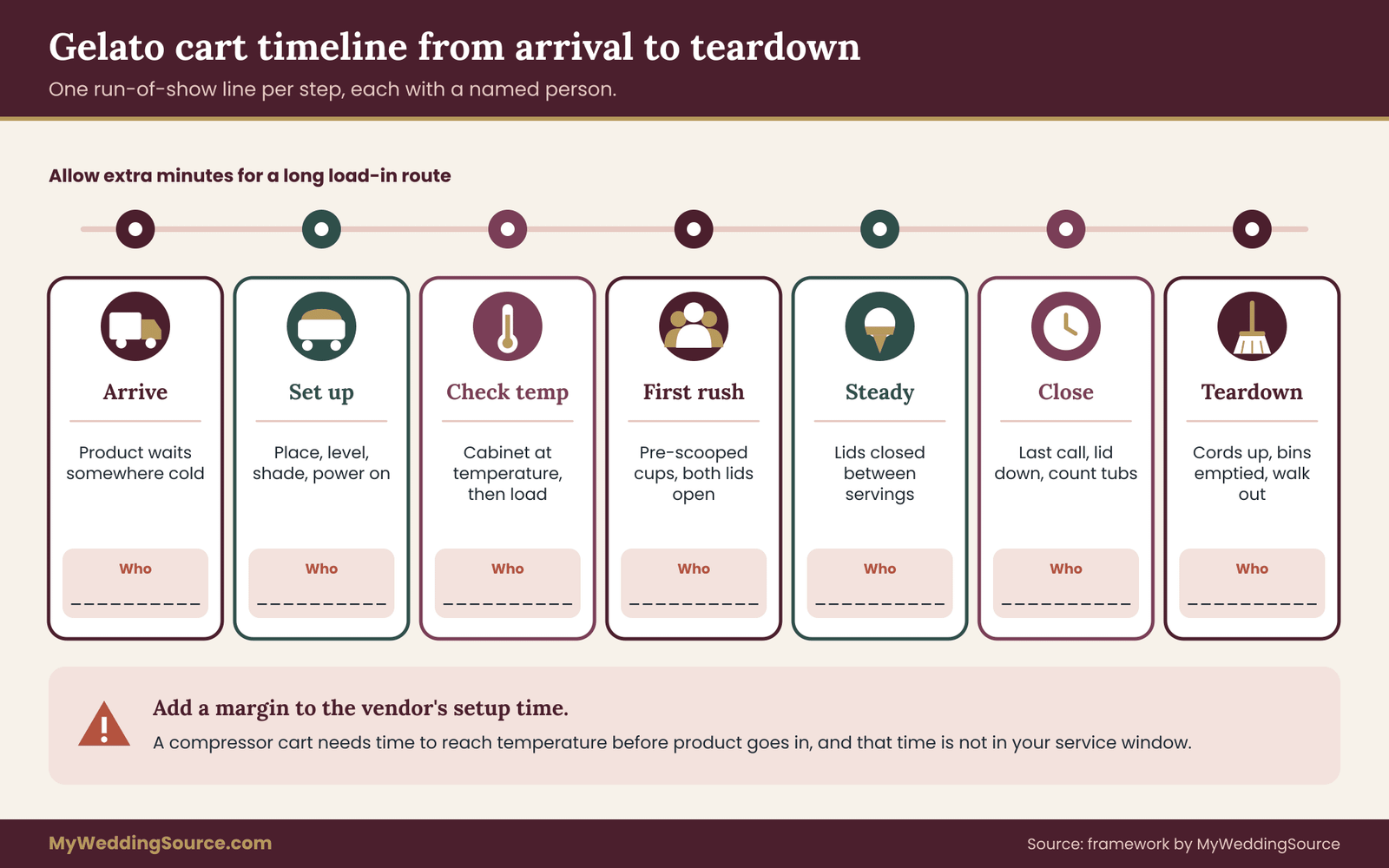
A gelato cart needs a setup window, and the compressor type needs time to reach temperature before product goes in. Ask the vendor for the full timeline: arrival, unloading, placement, power on, temperature check, product loaded, ready for service. Add a margin of thirty minutes to whatever they quote if the load-in route is long.
For teardown, ask when the cart can leave. Some venues do not allow loading while guests are present, and a cart that stays until the end of the reception sits in the middle of the room. Agree on a teardown time, a route and a person who walks the vendor out.
Building the run-of-show line
A single line in the run-of-show covers all of this. It should list the time the vendor arrives, where the product waits, when the gelato cart is powered, when it is at temperature, when service opens, when it closes, and when it leaves. Give a copy to the coordinator, the venue and the caterer. The ceremony cue sheet guide shows how a good cue sheet reads, and the reception equivalent follows the same principle: one named person per time.
Pairing with cake and other desserts
If a cake is also served, align the two. The cake cutting is a natural moment, but if cake slices and gelato come out together, a single line is better than two. Some caterers offer a slice and a cup together, and then guests take both. Others open the gelato cart after the cake, for those who want something cold. Cake timeline planning covers the cake side, including when the cake must be ready and cut.
If the gelato is the main dessert and no cake is cut, plan a small ceremony anyway, since guests will wait for a signal. A couple’s first scoop, a short announcement and a clear time for the line to open can replace the cutting.
Quotes, contracts and costs for a gelato cart
Quotes for a gelato cart come in several shapes, and comparing them takes a little translation. The price on the page is rarely the price you pay, and the missing items are usually the ones the worksheet exposes.
Reading the pricing model
Vendors usually price in one of four ways. A flat package covers a set number of hours and servings. A per-person rate multiplies by the guest count or the expected servings. A per-scoop or per-serving rate charges for what is actually served, often with a minimum. An hourly rate covers the cart and staff for a window, with product charged separately.
Each model rewards a different behavior, and each has a different risk. A flat package is simple but may not scale if your guest count rises. A per-person rate can leave you paying for guests who do not take gelato. A per-serving rate protects you from waste, but makes the final bill uncertain. An hourly rate is clear on time, and then you need to know how many servings that time can support.
Whichever model you see, ask the vendor to restate it as a cost per serving at your expected servings from Line A. That one number lets you compare quotes. It also reveals a quote that looks cheap only because it assumes a smaller crowd or a slower service.
What is often missing from a quote
Ask whether each of the following is included, extra or not offered: delivery and travel, setup and teardown time, a second server, cups, cones, spoons and napkins, signage, power equipment such as cords and cord covers, a generator, the venue’s vendor fee, a certificate of insurance, a taste test, a trial run, reserve tubs, and a service charge or gratuity. The service charge and tip logic in the gratuity guide applies if you are unsure how the vendor handles it.
None of these is unreasonable to charge for, and a vendor should explain what each item costs. The point is to see them before the contract, because each one tends to appear as a line on the final invoice.
Minimums and the shrinking guest count
Many vendors set a minimum, either as a number of servings or as a spend. If your guest count drops after the guarantee date, the minimum may stay. Ask for the date by which you can change the count, the reduction allowed without penalty, and how the vendor handles a count that rises. This mirrors the way catering contracts work, and the catering minimum spend guide explains the same mechanics for food and beverage.
What the contract should say
A contract for a gelato cart does not need to be long, but it should be specific. It should name the date, the address and the service window, with a start and end. It should specify the type of cart and what powers it, plus the power the vendor needs and who provides it. It should list the flavors, or the number of flavors and when they will be confirmed, and it should state the number of servers.
It should also state what the vendor does if the gelato cart fails, such as a backup cart, a refund or a replacement dessert. It should describe the vendor’s permit and insurance, who is responsible for cleanup, and how and when payments are due. And it should explain the cancellation terms, including what happens if the weather forces a change.
Our vendor contract guide goes through contract clauses in general, with an emphasis on what to look for before signing. For a gelato cart, the clauses that matter most are the backup plan, the service window and the power requirements, because those are the ones that decide whether the cart can serve at all.
Payment timing and deposits
Deposits for small food vendors are usually modest relative to the final bill, and the balance falls due before or on the day. Make sure the due dates fit your cash plan, and write them into the payment calendar you already keep for other vendors. The cash-flow planning guide shows how deposits and final balances are scheduled across the whole wedding.
Where the gelato cart fits in the budget
A gelato cart is sometimes chosen to replace a larger cake, and sometimes as an extra. Count it as an extra unless you have decided that it replaces something else, and look at the total dessert line, not just the gelato cart. The wedding budget guide can help set a dessert allocation inside the larger plan.
Be honest about trade-offs. A cart adds staff, equipment and logistics that a cake does not. In exchange, it adds an activity and a moment, which some couples value more than a tiered cake. Neither choice is wrong, but they cost different things, and the cost is not only money.
When something goes wrong at a gelato cart
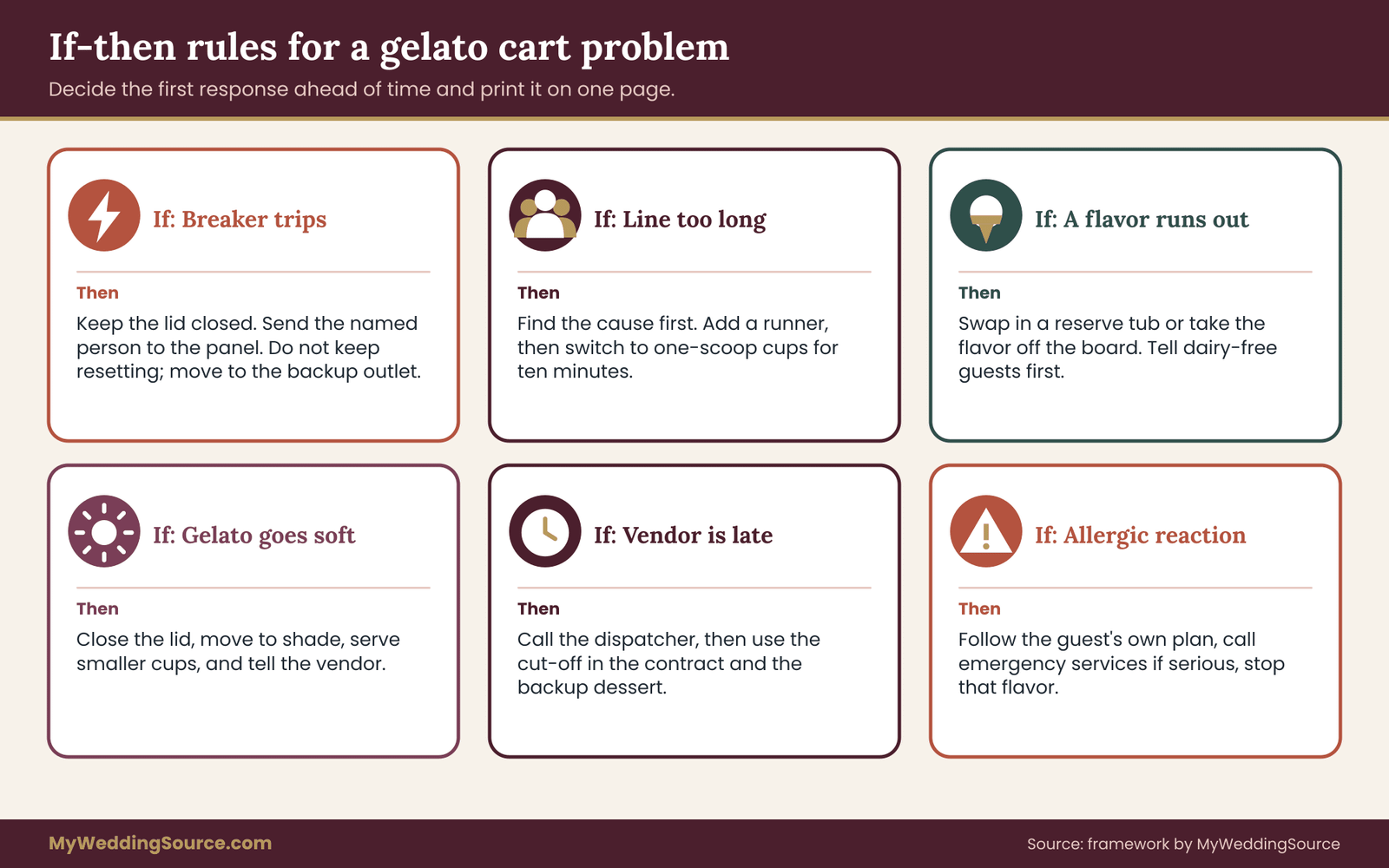
Most problems at a gelato cart have been seen before, and each has a standard first response. The plan below is a set of if-then rules, written ahead of time, so that a person on the day does not need to improvise.
The power trips
If the breaker trips, the cabinet keeps its cold for a while, and the first rule is to keep the lid closed. Send the named person to the panel with the key. If the circuit trips again, do not keep resetting it: unplug the cart and move it to the backup outlet from the power plan. If there is no backup outlet, switch the gelato cart to a generator only if the venue has already allowed one.
Ask the vendor beforehand how long the cabinet holds with the lid closed, and use that number as the trigger. If power is not restored by then, move product to the vendor’s backup freezer or cooler and either pause service or switch to pre-scooped cups. Tell the coordinator, who can announce a short delay.
The line is longer than expected
If the line exceeds the number you planned for, look for the cause before adding staff. Is a server answering questions at the front? Is a flavor running out and causing hesitation? Is the menu board unreadable? Often a single fix, such as a runner who tells people the flavors while they wait, shortens the line.
If the line is long because more guests than expected want gelato, offer cups with one scoop for the next ten minutes. A smaller serving lets the line move and lets everyone be served, and the second scoop can be offered once the line has cleared.
The cart runs out of a flavor
Swap in a reserve tub if one is available, and update the board. If not, remove the flavor and say so. A guest is happier to hear “we are out of pistachio” than to wait and then be told. If a dairy-free flavor runs out, tell the guests who need it first, and have the vendor offer an alternative from the backup freezer.
Heat makes the gelato soft
If scoops are slumping, shorten the service window, close the lid between servings and move the gelato cart farther into shade. Serve smaller cups so guests finish them faster. If the cabinet is not holding temperature, tell the vendor, who should check the unit and consider swapping in the backup product. Do not serve product that has melted and refrozen, and do not let anyone argue the point at the cart.
The vendor is late or does not arrive
This is rare and serious, and the plan should be written down. A contract with a late-arrival clause lets you set a point beyond which the service is cancelled. Know that time, and know the replacement: packaged frozen treats from a nearby store, an extra cake, or a different dessert from the caterer. Keep the vendor’s phone number, the dispatcher’s number and the coordinator’s number together on one sheet.
A guest has an allergic reaction
Stay calm and follow the guest’s own plan. Call emergency services if the situation is serious. Do not leave the guest alone, and do not let the gelato cart continue serving the flavor in question until it is secured. After the event, write down what happened for your own record and the vendor’s. This is why the allergen information and cart labeling matter before the event, not after.
Making the plan usable
A plan that lives in a folder does not help. Reduce it to a single page with the if-then rules, names and phone numbers, and give copies to the coordinator, the vendor lead and a trusted friend or family member. Pick one person who is allowed to make decisions about the cart, so there is no committee at the front of the line.
Your next steps
You do not need to do everything at once. A reasonable order is below, and each step feeds the next.
- Pick the likely service window and the gelato cart’s location, then visit the site or ask for photos and measurements of the spot, the outlet and the route.
- Fill in the worksheet with estimates for Lines A to F, and note which inputs are guesses.
- Ask each vendor for the rating plate figures, the cart type, the cold-hours, the staffing plan and the pace they expect, in writing.
- Check the venue’s rules on outside vendors, generators, dry ice and power, and ask for a service outlet away from other loads.
- Request the vendor’s health permit, insurance certificate and ingredient and allergen sheet for every flavor.
- Arrange a tasting with a timed practice round if you can, and update Line C.
- Sign a contract that states the service window, power needs, backup plan and cancellation terms.
- Write the one-page power plan and the one-page if-then plan, and share them with the coordinator and the venue.
If you only have time for two things, make them the power plan and the staffing plan. Those two address the most common failures, and both can be fixed on paper long before the wedding.
FAQ
How many servers does a gelato cart need for a wedding?
It depends on your servings, the active service window and the pace of each server. Divide the servings needed by the active minutes and by the servings per minute one server really handles. Then check the access points, since two servers need two places to work. Ask the vendor for their pace at an event of your size, and test it with a timed trial if you can.
Does a gelato cart need electricity?
Some do and some do not. A compressor cart needs a plug and a suitable circuit, while a cold-plate or dry-ice cart runs without power for a limited number of hours. Ask for the rating plate figures if the cart plugs in, or the tested cold-hours if it does not. Confirm either one with the venue and the vendor in writing.
Can a gelato cart run on a generator?
Sometimes, but the venue has to allow it. Many venues restrict or ban generators, especially indoors or near guests. If one is allowed, it should stand outdoors, away from tents and seating, because engine exhaust contains carbon monoxide. Ask the vendor to show that the generator can handle the gelato cart’s start-up surge, and ask the venue where it may be placed.
How long does gelato stay cold in a cart?
It depends on the cart type, the starting temperature, the weather and how often the lid opens. A compressor cart with steady power holds temperature for as long as it runs. A cold-plate cart has a limited number of hours. Ask the vendor how long the cart has been tested in conditions like yours, and subtract setup time and a heat margin.
How do I keep the gelato cart line short?
Use a short menu, default to cups, limit tasting spoons and pre-scoop a modest batch for the first rush. Release tables in groups rather than announcing dessert to everyone, and give the line a clear path. Make sure the number of servers matches the number of lids. A timed trial with your actual menu tells you more than a guess.
What allergen information should a gelato vendor provide?
A written ingredient and allergen list for each flavor, covering the major allergens: milk, eggs, fish, shellfish, tree nuts, peanuts, wheat, soy and sesame. Ask about shared scoops, shared tubs and facility cross-contact. For guests with serious allergies, ask how the vendor keeps a dedicated scoop and tub, and consider a sealed alternative the guest trusts.
Does a gelato cart need a health permit?
Mobile food vendors usually need a permit from the local health department, and rules vary by city and county. Ask the vendor for a current copy and the name of the agency, and confirm that it covers your event location. Check with the venue and the caterer too, because some venues require approval of outside food vendors and paperwork.
What should a gelato cart contract include?
The date, address and service window, the type of cart and its power or cold needs, the number of servers and flavors, and who provides what. It should also name the vendor’s permit and insurance, the backup plan if the gelato cart fails, cleanup duties, payment dates and cancellation terms. Include a late-arrival clause with a clear cut-off time.
Sources
- U.S. Food and Drug Administration, Food
- FDA Food Code
- FDA, Food Allergies
- FoodSafety.gov
- Centers for Disease Control and Prevention, Food Safety
- Occupational Safety and Health Administration, Electrical
- National Fire Protection Association
- National Weather Service
- Consumer Product Safety Commission
- ADA.gov, U.S. Department of Justice Civil Rights Division