
A monofloral bouquet is a monofloral bouquet built from one kind of flower, and it succeeds or fails on practical grounds long before it succeeds on looks. This guide gives you a one-page worksheet that tests any bloom for hold time, structure, supply, safety and appearance, so you can choose one flower with evidence instead of a hunch.
Choose a monofloral bouquet by running each candidate bloom through five gates: Hold (how many hours it stays presentable out of water), Build (whether its stem and head size can form a stable shape), Supply (whether your florist can source enough in your season), Safety (whether anyone who will touch or sniff it has a plant-specific risk), and Look (how the single flower reads in photos). Any failed gate removes the bloom or forces a named fix. Pick the flower that passes all five, not the one you saw first.
Most advice about single-flower bouquets starts with a picture. A fistful of white tulips, a dome of garden roses, a loose armful of ranunculus. The pictures are persuasive, and they hide the question that decides whether you will enjoy the bouquet on the day: can this particular flower do this particular job for the number of hours you need?
A mixed bouquet hides weakness. If one stem type droops by the reception, the others still hold the shape. A monofloral bouquet has no such cover. Every stem fails in the same way at the same time, because they are the same plant with the same water uptake, the same stem strength and the same reaction to heat. That is why the choice deserves a structured test instead of a mood board alone.
This article is built around a worksheet you can fill in at the kitchen table or in a florist consultation. It is not a ranking of flowers. Growing conditions, varieties, regions and seasons change too much for a fixed list to stay true, and any list that claims otherwise is guessing. Instead you get a method, a worked example with an invented couple, the questions that make florists give precise answers, and a short list of edge cases.
A note on scope. This guide is general information, not legal, tax or financial advice, and plant safety details must be checked against current sources for the exact flowers you choose.
What a monofloral bouquet is, and when it is the right call
In floristry, “mono” means one. A monofloral bouquet uses one species of flower as its main material, and often as its only material. People use the term loosely, so it helps to separate three levels before you talk to a florist, because the level changes the price, the supply risk and the look.
Strict. One species, one variety, one color, nothing else in the hand. Think of a bundle of a single white tulip variety, tied and cut flat. This version is the most dramatic and the least forgiving, because there is nothing to adjust if a few stems arrive short or bruised.
Soft. One species, several varieties or colors. A bouquet of garden roses in four shades of blush, or ranunculus in cream, peach and coral. The silhouette still reads as one flower, but the florist can mix stems from different growers, which softens supply risk and gives some room to hide a weak stem.
Framed. One flower plus its own foliage, or one flower plus a plain green such as a few leaves. The flower is still the whole story, but the greenery gives the florist structure, covers mechanics and sometimes adds a little hold time because foliage is tougher than many petals.
Write down which level you actually want. Couples often say “just one flower” and then, when shown a strict version, ask for greenery. That is a normal reaction, not a failure of nerve. Greenery is a structural tool as much as a style choice, and the Build gate later in this guide explains why.
Why couples choose a monofloral bouquet
The reasons are usually good ones. A single flower gives a clean, confident shape that photographs well against a plain dress. It is easy to describe, so a florist can quote it without a long design conversation. It can match a restrained color story, and it lets you spend a budget on a better bloom instead of spreading it across many cheaper stems. If your wedding already has a firm wedding color palette, one flower can express that palette more strictly than a mixed arrangement can.
There is also an honest emotional reason. Some couples want a flower with a meaning, a memory or a family link, such as a plant that grew in a grandparent’s garden. A monofloral bouquet puts that single choice at the center.
Why a monofloral bouquet goes wrong
The same strengths create the failure modes. Because the whole bouquet depends on one plant, it carries four concentrated risks.
First, a single point of supply. If a grower has a bad week, there is no second flower to swap in. Second, a single hold profile. If the bloom wilts, browns at the edges or shatters, the entire bouquet does.
Third, a single structure. If the stems are too thin to support the heads, or the heads are too large to form a dome, the monofloral bouquet cannot be fixed by adding a different stem. Fourth, a single safety profile. If the flower is a problem for one guest, a florist’s hands or a pet at home, there is nothing else in the bouquet that changes the answer.
None of these makes a monofloral bouquet a bad idea. They make it a decision that should be tested, which is what the rest of this guide does.
Situations where a monofloral bouquet fits well
A monofloral bouquet tends to work best when the conditions are on its side. The ceremony is short and the monofloral bouquet will be set down in water soon after. The weather is mild. The flower is in a peak local season, so supply is deep and the price reflects abundance instead of scarcity. The wedding party is small enough that each bouquet can be built from the best stems. And the person carrying it is comfortable holding a bouquet with a deliberate, simple shape.
It also fits when you are willing to accept a version of the flower that is slightly different from your first picture. A couple who wants peonies but will accept garden roses has a much easier supply problem than a couple who will accept only one named peony variety.
Situations that call for caution
Be more careful when the day is long, hot, windy or outdoors with no shade, when the flower is known to be delicate or seasonal, when the wedding party is large, or when the bouquet will be handled by many people for many photos. Be careful too when someone in your circle has allergies, when pets or young children will touch the flowers at home before or after, or when the bloom you love is out of season where you live and would arrive by air.
Caution does not mean avoidance. It means the worksheet below matters more. A fragile flower can still be the right choice if you shorten the hours it has to survive, add a structural fix, or accept a spare bouquet in a sturdier bloom for the longest photo sessions.
The Bloom Fit Worksheet: five gates on one page
The worksheet is a single page with five gates. Each gate asks one question and ends in one of three results: Pass, Watch or Stop. You fill in one column per candidate flower, so a comparison of two or three blooms fits on the same sheet.
Hold asks how many hours the flower stays presentable once it leaves water. Build asks whether the stem and the head size can form the bouquet shape you want without help. Supply asks whether your florist can get enough stems in the right quality for your date. Safety asks whether the plant carries a known risk for the people and pets around it. Look asks whether one flower, repeated, reads the way you imagine in photos and in the hand.
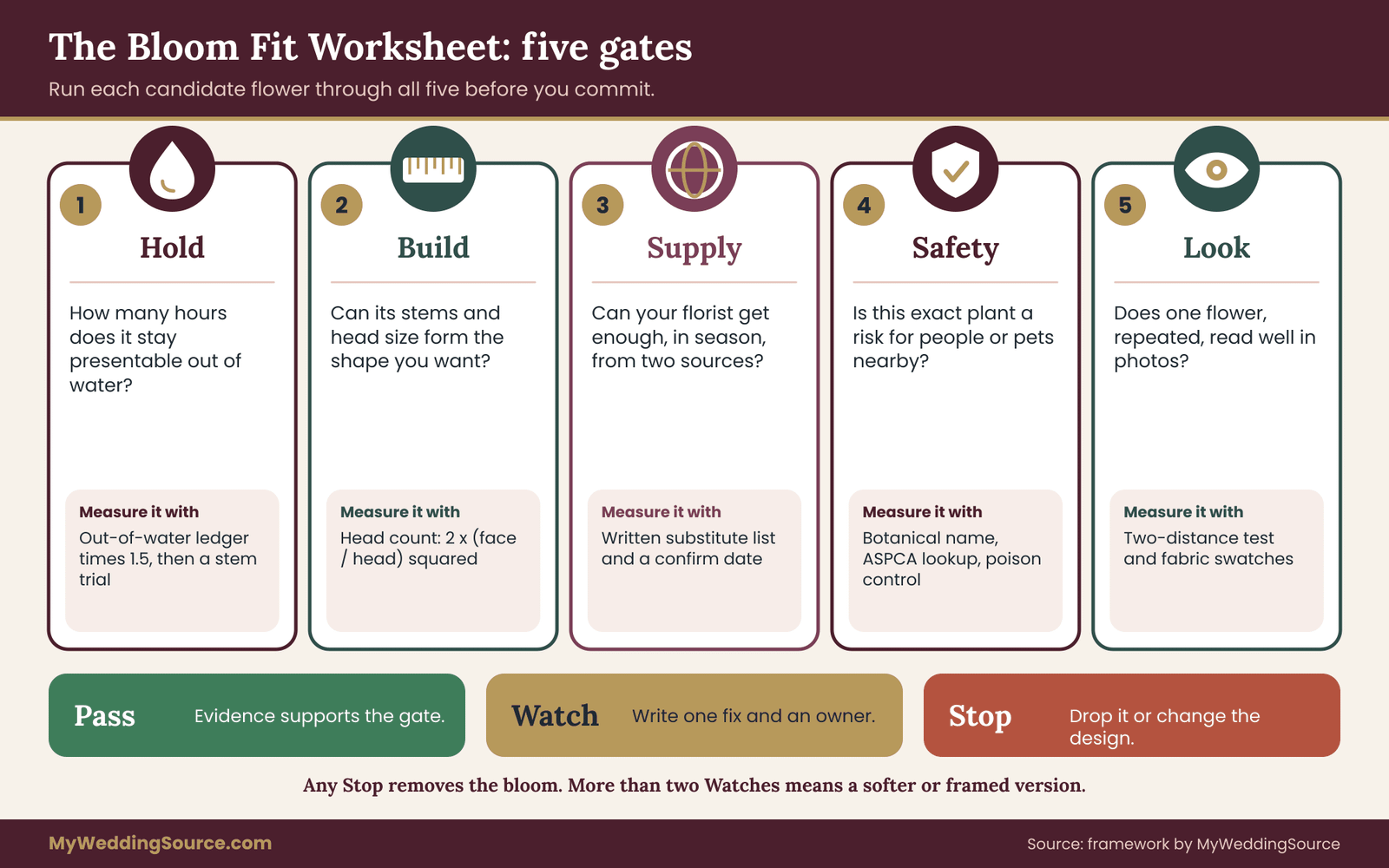
The three results mean something specific. A Pass means the evidence you have supports the gate and no action is needed. A Watch means the gate is uncertain or marginal, and you must write down one named fix and who owns it. A Stop means the gate fails as things stand, and the bloom is out or the design changes until the gate becomes a Watch or a Pass.
The decision rule is deliberately plain. Any Stop removes the candidate unless you change the design. More than two Watches means the bloom is too uncertain for a strict monofloral bouquet, so move to a soft or framed version, or switch flowers. A candidate with no Stops and at most two Watches, each with a named fix, is a go.
The sections that follow take the five gates one at a time, with measurable checks you can do before you pay a deposit. If you have already hired a florist, read what your florist contract says about substitutions before you fall in love with one stem. If you have not yet hired one, the checks double as a way to compare quotes, and the same discipline applies to any vendor decision described in the guide to wedding vendor due diligence.
Gate one: how long a monofloral bouquet holds out of water
The first gate is about time. Florists talk about vase life, which is how many days a cut flower lasts in clean water. A bridal bouquet needs a different number: how many hours the flower stays presentable while it is carried, photographed and handed around with its stems either dry or on a small water source.
These two numbers can be very far apart. A flower with a long vase life can still look tired after a few hours in a warm hand, and a short-lived flower can look perfect for a short ceremony if it is kept cold until the last minute.
Start by asking your florist which water method the monofloral bouquet will use. Some hand-tied bouquets are wrapped at the stems with a damp, sealed wrap. Others sit in a bouquet holder with water-soaked foam. Some stand in a vase or glass between photos, and some have nothing. The answer changes your hold gate more than the flower name does.
The out-of-water budget
The most useful measurable check at this gate is a simple ledger of hours. Start the clock when the monofloral bouquet is last in clean water, and stop it when the final photograph is taken or the monofloral bouquet is set in a vase for good. Everything in between is “out-of-water time”, and it comes in blocks you can list.
Typical blocks are: the drive from the florist or studio to the getting-ready location; time in the hand during portraits; time during the ceremony; family photographs after the ceremony; the cocktail hour; and the first part of the reception, when the monofloral bouquet often sits on a head table or goes missing for a while. Some blocks are in water and some are not, so mark each one.
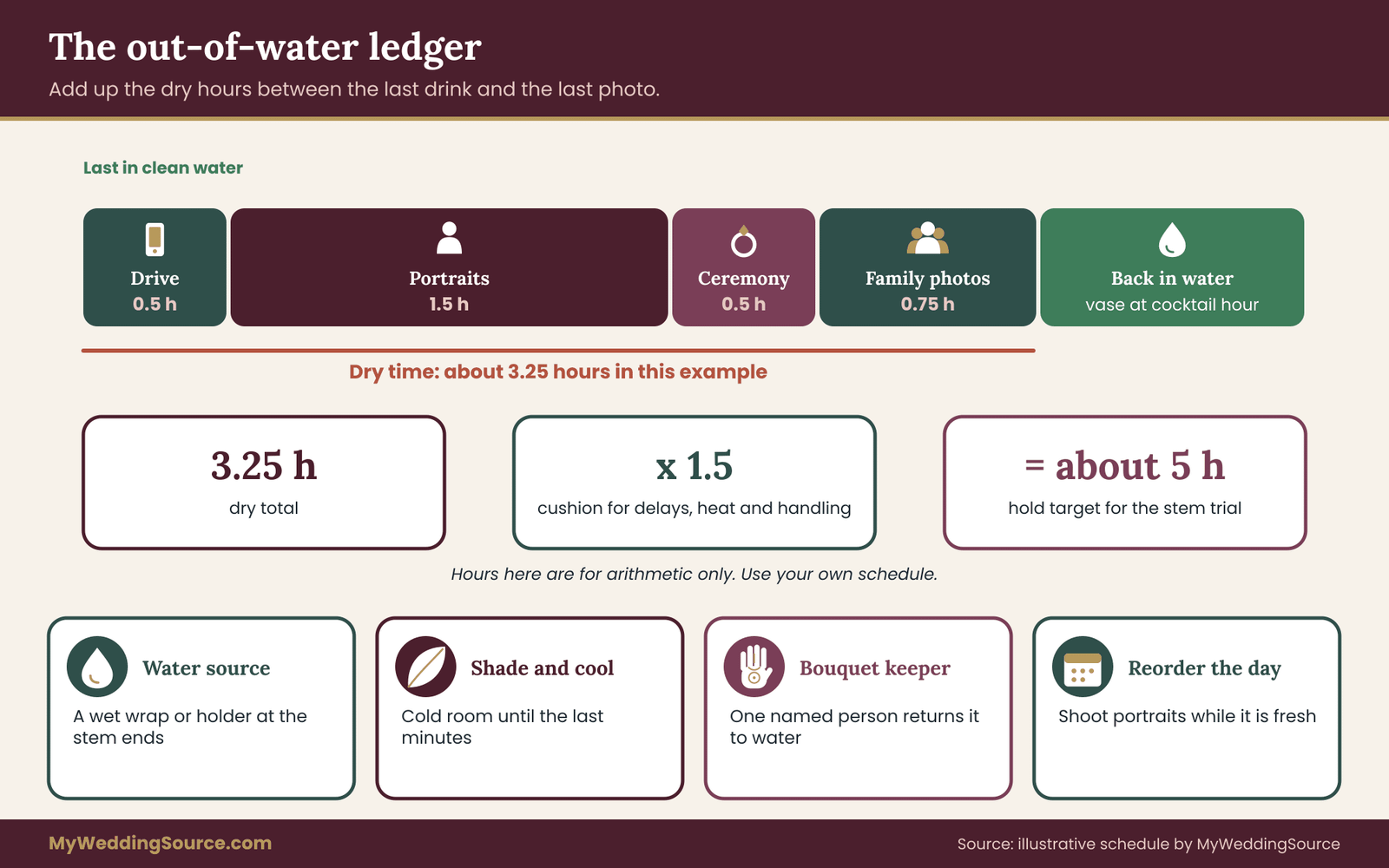
Add the dry blocks together and compare the total to what the bloom can reasonably do. If the ceremony starts at four and the family photographs finish at five-thirty, and portraits began at two, you are asking the monofloral bouquet to look good across roughly three and a half hours in different conditions, even if the monofloral bouquet sits in water for part of that time. The numbers here are for arithmetic only; your own schedule will differ, and your photographer’s shot list from the family photo list is often the largest single driver.
Why heat, wind and hands matter more than the clock
Hours are only half the picture. Three conditions speed up water loss from petals and leaves. Warm air makes the flower lose water faster. Moving air, even a light breeze at an outdoor ceremony, does the same. And human hands add warmth directly to the stems and the flower heads, especially when a monofloral bouquet is held tightly for a long portrait session.
A thin, soft petal loses water faster than a thick, waxy one. This is why florists often describe flowers by how much they sulk in heat, and why a flower with large, ruffled petals can look limp when a stiffer, smaller bloom still looks crisp. Treat these descriptions as a starting point. They vary by variety, grower, how recently the flower was cut and how it was stored, so ask your florist about the specific bloom they will source for your date.
Ethylene and why the fruit bowl matters
Many cut flowers are sensitive to ethylene, a gas that ripening fruit and some other materials give off. Exposure can make certain flowers age faster, drop petals or close up. Postharvest researchers at universities, including the UC Davis postharvest program, publish handling notes that identify which cut flowers are sensitive, and a florist who works with the flower daily will know.
For you, the practical lesson is simple: if your chosen bloom is ethylene-sensitive, the monofloral bouquet should not sit in a kitchen beside a bowl of fruit, in a closed car with produce, or in a hotel room fridge shared with food.
The stem trial
You can test hold time yourself before you commit. Ask your florist, or a local wholesaler or flower farm, for a small bunch of the exact bloom you are considering. Choose a month and conditions as close as possible to your wedding. Cut the stems, put them in clean water with flower food as the florist advises, and keep them in a room at a temperature like the one expected on your day.
Then hold the check. At the start, and again at about three, six and twelve hours, photograph the flowers next to a ruler and the time on a clock. Look for four things: neck droop, where the head bends from the stem; edge browning or translucent patches on petals; petal drop, where petals fall when touched; and softness, where the head feels loose or papery. Record each as none, slight or clear.
This is a sample of one, not a laboratory result. The value of the test is not a precise number. It is that you see the flower do what it does, in conditions close to your own, before you rely on it.
Turning the trial into a gate result
Use a margin. Take the total out-of-water hours from your ledger and multiply by one and a half. That is the number of hours the bloom should hold with no clear change in the trial. The extra half is a cushion for delays, heat and handling you cannot predict, since weddings run late more often than early.
If the flower shows no clear change over that period, the gate is a Pass. If it shows slight changes, such as small edge browning, but stays photographable, the gate is a Watch, and you write down a fix: a shorter dry time, a water source, cooler storage. If it shows clear changes within the hours you need, the gate is a Stop for a strict bouquet, and you move to a sturdier bloom, a framed version or a shorter dry schedule.
Fixes that change the hold result
Hold is the gate with the most practical fixes. The simplest is cutting the dry time: keep the monofloral bouquet in water in a vase until the moment it is needed, and have a person whose job is to return it to water after each photograph. Another is cooling: a florist’s cooler or a cold, shaded room until the last minutes keeps the flowers firm. A third is a water source in the monofloral bouquet itself, such as a wrap or a holder, which your florist can describe.
You can also change the order of the day. Moving most of the portraits before the ceremony, while the flowers are fresh, or shooting family formals first with a spare bouquet, reduces dry time on the main bouquet. A cooler, shaded location for outdoor portraits helps more than almost any other change.
A fix is only a fix if a named person owns it. If the plan says “keep the monofloral bouquet in water between photos” and nobody has that job, the gate should stay at Watch. The planning of who holds what is part of the same system you would use for any vendor handoff, as covered in the guide to wedding vendor timelines.
Hold needs differ by role
Not every bouquet in the wedding party faces the same hours. The main bouquet usually has the longest dry time because it is carried through portraits, the ceremony and family photographs. Attendants often carry theirs for a shorter stretch and may set them down at a seat or a table during the ceremony. A flower-girl bouquet is small and may be gone after the processional, while a toss bouquet, if you have one, needs to hold up for only a few minutes late in the evening.
Treat these as separate ledgers. A bloom that is marginal for the main bouquet may be perfectly good for an attendant’s smaller one, and a sturdier flower can be used for the longest-carried bouquet. Because the monofloral bouquet shares one flower across roles, you may find that the safest design is the same flower in different sizes, with the shortest-carry bouquets using the most delicate stems.
Questions to ask at the hold gate
When you talk to a florist, a few precise questions give you more than general reassurance. Ask how many hours they would expect this flower to look good in the hand in a day like yours, and what they base that on. Ask which water method they use for the monofloral bouquet and how it is hidden. Ask whether they have worked with this flower on a warm day and what they changed. Ask what they will do if the stems arrive weaker than expected.
A good florist will answer in terms of their own experience and will not promise what nobody can promise. Be cautious about a vendor who gives a confident, exact hour count with no reasoning. The honest answer to hold time is usually “it depends, and here is what I do about it”.
Gate two: structure, or whether one flower can carry a monofloral bouquet
A bouquet is a small piece of engineering that someone will carry for hours. The second gate asks whether the bloom you want can form the shape you picture using only its own stems, heads and foliage. Flowers differ enormously here. Some have thick, rigid stems and compact heads that stack neatly. Others have thin, flexible stems, heavy heads or irregular outlines that sprawl.
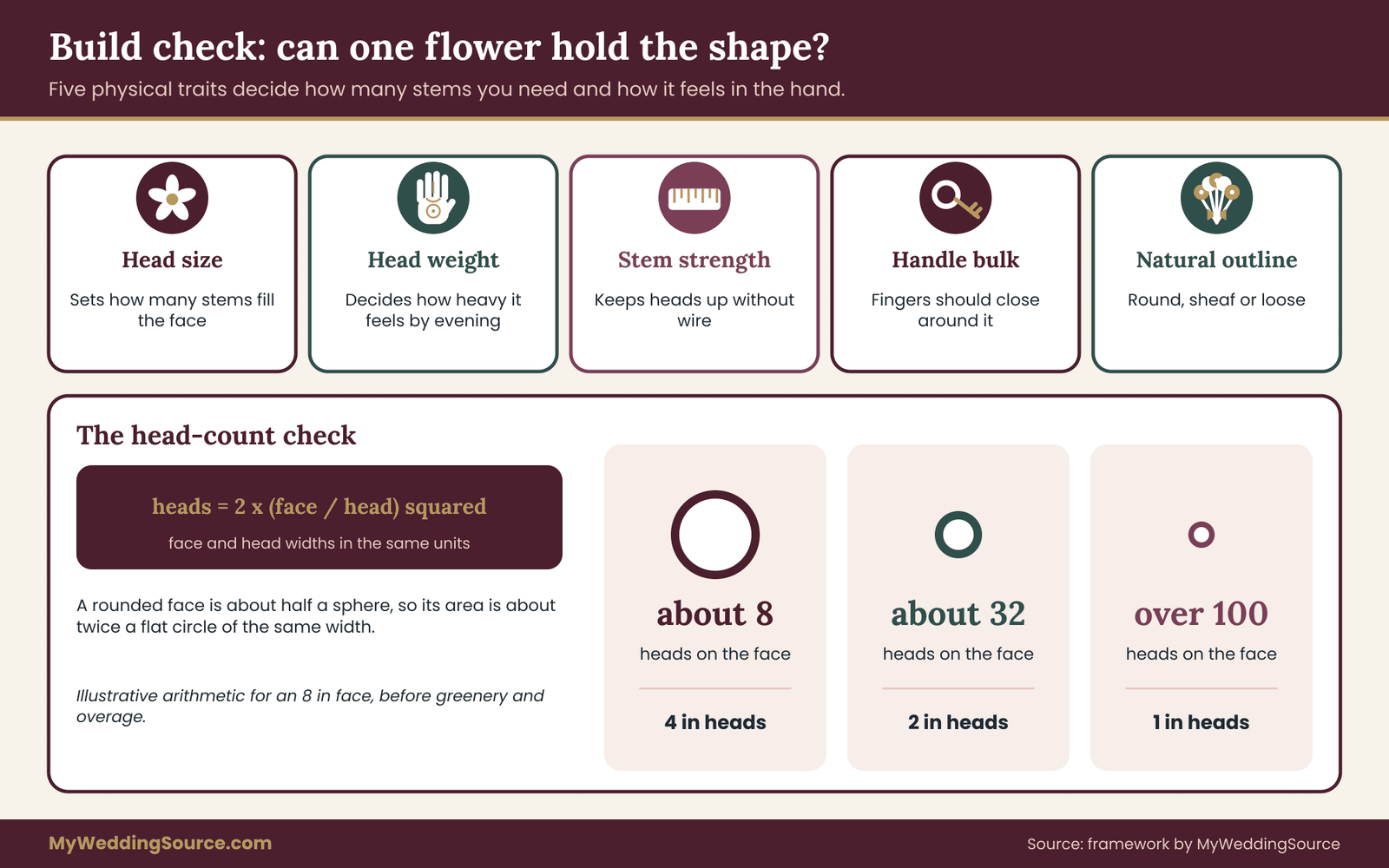
Five physical traits decide most outcomes. Head size sets how many blooms you need to fill the shape. Head weight decides how much the stems must carry. Stem strength decides whether the heads stay up. Stem thickness decides how bulky the handle becomes when you bind many together. Natural outline decides whether the flowers tuck together into a dome or fall into a looser, taller shape.
The head-count check
You can estimate how many stems a round monofloral bouquet needs with one piece of arithmetic. Decide the width of the bouquet face, which is the rounded top you see from the front. Measure the typical head width of your bloom, either from your florist’s description or from the trial bunch. Divide the first by the second, square the result, and double it.
In symbols, heads needed are about two times the face width divided by head width, squared. The logic is geometry: a rounded face is about half a sphere, and its surface area is about twice the area of a flat circle of the same width. Each head covers a small circle, so the ratio of the two areas gives the count.
For example, an eight-inch face covered with four-inch heads comes to about two times two squared, which is eight heads. The same face covered with two-inch heads is two times four squared, which is thirty-two. Cover it with one-inch heads and you are above one hundred. These numbers are illustrative arithmetic, not florist quotes, and real bouquets include overlap, gaps and foliage. But the pattern is the useful part: halving the head width roughly quadruples the stem count.
What the head count tells you
The count feeds three decisions. The first is cost. More heads means more stems to buy, and any quote should reflect the number your florist actually needs, plus the extra they build in for stems that arrive damaged. Ask for both numbers. The second is the handle. Many thin stems make a thick bundle that is hard to grip, so a flower with small heads may need a slimmer design or a different binding method. The third is weight. A large number of small, light heads may weigh less than a small number of large, wet ones.
The count also tells you whether a strict monofloral bouquet is realistic at all. If the arithmetic gives a number your florist says is not practical to source in your season, the bloom might still work as a soft version in a smaller size, such as a posy, instead of a full round bouquet. Size and stem count move together, and it is easier to accept a smaller bouquet than a failed supply.
Weight and grip
Two checks cover the hand. The first is weight. Large, dense heads on thick stems, which many florists describe for flowers such as sunflowers, hydrangeas and some dahlias, can make a monofloral bouquet heavy by the end of a long day. Ask your florist to tell you roughly how heavy the finished bouquet will be, or hold a comparable bunch for ten minutes with your arm at carrying height.
The second is grip. Wrap your hand around the stem bundle at the point where you would hold it. If your fingers cannot close comfortably, the handle is too thick. Thick-stemmed flowers such as calla lilies create a bulky, slippery handle at higher counts, and florists often trim, wrap or taper the stems to fix this. A ten-minute hold test will tell you more than a description.
Binding, wrapping and the handle
How the stems are bound changes the grip and the look of a monofloral bouquet. Most hand-tied bouquets are built by adding stems in a spiral so the heads fan outward, then tying the bundle at the binding point and trimming the stem ends. The binding point should sit where your hand holds the monofloral bouquet, because a tie that is too high or too low makes the shape sag or tilt.
Florists then cover the handle with ribbon, fabric or a wrap, which also hides the bulk. Some use fine wire to support heavy or bending heads. Wire helps structure, but it adds weight and makes the monofloral bouquet harder to re-cut, so ask whether it will be used and where. A water-soaked wrap at the stem ends can extend hold time, but it makes the handle slightly thicker. Ask for the finished handle length too, since a handle that is too long looks awkward against the dress.
Matching the bloom to a shape
Different shapes suit different flowers, and the match is the heart of the build gate. This is a general guide, not a rule.
A rounded hand-tied bouquet suits flowers with round, compact heads that sit close together. Garden roses, ranunculus and carnations are commonly built this way. A posy is a small round bouquet and suits small heads or expensive stems, since the count is low. A sheaf or armful suits flowers with long, straight stems that look best as a loose bundle laid in the arm, as with tulips or calla lilies. A cascade suits flowers with flexible, trailing stems and is the hardest shape for a strict monofloral bouquet because it needs variation in length and texture.
If the shape you imagine does not match the flower’s natural form, the build gate is at Watch or Stop. Forcing a long-stemmed flower into a tight dome, or a heavy-headed bloom into a cascade, produces stress on stems and a monofloral bouquet that does not look like the picture.
Stem behavior that surprises people
Several flowers have habits that matter to structure. Tulips keep growing after they are cut and tend to bend toward light, so a tulip bouquet can change shape over hours. Some flowers with long, hollow or thin stems, such as gerbera daisies, have necks that bend under their own weight, and florists sometimes support them with fine wire. Garden roses carry thorns that must be removed without bruising the stem. Hydrangeas have woody stems and a high water demand that can make them wilt suddenly.
None of these habits is a reason to avoid a flower. They are reasons to ask the florist how they deal with each one. A florist who knows the flower will answer specifically, with a technique and not with reassurance.
What greenery does for structure
For a strict version, greenery is not allowed, and every structural job must be done by the flower stems. For a framed version, a few leaves or stems of foliage can do several jobs at once. They support the outer ring of heads, cover the binding, soften the transition between flowers and the handle, and give the eye a rest. Foliage is also often tougher than petals, so it can look fresh for longer.
If your candidate bloom has weak structure, switching from strict to framed is the cheapest fix. It costs little, changes the look slightly and removes a Stop from the sheet. The decision is yours, and it should be made with your eyes open, not forced on you at the last minute by a florist who discovers on the day that the stems will not hold.
Asking for a mock-up
The best structural check is a mock-up. Ask your florist whether they will build a sample bouquet, either with the real flowers if they are in season or with a similar bloom, and let you hold it. Some charge for this and some include it in a consultation. If you cannot get one, ask to see photographs of bouquets they have built with the same flower, ideally in similar sizes, and ask what they would do differently.
Measure the result. Note the bouquet width, the number of stems, the grip circumference and how it feels after ten minutes. Hold it against the dress or a similar neckline and sleeve, and look at how it sits at waist height. A bouquet that is too wide can hide a bodice or push against the elbows, and a monofloral bouquet that is too small can look lost.
Gate results for structure
Mark Pass when the bloom’s natural shape, the head count, the weight and the grip all match your design and the florist has built the shape before. Mark Watch when one of those is uncertain and you have a named fix, such as adding greenery, shrinking the monofloral bouquet or taping the handle. Mark Stop when the shape and the flower disagree in a way that cannot be fixed, such as an impossible stem count or a heavy bloom that cannot be carried comfortably.
Gate three: supply, season and substitutions
The third gate asks whether the flower will actually exist, in good condition and in the right quantity, on your date. A monofloral bouquet leans on one crop. If that crop is in full season nearby, supply is deep and the price tends to reflect abundance. If it is out of season, arrives by air from another country or depends on a single grower, the same flower becomes a risk.
Start with the season. Flowers are grown in different parts of the world at different times, and a flower that is a local spring crop may be available in other months only as an import. Availability windows shift by region, by variety and by how the year’s weather behaved, so any fixed calendar in an article is unreliable. Ask your florist when your bloom is naturally available in your area and where it will come from on your date.
Local, imported and the single-point problem
Local flowers cut near the wedding date have a shorter journey and often hold well, but their supply is limited by the farm’s planting. Imported flowers expand the calendar, but they travel farther, and cut flower imports into the United States are subject to plant health inspection at the border, which is overseen by the U.S. Department of Agriculture’s Animal and Plant Health Inspection Service. Delays, cold-chain problems or rejected shipments are possible, although florists who import regularly plan around them.
Neither source is better in every case. What matters for a monofloral bouquet is whether your florist has more than one source for the flower. Ask directly: “If your first supplier cannot deliver this flower the week of our wedding, what is the second option?” A florist with a ready answer, such as a second farm or a wholesaler, lowers the risk. A florist who has never thought about it raises it.
Counting stems across the whole wedding
The monofloral bouquet is rarely the only place the flower appears. If the same bloom is also on the ceremony arrangements, tables and boutonnieres, the total demand can multiply, and the best stems may be spread thin. Count the full order before you commit. A rough tally of the bridal bouquet, each attendant bouquet, any flower-girl or toss bouquet, and every other use gives the florist’s real demand for the bloom.
Then decide where the flower matters most. A sensible rule is to give the best, freshest stems to the places that will be photographed up close and held in hands, and use a sturdier or cheaper companion flower for large arrangements where one stem’s imperfection does not show. The monofloral bouquet is the flagship, and it does not have to be matched everywhere else.
Cost logic without invented prices
Prices for flowers change with season, grower, weather and demand, so no fixed number belongs in a guide like this. What you can do is understand how a quote is built. A florist’s price for the monofloral bouquet usually combines the cost of stems, a margin for waste, the labor to condition and build the monofloral bouquet, supplies such as wraps and ribbon, and sometimes delivery.
The stem cost is the head count from the structure gate, multiplied by the price per stem, plus an overage. The overage covers stems that arrive bruised, short or open too early. Ask what percentage your florist builds in and whether it changes for a delicate flower. A delicate bloom needs a larger overage, so its true cost is higher than the per-stem price suggests. Putting the figures into your wedding budget as stem count, overage, labor and supplies makes comparisons between flowers fair.
A seasonal premium is also worth understanding. A flower that is scarce or imported usually costs more per stem, and a flower in peak local season often costs less. If two blooms pass every other gate and one is much cheaper in your month, that is a legitimate reason to choose it.
Substitution terms
Substitution is the supply gate’s safety net. Most florists include a clause saying they may substitute flowers of similar quality or color if the original is not available. For a monofloral bouquet, that clause can undo your whole design, because a substitute is a different flower. Read the wording before you sign, and ask for specific language. The guide to the wedding vendor contract explains what such clauses commonly cover.
Useful terms name an acceptable alternative list in order, such as a different variety of the same flower, then a close relative, then a named second choice. They say that no substitution from outside the list occurs without your approval, and they set a date by which the florist will confirm that supply is secure. A contract that says “equal or greater value” without naming a flower leaves the choice with the vendor.
Gate results for supply
Mark Pass when the flower is in local season or the florist has a reliable, named source, the total stem count is covered, and substitution terms protect your design. Mark Watch when the flower is imported, the supply is limited or the contract is vague, and write down the fix, such as an earlier order date or a written substitute list. Mark Stop when the florist cannot confirm supply, or the contract allows an unrestricted substitution you will not accept.
Gate four: safety, allergens and plant-specific checks
The fourth gate is the one where guessing is not acceptable. Flowers are not food, and some are harmful to people or pets if chewed, swallowed or handled the wrong way. A monofloral bouquet makes the check simple because you only need to research one plant, but you must research that exact plant.
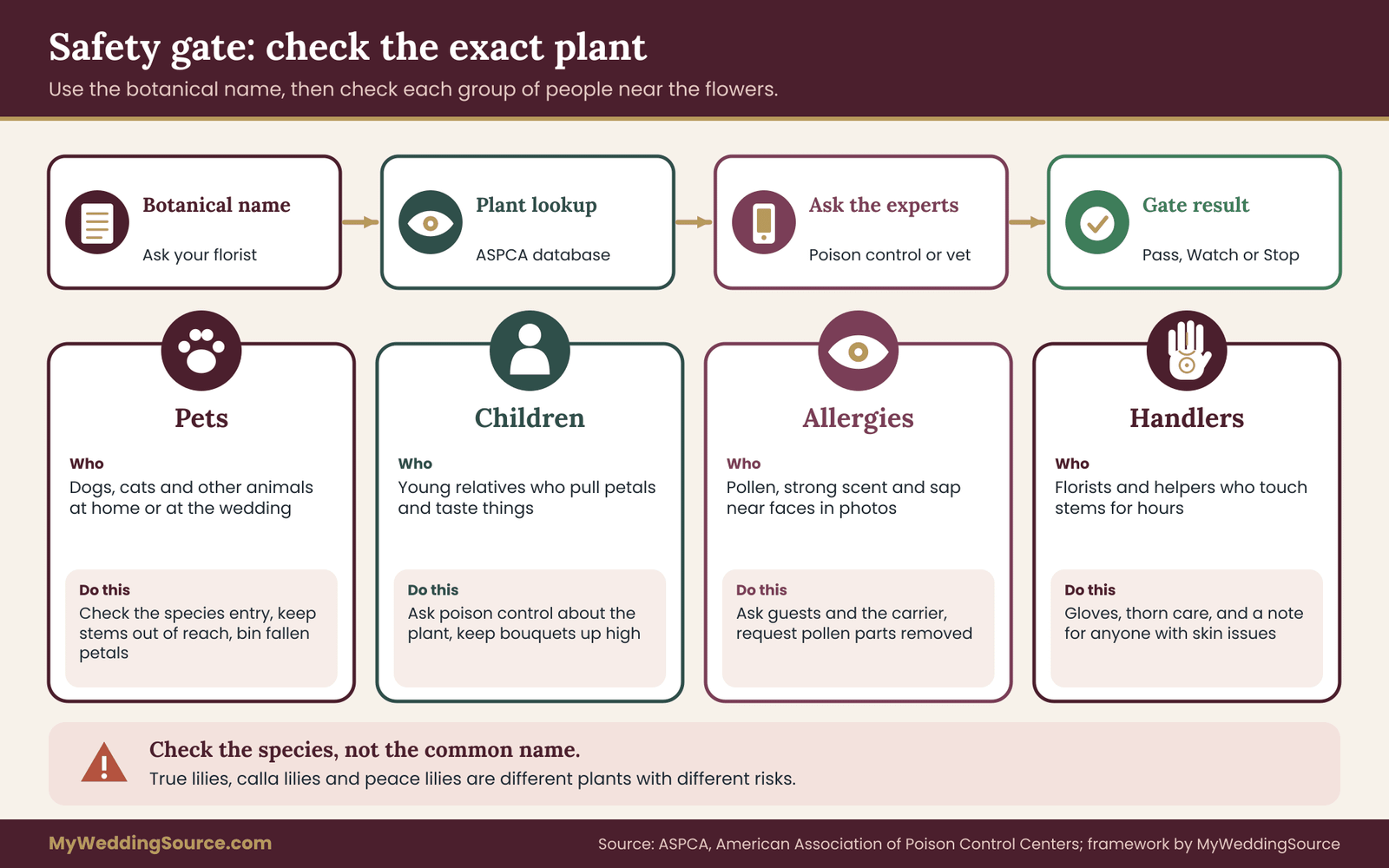
The golden rule is to check the species, not the common name. Common names overlap and mislead. The word lily covers true lilies and many unrelated plants, such as calla lilies and peace lilies, which belong to different families and carry different risks. Ask your florist for the botanical name, which is usually two words in Latin, and use it for every lookup.
Four groups of people to think about
Safety is not one question. It depends on who will be near the flowers, and four groups cover most weddings.
Pets. If the flowers will be at home before or after the wedding, or if a pet will take part in the day, the ASPCA maintains a searchable database of plants that are toxic and non-toxic to dogs, cats and horses. The ASPCA, for example, warns about true lilies and cats. Check your plant’s entry and read what it says about the part of the plant and the symptoms.
Children. Children put things in their mouths and pull petals. If young relatives will be near the monofloral bouquet, check whether the plant is harmful if eaten. In the United States, poison control centers answer questions about plant exposures at 1-800-222-1222, and the American Association of Poison Control Centers publishes information through its website.
People with allergies. Pollen, strong scent and plant sap can set off reactions. Some flowers are pollen heavy and some are bred to produce little. Ask guests, family and the person who will be carrying the monofloral bouquet whether there is a known sensitivity, and ask the florist whether pollen-bearing parts can be removed.
People who handle the flowers. Florists, assistants and family helpers handle stems for hours. Some plants can irritate skin with repeated contact, and thorns cause injuries. Ask your florist what protection they use, and ask any helper with a skin condition to wear gloves.
What to do with what you find
A lookup gives you information, not a verdict. If the ASPCA lists your flower as non-toxic to cats and dogs, that does not mean a pet should eat it, but it does mean a nibble is less likely to cause a serious problem. If the flower is listed as toxic, the question becomes how to manage the exposure, not whether the flower is allowed.
Management is practical. Keep toxic flowers out of reach in rooms pets cannot enter. Dispose of stems and fallen petals promptly. Wash hands after handling. Tell any pet sitter or family member who will be in the home. If the flower is a risk to someone close, that is a Stop for them, and you may choose another bloom or have a second, safe bouquet for the people who are affected.
Fragrance and photographs
Scent is a quieter issue. A strongly scented flower held near your face for hours can bother you or others, and not only people with a diagnosed allergy. In photos, people lean in to hug the bouquet holder. If you are sensitive to fragrance, ask for a low-scent variety, or test the flower in a closed room before deciding.
Claims you should not accept without checking
Avoid statements such as “that flower is perfectly safe” or “it is all natural, so it is fine”. Natural does not mean harmless, and florists are not poison specialists. Ask where the claim comes from. Your florist can tell you about handling and what they have seen in practice. A plant-safety source, such as the ASPCA database, a poison control center or a veterinarian, should confirm the rest.
Gate results for safety
Mark Pass when you have checked the botanical name against a reliable source, no one close to the flowers has a known issue, and any handling steps are agreed. Mark Watch when the plant is listed as a concern but you have a clear management plan. Mark Stop when someone with a serious allergy or a high-risk pet will be exposed and the exposure cannot be avoided.
Gate five: how a monofloral bouquet looks, and photographs
The last gate is the one most couples start with and should finish with. A monofloral bouquet reads differently from a mixed one. With many flowers, the eye sees variety. With one flower repeated, the eye sees pattern, texture and a single mass of color. The result can be calm and striking, or flat and heavy, depending on the bloom, the shape and the light.
Several things control the look. The flower’s own variation matters: even one variety differs in size and shade from stem to stem, which gives a natural depth that a strict bouquet depends on. Contrast with the dress matters: an ivory flower against an ivory dress can lose its edges in photographs, while a bloom with a dark center or a deeper shade holds its outline. Openness matters, because a flower changes shape as it opens, and the stage you see at delivery may not be the stage you see at the ceremony.
Contrast, color and light
Cameras handle whites and very saturated colors differently from the eye. Pure white petals can lose detail in bright light, and very deep reds can turn into flat dark shapes. Ask your photographer to show you pictures of the flower you are considering, or a similar one, in the kind of light you expect, such as open shade, direct afternoon sun or an indoor room with warm bulbs.
Then compare the flower against your palette. Hold a few swatches of fabric beside the trial bunch in daylight, because indoor lighting changes color. If you have already settled your color story and palette, check that the flower sits comfortably inside it, since a single bloom has no other color to balance a shade that is slightly off.
Openness and change over the day
Flowers open as they age, and some open a lot. A bud-stage rose looks tight and formal, while a fully open rose looks loose and romantic. A ranunculus can open into a wide, layered disc. A tulip can open and flop outward as the hours pass. If your design depends on a particular stage, tell your florist, and ask how they time the order so the flower reaches that stage at the right hour.
A bloom that looks best half-open and holds that stage for hours is easier to plan around than one that changes quickly. The stem trial from the hold gate doubles as a look test: photograph the flower at the same hours and see which stage you prefer.
Scale against the person and the dress
A bouquet is always seen next to a person. Hold the trial bunch, or a mock-up, at waist height and in front of a mirror. The face of the monofloral bouquet should sit comfortably between your elbows without pushing against them, and it should not cover the bodice details you chose the dress for. A strapless neckline can take a larger bouquet than a dress with sleeves and appliqué that you want to see.
Bring the same questions to bridesmaids and a groom’s boutonniere, if the flower is repeated on them. A boutonniere uses one head or a small spray, so it needs a flower that holds its shape pinned to a lapel. Not every bloom that makes a good bouquet works there. Check this early, because it affects the stem count for the whole order.
The two-distance test
Take your trial bunch and look at it from two distances. At arm’s length, check texture and detail: petal edges, the center of the flower, the color difference between stems. At ten feet, check mass and color: does it read as the shape and shade you want? Many bouquets look wonderful close and dull at a distance, or the reverse.
Ask two or three friends to describe it in a sentence without telling them what you hope to hear. If their words match your intention, the look gate is solid. If they say something unexpected, such as “heavy” or “like a vase of grocery-store flowers”, you have learned something cheaply.
Gate results for look
Mark Pass when the bloom holds its outline against the dress, matches the palette and reads clearly at both distances. Mark Watch when one issue is fixable, such as low contrast that greenery or a deeper shade would solve. Mark Stop when the bloom conflicts with your clothing or palette in a way you cannot adjust.
A worked example of a monofloral bouquet decision
Here is the worksheet in use. The couple is invented, the numbers are illustrative and the trial results are made up for the sake of the example. Do not read them as facts about any flower. Their purpose is to show the process.
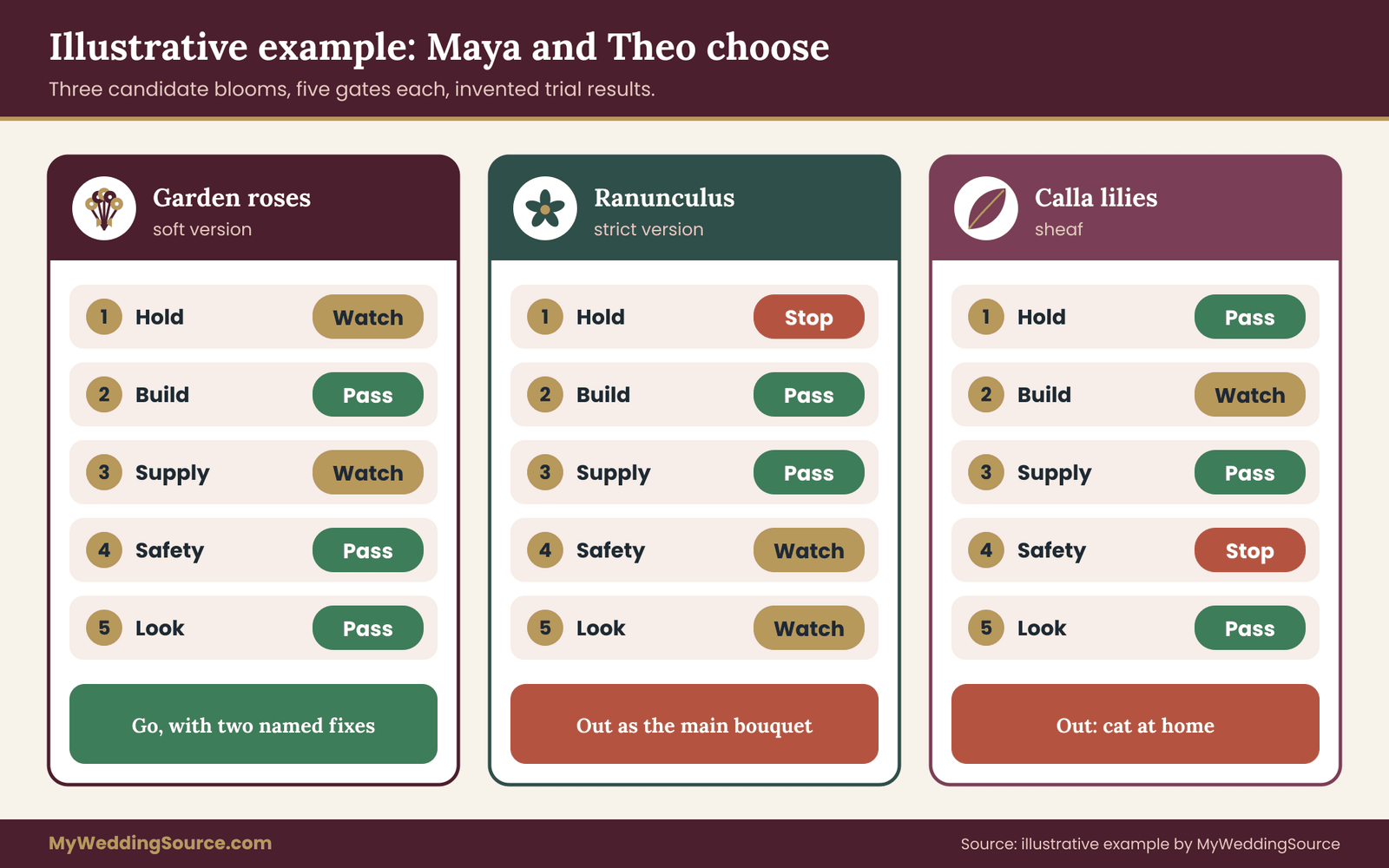
Maya and Theo are planning a late-spring wedding. The ceremony begins at four in the afternoon in a garden, with open shade for portraits. Maya’s dress is a simple ivory. Their palette is ivory, blush and sage. They have a cat at home, and Maya wants a monofloral bouquet she can hold without fuss. She has three candidates: garden roses, ranunculus and calla lilies.
Step one: the out-of-water ledger
They start with the hours. The drive to the garden is half an hour, with the stems wrapped in a damp wrap. Portraits before the ceremony take an hour and a half. The ceremony is half an hour. Family photographs after the ceremony take forty-five minutes. During the cocktail hour the monofloral bouquet sits in a vase. That adds to about three and a quarter hours of out-of-water time. Multiplied by one and a half, the target is about five hours.
Step two: the five gates for each bloom
Garden roses in three blush shades (soft version). Hold: in the trial, outer petals soften slightly near the five-hour mark, so the gate is a Watch, with fixes of a water source in the wrap, shaded portraits and a named person returning the monofloral bouquet to water after each photo.
Build: a round hand-tied shape, with an eight-inch face and heads of about three inches, gives about two times two and two-thirds squared, which is roughly fourteen heads, plus overage. Pass.
Supply: the florist can source them, but variety names are not yet written down, so a Watch, with a fix of a written variety list.
Safety: roses are listed as non-toxic to cats by the ASPCA, and the florist will remove thorns. Pass. Look: the dark-edged blush shades hold their outline against ivory. Pass.
Ranunculus (strict version). Hold: in the trial, heads droop clearly by the third hour, below the five-hour target, so this is a Stop for a strict bouquet. Build: round, compact heads work well, a Pass. Supply: local and in season, a Pass. Safety: the couple has not finished the lookup, a Watch. Look: pretty, but openness changes quickly, a Watch. One Stop ends the strict version. They could revisit it as a short-dry-time spare, but not as the main bouquet.
Calla lilies (sheaf). Hold: stout stems and firm blooms hold well in the trial, a Pass. Build: a sleek armful works, but the grip is bulky at higher counts, a Watch. Supply: a Pass. Safety: the ASPCA lists calla lily as toxic to cats and dogs, and the cat lives where the flowers would be kept before and after the wedding. A Stop as it stands. Look: striking, a Pass.
Step three: apply the decision rule
The rule is simple. Any Stop removes a candidate unless the design changes. Two Watches or fewer, each with a named fix, is a go. Garden roses have no Stops and two Watches, both with named fixes, so they go ahead. Ranunculus has a Stop on hold time and is out as the main bouquet. Calla lilies have a Stop on safety and are out unless the flowers could be kept away from the cat, which Maya decides is not realistic.
Notice what the worksheet did. It did not pick the prettiest flower. It removed one for a physical reason and one for a household reason, and it turned the remaining choice into a short list of actions with owners. That list is the real output.
Step four: write the fixes down
Maya writes the fixes as three lines and sends them to the florist. The water source goes into the monofloral bouquet design. The variety list goes into the contract. The bouquet keeper, who is her sister, gets a one-line job: return the monofloral bouquet to water after every photo. These are small, specific and easy to check, which is what makes them work. The same habit of turning a decision into owned tasks is useful across planning, and it ties in with the guide to wedding day accessories, where backup items and hand-offs are covered in more detail.
What changes if the answer is different
If the cat did not exist, calla lilies would have passed the safety gate and the decision might have gone another way. If the ceremony were at noon on a hot day, garden roses might have moved from Watch to Stop and sent Maya to a sturdier flower. If the florist could not confirm supply, a different bloom would have been chosen regardless of looks. The worksheet is not a verdict machine. It is a way to find the weak point of each option while there is still time to change the design.
Questions to ask your florist about a monofloral bouquet
A worksheet is only as good as the answers behind it, and florists vary in how they answer. The questions below are grouped by gate. Ask them in a consultation or in writing, and keep the answers with your contract. Vague answers are information too.
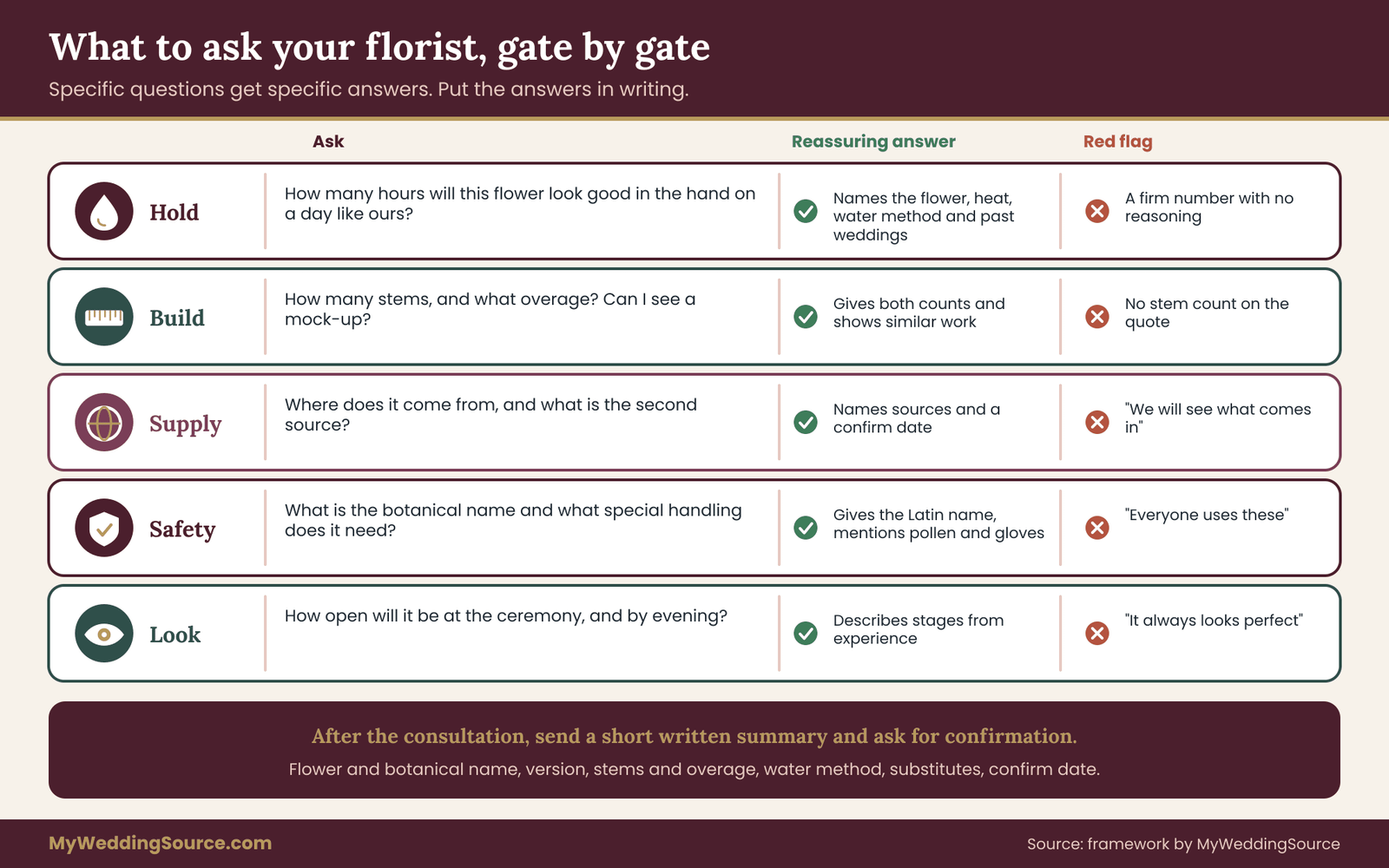
Hold. “For a day like ours, how many hours do you expect this flower to look good in the hand? What does that estimate rest on?” A useful answer mentions the flower, the temperature, the water method and past weddings. A worrying answer is a confident number with no reasoning. Follow with: “What do you do when it starts to fail on the day?”
Build. “How many stems will this bouquet use at the size we discussed, and how many extra do you build in?” Then: “Have you made a monofloral bouquet from this flower alone? Can I see photographs or a mock-up?” A good florist will describe how they handle the known habits of the flower, such as bending stems or thorns.
Supply. “Where will this flower come from on our date, and what is your second source?” Then: “Which varieties are acceptable substitutes, and by what date will you confirm supply?” A worrying answer is “we will see what comes in”.
Safety. “What is the botanical name, and does anything about this plant need special handling?” Then: “Can pollen parts be removed? What gloves or protection do you use?” Florists are not plant-safety experts, so treat their answer as one input and check the plant yourself.
Look. “Which stage of openness will the flower be in at the ceremony, and how will it change by the evening?” A florist who has photographed the flower will give a specific answer.
Red flags worth noticing
A few patterns in a florist’s answers deserve a second look. One is a refusal to name the flower’s source or a second source. Another is a promise that a delicate flower “never wilts” or “will last all day” with no explanation. A third is no willingness to put substitution terms in writing. A fourth is a quote that does not list stem count or overage, which makes it impossible to compare. And a fifth is dismissing a safety question with “everyone uses these”.
None of these proves a florist is wrong or dishonest. They are signals to ask more, to request a written answer or to compare with another quote. The point of the worksheet is that you can ask calm, specific questions, and a good florist will usually welcome them because they make the job clearer.
Putting answers into writing
Spoken reassurance disappears. After the consultation, send a short written summary and ask the florist to confirm it. A few lines are enough: the flower and the botanical name, the version (strict, soft or framed), the stem count and overage, the water method, the acceptable alternatives in order, and the date by which supply is confirmed.
This is the point where your contract matters. If the written summary and the contract disagree, the contract usually controls, so make sure the final version includes the same terms. The vendor contract guide covers how to read clauses on substitutions, changes and refunds, and you can ask a florist to add the specifics as an addendum.
Five numbers to carry out of the consultation
Five measurable figures make your choice checkable. First, your out-of-water hours and the one-and-a-half target. Second, the head count from the geometry check, and the florist’s actual stem count with overage. Third, the grip circumference of the finished handle. Fourth, the result of your stem trial at the hours you need. Fifth, the date supply is confirmed and the written list of acceptable alternatives.
If you can fill in all five, you are making a decision with evidence. If two or three are blank, the gate is probably a Watch, and the blanks are your next tasks.
The backup ladder for a monofloral bouquet
A monofloral bouquet has a single point of failure, so a backup ladder is part of the design, not a pessimistic extra. The ladder lists what you will do, in order, if the first choice cannot be delivered or fails on the day. You write it before the problem, so the decision is already made when stress is high.
Rung one: a different variety of the same flower. Often the supply problem is variety-specific, not species-specific. If the named variety is unavailable, a close variety in the same color family keeps the design intact.
Rung two: a close relative. A flower of similar shape, size and color, such as a different member of the same family. This keeps the silhouette and may keep the hold profile similar.
Rung three: a framed version. Add a little of the flower’s own foliage or a plain green. It changes the look slightly and fixes many structural problems.
Rung four: a mixed bouquet in the same color. A one-color arrangement with a few flower types, built to the same shape. The color story survives even if the single flower does not.
Rung five: a spare for the longest photo sessions. A smaller, sturdier bouquet, kept in water, used for family portraits and long handling, so the main bouquet stays fresh.
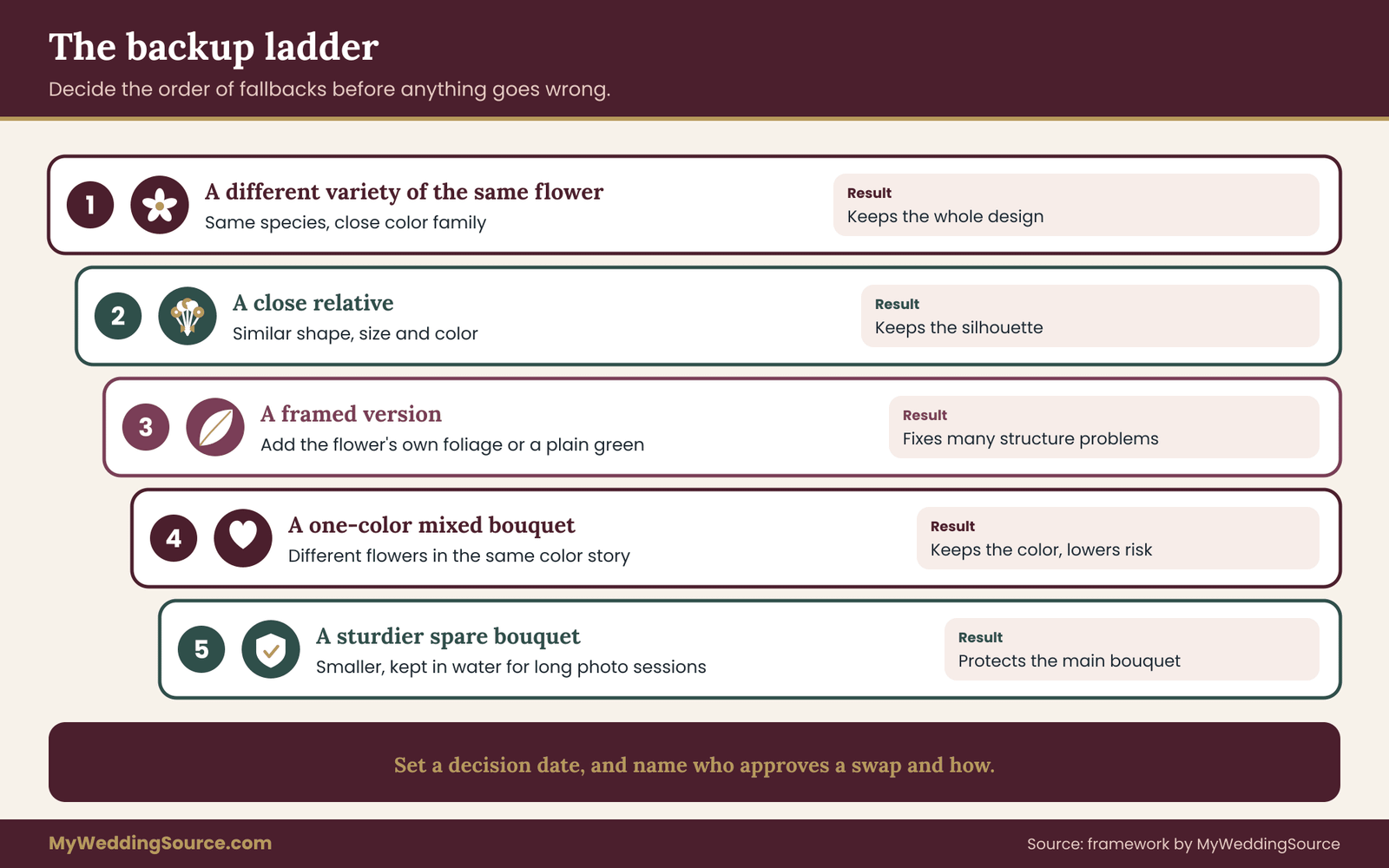
Give the florist a decision date for the ladder. After that date, changing the flower costs more or becomes impossible. Ask what that date is, and put it in your calendar. Agree who approves a substitution and how quickly: a text with a photograph is usually enough if both sides have agreed on who answers.
Monofloral or mixed: comparing the alternatives
Sometimes the worksheet shows that a strict single flower is a poor fit for your date. That does not mean you have lost your look. There are neighboring options, and comparing them in plain terms is useful.
A strict monofloral bouquet is the most dramatic and carries the most concentrated risk: one flower, one hold profile, one supply line. A soft monofloral bouquet, using several varieties of the same flower, gives the same silhouette with less supply risk and some room to hide a weak stem. A framed monofloral bouquet, with the flower’s own foliage or a neutral green, improves structure and hold at little cost to the look.
A one-color mixed bouquet, using different flowers in the same color family, gives the clean color story with much lower risk, because a failing stem is replaceable. A hero-and-support bouquet, where one flower dominates and two or three others play a small role, keeps the focal point and gives the florist flexibility.
On the five gates, the strict version is the most exposed on Hold, Build, Supply and Safety, and the most controlled on Look. As you move down the list toward mixed, risk falls and design freedom rises. A good decision is the one that keeps the feature you care about most, whether that is the single flower itself, the color or the shape, and relaxes the rest.
Edge cases that change the answer
Most weddings fit the worksheet cleanly. A few situations push the results in unexpected directions.
Heat and long days. A hot, sunny or windy outdoor day shifts the hold gate toward Stop for delicate blooms. Reduce dry time, add cooling and shade, or choose a sturdier flower. If the ceremony is at midday in strong sun, ask the florist whether they would still recommend a strict version.
Winter and cold. Cold is gentler on petals than heat but can damage some flowers if they freeze, and a monofloral bouquet carried outdoors in freezing air for a long period can suffer. Keep it indoors until the last moment and ask your florist about cold tolerance.
Travel and destination weddings. Carrying fresh plant material across borders or into some regions can be restricted. In the United States, agricultural inspection rules apply to plant materials, and the Animal and Plant Health Inspection Service explains what travelers may bring. Other countries have their own rules, so check with the destination’s agriculture authority before you pack flowers. Local sourcing at the destination is usually safer.
A large wedding party. Many bouquets multiply the stem count and the risk of supply shortage. Consider using the flower in the main bouquet and a sturdier or less scarce companion flower in attendants’ bouquets, in the same color.
Keepsake bouquets. If you want to dry or preserve the monofloral bouquet, the flower’s structure and moisture content affect the result. Some flowers dry well and some turn brown or collapse. Ask your florist or a preservation service which results to expect for your bloom before you decide.
Staining and pollen. Pollen from some flowers can stain fabric. Florists often remove pollen-bearing parts, and you can ask them to do so, especially if you will carry the monofloral bouquet against a pale dress.
Cultural or family meaning. A flower with a tradition or a family link may matter more than any gate. If the worksheet says Watch or Stop, you can still choose it, but make the trade-offs explicit and let the florist design around them.
Allergic guests or helpers. If someone close to you has a serious reaction to a plant, the safest answer may be a different flower for them or an artificial or paper alternative kept for photographs.
A timeline for deciding on a monofloral bouquet
The worksheet works best when it runs across several months instead of in one rushed afternoon. The timeline below is a sequence of decisions, not a fixed calendar, so shift it to fit your wedding date and your florist’s own deadlines.
Early on, choose the level and the shortlist. Decide whether you want a strict, soft or framed monofloral bouquet, and pick two or three candidate blooms. Look up the botanical names and run the safety lookup first, because it is free and can remove a candidate on day one. Share your color story and your photographer’s style with the florist.
A few months out, run the trials. Order a small bunch of each remaining candidate in conditions close to your wedding month, and run the stem trial and the two-distance test. Fill in the out-of-water ledger from the draft schedule. This is also when you ask for a mock-up, if the florist offers one, and compare the head count and grip with your own arithmetic.
Six to eight weeks out, lock the decision. Confirm the flower, the version, the stem count and overage, the water method, the substitution list and the confirmation date in writing. Make sure the final contract or addendum carries the same terms. Add the fixes from every Watch gate to your task list with an owner and a date.
Two weeks out, confirm supply. Ask the florist whether the flower is on track. If a problem appears now, you can still move to rung one or two of the backup ladder without panic. Confirm the schedule of dry blocks with your photographer, since small changes in the order of the day can protect the flowers.
The day before and the day of, hand off. Tell the person in charge of the monofloral bouquet exactly what to do, in one short message. Return the monofloral bouquet to water after each photograph. Keep it out of sun and away from fruit. Do not hold it tightly for long sessions. If you have a spare for family portraits, keep it close to the photography area.
What to say to your bouquet keeper
A short, specific message works better than a long one. Something like: “After each set of photos, put the monofloral bouquet back in the water glass in the shade. Keep it away from the fruit table. If it starts to droop, tell me and the florist’s number is on this card.” The keeper does not need to know about the five gates. They need a job, a place and a person to call. The best keepers are calm friends or relatives who will not be in every photograph.
After the wedding
When the day is over, decide what happens to the monofloral bouquet. If you plan to preserve it, get it into water right away and tell the preservation service or florist as soon as possible, since the timing affects the result. If you plan to compost or donate it, check the options in advance. Either way, keep any pets away from the flowers until they are gone, especially if your safety lookup flagged the plant.
Your next steps
Start with three small tasks and the rest follows.
- Choose your level and two blooms. Write down whether you want a strict, soft or framed monofloral bouquet and name two candidate flowers by their botanical names.
- Run the safety lookup and the supply question. Check each plant against the ASPCA database and a poison control source, and ask your florist where the flower comes from on your date and who the second source is.
- Fill in the five numbers. Build your out-of-water ledger, do the head-count arithmetic, and plan a stem trial for the bloom that passes the first two checks.
Then book the consultation, bring the worksheet, and ask for the answers in writing. If a candidate collects a Stop, move down the backup ladder. If it collects only a few Watches with named fixes, you have a defensible choice. The bouquet in your hands will have been tested, and that is the point.
FAQ
What does monofloral mean in a wedding bouquet?
Monofloral means the bouquet is made from one kind of flower. A strict version uses a single variety in one color with nothing else. A soft version uses one species in several varieties or shades. A framed version adds the flower’s own foliage or a plain green. Ask your florist which level they are quoting, because the level changes the look, the price and the supply risk.
How many hours can a monofloral bouquet stay fresh without water?
It depends on the flower, the temperature, the handling and how recently it was cut, so no single number is reliable. A better approach is to total the hours your bouquet will be out of water, multiply by one and a half, and test the bloom in a small stem trial. Ask your florist what they expect for your date and how they will keep the flowers in water between photographs.
Which flower is best for a monofloral bouquet?
There is no single best flower, because the answer depends on your season, your climate, your schedule and your household. Sturdy, compact blooms with firm stems are easier to build and hold, and delicate ones need more care. Run each candidate through the five gates of hold, build, supply, safety and look, and choose the one that passes with the fewest uncertain gates.
How many stems do I need for a monofloral bouquet?
Use the head-count check. Decide the width of the bouquet face, divide it by the typical head width of your flower, square the result and double it. That gives a rough count of heads for a rounded bouquet, before greenery and overage. Smaller heads need far more stems. Your florist will give the real number, so ask for the stem count and the extra they build in.
Is a monofloral bouquet cheaper than a mixed bouquet?
Not automatically. A single flower can save design time and let you spend on a better bloom, but small heads need many stems, and a scarce or imported flower costs more per stem. A delicate flower also needs a larger overage. Compare quotes by stem count, overage, labor and supplies, and use your wedding budget to see which option fits.
Are monofloral bouquets safe for homes with pets?
It depends entirely on the plant. Check the botanical name in the ASPCA’s toxic and non-toxic plant database, and read the entry for your species, not just the common name. Some popular flowers, including true lilies for cats, are a serious concern. If a plant is listed as toxic, keep it out of reach, remove fallen petals, or choose another flower.
Can I make a monofloral bouquet myself?
Yes, many people do, and a single flower is simpler than a mixed arrangement. Run the stem trial first, buy extra stems, practice the binding and thorn removal, and keep the stems in cool water until the last moment. Be honest about the out-of-water hours and ask a friend to act as bouquet keeper. If supply or safety is uncertain, talk to a florist.
What if the flower is unavailable on my wedding date?
Plan for it before it happens. Write a backup ladder: a different variety, a close relative, a framed version, a one-color mixed bouquet, and a spare for long photo sessions. Ask the florist for the date they will confirm supply and put the acceptable substitutes in the contract. A named alternative is far easier to accept than a surprise on the morning of the wedding.
Sources
- ASPCA: toxic and non-toxic plants for pets
- Poison Control: American Association of Poison Control Centers
- UC Davis Postharvest Technology Center
- USDA Animal and Plant Health Inspection Service
- USDA Agricultural Marketing Service
- CDC National Institute for Occupational Safety and Health
- USDA National Agricultural Library
- Cooperative Extension: extension.org
- Royal Horticultural Society: plant advice