
Editorial portraits are the few deliberate, art-directed images a couple makes of themselves on the wedding day, in good light and a strong location, apart from the documentary coverage. This guide shows how to fit them into the schedule: where the golden-hour window falls, which slot costs your guests the least, how long to allow, and how to build buffers so nothing else slides.
Plan editorial portraits as one short block of about twenty minutes of actual shooting, not a long session. Find your real sunset time and work backward. Choose one of four slots (before the ceremony, right after it, the reception’s golden hour, or after sunset) by adding up the minutes the two of you are away. Pick a location within a short walk, add a buffer on each side, and tell guests what is happening so the break feels like part of the evening.
Most couples want two things that seem to pull against each other. They want editorial portraits with real mood, the kind of low light and clean composition they have seen in magazines, and they want to be at their own wedding. Both wishes are reasonable. The conflict is mostly one of arithmetic, and arithmetic can be planned.
Dramatic editorial portraits are rarely slow because the photographer is slow. They take time because light changes, because people have to walk somewhere, because a dress needs adjusting, and because a schedule with no slack turns every small delay into a missing guest. A well-built editorial portraits timeline attacks those causes one at a time instead of simply asking for more minutes.
A note on scope. This is general planning information, not legal, tax or financial advice. Sunrise and sunset times, venue rules, permit requirements and photographer contracts vary by place and by date, so confirm each of them with the source that issues or enforces it. The sources at the end of this guide point to the official tools for sun times, weather and copyright.
This guide is about one narrow question: where in the day do editorial portraits go, and what do they cost? It does not repeat advice on family formals, which has its own guide, the wedding family photo list, and it does not cover detail photography, film coverage or any particular venue. If you are still choosing a style, start with the overall photographer conversation and come back here once you know you want this look.
What editorial portraits are and what they cost your guests
The word “editorial” borrows from magazine work. In wedding photography it usually means portraits that are directed and composed on purpose: a chosen spot, a chosen quality of light, simple poses or movement suggested by the photographer, and a finished look that feels designed rather than caught. That is different from documentary coverage, where the photographer watches events and avoids interfering.
Neither approach is better. Most weddings use both, which is why the question of editorial portraits is really a question of how much directed time your day can afford. A couple who wants a quiet documentary day might still want ten minutes of direction at sunset. A couple who loves fashion photography might want three separate short sessions. The planning method below works for either.
The real cost is absence, not minutes
Twenty minutes of editorial portraits sounds small. The cost depends entirely on what your guests are doing while you are gone. If they are eating a plated dinner, twenty minutes might be invisible. If they are standing in a field with nothing to drink and no one to greet, the same twenty minutes can feel like abandonment. So the useful measure is not the length of the session but the length of the absence, and how well the room is covered during it.
Absence includes everything outside the frame. You walk to the location, you pose, you walk back, and someone fixes a veil or touches up lipstick. Each of those segments is part of the real cost. A session that takes eighteen minutes in front of the camera can easily take thirty-five minutes of absence if the location is across a parking lot.
Three costs to weigh
Guest time is the first cost. People came to celebrate with you, and the first hours after the ceremony are when many of them want to say congratulations in person. Interrupting that for a long break spends goodwill.
Light is the second cost. Editorial portraits depend more on light quality than any other kind of coverage, and the best light lasts a short time. Choosing a slot with poor light to save guest time can mean paying for editorial portraits you will not love.
Schedule risk is the third. Every minute added to a tight evening pushes toasts, cake and the first dance later, and the later they run, the more they cost the venue, the band and the kitchen. A buffer is the price of being able to absorb a delay without that chain reaction.
Seeing the three costs together is the core of the framework in the next section. You are not trying to eliminate any of them. You are trying to find the slot where the combined cost is lowest for your particular day.
What this approach does not promise
A planned schedule improves your odds. It does not guarantee weather, cooperative clouds or a perfect sky. Photography trends and sample galleries are not promises about your own results, and a photographer who shows you a stunning sunset portrait from another wedding was working with that day’s conditions. Treat samples as evidence of style and skill, and treat your own schedule as the thing you control.
It also helps to separate what you can know from what you cannot. You can know your sunset time, the walking distance to your chosen spot, the order of events in your venue’s day and the number of minutes the photographer needs. You cannot know whether the sky will be clear. Plan around the first group and keep a fallback for the second.
Who benefits most from this plan
This approach suits couples who want a few strong images and a full evening with their guests. It suits those with a fixed venue and a fixed timeline, where nothing can be stretched. It also helps couples who have never worked with a photographer on directed images and are unsure how much time to request. If you already have a planner who builds the day to the minute, hand them this guide and let them adapt it.
It is less useful for couples planning a separate styled shoot on another day, since that session has no guests and no timeline to protect. For those couples, a single sun table and a location scout are enough. The rest of this guide assumes the editorial portraits happen on the wedding day itself, among the other events, with real people waiting for you.
The Window Ledger for editorial portraits
The planning tool used in this guide is a simple ledger. It has five lines, and it works with a pencil. For each candidate slot, you write down the minutes in each line, add them, and compare. The slot with the best light that stays inside your absence ceiling usually wins.
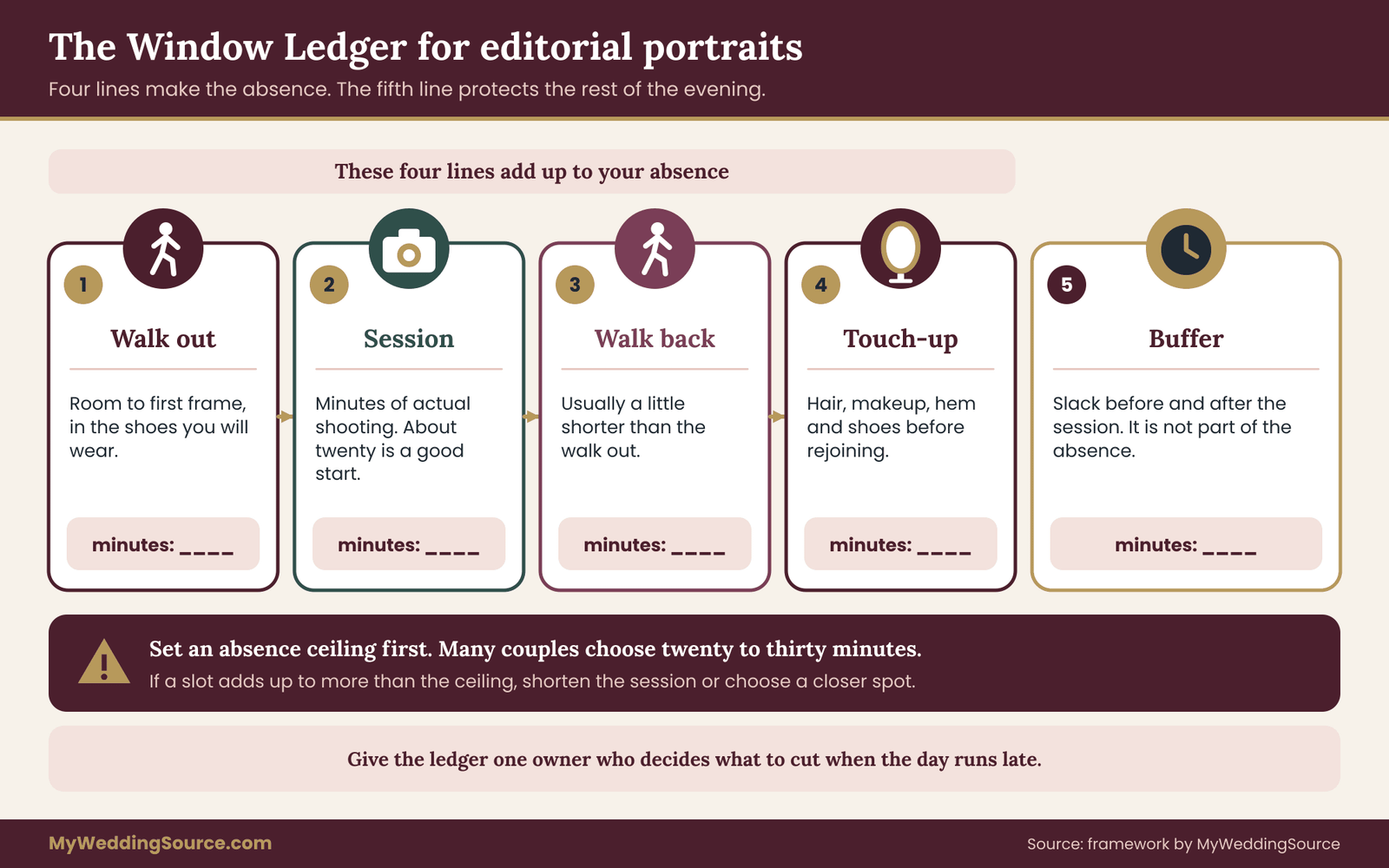
The five lines are these. Walk out: the minutes from the room you leave to the first frame. Session: the minutes the photographer is actually shooting. Walk back: the same trip in reverse, usually slightly shorter because nobody is searching for the spot. Touch-up: the minutes spent on hair, makeup, clothing and shoes before you rejoin. Buffer: minutes of slack that sit outside your absence but inside the schedule.
The first four lines added together are your absence. The fifth is your safety margin. Keeping them separate matters because couples often compress the buffer when time is tight, and then a ten-minute delay at the start becomes a late toast at the end.
Setting an absence ceiling
Before you add up any slot, decide your ceiling: the longest time you are willing to be away from guests in one stretch. There is no official number, so choose one that fits your crowd. A reasonable starting point is to keep a single absence under about half an hour, and to make it shorter at a moment when guests have nothing to do. Many couples find that a ceiling of twenty to thirty minutes feels comfortable at the reception and that a longer one is easier to hide during a cocktail hour with food and music.
Write the ceiling down. It turns a vague worry (“we should not be gone too long”) into a number you can test each slot against. When your photographer suggests a location that is a ten-minute walk away, you can say plainly that it breaks the ceiling and ask for the closer option.
Scoring light, not only time
The ledger has a second half that scores light. For each slot, ask four short questions and answer yes, partly or no. Is the sun low enough to give warm, soft light? Does the location have open sky or an interesting backdrop in that direction? Will the light still be good if the session starts ten minutes late? Is there a plan if it is overcast?
A slot that wins on time but loses on all four light questions is a poor trade for editorial portraits specifically. A slot that wins on light but breaks the ceiling needs either a closer location or a shorter session. The point of scoring both halves is that you see the trade clearly and choose it on purpose.
Who owns the ledger
Give the ledger to one person. It might be a planner, a coordinator, the photographer or one of the two of you, but someone has to hold the numbers on the day. If the evening runs late, that person decides whether to shorten the session, move it or drop it, and tells everyone the new plan in one sentence. Without an owner, each vendor protects its own part of the schedule and the editorial portraits get squeezed by default.
If you do not have a coordinator, the photographer is usually the best owner of the light half, because they watch the sky anyway. The couple or a trusted friend should own the guest half, meaning the walking, the covering and the return. The wedding vendor timeline is a good place to put the final numbers so every vendor sees the same plan.
Light: how golden hour shapes editorial portraits
Photographers use “golden hour” loosely for the period when the sun is low and the light turns warm, soft and directional. It is not a fixed sixty minutes. How long the sun stays low depends on your latitude and the season, and the usable light fades gradually, not at a clear line. For planning, treat golden hour as the stretch of roughly an hour before sunset, then check it against the actual sun times for your date and place.
Editorial portraits lean on this light for good reasons. Low sun creates gentle shadows on faces, adds warm color to skin and fabric, and produces glow behind hair and veils. Midday sun does the opposite: it sits high, carves dark eye sockets and forces squinting. A skilled photographer can make midday editorial portraits work with shade or flash, but the effort and the compromise are larger.
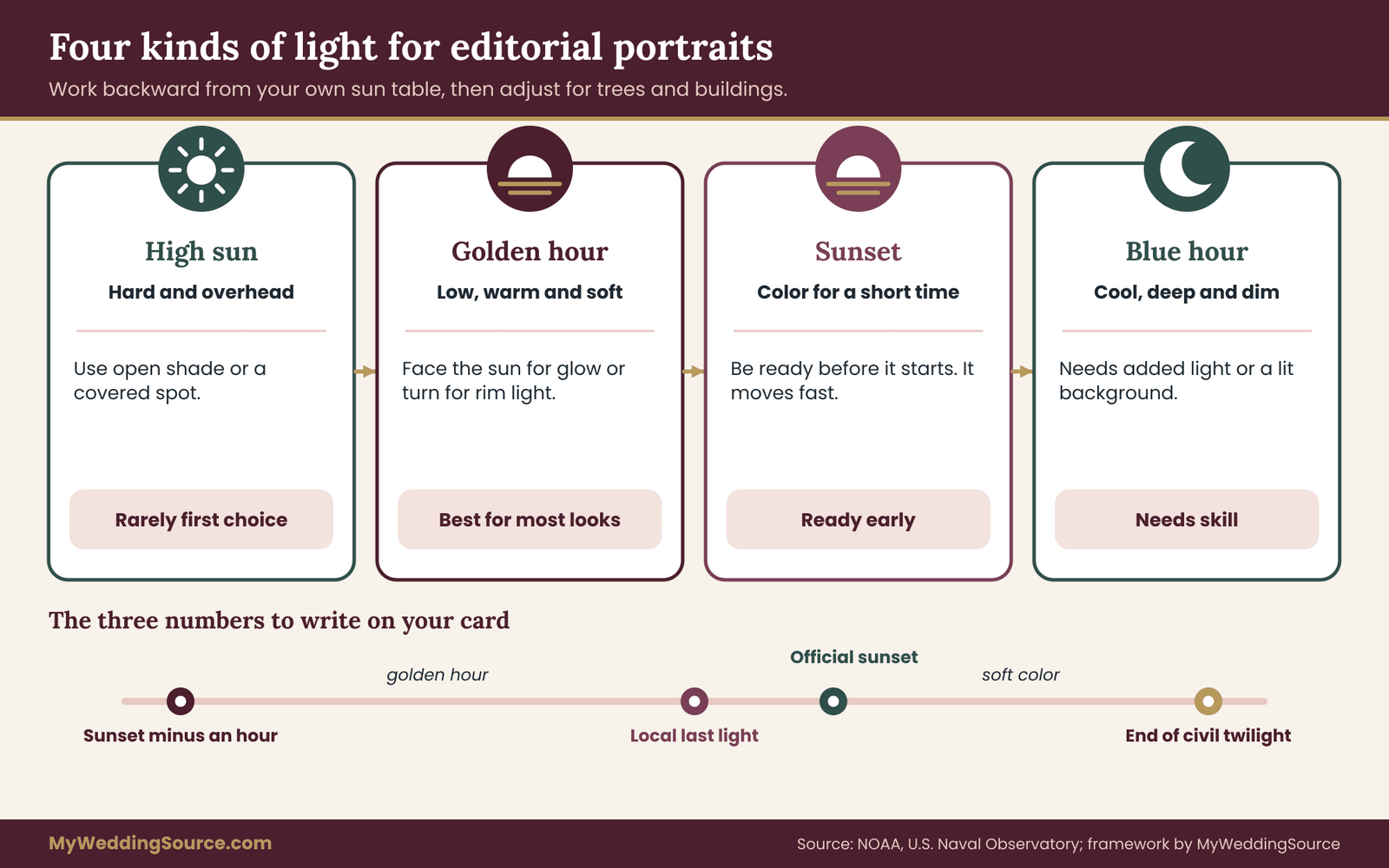
The four light conditions you will actually meet
It helps to name the conditions, because each one suggests a different slot and a different kind of portrait.
High sun. Hard, overhead light. Best handled by open shade, a building’s shadow or a covered spot. It is rarely the first choice for dramatic images, but it may be the only light you have if the ceremony runs in the middle of the day.
Golden hour. Low, warm, directional light. The couple can face the sun for glow, turn away for rim light, or stand in the soft light beside it. This is the condition most people picture when they ask for editorial portraits.
Sunset and the minutes after. The sun disappears, the sky holds color, and the light is cooler and softer. The color can be strong for a short time, and it changes quickly, so the session must be ready before it starts.
Blue hour and dusk. The sky turns deep blue as the light fades. Portraits need either a photographer’s artificial light or a lit location such as a lamp, a doorway or a string of bulbs. It can look dramatic, and it demands more equipment and more skill.
Why direction matters as much as timing
A common mistake is to schedule the time and forget the compass. At sunset the sun sits in the western half of the sky, and where exactly depends on the season and the latitude. If your chosen backdrop is a lake on the east side of the venue, golden hour will light the couple nicely but the background will be dim and plain. If the same lake is on the west, you may get color in the sky behind them.
This is why the location and the timeline are one decision, not two. A photographer who scouts the venue will usually tell you which side the sun falls on and which spots work at which hours. If yours has not scouted, ask them to check the venue in a map app or on a site visit before they recommend a slot.
What overcast days change
Clouds change the answer without ruining it. A thick, even overcast acts as one large softbox, so faces get gentle light all day and the pressure on the golden-hour window is much lower. The trade is that skies turn gray and flat, so the images lean on texture, architecture, foliage and expression rather than color in the sky.
The practical lesson is to keep your plan flexible about the hour on a cloudy day and rigid about the buffers. If the weather forecast shows heavy cloud, ask your photographer whether the session could move to a more convenient moment, such as the cocktail hour, without losing much. That swap often saves guest time at no cost to the result.
What to wear and carry in the light
Light and clothing interact. Warm low sun flatters most fabrics, but very bright whites can lose detail, and shiny satin can throw hard highlights. If editorial portraits matter to you, mention the fabrics and colors to the photographer in advance and ask whether anything should be adjusted. A veil can catch backlight and glow, while a heavy jacket may flatten the silhouette.
Small choices help with the schedule too. Shoes that can walk across grass, a wrap for cool air and a way to carry a train shorten the absence and keep the editorial portraits relaxed. None of this needs to be elaborate. A short list agreed with the photographer is enough, and it can be carried by the same person who holds the small kit.
Finding the real light windows on your date
Do not rely on an app’s rough hint or a friend’s memory of last summer. Use an official sun table for the exact date and the exact location. The National Oceanic and Atmospheric Administration publishes a solar calculator, and the U.S. Naval Observatory publishes sunrise, sunset and twilight data for any place in its tables. Both are listed in the sources. Enter the venue’s town, not your home city, because even a short distance can shift the time slightly, and a different time zone changes everything.
Reading the sun table
A sun table gives you several times, and each one has a use. Sunset is the moment the upper edge of the sun disappears below the horizon. Civil twilight ends when the sun is six degrees below the horizon, which is roughly when the brightest part of dusk is over and outdoor activities start to need lights. The gap between sunset and the end of civil twilight is the window in which the sky still holds soft color.
Write three numbers on your ledger: sunset, the end of civil twilight, and the time one hour before sunset. Those three numbers define your light envelope. Anything inside it is a candidate for golden hour or sunset editorial portraits, and anything outside is a high-sun, cloudy or artificial-light plan.
Account for the building, the trees and the horizon
The table gives you the sun’s theoretical set time on a flat horizon. Your venue is not flat. Hills, trees and buildings can hide the sun well before the official sunset. A venue in a valley, a downtown courtyard or a wooded property may lose direct sun thirty minutes or more earlier than the table says. In that case, golden hour for your purposes ends when the sun drops behind the tree line, not when the sun table says it does.
The fix is simple. Ask the venue or the photographer to check where the sun will be on your date, or visit at the same time of day a few weeks before the wedding and note when direct light leaves your chosen spot. Write that “local sunset” on the ledger, and use it in place of the official time.
Work backward from the last good minute
Once you know the last good minute of light at your spot, count backward. If the local sunset is 6:10 in the evening and the session is twenty minutes, the shooting should start no later than about 5:50. Add the walk out, and you need to leave the room around 5:44. Add a ten-minute buffer so that a late toast does not eat the session, and the room should be ready to release you at 5:34.
Notice what has happened. A window for editorial portraits of about twenty minutes has produced a release time more than half an hour before sunset. That is why editorial portraits often feel as if they intrude on the evening. They cannot be pushed later; the light sets the deadline, and everything else has to fit in front of it.
A second chance at a different hour
If working backward from sunset collides with something you do not want to move, such as a toast, a cake cutting or a long dinner course, consider a second, shorter window. Some couples use the cocktail hour for the main set of editorial portraits and sneak out for five minutes at sunset for a single dramatic frame. Others do the reverse. A short second window costs little and gives the photographer two chances at good light, which also protects you from a bad forecast.
The next section compares the main slots side by side, but the lesson holds across all of them: know your local last-light time before you commit to any slot, and keep the slot in the schedule when other plans move.
Keeping the light plan simple
It is easy to over-plan the sky. A better habit is to decide the one window that matters most and protect it. If editorial portraits are a priority, treat the last good half hour of light as a fixed point and schedule the rest of the evening around it, within reason. If they are a small bonus, treat the light as a pleasant extra and avoid bending the day for it.
Either choice is sound. What causes trouble is the middle path, where the editorial portraits are important in conversation and unprotected in the schedule. Say which kind of priority they are, write it on the ledger and let your planner and photographer see it. That one line prevents most disagreements on the day.
Season and latitude in plain terms
Winter weddings in northern places get a short, early golden hour, often during the ceremony or the first part of the reception, so the dramatic window may land before many guests have settled. Summer weddings get a long, late one that may arrive after dinner. Places closer to the equator have shorter dusks, so the color fades fast. None of this changes the method. It changes which of the four slots fits, and the sun table will tell you which one that is.
If your date is close to a daylight saving time change, double-check that your sun times and your clocks agree. A time written down in the wrong season is a very common source of confusion, and it is easy to avoid by reading the table for your exact date.
The guide on choosing a wedding date covers how season shapes daylight, weather and cost more broadly. For your editorial portraits plan, you only need the few numbers from your own date.
Four slots for editorial portraits, compared
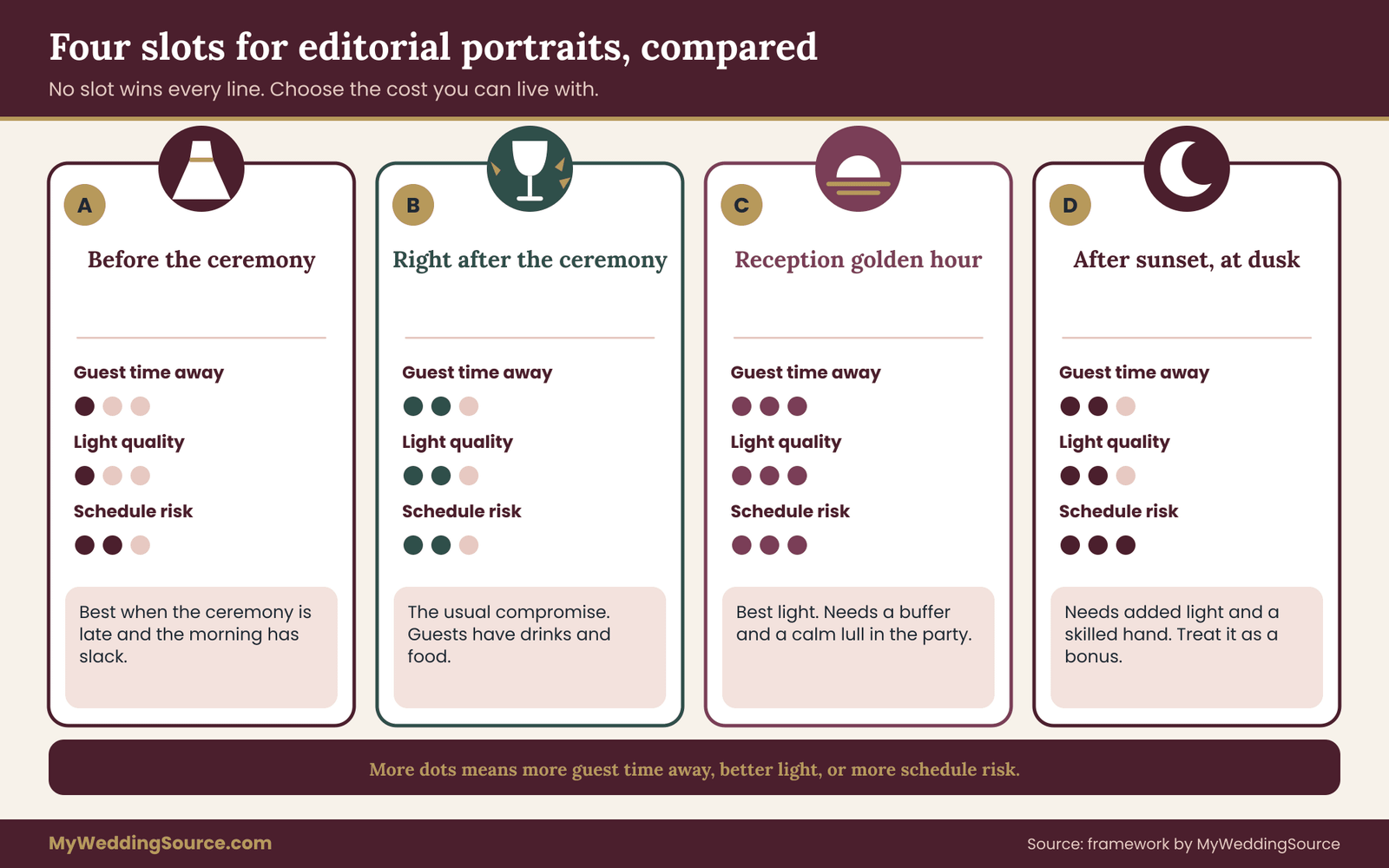
Every wedding day offers roughly four places to put editorial portraits. Each trades guest time, light quality and schedule risk differently. The right choice depends on your sunset time, your ceremony hour and your guest list, so read all four before you pick one.
Slot A: before the ceremony
Some couples make their editorial portraits before the ceremony, either together after a private reveal or separately. The big advantage is that guests are not yet there, so the absence costs nothing. You are also fresh, the clothes are untouched, and nobody has had a drink.
The cost lands elsewhere. You must finish getting ready earlier, and any delay with hair, makeup or transport squeezes the session before a hard deadline, the ceremony start. The light also depends on the ceremony hour. A late-afternoon ceremony can offer wonderful light in this slot. A noon ceremony will put you in high sun, which means shade, a covered location or a different slot.
Choose Slot A if your ceremony is in the late afternoon or early evening, you are comfortable seeing each other beforehand, and your getting-ready schedule has slack. Skip it if your morning is already tight or if you want the ceremony to be the first time you see each other. That is a personal preference, and it is a perfectly good reason.
Slot B: right after the ceremony
The period immediately after the ceremony, often the cocktail hour, is the most common slot. Guests are moving to drinks and food, there is natural movement in the room, and your absence is easy to explain. Cocktails and appetizers give guests something to do, and the hour is traditionally a time when the couple is away anyway.
The conflicts are family formals, receiving lines and the simple fact that the guests want to greet you. If family portraits happen in the same window, the editorial portraits have to share it. That can crowd the schedule, especially if the venue is large. The wedding cocktail hour guide explains how to structure that hour so guests are comfortable while the two of you step away.
Light depends on the season. A late-afternoon ceremony in summer may place the cocktail hour right in golden hour, which is ideal. A morning or noon ceremony will leave you in high sun. A winter ceremony may lose the light before the cocktail hour ends. Choose Slot B when your ceremony ends within an hour or two of sunset, or when you can use shade and a covered location with confidence.
Slot C: the reception golden hour
Slot C is the so-called sunset sneak. The reception is underway, dinner is finishing or has ended, and you slip out for ten to twenty minutes when the light is at its best. It often produces the most dramatic results because the sun is lowest and the sky holds color.
The cost is guest absence in the middle of the party, so the details matter. Choose a moment when guests are occupied, such as between dinner and toasts, during a long dessert service, while a band sets up the second set, or just before the dance floor opens. Avoid slipping out during speeches or the first dance, which are the moments guests are watching.
This slot is the least forgiving about schedule risk. If dinner runs late, the sun does not wait. Keep a ten-minute buffer, and if the day runs behind, have the person who owns the ledger decide in advance whether to shorten the session, drop the walk to the farther spot or move to a closer one. Choose Slot C if your sunset falls at a convenient moment for the reception and you can keep the timeline predictable.
Slot D: after sunset and into dusk
After the sun is down, the sky still carries color for a short while, then fades to deep blue. Couples sometimes pick this slot for moody editorial portraits, especially at venues with strong artificial lighting, such as a lit courtyard, a doorway, a string of lights or a dark interior.
Guest cost is moderate because the party is usually in full swing, with people on the dance floor and the bar open. The risk is technical. Dusk editorial portraits need flash or continuous light, a lit background and a photographer who is comfortable with them. Ask to see examples of that kind of work, taken at real weddings, before you rely on this slot. It also demands energy, because by this hour many couples are tired and hungry.
Choose Slot D when the sun sets very early, when your venue has atmospheric lighting you love, or when you want a second, separate set of images in a different mood. Treat it as a bonus, not a rescue plan, because dusk gives you less margin for error.
A quick scoring sheet for editorial portraits
For a fast comparison, give each slot a score from zero to two on four lines: light quality, guest cost, schedule risk and technical demand, where two is the best result on each line. Add the four scores, and treat the total as a conversation starter, not a verdict. A slot with a high total and one zero deserves a close look at that zero before you commit.
The reason to score is not precision. It is to prompt a short, honest talk with your photographer about why one slot beats another for your date. Two people who disagree about a total usually disagree about one of the lines, and finding that line is the whole point. Keep the sheet to one page so it travels easily and can be updated if the forecast or the schedule changes.
Putting numbers on the four slots
Use the ledger to compare. For each slot, fill in the five lines, add the absence, and note the light. Here is how the comparison might look for an invented couple with a late-afternoon ceremony and a sunset an hour and a half later. The numbers are illustrative only.
In Slot A, the walk is short, the session is twenty minutes and the touch-up is minimal, so the absence is small and invisible to guests, but the light is still fairly high.
In Slot B, the absence is slightly longer because guests are present, but they are busy, and the light is good. In Slot C, the absence is the same length but happens at the moment when the sun is lowest, so the light is best and the cost to guests is highest. In Slot D, the absence is moderate and the light is soft and cool, but the technical demands are highest.
This is why no single slot wins on every line. Slot C often wins on light and loses on guest cost. Slot A often wins on guest cost and loses on light. Slot B is the compromise. You are choosing which cost to accept, and writing it down makes that choice honest.
Combining slots on purpose
Many couples get the best result by splitting editorial portraits across two slots. A common pattern is a main set during the cocktail hour, when guests are busy and the light is decent, plus a short sunset set of five to ten minutes. The first set gives you variety, and the second gives you a chance at a single memorable frame without a long absence.
The danger of splitting is that two small absences can add up to a larger one than a single block would. Add both on the ledger. If the combined total exceeds your ceiling, shorten one set or drop it. The wedding ceremony cue sheet is a good model for how to write each handoff down so that everyone knows when the couple leaves and when they return.
Decision rules in plain language
A few rules cover most weddings. If your ceremony ends more than two hours before sunset, use Slot B for the main set and Slot C for a short second window. If your ceremony ends within an hour of sunset, use Slot B and treat it as your golden hour. If sunset falls during dinner, use Slot C with a tight buffer and a clear owner. If sunset is very early, use Slot A or B, and consider Slot D as a bonus.
If you cannot decide, pick the slot with the lowest absence that still has acceptable light, and ask the photographer to confirm it. A clear, modest plan almost always beats an ambitious one that depends on everything going right. The same principle applies when an ambitious location sounds appealing but sits far from the venue, which the next section takes up.
What to do when guests are not busy
All four slots depend on guests having something to do. If your event has no cocktail hour, no long dinner and no obvious lull, build one. Open the bar a little earlier, put out lawn games or a photo display, ask the DJ or the band to play through, or schedule a slideshow. The point is not to entertain people every second. It is to make sure your absence does not leave a room of people waiting for something to happen.
For very small weddings, the question changes. With twenty guests at a single table, a twenty-minute absence is felt by everyone. In that case, make the editorial portraits shorter, do them before the ceremony, or invite a few people along as helpers who carry the train and hold the umbrella. Guests who are part of the process do not feel left out of it.
Choosing a location that earns its minutes
The best location for editorial portraits is not the most dramatic one. It is the one that gives you the most pleasing frames per minute of absence. A cliff edge forty minutes away loses to a plain wall twenty steps from the ballroom if the wall has good light and the cliff costs half the evening. Think of every minute of walking as a fee you pay before you get to take a single picture.
Start with what the venue already has. Most venues contain several places that photograph well without any travel: a doorway with warm light, a window, a staircase, a hedge, a courtyard, a garden wall, a field edge, a covered porch. Ask the venue and the photographer to name the three best spots within a short walk and to say which hour each one suits.
Five questions for any candidate location
Score each spot with five short questions. They take a minute to answer and save a lot of regret.
How long is the walk, with the dress and shoes? Measure it as the two of you would actually walk it, in your shoes and with the train, not as a map app would on a normal afternoon. Gravel, grass, stairs and slopes all slow people down.
Where will the light fall at the time we need it? The spot must work in the direction the sun will be, inside your local last-light time, not just on a bright afternoon.
Is it ours to use? Some places are private, some belong to the venue and some are public land with their own rules. A permit or permission may be needed, so ask early. Public parks and protected lands often regulate commercial photography, and the land manager is the one who decides. Do not rely on a photographer’s assumption, and do not discover the rule at the entrance.
What happens if it rains or the wind picks up? A location that works only in perfect conditions needs a fallback within the same short walk.
Can everyone get there safely? If someone in the party has limited mobility, or the path is uneven, the location must be reachable without risk. A beautiful image is not worth a fall.
Close beats clever
Distance is the most reliable predictor of whether the editorial portraits plan holds together. Each additional minute of walking is paid twice, out and back, plus the extra touch-up that a longer walk causes when hair and hems move. A spot that is three minutes away costs about six minutes round trip. A spot ten minutes away costs twenty or more.
That is why many photographers prefer to start with a close location and add a second only if time allows. A sequence that begins at the closest spot also gives the photographer an immediate set of safe images, and anything that follows is a bonus. If the plan has to be cut short, the best frames are already taken.
Using a vehicle sensibly
When the best location is far, a vehicle can change the arithmetic, but only if it is organized. A driver, a clear pick-up point and a short loading routine can turn a fifteen-minute walk into a three-minute ride. A dress with a full skirt or a long train may need a larger vehicle, and rental equipment such as a golf cart usually needs the venue’s approval.
Before you commit, ask whether the vehicle arrangement adds minutes of its own. Waiting for a ride, loading a skirt and finding a parking spot can add more than the walk would. Run the ledger both ways and choose honestly.
Matching the location to the style you want
Different looks ask for different places. Clean, quiet editorial portraits come from plain walls, open fields and wide skies. Moody editorial portraits often use doorways, dark foliage, stairwells or interiors with a single strong window. Romantic, glowing editorial portraits need backlight and a soft background, such as a tree line or a low hedge.
Name the look you want before you name a spot, and tell the photographer. A photographer who knows that you prefer quiet, simple editorial portraits will choose very different places from one who thinks you want a dramatic landmark. Matching place to style first avoids the common problem of walking a long way to a location that does not suit the images you had in mind.
Backgrounds that need nothing
Some of the strongest editorial portraits use very little: a plain wall in warm light, a line of trees, a field, a sky. These backgrounds are forgiving, easy to find, and they put attention on the two of you and the light. A photographer who works well with simple settings will make a short session feel full, which is a better use of twenty minutes than a complicated set that takes ten to reach.
If you are drawn to a landmark or a scenic overlook, treat it as a separate trip with its own ledger, and decide whether it belongs on the wedding day at all. Many couples use a different day, such as a morning after the wedding or a day before, for those images. That choice can bring the best light and no guests waiting.
Making the spot ready in advance
Time at the location is expensive, so remove everything that does not need to happen there. The photographer or an assistant can scout the spot in advance, check for obstacles, move a chair, test the light and decide where the first frame will be. The two of you should arrive to a plan, not a discussion.
Small preparations pay off. Carry a spare pair of flat shoes for the walk. Have someone bring water, tissues and a small kit with pins, tape, a lint roller and a comb. Bring the veil or jacket only if it will be used. These items cost a minute to pack and can save five at the location.
Pace and posing: how directed time stays short
A short session works when the photographer arrives with a plan for the first five minutes. Many photographers start with simple movement, such as walking, turning and looking at each other, because it warms people up and produces natural frames quickly. The most efficient editorial portraits often come from three or four simple setups used well, not ten complicated ones.
Ask your photographer to describe the sequence they would use. A clear answer shows that they have run short sessions before and know how to protect your time. If the answer is a long list of locations and ideas, ask which two they would keep if the light began to fade. The shorter the list, the more likely the editorial portraits will finish on time and still look deliberate.
Buffers, travel and transitions
A schedule without slack is a schedule that will break. The buffer line on your ledger is what stops one late event from knocking over all the others. It is not padding. It is the cost of being able to say “we are fine” when something runs over.
How big should the buffer be?
There is no universal figure, and anyone who gives you one is guessing. Ten minutes on each side of the session is a sensible starting point for a venue with predictable timing. Increase it if the ceremony is outdoors, if the venue is large, if the day involves multiple transport steps, or if the weather is uncertain. Reduce it only if you have a coordinator who has run similar days there before.
Ask what typically slips. At many weddings it is the ceremony start, the length of the receiving line, and the time between the end of cocktails and the start of dinner. If your venue’s staff say that dinner usually starts fifteen minutes late, you need at least that much slack before a sunset session that follows it.
Two kinds of buffer
Separate the buffer before the session from the buffer after. The first protects the start. If the previous event runs long, it absorbs the delay without touching the light window. The second protects what follows. If the session overruns or the walk back takes longer, it keeps toasts, cake and the first dance on time.
If you can afford only one, put it before the session. A late start loses light, and light is the one resource that cannot be recovered. A late return can be fixed by shortening a later activity or by shifting the next event by a few minutes, and guests rarely notice.
Write the handoffs down
Every transition needs a name attached to it. Who tells the photographer the room is ready? Who signals the DJ that the couple is leaving? Who walks with the couple, and who stays behind to explain? Who calls them back? On a day with many moving parts, these small handoffs are where time disappears.
A short written plan, even a few lines on a card, solves this. Include the release time, the location, the planned return time, the person responsible for each handoff, and a decision rule for running late. The cue-sheet format used for ceremonies works well here: one line per cue, one name per line, and a time that any vendor can follow.
The late rule
Agree in advance on what happens if the day runs behind. A plain rule is enough, for example: “If we are more than ten minutes late at release time, the session shortens to ten minutes at the nearest spot. If we are more than twenty minutes late, we take two frames at the venue door and move on.” Decisions made calmly in advance are much easier to follow than decisions improvised in the moment.
Without a rule, the usual result is that nobody wants to cancel or shorten, so the session runs full length and everything after it slips. With a rule, the person holding the ledger can say “we are using the short version” and everyone knows what that means.
Protect the return as well as the exit
Couples often plan the exit carefully and leave the return vague. Yet a return has its own steps: the walk back, a quick check in a mirror, a drink of water and a moment to breathe. Give the return a specific time and an entrance, and tell the DJ or the coordinator so that your arrival can be announced or, if you prefer to slip in quietly, so that the room is not waiting for a grand entrance.
A short, calm return does something useful. It resets the energy for the next part of the evening. Rushing back sweaty and flustered makes it harder to enjoy the reception, and a minute of calm costs almost nothing.
Keeping guests comfortable while you step away
Guests do not mind a couple leaving for editorial portraits. They mind not knowing what is happening, having nothing to do and feeling that the schedule has stopped. The fix is communication and a little hospitality, and both are cheap.
Tell people in advance
Put a single line in the program, on the welcome sign or in the invitation details: “The couple will step out for editorial portraits after the ceremony and join you for dinner.” People who read it will relax. People who do not will still hear it from the host, the coordinator or the DJ. A friendly announcement, kept short, makes the break part of the program instead of an unexplained gap.
For the reception sunset slot, a brief note from the DJ or band leader works well: “The couple are stepping out to catch the sunset and will be back in a few minutes. Please keep dancing and enjoy the bar.” Keep it light, make it short and do not apologize. The announcement tells guests that the absence was planned, which is exactly what they want to know.
Give guests something to do
The best guard against a restless room is a reason to stay put. Open the bar before the session, serve a second round of appetizers, let the band play a longer set, or run a slideshow. Lawn games, a photo display and a guest book table all fill the gap. People are comfortable when they have a drink in hand, someone to talk to and something to look at.
Seating helps too. Assign someone from the wedding party or the family to circulate, introduce people and check that no one is stranded. At weddings where guests mostly arrive in groups, the wedding party can be the bridge, since many guests already know them.
Keep older guests and children in mind
Older guests may have less energy for long waits and fewer places to sit. If the break happens outdoors, provide chairs and shade. If it happens at a time when older guests would normally head home, consider scheduling it earlier in the evening so they can see you before they leave. The guide to reception guest flow explains how to arrange the room so that movement and breaks feel natural to everyone.
Children are another special case. A young guest who is hungry or tired will make a long gap feel longer. If children are present, ask the caterer to serve them early or keep a snack table going while you are away.
Decide whether guests may follow
Some guests will want to come along, especially the curious or the camera-loving ones. A crowd at the location for editorial portraits changes the session, because the couple becomes aware of an audience, and the photographer has to manage people instead of light. Decide before the day whether you want to be alone or accompanied, and tell your wedding party so that they can steer people politely.
A helpful compromise is to invite one or two people, such as a sibling or a close friend, to come along and carry things. They keep you company, handle the small tasks, and can pass messages back to the venue. Everyone else stays with the party.
Phones and other photographers
Guests with phones can follow the couple and take their own images, which can interfere with the light, distract the couple and clutter the background. Your usual guest photo policy applies here as well, and the guide on wedding photography consent explains how to set boundaries kindly and clearly. For editorial portraits, a short request is enough: “We are taking a few quiet portraits. Please let us have this time.”
A short script for the host
If someone has to explain, a short script helps. “They are just stepping outside for a few editorial portraits in the evening light. They will be back shortly, and dinner will start right after.” Anyone, a parent, a friend or a coordinator, can say it. A consistent answer prevents rumors and impatience.
When the break should not happen at all
Some moments are poor choices for any absence. Speeches, the first dance, a cake cutting, a parent dance and a ceremonial ritual all draw the room’s attention, and guests tend to remember a missing couple at those times. If your sunset collides with one of them, move the editorial portraits to another slot instead of asking the room to wait.
The same applies to a long, formal dinner service at a small wedding. If the whole room is seated at a few tables, a gap is obvious. In that setting, a short cocktail-hour session or a before-ceremony slot protects the evening better than a sunset sneak, even if the light is slightly less dramatic. Honest trade-offs like these are what the ledger is meant to expose.
A worked example: one evening of editorial portraits
The following example is invented to show the method. It is not a real couple and the numbers are not typical results. Use it as a pattern, then replace every figure with the ones from your own date and venue.
The setup
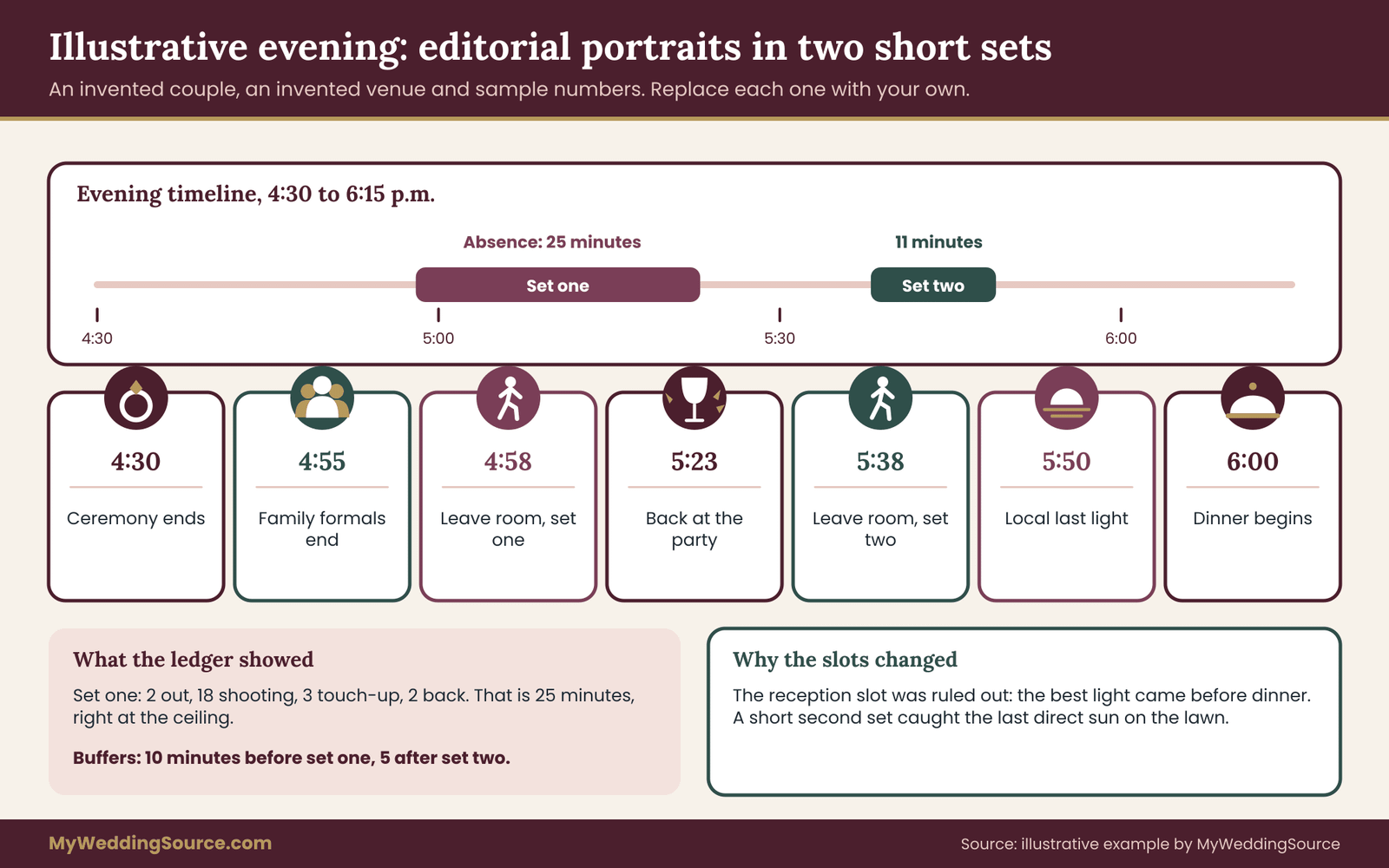
Imagine a couple called Maya and Daniel, married on an autumn Saturday at a garden venue. The ceremony ends at 4:30 in the afternoon. The sun table for the venue’s town shows sunset at 6:12. The venue sits on a gentle slope, with a line of tall trees on its west side. On a site visit, the photographer notes that direct sun leaves the lawn about twenty minutes before the official sunset, so the local last light is 5:50.
They want a handful of editorial portraits, they dislike the idea of leaving a party, and their guest list is about seventy people, including several older relatives. They set an absence ceiling of twenty-five minutes at any one time.
The ledger for each slot
For Slot A, they decide against a private reveal because they want to see each other at the ceremony. That removes the slot.
For Slot B, the cocktail hour runs 4:45 to 5:45. The sun is still fairly high at the start and drops through the hour. The garden wall by the lower lawn is a two-minute walk. The session is eighteen minutes, the touch-up is three, and the walk back is two. The absence is twenty-five minutes, right at the ceiling. The light is good but not at its best, and family formals also need a window in the same hour.
For Slot C, dinner starts at 6:00 and the main course is cleared close to 6:50, after the local last light. The best light would arrive before the meal even begins, so a reception sunset slot offers nothing. The photographer rules it out.
For Slot D, there is little drama left after 6:20 on this property, and the lit courtyard is attractive but small. They keep it as a possible bonus.
The choice
They split the plan. The main set takes place in Slot B, leaving the room at 4:58 once a short family formals block ends at 4:55, with the photographer shooting from about 5:00 in improving light. A second, shorter set of five minutes happens at 5:40 at the top of the lawn, with the couple leaving the room at 5:38, where the last direct sun lands before the trees take it. The first set uses the wall and the field edge. The second uses the tree line and the glow behind it.
The first absence is twenty-five minutes and the second about eleven, each below the ceiling, with fifteen minutes at the party between them. They add a ten-minute buffer before the first set and a five-minute buffer after the second, which is enough to protect dinner at 6:00, since they are back by about 5:50.
How the guests experience it
While Maya and Daniel are away at 5:00, the bar has just opened, the band plays a second set of acoustic songs, and a sibling circulates with a tray of appetizers. The program card mentions a short break for editorial portraits. Older relatives are seated in the shade with drinks. When the couple return around 5:23 there is no announcement, only a quiet walk back in. The second break at 5:38 is so short that most guests barely notice.
What the example shows
The method did not produce a perfect schedule. It produced a visible one. The couple could see that Slot B alone was tight, that Slot C would collide with dinner, and that a short second window at the local last light was cheap. Each decision came from numbers on a card rather than from guesses. That is the real value of the ledger: it turns “how long will this take?” into a comparison you can discuss with your photographer in five minutes.
Questions for your photographer and venue
A planned session of editorial portraits depends on a few facts only your vendors know. Ask them early, ideally before you sign, and write the answers into your plan. Most of these questions take a minute to answer and prevent a long discussion on the day.
Questions for the photographer
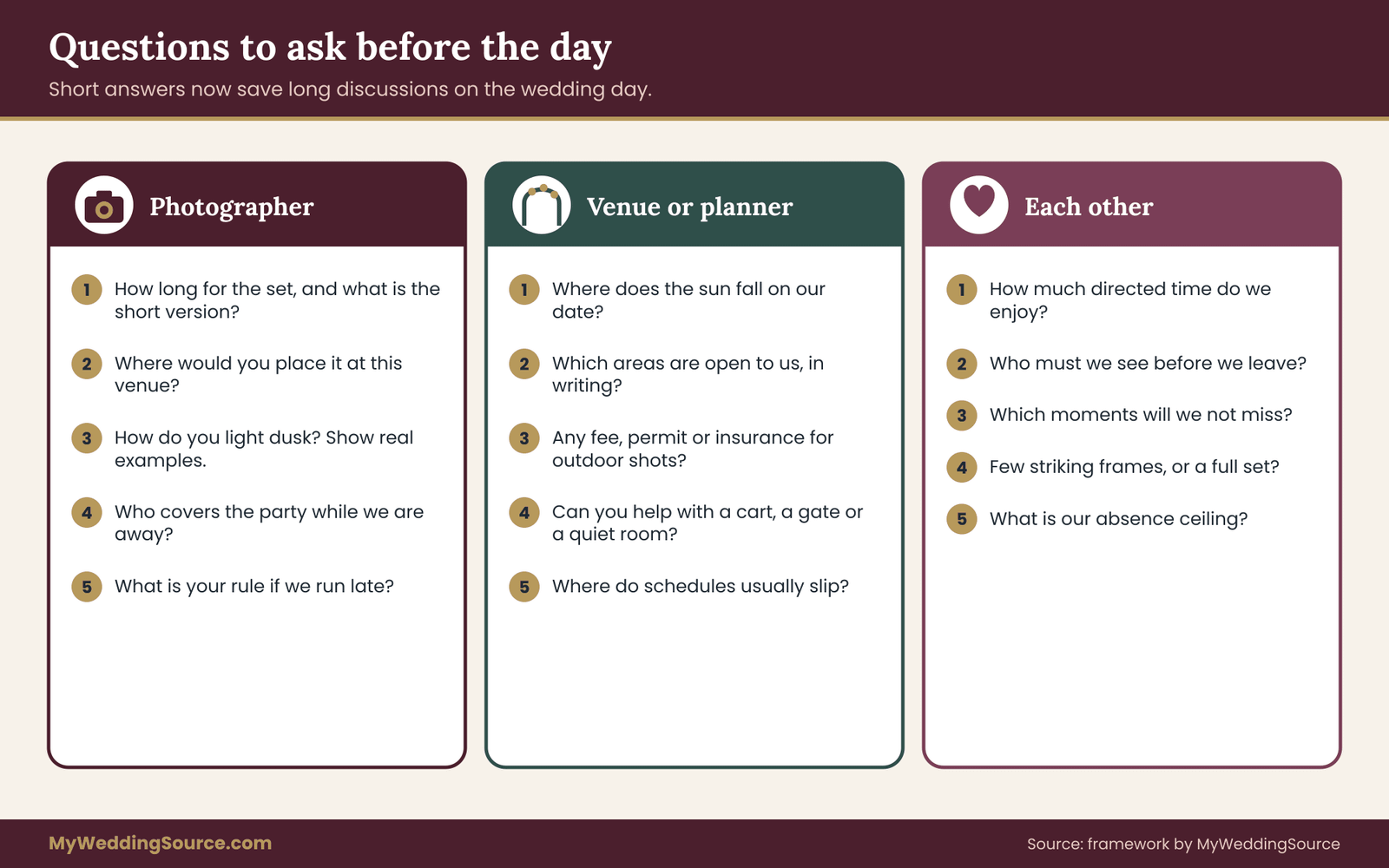
How long do you need for the editorial set, and what is the shortest version you would still be happy with? The answer gives you the full and reduced forms of the session. A photographer who can describe both has thought about running late.
Have you worked at this venue, and where would you place the session? If the answer is yes, ask for the two or three spots they like and the hour for each. If no, ask whether they will visit or study the property before the day, and whether that visit is included.
How do you handle low light and dusk? If you plan Slot D, ask what lighting they bring, whether they use flash or continuous light, and to see real wedding examples taken at that hour. Do not accept a stock portfolio image as an answer.
Who covers the party while we are away? If there is a second photographer, ask whether they stay with the guests. If there is only one, ask what will be missed during the session, such as cocktail hour candids, and whether you are comfortable with that trade.
What happens if we are late or the weather changes? You want a stated rule, not a promise to see how it goes. Ask which spot they would use in rain, which in wind and what they would cut first.
How is the time for editorial portraits reflected in the contract? Ask whether the session sits within the booked coverage hours, whether any travel or extra location costs apply, and what overtime costs if the day runs long. The wedding vendor contract guide explains which clauses to check and how to ask for changes in writing.
Questions for the venue or planner
Where does the sun fall on our date, and which spots work at which hour? The venue staff see the property in every season and often know the answer by heart.
Which areas are open to us and which are restricted? Some gardens, rooftops, kitchens and guest rooms are closed at certain times, and some are reserved for other events. Ask for the rules in writing or an email, and ask who to contact if the plan changes.
Is there any fee, permit or insurance requirement for photography in outdoor areas? Private venues sometimes include this in the rental, and public spaces may regulate commercial photography. A land manager decides, so ask them directly.
Can the venue help with logistics? A staff member to open a gate, a cart for the dress or a quiet room for touch-ups can save minutes. Ask in advance, since these favors are easier to arrange before the day.
What is the usual timing slip at your events? Staff who have run hundreds of weddings can say where schedules typically slip. Use that answer to set your buffer.
Questions for each other
Before you talk with vendors, settle a few things between the two of you. How much directed time do you actually enjoy? Some couples love it, and some would rather skip it. Are there guests you must see before the editorial portraits, such as an elderly relative who may leave early? Are there moments you refuse to miss? What do you each want from the images, a few striking frames or a full set?
The answers define your priorities, and the ledger turns them into a schedule. Write them in one line, for example: “Three striking portraits, no more than twenty-five minutes away, never during dinner or speeches.” That sentence is easy to repeat to a planner and hard to forget on the day.
Cost logic without invented numbers
Extra time costs money in ways that are easy to miss. Coverage hours are often priced in blocks, so pushing editorial portraits to sunset may extend the day by an hour. A second location may add travel time and a fee. An assistant for dusk lighting may add a charge. A vehicle may add a rental. None of these is large on its own, but together they can change a quote.
Ask for the price of each add-on as a separate line, and compare it with the cost of a simpler plan. Often the cheapest improvement is not more time but a better slot: moving the session to the cocktail hour or to a closer location can give a similar result for no extra cost. Always base decisions on the actual quotes in front of you, not on averages you have read.
What to put in writing
After the conversations, write a one-page summary and send it to the photographer, the planner and the venue contact. Include the release time, the location, the planned return, the buffers, the late rule and the person holding the ledger. A written plan avoids the “I thought you said” moments and gives every vendor something to point to. Once the numbers are confirmed, copy them into the shared vendor schedule so everyone works from the same page.
Reading the answers
When the answers come back, look for two signals. The first is specificity. A photographer who names the spot, the hour and the fallback has planned the editorial portraits, while one who says “we will see how it goes” has not. The second is willingness to put the rule in writing. Vendors who are comfortable with a late rule usually run calm days.
If an answer worries you, ask a follow-up before moving on. A good photographer will welcome questions about editorial portraits, since a clear plan helps them as much as it helps you. If the answers stay vague after a second try, treat that as information about how the day may go, and weigh it alongside the style and price.
Edge cases: early sunsets, rain, heat and mobility
Not every wedding fits the standard slots. These are the common exceptions and a sensible way to handle each.
Very early sunsets
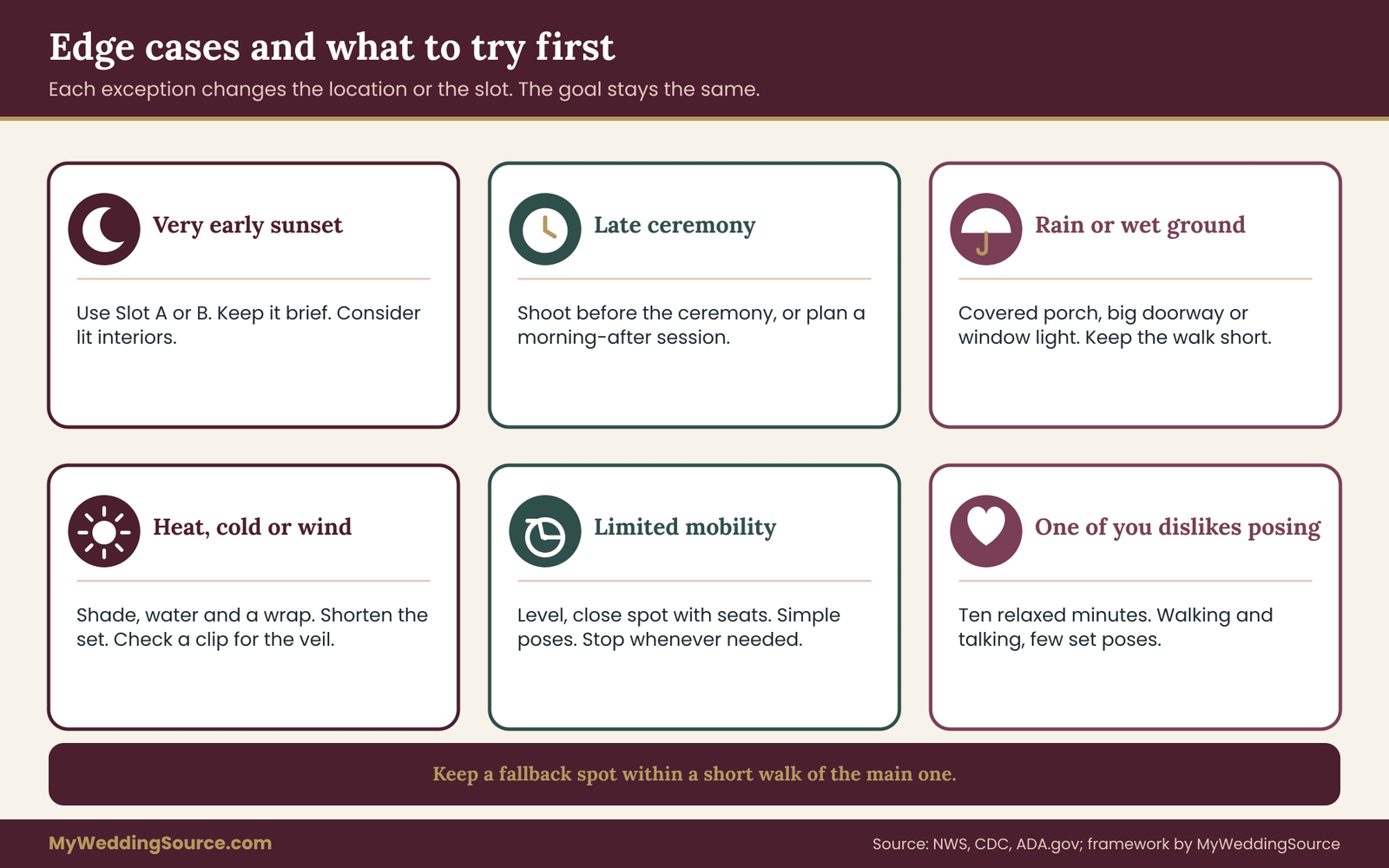
Winter weddings may face a sunset before four-thirty in the afternoon in northern locations. If the ceremony ends near sunset, the cocktail hour may already be in dusk. Options include making Slot A the main slot, holding the ceremony earlier, shortening the formal photos to leave room, or making the editorial portraits a brief set right after the ceremony while the light lasts.
Another option is to treat the evening as a lit-location event. Strong string lights, candles, a fireplace and warm interiors can make beautiful backgrounds. That approach needs a photographer who is skilled at it, which is the reason to ask for real examples.
Late ceremonies
When a ceremony starts after the golden hour has passed, there may be no natural-light window for the editorial portraits at all. A short session before the ceremony, while light remains, may be the only option. Another is to schedule editorial portraits on a different day. A morning-after session or a day-before session gives you full choice of light and location with no guests waiting, and is often more relaxed.
Rain and wet ground
Rain changes the location, not the goal. A covered porch, a large doorway, a greenhouse or an interior with big windows can produce editorial portraits in soft, even light. Umbrellas, clear or dark, can also work as props. Keep a fallback spot within a short walk, and confirm that the venue allows it.
Wet grass is a hazard for dress hems and shoes. Bring a towel and a spare pair of shoes, and think about whether a ramp or a dry path can substitute. The point is to keep the walk short, since rain makes every minute outside more expensive.
Heat, cold and wind
Heat tires people and ruins makeup. If the day is hot, choose shade and keep the session short, and bring water. The Centers for Disease Control and Prevention and the National Weather Service publish heat safety guidance, and both are listed in the sources. Cold has the opposite effect, with stiff poses and chilled hands. Bring a coat or a wrap to wear between frames, and keep the walk brief.
Wind changes veils, hair and skirts. It can create movement that photographs well, and it can make a long veil unmanageable. Ask the photographer how they handle it, and consider whether a shorter veil or a clip makes sense on that day.
Mobility, energy and comfort
If one of you uses a mobility aid, has limited stamina or finds long standing painful, plan the location around that. Choose a spot that is level and reachable, put seats near it, and shorten the session. Dramatic images do not require difficult poses. Many strong editorial portraits are built from simple standing, sitting or walking, and a patient photographer can create variety within them. The Americans with Disabilities Act website, listed in the sources, explains accessibility in public places.
The same care applies to pregnancy, injury or illness. Build in breaks, keep water close and give the photographer a plain instruction: stop if either of us needs to.
When one of you dislikes being photographed
Not every couple enjoys directed editorial portraits. If one partner is uncomfortable, say so before the day and ask the photographer for approaches that are low pressure: walking, talking, a few very simple poses, and a short session. Ten relaxed minutes often produce better images than thirty tense ones, and the schedule is better for it too.
Checks that show the plan is working
A plan you cannot test is a hope. The following checks are measurable, take little time and tell you early whether your editorial portraits plan will hold. Run them in three stages: weeks before, the day before and the day itself.
Weeks before: five written facts
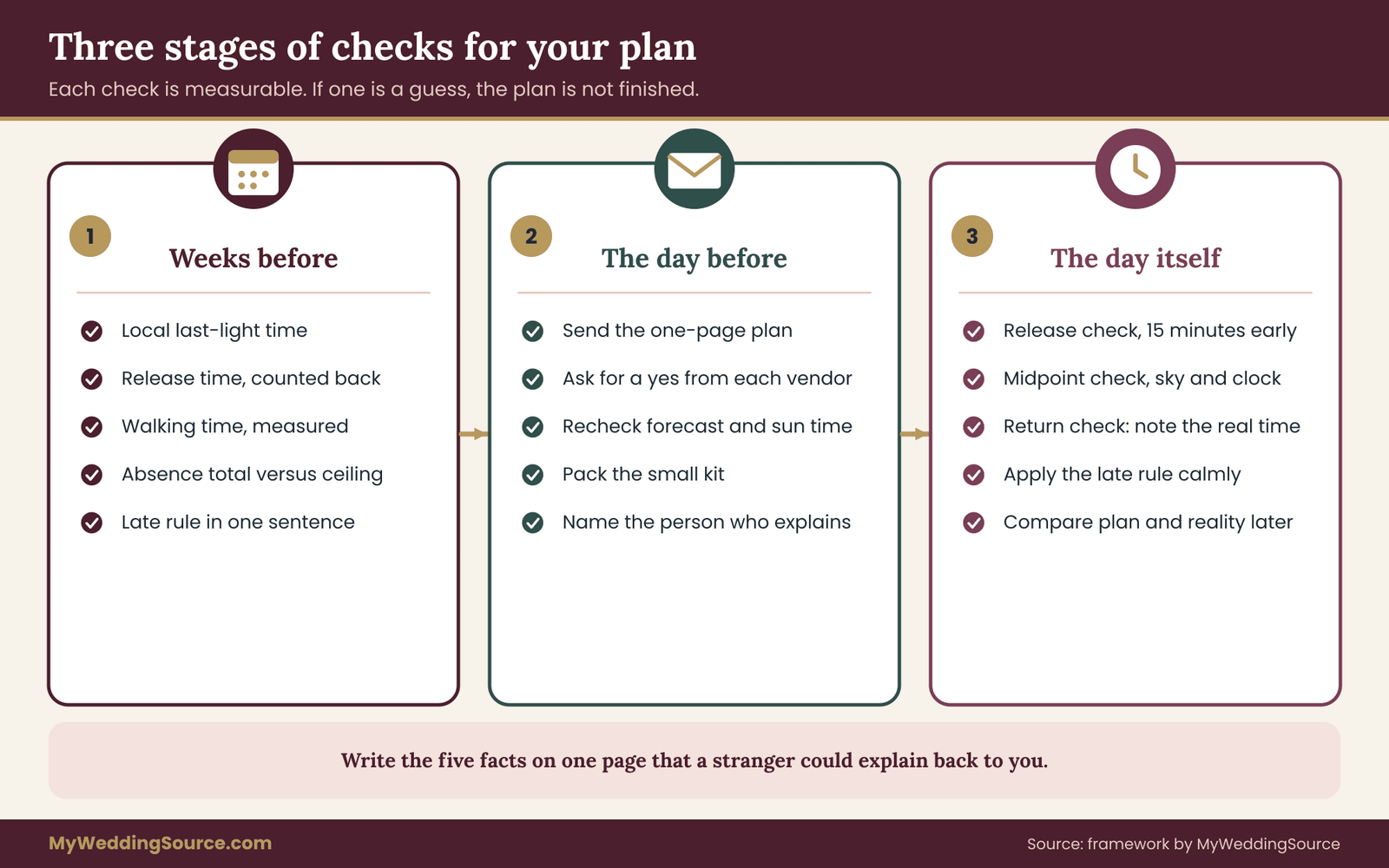
By about a month before the wedding, you should be able to write five facts on one page. The local last-light time at your chosen spot, taken from the official sun table and adjusted for trees and buildings. The release time, counted backward from that last light. The walking time, measured at the pace you will actually walk. The absence total from the ledger, compared with your ceiling. The late rule, in one sentence.
If any one of the five is a guess, the plan is not finished. Guessing is fine early on, since few couples know their last-light time in the first month of planning, but each guess should turn into a fact before the day. A quick check is to hand the page to someone who has not seen it and ask them to explain it back to you. If they cannot, the plan is too complicated.
A walk-through you can do alone
If you can visit the venue a few weeks before the wedding, go at the same time of day as the planned session. Walk from the room to the location at a natural pace, time it, and note where the sun is. Take a few phone pictures of the spot from the angles the photographer might use. Look for things that could spoil a frame: a trash bin, a parked vehicle, a utility box, a sign.
This visit takes less than an hour and removes most surprises. If you cannot go, ask the photographer or the venue to send a short video walking the route, and check the timing from that. The point is to replace a map estimate with a measured number.
The day before: confirm and release
The day before, send a short confirmation message to the photographer, the planner and the venue contact. Repeat the release time, the location, the planned return and the late rule, and ask each person to reply with a simple yes. Check the forecast and the sun time one more time, and adjust the plan if the weather has changed.
Prepare the small kit now: flat shoes, water, tissues, pins, tape, a comb, a lint roller. Choose the person who carries it, and tell them. Choose the person who explains the break to guests, and give them the script from earlier in this guide. Little jobs assigned the day before rarely fall through, and those assigned on the day often do.
The day itself: three checkpoints
On the day, three checkpoints keep the plan honest. The first is the release check, about fifteen minutes before the release time. The person holding the ledger asks one question: are we on time? If not, apply the late rule now, not later.
The second is the midpoint check, halfway through the session. The photographer glances at the sky and the clock and says whether the session is on track. A quick check at this point lets them trade an extra pose for a safer return.
The third is the return check. When the two of you step back into the room, note the actual time. That number goes on the ledger next to the plan, and it will tell you, after the wedding, how accurate your estimates were. It also sets the clock for the next part of the evening, which is the real reason to note it.
Measures that matter afterward
After the wedding, compare plan and reality. Did the absence stay under the ceiling? Was the release on time? Did the session start inside the light window? Did the buffers get used, and by how much? Did guests seem comfortable, or did anyone mention the break?
These are not tests you can fail. They are information. A couple who learns that the walk took twice as long as planned has a useful fact for their own future events, and a planner or photographer who sees the numbers may use them for other clients.
Checking the images against the plan
When the gallery arrives, look at the editorial portraits with the plan beside you. Were the best frames taken in the first part of the session or the second? Did the light match what you expected? Did the location work as planned? The answers help you judge whether the slot was the right one, and they are useful if you ever plan an anniversary session.
Do not judge the result against someone else’s gallery. Every wedding has its own light, its own place and its own sky. A fair measure is whether your images look the way you described to the photographer in the first place, using the style conversation as the benchmark.
A one-page template to carry
Keep the final plan to one page. Write the date and venue at the top, then the local last-light time and the release time. Below them, list the location, the walking time, the session length, the buffers and the planned return. At the bottom, write the late rule, the name of the person who holds the ledger and the line you will say to guests. Print it, and give a copy to the photographer, the planner and one friend.
A single page works because it is read. Long documents sit in inboxes, while a card in a pocket gets used. If your editorial portraits plan fits on a card, it is simple enough to follow when the day is busy, and simple enough to change calmly when something slips.
Common mistakes to avoid
Several errors appear again and again. Planning from the official sunset time without allowing for trees and buildings. Treating the buffer as spare time and spending it. Choosing a far location for a short session. Scheduling the editorial portraits during toasts, dinner service or the first dance. Failing to tell guests. Having no one own the ledger. Setting no late rule.
Each of these is easy to prevent with one line on a card. A short, written, shared plan beats a long, ambitious one that exists only in someone’s head.
A note on image rights and delivery
The photographs you commission are protected by copyright, and in the United States the photographer usually owns the copyright unless the contract says otherwise. The Copyright Office explains the basics on its website, listed in the sources. What you normally receive is a license to use the images, and the contract should say what that license covers, such as printing, sharing online and use by other vendors. If you plan to post editorial portraits widely, or want a vendor to feature them, ask about usage in writing before the wedding.
Also ask how and when the images will be delivered and how long the gallery will stay online. Those terms are separate from the schedule for editorial portraits, but they affect how long you have to download and keep the files you waited so long to see.
Bringing it back to the day
The simplest summary of everything above is this: find your last good light, count the real minutes, pick the slot that fits, protect it with buffers and tell your guests. If you want a list of who is photographed with whom, the family formals list handles that separately and should be finished before the editorial set begins, so the two do not collide.
For many couples, the best moment of the whole day is the quiet one: ten minutes alone in good light, with no schedule on their minds because the schedule has already been built. That is what the ledger is for.
FAQ
How long should editorial portraits take on a wedding day?
Plan about twenty minutes of actual shooting, and expect the full absence to be longer once walking and touch-ups are added. A shorter session of ten minutes can still produce strong images if the location is close and the light is good. Ask your photographer for both a full and a reduced version so you have a plan if the day runs late.
When is the best time for editorial portraits?
Usually the hour before sunset, when the sun is low and the light is warm and soft. Check the exact sunset time for your date and venue, then adjust for trees or buildings that may hide the sun earlier. If your schedule does not allow that hour, a cocktail hour in open shade or an overcast sky can also work well.
Will editorial portraits make us miss the cocktail hour?
They can, if you plan them badly. The cocktail hour is a common slot because guests have food and drinks, but you may miss some of it. Keep the session short, put it after any family formals, and give guests something to do. You can also split the editorial portraits so each absence stays brief.
What if it rains or is overcast?
Overcast skies give soft, even light, so the timing matters less and you can often shift the session to a more convenient hour. In rain, use a covered porch, doorway or interior with large windows, and keep a fallback spot close to the main space. Ask your photographer in advance which locations they would choose, and confirm that the venue allows them.
Should we do editorial portraits before the ceremony?
It depends on your preferences and your schedule. Before the ceremony, guests are not waiting, so the absence costs nothing, but you must be ready earlier and cannot afford delays. Some couples also prefer to see each other for the first time at the ceremony. If neither concern applies, a late-afternoon ceremony can offer very good light before it starts.
How far away can the location be?
As close as possible. Each minute of walking is paid twice, out and back, and the touch-up adds more. A spot three minutes from the room costs about six minutes round trip, while one ten minutes away costs at least twenty. If a farther location matters to you, consider a separate session on another day.
What should be in the contract about editorial portraits?
Ask that the contract or an attached note state the length of the coverage, whether the session for editorial portraits is included in it, any travel or extra location fees, the cost of overtime, and who owns and may use the images. Written terms avoid surprises, and you should confirm every detail with your photographer before signing.
How do we tell guests about the break?
Use a short line in the program or welcome sign, plus a brief announcement from the host or the DJ at the time. Say that the couple are stepping out for editorial portraits and will return shortly, and invite guests to enjoy the bar and the music. Keep the tone light, give guests something to do and ask a friend to answer questions.
Your next steps
This week, look up the sunset time and the end of civil twilight for your venue and date, and write them on a card. Ask the venue or your photographer where the sun leaves your best spot, and note the local last-light time. Then count backward to a release time and write the five lines of the ledger for the slot you prefer.
Next, set your absence ceiling, pick a close location and write the late rule. Send a one-page summary to your photographer, your planner and your venue, and ask each of them for a yes. On the day before, send a short confirmation. With those few steps done, your editorial portraits become one calm part of the schedule instead of a negotiation on the day.
Sources
- U.S. Copyright Office, copyright basics and registration information
- NOAA Global Monitoring Laboratory, solar calculator
- U.S. Naval Observatory, sun and moon rise, set and twilight data
- National Weather Service, forecasts and warnings
- National Weather Service, heat safety
- Centers for Disease Control and Prevention, heat and health
- U.S. Environmental Protection Agency, sun safety and the UV index
- National Park Service, commercial filming and photography
- ADA.gov, U.S. Department of Justice, Americans with Disabilities Act
- USAGov, government services and information