
Getting ready photos are some of the most loved pictures from a wedding day, and some of the hardest to take well when the room is small, shared or full of people who did not agree to be in them. This guide gives you a room-zone sketch and a consent-based camera timing schedule, so the photographer knows where to stand, who has said yes, and when the camera goes down.
Draw the room before the day and split it into four areas: an open zone where cameras are welcome, an ask zone where the camera comes out only at agreed moments, a closed zone where it never does, and a clear path for people to move. Then write a short timing schedule that names each moment, who is in it, and who has agreed. Share both with your photographer, your hair and makeup artist and the people in the room. Getting ready photos work in a tiny space when everyone knows the rules before the first curler is plugged in.
Picture a hotel room built for two people on a business trip. On a wedding morning it holds a bride, four bridesmaids, a mother, a hair stylist with a rolling case, a makeup artist with a folding chair, a photographer, a videographer and a rack of garment bags. Someone is changing, someone is crying a little, someone is on the phone with the florist, and a tray of coffee sits on the only flat surface. This is the normal setting for getting ready photos, not an unusual one.
Nothing about that scene is a problem by itself. The trouble starts when the camera meets a person who did not expect it. A bridesmaid is in a robe with her hair half pinned and did not know a lens was pointed her way.
A grandmother wants privacy to get into her dress and does not like to say so. A groomsman who is shy about his scar has nowhere to go. Small rooms make these moments close and quick, because there is no corner to retreat to and no time to talk. Good getting ready photos do not depend on a big room, only on a clear plan.
A note on scope. This article is general planning information, not legal advice, and it does not replace a conversation with your venue, your photographer or a lawyer about your own contract. Keep that in mind as you read: the aim is calm getting ready photos, not a legal exercise.
The two tools in this guide are simple on purpose. The room-zone sketch is a one-page drawing of the space with each area marked by how the camera is allowed to behave there. The consent-based camera timing schedule is a short list of moments in the getting-ready window, each with a camera rule and a note of who agreed.
Together they let you protect privacy without making the morning feel like a legal meeting. Later sections show how to draw them, how to ask people, what to do when the room has no spare corner, and a worked example for an invented couple. Both tools exist to make getting ready photos easier to take and easier to say yes to.
If you want the wider picture of guest boundaries, gallery sharing and image ownership, the guide to wedding photography consent covers it. This article stays inside one room on one morning.
What getting ready photos actually include
People use the phrase loosely, so it helps to name what is actually being photographed. Getting ready photos usually mean a mix of five kinds of picture, and they carry very different privacy weight.
Detail photos. The dress on a hanger, the shoes, the rings in a box, the invitation suite, the perfume bottle, the cufflinks laid out on a bedspread. No person appears, so there is almost nothing to consent to beyond access to the room and its contents. These are the easiest getting ready photos to take in a small space, and they can be taken before anyone arrives.
Process photos. Hair being pinned, makeup being applied, a tie being knotted, a veil being set. People appear, usually partly dressed, usually at ease. These pictures carry a modest amount of privacy weight, and they are where most disagreements start, because the person in the chair rarely knows how the frame will look.
Moment photos. A mother fastening a necklace, a father seeing a child dressed for the first time, a friend handing over a note. These are the pictures couples remember. They are also emotional, and some people prefer not to be watched during them.
Group photos. The wedding party laughing in matching robes, a toast with coffee mugs. They are cheerful and posed, and they are usually welcome if the people involved have been asked.
Change photos. Anything that shows someone in the middle of putting clothing on or taking it off. For most people, in most settings, the right rule is no camera at all. We come back to this in the section on the closed zone.
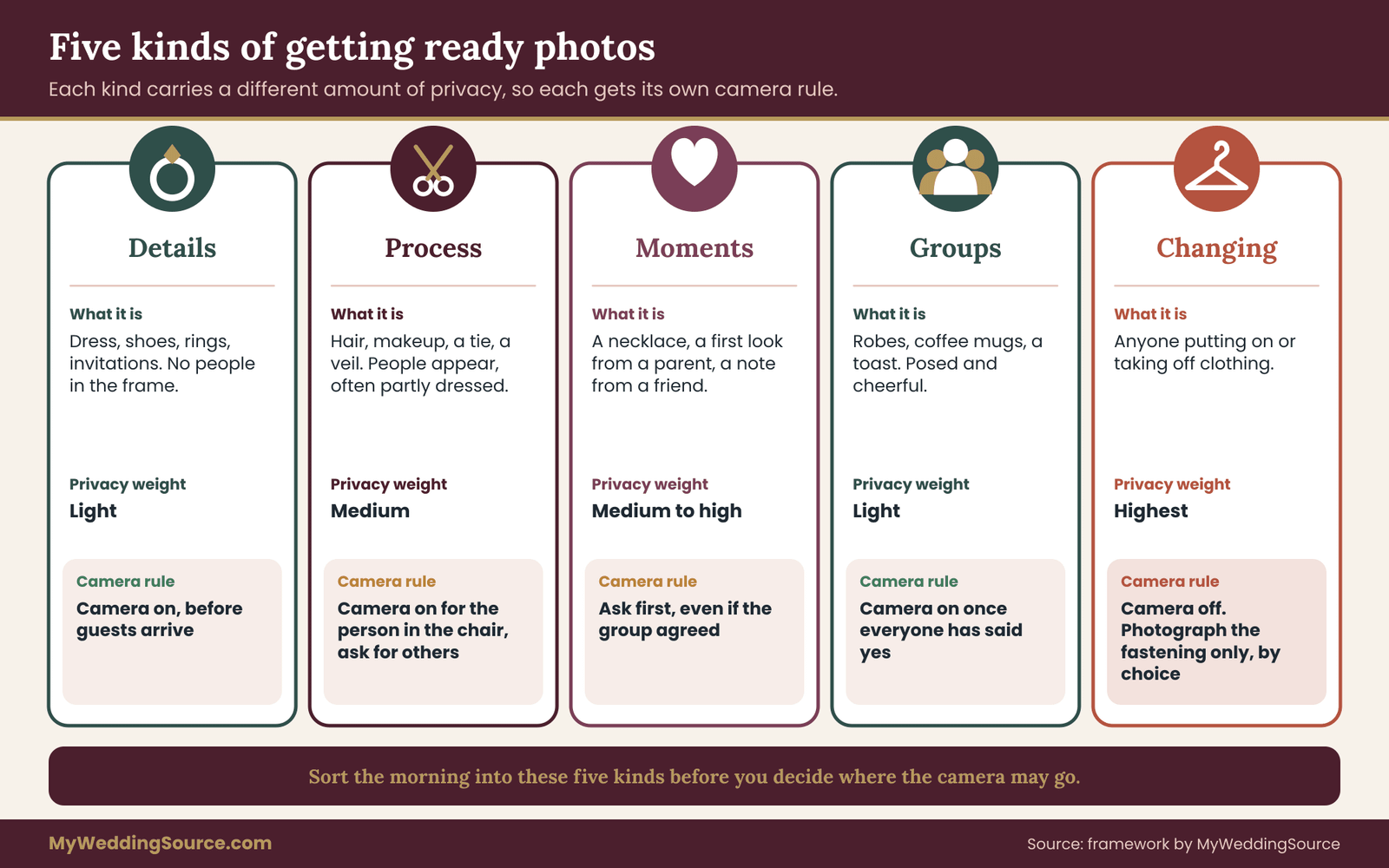
Sorting getting ready photos this way is useful because the plan for each is different. Details need access. Process photos need a place to stand and a sense of who is comfortable. Moments need a quiet word beforehand. Groups need a few minutes of everyone’s attention. Change photos need a clear boundary. When all five are treated as one category called “getting ready photos,” the loudest preference in the room decides. Each type of getting ready photos needs its own rule.
Who is actually in the picture
It is easy to think of the bride, or the couple, as the subject of getting ready photos, but a small room holds more people than that. The couple is the subject. The wedding party, the parents and the helpers are bystanders who may or may not want to be subjects too. Hair stylists, makeup artists, a venue coordinator who pops in with a steamer, a hotel staff member who delivers an iron: they are all in the room, sometimes only for a minute, and none of them signed up to be in your gallery.
The practical question is not whether these people will appear, because in a small room they will. The question is what you have told them in advance and whether they have a way to say no without making a scene. A short message to each person works well. We cover wording in a later section. Think of it as the first rule of getting ready photos in a crowded room: everyone should know the plan.
A large bridal suite with a separate dressing room, a living area and a bathroom solves most privacy problems with architecture. Doors close. People wander off. The camera follows the people who want it. A small or shared space removes those options, and a few things follow. Getting ready photos in a suite like that need little extra planning.
There is no natural retreat. In a big room a guest who does not want to be photographed can sit in the far chair. In a small one, the far chair is two feet from the photographer. If the plan does not give her somewhere to go, she either puts up with the camera or leaves the room at a moment she would have liked to be in it.
Everything is in the background. A wide lens in a small room captures the whole space, including the open suitcase, the person changing behind a half-closed curtain and the guest checking her phone. A photographer who is skilled at tight rooms will think about backgrounds, but they cannot control who walks through the frame without your help.
Time compresses. Getting ready usually has to fit between a hair start time and a first-look or ceremony time. When space is tight, each task waits for another. The photographer has a narrow window for each shot, and any delay for a consent conversation comes out of that window. That is why the timing schedule matters more than the sketch alone.
Light is scarce. Many small rooms have one window. The best light for getting ready photos tends to be near it, which is also where the hair chair wants to be, where the dress hangs and where the mother wants to sit. Everyone competes for the same few square feet. Getting ready photos live or die on that window.
The room is shared in more than one way. It may be shared by two parties, such as the couple and their friends in an Airbnb. It may be shared with a venue’s other events, such as a historic house where the bridal room is also the storage room. It may be shared with a hotel that has its own policy on photography in guest rooms. It may be a family home where the host has opinions. Each kind of sharing brings a different person whose permission you need.
The cost of not planning, in plain terms
A morning without a plan tends to go one of three ways, and none of them is a disaster. In the first, the photographer is careful and asks permission moment by moment, which is considerate but slow, and the couple loses time. In the second, the photographer is quick and takes what they see, and one guest later asks that a picture be removed. In the third, the room is so crowded that the photographer cannot find a safe angle, and the result is a short set of getting ready photos that look like every other hotel room.
A plan prevents the second outcome, shortens the first and improves the third. It does not cost money. It takes one hour of thought the week before, a drawing on a sheet of paper and a handful of short messages. A plan keeps getting ready photos from becoming a source of regret.
What this guide does not try to do
This guide does not tell you how to pick a photographer, how to write a shot list for the whole day or how to handle gallery delivery. It also does not suggest that every wedding needs a formal consent process for the getting-ready window. Many couples will read the next sections and decide a two-line message to the wedding party is enough. The point is to give you the tools and let you choose the weight. Even a light version of the plan improves getting ready photos.
If you are planning your own timeline, the wedding vendor timeline page shows how the getting-ready block sits beside hair, makeup, travel and the first photographs. Use the timing schedule in this article as a layer on top of that timeline, not a replacement for it.
A room-zone sketch for getting ready photos
The sketch is the heart of the plan. It is a floor plan, not an interior design drawing, and it takes about fifteen minutes. You do not need to be good at drawing. A rectangle for the room and a few labeled boxes are enough. For getting ready photos it is the single most useful page you will draw.
Step one: draw the room and its fixed points
Start with the outline of the space. Mark the door or doors, the windows, the bathroom, the bed or beds, the sofa and any large furniture that cannot move. If you have visited the room, use your own measurements. If you have not, the venue or host can usually send a floor plan or a few photos, and a short call will fill in what is missing. Note where the power outlets are, since hair tools and steamers decide where the stylist sets up.
If you have not seen the space, do not guess at dimensions you cannot confirm. The venue technical walkthrough guide explains what to measure and what to ask a venue about access, and the same questions apply to a bridal suite.
Step two: mark the light
Draw an arrow from each window showing roughly where the daylight falls, and note the time of day you will be there. A window that faces east gives soft morning light in a room with a late-morning start, and almost none after noon. A room facing west may be dark until late afternoon. Your photographer can tell you which areas of the room will be useful, and it is worth asking before you decide where the hair chair goes. Light matters more for getting ready photos than for almost any other part of the day.
The best light for getting ready photos is usually where you most want to sit, so this step often creates the first useful decision. If the window area is also the only place with an outlet and a mirror, you have a choice: give it to the stylist, give it to the photographer, or share it in time blocks. The timing schedule handles that.
Step three: assign each area a camera rule
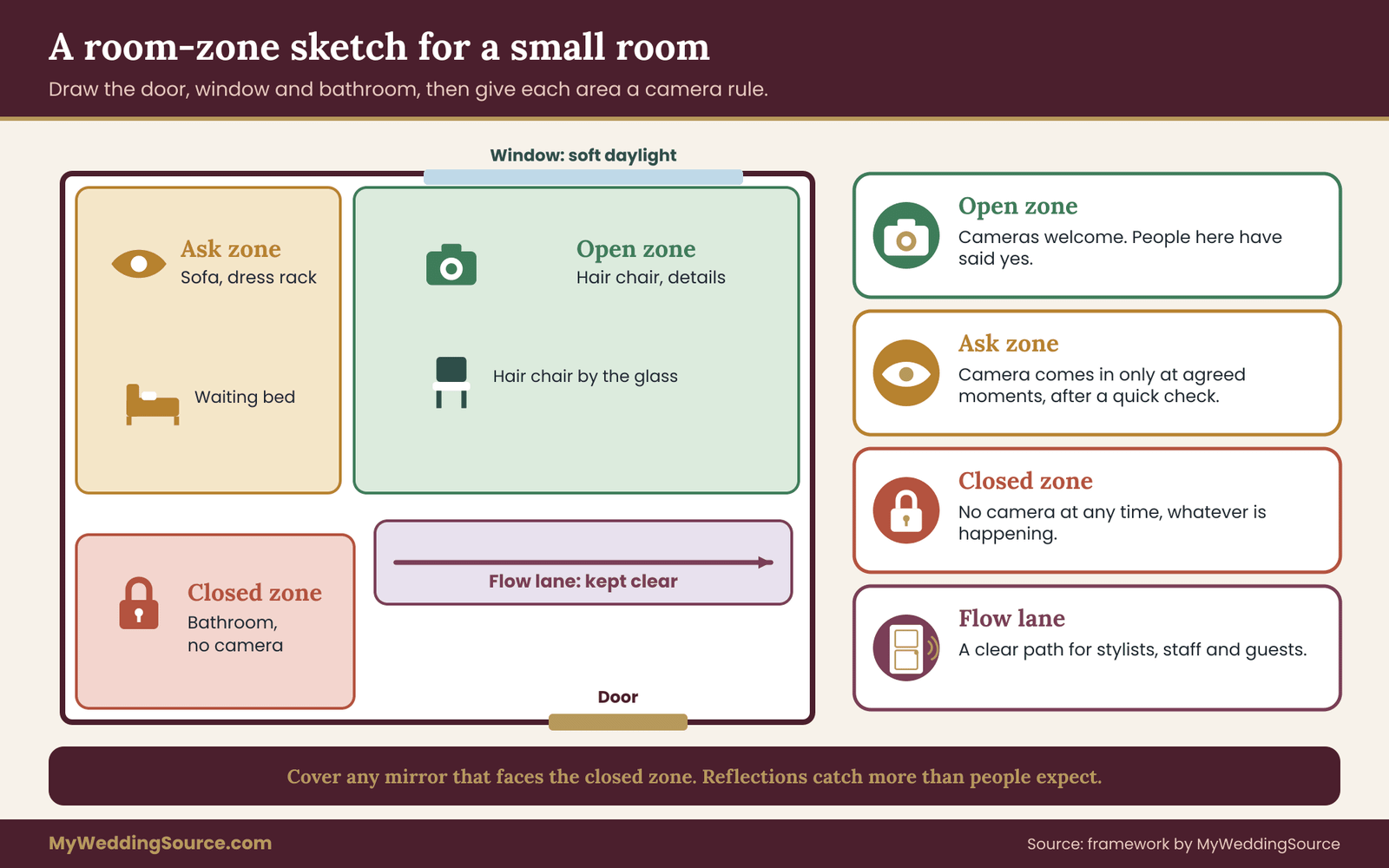
Now divide the room into four kinds of space and label them. These are the room zones.
Open zone. Cameras are welcome here and people who sit here have said they are fine with it. This is usually the window area and the hair-and-makeup chair, where much of the process and detail work happens.
Ask zone. The camera comes into this area only at agreed moments, with a quick check first. A seating corner where family waits might be an ask zone, or the area by the dress rack where the couple finishes dressing.
Closed zone. No camera at any point, whatever is happening. A bathroom, a screened-off corner or an adjacent room where people change. If the room is too small for a closed corner, the closed zone can be the bathroom with the door shut, or a hallway outside the door, with a short sign or word from the coordinator.
Flow lane. A path through the room, kept clear of people sitting and gear standing, so that staff, stylists and guests can move without crossing the photographer’s frame. In a tiny room, the flow lane may be the only open floor.
The first time you draw this, it feels like a lot for one hotel room. In practice you will find that most rooms have two natural areas: a bright side and a dark side. The bright side becomes open and ask. The dark side, near the door and bathroom, becomes closed and flow lane.
Step four: mark where each person starts and ends
Add small labeled circles for the people who will be in the room and where they sit or stand at the start. A bride in the hair chair. A mother on the sofa. Two bridesmaids on the bed waiting their turn. The point is not to freeze the room in place, since people will move, but to find collisions before they happen. Two stylists and a photographer cannot all stand at the window. If your sketch shows that, you can fix it with a timing change instead of a mid-morning argument.
Step five: share the sketch
A sketch nobody sees changes nothing. Send it as a photo or a PDF to the photographer, the hair and makeup artist and the person who will manage the room, whether that is a maid of honor, a planner or a family member. Keep the message short.
Say what the zones are, point to the closed zone and ask if anything in the drawing does not match what they have seen in similar rooms. Photographers and stylists work in tiny spaces constantly and will usually have a practical correction. The sketch only helps getting ready photos if the people involved have seen it.
The sketch also gives you something to hand to a guest who asks “What is the plan for the morning?” You can answer in two sentences and show a drawing, which is far kinder than a long explanation in a group chat.
Who needs to agree to getting ready photos
Consent in a small room is not a form. It is a handful of short, honest exchanges that happen before the day and a few quick check-ins during it. To keep them short, you first need to know whose agreement matters and what it covers. Consent for getting ready photos works best when it is light and specific.
The people in the room, in three groups
The people you are photographing on purpose. This is you, your partner if they are in the room, and the people you have asked to be part of the story: parents, wedding party, a grandparent. They are invited into the getting ready photos, but being invited into the room is not the same as agreeing to every kind of picture. A bridesmaid who is delighted to be in a laughing group shot may not want to be in a frame while she changes shoes in her slip.
The people who are working. Hair and makeup artists, a coordinator, a florist dropping off a bouquet, a venue staff member. They are there to do a job. Most are used to being in the background of photographs and will be comfortable with a heads-up, but it is polite to give one and to ask whether they want to be left out of any pictures that may be shared publicly.
The people who are passing through. A hotel housekeeper, a neighbor in a shared house, a child who wanders in. They did not agree to anything. A good plan keeps them out of the frame, which is another reason the flow lane matters. Getting ready photos should never include them by accident.
What exactly are they agreeing to
Think of three questions in order, the same layered approach that works for the rest of the wedding. They apply to getting ready photos in particular because the setting is private.
First, may this person be photographed in this room at all. Second, in which moments and zones. Third, what may happen to the pictures afterward, including whether they go in the couple’s gallery, a shared guest album or the photographer’s portfolio. The first two questions are answered by the room-zone sketch and the timing schedule. The third is the territory of the wider consent guide, though it helps to ask at the same time.
Most people will say yes to the first, yes with limits to the second and “I do not mind” to the third. A few will want more control, and the reasons are usually good ones. Someone may be recovering from surgery, wearing a medical device, uncomfortable about their body, observing a religious norm about uncovered hair, or keeping their location private for safety reasons. You do not need to know the reason. You need to make it easy for the answer to be no. Those answers shape every one of your getting ready photos.
Why the couple cannot give consent for everyone
It is tempting to say, as the couple, that everyone in the room is fine with getting ready photos because the day is yours. That is not how consent works, even among close friends. You can decide what you want photographed. You cannot decide on someone else’s behalf that their body, their face or their private moment is fair game. The good news is that you rarely have to argue the point. A kind, specific question solves nearly every case. Getting ready photos are the couple’s wish, but not the couple’s right to impose.
The copyright side is a separate matter. Who owns a photograph usually depends on the agreement with the photographer, not on who appears in it, and the U.S. Copyright Office explains the general rules on its website. If you want certainty about how your photographer’s contract treats usage and sharing, read it, ask questions and check the final wording with a lawyer if the stakes are high. Consent to be photographed and ownership of the photograph are different things, and mixing them up causes most of the arguments.
If the photographer is also asking to use your getting ready photos in marketing, treat that as its own question. The wedding vendor contract guide shows where such clauses tend to sit, and a short email asking the photographer to exclude specific moments or people from promotion costs nothing.
How to ask for consent without making it awkward
Most awkwardness comes from vagueness. “Is it okay if we take photos?” invites a polite yes that means nothing. A specific question gives a specific answer. Asking about getting ready photos works best with concrete examples.
A short message to the wedding party
Send this a week or two before the wedding, in your own words. The version below is a template, not a script to recite.
“We are planning the getting-ready morning in a small room, so I sketched where the camera will and will not be. There is a spot by the window where photos are fine, a corner where we will ask first, and a closed area for changing where nobody takes pictures. If there is anything you would rather not be in, or a moment you would like left out, tell me and the photographer will plan around it. Silence will mean you are comfortable with the open and ask zones.”
Notice what this does. It describes the plan in plain terms. It gives an easy way to opt out without a reason. It states what silence means, so nobody has to agonize over how to reply. And it takes about forty seconds to read.
A short message to the parents and older relatives
Older relatives often do not use the group chat, and a text may not reach them. A phone call from one person you trust works better.
Keep it light: “Mom, we are planning where the photographer will stand in the morning. Is there anything you would rather not have photographed, like getting dressed or having your hair done?” Then listen. If the answer is “Oh, just do whatever,” follow up gently with one specific example, such as “Would you like to be in the picture where I put the necklace on you?” A concrete example is easier to answer than an abstract one.
A short message to hair and makeup artists
Professionals will usually appreciate being included. Ask them how they prefer the photographer to work around them, and whether they are comfortable appearing in photos that may be posted by the couple or the photographer. Many have their own policies on whether they can be photographed during a service. Some want a credit when their work is shown. Some prefer not to be identified. Let them say. Many artists have a strong view about getting ready photos taken mid-service.
The bridal hair and makeup planning guide explains how to schedule artists around a start time. In a small room, the chair position you choose for them is one of the biggest factors in how the photographs turn out, so settle it in the sketch.
A short message to the photographer
Your photographer is the person who most needs the sketch, and the one most likely to improve it. Send the drawing and ask three questions. Where do you want to stand for the process shots? Which areas of this room will not work for photography because of light or space? Is there a point in the morning when you would prefer fewer people in the room? Ask how they usually handle getting ready photos in tight spaces.
Photographers who work small rooms regularly tend to have strong opinions about all three, and the answers can change your sketch for the better. Do not be surprised if the photographer asks you to move the hair chair by three feet or to turn off a lamp. These are small adjustments with a large effect.
When someone says no
Some will, and it should be a non-event. The right response is a short thank you and a note on the sketch. “Understood, thanks for telling me. I will make sure you are not in any of the moment photos and we will keep you out of the gallery if you like.” Do not ask for a reason. Do not try to persuade. If the person wants to be in the room but not in the pictures, the photographer can frame around them or the person can sit in the flow lane or the closed zone for the relevant moments.
The harder case is silence. A guest who does not reply may have not seen the message, may be uncomfortable saying no or may be fine. Treat silence as permission only for the open zone, and check again in the room before the camera comes out in the ask zone. That is what the timing schedule is for.
The closed zone and the change photos rule
The simplest and most important rule in a plan for getting ready photos is that the closed zone is closed. Here is why it matters more in a small room than a large one. Without a closed zone, getting ready photos can drift into territory nobody agreed to.
What belongs in the closed zone
Anything that involves a person changing clothes, undressing, adjusting underlayers, having a garment fitted against bare skin or dealing with a medical or personal matter. In a hotel room, the bathroom is the obvious closed zone. In a one-room cabin or a studio, a folding screen, a hanging sheet or even a coordinated pause in the room’s activity can work: the photographer steps out for three minutes while the bride gets into her dress.
For most people the rule is easy to accept. The pictures of the dress being buttoned, with the photographer in the doorway, are a staple of wedding photography, and many couples love them. They can be taken without any bare skin showing, with the person already in a slip or a robe and with her agreement. The difference between a lovely photo and an uncomfortable one is whether the person was asked.
How to run the dress moment in a tiny room
The dress moment is the one that most often creates problems in a small room, because the dress usually goes on in the middle of the space and the photographer wants to be nearby. A workable sequence looks like this. Handled well, it produces some of the best getting ready photos of the day.
The bride, with her mother or a close friend, steps into the closed zone and puts on whatever is under the dress, with the dress already unzipped on its hanger. Everyone else, including the photographer, waits outside or in a corner with their backs turned. When she is ready, she steps out into the ask zone, where the photographer is invited back.
The dress is then lifted, stepped into and fastened in front of the camera, with her already in her slip and shapewear. The moment of the dress going up and the buttons being done is photographed. The change itself is not.
Some brides prefer that the dress moment is not photographed at all, or only in a mirror, or only from behind. Those are all fine. What matters is that the preference is known before the morning, and that the photographer is not guessing. Any of these choices keeps getting ready photos comfortable for the bride.
Groomsmen and a similar rule
The same logic applies to the other side of the wedding. Groomsmen get dressed in a shared room more often than people assume, and the jokes about who is stuck in a corner with a tie tend to hide real discomfort. A sketch with a closed zone and a timing note for the change works as well for a groom’s party as for a bridal one. If the groom’s party is getting ready in a different room, the plan is the same; draw it again.
Children and minors in the room
Children are often part of the getting ready photos: a flower girl in her dress, a ring bearer with a bow tie, a young cousin fascinated by the curling iron. Photos of minors deserve care, and the decision belongs to a parent or guardian. Ask them directly, before the day, what is fine for the gallery and what is fine for sharing.
A child should also never be photographed while changing, and no child should be alone with an adult photographer in a closed zone. The wider guest-boundary guidance on children and sharing is worth reading if minors will be in the room. Photographs of minors are the most sensitive of all getting ready photos.
What to do when a guest wanders into the closed zone
It will happen, usually with good intentions. The simplest fix is a single, calm sentence from whoever manages the room: “We are keeping this corner clear for changing, could you wait by the window?” A small sign on the bathroom door is also useful. If the person is a family member and the room is small, the manager can offer them a task that moves them out of the closed zone, such as fetching coffee. The camera, meanwhile, stays down until the zone is clear again. The same rule protects getting ready photos from awkward surprises.
A consent-based camera timing schedule for getting ready photos
The sketch says where the camera may go. The timing schedule says when, and who has agreed. It is a list of short blocks, usually six to ten, covering the period from the first arrival to the moment the group leaves the room. Each block has a time, a place on the sketch, a camera rule and a note of who is in it. Together they turn getting ready photos from a scramble into a routine.
The shape of one block
Every block answers five questions in a line or two.
When. A start time and a length, such as ten minutes from nine-fifteen. Short blocks are easier to keep than long ones.
Where. Open zone, ask zone or closed zone from your sketch. If the block moves between zones, say so.
What. The kind of picture: details, process, moment, group or none.
Who. The people who will be in the frame, and who has said yes. Use first names. If someone has asked to be left out, write their name with a note.
Camera rule. “On,” “ask first,” “off” or “one photographer only.” The rule is what the people in the room will see, so make it plain.
A block might read like this: “Nine-thirty to nine-forty, open zone, process photos of hair, bride, hair stylist, maid of honor, camera on, mother prefers no close-ups.” The point is not elegance. It is that a person reading it knows what is going to happen.
Build the schedule backward from a fixed time
Start with the time the couple needs to leave the room, whether for a first look, a ceremony or a travel window. Then move backward through the tasks that must happen: final dress fastening, veil, flowers, the moment with parents, the group photograph, hair and makeup, arrival of the artist. Space the blocks so that no task has to wait for another to leave the room. Getting ready photos are easiest when the end time is fixed first.
This is the same approach used in a full day-of schedule, and the wedding vendor timeline page on this site describes how the other vendors fit in. For the getting-ready window specifically, add ten minutes of buffer at the end. Small rooms run late, because a missing pin or a delayed coffee affects everyone at once. A buffer protects the photographs you most want, which are usually the final ones.
The three-beat check
In the room, consent is checked with a quick rhythm that takes seconds. The photographer, or the person managing the room, does three things before a moment in the ask zone. The rhythm keeps getting ready photos moving without pressure.
First, signal the moment. “I would like to take a few photos of your mother helping with the necklace, in the corner by the window.” Second, look for a yes. A nod, a “sure” or a thumbs up, from the people involved. Third, offer an exit. “If you would rather skip it, no problem, just say so.” Then proceed.
Nothing about this needs to be formal. A good photographer already does something like it. What the schedule adds is that the check is expected, which means people do not feel odd about answering, and the photographer does not feel rude for asking.
The camera-down signal
Agree on a signal that means “stop now,” and tell the whole room. It can be a raised hand, a word such as “pause” or a hand placed flat on a table. The photographer lowers the camera immediately and does not make a joke about it. The signal costs nothing and gives shy people a way to stop a moment without making a speech. It is a small tool that makes getting ready photos feel safe.
Keep the signal and the closed-zone rule in view. A card on the dresser with the zone names and the signal is enough. People in a crowded room relax when they know the rules are written down and the exit is easy.

A sample schedule for a tight two-hour window
The times below are an invented example for a morning with a start at eight-thirty and a first look at ten-thirty. Adjust them to your own timing, and keep them only as long as they are useful.
Eight-thirty to eight-forty: details. Open zone. The photographer arrives and photographs the dress, shoes, rings and invitation suite before the room fills up. No people in the frame, so no consent needed beyond access to the room. Camera on.
Eight-forty to nine-thirty: hair and makeup, process. Open zone near the window. The stylist and the bride work, with a bridesmaid or two waiting their turn on the bed, which is an ask zone. Camera on for the bride, ask first for the others. The photographer takes a handful of frames each ten minutes and steps back otherwise.
Nine-thirty to nine-forty-five: bridesmaids’ group. Ask zone. A laughing group photo in robes with coffee mugs, once everyone has hair done. The photographer asks, shows the frame on the back of the camera if anyone wants to see it and moves on.
Nine-forty-five to ten: closed zone. Bride and mother or friend in the bathroom or behind a screen, dress step-in. No camera. Everyone else tidies the room. The photographer steps out or faces the wall.
Ten to ten-ten: dress fastening, moment. Ask zone. The photographer is invited back. The bride has the dress on and unfastened at the back. The mother and the maid of honor fasten it. Camera on for these three people, off for anyone else.
Ten-ten to ten-twenty: veil, final details, parents. Open zone. The bride with a parent or two, the veil, the bouquet. Camera on.
Ten-twenty to ten-thirty: buffer and exit. Flow lane. Final checks, a last lipstick touch-up and the group leaves the room together. Camera at the door.
Notice that this schedule is not complicated. It is one page. The consent-based part is that each block names who is in it and what the camera may do. The two sentences at the top of the page tell the room what to expect, and anyone who wants a different arrangement can ask before the first block starts. Schedules for getting ready photos only need to be this simple.
Who holds the schedule
Give the schedule to one person who is not the photographer. A maid of honor, a planner, a sibling or a trusted friend. Their job is to keep time, nudge the blocks and speak up when the closed zone is crowded. This is a quiet role, and it makes the photographer’s life easier, because the photographer can focus on the pictures and not on the room. The best getting ready photos usually come from a calm room.
If you do not have anyone for this job, the photographer can take it on for the first few blocks. But a person who works the camera should not also have to be the room’s referee, and the plan works better with a separate manager.
Getting ready photos when a videographer is in the room
If you have both a photographer and a videographer in the same small space, plan for two cameras. Two people with equipment fill a room faster than one, and two sets of eyes on guests may feel heavier than one. A few rules help. Two cameras change the rules for getting ready photos.
Share the sketch with both. Their preferred positions often conflict, and it is better to find out beforehand which one takes the window and which one takes the doorway.
Agree on a shared closed zone. Both operators step out at the same time. A videographer who keeps recording audio from the hallway while a dress goes on is a privacy problem even if the lens is pointed at the wall.
Ask about audio. Wireless microphones, room tone recording and ambient audio capture conversations that are not meant for a film. Ask the videographer whether the audio can be paused during private moments. This is a short question and a firm one.
Decide whose cuts go where. Video and photos from the same moment can be used differently. The consent you gather for the gallery may not cover a highlight film posted online. State, in the timing schedule or a note, which moments may be used for what.
Some couples decide to have only one camera in the getting-ready room and bring the second operator in after the dress is on. That is a reasonable choice in a small space and often improves the photos, since the single operator moves more freely.
Cell phones, guest cameras and the other lens in the room
The photographer is only one of the lenses. In a getting-ready room full of friends, a dozen phones are likely to come out. This is one of the places where the plan for getting ready photos meets the usual rules about guest photography, and it is worth deciding what you want.
The case for a phone pause
A short rule that works well in small spaces is that phones stay in bags during the closed and ask blocks, and may come out in the open zone for details and group photos. The reason is practical as much as private. A bride in a slip does not want twelve phone cameras in her face, and a stylist cannot work with a bridesmaid leaning over the chair to film. The photographer can take the pictures, and the couple can share the good ones later. Guest phones are the biggest variable in getting ready photos.
You can say this lightly: “We would love for the photographer to capture the morning so that everyone can be present. If you take any pictures, please keep them to the details and group shots, and check with people before posting.” That wording gives people something to do and a reason that sounds kind.
Social media in the getting-ready window
A story posted from the room can reveal the dress before the first look, the address of a private house or the face of a guest who wanted to stay off the internet. If you want a delay, ask for one: “Please wait to post until after the ceremony.” If you want a stricter rule on certain people, such as a guest who has asked not to appear, say so privately and do not announce it to the group. Posting rules belong in the plan for getting ready photos too.
If you want sample wording for a request that works across the whole wedding, the wider guidance on guest phone and posting rules is a good place to start. Our focus here is the getting-ready room, where fewer people are present and a quiet word is usually enough.
When a guest takes a photo of someone who did not agree
It happens. A bridesmaid snaps a picture of the mother of the bride in curlers and posts it before anyone has a chance to speak. The fix is simple and kind: ask the guest to take it down, and explain why. Most people will, with an apology. If they do not, ask the room manager to follow up privately. This is also the reason to set the phone expectations before the day, so that the first request does not feel like a correction in front of an audience.
Where the photographer can stand in a small room
A photographer who works in tight rooms regularly will have a few habits worth knowing. They help you judge a sketch, and they explain why the photographer sometimes asks you to move a chair. This section covers the physical side of getting ready photos in limited space, without assuming any particular equipment. Skilled photographers can make getting ready photos look easy.
Use the corners and the doorway
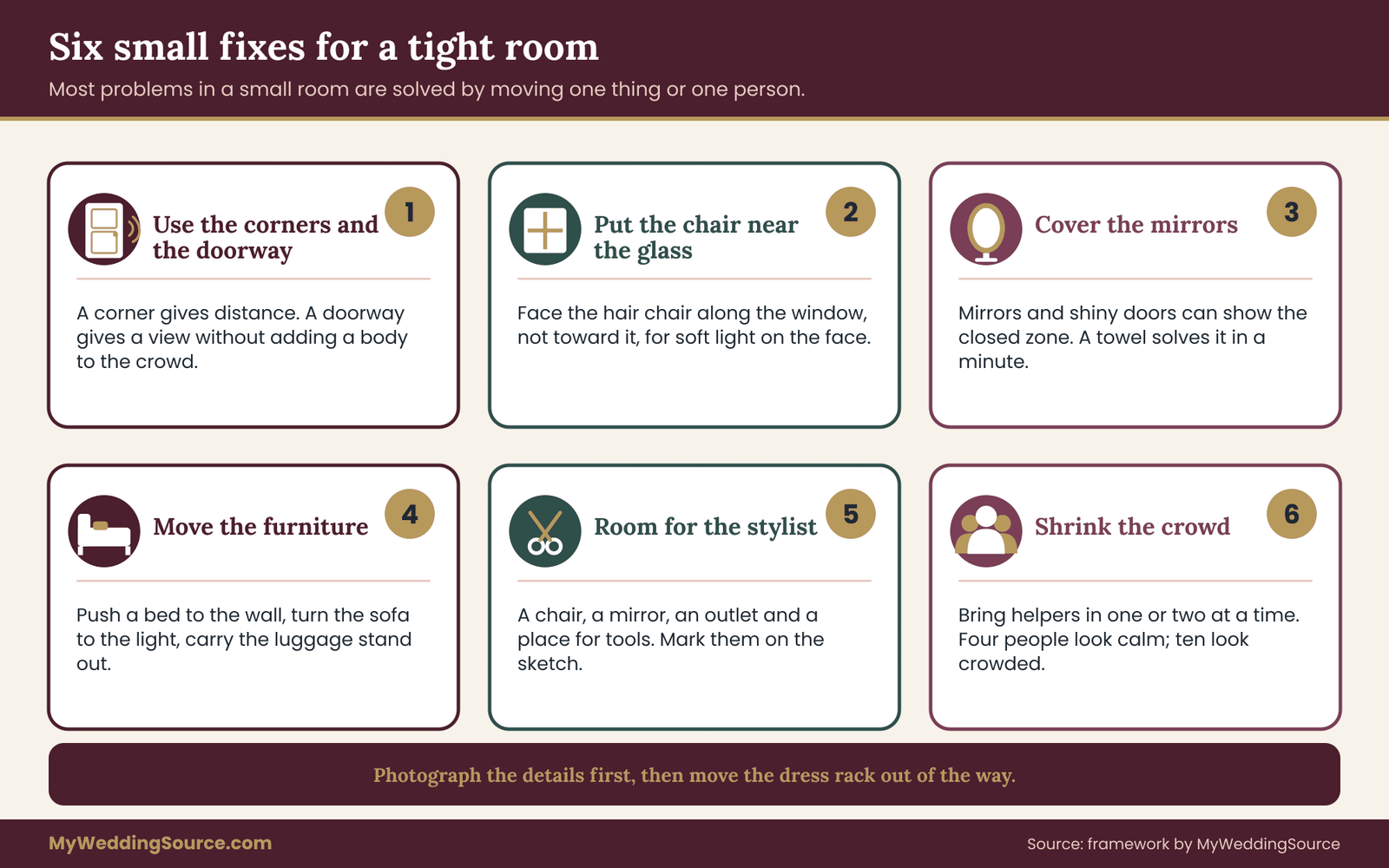
In a small room, the wall behind the photographer decides how much of the scene fits in the frame. Standing in a corner gives the most distance to the subject and a view across the room. Standing in the doorway, or just outside it, gives a view into the room without adding another body to the crowd. Many photographers shoot through a bathroom doorway for moments in the open zone, since the shared wall is also a closed zone.
If you have drawn your sketch with a flow lane along one wall, the photographer’s usual spot will probably be at the end of it. This is a good sign, because the same place that keeps the route clear also gives a clear angle on the window.
Lenses and distance, in plain terms
A wider lens captures more of the room and makes small spaces look larger. It also includes more background and more bystanders, which in a shared room means more people who did not choose to be in the frame. A longer lens lets the photographer stand farther back and isolate one person, which suits moments such as a parent fastening a necklace. Many photographers carry both and switch depending on the block. The lens choice changes how much of the room your getting ready photos reveal.
You do not need to specify lenses in your plan. It is enough to ask your photographer how they handle tight rooms and what they would like to change in your sketch. If the answer is “I use a wide lens and stay out of the way,” you can ask whether that includes keeping the lens out of the closed zone and the flow lane. If you hear “I prefer to be in the middle of the action,” ask what they do when someone asks for privacy. A good photographer will have a clear answer.
Light before furniture
Daylight from a window is the best-looking light in most small rooms and often the only good light. If the room has one window, give the photographer a say in where the hair chair goes. A chair placed a few feet from the window, facing along the glass instead of toward it, usually produces soft light on the face. A chair in front of the window with the window behind it produces a silhouette, which may be lovely but may also look like a mistake. Window light is the main tool behind natural-looking getting ready photos.
Turn off overhead lights during photography blocks unless the photographer asks to keep them. Mixed light from bulbs and a window can give skin an odd color cast, and most photographers prefer to work with one kind of light at a time. If the room is dark, a handheld lamp or a portable light is something the photographer can bring. Ask, and do not buy anything without a recommendation.
Mirrors and reflections
Mirrors are common in hotel rooms and bathrooms, and they cause privacy problems that people rarely think about. A photographer standing in the hallway may capture the closed zone in the reflection of a dresser mirror. A person changing behind a screen may be visible in a window or a mirrored closet door.
Walk through the room with your sketch and look for reflective surfaces that face the closed zone. Cover a mirror with a towel, turn it to the wall, or move the changing area. This takes two minutes and prevents the most common accidental exposure. Check mirrors before you finalize your getting ready photos plan.
Furniture is flexible, so move it
In a small room, the bed, the sofa and the chair are often the most valuable pieces of equipment. A bed pushed to one wall frees a patch of floor for a flow lane. A sofa turned to the window becomes an ask zone seat. A luggage stand carried into the hallway clears a corner for the dress rack. Ask the venue or host whether you may rearrange furniture and whether it must go back to its original position, and plan the move into your timeline, since it takes ten or fifteen minutes with help.
Space for the stylist
The hair and makeup artist is the person who most needs space and light, and the one most often squeezed in a small room. A stylist needs a chair, a mirror, a place to set tools and an outlet. A rolling case and a folding stool take about as much floor as a small armchair. If the artist has done this before, they will tell you what they need. Ask in advance and mark it on the sketch.
The hair and makeup planning guide covers how long services take and when artists should arrive. In a small room, the more useful detail is who sits where while the others wait. A short sketch note, such as “Maid of honor next, bed, left side,” prevents a traffic jam.
The dress rack and garment problem
A rack of garment bags, a hanging dress and a steamer can occupy half of a small room. They also make beautiful photographs, since a gown on a hanger by a window is a classic detail shot. The trick is to photograph the details first, then move the rack to the closed zone or out of the room so it does not clutter the later blocks. Detail shots are the simplest getting ready photos of all.
The wedding dress fit and alterations guide explains what to bring for a final fitting and how to protect a gown during transport, which is useful context when you are deciding where the dress hangs in a small room. If the dress needs steaming, plan for it in a block before the photographs, and in a closed space where steam will not fog the lens.
When a room has no spare corner
Some rooms really are too small for four zones. A single-room cabin, a studio apartment, a bridal tent or a restroom-sized dressing room may offer one space and one door. The plan still works, but it needs a different set of tools. Even then, getting ready photos are possible.
Use time instead of space
If you cannot separate zones physically, separate them by time. The room is open at some moments and closed at others. For example, the first half-hour is the open zone for details and hair, the next ten minutes are closed while the dress goes on, and the rest are open again. The camera is a guest in the room only during open and ask blocks. Time can protect getting ready photos as well as walls can.
This means the timing schedule does more of the work, and the sketch does less. A single page for the whole room is enough, with blocks labeled “open,” “ask” and “closed” instead of zones. When a closed block starts, the photographer steps outside, and everyone else knows the dress moment has begun.
Use the doorway as the boundary
For a one-room space, the doorway is the natural boundary of the closed zone. The photographer works from outside the door during the closed block, with the door ajar or closed as agreed, and enters again when invited. If the room has no door, a sheet, a screen or a folding clothes rack with a hanging garment bag creates a temporary wall. These are small tools, and they are surprisingly effective.
Reduce the number of people
When space is limited, the most effective thing you can do is shrink the crowd. A getting-ready room for ten people is usually a getting-ready room for four with six people waiting somewhere else.
A common arrangement is to bring the bridesmaids in one or two at a time, or to move the larger group to a different room for hair and then back. The wedding family photo list page is a useful companion here, because it helps you decide which family members need to be in photographs and when, so that you do not invite everyone into the same small room at once. Fewer people also means better getting ready photos.
Reducing the crowd also improves the pictures. A small room with four people looks warm and calm. The same room with ten looks stuffed, and the photographer has no room to work.
Use the hallway and the venue’s other spaces
A hallway, a lobby corner, a porch or a balcony can serve as an overflow area for waiting guests, for the first moment with a parent or for details that do not need to be in the room. These spaces are not private, so check whether the venue or the hotel allows photography there. Some hotels ask that photographs in public areas be limited, and some venues restrict photography in certain rooms. A short call to the venue coordinator will answer it.
Use outdoor light
If the weather and the setting allow, a porch or a patio can host the open zone, with the room inside serving as the closed zone. This works well in a rental house or a venue with a garden. It also solves a lot of light problems. Be realistic about weather and neighbors, and have a plan B. Your getting-ready window should be flexible enough to move inside if the weather turns.
Accept that some pictures will not happen
A very small room means fewer getting ready photos, and that is acceptable. A smaller set of well-chosen pictures, with consent behind each one, is better than a long set that includes moments someone later wishes had not been taken. Ask your photographer which three or four pictures matter most to you and build the schedule around them. The rest is a bonus. Choose the few getting ready photos that matter most, and plan around them.
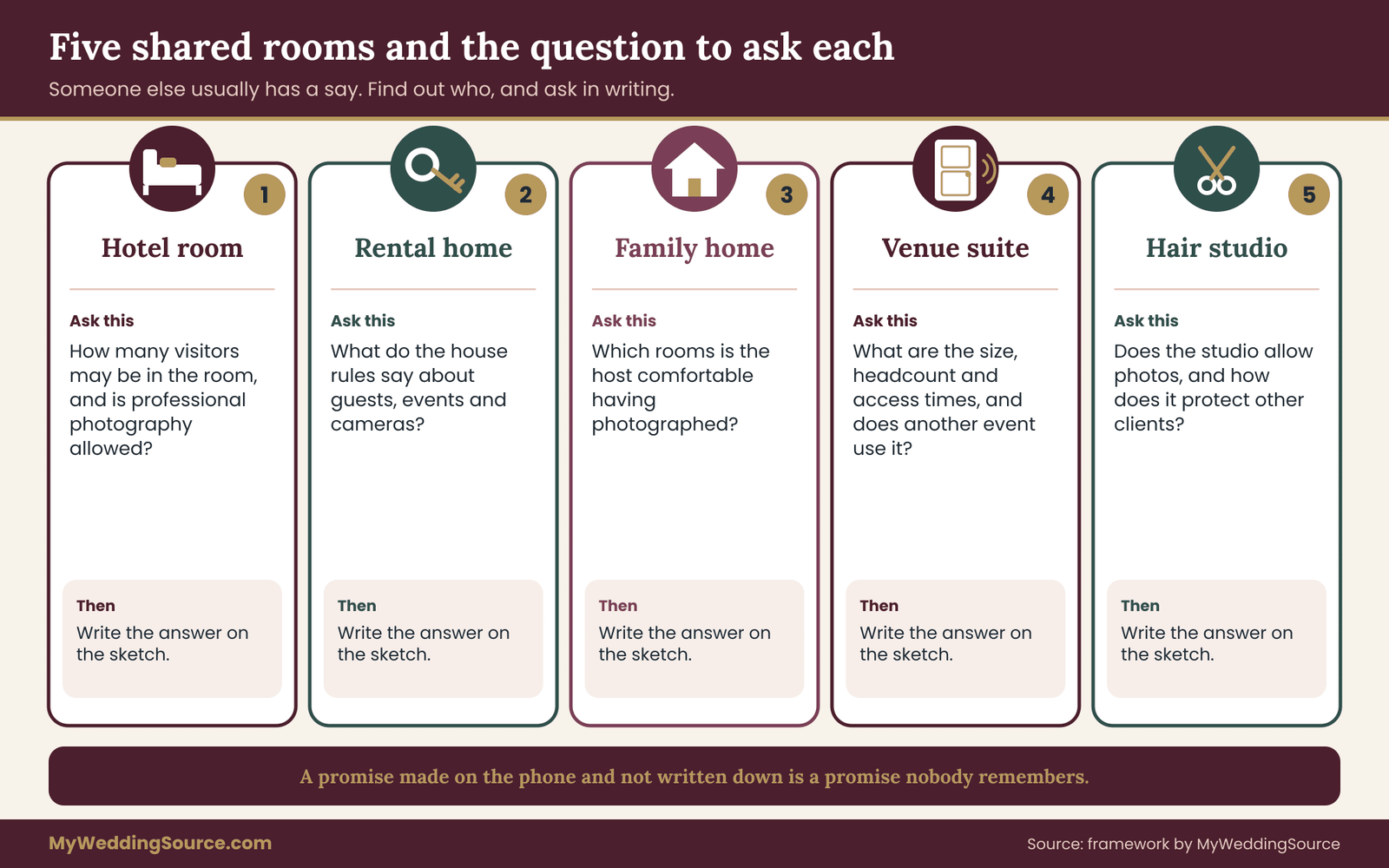
A room is rarely only yours. The same plan for getting ready photos needs small changes depending on who else has a claim on the space. Before you invest in the sketch, find out whose rules apply. Shared rules shape getting ready photos more than most couples expect.
Hotel rooms
A hotel room is private for the guest who booked it, but the hotel has its own policies on guests, visitors, equipment and sometimes professional photography. Some hotels do not mind at all.
Others ask that commercial photographers register, or ask for a note about how many extra people will be in a room. The number of people permitted in a room can be limited for fire safety reasons, and an informal gathering of ten in a room booked for two can attract a polite visit from the front desk. Ask the hotel before you commit to getting ready photos there.
Ask the hotel directly, in writing if possible, what its policy is on visitors and professional photography in guest rooms, and whether a larger room, a suite or a meeting room is available for the morning. The question is routine for hotels near wedding venues, and the answer is usually quick. If your wedding party is also staying at the hotel, the guest hotel pages on this site describe how room blocks and arrival timing work, and a bridal suite can sometimes be requested through the same contact.
Hotel corridors and lobbies are shared with other guests, so photographs there involve strangers. Keep getting ready photos inside the room whenever you can, and take hallway pictures only when the corridor is empty.
Short-term rentals and vacation homes
A rental house or apartment is usually private for your booking, but the host’s rules still apply. Many listings limit the number of guests, restrict events, ban commercial activity or ask for an extra fee for professional photography. Read the listing and the house rules, and message the host before you plan anything. If the host says no to extra visitors, you may need a different room for the morning.
Cameras installed by the host also deserve a look. Hosts of short-term rentals are generally expected to disclose indoor security cameras, and cameras in bedrooms or bathrooms are widely prohibited, so check the listing and the house rules and ask if anything is unclear. A camera in a living area could capture the getting-ready morning, and you will want to know before the dress goes on. Rental rules can change where getting ready photos happen.
If you are renting for several days and sharing with relatives, the sketch is also useful for the rest of the group. Mark the areas where you do not want anyone to wander through during the morning, and give the closed zone a sign.
A family home
A parent’s or relative’s house adds a layer of feeling to getting ready photos. It is where a bride grew up, where a mother wants to be present, where the walls hold old photographs. It is also private territory with its own expectations. Ask the host what rooms they are comfortable having photographed, and whether any are off limits. A bedroom with personal items may not be a place the host wants in a wedding gallery, even in the background. Family homes make getting ready photos more emotional and more delicate.
Be gentle with this. A family home often matters more to the people who live in it than to the couple. If the host prefers not to have the camera in a certain room, move the open zone elsewhere and thank them for saying so. The photographs will survive, and the relationship matters more.
A venue’s bridal suite
A suite at a venue usually comes with its own rules: a time window, a limit on the number of people, restrictions on open flames and steamers and sometimes a rule about who may enter. Ask what the room looks like, what it holds and whether other events may use it before or after you.
Some venues use the bridal suite for storage on other days, and a closet full of chairs is not a flattering background. Ask for photographs, a measured floor plan or a short video of the room. Venue rules apply to getting ready photos as well as to decor.
If the suite is shared with another event on the same day, find out when it is available and how it is cleaned between uses. A room that is still being turned over at the start of your morning cannot be photographed in the same way as one that is ready and quiet. The venue walkthrough guide offers a structured way to cover these questions on a visit.
Rooms shared between the couple’s two parties
Sometimes the bride’s side and the groom’s side are in adjacent rooms, or in the same large room with a divider. Photographers who cover both need to move quickly, and the privacy needs of each group are separate. Draw two sketches, one for each room, and write two timing schedules. This is faster than it sounds, and it keeps the closed zone of one party from being crossed by the photographer on the way to the other.
If there is a first look or a joint photograph planned, mark the route between rooms and make sure the closed-zone doors are closed before the photographer passes through.
Shared with a hair or makeup studio
If the artists work at a studio rather than your room, the studio has its own house rules about photography. Some allow it, some allow it with a notice, some forbid photographs of other clients in the space. Ask in writing and, if the studio is shared with other clients, ask how they protect those clients. A studio that is careful with other people’s privacy is likely to be careful with yours.
Cultural, religious and personal norms in the getting-ready room
Some of the most important preferences in a small room have nothing to do with law or logistics. They are about what people believe is appropriate. A plan for getting ready photos should leave room for them. A plan for getting ready photos should leave space for them.
Modesty and covering
Some guests cover their hair or body in public and may not want to be photographed without that covering. A friend who wears a headscarf may be comfortable in a group photograph in the open zone and not during a hair styling block where it would be removed. A grandmother may be glad to appear with the family but not to be seen without her wig.
Ask, and be ready to adjust the order of blocks to accommodate. This is not a favor you are doing. It is the reason the plan exists. Respecting this makes getting ready photos welcome for everyone.
Ritual moments
Many weddings include rituals in the getting-ready window: a henna application, a blessing, a prayer, a washing of hands or feet, a symbolic dressing or a family gift. These may carry rules about who may watch and who may photograph. Ask the people who lead the ritual, usually an elder or a religious figure, what is expected. Some rituals are open and joyful. Others are closed to cameras entirely, or open only to one photographer and no video. If you are unsure, ask the person responsible and follow their answer.
Health, disability and medical devices
A person who uses a mobility aid, a medical device, a wig for hair loss or a breathing apparatus may not want these to be a focal point. Others are happy to have them in the picture. Do not assume.
Ask the person, privately, how they would like to be photographed, and whether any angle makes them uncomfortable. If a person has limited mobility, plan seating in the open zone with the best light and make sure the flow lane is wide enough for a wheelchair or walker. This is also a good moment to read the venue’s accessibility information. The accessible wedding venue red flags article lists the issues that tend to come up in rooms and routes.
Safety and privacy concerns
Some guests have reasons to keep their face or location out of public view: a safety concern, a custody arrangement, an employer that has strict rules about social media, a job that involves public safety. They may not tell you why, and they should not have to. The simplest way to protect them is to give everyone a clear, private way to opt out and to treat every opt-out the same way.
Faith and family expectations about who sees the bride
In some families, parts of the preparations are private to women, or to the immediate family, and a male photographer, or a larger group, would not be welcome. If this applies, ask the family how they would like to handle it, and consider whether a second photographer or a photographer of a different gender is appropriate. A candid conversation is respectful and often leads to a solution that everyone is happy with.
Talking to vendors and venues: what to ask and what to verify
You can only plan around what you know. A short list of questions to your photographer, venue, hotel or host will tell you most of it. This section is about verifying, since a plan built on a guess is a plan waiting to fail. Verification is what keeps getting ready photos on schedule.
Questions for the photographer
How do you usually work in a small getting-ready room, and where would you stand in the sketch? Do you ask permission moment by moment, or do you prefer a plan agreed beforehand? What is your approach to photographs of people changing, and are you comfortable stepping out for the dress? Does your contract allow us to exclude certain moments or guests from the gallery and from your portfolio? Will a second shooter or assistant be in the room, and if so, what will they do?
The answers tell you how much of the plan the photographer will already follow and how much you must spell out. If the photographer has no objection to a written plan, that is a good sign. If the photographer bristles at the idea of a closed zone, you may want to talk further before signing. This conversation sets the tone for all your getting ready photos.
Questions for the venue or host
What are the dimensions and layout of the room, and can we have a floor plan or photographs? How many people may be in the room at once? Are there restrictions on furniture movement, steamers, hair tools or candles? What time does access begin and end? Does the room double as storage or serve other events? Are there security cameras in or near the room, and where? Is the hallway shared with other guests or events? Who is the contact on the morning, and how do we reach them?
Write the answers on your sketch. A question answered on the phone and forgotten a week later helps nobody.
Questions for the hair and makeup artist
How much floor space and what kind of light do you need? Do you work with a photographer in the room, and where do you prefer them to stand? Are you comfortable being photographed and having those pictures shared? Do you prefer a credit, or no credit? What time do you need access, and how much time does each person take?
What to put in writing
For any promise that matters, ask for it in an email or a message, or add it to the contract. Contracts usually say who owns the photographs, how they may be used and how long they are kept. They rarely say anything about the getting-ready room.
If you want a closed zone, a pause on audio, an exclusion from the portfolio or a limit on the number of people, ask the photographer to confirm it in writing. The vendor contract guide explains where such terms usually appear and how to ask for changes. A short written note keeps everybody honest and saves a long conversation later. Write down anything that affects getting ready photos.
Official and local sources to check
For rules on copyright and ownership, the U.S. Copyright Office publishes general information at copyright.gov. For rules on privacy in rented lodging, check the booking platform’s current policy pages and the terms of the specific listing. For local rules on photography in public buildings, ask the venue or the local government office. Rules vary by place and change, so confirm the current version with the organization that issues it, and talk to a lawyer if the stakes are high.
A worked example: Dana and Marcus plan getting ready photos in one hotel room
The couple below is invented, and the numbers are illustrative. They show how the sketch and the schedule work together on a real kind of problem. It follows one set of getting ready photos from sketch to finish.
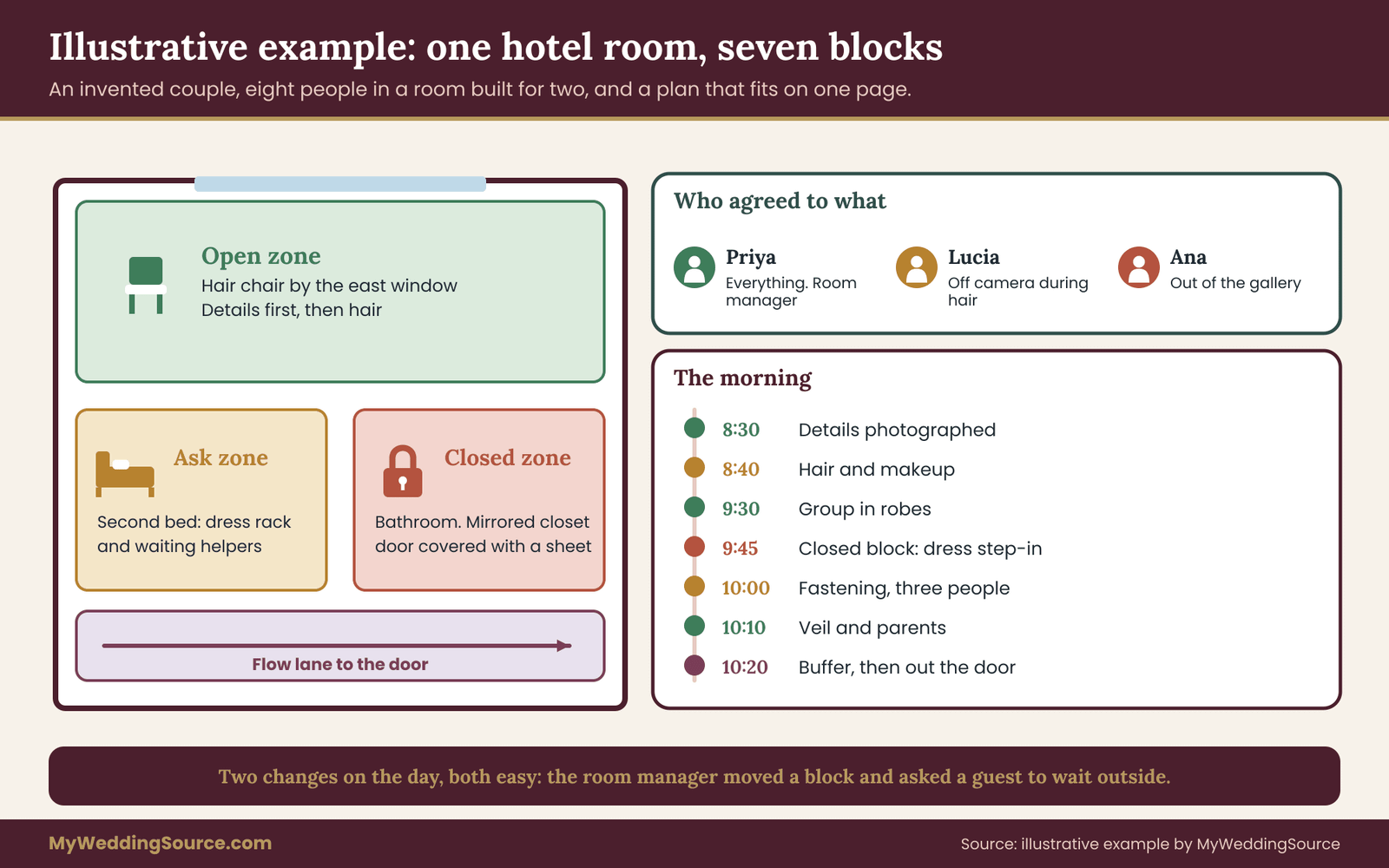
Dana and Marcus are marrying at a restaurant venue with no bridal suite. Dana is getting ready in a standard hotel room two blocks away. The room has two double beds, one window facing east, a small desk, a closet and a bathroom with a door that locks. The people who will be there: Dana, her mother Lucia, her sister and maid of honor Priya, two friends Ana and Kofi, a hair stylist, a makeup artist and a photographer. That makes eight people in a room built for two.
Step one: shrink the crowd
Dana’s first move is to ask who really needs to be in the room all morning. Kofi will arrive for the final hour only. Ana will join after her own hair is finished in a second room down the hall. The photographer will arrive after the stylist has set up. The room at its fullest holds five people and the stylist. Fewer people means safer getting ready photos.
Step two: draw the room
Dana draws a rectangle. The window is at the east end. She puts the hair chair a few feet from it, facing along the glass, which her photographer recommended after seeing the room photos. The makeup artist sets a folding chair by the desk. One bed is pushed to the wall for the dress rack and seating. The bathroom is the closed zone. The strip of floor between the beds and the door is the flow lane.
She labels the window end as the open zone and the seating by the second bed as the ask zone. She covers the closet’s mirrored door with a bed sheet, because it faces the bathroom and the door is often ajar.
Step three: ask the people
Dana sends the sketch and a short message to the group. Priya says yes to everything. Lucia says she does not want to be photographed with curlers in her hair, but is happy to be in the necklace moment and the dress fastening. Ana says she would rather not appear in the gallery at all, because she is a teacher and her school asks staff to keep a low online profile. Kofi says nothing.
Dana makes a note of each answer on the sketch and tells the photographer that Lucia is off camera during the hair block and Ana is out of the gallery. She asks the photographer to confirm in writing that Ana’s images will not be included in the shared gallery or in the portfolio. The photographer agrees and adds it to the shot list. Every answer shapes the getting ready photos that follow.
Step four: write the schedule
The morning starts at eight-thirty. Dana writes seven blocks, as in the sample earlier. She adds two notes at the top: the camera-down signal is a raised hand, and phones stay in bags except for the details and the group photo.
She gives the page to Priya, who becomes the room manager. Priya’s task is to keep time, move people between zones and say “Time for the closed zone” at nine forty-five. Dana prints the page, folds it into the hotel’s stationery folder and puts it on the desk.
Step five: run the morning
The photographer arrives at eight-thirty and photographs the details: the dress on its hanger by the east window, the shoes, the rings and the invitation. At eight-forty the stylist begins. Lucia sits on the second bed with her phone and, as agreed, is not photographed. Priya takes her turn in the chair. The photographer steps back during makeup, since the artist needs space.
At nine-thirty Priya, Lucia, Ana and Dana take a group photo in robes with coffee. Ana steps out of the frame at the last moment and the photographer notes it. At nine forty-five Priya calls the closed zone. Dana and Lucia go into the bathroom, the photographer steps into the hallway and the stylist tidies tools. At ten, Dana comes out and the photographer is invited back. The necklace and the dress fastening are photographed with three people in the frame. At ten-twenty the buffer starts, and at ten-thirty the group leaves.
What went well, and what changed
Two things changed in practice. The window light moved faster than expected, so the photographer asked to swap the hair block and the details block. Dana said yes, and Priya moved the order on the page. Kofi arrived early and walked in during the closed block, and Priya asked him to wait in the hallway, which he did with a laugh. Neither change caused a problem, because the plan made it easy to adjust. Plans for getting ready photos should expect small changes.
At the end, Dana has a smaller set of getting ready photos than she might have had in a large suite, but each is a picture she is glad to keep, and no guest felt exposed. The example is invented, but the pattern holds for nearly any small room: a few clear zones, a short schedule, one person who keeps time and a written record of who agreed to what.
A decision rule for each moment: camera on, ask or off
Once you have a sketch and a schedule, you will meet moments that the plan did not cover. A simple rule helps you decide on the spot. Ask three questions in order. The rule keeps getting ready photos consistent.
Is anyone in this moment partly dressed or changing? If yes, camera off, unless the person has already agreed to a specific shot, such as the dress fastening. This question comes first because the answer is the most important.
Has everyone in the frame agreed to this kind of picture? If everyone has said yes in the message or the room, camera on. If anyone has said no or has not answered, camera ask or off. If you are unsure, assume the answer is no until you hear otherwise.
Is the moment emotional or private? A parent’s quiet words, a note from a friend, a moment of nerves. These are often the best pictures and the most private. Ask first, even if everyone has agreed in general. A glance and a nod from the person is enough.
If the answer to all three is “no concerns,” the camera is on. If it is “unsure,” the camera asks. If the first answer is “yes,” the camera is off. This three-question order, in sequence, covers almost every case.
When the plan and the moment disagree
Sometimes the plan says camera on and the person in the frame looks uncomfortable. Trust the person. The plan is a guide, and people are allowed to change their minds. A raised hand, a shake of the head, a sudden turn away are all signals to lower the camera. Ask quietly whether they would like to continue, and record the change on the sketch so that the photographer knows for the rest of the morning. Getting ready photos are for the people in them.
When the plan says no and the person wants a photo
The reverse also happens. A guest who said no earlier decides she would like to be in the picture. That is fine, as long as the choice is hers and the photographer checks again with her directly. A change of mind from no to yes is easy to accommodate. The harder case is a change from yes to no, so make sure the exit is always open.
Common mistakes with getting ready photos in small spaces
Most problems with getting ready photos are repeats of a few mistakes. If you avoid these, you avoid most of the trouble. Each mistake is easy to avoid.
Treating the room as public because the day is public. A wedding is a public event in some ways, but a getting-ready room is private. The people in it have a different set of expectations from guests at the reception.
Overcrowding. Too many people in a small room means worse light, a harder job for the stylist and fewer places to be private. The most useful single change is a shorter guest list for the room. Crowds make getting ready photos worse and less private.
Drawing the sketch and not sharing it. A plan that only the couple has seen protects no one. Send it to the photographer, the stylists and the room manager, and bring a printed copy.
Skipping the closed zone because it feels dramatic. The closed zone is not about drama. It is about letting people change without wondering who is looking. It also saves the photographer from a very awkward moment. Without it, getting ready photos carry hidden risk.
Forgetting the reflections. Mirrors, windows and shiny doors catch the closed zone. A towel over a mirror solves this.
Letting phones run free. A phone in every hand turns the room into a film set. Ask for a phone pause in the ask and closed blocks, and give people a reason.
Assuming silence means yes. Silence on a message means only that the message was not answered. Confirm in the room before an ask-zone moment.
Not writing down the promises. A photographer who promises to exclude a guest from the gallery should confirm it in a message. Memory fades and staff change.
Scheduling the dress moment too late. If the dress goes on at the last minute, there is no time for the check, the closed zone or the photographs. Give it at least twenty minutes.
Forgetting the people who are not in the room. A parent in the next room, a child in the hallway, a hotel guest in the corridor all have a stake in what the camera sees. Keep the camera inside the room unless someone has agreed otherwise.
The week-before routine for getting ready photos
Most of the work happens before the morning. A short routine keeps the plan alive and gives you time to fix problems. That is where getting ready photos are really made.
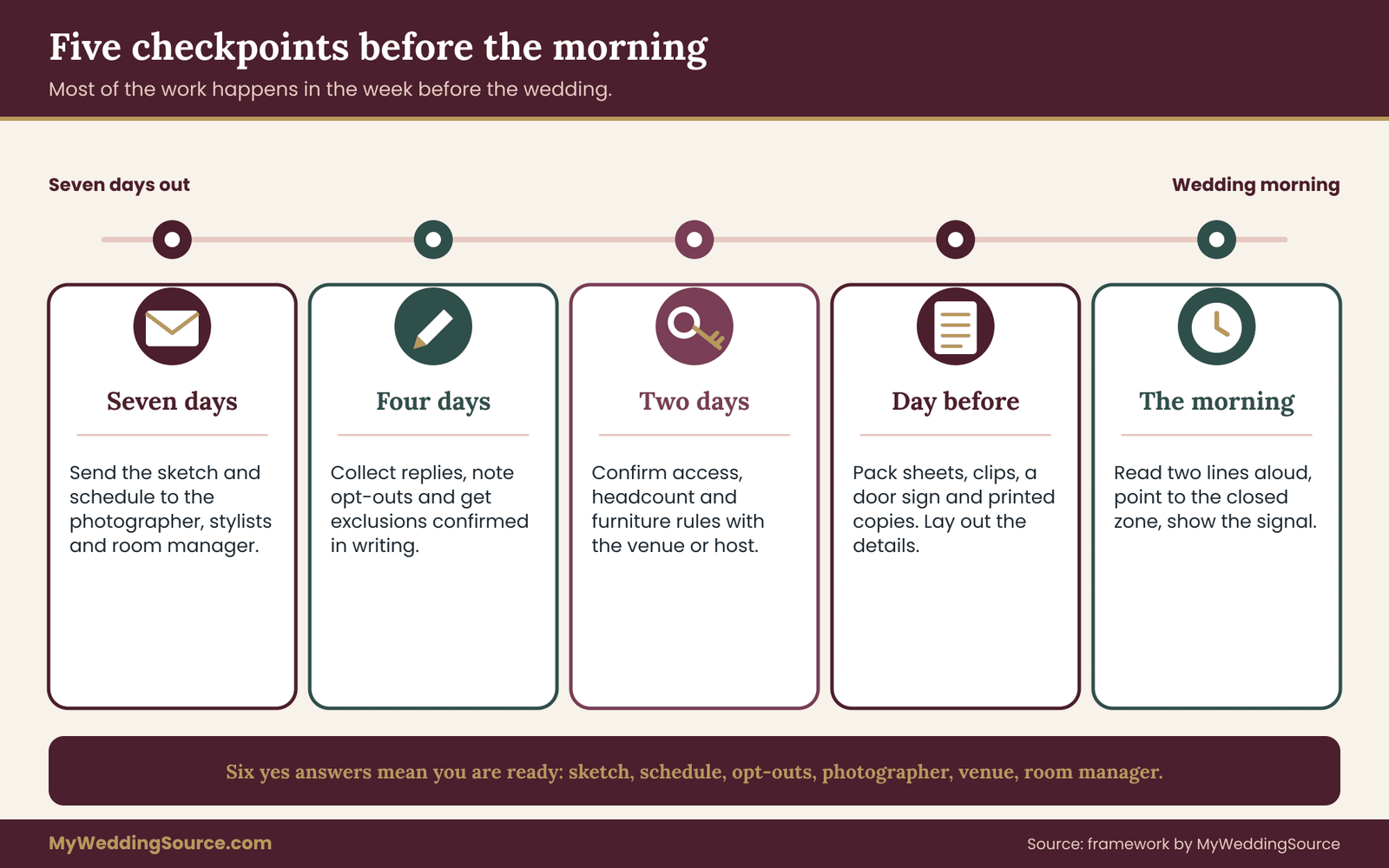
Seven days before. Send the sketch and the timing schedule to the photographer, the stylists and the room manager. Ask each to reply with one correction or confirmation. Send the short message to the wedding party and the family.
Four days before. Collect replies and update the sketch. Note anyone who prefers to be left out, anyone who wants a closed block for a specific moment and anyone with access needs. Confirm in writing any promise from the photographer about exclusions or portfolio use.
Two days before. Confirm access times and room rules with the venue, hotel or host. Ask whether furniture may be moved, whether extra visitors are allowed and who the contact is. Print the sketch and the schedule, one copy for the room manager and one for the photographer.
The day before. Pack the small items that make the plan work: a sheet or two for covering mirrors, a few clothespins or clips, a sign for the bathroom door, a pen and tape. Charge the phone of the room manager. Lay out the dress and details so that the photographer can start with them.
The morning. The room manager reads the two lines at the top of the schedule aloud to the room, points to the closed zone and shows the camera-down signal. This takes under a minute and sets the tone. Everyone then knows how getting ready photos will work.
After the morning. Thank the people who helped, and make a note of any moments you would like to revisit in the gallery. If anyone later asks for a picture to be removed, respond quickly and kindly. The guide to guest photo boundaries and image use explains removal and sharing requests in more detail.
A short checklist, in prose
Does the sketch show the door, the window, the closed zone and the flow lane? Does each block of the schedule name a place, a kind of picture, the people and the camera rule? Has every person in the room heard the plan and been given a way to opt out? Has the photographer confirmed the closed zone, the exclusions and the phone rule? Has the venue or host confirmed access, headcount and furniture? Is there a room manager with a printed copy? If you can say yes to all six, you are ready.
What this plan cannot do
A plan for getting ready photos has limits, and it helps to know them. Honest limits make the plan more trusted.
It cannot control what people do after the morning. A guest may post a photograph despite a request. A friend may share a picture in a group chat. You can ask, and you can ask for removals, but you cannot guarantee that every picture stays where you meant it to stay.
It cannot replace a contract. The agreement with your photographer decides who owns the pictures and how they may be used. A sketch and a schedule can be added to the conversation, but only a written agreement binds the parties.
It cannot override the rules of a hotel, rental platform or venue. If a host forbids visitors or photography, the plan has to fit the rule, or you need a different space.
It cannot decide for anyone what they feel comfortable with. The best it can do is make it easy for them to tell you.
It is also not legal advice. Laws about privacy, photography and recording differ by place, and they change. If your situation involves a custody matter, a protective order or a similar legal issue, speak to a lawyer and tell your photographer what you must.
Your next steps
Pick a free half-hour this week. First, draw the room on a single sheet: door, window, bathroom, bed, desk and the place for the hair chair. Mark the open zone, the ask zone, the closed zone and the flow lane. Second, write the schedule in six to eight blocks, working backward from the time you must leave. Third, send both to your photographer and ask one question: where would you stand? This is the whole job of planning getting ready photos.
Then send the short message to your wedding party and family, collect the answers, and write them on the sketch. A week before the wedding, confirm access with your venue or host and print the pages for the room manager. On the morning, read the top two lines aloud and begin. Your getting ready photos will be calmer, and the people in the room will know what to expect.
FAQ
How many people should be in a small getting-ready room?
As few as the morning allows, since every extra person means less light, less floor and less privacy. Many couples find that the bride or couple, one or two close helpers, the stylist and the photographer fit comfortably, and bring others in for short blocks. Check the venue or hotel for any limit on visitors, which may be set for safety or policy reasons.
Do guests have to agree before being in getting ready photos?
There is no single rule for every situation, and laws vary by place, so check local rules if it matters. As a matter of courtesy and good planning, ask people in advance and make it easy to say no. Treat silence as agreement only for open-zone moments, and check again in the room before a private or emotional shot.
Is it normal to ask the photographer to leave while the dress goes on?
Yes. Many photographers step out while the bride changes and come back for the fastening, and most are glad to know the preference in advance. Ask in the first conversation, include it in the timing schedule and agree on who will invite the photographer back. If a photographer objects, talk further before you sign a contract.
What if the hotel limits the number of visitors in a room?
Ask the hotel directly and in writing about its visitor and photography policy. Options include a larger room, a suite, a meeting room for the hair block or a rotation where small groups visit the room in turn. Do not assume a front desk will overlook a crowd, since room limits can relate to fire safety and hotel rules.
How do I handle a guest who does not want to be photographed?
Thank them for telling you, do not ask for a reason, and note it on the sketch and the schedule. Tell the photographer, and ask for written confirmation that the person will be left out of the gallery or portfolio if that is what the guest wants. Give them a place to sit outside the frame, or a task that moves them away from the camera.
Can the photographer use our getting ready photos in their portfolio?
That depends on your contract, so read it and ask. Many photographers include a clause allowing portfolio use, and many will exclude certain moments or people if you ask in writing. The copyright question is separate from the question of who appears in the pictures. The U.S. Copyright Office explains the general rules, and a lawyer can review your specific agreement.
What should we do if there is no room for a closed zone?
Use time instead of space. Agree on closed blocks during which the photographer steps outside, and use the doorway, a sheet or a screen as a boundary. Reduce the number of people in the room, ask for the dress moment to be photographed only after the dress is on, and consider moving the open zone to a porch, hallway or another space with the venue’s permission.
Should the couple’s phones and guest phones be allowed in the room?
A phone pause during closed and ask blocks protects privacy and keeps the room workable. Allow phones in the open zone for details and group photos, and ask guests to wait before posting. Give a reason people can accept, such as keeping the morning calm and the dress under wraps. A quiet request from the room manager usually works better than a rule announced to everyone.
Sources
- Copyright basics and registration information, U.S. Copyright Office
- Copyright frequently asked questions, U.S. Copyright Office
- Copyright circulars and general information, U.S. Copyright Office
- Children’s privacy, Federal Trade Commission
- Information and technical assistance on the Americans with Disabilities Act, ADA.gov
- Fire and life safety codes and standards, National Fire Protection Association
- Help Center, Airbnb
- Government services and consumer information, USAGov