
Wedding photography styles describe how a photographer sees, directs, lights and finishes a wedding day, and choosing among editorial, documentary, film and classic work is easier when you judge real samples with a rubric instead of reacting to a label. This guide compares the four main wedding photography styles in plain terms and gives you a five-check sample rubric and a one-page brief to hand your photographer.
Quick answer
Treat the four wedding photography styles as habits, not boxes. Classic work records the people and the formal moments reliably. Editorial work designs the frame and directs you. Documentary work waits for moments and stays out of the way. Film is a medium that can carry any of those habits. Ask each photographer for a full gallery, score it on five checks (light, direction, moment, finish and range), weight the checks by what matters to you, and write a short brief that names your priorities and your limits.
Picking a photographer feels like picking a taste. You scroll through portfolios, you save the images that make your chest tighten a little, and you end up with a folder of pictures that look nothing alike. One is bright and soft, one is dark and grainy, one is a stiff family lineup, one is a couple in a field with wind in the veil. Then you search for the right label and the vocabulary multiplies: fine art, photojournalistic, candid, timeless, moody, light and airy, traditional, film-inspired.
This article cuts through that by comparing wedding photography styles on what they actually do on the day. It looks at the working habits behind each style, the strengths and the risks, and the kind of wedding where each one tends to fit. It then gives you an original tool, the Style Sample Rubric, so you can compare photographers on evidence rather than on adjectives. The last parts turn your choice among wedding photography styles into a written brief and into contract terms that protect it.
This guide pairs with the broader advice in wedding photography consent, which covers guest boundaries and image use, so this article stays on style.
A note on scope. This is general planning information, not legal, tax or financial advice. Copyright and contract rules can vary by situation, so confirm the details that matter to you with the U.S. Copyright Office, with the photographer’s written contract and, where the stakes are high, with a qualified professional.
Wedding photography styles in plain terms
The phrase “wedding photography styles” covers two different things that people tend to blur together. The first is approach: how the photographer behaves during the day, how much they arrange and how much they wait. The second is finish: how the files look after editing, including color, contrast, grain and how bright the whites are.
In wedding photography styles, a photographer can have a documentary approach with a bright, airy finish. Another can have an editorial approach with a dark, saturated finish. When you read “editorial” or “documentary,” you are mostly reading about approach. When you read “film” or “light and airy,” you are mostly reading about finish and medium.
Keeping those two ideas apart when you study wedding photography styles solves a surprising number of mismatches. Couples often say they want “candid” pictures and then choose a portfolio full of styled portraits shot on film, because the film look read as candid. The images were not candid at all. They were carefully directed pictures with a film finish. Understanding what each of the wedding photography styles really promises is the first protection against that kind of surprise.
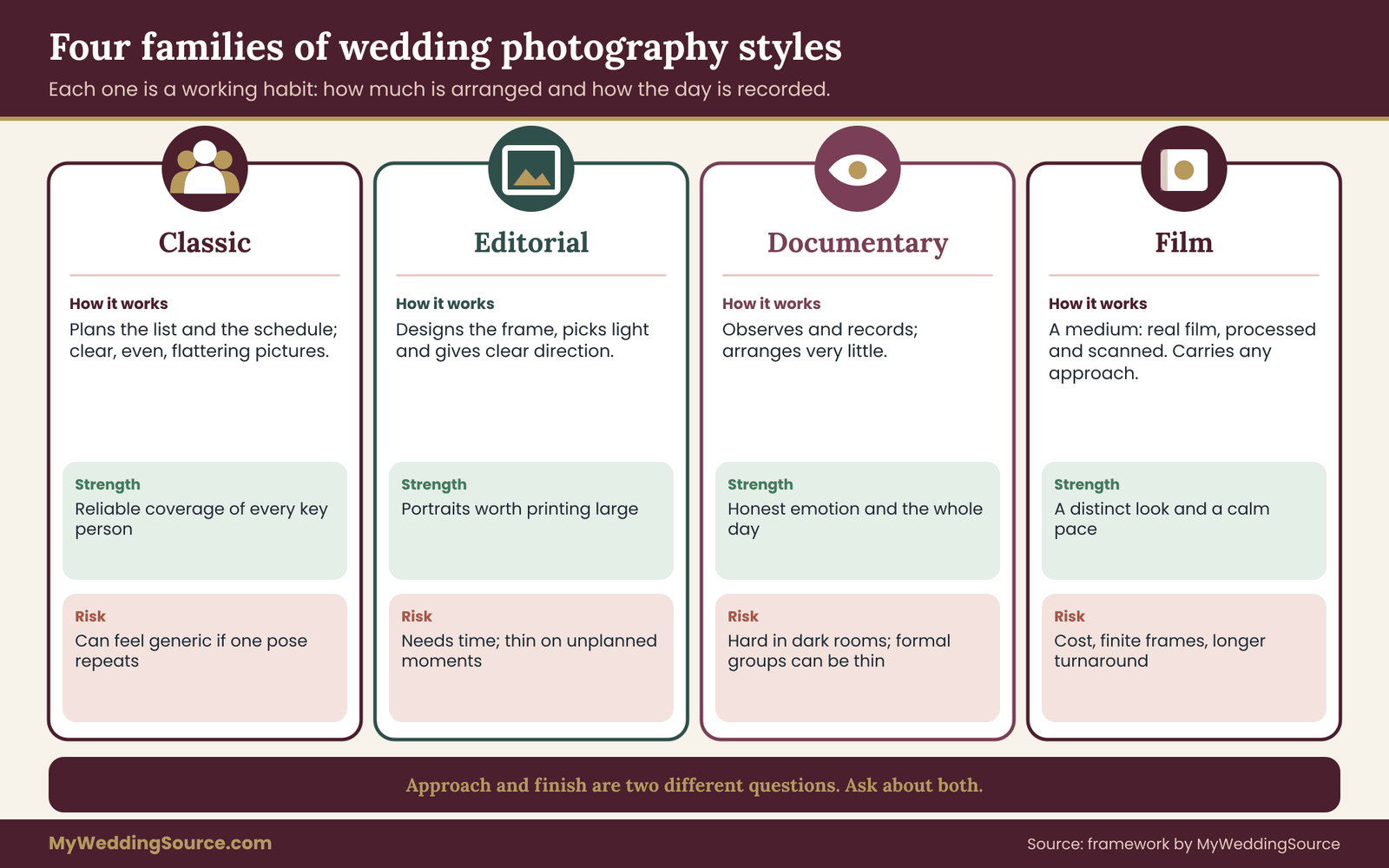
Here is the short version of the four wedding photography styles this guide compares.
Classic. The photographer works from a list, produces clear and flattering pictures of the people who matter, and leaves little to chance. Group portraits, the ring exchange, the cake cut and the formal couple portraits are all planned and delivered cleanly. The strength is reliability. The risk is that the gallery can feel generic if the photographer relies on one safe pose.
Editorial. The photographer treats the day like a shoot with a point of view. They choose locations for their light and lines, direct posture and movement, and think in terms of composition and sequence. The strength is striking portraits. The risk is that the day can feel like a production, and the pictures of the unplanned moments can get thin.
Documentary. The photographer observes and records, intervenes very little and builds the gallery from moments that happened without arrangement. The strength is honest emotion and a real sense of the day. The risk is that without any direction, family and couple portraits can be sparse or awkward, and dark rooms can punish the approach.
Film. The photographer captures some or all of the day on photographic film and has it processed and scanned. The strength is a distinct look and a slower, more deliberate pace of shooting. The risk is cost, limited frames and a different turnaround. The film question is a separate decision from the approach question, and a later section treats it that way.
The two questions behind every label
When you evaluate any photographer, two questions sit under the labels used for wedding photography styles. The first is how much the day will be arranged. The second is how the final files will be finished. Everything else you read in a portfolio is a combination of those two answers, plus a third factor that has nothing to do with style at all: skill under difficult conditions.
That third factor matters because a label for wedding photography styles can make weak technique look intentional. Grain can hide missed focus. Dark, moody editing can hide bad light. A documentary claim can excuse a gallery that missed the vows. The rubric later in this guide separates skill from fit for exactly this reason. It scores whether the work is well made first, and only then asks whether it matches your taste and your wedding.
Why a style label is a weak guide on its own
Labels for wedding photography styles travel faster than meaning. A photographer might call their work “timeless” because they edit with natural colors. Another might call theirs “timeless” because they shoot formal portraits in a studio-like setup. A third might use it because they shoot film. Three photographers, one word, three different galleries.
Three things make labels for wedding photography styles unreliable in practice. The first is that photographers choose their own labels, and the choice is marketing as much as description. The second is that many photographers genuinely blend wedding photography styles, so a single label hides half of what they do. The third is that portfolios are curated. They show the best frames from the best days, which tells you the ceiling of a photographer’s work and very little about the floor.
What a portfolio can and cannot tell you
A portfolio can tell you what a photographer is capable of at their best, which kind of light they like and how they compose a frame. It can also tell you how they want to be perceived. What it cannot tell you is how often they reach that standard, how they handle a dark reception hall, how they photograph a crowded family group or how consistent their editing is over a whole day.
For that reason, the single most useful request you can make is for a complete gallery from one real wedding, preferably one with conditions similar to yours. A full gallery shows the sequence of the day, the percentage of frames that are strong, the way the photographer handles guests of all ages and the way the editing holds together from the morning to the last dance.
Many photographers will share one with the couple’s permission. If a photographer cannot share any full gallery, that is information too, and the section on collecting samples explains how to ask and how to read the answer.
A practical test for any label
When a photographer uses a style word, ask what it means in terms of behavior on the day. Three short questions do most of the work. How much of the day do you direct, and how much do you leave alone? How many minutes of portrait time do you expect, and where do you want them? What do you do when the light is poor? The answers describe the real approach in a way that the label never will.
A photographer who calls themselves documentary and says they rarely direct anything is describing one working pattern. One who says they are documentary but always take twenty minutes for portraits at golden hour is describing another. Neither is wrong. The point is to hear the behavior and to decide whether it fits you, rather than assuming the word means what you think it means.
What each family promises, and what it does not
It helps to think of each of the wedding photography styles as a promise with a cost attached. A promise is something the style reliably delivers when it is done well. A cost is something you give up or risk by choosing it. Looking at both at once keeps the decision honest.
Classic work promises coverage. You will have a clean record of the people and the formal moments, and you will probably have it on time. The cost is predictability. If every family group looks like every other family group, the gallery is complete but not memorable. A good classic photographer manages this by varying the setting and keeping an eye out for small moments between the formal ones.
Editorial work promises portraits that feel designed. You will probably have a handful of images you want to print large. The cost is time and attention. A shoot-style approach needs minutes with the couple, ideally in good light, and those minutes come out of the schedule. It also asks you to take direction from someone and to be comfortable being looked at while you do it. Couples who dislike being posed can find this tiring, and the strain shows in the pictures.
Documentary work promises authenticity. You will probably have pictures of reactions, hands, children and the in-between moments that you would never think to request. The cost is control. You get what happened, and what happened includes the unflattering angle and the partly closed eye. It also depends heavily on light and on the photographer’s timing, which is why a documentary gallery from a dim venue is the sample most worth studying.
Film, among the wedding photography styles, promises a look and a pace. The images have tonal qualities that digital files imitate with presets but do not exactly reproduce, and a film photographer usually shoots more slowly and more deliberately. The cost is a finite number of frames, a lab and scanning stage that adds time and money, and a narrower margin for error in low light. Film also changes how a photographer works with flash, which a later section explains.
Hybrids are the norm, not the exception
Most working photographers do not keep to one of the wedding photography styles. A common pattern is editorial portraits in the middle of the day, documentary coverage of the ceremony and reception, and a short formal family list. Another is a digital main kit with a film camera for portraits and details. When you hear that a photographer blends wedding photography styles, such as “a documentary photographer who also does portraits,” believe it, and then ask what proportion of the day goes to each.
A useful way to describe a hybrid of wedding photography styles is as a recipe. For example, a photographer might spend most of the day in observation mode, ask for twenty minutes of directed portraits, and take a short list of formal groups. That recipe tells you more than any single label, and it gives you a concrete thing to put in a brief later.
Classic wedding photography styles and the family record
Classic work is the oldest of the four wedding photography styles and the easiest to underrate. It is built on a simple idea: a wedding creates a set of people and moments that will never be assembled in the same room again, and the photographs should record them clearly. Among all wedding photography styles, classic is the one most closely tied to the idea of an album that grandparents can understand at a glance.
A classic photographer works from a list and a schedule. They know the order of the ceremony, they know where to stand for the vows and the ring exchange, and they arrive at the family portraits with a plan for who goes in which group. They tend to use even, flattering light, to keep the horizon level, to face people toward the camera and to make sure no one is blinking in the frame that gets delivered.
What classic work does well
The first strength of classic wedding photography styles is completeness. When a classic photographer is good, nobody important is missing from the gallery. The grandmother in the third row has a portrait. The officiant has a clear picture. Both sets of parents appear together and separately. If your priority is a record that covers the whole family without gaps, this is the most dependable approach.
The second strength is speed. Because the photographer has a repeatable method, formal portraits take less time than they do with a more experimental approach. That matters when the schedule is tight, when the light is fading or when a large group is losing patience. A well-run family list of twenty groups can move quickly when one person is calling names and the photographer is working from a rhythm.
The third strength is legibility across generations. A classic photograph of a couple standing together, looking at the camera, is understood instantly by relatives who may not appreciate a tilted, cropped or heavily stylized frame. If older relatives will be the main audience for your album, this clarity is a real benefit.
Where classic work goes wrong
The common failure in classic wedding photography styles is sameness. A photographer who relies on three poses and one background will deliver a gallery in which every portrait feels interchangeable. The pictures are technically fine and emotionally empty. When you review classic samples, look at a run of consecutive family groups and ask whether the photographer varied anything: the angle, the distance, the spacing, the setting.
The second failure is stiffness. People who have been told to hold still and smile often produce a flat expression. A skilled classic photographer solves this with a quick joke, a change in position or a short pause between frames, and the best of them capture a relaxed moment right after the posed one. A weaker one delivers only the posed frame.
The third failure is the formal list swallowing the day. If the list is long and the photographer treats every group with the same weight, you can lose an hour of the reception to portraits. The way to manage this is with a short, ranked list and a named helper, which is covered in the guide to the wedding family photo list.
How to recognize classic work in a sample
In a full gallery, classic wedding photography styles show a clear pattern. Family groups appear in a consistent block. Couple portraits are mostly facing the camera or in simple, balanced poses. Backgrounds are tidy. Exposure is even from frame to frame. Editing is restrained, with natural skin tones and moderate contrast, so that the gallery looks coherent when printed.
If you see these traits and you also see a few unposed frames between the formal ones, you are probably looking at a photographer who works in the classic family of wedding photography styles but keeps an eye open. That combination is the best version of classic wedding photography styles.
Editorial wedding photography styles: direction and design
Editorial work, one of the more directed wedding photography styles, borrows its habits from magazine and fashion shoots. The photographer thinks about composition before pressing the shutter, picks locations for their light and shape, and gives the couple clear direction about posture, distance and movement. The word “editorial” is sometimes used loosely for anything with a polished, high-end look, but the working approach is specific: the frame is designed.
Among wedding photography styles, editorial is the one that most clearly depends on a working relationship between the photographer and the couple. The pictures only succeed if the couple will follow direction without feeling silly, and the photographer will give direction without being bossy. That dynamic is part of what you are hiring.
What editorial work does well
The strongest images in editorial wedding photography styles are portraits you would hang on a wall. The light is chosen, the background supports the subject, the pose has intention, and the expression feels natural because the photographer has worked to relax the couple. If your goal is a small number of exceptional portraits, this approach is the most likely to deliver them.
Editorial photographers also tend to be good with detail and design. The invitation suite, the table setting, the dress detail and the flowers are photographed with care, often with a sense of styling. If you have invested in design and you want it recorded with equal care, an editorial eye will usually do justice to it.
A third strength is the sense of a coherent gallery. Because the photographer thinks in sequences and in a consistent visual language, the finished set often reads like a story with a point of view, not like a pile of unrelated frames.
What editorial work costs
The first cost of editorial wedding photography styles is time. Directed portraits in good light need a window of uninterrupted attention. That window might be thirty to forty minutes with the couple alone, not ten minutes squeezed between family groups. If the timeline cannot hold that window, the editorial approach will be compromised, and you will receive some frames that look rushed.
The second cost is comfort. Couples who find posing awkward can feel performative under direction, and that discomfort is visible in the face. Before choosing an editorial photographer, honestly ask yourselves whether you would rather be photographed while doing something, such as walking, talking or dancing, than while holding a posture. A good editorial photographer directs through activity as often as through pose, but you should check this in the samples.
The third cost is coverage of the unplanned. A photographer who is busy composing may miss the moment when your father wipes his eyes. Editorial specialists often bring a second shooter to cover moments while they work, and it is reasonable to ask how that is handled.
Reading editorial samples honestly
When you review editorial wedding photography styles, look for variety in the directed work. If every portrait uses the same pose in a different location, the photographer has a formula, not a vision. Look at how the couple’s faces look across a set. Are they relaxed in most frames, or only in a handful? Look at the unposed frames in the same gallery and ask whether the photographer is still alert when they are not directing.
Also check the finish. Editorial galleries often use bold color grading or high contrast, and those choices can date quickly or can clash with skin tones under certain light. The rubric later in this guide includes a finish check for this reason, and it asks you to look at skin tones in mixed light, not only in a flattering portrait at sunset.
When editorial and classic overlap
A good deal of high-quality work in wedding photography styles sits between editorial and classic. The photographer directs the portraits with care but works from a clear family list, and the gallery delivers both designed images and a complete record. If you want both a strong set of portraits and full coverage of the family, this overlap is the sensible target. It also happens to be the combination many couples describe when they say they want pictures that are “polished but still real.”
When you speak to a photographer about this overlap, ask them to describe how the day will be divided. A clear answer, such as a block of time for family, a separate block for portraits and observation mode for the rest, is a good sign. A vague answer suggests the photographer has not thought about how the two modes coexist, and the portrait time is the first thing to disappear when the day runs late.
Direction is a skill, not a personality
People sometimes assume that directing a couple, a core skill in editorial wedding photography styles, is a matter of confidence or charisma. In practice it is a learnable craft with a few repeatable moves. A skilled photographer gives one instruction at a time, uses movement to loosen people up, asks for a small action instead of a pose, and photographs the reaction after the instruction as often as the instruction itself. They also adjust to each couple. A shy pair gets fewer instructions and more time. A playful pair gets games.
You can watch for this in a sample. If the couple looks relaxed across a long run of portraits, the photographer probably directs well. If you see the same stiff, braced posture in most frames, the direction is probably heavy-handed. You can also ask the photographer how they work with people who dislike being photographed, because a thoughtful answer will describe specific methods, and a vague answer will repeat the word “natural.”
Documentary wedding photography styles: moments you did not arrange
Documentary work, sometimes called photojournalistic, starts from a different idea than the other wedding photography styles. The wedding is already full of events, and the photographer’s job is to notice them and record them without changing what happens. The photographer stays out of the way, moves quietly, keeps a distance and rarely asks anyone to repeat a gesture.
Of all wedding photography styles, documentary is the one most likely to produce pictures you did not know you wanted. The best frames are often small: a hand on a shoulder before the aisle walk, a child asleep on a chair near midnight, the look between two friends as a toast lands. These are the images couples describe as feeling like the day felt.
What documentary work does well
The first strength of documentary wedding photography styles is emotional honesty. Because nobody is performing for the camera, the faces in a good documentary gallery look the way people actually looked. Tears, laughter and boredom are all there, and the gallery tends to have a quality that couples describe as true to the day.
The second strength is breadth. A documentary photographer covers the whole day, not only the scheduled events. They photograph the preparations, the arrivals, the guests talking in clusters, the food, the musicians and the late-night dancing. If you expect to be too busy to remember most of your own wedding, a documentary gallery works like a record of everything you missed.
The third strength is that it asks very little of you. If you dislike posing and you do not want your wedding to feel like a photo shoot, the documentary approach lets you stay in the day. It also pairs well with a relaxed, unscripted celebration, where a rigid shot list would be out of place.
What documentary work costs
The central cost of documentary wedding photography styles is that nothing is promised. The photographer records what happens, so if a moment happens in bad light, behind a pillar or while the photographer is across the room, it may not be captured well or at all. The approach rewards photographers with excellent anticipation and punishes weak ones, which is why the full gallery matters so much.
A second cost is formal coverage. Many documentary photographers do not enjoy family lists and can treat them as an interruption. Without a clear agreement on this, you might receive a beautiful record of the day and a thin set of portraits. If the formal groups matter to your family, state that in the brief and ask how the photographer will handle them.
A third cost is dark rooms. Observation depends on being able to photograph quickly in whatever light exists. A dim reception hall with no flash and no direction can produce soft, grainy and underexposed frames. Ask documentary photographers directly how they handle low light, and look for their evening frames, not only their golden-hour pictures.
Documentary is not the same as candid
Couples often use the word candid to mean pictures of real moments, and that is a fair description of documentary work. The problem is that some photographers use “candid” to describe directed pictures that look unposed, such as a couple walking toward the camera while laughing on instruction. These are posed in every way that matters. They can be lovely, but they come from the editorial family of wedding photography styles, and they take time and direction.
A simple test for a sample: look at who is looking at the camera. In genuine documentary frames, people mostly are not, which is how you tell these wedding photography styles apart. If most of the couple portraits show both partners looking at each other in a moment that was clearly prompted, you are looking at directed work with a candid finish, which is fine, as long as you know what it is.
Reading documentary samples
When you review documentary wedding photography styles, look for the timing of the frame. Is the expression at its peak, or a half-second before or after? Look for the clean frame: is the subject separated from a cluttered background, or does a stranger’s elbow cut through the picture? Look at the sequence: does the gallery tell the day in order, with enough frames of the ceremony to show how it unfolded?
Then look for the failure modes. A documentary gallery with many near-misses, partly hidden faces and awkward mid-blink frames is a gallery from a photographer who was present but not skilled. A gallery with a high rate of clean, well-timed pictures from a variety of lighting conditions is the real thing. The rubric in a later section turns this reading into numbers you can compare.
Film: a medium that shapes the style
Film is the wedding photography style that is easiest to misunderstand, because it is not a style of approach at all. It is a medium. A photographer can shoot a classic, an editorial or a documentary wedding on film. What changes is the look, the pace, the cost and the risk profile.
When people say they want a film look, they might mean one of three different things, and it helps to separate them before you contact anyone. They might want real photographic film, processed by a lab and scanned. They might want digital files edited to resemble film, with grain and muted color. Or they might want a vintage mood that has more to do with the clothing, the locations and the lighting than with the medium. Each of these is a legitimate preference, but each is a different request.
What shooting on film changes
Film changes the rhythm of the day compared with other wedding photography styles. Each roll holds a fixed number of frames, and the photographer pays for every one, so they shoot more deliberately than they would with a digital card. Many couples feel this slower pace as calm. Others notice that the photographer takes fewer frames of each moment, which raises the stakes on timing.
Film also changes how the photographer handles light. Many films need more light than a modern digital sensor, and low-light reception rooms are harder. Photographers who shoot film in dark venues often use flash, a faster film or a hybrid approach in which a digital camera covers the evening. If your reception is dim and you want a film look, ask how the photographer would handle the darkest part of the night.
Finally, film adds a process after the wedding. The rolls go to a lab, the lab develops and scans them, and the photographer reviews and edits the scans. That sequence takes time, and it can add cost and a delay to the delivery of your gallery. Ask how long it typically takes and what happens if a roll is damaged or lost in transit.
Real film, film-style editing and hybrids
Real film means light-sensitive material exposed in a camera and chemically processed. The look comes from the emulsion, the lab’s handling and the scanner’s settings. Film-style editing means a digital file adjusted to imitate those qualities, often with presets. Many excellent photographers use one, the other or both, and a hybrid approach is common: digital for the ceremony and the dark reception, film for portraits, details and daylight moments.
None of these choices is better in the abstract. The honest question is what you will do with the images and what you value. If you love the specific look of film and you accept the constraints, real film is a good fit. If you simply like soft color and visible grain, a skilled digital photographer can provide a close approximation, often with more flexibility. The basic decision is whether the look is worth the trade-offs for your venue and schedule.
Questions to ask a photographer who shoots film
Ask what share of your wedding will be shot on film and what share on digital. Ask which camera and film stock they use for portraits and which for the ceremony. Ask how many frames they typically shoot during a wedding and how many they deliver. Ask which lab they use and what the turnaround is. Ask what the backup plan is for a lost roll, a damaged roll or an airport X-ray problem. Ask whether the price includes processing and scanning or whether those are separate.
The answers tell you whether film is an integrated part of the photographer’s practice or an occasional add-on. A photographer who shoots film every week will answer without hesitation. One who tries it a few times a year may be less certain about the details, which is not disqualifying, but it is worth knowing before you rely on it for your first dance.
A word on trends
Preferences in wedding photography styles shift over time, and each look has its season. Bright and airy finishes, dark and moody finishes, heavy grain and clean digital looks each have a stretch of popularity and then a stretch of seeming dated. Nobody can promise which look will age gracefully, and a photographer who claims to know is guessing. The most dependable protection is to favor finishes that keep skin tones natural and that do not rely on an extreme effect.
Photographs also carry an unusual burden: they will be viewed decades from now, by people who may not share your taste. A neutral, well-exposed image with accurate color can be restyled later. An image with crushed shadows and a heavy color cast cannot be fully repaired. That is one reason the rubric treats the finish as a separate check and asks for a few frames in neutral light.
Black and white as a separate choice
Some photographers convert a portion of a gallery to black and white, and some couples ask for it as a deliberate part of the look. It is worth treating this as its own decision. Black and white removes color problems, such as a mixed-light cast, so it can rescue frames and give a gallery a consistent feel. It also removes the colors you may have chosen carefully, such as flowers, fabrics and decor.
A reasonable approach is to ask for color as the main delivery with black and white versions of a selection of frames, usually the emotional ones. That keeps the color record intact and gives the photographer room to use monochrome where it helps. If you want a gallery that is mostly black and white, say so clearly in the brief, because it changes how the photographer exposes and composes certain frames.
The Style Sample Rubric for wedding photography styles
The rubric for comparing wedding photography styles exists to solve one problem: when you compare photographers by feel, the most polished portfolio usually wins, even when a plainer one fits your wedding better. The Style Sample Rubric replaces the feeling with five checks, each scored the same way on every photographer, plus a second pass that applies your own priorities. It works for every one of the wedding photography styles in this guide because it measures behavior in the pictures, not the label on the website.
The rubric has two passes. The first pass of the rubric for wedding photography styles measures skill and uses fixed scoring, so that it works the same for everyone. The second pass measures fit and uses your own weights, so that it reflects what matters in your wedding. Keeping the passes separate stops a gorgeous but mismatched gallery from outscoring a modest but suitable one, and it stops a poor gallery from hiding behind a flattering style.
The five checks
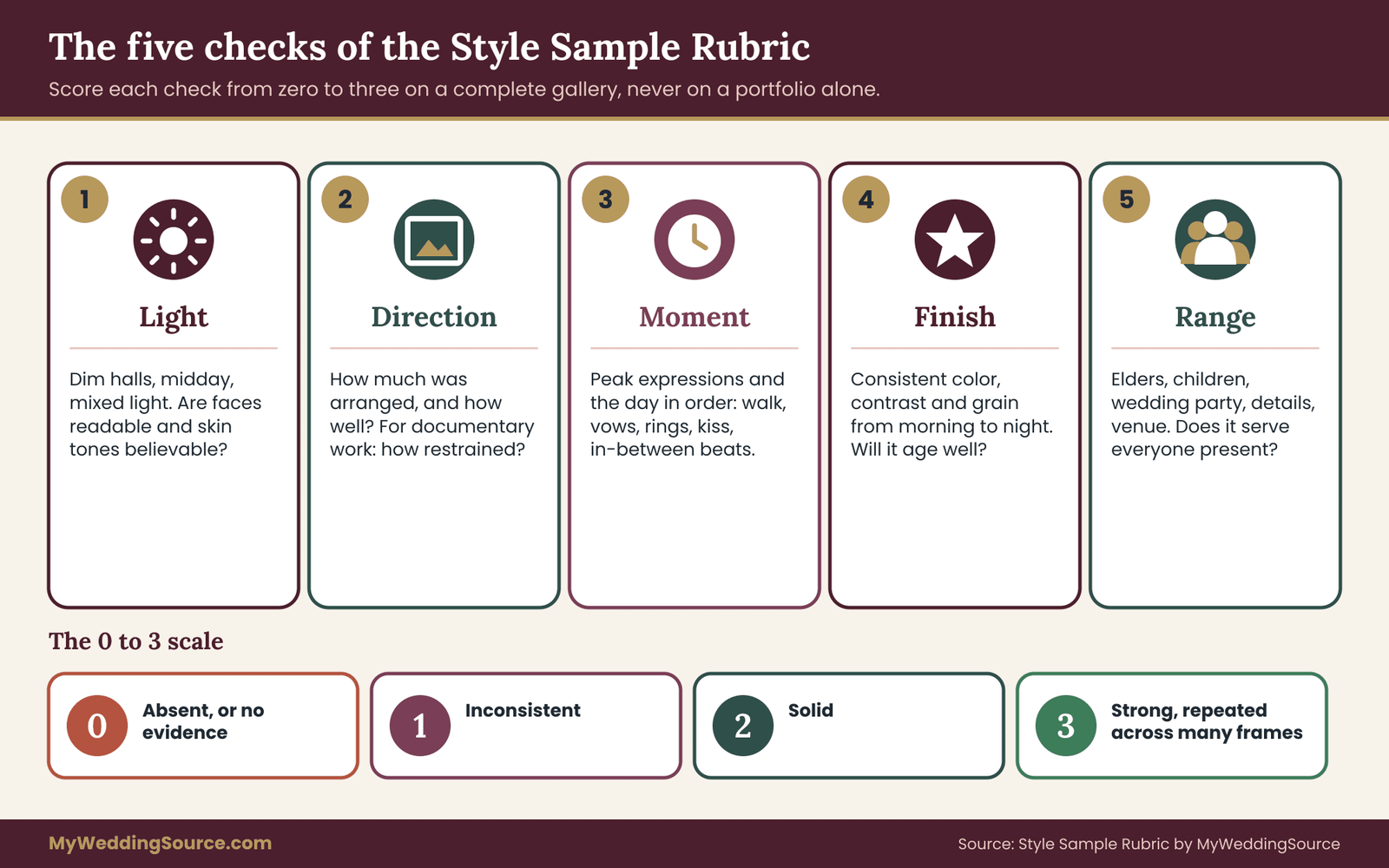
Each check asks a question about the sample and can be scored from zero to three. A zero means the trait is absent or the evidence is missing. A one means it is inconsistent. A two means it is solid. A three means it is strong and repeated across many frames, not shown once.
Check one: Light. How does the photographer handle light that is not ideal? Look for frames taken at midday, in a dim hall, in mixed lighting and under harsh flash. Are skin tones believable? Are faces readable? A photographer who only shows soft sunset portraits has proven they can use good light, and nothing else.
Check two: Direction. How much of the gallery looks arranged, and how well was the arranging done? Count the portraits. Do the couple’s bodies look relaxed? Is the direction varied or is it one pose repeated? For documentary samples, this check becomes a check on restraint: did the photographer stay out of the way, and do the people look unaware of the camera?
Check three: Moment. Is the timing right? Look at peak expressions, gestures caught at their height and the story of the day in sequence. Does the ceremony gallery show the walk, the vows, the ring exchange and the kiss as distinct, readable frames? Are the in-between moments present?
Check four: Finish. Is the editing consistent and does it serve the people? Look at color, contrast, grain and the treatment of skin. Check whether a morning frame and a night frame look like they belong to the same day. Finish also covers how well the finish might age. Heavy effects can date quickly.
Check five: Range. Does the gallery cover the whole day and the whole cast? Look for older relatives, small children, wedding party members who are not the couple’s closest friends, details, the venue, and the quiet beats before and after major events. A photographer with range delivers a gallery that serves every person who was there.
First pass: scoring skill
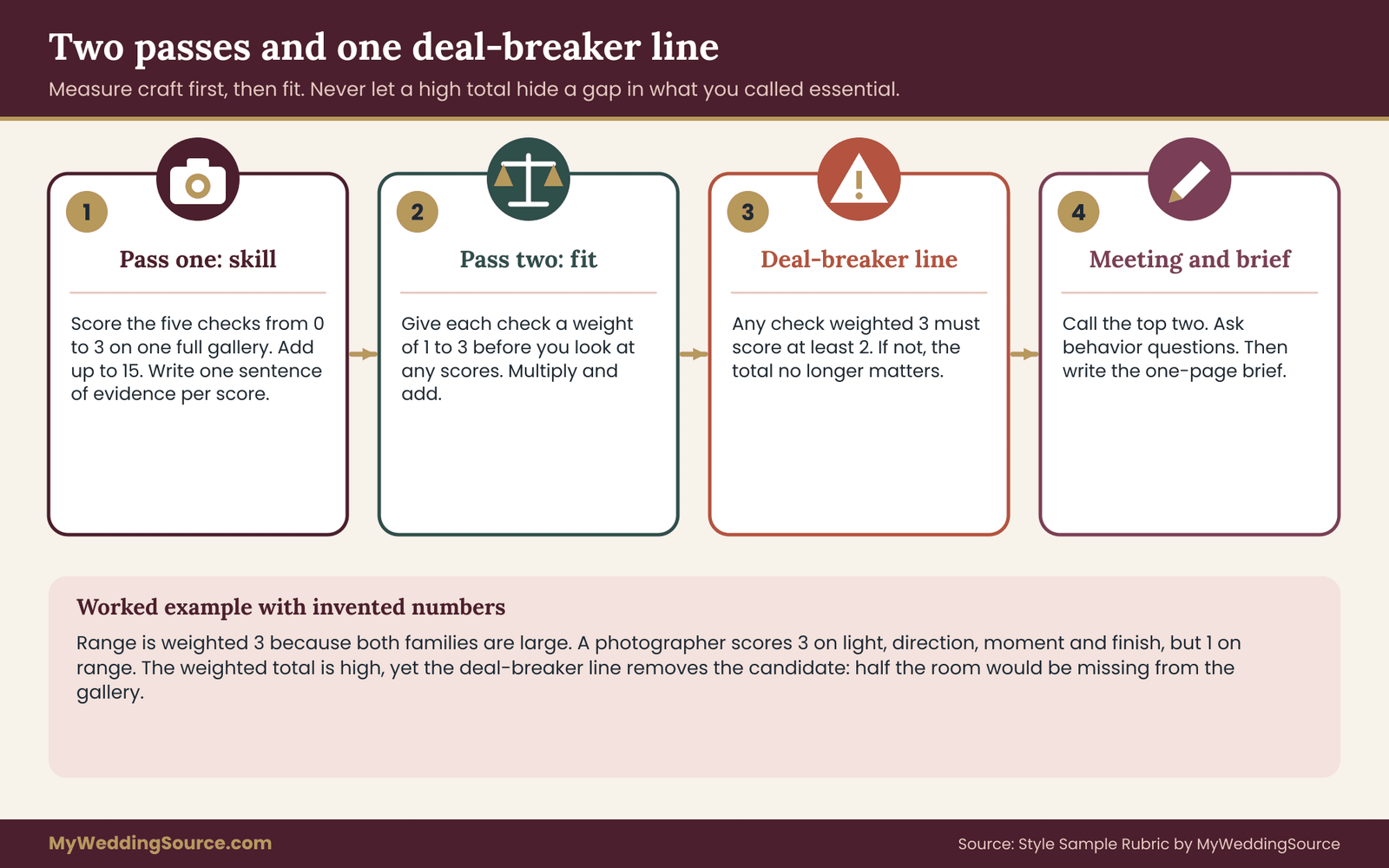
To apply the rubric to wedding photography styles, take one full gallery from each candidate and score each of the five checks from zero to three. Add the scores to a total out of fifteen. Do not weight anything yet. This pass is only about craft, and it should be done as calmly as possible, ideally on a day when you are not feeling dazzled by the first impression.
Write one sentence of evidence for each score. A score without evidence is a mood. If you give a two for Light, note which frames made you think so, for example “the dim reception frames hold detail in the faces but the toast frames are soft.” Those notes become the questions you ask the photographer later, and they protect you from rewriting your memory of the gallery after you meet a charming person.
As a working guide, a total of twelve or more suggests a photographer whose craft is strong across the day. Nine to eleven suggests solid work with one or two weak spots. Eight or fewer suggests that the samples do not yet show enough, which can mean that the photographer is early in their career or that the sample you were given is thin. Ask for more before you reject or accept, and treat these ranges as a guide, not a law.
Second pass: scoring fit
Now give each check a weight from one to three according to how much it matters to you. A weight of three means the trait is essential for your wedding. A weight of two means important. A weight of one means a nice extra. You can assign the same weight to more than one check, and you should do this before you look at the scores for any specific photographer, so that your priorities are not shaped by who is in front of you.
Multiply each skill score by its weight and add the results. With five checks, the maximum is the sum of the weights times three. If your weights are three, three, two, two and one, the total weight is eleven and the maximum is thirty-three. Compare candidates as a share of their own maximum, not by the raw number, if your weights differ between scenarios.
The deal-breaker line
Add one rule on top of the arithmetic. Any check you weighted at three must score at least two. If a photographer scores a one on something you called essential, the total does not matter. This line prevents a high score on features you barely care about from covering a gap in the one you most need.
Here is a short example with invented numbers. A couple weights Range at three because both families are large and spread across several generations. A photographer with a very strong portfolio scores three on Light, three on Direction, three on Moment and three on Finish, but only one on Range because their full gallery focuses almost entirely on the couple. The weighted total is high. The deal-breaker line still removes this photographer, and the couple has avoided a gallery that would have left half the room unrecorded.
What the rubric does not do
The rubric for wedding photography styles does not rank photographers in an absolute sense, because the weights are yours. It does not replace a conversation, a contract review or a check of references. It does not detect whether the gallery you were shown is actually the photographer’s work, which is why the section on contracts and due diligence points you toward the vendor checks in the wedding vendor due diligence checklist.
It also cannot measure rapport, which matters enormously for a day that lasts ten or twelve hours. A short call or meeting is a necessary complement. The rubric tells you whether the work fits, and the meeting tells you whether the person fits. You need both, and neither should be allowed to overrule the other by default.
How to collect and read samples
The rubric for wedding photography styles is only as good as the samples you feed it. Collecting the right ones is the part that most couples skip, because it takes a request and a little patience. The reward is that you compare photographers on the same footing, which is rare in this market.
What to request
Ask each finalist you are comparing across wedding photography styles for three things. First, one complete gallery from a real wedding, delivered as the couple received it, not a selection. Second, a second complete gallery from a wedding with different conditions, such as a different season, a different venue type or a different time of day. Third, a handful of unedited or lightly edited frames, if the photographer is willing, to see what the finish is built on.
Offer a reason. A short, courteous message works well: you are comparing a few photographers, you would like to see how their work holds up across a full day, and you would appreciate access to a complete gallery. Most professionals understand the request, and many keep a few galleries available for exactly this purpose with the permission of the couples involved.
Respecting the couples in the samples
A full gallery contains pictures of real people, and the couple in it agreed to some level of sharing. Do not download, repost or circulate these images. View them in the form the photographer provides, and treat them as private. The same courtesy you would want for your own gallery applies here, and the guide to guest boundaries and image use explains how those boundaries work for guests and for galleries.
It also helps to remember that the images belong to someone. Copyright rules mean that the photographer, as the creator, usually holds the rights unless a written agreement says otherwise. The U.S. Copyright Office explains the basics. For you, the practical consequence is that sample images are for viewing and evaluating, not for use in a mood board you publish or send to another photographer as a reference to copy.
What a thin sample tells you
Sometimes a photographer can offer only a portfolio and a small online album. That is not automatically a bad sign. They may be new, they may have strict privacy agreements, or they may simply have never been asked. Your response can be to ask for something else that serves the same purpose: a longer set of frames from one event, a recorded walk-through of a gallery on a call or a conversation with a recent client who is happy to talk.
If the photographer declines every version of the request, weigh that. You are about to hand someone a lot of money and a day you cannot repeat, and a refusal to show any sustained work is a gap in the evidence. It does not prove poor quality, but it should lower your confidence and might change how you weight the other checks.
Matching wedding photography styles to your day
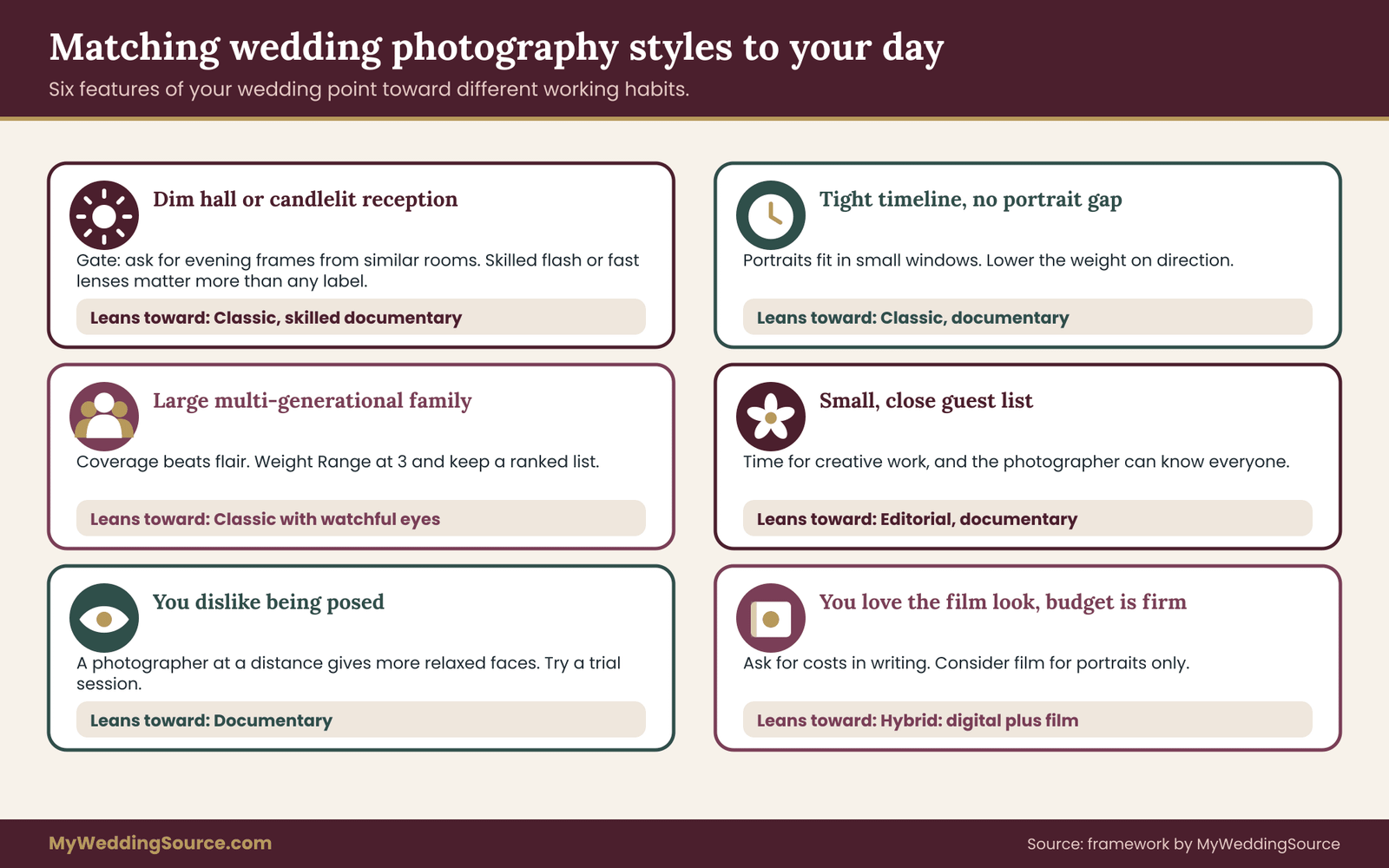
Once you can read samples, the next question is which of the wedding photography styles suits your particular wedding. The answer depends less on your taste in the abstract than on five features of your day: the light, the schedule, the size and shape of the family, how you feel in front of a camera, and how you plan to use the pictures. This section turns those features into decision rules. Think of it as an option matrix for wedding photography styles written in sentences.
Light and venue
When choosing among wedding photography styles, start with the darkest part of your day, because that is where weaker work shows up. If the ceremony is outdoors in the afternoon and the reception is in a bright tent, almost any approach can succeed, and your choice becomes a matter of taste.
If the ceremony is in a dim church and the reception is in a candlelit hall, the choice narrows. Photographers who rely on available light and a slow pace struggle here, while those who use flash with skill or have fast lenses and strong technique do better.
For a dark venue, give extra weight to the Light check and ask to see evening frames from similar rooms. Documentary and film approaches are not ruled out, but the photographer should be able to explain exactly how they handle the dark. If a venue forbids flash during the ceremony, say so early, because the photographer needs to plan around it. Ask the venue directly about lighting rules, restricted areas and any hours when photographers may not use flash.
Schedule and portrait time
Of all wedding photography styles, editorial portraits need uninterrupted time in good light. If your schedule has a gap of thirty minutes before sunset, an editorial approach has room to work. If every minute from the ceremony to dinner is spoken for, it does not. In that case a classic or documentary approach, which fits portraits into smaller windows, will serve you better, and you should lower the weight you give to directed portraits.
A good compromise is a short portrait session, around fifteen to twenty minutes, placed where the light is best and the day is calm. Many couples find that a brief, well-planned session produces better pictures than a long one that drains their energy. Have the photographer name the exact window in the timeline, and confirm it with your other vendors, as the guide to the wedding vendor timeline explains.
Family size and structure
A large, multi-generational family favors a photographer with strong classic habits, because coverage matters more than flair. If you have two households, estranged relatives or complicated groupings, a clear written list and a photographer who respects it become essential, and the Range check deserves a weight of three. A documentary photographer can still be a good choice here if they agree to work through the list efficiently and then return to observation mode.
A small, close family changes the balance among wedding photography styles. With ten guests, the formal list is short, and the photographer has time for creative work. This is the setting in which editorial and documentary approaches shine, because the people are few and the photographer can get to know them. Whichever approach you choose, build the shot list around the people who will want pictures, and use the wedding family photo list to keep it short and ranked.
Comfort in front of a camera
Be honest about how you feel being photographed, because it affects which wedding photography styles will work. Some people enjoy it and respond well to direction. Others tense up the moment a lens points at them. If you are the second kind, a documentary photographer who stays at a distance will produce better pictures than an editorial one who asks for poses, simply because your face will be more relaxed.
A middle path exists for people who are unsure. Ask for an engagement session or a short trial shoot with the photographers you are considering. The session shows how each of them communicates and how you feel under their direction. If you find yourself laughing and forgetting the camera, that is a strong sign. If you find yourself checking the clock, that is a sign too.
How you plan to use the pictures
Consider what will happen to the photographs, because the use shapes which wedding photography styles suit you. If you plan a large printed album and wall prints, image quality and consistent finish matter more, and you should weight the Finish check more heavily. If you plan mostly to share galleries online with family, speed and breadth matter more. If you plan to give prints to older relatives, clear classic portraits are worth more than a few dramatic ones.
Also consider the long term. Pictures that you love now should still be good in thirty years. A neutral finish with accurate color gives you the most flexibility. A heavy stylistic finish gives you a strong identity now and fewer options later. That is not a reason to avoid distinctive work, only a reason to know what you are choosing.
The fit ladder: five questions in order
The rules above for matching wedding photography styles can feel like a lot at once. A short ladder helps put them in order. Answer the five questions below in sequence, and stop when the answer is decisive. The ladder is a thinking tool, not a formula, and it works best when both partners answer separately and then compare.
Question one: what must the gallery contain? If the answer is “every important person, clearly,” start from classic habits and look for a photographer who also notices small moments. If the answer is “the feeling of the day,” start from documentary habits and make sure the formal list is agreed. If the answer is “a few remarkable portraits,” start from editorial habits and protect the time they need.
Question two: how dark is your darkest hour? If the reception is dim, filter out photographers whose samples do not include similar rooms, whatever their label. This question is a gate, not a preference.
Question three: how long can you spare? Count the minutes you are willing to give to directed portraits. If it is under fifteen, weight direction low. If it is thirty or more, direction can matter a lot.
Question four: how will you feel? Decide whether you want to be directed or left alone, and whether your partner agrees. If you disagree, discuss it now, because the photographer will absorb the tension on the day.
Question five: does the medium matter? Decide whether you want real film, a film-style edit or neither. This is the last question because it changes cost, delivery time and risk, and it should be settled after the approach is clear.
Two people, two answers
It is common for partners to answer the ladder differently. One wants candid pictures and the other wants a few formal portraits. This is not a problem, but it needs a plan. The simplest approach is to split the day by purpose: formal pictures where family is gathered, portrait time for the couple, and observation for everything else. A photographer working from that recipe can satisfy both preferences, and the brief can state it in two sentences.
A harder case is when one partner wants a specific look that the other finds unappealing, such as heavy grain or a dark finish. In that case, ask each photographer for a small set of images in both a neutral finish and the preferred one. Looking at the neutral and the styled versions of the same frames side by side often resolves the disagreement quickly, because it shows what the finish adds and what it hides.
When your budget limits the choice
Budget shapes what is possible among wedding photography styles, and it is reasonable to say so to a photographer. A shorter coverage window, one photographer instead of two, or a smaller delivered gallery can reduce cost without changing the approach. It is usually wiser to cut hours than to hire someone whose approach does not fit, because a poor fit costs more in disappointment than it saves in money.
Be careful with film, which usually adds processing and scanning costs on top of the base price. If cost is tight, consider asking for film only for the portraits and a digital main kit for the rest, or choose a skilled digital photographer who can produce a film-inspired finish. Ask for the costs in writing and check them against the wedding budget guide so that nothing is a surprise after the contract is signed.
Writing the brief for your photographer
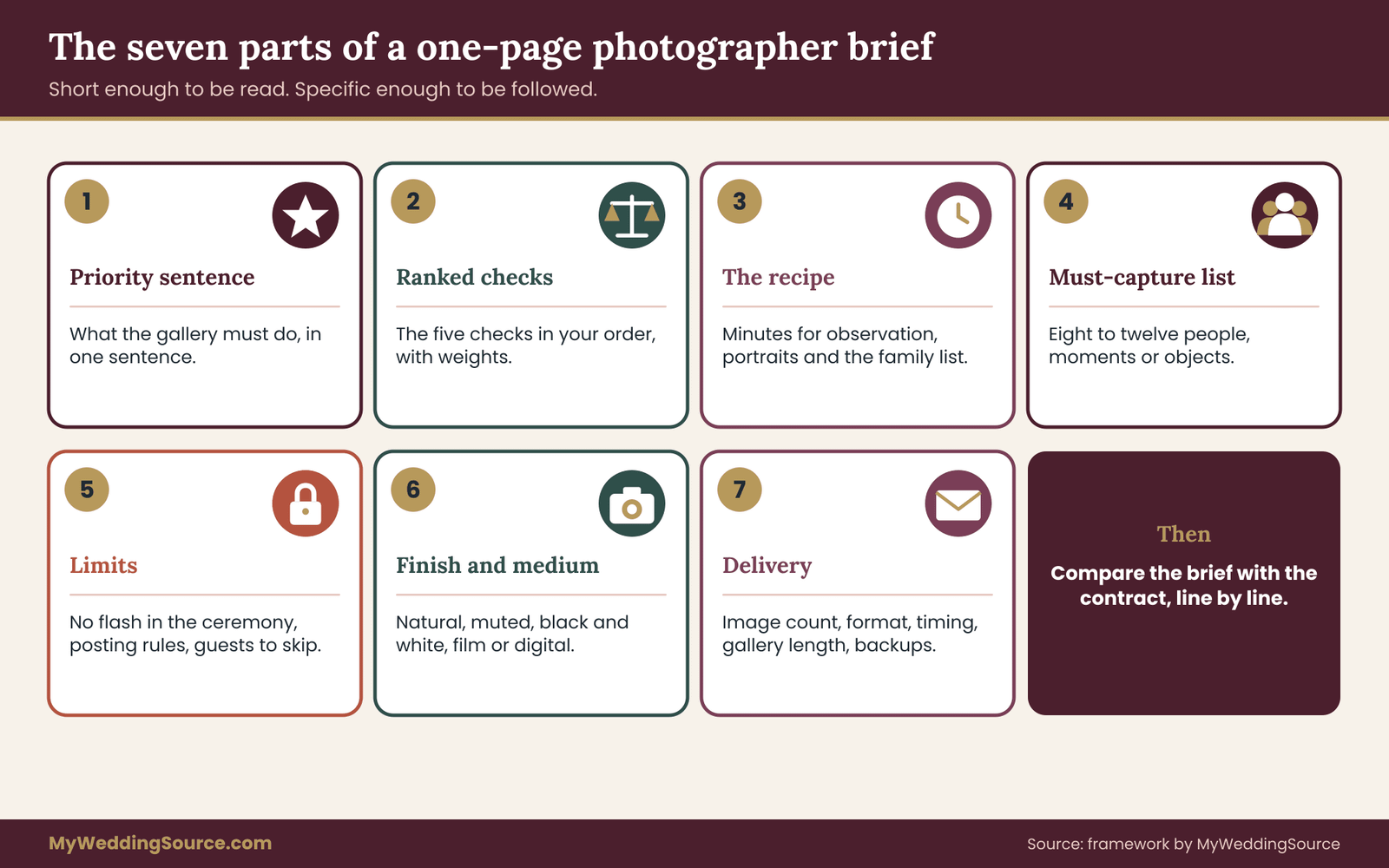
A brief is the document that turns your choice among wedding photography styles into instructions. Without one, the photographer relies on the label you chose and on guesses about your priorities. With one, they know what you rank first, what you want protected and what you want left alone. The brief should be short enough that a busy photographer reads it, which means one page, written in plain sentences.
The brief is not a script and it is not a contract. It tells a professional what you care about and leaves them room to use their judgment. It is also not a list of reference images to copy, because copying another photographer’s work raises copyright concerns and tends to produce weak imitations. Use the photographer’s own samples as your references, since those show what they can do.
The seven parts of the brief
One: the priority sentence. State in a single sentence what the gallery must do. For example: “The gallery must show both families clearly, include quiet moments between guests and give us a small set of portraits we can print large.” If you cannot write this sentence, the decision is not finished.
Two: the ranked checks. List the five rubric checks in your order of importance, with the weights you used. A photographer who sees that you weighted Range at three and Direction at one understands the shape of the day without a long conversation.
Three: the recipe. Describe how you want the day divided between observation, directed portraits and the formal list. Use minutes or percentages that you have actually checked against the timeline. For example: observation for most of the day, twenty minutes of portraits near sunset, fifteen minutes for family groups after the ceremony.
Four: the must-capture list. Name the specific people, moments and objects that matter. Keep it short and concrete. A list of forty items is a wish list, and a list of eight to twelve is something a photographer can actually carry in their head during a busy day.
Five: the limits. State what you do not want. This might include no flash during the ceremony, no posed shots of the bridal party getting dressed, no pictures of certain guests, or restrictions on posting images online. The limits are as important as the wishes, and they can connect to your guest boundaries and image-use plan.
Six: the finish and medium. Say whether you want natural color, a muted finish, black and white for some frames, real film, a film-style edit or none of the above. Reference the photographer’s own galleries by describing the traits you like, such as “the skin tones in the second gallery.”
Seven: delivery. State what you expect to receive, how, and by when. Include the number or range of edited images, the format, how long the gallery stays online, how many film scans are included and how backups are handled. Confirm that these match the contract.
How to say it without sounding demanding
Many couples worry that a brief about wedding photography styles will sound controlling. In practice, photographers usually welcome one, because it reduces ambiguity and gives them a way to prepare. The tone that works best is collaborative and specific. You are not telling them how to do their job. You are telling them what the day is for.
A short opening message can set this up: “We loved your work and we want to make your job easier. Here is a one-page note about what matters most to us, where we want flexibility and where we need to hold a line. Please tell us if anything here conflicts with how you work.” This framing invites a reply, and the reply is data. A photographer who answers thoughtfully and flags a real conflict is showing you exactly the communication you will want on the wedding day.
A sample priority sentence and recipe
To make the brief concrete, here is an invented example. The priority sentence: “Show both extended families clearly, keep the mood relaxed and give us a handful of portraits we would be proud to frame.” The recipe: “Documentary coverage for most of the day. A twelve-name family list right after the ceremony, run by my cousin. Twenty minutes of directed portraits at sunset, then back to observation.” The limits: “No flash during the ceremony. No posed getting-ready pictures. No images of the children posted without parent permission.”
Read that aloud and notice how much it communicates. In five sentences the photographer learns the style, the schedule, the helper, the portrait window and three boundaries. That is the standard to aim for. It is not poetry. It is a clear instruction set, and it is the reason the brief is worth the hour it takes to write.
Keep the brief aligned with the contract
A brief that promises one thing while the contract promises another creates a quiet conflict. If the brief says you expect two photographers and the contract lists one, or the brief mentions film scans and the contract is silent, the contract usually governs when there is a dispute. After you write the brief, compare it line by line with the contract and ask for any missing items to be added in writing.
A calm way to do this is to attach the brief to the contract as a reference document, or to ask the photographer to confirm in an email that the brief matches their understanding. This is not a legal maneuver. It simply creates a record that both sides read the same instructions. If you later need to resolve a disagreement, the record is useful, and the wedding vendor contract guide explains what else to check before you sign.
Three worked cases
The following cases of wedding photography styles in practice are invented for illustration. They are not real couples and they do not describe real outcomes. They show how the rubric and the ladder behave when applied to realistic constraints, including the awkward ones.
Case one: a large family in a dim hall
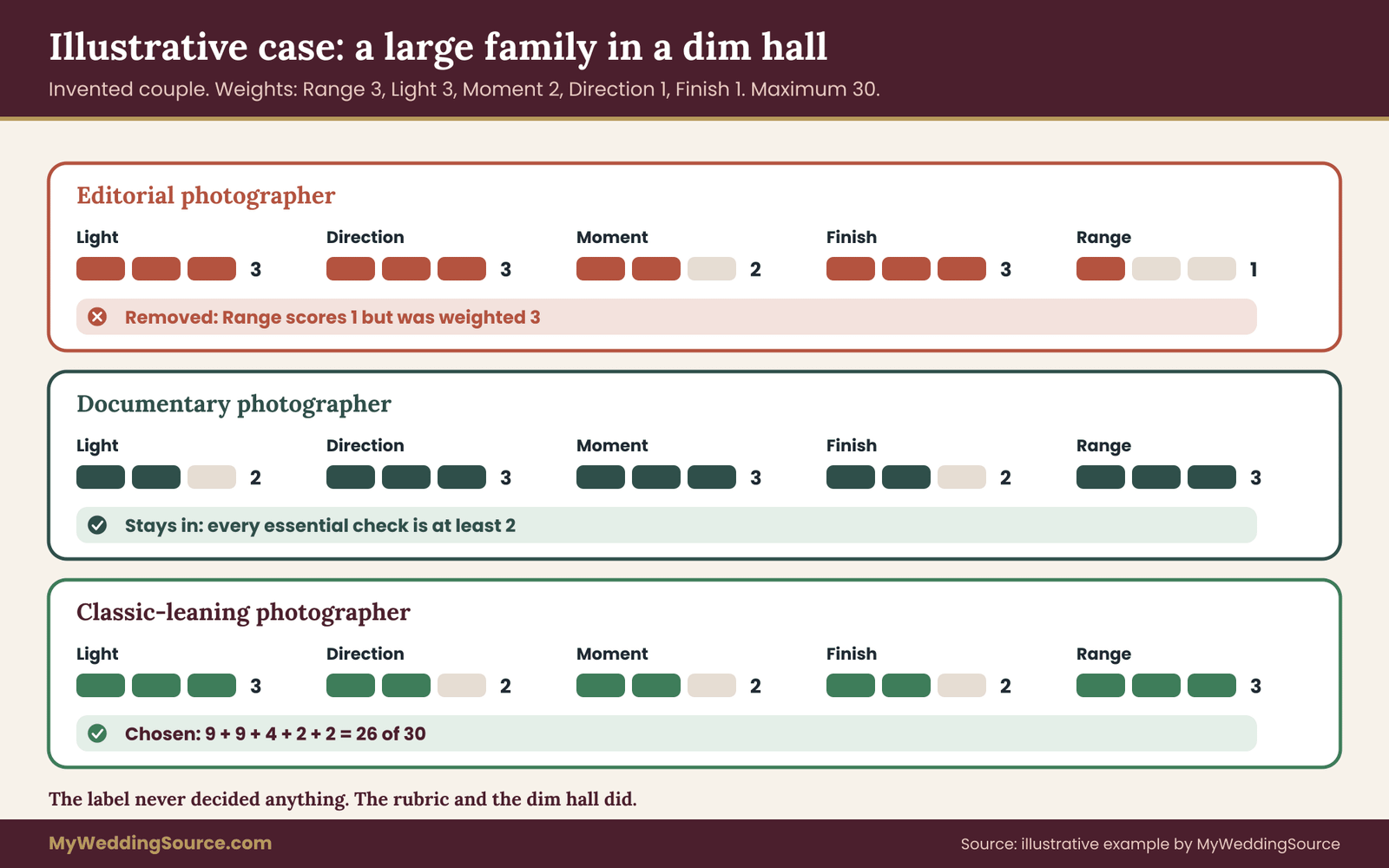
An invented couple, Maya and Dev, expect one hundred and forty guests, including three generations from two families and a candlelit reception hall. They weight Range at three, Light at three, Moment at two, Direction at one and Finish at one. Their total weight is ten, and the maximum weighted score is thirty.
They collect full galleries from three photographers. The first is a polished editorial photographer whose gallery shows gorgeous portraits and almost no relatives, and who scores one on Range.
The deal-breaker line removes this candidate, even though the weighted total would otherwise rank her near the top. The second is a documentary photographer who scores three on Moment and Range but two on Light, because the dim-room frames are soft. The third is a classic-leaning photographer who scores three on Range, three on Light thanks to a skilled use of bounced flash, two on Moment, two on Direction and two on Finish.
The weighted result for the third photographer is nine plus nine plus four plus two plus two, which equals twenty-six out of thirty. The second photographer’s Light score of two still clears the deal-breaker line, so she stays in contention at a lower total.
The couple choose the third photographer, and the brief asks for a twelve-name family list, a helper for the groups and observation mode for the rest of the day. The key point is that the label for the wedding photography styles never decided anything. The rubric and the dim hall did.
Case two: a small outdoor wedding
An invented couple, Chris and Alan, plan a forty-guest ceremony in a garden at five o’clock with dinner under string lights. They dislike being posed and want pictures that feel like the day. They weight Moment at three, Direction at three in the sense of restraint, Light at two, Range at one and Finish at two.
Two documentary-leaning photographers both score well. One scores three on Moment and three on Direction because the couple in her gallery never look at the camera, but her evening frames under string lights are grainy, giving her a two on Light. The other scores two on Moment, three on Direction and three on Light, because his low-light frames are clean. The first photographer’s weighted total is higher on the traits they care most about, and the second’s is higher on Light.
The couple use a short trial session to decide. At the session, the first photographer’s timing impresses them, and she proposes to work with a small fill light for the evening frames to address the grain. The couple choose her, and the brief records the fill light and the no-posing preference. The lesson from these wedding photography styles is that a gap in one check can sometimes be solved by a concrete plan, and the way to find out is to ask.
Case three: a film wish on a tight budget
An invented couple, Priya and Tom, love the look of film and have a limited budget. They weight Finish at three, Moment at two, Light at two, Direction at one and Range at two.
A real-film photographer quotes a price that covers six hours and a limited number of rolls, with processing and scanning charged separately. A skilled digital photographer with a film-inspired finish quotes a lower price for eight hours and a larger delivered gallery. When Priya and Tom score the galleries, both do well on Finish, but the film photographer’s evening frames are thin because of the venue’s dim light, and her Range score is two. The digital photographer scores three on Range and two on Light.
They decide on a hybrid: the digital photographer shoots the full day, and a short block of real film portraits is added for a small fee at golden hour. The brief states this plainly, along with the number of film scans included. They have kept the look they love where it matters and kept the budget intact. The point of the case is that the choice among wedding photography styles and the film decision did not have to be all or nothing.
Contract terms that protect your wedding photography styles choice
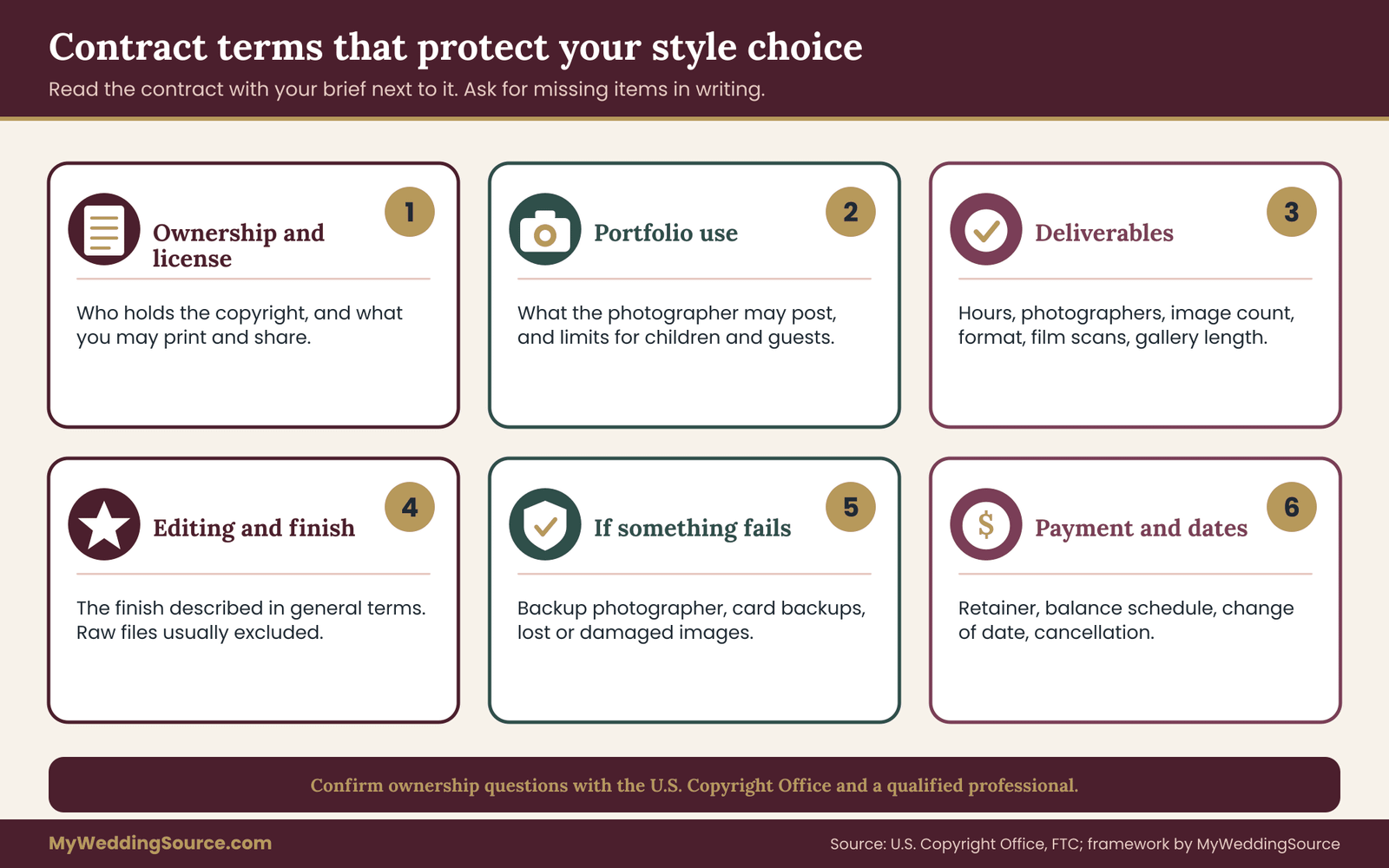
A good decision about wedding photography styles is only useful if the contract supports it. Photography contracts vary a great deal, and many are written to protect the photographer, which is reasonable, but it means you need to read them with your own priorities in mind. This section covers the terms that most often decide whether the gallery you receive matches the gallery you chose.
None of this is legal advice, and a contract is a legal document, so if you are uncertain about a clause, ask a qualified professional. The aim here is to help you notice which clauses matter and to ask sensible questions about them.
Who owns the pictures
In the United States, the creator of a photograph generally holds the copyright unless there is a written agreement that says otherwise. The U.S. Copyright Office publishes plain-language information on how ownership and transfers work, and it is the right place to confirm the current rules. For most couples, the practical arrangement is a license: the photographer keeps the copyright and grants you the right to print, share and display the pictures for personal use.
Read the license carefully. Look for whether you may print the images anywhere you like or only through the photographer, whether you may share them online, whether the license covers family members, and whether there are restrictions on commercial use. A personal-use license is usually enough, but a missing print release can force you to buy prints at a markup or to ask permission each time you want to use an image for something like a thank-you card.
How the photographer may use your images
Most photographers ask for the right to use images from your wedding in their portfolio, on their website and in social media. This is normal, and it is also negotiable. If privacy matters to you, ask for limits, such as no posting of images that show children, no tagging of guests and no use of specific images you name. Your boundaries for guests can be set out in the same document you use for the rest of your image-use plan.
If the photographer uses your images in advertising or in a paid submission to a publication, ask whether you will be told in advance and whether any payment or credit is involved. Written terms are better than assumptions here, and a few sentences in the contract settle the question. If the photographer features testimonials or reviews in their marketing, the Federal Trade Commission publishes guidance on how businesses should handle endorsements, which gives you a way to judge whether what you read about them is presented fairly.
Deliverables that match the style
The deliverables clause is where your choice among wedding photography styles becomes concrete. It should state the hours of coverage, the number of photographers, the approximate number of edited images, the delivery format, the delivery timeline and the length of time the online gallery stays available. For film, it should state how many rolls or scans are included, who pays for processing and scanning and what happens if a roll is lost or damaged.
Check what the contract says about editing, since finish is part of wedding photography styles. A photographer who promises a specific finish should be willing to describe it in writing, at least in general terms. Raw files are usually not part of the delivery, and many photographers will say so. If you want unedited files or a particular number of black-and-white conversions, ask for them to be written in, and expect to pay more for anything beyond the standard terms.
What happens if something goes wrong
Contracts should address what happens if the photographer cannot attend, for example because of illness. Ask whether they have a backup photographer, whether the replacement will be of comparable skill and whether the replacement will follow your brief. A photographer who has thought about this will have an answer ready, and one who has not may be less prepared for the other problems that arise.
Also ask about equipment failure, memory-card backups and the policy for lost or damaged images. For wedding days, a responsible photographer typically uses dual-card cameras and backs up files soon after the event, but the contract or a conversation should confirm this. The official guidance from the Cybersecurity and Infrastructure Security Agency and the Library of Congress on backups is helpful background for the questions you might ask.
Payment, cancellation and rescheduling
Photography is a time-limited service, so the date is the product. Ask whether the deposit is a retainer that holds the date and whether it is refundable. Ask how the schedule works for payments, what happens if you change the date and whether the contract allows a transfer to another date. These questions connect with the broader checks in the wedding vendor contract guide, and it is worth reading the contract aloud together before you sign.
Keep records of all payments and communications, because they are the evidence if a dispute arises. The consumer protection agencies, including the Federal Trade Commission and the Consumer Financial Protection Bureau, publish guidance on resolving disputes and on card-payment protections, and it is useful to know where to look before you need it. After the wedding, store the contract, the brief and the final gallery as part of your records, which the guide to organizing wedding records after the event covers in detail.
Common pitfalls and how to avoid them
Most disappointments with wedding photography styles come from a short list of avoidable mistakes. None of them requires bad luck or a bad photographer. They come from deciding quickly, comparing unevenly or leaving expectations unstated.
The first is choosing among wedding photography styles from a single saved image. A picture you love is a data point, not a gallery. Avoid this by always looking at a full gallery before deciding.
The second is confusing finish with approach in wedding photography styles. A film look or a moody edit does not tell you how the photographer handles a family list or a crowded room. Avoid this by scoring the five checks and asking about behavior.
The third is skipping the brief. If you do not say what you want, you will receive the photographer’s default. Avoid this by writing one page and asking for confirmation.
The fourth is overweighting the portfolio. The portfolio shows the best days, and your wedding will have its own challenges. Avoid this by asking for a second gallery from a different condition and by checking references.
The fifth is ignoring the relationship. The pictures depend on trust, and an uneasy couple produces uneasy images. Avoid this by meeting the photographer, or by doing a short trial session, before you sign.
The sixth is leaving the formal list undefined. Even the most documentary photographer needs a ranked list and a helper who can find people. Avoid this by preparing the list and naming the helper in advance.
Limits of this guide
This guide offers a way to compare and decide, not a promise about results. No rubric can guarantee that a photographer will deliver on the day, because weddings involve weather, people, schedules and light that nobody controls. Trends in photography change, and nobody can promise that a given style will look current in future decades. The examples are invented to illustrate the method, and none of them is a statement about a real photographer or a real couple.
Use the rubric for wedding photography styles as a structured way to notice what you are seeing, and use the brief to say what you need. Beyond that, trust your own judgment, and confirm legal and contractual questions with the right sources. The aim is a decision you can explain, a brief your photographer can follow and a gallery that reflects the day you actually had.
Your next steps
- Write your priority sentence and decide which of the five checks matter most, with weights of one to three.
- Shortlist three photographers and request one full gallery from each, plus a second gallery from a different type of day.
- Score each gallery on the five checks, write one sentence of evidence per score and apply the deal-breaker line.
- Meet or call the top two, ask the behavior questions from this guide and consider a short trial session.
- Write the one-page brief with the seven parts and send it before you sign.
- Compare the contract with the brief, ask for missing items in writing and confirm the license, the deliverables and the backup policy.
- Put the portrait window and the family list into your timeline and share them with the photographer.
- After the wedding, download your gallery promptly and file the contract, the brief and the gallery with your other records.
FAQ
What are the main wedding photography styles?
The four wedding photography styles most couples compare are classic, editorial, documentary and film. Classic work records people and formal moments reliably. Editorial work designs and directs the frame. Documentary work observes without arranging. Film describes the medium and can carry any approach. Many photographers blend these, so ask how a photographer actually works on the day rather than relying on one label.
How do I know which of the wedding photography styles fits me?
Start with what the gallery must do, then check your darkest venue light, your portrait time, your family size and how you feel being photographed. Score full galleries on light, direction, moment, finish and range, and weight those checks by your priorities. The result is a fit based on evidence, not on which portfolio looked most impressive at first glance.
Is documentary the same as candid?
Not exactly. Documentary means the photographer observes and rarely arranges anything. Candid is often used loosely, and some photographers apply it to directed pictures that merely look unposed. To tell the difference, look at whether people in the frames are looking at the camera and whether the same couple appears in many prompted moments. Ask the photographer how much they direct.
Is real film worth the extra cost?
It depends on how much you value the look and how you feel about the trade-offs. Film usually means a finite number of frames, processing and scanning costs, a longer wait and more difficulty in dark rooms. A skilled digital photographer can approximate a film finish, and a hybrid can use film for portraits. Ask for all costs in writing before you decide.
What should I ask a photographer for before booking?
Ask for one complete gallery from a real wedding, and ideally a second gallery from different conditions, so you can see consistency across a whole day. Ask how they handle dark venues, family lists and low light, and what their backup plan is. Also ask for the contract early so that you can read the license and deliverables calmly.
Do I own the photographs from my wedding?
Usually the photographer, as the creator, holds the copyright unless a written agreement transfers it. Most couples receive a license for personal use, which may include printing and sharing. Read the license for print rights and sharing limits, and ask for clarity if anything is vague. The U.S. Copyright Office explains the basics, and a qualified professional can advise on specific situations.
Can I share the sample galleries photographers show me?
No, treat them as private. The images show real people who agreed to certain uses, and the photographer holds the copyright. View them only in the form provided, do not download or repost them, and do not send them to other photographers as references to copy. Use a photographer’s own samples to describe the traits you like instead.
What should be in a photographer brief?
A good brief fits on one page. It includes a priority sentence, your ranked checks, a recipe for dividing the day, a short must-capture list, your limits, your preferences on finish and medium, and your delivery expectations. Keep the tone collaborative, compare it with the contract and ask the photographer to confirm that it matches how they plan to work.
Sources
- What is copyright?, U.S. Copyright Office
- Frequently asked questions, U.S. Copyright Office
- U.S. Copyright Office, home page and public guidance
- Endorsements, influencers and reviews, Federal Trade Commission
- Consumer advice, Federal Trade Commission
- Ask CFPB, Consumer Financial Protection Bureau
- Personal archiving: preserving your digital memories, Library of Congress
- Back up business data, Cybersecurity and Infrastructure Security Agency
- International Color Consortium, color management and profiles
- USAGov, government services and consumer help