
Event wristbands for a wedding weekend are small bands, usually paper, fabric or silicone, that mark a guest as invited, hosted or cleared for a particular space. They solve a few real access problems and they create a few feelings you may not want. This guide gives you a two-part test, an access check and a guest perception check, so you can decide whether event wristbands belong in your weekend at all.
Use event wristbands only when three things are true. First, there is a specific access or billing problem that a band solves better than a list, a sign or a person at the door. Second, someone will actually check the event wristbands at a fixed point and know what to do when a guest has none. Third, your guests will read the band as a welcome and not as a tag. If any one of those fails, choose a lighter tool, such as a named list, a printed card or a host standing at the entrance.
A wedding weekend is different from a single evening. Guests may arrive on Thursday, gather at a welcome dinner on Friday, attend the ceremony and reception on Saturday, and come back for a farewell brunch on Sunday. Some places along the way are private. Others, like a hotel bar, a pool deck or a lobby, are shared with strangers. Event wristbands become tempting at exactly the moment the guest list stops matching the room.
Most advice about wristbands is written for festivals and concerts, where tens of thousands of strangers need sorting. A wedding has ninety or one hundred and fifty people who mostly know the hosts. That changes the question. The problem is rarely “how do we stop gatecrashers” and more often “how do we tell the staff who is hosted, who is a stranger, and who is simply a cousin who arrived late.” This article stays on that narrower problem and leaves the rest of the planning to the broader guides on the site.
A note on scope. This is general information, not legal, tax or financial advice. Venue rules, alcohol service rules and accessibility duties differ by place, so confirm the current version with the venue, the licensed bar operator and the relevant local authority before you commit.
What event wristbands are for, and what they are not
Strip away the novelty and event wristbands do three jobs. They show staff who belongs to a group, they carry a small piece of information such as a color or a number, and they stay on the guest without anyone needing to remember a face. Everything else, from souvenir value to a photo prop, is a side effect.
That list is shorter than most people expect. A wristband does not stop an unwanted person from walking in. It only gives a staff member something to look at. A band on a wrist does not confirm age, does not prove a guest paid or was hosted unless the bar has agreed to read it that way, and does not keep a crowd out of a space with no door and no staff. If a band is the only barrier, the barrier is imaginary.
It helps to separate four purposes that often get lumped together.
Access. Who may enter a room, a section, a shuttle or a boat. A band works here only when a person or a door sits where the band is checked.
Billing. Which guests drink or eat on the hosts’ tab and which pay for themselves. This is the most common wedding use, and it depends entirely on an agreement with the bar or caterer about how the band is read.
Safety and identification. Knowing who is a guest during an emergency, a headcount or a lost-child moment. Here the band is a quick visual cue for staff and helpers.
Experience. A band as a keepsake, a color for a team, a cue for a game or a signal that a guest is part of the farewell plans. This is the weakest reason and the one most likely to feel excessive.
Naming the purpose is not a formality. It decides almost every later choice, from the material to the quantity to who gets one. A couple who says “we want event wristbands” has not yet made a decision. A couple who says “we want the hotel bar staff to know which guests are on our tab after midnight” has.
Where event wristbands usually show up on a wedding weekend
Across a typical weekend, the places where couples consider event wristbands cluster in a few spots.
The hotel bar or lounge after the reception, where hosted drinks meet a public room. The pool, beach or spa, where hotel guests and wedding guests mix. A welcome party held in a restaurant or on a rooftop that is open to other diners. A shuttle or boat that carries guests between sites. A late-night food truck or snack station that is meant for the wedding group only. And, less often, the ceremony itself, in venues where several events share a property.
Each of these has a different answer. The hotel bar is a strong case for a band, and the wedding bar service guide explains how bars handle hosted and cash drinks. The ceremony usually is not, because a printed program, an usher and a smaller space already do the job.
Why this decision matters more than it looks
It is easy to treat event wristbands as a ten-dollar detail. The cost is small, but the effects are not. A band decision touches the guest experience, the staff workload, the bar bill and the way relatives feel about the weekend. A badly chosen band can leave a grandparent wondering whether she is allowed into the room, or leave a bartender arguing with a guest at one in the morning.
It also touches records. Wristband counts become part of your final headcount for the bar, and a mismatch between event wristbands handed out and drinks charged is a classic source of a surprise invoice. The wedding planning checklist is a good place to note the band decision beside the other late-night details, so it is not made in a hurry the week before.
How the access and perception check works
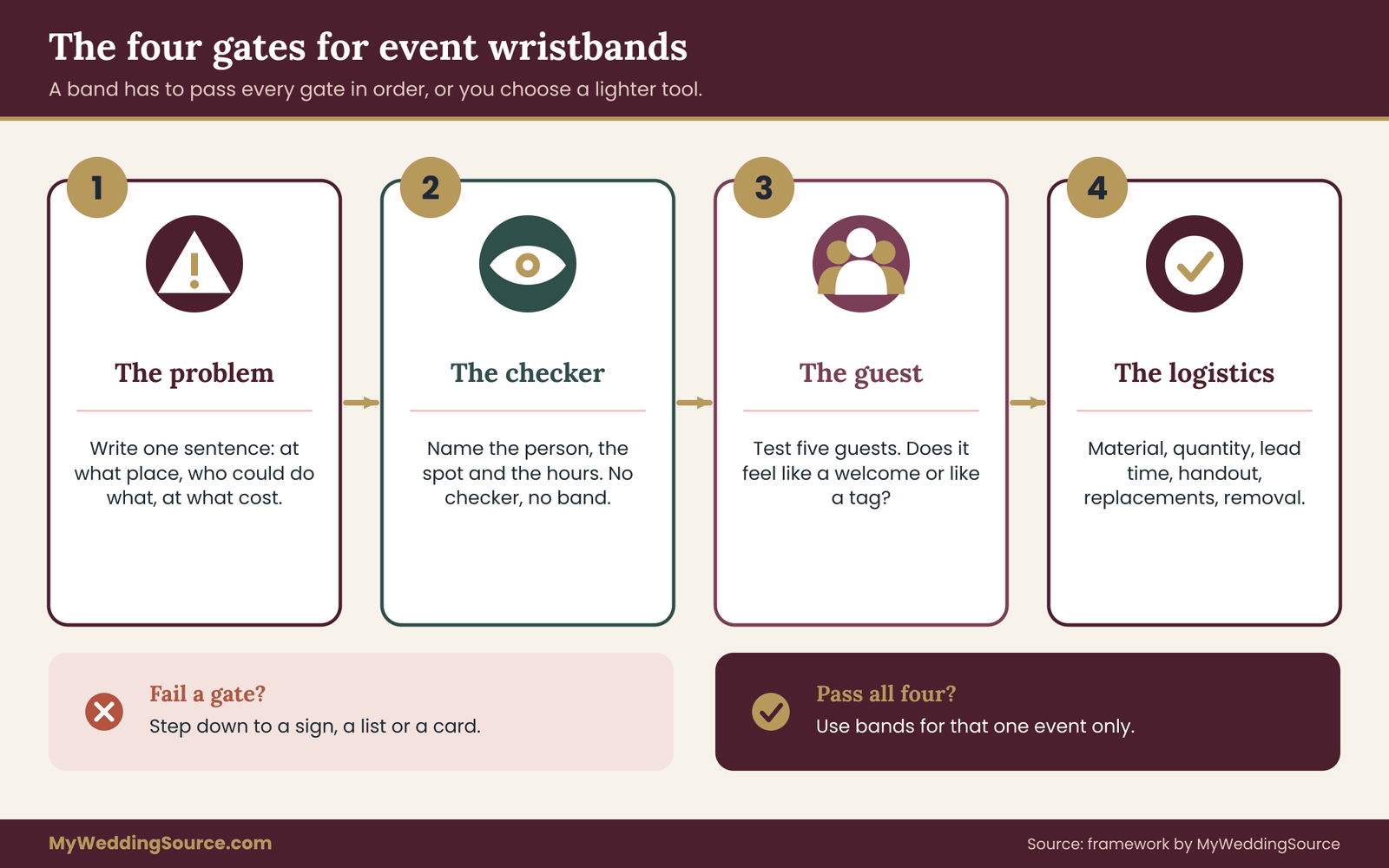
The method in this guide has two halves and four gates. The first half is the access check, which asks whether a band does a job that a simpler tool cannot. The second is the guest perception check, which asks how the band will land with the people wearing it. A band has to pass both halves. Passing only the first gives you a system that works and feels cold. Passing only the second gives you a lovely idea that nobody can enforce.
The four gates run in order, and a failure at any gate sends you to a cheaper alternative.
Gate one, the problem. Write one sentence describing the exact access or billing problem. If you cannot write it, you do not have one yet. This gate rejects event wristbands bought because they looked nice in a photo.
Gate two, the checker. Name the person who will look at the event wristbands, the place where they stand and the hours they are there. If nobody is posted, event wristbands are decoration. This gate rejects event wristbands in spaces with no staff.
Gate three, the guest. Imagine five specific guests, such as a grandmother, a guest with a medical bracelet, a toddler’s parent, a late arrival and a colleague who barely knows anyone. Check that the band works kindly for each. This gate rejects event wristbands that make people feel sorted.
Gate four, the logistics. Confirm material, quantity, lead time, handout point, replacement rule and removal. This gate rejects good ideas with weak execution.
Reading the result
Most weekends end up with one of three outcomes. Some pass all four gates for a single event, usually the after-party, and use event wristbands there only. Some pass for nothing and swap in lists and signs. A few pass for several events and need a color system. The rest of this guide walks through each gate in turn, compares the lighter alternatives, and finishes with a worked example and a set of questions for the venue and vendors.
One rule runs through the whole method. Decide for each event separately. A wristband that makes sense at the hotel bar does not automatically make sense at Sunday brunch, and wearing one for three days is rarely welcome. Treat each event as its own case and you avoid the common mistake of applying a festival logic to a family weekend. ## Gate one: name the problem event wristbands would solve
The first gate is a single written sentence. It should name a place, a group of people and a consequence. “Strangers at the hotel bar could drink on our tab” is a sentence. “We want a cohesive look” is not a problem, it is a preference, and preferences do not need an access system.
Here are the problems that genuinely justify event wristbands at a wedding, followed by the ones that do not.
Problems that a band can solve
Hosted drinks in a public room. When the couple or a parent pays for drinks in a bar that other guests can also enter, the staff need a fast way to separate hosted guests from everyone else. Event wristbands are far quicker than a list in a dim room, and it survives a guest moving between the bar and the lobby.
Shared spaces with other guests. A pool, a shuttle, a hotel breakfast room or a lounge may serve the public and your group at the same time. Event wristbands let a hotel host see that a person belongs to a reserved block, which can matter if a buffet or a boat has a fixed count.
Staged entry to a limited space. If the late-night room holds fewer people than the guest list, a numbered or capped supply of event wristbands gives you a plain way to hold the limit. When the bands run out, the room is full, and nobody has to argue with a friend about it. Venue occupancy limits are real and set by the venue or the local fire authority, so ask for the number in writing.
Younger guests and supervision. At a welcome party that includes children, a band that carries a parent’s phone number gives staff a quick way to reunite a lost child with family. This is an identification use, and it is valid when the band is private and the number is not printed in a way strangers can read.
Multi-day tiers. Some weekends have three groups: the whole guest list, the people staying on site, and the inner circle at a private dinner. Event wristbands in a color for each group can spare the hosts from repeating who is invited where.
Problems that a band does not solve
Event wristbands will not stop a determined stranger. It is not proof of age, and a bartender will still ask for identification if the venue’s alcohol rules require it. A band will not fix a guest list that is too large, and it will not substitute for a conversation with a relative who has not been invited. If the real issue is an uninvited plus-one, an honest message on the invitation does more work than any wrist item, and the guest list guide covers how to hold that line kindly.
Event wristbands also do not replace the staff who understand it. If the bartender, the door host and the hotel manager have not been told what a blue band means, the band means nothing.
Writing the one-sentence problem
Use this template and fill in all four blanks: “At [place], [who] could [do what], which would cost [what].” The final blank forces honesty about the consequence.
“At the hotel bar after midnight, hotel guests who are not in our wedding could order drinks that we would pay for, which would add to the bar tab we capped.” That is a real problem with a real answer.
“At the rooftop welcome party, diners from the public restaurant could join the buffet line, which would run out of food for our guests.” Another real one, and it may be solved by a rope and a host instead of a wristband.
“At the pool on Sunday, we want everyone to feel part of the group.” That is a feeling, and event wristbands are a clumsy way to produce it. A shared invitation, a sign and a friendly host will do more.
A quick test for borderline cases
If the sentence names a consequence that is money, safety or a hard capacity limit, event wristbands may earn their place, so keep going. If the consequence is that something would look untidy or that the weekend would feel less special, stop and pick a lighter tool. Those are valid wants, but they do not need an access device.
Also check whether the problem already has an owner. If the hotel already issues keys, room cards or a group name tag for its own reasons, adding your own band may duplicate a system that exists. Ask the venue who controls access at the site, because the answer sometimes makes your band unnecessary.
Bring the one-sentence problem to the venue. Ask the manager to read it back in their own words. If they describe a different problem, you have found a mismatch worth fixing before anything is ordered.
Gate two: who checks event wristbands, where, and when
Event wristbands without a checker are just bracelets. The second gate is about the person and the place, and it is where most casual band plans quietly fall apart.
The three checker questions
Who looks at the band? Name a role, not a hope. It might be the bartender, the hotel door host, a venue coordinator, a paid host from a staffing agency or a trusted friend with a clipboard. A friend can only be the checker if they agree and if they will not be dancing at the time the check matters.
Where do they stand? A fixed point, such as the entrance to the bar section, the foot of the shuttle steps or the door of the private room. A roaming checker is much weaker. If guests can reach the space by two routes, you need a checker for each or a way to close one route.
When are they there? The hours matter. A band at the bar is useful from the hour the hosted tab starts until it ends. A checker who leaves at eleven while the tab runs to one leaves two hours of open access.
What the checker does when there is no band
This is the question that couples skip. When a guest arrives without a band, what happens? Three outcomes are possible, and each needs a script.
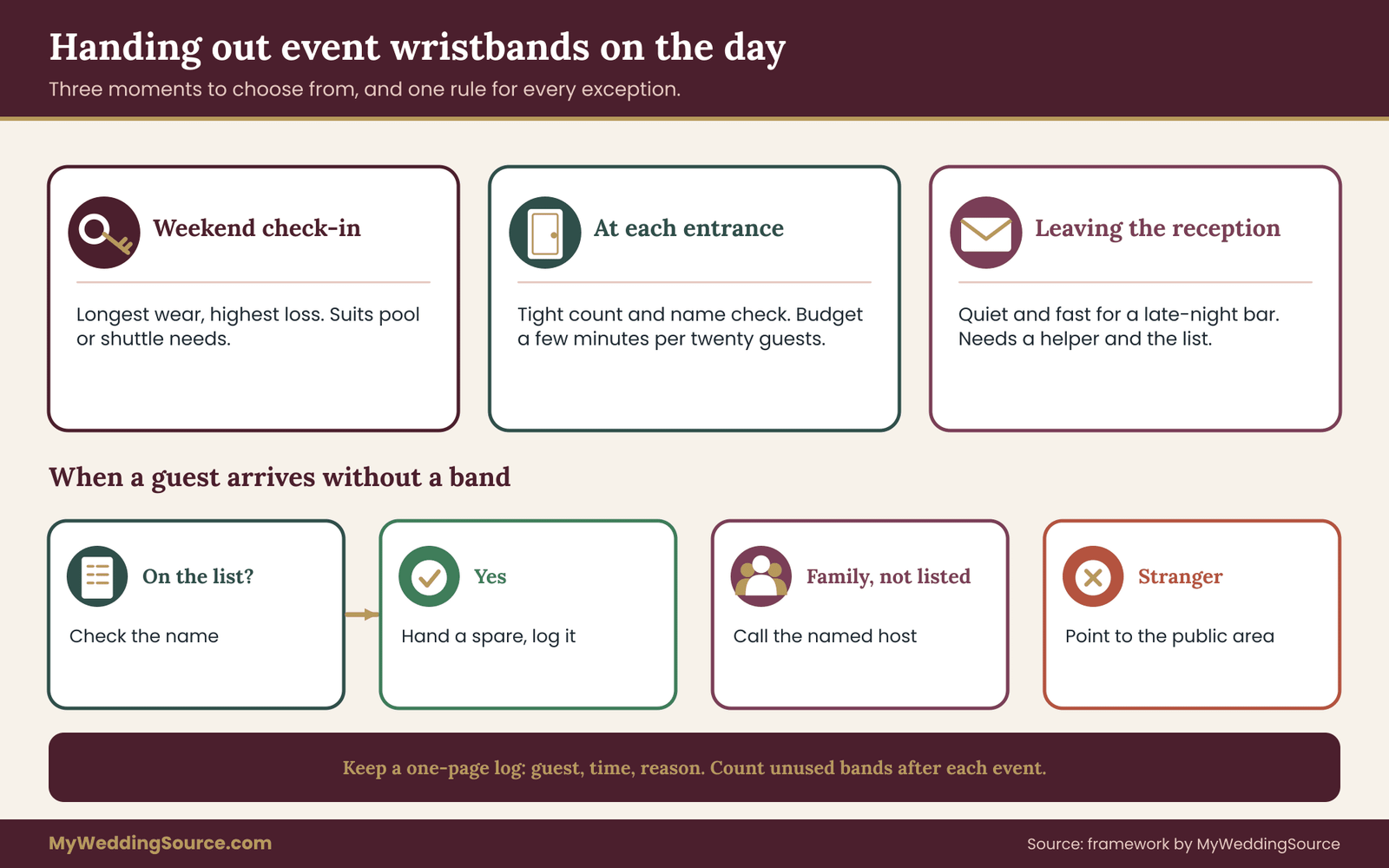
If the guest is invited and simply missed the handout, the checker gives them a band. That requires the checker to carry spares and a way to confirm the name, usually a short list.
If the guest is not on the list but is clearly a relative or friend of a guest, the checker needs a rule. Perhaps they check with a named host, a sibling or a parent, who is reachable by phone. The rule should name the person, not “someone in the family.”
If the person is a stranger, the checker politely explains that the section is reserved for a private event and points to the public part of the venue. This needs the venue’s agreement, because the staff, not your guests, handle the conversation.
“This section is set up for a private party tonight. The public bar is just through there.”
A line like that is short enough to memorize and calm enough that it does not start an argument.
Staff briefing and the hand-off
Event wristbands work only if the checker has been told the rules ahead of time. A short written brief, one page at most, is enough. It should name the band color and what it means, the hours of the tab or the section, the cap, the person to call about an exception and the plan for lost event wristbands.
Give the brief to the venue coordinator or bar manager a week ahead, and bring a copy on the day. Staff change shifts. The person who agreed to the plan on Tuesday may not be the one working on Saturday. The vendor timeline is a handy place to schedule that hand-off beside the other vendor confirmations.
When the checker is a friend
Many couples ask a groomsman or a cousin to be the checker. That works for a short window, a single doorway and a guest list that fits on one page. It breaks down when the friend is expected to say no to people they know. Consider whether the person will be comfortable declining an uncle’s date at the door. If not, use paid staff for the enforcement part and let the friend handle the welcome part, such as handing event wristbands to arriving guests.
The takeaway from gate two is blunt. If you cannot name the checker, the place and the hours, event wristbands will not hold. In that case move to the alternatives in the next section. ## The alternatives ladder: lighter tools to try before event wristbands
Event wristbands sit near the top of a ladder of access tools. Every rung below them is cheaper, friendlier and easier to take back. The sensible habit is to start at the bottom and climb only until the problem from gate one is solved. Plenty of weekends never need to go past the third rung.
Rung one: a sign and a host
A clear sign at the entrance of a reserved area, plus a person who smiles and says hello, solves more than people expect. It works when the area has a visible edge, such as a roped section or a separate room, and when the risk is a stranger wandering in by mistake, not a person intent on getting in. It costs almost nothing and carries no stigma. The signage system guide covers wording and placement so the sign reads as friendly and not as a warning.
Rung two: a named list at one door
A printed list held by a staff member or a host, with names in alphabetical order. This is the right tool when the group is small, fewer than a few dozen, and the entrance is a single door. Its weakness is speed and light. In a dark bar at midnight, with a line forming, a paper list is slow and the checker may not recognize half the names.
Rung three: a card or a table token
A small printed card placed at each seat during dinner, or handed to guests as they leave the reception, that says “Please join us at the hotel bar” and names the hours. The hotel staff are told that anyone holding the card is a guest. A card is easier to hand over and to explain than a band, and a guest can tuck it into a pocket. Its weakness is that it can be lost, passed on or left on the table.
Rung four: a lanyard, a name tag or a hand stamp
A name tag does double duty, since it helps guests who barely know one another, and it works well at a welcome mixer. A stamp is quick to apply and leaves nothing to throw away, but it needs a venue that allows it and a supply of ink that does not smudge onto a dress. Neither works well for an all-weekend cue, because both are easy to remove or wash off.
Rung five: event wristbands
Event wristbands are worth the climb when the problem needs something that stays on the guest, can be seen from several feet, and does not depend on the guest remembering a card. That is a short list: a bar with hosted and cash drinks mixed together, a shared pool deck, a capped late-night space, a shuttle that must count riders, or a larger event with children who need an identification cue.
Rung six: a ticket or a wristband with a number
Numbering event wristbands or issuing a ticket adds control. It gives you a hard cap and a record, but it also adds a layer of friendliness cost. Numbers feel like a concert. Reserve this rung for the rare case where capacity genuinely cannot be exceeded and the hosts are ready to turn a friend away.

Comparing the rungs in plain terms
It helps to hold the tools side by side on four questions: how fast is a check, how hard is it to pass on, how does it feel to the guest, and what does it cost in effort.
A sign and a host are slow for the host but gentle for the guest, and nothing is transferable because nothing is issued. A list is accurate but slow in the dark and depends on a literate checker. A card is fast and friendly but easy to hand along. A name tag is warm but not meant for access. Event wristbands are fast to check and hard to pass along, particularly the tamper-evident types, but they ask the guest to wear something and ask you to buy, count, hand out and replace them.
The tradeoff is clear enough. As you climb the ladder, enforcement improves and warmth falls. Pick the lowest rung that holds the line you wrote in gate one.
Combining rungs
Often the right answer mixes two rungs. A list at the reception door hands each guest a card for the bar. A sign at the pool and a host who knows the families. Event wristbands for the late-night section only, and nothing else for the rest of the weekend. Mixing keeps the heavy tool narrow and the friendly tools broad.
The guest perception check: how event wristbands feel on the people wearing them
Gate three is where wedding logic parts from festival logic. At a festival nobody expects to feel welcome from a wristband. At a wedding, the guests are family and close friends, and they read the small details of the weekend as a statement about how much they are valued. Event wristbands can say “you are one of us” or “you are being tracked.” The same plastic strip can say either, depending on how it is introduced.
Five guests to test against
Imagine each of these people holding your band, and ask whether the plan treats them well.
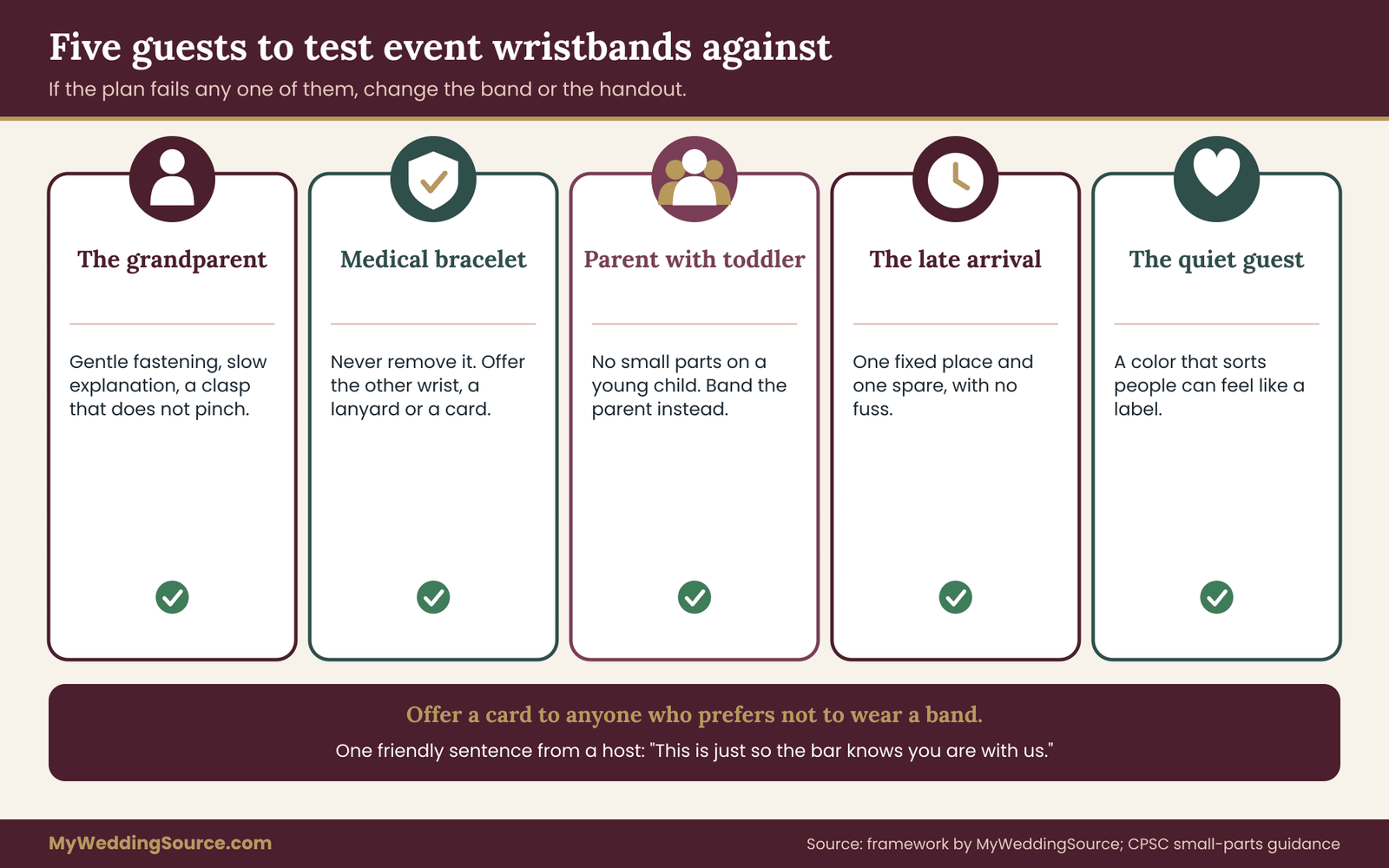
The grandparent. Some older guests have thin skin, arthritis in the wrist or hearing difficulty. A band with a tight clasp or a sticky closure can hurt. Staff may talk fast. Make sure someone can put the band on gently and explain it slowly.
The guest with a medical bracelet. Medical alert jewelry is serious, and a wedding band should never replace it or push it aside. Offer to attach the wedding band to the other wrist, a lanyard or a pocket loop. Never ask someone to remove a medical bracelet.
The parent with a toddler. Young children chew and tug. Small parts are a safety concern for children under three, and the Consumer Product Safety Commission publishes guidance on that. For small children, skip the band on the child and give the parent one instead.
The late arrival. Someone who lands after the welcome handout and finds a room of banded guests can feel behind. A friendly spare-band routine fixes this.
The quiet guest who knows very few people. A color that sorts people into groups can make this person feel labeled. Consider whether your color system is revealing any hierarchy, such as family in one color and friends in another.
Perception problems to watch for
The VIP signal. If two kinds of event wristbands exist, such as gold and silver, guests will read them as ranks, whatever the hosts intended. Weddings run on feelings of fairness. If the colors split the group, label them by place or event, such as “bar section,” not by status.
The festival feeling. Heavy tamper-proof event wristbands in neon colors can make a rehearsal dinner feel like a ticket line. Softer materials and quiet colors that match the palette reduce this. The wedding color palette guide can help you choose shades that blend with the rest of the weekend.
The surveillance feeling. Event wristbands that track movement or log entries are an unusual choice for a family wedding. They raise privacy questions that guests did not agree to. Plain event wristbands without chips are enough for nearly every case.
The exclusion signal. If some guests receive event wristbands for the after-party and others do not, the difference is visible. Handle this by deciding the invitation list for the after-party in advance, and by handing bands out privately, not at a public table. Keep the wording of any partial invitation warm and specific.
The photo problem. Event wristbands show up in photographs, especially in dance-floor shots. Consider whether a wide, bright band will appear on every wrist in every picture. Many couples are happy with that. Some find it distracting. Decide on purpose, and pick colors that photograph quietly.
The welcome script
How you introduce event wristbands matters more than the material. A one-line script from a host sets the tone. For example: “These are just so the bar knows you are with us tonight; take it off whenever you like.” The second half matters. It tells guests that the band is a convenience and that wearing it is their choice once they are past the checkpoint.
Avoid the language of enforcement, such as “you must wear this at all times.” Even at a controlled event, say “please keep it on while you are in the bar so the staff can see you are our guest.” That sentence asks for a behavior with a reason attached, which is easier to accept than a rule.
A short perception check list in prose
Before you order, say these out loud: Would my grandmother mind wearing this? Does the color suggest a rank? Can it go on the other wrist? Are children excluded from the rule? Is there a quiet way to give a spare to a late arrival? Will a guest who does not want to wear one have an easy alternative, such as a card? If any answer is no, adjust the plan before spending money. ## Choosing the material, size, color and fit of event wristbands
Once event wristbands have passed the first three gates, the fourth gate begins with what it is made of. The material of event wristbands decides comfort, cost, how well it holds the line and how much waste it leaves behind. There is no single best choice. There is a best match for the problem you wrote in gate one.
Common materials and where they fit
Coated paper or synthetic paper event wristbands with an adhesive closure. These are light, cheap and usually single-use. Many cannot be removed without tearing, which makes them good for access control and poor for a guest who wants to take one off at midnight and wear it again tomorrow. They suit a single evening at a bar or a pool. They are usually printed with a color or short text.
Woven fabric event wristbands. Soft, often reusable for a day or two, and available in a wide color range. They feel more like a keepsake than a ticket. They are less secure, because a determined person can slide them off, and they cost more than paper. They suit a welcome party or a brunch where warmth matters more than control.
Silicone event wristbands. Durable, waterproof and comfortable, which makes them a fit for a pool or beach day. Most are not tamper-evident, so they are better for identification than for strict access. They can be personalized with a short word or a date, but that adds lead time.
Tamper-evident or one-time-lock event wristbands. Designed so that removing the band breaks it. These are the strongest option for a hard cap, and the least friendly. Use them only for a narrow window, and keep spares for guests whose band tore by accident.
Cards, tags and clip-on options. Not a wristband strictly, but worth keeping in mind for guests who cannot or do not want to wear a band. A clip tag on a lapel does the same job in the same room.
Sizing and fit
Adult event wristbands generally come in one length that fits most wrists and a second option for larger sizes. Ask the supplier how the band adjusts, because a band that is too tight will cause discomfort within an hour, and one that is too loose will slide off during dancing.
Test a sample on three people with different wrist sizes before ordering the full quantity. Ask one of them to leave it on for an hour, then ask what it felt like. This costs a sample fee and a little time, and it catches problems that a product page will not show.
Children need a different approach. A narrow band may be fine for an older child, but for toddlers the better answer is to put the band on the parent. Small closures can be a choking hazard, and the CPSC publishes guidance on small parts. If a child will wear one, choose a soft, large-format band that has no detachable pieces, and supervise it.
Skin sensitivity and allergies
Adhesive closures, dyes and some plastics can irritate skin. Ask the supplier what the band is made of and whether it contains latex, since some people have latex allergies and the Food and Drug Administration offers general information on that topic. If you cannot get a clear answer, choose a fabric band or a card.
Include a line on the invitation or on the welcome sheet: “If you prefer not to wear a band, a card works just as well.” That sentence prevents an awkward standoff at the door and costs nothing.
Color
A color system for event wristbands should be simple and short. One color per place, not per person. Three colors is already a lot to explain to a bartender. Avoid pairs that look alike in dim light, such as navy and black, or pale pink and white.
Match the color to the rest of the weekend. A band in a color that sits within your palette looks deliberate. A bright color that clashes with the dresses may show up in every photo. A small test, placing the band beside a swatch of the bridesmaid fabric, takes two minutes.
Printing and text
A band printed with the couple’s initials and the date is charming, but printing lengthens lead time and fixes the date, which can be a problem if plans shift. A plain band in a solid color, or a band with a single short word, such as “Welcome,” carries less risk. Never print a name, a room number or a phone number where strangers can read it. If a child’s band carries a parent’s number, put it on the inside, or use a card.

Waste and reuse
Single-use event wristbands create waste. If that matters to you, choose a band that can be recycled where you live, or a woven band that guests can take home. Be wary of claims that a band is eco-friendly without a clear explanation. The Federal Trade Commission publishes guidance on environmental marketing claims, and a supplier should be able to say what the band is made of and how it is meant to be disposed of.
A practical point: put a small bin at the exit of the bar section, labelled for the band material. Otherwise event wristbands end up on floors, in pool filters and in cake.
Quantities, lead times and cost logic for event wristbands
Gate four continues with arithmetic for event wristbands. The numbers are simple, but they are the part that goes wrong most often, because couples order the exact guest count and then discover they need more.
Working out the quantity
Start with the number of guests who may enter the space where event wristbands will be used, not the whole weekend list. If the after-party room is for sixty people, you need sixty event wristbands plus a margin, not one hundred and fifty.
Add four groups to that base figure. First, spares for bands that tear or are lost, since adhesive closures fail more often than you expect. Second, extra event wristbands for guests who may be added late, such as a plus-one confirmed after the final headcount. Third, bands for staff and helpers who need to be recognized as part of the group, such as the photographer or the DJ, if the hosts agree. Fourth, a few unused bands for the venue manager, so the staff know what the band looks like.
A reasonable margin is a matter of your own judgment, and a supplier can suggest minimum order sizes. The key is to decide the number from your own list instead of rounding up wildly. Over-ordering wastes money and material. Under-ordering means a guest at the door without a band at one in the morning.
The cost formula
You can estimate cost without any invented averages by using a short formula with real quotes. Cost equals the price per band, multiplied by the quantity, plus printing or setup charges, plus shipping, plus the price of a sample. Then add a line for time, since someone must count, bag and distribute the event wristbands.
Request quotes for event wristbands from at least two suppliers, and ask each to state the price at two quantities, so you can see how the unit price changes. Ask whether the quote includes shipping and tax, and whether there is a fee for printing a custom color. Compare the total, not the headline unit price.
If the band is meant to control a hosted bar tab, set it against the cost it protects. A few extra hosted drinks poured for strangers can exceed the price of the entire order. That is the logic, not a claim about any average. Use your own bar quote and your own hosted limit to see whether the numbers justify the order. Record the line in your budget, so the order does not appear as a surprise in the final accounts.
Lead times
Lead time for event wristbands is the gap between ordering and receiving them, and it varies by material, printing method and season. Stock event wristbands in standard colors are often quick. Custom printing, special colors and silicone with embossed text take longer. Ask each supplier for a delivery date in writing, and add a buffer for shipping delays.
Work backward from the first event where event wristbands will be used. Subtract the delivery buffer, the time for proofs, the time for a sample test and the time to count and bag the bands. That gives you the latest date to order. Write it in your vendor timeline, next to the date when the final headcount is due.
Because a wedding date is fixed, a late delivery has no remedy. Order earlier than seems necessary, and ask the supplier what happens if the event wristbands arrive late or damaged.

Proofs and samples
A proof is a preview of what the printed text will look like. Check the spelling, the date and the color name. A color on a screen can differ from the color on the band, so request a physical sample if the shade matters. Keep the sample as the reference for the venue staff, so the bar manager can see the actual item.
Delivery and storage
Ask where the event wristbands will be shipped. A delivery to a hotel front desk may sit in a back room for days, and a package sent to a venue may be refused on a weekend. Many couples ship to a home address, count the event wristbands there, and carry them to the weekend. Heat, humidity and sunlight can affect adhesive event wristbands, so store them flat in a cool room, away from windows.
Keeping the records
For event wristbands, write down the supplier, the order number, the quantity, the price and the delivery date. Add the count handed out at each event and the count returned. These small records protect you if the bar bill and the number of event wristbands do not match. The wedding vendor contract guide explains why written terms matter, and a short email confirming the details counts as a record. ## Handing out event wristbands on the day, and replacing them
Good event wristbands can still fail on the day. The handout is a small operation with a few predictable weak points: who gives them out, when, to whom, and what happens when something goes wrong. Treat it like any other vendor handoff, with a named person and a written step list.
Choose the handout moment
There are three sensible moments, and each suits a different problem.
At the start of the weekend. Guests receive event wristbands when they check in at the hotel or at the welcome party, and wear them through the events that need them. This suits a pool or shuttle problem across several days. It has the highest chance of loss and the lowest chance that a guest wears the band when it matters.
At the entrance to each event. The checker hands the band to each guest as they arrive and fastens it. This keeps the count tight and lets you confirm names. It creates a queue, so budget a few minutes per twenty guests and add a second person if the arrival is bunched.
At the end of the previous event. Guests receive a band as they leave the reception, with an invitation to the after-party. This is the common approach for a late-night bar section, because it reaches everyone at once and lets you hand bands out quietly. It needs a helper standing by the exit, and the helper needs the list.
Who does the handing out
The person fastening a band is the first impression of the system. Choose someone warm who knows the guests, such as a sibling or a close friend, and give them the one-line script from the earlier section. Pair that person with the checker, so both know the rules.
Do not make the couple do it. They will be in photographs, greeting guests and moving between events, and a handout during those minutes will either be rushed or skipped. Delegate it by name, and tell the person where to find the box, the list and the spares.
Applying a band kindly
A few small habits avoid discomfort. Ask which wrist the guest prefers, since many people wear a watch or a medical bracelet on one side. Leave room for two fingers under the band, so it is snug and not tight. Avoid applying bands over a rash, a bandage or a skin sensitivity. For a guest with limited hand movement, offer to fasten it, or offer a clip-on card.
If a guest declines, accept it with good humor and give them the card alternative. Do not ask why. The point of the band is to help staff, and a card does the same thing for that guest.
Replacement and lost bands
Event wristbands tear, fall off in a pool and go through the wash. Decide a rule before the night. The simplest rule is that the checker may replace a band for any guest who is on the list, with one spare per guest and a note in the log. If a guest asks for a third, the checker checks with a named host.
Keep the log short. A page with a column for the guest name, the time and the reason is enough. After the weekend, the log helps you compare event wristbands handed out against bands counted by the bar.
Never replace a band for someone who is not on the list without a host’s approval. The rule feels strict, but it protects the whole system, and it protects the staff from having to decide in the moment.
Late arrivals and early departures
A guest who arrives after the handout of event wristbands should be able to get a band at one fixed place, such as the bar door or the welcome desk. Tell the checker the plan, and give the guest a line to say: “I’m part of the wedding, could I get a band?” For a larger weekend, a plain card at the front desk with the handout point and the host’s name keeps latecomers connected.
Guests who leave early need nothing, but bands left in the lobby or on the floor are waste. A small bin near the door, with a sign, makes returns easy.
Counting at the end
At the close of each event, count the unused event wristbands and write the number in the log. Compare it with the quantity you started with, minus the event wristbands handed out. A small difference is normal. A large one is a clue that bands went somewhere unexpected, perhaps to a guest’s friend, and it is useful to know before the bar bill arrives.
Edge cases: when event wristbands get awkward
Even a well-planned system of event wristbands meets a few situations that no list covers. Thinking through them in advance takes ten minutes and saves several uncomfortable ones on the night.
Guests who refuse to wear a band
Some people dislike wearing anything on the wrist, and others have sensory sensitivities or skin conditions. Respect that. Offer the card, the clip tag or a seat at a table where the host knows them. For a bar tab, tell the bartender that cards count as equivalent for named guests.
Guests who remove their band
A guest may take a band off in the heat, then wander back to the bar without it. The checker’s script is simple and kind: “No problem, I just need to see your band or your card.” If the band tore, replace it. If the guest cannot find it, check the list and give a spare. The aim is to keep the guest comfortable and the bar accurate, not to catch anyone out.
Guests who pass event wristbands to friends
Single-use adhesive event wristbands make this difficult. Woven and silicone event wristbands are easy to hand over. If the concern is real, choose a tamper-evident band for the part of the weekend that matters. If it is mild, accept some leakage as the price of a friendly tool, and rely on the cap and the bartender’s judgment.
Guests under the legal drinking age
A band is not proof of age. In the United States the minimum legal drinking age is twenty-one, and the National Institute on Alcohol Abuse and Alcoholism publishes information on it. The licensed bar, not the couple, is responsible for checking identification under local law, and a venue may have its own policy on how it marks guests who have been checked.
Do not assume that a band lets staff skip an age check. Ask the bar manager how they handle it. Some bars use a separate color or mark for guests who have shown identification, and some do not use any mark. If the venue insists on its own system, adopt it and do not add a second one on top, which would confuse the staff.
For younger guests at an evening event, a different color for “under twenty-one” can look like a label. A quieter approach is to give those guests the same band as everyone else and rely on the bartender’s checks, or to hold the event in a room where only soft drinks are served.
Guests with disabilities
Think about the whole route, not just the band. A checkpoint at the top of stairs shuts out a guest who uses a wheelchair, and a band applied at a high counter can be hard to reach. Place the checker on an accessible path and let them come to the guest when needed. The Americans with Disabilities Act site, ADA.gov, is the place to confirm what a venue must provide, and the venue’s accessibility contact can confirm what they do.
A guest who is blind or has low vision may not see the band color, so a color-only system fails for them. Ask the checker to use a spoken confirmation too, such as “You are on the wedding list, thank you,” so the guest does not have to guess.
Guests who are not on the list but are family
At some point an aunt will arrive with a surprise guest. The checker’s rule should say who can approve it. A named host, reachable by phone, can say yes or no in a few seconds. If the answer is yes, add the guest to the list and issue a band from the spares. If the answer is no, the host should be the one to speak to the family, not the bartender.
Guests who leave and come back
Pool decks, smoking areas and parking lots all involve people stepping out. A band that stays on makes re-entry easy. A hand stamp or a card does not. If many guests come and go, event wristbands are one of the few tools that keep up with the traffic.
Weather, water and heat
Bands get wet. Paper may disintegrate, and adhesive may fail on damp skin. If your weekend includes a pool or a beach, choose silicone or fabric. If the band will be exposed to sunscreen, test a sample with sunscreen on it, since oils can loosen a closure. In heat, a tight band is more uncomfortable, so allow some slack.
Photographs and videos
If the photographer is working during an event with event wristbands, tell them the color. Some will pose guests so the band is not the focus. Others will not mind. A short line in the shot list, such as “bands are fine in candids, please avoid close-ups of wrists in formal portraits,” saves a later edit.
Mixed events at the same venue
When another event is at the same property that night, make sure your color is not the same as theirs. Ask the venue which colors other groups are using, and pick a different one. Without that check, a guest from another party may carry the same band into your section.
Bands as keepsakes
Some guests like to keep their band. That is harmless, and the band can end up in a scrapbook. Do not design the system around it, and do not buy a more expensive band for the sake of a keepsake unless you want to. If you do want a keepsake, a card or a small ribbon at the end of the weekend is a gentler gift than a plastic band. ## A worked example: one weekend, four events, one set of event wristbands
The following example is invented for illustration. The couple, the venue and the numbers are not real, and nothing here reports an actual result. The point is to show how the access and perception check changes the answer from one event to the next.
Imagine a couple, Priya and Daniel, hosting about one hundred and ten guests at a lakeside hotel. The weekend has four events: a Friday welcome dinner on a restaurant patio, a Saturday ceremony and reception in a private ballroom, a late-night gathering in the hotel bar after the reception, and a Sunday brunch beside the hotel pool. They first assume that they want event wristbands for everything, because a friend did it at her wedding and it looked tidy.
Friday welcome dinner
Gate one. The patio is open to the public, but the couple has reserved a corner for their group. The problem sentence: “At the patio, other diners could sit in our reserved corner, which would leave guests without seats.” That is a seating problem.
Gate two. The restaurant host is already at the entrance and has the reservation under the couple’s name. A checker exists, and the corner has a rope.
Gate three. A band would be visible on arrival, but the guests are mostly meeting one another and a band could feel like a tag.
Result. No wristbands. The host places a small reserved sign on the corner and the couple’s sister greets each guest with a name tag. Cost is minimal and the problem is solved.
Saturday ceremony and reception
Gate one. The ballroom is private and booked for the wedding alone. There is no access problem to name.
Gate two. Not applicable, since no one else enters.
Result. No wristbands. A printed program and a greeter at the door are enough. Adding event wristbands here would make a formal ceremony feel like a ticketed event.
Late-night hotel bar
Gate one. The hotel bar is open to the public. The couple has agreed to pay for drinks for their guests up to a set limit between midnight and two. The problem sentence: “At the hotel bar after midnight, hotel guests who are not in our wedding could order drinks that we would pay for, which would use up the limit.” That is a real billing problem.
Gate two. The bar manager agrees to assign one bartender to the hosted section and to serve hosted drinks only to guests wearing the wedding band. A host from the wedding party will stand at the entrance to the section until one o’clock to hand out spares. The checker, place and hours are named.
Gate three. The grandparents are not staying for the late night, so the main wearers are friends and cousins. Two guests have medical bracelets and one has a latex allergy. The couple chooses woven fabric event wristbands in a muted color from the palette, and offers a card to anyone who prefers not to wear one. Children are not invited to this event.
Gate four. Seventy guests are invited to the bar, about two thirds of the list. The couple orders enough bands for those guests plus a margin for spares, plus a few for the hotel staff to keep as a reference. They request a physical sample three weeks ahead and have it checked by three people with different wrist sizes. The order is placed with a written delivery date and a buffer.
Result. Event wristbands, for this event only. The hosts hand them out quietly at the end of the reception, and the log records every replacement.
Sunday pool brunch
Gate one. The pool is shared with other hotel guests. The couple wants to avoid strangers eating from the brunch buffet. The buffet is set up in a roped area.
Gate two. A hotel server is posted at the buffet, and the hotel has agreed to a count of the couple’s guests.
Gate three. Many guests will be tired and in swimwear, so a band would feel like one more item to manage. Some will be in the water.
Result. A card, not a band. Each guest receives a small card at the Saturday reception that says “Join us at the pool at ten,” and the server knows to serve anyone who holds one or who is named on the list. The hotel pool host handles the conversation with strangers.

What the example shows
Out of four events, one uses event wristbands. The couple spent less, avoided putting a band on grandparents and children, and still protected the bar tab. They got there by letting each gate say no. The first assumption, wristbands everywhere, would have created extra cost, extra handouts and extra chances for a guest to feel sorted.
It also shows the value of writing the one-sentence problem. Friday and Sunday had seating and buffet problems that a rope, a sign and a host solved. Saturday had no access problem. Only the bar had a billing problem that needed something that stays on a person.
Real weekends will differ. A venue with only one entrance and no staff changes the answer. So does a hotel that refuses to serve guests by band, or a group with a larger share of children. The method is the point, not the specific result.
Reviewing the example after the weekend
After the weekend, the couple compares the bar bill to the log. They find that the number of event wristbands handed out matches the number of hosted drinks within a small margin, and they note two replacements. This is also invented, but it shows what a useful review looks like: a count, a comparison and a note about what to change. Even if your review is a single page, it makes the next event easier to plan.
Questions to ask the venue, the bar and the supplier about event wristbands
A short set of questions, asked in writing, prevents most of the problems in the earlier sections. Group them by who answers.
Questions for the venue or hotel
Do you already use wristbands or another system for private groups? Some hotels do, and their system may be better than yours. Using it avoids a second layer.
Who controls access to this space, and who is posted there? Ask for names and hours. If no one is posted, say so and ask what they can add.
What is the maximum occupancy for the space, and who sets it? Ask for the number in writing. The limit may come from the local fire authority, and the venue should be able to point to it.
May we use adhesive event wristbands, hand stamps or other marks? Some venues restrict marks on guests or ask that bands be removed at the exit.
What do you do if another event is running at the same time? Ask which colors that group is using, and whether the layout keeps the two apart.
How will staff be briefed? Offer a one-page brief and ask who will receive it. The wedding venues guide explains other questions worth asking when you choose or confirm a venue.
Questions for the bar or caterer
How will you read the band? The answer should be something concrete, such as “hosted drinks go only to guests wearing the blue band.” If the answer is vague, write the rule yourself and ask them to confirm it.
How do you handle age checks? Ask whether the band replaces, adds to or has nothing to do with identification checks. Do not assume.
What is the hosted limit, and who watches it? If the band is meant to control a tab, someone needs to tell the bar when the limit is reached.
What happens when a guest without a band orders? The bartender needs a script, and so do you. Agree on one.
Can you accept a card instead of a band? Having a second accepted token lets guests who dislike bands take part.
Questions for the supplier
What is the band made of, and does it contain latex or other common allergens? Ask for the answer in writing.
What are the minimum order, the unit price at two quantities, and the shipping charge? Compare the total, not the headline price.
How long does production take, and what is the delivery date? Ask for a date, not a range.
Is a sample available, and what does it cost? A sample is worth the fee for any band that will touch skin.
What happens if the order arrives late or damaged? Ask about replacement, refund and the timeline. Keep the supplier’s reply with your other records. Written terms are what you rely on if the order goes wrong.
What claims do you make about the material? If a supplier calls a band recyclable or biodegradable, ask what that means in practice. The Federal Trade Commission publishes guidance on environmental claims, and a supplier should be able to explain theirs.
Questions for your own helpers
Who will hand out event wristbands, and when? Name the person and the moment.
Who is the escalation contact? One host, reachable by phone, for every exception.
Where are the spares and the list? Tell the helper the exact location before the event begins.
Writing it down
Put the answers in one short document and send it to the venue and the bar a week ahead. A document of one page, with the band color, the hours, the cap, the checker and the escalation contact, is enough. If you want a wider look at the guest experience around the late night, the reception guest flow guide covers how guests move from dinner to the dance floor and beyond.
Many couples also keep a copy of the document with their other vendor paperwork. If something goes wrong with the bar bill or a band order, the document and the emails show what was agreed, and they make a calm conversation possible. The earlier gates give you the reasons, and this document gives you the terms. ## Your next steps
You do not need to settle everything in one sitting. A few short steps, taken in order, will tell you whether event wristbands belong in your weekend and, if they do, how to handle them with little fuss.
Step one: list the events. Write each event of the weekend on its own line, from the first arrival to the last goodbye. Include the shared spaces, such as the lobby, the bar, the pool and the shuttle, since those are where access questions come up. If your guests are traveling in, the guest hotels guide can help you see which of those spaces they will use.
Step two: write the one-sentence problem for each event. Use the template, “At [place], [who] could [do what], which would cost [what].” Where you cannot fill it in, cross the event off. Most lists shrink quickly at this point.
Step three: test the survivors against the ladder. For each event that still has a problem, try the sign and host first, then the list, then a card. Move up only if the lower rung cannot hold the line.
Step four: run the guest perception check. For each event that needs event wristbands, test the plan against the five guests: the grandparent, the guest with a medical bracelet, the parent with a toddler, the late arrival and the quiet guest. Change the material, color or handout method until all five are treated kindly.
Step five: confirm the checker. Name the person, the place and the hours, and write the script for a guest without a band. Send a one-page brief to the venue and the bar a week ahead.
Step six: order with a margin and a date. Compare totals from two suppliers, request a sample, test it and place the order with a written delivery date. Record it in your wedding checklist so the order date and the handout plan sit beside the other late-night details.
Step seven: run a count and a short review. At the end of each event, count the unused event wristbands, write down the replacements and compare the numbers with the bar bill. Keep the page. If you ever host another weekend event, it will save you time.
If your honest answer to the first four steps is that event wristbands solve nothing you cannot solve with a sign and a friendly host, that is a good outcome. A simple weekend with a clear welcome often feels warmer than one with an elaborate access system. The aim of the access and perception check is not to produce a band. It is to make sure the choice, whichever way it falls, was made on purpose.
FAQ
Do we need event wristbands for a small wedding weekend?
Usually not. With a small group, a named list, a printed card or a friendly host at one door tends to work and feels warmer. Event wristbands become useful when a shared room, such as a hotel bar or pool, mixes your guests with strangers and you need staff to recognize your group quickly. Write down the specific problem first. If you cannot, skip them.
Are event wristbands proof of age for the bar?
No. A band is only a visual cue that a guest belongs to your group or is hosted. Age checks are the responsibility of the licensed bar under local law, and policies vary by venue. Ask the bar manager how they handle identification and whether they use any mark of their own, and follow their system instead of adding a second one.
What is the least intrusive way to use event wristbands?
Limit them to one event with a real access or billing problem, choose a soft fabric or silicone band in a muted color, and offer a card to anyone who prefers not to wear one. Hand them out quietly, explain in one friendly sentence what they are for, and tell guests they may remove them after leaving the area.
Should children wear event wristbands?
Be cautious. Small parts and closures can be a choking hazard for toddlers, and the Consumer Product Safety Commission publishes guidance on small parts for young children. For little ones, put the band on a parent or use a card. For older children, pick a large, soft band with no detachable pieces, and keep any phone number on the inside or on a separate card.
How many event wristbands should we order?
Start with the number of guests who may enter the specific space, not the whole guest list. Add spares for tears and losses, a few for late additions, a few for helpers, and a couple for the venue staff as a reference. Decide the margin from your own list and ask the supplier about minimum orders. Compare total prices, not unit prices.
How early should we order them?
Earlier than feels necessary. Custom colors, printing and silicone can take longer than stock bands. Ask the supplier for a delivery date in writing, request a physical sample to test for fit and comfort, and work backward from the first event, allowing time for proofs, shipping delays, counting and bagging. A late order cannot be fixed on the day.
What if a guest refuses to wear one?
Accept it with good humor and offer a card or a clip tag that does the same job. Tell the bartender or checker in advance that cards count for named guests. Do not ask the guest to explain. The band exists to help staff, and a card achieves that without any pressure on the person.
Can event wristbands replace a guest list?
No. Bands tell staff who has already been recognized as a guest, but someone had to decide who gets one, so a list still sits behind the system. Keep the list for handouts, replacements and exceptions, and give the checker a copy. Build the list early and keep one copy with the checker.
Sources
- The Knot: general wedding planning and etiquette resources.
- U.S. Consumer Product Safety Commission: safety information on small parts and products for young children.
- ADA.gov: information on accessibility requirements under the Americans with Disabilities Act.
- National Institute on Alcohol Abuse and Alcoholism: information on alcohol use and the legal drinking age.
- Federal Trade Commission: guidance on environmental marketing claims and consumer protection.
- U.S. Food and Drug Administration: general information on natural rubber latex allergy.
- U.S. Environmental Protection Agency: guidance on reducing and recycling waste.
- National Fire Protection Association: codes and standards that address assembly occupancy and crowd safety.
- Centers for Disease Control and Prevention: general health information, including skin and allergy topics.
- USA.gov: directory for finding the local and state agencies that set venue and alcohol rules.