
A vow recording is an audio file of the promises you make at your wedding, kept for yourselves. This guide covers the two decisions that matter most: how to capture it cleanly with the consent of everyone who is heard, and how to store it so it still plays decades from now and stays as private as you intend.
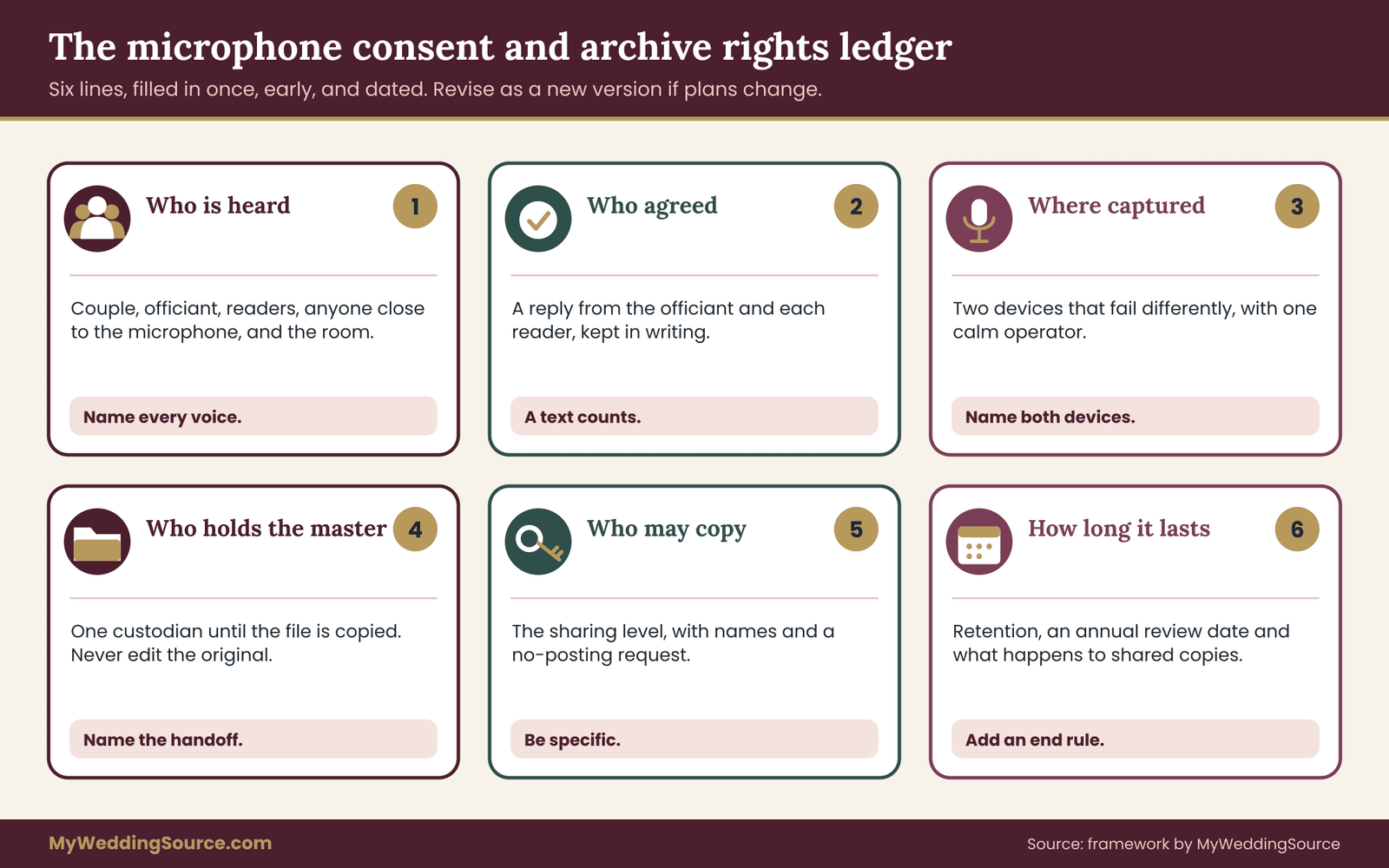
Decide the audience for your vow recording before you buy or borrow any equipment. Keepsake-only, family copy, guest sharing and public posting need different permissions. Write a one-page microphone consent and archive rights ledger with six lines: who is heard, who agreed, where it is captured, who holds the master file, who may copy it, and how long it is kept. Record on two independent devices, run a measured sound check, and store three copies on two kinds of media, with one copy away from home.
Most couples who want a vow recording are not trying to produce a podcast. They want to be able to press play on a quiet evening ten years from now and hear their partner’s actual voice saying actual words, with the officiant’s pause and the small laugh in the middle. That is a modest goal, and it is easy to ruin in two opposite ways.
One is a vow recording that never happened, because the phone in someone’s pocket was in airplane mode or the recorder card was full. The other is a vow recording that exists but ends up in places the couple never intended, because nobody decided who could have a copy.
A vow recording sits where three ordinary planning topics meet: audio technology, permission, and long-term file storage. Each is simple alone. Together they produce questions that wedding checklists skip. Can the officiant be recorded? Does the venue’s sound system feed a file you can keep? Is the videographer allowed to hand over the raw audio, or only an edited film?
If you read a poem during your vows, may a recording of it be shared? And five years from now, who can open the folder if one of you is unavailable?
A note on scope. This is general planning information, not legal advice, and recording and copyright rules differ by place and by situation. Where a rule matters, this article points to the agency or office that publishes it so you can confirm the current version yourself.
What a private vow recording is, and what it is not
A private vow recording is one made for the couple’s own use, whose audience you have defined in advance. The word private does the heavy lifting. It does not describe the sound quality or the device. It describes a decision you have made about who may hear the vow recording, who may hold it, and who may make more copies.
It is not the same as the wedding film. A videographer’s film usually mixes ceremony audio, music and ambient sound, and it is edited by someone else under a contract. Your vow recording is closer to a source document: the unedited, complete audio of the moments you say your promises.
It is also not a livestream. A livestream sends sound to other people while it happens, which raises a different set of consent questions, and the site’s guide on wedding day digital operations covers backup communication and file handling around the day.
It is not an audio guest book, either, where guests leave messages. And it is not the question of whether to say your vows in front of everyone or away from the crowd. If you are still weighing that, the ceremony step-by-step guide shows where vows sit in the order of a ceremony, and that choice comes first. This article assumes the vows will be spoken, and asks what happens to the sound.
Three situations are common. In the first, the vows are spoken at a normal ceremony with guests present, and the couple wants a clean file in addition to whatever the photographer or videographer captures. In the second, the vows are exchanged privately, perhaps before the ceremony with only the officiant or a photographer nearby, and the vow recording is the only way anyone else ever hears them.
In the third, the couple is eloping or holding a courthouse ceremony, where the room, the rules and the staff are not under their control at all.
Each situation changes the equipment choice and the consent map, but the six-line ledger introduced below works for all three.
Why a vow recording is worth planning for
Memory edits. Within a few years most people remember the shape of their vows and lose the exact words, the order, and the way they were said. A recording keeps the version that happened, including the nerves. Couples also tend to value the other person’s recording more than their own. Hearing your partner’s voice shake on one word is the kind of detail that makes a keepsake worth keeping.
There is also a practical reason. Wedding days are loud and busy. Even a ceremony with excellent photography often leaves the audio as an afterthought, so the one piece of media that captures the actual words may be the one nobody planned.
Why this deserves more than a phone in a pocket
A phone in a pocket can work. It can also produce twenty minutes of muffled rustling, because fabric moves against the microphone, or a file that stops at minute fourteen because storage ran out, or nothing at all because a notification changed the vow recording mode. The goal is not expensive equipment. The goal is a method you have tested, a backup that does not share a failure with the first device, and a clear agreement about what happens to the vow recording afterward.
Four levels of use decide everything else about a vow recording
Before you think about microphones, name the level of use. Almost every later decision, from who must say yes to how long the vow recording is kept, follows from this one choice. There are four levels, and it helps to think of them as rungs of a ladder where each step up adds people and adds permissions.
Level one: keepsake only. The couple holds the file. Nobody else receives a copy, and the file is not posted or played for guests. This is the simplest level, and it is what many people mean by private. It still involves consent, because the officiant, any reader and anyone speaking within range of the microphone is being recorded.
Level two: family copy. The couple chooses a few relatives who receive the file, such as parents or grandparents who could not attend. This adds a sharing decision and a question about what each recipient may do with the file afterward.
Level three: guest sharing. The file is played or sent to guests, perhaps as part of a thank-you message or a reception moment. Now you are distributing a recording of identifiable voices to a group, and some of them, such as readers or the officiant, may have a view about it.
Level four: public posting. The audio is posted on a website or a social platform. It is the hardest level to reverse, since anyone can copy a public file. It also brings copyright questions about anything else audible, such as a song playing or a published poem read aloud.
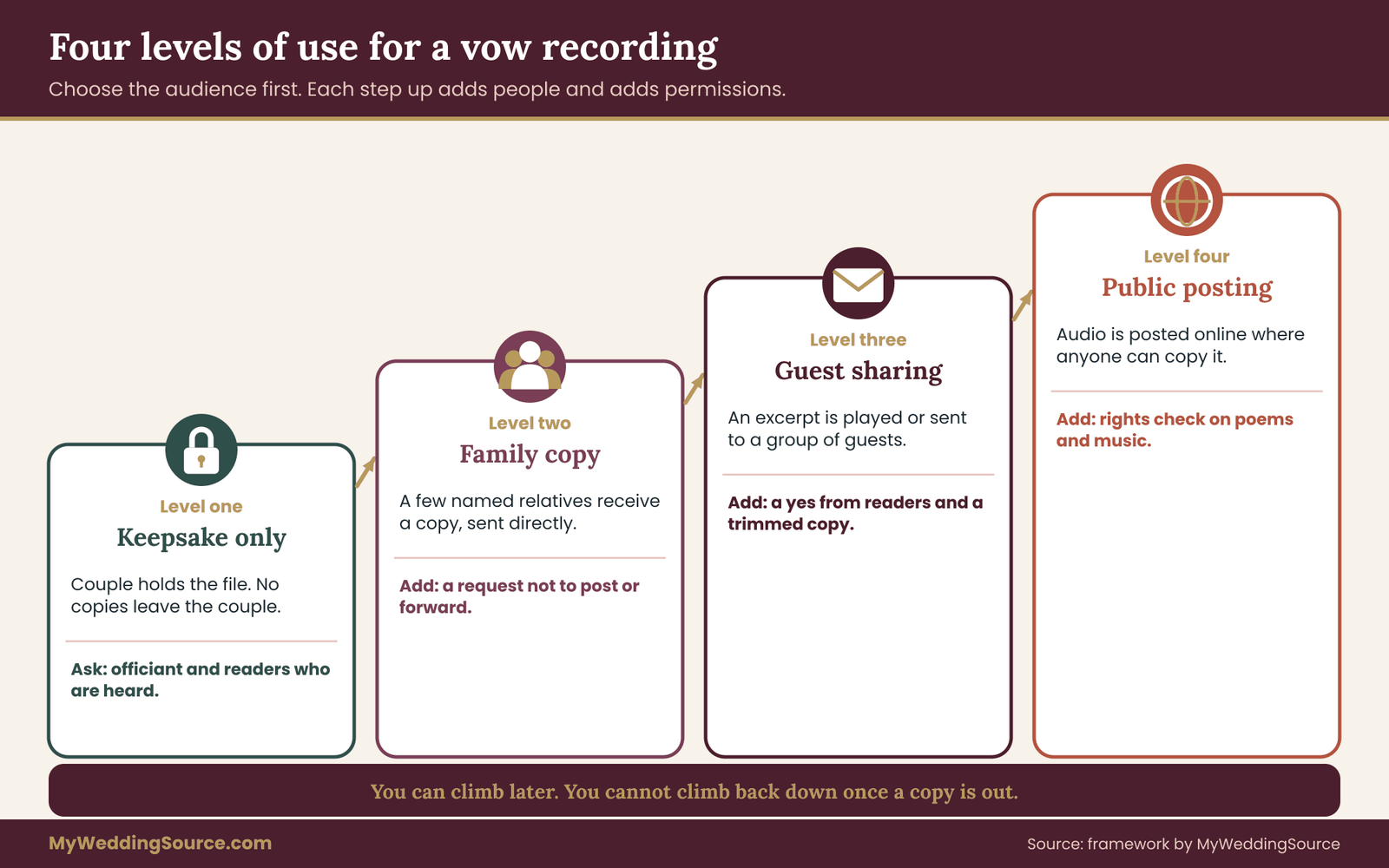
You can move up the ladder later, but you cannot easily move down. A file shared with fifty people cannot be made private again. That asymmetry is why this guide recommends starting at level one, deciding on purpose whether to go higher, and recording that decision in writing while the day is still planned and nobody is emotional.
A useful test is to ask each partner separately, before comparing answers: “Who, besides us, would you be comfortable hearing this?” Couples often discover they are on different rungs. One wants to send the file to a grandmother overseas, and the other would rather no one hear their nervous voice. Settling that in advance prevents an awkward conversation after the fact.
The level also shapes how much consent paperwork you need. At level one, a short spoken confirmation from the officiant and any reader is usually enough, though a written line is better. At levels three and four, you will want clearer written agreement, and you should think harder about what else is audible on the file.
One more consideration is that the level applies to the file, not to the day. You might share a short trimmed excerpt at level three while keeping the full, unedited master at level one. Treat those as two separate items on the ledger, because they have different audiences and different rules. The checklist in the next section shows how to record that.
The microphone consent and archive rights checklist
This is the working tool of the article. It is a one-page ledger with six lines. You fill it in once, early, and you revise it if plans change. Each line asks a plain question, and each has follow-up questions that turn a vague intention into something you can act on. Print it or keep it in the same folder as your other planning documents; the site’s guide to organizing wedding records after the event shows where a document like this belongs in a larger archive.
Line one: who is heard
List every voice that will plausibly end up on the vow recording. The couple is obvious. The officiant is almost always on the vow recording, because they prompt the vows or introduce them. Add anyone who reads, anyone who answers a question aloud, and anyone close enough to the microphone that their reactions will be audible: a parent in the front row, a child, a musician playing during the exchange.
Then add the category people forget, which is the room. A guest laughing, a baby crying and a door closing are all part of the vow recording. You cannot get written consent from every guest, so the practical answer is to be honest about it. If the vow recording is level one, incidental background sound in a room where everyone knows a ceremony is being held is a low-concern situation for most couples. If you plan to move up the ladder, the background voices matter more.
Line two: who agreed
For each named person, note how they agreed and when. The officiant is the most important entry. Ask them directly and early, and ask in a way that makes it easy to say no. A script that works: “We would like to make a private audio recording of our vows for ourselves, with a small recorder near us. It would include your part of the ceremony. Is that fine with you, and is there anything you would prefer we avoid?”
Some officiants are glad to agree. Others work within religious or institutional rules that limit recording, or simply prefer not to have their words kept. Either answer is fine, and you need it settled before the day, not at the altar. If the officiant says no, you still have options: record only your own vows with a device on your person, or exchange the vows in a separate private moment.
The guide to officiant requirements explains what to confirm with an officiant about the legal side of the ceremony, and the vow recording question fits naturally into that same conversation.
For readers and anyone else who speaks, a short message is enough: “We are making a private recording of the vows and the readings around them, for us only. Let us know if you would rather not be on it.” Keep their replies. A text message is a perfectly good record.
Line three: where it is captured
Name the device, who operates it, and where it sits. Also name the backup. This line forces you to answer the questions that otherwise get answered by accident. Is it a recorder in a jacket pocket, a small microphone clipped to a lapel, a phone on a stand, or an audio feed from the venue’s system? Who starts it and who stops it? Who checks, after the ceremony, that a file exists?
The key rule for this line is independence. Two devices that depend on the same battery, the same person or the same cable are one device. Section four of this article compares methods, and the sound check later in the article gives you measurable checks. For the ledger, write the names down.
Line four: who holds the master
The master is the first complete, unedited file. Only one place and one person should be listed as the holder at the start, and that is usually the couple, with a specific person named as the day-of custodian until the vow recording is copied. Wedding days are the moment files go missing, because the recorder gets handed to a friend, who puts it in a bag, which goes in a car.
Be explicit about the handoff. For example: “Maya holds the recorder from the end of the ceremony, copies the vow recording to a laptop that evening at the hotel, and confirms the file plays before she cleans up.” The master should never be trimmed, filtered or renamed in place. Edits happen on a copy.
If a vendor captures audio, the vendor is a second holder of a different file. Their file may be edited, compressed or tied to a delivery system with an expiry date. Put them on this line as a holder, with the terms of what they hold and for how long.
Line five: who may copy
This line records the sharing level from the ladder and attaches names to it. It answers: which people may receive a copy, in what form, and with what instructions? A good entry is specific. “Both sets of parents may receive a trimmed excerpt of the vows only, as a file sent directly, with a request not to post it.” A bad entry is “family can have it.”
Also decide who on your side can make copies. If one partner has the only account, the other is dependent on them. The usual answer is that both partners can access the master and all backups, and nobody else can without asking.
Think here about the rights attached to anything else on the vow recording. If a published poem is read, or a song plays under the vows, your own private copy is a modest matter, but the more widely you share, the more it matters who owns that other content. The section on ownership covers this in detail.
Line six: how long, and what ends it
Every ledger line about retention should have an end condition, even if the end condition is simply “kept indefinitely.” The sharper question is what happens to the shared copies. If you gave a family member an excerpt, does that arrangement last forever? What if a relationship changes? What if one of you wants the vow recording removed from a particular person’s hands?
You cannot retrieve a file once it is sent, so the most honest ledger entry is a request, not a guarantee: “Shared copies are for personal listening, and we will ask recipients to delete them if we ask.” For the master, an end condition might be an annual review date, when you check that the files still open and decide whether anything should change.
Using the ledger without turning the wedding into a legal project
The ledger is not a contract. It is a planning page and a memory aid. Its value is in forcing the conversation to happen once, on a calm day, rather than five times in pieces. Most couples fill it in during a single sitting of twenty or thirty minutes, because most lines have short answers.
A few signals mean you should slow down. If the officiant declines, if a reader is uncomfortable, if the venue has rules about recording, or if a partner is unsure about the audience level, resolve that line before you continue. A disagreement on one line usually changes lines three through five.
It also helps to attach the ledger to the date. Write “version one, made on” and the date at the top. If you change the sharing level or the device later, make a version two instead of overwriting the first. When a question arises years later, the earlier versions explain why a particular choice was made.
What to say when someone asks why you are recording
You will be asked, usually by a relative who is curious or a guest who is wary. A short, friendly answer works. “It is a private keepsake of the vows for the two of us. We are not posting it.” That sentence answers the two questions people actually have: what is it for, and will it end up online.
If you are going to share it with a few family members, say so rather than hiding it. A guest who learns later that a file went to the aunt but not to them will remember it longer than a polite explanation would have lasted.
If the person asking is a vendor, the question is different, because they may need to understand what they are or are not allowed to do. A photographer or videographer might worry that your recorder interferes with their equipment, or that you intend to replace their audio. Tell them what you plan, ask whether it causes any problem, and ask whether they can provide a clean audio feed from a microphone they place. The next sections turn those conversations into specific choices.
Choosing how to capture your vow recording
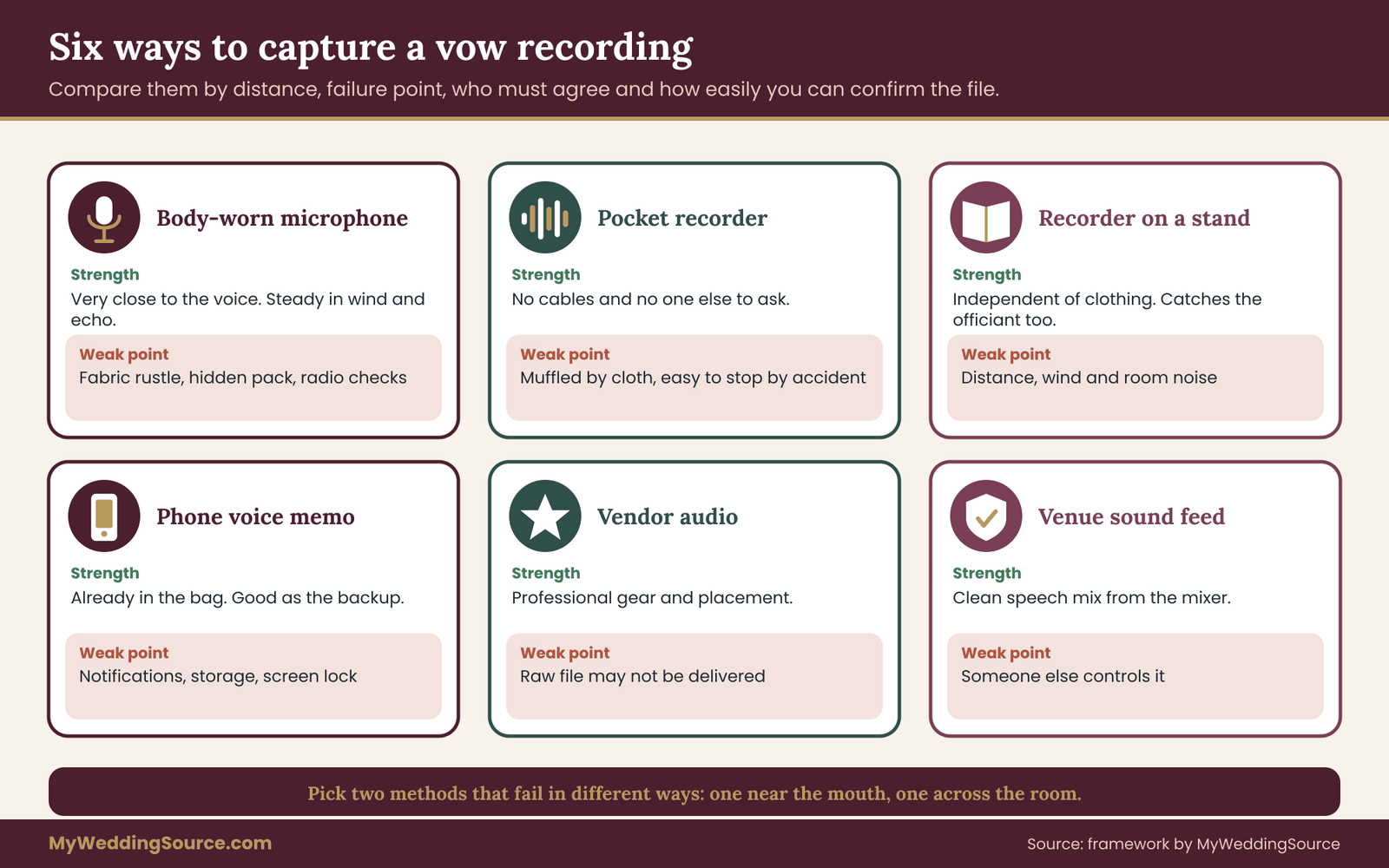
There are six common ways to capture a vow recording. None is best in every setting, and the right choice depends on the room, the level of use, your tolerance for intrusion, and how many things you are willing to test. The comparison below is about trade-offs, not product names, because equipment changes quickly and the principles do not. Prices differ widely and change often, so this guide does not quote any; ask suppliers for current figures.
Method one: a small body-worn microphone and recorder
A lavalier, or lapel, microphone clips to clothing near the chest and connects to a small recorder, either by wire or by radio. It sits close to the mouth, so it captures the speaker’s voice with little room noise. It is the standard way professionals capture speech at ceremonies.
The strengths are clarity and consistency: distance to the mouth stays roughly the same whether the person turns their head or the wind rises. The weaknesses are fabric noise, visible cables or packs, and the need to hide a body pack in a dress, a jacket or a waistband. A wired setup is simpler and less likely to suffer interference. A wireless one avoids a visible cable but adds a transmitter, a receiver and frequency questions, covered in a later section.
For a vow recording, the useful question is how many people need a microphone. If each partner wears one, you capture both voices closely, but you double the hardware and the testing. If only one partner and the officiant wear one, the other partner’s voice is captured from a distance, which sounds noticeably different. Many couples find that a single well-placed second source is enough.
Method two: a pocket recorder carried by the speaker
A small handheld digital recorder can go in a jacket pocket, a bouquet wrap, a small bag, or a custom pouch. It requires no cables, no transmitter and no one else’s cooperation. It is the lowest-friction method and the one most likely to be forgotten, accidentally stopped, or muffled by cloth.
Its audio depends on where it sits relative to the mouth. A chest-height pocket works better than a hip pocket, and a pocket facing outward works better than one pressed against the body. Fabric against the microphone causes the rubbing sound that ruins files. If you use this method, test it with the exact clothing you will wear, moving the way you will move.
Method three: a recorder on a stand or in the set
A recorder placed on a small stand, a lectern, an arch, or a table near the couple captures the room and the voices together. It is unobtrusive in photos if hidden among flowers or a table arrangement, though it should not be hidden in a way that surprises people, since concealment raises the consent questions covered earlier.
This method is simple to set up and independent of the couple’s clothing. Its weakness is distance. Sound falls off quickly as the microphone moves away from the speaker, and room noise rises relative to the voice. In an open outdoor space, wind and ambient sound can drown quiet vows. It works best in a small, quiet room or in a ceremony where the couple stands very close to the recorder.
Method four: a phone voice-memo app
A phone is already in your bag, it has a microphone, and the files are easy to move. As a backup, it is good. As the only method, it has problems: notifications, calls, battery drain, a lock screen that interrupts, a full storage warning, and the awkwardness of holding or placing a phone during a ceremony.
If you use a phone, change the settings in advance. Turn on airplane mode, switch off notifications, confirm there is storage, plug in or charge, and disable any setting that pauses recording when the screen locks. Then run a ten-minute test. Phones also tend to apply automatic processing that adjusts levels and suppresses what the software decides is noise, which can clip the start of a sentence. A short test shows you whether that happens.
Method five: the vendor’s audio
If you have a videographer, they likely record ceremony audio already, often with a lavalier on the officiant or the groom and a backup recorder near the front. If you have a DJ or an audio technician, they may run microphones through a sound system for the ceremony.
Asking a vendor for a clean copy of the raw ceremony audio is one of the best ways to get a vow recording, because they have professional gear and experience. The conditions are contractual rather than technical: whether the raw audio is included, whether it is delivered at all, in what format, and for how long it is kept. The section on vendor contracts gives questions to ask. Do not assume a film includes a separate audio file; many deliverables are finished edits only.
Method six: a feed from the venue or officiant’s sound system
Some venues and officiants use a public-address system with microphones. A technician can often take a line-level feed from the mixer to a recorder, which provides a clean mix of whatever microphones are open. This can sound excellent, since the system was set up for speech. The risk is that the mix is controlled by someone else, that any microphone left muted does not appear on the vow recording, and that the technician must agree to it.
Comparing the methods in prose
If clarity is the priority, a body-worn microphone and a feed from a sound system sit at the top, because both place a microphone close to the speaker. If simplicity is the priority, a pocket recorder or a phone is hard to beat, with the caveats above. If you want to avoid putting anything on your body, a recorder on a stand and the vendor’s audio are the least intrusive.
If you want the full ceremony rather than only your own voices, the stand recorder and the sound-system feed capture the officiant and the room more naturally.
The most useful way to compare is to ask five questions of each option. How close is the microphone to each speaker? What is the single point of failure? Who must agree for it to work? How visible is it to guests and to photos? How easy is it to confirm, right after the ceremony, that the vow recording exists and is playable? The answers rarely point to one winner; they point to a pair.
A decision rule for choosing a pair
Pick two methods that fail in different ways. A body-worn microphone with a recorder in the pocket fails when the clothing rustles or the battery dies. A recorder on a stand fails when the room is noisy or the wind rises. Together they are unlikely to fail at the same moment. A phone in a jacket and a recorder on a lectern, a lavalier and a venue feed, or a pocket recorder and the videographer’s raw audio are all reasonable pairs.
If you can afford only one extra step, make it this: have one device within about arm’s length of the speaker, and one device across the room. That combination covers both close voice and room context, and it is the nearest thing to a universal rule. Everything else is detail that depends on your space.
The role of a helper
A helper turns a fragile plan into a dependable one. Choose one person, not a committee, to be the audio custodian. They do not need technical skill. They need to start the recorders at an agreed cue, confirm they are running, stop them at an agreed cue, and carry the devices to the couple afterward. Give them a one-line note: “Start at the processional, check the light is on, stop after the kiss, bring both to Maya.”
Pick someone who will not be needed for another task at that moment. A bridesmaid who is also holding a bouquet and arranging a train is a poor choice. A calm friend or cousin who is seated near the front and has no other job is a better one.
Tell the custodian the ledger line they are responsible for, not just the tasks. If they understand that the files are private, they will not post a snippet to a group chat on the way home, and they will not leave a phone unattended on a table. That small bit of context prevents most accidental sharing.
Placement, wind and room noise that spoil a vow recording
Most failed recordings fail for ordinary physical reasons. Sound is simple to describe: the microphone hears whatever is loudest at the microphone. If your voice is quieter at the microphone than the wind, the air conditioning, or a nearby speaker, the vow recording will favor those. Understanding a handful of physical effects lets you predict problems that no equipment can fully solve.
Distance is the biggest lever
Moving a microphone closer to a voice raises the voice relative to everything else. Halving the distance has a large effect, and doubling it has the opposite effect. That is why a recorder in a pocket at chest height, perhaps a hand’s width from the chin, usually sounds clearer than a recorder on a lectern two meters away, even if the lectern recorder is a better device.
For a vow recording, aim to have at least one microphone within roughly an arm’s length of each speaker’s mouth. Vows are often spoken softly, and quiet voices have the least margin. If you plan to whisper, the microphone needs to be closer still, or you need to accept that the vow recording will capture the whisper and the room together.
Wind outdoors
Wind across a microphone creates a rumble that can bury a voice. It is the most common cause of ruined outdoor ceremony audio. A foam cover reduces it a little, and a furry windscreen reduces it much more. Putting the microphone under clothing or behind the body relative to the wind helps, as does standing with a wall or structure at your back.
If you are marrying outdoors, assume wind. Test at the location at the time of day you will be there, if possible, because coastal and open sites often change in the afternoon. If the wind is strong, the best approach is a body-worn microphone with a windscreen, hidden behind the lapel and facing the mouth, rather than a recorder on a stand.
A second option is to repeat a quiet reading of the vows afterward, in a sheltered place, and keep that as a companion file labeled as such. It is honest to label a second take as a second take.
Echo and reverb indoors
Stone, tile, glass and tall ceilings make a room echo. Echo mixes the voice with its own delayed copies, which makes speech hard to understand on a vow recording even when it sounded fine in person, because the ear is better at ignoring reflections than a microphone is. Churches and halls with high ceilings are classic examples.
Close microphone placement beats echo. A body-worn microphone or a recorder very near the mouth reduces the proportion of reflected sound. A recorder on a stand at the back of a large room will pick up mostly echo. A carpeted room, curtains, a full audience and even coats on chairs absorb sound and help.
Fabric, jewelry and hair
Clothing noise is the second-biggest problem after wind. Silk, satin, tulle, stiff cotton, sequins, beading and heavy wool all rustle against a microphone. A lavalier needs a clip placement that keeps fabric from rubbing the capsule, often with a small loop of tape or a mounting accessory. Test by moving your arms, turning your head, and walking the processional distance.
Necklaces, bracelets and long earrings can tap a microphone on the chest. Veils and long hair can drag across it. These sounds are small to the ear and loud on a vow recording. If you are unsure, remove the jewelry nearest the microphone, or pin the hair away from it.
People and music nearby
A seated audience adds noise, such as coughing, programs rustling, children, phones and shifting chairs. You can reduce it, but not eliminate it. Asking guests to silence phones, as in the guidance on unplugged ceremonies, helps both photographers and recorders. If music will play before or after the vows, ask the musician to stop completely during the exchange, and ask them to remain quiet until the vow recording is done.
A public-address system is a particular risk for a nearby recorder. If a speaker is broadcasting your own voice back into the room, a recorder on a stand will capture the amplified version, delayed and bounced, and the result can sound hollow. In that case a body-worn microphone or a direct line feed is better.
Planning for what you cannot control
You cannot plan for a leaf blower, a passing train, a sudden shower or a sneeze. You can plan for the possibility. Decide in advance whether you will pause, repeat, or accept. Some couples agree that if an interruption drowns the vows, the officiant will prompt them to repeat the line, which is natural in a ceremony and costs nothing. Others decide they will accept imperfection, because the keepsake is the real moment, not a studio take.
Having a second capture, as recommended above, is the real protection. The best way to keep calm about a loud truck is to know that a second device is in a different position.
A sound check you can measure before the ceremony
A sound check turns hope into evidence. It takes about thirty minutes, requires only the devices and clothing you plan to use, and answers five questions: does each device record, is the level right, is the background acceptable, does the vow recording survive a short handling cycle, and does the whole plan work from start to stop? Run it at the venue if you can, or in a similar space if you cannot.

Step one: confirm each device records at all
Record thirty seconds on each device, stop, and play it back through headphones. Do not trust the screen or the indicator light. Listen for the voice, for hiss, for clicks and for any gaps. Headphones matter because a phone speaker hides problems that headphones reveal.
Step two: set the level with your real voice
Speak the way you will on the day: the same volume, the same distance, the same posture. Read a passage the length of your vows. Most recorders have a level meter or a vow recording-level setting. The goal is a voice that registers well above the noise but never reaches the maximum, where the sound distorts.
A sound that hits the top of the meter and clips cannot be repaired afterward. If you are uncertain, set the level lower; a quiet file can be raised, while a clipped one cannot be rescued.
A practical measure is to listen for distortion on the loudest word you will say, such as your partner’s name or a laugh. If it is clean, the level is safe.
Step three: measure the background
Record thirty seconds of silence in the room, with no one speaking, and listen. Whatever you hear is the noise floor. If the air conditioning, a refrigerator, traffic or a heater is audible at a normal volume, the vow recording will carry it. You can sometimes turn off an appliance for the ceremony, ask a venue to reduce the fans, or choose a different spot a few meters away.
Step four: rehearse the movement
Wear the clothes, hold the bouquet, take the position and walk. Move your arms as you will during the ring exchange. Turn your head toward your partner and toward the officiant. Listen for rustles, taps and cable noise. If the sound changes when you turn, the microphone is too far off-axis, and you should move it.
Step five: rehearse the handoff
Practice stopping the recorders, retrieving the files and copying them. The most common failure is not the vow recording itself but the minutes afterward, when a device is handed to someone, a card is swapped, or a phone is wiped by an automatic cleanup. Do a rehearsal in which the custodian stops both devices, labels them, and puts them in a named place. Then copy the test files to a laptop and confirm they open.
The day-of routine
On the day, three checks matter. About an hour before the ceremony, replace or charge batteries, confirm storage is available, set the devices to record, and run a ten-second test. Fifteen minutes before, check that the devices are in position and that the custodian knows the cue. Immediately after, stop the devices, confirm the file exists, and transfer it to a safe place as soon as you can, even if only a quick copy.
If a device fails during the day, do not hide it from the couple until later. A calm plan is: the custodian tells the officiant or the nearest helper, the remaining device continues, and after the ceremony the couple decides whether to record a second take in a quiet moment.
What counts as success
A usable vow recording has three properties that you can check by listening once. Every word of the vows is understandable, with no clipped or missing sentences. The file runs from before the first word to after the last, with a few seconds of margin. And the background does not compete with the voice at any point.
Anything beyond that, such as perfect tone or no breath sounds, is extra. Do not judge the file against a studio production. It was recorded at a wedding, and that is part of what makes it yours.
Time and effort, honestly
None of this needs to be expensive. The most valuable parts, a second device, a headphone check and a rehearsal, cost almost nothing beyond time. Equipment from a friend or a rental service can replace a purchase, and a technician hired for an hour can set up and monitor a feed. Ask for current rental or service quotes rather than relying on a guess, since prices vary by area and season.
Officiants, venues, wireless rules and vendor contracts
Equipment is the easy half of a vow recording. The harder half is the set of people and documents that control what you are allowed to do. This section lists who to ask, what to ask, and what the answers mean. Do it early. A venue that restricts recording or a vendor whose contract forbids handing over raw files cannot be fixed on the wedding day.
The officiant
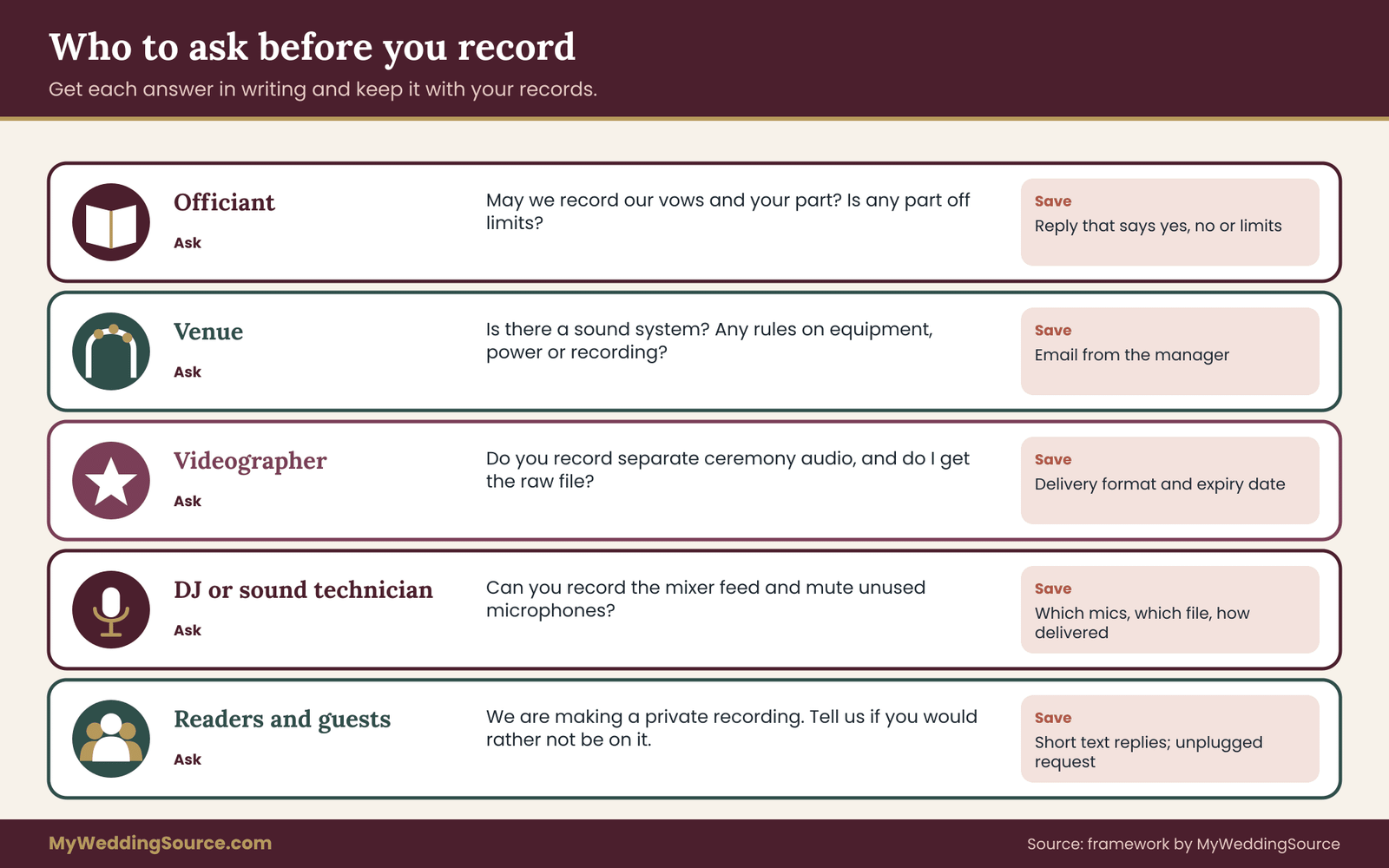
The officiant is the first call, because their voice is the one most certain to be on the vow recording and because their organization may have rules. Independent officiants and civil celebrants are often relaxed about it. Clergy and faith communities vary: some welcome recording, some limit it to certain parts of a service, some restrict it in sanctuaries, and some prefer the congregation’s own recording only.
Ask three things. May we record our vows and your part of the ceremony for private use? Are there parts of the service we should not record? And would you be willing to wear or stand near a microphone, if we provide one? If the answer to the first is no, ask whether a recording of only the couple’s vows, spoken into a device on their own person, would be acceptable.
Respect the answer. For the legal side of who may officiate and what they must sign, see the site’s officiant requirements page. The vow recording is not worth a conflict with someone whose role is to hold the ceremony together.
Courthouses and civil offices are a separate matter. Staff are bound by the office’s rules, not by your preferences, and many have a standard approach to recording, photography and phones. Ask the office directly and well in advance. If recording during the ceremony is not allowed, a short private reading of your vows afterward, in a parking lot, a park or your home, is a perfectly sincere substitute and can be labeled that way.
The venue
A venue may have rules about sound that bear on recording. It may have its own sound system, a house technician, volume limits, or restrictions on what equipment you may bring or plug in. It may restrict recording in certain rooms. It may also have its own policy about vendors operating audio equipment, covered by its insurance requirements.
Ask the venue manager: Is there a sound system we can use for the ceremony, and who runs it? Can a technician provide a line feed or a vow recording? Are there limits on bringing our own recorders or microphones? Are there rules about powering equipment or running cables? And is there any restriction on recording the ceremony itself? Get the answers in writing, even as a short email, and put the reply in your records folder.
Wireless microphones and the airwaves
Wireless microphones are regulated in the United States by the Federal Communications Commission, and the rules about which radio frequencies may be used and by whom have changed in recent years as spectrum was reassigned. For a couple, the practical meaning is simple: do not buy or borrow older wireless equipment without checking that it still operates legally and without interference, and ask your audio vendor or the venue what they use.
If a professional supplies the equipment, they are responsible for it. If you provide your own wireless microphones, check the manufacturer’s current guidance and the FCC’s published information on wireless microphones. Interference is also a practical problem: crowded venues, nearby broadcasts and other wireless devices can cause dropouts. A wired lavalier avoids the whole question, which is one reason the recommended approach for a modest private recording is wired or recorder-based rather than radio.
Videographers and photographers
A videographer is the most likely vendor to hold usable audio. Before you sign, ask what audio is captured, how, and what you receive. Specific questions: Do you record ceremony audio separately from the camera, with a dedicated microphone? Do I receive the raw audio file, a finished film, or both?
In what format, and with what delivery method? How long do you keep the raw files, and how long do links stay active? May I record my own audio alongside yours, and will it interfere with your equipment?
Some contracts say the vendor owns the copyright in everything they produce and licenses it to you for personal use. Others deliver the raw files. Neither is wrong, but the difference matters if you want a master you control. If a vendor will not deliver raw audio, you still own the decision to record separately. Tell them, because they may adjust their microphone placement to avoid a collision.
The site’s guide to reading a wedding vendor contract explains the clauses that usually matter, including delivery, usage rights and cancellation, and it is worth reading before you add an audio request. Also ask about the vendor’s data retention: some galleries and file links expire, and raw footage is sometimes deleted after a set period. If the audio is important to you, download it promptly.
A photographer is less likely to hold audio, but some offer short video clips or audio capture with their cameras. Ask. In many cases the photographer is simply someone whose shutter noise you should consider when you test the room, because a recorder close to a loud camera can pick up each click.
A DJ or sound technician
If a DJ or technician runs the ceremony sound, you can ask them to record the feed. Many can, using a recorder connected to the mixing console. Ask what the file includes (which microphones, with what processing), whether the vow recording runs from the start of the ceremony or only when a microphone is open, and how they will deliver the vow recording. Also ask them to avoid playing music over the vows, unless you want it there.
Ask them to mute any microphone that is not in use. A cluster of open microphones adds echo and picks up whispers, throat clearing and conversations. A good technician will already do this.
Guests and unplugged ceremonies
Guests with phones are recorders too. If you have asked for an unplugged ceremony, your request covers audio as well as photos. If you have not, assume some guests will film the vows and may post them. This is the one way a private recording becomes public regardless of your plans. The decision of whether to ask for an unplugged ceremony belongs with your wider consent plan, which the site’s wedding photography consent guide covers in more detail.
If guests will record, say so in your ledger as an uncontrolled source. You can request that they not post, but you cannot enforce it. That is another reason to decide the level of use calmly: a couple who plans to keep the vows private should ask for an unplugged ceremony in writing, and should let the officiant announce it.
Laws about recording
Laws on recording conversations differ widely. In many places, rules about recording people depend on whether the people can reasonably expect privacy, whether the vow recording is of a private communication, and whether one party or all parties must consent. A wedding ceremony with invited guests is not the same as a private phone call, but rules vary by state and country, and a few places have strict consent requirements. Do not assume.
The practical response is the same as the ethical one. Tell the people who are being recorded at close range, get a clear yes from the officiant and readers, and keep the record. If you are marrying in another state or country, or if you have any doubt, ask the venue or the local authority what applies. The USAGov site is a starting point for finding the relevant government office, and a local attorney can advise on your own situation.
A one-page vendor email
You can combine most of these questions in a single message. A model: “We would like to make a private audio recording of our ceremony vows for ourselves. Could you tell us whether your package includes a separate audio file of the ceremony, whether you can deliver the raw file, and how long you retain it?
We also plan to place a small recorder near us as a backup, and we would like to know whether that would interfere with your setup. We would be grateful for a reply in writing.”
That message is specific, polite, and easy to answer. The answers go in your ledger, line three and line four. Save the replies, because they are exactly the documents you will want if a delivery question arises later.
Storing a vow recording so it still plays in twenty years
A recording that cannot be opened is not a keepsake. Digital files fail quietly: a drive stops spinning, a cloud account closes, a format falls out of use, a password is forgotten. None of that is dramatic, and all of it is preventable with a handful of habits. The Library of Congress publishes plain-language guidance on personal digital archiving, and this section follows the same general ideas, adapted to one small, precious file.
Step one: secure the master within a day
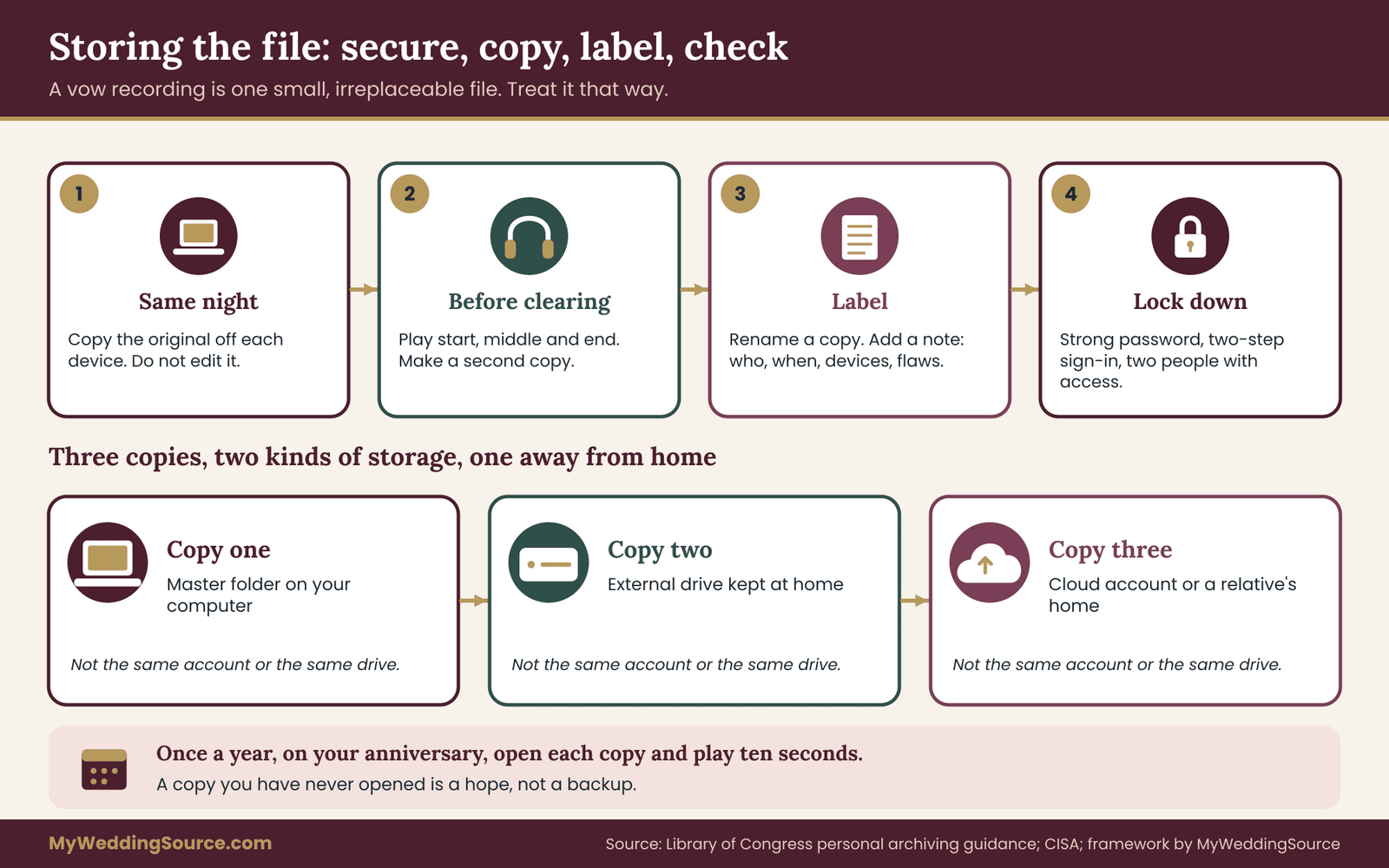
The risk is highest in the first hours. A card or phone is small, easily lost, and often reused. The same evening, or the next morning at the latest, copy the original file from each device to a computer. Do not edit it. Do not rename it yet. Play it through headphones from start to finish, or at least from start, middle and end, to confirm it is complete.
Then make a second copy immediately, before you clear the device. Only after the vow recording exists in two places should anyone erase a card or reuse a recorder. A tempting shortcut is to delete the original from the phone to free space. Resist it until the three-copy rule below is met.
Step two: choose a format on purpose
Audio files come in two broad families. Uncompressed formats, such as WAV, keep everything the microphone heard. Compressed formats, such as MP3 and AAC, make the vow recording much smaller by discarding some detail. Some compression is lossless and keeps everything, and some is lossy and does not.
For a master, use whatever the recorder produced if it is uncompressed or lossless, and keep it. If the recorder produced only a compressed file, keep that. Do not convert a lossy file to another lossy format, since each conversion loses more. For sharing, a compressed copy is fine.
As a rough guide, uncompressed stereo audio at common quality takes about ten megabytes per minute, so a thirty-minute ceremony is a few hundred megabytes, which is small by present storage standards. Size is rarely a reason to throw away the original.
Step three: name and describe it
Rename a copy, not the original, with a name that sorts and explains itself. A useful pattern is the date, the event, the device and the version, written in a way a stranger could understand: year, month, day, then the words ceremony vows master, then the device. Keep the original file name too, in a notes file, so that you can match it to the device.
Add a plain text note beside the vow recording. Write who is heard, the date, the place, the devices used, the ledger version and any known flaws, such as “wind noise from minute eleven.” That note is the difference between an anonymous file and a documented one. In twenty years you will have forgotten which of two recordings was the primary.
Step four: the three-copy rule
A common guideline, recommended in various forms by archivists and security agencies, is three copies of anything you cannot replace, on two different kinds of storage, with one copy somewhere else. It applies well here, since the vow recording is a single, irreplaceable file.
A realistic version: the master on your computer, a copy on an external drive kept at home, and a copy in a cloud account or on a drive at a relative’s house. The three copies should not all depend on one thing. Two copies on the same laptop are one copy. Two cloud copies in the same account are one copy. The Cybersecurity and Infrastructure Security Agency publishes guidance on backing up data that makes the same point in general terms.
Step five: lock down access
Private means controlled. Decide which accounts and drives hold the file, and who can open them. Use a strong, unique password and, where offered, two-step sign-in on any cloud account. Avoid keeping the only copy in a shared family account, a work account or an account tied to a phone number you may change.
Consider what happens if one of you cannot access the account. A shared password manager or a written note stored securely, such as in a home safe or with a trusted person, can solve that. Also think about devices: a drive in a drawer is private, but also easy to lose. Label it in a way that does not invite curiosity, and keep it with other important papers.
Step six: plan for change
Technology moves. Formats that are common now may need conversion in the future. The practical habit is simple and costs one afternoon a year: on a fixed date, perhaps your anniversary, open each copy, play ten seconds, and note that you did. If a drive is more than several years old, replace it. If a service changes its terms or closes, move the file before it does. Keep the format notes in the text file so a future version of you knows what to look for.
The anniversary check is also the natural time to revisit the ledger. If your sharing decisions have changed, update the ledger and note what changed and when.
What not to do
Do not rely on a social platform or a messaging app as storage; they compress, rename and sometimes delete. Do not keep the master only in a vendor’s gallery or delivery link, since those expire. Do not edit the only copy. Do not label the file in a way that makes sense only today. And do not trust a copy you have never opened.
If the file is damaged
If a file will not open, do not repeat attempts that could overwrite it. Make a copy and work from the copy. Try a second player. Try the other copies. If a recorder produced a file that seems truncated, stop using that recorder and consult a technician before deleting anything. Many problems with audio files can be repaired if the original data remains, but only if it is not overwritten.
Who owns the vow recording, and who may copy it
Ownership of a vow recording is less obvious than it seems, because several layers of rights can attach to one file. The U.S. Copyright Office publishes plain information on copyright, and it is the right place to confirm current rules. What follows is general background, not advice about your situation.
The sound recording and the words
Two things are present in a recording of your vows. One is the vow recording itself, the captured sound. The other is the content, the words spoken. In general, the person who makes a vow recording and fixes it in a file is treated as its author unless a contract or other arrangement says otherwise. If you make your own recording with your own recorder, you are ordinarily the author of that sound recording.
If a vendor makes the vow recording, the vendor’s contract typically says who owns it. Many vendor contracts say the vendor keeps the rights and gives the client a license to use the files for personal purposes. Some say the client owns the files. Read the terms, and ask for the arrangement in writing. The difference matters if you later want to share, edit or have the file converted.
Your own words are yours in the everyday sense, and an original text you wrote has its own protection. You do not need to register anything for a private keepsake. Registration matters mainly for people who want to enforce rights against others, which is not your situation.
Other people’s words on the file
Anything on the file that others created has its own owners. A published poem or a passage from a book that a reader recites is protected by its author’s or publisher’s copyright, and a recording of a performance of it may involve additional rights. A song playing under the vows is a music rights matter. For a private copy kept at home, the practical risk is low. As you move toward sharing and posting, the practical risk rises, particularly on public platforms that scan for protected content.
This is another reason the level of use matters. A level-one file containing a famous poem is a private keepsake. A level-four public post of the same file may raise rights issues for the poem. If you intend to share widely, use text that is yours, in the public domain, or that you have permission to use, and ask readers to follow the same rule. The site’s guide on non-religious ceremony scripts discusses writing and sourcing wording for a ceremony.
The voices of other people
A person’s voice is not usually something they own as property, but a person may reasonably expect a say in how a recording of themselves is shared. The officiant and any reader are not signing away anything by being recorded at a wedding. Even so, treating them as participants with a voice in the decision is both courteous and practical. If you plan to share beyond level one, ask them. A short message is enough.
Delivery terms and expiry
A vendor may deliver the file through a gallery or link and set an expiry date. If you want to keep the file, download it promptly, move it to your three copies, and note the vendor’s retention period in the ledger. Ask the vendor how long they keep the raw files, and whether they will provide them on request later. If the vendor is a small business, it may close; do not rely on the vendor as your archive.
Who may copy, in practice
Your ledger already says this. In practice, the answer is that you and your partner may copy freely to your own storage, and anyone else may copy only as you have said. Make this easy to follow. When you send a file, include a line: “This is a private recording for you only.
Please do not post it or forward it.” Most relatives will follow a polite, clear request. A few will not, and no legal agreement will fix that, which is why the first decision, the level of use, matters most.
Sharing, withholding and changing your mind
Having a vow recording creates a pull to share it. A grandparent asks, a friend wants to hear, a relative who missed the wedding would love it. Sharing is not wrong, but it deserves the same care as the vow recording itself, because you cannot take a copy back.
A sharing ladder in practice
Use the four levels from earlier as a working rule. At level one, you tell people the vow recording exists only if they ask, and you answer honestly. At level two, you send a named person a copy directly, not through a group chat. At level three, you prepare a shorter excerpt and play or send it on purpose.
At level four, you decide about public posting only after reading any rules on the platform, thinking about what else is audible, and agreeing together that you can live with it being permanent.
Prepare a version for sharing separately from the master. Trim the start and the end, and remove anything that is not the vows if you wish. Save it under a new name with a note. If you trim, work on a copy. Keep a line in the ledger saying which version went to whom.
The pause before sending
A good habit is a waiting period. After the wedding, put a rule in the ledger: no sharing outside the couple for thirty days. Feelings after a wedding are strong and not always representative of what you will want in a year. A month gives you time to listen together, hear what is in the vow recording, notice what you would rather not share, and decide calmly.
Listen to the whole file before anyone else does. You may find a moment you love, a moment you would rather no one hear, an unexpected comment from a guest, or a stray remark by a vendor. Those are easier to handle if you hear them first.
When a request arrives
When someone asks for a copy, you can say yes, say not yet, or say no. Kind wording helps. “We are keeping it just for the two of us for now, and we will let you know if we decide to share.” If the person is a parent or someone close, a short excerpt, or a live listening together, may satisfy the wish without handing over a file. Listening in person has a benefit: the vow recording stays under your control.
If someone who is on the vow recording asks for it, such as the officiant or a reader, consider how you would feel. Usually, yes is easy. Say what the copy is for, and ask that it stay private.
Changing your mind later
A couple may decide, years on, that they wish to share more, or less. If the vows were part of a larger ceremony plan, the order of a wedding ceremony is worth rereading first, because a shared excerpt should make sense without that context. Moving up the ladder is a matter of deciding and updating the ledger. Moving down means asking recipients to delete, and accepting that you cannot confirm it. A small step is to replace a shared full file with a shorter one in future shares.
If one partner changes their mind and the other disagrees, the vow recording is shared property in spirit. Let the more cautious partner’s preference prevail for any new sharing, and discuss the rest. That rule is simple and it protects trust.
A worked example: the Alvarez and Brandt ledger
This is an invented example, made up to show how the pieces fit together. It is not a real couple and not a statistic. Nora Alvarez and Tom Brandt are marrying outdoors at a garden venue in late spring, with sixty guests, an independent officiant, a photographer, and a videographer.
Step one: choose the level
Separately, each answers the question: who besides us would you be comfortable hearing this? Nora would like her mother and her grandmother, who cannot travel, to hear it. Tom would like only the two of them. They talk it through and agree on level one for the master file, with a single decision pending: after thirty days, they will decide together whether to send a short excerpt to Nora’s family. That decision becomes a ledger line.
Step two: fill in the ledger
Who is heard: Nora, Tom, the officiant, and a friend who reads a short passage. Background: guests and garden sounds. Who agreed: the officiant says yes by email and asks that the closing blessing not be shared; the friend says yes by text. Where captured: a small wired lavalier on Tom’s lapel feeding a pocket recorder, plus a handheld recorder on a stand a meter in front of the couple, started by Tom’s cousin Daniel, who has no other duty.
Who holds the master: Tom holds both devices after the ceremony and copies them that night. Who may copy: only Nora and Tom. How long: kept indefinitely, reviewed each anniversary.
Step three: ask the vendors
The videographer replies that the contract includes an edited film and a separate raw ceremony audio file, delivered by a download link that stays active for a stated number of months. Nora and Tom note the date and set a reminder to download the audio two weeks after the wedding. The venue confirms that outdoor recorders are fine and that the garden has a small speaker system the officiant may use. They ask that the speaker be placed away from the stand recorder to avoid an echo.
Step four: the sound check
At the venue two weeks earlier, they test both devices, Tom wearing the jacket he will wear. They hear rustling from the jacket on the lavalier and move it to a different clip position with a small loop of fabric tape. They record thirty seconds of the garden, notice a faint hum from a pump, and ask the venue to switch it off during the ceremony.
The stand recorder captures the officiant clearly, but Nora’s quiet voice is faint, so they plan for her to step half a pace closer at the vows.
Step five: the day
Daniel starts both devices at the processional, checks each light, and stops them after the recessional. He hands both to Tom’s brother, who puts them in a labeled pouch for the couple. That night in the hotel, Tom copies both files to his laptop, plays the start, middle and end of each, then copies them to an external drive. Nora uploads one set to a cloud account that only she and Tom can open. Only then do they clear the devices.
Step six: the review
A week later they listen together. Wind rises in the middle of the stand recorder file, but the lavalier file is clean throughout, and the videographer’s audio is fine too. They name the lavalier file as the master and label the others as backups. After thirty days, Nora and Tom agree to send Nora’s family a two-minute excerpt of the vows only, sent directly, with a note asking them not to post it. They record this in the ledger as version two.

What the example shows
Nothing in it needed expensive equipment. The couple chose a pair of methods that fail differently, tested them, asked the vendors in writing, agreed on an audience, and set a waiting period. The most important step was the first: choosing the level of use before touching a device. Everything else followed from it.
Edge cases and hard conversations
Plans for a vow recording meet real life in a few predictable ways. These are the cases that cause the most trouble, with a sensible way to handle each.
The officiant says no
Respect it. Offer the alternatives: record only the couple’s own voices on a device carried by the couple, record a private reading of the vows afterward, or ask whether a different portion can be recorded. Some faith traditions treat the ceremony as sacred and not for recording. A private reading of the vows later does not replace the ceremony, but it can still be a sincere keepsake.
A reader or relative objects
Do not push. Either omit their part from any shared version or record around it. If their part is on the master, keep the master private and edit any shared copy. Tell them what you plan to do, so they are not surprised.
The two partners disagree about sharing
Default to the more private choice and keep talking. The vow recording will not spoil in a month. If one partner is unsure about their own voice, offer to share nothing until they have listened to it alone and decided. A recording they are uneasy about is not the keepsake you want.
A relationship ends
This is an uncomfortable question, and the ledger helps because the rules exist in advance. Decide now what happens to the file if you separate. Many couples agree that each keeps a copy and neither shares it without the other’s agreement. Others agree that either may delete their own copy. A written line in the ledger is better than an assumption, and a decision made in a calm period is easier to honor.
A partner or relative dies
A vow recording can become more precious than anyone expected. The practical lesson is access. If the file lives only in one person’s account, the survivor, or the family, may be unable to reach it. Make sure at least two people can open the storage, and leave a note of where the copies are. The site’s organizing guide for wedding records suggests access levels for this kind of material.
Sensitive content
Sometimes vows include private details, health, family history or faith, that the couple does not want to share. That is another reason to keep the master private and to build shared versions deliberately. If your vows speak of a difficult period, you may prefer that only the two of you ever hear them.
Accessibility and language
If a guest or a spouse is deaf or hard of hearing, a transcript of the vows is a gift: it is simple to make from the vow recording, and it gives a second way to experience the same words. The U.S. Department of Justice publishes information on accessible communication, and a written copy kept with the file is useful for everyone. If the vows are in more than one language, say so in the file note, and keep any translated text beside the audio.
A recording that did not work
If neither device captured the vows, do not treat it as a failure of the marriage. Find a quiet moment, perhaps that evening or the next morning, and say the vows again to each other on a recorder. Label the file as a re-recording and note the date. That honest label is better than pretending, and many couples treasure it. The spoken words are the same, and the voices are calmer.
Your next steps
Start with the ledger. Sit down together for half an hour and answer the six lines, beginning with the level of use. Send the officiant the short request, and write to the videographer or sound technician with the one-page email. Choose a pair of methods that fail in different ways, and name one calm person as the audio custodian.
Then schedule the sound check, ideally in the venue, and test the whole chain from start to copy. After the wedding, secure the master within a day, make the three copies, add a note, and wait thirty days before sharing. Put an annual review on your calendar. If you do those things, the vow recording will be there, intact and private, when you want to hear it.
FAQ
Is it legal to record our own wedding vows?
In general, couples record their own ceremonies for private use without difficulty, but recording laws differ by state and country, and some places require consent from the people being recorded. The safest practice is to ask the officiant and any readers directly, keep their replies, and check with the venue or local authority if you are unsure. A local attorney can advise on your specific situation.
What is the simplest way to make a vow recording?
Use two devices that can fail independently. For example, a small recorder in a jacket pocket near the chest and a phone or second recorder on a stand a short distance away. Test both with your clothing, in the venue if possible. Ask one calm helper to start and stop them. Then copy the files the same night.
Should we ask the officiant before recording?
Yes. The officiant is almost certainly on the file, and some are bound by the rules of their organization. Ask early and make it easy to decline. A short written message is enough, and you should keep their reply. If they say no, you can still record only your own vows with a device on your person or read them again privately afterward.
Can our videographer give us the raw audio?
Sometimes. It depends on the contract. Many packages deliver only an edited film, while others include a separate audio file. Ask before you sign what audio is recorded, whether the raw file is delivered, in what format, and how long links stay active. If the answer is no, record your own backup and tell the videographer what you plan.
What file format should we keep?
Keep the original file exactly as the recorder produced it, whether it is uncompressed like WAV or compressed like MP3 or AAC. Do not convert it to a different lossy format. Make a separate compressed copy for sharing. Name the files clearly and keep a short text note listing who is heard, the date, the device and any known flaws.
How many copies of the vow recording should we keep?
A common guideline is three copies on two kinds of storage, with one kept away from home. For example, your computer, an external drive and a cloud account or a relative’s house. Open each copy once a year and play a few seconds. A copy you have never opened may not work when you need it.
Who owns the copyright in the vow recording?
Generally the person who makes a vow recording is its author unless a contract says otherwise. If you record it yourselves, you ordinarily own the sound recording. If a vendor records it, their contract controls, and many vendors keep the rights and license the files to you. Text written by others, such as a published poem, remains under its own copyright. Check the U.S. Copyright Office for current rules.
Can we share the vow recording with family?
You can, and the safer approach is to decide first. Choose a level of use, ask anyone on the file whether they are comfortable, share a trimmed excerpt rather than the master, and send it directly with a request not to post it. Wait about a month after the wedding before sending, so you can listen together and decide calmly.
Sources
- U.S. Copyright Office
- Personal archiving: preserving your digital memories, Library of Congress
- Library of Congress
- Cybersecurity and Infrastructure Security Agency
- Federal Communications Commission
- National Archives and Records Administration
- USAGov
- Federal Trade Commission
- U.S. Department of Justice
- ADA.gov, Americans with Disabilities Act