
Free time at a destination wedding is the stretch of hours between the events you host, and most guests will spend it on things you did not plan and cannot fully see. This guide gives you a plain way to build a catalog of free time activities, label each one honestly by who books it and who pays, and tell guests what to book themselves before they leave home.
Do not try to schedule every hour. Mark the free time blocks first, then list each free time activity with one of five labels: hosted, group rate, book yourself, walk up, or free. Add an honest price band, a booking deadline, a cancellation rule and a mobility note. Tell guests early which items sell out (book yourself), which ones you hold (group rate) and which need nothing at all (walk up and free). Guests then plan their free time with real numbers instead of guesses.
Every couple who invites people to a destination faces the same awkward gap. You know which three events you need guests at: perhaps a welcome drink, the ceremony and the reception. Beyond that, you are inviting people to a place, and a place has a hundred things to do. Some are cheap, some are expensive, some need tickets weeks ahead, and some are closed on the one day your guests have off.
Guests fill their free time one of three ways. Some research everything and book early. Some wait to be told what to do. Some do nothing and are quietly disappointed on the flight home. A good free time plan serves all three without turning your wedding weekend into a tour package.
This article is about the guest-facing side of free time: the catalog of things guests might do, the labels that make prices honest, and the short list of items that guests really do need to book themselves. If you are designing the hosted events and deciding how many to offer, the broader planning is covered in the destination wedding planning material on this site. Here the focus is narrower and more practical.
A note on scope. This is general information, not legal, tax or financial advice. Entry rules, health requirements, local permits and operator terms differ by country and change often, so confirm anything that matters with the official agency or the supplier. The sources at the end of the article point to the main ones.
What free time means at a destination wedding
Free time is any block in the weekend where the couple has not asked guests to be anywhere. That sounds simple, but it hides three different situations, and each one needs a different kind of help.
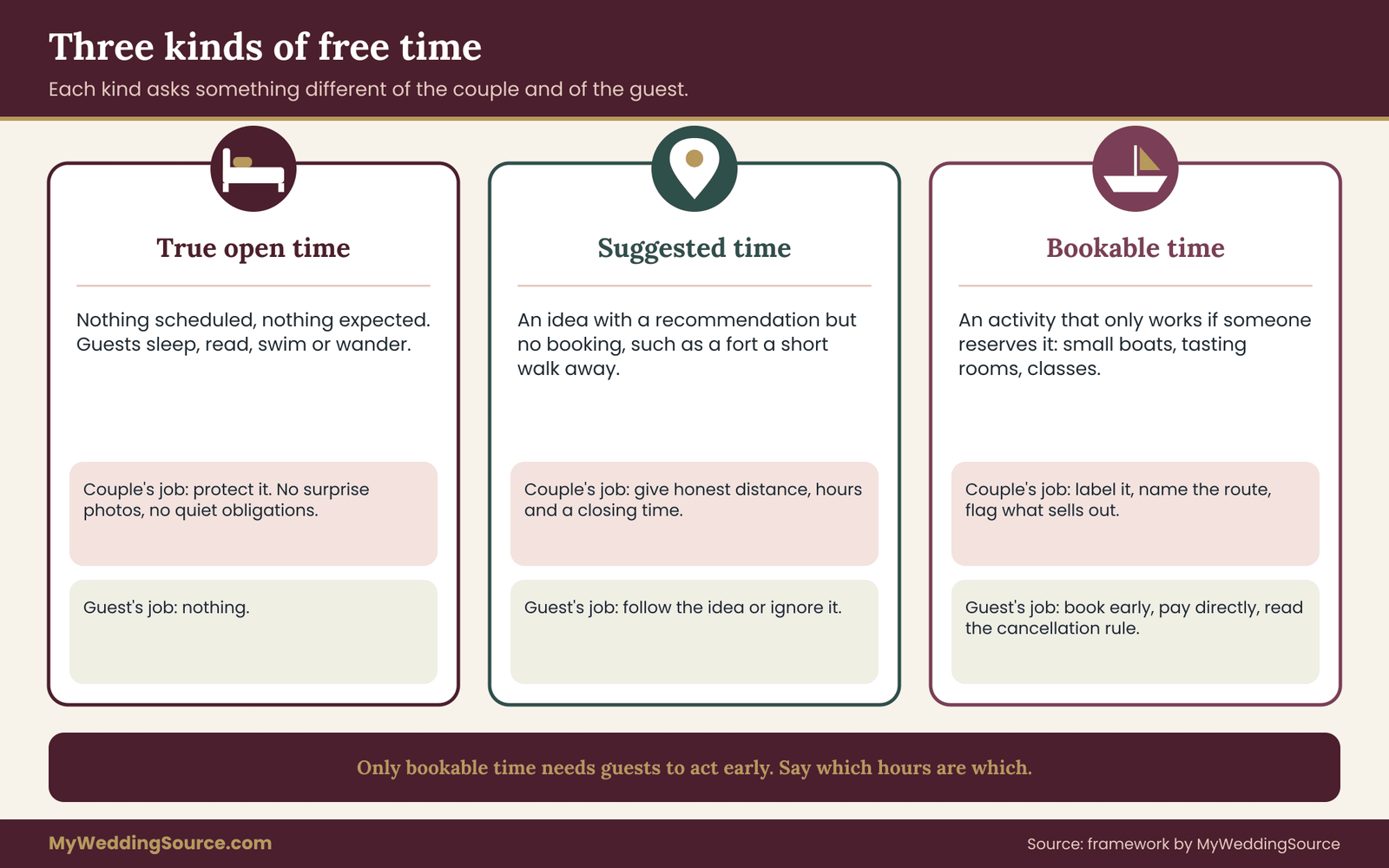
The first is true free time: hours with nothing scheduled and no expectation. A guest might sleep, read by a pool, wander into town or take a long lunch. This time does not need a plan. It needs protection, which means you do not fill it with a surprise group photo or an optional hike that quietly becomes expected.
The second is suggested time: hours where the couple has an idea and a recommendation but no booking. “The old fort is a fifteen-minute walk from the hotel and is open until five” is suggested time. Guests can follow the idea or ignore it, and you carry no cost or risk.
The third is bookable time: hours where an activity exists but only works if someone reserves it. A boat trip with eight seats, a restaurant that takes tables for six, a cooking class that needs a day’s notice. This is where guests get stuck, and this is the part the rest of the guide spends most time on.
Why this matters more at a destination
At a wedding in your home town, free time takes care of itself; guests know the area and improvise. Guests know the area, have cars and can improvise. At a destination wedding, guests arrive without a car, without local knowledge and often without a firm sense of how long things take. A beach that looks ten minutes away may need a taxi and a ferry.
Free time also matters because guests have limited days off and paid for flights. A guest who spends three days in a place and sees only a hotel lobby and a reception hall may feel they missed something, even if nobody told them they should have done more. A short, honest catalog fixes that quietly.
What hosts usually get wrong
Three mistakes show up again and again, and none of them comes from bad intentions.
One is silence. The couple assumes guests will figure it out, and then half of them discover that the one activity everyone wanted was sold out two months earlier. Another is over-scheduling, where every afternoon has a hosted option and guests feel obliged to attend all of them. The third is vague pricing: “free time activities are available” with no sense of whether that means free, forty dollars or four hundred.
Each mistake has the same cure for free time planning. Put the real information in one place, label it clearly, and say who is responsible for what. The rest of this guide shows how.
Where this guide sits next to other planning
You will see overlap with other decisions you are making. Lodging choices shape which free time options guests can reach, which is why the guest hotel and mobility guide is worth reading beside this one. Rules about who pays for what sit within the wider wedding etiquette conversation. And your overall cost picture belongs in the wedding budget you already keep.
None of that needs to be settled before you start the catalog. You can begin with a blank page and a list of the free time blocks in your weekend.
The central tool in this guide is a set of five labels. Every free time activity in your catalog gets exactly one. The labels answer two questions that guests care about more than any description: who books this, and who pays for it?
Hosted. The couple books it and pays for it. Guests only need to show up, perhaps after replying that they are coming. A welcome reception and a farewell brunch are common examples. If you call something hosted, guests should never be asked for money at the door.
Group rate. The couple, or a planner, has arranged a price or a reserved block with a local provider, but each guest pays for their own place. Guests pay by a stated date, usually to the provider or through a sign-up form. The couple’s role is to negotiate, to collect names and to relay the rules. The couple does not pay unless numbers fall short and they have agreed to cover it, which should be stated openly.
Book yourself. Nothing is arranged. The couple lists the activity as a good option and names the provider or the booking method, but each guest reserves and pays directly. These are the items that guests really do need to deal with on their own, and they are the heart of this article.
Walk up. No reservation is needed. A guest turns up, pays on the spot or pays nothing, and takes part. Hiking a public trail, browsing a market, visiting a free museum day and sitting in a cafe all fall here. Walk-up does not mean risk-free. Hours and closures still matter, so it needs a line about when it works.
Free. Costs nothing at all: a public beach, a viewpoint, a garden path. This label is separate from walk up because some walk-up items have an entry fee, and guests should not have to discover that at a ticket window.
Why five and not three
A simpler system would say paid or free. That fails because it hides the most useful distinction, which is whether anything needs to be booked in advance. A guest staring at a “paid” activity cannot tell whether to book now or turn up on the day. Two guests might read the same listing and make opposite choices.
Five labels let you separate cost from effort. A free activity can still need a reservation (a timed-entry garden, for instance), and a paid activity might be walk-up (a market stall lunch). Cost and booking effort are different questions, and your catalog should answer both.
How to apply a label
Ask four questions in order. Is the couple paying? If yes, it is hosted. If no, did the couple arrange a price or a reserved place with the provider? If yes, it is group rate. If no, does the guest need to reserve in advance? If yes, it is book yourself. If no, does it cost money on the day? If yes, it is walk up with a price band. If no, it is free.
Run every idea through that sequence and write the label next to it. You will find that most of your list lands in the last three categories, which is how it should be. A destination wedding that has ten hosted activities is usually a wedding with too many obligations.

The price band that goes beside the label
A label alone does not tell a guest whether they can afford something. Next to each label, add a price band. Because prices vary by place and season and you should not state figures you cannot verify, use relative bands that you define once on the guest page.
A workable set: Free, Low (about what a casual lunch for one costs at the destination), Medium (about a sit-down dinner with a drink) and High (more than a night in a mid-range hotel room). The bands are your own, the anchors are things guests can picture, and you can still add a specific figure when a provider has published one. State the date you checked it.
Guests find this more useful than a bare number because it matches how they actually decide. Most people do not think “is this forty-two dollars?” They think “is this a lunch-sized spend or a big spend?” The bands answer that directly.
Building the free time catalog: what belongs on it
A free time catalog is just a one-page list with a consistent format. Its job is to let a guest read for two minutes and know what the weekend could hold. It should not read like a brochure, and it should not try to list everything the destination offers. Eight to twelve entries is usually plenty.
Start by collecting candidates from four sources: your own favorite places, the venue or hotel concierge, a local planner or operator if you have one, and the questions guests have already asked you. The last source is often the best. If five people have asked about a day trip, it belongs on the list even if you would not have picked it.
The categories worth covering
A balanced catalog covers a few different needs rather than ten versions of one idea. These categories tend to cover a mixed group well.
One easy, near-the-hotel option. Something reachable on foot or by a short ride, with no booking: a waterfront walk, a nearby cafe street, a small museum. Guests who arrive tired, travel with children or use a mobility aid need an option that costs little effort.
One half-day outing. A guided tour, a boat trip, a food walk or a garden visit that takes three to four hours including transport. This is the typical group rate or book-yourself item, and it is the one most likely to sell out.
One full-day or longer excursion. A national park, a historic town, an island. Offer it only if the distance is real and you can describe the transport honestly. Many weddings do not need one, and leaving it out is a legitimate choice.
One restful option for free time. A spa, a pool day, a quiet beach, a reading spot. Calling rest an activity sounds funny, but listing it tells guests that doing little is a normal way to spend the weekend.
One local-food option. A market, a cooking class, a famous bakery, a tasting. Food is how many people experience a place, and it scales across budgets.
One option for the early or late hours. Sunrise at a viewpoint, a late evening walk, a night market. Jet lag and different schedules mean some guests are awake when others are not.
That is six. Add up to six more from the same list if your destination supports it, but do not feel the free time catalog is weak with eight.
The fields every entry needs
Each entry should answer the same questions in the same order, so guests can compare quickly. Use these fields.
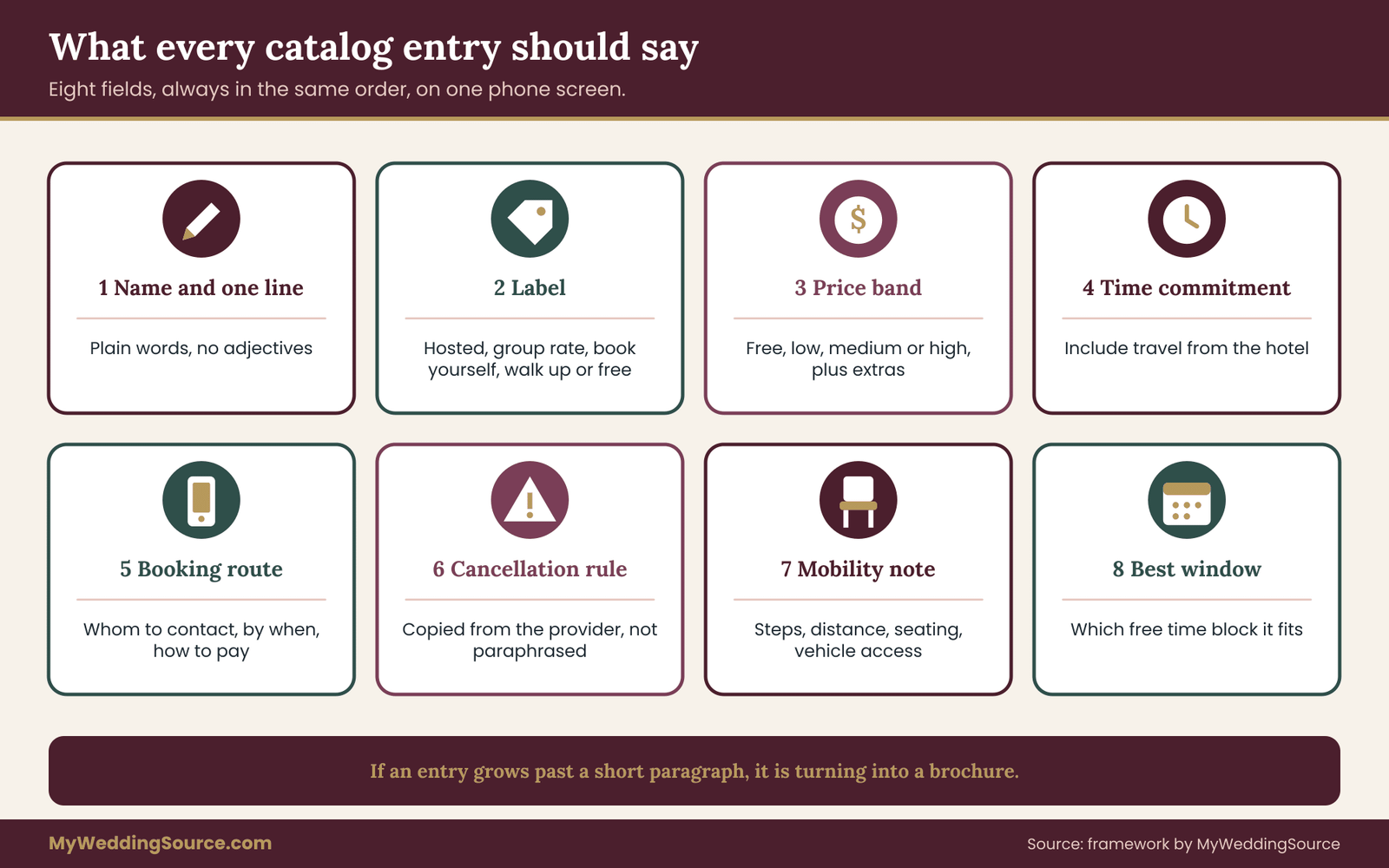
The name and a one-sentence description in plain words. The label from the five above. The price band, plus a specific amount only if you have a dated source. The time commitment, including travel to and from the hotel. The booking route: whom to contact, by when, and how to pay. The cancellation rule as the provider states it, copied faithfully. The mobility note: stairs, walking distance, uneven ground, vehicle access, whether a seat is available. And a best window, meaning which free time block in the weekend it fits.
The last field is the one most catalogs miss, and it is what turns a list into a plan. An activity that takes five hours cannot fit between a morning brunch and an afternoon rehearsal, no matter how appealing it sounds.
Three sample entries, written out
Seeing the format filled in helps more than describing it. The entries below are invented for an imaginary coastal town and use no real prices.
Harbor boat trip. Book yourself. Medium. A two-hour trip on a small boat with eight seats. Book once your flights are confirmed, because it fills in busy weeks. Price covers the boat and guide; the walk from the hotel to the dock is about fifteen minutes, and lunch and tips are extra. Cancellation follows the operator’s weather rule, which you should read before paying. One step down to the boat, with crew help. Best window: Friday morning.
Market morning. Walk up. Low. A covered market with food stalls and crafts, open most mornings. No booking. Bring some cash, since some stalls may not take cards. Flat floor, benches near the entrance, a short taxi ride from the hotel. Best window: Sunday late morning, after brunch.
Waterfront path. Free. A flat, paved path along the harbor with benches, about forty minutes round trip at a slow pace. Shade in the morning, none at midday. A good alternative to the viewpoint for guests who prefer level ground. Best window: any free time block.
Each entry fits on a phone screen. Each one answers who books, who pays, how much effort it takes and when it works. If an entry grows beyond a short paragraph, it is probably trying to be a brochure.
What to leave off
Leave off anything you have not checked. If you have never confirmed that a viewpoint is open in the season of your wedding, do not list it as a sure thing. Either check, or put it under a clearly marked “ideas we have not verified” line, or skip it.
Leave off activities that need specialist skill or carry real risk unless a licensed operator runs them and you can name the operator. Diving, climbing, rough-water boating and similar activities belong with a provider that holds the right permits, and guests should hear the provider’s own safety and age rules rather than your summary of them.
Leave off anything that excludes a meaningful group without saying so. A cliff-top path with steps is a wonderful option for many guests and a closed door for others. It can stay on the free time catalog if the mobility note is honest, and if there is a nearby alternative in the same time block.
Mapping the free time blocks of free time
Before you list a single activity, draw the weekend as hours. Most couples work backward from the events they host and discover they have more free time than they thought, and less than they assumed.
Take a plain sheet for each day. Mark the fixed anchors, since free time is whatever they leave: ceremony, reception, rehearsal, any hosted meal. Mark transport times to and from them, since guests need to get ready and travel. Then shade what is left. Those shaded stretches are your free time, and each block of free time has a length and a type.
The four kinds of day
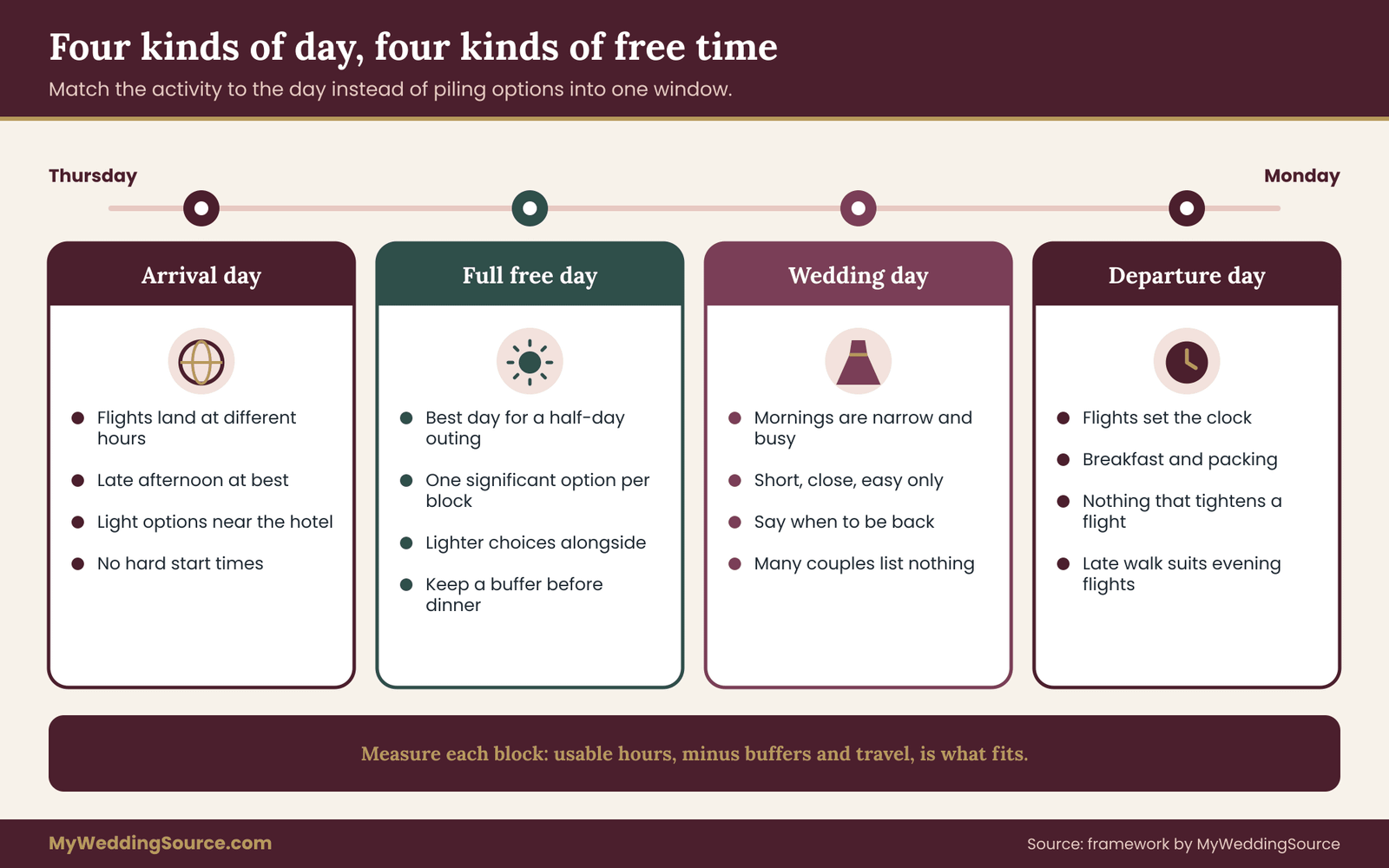
A destination weekend usually has four kinds of day, and the free time on each behaves differently.
Arrival day. Guests land at different hours, often tired. Free time here is mostly unusable for big plans. Aim for light options near the hotel and do not assume anyone will join anything before late afternoon. Flights delay and bags go missing, so an arrival-day activity with a hard start time will lose people.
Full free day. The day before or after the wedding, with no hosted events. This is where the half-day outing and the longer excursion live. It is also the day that matters most for guests who traveled a long way to see the place.
Wedding day. Hours before the ceremony are open but narrow. Guests are getting ready and may be nervous or busy with family. Suggest only things close by and short, and tell people when to be back, with a buffer. Many couples prefer to list nothing at all before the ceremony and let guests rest.
Departure day. Flights set the clock. Free time here is mostly breakfast and packing, and some guests leave before sunrise. Do not list anything that makes a flight tighter. A late morning walk is fine for guests whose flights are in the evening, and useless for everyone else, so say who it suits.
Measuring a block honestly
For each shaded block, write down three numbers: the usable length, the buffer you will keep on each side, and the longest activity that actually fits. A block from ten in the morning to four in the afternoon is six hours on paper. Subtract an hour to get ready and eat, an hour of buffer before the next event, and travel each way. The activity that fits might be a three-hour trip, not a six-hour one.
This arithmetic prevents the most common guest complaint, which is being rushed back from something they were enjoying. It also decides which entries on your catalog get a green light for which block.
The rule of one big thing in free time
A guest with a free time day usually has energy for one significant activity, and then for dinner. Two big things in one day tends to produce tired, short-tempered people the next morning, which is not what you want before a wedding. So aim for one significant option per free time block, plus lighter alternatives that run alongside it.
This rule works against the instinct to offer more. A catalog that shows a tour, a class and a hike all at ten o’clock in the morning can look generous, but it is simply a choice among three. Guests only get one of them. What they need is a spread across the weekend and a mix of effort levels, not a pile in one window.
Honest gaps
You will also find blocks that are awkward: ninety minutes between events, or an evening after the ceremony of the day before. Do not feel you must fill every pocket of free time. Label them in your own notes as “rest” and say nothing, or say “free time” on the guest page. A gap that nobody mentions is a quiet relief. A gap with a forced activity becomes an obligation.
From blocks to the free time catalog
Once the blocks are drawn, go back through your catalog and give each entry a best window. Where two entries compete for the same block, decide whether you want both, and if so make sure they differ in effort or cost. Where a block has no entry, check whether that is deliberate. Some blocks should be empty.
You now have a grid, drawn in your own notes, that connects time and options. It is the skeleton of what you will send to guests, and it is far easier to build from than a blank page.
Booking lead times: what guests should book before they fly
The most useful thing a catalog can do is tell guests which items to reserve early and which to leave alone. Booking too early locks money and flexibility. Booking too late means the best items are gone. The difference comes down to supply.
Sort every entry into one of three lead-time groups, based on how limited it is.
Group one: book as soon as plans are firm
These items have a small supply and a fixed schedule. Examples are small-boat trips, guided tours with a cap on group size, tasting rooms that seat few, popular restaurants that take a limited number of tables, timed-entry sites and any private driver or guide. In busy seasons they fill weeks ahead, and during local festivals or holidays they may fill months ahead.
Tell guests to book these once their flights and hotel are confirmed, because that is the point when they know which days they will be there. Before then, a reservation is a guess. After that, waiting only costs options.
The catalog should say, plainly, “this one sells out.” Do not say it unless you have checked with the provider, and do not say it to create urgency. If a provider tells you it rarely sells out, say that instead.
Group two: book a few weeks ahead
Many half-day activities have more capacity but still need a name on a list. Cooking classes, guided walks, bike rentals and boat charters with flexible seating usually fit here. A good rule of thumb for guests is to reserve once the weekend schedule is published, and to avoid leaving it until they arrive.
For this group, the provider’s own booking page is the authority. The catalog should tell guests where it is and what the provider says about notice periods, rather than guessing at a number.
Group three: decide on the day
Walk-up and free items need no early action. Markets, public beaches, parks, cafes and most museums fall here. Telling guests to wait protects them from the most common over-booking trap, which is paying a nonrefundable deposit for something they could have done for nothing.
There are exceptions, and the free time catalog should name them. Some museums have timed tickets on certain days, some trails need permits in certain seasons, and some beaches have a fee or a closure after storms. If you have not checked, say “check the current hours and any entry rules before you go.”
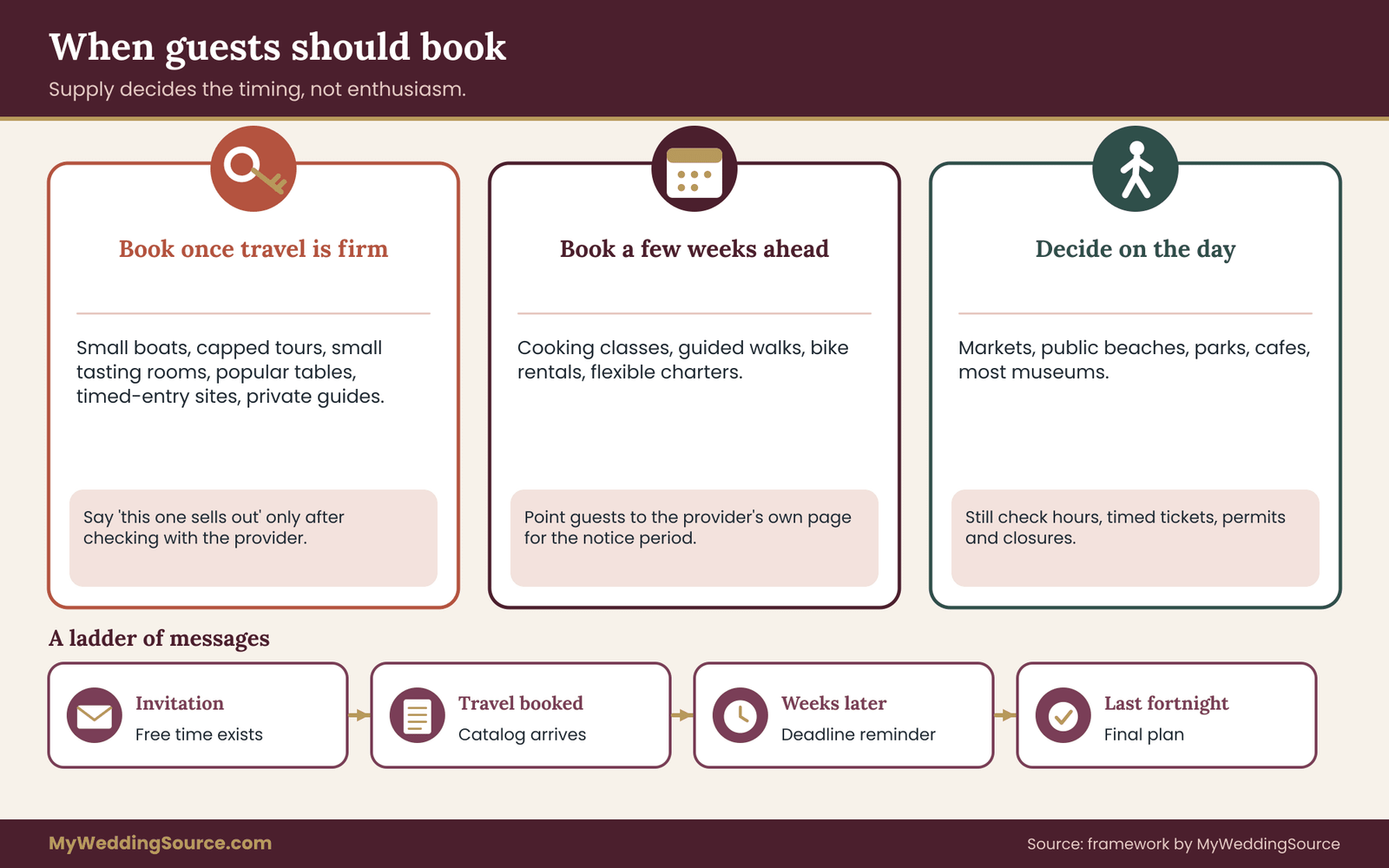
A simple ladder of messages for free time
Many guests respond well to a short sequence. Here is one that fits most weddings, expressed as a timeline rather than a deadline, since your own dates will vary.
When the invitation goes out, guests learn that free time exists and that a catalog is coming. When travel is booked, the free time catalog arrives and highlights the group one items. A few weeks later, a reminder lists anything with a booking deadline. In the last fortnight, a short message sends the final plan, local contacts, and a reminder that free time is open.
This ladder keeps every message small. You never have to send a long email, and guests do not have to dig for dates.
Passports, health and entry rules
Free time planning has a quiet dependency: whether the guest can enter the country and be well enough to enjoy it. For activities outside the main town, entry rules and travel health matter more than usual.
Guests who are traveling abroad should check passport validity and any visa or entry requirement with official sources well before booking nonrefundable activities. The U.S. Department of State publishes country information and travel advisories for U.S. citizens, and guests from other countries should consult their own government. For health, the Centers for Disease Control and Prevention publishes destination guidance, and it advises seeing a health care provider ahead of international travel; the earlier the better when vaccines or medicines are involved.
You do not need to repeat those rules in the free time catalog. You do need to tell guests where to find them, and to say so before they spend money on a trip that might need documents they do not have.
What to do about deposits
Some book-yourself items ask for a deposit or full payment at booking. Tell guests to check three things before paying: whether the price is per person or per group, whether the deposit is refundable and until when, and whether the provider charges extra for taxes, fees, equipment or tips.
Paying by credit card usually gives guests more recourse than other methods if something goes wrong. The Consumer Financial Protection Bureau explains billing error and dispute rights, including that disputes generally need to be made in writing within a short window after a statement. Pointing guests to that agency is more useful than offering your own summary.
The honest price of a free time day
A price band tells guests how big a cost is. It does not tell them what the whole day costs. A boat trip listed at a medium band may need a taxi to the dock, a hat, snacks, a tip for the crew and a late lunch afterward. The honest price is the whole of it.
You can help guests see that without becoming an accountant. For each book-yourself and group-rate entry, ask the provider and your own judgment three questions: what is included, what is extra, and what will most people end up spending beyond the ticket?
The extras that surprise people
A short list of extras covers most surprises. Transport to and from the starting point, since many activities begin outside the hotel zone. Entry fees at sites visited during a tour that sell tickets separately. Gear rental, such as snorkel sets or helmets. Meals, when a tour spans lunch and does not include it. Tips, which differ by country and by service. Currency conversion and card fees on foreign payments. And local taxes, which some providers add at checkout.
Guests do not need a figure for each. They need to know the categories exist. A line such as “Price covers the boat and guide. Lunch, tips and the taxi to the dock are extra” is honest and takes seconds to write.
Pricing group-rate items fairly
If you negotiate a group rate, the guests deserve to know how it works. Ask the provider whether the discount depends on a minimum number of people, and what happens if fewer join. Tell guests your answer: either the activity runs only if enough sign up, or the couple covers a shortfall, or guests share the difference. Each is acceptable. Hiding it is not.
Be careful with anything that looks like a markup. If you collect payment from guests and pass it on to a provider, pass on exactly what the provider charges. If the couple takes a fee, say so, and think carefully about whether it fits the spirit of a wedding invitation. Most couples simply pass costs through, or ask guests to pay the provider directly, which avoids the question.
A worked price comparison in prose
Imagine two guests looking at the same half-day boat trip, listed as medium. The first lives nearby and is already at the hotel. She pays the ticket, walks to the dock and eats lunch at a cafe in town. Her day costs about what the ticket costs plus a modest meal.
The second flew in, has no car and must take a taxi each way, which in this imaginary place costs about as much as the ticket itself. His honest price is nearly double the listing. If the free time catalog had said “the dock is outside the walkable zone; a shared ride can be arranged,” he could have joined a group ride and cut the cost, or chosen a different outing.
This is the reason the free time catalog carries both a band and a note on how to reach the start. It makes the real cost visible without a spreadsheet.
Keeping cheaper free time paths visible
Guests have different budgets and the free time catalog should show that on purpose. For each paid half-day item, try to list a free or low-cost alternative in the same window. If the paid option is a guided food walk, the alternative might be the same market on your own with a suggested route. If it is a boat trip, the alternative might be the public ferry, which gets guests onto the water for less.
You do not have to make the cheaper path the star. You do have to include it, so that a guest on a tight budget sees that there is a way to take part in the weekend without feeling left out. Money should never be the reason someone hides in their room.
Where the couple’s own money goes
If you want to cover some free time costs, decide it as a rule rather than case by case. Common patterns include paying for a single shared outing so everyone has a common experience, paying for transport so location is not a barrier, or covering costs for the wedding party only. Each has trade-offs, and the main one is perceived fairness. Whichever you choose, state it and apply it consistently.
Then log it in your wedding budget as its own line, so it does not disappear into “miscellaneous.” Hosted free time is a real cost, and it tends to grow when nobody is watching.
Matching free time options to different guests
A catalog works best when each guest can find their own kind of free time in it. You will not know everyone’s preferences, but you can group guests by the constraints that affect their free time most, and check that at least one option works for each group.
Guests with limited mobility
Older relatives, guests with injuries and anyone who uses a cane, walker or wheelchair need specific information, not general reassurance. “Accessible” means different things to different providers, and it is often used loosely.
For each entry, the mobility note should say how much walking is involved, whether there are steps or uneven ground, whether a vehicle can reach the start, and whether seating is available. When you do not know, ask the provider and write down the answer in their own words. When a provider cannot say, mark the entry “not confirmed” and offer a nearby alternative.
The Americans with Disabilities Act applies to places in the United States, and guests will find that rules abroad differ. Provider answers matter more than assumptions about a country’s rules. The guest hotel and mobility guide covers the lodging side of this, including how room access shapes what a guest can do next door.
Families with young children
Parents need a different kind of information. Is there a minimum age? Do infants need a ticket? Are life jackets available in small sizes? Is there shade, a toilet, a place to change a baby? Does the schedule survive a nap?
Many parents are happy to skip organized activities and use the hotel pool. The catalog should give them a clear signal that doing so is fine. It should also flag the options that suit children well, so a family can pick one without reading ten pages. For wider support, from childcare to older relatives, the guest care planning guide goes through what to arrange.
Guests traveling alone
A solo guest may arrive not knowing anyone besides the couple. Free time can feel exposed: sitting alone at a table for six, or being the odd one out on a tour. Small group options and shared meals help. So does a simple note like “We can introduce you to others who are going.” Offer that only if you will follow through, and ask the solo guests’ permission before sharing contact details.
Guests on a tight budget
You may not know who they are, and they may not say. Budget-conscious guests are often already stretching to attend, and the cost of the flight and hotel has used most of what they planned to spend. A catalog with several free and low-cost options tells them they are welcome without anyone asking.
Keep the tone matter-of-fact. Avoid phrases such as “for those who want to splurge,” which implies that others are being cheap. Say “Medium band” and move on.
Guests with dietary restrictions or health needs
Food-related activities need an honest line about allergies and dietary rules. If a cooking class cannot adjust for a severe allergy, say so. If a tasting is mostly alcohol, mention that a nonalcoholic option may or may not exist, and ask the provider. Guests should not have to discover those things after paying.
Health needs vary widely, from heat sensitivity to medication schedules to a need for easy access to a bathroom. A general line on the catalog helps: “If you have a health or access need, tell us and we will help you find the right fit.” Then be ready to answer.
Guests who want free time to be empty
Some will want no activities at all, and that is a good outcome, not a failure of the catalog. Make sure that the guest page tells them where the pool, the quiet spaces and the nearest good coffee are. Free time that comes with a short list of calm places feels like a gift.
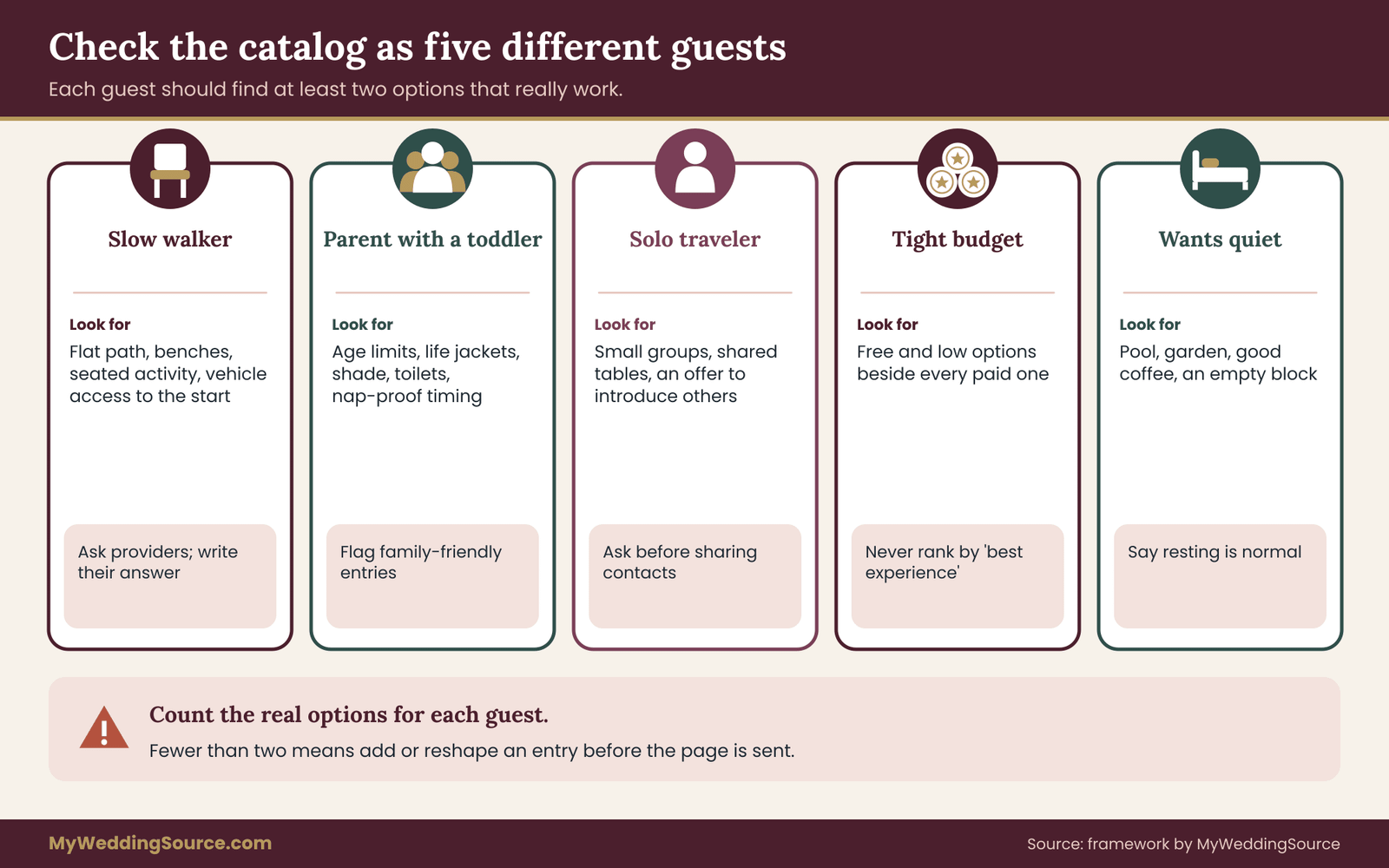
Checking the match
When the catalog is drafted, read it as five different guests: an older relative who walks slowly, a parent with a toddler, a solo traveler, someone watching their budget, and someone who wants quiet. Count how many entries each of them could actually take. If any guest finds fewer than two, add or reshape an entry before sending.
Vetting what guests book themselves
When you put a provider’s name in a free time catalog, guests will read it as a recommendation. That means you carry some responsibility for what you list, even if you receive nothing for it and the guests pay directly. Take a modest, consistent approach to checking.
What you can and cannot promise
You cannot guarantee another business’s service. You can, however, check basic facts and be clear about what you checked. A good catalog line reads like this: “We have not used this provider ourselves. We confirmed their hours and cancellation rules on the date shown.” That wording is honest and sets expectations.
If you have used the provider, you can say so in plain terms, but only if it is true. Do not invent a personal experience to make an entry sound warmer. Guests can tell, and the wedding site is a poor place to be caught.
If you receive any payment, discount or free service from a provider, say so near the listing. Many couples receive nothing, and many planners earn commissions. Either way, guests are entitled to know when money is involved. The Federal Trade Commission publishes guidance on disclosing material connections, and its principle is simple: if a relationship might affect how much weight people give a recommendation, say so clearly.
Seven questions to ask every provider
Send these in writing, so you have the answers on record.
- What exactly is included in the price, and what costs extra?
- What is the cancellation and refund policy, in full, including weather cancellations?
- What are the minimum and maximum group sizes, and what happens if the minimum is not met?
- Is the provider licensed or permitted for this activity, and can they show it?
- What are the age, health, mobility and safety requirements?
- What happens if the provider cancels, and how are guests told?
- Who is the contact on the day, and how can guests reach them?
Keep the replies. If a provider will not answer in writing, treat that as information.
A message you can send to a provider
Short, specific and polite works best. Something like this: “We are hosting a wedding for about sixty guests in your area on these dates. Some guests may want to book your half-day trip on their own. Could you tell us what the price includes, your cancellation and weather policy, group size limits, any age or mobility requirements, and the best way for guests to book? We would like to list your details accurately and will confirm them again a month before.”
The last sentence matters. It tells the provider you will check, and it signals that accuracy is the reason for the questions, not a bargaining position. Replies tend to be fuller when the provider can see that you are not asking for a discount.
Red flags worth taking seriously
A few signs should make you pause. Pressure to pay a large deposit immediately, especially by wire transfer or other methods that are hard to reverse. Refusal to put terms in writing. Prices that are far below comparable local options without explanation. A website with no verifiable address, no business registration and no reviews outside the provider’s own pages. Staff who cannot describe the safety plan for a physical activity.
None of these proves bad faith, and some small local operators are simply informal. But for any activity with risk or real money involved, informality is a reason to choose a different provider or to leave the item off the catalog.
Checking the provider’s own claims
Permits, licenses and insurance differ from place to place, and in many destinations the rules are enforced unevenly. You are not expected to audit regulators. You are expected to ask, record the answer and decline to list providers who dodge. For national parks and protected areas, the managing agency’s website usually lists approved operators and access rules, which is a more reliable source than any directory.
A short record sheet for each entry
Keep a simple note for every entry: provider name, date you checked, what you confirmed, what you could not confirm, and the date you will check again. Prices, hours and seasons change, so set a reminder to re-verify a month before the wedding and again in the final fortnight. If something has changed, update the catalog and tell guests who already signed up.
That one-page note takes minutes per entry and saves hours if a guest later asks what you knew.

Worked example: a three-night wedding in a small harbor town
The example below is invented to show the method. The couple, the town and the numbers are illustrative, not data from a real wedding or a real place. Use it as a pattern, not as a source for prices.
Mara and Dev are marrying in a small harbor town reached by a morning ferry. They have about sixty guests. Most arrive Thursday afternoon, the ceremony is Saturday at five, and most people leave Monday. Dev’s grandmother uses a walker. Mara’s college friends are on tight budgets. Two families are bringing small children.
Step one: draw the free time blocks
They mark their anchors. Thursday evening has a hosted welcome drink. Saturday has the ceremony and dinner. Sunday has a hosted brunch at eleven. Everything else is open. Friday is a full free day. Saturday morning is open until about two. Sunday afternoon is open until guests leave or until dinner.
Working through the hours, they find three real blocks: all of Friday, Saturday from nine to noon, and Sunday from one to five. Thursday afternoon is arrival and does not count. Monday is departure. They decide to protect Saturday morning by listing nothing at all except a short walk nearby and a reminder to eat.
Step two: build and label the catalog
They collect ideas from the hotel concierge, a local guide Mara met on a scouting visit, and questions from guests. Then they label each one.
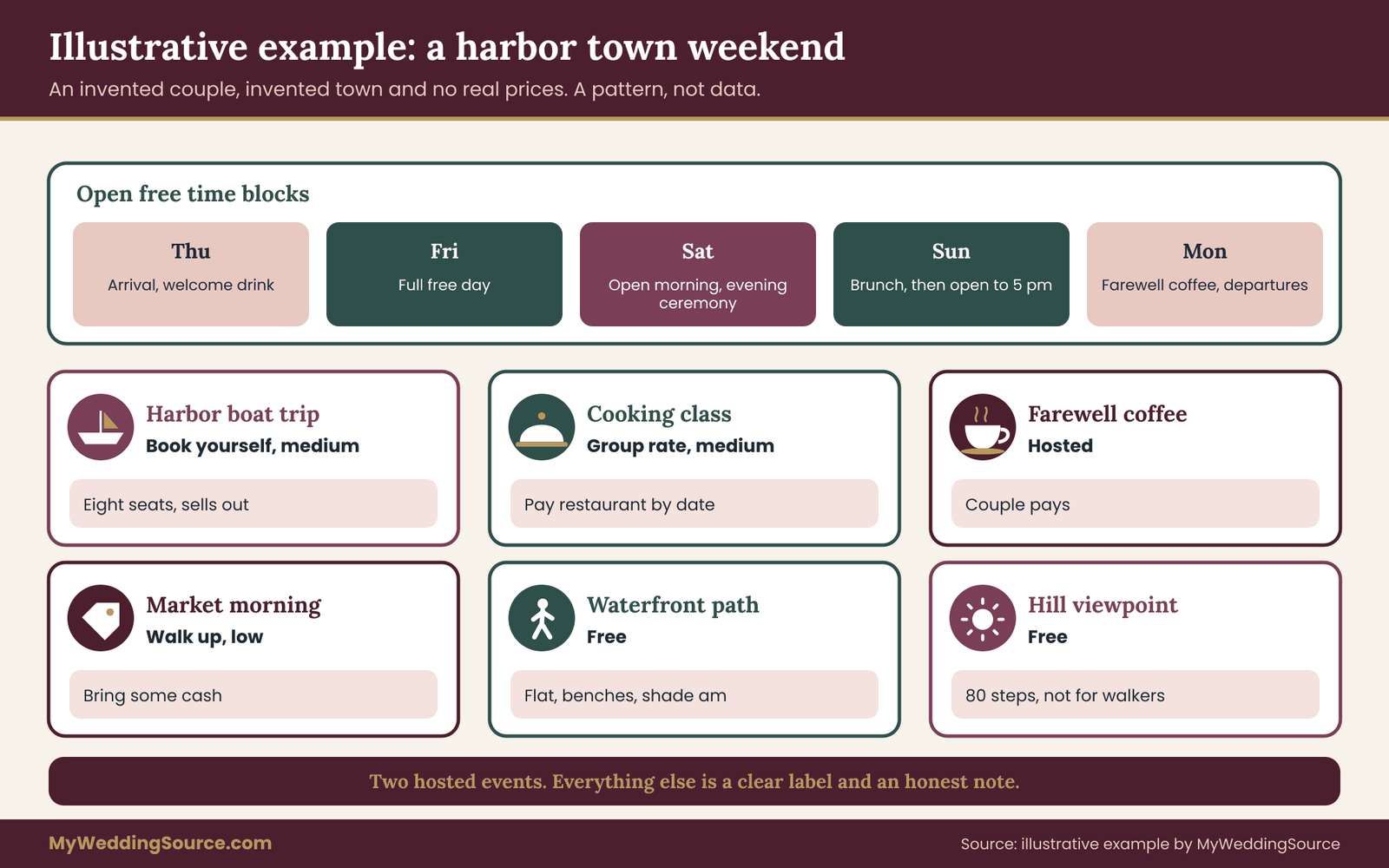
In their free time guide, the ferry ride that everyone takes anyway is free to look at and cheap to ride, so it is walk up, low. A guided harbor boat trip with eight seats is the one item that sells out, so it is book yourself, medium, with a note to book as soon as flights are confirmed. A small-group cooking class at a family restaurant is group rate, medium: Mara negotiated a lower per-person price for ten or more guests, and each person pays the restaurant by a stated date.
A hosted farewell coffee on Monday is hosted. The public beach is free. A hill viewpoint with eighty steps is free, with a mobility note and a nearby alternative: a flat waterfront path with benches.
They add a restful item, a quiet garden café near the hotel, labeled walk up, low. And a market morning on Sunday, walk up, low to medium, which suits late risers.
Step three: the honest price
Next to each entry they write the band and the real extras. The harbor trip lists the dock as a fifteen-minute walk from the hotel and says lunch and tips are not included. The cooking class lists the restaurant’s cancellation rule as the owner stated it in writing. The market entry says to bring cash because some stalls do not take cards, which Mara confirmed on her scouting trip.
For the grandmother, the harbor trip note says there is a step down to the boat and a crew member to help; Mara asked the operator and wrote down the answer in their own words. The viewpoint entry says clearly that it is not suitable for walkers.
Step four: check against five guests
They read the catalog as five people. The grandmother has the waterfront path, the garden café and the cooking class. The college friends have the free beach, the market, the ferry and a clear low-cost route to the cooking class. The parents have the beach and a note that the harbor trip takes children over five, which came from the operator. A solo guest has the cooking class, a shared table. A guest who wants quiet has the garden and a no-activity Saturday morning.
Every guest has at least three real options. Mara and Dev notice that Sunday afternoon has only one entry, add a second, and send the catalog.
Step five: the lead-time messages
At the save-the-date, they write that there will be a few hosted events and a lot of free time. When most guests have booked travel, they send the catalog and flag the harbor trip as the item to book early. Two weeks before the deadline for the cooking class, they send a one-line reminder. In the last fortnight they send the full weekend page and a note that Saturday morning is deliberately empty.
What the example shows
Mara and Dev hosted only two events beyond the wedding, yet their guests’ free time felt supported, and guests felt well looked after. The catalog took a few evenings. The only paid commitments they handled were the group-rate class and the hosted farewell coffee. Everything else was clear information, which cost them nothing but time.
Notice also what they did not do. They did not book a full-day excursion, because the harbor town has none that is worth the distance. They did not schedule Saturday morning. And they did not ask guests to commit to anything before knowing their travel.
Alternatives compared: four ways to handle free time
Not every wedding needs a catalog of free time. The right level of help depends on the group, the place and the couple’s energy. Here are four approaches, described side by side in plain terms.
Approach one: say nothing about free time
You tell guests the date, the venue and where to stay, and leave the rest to them. This costs you nothing and requires nothing. It works well when the destination is a large, easy city where guests can find things on their own, when the group is small and close, or when most guests already know the area.
It works badly when the place is remote, when guests are older or traveling with children, or when the best experiences need advance booking. The risk is not that guests are unhappy with you; it is that they are disappointed with the trip and do not say so.
Approach two: a light list
You send a short list of ideas, without labels or prices, perhaps in the same message as the schedule. This takes an hour and helps with the biggest uncertainty, which is what is around the hotel. It suits informal weddings and groups with similar budgets.
Its weakness is that guests still have to work out cost and booking effort for themselves, and they may spend time on the wrong questions. A list of ten ideas with no signals tells guests nothing about what sells out.
Approach three: the labeled catalog
This is the approach this guide describes. It takes several evenings and some checking. It gives guests honest price bands, booking routes and deadlines. It suits most destination weddings of more than a few dozen guests, especially in places where supply is limited or where guests vary in budget and mobility.
The cost is your time, and the catalog needs updates when facts change. Its strength is trust: guests see that the couple has thought about them without having organized them.
Approach four: a full hosted program
You plan and pay for most free time yourself, or you arrange it through a planner or travel company, with set departures and a fixed price. This offers the most control and the least work for guests, and it suits couples who want the whole group to share each outing.
The trade-offs are cost, obligation and variety. A full program is expensive, guests may feel they must attend, and it leaves little room for people who want to do something different. It can be the right choice for a small wedding with a large budget, or for a place with few options and difficult logistics.
Choosing between them
Ask four questions. How well do guests know the place? How limited is supply? How varied are their budgets and mobility? How much time and money do you want to give? If the answers are “poorly,” “very,” “very varied” and “a modest amount,” the labeled catalog is almost always the best fit.
Many couples mix approaches, hosting one shared outing and offering a catalog for everything else. That is perfectly sound. What matters is that each item sits under one honest label, and that guests are never left guessing which kind of item they are looking at.
Edge cases: when free time plans go sideways
Even a careful catalog meets surprises. Most of them are small, and a few rules of thumb cover nearly all of them. Decide the rules in advance so that you are not inventing policy at midnight in a hotel lobby.
Weather and seasonal closures of free time options
Weather changes outdoor plans, and seasonal closures change them more. Trails, ferries, boat trips and beaches can close for conditions that nobody could predict months earlier. The catalog should say, for every outdoor entry, that conditions can cancel it and that guests should read the provider’s weather policy before they pay.
Have a rainy-day alternative for each significant block. It need not be elaborate: a museum, a covered market, a long lunch somewhere warm. The goal is that a canceled boat trip does not leave a guest with a gap and nowhere to go. A short line in the final message, such as “if the weather turns, these three options work indoors,” removes most of the stress.
For the destination itself, check local sources for the season. For places in the United States, the National Weather Service publishes forecasts, and public land managers publish closure notices. Elsewhere, local tourism boards and official park sites usually post current conditions. Check close to the date, because information from months earlier may be out of date.
Flight delays and missed events
Guests arrive late, and some miss entire blocks. For anything with a fixed start, tell guests what happens if they cannot make it: whether the provider refunds, reschedules or keeps the fee. This is exactly the sort of information the cancellation field exists for.
Encourage guests to book flexible options when their travel dates are uncertain. A catalog can add a gentle line: “If your flight is not confirmed, wait on book-yourself items, or choose ones with free cancellation.” That one sentence prevents a lot of lost deposits.
For the couple, build slack into your own schedule. If the main arrival day has flights landing until late, keep the first evening light and do not make the welcome event the only way to see the people you care about.
When an activity is canceled by the provider
Providers cancel. A boat breaks down, a guide falls ill, a minimum number is not met. Your catalog should tell guests what to expect, which is whatever the provider’s policy says, and it should tell them how you will pass on news.
If you hold a group-rate booking, ask the provider to tell you first, so you can tell guests quickly. Have a short message ready that names the change, the refund path and one or two alternatives. If guests paid the provider directly, the provider owes them the refund under its own terms; your role is to help, not to pay unless you decided that earlier. For paid bookings that go wrong, guests who paid by card can use the dispute process described by the Consumer Financial Protection Bureau.
A group splits during free time and someone feels left out
At some point, a subgroup will do something together and others will not be invited. Often this is innocent: college friends take a boat while family stays at the hotel. Sometimes it creates hurt feelings, especially when a visible clique forms around the couple.
You cannot prevent every awkward moment, and you should not try. You can make it easier by labeling every item as open to all, by avoiding private invitations inside shared channels, and by repeating that free time is open. If a particular activity is meant for the wedding party only, say so at the start.
Plus-ones joining free time activities
Some guests will ask whether they can bring a friend, a local relative or a travel companion. For hosted items, the answer belongs to the couple. For group-rate and book-yourself items, the answer belongs to the provider, and the guest can ask directly. A line on the free time catalog helps: “Group-rate places are for invited guests; for anything else, check with the provider.”
For hosted events, politeness helps. If your budget does not stretch, a plain and kind answer is fine. Guests generally understand that hosts are paying for specific people.
Safety, injuries and emergencies
Free time brings physical activity, unfamiliar places and sometimes alcohol. Most outings go fine, but you should know what you would do if one did not. Keep a short list of local emergency numbers, the address and phone of the nearest hospital or clinic, and the contact for the hotel front desk. Put it on the guest page, not in a long email.
For activities with a real risk, remind guests to read the provider’s safety briefing, to check whether their own travel insurance covers the activity, and to tell someone where they are going. The U.S. Department of State offers a program for citizens traveling abroad to register trips and receive alerts, and guests from other countries may have similar services.
You are not responsible for every accident, but you are responsible for making help easy to find. A one-line “If something goes wrong” box on the page usually settles it.
Alcohol and free time
Free time and drinking often travel together. Some guests will want a winery or a bar crawl, some will want none of it, and some are pregnant, in recovery or simply do not drink. The catalog should not push alcohol as the default way to enjoy a place.
For tastings, ask whether the venue offers a nonalcoholic option and say what they told you. For boat trips and long outings, mention whether drinks are included and whether they can be skipped. For any activity involving alcohol and transport, remind guests to plan a safe ride back. Short and calm is enough.
When a guest overspends or feels pressure to join
Some guests will spend more than they planned because they did not want to seem cheap. The catalog can reduce this by showing the low-cost options on equal footing, by never ranking items by “best experience,” and by giving a clear reason to skip: “Plenty of guests will spend this block resting.”
If a guest tells you they are struggling with cost, offer privacy and help. A couple might cover a single outing for someone, or arrange a shared ride. Do it quietly and do not announce it. The wedding etiquette conversation on this site covers how hosts and guests share costs in general.
Measurable checks before you send
A few simple checks turn a draft into something you can trust. None of them needs special tools.
Count the entries by label. If more than a third are hosted, you may be carrying too much. Count the entries per free time block. Every full day should have at least one easy option and no more than one significant outing at the same hour. Check that every book-yourself entry has a booking route and a date you verified. Check that every outdoor entry has an indoor alternative somewhere in the same block.
Then check the reading time. A guest should be able to read the whole page in about five minutes on a phone. If it takes longer, cut entries or shorten them. Finally, ask one friend who is not in the wedding to read it and tell you what they would book first. Their answer shows whether the labels work.
Telling guests: the free time page and the messages
A catalog is only useful if guests find it and understand it. That means a single page, a few short messages and a calm tone. The goal is information, not enthusiasm.
One page that holds all the free time information
Put the free time catalog on your wedding website or in a shared document, on one page that guests can open on a phone. Lead with a short paragraph that says what the page is for. Something like: “Here are things you might want to do with your free time. Nothing here is required. Some need booking ahead; the labels show which.”
Then list the five labels with a one-line explanation of each, so no one has to guess. Below that, list the entries grouped by the block of the weekend where they fit best, rather than by type. Guests think in days and mornings, not in categories.
At the top, add the single thing most guests need: a short “book this soon” list with the group-one items and their deadlines. At the bottom, add contact details for questions and the emergency box described above.
The first message
When guests have confirmed travel, send one short message pointing to the page. It should say that the page exists, that nothing is required, which items sell out, and when you will send the final plan. It should not list every item or repeat the whole catalog. Guests who want detail will click.
A sample in plain language: “We have put together a page of things to do with your free time. Nothing is required. A few options, such as the harbor boat trip, are small and sell out, so if you want one, book once your flights are set. Everything else can wait until you arrive.”
Reminders and updates
Send a reminder for each deadline, and send nothing more than needed. If something changes, a canceled activity or a closed trail, say so in one short message with the new option. Keep a changelog at the bottom of the page with dates, so guests can see what is current. A backup communication plan is worth borrowing from for last-minute notices, especially when mobile service is patchy.
The final plan
In the last fortnight, send the full weekend page, now with times, meeting points, contacts and the open-time reminder. Include a short list of local numbers and a line on what to do if plans fall through. At this stage, remove anything canceled and mark any item with a changed price.
Wording that keeps it light
Use verbs that give guests permission: “you might,” “if you like,” “some guests will.” Avoid verbs that imply duty: “you should,” “do not miss,” “everyone will.” Avoid superlatives and hype. A description such as “a two-hour walk along the harbor, flat and shaded in the morning” does more than any adjective.
When a guest says they are skipping everything, treat it as a normal answer. A warm “enjoy the rest” costs nothing and keeps the weekend easy for everyone.
Your next steps
You do not need to build all of this in one sitting. Work through the steps below in order and stop when your free time plan fits your wedding.
First, draw the blocks of free time on a sheet for each day, marking anchors, transport and buffers. Second, collect ten to fifteen candidate activities from your own favorites, the venue, a local contact and the questions guests have already asked. Third, run each one through the four-question label sequence and write the label and price band beside it.
Fourth, send the seven provider questions in writing for every entry that is not walk up or free, and keep the answers. Fifth, add the fields to each entry: time commitment, booking route, cancellation rule, mobility note and best window. Sixth, read the draft as five different guests and fix anything that leaves one of them with fewer than two real choices.
Seventh, build the single free time page and the first message, and send them once most guests have confirmed travel. Eighth, put a reminder in your calendar to re-verify prices, hours and seasonal closures a month before the wedding and again in the last fortnight. If you are still setting the larger sequence of decisions, the wedding planning overview can sit beside this guide as the master timeline.
A final check before you send the page: could a tired guest, with a modest budget and a slow-walking relative, find a good weekend in it? If the answer is yes, the free time plan is ready.
FAQ
What does a destination wedding free time itinerary need to include?
Keep it short. A destination wedding free time itinerary needs the free time blocks of the weekend, a handful of labeled activities, a price band and a booking route for each, and a note on which items sell out. It does not need a minute-by-minute schedule. Guests should see what is hosted, what is optional and which choices need early action.
Should guests book their own activities at a destination wedding?
Usually yes, for anything the couple is not hosting. Guests know their own budgets, energy and travel dates, and direct booking keeps money simple. The couple’s job is to name the options, flag the ones that sell out, and say who pays. Group-rate items are the exception, since the couple has arranged them in advance.
How far ahead should guests book free time activities?
It depends on supply. Small-group tours, popular restaurants and timed-entry sites can fill weeks or months ahead, so guests should book them once flights and hotel are confirmed. Larger or flexible items usually need less notice. Markets, public beaches and parks need none. Check each provider’s own booking page for its notice period.
Do the couple have to pay for guests’ free time activities?
No. Hosted events, such as a welcome drink, normally come from the wedding budget, but free time activities are usually paid by the guests who join them. What matters is stating who pays before anyone commits. If you cover part of the cost, say how much and what happens if fewer people sign up than planned.
How many free time options is enough?
Eight to twelve entries cover most weddings, and a smaller number works for a small group. What matters is range: one easy option near the hotel, a half-day outing, something restful, something food-related and a cheap or free alternative for each paid choice. More options rarely help and often make guests feel they are missing something.
How do we keep guests from feeling pressured to join?
Use permissive wording like “you might” and “if you like,” and avoid ranking activities by how special they are. Show free options beside paid ones, protect some blocks with nothing scheduled, and state plainly that resting is a normal way to spend the weekend. Do not track who attends.
What if a guest has limited mobility?
Ask providers specific questions: how much walking, whether there are steps or uneven ground, whether a vehicle can reach the start and whether seating is available. Write the answers in the entry in the provider’s own words, and offer a nearby alternative in the same time block. If a provider cannot confirm access, mark the entry “not confirmed.”
What should we do if an activity is canceled?
Follow the provider’s policy for refunds and rescheduling, and tell guests quickly with one short message that names the change, the refund path and one or two alternatives. Keep an indoor option ready for every outdoor block. Guests who paid by card can also use the billing dispute process explained by the Consumer Financial Protection Bureau.
Sources
- U.S. Department of State, Travel.State.Gov: travel advisories, passports and country information
- Centers for Disease Control and Prevention, Travelers’ Health
- Consumer Financial Protection Bureau: credit card billing errors and disputes
- Federal Trade Commission: endorsements, reviews and disclosing material connections
- U.S. Department of Transportation, Aviation Consumer Protection: refunds and flight delays
- Transportation Security Administration: travel guidance for passengers with disabilities and medical conditions
- ADA.gov: information on the Americans with Disabilities Act
- National Weather Service: forecasts and weather warnings
- National Park Service: park conditions, closures and permits
- U.S. Customs and Border Protection: international travel and returning to the United States