
Pet safe flowers are not a fixed list you can copy from a blog post. They are the result of a short, repeatable check: name the exact plant, confirm it in a veterinary source, decide which part of it a pet could reach, and write the decision down. This guide gives you that check, an exclusion list to start from, and a way to work with your florist so the arrangements are lovely and nothing in them sends an animal to an emergency clinic.
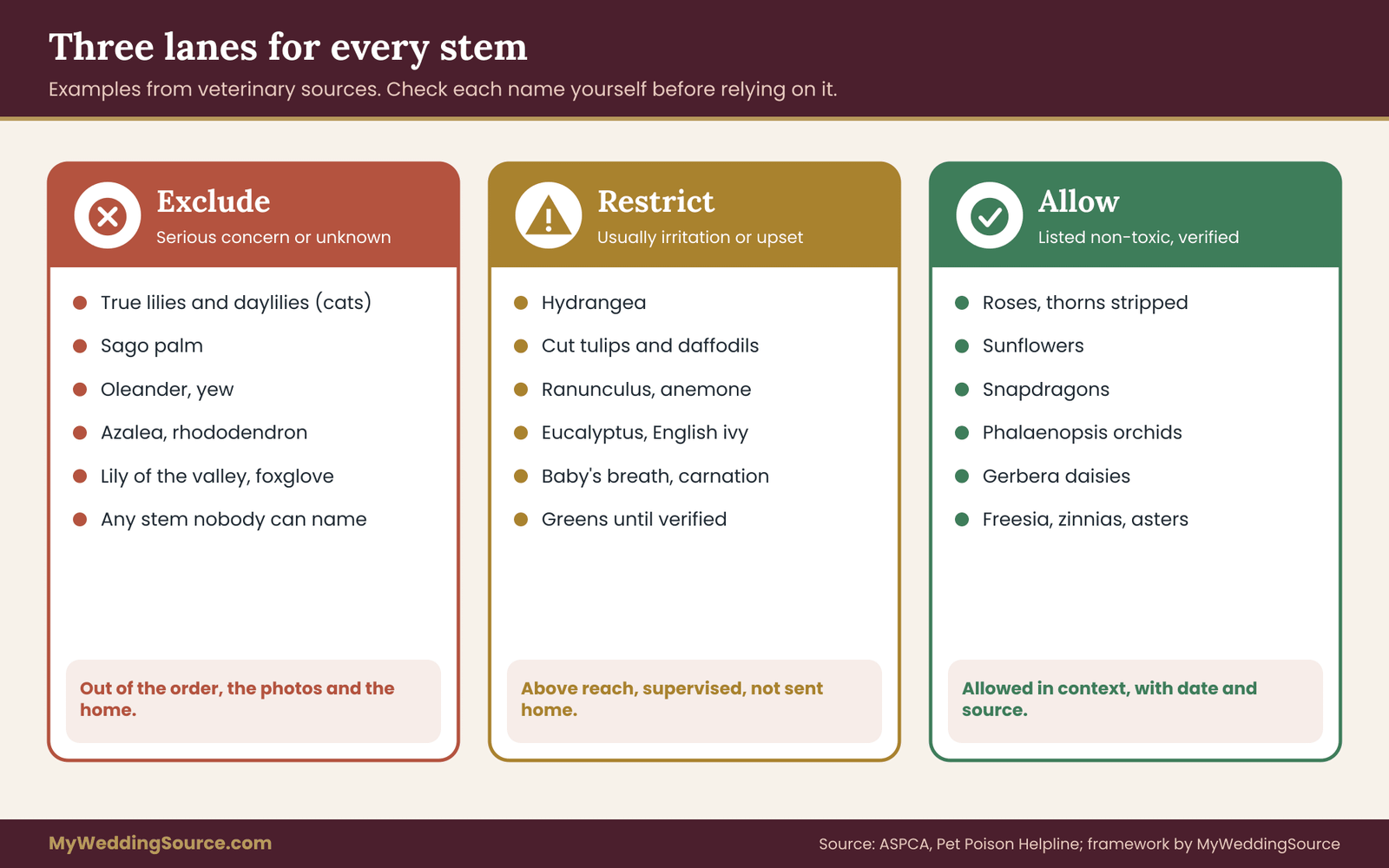
Ask your florist for every stem, filler and green by botanical name. Look each one up in the ASPCA toxic and non-toxic plant database and the Pet Poison Helpline list, and note the species it is toxic to. Sort every stem into three lanes: exclude (lilies near cats, sago palm, oleander, azalea and similar), restrict (keep out of reach, keep off the floor), or allow. Pet safe flowers also depend on extras such as foam, wire, preservative and pesticide, and on where the flowers go afterward. Give the florist the list in writing.
Plenty of couples never think about pet safe flowers until it is almost too late. They never think about plants and pets together until a week before the wedding, when a florist mentions that the bridal bouquet is mostly lilies and the couple’s cat lives in the same apartment where the bouquet will sit overnight. By then the order is placed. Others think about it constantly because a dog is walking down the aisle, and they are not sure whether the roses are fine or the greenery is the problem.
Both situations have the same fix for pet safe flowers, and it is more about process than about plants. A good list of pet safe flowers is a starting point. What makes flowers pet safe in practice is knowing that the list was checked against a credible source, for the right species, and applied to the flowers that actually show up on the day.
This article builds that process one piece at a time, and it stays on one narrow question: which flowers and greens should be excluded, restricted or allowed when pets will be near a wedding.
A note on scope. This is general information, not veterinary, legal or financial advice, and it cannot replace a call to your own veterinarian or a poison control service. Plant toxicity depends on the species of animal, the amount, the part of the plant and the individual pet, and the sources change their entries over time, so confirm each plant yourself before you rely on it.
If you are still working out whether animals will be at the wedding at all, ask your venue first and read the general wedding planning checklist to see where animals fit in your timeline. This article assumes the answer is already yes, or that pets will meet the flowers at home afterward, which happens more than people expect.
What pet safe flowers means, and what it cannot mean
The phrase sounds simple. In practice it hides three different claims, and mixing them up is how couples end up with a false sense of safety.
The first claim is “this plant is not known to be poisonous to dogs and cats.” That is what most databases mean when they list a plant as non-toxic. It is a statement about toxicity in the common household species, and it is the narrowest meaning of pet safe flowers, usually dogs, cats and horses. It says nothing about rabbits, birds, ferrets, guinea pigs, reptiles or the many other animals people keep. If the pet at your wedding is a parrot, a list built for dogs and cats is the wrong tool.
The second claim is “eating this will not cause any problem.” That is a much stronger statement, and no database can make it. A non-toxic plant can still cause vomiting or diarrhea when a dog eats a mouthful of petals, and a woody stem can be a choking or blockage risk. Roses are a good example. The plant itself is listed as non-toxic by the ASPCA, but the thorns can injure a mouth or paw, and the blooms are often sprayed or treated before they reach a bouquet.
The third claim is “this arrangement is safe.” That one depends on everything around the stems: floral foam, wire, tape, ribbon, plant food in the vase water, glitter, pesticides, and how the arrangement is placed and what happens to it later. This is the claim your guests and your pet care person actually care about, and it is the one that only your own decisions can support.
So when this guide says pet safe flowers, it means a stem that has passed a documented check for the species you care about, in a form and place where the realistic risks are managed. Pet safe flowers, in other words, describe a process and not a plant. It does not mean a flower that is magically harmless.
Thinking in those terms also keeps the planning of pet safe flowers calm. You are not trying to find the perfect plant. You are trying to remove the clearly dangerous ones, control the middling ones, and be able to show what you did.
Why a plain list of pet safe flowers is not enough
Search results for pet safe flowers tend to offer lists of ten or twelve pretty flowers with the word “safe” next to each. Those lists are fine as inspiration, but they fail in three ways when applied to a real order.
They collapse common names. “Lily” can mean a true lily from the genus Lilium, a daylily, a peace lily, a calla lily or a lily of the valley. These are different plants with different risks, and the common name does not tell you which one the florist has. A list that says “lilies: avoid” is right but vague, and a list that says “calla lilies: fine” can be wrong.
They ignore species. A plant that is a problem mainly for cats, such as true lilies, may appear on a dog owner’s list as “not a big deal.” A couple with a dog and a cat needs both answers.
They ignore the supply chain. Florists work with what the wholesaler has that week, and the substitutions happen quietly. A bouquet specified as roses, ranunculus and eucalyptus may arrive with a different filler and a different green. Unless the plan includes a rule for substitutions, even a carefully checked list can be undone in the final week.
Because of those three failures, the rest of this guide to pet safe flowers uses a verification log rather than a list. A log records the exact plant, the source and its date, the pet species it applies to, and the decision. When a substitution appears, you add one line instead of starting over.
Who needs pet safe flowers planning
You will get the most from this guide to pet safe flowers if one of these is true. A dog, cat or other pet will be in the ceremony or the photos. A pet will be at home when the flowers arrive, which includes the engagement-party bouquet, the bridesmaids’ flowers carried home, and the centerpieces that someone takes after the reception.
Guests will bring pets. The venue has resident animals, such as barn cats, a farm dog or livestock. Or you simply want to be able to say yes when a guest with a young dog asks whether the flowers are okay.
If none of those apply, you can skim the pet safe flowers advice. The sections on extras and on what happens after the reception are still worth a few minutes, because leftover flowers travel.
How flowers reach pets that never attend the wedding
A wedding does not keep flowers in one place. A single bouquet might sit in a hotel room, ride in a car, spend an hour at the altar, sit on a head table, and end its life in a kitchen vase at someone’s house. Each stop has a different animal nearby, and the risk follows the flower, so pet safe flowers must be judged at every stop.
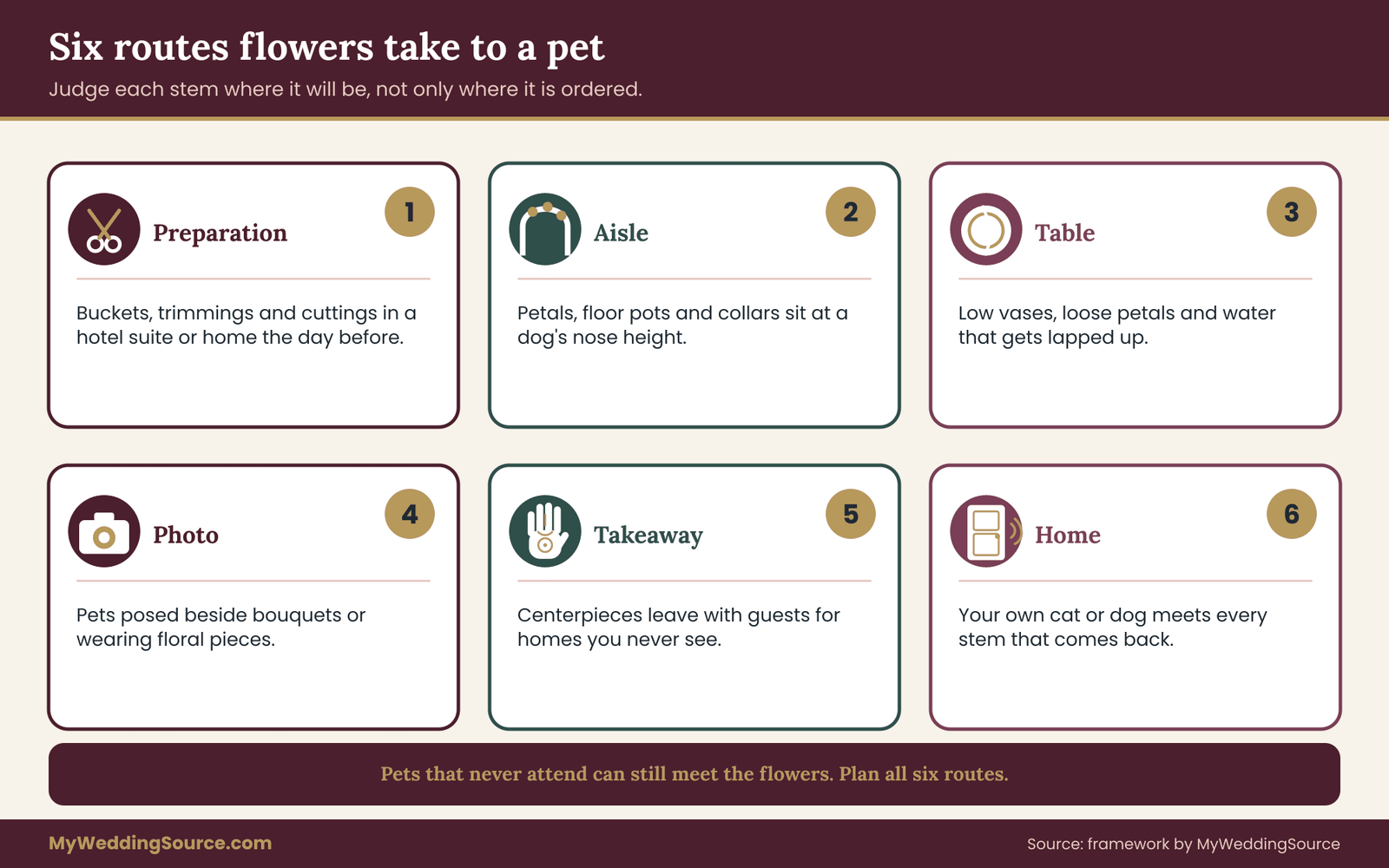
Think of six routes, and give each one a name so you can talk about it with your florist and your family.
The preparation route. Flowers are delivered a day or two early and sit in buckets, in a cooler, or in a hotel bathroom. If the couple’s pet is in the same home or hotel suite, that is the first contact. Florists processing stems drop cuttings and trimmings, and those cuttings are exactly what a curious cat or puppy finds.
The aisle route. Ceremony arrangements, petals and ground-level decor are at nose height for a dog. A dog ring bearer or a guest’s dog will notice aisle petals, floor arrangements and low pots. This is also the route where a flower crown or collar becomes a chewing target.
The table route. Centerpieces are usually at human height, but they get moved, bumped and carried. Water in low vases can be lapped up by a thirsty dog, and that water may contain flower food, a preservative or a trace of whatever the stems were treated with.
The photo route. Pets in portraits are often posed next to bouquets or wearing floral accessories. Photographers and family members place stems quickly, and the pet is the one that decides what to do with them. The practical fix is to decide beforehand which flowers are allowed in pet portraits, and to keep those few separate from the rest.
The takeaway route. The reception ends, someone offers the centerpieces to guests, and a dozen arrangements go out the door to homes with unknown pets. Hosts rarely think about this. A line on a card by the table can prevent a problem in a home you never see.
The home route. The couple’s own pets will meet the bouquet, the boutonnieres and the keepsake flowers, often after a long and distracted day. Cats in particular groom pollen from their fur. A cat that brushes against a lily and later licks its coat has ingested pollen without ever biting a petal, which is why the cat-and-lily combination is treated so seriously by veterinary sources.
Seeing the six routes together is useful for choosing pet safe flowers because it changes the question. Instead of asking whether the flowers are safe for the wedding pet, you ask where each stem will be at each stage and which animals are within reach. The rest of the plan follows from that.
A first pass: map your own routes
Before you touch a plant list, write a few lines about your own situation. Your answers decide how strict your pet safe flowers rules need to be. Which pets belong to you, and which species are they? Which pets will be at the wedding itself, and for how long? Where will the flowers be on the night before, and who will be in that room? What happens to the bouquets and centerpieces after the reception, and who decides?
Answers to those questions set how strict the exclusion list needs to be. A couple whose only pet is a dog that will stay at a sitter’s during the wedding can focus pet safe flowers planning on the home route and the takeaway route. A couple whose dog walks the aisle has to treat the aisle and photo routes as live.
A couple with a cat at home has the most important single rule on the list: no true lilies anywhere in the flowers that will come home, in any form, including as a single stem in a mixed bouquet.
If a pet care person will be on site, it helps to share the map with them as well. The pet attendant needs to know where flowers are, not only where the pet is. Planning for that person is covered in the wider guidance on guest care operations, which uses the same logic of assigning a specific person to a specific job.
The four-question check for every stem
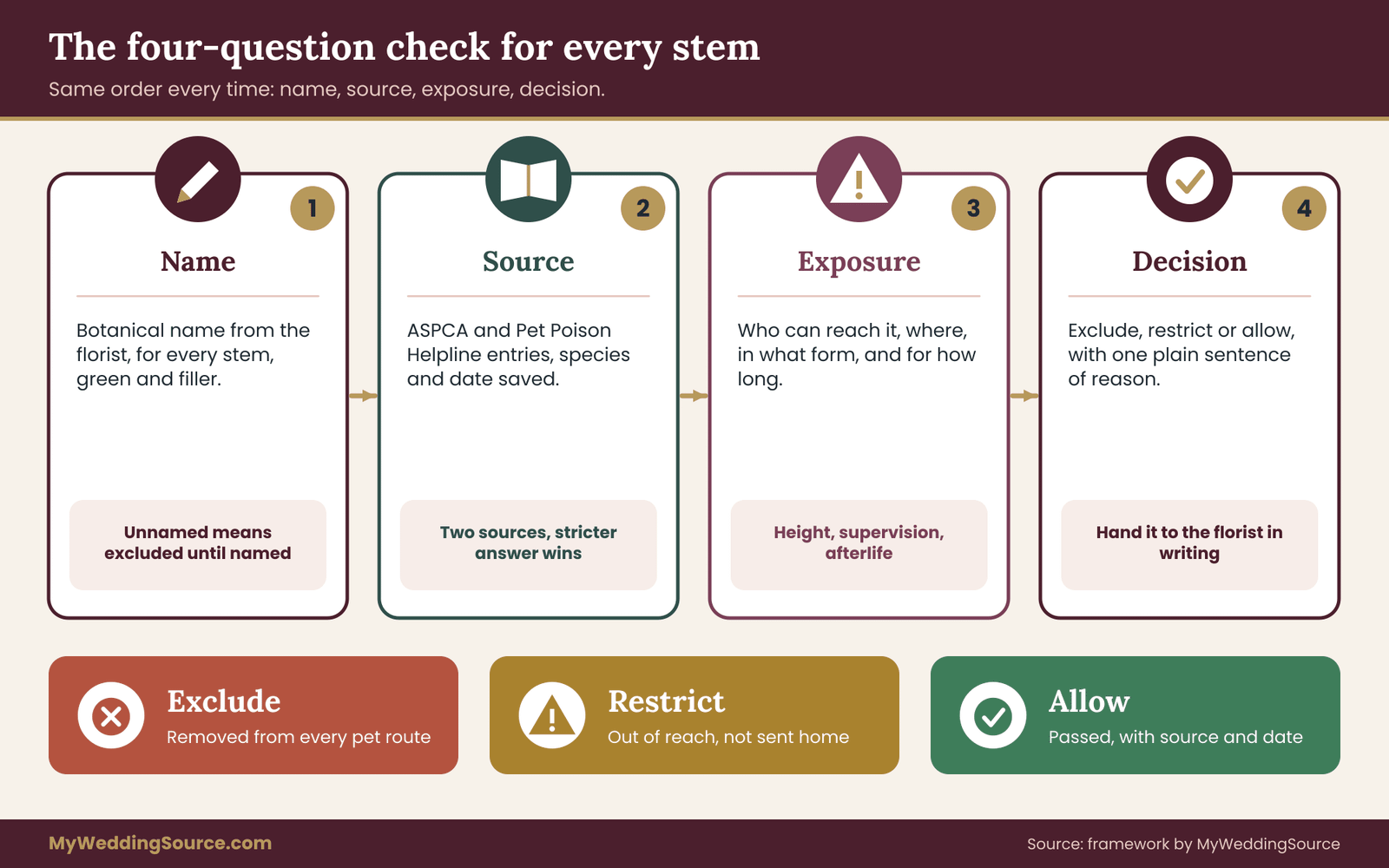
The core of this guide to pet safe flowers is a check you apply to each plant in the order, one at a time. It has four questions, and they always come in the same order because each answer depends on the one before it. Think of it as a log with four columns: name, source, exposure and decision. You will not need a spreadsheet for it. A page of notes or a shared document is enough, as long as each stem has its own entry.
Question one: what is the exact name?
Start with the botanical name, not the common one. Ask the florist to list every stem, filler and green by common name and genus, or at least by common name plus variety. “Lily” is not an answer. “Oriental lily, Lilium” is. “Baby’s breath, Gypsophila” is. “Eucalyptus, silver dollar” is closer, and “Eucalyptus cinerea” is better.
Florists are used to being asked for a stem list, including when a couple wants pet safe flowers. Most keep one for their own ordering. Some wholesalers label by common names only, so a florist may need a day to confirm genus. That is fine. If a florist cannot name a plant beyond “green filler,” treat the green as unknown, and unknown stems go into the restrict lane until identified.
Be especially careful with names that cross plant families. “Calla lily” and “peace lily” are not true lilies, but each has its own issues. “Lily of the valley” is a different plant altogether and is considered dangerous for pets. “Daylily” is in a separate genus from true lilies, yet veterinary sources still group it with the lily family for cats. The point of this first question is to avoid arguing about whether a name is close enough. You want the name that a database can match.
Question two: what does a credible source say about pet safe flowers, and for which animal?
Once you have a name, look it up in at least two independent veterinary sources. This guide recommends the ASPCA toxic and non-toxic plant database and the Pet Poison Helpline plant list as the two defaults, and it suggests that you save the page address and the date you checked.
The ASPCA site lets you search by common or scientific name and shows, for each plant, whether it is listed as toxic to dogs, cats or horses, plus the usual clinical signs. Pet Poison Helpline publishes its own lists with a severity description that can help you rank problems.
Record three things: the species the entry covers, the stated toxicity, and any note about which part of the plant is the issue. If the two sources disagree, treat the stricter result as the working answer and make a call to a veterinarian before you downgrade it. A real disagreement is rare, but when it appears it is useful information, because it usually means the plant has several species with different profiles.
If the plant does not appear in a source at all, say so in the log. Absence from a database is not proof of safety. It means the question is unresolved. The honest status of such a stem in a pet safe flowers plan is “not verified,” and unverified stems go into the restrict lane at best, or the exclude lane if a pet will be near.
Question three: what is the exposure?
A toxic plant is a bigger problem when an animal can reach it, chew it and swallow enough of it. Exposure is the question people skip, and it matters in both directions. A stem that sits at the back of a tall arch is not a risk to a dog at the aisle, and a “non-toxic” petal confetti toss may still make a puppy ill if it eats a handful.
Ask four small questions here. Who will be within reach: the dog ring bearer, a guest’s pet, a barn cat, your own pet at home? Where will the stem be: the ground, a low table, a hand-held bouquet, an overhead installation? In what form: a loose petal, a whole bloom, a woody branch, a pot with soil, a bulb, dried material? And for how long: a ten-minute ceremony, an evening, a night in a hotel room, a week in a kitchen vase?
The answers do two jobs. They tell you whether a borderline stem can stay with extra care, and they tell you where to put anything that stays. A mid-level concern, such as a stem that mostly causes mouth irritation, can usually be handled with distance and supervision. A severe concern, such as a plant associated with heart rhythm problems or kidney failure, should not be handled with distance at all. It should be removed.
Question four: what is the decision?
Every stem leaves the check with one of three decisions, and only the allowed ones count as pet safe flowers. Exclude means the stem is removed from the order, from the home bouquet, from the photos, from everything that a pet might reach. Restrict means the stem stays, with a rule about where it can go, who handles it, and what happens to it afterward. Allow means the stem passed, with the date and the source noted.
Write the decision in one plain sentence with a reason. “Exclude: oriental lily; cat at home; sources list true lilies as dangerous to cats.” “Restrict: hydrangea; dog at ceremony; sources list as toxic to dogs and cats, mostly stomach upset; keep above floor, remove from table after the ceremony.” “Allow: sunflower; ASPCA lists as non-toxic to dogs and cats; checked on the date written in the log.”
That one sentence is what you hand to the florist, the pet attendant, and the person who is carrying the bouquet back to the hotel. Everyone else can act on it without understanding the botany.
How the check scales when time is short
If your wedding is two weeks away and the florist has already ordered, building pet safe flowers from scratch is unrealistic, and the full log is not realistic for every stem. Use a short version. Check only the stems that are in contact with pets, and do the exclusion pass first: scan for the highest-severity plants (true lilies for cats, sago palm, oleander, azalea and rhododendron, lily of the valley, foxglove, and similar).
You can do that in under an hour, and it removes most of the serious risk. Then log the rest as time allows.
The honest limit of this shortcut is that you will not catch the odd substitution. That is the reason to include a substitution rule in the florist agreement, which a later section covers.
Where to verify: the sources that count and the ones that do not
The log is only as good as its sources. Plant safety information online is uneven, and pages about pet safe flowers are no exception, and wedding blogs, florist pages, decor websites and social posts are not authoritative on toxicity, however kind their intentions. A ranked set of sources keeps you from spending an evening comparing five pages that all copy each other.

Tier one: veterinary toxicology organizations
The strongest sources are the organizations that take calls about poisonings and publish what they learn. The ASPCA Animal Poison Control Center maintains the toxic and non-toxic plant database mentioned above, and its entries list common and scientific names, the species affected and the clinical signs. Pet Poison Helpline, a separate animal poison control service, publishes its own plant lists and guides. Both lists are written for pet owners, which makes them readable, and both are updated over time, so record the date you looked.
The American Veterinary Medical Association is the professional body for veterinarians in the United States. Its pages are not a plant database, but its guidance on poisoning, pet emergencies and finding veterinary care is a reliable place to confirm what a pet owner should do. The Merck Veterinary Manual and veterinary school pages, such as the school of veterinary medicine at a land-grant university, go deeper on specific toxins when you want the mechanism behind a warning.
Tier two: your own veterinarian
Your own veterinarian is the best source for your animal. A vet knows if your dog has a history of eating things, whether your cat has kidney disease that raises the stakes, whether your rabbit chews woody stems. A short phone call or email asking them to look over your exclusion list is worth doing. Send the list of plants, not photos of the arrangements, so the answer can be about specific species.
If you do not have a regular vet, many clinics will answer a quick plant question for a client or at a modest fee, and animal poison control services will take a call about a specific plant, though a consultation fee may apply. Check the current fee and phone number on the service’s own website before you rely on it.
Tier three: florists and venues
Florists and venue staff know what they have and what is in season. They are a good source on availability, substitutions and handling, and they are not a source on toxicity. A florist who says “those are totally fine for dogs” has given you an opinion, not a verification. It is polite to ask, and wise to confirm in the tier one sources.
Venues also add a layer of rules about animals and plants. Some farms, parks and historic sites restrict plant material from outside, or have livestock that could be harmed by certain greens. Ask for that in writing as part of your venue contract questions, and keep it with the other terms in your vendor contract file.
What does not count
Skip anything that cannot name its source. That includes lists without botanical names, pages that rate plants “mild” or “severe” without citing a database, social posts built on a single personal story, and decor retailers that label arrangements “pet friendly” without saying what that covers. A product claim is not a toxicity entry, and a label is not proof of pet safe flowers. If the label says pet safe flowers, ask which plants are in the arrangement and then check them yourself.
The same applies to artificial flowers. Silk and plastic stems avoid the plant toxins that make real pet safe flowers a question, though small parts, wire and glued beads can cause blockage or injury if chewed. They are not automatically a safer option for a puppy that eats everything, so apply the exposure question to them too.
Keeping the pet safe flowers log honest
A working log of pet safe flowers has date, source, species and decision on each line. When you check a stem a second time six weeks later, add a line instead of overwriting the first. If the entry changed, you will see it. If the florist swaps a plant on the delivery morning, add the new stem before it leaves the cooler, not after it is on the table.
One more habit pays off. Save the page address, or the exact search term and the date, for the stems that matter most. If a guest or a pet owner asks later why you chose a stem, the answer takes ten seconds. And if a pet does get sick, a poison control service will ask exactly which plant, which part, and how much. A written log lets you answer in seconds, which is when speed matters.
The exclusion list for pet safe flowers: stems to remove first
An exclusion list for pet safe flowers is a short set of plants that do not belong in or near a wedding with animals, no matter how well they fit your palette. The reason to keep it short is practical. If the list has thirty plants, nobody reads it. If it has about ten names grouped by reason, a florist can scan it and a bridesmaid can remember it.
The entries below reflect what veterinary toxicology sources commonly flag as serious for dogs and cats, and they are written as a starting point for your log. They are not a replacement for checking each plant yourself in the ASPCA and Pet Poison Helpline databases, because entries are updated and because your own pet and your own order may add something this list does not mention.
Group one: the cat and lily rule
True lilies and daylilies are the best-known case on any list of pet safe flowers, and the reason is the cat. Veterinary sources describe true lilies (the genus Lilium, which includes Easter, tiger, Asiatic, oriental and stargazer lilies) and daylilies (Hemerocallis) as potentially causing acute kidney injury in cats, and they note that even small exposures, such as chewing a leaf, drinking vase water or grooming pollen off fur, can matter. The sources use strong language here because the early signs can look mild and the window for treatment is short.
For a couple with a cat in the home, this is the one firm rule for pet safe flowers. No true lilies and no daylilies in the bouquet, the boutonnieres, the centerpieces, the guest favors, or anything else that will enter the home. A single stem in a mixed arrangement counts. Florists often use lilies as the large focal bloom in a bouquet because they are dramatic, inexpensive per bloom and fragrant, so you may have to ask for them to be left out by name.
Peace lilies and calla lilies are not true lilies, and the sources describe a different, usually milder problem: mouth and throat irritation from insoluble crystals, with drooling and vomiting in some animals. Peruvian lily (Alstroemeria) is another look-alike name worth checking by name in the database. Do not assume a “lily” is fine because it is not the dangerous kind. Look it up.
Group two: plants linked to heart, liver or kidney harm
A second group is excluded because the possible outcome is severe, even if few animals ever meet them at weddings. Sago palm (Cycas revoluta, often used as a tropical or modern accent) is described by veterinary sources as dangerous to dogs and other animals, with the seeds the most concentrated part, and with possible liver failure. Oleander (Nerium oleander) and yellow oleander are associated with cardiac effects.
Foxglove (Digitalis) and lily of the valley (Convallaria majalis) are likewise associated with heart rhythm problems. Azalea and rhododendron are also on the list for cardiac and gastrointestinal effects. Yew (Taxus) is another plant with a serious cardiac profile that sometimes appears in wreaths and greenery.
Other plants that regularly appear on serious-concern lists include autumn crocus (Colchicum), monkshood (Aconitum), castor bean (Ricinus), and hellebore. Several of these are garden plants that florists occasionally use for a cottage or wild look. If a stem list reads like a woodland garden, run each name through the database even if it is only used as a single accent.
You do not need to memorize any of this. The practical rule for pet safe flowers is that the more unusual and garden-like a plant is, the more likely it is to be missing from the list in your head, and the more it deserves a lookup.
Group three: bulbs and tubers
Tulips, hyacinths, daffodils (Narcissus) and cyclamen are sold as cut flowers, and the veterinary guidance generally notes that the toxic compounds are concentrated in the bulb or tuber rather than the bloom. A cut stem has little or no bulb attached, which lowers the exposure. Potted bulbs, forced bulbs in decorative containers, and plants with soil exposed are another matter, because a dog can dig and eat the part that matters most.
That is why the exposure question matters as much as the name. Cut tulips in a bouquet that stays on a table sit in the restrict lane. A planter of tulip bulbs as a table decoration at a wedding with a dog belongs in the exclude lane.
Group four: unverified and unlabeled plants
The last group on the exclusion list is not a species at all. It is any stem or green the florist cannot name, and any item that came from a garden, a roadside, or a relative’s yard without a clear name. Wild-gathered and homegrown material is a sweet idea for a wedding, and it is also how people end up with castor bean, oleander or poison hemlock in a centerpiece, because the plant looked pretty and nobody checked.
The rule is simple. Unnamed means excluded until it is named, and named means checked. If a relative offers garden flowers, ask them to send the plant names and add each one to the log.
The restrict list: stems that need distance, supervision or a plan
The restrict lane is where most real pet safe flowers decisions happen. These are plants that appear in veterinary databases as toxic or irritating, but with outcomes that are usually limited to mouth irritation, vomiting, drooling or diarrhea, especially at small doses. They are not trivial for a small dog or a sensitive animal, and they should not be dismissed. They can often stay in an arrangement when the pet is kept out of reach.
What belongs in the restrict lane
Commonly listed examples include hydrangea, which veterinary sources list as toxic to dogs and cats, mainly with stomach upset; tulips and daffodils as cut stems; chrysanthemum; iris; ranunculus and anemone (members of the buttercup family, with irritant sap); sweet pea; amaryllis; peony; English ivy; and eucalyptus. Carnations and baby’s breath are often mentioned as mild irritants, which means that a florist who says they are fine is not inventing it, but also that a dog that eats a lot will not be fine.
Treat this list as a prompt, not a verdict. Each of these plants has its own entry that you should open. The ASPCA lists some as toxic to cats and dogs and some only to one, and the text gives the usual signs, which tells you what to watch for.
The three restrict rules for pet safe flowers
A restrict decision on pet safe flowers becomes real only when it has a rule attached. Three rules cover most weddings.
Height. Restricted stems stay above the pet’s reach, which for a dog means off the floor and out of low vases, and for a cat means out of any place a cat can jump. Aisle-level arrangements and floor installations are made only from allowed stems.
Supervision. Restricted stems are handled by people who know the rule. A bouquet that includes restricted stems is held by the person carrying it, and set on a high surface, not on a chair or the floor. Pet attendants should know which arrangements are restricted so they can steer the pet away.
Afterlife. Restricted stems do not go home to a house with a pet unless the owner agrees. The day-after plan decides where they go: composted, donated, dried in a closed room, or given to someone without pets. A later section deals with the takeaway route in detail, including the line on the card that tells guests what to do.
Dried and preserved material
Dried flowers, pampas grass, preserved eucalyptus, and cotton stems are popular, and the veterinary evidence on them is thinner. Dried versions of a toxic plant should be treated as still toxic. Fluffy plumes and loose seed heads can also shed and be inhaled or swallowed, and brittle stems can splinter in a mouth. When a dried element is part of a design, apply the same four questions: name it, look it up, think about where it is, and decide.
Why the restrict lane is not a loophole
The restrict lane in a pet safe flowers plan should not become where every beautiful but risky stem goes because the florist loves it. A useful test is to imagine the worst realistic case. If the pet got hold of the stem, what would the veterinary source say could happen? If the answer is “stomach upset that usually resolves,” restrict is reasonable. If the answer includes the words kidney, heart or liver, the stem is in the exclude lane regardless of how carefully you plan to keep it away.
Another test is the person test. If the plan only works when a specific person is watching a specific pet at a specific moment, the plan is fragile. Weddings are busy, and the person assigned to the dog is also being asked to take photographs and hold a drink. Choose pet safe flowers for the places where you cannot guarantee watching, and keep restricted stems for places you can.
Pet safe flowers that usually pass the check, and how to confirm them
Once the exclude and restrict lanes are clear, the allow lane of pet safe flowers is usually larger than people expect. Many popular wedding flowers are listed by the ASPCA as non-toxic to dogs, cats and horses. That is welcome news, and a few cautions apply to every name below.
Commonly listed as non-toxic: the core pet safe flowers
The ASPCA database lists roses (Rosa), sunflowers (Helianthus), snapdragons (Antirrhinum), orchids such as Phalaenopsis, gerbera daisies (Gerbera jamesonii), freesia, zinnias and asters among its non-toxic entries for dogs and cats. Entries for individual varieties and species can differ, so confirm the exact plant when you check, and record the date. If you want a short palette of pet safe flowers built around these, you have cream, pink, red, yellow, orange and purple options.
For a couple who wants a neutral or romantic palette, roses, snapdragons and orchids carry most of the structure. For a brighter or more casual wedding, sunflowers, gerbera and zinnias work. The list is not exhaustive, and your florist can propose other plants that you then run through the same check.
Cautions that apply even to allowed stems
A plant being non-toxic still leaves four issues for pet safe flowers. Thorns on roses can hurt a mouth, so strip thorns on any stem that is near a pet, which florists routinely do for bouquets anyway. Treatments matter: cut flowers may carry pesticide residue, and many florists use preservatives or dyes. A non-toxic plant that has been sprayed is not the same exposure as an untreated one, so ask about it.
Quantity matters too. A dog that eats a lot of any plant material can have vomiting or an intestinal blockage. Form matters: a petal confetti toss means a pet may eat large amounts without noticing.
For those reasons, an allowed stem is allowed in a context. “Allow: rose, thorns removed, for hand bouquet and table arrangements. Not for floor confetti.” That is a better decision than “roses: safe.”
Confirm by name, date and species
The final step for each allowed stem is the same as for every other stem, and it is what makes it one of your pet safe flowers. Look it up by botanical name, record the species it covers, and write the date. If you only checked it for dogs and cats, say so in the log.
If a rabbit, a bird or a reptile lives in the house, the database may list the plant under a different set of animals or not at all, and your veterinarian is the right person to ask.
Be cautious with long palettes of exotic flowers. Tropical blooms such as anthurium and bird of paradise, and unusual textures such as proteas, are not covered as thoroughly in popular lists, and a few have irritating sap. They can stay in the log as “not verified” until you or your veterinarian has a source, and that status moves them to the restrict lane.
A short palette of pet safe flowers that holds up
If you want a starting palette of pet safe flowers that still looks full, an approach that works is to choose one structural bloom (rose or orchid), one airy accent (snapdragon or a verified filler), one color accent (gerbera, zinnia or sunflower), and a verified green. That gives you four stems to check instead of fifteen, and it makes florist conversations short.
If you want to explore whether a plan like this fits your color scheme, see how this works with a wedding color palette and bring those exact stems to the check.
Greenery, fillers and extras that undermine pet safe flowers
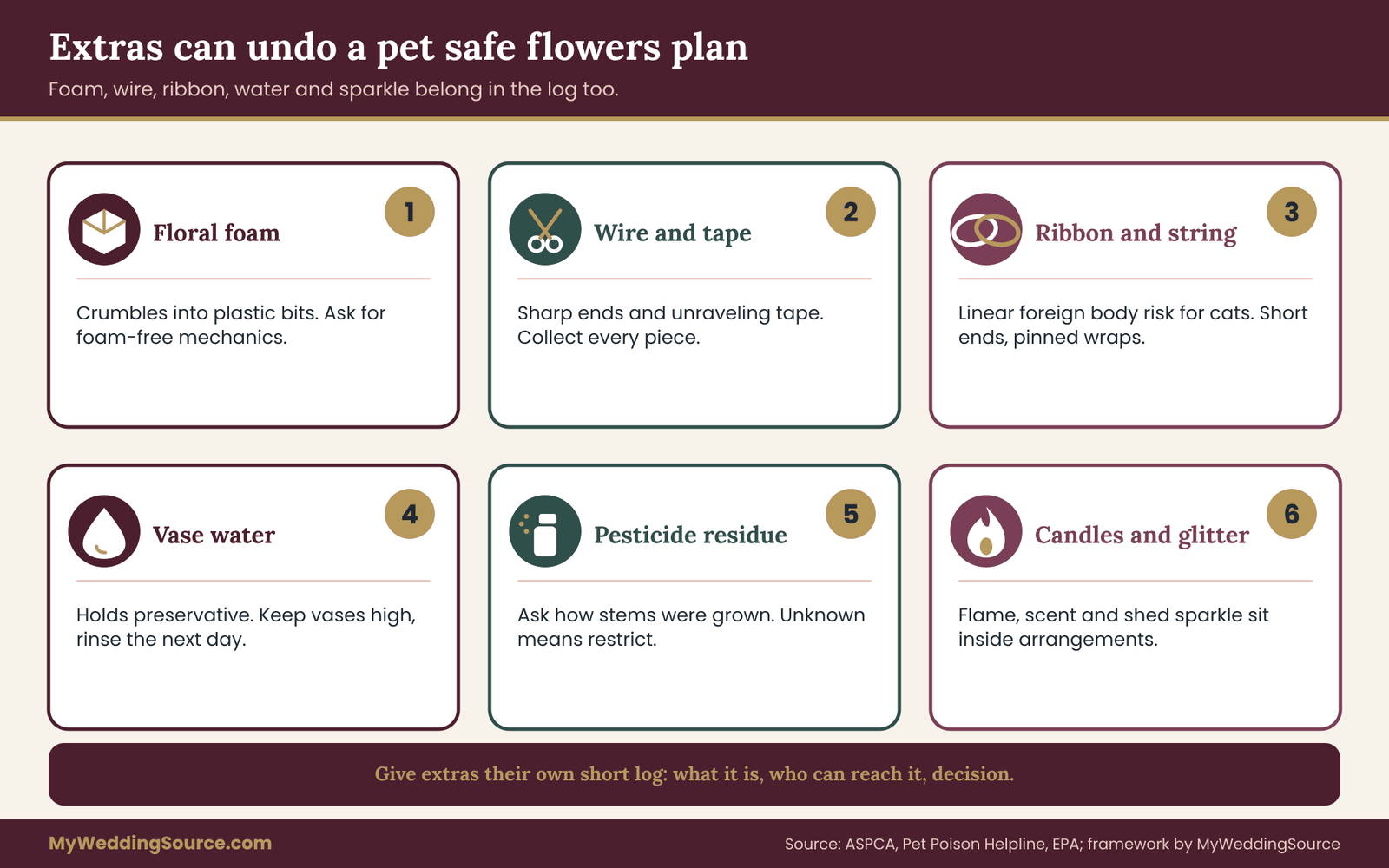
Ask a florist what is in a bouquet and you will hear flower names. Ask what holds it together and the answer is greenery, filler, wire, tape, foam and ribbon. Those supporting parts are where pet safe flowers plans most often come apart, because nobody thinks of them as flowers and nobody checks them.
Greenery is a plant too
Greens make up a large share of the volume in many arrangements, so they matter for pet safe flowers. Eucalyptus is the most popular and is listed by the ASPCA as toxic to dogs and cats. English ivy, which trails nicely from arches and centerpieces, is also on the toxic list. Boxwood, used in wreaths and garlands, is listed as well.
Asparagus fern, a common filler that looks soft and feathery, is on the list too, and it is often confused with true ferns that are listed differently. Some common ferns, such as Boston fern, are listed as non-toxic, but the name “fern” covers many different plants, so check by name.
Olive branches, ruscus, leatherleaf and a long list of other greens appear in florist work. Some are listed as non-toxic, some are not listed at all, and a few have two or more entries under different common names. The rule from the four-question check applies unchanged. Ask for the name, look it up, think about exposure, decide.
An interesting side effect of choosing pet safe flowers is that it often simplifies the design. If eucalyptus and ivy are removed, florists tend to propose two or three alternatives, and you pick the one that photographs the way you want. The result is fewer varieties and a cleaner look, and a shorter log.
Floral foam, wire and tape
Floral foam is the green or brown block that holds stems in many ceremony and table arrangements. It is a plastic product that crumbles into small pieces, and a pet that chews it can swallow fragments that do not break down. Even if the pieces are small, repeated bits are a blockage concern, and the dust is a nuisance. Foam-free mechanics, such as chicken wire in a vase, a pin frog, or a grid of tape across the mouth of a container, are common among florists who are concerned about waste.
If you are already looking at ways to cut waste, the reasoning overlaps with the audit in the guide on wedding waste reduction, and the same request often covers both.
Floral wire and the thin stem wire used to reinforce delicate blooms can be sharp. Wrapped stems often have floral tape over wire, and tape unravels when chewed. A bouquet that is dropped or pulled apart by a dog leaves wire ends on the floor. This is mostly a handling risk, and it points back to where the stems are placed and who collects the pieces after the event.
Ribbon, string and trim
Ribbon on a bouquet or a flower crown is a problem for cats in particular. Veterinary sources describe string, thread and ribbon as linear foreign bodies that can cause serious intestinal trouble if swallowed, and cats are drawn to them. A tidy satin ribbon wrap on a bouquet that sits on a bedside table overnight is a better toy than most things in the room. Use short ribbon ends, tuck them in, and store the bouquet where the cat cannot reach, or switch to a pinned wrap.
Flower food, water and pesticides
Cut-flower preservative packets contain ingredients that vary by brand, and the labels or the safety data sheet are the place to check, not general advice. The practical advice is that the vase water holds more than water. A dog that laps from a low centerpiece or a cat that drinks from the kitchen vase is drinking whatever is in it. Keep vases high, and empty and rinse them the night after the wedding.
Pesticides are a separate topic that the florist can speak to. Cut flowers are often grown commercially with pesticides, and residues vary. A florist who sources from a local farm may know the growing practices, and one who buys through a wholesaler may not. The Environmental Protection Agency has general information on pesticides and pets, and your veterinarian can advise if you are worried.
Asking a florist whether the flowers were treated with anything beyond normal commercial practice is a fair question, and the honest answer is sometimes “I don’t know.” Record that and decide whether the stem should be handled as restricted.
Candles, scent and sparkle
Many floral designs include candles, scented sprays, essential-oil diffusers, glitter or metallic confetti. These are not plants, but they sit in the same arrangements, and several are risks to pets. Open flames and dogs are a hazard on their own. Scented oils used near cats are a concern in veterinary sources, and glitter or foil that sheds can be swallowed. List them in the same log under “extras” and apply the same decision.
The extras log
Keep a separate short list for the non-plant items, with the same four questions in plain language. What is it? What does the maker or a veterinary source say? Who can reach it? Do we keep it, restrict it, or drop it? Most weddings that plan for pet safe flowers end up with about five entries: foam, wire, ribbon, preservative, and one decorative item such as candles or confetti. That is about fifteen minutes of work and it closes a large share of the remaining risk.
Worked example: a bouquet list, a cat at home and a dog in the aisle
An example makes the lanes of a pet safe flowers plan concrete. This one is invented for illustration. It is not a case study, it does not describe a real couple, and the specific plants are chosen only to show the process.
The situation
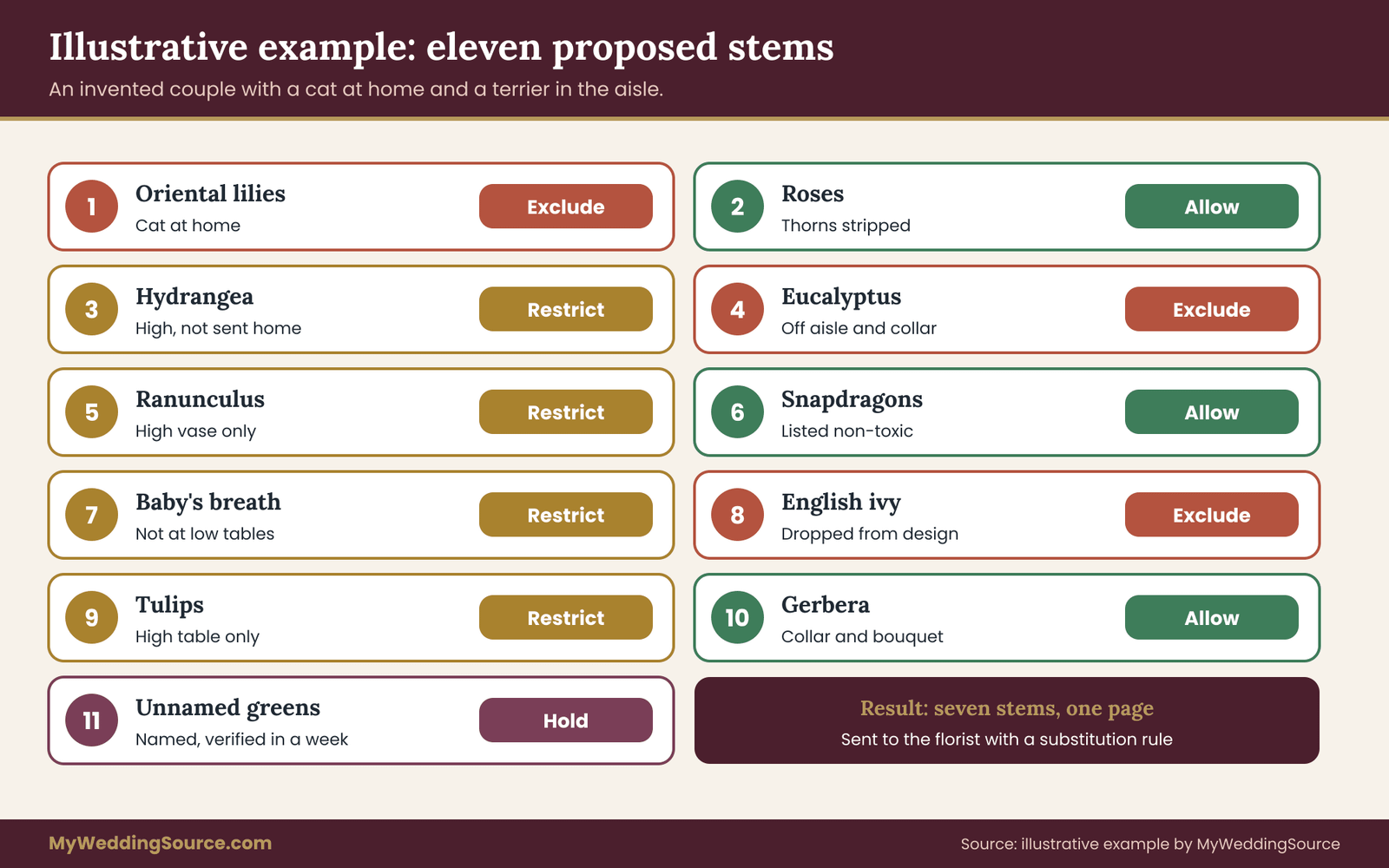
Two people are planning a garden wedding for about eighty guests. They live with a cat, and the groom’s sister is bringing a small terrier that will walk the aisle with a flower-collar and then go home with her. The florist’s first proposal contains eleven items: oriental lilies, roses, hydrangea, eucalyptus, ranunculus, snapdragons, baby’s breath, English ivy, tulips, gerbera and a selection of “garden greens.”
Step one: names
The couple asks for names. The florist replies with genus names for the flowers and agrees to name the garden greens: the greens turn out to be ruscus, olive branch and a trailing vine that the florist says might be ivy or might be something else. The vine is the first problem.
It is unnamed, so it is excluded until named. By the next morning the florist confirms English ivy, which was the suspicion, and the vine goes to the restrict lane, then to the exclude lane when the couple decides they do not need it.
Step two: lookup and sources
The couple runs each name through the ASPCA database and the Pet Poison Helpline list, and notes the date. Oriental lily returns a serious cat warning. Hydrangea, ranunculus, tulips, eucalyptus and English ivy each return a toxic entry with stomach upset or irritation as the main concern, and baby’s breath returns a mild irritant. Roses, snapdragons and gerbera are listed as non-toxic. Ruscus and olive branch are either not listed or listed in ways that need a second check, so they enter the log as “not verified.”
Step three: exposure
The couple draws their routes. The terrier will be on the aisle for about three minutes and then at a table with a pet attendant. The bouquets will be carried and then set on the head table. The centerpieces will be at human height. The cat is at home, and the bouquet, boutonnieres and two centerpieces will come home that night.
The home route is the big one. The cat will meet every stem that comes in the door, so the “cat at home” rule applies to everything that returns, regardless of where it sat during the wedding.
Step four: decisions
Oriental lilies are excluded, which is easy because there is a cat at home and the rule is firm. Hydrangea is restricted: allowed in the bouquet and head-table arrangement, kept above the floor, and not allowed to come home. Eucalyptus and ivy are excluded from the aisle and the terrier’s collar, and ivy is dropped altogether. Tulips are restricted to a vase on a high table. Ranunculus is restricted the same way.
Baby’s breath is restricted, since the terrier might snatch a stem from a low centerpiece. Roses, snapdragons and gerbera are allowed, with thorns stripped. The collar is made only from rose petals and gerbera, thorn-free and untreated, with a plain cloth band and no ribbon ends. Ruscus and olive branch are held until verified. Both are verified within the week, and the florist agrees to use them.
Step five: the written list
The couple sends the florist a one-page list of pet safe flowers with three sections: excluded stems with the reason, restricted stems with where they may go, and allowed stems. It includes a substitution rule: any change of stems or greens needs approval before the delivery. It includes a rule for the takeaway route: centerpieces made with restricted stems stay at the venue or go to the venue’s compost or a donation arrangement, and the pet-safe arrangements go to guests with a card.
The florist responds with a revised proposal in two days. The bouquet drops from eleven items to seven, and the florist says the result photographs cleaner. That outcome does not happen in every case, but a smaller palette is a common result of this process, and a smaller palette is easier to verify.
What the example shows about pet safe flowers
The example of pet safe flowers shows four things. A vague name is the first thing to fix, and it can change a stem’s status in a day. The lanes are not the same for every route, so one stem can be allowed in a bouquet and excluded from a collar. Pets at home drive stricter decisions than pets at the wedding.
And the written list takes less than an hour, while the work it prevents is a bad evening at an emergency clinic. For the vendor side of such agreements, the framework in the vendor due diligence checklist is a useful parallel for asking for substitutions and responsibilities in writing.
Talking to your florist about pet safe flowers: questions and a script
A florist is a skilled partner for pet safe flowers, and most are glad to be asked. The worry that you will seem difficult is usually larger than the reality. A florist who builds arrangements for homes, hospitals and events has heard about pets before. What helps them is clarity, a short list, and a reason.
When to raise it
Raise it at the first design conversation, not at the final proposal. It is far easier to start from a palette that already excludes certain plants than to remove a signature bloom from a finished design. If you already have a proposal, raise it before the deposit is paid, and ideally before the florist orders stems, since some wholesale orders have lead times that cannot be reversed. The pacing of those conversations fits with the broader vendor timeline, where flowers sit relatively late and a change in week eight is still manageable.
A short script
You do not need legal language to ask for pet safe flowers. Something like this does the job: “We have a cat at home and a dog in the ceremony. Could you give me the full stem list, including greens and fillers, by common and botanical name? We will check each against veterinary sources and send you a short list of stems to leave out. Could you also let us know before any substitution?”
If the florist pushes back, a second sentence helps: “We are not asking for a plain palette. We want to keep the look you proposed and just swap out the few stems that fail the check.” That keeps the conversation about solving a design problem together.
Questions worth asking
A short list of questions covers most of what you need. Keep them in a message so the answers are in writing.
- Can you send a complete stem list, including greens, fillers and accents, with botanical names?
- Does anything in the design use floral foam, wire, glitter, candles or scented products, and can any of them be swapped?
- Were the flowers treated with anything beyond normal commercial practice, and do you know the source?
- Will you tell us about any substitution before delivery, and can we approve it?
- Can you label the arrangements, or give us a sheet that says which are made only from allowed stems?
- What will you do with unused stems and trimmings, and can they be removed from our home or hotel room on the delivery day?
- Can the pet-reachable arrangements, such as the aisle and the dog’s collar, be made from separate stock?
Two of these deserve a comment. The labeling question sounds fussy and saves a surprising amount of confusion on the day, because the person moving arrangements at midnight can sort by a sticker instead of a memory. The separate stock question helps with cross-contamination of pesticide treatments and with confusion about which stem is which, which is a real worry when a florist works from the same buckets for fifteen arrangements.
Writing pet safe flowers into the agreement
Verbal agreement about pet safe flowers fades by the wedding weekend, so put the key points into the proposal or the contract. A short clause is usually enough: a list of excluded stems; a statement that substitutions require written approval and must pass the same check; a statement that extras such as foam and ribbon will follow the list; and a delivery and removal plan.
For more on how to read and negotiate scopes, see the guide to the wedding vendor contract. Contract wording depends on your state and your florist, so ask the florist to draft it in their own template rather than adding a clause you found online.
The substitution clause matters most. Florists substitute for good reasons, such as a bad harvest, a shipping delay or a price spike, and their usual practice is to swap a similar stem. A similar-looking stem is not necessarily a similar-risk stem. Write in the rule that any replacement is named, checked and approved by you, or by a person you designate, before it is used.
What if the florist cannot or will not comply
Occasionally a florist says that a design cannot work without a specific stem, or that they cannot name a plant. In that case you have three choices: ask for a palette that avoids it, choose a different florist, or keep the stem in an arrangement that is physically separate from pets and does not come home.
The first is usually easiest. The third works only when a person is responsible for the separation. Weigh that honestly. A florist who cannot name their stems is a signal about due diligence, which is a general warning sign about any vendor, not only a florist.
Rental and borrowed pieces
Pots, planters and urns that are rented or borrowed can carry soil, mulch or plant remains from earlier events. If the rental company supplies live plants, treat them as a florist order and apply the same list. Rental planting, mossy ground cover and fertilizers on potted material are common sources of surprises, and the guidance in the rental planning checklist applies to the paperwork around them: ask what is in the container, not only what it looks like.
Edge cases: venue animals, guest pets, flower crowns and the takeaway route
The standard check for pet safe flowers handles most weddings. A handful of situations push it, and they are worth thinking about before the day so they do not become decisions made in a hurry.
Venues with resident animals
Barns, farms, ranches and some historic properties have animals that live there. A barn cat or a dog that wanders the grounds is not your pet, and its owner is not at your planning meeting. Ask the venue what animals are present, where they are allowed, and whether the venue has any rules about outside plant material.
Livestock such as horses, goats and sheep have their own sensitivities, and some plants are dangerous to them. A venue that keeps horses will often have a firm opinion on cut greenery, and you will want to hear it before the eucalyptus is ordered.
Guest pets and service animals
A guest may bring a dog, and a service animal may be present under the law and the venue’s own rules. You cannot control a guest’s pet the way you control your own, so the flowers are what you can manage, and pet safe flowers are the lever you hold.
Keeping floor-level decor to allowed stems, and keeping petal toss material to a verified, untreated option, reduces the chance of a problem. If a guest asks about the flowers, a one-page list helps you give a quick, honest answer: here is what we used and where.
Service animals are working animals and should not be distracted. Do not offer food, petals or decor to them, and do not ask guests to do so. Questions about access and rights are a separate topic that the venue and local rules govern.
Flower crowns, collars and wearable flowers
Flowers worn by an animal are the highest-exposure case for pet safe flowers, because the pet cannot avoid them and chewing is natural. A flower crown or collar for a pet should be treated as if the pet will eat part of it. That means only allowed stems, no wire against the skin, no ribbon ends, a secure but loose fit that cannot choke, and a short wear time.
A cloth band with a few fresh stems tucked in is easier to remove at a moment’s notice than a wired wreath. Check that the animal tolerates wearing it, in a rehearsal at home, before the day.
If you are not sure the animal will tolerate it, a ribbon-free silk piece is an alternative, though it needs its own check for small parts such as glued beads. This is one of the cases where the wedding photographer can help by taking a few quick photos early and letting the pet take it off.
Petal confetti and aisle petals
Loose petals are an enjoyable detail and a hard one to control. Petals can be eaten in quantity, can carry pesticide residue, and can be mixed from several plants without labeling. A pet safe flowers plan keeps petal use to a single verified stem, such as untreated rose petals bought for the purpose, and keeps pets off the petal area. Many venues also restrict petals because of staining, slipping or cleanup, so confirm the venue’s rule first.
Potted plants, trees and living decor
Potted plants add soil, fertilizer, mulch and sometimes slug bait or other garden products. Citrus trees in pots, herb planters and succulents are common wedding elements, and each needs a name and a check. Some herbs and succulents are listed as toxic to pets, and others are listed as non-toxic, so do not assume either way. Living decor that will be given away or planted at home should follow the home rule.
The takeaway route for pet safe flowers
When the reception ends, flowers leave. Some go to the couple’s home, others to bridesmaids, parents, hospitals, nursing homes, or whoever asks. A short printed card at the table, or a note from the host, can say: “Some of these stems can be harmful to pets. Please keep this arrangement away from dogs, cats and other animals, or ask us for the plant list.” It costs nothing, and it avoids an unpleasant message days later.
For the couple’s own home, decide before the wedding where the flowers will go. If the couple has a cat, the safest arrangement is that nothing with lilies, and no restricted stems, enters the home. If someone else is taking the keepsake bouquet, decide whether it is dried or preserved, and who handles that process.
Edge cases outside the standard species
Birds, rabbits, rodents, reptiles and fish are less often covered in popular plant lists, and they have different sensitivities. A bird, for example, may be affected by fumes and sprays that are no problem for a dog. If a household pet falls outside the dog and cat lists, the usual pet safe flowers lists stop applying, so treat every stem as unverified until a veterinarian who knows that species gives you an answer, and keep arrangements and pets in different rooms.
Measurable checks for the day and the morning after
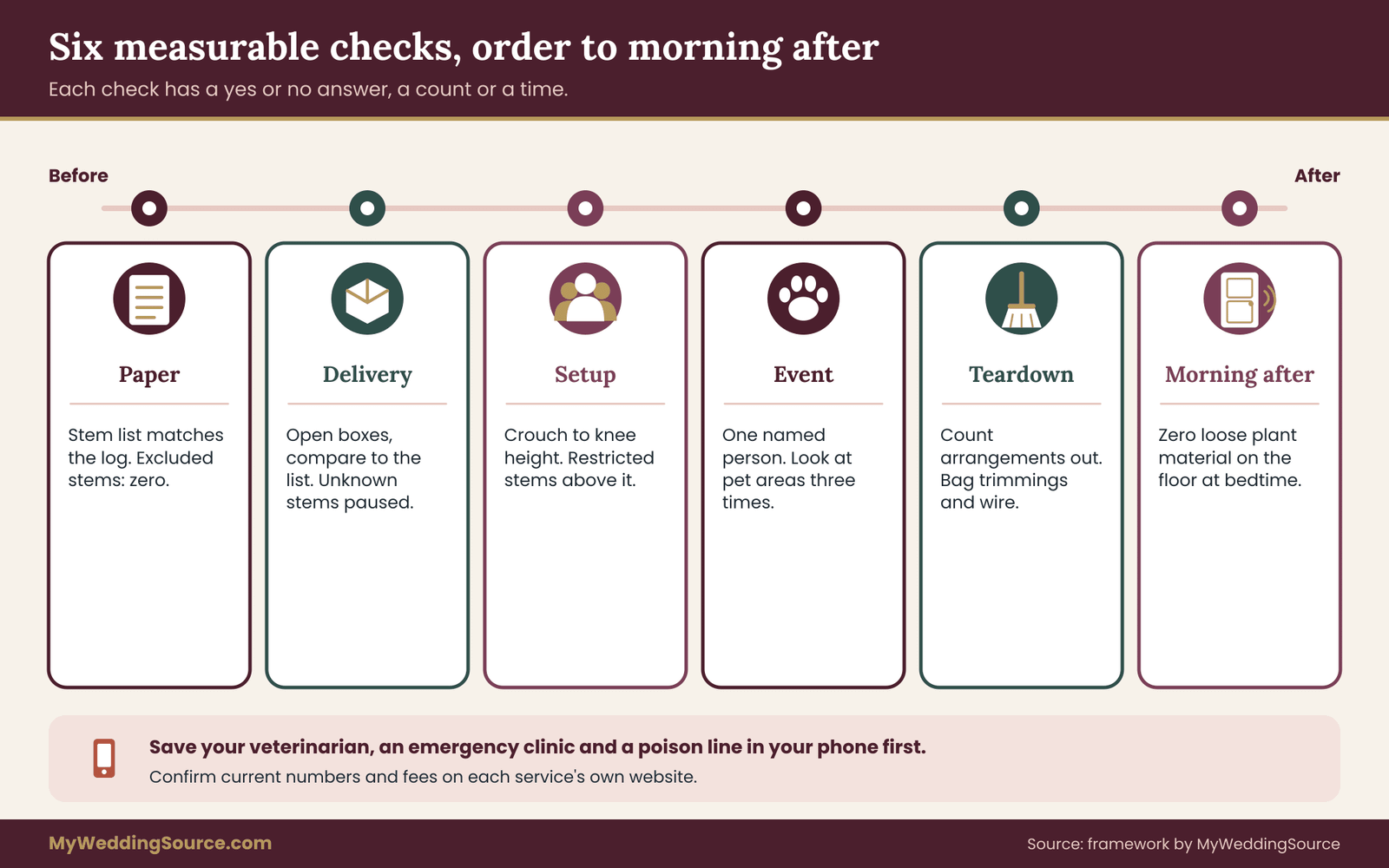
A plan for pet safe flowers is only as good as the checks that confirm it happened. The following checks are deliberately concrete. Each one can be answered yes or no, counted or timed, so you do not have to rely on a feeling that things look fine. They are not scientific tests and they do not prove an arrangement is risk-free. They show that the decisions in your log were carried out.
Before delivery: the paper check
Count the stems on the florist’s final list of pet safe flowers and compare the number to your log. The count of stems on the final list should match the count in your log, with no unnamed items. Every excluded stem should appear zero times. Every restricted stem should have a placement rule next to it. Every extra, such as foam, ribbon and candles, should have a decision.
Also check the date column. Every line in the log should carry a date that is after the last time you changed the order, and no source should be older than the last time you rechecked. If you have been working for months, spend ten minutes opening the database again on your most important stems, in case an entry has been updated.
On delivery: the cooler check
When the flowers arrive, open the boxes to confirm the pet safe flowers are what you ordered: and compare what you see against the list. This takes five to ten minutes and is best done by whoever knows the list, with the florist or driver present. Look for any stem that is not on the list, especially a bloom or green that looks like something you excluded.
Lilies are the usual case, and they are easy to recognize by their large, trumpet-shaped or star-shaped blooms and prominent pollen-covered stamens. If you see one and the list says none, ask before it moves.
If there is a substitution, do the check on the spot. Photograph the stem, ask for the name, and look it up on your phone. If you cannot verify it in a few minutes, the stem goes to the restrict lane and out of reach, or it is removed. The florist will be asked this kind of question regularly, and it is better to ask while they are there.
At setup: the placement check
Walk the venue before guests arrive to confirm the pet safe flowers are placed as planned. and look at the arrangements from a dog’s eye level. Stand or crouch at about knee height. Every restricted stem should be above that line. Every low arrangement should be made of allowed stems. Check for dropped petals, trimmings and ribbon ends on the floor. Remove them, since cut stems on the ground are the first thing a pet finds.
Also check water. Low vases and bowls should be empty of preservative, or out of reach. If a table has a low vase with preservative and a dog might pass by, move it up or swap it for a dry arrangement.
During the event: the handoff check
Make one person responsible for pet-reachable areas during the event, and give that person the one-page list. At a wedding with a pet attendant, the attendant is the natural owner, and the role fits the idea of a named person for each task described in the guide to wedding guest care planning. The person’s job is simple: know which arrangements are restricted, keep the pet from them, and take a dropped stem out of a pet’s mouth if it happens.
Set a time-based check. At the end of the ceremony, at the start of dinner, and at the end of the evening, walk through the pet’s area for ten seconds and look for chewed or dropped material. You do not need to be anxious. You are doing a short, regular look.
At teardown: the removal check
At the end of the night, decide who takes what, since only pet safe flowers should go to a home with animals. Restricted arrangements go to the planned place, which might be the venue compost, a donation point or a room without pets. Arrangements going home are only those made from allowed stems, and they are placed above the pet’s reach as soon as they arrive. Count the arrangements that leave, and compare the count to your list, so none walk out the door by accident.
Trimmings, ribbon, floral foam pieces and wire go in a closed bag in the trash that night, not in a bin the cat can open, and not on the floor of the hotel room.
The morning after: the home check
The morning after is when the home route for pet safe flowers becomes real. Walk through the rooms where flowers sit and look for fallen petals, leaves, stems and ribbon. Empty and rinse the vases. Move the arrangements higher. If the cat is a climber, think about whether any place is out of reach, and if not, put the flowers in a closed room.
A simple measurable standard is “zero loose plant material on the floor at bedtime.” If you find something, check the name against the log and decide. The standard is demanding and short-lived, since flowers last a few days, and it ends when you discard the arrangement.
Signs to watch for
Be familiar with the signs that veterinary sources associate with plant exposure: drooling, pawing at the mouth, vomiting, diarrhea, lethargy, loss of appetite, tremors, changes in drinking or urination, or any change in behavior after a pet has been near flowers. Not every sign appears in every case, and some serious conditions have a delay between exposure and symptoms. That is the reason to act on the possibility of exposure and not wait for signs.
If a pet eats something: what to do and what to tell the poison line
Despite careful planning and pet safe flowers, an animal may eat something it should not. A calm response is easier if you have decided in advance what to do and where the numbers are.
First steps
Remove the animal from the plant and take away any plant material that remains in its mouth, if you can do it safely. Do not induce vomiting unless a veterinarian or a poison control service tells you to, because some substances make things worse coming back up and some animals should not be made to vomit. Do not give home remedies without advice. Keep a piece of the plant or a clear photo of it, along with the packaging of anything else involved.
Call your veterinarian, an emergency veterinary clinic, or an animal poison control service immediately. The ASPCA Animal Poison Control Center and Pet Poison Helpline both operate poison hotlines, and consultation fees may apply, so confirm the current phone numbers and fees on their own websites and save them in your phone before the wedding. If the plant on your list is one of the serious ones, such as a true lily with a cat, go directly to a veterinarian without waiting to see whether signs appear.
What to tell them
The person on the line will ask a short list of questions, and having the answers ready speeds the call. Have these things: the species, breed, age and weight of the animal; the exact plant or product, by name if you know it; which part was eaten; how much, roughly; when it happened; any signs so far; and any existing health conditions or medications. Your log answers most of these in seconds, which is the second reason to keep it.
If you are unsure about the plant, send a clear photo. A florist can often name it from a picture or from the stem list, so keep the florist’s contact where you can reach it, including on the weekend.
Who holds the information
Decide in advance who will make the call. At a wedding, the couple will not be the person to do it. Give the pet attendant or another responsible adult a card with the pet’s details, your veterinarian’s name and number, the nearest emergency clinic, and the poison hotline numbers. Put the log or the list in a shared place that person can reach. At home, the same card on the refrigerator door works for the week after.
After the event
If an exposure occurs, tell the florist and the venue, since the information may help another client, and keep the record. Do not assume blame. A thorough log shows that you did the work, and the florist will usually appreciate knowing which stem was involved.
For the rest of the planning timeline, including where this work fits among the other tasks, use your wedding planning checklist to place the florist conversation, the list review and the day-before delivery check on your calendar.
Your next steps
Here is a sequence for choosing pet safe flowers that you can finish over about two weeks, in short sessions, without needing to become a botanist.
- Write your route map. List your pets and their species, which animals will attend, where the flowers will be the night before, and where each arrangement goes afterward. Ten minutes.
- Ask the florist for the full stem list. Ask for botanical names, including greens, fillers, accents, and any foam, wire, ribbon, candles or glitter. Send the request in writing.
- Run the four questions. For each stem, record the name, the sources and the date, the exposure, and the decision. Start with the exclusion pass: true lilies and daylilies with cats, sago palm, oleander, azalea, rhododendron, lily of the valley, foxglove and yew.
- Sort into three lanes. Exclude, restrict or allow, with one plain sentence of reasoning for each.
- Send one page to the florist. Include the excluded stems, the restricted stems with placement rules, the allowed stems, the substitution rule and the takeaway plan.
- Ask your veterinarian to review the list. Send plant names and the pet species. Ask about anything unusual about your own animal.
- Set up the day. Name a person for the pet area, prepare the emergency card, and plan the cooler check, the placement check and the teardown check.
- Save the emergency numbers. Store your veterinarian, the nearest emergency clinic and an animal poison control service in your phone and on a card. Confirm current numbers and fees on their websites.
If you only do three things for pet safe flowers, do these: tell the florist about the pets in the first conversation, remove true lilies if a cat will meet the flowers, and write the substitution rule into the order.
FAQ
Are roses really pet safe flowers?
The ASPCA database lists roses as non-toxic to dogs and cats, which makes them a common choice for pet safe flowers. The plant is not the whole story, though. Thorns can injure a mouth or paw, and cut roses may carry pesticide residue or preservatives. Strip thorns near pets, avoid using roses as loose petals in large amounts, and confirm the entry yourself on the date you plan the order.
Are lilies dangerous for dogs too, or only for cats?
Veterinary sources focus on cats for true lilies and daylilies, because even small exposures, including pollen groomed from fur, are associated with kidney injury in cats. Dogs are generally described as having milder problems, usually stomach upset. If any cat will meet the flowers, remove true lilies entirely. If only dogs are involved, check the entry and still keep lilies out of reach.
Can I use hydrangea if my dog will be at the wedding?
Hydrangea is listed as toxic to dogs and cats in veterinary databases, mostly with stomach upset. Many couples keep it in the restrict lane, which means above the floor, away from the dog and not sent home. If the dog will be near the arrangements or likely to chew, choose another bloom. Check the current entry and ask your veterinarian about your own dog.
Does a non-toxic label mean a bouquet is pet safe?
No. A non-toxic listing covers the plant for specific species. It does not cover thorns, wire, foam, ribbon, preservatives, pesticide residue or the quantity a pet eats. A bouquet is safe only when the stems, the extras and the placement all pass your check. Treat a label on a product as a claim, and ask the maker which plants and materials are inside.
What should I do about unknown greens or garden flowers?
Treat any stem without a name as excluded until it is named and checked. Ask the florist or the person who grew it for the common and botanical names, then look each one up in the ASPCA and Pet Poison Helpline databases. If you cannot identify it, leave it out. Wild and garden plants can include dangerous species that look harmless in a vase.
What if the florist substitutes a stem at the last minute?
Write a substitution rule into the order: any change is named in writing, checked against your sources and approved before it is used. On delivery day, compare what arrives to the list. If a substitute cannot be verified quickly, move it out of pet reach or remove it. Florists substitute often, so the rule protects both of you.
Are silk or artificial flowers a better choice around pets?
They avoid plant toxins, but they bring other risks, such as small parts, glued beads, wire and loose fibers that can cause choking or blockage if chewed. They suit some situations, such as a flower collar for a dog that chews, but they still need the exposure question. A puppy that eats everything may need no floral accessories at all.
What should I do if my pet eats part of a bouquet?
Remove the pet from the plant and any material from its mouth if you can do it safely. Call your veterinarian, an emergency clinic or an animal poison control service right away, and do not induce vomiting unless they tell you to. Have the plant name, the part, the amount, the time and your pet’s weight ready. Keep a sample or photo of the plant.
Sources
Verify every plant entry and every rule on the issuing organization’s current pages before you rely on it.
- ASPCA: Toxic and non-toxic plants list
- ASPCA Animal Poison Control Center
- Pet Poison Helpline
- American Veterinary Medical Association
- Merck Veterinary Manual
- U.S. Food and Drug Administration: Animal and Veterinary
- U.S. Environmental Protection Agency: Pesticides
- CDC: Healthy Pets
- UC Davis School of Veterinary Medicine
- Cornell University College of Veterinary Medicine