
A Christian wedding ceremony script gives the officiant, the couple and the congregation one shared map: what is said, in what order, and why each part is there. This guide walks through a complete order of service, with original sample wording, scripture options and notes on Catholic, Protestant and Orthodox differences.
Quick answer
A Christian wedding ceremony script usually moves through the prelude and processional, a welcome and prayer, a charge to the couple, scripture and a short message, the vows, the exchange of rings, a prayer or unity moment, the pronouncement and blessing, and the recessional. A ceremony without communion is usually shorter than the 45 minutes to an hour a Catholic nuptial Mass often takes. Denominations differ, so confirm the required elements with your pastor or priest before you finalize the wording.
Most couples who search for a Christian wedding ceremony script are trying to answer one of three questions. They may be the couple, asking what happens in a church wedding and what they can personalize. They may be the officiant, a pastor, a friend or a family member who has been ordained for the day and needs a script they can trust. Or they may be a guest or family member trying to understand what is coming.
This guide is written for all three. It gives you a working outline, sample wording you can adapt, and the reasoning behind each part, so you can change the Christian wedding ceremony script without breaking the meaning of the service.
Two cautions up front. First, this is a general guide, not the rule book of any one church. A Catholic parish, an Orthodox church, an Anglican parish and a nondenominational church will each have required texts, and your pastor or priest has the final say. Second, marriage is also a legal act. Your state sets the rules for the license and for who may officiate, and the officiant must follow them whatever the script says. Our guide to wedding vs marriage explains how the license, the ceremony and the certificate fit together.
What a Christian wedding ceremony script includes
Every Christian wedding ceremony script has the same backbone, even though the wording varies a great deal. The Church of England’s marriage service, for example, is laid out as an introduction with a welcome, preface and declarations, followed by readings and a sermon, then the marriage itself with the vows, the giving of rings, the proclamation and the blessing, and finally the registration and prayers. A sample officiant template from the Christian Leaders Institute begins with the prelude and the seating of parents, and a Methodist program has both a traditional and a contemporary outline.
Different churches, same bones. Here is the pattern most services share.
- Gathering. Music, seating of family, the entrance of the wedding party and the couple.
- Opening. A welcome, a prayer and often a hymn.
- Teaching. The charge or preface, scripture and a short message.
- Covenant. The declaration of intent, the vows and the rings.
- Blessing. Prayers, a unity moment or communion where it is used, the pronouncement and a benediction.
- Sending. The recessional, and often the signing of the register.
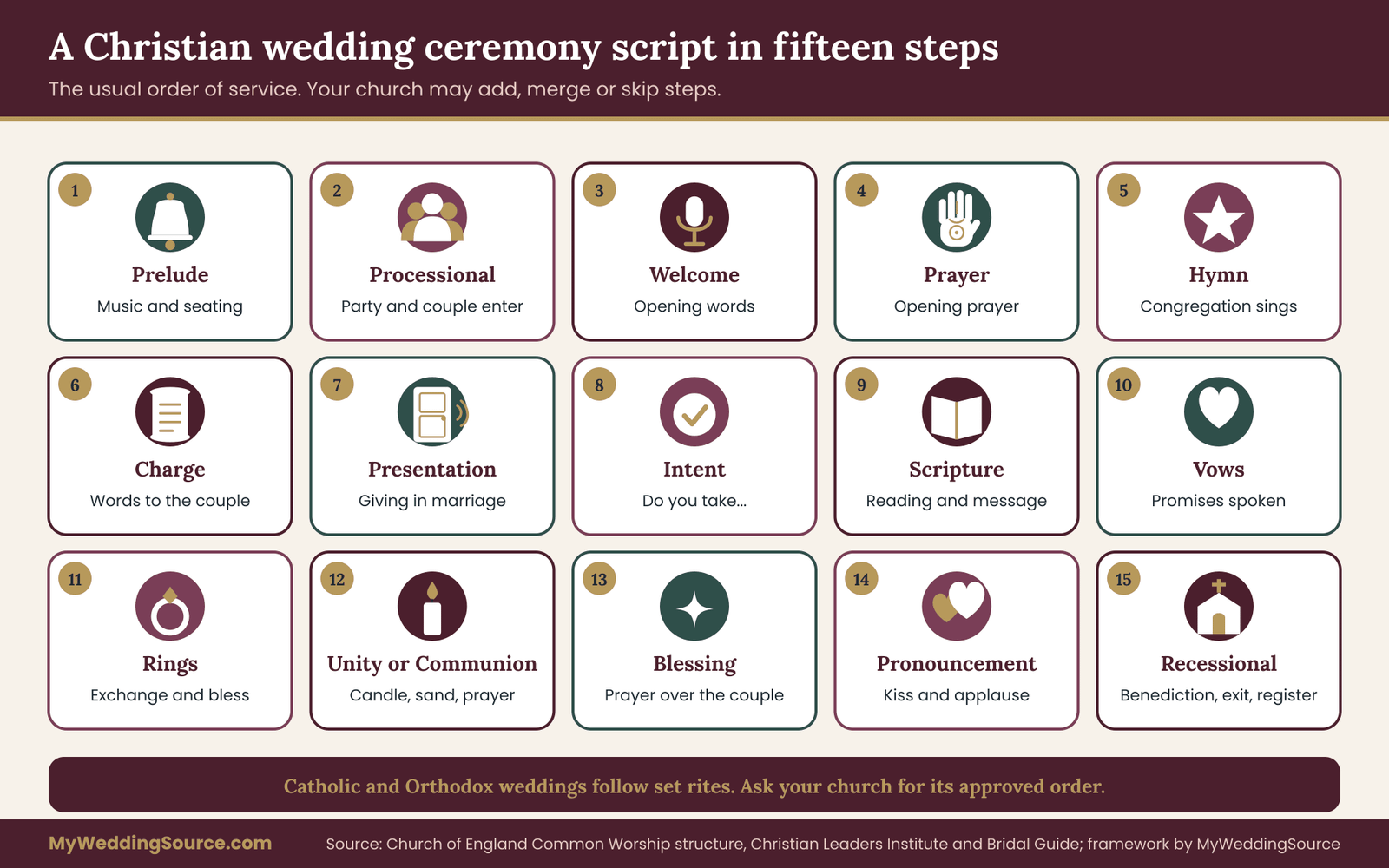
If you remember only one thing, remember this: in a Christian wedding ceremony script, the vows and the declaration of consent are the heart of the service, and everything before them prepares for those words while everything after them confirms them.
Why the order of a Christian wedding ceremony script matters
A script is more than a list of items. Each step does a job in the story the ceremony tells.
- The gathering invites the community to witness. Christian weddings traditionally take place in a church, in front of a congregation, rather than as a private contract between two people.
- The opening prayer places the marriage before God, so the couple and the guests know the service is worship as well as celebration.
- The charge and scripture explain what Christians believe marriage is for.
- The vows are the promises themselves. Wikipedia notes that vows in this form are rooted in Western Christian practice and are not universal, and they are not even used in the traditional Eastern Christian rite.
- The rings are a visible sign of the vows.
- The pronouncement and blessing declare the marriage and ask for God’s help in living it.
When you personalize a Christian wedding ceremony script, keep that logic intact. You can change the words, the music and the readings without losing the shape.
How to use this Christian wedding ceremony script guide
The sections that follow give a full order of service with sample wording written for this guide, followed by notes on vows, scripture, denominations, symbols, timing and common mistakes. The sample words are a starting point. Read them aloud, change them to sound like your church and your voices, and then check them with your pastor, priest or officiant.
If you are the officiant, the same principle applies. A Christian Leaders template describes itself as a launch pad rather than a cage, and that is the right spirit: a good Christian wedding ceremony script steadies your nerves and protects the essentials, and it leaves room for the couple.
The order of service for a Christian wedding ceremony script, step by step
What follows is a complete Christian wedding ceremony script in the order most Protestant and nondenominational churches use. The sample words are original, written for this Christian wedding ceremony script guide, and can be adapted. Where a step is optional or differs by tradition, we say so.
Wherever you see a block marked Officiant, that is a suggested spoken line. Change the wording so that it sounds natural when you say it out loud.
Step one: the prelude and the seating of family
The service begins before anyone speaks. Guests arrive and are seated while the organist, pianist or musicians play. This is called the prelude, and it sets a calm tone. The Christian Leaders sample program places the prelude first, followed by the seating of the parents and grandparents. In many churches the grandparents and parents are seated in turn, with the mother of the bride seated last, which signals that the processional is about to begin.
There is usually no spoken script here, though some churches have an usher or the officiant give a brief welcome and ask guests to silence their phones. If your church wants a short announcement, keep it friendly.
Usher or officiant: “Good afternoon, and welcome. Please silence your phones and join us in a spirit of prayer as we celebrate this wedding.”
Step two: the processional
The processional is the entrance of the wedding party and the couple. A common order is the officiant and groom taking their places, then the groomsmen and bridesmaids, the ring bearer and flower girl if the couple has them, and finally the bride, often with her father or another escort. Many couples now choose different patterns, such as both partners entering together. Our guide to the processional order shows several arrangements, including those for blended families.
In church weddings the congregation often stands when the bride enters. A line from the officiant can invite that.
Officiant: “Please rise, as we welcome the bride.”
For a couple who walk in together, the line can simply be “Please rise as we welcome the couple.”
Step three: the welcome and the opening words
Once the couple has reached the front, the officiant welcomes the guests and says why they are there. The welcome is short and warm, and it names the couple, the families and the purpose of the gathering. The Church of England structure calls this part the welcome and the preface, and it is where the service explains what marriage means.
Officiant: “Friends and family, we are gathered in the presence of God to witness the marriage of Anna and James, and to ask God’s blessing on their life together. Marriage is a gift from God and a covenant, and we come with joy to celebrate it.”
If you want a less formal tone, you can add a sentence about the couple.
Officiant: “Anna and James asked me to say how grateful they are that each of you is here. You have each shaped their story, and today you are part of it.”
Step four: the opening prayer
The opening prayer, sometimes called the invocation, asks for God’s presence and blessing. It can be read from a book, spoken from the heart or led by a family member. Keep it short enough that guests can follow, usually under a minute.
Officiant: “Let us pray. Gracious God, you are the source of all love. Be with Anna and James as they stand before you today. Bless this service, bless their families, and bless everyone gathered here, so that all we say and do may honor you. We ask this in the name of Jesus Christ. Amen.”
For couples who prefer a prayer that includes the congregation, the officiant can invite everyone to join in the closing “Amen.” A prayer from a hymnal or a liturgical book is also appropriate where your church uses one.
Step five: a hymn or song
Many churches include a hymn or a song after the opening prayer, which lets the congregation take part. A typical Church of England parish outline lists a hymn or song as an option at this point, and some Catholic and Anglican programs include several.
If you choose congregational singing, put the words in your program so that guests do not have to guess. Our guide to wedding programs explains what to include in a printed order of service. If the congregation does not sing at your church, a soloist or an instrumental piece works equally well.
Step six: the charge to the couple
The charge, or preface, is a short statement of what marriage is and what the couple is about to do. It is where the Christian wedding ceremony script explains the purpose of the service. Different traditions emphasize different themes: covenant, mutual love and support, faithfulness, family and faith.
Officiant: “Marriage is not to be entered into lightly, but with thought, prayer and a sense of purpose. It is a covenant of love in which two people promise to be faithful, to support one another, and to put each other first. Today Anna and James will make that promise in the presence of God and of those who love them.”
A longer version can mention the couple’s own hopes.
Officiant: “Anna and James have told me that they want a home where people feel welcome, where faith is practiced and where laughter is easy. Marriage will ask them to work for that, day by day.”
Step seven: the presentation or giving in marriage
In some ceremonies, someone presents the bride, or both partners, to the officiant. The traditional form has the father of the bride “give her away.” Many couples now prefer a version that includes both families, or both parents of each partner, or no presentation at all.
Officiant: “Who presents Anna and James to be married?”
Parents: “Their families and I do.”
Another option is for the officiant to ask both families to give their blessing.
Officiant: “Do the families of Anna and James promise to love and support them in their marriage?”
Families: “We do.”
This is a place where the Christian wedding ceremony script can show who you are. If one parent has died, or the couple’s family is blended, a line that honors them is often more meaningful than the traditional wording.
Step eight: the declaration of intent
Before the vows, many services ask each partner whether they have come freely to marry. In the Catholic rite this is the declaration of consent, and in many Protestant services it is called the declaration of intent. It is a short, direct exchange, and it asks the couple to confirm in front of witnesses that they are free to marry and willing to do so.
Officiant: “Anna, have you come here freely and without reservation to give yourself to James in marriage?”
Anna: “I have.”
Officiant: “James, have you come here freely and without reservation to give yourself to Anna in marriage?”
James: “I have.”
The words may be more formal in your church, but the purpose is the same. If your officiant is a legal witness, this is also a natural point to confirm that the couple has the marriage license.
Step nine: scripture and the message
The reading of scripture is the center of the teaching in a Christian wedding ceremony script. Most services include at least one reading, and Catholic weddings include several, and one Catholic wedding guide says the ceremony includes at least three biblical readings along with the vows, the rings, the prayer of the faithful and the nuptial blessing. Protestant services are usually more flexible, and the couple can choose passages that speak to them.
The most frequently chosen passages include the “love chapter” of 1 Corinthians 13, Genesis 2:24, Ecclesiastes 4:9 to 12, Ephesians 5, Ruth 1:16 to 17, and Song of Solomon 8:6 to 7. We list more of these, with notes on what each says, in the scripture section below.
A reader, who can be a friend or family member, usually comes forward to read. The officiant introduces the passage in a sentence.
Officiant: “Anna’s sister, Claire, will now read from the first letter of Paul to the Corinthians.”
After the reading, a short message or homily applies the passage to the couple. This is typically three to ten minutes. It is the most personal part of a Christian wedding ceremony script, and it should be specific to the couple.
A simple structure works well for the message.
- A story. Share one short memory that shows who they are as a couple.
- A truth. Connect it to the scripture that was read.
- A hope. End with what you wish for their marriage.
Officiant: “When Anna and James first started dating, they got lost on a hike and walked an extra three miles. They laughed the whole way. That is worth remembering, because the passage Claire just read describes love that is patient, kind and not easily angered. Marriage will bring wrong turns. A marriage built on patience and humor will find its way home.”
Step ten: the vows in a Christian wedding ceremony script
The vows are the promises the couple makes to one another. In the traditional Western Christian form, each partner says them in turn, repeating after the officiant or reciting from memory. The oldest traditional vows can be traced to the manuals of the medieval church, and the first Book of Common Prayer in 1549 based its marriage service mainly on the Sarum manual. Several phrases from that tradition, such as “to have and to hold,” are still familiar.
There are three common approaches.
- Traditional vows. Familiar wording from the prayer book tradition, said in the formal rhythm many guests recognize.
- Contemporary vows. A modern version of the same promises, often provided by your denomination.
- Personal vows. Words written by the couple, which are usually added to a core set of traditional promises or read after the officiant’s questions.
A sample set of original contemporary vows follows. Each partner repeats after the officiant.
Officiant: “Anna, repeat after me. I, Anna, take you, James, to be my husband. I promise to love you, to honor you, and to cherish you. I will stand by you in joy and in sorrow, in sickness and in health, in plenty and in need. I will be faithful to you, and I will keep this promise for as long as we both live. This is my solemn vow, made before God and these witnesses.”
The officiant then repeats the same lines for James. For couples who prefer questions to repetition, the officiant can ask each partner whether they will love, honor and cherish the other, and the response is “I will.”
Reformed Worship notes that many couples prefer to repeat the vows phrase by phrase after the minister or to have the minister ask the vows as questions, because it makes them easier to say when nervous. If you write your own vows, our guides to wedding vows have structure and wording ideas.
Vows are a good place for an honest note about scripture. The vows themselves do not appear in the Bible, and Christianity.com points out that no formal words of that kind appear in the Bible. They are a historical form, created by the church, and many churches are comfortable changing their wording as long as the promises are kept.
Step eleven: the exchange of rings in the ceremony script
The rings are the visible sign of the vows. In Western Christian traditions, including Catholic, Anglican and Protestant weddings, rings are exchanged, and the exchange symbolizes love, unity and commitment. No church or civil law requires it, as Reformed Worship points out, but because of the rich symbolism, the exchange of rings is almost always part of the service.
In a Catholic ceremony the rings are blessed by the priest before they are exchanged. In many Protestant services the officiant says a short prayer or a sentence of meaning.
Officiant: “The ring is a circle, with no beginning and no end. May these rings remind Anna and James of the promises they have made today, and of the love that holds them.”
Each partner then places the ring on the other’s hand and says a line.
Anna: “James, I give you this ring as a sign of my love and faithfulness.”
James: “Anna, I give you this ring as a sign of my love and faithfulness.”
If you will use one ring, or none, or an unusual ring, the officiant can adjust the wording. The symbolism is more important than the object.
Step twelve: the unity moment, communion or prayer
After the rings, many services include a symbolic or sacramental moment. The right choice depends on your church, and this is where the traditions differ most.
- Communion. Holy Communion may be part of the wedding service in liturgical Protestant churches such as Lutheran and Anglican, and in a Catholic nuptial Mass. Non-conformist Protestant churches such as Baptist and Methodist usually do not include it, according to revision notes for a UK religious studies course.
- A unity candle or unity sand. Two flames or portions of sand merge into one vessel, a symbol of two lives woven together. Reformed Worship says that the answer to the significance of the unity candle depends on one’s liturgical background, and that Christians from other traditions often find it a beautiful symbol. Catholic guidance is different, as we explain below.
- A covenant prayer. One officiant quoted by The Knot includes a prayer after the vows and rings about the commitment between the couple and God.
- Prayers for the couple. Family members or friends can read short prayers. Catholic services have the prayer of the faithful.
- A hymn or song. The congregation sings or listens while the couple lights a candle or receives communion.
A short unity candle script might read like this.
Officiant: “Anna and James each hold a candle, lit from the flame of their families’ love. Together they will light the center candle. As they do, we remember that in marriage two lives become one, while each person remains who they are.”
Some churches suggest leaving the two outer candles lit, which Reformed Worship notes can show that each partner keeps their own identity.
Step thirteen: the blessing of the marriage
Many Christian services include a blessing of the couple, in which the officiant prays for them and the congregation. In some traditions the officiant joins the couple’s hands and says words about God having joined them. The joining of hands is understood in Christian teaching as a sign that God has joined the couple together, as the revision notes explain.
Officiant: “Anna and James, may God bless you and keep you. May he give you wisdom in difficult days, joy in ordinary ones, and a love that deepens as the years go on. May your home be a place of welcome, and may your marriage be a sign of God’s faithfulness to all who know you.”
This is also a good moment for the Lord’s Prayer in traditions that use it, with the congregation joining in.
Step fourteen: the pronouncement and the kiss
The pronouncement is the officiant’s statement that the couple is now married. It follows from the vows and the rings, and in a church service it is usually made “in the name of the Father, and of the Son, and of the Holy Spirit,” although some churches use shorter words.
Officiant: “Anna and James, you have promised yourselves to one another before God and in front of these witnesses. By the authority given to me as a minister of the church and by your state, I now pronounce you husband and wife. What God has joined together, let no one divide. You may kiss.”
Replace the state named in the sample with your own. The officiant should use the legal words that their state requires, which your county clerk can confirm.
The Church of England structure places the proclamation of the marriage after the vows and rings, followed by the blessing. In a Christian wedding ceremony script, the kiss is optional, and some couples choose a hug, a prayer or simply a smile.
Step fifteen: the benediction, the recessional and the register
The benediction is the final blessing, sending guests out with God’s blessing and a charge to go in peace. It can be spoken or sung.
Officiant: “Go in peace, and may the love of God go with you. Friends and family, it is my joy to present, for the first time, Mr. and Mrs. James Carter.”
The recessional follows, with the couple walking back up the aisle, followed by the wedding party and then the families. Upbeat music is typical.
Finally, the couple, the officiant and the witnesses sign the marriage license or register. The Church of England structure lists registration of the marriage after the blessing, with prayers following. Make sure the officiant knows how and when to return the signed license, because the filing deadline varies by state. If the couple is going to a private room or a side table to sign, a short piece of music keeps the congregation engaged.
Christian wedding vows: where the words come from
Before you choose between traditional and personal wording, it helps to know where the familiar phrases came from. The history makes a Christian wedding ceremony script feel less like a rule and more like a living tradition.
A short history of the vows
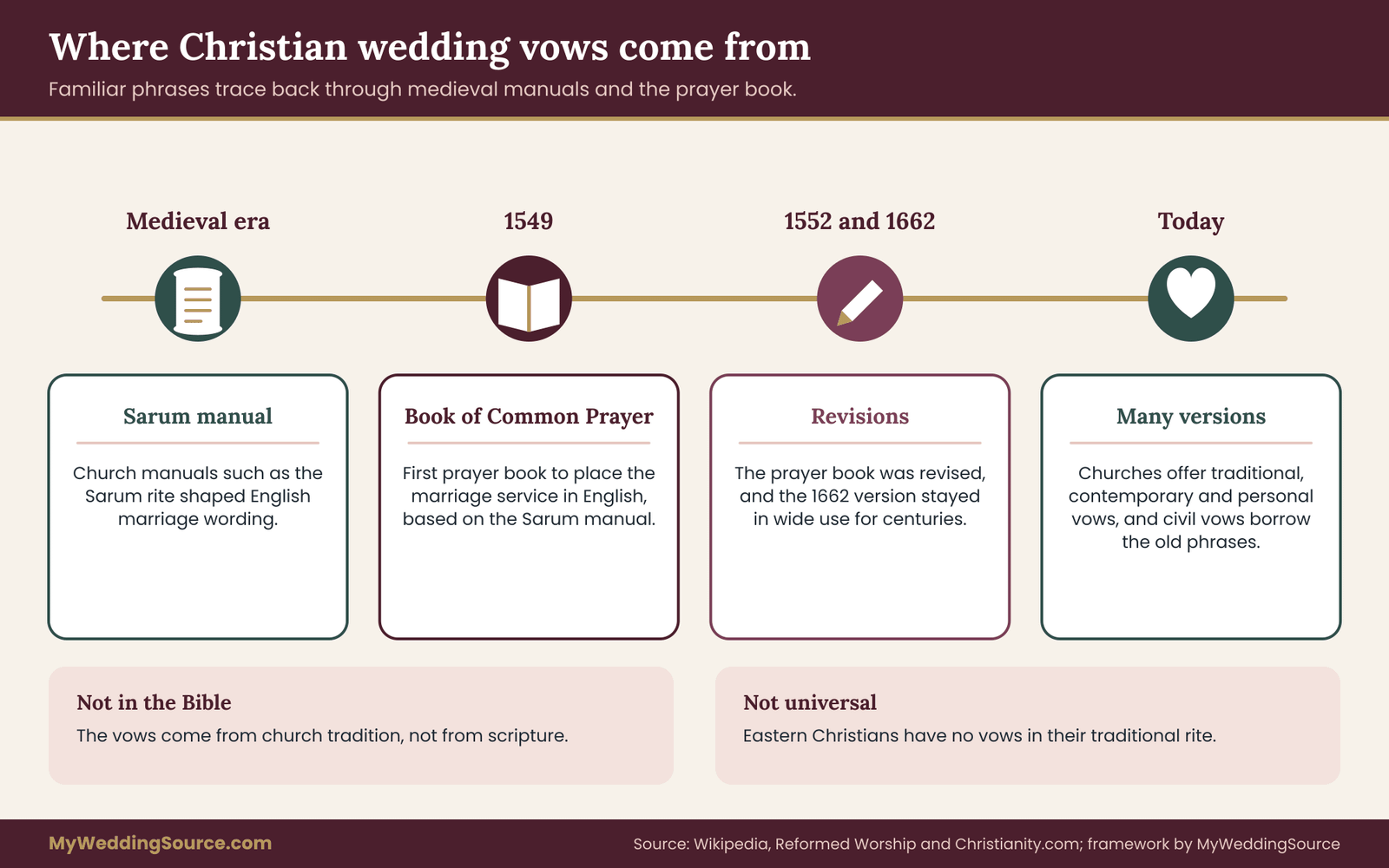
The oldest traditional wedding vows can be traced to the manuals of the medieval church. In England, one of the most influential was the Sarum manual, used in the diocese of Salisbury. One source places the Sarum rite as far back as the 11th century, and another dates the Sarum prayer book to the 13th century, so the exact date depends on which text you mean. What is clear is that the compilers of the first Book of Common Prayer, published in 1549, based its marriage service mainly on the Sarum manual.
The 1549 book matters for one reason in particular: it was the first to place the whole service in English, so ordinary people could follow it. Thomas Cranmer, Archbishop of Canterbury, is the figure most often credited with the work, though it is unlikely to be the work of a single author. The prayer book was revised in 1552 and 1662, and the 1662 version remained in wide use for centuries.
That history explains why so many ordinary couples, whether or not they attend church, use a phrase like “to have and to hold from this day forward” in a civil ceremony. Wikipedia notes that many civil marriage vows are adapted from the traditional vows in the Book of Common Prayer.
Two other points are worth knowing.
- The vows are not in the Bible. Christianity.com says plainly that the vows, from the prayer book or written by the couple, do not appear in scripture.
- The vows are not universal. Wikipedia states that vows are not even universal within Christian marriage, because Eastern Christians do not have marriage vows in their traditional ceremonies. The Orthodox rite focuses instead on the crowning, the prayers and the joining of the couple in the church.
Choosing traditional, contemporary or personal vows for the Christian wedding ceremony script
There is no single right choice. The best vows are ones the couple can say with sincerity and the congregation can hear with understanding.
Traditional vows give a sense of continuity. When you say words that have been spoken for centuries, you join a long line of couples. The tradeoff is that some phrases, such as the older promise of obedience, have been removed from most modern versions, and the formal language can sound distant to some guests.
Contemporary vows keep the promises but update the language. Many denominations publish approved contemporary versions, and a pastor can often adapt them.
Personal vows let the couple speak in their own voices. They work best when they follow a structure, such as a promise to love, a promise to support and a promise of faithfulness, and when they stay under about a minute each. Many couples say personal vows in addition to the traditional ones, or write them as a letter to be exchanged privately.
A balanced approach is to use a core set of formal promises, followed by a short personal sentence from each partner.
Anna: “James, I promise to love you, to honor you and to cherish you for as long as we both live. And I promise to keep making you laugh.”
Tips for saying the vows well
- Repeat after the officiant in short phrases. Nerves are normal, and phrase-by-phrase repetition removes the pressure to remember.
- Practice aloud. Read the vows at the rehearsal, standing, with a microphone if one will be used.
- Face each other. Hold hands if comfortable, and look at your partner, not at the paper.
- Keep a printed copy. The officiant should have a spare in case someone forgets a line.
- Check with your church. Some denominations require specific wording for the vows to be valid within the service.
Scripture for a Christian wedding ceremony script
Scripture is what makes a Christian wedding ceremony script Christian. The right passage can state in a few lines what a couple hopes for, and it can set the tone for the whole service. A few details help you choose well.
According to The Knot, 17 percent of couples include a religious reading in their ceremony. That figure covers all couples, not only those marrying in a church. In a Christian service, a scripture reading is a normal part of the order. Most churches welcome the couple’s choice, and some, like Catholic parishes, offer a list of approved readings.
Eight passages and what they say
The passages most often cited by Christian wedding resources are these.
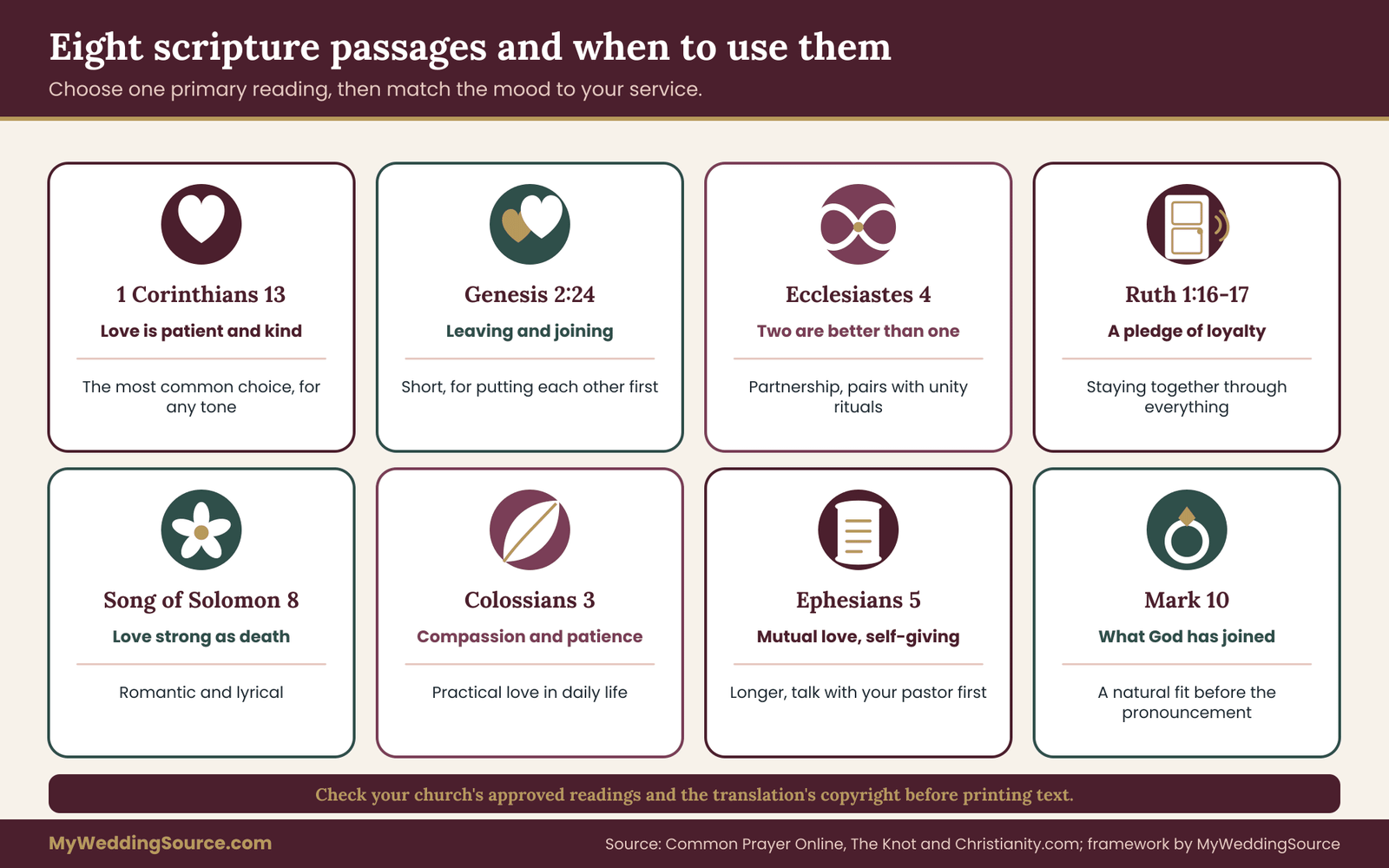
- 1 Corinthians 13:4 to 8. The “love chapter” describes love as patient, kind and enduring. It is the most commonly used wedding reading across Christian traditions, and it is often requested even by non-religious couples. One commentator notes that Paul wrote it to a church rather than a couple, so it describes love in community, of which marriage is the most intimate form.
- Genesis 2:24. A short verse about a man leaving his family and joining his wife, so that they become one. It emphasizes putting each other first.
- Ecclesiastes 4:9 to 12. “Two are better than one” and the cord of three strands. It suits couples who want a reading about partnership and mutual support, and it is often paired with a unity ritual. Note that the passage was originally written about work and companionship, not marriage in particular.
- Ruth 1:16 to 17. Ruth’s pledge of loyalty to Naomi, often chosen for its language of staying together through everything. It was written about a daughter-in-law and mother-in-law, but it has become a favorite for its depth of commitment.
- Song of Solomon 8:6 to 7. A poetic passage about love as strong as death. It is a good choice for couples who want a more romantic and lyrical reading.
- Colossians 3:12 to 17. A passage about putting on compassion, kindness, humility and patience, with love holding everything together. It is suited to couples who want a practical reading about daily life.
- Ephesians 5:21 to 33. A longer passage about mutual love and self-giving, with the image of Christ and the church. Interpretations of its language about wives and husbands vary among churches, so talk with your pastor about which verses to read and how to introduce them.
- Mark 10:6 to 9. Jesus on the two becoming one flesh and what God has joined together. It is a natural fit for a ceremony that includes the pronouncement.
Other widely used passages include 1 John 4:7 to 12 on love, Romans 12:9 to 18 on sincere love, John 2 on the wedding at Cana, and Revelation 19 on the marriage supper of the Lamb. Online worship resources such as the Common Prayer site list a wide set of first and second lessons for weddings, from Genesis and the Song of Solomon to Colossians and 1 John, and a diocesan list for Catholic weddings is similar.
How to choose and introduce a reading
- Pick one primary passage. A single well-chosen reading is more memorable than three short ones.
- Read it in a translation you understand. Many couples choose a modern translation for clarity, and some prefer the older language for its rhythm. Check that the translation is permitted if you will print the text.
- Choose a reader. A sibling or close friend is a good choice, and the reader should practice aloud.
- Print the passage in the program. It helps guests follow along. Check any copyright rules for modern translations before reproducing the full text, or print only the reference.
- Introduce it with a sentence. A line of context helps the guests who are less familiar with scripture.
Our guide to wedding readings has more ideas for secular and religious readings, and works well alongside this section.
How the Christian wedding ceremony script differs by denomination
“Christian wedding” covers a wide range of churches, and the Christian wedding ceremony script that works in one may not be allowed in another. The biggest differences come from how each tradition understands marriage itself.
Catholic weddings
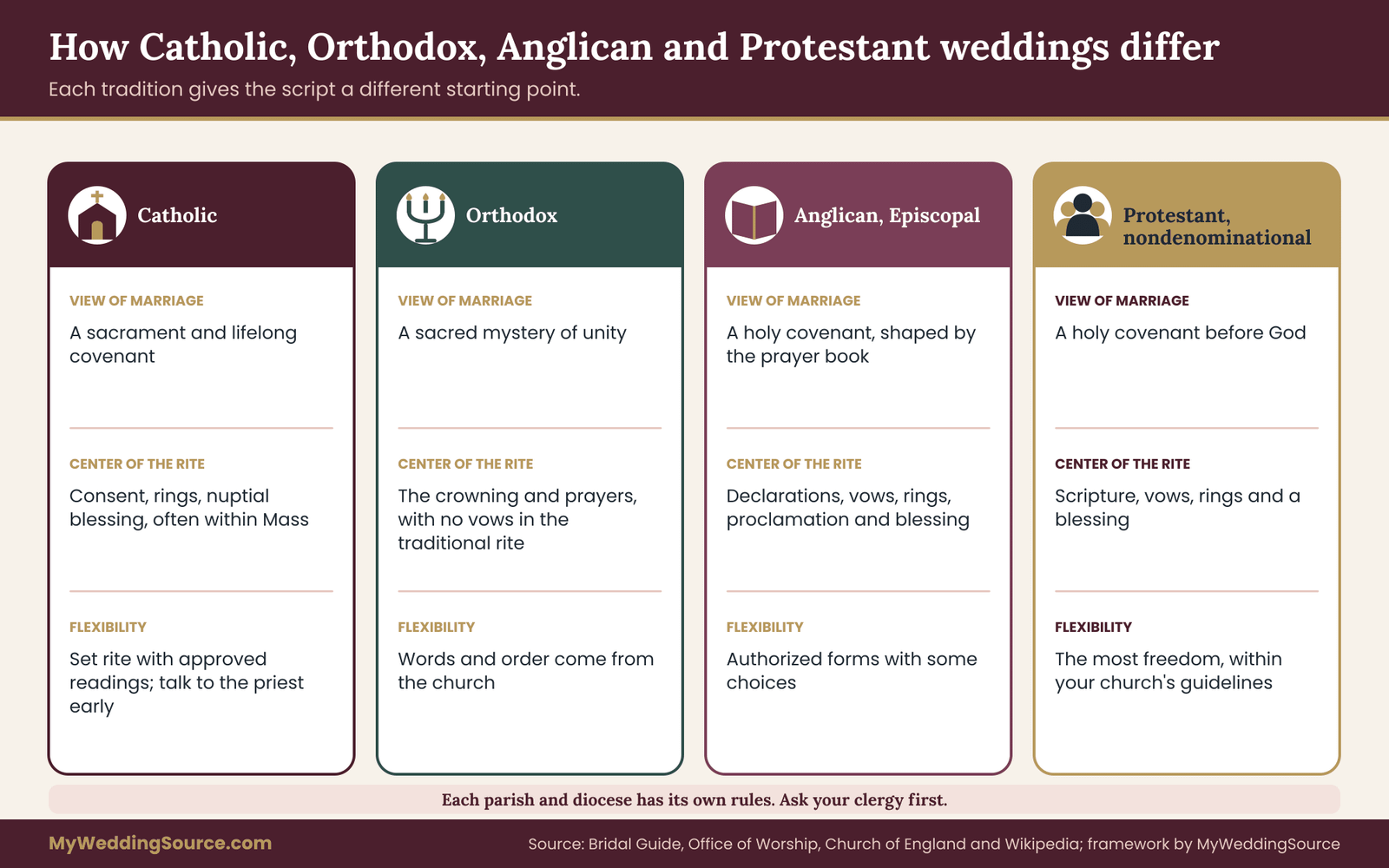
In Catholicism, marriage is one of the seven sacraments, a holy mystery that brings God’s grace to the couple and a lifelong covenant, not just a contract. A Catholic wedding usually takes place in a Catholic church, and Bridal Guide notes that it often happens during a nuptial Mass lasting 45 minutes to an hour. After the declaration of consent, the rings are blessed and exchanged, and the Mass then continues with the Liturgy of the Eucharist and the concluding rites.
Couples can choose between a celebration of marriage within Mass and one without Mass. A diocesan Office of Worship notes that the rite without Mass is often used when one partner is Christian but not Catholic, and there are other forms for a marriage between a Catholic and a catechumen or an unbaptized person. One Catholic wedding guide describes the ceremony as including at least three biblical readings, the vows, the rings, the prayer of the faithful, the nuptial blessing, prayers and music.
Several customs that are common in Protestant weddings are treated differently.
- The unity candle. The same diocesan office says that lighting a unity candle is a secular practice of recent origin that has never been part of the Catholic celebration of matrimony. If one is used, it suggests the couple light their own candles from the Easter candle, leave them burning and keep the candle off the altar. It also advises against unity sand, because sand has no Christian symbolism.
- Music. The office advises saving secular or pop songs for the reception.
- Readings. The Church provides lists of approved Old and New Testament readings, from Genesis and Romans to 1 Corinthians, Ephesians, Colossians and 1 John.
Because each parish and diocese has its own rules, Catholic couples should meet their priest early. Marriage preparation is often required, and the priest can explain which options are allowed.
Orthodox weddings
Orthodox Christians also view marriage as a sacred mystery, focusing on spiritual growth and unity. The service is rich in symbols, and several rituals are performed three times to represent the Holy Trinity. The couple is crowned with ornate crowns, and the service often ends with the congregation singing a hymn while the couple circles a ceremonial table hand in hand. The wedding takes place in a church, and Bridal Guide notes its similarity in some respects to the Roman Catholic wedding.
In the Orthodox tradition, the crowning rather than the vows is the central act. Wikipedia notes that Eastern Christians have no marriage vows in their traditional ceremonies.
For couples marrying in an Orthodox church, the Christian wedding ceremony script is provided by the church. You can choose music, readings, wedding party and some details, but the words and the order are not usually yours to rewrite. If one partner is not Orthodox, talk to the priest early.
Anglican and Episcopal weddings
The Anglican tradition, which includes the Church of England and the Episcopal Church in the United States, is built on the Book of Common Prayer and, in England, the Common Worship service. The structure described by the Church of England has an introduction with a welcome, preface and declarations, then a collect, readings and a sermon, followed by the marriage itself with the vows, the giving of rings, the proclamation and the blessing, and finally registration and prayers.
The vows are the best-known part, drawn from the prayer book tradition. Communion may be part of a wedding in liturgical churches such as Anglican and Lutheran ones, and the couple can choose whether to include it.
Protestant and nondenominational weddings
Protestant churches are the most varied. Most understand marriage as a holy covenant rather than a sacrament, and services center on scripture, vows, rings and a blessing. A few traditions, such as the Baptist, do not treat marriage as a sacrament but still regard it as sacred.
Within this group, the officiant often has the most freedom. Methodist programs, for instance, offer two outlines, one with traditional vows and one with contemporary vows. The Reformed Church in America’s published order for Christian marriage describes itself as a brief service that can be used in a variety of settings, though it says that a Christian marriage service should be held in the church.
A nondenominational church or a ministry-ordained friend has more flexibility still. The Christian Leaders Institute template, for example, aims to protect the biblical and legal essentials while letting the officiant adjust the tone and the length of the message for couples with strong Christian backgrounds, mixed faith backgrounds, or little church exposure, as well as for second marriages.
Which tradition suits your Christian wedding ceremony script
The practical questions are simple.
- What does your church require? Ask for the approved order, the allowed readings and any restrictions on music and symbols.
- Who is officiating? A priest, pastor or authorized minister has legal authority, and a friend who is ordained online needs to follow state rules. Our guide to the wedding officiant explains the options.
- Are both partners from the same tradition? If not, plan an early conversation with the clergy about how to honor both.
- How formal do you want the service? A liturgical service is formal and set, while a free-church service is more flexible.
- How much time do you have? Counseling and preparation take months in many churches.
Symbols and traditions in a Christian wedding ceremony script
Many symbols turn up in a Christian wedding ceremony script, and each carries a meaning that you can explain in your program or in a short line from the officiant.
The rings. A circle with no beginning or end, a sign of unending love and the seal of the vows. One church writes that the rings both remind the couple of their vows and seal those vows upon them.
The joining of hands. A visible sign that God joins the couple, as in the officiant’s words “what God has joined together.”
The unity candle or unity sand. Two flames or two portions of sand merge into one vessel. It is a modern symbol, popular in many Protestant weddings and discouraged in some Catholic settings.
The three-strand cord. Based on Ecclesiastes 4:12, a braided cord of three strands represents the couple and God. It is sometimes used as a ritual in nondenominational weddings.
Holy Communion. The couple may take communion together to place Christ at the center of their covenant, as one Christian resource puts it, or receive it with the congregation.
The lasso. In some Hispanic ceremonies, a large rosary or cord is placed around the couple as a sign of unity. It is a regional custom rather than a requirement.
The crowns. A central rite in Orthodox weddings, in which ornate crowns are placed on the couple as a sign of their union.
Candlelight blessings. In both Catholic and Protestant churches, a candlelight blessing can follow the vows. Catholic tradition sees the flame as a symbol of Christ, the light of the world.
If you want to use a ritual from another tradition, ask your clergy. Some may welcome it as a gesture of respect, and others may feel that it does not fit the theology of the service.
Timing and length: how long a Christian wedding ceremony runs
Length is one of the first practical questions about any Christian wedding ceremony script. The honest answer is that it depends on the tradition and on how many optional elements you include. A Catholic nuptial Mass often lasts 45 minutes to an hour, according to Bridal Guide. A Protestant or nondenominational service without communion is usually shorter.
You can shape the length with a few choices.
- The message. A three-minute reflection and a ten-minute homily produce very different services.
- The music. Each hymn adds two to four minutes, and a solo adds about the same.
- Communion. Receiving communion takes time, especially with a large congregation.
- Unity rituals. A candle lighting is quick, while an extended foot-washing or prayer ritual takes longer.
- Readings. Each reading adds one to three minutes.
- The processional. A large wedding party takes longer to enter and exit.
Below is a sample plan for a Protestant-style ceremony that takes about thirty minutes from the processional to the recessional. It is only a starting point.
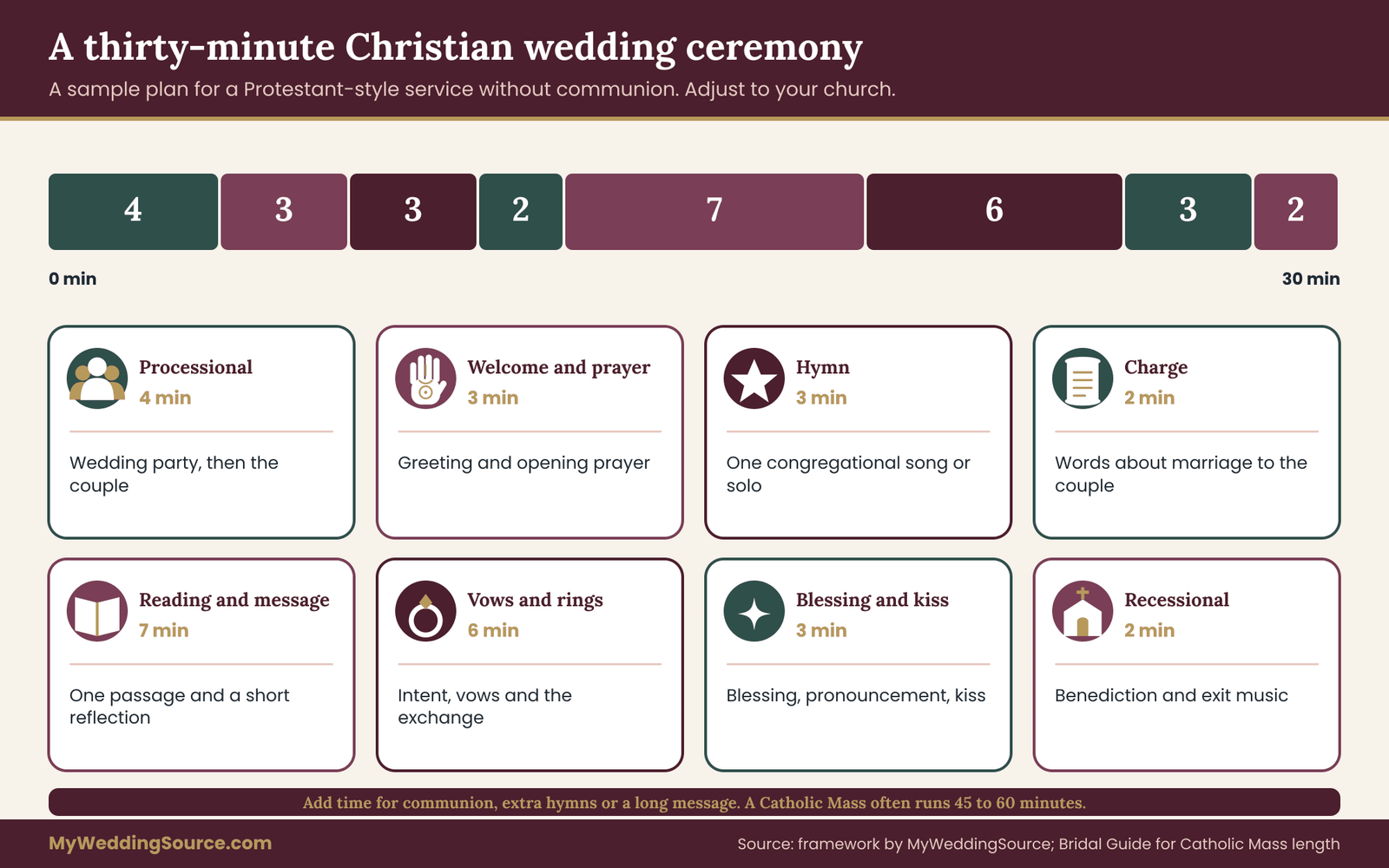
If the venue has a hard end time, build in a buffer. Weddings seldom run short. For a larger view of how the ceremony fits into the whole day, our wedding planning timeline shows how to schedule the hours before and after. For a version of this ceremony in a different style, see our template collection for a wedding ceremony script.
Writing your own Christian wedding ceremony script
A template saves time, but a good Christian wedding ceremony script reflects the couple. Here is a process that works.
Start with the church’s requirements
Ask the pastor or priest for the approved order, any required prayers or readings, the length limit, the music rules and any restrictions on photography or candles. This conversation prevents the most common problem, which is writing a lovely script that cannot be used.
Decide the tone
Christian ceremonies range from formal liturgy to relaxed conversation. Choose a tone that fits the couple and the congregation, and keep it consistent. A formal prayer followed by a joke can feel jarring, while a warm story followed by a solemn vow can feel just right.
Choose the non-negotiables
Write down the three elements that matter most to the couple. For one couple it may be a hymn that the congregation sings, for another a specific reading, and for another the presence of communion. Build the script around these.
Draft the spoken parts
Write the welcome, the prayers, the charge, the vows, the ring wording, the pronouncement and the blessing in full. Read each aloud. If you stumble, simplify.
Add the personal touches
The message, a reading from a friend, a short note about family and a thank you to guests are places for personality. A tip from a Christian Leaders guide is to know your structure well enough that you do not need to hold the script in front of you.
Test the timing
Read the entire script aloud with a timer, adding time for music and movement. Adjust until it fits.
Print the final copy
Give the officiant a clean copy in a large font, with names pronounced phonetically if needed. Keep a backup on a phone and a paper copy in a folder.
Personalizing the Christian wedding ceremony script for different situations
The same Christian wedding ceremony script can be adapted to many situations.
Second marriages
Couples marrying again may want to acknowledge their earlier lives without dwelling on them. A short line in the charge can honor the past and look ahead. Some churches have specific requirements for remarriage, such as counseling or a meeting with the pastor, so ask early. If there are children, the ceremony can include them, with a blessing for the new family or a promise spoken to the children.
Officiant: “Anna and James each bring a story and a family to this day. Today those stories join together, and we ask God’s blessing on every person in this new household.”
Mixed-faith and mixed-denomination weddings
When the couple comes from different traditions, the Christian wedding ceremony script can include elements from each. A priest and a minister may officiate together, or the couple may choose a service that honors both. The Catholic rite has specific forms for a marriage involving a non-Catholic Christian or a non-Christian, so a conversation with the priest is essential. Keep the program explanatory, with a brief note about unfamiliar traditions so guests understand what is happening.
Short or small ceremonies
If you want a shorter Christian wedding ceremony script, keep the essentials: a welcome, a prayer, one reading, the vows, the rings, the pronouncement and the blessing. You can omit the hymn, the unity ritual and the extended message. Many couples choose this format for elopements, small gatherings and courthouse weddings with a pastor present.
Outdoor and nontraditional venues
A Christian ceremony can take place in a garden, on a beach or at a venue. Some churches allow their clergy to officiate outside the church, and others do not. Check this early, and plan for wind and sound, because without a church’s acoustics the officiant and readers will need a microphone. Keep the order of service the same, and consider adding a short blessing of the place.
Interfaith guests
When many guests are not Christian, a few touches help. Include a brief explanation in the program of each ritual, invite guests to join prayers if they wish, and avoid language that assumes everyone shares the faith. The couple can also include a reading that speaks of love in broad terms alongside scripture.
A ceremony without a church
Some couples want a Christian ceremony but do not belong to a church. A pastor, a chaplain or an ordained friend can lead the service. In that case, the couple must make sure the officiant is legally authorized to perform weddings in their state. If your plan is for a non-religious ceremony instead, see our non-religious ceremony script.
Roles in a Christian wedding ceremony
A script works better when everyone knows their part. These are the usual roles.
- The officiant. Leads the service, speaks the charge and the blessing, asks the vows and signs the license. In a Catholic Mass, the priest also leads the liturgy.
- The readers. One to three people who read scripture or prayers.
- The musicians. Organist, pianist, soloists or a worship band, plus a coordinator for cues.
- The ushers and greeters. Seat guests, hand out programs and keep the aisle clear.
- The wedding party. Bridesmaids and groomsmen enter and stand with the couple, and the ring bearer and flower girl take their places.
- The witnesses. Two people are typically required to sign the marriage license in many states.
- The coordinator. A church or venue coordinator who cues the processional and the music.
At the rehearsal, walk through the whole script, including the signing. Our guide to the wedding ceremony step by step explains the usual sequence from the prelude to the recessional, which helps your team practice.
Delivering the Christian wedding ceremony script well
A script on paper is only half the work. The way the officiant and the couple deliver a Christian wedding ceremony script decides whether it feels warm and unhurried or stiff and rushed. These habits help.
Advice for the officiant
- Speak slowly and pause. Nerves speed everyone up. A pause after each phrase of the vows gives the couple time to repeat them and gives the congregation time to listen.
- Use a microphone you have tested. Check the volume at the rehearsal, standing where you will stand on the day.
- Know the script well enough to look up. Eye contact with the couple makes the prayers sound sincere, and it keeps the service from feeling read aloud.
- Mark the cues. Note in the margin where the music starts, where the couple turns, where the rings are handed over and where guests are invited to stand or sit.
- Keep the message focused. One idea, one story and one scripture are enough. A short, well-prepared reflection is remembered longer than a long one.
- Carry a backup. Bring a printed copy of the Christian wedding ceremony script, the vows, the license and a pen that works.
Advice for the couple
- Choose a few moments to be fully present. The vows and the blessing are the two that most couples remember. Let everything else be easy.
- Breathe before you speak. A slow breath steadies the voice.
- Hold a small card if you are nervous. It is fine to glance down. Guests care about the promise, not about perfect recall.
- Trust the officiant. If a line goes wrong, the officiant can repeat it, and nobody will remember the slip.
Advice for the congregation
A short note in the program helps guests take part. Tell them when to stand, which hymn they are invited to sing, whether communion is open to everyone, and whether phones should stay away. A single printed page that explains the order of service makes a Christian wedding ceremony script easier to follow for guests of any background.
Program wording for a Christian wedding
The printed program is the public version of the Christian wedding ceremony script. A clear program shows the order, names the readers and musicians, and explains the traditions in a sentence or two. A simple layout works well.
- The cover. The couple’s names, the date and the place.
- The order of service. Prelude, processional, welcome, prayer, hymn, readings, message, vows, rings, blessing, pronouncement, recessional.
- The people. The officiant, readers, musicians, wedding party, and parents.
- A note of thanks. Two or three sentences to family and friends.
- A short explanation. If the service includes a unity ritual, communion or a tradition from the couple’s heritage, explain it in a line.
If you plan to print scripture in full, check the copyright terms of the translation first, or print only the reference and let the reader proclaim the text. Our guide to wedding programs shows layouts and wording that work for a ceremony of this kind.
Involving family and children
A Christian ceremony is a family occasion, and the Christian wedding ceremony script can make room for the people who matter most.
- Parents. A blessing for the parents, a prayer spoken by them, or a moment when they stand and say a few words can be the emotional center of the service. Some couples present each parent with a flower at the start or the end.
- Grandparents. Seat them with care and, if possible, mention them in the welcome.
- Children from a previous marriage. A promise to the children, a family medallion or a prayer said together makes the new household visible. A short, simple line is better than a long speech, because children usually find long moments hard.
- A flower girl and ring bearer. A small part, practiced at the rehearsal, is charming. Our guide to the flower girl and ring bearer rehearsal has practical tips for young attendants.
- Those who have died. A candle, an empty chair or one sentence in the prayer can honor loved ones who cannot be present. Keep it brief so that the day stays joyful.
Keeping the Christian wedding ceremony script meaningful
The best test for any Christian wedding ceremony script is whether the couple and their guests will recognize it as truthful. A few questions help.
- Does each element have a reason? If a ritual is included only because it is customary, consider removing it.
- Does the language sound like us? The formal wording of tradition has its own beauty, but personal sentences make the day yours.
- Does it honor our faith and our guests? Aim for sincerity without pressure.
- Is it the right length? A shorter service that feels complete is better than a long one that tires the room.
- Could someone else follow it? If a friend can read the Christian wedding ceremony script and lead the ceremony, the order is clear.
When the answers are yes, the script is ready.
A complete sample Christian wedding ceremony script
To make the pieces concrete, here is a condensed version of a Christian wedding ceremony script, from welcome to blessing, written for this guide. It takes about twenty to twenty-five minutes when spoken at a natural pace, without hymns. Replace the names, scripture and wording to suit your church and your voices.
Officiant (welcome): “Welcome, friends and family. We are here today in the presence of God to celebrate the marriage of Anna and James. Marriage is a gift and a covenant, and we come with thankfulness and joy.”
Officiant (prayer): “Let us pray. Loving God, you are the source of every good gift. Bless this day, bless Anna and James, and bless all who have come to witness their promises. Make our words honest and our hearts glad. Amen.”
Officiant (charge): “Anna and James, marriage is a promise to love when it is easy and when it is hard. It is a decision you make again each day. You will be tested by time, by stress and by ordinary life, and you will be strengthened by prayer, by forgiveness and by the people who love you. Today you make this promise in front of them.”
Reading: A passage chosen by the couple, read by a friend or family member.
Officiant (message): A short reflection on the reading and on the couple, three to five minutes.
Officiant (intent): “Anna, will you have James to be your husband, to live together in the covenant of marriage? Will you love him, comfort him, honor him and keep him, in sickness and in health, and be faithful to him as long as you both live?”
Anna: “I will.”
Officiant: “James, will you have Anna to be your wife, to live together in the covenant of marriage? Will you love her, comfort her, honor her and keep her, in sickness and in health, and be faithful to her as long as you both live?”
James: “I will.”
Officiant (vows): “Please face each other and join hands. Anna, repeat after me.” The officiant leads each partner through the vows, phrase by phrase.
Officiant (rings): “These rings are a circle with no end, a sign of the promises you have made. May they remind you of this day and of the love that holds you.”
Anna and James (placing rings): “I give you this ring as a sign of my love and faithfulness.”
Officiant (blessing): “May God bless you and keep you. May he fill your home with peace, your days with joy and your hearts with love. May your marriage be a sign of his faithfulness to everyone who knows you.”
Officiant (pronouncement): “Anna and James have promised themselves to one another before God and these witnesses. By the authority given to me as a minister and by the state, I now pronounce you husband and wife. What God has joined together, let no one divide. You may kiss.”
Officiant (benediction): “Go in peace, and may the love of God go with you. Friends and family, it is my joy to present Mr. and Mrs. James Carter.”
This version leaves out the presentation, the hymn, the unity ritual and communion. Add them if your church or your family expects them. If you are the officiant, mark where the music begins and ends, and mark the places where you wait for the couple, such as the kiss and the signing.
Legal essentials for a Christian wedding ceremony script
A Christian wedding ceremony script is a religious document, but the marriage is also a civil act. A few points matter in every state.
- The license. The couple must obtain a marriage license before the ceremony, and it is typically valid for a limited time. The license is permission to marry, and the certificate is the proof that the marriage took place. Details and fees vary by county.
- The officiant. The person leading the service must be legally authorized to perform weddings in the state. A priest or pastor is normally authorized, and an ordained friend needs to check the state’s rules. Some states require registration.
- The wording. Some states require the officiant to ask the couple certain questions or make a specific statement. The declaration of intent and the pronouncement usually cover this, but confirm the details with the county clerk.
- The witnesses. Some states require one or two witnesses to sign the license.
- The filing. The officiant, or the couple, must return the signed license by the state’s deadline.
If you are unsure, call the county clerk or the church office. A beautiful service that does not result in a valid marriage is a heartbreak that is easily avoided.
A planning timeline for your Christian wedding ceremony script
The ceremony itself takes half an hour, but preparing it takes months. A simple timeline helps.
- Nine to twelve months before. Meet the pastor or priest. Ask about premarital counseling or marriage preparation, which many churches require or recommend. Confirm the date and time, and ask for the church’s wedding guidelines.
- Six to nine months before. Choose the officiant, musicians and readers. Start a list of scripture and hymn choices.
- Four to six months before. Draft the Christian wedding ceremony script with the officiant. Decide on the vows, the unity ritual and the length.
- Two to three months before. Finalize the order of service, the readings and the music. Begin the program and any stationery.
- One month before. Apply for the marriage license if the timing allows. Send the final script to everyone with a role.
- One week before. Hold the rehearsal. Walk through the processional, the vows, the signing and the recessional. Print final copies.
- The day before. Confirm the plan with the officiant, musicians and coordinator.
Music for a Christian wedding ceremony
Music shapes the mood of the ceremony. Most Christian wedding ceremony scripts include music at four points.
- The prelude. Instrumental or vocal pieces while guests arrive.
- The processional. One piece for the wedding party and a second for the bride or couple. Many couples choose a hymn arrangement, a classical piece or a modern instrumental.
- During the service. A congregational hymn, a solo or a piece during the unity ritual or communion.
- The recessional. Joyful, upbeat music as the couple leaves.
Churches often have rules about music. A Catholic diocesan office, for example, advises saving secular and pop songs for the reception, and some churches limit the use of recorded music. Check with the music director before you finalize the list.
Common mistakes with a Christian wedding ceremony script
A few errors come up often, and most are easy to avoid.
- Skipping the church conversation. A script written without the pastor’s input may include elements the church does not allow.
- Making it too long. A long message, extra readings and several songs can stretch the service and tire guests.
- Copying wording without understanding it. Know why each element is there, so you can explain it or change it.
- Forgetting the legal pieces. The license, the officiant’s authority and the witnesses are essential.
- Using inside jokes. A joke that only a few people understand leaves the rest of the congregation out.
- Overlooking guests who are not Christian. A short explanation in the program makes everyone feel welcome.
- Not rehearsing. Even a simple service benefits from a walk-through.
- Leaving the script on one phone. Print copies and share a digital version.
- Relying on a template without adapting it. The best Christian wedding ceremony script sounds like the couple.
- Leaving out the quiet moments. A pause after the vows, or a moment of silence during the prayer, can be the most memorable part.
FAQ
What is included in a Christian wedding ceremony script?
A Christian wedding ceremony script usually includes the prelude and processional, a welcome and opening prayer, a charge to the couple, scripture and a message, the declaration of intent, the vows, the exchange of rings, a blessing or unity moment, the pronouncement, the benediction and the recessional. Catholic and Orthodox weddings follow set rites, and some churches include communion.
How long is a Christian wedding ceremony?
It depends on the tradition and the optional elements. A Catholic nuptial Mass often lasts 45 minutes to an hour, while a Protestant service without communion is usually shorter. Hymns, readings, the message and communion all add time, so build the Christian wedding ceremony script around the length your venue allows.
Where do traditional Christian wedding vows come from?
The oldest traditional vows can be traced to medieval church manuals such as the Sarum manual, and the first Book of Common Prayer in 1549 based its marriage service mainly on that manual. The vows are not in the Bible, and traditional Eastern Christian ceremonies do not have marriage vows.
Which Bible verses are most common at Christian weddings?
The most commonly used passages include 1 Corinthians 13, Genesis 2:24, Ecclesiastes 4:9 to 12, Ephesians 5, Ruth 1:16 to 17 and Song of Solomon 8:6 to 7. Colossians 3, Mark 10 and 1 John 4 are also popular. Check with your pastor, because some churches provide a list of approved readings.
Can we write our own vows in a Christian ceremony?
Often, yes, but it depends on the church. Many Protestant and nondenominational churches welcome personal vows, usually in addition to a core set of traditional promises. Catholic and Orthodox churches follow set texts for the vows or crowning, though you may be able to add personal words at another point.
Is a unity candle part of a Christian wedding?
In many Protestant weddings, yes. It is a modern symbol and not required. One Catholic diocesan office says it has never been part of the Catholic celebration of matrimony and advises against unity sand. Ask your clergy before including either.
Do we need communion in a Christian wedding?
No. Communion may be part of the service in liturgical Protestant churches and in a Catholic nuptial Mass, but non-conformist Protestant churches such as Baptist and Methodist usually do not include it. Whether to include it is a question for your church.
Who can officiate a Christian wedding?
A priest, pastor or other minister authorized by your church and by the state can officiate. An ordained friend can also do so where state law allows, and the officiant must follow the state’s requirements for the license and signing. Check with your county clerk.
Your next steps
Begin with four actions this week. First, meet or call your pastor or priest and ask for the church’s wedding guidelines and approved order of service. Second, choose your officiant and confirm that they are legally authorized to marry you. Third, sketch the Christian wedding ceremony script on one page, using the outline in this guide for a Christian wedding ceremony script, and mark the three elements that matter most to you. Fourth, read the draft aloud with a timer.
Then refine it. Choose a scripture that says what you hope for, write vows you can say sincerely, and rehearse the whole service once with everyone who has a role. A script that is clear, prayerful and personal will carry the day, and the rest will take care of itself.
Sources
- Wedding ceremony template and officiant guide, Christian Leaders Institute
- Sample wedding ceremony program, Christian Leaders Institute
- Using this wedding ceremony template, Christian Leaders Institute
- Common Worship marriage service structure, Church of England
- Order for Christian marriage, Reformed Church in America
- Wedding wisdom, Reformed Worship
- Religious wedding ceremony guide: order of events, Bridal Guide
- Wedding planning and the Order of Celebrating Matrimony, Office of Worship
- Order of Celebrating Matrimony: structure, Liturgy Office
- Roman Catholic wedding traditions, Wedding Details
- Protestant wedding ceremony rituals, The Knot
- Methodist wedding program, The Knot
- How to find wedding readings, The Knot
- Marriage vows, Wikipedia
- What is the origin of traditional marriage vows, Christianity.com
- Christianity and marriage, Save My Exams
- Key elements of a Christian wedding, Bible Hub
- Wedding readings, Common Prayer Online
- Bible quotes for a wedding, Beach Bride
- Wedding ceremony, Wikipedia