

Sustainable seafood on a wedding menu is a promise that someone else made first: a fisher, a farm, a distributor or a caterer. This guide gives you a one-page verification sheet to test that promise, a food-safety review that runs beside it, and plain scripts for asking your caterer for proof before the menu is final.
Treat every sustainable seafood claim on your menu as a statement to be supported, not a fact. For each seafood item, write down the claim, then check five things: the exact species name, the place and method of catch or farming, the standard or rating behind the claim, the paper trail from source to caterer, and how the food will be kept safe and labeled for guests. Ask for documents, not reassurance. Keep what you can support, reword what you can only partly support, swap what you cannot support, and never promise guests that a dish is safe for an allergy.
Couples who care about the ocean often add seafood to the reception menu with good intentions and very little information. The caterer’s proposal says “sustainably sourced salmon” or “locally caught shrimp,” the tasting is excellent, and the line goes onto the printed menu. Then a guest asks what “sustainable” means here, or a cousin with a shellfish allergy asks how the kitchen separates the crab cakes from everything else, and nobody at the table has an answer.
This article is about closing that gap on sustainable seafood before the menu card is printed. It does not try to name the species that count as sustainable seafood, because ratings and stock conditions change and differ by region and method. It teaches you how to test a sustainable seafood claim, what documents are reasonable to ask for, how the food-safety side of seafood fits into the same conversation, and how to make a decision you can defend if a guest or a journalist-minded relative asks about it.
A note on scope. This guide is general information, not legal, tax or financial advice. It also cannot replace your caterer’s local health permit, your venue’s rules or your own doctor’s advice for a guest with a medical condition. Where a rule matters, the text names the agency that issues it so you can read the current version yourself.
Why sustainable seafood claims need checking at a wedding
Seafood is one of the few foods where the same word on a menu can describe very different products. “Wild” can mean a small boat fishing with hooks or a large vessel using nets. “Farmed” can mean a well-managed operation or a poor one. “Fresh” can mean caught yesterday or thawed this morning. When a plate is described as sustainable seafood, the word is doing a lot of work, and a reception is a bad moment to find out how much.
There are three reasons the check matters more at a wedding than at a restaurant dinner.
The first is scale. A caterer serving two hundred guests buys in quantity, often through a distributor, and sometimes substitutes a similar product when the first choice is unavailable. A substitution that is harmless in a pantry staple can quietly break a sourcing claim for fish.
The second is permanence. A menu card, a website, a social post and a toast can all repeat the sustainable seafood claim. If it turns out to be wrong, the correction is awkward and public. Careful wording at the start prevents that.
The third is that seafood sits at the crossing of two risks. One is an honesty risk, since species and origin are easy to mislabel. The other is a safety risk, since fish and shellfish spoil quickly and are among the most common food allergens. A couple who verifies the first and ignores the second has only done half the job. That is why this guide treats the sourcing sheet and the food-safety review as one process.
Who this guide to sustainable seafood is for
It is written for couples who are paying for seafood at a reception and want to be able to explain their menu honestly. It also suits a planner, a parent who is hosting, or a friend who offered to help with the menu. It assumes you are working with a professional caterer or a venue kitchen. If a relative is cooking seafood at a backyard wedding, the sourcing ideas still apply, but the food-safety section matters even more, because home kitchens rarely have the equipment and training that licensed caterers have.
What this guide leaves to other pages
The broad question of how to build a menu around guests of different ages and diets is covered in the wedding menu planning guide, and this article does not repeat it. If your seafood will appear at a raw bar or as passed bites, the wedding cocktail hour page covers how that hour is structured. Here the focus stays narrow: proving what a seafood claim means and keeping the dish safe.
The first surprise for most couples is that the phrase has no single legal definition for menus. In the United States, the Federal Trade Commission publishes the Green Guides, which explain how environmental marketing claims should be made so they are not misleading. The Guides do not define the word “sustainable” for seafood, and they warn against broad claims that suggest a general environmental benefit without being able to back it up. So when a caterer writes “sustainable,” the meaning comes from the caterer, not from a rulebook.
That does not make the word meaningless. It means you should ask which meaning is intended. In practice, sustainable seafood claims fall into a few families, and each family is checked in a different way.
Claims about the fishery or farm. The product comes from a fishery or aquaculture operation that meets an environmental standard. The proof is a certificate or a rating that names the fishery or farm, the species and the area.
Claims about origin. “Local,” “Gulf,” “Alaskan,” “Atlantic.” These describe a place, not a practice. A place can have well-managed and poorly managed fisheries at the same time, so origin alone says little about sustainability.
Claims about method. “Line-caught,” “pole-caught,” “traps,” “recirculating tank farm.” These describe how the product was caught or raised. Method matters because some gear has more unintended catch than others, but the word needs a source behind it.
Claims about a relationship. “Direct from the boat,” “from our fisherman,” “small-batch.” These describe a supply story. They can be completely true and still say nothing about stock health or practices.
Claims with no content. “Eco-friendly,” “responsibly sourced,” “ocean-friendly.” These are the hardest to test because they have no stated standard. They are not automatically false, but they are not claims you can repeat until someone fills in the meaning.
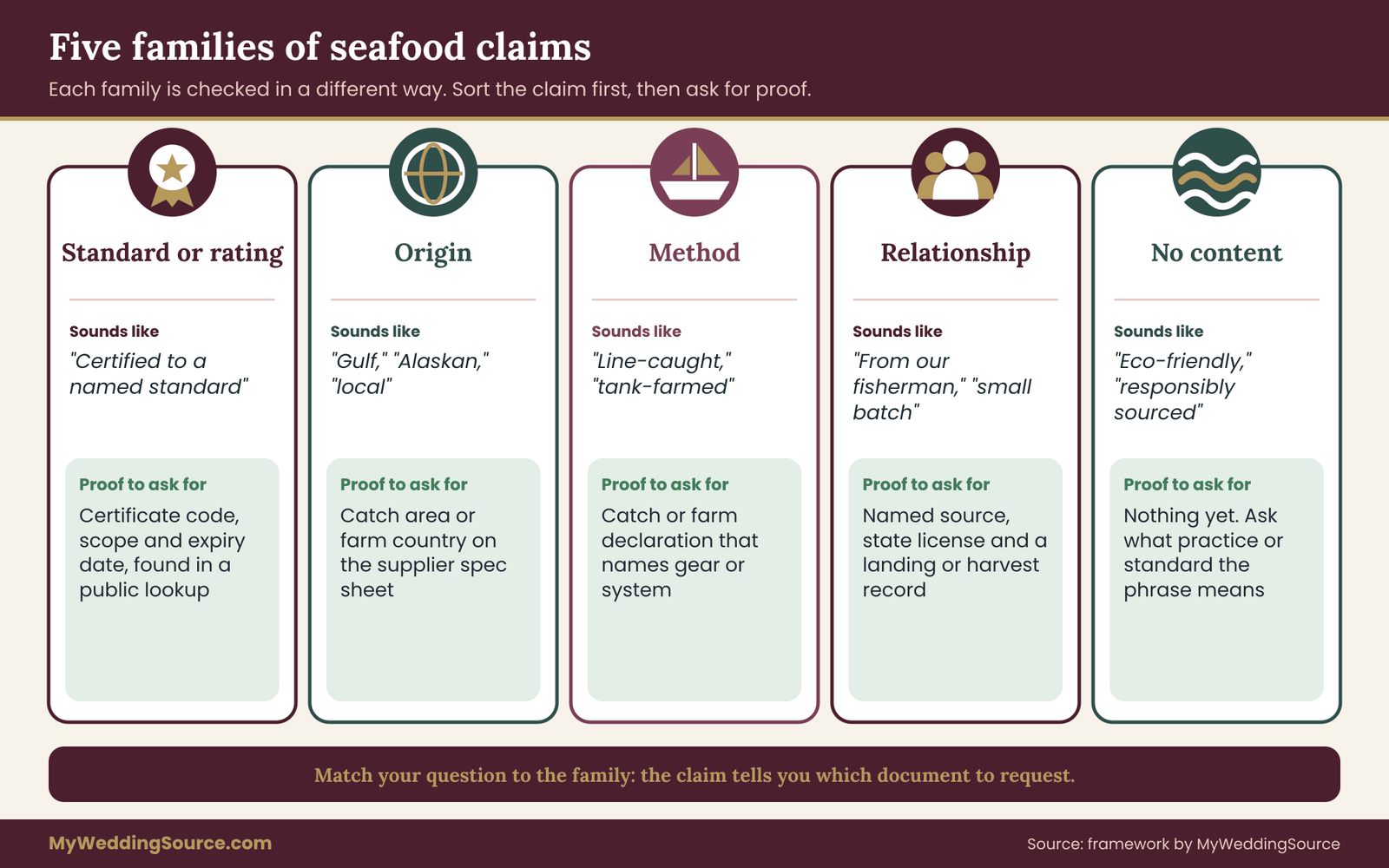
Sorting a claim into one of these families is useful for a practical reason. It tells you which question to ask next. A claim about a standard sends you to the standard’s public database. A claim about origin sends you to a document showing the catch or farm location. A claim about a relationship sends you to the invoice and the dock receipt. A claim with no content sends you back to the caterer to ask what they actually mean.
Environmental, social and safety meanings
Three different ideas hide inside the phrase sustainable seafood. The environmental meaning concerns fish stocks, habitat, bycatch and farm practices. The social meaning concerns the people who catch, farm and process the product, including labor conditions. The safety meaning concerns whether the product is handled and described in a way that keeps guests healthy.
Most certifications and ratings focus on the environmental meaning. Some programs also include labor or community requirements, and others do not, so it is worth reading what a given standard covers rather than assuming. The safety meaning is almost never part of a sustainability label at all. A product can come from a very well-managed fishery and still make a guest sick if it is held at the wrong temperature on a buffet. Keep the three meanings separate in your head and on your sheet, and you will avoid a common trap, which is letting a good environmental story stand in for a safety review.
Why couples should not rely on a single label
A single logo on a package is a starting point. Certification programs generally certify a particular fishery or farm for a particular species, and a separate chain-of-custody certificate covers companies that handle and resell the product. A caterer who buys certified fish from a certified supplier can usually point to both. A caterer who bought something similar from a different supplier may not be able to. The logo on last year’s box does not prove this year’s delivery. Later sections show how to ask the question so the answer is specific to your event.
The seafood claims verification sheet
The core tool in this guide is a single page, one row per seafood item, that you fill in with your caterer. It exists so that every sustainable seafood claim on the menu ends up in one of four states and so that nobody relies on memory or a friendly phone call. You can keep it as a shared spreadsheet, a printed page or a note in your planning folder. The format matters less than the habit of filling it in.
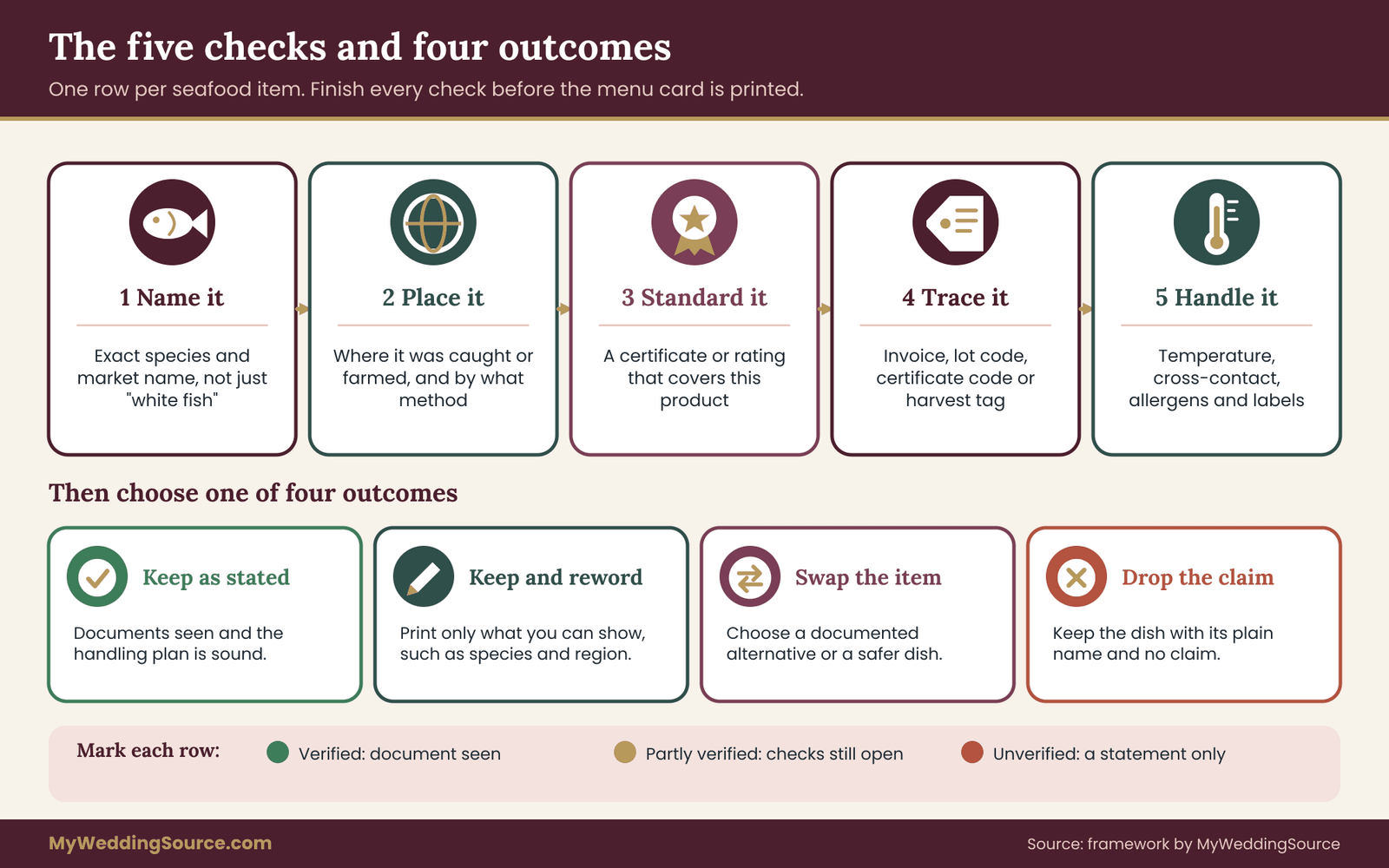
Each row has a header and five checks. The header is simple: the menu item as it will be printed, the sustainable seafood claim exactly as the caterer worded it, and the date you asked. The five checks are the part that does the work.
Check one: Name it. What is the exact species? Not “white fish” or “shrimp,” but the market name and, where it matters, the scientific name. The FDA publishes a Seafood List of acceptable market names, and a caterer who buys from a reputable supplier will have the name on the invoice. Naming matters because mislabeling and substitution are the oldest problems in the seafood trade, and because every later check depends on knowing what the product actually is. It also matters for allergies, since guests are often allergic to a group such as shellfish or to one species.
Check two: Place it. Where was it caught or raised, and by what method? For wild fish this means the catch area and the gear. For farmed fish it means the country and the type of farm system. You are not trying to become a fisheries scientist. You are collecting two or three plain facts that can be compared against a standard or a rating.
Check three: Standard it. Is there a certification, a rating or a program that supports the claim, and does it cover this species, this place and this method? Certification and rating systems publish their criteria and, in most cases, a public lookup. The check is whether the product you are buying falls inside what the standard actually covers.
Check four: Trace it. Is there a paper trail from the source to the kitchen? This is where most claims succeed or fail. A certificate for a fishery does not prove that the fillets on your plate came from that fishery. Invoices, lot or batch codes, chain-of-custody certificate numbers and shellfish harvest tags are the documents that connect the sustainable seafood claim to the product.
Check five: Handle it. How will it be stored, cooked, held, labeled and served so that it is safe for guests, including guests with allergies? This check does not depend on the first four. It applies to every item, certified or not.
The four outcomes for each sustainable seafood claim
After the five checks, each row ends with one of four decisions, written in a final column of the sheet.
Keep as stated. The claim is supported by documents you have seen, and the handling plan is sound. The wording can go on the menu.
Keep and reword. Part of the claim is supported. For example, the caterer can show the species and the region but not a certificate. The menu then says only what can be shown: “Atlantic salmon, farmed in Norway” instead of “sustainably farmed salmon.” Reworded claims are often more honest and more interesting to guests than the vague original.
Swap the item. The claim cannot be supported, and it matters to you. The caterer offers an alternative that can be documented, such as a different species, a different supplier or a different region.
Drop the sustainable seafood claim, keep the dish. You still want the dish, but you will not describe it as sustainable. It appears on the menu with its plain name. This is a respectable outcome, and it is much better than printing a claim nobody can support.
Confidence levels on the sheet
Add one more small marker to each row: verified, partly verified or unverified. Verified means you have seen a document, not just heard a statement. Partly verified means some checks passed and others are open. Unverified means you have only the caterer’s word. The marker keeps you honest when you review the sheet a month later, because it is easy to remember a conversation as more conclusive than it was.
How much detail the sheet needs
A sheet that is too heavy will be abandoned. A reception with two sustainable seafood items needs two rows and perhaps twenty minutes of email. A reception with a raw bar, a seafood station and a plated fish course needs more rows and a longer conversation. The rule of thumb is to fill the sheet in proportion to how prominently you plan to advertise the claim. A claim printed on the menu card, repeated on your website and spoken in a toast deserves a full row. A dish that appears among twelve buffet items without any claim attached needs only the handling check.
How to read sustainable seafood wording on a menu
Before you ask for documents, learn to read the sustainable seafood claim itself. The wording tells you how much evidence it needs and how likely it is to be backed. A useful way to think about it is a ladder with five rungs, from weakest to strongest.
Rung one: a feeling. “Responsibly sourced,” “ocean-friendly,” “eco-conscious.” There is no object to verify. The honest response is to ask what the phrase refers to, and to use it only if the caterer can name a specific practice or standard.
Rung two: a place or a story. “Local,” “from the Gulf,” “from our fisherman.” These can be checked against a supplier record, but they do not prove anything about sustainability by themselves.
Rung three: a method. “Line-caught,” “hook-and-line,” “closed-system tank farm.” These can be checked against a catch or farm declaration and are meaningful when combined with a place.
Rung four: a named rating or standard. “Rated Best Choice by a seafood guide,” “certified to a named standard.” These can be checked against a public database, but only if the caterer can say which one and for what product.
Rung five: a documented chain. “Certified, with a certificate number we can show, from a supplier whose chain-of-custody certificate covers the product.” This is the strongest rung, since it names the standard, the product and the paper trail.
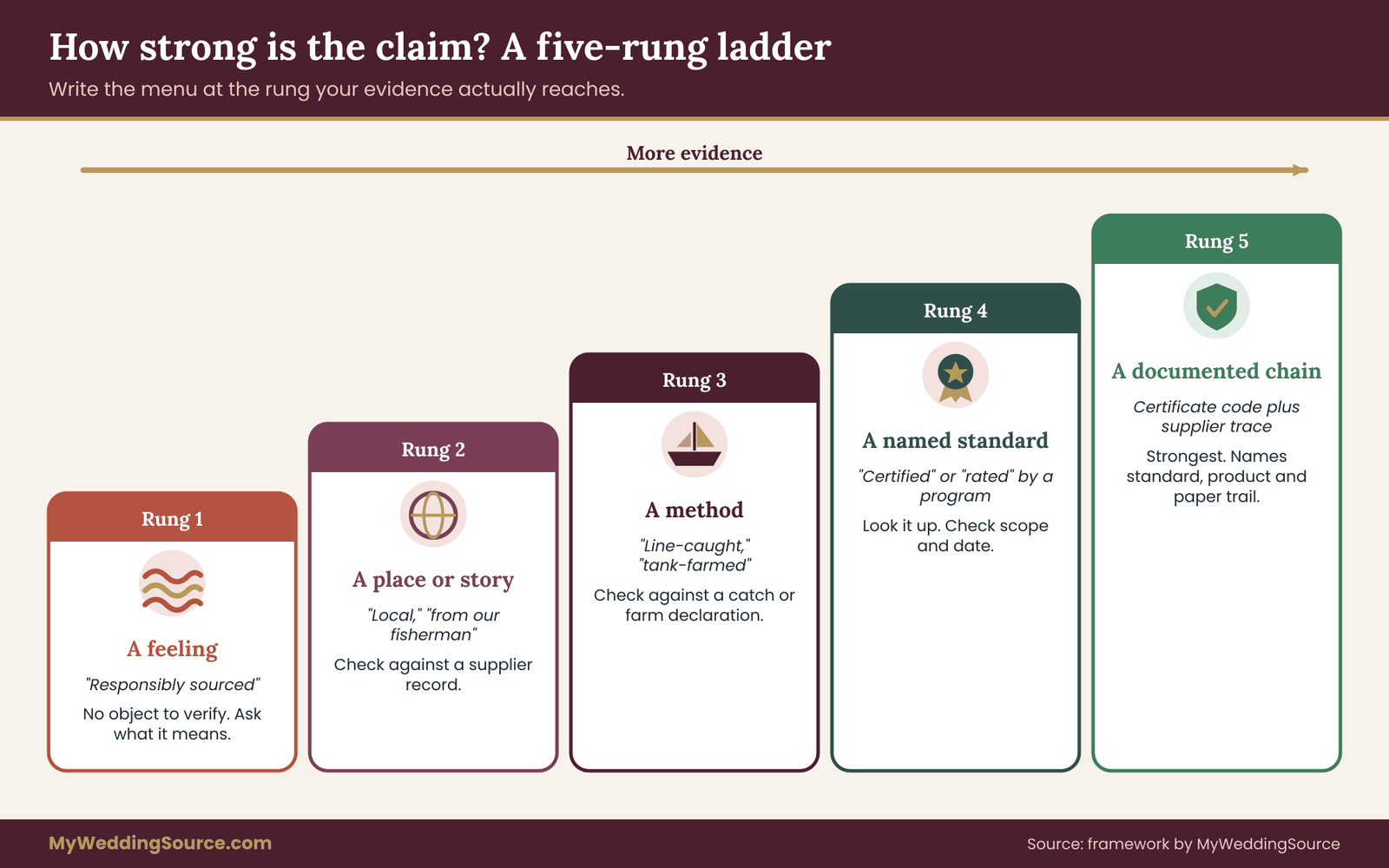
You do not need every sustainable seafood dish to reach rung five. Many excellent meals come from small suppliers that have no certification at all. What you need is a menu whose wording matches the rung the evidence actually reaches. A dish supported at rung three should be described at rung three.
Words that raise a flag
Some phrases deserve a second question, not because they are always wrong but because they are often used loosely.
“Fresh” is rarely a verifiable claim at a reception, since the product may have been frozen at sea and thawed on purpose. Frozen at sea can be excellent quality, so the word to question is the implication that frozen is worse.
“Wild-caught” is a statement of origin type, not of sustainability. Some wild fisheries are well managed and others are overfished.
“Organic” needs care. It is not a general synonym for sustainable, and the rules for what the word can mean on seafood differ from the rules for land crops. If a caterer uses it, ask which standard and which certifier they mean, and check the USDA’s National Organic Program for what it covers.
“Dolphin-safe” applies to tuna and a particular type of bycatch concern. It does not say anything about the health of the tuna stock itself.
“Natural” has no useful meaning for this purpose.
“Sustainable” on its own should always prompt the question: according to whom? That single question, asked politely, resolves more problems than any other.
A gentle way to ask
Caterers are not villains. Many are working from a supplier’s marketing sheet, and some have never been asked to back a sustainable seafood claim up. Asking in a way that treats the claim as something you want to repeat accurately keeps the conversation friendly. A message such as the following works well.
“We love the salmon on the proposal and want to describe it accurately on our menu. Could you tell us the species, where it was farmed or caught, and whether a certification or rating supports the sustainable description? If it is easier, a copy of the supplier’s spec sheet would be great.”
This asks for specifics without accusing anyone, and it explains why you need them. Later sections give longer scripts for each stage of the conversation. For a broader look at how to question any vendor before signing, the wedding vendor due diligence checklist covers permits, insurance and references that apply to caterers as well.
Reading a sustainable seafood claim by its most specific noun
One more habit helps before you move on to documents. When you read any seafood claim, find the most specific noun in it and ask whether it can be checked. “Sustainable” is not a noun you can check. “Salmon” is a start, but “Atlantic salmon from a named farm in a named country” is a noun phrase you can look up. “Line-caught” attaches to a boat, a trip and a landing date. The more specific the noun, the more testable the sustainable seafood claim, and the more likely the caterer already has the paperwork.
Specific nouns also protect against substitution. If your menu says “Gulf shrimp” and the delivery on the day is farmed shrimp from another region because the supplier ran short, a specific claim lets a kitchen manager recognize the conflict immediately. A vague claim lets the substitution pass unnoticed. This is one of the quiet reasons that specific wording is better for the caterer as well as the couple, and it is a point worth making when you ask for a substitution clause in the contract, which a later section covers.
Checking the standard behind a sustainable seafood claim
When a caterer says a product is certified or rated, the next move is to look at the standard itself. This takes less time than it sounds, because the main programs publish their criteria and lookup tools on their own websites. The point is not to audit the program. It is to confirm three things: that the program is real and public, that its scope covers your product, and that the caterer can connect the product to it.
Certifications and ratings for sustainable seafood are different things
A certification is a decision by an independent auditor that a particular fishery, farm or company meets a published standard. It usually has a certificate number, a scope, a start date and an expiry date. A rating is an assessment, often by a nonprofit or a research group, of how a species from a particular region and method compares with criteria the group has set. Ratings are generally advice for buyers and consumers, not permission to use a label.
Both can support sustainable seafood claims. They answer slightly different questions. A certificate says that a specific operation passed an audit. A rating says how a category of product looks when assessed against criteria. Couples run into trouble when a caterer uses one word for both, saying “certified” when the real source is a rating, or “rated” when no rating exists.
The main sustainable seafood programs you will see
You will most often meet four or five names on caterers’ proposals and supplier sheets.
The Marine Stewardship Council runs a program for wild-capture fisheries, with a blue label, and a separate chain-of-custody certification for the companies that process and sell the product. The Aquaculture Stewardship Council runs a program for farmed seafood and likewise offers a chain-of-custody certification. Best Aquaculture Practices, run by the Global Seafood Alliance, certifies farms, hatcheries, processing plants and feed mills. The Monterey Bay Aquarium’s Seafood Watch publishes ratings that sort products into green, yellow and red style categories, usually named Best Choice, Good Alternative and Avoid. NOAA’s FishWatch, from the U.S. government, publishes profiles of many U.S. wild-caught and farmed species with information on stock status and management.
You do not need to memorize any of these. You need to know that each has a public website with a lookup or a profile, and that you can read the criteria in plain language. If your caterer cites a program you have never heard of, search for its name together with the word “standard,” and read what the program says about who audits it, how often and what it covers. A program with no published criteria, no named auditor and no public list of certified products is not necessarily dishonest, but it is not a source you can verify.
What “in scope” means
Every standard has a scope. A fishery certificate covers a named species, caught with named gear, in a named area, by named vessels or a named group. A farm certificate covers a named farm or group of farms. A chain-of-custody certificate covers a named company and the sites listed on it. The question is always whether your product falls inside that box.
An example, described in general terms: a distributor may hold a chain-of-custody certificate that covers certain product lines but not others. A caterer who buys a different line from the same distributor may have the wrong impression that all of its fish carries the certification. The distributor’s certificate lookup, or a short email to the distributor’s sales contact, settles this in minutes. The lookup typically lists company name, certificate code and scope. That is the document you want.
Looking up a sustainable seafood certificate
When a caterer gives you a certificate or license code, the steps are routine.
- Go to the certifying program’s official site by typing its name, not by clicking a link in an email.
- Find the public search for certified companies, fisheries or farms.
- Search for the company name or the code the caterer gave you.
- Read the status, the scope and the expiry date.
- Compare the scope with the product on your menu.
- Save a screenshot or a printout with the date to your sheet.
If the code does not appear, do not assume fraud. Certificates are renewed, suspended and relabeled, and codes get mistyped. Ask the caterer for a fresh copy of the certificate. A genuine certificate holder can usually produce one the same day.
What a rating lookup can and cannot tell you about sustainable seafood
A rating site lets you search by species, and often by region and catch method. This is helpful because the same species can be rated differently depending on where and how it was produced. For that reason, the first answer to a rating question is rarely “this species is fine” or “this species is bad.” The answer is “this species from this region, caught or raised this way, is rated at this level on this date.”
That means a rating lookup is only useful once you have completed check two on your sheet. If the caterer can tell you the region and the method, you can look up the rating. If they cannot, the rating lookup produces a range of answers, and the honest conclusion is that the sustainable seafood claim is partly verified.
Ratings are also revised. A rating that was favorable when your caterer wrote the proposal may have changed by the wedding date, and the reverse can happen too. Check again close to the final menu decision, and note the date you checked.
Imported sustainable seafood and the paper trail
A large share of the seafood eaten in the United States is imported, and your caterer’s supplier may be buying from importers, not from boats. Imported seafood adds a layer to check four, because the chain from source to kitchen is longer.
The federal government has a program aimed at this problem. NOAA Fisheries runs the Seafood Import Monitoring Program, which requires importers of certain species to report and keep information about the harvest event and the chain of custody. The list of species covered has changed over time, so check the current list with NOAA. The program is aimed at illegal, unreported and unregulated fishing and seafood fraud, and it places its obligations on importers, not on caterers.
What does this mean for your menu? It means that for covered species, a legitimate importer already holds records about where the product came from, and a caterer’s supplier should be able to say that the product was imported under that program. A caterer is not required to hold those records, but a reputable supplier should be willing to confirm that they exist. This is a reasonable thing to ask when the claim involves an imported species such as shrimp or tuna.
What the caterer is and is not required to tell you
Country-of-origin labeling for fish and shellfish applies at retail, such as grocery stores. Restaurants and food service operations, including caterers, are generally exempt from that labeling rule. That is why a menu might say nothing about origin at all. It also means that when you want origin on your menu card, you are asking for something the rules do not require, and you should ask early and in writing. USDA’s Agricultural Marketing Service explains the labeling rule and its exemptions.
Labor and community concerns
The environmental meaning of sustainable seafood gets the most attention, but some couples also want to know that people were treated fairly in the supply chain. Environmental ratings often do not address this. Some certification programs include labor requirements, and others do not, so you may need to read each program’s own description.
The U.S. Department of Labor also publishes a list of goods that it has reason to believe are produced with child labor or forced labor, and some seafood products from certain countries have appeared on it. If labor is part of why you care about the menu, add a line to your sheet that records whether the standard behind the sustainable seafood claim covers it, and avoid using the word sustainable to imply it when it does not.
When the source is a small boat, a local farm or a family connection
Not every good sustainable seafood claim fits a certificate. A fishing family, a small oyster grower or a local fish market may supply a caterer with excellent product and no certification. These sources can be just as responsible as certified ones, and sometimes more so, but they require a different kind of proof.
The proof for a small source is mostly about identity and traceability. Instead of a certificate code, you look for the following.
A named source. The grower, the boat or the market is named, and the caterer can say how long they have bought from them.
A license or permit. Commercial fishers and shellfish growers hold state licenses. Shellfish growers also work under a state program that certifies them as a source for food service. The caterer or the grower can name the license or certification number, and the state agency that issues it can confirm it.
A harvest or catch record. Even for small suppliers there is a landing record, an invoice or a harvest tag that shows when and where the product came from.
A description of practices in plain words. The grower explains the method, the season and what they do not harvest. This is not a substitute for a standard, but it gives you something specific to repeat accurately on the menu.
For these sources, the best wording is often a plain description instead of the word sustainable: “Oysters from a named local grower, harvested in the days before the wedding.” That is true, specific and verifiable, and it often reads better on a menu card than a general claim.
Checking a connection claim
A claim like “our fishing cousin is catching it for us” calls for kindness and care at once. Recreational catches generally cannot be sold or served at a paid event under the rules in most places, and a venue or health department may not permit it.
If a family member wants to contribute seafood they caught, ask the health department and the caterer first. Many jurisdictions require food served at a catered event to come from approved sources, which means a licensed supplier, not a private catch. A gift of fish is a lovely gesture, and a better place for it may be a rehearsal dinner at home than a licensed reception.
How a standard shapes sustainable seafood menu wording
Once you know what a standard covers, you can write a menu description that mirrors it. The principle is to describe only what you can support, and to use the same words the standard uses.
If a product is certified, name the standard on the menu or in a small note: “Alaska salmon, certified to the standard of a named program.” If it is rated, say so with the date in your notes, though the menu may not need it. If it is neither, name the facts you have: species, place, method. This keeps you on the right side of the FTC’s guidance, which is that environmental claims should be specific and supportable, and it gives guests information they can actually use.
Avoid the temptation to combine two weaker claims into a stronger one. “Local, wild and sustainable” sounds persuasive, but each of the three words needs its own support, and stacking them multiplies the ways the sentence can be wrong. One accurate, specific phrase is better than three loose ones.
Questions to ask your caterer about sustainable seafood
The verification sheet for sustainable seafood is only as good as the answers that go into it. This section turns the five checks into questions you can send by email, in an order that keeps the conversation friendly. Email is better than a phone call for this purpose, because you end up with written answers and the caterer has time to check with a supplier instead of guessing.
Start with the proposal, not the menu card
Begin with the proposal the caterer has already sent. Highlight every seafood item and every phrase that describes it. For each, copy the exact wording into the first column of your sheet. Do not paraphrase. If the proposal says “sustainably sourced wild shrimp,” those four words are the sustainable seafood claim, and the whole process is about whether they can be supported.
Then send a single message with all of the questions in it, grouped by item. A caterer who gets ten separate emails over three weeks will answer with less care than one who gets one tidy message with a clear deadline.
The first message about sustainable seafood
“Thank you for the proposal. We would like to describe the seafood on our menu accurately, so we are checking each item. For each seafood dish, could you send: the species name as it appears on your supplier’s invoice; where it was caught or farmed, and by what method; any certification or rating you are relying on, with the certificate number or program name; and the name of the supplier. If anything on the proposal is an estimate and may change by the wedding date, please tell us which items. We are happy to adjust wording on the menu to match what you can document.”
Several things make this message work. It says why you are asking. It asks for facts that every caterer who buys seafood already has. It invites the caterer to flag uncertainty, which is the most valuable thing a caterer can tell you. And it offers a way out: changing the wording, not the dish.
Reading the reply
Replies about sustainable seafood come in a few recognizable shapes.
The complete reply. The caterer sends species, origin, method and a supplier spec sheet or certificate code. This is the best case. Move to the lookup step.
The partial reply. The caterer gives species and region but says the supplier will confirm the rest. Ask for a date by which they will have it, and mark the row partly verified.
The reassuring reply with no facts. “Everything we serve is sustainable, we only use top suppliers.” It is polite, it may be sincere, and it supports nothing. Reply with a narrower question: “Which supplier will provide the salmon, and could you send the product specification?” Narrow questions are harder to answer with a slogan.
The honest limit. “We cannot document that. We buy whatever is best that week from our distributor.” This is useful information. It means the item should move to reword or drop the claim, and the caterer has just done you a favor by saying so.
The defensive reply. Occasionally a caterer feels accused. If that happens, say plainly that the goal is to make the menu match reality, that you are not auditing them, and that you would rather print a modest true statement than an impressive uncertain one. Most caterers relax when they see that you are protecting the sustainable seafood claim, not attacking them.
The documents that support sustainable seafood claims
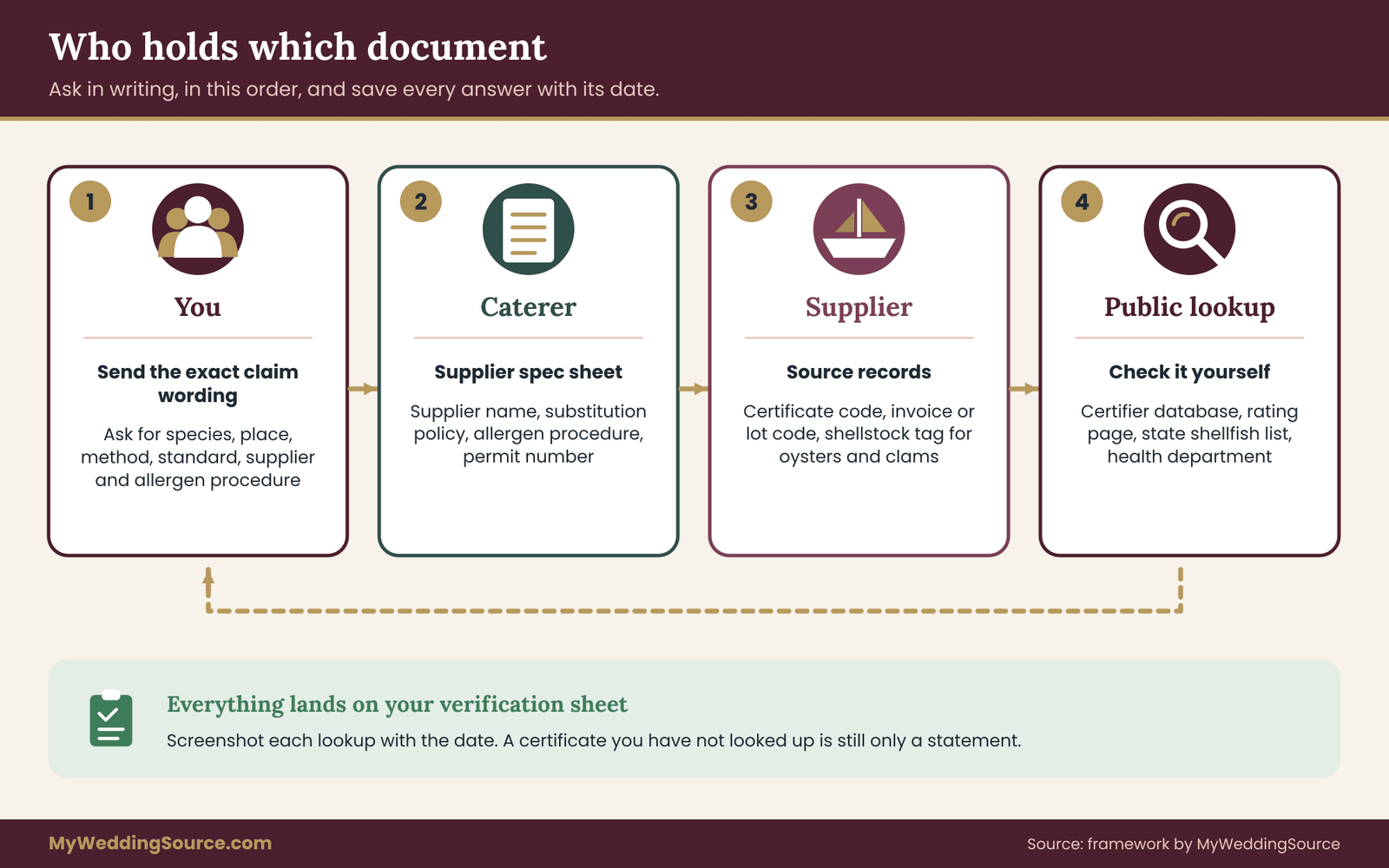
Not every document is available for every item. A reasonable set, depending on the product, looks like this.
The supplier’s specification sheet or product description. It names the species, the region, the production method and the grade. This is the single most useful page.
The invoice or purchase confirmation for the product, once it is ordered, showing the species and the supplier. For an event months away this will not exist yet, so ask what the kitchen’s standard supplier is and what the substitution policy is.
A certificate or code for any certification the caterer is relying on, with a lookup you can do yourself.
A shellfish harvest tag or its record, for oysters, clams and mussels. Retail and food service operations are expected to keep shellstock tags for a period after the shellfish is used, so the kitchen can usually photograph one. The tag identifies the harvest area, the harvest date and the certified dealer.
The kitchen’s allergen and cross-contact procedure in writing, described in the food-safety section.
The caterer’s food-service permit or license number, which a county or state health department can confirm.
Asking the supplier directly
Sometimes the caterer is happy to connect you with the supplier or the fishmonger. A short call or email to the person who actually sells the product can resolve things faster than a relay. The questions are similar: species, region, method, certification and how the product reaches the kitchen. A supplier who sells a certified product usually welcomes the question, because it is a selling point. A supplier who becomes vague when asked to name a source has told you something too.
Treat the supplier’s answers as documents to be saved, not as conversation. If they answer by phone, follow up with an email that restates what they said and ask them to correct anything wrong.
Putting verified sustainable seafood claims into the contract
Many couples verify a sustainable seafood claim, feel reassured, and then sign a contract that says nothing about it. The contract is where a claim becomes a promise, and it is also where the caterer’s right to substitute is defined. If you are paying extra for documented sustainable seafood, the paperwork should say so.
For the general structure of a catering agreement, including cancellation terms, final headcount dates and service charges, the wedding vendor contract page walks through what to look for. For seafood specifically, there are four clauses worth discussing.
A description of the item. The contract or its menu attachment names the species and, where it matters to you, the region or the standard. For example, “wild salmon from a named region” or “certified shrimp with certificate number supplied before the event.”
A substitution rule. If the named product is unavailable, what happens? Options include a substitute of equal documented standard, a substitute chosen with your approval by a set date, or a change of dish. What you want to avoid is a clause that lets the caterer swap any “comparable” seafood without notice, since comparable in price is not comparable in sourcing.
A documentation promise. The caterer agrees to provide the supplier’s specification or certificate code by a certain date before the wedding, for example thirty days out. A caterer who is confident in the sourcing rarely objects.
A menu-wording agreement. The caterer agrees that printed menus and signage will use only the description approved by you. This prevents a well-meaning server from adding “sustainable” to a description from memory.
You do not need legal language. A clear sentence in an addendum, signed by both sides, is better than a long clause nobody reads. If the contract is complex or the amount is large, a lawyer in your state can review it.
Tying sourcing to payment
A purchase order or a payment schedule can include the documentation date as a condition for the final payment on the seafood portion, or at least as a milestone. The wedding vendor purchase order checklist explains how to structure scope agreements and acceptance checks, and the same logic applies to a menu item that depends on a document. You do not need to hold money hostage. A simple milestone, such as “documents received by this date,” is enough to keep the topic from slipping.
From the sheet to the sustainable seafood menu card
The menu card is where the verification work on sustainable seafood becomes visible to guests. Three small habits keep it accurate.
Write the card from the sheet, not from the proposal. The approved wording in your last column is what appears on the card. If the caterer’s proposal says “sustainable” and your sheet says “reword,” the card follows the sheet.
Keep claims short and factual. “Wild Alaska salmon” or “farmed mussels from a named bay” tells a guest more than a paragraph about the ocean. If you want to say more, put it on a small note near the buffet or in the program, with the standard named.
Include allergen information in the way the caterer and local rules allow. A card that lists fish, shellfish or both helps guests decide quickly. Never write “allergy-safe” or “safe for shellfish allergies” about any dish. The food-safety section explains why.
Briefing the service staff
The best card can be undone by a server who answers a guest’s question from memory. Ask the caterer to brief the staff on the approved description of each seafood dish, including what not to say. A one-line instruction is enough: “If asked, say X; if you do not know, ask the kitchen.” A server who says “I am not sure, let me check” is far better than one who confidently repeats a phrase from last weekend’s event. The same briefing should cover allergy questions, with a rule that any allergy question goes to the kitchen lead, not to whoever happens to be at the station.
The food-safety review that sits beside the sustainable seafood sheet
Everything so far has been about whether a sustainable seafood claim is true. This section is about whether the dish is safe. The two reviews are separate on purpose. A fishery can be exemplary and the fish can still be mishandled between the dock and the dessert course, and a plain, uncertified fillet kept cold and cooked properly is safer than a certified one left on a warm buffet. A sustainable seafood label says nothing about temperature, cross-contact or raw preparation, so the fifth check on your sheet needs its own attention.
You are not the food safety inspector, and you do not need to become one. The caterer holds the permit and the training, and the local health department sets the rules. Your job is to ask the right questions, to notice whether the answers are specific, and to make sure that guests with allergies or medical conditions are not guessing.
The route sustainable seafood takes from supplier to plate
Food safety for sustainable seafood is easiest to see as a route with checkpoints. Each checkpoint has a question you can ask.
Receiving. When the seafood arrives at the kitchen, is it checked for temperature and condition, and who is responsible for rejecting a bad delivery? Fish and shellfish are perishable, and the Food Code that most states base their rules on sets a cold-holding limit of 41 degrees Fahrenheit or below for foods that need temperature control.
Storage. Is raw seafood stored below and apart from ready-to-eat foods, so that drips and contact do not spread bacteria or allergens? Is shellfish kept in its original tagged containers until use?
Preparation. Are cutting boards, knives and prep surfaces for raw seafood separated from those used for salads, bread and desserts? For a large event, is there a plan for a separate prep area or a clean-down between tasks?
Cooking and holding. How is doneness checked, and what holding temperatures are used for hot seafood dishes? The Food Code sets 135 degrees Fahrenheit or above for hot holding. How is cold seafood, such as shrimp cocktail or a chilled platter, kept cold during service?
Service. How long will seafood sit out at a buffet or a station, and how is it replenished? What happens to leftover items at the end of service?
Labeling. How are fish, shellfish and shared utensils identified at the buffet?

You can send these as questions, or ask the caterer for their standard operating procedure for seafood service and read it yourself. Caterers who run seafood events regularly usually have a written procedure, or at least a clear answer to each.
Temperature is the quiet failure point for sustainable seafood
Warm weather, outdoor receptions and long cocktail hours stress the cold chain. Shrimp on ice in a decorative display can warm quickly under the sun, and a tuna crudo that sits out through speeches may spend longer at room temperature than anyone intended.
Two seafood-specific hazards are linked to temperature abuse. Certain fish, including tuna and mahi-mahi, can develop histamine if they are held warm, and histamine causes a reaction that cooking does not remove. Bacteria can multiply quickly in warm shellfish and shrimp.
You do not need to explain the chemistry to the caterer. You can simply ask how seafood is kept at or below the required temperature during the whole service, and what the plan is if the weather is hot. A good answer mentions ice, chilled serving vessels, small replenished portions or a hold-then-serve approach. A vague answer, or none, is a reason to shrink the seafood station or replace it with a plated course.
Raw and lightly cooked sustainable seafood
Oyster bars, crudo, ceviche, sushi and poke are popular ways to serve sustainable seafood at receptions, and they deserve separate treatment because the safety margin comes from sourcing and handling alone, not from cooking.
Raw shellfish and the harvest tag
Raw oysters, clams and mussels can carry bacteria, including Vibrio species. The Centers for Disease Control and Prevention explains that Vibrio illness is associated with raw or undercooked shellfish, particularly oysters, and that people with liver disease, weakened immune systems and some other conditions are at higher risk. Guests who fall into those groups may be among your relatives and friends, and they may not announce it.
Shellfish for food service should come from a source certified under the state shellfish sanitation program, and the shellstock tag that travels with each container records the harvest area, the date and the certified dealer. Asking the caterer to show you the tag, or a photo of it, is both a food-safety check and a sustainable seafood sourcing check. It tells you where the oysters were grown and that they came through a certified chain. For a couple who wants to put “oysters from a named bay” on the menu, the tag is the best single document you can ask for.
Raw fish
Fish served raw must be handled to address the risk of parasites. The Food Code describes freezing requirements for fish intended to be eaten raw, with certain exceptions, and many kitchens buy fish that is already frozen to those specifications for this purpose. Ask the caterer how they meet the requirement and whether the supplier provides a written statement. Do not accept a vague answer. Also remember that marinating fish in citrus juice, as in ceviche, is not the same as cooking and should not be treated as a safety step.
Consumer advisories
Many jurisdictions require a written notice on menus or at stations where raw or undercooked animal foods are served, reminding guests that raw or undercooked food can raise the risk of foodborne illness. Ask your caterer whether the rule applies at your venue and how they plan to display it. A small, tasteful sign at a raw bar is a normal part of service and does not spoil the mood. If you are considering a raw bar as part of the cocktail hour, the wedding cocktail hour guide may help you decide how it fits the timeline and the space.
When to skip the raw option
It is perfectly reasonable to decide that a raw station is not right for your wedding. Reasons include a hot outdoor setting, a long gap between setup and service, an older guest list, several pregnant guests, a venue kitchen without suitable cold storage or a caterer who has not run raw seafood service before. Cooked alternatives, such as seared scallops, grilled shrimp skewers or smoked fish, give guests a sustainable seafood moment with a much wider safety margin.
Allergies and sustainable seafood: cross-contact and the limits of what you can promise
Fish and crustacean shellfish are two of the major food allergens recognized under U.S. food labeling law. The FDA’s food allergy information explains the list and the labeling rules for packaged foods. Mollusks such as oysters, clams, mussels and scallops are not on the major allergen list in the same way, but some people are allergic to them, and they should be listed on a menu for the guests’ benefit.
No sustainable seafood label changes the allergy picture. A seafood allergy can be severe, and a reaction can start from very small amounts or from contact with shared equipment. This is why cross-contact matters. A grill used for shrimp and then for chicken, a fryer shared between calamari and fries, a shared serving spoon or a bread basket placed beside a seafood display can all carry allergens into other dishes.
The only honest promises
Do not ask your caterer for, and do not offer guests, a promise that any dish is allergy-safe. A kitchen can reduce risk with careful procedures, and a good caterer will describe them, but no kitchen at a busy event can promise zero risk, and nobody should say so unqualified. What you can do is ask for specifics and share them honestly with guests.
Questions to ask the caterer in writing include whether the kitchen can prepare a separate seafood-free plate for a guest with a fish or shellfish allergy, with separate utensils and a clean surface; whether seafood dishes will be cooked on equipment that is also used for other foods; how the kitchen identifies and delivers a special meal so that it reaches the right guest; who answers allergy questions during service; and whether the caterer will list all fish and shellfish ingredients, including those in sauces, stocks and dressings.
Hidden fish in other dishes
Some dishes contain fish that guests do not expect. Caesar dressing, Worcestershire sauce, some paellas and stocks, fish sauce in Southeast Asian dishes and certain vegetable dishes finished with anchovy butter can all contain fish. A guest who avoids seafood for allergy, religious or ethical reasons might eat them without knowing. Ask the caterer to flag every dish that contains fish or shellfish in any form, not just the dishes that are obviously seafood. For collecting dietary needs on the RSVP so the kitchen has them early, see the notes on building a menu around different ages and diets.
Guests with higher risk
Pregnancy, older age, weakened immunity and liver conditions all affect which seafood is a good idea. The FDA and the Environmental Protection Agency publish joint advice about eating fish, including which fish are higher in mercury and which are better choices for pregnant and breastfeeding women and young children. The advice lists some fish, such as swordfish, shark, king mackerel and tilefish from the Gulf of Mexico, among those to avoid for these groups.
If your menu includes any of these, your guest list may include someone who should not eat it, and a clear label allows them to decide. A guest’s own doctor is the right authority for anything more specific.
Leftovers, takeaway and the end of the night
The last food-safety question is the one nobody asks until midnight. What happens to seafood that was served and not eaten? Couples often want leftovers boxed for guests or taken home. Seafood that has sat at room temperature for an evening is not a good candidate. Ask the caterer for their policy, and be ready to accept that the answer is no seafood leftovers. If the venue donates food, check whether seafood is accepted and under what conditions.
This is also the moment where waste and sustainable seafood meet. A menu of sustainable seafood with big uneconomical portions can still waste a lot. The wedding waste reduction planning guide looks at catering waste in general, and the practical point here is that portion planning for seafood, which is expensive and perishable, deserves attention in its own right.
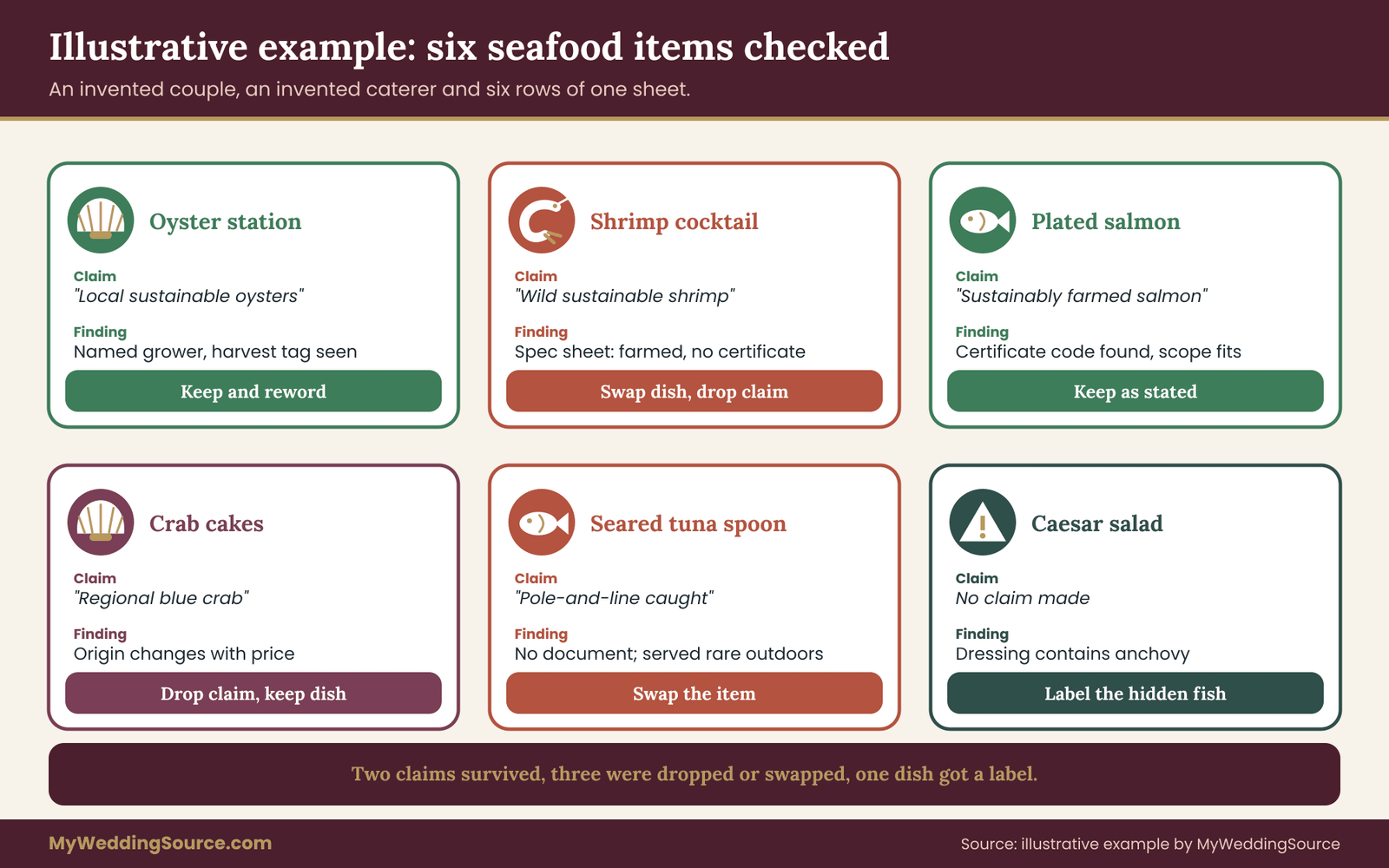
The following couple is invented, and so is every number, but the steps are the ones a real couple would take. Nadia and Tomas are planning a September reception for about one hundred and ten guests at a lakeside venue with an outdoor cocktail hour. Their caterer’s proposal lists six seafood items, and three of them make a sustainable seafood claim or something close to it. They decide to fill in the sheet for every item before approving the menu.
They send the caterer the first message described earlier, with the exact wording of each sustainable seafood claim, and they give a two-week deadline. The replies arrive in pieces over ten days. Here is how each row ends.
Item one: oyster station at cocktail hour, described as “local sustainable oysters.” The caterer names the grower and the bay, and sends a photo of a recent shellstock tag from that grower. The tag shows the harvest area and a certified dealer number. Nadia checks the grower’s name against the state’s list of certified shellfish dealers on the state agency site. Species, place and trace are verified. There is no third-party sustainability certificate, and the grower describes the practices in a short note. The decision is to keep and reword: “Oysters from a named bay grower.”
The handling check raises a different point. The cocktail hour is outdoors in September, and the caterer’s plan is to serve oysters on ice from a shaded station with a replenishment schedule, plus a consumer advisory sign. Nadia and Tomas accept the plan and ask for the shucking to be done by one trained person who does not also handle other food.
Item two: shrimp cocktail, described as “wild sustainable shrimp.” The caterer says the shrimp come through the regular distributor and does not know the origin. After a follow-up, the distributor’s sheet shows that the product line is farmed, not wild, from an overseas source, with no certification on that line. The claim is wrong as written. Wild, farmed and sustainable are all unsupported words.
The couple could ask for a certified alternative, but the kitchen would need a special order, and the shrimp cocktail would sit on ice outside for a long time. They decide to drop the sustainable seafood claim and change the dish: grilled shrimp skewers, served warm in smaller batches, described as “shrimp” with the origin added if the distributor provides it. The decision is swap the dish and drop the claim.
Item three: salmon as the plated fish option, described as “sustainably farmed salmon.” The spec sheet names the species, the country and the farm group. The distributor holds a chain-of-custody certificate for a farmed-seafood standard, and the code appears in the program’s public lookup with a scope that includes this product line. Nadia saves a dated screenshot. The decision is keep as stated, with a reworded menu line that names the standard: “Farmed salmon, certified to a named aquaculture standard.” The sheet records the certificate expiry date and a note to recheck the lookup a month before the wedding.
Item four: crab cakes as a passed appetizer, described as “regional blue crab.” The caterer admits that the crab meat is bought pasteurized in tubs from a supplier that changes with price. Origin cannot be documented for the event. The decision is to drop the claim and keep the dish, called simply “crab cakes.” Because crab is a crustacean shellfish, the item is marked on the allergen list, and the kitchen confirms the crab cakes are fried in a separate oil from anything served to guests with allergies.
Item five: seared tuna on a cocktail spoon, described as “pole-and-line caught.” The caterer cannot produce any document for the method. The dish is served rare, outdoors, and the couple would prefer a cooked option. They swap it for smoked trout on rye crisps from a named supplier whose spec sheet states the farm country and method. The decision is swap the item.
Item six: Caesar salad. It has no sourcing claim, but the dressing contains anchovy. The handling check flags it as containing fish. The caterer agrees to mark it on the buffet card and to offer a version without the dressing.
What the example shows
Of six items, two ended with a verified claim in a form guests can read, three had the sustainable seafood claim removed or the dish changed, and one was simply labeled for its hidden fish. The menu became more modest, and also more accurate. Tomas notes afterward that the printed card says less than the original proposal did, and that every word on it can be defended. That is the point of the exercise.
Note too what the couple did not do. They did not demand certificates for every item, and they did not treat the caterer as an opponent. They accepted a plain description when that was the honest one, and they let the food-safety check change two dishes. The sheet produced those outcomes because it kept the sourcing question and the handling question in the same row.
The cost logic of verified sustainable seafood
Verifying a sustainable seafood claim is nearly free. It costs a few evenings of email and a short list of lookups. The costs that matter are the ones created by the decisions at the end of the sheet. They fall into a few categories, and thinking about them in advance keeps a good intention from turning into a budget surprise.
Where the money moves with sustainable seafood
A documented product may cost more per portion. Certified or specially sourced seafood can carry a higher price than an unspecified equivalent, and a caterer who has to place a special order may add handling charges. The size of the difference varies widely by species, season and supplier, so there is no honest general figure. Ask the caterer to price the documented option and the standard option side by side, per portion, and keep both quotes.
A swap may cost less. Moving from a raw station to a cooked dish, or from a premium species to a more modest documented one, can lower the bill. A sustainable seafood menu is not automatically a more expensive one.
Dropping a sustainable seafood claim costs nothing. If a claim cannot be supported, removing it from the card is free. The dish stays the same and the couple loses only a phrase.
Portion planning changes cost. Seafood is among the costlier items on a catering menu, so the number of seafood items and the portion at each station affects the total more than a premium on a single dish. Fewer items done well often cost less than many items done adequately.
A simple decision rule for sustainable seafood
Use the claim’s visibility to decide how much to pay for proof. Ask three questions for each seafood item. Will the claim be printed or announced? Does it matter to us or to a guest we know? Can the documented version be had for a price we accept?
If the answers are yes, yes and yes, pay for the documented version. If the sustainable seafood claim will be printed but the price is too high, reword or drop it, and serve the dish you can afford. If nobody will see the claim and it does not matter much, spend the money elsewhere and keep the plain description.
Illustrative arithmetic
Suppose, purely for illustration, that the documented salmon would add a few dollars per portion over the caterer’s standard salmon for the one hundred and ten guests who choose fish. Multiply the difference by the number of portions to see the total. If that total is more than the couple wants to spend, they might serve the documented salmon only at the plated course and reduce the number of seafood passed appetizers to compensate, so the overall seafood spending stays about the same.
The point of the arithmetic is the structure, not the numbers: price per portion, number of portions, and what you remove to pay for what you add.
For the larger picture of how catering fits into the overall spending, the wedding budget page shows how to set category limits and track changes, and a seafood premium belongs in the food and beverage line, not as an extra.
Paying for proof versus paying for a label
A higher price is not proof. A premium menu item with an impressive description can be less supported than a modest one with a spec sheet. When you are comparing quotes, compare the documents, not the adjectives. A quote that includes a spec sheet, a certificate code and a substitution clause is worth more than a quote with the same price and a description that says sustainable.
Edge cases that change the checks
Real weddings rarely follow the simplest pattern. Several situations change how the sheet is used.
The venue requires its own caterer
Some venues have an exclusive caterer or a short approved list, so you cannot switch to a supplier with better documentation. In that case, the sheet still works, but the decision leans toward reword and drop, since you have less leverage to swap. Ask the venue’s caterer the same questions, and accept the honest answers. If the caterer cannot support a sustainable seafood claim, choose the menu items they can describe accurately instead.
Destination and international weddings
Abroad, the standards, labeling and health rules differ from those in the United States, and the U.S. agencies named in this guide do not apply. The principles hold, though: name the species, place the source, ask what standard or rating applies and trace the product. Local fishing communities may supply excellent seafood with little paperwork, which means the sourcing check relies on direct description and a trusted local contact. For food safety, ask what local rules require and how the kitchen manages the cold chain, especially in heat. If you are unsure, favor cooked seafood.
Buffet versus plated service for sustainable seafood
A plated course makes sourcing easier to control. The kitchen portions a known quantity, the item is cooked to order, and it is served right away. A buffet increases hold time and the chance that guests will cross-contaminate serving utensils. If seafood is a main feature of your menu and food safety is a concern, a plated or family-style seafood course is simpler to verify than a long buffet line.
Pescatarian, kosher, halal and other guests
Guests who eat fish but not meat will welcome a good seafood option. Guests who follow religious dietary laws may need seafood prepared in particular ways, and the rules differ by tradition. A kosher or halal guest may need seafood prepared under certification of its own, in a separate kitchen process. This is a separate verification track from sustainability, and the caterer should be asked early, not on the day.
Day-of substitutions
Suppliers run out. A caterer who has promised a documented product and cannot get it on the morning of the wedding faces a choice. Agree beforehand on what happens. The best answer is a documented replacement or a change to a dish with no claim, and the worst is a quiet swap that leaves the printed card inaccurate. Give the caterer a name and a phone number of one person on your side, usually a planner or a trusted friend, who can approve the change and a way to correct the menu card if needed.
Sustainable seafood outside the main meal
Seafood shows up in places couples forget: a sushi chef at a late-night station, anchovies on a charcuterie board, smoked salmon on a brunch bagel the next morning, an oyster shooter in a signature cocktail. Add each to the sheet. A late-night station is a particular risk because food sits out longer, the guests have been drinking and the staff may be tired. The wedding bar service planning page covers the bar side, including how to coordinate with the food menu.
The limits of what verification can tell you about sustainable seafood
A verification sheet for sustainable seafood reduces uncertainty. It does not remove it. Being honest about the limits is part of the method, and it will make your menu wording better.
What a certificate cannot show
A certificate shows that an operation met a standard at the time it was audited. It cannot show that every fillet in a given delivery came from that operation, unless the chain-of-custody records are intact, and even then you are relying on the records. Auditors can only inspect so much. Seafood fraud has been documented by government agencies and researchers, and certification programs have systems to detect it, but no system is perfect.
This is why check four, the paper trail, matters as much as check three. It is also why the wording “certified to a named standard” is safer than “completely sustainable,” a phrase that nobody can honestly stand behind.
What a rating cannot show
A rating reflects the information available when the assessment was made. Stocks change, regulations change and new studies appear. A rating that was favorable last year may be revised. Ratings also assess categories, such as a species from a region caught by a method, not your individual delivery. Use them as guidance, name the date you checked, and avoid wording that suggests permanence.
What the caterer cannot know
Caterers depend on their suppliers, and suppliers depend on theirs. A caterer who answers honestly “I know what my supplier told me” has told you the real limit. That is not a failure. It is the point at which your wording should stop. If the caterer’s knowledge ends at the distributor, your menu claim should end there as well.
What you cannot verify at all
Some things cannot be checked by a couple. You cannot inspect a fishing vessel, audit a farm or test a fillet for species. You cannot tell by looking whether an oyster is safe. You cannot observe the kitchen’s cross-contact practices from the guest side of the table. For those things, the best available steps are to ask clear questions, read the documents offered and choose caterers with a track record and a valid permit. Your local health department can confirm that a caterer is licensed and, in many places, can tell you about inspection history.
The rules change, and so do the products
Rules about labeling, imports, allergens and food service differ by state and county, and they are revised from time to time. Lists of covered species, advisories on fish consumption, ratings and certificates all change. This guide describes the approach, and the agencies and programs named in the sources hold the current versions. Check them close to your decision date, not months before.
When honesty costs a headline
There is a social limit too. Some couples feel a pull to print an impressive claim because guests expect one, or because it matches the tone of the wedding. Resist it. A modest, accurate line such as “oysters from a named local grower” gives guests real information, and it protects you and the caterer if anyone asks questions. An impressive claim that cannot be supported can turn a meal that was good into a small embarrassment.
Telling guests what you verified about sustainable seafood
Once the sheet is complete, the question becomes how to tell people. A few channels matter.
The menu card. Use the approved wording and keep it short. If you want to name a standard, use its official name.
The wedding website. A short note about your seafood choices and the reasons can be warm and useful, especially for guests who care about the ocean or who have dietary needs. Keep it factual. “We chose oysters from a named local grower and farmed salmon certified to a named standard” says what you did. You can add that the caterer has informed you of the sources.
A toast or an announcement. Be careful here, since spoken claims drift. If someone will mention the seafood in a toast, give them the approved sentence in writing.
Social posts and photos. Vendors and guests often post photos with captions. If you or a vendor will add a caption about sustainability, use the same approved wording.
When a claim turns out wrong
Occasionally a sustainable seafood claim fails after the card is printed. A substitution is made, a certificate lapses or a supplier admits an error. The best response is quick and plain. Tell the caterer you want the guests to get accurate information, correct the card by hand, a printed insert or a table sign if there is time, and brief the staff on the correct description. Do not leave a known error in place for the sake of appearances. A short correction is almost never noticed, and an uncorrected claim is a problem you chose to keep.
A timeline for checking each sustainable seafood claim
Verification works best when it is spread across the planning period instead of squeezed into the last month. The following timeline assumes a wedding with a caterer booked about a year ahead, and you can compress it for a shorter engagement.

Ten to twelve months out. Decide whether seafood belongs on the menu at all, and in what form. When you interview caterers, ask each one how they handle seafood sourcing and whether they can provide specification sheets. Their reaction is informative.
Six to nine months out. Once you have a proposal, copy each seafood claim into the sheet and send the first message. Allow a couple of weeks for replies, since suppliers need time.
Four to six months out. Do the lookups, record what you find and decide on each row. Negotiate the contract clauses on description, substitution, documentation and menu wording. This is also the right time to decide whether to keep a raw station.
Two to three months out. Finalize the menu wording and send it to your stationer. Gather dietary and allergy information from guests through the RSVP, and pass it to the caterer along with your request for a written allergen procedure.
One month out. Recheck the certificate and rating lookups, since statuses may have changed. Confirm the supplier for each seafood item and the substitution plan. Ask for the weather plan for any cold seafood service.
The week of the wedding. Confirm delivery arrangements, the supplier names and the staff briefing. Give the caterer your point of contact for approvals on the day.
The day after. Save the final sheet, the lookups and the caterer’s documents in your vendor records. If the caterer did well, tell them in writing, because a good reference helps the next couple who asks hard questions. If something went wrong, write down what happened while you remember it.
Keeping the sheet as a record
The sheet is also a small record that supports a later conversation. If a guest becomes ill after the reception, if a vendor disputes a charge or if a review is posted, the sheet and the email trail show what was asked and answered. This is not about blame. It is about having facts at hand. Save it with your other contract documents, and keep it for as long as you keep the rest of your vendor files.
Your next steps
Start with the proposal. Highlight every seafood item and copy each sustainable seafood claim, word for word, into a one-page sheet with the five checks and four possible outcomes. Send your caterer a single message asking for the species, the place and method, the standard or rating, the supplier and the allergen procedure, and give a date for the reply.
Then look up what you receive, decide row by row, and put the decisions into the contract and onto the menu card. Keep the claims you can support, reword the ones you can partly support, and drop the rest. Run the food-safety check on every dish, whether or not it carries a claim, and never promise a guest that any dish is allergy-safe. A modest menu that is accurate and safe is the best version of sustainable seafood a wedding can serve.
FAQ
What does sustainable seafood mean on a wedding menu?
There is no single legal definition on menus, so the meaning comes from whoever wrote the sustainable seafood claim. It usually refers to fish or shellfish caught or farmed in ways that protect fish stocks and habitats, sometimes backed by a certification or rating. Ask the caterer which standard, species, place and method they mean, and print only what documents support.
Is wild-caught or farmed the better sustainable seafood choice?
Not automatically. Some wild fisheries are well managed and others are overfished, and some farms perform well while others do not. The species, the place and the method matter more than the label wild or farmed. Check a certification lookup or a rating for the specific product, and note the date you checked, because ratings and statuses change.
Can a caterer promise a seafood dish is safe for a shellfish allergy?
No unqualified promise is honest. A good kitchen can describe how it reduces cross-contact, such as separate utensils, clean surfaces and a labeled special plate, and you can ask for those steps in writing. Guests with a serious allergy should speak with the caterer directly and decide for themselves, and the menu should never describe a dish as allergy-safe.
Which documents should I ask my caterer for about sustainable seafood?
Ask for the supplier’s specification sheet showing species, origin and method, the certificate or program name with a lookup code if one is claimed, and the shellfish harvest tag for oysters or clams. Also ask for the kitchen’s written allergen procedure and the caterer’s food service permit number, which your local health department can confirm.
Is a raw oyster bar a good idea at an outdoor wedding?
It can work, but heat and time are the risks. Raw shellfish can carry bacteria such as Vibrio, and some guests are at higher risk. Ask how the oysters are kept on ice, how long the station runs, whether a consumer advisory will be posted and where the shellstock tag is kept. In hot weather, cooked options are safer.
How early should I verify sustainable seafood claims?
Start when you receive the proposal, ideally six to nine months before the wedding. Suppliers need time to send documents, and you may want to swap an item or change the contract. Recheck certificates and ratings about a month before the date, since statuses can change, and confirm the substitution plan in the final week.
What if the caterer cannot back up a sustainable seafood claim?
Treat it as useful information, not a failure. Reword the menu to say only what is documented, such as species and region, or drop the claim and keep the dish. If the claim matters to you, ask whether a documented alternative is available. Avoid printing any claim that neither of you can support.
Do I need a certificate for seafood from a small local boat?
Not necessarily. Small suppliers often lack certification yet can be excellent. In that case, ask for the boat or grower’s name, the state license or certification, and a catch or harvest record, and describe the product plainly on the menu. Shellfish should still come through a state-certified source with tags. Recreational catches generally should not be served at a paid event.
Sources
- Food allergies, U.S. Food and Drug Administration
- FishWatch: U.S. seafood facts, NOAA Fisheries
- Seafood Import Monitoring Program, NOAA Fisheries
- FDA Food Code, U.S. Food and Drug Administration
- Advice about eating fish, U.S. Food and Drug Administration and Environmental Protection Agency
- Green Guides for environmental marketing claims, Federal Trade Commission
- Vibrio and oysters, Centers for Disease Control and Prevention
- Marine Stewardship Council
- Aquaculture Stewardship Council
- Seafood Watch, Monterey Bay Aquarium