
Personal statements are the spoken, heartfelt parts of a ceremony that tell a story, say thank you or describe what you see in your partner, while wedding vows are the promises you make about the future. This guide gives you a simple map for sorting every line you want to say into the right slot, so nothing meaningful gets lost and nothing important gets crowded out.
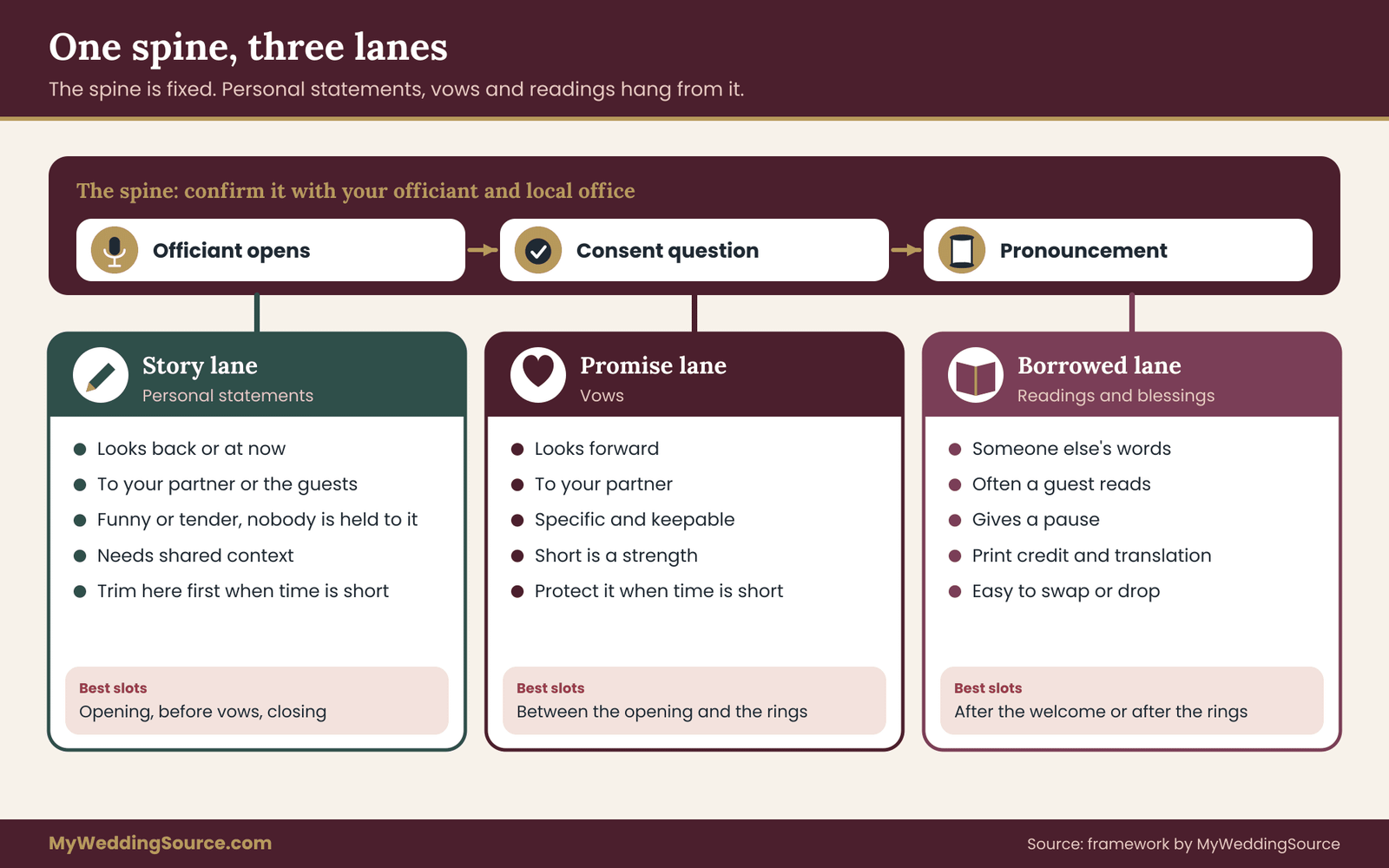
Treat the ceremony as a spine with three lanes hanging from it. The spine is the legal core that your officiant and local rules require. The lanes are story (personal statements about the past and present), promise (the vows, written in the future tense) and borrowed words (readings, blessings and quotations). Place any line by asking five questions about tense, audience, accountability, context and weight. Then confirm the plan with your officiant before you print or rehearse anything.
Plenty of couples arrive at the same problem from different directions. One partner has written four pages about how the two of you met and cannot bear to cut a word. The other has written six plain sentences and worries they sound cold beside it. A parent has offered a reading. The officiant has a standard script that says “repeat after me.” Everyone means well, and nobody has said out loud which of these pieces is the promise and which is the story.
Personal statements and vows can sit in the same ceremony and strengthen each other. They just do different jobs. A story helps guests understand why this marriage makes sense. A promise tells everyone, including you, what you are agreeing to do. When the two are blended into a single speech, the promise often gets buried under the anecdotes, and the anecdotes get cut short because the speech is supposed to be a vow. Separating the personal statements from the promises first, then deciding where each belongs, usually fixes both.
A note on scope. This is general information, not legal advice, and it does not replace what your officiant, faith community or local marriage office tells you. Requirements for the words of a ceremony, for witnesses and for who may officiate differ by state and by country, so the article points you to the places where you can confirm the current rules.
What personal statements and wedding vows each do
Start with plain definitions, because most of the confusion comes from using one word for several things.
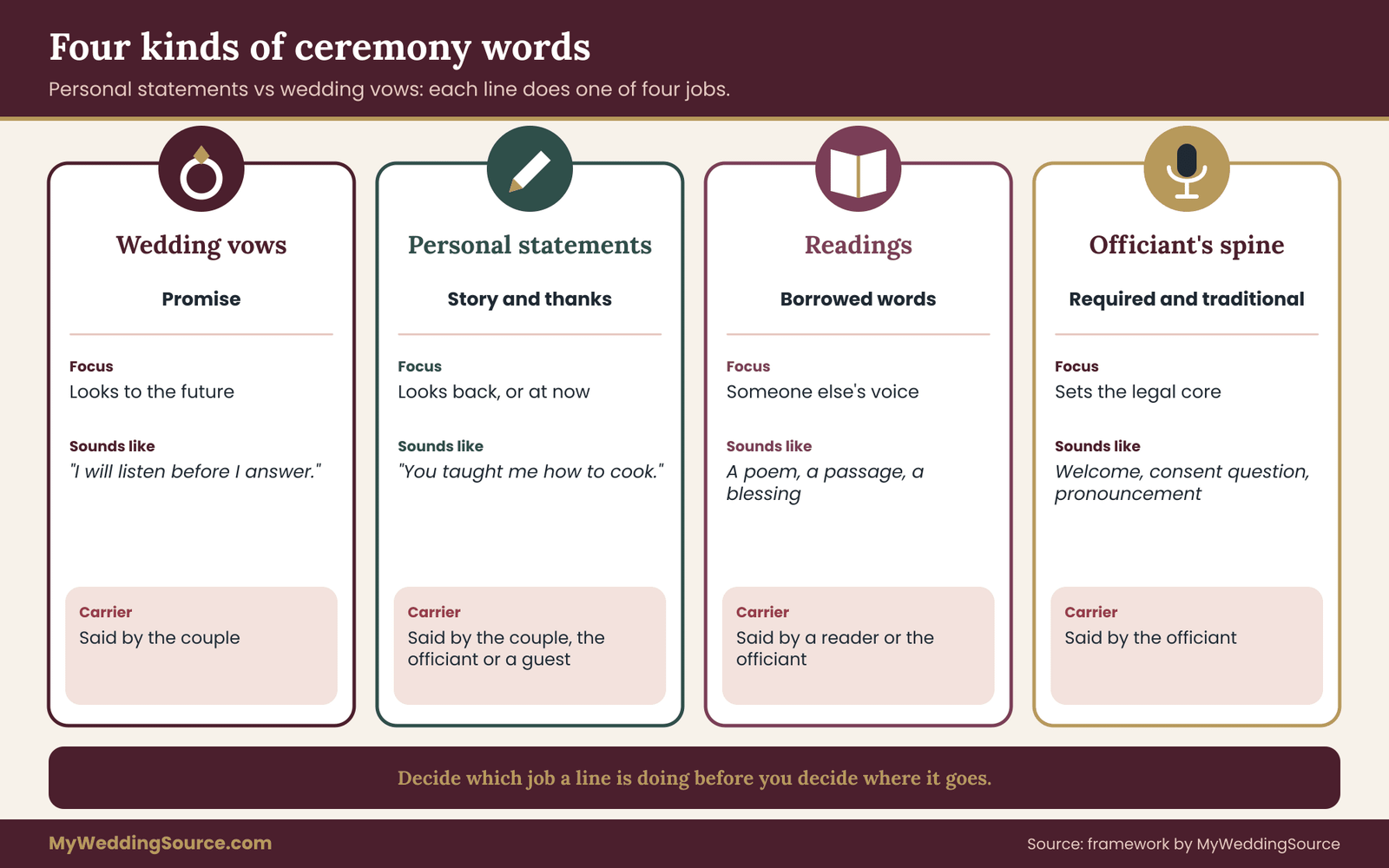
Wedding vows are promises. They are addressed to your partner, they look forward, and they describe how you intend to behave over time. “I will listen before I answer” is a promise. “I will be there when the year gets hard” is a promise. A vow is something your partner could, in principle, remind you about on an ordinary Tuesday ten years from now.
Personal statements are everything else you might say in your own voice: how you met, what you noticed first, what your partner has taught you, thanks to the people who raised you, a reflection on why you chose this person. They look backward or at the present moment. They are true and affecting, but they are not commitments. “You made me laugh in a hospital waiting room” is a personal statement. So is “I am grateful to my grandmother for teaching me to be patient.”
Readings and blessings are a third category. They are words that belong to someone else or to a tradition: a poem, a passage of scripture, a song lyric, a blessing from your culture. You or a guest read them aloud, and their power comes from being familiar or well made rather than from being yours.
The officiant also speaks, and the officiant’s words form a fourth layer that the couple usually does not write. These may include a welcome, a short reflection on marriage, the legally required questions and the pronouncement. Many officiants will work in a few lines about the couple if you give them good material, and that choice is one you can make deliberately rather than by accident.
Why the difference changes what you write
If you treat everything as a vow, you will try to make every sentence a promise, and the result tends to sound strained. People write things like “I promise to always remember the night we met at the lake,” which is not really a promise about the future but a memory wearing a promise’s clothes. If you treat everything as a personal statement, you may skip the commitments altogether, and a ceremony without a promise can feel oddly unfinished even to guests who cannot say why.
Knowing the difference lets you write each piece for its own purpose. A promise can be short because its power is in being specific and sincere. A story can be longer or more playful because it has a different job. A reading can be borrowed because you are not claiming to have written it.
Why the line matters beyond style
There is a practical reason too. Some of what is said in a ceremony may carry legal weight. In many places, the couple must state, in front of the officiant and sometimes in front of witnesses, that they take each other in marriage. The exact wording varies, and some jurisdictions require little more than a clear statement of consent. If your planned personal statements replace that exchange instead of sitting beside it, you could leave out something the officiant is obliged to hear. The section on officiants and local rules later in this guide explains how to check.
There is also an emotional reason. A ceremony is shared among many people with different attention spans, languages, hearing levels and relationships to you. Material that is perfect for a private letter can land awkwardly in front of a hundred guests. Placing each line where its audience fits is a kindness to everyone, including the person speaking.
Why personal statements and wedding vows get mixed up
Couples blend the two for understandable reasons, and recognizing the cause helps you choose a fix that suits you.
The words are used loosely. Wedding websites, templates and even officiants may call anything a couple says “vows.” A friend who “wrote vows” may have written a love letter. A video of a tearful, funny, eight-minute speech gets labeled vows and sets a standard that other couples feel they must match. Nothing is wrong with that speech. It simply is not only a vow.
Tradition hands you a fixed script. Many religious and civil ceremonies include a traditional exchange of promises that is short and formulaic. Couples who want something more personal sometimes respond by replacing the whole thing with their own prose. But the fixed script exists partly to guarantee a clear, recognizable commitment, and discarding it without a substitute can remove the one moment the ceremony is built around.
Emotion pulls everything into one speech. Personal statements and promises tend to arrive together when you are moved. When you sit down to write something you will say to the person you love, the story, the thanks and the promise all arrive at once. There is nothing wrong with that in a draft. The problem is carrying the blend all the way to the ceremony without sorting it.
Time pressure hides the cost. On a planning timeline, “we’ll each say something personal” feels like a single task. It becomes several tasks once you notice it involves legal wording, microphone logistics, program printing and the order of the cue sheet. The wedding ceremony cue sheet guide shows how every spoken moment has an owner and a position in the sequence, and the same discipline helps here.
Family and guests add requests. A parent wants to speak. A sibling has a poem. A close friend has been told they can “say a few words.” Each is a personal statement of a kind, and each takes minutes. Without a map, requests accumulate until the promise is a small piece of a long program.
A short vocabulary for the rest of this guide
To keep the rest of the guide clear, here are the terms it uses. The “spine” is the required or traditional core of the ceremony: the officiant’s authority, the couple’s declaration of consent and the pronouncement. A “lane” is a category of spoken content that hangs from the spine. The “story lane” holds personal statements, the “promise lane” holds vows, and the “borrowed lane” holds readings and blessings. A “slot” is a specific moment on the cue sheet where something can be said. A “carrier” is the person who says it: you, your partner, the officiant or a guest.
With those terms, nearly every decision in this article reduces to one question: which lane does this line belong to, and which slot and carrier should hold it? The next part builds the map that makes that question easy to answer. ## The three-lane map for personal statements, vows and readings
The map has one spine and three lanes. It is meant to be drawn on a single sheet of paper, with your drafts sorted onto it, so you can see at a glance what you have and what is missing.
The spine: what the ceremony needs to be a marriage
The spine is not a lane you write. It holds the parts that make the ceremony a ceremony: the officiant’s role, the couple’s declaration of intent, any questions your officiant is required or accustomed to ask, and the pronouncement. Some of this is legal and some is tradition, and your officiant can tell you which is which for your location and your faith community.
Think of the spine as fixed ground. You can decorate around it, add to it and sometimes reword parts of it with the officiant’s agreement, but you do not remove it without checking. Everything else in this guide hangs from it.
Lane one: story, the home of personal statements
The story lane holds anything that looks backward or describes the present. It includes how you met, the moment you knew, specific things you admire in your partner, thanks to parents and guests who traveled, and reflections on what marriage means to you. These are the personal statements in the narrow sense of the word.
Personal statements in the story lane have three useful traits. They can be funny without being awkward, because it is not a commitment. They can be long or short as the ceremony allows, since nobody will hold you to it. And they can be spoken to your partner, to the guests or to both, which gives you flexibility in where it goes. The cost is that it depends on shared context. A story that makes perfect sense to you may need setup for the guests, and setup takes time.
Lane two: promise, the home of vows
The promise lane holds statements about what you will do. It is the lane that most closely matches what people mean when they say wedding vows. Good promise content is specific, kind to the other person and possible to keep. It is written in the future tense or the present tense of commitment: “I will,” “I promise,” “I choose to.”
Promises are usually shorter than stories, and that is a strength. A sincere, specific commitment does not need much room. Promises are also addressed to your partner, even though guests listen. That matters for tone: you are speaking to one person with the rest of the room as witnesses.
Lane three: borrowed words, readings and blessings
The borrowed lane holds words that come from outside you. These might be a poem, a passage from a sacred text, a literary excerpt, a song lyric spoken as a reading, or a blessing from your family’s tradition. They are often assigned to a reader other than the couple.
Borrowed words do something your own words cannot: they connect the ceremony to a larger body of human experience.
They also give a pause.
A reading placed before the couple speaks gives both of you a moment to settle.
If you plan to print a poem or song lyric in the program, check its copyright status first, since the U.S. Copyright Office explains that most recent works are protected, and ask the publisher or author for permission or choose a text in the public domain. If you want a reading in a language the guests may not speak, or one that carries a religious meaning for some guests and not others, consider printing a translation or a one-line note in the program. The interfaith wedding ceremony planning guide covers how to decide who owns each ritual element when families hold different traditions.
What the map shows you
Once your material is sorted, three patterns commonly appear.
One lane is overloaded. Often the story lane is huge and the promise lane is thin. That is not a failure. It tells you that most of your writing is personal statements, which can find a home in a toast, a letter or the officiant’s remarks, and that the promise lane needs a short, deliberate piece of its own.
One lane is empty. If you have no readings, you have a free choice about whether to add one. If you have no promise, the ceremony may lack its center, and you can write a few sentences or use a traditional formula.
A line belongs to two lanes. “I promise to keep telling you the story of the night we met” is a promise that points to a story. You can keep it as a vow if it is specific and keepable, or split it into a promise and a separate story. The tests below help you choose.
Five tests for placing any line
The map tells you the categories. The tests tell you which category a particular line belongs to. They take seconds per line and settle most arguments between partners.

Test one: tense
Read the line and note where it points in time. If it describes something that already happened, or something that is true now, it belongs with your personal statements. If it describes something you will do, it is a promise. “You taught me to cook” is story. “I will cook with you on the days neither of us wants to” is promise.
Tense is not perfect, because some promises are phrased in the present (“I choose you”) and some stories can be written in the future (“one day we will tell this at dinner”). Even so, it is the fastest test, and it settles most lines on the first read.
Test two: audience
Ask who the line is for. If it is for your partner alone, it works as a promise or an intimate statement. If it is for the guests, such as thanks for traveling, it is a personal statement that belongs in an opening or closing moment, not in the middle of the vows. If it is for a specific third person, such as a parent or a child, it often works best as a separate, brief moment or as something said privately, not folded into the exchange between you two.
Mixing audiences inside one of your personal statements is a common cause of awkwardness. Turning from your partner to the room and back within a minute can feel jarring, and it makes the vow harder to follow. Giving each audience its own slot keeps the eye contact and the emotional line clean.
Test three: accountability
Ask whether you could honestly be asked in ten years, “Did you do that?” If yes, it is a promise, and it should be one you are willing to keep. If the answer is “that question makes no sense,” it is a personal statement.
This test also catches promises that should not be made. “I promise never to be angry” cannot be kept by anyone. “I will tell you when I am angry instead of going quiet” can. Rewriting an impossible promise into a behavior you can actually do is one of the most useful edits in the whole process.
Test four: context
Ask whether a guest who has never heard the backstory would understand the line. Personal statements lean on shared context more than promises do. If yes, it can live in the ceremony. If it needs an explanation, it may belong somewhere with more room, such as a toast where you can tell the story, a printed program note or a private letter.
Inside jokes are not banned. A short one that the room can sense is affectionate and requires no decoding. The risk is a line that makes two people laugh and leaves everyone else guessing, in a moment when attention is high and silence is respectful.
Test five: weight
Ask what the moment can carry. A ceremony has a rhythm with places that can hold silence, places that can hold laughter and places that need to move along. A long anecdote placed immediately before the rings, for example, may drain the weight from the exchange it is supposed to lead into. A heavy confession placed right after a processional may be too much too early.
Weight also covers practical load: whether the line will be spoken from memory or read, whether it will be heard through a microphone, and whether the speaker is likely to be too emotional to finish. If a line is heavy for any of these reasons, consider moving it to a place where a pause or a repeat is easy to absorb.
Using the tests together
Run the five tests on each line and mark the result in the margin: S for story, P for promise, B for borrowed. When a line gives mixed results, split it. A sentence that starts as a memory and ends as a commitment is usually two sentences that were written as one.
Do this separately, each partner on their own draft, then compare. Seeing that one of you wrote mostly personal statements and the other mostly promises is a useful conversation, not an alarm. It means you can decide together how the ceremony should balance the two lanes, rather than discovering the difference when the first person finishes speaking. ## Where personal statements fit inside the ceremony
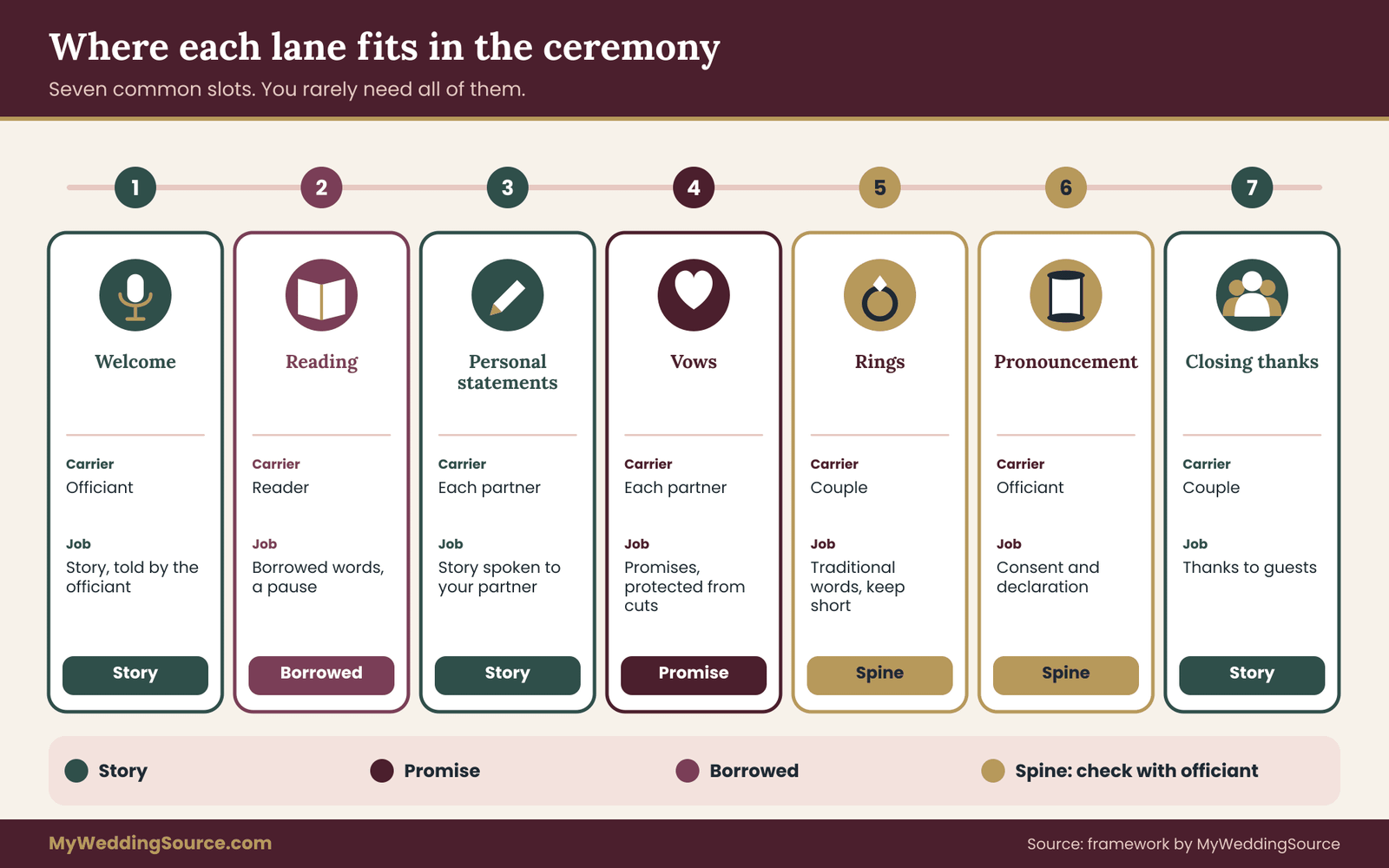
A typical ceremony has a handful of slots where words can be added without disturbing the core. The names differ among traditions, but the order is similar. The wedding ceremony step-by-step guide walks through the standard sequence, and the slots below sit inside it.
Slot one: the officiant’s welcome and opening remarks
The officiant usually opens by welcoming guests, saying a few words about marriage and sometimes about you. This is a natural home for personal statements delivered by someone else. If you give your officiant two or three short facts and a sentence about what you want guests to understand, the officiant can weave them into the opening in a steady, practiced voice.
The advantage is that you do not have to hold your own emotions together while telling the story. The cost is some loss of control over the phrasing, so give the officiant clear material and ask to read the final wording before the day. Officiants differ in how much they invite this, so ask early.
Slot two: a reading or blessing
After the welcome, many ceremonies include a reading. This is the borrowed lane, and it works as a breathing space. Readings differ from personal statements because the words are borrowed, which makes them easier to place. A reader who is not part of the couple also lets another person take part, which can matter in families where several people would like a role. If you have more candidates than slots, a second reading placed after the rings is a common way to include another person without lengthening the central moment.
Slot three: the couple’s personal statements
This is the slot most couples are asking about when they search for guidance. It comes between the opening remarks and the vows, or between the vows and the rings, depending on how you want the emotional arc to run.
Before the vows. Placing personal statements first moves from story to promise. The guests hear why you are here, then hear what you are committing to. The order feels natural to many couples because it builds toward the commitment, and the promise becomes the last thing spoken before the rings.
After the vows, before the rings. Placing a personal statement after the promises is less common, but it works if it is short and meant as a closing thought, such as a sentence of thanks. It can feel like an anticlimax if it is long, because the commitment has already been made and the room is ready for the rings.
Whichever order you choose, keep each partner’s personal statement roughly equal in length. A large imbalance can leave one person feeling exposed, and guests notice. If you want a long personal statement and your partner wants a short one, there are solutions in the later section on edge cases.
Slot four: the vows themselves
The promise lane has its own slot, and it deserves protection. Whatever else you add, the vows should not be squeezed between stories or trimmed to make room for them. If time is tight, trim the story lane first. The promises are the part the ceremony cannot do without, and they are often the shortest.
Vows can be said in three common ways: repeated line by line after the officiant, recited from memory or read from a card. Each affects how much you can ask of the moment. Repeating lines is the most forgiving when nerves run high, and reading from a card is the most reliable. Memorizing is the riskiest, and it adds little for the audience.
Slot five: the rings and the pronouncement
Ring exchanges often have their own short script. Treat these words as part of the spine, and check with your officiant before changing them. A line such as “with this ring” is a traditional promise in miniature, and adding personal statements here can blur the moment. If you want to say something while giving the ring, keep it to a sentence.
Slot six: closing words
After the pronouncement and the kiss, some couples turn to the guests to thank them. This is a good home for guest-facing personal statements. It also lets the ceremony end on gratitude and movement toward the recessional, rather than ending on a long speech.
How many slots are enough
A ceremony does not need to use every slot. Each added slot for personal statements means another transition, and each transition is a point where the officiant must hand over, a microphone may need passing and guests may lose the thread. For many couples, three or four active moments are plenty: an opening that includes a short story, a reading, the exchange of vows and a closing thank you. If you are tempted to add more, ask what would be lost if that piece moved to the reception.
The cue sheet is the place to record this. Each active moment becomes a line with a carrier, a cue, a microphone note and an approximate duration. If you have not made one, the guide to ceremony cue sheets explains the layout and how to share it with the officiant, readers and music contact.
Personal statements that belong outside the ceremony
Some of your most meaningful personal statements do not need to be said during the ceremony at all. Moving them elsewhere is not a demotion. A story told as one of your personal statements in a room where guests can laugh, answer and eat is often better received than the same story told in a quiet, formal moment.
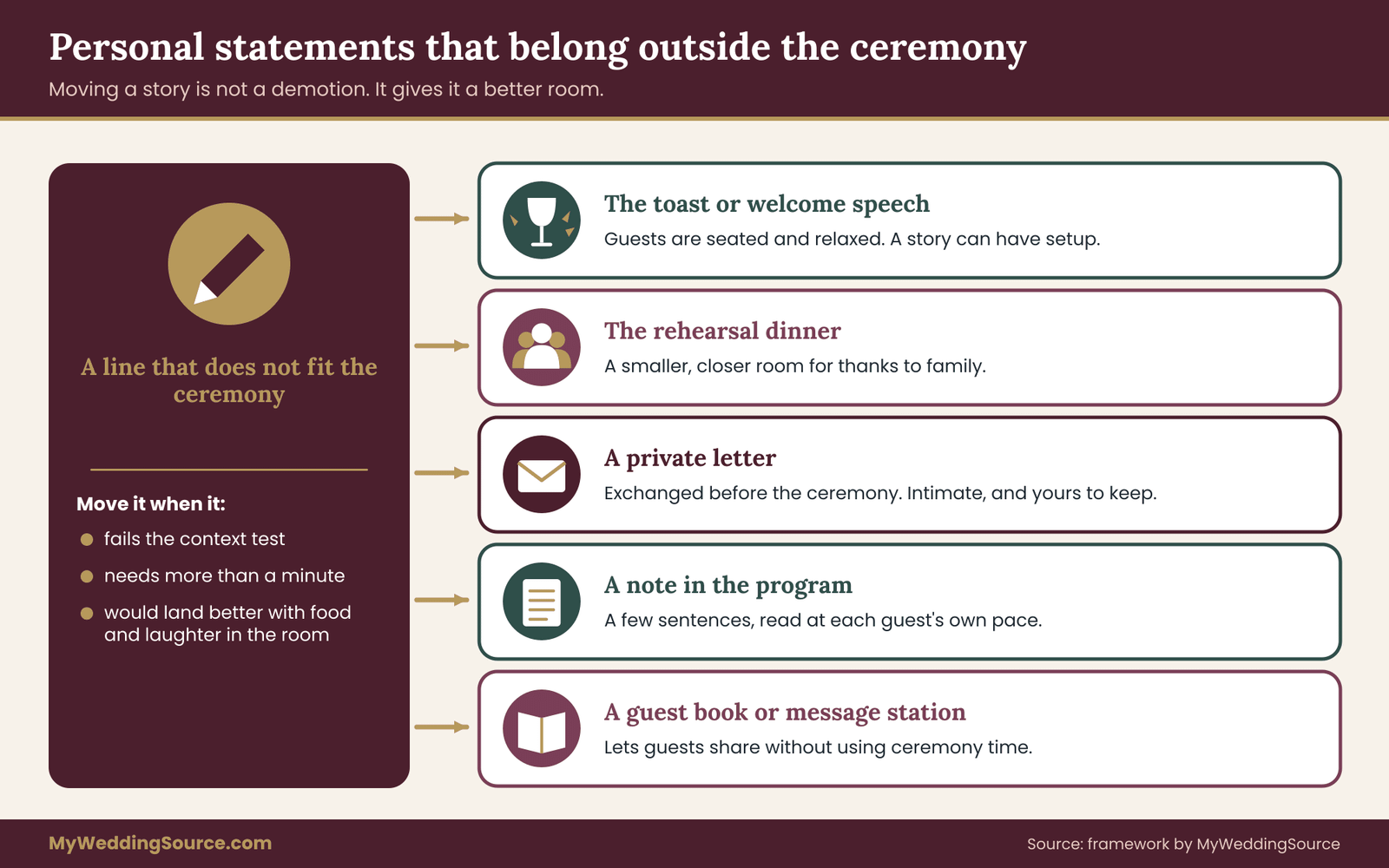
The toast or welcome speech. At the reception, a spoken thank you or a story has natural room. Guests are seated, relaxed and ready to listen, and a microphone is usually already in place. Stories that need context do well here, because you can take a moment to set them up.
The rehearsal dinner. If you hold a rehearsal dinner, it is an ideal place for thanks to family and for the more affectionate, family-centered personal statements. The audience is smaller, closer and more forgiving.
Letters exchanged privately. Many couples write each other letters and read them in private before the ceremony, with a photographer present or not. This keeps the most intimate material from becoming a performance, and it gives you something to keep. A private exchange can also take pressure off the public vows, since you have already said the most personal things.
The printed program. One of the gentlest places for personal statements. A short note from the couple in the program can carry thanks and a few sentences of story. The reader can take it in at their own pace, and you can include context that would be awkward to say aloud. Keep it brief so the program remains easy to hold.
A guest book or message station. If many people want to share a reflection with you, a guest book, a video message station or a set of cards invites them without taking ceremony time.
A first-dance or send-off moment. Short personal remarks before a dance or at the exit can carry a final thank you without adding anything to the ceremony itself.
A simple rule for deciding in-ceremony or outside
Move a personal statement outside the ceremony if it fails the context test, if it needs more than a minute to tell or if it would be better received with food and laughter in the room. Keep it inside if it is short, if every guest can follow it and if it prepares the ground for the promises.
What to do when someone else wants to speak
Parents, siblings and friends often want a moment. Each wish adds to the personal statements the ceremony has to hold, and it is easier to answer if you have already decided how many speaking slots the ceremony has. A kind and clear reply helps.
“We are keeping the ceremony short, and we would love to hear your words at the rehearsal dinner. Would you be willing to say them there?”
If the person is a natural fit for the reading slot, offer that instead. A reading gives them a role without adding open-ended speaking time, and you can approve the text in advance. If the answer is still no for the ceremony, the toast and the program note give a second and third option. Telling people early, in your own words, prevents surprise requests on the day. ## What your officiant and local rules may require
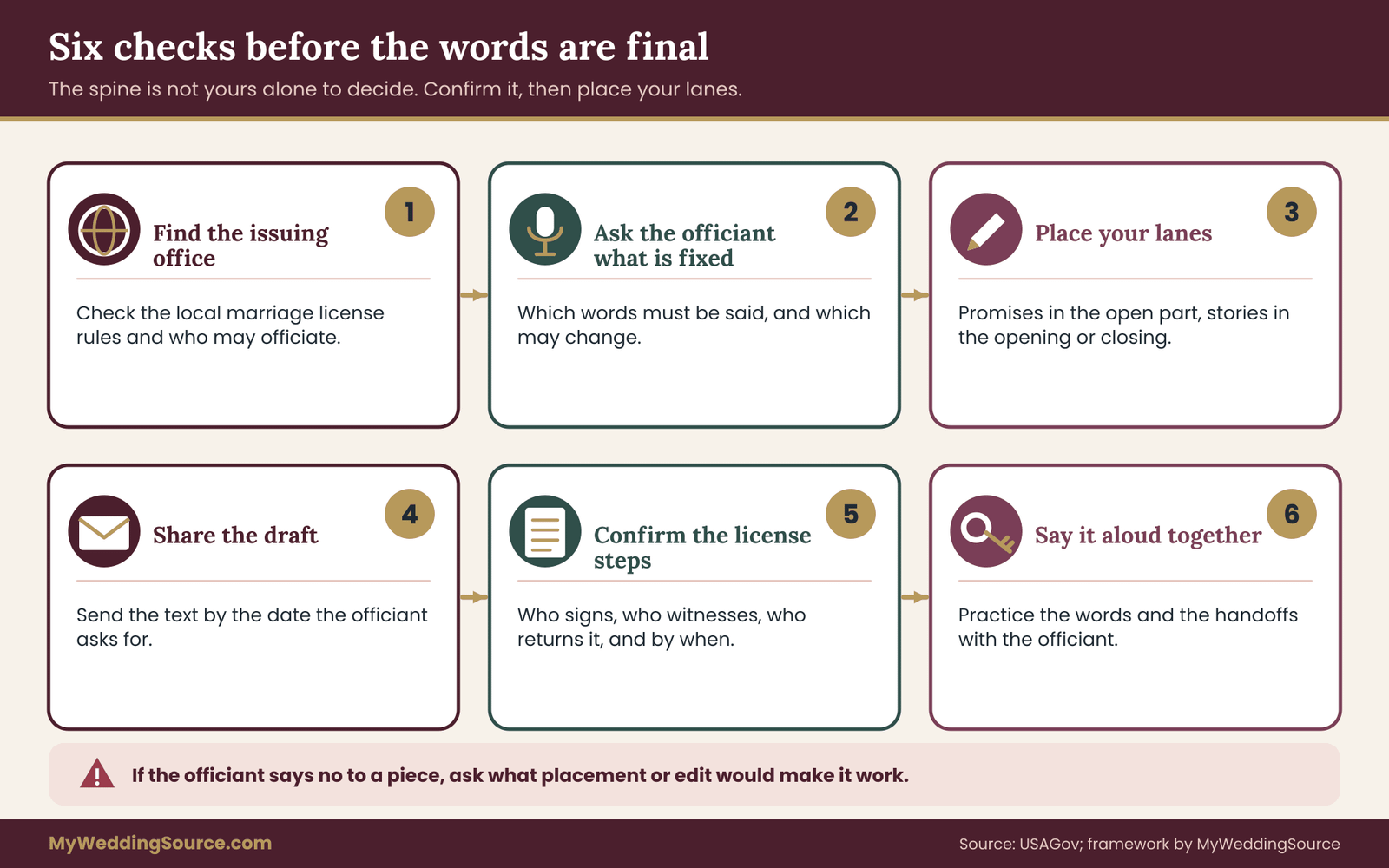
Before you finalize how personal statements and vows will be arranged, find out what has to happen in the ceremony for the marriage to be valid and for your officiant to be comfortable. This is the spine, and it is the one part of the map you do not decide alone.
The general picture
In the United States, marriage law is set mainly by states, and other countries have their own systems. As general background, a marriage usually involves a license issued by a local office, an officiant who is authorized to perform marriages, a ceremony in which the couple consents to marry and, in many places, one or more witnesses. After the ceremony, the signed license is returned for recording. USAGov explains how to find the marriage license requirements for a state, and it is the best starting point for confirming the details that apply to you.
What matters for this guide is the consent moment. Many jurisdictions expect the couple to say, in the presence of the officiant, that they take each other as spouses. Some specify wording or a question-and-answer format, and others ask only for a clear expression of consent. A few places also have rules about what the officiant must say. Because the details vary, a sentence from a template website is not a substitute for asking.
None of this means your personal statements are in the way. It means the legal moment needs to happen clearly, and everything else can be arranged around it. In practice the consent moment is often built into the traditional vows or into a short question the officiant asks, such as “Do you take this person as your spouse?” Your officiant knows the local wording and can tell you whether your planned vows already cover it or whether a separate question is needed.
Who decides, and about what
Three parties each hold part of the decision.
The issuing office sets the rules for the license, witnesses and who may officiate. It does not usually dictate what personal statements you give, but it may specify what the signed license must show. Your county or local clerk, or the equivalent office where you live, is the authority for this. The official directory of local and state government pages on USAGov helps you find the right office.
The officiant decides what they will perform.
A civil officiant may have a standard ceremony and be glad to adapt it. A religious officiant may follow a fixed rite and allow limited personal additions, or may not allow personal vows in place of the rite at all. Some officiants have a rule about reviewing text in advance, and some ask for a copy of everything spoken. Some officiants ask to read personal statements before the day, and some set a limit on how long they can run. These are legitimate preferences, and finding out early avoids a conflict later. The wedding officiant requirements guide explains how to confirm that someone is authorized to marry you.
You and your partner decide everything else: whether you speak, how long, in what order and in what spirit.
If your ceremony is religious, the faith community’s own rite carries its own rules. Some traditions fix the words of the vows and treat personal additions as separate from the rite, to be said before or after. The Christian wedding ceremony script guide shows how a traditional order is commonly arranged, and the non-religious ceremony script guide shows where a civil ceremony leaves open space for personal material.
Some churches, including the Catholic Church, use an official rite of marriage with set vows, and the United States Conference of Catholic Bishops publishes general information about it. Confirm the specifics with your own priest, pastor or other officiant rather than relying on a general script.
Questions to ask your officiant
Come to the first planning conversation with a short list. It signals that you respect their role and it gets useful answers quickly.
- Which words, if any, must be said by us for the marriage to be valid here?
- Do you have a standard order of service, and where can we add personal statements?
- Are there limits on length, content or language?
- Do you want to review our written text before the ceremony, and by when?
- Do you prefer that we repeat after you, read from cards or speak from memory?
- Will you bring a microphone, or should we arrange one?
- If one of us becomes too emotional to continue, how do you handle it?
- How and when will the license be signed and returned?
“Thank you for working with us. We would like to add some personal statements and our own vows. Could you tell us which words we must keep, and where you would suggest the personal parts go?”
A message like this is short, polite and specific. Most officiants have answered the same questions many times and will reply with a clear structure.
Putting the answers into your plan
As answers arrive, mark them on the spine. A good working document has two columns in your own notes, not a table in the final program: what is fixed and what is open. Fixed items might include the consent question, the pronouncement and any required readings. Open items might include whether you may personalize the promise wording, whether a friend can give a reading and whether the officiant will include a short story about you.
Then place your lanes. Promise content goes into the open part of the exchange, story content goes into the opening or closing, and borrowed words go into the reading slots the officiant allows. If the officiant allows only the fixed vows, move all your personal statements to the toast, the program or a private letter exchange. That is not a loss. It simply separates the legal and religious center from the personal expression, and many couples find the private version more affecting.
Verifying what you were told
Officiants are usually right about their own practice, but it is sensible to verify two things independently. First, that the officiant is authorized where you are marrying. Second, that the license process is understood by everyone: who signs, who returns the license, how many witnesses are needed and what the deadline is for returning it. Your issuing office publishes the requirements, and a short call or a visit to its website settles them. If a venue or vendor says “we always do it this way,” treat it as a prompt to check, not as an answer.
The Centers for Disease Control and Prevention’s National Center for Health Statistics maintains guidance on where to request vital records. It is not about ceremony wording, but it is where you will go for certified copies later, so it is worth a bookmark.
Language, accessibility and translation
If guests speak different languages or have hearing differences, the spoken parts of the ceremony may need support. A printed program with the text of the readings or a short summary helps people who read more easily than they hear. If a sign language interpreter will be present, share the text in advance so the interpreter can prepare, and place them where both the couple and the interpreter can be seen. The Americans with Disabilities Act pages at ADA.gov explain accessibility obligations for public venues and are a useful starting point if you are unsure what a venue must provide.
Personal statements can be spoken in any language the speaker is most at home in, because they carry no legal weight. For vows spoken in a language other than the officiant’s, ask whether the officiant needs an English version for the legal portion. The couple’s consent must be understood by the officiant and, where witnesses are required, usually by the witnesses. A bilingual exchange, where each partner speaks in their own language and then in the other’s, is one way to meet the need. Plan it as a deliberate moment, not an improvisation.
When the officiant disagrees with your plan
Sometimes an officiant will say no to part of your plan. The most common reasons are length, content that conflicts with a tradition and wording that might create doubt about the consent moment. Take the objection seriously.
Ask what would make the element acceptable. Often the answer is a placement change: the personal statement can stay, but before the officiant begins the rite or after the pronouncement. If the objection is firm and the element matters to you, the options are to move it outside the ceremony or to choose a different officiant. Both are legitimate, and choosing early is easier than changing late. ## Sorting a draft: personal statements into vows and back
Most couples start with one pile of writing. The practical task is to take that pile and divide it into three outputs: a short set of promises, a set of personal statements with a home, and a list of readings. The method below uses four passes. Each pass can be done in one sitting, and you do it twice, once per partner, before you compare.
Pass one: dump everything
Write or paste every line you might want to say. Do not edit while you do it. Personal statements tend to run longest in this pile, and that is fine at this stage. Include the stories, the thanks, the jokes, the promises and the quotes you like. A messy first pile is useful because it shows you what you actually care about, which is not always what you expected to write.
If you have notes in several places, such as a phone, an email draft and a notebook, gather them into one document. Keep a second copy somewhere safe. The wedding day digital contingency plan explains why spoken text on a single phone is a risk, and the same logic applies to your drafts from the first day.
Pass two: label every line
Run the five tests from the previous section and mark each line S, P or B. Be strict about tense and accountability, because those two catch the most mislabeled lines. A line like “I love how you always make me feel safe” is S, since it describes the present. A line like “I will keep making our home a place where you feel safe” is P, since it commits to future behavior.
You may find that a long paragraph contains all three labels. That is normal. Split it into its parts and number them, so you can move them without losing the thread.
Pass three: convert where it helps
Conversion is the useful middle step. Many lines are not in the right lane, but they are the right idea, and a small rewrite moves them.
From story to promise. Take a personal statement and ask what behavior it implies. “You stayed with me through the winter my father was ill” implies a promise: “I will stay with you through the hard seasons, and I will tell you when I need you to stay with me.” The story remains in the story lane, and the promise carries its meaning forward.
From vague promise to specific promise. “I promise to always love you” is sincere and almost impossible to measure. Specific versions are easier to say and to hear: “I will say thank you for the small things,” “I will ask before I assume,” “I will make time for us when we are both tired.” They are not more romantic by default, but they have the quality of being checkable, and many people find that more moving.
From impossible promise to possible one. Watch for absolutes: always, never, forever, every day. Some of these are traditional and are understood as poetic, and that is acceptable in a set formula. In your own words, absolutes can sound hollow. Rewrite them as intentions: “I will work to be someone who listens, even when I am frustrated.”
From promise to story. Sometimes a line is shaped like a promise but is really a memory. “I promise I will never forget the way you looked at the airport” is a story about the airport. Let it be one. Move it to the personal statement lane and say what it is.
From private to public. A line that works in a private letter may need a small change for a public room. Remove names a guest would not know, expand an abbreviation and cut anything that would make a grandparent or a colleague wince. You can keep a version of the original in the letter.
The bridge sentence
When a story and a promise sit close together, one connecting sentence helps the listener follow. The pattern is simple: a short fact, then “so,” then the promise. “You drove four hours to bring me soup, so I will show up when you need me.” The bridge turns one of your personal statements into the reason for the vow, and it spares you from explaining the connection in a paragraph.
Use the bridge sparingly. Repeating it for every promise starts to sound like a formula, and a single bridge near the center of the exchange is usually enough.
Pass four: fit to the slot and read it aloud
Now that each line has a lane, give it a slot from the section on where personal statements fit. Count the words and read the material aloud with a timer. Speaking time is longer than most people expect because of pauses, emotion and the room’s reaction. As a rough planning rate, many people speak at about 130 to 150 words per minute, and slower in front of a crowd. Use your own timing and add a margin.
Reading aloud also exposes tongue-twisters, rhythm problems and lines that sound different out loud than on the page. If a sentence is hard to say without running out of breath, shorten it. If you stumble on a word, replace it. Do this at least twice on different days, since the second read often shows what the first missed.
Content to move or cut
Some personal statements, and some promises, are better placed elsewhere or left out, whatever the lane. The following list is meant as a gentle filter, not a rule.
- News for your partner. A ceremony is a poor place to reveal a plan or a decision your partner has not heard. Promises that involve a move, a career change or a child should be discussed before they are spoken.
- Private health, money or family conflict. Material that would embarrass a family member or reveal something your partner has not agreed to share belongs in private.
- Former partners. Even a gracious mention can change the mood of the room.
- Jokes at your partner’s expense. Light teasing can be fine if your partner enjoys it and the room can follow. Anything that your partner might find exposing is a risk in front of family.
- Material that excludes. Lines that make some guests feel they do not belong, whether through religion, family structure or inside jokes, deserve a second look.
- Statements that overpromise. If you could not say it calmly to your partner at the kitchen table, it may not belong in your vows.
Comparing drafts with your partner
When both partners have sorted, sit down together with the two sorted drafts. Compare three things: the balance of lanes, the tone and the rough time. If one of you has written many more personal statements and the other many more promises, decide on the shape of the combined section before anyone edits further. A few common solutions:
Mirror the structure. Each of you gets one personal statement of about the same length and a set of promises of about the same number. This is the most balanced and the easiest to cue.
Let one lead. One partner speaks first, with a longer personal statement. The other responds with a shorter one and the promises. This works when the difference in style is natural and both are comfortable with it.
Move the long form out. If one of you has a long piece that is dear to you, keep it for the toast or a letter and use a short version in the ceremony. The longer text does not disappear, it finds a better room.
Share the promises. Some couples write one set of vows and say them together or in turns. This gives equal weight and is easy to cue, though it may feel less personal to some people.
None of these is the correct one. The point is that the decision is made together, in advance and with the draft in front of you, not on the day with an audience.
Keeping a master copy
Once the sorted drafts are settled, create a single master document for the ceremony. It should list, in order, every spoken element, its carrier and its text or its source. Back up the file in more than one place, following the Library of Congress personal archiving guidance and the Cybersecurity and Infrastructure Security Agency’s advice on backups.
Print two copies, give one to your officiant if they ask, and keep one with the person who will carry your belongings on the day. If you use cards, put the text on cards in large type with the opening words of the next section at the bottom, so that nobody loses their place. ## Timing and delivery for personal statements and vows
A well-sorted plan can still stumble in delivery. This section covers the practical side: how long each piece takes, who carries it, how it is amplified and what happens if something goes wrong.
Build a minute budget
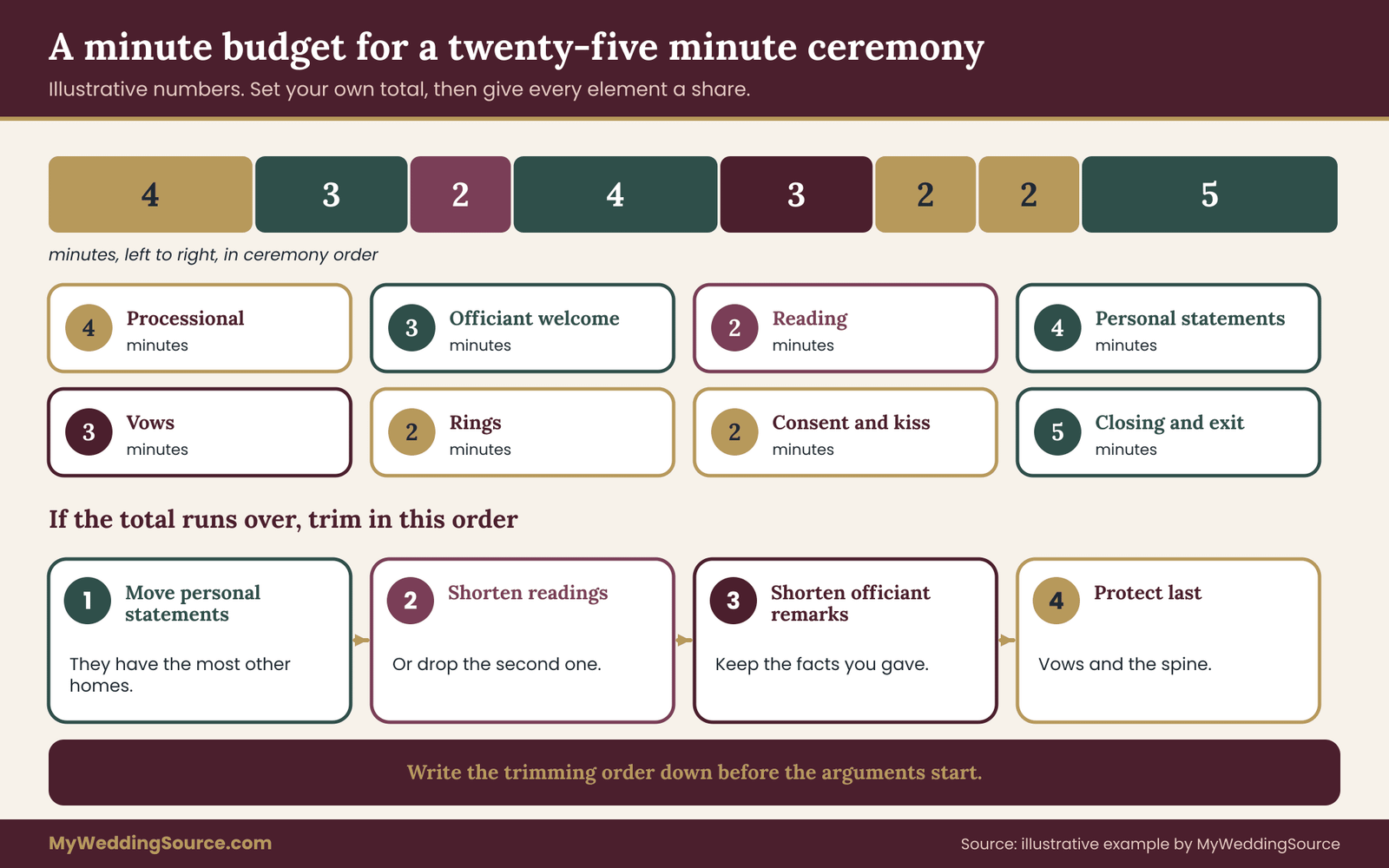
Start with the total ceremony length your venue, officiant and guests can comfortably hold, then divide it. Many couples aim for a ceremony that fits in about twenty to thirty minutes. That figure is a common planning range, not a rule, and your own tradition may run shorter or much longer. What matters is that you set a number before you write the last draft.
Here is how the budget might look for a twenty-five minute ceremony. The procession and seating take about four minutes. The officiant’s welcome and remarks take about three. A reading takes about two. The couple’s personal statements take about four, which is two minutes each. The vows take about three. The rings take about two. The consent question, pronouncement and kiss take about two. The closing words and recessional take the remainder, about five. Your numbers will differ, and the point is the habit: every element has a number, and the numbers add up.
When the total is over, trim the lanes in a fixed order. Cut or move personal statements first, because they have the most alternative homes. Shorten readings second, then check that the personal statements still sound like you. Shorten the officiant’s remarks third. Protect the promises and the spine last. Writing the order down in advance keeps the conversation fair, since nobody has to argue about whose piece is least important.
Decide the carrier for each element
Each spoken element needs a carrier, a person responsible for saying it. For personal statements, the carrier is usually the person who wrote them. For readings, it is a friend or relative, or the officiant. For the opening remarks, it is the officiant. For closing thanks, it is the couple or the officiant on their behalf.
Name the carrier for every one of the personal statements, not only for the readings. Think about the carrier’s comfort. A guest who agreed to read may be more nervous than you. Give readers the text early, in a large readable format, and ask if they would like to rehearse once. Let them know where to stand, whether there will be a microphone and what their cue is. A sentence in the cue sheet is enough: “After the processional ends and the officiant nods, the reader walks to the lectern.”
Cards, books or memory
How you hold your words affects how you look and feel.
Cards. Index cards or a small card folded in half are easy to hold and read. Use large type, short paragraphs and clear breaks. Number the cards in case they get shuffled.
A small book or folder. Some couples write vows in a keepsake book, which they can keep afterward. A book is steady in wind and easy to hold with one hand, but it can be heavy if the ceremony includes ring exchanges at the same time.
Memory. Memorizing is possible for short promises, and it allows eye contact. It also adds risk. If you want the benefit without the risk, memorize the opening of each promise and keep a card in a pocket.
Repeat-after-me. The officiant says a phrase and you repeat it. This is the easiest to deliver, the hardest to get wrong and the least personal in tone. A hybrid works well: the officiant leads the formal, required words and you read your own promises from a card.
Whatever you choose, practice with the exact object you will hold. Cards that feel fine at a kitchen table can be awkward with a bouquet in the other hand. Decide in advance who will hold the bouquet and the rings during the exchange.
Microphones and sound
A voice that carries in a living room may not carry outdoors, and guests at the back are often the ones who miss the promises. Ask the venue or your sound contact what is available and who will operate it. Options include a lectern microphone, a lapel microphone on the officiant and a handheld microphone passed between speakers.
Passing a handheld microphone between people is a common source of awkwardness. If you expect both partners and the officiant to speak, ask whether the officiant can wear a lapel microphone, and whether there are two handhelds so that the couple does not pass one back and forth. If the ceremony will be recorded, tell your videographer where the audio will come from, so that the recording picks up the promises and not only the wind. Ask the venue about power, microphone placement and any sound limits during your site visit.
Personal statements spoken to your partner are often quieter than the vows, so check that they still carry to the last row. For a very small ceremony with guests close by, a microphone may not be needed. In that case, plan for pace and volume: speak slowly, face the guests slightly and pause after each phrase.
Pace, pauses and emotion
Nervous speakers talk faster than they realize. Put pauses in the written text with a mark such as a slash, and breathe at the marks. Silence in a ceremony reads as sincerity, not as a mistake.
Personal statements are the most likely place to lose composure, because they touch memory. Plan for emotion. It is normal to choke up, laugh or lose a line. A few small supports help:
- Put a short, calm sentence at the start of each piece, so the first words are easy to say.
- Keep a tissue or handkerchief in an easy pocket.
- Agree with the officiant on a signal. A look or a hand gesture can mean “please prompt me” or “give me a moment.”
- Choose a stopping place for each piece so that, if you cannot continue, you can end at a natural point.
- Tell your partner that a pause is welcome. Many couples find that a shared smile resets the room.
Rehearsal
The rehearsal usually focuses on movement. Use some of the time for words as well. Say your promises aloud, with the officiant present, at the volume you will use on the day. If you are not holding a rehearsal, ask your officiant for ten minutes before the ceremony to walk through the order.
Rehearse the transitions, not only the content. The most common stumbles occur between elements: who steps forward, who takes the card, who holds the ring, when to look at the officiant and when to look at each other. The cue sheet records these moves, and a quick walk-through catches the ones that were missing.
Guests who cannot hear or understand
A ceremony is only meaningful to guests who can follow it. Printed programs, large-type copies and a note about the reading help. If any guests rely on lip reading, face them when you speak, and avoid turning your head away mid-sentence. If an interpreter is present, give them your final text and a cue sheet in advance, and keep a short pause after each phrase.
Photographers, videographers and the pace of the moment
Photographers and videographers appreciate knowing when the personal statements and vows will occur. Share the cue sheet so they can position themselves without moving during the promises. If you plan a private exchange, say whether the photographer should be present, at a distance or absent. Some couples ask for a recording of the vows for a keepsake and ask that guests silence their phones. A recorded copy needs a safe place afterward, so keep it in more than one location.
The day-of backup kit
Prepare a small kit that travels with a trusted person: printed copies of every spoken text, a pen, spare cards, tissues, a small bottle of water and the officiant’s contact details. If you use a phone for any text, charge it and bring a printed copy as well. If a reader fails to arrive, someone in the kit’s care can step in. If wind takes a page, there is a spare. The kit costs nothing and removes a surprising amount of worry. ## A worked example: one couple, three drafts
The example below is invented to show the method. The couple, the drafts and the choices are illustrative, and your own ceremony may land somewhere very different. Call the partners Mara and Theo.
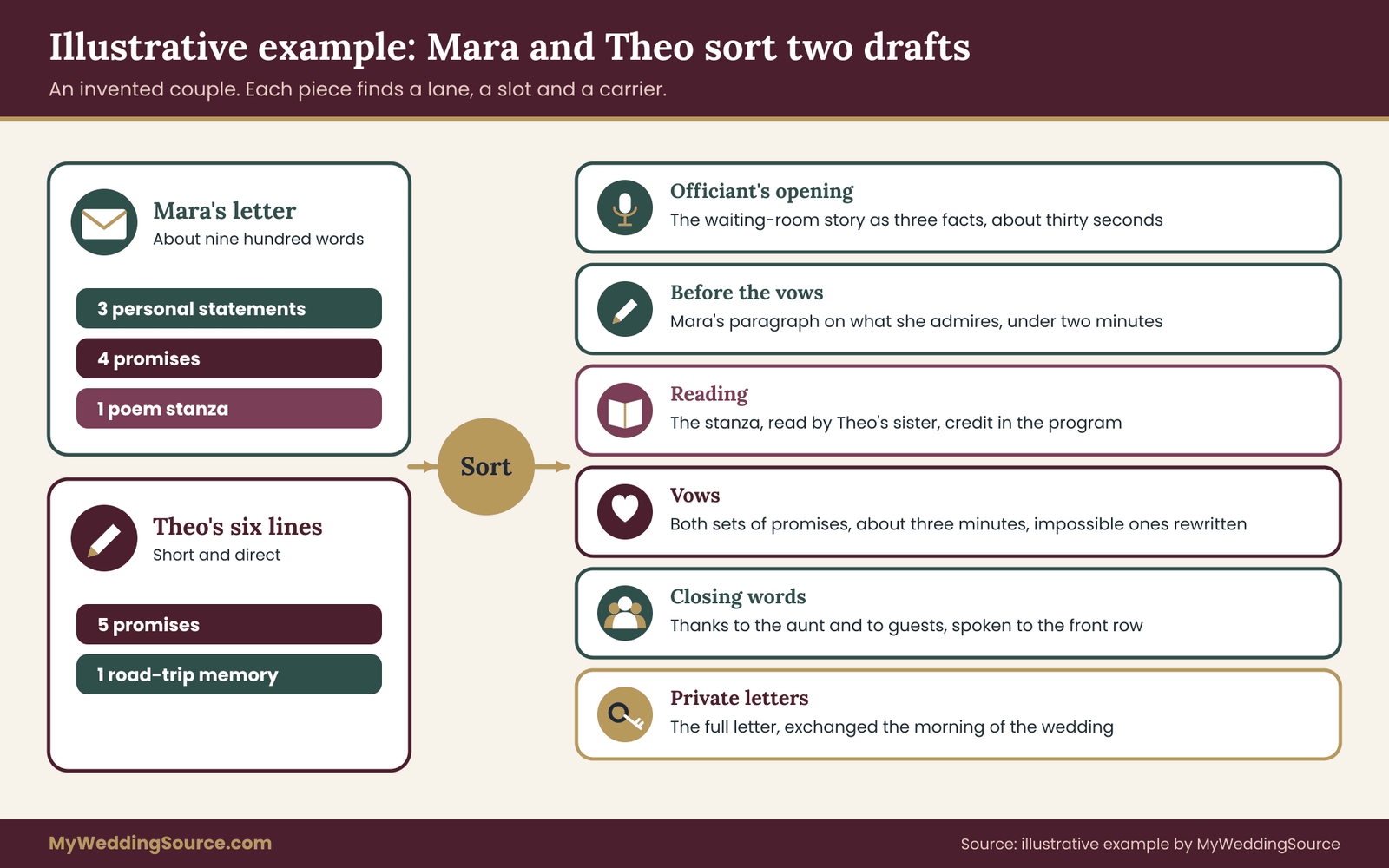
Mara has written a letter of about nine hundred words. It opens with the day they met in a hospital waiting room, thanks her aunt for raising her, describes what she admires in Theo, includes a stanza from a poem she loves and ends with a handful of promises. Theo has written six short lines. Five of them are promises, and one is a memory of a road trip. Their officiant is a civil celebrant who is open to personal additions and wants to see the text a week in advance. They want a ceremony of about twenty-five minutes.
Step one: label
Each partner marks their draft S, P or B. Mara’s letter divides into three story passages (the waiting room, the aunt, what she admires in Theo), four promises and one borrowed stanza. Theo’s draft has five promises and one story. At this point, the contrast is clear. Mara has a lot of story and Theo has almost none, and both of them have reasonable promise material.
Step two: decide the shape
The couple talks it through. Mara does not want to cut the letter but agrees it is too long for the ceremony. Theo is relieved to learn that his short promises are not “less” than her letter, since they sit in a different lane. They decide to mirror the promise lane and let the story lane flex.
They agree on a budget of two minutes each for personal statements, three minutes in total for the vows, two for a reading, and about three for the officiant’s opening, the rest of the minutes going to the processional, rings, pronouncement and recessional.
Step three: place each piece
- The waiting room story becomes three facts handed to the officiant, who will tell it in about thirty seconds in the opening. Mara gives the officiant the setting, the detail she most wants kept and a sentence about why it matters.
- The aunt gets a short, warm thank you in the closing words, spoken to the guests, with Mara turning to the front row.
- What she admires in Theo is trimmed to a single paragraph, which Mara speaks to him just before the vows. This is her personal statement for the ceremony. The remaining admiration stays in the letter.
- The stanza becomes the reading, delivered by Theo’s sister. The couple prints the author and title in the program.
- Mara’s four promises are tightened. One of them said “I will never go to bed angry,” which Mara rewrites as “I will bring the hard conversations to the table, not to the hallway.” The rewrite is something she can actually do.
- Theo’s five promises stay nearly as written. His road-trip memory is turned into a bridge sentence: “You read the map and I drove, so I will trust you with the directions and with the big decisions.” He keeps it short. He also adds a one-sentence personal statement of thanks to the guests for traveling.
- The full letter is not discarded. Mara and Theo decide to exchange private letters the morning of the wedding. Mara’s long letter is a natural fit.
Step four: time it and check it
They read the final text aloud with a phone timer. Mara’s personal statements run about two and a half minutes, which is too long. She cuts a sentence and gets under two minutes. Theo’s piece runs about ninety seconds, and he decides it is fine, since the budget is a ceiling, not a target. Their combined vows run about three minutes.
They send the draft to the celebrant a week out. The celebrant responds that the consent question will come right after the promises, and suggests that the promises be said directly to each other with the celebrant stepping back. The celebrant also points out that the opening story will need the guests to hear the name of the hospital, so Mara swaps it for a neutral phrase.
Step five: cue sheet and backup
Each element goes on the cue sheet with its carrier. The reader knows she begins after the opening remarks. The celebrant has the three facts about the waiting room. The couple’s cards have large print, and the maid of honor holds a printed backup set. Two copies of the master document live on two devices.
What the example shows
In the end, the personal statements that Mara wrote did not vanish, and the promises that Theo wrote were not overshadowed.
The outcome is not that Mara spoke less than she wrote or that Theo wrote more than he had. It is that each piece found a lane, a slot and a carrier. Mara’s affection for her aunt, which would have been squeezed into a vow, is spoken to the people it concerns. Theo’s short promises hold their own beside a much longer draft. And the longest, most intimate text goes to the person it was written for, privately. The ceremony stays within its budget, the legal center is intact and the officiant is not surprised.
Edge cases and common mistakes with personal statements
The map handles typical situations well. A few less typical ones need their own thought.
One of you does not want to give personal statements at length. Some people find public speaking hard, and a strong ceremony does not depend on it. Use the officiant’s words, a repeat-after-me format or a short card. Your partner can still give a longer personal statement without you matching it, as long as you both agree on the balance. Equal length is not the same as equal sincerity.
One of you wants a long speech and the other a short one. Decide whether the long piece belongs in the ceremony. If it does, give the shorter speaker a clear, protected slot so the contrast looks like two styles, not a gap. If it does not, move the long form to the toast or a letter.
A second marriage or children from a previous relationship. Children may want a moment, and a short, optional role often suits them better than a speech. Statements that address the children should be warm and clear that they are not obligations. A promise to a child is a different kind of promise from the one between you, and it works best as a separate, short statement spoken to them, with their comfort in mind.
A religious rite with fixed vows. If your tradition fixes the wording of the vows, treat your personal statements as additions outside the rite, at the opening, the closing or the reception. Ask the officiant for the right moment.
A very small ceremony or an elopement. With only a few people present, the stakes of context are lower, and personal statements can be longer and more specific. The legal steps still apply, so check the witness and officiant requirements for the place where you marry.
A bilingual or multilingual ceremony. Decide which language carries the legal consent and which carries the personal statements. It is common to say the promises in both languages and the personal statements in the language each speaker is most at home in, with a printed translation for guests.
Remembering someone who has died. A brief mention can be moving, and a long one can shift the room’s mood. A single sentence in the closing words, or a candle or an empty chair with a line in the program, lets you honor the person without turning the ceremony into a memorial.
A reader who does not show up. Name a backup reader and give them the text. The backup can be the officiant or a member of the wedding party. If neither is available, skip the reading and note that the ceremony loses little.
A guest who takes over. An open invitation to “say a few words” can invite a long speech. If you want guest participation, name the slot, name the person and give a time limit through the officiant.
Mistakes worth avoiding
- Making a promise in the middle of a story, so that neither is clear.
- Writing for the audience at the expense of the person next to you.
- Copying a template and not checking whether the words match what your officiant requires.
- Adding more personal statements without trimming anything else.
- Leaving the order to be decided at the rehearsal.
- Printing text in the program that differs from what is said.
What this map does not do
The map organizes content. It does not tell you what to feel, how much to share or what your tradition requires. It cannot replace advice from your officiant, your faith community or the office that issues your license. It does not cover legal questions beyond the general outline above, and rules change, so confirm current requirements with the issuing office before you rely on anything here. Ceremony preferences are personal, and a plan that suits one couple may not suit another. Use the map to make your decisions clearer, not to make them for you.
Your next steps
Pick one evening this week and do three things. First, each of you writes a single pile of everything you might say, and labels each line S, P or B. Second, send your officiant the questions from the officiant section and ask which words must be kept and where personal statements can go. The wedding officiant requirements guide can help you confirm what to ask.
Then, over the next two weeks, convert and trim: turn stories into promises where it helps, give each piece a slot and a carrier, and read everything aloud with a timer. Share the draft with your officiant by the date they request, put every spoken element on the cue sheet and print a backup set. When the sorting is done, the ceremony tends to feel less like a performance and more like a conversation you are having in front of people who love you.
FAQ
What is the difference between personal statements and wedding vows?
Personal statements are spoken reflections, stories and thanks that describe the past or the present. Wedding vows are promises about the future, addressed to your partner. A simple check is tense: if the line says what you will do, it is a vow, and if it says what happened or what is true now, it is a personal statement. Many ceremonies include both in separate moments.
Can personal statements replace the vows?
Sometimes, but check first. Many places expect the couple to state their consent to marry in front of the officiant, and some religious rites fix the wording of the vows. Personal statements can sit alongside those words, but they may not satisfy the consent requirement on their own. Ask your officiant which words must be said, and confirm the rules with the office that issues your license.
Should personal statements come before or after the vows?
Most couples place them before the vows, so the guests hear why you are marrying and then what you promise. That order builds toward the commitment and leaves the vows as the last thing spoken before the rings. A short thank you after the vows can also work. Longer statements after the promises can feel like an anticlimax, so move them elsewhere.
How much time should personal statements get?
There is no required length. Set a total ceremony time first, then give each element a share. Many couples allow roughly two minutes each for personal statements within a ceremony of twenty to thirty minutes, but your own tradition and venue may differ. Read the text aloud with a timer, include pauses, and add a margin for emotion and applause.
Can a parent or friend give a personal statement during the ceremony?
Yes, if you plan for it. Decide how many speaking slots the ceremony has, then offer the person a defined role, such as a reading or a short blessing, with an approved text and a time limit. If the ceremony is already full, invite them to speak at the rehearsal dinner or the reception, where there is more room and a more relaxed audience.
What if my partner and I have very different amounts to say?
Treat it as a difference in style, not a problem. You can mirror the structure with equal slots, let one partner lead with a longer statement, or move the long form to a toast or private letter. What matters is that you decide together in advance, and that neither of you feels exposed or shortchanged on the day.
Does the officiant have to approve what we say?
Not always, but many officiants ask to see the text, and some religious officiants have firm limits. Ask early whether they want to review your wording, by what date and what they cannot accept. If they object to something, ask what placement or edit would make it acceptable. A move to the opening, the closing or the reception often solves it.
Where should a story go if it does not fit in the ceremony?
Move it to a place with more room and context. Good options are the reception toast, the rehearsal dinner, a private letter, a short note in the printed program or a guest message station. Stories that need explanation, run long or invite laughter usually land better when guests are seated and relaxed than in the quiet, formal middle of a ceremony.
Sources
- How to get married and find marriage license requirements, USAGov
- State governments directory, USAGov
- Local governments directory, USAGov
- National Center for Health Statistics, Centers for Disease Control and Prevention
- ADA.gov, U.S. Department of Justice Civil Rights Division
- U.S. Copyright Office
- Personal archiving: preserving your digital memories, Library of Congress
- Cybersecurity and Infrastructure Security Agency
- United States Conference of Catholic Bishops