

Wedding records are the contracts, receipts, certificates, photos and messages that pile up around a wedding and then get ignored the week after it ends. This guide shows how to turn that pile into an organized archive in a few evenings: what to keep, where to keep it, who gets access, and which deadlines run out first.
Sort your wedding records into five families (legal papers, vendor files, money, photos and media, gifts and keepsakes). Order certified copies of the marriage certificate before you change any names. Match every vendor invoice to its contract and to a payment you can prove. Download every photo gallery and keep copies in at least three places. Then put the short deadlines on a calendar, because refund windows, billing-dispute windows, insurance enrollment windows and gallery expiry dates are measured in weeks, not years.
Most couples spend a year building a wedding and about ten minutes deciding what to do with the wedding records afterward. The result is predictable. A signed contract lives in one partner’s email, the final invoice sits in a vendor portal nobody remembers signing up for, a gallery link expires quietly, and the certified marriage certificate you need for a name change turns out to be a photocopy. None of this is dramatic. It is just avoidable friction, and some of it costs real money.
Good wedding records organization is not about building an elaborate system. It is about answering four plain questions for every document: Do we need to keep it? For how long? Where does the master copy live? And who besides us can find it if we cannot? This article walks through each kind of record and gives you a retention map, a set of access levels and a calendar for the first ninety days.
A note on scope. This is general information, not legal, tax or financial advice. Rules for marriage licenses, name changes, taxes and insurance differ by state and by situation, and they change. Where a rule matters, the article points you to the office or agency that issues it, so you can confirm the current version yourself.
What wedding records organization covers
When people say “wedding paperwork” they usually mean the marriage license. In practice wedding records fall into five families, and each has a different life span, a different risk and a different person who should be able to find it.
Legal and identity records. These wedding records are the signed marriage license, the recorded marriage record, certified copies of the marriage certificate, and any documents tied to a name change. These are the records that agencies and employers ask for years later.
Vendor files. Contracts, amendments, proposals, quotes, vendor emails, insurance certificates, run-of-show documents and final invoices. These decide who owes what if something went wrong.
Money records. Deposits, balances, receipts, refunds, travel credits, gift cards, the budget you actually spent, and statements that prove a payment happened.
Photos and media. Professional galleries, albums, video files, guest-contributed photos and the originals of anything you plan to print or share.
Gifts, registry and keepsakes. Who gave what, which thank-you notes are written, registry orders and return windows, and the physical items you intend to preserve, such as the dress, a bouquet or a framed license.
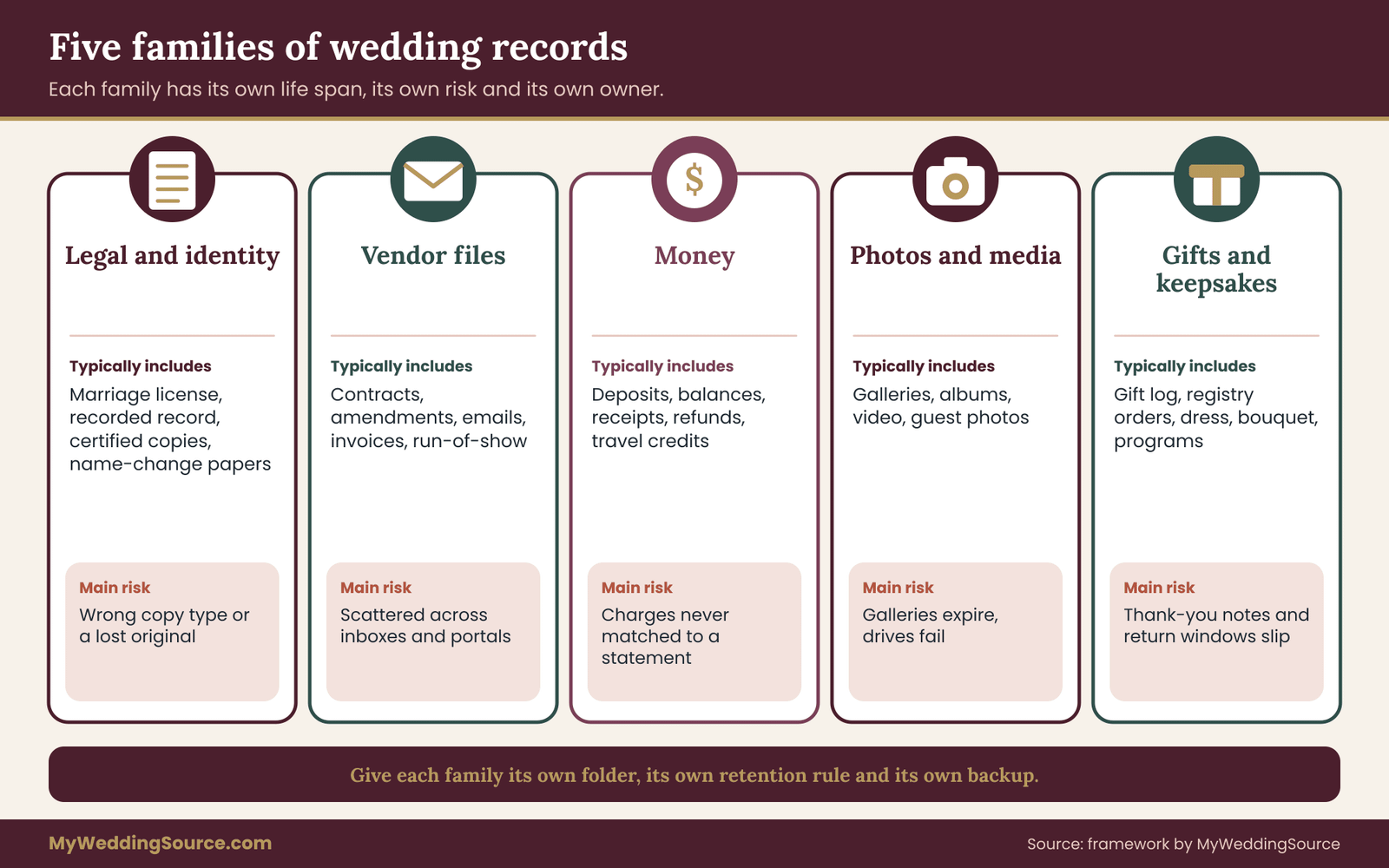
Seeing the families separately matters because they fail in different ways. Legal records fail by being lost or being the wrong kind of copy. Vendor files fail by being scattered. Money records fail by being unmatched to statements. Photo files fail by expiring. Gift records fail by being forgotten until a thank-you note is three months overdue.
Why wedding records deserve a real system
You might wonder whether any of this is worth the effort. There are four concrete reasons.
First, deadlines. Several windows that touch wedding records are short. A credit card billing error generally has to be reported in writing within sixty days of the statement that shows it, according to the Consumer Financial Protection Bureau. Marketplace health insurance offers a special enrollment period after marriage, and the window is measured in days. Online galleries often expire on a schedule the photographer set in the contract. If you do not know these dates, you find out about them after they pass.
Second, disputes. If a vendor claims you owe a balance, or you believe a vendor promised something they did not deliver, the contract, the amendment and the payment record settle the question. Without them you are arguing from memory.
Third, official use. A marriage certificate is the document that opens the name-change process and proves your marital status to employers, insurers and agencies. The photocopy in a drawer is not enough for most of them.
Fourth, the future. Wedding photos, vows and keepsakes are things you will want in thirty years. Digital files are fragile in ways that paper is not, and a thoughtful archive costs very little compared with what it protects.
Who should hold the wedding records
Decide early who is the keeper of your wedding records. Often one partner already handled most of the planning and has the email threads. That is fine, but it creates a single point of failure. A better pattern is one partner as keeper of the master archive and the other as holder of a complete second copy, plus a trusted third person who knows where the physical certificates are. The access levels section later in this guide shows how to set that up without handing everyone everything.
The first 72 hours: collect your wedding records before you organize
The temptation after a wedding is to start filing straight away. Resist it for a few days. Organizing from a half-collected pile creates folders you will have to rebuild. Spend the first three days only collecting, and organize afterward.
Day one or two: sweep the physical items. Gather anything with paper or ink: leftover programs, vendor leave-behinds, the signed copy of any contracts brought to the venue, a rental receipt from the day, a tip envelope list, the cards that came with gifts. Put them in one box or bag. If a card contains a gift, write the giver’s name on the back before anything else.
Day one or two: capture the vendor handoffs. Look through your phone for texts and emails from the day itself. Vendors often confirm timings, last-minute charges or changes in messages that are not in any formal document. Screenshot or forward those messages into a single folder, even if you never look at them again.
Day two or three: confirm the license is on its way. The signed marriage license has to be returned to the issuing office, usually by the officiant, within a period set by the state. Ask your officiant, kindly and directly, when and how it was sent, and whether you will receive confirmation. The next section explains why this step matters more than any other on your list.
Day three: list what is still owed. Write down every vendor who has not yet been paid in full, every rental that must be returned, every gallery or album that has not been delivered, and every item that has to be picked up. This list becomes the spine of your deadline calendar.
“Hi, thank you again for yesterday. Could you tell us when the signed marriage license was mailed or filed, and whether the office sends any confirmation? We would like to order certified copies as soon as it is recorded.”
A short message like this one protects you. It is polite, it is specific, and it creates a written record that you asked.
If you are still planning, the wedding planning checklist and the wedding timeline guide cover the work that comes before the wedding. Everything from here on assumes the event is behind you, or close enough that you want the wedding records archive ready.
Marriage license, marriage certificate and certified copies in your wedding records
This is the most important group of wedding records, and the one most often misunderstood. Three different things get called “the marriage certificate,” and agencies treat them very differently.
The marriage license is the permission slip you obtained before the wedding. It is issued by a local government office, it expires after a set period, and in many states it needs signatures from the couple, the officiant and sometimes witnesses. On its own it does not prove you are married. It proves you were allowed to marry.
The marriage record is what the issuing office creates after the signed license is returned and recorded. This is the official event: the marriage is entered into public or semi-public records, depending on the state.
A certified copy of the marriage certificate is an official copy of that record, issued by the recording office or the state vital records office, usually with a raised seal or a special security paper and a registrar’s signature. This is the document the Social Security Administration, motor vehicle offices, passport agencies, employers and insurers want to see.
The decorative certificate your officiant or venue gave you, the one with calligraphy and two signature lines, is a keepsake. It is lovely and it is not what an agency will accept. Keep it with your keepsakes and do not count it as a legal record.
Step one: confirm the license was returned and your wedding records are on file
The officiant is typically responsible for returning the signed license to the office that issued it, and states set deadlines for doing so. If the license is returned late, or not at all, the marriage may not be recorded on time, and you cannot order a certified copy of a record that does not exist yet.
Do three things. Ask the officiant for the date the license was sent. Note the name and contact details of the issuing office from your own license paperwork. Then set a reminder to call or check that office’s website after a reasonable interval. The USAGov page on marriage certificates is a good starting point, because it explains the difference between the license and the certificate and points you to the right type of office.
If more time passes than the office said to expect, do not wait and hope. Call the office, give both names and the wedding date, and ask whether the record is on file. If it is not, contact the officiant the same day. A problem caught in week two is a short annoyance. A problem caught in month six can complicate a name change, a spousal insurance enrollment or a visa application.
Step two: order certified copies of the legal wedding records
Once the record is on file, order certified copies. Which office issues them depends on the state and sometimes on the county. Some states issue copies from the county clerk or recorder, some from a state vital records office, and some from both. The Centers for Disease Control and Prevention keeps a directory called Where to Write for Vital Records that lists the right office for each state and territory, along with current fees and ordering methods.
How many copies should you order? There is no single right answer, but a useful rule of thumb is to order more than feels necessary at the start. Several processes can run at the same time, and some agencies keep the document they receive instead of returning it, or take weeks to send it back. Think about these likely uses:
- Social Security name change, if either of you is changing a name
- Motor vehicle office, for a license or identification card
- Passport name change or renewal
- Employer or payroll records and benefits enrollment
- A health insurance enrollment that depends on marital status
- Banks and financial institutions that ask for proof
- A personal backup for your own filing, since a certified copy cannot always be replaced instantly
Fees differ by state and by how you order, so check the issuing office’s current fee schedule instead of relying on a number from an article. Ordering several copies in one request is usually cheaper than ordering them one at a time later.
Step three: check every detail of the wedding records on the first copy
When the first certified copy arrives, read it as carefully as you would read a contract. Check:
- Spelling of both full legal names, including middle names
- Dates of birth, if shown
- The wedding date and the place of the ceremony
- Any names listed for parents or witnesses, if the document includes them
- The recording date and any file number
Errors happen. A misspelled name or a transposed digit can cause a mismatch with your other identity documents, and a mismatch is the most common reason a name change stalls. If something is wrong, contact the issuing office right away and ask how to request a correction. Procedures and evidence requirements vary, and a correction found early is usually simpler than one found after you have updated five other accounts using the wrong spelling.
Where the certified wedding records should live
Store certified copies flat, in a folder or sleeve that protects the seal from creasing, and keep at least one in a place that is both secure and reachable. A fireproof box at home works for some couples. A safe deposit box works for others, with the caveat that you cannot always reach it at short notice. Do not laminate a certified copy, because laminating can make an agency reject it.
Make a scan of every copy for your own digital archive, and label the file clearly as a reference copy. A scan is useful for finding details later, but it is not a substitute for the certified paper document in the situations that require one. Mark the digital file with a warning in the name, such as “reference only,” so nobody mistakes it for an official copy.
Your certified copies are the heart of your legal wedding records. The rest of the wedding records in this section are simple by comparison, but it is worth keeping tidy.
Name changes and other updates to your wedding records
If neither of you is changing a name, this section is shorter for you. Even so, a wedding triggers a handful of updates that have nothing to do with names, and they are worth putting on the calendar. If one or both of you is changing a name, the order of operations matters more than most people expect.
The order that avoids rejected applications
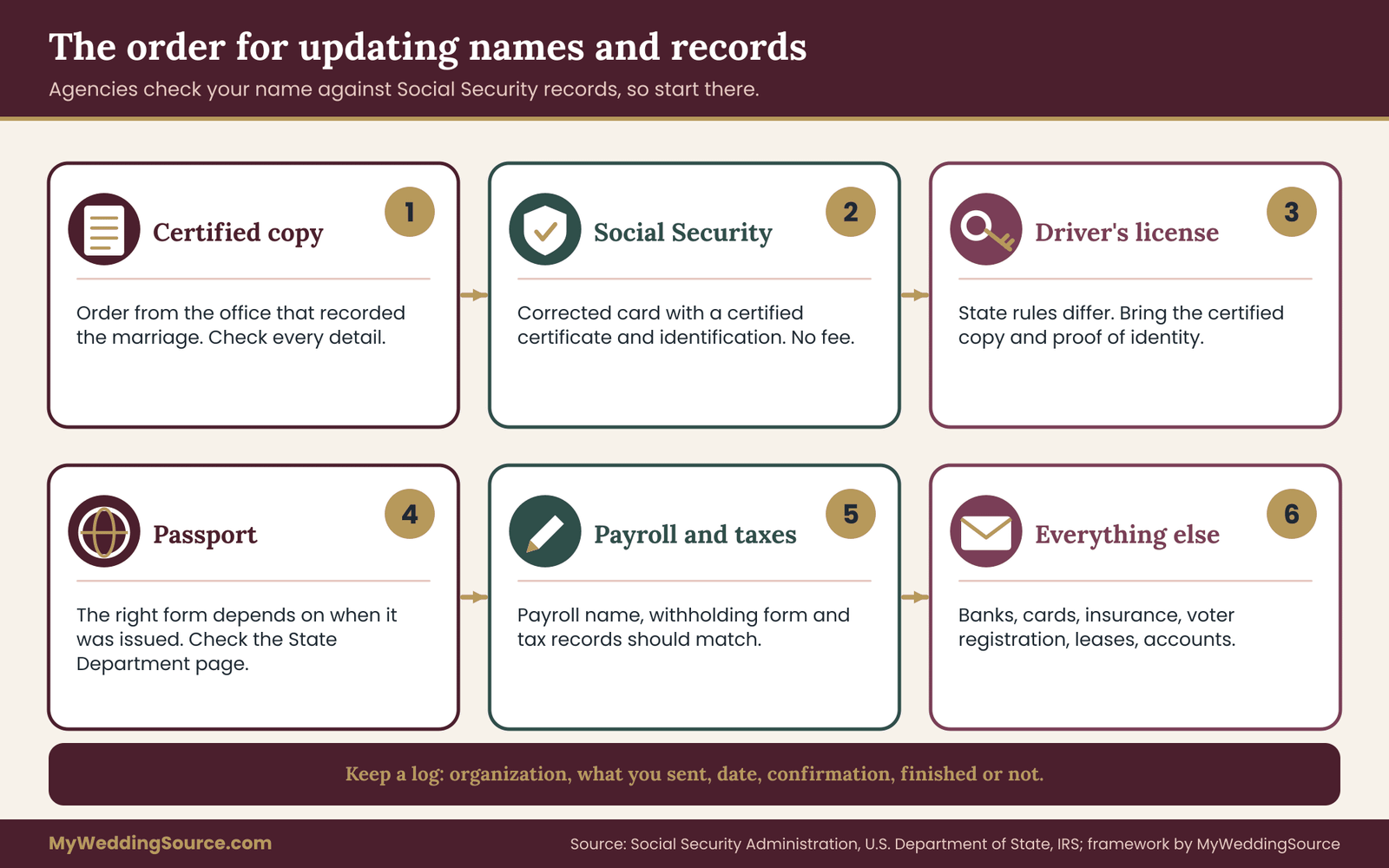
Many couples start with the bank or the driver’s license because those feel urgent. The standard advice from government agencies runs the other way: start with the Social Security Administration, because other agencies check your name against its records.
- Social Security. Apply for a corrected card using the agency’s application form and bring your certified marriage certificate and proof of identity. The Social Security Administration explains which documents it accepts on its pages about name changes, and it says it generally needs original or certified documents rather than photocopies. There is no fee for a corrected card.
- State driver’s license or identification. Motor vehicle offices set their own rules, so check which documents they accept and whether you need to make an appointment. Many require proof of your Social Security record and a certified certificate.
- Passport. The State Department uses different forms depending on how long ago your passport was issued and whether it is still undamaged and in your possession. A recently issued passport can usually be corrected with one form, while an older one may go through a renewal, and some situations require an in-person application. Check the State Department’s page on changing or correcting a passport before you pick a form.
- Employer and payroll. Tell your employer’s HR or payroll team so your tax forms match your Social Security record. The Internal Revenue Service notes that a mismatch between the name on a tax return and the name in Social Security records can slow processing.
- Banks, cards and insurance. Update accounts one at a time and keep a log of each one.
- Everything else. Voter registration, professional licenses, utility accounts, memberships, loyalty programs, the lease or mortgage, and your email signature.
Keep a name-change log with your wedding records
A name change is a long list of small tasks, and it is easy to lose track. Keep a single sheet or note with these columns written out in plain words: organization, what you sent, the date you sent it, the confirmation you received, and whether it is finished. This log belongs with your wedding records because it answers questions like “did we ever update the old life insurance policy?” two years from now.
When a task is done, file the confirmation letter or email with the log. If an organization requires an original document, write down exactly what you mailed and how, and prefer a trackable method for anything irreplaceable. Many agencies return the original, but not all do it quickly.
Updates that apply even without a name change
Whether or not a name changes, marriage can affect several other records. Put these on your list and check each one with the relevant organization:
- Health insurance. Marriage is generally a qualifying life event for Marketplace coverage, which opens a special enrollment period, and HealthCare.gov explains how that period works and that you must act within a limited window. Employer plans usually have their own, often shorter, window for adding a spouse, so ask your human resources team promptly.
- Tax withholding. Review your withholding form with your employer. The IRS publishes guidance on what newlyweds should consider, including filing status and withholding, and a tax professional can help if your situation is complicated.
- Beneficiaries. Retirement accounts, life insurance and bank accounts have beneficiary designations that do not update themselves. Decide whether you want to change them and file the new forms.
- Insurance policies. Auto, renter’s or homeowner’s and other policies may need updated names, addresses and household details.
- Address changes. If one or both of you moved, update your address with every institution, and keep a record of when you did.
- Emergency contacts. Update them at work, at your doctor’s office and with schools or other organizations.
None of these updates is difficult. They are easy to forget because they have no natural reminder, and the wedding records you keep afterward are what let you prove you did them. Each completed item gets a line in your log, and each confirmation gets a place in the legal folder of your archive.
For the money side of the change, a licensed financial or tax adviser can answer questions about your own situation.
Contracts and vendor files in your wedding records
Vendor files are the part of your wedding records most likely to matter if something goes wrong. A good vendor file lets you answer three questions without searching: what was promised, what was paid, and what was delivered.
What belongs in each vendor file of your wedding records
Create one folder per vendor, named the same way every time, for example “Photographer, Studio Name.” Inside it, keep:
- The signed contract and every signed amendment, in final form
- The proposal or quote that led to the contract, because it often lists inclusions that the contract summarizes
- All written changes after signing, including emails that confirm a time, a count or a price
- Every invoice, and the proof of payment that matches it
- The vendor’s certificate of insurance, if the venue required one
- Any run-of-show or timeline the vendor worked from
- Delivery confirmations, such as a gallery link, an album proof or a returned rental receipt
- Notes on tips and gratuities, if you gave them, and when
Do not rely on the vendor’s portal as your only copy. Portals change, accounts get closed and vendors go out of business. Download the PDF of each contract and invoice and keep it in your own archive.
The wedding vendor due diligence checklist explains what to verify before you sign. This section picks up after the event, when the question becomes whether each file is complete and closed.
Close each vendor file in your wedding records on purpose
A vendor file is not finished when the wedding ends. It is finished when every promise has been delivered and every payment is settled. Work through each vendor with six checks.
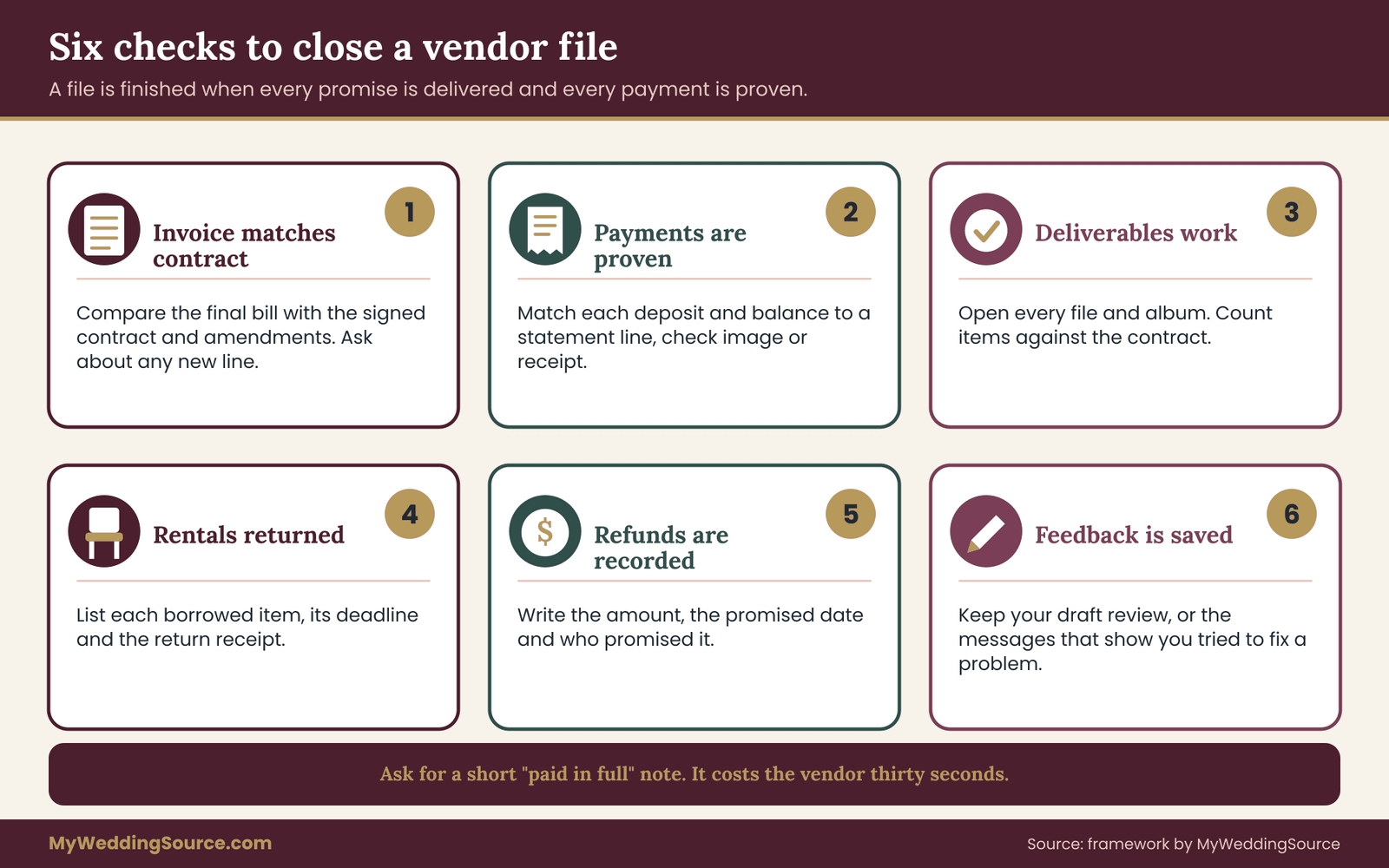
One: the final invoice matches the contract. Compare the final invoice against the signed contract and any amendments. Look for added fees, overtime charges, service charges and gratuities that were not in the agreement. If a line is unfamiliar, ask the vendor to explain it in writing before you pay or after you have paid. Keep the question and the answer.
Two: every payment is proven. Each deposit and balance should be matched with a bank or card statement line, a check image or a payment receipt. If you paid by check, keep the image of the cleared check. If you paid by app, screenshot the confirmation and download the transaction record.
Three: deliverables arrived and work. Open every file, album proof or product. Confirm that photos and videos play, that the album pages are correct, that the cake topper was returned, and that the number of items matches the contract. Do this promptly, because delivery windows and complaint windows are often short.
Four: rentals and loaned items are returned. Make a list of every rented or borrowed item and the return deadline. Record the date and method of return and keep any receipt. A missed return can lead to a charge that is hard to dispute without proof.
Five: refunds and credits are recorded. If a vendor owes you a refund, a security deposit or a credit, write down the amount, the promised date and who promised it. Follow up on that date.
Six: feedback is saved. If you plan to write a review, draft it now while the details are fresh, and save a copy. If you had a problem, save the exchange that shows you tried to resolve it.
“Thank you for everything on the day. We are closing out our records and want to confirm that our final balance is settled and that nothing further is due. Could you send a short note confirming the account is paid in full?”
A “paid in full” confirmation costs the vendor thirty seconds and gives you a clean ending to the file. Not every vendor will send one, but most will if you ask politely.
Contracts, amendments and cancellation terms
Keep the cancellation, change and refund terms of every contract visible. Even after the event, those clauses matter for two reasons. One is that some terms apply after the event, such as limits on how long a vendor must keep files or how long you have to raise a complaint. The other is that if you ever need to refer to what was promised, you will want the clause in front of you without rereading forty pages.
A short “terms summary” at the top of each vendor folder is worth the ten minutes it takes to write. Note the date of signing, the total price, the deposit, the balance due date, the cancellation terms, and any clause about complaints or delivery deadlines. When you reread the contract in the future, you will start from your own summary.
If the vendor’s work involved a dispute, do not delete anything. Keep every message, quote and photograph. If the matter is serious, a lawyer or a consumer protection agency can tell you which records matter, and the wedding insurance guide explains what a policy typically covers and how claims work.
How long to keep vendor wedding records
There is no universal number for vendor wedding records. For records that support a tax or financial position, the Internal Revenue Service gives general retention periods tied to how long a return can be reviewed, and those periods often start at three years from filing. For vendor files that cover a dispute, keep the whole file until the matter is resolved and the relevant time limits have passed. For routine vendor files with no dispute, many couples keep them for several years, then decide what to keep permanently, such as the contract summary and the proof of payment. Whatever you choose, write the retention rule into your archive so future you does not have to guess.
Money records: receipts, statements and the real budget behind your wedding records
The money side of wedding records has two jobs. It proves what was paid, and it shows what the wedding actually cost. Both are useful, and the first is more urgent.
Gather every payment in one place
Pull together every source of payment for the wedding: credit cards, debit cards, bank transfers, checks, cash withdrawals, payment apps, gift cards, vendor financing and money contributed by family. Many couples discover that a handful of payments went through a card or an account they forgot to include.
For each payment record the date, the amount, the payee, the method and what it covered. A spreadsheet or a shared document is fine. The point is a single list in which every payment lines up with a vendor and a document.
Reconcile your wedding records against statements
Reconciliation means comparing your payment list with your actual statements, line by line. It is the best way to catch double charges, charges after you cancelled, amounts that differ from the invoice, and payments that never reached the vendor.
Do this soon, not at the end of the quarter. Under the Fair Credit Billing Act, a credit card holder who spots a billing error generally has to notify the card issuer in writing within sixty days of the statement that first showed it. The Consumer Financial Protection Bureau explains how to dispute a charge and what to include. Other payment methods, such as debit cards, bank transfers and payment apps, follow different rules and time limits, so check with your bank or the payment provider rather than assuming the credit card rule applies.
That sixty-day figure is the reason reconciliation belongs in your first month. A wedding often generates a cluster of large charges, and some appear on statements weeks after the event.
Chase every outstanding credit, refund and deposit
Money you are owed tends to disappear into the gap between “we will refund that” and an actual refund. Build a short list:
- Security deposits from venues and rental companies, with the date they promised to return them
- Refunds for cancelled services, overcharges or returned items
- Travel credits from airlines or hotels, which often expire and sometimes need rebooking before a deadline
- Gift cards you bought or received, with expiry dates and balances
- Wedding insurance claims, if any, with the claim number and filing deadline
Put each expiry or promise date on your calendar with a reminder a week earlier. Travel credits in particular have a habit of expiring without a warning that you will remember.
Build the real budget
When the payments are reconciled, compare the total against your original plan. The wedding budget page explains how to set up categories, and it is a good place to lay out the final numbers beside the planned ones. You are not doing this to feel bad about the difference. You are doing it because the final figures are the most honest picture you will ever have of what a wedding in your area and at your scale costs, and they help if you are advising a friend or planning an anniversary trip.
Note anything that should be recorded separately, such as money contributed by family, which can matter later if you buy a home or file taxes in a way that requires you to show where funds came from.
Taxes and wedding records: what to keep and what to ask
Most wedding costs are personal expenses, and the records you keep are not going to turn into a tax return line. Even so, a few kinds of wedding records can matter for taxes, and you should know what to ask a tax professional about:
- Cash and large gifts. The Internal Revenue Service explains that gift tax rules generally apply to the person giving the gift, not the person receiving it, and that most gifts do not lead to any tax. If you received a very large gift, or expect to, keep a record of who gave it and when, and ask a tax professional whether anything needs to be reported by anyone.
- Name and filing changes. Your tax return needs to match Social Security records. The guidance on updating names above applies here too.
- Business-related costs. If part of the wedding overlapped with a business activity, a tax professional can tell you whether any record needs to be kept separately.
The IRS publishes general guidance on how long to keep records. The usual starting point is three years from the date you file a return, with longer periods for some situations. Treat that as a starting point, not a promise, and talk to a tax adviser about your own situation.
Photos, video and digital files: the wedding records you will want most
Of all your wedding records, the photos and video are the ones you will open most often and miss most if they vanish. They are also the most fragile, because they live on hard drives, phones and cloud galleries that you do not fully control.
Know what the wedding records say you are owed
Start with the contract. The photographer’s and videographer’s agreements say what you will receive: the number of edited images or a delivery range, whether you get high-resolution files, whether you get print rights, how long the online gallery stays open, and when delivery is expected. The wedding photography deliverables guide explains what to expect and what to ask before signing. After the event, treat that list as a checklist.
Write down the delivery date the vendor promised, and mark it. The wedding photography timeline covers the shoot-day side. If the date passes without a gallery, send a polite written reminder, and keep the message. Ask whether the vendor keeps unedited files, and for how long, because policies differ and some vendors delete files on a fixed schedule.
Download your wedding records the day they arrive
Online galleries are convenient, and many are temporary. Some are open for a set number of months, some for a year, and some stay up for as long as you pay for storage. The expiry date is in your contract or the gallery’s terms. Do not assume the link will work next year.
The routine is simple:
- Download the full-resolution files, not only the web-sized versions.
- Download any albums, slideshows, videos and extras separately.
- Check that the number of files matches what the vendor said it delivered.
- Open a sample of files to confirm they are not corrupted.
- Save the gallery link, the login and the expiry date in your vendor folder.
Do this within the first week, while the vendor is still easy to reach if a file is missing.
The three-copy rule
The Library of Congress, in its guidance on personal digital archiving, suggests a four-part routine: identify what you have, decide what matters most, organize it, and make copies kept in more than one place. For wedding records, a common way to apply the last step is the 3-2-1 approach: three copies in total, on two different kinds of storage, with one copy somewhere other than your home. The Cybersecurity and Infrastructure Security Agency also publishes guidance on backing up important data.
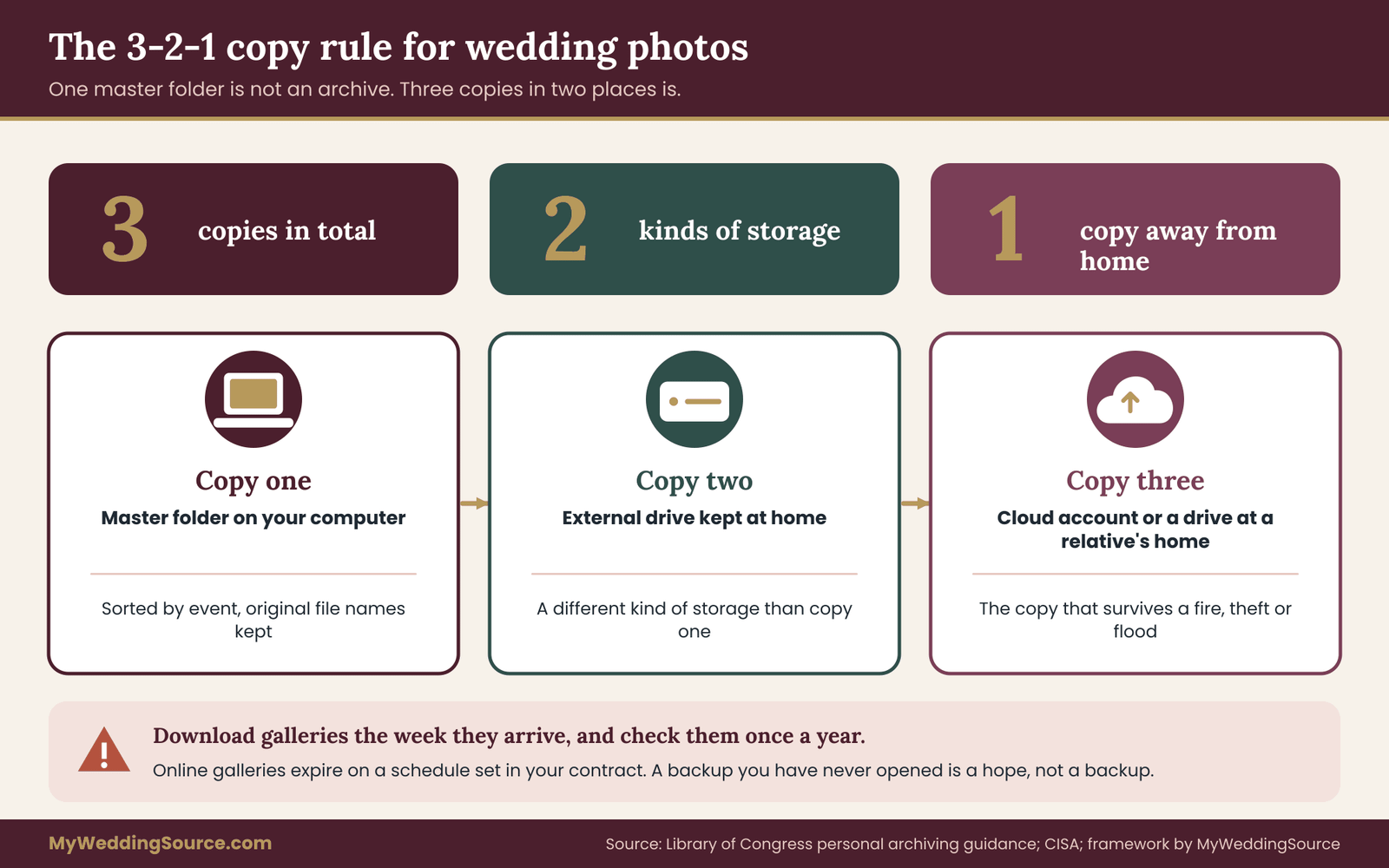
For wedding photos this might look like:
- Copy one: the master folder on your computer
- Copy two: an external drive, kept at home
- Copy three: a cloud storage account or a drive stored at a relative’s house
Two drives bought on the same day from the same maker can fail around the same time, so mix the types. Check your copies once a year by opening a few files. A backup you have never tested is a hope, not a backup.
Name and sort wedding records so you can find them
A folder of thousands of images named “IMG_0001” is hard to use. You do not need to rename every picture, but you do need a structure. A simple one:
- Wedding, Professional, Ceremony
- Wedding, Professional, Reception
- Wedding, Professional, Portraits
- Wedding, Guest Photos
- Wedding, Video
- Wedding, Print Favorites
Within each folder, keep the photographer’s original file names so that the gallery and your copy match. If you want to rename, do it to a duplicate set, not the master.
Collect guest photos and videos
Guests take photos you will never see unless you ask. A short, friendly message with a shared album link a few days after the event usually brings a good number. Set up the album, pick a deadline for uploads, and download everything once the deadline passes. A shared album is not a permanent archive, so download its contents into your own copy.
Be considerate about privacy. Some guests may not want their images shared widely, and children’s photos deserve extra care. Keep guest contributions in a private folder, and ask before posting images of other people.
Printing, sharing and rights
Digital files and print rights are separate questions. Check your contract for whether you may print the files yourself, whether there are credit requirements when you post them, and whether the photographer retains the right to use the images in marketing. If you want a print for the wall, ask the vendor whether a lab they recommend has better color matching than a drugstore kiosk.
If you plan an album, put the order deadline on your calendar. Album proofs and design reviews have their own windows, and some vendors charge for changes after a set point.
Gifts, registry and thank-you records
Gift records look like etiquette, and they are also wedding records in the practical sense (the wedding gifts guide covers the etiquette side): they track who gave what, what you owe in thanks, and what you are entitled to return or exchange.
Keep a single gift log with your wedding records
Start the log on day one, when the cards and boxes are fresh. For each gift, write down:
- Who gave it, including the household name you will use on the thank-you note
- What it was, or the amount if it was cash or a check
- The date you received it and how it arrived
- Whether it came from the registry or elsewhere
- The status of the thank-you note: not started, drafted, sent
- Any damage, duplicate or issue
Cash and checks deserve special care. Record the amount and the giver on the day, deposit them promptly, and keep the card with the note you wrote about it. If a check is large, keep an image of it before depositing.
Track thank-you notes against a date
Etiquette sources commonly suggest sending thank-you notes within a few weeks to a couple of months after the wedding. The wedding thank-you card wording guide has sample messages, and the wedding gift etiquette guide covers the questions that come up around timing and tone. For your records, the useful move is to set a finish line, such as a date six weeks out, and track progress against it in the log so you can see what is left.
A note on pacing: ten notes a night for a week is more realistic than one heroic weekend. Put the stack where you will see it, and write notes in batches.
Registry orders, returns and exchanges
Registry stores and retailers each set their own return and exchange windows, and some of them start from the order date, not the date you open the box. Save the order confirmations and gift receipts, and make a short list of anything that is damaged, duplicated or the wrong size. Contact the retailer promptly with the order number, and keep the exchange record.
If a gift is broken in transit, photograph it and the box before you do anything else. Photos support a claim with the retailer or the carrier. Note the date and the person you spoke to.
For couples who use a gift fund or receive cash, keep a record of the platform, the dates and the amounts transferred to your bank account. Platform fees and payout times differ, so the statement from the platform is part of your money records.
Keepsakes and physical items among your wedding records
Not every wedding record is paper or pixels. A few physical items deserve a plan, because time is working against some of them.
The dress and veil. Cleaning soon after the wedding matters, because stains from food, drinks and makeup can set if left. Ask a specialist cleaner what they recommend and how soon, and ask what preservation involves before choosing it. Keep the receipt and any guarantee in your records.
The bouquet and flowers. If you want to dry or preserve flowers, start within days. Floral preservation services have their own timelines, so ask the florist or a preservation studio how quickly they need the flowers.
Paper keepsakes. Programs, the guest book, a signed ceremony text, handwritten vows, a framed copy of the invitation. Store paper in acid-free folders or boxes, away from direct light and damp. Avoid attics and basements where temperature and humidity swing.
The decorative certificate and ring documentation. Keep the keepsake certificate with other mementos. Keep any appraisal or insurance paperwork for rings with your insurance records, not with the keepsakes, because you may need it for a claim.
Religious or cultural documents. Some ceremonies produce a document that carries meaning for your community or family, such as a signed contract or certificate. Ask the officiant or family elder how it should be stored, and note where it lives.
Photograph each physical keepsake once and add the image to your wedding records. The picture is not a replacement, but if something is damaged or lost, you will still have a record of what it looked like.
The retention map: how long to keep each kind of wedding records
A retention map answers the question “do we keep this, and for how long?” in advance, so you are not deciding in a panic. It sorts wedding records into four groups by how long they should stay in your archive.
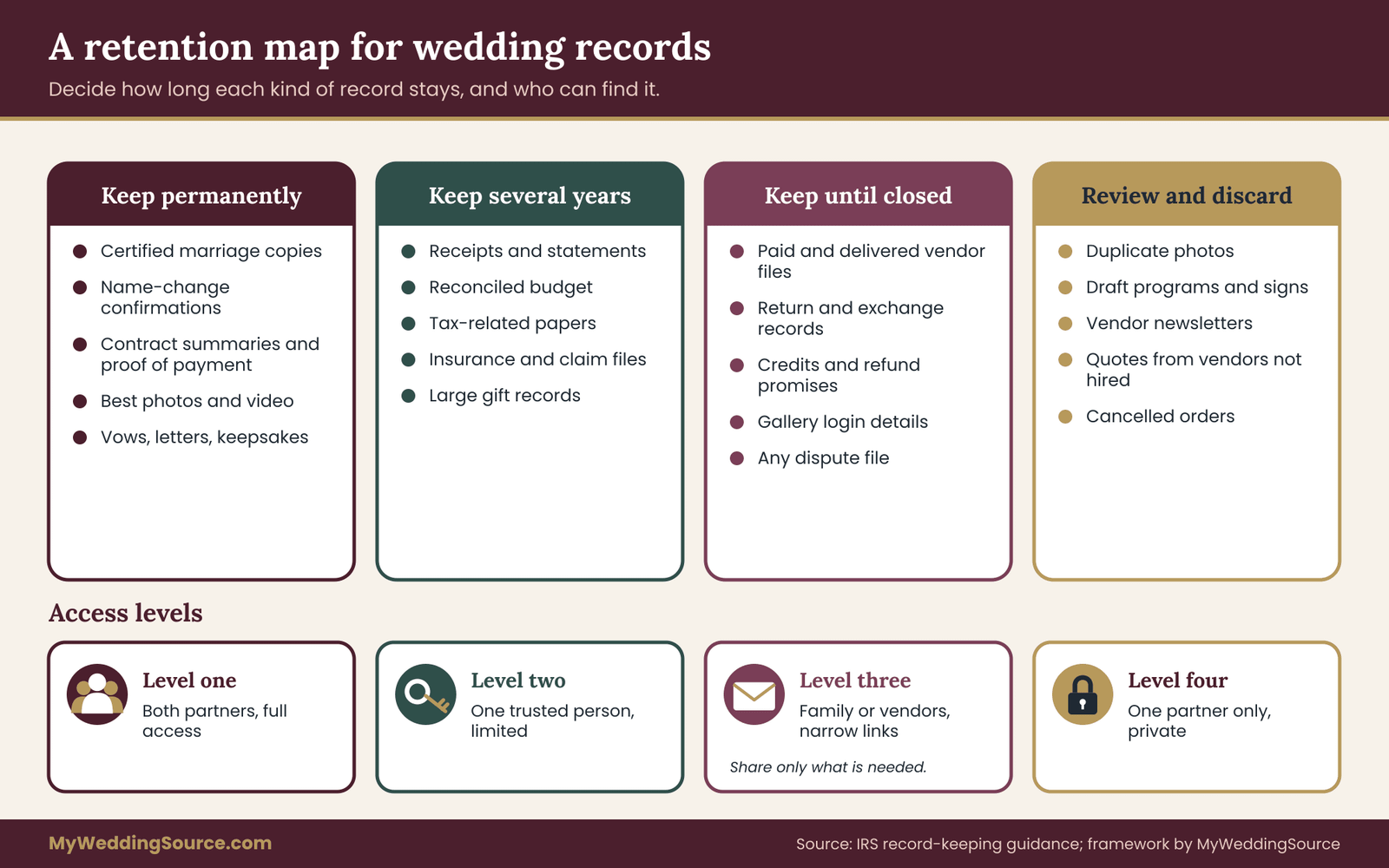
Keep permanently. These records have lasting legal, financial or sentimental value:
- Certified copies of the marriage certificate and the recorded record details
- Name-change confirmations and the log you kept
- Final contract summaries and proof of payment for major vendors
- Professional photos, video and the best of the guest photos
- Vows, speeches, letters and the keepsakes you chose to preserve
- The gift log, as a family record
Keep for several years. These support taxes, insurance and financial history, and the right time to discard depends on your circumstances:
- Receipts and statements that prove payments
- The reconciled budget
- Tax-related paperwork, following the general guidance from the Internal Revenue Service and your adviser’s advice
- Insurance policies and claim files, until the claim and any appeal windows are closed
- Large cash or check gift records
Keep until the matter closes. These records have an end date tied to an event:
- Vendor contracts that have been fully performed and paid, until you decide to keep only the summary
- Return and exchange records, until the window ends
- Travel credits, gift cards and refund promises, until used or settled
- Online gallery access details, until you have downloaded and verified every file
- Any dispute file, until the dispute is resolved and the time limits for further action have passed
Review and discard. These can usually go once you have confirmed you do not need them:
- Duplicate photos you have chosen not to keep
- Drafts of programs and signage files
- Marketing emails and vendor newsletters
- Old quotes from vendors you did not hire
- Cancelled orders with no outstanding questions
Retention periods are not the same for everyone. If a record might matter for a tax return, an insurance claim, an immigration matter or a legal dispute, ask a professional before you discard it. When in doubt, keep a scan.
Write the wedding records rule down
Put a one-page note at the top of your wedding records archive that says what is kept, where it lives and when it will be reviewed. A single line, such as “Review wedding records every year on our anniversary,” turns a good intention into a habit. Many couples find that an anniversary review takes less than an hour and doubles as a pleasant way to look back.
Access levels: who sees which wedding records
An archive is not useful if only one person can open it, and it is not safe if everyone can. Access levels give each kind of record the right audience.
Level one: both partners, full access. The shared archive of wedding records, including legal copies, vendor files, money records and photos. Both of you should be able to find and open everything, on your own devices, without asking the other.
Level two: a trusted third person, limited access. Choose one person, such as a parent, sibling or close friend, who knows where the physical certificates are and how to reach a master copy in an emergency. Give them a short written note, not the keys to every account. Review the choice from time to time.
Level three: shared with family or vendors, narrow access. Photo albums for relatives, a shared guest album, a single contract that a vendor needs. Share only what is needed, with links that can be turned off, and remove access when the purpose is over.
Level four: private to one person. Some records belong to one partner, such as that person’s identity documents, name-change correspondence tied to their accounts, or a personal letter.
Protect the sensitive wedding records
Wedding records can hold information that identity thieves value, including dates of birth, addresses, Social Security numbers on forms and financial account details. A few habits go a long way:
- Store scans of sensitive documents in an encrypted folder or a password-protected storage area
- Use a password manager for vendor portals and gallery logins, and protect it with a strong master password and a second step at sign-in
- Never email a document containing a full Social Security number unless the recipient has a secure method for it
- Shred paper copies that you are sure you do not need, and do not leave them in a recycling bin where others can read them
- Remove access links to photo albums when you no longer need them
The Federal Trade Commission publishes practical guidance on protecting personal information, and it is worth reading once.
Plan for the unexpected
If something happens to one of you, the other should not have to search for passwords, certificates and policies. A short “if something happens” note, stored with the third person from level two, can say where the main archive lives, how to unlock it and which documents matter most. It takes ten minutes to write and relieves a great deal of stress later. This is general organization advice, and an attorney can help with formal documents such as wills and powers of attorney, which are outside the scope of this guide.
A deadline calendar for wedding records: the first 90 days and beyond
Most of the deadlines that touch wedding records fall in the first three months. The calendar below puts them in the order they tend to arrive. Dates for your own situation come from the issuing organizations, so treat the timing as a prompt to check, not as a rule.
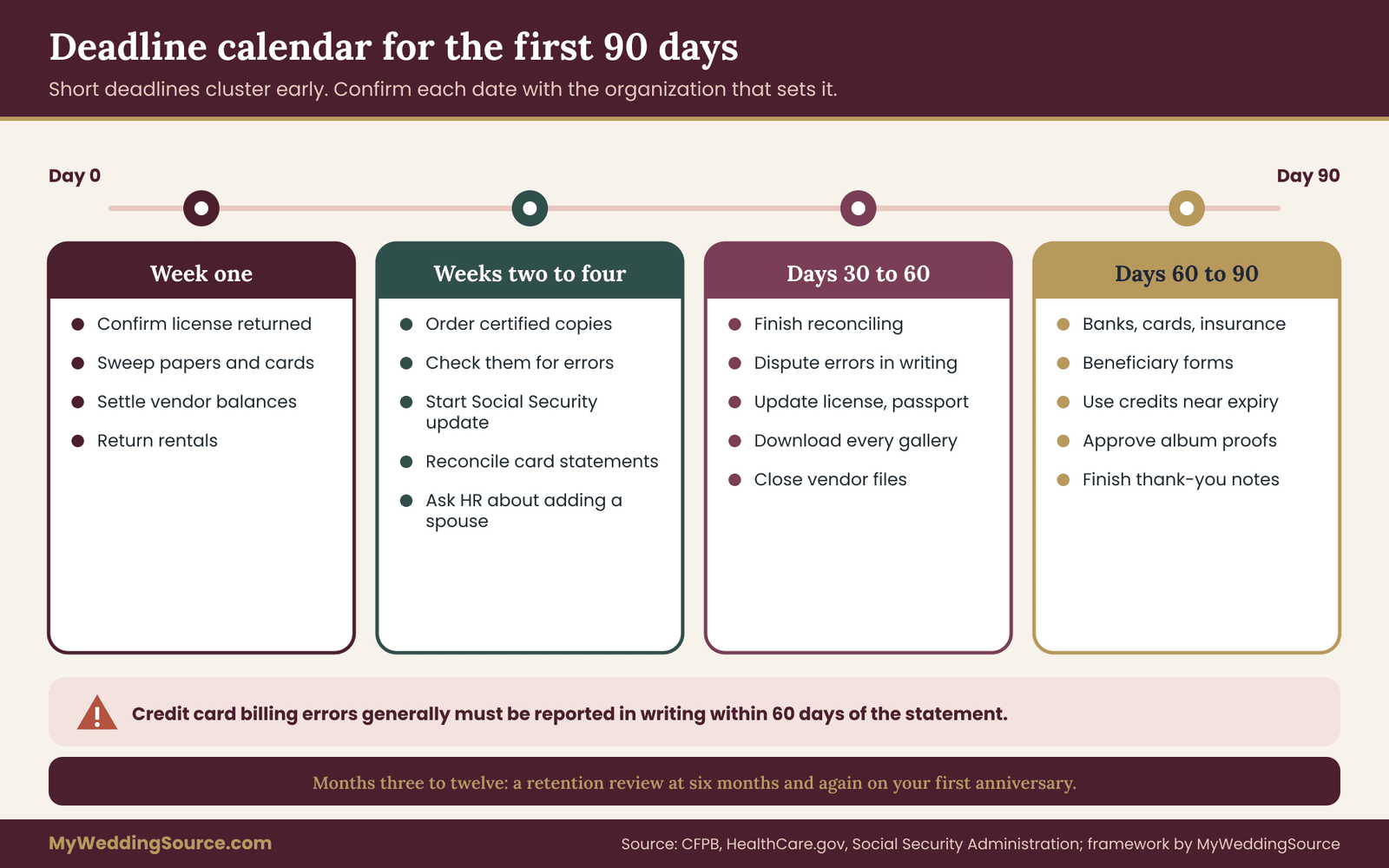
Week one
- Confirm with the officiant that the signed license was returned, and when.
- Sweep physical items into one box, and write names on gift cards.
- Pay or confirm any vendor balances still due.
- Download any photo previews or files already delivered.
- Check that rentals are returned and note the receipts.
Weeks two to four
- Order certified copies of the marriage certificate once the record is on file.
- Check the copies for errors, and request corrections if needed.
- If you are changing a name, start with the Social Security Administration.
- Start reconciling credit card statements against your payment list, because billing-error notices for credit cards generally have to be sent within sixty days of the statement showing the error.
- Ask your employer about the deadline for adding a spouse to a health plan, and check the marketplace window if you buy your own coverage.
- Begin writing thank-you notes, using the gift log.
Days 30 to 60
- Finish reconciling and dispute any error in writing.
- Update the driver’s license or identification, then the passport if needed.
- Update employer payroll and withholding information.
- Download every gallery and verify the files, and set up the three-copy backup.
- Send follow-up messages for deliverables that are late.
- Close vendor files with a “paid in full” confirmation where you can get one.
Days 60 to 90
- Update banks, cards, insurance and beneficiary designations.
- Finish thank-you notes, or send a short note to anyone still waiting.
- Use any travel credits and gift cards that are near expiry.
- Send album orders and proof approvals before the vendor’s deadlines.
- Review your name-change log for open items.
Months three to twelve
- Take care of long-tail tasks: registry exchanges that need a replacement, the dress cleaning follow-up, an album delivered late.
- Hold your first retention review at six months, and a second on your first anniversary.
- When tax season arrives, give your adviser or preparer a short folder of the relevant wedding records, and ask whether anything else is needed.
- Keep a short list of what you learned, because the next big family event will go better for it.
The wedding timeline guide covers the lead-up to the day, and the calendar above takes over the moment the wedding ends.
Special situations that change your wedding records
The core system works for most couples. A few situations add steps, and it is better to know about them before you are holding the wrong document.
Destination and international wedding records
If you married outside the United States, or you married in the United States but one of you is a citizen of another country, the legal paperwork can look different. A foreign marriage certificate may need to be translated, and some agencies or foreign authorities ask for an additional certification of the document’s authenticity, often called an apostille. Requirements depend on the country that issued the document and the organization that will receive it.
The sensible approach is to ask the receiving organization what it accepts before you spend money on translations or certifications. Keep the original document, every translation, the certificate of the translator and any certification pages together as one set. If the wedding involved a separate legal ceremony and a symbolic one, label which is which, so you never present the wrong one.
If immigration or citizenship is part of your situation, work with an immigration attorney or an accredited representative. Marriage can have consequences for immigration status, and the wedding records you keep can become evidence in that process. Do not guess about what matters.
Courthouse weddings, elopements and their wedding records
A courthouse or elopement ceremony usually involves fewer vendors and a faster path to the legal record, since the same office may issue the license and record the marriage. The records are fewer but not less important. Ask the clerk when the record will be on file and how to order certified copies. Keep receipts for the photographer or any services you used, and apply the same photo backup routine to whatever images you have.
Second and later marriages and their wedding records
If either of you has been married before, keep the documents that ended the earlier marriage, such as a divorce decree or a death certificate, with your legal folder. Some agencies ask for them when you change a name or update benefits. If a decree includes obligations such as support or insurance that continue, keep it somewhere easy to find, and ask your adviser which parts affect your new household.
Long-distance and two-household couples
If you live apart or in different states, decide in advance which household holds the master copy of each type of record. Digital archives help here, but physical documents, such as certified copies and keepsakes, need a clear home. Write down where each one lives, and give your trusted third person the same note.
Financial agreements and legal documents
Some couples sign a premarital agreement or other legal documents before the wedding. Keep signed copies with your legal records, and tell your trusted third person where they are. Do not store them only in a shared cloud folder with wide access. If you are unsure whether a document needs special handling, an attorney can advise.
A worked example: Rivera and Okafor organize their wedding records
The following example is invented to show how the pieces fit together. The names, amounts and dates are illustrative, and your own timing will differ.
Sam Rivera and Jordan Okafor married on a Saturday in October with about seventy guests. Sam had handled most of the planning, so most of the emails and contracts were in Sam’s inbox. Jordan was changing a surname and wanted the process finished before the end of the year.
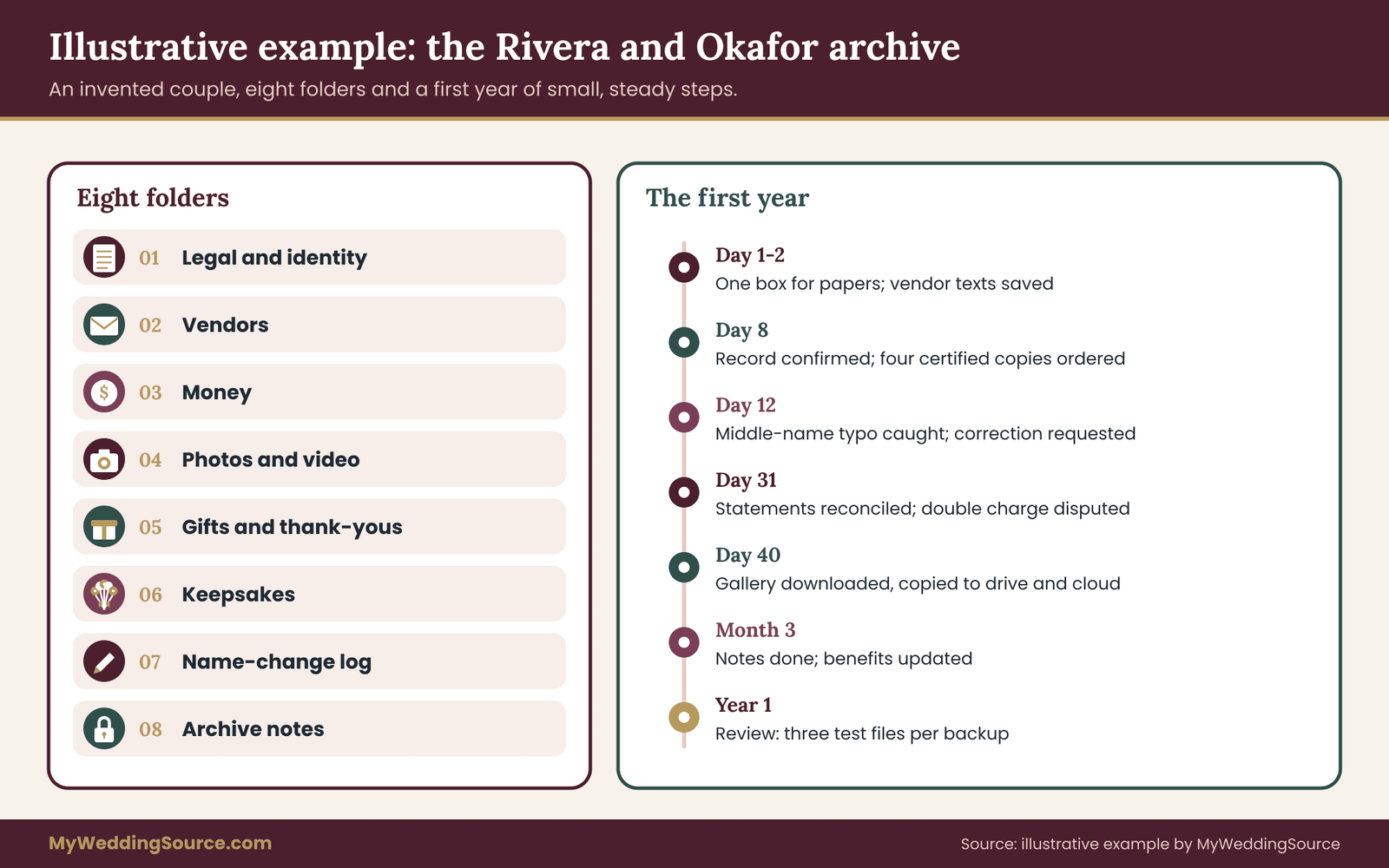
Day one and two. They put every paper item from the day into one box, and Jordan wrote the giver’s name on the back of each card. Sam forwarded the vendor texts from the weekend into one folder called “Day-of messages.” They asked the officiant when the license was mailed, and she said it had gone out on Monday.
Day eight. They called the county office and confirmed the record was on file. They ordered four certified copies in a single request and paid the listed fee.
Day twelve. The copies arrived. Jordan read each field and noticed that a middle name was misspelled. They contacted the office the same day, learned what evidence was needed, and sent the correction request. Because they caught it before using the certificate anywhere, nothing downstream had to be redone.
Day twenty-six. The corrected copy arrived. Jordan applied for a corrected Social Security card, bringing a certified copy and identification. The driver’s license and passport updates followed over the next few weeks, each logged in the name-change sheet.
Day thirty-one. Sam reconciled the credit card statements against the payment list and found that the florist had been charged twice for a delivery fee. Because it was well inside the sixty-day window for a credit card billing error, Sam wrote to the card issuer with the invoice and the statement lines, and the charge was reversed after the issuer’s review.
Day forty. They downloaded the photographer’s gallery in full resolution, checked the file count against the contract and copied the folder to an external drive and a cloud account. They noted the gallery expiry date in the vendor folder and on the calendar.
Day fifty-five. Each vendor file had a short terms summary and a “paid in full” confirmation, except the band, who confirmed by email a week later. Sam added a line to the budget sheet showing the final cost against the original plan.
Month three. Thank-you notes were finished by the date they had set. Jordan updated beneficiaries at work, and Sam added Jordan to the health plan using the employer’s enrollment period, which they had confirmed with human resources in the first month.
First anniversary. They opened their wedding records archive, tested three random files from each backup, updated the retention note and wrote down two things they would do differently. It took under an hour.
The example is ordinary, and that is the point. No single step was difficult. What made the difference was a short list of dates, one place for each record and the habit of checking. Two small mistakes, the misspelled name and the duplicate charge, were caught because the process had a place for catching them.
Common mistakes in wedding records organization
Most problems with wedding records come from a small set of habits. Here are the ones to avoid.
Treating the keepsake certificate as the legal one. The decorative certificate is not accepted by agencies. Order certified copies from the issuing office.
Changing names in the wrong order. Starting with the bank or the license office and leaving Social Security for later can cause mismatches and delays. Start where agencies check your name against.
Ordering too few certified copies. Running out in the middle of a process forces another order and another wait.
Trusting a vendor portal as the archive. Portals close and links expire. Download everything.
Skipping reconciliation. Errors and double charges are much easier to fix in the first month than in the sixth.
Leaving one copy of the photos. A single hard drive is a single point of failure. Make three copies, in two kinds of storage, with one away from home.
Forgetting the short deadlines. Billing-dispute windows, insurance enrollment windows and gallery expiry dates are measured in weeks.
Keeping all wedding records with no map. A pile that grows forever becomes unusable. A retention map and an annual review keep the archive useful.
Sharing too widely. Wedding records contain sensitive details. Share narrowly and remove access when it is no longer needed.
Waiting for a perfect system. A simple folder structure and a calendar are far better than a complicated plan you never finish.
What to check with the issuing organization about your wedding records
This guide gives you a framework and the questions to ask, but it cannot give you the rules for your state, your vendors or your tax situation. For each of these, confirm the current rule with the organization that issues or enforces it:
- Marriage license and certificate: your county or state office, including deadlines for returning the license, how to order certified copies and fees
- Name changes: the Social Security Administration, your state’s motor vehicle office and the State Department for passports
- Health coverage: the Marketplace and your employer’s benefits team for enrollment windows
- Taxes: the Internal Revenue Service and a qualified tax professional
- Billing disputes: your card issuer or bank and the Consumer Financial Protection Bureau
- Vendor terms: the contract itself and the vendor
- Insurance claims: your insurer, including the filing deadline in the policy
If a rule has changed since this article was written, the issuing organization’s current guidance wins. When a policy, fee or deadline matters to you, take a screenshot of the page you relied on and file it with the relevant record.
A simple folder structure and master index for your wedding records
You do not need special software. A folder tree on a computer, mirrored in a cloud account, and a single index document will do. The structure below follows the five record families and keeps names predictable.
Folder names. Use a number at the start so folders stay in order, and keep names short:
- 01 Legal and identity
- 02 Vendors
- 03 Money
- 04 Photos and video
- 05 Gifts and thank-yous
- 06 Keepsakes and physical items
- 07 Name-change and updates log
- 08 Archive notes
Inside “01 Legal and identity”: scans of certified copies marked as reference only, the license information, correction requests if any, and the confirmations from each agency.
Inside “02 Vendors”: one subfolder per vendor, each containing the contract, amendments, invoices, proof of payment, deliverable confirmations and a one-page terms summary.
Inside “03 Money”: the payment list, reconciled statements for the wedding period, the final budget, refund and credit tracking, and any insurance paperwork.
Inside “04 Photos and video”: the sorted master folders described earlier, plus a text file called “Gallery details” that holds each gallery’s link, login location and expiry date.
Inside “05 Gifts and thank-yous”: the gift log, registry order confirmations and any return records.
Inside “06 Keepsakes and physical items”: a photo of each physical keepsake and a note saying where it is stored.
Inside “07 Name-change and updates log”: the log itself and every confirmation.
Inside “08 Archive notes”: the retention rule, the access-level list, the “if something happens” note and the date of the last review.
The one-page master index of wedding records
The index is a single document that tells you where everything lives. Make it a table-free list so it works in any app. For each item, write one line:
- What it is
- Where the master copy is
- Where the backup is
- Who else can find it
- When it should be reviewed or discarded
Fifteen to twenty lines will cover most couples. Update it when something moves. If your wedding records ever feel messy, the index is the thing that keeps it recoverable.
Naming files so they sort
Consistent file names make search easy. A pattern like “Vendor, Document type, Date” works well, for example “Florist, Contract signed, 2026-03-14.” Using the year first in dates makes files sort in order. Avoid putting sensitive details in file names, since names can be visible in places where the content is not.
Digital housekeeping for wedding records
A few small habits keep the archive healthy:
- Keep the folder in a location that is backed up, and check the backup runs
- Do not store the only copy of anything on a phone
- Record the login location, not the password, in your notes, and keep passwords in a password manager
- Test restoring a file once a year, so you know the process works
- When you replace a computer or phone, move the archive on purpose and check the files arrived
FAQ
How long should we keep wedding records?
It depends on the kind of record. Certified marriage certificates, name-change confirmations, vendor contract summaries, professional photos and keepsakes are usually kept permanently. Receipts and statements that support taxes or insurance are often kept for several years, and the Internal Revenue Service publishes general periods that begin at three years from filing and run longer in some situations. Records tied to a vendor dispute or an insurance claim stay until the matter is closed. Put your own rule in writing and review it each anniversary.
Do we need certified copies of our marriage certificate, or is a photocopy enough?
Most agencies, employers and insurers want a certified copy issued by the recording office, not a photocopy or the decorative certificate from the ceremony. The Social Security Administration, for example, says it generally needs original or certified documents. Order a few certified copies once the record is on file, and keep a scan marked as reference only for your own use.
Who is responsible for returning the marriage license?
In many places the officiant returns the signed license to the issuing office within a period set by the state, but rules differ, and some places expect the couple to file it. Check the instructions that came with your license, ask your officiant what they will do and when, and confirm with the issuing office that the record is on file before you plan anything that depends on it.
What should we do first if one of us is changing a name?
Order certified copies, then start with the Social Security Administration, because other agencies check your name against its records. Next update your driver’s license or identification, then your passport if you need one, then your employer and financial accounts. Keep a log of every update and file each confirmation. Check each agency’s page for the current documents and forms.
How many photo backups do we need?
A common guideline is three copies in total, on two different kinds of storage, with one copy kept away from your home. For example, a master folder on your computer, an external drive and a cloud account. Check the copies once a year by opening a few files, and download every online gallery before its expiry date.
How soon do we need to check our statements for wedding charges?
Soon after the wedding. A credit card billing error generally has to be reported to the card issuer in writing within sixty days of the statement that first showed it, as explained by the Consumer Financial Protection Bureau. Other payment methods have different rules, so ask your bank or payment provider. Reconciling in the first month leaves time to dispute a double charge or an item you did not receive.
Are wedding gifts and wedding expenses taxable or deductible?
Tax treatment depends on your situation, so ask a qualified tax professional. As general background, the Internal Revenue Service explains that gift tax rules generally apply to the giver and that most gifts do not result in any tax. Most wedding costs are personal expenses, but keep your records anyway, since receipts, statements and a gift log help if a question arises.
What if we find a mistake on the marriage certificate?
Contact the office that issued it as soon as you notice, and ask how to request a correction. Procedures and the evidence required differ by state. Fix the error before you use the certificate for a name change or enrollment, if you can, so you do not have to redo updates made with the wrong details.
Your next steps
Pick one evening this week and do three things. First, confirm with your officiant that the license was returned, and ask the issuing office when you can order certified copies. Second, put the short deadlines on your calendar: the sixty-day billing window, your health coverage enrollment window and every gallery or credit expiry date. Third, create the eight folders and the one-page index, even if most of them are empty.
Then work through the calendar a week at a time. Reconcile your statements, download your galleries, close your vendor files and finish your thank-you notes. After a few weeks the archive stops being a project and becomes a quiet part of your home, and your wedding records are ready the next time an agency, an insurer or your future selves ask for them.
Sources
- How to get a copy of a marriage certificate or a marriage license, USAGov
- Where to write for vital records, Centers for Disease Control and Prevention, National Center for Health Statistics
- How do I change or correct my name on my Social Security number card?, Social Security Administration
- Corrected card for a U.S. citizen adult, documents required, Social Security Administration
- Change or correct a passport, U.S. Department of State
- How long should I keep records?, Internal Revenue Service
- Marriage means making changes before next filing season, Internal Revenue Service
- Tax to-dos for newlyweds to keep in mind, Internal Revenue Service
- Frequently asked questions on gift taxes, Internal Revenue Service
- Special enrollment period, HealthCare.gov
- How do I dispute a charge on my credit card bill?, Consumer Financial Protection Bureau
- Personal archiving: preserving your digital memories, Library of Congress
- Back up business data, Cybersecurity and Infrastructure Security Agency
- How to get a copy of your marriage certificate, WeddingWire
- How long it takes to get your wedding photos back, WeddingWire