
A wedding with no room block is a normal, workable plan, but it moves the jobs a hotel would have done onto you: finding rooms, comparing prices, watching cancellation dates and telling guests clearly. This guide gives you a comparison sheet, a release calendar and a worked example so guests can book their own hotels without a room block and still feel looked after.
Pick three to five hotels near your venue and compare them on one sheet. For each, record the all-in nightly price (taxes, fees, parking, breakfast), the route to the venue, how the accessible rooms are handled, and the last day a guest can cancel for free. Read the cancellation rules on the actual rate, not the hotel’s home page. Then give guests a short lodging page that says what to book, which rate type to choose and when you will check back. Without a room block, the cancellation window is your safety net.
Most advice on guest lodging assumes you will sign a room block contract. Plenty of couples do not. The wedding is small, the town has a dozen reasonable hotels, the hotel’s sales office wants a minimum you cannot reach, or the idea of being responsible for unsold rooms makes your stomach drop. All of those are good reasons. What they have in common is that nobody then owns the question “will our guests actually be able to find a decent, affordable room?”
That question does not go away. It just needs a different answer. This article builds the answer in layers. First it helps you decide whether skipping a room block is wise for your wedding. Then it shows how to build a shortlist, how to compare hotels on a single sheet, how to read cancellation windows, how to count the real price of a night, and how to check access. A worked example with invented numbers follows, then the guest message, a calendar of release dates, and a section on what to do when something slips.
A note on scope. This is general information, not legal, tax or financial advice. Hotel policies, local lodging taxes, fee rules and accessibility obligations differ by property, by rate and by place, and they change. Where a rule matters, the article points you to the agency or the hotel that sets it so you can confirm the current version before you rely on it.
When a wedding works fine without a room block
A room block is a group of rooms a hotel holds at a negotiated rate for your guests. If you want the full picture of courtesy blocks, contracted blocks and attrition clauses, the guide on coordinating wedding guest hotels across budgets and mobility needs covers them. This article starts from the opposite decision: you have chosen not to use a room block, or no hotel will give you a room block that makes sense.
Skipping the room block is usually sensible in a handful of situations.
The number of rooms is small. If only eight or ten households are traveling, the amount you could negotiate is small too, and a hotel group office may not treat you as a group at all. Many hotels set a minimum number of rooms per night before they offer group terms, and that minimum varies, so ask rather than assume.
The rooms are spread across several hotels. If your guests span budgets, some wanting a motel and some wanting a spa hotel, no single property will hold enough of them to reach a minimum. Splitting across properties is good for guests and bad for block contracts.
The area has plenty of rooms. In a city or a well-served tourist town, the wedding weekend does not threaten supply. Rooms stay available, and a block adds little beyond a code.
The risk does not fit your budget. A contracted room block can leave you responsible for rooms nobody books. If a surprise bill would hurt, a plan with no block removes that risk entirely.
Guests are mostly local or staying with family. If most guests sleep at home or at relatives’ houses, a handful of out-of-town rooms is easy to manage with a list of suggestions.
When skipping a room block is risky
The opposite cases matter just as much. Be honest if one of these describes your wedding.
- Rooms are scarce. A small town with one inn and a harvest festival on the same weekend is the classic example. Without a held room block, guests who wait can find nothing within thirty miles.
- Your date collides with a big local event. Sports weekends, graduations, conventions and holiday weekends can empty a market. Our guide to choosing a wedding date around guest availability and travel disruptions explains how to check this before you commit to a date.
- A large share of guests need accessible rooms. Accessible rooms are limited in number at every hotel, and a room block does not magically create them. It can still help to coordinate them in one place.
- You promised guests a discount. If your invitations or website imply a special rate, you owe guests that rate. Do not imply one you have not confirmed.
- Your venue is remote. A venue far from any hotel usually needs a shuttle, and shuttle contracts often depend on a predictable number of riders.
Five questions that settle it
Use these five questions as a quick screen. They are not scientific, and you should answer them with the numbers you actually have.
- How many rooms will your guests need on the busiest night? Estimate from the guest list and the likely out-of-town share, not from hope.
- How many hotels within a sensible distance have rooms for that weekend today? Search the real dates, across more than one site, in a private browsing window.
- How wide is the price spread? If the cheapest and priciest options are several times apart, a single block will not suit everyone.
- How risky is the weekend? Check the local events calendar for the town and the nearest large city.
- How comfortable are you holding financial risk? Be truthful. A plan that keeps you awake at night is not a bargain.
If the first three answers are “few rooms, plenty of hotels, wide spread” and the last two are “low risk, low appetite for liability,” you are the ideal candidate for the approach in this guide. If rooms are scarce or the weekend is crowded, consider at least asking the hotel for a courtesy room block so you have something held.
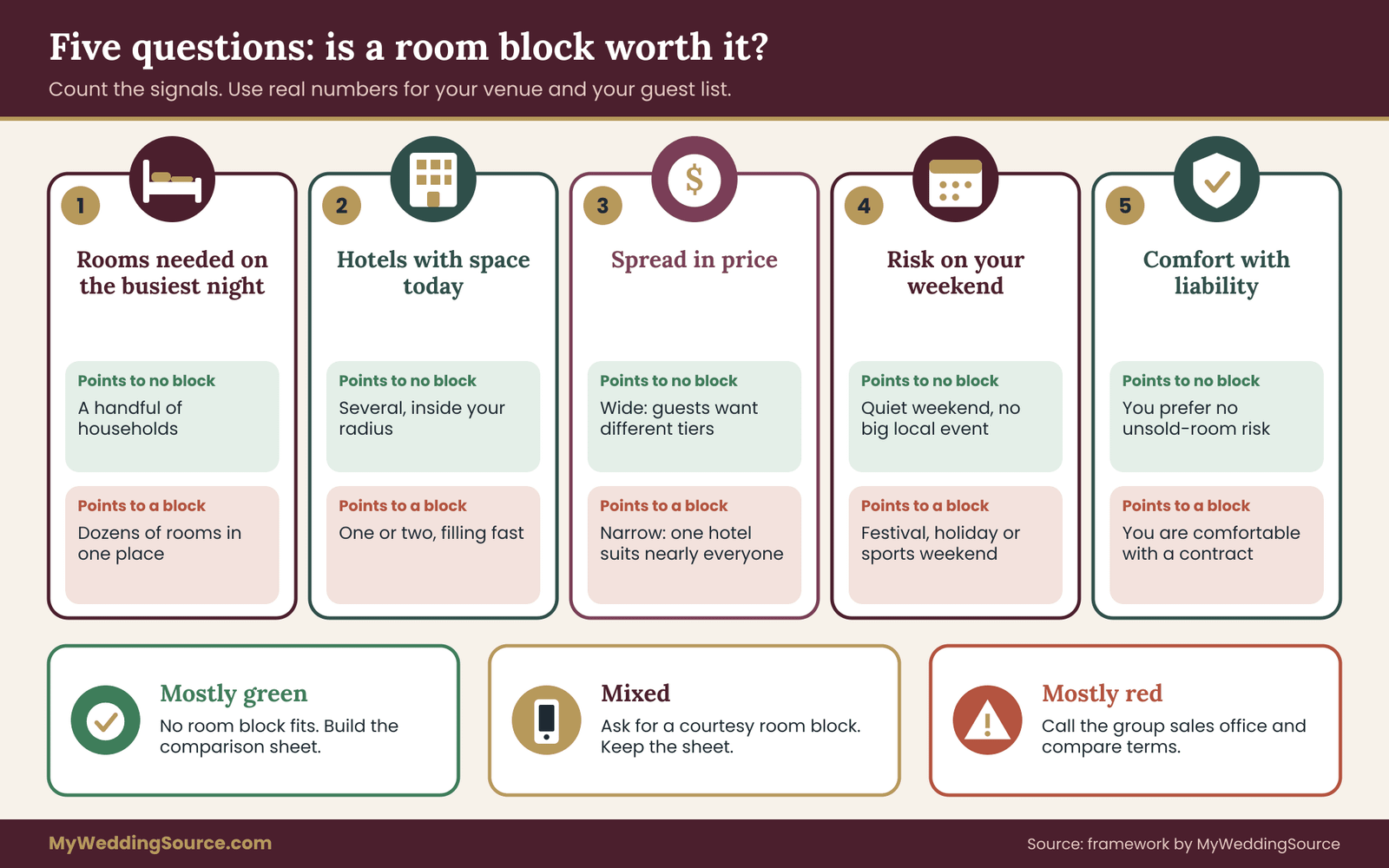
The five questions on the infographic are the same ones above, arranged as a short decision path. If you land in the middle, with some risk and some supply, the usual answer is a hybrid: no contract, but a polite call to your first-choice hotel to ask what it can do at no risk to you. The next section explains what such a hotel might offer, and what you give up when you decline.
What a room block does, and what replaces it
Before you drop a room block, it helps to know what you are dropping. A room block does several different jobs at once, and each one has to be done by something else if the room block is gone. Treating it as a single “discount” misses most of its value.
It holds inventory. The hotel keeps a number of rooms off the general market until a release date. Without it, rooms sell to anyone, and your guests compete with every other traveler that weekend.
It sets a price. The rate is negotiated and the same for everyone who uses the code. Without it, each guest sees whatever the hotel’s pricing system shows that day, and two guests booking a week apart may pay different amounts.
It gives you one point of contact. The group sales office knows your event, your dates and your needs. Without it, guests deal with the front desk or a call center that knows nothing about your wedding.
It gives you data. A block shows you how many rooms have been booked, so you can nudge guests before the cutoff. Without it, you will not see bookings unless guests tell you.
It handles special needs in one place. A sales manager can often note accessible-room requests in a single file. Without it, each guest must make and verify their own request.
It offers a negotiating position. A signed room block can bring small concessions, such as a late checkout or a complimentary room. Without it, you have little leverage.
The replacement for each job
Here is how the method in this guide covers the same six jobs when you have no room block.
- Holding inventory is replaced by early booking with free-cancellation rates. A guest who books a flexible rate in the spring holds a room that costs nothing to release. The room is held by the guest’s own reservation, not by your contract.
- Setting a price is replaced by the comparison sheet. You show guests which hotels are fair on all-in cost, and you tell them which rate type to choose.
- Giving one point of contact is replaced by a lodging page on your wedding website that lists contacts, booking tips and your own point person for questions.
- Giving data is replaced by a light check-in. You ask guests, usually on the RSVP form, where they plan to stay. You do not need a perfect picture, only an idea of whether one hotel is filling up.
- Handling special needs is replaced by direct confirmations. The guest, or you on their behalf, asks the hotel to describe and hold the specific room type and gets the answer in writing.
- Offering negotiating position is replaced by asking nicely. Many hotels will still answer a polite question about a courtesy rate, even without a contract.
Two jobs deserve a second look, because they carry the most risk.
Inventory. If a room is not held by anyone, the hotel can sell out before your guests book. The protection is simple but requires discipline: tell guests to book early on a rate they can cancel, and expect that some will not. The release calendar later in this guide shows how to time reminders so early bookers are not stuck and late bookers have a chance.
Price. Without a negotiated rate, guests may pay more than they would have with one, and you cannot promise otherwise. The comparison sheet reduces the gap by steering people to fair options, but it does not close it. A short honest sentence on the lodging page, saying you have no negotiated rate and are only suggesting hotels, protects both you and your guests.
What this method is, and is not
The method is a comparison and communication process for weddings with no room block. It is not a way to get a free room, a rebate or a hidden discount. It does not replace a signed room block contract when a contract is what you need. And it is not a promise that any particular hotel will have availability, a particular room type, or a particular cancellation policy on the day your guests call.
What it does give you is a clear picture of your options, a way to explain them to guests in a few lines, and a set of dates that keep everyone from losing money by accident. If you are also building the rest of your plan, the wedding planning checklist shows where lodging fits among the other tasks, and the sections below turn the lodging piece into a repeatable process.
Build the candidate list when there is no room block
When there is no room block, the first job is a shortlist, and the discipline is to keep it short. Three to five hotels is enough for most weddings. A list of twelve makes the comparison sheet unreadable, and it makes the lodging page so long that guests skim it and pick whatever appears first on a booking site.
Start from the venue, not from the hotels. Open a map, mark the ceremony site and the reception site if they differ, and look at what exists within a sensible travel radius. “Sensible” depends on the place. In a walkable town it may be a fifteen-minute walk. In a rural area it may be a twenty-minute drive. Write the radius down before you start, so you do not talk yourself into a hotel that is too far because the photos were nice.
Where candidates come from
Use several sources, because each one hides something the others show. This matters more with no room block, because no sales office is doing the searching for you.
The venue itself. Venue coordinators see hundreds of weddings. Ask which hotels guests tend to use, which ones have been reliable, and which ones are known for problems such as late-night noise or slow check-in. This is a conversation, not a recommendation you must follow. You are collecting names.
Hotel websites, booked direct. A hotel’s own site shows its own rate rules, its policies page and its contact details. Brand sites often show the cancellation terms in more detail than a third-party listing does.
Booking platforms and map search. Use these to see which properties have rooms for your dates and to compare prices. Treat the listed price as a starting point, because platform listings often show a rate without every fee, and the cancellation terms on a platform may differ from the hotel’s own.
The local visitor bureau. Tourism offices and chambers of commerce keep lodging lists that include small inns and bed and breakfasts that do not appear on large platforms. They can also tell you about events that affect the weekend.
Your own guests. Some guests already know the area, or a hotel, or a family member who works at one. Ask in a friendly way, and treat the answers as leads to verify.
Sort the candidates into tiers
Guests do not all want the same thing, and a good shortlist reflects that. Sort what you find into rough tiers by price, then pick at least one from each tier that matters to your guest list.
- A budget tier for guests who want a clean, safe room and are happy to skip extras.
- A middle tier for most guests, with reliable service and a mix of room types.
- An upper tier for guests who want comfort, a nicer setting, or a spa, and who are willing to pay for it.
- A family tier if many guests bring children. This might mean suites, rooms with kitchenettes or a hotel with a pool.
You do not need every tier. A wedding of mostly young friends may need only budget and middle options. A wedding with many older relatives may need one close hotel with easy access and one with a quiet setting. Match the shortlist to your actual guests, and read the guide on wedding guest hotels if you want a deeper look at tiers and scoring.
Independent hotels and chain hotels
The phrase “independent hotel” is used two ways. In the hotel industry it means a property that is not part of a large brand. In this guide, it also means any hotel that guests book on their own, with no room block. The method works for both, but they behave differently.
Small independent properties often have more flexible people at the front desk and may be willing to answer a question by phone and put the answer in an email. They also have fewer rooms, so they sell out faster, and their cancellation rules can be stricter on busy weekends because each empty room matters more.
Chain hotels usually publish standard policies online and have a central reservation system. Their rules are more predictable, and their loyalty programs give some guests extra value. A branch may still apply a special-event policy to your weekend, so the brand’s general policy is not the last word.
Neither type is better. Put both on the sheet if they fit your guests.
Apply two gates before anything else
Before you spend time on price, run every candidate through two gates. A hotel that fails a gate comes off the list or is flagged.
Gate one: the route. Can guests get from the hotel to the ceremony, and back after the reception, without a problem? Do not guess from a map. Check the actual travel time at the hour guests will travel, and check the late-night return. If the reception ends at ten, can a guest find a ride or walk safely? If the answer is “only if someone drives,” note who that would be.
Gate two: accessibility. If any guest needs an accessible room or an accessible route, the hotel must be able to provide it. The accessibility section later in this guide explains how to verify this. For now, treat it as a gate, not a score: a hotel that cannot offer what a guest needs is not suitable for that guest, however good its rate.
Hotels that pass both gates move on to the comparison sheet. Hotels that fail can stay as backup options for guests who are not affected.
The comparison sheet: what to record for each hotel
This is the heart of the method. A comparison sheet is a single page, with one card per hotel and the same fields on every card. It can live in a notes app, a spreadsheet, or a sheet of paper. What matters is that every hotel is described the same way, so differences become visible instead of buried in browser tabs.
The sheet in this guide, built for a wedding with no room block, has ten fields. Each one answers a question a guest will eventually ask.
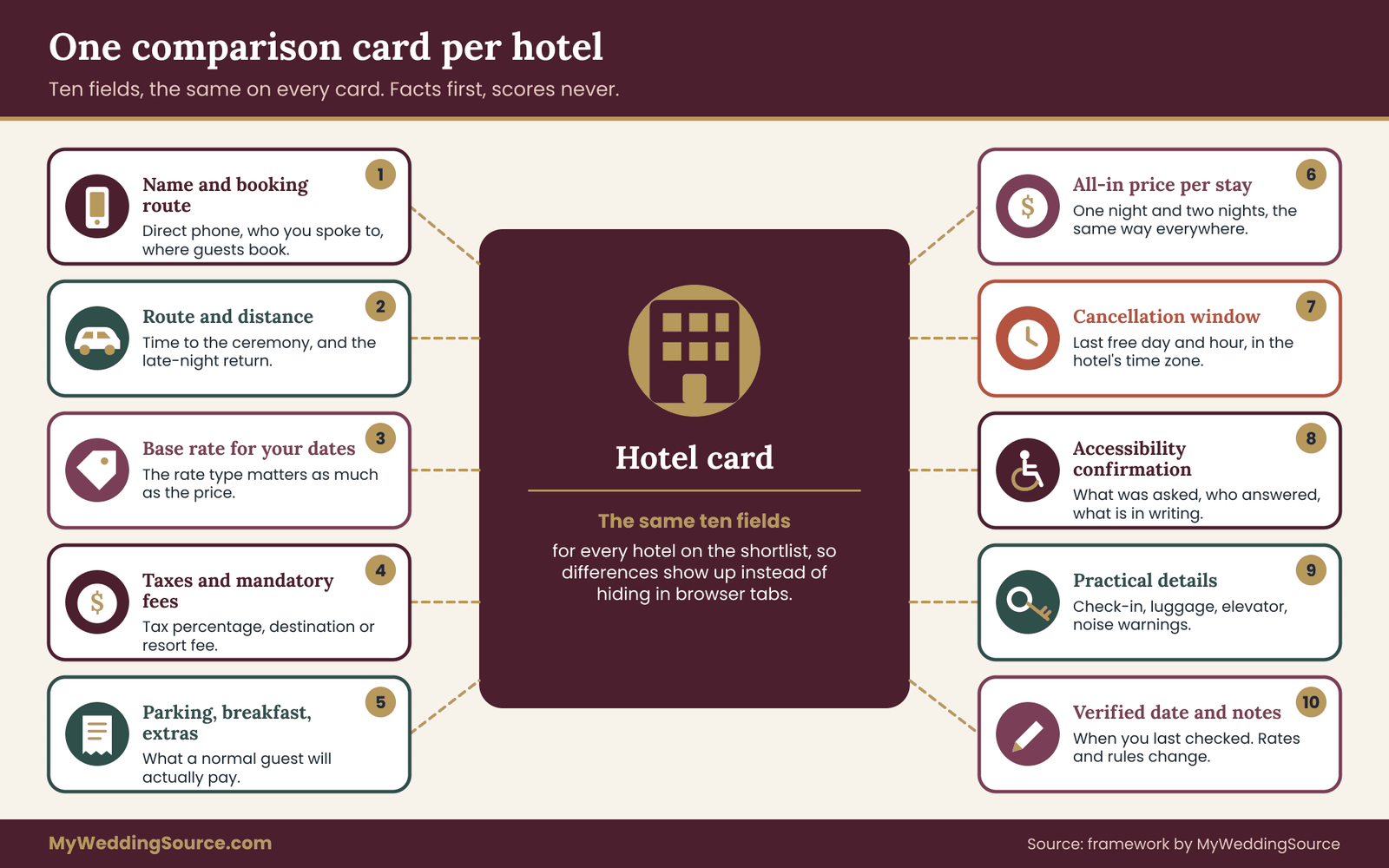
The ten fields
1. Name, contact and booking route. Record the property’s name, its direct phone number, the date you called, and the name of the person you spoke to. Note whether guests should book on the hotel’s site, by phone or through a platform. Booking direct often makes cancellation easier, because there is one party to deal with.
2. Route and distance. Record the travel time to the ceremony, the travel time to the reception if different, and the method (walk, drive, shuttle, ride-share). Add a line for the late-night return.
3. Base nightly rate for your dates. Use the rate for the actual nights, not a generic “from” price. Record the rate type too, because the same room can have several prices (see the cancellation section).
4. Taxes and mandatory fees. Lodging taxes and mandatory charges such as a destination, resort or amenity fee can add a lot. Record each one per night. If the hotel says “plus tax,” ask for the percentage.
5. Costs outside the room rate. Parking, breakfast, Wi-Fi and pet charges. If breakfast is included at one hotel and not at another, you must account for it in the comparison.
6. All-in price per night and for a typical stay. Add the above. A two-night stay is the most common pattern for a Saturday wedding, so calculate that, and a one-night stay as well. This single number is the one guests care about.
7. Cancellation window. The last day and time a guest can cancel without a charge, whether payment is due at booking or at the property, and how the rule changes for event weekends. This field gets its own section below, because it carries so much of the risk.
8. Accessibility confirmation. What was asked, what the hotel said, who said it and when, and what is in writing. Leave it blank if you did not ask, so the gap is visible.
9. Practical details. Check-in and check-out times, whether the hotel holds luggage, whether early arrival is possible, whether there is an elevator, and any noise or construction warnings.
10. Verified date and notes. Write the date you last confirmed the information. Rates and policies change, and a sheet that is three months old needs checking.
A short script for the call
You will fill in several fields only by phone or email. A direct, polite request works best, and it helps to ask all your questions in one call.
“Hello, we are planning a wedding on the weekend of the fifteenth, and our guests will book their own rooms. We are not planning a room block. Could you tell us what the standard rate is for those nights, which taxes and fees apply per night, and what the cancellation policy is for that weekend? Could you also confirm in an email?”
Several things are packed into that request. You said you are not asking for a room block or a contract, which lowers the pressure. You asked about the specific weekend, because event dates can carry different rules. And you asked for the answer in writing, which makes it a record you can point to later.
Keep the sheet honest
Without a room block, the sheet is the only record of what each hotel told you, so it has to be trustworthy. Two habits keep a comparison sheet useful.
First, record what you were told and what you saw as separate things. “Rate shown on hotel site on March 3: one hundred eighty-nine dollars” is a fact. “Front desk said they would probably have rooms” is an impression. Mark each one accordingly.
Second, resist the temptation to rank hotels with a single total score. A score hides the reasons. A hotel with a great rate and a rigid cancellation rule may be wonderful for a guest who is certain to come and risky for one who might not. Show the facts on the cards and let the lodging page explain which hotel suits which kind of guest.
Cancellation windows: the safety net when there is no room block
With a room block, a hotel holds rooms for you until a release date, and guests who book through the block often get the hotel’s group cancellation terms. Without a room block, the only protection a guest has is the cancellation rule attached to their own reservation. That is why the cancellation window deserves more attention than the nightly rate. A cheap room that cannot be cancelled is a bet on the future. A slightly pricier room that can be cancelled until the week before is a held room with an exit.
The goal of this section is to make you able to read any hotel’s cancellation language and turn it into one date and time on your sheet: the last moment a guest can cancel for free.
The common rate types
Hotels sell the same room under several rate types, and the type decides the cancellation rule. Names differ from one hotel to the next, so use these as categories rather than labels.
Flexible, pay at the property. The guest gives a card to hold the room and pays on arrival. Cancellation is free until a stated deadline, often a day or two before arrival, and sometimes the afternoon of arrival. This is usually the best fit for wedding guests who are still sorting out travel.
Flexible, prepaid. The guest pays when booking, and the hotel refunds the payment if the guest cancels before the deadline. Read the refund rule carefully, because some hotels refund in full and some keep a fee.
Advance purchase or “saver” rates. A lower price in exchange for paying at booking and giving up the right to a refund. Some allow date changes for a fee, and some do not allow changes at all. These are fine for a guest who is certain, and a poor choice for someone who might have a work conflict.
Partially refundable rates. A middle option. For example, a refund of everything except the first night, or a refund until a long deadline and then a partial refund.
Package and third-party rates. Rates sold through a booking platform, a travel agency or a bundle with a flight. These may follow the platform’s rules, not the hotel’s, and changes often must go through the platform.
Event or peak-date rates. A room block contract would normally spell this out, so with no room block you have to ask. Some hotels apply a longer notice period, a minimum stay or a non-refundable deposit to weekends they expect to be busy. If your wedding falls on a festival weekend or a holiday weekend, assume nothing until the hotel confirms the terms for those dates.
Turn the rule into a date
A rule such as “free cancellation until 48 hours before arrival” is not yet a date. A guest needs a calendar entry. Convert each rule into the exact last moment, in the hotel’s local time, for the night your guests will arrive.
A few conversions illustrate the logic.
- “Free cancellation until 3 pm, two days before arrival.” If arrival is Friday, the deadline is 3 pm on Wednesday.
- “Cancel by 11:59 pm local time three days before check-in.” For a Friday arrival, that is late Tuesday night.
- “Cancel by 6 pm on the day of arrival.” Friday at 6 pm. The hotel then releases the room.
- “Seven days’ notice for stays that include a Saturday night.” This one catches people. A guest who arrives Thursday and stays through Sunday may be held to the stricter Saturday rule for the whole reservation. Ask which date the hotel measures from.
Write the result on the sheet as a date, a time and a time zone. The time zone matters when a guest lives in another one. A deadline at noon local time in the hotel’s city is a different moment for a guest booking from the opposite coast.
What to ask when the terms are unclear
Ambiguity is common. A policies page might say “standard cancellation policy applies” with no further detail, or a platform might show a banner saying “free cancellation” that does not say until when. When that happens, ask the hotel. A short list covers most of what you need.
- Until what date and time can a guest cancel without charge on this rate?
- Is payment taken at booking or at the property?
- Does a different policy apply to our dates because of a local event or a minimum stay?
- If a guest shortens a stay, is there a fee?
- If a guest changes dates, is the new rate the current rate or the original?
- What happens if the guest does not arrive and has not cancelled?
- Can you confirm this in an email?
The final question is the one that matters. A phone answer fades quickly. An email that says “free cancellation until this date” is something a guest can forward if there is a dispute.

Read the rule that applies to the rate, not the hotel
The most common mistake in this process is reading a hotel’s general policy and assuming it applies to the rate a guest will book. The general policy might promise free cancellation until the day before arrival, while the cheapest rate on the booking page might be non-refundable. The hotel is not lying. The page just describes different things.
When you build the sheet, look at the cancellation language displayed at the last step of booking for the exact rate you plan to recommend, and capture it with a screenshot. If you cannot get that far without entering payment, call the hotel and ask them to read you the rule for that rate code on those dates. Then tell guests which rate type to choose, in words they can find on the booking page.
Prepaid versus pay later
Whether payment happens at booking or at the property affects both cost and risk.
A pay-at-property reservation leaves your guest’s money in their pocket until they arrive. If plans change, nothing needs to be refunded. The downside is that some hotels require a card guarantee and may charge a fee after the deadline.
A prepaid reservation can offer a lower price, but money leaves the guest’s account early. If a refund is due, it depends on the hotel returning it, and refunds can take a while. A guest booking on a platform might have to chase the platform and the hotel separately.
For most wedding guests, pay-at-property with free cancellation is the lower-stress choice when no room block stands behind the booking. It costs a little more on paper, and the difference often buys real peace of mind. Where a prepaid rate is meaningfully cheaper, let guests decide, and say plainly what they give up.
A note on card holds and deposits
Some hotels place a hold or take a deposit when a guest books, even on a pay-later rate. Holds are temporary authorizations that reduce available credit until released. Deposits are real charges that may be refunded later. Guests on tight budgets, or using debit cards, should ask which one applies. A hold of a full stay can matter to a guest whose card has a low limit, and it is an easy detail to forget until the check-in desk.
Reading the rule on the day a guest books
Guests are the ones who actually book, so give them a simple habit that protects them. The habit has four steps.
- Choose the flexible rate unless you are sure of your plans.
- Screenshot the final booking screen, which should show the cancellation terms and the total price.
- Save the confirmation email in a folder that is easy to find.
- Put the free-cancellation deadline in a calendar with a reminder one week earlier.
This habit costs a few minutes. It also means that when a guest needs to change plans, they know the last day to do it and have proof of what they were promised. You can include these four steps on your lodging page in your own words. The language of the page is covered in a later section.
What the cancellation window does not do
The window protects against changes of plan. It does not protect against everything, and it is not a substitute for what a room block holds, namely the rooms themselves.
It does not guarantee a room will be available if the hotel overbooks, although most hotels aim to avoid that. It does not make a rate drop automatically apply to an existing booking, because the hotel does not usually adjust a reservation unless asked. And it does not protect a guest from fees tied to something else, such as a damage deposit or a minibar charge.
It also does not stop a guest from waiting too long and finding the hotel full. A flexible rate is only useful if a guest has booked it. That is why the release calendar later in this guide includes a reminder to guests, timed so early bookers still have a free exit and late bookers still have rooms to choose from. Hold that thought, because the next section looks at the other half of the decision for a wedding with no room block: what the room really costs.
The real price of a night when there is no room block
A negotiated rate in a room block is usually easy to compare, because every guest sees the same number. Without a room block, each hotel shows its own number in its own way, and the number on the search page is rarely the number that leaves a guest’s account. The comparison sheet fixes this by recording an all-in price for each hotel. This section shows how to build that number and how to use it.
The layers behind a nightly rate
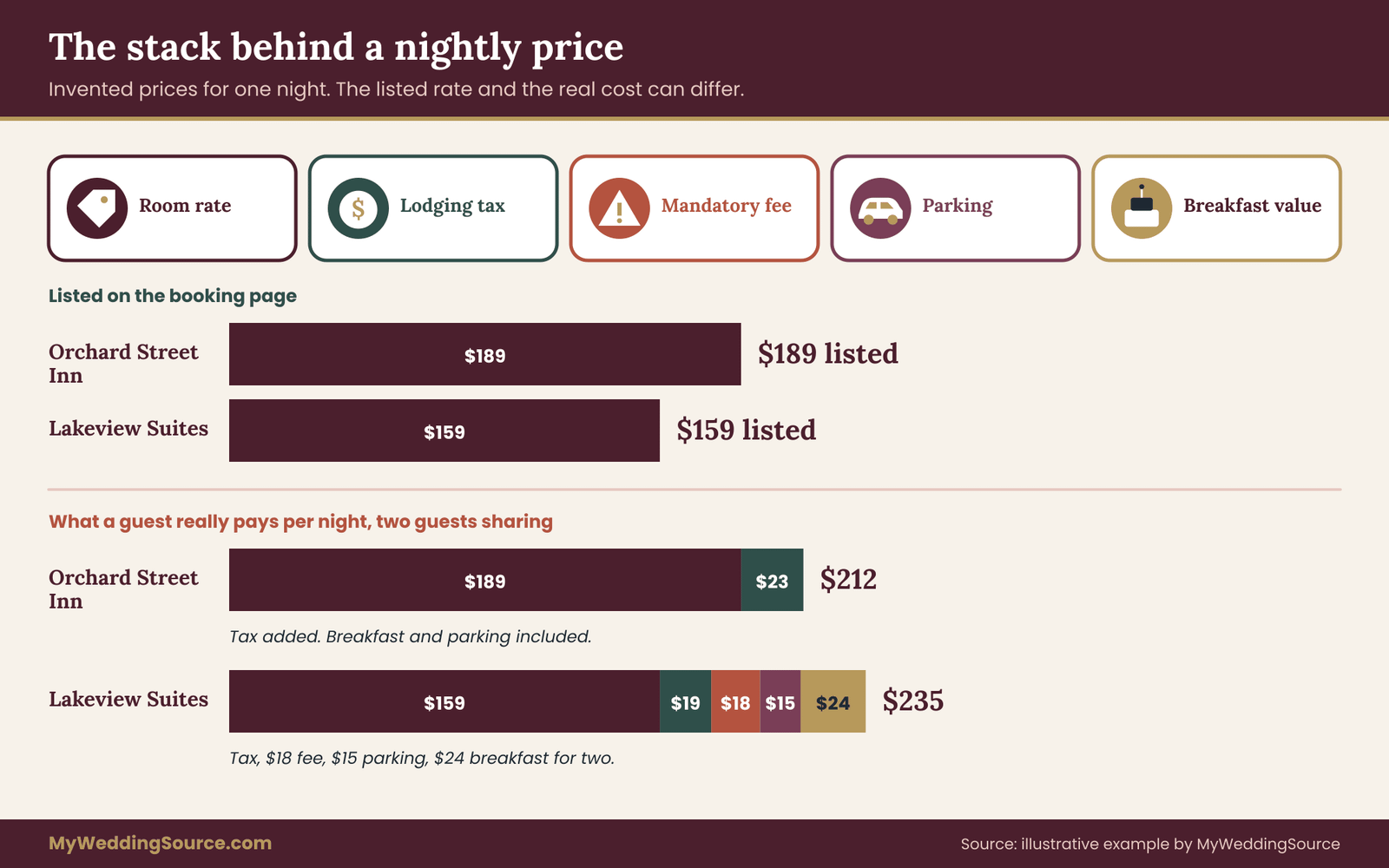
Think of a night as a stack, with the room rate at the bottom and extra layers added on top.
The room rate. The advertised price for the room type and rate type. It changes with the date, the day of the week, the demand and the rate type. It is the only layer most search pages emphasize.
Lodging taxes. State, county and city taxes applied to lodging. Percentages differ by place, and some places add a flat per-night charge on top. Ask the hotel for the exact percentage, or look at the tax line on the final booking screen.
Mandatory fees. Some properties charge a destination fee, resort fee or amenity fee per night, whatever the guest actually uses. These can change the order of two hotels entirely. The Federal Trade Commission has adopted a rule on unfair or deceptive fees that covers short-term lodging, and it is aimed at making the total price clear before a customer pays. Its scope and effective dates are set by the agency, so read the FTC’s current page before you tell guests what a hotel must display.
Parking. In a city center, a night of parking can cost as much as a budget room. In a rural area, parking is usually free. Record it either way.
Breakfast and other included items. A free breakfast has real value for a family. A hotel with a higher rate and a breakfast may cost less overall than a cheaper one with none.
Extras guests may choose. Pets, late checkout, an extra person in the room, a rollaway bed. These do not belong in the base comparison, but a family with a dog or three people in a room should see them.
Compare on a typical stay, not a single night
A Saturday wedding usually means a one-night or two-night stay. Some guests arrive Thursday. Calculate at least these cases for each hotel.
- The two-night stay (Friday and Saturday), the most common pattern.
- The one-night stay (Saturday only), used by local-ish guests and anyone who drives home on Sunday.
- A family version, if relevant, for two adults and children in one room.
Do the arithmetic on the sheet, so guests do not have to. Write the totals in the same format at every hotel: “two nights, all in, about this much.” Use words such as “about” or “at the time we checked,” because prices move.
Cost per guest, not cost per room
A room is not a guest. Two friends sharing a room split a cost. A solo traveler pays all of it. A family of four may need a suite or two rooms. When you compare hotels, think about how guests will really use the rooms.
If many guests will share, a pricier hotel with larger rooms or two beds can be the better value per person. If many guests travel alone, a small budget room is more efficient. This is a reason to keep a mix of options on the sheet, instead of choosing a single “best” hotel.
A quick test for hidden differences
Here is a rule that catches most surprises. For the two cheapest candidates, ask: “If I add everything a normal guest would pay, which one is actually less?” Then check the answer against the following three items.
- Fees. Does one of them charge a mandatory fee the other does not?
- Parking. Will most guests arrive by car, and does one of the two charge for it?
- Breakfast. If neither includes breakfast, what is the cost of a modest breakfast nearby? If one includes it, add that value to the other.
Often the “cheaper” room is cheaper by a few dollars before the stack and more expensive after it. The worked example later shows exactly this.
Be careful with price promises
When you present prices on your lodging page for a wedding with no room block, avoid stating a fixed price as though it were a rule. Rates move. A guest who sees “about this much per night” and later finds a different number should not feel misled. Say when you checked and say the hotel sets the final price. If you do not know a number, leave it out and tell guests to look at the final booking screen.
Should the couple help pay
Some couples decide to cover or subsidize rooms for the wedding party or for close family. That is a separate budget decision, and with no room block it is entirely yours. It affects how you handle bookings, because someone must pay. If you plan to cover certain rooms, do it through a method that matches your cash flow: pay the hotel directly for named guests, reimburse guests after the stay with their receipts, or give a fixed amount toward lodging. The guide to wedding cash-flow planning explains how to time deposits and reserves, and the wedding budget page is a good place to record what you decide.
Do not tell a guest you will pay for a room until you have decided how, when and how much. And do not ask a hotel to hold a card of yours for guests without understanding what you are authorizing. If you are not careful, a guest’s no-show can become your charge.
Routes, access and the accessibility gate
Distance and accessibility belong on the sheet next to price, and they decide whether a hotel is suitable at all. Both are easier to ignore without a room block, because no group sales manager is asking about them.
Test the route as a guest would
A map shows distance. It does not show the route a guest will actually travel. For each hotel on the sheet, do these checks.
Time the trip at the right hour. Check the travel time for the hour guests will leave for the ceremony, which may overlap with local traffic or a large local event, and for the hour they will leave the reception.
Choose the transport method. If the venue is walkable from a hotel, decide whether the walk is pleasant for guests in formal shoes and whether the route is lit and has sidewalks. If the venue requires a car, note how many guests will need a ride, and whether ride-share service is reliable in that area at that hour. Rural venues often have patchy coverage.
Plan the late return. Guests leaving at the end of the night are tired, and some have had a drink. A hotel with a safe, simple route home is more valuable than one with a lower rate and a complicated return.
Think about the next morning. Is a brunch planned? Do guests need to check out and get to an airport? A hotel near the highway may be better for the Sunday departure than one in the center.
If your plan needs a shuttle, remember that a shuttle is a service you contract and pay for, usually based on a fixed number of hours and vehicles. It is a separate decision from the hotel choice, and without a room block you may have less certainty about how many guests will use it. A simple solution is to run the shuttle between one or two nearby hotels and the venue at set times, and to tell everyone else to arrange their own transport.
Accessibility is a gate, not a score
A hotel is either able to provide what a particular guest needs, or it is not. A low price does not offset a room the guest cannot use. So treat accessibility as a pass-or-fail check on each hotel, by guest need, before the hotel earns a place on the lodging page.
Some background helps you ask the right questions. In the United States, the Americans with Disabilities Act sets requirements for hotels, including rules about how accessible rooms are reserved. The Department of Justice’s regulation on reservations, 28 CFR 36.302, describes what lodging must do for people with disabilities, such as letting them reserve accessible rooms the same way others reserve rooms and identifying and describing a room’s accessibility features.
The details, and how they apply to a particular property, are best confirmed on the Department of Justice’s ADA site or with the ADA National Network. This guide does not tell you what a hotel must do in a specific case. Its purpose is to help you ask clear questions.
What to ask for an accessible room
A guest needs specifics, not a general promise. Questions that produce useful answers include these.
- Is there a roll-in shower, a tub with a transfer bench, or a standard tub, in the specific room type?
- What are the bed heights, the door widths and the clear floor space beside the bed?
- Are there grab bars, a lowered closet rod, a lowered peephole?
- Is there a route without stairs from the parking area, the lobby and the elevator to the room?
- Is there a hearing-accessible kit with visual alarm and notification?
- Can the hotel hold that specific room for the guest’s dates, and send written confirmation?
Photos and descriptions on a booking site help, but hotels sometimes describe rooms loosely. A direct question, with the answer in writing, is much better. Our guide on accessible wedding venue red flags covers the venue side and the habits of asking that carry over to hotels.
Without a room block, the guest or you must confirm
In a room block, a sales manager can often note accessible-room requests in one place. Without a room block, no one is doing that, so each request has to be made and checked individually. Two practical routes work.
The guest makes the reservation and confirms the details by phone. This puts the guest in control and keeps their information private. Offer to help if they would like, and give them the questions above.
You make the call on the guest’s behalf, with their permission. This is a kindness and saves them the effort. Be careful to relay their needs accurately, and let the guest confirm the answers.
In both cases, ask for written confirmation of the specific room type and dates. Never promise a guest a room you have not seen confirmed, because accessible rooms can be reassigned or unavailable on the day. If something goes wrong, the written confirmation is what the guest can show.
Where accessibility planning has limits
Be honest with guests about what you can and cannot control. You can ask, confirm, record and advocate. You cannot guarantee that a hotel will do what it said, that a room will be ready, or that every part of a hotel is usable. If a guest has needs that a hotel cannot meet, help find a different one, even if it is not on your sheet. The point of the sheet is to serve guests, not to defend the list.
A worked example with no room block: four hotels, one wedding
The example below is invented. The couple, the hotels and every price are made up to show the method, and real prices and policies will differ, so do not use these numbers as a guide to what a night costs anywhere. The point is the reasoning.
The situation
Maya and Jordan are marrying on a Saturday in mid-October at a vineyard outside a small city. They have invited ninety guests. From the early RSVPs, about thirty households will need a room on Saturday night, and roughly half of those will also stay on Friday.
They called the group office at the best-known hotel in town. It offered a room block only for ten rooms or more on a single night, with an attrition clause. Their guests would be spread over several hotels at different prices, so no single hotel would reach ten rooms on both nights, and Maya and Jordan did not want to be liable for unsold rooms. They decided on no room block, and on the comparison method.
Step one: four candidates
Using the venue coordinator’s suggestions, a map search and the local visitor bureau’s list, they picked four hotels, none of them tied to a room block, that passed the route gate.
Orchard Street Inn. A small independent inn with twenty-two rooms, six minutes from the venue. Breakfast and parking are included.
Lakeview Suites. A midscale chain property, nine minutes away, with a pool. Breakfast and parking cost extra.
Maple Court Motel. A budget motel, twelve minutes away, with free parking and no breakfast.
Grand Mill Hotel. A downtown hotel, twenty-five minutes away, with restaurants within walking distance and paid valet parking.
Step two: the calls and the sheet
Maya made one call to each, using the script from earlier, and asked for the answers by email. She recorded the rate for the Friday and Saturday nights, the taxes and fees, and the cancellation rule on the rate she planned to recommend.
Here is what the sheet said, in plain sentences.
Orchard Street Inn: one hundred eighty-nine dollars a night before tax, with a local lodging tax of twelve percent. No mandatory fee, free parking, breakfast included. The inn’s website says free cancellation until forty-eight hours before arrival. The email from the front desk added that Saturday nights in October carry a seven-day window, because of a local harvest festival. Without the email, the sheet would have said Wednesday. With it, the sheet says Friday, October eighth, at 3 pm.
Lakeview Suites: one hundred fifty-nine dollars before tax, an eighteen-dollar nightly destination fee, and fifteen dollars a night for parking. Breakfast is not included. The flexible rate cancels free until 11:59 pm local time three days before arrival. A cheaper “saver” rate at one hundred forty-nine dollars is prepaid and non-refundable.
Maple Court Motel: one hundred nine dollars before tax, no fees, free parking, no breakfast. Free cancellation until 6 pm on the day of arrival.
Grand Mill Hotel: two hundred nineteen dollars before tax, a thirty-dollar nightly destination fee, thirty-eight dollars for valet parking, no breakfast. Free cancellation until fourteen days before arrival. A non-refundable rate is available for one hundred eighty-nine dollars.
Step three: the all-in price
Maya assumed, for simplicity, that the twelve percent tax applies to the room rate only, and that a guest buying breakfast would spend about twelve dollars per person. These are assumptions for the example, and she noted them on the sheet. Then she added each layer.
Orchard Street Inn. One hundred eighty-nine plus twelve percent tax is about two hundred twelve dollars a night. Nothing else to add. Two nights come to about four hundred twenty-three dollars, with breakfast.
Lakeview Suites. One hundred fifty-nine plus tax is about one hundred seventy-eight. Add eighteen for the fee and fifteen for parking, and the total is about two hundred eleven dollars a night. That is almost exactly the Orchard Street total, and it does not include breakfast. For two guests sharing, breakfast adds about twenty-four dollars a morning, so the real two-night cost for two people is about four hundred seventy dollars.
Maple Court Motel. One hundred nine plus tax is about one hundred twenty-two dollars a night. Two nights come to about two hundred forty-four.
Grand Mill Hotel. Two hundred nineteen plus tax is about two hundred forty-five. Add thirty and thirty-eight, and the total is about three hundred thirteen dollars a night. Two nights come to about six hundred twenty-seven.
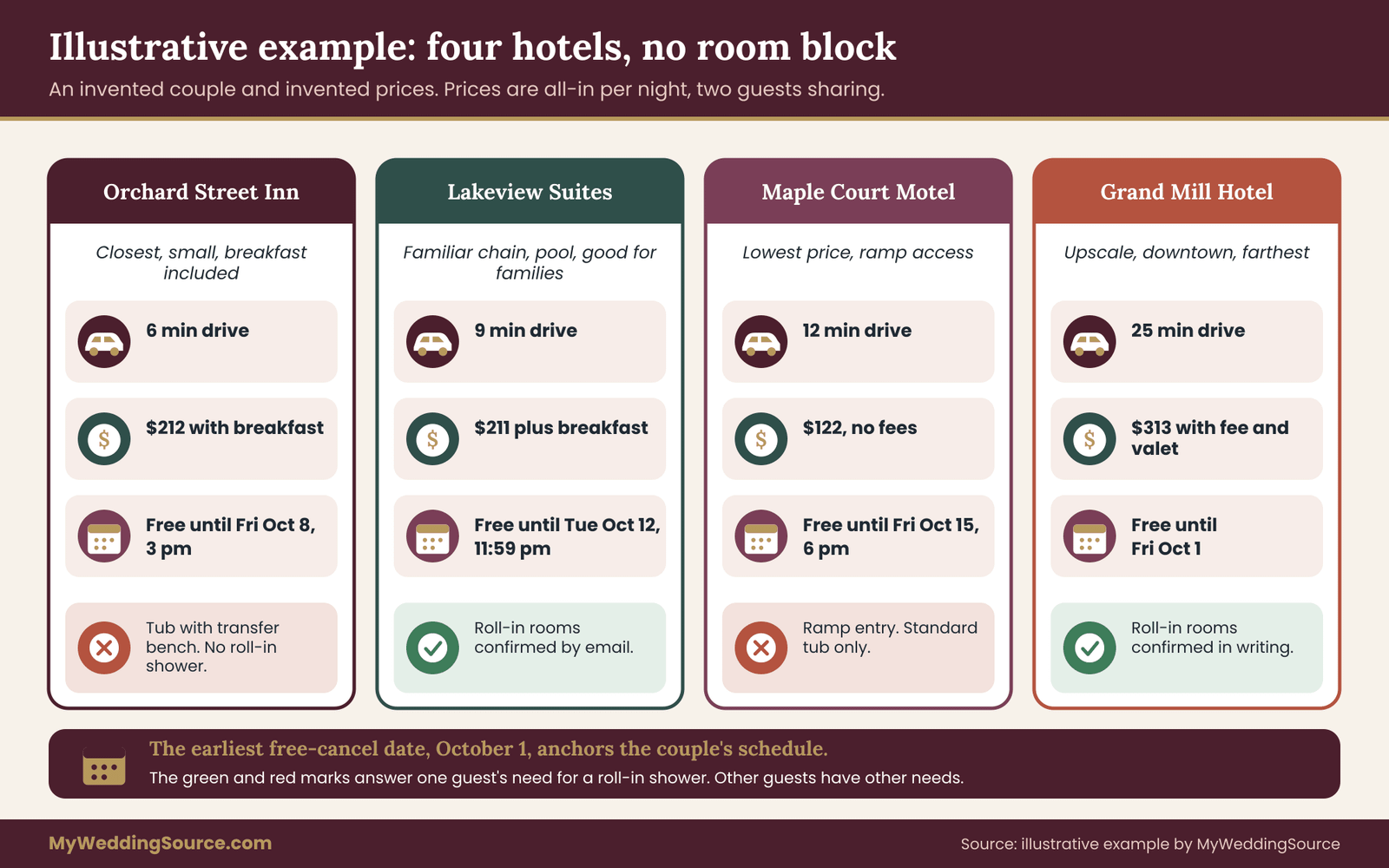
The surprise was Lakeview. On the booking page, it looked about thirty dollars a night cheaper than the inn. After the fee, the parking and a breakfast, it was a bit more expensive than the inn. That finding went straight onto the lodging page, because it changed which hotel she would suggest to guests who wanted a mid-range option.
Step four: the gates
Route. All four passed. Maya checked the drive to the vineyard at the hour guests would leave for the ceremony and the drive back at about eleven at night. The twenty-five-minute trip from Grand Mill was the longest, so she noted that guests there should plan a ride-share or a designated driver, and that coverage near the vineyard can be patchy.
Accessibility. She asked each hotel about accessible rooms. Orchard Street Inn had one ground-floor accessible room, with a tub and transfer bench, and said it could be held with a written confirmation. Lakeview Suites had several accessible rooms, with roll-in showers in some of them. Maple Court had one ground-floor room reachable by ramp, but the staff said the bathroom had a standard tub with a grab bar. Grand Mill had roll-in shower rooms and sent a written confirmation of the room type.
Because one of Maya’s cousins uses a wheelchair and needs a roll-in shower, Maple Court and Orchard Street Inn did not pass the gate for that guest, while Lakeview and Grand Mill did. The cousin chose Lakeview because it was closer and cheaper than Grand Mill, and Maya asked the hotel to confirm the room type by email. The other hotels stayed on the page for everyone else, with a plain note about what each one could and could not offer.
Step five: the cancellation windows on one line
Maya then turned the four rules into dates for a Friday arrival.
- Grand Mill: free cancellation ends Friday, October first.
- Orchard Street Inn: free cancellation ends Friday, October eighth, at 3 pm.
- Lakeview Suites: free cancellation ends Tuesday, October twelfth, at 11:59 pm.
- Maple Court: free cancellation ends Friday, October fifteenth, at 6 pm.
The earliest of those dates, October first, became the date that mattered. Any change a guest wanted to make before October first would be free at all four hotels. The couple scheduled their own checks around it: a sheet review in mid-August, a reminder email in mid-September, and a note to themselves to look at the pickup the week before October first.
Step six: the roles on the lodging page
Maya did not rank the hotels. She gave each one a plain role on the page.
- Orchard Street Inn: closest to the venue, breakfast included, small, so book early.
- Lakeview Suites: familiar brand, pool, good for families, all-in price close to the inn once fees are counted.
- Maple Court Motel: lowest price, step-free ramp access but a standard tub, good for guests who want to spend little.
- Grand Mill Hotel: the upscale option, restaurants nearby, roll-in shower rooms confirmed in writing, farthest from the vineyard.
She wrote the all-in estimates for two nights beside each, with a line saying the figures were checked in the spring and the hotel sets the final price.
What happened next
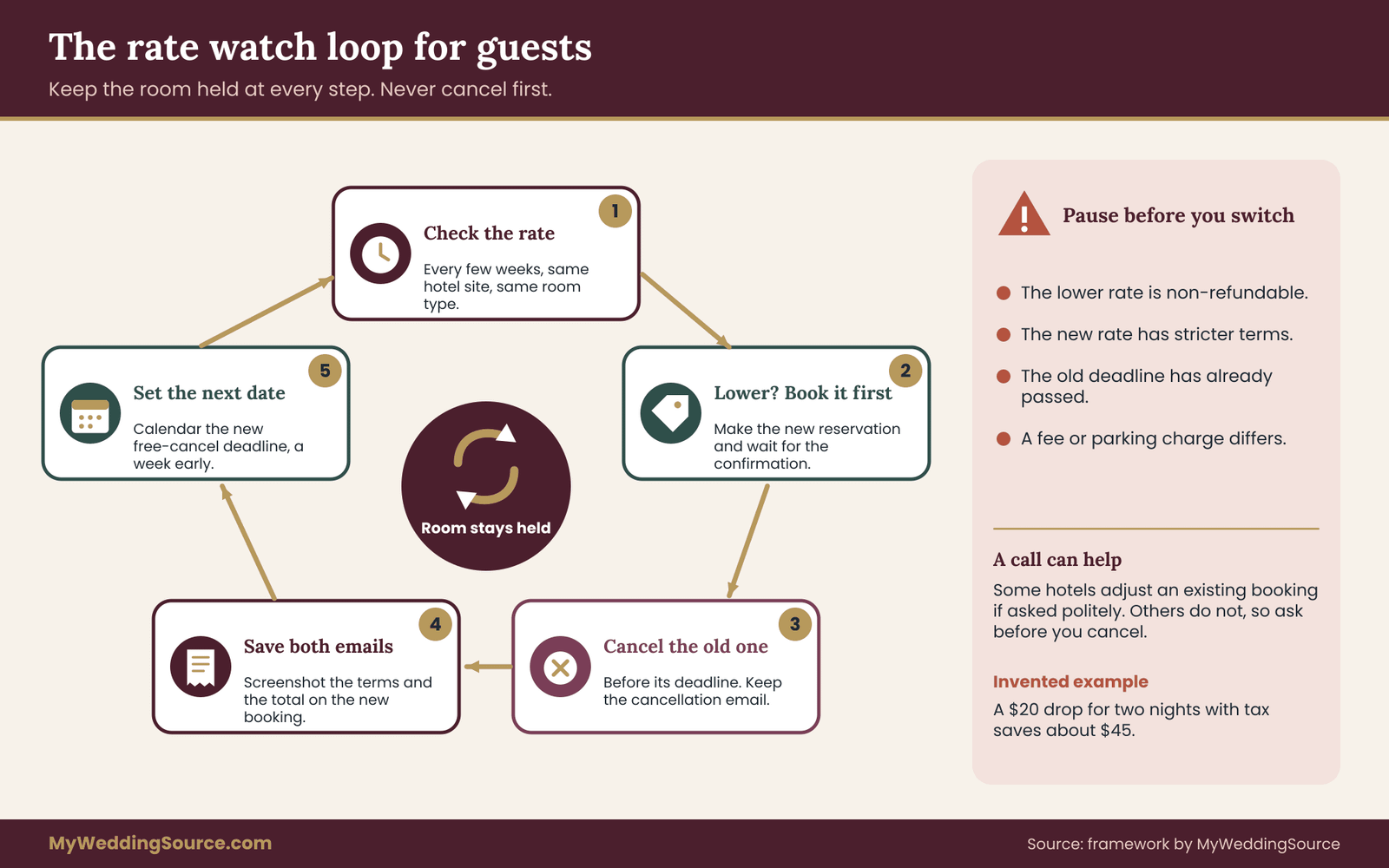
In the example, with no room block behind the bookings, a guest booked a flexible room at Lakeview in June. In August, when Maya reviewed the sheet, the rate for those nights had dropped by twenty dollars. She mentioned it in a short update email. The guest booked the new rate first, then cancelled the old one before the deadline, and saved roughly forty-five dollars for two nights with tax. If the guest had chosen the non-refundable saver rate, no such move would have been possible.
In early September, Orchard Street Inn showed no rooms for Saturday. Maya sent a short update telling guests that the inn was full, and pointed late deciders to Lakeview and Maple Court. Nobody was left without options, because the other three hotels still had rooms.
What the example shows
Five lessons come out of this invented case, and they apply to any wedding with no room block.
- The cheapest listed rate is not always the cheapest stay. Fees, parking and breakfast can reverse the order.
- The cancellation rule on the rate matters more than the one on the home page. One email changed a deadline by five days.
- Gates before scores. A guest with a specific need can rule a hotel out regardless of price.
- Dates beat descriptions. “Free cancellation” became four calendar dates, and the earliest one drove the schedule.
- A flexible rate lets guests react. The rate drop and the sold-out inn were both manageable because most bookings could still change.
None of this required a room block contract. It required one afternoon of calls, a sheet, and a few short messages. The next section explains how to tell guests so they act on it.
What to tell guests when there is no room block
The comparison sheet is for you. Guests need something shorter. A good lodging page takes the sheet and turns it into clear advice, with just enough detail for a guest to book in one sitting and feel confident about it. Because there is no room block, no code and no sales manager, the page is the whole service. It is worth writing well.
What the page should say
Keep it to one screen of reading, with these pieces in this order.
A plain opening statement. Say that guests will book their own rooms, that there is no room block or special rate, and that you have collected a few hotels to make the choice easier. This sentence matters, because it sets expectations and heads off the question “where is the code?”
The hotels, with a role for each. For each hotel, give the name, a link to the hotel’s own site, the distance from the venue, and one sentence on what it suits. “Closest to the venue, breakfast included” is better than “charming and cozy.”
Estimated all-in prices. Give an approximate figure for two nights, say when you checked, and say the hotel sets the final price. Round numbers are fine.
The booking advice. Tell guests to choose a flexible rate, to screenshot the cancellation terms and to put the free-cancellation deadline in their calendar. Explain it in a sentence or two. Guests who have never thought about rate types will thank you.
Accessibility. Say that you have asked each hotel about accessible rooms, summarize what you learned, and invite guests with needs to contact one named person, who will help confirm details.
Getting around. Say how guests can reach the venue, whether a shuttle exists, and where ride-share is likely to be reliable.
Dates and updates. Say when you last checked the information and when you will update it.
A point of contact. One name, and one way to reach that person. Do not list an email in a public page if you prefer a contact form; use whatever method your wedding site offers.
Sample wording
The language below is a starting point, and you should change it to sound like you.
“We have not set up a room block, so you are free to stay wherever suits you. These four hotels are all within a short trip of the venue, and we have listed what each is like. Please book directly with the hotel. We suggest a flexible rate with free cancellation, so you can change plans without a charge. Prices below are approximate and were checked in the spring. The hotels set the final price, and rates can change.”
“If you need an accessible room, tell us which features matter to you. We are glad to help check details with the hotel, and we will ask for the room type to be confirmed in writing.”
“Rooms may sell out on a busy weekend, so booking earlier gives you more choice. If your plans change, cancel before the deadline on your confirmation.”
Notice what the wording avoids. It does not scold, and it does not hint that the couple will fix things if a guest makes a mistake. It also does not imply a discount that does not exist. If you want to build a longer page, the guide on wedding RSVP etiquette can help you decide where a lodging question fits among the other questions you ask guests.
Where and when to publish it
Put the lodging page on your wedding website and link it from the save-the-date and the invitation. A printed card in the invitation can say “Hotel suggestions are on our website” with the address, which keeps the printed piece short and lets you update the page. Printing hotel names and prices on paper locks in information that will change.
Timing depends on how scarce rooms are. If the weekend is quiet, publish with the save-the-date, several months out. If the weekend is busy, publish earlier and tell guests that rooms may go fast. A soft target date helps, for example “if you know you are coming, please book a flexible room by the end of June.” Present it as advice, not a deadline. The hotels set the real deadlines.
Learn where people are staying without building a rooming list
A room block gives you a pickup report. Without one, you can still get a rough idea. The simplest way is one optional question on the RSVP form: “Where are you planning to stay?” with the hotel names, an “other” option and “staying with family or friends.” You do not need the answers to be exact. You need to know whether one hotel is filling and whether anyone has no plan.
Keep this information private. Use it to guide your updates, and do not publish it or share a list of who is staying where. Some guests prefer privacy, and a couple who are collecting guest data should handle it with care. If guests change plans after they answer, that is fine. The question is a rough thermometer, not a commitment.
The wedding guest list guide explains how to estimate out-of-town attendance early, which gives you the first rough count of rooms before RSVPs arrive.
Wedding party and family
Some guests, usually the wedding party and close family, will want to stay at the same hotel. Without a room block, nothing ensures it. If this matters, tell those guests early which hotel you would suggest, and ask them to book around the same time. You can also suggest that they ask the hotel whether adjacent rooms are possible, bearing in mind that the hotel may not be able to promise it.
Do not assign hotels. Offering a recommendation to certain people is natural. Telling guests where they must stay creates resentment, and it can imply you will pay.
The release calendar and the rate watch
The release calendar is the second piece of the method, and it is what makes a wedding with no room block safe. It is a short list of dates, built backward from the earliest cancellation deadline on the sheet, that tells you when to check, when to remind guests and when the free exits close.
Build the calendar in five moves
- List every free-cancellation deadline from the sheet, as a date and time at each hotel.
- Find the earliest one. That date is the first moment any guest could lose money by changing plans, so it anchors the schedule.
- Set a reminder to guests about two weeks before the earliest deadline. The message says, in a few lines, that this is the time to confirm plans, cancel anything that will not be used, and book if they have not.
- Set a sheet review about six to ten weeks before the wedding. Check rates, availability and policies at each hotel, and update the “verified” date.
- Set a final note a few days before the first deadline passes, thanking guests and noting which deadlines remain.
Add one more date: the last day on which a guest could still find a reasonable room. You may not know this exactly, but you can watch for it by searching the dates every few weeks. If a hotel shows no rooms, tell guests and name the alternatives.

What each reminder should do
The first reminder should be gentle and brief. Its job is to move people who have not booked and to give early bookers a chance to correct plans. A message might read: “A quick note for out-of-town guests. If you have not booked yet, the hotels on our lodging page still had rooms when we last looked. If you booked a flexible room and your plans have changed, please cancel before the date on your confirmation so you are not charged.”
The second note, if you need one, is for a real change, such as a sold-out hotel, a fee that appeared, or a new policy. Keep it factual. Do not apologize at length for something outside your control.
The rate watch
Without a negotiated rate, prices can move. Sometimes they go up as the weekend fills, and sometimes they come down. A flexible reservation lets a guest benefit when they drop. The habit is simple and a guest can learn it in a minute.
Check the rate every few weeks. Use the hotel’s own site and the same room type.
If the rate is lower, book the new one first. Do not cancel the old reservation until the new one is confirmed. This keeps the room held.
Then cancel the old one before its deadline. Save the cancellation confirmation.
If the new rate is not available to cancel for free, think twice. A non-refundable saving may not be worth the lost flexibility.
Some hotels will adjust a rate on an existing booking if asked politely, and some will not. A short phone call costs nothing. Do not demand it, since policies vary, and a guest who is pleasant usually gets a better response.
The couple’s own watch
You also have a role, though a small one. A few times before the wedding, run the same search a guest would. If a hotel on your sheet has sold out, or doubled its rate, or changed its cancellation terms, update the page and tell guests. It is a ten-minute task, and it is the closest thing you have to the pickup report a room block would have given you.
If you are managing several moving pieces at once, the wedding planning checklist is a handy place to put the sheet review and reminder dates so they do not disappear among the other tasks.
When plans go wrong with no room block
Most weddings with no room block run quietly. A few guests book early, a few book late, and one or two change plans. Still, it is worth knowing what the common problems look like, because without a group contact you are the nearest thing guests have to one. For each problem below, the response follows the same shape: document it, contact the hotel, and tell guests only what is confirmed.
A hotel sells out
This is the most likely problem on a busy weekend. When a hotel on your page shows no rooms, update the page the same day, name the remaining options, and send a brief note to guests who said they planned to stay there. Do not try to find rooms for everyone yourself. Point to the alternatives and the sheet, and ask guests who are stuck to tell you so you can look for options.
If several hotels sell out, widen the radius and check vacation rentals or a hotel in the next town, and tell guests how the added travel changes the plan. At that point, consider a courtesy room block with one of the hotels that still has space, which is a polite request rather than a contract, if the hotel will do it.
A guest finds a cheaper rate elsewhere
It will happen, and it is not a problem. A guest may find a lower price through a platform, a loyalty program, a corporate rate or a promotion. That is their right, and it does not mean your sheet is wrong. The sheet showed a fair comparison on the day you checked. What a guest does with a better deal is up to them. The one thing worth saying on the page is that guests should compare cancellation terms as well as price, because a lower platform rate often has stricter rules.
A guest is charged after cancelling
A guest says they cancelled and the hotel charged them anyway. This is a documentation problem first. Ask the guest for the confirmation, the cancellation confirmation, and the screenshot of the terms. Then the guest, or you with their consent, should contact the hotel with the documents and ask for the charge to be reversed. If the booking was through a third-party platform, the platform may be the right first contact, because the hotel may not control the rate.
If the hotel does not respond, the guest can ask their card issuer about a dispute. The Consumer Financial Protection Bureau explains how credit card billing disputes work, including the short time limit for reporting a billing error in writing, which is generally sixty days from the statement that shows it. The guest should read the CFPB’s current page and their own card terms, because rules differ by card type and situation.
The hotel overbooks or changes terms
Hotels occasionally sell more rooms than they have, or change a policy after a guest books. A guest who arrives and finds no room should ask the hotel to arrange a comparable room nearby, and ask what the hotel will cover. Policies differ, and there is no single rule that applies everywhere, so the hotel’s own terms are the starting point.
If a hotel changes a cancellation rule after a guest books, the screenshot of the original terms is what protects the guest. This is why the habit of saving the booking screen is on the lodging page.
The accessible room is not what was promised
Suppose a guest arrives and the room has a tub when they were told it had a roll-in shower. Ask the hotel to move the guest to a room that fits the written confirmation. If none exists, ask the hotel to find a comparable accessible room nearby. Keep a record, and be calm and specific. The written confirmation you asked for earlier is now the most useful thing you have.
For the guest’s rights in a specific case, the Department of Justice’s ADA site and the ADA National Network are the places to start. This article cannot assess a particular dispute.
Pickup is lower than you hoped
With no room block, there is no financial risk if few people book. If rooms are empty at the hotels you listed, nothing is owed. The only effect is that a hotel with unsold rooms may have been a fine choice for guests who went elsewhere. Do not read much into it, and do not pressure guests to use a particular hotel.
Weather or travel disruption
A storm, a canceled flight or a road closure can change travel plans fast. A guest with a flexible room can cancel or shift dates by phone, but only if the hotel’s terms allow it, and some hotels have special policies during declared emergencies. Guests who fly should read the airline’s terms and, for refund questions, the U.S. Department of Transportation’s aviation consumer protection pages, which explain the rules on flight refunds and cancellations. Check the current version, since the rules have changed in the past.
Travel insurance is a separate topic, and its coverage depends on the policy. Guests who buy it should read what it covers and what it excludes before they pay.
Illness or an emergency before arrival
Tell guests plainly that if they cannot come, the first step is to cancel before the deadline if they can. If the deadline has passed, a call to the hotel with a brief explanation is sometimes met with kindness. It is not a right, and the hotel decides. Do not promise a refund on the hotel’s behalf.
Special situations, limits and what to verify
The method above fits a typical wedding with no room block. These variations call for adjustments.
Very few hotels in the area
In a small town with one or two hotels, a sheet is short and the real work is to book early. In that case, call the hotels months ahead and ask what they can do. A hotel with only a few rooms may be glad to talk about a courtesy room block, even if it is not a contract. If one hotel holds nearly all the local rooms, a room block may be worth a second look, and the guide on wedding guest hotels has the details of room block types and what to ask in a call to the group office.
Destination weddings
When most guests travel from afar, the stakes rise, because guests also spend money on flights and take time off work. A sheet is still useful, but guests will want earlier information, firmer advice on flexible rates and a clearer note on what you cannot control. Consider offering a short list of places in a couple of price tiers and the earliest time you can confirm details.
Holiday and event weekends
On a holiday weekend, a festival weekend or a major sports weekend, hotels tend to apply stricter rules and higher rates. Assume nothing. Ask each hotel about policies for those specific dates, and be ready to tell guests to book earlier than usual. If rooms are scarce and the cancellation rules are strict, the argument for a held block gets stronger.
Vacation rentals
Some guests, particularly groups of friends and families, prefer vacation rentals. They are not hotels, and their rules differ: cleaning fees, minimum-night stays, host cancellation policies, and a different relationship with the platform. Accessibility is much harder to verify. Do not put rentals on the sheet unless you have the information you need, and tell guests to read the cancellation terms carefully, because rental policies are often stricter than hotel ones.
Hotel venues
If your venue is a hotel, rooms at that property may already come with a package. Ask the venue what it includes and whether it holds any rooms. That is a different conversation from the one in this article, and you should treat the venue contract as the main source of truth.
Guests with extra needs
A guest traveling with a service animal, a baby or a care assistant may need a larger room, an extra bed or a connecting room. These are all things to ask at the hotel, and they often cost nothing if the hotel is told in advance. Mention on the lodging page that you will help with these requests.
When to reconsider a room block
The method is not a vow. Here are the signs that a room block, or at least a courtesy room block, may serve you better.
- Several hotels on your list sell out well before the wedding.
- A hotel offers a courtesy block at no risk and a fair rate.
- Local events make the weekend unusually tight.
- A large share of guests need accessible rooms in the same place.
- A shuttle depends on a predictable number of riders.
If two or more of these appear, call a hotel’s group sales office and ask what it can offer. You can still keep the sheet. It will help you compare what the hotel offers with what guests would pay on their own.
Limits of this guide
A comparison sheet is a snapshot. Prices, fees, cancellation windows and room availability can change between the day you check and the day a guest books. Hotels set their own terms, and a policy you read in spring may differ in autumn. Nothing in this method, or in the choice to skip a room block, guarantees a room, a rate or a refund, and you should not promise guests any of those. Accessibility details need to be confirmed with the hotel for each guest. Where a legal question arises, such as an accessibility dispute or a contract disagreement, consult the relevant agency or a qualified professional.
What to verify, and with whom
To keep the sheet reliable, check these items with the party that controls them.
- Cancellation rules and fees: the hotel, in writing, for the exact rate and dates.
- Lodging taxes and mandatory fees: the hotel, and the final booking screen. For tax rules, your state or local tax authority.
- Fee display rules: the Federal Trade Commission.
- Accessibility requirements: the Department of Justice’s ADA site and the ADA National Network.
- Flight refunds and cancellations: the Department of Transportation and the airline.
- Billing disputes: the card issuer and the Consumer Financial Protection Bureau.
- Weather alerts near the date: the National Weather Service.
- General background on how hotels work: the American Hotel and Lodging Association, the industry trade group, though every hotel sets its own terms.
Quarterly review
Set a recurring reminder, roughly every three months until the wedding, to open the sheet and check each item. It takes about fifteen minutes, and it is the best defense against stale information. Update the verified date, change the lodging page if needed, and write one line on what changed. If nothing changed, write that down too.
Common mistakes
- Reading the hotel’s general policy instead of the rule on the specific rate.
- Comparing room rates without fees, parking and breakfast.
- Listing too many hotels, so guests cannot decide.
- Promising a rate, a room type or a refund that the hotel has not confirmed.
- Forgetting that a deadline measured from arrival can differ by hotel.
- Treating the sheet as finished after one pass.
- Telling guests where to stay instead of offering options.
- Leaving accessibility until a guest asks.
None of these is dramatic, and each is easy to avoid with the sheet in front of you.
Your next steps
Pick one evening this week and do three things. First, write down the radius you consider sensible around your venue and list every hotel inside it that has rooms for your dates. Second, call or email three to five of them with the short script, ask for taxes, fees and the cancellation rule on the exact rate, and request the answers in writing. Third, build one card per hotel with the ten fields, and turn each cancellation rule into a date and time.
Then draft the lodging page, set the release calendar around the earliest deadline, and put the reminders where you will see them. Once those pieces are in place, a wedding with no room block is a quiet, well-organized plan, and your guests will know where they can stay, what it is likely to cost and when they can still change their minds.
FAQ
Is it okay not to have a room block for a wedding?
Yes. Many couples skip a room block, especially when the wedding is small, guests are spread across several hotels, or the couple does not want to risk paying for unbooked rooms. The trade-off is that you give up held rooms and a negotiated rate, so you take on the job of comparing hotels, explaining rate types to guests and watching cancellation dates.
How many hotels should I recommend when there is no room block?
Three to five is enough for most weddings. That is enough to cover different budgets and needs without overwhelming guests. If rooms are scarce, a longer list can help, but each added hotel makes the sheet harder to maintain. Choose hotels that pass your route and accessibility checks first, then pick from different price tiers.
What rate should guests book if there is no room block?
For most guests, a flexible rate with free cancellation is the safest choice, preferably paid at the property. It costs a little more than a non-refundable saver rate, but it lets guests change plans and take advantage of lower prices later. A guest who is certain about the trip may reasonably choose a cheaper prepaid rate and accept the loss of flexibility.
How do I find out a hotel’s real cancellation window?
When there is no room block, this is the question that matters most. Read the cancellation terms shown at the last step of booking for the exact rate and dates, and take a screenshot. If it is unclear, call the hotel and ask until what date and time a guest can cancel for free, whether event weekends have different rules, and what happens after the deadline. Ask the hotel to confirm its answer in an email.
Can I still get a discount without a room block?
Sometimes, but you cannot count on it. Some hotels offer a courtesy rate for a wedding even without a contract, and some do not. Many hotels set a minimum number of rooms for group terms, and the minimum varies. It costs nothing to ask politely. Never tell guests a discount exists until the hotel has confirmed it in writing.
How do I make sure a guest gets an accessible room?
You cannot guarantee it, but you can improve the odds. Have the guest, or you with their consent, call the hotel and ask about the specific features needed, such as a roll-in shower or a step-free route. Ask the hotel to hold that room type for the dates and to confirm in writing. Treat accessibility as a pass-or-fail check, not a score.
What if the hotels fill up before guests book?
Search the dates a few times before the wedding so you know early. If a hotel sells out, update the lodging page the same day and point guests to the other options. If several sell out, widen your radius, consider a courtesy room block at a hotel that still has space, and call the hotel’s group sales office to see what it can offer.
Should the couple pay for guests’ rooms?
That is your choice, and it is separate from the hotel comparison. If you decide to help with lodging, settle how you will pay before you mention it to guests: pay the hotel directly for named guests, reimburse receipts, or give a fixed amount. Do not promise to cover a room until you have decided the amount and the method, and tell guests plainly.
Sources
- Rule on unfair or deceptive fees, Federal Trade Commission
- Consumer advice, Federal Trade Commission
- Rule on reservations by places of lodging, 28 CFR 36.302, Cornell Legal Information Institute
- Americans with Disabilities Act, U.S. Department of Justice
- ADA National Network
- Aviation consumer protection, U.S. Department of Transportation
- How do I dispute a charge on my credit card bill?, Consumer Financial Protection Bureau
- Forecasts and weather alerts, National Weather Service
- American Hotel and Lodging Association