
A wedding buffet line gets long for one reason: too many guests reach the food at the same moment. This guide shows how to shorten it with two tools you control, a table-release sequence and smart station placement, and gives you a one-page estimator so you can size each wave of guests before the day instead of guessing.
Do not let every table stand up at once. Count the guests who will actually use the wedding buffet line, ask your caterer how many guests per minute one serving side moves, and multiply by the number of open sides. Release tables in waves sized to that rate, so the last guest in each wave waits only a few minutes. Then place the food so the line forms away from doors, aisles and the bar, with a separate path back to the tables. Release by line position, with a clock as the backstop.
Almost everyone has stood in a long wedding buffet line, holding an empty plate, watching the first tables eat while the last tables wait. It is rarely the caterer’s fault, and it is rarely a sign that the food is too slow. It is arithmetic. If two hundred people are told they may go up together, the wedding buffet line is as long as the crowd, and the wait is as long as the crowd divided by the speed of the serving table.
The good news is that the arithmetic works in your favor once you see it. Releasing tables a few at a time costs nothing. Moving a serving table ten feet can cut a wait in half. Neither fix needs a bigger budget, only a plan that someone has written down and someone else has agreed to run.
A note on scope. This is general planning information, not legal, safety or food-handling advice. Food holding rules, fire and occupancy rules and accessibility rules are set by your local health department, your venue and the authorities that govern it, so confirm each with them before you rely on it.
Why a wedding buffet line gets long
A line is the gap between how fast guests arrive at a serving point and how fast the serving point can handle them. When arrivals exceed service, the extra people wait. When service keeps up, nobody waits. Everything in this guide follows from that one idea.
Picture a wedding buffet line that moves three guests per minute on each side of a serving table. That is an assumption, not a measurement, and your own caterer’s figure may be higher or lower. If the table is served from both sides, the combined pace is six guests per minute. A crowd of 140 guests released all at once needs about twenty-three minutes to pass through, and the average guest in that crowd waits about half of that. Release the same crowd in small groups and no one waits more than a few minutes. The food, the staff and the table are identical. Only the release changed.
Three ways to shorten a line
There are only three levers, and it helps to name them, because each costs something different.
Raise the pace. Make each guest faster at the table. This means a simpler layout, fewer slow items on the main line, plates stacked at the start, and staff who serve the slow dishes. It is the cheapest lever when it works and the weakest when guests simply browse.
Add parallel lines. Serve from both sides of a table, or build a second table. This is the most reliable lever. It also costs money, because a second side needs its own full set of dishes, utensils, serving spoons and usually one more person.
Spread the arrivals. Do not send everyone at once. This is the table-release lever, and it is the one most couples overlook. It costs nothing but attention, and it works with whatever pace and layout you already have.
Most wedding buffet line problems get fixed with the third lever first, the second lever if needed, and the first lever as fine tuning. The sections ahead follow that order, and the details live in the guide to reception guest flow if you want the whole evening in view.
Why the middle of the wedding buffet line moves slower than you expect
A common mistake is to measure a wedding buffet line by the time one guest spends at the table. If a guest needs about a minute to plate, you might assume the pace is one guest per minute. In practice many guests are moving at once, each at a different dish, so the pace depends on the slowest single stop rather than the total time.
Think of a wedding buffet line as a conveyor with several stations. If every station takes about twelve seconds, a guest leaves the first dish every twelve seconds and the line behind keeps moving. The pace is set by the slowest stop. If one dish needs a server to slice and plate it, that stop might take thirty seconds per guest, and the whole line slows to match it, because guests cannot pass each other at a table. Moving that slow stop off the main line is one of the largest pace gains available, and it comes up again in the section on station placement.
What a long line costs besides time
Waiting is the obvious cost of a long wedding buffet line. There are quieter ones.
Food sits longer. Hot dishes that were ready at the start of service are still out at the end, and the caterer has to manage temperatures, refill trays and keep the quality up. Your reception timeline slips, because dinner is the hinge for toasts, the first dance and the cake. Guests who wait too long begin to stand, wander, check the wedding buffet line and block aisles, and the line becomes a crowd. Some guests give up and go to the bar, which creates a second line. And the last tables, who are often the guests you most want to treat well, feel like an afterthought.
None of this means a buffet is a poor choice. A wedding buffet line can be relaxed, generous and good value. It means a buffet needs a plan, in the same way a plated dinner needs a plan for servers.
The four numbers behind every wedding buffet line
You can predict how a wedding buffet line will behave with four numbers. Call this set the Release Clock. The numbers are plates, pace, sides and gap. Each has a plain meaning, and each comes from a specific person.
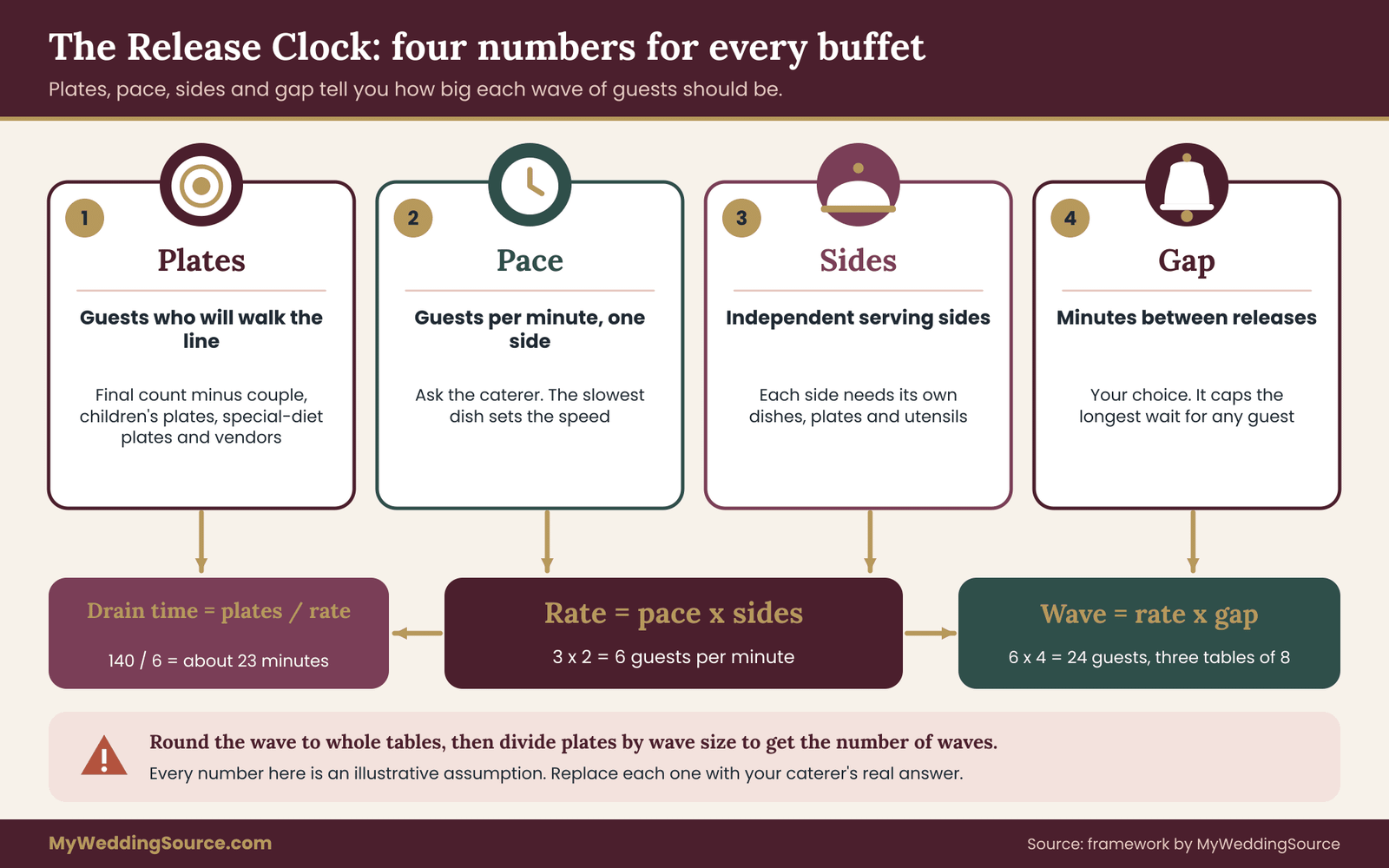
Plates are the number of guests who will walk through the wedding buffet line. This is smaller than your guest count. Subtract the couple if they are served at their table, children with a separate meal, guests with plated special meals, vendors who eat in their own room, and anyone who will not eat at that time. Add a handful for second visits if your caterer allows them. The plates number comes from your final guest list and your meal selections.
Pace is how many guests one serving side moves per minute. This number comes from the caterer. Ask what the team assumes for a menu like yours, and ask whether the figure comes from events with a similar guest count. A buffet with three simple dishes and pre-cut portions moves faster than one with a carving board and a pasta toss. If the caterer cannot give a number, treat any figure you find online as a starting guess and plan a safety margin.
Sides are how many serving sides are open at the same time. A single table served from one side is one side. The same table with duplicate dishes and a server on each side is two. Two separate tables, each double sided, are four. Only count a side if it has its own full set of dishes, its own plates and its own utensils.
Gap is the number of minutes you allow between table releases. You choose this one, and it sets the longest wait any guest will face. A short gap means short waits and more waves to announce. A longer gap means fewer announcements and longer lines.
Put the numbers together in two steps. The combined rate is pace times sides. The wave size is the combined rate times the gap. With a pace of three, two sides and a gap of four minutes, a wave is twenty-four guests, which is three tables of eight.
A note on honest numbers
Every number here is an input you can test. Do not treat a vendor’s figure as a promise, and do not treat the figures in this guide as measurements. The worked examples use made-up values so you can follow the method. Replace them with your caterer’s real answers, then add a margin. A pace that is off by a quarter changes the length of your line by a quarter, which is why the estimator later includes a quick check with a slower pace.
Where the numbers come from
Your caterer owns the pace and the number of sides they can staff. Your planner or coordinator owns the gap, because the gap has to fit the timeline for toasts and dances. Your venue owns the floor plan, which decides how many sides you can fit. And you own the plates number, which changes as RSVPs and meal choices settle.
Write each number in a shared note and put a date beside it. If the guest list changes by a dozen after the final count, update the plates number and the wave size. The estimator takes five minutes to redo, and that is far cheaper than discovering at 7:30 p.m. that a wave of thirty is trying to fit into a queue lane built for twenty.
The next section turns the four numbers into a one-page estimator you can fill in with your caterer on a single call.
A one-page estimator for your wedding buffet line
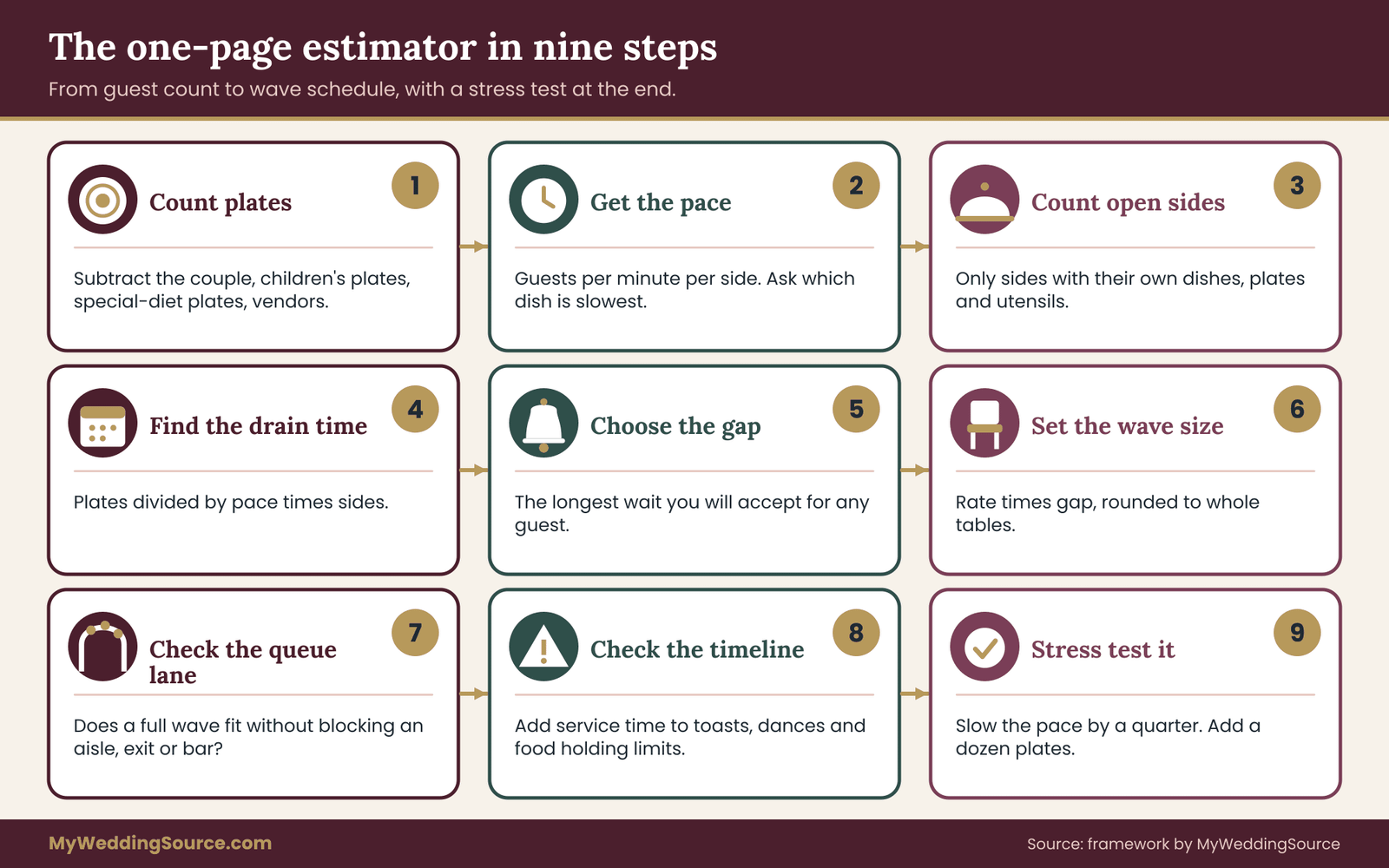
The estimator is a short sequence of calculations for any wedding buffet line, and you can do on paper or in a phone note. It asks nothing technical. Its job is to turn “I hope the wedding buffet line is fine” into three concrete outputs: how long the whole service takes, how big each wave should be, and how many waves you will release.
Step one: count your plates
Start with the final guest count and subtract everyone who will not use the wedding buffet line. Common subtractions are the couple, if you want to be served at your table, children who have their own plated meal, guests with a special-diet plate that the kitchen will deliver, musicians, photographers and other vendors who eat in a separate room, and guests who have told you they will not eat dinner. The remainder is your plates number.
Do this from your actual meal selections, not from a guess. If your caterer collected meal choices, the plated items are already counted. If you did not, ask the caterer which dishes they plan to deliver to tables and how many.
Resist the urge to round up generously. A plates number that is too high produces waves that are too large to fit your queue lane. It is safer to be close and to update the number after the final count.
Step two: get the pace per side
Ask the caterer directly: “For this menu and this many guests, how many guests per minute does one serving side move?” Then ask three follow-up questions. Which dish is the slowest? Would anything be served by a staff member rather than by the guest? And does this pace assume pre-portioned items or scoops?
The answers shape the number. A line with pre-portioned items, large serving spoons and a few choices moves faster than a line with long tongs, delicate salads and a dozen options. A server plating from a carving board takes longer per guest than a self-serve tray. A dim room slows people down, and so do heavy plates, young children and a crowd that has been waiting a long time and is now hungry and a little impatient.
If the caterer gives a range, use the slower end for planning and the faster end for the best case. If the caterer gives no number, assume a slow pace, then tighten the estimate after the tasting or a visit to another event run by the same team.
Step three: count the open sides
Count only sides that are independent. A side is independent if it has its own plates at the start, a full set of dishes, its own serving utensils and a place for a guest to stand without blocking the other side. A second side that shares one set of dishes is not a second side. It is two guests arguing over the same spoon.
At small weddings, one double-sided table is common. At larger weddings, two separate tables or two matching lines at opposite ends of the room are common. The next sections cover layouts. For now, write down how many independent sides you expect to staff.
Step four: find the combined rate and the drain time
Multiply the pace by the sides. If the pace is three per side and you have two sides, your combined rate is six guests per minute. Then divide the plates by the combined rate. That is the drain time, the length of time the wedding buffet line needs to pass every guest if the line never starves and never stalls.
Drain time tells you how long dinner service will take. If the drain time is nearly an hour, you know before you start that you need more sides, a faster layout or a different service style. If it is twenty minutes, you have room to be generous with waves.
Step five: choose a gap
The gap is the longest wait you are willing to impose on any guest. It is a decision about your wedding, not a technical value. Some couples are comfortable with five or six minutes, particularly if there is bread, salad or a first course at each table. Others want waits under three.
A useful way to decide is to picture the guest you most want to protect. If your guest list includes many older relatives, small children or guests with limited mobility, a shorter gap is kinder, because standing in a line is harder for them. If most guests are young and the room is full of conversation, a longer gap may be perfectly comfortable.
Step six: set the wave size
Multiply the combined rate by the gap. With a rate of six guests per minute and a gap of four minutes, a wave is twenty-four guests. Now round to whole tables. If your tables seat eight, three tables is twenty-four guests. If your tables seat ten, two tables is twenty and three is thirty, and you must decide which side of the target you prefer. Rounding down gives shorter lines and more waves. Rounding up gives fewer waves and slightly longer lines.
Then divide the plates by the wave size to find the number of waves. For many receptions, the answer falls between five and eight. Fewer than four waves usually means the gap or the wave is large. More than ten waves usually means announcements will dominate the evening, and you should consider larger waves with a second side.
Step seven: check the queue lane
A wave is a crowd that must stand somewhere. Walk your venue’s floor plan, or the room itself, and find where the wedding buffet line will form. Ask whether the space in front of the table holds a full wave without blocking an aisle, a door, the bar or the dance floor. If it does not, either shrink the wave, lengthen the lane or change the layout.
The practical way to check is to mark the lane during the venue walk-through and ask a few staff members or friends to stand in it. A line of people with plates takes more room than a line of people with empty hands, and guests with mobility devices or strollers take more again. Ask your venue whether tape on the floor or stanchions are allowed, and keep every exit and aisle clear according to the venue’s own rules.
Step eight: check the timeline and the hold time
Write the release schedule into your reception timeline. Add the total service time to dinner start, then see what it does to toasts, the first dance and the cake. Then talk to the caterer about how long food stays out. General food safety guidance from the U.S. Department of Agriculture, for example, warns against leaving perishable food in the temperature range between 40 and 140 degrees Fahrenheit for more than two hours, and for more than one hour in hot weather. Your caterer’s procedures and your local health rules decide the details, and those rules, not this guide, govern what you do.
If the full service window comes close to the caterer’s holding limits, shorten it with more sides rather than faster waves.
Step nine: stress test it
A plan for a wedding buffet line is only useful if it survives a bad day. Run the numbers twice more. First, assume the pace is a quarter slower than the caterer said. With a pace of three that is about two and a quarter per side, a combined rate of four and a half, and a wave of twenty-four guests that now takes about five and a third minutes. Does the plan still hold? Second, add a dozen guests to the plates number, as happens when a few meal changes come in late. Does the wave still fit the lane?
If either test breaks the plan, you have found a weak point while it is still cheap to fix. Add a minute to the gap, add a staff member, or shrink the wave by a table.
What the estimator cannot tell you
The estimator is a model of a wedding buffet line, and models leave things out. It does not know that your uncle will chat with every server. It does not know that a tray will run low and the wedding buffet line will pause for replenishment. It does not know that a thunderstorm will move the whole reception under a tent. It gives you a sensible starting plan and a way to see which numbers matter most.
For that reason the estimator is paired with the release trigger rule in a later section. A trigger based on the actual position of the wedding buffet line corrects for the things a calculation cannot see. Use the estimator to plan, and use the trigger to run.
Keeping the page small
The finished page should fit on one sheet. At the top, list the four numbers. Below them, list the drain time, wave size, number of waves and the gap. Below that, write the order of waves by table number. At the bottom, note the caterer’s contact on the day and the person who will make the announcements. Give a copy to the caterer, the planner or coordinator and the person who will speak. A plan that lives on one page is a plan that gets used, and a plan that only you understand is a plan that fails the moment you step away to greet a guest.
The next section works through one complete example from start to finish, with every assumption marked, so you can see how the steps fit together.
Worked example: a 160-guest wedding buffet line, wave by wave
The numbers below are illustrative assumptions for a made-up wedding. They show how the method fits together and where the trade-offs sit. Replace every figure with your own caterer’s answers and your own venue’s floor plan.
The setup
The couple, whom we will call Dana and Marcus in this example, are planning a dinner for 160 guests at 20 round tables of eight. The caterer will serve a buffet with two entrees, two sides, a salad and rolls. A roast is carved to order at its own station.
Plates first. From 160 guests, subtract the two of them, who will be served at their table. Subtract six children who have a plated children’s meal, seven guests with special-diet plates that the kitchen will deliver, and five vendors who eat in a separate room. That leaves 140 plates. On average about seven guests per table will use the wedding buffet line, which matters later when we size waves.
For pace, the caterer says one serving side moves about three guests per minute for this menu, because the roast is at its own station and the main line holds only quick items. Dana and Marcus plan one double-sided table, with identical dishes on each side. That is two sides, and a combined rate of six guests per minute.
The drain time is 140 divided by six, which is about twenty-three minutes.
Option one: release everyone at once
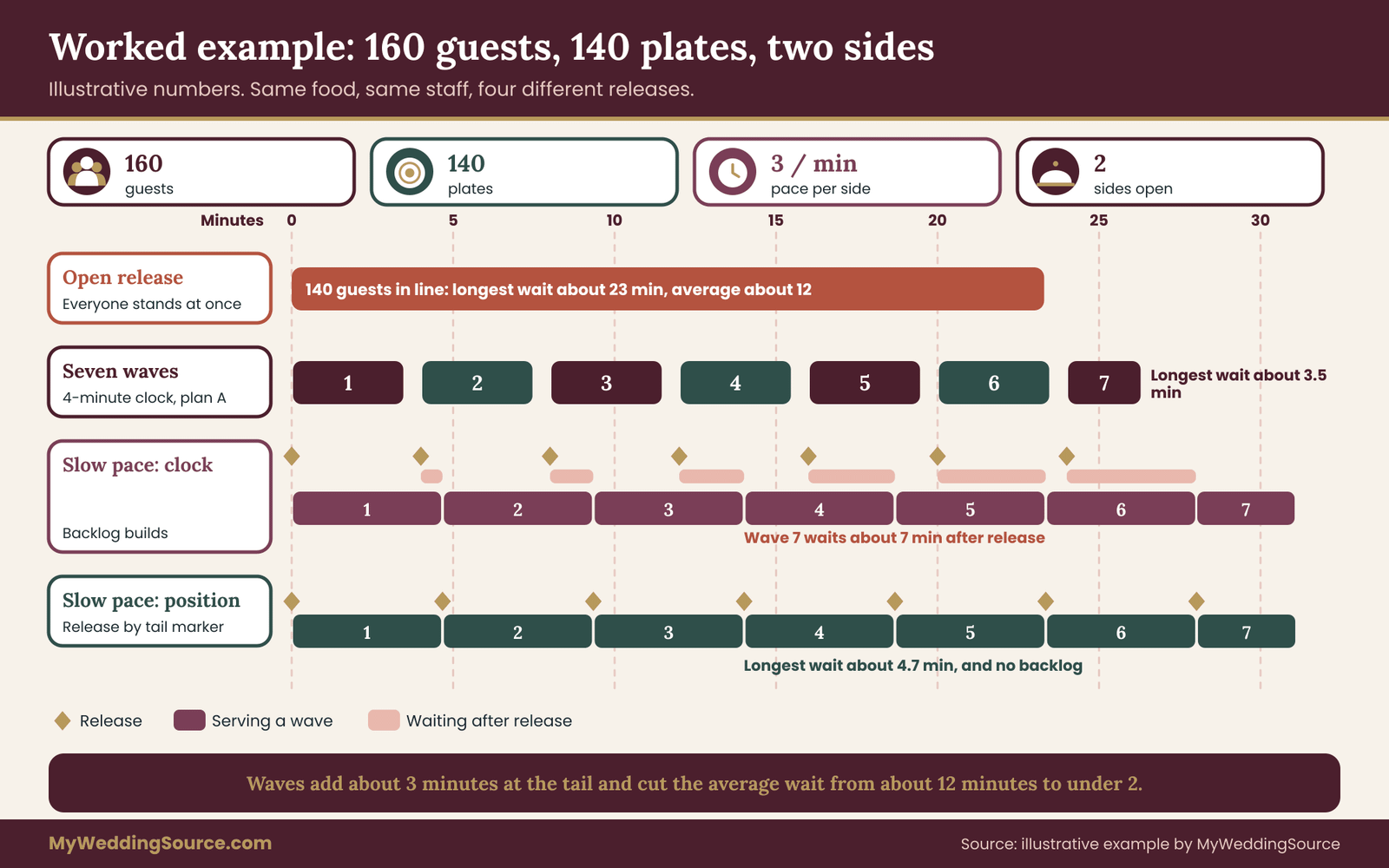
Suppose the host says, “Dinner is open, please help yourselves.” Almost every guest stands, because no one wants to be last. A hundred and forty people converge on one wedding buffet line. The first guests are served immediately. The last guest reaches the front about twenty-three minutes later. The average guest waits about half of that, near twelve minutes, and the wedding buffet line itself fills the middle of the room.
The crowd also blocks the paths servers use to bring water and clear plates. People who have already filled plates struggle to cross the line to reach their seats. Older guests may stay in their chairs, and children may be sent up by themselves. Nothing in this scenario is dramatic. It is simply a bad half hour that the couple did not choose.
Option two: seven waves on a four-minute clock
Now apply the Release Clock. Choose a gap of four minutes. With a combined rate of six, a wave of twenty-four guests would clear in exactly four minutes. Three tables of eight is twenty-four seats, but only about twenty-one will be line users, so a three-table wave needs about three and a half minutes to clear. That leaves thirty seconds of slack for refilling a tray or a slow guest.
Twenty tables released three at a time make six waves of three tables and a final wave of two tables, seven waves in all. They go up at minute zero, four, eight, twelve, sixteen, twenty and twenty-four. The last wave has about fourteen line users, which takes about two and a third minutes, so the final plate is filled around minute twenty-six.
Compare the outcomes. Under open release, the longest wait is about twenty-three minutes and the average is about twelve. Under the seven-wave plan, the longest wait is about three and a half minutes and the average is under two. The cost is that the last guests are served about three minutes later than under open release, because waves leave small gaps in the wedding buffet line. That is the whole trade: a few extra minutes at the tail in exchange for a much shorter wait for nearly everyone.
Option three: the same plan when the pace slips
The previous option assumed the caterer’s number was right. Test it. Suppose the real pace turns out to be a quarter slower, about two and a quarter guests per side. The combined rate drops to four and a half, and a wave of twenty-one now needs about four and two-thirds minutes. On a fixed four-minute clock, each wave leaves a small backlog of about forty seconds. By the sixth wave the backlog has added up to roughly four minutes, and the last wave waits about seven minutes in a line that was supposed to cap at four.
Now release by position instead of by the clock. The rule is simple: release the next wave when the last guest of the current wave has reached a marker partway along the table. Under this rule, each wave goes up about four and two-thirds minutes after the last, no backlog builds, and no guest waits much more than the time it takes to clear a wave. The end of service lands at about thirty-one minutes under either rule, but the trigger keeps the lines short all the way through.
This is why the planning pages in this guide use the clock as a plan and the position trigger as the rule on the day. The clock tells you the schedule to expect. The trigger keeps the schedule honest when reality differs.
What the schedule looks like on the evening
Here is how the plan might read in the reception timeline, using made-up times.
At 6:15 guests are seated and a first course or bread is on the tables. At 6:20 the host welcomes everyone, explains in two sentences how dinner will be released, and invites the couple to be served. At 6:25 the couple’s plates arrive at their table and the kitchen delivers the special-diet and children’s plates. At 6:30 the first wave goes up. The last wave goes up around 6:54 to 6:57, depending on the trigger, and service ends before 7:00. Toasts follow once most guests have food and are seated, and the cake and the first dance follow the toasts.
Notice that nothing needs to be rushed. The couple eats first, because their plates are delivered, so they are not standing in line while guests watch. And the host’s explanation takes about twenty seconds.
What changes with a smaller wedding
Take a wedding of 56 guests at seven tables of eight, with about 48 plates and the same double-sided table. The combined rate is six per minute, so the drain time is eight minutes. A single release would produce a wait of about four minutes on average and eight at the worst. That is tolerable, but it is longer than most guests expect to stand at a wedding.
Two or three waves is enough here. Release the first three tables, then the next three, then the last one, or release the tables with older guests first and the rest a few minutes later. Small weddings gain less from precise timing and more from sequence, which is the subject of the release section later in this guide.
What changes with a larger wedding
Now take 240 guests at thirty tables of eight, with about 212 plates. One double-sided table cannot serve a wedding buffet line of this size well, so assume two such tables at opposite ends of the room, which is four sides and a combined rate of twelve per minute. The drain time is about eighteen minutes. A gap of three minutes gives a wave of thirty-six guests, which is about five tables. Thirty tables in waves of five make six waves, and the whole service finishes in roughly eighteen to twenty minutes.
The new detail is that each wave must be divided between the two tables. Assign each dining table to the nearest line, and make sure each wave contains tables that belong to both lines, so that both lines are busy at once. If all five tables in a wave belong to the same line, one side idles while the other jams. This assignment is easy on paper and nearly impossible to invent during the event, so write it down in advance and show it on the table cards or the seating display.
What changes when you only have one side
Sometimes the venue or the caterer can support only a single-sided wedding buffet line. Using the 160-guest example with a pace of three and one side, 140 plates take about 47 minutes. No release order can change that, because the limit is the rate of the table, not the crowd.
A single side leaves three honest choices. Release one table at a time in a steady rhythm and accept a long service, which works if there is a seated first course and good food holding. Move some of the food to a second serving point, such as the roast station plus a salad table, so the main line has fewer items to carry. Or change the service style for part of the meal, such as serving the first course at tables. What does not work is hoping the wedding buffet line will go faster than the table can serve.
Reading the example honestly
The example is simple on purpose. Real weddings have uneven tables, late arrivals and tray changes. A real caterer might tell you that a double-sided table works at four per side for a short menu and two for a long one. The example is a way to practice the calculation so that when you hear the real numbers you know which ones matter. If you remember only one thing from this section, remember that, for any wedding buffet line, wave size equals rate times gap, and the rate depends on how many independent sides are open.
Next comes the other half of the plan: where the food sits in the room, and why a few feet of placement can matter more than a faster server.
Station placement for a shorter wedding buffet line
Release timing controls how many guests reach the food at once. Placement controls what happens when they get there. A good layout raises the pace, gives the wedding buffet line somewhere to stand and keeps full plates from colliding with empty ones. A poor layout can cancel the benefit of a perfect release schedule.
There are five placement questions, and each one is easy to answer on a floor plan long before the day. Where does the wedding buffet line start? Where does it form? Which way does it move? Where do guests go afterward? And what else in the room is nearby?
Compare the common layouts
Most wedding buffet line setups use one of four layouts. Each has strengths, and each has a typical failure.
One table, served from one side. This is the simplest layout and the slowest. It fits a small wedding or a second, smaller service point. Its failure is the one you would expect: the whole crowd lines up behind a single serving lane, and the lane lengthens with every wave. If you use this layout, keep waves small.
One table, served from both sides. This doubles the rate only if both sides have a full set of dishes, plates and utensils. It needs a lane on each side of the table, so the room must have space on both sides. Its common failure is imbalance. One side looks shorter, guests drift to it, and the other side idles. A server who calls “this side has room” fixes most of that.
Two matched lines at opposite ends of the room. This spreads guests across the floor, shortens the walk from tables and lets each line have its own queue lane. It uses more space and more staff. Its failure is assignment. If guests choose a line freely, one line grows, so give each table a line and put that on the seating display.
A circuit or island. Guests enter at one end of a central table, go around it and leave at the other end. This works in a wide room and for a large wedding, because the food surface is long and guests are always moving forward. Its failure is crossing. If the exit of the circuit meets the entrance of the queue, guests with full plates collide with guests with empty ones.

None of these layouts is best for every room. The right choice depends on your guest count, your caterer’s staff and the shape of the room. If you are comparing layouts, ask the caterer for the combined rate each would deliver, then run the estimator for each. The layout that gives the shortest wedding buffet line for the same staff is usually the one with more independent sides and a clear one-way flow.
Give the wedding buffet line a place to stand
A line needs floor space. People waiting with plates occupy more room than people standing in conversation, and they spread out sideways if the space allows. If you do not give the line a lane, it forms wherever there is space, which is often across an aisle or in front of the bar.
Decide where the lane runs, and make it parallel to a wall or to the table. A lane that runs along a wall keeps the middle of the room open for servers and guests. A lane that crosses the center of the room divides it in two. Then compare the lane with your wave size. If a wave of twenty-four guests will not fit in the lane without crowding an exit, an aisle or the bar, shrink the wave or lengthen the lane.
Mark the lane at the venue walk-through and test it with real people, as the estimator suggests. Ask the venue what it permits. Many venues allow stanchions or floor markers, and some do not. Venues also set rules for exits, aisle widths and how many people a room may hold, and many local authorities base their fire and life-safety rules on published codes such as those from the National Fire Protection Association. Follow the venue’s approved floor plan and the guidance of the local authority, and never trade an exit path for a longer queue lane.
Put the right things at the start and the end
The beginning and end of the wedding buffet line are where small decisions save the most time.
Put plates at the start, not the middle. A guest who has to hunt for a plate stops the line. Put cutlery and napkins on the dining tables when you can, because a guest carrying a plate in one hand, napkins in another and a fork in a pocket is the slowest person in the room. If cutlery must be at the buffet, place it at the end, in a roll-up or a tray, where a guest can pick it up after the food, or have servers bring it to the tables.
Put water and other drinks on the dining tables, or at a separate station, so that no one is balancing a glass while serving. Keep sauces and condiments next to the dishes they go with, so guests do not double back. Keep bread and salad early in the wedding buffet line, where they are quick, and put the heavy items last, where a guest’s plate is ready to carry.
If the caterer uses sneeze guards or other protective equipment, ask where it goes and how tall it is, because it affects reach. Check with your caterer and the local health authority about any requirement, since rules about food service equipment vary by place.
Pull slow items off the main line
The most effective single change for pace is to remove the slowest stop from the main line. A carver, an omelet cook, a pasta pan or a made-to-order station takes much longer per guest than a self-serve tray. If it sits in the main line, every guest behind it waits for the same slow step.
Place the slow item on its own station with its own small queue, ideally near the main table but not in its lane. Guests can visit it before or after the main line, or at a second pass. Ask the caterer whether the item can be pre-sliced or pre-portioned for the first wave, with the live station reserved for second visits. Another option is to have a server carry the slow item to tables in the first wave, so the wedding buffet line serves only quick items.
A good rule is to think in terms of the slowest stop and treat it as the speed limit. If the main line has a fifteen-second item and a thirty-second item, the thirty-second item sets the pace. Speed up that one, and everything behind it speeds up with it.
Keep full plates away from empty plates
The most common avoidable collision in a wedding buffet line is a guest with a full plate meeting a guest with an empty one. It is awkward, it is slow, and it is how plates end up on the floor. The fix is a one-way flow with separate paths.
The queue lane should lead to the start of the table. The path back to the tables should leave from the end and should not cross the queue. If the room makes this impossible, put a server at the crossing point to direct traffic and keep the crossing as short as possible.
Place the dining tables so that the route from the end of the buffet to every table is open. Do not push tables so close to the buffet that they block the exit path. The tables closest to the wedding buffet line should be released with care, because their guests have the shortest walk and the strongest temptation to go early.
Look at what sits next to the buffet
The buffet’s neighbors decide how crowded it feels. Keep it away from the main entrance, so arriving guests do not join the wedding buffet line. Keep it away from the bar, so drink lines and food lines do not merge. Keep it away from the restroom corridor, the dance floor, the band or DJ and the cake table. Avoid a dead end, where a line has no way to spread. And avoid a spot where the line will block a service door the staff needs.
Our wedding bar service planning guide covers bar placement in detail, and the wedding signage guide explains how to mark lanes and directions so guests understand where to stand.
Plan the back of the house
The kitchen side matters as much as the guest side. Caterers need to bring out fresh trays during service, and the route they take should not cross the queue lane. Ask where the staging area is, how trays travel and where used trays go. If the route crosses guests, adjust the layout or the timing.
Heating equipment needs power or fuel. Power cords across a lane are a trip hazard. Open-flame heating fuel may be restricted by your venue or by local rules. Ask your caterer what they plan to use, and ask your venue what it permits. These are quick conversations that prevent last-minute changes.
Think about the weather and the ground
At an outdoor wedding, the wedding buffet line should stand in shade and on level ground, away from wind that blows napkins and lids. A tent protects food and guests, but the space under it is often tight, so measure the lane. Sun, rain and heat change the feel of a line. A wait that is easy in a cool room can be hard on a hot lawn, and heat also shortens the time food can safely stay out.
The National Weather Service publishes weather safety guidance, and it is worth reading before planning an outdoor service. Make a rain plan that includes where the buffet goes, because a late move often creates a crowded, single-sided line.
Make the wedding buffet line reachable for everyone
A buffet is hard for guests who use wheelchairs, walkers or canes, for guests who are short or have limited reach, and for guests carrying a child. Set up at least one way for these guests to be served without waiting in a long queue or reaching across a deep table.
Options include an assisted-service wave, a volunteer or server who fills plates on request, or plates delivered to the table. Make the path wide enough for a mobility device, keep the floor clear of cords and mats, and place the most-requested dishes within reach at the front edge. Federal accessibility standards address aisle widths and reach ranges for public food service lines. A private event may not be covered in the same way, but those standards are a sensible reference, and your venue can tell you what it follows.
A placement check for the walk-through
Take the floor plan to your walk-through and answer six questions. Where does the wedding buffet line start and where does it end? Does the lane hold a full wave without touching an aisle, exit, bar or dance floor? Does the path back to tables cross the queue? Are slow items off the main line? Does the kitchen route stay clear of guests? And can a guest who uses a mobility device reach the food or be served?
If you can answer all six with a clear yes, the layout is ready. If any answer is no, fix it on paper first. Moving a table on a plan costs nothing, and moving it at 6:25 p.m. costs everyone’s patience.
Table-release sequences for a calmer wedding buffet line
A release sequence for a wedding buffet line answers four questions. In what order do tables go? How many go at once? What tells you it is time for the next wave? And how do guests find out? The estimator gave you the wave size. This section covers the other three, and it gives you a short ladder you can use to decide the order without ranking your guests like a seating contest.
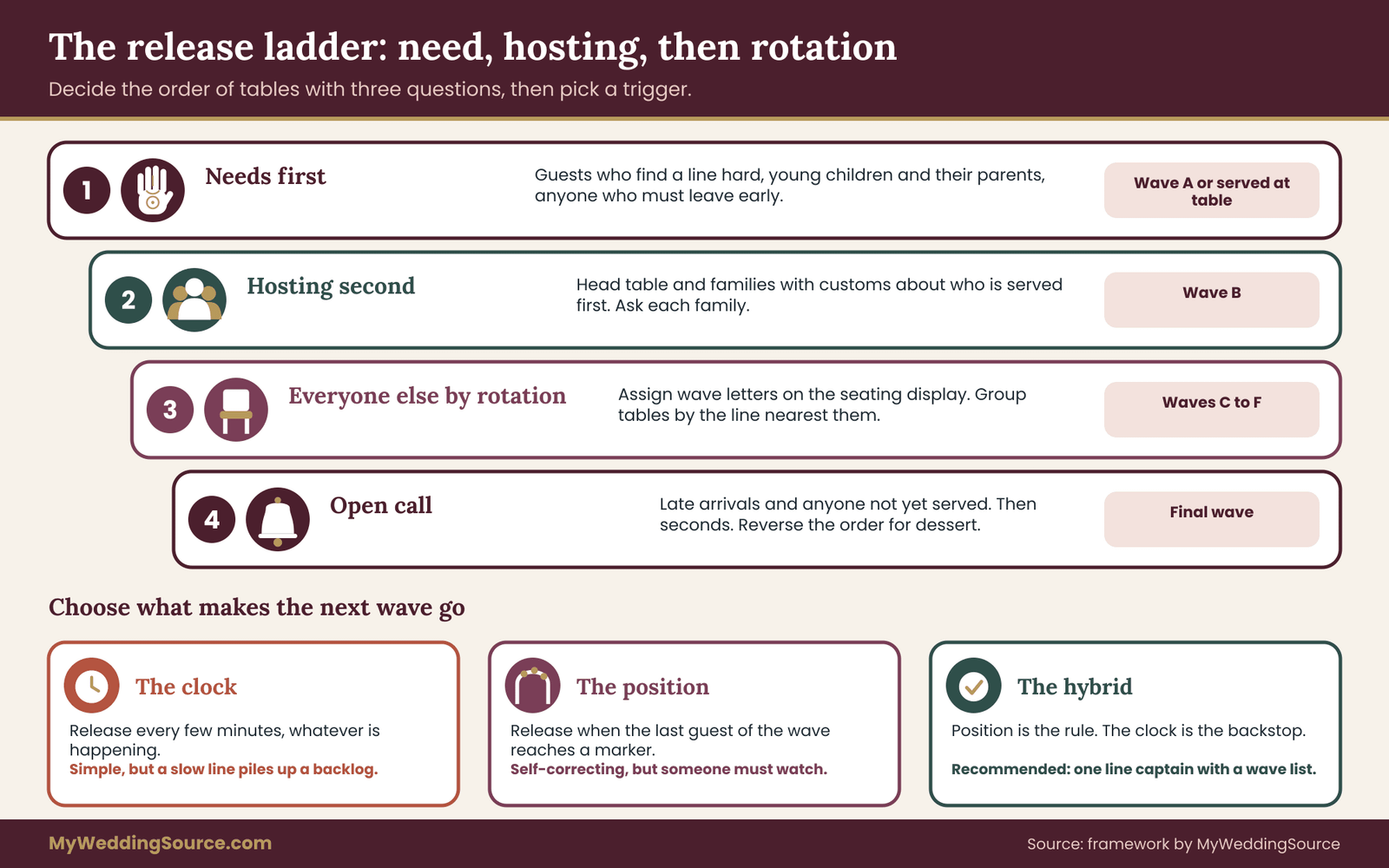
Start with need, then logistics, then rotation
When couples plan the order of a wedding buffet line, they often start with status: the parents, the grandparents, the wedding party, the friends. That produces an order that is easy to explain and hard to enjoy, because it is built around who matters most rather than who needs what. A better order follows a ladder with three questions, asked in this order.
First, who needs to eat early or be served? This covers guests who will find a line hard, such as people who use mobility devices, very young children and their parents, older guests who tire quickly, and anyone who has told you they need to leave early or take medication with food. These guests go first, or are served at their table. Doing this on the basis of need is gentler than doing it on the basis of age, because it avoids pointing at anyone.
Second, who is hosting? Families often expect the head table, parents and close relatives to go early, and some cultures and faiths have customs about who is served first or about a blessing before the meal. Ask each family what they expect. If a custom matters to someone, build it into the sequence on purpose, because a surprise during service is harder to fix than a conversation a month earlier.
Third, everyone else, in a fixed rotation. Assign the remaining tables to waves by location, grouping tables by the line they are nearest to. Within a line, rotate which group goes first at later courses, so the same people are not always last.
The ladder keeps the order defensible. If anyone asks why their table is where it is, the answer is simple: need first, then hosting, then rotation by location.
Choosing an order for the middle tables
For the middle of the sequence, there are four common methods, each with a different feel.
By table number. Call table one, then two, then three. It is the easiest to announce and the easiest to follow. The cost is that table numbers often follow importance, so the same tables are always last. Reverse the order for dessert or a second pass to even it out.
By wave letter. Assign each table a wave on the seating display or on the table cards, such as A, B or C, and call the waves. Guests see their wave when they find their seat, so they know what to expect before dinner starts. This works well with large weddings and is easy to pair with a seating display, as described in our guide to the wedding seating chart.
By color or symbol. A colored dot or a small icon on each table number does the same job without needing guests to read letters. It helps when a guest list includes people who read little English or who have a visual impairment, as long as the color is not the only clue. Pair it with a letter or a number.
By random draw. Draw a card from a deck for each table. This is playful and feels fair, and it works at casual weddings. It is harder to align with the lines and with priority guests, so it is a poor fit for a large wedding.
For most couples, wave letters on the seating display are the most reliable method. They are quiet, they work without a microphone and they are easy to hand to the caterer.
Choose a trigger, not just a schedule
A schedule says when waves will go. A trigger says what makes the next wave go. The distinction matters because the pace of a real wedding buffet line is rarely the pace in the plan.
There are three kinds of trigger.
The clock. Release a wave every few minutes, whatever is happening. It is simple, and it is predictable for the host and the kitchen. Its weakness is that it ignores reality. If the wedding buffet line is slow, the clock piles guests on top of a backlog. If the line is fast, the clock leaves the table idle.
The position. Release the next wave when the last guest of the current wave reaches a marker, such as the third dish on the table, or when the line behind the marker has fewer than a certain number of people. It corrects itself. A slow line delays the release, and a fast line speeds it up. Its weakness is that it needs someone watching.
The hybrid. Use position as the rule and the clock as a backstop. A line captain releases the next wave when the tail passes the marker, and if more than a minute past the planned gap goes by, the captain checks whether something is wrong and decides whether to release anyway. This is the method this guide recommends.
The hybrid requires only one person with a view of the wedding buffet line. The coordinator, a banquet captain from the caterer or a trusted friend can do it. Give that person a one-page list of waves, a marker on the table and the authority to release without asking anyone.
Choosing the signal
How do guests learn that their table is up? Four signals work, and they can be combined.
A microphone announcement. The host or DJ says which tables may go. It is clear and loud, and it makes the evening feel organized. Its downside is that every announcement interrupts conversation, so for seven waves it becomes a chore. Limit announcements to the first wave, a midpoint and the open call, and use another signal for the rest.
A server at the table. A server or volunteer walks to a table and quietly says that it is welcome to go up. This is the most gracious method. It is also the most staff-intensive, so it suits small and mid-sized weddings.
A table sign. A small flag or card on each table flips from “please wait” to “welcome to the buffet.” A server turns it over, and guests glance at it. It is quiet and clear, but it needs a little design, and it must not look like a restaurant waiting sign. Keep the wording short and the type large enough to read from a seat.
A posted wave list. A sign near the entrance or on the seating display lists the waves with a rough time. It prepares guests and takes pressure off the host. It is not a signal by itself, because guests lose track of the time, but it is a useful companion to one.
What to say, in plain words
Guests will follow a system that sounds friendly and clear. A host can explain dinner in two or three sentences, once, before the first wave.
“Dinner is served buffet style. To keep lines short, we will invite a few tables at a time. Your table card shows your wave, and a server will let you know when it is your turn.”
For a quiet table-by-table release:
“Table nine, please help yourselves whenever you are ready.”
For the last call:
“Anyone who has not been up yet, the buffet is open to everyone. Please take your time.”
Keep these short. A host who explains the system for a minute and a half invites questions and makes the wedding buffet line feel complicated.
Handling the guest who jumps the line
Some guests will go early, either because they did not hear the announcement or because they are hungry or restless. Do not confront them. A server near the start of the line can say something like, “Tables nine to eleven are up next. May I bring you a drink while you wait?” That is kind, factual and gives them a way back to their seat without embarrassment.
If one early guest is let through, others will follow, so the line captain and the servers need to agree on a rule in advance. A common choice is to let one or two individuals go through and to hold groups, because individuals have little effect on the pace and groups do.
Keep waiting guests occupied
A wait for the wedding buffet line feels shorter when something is happening at the table. Plan something that arrives while guests are waiting. Bread and salad at tables, a first course, a drink service, a short slideshow or a quiet musical interlude all work. If the bar is open, a server can offer drinks to tables that are waiting. If a wedding has a cocktail hour that ended recently, guests will still be in the mood to talk, and a few minutes of seated conversation is not a hardship.
The wedding cocktail hour guide covers how to use the time before dinner so guests arrive at their tables fed lightly, settled and ready to wait. A guest who has had a light snack and a drink is less likely to rush the first wave.
Getting guests to their seats before the first wave
A release plan for a wedding buffet line only works if guests are at their tables. If half of them are still at the bar or outside, the first wave is half empty and the second wave is a crowd. Announce a seating call ten to fifteen minutes before dinner, and have the host or the band move people toward their tables. Tell guests not seated that they will be included in the open call.
Allow for people at the wrong table. Some guests will sit with friends at another table, which scrambles waves. The simplest remedy is to release by table card or by wave letter, so that a guest who sits elsewhere still goes up with the people at that table. A tolerant approach keeps the wedding buffet line moving and avoids policing seats.
Special cases that change your wedding buffet line
A wedding buffet line plan that works for an average table can fail for the specific people at your wedding. The cases below come up often. None needs an elaborate fix. Each needs a decision made in advance, so the person running the wedding buffet line is not inventing policy while a queue forms.
The couple
You have three sensible choices. The first is to have your plates delivered to your table before the first wave, so you eat in peace and are not in a line while guests watch. The second is to go in the first wave with the head table. The third is to go last, after guests have eaten, and accept that you will eat later than most.
The first choice is the most common, and it has a practical benefit beyond comfort. Once the couple is eating, guests feel permission to eat, and the first wave starts on a calmer note. It also gives you something rare at a wedding, ten quiet minutes with your plates. Ask the caterer whether your plates can be a smaller version of the buffet or something chosen from the menu.
Children and their parents
Young children are the hardest guests to fit into a buffet, because they are slow, they need help carrying plates and they get hungry before everyone else. Plan their meal as a separate service. A children’s plate delivered to the table before the first wave means parents are not standing in a line with a child by one hand and a tray in the other.
If children will use the wedding buffet line, put them and their parents in an early wave, and ask a server to be nearby. Keep hot dishes out of reach of small hands, or serve them from the back of the table. Tell parents in advance how the children’s meal works, so no one is surprised. Seat families with young children where they can leave the table easily and where they are not sitting in the center of a long line of chairs.
Older guests and guests with limited mobility
Standing in a line is tiring, and carrying a full plate across a room is harder than it looks. For these guests, the best experience is service at the table, delivered by a server or a family member. If the caterer can offer that for a few guests, it takes very little effort and means a great deal.
A second option is an early wave with an assistant. Pair guests who may need help with a family member or volunteer who goes up at the same time, and mention it to that person ahead of time. Do not assume that a guest wants help. Ask quietly beforehand, and let the guest choose how to be served. Guests who use mobility devices should have a clear path to the food and a table in a spot that does not require crossing the queue lane.
Allergies and dietary needs
A shared wedding buffet line is a hard place for a guest with a serious food allergy. Serving spoons move between dishes, crumbs travel, and a label can be wrong or missing. The safest approach for a severe allergy is a plate prepared in the kitchen, delivered to the guest by someone who knows what it contains. That also removes the guest from the wedding buffet line.
Ask guests about dietary needs on the RSVP, then pass the list to the caterer and ask how each need will be met. Ask whether special plates will be prepared separately, how the kitchen avoids cross-contact and how servers will recognize the right guest without announcing it. A discreet mark on a table card or a seat marker works better than calling out a dish. The U.S. Food and Drug Administration publishes general information about food allergies, and your caterer should be able to describe their own procedures.
For guests with milder preferences, such as vegetarian or low-salt, a clear label on every dish is usually enough. If you want more on balancing a menu across ages and diets, read our guide to wedding menu planning, which treats that question in depth.
Vendors
Photographers, videographers, the DJ or band, the planner and any assistants often need to eat during dinner, and many contracts include a meal for them. The risk is that vendors eat at the wrong time. A DJ who eats during the toasts leaves no one to run the sound. A photographer who eats while guests are in the first wave misses the sight of a full room. The usual solution is to schedule vendor meals in the middle of service or just after the first wave, and to confirm that in writing.
Check each vendor contract for what it says about meals, the number of meals and the timing. The wedding vendor contract guide explains what clauses to expect. Then tell the caterer the number of vendor meals, so the plates number is right.
Guests who arrive late or do not eat
Some guests arrive during dinner, and some choose not to eat at the buffet at all. Neither is a problem if the plan expects it. Include late arrivals in the open call, and tell servers that a guest arriving late may need a plate or a short explanation. Guests who do not plan to eat should be removed from the plates number, but check with the caterer, because a guest who says no at the RSVP stage sometimes eats anyway.
Second helpings and dessert
Seconds are the reason many wedding buffet lines run out. Decide whether guests may return. If so, open seconds only after the last wave has been served, and tell the host to announce it. This keeps the first pass short and avoids a second line forming as soon as the first one ends. It also lets the caterer confirm that every guest has been served before the remaining food is available again.
Dessert is a separate service. If dessert is a buffet or a station, treat it as a mini release and reverse the order, so the tables that went last for dinner go first. If a cake is cut and served by the kitchen, that is its own process, and it should not overlap with the dinner release.
Running the wedding buffet line on the day
A good plan for a wedding buffet line still needs someone to run it. The best release plans fail when no one knows who is in charge. Assign roles in advance and write them on the one-page line card.
Five roles
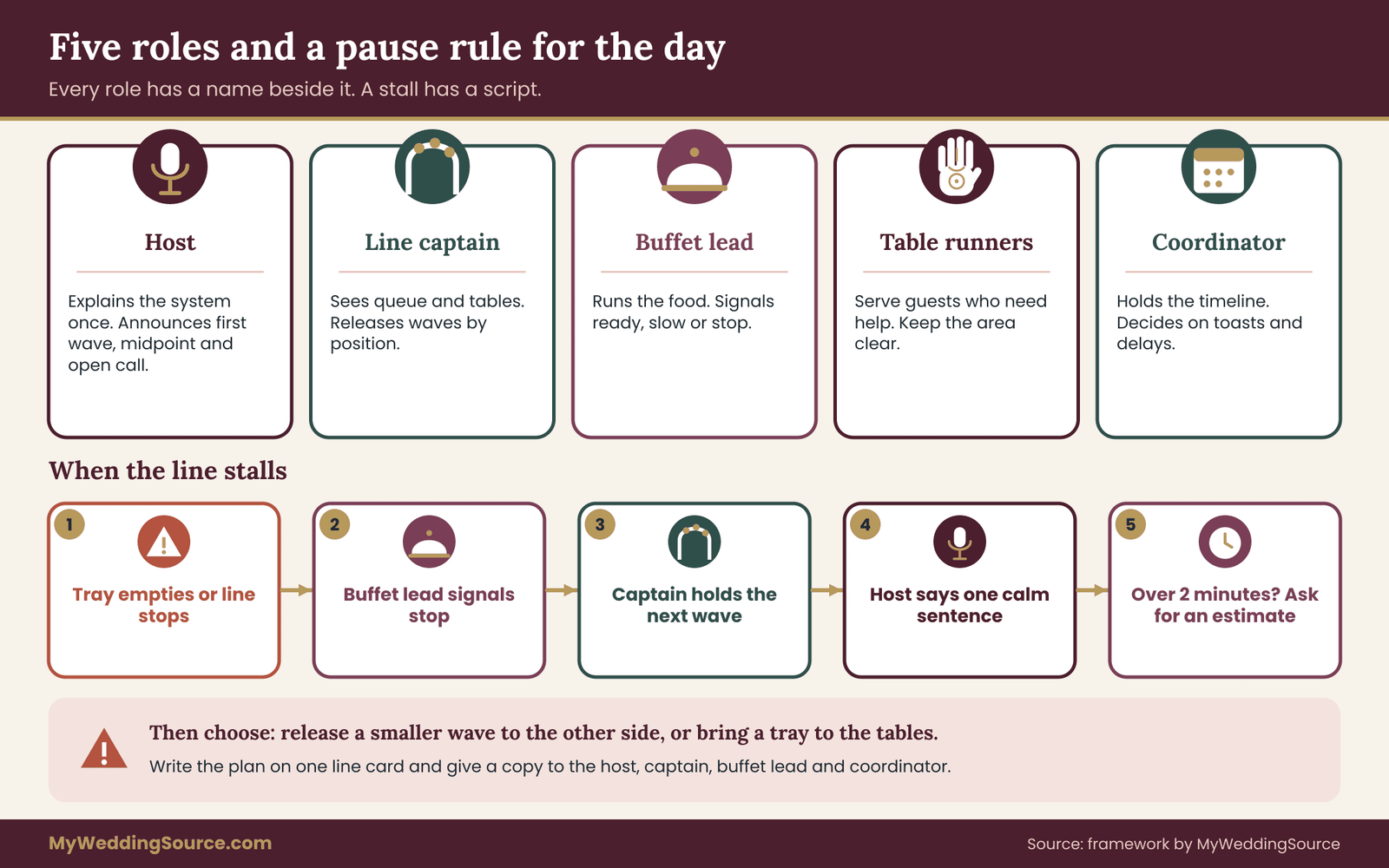
The host or announcer speaks to guests. This may be the DJ, the emcee, a friend or the planner. The host explains the system once, announces the first wave, the midpoint and the open call, and keeps conversation going when the wedding buffet line pauses.
The line captain watches the line and decides when to release. This person stands where they can see both the queue lane and the tables. The captain carries the wave list and the marker rule and has authority to release without asking.
The caterer’s buffet lead runs the food. This person watches trays, swaps them and tells the captain if anything slows down. The captain and the buffet lead need to be able to talk in two or three words, with a signal for ready, slow and stop.
The table runners are servers or volunteers who deliver plates to guests who need them, signal tables and keep the area around the wedding buffet line clear.
The coordinator or planner watches the whole room, keeps the timeline and handles anything the others cannot. If a toast is scheduled, the coordinator decides whether to delay it.
At small weddings one person may fill two roles. What matters is that every role has a name beside it.
A five-minute huddle before service
Before service begins, gather the host, line captain, buffet lead and coordinator for five minutes. Confirm the wave order, the trigger and the marker. Confirm the first plates, such as the couple’s and any special meals. Ask the buffet lead how many trays are ready and how long until refills. Agree on a pause signal, which is a hand gesture or a short message. Then walk the wedding buffet line once with the captain, standing at the marker, and look at the tables from there.
When the line stalls
Every wedding buffet line stalls sometimes. A tray empties, a guest spills a drink, a dish needs a new serving spoon. The question is how the team responds. A pause rule helps.
When the buffet lead signals a stall, the captain holds the next wave. The host says something calm and brief, such as “We are refreshing a tray, thank you for your patience,” and moves on. If the pause lasts more than two minutes, the captain asks the buffet lead for an estimate and decides whether to continue holding, release a smaller wave to the other side or ask servers to bring a tray to the tables.
If a dish runs out, ask the caterer how they plan for that in advance. Most have a reserve, and the buffet lead can say so. If not, the captain tells the host, and the host tells guests which items are still available.
When the wedding buffet line is too long anyway
If the line grows beyond the lane, shrink the next wave. Release two tables instead of three, or split a wave between the two sides. Do not make a bigger announcement to move the crowd faster, because that adds pressure. If one side is much longer than the other, a server can redirect guests to the shorter side. And if a wave of guests stands up early, let them go in order, because telling a crowd to sit down creates more confusion than it solves.
Toasts and speeches during service
Toasts are the most common collision with dinner. A toast during service stops the wedding buffet line, because guests will not carry plates during a speech, and the food sits longer. Place toasts before the first wave, with guests holding drinks, or after about eighty percent of guests have been served. Your coordinator will have the timeline, and the wedding vendor timeline guide shows how to align vendors and the host with it.
Ask speakers to keep to the time they were given. If a speech runs long, the buffet lead should tell the captain how long the food can wait, so the team can decide whether to start the next wave after the speech or hold the wedding buffet line.
Clearing without clogging
Plates stack up as the first waves finish. Left alone, they crowd the tables and block paths. Ask the caterer to clear in waves, behind the release, starting with the tables that finished first. Put a clearing station away from the buffet, and keep the servers’ route to it separate from the queue lane. A clear table also tells guests that service is moving.
Food holding time, heat and weather for a wedding buffet line
Food safety sits behind every buffet decision. Your caterer and your local health department set the food safety rules. What you can do is understand how your release plan interacts with them, and ask the right questions of the person who does set them.
The U.S. Department of Agriculture advises that perishable food should not stay in the temperature range between 40 and 140 degrees Fahrenheit for more than two hours, and for no more than one hour when the air temperature is above 90 degrees. The FDA Food Code is a model that many local health departments use as a base. Your caterer is responsible for holding food correctly, using proper equipment, rotating trays and following local rules, and your county or city health department is the authority on what is allowed.
For your plan, the practical questions are these. When does the food come out, and when does the clock start? How long will service last, according to the estimator? How does the caterer rotate trays so that no tray sits for the whole service? What happens if toasts or a delay push service back? And what changes if the day is hot?
A longer service means trays are out longer, so a plan that adds sides and shortens service helps with holding time. A delay before the first wave is more dangerous than a slow line, because the food is already out. Tell the caterer to hold the food until the host has confirmed that guests are seated and the first wave is ready, and plan the timeline so service starts on time.
On a hot day, ask about shade, insulated or chilled serving equipment, and a shorter hold window. The National Weather Service has safety guidance for heat and storms. If your reception is outdoors, make weather part of the plan and decide in advance who calls a change, what the new layout is and how waves adjust under a tent.
Do not publish a promise to your guests about when dinner will be served. Say something looser, like “dinner service begins around seven,” and leave room for delays. Precise timing is the caterer’s call, and it belongs in the caterer’s judgment, not in a printed program.
What to ask your caterer and your venue
Most of the numbers behind a wedding buffet line come from two conversations. Have them early, ideally before you sign, and put the answers in writing. The questions below are in plain language so you can read them aloud on a call.
Questions for the caterer
Ask how many guests per minute one serving side moves for your menu, and which dish is the slowest. Ask how many serving sides they plan for your guest count and how many staff will work each one. Ask whether the second side of a double-sided table comes with a full duplicate set of dishes, serving utensils and plates, or whether that is an extra charge.
Ask how they handle slow items such as carving or made-to-order stations, and whether those can be placed off the main line. Ask how they rotate and replace trays during service, how they hold hot and cold food and what they do if service runs long. Ask how they deliver special-diet plates, how they avoid cross-contact and how they identify guests discreetly.
Ask what they need from you: a final count by a certain date, a floor plan, a power source, a space for staging. Ask whether they have a buffet lead who will work with your line captain on the day, and whether that person will attend the pre-service huddle. A caterer who has run many buffets will answer these questions easily, and the way they answer tells you a lot about how the day will go.
Questions for the venue
Ask where buffet tables can go and which layouts the venue has approved. Ask whether floor markers, stanchions or signs are allowed. Ask about aisle widths and exit paths that must stay clear, and which rules apply to the number of guests in the room. Ask about power, and about restrictions on open-flame heating fuel. Ask where the caterer can stage trays and which route they must use.
Ask about rain plans, tents and what changes if the room changes. If you rent extra tables, linens or serving equipment for a second line, the wedding rental planning checklist shows what to confirm, including delivery times and who sets up.
What to put in writing
A conversation is easy to forget. After each call, send a short written recap to the vendor, and ask them to confirm it. Include the number of serving sides, the number of staff per side, how many dishes per side, the location of slow stations, the number of special-diet plates and the plan for tray rotation. If the caterer’s contract includes a staffing line for the buffet, make sure it names the number of attendants.
If the contract already exists, compare it with your plan before you sign changes. A plan to serve from both sides is only real if the contract provides enough staff and enough equipment for both sides. It is a common gap, and it is easy to fix before the wedding and hard to fix after.
What each fix costs, and which to try first
Every fix for a long wedding buffet line has a price, in money, in space or in attention. The order below puts the cheapest and most reliable fixes first. Work down the list until the estimator gives you a plan you like.
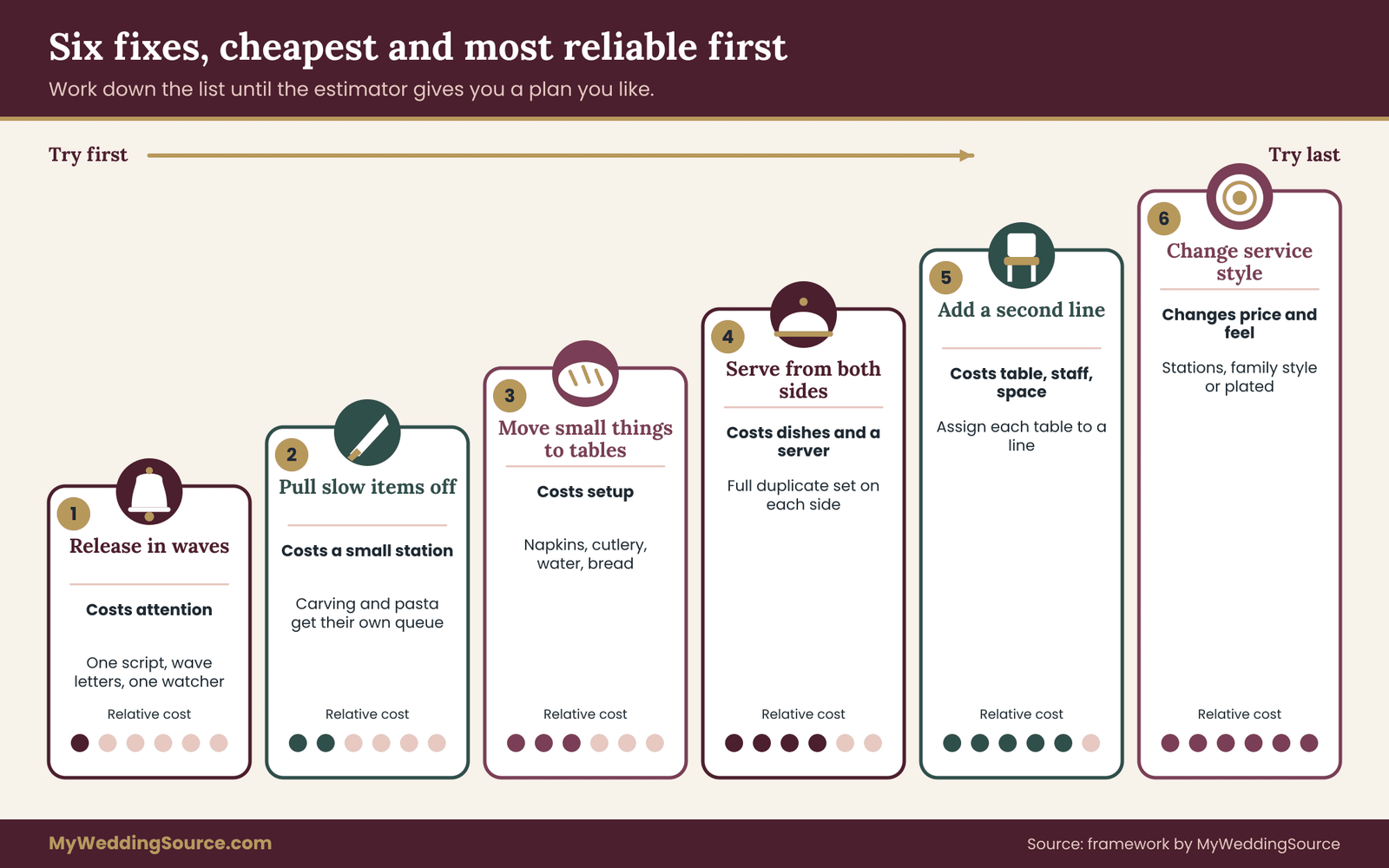
One: release tables in waves. It costs one announcement script, a seating display that shows waves and a person to watch the wedding buffet line. It reduces the average wait more than any other single change. Start here.
Two: pull slow items off the main line. The cost is a small extra station and sometimes a staff member. It raises the pace of everyone behind the slow item, and it is the next best step if waves are not enough.
Three: move small things to the tables. Napkins, cutlery, water, bread and sometimes salad at the tables shorten the wedding buffet line and the first wave. It costs a little more setup and sometimes a little more service staff.
Four: serve from both sides of a table. This costs a duplicate set of dishes, utensils and plates, and usually another server. It nearly doubles the rate, and it is worth the cost when the drain time is long. The extra dishes mean extra food, so ask how the caterer prices them.
Five: add a second line. It costs another table, more food surface, more staff and more floor space. It makes sense for larger weddings or when the room is wide. It is more expensive than a double-sided table, and it brings assignment work.
Six: change the service style. Family style, stations or plated service remove most of the wedding buffet line. They also change the cost, the staff and the feel of the meal. They are the right choice if the estimator shows that no buffet layout can give you a service time you like.
These are not rankings of quality. A couple who loves the generosity of a buffet may choose fix four or five without hesitation. The point is to spend money on the changes that help most per dollar, and to avoid spending on a faster server when the real problem was a crowd released all at once. If you have already read about designing reception guest flow from entry to exit, you will recognize this as one piece of that larger system.
Common mistakes with a wedding buffet line, and the fix for each
Releasing everyone at once. The crowd is the problem. Release in waves, sized by the estimator, and use the first announcement to explain the system in two sentences.
Counting a side that is not independent. A second side that shares dishes with the first is not a second side. Count sides only when each has its own dishes, plates and utensils.
Putting a slow station in the main line. One carving board can set the pace for 150 guests. Give it its own station or pre-slice the first pass.
Letting the wedding buffet line form across an aisle. Mark a lane with the venue’s permission and test it with real people. If a wave does not fit, shrink the wave.
Forgetting where full plates go. Give guests a separate path back. If the room does not allow one, station a server at the crossing.
Making the order a ranking. Use need first, hosting second and location third, and rotate later courses so the same tables are not always last.
Running the clock with no one watching. A clock without a line captain piles guests on a backlog. Use position as the rule and the clock as the backstop.
Scheduling a toast in the middle of service. Place toasts before the first wave or after most guests have been served, and tell the buffet lead how long the food can wait.
Leaving special diets to the wedding buffet line. Prepare and deliver plates for guests with serious allergies, and ask the caterer how they prevent cross-contact.
Forgetting vendors. Count their meals, schedule them and confirm the timing in writing.
Not testing the plan. Run the estimator with a slower pace and a larger plates number. Walk the lane before the day.
Your next steps
Start with the numbers behind your wedding buffet line. Write down your plates, ask the caterer for the pace per side and the number of sides they can staff, and calculate the drain time. If it is more than about half an hour, look at fixes four to six before you look at the order of tables.
Next, choose your gap and your wave size, and group your tables into waves. Put the wave letters on the seating display, assign each table to the nearest line and note the special cases. Then walk the room with the floor plan, mark the lane, find the slow items and decide where they go.
Finally, write the line card, name the five roles and plan the five-minute huddle. A wedding buffet line that has a plan, a person watching and a script for the first announcement will move at the pace of its serving table, and most guests will barely notice the wedding buffet line at all.
FAQ
How long should a wedding buffet line take?
It depends on guest count, pace and the number of serving sides, so no single answer fits every wedding. Use the estimator: divide your plates by the combined rate to get the service time. Then aim for waves that keep each guest’s wait to a few minutes. Ask your caterer for their own pace figure rather than relying on a general number.
Is it rude to release tables one at a time?
No. Most guests welcome it, as long as it is explained in a sentence or two and the order is fair. Put the order on the seating display or table cards, serve guests who need help first and rotate later courses so the same tables are not always last. A friendly host and a visible system make waves feel organized rather than strict.
Should the couple go first in the buffet line?
You have three choices: have plates brought to your table, go up with the first wave, or go last. Many couples choose delivered plates, because it avoids standing in line in front of guests and gives you a few quiet minutes to eat. Ask the caterer what is possible, and decide who will tell guests that dinner is open.
How many serving sides do we need for our guest count?
Work backward from the service time you want. Divide your plates by the time you are willing to spend, and compare the result with the pace your caterer gives per side. For example, if a side moves three guests per minute and you want service done in about twenty-five minutes, 150 plates need about two sides. Confirm with your caterer and venue.
What is the best way to handle guests with allergies at a buffet?
For severe allergies, ask the caterer to prepare a plate in the kitchen and deliver it to the guest, so the guest does not use shared serving spoons. Collect dietary needs on the RSVP, pass them to the caterer in writing and ask how they prevent cross-contact. The FDA publishes general food allergy information, and the caterer’s procedures should be clear.
Where should the buffet go in the room?
Away from the entrance, the bar, the restroom route and the dance floor, with space for a full wave to stand along a wall or table and a separate path back to the tables. Keep the kitchen route clear of guests. Confirm the layout with your venue, which sets the approved floor plan, exits and rules for the number of guests.
Can we use a buffet at an outdoor wedding?
Yes, with extra planning. Choose shade and level ground for the wedding buffet line, ask the caterer about holding food in heat, and make a rain plan that says where the buffet moves. Food safety guidance from the USDA is stricter in hot weather, and your caterer and local health department set the rules. Check the National Weather Service forecast before the day.
What if the caterer says a double-sided table is not possible?
Ask why, and whether a second serving point could work, such as a station for slow items or a second table for salad and bread. If only one side is possible, release smaller waves more steadily, plan a first course at the tables and ask about the holding time for a longer service. If the service time is still too long, consider another style.
Sources
- Danger Zone (40 °F to 140 °F), USDA Food Safety and Inspection Service
- FDA Food Code, U.S. Food and Drug Administration
- Food Safety, foodsafety.gov, U.S. Department of Health and Human Services
- Food Allergies, U.S. Food and Drug Administration
- Food Safety, Centers for Disease Control and Prevention
- Weather Safety, National Weather Service
- Information and Technical Assistance on the Americans with Disabilities Act, U.S. Department of Justice
- U.S. Access Board, accessibility guidelines and standards
- National Fire Protection Association, codes and standards