
A remarriage anniversary is the yearly marking of a second or later marriage, and it rarely belongs to one date or one set of people. This guide shows how to build a family calendar, choose the date that anchors your remarriage anniversary, handle earlier milestones with care, and word invitations and messages without assuming anyone’s role.
List every date that touches your household: the legal wedding date, the ceremony or party date, the day you met, each partner’s earlier history, and the children’s own milestones. Pick one anchor date for the remarriage anniversary, then give every other date a size: private, a quiet mention, a small family gesture or a full celebration. Ask the people affected before you mark a date that belongs partly to them. Write wording that describes what happened, not who should feel what.
Anniversaries are simple for a first marriage that began in a straight line. One day, one ceremony, one cake, and every year after that the same date comes around. A remarried couple often has a more crowded calendar. There may be an earlier wedding for one partner or both. There may be a divorce date, a date of loss, children with birthdays and their own memories, and a second ceremony that happened months after the legal one.
None of that is a problem. It only means the remarriage anniversary needs a little more thought than a reminder on a phone.
The aim here is practical. By the end you will have a method for deciding which dates to mark, how loudly, and with whom. You will also have sample wording for a card, a toast, a family message and a conversation with a child who is not sure how they feel.
Nothing in this guide tells you what a stepfamily should feel or promises that a ritual will settle old tension. Rituals help when they are chosen by the people who live with them, and they cause friction when they are imposed.
A note on scope. This is general planning information, not legal, tax or financial advice. Rules about marriage records, benefits and filing status differ by state and by situation, so where a date has a legal meaning this guide points you to the office that issues the current rule.
What a remarriage anniversary covers
Most advice about anniversaries assumes a first marriage and a clean single date. A remarriage anniversary has the same core as any other: it marks the day two people committed to each other. The difference is the context around it. Each partner arrives with a history, and often with children, parents and friends who knew the earlier chapter. The anniversary sits inside that history rather than above it.
It helps to separate four ideas that people tend to blend together.
The legal date. This is the day the marriage was solemnized and recorded. It appears on the marriage certificate and is the date government offices use. If you want a refresher on how that document works, the guide on organizing wedding records after the event explains certified copies and what to keep.
The ceremony date. Sometimes the legal date and the ceremony are the same. Sometimes a couple signs paperwork at a courthouse on a Tuesday and holds a ceremony with family three months later. Both are real milestones.
The celebration date. A party, a dinner or a backyard gathering that happens on a different day again. For some families this is the date the children and extended relatives actually remember.
The family date. A day that belongs to the whole household, such as the day the families first lived under one roof, a first holiday together or the day a child asked to be called by a new name for a stepparent. Not every family has one, and none is required.
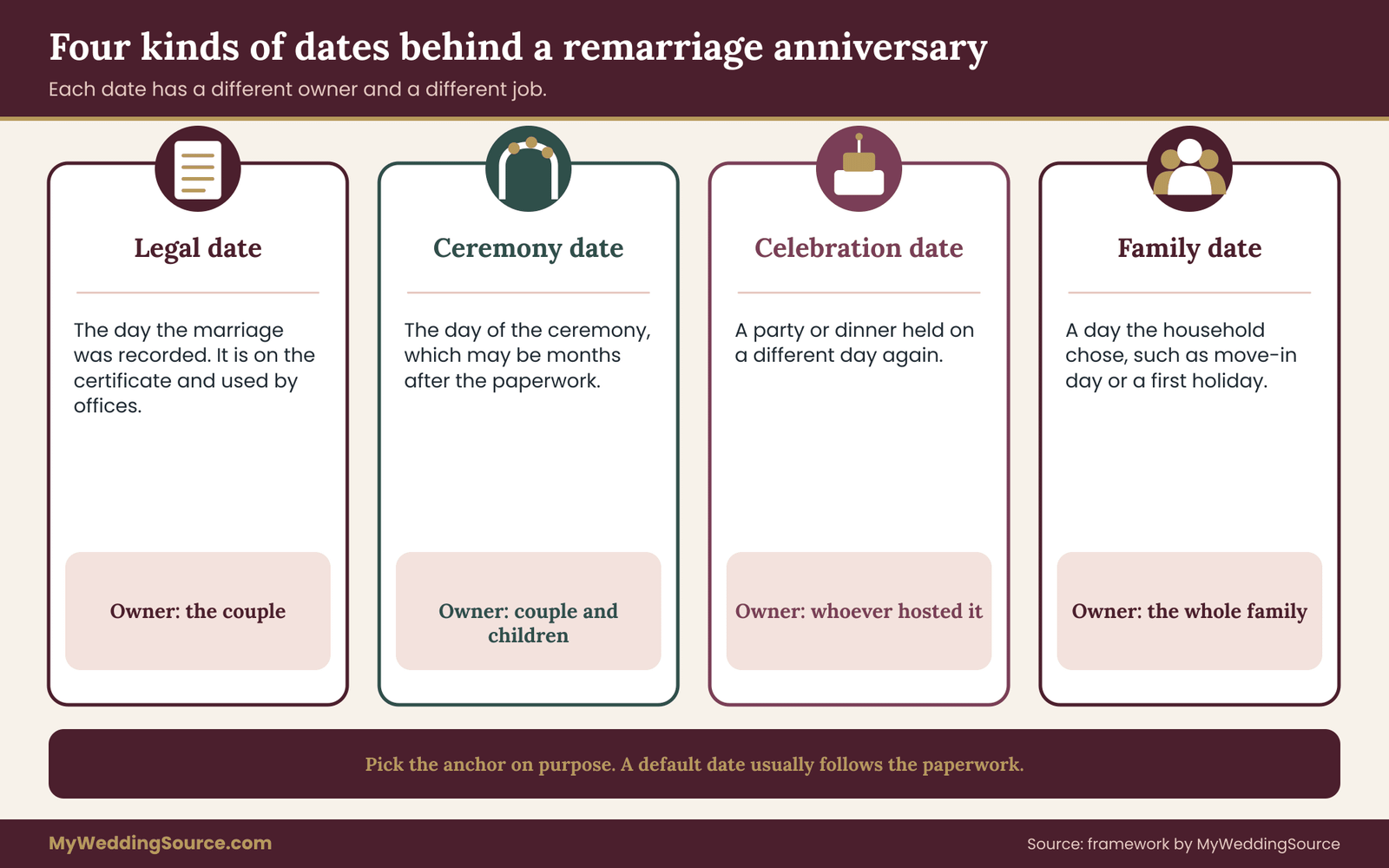
Seen this way, a remarriage anniversary is less a single event than a decision about which of these dates is the main one for the couple, and which are shared with other people. That decision is the heart of the guide.
Why one date is rarely enough
A couple may be perfectly happy with a single yearly date, and that is a fine outcome. The trouble starts when the date is chosen by default rather than by choice. A default remarriage anniversary tends to follow the paperwork, because the paperwork has a date on it. But paperwork dates do not always match how the family experienced the beginning.
Picture a couple who signed at a county office in March and held a small ceremony in June, with the children standing beside them. The younger child remembers June. The couple’s accountant remembers March. If the couple celebrates only March, the child may feel the real day was skipped. If they celebrate only June, the couple may feel the legal start is ignored. Either way, nobody did anything wrong. They just never chose.
The practical answer is to make the choice on purpose and say it out loud. The next sections show how.
What this guide does not cover
Some neighboring topics have their own space on this site. If you are still planning the ceremony itself, the step-by-step ceremony guide walks through the order of events. If your question is whether to hold a vow renewal rather than a remarriage anniversary gathering, that choice has its own comparison.
For general manners around announcements and invitations, the wedding etiquette guide is the place to start. Here the focus stays on dates, wording and family milestones, because those are the questions remarried couples ask after the wedding is over and the calendar starts to fill.
Why a remarriage anniversary is not a copy of a first-marriage anniversary
First anniversaries come loaded with expectations. Traditional gift lists tie each year to a material, magazines suggest a particular dinner, and social media shows the same posed photo every June. A remarriage anniversary can borrow any of that, but it does not have to. Copying the first-marriage script often creates three quiet problems.
The first is the comparison problem. If one partner was married before, a remarriage anniversary tradition may feel like it echoes the earlier marriage. A paper anniversary gift, a repeated restaurant or a song that was used at the first wedding can land badly even when no one meant it that way. The fix is not to avoid everything. It is to choose rituals that are new to this marriage.
The second is the audience problem. In a first marriage, the audience for the remarriage anniversary is usually the couple, plus perhaps parents. In a remarriage the audience can include children, former in-laws, grandparents who attended both weddings, and friends from two social circles. Each group may need something different from the day, or nothing at all.
The third is the ownership problem. Some dates in a remarried household are not the couple’s to claim. A child’s birthday, an earlier spouse’s memorial day or a parent’s own milestone belongs first to the person it concerns. A couple who folds those dates into their anniversary plans without asking can cause hurt they did not intend.
Traditional anniversary lists and when to use them
Many people know the idea that each year has a traditional material or gift. Wedding publishers such as The Knot print versions of these lists, and the lists differ from source to source, so there is no single official one. Treat them as optional prompts, not rules.
For a remarriage anniversary, the lists are most useful in one way: they give a couple a shared, light-hearted frame that has nothing to do with either person’s past. A couple who never chose a “first” anniversary tradition together can make the list their own game. Others will ignore it, and that is equally reasonable.
The calm default
If you want a safe starting point with no decisions about history, use this. Mark the legal date quietly as a couple. Hold any family gesture on a separate day you chose together. Do not schedule anything that depends on a child, former spouse or parent attending unless they have said yes. That default asks no one to perform feelings, and it leaves room to add more later.
The people a remarriage anniversary can touch
Before you list a single date, list the people. A remarriage anniversary is easiest to plan when you know who has a stake in it, and in what way. The list is not a guest list. It is a map of relationships.
The two partners. Each may have different feelings about the date. One may love marking every year. The other may find the attention uncomfortable, especially if an earlier marriage ended in loss or conflict. Settle this first, privately, before involving anyone else. A short conversation with two questions works well: what would feel good to mark, and what would feel like too much?
Children and stepchildren. Their ages change everything. A six-year-old may love a family cake and a paper crown. A sixteen-year-old may want no ceremony at all and a quiet “thanks for including me.” An adult child may want to be a witness and nothing more. The later section on children gives scripts for each.
Former spouses and co-parents. Usually they are not part of a couple’s anniversary. They do come up in logistics, such as who has the children on the day, and in the wording of messages the children might share. Plan around those facts without making the former spouse a topic.
Parents, grandparents and older relatives. They may remember the earlier marriage fondly and feel unsure how to talk about the new one. Giving them a simple, clear message helps. A card that says “we are marking six months since the wedding” is easier to answer than an open question.
Friends and colleagues. A few will remember both weddings. Most will only know the new one. A public post or office announcement is optional, and it can wait until the couple has agreed on wording.
A quick map you can draw in ten minutes
Take a sheet of paper. Write the couple’s names in the center. Draw one circle around them for children and stepchildren, a second for parents and close relatives, and a third for friends. Note anyone whose feelings about the remarriage you are not sure of. Then, beside each circle, write one sentence: what this group would need from the remarriage anniversary to feel included but not pressured.
That sheet becomes the input for the family calendar in the next part. It also stops a common mistake, which is planning everything around the loudest voice in the family instead of the person who most needs to be considered.
The family calendar: every date that can matter
The central tool in this guide is a family calendar built as a ledger. It is not a decoration schedule. It is a plain list of dates, who each one belongs to, and how loudly the household wants to mark it. Building it takes one evening and saves a year of small misunderstandings. The ledger is also the original framework this guide offers for a remarriage anniversary, so it is worth doing in order.
Step one: collect every date, without judging it
Write down any date that might come up in your household. Do not sort yet. Include the happy ones and the heavy ones, and include dates that belong to other people. The point is that nothing surprises you later in the year.
Start with the couple’s own dates. These usually include the day you met, a first date, the engagement, the legal wedding date, the ceremony date, the party date and the day you moved in together. Many couples find they have four or five candidates for their remarriage anniversary before they have even reached the harder dates.
Then add each partner’s earlier history. Depending on the person, this may mean the date of an earlier wedding, the date a divorce became final, or the date a spouse died. These are not decorations for a party. They are on the list so that you know when a partner may need extra care, not so that you mark them.
Add the children’s dates: birthdays, the day a custody arrangement began, a first day of school, a graduation, a religious milestone, or the date a stepchild first stayed at your house. A child may have a date they treat as private, such as the day a parent moved out. You will not know unless you ask, and you should not ask in front of others.
Finally add extended family dates that regularly shift plans: a grandparent’s birthday, a family reunion, a holiday that always involves travel. These affect when a gathering is realistic more than what it means.
Step two: tag the owner
Next to each date, write whose it is. Use simple tags: Couple, Partner A, Partner B, a child by name, or Family. A date can have two owners. The legal wedding date belongs to the couple, but a ceremony where the children took part might be tagged Couple and Children.
Owner tags answer the most important question in the ledger: who gets to decide how this date is marked? A date owned by one child belongs to that child’s comfort first. A date owned by one partner’s earlier history belongs to that partner. Only dates tagged Couple are the couple’s alone to plan around.
Step three: tag the feeling, not the size
Many families skip this step and regret it. For each date, tag how it is likely to feel for the owner, using four labels that need no explanation:
- Glad: the date brings pleasure and the owner enjoys attention on it.
- Mixed: the date carries more than one feeling and the owner may want to choose in the moment.
- Heavy: the date carries grief or a hard memory. The owner may want quiet company, or none.
- Unknown: you do not know and have not asked.
Tag from what the person has told you, not from your guess. If you are not sure, the honest tag is Unknown, and the action is to ask later, gently. A ledger with many Unknown entries is not a failure. It is an accurate map of what you still need to learn.
Step four: choose a ritual size
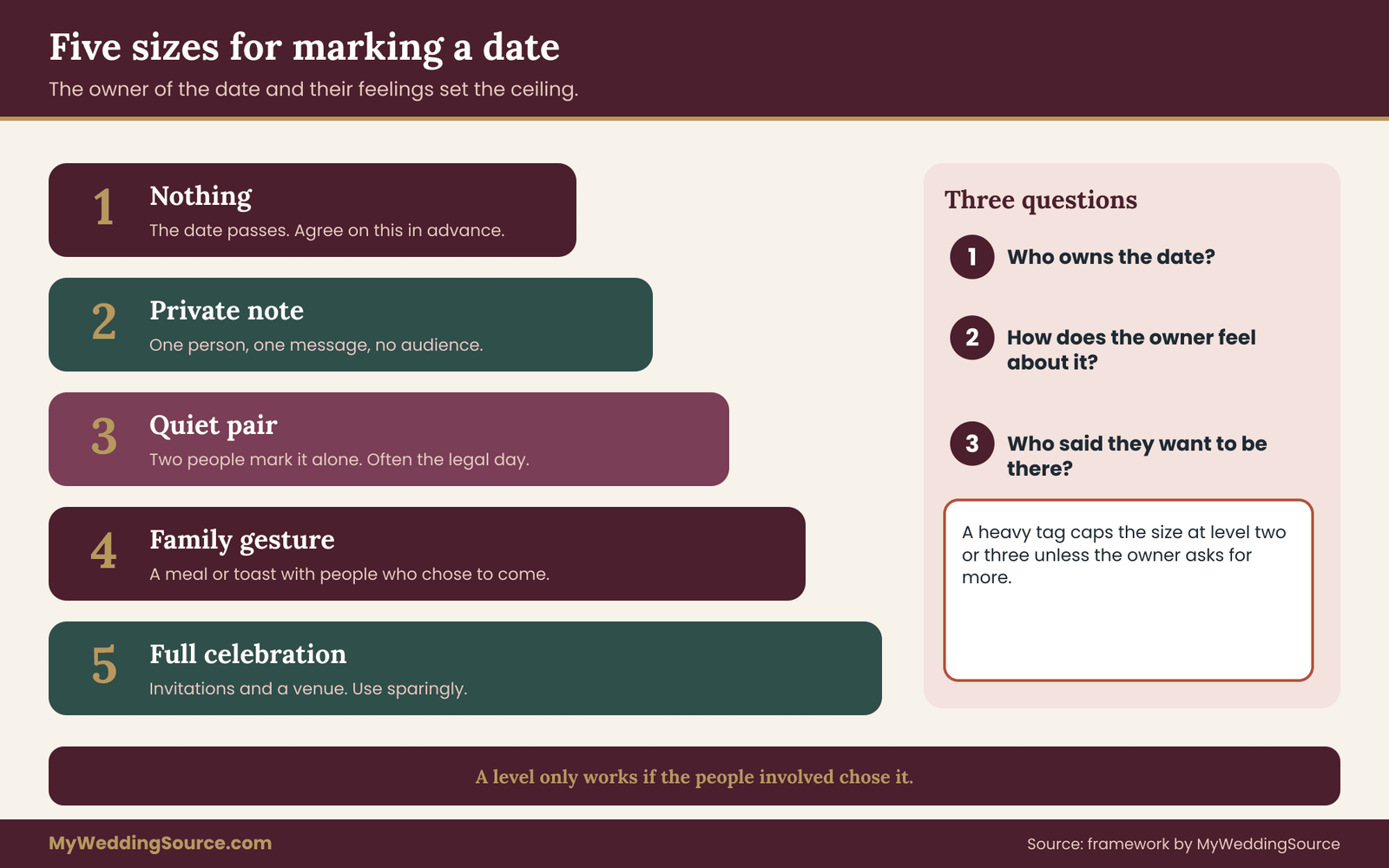
Now assign each date a size. The scale below has five levels, and the later section on ritual size describes each in detail.
- Nothing. The date passes without comment.
- A private note. One person, one message, no audience.
- A quiet pair. The two partners, or a parent and child, mark it alone.
- A small family gesture. A meal, a walk, a toast at home.
- A full celebration. Invitations, a venue or a gathering that people plan around.
Most dates in the ledger land on levels one to three. Only a few belong on levels four or five, and the remarriage anniversary itself is usually one of them. That is not a rule. It is just what the ledger tends to show once a household has written it down.
Step five: write the wording and check it
The final step turns the ledger into messages. For each date that will be visible to someone else, draft one sentence of wording and show it to the person it concerns. This is the step that prevents harm. A card to a stepchild that says “our family’s first year” will feel different to a child who does not yet think of it as a family. The wording section later in this guide gives samples.

How long the ledger should be
It will usually run to between twelve and thirty dates. If it is longer, you have probably added every birthday for every cousin, which is not necessary. Keep what changes how you act in the household. A date that changes nothing is a date for the ordinary calendar, not the ledger.
Where to keep it
A shared digital calendar works well for the dates tagged Couple and Family. For heavy or private dates, a private note on one partner’s phone is better than a shared event that pops up on a screen the children see. Some couples keep the ledger itself on paper in a folder with other wedding papers, so it can be revisited each year. If you already keep a wedding archive, the wedding archive approach shows a folder structure where a one-page ledger fits easily.
A short worked fragment
Here is a fragment of an invented ledger, to show how the tags work. The couple, whom we will call Imani and Tomas, have a legal wedding date in March, a ceremony date in June and a younger child, Noor, whose birthday is in early June.
The March date is tagged Couple, Glad, with the size set to a quiet pair. The June ceremony is tagged Couple and Children, Glad, set to a small family gesture. Noor’s birthday is tagged Noor, Glad, with a note that the ceremony date and her birthday fall in the same week, so the family agreed never to schedule the remarriage anniversary meal on her birthday weekend. A later part of the guide returns to this family for a full year.
The example is invented. It is here only to show that the ledger produces a concrete decision, not a vague intention.
Choosing the anchor date for your remarriage anniversary
Once the ledger exists, the first real decision is the anchor: the one date the couple treats as the yearly remarriage anniversary. Everything else in the ledger can be smaller, but the anchor needs to be chosen on purpose.
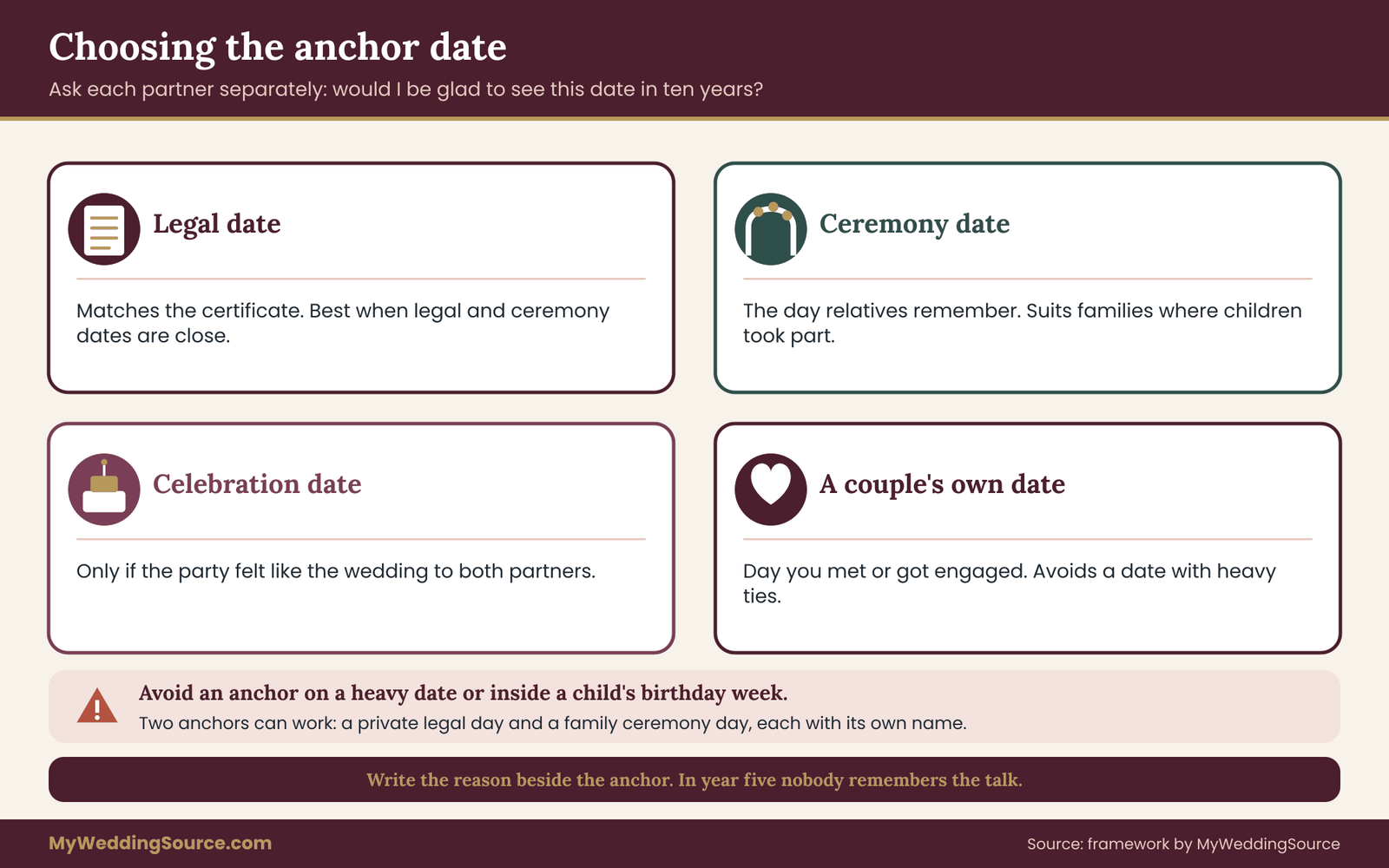
A useful rule is that the anchor should be the date both partners feel is the real start of this marriage. That is not always the legal date. It also should not be a date that one partner feels uneasy about. Test each candidate with two questions asked separately to each partner: if this date came up on the calendar in ten years, would I be glad, and would I feel I had to explain it?
The four common candidates
The legal date. The advantages are clarity and consistency. The date matches the certificate, and no one needs to explain it to an official. It is the best choice when the legal and ceremony dates are close together or the same.
The ceremony date. This often suits families where the children took part. It is the day relatives remember and photographs show. It suits couples who handled paperwork quietly and held the event later.
The celebration date. Choose this only if the party was the day that felt like the wedding to both partners. It is less common, and it can confuse relatives if the paperwork says otherwise.
A couple’s own date. Some couples choose the day they met or got engaged, and treat the wedding dates as the formal record. This works well when a wedding date carries complicated associations, such as a date close to an earlier divorce anniversary, since the couple can avoid the clash without hiding anything.
Using two anchors on purpose
A tidy option for couples who cannot choose is two anchors with different roles. The legal date is the couple’s private day, marked with a quiet pair at level three. The ceremony date is the family day, marked at level four with a meal or small gathering. Because each has a different job, neither competes with the other, and the household always knows which one a message refers to.
Two anchors are not for everyone. If you choose them, give each a name in everyday speech, such as “our day” and “family day”, so that cards and calls stay clear. And do not add a third anchor in the same year. Three dates make people feel they are being scheduled.
Dates to avoid as the anchor
Avoid an anchor that falls on a date with a heavy tag for either partner or a child, unless the owner has said they want it. Avoid an anchor that falls on another person’s recurring milestone, such as a child’s birthday week. Avoid an anchor chosen only because it is easy to remember. A date can be tidy and still wrong.
If you are still choosing a wedding date and have not yet set one, the guide to choosing a wedding date covers how guest availability and calendar clashes shape the decision. The same thinking applies later when you pick the date you will keep marking.
When the legal date has practical weight
The legal date can matter beyond sentiment. Tax filing status for a given year generally depends on marital status at year’s end, according to the Internal Revenue Service. Some benefits rules depend on when a marriage began, and the Social Security Administration explains how remarriage can affect survivor benefits in certain situations.
These are reasons to keep the legal date correct in your records, not reasons to make it your remarriage anniversary. Check the agency pages listed under Sources, or a qualified professional, before relying on any date for a benefits or tax decision.
Writing the anchor into the ledger
When you have chosen, write the anchor at the top of the ledger with a one-line reason, such as “Legal date, because it matches the certificate and neither of us is uneasy about it.” The reason matters in year five, when someone asks why you celebrate in March, not June, and nobody remembers the discussion.
Dates from earlier marriages, divorce and loss
This is the part of the ledger that needs the most care, and the part where a remarriage anniversary can go wrong without anyone intending it. Earlier dates are real. They do not vanish because a new marriage began. But they are also not decorations, and they do not belong on the same footing as a celebration.
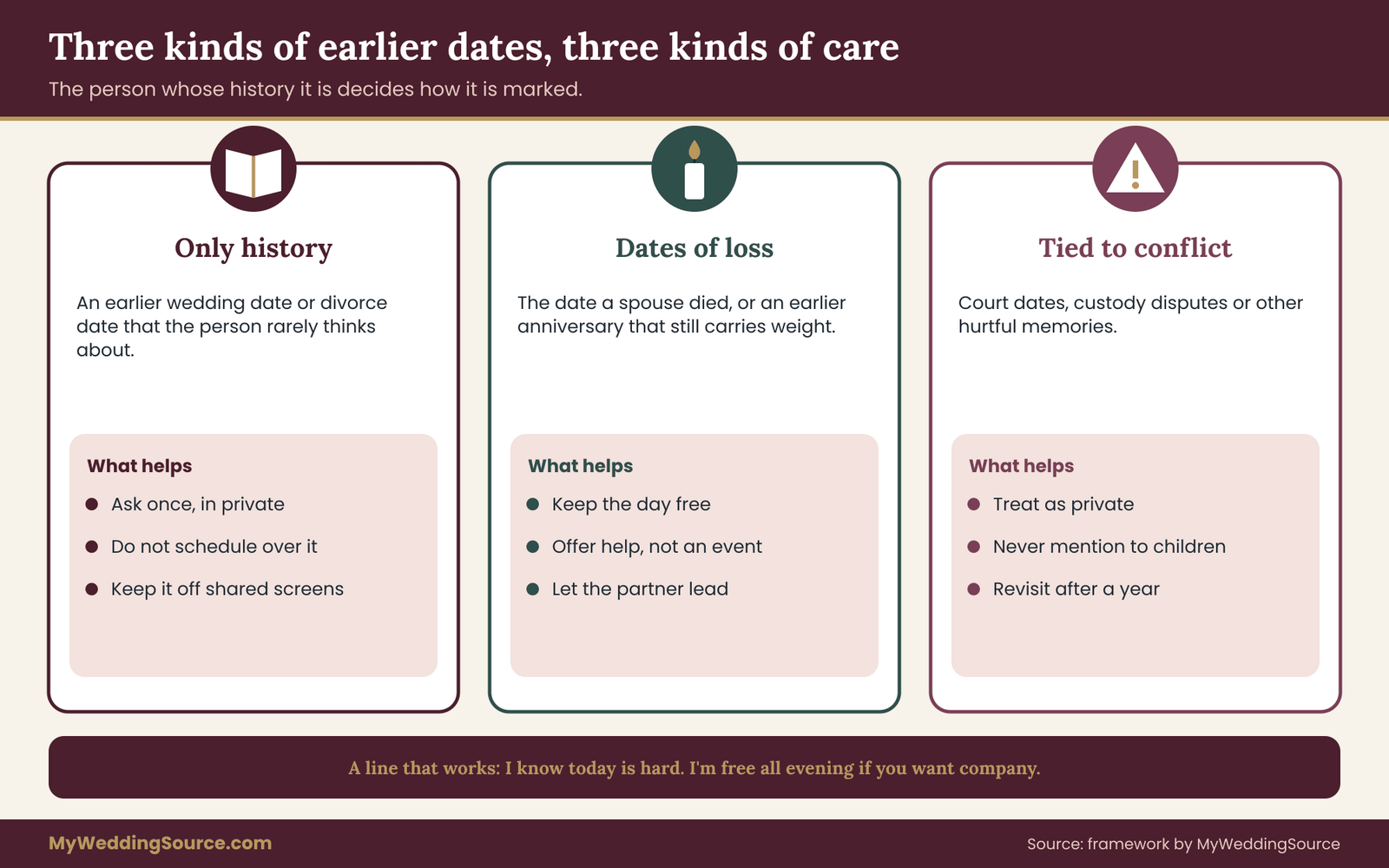
The guiding rule is simple: the person whose history it is decides whether, how and with whom it is marked. The other partner’s job is to know the date, to avoid scheduling over it carelessly, and to offer support in the form that person prefers.
Three groups, three kinds of care
Dates that are only history. An earlier wedding date, for someone who is divorced, is often just a fact. The person may rarely think of it. For this group the ledger entry is usually tagged Partner and set at level one. Do not send a card, do not mention it, and do not schedule a celebration of the new marriage on that date without asking the partner first.
Many people find it neutral. Some do not, and the only way to know is to ask once, in private, at a calm moment.
Dates of loss. If a partner’s earlier spouse died, the date of death and the earlier anniversary may both carry real weight. The partner may wish to visit a grave, light a candle, call a relative or simply be alone. The new spouse can help in practical ways: keep the day free, take over a chore, ask what would help. They should not try to turn the day into a shared event unless invited, and they should not tell the partner how to feel about it.
Dates connected to conflict. A divorce that ended with court dates, custody arguments or hurt feelings can leave dates that the owner would rather not see on a shared calendar. Treat these as private. Do not put them on a screen the children can see, and do not mention them in front of the children unless the partner has chosen to.
What not to do on these dates
There are a few patterns that reliably hurt. Avoid planning the remarriage anniversary on a heavy date to “reclaim” it. A partner may appreciate the thought, but it should be their idea. Avoid comparing the new marriage with the old one, even kindly. Avoid asking a partner whether they are “over” an earlier relationship on a day they are quiet. And avoid sharing the date with friends and relatives as a reason for a special event, since the partner may not want it discussed.
On the other hand, silence is not the only kind option. Some partners want the new spouse to acknowledge the date, in a small way. A sentence like “I know today is hard. I’m free all evening if you want company” gives the choice to the partner without presuming it.
A short script for asking once
Because these dates are sensitive, the question is best asked once, early, in private, and in a way that allows any answer.
“I’d like to know which dates from before matter to you, and whether you’d want me to say something or stay out of the way. You don’t have to answer today, and the answer can change.”
The partner may answer fully, partly or not at all. Write the answer into the ledger in the partner’s own words, tag it with the feeling they named, and revisit it after a year. Feelings about these dates change, and the ledger should be able to change with them.
The date of an earlier marriage in the new household
A practical question that many couples face is what to do when the dates of two weddings appear in the same house. Photographs, a ring in a drawer, an old certificate, or children who remember both. There is no single right way to handle this, but there are two approaches that tend to work.
The first is to keep earlier-marriage items in a place the owner chooses, and not bring them into shared spaces without agreement. A box in a closet, a folder, or a shelf belonging to the partner. This respects the history and avoids forcing the new spouse to see it daily.
The second is to acknowledge earlier history openly, where the family wants that. Some stepfamilies keep a photograph of a deceased parent on display, and children value that. If the household does this, the new spouse’s agreement matters as well, so that nobody feels they are being displaced. Both approaches are valid. What matters is that the choice is shared and not decided by silence.
When a former spouse is part of the picture
Former spouses sometimes remain close to the family because of children. Their role in a remarriage anniversary is usually small and indirect. They may be asked to swap a weekend so the children can attend a family meal. They may hear about the remarriage anniversary from the children. They are not guests unless the couple and the former spouse have all agreed they are.
Keep logistics polite and brief. A message such as “We’re having a small family dinner on Saturday the fourteenth. Could the children be dropped off at five?” is clear and requires no comment on the new marriage. Avoid placing the former spouse in the position of approving the remarriage anniversary. If a parenting plan or court order sets the schedule, follow it, and ask a family law professional rather than a wedding article if the plan is unclear.
Children and stepchildren: their milestones and their say
Children are the people most likely to be affected by a remarriage anniversary and the least likely to have chosen it. Their feelings vary with age, history and their relationship with the new stepparent, and they can change week to week. A thoughtful ledger gives children a real say without handing them the burden of managing adult feelings.
Their own dates come first
When you plan a remarriage anniversary, a child’s birthday, their other parent’s custody days, their school events and their cultural or religious milestones all rank above the couple’s anniversary in the ledger. Do not schedule the remarriage anniversary meal over a child’s birthday weekend. Do not ask a child to give up time with the other parent for the couple’s celebration unless the child has said they want to come.
A parent can also mark a child’s milestone in a way that includes the stepparent without making the stepparent the center. Letting the stepparent make a favorite meal, attend a game or write a short note is a small act that tends to land well. Let the child decide how much of this they want.
Let age guide the size
At a remarriage anniversary, young children usually enjoy simple, concrete rituals: a special dinner, a cake, a picture drawn for the couple, a short walk. They tend to take their cue from how the adults feel. Explain what the day is in plain words, such as “this is the day we got married, and we’re having cake.”
Older children and teenagers often want an exit from a remarriage anniversary and a clear role. They may attend the meal, then leave early. They may want to be asked, not told, and they may prefer a text to a speech. Respect that. An anniversary at which a sixteen-year-old stays for ninety minutes without complaint is a good outcome.
Adult children usually want to be treated as adults. A phone call, a card, or an invitation they are free to decline will respect that. If they were witnesses at the wedding, a short note of thanks on the remarriage anniversary can mean a great deal.
What to ask, and how
Questions work best when they offer choices and require no feelings in return. Compare two ways of asking.
A weaker version: “Are you okay with us celebrating our remarriage anniversary?” This asks a child to grant permission and to declare their feelings.
A stronger version: “We’re having dinner on Saturday for our remarriage anniversary. You’re welcome to come for the whole thing, just for dessert, or skip it. Any of those is fine.”
The second version tells the child what is happening, gives real options, and treats every option as acceptable. It also avoids the mistake of making the child responsible for the couple’s happiness. When a child chooses to skip, accept it without comment and do not bring it up later.
The stepparent’s role on the day
A stepparent can be present at the remarriage anniversary without trying to claim a parental role. Their role is to be warm, predictable and unpushy. They can say, “I’m glad you came,” and leave it there. They should not ask a child to call them anything, give a speech about the family or expect gratitude.
For couples who want a framework on shared decisions, the guide on how couples and families share wedding decisions explains how to give input without losing control, and the same approach works for anniversary planning: the couple decides, and the family is consulted where it affects them.
Marking a child’s place in the new family
Some families like to create a child-centered tradition, such as a family walk on the ceremony date, a yearly photograph of everyone together, or a jar of notes opened each year. These are best proposed as options. If the first year goes well, keep it. If a child quietly stops taking part, let it fade or adapt it. A tradition that outlives the people’s interest in it turns into an obligation.
When a child is hurting
Sometimes the remarriage anniversary brings up a child’s feelings about their other parent, a divorce or a move. If that happens, resist the urge to explain or defend the marriage. Say something like, “It’s okay if today feels strange. I’m here, and you don’t have to say anything.” Then do what the child asks. If the distress continues, a family counselor or the child’s pediatrician can advise on support, and that is better than any wedding ritual.
The American Psychological Association and similar bodies publish general information about stepfamily adjustment, and the Sources list points to their sites. Use them for background, not for a diagnosis, and rely on a professional for any specific concern.
Matching the size of your remarriage anniversary to the people involved
The ledger gave every date a size on a five-step scale. This section describes each level and, more usefully, when each one fits. Think of it as a dial. A household can turn it up for one year and down for the next, and neither setting is better.
Level one: nothing
Some dates are best left alone. A heavy date for a partner, an old date no one thinks about, or a remarriage anniversary in a year when the family is under strain. Doing nothing is a legitimate choice, and a calm one, if both partners agree. The only risk is silence that one partner reads as neglect. If you choose nothing for your remarriage anniversary in a particular year, say so in advance: “Let’s skip anything big this year. Dinner at home is plenty.”
Level two: a private note
A single written message from one person to another, with no audience. It suits dates a partner finds tender, a child who prefers privacy, or a parent who does not want a fuss. A good note is short and describes something specific: “I’m thankful for the way you handled the move last spring.” It does not need to mention the past. It does not ask for a reply.
Level three: a quiet pair
Two people mark the date together. For the couple this is often the legal anniversary: a walk, a favorite breakfast, an evening with no phones. For a parent and child it may be an outing on a date that matters to the child. The test for level three is that nobody else is expected to know or take part, which keeps the date free of performance.
Level four: a small family gesture
A meal, a toast or an afternoon with the people living in the household, and perhaps a few close relatives. This level suits the family date and often the ceremony date. Keep three principles in mind for a remarriage anniversary at this level. Invite only people who have said they want to come. Plan an exit for anyone who wants to leave early. And keep the program short, since long speeches strain a mixed group.
A small family gesture can be a regular feature of a remarriage anniversary, repeated each year in the same simple way: the same restaurant, the same kind of meal, the same photograph taken in front of the same wall. Repetition turns it into a tradition without the weight of a performance.
Level five: a full celebration
A party with invitations, a venue or a rented space, and guests who plan around it. Use this level sparingly. Common reasons are a milestone year, a vow renewal or a delayed celebration that never happened after the wedding. If you are choosing between a party and a vow renewal, the key difference is simple: a party celebrates, and a renewal asks guests to witness new promises.
Before planning a level five event, ask whether the children and close relatives want to attend and whether the date is comfortable for them. A big party that a stepchild dreads is not a success, however good the cake.
How to pick the right level
Three questions settle most cases. Who owns the date? A date owned by one person is rarely above level three unless that person asks. How does the owner feel about it? A heavy tag caps the level at two or three unless the owner says otherwise. And who has said they want to be there? A level only works if the people involved have chosen it.
When partners want different sizes
It is common for one partner to want a larger remarriage anniversary than the other. One may want a party, the other a quiet dinner. A fair compromise is to alternate years, or to give each partner one level to choose: one picks the anchor date’s size, the other picks the family date’s size. Another option is to use a split day, with a small family gesture at lunch and a quiet pair in the evening. The goal is to avoid a pattern where one person’s preference always wins.
Wording examples without assumptions
The words around a remarriage anniversary do as much work as the plans. A card, a toast or a social post can include or exclude people in a single sentence. The safest approach is to describe what happened and leave feelings to the reader.
Principles for wording
Describe, don’t prescribe. Write “we got married a year ago today,” not “we became a family a year ago today.” The second claims something the stepchildren may not yet feel.
Use names for people, not role labels, where you can. “Jonah and Priya” works better than “my stepchildren” in a message the children will read.
Avoid the phrase “second chance” and similar framing unless a partner has chosen it. It may suggest the earlier marriage was a failure, which neither partner may think. Avoid “blended” if a child dislikes it.
Leave out the earlier marriage unless the message is for someone who shares that history, and even then keep it brief.
A card from one partner to another
“One year ago today we signed our names and went out for pancakes. I would repeat the pancakes, and everything else.”
This uses a specific, small memory, claims nothing about the past, and fits level two or three.
A message to the household
“Saturday is our wedding anniversary. We’re having dinner at six, and you’re welcome for all of it, some of it, or none. We’d like you there, and we’d also understand if you have other plans.”
This tells the family what, when and that every option is welcome.
A message to a stepchild
“Thank you for being part of our day in June. Nothing is needed from you on the remarriage anniversary. If you’d like cake, it’ll be here.”
It thanks the child for something they did, makes no request, and offers one concrete thing.
A message to older relatives
“We’re marking six months since the wedding with a quiet dinner. We would love a call this weekend if you’re free.”
It is clear about the size of the event and invites a small gesture in return.
A toast at a family gathering
Keep it to three sentences and name no one who is not present to agree. For example: “Here’s to a year of figuring things out together. Thank you all for the patience and the pancakes. To the next one.” The toast thanks, points forward, and avoids anything about the past.
A public post
Posting is optional. If you do, agree on the wording and photographs first, and check whether anyone shown, especially a child, is comfortable being tagged. Many families keep children’s names and faces out of public posts by default. The guide on wedding family photo lists covers how to think about who appears in photographs, and the same care applies to anniversary photos.
What to say when someone mentions the earlier marriage
Sometimes a relative or friend will bring up the earlier marriage at the remarriage anniversary. A calm, short reply closes the topic without drama: “That was a different chapter. We’re enjoying this one.” If the person is a child, “Yes, that happened. Today is about dinner” is enough.
A note on gifts
Anniversary gifts between spouses are personal choices. Between a couple and others, gifts are not expected at a remarriage anniversary, and a note on a card can say so. Where a couple already has two households of belongings, a donation, a shared experience or a simple handwritten letter often fits better than an object. If the couple is thinking about gifts around the original wedding as well, the guide to wedding etiquette covers the general approach to gift expectations and thanks.
A worked case: one year of dates for an invented family
The example below is invented to show the ledger in use. It is not a real family and it is not a template to copy. Names and dates are made up, and your own answers will differ.
Imani and Tomas married at a county office on a Thursday in March, with two friends as witnesses. Both had been married before. Imani is divorced and has a daughter, Noor, who is seven. Tomas is a widower with a son, Elias, who is fifteen. They held a small ceremony in June at a park pavilion with both children, four grandparents and a handful of friends. Noor’s birthday falls in the first week of June.
What the ledger showed
Imani and Tomas sat down with a sheet of paper after the first spring. Their list ran to eighteen dates. The couple’s own dates included the day they met in October, the March legal wedding, the June ceremony and the weekend they moved into one house in August. Each partner had earlier-history dates. Tomas had the date his late wife died and the date of their earlier wedding.
Imani had the date of her divorce, which she had no wish to mark. The children had birthdays, and Elias had a date in April that he had once mentioned as hard, since it was the remarriage anniversary of his mother’s death.
They tagged the dates in turn. The March date was Couple and Glad. June was Couple and Children and Glad. Noor’s birthday was Noor and Glad. Tomas’s two earlier dates were Heavy. Elias’s April date was Elias and Heavy. Imani’s divorce date was Unknown, because she had not decided how she felt, and she said she would tell Tomas if she did.
Choosing the anchor
The couple asked each other the two questions: would I be glad to see this date in ten years, and would I have to explain it? March came out clean for both. June was warm but sat close to Noor’s birthday and, Tomas admitted, was near enough to a heavy summer date for him that he would rather not make it the formal remarriage anniversary.
They chose a two-anchor system. March became “our day” and June became “family day.” They wrote a line in the ledger: “March is our remarriage anniversary because it matches the certificate and we are both glad about it. June is the family day, because that is when the children took part.”
Choosing sizes
Our day was set to level three, a quiet pair. They would have breakfast out, then spend the day on their own. Family day was set to level four: a picnic at the same park, held on the Sunday after Noor’s birthday weekend so that the two never collided. The picnic would be open to the children and the grandparents who wished to come.
Heavy dates were set to levels one and two. For Tomas’s earlier dates, he would decide on the day, and Imani would keep the evening free in case he wanted company. For Elias’s April date, Tomas would check with Elias privately, and the family would not schedule anything else near it. Imani’s divorce date stayed at level one, with a note to ask again after a year.
The wording
For family day, they sent a short message to the household and grandparents: “We’re having a picnic at the pavilion on the second Sunday in June, to mark the day of our ceremony. Come for as long as you’d like.” For Elias, Tomas wrote a separate note: “The picnic is on Sunday at noon. You’re welcome to come, bring a friend, or skip it. Either way, I’m glad you were there last year.”
For their own day, there was no announcement at all. Imani left a card on the counter that said only, “Pancakes, as usual?”
What went right and what went wrong
Several things worked in their first remarriage anniversary year. Noor loved the picnic and asked to repeat it. The grandparents understood what the day was. The heavy dates passed without pressure on anyone.
Some things did not. Elias attended for forty minutes and left, and Tomas was disappointed until Elias said later that the picnic had been fine and he simply preferred small gatherings. The couple recorded that as a result, not a problem: next year, they would shorten the program and let him pick a friend to bring.
A grandparent raised the earlier marriage in conversation, and Tomas used the short reply from the wording section. Imani realized she had forgotten to tell Tomas that she wanted a quiet sentence on her divorce date after all, and she added it to the ledger for the following year.
The point of the example is not that the family did everything right. It is that the ledger turned vague feelings into specific choices, and the errors became notes for next year instead of grievances.

The year as a calendar
Seen across twelve months, the family’s remarriage anniversary plan looked light. March: a private breakfast. April: no events, space around Elias’s date. June: Noor’s birthday, then the family picnic the following Sunday. August: the remarriage anniversary of moving in, noted with pizza on the floor, which the children voted into the ledger as a family date. October: the day the couple met, a quiet pair. The year had five marked dates, three of them small, and none that required anybody to perform an emotion.
The framework reduces work for every remarriage anniversary after the first. A family that writes the ledger once can update it in twenty minutes each January.
Adapting the case to other families
Change the facts and the answers change. A couple without children might use one anchor for the remarriage anniversary and level three each year. A couple where one partner has adult children who live far away might send a card instead of hosting a picnic. A couple where both have been married several times might choose their own date, the day they met, to avoid the dates attached to prior weddings.
A couple with a strained relationship with a former spouse might keep the family date entirely at home. The ledger is a method for deciding, not a menu of fixed answers.
If the ceremony itself is still ahead of you, the step-by-step ceremony guide shows the usual order of a ceremony, which helps when you want the ceremony date to include the children in a way they have agreed to.
Alternatives, and when your remarriage anniversary plan fails
Every plan has a condition under which it should be abandoned or adjusted. This section sets out alternatives to the two-anchor system and then lists the failure conditions to watch for. A method you know how to stop is safer than one you never question.
Alternatives to the two-anchor system
One anchor and nothing else. Choose the legal date, mark it as a quiet pair, and leave the rest of the ledger as private notes. This suits couples without children at home and couples who dislike family gatherings. Its weakness is that it does not give the children a date, so ask whether that matters in your household.
A family-first system. Treat the ceremony or family date as the main remarriage anniversary and give the legal date a small private mention. This suits blended households where children took an active part in the ceremony. Its weakness is that it can leave one partner feeling the couple’s own date was handed over.
A rotating system. Alternate the main focus year by year: the couple’s date one year, the family date the next. This suits partners with different tastes. Its weakness is that the date can feel unpredictable to children, so write the rotation down.
A season, not a date. Some couples mark the month rather than the day, and do something small whenever it fits. This suits families whose schedules, custody arrangements or travel make a fixed date hard to keep. Its weakness is that it can drift, so put it on the calendar.
A new date entirely. A couple may invent a date, such as the day they moved in or a long walk they took together. This avoids heavy associations and is easy to explain. Its weakness is that relatives may not understand it, so explain in a sentence.
Failure conditions
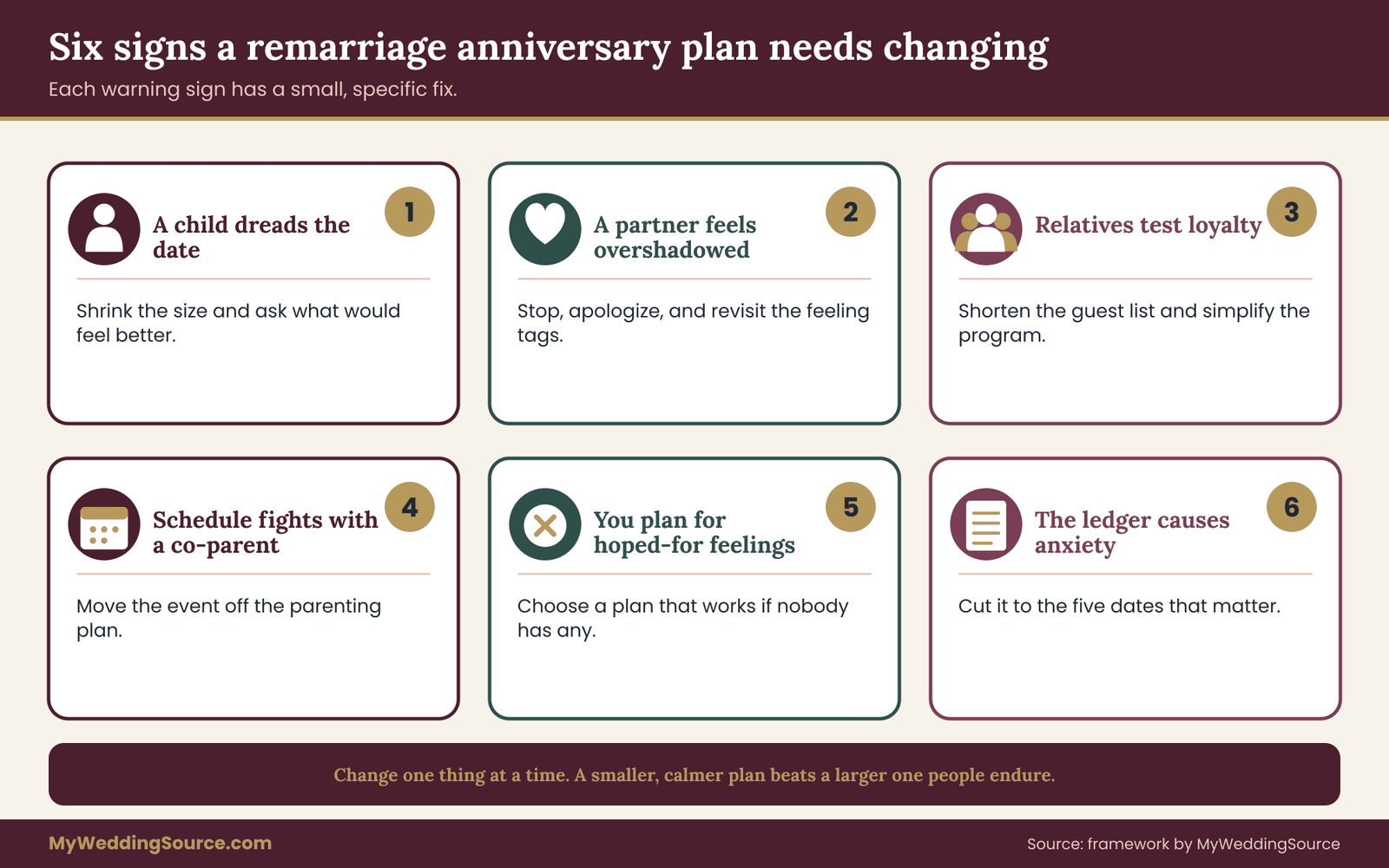
A plan has failed, and should be changed, if any of the following happens.
- A child dreads the date or begins avoiding the family. Reduce the size and ask the child what would feel better.
- A partner feels the remarriage anniversary is about the other partner’s past, or that a heavy date is being used to make a point. Stop, apologize without defending, and revisit the tags.
- Relatives begin to treat the date as a test of loyalty. Shorten the guest list and simplify the program.
- The plan causes recurring conflict with a former spouse over schedules. Move the event to a time that does not touch the parenting plan, or ask a family law professional if the plan is unclear.
- You are planning for feelings you hope people will have. Replace it with a plan that works if nobody has any.
- The ledger has become a source of anxiety. Cut it back to the five dates that matter and delete the rest.
What a failed year teaches
A year that goes badly can still help. Write down what happened without assigning blame. Ask each person one question: what would have made it easier? Then change one thing, not five. Couples who change too many variables learn nothing, and families lose patience with constant experiments.
When to get outside help
A remarriage anniversary is not a therapy session, and it will not fix deep conflict. If a date repeatedly leads to strong distress for a child or partner, consider a counselor who works with families. A family counselor, a faith leader or a trusted pediatrician can offer help that no article can. The aim of the ledger is to reduce friction around a day, not to substitute for care.
Dates with legal weight: what to keep correct in your records
Some dates in a remarried household have practical consequences, and they should be correct even if they are not the ones you celebrate. It is worth a short section because mistakes tend to surface years later, at inconvenient moments.
The marriage certificate
The certified marriage certificate carries the legal date and is issued by the vital records office in the place the marriage was recorded. The USAGov page and the CDC’s directory of vital records offices explain how to request copies. If the date or any detail is wrong, ask the issuing office how to correct it. A date that is wrong on the certificate will be wrong in every record built on it.
Divorce and earlier-marriage records
If you or your partner were divorced, the final divorce decree date matters for a new marriage license in some places, and agencies may ask for it. Keep a copy of earlier decrees and, for a widowed partner, a death certificate, in a secure place. Requirements differ by state and office, so confirm with the office issuing your license or the agency you are dealing with.
Taxes and benefits
The IRS publishes guidance on how marital status affects filing status, and its newsroom has an article about changes newlyweds should make before filing season. The Social Security Administration explains how remarriage may affect survivor benefits. These are matters for the agencies or a qualified tax or benefits professional, not for anniversary planning. The one practical point is to keep the legal date straight in your files, even if your celebrated date is another.
Keeping the two kinds of dates apart
A useful habit is to keep a “records date” and a “celebrated date” on the first page of your ledger. The records date is the legal one, used in forms. The celebrated date or dates are the ones you mark. If your celebrated date is not the legal date, make sure family members who help with paperwork know the difference. Otherwise, a well-meaning relative may write the wrong date on a form, or a child may quote the wrong date at school.
Adding the date to your archive
If you keep a wedding archive, place the ledger in the folder with other family records and review it each January. The guide on organizing wedding records describes folders, retention and access levels, and a one-page ledger fits neatly into the legal and identity folder or the archive notes. The Library of Congress also publishes guidance on keeping personal digital records, useful if your ledger, photos and messages live on a phone or in the cloud.
Edge cases: when the usual remarriage anniversary advice bends
The ledger covers most households, but a few situations deserve their own notes. Each is a reminder that the method serves the family, not the other way around.
The date lands on an earlier anniversary
Sometimes the legal date of the new marriage falls on the same day as an earlier wedding or an earlier loss. If you notice this before the wedding, you can change the date. If you notice after, do not panic. Talk to the partner whose history it is, listen to what they would prefer, and consider using a different anchor, such as the ceremony date or a couple’s own date. The legal date can stay quiet in the records without being celebrated, and the family loses nothing.
A first-year milestone
The first remarriage anniversary tends to carry more weight than later ones. It is when relatives ask what the plan is and when children first see how the household handles it. Keep the plan simple and expect to adjust. A small gesture done well in year one sets a pattern that feels natural by year three. A large event in year one sets a bar that is hard to keep.
Round-number years
Fifth, tenth and twenty-fifth anniversaries often prompt a bigger plan. In a remarriage, a round number can also mean a point at which the children are grown and the couple has a longer history than the earlier marriage did. Some couples feel this deserves a vow renewal or a party. If you reach that decision, use the same ledger steps: ask who wants to attend, check the heavy tags, and write the wording. The choice of format does not change the need to ask people first.
Late-in-life remarriage
Couples who marry later may have adult children with their own families, grandchildren and strong feelings about inheritance and loyalty. In these cases the remarriage anniversary often works best as a quiet pair, with a card or call from the family. Do not use a remarriage anniversary gathering to announce plans about property, wills or care, since these topics belong in separate, private conversations, ideally with a qualified professional.
Shared custody and travel
When children move between two homes, a remarriage anniversary meal may be possible only on some weekends. Plan around the custody calendar rather than asking a former spouse to change it. A picnic on a Sunday that suits the schedule is better than a date that feels right in theory but strains logistics. If the children are not present on the day, send a photograph or hold a small second meal when they are, and say plainly that the date is flexible.
Long-distance relatives
Relatives overseas or across the country may not be able to attend. A short video call, a letter or a shared photo album gives them a role without travel. Keep the message light: “No gift or travel needed, we would love to see your face for ten minutes.” That removes any sense of obligation.
Religious or cultural observances
Some faith traditions and cultures observe marriages in particular ways, and a remarriage may raise questions that families and clergy have thought about. A couple who belong to a faith community can ask their officiant or leader what the tradition says and what it offers. Take what fits and leave the rest. If the household includes more than one tradition, the guide on interfaith ceremony planning covers how to give each tradition clear ownership, and the same principle works for anniversaries.
A partner who prefers not to mark it at all
Some people simply dislike anniversaries. They may feel self-conscious, or find the idea of a yearly performance tiring. That is a valid preference. The couple can agree on a minimal gesture, such as a single text, or none. What matters is that the other partner understands it is a preference about attention, not about the marriage. If one partner needs more acknowledgment, say so plainly and find a middle size together.
When the family is not ready
Occasionally a household is still settling in, and any remarriage anniversary feels forced. In that case, wait. A remarriage anniversary does not expire. Mark it privately for a year or two, and add a family gesture when everyone is more at ease. Tradition built slowly lasts longer than tradition built under pressure.
Your next steps
Pick one evening this week and do three things. First, make the ledger: write down every date that touches your household and tag the owner and the feeling for each. Second, choose the anchor for your remarriage anniversary, with a one-line reason, and decide whether you want one anchor or two. Third, give each date a size from nothing to a full celebration, and draft one sentence of wording for any date that someone else will see.
Then check with the people who are affected. Ask the children and relatives with choices, not requests, and ask any partner with a heavy date what they would like. Put the ledger somewhere you can find it next January. After a year or two the remarriage anniversary stops being a decision and becomes a quiet routine that your family understands and, ideally, looks forward to.
FAQ
Which date should we treat as our remarriage anniversary, the legal date or the ceremony date?
Either can work for a remarriage anniversary. Choose the date both partners are glad to see on the calendar and do not need to explain. If the legal and ceremony dates are months apart, consider using both: the legal date as a private pair and the ceremony date as a small family day. Keep the legal date correct in your records, whichever you celebrate.
Is it appropriate to celebrate a remarriage anniversary if one of us is a widow or widower?
Yes, if the surviving partner is comfortable. A remarriage anniversary marks the new marriage, which is its own milestone, and marking it does not erase an earlier one. Ask the partner what feels right, avoid planning on dates tied to the earlier loss unless they invite it, and keep any wording about the past brief and chosen by them.
How do we include children without pressuring them to celebrate?
For a remarriage anniversary, tell them what is happening and offer real options: attend all of it, some of it, or none. Treat each option as fine and do not comment if a child skips. Children can also help choose the date’s size. A short note thanking them for something specific often means more than asking them to join in.
Should we invite a former spouse to a remarriage anniversary?
Usually no. At a remarriage anniversary, a former spouse is typically involved only through logistics, such as swapping a weekend for the children. If everyone involved has chosen to be on friendly terms and wants to attend, that is their decision to make together. Otherwise keep messages short and practical, and follow any parenting plan or court order.
What wording avoids assuming a family feels blended?
Good remarriage anniversary wording describes what happened, not what people should feel. Write “we got married a year ago today” instead of “we became a family.” Use names, not role labels, where you can, and avoid phrases like “second chance” unless a partner chose them. Offer invitations as options so no one has to act out a feeling.
Do traditional anniversary gifts apply to a remarriage?
They can apply to a remarriage anniversary as a light framework, but no official list exists and published lists differ. Many couples count years from their own anchor date and treat the list as optional. If you worry that a gift echoes an earlier marriage, pick a new tradition, an experience or a handwritten letter instead.
Can a remarriage anniversary also be a vow renewal?
A remarriage anniversary can double as a vow renewal, though they are different events. A renewal asks guests to witness new promises, so it usually needs more planning and clearer invitations. If you are considering one for a round-number year, check whether children and close relatives want to take part, and decide whether an officiant or a simple speech is right.
When should we change or drop our remarriage anniversary plan?
Change your remarriage anniversary plan if a child dreads the day, a partner feels it centers the other’s past, relatives treat it as a loyalty test, or planning keeps causing conflict over schedules. Reduce the size, ask what would help, and change one thing at a time. A smaller, calmer plan is better than a larger one that people endure.
Sources
- How to get a copy of a marriage certificate or a marriage license, USAGov
- Where to write for vital records, Centers for Disease Control and Prevention, National Center for Health Statistics
- Marriage and divorce data, Centers for Disease Control and Prevention
- Marital status and filing status, Internal Revenue Service
- Marriage means making changes before next filing season, Internal Revenue Service
- Survivors benefits, Social Security Administration
- Personal archiving: preserving your digital memories, Library of Congress
- Stepfamily and family topics, American Psychological Association
- Family and marriage research, Pew Research Center
- Anniversary and wedding planning resources, The Knot