

A wedding generator rental works best when you treat it as a power load plan that begins with your vendors’ equipment lists, not as a size you pick from a catalog, because the right unit depends on what will actually plug in, when it will run, and where it can safely sit.
Quick answer
Add up the running watts of everything that will draw power, add the starting surge of the single biggest motor, and keep the continuous load at or below about 80% of the generator’s rated capacity. That is the method an event-rental supplier, Tent and Table, describes, and a fuel company, Fuel Logic, suggests a 20% buffer on top of the total. Put the total, your vendors’ lists, and your site details in front of the company handling your wedding generator rental and let them confirm the match in writing. Keep the unit outdoors and away from tents, doors, windows, and vents, plan how it will be refueled, and ask the venue and local authorities what they require. This guide is planning information, not electrical engineering or legal advice, and a licensed electrician or the rental company should confirm anything that touches wiring.
What a wedding generator rental actually covers
When people search for a wedding generator rental, they usually picture one machine delivered on a trailer. In practice you are arranging several separate things that happen to arrive together: a source of power, a way to get that power to the places it is needed, and fuel to keep it running for as long as the event lasts. Each of those can go wrong in its own way, and each belongs to a different person on your vendor list. Seeing them separately is the first step toward a plan that holds up on the day.
A wedding generator rental is three separate things
The simplest way to think about a wedding generator rental is as a bundle of three jobs: making power, moving power, and feeding the machine. A quote that names only the machine leaves the other two jobs unassigned, which is where most surprises come from.
The generator itself
The generator is the engine and alternator, and its main specifications are rated output, surge capability, voltage, and whether it supplies single-phase or three-phase power. A trade article in ForConstructionPros points out how vague a request can be: asking for a “200-amp generator” could describe anything from roughly 30 to 166 kVA, depending on voltage and phase. For a wedding generator rental, that means you should never order by one number alone. Give the rental company your total load and let them tell you the voltage, outlets, and capacity they would deliver.
The cords and distribution
Power has to travel from the machine to the sound table, the kitchen tent, the lights, and the bar. That takes cords, distribution boxes, and receptacles, and it takes a plan for crossing guest walkways safely. The Consumer Product Safety Commission advises heavy-duty outdoor-rated cords with three prongs, no cuts or tears, and a wattage rating higher than the total of what is plugged into each one. Ticket Fairy, a festival ticketing company with a planning blog, recommends cable ramps where cords cross walkways and distribution boxes lifted off wet ground. Ask who supplies these items and who sets them up, because a generator with no usable distribution is only half a rental.
The fuel and the service
Fuel is the part of a wedding generator rental that couples your wedding schedule to the machine’s limits. Fuel Logic says a generator normally runs about 8 to 12 hours on a full tank at 50% load, and that actual runtime depends on the fuel type, tank size, and load. Service is the other half of any wedding generator rental: who responds if the unit stalls at 7:40 p.m., how fast, and what it costs. Fuel Logic notes that many firms offer around-the-clock service but tells renters to confirm response times before they sign.
When a wedding generator rental is the right answer, and when it is not
Not every outdoor couple needs one. A wedding generator rental adds cost, noise, a safety zone, and one more vendor to coordinate, so it should earn its place.
Sites with no usable power
A field, a farm lawn, a park pavilion, or a private property with no outlets near the tent is the clearest case. If nothing at the site can carry the load, a wedding generator rental is often the practical way to run sound, lighting, and catering equipment. Ask the venue or property owner exactly what exists, not what they assume exists, because an outlet that powers a porch light is not the same as a circuit that can run a coffee station.
Sites with power that is not enough or not in the right place
Many venues have electricity but not where the tent goes, or not enough of it once a caterer, a DJ, and a lighting vendor all plug in at once. In that case the question is less “do we need power” and more “which loads should be on the venue’s circuits and which should be on a separate unit.” A common planning approach, described by Ticket Fairy for festivals, is to split loads by zone so that a fault in one area does not take down the rest of the site. For a wedding, that can mean keeping music and lighting separate from the kitchen.
Backup for a venue that already has power
Some couples consider a rental purely as insurance against an outage. That is a reasonable question to put to your venue and your electrician, but be careful with the wiring side. The CPSC warns against plugging a generator into a wall outlet to feed a building, a practice called backfeeding, because it endangers utility workers and neighbors and bypasses household circuit protection. Any connection between a generator and a building’s wiring is a job for a licensed electrician and the venue, not for a wedding party.
Who owns the load plan: you, your vendors, the venue, and the rental company
A wedding generator rental fails most often at the handoffs. The rental company knows machines, your vendors know their own equipment, the venue knows its site, and you know the schedule. Nobody holds all four pieces unless you ask for them. This section lays out who knows what, so you can collect the right information from the right person.
The rental company sizes equipment, and you supply the list
A rental company can match a machine to a load, but it cannot invent your load. If you ask for “something for a backyard wedding,” you will get an answer based on assumptions, and the assumptions may not match your caterer’s equipment.
What the rental company will want to know
Expect questions about total wattage, the biggest single motor or compressor, voltage and phase, how many hours it must run, how it will be delivered, what the ground is like, and where it will sit. Fuel Logic’s guide tells renters to plan entry routes and placement before delivery, and Big Rentals, an equipment rental website, says to plan the unload before arrival because a skid-mounted unit may need a rated ramp or a forklift. Have a site sketch and a vendor list ready before you call.
What the rental company will not know
They will not know that your caterer plans two warming cabinets and a refrigerated trailer, that your band brings its own lighting rig, or that the photo booth company plugs in a printer. Those details live with your vendors. A rental company can only be as accurate as the list you hand it, which is why the next section matters.
The vendors that draw power
Every vendor who plugs something in is part of your load. Asking early, in writing, is the single most useful habit in this whole process.
Sound, DJ, and band
Sound is usually steady, and its draw depends on the system. For your wedding generator rental, ask your DJ or band for the total power they expect and the number of outlets and circuits they want. Our wedding DJ questions guide covers what else to ask them, and our wedding audio and lighting checklist shows how sound and light requests overlap.
Caterer, bar, and coffee
Catering equipment is often the heaviest and most variable load in a wedding generator rental. Heating elements, refrigeration, coffee makers, and warming cabinets can all be on the list. Ticket Fairy advises asking food vendors for exact wattage and amperage lists weeks before load-in, then applying a diversity factor, since not every heating element is on at the same moment. Many caterers also bring propane for cooking, which shifts some load away from the generator. Ask them what they need electrical power for, not just what they cook with. Our wedding catering service planning guide explains how service styles change the equipment list, and our wedding bar service planning guide covers coolers and ice.
Lighting, photo booth, rentals, and climate equipment
String lights, uplighting, photo booths, and tent heating or cooling all belong on the list. Our wedding lighting guide goes through the lighting side, and our wedding photo booth guide covers booth requirements. A rented fan or heater is a power load like any other, so ask your tent or rental company for its electrical figures too. Our wedding rental planning checklist helps you track who supplies what.
The venue and local authorities
A venue or jurisdiction can restrict what you may do, no matter what a wedding generator rental company is willing to deliver.
Venue rules
Venues may prohibit any wedding generator rental, require approved vendors, set quiet hours, limit fuel storage, or require insurance certificates. Ask in writing before you reserve equipment. Our wedding venue questions guide has a broader list, and our wedding venue load-in restrictions article covers delivery windows and access, which matter for a trailer-mounted unit.
Permits, noise rules, and the fire marshal
Rules vary by city and county, and we cannot tell you which apply to you. Fuel Logic suggests checking local noise rules and whether a temporary power permit is needed, and contacting the local fire marshal or building department. Treat that as a question to ask, not a finding. Our wedding permits guide explains the general landscape of wedding permits and how to approach the offices involved.
Watts, amps, and fuel burn in plain language
Planning a wedding generator rental takes a small vocabulary. Once you can read a label and do three pieces of arithmetic, vendor conversations become much easier. None of this requires an engineering degree, and you do not need to do the math perfectly, since the rental company will check it. The goal is to hand them a list they can trust.
Running watts versus starting watts
Every electrical device has a running figure, which is what it draws while operating, and some have a higher starting figure, which is a brief surge at the moment a motor turns on.
Why starting watts matter
Motors, compressors, and pumps can need several times their running power for a moment when they start. The ForConstructionPros article says motors can need several times their running power to start, and cites up to four times as one figure. A refrigerator is a familiar example. A Lowe’s wattage chart lists a refrigerator or freezer at about 700 running watts with about 2,200 starting watts. The chart notes that its figures are approximate and that you should check each appliance’s label.
The rule that keeps the math simple
Tent and Table describes a practical method: add the running watts of everything, then add the starting watts of only the single largest motor, since motors rarely start at the exact same instant. The same article says to keep continuous loads at or below 80% of the generator’s rated capacity, with an example in which a 4,000-watt load calls for a generator rated at least 5,000 running watts. A fuel company, Fuel Logic, suggests a 20% buffer, and Ticket Fairy suggests 20 to 30% for festivals. These are published planning rules from companies in the business, not code requirements, so use them as a starting point and let the rental company advise.
Reading a data plate
Most equipment carries a label with its electrical rating. That label is the best source for your list because it describes the actual item, not a typical one.
Watts, amps, and volts
If a label lists amps instead of watts, multiply amps by volts to get watts. Tent and Table gives a blower example: a 12-amp blower on 120 volts draws 1,440 watts. ForConstructionPros adds a conversion for motors rated in horsepower, where one horsepower is roughly 746 watts. Ask vendors for watts if they can give them, and accept amps and volts if they cannot.
When a vendor cannot give you a number
Some vendors will say “it is not much.” Ask them to read the plate or send a spec sheet, and treat an unanswered question as a gap in the list. Our wedding vendor due diligence checklist describes how to keep vendor questions on record, and a short email with the question and the reply is enough. When a number is truly unknown, mark it as an estimate, add a note, and let the rental company decide how much margin to carry.
Estimating energy over a day
Watts describe how hard the generator works at one moment. Runtime and fuel for a wedding generator rental depend on how that load changes over the day.
Peak load and average load
The peak is the busiest moment, usually dinner service with the kitchen, sound, and lights all on. The average is lower. Size the generator for the peak, and size the fuel for the average, with a margin. If you do not know the average, ask the rental company for burn rate at the load you expect, and mention the schedule.
Why a very light load can also be a problem
The ForConstructionPros article warns that an oversized unit adds cost, fuel, and noise, and that diesel engines running far below their rating, under about 30% by its figure, can build up carbon deposits called wet stacking, which reduces power over time. It is not a reason to oversize or undersize. It is a reason to describe your load honestly and let the rental company match the machine.
The power load worksheet for your wedding generator rental
This is the working core of the guide to wedding generator rental: a worksheet you can copy into a spreadsheet and send to every vendor. It does not replace the rental company’s own sizing, and it does not tell you how to wire anything. It does give you one page that holds your whole load, so the conversation with the rental company starts from facts.
How to fill in the worksheet
Work through it in order, and keep a column for who gave you each number. A figure from a data plate is better than a figure from memory, and a figure marked “estimate” is better than a blank.
Step one: list every device
Start with the vendors named in the previous section, then walk through the day in order and add anything that plugs in: sound, microphones, lights, heaters, fans, coolers, coffee, warming equipment, photo booth, charging stations, and the officiant’s amplifier if there is one. Include the quiet, small items too. They are small individually, but a long list adds up, and they are the items vendors forget to mention.
Step two: record running watts and the largest starting surge
For each item, write the running watts and the quantity, and multiply. In a separate column, write any extra starting watts for motors or compressors. At the bottom, total the running watts, find the single largest starting figure, and add it once. That total is your estimated starting load. If you have an item with an unknown starting figure, ask the vendor, and mark it unknown until you hear back.
Step three: add margin and group the circuits
Divide the running total by 0.8 to see the minimum rating that keeps continuous load at or below 80% of capacity, using Tent and Table’s rule. Compare with the 20% buffer from Fuel Logic and the 20 to 30% range from Ticket Fairy, and note the spread. Then group items into zones, such as music and lighting versus catering, so the rental company can decide whether one unit or two makes sense.
A worked example, with placeholders labeled
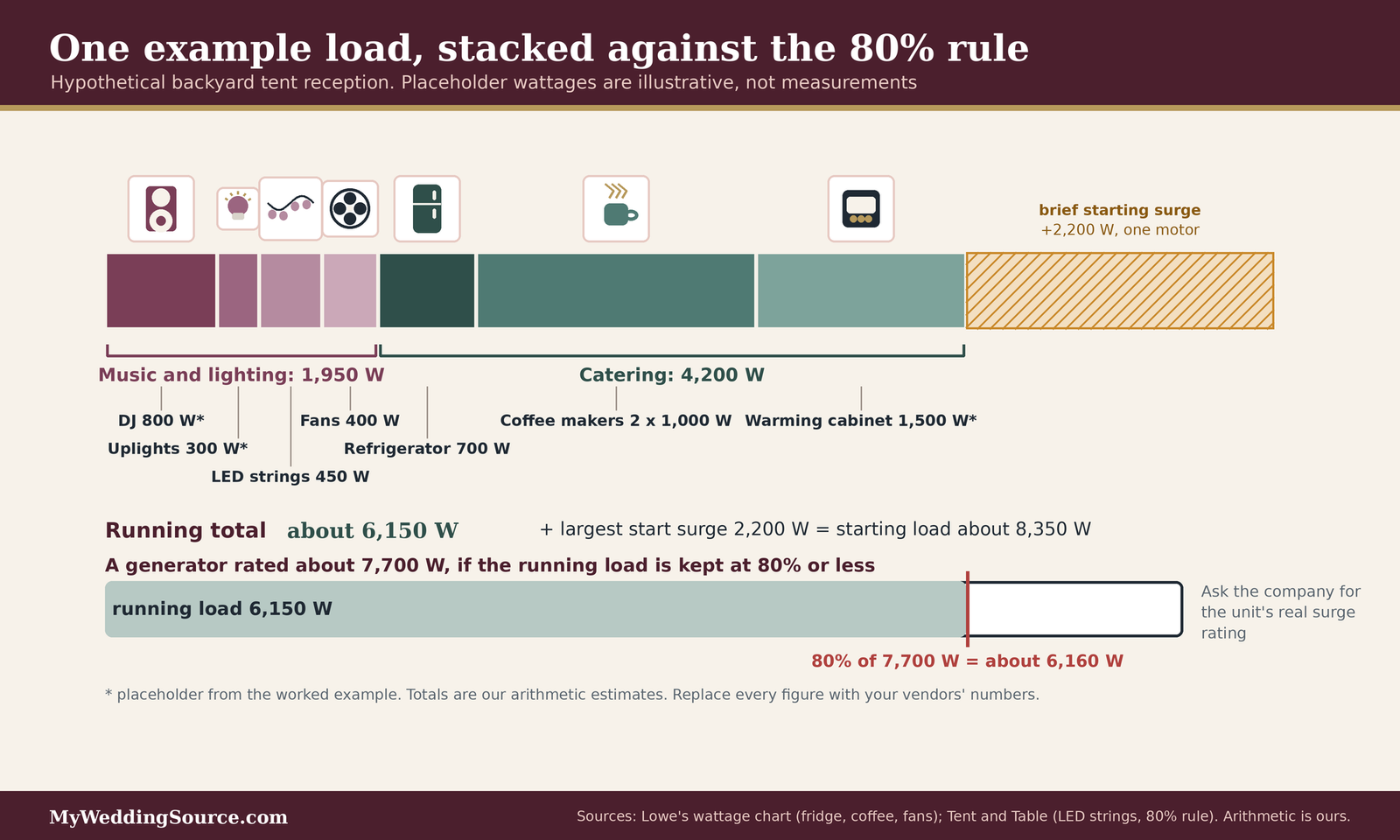
Here is an example for a hypothetical backyard tent reception. The figures marked “placeholder” are invented round numbers to show the arithmetic. They are not measurements, and you should replace them with your vendors’ numbers. The others come from the published figures cited earlier: Lowe’s wattage chart for the refrigerator, coffee makers, and fans, and Tent and Table’s range of about 50 to 100 watts for a 100-foot commercial LED string, for which we used 75 watts.
| Zone | Item | Qty | Running W each | Running W total | Extra starting W | Source of figure |
|---|---|---|---|---|---|---|
| Music and lighting | DJ and sound system | 1 | 800 | 800 | none listed | Placeholder, DJ to confirm |
| Music and lighting | LED uplights | 1 set | 300 | 300 | none listed | Placeholder, lighting vendor to confirm |
| Music and lighting | LED string lights, 100-ft strands | 6 | 75 | 450 | none listed | Midpoint of Tent and Table’s 50 to 100 W range |
| Music and lighting | Box fans | 4 | 100 | 400 | none listed | Lowe’s wattage chart, approximate |
| Catering | Refrigerator or freezer | 1 | 700 | 700 | 2,200 | Lowe’s wattage chart, approximate |
| Catering | Coffee makers | 2 | 1,000 | 2,000 | none listed | Lowe’s wattage chart, approximate |
| Catering | Warming cabinet | 1 | 1,500 | 1,500 | none listed | Placeholder, caterer to confirm |
Reading the totals
Music and lighting total about 1,950 running watts. Catering totals about 4,200. Together that is about 6,150 running watts. Add the largest starting surge, 2,200 from the refrigerator, and the estimated starting load is about 8,350 watts. Dividing the running total by 0.8 gives roughly 7,690, so a single unit would need a rated running capacity near 7,700 watts or more to stay at or below 80%. A 20% buffer on the running total gives about 7,380, and 30% gives about 8,000. These are our own estimates for a made-up event, so do not treat them as a recommendation for yours.
What splitting the load changes
If the same example is split into two units, music and lighting alone would need about 2,440 running watts at the 80% rule, and catering alone about 5,250, plus its own 2,200-watt refrigerator surge, for a catering starting load of about 6,400. Two smaller units can be easier to place and quieter, and a tripped breaker in the kitchen no longer silences the dance floor. The trade-offs are two deliveries, two fuel plans, and two sets of cords. Ask the rental company which they would deliver for your actual list.
What-if checks before you finalize
Weather and last-minute vendor changes are the most common reasons a load grows after the plan is made. A few quick what-if lines on the worksheet make a wedding generator rental plan robust.
Adding heat or cooling
The Lowe’s chart lists a space heater at about 1,800 running watts and a 12,000 BTU window air conditioner at about 3,250 running and 3,950 starting watts. Tent and Table calls a single 1,500-watt electric heater a heavy load, and says four or five can overwhelm standard portable generators. In the example above, one 1,800-watt heater would push the running total from about 6,150 to about 7,950 watts, or about 9,940 at the 80% rule, and a window air conditioner would push it to about 9,400 running watts. A load added at the last minute may mean a bigger unit, so decide on heating and cooling before you order. Our summer wedding heat plan and winter wedding weather plan guides cover the comfort side of that decision.
Vendor swaps and late additions
A new caterer, a second bar, a food truck, or an upgraded lighting package can change the list overnight. Add a line to your vendor contracts or emails that asks them to tell you before changing their electrical needs, and keep the worksheet as a shared document so everyone sees the latest version. Our wedding vendor timeline guide helps you decide when each vendor’s details are due.
Choosing the size and type for a wedding generator rental
Once you have a total, the wedding generator rental question becomes which kind of machine suits it. A catalog lists many types, and the differences matter for noise, fuel, weight, and the number of outlets.
Common types and what rental companies say about them
Published descriptions of wedding generator rental options come from companies that rent or sell equipment, so read them as how the industry describes itself, not as independent testing.
Inverter and open-frame portable units
Tent and Table describes inverter generators as quiet and suited to small and medium events, typically up to about 7,000 to 9,000 watts, and open-frame conventional units as typically 10,000 to 15,000 watts but much louder. Fuel Logic says a unit in the 5,000 to 8,500 watt range is adequate for most small events. Those ranges overlap with the example above, which is why it can be a one-unit or two-unit decision.
Towable and larger units
Fuel Logic describes towable units as trailer-mounted, which helps when power must move between sites, and says building sites and large events often need 20 kW to 100 kW or more. Tent and Table lists tow-behind diesel units as providing three-phase power from 25 kVA to 500 kVA or more for large events. Big Rentals notes that a towable unit is itself a trailer, so its coupler, connector, brakes, and tow rating must match the vehicle, and that a compact diesel unit can weigh far more than it looks. For a wedding generator rental with a normal-sized catering line, a towable unit is often more than the load needs, but ask.
Fuel type
Fuel Logic calls diesel the most popular choice for construction and events because of durability and fuel availability, and says natural gas units burn cleaner and run quieter but need a gas line. Gasoline and propane units are common in smaller sizes. The type changes how fuel is stored and delivered, so ask what the unit uses and what that means at your site.
Redundancy and what to power first in a wedding generator rental
A backup plan for a wedding generator rental does not have to be expensive. It has to be decided in advance.
Which loads matter most
Ticket Fairy advises powering critical systems first, such as safety lighting and the sound system, and using small battery backup units for sensitive gear. For a wedding, you can adapt that thinking by deciding which items would hurt most to lose: ceremony sound, a path light that keeps guests safe, refrigeration for food. Put those on a circuit that is least likely to be disturbed.
Backup units and transfer arrangements
Ticket Fairy also describes a backup generator on standby wired through a transfer switch, or a parallel twin-pack setup, as ways for one unit to carry the load if the other fails. Both involve electrical connections that a qualified provider should make, and not something to improvise. For most weddings the practical version is simpler: ask the rental company about response time and replacement, and ask whether a second smaller unit is available for essential loads.
Where to put the generator, and how loud it will be
A correctly sized wedding generator rental in the wrong place is still a problem. Placement is about carbon monoxide, fire, noise, weather, and guest flow, and the answer comes from the site, not from a formula.
Distance, direction, and enclosed spaces
The consistent message from safety sources is to keep generators outdoors and away from openings. The specific distances vary by source, and the rental company, manufacturer, venue, and local authorities have the final say.
What the sources say about distance
The CPSC advises running a generator outdoors, away from doors, windows, and vents, with exhaust pointed away from buildings, and never in enclosed or partly enclosed spaces. It gives no distance in feet. A Maine Emergency Management Agency page, written for home use, says at least 15 feet from doors, windows, and vents. Big Rentals, in an event-focused article, cites a commonly recommended minimum of at least 20 feet from occupied spaces and openings, and more when wind shifts or people are close. Those are guidance figures, not legal limits, and your venue or rental company may set a larger one.
Tents and partial enclosures
A tent with sidewalls is a partly enclosed space. Big Rentals says never to run a generator inside a tent or any partly enclosed space, and the CPSC lists garages, crawlspaces, and sheds along with other partial enclosures. Carbon monoxide has no color or smell, and the CPSC says it can build up to dangerous levels within minutes in enclosed spaces and linger for hours after the generator is off. If a guest or vendor feels dizzy, weak, or sick, the CPSC says to get to fresh air immediately. Ask your tent company where the sidewalls and openings will be, so the generator spot can be chosen with them in mind.

Ground, weather cover, and guest flow
The ground under the generator matters as much as the distance around it.
Stable, dry, and clear
Big Rentals says to set the unit on stable, level ground away from dry brush and anything combustible, and Ticket Fairy recommends firm, level ground with a few meters of clear space around the unit, fencing, warning signs, and restricted access. For weather protection, the CPSC advises an open canopy-like structure on a dry surface where water cannot pool or drain under the unit, and says to dry your hands before touching it. Avoid low spots that flood. The National Weather Service says flash floods can occur within minutes, sometimes without visible rain, so low ground is a poor choice even on a sunny afternoon.
Cable paths and where guests walk
Plan the cord route on your site sketch. Big Rentals advises keeping cable runs out of standing water and taping or ramping them where people cross, and Ticket Fairy recommends cable ramps across walkways. Ask the rental company or electrician to set the route, and keep it away from the aisle, the dance floor edge, and the path to restrooms. Our outdoor wedding infrastructure checklist puts power next to water, restrooms, and parking in one site walk-through.
Noise and the moments that need quiet
Even a quiet wedding generator rental is audible, and the quiet moments of a wedding are exactly when you notice it.
Reading a decibel rating
A noise review site, dBSkeptic, reports decibel figures as dBA at 7 meters, about 23 feet, and says most manufacturers publish only a light-load figure. Its data show an inverter generator rising about 9 dB from 25% load to full load, for example a Honda EU2200i going from 48 to 57 dBA, and a conventional 3,500-watt unit rising from 68 to 80 dBA. The site is affiliate-supported and mixes manufacturer specifications with third-party tests, so treat the numbers as a guide. The takeaway for planning is that load matters, which is another reason to size honestly.
How distance and direction help
dBSkeptic says noise falls about 6 dB each time the distance doubles in open air, and that hard ground reduces the drop to about 4.5 dB. Using its example, the EU2200i at full load is about 57 dBA at 7 meters, 51 at 14, and 45 at 28. Applying the same 6 dB rule to the conventional unit’s 80 dBA full-load figure gives roughly 74 at 14 meters and 68 at 28, which is our own estimate and a best case, since trees, buildings, and terrain change the result. Ticket Fairy advises placing generators away from stages and audience areas or behind solid barriers, and Big Rentals suggests a spot downwind of the crowd.

Fuel, runtime, and refueling without a hot-engine mistake
Fuel planning is the part of a wedding generator rental that couples the machine to your timeline. The goal is simple: the unit should never need a stop at a moment you care about.
Working out how many hours it must run
Runtime for a wedding generator rental starts when the first vendor plugs in, not when the ceremony begins.
Count from load-in to the last teardown
List the hours: the sound check, caterer setup, ceremony, cocktail hour, dinner, dancing, and the teardown that follows. A reception that ends at 10:30 p.m. may mean power is needed until near midnight. Tent and Table recommends a minimum of 8 to 10 hours at half load so the unit does not need refueling during the event, and Fuel Logic says to estimate the hours you need and add a margin. Our wedding week checklist shows how the final days fit together.
Ask for burn rate at your load, not at half load
The 8 to 12 hour figure from Fuel Logic is for a full tank at 50% load. At a higher load, a tank empties sooner. In the example above, a single unit at roughly 80% of capacity would be working harder than that benchmark, so ask the rental company for the tank size and the hourly burn at your expected load, and compare the resulting hours with your schedule. We cannot give you a burn rate, because it depends on the specific unit.
Refueling and fuel storage
How and when a wedding generator rental is refueled is a safety question and a schedule question.
The cooling rule
The CPSC says to turn the generator off and let it cool before refueling, because gasoline spilled on hot engine parts can ignite. Fuel Logic likewise says to avoid refueling under load. That means a refuel often requires a planned shutdown, and a planned shutdown must never land on the vows, the toasts, or the first dance. Ask the rental company to deliver a unit with a tank that covers the event without a midpoint refuel, or to confirm who will refuel and when.
Storage and who does it
The CPSC says to store fuel outside living areas in labeled, non-glass safety containers, away from fuel-burning appliances. Ticket Fairy recommends approved containers in a cool, ventilated area away from ignition sources, a no-smoking and no-open-flame rule near fuel and generators, and a Class B fire extinguisher within reach. At a wedding, that translates to keeping fuel away from the tent, the bar, and the guest area, and naming one person, ideally the rental company’s technician, as responsible.
Delivery, buffer, and a backup supplier
Fuel Logic advises keeping a buffer of at least one generator runtime window beyond the planned schedule, and naming a secondary supplier in case roads become congested. It also advises against relying on a single daily drop, which creates a single point of failure. Scale that thinking to a wedding generator rental by asking whether the unit arrives full, whether a refill is included, and who to call if you need one.
Confirm the fuel policy
Fuel Logic notes that some providers expect a full tank back while others charge based on usage, so ask which applies, and what the return checklist requires. A unit returned with a half-empty tank can cost more than a full one if the contract says so.
Name the person who owns the generator on the day
For any wedding generator rental, someone should know where the unit is, who to call, and what to do if it stops. Ticket Fairy suggests assigning someone to monitor loads and log fuel levels at events. For a wedding, that can be a rental technician or a trusted venue staff member, not a guest. Put the name and phone number on your day-of contact sheet. Our wedding party coordination checklist can hold it.
Electrical and weather safety around a wedding generator rental
A wedding generator rental puts power equipment in the middle of a crowd of people in formal clothes, often on grass, sometimes in the rain. That is a setup that rewards caution and punishes improvising. This section collects what safety sources say and, just as important, marks where the work belongs to a professional.
Shock, wet ground, and ground-fault protection
Wet conditions raise the risk of electric shock, and the generator is only one part of the picture. Cords, boxes, and connections all matter.
What safety agencies name as common causes
The Occupational Safety and Health Administration’s electrical page lists lack of ground-fault protection and improper use of extension and flexible cords among the most frequent causes of electrical injuries, and it mentions contact with power lines and missing or broken paths to ground. That page covers workplaces and does not mention generators, so we use it only as a reminder of what tends to go wrong, not as event rules. Big Rentals advises ground-fault protection with outdoor-rated cords and keeping the unit and its connections dry. Ask the rental company what protection is built into the equipment they deliver.
Keep the equipment off wet ground
The CPSC says to run a generator under an open, canopy-like structure on a dry surface and to dry your hands before touching it. Ticket Fairy advises lifting distribution boxes off wet ground and keeping them out of reach of the public. A rainy forecast is a reason to talk to the rental company early, not on the morning of the event, because the answer may change the placement, the cord routes, and the canopy. Our wedding venue rain plan article covers the wider decision.
Storms, flooding, and a decision in advance
Weather decisions go better when they are made calmly in advance than when they are made under thunder.
What the National Weather Service says
The National Weather Service safety pages are organized by hazard, including thunderstorms, lightning, wind, heat, floods, and others. Its lightning page says lightning strikes the United States about 25 million times a year and kills about 20 people annually, and it points to separate lightning safety guidance. Its safety overview says flash floods can occur within minutes, sometimes without any visible rain. We did not find specific event-shutdown thresholds on those pages, so we do not give one here. Ask your planner, venue, and rental company who decides to pause an event, and what happens to the generator when they do.
Who decides and what is switched off
Write the decision down in advance: who watches the forecast, who has the authority to pause music and lights, and who is responsible for shutting down and safely securing power equipment. A rental technician can often answer the last question in one sentence. Our wedding emergency kit guide covers the small items to keep on hand, and a flashlight with fresh batteries earns its place if the lights go out.
What is not a do-it-yourself job
The most important safety sentence in this guide is a short one: leave the wiring to the professionals.
Connecting a generator to a building
The CPSC warns against backfeeding a building by plugging a generator into a wall outlet. It calls the practice dangerous to utility workers and neighbors, and says it bypasses household circuit protection. Any link between a generator and a building should be made by a licensed electrician or the venue’s approved provider, who knows the local rules. If a vendor suggests a shortcut, say no and ask the rental company instead.
Cords, overloads, and daisy chains
Heavy-duty outdoor-rated cords with three prongs are the CPSC’s baseline, and each cord’s rating must exceed the total load on it. Beyond that, cord layout, distribution boxes, and circuit assignments are a job for the rental company’s technician. Do not stack extension cords or power strips to reach one more outlet. If a vendor needs more reach, ask the rental company to add distribution rather than improvising with whatever is in the van.
Cost and contract terms for a wedding generator rental
Prices for a wedding generator rental vary with unit size, delivery distance, season, and what is included. The published ranges are useful for orientation, and the contract is what actually matters.
What it can cost
Fuel Logic, a fuel delivery company, cites about $50 to $100 per day for small portable units and $500 to $1,500 per day or more for large industrial generators, and says delivery, setup, and pickup are usually extra. It also says weekly or monthly rentals usually carry lower daily rates and that renting is almost always cheaper than buying for a one-time need. Those are one company’s published figures without a stated method, and they will not match every region or season. Ask for an itemized quote that covers the machine, delivery, setup, pickup, fuel, any technician, and insurance.
Reading a wedding generator rental quote
A short wedding generator rental quote can hide long extras. Reading it line by line is quicker than finding out on the day.
Line items to look for
Look for the unit and its rated capacity, delivery and pickup, setup and cords, distribution boxes, fuel included or not, a technician or attendant if you want one, a deposit, damage terms, and overtime if the event runs late. If a line is missing, ask whether it is included, charged separately, or not provided. Our wedding vendor due diligence checklist explains how to keep these answers on record, and our wedding planning checklist can hold the budget line.
Insurance and who is responsible
Fuel Logic says rental companies typically include basic coverage and that renters should consider additional coverage. We cannot tell you what yours includes. Ask what happens if the unit is damaged, if a guest is injured, or if the venue requires a certificate of insurance. Our wedding insurance guide explains how event coverage works in general terms, and this is not insurance advice.
Questions to ask before you sign
Questions worth asking the rental company
- What rated capacity, voltage, and phase will you deliver, and how many outlets and what type?
- What load did you assume, and what margin does that leave at my total?
- How many hours will one tank run at my expected load, and who refuels?
- What is your response time if the unit stops, and do you replace or repair it?
- Who sets up cords and distribution, and who is on site during the event?
- What are the fuel, return, delivery, overtime, and insurance terms?
About the equipment
Ask for the machine’s specifications in writing, not just a model name. A model name tells you little unless you know the rated capacity, tank size, and noise rating at the load you plan to run. If the company recommends a different size from your estimate, ask for the reasoning, and compare it with your worksheet.
About service and responsibility
A wedding generator rental is only as good as the response when something goes wrong. Ask for a phone number that is answered during the event, a stated response time, and a plan for a replacement unit. Fuel Logic tells renters to confirm those details before signing, since many firms offer around-the-clock service but terms differ.
A planning timeline for wedding generator rental
A wedding generator rental is easier to plan when the work is spread across several weeks than when it is compressed into the last few days. The sequence below is our suggestion, built from the sources above. Your own venue and vendors may need a different order.
Early: venue, vendors, and rules
Start with what the site allows, then collect the details that depend on it.
Ask the venue and the property owner
Ask whether a wedding generator rental is allowed, what power exists, where the tent will go, what the quiet hours are, and whether insurance certificates or approved vendors are required. Ticket Fairy advises booking generators three to six months ahead for festivals, since summer demand depletes quiet, sound-attenuated units, and it makes sense to ask early for a wedding in a busy season, though that figure comes from the festival world.
Gather vendor lists
Ask each power-using vendor for a list of equipment, watts or amps and volts, and the largest motor, and say you need it several weeks before the event. Ticket Fairy suggests asking food vendors weeks before load-in. Start the shared worksheet from the table above so everyone fills in the same format.
Final weeks: confirm and walk the site
Once the load is known, the work is mostly confirmation.
Send the worksheet to the rental company
Send the worksheet, your site sketch, the schedule, and the venue’s rules. Ask the rental company to confirm the unit, the outlets, the fuel plan, and the placement in writing. If they suggest a change, update the worksheet so all parties see the same version.
Walk the site with the right people
If possible, walk the site with the rental company, the venue contact, and the vendor who has the biggest load. Check the generator spot, the delivery route, the ground, the cord route, and the clearance from the tent. Our outdoor wedding venues and barn wedding venues guides describe common site conditions that affect where a unit can go.
Day of: delivery, checks, and a named contact
The day of the event should feel like a checklist and not a negotiation.
Before guests arrive
Confirm the unit is where the plan says, away from openings and tents, on dry ground, with a clear zone around it. Confirm the cord route is covered where people walk, and that fuel is stored away from the guest area. Run the sound check and lighting check with the unit already running, so any overload shows up at 2 p.m. and not at the first dance.
During and after the event
Keep the contact sheet with the rental company’s number and the on-site contact. Note when the unit was last fueled, and check it at planned intervals. At the end, let the unit cool before it is moved or refueled, follow the return checklist from the contract, and confirm pickup. Fuel Logic advises letting the unit cool, switching off loads, and following any fuel-handling steps the provider requires.
Edge cases that change the plan
Not every wedding generator rental fits the tent-on-a-lawn picture. These situations come up often enough in wedding generator rental planning to be worth a plan.
Where the site changes the answer
Venue type affects both the need for power and the rules for the machine.
Beaches, parks, and public land
Public land often requires permits, and managers of parks and beaches may limit or prohibit generators, restrict hours, or set noise rules. We did not find a single rule that applies everywhere, so ask the managing agency directly and in writing. Our wedding permits guide describes how to approach those offices, and remember that the permit for the ceremony may not cover a wedding generator rental.
Barns, tents with sidewalls, and indoor spaces
A generator never goes inside a building, tent, or other enclosed or partly enclosed space, according to the CPSC and Big Rentals. In a barn or an enclosed tent, the exhaust path and the position of doors and flaps matter, and the answer is usually to put the unit well outside and run distribution in. Ask the venue where its approved generator areas are, and do not assume that an open barn door counts as ventilation. The CPSC says fans and open doors or windows do not make indoor use safe.
When the plan changes late
Changes after a wedding generator rental plan is made are normal. The question is whether the plan makes them easy.
Forecast shifts and guest-count changes
A hot forecast may add fans or cooling, a cold one may add heaters, and a larger guest count may add catering equipment. Each is a line on the worksheet, so update it, recalculate, and tell the rental company as soon as you know. A last-minute change is usually easier to handle if the original plan had margin, which is another reason to keep it.
Late nights and neighbors
A reception that runs later than planned needs more fuel from your wedding generator rental and may cross a quiet-hours line. Ask the venue and rental company what the contract says about overtime and noise, and agree in advance on a firm end time for power. If the property has neighbors, consider telling them about the date, because a surprise sound at night is more likely to cause a complaint than an expected one.
Smaller or different approaches
Some weddings do not need a wedding generator rental at all.
Small gatherings and venues with strong power
An intimate ceremony with a small speaker and a few lights may be within what the venue’s own circuits can handle, so ask the venue about its capacity before assuming a rental is needed. A short conversation with the venue and the sound vendor may save a rental fee, a delivery, and a safety zone.
Battery-based options
Battery-powered equipment, such as speakers and string lights with their own batteries, can reduce the load a generator must carry. We did not research battery power stations or other alternatives for this guide, so ask your vendors what they use and what its limits are, and do not assume it will run a caterer’s equipment.
FAQ: wedding generator rental questions
Sizing and loads
How big a generator do I need for a wedding?
It depends on the total running watts of everything plugged in, plus the largest starting surge. A common published rule keeps continuous load at or below about 80% of rated capacity. Collect vendor wattage lists, total them on a worksheet, and give the rental company the result so they can confirm the match in writing.
What is the difference between running and starting watts?
Running watts are what a device draws while operating. Starting watts are a brief higher surge when a motor or compressor turns on. Refrigerators are a familiar example. Planners often add running watts for everything plus the single largest starting surge, and the rental company can advise on any further margin for your site.
Placement and safety
How far should a generator be from the tent and guests?
Sources vary. The CPSC says outdoors and away from doors, windows, and vents, with no distance given. A Maine agency says at least 15 feet for homes, and Big Rentals cites at least 20 feet from occupied spaces for events. Your rental company, venue, and local authorities may require more, so ask them.
Can a generator run in the rain?
The CPSC says to protect it from moisture by running it under an open, canopy-like structure on a dry surface where water cannot pool, never indoors or near building openings. Rain also affects cords and connections, so tell the rental company about the forecast early and ask how they handle wet conditions.
Fuel and timing
How long will a generator run on one tank?
Fuel Logic says a unit normally runs about 8 to 12 hours on a full tank at 50% load, depending on fuel type, tank size, and load. Higher loads shorten that. Ask the rental company for the tank size and burn rate at your expected load, then compare the result with your schedule.
How far ahead should I book?
Ticket Fairy advises booking generators three to six months ahead for festivals, because summer demand depletes quiet units. That figure comes from the festival world, so treat it as a prompt to ask early. Check availability for a wedding generator rental as soon as your date, site, and rough load are known.
Cost and rules
How much does a wedding generator rental cost?
Fuel Logic cites about $50 to $100 per day for small portable units and $500 to $1,500 per day or more for large industrial ones, with delivery, setup, and pickup usually extra. Those are one company’s published figures. Ask for an itemized quote that includes fuel, any technician, and insurance.
Do I need a permit for a generator?
It depends on where you are. Fuel Logic suggests checking local noise rules and whether a temporary power permit is required, and contacting the local fire marshal or building department. We cannot say what applies in your city or county, so ask the venue and the local offices directly and keep their answers in writing.
Your next steps
Build the list
Send the worksheet to every vendor
Copy the worksheet table for your wedding generator rental into a shared document and ask each vendor to fill in their own lines, with watts, or amps and volts, quantities, and the largest motor. Set a date a few weeks before the event, and follow up on any blank line, since a blank is a risk.
Draw a simple site sketch
Mark the tent, guest areas, the kitchen, walkways, the road, and a candidate generator spot. Show where doors and openings will be. Our outdoor wedding infrastructure checklist helps you cover the rest of the site, and the sketch makes every conversation faster.
Confirm in writing
Ask the venue and local offices
Confirm what the venue allows, what the fire marshal or building department requires, and any noise or quiet-hours rules. Our wedding permits and wedding venue questions guides can help structure the conversation.
Get the rental terms on paper
Share the worksheet with the rental company and ask them to confirm unit, capacity, outlets, fuel plan, response time, and total price in writing. Then add the contact names and numbers to your day-of sheet, and share it with your planner or coordinator. Our wedding vendor timeline guide can help you place the deadlines.
Related reading: Winter wedding venue heating and safety.
Sources & methodology
How we built this guide
What we relied on
This guide combines safety guidance from a federal consumer-product agency and a state emergency-management agency, National Weather Service hazard pages, an OSHA electrical overview, and published planning advice from event-equipment, fuel, ticketing, and rental companies. Where a statement comes from a company, we name the company, because its advice reflects what it sells. The worksheet totals, percentages, and the noise figures extended beyond the published examples are our own arithmetic, they are estimates, and the placeholder wattages in the worked example are invented round numbers for illustration. We checked the pages listed below on November 12, 2026, and we make no claim about whether they have changed since. Company names appear because their published guidance is cited, not as recommendations.
What we did not do
We did not test generators, measure noise, inspect any site, or review electrical codes, and this is not electrical, legal, insurance, or safety-engineering advice. Rules on generators, fuel storage, noise, and permits vary by city and county, so confirm them with your venue, your local authorities, a licensed electrician, and your rental company. Several other pages we tried to open did not load, so we did not rely on them.
Source list
Government and public-agency sources
- U.S. Consumer Product Safety Commission, Portable Generators safety alert: https://www.cpsc.gov/s3fs-public/5123_SafetyAlert_PortableGenerators_102021.pdf
- Maine Emergency Management Agency, Generator Safety: https://www1.maine.gov/mema/maine-prepares/home-preparedness/generator-safety
- National Weather Service, Safety: https://www.weather.gov/safety
- National Weather Service, Lightning: https://www.weather.gov/safety/lightning
- Occupational Safety and Health Administration, Electrical: https://www.osha.gov/electrical
Rental, fuel, event, and trade sources
- Fuel Logic, Renting a Generator: https://www.fuellogic.net/everything-you-need-to-know-about-renting-a-generator/
- Fuel Logic, Hidden fuel risks at outdoor events: https://www.fuellogic.net/hidden-fuel-risks-outdoor-events/
- Tent and Table, What generator do I need for my event rental company: https://www.tentandtable.net/blog/post/what-generator-do-i-need-for-my-event-rental-company
- Ticket Fairy, Generators and fuel management for festivals: https://www.ticketfairy.com/blog/generators-and-fuel-management-for-festivals-ensuring-safe-and-uninterrupted-power.md
- Big Rentals, How to haul a generator to an outdoor event: https://bigrentals.com/rental-resources/trailer-rentals/how-to-haul-a-generator-to-an-outdoor-event-trailer-sizing-and-safety
- ForConstructionPros, How to get the right-sized generator for the job: https://www.forconstructionpros.com/rental/power/generators/article/11361025/how-to-get-the-rightsized-generator-for-the-job
- Lowe’s, Portable generator wattage chart: https://www.lowes.com/pdf/portable_generator_wattage_chart.pdf
- dBSkeptic, How loud is a generator at different loads: https://dbskeptic.com/quiet-generators/how-loud-is-a-generator-at-different-loads/