
A visa invitation letter for a wedding is a short, factual note from the couple or hosts that tells a consular officer who is inviting the guest, what the event is, when and where it happens, and what the hosts have actually arranged. This guide shows what couples can honestly claim in that letter, what they cannot, and how to build one from evidence instead of hope.
A visa invitation letter supports a guest’s application; it never decides it. Write only statements you can prove (names, dates, venue, relationship, lodging you booked, costs you will really pay) and attach the proof. Leave out anything about the guest’s job, savings, home ties or intention to return, because the guest must prove those personally. Never promise approval, and never invent or inflate details. If a sentence cannot be checked, delete it.
Every year, couples send long, warm, slightly desperate letters to relatives and friends abroad. They say the guest is “very important to us,” that the wedding “cannot happen without them,” and that the family will “guarantee” everything. The intention is kind. The effect is often neutral at best, and sometimes harmful, because a consular officer reads a stranger’s promises with a trained skepticism and a short amount of time.
This article takes a narrower, more useful view. A visa invitation letter is a piece of evidence about the event, written by the people who own the facts of the event. That is its whole value. It confirms that a real wedding exists, that a real person invited the guest, and that the plans around the visit are concrete. It does not prove the guest will return home, and it cannot do so.
The sections below give you a way to sort every sentence into what you may claim and what you may not, an evidence checklist to gather before drafting, a fact-only outline with placeholders, one worked case with an invented couple, and a list of failure conditions that tell you to stop and rewrite. The main examples assume a wedding in the United States and a guest who needs a visitor visa. If the wedding is abroad, the same logic applies, but the destination country sets the rules.
A note on scope. This is general information, not legal advice. Immigration decisions are made by government officials under rules that change, and your situation may have details that matter. For anything unusual, such as a past refusal, a prior overstay or a complicated family history, the guest should talk to a licensed immigration attorney or to the official sources listed at the end.
What a visa invitation letter is, and what it is not
Start with the word “invitation,” because it causes most of the confusion. There are two different documents with that name.
The first is the wedding invitation: the printed or digital card with the date, venue and dress code. If you are still working out wording, spelling and mailing, the wedding invitation etiquette guide covers it, and the print production side lives in the invitation printing guide. That card is a social document. Its job is to tell guests where to be.
The second is the visa invitation letter. It is a separate, plain page written to an official reader, usually a consular officer, sometimes a border officer or an airline agent. Its job is to answer a few practical questions: Who is this event for? Is it real? Who invited this person? Where will they stay? Who is paying for what? Nothing in it needs to be pretty.
What the letter can do
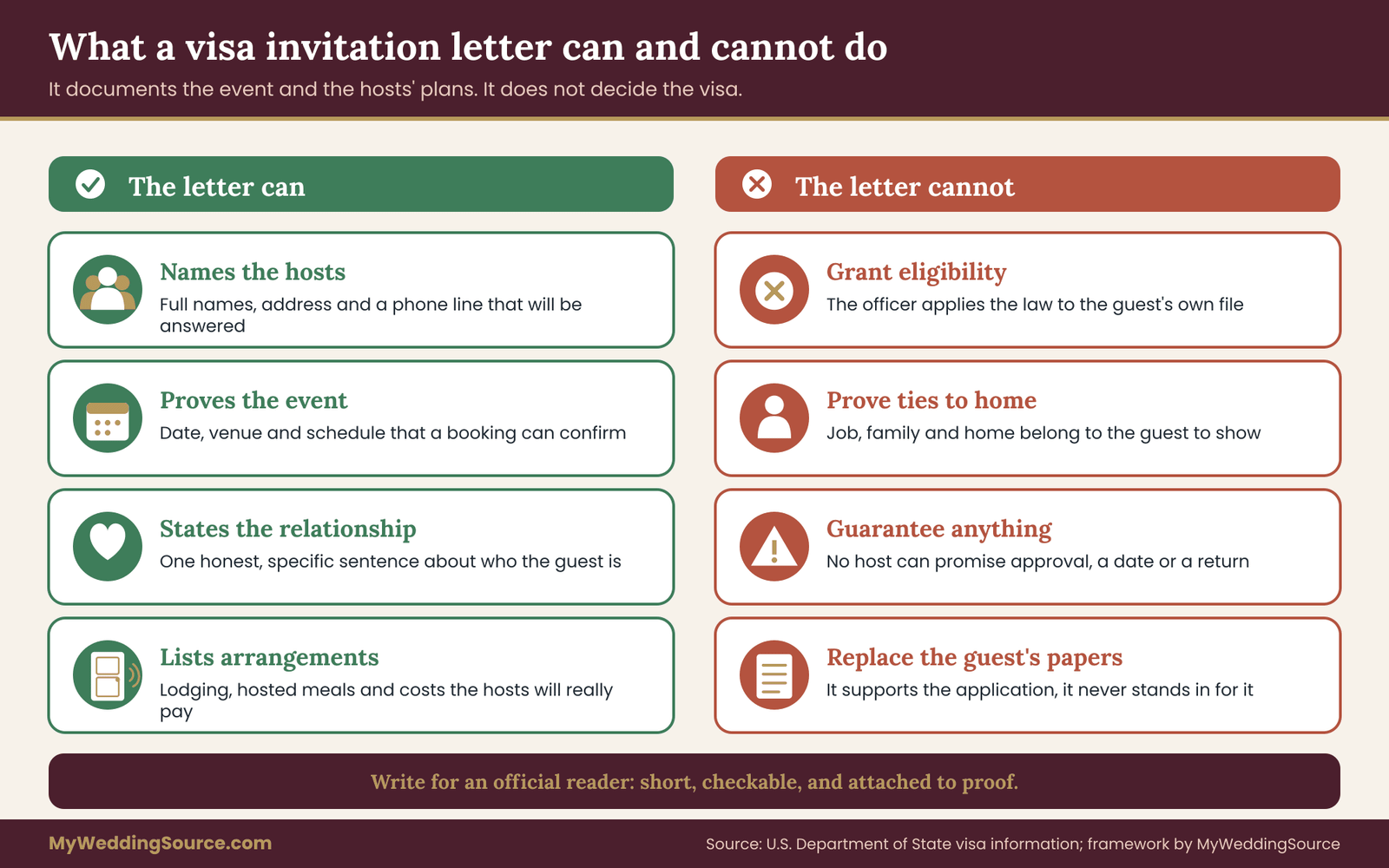
A good letter does four modest things. It identifies the hosts and gives a way to reach them. It describes the event with dates and a place that can be verified. It explains the relationship between the hosts and the guest in one honest sentence. And it states the arrangements the hosts have made, with proof attached.
Those four things shorten the officer’s work. An officer who can see at a glance that the wedding is on a specific Saturday, at a named venue, with a booked hotel room, spends less time wondering whether the trip is real. That is a real, if small, contribution.
What the visa invitation letter cannot do
It cannot create eligibility. Visitor visa decisions rest on the applicant’s own circumstances, the application, the interview and the law. A letter from a host does not change who the applicant is.
It cannot replace the applicant’s own evidence. Ties to the home country, such as employment, family, property and a settled life, are shown by the applicant. The hosts do not know the guest’s pay slips or lease, and a visa invitation letter that pretends otherwise adds nothing.
It cannot guarantee anything. No private person can guarantee a visa, an interview result or admission at the border. A sentence that suggests otherwise is a red flag, not a reassurance.
And it is generally not a required document. The State Department’s visitor visa information does not, as far as the public pages show, list a host invitation letter among the items every applicant must provide. Confirm that on the current page for the guest’s country, because embassies sometimes publish local instructions. If a visa invitation letter is optional, the question is not “must we write one?” but “will a careful, accurate one help, and will a careless one hurt?”
Who actually decides
For a U.S. visitor visa, a consular officer abroad decides whether to issue the visa. The applicant completes an online application, pays the fee, attends an interview and answers questions. At the border, a Customs and Border Protection officer decides whether to admit the traveler, and a visa does not guarantee that admission. Travelers from countries in the Visa Waiver Program apply for travel authorization instead, and that authorization is also not a guarantee of entry.
This chain matters for how you write. Your reader is an official with limited time, a duty to apply the law, and no reason to take your word for anything you cannot support. Write for that reader. A plain letter with three attachments will outperform a heartfelt page of adjectives.
The legal idea behind the caution
U.S. law sets a default that every visitor visa applicant is treated as a possible immigrant until the applicant shows otherwise. The State Department explains this in its visa denial guidance. In practice it means the burden sits with the applicant to demonstrate that the trip is temporary, that the purpose is legitimate and that the applicant can pay for it or has someone who will.
A wedding visit fits comfortably inside the visitor category. Attending a social event with friends or relatives is an ordinary purpose of a visit. The difficulty is rarely the purpose. It is the proof of temporary intent, which the couple cannot supply. Once you understand this, you can see why the visa invitation letter’s strongest honest role is to document the event and the hosts’ arrangements, and why overreaching into the guest’s side of the file backfires.
A quick sorting test before you start
Before drafting anything, ask whether the visa invitation letter is likely to be useful at all. It tends to help when the guest is a close relative or friend whose connection to the hosts is easy to state, when the event details are fixed, and when the hosts have made specific arrangements, such as hosting the guest in their home or paying a venue deposit. It adds less when the connection is thin, when the date is still moving, or when the main questions in the application are about the guest’s own finances and ties.
None of that means you should skip a letter. It means you should set expectations. A visa invitation letter is one small, accurate piece in a larger file the guest builds.
What the officer sees at the interview
It helps to picture the interview. The officer has a short window. The applicant’s form is on a screen. The questions are typically simple: What is the purpose of the trip? Who are you visiting? How long will you stay? Who is paying? What do you do for work? What will you return to?
The wedding answers the first three questions cleanly. The guest answers the rest from their own life. A visa invitation letter that supports the first three, and says nothing about the rest, matches how the interview actually runs.
Three questions the visa invitation letter should make easy
The first is whether the event is real and dated. A specific date, a named venue and a ceremony time can be checked against a venue contract or a booking confirmation. Attach the confirmation, or a page from it with private pricing hidden.
The second is whether the host is real and reachable. A full name, a street address, a phone number and the hosts’ relationship to the event let an officer understand who is behind the visa invitation letter. Use a phone line you will actually answer. Do not publish an email address in a public version of your letter template, and keep contact details in the visa invitation letter itself only for the guest to carry.
The third is whether the arrangements are credible. A hotel reservation with a confirmation number, a statement that the guest will stay at the hosts’ home, or a rehearsal-dinner invitation with a date are the kinds of details that make a trip look planned instead of improvised.
Two questions the visa invitation letter must not try to answer
Is the guest likely to go home? Does the guest have enough money? These are the center of most visitor visa decisions, and they belong to the applicant. If the hosts will pay some costs, the visa invitation letter can say so, with limits, in plain terms. If the hosts try to vouch for the guest’s character or promise the guest will return, they are speaking outside their knowledge, and a careful officer will notice.
How this changes your drafting stance
Think of yourselves as witnesses to an event, not advocates for a person. A witness says what they saw, what they planned and what they did. An advocate argues. The difference sounds small and changes every sentence. “Our wedding is on Saturday, June 12, at the Harbor Room, and the ceremony begins at four o’clock” is witness language. “Our wedding will be heartbreaking without her” is advocate language, and it does nothing for the file.
If you are also managing the rest of the guest side, such as RSVPs, hotel blocks and arrival times, keep that work separate from the letter. The wedding guest list guide helps you decide who is invited and how to track addresses, and the wedding RSVP etiquette page covers response deadlines. Those documents feed facts into the visa invitation letter, but they are not the visa invitation letter.
The claim ledger: four kinds of statements in a visa invitation letter
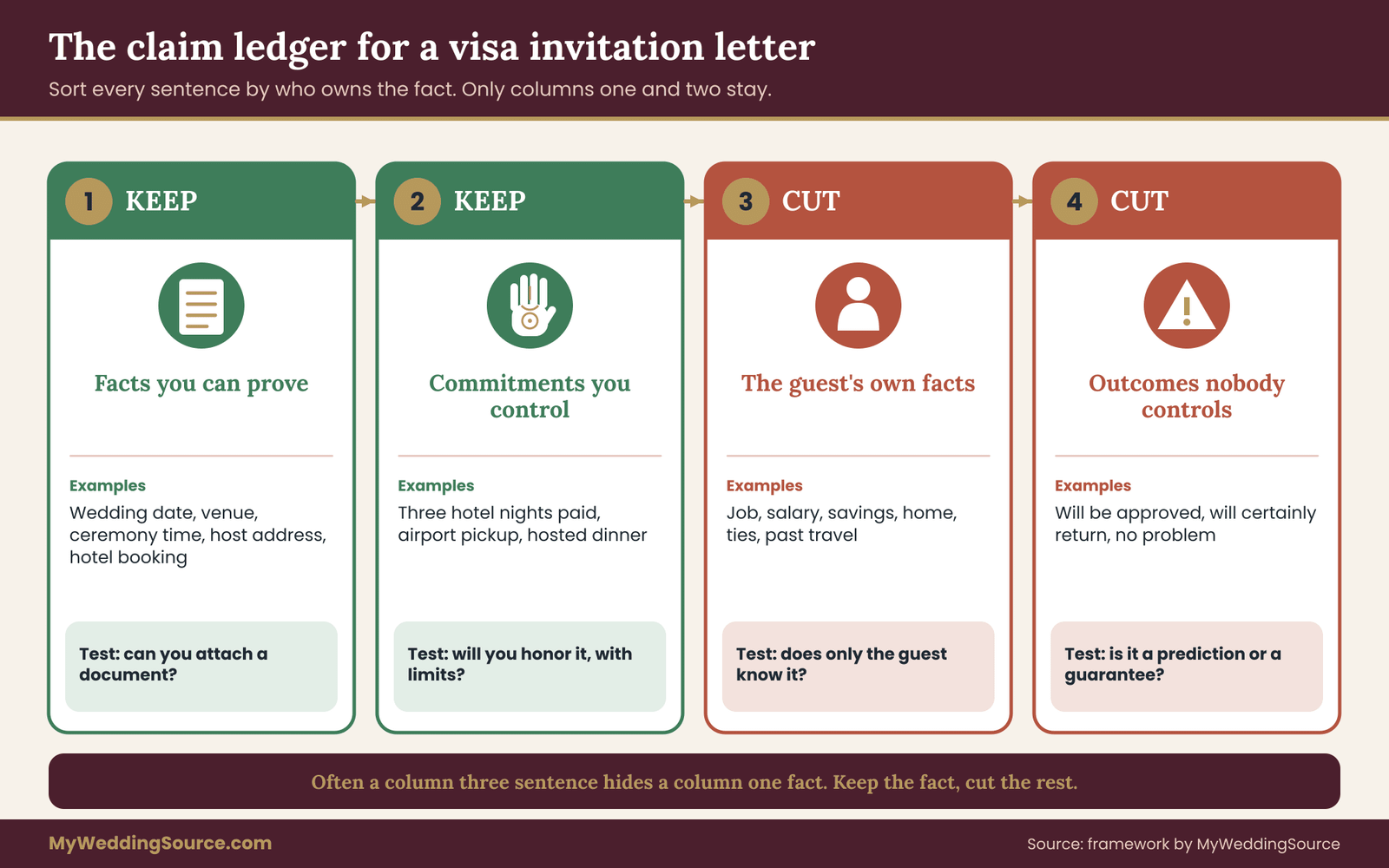
Most advice about these letters is a list of dos and don’ts. Lists are easy to forget and hard to apply to a sentence you wrote at midnight. A better tool is a ledger that classifies every statement by who owns the fact. Before a sentence goes into the visa invitation letter, you assign it to one of four columns. The sentence stays only if it belongs in the first or second.
Column one: facts you can prove
These are facts about the event and the hosts that a document can confirm. The wedding date, the venue name and address, the ceremony time, the hosts’ legal names, the hosts’ home address, and the booking confirmation for a hotel room you reserved all belong here. If an officer asked you for evidence, you could hand it over within a day.
The test is simple: can you attach or produce something? A venue contract, an invitation card, a booking confirmation, a utility bill with the host address, a marriage license application receipt where the jurisdiction issues one. If the answer is yes, the statement is column one.
Column two: commitments you control
These are things you promise to do and can actually do. “We will host her in our home from June 8 to June 15.” “We will pay for her hotel for three nights.” “We will meet her at the airport.” A commitment is honest when you have the means and the intent, and when you are prepared to be held to it.
Be careful about scope. A commitment should be specific, limited and affordable. “We will cover everything” is not a specific commitment; it is an open-ended promise you may not be able to keep, and it can also raise the question of why the guest cannot show their own funds. “We will pay for the hotel for the three nights of the wedding weekend” is a commitment an officer can understand and you can honor.
Column three: facts the guest owns
These are statements about the guest’s life: job, salary, savings, home, family at home, past travel, reasons to return. You may know some of them informally. You do not know them the way the guest does, and you cannot document them. In your visa invitation letter, they are out of bounds.
If you are tempted to write “she has a stable job and will certainly return to her family,” stop. Either that sentence is true and the guest should prove it with her own documents, or it is a guess dressed up as a fact. In both cases it does not belong in your letter. The guest speaks for herself at the interview.
Column four: outcomes nobody on your side controls
These are predictions and guarantees. “She will be approved.” “He will leave on time.” “There will be no problem.” “We guarantee she will return.” No host can promise a visa decision or a traveler’s future behavior. Sentences in this column are the most common reason a visa invitation letter reads as unserious.
Column four also includes hidden outcomes. “We are sure the officer will understand” is a prediction. So is “this letter proves our relationship.”
How to use the ledger in practice
Print your draft, or paste it into a document, and mark each sentence with 1, 2, 3 or 4. Sentences marked 1 and 2 stay. Sentences marked 3 and 4 go, or they get rewritten into a column one or two statement. Often a column three sentence hides a column one sentence inside it.
For example, “Lucia is a retired teacher who owns her home and has no reason to stay in the U.S.” is column three throughout. The column one fact inside it might be “Lucia is the bride’s aunt, and she has attended every family milestone since the bride was born.” Even that is better trimmed to “Lucia is the bride’s aunt,” because the second half is color, not evidence. Short and checkable beats long and warm.
A good letter usually ends up with a surprising proportion of its sentences in column one. That is a sign it is working.
Why ownership matters more than tone
Notice that the ledger never asks whether a sentence sounds good. It asks who can stand behind it. This is what makes a host letter credible: every claim in it can be traced to someone who is entitled to make it. When an officer reads a visa invitation letter where every statement is something the hosts could know, the letter reads as honest. When it contains statements the hosts could not possibly know, the whole page loses trust, including the true parts.
A side benefit is that the ledger protects you. If something goes wrong later and someone asks what you said, you can point to a visa invitation letter that claimed only what you owned.
What couples can claim in a visa invitation letter
With the ledger in hand, here is the list of claims that normally survive it. Not every item is needed in every letter, and none should be padded.
Identity and contact of the hosts
Your full legal names as they appear on your own identification, your address, and a phone number you will answer. If the hosts are parents rather than the couple, say whose wedding it is and what the relationship is. Keep it consistent with the guest’s application, which will list the host or the person the guest is visiting.
If the guest will stay with you, say so and give the address. If not, say where they will stay and who made the reservation. Names and addresses across the letter, the hotel confirmation and the application should match exactly, down to spelling and middle names. Small mismatches look like carelessness at best.
The event itself
State that you are getting married, the date, the city, and the venue. If there are several events, such as a welcome dinner on Friday, the ceremony on Saturday and a farewell brunch on Sunday, list the dates of the ones the guest is invited to. This also helps the guest justify their planned stay length, since a stay built around a three-day event with a day on each side is easy to understand.
Do not overstate. If the date might still move, say it is the planned date. If a venue is booked but the contract is not yet signed, say booked “subject to contract” or wait until it is. Officers care less about perfect certainty than about honesty and consistency.
The relationship
One sentence, true, specific. “Lucia is the bride’s aunt.” “Tomas has been the groom’s close friend since university.” “Ayo is the groom’s colleague and a guest at the wedding.” If the relationship is not close, say what it is and no more. A modest, accurate statement is stronger than a stretched one, because the guest will be asked about it and the answers must line up.
If the guest is a member of the wedding party, such as a bridesmaid, a groomsman or a reader, say so. That is a concrete reason their presence matters, and you can attach the wedding party list or a short note from the ceremony program.
The arrangements you made
This is where the visa invitation letter does real work. Lodging is the clearest example. A confirmed hotel booking, a room in the hosts’ home, or a place in a booked guest block are all column one or two facts. The wedding guest hotels guide explains how to run a block and keep records, and those same confirmations become your attachments here.
Transport is next. If you will collect the guest from the airport, say when you expect to. If you have booked a shuttle for the wedding day, mention it. Do not claim to have booked flights unless you have, and do not book a ticket in the guest’s name unless the guest agrees.
Who is paying for what
Say it plainly and narrowly. “The guest will pay for her own flights. We will pay for three nights of hotel accommodation and the wedding events.” The next major section covers this sentence in depth, because it is where good intentions most often turn into trouble.
Contact and verification
Give the officer a way to confirm that you exist. A phone number and an address are enough. You may add a line such as “We are available to answer any questions.” That is honest and low-key. Avoid language that sounds like a demand, such as “please contact us immediately if there is any problem.”
The statement that you understand who decides
One closing sentence is both truthful and reassuring: you understand that the decision belongs to the consular officer, and that the letter is provided only to document the event and the hosts’ arrangements. This sentence quietly signals that you are not trying to pressure anyone, and it keeps you inside column one.
Claims that are fine but optional
A short note about the guest’s role in the family, a mention that this is the first time the guest has been invited to the U.S., or a reference to previous visits, can be included if you can document them. Previous visits are best shown by the guest’s own passport stamps and records. If you were hosts for a prior visit, you can mention it in one line, and only if it was accurate and the guest left on time.
Keep optional claims few. Each extra claim is something the guest must be ready to discuss, and each is a place for a mismatch to appear.
What couples cannot claim in a visa invitation letter
The previous section was about what survives the ledger. This one is about what does not. Each item below is a pattern that shows up repeatedly in hurried drafts, with a reason it fails and a safer replacement. None of these are traps; they are ordinary human impulses that sit badly in a visa invitation letter.
Promises about the result
“We are confident the visa will be granted.” “Please approve her request.” “This visit will definitely be temporary.” You cannot know any of these, and a visa invitation letter that tries to steer a decision signals insecurity rather than strength. Replace the whole group with the closing sentence about the decision belonging to the officer.
There is a legal reason as well as a practical one. A consular officer is bound to apply the law to the facts in the file, not to be persuaded by a third party’s confidence. A private letter has no authority to ask for an outcome.
Claims about the guest’s money, job or home ties
The guest’s employment, salary, bank balance, property and family obligations are the guest’s to prove. A host writing “he earns a very good salary” is repeating hearsay at best. If an officer then asks the guest what they earn and the number differs, the mismatch harms the guest, not the hosts.
If the hosts genuinely plan to pay for part of the trip, that is a column two statement and belongs in the letter. A claim that the guest “does not need any money because we will cover everything” invites the follow-up question of why a close relative cannot pay for a short trip, and invites doubt about what “everything” means.
Claims that the guest will definitely return
Intent to return is the guest’s own state of mind. The hosts do not own it. What hosts can honestly say is when the event ends and when they expect the guest to travel home, if the guest has told them. “Lucia plans to return home after the farewell brunch” is acceptable only if she actually has said so and has a ticket or a plan. Even then, the guest’s own paperwork carries the weight.
Invented or inflated details
An obvious example is changing the nature of the event: calling a small backyard gathering a “grand wedding of three hundred guests” to make it sound more important, or listing a venue that you have not booked. Another is stretching the relationship: “my brother” when the person is a family friend, or “lifelong friend” when you met a year ago. A third is adding trips or tasks that are not real, such as an invented rehearsal or a job for the guest at the wedding.
These are not stylistic errors. Misstatements in a document given to officials can cause serious problems for the guest, including findings about misrepresentation that can follow a person for years. The State Department’s visa pages and denial guidance explain how misrepresentation is treated. Do not be the reason a loved one has that on their record. If something is not true, leave it out, even if the visa invitation letter then looks plain.
Documents that imply a role the hosts do not have
A host letter is not a sponsorship document, an affidavit of support or a guarantee of financial responsibility, and hosts should not title or format it as one. Avoid headings like “Letter of Guarantee,” “Sponsorship Letter” or “Financial Undertaking” unless a specific official form asks for exactly that. Official forms exist for certain situations, and they come with obligations. A casual letter that borrows their language can create confusion about what the hosts agreed to.
Likewise, do not attach forms you do not understand. If a family member suggests copying a form from an unrelated process, check with the issuing agency first.
Statements about the guest’s legal status or history
Do not describe past visa decisions, immigration history, prior refusals or overstays on the guest’s behalf. If any of that exists, it is on record with the government, and the guest must answer questions about it truthfully and directly. A host’s attempt to explain or excuse it in a letter can look like coaching.
If the guest has a complicated history, this is the point where talking to a licensed immigration attorney is worth the fee. The attorney can advise whether a host letter helps at all and how it should be framed.
Emotional pressure
“She is the only mother I have.” “If she cannot come, the wedding will be ruined.” These sentences are sincere. They also do nothing for an officer applying a legal standard, and they can read as pressure. Keep your feelings for the invitation card and the toast. A short sentence such as “She is very important to us” is the most you need, and even that is optional.
Material that is not yours to share
Do not put the guest’s passport number, date of birth or other sensitive identifiers in a letter you will email or text around, unless the guest has asked you to. The guest carries those details on their own forms. If your visa invitation letter needs to identify the guest, a full name as it appears in the passport is usually enough, and the guest can match it to their documents.
Similarly, avoid including private details about other guests, your finances beyond what is necessary, or the couple’s own immigration status. Say only what the guest and the officer need.
A quick way to catch problems
Read the finished letter aloud and ask of each sentence: “Would I be comfortable if the officer called and asked me to prove this?” If the answer is no, the sentence is in column three or four. If you hesitate, rewrite it into a plain fact.
You can also hand the letter to a friend who knows nothing about the guest and ask them what they learned. If they come back with what the event is, who the hosts are and what the hosts arranged, the visa invitation letter is doing its job. If they come back with “she seems very nice,” it is not.
Evidence checklist before you write the visa invitation letter
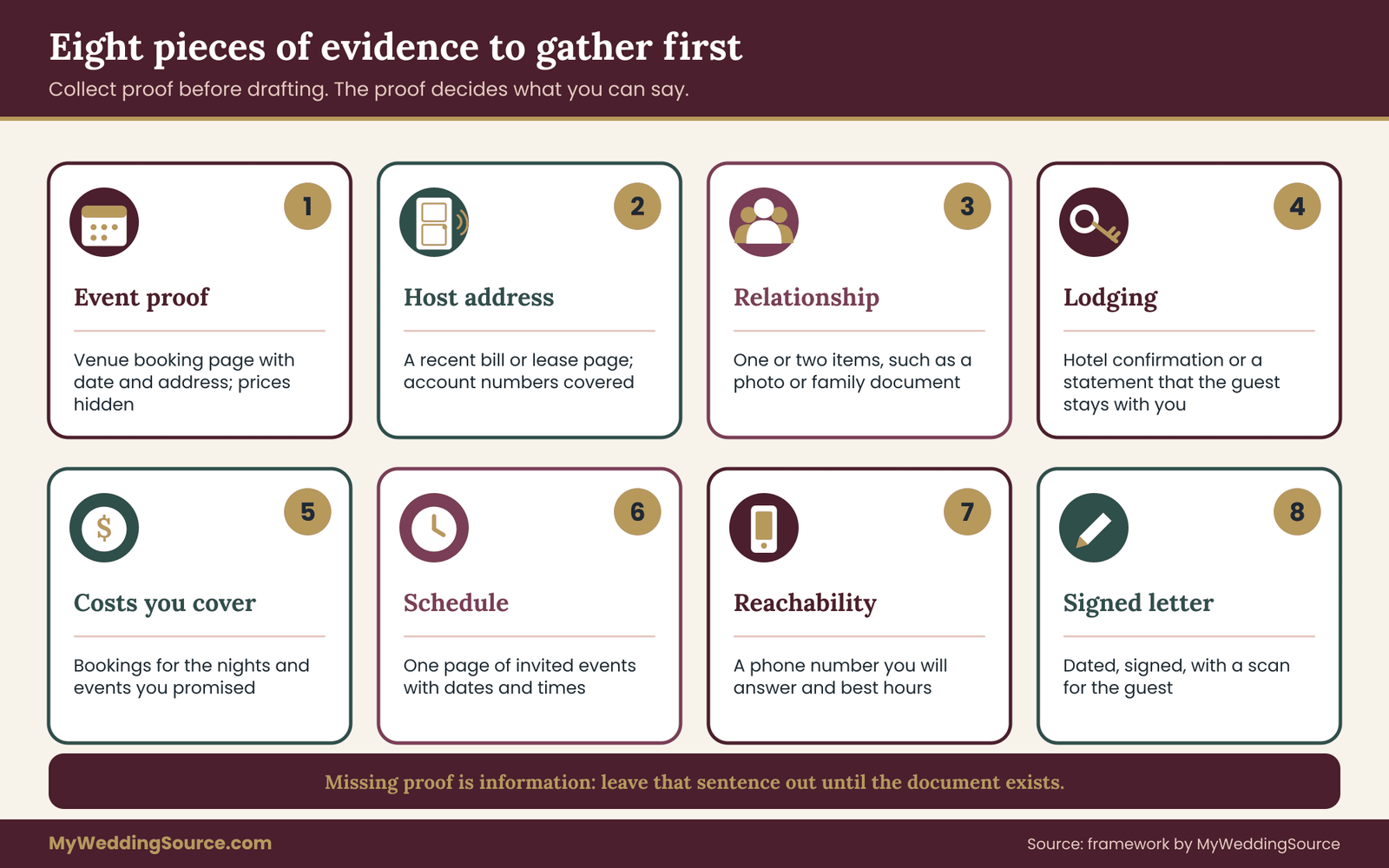
Drafting should be the last step, not the first. Gather the proof, and let the proof tell you what you can say. This checklist is the second piece of the toolkit: eight items, each tied to a claim in the visa invitation letter, each something you can produce on request.
1. Proof of the event
A venue contract or booking confirmation that shows the date, the venue name and the address. If the contract includes prices and payment terms, mask those lines or attach only the page with the event details. If you have not signed yet, wait. A letter that describes a venue you have not secured is a visa invitation letter about a hope.
A printed or digital wedding invitation is a useful second proof, because it shows the date and venue the way guests will see them. Attach the same version you sent, not a draft.
2. Proof of the hosts’ identity and address
A copy of a government-issued ID page is not always necessary, and you should not spread it around casually. A recent utility bill or lease page, or a bank statement with account numbers hidden, can show the address. Choose the least sensitive document that does the job. If the guest will stay in your home, this document supports the statement that the home exists and is yours.
3. Proof of the relationship
You do not need an elaborate file. A photo together, a family document that shows the link, or a thread of messages that shows an ongoing relationship can be enough. Choose one or two items, not a dossier. If the relationship is a family tie, a short line in the letter is often all that is needed, because the guest can confirm it in an interview.
4. Proof of lodging
A hotel confirmation with the guest’s name, the dates and the reservation number. If you are hosting at home, a statement in the visa invitation letter and your address proof. If the guest is in a hotel block, the block confirmation and the guest’s individual booking. Keep the dates consistent with the letter and with the guest’s application.
5. Proof of any costs you are covering
If you are paying for a hotel night, show the booking and the payment method in a way that does not expose card numbers. If you are covering a rehearsal dinner or a meal, a copy of the event plan is enough. Do not claim to be covering a cost you have not budgeted. The wedding budget page can help you decide what you can afford to commit before you write a promise down.
6. The event schedule
A one-page schedule showing which events the guest is invited to, with dates and times. This is the basis of the guest’s planned dates of travel. If the schedule includes a farewell event on the final day, the guest’s return date can reasonably follow it.
7. Reachability details
A phone number you will answer, a postal address and the best hours to call. Tell the guest that an officer may, in rare cases, call, and be ready. Do not list a number you do not monitor.
8. A signed, dated copy of the visa invitation letter
The letter itself should be signed in ink or with a clear electronic signature, dated, and printed on plain paper. Keep a copy. Give the guest an original and a scan, so they can show whichever the interview or the border officer prefers.
Why the checklist comes first
There is an ordering reason. If you write the visa invitation letter first and gather proof later, you discover gaps. A hotel is not booked. The venue contract is not final. The date moves. Then you edit the letter, and the guest has already printed the old one. If you gather proof first, the visa invitation letter becomes a summary of documents you already hold.
There is also a psychological reason. When you hold the documents, you are less tempted to add decoration. The letter shrinks to what the documents support, and that is the right size.
What to do when evidence is missing
Missing evidence is information. If you do not yet have a hotel booking, leave lodging out of the visa invitation letter or say that arrangements are in progress, and update the letter when the booking exists. If the venue is not secured, wait. If the relationship is hard to document, keep the claim modest. The visa invitation letter does not need to be complete to be useful; it needs to be accurate on the day it is signed.
If the guest’s appointment is coming soon and your evidence is not ready, tell the guest honestly. A late, accurate letter is better than an early, uncertain one, and the guest can usually apply without a host letter anyway.
A fact-only sample outline for a visa invitation letter
Here is the third piece of the toolkit: an outline for a visa invitation letter built only from column one and column two statements. It runs about one page. Brackets mark the details you replace. Nothing in it is meant to be copied word for word; the point is the order and the restraint.
Block one: header and date
Put your full legal names, your street address and a phone number at the top, then the date. Address the letter “To the consular officer” or “To whom it may concern.” Do not address it to a named person unless an official has asked you to. Keep the format plain: a standard letter, one page, readable font.
Block two: who we are and what the event is
Open with one sentence on the event: “We are [Name] and [Name], and we are getting married on [day, date] at [venue name], [city, state].” Add the ceremony time and, if relevant, the other events the guest is invited to, each with a date. This block is column one throughout. Every item matches your venue confirmation and your invitation.
Block three: the guest and the relationship
Name the guest as it appears in the guest’s passport. Then state the relationship in one sentence: “[Guest name] is [the bride’s aunt / the groom’s friend from university / a member of our wedding party].” If the guest has a role, such as reading at the ceremony, add it in a short clause. Do not add a character reference.
Block four: the dates and the arrangements
State the dates you are inviting the guest to be in the country, tied to the event: “We have invited [Guest name] to attend from [date] to [date].” Then give the lodging fact: “[Guest name] will stay at [hotel name and address] under reservation [number], booked on [date],” or “[Guest name] will stay with us at the address above.” Mention transport only if you have arranged it.
Block five: who is paying
One or two plain sentences. For example: “[Guest name] is responsible for [his/her] own travel to the United States. We will pay for [the hotel nights listed above and the meals at the wedding events].” If you are paying nothing, say nothing, or say “[Guest name] is arranging [his/her] own expenses.” Do not describe the guest’s finances.
Block six: contact, attachments and closing
State that you are available at the phone number above to confirm these details. List the attachments by name: the invitation card, the venue confirmation, the hotel confirmation, the address proof. Close with the statement that you understand the decision rests with the consular officer and that the visa invitation letter is provided to document the event and the arrangements. Sign and date.

A sample, in plain placeholders
Here is how those blocks read as a continuous text. Every bracket is yours to fill, and every sentence is one you can prove.
“We are [Name] and [Name]. We are getting married on [day, date] at [venue], [city, state], with the ceremony at [time]. [Guest name] is [relationship] and is invited to the ceremony and to [other events and dates]. We have invited [Guest name] for [date] to [date]. [He/She] will stay at [lodging, with reservation number or our home address]. [Guest name] will pay for [his/her] own travel. We will pay for [named costs only].
We are available at [phone] to confirm these details. We understand that the decision on any visa application belongs to the consular officer, and we are providing this letter only to document our event and our arrangements. Attached are [list].”
That is close to the full letter. It fits on one page with room to spare, and it contains no promise, no adjective of devotion and no claim about the guest’s life.
What the outline leaves out on purpose
You will notice what is missing. There is no sentence about how long you have known the guest beyond the relationship label, no mention of the guest’s job, no appeal to emotion, no guarantee. That is deliberate. Every one of those would add risk and no evidence.
Some couples worry that the visa invitation letter looks too thin. It does not, to an officer. Officers read many documents, and a clean one-pager with attachments is easy to evaluate. Thin is a feature when thin means checked.
Tone and format
Write in the first person plural, in plain sentences. Avoid legal jargon, which can create the false impression that you understand obligations you do not. Avoid decorative fonts and letterheads. If you are using a template found online, strip anything that does not match the outline above.
Proofread names, dates and numbers twice, ideally with another person reading the documents aloud against the letter. A wrong date is the commonest error and the easiest to avoid.
Language and translation
If the guest’s interview or the officer’s reading will take place in another language, think about whether a translation helps. The visa invitation letter itself is usually fine in English for a U.S. consulate, but a guest who struggles with English may want a translation alongside so they understand what was said on their behalf.
If you add a translation, mark it as a translation, keep it faithful, and do not use the translated copy to say anything the English does not say. When the wedding itself is bilingual and the guests rely on translated material, the same care for faithful wording applies.
Money, lodging and who pays: the sensitive paragraph
If one paragraph decides whether your visa invitation letter helps or harms, it is usually the one about money. Hosts want to be generous and reassuring, and generosity expressed carelessly raises questions. Here is how to handle it.
Separate three questions
Who pays for the guest’s flights? Who pays for the guest’s lodging? Who pays for the guest’s daily costs, such as meals and local transport? Keep the answers separate. A letter that says “we will take care of everything” merges all three and answers none of them.
For each, decide honestly what you will do, and write only that. The guest should know the same answer and should be prepared to describe their own funding at the interview. If the guest’s story and the hosts’ letter differ, the difference itself becomes the question.
Be specific, bounded and sustainable
“We will pay for three nights at the hotel listed above” is specific and bounded. “We will cover all expenses during the stay” is open. If you choose to cover meals, say which meals: the rehearsal dinner, the wedding reception and the farewell brunch. Name the cost you can afford and stay within it.
Before writing the promise, check it against your own plan. The wedding cash-flow planning guide shows how to schedule deposits and balances so you know what you will actually have on hand when a hotel invoice arrives. A promise you cannot pay is worse than no promise.
Hosting in your home
If the guest will stay at your home, the sentence is simple and powerful: it states where the guest sleeps and who is responsible for that. Add your address. If you are renting, make sure your lease allows guests for the planned duration. A landlord’s rule is not a legal technicality in this context; it is a fact that can be checked.
Stay honest about space. If the guest will share a room, say so only if it matters. If you have not yet arranged sleeping space, do not describe it as ready.
What not to attach
Do not attach your bank statements, tax records or pay slips as proof that you can afford the promise unless an official form specifically asks for them. Hosts’ finances are not the guest’s finances, and an officer is judging the applicant. If you volunteer private documents, you expose your own data for little benefit. A modest, specific promise does not need them.
A caution about repayments
Do not write that the guest will “repay” you, or that the arrangement is a loan, unless that is true and you are comfortable with the implications. Generally, keep the language to gifts and hosting. If the arrangement is complicated, such as a family loan, talk with a professional before putting any wording in writing.
If the guest is covering their own costs
Many guests do. In that case the visa invitation letter can say so in one line, or say nothing about costs. Hosts who give lodging as a courtesy often find that the cleanest letter simply states where the guest will stay and who arranged it. Silence about the guest’s money is acceptable. It is not your department.
When costs change
If you booked a hotel night and later cancel it, tell the guest at once, and update the letter before the interview. An outdated promise in a signed letter is worse than a corrected one. Keep a version number or a date on the visa invitation letter, and recall the earlier copies with the guest.
Travel assistance and privacy
Some couples offer travel help to guests who could not otherwise attend. That is generous, and it raises its own questions, including how the guest feels about their finances being discussed. Handle the offer privately, keep the amounts out of any group message, and let the guest decide what to say in an official setting. Keep that conversation and its records separate from the visa invitation letter file.
Worked case: an invented couple, one guest and one visa invitation letter
The example below is invented to show the method. The names, dates and places are illustrative, not real people, and nothing here describes a real application or predicts any result. It follows one visa invitation letter from a first draft to a final version.
The setting
Priya Raman and Daniel Brooks are getting married on a Saturday in early October at a restored mill venue outside a mid-sized U.S. city. Priya’s aunt, Lucia, lives abroad in a country whose citizens generally need a visitor visa for the United States. Lucia is retired, has been to the U.S. once before many years ago, and has been invited to the ceremony, a Friday welcome dinner and a Sunday brunch.
Priya’s parents live in the U.S. and have offered Lucia their guest room, but Priya and Daniel want to book a hotel so the parents’ house is not crowded during the weekend.
Priya’s first instinct is to write a long, emotional letter. Daniel suggests using the ledger instead.
The first draft
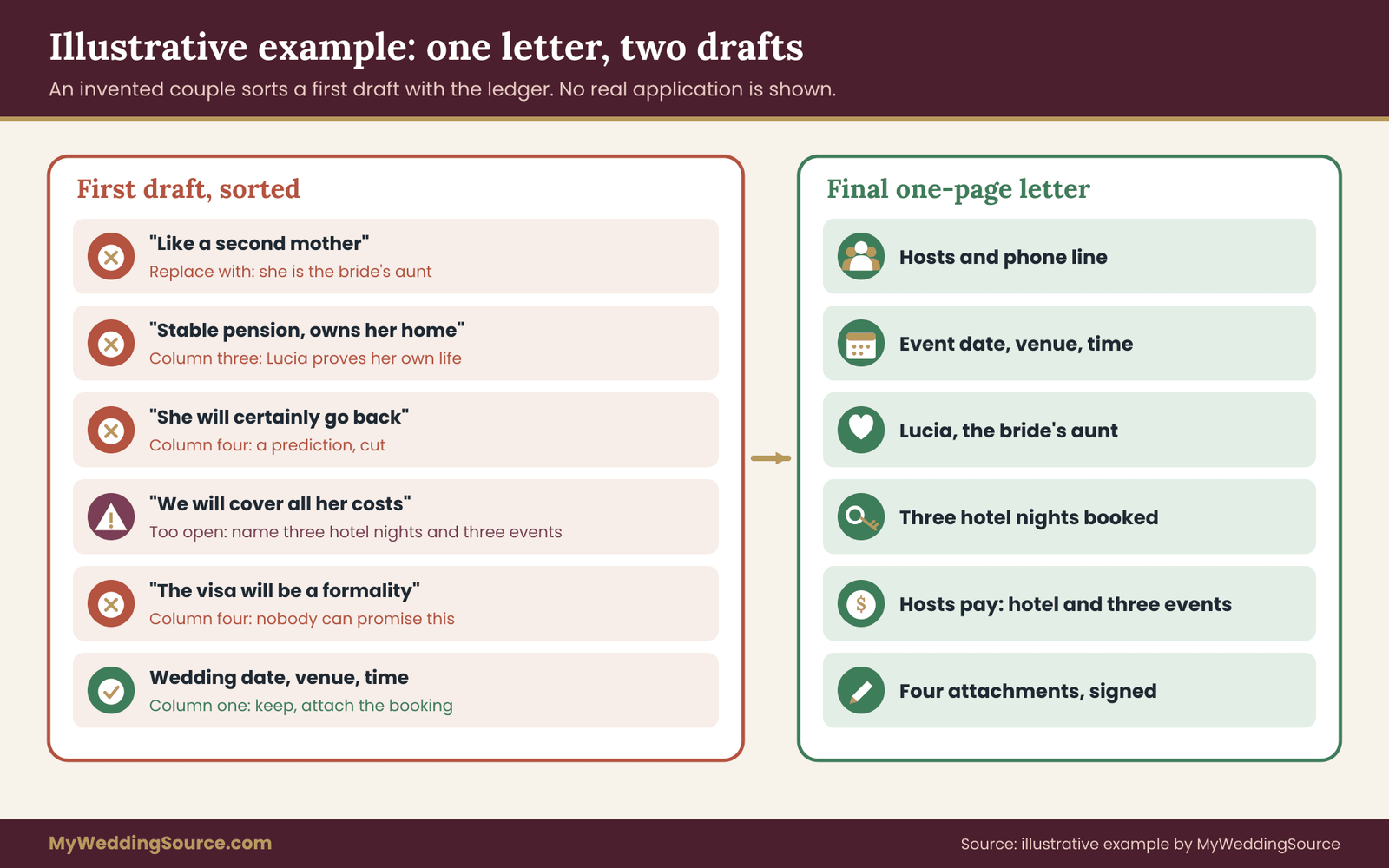
Priya’s first draft says, in summary: Lucia is a wonderful woman who has been like a second mother; she has a stable pension and owns her home, so she will certainly go back; the couple will cover all of her costs; the visa will surely be a formality because the family is well established; and the wedding cannot be complete without her. It runs a page and a half and closes by asking the consular officer to approve the visa as a kindness.
Every sentence is sincere. Most are unusable.
Sorting the first draft
Daniel marks each sentence with the ledger.
“Lucia is like a second mother” is warm but not evidence. It goes, replaced by “Lucia is the bride’s aunt,” which is column one if Priya can show the family link, and she can.
“She has a stable pension and owns her home” is column three. Priya has heard this from her aunt, but she has never seen the documents and cannot attest to them. It goes. Lucia will speak to her own situation and bring her own papers.
“She will certainly go back” is column four. It goes.
“We will cover all of her costs” is a column two statement with no limits. Daniel asks what they can really pay. They decide to book three hotel nights and to pay for the three wedding events. Everything else is Lucia’s.
“The visa will surely be a formality” is column four. It goes. “The wedding cannot be complete without her” is feeling, not fact. It goes.
“Please approve the visa as a kindness” is a request for an outcome and goes with the rest.
That leaves a short list of survivors: the event, the relationship, the hotel nights, the paid events and a way to reach them.
Gathering the evidence
They collect what they can attach. The mill venue sent a booking confirmation with the event date and address; they black out the price lines. They have the wedding invitation as a PDF. The hotel confirmed a room for three nights, with Lucia’s name as it appears in her passport, which Lucia sent them in a private message for that purpose. They add a recent utility bill with Priya’s parents’ address, since the parents are hosting a welcome dinner and will pick Lucia up. They also write a one-page schedule of the three events.
They notice they have no proof of the date on which the hotel booking was made. They add the booking date to the confirmation printout.
The final letter
The final version is a single page. It gives their names, address and phone number. It states the wedding date, venue and ceremony time. It says Lucia is the bride’s aunt and is invited to the Friday welcome dinner, the Saturday ceremony and reception, and the Sunday brunch.
It says Lucia is invited from the Thursday before to the Monday after, and that she will stay at the named hotel for three nights under the confirmation number given. It says Lucia is responsible for her own travel to the United States, and that Priya and Daniel will pay for the three hotel nights and the three events. It gives the phone number for questions, lists four attachments and closes with the sentence about the decision belonging to the consular officer. Both sign and date it.
What changed between the drafts
The first draft tried to prove things about Lucia. The final version proves things about the event. The first draft promised everything; the final promises exactly what the couple will pay. The first draft asked for a result; the final states that the result is not theirs to ask for.
It is also shorter and much easier to check. An officer reading it can see in seconds who invited Lucia, why, when, and where she will sleep.
What the visa invitation letter did not try to do
It did not mention Lucia’s pension or home. Lucia, at her own interview, will explain her life and bring her own documents. The letter does not coach her. Priya and Daniel also did not tell Lucia what to say; they told her what the visa invitation letter says, so her account and theirs match. That conversation takes ten minutes and prevents most inconsistencies.
A twist: the date moves
Three weeks before Lucia’s interview, the mill venue offers Priya and Daniel an earlier Saturday in September because of a scheduling change, and they accept. They update the invitation, the hotel booking, the schedule and the letter, and they tell Lucia right away. They also tell her to bring only the new version. The old letter is deleted from the shared folder and marked superseded in their own records.
This is the kind of event that creates trouble if no one owns the file. Because Priya has kept every version in one place, the change is a short afternoon of work rather than a crisis.
What the example does and does not show
It shows a method: ledger, evidence, outline, review. It does not show that a visa invitation letter produces a visa, because a visa invitation letter does not. In the example, Lucia’s application will rise or fall on her own circumstances and the officer’s judgment. All Priya and Daniel can do is make their part accurate and easy to verify. That is a modest ambition, and it is the right one.
Timing: build the visa invitation letter around the appointment calendar
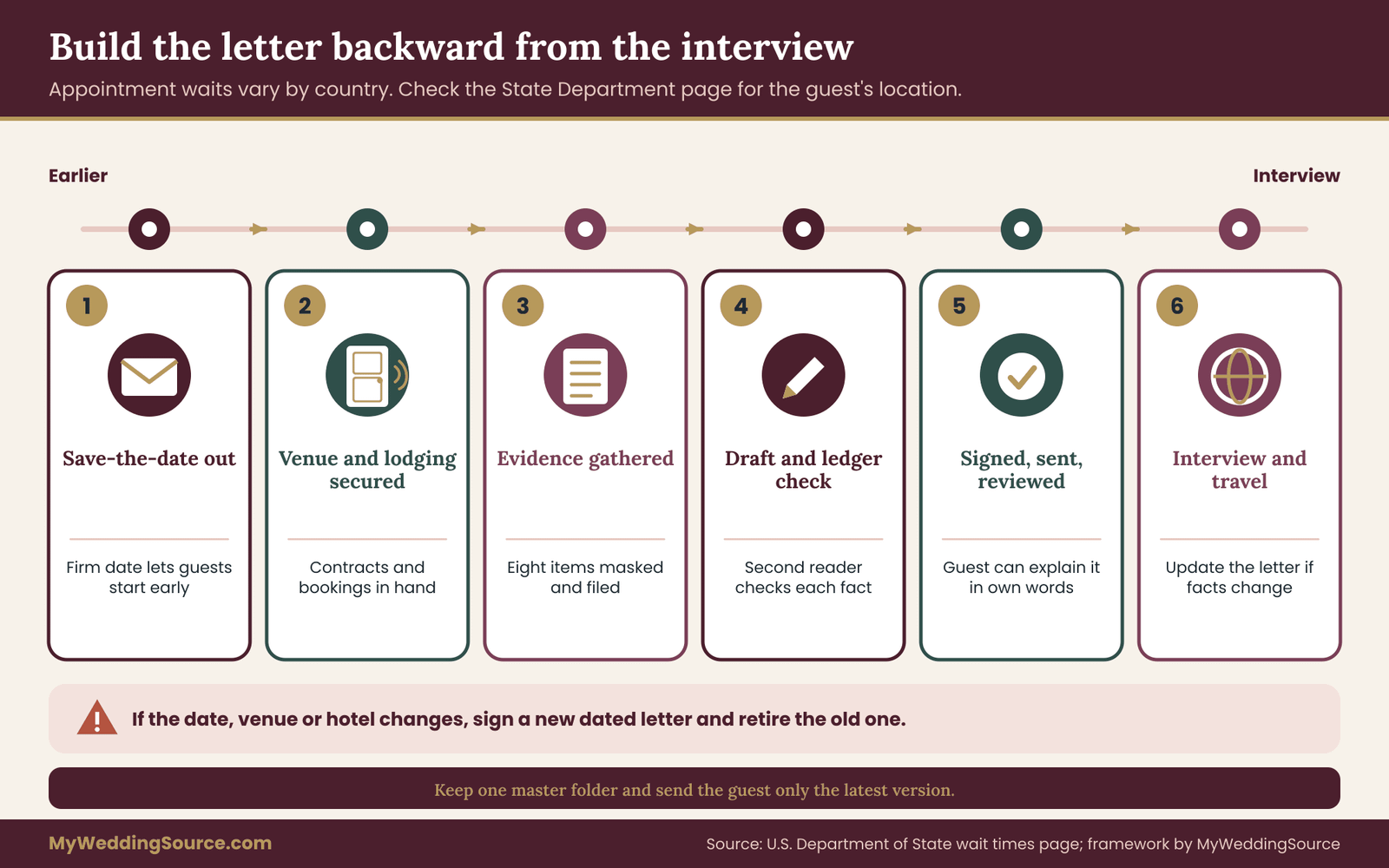
A visa invitation letter is only useful if it exists before the interview and matches the facts on the day. Timing is therefore a design problem, and it is easier to solve backward from the interview than forward from the wedding.
Work backward from the interview
Start with the guest’s interview date, which the guest controls and which can be far from the wedding. Wait times vary a great deal by country and by time of year. The State Department publishes current estimated wait times for visa interview appointments on its site. Have the guest check the page for their own location instead of relying on anyone’s memory, including yours.
Then count back. The visa invitation letter and attachments should be final at least a couple of weeks before the interview, so there is time to fix errors. Before that, hotel bookings and venue confirmations must be in hand. Before that, the venue contract and the guest list must be settled.
Start earlier than you think
Because appointment availability is the guest’s biggest uncertainty, the invitation process works best when it begins long before the wedding. The twelve-month wedding checklist gives a general frame for what should be settled when. For a couple with international guests, the guest list and the save-the-date should go out early, so guests can look up their own requirements while appointments are available.
A save-the-date with a firm date lets the guest start the application sooner. Choosing a date with this in mind is part of the date decision, and the guide to choosing a wedding date covers how guest availability and travel factor in.
What to do when the wedding date is firm but the guest’s appointment is late
If the guest’s appointment falls close to the wedding, it is time to be honest. Tell the guest that you can supply a letter and documents quickly, and ask whether the embassy offers any expedited process for urgent travel. Do not make promises on behalf of the embassy. Do not assume an expedited request will be granted either, since that is a decision for the consulate.
Meanwhile, keep the plan flexible. Share the livestream or a recorded message option if you are offering one, and tell the guest it is a backup, not a reproach.
A simple schedule for the visa invitation letter itself
Four steps are enough. First, settle the facts: venue, date, events, lodging. Second, collect the attachments. Third, draft, sort with the ledger and review with another person. Fourth, sign, scan, send, and confirm the guest has received it and knows what it says. Add a fifth step if anything changes: update, resend and retire the old copy.
Keep one master copy
Store the final signed letter and attachments in one folder with a clear version date, and share a link or send files only to the guest. When the guest prints the letter, ask them to bring only the latest version. Old copies in old emails are the usual source of date mismatches.
If your wedding file already has a place for official papers, keep the visa invitation letter next to the marriage license paperwork and the vendor contracts. Treat it as a small document with a short life: relevant for a few months, then archived.
Alternatives when a visa invitation letter is not enough
Sometimes a host letter is the wrong tool, or only a small part of the right one. Knowing the alternatives keeps you from stretching a visa invitation letter to cover a job it cannot do.
Guests who do not need a visa at all
Travelers from countries in the Visa Waiver Program can generally visit the United States for a short stay without a visitor visa, but they must obtain travel authorization online through the Electronic System for Travel Authorization before boarding. Customs and Border Protection runs that system, and approval is not a promise of admission. For these guests, a host letter is rarely requested at authorization, and a short copy of the invitation and lodging details in their carry-on is usually the most they will need if an officer asks at the airport.
Do not assume a guest is in this group. Eligibility depends on citizenship and on the traveler’s history, and some travelers from participating countries are not eligible. Ask the guest to check the official pages for their own case.
A different category: the fiance visa
If the person you want to bring to the United States is your own partner and the plan is to marry, that is not a visitor situation. A separate nonimmigrant category exists for the foreign fiance of a U.S. citizen, and it involves a petition, forms, fees and obligations that are a world apart from a guest’s trip. A host letter has no role in that process, and a wedding-guest letter should never be adapted to it. Anyone in that situation should use the State Department’s and USCIS’s official pages and, ideally, a licensed immigration attorney.
Weddings abroad and guests who travel to another country
If your own wedding is in another country and your guests travel from yours, the destination government sets the rules. Some countries want proof of accommodation and an itinerary; some ask for an invitation from the host; some ask for nothing beyond a standard application. Each embassy or consulate lists the documents it expects. The same ledger applies: claim what you can prove, and promise what you can deliver. For the wider planning questions of a faraway event, the plan wedding hub is a place to start.
Letting the guest apply without a host letter
Because the letter is generally optional, a guest can apply with their own documents and no host paper. For a guest with a strong file of their own, an extra letter adds little. The decision is the guest’s. If a host letter would only restate what the guest’s own documents show, skipping it removes one place for a mismatch.
A shorter alternative: the event confirmation sheet
If you do not want to write a visa invitation letter, you can give the guest an event confirmation sheet: a single page listing the event, the date, the venue, the schedule, the lodging and the host’s contact line, with the attachments. It contains no relationship claim and no promise. Some couples prefer this because it is almost impossible to get wrong. It gives the guest something to hand over, and the guest does the explaining.
Virtual attendance
If a visa is refused or delayed, the guest may not be able to attend. Plan for that possibility without implying that it is likely. A livestream, a recorded message or a family call after the ceremony can include the guest. The livestream planning guidance belongs to a different part of your plan, so do not tie your letter or your visa advice to it. Bring it up only when it is needed, and with kindness.
Moving or adding an event
Occasionally couples hold a second, smaller celebration in the guest’s home country at another time. That can be a gracious alternative, and it keeps the main event free from pressure. It is a family decision and not a workaround for a visa problem; it should be offered, not imposed.
Paid services and agents
Be cautious about anyone who offers to prepare the visa invitation letter for a fee or to promise a result. The Federal Trade Commission and the State Department both warn about scams that target people applying for visas. A letter from you costs nothing, and no agent can lawfully promise an approval. If a guest wants professional help with the application itself, a licensed attorney or an accredited representative is the credible route, and the guest should check credentials before paying.
Edge cases worth a second look
A few situations come up often enough to plan for. In each, the ledger still decides what goes on the page.
A guest traveling with a spouse or children. List each traveler by name and state the relationship to you, and keep one booking confirmation per room. Do not describe the family’s finances or the children’s school situation. Those facts belong to the parents. If the children are invited as part of the wedding party, say so with their roles.
A guest who is also a vendor or performer. If a relative is a musician who will play at the reception, be careful. Visitors generally cannot work in the United States, and performing for pay is work. If the guest is playing as a gift and unpaid, say exactly that, and ask an attorney or the official pages whether that is acceptable in the guest’s case before you promise anything. Never describe a paid engagement as a casual visit.
A guest who wants to stay longer than the wedding weekend. Your letter should describe the dates you invited them for. If the guest plans to tour afterward, that is the guest’s own plan, and it belongs in the guest’s application, not in your promises. Do not extend your hotel commitment to cover a vacation.
A guest with a very short notice invitation. When the wedding is only weeks away, avoid packing the letter with reassurance. Send the same plain page, early in the day, with the attachments, and tell the guest honestly that appointment availability is outside your control.
A venue with more than one event location. If the rehearsal dinner and the ceremony are at different addresses, list each address once, with its date. One mistaken street number can look like a different event entirely.
A same-sex or interfaith ceremony. The ledger does not change. State the event and the arrangements as facts. Whether a guest feels comfortable describing the ceremony at an interview is the guest’s choice, and the hosts should not script it.
Failure conditions: when a visa invitation letter should be stopped and rewritten
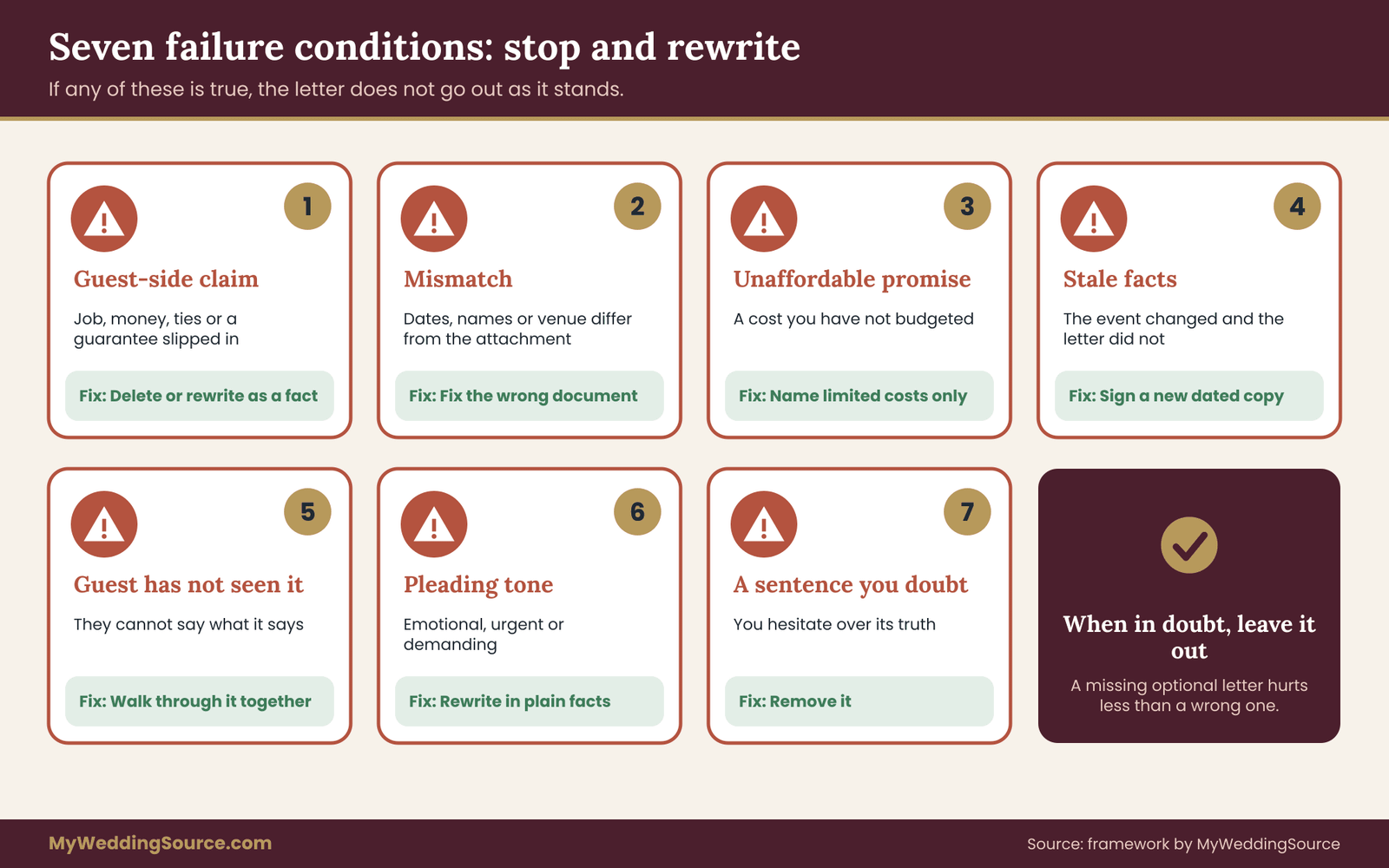
A method is only useful if it tells you when it has failed. These are the conditions that mean the visa invitation letter should not go out as it stands. Run the list before you sign.
Failure one: the letter contains a column three or four sentence
Any sentence about the guest’s job, money, ties or future behavior, or any prediction or guarantee, fails the ledger. Delete it or rewrite it. If you cannot rewrite it into something you can prove, leave it out.
Failure two: an attachment contradicts the visa invitation letter
If the hotel confirmation shows different dates, if the venue name on the contract is different from the name in the letter, or if the guest’s name is spelled two ways, the visa invitation letter fails. Fix the document or the letter, whichever is wrong, before anyone sees it. Officers notice mismatches, and the guest will be asked to explain.
Failure three: a promise you cannot keep
If you wrote that you would pay for something and you have not budgeted for it, the visa invitation letter fails. If the promise is open-ended, it fails. Rewrite it to a specific, affordable commitment, or remove it.
Failure four: the facts changed and the visa invitation letter did not
A new date, a new venue, a cancelled hotel night or a changed guest list all trigger an update. A visa invitation letter that was true in March and is false in July is a failed letter. Date every version and retire the old ones.
Failure five: the guest has not seen the visa invitation letter
If the guest cannot say in their own words what the visa invitation letter says, it fails. The guest does not need to memorize it, but the guest’s account of the trip and the letter must agree. Walk the guest through it, and let them tell you if anything is wrong.
Failure six: the visa invitation letter is written to persuade
If a neutral reader would describe the tone as pleading, emotional or demanding, rewrite it. The letter’s authority comes from its accuracy, not its feeling.
Failure seven: you are not sure it is true
This is the simplest test. If you hesitate over a sentence, it fails. You do not need to find the reason; hesitation is the reason.
What to do when a failure is found
Stop sending the current version. Fix the problem. Tell the guest which version is current and ask them to discard the rest. If the interview is imminent and a fix is not possible, say so, and let the guest proceed without the visa invitation letter rather than with a flawed one. A missing optional letter hurts far less than a wrong one.
When the visa is refused anyway
A refusal does not mean the letter was wrong. Many applications are refused for reasons unrelated to any host paper. If it happens, be kind, avoid blame and let the guest decide what to do next. The State Department explains what a refusal means and what an applicant can and cannot do afterward on its denial pages.
The guest may be able to reapply with new information; whether and how is a question for the guest, ideally with advice from an attorney. Do not write a second, more emphatic letter. If circumstances really change, a new accurate letter can follow, but more emphasis is not a change.
Keep your own records of what you sent
Keep the final letter and attachments in your wedding archive for a reasonable time, in case anyone asks later. The wedding records after the event guide explains how to decide what to keep and for how long.
Privacy, scams and file handling around a visa invitation letter
A visa invitation letter carries names, addresses and travel dates. Handled casually, those details travel further than you intend. A few habits keep the file safe without making it a chore.
Share only with the guest
Send the visa invitation letter and attachments to the guest, and to no one else unless the guest asks. Do not post a copy in a group chat, a family thread or a shared album, even in the name of helping. Other guests do not need your address or the guest’s hotel reservation, and the more people hold a copy, the more versions drift apart.
Use a method the guest can reach easily. If the guest prefers a printed original by post, send it early enough to arrive. If you send a scan, use a file name that does not carry sensitive details.
Hide what the letter does not need
Mask prices, card numbers and account numbers on any confirmation you attach. If a hotel confirmation shows a payment card, blur all but the last digits or print a version without the card. If you attach an address proof, choose a document that shows your name and address and nothing else, such as a utility bill with the account number covered.
Do not attach copies of your own passport, driver’s license or Social Security card unless an official form or an official instruction requires it. The visa invitation letter does not need them, and every extra copy is another thing that can be lost or misused.
The guest’s identifiers stay with the guest
If you need the guest’s name for a booking, ask for the name exactly as it appears in the passport and nothing more. Passport numbers and birth dates are not needed for a hotel confirmation or a host letter. If the guest chooses to share more, delete it from messages when you are done and do not store it in your wedding folder.
Spotting scams
Visa applicants are frequent targets of fraud, and wedding guests are no exception. Be wary of anyone who says they can guarantee a visa, sell a letter that will “work,” arrange an appointment for a fee outside the official channels, or ask for payment by gift card or wire. The State Department and the Federal Trade Commission both publish scam warnings. An official visa application is made through government channels, and no host letter is for sale.
Be careful too with websites that look official but charge for forms. The official application and appointment systems are run by the government, and the guest should start from the State Department’s own pages and follow links from there.
If a guest receives a message that looks like it comes from an embassy but asks for money or personal data in an unusual way, the guest should verify it through the embassy’s published contact details, not through the message.
Be careful with agents who offer to write the visa invitation letter
You are the right author of your own letter, because only you know the facts. A third party who offers to write a “stronger” letter is selling invented strength. If you use a template, check every line against the ledger and remove what does not apply.
Store the file sensibly
Create one folder for the visa invitation letter and its attachments, named with the guest and a version date. Keep the signed final and the draft history. When the wedding is over and the guest has traveled, you can move the folder to your archive and set a deletion date for the sensitive attachments, such as the address proof and hotel confirmation. Keep the letter itself for as long as your own records plan says.
If more than one person is handling invitations, such as a parent who is helping the couple, agree on a single owner for the visa invitation letter so edits do not collide.
If the letter is lost or the guest needs another copy
Send a new signed copy with a fresh date, and tell the guest which version is current. Do not alter an old one and re-date it by hand. A clean new original is better than an edited copy.
A short privacy test
Before sending anything, ask who will see this and what harm would follow if they saw all of it. If the answer is “the guest and an officer, and no harm,” send it. If the answer is “a dozen cousins,” trim it.
Your next steps
Start with the facts, not the prose. This week, confirm your venue booking and your event dates, decide which events your guest is invited to, and book or confirm the guest’s lodging. Then check what you can afford to promise and write that down in one sentence.
Next, gather the attachments from the checklist and mask anything private. Then draft the letter from the outline, mark every sentence with the ledger and delete everything that is not column one or two. Have a second person read it against your documents. Sign it, date it, send it to the guest and go through it together.
After that, set a reminder to review the visa invitation letter if anything about the event changes. If you want a wider frame for the guest side of your planning, the wedding guest list guide and the wedding invitation etiquette page are good next reads, and the guest should keep the official State Department and Customs and Border Protection pages close for their own application.
FAQ
Is a wedding invitation letter required for a U.S. visitor visa?
Generally no. The State Department’s visitor visa information does not list a host invitation letter as a required document, and the application, fee and interview are the core steps. Embassies sometimes publish local guidance, so the guest should check the page for their country. A letter can support the application by documenting the event, but it cannot replace the guest’s own evidence.
Can a visa invitation letter guarantee that a guest gets a visa?
No. A consular officer decides each application based on the applicant’s own circumstances, the interview and the law. No host, couple or agent can promise a result. A letter that implies a guarantee can look unreliable, so keep the wording factual and state that you understand the decision belongs to the officer.
What should a wedding visa invitation letter include?
Keep it to facts you can prove: your names and contact details, the wedding date, venue and schedule, the guest’s name and relationship to you, the dates you invited them for, where they will stay, and exactly which costs you will pay. Attach proof such as the venue confirmation and hotel booking, and avoid any claims about the guest’s money, job or plans to return.
Should we say we will pay for everything?
It is better not to. “Everything” is open-ended and may raise questions about the guest’s own funds. Name specific costs you can truly afford, such as three hotel nights and the wedding events, and say the guest pays for their own flights if that is the case. Check the promise against your budget before you write it.
Can we describe the guest’s job and savings to show they will return?
No. Those facts belong to the guest, who must show them with their own documents. Hosts cannot verify a job, salary or home ties, and a mismatch between your description and the guest’s answers can hurt the application. Describe only the event, your relationship and your arrangements, and let the guest speak for themselves.
What if the wedding date changes after the letter is sent?
Update everything. Revise the letter, the hotel booking and the schedule, sign a new dated version, and tell the guest to bring only the latest copy. Retire the old one in your files. If the interview has already passed, tell the guest right away so they can check whether anything on their application needs attention, and ask an attorney if unsure.
Do guests from visa-free countries need a letter?
Usually not, but they may still need travel authorization. Travelers from Visa Waiver Program countries generally apply online through ESTA before boarding, and Customs and Border Protection decides on admission at the airport. It helps to carry the invitation and lodging details in case an officer asks, but eligibility rules vary, so the guest should check the official pages.
When should we talk to an immigration attorney?
When the guest has a past refusal, an overstay, a complicated travel history or any question you cannot answer from official pages. Also consult one if the person you are inviting is your own partner and you plan to marry, since that is a different process from a guest visit. An attorney can advise on the individual case, which a general guide cannot.
Sources
- Visitor Visa, U.S. Department of State
- U.S. Visas, U.S. Department of State
- Visa Appointment Wait Times, U.S. Department of State
- Visa Denials, U.S. Department of State
- Visa Waiver Program, U.S. Department of State
- Electronic System for Travel Authorization, U.S. Customs and Border Protection
- Nonimmigrant Visa for a Fiance(e) (K-1), U.S. Department of State
- Online Nonimmigrant Visa Application (DS-160), U.S. Department of State
- U.S. Citizenship and Immigration Services
- Consumer advice and scam alerts, Federal Trade Commission