
Bilingual wedding invitations ask a question that looks simple and is not: which words go into both languages, and which words stay exactly as they are? This guide gives you a line-by-line sort for every element of the suite, a five-pass proof checklist, one worked case and the conditions under which the whole approach breaks down.
Translate the words that carry meaning for the reader: the invitation sentence, the request to attend, dress guidance, instructions and the response request. Keep identical anything that must match the real world: proper names, street addresses, numbers, times, website addresses and the names of venues as they appear on signs and maps. Add a short gloss for anything that is correct in one language but unfamiliar in the other. Then run five proof passes (facts, meaning, reader, print and mail) before anything goes to the printer.
Most advice about bilingual wedding invitations starts with layout: which language goes on the left, whether to use two sides of a card, which fonts pair well. Those are real choices, but they come second. The first choice is content. Before you decide where the second language goes, you need to know what the second language is for, and that depends on each line of the invitation, one line at a time.
A wedding invitation is a short document, but it is not one kind of text. It contains a ceremonial sentence, a handful of facts, a few instructions and some names. Each of those behaves differently when it crosses a language border. A ceremonial sentence needs a translator who understands register. A fact needs to be copied, not translated. An instruction needs to be translated and then tested on a real reader. A name needs a decision about spelling, order and script that belongs to the person who carries it.
When couples skip this sorting step on bilingual wedding invitations, the same few problems show up again and again. A street name gets translated and a guest cannot find the building. A date gets written in a format that reads as a different day. A dress code is translated word for word and means something else. A family title is rendered in a form that one grandparent finds cold. None of these is a disaster on its own. Together they make a guest feel the invitation was written for someone else.
This guide is about that sorting step for bilingual wedding invitations. It does not cover typefaces, paper, layout or printing methods in depth, because those belong to the design and print stages. It covers what the words should say, in which language, and how to prove that the two versions agree. For the broader question of who gets invited and in what order, see the site’s guide to wedding invitation etiquette.
A note on scope. This is general information, not legal, tax or financial advice. Where a rule matters, such as postal addressing or accessibility, the guide points you to the agency or organization that issues it so you can read the current version yourself.
What bilingual wedding invitations need to decide before anything is translated
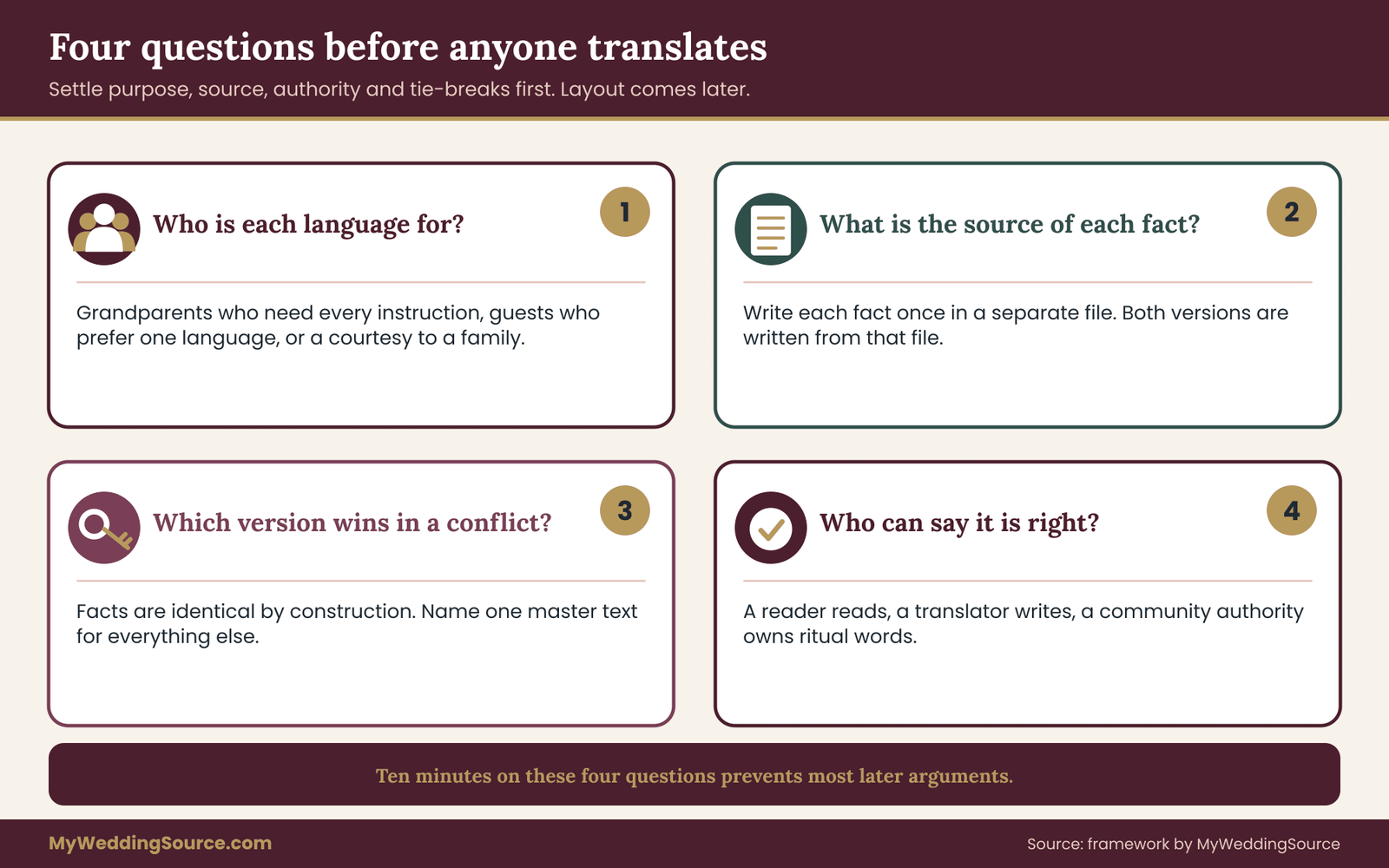
Every set of bilingual wedding invitations answers four questions, whether or not the couple states them. Saying them out loud takes ten minutes and prevents most of the later arguments.
Who is each language for? One language is rarely just “the other half of the family.” It might be for grandparents who read it comfortably and nothing else. It might be for a group of guests who read both but prefer one. It might be a gesture of respect toward a family whose members will manage fine in the first language. The purpose changes how much you translate. An invitation written so that a grandparent can act on it alone has to carry every practical instruction. One written as a courtesy can carry less.
What is the first language of the facts? Facts should be written once and copied. Decide which version is the source for each fact: the venue’s own wording for the address, the officiant’s own wording for a ceremony title, the person’s own preference for a name. If two people produce two versions of the same fact, one of them is wrong.
Which version wins if the two disagree? On a wedding invitation the disagreement is almost always small, but you still need a rule. The simplest is that the facts are identical by construction, so no version can win because there is nothing to disagree about. The second is that one language is the master text and the other is checked against it. Name the master text in your working file even if the printed invitation never mentions it.
Who has the authority to say it is right? A bilingual relative who reads both languages is a reader. A translator is a professional who produces a text. A person from the community that owns a ritual term is the authority on that term. These are three different roles, and one person rarely fills all three. The proof checklist later in this guide assigns each pass to the right role.
Why content comes before layout
Layout decisions for bilingual wedding invitations are reversible in a way content decisions are not. If you move the second language from a back panel to a facing column, nothing about the meaning changes. If you discover after printing that the time was copied wrongly into one language, the entire suite is wrong. Treat the words as the load-bearing part and the arrangement as the finish.
There is also a practical reason. A printer or designer can only set what you give them. If you hand over two paragraphs of text that were never compared line by line, you are asking a designer to do proofreading they were not hired to do and cannot do in a language they may not read. A designer who receives a clean, sorted, line-matched text file can concentrate on the design.
What a “bilingual” invitation does not have to mean
It does not have to mean that every word appears twice. Some of the strongest bilingual wedding invitations translate the invitation sentence and the instructions and leave the rest in a single form. It does not have to mean equal space either. Equal space can be a fair design choice, but it should be a choice rather than an assumption.
And it does not have to mean two languages on every piece. The invitation card, the details card, the response card and the envelope can each make a different choice, as long as the whole suite adds up to something a guest can use.
Think of bilingual wedding invitations as a small set of tasks the guest has to complete: understand that they are invited, understand when and where to arrive, understand what to wear and bring, understand how to answer and by when. For each task, ask which language or languages the reader needs in order to finish it without help. The answer to that question, not a general feeling of fairness, should decide how much gets translated.
The four-way sort: translate, keep, gloss or decide separately
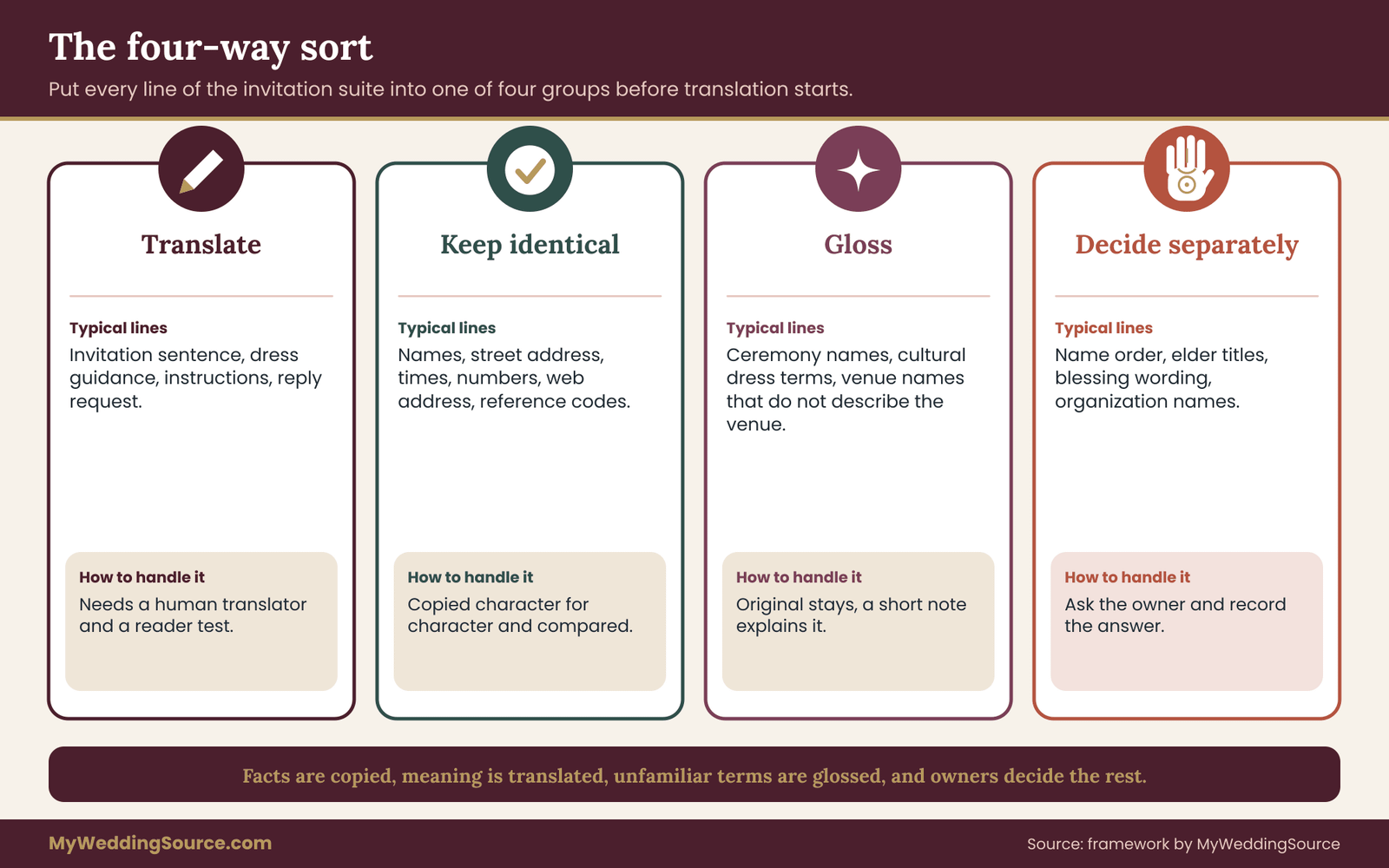
The sort used throughout this guide puts every line of the suite into one of four groups. For bilingual wedding invitations the groups are simple to remember and hard to misuse, which is why they work as a checklist.
Translate. The line carries meaning that a reader must understand, and a good equivalent exists. Examples: the invitation sentence, “request the pleasure of your company,” the instruction to reply by a date, the note about children, the dress guidance in plain words.
Keep identical. The line is a fact or an identifier that must match something outside the invitation. Examples: a person’s name, a street number, a postal code, a time written in numerals, a web address, a phone number, a reference code on a response card. These are copied character for character. If a copy ever differs from the original, that is an error, not a variation.
Gloss. The line is correct and should stay in its original form, but a reader from the other language may not understand it. A gloss is a short explanation, set close to the original, that says what the term means or what to do about it. Examples: a ceremony name, a cultural dress term, a venue name that does not describe the venue, a tradition mentioned in the program.
Decide separately. The line involves a choice that belongs to a person or to a third party rather than to the translation process. Examples: the order and spelling of a name, the form of address for an elder, the wording a religious officiant uses for a rite, how an organization’s name should be written. These are settled by asking the owner, and the answer is recorded.
How to use the four groups in practice
Take your draft invitation text and put each line on its own row in a working document. Next to each line, mark one of the four groups. Do this before anyone translates anything. The marks do two jobs. They tell the translator what you want, and they tell you where the risk is.
You will find, when sorting bilingual wedding invitations, that the “keep identical” group is longer than you expected, and that is useful. Every line in that group can be copied by a person who reads neither language, and every line can be checked by comparison alone. That means the riskiest-looking part of a set of bilingual wedding invitations, the facts, turns out to be the easiest part to verify.
The “translate” group is where you need a human translator. Ask for a version that reads as natural writing in the target language rather than as a mirror of the source. The “gloss” group is where you need a short, careful hand: a gloss that runs to a paragraph has stopped being a gloss. The “decide separately” group is where you need to talk to people, and that is often the group that takes the most calendar time, because it depends on others replying.
A quick test for borderline lines
Some lines refuse to settle into a group. A venue called “The Old Mill” is a name, so it should stay identical, but a guest who reads only the other language may take it for a description and look for an actual mill. A line like “black tie optional” is not a fact, so it should be translated, but the translation has to carry the same level of formality.
Use three questions in order. First, does this line have to match something outside the invitation, such as a sign, a map, a legal document or a person’s own preference? If yes, keep it identical or decide separately. Second, could a reader act on this line without understanding it? If not, translate it. Third, would a reader from the other language understand the original but misread its role? If yes, keep the original and add a gloss.
Lines that pass all three questions without landing anywhere are usually decoration, such as a quotation or a poetic phrase. Those can be translated, left alone or dropped. Because they carry no facts, they are a good place to give the other language some warmth without adding risk.
The next four sections go through the elements of a typical suite in the order guests meet them: names, dates and times, places and addresses, ceremony terms, tone and instructions, and responses. Each section applies the four-way sort and points out where couples usually go wrong.
Names, titles and honorifics on bilingual wedding invitations
Names are the first thing a guest reads on bilingual wedding invitations and the last thing a translator should touch. In bilingual wedding invitations, names fall almost entirely into the “keep identical” and “decide separately” groups, and the mistakes come from treating them as ordinary words.
Personal names: copy, do not translate
A person’s name is an identifier. It belongs to the person, and the person decides how it is written. Do not let a translator “localize” a name. A man named Guillermo is not Will on the invitation unless he says so. A woman named Zhang Wei does not become Wei Zhang unless she uses that order herself. If a name is normally written in a non-Latin script, ask whether the person wants that script on the invitation, a romanized form, or both, and ask which order the name should take in each.
The safest working rule is that each name appears in the form its owner uses on their own documents or has told you to use, and that form is copied into both language versions without change. If the owner uses two forms, such as a legal name and a name used among family, decide which appears and record the decision.
Diacritics deserve special care. Accents, tildes, cedillas and umlauts are part of the spelling. If the designer’s software or the printer’s font drops them, the name is misspelled, and the owner will notice. Check the proof letter by letter. A name that contains characters outside the basic Latin alphabet also needs to be tested in the file format you send, because some systems silently replace unusual characters. The W3C’s internationalization pages are a plain-language starting point for how character encoding works and why text can break between systems.
Order of names and family names
Naming conventions differ. Some traditions put the family name first. Some use two family names, one from each parent. Some use patronymics or a single name. Some people change their names at marriage and some do not. An invitation that has to work in two languages often has to work in two naming systems at once, and bilingual wedding invitations make that visible.
Do not solve this with a general rule. Ask each person named on the invitation how they want to appear, and write the answer down. When the two language versions use different name orders because each follows its own convention, say so in your working file so that no proofreader “fixes” the difference. When you want both versions to show the same order, say that too. Either approach is fine. What fails is an unexamined mix.
A related point is the line “Mr. and Mrs.” or its equivalents. These forms assume a particular household structure and a particular naming practice. They may not translate at all. If a couple hosting the wedding is two women, two men, a single parent or a pair of parents with different family names, the form needs to be written from scratch in each language rather than adapted from a template. Let the people named choose the wording.
Honorifics and forms of address for elders
Titles of respect are where literal translation does the most damage. A form that is warm in one language can sound stiff or even cold in another. A form that signals deep respect in one tradition may be too formal in the other, or may not exist.
Treat honorifics as “decide separately.” Ask the family which form each elder would expect to see, and ask that elder’s own family rather than guessing. When you cannot ask, use the plainest respectful form in each language and avoid inventive equivalents. For example, a title followed by the surname is almost always safer than a kinship term that depends on the relationship between writer and reader.
Be consistent about how many titles you use. If the invitation names the hosts with titles in one language, it should name them with the closest respectful form in the other language, even if the form is shorter. Visible asymmetry in how people are honored is something guests notice quickly.
Names of the couple and the hosts’ line
The hosts’ line, the part that says who is inviting, is the most culturally loaded sentence on an invitation. It can name the parents, the couple, both families, or no one. Each of those choices has a different meaning in different communities, and the translated sentence has to carry the same meaning rather than the same words.
Here is a working method. Write the hosts’ line in the first language and say in one plain sentence what it communicates: “The two sets of parents are inviting you to their children’s wedding.” Give that sentence to the translator, not just the original wording. Ask them to write the closest natural line in the second language and then to back-translate it, in their own words, so you can see whether the meaning matches. This is a check on meaning, not on elegance, and it takes minutes.
If the families disagree about who should be named first, that is a family question, not a translation question. The site’s etiquette guidance on invitations covers the common conventions for hosts’ lines and order of names, and the second language should follow whatever the family settles on rather than reopen the question.
Using bilingual wedding invitations to show names fairly
Fairness in bilingual wedding invitations is easy to measure for names: count characters and compare size and position. If one family’s names are set in a larger or bolder type, or appear first on every piece, guests will read that as ranking. Make a short list of every place each family’s names appear across the suite and check that the treatment is parallel. Parallel does not mean identical, since different scripts take different amounts of space, but it should be recognizably equal.
Dates, times and numbers: the facts that must match
If names are where bilingual wedding invitations get personal, dates and times are where they get dangerous. A wrong date reads like a different appointment. The correct practice is almost mechanical, and it rests on one idea: facts are written once and copied.
Writing the date so it cannot be misread
Date formats differ, and bilingual wedding invitations meet that difference head on. In some places the month comes first, in others the day, and in others the year. A numeric date such as 04/05 can mean April 5 or May 4 depending on who reads it. On a two-language invitation, never rely on an all-numeric date as the only form.
Write the date out in words in each language, with the month spelled out. Include the weekday. The weekday acts as a built-in check: if the weekday and the date do not match the calendar, a careful reader will notice something is wrong. In the second language, use that language’s own month names and weekday names rather than the first language’s.
If you want a numeric form too, such as on a response card or in a website address, use the ISO 8601 order of year, month and day, which is designed to avoid the ambiguity. The International Organization for Standardization publishes a short public explanation of it.
For bilingual wedding invitations, do not translate a date by converting a calendar. If the ceremony follows a lunar, religious or regional calendar, say what the invitation should show. Some couples include the date in both the civil calendar and a second calendar. If you do, the second calendar’s date is a separate fact that must be checked against a reliable source, not computed by a translator in passing. Ask a person who knows the calendar to confirm it, and keep the civil date as the anchor that guests will plan around.
Times, time zones and the 12-hour and 24-hour clocks
Time has the same problem on bilingual wedding invitations. A guest used to the 24-hour clock may read “4:00” as early morning. A guest used to the 12-hour clock may find “16:00” puzzling. Put the time in one clear form and add the other form only if you know that readers need it. Include “p.m.” or its equivalent, or write “four o’clock in the afternoon” in words in each language.
If guests arrive from different time zones, the invitation should say the time is local to the venue. A phrase such as “local time at the venue” is short and does a lot of work. The invitation also needs to distinguish the arrival time from the ceremony start time when they differ. Guests often interpret “ceremony at 4:00” as “arrive by 4:00,” so say when the doors open if you want them to come earlier.
When the day has several events, list them in the same order in both languages and give each a time written in the same form. Do not let the second language collapse two events into one line to save space. If a rehearsal dinner, a ceremony and a reception exist, each has its own row in both versions.
Numbers, currency and measurements
Numbers on bilingual wedding invitations are facts and should be copied. This includes the number of guests in an invited party, table numbers on a seating card, room numbers and any dollar amounts. Decimal marks and thousands separators vary across languages, so a number like 1,500 can be read as one and a half or as fifteen hundred. If an amount appears at all, write it in words or in a format that your readers will not misread, and avoid putting prices on invitations unless you must.
Measurements are less common on invitations but appear on direction cards: distances to a parking lot, walking times, shuttle intervals. Use units that the guests will actually use, and give the unit every time. If you give both miles and kilometers, check the conversion, and round it sensibly.
The “one source of truth” file
For bilingual wedding invitations, the method that prevents almost every fact error is a single file, kept separate from either translation, that lists each fact once. It should contain the full names as chosen, the exact date and weekday, the times for each event, the venue’s name and address, phone numbers, web addresses and the reply-by date. Each language version is then written from that file, not from the other language version.
This matters because copying from the translated version, rather than from the source, is how a typo travels. If the second language is written from the first language’s printed text and the first contains an error, the error is now in both and consistent, which makes it harder to catch. If both are written from a separate fact file, an error in one will show as a difference.
At proof time, compare each version to the fact file, not to each other. Two versions that agree with each other can still both be wrong. Two versions that each agree with the fact file are right.
A short example of a fact line
Suppose the fact file says: Saturday, October 10; ceremony 4:00 p.m.; reception 6:30 p.m.; doors open 3:30 p.m.; venue local time. In the first language the details card reads in full sentences. In the second language, the same facts appear in the same order, with the weekday, month and day written with that language’s names, and the times written in the form that readers of that language expect, with “p.m.” or the equivalent clearly marked.
A proofreader compares the details card to the fact file, line by line, and ticks each. That is the whole process for the facts on bilingual wedding invitations. It is dull, and it is what makes the facts safe.
The next section turns to the part of the suite where facts and language collide most often: places, addresses and the mail itself.
Places, addresses and postage: what stays in one form
On bilingual wedding invitations, places are identifiers too. A guest has to reach a physical location, and the location is known to maps, drivers, doormen and delivery services by one name. Writing it differently in the second language does not help the guest. It gives them two things to search for.
Venue names and street addresses
Keep the venue’s name and street address in the form the venue uses on its own website and signs. This is the form that a map application, a taxi driver and a security guard will recognize. Copy it character for character into both language versions of your bilingual wedding invitations.
A venue whose name is also a description is the main trap. “The Garden Pavilion” may be a registered building name, but a translator may helpfully render it as a descriptive phrase in the second language. A guest who then types that phrase into a map finds nothing. Keep the original name identical, and, if guests who read only the other language would not understand what kind of place it is, add a short gloss next to it: the name first, then a few words in the second language saying what the place is.
For instance, the name stays as printed and the gloss says it is a garden venue next to the river.
Do not translate street words either. “Avenue,” “Street,” “Road” and similar words are part of the address as it appears on the map. If you add a second-language version of the address for readability, label it clearly as a reading aid and keep the original address visible, so that a driver can match it with a sign.
Directions, parking and landmarks
Directions are the part of bilingual wedding invitations most likely to need real translation, because they are instructions, not names. Write them in plain, short sentences in both languages, and keep the proper names in them unchanged. “Turn left at the Oak Street entrance” keeps “Oak Street” as it is on the sign even when the rest of the sentence is in another language.
Landmarks are a mixed case. A bridge, a church or a gas station may be known by a name in one language and by something else in the other. When in doubt, give the sign’s name and a short gloss.
Parking, shuttle and drop-off instructions need special care because they depend on the venue’s rules, and these rules can change. Confirm them with the venue in writing before you finalize the text, and keep the confirmation with your fact file. If the instructions say guests may not park on a certain side street, that sentence has to be as clear in the second language as in the first, since the consequence of misreading it is a parking fine or a blocked driveway.
A site-visit habit helps: have someone who reads only the second language follow the printed directions on a map without any other help. If they get lost on paper, they would get lost on the day.
Accessibility information on bilingual wedding invitations
Accessibility information is a practical instruction, not a courtesy, and it must exist in every language you use. If the venue has step-free entry, an accessible restroom, accessible parking or a quiet room, the guests who need to know that should be able to find it in the language they read. The same goes for a way to ask for an accommodation: a phone number or a response-card line, written in both languages.
The U.S. Department of Justice’s ADA site explains how the Americans with Disabilities Act treats effective communication and accessible facilities. It is a reference for businesses and public entities, and a private wedding is a different situation, but the guidance on clear communication is a useful benchmark for what “effective” means. Read it, and then check any claim about the venue’s accessibility with the venue itself. The site’s guide to accessible wedding venue red flags covers what to ask a venue before you print a sentence such as “the venue is wheelchair accessible.”
The same logic applies to readable print. A small, ornate type may be impossible for a guest with low vision to read, in either language. Keep essential information in a legible size, and consider offering the details in a larger-print or digital form on request, in both languages.
Postage, envelopes and mailing addresses
The envelope is part of bilingual wedding invitations and has its own rules. A postal service reads addresses with machines, and the machines expect a specific order and script. The United States Postal Service’s Publication 28 describes how addresses should be formatted for domestic mail. If a guest’s address is in the United States, the outer envelope should follow that format, in Latin letters, regardless of which language appears on the invitation inside.
When you want the guest’s name to appear in a non-Latin script on the envelope, add it as an extra line above or beside the address block, not in place of the address, and check with the postal service or your printer whether that placement will confuse sorting. For mail to guests abroad, find out how the destination country writes its addresses and whether the country’s postal service wants the address in a particular script. Rules differ, and your own postal service’s international pages are the place to confirm the current requirements.
Return addresses are the usual afterthought. Put the return address on the envelope in the form your postal service expects, so that undeliverable mail comes back to you rather than disappearing. The site’s wedding invitation printing guide covers proofs, quantities and what printers need from you, including envelope addressing, and it is the place to go for the production side of this.
Web addresses and QR codes
On bilingual wedding invitations a web address is a fact and must be copied exactly. Use a short address that is easy to type, and test it on a phone before printing. If your wedding website has two language versions, decide how the guest will reach the right one: a single address with a visible language switch, or two addresses. A single address with a clearly labeled switch is simpler and has less to go wrong on paper.
If your bilingual wedding invitations use a QR code, put the plain web address near it in text, because some readers will not scan. Check that the page the code opens works in the language the reader expects. Writing “scan for details in English or Spanish” is more useful than a bare code.
Ceremony terms, ritual words and family titles
Ceremony vocabulary is the part of bilingual wedding invitations that tempts couples most to translate and that translators are least qualified to settle. These words carry religious, ritual or family meaning, and the right form is held by the community or the officiant, not by the dictionary.
Names of rites and ceremonies
If the day includes a named rite, such as a tea ceremony, a blessing, a traditional procession or a religious service, the name of the rite should be kept in its original form. A translated name will usually be less precise. A gloss should say what the rite is and, if relevant, what the guest does.
A good gloss answers two questions in a short phrase: what is this, and what should I expect? For example: the name of the rite, followed by a note that it is a family tea ceremony before the main ceremony and that guests are welcome to watch. The gloss is not an essay on the tradition. If a guest wants more, the program or a short note on the wedding website is the place.
For couples whose ceremony combines more than one tradition, the site’s guide to interfaith wedding ceremony planning explains how to settle who owns each ritual. The same question, who owns the wording, applies on the invitation. If a religious leader has a standard form of words for an invitation or a blessing, ask for it in writing and use it unchanged.
Religious and ceremonial phrases
Some invitations open with a blessing, a verse or a traditional formula. If one appears, treat it as “decide separately.” The text should come from the officiant or a person authorized to speak for the tradition, in the language the tradition uses. A machine translation or a general-purpose translator’s rendering is not an appropriate source for a religious text, and you should not describe such a rendering as authoritative.
If the formula exists in the first language only, such as a sacred phrase that is normally spoken in its original language, leave it in that language and gloss it if guests will not know it. Some phrases are meant to be left untranslated.
If you are unsure whether to include a religious phrase at all, remember that a blessing is not required. A plain invitation sentence in both languages is complete.
Family titles and relationship words
Words like “grandmother,” “uncle” or “godparent” do not map neatly across languages. Some languages distinguish maternal from paternal grandparents, older from younger siblings, or relatives by blood from relatives by marriage. If a title appears on the invitation, such as a line about a flower girl or a special guest, check whether the translated word says the same thing.
When it does not, write the relationship in a plain descriptive phrase and give the person’s name. “Their grandmother, Elena Torres” is clearer than a kinship term whose precise meaning differs. For people who will do something at the ceremony, a plain description of the role does the job.
Symbols, colors and gestures
Pictures and symbols are also a kind of language. A color that suggests celebration in one culture can suggest mourning in another. A flower or an animal that is lucky in one place is neutral or unlucky elsewhere. If your bilingual wedding invitations include a motif, such as a crest, a symbol or a pattern, ask someone from each of the families whether the motif says what you intend. This is a five-minute question that avoids a long apology.
When a term has no equivalent
Some terms simply do not exist in the other language, and on bilingual wedding invitations that is fine. Keep the original, gloss it once, and move on. If the term appears several times, gloss it at its first appearance on each piece rather than on every line. If the invitation is a single card with no room for a gloss, the wedding website or the program is a better place for the explanation, with the card carrying only the name and a web address.
The most important rule for ceremonial words on bilingual wedding invitations is humility. A couple does not need to understand every nuance to ask the right person. They need to know which words belong to someone else’s authority and to ask that person before printing.
Register, dress code and instructions: what to translate with care
This is the group where real translation work happens. Dress guidance, notes about children, gift wording and day-of instructions are all “translate” lines. They carry meaning, they have to be understood, and a literal rendering is often wrong. In bilingual wedding invitations, this is also where tone either holds or breaks.
Register: formal, warm or plain
Register is the level of formality and warmth in the writing, and it shapes how bilingual wedding invitations feel. The first language version may be formal, with a traditional invitation sentence. The second language may have its own conventions, which may be more or less formal, more or less personal. A word-for-word translation of a formal English sentence can come out stiff and strange in another language, and a natural sentence in the second language may be shorter or longer than the English.
Tell the translator what feeling you want, not just what words to use. “Formal but warm, like a letter from the families” is more useful than “translate this.” Ask them to write the second version as if it were the original. Then compare the effect, not the structure. If the first version feels like a ceremony and the second feels like a notice, the translation has missed.
Be wary of the idea that the second version must have the same number of lines. Different languages use different amounts of space. A good two-language suite adjusts layout to the text, not text to the layout. The site’s guide to wedding invitation etiquette describes the traditional components of an invitation, and the second language should cover the same components in whatever form is natural.
Dress code: translate the meaning, not the label
Dress terms on bilingual wedding invitations are among the least portable words in the language. “Black tie,” “cocktail attire,” “festive” and “garden party” each assume a shared set of expectations. In a second language, the same words may not exist, or may suggest something else. A literal translation of “cocktail attire” might lead a guest to think the event is a bar.
The solution is to describe what you expect in plain terms, in both languages, and to keep the label if it is useful. For example: “Cocktail attire. Suits or dresses for the evening; no need for a tuxedo.” A short description removes the ambiguity. If you use a cultural dress code, such as a traditional outfit or a color request, name it in its own language and describe it in the other. Ask a person from that culture to read the description, since a couple unfamiliar with the garment can easily mis-describe it.
Practical details are part of a dress note. If the ceremony is outdoors on grass, say so, since heels sink. If the venue is warm or cold, say so. Whether a head covering, shoulder covering or removal of shoes is expected at the ceremony is also a practical fact that belongs in both languages, stated courteously.
Children, plus-ones and who is invited
Lines about who is invited are sensitive in any language, and bilingual wedding invitations have to get the tone right twice. “Adults only” and “kindly note the invitation is for the named guests” are blunt in some languages and soft in others. Ask your translator to write the line so that it is clear without being cold. The goal is that the guest understands the policy and does not feel scolded.
The most reliable way to avoid confusion is to address the invitation to specific named people, on the envelope and on the response card, so that the answer to “who is invited” is on the page without an explanatory sentence. When a sentence is needed, use the same structure in both languages and have a native reader test the tone. The site’s guide to the wedding guest list covers how to decide on children and plus-ones before they appear on the invitation.
Gift and registry wording
Wording about gifts varies sharply between cultures, which matters for bilingual wedding invitations. Some traditions give money as a matter of course, some give household items, some give nothing formal, and some treat any mention of gifts on an invitation as improper. A line about registries or money may be routine in one language and awkward in the other.
The safe choice is to keep gift information off the main invitation and place it on the wedding website or a separate card, written for each audience in the form that fits. If gifts appear, write the line in each language from scratch rather than by translation, and ask a reader from each background whether it sounds natural. If you mention cash gifts or a bank transfer, remember that payment details are facts and sensitive ones. Do not print account numbers on an invitation.
Instructions for the day
Instructions are practical sentences: arrive by a certain time, park in a certain lot, bring an umbrella, expect a long ceremony, silence your phones. They are all “translate” lines, but each should be tested by a reader.
Write them as short, direct sentences, which suits bilingual wedding invitations well. Avoid idioms, which seldom survive translation, and avoid sentences that depend on a pun or a shared joke. Use the imperative or the polite form that fits the language. Keep each instruction to one idea.
If the ceremony includes a quiet moment, a procession, a standing and sitting sequence or a participation request, explain what the guest should do. A guest who reads the second language and has never seen the tradition needs those instructions most. Put them on the program, with a short note on the invitation pointing to them.
Phrases to avoid in both languages
A few kinds of phrase cause trouble on bilingual wedding invitations in nearly every language pair. Wordplay, rhymes and idioms rarely carry over. Abbreviations that are standard in one language, such as “RSVP” in English, may be unfamiliar in another. Slang and humor can be misread or can offend. Cultural references that assume shared knowledge, such as a song title or a local joke, should be glossed or dropped.
If you want the invitation to have a personal touch, a short sentence in the guest’s first language is more effective than a long poem that has been translated clumsily. A single line, written by someone who speaks the language, is a better gesture than a paragraph that sounds machine-made.
Responses, RSVPs and the data you collect
The response card and the response page of bilingual wedding invitations are where the invitation stops being a document and becomes a transaction. Guests answer, you store the answers, and the answers include names, contact details and sometimes dietary needs or accessibility requests. In bilingual wedding invitations, the response system has to work in both languages, and the data has to be handled with care.
Response wording: deadline, method and consequences
The response request is a “translate” line with a “keep identical” core. The reply-by date, the web address, the phone number and the reference code are facts that must match. The request itself, “kindly reply by,” and any instruction on how to reply are sentences that need real translation.
State the deadline as a full date with the month written out, as discussed above. State the method plainly: by mail, by web form, by phone, by text. If more than one method exists, list them in the same order in both languages. If you are collecting answers on a website, say whether a response by mail is also accepted.
Give the reason for the deadline in a phrase if it is not obvious, such as “so we can give the caterer a final count.” A reason makes a firm date feel fair and helps in a culture where a deadline is read as flexible. The site’s RSVP etiquette guide covers deadlines, follow-ups and what to do with late replies, and the second language should follow the same conventions.
The response card in two languages
On bilingual wedding invitations a response card has a small number of lines, so it is easy to proof, and it is the piece guests are most likely to lose or misunderstand. Keep the card as short as possible. Each line should have a single task: names, attending or not attending, number attending if relevant, meal choice if relevant, dietary or accessibility notes, and a contact line.
If the card has checkboxes, the labels should be short enough to fit in both languages without shrinking the type. If you need two languages on a small card, consider two cards or a card with a web address instead. A card that crams two languages into tiny type fails the people it was meant to help.
Put the guest’s own information on the card when you can. A pre-printed reference code or a pre-filled name saves the guest from writing it and saves you from reading unfamiliar handwriting. The code is a fact and is copied identically.
Language preference as a data field
A response form is a good place to ask which language a guest prefers for later communication, such as updates, reminders and the program. A single field with the two languages as options does the job. This is useful, since it lets you send a guest the version they want, and it prevents you from guessing from a name.
Do not infer a guest’s language from their name, country or appearance. A person with a name from one culture may read only the other language, or both, or a third. Ask, and respect the answer. Keep the question optional and phrase it neutrally.
Privacy of the answers
Response data from bilingual wedding invitations is personal information. Treat it with the same care you would give any guest list. Collect only what you need, store it in one place with limited access, and delete it, or archive it, when the event is over. If a third-party form or website collects the answers, read its privacy terms, and tell guests if their answers will be stored by a service.
A guest who gives a dietary or medical need is trusting you with sensitive information, so share it only with the people who need it, such as the caterer, and in the minimum form needed.
If the form is in two languages, the privacy note should be too. A privacy line that exists only in one language is not much use to a reader of the other.
What happens when a guest answers in the wrong language
Some guests will answer in a language you do not expect, or will write a free-text note you cannot read. Plan for it. Decide who on your side can read each language, and route messages to them. If you cannot read an answer, do not guess; ask a bilingual friend or reply with a polite request for clarification. A wrong guess about a meal choice or a plus-one is a small matter, but a wrong guess about an accessibility need is not.
A final point on responses is to test the full path. Have two people, one for each language, fill out the card or form as a guest would, send it back, and confirm that you receive it in a form you can read. If the web form uses a drop-down menu, check that the labels in each language show correctly, including accents. Most response failures are not translation errors at all. They are a button that does not work, a field that cuts off a long name, or a character that turns into a box.
The proof checklist for bilingual wedding invitations: five passes
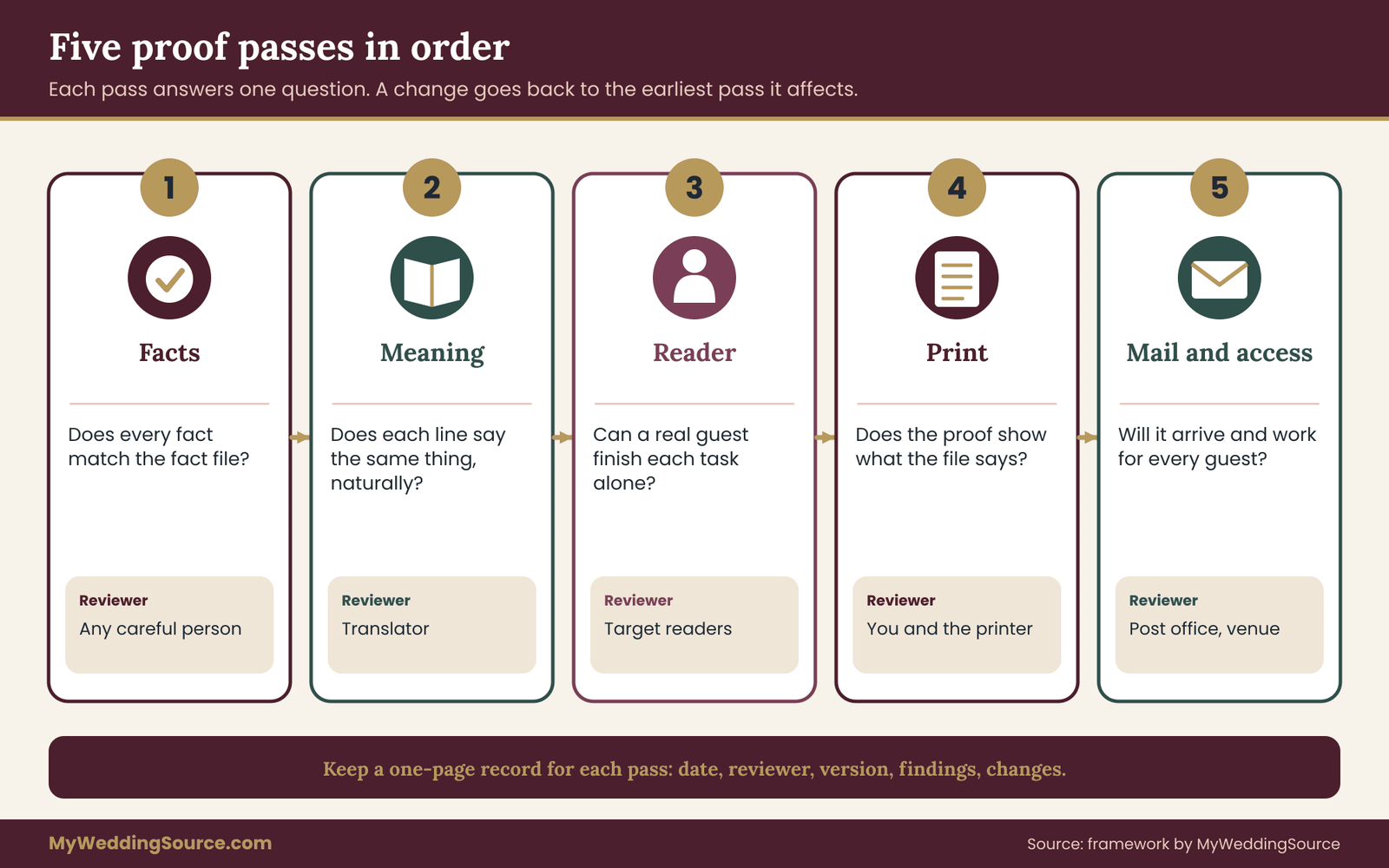
Proofing a single-language invitation is one task. Proofing bilingual wedding invitations is several tasks that look like one, and doing them all at once is how errors get through. The checklist below splits the job into five passes. Each pass has one question, one kind of reviewer and one record of what was checked. Run them in order, from the first draft of your bilingual wedding invitations to the mailed envelope. A later pass assumes the earlier ones are clean.
Pass one: the fact pass
The question is simple: does every fact in both versions match the fact file? Facts are names, dates, weekdays, times, venue names, addresses, phone numbers, web addresses, reference codes and the reply-by date.
Anyone careful can do this pass on bilingual wedding invitations, and the reviewer does not have to read both languages fluently. They compare each fact in the printed or proof version against the file, character by character. A reviewer who reads neither language can still do it, because the task is a comparison, not a reading. Use a highlighter or a digital tick. Do each version separately and tick every fact. At the end, every fact in the file should have two ticks, one per language.
Common failures at this pass include a transposed digit in a phone number, a month spelled one way in one place and another way in another, a time with the wrong “p.m.,” and a venue name with a missing accent. Anything that fails goes back to the source file, not to the other language version, so that the fix is made in the right place.
Pass two: the meaning pass
The question here is: does each translated line say what the source line says, in natural writing? This is the pass for a translator or an equally qualified reader. The reviewer reads the second version as a native reader and then compares its meaning with the first.
Ask the reviewer to mark three kinds of problem. A meaning error is where the translation says something different. A register error is where the tone is wrong, too stiff or too casual. A naturalness error is where the sentence is correct but nobody would say it that way. Each gets a different fix. Meaning errors are corrected immediately. Register and naturalness errors are discussed with the translator, since the fix depends on a judgment.
The back-translation check is a useful tool at this stage. Ask a different qualified person, who has not seen the first version, to translate the second version back into the first language in plain words. Compare the result to the original. Differences point to places where meaning slipped. A back-translation is not a perfect test, because a good natural translation may not map back word for word, but a large gap is a signal.
Pass three: the reader pass
The question is: can a real member of the intended audience complete each task using only the printed piece? Pass two checks the text; pass three checks the use.
For bilingual wedding invitations, pick one or two people who read only the language being tested, and ideally who are similar to the guests: an older relative, a person who has not followed the planning, a friend who has never met the families. Give them the printed proof, not the file, and a simple set of tasks. When is the ceremony? Where do you go? What should you wear? How do you reply, and by when? Is the venue accessible? Watch what they do, without helping.
Note where they hesitate. A hesitation is a finding even if they eventually get the right answer. Note also where they ask a question. Every question is a line that could be clearer. Keep the notes, make the fixes, and then test the changed lines with a new reader if you can.
Pass four: the print pass
The question is: does the printed or digital proof show what the text file says? Typesetting can introduce errors that were not in the text. Fonts may drop accents. A line may break in a way that changes the reading. A script may need a different line height, and a right-to-left script may reverse punctuation or numbers.
This pass is done on the printer’s proof, at actual size, in good light. Check each line for missing or substituted characters, broken words, orphaned lines, and numbers that have shifted or been reordered. Compare the proof to the fact file again for the facts, since a typesetter may have retyped them. The wedding invitation printing guide explains what a printer needs from you at proof stage and how to approve a proof in writing.
If the proof is a digital image, zoom in and read at the pixel level. If it is a printed sample, check that the ink and paper do not make small type or thin strokes hard to read, especially in scripts with fine details.
Pass five: the mail and access pass
The question is: will the piece arrive, be opened, and be usable by every guest? This covers the envelope address, the postage, the order of pieces in the envelope, and the digital copies and accessible versions.
Check that the address block follows the postal format and is legible to a machine. Check the return address. Weigh a complete sample suite and get it priced at the post office, since extra pieces, inserts and unusual shapes can change the cost. Check that each language version of the website, form or QR destination opens and works on a phone. If you offer a large-print or screen-reader-friendly version, confirm that it matches the printed text and exists in both languages.
A short list of mailing checks catches a surprising number of problems: the right invitation goes to the right guest, with the right language option if you have chosen to send one language to some guests and both to others. If you have two variants, label the boxes and keep a list of who gets which.
Recording the passes
Keep a one-page record for each pass of your bilingual wedding invitations: the date, the reviewer, the version checked, what was found and what was changed. This takes minutes and has three uses. It stops you from checking the same thing twice and skipping something else. It gives the printer a clear sign-off. And it gives you a trail if a problem shows up later, so you can see where the check failed.
The record also tells you when to stop. A pass is complete when its question has been answered for every line in the suite and every finding has been resolved or accepted on purpose. Perfection is not the aim. A clear list of what was checked and what remains is.
The order matters
Why five passes in that order for bilingual wedding invitations? Facts first, because a wrong fact makes every later check pointless. Meaning second, because there is no point testing how a text reads if it says the wrong thing. Reader third, because it tests the text as a real person uses it. Print fourth, because the printed form is the last place errors can enter. Mail and access last, because they depend on the final form.
If you change a line late, go back to the earliest pass that the change affects. A small change to a date goes back to pass one and then to pass four. A change to a sentence goes back to pass two, three and four. The cost of re-running a pass on one line is small, and the cost of printing a mistake is not.
Who can check what, and where each reviewer stops
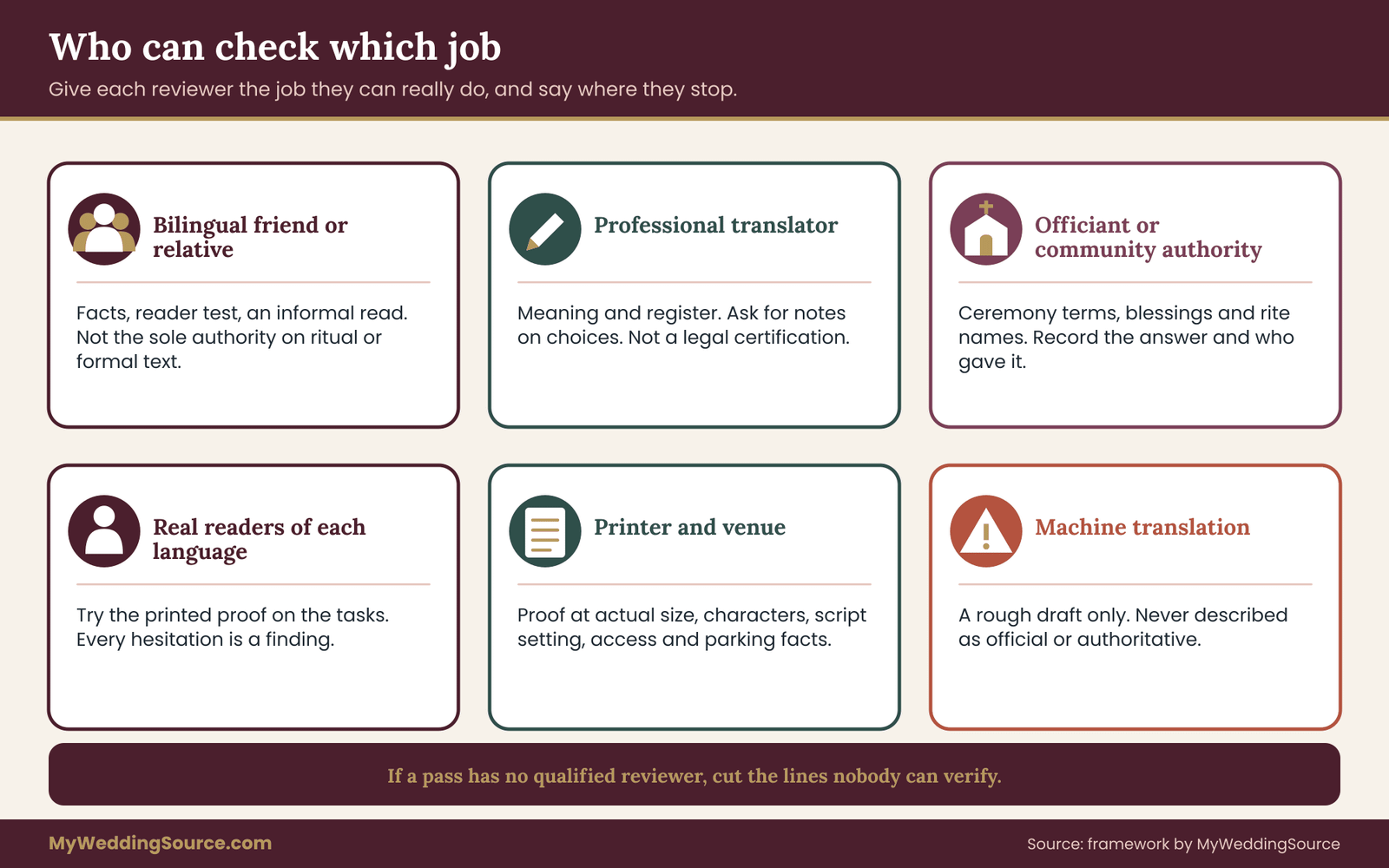
Proofing bilingual wedding invitations goes wrong when the wrong person is asked to check the wrong thing. A bilingual relative is eager and helpful, and also often the only reviewer a couple has. The solution is not to avoid that relative but to give them the right job and to bring in others for the rest.
The bilingual friend or relative
A friend or relative who reads both languages is the right person for the fact pass, the reader pass and an informal read of the meaning. They know the families, they know the occasion, and they will tell you if something sounds odd. They are not the right sole authority for the meaning of a ceremonial text, a formal register or a technical term, unless they have the training or standing to be.
They also face an awkward position: correcting a couple, or an elder’s wording, is hard for a relative. Make it easy by asking for a list of questions, not a verdict. Say that you are looking for anything that might confuse a reader, and thank them for each finding.
The professional translator
For bilingual wedding invitations, a translator is trained to move meaning and register across languages and to flag choices. For a short text such as an invitation, a professional translation is a small job and a worthwhile one. When you look for one, ask about their working language pair, their experience with ceremonial or personal texts and whether they will provide a note on any choices they made.
The American Translators Association, a professional body, publishes information on working with translators and a directory. Credentials and standards differ between countries and languages, and a credential is not a guarantee of fit for your text, so ask about experience with this kind of document. A translator can also tell you if a line should be left untranslated.
A professional translation is not a legal certification. If any part of the suite has to carry legal weight, such as a notice that is part of a legal process, the requirements are set by the body that will rely on the document, and you should ask that body what it accepts. A wedding invitation does not usually have that requirement.
The community or religious authority
For ceremonial words, names of rites and religious phrases, the authority is the officiant, the community leader or a respected elder. They are not proofreaders in the usual sense. They are the people who can say whether the term is right, whether it should be left in its original language and how it should be written.
Ask them a specific question: “Here is the phrase and the sentence around it. Is this the right form? Should it be glossed? Is there a standard English form?” Record the answer and the name of the person. If they decline to comment, leave the term out rather than guess.
Machine translation: a draft tool with limits
Machine translation can produce a quick draft and is often good enough to show what a text roughly says. It can be useful as a first look, or to understand a message from a guest. It is not a reviewer, and it should not be presented as an authoritative translation of an invitation or of any ceremonial or legal text.
If you use a machine draft as a starting point, mark it as such in your working file and have a qualified human review every line. Do not paste a guest’s private information into an online tool without reading its terms, because some services keep or reuse what you submit. The risk is practical, not abstract: a tool can produce a fluent sentence that is wrong, and fluency hides the error from a reader who cannot check it.
Matching reviewers to passes
For a typical suite, the assignments look like this. The fact pass: any careful person. The meaning pass: a translator or a qualified bilingual reader. The ceremonial terms: the relevant authority. The reader pass: members of the intended audience. The print pass: you and the printer, with a bilingual reader for each script. The mail and access pass: you, with the post office and the venue.
Put the reviewer’s name next to each pass in your record for bilingual wedding invitations. If a pass has no reviewer, that is a gap, not a detail. Closing the gap may mean asking a favor, paying for an hour of a professional’s time or cutting a line that nobody can verify. Cutting is a legitimate choice. A shorter second-language invitation that is right is better than a longer one that is nearly right.
A worked case of bilingual wedding invitations: an invented Spanish and English suite
The case below of bilingual wedding invitations is invented for illustration. The couple, the venue and the details do not exist. The point is to show how the sort and the five passes work on a real set of lines, including the errors a careful process tends to find. Treat the choices as one reasonable path, not as rules for every couple.
The setup
Lucía Herrera and Tom Whitfield are marrying on a Saturday in October at a converted barn called The Old Mill Barn, an hour outside the city. Lucía’s grandparents and several aunts and uncles read Spanish comfortably and English very little. Tom’s family reads English only. Most guests under fifty read both. The couple wants every guest to feel the invitation was written for them, and they have three months before they need to mail.
For their bilingual wedding invitations, the couple decides that Spanish and English are both full languages on the invitation card and the details card. The response card will carry both languages with short lines. The wedding website will have a visible language switch. Lucía’s mother, Marta, reads both languages and has offered to help. They hire a translator for a single hour to review the Spanish and ask the parish priest for the wording of the blessing line.
Building the fact file
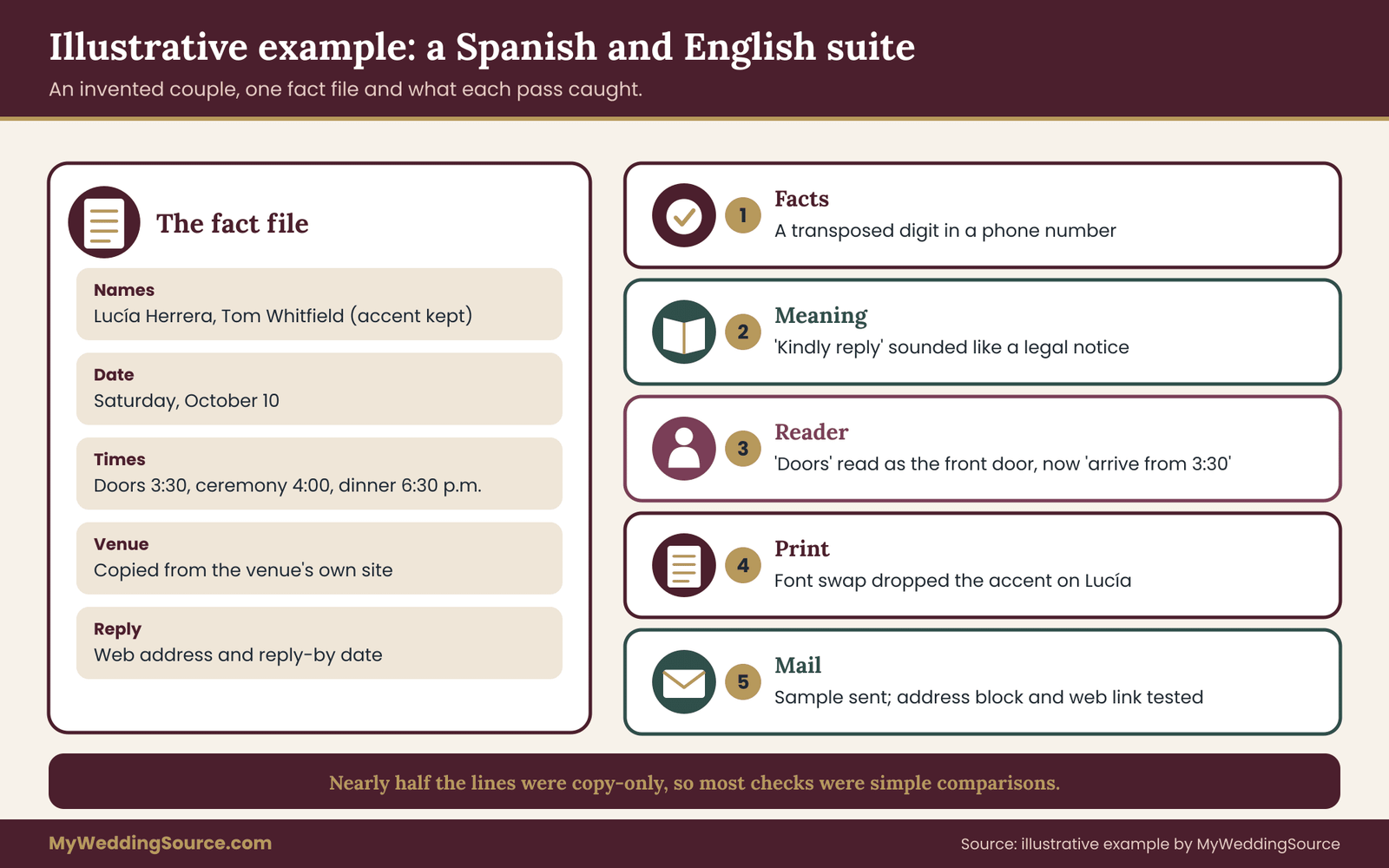
Before anything is translated, they write the fact file. It lists the couple’s names as each uses them: Lucía Herrera with the accent, and Tom Whitfield. It lists the day as Saturday, October 10, with the ceremony at 4:00 p.m., doors at 3:30 p.m. and dinner at 6:30 p.m., all local time at the venue. It lists the venue name exactly as the barn writes it on its own website, the street address copied from that site, the venue’s phone number, the wedding website address and the reply-by date.
They copy the address from the venue’s website, not from an email, and check it against a map. They note one mismatch: an old email calls the road by a former name. The website and the map agree on the current one, so the file uses that.
Sorting every line
They list every line of text that will appear on the suite and mark each one. The invitation sentence is “translate.” The hosts’ line, which names the couple and both sets of parents, is “decide separately.” Every name is “keep identical,” with the accent on Lucía copied exactly.
The date, times, address, phone number and web address are “keep identical.” “The Old Mill Barn” is “keep identical” with a “gloss.” The dress note and the line about children are “translate.” The blessing is “decide separately.” The words for a planned tradition, in which the couple exchange the arras, a coin ritual, are “keep and gloss.” The reply-by sentence is “translate” around a “keep identical” date.
Sorting their bilingual wedding invitations produces a pleasant surprise: nearly half the lines are copy-only. The translator’s job is smaller than the couple feared, and the proofing burden for those lines falls to a comparison anyone can do.
The decisions behind the “decide separately” lines
For the hosts’ line, the couple asks both sets of parents how they want to be named. Lucía’s parents prefer a form with both families named and the couple’s names set apart. Tom’s parents are happy with whatever the couple chooses. The couple writes a plain sentence of meaning, “Both families invite you to the wedding of their children,” and the translator writes the Spanish from that.
Marta reads it and says it sounds right, and that she would put the elders’ titles in a particular form. They check with Lucía’s grandmother’s own daughter, who confirms the title. The grandmother’s form of address is therefore settled by asking, not guessing.
For the blessing, the priest supplies a short traditional line in Spanish. It is used as written, with no English translation, since it is normally spoken in Spanish. A small note on the website explains it in plain English for guests who want to know.
What the translator changes
The translator reads the English invitation sentence, the dress note and the line about children, and rewrites each as natural Spanish rather than a mirror. The dress note in English says “Cocktail attire.” A literal rendering in Spanish would be confusing, so the translator proposes a short description: dressy but not formal, suits or dresses, no tuxedo needed. The couple takes the description and keeps the English label as well.
The line about children says the evening is for adult guests, with named exceptions on the envelope. In English it reads slightly curt. The translator suggests a gentler construction in Spanish, and the couple asks Tom’s sister to re-read the English for the same softness. Both versions end up warmer than the first English draft.
The five passes in action
In the fact pass, Marta compares both versions to the fact file and finds a Spanish phone number where one digit was transposed. She also finds that the Spanish date used a lowercase month where the couple had agreed on the capitalization that Spanish normally uses, which is lowercase. They keep the lowercase form, which is the correct Spanish convention, and note it in the file so no later proofreader changes it back.
In the meaning pass, the translator flags the hosts’ line, which was slightly more formal than the English, and the couple accepts it. The translator also points out that one phrase, a literal rendering of “kindly reply,” sounds like a legal notice, and offers a friendlier form.
In the reader pass, a family friend who reads only Spanish is given the printed proof and asked to find the time, the place, the dress and the reply method. She finds all four, but hesitates over the doors time. The card says “doors” and the Spanish equivalent she sees could mean the front door, not the opening time. The couple changes the line to say plainly that guests may arrive from 3:30 p.m.
In the print pass, they find that the printer’s template drops the accent on Lucía’s name on the envelope liner, because of a font substitution. The printer fixes it and sends a new proof, and the couple checks it against the file again.
In the mail pass, they mail a sample to a friend in another state, address block formatted in the postal style, with the Spanish card in the same envelope. The sample arrives intact. They also check that the web address on the card opens the website, and that the language switch on the site works on a phone.
What the example does and does not show
The example shows that sorting bilingual wedding invitations is quick, that most of the risk sits in a few lines and that cheap checks catch most errors. It does not show a typical budget, and it deliberately avoids prices, because costs vary by translator, region and printer and should be confirmed through quotes.
It also does not show every language pair. A suite in a right-to-left script, or in a script with no spaces between words, adds print and layout checks that are not in this example, though the four-way sort and the five passes still apply.
The example involves a family willing to help. When no one in the family can review, the answer is not to skip the pass but to buy an hour of a translator’s time for it, or to reduce the second-language text to the lines that someone can verify.
Reading the result
At the end of the process, the couple has a fact file, a sorted line list, a record of five passes and a short list of decisions with names beside them. The printed bilingual wedding invitations have Spanish and English cards that agree on every fact and read naturally in each language. If a guest calls to ask a question, the couple can look at the record and see how any given line was settled.
That record also helps with later pieces. The program, the website and the signs at the venue can all draw on the same fact file and the same sorted list. The site’s guide to wedding signage systems covers how to carry a consistent set of names and facts onto signs and printed day-of pieces.
Alternatives to full translation, and when bilingual wedding invitations fail
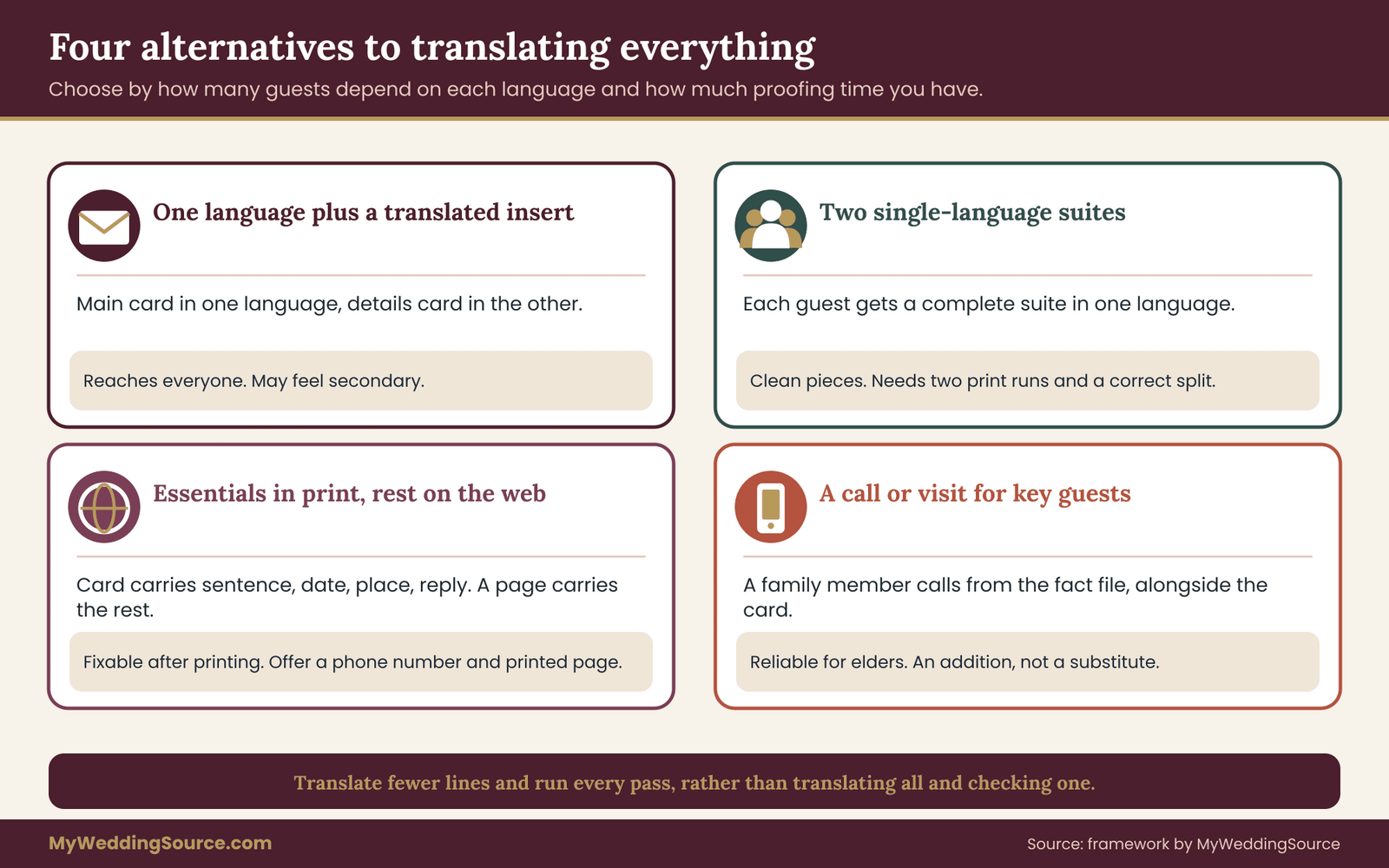
Not every couple should translate every line of their bilingual wedding invitations, and not every suite should be bilingual on every piece. The sort and the passes still help, because they show what you can safely leave out. Here are the main alternatives, followed by the situations in which the approach itself breaks down.
Alternative one: a single-language invitation with a translated insert
The invitation card stays in one language, and a separate details card carries the second. This keeps the main card uncluttered and puts the practical content, where translation matters most, in the guest’s language. The trade-off is that the second language can feel secondary, since the card that announces the wedding is not in it. It suits families where one language is used for tradition and the other for daily life, and where the couple wants the invitation sentence to carry a single voice.
Alternative two: two single-language suites
Each guest receives a complete suite in one language. This gives each reader a clean, uncluttered piece and avoids layout compromises. The costs are two print runs and a guest list that has to be split correctly. The split depends on knowing each guest’s preference, and a mistake means a guest receives a suite they cannot read. If you choose this route, label the boxes and the mailing list clearly and consider placing a one-line note in the other language on every envelope, in case a suite lands with the wrong reader.
Alternative three: translate the essentials and send the rest by web
The card carries the invitation sentence, the date, the place and the reply method in both languages, and a short web address leads to a fuller page in each language. This reduces printed text and allows corrections after printing. The weakness is that guests who do not use the web or who find it difficult are left with the minimum. Offer a phone number for them, and offer a printed copy of the web page on request.
Alternative four: a spoken or personal channel for key guests
For a small number of elders or guests who may not manage printed text in either form, a phone call or a visit from a family member, along with a card, is the most reliable way to deliver the facts. This is not a substitute for a written invitation, but it is a reasonable addition. Make the call from the fact file so the information is the same.
Choosing between them
Ask three questions. How many guests depend on each language to act on the invitation? How much time and budget exist for proofing? And how much will the family accept a single-language main card? If many guests depend on the second language and you have time, put both languages on the key pieces. If time is short, translate the details and the reply request first, since they carry the tasks, and leave the invitation sentence for last.
The site’s overview of wedding etiquette is a good place to check what each family expects before you choose, since the answer often depends on norms the couple does not hold themselves.
Failure conditions: when this process does not work
A process is only useful if you know when it fails, and bilingual wedding invitations are no exception. Here are the situations where the sort and the passes will not save a suite, and what to do about each.
There is no one to run the meaning pass. If no translator and no qualified bilingual reader is available, the second-language text cannot be verified. The fix is to reduce the text to lines you can check, such as the facts, and to carry the rest in a single language or by another channel. Do not print text you cannot read as though it were verified.
The master text keeps changing. If the details are not settled, every change forces a full re-run. Do not start translating until the facts are fixed, or build a short list of “pending” items and keep them off the printed piece. A date that is not final does not belong on an invitation in any language.
Families disagree about names, titles or order. A translation process cannot settle a family question. If the disagreement is open, finish the family conversation first. A neutral form, such as listing all names in alphabetical order, may help as a temporary approach, but it is a decision, not a translation.
The script or layout is beyond your tools. A right-to-left script, a script that uses complex shaping or a language with unusual line-breaking rules needs a designer who works in that script. If your printer or designer cannot set the script, find one who can before you commit to text in that language, and ask to see a sample in the script.
The deadline is too short for five passes. If the mailing date is close, shrink the scope, not the checks. Translate fewer lines and run all five passes on them, rather than translating everything and running only the fact pass.
A guest’s needs are not met by print at all. Some guests need a different format, such as large print, a screen-reader-friendly file or a spoken message. Print in two languages does not meet that need. Offer the alternative format, in both languages where relevant, and ask guests how they would like to receive information.
What not to claim
Do not describe a machine translation, or a family member’s translation, as professionally translated, certified or official. Do not claim a text has been reviewed by a community authority unless it has. Do not print “wheelchair accessible” or any similar claim unless the venue has confirmed it in writing. Honest labels on bilingual wedding invitations protect you, and they protect guests, who act on what you print.
When to revisit the decisions
Revisit the sort for bilingual wedding invitations if a fact changes, if a guest is added who needs a language you did not plan for, or if a reviewer finds a systematic problem, such as a mismatch between the registers of the two versions. A change to one line usually needs only the relevant passes, not all five. Keep the fact file as the single source and update it first.
Your next steps
Start with an hour on your bilingual wedding invitations. Write the fact file: names as each person wants them, date with weekday, times, venue name and address as the venue writes them, web address and reply-by date. Then list every line of your draft invitation and mark each as translate, keep identical, gloss or decide separately.
In the following week, ask the owners of the “decide separately” lines for their answers, and book a translator for the “translate” lines. Run the fact pass on the first draft, then the meaning pass, and schedule a reader pass with someone who reads only the language being tested. Hold the print and mail passes until the printer’s proof arrives, and write the five-pass record as you go. Done in this order, bilingual wedding invitations stay accurate and warm, and the record you keep will serve the program, the website and the signs as well.
FAQ
Should every word on bilingual wedding invitations appear in both languages?
No. Translate the lines a guest must understand to act, such as the invitation sentence, dress guidance and the reply request. Keep names, addresses, numbers and web addresses identical in both versions. Add a short gloss for unfamiliar terms. Some lines can stay in one language, and a shorter, accurate second version is better than a longer, uncertain one.
Should I translate the venue name and address on bilingual wedding invitations?
Usually not. Keep the venue name and street address exactly as the venue and the map write them, so guests, drivers and navigation apps all find the same place. If readers of the other language may not understand what kind of venue it is, add a short gloss beside the name that describes it.
Which language should go first on bilingual wedding invitations?
There is no rule. For bilingual wedding invitations, choose according to who needs which piece most, and keep the treatment parallel so neither family feels ranked. Whatever you choose, use the same order across the whole suite and make sure each family’s names receive equal size and prominence. The decision is a family and design question, separate from the translation itself.
Is machine translation good enough for bilingual wedding invitations?
For bilingual wedding invitations it can give you a rough draft and help you understand a guest’s message, but it should not be the final word. Fluent output can still be wrong, especially for tone, titles and ceremonial terms. Have a translator or qualified bilingual reader check every line, and do not describe a machine draft as an authoritative or official translation.
How do I write the date for readers of two languages?
On bilingual wedding invitations, spell out the month and include the weekday in each language, using that language’s own names. Avoid all-numeric dates, because the order of day and month differs. If you need a numeric form, the ISO 8601 order of year, month and day is designed to avoid confusion. Add the time zone or “local time at the venue” if guests travel.
What do I do with cultural or religious terms on bilingual wedding invitations?
On bilingual wedding invitations, keep the original term, add a short gloss in the other language and ask the officiant or a community authority for the right form. Do not rely on a dictionary or a general translator for sacred or ceremonial wording. If no authority can confirm a phrase, leave it out. A plain invitation sentence in both languages is complete without it.
How many people should proofread bilingual wedding invitations?
At least three roles are useful: someone to compare every fact against the fact file, a translator or qualified bilingual reader for meaning, and a real reader of each language to test whether they can use the invitation. Add the printer for the proof and the venue for access details. One person can fill more than one role only if qualified.
What if I cannot find anyone to review the second language?
Reduce the second-language text to lines you can verify, such as the facts, and carry the rest in a single language or through another channel, such as a call or the website. A short, checked version is better than a full version that nobody has read. A translator can often review a short suite in an hour or two.
Sources
- Americans with Disabilities Act, effective communication and accessibility guidance, U.S. Department of Justice
- Language access and limited English proficiency, LEP.gov, U.S. federal interagency website
- Working with translators and interpreters, American Translators Association
- Internationalization resources, World Wide Web Consortium
- ISO 8601 date and time format, International Organization for Standardization
- Publication 28, Postal Addressing Standards, United States Postal Service
- International mail, United States Postal Service
- The Unicode Standard and character encoding, Unicode Consortium
- Federal plain language guidelines, plainlanguage.gov