
Wedding decor resale works best when you treat it as a small, finite project with a start and an end: count what you own, photograph it honestly, price it with fees in mind, meet buyers in safe places, and keep unsold items dry while you wait.
Quick answer
For wedding decor resale, do four things in order. First, confirm what you actually own, because rented and venue-owned pieces cannot be sold. Second, photograph each item alone, in bright even light, with close-ups of any wear. Third, price from what you paid, then subtract platform fees and your time before you decide the number is worth it. Fourth, make local pickups in a public, well-lit place, and do not ship or hand over anything until payment is confirmed in your own bank account. Keep unsold stock somewhere dry and steady while it waits.
What wedding decor resale actually involves
The reception ends, the venue crew packs the centerpieces into crates, and suddenly you own forty candle holders, a handful of signs, and a pile of linens you will never use again. Wedding decor resale is the process of turning that pile into either cash, a donation, or a gift to someone who will use it, without letting it take over your closet for a year. It is less glamorous than planning the wedding, and a little organization up front makes wedding decor resale much easier.
Why couples sell decor after the wedding
Most couples who try wedding decor resale do it for plain reasons: the items cost real money, the pieces are now clutter, and the couple would like some of the budget back. Some also like the idea that another couple will use what they chose. Our own wedding budget guide explains how decor competes with every other line in a plan, and that competition is exactly why recovering a little of it feels sensible afterward.
Recovering part of the budget
A common expectation is that wedding decor resale will return a large share of what was spent. We could not find a trustworthy published figure for how much of its price wedding decor typically resells for, so this guide does not quote one. What is certain is that every sale has costs, including fees, packaging, travel, and your hours, so treat any proceeds as a partial offset and not as a refund. A calm target is “enough to be worth the effort,” and that target is different for every household.
Reducing clutter and waste
For many people the real prize of wedding decor resale is space, not money. A garage full of mason jars is a monthly reminder of a task you have not done. Selling, gifting, or donating decor within a few weeks lets you close the project, which is often worth more than the last ten dollars of proceeds. If you are choosing between a slow sale and a quick handoff, weigh the value of reclaiming the space.
What tends to sell and what tends to stay in the bin
No dataset we could verify ranks which wedding decor sells fastest, so treat the patterns below as practical reasoning, not market statistics. In general, items that are useful beyond a wedding, durable, and easy to describe are simpler to sell than items that are delicate, easily damaged, or tied to a single event.
Items that travel well in a sale
Hard goods with obvious uses, such as glass vases, candle holders, lanterns, cake stands, table numbers on sturdy stands, and frames, are easy to photograph and describe, and a buyer can picture them in a home or at another event. Sets are easier to sell as sets, because a buyer planning a wedding often needs a matching number of pieces. If you have twelve identical vases, list them as twelve so the right buyer finds the whole lot.
Items that struggle
Heavily personalized pieces carrying your names and date, fresh or dried flowers, anything stained or faded from the day, and anything that needed to look perfect once are harder to sell. Single-use paper goods such as printed programs and menus are rarely worth a listing. That does not mean they are worthless. It means the time you spend on them should be limited, and a free offer to a friend or a local group may serve you better than a listing that never gets a message.
A realistic timeline
A wedding decor resale project drifts when it has no calendar. A short, specific timeline keeps it from becoming a permanent task. The one below is our own suggestion, not a rule, and you can stretch it if your life is full after the wedding.
The first two weeks
Collect everything in one place, count it, and decide what you are keeping. Our after-wedding checklist covers the broader list of post-wedding tasks, and wedding decor resale is one of them. During these two weeks, also return anything that was rented and settle questions about what the venue or planner may have stored for you.
The following month
Photograph and list in batches. With wedding decor resale, aim to get the best items online or in local groups within a few weeks, respond promptly, and set a rule such as lowering prices after a set number of weeks. At the end of that month, decide what remains, and send it to donation, a swap, or a final markdown so the project ends instead of lingering.
Before you list anything: take inventory
Wedding decor resale from memory leads to mismatched counts, forgotten ownership problems, and awkward conversations. A written inventory takes an hour and prevents most of them. It also doubles as your listing notes, because you will need the dimensions, counts, and condition anyway.
Build a simple inventory
Use a spreadsheet, a notes app, or paper. The format matters less than being able to see everything on one page. If you used a tracking system for gifts, the same habits apply, and our wedding gift tracking guide is a companion for keeping a running list.
What to record for each item
For every item or set, write down the name, quantity, what you paid, where you bought it, the material, the approximate dimensions, any damage, and whether it is rented, borrowed, or owned. Add a column for the decision: sell, keep, give, donate, or return. Photograph the whole group once before you split it up, so you have a record of what existed on the day you started.
Counting what you actually have
Count after the wedding, not from the shopping order. Things break, walk off with guests, or stay behind at the venue. If the count is lower than expected, ask the venue and your planner before assuming it is lost. Our wedding rental planning checklist is a useful companion for separating what is yours from what is not.
Check who owns what
This is the step that prevents the only truly serious problem in wedding decor resale: selling something you do not own. Ownership can be surprisingly unclear after a wedding, especially when several vendors and family members contributed pieces.
Rented and leased items
Any item delivered by a rental company belongs to that company, even if it was on your tables all night. Do not list it. If you are unsure which pieces were rented, read the rental agreement and the delivery or pickup receipts. If you rented larger pieces, our article on lounge furniture rentals covers that side of the planning, and the same caution applies to rented vases, linens, and signs.
Borrowed, gifted, and venue-provided items
A borrowed arch from an aunt, a sign made by a friend, or table numbers the venue includes are not yours to sell. Ask before you list. For gifted items, such as a handmade sign from a friend, it is polite to check that she is comfortable with it being sold. Items your venue or florist includes in a package may remain theirs, so read the contract language or ask in writing.
Decide sell, keep, give, or donate
Once you know what is yours, make a deliberate decision about each item. It is easier to do this once than to revisit the same box every month.
A fast sorting rule
For each item, ask three questions. Would I use this or display it? Could someone else plausibly use it? Is the likely sale worth more than my time? If the answer to the first is yes, keep it. If the second is yes and the third is yes, list it. If the second is yes and the third is no, give it away or donate it. If the second is no, recycle it or discard it responsibly. Writing the decision in your inventory removes the need to decide again.
Honoring sentimental pieces
Some pieces carry weight: the sign from the entrance, a guest book, a handmade piece from someone you love. Put those in a separate keep pile before you start pricing, so you do not sell something you will regret. Our wedding keepsake storage guide explains how to store the things you decide to keep.
Photographing items for wedding decor resale
Photos do most of the selling in wedding decor resale. A buyer scrolling a marketplace sees a thumbnail and a price, and the thumbnail decides whether they tap. Good listing photos for wedding decor resale do not need a studio. They need plain light, a plain background, and honest detail. eBay’s seller guidance, for example, asks for sharp images with the item centered and fully visible in the first photo, because that image appears in search results.

Set up a plain place to shoot
For wedding decor resale, the goal is a spot you can return to for every item, so your listings look consistent and your time per item stays low. A repeatable spot also makes comparisons easier for buyers, because they see the same light and scale across your listings.
Light and background
eBay’s seller center recommends bright overhead or natural light, an uncluttered space, and a white or neutral backdrop, and it advises avoiding flash and filters. A table near a window with a white sheet or poster board works. Shoot in the morning or on a bright overcast day when light is soft. Glass and metal reflect everything, so stand where you will not appear in the surface, and turn off colored lights that tint the item.
A spot for scale
Buyers of wedding decor cannot judge size from a photo alone. Include one shot with a familiar object beside the item, such as a ruler or a standard drinking glass, and write the measurements in the listing. For tall items such as lanterns and risers, a shot with a person’s hand or a yardstick leaning beside them tells the story faster than a number does.
The shot plan for each item
A fixed list of shots for wedding decor resale keeps you from forgetting the angle a buyer will ask about later. Ten minutes per item is plenty once the setup is built. eBay’s guidance allows up to 24 photos per listing and suggests showing every side with close-ups of textures, tags, and labels. You will rarely need that many for decor, but the principle holds.
The hero shot
The first photo should show the whole item, centered, filling most of the frame, on the plain background. For a set, show the full set together here, then individual pieces after. This is the thumbnail, so avoid text overlays, borders, and watermarks. eBay notes that text, artwork, logos, and watermarks can keep images from appearing in third-party search results, which is one more reason to keep the main photo clean.
Detail, scale, and set shots
After the hero, add a side view, a top view, a base view if the item stands, a scale shot, and a close-up of the material or finish. If the item has a maker’s mark or label, photograph it. For lots, include one photo with every piece lined up so the count is easy to see. Fewer, clearer photos beat a long scroll of near-duplicates.
Show wear honestly
Honest condition photos reduce questions, returns, and disputes in wedding decor resale. They also protect you. A buyer who has seen the chip before buying cannot say it was hidden. eBay’s guidance specifically suggests close-ups of any blemishes, damage, or wear so buyers know what to expect, and notes this helps reduce returns.
Photograph flaws up close
Check each item under bright light, run a finger along edges, and look for chips, scratches, stains, cloudiness, loose parts, and fading. Photograph each flaw next to a coin or ruler for scale and describe it in the listing. A small chip that is visible and described rarely kills a sale. A surprise chip on arrival or pickup nearly always does.
Say what the day did to it
Items used outdoors may have wax drips, grass stains, or sun fading, and fabric may carry creases from storage. State that plainly, and explain what you did to clean it. If you have not cleaned an item, say so. Do not claim that something is “like new” unless it truly is. Plain, specific words build more trust than adjectives, and they keep your listing consistent with your photos.
Write the listing to match the pictures
In wedding decor resale, your words and photos should agree. The text is also what search engines and platform search use, so describe the item the way a buyer would search for it.
Title and description
Lead the title with the item and the key attribute, such as “Clear glass cylinder vase, set of 12, 9 inches tall.” Then describe the material, dimensions, count, condition, and what is included. Mention that it was used at one wedding if that is true and relevant. Avoid hype and avoid vague claims. State whether the item is smoke-free or pet-free only if you know it to be true.
Terms and logistics
Say how a buyer can get the item: local pickup only, shipping available, or both. State your payment preference, and say that pickup is by appointment in a public place. A listing that sets expectations filters out many time-wasters before they message you. Our wedding planning website privacy and security guide is a helpful companion here, because a public listing should not reveal your home address or wedding details.
Pricing wedding decor resale
Pricing is where most people doing wedding decor resale either undersell out of impatience or overprice out of attachment. A method helps. The one below is an editorial framework we built for this guide, not market data, and you should adjust it after you see how real buyers respond.
Start from what you paid
In wedding decor resale, your original price is a reference point, not a promise. Buyers will compare your listing with new items from retail stores, with other secondhand listings, and with nothing at all if they can improvise. The original price helps you set a ceiling and a consistent discount.
Find your reference prices
Look up the same or a similar item from the original retailer, and check a few active secondhand listings. Active listings show what sellers hope to get, which is not the same as what items sell for. If your platform shows sold listings, those are better evidence. Write down two or three comparisons in your inventory so your price has a basis you can explain.
Adjust for what has changed
Decor that was custom, discontinued, or part of a trend may sell for more or for less than a plain equivalent. Tastes also move, as our wedding decor trends article describes, so a style that looked current when you ordered it may feel dated to a new buyer. If an item is hard to compare, price it near the middle of your range and let the response guide you.
Condition tiers
A short tier system keeps your wedding decor resale consistent across dozens of items. The multipliers below are our own starting points for thinking, not sourced market rates. Replace them with your own after the first week of listings.
A simple three-tier starting point
Use three tiers. For unused or like-new items in original packaging, start at a moderate share of the original price. For used with minor wear, start lower. For visibly worn, repaired, or incomplete items, start lower again and say so. A starting share of about half, about a third, and about a fifth of the original price is one way to begin, and it is only a way to begin. If a listing gets many messages within a day, you probably priced low. If it gets none after two weeks, you probably priced high.
Test, then adjust
Treat the first week as an experiment. Watch views, saves, and messages if your platform reports them. Raise or lower by a small step instead of making a dramatic change, and record what you changed. Over a dozen items, you will learn your market faster than any rule can tell you.
What fees take
Fees are the part of wedding decor resale that surprises people. They do not apply everywhere, but when they do, they change the math. Compare routes by what you keep, not by the listed price.
A worked example with one platform’s published fees
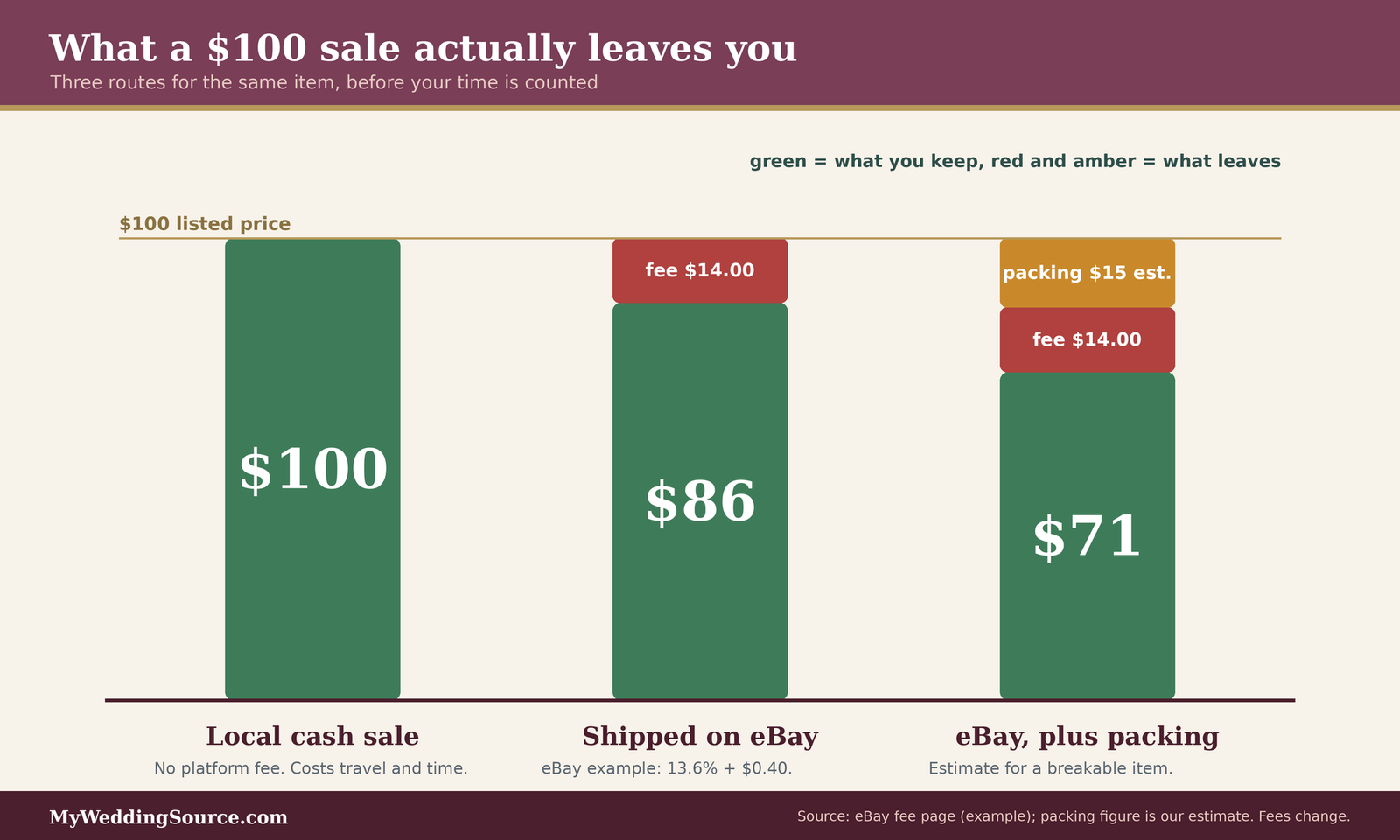
eBay’s published fee page states a final value fee of 13.6 percent of the total sale amount up to $7,500 per item for most categories, plus a per-order fee of $0.40 for orders over $10. On a $100 sale, eBay’s own example puts the total at $14.00, so you keep about $86 before shipping supplies and postage. The page does not give an effective date, and rates change, so check the current page before you rely on this number.
Local cash versus shipped sales
A local cash sale has no platform fee, but it costs travel and time, and it carries the safety considerations covered later in this guide. A shipped sale reaches more buyers and may offer seller protections, but it adds packaging and postage, and breakage becomes your problem. The FTC advises that when you are not selling locally, you should check what seller protections the site offers. Neither route is always better.
Cost check: what a $100 sale really leaves you
Using eBay’s published example, a $100 sale carries $14.00 in fees, leaving about $86 before packing materials and postage. A local cash sale of the same item leaves $100 but costs your travel and time. Our estimate: if packing and shipping a breakable item adds even $15 to your costs, the shipped sale nets nearer $71. Your numbers will differ, so price the item, subtract fees, shipping, and a fair value for your time, and only then decide whether the item is worth listing.
Lots, bundles, and price drops
Selling wedding decor one item at a time is slow. Selling them as thoughtful groups saves effort and often suits buyers better.
When to bundle
Bundle items that a buyer would use together: a dozen identical vases, table numbers one to twenty, a set of frames, or a collection of lanterns in one finish. Bundling raises the average sale and cuts the number of meetings you need to arrange. It also makes pickup more efficient. Photograph the entire set together, list the exact count, and be clear about whether the set can be split.
A calendar for markdowns
Decide your markdown plan before you list, so you do not agonize later. For example, lower the price by a set amount every two weeks, and set a final date after which anything unsold goes to donation. The date matters more than the exact amounts, because a date ends the project. Keep a note of the final price you are willing to accept, and do not negotiate below it in a rush.
Choosing where to sell
There is no single best place for wedding decor resale, because each route trades speed, fees, reach, and risk differently. The Knot’s guide to making money after a wedding, last updated in 2020, lists marketplaces such as Craigslist, eBay, Tradesy, Bridal Garage Sales, and Facebook Marketplace for decor, and it also points to Facebook bridal swap groups. Because that list is several years old, treat it as a starting set of ideas and check whether each service still exists and what it charges today.
Start local
Local wedding decor resale avoids shipping, breakage, and many fees, and they suit heavy or fragile items. They also bring the safety questions covered in the next section, so plan the handoff before you list.
Neighborhood and community listings
Local marketplace apps, community bulletin boards, and neighborhood groups let buyers see you are nearby and let you set a pickup window. Describe what you have, state that pickup is by appointment, and name a general area instead of a street address. Buyers who live close are usually the quickest, and many will take an entire set in one trip, which saves you repeated meetings.
Local wedding communities
A local bridal group, a regional swap page, or a venue’s alumni group connects you with people actively planning weddings. One blogger writing at Something Turquoise said Facebook bridal swap groups worked best for her, though this is one person’s experience and not data. Search for terms such as “wedding swap” plus your region, read the group rules before you post, and follow any rules about prices or photos.
Shipping marketplaces
Shipping widens the audience for wedding decor resale, which matters for specialized decor, but it also means packaging, postage, and platform rules. Think about whether each item can survive a trip.
Fees and payment on larger platforms
Larger platforms charge fees and handle payment in their own way. eBay’s published fee page, as described above, shows a percentage plus a per-order fee. Etsy’s seller policy, by contrast, states that dropshipping and reselling are not allowed on Etsy except in cases outlined in a linked help article, with craft supplies named as an example, so do not assume that Etsy accepts used decor and read its current policy first. Read the fee and payment terms of any platform before you list.
Packing fragile decor
Glass, ceramic, and anything with a delicate finish needs real packing: a sturdy box, cushioning on all sides, and no room to shift. Photograph the packed box before you seal it, keep your receipts, and consider whether postage and packing materials will consume most of the item’s price. For heavy or very fragile pieces, local pickup is usually the more sensible route.
Swap groups, consignment, and the venue
Some routes for wedding decor resale ask less of you than a listing does. They typically return less money, but they also save time and effort.
Swaps and handoffs between couples
Swaps and direct sales between engaged couples can be quick, because the buyer already knows the use and the size of the need. Sharing a spreadsheet link or a photo set in a group lets several people see everything at once. Be clear on what is included, set a pickup time, and use the same safety habits you would use with a stranger.
Telling the venue what to keep
The Knot’s guide advises telling the venue which items to keep so they are not thrown out during teardown, and pulling decor before teardown begins. That is practical advice for any wedding. Write the list in advance, hand it to your planner or venue coordinator, and ask who will box the items and where they will be stored until you collect them.
Donating and passing things along
Not everything in wedding decor resale needs to be sold. A donation closes the loop quickly, and gifting to a friend can feel better than a marginal sale.
Where donations make sense
Donation fits items that are useful but unlikely to command a price: bulk glassware, plain linens, baskets, frames, and unused stationery. Before you drop anything off, ask the organization what it accepts, because policies vary. The Something Turquoise article suggests researching a shelter’s donation policies and food-safety requirements before donating food or flowers, and that is sensible for anything perishable. Call first and ask.
Passing items to friends and family
Friends planning their own weddings, relatives hosting a party, or a local school or community group may all want a free carload. Offering an item with no strings is simple, and it saves you the time of a listing. If you hope to be reimbursed even a little, say so honestly instead of pretending it is a gift.
Pickup safety for wedding decor resale
Most people on the buying side of wedding decor resale are exactly who they seem to be: someone planning a party or a wedding on a budget. A small number are not, and strangers coming to your home or meeting you with cash create real risk. A few habits drawn from consumer-protection and public-safety guidance lower that risk without making the process unpleasant.
Before anyone comes
Most of the safety work in wedding decor resale happens before the meeting. A clear plan filters out problem buyers and gives the good ones confidence.
Keep your details private
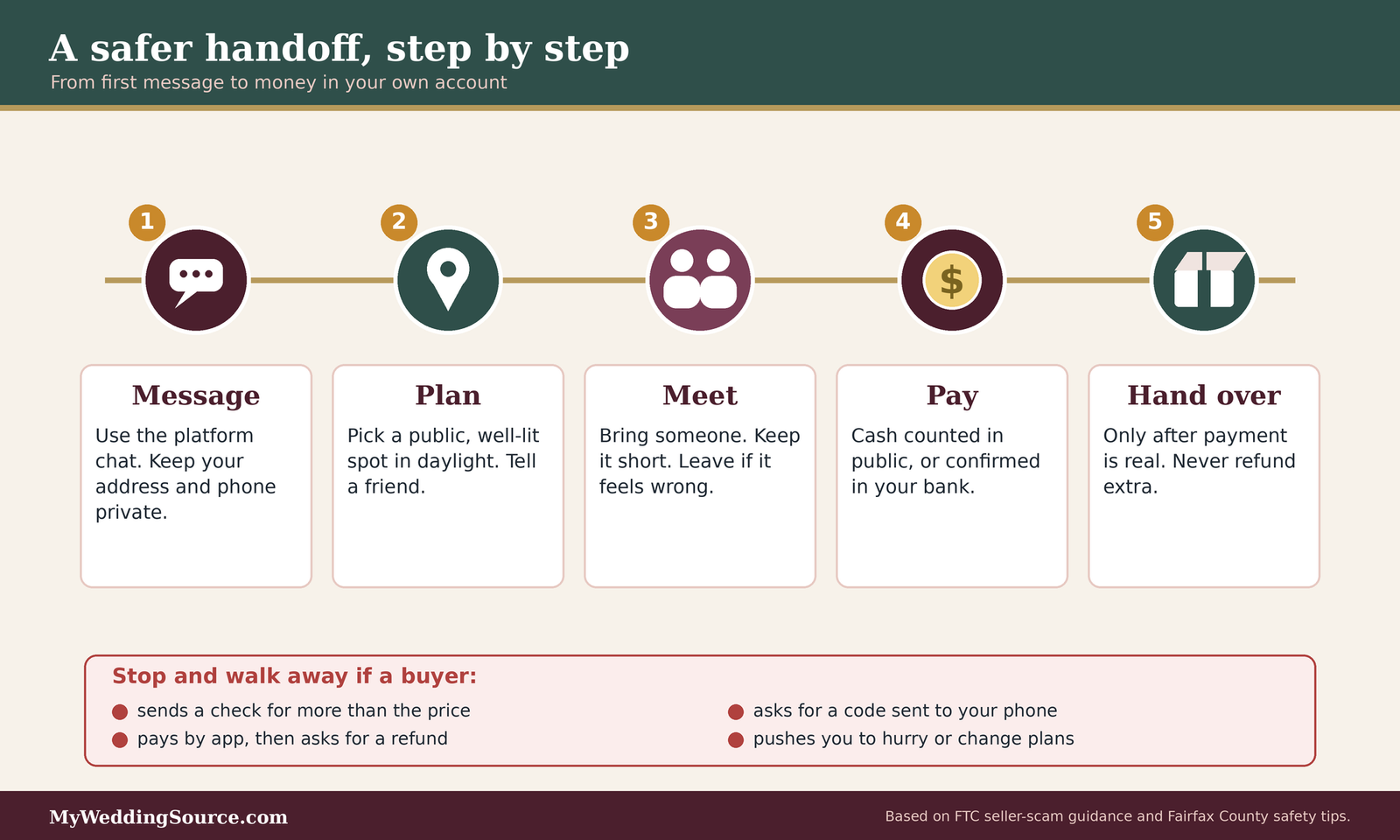
Fairfax County’s online-transaction safety tips advise against sharing your home address, phone number, or Social Security number, and limiting what you share to details about the transaction. Use the platform’s messaging, not your personal number, when you can. Never post a street address in a public listing. If a buyer asks for personal details that have nothing to do with the sale, treat it as a warning sign.
Make a plan and tell someone
Meta’s safety advice, as reported by The Dallas Morning News, suggests making a meetup plan and sharing it with friends or family, and sharing your live location during the meeting. Tell a person you trust the time, place, and the buyer’s name, and ask them to check in. Charge your phone and save local law enforcement’s number before you go, as that article also recommends.
At the handoff
The meeting itself should be short, public, and predictable. If anything feels off, you can end it.
Choose the place and the time
Fairfax County advises meeting in a busy public place such as a coffee shop, shopping center, or the parking lot of a police station, noting that some police stations have exchange zones for online purchases. It also advises daylight hours when possible, bringing someone with you, and avoiding secluded spots. Meta, per The Dallas Morning News, describes a public, well-lit area. Check whether your local police department or city has a designated exchange zone.
When the item is heavy or bulky
Large decor sometimes cannot move to a parking lot. If so, bring a friend or family member to the handoff, stage the item near the door or in the garage, and keep the rest of your home closed off. Do not invite a stranger inside. Consider meeting at a storage unit entrance or a friend’s driveway if your own home feels like a poor option, and keep the buyer’s visit short.
Getting paid safely
Payment is where most losses in wedding decor resale occur. The rules are simple, but they matter more than any other safety step.
Cash and apps
The FTC advises that, where possible, you sell to a local buyer you can meet in person and accept only cash, and that you not accept a mobile payment from someone you do not know. If you do use a payment app, the FTC says to move the money to your bank and confirm it is there before you ship anything or hand over an item. Fairfax County advises against carrying large amounts of cash and mentions payment methods with buyer protection for expensive items, so for a costly lot, think about whether a platform checkout is safer.
Check the cash
Count cash in front of the buyer, in a public place, and check bills for anything that looks wrong. Large amounts are a good reason to meet at a bank or to bring a friend. Keep proceeds in your pocket or bag, not displayed, and go straight home or into a store when you leave. If a buyer wants to pay with a check or asks you to send change back, stop and read the next section.
Scams to recognize
Scammers like wedding decor resale and other secondhand sales because sellers are casual and hopeful. Knowing the common patterns removes their advantage.
Fake payments and overpayment
The FTC describes several scams aimed at sellers. A buyer insists on a mobile payment app and sends a fake payment notification, hoping you ship before checking. A buyer says they paid twice by accident and asks you to refund one payment. A buyer sends a check for more than the price and asks you to deposit it and send back the difference. The check is fake, the bank eventually reverses it, and you lose both the item and the cash you sent. The FTC says never deposit a check for more than the selling price.
Verification codes and pressure
The FTC also warns about a buyer who poses as a fellow shopper worried about fake listings and asks for the Google Voice verification code sent to your phone. The FTC says scammers use the code to create a Google Voice number linked to your number, which they then use to scam others. Do not share any verification code with someone you do not know. Scams often include urgency, so if a buyer pushes for speed, change of plan, or an unusual payment, slow down. You can report scams to the FTC at ReportFraud.ftc.gov, and the Consumer Financial Protection Bureau points consumers to the same reporting route.
Holding stock until it sells: a storage and humidity plan
Wedding decor resale takes weeks, and during that time your inventory sits in a closet, garage, or storage unit. Damp or unstable conditions can ruin items that would have sold well. The reasoning below borrows from museum conservation guidance, which is written for collections and not for households, so we adapt it cautiously and say where we are inferring.
What damp and swings do
The American Museum of Natural History’s preventive conservation page is a useful source on this. It is about museum objects, not wedding decor, and it does not address paper or textiles directly, so we apply its general principles as an inference.
Why humidity matters
According to that page, museum environments are generally kept within a range of 40 to 60 percent relative humidity, with changes of no more than 5 percent within 24 hours. It notes that high humidity can lead to mold on organic materials, on labels, and on storage containers. For decor, that suggests that anything organic, such as paper, wood, fabric, and dried botanicals, deserves a dry place, and that a damp garage or basement is a risky choice.
Why swings matter too
The same page explains that materials that swell and shrink as they absorb and release moisture can crack or crumble, and layered objects can come apart because their layers move differently. We infer that framed prints, laminated signs, painted wood, and glued pieces are the household items most likely to suffer from big swings, such as a hot garage in summer followed by cold nights. Choose a steady indoor spot such as a closet over an unheated shed.
A plan by material
The table below is our own practical suggestion, built from the principles above. It is not a conservation standard, and the right answer depends on your home.
How to read the table
Find the row that matches the item, read the concern it names, and follow the suggestion in the last column. Where an item mixes materials, such as a framed print on a wooden stand, follow the more cautious row. Treat the rows as prompts for thinking, since your climate, your storage space, and the age of the pieces all change the right answer.
| Item type | Main concern while waiting | What to do |
|---|---|---|
| Glass and ceramic | Breakage more than humidity | Wrap each piece, use dividers, store low and stable |
| Paper goods, signs, frames | Mold and warping in damp air | Keep indoors, in sealed bins, away from exterior walls |
| Fabric and linens | Mildew and creases | Wash and fully dry first, store in breathable bags or bins |
| Wood and painted pieces | Swelling, cracking with swings | Avoid garages and sheds, keep off bare floors |
| Metal and candle holders | Corrosion in damp air | Dry fully, add a silica packet, wrap loosely |
| Artificial flowers and greenery | Dust, crushing | Store upright or in large boxes, cover loosely |
Packing bins so items stay sellable
Use clear bins with tight lids, label the outside with the contents and count, and keep a printed copy of the inventory list on top. Do not stack heavy bins on delicate ones, and leave a little space around items so nothing rubs. Photographing each bin once packed gives you a quick visual record if you need to check for damage later.
Checking your storage
You cannot manage what you do not measure, and measuring is cheap.
Cheap monitors and simple habits
A small digital hygrometer costs little and shows temperature and humidity. Place it with your bins, check it weekly, and aim for the museum-style range above as a general target. If readings are consistently high, move the bins, add a dehumidifier, or sell faster. Label each bin with its contents so you do not need to open everything to find a single item.
What to do if you find mold or damp
If you find mold, handle it carefully and separate affected items from the rest. Do not photograph or list moldy items as clean. Consider whether the item is worth cleaning, and if you are unsure of the right method for a particular material, ask a specialist or choose to discard it. When in doubt, protect your health first, and sell only what is clean and dry.
Edge cases in wedding decor resale
Most wedding decor resale listings are routine. A few situations are not, and they are the ones that cause arguments, so it helps to think them through before they happen.
Rented, borrowed, and venue-owned pieces
Ownership problems are the most serious edge case in wedding decor resale, and the cure is documentation. When you are unsure, assume you do not own it until a document says you do.
Packages and bundled items
Some venues, florists, and rental companies include decor in a package, but the contract decides who owns it afterward. A florist may reuse vases, and a venue may keep arches or lanterns. Read the paperwork or email the vendor and ask in writing, then save the reply. Our vendor due diligence checklist explains why it is worth keeping written answers from vendors.
Items you bought but never took home
Sometimes decor was bought, delivered to the venue, and left behind. Contact the venue promptly, because stored items are often cleared on a schedule. Ask whether items can be collected, how long they will be held, and whether any storage fee applies. Do not list anything until you physically have it and have photographed it yourself.
Personalized and sentimental pieces
Personalization makes wedding decor resale harder, and sentiment makes it harder to let go. Both are normal.
Names, dates, and monograms
Signs, napkins, cups, and favors carrying your names are of limited value to a stranger. Options include selling at a steep discount, covering or removing the personalization if the material allows it, repurposing the item, or keeping it. Do not try to remove a finish in a way that damages the piece. If the item can only be sold with your names showing, say so in the listing, since a buyer will see them in the photos.
Pieces made by friends and family
A hand-lettered sign or a centerpiece built by relatives has a story you may not want to end. Ask the maker how they feel about a sale before you list, and consider giving it back to them or keeping it. Our guide to DIY wedding decor discusses homemade pieces from the planning side, and the same care for the makers applies afterward.
Big, fragile, or perishable items
These are the items that cost wedding decor resale the most time for the least return, so make deliberate choices about them.
Large structures and furniture
Arches, backdrops, and furniture are heavy and awkward. Local pickup with two people, a vehicle with enough space, and a clear time is the best route. Our wedding signage and floral wedding arch guides cover how these pieces are planned, and knowing the material helps you describe it accurately. Measure it, photograph it from several angles, and state how it comes apart, if it does.
Flowers and anything fresh
Fresh flowers do not wait for a listing. The Knot’s guide mentions renting centerpieces and arrangements through a Bloomerent-affiliated florist and lists an offer of 10 percent off your bill, but that arrangement needs advance planning and a couple marrying the next day. Something Turquoise suggests giving leftover flowers to guests or donating them. Our guide on fresh versus silk flowers is helpful if you want to keep a version that lasts, and silk or artificial arrangements are far easier to resell.
Tax and record-keeping
We are not tax or legal advisers, and nothing here is tax or legal advice. The IRS describes how it treats common situations, and those descriptions are worth knowing, so check the current pages or ask a qualified professional about your own situation.
Selling at a loss and getting a form
The IRS says that if you sell a used personal item for less than you paid, you may still receive a Form 1099-K, but the proceeds do not increase your taxable income because you made no profit, and the loss is not deductible. It also says a gain on a personal item is taxable. The IRS page lists a threshold of more than $20,000 in payments and more than 200 transactions for third-party platforms to file the form, and it does not say how those rules apply beyond the years it discusses, so verify the current rules.
Keep a simple record
For wedding decor resale, keep the inventory, what you paid, what you sold each item for, and the date. If a platform sends a form, you will be able to match it to your records and explain it. A spreadsheet is enough, and our wedding budget calculator can help you see how resale proceeds fit into the larger picture. Store the records somewhere you can find them next spring.
Questions to ask before you sell
Questions you ask early in wedding decor resale save arguments later. Some go to the people who handled your wedding, and some go to buyers and platforms.
Questions worth asking before you list
- Which of these items do I own outright, and where is that written down?
- Will the venue or florist store my decor, for how long, and for what fee?
- What are this platform’s current fees, payment terms, and seller protections?
- Does this platform allow used or secondhand decor in this category?
- Where is a public place or police exchange zone near me for a handoff?
- How will I confirm payment before I hand over or ship anything?
- What is my lowest acceptable price, and when does an unsold item go to donation?
Questions for the venue and vendors
The people who handled the wedding hold the answers to ownership and storage, and they are usually willing to help if you ask clearly and early.
Ownership and storage
Ask each vendor in writing which items are yours, which are theirs, and which are included in the contract price only for the day. Ask about storage, pickup deadlines, and fees. A one-line reply by email is enough, and it protects you if a question comes up later.
Damage and missing items
If items are damaged or missing, report it promptly, before you list anything else from the same group. Some contracts have time limits for reporting issues. Keep your photographs and the inventory, and be calm and specific when you write.
Questions for buyers and platforms
Wedding decor resale involves buyers and platforms, which each need a different kind of question, and a clear answer from both makes a sale go smoothly.
Questions to ask a buyer
Ask when they can pick up, whether they are buying the whole lot, and how they plan to pay. Ask for a name for the handoff. A genuine buyer answers readily. A buyer who dodges simple questions, pushes for a different payment method, or insists on speed is giving you information.
Questions to ask a platform
Read the fee schedule, the payment and payout terms, the rules about used goods, the seller-protection policy, and the process for disputes. If a rule is unclear, ask support before you list a hundred items. Save the answers, because policies change and you may need to show what you were told.
FAQ: wedding decor resale questions
Getting started
When should I start wedding decor resale?
For wedding decor resale, start with an inventory in the first week or two after the wedding, once rented items are returned and you know what you own. List the strongest items within a few weeks, and set a date when unsold items go to donation. A short timeline keeps the project from lasting months and keeps stored items in better condition.
Can I sell decor I rented or borrowed?
No. Rented items belong to the rental company, and borrowed or venue-provided items belong to their owners. Selling them would be selling property that is not yours. Check your contracts and receipts, ask the vendor in writing if you are unsure, and list only items that you can show you own outright.
Photos and prices
How many photos does each item need?
Enough to show the whole item, each side, the scale, and any flaws. eBay allows up to 24 photos per listing, but most decor needs far fewer, often five to eight. Make the first photo a clean, centered shot on a plain background, because it appears in search results and decides whether people tap.
How do I price wedding decor resale items?
Start from what you paid, compare similar active and sold listings, and set a price by condition. Then subtract fees, shipping, and the value of your time. Treat the first week as a test, adjust in small steps, and set a markdown calendar so the project ends. No verified rule gives a standard resale percentage.
Safety and payment
Where should I meet a buyer?
Choose a busy, well-lit public place, such as a coffee shop, shopping center, or a police station parking lot, and check whether your police department has an exchange zone. Meet in daylight when you can, bring a friend, tell someone your plan, and avoid inviting strangers into your home. If anything feels wrong, leave.
Is it safe to accept payment apps?
Be careful. The FTC advises not accepting a mobile payment from someone you do not know, and where possible selling to a local buyer for cash. If you do use an app, move the money to your bank and confirm it arrived before handing over or shipping anything. Never deposit a check for more than the price.
Storage and taxes
How do I store unsold decor safely?
Use a dry, indoor, steady location and avoid damp garages and basements. Museum guidance suggests keeping humidity in roughly the 40 to 60 percent range, though that is for collections, so we adapt it for the home. Wrap fragile pieces, keep paper and fabric sealed and dry, and check storage weekly.
Do I owe taxes on selling wedding decor?
We cannot give tax advice. The IRS says that selling a personal item for less than you paid does not create taxable income and that the loss is not deductible, while a gain is taxable. Reporting rules and form thresholds change, so check the current IRS pages or ask a qualified tax professional.
Your next steps
Get organized this week
Count and confirm
Gather everything, write the inventory, and confirm which pieces are yours. Return rentals and ask the venue about storage. Our after-wedding checklist is a good place to track the rest of your post-wedding tasks, and our wedding gift inventory spreadsheet guide can help with keeping lists organized.
Sort into four piles
Mark each item sell, keep, give, or donate. Move keepsakes aside first, and move rented items into a return pile with their paperwork. Decide your deadline for listing and your date for sending the rest to donation.
List with care
Photograph in one session
Set up one plain spot, follow the same shot plan for each item, and write the listing while the photos are fresh. If you are returning rented items after the reception, our guide on returning wedding rentals after a Sunday reception can help you keep those separate from your sale items.
Plan every handoff
Pick your public meeting spot and your payment rule before you publish the first listing. Tell a friend your plan, keep your address private, and confirm payment in your own account before anything leaves your hands.
Sources & methodology
How we built this guide
What we relied on
This guide draws on consumer-protection guidance from the Federal Trade Commission and the Consumer Financial Protection Bureau, the Internal Revenue Service’s description of how it treats personal items sold for less than their purchase price, a county government’s safety tips for online transactions, eBay’s published seller guidance on photos and fees, Etsy’s seller policy, and preventive-conservation guidance on humidity from the American Museum of Natural History. For the wedding-specific context we read two wedding publications. We checked these pages on November 12, 2026, and policies, fees, and tax rules change, so recheck before you rely on them. The condition-tier starting shares, the cost example beyond eBay’s own, the storage table, and the timelines are our own editorial suggestions and estimates, not market data. We could not find a verified figure for how much of its price wedding decor typically resells for, so we do not quote one.
What we did not do
We did not test any platform, sell any items, or verify claims made by individual sellers. We are not tax, legal, or safety professionals, and nothing here is tax or legal advice. The museum guidance on humidity is written for collections and not for homes, so our household suggestions are an adaptation.
Source list
Government and regulatory sources
- Federal Trade Commission, Selling stuff online? Here’s how to avoid a scam: https://consumer.ftc.gov/consumer-alerts/2022/07/selling-stuff-online-heres-how-avoid-scam
- Federal Trade Commission, Tips for using peer-to-peer payment systems and apps: https://www.consumer.ftc.gov/blog/2018/02/tips-using-peer-peer-payment-systems-and-apps
- Internal Revenue Service, Form 1099-K FAQs: What to do if you receive a Form 1099-K: https://www.irs.gov/newsroom/form-1099-k-frequently-asked-questions-what-to-do-if-you-receive-a-form-1099-k
- Consumer Financial Protection Bureau, Fraud and scams: https://www.consumerfinance.gov/consumer-tools/fraud/
- Fairfax County, Virginia, 10 safety tips for online transactions: https://www.fairfaxcounty.gov/news/10-safety-tips-online-transactions
Marketplace, conservation, and wedding sources
- eBay Seller Center, Take great photos: https://www.ebay.com/sellercenter/listings/photo-tips
- eBay, Selling fees: https://www.ebay.com/help/selling/fees-credits-invoices/selling-fees?id=4822
- Etsy, Seller Policy: https://www.etsy.com/legal/sellers/
- American Museum of Natural History, Temperature and relative humidity: https://amnh.org/research/science-conservation/preventive-conservation/agents-of-deterioration/temperature-and-relative-humidity-rh
- The Dallas Morning News, What to know about Facebook Marketplace’s safety tips for selling and buying items online: https://dallasnews.com/news/public-safety/2024/11/15/what-to-know-about-facebook-marketplaces-safety-tips-for-selling-buying-items-online
- The Knot, How to make money after your wedding: https://www.theknot.com/content/make-money-after-wedding
- Something Turquoise, After I Do: How to sell, share, and save your wedding items: https://somethingturquoise.com/?p=56059