

A credit card surcharge is an extra charge a vendor adds when you pay by card, and at a wedding it can fire several times on a single contract. This guide gives you a five-step fee check, a simple break-even formula for card rewards and a three-way receipt match, so you can see what each way of paying really costs before the money leaves your account.
Before you pay any wedding vendor by card, get the credit card surcharge in writing: its name, its rate, what amount it applies to, and whether it comes back if the payment is refunded. Multiply it across every payment on the schedule, not just the first one. Compare the total with the cost of paying by check or bank transfer, and subtract the card rewards you would earn on the larger amount. Then match the final receipt to the contract and your card statement line by line. If the numbers disagree, ask the vendor in writing before the statement window closes.
Most couples meet the credit card surcharge by accident. A photographer sends an invoice, the payment page has a small line that says “processing fee,” and the total at checkout is higher than the number in the contract. By then the deposit deadline is two days away, the date is held, and arguing about three percent feels petty. So the couple pays, and the same thing happens again with the balance, the add-on album and the tip.
None of this is unusual, and a credit card surcharge is legal in most places. Vendors do pay real money to accept cards, and many small businesses run on thin margins. The trouble is not that a fee exists. The trouble is that it is often vague, applied to the wrong amount, repeated on every installment or forgotten when a refund comes through. A credit card surcharge you understood and chose is a business cost. One you discovered on the statement is a dispute waiting to happen.
This guide treats the credit card surcharge as a small piece of arithmetic and a small piece of paperwork. The arithmetic tells you what each payment method costs. The paperwork proves what you were charged and why. Neither takes long once you know the steps.
A note on scope. This is general information, not legal, tax or financial advice. Surcharge rules differ by state, card network and payment type, and they change, so the guide points you to the agency or network that publishes the current version rather than quoting figures that may be out of date. For the bigger picture of when deposits and balances fall due, the wedding cash-flow planning guide on this site covers the schedule itself. Here we deal only with what a credit card surcharge adds to it.
What a credit card surcharge is, and what it is not
A credit card surcharge is an added amount, usually a percentage of the payment, that a merchant charges only to customers who pay with a credit card. The vendor decides to add it, tells you about it, and keeps it to offset what the card processor charges the business. It is separate from the price of the service itself.
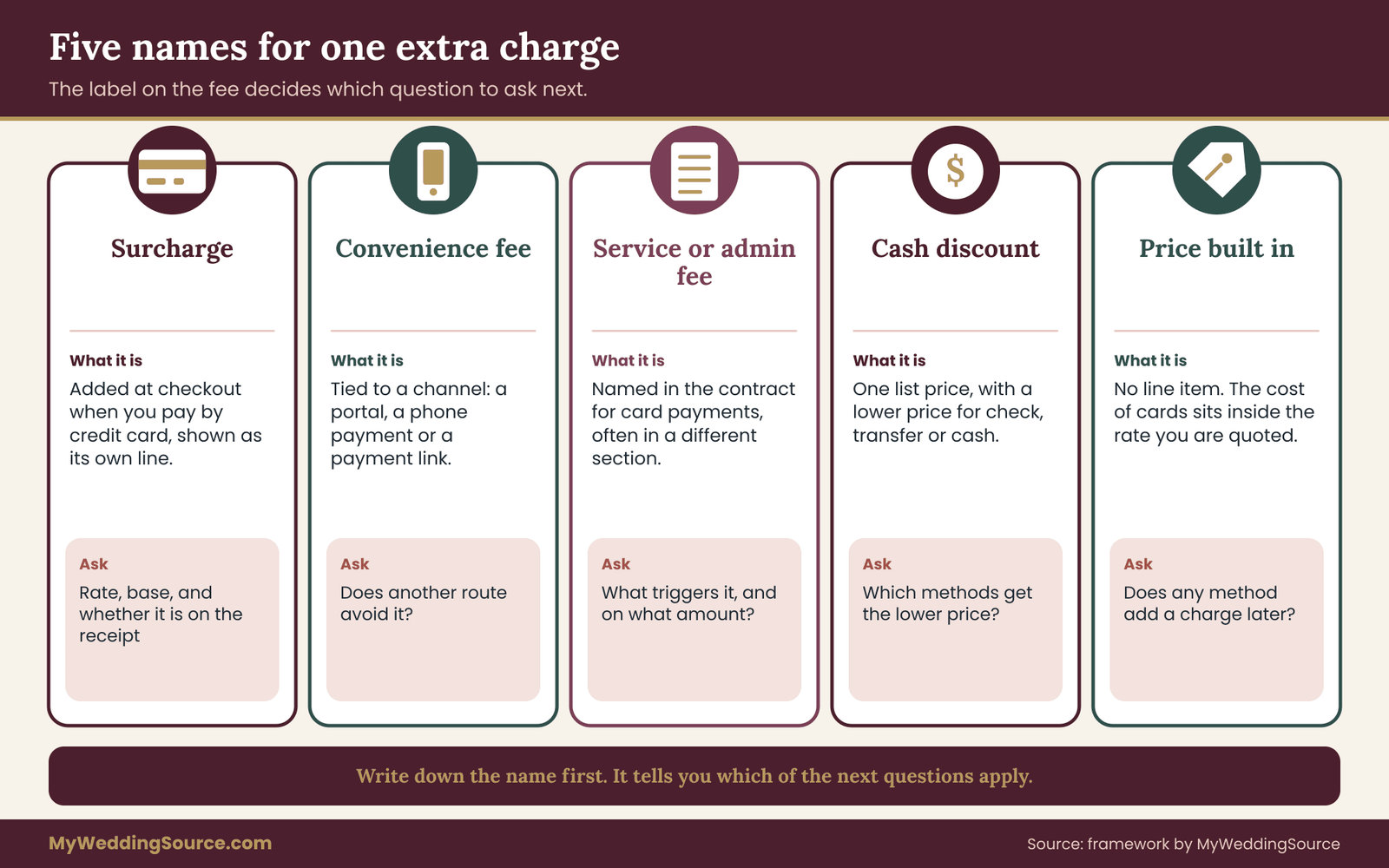
That definition sounds clean. In practice, vendors use five different labels and approaches for the same goal, and they are not equal. Telling them apart is the first job, because each one raises different questions.
Surcharge
A surcharge is a fee added at checkout for paying by credit card. Card network rules generally require the merchant to disclose it before the sale is completed and to show it as its own line on the receipt. The rules also place a ceiling on the percentage and, in general, do not allow surcharges on debit card payments. The exact ceiling and conditions are set by each network and have changed over the years, so check the current version on the network’s merchant pages instead of trusting a number you read in a forum.
Convenience fee
A convenience fee is usually a flat amount or a percentage charged for a particular way of paying, such as an online portal, a phone payment or a payment link. Networks treat it differently from a credit card surcharge, and the vendor’s obligations can differ. For you, the practical difference is that a convenience fee is sometimes charged even if you pay by bank transfer through the same portal.
Service or administrative fee
Some contracts describe the charge as an “administrative fee,” a “payment handling fee” or a “service charge” that applies to card payments. The name tells you little. What matters is what triggers it, what it is calculated on and whether the contract says so in plain words.
Cash discount
Some vendors list one price and give a discount for paying by check, transfer or cash. Mathematically it can look the same as a credit card surcharge. A card payment costs more than a cash payment either way. Legally and on the receipt, it can be treated differently, and some couples find it easier to negotiate because the vendor frames it as a reward for easy payment rather than a penalty.
A price built in
Many vendors take no extra fee and simply price the cost of accepting cards into their rates. This is the version with no surprise, and it is a good reason not to treat every fee-free vendor as a bargain. You have no way to see what the card cost them, and you do not need to. You pay one price.
Why vendors add a credit card surcharge
Card processors charge businesses a percentage of each payment, often with a small flat amount on top. The business also pays for the terminal or software, and sometimes a monthly fee. When the payment is large, the percentage becomes real money. A florist taking a card payment of a few thousand dollars may pay the processor more than the profit on some of the flowers.
That is the vendor’s case, and it deserves a fair hearing. A small business that takes a card payment for a big service cannot easily raise its prices for everyone because some customers use cards. Adding a fee for the card payers is one way to avoid that. Many couples accept the logic once they see it written down plainly. What they do not accept is a fee that appears from nowhere or keeps growing.
Why weddings make the fee matter more
A grocery bill is small, one payment, and over in minutes. A wedding vendor relationship is different in four ways, and each one changes how you should think about the fee.
First, the amounts are large. A fee that rounds to nothing on a sandwich is a few hundred dollars on a catering invoice.
Second, there are several payments. A deposit, an interim installment, a final balance and add-ons can each carry a fee. Some payment portals charge a flat amount every time, which makes many small payments more expensive than one larger one.
Third, there is a long gap between the first payment and the service. If you pay a deposit by card a year ahead and the vendor closes, the card is your route to a refund request. That protection has a value, and the next sections show how to price it.
Fourth, refunds are common. Dates change, guest counts drop and vendors cancel. Whether the fee is returned along with the refunded amount is rarely addressed in a contract, and it should be.
What the rules cover and what they do not
Three layers of rules apply, and none of them gives you a simple answer on its own.
The card networks set the merchant’s obligations: how the fee is disclosed, how it is capped and what cards it may be applied to. A vendor who breaks those rules answers to its processor, not to you, though the processor can still be a useful place to raise a complaint.
State law adds its own layer. A few states restrict or prohibit surcharges on credit cards, and others require specific disclosures. Because these laws change and have been challenged in court, your state attorney general’s consumer protection office is the right place to confirm the current position, and a short call or web search there takes minutes.
Federal law sets the baseline for your rights as a cardholder. Under the billing dispute rules, an error on a statement generally has to be reported to the card issuer in writing within sixty days of the statement that shows it, a point the Consumer Financial Protection Bureau explains in plain language. A fee that was not disclosed or that does not match the contract can be raised through that route if the vendor will not fix it.
What the rules do not do is tell you whether a particular credit card surcharge is fair. That decision is yours. The method in this guide helps you make it with numbers instead of irritation.
“Does the card payment carry any added fee, and where is it written in the contract?”
That single question, asked before you sign, prevents more trouble than any later negotiation. The next section shows where the answer usually hides and what a good disclosure looks like.
Finding the credit card surcharge before you sign
The best time to learn about a credit card surcharge is before the deposit, because that is the only moment you can walk away without a loss. After the deposit, every conversation about fees happens with your money already in the vendor’s account. So the first rule is simple: do not pay anything until you have read the fee language and found it clear.
Where a credit card surcharge tends to hide
Vendors rarely hide a fee on purpose. More often the information lives in several places, and no single one tells the whole story. Check each of these before you treat a quote as final.
- The proposal or quote. Some list payment options and fees at the bottom, in smaller type than the price.
- The contract’s payment section. This is the document that counts. Look for a paragraph about accepted methods, due dates and late fees.
- The vendor’s website FAQ or policy page. A line such as “card payments incur a processing fee” may appear here and nowhere else.
- The invoice or payment portal. The fee may only show at the final checkout screen, after you have entered your card details.
- The terms linked from the payment page. Click the “terms” link. Third-party payment tools often add their own rules.
- Emails and texts. A vendor may mention the fee casually when sending a payment link. Save that message.
If the credit card surcharge appears in the portal but not in the contract, that gap is worth a short email. Ask the vendor to confirm the fee in writing and to add it to the contract or an invoice note. It costs nothing, and it gives you something to point to later. The vendor purchase order checklist shows one way to record every agreed term, fee notes included.
Words to search for
Open each document and search for the following words, in this order. A search takes a minute and catches most of what a skim misses.
- “fee,” then “surcharge,” then “processing,” “convenience,” “administrative,” “service charge” and “handling”
- “card,” “credit,” “debit,” “online payment,” “payment platform,” “portal”
- “non-refundable,” “refund,” “chargeback,” “dispute”
- “installment,” “payment schedule,” “due”
- “total,” “balance,” “invoice amount”
When you find one, read the whole sentence, then the sentence before and after. Fee language is often tucked into a paragraph about something else, such as late payments or cancellations.
What a clear disclosure looks like
A good disclosure of a credit card surcharge answers six questions without making you guess. Here is how a clear version might read in everyday words: “Payments by credit card carry a fee of a stated percentage of the payment amount, added at checkout. There is no fee for check or bank transfer. The fee applies to the full amount charged, including tax. If a card payment is refunded, the fee is refunded with it.” That sentence names the trigger, the rate, the method that avoids it, the base and the refund treatment.
A weak version says something like “credit card payments are subject to processing fees.” It does not say how much, on what, or whether the fee returns. A weak disclosure is not a reason to leave the vendor, but it is a reason to ask three questions before you pay.
What is the exact rate or flat amount for card payments? What amount does it apply to: the payment, the invoice total, or a subtotal that excludes tax and service charges? Is there a way to pay with no added fee? Does the fee apply to deposits, to each installment, to add-ons and to tips? If a payment is refunded, is the fee refunded too? Will the fee appear as its own line on the receipt?
The three kinds of vendor you will meet
Across a typical vendor list, you will meet three situations, and the right response differs.
Vendors with no fee. Take the quote at face value, but still ask whether any payment method carries a charge. “No fee” sometimes means no fee for the deposit and a fee for the balance, because the balance is processed through a different system.
Vendors with a clear credit card surcharge. This is the easiest case. You can calculate the cost, compare the alternatives and decide. Most of this guide helps you do exactly that.
Vendors with an unclear credit card surcharge. The fee is mentioned but not defined. This is where couples lose money and goodwill. Ask for the missing details in writing and wait for the answer before you pay. A vendor who responds clearly and quickly is usually a vendor who runs the rest of the job the same way. A vendor who cannot explain their own fee may deserve a second look in your overall vendor review. The wedding vendor due diligence checklist lays out the wider checks.
The base: what amount does the percentage apply to?
The most common source of surprise with any credit card surcharge is the base, meaning the amount the fee is calculated on. Take a caterer’s invoice with food and drink, a service charge and sales tax. A fee of a stated percentage on the “total” is different from a fee on the “food and drink subtotal.” On a large invoice, that difference can reach a few hundred dollars.
Ask the vendor to write the base as a dollar example. For instance: “On a payment of a stated amount, the card fee would be this dollar figure, making the card total this figure.” Examples remove ambiguity. If a vendor will not give one, that is information too.
There is a second, subtler question: is the fee calculated on the payment before the fee, or on the payment after the fee is added? Some systems add the fee to the amount and then compute the percentage so that the vendor receives the full intended amount after processing costs. That produces a slightly higher fee than a plain percentage. You will see the effect in the worked example later. Neither method is automatically wrong, but you should know which one you are being charged.
Why you should ask before the deposit, not after
A vendor holding your deposit has little reason to move on a fee. A vendor who is still competing for your booking has a good reason to be flexible. Most vendors who will adjust a credit card surcharge do so during the quote stage, when waiving a few percentage points is cheaper than losing a client. After the contract is signed, the fee is part of the agreed terms, and changing it means amending the contract.
This is not about being sharp. It is about order. The questions cost nothing early and cost goodwill late.
A credit card surcharge calculator in five steps
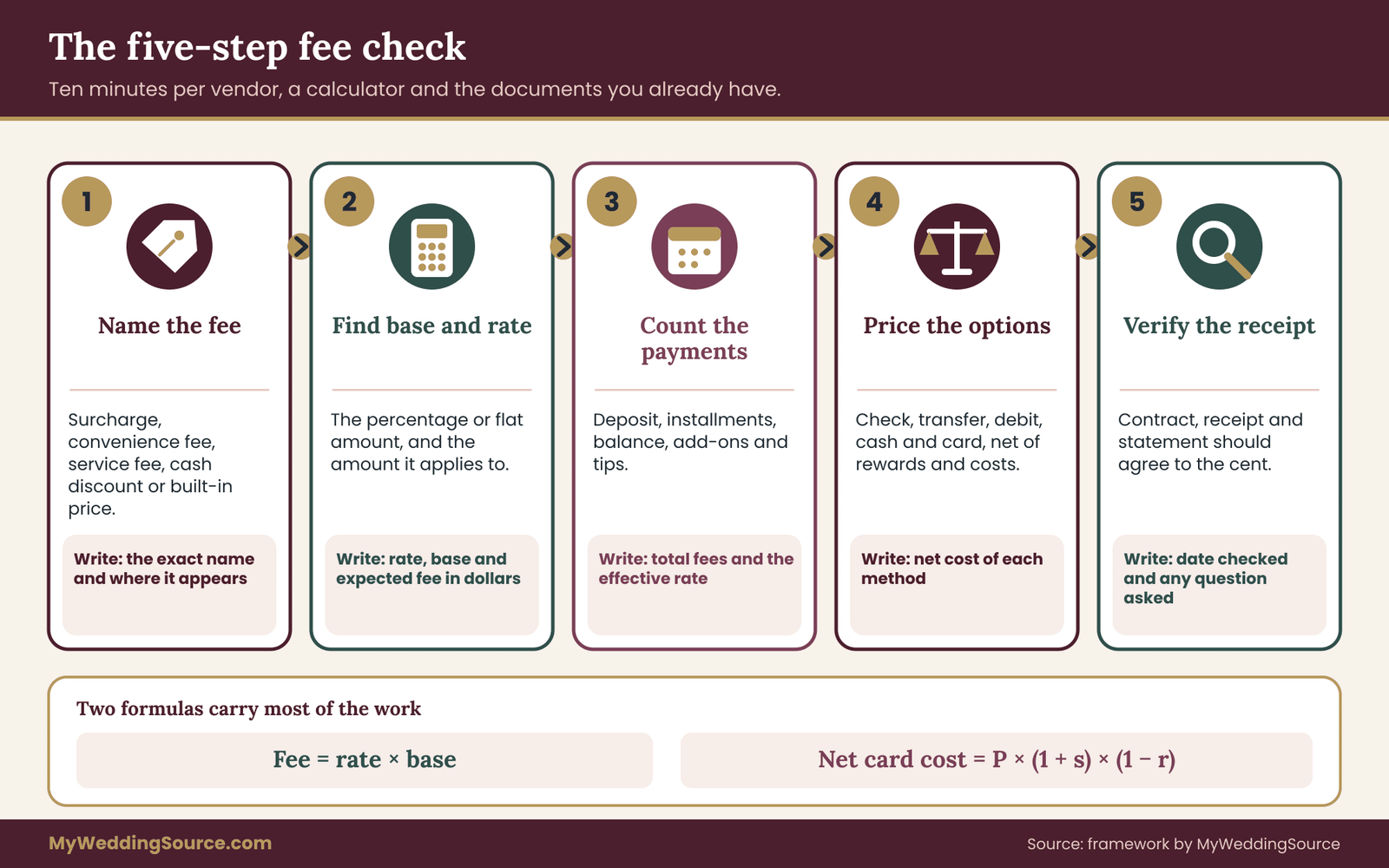
The method that follows is a fee check for any credit card surcharge, and you can run it on any vendor in about ten minutes. It uses simple arithmetic, a pen and a calculator or spreadsheet, and the documents you already collected. It has five steps: name the fee, find the base and rate, count the payments, price the alternatives and verify the receipt. This section covers the first three, which tell you what the fee is. The next section covers the last two, which tell you what to do about it.
Step one: name the fee
Write the fee’s exact name as it appears in the vendor’s document. Then write which of the five types from earlier it is: a surcharge, a convenience fee, a service or administrative fee, a cash discount or a built-in price. This is not a formality. The name decides which question comes next. A cash discount means you ask for the discounted price and the methods that qualify. A flat convenience fee means you ask whether another route avoids it. A percentage credit card surcharge means you move on to the base and rate.
Also note where the fee is written. If it is only in an email or on the payment page, mark it “not in contract” so you remember to fix that.
Step two: find the base and the rate
Write the rate as a percentage or a flat amount. Then write the base: the specific amount to which the rate applies. If the base is unclear, ask, as described above.
With a percentage fee, the arithmetic is one line.
Fee = rate × base
With a flat fee, it is even simpler: the fee is the flat amount, and the percentage it represents depends on the payment size. This matters because a flat fee punishes small payments. A flat fee on a payment of a few hundred dollars equals a high percentage, while the same flat fee on a final balance of several thousand dollars is almost invisible.
If the fee is the “gross-up” type, where the processor’s percentage is calculated on the final charge, the formula changes slightly.
Fee = base × rate ÷ (1 − rate)
You do not need to memorize this. You only need to recognize that some vendors compute the fee this way, so a result a little higher than rate times base may be correct. Ask which method applies, and note the answer.
Step three: count the payments
This is the step most couples skip, and it is where the cost grows. A credit card surcharge looks small on a single payment. Multiply it across the schedule.
List every payment you expect to make to this vendor from signing through the wedding day and after it: the deposit, any installments, the final balance, add-ons such as extra hours or an album, overtime on the night, and a tip if you plan to pay it by card. Next to each, write the base and the fee.
Then add the fees. Divide the total fee by the total price to find the effective rate. If a vendor charges a flat fee per portal payment and you plan to pay in six installments, the effective rate may be far higher than the headline suggests, because six flat fees stack. If the vendor lets you pay in two payments, the same flat fee is charged twice.
A useful discipline is to write the total as a single sentence: “If we pay everything to this vendor by credit card, we pay this much in fees, which is this percent of the contract.” That sentence is the number you take into the comparison in the next section. It also makes the conversation with the vendor concrete. “The portal fee adds up to about this much across the schedule. Could we pay the balance by transfer?” is a far stronger question than “can we avoid the fee?”
A short example of step three
Suppose a vendor’s total is a round figure, with a deposit due now, a second payment in six months and a balance a month before the wedding. The vendor adds a percentage credit card surcharge and nothing on checks. Step three has you write three lines, one per payment, and multiply each by the rate. The three fees add up to exactly the rate times the total, because the rate is constant. So with a plain percentage, the schedule does not change the total fee. Where the schedule matters is a flat fee, a tiered fee, or a fee that applies to some payments and not others.
That observation simplifies your thinking. With a plain percentage credit card surcharge, you do not need to track each payment. You can decide per vendor, then choose which payments, if any, to put on the card. With flat or uneven fees, the schedule is the whole story, and splitting or combining payments can save real money.
Step four: price the alternatives
Once you know what the credit card surcharge costs, ask what the other ways of paying cost. This step is where most of the saving happens, and it is also where couples make the most avoidable mistakes, because “no fee” is not the same as “no cost” and “rewards” are not the same as “money.”
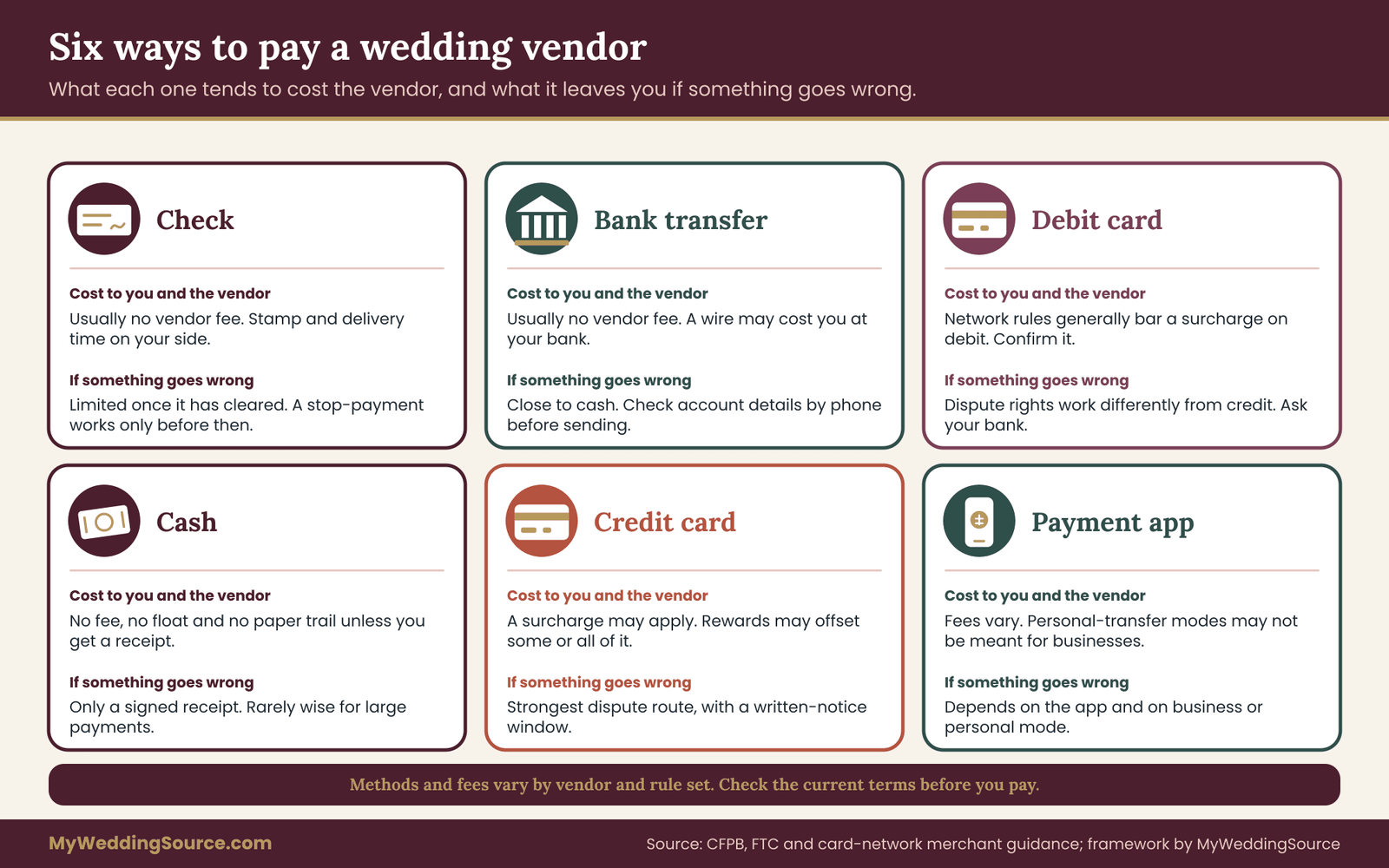
Start by listing the payment methods the vendor accepts. Typical options are a paper check, a bank transfer or ACH payment, a debit card, cash, a credit card, a payment app and, for some larger vendors, a financing plan. For each one, write down three things: the fee the vendor charges, any cost you bear on your side, and the protection you keep if something goes wrong.
Check. A check usually carries no vendor fee. Your costs are a stamp or a courier, and the time the check takes to arrive and clear. Protection is limited. You can ask your bank to stop payment on a check that has not cleared, but once it has cleared, getting money back depends on the vendor’s cooperation or on a legal claim. Checks also reveal your account number, which is worth thinking about if you are mailing them.
Bank transfer or ACH. Often free for the vendor and for you. Some banks charge for wire transfers, which are faster and harder to reverse, so confirm your bank’s fee schedule before you choose one. Ordinary ACH payments can sometimes be reversed within narrow windows in cases of error or fraud, but you should not count on that for a service dispute. Treat a transfer as close to cash.
Debit card. Many card-network rules do not allow merchants to surcharge debit card payments, so a debit payment may avoid the fee while a credit card payment does not. Check that the vendor actually applies it that way. Debit payments take money straight from your account, which can matter for cash flow. Dispute rights exist but work differently from credit card rights, so ask your bank how its process runs before you rely on it.
Cash. No fee, no float, and almost no recourse if there is a disagreement, unless you get a signed receipt. For a large wedding payment, cash is rarely the sensible choice, and some vendors will not accept it above a certain amount.
Credit card. This is the method that carries the credit card surcharge. It also gives you the strongest consumer protections, the longest float before you pay, and the possibility of rewards.
Payment apps. These can be convenient, and some vendors ask for them. The risk is that apps often separate payments to businesses from payments to friends and family, and protections and fees differ between the two. A vendor who asks you to send a business payment as a personal transfer to avoid fees is asking you to give up protection that the app’s own terms attach to business payments. Read the app’s terms before you agree.
Financing. Some vendors offer installment plans through a lender. Plans differ in cost and terms, and some charge fees or interest. They belong in a conversation about borrowing, which is outside what this guide covers. If a financing plan is offered, ask for the full cost in writing like any other payment method.
The result of this step is a short list: for each vendor, the methods you could use, with their fee and your cost. Now you can compare them in dollars.
The break-even formula for card rewards
Many couples put wedding spending on a rewards card, and rewards are a real offset to the fee. The question is how much of the fee the rewards cover. A simple formula answers it without guesswork.
Let the credit card surcharge rate be s and the rewards rate be r, both written as decimals. If the vendor’s price is P, paying by check costs P. Paying by card costs P × (1 + s) up front, and you earn r × P × (1 + s) back in rewards, because you earn on the larger amount that includes the fee. Your net cost by card is therefore
Net card cost = P × (1 + s) × (1 − r)
The card is cheaper than a check only if this is less than P. With a little algebra, that happens when
r is greater than s ÷ (1 + s)
In words: the rewards rate has to exceed the surcharge rate, shrunk slightly. If the credit card surcharge is three percent, you need rewards of a little more than 2.9 percent for the card to match a check. If the surcharge is three and a half percent, you need about 3.4 percent. Most cards that couples actually hold offer rewards well below those numbers on general spending, so a surcharge of that size usually costs you more than the rewards return.

Two cautions apply. First, use the rewards value you will really redeem, not a marketing figure. Cash back counts at face value. Points or miles count at the value you would realistically get, which is usually lower and depends on how you spend them. Second, rewards are only worth counting if you pay the statement in full. A card balance that carries interest erases the rewards quickly, and this guide does not suggest borrowing to chase them.
There is a related case worth naming. A sign-up bonus tied to a spending threshold can change the math, because the bonus is a lump sum, not a rate. If a wedding payment helps you cross a threshold you would otherwise struggle to reach, include the bonus in your calculation, spread over the spending needed to earn it. Be honest about whether you would have reached the threshold anyway.
Comparing flat fees to percentages
A flat fee reverses the usual logic. A percentage credit card surcharge costs more on large payments, so you save the most by moving the biggest payment off the card. A flat fee costs the same on every payment, so you save the most by combining payments or moving the smallest ones.
Take a vendor who charges a flat portal fee on each online payment. If you had planned four small payments, the four flat fees add up. Ask whether you can pay in one or two larger payments, or whether the vendor can send a manual invoice that you pay by transfer. If the vendor insists on the portal, make fewer payments through it and handle the rest another way.
The cost nobody lists: your own time and risk
Some alternatives have costs that never appear on a vendor’s page. Mailing a check means finding an envelope and a stamp, and allowing time for delivery. If a deposit is due on a deadline, a check that arrives late can cost you the date. A bank transfer requires accurate account details, and a transposed digit can send money to the wrong place. When a vendor emails you changed bank details shortly before a payment is due, treat it with caution and confirm by phone using a number you already trust, because payment-redirection scams target exactly this moment.
These costs are small, but they are real, and they are the reason some couples choose to pay a modest fee for the convenience and the protection. That is a perfectly reasonable decision when you make it knowingly. The aim of step four is to make the choice with the numbers in front of you.
Step five: verify the receipt
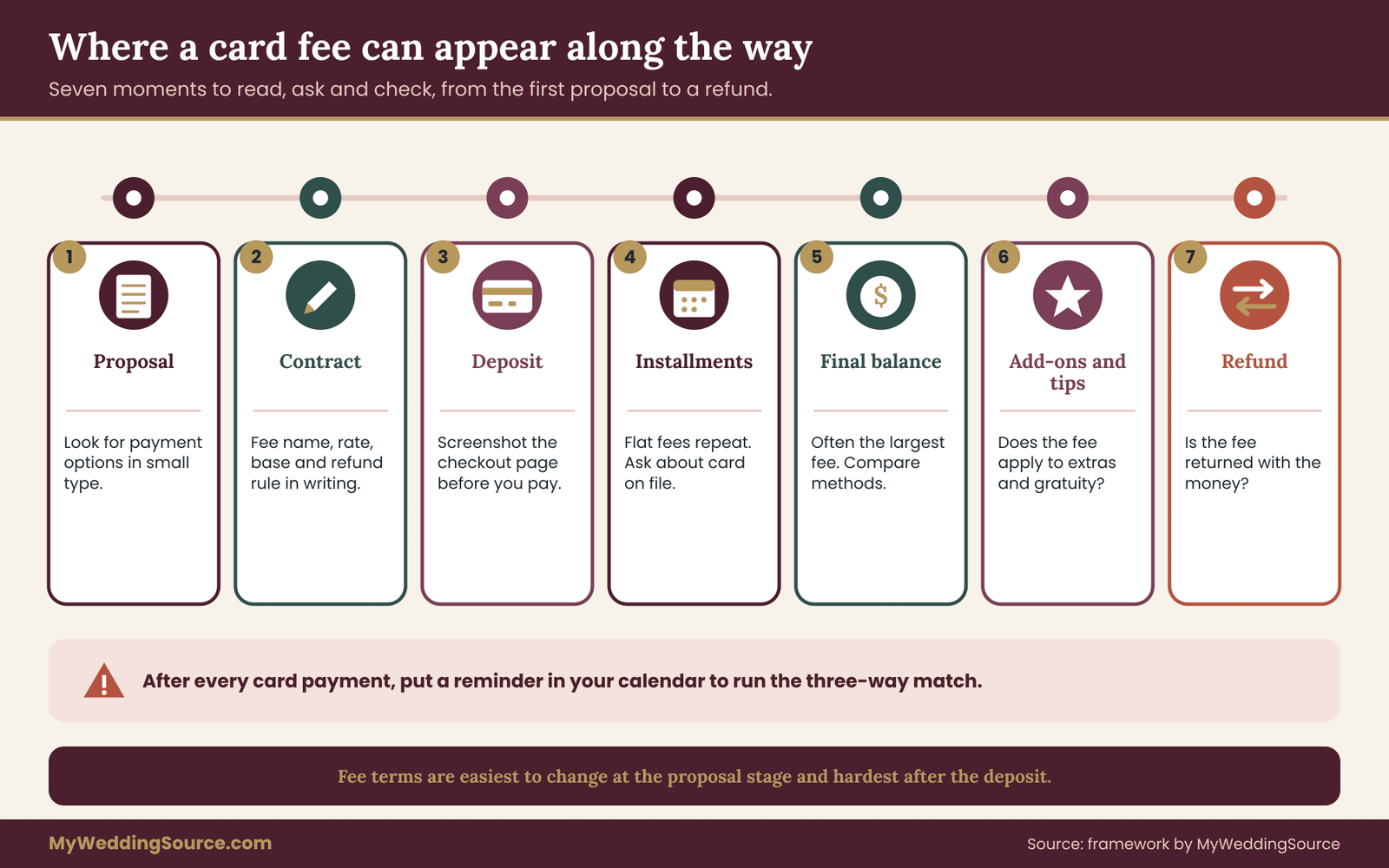
The fifth step happens after you pay, and it has its own section later because it matters as much as the other four. In short, you compare three documents: the contract, the invoice or receipt and your card statement. The credit card surcharge should appear on each in a way that agrees. If it does not, you ask. Put a reminder in your calendar for the day after each payment to run the check, because the clock on a billing dispute starts with the statement that shows the charge.
Choosing a payment method when a credit card surcharge applies
You now have a fee, a count and a list of alternatives with costs. The decision is easier than it looks, because most vendors fall into a handful of patterns. This section gives you decision rules that you can apply vendor by vendor.
Rule one: protect the money you cannot get back
The strongest reason to pay by credit card despite a credit card surcharge is protection for money that is at risk. Ask of each payment: if this vendor failed to deliver, how would I get this money back? A refundable deposit to an established business carries little risk. A large non-refundable deposit to a new business, paid a year ahead, carries more. The credit card gives you a formal dispute route, and the fee is the price of that route.
You can think of the fee as insurance. If the credit card surcharge on a deposit is a small sum and the deposit is a large amount you could not recover otherwise, the insurance is cheap. If the fee is a large sum on a payment that is low-risk, you are overpaying for protection you do not need.
Rule two: use the card for the early, risky payment and another method for the late, safe one
A common and sensible split is to pay the deposit by card and the final balance by check or transfer. The deposit is paid the furthest from the event, when the risk that the vendor changes or closes is highest. The final balance is paid close to the event, once the vendor has proved reliable through months of communication. The fee applies only to the smaller payment, and you keep the protection where it matters most.
Lay the split out against the payment dates in your wedding budget, so each due date already has a method beside it.
This split only works if the vendor allows different methods for different payments and says so in writing. Ask for that explicitly.
Rule three: move the biggest payment off the card when the vendor is established
For a large invoice from a vendor you have checked carefully, such as a caterer or venue with a long track record and clear reviews, the credit card surcharge can be the largest single avoidable cost in the arrangement. If the fee is a few hundred dollars and you have no reason to doubt the vendor, paying by transfer or check is often the better choice. You save the fee and lose only the extra layer of protection you are unlikely to use.
Rule four: do not let rewards decide alone
Rewards feel like free money, so couples sometimes talk themselves into paying a credit card surcharge that the rewards do not cover. Run the break-even formula. If the rewards rate is below the break-even rate, the card costs you money on that payment, and you need another reason, such as protection or cash flow, to justify it.
Rule five: when the credit card surcharge is not negotiable, make it small
If a vendor will not budge, you can still reduce the cost by shrinking the base. Put only the payments you most want protected on the card. Ask whether the fee applies to the deposit only. Ask whether tips and tax are excluded. Ask whether a debit card avoids it. Each of these narrows the amount the percentage touches.
Negotiating a credit card surcharge without souring the relationship
Many couples never ask about the credit card surcharge because they assume it is fixed, or they worry that asking will mark them as difficult. Both worries are mostly unfounded. Vendors hear questions about payment methods constantly, and a polite, specific request is rarely taken as an insult. What does cause friction is an accusation, an ultimatum or a request that makes no sense for the vendor’s business.
The approach that works is to treat the conversation as a small piece of problem solving. The vendor wants to cover the cost of accepting cards. You want to avoid paying more than the cost requires and to keep the paperwork clear. Those goals overlap more than they conflict, and a credit card surcharge is one of the easier terms to discuss because it is specific and measurable.
Start with what a credit card surcharge is for
Before you ask for a change, remind yourself of the vendor’s side. A card payment costs the business money. A larger payment costs more. The vendor may also face chargebacks, in which a card issuer pulls money back after a dispute, and a large wedding invoice is a bigger exposure than a small one. A credit card surcharge is a way to cover those costs without raising everyone’s prices.
When you understand that, your requests become easier to frame. You are not asking the vendor to absorb a cost. You are offering a way to avoid it. “We would rather pay by bank transfer to keep your costs down. Is there a way to do that?” invites a yes. “Why do you charge this fee?” invites a defense.
What you can reasonably ask for
There is a short menu of requests that vendors can often grant, from the smallest to the largest.
- Confirm the fee in writing. A line in the contract or an email stating the rate, the base and the methods affected. Almost every vendor will do this.
- Use a method with no fee for part or all of the payments. For example, a transfer for the balance, a check for the deposit or a debit card for a smaller add-on.
- Apply the fee only to the deposit. This keeps the protection on the early payment and removes the cost from the later, larger one.
- Exclude tax, service charges or tips from the base. The fee then applies only to the amount that the vendor actually earns.
- Refund the fee when the payment is refunded. If you cancel inside a window the contract allows, the fee should not become a loss on top of the deposit policy.
- Combine payments to reduce flat fees. One larger payment rather than several small ones.
- Waive or reduce the credit card surcharge entirely. This is the largest ask. It is more likely when you are signing a large contract, paying early or booking an off-peak date.
You rarely need all of these. Pick the one or two that matter most for that vendor, based on your step-four numbers, and ask for those.
What you can offer in return
A request to reduce a credit card surcharge lands better when it comes with something the vendor values. Several offers cost you little.
- Pay on time, or early. Vendors who track cash flow value a predictable payment date.
- Use the payment method they prefer, within reason, when it is also cheaper for you.
- Consolidate payments into fewer, larger transactions.
- Confirm your decisions promptly, so the vendor does less back-and-forth.
- Sign earlier than the vendor’s usual deadline if you are ready to.
Avoid offering to post a review in exchange for a discount. Rules around incentivized reviews are strict, and a review written as part of a trade does not help future couples. Keep the exchange about payment terms.
Scripts you can adapt
The wording below is meant to be changed to sound like you. Keep it short, specific and friendly.
Before signing, by email:
“Thank you for the proposal. Before we sign, could you tell us whether card payments carry any added fee, what the rate is and what amount it applies to? If there is a way to pay by bank transfer or check with no fee, we would be glad to do that for the balance. We would also like the fee terms written into the contract.”
By phone, if you prefer to talk:
“We are ready to move forward. One thing we would like to understand is the fee for card payments. If we pay the deposit by card and the rest by transfer, would that work for you? We would like to confirm it in writing afterward.”
After the call, to create a record:
“Thank you for talking with us today. To confirm: the deposit can be paid by card with the stated fee, and the balance can be paid by bank transfer with no fee. The card fee applies only to the deposit amount. Please tell us if we have misunderstood anything, and we will treat this as the agreed payment arrangement.”
The third message is the most important of the three. A phone agreement that is not written down is easy to forget on either side. A short confirmation email takes two minutes and gives both of you something to refer to.
Replies to common answers
Vendors give a handful of standard answers when asked about fees. Each has a natural next step.
“The fee is set by our payment system, and we cannot change it.” This is common with booking platforms and invoicing software. Ask whether the vendor can send a manual invoice paid by transfer or check outside that system. Be careful here: if the vendor is hired through a marketplace that forbids payments outside the platform, ask the vendor what the platform allows, and follow the rules. Do not push a vendor into breaking an agreement that protects both of you.
“We only accept cards.” Some businesses really do. In that case, the question becomes whether the credit card surcharge is part of the price you accept. Calculate the total, compare it with other vendors for the same service and decide. A fee is one factor, not the only one.
“Just send it as friends and family.” This asks you to use a personal-payment feature to pay a business. The app’s terms may not allow it, and the protections that apply to purchases may not apply to personal transfers. Decline politely and ask for another no-fee method, such as a bank transfer.
“We can give you a small discount for paying by check.” Good. Ask how much, and whether it applies to the deposit as well. Compare it with the card rewards you would give up, using the break-even formula.
“We will waive the fee if you pay in full now.” That may suit you or it may not. Paying the full amount early reduces your protection, because more money is at risk for longer. If the vendor is established and the contract protects you, it can be a fair trade. If the vendor is new, the better answer may be to keep the schedule as written.
What this actually costs: valuing a concession
When a vendor offers something in exchange for a payment arrangement, translate it into dollars before you answer. Suppose a vendor offers a one percent discount for paying by check. Compare it with a card option that carries a three percent credit card surcharge and gives you two percent rewards. The card’s net cost is about one percent of the price, since the fee exceeds the rewards by roughly that amount. The check’s net is a one percent saving.
The difference between the two is about two percentage points of the contract, which on a large invoice is a number worth acting on. On a small invoice, it may not be worth a fuss.
A concession is worth what it saves you after your own costs. Subtract the rewards you would earn, the postage or bank fees you would pay, and the value of any protection you would give up. If what remains is a few dollars, take the simpler path. If it is a few hundred, it is worth a short email.
Putting the answer into the contract
The end of any negotiation should be a written term. You do not need legal language. A sentence in plain words about the credit card surcharge, added to the contract or confirmed in an email that the vendor acknowledges, is enough for most small vendors. Typical terms include the rate, the base, the payments that carry the fee, the payments that do not, and the refund treatment. For example: “The deposit may be paid by credit card with the agreed fee. The final balance may be paid by bank transfer with no fee. Any refunded card payment will include a refund of the associated fee.”
For larger contracts, such as a venue or a full-service caterer, consider asking a contract attorney to review the payment and cancellation language together. The general guidance in the wedding vendor contract guide covers what to look for across the whole agreement. This article only concerns the payment-method clauses inside it.
Knowing when to stop
Sometimes a vendor will not move. If you have asked once clearly, followed up once and received a polite no, stop. Pressing further risks the relationship for a few dollars. Return to your step-four numbers and decide whether the credit card surcharge, at that rate, on that vendor, is a cost you accept. If it is, pay it knowingly and move on. If it is not, and you have alternatives, that is a legitimate reason to choose a different vendor. Either decision is fine. What you want to avoid is paying the fee grudgingly and carrying resentment into a relationship that has to run for a year.
Receipt verification: matching the credit card surcharge to your contract and statement
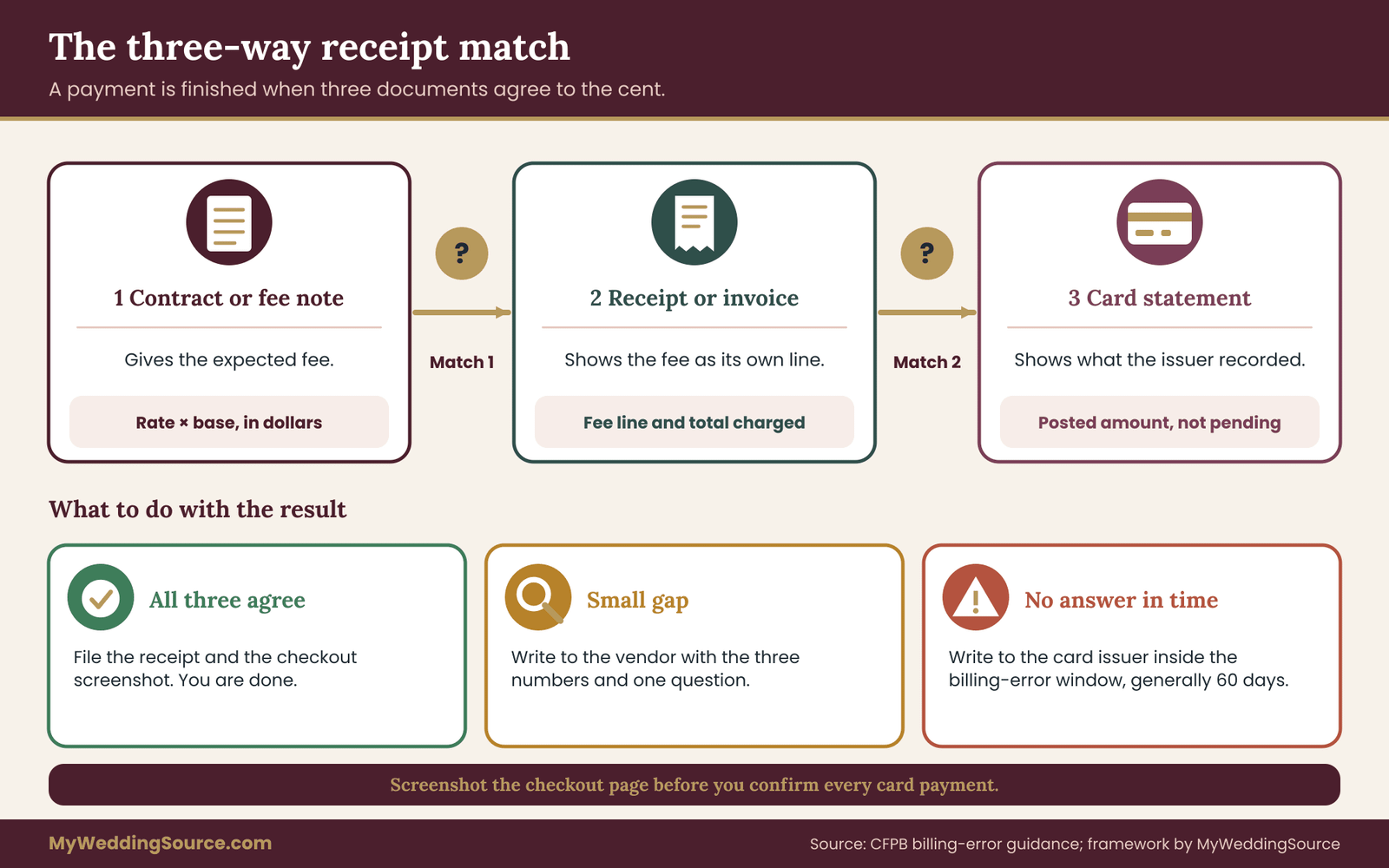
Paying is not the end of the job. A payment is finished when three documents agree with each other: what the contract said you would be charged, what the vendor’s receipt says you were charged and what your card statement says was taken. Most of the time they agree, and checking takes three minutes. The credit card surcharge is the line most likely to disagree, because software usually calculates it. When they do not, the first week is the cheapest time to find out.
A mismatch is usually an honest mistake. A vendor’s software applied the wrong rate, a receipt was generated before an add-on was removed, or a fee was calculated on a different base than the contract described. You do not need to assume bad faith. You only need to notice.
The three-way match
The match compares three sources and asks one question at each junction.
Document one: the contract or the written fee confirmation. This tells you the expected credit card surcharge. Using the formula from step two, calculate it in dollars before you look at the receipt. Write it down as “expected fee.”
Document two: the invoice or receipt. This tells you what the vendor says it charged. A clear receipt shows the amount of the service, the fee as a separate line, the total and the payment date. Compare the credit card surcharge line with your expected figure.
Document three: your card statement or transaction history. This tells you what the issuer recorded. Compare the total charged with the receipt total. If the vendor processes the fee as a separate transaction, you should see two lines that add up to the receipt total.
At each junction, ask whether the numbers agree to the cent. Small rounding differences of a cent are normal. Anything larger deserves a note.
What a good receipt contains
Ask the vendor for a receipt for every payment, and check that it has these elements.
- The vendor’s name and the date of payment
- The amount applied to the contract, before any fee
- The credit card surcharge, shown as its own line, with the rate or description
- The total charged to your card
- The last four digits of the card, or another reference you can match to your statement
- The balance still due after this payment
If the credit card surcharge is missing as a separate line, ask why. Card network rules generally expect a credit card surcharge to be itemized on the receipt, and a receipt that folds the fee into the total makes it impossible to verify. This is a fair request and a normal one. Vendors who use professional invoicing software usually produce compliant receipts automatically. A vendor who writes receipts by hand may need a gentle reminder.
Capture the checkout page before you pay
One habit saves arguments later: take a screenshot of the payment page at the moment before you confirm. It should show the amount, the credit card surcharge line and the total. If the page shows no fee and the charge later includes one, the screenshot is evidence. If it shows a fee that matches the contract, the screenshot confirms what you agreed to. Either way, save it in the same folder as the receipt. It takes five seconds.
Reading your statement without confusion
Card statements do not always show the vendor’s business name. A florist may appear under the name of its payment processor followed by an abbreviation. That is normal. Match by amount and date, not by name, and keep the receipt open beside the statement.
Two further points help.
First, a pending charge is an authorization, a hold placed on your available credit. The final posted charge may differ slightly, for example when a tip is added or a fee is adjusted. Wait for the posted amount before you conclude anything.
Second, if the credit card surcharge was charged as a separate transaction, it may post on a different day from the main payment. Look a few days either side before deciding it is missing.
A worked check
Return to the gross-up method from step two. A caterer’s contract says that card payments carry a credit card surcharge of three and a half percent. You owe a balance of nine thousand six hundred dollars. You calculate the expected fee as three and a half percent of nine thousand six hundred, which is three hundred thirty-six dollars. The receipt shows a fee of three hundred forty-eight dollars and nineteen cents. The statement shows a charge matching the receipt total.
The receipt and the statement agree with each other. The receipt disagrees with the contract by twelve dollars and nineteen cents. A bit of arithmetic explains it: the vendor’s system computed the fee so that, after the processor takes its percentage from the larger total, the vendor receives the full nine thousand six hundred. That calculation divides by one minus the rate, and it produces the larger figure.
Neither number is dishonest. The contract said “three and a half percent” and the system applied it to the grossed-up amount.
The right response is a calm email: “Our contract says three and a half percent on the balance. The receipt shows a slightly higher fee, which looks like the rate was applied to the total including the fee. Could you confirm which method applies and adjust the receipt or the contract wording accordingly?” Many vendors correct such a difference or clarify the contract. Some will explain that the gross-up method is their standard and add it to the contract for future payments. Either way, the matter is settled in writing.
The most common mismatches and what they usually mean
- The credit card surcharge is higher than the contract rate. Often the gross-up method, or a base that includes tax, a service charge or a tip. Ask which base and method apply.
- The fee appears twice. The portal may add a fee and the vendor may add another. Ask whether both are intended, and whether either is described in the contract.
- A fee on a debit card payment. Network rules generally do not allow surcharges on debit cards in the United States. Ask the vendor to explain, and if it was a mistake, to refund it.
- A flat fee on each portal payment. If the contract did not mention a flat fee, ask for it to be documented or removed.
- The charge differs from the receipt. This could be a currency conversion, a tip, a held authorization that was later adjusted or a genuine error. Ask for the processing detail.
- A refunded payment did not return the fee. Ask whether the contract addresses it and request the fee back if it does not exclude it.
What to do when the numbers do not match
Take the steps in this order. Each one is small, and most disagreements end at the first.
Step one: write to the vendor. Send an email that states the three numbers, the difference and the question. Use the tone of a person trying to understand, not accuse. Attach the receipt and the statement line with account details hidden. Ask for a reply within a few business days.
Step two: set a date in your calendar. The clock for a card billing dispute runs from the statement that shows the charge. For credit cards, a billing error generally must be reported to the issuer in writing within sixty days of that statement. Count the days now, and decide on your deadline for contacting the issuer, leaving a margin. Do not wait for the vendor until the last week.
Step three: raise it with the card issuer if the vendor does not resolve it in time. Use the issuer’s written dispute process and explain what you were charged, what the contract says and what you asked the vendor to do. Attach your records. The Consumer Financial Protection Bureau and the Federal Trade Commission both publish plain-language guides to how credit card billing disputes work, and your issuer’s process is on its website or the back of your statement.
Step four: report patterns, not one-off differences. If a vendor is charging fees that the contract does not describe, or charging debit cardholders a surcharge, your state attorney general’s consumer protection office and the CFPB accept complaints. This is rarely needed, but it is there.
Keeping the paper trail small
You do not need a filing system for this. A single folder for each vendor with five things is enough: the contract, the written credit card surcharge confirmation, each receipt, the matching statement lines and a short note of what you checked and when. If you also keep the checkout screenshot, you have the full chain. The wedding records after the event guide explains how long to keep this kind of paper and where to store it.
The refund test
When money comes back to you, run the same three-way match in reverse. Write down three numbers: the original card total, the amount refunded and whether the fee was included. If the contract promised that the credit card surcharge would return and it did not, ask. If the contract was silent, ask anyway, because many vendors will return the fee when you point it out, especially when the cancellation was not your fault.
Also check how long the refund takes. Card refunds can take days or weeks to post, and the timeline depends on the vendor and your issuer. Put a date in your calendar and check again.
Revoking stored card details
Some vendors keep your card on file for later payments or incidentals. After the final payment, ask whether they can remove the stored card details. If the vendor is paid in full and no further charges are expected, there is no reason for them to keep the card. Some card issuers also offer virtual card numbers or per-merchant controls that limit what a stored number can be used for. Ask your issuer what it offers.
A worked example: four vendors, one wedding, one fee ledger
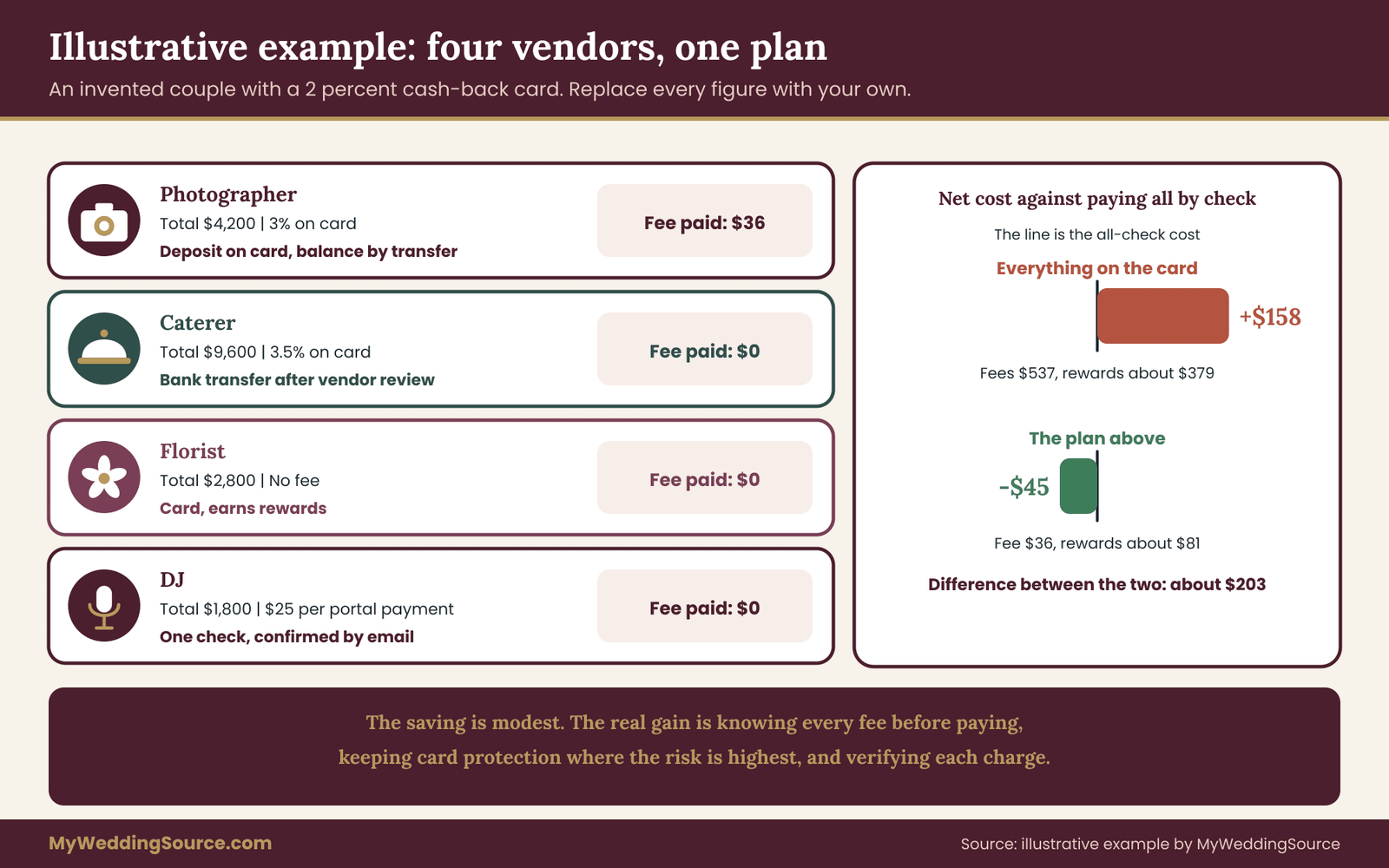
The following example is invented to show the method in numbers. The couple, the vendors and the contract terms are made up, and the card rewards rate is an assumption chosen for illustration. Real rates and rules vary, so replace each figure with your own.
Alvarez and Chen are planning a wedding with four vendors that matter for this exercise. They hold one credit card that returns two percent in cash back. They pay their statements in full each month, so interest does not enter the picture. They keep a simple fee ledger with one line per payment, and they want to know what each credit card surcharge really costs them.
The four contracts
The photographer has a total of four thousand two hundred dollars: a deposit of twelve hundred now and a balance of three thousand dollars due a month before the wedding. The contract says card payments carry a three percent fee, and there is no fee for check or bank transfer. The vendor is new to them, and the deposit is non-refundable.
The caterer has a total of nine thousand six hundred dollars, which includes food and drink, a service charge and sales tax. The contract says card payments carry a three and a half percent credit card surcharge on the amount charged. The caterer has strong local reviews and a long track record, and the couple confirmed this during their vendor review.
The florist has a total of twenty-eight hundred dollars. The florist accepts cards and charges no added fee.
The DJ has a total of eighteen hundred dollars, payable in three installments through an online portal that adds a flat twenty-five dollar fee to each payment. The DJ will also accept a check.
The total price across the four contracts is eighteen thousand four hundred dollars.
Steps one to three: name, rate and count
For the photographer the fee is a percentage credit card surcharge. The base is each payment. The rate is three percent. Across the two payments the fee totals one hundred twenty-six dollars, which is three percent of the contract.
For the caterer the fee is a percentage credit card surcharge of three and a half percent on the total charged. Across the single balance the fee is three hundred thirty-six dollars.
For the florist the fee is zero.
For the DJ the fee is a flat convenience fee of twenty-five dollars on each of three portal payments, seventy-five dollars in all. On a contract of eighteen hundred dollars, that is about four and a sixth percent. The flat fee, spread across three payments, costs more in percentage terms than either percentage credit card surcharge.
If the couple paid every contract by card, the fees would total five hundred thirty-seven dollars.
Step four: price the alternatives
With a two percent rewards rate, the couple earns two percent on whatever they charge, including the fees. If they paid everything by card, they would charge eighteen thousand nine hundred thirty-seven dollars and earn about three hundred seventy-nine dollars in rewards. The fees minus the rewards leave a net cost of roughly one hundred fifty-eight dollars above the price of the contracts.
Applying the break-even rule shows why. For the photographer’s three percent credit card surcharge, the card needs rewards of about 2.9 percent to match a check. The couple’s two percent falls short. For the caterer’s three and a half percent credit card surcharge, the break-even is about 3.4 percent. Again short. The DJ’s flat fee works out above four percent. The florist has no fee, so the card wins by the full amount of the rewards, which is fifty-six dollars.
Taken vendor by vendor, using the card costs the couple a net amount compared with a check in three of four cases.
Step four continued: apply the decision rules
Money alone does not decide this. The couple also asks how much protection each payment needs.
Photographer, deposit. The vendor is new and the deposit cannot be refunded, so the card’s dispute route has real value. The fee on twelve hundred dollars is thirty-six dollars. The rewards on the charged amount are about twenty-five dollars, so the net cost is roughly eleven dollars. They judge that small price worth it and pay the deposit by card.
Photographer, balance. By the time the balance is due, they have worked with the photographer for months and have seen sample galleries and a detailed shot list. They pay the three thousand dollar balance by bank transfer and save a ninety dollar fee.
Caterer. The vendor has a long record, and the invoice is the largest single payment. The card would cost about one hundred thirty-seven dollars more than a transfer after rewards. They choose a bank transfer.
Florist. No fee, so they use the card and earn the fifty-six dollars.
DJ. The flat fee makes the portal expensive. They ask whether they can pay by check in one payment, and the DJ agrees and confirms it by email. They pay eighteen hundred dollars by check and avoid seventy-five dollars of fees.
The plan in numbers
Under this plan, the couple pays eighteen thousand four hundred thirty-six dollars in total: the contract prices plus a single thirty-six dollar fee on the photographer’s deposit. They earn about eighty-one dollars in rewards. The net cost is about eighteen thousand three hundred fifty-five dollars, which is roughly forty-five dollars less than paying every vendor by check and roughly two hundred three dollars less than putting everything on the card.
The saving is modest, and the example is meant to show that honestly. With a higher rewards rate it would be smaller. With a lower rewards rate or larger fees, it would be bigger. What the exercise really buys the couple is the absence of surprises. They know every credit card surcharge in advance, they chose where to keep protection and they can verify each charge.
What the receipt check finds
When the caterer’s balance is paid by transfer, there is no fee to verify, so the check reduces to confirming that the amount matches the invoice and that the receipt notes the payment as final. For the photographer’s deposit, the receipt shows a thirty-six dollar fee as its own line, which matches the contract: three percent of twelve hundred. The statement shows a charge of twelve hundred thirty-six dollars. All three documents agree.
Had they paid the caterer by card with the fee calculated on the grossed-up amount, the receipt would have shown three hundred forty-eight dollars and nineteen cents instead of the three hundred thirty-six they expected. They would have written the short email described in the previous section and settled it in writing.
A variation: lower rewards, bigger bill
Change one assumption. Suppose the couple’s card returned only one percent. On the caterer’s card payment, the rewards would be about ninety-nine dollars instead of about one hundred ninety-nine, so the net cost of paying by card would be roughly two hundred thirty-seven dollars above a transfer instead of about one hundred thirty-seven. The decision would not change, but its weight would. This is why the method asks you to use your own rewards rate, not a figure from an advertisement.
Special situations that change the credit card surcharge math
The core method handles most vendors. A handful of situations change the numbers or the risks, and they are worth thinking through before they happen.
Non-refundable deposits
A non-refundable deposit is the clearest case for protection, but it also raises a quiet question: does the credit card surcharge fall under the same rule? If the deposit is non-refundable and the fee is added at checkout, the fee is usually non-refundable too. Ask in advance. If the vendor cancels or fails to deliver, the dispute route on the card is your remedy for the deposit, and the fee should be part of what comes back.
Installments and cards on file
Some vendors collect installments automatically from a card on file. Each installment may carry a credit card surcharge, and each one is a payment you should verify. Ask for a schedule listing every installment date and amount, and ask for a reminder before each charge. If your card is replaced or expires before a payment, find out whether the vendor will contact you or whether a failed payment triggers a late fee. A failed automatic payment late in the schedule can be more expensive than any card fee. For where each installment should fall in the first place, see the guide to deposit, final balance and reserve timing.
Cancellations and date changes
When you move a date or cancel, three questions matter. Is the deposit refundable, partly or not at all? Is the credit card surcharge returned along with any refund? If you dispute a charge with your card issuer, does the contract say you owe the vendor processing costs or a chargeback fee?
Some contracts include language that shifts chargeback costs to the client. Read it before you sign, because a clause like that changes whether a dispute is a practical option. If it worries you, raise it with a contract attorney. Do not treat a dispute as a first move in any case. A conversation with the vendor usually resolves more than a chargeback does.
Tips and gratuities
Tips are usually optional and may be paid in cash, by card or through a portal. If you plan to tip by card, ask whether the credit card surcharge applies to the tip. Some vendors apply the percentage to everything charged, including the tip, which would mean the fee reduces what the person receives or increases what you pay. Cash tips in envelopes avoid the question, but record them in your budget so the total is accurate.
Marketplaces and booking platforms
When you hire a vendor through a platform, the platform may set the fees, the payment method and the rules for payments outside it. Read the platform’s terms. Do not ask a vendor to move a payment outside the platform if the terms forbid it, because you may lose the platform’s protections. Ask what fees the platform adds and whether they show in the vendor’s quote.
Destination weddings and foreign vendors
When a vendor charges in another currency, two extra costs appear. Your card issuer may add a foreign transaction fee, and the payment terminal may offer to convert the charge to dollars for you. Converting at the terminal is often more expensive than letting your issuer convert, so many cardholders choose to pay in the local currency. Check your issuer’s current foreign transaction terms before you travel. Credit card surcharge rules also differ by country, so a fee you could not charge in one place may be normal in another.
When someone else pays
Parents or relatives sometimes pay a vendor with their own card. This raises questions the couple should settle early. Whose card is on the contract? Who earns the rewards? Who receives the refund if a payment is cancelled? Who handles a dispute? A card issuer deals with the cardholder, not with the couple, so the person whose name is on the card has to be involved in any dispute. Agree on the answers in writing, kindly, before the first payment.
Splitting one payment across two cards
Some vendors allow a payment to be split between two cards. This can help when a single card has a limit, or when two people want to share rewards. Ask how the credit card surcharge is calculated on each portion and whether each card produces its own receipt. Keep both receipts.
The limits of this method, and when a credit card surcharge calls for an expert
A fee check for a credit card surcharge is a practical tool, not a ruling. It turns a vague worry into numbers and a short list of questions, and that is its whole purpose. It cannot decide who is right in a disagreement, and it cannot replace the current rules from the people who write them. This section is about where the method stops.
What the calculator cannot tell you
The arithmetic assumes you know the rate, the base and the rewards you will earn. Each of those can be uncertain. A vendor may change its credit card surcharge or its processing arrangement between signing and the final payment. A card’s rewards program may change its terms. A promotional rate may expire. The calculation is correct for the inputs you entered, on the day you entered them, and no more.
It also cannot price the things that are not money. How much is it worth to you to have a formal dispute route for a deposit? How much is a clean relationship with a vendor you will rely on for the most important day of the year? Reasonable couples answer those questions differently. The method makes the money part visible so that the other part gets decided on purpose.
Finally, it cannot tell you what a vendor is allowed to do. That depends on the card network’s merchant rules, your state’s law and the contract you signed.
Where the rules differ and change
Three sources of rules apply, and they are updated on their own schedules.
- Card networks publish merchant rules about a credit card surcharge, including caps, disclosure and the card types that may be surcharged. These have been revised more than once in recent years, and they continue to change. The current version sits on each network’s merchant or business pages.
- States regulate a credit card surcharge in different ways. A few restrict or prohibit them for credit cards, and others require specific disclosures. Court decisions have also affected how some of these laws apply. Your state attorney general’s consumer protection office can tell you the position today.
- The contract sets the terms between you and the vendor. If the contract says one thing and a general rule says another, the contract is where the conversation starts, but a term that conflicts with the law may not be enforceable.
For a wedding in another state or country, the vendor’s location and the payment processor’s location can matter. If you are unsure which rules apply, ask the vendor where it is based and what law its contract uses, and check that place’s rules.
Because everything above changes over time, the freshest fact in this guide is the method, not any figure. Before you rely on a rule, look at the current version from the agency or network that publishes it.
When to ask for help
Most fee questions need only an email. A few justify more.
A contract attorney is worth consulting when the payment terms interact with cancellation rights, when a clause shifts dispute or chargeback costs to you, or when the total at stake is large relative to your budget. An hour of review on a large contract can be inexpensive compared with the amounts involved. Ask the attorney specifically about the payment, refund and dispute clauses.
Your card issuer is the right contact when a charge does not match the receipt and the vendor has not fixed it, when you need to understand its dispute process or deadlines, or when you want to know what protections and controls your particular card offers.
Your state attorney general’s consumer protection office is the place to ask whether a specific surcharge is allowed in your state and to report a vendor who charges fees the contract never mentioned or who surcharges debit cards.
The Consumer Financial Protection Bureau accepts complaints about credit card issues and publishes guides to billing disputes and consumer rights. It is also a good source for background reading before you call anyone.
A tax or financial professional can help if you are using a business account, a joint account with unusual arrangements or any structure that adds complications. This guide does not cover those cases.
A wedding planner or coordinator, if you have one, often knows which local vendors are flexible and can ask on your behalf. A good planner will also help you keep the payment schedule straight.
Mistakes that make a credit card surcharge cost more than it should
Couples who run into trouble with fees tend to make the same handful of mistakes. Each is easy to avoid once you know it.
Paying before reading. The deposit is the moment of least leverage and the moment most couples pay without reading the fee language. Read first. The page that says “pay now” does not change if you take an evening.
Looking only at the first payment. A credit card surcharge that seems small on a deposit becomes large when it applies to the whole schedule. Count every payment.
Counting rewards at an advertised value. Use what you will realistically redeem, and remember that rewards on a larger charge are only worth having if you pay the statement in full.
Treating “no fee” as “no cost.” A free transfer can still carry a wire fee at your bank, and a check can arrive late. Price the real alternative.
Agreeing by phone and never writing it down. A fee waiver or method change that exists only in a conversation can disappear the next time a different person in the vendor’s office handles your account.
Never checking the statement. The three-way match takes minutes. Skipping it lets a small error run through the rest of the schedule, and it lets the dispute window close.
Moving a payment to a personal app to dodge the fee. The saving is small compared with the protection you give up.
Forgetting about the credit card surcharge when a payment is refunded. Ask about it when you sign, and check it when the money comes back.
A one-page fee ledger you can copy
You can keep the whole method on one page, on paper or in a spreadsheet. Give each payment a line with these items:
- the date and the vendor
- the payment method you chose
- the contract amount for this payment and the base the fee applies to
- the rate and the expected fee in dollars
- the actual fee shown on the receipt
- whether the receipt shows the fee as its own line
- whether the statement line matches the receipt total
- the date you checked, and a note if you asked the vendor a question
Add a section at the bottom for the total fees expected, the total fees actually charged and the rewards earned. If the expected and actual totals are close and every line is checked, you are done. If they differ, the ledger shows exactly where.
When to review again
Rules and fees can change during a long engagement. Before each major payment, take two minutes to reread the credit card surcharge language, confirm that the vendor still accepts the method you chose, and check whether the card or the payment system has changed its terms. A wedding vendor timeline is a handy place to keep these reminder dates beside each booking milestone. If a vendor emails you a new payment link or new bank details close to a due date, confirm by phone before you pay, using a number you already had.
FAQ
Is a credit card surcharge legal for wedding vendors?
In most places a business may add a credit card surcharge if it follows the card network’s rules and local law. A few states restrict or ban the practice, and networks require disclosure and cap the amount. Rules change, so confirm the current position with your state attorney general and the network’s merchant pages. If a vendor never told you about the fee, ask them to put it in writing.
Can a wedding vendor charge a fee when I pay with a debit card?
Card network rules generally do not allow surcharges on debit card payments in the United States, though a vendor may offer a cash discount or charge a separate convenience fee for a payment method. If a debit payment carries a charge that the contract never described, ask the vendor to explain and to correct it, then confirm the current rule with the network.
How do I know whether paying by card is worth the fee?
Compare the net cost of each method. Divide the credit card surcharge rate by one plus the rate to find the rewards rate you would need to break even, then compare it with the rewards you will actually redeem. Add the value of the dispute protection if the payment is large or non-refundable. If the rewards fall short and the vendor is established, a check or transfer is usually cheaper.
Is a convenience fee the same as a credit card surcharge?
Not exactly. A surcharge is an added amount charged specifically for paying by credit card, while a convenience fee is usually tied to a method or channel, such as an online portal or phone payment. The rules and disclosures can differ. For your budget the effect is the same, so ask for the name, rate, base and refund treatment of whichever fee appears.
Can I ask a vendor to waive or reduce the fee?
Yes, and a polite request often works, particularly before you sign. Offer something useful in return, such as paying by transfer, combining payments or confirming earlier. If the vendor says no, ask whether the fee can apply to the deposit only, exclude tax and tips, or be refunded with any refunded payment. Get any agreement confirmed in writing.
Will the fee be refunded if I cancel or a payment is returned?
It depends on the contract. Some vendors refund the fee with the payment, and others treat it as the cost of processing and keep it. Ask before you pay, and ask the vendor to confirm the answer in writing. If the contract is silent, request the fee back anyway when a refund is issued, and keep the receipts showing both amounts.
How long do I have to dispute a wrong charge on my credit card?
For credit cards, a billing error generally has to be reported in writing to the card issuer within sixty days of the statement that first showed it. The Consumer Financial Protection Bureau explains this process. Other payment methods follow different rules, so ask your bank. Check each statement soon after a payment and write to the vendor first, leaving time to escalate.
Should I pay a deposit by card even when there is a surcharge?
Often yes, if the deposit is large, non-refundable or paid to a new vendor, because the card gives you a formal dispute route. A small fee on the early payment can be a fair price for that protection. For a late balance to an established vendor, a check or transfer is usually the cheaper choice. Run the break-even formula and decide per payment.
Your next steps
Start with one vendor, the one with the largest invoice. Open the contract and the payment page and find the credit card surcharge language. Write down its name, rate, base and refund treatment. If any of those is missing, send the short email from the negotiation section and wait for the answer before you pay.
Then run the five steps on that vendor: name the fee, find the base and rate, count the payments, price the alternatives with the break-even formula and set a reminder to verify the receipt. Decide which payments, if any, belong on the card, and ask the vendor to confirm the arrangement in writing.
Repeat for the next vendor, working from the largest invoice down, and keep the one-page ledger as you go. Add the sixty-day billing window to your calendar for every card payment. When the final payment clears, run the three-way match once more and file the receipts. A handful of careful emails now is a small price for knowing exactly what your wedding payments cost and why.
Sources
- Consumer Financial Protection Bureau
- Regulation Z, billing error resolution, Consumer Financial Protection Bureau
- Disputing credit card charges, Federal Trade Commission
- State consumer protection offices, USAGov
- National Association of Attorneys General
- Federal Reserve Board, payment systems and consumer information
- Visa merchant and business information
- Mastercard merchant and business information
- Payment processing pricing, Square