
Good wedding reception music is not a playlist of songs you like. It is a plan for how a room full of mixed ages moves through four or five hours, with a shape, a set of limits and a person in charge of adjusting it. This guide shows how to program that plan: who it is for, what the energy should do, how to blend generations and dance styles, what to ban, how loud it can be, and what rights questions to settle before the first song.
Build wedding reception music in three layers. First, map who is in the room and which songs mean something to each group. Second, draw an energy curve for the evening, with quiet stretches for dinner and toasts, a warm-up, one or two peaks and a slow landing. Third, write down your limits: songs to avoid, volume ceilings, venue curfew and who runs requests. Hand all three to your DJ or bandleader in writing, and confirm in the contract who holds the public performance licenses.
Think about the last wedding you attended where the dance floor worked. Chances are it was not because the playlist was perfect. It was because someone kept noticing the room. A grandmother was brought a chair near the speakers but not under them. The wedding reception music dropped to something you could talk over while plates were cleared. A line dance appeared at the exact moment the floor had gone a little flat. At 10:40 the song choices narrowed to things everyone knew, and people who had said they were leaving stayed for one more.
None of that happens by accident, and very little of it comes from the songs themselves. It comes from programming, which is the work of deciding what plays when, for whom, and why. This guide is about that work. It is written for couples who are hiring a DJ or band and want to give useful direction, for couples running their own playlist and wondering whether that is wise, and for planners and family members who have been handed the wedding reception music task.
You do not need to know much about music. You do need to know your guests, and you need to be willing to write a few things down. Most of what follows is decision rules, sample wording and checklists you can copy.
What wedding reception music programming actually is
Programming means treating the evening as a sequence of moments, each with a job. Cocktail hour music has a different job than dinner music, and dinner music has a different job than the set that follows the first dance. A good program names those jobs, matches songs and volume to each, and leaves room for the person at the controls to change course.
There are four ingredients.
An audience. Who will be there, how old they are, what they listened to growing up, what they will dance to, and what they will not tolerate. The same song that clears one table fills another.
An energy curve. A planned rise and fall in tempo, volume and intensity across the night. Most weddings need at least one deliberate quiet period and one deliberate peak, and they need the transition between them to be gentle.
A set of constraints. Songs you will not play, topics you want to avoid, a venue curfew, a sound limit, religious or cultural considerations, and the stamina of your oldest guests.
An operator. A human who watches the floor and makes calls. Even the best plan needs adjusting, and the quality of the adjustments often matters more than the quality of the plan.
Playlist versus a wedding reception music program
A playlist is a list. A program is a list plus rules. The difference shows up around the third hour.
With a playlist, if the floor empties during a song, the next song plays anyway. With a program, someone notices the floor emptied, checks the plan, and either moves to the planned recovery song, shortens a set, or changes direction. A playlist can be perfect and still fail because the people it was written for are tired, or hungry, or at the bar.
That is not an argument against playlists. For a small wedding, a daytime reception, or a cocktail-style evening with little dancing, a well-built playlist with a person assigned to manage volume may be all you need. The point is that even a playlist benefits from the thinking in this guide: an audience map, an energy curve and a short list of limits.
Who runs the wedding reception music, and why it changes the plan
Your choice of wedding reception music provider changes how much you plan and how much you hand over.
A DJ brings recorded music, a sound system or the ability to work with the venue’s, and usually acts as emcee. A DJ’s strength is range. One person can move from a 1960s ballad to a current hit to a line dance within minutes. A good DJ reads the room and adjusts. A weaker one follows a script.
A live band brings a fixed repertoire, a sound that is hard to match from recordings, and a presence that changes the room. A band’s strength is atmosphere. Its limits are repertoire, set breaks and stage space. A band cannot play a song it does not know, and between sets there is silence unless someone fills it.
A hybrid combines the two, for example a band for the dinner and first hour and a DJ afterward, or a DJ with a live saxophonist. Hybrids take careful coordination of handoffs and equipment, but they can cover more ground than either alone.
A self-run playlist uses a streaming account or a prepared file, a speaker system, and a friend or venue staff member in charge. It costs the least and carries the most risk, mostly around transitions, volume, interruptions and licensing. We come back to that last point in the rights section.
Whichever you choose, the rest of this article applies. The more you hand to a professional, the more your job is to describe the audience and the limits clearly. The less you hand over, the more of the operating work falls on you or someone you trust.
Where wedding reception music sits in the larger plan
Wedding reception music is tied to nearly every other part of the day. The venue sets sound limits and curfews. The caterer sets the pace of service, which affects when the floor can open. The photographer needs certain moments, such as the first dance, to be announced and lit. The bar program affects how long guests will stay and how they feel about the wedding reception music. If you are still putting those pieces together, our wedding planning checklist shows where each decision falls and our wedding audio and lighting checklist covers the equipment side. ## Start with your audience: mapping wedding reception music to the room
Couples tend to build a list from the top down: favorite songs first, then a few for the parents, then some filler. Programmers work from the bottom up. They start with the room and ask what each group will respond to.
Listening eras: why guests react to different decades of wedding reception music
Research on musical memory points to a pattern that most people recognize from their own lives. A psychologist who studied listening preferences across a century of popular music found that people tend to like most the music that was popular when they were in their late teens and early twenties, and that their strongest memories attach to songs heard between about thirteen and twenty-nine. The same study found that how a song feels matters a great deal: music that comes across as happy, nostalgic, romantic or energizing was liked more, and was more strongly tied to memories.
That is a single study with an online, self-selected sample, so treat it as a useful lens, not a law. But it matches how weddings work in practice. A guest in their sixties lights up at music from roughly the late 1970s and 1980s. A guest in their thirties responds to the late 1990s and 2000s. A guest in their twenties may respond to current pop, and to nostalgic hits from their childhood. These ranges are approximate, and individual taste varies, but they give you a map.
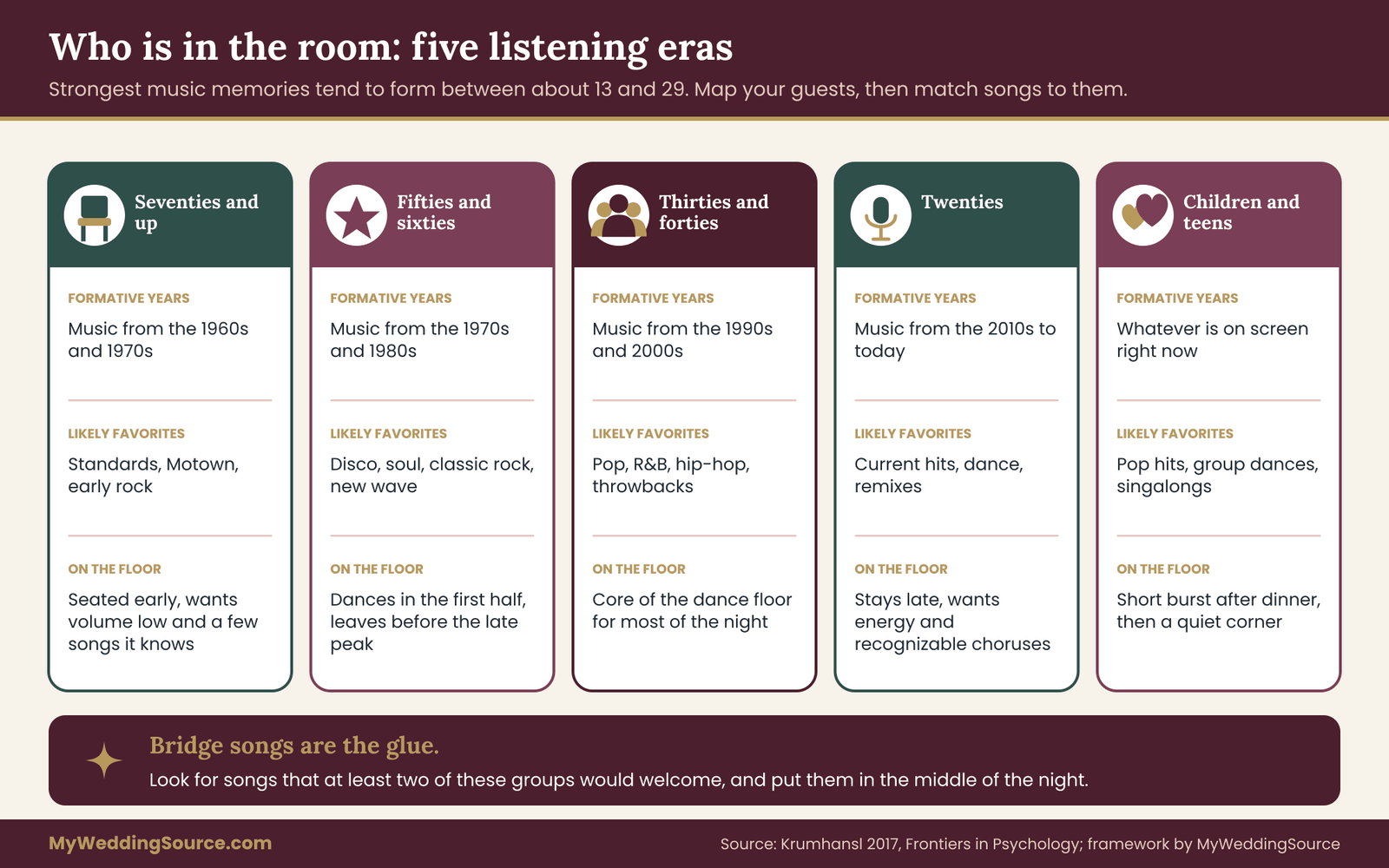
To use the map, estimate the age spread of your guest list and note roughly how many people fall into each band. You do not need exact numbers. A rough split, such as “about a quarter over sixty, a third in their thirties and forties, a third in their twenties, and a few kids,” will do. Our wedding guest list guide can help you get a realistic headcount first.
For each band, ask the same three questions:
- What did they listen to when they were about fifteen to twenty-five?
- What will they get up and dance to, as opposed to what they simply like?
- What would make them leave the floor?
The answers will overlap less than you expect. That is useful, because it tells you where the program needs bridges, which we cover later.
Count the dancers, not the guests
Not everyone dances, and the number who do depends on the crowd, the venue, the time of night and the drinks. A 150-person guest list does not mean 150 people on the floor. At many weddings only a portion of guests dance at any one time, and a smaller core dances most of the night.
This matters for two reasons. First, the floor should be sized to the likely number of dancers, not the headcount; an oversized floor looks empty, and an empty-looking floor discourages people from stepping onto it. Second, the wedding reception music should be aimed at the dancers who are present at each moment, not at the average guest. Ask your couple-and-friends circle honestly: who will be on the floor at 9 p.m.? If it is mostly friends in their twenties and thirties, the peak hour should speak to them. The older guests will usually be glad to have had a moment earlier in the night and a closing song they know.
Non-dancers have needs too
Guests who sit out the dancing are part of the audience. They are talking, eating, watching, resting and sometimes escaping. Their needs are simple.
- A place to talk without shouting. If every seating area is within a few feet of a speaker, conversation turns into repeated “what?” and the quiet guests leave early.
- A way to see the floor. Many people enjoy watching the dancing. Seating with a line of sight lets them take part without moving.
- A way to step out. A bar area, a lounge corner, a patio or a hallway where the sound drops gives people a break.
We take this further in the sound section, because speaker placement is a wedding reception music decision as much as a technical one.
Language and culture
If your guests speak several languages or come from different cultural traditions, the audience map needs another layer. Ask which songs, dances and moments carry meaning for each group. A traditional dance, a regional song or a particular instrument can be a high point for one set of guests and unfamiliar to another. That is not a reason to leave it out. It is a reason to place it deliberately, introduce it briefly so everyone knows what is happening, and make sure the DJ or band has the right recordings or knows the repertoire.
Be specific with your provider. “We have a lot of Latin music fans” is vague. “We want a thirty-minute set of salsa and bachata after dinner, with a short announcement explaining the first dance” is useful. If you need a performer from your own community, such as a drummer or a dance group, treat them as additional vendors, and include their needs in your sound plan.
Children and teens
Children change the shape of the night. They will dance, early and with enthusiasm, and they will leave early. A common pattern is a burst of kid-friendly songs just after dinner, a handful of well-known group dances, and then a gradual thinning as bedtime arrives. If children are an important part of your guest list, plan that window deliberately, and have a quiet area with books, crayons or a screen for those who need a break.
Teenagers are a separate group. They often prefer current hits and, at some weddings, will dance in a group at the edge of the floor. A few songs that speak to them, and a gentle invitation to the DJ, can turn them from bored to engaged.
Older guests and mobility
Older guests are rarely hostile to dancing, but they are sensitive to volume, seating and time. Many will come for dinner, toasts and the first parts of the evening, then leave at a predictable time. Plan the family dances and any songs meant for them before that point. Place them away from the loudest speakers, keep a few seats near the floor, and consider tempo: a slow song gives people a chance to dance who cannot manage a fast one. Our guide to wedding guest transportation planning is worth a read if older guests need a ride home at a set time.
A one-page audience summary
Before you talk to a DJ or band, put the findings on one page. A useful summary is short:
- Approximate guest count and the rough age spread
- Who is likely to dance, and when they are likely to leave
- Two or three songs or artists that mean something to each age band
- Any cultural or religious traditions that involve music or dance
- Guests with special needs: hearing aids, sensory sensitivity, mobility limits, young children
- Anything you do not want to hear
That page is the raw material for everything else in the program. ## The energy timeline: shaping wedding reception music across the night
Draw the evening as a line on a page. The horizontal axis is time. The vertical axis is energy, meaning a blend of tempo, volume, vocal density and how much the wedding reception music asks of the listener. You do not need to be precise. What you need is to see where the line rises, where it falls, and where it has to stay low because something else is happening.
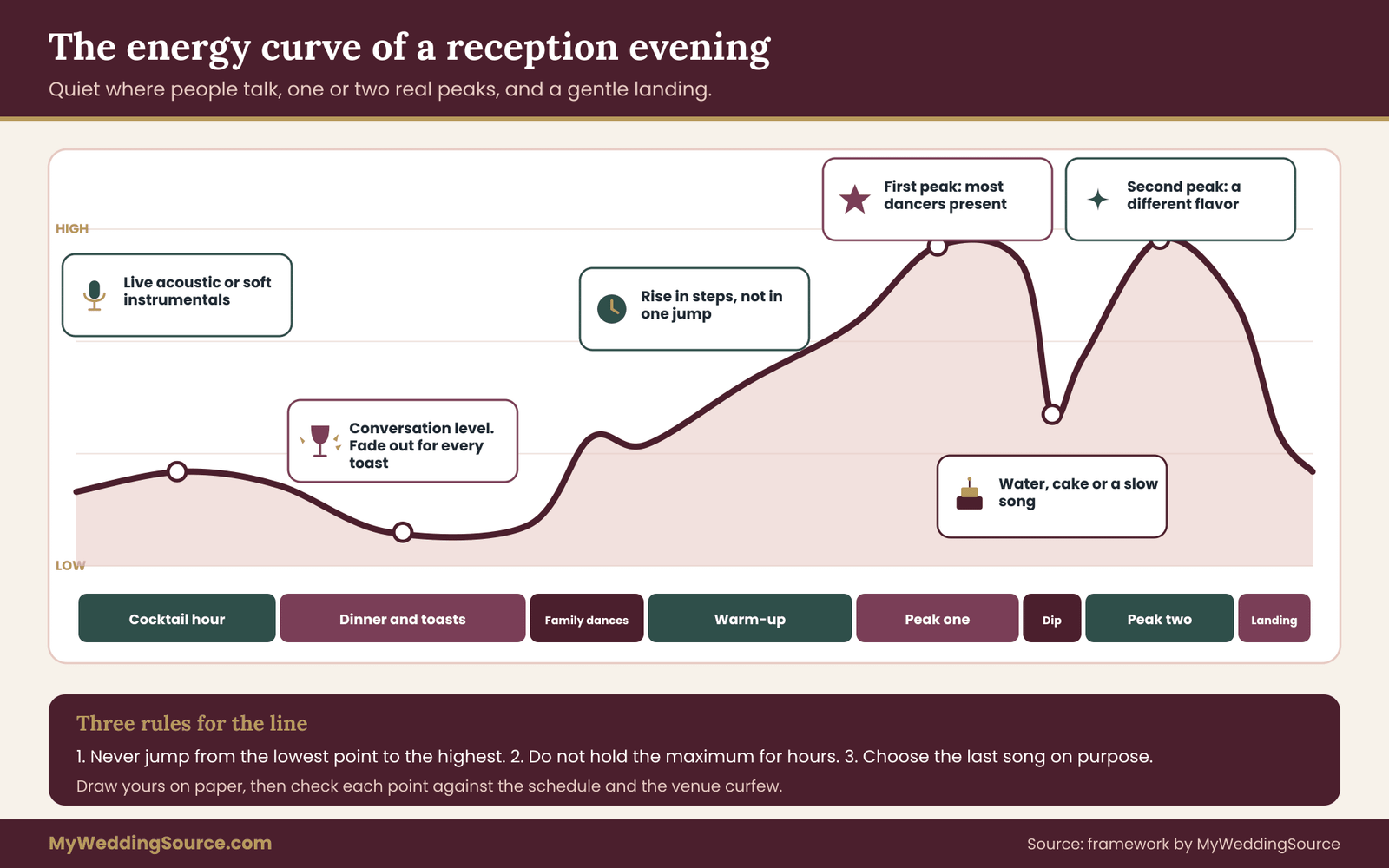
A typical evening has five movements: arrival, dinner and toasts, warm-up, peak, and landing. Each has a different job, and the transitions between them matter more than most couples expect. A sudden jump from quiet dinner jazz to club-level dance music tends to make people flinch and leave. A gradual lift over twenty minutes feels natural.
Arrival and cocktail hour: low and welcoming
Guests arrive in clusters, find drinks, and talk. The job of the wedding reception music is to set a tone and then get out of the way.
Keep volume low enough that people at normal distance can hold a conversation without raising their voices. Choose instrumental or lightly vocal tracks, mid-tempo, with a familiar feel. Think of it as the audio version of good lighting: noticeable if it is wrong, mostly invisible if it is right.
If you have a live musician, such as a string trio, a pianist or a guitarist, this is where they are most useful. A single live instrument adds atmosphere without competing with conversation. Check what the performer needs: a power outlet, a stool, shade or a covered area, and a clear place to set up that does not block the bar line.
The entrance and the first moments of the reception
When the couple and wedding party are introduced, energy briefly rises. This is a moment where a short burst of lively music works well, for ten to twenty seconds per introduction, enough to give the entrance a lift without turning into a concert. Agree beforehand on the order of introductions and the names and pronunciations the emcee will use. Write them down, with phonetic spellings where helpful.
Dinner and toasts: the quietest stretch of the reception music
Dinner is where programming most often goes wrong, in both directions. Too loud, and guests at the same table cannot hear each other. Too quiet, and the room feels awkward while plates clink.
Aim for background wedding reception music with a steady, unhurried feel and a volume that is clearly lower than at any other point in the night. Avoid songs with dense vocals that compete with conversation. Instrumental versions of familiar songs, acoustic sets and gentle jazz are common choices, but any style works if the volume and density are right.
Toasts need a different kind of control. Speakers are nervous, microphones can squeal, and the room needs to quiet down fast. Agree with the DJ or band on a signal: music fades fully before a speaker is introduced, and returns gently afterward. If a toast runs long, the wedding reception music stays off. The timing of speeches matters for your catering plan too, since cold food is a quiet mood killer.
Family dances and the first dance
The first dance, parent dances and any special dances are the emotional center of the evening. They are also short, usually between two and four minutes each, and they set the tone for what follows.
Choose songs you can bear to hear for the length of time you plan to dance. Many couples have the DJ edit the song so the dance is shorter, and arrange a way for guests to join in after the first verse or chorus. That lifts the pressure of being watched and brings people onto the floor.
If you want a choreographed dance, talk to your wedding reception music provider early. A routine needs a specific edit of the song, and an edit takes time to produce. Check whether the DJ can create or work with an edited file, and ask for a test play before the wedding.
Warm-up: opening the floor
After the formal moments, the floor needs an invitation. The most reliable invitation is a song that most guests know and can move to without effort, played at a volume that raises the energy a little without startling anyone. The song choice matters less than the match to your audience; a gentle classic for one group might be a recent hit for another.
Aim for songs with a clear beat, simple movement and a feel-good emotional tone, since the research on preferences suggests that happy and energizing songs tend to be liked best. Avoid sad songs, slow songs and songs that require specialized knowledge. The goal is to get ten to fifteen people on the floor and give them a reason to stay.
A warm-up usually lasts fifteen to thirty minutes. During that time, the DJ or bandleader is watching who comes onto the floor and who leaves, and adjusting. If the first few songs fall flat, the plan has a backup: a group dance or a well-loved crowd-pleaser to rebuild momentum.
The peak: one or two sustained high points in the music
Most couples want the dance floor to be full for as long as possible. That is not realistic, and it is not necessary. Energy cannot stay at its maximum for hours, and dancers tire. A better target is one or two peaks, each lasting twenty to forty minutes, separated by a short dip.
Place the first peak when most of your dancers are present and fresh, usually shortly after the formal moments end and before the cake or other interruptions. Place the second, if you have one, later in the evening after a lull, with a different flavor: perhaps a more current or higher-tempo set for the younger crowd after the older guests have left.
The dip is important. A short slower song, a break for cake cutting or a bouquet toss, or a change of genre gives people a chance to rest, drink water and return. Without it, the peak burns out.
The landing: bringing the evening down
Many weddings end abruptly, with the last song of a loud set followed by lights up. A planned landing is gentler and more memorable. In the last twenty to thirty minutes, move toward songs that everyone knows well and wants to sing together, ease the tempo down, and finish with a final song that feels like an ending, whether that is a slow dance, a group singalong or a favorite of the couple.
Choose that last song deliberately. It is the one people will remember, and it is often the last thing that happens before the send-off. If you plan an exit with sparklers, a car or a shuttle, coordinate with the venue and your transportation provider so the final song ends as the guests are ready to step outside.
A rule of thumb on tempo
DJs and bandleaders use tempo as a practical tool. As a rough rule of thumb, slow dances tend to sit at the lower end of the range, mid-tempo songs for warming up sit in the middle, and the high-energy dance songs sit at the upper end. Exact numbers vary by genre and by how a song is performed, and there is no single correct range, so ask your provider how they think about it. What matters is the pattern: do not jump from the bottom to the top, and do not stay at the top for the whole night.
Matching the curve to the night’s constraints
Your energy curve must fit the realities of the evening. If the venue has a hard curfew at 11 p.m., the peak must come early enough that you do not waste it. If dinner is served late, the warm-up shifts later. If a cultural tradition such as a procession or a special dance takes place midway through, the curve needs a place for it. Draw the line first, then check each point against the schedule. Our wedding timeline guide shows how to set out the full day so wedding reception music, meals and photographs do not collide. ## Dance styles: what each one asks of the floor and of your wedding reception music
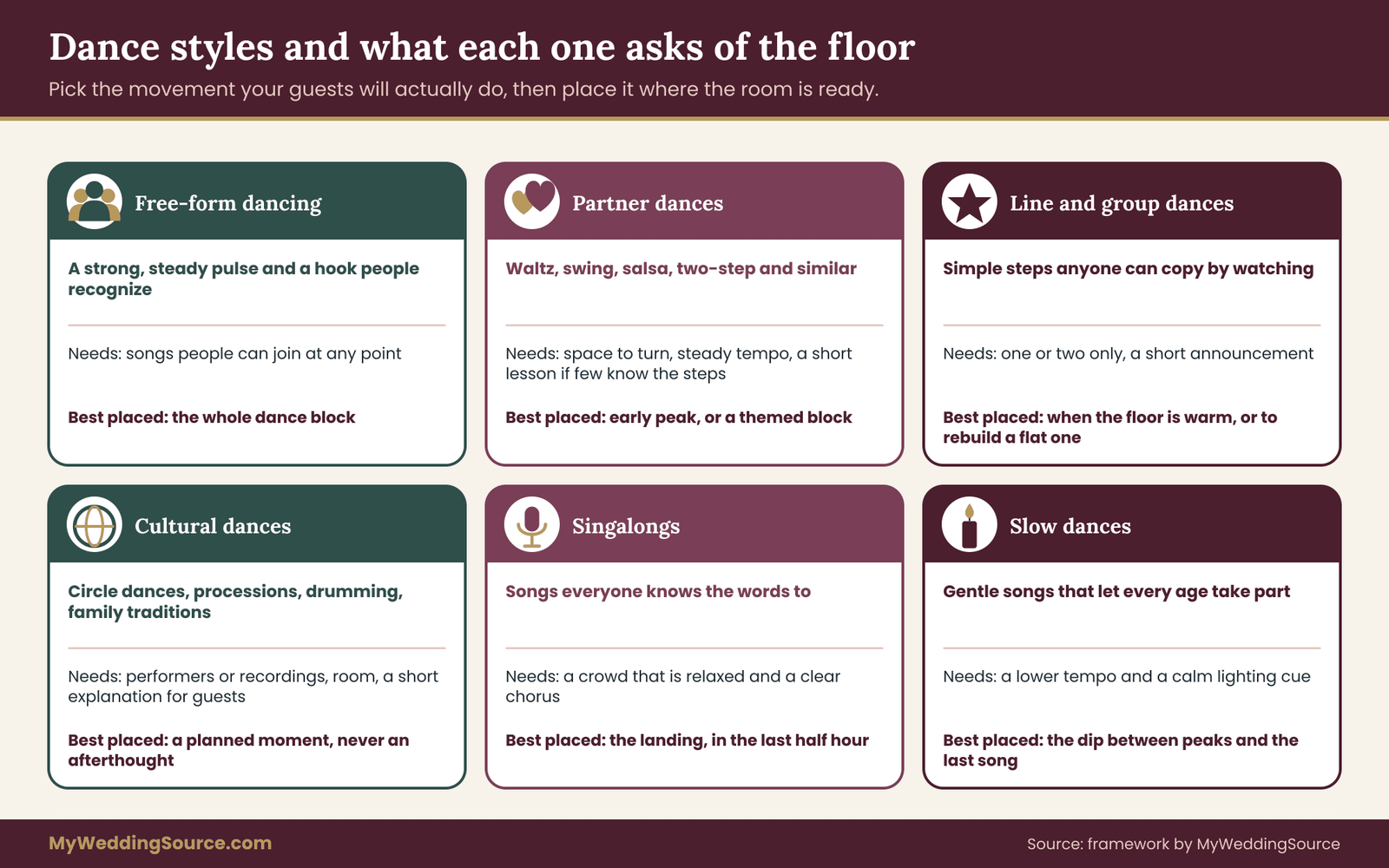
“Dance styles” in wedding planning means two different things. One is the genre of the wedding reception music: pop, soul, country, hip-hop, Latin, disco, rock. The other is the kind of movement the guests will do: free-form dancing, partner dances, line dances and group dances. Both shape your program, and they do not always line up. A country song can invite a line dance, a partner two-step or just swaying. A disco track can fill the floor with free dancing or a choreographed group routine.
Before choosing, think about what your guests will actually do. A style that works beautifully for a dance-loving crowd can leave a reserved one standing at the edge.
Free-form dancing
This is the default at most weddings: people move however they like to a beat. It is the most inclusive style, since no one needs to know steps, and it is the most dependent on the wedding reception music having a strong, steady pulse. Songs with a clear beat, a recognizable hook and a feel-good mood work best. For programming, this means choosing songs that people can enter and exit easily, without needing to follow a routine. It also means giving them enough time on the floor to get comfortable.
Partner dances
Waltz, foxtrot, swing, two-step, salsa, bachata and similar dances involve couples dancing together in a defined style. They can be magical in a room that knows them and awkward in one that does not. If your guests include a community that dances these together, such as a Latin dance community or a country-western crowd, include them deliberately and give them a block of time. If only a few guests know the steps, consider a short lesson at the start of the night, led by the DJ or a dance instructor, which turns a possible barrier into a shared activity.
Partner dances need space. Check your floor size and layout; a crowded floor makes turns hard and increases the risk of collisions. They also need tempo control, since steps are tied to a specific beat range, so brief your DJ or band if you want these styles.
Line and group dances
Line dances and group dances are the great equalizers. Everyone can join, nobody needs a partner, and the instructions are simple enough to follow by watching. They are also divisive. Some guests love them and some refuse them on principle. A good approach is to include one or two, place them at a point when the floor is warm and people are in a good mood, and keep them short.
A DJ or bandleader who reads the room can tell whether the crowd will join in. If the floor has been dead for ten minutes, a familiar group dance can bring people back. If the floor is already full, adding one may cause more disruption than delight. Ask your provider to use group dances as tools, not as fixed items on a list.
Cultural dances and processions
Many weddings include dances or musical moments with specific cultural or religious meaning: a hora, a circle dance, a baraat procession, a first dance in a particular tradition, a money dance, a lion dance, a drumming ensemble. These are central to the day for the people who value them, and they need planning like any other element.
Settle four things. First, timing: where in the evening does it fit, and how long does it last? Second, performers and equipment: do you need live musicians, a particular instrument, or a prepared recording? Third, space: does the dance need the full floor, a procession route or an outdoor area? Fourth, explanation: will guests who are unfamiliar know what is happening and how to take part? A short announcement from the emcee, a printed note in the program or a brief word from a family member goes a long way.
Genres and their practical limits for wedding reception music
Different genres have different practical needs.
Pop and current hits are easiest to program for broad appeal. Their risk is lyrical content; many hits include explicit language, and edited versions may be needed for a mixed-age crowd.
Classic soul, funk, disco and 1970s to 1990s hits often work across age ranges, because they have strong grooves and are familiar to older guests, while many younger guests know them from family or from film and television.
Country can be a tradition in some regions and a stretch in others. It lends itself to line dances and partner dances, and to singalongs.
Hip-hop and R&B are popular with many younger and middle-aged guests. Explicit lyrics are common, so discuss edits and your no-play list.
Latin music covers many styles, from salsa and bachata to reggaeton and cumbia. Programming it well takes knowledge of the specific styles, so ask your provider about their experience.
Rock and classic rock suit guitar-friendly crowds and singalongs. Volume and density can climb quickly, so watch the older tables.
Electronic and dance music is high-energy and works best with a crowd that wants it. Place it where the floor is ready and the older guests have departed or have a quiet space.
Jazz, swing and standards are good for cocktail hour, dinner, and certain moments in the evening. A swing set can also be a dance event in itself.
The takeaway is not to pick one genre. It is to know what each one needs and to place it where the room can use it.
Mixing generations on one floor with wedding reception music
Mixed-age weddings are the norm, and they pose the central problem of reception programming: how do you give each age group something that feels like theirs without losing the others? Three techniques help.
Era blocks and era blends
An era block is a stretch of music from one era or style, say twenty minutes of 1970s and 1980s hits. It lets one group have a clear moment of delight, and gives others a chance to rest or to watch. It works well when the age groups are distinct and when guests do not mind sitting out part of the time.
An era blend mixes eras within a set, moving from a 1980s hit to a 2000s hit to a current track. It keeps the whole room engaged, and it works when songs share a feel, such as tempo, mood or groove. It takes more skill, since a bad transition can jar.
Most weddings use both. A common structure is a block for the older guests early in the night, when they are present, followed by blended sets that run through the middle and late periods.
Bridge songs for wedding reception music
A bridge song is one that belongs to more than one group. It could be a classic that younger guests know from family and film, a recent hit that older guests know from radio, or a cover or remix that connects two eras. Bridge songs are the glue of a mixed-age floor.
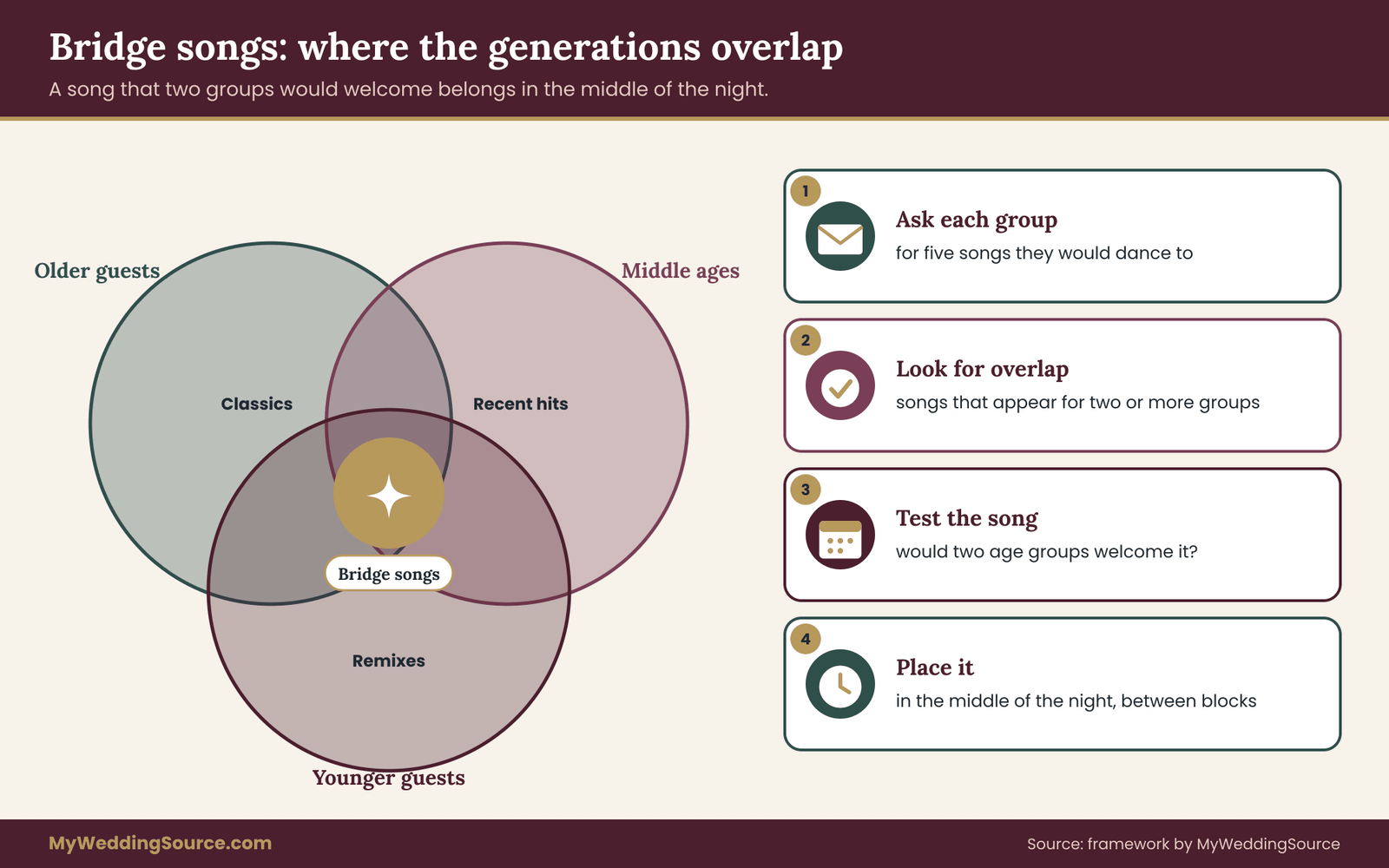
You can find bridge songs by asking each age group for a short list of songs they would dance to, then looking for overlaps. Ask guests in their twenties which older songs they know every word to. Ask older guests which recent songs they have heard enough to recognize. A DJ can also suggest bridge songs from experience.
A useful test for any song is the two-group test: would at least two distinct age groups welcome this? If the answer is yes, it is a strong candidate for the middle of the night. If the answer is no, it is a niche pick, and it belongs in a block aimed at one group.
Edits, remixes and clean versions
Many songs have more than one version: the original, a radio edit, a clean version with explicit lyrics removed, an extended version, a remix, a cover. These versions can help the program.
A clean version lets a song with a great groove work in a room that includes grandparents and children. A remix can update an older song for a younger crowd, or slow down a fast song for a different moment. A shortened edit lets a dance end before people lose interest. Ask your DJ which versions they have and how they handle explicit content. Do not assume the clean version is the default.
Transitions
How a song ends and the next begins matters as much as the songs. A jarring switch between a slow ballad and a fast dance track can empty the floor. Skilled DJs and bandleaders manage transitions by matching tempo, key or mood, by using a short instrumental break, or by taking a moment to introduce the next song. If you have a say, ask your provider how they plan transitions between generational sets, and listen to examples.
What to do when the groups want different things
Conflicts will come. The groom’s father wants country, the bride’s friends want hip-hop, and the grandparents want the Great American Songbook. The decision rule is simple: give each group a clear window, and make the windows proportionate to their presence and energy at that point in the night. The older guests usually get theirs early, the younger crowd later, and the mixed groups the middle. If a group’s window falls at a time when they are unlikely to be present, they will not feel included, so schedule with that in mind.
If a family member is pressing for a particular song or genre, ask what moment they are hoping for, and see if a single song or a short block can meet it. A person who gets one meaningful song is often satisfied, and the rest of the night remains yours. ## Your must-play, maybe and never lists for wedding reception music
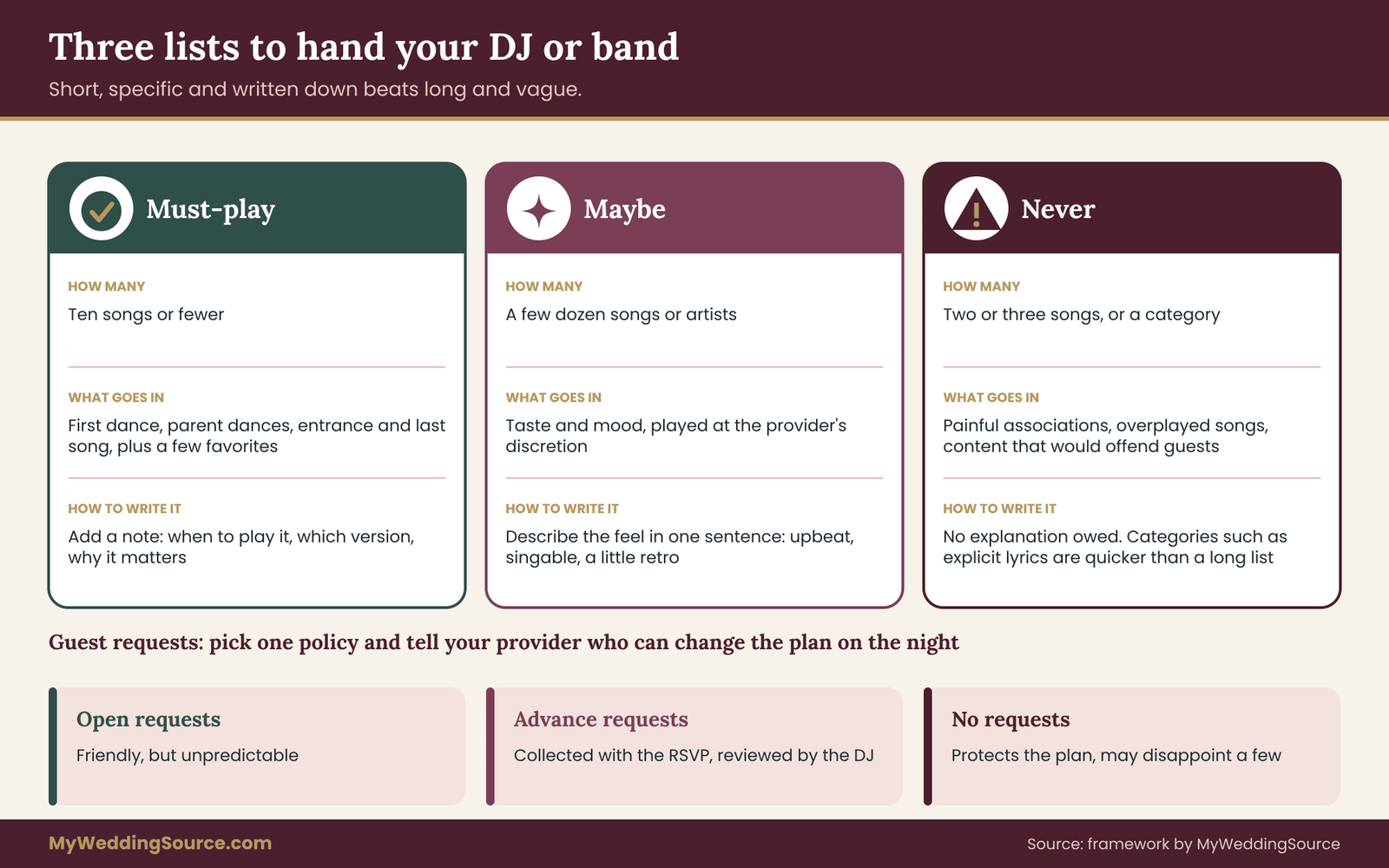
Handing a DJ or band a clear set of lists is one of the most useful things you can do. A good provider will ask for them. A weaker one may ignore them, which is itself information.
The must-play list
This is short: songs that matter to you so much you would be disappointed if they did not play. Many couples include the first dance, parent dances, the entrance song, the last song and a handful of favorites. Keep it to ten or fewer. Every extra must-play song takes up space in a program that has limited time, and a long list turns the DJ into a jukebox.
Include notes where they help. “Play after the cake cutting,” “only if the floor is full,” or “the clean version, please” tells the provider how you see the song working. A note that a song has special meaning, such as it was played at your grandparents’ wedding, helps the provider introduce or place it with care.
The maybe list
This is a longer list of songs and artists you like and would be happy to hear, played at the provider’s discretion. It gives the DJ or band a sense of your taste without locking them in. Thirty to fifty songs is plenty, and an artists-and-genres list works as well as individual tracks.
The maybe list is where you can explain mood. “Upbeat, singable, a bit retro” tells the provider more than a collection of tracks does. If you can describe the overall feel in a sentence, do so.
The never-play list
A do-not-play list is a reasonable request, and most professionals accept one. Keep it limited and specific. A list of two or three songs you truly cannot stand, or that carry difficult associations, is easy to honor. A list of fifty makes the provider’s job harder and limits the program.
Reasons to put a song on the never list include a painful memory, a song associated with a former partner, content that would offend your guests, or a song that is simply overplayed to the point where you would groan. You do not owe anyone an explanation, and the provider does not need one.
It helps to think about categories as well as individual songs. Some couples ask for no explicit lyrics at all. Some want no songs with religious references, or no songs that are overtly political. Some want no novelty songs. Describing the category is quicker and less likely to miss a case than listing songs.
A sample brief to give your provider
You can adapt this wording:
“Our guests range from children to people in their eighties. We would like the dance floor to feel welcoming to everyone, with a mix of eras, and a few moments where older guests can enjoy music they know. Must-play songs are attached, and we would like to keep them to the moments we have noted. Please avoid explicit lyrics, and please do not play the songs on the never-play list. If you see the floor going quiet, we trust your judgment about what to play next from our maybe list or your own repertoire.”
This message gives the provider a goal, three lists and a clear sign of trust. It avoids micromanaging while setting limits.
Guest song requests
Requests are a feature of many weddings, and a source of conflict. Your provider will usually have a policy, and you should know it.
There are three common approaches. The first is open requests, where guests can ask the DJ in person on the night. This feels friendly, and it also lets a guest with a few drinks demand a song that suits no one. The second is advance requests, where guests submit songs when they RSVP or through a shared form, and the DJ reviews them in advance. This gives you control and shows guests that their taste matters, though it can create a long list. The third is no requests, where the couple sets the wedding reception music and the DJ declines others. That protects the plan and may disappoint a few guests.
Many couples choose a middle path: collect requests in advance, share the strongest ones with the DJ, and let the DJ politely decline others on the night. If you are asking for song suggestions on an invitation or website, say clearly that requests are welcome but not promised. Some online tools exist that let guests submit requests to a DJ and let the couple limit what is allowed; ask your provider if they use one.
Whatever you choose, tell the provider who has the authority to change the plan on the night. A parent who demands a song while you are dancing can be redirected if the DJ knows to check with a named person, such as a planner or a friend assigned to manage music.
Sound, volume and hearing comfort for wedding reception music
Programming includes how loud the wedding reception music is and where it is heard. A perfect set played too loud is a poor set. Volume affects comfort, conversation and, over long periods, hearing.
What the hearing-health numbers say about wedding reception music
The National Institute for Occupational Safety and Health, part of the Centers for Disease Control and Prevention, recommends limiting workplace noise exposure to 85 A-weighted decibels averaged over an eight-hour day. It also describes a trade-off: for every three decibels of increase, the safe exposure time is cut in half. The agency lists bars, nightclubs and large sporting events as places where levels can reach 95 decibels or more, a point at which you would likely have to shout to be heard.
These are workplace guidelines, not wedding rules, and wedding guests are not exposed for eight hours. But they show the principle: louder means safe time shrinks quickly. Over a three-hour dance set, levels that feel exciting to the younger crowd may be uncomfortable or harmful to people who are more sensitive, including children, older adults and guests who wear hearing aids. Your sound provider can measure levels with a meter, and many professionals already work to a target. Ask what their target is and whether they monitor it.
Zones, not a single volume
A reception has several kinds of space, and each can have a different volume.
The dance floor can be loud enough to feel energetic. Position speakers so that sound is directed at the floor, not at tables.
The dining area should stay at conversation level. If dinner shares a room with the dance floor, separate them physically if you can, or ask for speakers that cover areas separately.
The bar and lounge areas are social spaces, and many guests will gather there when they need a break from the floor. Lower volume here makes it a usable refuge.
Quiet areas are worth planning for guests who need them: someone with sensory sensitivities, a parent with a baby, an older guest, someone who needs a phone call. A small room, a patio, or a corner far from the speakers will do.
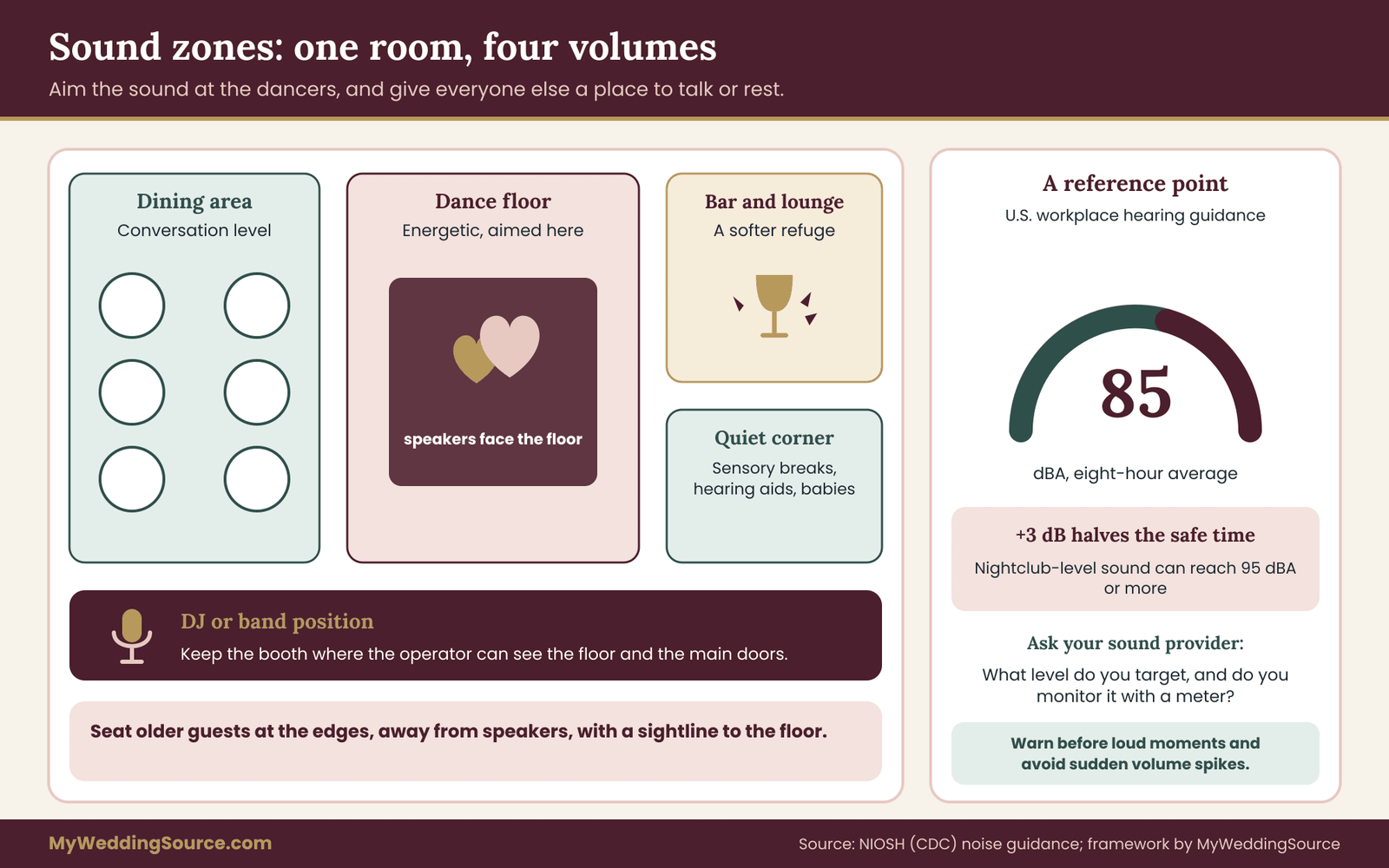
Your venue layout may limit what is possible. If the dance floor sits in the middle of a single large room, you can still lower speakers’ throw toward tables, place seating for older guests farthest from the sound, and arrange the quiet areas at the edges. Our wedding venues guide covers how to evaluate a space before you commit to it.
Venue rules, curfews and neighbors
Many venues set sound limits, end times and rules about outdoor amplification. Some are written into the contract and some are set by local ordinance. Ask the venue three things before you finalize the wedding reception music: what time must the wedding reception music end, is there a decibel limit and how is it measured, and are there restrictions on outdoor speakers or live bands. If your venue is near homes or a hotel, assume that neighbors will notice and complain.
If a limit is lower than you want for the style of wedding reception music you have in mind, a sound provider can often work around it with speaker placement, a lower overall level and a tighter, more intelligible mix. A band that suits a loud room may not suit a quiet one, so mention the limits when you interview them.
Hearing aids and sensitivity
Guests who wear hearing aids may find a loud, echoing room painful, because amplification adds to the volume already present. Guests with sensory sensitivities, including some autistic guests, may find sudden sound changes, flashing lights or low-frequency bass overwhelming. You do not need to turn the night into an accommodation exercise. A few small steps help many people: avoid sudden volume spikes, give warning before loud moments such as a grand entrance, provide a quiet area, and mention it to the DJ.
If a guest asks you to turn the wedding reception music down, take the request seriously and check the levels, since what feels fine to one person may be a problem for another. ## Rights and licensing for wedding reception music: the part nobody wants to think about
Wedding reception music in public is protected by copyright, and the rules are not always intuitive. This section is general information, not legal advice. If a contract, a venue or an event raises a specific question, ask the venue, your provider, or a lawyer who works with music.
Private listening is not public performance
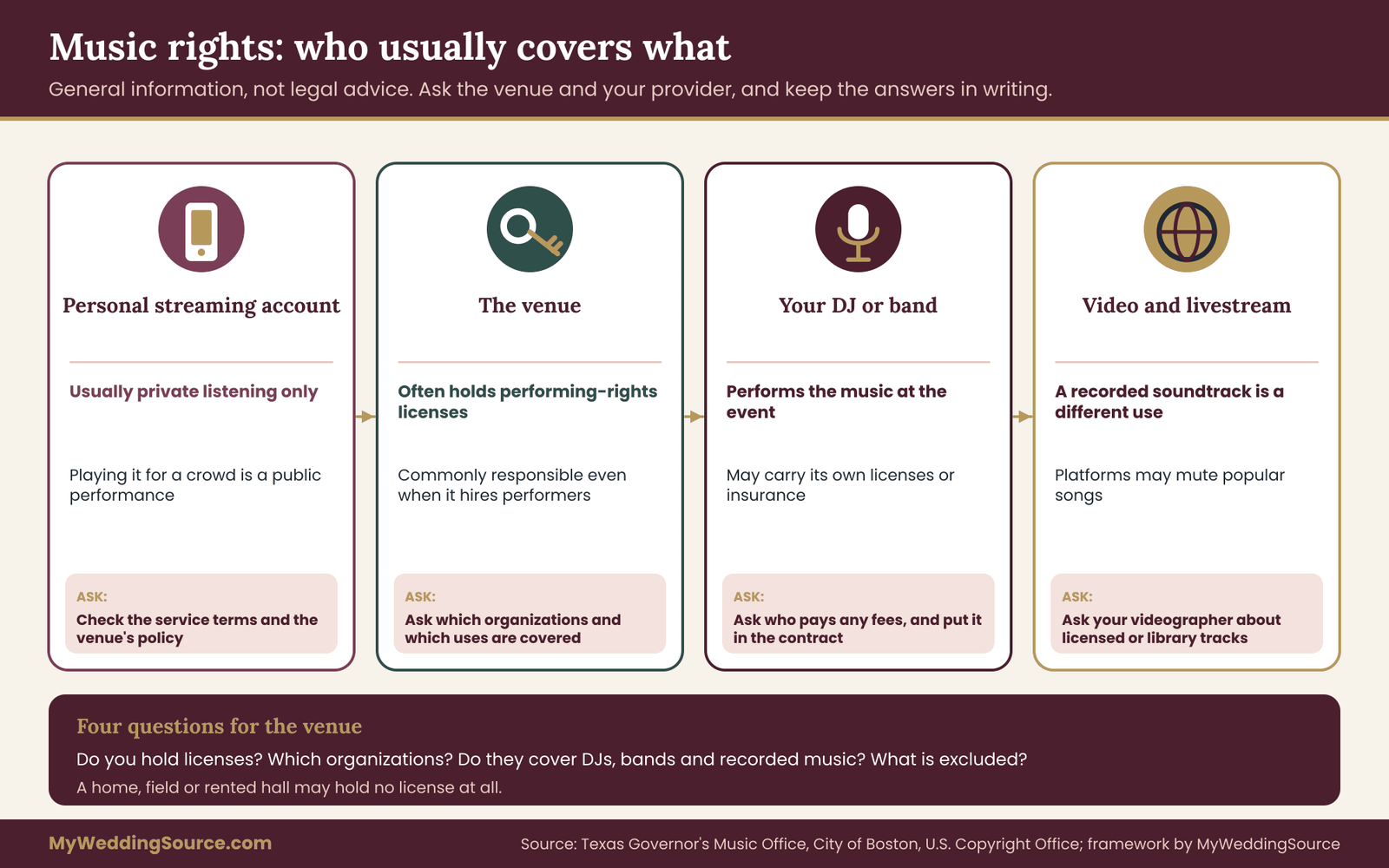
When you pay for a music subscription or buy a track, you are usually paying for personal, private listening. Playing a song for a crowd is a different use, called a public performance, and it generally involves additional permissions. The Texas Governor’s Music Office, in its guidance on music in venues, notes that a personal streaming subscription typically covers private listening only, and that music played publicly generally requires a performance license. The City of Boston’s guidance makes a similar point about business streaming accounts, which cover only part of what a business needs.
In practice, this means that running your own reception from your personal streaming account is a gray area at best, and a venue or the service’s terms may not allow it. If you plan to use a self-run playlist, ask the venue and read the terms of the service.
Who usually holds the licenses
In the United States, performing rights organizations, which include ASCAP, BMI, SESAC and GMR, license the public performance of the songs in their catalogs. Each organization represents different songs, so one license does not cover everything. Venues that regularly host events with music often hold licenses from one or more of these organizations.
The Texas guidance says the venue or establishment is commonly responsible for the license, even when it hires performers. That fits how weddings usually work. A DJ or band plays at a venue that holds the relevant licenses, so the couple rarely has to deal with them directly. But venues differ, and some private spaces, such as a home, a field or a rented hall, may not hold any license at all.
Because the rules are not uniform, ask directly. These questions go to the venue:
- Do you hold public performance licenses for music played at events here?
- Which organizations do your licenses cover?
- Does the license cover DJs, live bands and recorded background music?
- Are there any music uses the license excludes?
And these go to your DJ or band:
- Do you carry any licenses or insurance related to public performance?
- Are you responsible for any fees tied to the music you play?
- What do you need from us or from the venue?
Get the answers in writing, preferably in the contract or an email you can keep.
Live bands and cover songs at a wedding reception
A band playing cover songs is publicly performing other people’s compositions. That performance is generally licensed through the venue’s arrangements, but a private space without a license is a question mark. If you hire a band to play at a location that is not an established venue, ask the band how they handle it.
If your band plays original music, the rules differ: the band owns or controls the rights to its own songs, and the question is largely about the band’s agreements. It is rarely a concern for the couple.
Ceremony and wedding reception music in recorded video and livestreams
Wedding reception music is not the only place rights come up. A wedding video that includes a popular song in the soundtrack is a different use than a live performance, and it can create problems when posted online. A livestream can have music muted or blocked by the platform if it contains songs that the platform’s systems recognize. If you plan to share your video or stream the ceremony, ask your videographer how they handle music. Many use licensed or library tracks designed for this purpose.
The same applies to guest videos posted on social media. A short clip of a dance with a pop song in the background can be muted by the platform. This is a platform rule, not a legal complaint against your guests, but it can disappoint people who expected to share the moment.
What the U.S. Copyright Office does and does not do
The U.S. Copyright Office registers copyrights and administers parts of the copyright system, but it does not issue licenses for public performance at weddings and does not tell you who needs one. Its website explains copyright basics, and it is a sound starting point for understanding what is protected. For practical questions, the venue, the performing rights organizations and your wedding reception music provider are where to look.
What can go wrong, and how to avoid it
Most weddings pass without any rights issue. Problems tend to arise when the setup falls outside the usual pattern: a private home or field, a self-run playlist on a personal account, a band at a nonlicensed space, or a livestream with copyrighted songs. A few steps reduce the risk.
- Ask the venue about licenses before booking wedding reception music, not after.
- Choose providers who work regularly at weddings and understand the rules.
- For self-run playlists, check the venue’s policy and the service’s terms, and consider an alternative with a commercial license for public use.
- For video and livestream, ask how music is handled and ask for licensed tracks if needed.
- Keep copies of any written answers.
Hiring and briefing the wedding reception music vendor
A strong brief only works if the provider can deliver it. These are the questions and contract points that matter most.
Questions to ask when you interview a wedding reception music provider
Use these questions with a DJ, band or hybrid:
- How do you approach a mixed-age audience? Can you describe a recent wedding with a similar mix?
- How do you read the room, and what do you do if the floor empties?
- How do you handle requests, and how do you decline them?
- How do you handle explicit lyrics and clean versions?
- What does your sound system include, and what power and space does it need?
- What is your backup plan if equipment fails or you are ill?
- Who is the person who will actually perform at our wedding?
- How long is your set, and what happens if we run late or need extra time?
- How do you handle emcee duties, and do you need a script?
- How do you work with the photographer, caterer and venue staff?
Listen to how they answer. A professional answers specifically and without defensiveness. Vague answers and sales pitches are a warning. If you can, watch a recording of them working a room, or ask to attend a public event where they perform. Our vendor due diligence checklist lists what else to confirm before signing.
What belongs in the contract for wedding reception music
Your contract is the place to record what you have agreed. For music, it should state at least:
- The date, the start and end times, and the length of each set, including breaks for a band
- The names of the performers who will attend, and what happens if one cannot
- Equipment to be provided, and power and space needs
- The number of hours of coverage and the cost of overtime
- The policy on requests and the do-not-play list
- A statement on who is responsible for licensing, if relevant
- A backup plan, including a replacement if the provider cannot attend
- Payment schedule, cancellation and date-change terms
Date-change and cancellation terms deserve extra care, since a wedding date can shift. Payment rights and obligations vary by contract and by state, so read carefully and ask for changes where something is unclear.
The written brief
Alongside the contract, give the provider a brief, ideally a document of one to two pages that covers:
- The schedule of the evening with times, including meals, toasts and special moments
- Names and pronunciations for introductions
- The audience summary and any cultural moments
- Your three lists
- The energy curve in plain words
- Contact details for the person in charge on the night
Send it a few weeks before the wedding and ask the provider to confirm they have read it. A short phone call two weeks before and a quick check-in the week of the wedding keep everyone aligned.
The day-of handoff
On the day, assign one person to be the wedding reception music point of contact, someone who is not the couple. That could be a planner, a friend or a family member. Introduce them to the provider before the reception. They can answer questions, approve changes and deal with requests so you do not have to. Make sure they know your priorities and your limits. ## A worked example of wedding reception music: one evening, three generations
The following is an illustration, not a case study. The couple, the guest list and the songs are invented to show how the pieces fit together. Adapt the logic, not the details.
The setting. Maya and Daniel are marrying on a Saturday in a hall with a hard 11 p.m. wedding reception music curfew. They have 140 guests. About thirty are over sixty, roughly fifty are in their thirties and forties, about forty are in their twenties, and a handful are children. Dinner begins at 6:30 p.m. Maya’s family loves Motown and classic soul. Daniel’s father wants some country. Their friends want recent pop and hip-hop. A group of cousins knows a particular line dance.
What they decided first. They agreed that three things mattered most: the older guests should have a real moment before they went home, the floor should be full by about 8:30, and nobody should have to shout over music at dinner. They also agreed on a short never list: two songs with painful associations, and no explicit lyrics before 9 p.m.
The curve they drew.
- 5:30 to 6:30, cocktail hour. A live guitarist plays quiet instrumentals at low volume. The older guests are seated near the bar.
- 6:30 to 7:45, dinner and toasts. Recorded background wedding reception music at conversation level. Music fades fully for each toast.
- 7:45 to 8:15, first dance, family dances and cake. The first dance is edited to about two minutes, so guests can join in at the end. The father-daughter and mother-son dances follow. Cake is cut before the dance floor opens, so the older guests who plan to leave early see it.
- 8:15 to 8:50, the older guests’ block. Motown and classic soul, with a short country set requested by Daniel’s father. The goal is to get the oldest guests dancing while they are still present.
- 8:50 to 9:05, a bridge set. Songs both generations know, such as disco and 1990s hits. The line dance appears here, once, with a short explanation.
- 9:05 to 9:45, first peak. Blended pop, dance and hip-hop for the younger crowd, with clean edits until 9, then unrestricted within the limits of the never list.
- 9:45 to 10:00, dip. A slow song, bouquet toss and a water break. Some of the older guests say goodnight.
- 10:00 to 10:40, second peak. A higher-tempo set aimed at the twenties and thirties, with a bridge song every fourth or fifth track.
- 10:40 to 11:00, landing. Singalongs everyone knows, ending with a slow song chosen by the couple.
Where they hit problems. At 9:20 the floor thinned out during a rap track the cousins loved. The DJ, watching the room, moved to a recent pop hit that most people knew, and the floor refilled. At 9:50 a guest asked for a song on the never list. The DJ declined politely, and offered a different song by the same artist. At 10:15 the venue manager noted that the bass was carrying into the neighboring room. The DJ lowered the low end slightly and moved speakers, and no one on the floor noticed.
What made it work. The couple had a plan, but the plan was a set of intentions, not a script. They trusted the DJ to adjust, and they had a friend named as the contact who handled requests and a question from the venue manager. The older guests had a real moment, the middle of the night belonged to the dancers, and the landing gave everyone a shared ending.
Special situations for wedding reception music
Not every wedding follows the evening-dance model. These are common variations and the adjustments they call for.
Small weddings and micro-weddings
With fewer than thirty guests, there may not be a dance floor at all, and the wedding reception music’s job is atmosphere. A thoughtful playlist managed by a friend, with a few moments for toasts and a first dance, can be all you need. The audience map is still useful, since a small group means each person’s taste weighs more. Check the venue’s rules about amplified music, and think about whether a live musician for the ceremony or dinner would add more than a long set.
Daytime and brunch receptions
A daytime reception has less appetite for loud dancing and more interest in conversation. The curve is flatter: warm and lively, with a short dance block, and an earlier landing. Choose wedding reception music that suits daylight and a social setting, and keep the volume lower than you would at night. If it is outdoors, check the weather plan; our outdoor wedding rain plan covers sound equipment risks in wet weather too.
Alcohol-free and low-alcohol receptions
Alcohol lowers inhibitions, and without it a crowd may take longer to warm up. Plan a stronger warm-up, such as a group dance or a lesson, and consider starting the dance block earlier. Mocktails and a good coffee or dessert station keep people around. Our wedding bar service planning guide covers beverage service, and it affects the mood of the floor more than most couples expect.
Second weddings and blended families
Wedding reception music can carry heavy associations in a second wedding. Children from earlier relationships may have strong feelings about certain songs, and the couple may want to honor a past without bringing it into the room. Talk with the people involved, put sensitive songs on the never list, and consider including the children in a dance or a song of their own.
Cultural fusion weddings
When two traditions meet, the program may need to alternate or blend. Decide whether each tradition gets a block, or whether you combine them in a single set. Introduce each moment briefly so guests who are unfamiliar can join, and avoid leaving either family feeling like an audience at the other’s party.
Sensory-friendly and quiet receptions
For guests who need a calmer experience, a lower overall volume, no sudden spikes and a separate quiet space make a difference. Some couples run a shorter dance block early in the evening and let the rest of the night be conversation and dessert. This is a legitimate choice, and it can be as joyful as a loud party.
Outdoor and tent receptions
Outdoor spaces swallow sound, and wind, heat and rain affect equipment and guests. Speakers may need more power and careful placement, and the sound can travel farther than expected, which matters if you have neighbors. Ask the sound provider how they handle open air and what they do in a weather change.
Common wedding reception music mistakes, and what to do instead
Writing a list of fifty must-plays. It leaves no room for the room. Keep the must-play list under ten and put the rest in a maybe list.
Playing the loudest music at dinner. Guests cannot talk, and the older ones leave early. Treat dinner as the quietest stretch.
Skipping the warm-up. A cold start from a quiet dinner to a high-energy set leaves the floor empty. Bring energy up in steps.
Designing for yourselves only. The wedding is a shared event, and your taste is one voice. Check the audience map.
Over-planning every minute. A script that cannot flex fails the first time the floor empties. Give your provider room to adapt.
Ignoring explicit content. A song that is fine at a friends’ party can offend a grandparent. Ask for clean edits before a set time and put sensitive categories on the never list.
Forgetting the exit. A strong ending shapes memory. Choose the last song and plan the landing.
Skipping the contract details. Date changes, backup plans and overtime are the terms you want to read before something goes wrong.
Assuming the venue handles licensing. Many do, but not all. Ask.
Giving the DJ no contact on the night. Someone has to make decisions. Name that person in advance.
Troubleshooting wedding reception music on the night
Even with a good plan, things happen. These are the common problems and what to do.
The floor is empty. Wait through two songs before panicking; people often need time. If it stays empty, ask the DJ to shift to a song that most guests know, or to a group dance. Have friends or the wedding party step onto the floor and bring others with them. Check the volume, since a floor that is too loud or too quiet can stay empty.
The wedding reception music is too loud. Ask your point of contact to talk to the DJ, quietly and without drama. Do not shout across the room. If the issue is one area, such as a table near a speaker, a small change to speaker angle or a seat move may fix it.
Requests are flooding in. Direct guests to the agreed process, and let the DJ decline kindly. A brief line such as “we have a plan for tonight, but thank you” works.
Equipment fails. A professional has a backup. Ask in advance, and know where the spare is. If the failure is brief, the emcee can make an announcement and keep the room engaged until the wedding reception music returns.
The schedule runs late. Cut or shorten a segment, not the dance block. Ask the DJ to trim the toast-to-dance transition or shorten the cake break. If the curfew is fixed, shorten the earlier peak so the landing still fits.
A guest is upset by a song. Take them aside and listen. The DJ can change course, and a brief explanation or apology usually resolves it.
The venue asks for lower volume. Cooperate. The provider can adjust bass and speaker placement without killing the energy, and a relationship with the venue manager matters for the next event.
A planning timeline for wedding reception music
These steps are a guide. Your own timeline will depend on the size of the wedding and how early you book. The same logic applies to the rest of the planning calendar.
Nine to twelve months before. Decide what kind of wedding reception music provider you want. Check venue sound rules and curfew. Book your DJ or band, especially if your date is in peak season. Get the contract in writing.
Six months before. Build your audience summary. Ask guests, in small groups, about songs that matter to them. Start drafting must-play, maybe and never lists. If you have a cultural or religious tradition that involves music, confirm performers and recordings.
Three months before. Finalize the must-play and never lists. Choose your first dance and family dance songs, and ask for edits where needed. Decide on a request policy and add it to your website if you want advance requests.
One month before. Send the written brief to your provider, including the schedule, introductions and pronunciations. Confirm sound, power and layout with the venue. Name your wedding reception music point of contact.
Two weeks before. Check in with your provider. Confirm times, equipment and the plan for the first dance. Test any edits.
The week of. Confirm arrival times, load-in access and the quiet-area plan. Share the schedule with the point of contact.
The day of. Introduce the point of contact to the provider. Check levels at the start of dinner and again before the dance block begins. Enjoy it.
The day after. Thank your providers, and write down what worked and what you would change. If you are happy, a short review helps the next couple find them.
Wedding reception music has a cost, and the decisions in this guide affect it: set length, overtime, a second performer, extra equipment, edits and live musicians. Our wedding budget guide shows how to place those costs in the larger plan.
FAQ
How many songs should be on a wedding must-play list?
Ten or fewer is a good limit. A short list protects the moments that matter and leaves your provider free to read the room. Put anything beyond that into a maybe list and tell your provider how you want it used.
How do I choose wedding reception music for guests of very different ages?
Estimate the age spread of your guest list, note what each group listened to in their teens and twenties, and give each group a clear window. Use bridge songs that two or more groups know, and place older-guest wedding reception music early in the evening while those guests are still present.
Is it rude to give a DJ a do-not-play list for wedding reception music?
No. A short, specific list is a normal request, and most professionals welcome it. Keep it to the songs or categories that matter, so the DJ has room to work.
Should we allow guest song requests during wedding reception music?
It depends on your style. Advance requests give you control and let guests feel involved. Open requests on the night can be friendly but unpredictable. Many couples collect requests in advance and let the DJ decline others. Whatever you choose, tell the provider who has authority to change the plan.
How loud should wedding reception music be?
Quiet enough that guests at dinner can talk without raising their voices, and louder on the dance floor but within what your venue allows. U.S. occupational health guidance recommends limiting exposure to 85 decibels averaged over a workday, and notes that levels in nightclubs can reach 95 or more. Ask your sound provider what level they target and how they monitor it.
Do we need a license to play wedding reception music?
Usually the venue holds the relevant public performance licenses, but not always, and private spaces such as a home or field may not. A personal streaming subscription generally covers private listening, not public performance. Ask the venue, your provider and, if needed, a lawyer, and get the answers in writing.
How do we handle explicit lyrics with children and grandparents present?
Ask your DJ for clean edits, and set a time after which unedited songs are acceptable, if you wish. Put categories you want to avoid on the never list, and mention children and older guests specifically.
What if the dance floor stays empty during wedding reception music?
Give it a couple of songs, then ask the DJ to move to a song most guests know or a group dance. Have friends and the wedding party step in. Check the volume and the time, since people may be eating, drinking or waiting for a moment to start.
Your next steps
Start with a single page. List the approximate age groups at your wedding, two or three songs or artists each would respond to, any cultural moments you want to include, and anything you do not want to hear. That page tells you what kind of provider to look for and what to ask them.
Next, sketch your energy curve on paper, with the quiet stretches for dinner and toasts and one or two peaks. Mark your venue’s curfew and any sound limits. Then ask your venue about licensing and sound rules, and book a provider whose answers to the interview questions make you comfortable. When the contract is signed, write your three lists and your brief, name a point of contact for the night, and let the professionals do what they do.
Sources
- Noise-Induced Hearing Loss, NIOSH, Centers for Disease Control and Prevention
- Music Licensing for Your Business, Texas Governor’s Music Office
- Avoiding copyright infringement, City of Boston Entertainment Licensing
- Listening Niches across a Century of Popular Music, Frontiers in Psychology
- Copyright basics, U.S. Copyright Office
- Music Modernization Act resources, U.S. Copyright Office
- Noise-induced hearing loss: prevention, recognition and protection, UCSF Ears
- Is your business playing music in public spaces legally, Nixon Peabody
- Guide to song requests at weddings, NoSongRequests
- Dealing with song requests, iDJ Now
- Is it OK to have a do-not-play list at our wedding, EasyWeddings
- How to create a do-not-play list for your reception, Elite DJ
- Wedding songs: hearing the music you want to hear, Limelight Entertainment
Planning a family-friendly dance floor? See how to review song lyrics and build a clean wedding playlist without guesswork.