

Wedding credit card reconciliation is the plain habit of matching every card charge to a contract, an invoice, or a receipt, so that the one charge that really is wrong stands out from the many that only look strange.
Quick answer
Build one ledger with a row for every vendor payment you expect and a row for every line on your card statement, then match them by amount, date, and reference number. Many “duplicates” turn out to be a pending hold beside a posted charge, or a deposit beside a balance. If two posted charges truly match and no refund is coming, ask the vendor first, in writing. If that does not settle it, send your card company a written billing error notice within 60 days of the statement that shows the charge. This guide is general consumer information, not legal or financial advice.
What wedding credit card reconciliation means
A wedding is one of the few events that produces dozens of card charges across a year, from different businesses, in different amounts, on different schedules. A florist takes a deposit in spring, a venue bills a balance in fall, a rental company places a hold the week before, and a photographer’s software charges an installment on the first of every month. Wedding credit card reconciliation is how you keep that stream readable.
The job in plain terms
Wedding credit card reconciliation sounds like accounting, but the task is small and concrete. For every line on your statement you want to be able to say what it paid for, who agreed to it, and whether it is final. For every payment you expected to make, you want to be able to say which statement line it became. Anything left over on either side is what deserves your attention.
Match every card line to a reason
A line is “explained” when you can point to a document that justifies it: a signed contract with a payment schedule, an invoice, a receipt, or an email in which you approved a charge. A line with no document is not necessarily wrong. It may be a charge somebody else made for you, or one you simply forgot. It is, however, unexplained, and that is the status you are trying to eliminate one line at a time.
Separate unusual from wrong
The most useful distinction in wedding credit card reconciliation is between a charge that surprises you and a charge that is an error. Surprise is common and usually harmless: a hold you did not expect, a total that differs by a few dollars from the quote, a vendor name you do not recognize. Error means money left your account that you did not agree to, in an amount you did not agree to, or twice. You handle surprises with a question. You handle errors with a documented request. Mixing the two up leads either to needless disputes or to ignored mistakes.
Why a wedding produces messy statements
Everyday spending has a rhythm that makes errors easy to spot. Wedding spending does not. The amounts are larger, the vendors are unfamiliar, and the payments arrive in bursts. Understanding why makes wedding credit card reconciliation feel less like paperwork and more like common sense.
Many vendors, staged payments
Most wedding contracts split the price into a deposit, one or more interim payments, and a final balance, and some add fees after the event for overtime, damages, or a changed headcount. That structure means a single vendor can legitimately appear on your statement three or four times, in different amounts. A rule such as “the same vendor twice means a duplicate” will therefore be wrong more often than right. Our guide to vendor contract red flags explains how to read a payment schedule before you sign, which is the first step toward reconciling it later.
Several people, several cards
Couples often use more than one card, and parents, attendants, and friends sometimes pay a vendor directly. If you paid a venue deposit on one card and a family member paid the balance on theirs, neither statement tells the whole story. Wedding credit card reconciliation works best when one person owns the ledger and everyone who pays a vendor sends that person a screenshot or receipt. We come back to shared cards in the edge-case section below, because that is where honest confusion and real double payment overlap most.
Why a normal charge can look like a duplicate
Before you suspect an error, rule out the ordinary mechanics of how a card payment works; that is the first honest step in wedding credit card reconciliation. Most of the “double charge” panics that couples describe come from three things: holds, staged payments, and unfamiliar names.
Authorizations, holds, and posted charges
When you hand over a card, the merchant usually asks your card company to approve an amount. That approval is called an authorization, and it can show on your account before the sale is final. It is not the same thing as the finished charge, and the two can sit on your account side by side for a while.
What a hold is
Capital One describes an authorization hold, also called a pre-authorization, as a temporary block a merchant places on your card to confirm that the card is valid and has enough available credit for an expected transaction. It appears as a pending transaction, it is not a posted purchase until the final transaction is processed, and it lowers your available credit while it is in place. The hold amount can be larger than the final bill, and you see only the final amount on your statement. PNC makes a similar point: pending entries are approved but not yet processed, and they can change or disappear.
Why you may see two lines for one purchase
A pending entry usually appears soon after a purchase, and the posted entry appears once the merchant finishes processing. For a short time both may show on your account for the same purchase, and the pending amount may be higher than the final charge. PNC says pending transactions typically take one to five business days to process, and that hotel and car rental holds may take longer. PNC does not use the word “duplicate”; that reading is our inference from how it describes pending entries. The practical point is that the posted entry is the official record, so wait for the pending line to resolve before you count it as a second charge.
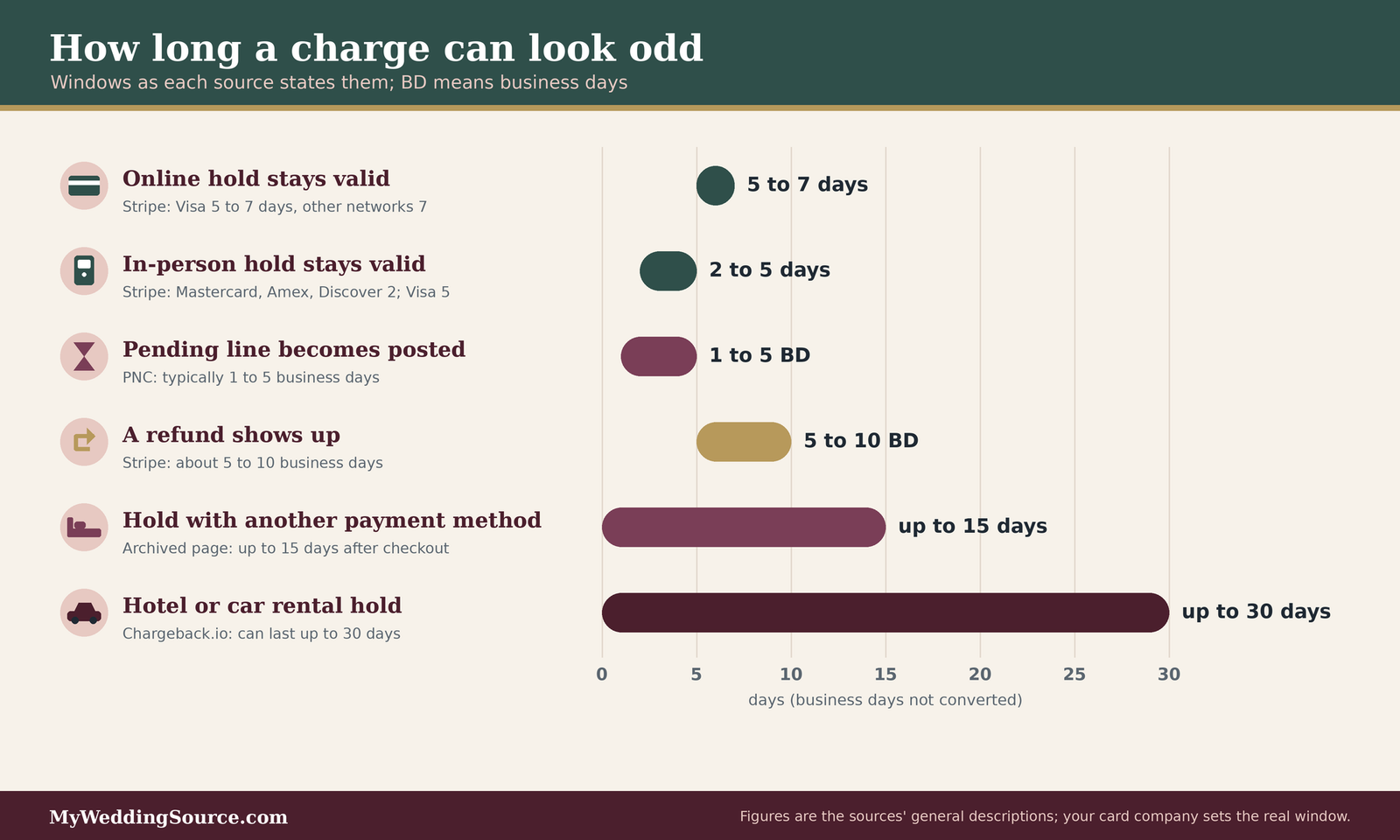
The figure above gathers the time windows that matter for wedding credit card reconciliation, as different sources give them. They are not the same kind of window, so read the labels carefully. An authorization validity window is how long an approved hold stays valid if the merchant never completes the sale. A refund window is how long a credit can take to show up. A hold on a hotel or rental can last longer because it covers estimated extras. Chargeback.io, a company that sells chargeback-management software, says most holds clear within about one to five business days, that the customer’s bank sets the actual window, and that hotel and car rental holds can last up to 30 days.
Deposits, balances, and installment schedules
The second big source of look-alike charges in wedding credit card reconciliation is the payment plan itself. Vendors often write the schedule into the contract, and the charges on your card simply follow it.
A deposit plus a balance is two charges, not a duplicate
If a caterer asks for a deposit now and the balance later, you will see two charges from the same business, and they may be different amounts or even the same amount if the contract splits the price in halves. Equal amounts are the case that fools people most often. Two charges of the same size, weeks apart, that line up with the dates in your contract are a schedule, not a mistake. Put each scheduled payment in your ledger on the day you sign, so the later statement line has something to match against.
Installments and autopay
Some vendors, especially photographers and planners who use billing software, charge a fixed installment every month. Those charges repeat on purpose. Check three things: the number of installments in your contract, the date the last one is due, and whether the contract says the payments stop automatically. If a charge shows up after the final scheduled installment, that is worth a question, not because it is a duplicate, but because it is outside the schedule you agreed to.
Names on the statement do not match the vendor
The third source of confusion in wedding credit card reconciliation has nothing to do with money at all. It is the name printed beside the charge.
Processor and platform names
Small businesses often use a payment service, so your statement may show a processor’s name, a shortened business name, or a string of letters and numbers instead of the florist you know. Chargeback.io notes that unclear billing descriptors make holds and charges harder for customers to recognize and can lead people to dispute a charge as unauthorized or duplicate when it is neither. Before you dispute anything, look at the date and amount, then search your email for a receipt with the same amount. A receipt from the vendor’s platform usually settles it.
A planner or venue paying on your behalf
If a planner books and pays several vendors from one account and bills you, you may see a single large charge from the planner rather than separate charges from each vendor. That is a different arrangement from a vendor charging you directly. It also changes who you contact if something is wrong: the planner, who made the payment, rather than the vendor who received it. Our article on planner commission disclosure explains how to ask a planner what each charge covers.
The wedding card ledger: the worksheet to build
This is the working tool of the guide. It is a ledger with two halves, one for what you expected to pay and one for what your card actually shows, joined by a match column. You can build your wedding credit card reconciliation ledger in any spreadsheet or on paper. The value is in the structure, not the software.
The columns that do the work
The wedding credit card reconciliation ledger asks for very little per row, because a row that takes a minute to fill is a row you will actually fill. The two halves use different columns.
The expected side
For each payment you agree to make, record the vendor, what it covers, the amount, the due date, the card you plan to use, and the document that proves it, such as “contract, page 3” or “invoice 1042.” Add a column for the status of the payment, which we define below. Record scheduled installments as separate rows, one per payment, rather than one row for the whole contract.
The statement side
For each line on a card statement, record the posting date, the name exactly as printed, the amount, the card, and whether it was pending when you first saw it. Add a column that holds the expected-side row it matches, and a notes column for anything you asked or were told. The matching column is what turns two lists into a reconciliation.
| Expected side (when you agree) | Statement side (when you read it) |
|---|---|
| Vendor and what it covers | Posting date and printed name |
| Amount and due date | Amount and card used |
| Card you plan to use | Pending or posted when first seen |
| Proof: contract page or invoice number | Row it matches, if any |
| Status word | Status word and notes |
Where to fill it from
You do not have to type everything from memory when you do wedding credit card reconciliation. Three places hold almost all of what you need, and each answers a different question.
Contracts and invoices
These tell you what you owe and when. Read the payment schedule, the late fee terms, and any clause about gratuity, overtime, or damage charges. A charge that the contract allows is not a billing error even if you dislike it; it is a question about the contract. Our vendor due diligence checklist lists what to confirm before you sign, and it pairs well with this ledger.
Receipts and confirmation emails
These tell you what the vendor says it charged. Save the email or the PDF, and note the amount and any reference or order number. A reference number is the strongest single piece of evidence in a reconciliation, because two charges with different reference numbers are almost certainly different transactions, and two with the same reference number may be one transaction processed twice.
Statements and your card app
These tell you what the card company recorded. Use the posted statement as the official record, and use the app to catch pending items early. Download each statement as a PDF and save it with the ledger, since app views can change after a charge posts.
Match rules and status words
A short list of rules keeps wedding credit card reconciliation consistent, even when you are tired and the statement is long. Use the same status words every time you do wedding credit card reconciliation.
Four status words
Use Matched when a statement line agrees with an expected payment in amount, date range, and vendor. Use Pending when a line is a hold or not yet posted and you are waiting. Use Question when a line is unexplained or the amount differs, and note what you asked. Use Disputed only after you have sent a written notice to the card company. Four words are enough; more invite confusion about which pile a line belongs in.
A worked example
The example below is invented to show the mechanics, and the vendors and amounts are not real. Suppose your ledger expects a florist deposit of $600 on March 3 and a balance of $900 in September. In March your statement shows $600 from a florist-like name. It matches, so you mark it Matched and note the invoice number. In September the statement shows a pending $900 and, two days later, a posted $900. You mark the pending line Pending, wait for it to disappear or post, and when only one $900 line remains you mark it Matched. If both $900 lines were still there after a week, you would mark one Question and write to the florist, with the invoice number and both dates.

What a duplicate can cost while you sort it out
A double charge is not only a risk of losing money. It also ties up available credit. As a rough illustration, an extra $2,500 posted to a card with a $10,000 limit leaves $2,500 less to spend until it is credited back, which is a quarter of the limit. That figure is our own arithmetic for illustration, not a rule. If you carry a balance, the extra charge can also add interest, so check your card agreement. Reconciling soon after each statement keeps small errors small and keeps your deadlines intact.
Reading the lines: a duplicate charge decoder
With the ledger in place, wedding credit card reconciliation turns a suspicious line into a short investigation instead of a worry. This section gives you the likely explanations in the order you should test them, from most ordinary to most serious.
Five patterns and what they usually mean
The table below sorts the look-alike situations that wedding credit card reconciliation turns up, the ones you are most likely to meet. It is a starting guide built from the mechanics in the sources, not a diagnosis, and a vendor’s records can contradict it in either direction.
| What you see | Often explained by | First move |
|---|---|---|
| One pending line and one posted line, same amount | A hold beside the finished charge | Wait several business days, then recheck |
| Two posted lines, same amount, different dates, matching contract dates | A deposit and balance, or installments | Check the payment schedule in the contract |
| Two posted lines, same amount, same day, same vendor | Possible double processing | Compare reference numbers, then ask the vendor |
| A line from a name you do not recognize | A processor or platform descriptor | Search email for a receipt with that amount |
| A charge after a refund was promised | Refund still in transit, or not issued | Ask for the refund date and reference number |
Patterns that are usually not errors
The first three rows of the decoder, taken in the order a person tends to see them, are usually benign: a pending hold, a scheduled payment, or a recognizable vendor in an unfamiliar name. Resist the urge to act before checking them. A premature dispute over a hold can create more paperwork than the problem is worth.
Patterns that deserve a written question
Two posted charges for the same amount from the same vendor on the same day, with no matching schedule, are the pattern most likely to be a real duplicate. Visa’s merchant-facing page on duplicate processing lists how it can happen on the business side, including the same transaction being entered twice, the same batch being sent twice, and two receipts being generated for one purchase. None of that requires bad faith. It is also the reason a vendor can usually fix it quickly once it sees the two reference numbers.
Tests to run before you call anyone
Three small tests settle most cases in wedding credit card reconciliation. They take a few minutes and give you better evidence than a feeling.
Compare amount, date, and reference number
For wedding credit card reconciliation, put the two lines side by side. Are the amounts identical to the cent? Are the dates the same or different? Do the receipts, if you have them, show the same order number? Identical amount and date with different order numbers suggests two real transactions. Identical order numbers suggest one transaction processed twice. Write the result in the notes column.
Check whether one line is still pending
Open your card app and look for a pending label. If one of the two lines is pending, you may be looking at the same purchase at two stages. Come back in a few business days. If the pending line has disappeared and one posted line remains, the ledger row can be marked Matched.
Wait the right amount of time, no longer
In wedding credit card reconciliation, waiting is sensible for a hold and risky for a posted duplicate, because the dispute clock described below starts when the statement is sent. As a working rule, give a pending item about a week, and treat a posted pair as a question the same day you notice it. That rule is our suggestion, not a legal standard, and it exists only to keep you from missing a deadline.
Contacting the vendor first
In wedding credit card reconciliation, your card company will ask whether you tried to resolve the problem with the business, and the CFPB’s own advice begins with contacting the card company right away to report a problem. In practice the fastest fix for a true double charge is usually a vendor who can see both transactions and reverse one. A short, factual message, sent in writing, also creates the paper trail you may need later.
What to say
In wedding credit card reconciliation the message should be short enough to read in thirty seconds and specific enough to act on. Tone matters less than facts. A vendor who processed a charge twice by accident wants to correct it as much as you want it corrected.
A short message that works
State who you are, what the contract covers, and what you see. For example: “Hello, this is [name], booked for [date]. My card statement dated [date] shows two charges of [amount] on [dates]. My contract and invoice [number] show one payment of that amount. Could you confirm whether the second charge was intended and, if not, reverse it and send me the refund reference number?” Then stop. Do not guess at causes or assign blame, because the vendor’s records will show what happened.
What to attach
Attach the invoice or contract page, a screenshot or statement excerpt with the two lines highlighted, and your card’s last four digits only. Never send a full card number by email. If you have to describe the card, “the card ending in [four digits]” is enough, and it keeps your account safer. Our guide to password sharing for wedding planning covers how to share account information without handing over more than you need to.
Questions to ask a vendor or planner
Good questions turn a vague complaint into a record, which is the point of wedding credit card reconciliation. Ask them in writing when you can, and keep the answers with the ledger row.
Questions worth asking about a charge
- Which invoice or contract payment does each of these two charges belong to?
- What are the reference or order numbers for both transactions?
- Was either one an authorization hold, and when will it be released?
- If one charge was a mistake, will you reverse it or refund it, and on what date?
- Can you send written confirmation of the refund and its reference number?
- Will any fee be kept, such as a processing fee, and where does the contract say so?
- Who handles billing questions if you are away, and how long do you need to respond?
Questions about the charge
These questions establish what happened. Ask which payment the charge belongs to, whether it was a hold or a completed sale, and what reference number it carries. A vendor who cannot say which contract payment a charge belongs to has just handed you the answer to whether it is yours.
Questions about the fix
These questions establish what will happen next. Ask whether the fix is a reversal or a refund, who initiates it, and when you should expect to see it. Ask for the confirmation in writing, with a date. A promise with no date is difficult to hold anyone to, and the dates are what you will use in the ledger.
What vendors may see on their side
It helps to know how the business side works when you do wedding credit card reconciliation, because it explains why a good vendor can usually fix a real duplicate quickly and why a fix takes days rather than minutes.
Why duplicates happen
Visa’s page on duplicate processing lists several ways a merchant can create one: entering the same transaction into a terminal twice, sending the same batch to the processor twice, depositing both the merchant copy and the acquirer copy of a receipt, or generating two receipts for one purchase. These are operational slips. The same page describes what a merchant may do when a cardholder disputes such a charge, including showing that the charges were for separate items or services, or showing proof that a credit or reversal was already issued, with its amount and processing date. In other words, a vendor who already fixed it will have a date to give you.
How refunds appear
Stripe, a payment processor, says it submits a refund request to the customer’s bank or card issuer and that a customer sees the credit about five to ten business days later, depending on the bank. It also says that a refund issued shortly after the original charge can appear as a reversal, in which case the original charge drops off the statement and no separate credit is issued. If a vendor uses a different processor, timelines may differ. The practical lesson is that “I refunded it yesterday” and “I see nothing yet” can both be true. Ask for the reference number, which Stripe describes as something a bank can use to say when a refund will be available.
When to dispute with your card company
If the vendor does not answer during wedding credit card reconciliation, will not fix a charge you did not authorize, or says the charge is correct and you disagree, the next step is a written dispute with the company that issued your card. This is where deadlines begin to matter for wedding credit card reconciliation.
The clock that matters
Federal rules on credit card billing errors set the main deadlines for wedding credit card reconciliation. The summaries below come from the CFPB, the FTC, and the text of the regulation, and your card agreement may add terms, so read it.
The sixty-day window
The CFPB says to send a written billing error notice within 60 calendar days after the charge appeared on your statement, and to call the card company right away as well. The FTC phrases the same deadline as within 60 days after the first bill with the error was sent to you. The regulation, Regulation Z, says the notice must reach the creditor no later than 60 days after the creditor sent the first statement showing the error. Because the clock runs from the statement, not from the day you noticed, checking each statement soon after it arrives is the most useful habit in this entire guide.
What the issuer must do
The CFPB says the issuer must send a letter confirming it received your dispute within 30 days, unless it has already finished its procedures. The FTC says the issuer must resolve the dispute within 90 days of receiving your notice, and Regulation Z says within two complete billing cycles and in no case later than 90 days. If the issuer agrees you are right, the charge must be removed. If it finds the bill correct, it must explain why in writing, state how much you owe, and give the payment due date.

How to write the notice
The notice that wedding credit card reconciliation sometimes calls for is a letter, and a short one. Its job is to let the issuer identify you and the error. A phone call alone is not the written notice the rules describe.
What to include
The FTC lists the basics: your name, address, and account number, a description of the error, and copies, not originals, of receipts or documents that support you. Regulation Z asks that the notice state, to the extent possible, that you believe an error exists, why, and the error’s type, date, and amount. Keep a copy, and note the dates of any calls. The FTC suggests certified mail with a return receipt so you have proof of delivery.
Where to send it
Send it to the address your issuer lists for billing inquiries, which is not necessarily the address for payments. The FTC says to use the billing inquiries address, and Regulation Z refers to the address the creditor disclosed for that purpose. Your statement or the issuer’s website should list it. Some issuers also accept disputes through an app or online form; if you use that route, save a screenshot or confirmation, and ask the issuer whether the form counts as the written notice.
Paying while a dispute is open
Many people doing wedding credit card reconciliation worry that disputing one charge means they must stop paying the whole bill. According to the FTC, that is not how it works for credit cards.
Disputed versus undisputed amounts
The FTC says you may withhold payment on the disputed amount and related finance charges, but you must still pay the undisputed part of the bill, including finance charges on that undisputed amount. The CFPB adds that if you already paid the disputed charge you can still dispute it, but you probably will not get the money back until the company decides in your favor. Neither source is a promise about your specific account, so read your agreement or ask the issuer.
What the issuer cannot do during a dispute
The FTC lists protections while a dispute is open: the issuer cannot sue to collect the disputed amount, close or restrict your account because of it, threaten your credit rating, or demand immediate full payment of the whole balance. It may report the account to credit bureaus but must note that the amount is in dispute. The FTC also says an issuer that does not follow the procedure can lose the right to collect up to $50 of the disputed amount plus finance charges. If you are unsure how this applies to you, a consumer-protection office or an attorney can advise; this guide cannot.
Edge cases that complicate reconciliation
The simple version of wedding credit card reconciliation assumes one card, one vendor, and one clear charge. Real weddings rarely cooperate. These are the cases that most often change the answer.
Debit cards and bank-linked payments
In wedding credit card reconciliation, if you paid with a debit card, a bank transfer, or a payment app linked to your bank, the protections and the timing differ from a credit card, and the money has already left your account.
Debit protections work on different terms
The FTC’s guidance on lost or stolen cards describes different liability tiers for ATM and debit cards: your maximum loss depends on how quickly you report. It lists $0 if you report before any unauthorized charges, $50 within two business days of learning about the loss or theft, and up to $500 after that within 60 calendar days of the statement. After that, you could lose more. That guidance is about lost or stolen cards and unauthorized use, which is not the same as a vendor’s double billing, so for an ordinary billing dispute on a debit card, call your bank promptly and ask what process and deadline apply.
A hold can tie up real cash
A pending hold on a debit card reduces your available balance, which can matter if you are also paying other vendors. The FTC’s archived consumer page on card blocks notes that a hold may last up to 15 days after checkout if you pay a hotel or rental with a different method than the one used for the hold, and suggests telling the front desk to remove the earlier hold. That page is an older web-archive copy, so treat the number as a reference point and ask the business about its current practice.
Cards used by several people
Money for weddings often comes from more than one person, which complicates wedding credit card reconciliation. That is generous, and it is also the situation most likely to produce a payment nobody records.
Parents or a friend paying a vendor directly
If someone else pays a vendor, ask them to forward the receipt the same day, and add a row to the ledger marked with the payer’s name. Without that, you may pay the same balance again, not knowing it was covered. A short standing request works: “If you pay anyone for the wedding, please send me the receipt or a screenshot so I can keep the ledger accurate.” Our guide to paying for a wedding covers how contributions are commonly arranged.
Wedding party deposits and cost sharing
When attendants or guests pay a deposit for a group booking, such as a block of rooms or a shared rental, the charge may appear under one person’s name. Decide in advance who is the account holder for each shared payment, and record in the ledger who owes whom. Reconciling a card statement is easier than reconciling a friendship, so keep group payments in writing. For wider planning of costs, our wedding budget guide and budget calculator can help you set up categories that your ledger can reference.
Refunds, cancellations, and credits that never arrive
A credit you were promised and cannot see is the quietest kind of discrepancy in wedding credit card reconciliation. It belongs in the ledger as an expected payment in the other direction.
When a credit is promised but not processed
Visa’s page on credit-not-processed disputes describes the situation as a cardholder who says they received a credit or void receipt that was never posted to their account. It lists causes such as no credit being issued, a credit reaching the processor too late to show on the next statement, and a transaction that should have been voided being processed instead. It offers no deadline, so rely on your issuer’s rules and your own dates. Record the date the vendor promised the credit, and check the next statement before you write to your card company.
Reversals, refunds, and partial refunds
A reversal makes the original line disappear. A refund shows as a separate credit. A partial refund may leave a smaller charge. Because all three can look like “the charge changed,” record what the vendor told you to expect, and match it. If a vendor kept a fee, ask where in the contract it is allowed. If a charge was for a rental that you returned, our guide to returning wedding rentals after a Sunday reception explains why return times and condition notes matter for deposit credits.
Tips, gratuities, and changing totals
Not every difference between the quote and the charge is an error, and wedding credit card reconciliation should tell the two apart. Some are built in, and some are an invitation to ask a question.
When the final amount differs from the pending amount
PNC says the final charge can be less or more than the pending amount, using the examples of a gas station holding more than a fill-up costs and a hotel holding funds for incidentals until checkout. For wedding vendors the same logic applies to any event that is billed after the fact, such as bar tabs, overtime, or final headcounts. If the vendor’s final invoice explains the change, it is a match. If the invoice and the charge disagree, mark it Question.
When a vendor adds charges after the event
Overtime, damage fees, and extra headcount charges are common after-event additions. Our article on vendor overtime rates explains what such fees usually refer to. Ask for an itemized invoice that cites the contract clause that allows each addition. A fee the contract allows is a contract matter. A fee it does not mention is a question, and unanswered questions about a posted charge are the case for the written notice.
A schedule for wedding credit card reconciliation
Wedding credit card reconciliation is easier in small doses than in one panicked evening after the honeymoon. A modest rhythm keeps you ahead of the sixty-day window without taking over your planning.
During planning
The goal of wedding credit card reconciliation in this phase is to build the expected side of the ledger as contracts are signed and to read each statement when it arrives.
When you sign
For wedding credit card reconciliation, add one row per scheduled payment on the day you sign, with the due date, amount, card, and the contract page that supports it. Put reminders on the calendar a few days before each due date, so that a charge on the card is never a surprise. This is also the right time to ask a vendor how its charges will appear on your statement, which saves guessing later.
Each time a statement arrives
Download the statement, match every line to a row, and set a status word. Do this within a few days, not at month’s end, because the sixty-day window begins when the statement is sent. Fifteen minutes with a statement while the details are fresh is easier than an hour with it a month later. Our wedding planning checklist can anchor these check-ins to your timeline.
The week of the wedding
Charges cluster in the final weeks, and so do distractions, so wedding credit card reconciliation should stay brief. Keep this phase of wedding credit card reconciliation brief and focused on what could change quickly.
Check pending items and final balances
Before the wedding, confirm which balances are still due and on what dates, and look for pending holds from rentals, hotels, or lodging. If a vendor will charge a final balance on the day, note it. Ask each vendor whether a card will be charged automatically and when, so that a charge during the wedding weekend is expected, not alarming.
Name one person to receive receipts
Someone should collect receipts on the day, such as for tips handed over, rentals picked up, or last-minute purchases. If a family member or friend pays on your behalf, ask them to send receipts the same day. Leaving the ledger to be rebuilt from memory weeks later is where unexplained charges multiply. Our wedding week checklist pairs well with this.
After the honeymoon
The final wedding credit card reconciliation is the one that closes the book. It is also where credits, deposit returns, and after-event fees show up.
Reconcile the statements that follow the wedding
For the final wedding credit card reconciliation, expect final balances, tips charged to cards, overtime, damage assessments, and deposit credits to appear on the one to two statements after the event. Mark each as Matched, Pending, or Question. Open items from earlier months should be resolved or escalated now, with the sixty-day window in mind. Our after-wedding checklist lists other tasks that belong in the same sitting.
Close the ledger and decide what to keep
When every line is Matched or Disputed with a case number, add a closing note and the date. Keep the ledger, statements, contracts, and receipts together in one folder. How long to keep records for tax or legal reasons is a question for a tax professional or attorney, and this guide does not give that advice. If you are selling or donating leftover items, our guide to wedding decor resale shows how to track what you recover, and keepsake storage covers what to hold on to.
Keeping your records private and organized
A wedding credit card reconciliation ledger holds vendor names, amounts, order numbers, and sometimes card digits. It deserves the same care you would give any financial record.
What to keep and what to leave out
The ledger is more useful and safer when it contains only what wedding credit card reconciliation needs.
Keep the evidence, not the card
In wedding credit card reconciliation, store the last four digits of a card, never the full number or the security code. Keep invoices, contracts, confirmation emails, statement PDFs, and a log of calls with dates and names. These documents are what a vendor or issuer will want to see, and they are the first things you will search for later.
Write notes that a stranger could follow
Use plain notes: who you spoke to, on what date, what they promised, and by when. A future you, or a helper, should be able to read a row and understand it without remembering the conversation. Notes like “called, said fixed” help less than “spoke to billing on [date], refund promised within ten days, reference [number].”
Who sees the ledger
A shared ledger invites errors, and an unprotected one invites exposure. A little structure prevents both.
One owner, a few readers
For wedding credit card reconciliation, choose one person to maintain the ledger and share it with others as read-only if they need it. Our guide to wedding guest spreadsheet permissions walks through sharing settings that apply equally here. Fewer editors means fewer conflicting versions.
Protect the accounts behind it
Use strong, unique passwords for card and bank accounts, and do not store them in the ledger. If a helper needs to see statements, consider whether a screenshot or an exported PDF can do the job instead of a login. Our article on wedding planning website privacy and security covers related habits.
FAQ: wedding credit card reconciliation questions
Spotting a duplicate
How do I know if a wedding charge is really a duplicate?
Compare the two lines by amount, date, and reference or order number. Identical amounts on different dates that follow your contract’s schedule are usually a deposit and balance. Two posted charges on the same day with the same order number are the pattern most likely to be a true duplicate, and worth a written question to the vendor.
Can a pending charge and a posted charge be the same purchase?
Yes. PNC describes pending entries as approved but not yet processed, so a pending line and a later posted line can both show for one purchase for a short time. The posted entry is the official record. Give pending items several business days to resolve before you treat them as a second charge.
Why does my statement show a name I do not recognize?
Many small businesses bill through payment services, so the printed name may be a processor or shortened name. Chargeback.io notes that unclear billing descriptors lead customers to dispute charges that are legitimate. Search your email for a receipt with the same amount and date before you contact your card company.
Getting it fixed
Should I contact the vendor or my card company first?
Both matter, and the CFPB advises calling your card company right away about a problem. For a likely double charge, a written message to the vendor is often the fastest fix, because it can see both transactions. Keep the 60-day written-notice window in mind, and do not let a slow vendor reply use it up.
How long do I have to dispute a credit card charge?
The CFPB says to send a written billing error notice within 60 calendar days after the charge appeared on your statement. The FTC says within 60 days after the first bill with the error was sent. Because the clock runs from the statement date, review each statement soon after it arrives and note the date.
Do I have to pay the whole bill while I dispute one charge?
According to the FTC, you may withhold the disputed amount and related finance charges but must still pay the undisputed part of the bill. During the dispute the issuer cannot sue to collect the disputed amount or restrict your account because of it. Your card agreement may add details, so read it or ask the issuer.
Special situations
What if I paid with a debit card?
Debit cards are covered by different rules than credit cards. The FTC’s lost-or-stolen card guidance describes liability tiers that depend on how quickly you report unauthorized use. For a vendor’s double billing on a debit card, call your bank promptly and ask which process and deadline apply, since the money has already left your account.
What if a promised refund never shows up?
Record the date and reference number the vendor gave you. Stripe says card refunds can take about five to ten business days to appear, and a quick refund may appear as a reversal that removes the original line. If the next statement still shows nothing, write to the vendor again, then consider a written notice to your card company.
Your next steps
Set up the ledger
Create the two halves
To begin wedding credit card reconciliation, open a spreadsheet and add the expected-side columns first. Enter every scheduled payment from your contracts, one row each, with the due date, amount, card, and the page of the contract that supports it. Then add the statement-side columns, so each new statement has a place to land. Our wedding budget guide can help you keep categories consistent.
Fill in your most recent statement
Take the latest statement and match each line; this is the core of wedding credit card reconciliation. Mark each row Matched, Pending, or Question, and note the date you checked. Start with the newest statement, because it is the one whose sixty-day window is still open longest. Then work backward as time allows.
Handle what stands out
Write to the vendor about any Question rows
For each unexplained line, send the short message from this guide, with the invoice number and a statement excerpt. Record the date you sent it and the date you expect an answer. Keep copies of everything in the ledger folder.
Escalate in writing if needed
If a vendor does not fix a charge you did not authorize, prepare the written billing error notice and send it to your issuer’s billing inquiries address within the window. For related tasks that follow the wedding, see our after-wedding checklist and wedding planning checklist.
Sources & methodology
How we built this guide
What we relied on
This guide draws on consumer-protection guidance from the Consumer Financial Protection Bureau and the Federal Trade Commission, the text of the federal billing error rule (Regulation Z, 12 CFR 1026.13), explanations of authorization holds and pending transactions from a card issuer and a bank, and the published pages of Visa and a payment processor on duplicate processing, authorization windows, and refunds. We checked these pages on November 12, 2026. Where a statement comes from a company that sells payment or chargeback services, we say so, because those companies describe their own side of the transaction. The worked examples and the available-credit illustration are our own invented arithmetic, not real vendors or rules.
What we did not do
We did not review any reader’s card agreement, contract, or statement, and we did not test how particular issuers handle disputes. This is general consumer information and not legal, tax, or financial advice. Deadlines, protections, and procedures depend on the type of account, the issuer’s agreement, and your state’s law, and they change. For a specific problem, ask your card issuer, a consumer-protection agency, or an attorney.
Source list
Government and regulatory sources
- Consumer Financial Protection Bureau, How do I dispute a credit card charge: https://www.consumerfinance.gov/ask-cfpb/how-do-i-dispute-a-credit-card-charge-en-61/
- Consumer Financial Protection Bureau, What is a chargeback: https://www.consumerfinance.gov/ask-cfpb/what-is-a-chargeback-en-61/
- Federal Trade Commission, Using credit cards and disputing charges: https://consumer.ftc.gov/articles/using-credit-cards-and-disputing-charges
- Federal Trade Commission, Lost or stolen credit, ATM, and debit cards: https://consumer.ftc.gov/articles/lost-or-stolen-credit-atm-and-debit-cards
- Legal Information Institute (Cornell), 12 CFR 1026.13, Billing error resolution (Regulation Z): https://www.law.cornell.edu/cfr/text/12/1026.13
- Archived consumer-protection page, When a company blocks your credit or debit card (web-archive copy from 2013, so treat the figures as dated): https://webarchive.library.unt.edu/web/20130218163947/http://www.consumer.ftc.gov/articles/0217-when-company-blocks-your-credit-or-debit-card
Card network, issuer, bank, and processor sources
- Capital One, What is a credit card hold and how does it work: https://www.capitalone.com/learn-grow/money-management/credit-card-hold/
- PNC, What is a pending transaction: https://www.pnc.com/insights/personal-finance/spend/what-is-a-pending-transaction.html
- Visa, Duplicate processing, condition 12.6.1: https://usa.visa.com/supporting-info/duplicate-processing-condition-12-6-1.html
- Visa, Credit not processed, condition 13.6: https://usa.visa.com/supporting-info/credit-not-processed-condition-13-6.html
- Stripe, Refund and cancel payments: https://docs.stripe.com/refunds
- Stripe, Place a hold on a payment method: https://docs.stripe.com/payments/place-a-hold-on-a-payment-method
- Chargeback.io, What is an authorization hold (a chargeback-software company): https://www.chargeback.io/blog/authorization-hold-glossary