
A wedding medical emergency is any moment when a guest, family member, vendor or member of the wedding party needs help with their health that is more than water and a chair. This guide assigns the jobs in advance, for venue and vendor staff and for family, so that the first minutes run on a plan instead of on panic.
Plan a wedding medical emergency around five seats, not around medical knowledge: a caller, a gate person, a companion who stays with the patient, a family liaison who speaks to responders, and a voice who manages the room. Staff hold the first three seats where possible, because they know the building. Family hold the liaison seat and stay out of the rest. Sort every incident into a green, amber or red lane, and when you are unsure, call emergency services. This is a coordination plan, not treatment advice.
Most wedding emergency advice is written as one long list of everything that could go wrong: storms, fires, power cuts, medical events. That is useful at the venue-contract level, but it hides the part that actually fails on the day. When a guest slumps in a chair at the cocktail hour, nobody reads the list. People look at each other. Someone says “should we do something?” Someone else says “I think someone called,” and nobody did.
A wedding medical emergency is different from the other disruptions because the person at the center is a human being you know, usually in a crowd of people who love the couple and are afraid of getting in the way. The skills involved are not complicated. What is missing is a shared understanding of who does which small job. That is the entire subject of this guide.
You will not find medical instruction here. The plan is built on the idea that trained responders, reached through local emergency services, handle the medicine. The people at your wedding handle everything around it: making the call quickly and accurately, opening the way for the ambulance, keeping the person company, getting information from the people who know them, and protecting the rest of the evening and the person’s privacy.
A note on scope. This is general planning information, not legal, medical, tax or financial advice, and it does not replace your venue’s own procedures, local emergency services, or a licensed safety professional.
If you are still negotiating vendor agreements, the wedding vendor contract page lists the clauses worth asking about. The guide covers who does what, in this order. First it defines the term and shows how to sort incidents into three lanes. Then it introduces the five seats of a wedding medical emergency, walks through staff roles and family roles separately, gives a script for the first five minutes, and shows how to build a one-page contact card.
After that it works through one invented case, explains how to handle the pause decision and privacy afterward, and ends with failure conditions, special situations and a preparation calendar.
If you are still at the stage of choosing a venue or writing vendor contracts, the wedding planning checklist shows where safety questions fit in the larger timeline. This guide picks up once those basics exist and asks a narrower question: when someone needs help, which person does what?
What a wedding medical emergency is, and what it is not
The phrase covers a wide range, and the first job of a plan is to stop treating the range as one thing. At one end sits a guest who feels dizzy after standing in the sun and needs shade, water and a seat. At the other end sits a person who has collapsed, is not responding, is having trouble breathing, or is having a reaction to food. The people at a wedding cannot always tell where on that range a situation sits, and that is exactly why a plan helps.
For planning purposes, treat a wedding medical emergency as any situation in which someone’s health is the reason the event’s ordinary flow might need to change. That definition is deliberately wide. It includes sudden events, such as fainting, choking, a fall, a cut that will not stop bleeding, a seizure, chest pain or an allergic reaction.
It includes events that build, such as heat illness over a long outdoor afternoon, or a guest with a chronic condition who stops feeling well. It also includes events that involve people other than guests: a server who burns a hand, a musician who feels faint, an older relative who simply cannot go on.
It is also worth saying what the phrase does not mean. It does not mean that anyone at the wedding is expected to diagnose. It does not mean a family member should perform procedures they have not been trained to do. And it does not mean the couple is responsible for the outcome. Their responsibility is to have set up a reasonable structure beforehand, and then to let it work.
Why plan separately for staff and for family? Because the two groups hold different kinds of power. Venue and vendor staff know the building, the entrances, the keys, the elevators, where the first aid kit is and, often, whether there is a defibrillator on site. They are also working, which means they are more available to act than a guest who has been looking forward to the evening for months.
Family know the patient. They know whether Grandpa takes heart medication, whether a cousin carries an epinephrine pen, and which number to call afterward. Neither group can do the other’s job well.
There is a social layer as well. Guests tend to defer to the couple’s parents, and parents tend to defer to the couple. In a crisis, that chain of deference slows everything down. A written assignment cuts through it. When a named usher says “I have the call,” nobody needs to ask permission, and nobody needs to feel they are overstepping.
Consider what typically goes wrong without a plan. The first person to notice walks away to find someone in charge, and the patient is alone. Three people call emergency services, and each gives a different location. The ambulance arrives at the front of the property while the patient is in a garden at the back.
A family member answers the responders’ questions with guesses. The DJ keeps the music loud because nobody told him to stop. Photographers keep shooting. A phone video lands in a group chat before the family has been told. None of these failures involves bad people. They all involve missing assignments.
A well-built plan prevents each of those with one small sentence on a card. “Call: Dana, the venue’s event manager, backup: the lead server.” “Gate: Marcus, the usher at the front door.” “Voice: the DJ, who lowers the music when Dana nods.” Specific, boring, effective. Notice what is left out: any attempt to describe how a heart attack looks or what to do about it. Dispatchers do that, on the phone, in real time.
One more boundary matters at this point. A wedding medical emergency plan is not a substitute for ordinary common sense, for your venue’s own emergency procedures, or for local emergency services. If the venue has a written procedure, that procedure comes first and this guide fits around it. If you are hosting at a home or a rented space with no staff, the plan matters even more, because there is nobody else to hold the seats.
Three lanes for every wedding medical emergency: green, amber, red
A plan that says “call 911 for emergencies” sounds clear until you try to use it. Is a guest who feels light-headed an emergency? Is a child with a scraped knee? A person who has been vomiting since the cocktail hour? Without a simple way of sorting, people either call too late because they do not want to make a fuss, or they freeze because they cannot decide.
The wedding medical emergency lane system gives the sorting a shape. It is not clinical and it does not try to rank severity. It only answers one question for the person who notices: who do I tell, and how fast?
Green lane: help on the spot. The situation is small and the person is alert and talking. Examples include a blister, a mild headache, a guest who feels warm, a splash of hot coffee, or someone who simply needs to sit down. The response is a quiet word to the nearest staff member or helper, a chair, shade or a cool room, water, and the basic first aid kit if needed. A helper checks back a few minutes later. Nothing in the event changes.
Amber lane: get a person with the right skills involved. Something is not quite right, or the situation could change. The person seems confused, is in more pain than the cause explains, has a known condition that is flaring, is dizzy and cannot stand steadily, or the people nearby are simply worried.
The response is that the event manager or day-of lead is told at once, a companion stays with the person, and someone makes the call to emergency services or, where it is appropriate and the venue or a medical professional has advised it, an urgent care line.
If the person has a medical contact or a regular doctor, a family member may reach out. The key instruction for amber is this: if anyone present is worried, move up a lane.
Red lane: call emergency services immediately. The person is unresponsive, not breathing normally, choking and unable to speak, bleeding heavily, having a seizure, showing signs of a severe allergic reaction, or has chest pain with other worrying signs, or any situation where the people nearby believe life is at risk. The response is a call to emergency services first, then the gate person, then the companion, then the event manager. Everything else waits.
The point of the lanes is that anyone can use them. A guest who has never read this guide can follow “green: tell staff, amber: tell the manager and stay, red: call.” It also gives staff permission to act without waiting for the couple. The couple never needs to be the person who decides that a situation is serious.
There are three rules that keep the wedding medical emergency lane system honest.
The first rule is that lanes only move up during an incident, never down, until a trained person says otherwise. If a green situation starts to look worse, it becomes amber. If an amber situation worries the person on the phone with dispatch, it becomes red. Nobody downgrades a situation because they are embarrassed to cause a scene.
The second rule is that anyone may call. The assignment of a caller in the five-seat model, which the next section explains, is about reliability, not permission. If a guest sees something frightening and there is no staff member nearby, that guest should call, and tell staff afterward.
The third rule is that the lanes describe the event’s response, not the patient’s condition. A lane tells a helper what to do next. It is not a label for anyone’s health, it is never announced, and it is never discussed in a group chat. The nonclinical approach keeps the wedding medical emergency plan useful for people who are scared, and it keeps it honest about what a florist or a cousin can and cannot judge.
Write the three lanes on one half of the card you will build later. Keep the wording short enough that a server can read it in five seconds with a tray in one hand. The next section sets out who takes each seat once a situation reaches amber or red.

The five seats that run every wedding medical emergency
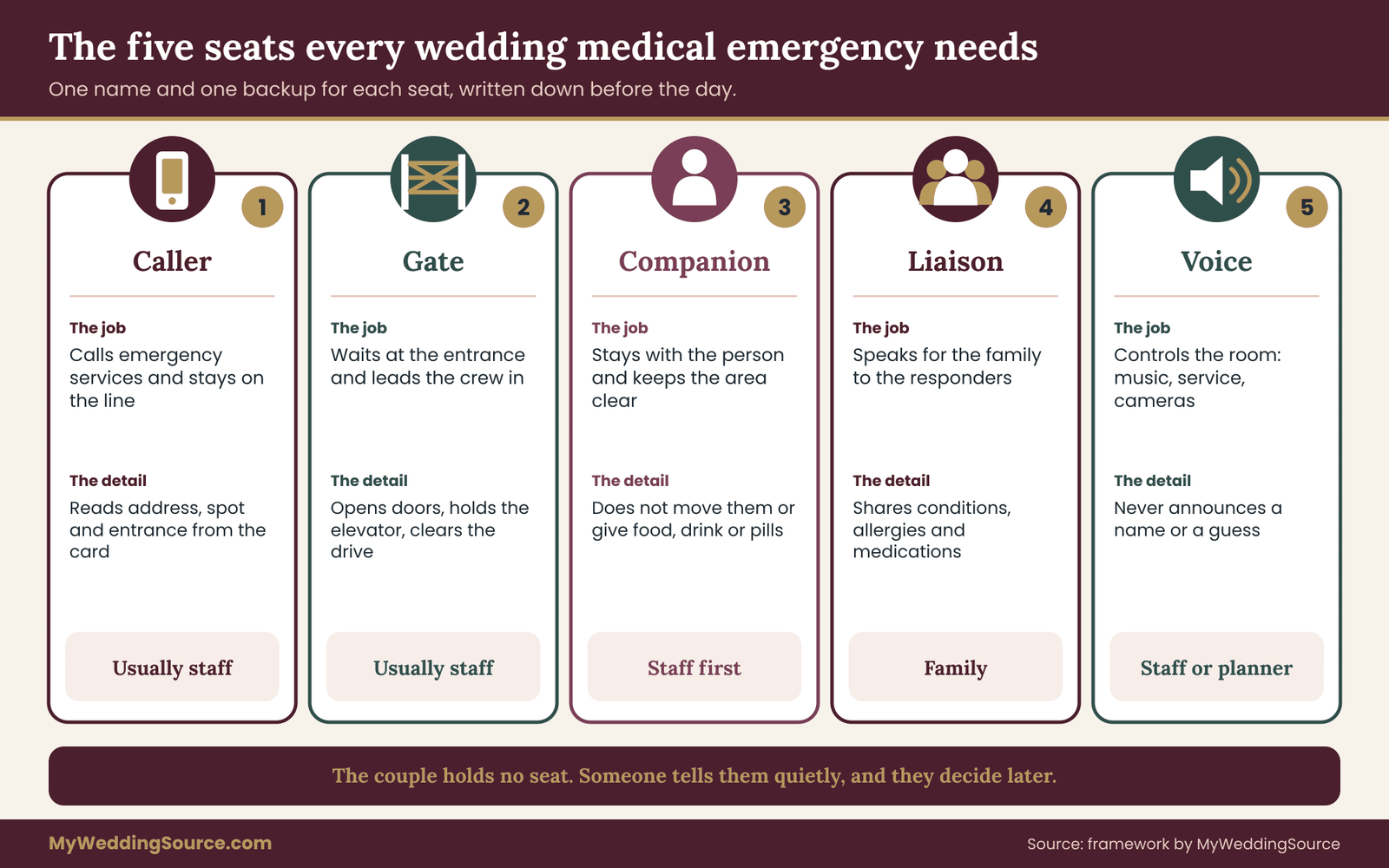
The core of this guide is a simple structure. Every wedding medical emergency, from a fainting guest to a serious event, needs five jobs filled within the first minutes. Think of them as seats at a table. If one seat is empty, someone stands up from another seat to fill it, and the job they left goes undone. The plan simply names a person for each seat and a backup, in advance.
Seat one: the caller. This person phones emergency services and stays on the line until the dispatcher says they can hang up. The caller needs four facts in front of them, not in their head: the full street address as emergency services would look it up, the specific spot within the property, the best entrance for an ambulance, and a callback number. The caller does not decide how serious the event is. They report what they can see and answer the dispatcher’s questions, which are designed to sort severity on the phone.
Seat two: the gate. The gate person goes to the entrance and waits for the ambulance or fire crew, then leads them to the patient. On a large estate, in a hotel, a museum or a barn down a rural road, this single job can save several minutes. The gate person opens any locked door, holds any elevator, clears a path through guests and keeps cars from blocking the drive. They are also the person who knows the quickest route and is willing to walk it fast.
Seat three: the companion. The companion stays with the patient. They are not the treating person. They stay close, keep the patient from being alone, keep onlookers back, bring water or a chair if the dispatcher or a trained responder advises it, and relay the patient’s own words to whoever is helping. If the patient is a guest who arrived with family, the companion makes sure a family member is brought over quickly, and then makes space.
Seat four: the liaison. The liaison is the family’s voice to the responders. Where the patient has family or friends present, the liaison is the one who speaks for them about medications, allergies, conditions and who to call. Where the patient is a stranger in the room, such as a vendor, the liaison seat belongs to the employer’s supervisor. The liaison carries the patient’s belongings, the phone numbers and, if the patient is taken away, goes along or arranges for someone to follow.
Seat five: the voice. The voice controls the room. That person tells the DJ or band to lower the music, asks the photographer to stop shooting in that direction, has servers hold service in the affected area, and quietly keeps the rest of the guests informed in a calm and minimal way. The voice also decides, with the couple and the venue, whether the evening pauses. The voice does not make announcements about the patient.
Why five seats and not three or ten? Because each one has a different location and a different skill. The caller must be able to speak clearly and read from a card. The gate must be mobile and not in the middle of a dance. The companion must be calm and willing to sit still.
The liaison must know the patient. The voice must have authority over the music and the schedule. When one person tries to fill two seats, the clearest failure is the caller who also goes to the gate: the call ends too early, or the gate is unattended.
The seats also serve a second function: they give everyone else something to do, which is nothing. A guest who is not holding a seat can step back, which is a genuine contribution. Crowds make every job harder. A short announcement to the wedding medical emergency plan’s owners, and a line in the guest-facing materials about following staff directions, means most people will see the structure working and will not hover.
Who holds which seat
The default assignment is easy to remember: staff take seats one, two, three and five; family take seat four. Staff take the call and the gate because they know the address, the doors and the building. A staff member takes seat five because they have the authority to cut music, hold service and coordinate with the vendors.
The companion seat is the only flexible one. In the first minute it is whoever is closest. After that, if a trained staff member is not available, it can move to a calm friend or relative of the patient.
Family hold seat four because only they know the patient. That does not mean the couple. The couple are the people least able to hold any seat, since they are the center of attention, they are dressed for photographs, and they are likely to be the people most upset by the situation. Do not assign the couple a seat. Assign them a quiet message instead. The voice, or a trusted friend, tells them what is happening, and they decide only what they want to do about the rest of the evening.
Put a name and a backup beside each seat. A backup matters more than people expect. The first-choice caller may be in the restroom, may be the patient, or may be three tables away with a drink in each hand. Choose a backup who is physically somewhere else, ideally a different category of person. If the first caller is the venue’s event manager, the backup might be a lead server or the planner.
Seat cards, in plain words
Give each seat a short card of three lines. Cards can live on the one-page sheet or be printed in small type and handed to the person on the day. A card for the caller might say: what you do, what you need, who covers you. The caller card reads: “Call emergency services. Read the address and entrance from the sheet. Stay on the line. Backup: the lead server.” The gate card reads: “Go to the main entrance now. Wait for the crew. Bring them to the location the caller gave.”
The companion card reads: “Stay with the person. Keep the area clear. Do not move them unless the dispatcher or a responder says so. Do not give medicine.” The liaison card reads: “Find the person’s family or friends. Tell responders about conditions, allergies and medications if you know them. Keep their belongings together.” The voice card reads: “Lower the music and hold service near the area. Brief the photographer. Do not announce anything about the person.”
Notice how little each card asks. A single clear verb, a short boundary, a backup. The cards do not explain medicine and do not ask anyone to take risks. They are also short enough to pass the test of the busiest staff member: could they read it between two plates?
Some details deserve a line of their own because they are where the wedding medical emergency plan usually breaks.
The address. People who work at a venue every week often know it by a nickname, “the Garden Room” or “Barn B,” and say that to the dispatcher. Dispatchers need the street address and, for a large property, a point where the crew can meet someone. Write the actual address, the gate or entrance the crew should use, and a nearby cross street or landmark if the property is hard to find.
Mobile phones may not always give emergency services the caller’s exact position, so the caller should be ready to state the location rather than assume it is known.
The spot inside the property. “The terrace” is not specific if there are two terraces. Name the area plainly, give a landmark, and note whether the crew needs to pass through a kitchen or a loading dock. The gate person should know the route before the day, which is a reason to walk it during the venue walkthrough.
The venue technical walkthrough guide explains how to measure and test access routes, and that same visit is the place to time how long it takes to walk from the front door to the ballroom.
The callback number. Responders sometimes call back. The caller’s phone should be on and unmuted, and the number on the card should be one that someone will actually answer. A planner’s phone that is in a bag in the bridal suite is not a plan.
What each seat must never do
Boundaries are as important as duties, and they protect the people holding the seats.
The caller does not tell the dispatcher what the diagnosis is, only what they see. The gate does not leave until the crew arrives, even if the patient’s family begs for a status report. The companion does not give food, drink, pills or home remedies. They also do not move the person unless the dispatcher, a trained responder or immediate danger requires it.
The liaison does not guess about conditions or medications. A confident wrong answer is worse than “I do not know, but his wife is on her way.” The voice does not announce a name, a diagnosis or a guess.
Nobody in any seat promises that the patient will be fine. It is the kindest instinct and the most dangerous sentence. “Help is on the way, and I am staying with you” is true, specific and enough.
Training helps, though it is not required for the wedding medical emergency plan to work. The American Red Cross and the American Heart Association run first aid, CPR and AED courses for the public. If a vendor lead or a family member has a current certificate, note it on the sheet. That does not change the seat structure, but it can help decide who takes the companion seat.
A certificate holder should still call emergency services first and follow the dispatcher’s guidance. Rules about helping at an accident, sometimes called Good Samaritan laws, differ by state, so do not assume protection applies. If the question matters to you, ask your venue or a local attorney.
Taken together, the five seats of a wedding medical emergency are a small piece of choreography. They take five names, five short cards and one conversation with the venue. They are easy to test: ask each person to say aloud what they would do in the first sixty seconds. If any answer is “I would go find someone,” the card needs one more line.
Staff roles in a wedding medical emergency: venue, vendors and day-of lead
Most weddings involve more paid people than couples realize. A typical evening might have a venue manager, a few servers, a bartender, a caterer’s lead, a DJ or band, a photographer, a videographer, a planner or day-of coordinator, a florist who stays for the ceremony and sometimes a security or valet team.
Every one of them can be the first person who sees a wedding medical emergency, and every one of them has a different view of the room and a different set of limits. A staff plan works by giving each role one narrow job.
The aim is not to turn vendors into paramedics. It is to make sure that, within the first minute, the right person has the call, the right person has the gate and the right person has the room. Staff also need permission to act, and the clearest way to give permission is in writing, ahead of time, through the venue and each vendor.
The venue manager or event lead
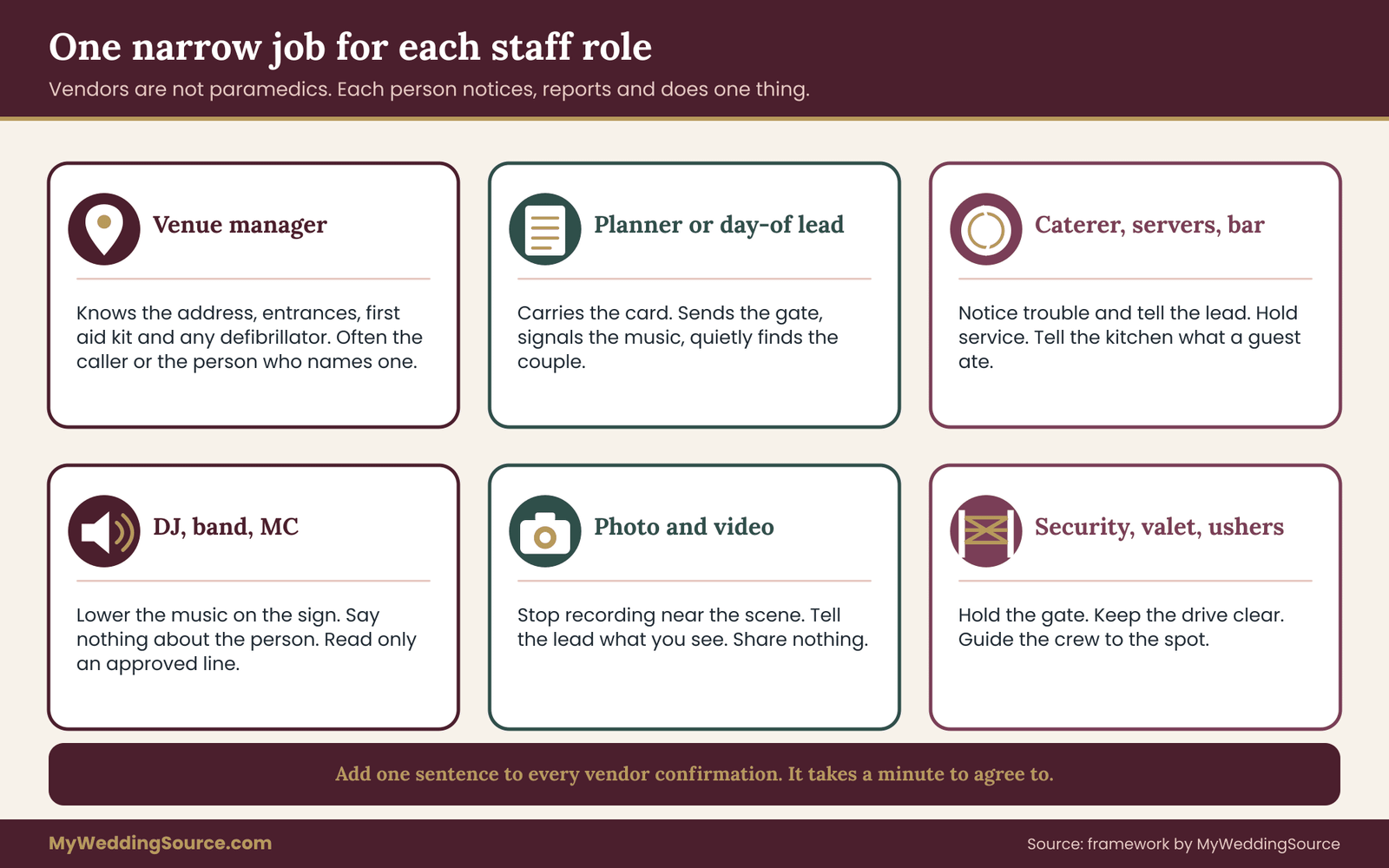
The venue’s event manager is the natural holder of the caller seat or the person who decides who is. They know the legal address, the entrances, any rules for emergency vehicles and where the building’s safety equipment is kept. Many venues already have an emergency procedure, and some have staff with first aid or CPR training.
Ask for it. A good question to put to the venue is: “If a guest needs medical help during our event, who on your team makes the call, who meets the ambulance, and where is the nearest defibrillator, if you have one?”
The venue manager may also be the only person who can authorize a pause: stopping service, unlocking a side door, clearing a hallway, or moving the party to a different room. Put that authority on the sheet in plain terms. When the manager and the couple’s family disagree about whether to pause, the wedding medical emergency plan should already have said who decides.
Some venues have a house policy that the venue’s staff call emergency services and their own procedures take over. That is normal and sensible. In that case your plan fits inside theirs, and your role is to supply the information they do not have: which guests have known needs, who the family contacts are and who on your side is the liaison.
The day-of lead or planner
If you hired a planner or day-of coordinator, that person often holds the voice seat, or the call seat when the venue has no event manager of its own. A planner’s value in a wedding medical emergency is orchestration. They send the usher to the gate, tell the caterer to hold the next course, ask the band to pause and quietly find the couple. They also carry the sheet, so that the first question from any staff member, “who do I tell?”, has the same answer every time.
If you do not have a planner, name a friend or relative as the day-of lead, and make the job explicit. A day-of lead should not also be in the wedding party, should not be drinking heavily and should have a charged phone. They should know the wedding medical emergency plan well enough to explain it in thirty seconds.
A wedding vendor contract is a good place to check what each vendor has actually agreed to do on the day, since a clause about cooperating with the day-of lead is easier to ask for before signing than after.
Caterer, servers and bartenders
Food service staff are on their feet, near the guests and trained to notice trouble. They are also the group most likely to see choking, food reactions and intoxication. Their job in the wedding medical emergency plan is to notice and report. A server who sees a guest in difficulty should alert the nearest lead, not run a one-person rescue. The caterer’s lead can then call the venue manager, hold the course and make sure the kitchen knows.
Food allergies are the best-known overlap between catering and medical response. The caterer should know which guests have serious allergies and how those guests were marked. The wedding medical emergency plan should name who tells the kitchen when a reaction is suspected, so the kitchen can identify what the person ate. This is information for responders and for the family liaison. It is not a reason for servers to guess about treatment.
Bartenders see another category of risk. A guest who has had too much, or who is mixing alcohol with medication, may need a quiet intervention: water, food, a seat and a companion. Many bar teams already have a policy, and some jurisdictions have rules about service to intoxicated people. Ask the bar manager what they do, and who they tell. The wedding medical emergency plan should state that a bartender who has concerns tells the day-of lead, who assigns a companion. The bartender does not argue with the guest in public.
DJ, band and MC
The voice seat often belongs, practically, to whoever controls the sound. Music makes everything harder: it makes it hard to hear a call for help, hard to hear a dispatcher and hard for the gate person to find the patient. The simplest instruction in the staff plan is this: when the day-of lead gives the sign, the music goes down or stops. Agree the sign in advance, such as a raised hand or a short message to the DJ’s earpiece or phone.
The MC or DJ should also know what not to say. Announcements like “is there a doctor in the house?” are tempting and sometimes appropriate, but they also scare people and draw a crowd. If the day-of lead or venue manager decides that asking for medical help from the room is wise, they authorize the exact words.
Otherwise the DJ lowers the music, keeps a calm tone and carries on with something quiet. If the situation calls for a longer pause, the voice seat tells the DJ what to say, and it is short: “We are going to take a short break. Please stay where you are, and thank you for your patience.”
For the ceremony itself, the officiant and the musicians hold a similar role. A guest who faints during vows has not ruined anything, but the officiant needs to know whether to pause. The ceremony cue sheet guide is a useful companion here, because a cue sheet that already names who can hold the ceremony and who gives the signal makes a medical pause one more cue rather than an improvisation.
Photographers and videographers
Photographers and videographers are often the best-placed observers, since they move around the room and have a view of everyone. They are also the people most likely to keep shooting. Their instructions should be brief: if you see someone in difficulty, tell the day-of lead; if a medical response is underway, stop photographing that area and hold.
Do not post anything from the scene. The planning questions around images, consent and what the family wants kept private are covered in the site’s guide to wedding photography consent. It is worth a line in the photographer’s brief: “In a wedding medical emergency, stop recording near the patient and wait for our lead’s instruction.”
A professional photographer can also help in an unexpected way. They are usually calm, they often carry a phone and they tend to know where the family members are. If the photographer’s contract allows it, they can bring a relative of the patient to the liaison seat. But their first duty is to their camera’s silence, not to the incident.
Security, valets and parking staff
Where a wedding has a hired security guard, valet team or parking attendants, those people are natural holders of the gate seat. They are at the entrance, they can see arriving vehicles, and they can clear the drive. Make sure they have the sheet, or at least a card with the address, the gate instruction and who to call. Parking attendants in particular are easy to forget, and they can be the difference between a clear drive and a blocked one.
If you have no security, the gate usually falls to an usher or a vendor’s assistant. The point is that someone is assigned, not that the person is trained. For a larger wedding, a short briefing before the first guest arrives pays off. The same logic applies to staffing the whole day: a medical role is one more line in a staffing chart, not a separate system.
Putting staff roles into contracts and briefings
Staff plans work better when vendors are not hearing about them for the first time at 4 p.m. on the wedding day. Four small steps help.
First, ask the venue for its emergency procedure and the name of the on-site emergency lead for your date. If a procedure exists, ask for a copy or a summary, and share your contact sheet with the same person.
Second, add one sentence to each vendor’s final confirmation: “If a guest or staff member needs medical help during the event, please alert our day-of lead first, and follow the venue’s procedure. Please stop recording and lower noise near the incident.” The sentence is short, it is easy to agree to, and it makes the later conversation shorter.
Third, run a five-minute briefing for the staff on the day. Introduce the day-of lead, say where the sheet is kept, and state the three lanes. Ask the lead servers, the DJ and the photographer to repeat back what they would do. This is the most valuable five minutes in the wedding medical emergency plan.
Fourth, decide how staff will communicate. A group text can work, but it is noisy; a short list of two-way radios may be available from the venue or the planner; a plain phone call from the caller to the day-of lead is often best. The wedding-day digital contingency plan goes through backup communication channels in detail, including what to do when cell service is weak.
Where staff roles run out
Staff cannot be everywhere, and they are not trained or licensed to act as medical staff unless a particular person says so. A caterer’s lead is not an emergency medical technician. A planner is not a nurse. If someone on the team does have a medical background, such as a guest who is a nurse, treat that as a welcome extra and not as a plan.
A professional who volunteers in an emergency may help the dispatcher, but they are also a guest, who has not agreed to be on call and who may have had a drink. The wedding medical emergency plan does not rely on them.
It is also true that some venues have thin staffing. A home, a field or a rented hall may have nobody on the premises except the caterer. In those cases, family and friends fill more seats, and the plan leans on advance practice. The later section on failure conditions returns to this. For now, the main lesson of the staff roles is that each person needs one clear job, a plain permission and a backup, and that most of the work can be done by asking questions weeks before the date.
Family roles in a wedding medical emergency: who steps up and who steps back
Family members at a wedding carry a double load. They are guests, they are hosts and they are often the people most emotionally invested in the day. In a wedding medical emergency they are also the group most likely to cluster around, to give conflicting instructions and to make quiet decisions on behalf of someone who has not asked them to. A good plan gives family two kinds of instruction: a very small set of jobs for a few named people, and a clear, kind request for everyone else to step back.
The aim is not to exclude family. It is to point their energy at the one thing only they can do, which is to know the patient, and to protect them from the things that make the situation worse, such as crowding, guessing and filming.
The family liaison
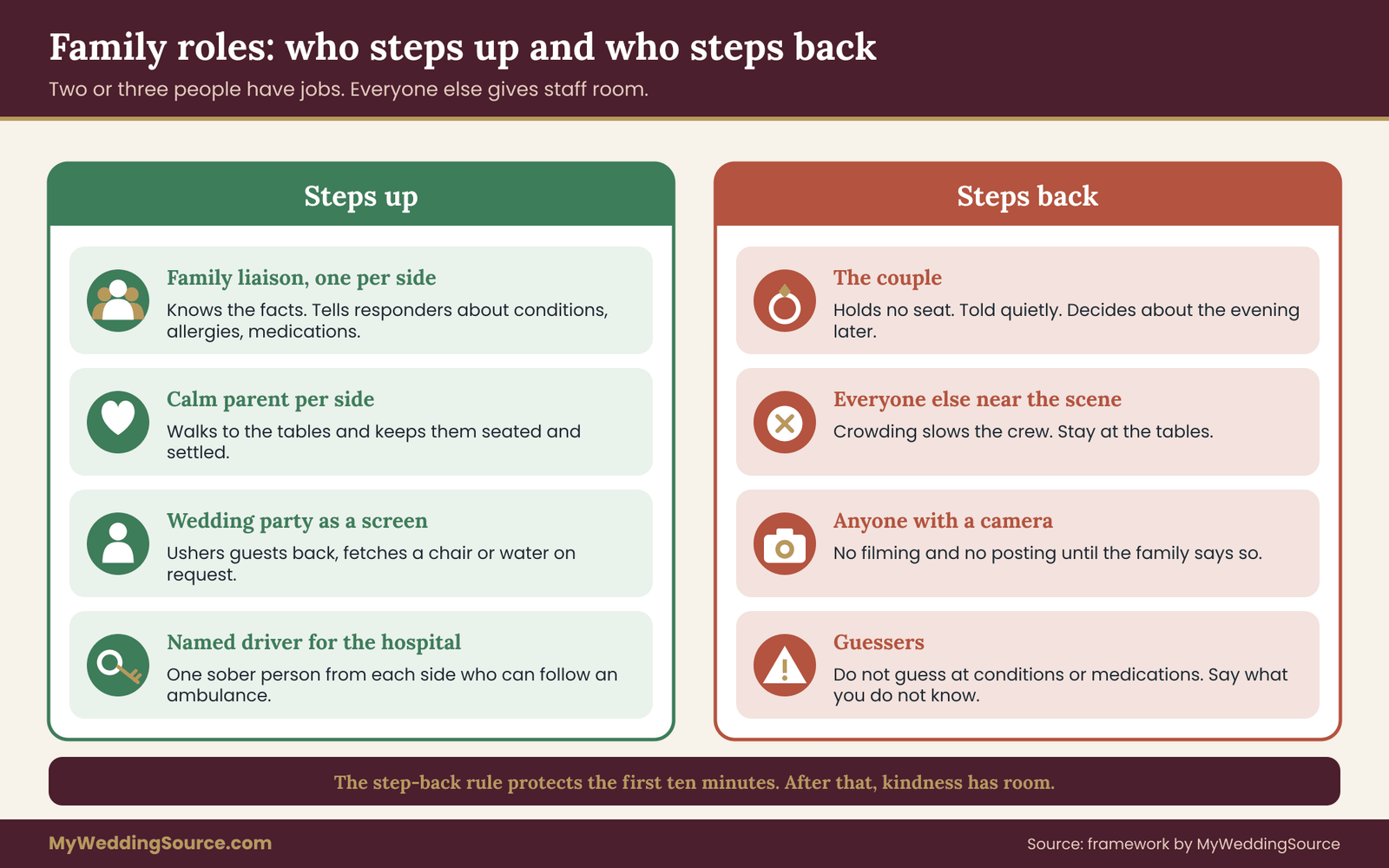
The liaison seat is the family’s most important contribution. This person is not the patient’s closest relative, who may be too distressed, but a calm family member or friend who knows the facts and can speak clearly. Ask one person on each side of the couple’s family to hold the liaison seat for their relatives. A third liaison, perhaps a friend, can cover guests who came without family.
The liaison’s job is narrow. Find the people who know the patient. Collect what they know about conditions, allergies and medications. Tell the responders those facts when they arrive, and say what is unknown. Keep the patient’s bag, phone and jacket together. Arrange who will go with the patient if they are taken to hospital, and who will follow with the patient’s belongings. Make the phone calls to the patient’s family, and keep the calls short.
The liaison does not make medical decisions, does not tell the responders what to do, and does not speak to the crowd. They also do not post, text or share the news outside the family until the family has agreed. That last rule feels odd until it is tested: within a few minutes of an ambulance arriving, guests start texting friends who are not at the wedding. A liaison who says, “Please let the family share news when they are ready,” is protecting the patient.
Parents and elders of the couple
Parents of the couple are usually the most trusted people in the room. Because they are trusted, the wedding medical emergency plan should give them a specific job rather than leaving them to improvise. A common and effective assignment is to have one parent per side act as a calm presence for guests: walk to the nearest tables, say “the staff are handling it, please stay seated,” and give people a reason to stay put.
That job is real. It reduces crowding, it prevents rumors and it gives the staff room. Parents who try to hold the companion seat for a guest they barely know often find they cannot do both the emotional and the practical task. Make clear in advance that stepping back is the supportive choice, and say so kindly. Something like, “Your most helpful role in an emergency is to keep the tables calm. The venue has the rest.”
If the patient is a parent or grandparent, the situation changes. The family may be both liaison and patient’s relatives at once, and the wedding medical emergency plan should have named a second liaison who is not related to the patient. That person speaks to responders while relatives are with the patient.
The couple
The couple’s role is simple and often hard to accept: they do not hold a seat. A couple in wedding clothes, with the attention of everyone in the room, cannot help the patient and are likely to make the room more anxious. They also should not be left to find out from rumors.
The wedding medical emergency plan should assign someone to tell the couple quietly. That person, usually the day-of lead or a close friend, explains what is happening in a sentence or two, says who is handling it and asks them to stay in a safe, quiet place. The couple’s decisions come later: whether to pause, whether to continue, whether to say anything to the guests.
The next sections cover those decisions in detail. For now, the useful message to the couple is, “You do not need to do anything. Several people are on it. We will tell you as soon as there is news.”
Couples often ask how to say this to their families without sounding as if they are giving orders. A short note in the wedding medical emergency plan, shared with the wedding party and parents a few weeks ahead, solves most of it: “If someone needs medical help during the wedding, the venue staff and our day-of lead will handle the call. We have asked a few people to help. Everyone else, please give them space. We would rather have a quiet room than a crowded one.”
The wedding party
Bridesmaids, groomsmen and other attendants are often the most visible helpers. They are also the group most likely to feel that they must do something. Give them a job that fits: ushering guests away from the area, bringing a chair or water if the companion asks, fetching a coat, standing between the patient and the crowd, or meeting the ambulance as a second gate person. The best use of a wedding party in a wedding medical emergency is as a screen and a messenger, not as a medical team.
A wedding party member who has medical training, such as a nurse or a paramedic, may feel strongly pulled to help. Agree in advance, kindly, that they will help if asked by the responders or the dispatcher, but that they are also a guest and have no obligation. The wedding medical emergency plan does not rely on them, and they should not feel judged either way.
Guests who need support in their own right
Some guests have conditions that mean they are more likely to need help, and some guests want to share that information in advance. Older relatives, a guest with a heart condition, a guest with severe allergies, a pregnant guest or a guest with diabetes may all be glad to tell a trusted family member where their medication is kept and what to do. Others will not, and that is their right.
Ask gently, ahead of time, and keep answers private. A short line on the RSVP or in a personal message, such as “If there is anything we should know to help you be comfortable, tell us or [name], and we will keep it private,” is enough. The guide to guest care for children, older relatives and others covers how to ask about needs without turning every invitation into a form.
Share only what the wedding medical emergency plan needs. The day-of lead and the liaison need to know that a guest has a severe allergy or a condition that may need a quick response. They do not need a medical history. The caterer needs to know about allergies. Nobody needs the information posted, printed on a seating chart or mentioned in a toast. A guest who has told you something in confidence has trusted you with it.
Children and young relatives
Children are sometimes the patient and sometimes the witness. If a child is hurt or ill, the wedding medical emergency plan should say which adult is responsible for them and how to reach that adult at once. A child who sees a relative in trouble needs an adult, not an explanation. Name a family member or a childcare helper whose single job, during any incident, is to keep the children together and away from the scene, with something to do.
A basic rule that can be spoken to any child on the day: “If someone looks unwell, tell a grown-up. Do not try to help yourself.” It is worth saying aloud at the start of the event to the children who are old enough to follow it.
The family step-back rule
The most important family instruction is the shortest. In a wedding medical emergency, the default for any family member who does not hold a seat is to step back and stay calm. It is easy to say and surprisingly hard to do when someone you love is involved.
Write it down in friendly words and share it with the people who matter. A helpful phrase for the family message is: “If something happens, please give the staff room. If you want to help, ask the liaison what is needed.” Together with a named liaison and a calm parent per side, it keeps the circle around the patient small and the room orderly.
Nothing here removes the human side. People will want to comfort the patient, sit with the family and say a prayer. The companion and the liaison can make room for that once the responders have what they need. The wedding medical emergency step-back rule protects the first ten minutes. After that, kindness has plenty of space.
The first five minutes: a script for a wedding medical emergency
All the planning in the world comes down to a few minutes at the start. The first five minutes of a wedding medical emergency are the only part that cannot be improvised, because they happen quickly and with people who are frightened. A script helps. The script below is not a medical procedure. It is a sequence of coordination steps, written so that anyone holding a seat can recite it.
Read it aloud during the staff briefing. If you can say it from memory, you can run it.
Minute zero: notice and speak. Whoever notices a guest in difficulty goes to the person, asks, “Are you all right?” and listens. If the person is alert and says they are fine but looks unwell, treat it as green or amber and tell a staff member. If the person cannot answer, does not respond, cannot breathe, or the situation is frightening, treat it as red.
Shout for help or send a bystander with a specific request: “You, in the blue jacket, go to the manager and say we need an ambulance at the garden terrace.”
Specific, named requests work better than general calls. People in a crowd tend to assume someone else has acted. Pointing at one person and giving one task breaks that pattern.
Minute one: the call. The caller, or the nearest person if the caller is not there, calls emergency services. The call goes roughly as follows. State what happened in plain words: “A guest has collapsed and is not responding.” State the address and the exact location, from the card.
State the entrance. Answer the dispatcher’s questions. Do not hang up until told. If the caller is on a mobile phone, they can put it on speaker and carry on with the dispatcher’s instructions, which may include steps for a trained or untrained helper to follow.
The dispatcher is the only person on the scene who is trained to sort the situation by phone, and they will often ask questions that feel strange. Answer them. Resist the urge to say “he’s fine” if it is not clear. The caller’s job is to report, not to reassure.
Minute one, in parallel: the gate and the companion. While the caller speaks, the gate person leaves for the entrance. The companion stays with the patient, keeps people back and asks someone for the family. If the dispatcher gives instructions for helpers, the companion, or a trained helper if one is present, follows them. If nobody is trained, the dispatcher can still guide the caller through what to do and what not to do.
Minute two: the voice. The voice seat quiets the room. The music goes down. The photographer stops. Servers hold the next course. The voice does not announce anything. If a crowd has gathered, the voice asks the wedding party and two or three ushers to form a loose screen and to ask people, kindly, to return to their seats. If the incident is in a corner or a side room, the rest of the room may not need to know anything at all.
Minute three: the liaison and the couple. The liaison finds the patient’s family or friends. The day-of lead, or a friend, quietly tells the couple. The couple are told in a sentence, with a name of who is handling it. They are not asked to do anything.
Minute four: the information handoff. The liaison collects the facts: conditions, allergies, medications, any food or drink consumed, the time the problem began, and who to call. The dispatcher may also ask for those details, so the liaison and caller should be close to each other. Write the facts on a card if possible, since responders will want them in one place.
Minute five: the crew arrives. The gate person leads the crew to the patient. The companion steps back and tells the crew what they saw. The liaison gives the facts. The caller confirms that the call is complete. The venue manager clears the path. From this moment, trained responders are in charge of the patient. Nobody else directs treatment.
After minute five, three questions remain: does the event pause, who goes with the patient, and who tells the guests what? The next sections answer them.
A few small pointers help the script work in practice.
Say the location the same way every time. If the caller says “the terrace” and the gate says “the patio,” the crew goes to the wrong place. Use the names on the card, and teach them to everyone with a seat.
Keep your phones out for the call and for nothing else. During an incident, phones are for the caller, the liaison and the day-of lead. Everyone else can put them away. Filming is the usual temptation, and it is the one the wedding medical emergency plan should name outright.
Do not move the patient unless there is immediate danger, such as a fire, or unless the dispatcher or a trained responder says so. It is hard to leave someone on the floor of a ballroom, and it is usually right.
Do not give food, drink or medication unless the dispatcher advises it or the person is fully alert and has asked for their own medication. If a guest asks for their own prescribed medication, such as an inhaler or an epinephrine auto-injector, helping them reach it is reasonable, and the caller should tell the dispatcher. Where the person cannot ask, follow the dispatcher.
Resist the urge to send someone to drive the patient. An ambulance is faster than a private car, brings trained crew and does not leave the patient alone in the back seat. The dispatcher will say if there is any reason to do otherwise.

The one-page contact card for a wedding medical emergency
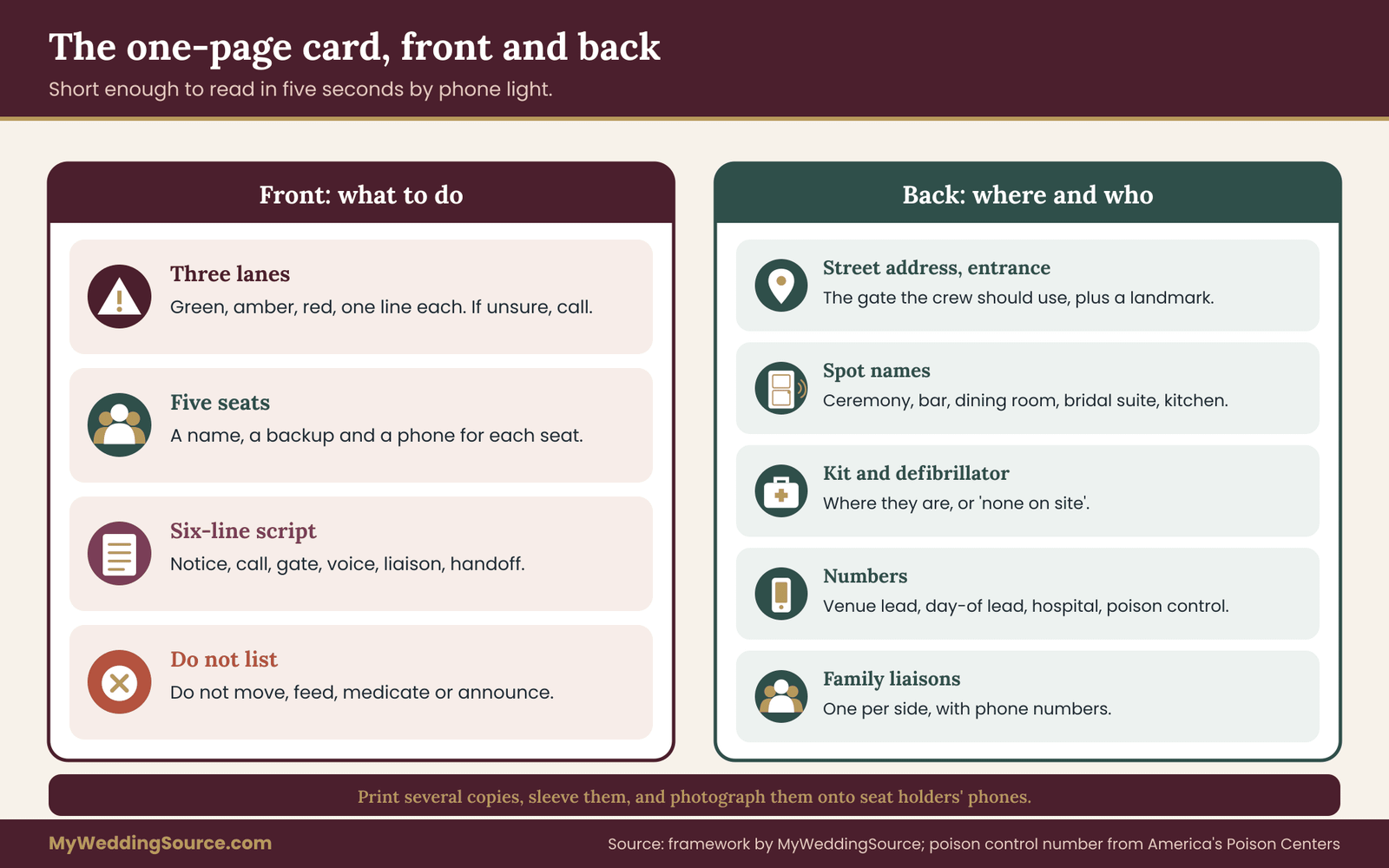
A plan that lives in someone’s head fails the moment that person is the patient, or is out of the room. The plan needs to be on paper, short and in more than one place. A one-page contact card does the work. It is not a binder or a manual. It is a sheet that fits on one side of letter paper, with a second side for contacts, printed in a size that can be read in a dim room.
The card is the written form of the five seats of a wedding medical emergency. It also doubles as the emergency service contact plan: the information a caller needs, in the order a dispatcher is likely to ask for it.
Front of the card: what to do
The front carries three blocks.
The first block is the three lanes in one line each. “Green: tell a staff member, offer water and a seat. Amber: tell the day-of lead, a companion stays, someone calls. Red: call emergency services now.” Then one more line: “If you are unsure, call.”
The second block is the five seats of a wedding medical emergency with a name and a backup for each. Use names that people will recognize on the day, and add a description, such as “Marcus (usher, grey suit)”. Include the phone numbers of the people who hold seats one, two and five, since those are the people others may need to reach.
The third block is the first-five-minutes script in six short lines, the same lines as in the previous section. Do not lengthen it. A longer card will not be read.
Back of the card: where and who
The back carries the facts a caller needs.
The full street address of the venue as emergency services would use it. If the venue has more than one building or gate, name the one the crew should use.
The specific place on the property for each area where the event happens: ceremony site, cocktail space, dining room, dance floor, bridal suite, kitchen, parking. Beside each, the nearest entrance and a landmark.
The location of the first aid kit, and, if the venue has one, the automated external defibrillator, which is a portable device that gives voice instructions to a rescuer. Where the venue does not have one, write “none on site,” so that nobody searches for it.
The numbers for the venue’s emergency lead, the day-of lead and the caterer’s lead. The number for poison control in the United States is 1-800-222-1222, which routes to a regional center, and is useful for an ingestion or a reaction question that is not an obvious emergency. Check it with the official poison control site before printing. The nearest hospital emergency department and urgent care, with addresses, for non-emergency needs and for the person following an ambulance.
A line with the names of the family liaisons, and the phone number of each.
A line that says, in words, “Do not post or share anything about an incident until the family says so.”
Once the card is ready, send it to the venue manager and the day-of lead for review. They will almost certainly correct something, such as an entrance name or a number that has changed. That is the point.
Where the card lives
Print more than one copy. Give one to the day-of lead, one to the venue manager and one to the caterer’s lead. Keep one at the DJ booth and one at the front desk or the gate. Take a photo of it on the phones of the people who hold seats, so they can find it without hunting. If the venue uses a staff briefing board, post one there.
The wedding planning checklist puts the card in context as one of the final documents to circulate in the last couple of weeks. The same circulation can include the vendor timeline, the seating chart and the run of show. The vendor timeline is a useful place to add the line “contact card shared with all vendors” next to the arrival times.
Questions to ask the venue
The card gets better with answers from the venue. These questions are quick, and a good venue will welcome them.
Who is the on-site emergency lead for our date, and where will that person be during the event?
What is your procedure if a guest needs medical help? Who calls emergency services? Who meets the crew?
Where is the nearest first aid kit and automated external defibrillator, and who knows how to use it?
What is the best entrance for an ambulance, and is there a point on the property that the crew has trouble reaching, such as a locked gate, a long drive or a steep path?
Do you have a policy for incidents involving alcohol, and who do we tell if we are worried about a guest?
Is cell service reliable throughout the property? If not, where is the landline or the reliable signal?
What do you ask us to do after an incident? Is there a report, and who fills it?
Does your insurance or your contract say anything about how incidents are handled, and what do you need from us?
Write the answers on the card. If a venue cannot answer these, treat that as information, and plan to fill the gaps yourself.
Making the card usable at night
Plans written at a desk in daylight run into trouble in a dark ballroom. Print the card in a font large enough to read by phone light. Keep the front free of anything decorative. Laminate or put it in a sleeve for the staff copies, since drinks spill. And test it: hand a copy to a vendor lead who has not seen it and ask them to read the caller’s lines aloud. If they stumble over something, change the card.
A worked case: a guest collapses at the cocktail hour
The following example is invented. It is not a report of an actual event, and the names and details are made up to show how the five seats of a wedding medical emergency and the lanes work together. It uses a plausible venue: a garden estate with a main house, a terrace, a lawn with a tent and a long driveway.
The setup. Priya and Daniel are marrying at the estate with ninety guests. The couple’s contact card names the venue’s event manager, Dana, as caller, with the lead server as backup. A groomsman, Marcus, holds the gate. The planner, Lee, holds the voice. The family liaisons are Priya’s aunt for her side and Daniel’s brother for his.
The card lists the address, the main gate as the ambulance entrance, the terrace as “the terrace behind the main house, reached through the white gate on the left,” and a defibrillator in the house hallway.
Minute zero. During the cocktail hour, a server notices an older guest sitting on a terrace bench, gray in the face and not answering when spoken to. The server crouches, asks, “Are you all right?” and gets no clear reply. This is red by the card’s definition. The server turns to the nearest guest and says, “Please find Dana, the manager, and say we need an ambulance at the terrace.” Then the server stays.
Minute one. Dana is on the lawn. She hears the message, moves quickly and calls emergency services from her phone while walking. She reads from her card: the address, “the terrace behind the main house,” and “ambulance entrance is the main gate.” She answers the dispatcher’s questions and stays on the line. She speaks to Lee by text as she walks: “Red. Terrace. Gate and voice please.”
Marcus is already near the main gate. Lee texts him: “Red at the terrace. Please wait at the main gate for the ambulance.” Marcus goes to the gate and stays.
Minute two. Lee walks to the DJ, who is playing low background music, and makes the agreed sign. The DJ turns the music down to almost nothing. Lee asks the photographer, who is near the terrace, to stop shooting that direction and to find the couple’s families. The photographer lowers the camera and walks toward the lawn. Servers near the terrace hold their trays and steady the crowd.
At the bench, the server stays with the guest. A lead server arrives to be the companion and asks two guests to step back. Dana, on the phone, relays the dispatcher’s instructions to the people at the bench.
Minute three. Daniel’s brother, the liaison for his side, is found by the photographer and learns that the guest is Daniel’s great-uncle. He goes to the terrace and speaks to the lead server. He does not know the great-uncle’s medications, so he finds the great-aunt, who is seated near the cake table, and brings her over calmly. Lee, meanwhile, has found Priya and Daniel and told them quietly:
“A guest is unwell on the terrace. The staff and a family liaison are with him, an ambulance is coming. You do not need to do anything. We will tell you more shortly.” They ask who it is. Lee tells them. Priya’s mother is asked to go to the tent and keep the tables calm.
Minute four. The great-aunt tells the liaison and Dana, who is still on the line, about his heart condition and his medications. The liaison writes them on the back of a napkin because nothing else is at hand, which is a good reminder to keep a card and pen at the gate and in the liaison’s pocket.
Dana passes the details to the dispatcher. The lead server has the defibrillator question answered by the dispatcher: whether to fetch it depends on what the dispatcher advises, and a second server is sent to bring it from the hallway, in case.
Minute five and after. The ambulance arrives at the main gate. Marcus leads the crew down the path and through the white gate to the terrace. The lead server steps back and tells the crew what happened. The great-aunt and the liaison give the facts. The crew takes over. Dana ends the call when told.
The crew takes the great-uncle to the hospital. The great-aunt goes with him in the ambulance if allowed, or follows with her niece, who was named as a driver in the card. Daniel’s brother goes with them as liaison and phones the family.
The pause decision. Back at the venue, Lee, Dana and the couple’s parents talk quietly. The couple is asked whether they want to continue. They decide to pause the party for twenty minutes, tell guests the family is with the guest and the hospital, and resume with a quiet toast to their great-uncle, with no announcement of what happened. The DJ is told to keep the music low until further notice. The photographer is asked not to photograph the terrace and not to post.
What worked. The server told someone specific. Dana had the card. Marcus was at the gate within a minute. The music dropped quickly. The family liaison knew who to find. The couple heard it from Lee, not from a rumor.
What could have gone wrong. If Dana had not had the card, she might have given the dispatcher a nickname for the terrace. If the gate had been unattended, the crew might have gone to the front of the main house. If the photographer had posted a photo, the family would have learned the news from a stranger. If the liaison had guessed about medications, the dispatcher would have heard the wrong thing.
What the couple learned. The next day, Priya and Daniel update the card with a note about carrying a notepad at the gate, and ask the venue to add the defibrillator’s location to its own sheet. They also add a line to their thank-you notes for the staff, since three people did hard work without being asked.
The case shows the same structure as the wedding medical emergency plan. It also shows how small the assignments are. No one in it did anything heroic. They did their one job, and the system did the rest.

After the call: pausing, continuing and privacy in a wedding medical emergency
Once responders have arrived and the patient is in their hands, a different set of questions begins. They are not safety questions. They are about the event, the family and the people who watched. A plan that stops at the ambulance leaves the couple to improvise at the moment they are least able to.
The pause decision
Does the wedding stop, slow down or carry on? There is no universal answer, and the wedding medical emergency plan should not pretend there is. What the plan can do is set out who decides and what they consider.
The decision has two layers. The first layer is practical and belongs to the venue manager and the responders: whether the area must be cleared, whether service in that space must stop, whether a path must stay open for the crew. These decisions are about safety and access, and the couple does not override them.
The second layer is personal and belongs to the couple, in consultation with the family of the patient. If the patient is a close relative, the couple may want to stop, to go to the hospital or to end the event. If the patient is a more distant guest or a vendor, they may prefer to continue after a short pause. Both choices are legitimate. What matters is that the couple is asked privately, by one person, with a simple question: “Would you like to pause, continue or talk about it first?”
The voice seat carries out the decision. A short pause can be handled with a quiet message to the band and servers. A longer pause, or a decision to end the event, calls for one short announcement from the couple, a parent or the planner, with the wording agreed in advance.
The announcement does not name the patient or describe what happened. A calm sentence works: “Thank you for your patience. We are going to pause for a little while. Please stay and enjoy the food and drink, and we will update you soon.”
Consider writing three versions of the announcement on the back of the planner’s copy of the card.
One version is for a short pause, such as twenty minutes, with the party resuming afterward.
One version is for a longer break or a change in the schedule, such as moving dinner or shortening dances.
One version is for ending the event early, with thanks and a note about how guests will hear more.
Having words ready spares the couple from composing a speech while worried.
Who goes with the patient, and who follows
If the patient is taken to the hospital, the wedding medical emergency plan should say who goes. Emergency crews usually decide whether a companion may ride along. If not, a named person follows by car. The patient’s family decides who that is, but the liaison can suggest a driver who has not been drinking. Alcohol is a real factor at a wedding.
A designated driver for emergencies, one person on each side of the family who has agreed in advance to stay sober enough to drive, is a small plan with a large payoff. If that is not possible, a taxi or a rideshare is an acceptable choice, and the wedding medical emergency plan should name it.
The person who follows brings the patient’s belongings, phone, medication list and identification, which the liaison has kept together. At the hospital, the staff take over. The family liaison’s role winds down to relaying updates to the couple, in a way that does not demand their attention.
Telling guests
Guests will notice, and they will want to know. The wedding medical emergency plan should agree on a short, honest and private-respecting message. It is better to say too little than too much. Avoid names, diagnoses and speculation. If a guest asks the planner, the planner says, “A guest needed some help and is with the right people. Thank you for your patience.”
If the situation was serious, or if the patient is a relative, the family decides what to say and when. That may happen the next day, in a private message or a call, not in the room. A rule in the wedding medical emergency plan says that nobody announces the outcome without the family’s agreement. This includes the DJ and the best man.
Privacy: photos, videos and messages
A wedding is full of cameras, and a medical event is the one thing nobody wants recorded. The plan needs a plain rule on this. Photographers and videographers stop recording near the patient and do not publish images from the incident. Guests are asked, kindly and by someone in authority, to keep phones down. The family decides what to say online, and when.
Guests who filmed anyway are a harder problem. You cannot control all phones, but you can ask. A short, polite message in the group chat or on the wedding website afterward, such as “If you took photos or video of anything involving a guest who needed help, please delete them and do not share them. Thank you for respecting the family,” is reasonable. A line about wedding medical emergencies fits naturally into the conversation about image rules you may already be having with your photographer.
Medical information is private even when the event is public. Whatever the liaison learns, whether a diagnosis, a medication or a family situation, stays with the people who need it. The venue’s staff should not discuss it with other guests. If the patient was a vendor or staff member, their employer handles the follow-up and the couple respects that.
Notes, reports and follow-up
After the event, some written follow-up helps everyone. The venue may need an incident report, and may ask the couple or the day-of lead for details. The planner can write a short, factual note of times, names and what was done, while memories are fresh. That note is for the venue, the family and, if needed, an insurer. It is not for social media.
If a vendor or guest was injured because of something at the venue, such as a broken step, spilled liquid or a loose cable, say so to the venue in writing. If an insurance policy might apply, ask the insurer how and when to notify them. Policies differ and many have notice requirements, so do not assume. The wedding vendor contract guide covers the clauses that usually matter, including liability and insurance, and it is the place to check before the day rather than after.
A thank-you matters here too. The people who held seats did hard work, and often it was invisible. A short note to the staff and to the family members who helped, sent in the next few days, is a quiet but meaningful way to close the loop.
When a wedding medical emergency plan fails: failure conditions and alternatives
No plan survives everything, and a good one says where it will break. Knowing the failure conditions in advance helps you decide whether to adjust the plan, change the venue arrangements or accept a limit.
Failure condition one: no staff and no signal
A remote venue, a private home or a field wedding may have no on-site staff and weak cell service. In that case the wedding medical emergency plan cannot lean on venue staff, and it may not be able to rely on a mobile phone. The alternative is to move the seats to family and friends and to check the environment ahead of time.
Walk the property with your phone and test for signal in each place guests will be. Note where the signal is reliable and where it is not. If there are dead zones, add a landline or a spot with a signal to the card, plus the name of a person who can run to it. Ask local emergency services how long it takes to reach the address, since rural response times can be longer, and let the family know.
If the time is long, consider whether a licensed medical standby, such as a private event medical service, makes sense. Rules and costs vary by area, so ask local providers and the venue, and do not assume.
Failure condition two: the seat holder is the patient, or is missing
The caller may be at the bar, the gate may be busy with a delivery and the voice may be in the bathroom. A seat holder may also be the patient. The backup names exist for this reason. The simple fix is to name a backup for each seat who is physically elsewhere, and to include the line “If your seat holder is not here, take the seat” in the staff briefing. Any person who notices a missing seat holder fills the role until the right person is found.
Failure condition three: the plan is not known
The wedding medical emergency plan fails if the people who hold seats have not seen it. A card in a folder in the planner’s car is not a plan. The solution is the five-minute briefing and the sheet in several places. If the plan changes after the briefing, tell everyone. A last-minute change in the gate or the caller must reach the person who needs it.
Failure condition four: too many people take action
The opposite problem is crowding. Two callers, three people at the gate and a ring of guests around the patient all make the response slower. The wedding medical emergency step-back rule and a calm parent per side reduce this. So does a short line from the voice, such as, “Thank you, we have it covered. Please give them room.”
Failure condition five: the wrong assumption about severity
A person who looks fine may not be fine. A person who looks terrible may recover quickly. The wedding medical emergency plan avoids this by not asking anyone to judge. The lanes tell people when to move up, not how serious it is. If the situation changes, the lane changes. When in doubt, call. Emergency services would rather be called and not needed.
Failure condition six: the event is not the place for the response
A large outdoor event with hundreds of guests, a boat, a very remote location or an event with unusual risks, such as fireworks, may call for more than this guide offers. In those cases, ask the venue and the insurer about a licensed event safety professional or a medical provider on site. The Ready.gov site and the Occupational Safety and Health Administration both publish general preparedness material, though they are not wedding-specific. For a high-risk event, a licensed professional can assess the site and recommend what is appropriate.
Alternatives to the five-seat plan
If the five-seat approach feels heavy for your wedding, there are lighter options. Each has a cost.
The lightest is the venue-first approach: rely entirely on the venue’s own procedure, share your guest needs with the manager and keep a short card with the address. This works when the venue is professionally staffed and has a written procedure. Its limit is that you have no control and no backup if the venue’s team is stretched.
A middle option is the day-of lead approach: give one person, a planner or a trusted friend, all five seats on paper and the authority to delegate in the moment. This is simple, and it can work for small weddings. Its limit is that one person is a single point of failure.
The most thorough option is a licensed medical standby at the event, where a medical professional or service is present. This adds cost and logistics, and it may not be necessary. It is worth considering for large events, remote sites or when many guests have known health needs. A standby professional still works with the wedding medical emergency plan, and dispatch still handles serious emergencies.
Choose the option that fits the event. For most weddings of moderate size at a staffed venue, the five seats plus the venue’s procedure are enough.
Where an honest plan stops
A plan can reduce confusion. It cannot prevent illness or guarantee any outcome. It does not replace emergency services, medical care or professional advice. Nobody who followed it faithfully should feel they failed if a person was seriously ill. The aim was never to control the outcome. It was to make sure the right people acted quickly and the person was not alone.
Special situations that shape a wedding medical emergency plan
The five seats work for most events, but certain conditions change the details. This section covers the ones that come up most often. None of it is medical advice. It is about where to adjust the assignments.
Heat, cold and long outdoor ceremonies
Outdoor weddings in hot weather are the most common source of mild health problems. Guests stand in the sun, wear formal clothes, drink less water than usual and sometimes drink alcohol. The Centers for Disease Control and Prevention publishes heat and health information for the public, and it is worth reading before a summer wedding. For planning, the practical steps are simple: shade for seating, water available early and often, a cool place to go, and a helper who watches for guests who look unwell.
Name one person in the wedding party or among the ushers to hold the “water and shade” job. It is a green-lane job that prevents many amber-lane events.
Cold weather has the same shape in reverse: blankets, warm drinks, a heated indoor option and a plan to move older guests inside early.
If a guest looks unwell in heat, treat it as amber at least, move up if anyone is worried, and let the dispatcher guide the next steps. Do not try to treat it yourself.
Food allergies and reactions
A severe allergic reaction is a medical emergency that is also a catering matter. The wedding medical emergency plan should include a few specific lines. The caterer knows which guests have serious allergies and how they are identified. Servers know whom to tell if a guest says they feel unwell after eating. The kitchen can say what a guest ate and what was in it. Guests who carry their own emergency medication are encouraged to keep it on them and tell a family member where it is.
If a reaction is suspected, it is a red-lane situation. The caller says so, and the dispatcher guides the response. If the guest carries an epinephrine auto-injector and is able to use it, or has a companion who knows how, the dispatcher will advise. The wedding medical emergency plan does not ask staff to administer medication, and it does not discourage them from helping the guest reach their own.
For the broader question of menus and labeling, the wedding menu guides on the site cover the details. In the medical plan, the allergy line is only about getting information to responders quickly.
Alcohol
Alcohol appears in many wedding wedding medical emergencies, either as a cause or as a complication. The wedding medical emergency plan does not need to moralize. It needs to answer three questions: who at the bar notices, who do they tell, and who sits with the guest? The bar manager tells the day-of lead, the day-of lead assigns a companion, and the companion keeps the guest company with water and food while a family member is found.
A guest who is very drowsy, hard to wake, vomiting repeatedly or confused is an amber or red case, and the lane rules apply.
Ride arrangements are part of this. A guest who has had too much should not drive. Having a few rideshare vouchers, a shuttle or an agreed driver list is a kind and practical backup. The wedding medical emergency plan can note who arranges that, without turning it into a lecture.
Older relatives and guests with known conditions
Older guests are more likely to need help, and more likely to be hesitant to ask. A few small adjustments make a difference. Seat them near an exit or a quiet area. Assign a family member or friend to check on them during long stretches. Make sure they know where the restrooms are, and that someone can walk with them.
For guests with limited mobility, the layout of the venue and the distance to the nearest entrance matter, and the guide to reception guest flow covers how to design routes that work for everyone.
Where a guest has a known condition and has chosen to tell the family, the liaison for that side has a short note, kept private, saying where medication is and who to call. That note never goes on the seating chart or in a group message.
Children
A child who is unwell needs the same lane logic, but also a parent or guardian, quickly. The wedding medical emergency plan should name who finds the parent, and who looks after any siblings while the parent is busy. Keep a card for the childcare helper with the parent’s number. A family with a child who has a known condition should be given the chance to share the details privately with the liaison.
Pregnancy
A guest who is pregnant may need a seat, water, a break from standing and, sometimes, a quiet place. In an amber or red situation, the dispatcher is the guide. The wedding medical emergency plan simply notes that a pregnant guest who feels unwell is treated as at least amber, and that the liaison is told. For a bride or a guest who is pregnant, the couple may want to talk to their own doctor about the day and share any instructions with their liaison.
Vendors and staff
Servers, musicians and other staff can also be patients. A server who burns a hand or a musician who faints needs the same response. The employer or supervisor holds the liaison seat, and the venue manager treats the situation like any other. The couple may be asked to cover a pause. Avoid assuming that a vendor will push through it. A person who looks unwell is a person to help, and the schedule can bend.
The couple themselves
It happens. A bride faints in a heavy dress, a groom has a panic attack, one of them is unwell. The wedding medical emergency plan should have a line about this, too. The planner or the day-of lead takes the voice seat, and a close friend or a parent takes the companion seat.
The couple’s photographer stops. The venue manager is told. The same lanes apply, and the same rule: when in doubt, call. Weddings are scheduled with a lot of pressure, and many couples are tempted to power through. The plan gives permission to stop.
Mental health and panic
Not all emergencies are physical. A guest may have a panic attack, a severe anxiety episode or a distressing reaction to something at the wedding. These do not follow the same lines, and they can be frightening. The wedding medical emergency plan’s lanes still help: a quiet space, a companion who stays calm, no crowd, and a call to emergency services if the person is in danger or the situation is beyond the helpers’ ability.
If a guest is at risk of harming themselves or others, call emergency services. The quiet room discussed in the site’s other guides can serve a double purpose here. Where it exists, it gives a place for a person to recover without an audience.
Preparing the wedding medical emergency plan: a calendar
The plan takes a few short sessions, not a project. Here is a sequence that spreads the work from several weeks out to the day itself.
Six to eight weeks before. Ask the venue for its emergency procedure and the name of the on-site emergency lead. Ask the questions listed earlier. Note the answers. Check whether the venue has a first aid kit and a defibrillator. Draft the five seats of a wedding medical emergency with names and backups, using your best guess.
Four to six weeks before. Add the sentence about medical events to vendor confirmations. Ask a few people whether they will take seats, and explain the role. Choose a liaison for each side of the family. Walk the property if you have not, and test the cell signal. Time the walk from the main entrance to each area.
Two to three weeks before. Finish the one-page card for a wedding medical emergency, front and back. Send it to the venue manager and day-of lead for review. Correct names, numbers and entrances. Share the family step-back note with parents and the wedding party. Ask guests gently about needs, if you have not.
One week before. Print the cards, in several copies. Photograph them on the phones of seat holders. Confirm that the backup names are correct and available. Check that the day-of lead’s phone number is right and that there is a charger.
The day before. Do a five-minute walkthrough with the day-of lead and the venue manager. Walk from the gate to the ceremony space and the reception. Confirm where the first aid kit and defibrillator are. Agree the sign for the DJ.
The day of. Hold the staff briefing before guests arrive. Say the lanes. Ask three people to say aloud what they would do. Give the cards out and post one. Brief the wedding party and parents in a few sentences. Then forget the wedding medical emergency plan, and enjoy the wedding. A plan that is ready does not need your attention until it is used.
The week after. Thank the people who held seats. If anything happened, write a short note while memories are fresh. Ask the venue whether they need anything. Update the card with what you learned, in case you host another event, or a friend asks to borrow it.
Your next steps
Start with one conversation. This week, ask your venue who the on-site emergency lead is for your date, who calls emergency services if a guest needs help, and where the first aid kit and any defibrillator are kept. Write down the answers. Then name the five seats of a wedding medical emergency and a backup for each, beginning with the caller and the gate, since those two shape the first minutes.
Over the next few weeks, draft the one-page card, ask the family liaisons to say yes, add one sentence about wedding medical emergencies to your vendor confirmations and share the card with the venue manager and your day-of lead. Hold a short briefing before guests arrive. A short plan that the right people have actually seen is worth more than a long one nobody has read. For anything beyond planning, speak with your venue, your insurer and, for large or remote events, a licensed safety professional.
FAQ
Who should call emergency services at a wedding?
Name a caller and a backup in advance, usually the venue’s event manager or the planner, because they know the address and entrances. In the moment, though, anyone who sees a serious problem should call at once and tell staff afterward. The assignment makes the call reliable. It does not make anyone else wait for permission or hesitate when someone looks very unwell.
Should the couple be involved in a wedding medical emergency?
The couple should not hold a role in the response. They cannot help the patient, and they are the center of attention. Assign one person to tell them quietly what is happening and who is handling it. Their decisions come afterward: whether to pause, continue or end the event, and what to say to guests. Ask them privately, with one clear question.
What if a guest is a doctor or nurse?
Treat a medically trained guest as a welcome extra, not as the wedding medical emergency plan. They may help the dispatcher or responders if they choose, but they are also a guest who has not agreed to be on call. Do not announce a request for a doctor unless the venue lead or day-of lead approves it. The plan works the same with or without a trained guest present.
Do we need a defibrillator or paid medical staff at the wedding?
Not always. Ask the venue first whether it has an automated external defibrillator, where it is kept and who knows how to use it. For large events, remote sites or groups with many known health needs, ask the venue and a licensed safety professional whether a medical standby is appropriate. Cost and rules vary by location, so confirm locally.
How do we keep guests from filming or posting about it?
Brief photographers and videographers to stop recording near the patient and to share nothing. Ask a trusted person, such as the planner or a parent, to kindly request that guests keep phones down. Afterward, send a short, polite message asking anyone who filmed to delete it. You cannot control every phone, but a clear request and a named person help.
What should family do during a medical emergency at a wedding?
Most family should step back and stay calm, which gives staff and responders room. Two or three people have specific jobs: a liaison for each side who shares conditions, allergies and medications, and a calm parent who keeps tables settled. Anyone who wants to help can ask the liaison. Comforting the patient and family can happen once responders have what they need.
What if the venue has no staff or poor cell service?
Shift the seats to family and friends, and test the property for signal ahead of time. Note where reliable signal or a landline is, and name a runner to reach it. Ask local emergency services about response times for the address, since rural areas can take longer. For remote sites, ask whether a licensed medical standby makes sense, and confirm rules and costs locally.
Does wedding insurance cover a guest’s medical emergency?
It depends on the policy, and many cover event cancellation or liability rather than a guest’s treatment. Ask your insurer or broker to explain in writing what is covered, what is excluded and how quickly you must give notice. Insurance helps with money after an incident. It does not make the event safer, so treat it as one layer beside the wedding medical emergency plan.
Sources
- Ready.gov, preparedness information from the U.S. government
- 911.gov, National 911 Program
- First aid, CPR and AED training, American Red Cross
- CPR and emergency cardiovascular care, American Heart Association
- Emergency preparedness and response, Occupational Safety and Health Administration
- Heat and health, Centers for Disease Control and Prevention
- Poison Control, America’s Poison Centers
- Federal Emergency Management Agency
- Americans with Disabilities Act information, U.S. Department of Justice
- National Fire Protection Association