
An altered wedding dress can be a very good buy or a very expensive surprise, and the difference usually comes down to what was changed, how it was changed and whether anyone wrote it down. This guide gives buyers and sellers a disclosure diagram, a measurements checklist and a worked case, so the changes made to a gown are named before money moves.
Sort every change to an altered wedding dress into six layers: length, fit, bodice and straps, embellishment, fabric and lining, and structure. Then ask whether each change can be reversed, partly reversed or not at all. Compare the seller’s current measurements with the original size, ask for photos of the inside seams and the hem, and put the list of alterations in writing before you pay. Treat any missing answer as a cost, not as a detail to sort out later.
Most dresses on the resale market have been altered. An altered wedding dress that fit its first owner in a boutique sample size almost never arrived that way. The hem was shortened, the bodice was taken in, a bustle was added, and sometimes a strap, a sleeve or a neckline was rebuilt. None of that is a flaw. A skilled alteration is often what made the dress wearable in the first place.
The trouble starts later, when the altered wedding dress goes up for sale and the listing still carries the label size from the tag. A buyer reads “size 10” and assumes a size 10 can be had. The seamstress’s work says something different. The altered wedding dress may now fit a body shaped like the first bride’s, in one particular pair of shoes, with no extra fabric left to let it out.
This article is about that gap. It covers which alterations make resale harder, how to describe them honestly, how to measure what is left, and when the safest decision is to walk away. It is written for both sides of the sale, because a good disclosure helps the seller too.
A note on scope. This is general information, not legal, tax or financial advice, and it is not a conservation treatment plan. Fabric, construction and resale outcomes vary a great deal, and nothing here promises a particular price or result. For a specific gown, a trained seamstress or a textile conservator can examine the actual garment.
What an altered wedding dress changes for a buyer
A new gown is sold in a standard size, with seam allowances and hem depth that follow the maker’s pattern. An altered wedding dress has left that standard. It has become a one-off garment, shaped around one body, and everything a buyer assumes from the label has to be checked again.
Three things change at once. The first is the size. Taking in a side seam by an inch on each side changes the circumference of the dress by four inches, and the original numbers no longer describe it. The second is the reserve of fabric. Every seam has a strip of extra cloth tucked inside it. Once a seamstress trims that strip to reduce bulk, the altered wedding dress cannot grow back to its old dimensions.
The third change is trust. A buyer who cannot see the work cannot judge it. Two seamstresses can produce the same result on the outside, one by folding fabric away neatly and the other by cutting it off. The first dress can be restored. The second cannot. From a photo, they look the same.
Why alterations matter more on resale than on the first purchase
The first bride has the seamstress in the room. She tries on the gown, sees the pins and approves the result. She does not need a document, because she was there.
A resale buyer is working from a listing, photos and a few messages. There is no fitting room and no way to ask the person who did the work. So the information that the first bride carried in her head has to be put on paper, or it disappears. The seller’s memory of the alterations becomes the main source of truth, and a seller who did not manage the alterations herself, because a mother or an assistant handled the appointments, may genuinely not know what was done.
This is also why the same dress can feel fair to one buyer and deceptive to another. A seller who writes “hemmed for a 5’4” bride, bustle added” has told the buyer what to expect. A seller who writes “like new, never worn after the ceremony” has told the buyer nothing about the one thing that will decide whether the dress works.
The three kinds of cost an alteration creates
Alterations create cost in three places, and buyers tend to count only the first.
Cost of the work itself. What a seamstress charged the first bride is sunk. It does not transfer to the new owner and it does not automatically raise the price. A buyer should not pay extra simply because the first owner spent a lot on alterations, unless the work happens to fit the buyer.
Cost of reversing or redoing the work. If the buyer is taller, wider or simply different, someone has to undo the first owner’s choices and apply new ones. That costs time and fee, and sometimes it cannot be done at all.
Cost of uncertainty. This is the hidden one. An altered wedding dress with no record of its alterations forces the buyer to either assume the worst or pay a seamstress to open the seams and look. Both are real costs, and the second one is better paid before the purchase than after it.
How fitting and alterations work for a first-time buyer is covered in the wedding dress fit and alterations guide. This article takes one narrow slice of that topic and goes deeper: the work a seamstress already did, and what it means for the next owner of an altered wedding dress.
The alteration disclosure diagram: six layers of change
The most useful tool in this whole subject is a simple map. Instead of asking “has the dress been altered?”, which always gets the answer “yes”, ask which layer was altered and how reversible the change is. The diagram below splits a gown into six layers.
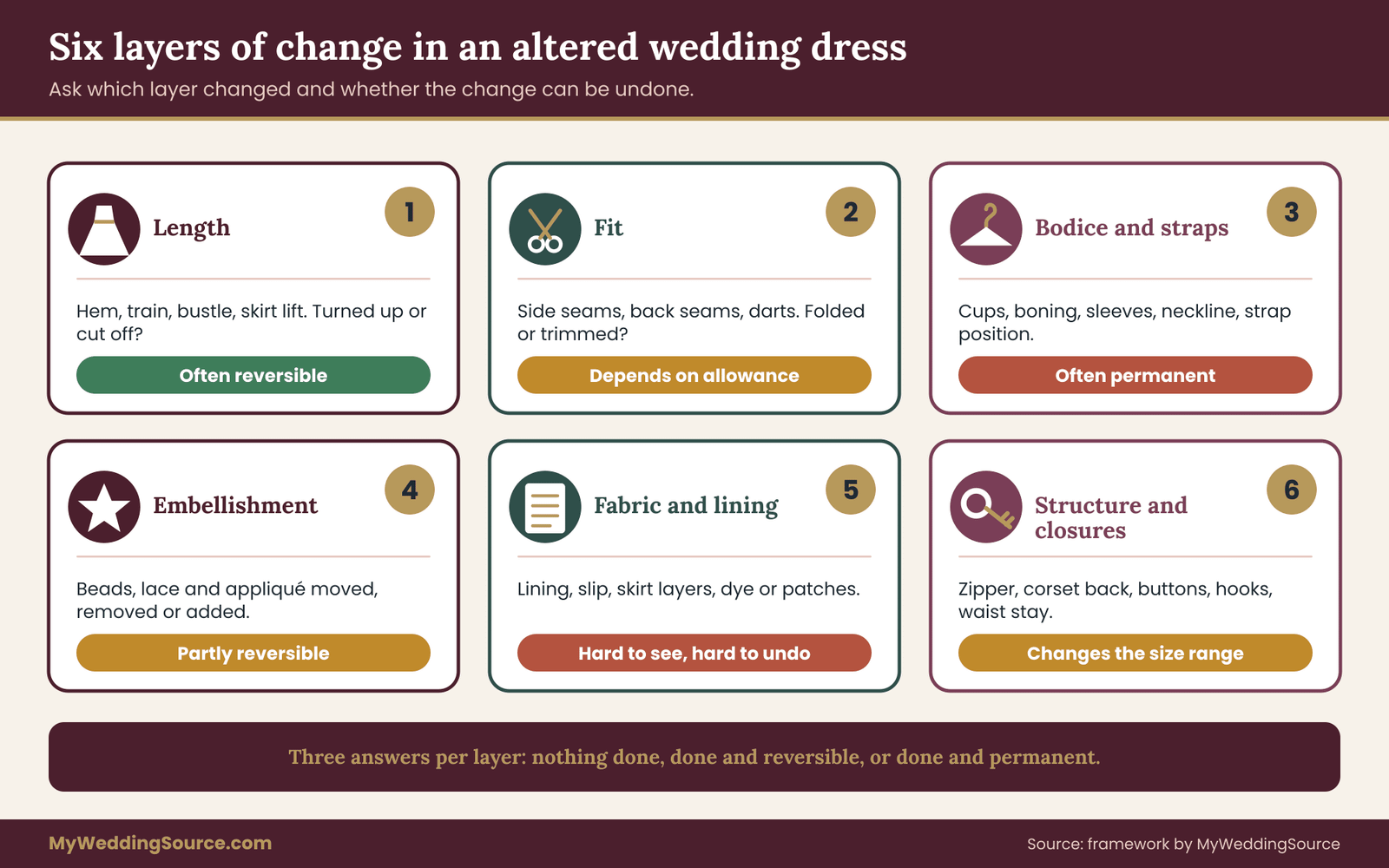
Layer one: length. Hem, train, bustle and any lift to the skirt. This is the most common alteration and often the most reversible, because many hems are turned up rather than cut.
Layer two: fit. Side seams, back seams, darts, waist and hip shaping. This layer decides the size the altered wedding dress now truly is.
Layer three: bodice and straps. Cups, boning, strap length, strap position, sleeves and neckline. These changes often involve cutting and rebuilding, so they are less forgiving.
Layer four: embellishment. Beads, lace, appliqué and trim that was moved, removed, added or re-sewn. Pattern placement matters here, and it is hard to restore.
Layer five: fabric and lining. Linings replaced, layers added or removed, a skirt shortened by trimming tulle, patches or dye work. These alter the hand and the drape of the dress.
Layer six: structure and closures. Zippers swapped for corset backs, buttons added, hooks moved, built-in cups, new waist stays. Closures change how the altered wedding dress goes on, and how much range of size it can cover.
How to use the diagram
Treat each layer as a question with three possible answers. Nothing done, done and reversible, or done and permanent. A seller who can answer six questions has given a buyer more than most listings do. A seller who cannot answer them should say so plainly, and the buyer should price in the uncertainty.
The next section places those answers on a ladder from easily reversed to final. The idea is borrowed from how conservators think about any treatment of an old textile: prefer changes that can be undone. The Smithsonian and the American Institute for Conservation both publish public guidance about caring for textiles, and the sources section lists them.
Here is how the layers combine in practice. A dress with only a hem change and a bustle is low in complexity. An altered wedding dress with fit changes, strap changes and beads moved is high in complexity. The more layers touched, the less the label size means, and the more a buyer needs documentation rather than a general assurance. If you are the seller, the diagram is also a clear way to write your own notes before listing.
Finally, notice what the diagram does not do. It does not decide whether the alterations are good or bad. It only decides how much a buyer has to verify. Good work in a hard-to-reverse layer can still be an excellent purchase for the right buyer.
Hems, bustles and length on an altered wedding dress
Length is where most alterations begin, because almost no gown is made for the exact height and shoe heel of the person wearing it. It is also where resale buyers most often misjudge what they are getting.
Three ways a hem can be changed
There are three common methods, and they have very different consequences for the next owner.
Turned up and stitched. The seamstress folds the bottom edge of the skirt upward and sews it in place. The extra fabric stays inside the hem. A later owner who is taller can often let it down, although the old fold may leave a faint line or crease, especially on satin, crepe and heavier fabrics.
Cut and re-hemmed. The bottom of the skirt is trimmed off and the raw edge is finished again. The fabric is gone. No later owner can restore the length, and the skirt may also have lost depth in a lace border or a scalloped edge that was designed to sit at the floor.
Lifted at the waist or in the layers. On a gown with several skirt layers, a seamstress may shorten each layer separately, or raise the whole skirt at the waistline. This can protect a lace edge, but it changes the proportions of the altered wedding dress and cannot be undone as simply as a plain hem.
A seller should know which of the three was used. If she does not, the inside of the hem will usually show it. A turned-up hem shows a visible fold and a stitched line. A cut hem shows a clean, narrow finish with no spare fabric behind it.
Lace borders and the hem problem
On a lace gown, the border is usually a designed edge. Scallops fall at the hem, and the lace pattern is arranged so that the border meets the floor. If the skirt is shortened by cutting, the border can lose its shape, or the seamstress may need to remove the lace, trim the skirt and appliqué the lace back on. That last method is skilled and slow, and it is also visible if the match is imperfect.
For a buyer, the question is short: was the lace border cut, moved or left alone? If it was moved, ask for a close photograph of the hem in good light, with the border laid flat. Uneven scallops, a repeated motif or a visible seam line in the lace are signs of reapplication. They are not automatically a problem, but they affect how much the next owner can safely change.
The bustle is part of the length decision
A bustle is the system that lifts a long train off the floor for the reception. It is usually a set of hooks, loops, buttons or ties, with a numbered or colored system that tells the wearer which loop attaches to which point.
Buyers sometimes treat a bustle as a bonus. It is better to treat it as another alteration with its own conditions. A bustle is built for a specific train length and a specific skirt weight. If the new owner is shorter, the same bustle may leave the train dragging. If she is taller, the skirt may rise so far that the bustle no longer reaches the right points.
Ask the seller three things about the bustle:
- What style is it: over bustle, under bustle, French bustle or a ballroom-style multiple point system?
- How many points are there, and is the numbering system marked on the dress?
- Was it set for a specific height and shoe heel?
A bustle that was added after the altered wedding dress was made involves stitching into the skirt and lining. It may be possible to remove it, but the stitching can leave small holes or a slightly different fold line. A bustle that came with the dress, built by the maker, is usually easier for a later seamstress to reset.
A decision rule for length
Here is a rule a buyer can apply in a few minutes. Take the seller’s stated hollow-to-hem measurement, which runs from the dip at the base of the neck to the hem, and add the heel height she wore. That gives a rough total height equivalent for the length of the altered wedding dress. Compare it with your own hollow-to-hem measurement plus the shoes you plan to wear.
If the dress is shorter than you need by more than the hem allowance inside it, the length cannot be recovered. If it is longer, it can be shortened by anyone competent. So an altered wedding dress that is slightly long for the buyer is a safer purchase than one that is slightly short, even though the second one may seem closer on paper.
Seams, darts and size claims on an altered wedding dress
Fit alterations are the ones that most often make the listed size meaningless. They are also the ones where a buyer can calculate the most from a few measurements, if the seller provides them.
What “taken in” really means
When a seamstress takes in a dress, she moves the seam inward. If she takes in each side seam by one inch, the altered wedding dress loses two inches at each seam line, because the seam involves two layers. A dress taken in at the side seams, the back seam and the darts can lose a total of several inches at the bust, waist and hips without any one change seeming large.
What happens to the excess fabric matters most. There are two options. The seamstress can fold the excess inside the seam and stitch over it, so it stays in the garment. Or she can trim it away to reduce bulk. Folded fabric can be released again. Trimmed fabric is gone.
Often the answer is mixed. A careful seamstress may leave a generous allowance where the altered wedding dress has no lining, and trim where bulk would show through. This is why the seller’s statement “it can be let out” needs a number: how much, and at which seams.
Letting out is harder than taking in
Most bridal gowns are cut with seam allowances that are wide enough to give a modest amount of size back, often an inch or so per seam. That is a general pattern, not a rule, and it varies by maker and by fabric. Formal gowns with heavy boning, multiple layers or corset backs may have much less room, and an alteration that already used up the allowance leaves nothing.
For a buyer who is larger than the first bride, a gown that was taken in is a risk. For a buyer who is smaller, it can be a bargain. This is why a buyer should always state her own measurements in the first message, and ask the seller to compare them with the dress’s current flat measurements and the seam allowances still inside it.
The corset back changes the math
Some gowns were converted from a zipper to a corset back during the first alteration, so the altered wedding dress could be adjusted by a few inches in either direction. This is a useful design, but it changes the size claim. A corset back lets the dress adapt, but it is not unlimited. The gap that remains at the back, the width of the fabric panel behind the laces and the structure of the boning all limit how much it can flex.
Ask the seller for a photograph of the back fully closed, and another with the laces opened to the widest point the seamstress allows. The gap between the two is the true size range of the altered wedding dress, and it matters more than any label.
Mismatched claims are the main source of disputes
A listing for an altered wedding dress that says “size 8, fits 8 to 10” may be based on the first owner’s body and on a closing system that has already been adjusted. Buyers who accept the claim without measurements often end up in a dispute about whether the dress was described accurately. Sellers who gave the claim in good faith can end up in the same dispute.
The cleanest fix is for the seller to give the current measurements, as they are now, and leave the label size as a secondary note. A listing that says “tagged 10, currently measures 34 inch bust and 27 inch waist, taken in at side seams, extra allowance 3/4 inch each side” leaves little room for a misunderstanding.
The guide to wedding dress fitting and measuring guide lays out how to compare measurements on an altered wedding dress of any age. Here the main point is narrower. For an altered wedding dress, the number that counts is the one taken from the dress today, not the one printed on the label.
A quick calculation buyers can do
Take the seller’s current bust, waist and hip measurements. Ask how much the seamstress took in at each level in total, and whether that fabric was folded inside or trimmed away. Add only the folded amount to the current measurement. If the seam was opened for a photograph, measure the allowance you can see and count every seam edge it applies to. The result is the largest size the altered wedding dress could reach if every allowance were released fully.
Now compare it with your own measurements, with a bit of ease for movement and breathing. If the largest possible size is still smaller than you need, stop. If it barely reaches your size, the dress will be tight and the seamstress will have no room for errors. If it clears your size with a comfortable margin, the altered wedding dress is worth a closer look.
Bodice, strap and embellishment changes on an altered wedding dress
The upper half of a gown is built differently from the skirt. It has structure: boning, cups, interfacing, a waist stay. Changes here are rarely simple, and they are the ones most likely to leave a buyer with an altered wedding dress that looks right but does not hold its shape.
Cups, boning and internal structure
Many gowns come with sewn-in cups, and plenty of brides ask for them to be added or removed. Adding cups means stitching into the lining and sometimes into the fashion fabric. Removing them leaves small stitch holes and may change the line of the bodice. Both are manageable, but both are marks on the garment.
Boning is similar. A seamstress may add boning to stop a strapless bodice slipping, or remove a piece that dug into the first bride. If boning was moved, the channels that hold it are visible from the inside as lines of stitching. A buyer who can see the inside of the bodice can usually count the bones and judge whether the structure is complete.
Ask for an inside photo with the lining visible. A bodice that has been re-boned several times may show a cluster of old stitching lines. That is a warning that the garment has been adjusted more than once, and later alterations have less to work with.
Straps, sleeves and necklines
Straps are among the easiest things to change and the easiest to damage. A strap can be shortened by folding, shortened by cutting, or moved to a new position on the bodice. A strap moved to a new position leaves an old attachment point. On sheer or lightweight fabric it can leave a visible mark.
Sleeves are harder. Adding sleeves to a strapless gown, or removing them from a gown that came with them, changes the neckline, the armhole and the balance of the entire bodice. It is also one of the alterations that most strongly affects resale value, because it makes the altered wedding dress appeal to a narrower group of buyers.
Neckline changes, such as lowering a sweetheart, raising a plunge or adding an illusion panel, are permanent in most cases. The fabric that was removed is gone, and adding it back with a matching piece rarely looks identical. If the seller says the neckline was altered, ask what it looked like before. A photograph from the original boutique listing, or a screenshot of the maker’s product page, can help a buyer judge how much was changed.
Beads, lace and appliqué that moved
Embellishment is the layer where small changes show up most clearly. When a seamstress takes in a beaded bodice, the beading along the seam has to be removed first, the seam stitched, and the beads reapplied. If the pattern is continuous, such as a lace repeat or a symmetrical beaded vine, the repeat has to line up again on both sides. Sometimes it does, and sometimes a section ends a little off.
Common signs of reapplied embellishment include:
- Beads in a slightly different color, size or sheen along one seam, usually because replacements were used.
- A short gap in a beaded pattern where a few beads are missing and have not been replaced.
- Lace motifs that stop abruptly at a seam, or lace pieces that overlap where they did not originally.
- Thread of a different color or thickness used for tacking.
None of these makes the gown unusable. They do tell a buyer that the garment has been opened up and put back together, and that a later alteration will repeat the process.
Beaded and sequined fabrics also carry a risk that is easy to overlook. Loose beads can snag, and heavy beadwork can stretch or distort the fabric it is stitched to, especially if the seamstress removed part of the weight. Beads also catch on veils, gloves and jewelry, which is why the wedding day accessories planning guide treats those items as part of the same compatibility check as the altered wedding dress itself.
Fabric and lining changes
The fifth layer is the least visible. A lining may have been replaced because the original was scratchy, too warm or damaged. A layer of tulle may have been removed to make the skirt less full. A slip may have been sewn in. These changes affect how the dress moves and how it holds its shape, and they affect what a later seamstress can do.
If the fashion fabric was dyed or tinted after purchase, that is another permanent change. A colour-corrected gown can look right in the photographs and still react differently to cleaning and storage. A buyer should ask for the name of the dye process, the date and the person who did the work.
Because these changes are hard to see, the best habit is to ask a simple, direct question: “Has anything been added, removed or replaced inside the dress, such as lining, cups, boning, a slip or a layer of skirt?” A seller who answers carefully has probably paid attention. A seller who says “nothing major” has not answered.
How the fabric records the alteration
Different fabrics keep different evidence of what was done to them, and knowing the pattern helps a buyer read photographs.
Satin, silk and other tightly woven cloth. Needle holes are permanent in a tight weave. A seam that was opened and re-stitched may show a faint dotted line along the old stitching, and a fold that was pressed in for a long time may leave a shiny or dull streak. Held at an angle to the light, these marks show up in a photograph far better than in a straight-on picture.
Crepe and heavier synthetics. These hold creases and pressing marks stubbornly. A hem that was turned up and later released can keep a visible line for good. Ask whether the hem was pressed hard, and ask for a close photograph of the fold line.
Tulle and net. The fabric is forgiving about holes but easy to tear. Removed layers leave no mark, so the main question is whether layers were taken out, because that changes the fullness of the skirt. Compare the skirt’s current width at the hem with the original silhouette in the maker’s photographs.
Lace. Lace hides stitching well and hides a missing allowance badly. A lace bodice that has been taken in may look perfect, while the pattern has quietly shifted, so the repeat no longer lines up across the seam. A close photograph of the seam line, in even light, shows whether the motifs still meet.
Chiffon and other lightweight layers. Thin fabrics show every inside seam and every thread. If a seamstress added boning, a slip or a layer of lining, the shape of the addition may show through. A photograph with a bright light behind the fabric, or a note on how the layers were built, helps here.
None of these fabric notes is a substitute for a seamstress’s opinion. They are a guide to what to ask for, and to which photographs reveal the most. A seller who understands them can also take better pictures, which makes the listing clearer and the altered wedding dress easier to trust.
Measurements checklist for an altered wedding dress
Measurements turn an uncertain claim into something a buyer can check. They also protect the seller, because an accurate number cannot later be called misleading. The checklist below works for either side. A seller can fill it in before listing. A buyer can ask for it before paying.

How to take the measurements
Lay the dress flat on a clean surface, fastened as it would be when worn. Smooth it without stretching it. Use a soft tape measure, and measure the altered wedding dress, not a body. Record each number in inches or centimeters, and state which one you used.
A dress laid flat shows only half its circumference, so measure across the front and double it. The seller should say which method she used. A flat measurement of 17 inches across the waist is 34 inches around, and a buyer who forgets to double the number will make a serious mistake.
The core measurements
Record these as they are now, and add the original numbers beside them if you know them.
- Bust. Measure across the fullest part of the bodice, under the arms, and double it.
- Waist. Measure across the natural waist seam or the narrowest part of the bodice, and double it.
- Hip. Measure about 8 inches below the waist, or at the fullest part of the hip line, and double it.
- Hollow to hem. Hold the tape at the dip at the base of the neck and run it to the hem, measured on a hanger or on a mannequin. A flat-lay number alone can mislead on a full skirt.
- Bodice length. Measure from the top of the bodice at the center front to the waist seam.
- Strap length and drop. Measure the straps from the bodice to the shoulder point, if the altered wedding dress has them.
- Train length. Measure from the waist seam at the back to the end of the train, laid out straight.
The three numbers people forget
Three other measurements decide more resale disputes than they should.
Seam allowance. Open the lining at a side seam, or ask a seamstress to look, and measure the fabric left inside. This number tells a buyer how much the dress can still grow.
Hem depth. The folded fabric inside the hem is the reserve for length. A hem with two inches inside is easy to lengthen. A hem with a quarter inch is not.
Shoe height used. A hollow-to-hem measurement means little without the heel height the first bride wore. An altered wedding dress hemmed for a three-inch heel will drag for a bride in flats and will be too short for someone who wants five inches.
Photographs that count
Measurements are strongest when photographs support them. Ask for these six: the full front on a hanger, the full back, the inside of the bodice with the lining visible, a side seam opened or pulled back, the hem turned to show its depth and the closure fully closed and fully open. Good light and a plain background matter more than a fancy camera.
The seller’s own record of the dress, such as the fitting appointment receipt or the seamstress’s work order, adds weight. These are the sort of papers described in the guide to wedding records after the event, and they are worth keeping from the day of the fitting.
A worked case: one altered wedding dress from listing to decision
The example below is invented, with made-up people and numbers, to show the method from start to finish. It is not a real sale, and the measurements are not data about any maker. The point is the order of the questions.
The listing
A seller, Dana, lists a lace A-line gown. The listing says: tagged size 10, worn once, hemmed and bustled, “fits a 10 perfectly,” asking price set well below the original retail price she mentions. There are six photographs, all of the altered wedding dress on a mannequin from the front and side.
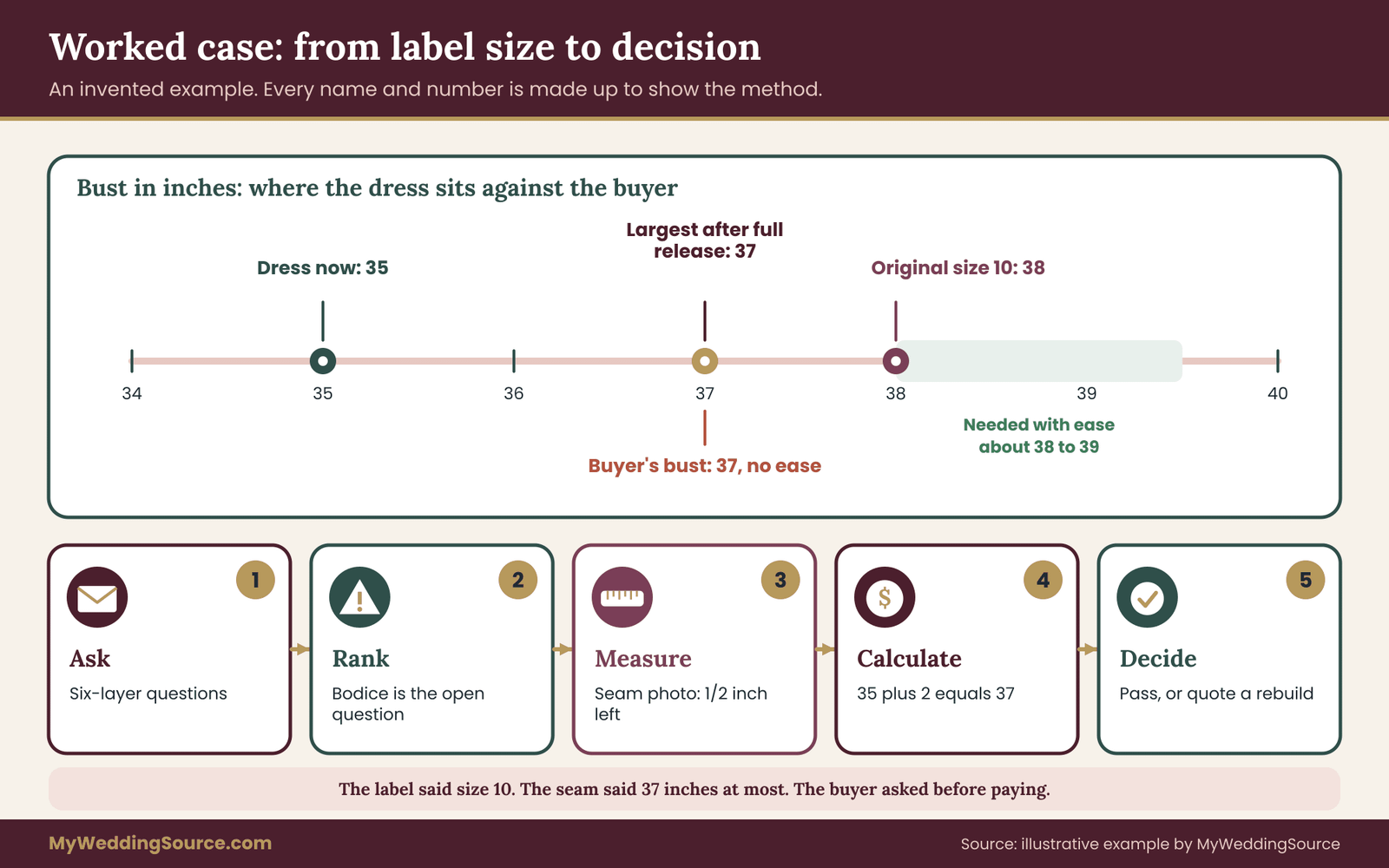
A buyer, Priya, measures 37 inches at the bust, 30 at the waist and 40 at the hip. She wants the dress for a ceremony in about five months and has a seamstress she trusts. She reads the listing twice and notices what it does not say. It gives no measurements, no mention of any change to the bodice and no hollow-to-hem number.
Step one: ask the six-layer questions
Priya sends a short message that works through the layers.
“Thank you for the listing. Before I decide, could you tell me what was altered? Specifically: hem, side seams or darts, straps or neckline, beads or lace moved, anything inside such as lining or cups, and the closure. For each one, was fabric folded away or cut off?”
Dana’s reply, in this example, is honest and a little vague. The hem was turned up two inches and not cut. The bodice and waist were taken in “a few inches.” A bustle with five points was added. The zipper is original. She does not remember whether the extra fabric was trimmed.
Step two: rank the reversibility
Priya places each change on the ladder from the earlier section. The hem, turned up and not cut, is reversible with a visible crease risk. The bustle is added stitching, removable with minor marks. The bodice and waist, taken in with unknown trimming, are the open question. She notes that a single unknown layer already carries most of the risk.
Step three: request the measurements
She asks for the flat measurements, hollow-to-hem with the heel height, and photographs of a side seam with the lining turned back.
Dana measures and replies. Current numbers, doubled from flat: bust 35, waist 28, hip 40, hollow to hem 58 with a two-inch heel. A seam photograph shows about half an inch of fabric left on each side of the side seam at the bust, and a wider allowance at the waist.
Dana also finds her seamstress’s receipt, which says “take in bodice and waist, 3 inches total, trim excess at bust.”
Step four: run the numbers
Priya does the calculation from the earlier section. At the bust, the altered wedding dress measures 35 inches now. The seam photograph shows half an inch of allowance on each of four seam edges, two on the front and two on the back panels. That is two inches in total. The largest possible bust size is 37 inches.
Priya’s bust measures 37. A dress needs some ease to be worn, to sit, breathe and raise the arms. An altered wedding dress with zero ease at full release is not a fit, and the seamstress would have no allowance left for error.
At the waist, the story is better. The receipt says fabric was folded, and the photograph shows a wider allowance. The waist could return close to its original 31 inches, which is more than Priya needs.
The mismatch is at the bust, which is the hardest place to fix on a lace bodice.
Step five: decide with failure conditions in mind
At this point Priya has three options, and the right choice depends on her tolerance for risk, not only on the numbers.
Pass. The bust has no ease to spare even at full release, the cause is trimmed fabric, and lace is difficult to extend. If she has a fixed date and a limited budget, this is the safe choice.
Negotiate with a repair plan. A seamstress could add side panels or a corset-style insert at the bust. That would be a rebuild of the bodice. Priya should get a written quote from her own seamstress before paying for the dress, and the price she offers Dana should reflect the combined cost. If her seamstress declines the job, or cannot say whether the lace will hold, the negotiation ends.
Buy and accept a tight fit. This is possible only if Priya is willing to wear an altered wedding dress with no ease at the bust. For most buyers, this option should be dropped quickly.
In this example, Priya asks her seamstress, who says an insert would be possible but would change the look of the lace. She declines. She tells Dana politely, and thanks her for the clear answers. Dana now has a better listing, because she knows the dress’s actual limits.
What the example shows
Three things come out of this case. First, the label size told Priya almost nothing, and Dana’s honest description, “fits a 10,” was true only for a body smaller than Priya’s. Second, a single receipt, kept by the seller, answered the central question in a few lines. Third, the buyer lost nothing by walking away, because she asked before paying.
How the same case reads from the seller’s side
Imagine Dana had written her listing after taking the measurements. It could read: “Tagged size 10. Taken in at bust and waist by 3 inches total; bust excess trimmed, waist excess folded. Current flat-doubled measurements: bust 35, waist 28, hip 40. Hem turned up two inches, not cut. Five-point bustle added. Original zipper. Seam photographs and receipt available.”
That listing would probably have attracted fewer buyers, and every one of them would have been a fit. It would also have saved Dana a long exchange with a buyer who could not wear the dress. Disclosure does not drive buyers away. It sends the wrong ones elsewhere and brings the right ones forward.
The same dress with different answers
Change two facts and the decision flips. Suppose the receipt had said “fold excess, do not trim,” and the seam photograph had shown a full inch of allowance on each of the four edges. The largest bust size would be 39 inches, two inches above Priya’s measurement. That is enough ease for most bodices, and it leaves the seamstress room to work.
Now suppose the facts were the original ones but the buyer measured 35 at the bust. The altered wedding dress would fit as it stands, and every alteration would have been done for a body very like hers. In that case the buyer is the ideal owner for the altered wedding dress, and the existing work is a benefit rather than a cost.
This is why two buyers can look at the same listing and reach opposite conclusions without either being wrong. The alterations do not make the dress good or bad. They make it specific, and the buyer’s body decides whether the specific choices work.
Where the method can go wrong
The worked case assumes cooperative people and a clear receipt. Real sales are messier. The seamstress may have retired. The seller may have inherited the altered wedding dress. The photographs may be poor. Where information is missing, the buyer has two honest options: price in the uncertainty, or ask a seamstress to examine the dress, which requires a return or inspection period. If neither is offered, the safest answer is no.
How sellers should disclose an altered wedding dress
Sellers sometimes worry that listing every alteration will scare buyers away. The reverse is more common. Vague listings attract questions, delays and disputes, while specific listings attract buyers who already know what they are getting. Disclosure is also a matter of plain honesty, and in some settings it is a legal one, since a description that leaves out a material fact can become a misrepresentation. The Federal Trade Commission publishes general guidance on truthful advertising, and a seller who is unsure should read it or ask a qualified adviser.
Build the disclosure sheet before you write the listing
Most sellers write the listing first and gather facts afterward. Reverse the order. Spend an hour on a one-page disclosure sheet, then copy from it into the listing.
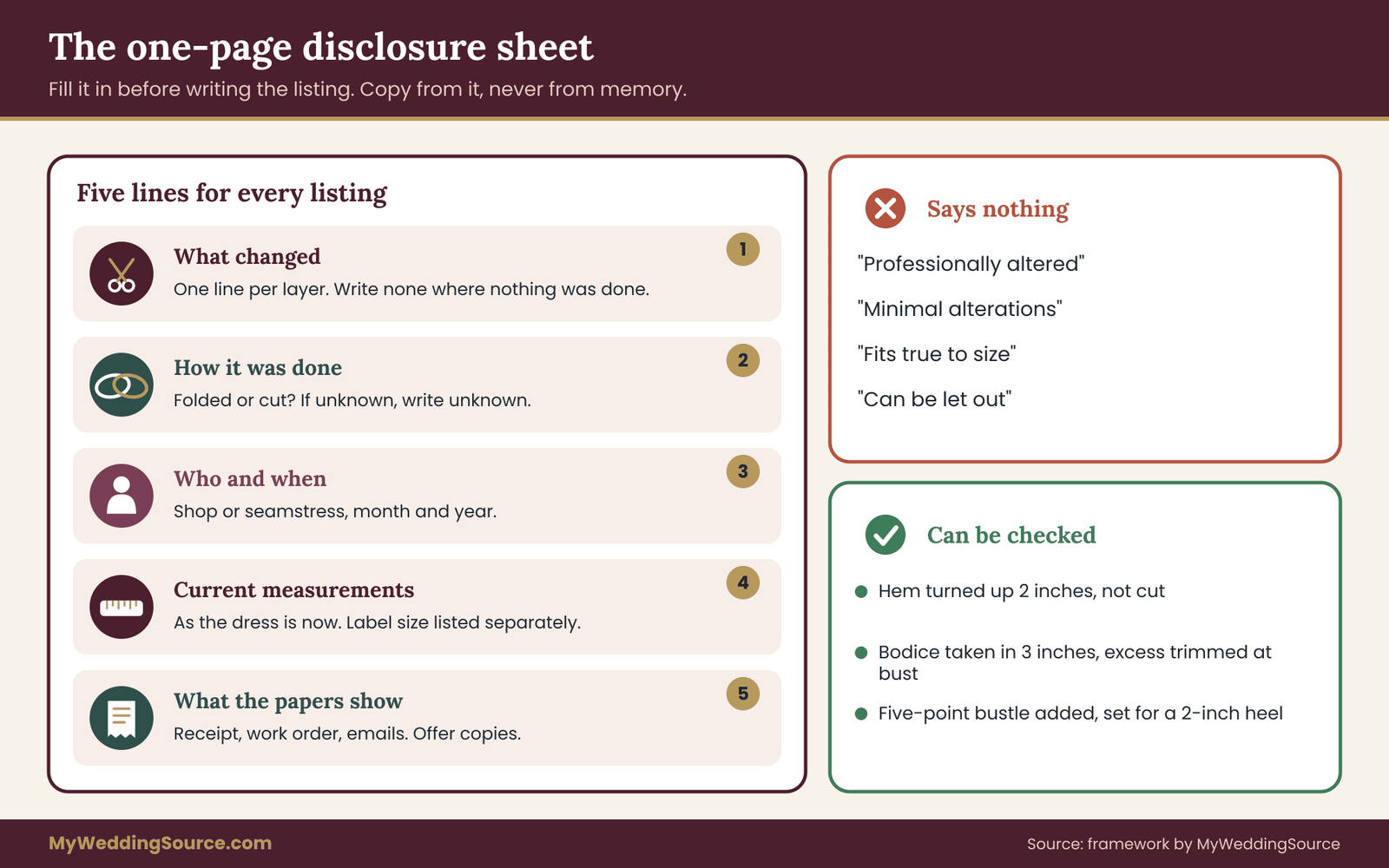
The sheet has five parts, and each one answers a question a careful buyer will ask.
What was changed. One line per layer, using the six layers from the diagram. If a layer was not touched, write “none.” A line that says “none” is information, not filler.
How it was changed. For each change, say whether fabric was folded away or cut off. If you do not know, say you do not know. “Unknown” is an honest answer. A confident guess that turns out to be wrong is not.
Who did it and when. The name of the shop or the seamstress, and the month and year. This lets a buyer contact the person, where possible, and tells her how old the work is.
Current measurements. The core measurements from the checklist, listed as they are now, with the label size and original measurements noted separately.
What the documents show. A receipt, a work order, an invoice, emails from the seamstress. Say which ones you have, and offer to share copies with private details removed.
Wording that helps and wording that hurts
Some phrases sound reassuring and say nothing. “Professionally altered” tells a buyer only that someone was paid. “Minimal alterations” has no standard meaning. “Fits true to size” refers to a size the altered wedding dress has already left. “Can be let out” has no value without a number.
Better phrasing is concrete and checkable. “Hem turned up two inches and not cut” can be verified. “Bodice taken in three inches total, excess trimmed at bust and folded at waist” can be verified. “Bustle added after purchase, five points, set for a 5’6” wearer in a two-inch heel” can be verified. Each of these gives the buyer something to compare against a photograph or a measurement.
A single rule works well: write only what you could prove if asked. If you cannot prove a statement, rephrase it as a belief, such as “I believe the extra fabric was folded, but I do not have a record.”
Photographs that support the disclosure
Photographs should show the alterations rather than hide them. A hem lifted to show its depth, a side seam pulled back, and a bodice with the lining visible are more convincing than six flattering poses. Take them in daylight, without filters. If you edit photographs, say so, and never alter colour or remove a mark.
Handling things you do not know
Many sellers inherited a dress, or bought it secondhand, or let someone else handle the fittings. The honest course is to say so. “I bought this dress preowned and I do not have the alteration history” is a perfectly acceptable line, and it sets expectations. A buyer who proceeds after reading it has accepted the risk knowingly.
The same applies to marks and wear. If there is a small stain, a loose bead or a seam that was reopened, name it. The cost of mentioning a small problem is almost always lower than the cost of a returned dress and a dispute over shipping.
Records, returns and keeping proof
Resale platforms and payment services publish their own rules about item descriptions, returns and disputes, and those rules differ. Read the policy of the platform you use before you list, and follow its terms about how the item must match the description. Where you sell directly, put your return terms in writing before the buyer pays. Keep the disclosure sheet, the photographs and the messages for as long as a dispute could arise.
For a reader keeping good paperwork around the sale, the guide to wedding vendor contracts explains how written terms with a seamstress or shop protect both sides, and it is a useful model for the agreement you make with a buyer.
What buyers should ask and inspect before paying
A buyer cannot inspect an altered wedding dress from a distance, but she can ask good questions and read the answers carefully. The goal is not to catch the seller out. It is to confirm that the seller’s picture and the real dress match.
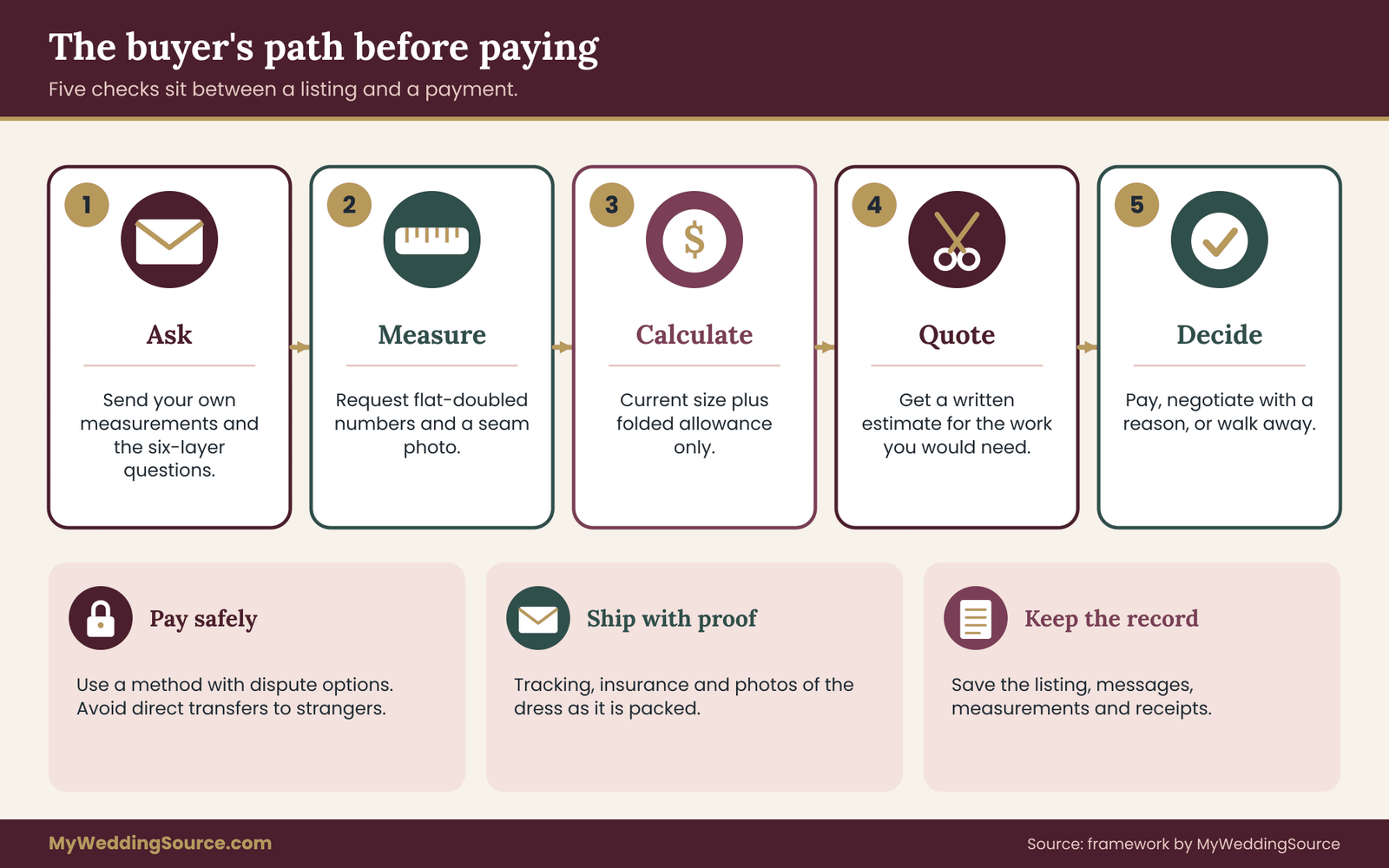
The first message
Open with your own measurements, your date and the one thing that matters most to you. Then ask for what the seller has. A message that does this is polite and efficient, and it tells the seller that you know what to look for.
A workable version: “I’m 37 inch bust, 30 inch waist, 40 inch hip, and I need the dress by a specific date. Could you share the current flat-doubled measurements, a photograph of a side seam with the lining turned back, and a list of what was altered and how? If you have the seamstress’s receipt, I would love to see it.”
Reading the answers
The way a seller answers is itself useful. A prompt, specific reply with numbers suggests a person who has handled the altered wedding dress and cares about a good outcome. A slow reply that repeats the listing, or that says “I’m sure it will be fine,” suggests that either the information is not available or the seller would rather not look for it.
Watch for three signals in particular.
Numbers without a method. A bust measurement that does not say whether it is flat or doubled is not a measurement yet. Ask.
A single photograph for several questions. If one photo is offered for the hem, the seam and the bodice, something is probably missing.
Pressure to decide quickly. A seller who says “several people are interested” and pushes for payment before answers arrive has, intentionally or not, taken away the one tool the buyer has. The Federal Trade Commission and the Consumer Financial Protection Bureau both publish consumer guidance on common online payment and purchase problems, and it is worth reading before any large payment to a stranger.
Ask for an independent look
If the price is significant, consider paying a local seamstress for a short consultation. She can open a seam, measure the allowance, check the structure and tell you honestly what can and cannot be done. For a remote purchase, ask whether the seller is willing to send the dress on approval, or whether the platform offers any kind of protection. Do not assume it does. Read the policy.
If a seamstress examines the altered wedding dress and finds an unexpected problem, a prior agreement about who pays for the exam and the return shipping prevents a second dispute.
Payment and shipping choices
Pay by a method that offers some form of dispute resolution, and avoid sending money in ways that cannot be reversed. A card or a platform that holds funds until delivery gives a buyer more recourse than a direct bank transfer to a stranger. Ask the seller to ship with tracking and insurance, and to photograph the dress as it is packed. The United States Postal Service and other carriers publish their own rules about insurance and claims, and a buyer should check them before the altered wedding dress leaves the house.
Ask, too, how the dress will be packed. An altered wedding dress folded tightly in a plastic bag for several days can pick up creases that are hard to remove. A box with acid-free tissue is better, and a garment bag on a hanger is better still for a short trip.
Pricing an altered wedding dress without guessing
Pricing is where the disclosure diagram pays off. A seller who knows which layers were touched can explain the price. A buyer who knows the same can judge whether it is fair. Neither needs an invented formula, only a clear order of thought.
Start from the unaltered comparison
The first question is what a comparable dress, in the same style and condition and without major alterations, is selling for. That means looking at completed or current listings for the same maker and style, and noticing which ones disclose alterations. Prices vary by region, season, maker and condition, so treat any figure as a range rather than a fact. The broader money picture belongs in your wedding budget.
Then adjust for what is different about this particular altered wedding dress. There are three adjustments, and they work in different directions.
Adjustment one: the cost to make it fit you
Get a written estimate from a seamstress for the work you would need. If the dress is nearly right, the estimate may be small. If it needs a hem let down, bust panels or a rebuilt neckline, it may be large. The estimate is the number that belongs in the price discussion. The seller’s past alteration fees do not.
A buyer should obtain the estimate before negotiating, and a seller can reasonably ask to see it. A seamstress will need photographs and measurements to give a useful quote, so the exchange of information described earlier comes first.
Adjustment two: the uncertainty discount
When a seller cannot say how a change was made, the buyer is carrying a risk. A reasonable response is to reduce the offer, or to ask for an inspection period instead. How much to reduce depends on how much of the altered wedding dress is unknown. One unknown layer, such as a hem that might have been cut, is a small risk. Four unknown layers, including the bodice, is a large one.
There is no standard percentage, and anyone who offers one is guessing. A better approach is to name the risk in the message. “I’d offer less because the bodice work is undocumented and I may need to pay a seamstress to open it” is a fair, specific reason. A seller can respond to a reason. She cannot respond to a lowball with no explanation.
Adjustment three: the fit match
Sometimes the alterations help. A dress already shortened to the buyer’s height, with the right bustle and a bodice shaped to a similar frame, saves her real work. That is a legitimate reason to pay closer to the unaltered comparison, and a seller may reasonably ask for it.
Be honest about the match. A buyer who says “this fits like it was made for me” while still asking for a discount for the alterations is asking the seller to carry costs that the buyer will not have. A seller who insists that every alteration adds value to every buyer is making the opposite mistake.
What sellers should not count
Two things do not belong in the price. First, the amount the original bride paid for alterations is a sunk cost. It does not transfer, and it does not describe how useful the work is to the next person. Second, the original retail price of the altered wedding dress is a weak guide, because it describes a new gown in a boutique with a full service package. A resale buyer is buying a used garment with a particular history.
Rather than anchoring on retail, anchor on what comparable altered gowns are selling for, and on what the alterations will cost the person buying yours. The seller’s goal is to find the buyer for whom the existing work is most useful, and the listing should make that match easy to see.
Costs a buyer should add up
Before agreeing to a price for an altered wedding dress, a buyer should write a short list of every cost beyond the purchase price. It might include a seamstress consultation, the alterations themselves, professional cleaning, shipping and insurance, return shipping if the dress does not work, and the time lost if a deadline slips. Adding these shows the real price of the altered wedding dress. Sometimes a more expensive, better-documented gown is cheaper in total than a bargain that needs a rebuild.
Wedding budgets are tight and attire is only one line in them. If the dress takes a large share of the budget, the guide to planning a wedding budget can help you decide how much of the total this purchase should be allowed to take.
Reversal, restoration and who can help
When an alteration is not right, the next question is whether it can be changed. The honest answer depends on the layer, the fabric and the skill of whoever does the work.
The reversibility ladder in practice
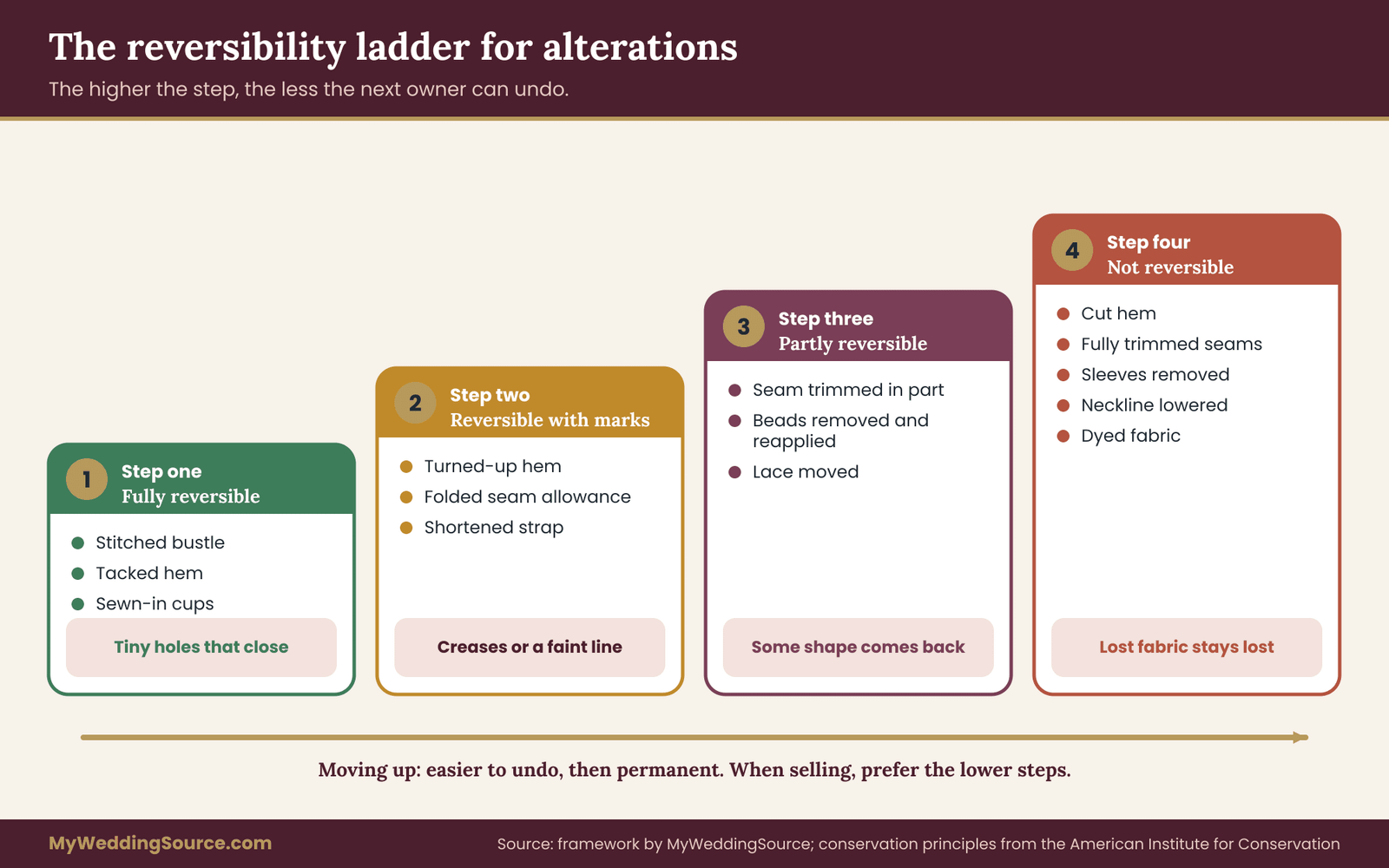
Think of the changes as a ladder, from easily reversed to final.
Step one, fully reversible. Stitched bustles, tacked hems, sewn-in cups and temporary straps. Removing them leaves tiny holes, which usually close or hide in the fabric.
Step two, reversible with marks. Turned-up hems, folded seam allowances and shortened straps. Releasing them can leave creases, faint stitch lines or a different fabric sheen at the fold.
Step three, partly reversible. Seams taken in with some fabric trimmed, beads removed and reapplied, lace moved. Some of the original shape can be recovered, but not all of it.
Step four, not reversible. Cut hems, trimmed seams with no allowance, removed sleeves, lowered necklines and dyed fabric. The lost material cannot be put back, and an added piece will never match exactly.
A buyer who is realistic about the step a change sits on can decide whether the altered wedding dress is still worth it. The ladder is also a good checklist for a seller who is deciding whether to alter a dress further before listing it. If the altered wedding dress is going to be sold, a reversible change is nearly always better than a permanent one.
What a seamstress can and cannot promise
A skilled seamstress can open a seam, measure the allowance and tell you what is possible. She can usually give an estimate for the work. She cannot promise that old fabric will look new again, that a crease will disappear or that a repaired bead will be invisible. Be wary of anyone who promises a result before seeing the dress.
If a fabric is old, delicate or unusual, a textile conservator is the right specialist, and the American Institute for Conservation maintains a public directory. Conservators work on preservation, not styling, and they are slower and more expensive than a bridal seamstress. For a recent gown in a common fabric, that is rarely needed. For a vintage or heirloom piece, it may be.
Alterations in a gown that is also being preserved
Some sellers and buyers also care about long-term condition. If a gown has been altered and will be stored for years, the alterations can affect how it ages. Folded allowances press creases into fabric, trimmed seams can fray, heavy beading pulls on altered seams, and old stitching thread can weaken. The Library of Congress and the National Park Service both publish public guidance on textile storage, and the sources list names them.
For this article the practical point is narrow: if you are buying an altered gown that you intend to keep and not wear soon, ask how the alterations were finished, and whether the seams were secured. A loose, hurried alteration that survives one wedding day may not survive a decade in a box. The broader question of storage versus selling is a separate decision, and the guide to wedding dress fit and alterations is a good place to continue.
Choosing a seamstress for a reversal or redo
Choose a seamstress who works on bridal gowns, not only everyday clothing. Ask whether she has worked on the fabric in question, whether she will examine the dress before quoting and whether she will describe what she did in writing. A written work order, with the date and the specific changes, is the best gift you can give the next owner.
Keep the paperwork in the same place as the rest of your wedding documents. If you later sell the altered wedding dress, the work order is the best proof you will have. The habits that make wedding records useful years later are described in the guide to organizing wedding records, and they apply to a single garment just as well as to a whole event.
Failure conditions and alternatives for an altered wedding dress
A good decision framework says when to stop. These are the conditions under which the sale should not go ahead, or should go ahead only with a change in terms. Some apply to buyers, some to sellers, and several to both.
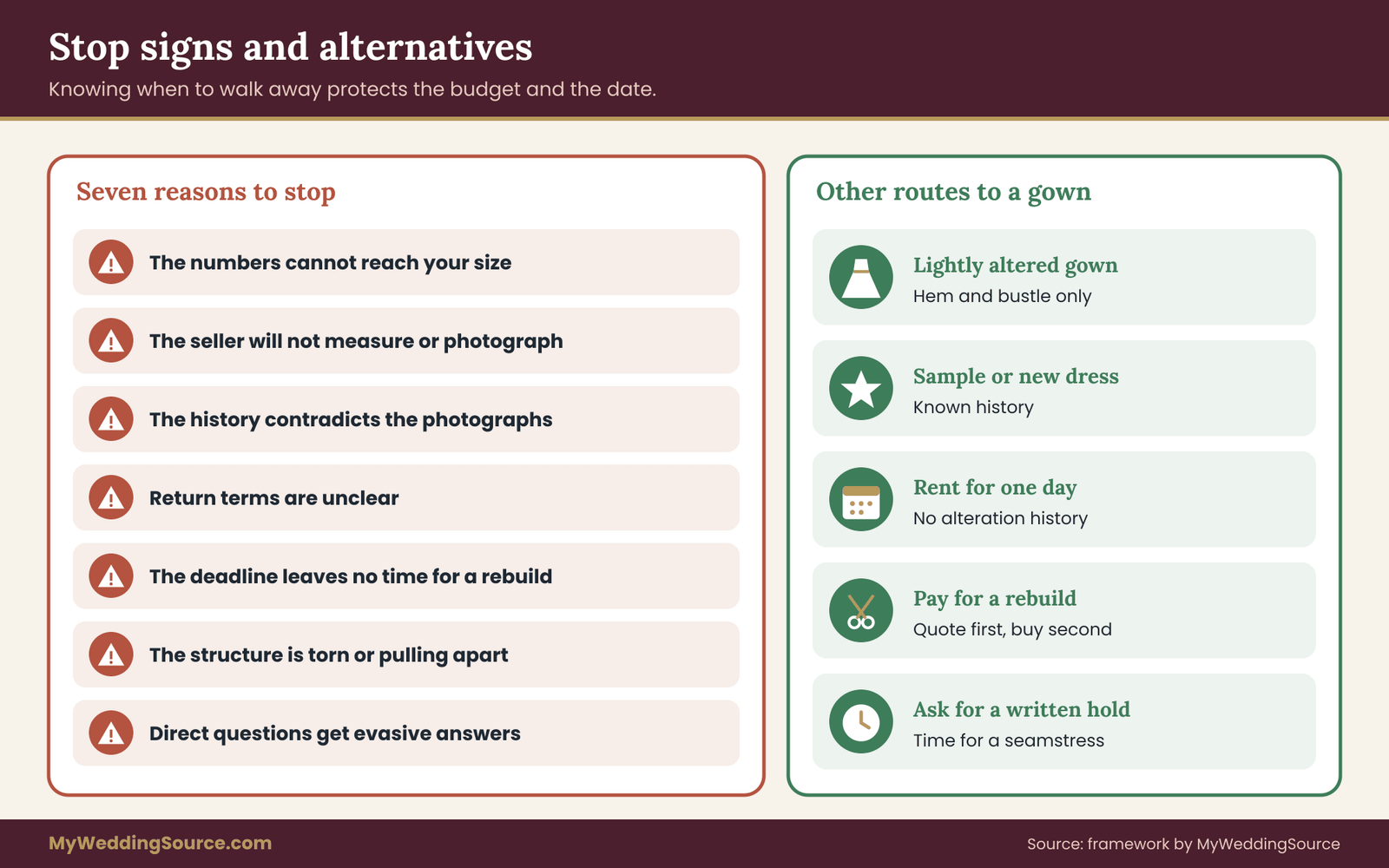
Seven conditions that should stop a purchase
The numbers cannot reach your size. If the largest size the dress could reach, after counting only folded allowance, still does not clear your measurements with ease, stop. Hope is not an alteration plan.
The seller cannot or will not measure. A seller who refuses to take three measurements and one seam photograph is either unable or unwilling to document the garment. Either way, the buyer is being asked to pay for an altered wedding dress that nobody has described.
The alteration history contradicts the photos. If the listing says “never altered” and the hem is visibly shortened, or the seam shows fresh stitching, ask directly. A seller who then gives a new account every time is a risk.
The return terms are unclear. For a dress with several unknown layers, an inspection period is part of the price. If the seller offers none and the platform offers none, the buyer is carrying all of the risk.
The deadline is too close. A rebuild takes a seamstress days or weeks, depending on her schedule and the complexity of the work. A purchase that leaves no room for that time turns every surprise into an emergency.
The structure is compromised. Torn lining, broken boning channels, seams that are pulling apart, or beading that is visibly detaching are repair projects. They may be worth tackling for the right dress, but they should be priced as such.
The seller is evasive. An evasive answer is information. If two or three direct questions get no direct answers, the sale is not worth the stress.
Conditions that should stop a listing
Sellers have failure conditions as well. If you cannot find any record of the alterations and cannot measure the altered wedding dress accurately, wait until you can. If you suspect the dress has a hidden problem, such as a repaired tear or a stain treatment that you do not understand, have a seamstress look at it before you list it. An altered wedding dress you have described honestly is easier to sell than one you have to explain after the fact.
If a buyer asks for something you cannot provide, such as proof of an alteration that you never documented, say so plainly. Do not invent a history. A statement that turns out to be false can become a return, a dispute or a complaint to a payment provider.
Alternatives to buying an altered gown
Not every bride needs the dress she first falls for. When the numbers fail, there are other routes, and some of them are better.
Look for an unaltered or lightly altered gown. An altered wedding dress with only a hem change and a bustle is simple to evaluate and simple to reset. Filtering for fewer touched layers is a legitimate search strategy.
Consider a sample or a new dress at a similar price. Sample gowns are sold at reduced prices by boutiques, and they come with a known history. The comparison between sample sales and secondhand purchases is a decision of its own, and the money side belongs in your budget.
Rent. For a gown that will be worn once, renting avoids the problem of the dress’s alteration history altogether, though the rental shop’s own policies on alterations apply.
Pay for a rebuild. For an altered wedding dress you love, a skilled seamstress can sometimes add panels, lengthen a hem with a matching border or restructure a bodice. It is slower and costs more, and it should be priced and agreed before the dress is bought.
Ask the seller to hold it. If a promising dress needs a seamstress’s opinion, a short written hold, for a small deposit or a refundable fee, can give you time to get the opinion before committing.
When a dress is simply the wrong dress
It is easy to treat a good price as a reason to make an altered wedding dress fit. That is how couples end up with a gown that is wrong in three places and costs more than a new one. An altered wedding dress that needs several permanent changes to fit is, in effect, a pattern and a pile of fabric. Pay for what it is.
Sometimes the right answer is to thank the seller, leave the dress and keep looking. There will be other listings, and another dress with a clear history will be worth the wait. A careful search protects both the budget and the day.
Vendor and seller checks that apply here too
Many of the habits above come from a wider practice of checking claims before paying. The guide to wedding vendor due diligence covers how to confirm that a business or a seller is who they say they are, and it is a good companion for any large purchase made at a distance.
Your next steps
If you are buying an altered wedding dress, do three things before you pay. First, take your own bust, waist, hip and hollow-to-hem measurements, and decide how much ease you need. Second, send the seller the six-layer questions and ask for flat measurements, a seam photograph and any receipt. Third, work out the largest size the altered wedding dress can reach from folded allowance only, and compare it with your numbers.
If you are selling, fill in the disclosure sheet first. List each of the six layers, say whether fabric was folded or cut, add the current measurements and gather the receipts. Then write the listing from the sheet and take the six photographs.
Either way, keep a copy of everything. A short, honest record turns an altered wedding dress from a mystery into a clear object, and it makes the next sale, or the next fitting, much easier.
FAQ
Does an altered wedding dress sell for less?
Often it does, but not always. The price depends on whether the changes suit the likely buyer and how well they are documented. A dress with a clean hem change and a bustle may sell close to the price of an unaltered one. An altered wedding dress with permanent bodice or neckline changes usually appeals to fewer buyers, so it may take longer or sell for less.
Should I tell buyers about every alteration?
Yes, at least every change that affects fit, length, structure or appearance. Buyers are making a decision about whether the dress will work for their body and their date, and alterations are central to that. Disclosing also protects you if the buyer later claims the description was misleading. If you do not know what was done, say that plainly instead of guessing.
How can I tell whether a hem was cut or turned up?
Look inside the hem. A turned-up hem shows a fold and a line of stitching, with spare fabric tucked behind it. A cut hem shows a narrow finish with no spare fabric. Ask the seller for a photograph of the hem turned back, in good light. If the photos are unclear, a seamstress can tell you in a minute or two.
Can a taken-in wedding dress be let out again?
Sometimes. It depends on whether the seamstress folded the extra fabric inside the seam or trimmed it away. Folded fabric can usually be released, though old fold lines may leave faint marks. Trimmed fabric cannot be restored. Ask the seller how much was taken in and whether it was folded, then confirm with a photograph of the seam.
Which measurements matter most when buying a used altered gown?
The current bust, waist and hip, taken with the altered wedding dress laid flat and doubled, matter most, along with hollow-to-hem length and the heel height it was hemmed for. Also ask for the seam allowance left inside. The label size is the weakest number, because it describes the dress before any changes were made.
Is it worth paying a seamstress to inspect a dress before I buy?
For a significant purchase, often yes. A short consultation can confirm the allowance, check the structure and give a repair estimate, all of which affect the price you should pay. If the altered wedding dress is being shipped, agree in advance who pays for the inspection and return shipping if the dress does not suit.
Do I need to disclose alterations when I sell through a marketplace?
You should describe the altered wedding dress accurately on any platform, and each platform has its own rules about item descriptions and returns. Read the policy before listing. Leaving out a change that a reasonable buyer would care about can lead to a dispute or return. Check the platform terms and, for legal questions, ask a qualified adviser.
What if the seller has no records of the alterations?
State that clearly in the listing, and expect buyers to ask for measurements and photographs instead. Buyers should price in the uncertainty, ask for an inspection period if possible, and consider a seamstress consultation. A seller who cannot document the work can still sell the dress, but the price and terms should reflect what is unknown.
Sources
- Smithsonian Institution
- Care of textiles and museum collections, National Park Service
- American Institute for Conservation
- Preservation, Library of Congress
- Canadian Conservation Institute, Government of Canada
- Federal Trade Commission
- Consumer advice, Federal Trade Commission
- Consumer Financial Protection Bureau
- United States Postal Service
- eBay seller and buyer policies