
A flight cancellation plan is a short, written agreement with yourselves about how news of a cancelled or badly delayed flight travels through your wedding guest list: who tells whom, in what order, and where the answer gets recorded. This guide gives you a four-ring communications cascade and an updated RSVP status log, so one cancelled flight does not turn into forty anxious text threads.
Name one point person for guest travel news and add optional arrival questions to your RSVP. Build a flight cancellation plan with two parts: a cascade that tells the hotel, venue and vendors first, then affected guests, then everyone else; and a status log that moves each guest party through five states, from “on track” to “out”. Say what you know, what you do not and when you will update. Never promise a room, a seat or a refund.
Somebody’s flight is going to be cancelled, which is why a flight cancellation plan belongs in every guest-travel wedding. That is not pessimism, just arithmetic: a wedding with more than a few dozen guests, many of them flying, puts a lot of separate itineraries on the same weekend. Weather, crew shortages, equipment problems and airport-wide ground stops do not check your save-the-date. Most of the time the damage is small. A guest takes a later flight and misses the welcome drinks. Occasionally it is larger: an officiant, a parent, or a whole table of cousins stuck in a connecting airport the night before.
What decides whether this becomes a crisis is rarely the cancellation itself. It is what happens in the next ninety minutes. Does the guest know who to tell? Does the hotel learn that a family will arrive at two in the morning? Does the caterer still plate seventeen dinners that nobody will eat? Does the couple find out from a worried aunt, or from a clear message? A flight cancellation plan answers those questions before they are urgent.
This guide covers one narrow job, the flight cancellation plan itself: communicating flight disruption to your guests and keeping your guest records accurate while it happens. It does not try to teach you everything about guest hotels, and it does not cover the wedding date decision or general RSVP etiquette. When you need those topics, the guide on coordinating wedding guest hotels across budgets and mobility needs covers lodging in depth, and the page on wedding RSVP etiquette covers how to ask for replies. Here, the focus stays on what you say, to whom, and when.
A note on scope. This is general planning information, not legal, financial or travel-insurance advice. Airline refund rules, hotel cancellation terms and insurance coverage vary by carrier, contract and policy, and they change. Where a rule matters, this guide points you to the agency or company that issues it so you can confirm the current version yourself.
What a flight cancellation plan is for, and what it is not
A flight cancellation plan has three jobs, and it helps to name them because they pull in different directions.
The first job is information flow. When a flight is cancelled, several people need to learn something different. The guest needs to know their options, which only the airline can give. The hotel needs to know whether the room will be used and when. The couple needs to know whether the headcount, the seating chart or the schedule changes. A good cascade sends each fact to the person who can act on it, without routing everything through the couple.
The second job is record keeping. Your guest list is a living document in the final two weeks. If it still says “Aunt Marisol: attending, arrives Friday” after she has been rebooked to Saturday morning, someone will plan around bad information. The status log keeps one honest version.
The third job is calm. People under travel stress read ambiguity as bad news. A message that says “We saw the airline cancelled your flight; here is who to call, here is what we can adjust on our end, and we will check in again at six this evening” removes a surprising amount of pressure from everyone involved, including you.
What a flight cancellation plan is not: it is not a travel agency. You are not rebooking flights for guests, and you should not offer to. It is not a guarantee system either. You cannot promise that a room will be held, that a shuttle will wait or that a missed ceremony will be redone. The honest scope is that you will pass information along quickly, adjust what you control, and keep records straight.

Where this fits among other disruption plans
Couples sometimes build one giant emergency document that covers weather, vendor no-shows, power outages and flights. That tends to produce a file nobody opens.
A better habit is one short plan per kind of failure, each with its own owner. Your digital contingency plan handles the situation where phones, internet or accounts fail on the day. Your date decision, covered in the guide to choosing a wedding date, may already account for seasonal travel risk. The flight cancellation plan sits between them, with its own owner and its own on and off dates. It switches on in the days before the wedding and during the arrival window, and it switches off once the last guest has arrived or has been marked “out”.
Who needs a flight cancellation plan most
Not every wedding needs a large flight cancellation plan. A rough way to judge how much structure you need is to count how many guest parties are flying and how concentrated the arrivals are.
If fewer than ten parties are flying, you can keep this in your head and a single shared note. Message the people affected as they tell you, and tell the hotel.
If you have somewhere between ten and thirty flying parties, or any destination setting where most guests arrive on the same day, you should write the flight cancellation plan down and keep the status log in a shared document.
If you are hosting a destination wedding, or a venue in a small town with limited flights, or a wedding where the officiant, a parent or a key vendor is coming by air, treat the plan as essential. A single cancellation in a thin schedule can mean no alternative flight for a day or more.
Also count the people whose absence would change the event itself. An officiant stuck in another city is a bigger problem than a guest who misses the cocktail hour. Mark those people in your log from the start. The cascade treats them differently, as later sections explain.
The two tools: a communications cascade and an updated RSVP status log
Everything in this flight cancellation plan rests on two simple tools. Learn them first, and the rest of the sections are details and scripts.
The communications cascade is an order of notification. It has four rings. Ring one is the couple and one point person. Ring two is the people who run the event: the hotel contact, the venue coordinator, the caterer, the transportation company and any wedding-day planner. Ring three is the affected guests themselves, plus anyone traveling with them. Ring four is everyone else on the guest list, who only need to hear if the news changes something for them.
The order matters for a practical reason. The fastest way to prevent a mess is to tell ring two before ring four. A hotel that knows about a late arrival at ten in the evening can hold a room and have a key waiting. A venue that hears about a missing group of ten can adjust the seating chart before place cards are laid out. Whole-list messages rarely solve any of these problems; they mostly create questions.
The updated RSVP status log is a single record with one row per guest party. It does not replace your RSVP list, which tracks yes and no. It sits beside it and tracks travel status in the final weeks. Each party sits in one of five states: on track, watching, rebooking, rerouted or out. A later section defines each state with the exact conditions that move a party from one to the next, so that anyone helping you reads the log the same way.
Why not just use the RSVP list? Because “attending” is a fact about intent, and a travel disruption changes arrival, not intent. A guest can be fully committed and still be arriving fourteen hours late. The log records that without touching their RSVP.
How the two tools work together
Picture a single cancellation. A guest texts the point person: their Thursday evening flight was cancelled. The point person does three things in order. First, they update the guest’s row in the log from “on track” to “rebooking”. Second, they check the guest’s ring: is this a guest whose absence changes the event? If yes, the couple hears right away. If no, the news goes into the daily summary. Third, they send a short reply to the guest and, if the arrival time moves, a note to the hotel.
That is the whole mechanism of the flight cancellation plan. Cascade decides who hears, and in what order. Log decides what the record says. The rest of this guide shows how to set both up before the final two weeks, how to run them when a disruption starts, and how to close them cleanly.
What you need before you begin
You do not need special software. A shared spreadsheet or a shared note, plus a messaging thread for the people in ring one and ring two, is enough. You do need four pieces of information, and it is much easier to gather them early.
The first is a contact list for ring two, with a mobile number that someone answers on the wedding weekend. A hotel front desk number is not the same as a group-sales contact who can approve a late arrival.
The second is a rough arrival picture for each flying party: which day they plan to arrive, which airport and, if they are willing to share, the airline and flight time. Many guests will give this if you ask kindly and explain why.
The third is the lodging information: which hotel each party is booked at, and whether they booked inside a room block or on their own. Late-arrival rules differ between the two cases.
The fourth is a decision, made in advance, about who acts when you cannot. If the point person is on a flight themselves, or the couple is in the middle of dress fittings, the cascade should not stall. Name a second person.
The next section turns those four pieces into the setup steps of your flight cancellation plan.
Building the flight cancellation plan before anything goes wrong
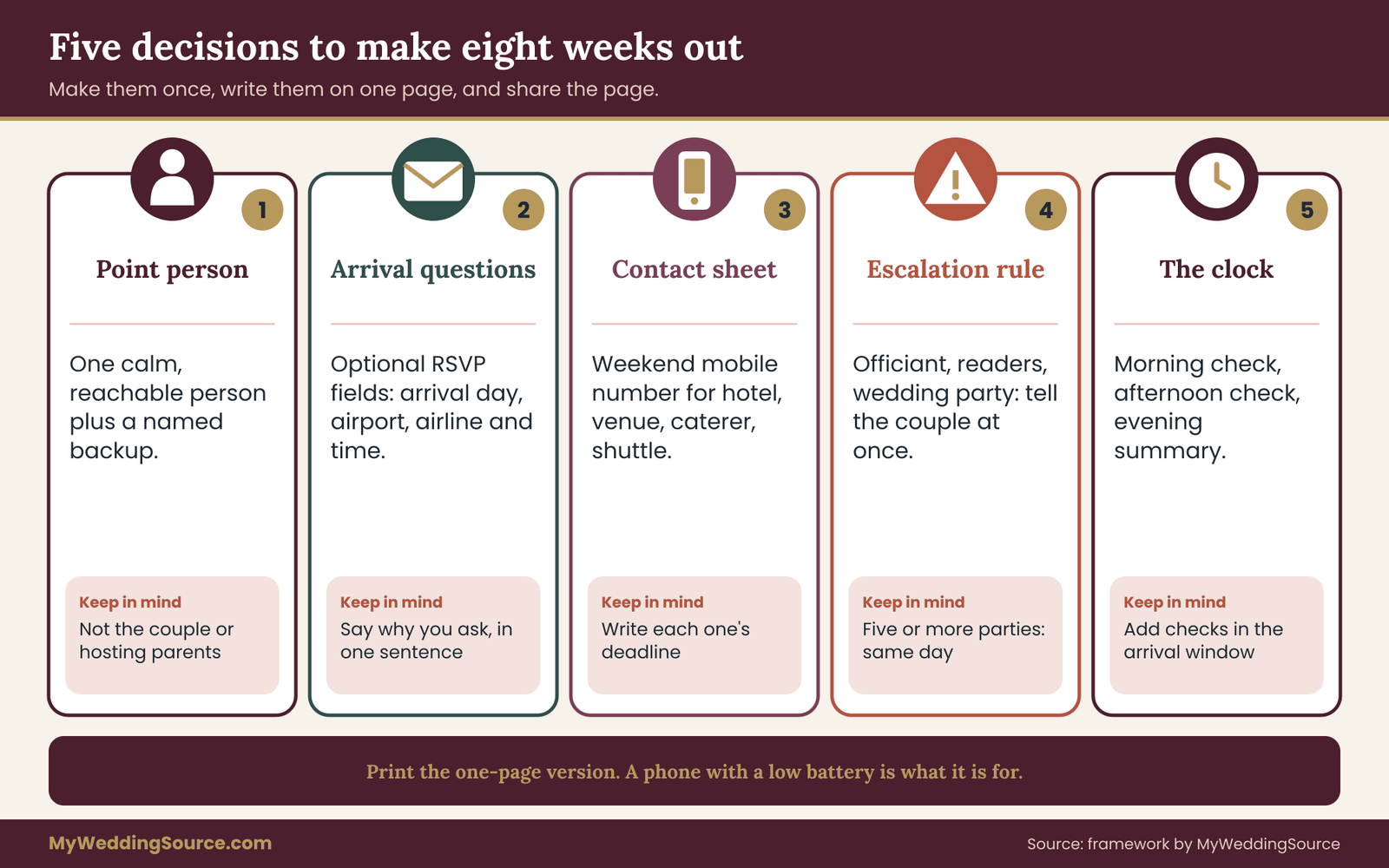
The best time to set up a flight cancellation plan is about eight to ten weeks before the wedding, when RSVPs are mostly in and nobody is panicking. It takes a few evenings. You are not writing a manual. A flight cancellation plan is five decisions recorded in one place.
Decision one: name the point person and a backup
In a flight cancellation plan, the point person receives every piece of guest travel news and runs the status log. Choose someone calm, reachable and not otherwise busy on the wedding day. That usually rules out the couple, the parents who are hosting, and anyone in the wedding party who will be in hair and makeup at noon. A sibling, a close friend, a hired day-of coordinator or a planner is a better fit. If you have a planner, ask whether guest travel news is part of the contract before assuming it is.
Name a backup, too. The backup does not need to do anything until the point person is unreachable for a defined period, for example two hours during the arrival window. Write down that handoff rule so nobody has to guess when it applies.
Tell the point person exactly what the job is, in one paragraph: receive news, update the log, notify ring two, answer affected guests using the scripts in this guide, and escalate to the couple only for the situations listed in the escalation rule below. If you hand over the flight cancellation plan without those limits, the couple ends up in every conversation anyway.
Decision two: ask for arrival details without nagging
A flight cancellation plan runs on arrival details, and guests will not volunteer flight details unless you ask in a way that is easy to answer. The least intrusive version is a short optional question on your RSVP form or wedding website: which day do you plan to arrive, and by which airport or route? A second optional line can ask for an airline and time, with a sentence explaining why you want it: “so we can let the hotel know about late arrivals and reach you quickly if there is a disruption.”
Keep these points in mind when you ask.
- Make the fields optional. Some guests do not know yet, and some will drive.
- Say what you will do with the answers, in one sentence. People share more when the purpose is plain.
- Do not ask for confirmation numbers, ticket details or payment information. You do not need them and you should not hold them.
- Ask only once on the form, then follow up with a gentle reminder to the parties who are flying and have left it blank, about three weeks out.
If you are collecting phone numbers for messaging, remember that guests agree to contact for the purposes you described. A group of guests who gave a number for “wedding logistics” will usually accept disruption messages as part of that. A mass marketing-style blast would be a different matter. Keep the messages operational and short.
Decision three: set up the ring-two contact sheet
In the flight cancellation plan, ring two is the group of people who change what they do when guest arrival changes. Build a small contact sheet with four columns of information, written as a simple list for each contact: who they are, the best number during the wedding weekend, what they need to know, and what they can approve.
For the hotel, that is the group-sales contact or the duty manager, who can say whether a late arrival is fine, whether a room will be held, and what happens to a booking if a guest never arrives. For the venue, it is the coordinator on site, who needs to know about changes to headcount or timing. For the caterer, it is whoever finalizes counts and when that count becomes fixed. For transportation, it is the dispatcher, because shuttles run on schedules and a late flight changes the pickup.
You will not use all of these in every disruption. But the single most common failure in a flight problem is the right person learning too late, so having the sheet ready saves the first twenty minutes.
Decision four: set the escalation rule
Escalation is the part of a flight cancellation plan that says when the point person goes to the couple. Without a rule, either everything reaches the couple or nothing does. A workable version has three lines.
Escalate immediately if someone who is needed for the event itself cannot arrive on time: the officiant, a parent giving a reading or walking someone down the aisle, a member of the wedding party, a musician, or a guest who is providing something such as the guest book or the family heirloom.
Escalate the same day if a group of five or more parties is affected by one cause, such as an airport closure, because the schedule or headcount may need a decision.
Everything else goes in the daily summary, a short message sent once in the evening listing who has changed status and what, if anything, needs a decision.
Decision five: choose the clock
The clock in a flight cancellation plan is the set of times when the point person checks for news and sends the summary. For the final week, a good rhythm is a check in the morning, a check mid-afternoon, and a summary in the early evening. During the arrival window, which is usually the day or two before the wedding, add a check every few hours for flying parties on the log. Most guests will not text unless a problem is real, so proactive checks of the airline’s status page and airport conditions are what catch problems early.
The Federal Aviation Administration publishes a live airport status page that shows delays and ground stops across the national system, and the National Weather Service publishes forecasts and warnings for any location. Neither tells you whether a specific guest’s flight is cancelled, but they tell you when to expect trouble. A later section describes how to use them as triggers.
Put the decisions in one page
When the five decisions are made, write the whole flight cancellation plan on a single page the point person and the backup can read in two minutes: names and numbers, the escalation rule, the clock, and a link to the status log. Print it as well as storing it digitally. A phone with a low battery in a regional airport is the exact situation this page is for.
The updated RSVP status log in detail
The status log inside the flight cancellation plan is simple on purpose. It has one row per guest party, a few fixed columns, and five states. The aim is that a person who has never seen it can open it at midnight and understand what is happening.
The columns
Each row of the flight cancellation plan’s log carries the following information, written in plain text with no formulas required.
- Party name and size. Include the number of people, because a party of six moves hotel and shuttle counts more than a single guest.
- Role flag. A mark for anyone whose absence changes the event: officiant, parent, wedding party, performer, or someone carrying an item the event needs.
- Hotel and booking type. Which hotel, and whether the booking is in a room block or on the guest’s own.
- Planned arrival. Day, airport and, if known, a time window. Do not store ticket numbers.
- Status. One of the five states below.
- Current arrival. The latest known arrival, which changes as the situation changes.
- Last contact. When the point person last heard from or spoke to the party, with a short note.
- Ring-two notified. A simple yes or no, with the date and time, for each affected hotel, venue or transport contact.
That is eight columns, and the flight cancellation plan needs no more. Resist the urge to add more. Every extra column is a field somebody forgets to update.
The five states
On track. The party has told you their travel plan, or has not reported a problem, and nothing in the airline or airport conditions suggests one. This is the starting state for everyone who is flying. A party can sit here for weeks.
Watching. Something outside the party’s control could affect them, but nothing has happened yet. Examples: a storm is forecast along their route, an airport they connect through has a ground stop, or the airline has announced a strike date close to the wedding. Watching is the state that gives you early warning. A party moves into it because the point person decided it should, not because the guest said so.
Rebooking. The guest has told you their flight was cancelled or significantly changed and they are working with the airline on another option. You do not yet know when they will arrive, or whether they will. This is the state that triggers the first contact script and the first ring-two heads up.
Rerouted. The guest has a new itinerary. The log now carries a new arrival day and time. The point person tells the hotel and the transportation contact, adjusts the party’s “current arrival,” and confirms with the guest. If the new arrival is on the wedding day itself, check whether they can reach the ceremony, and note it.
Out. The guest cannot attend, either because no workable alternative exists or because they decided not to travel. This is a change in the attendance record as well as in travel, so the point person tells the couple, and the couple decides about seating, meals and any thank-you or follow-up. Be careful to mark it only when the guest says so. A person stuck overnight is rebooking, not out.
Rules for moving between states
Clear rules keep the log, and the flight cancellation plan around it, honest. A few that tend to work well follow.
A party moves forward only on new information. “I heard it might be cancelled” is not enough to move someone to rebooking; the guest’s own report, or an airline notice they forward, is.
A party can move backward. If a delayed flight leaves after all, the party returns to on track, and the log should say so. Stale “rebooking” rows are the most common source of confusion.
Every move gets a short timestamped note in the last-contact column. Two or three words are plenty: “Flight cx, calling airline”, “Now arriving Sat 11 a.m.”
Only the point person and the backup edit the log. A shared document that ten people can change is a document nobody trusts. Others who help should send updates to the point person.
Reading the log at a glance
A log is only useful if it tells you something in a few seconds. Two simple habits help. First, sort by status, so that rebooking and rerouted parties appear at the top. Second, add a count of each state at the top of the page. A header like “On track 31, watching 4, rebooking 2, rerouted 1, out 0” tells the couple the situation before they read a single row.
Keep a copy of the log’s final state after the wedding. It is a small record of who attended, who did not, and why, which is useful when you write thank-you notes. If a guest could not come because of a cancelled flight, a sincere note about missing them lands very differently from a generic one.

Privacy and tidy habits
The log contains personal travel information, so treat it with care. Share it only with the point person, the backup and the couple. If a planner or hotel needs a part of it, send only the relevant lines, such as a party name, the new arrival day and a phone number, rather than the whole document. When the wedding is over and the thank-you notes are written, delete or archive the log in line with how you handle other guest records. The page on organizing wedding records after the event is not required reading, but it is a useful companion if you want a retention habit for guest data.
The communications cascade: who hears what, and in what order
The cascade is the center of your flight cancellation plan. It answers a question that sounds trivial until a cancellation happens: when you learn something, whom do you tell first? Most couples default to whoever texted them last. The cascade replaces that habit with an order based on who can act.
The four rings of the flight cancellation plan are not about importance or closeness. They are about what each group can do with the information, and how quickly that matters.
Ring one: the couple and the point person
Ring one is small by design. It is the couple, the point person and the backup. The point person receives the first report from a guest, an airline notice or a status check. They decide the state in the log, apply the escalation rule, and move to ring two.
Ring one meets once, briefly, to walk through the flight cancellation plan, before the arrival window opens. Ten minutes is enough to confirm three things: the point person has the contact sheet, the escalation rule is understood, and the couple agrees on what they want to be told versus what they would rather not hear until the evening summary. Some couples want to hear everything. Many do not, and they are right to protect their attention in the last week.
Ring two: the people who run the event
Ring two should hear before any guest outside the affected party does, whenever the news changes what they will do. In practice, it breaks into four contacts.
The hotel. The hotel needs to know three things: which party is affected, what the new arrival is likely to be, and whether the party’s booking should stay as it is. A late arrival is usually simple: ask the front desk or group contact to note that the guest will arrive late and confirm that the room will be held. Do not assume this is automatic.
Policies on holding rooms for late arrivals, on no-show charges and on how a block treats unused rooms differ. If a guest booked on their own, the guest owns that conversation with the hotel; the point person can still ask the group contact for a courtesy note, but should not promise an outcome. The longer guide to guest hotels, room blocks and mobility needs explains how blocks, cut-off dates and cancellation terms differ, which is worth reading before you call.
The venue. The venue coordinator needs to know about changes that affect headcount, seating or the schedule. A single missing guest rarely matters until the seating chart is final. A missing wedding party member, or ten guests at the same table, does.
The caterer. Caterers usually have a final-count date after which numbers lock. Before that date, a missing guest can be removed. After it, you may still pay for the meal. Ask the caterer early what their date is and what happens after it, so that a late cancellation does not turn into a surprise. Note the date in your contact sheet.
Transportation. If you are running a shuttle between the airport and the hotel, or between the hotel and the venue, the dispatcher needs to know about arrivals that no longer match the schedule. Most shuttle plans assume a pickup at a fixed time; a guest arriving four hours later is not covered unless the company has been told. This is also the moment to ask whether an extra run is possible and what it would cost, so the couple can decide.
Ring three: the affected guests
In a flight cancellation plan, once ring two is informed, or while it is being informed, the point person contacts the affected guests. The aim is not to solve the problem for them. The aim is to confirm that you know, to tell them what you have already done on the event side, and to say what they should do next.
A few principles keep this contact useful.
Start with the guest’s situation, not the wedding’s. “We saw your flight was cancelled and wanted to check in” lands better than “We need to know your new arrival time.”
Tell them what you have done. If you have already told the hotel, say so. It spares the guest a call and shows you are on top of it.
Point them to the airline for the things only the airline can decide: rebooking, refunds, vouchers, hotel or meal help during a long delay. Guests often assume the couple can help with these. A friendly “the airline is the only one who can change the ticket” is accurate and saves them from waiting on you.
Offer what is yours to offer, and nothing else. That can include a ride from a different airport or at a different time, a note to the hotel, a place at a later meal, or a heads up on when the shuttle runs. Offer these only if you have confirmed that they are possible.
Ring four: everyone else
In any flight cancellation plan, most of the guest list does not need to hear about someone else’s cancelled flight. Telling them tends to spread worry and invite helpful advice that nobody asked for. Ring four hears only when something changes for them: a shuttle schedule moves, the welcome event time shifts, a venue closes an access road, or the ceremony start is delayed because key people are late.
When ring four does hear, the message goes to the whole list at once, from one sender, in one place. Use the same channel guests already expect, such as the wedding website banner, an email or a group text, and keep it to what changed, what stays the same and where to find updates. The page on wedding etiquette offers useful background if you are unsure about tone for group notices.
The timing rule for each ring
The cascade works best when the flight cancellation plan sets explicit time windows. These are goals, not promises, and they are a test of whether your setup is workable.
- Ring one learns of a problem as soon as the point person does.
- Ring two is notified within about an hour of the point person confirming a change that affects them, or sooner if the change is within a day of the wedding.
- Ring three is contacted within the same hour, ideally before the guest has to ask.
- Ring four is updated once a day at most, unless something affects the schedule.
If a guest is the first to report news, the first reply should go out within thirty minutes, even if all it says is “Got it, thank you, looking into this now.” Silence is what makes people call three more relatives.
Handling a disruption that hits many guests at once
Sometimes one event hits many parties, and the flight cancellation plan has to scale: an airport closure, a ground stop, or an airline cancelling a whole route. The cascade still applies, but it changes shape.
First, resist messaging every affected guest individually before you understand the scale. Start by checking the log for everyone who uses the same airport or airline, and move them to watching. Then notify ring two once, with a short list of parties and a rough guess about timing.
Second, send the affected guests one group message rather than twenty personal ones, and follow up personally with the role-flagged parties. A group message should say what you know, what you do not know and when you will next update. A template appears in the messages section.
Third, tell the couple early. A disruption large enough to affect several parties may require decisions about the schedule, such as moving the welcome event, adjusting the rehearsal or giving a longer buffer at the start of the ceremony. Those are the couple’s decisions, and they need time to think about them.
Who should not be in the cascade
The cascade also protects your flight cancellation plan from well-meaning interference. Parents, in-laws, wedding party members and friends may all learn about a cancelled flight through the grapevine. They should not become new channels. A simple line to the people closest to you helps: “If you hear about a travel problem, please send it to our point person and do not message the guest list.” It sounds blunt, but people are usually relieved to be told where to send things.
A short example of the cascade in motion
Consider a guest whose Friday morning flight is cancelled.
At 8:10 a.m. the guest texts the point person.
By 8:20 the point person replies and moves the guest to rebooking. By 8:35 the log has been checked: the guest is a cousin, not role-flagged, booked in the block at the host hotel. The point person emails the hotel’s group contact that the cousin may arrive late tonight, and asks that the room be held. By 9:00 the cousin has rebooked to an evening arrival, the point person updates the log to rerouted, adds the new time, and sends a short thank-you. The couple hears about it in the evening summary. Nothing else changes, and nobody else needed to be told. That is the cascade working as intended, and the flight cancellation plan doing its job.

When the cascade is well tuned, most of the work disappears into the background. Guests feel looked after, the hotel and venue are never surprised, and the couple sees a summary rather than a stream of alarms.
When the flight cancellation plan switches on: three triggers
A flight cancellation plan that runs all year is just noise. The plan should sit quietly until something gives it a reason to wake up, and then it should move in clear stages. Three stages are enough for a flight cancellation plan: watch, alert and act.
Watch means a risk exists but nothing has gone wrong. Alert means a risk has become likely or has begun to affect some travelers. Act means a specific party has lost a flight or been significantly changed. Each stage has a different job for the point person and a different tone for the messages.
Stage one: watch
The watch stage starts about a week before the wedding, when the first guests begin traveling and weather forecasts become meaningful. During this stage, the point person does very little that guests can see. They open the log, review who is flying, and look for patterns: which airports and connecting hubs appear most often, which guests have tight connections, which role-flagged parties are traveling by air.
Concrete things to do during the watch stage of your flight cancellation plan:
- Check the National Weather Service forecast and any active warnings for the departure cities, the main connecting hubs and the wedding location.
- Look at the FAA’s airport status page for any current delays or programs at the airports that matter most.
- Note any announced labor disputes, airport construction or major events in the departure cities that could affect travel. Local news sources and the airline’s own notices cover these.
- Move parties to “watching” in the log when a specific risk touches their route.
You do not need to message guests at this stage unless there is something specific to say. If the forecast is clearly bad for a large share of the guest list, a short, calm note is useful: “We are keeping an eye on the weather along your route. If your flight changes, tell us and we will adjust on our side. Check your airline’s app for updates.”
Stage two: alert
Alert begins when the risk becomes concrete. A storm has a track and a timing. An airport has declared a ground stop. An airline has cancelled a number of flights on a route, or issued a travel waiver for the area, which usually means the airline will let travelers change their tickets without the usual fee for a limited period. Waiver details are set by each airline, so tell guests to read their airline’s notice and not to rely on a summary from you.
Alert is the point where the flight cancellation plan asks the point person to start contacting people. Four things happen at about the same time.
First, the log is updated. Everyone affected by the risk moves to watching, and the count at the top of the page changes.
Second, ring two receives a short heads up. The hotel contact is told that arrivals may be delayed and that some guests may be late. The transportation dispatcher is asked whether pickups can be flexible. The venue and caterer hear if the risk could affect a large group.
Third, affected guests receive a brief message. It says what you are seeing, what they should do (check the airline app, consider moving to an earlier flight if the airline allows it), and how to reach the point person.
Fourth, the couple is told, in one message, and given a short list of any decisions that may be needed. Examples: whether to keep the rehearsal time as it is, whether to leave a buffer in the ceremony schedule, whether to shift a welcome event to a later hour.
A note on advice. Moving a guest to an earlier flight is tempting advice, and it is sometimes the right one, but it depends on the fare rules, the airline’s waiver and whether the guest can get time off. Offer it as an option that guests can check, not as an instruction. Anything involving fees or refunds is between the guest and the airline.
Stage three: act
The act stage of the flight cancellation plan begins when a specific party reports a cancellation, or the point person sees one in an airline notice forwarded by the guest. At this stage the flight cancellation plan is fully live: the cascade runs in order, the log changes state, and messages go out as described in the previous section. The key difference from alert is that you now have an individual to help, with an individual timeline.
The first job in act is to establish facts. Ask the guest, gently, for three pieces of information: what the airline offered, when they expect to arrive on the new plan, and whether they need anything from you. Do not ask for details such as ticket numbers. If the guest has not yet reached the airline, tell them where to start, which is usually the airline’s app or phone line, and tell them you will check in again at a specific time.
The second job is to protect the role-flagged parties. If the person is an officiant, a parent or a wedding party member, the point person moves quickly to the escalation rule and the couple is involved at once. Decisions about a backup reader, a different processional order, or a delayed start belong to the couple and the people who run the ceremony. The point person gives them facts and timing.
The third job is to update ring two and the log, then move on to the next party.
A simple calendar of triggers
It helps to see the flight cancellation plan on a calendar. These are typical, not fixed, because every wedding has a different travel pattern.
Seven to ten days before. Watch begins. Review the log, look at the weather outlook and note high-risk routes.
Three to five days before. Check weather and airport status at least twice a day. Send a short reminder to flying guests asking them to check flight status the day before they leave and to tell the point person about any changes.
One to two days before. Arrival window. Alert and act may start. Check every few hours. Keep the hotel contact on a short loop.
Wedding day. Last arrivals. Only the point person and the backup are in the loop, plus the couple if a role-flagged party is affected. The point person marks every party as arrived, rerouted or out, and clears watching rows.
Day after. Close the log. Thank the people who helped, and send notes to guests who missed the wedding because of travel.

Writing the messages: short, specific and honest
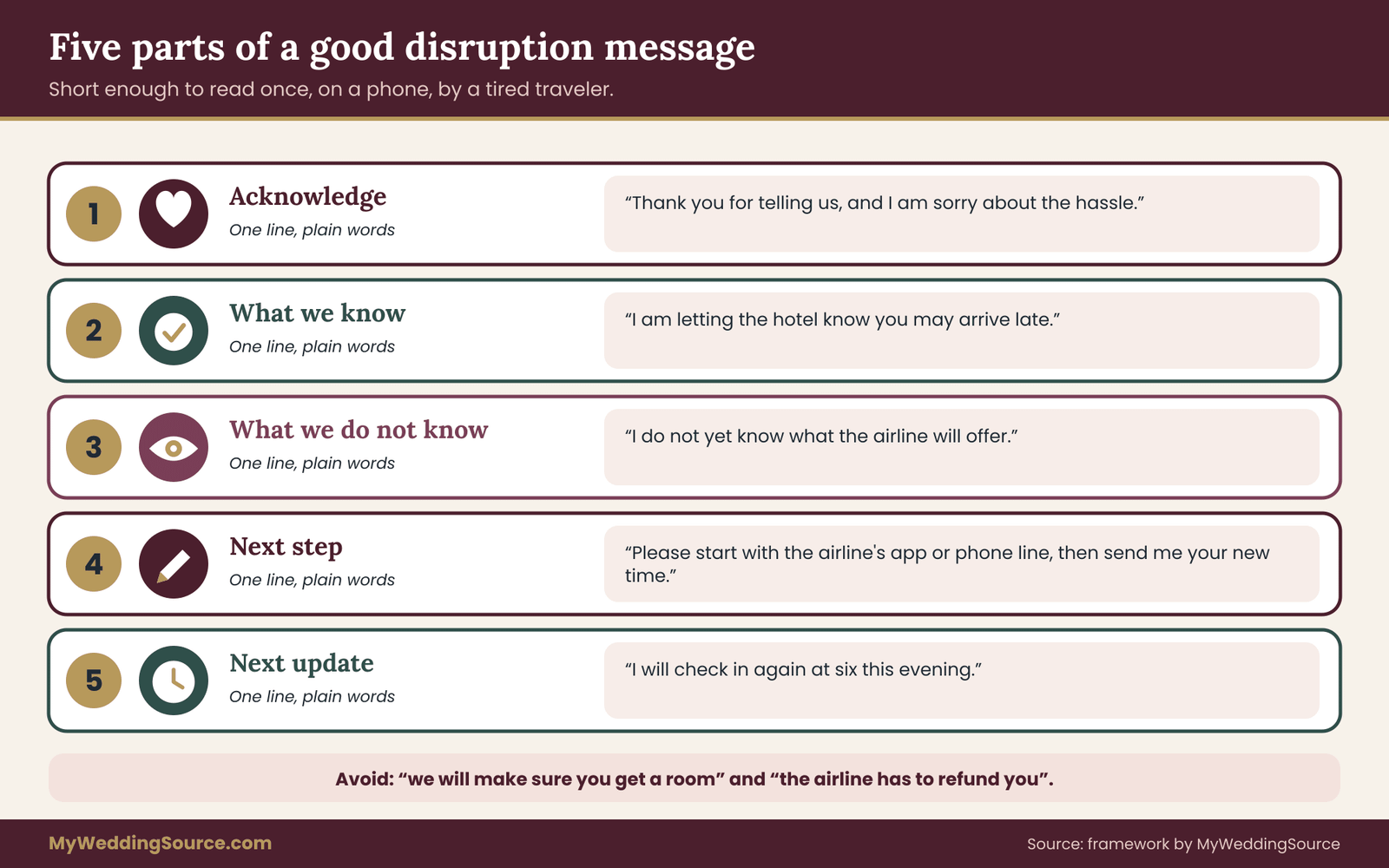
Words matter more than people expect in a travel disruption. A guest with a cancelled flight is tired, worried and probably on hold with an airline. They will read your message once, quickly, on a phone. It should do three jobs: show you care, say what you know, and make the next step obvious.
Five parts of a good disruption message
A reliable structure has five parts, and every message in your flight cancellation plan can use it.
- Acknowledge. One short line that shows you saw the problem.
- State what you know. Facts only: what has changed, what you have already done.
- State what you do not know. It is fine to say so. It builds trust.
- Give the next step. One action for the guest, one for you.
- Say when you will update. A specific time, not “soon”.
Script: first reply to a guest who reports a cancellation
“Thank you for telling us, and I am sorry about the hassle. I have noted your new situation and I am letting the hotel know you may arrive late. The airline is the only one who can rebook you, so I would start with their app or phone line. I do not know yet what they will offer. Please send me your new arrival time when you have it, and I will check in with you again at six this evening.”
Script: message to the hotel contact
“Hello, I am helping with the Reyes wedding. One of our guests in the room block, party of two, has a cancelled flight and now expects to arrive late on Friday night, possibly after midnight. Could you note that they are coming and let me know if the rooms will be held? I will confirm the exact time as soon as I hear it. Thank you for your help.”
The script is short. It names the party, gives an approximate time and a clear question. It does not ask the hotel to waive anything. If the hotel proposes a fee or a policy, pass it to the guest and the couple without argument.
Script: group notice when several parties are affected
“Quick travel update from Maya and Jon’s team. Several flights into the area are being delayed or cancelled because of weather. If your flight is affected, please contact your airline first, then send me your new arrival time. The hotel and shuttle company are aware. The welcome dinner start time is not changing yet. I will send another update at four o’clock today.”
Script: reassurance when nothing is wrong
The no-news message of a flight cancellation plan is underused. When an alert has passed and the guest list is fine, a short note stops rumor and gives the point person a clean record.
“Update: the storm has moved east and, as of this afternoon, all of our guests’ flights are running. The schedule for the weekend is unchanged. If your plans change, please send me a message.”
Script: when a guest cannot come
Be gentle and do not argue with the decision. If the guest decides to skip the wedding after a cancellation, the point person’s job is to say thank you, ask nothing more and tell the couple.
“I am so sorry the trip fell through. Thank you for trying so hard to be there. We will miss you and I will tell the couple right away.”
The couple can follow up personally after the event.
What to avoid saying
A few phrases cause trouble even though they feel kind.
- “Do not worry, we will make sure you get a room.” You may not control that.
- “The airline has to refund you.” Refund rights depend on the circumstances and the current rules. Tell the guest to check with the airline and the Department of Transportation’s consumer pages instead.
- “We will pay for it.” Offer money only if the couple has decided to, in writing, before the message goes out.
- “It will be fine.” You do not know that, and the guest will not believe it.
Channel and tone
Use the channel the guest already used to reach you. If they texted, reply by text. If they emailed, reply by email. For group notices, choose one channel and stick with it, and put the same text on the wedding website so people can find it later. Keep the tone plain. Exclamation marks and cheerful emojis can read as dismissive to someone who has been awake for twenty hours.
Helping a stranded guest without taking over their trip
The hardest part of a flight cancellation plan is not the logistics, and it is not the software either. It is knowing where your responsibility ends. Hosts are generous people. When a guest is stuck, the instinct is to fix it: find another flight, book a hotel near the airport, send a car. Sometimes that instinct is lovely. It can also create obligations you did not mean to take on, and it can interfere with what the guest is entitled to from the airline.
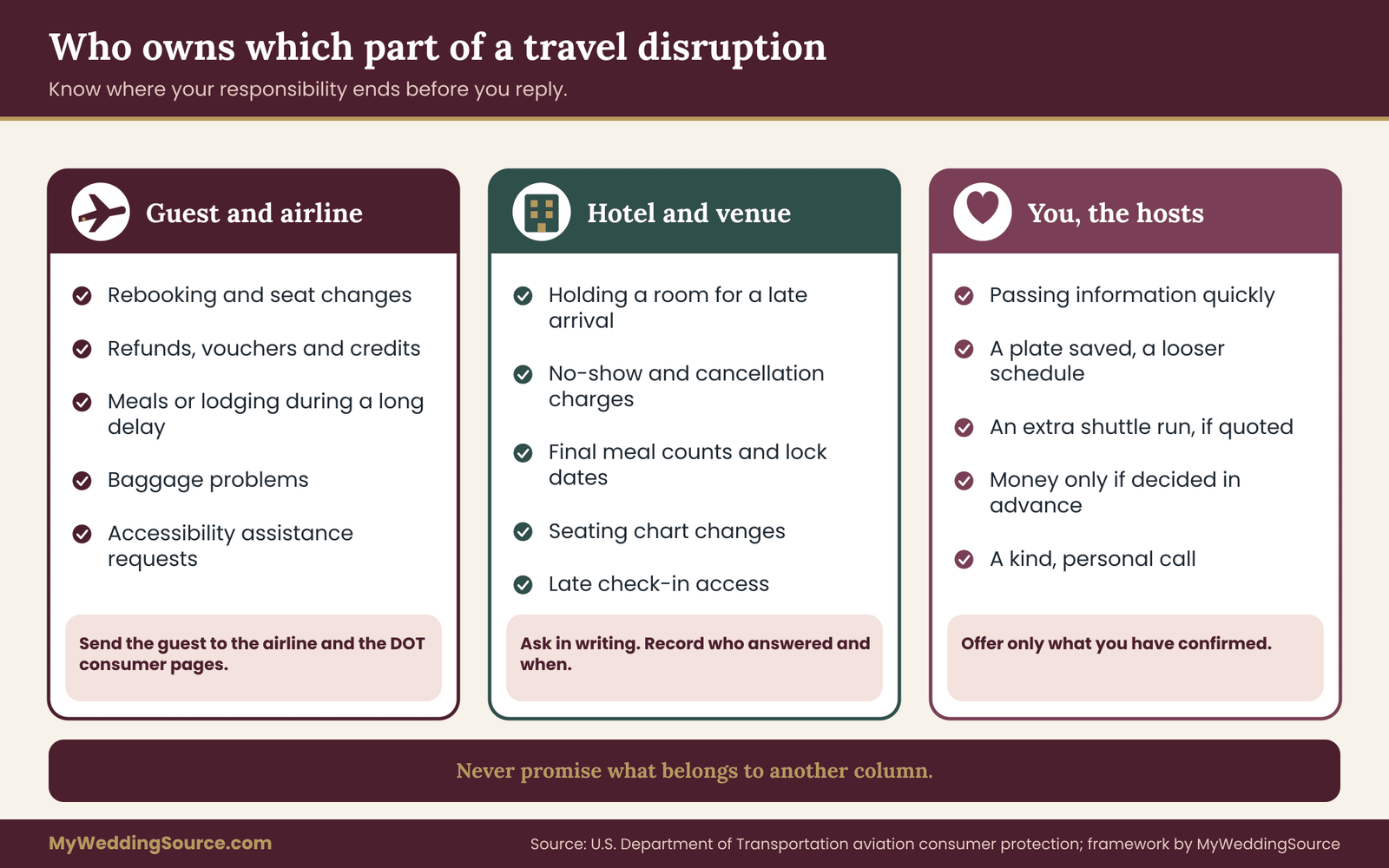
A simple way to keep the flight cancellation plan within bounds is to sort every possible form of help into three groups: what belongs to the guest and the airline, what belongs to the hotel and venue, and what belongs to you.
What belongs to the guest and the airline
Rebooking, refunds, travel vouchers, seat changes, baggage, and any meals or lodging during a long delay all belong to the guest and the carrier. The airline’s contract of carriage and the Department of Transportation’s rules govern them, and those rules vary by circumstance. The Department’s aviation consumer protection pages explain how refunds and rebooking work for flights that are cancelled or significantly changed, and they are the right place to send a guest who is unsure of their rights. They are current as of whatever date you read them, which is a reason to send the guest to the source and not to quote rules in your message.
Do not tell a guest what they are owed. Do not suggest that they should take or refuse a particular rebooking offer. A guest who accepts a rebooking may affect their right to a refund, and you do not want to be the person who gave the wrong advice at the wrong moment. A kind, neutral line works: “The airline’s customer service and the Department of Transportation’s consumer page can explain your options.”
What belongs to the hotel and venue
A room, a late arrival, a hold on a booking and a cancellation fee are the hotel’s to decide, under the booking terms the guest or the couple agreed to. Seating, meal counts and timings belong to the venue and caterer, under the couple’s contract. The point person’s role is to ask, not to promise. Questions to ask the hotel when a guest is delayed:
- Will the room be held for a late arrival, and until what time?
- If the guest does not arrive that night, is the booking cancelled automatically or charged?
- Can the arrival be noted on the reservation so the front desk is not surprised?
- If the guest arrives a day late, can the stay be shortened without a penalty, and who needs to approve it?
Write down the hotel’s answer, the name of the person who gave it and the time. If the answer is unclear, ask for it in writing, even if it is a one-line email. The hotel’s policy is the only one that counts, and it may differ for block bookings and individual bookings. A good guide to room blocks explains why a block’s attrition terms and cut-off dates matter when guests change plans.
What belongs to you
Your decisions are the part of the flight cancellation plan you control. A short list of the sorts of help that are commonly yours to give:
- Information. A quick message to the hotel, a note about shuttle times, a heads up about the schedule.
- Flexibility on your own events. A later arrival at the welcome dinner, an earlier or later seat at the reception meal, a plate saved for someone arriving after dinner.
- A ride. If you have arranged transportation, an extra pickup may be possible. Ask the company first and confirm the cost.
- A conversation. A kind phone call from a person the guest knows can mean more than any practical gesture.
Money is a special case in any flight cancellation plan. Some couples decide in advance that they will cover a night at an airport hotel for a parent or a key participant. That is a generous choice, and it should be made by the couple, not improvised by the point person. If you plan to offer it, decide the limits first: for whom, how much and under what conditions. Otherwise, assume you are not covering it.
Guests who need extra care
Some travelers need more from a flight cancellation plan than others, and the log should note them early.
Guests with mobility needs. A cancellation that forces a self-transfer through a busy airport, or an overnight stay in an unfamiliar place, is a bigger problem for a guest who uses a wheelchair, a walker or oxygen.
The airline has obligations to travelers with disabilities under the Air Carrier Access Act, and the Department of Transportation explains them. Do not try to interpret the rules; ask the guest what help they would like and point them to the airline’s accessibility desk. Tell the hotel if a guest needs an accessible room on a later night, since those rooms are limited. Ask the hotel to confirm in writing which accessibility features the room has.
Older guests. Long delays are tiring. A short, warm message that offers a ride from the airport or a quiet place to rest on arrival is often more welcome than anything else.
Guests traveling with children. A cancelled flight with a toddler is a different level of stress. If possible, ask the hotel about flexible check-in and any food available late. For the wedding itself, think about whether a child’s meal or a seat in a child-friendly spot can be held.
International guests. Cancellations can interact with visas, connection rules and time zones. Do not give advice on entry requirements. Refer the guest to the relevant government’s travel information, and, for U.S. citizens, to the State Department’s travel pages. For a guest arriving from abroad, ask for their new arrival time in local time at the destination to avoid mistakes.
Guests who decide not to travel
A guest may decide that a cancelled flight is the last straw, particularly if the new itinerary would get them in an hour before the ceremony or require an overnight at an airport. This is a legitimate decision. Do not push. Say what you will miss about their being there, tell them you will pass the news to the couple, and ask nothing further. If the guest asks about refunds on a hotel room, send them to the hotel. If the guest asks whether the couple would cover anything, tell them you will ask, and make no promise.
Passing changes to the hotel, the venue and the vendors
The second half of the cascade is where a good flight cancellation plan saves money and stress. In a flight cancellation plan, each vendor has a different deadline and a different cost of change, so the point person should know which ones matter.
The hotel
In the flight cancellation plan, the hotel’s concerns are rooms and timing. Give them the party name, number of rooms, the original arrival, the new arrival and the booking type. If the guest is in a block, ask whether the hotel will release the room or hold it. If a block has a cut-off date that has passed, the hotel may still be flexible, but the rate is no longer protected the way it was before. Keep the tone friendly. Hotel staff are used to late arrivals and are usually willing to help if you ask clearly.
The caterer and venue
For meals, the issue is the final count and the time of service. If a guest will arrive after dinner begins, ask whether a plate can be held or reheated. If a guest will miss the wedding altogether, ask whether the count can still be lowered. Before the final-count date, you can usually do this at no cost. After the date, expect to be charged, and note it for the couple. If the venue assigns seating, let the coordinator know as soon as you are sure about an “out”, so they can adjust the chart before place cards are placed.
Transportation
For shuttles, tell the dispatcher about new arrivals as soon as you know them. If a guest is arriving after the last scheduled run, ask whether a pickup can be added and at what cost. If a guest is arriving at a different airport, say so clearly. Many problems come from a pickup showing up at one terminal when the guest is at another.
The photographer, the planner and the officiant
Photographers need to know about role-flagged guests who will be missing from family photos. The planner needs to know about anything that affects timing. The officiant needs to know about any change to the ceremony start. A single short message to each, sent at the right time, is enough. The family photo list, if you have one, should be updated to remove missing people and to move someone who will arrive late to a later slot. The page on the wedding family photo list covers how to build one so that changes like this are easy to make.
A warning about over-notifying
It is possible to overdo ring two in a flight cancellation plan. A vendor who receives six messages in a morning starts to ignore them. Batch updates when you can. If several guests are affected by the same event, send one message listing them all, with the arrival times in a simple list. Reserve phone calls for time-sensitive changes: a missing wedding party member on the wedding morning, a shuttle that needs to be dispatched within the hour, or a hotel that needs to hold a room that evening.
A worked example of a flight cancellation plan: Priya and Daniel, three days out
The example below is invented to show how the pieces fit together. The names, numbers and airports are illustrative, not data from a real wedding, and your own situation will differ.
Priya and Daniel are marrying on a Saturday at four in the afternoon, at a venue about ninety minutes by road from a regional airport. They have 96 guests in 58 parties. Twenty-two of those parties are flying, and eight of the twenty-two connect through one large hub. They hired no planner, so Priya’s sister, Anika, is the point person, and Daniel’s friend Ravi is the backup. They built their flight cancellation plan ten weeks ahead, starting with the status log, collected arrival days on the RSVP form and set up a contact sheet for the host hotel, the venue coordinator, the caterer and the shuttle company.
Three decisions in the flight cancellation plan were made in advance, which turned out to matter. The caterer’s final count locks on the Wednesday before the wedding, and later removals are still billed. The couple agreed that Anika may arrange one extra shuttle run or one night at an airport hotel for a role-flagged guest without asking them first, up to a limit they wrote down. And the escalation rule says the couple hears at once if the officiant, a reader or a member of the wedding party is affected.
Monday: five days out, watch begins
Anika reviews the log, as the flight cancellation plan directs. Fourteen flying parties are on track. The eight parties that connect through the hub move to watching, because a forecast shows a line of storms crossing that region on Thursday. The count at the top of the log reads: on track 14, watching 8, rebooking 0, rerouted 0, out 0.
She sends no message yet. She checks the National Weather Service forecast morning and afternoon, and she looks at the FAA’s airport status page each time. She also reminds the hotel contact, in a short note, that Thursday and Friday arrivals may run late.
Tuesday and Wednesday: alert
The forecast firms up and an airline issues a travel waiver for the hub, which Anika reads on the airline’s website. She does not summarize the waiver terms. She sends the eight watching parties a short message: the weather is likely to affect flights through the hub on Thursday, they should check their airline’s waiver, and they should tell her if their plans change. She also tells them that the shuttle company knows and that the welcome dinner on Friday is not moving yet.
On Wednesday, she tells the couple the count of parties at risk, and mentions the caterer’s lock date, which is that day. Nothing in the situation justifies lowering the count, so it stays.
Thursday: act
At 11:40 a.m., Daniel’s cousin texts Anika that her evening flight through the hub has been cancelled. Within an hour, two more parties report problems. One is Priya’s uncle, who is meant to give a reading at the ceremony. The other is a groomsman and his partner.
Anika moves all three to rebooking. The count now reads: on track 14, watching 5, rebooking 3.
She applies the escalation rule. The uncle and the groomsman are role-flagged, so she calls Priya and Daniel immediately and tells them the facts: the uncle’s airline has no seats until Saturday morning, and the groomsman’s best option is a different airport two and a half hours away, arriving Friday evening. She does not offer opinions, only the timings.
The couple make two decisions in five minutes. First, a cousin, Mira, will be briefed as a backup reader. If the uncle lands by noon on Saturday, he reads. Second, Anika may arrange a ride for the groomsman and his partner from the alternate airport, within the limit they set.
Anika then contacts ring two. She emails the hotel’s group contact that three parties may arrive late, with the likely times, and asks that rooms be held. She calls the shuttle dispatcher about the alternate airport pickup and gets a quote for a ride. She tells the venue coordinator that a reader may be late.
By evening the cousin has rebooked to a Friday midday arrival. Anika moves her to rerouted and adds the new time. The groomsman’s party is rerouted to an alternate airport with a Friday 9 p.m. arrival. The uncle is rerouted to Saturday 9:40 a.m. The count reads: on track 14, watching 5, rerouted 3.
Friday: closing the gaps
Friday morning, an older couple in the watching group call Anika. After a long phone hold and an offer of a Sunday flight, they have decided not to travel. Anika thanks them, asks nothing more, moves them to out and tells Priya and Daniel. They write the couple a warm note and Priya calls them that evening. The caterer’s count had locked on Wednesday, so the meals for that party are still charged. The couple knew that risk and accept it.
The group notice goes out at noon to everyone on the list: a flight disruption is affecting some guests, the welcome dinner starts as planned, and the dinner team has saved plates for late arrivals. It does not mention anyone by name. The log reads: on track 14, watching 4, rerouted 3, out 1.
The ride for the groomsman and his partner is arranged. The hotel holds the rooms. The cousin arrives on time. The extra shuttle run adds a cost that the couple had pre-approved.
Saturday: the last arrivals
At 8 a.m. Anika checks the log and the status pages. The storms have passed. The four watching parties are all in town, so they move to on track and then to arrived. The uncle lands at 9:40 a.m. and the shuttle is there. He reads at the ceremony, and Mira is relieved of her backup duty. Anika marks every row and closes the log that evening.

What this example shows
Three things made the flight cancellation plan work, and none of them were clever. The decisions were made early: the escalation rule, the spending limit, the contact sheet and the caterer’s date. The messages were short, specific and sent in an order that put the hotel and shuttle ahead of the whole list. And the log told everyone the same story, so nobody had to ask “who is still stuck?” more than once.
Notice also what Anika did not do. She did not rebook anyone, interpret anyone’s airline rights, promise a refund or message the entire list about every change. She did not take on the caterer’s charge, which was a decision about a known cost. And she did not hide the “out” from the couple. The flight cancellation plan did what it was designed to do: it moved information to the people who could act.
Special situations that change the flight cancellation plan
Not every case fits the standard path. A few circumstances deserve a short note.
The officiant is flying
An officiant traveling by air is the single highest-stakes entry in a flight cancellation plan. Consider asking them to arrive a day earlier than the minimum, and keep a name or two of local backups. The legal requirements for who may solemnize a marriage differ by state, and a late-found substitute may not be eligible. Ask the issuing office or your officiant about the rules well before the wedding, long before a cancellation forces the question. The guide to wedding officiant requirements covers what to confirm.
The couple is flying
If you and your partner are traveling to the wedding, put yourselves in the flight cancellation plan too, and treat the date as more serious than any guest’s. Fly in early, with buffer days, and do not rely on a tight connection. Pack the things that cannot be replaced, such as rings, the license paperwork, medication and any garments, in a carry-on bag. If a delay does hit, the point person, not you, should tell the venue and vendors.
Guests carrying something the event needs
Some people travel with objects that matter: a family heirloom, a cake topper, a guest book, a handmade gift, a musician’s instrument. Add a note to the log for these guests. If a flight is cancelled, ask whether the item can be shipped or replaced, and decide whether the event can go on without it. This is a quiet failure point that rarely appears on anyone’s checklist.
A very late arrival
A late arrival tests a flight cancellation plan more than most. A party arriving at one or two in the morning needs two things: a hotel that knows they are coming and a way to the hotel. Ask the hotel about late check-in, whether the front desk is staffed all night and whether a keypad or mobile key is available. Ask the shuttle company whether late runs are possible. If neither is available, offer the guest an option for a ride-hailing service and let them choose.
The airport closes on the wedding day
Sometimes weather or an operational problem closes an airport on the day itself. The cascade still applies, but the stakes shift from arrival to the event schedule. The couple, the venue and the officiant decide whether to delay the start, shorten the cocktail hour or proceed with those who are present. The point person provides facts and updates the log. If the decision is to delay, the whole list is told through the usual channel, along with a clear time for the next update.
Guests who choose to drive
A flight cancellation plan should expect that some guests drop a cancelled flight and drive. That is sensible when the distance allows, but it adds fatigue and weather risk. Do not push anyone to drive. If a guest decides to, move them to rerouted with an arrival estimate and ask them to message when they are close. A late-night drive, an unfamiliar road and a morning ceremony can be a bad combination. A kind note urging them to rest is better than a plan that depends on a hard arrival time.
Weddings with a rehearsal or welcome event
Welcome dinners and rehearsals give you an easy place to build in flexibility. Keep the start time loose, or schedule a casual drop-in gathering that does not require everyone to be there. If a wedding party member misses a rehearsal, ask the officiant to walk them through the processional on the day. These small design choices reduce how often a flight problem becomes an event problem.
Mistakes that weaken a flight cancellation plan, and what to verify
Most failures of a flight cancellation plan are not dramatic. They are small gaps that line up on a bad day. These are the ones that appear most often.
Common mistakes
No named point person in the flight cancellation plan. When everyone is responsible, nobody is. Guests text the couple, the couple forwards to a parent, the parent asks a friend, and the hotel never hears. Name one person and one backup, and tell the guests who they are.
Collecting flight details too late. A request for arrival information in the final week reads as an interrogation. Ask at the RSVP stage or soon after, make it optional and say why you are asking.
Telling the whole list too early. A group message about one cancelled flight creates worry for people who are not affected. Keep ring four quiet until something changes for them.
Telling the hotel too late. The hotel is the first place a late arrival shows up. A hotel that learns about a midnight arrival at the front desk, after the room has been released, is the most predictable failure on the list.
Promising what you cannot control. Rooms, seats, refunds and shuttles all belong to someone else. Phrases like “we will sort it out” are kind, but they set an expectation. Say what you will do and what you will ask.
Letting the log go stale. A log with three weeks of “rebooking” rows and no timestamps is worse than no log, because people trust it. Close or update each row the same day.
Offering money without a decision. If the point person improvises an offer to pay for a hotel night, the couple may learn about it from a receipt. Decide in advance who may be offered what, and write the limit down.
Forgetting the guests who are not flying. Many weddings have local and drive-in guests who are affected by the same weather. A snowstorm that grounds flights also closes roads. The status log is about travel, not just flights.
Ignoring time zones. Arrival times written without a time zone have caused many wrong pickups. Write the time and the time zone, and where possible the airport code.
Treating a cancellation as an RSVP change. Guests who are delayed are still attending. Changing their RSVP to “no” or removing them from the seating chart too early is an avoidable error. Mark someone “out” only when they say so.
What to verify, and with whom
A flight cancellation plan depends on facts that belong to other organizations. Verify these before the wedding, and re-check them in the final two weeks, since policies and rules can change.
- Airline rebooking and refund rules. The U.S. Department of Transportation’s aviation consumer protection pages explain the general rules for cancelled or significantly changed flights, and each airline publishes its own customer commitments and contract terms. Guests should read the current versions; you should not quote them.
- Hotel terms. Ask the hotel, in writing, about late arrival holds, no-show charges, cut-off dates and how unused rooms in a block are treated. Group terms and individual terms differ.
- Caterer and venue deadlines. Ask for the final-count lock date and the charge for late removals, and put both on the contact sheet.
- Shuttle and transportation terms. Ask about late pickups, extra runs, and what the cost would be.
- Travel insurance, if guests or the couple have it. Policies differ widely in what counts as a covered delay or cancellation. The National Association of Insurance Commissioners publishes consumer information, and the policy itself is the final word. Do not advise guests on coverage; suggest they read their own policy or ask their insurer.
- Accessibility services. The airline’s accessibility desk and the Department of Transportation’s pages cover the rights of travelers with disabilities. Ask the guest what they need before offering any solution.
- Airport and weather information. The FAA’s airport status page and the National Weather Service are the right places to check conditions. They show delays and warnings, not individual flight status. For a specific flight, use the airline.
- Rules for international travelers. The State Department and the destination country’s government publish entry and transit requirements.
Limits of this approach
A few honest limits are worth stating.
The cascade and log do not make travel reliable. They make your response faster and your records more accurate. A cancelled flight will still cost the guest hours or an event.
They cannot guarantee a seat, a room or a refund. The rules that decide those are not yours.
They depend on guests telling you, and a flight cancellation plan cannot fix that on its own. Some will not, either because they want to avoid fuss or because they assume you already know. A proactive status check helps, but it cannot see everything.
They add a small administrative load. For a wedding with only a handful of flying guests, a shared note and a few text messages are enough. Use only as much of the structure as your wedding needs; a small flight cancellation plan is still a plan.
They do not replace judgment. Each real situation has its own details, and the point person should feel free to depart from a script when a kind, plain message fits better. The page on the wedding planning checklist is a useful place to add the arrival window and the point person’s name to your overall timeline.
A short review after the wedding
Within a week of the wedding, spend fifteen minutes with the point person reviewing how the flight cancellation plan held up. Which messages worked? Which vendor deadlines surprised you? Who needed help and did not ask? Write two or three lines you would pass on to a friend who is planning their own wedding, then close the log and store or delete the guest data according to your usual habits. The notes can also feed the thank-you messages, especially to guests who tried hard to make it.
Your next steps
Pick a quiet evening in the next week and do four things. First, name your point person and a backup, and send each a short note describing the job and the escalation rule. Second, add two optional arrival questions to your RSVP form or website. Third, build the ring-two contact sheet with a mobile number for the hotel, venue, caterer and shuttle company, and write down the caterer’s final-count date. Fourth, create the status log with the eight columns and the five states, and enter every flying party.
Then put three dates for the flight cancellation plan on your calendar: the day the watch stage begins, about a week before the wedding; the day you will send a brief reminder to flying guests; and the day after the wedding, when you will close the log. With those pieces in place, your flight cancellation plan is ready, and a cancelled flight becomes an ordinary problem with an ordinary answer.
FAQ
What is a flight cancellation plan for a wedding?
It is a short written agreement about how flight disruption news reaches the right people: who hears first, who contacts affected guests and where the record is kept. It has two parts, a communications cascade and an updated status log. It does not rebook flights or promise rooms. It makes your response faster, calmer and better recorded when a guest’s flight changes.
Who should be the point person for guest travel news?
Choose a calm, reachable person who is not busy with wedding-day duties, such as a sibling, a close friend, a planner or a day-of coordinator. Avoid the couple and the hosting parents. Name a backup who takes over if the point person is unreachable for a set time, for example two hours during the arrival window.
Should I tell all my guests when one flight is cancelled?
Usually not. In a flight cancellation plan, most guests are not affected, and a whole-list message spreads worry. Tell the hotel, the venue and the affected guest first. Message the full list only if something changes for everyone, such as a shuttle time, the welcome event or the ceremony start. Use one sender and one channel, and say when you will update again.
Can I promise a guest a refund or a hotel room?
No. Refunds and rebooking belong to the airline, under its terms and the U.S. Department of Transportation rules. Rooms and late arrival holds belong to the hotel. You can ask the hotel to note a late arrival and tell the guest what you have done, but avoid promises. Point the guest to the airline and the agency’s consumer pages.
What should I put in the RSVP status log?
In a flight cancellation plan, use one row per guest party with eight fields: party name and size, role flag, hotel and booking type, planned arrival, status, current arrival, last contact and ring-two notified. Keep five states: on track, watching, rebooking, rerouted and out. Only the point person and the backup edit it, and every change gets a short timestamped note.
When should I start watching for flight problems?
Start the flight cancellation plan about a week before the wedding, when forecasts become useful and early travelers leave. Check weather and airport status daily, then every few hours during the arrival window, which is usually the day or two before the wedding. Move a party to watching only when a specific risk touches their route.
What if the officiant or a parent has a cancelled flight?
Escalate to the couple at once under your flight cancellation plan. Facts come first: new arrival time, other options and the latest point they can still take part. The couple and the people running the ceremony then decide about a backup reader, a changed order or a later start. Ask the officiant early about legal requirements for a substitute in your state.
Do I still pay for meals if a guest cannot come?
It depends on your caterer’s contract, not on the flight cancellation plan. Many caterers lock the final count on a set date, and removals after that date may still be charged. Ask for the date and the policy early, and write them on your contact sheet. Before the lock date, a missing guest can often be removed without a charge.
Sources
- Aviation consumer protection, U.S. Department of Transportation
- Office of Aviation Consumer Protection, U.S. Department of Transportation
- National Airspace System Status, Federal Aviation Administration
- Federal Aviation Administration
- National Weather Service forecasts and warnings, NOAA
- Transportation Security Administration
- Bureau of Transportation Statistics, U.S. Department of Transportation
- Travel advisories and international travel information, U.S. Department of State
- Consumer information, National Association of Insurance Commissioners
- Ready.gov, preparing for emergencies, Federal Emergency Management Agency