
Local wedding vendors are often chosen because “local” sounds greener, but a short drive is only one small piece of a supplier’s environmental impact. This guide gives you a way to test the claims you hear: a claim card, an evidence ladder, supplier and transport questions, and a worked example that separates what is confirmed from what is only assumed.
Treat “local” as a starting question, not a conclusion. For each of your local wedding vendors, write down the exact claim, ask what it covers, ask for proof at the level the claim deserves, and look at transport, production method and what happens to materials after the wedding. Mileage is easy to measure and often explains the least. A nearby florist who flies in imported stems, or a nearby caterer who throws away half the food, can have a bigger footprint than a farther supplier who ships full loads and reuses everything.
A couple sits down with a stack of vendor websites. One florist says “locally sourced.” A caterer says “farm to table.” A rental company says “green delivery.” A stationer says “local and eco-friendly.” Every phrase sounds reassuring, and none of them tells you what you actually need to know: compared with what, measured how, and who checked?
That gap is the subject of this guide. It is written for couples who want to hire local wedding vendors for good reasons, which may include community spending, easy access, accountability and lower transport, and who also want to avoid paying extra for a claim that turns out to be thin. It does not tell you that local wedding vendors are better or worse. It shows you how to find out, in a few short conversations, what is true about the ones you are considering.
A short scope note. This is general information, not legal, tax or financial advice. Rules about environmental marketing claims, food labeling and business licensing vary by agency and by state, so the guide points you to the issuing agency whenever a rule matters.
Two other guides on this site cover neighboring ground. The wedding waste reduction guide walks through an audit of catering, decor and cleanup, and the wedding planning checklist shows where vendor decisions sit in the overall schedule. This article stays narrow: it is about how to judge a claim made by a supplier, using local wedding vendors as the example because “local” is the claim couples hear most.
What local wedding vendors can and cannot prove about environmental impact
Start with a plain distinction. A claim is a sentence a vendor says or publishes. Evidence is something you can look at that makes the sentence more or less believable. Many vendor claims arrive with no evidence at all, and that is not the same as being false. It only means the claim has not been tested yet.
Local wedding vendors can usually prove several things well. They can tell you where their studio, kitchen or warehouse is. They can tell you which growers, farms or suppliers they buy from, because they know those people. They can show you how they deliver, since they drive the vehicle or hire the driver. They can explain what they do with leftovers, because they handle the leftovers. Those are the facts a small business has close at hand, and a good one will share them without fuss.
What they usually cannot prove without more work is a comparison. “Our flowers have a lower footprint than imported flowers” is a comparison. So is “our food has fewer food miles,” “our approach is more sustainable than a big caterer’s” and “buying from us reduces emissions.” A comparison needs two sides, a method for measuring both and a boundary around what is counted. Most small local wedding vendors have never done that work, and it would be unreasonable to expect them to. What they can do is explain their reasoning honestly and show you the parts they can back up.
So the first job is to sort every claim you hear into one of three bins:
- A fact about the vendor. “Our kitchen is eleven miles from the venue.” You can verify this by looking at a map.
- A fact about a practice. “We compost kitchen scraps through a hauler.” You can verify this by asking for the hauler’s name or a recent service record.
- A comparison or a benefit. “This is better for the planet.” You cannot verify this by looking at anything the vendor owns, because it depends on method and on what you compare against.
The third bin is where most greenwashing risk lives, for the vendor and for you. The Federal Trade Commission’s Green Guides, which describe how environmental marketing claims should be made, say that marketers need a reasonable basis for the claims they make and that broad claims such as “eco-friendly” are hard to substantiate. Treat that as useful background, then confirm the current text on the agency’s own site, because guidance is revised from time to time.
Your goal is not to catch anyone. Most local wedding vendors who use a phrase like “locally sourced” mean something honest and simple. Your goal is to turn a loose phrase into a statement narrow enough to check, so that when you choose local wedding vendors you know what you are paying for and what you are only hoping for.
Why this matters at wedding scale
A wedding is a single event with a fixed date, so there is rarely a second chance to correct a choice. Flowers are cut for a specific day. A caterer orders for a specific count. Rentals are loaded on a specific truck. If you discover in the last week that a “local” claim meant less than you thought, your options are limited and often expensive. Asking early is cheap. Asking late costs money, goodwill or both.
It also matters because sustainability premiums are real. Some local wedding vendors charge more because their costs are higher, their volumes are lower, or their methods are more labor-intensive. Paying more for a smaller footprint can be a good decision. Paying more for a phrase that does not describe the product is a poor one. The questions in this guide help you tell the difference without turning every consultation into an interrogation.
Couples tend to approach local wedding vendors with goodwill, and that goodwill is a strength. The aim here is to keep it, while adding a little structure, so that the local wedding vendors you pick are chosen for reasons you can state.
Choosing among local wedding vendors well starts with this habit of separating what is said from what is shown.
Why mileage alone misleads when you compare local wedding vendors
Distance is attractive because it is a number. You can look it up, compare it and put it in a spreadsheet. “Twenty miles” feels more solid than “responsible sourcing.” The trouble is that the number leaves out almost everything that decides what the trip costs the environment.
Consider what distance does not tell you.
It does not tell you how full the vehicle was. A delivery van that carries one centerpiece order across town may produce more emissions for each item than a large truck that carries hundreds of items across several states. The kilometers are fewer, but the load is tiny. A vendor who makes five separate trips to your venue, one for each product, has a longer real mileage than their address suggests.
It does not tell you what kind of vehicle or fuel. A refrigerated van, a diesel truck, an electric vehicle and a passenger car all behave differently. The same twenty miles can mean very different things depending on the vehicle, the load and whether the engine idles during setup.
It does not tell you how the item was made. Flowers grown nearby under heated glass can carry a heavier energy burden than flowers grown in a warm climate and shipped by an efficient route. Produce grown nearby in the right season can be a clear win, while the same item grown nearby out of season in a heated structure may not be. Production method is often a larger share of the story than transport, and it is invisible in a mileage figure.
It does not tell you what happens afterward. Whether an item is reused, composted, recycled or sent to a landfill often matters more than how it arrived. A local rental chair that is used for hundreds of events is different from a local single-use decor piece that is trashed the next morning.
It does not tell you how many trips the whole arrangement requires. Couples sometimes choose three nearby vendors who each deliver separately, when one slightly farther vendor could have supplied all three categories in a single drop.
None of this means distance is meaningless. Shorter transport is generally helpful, and it brings real non-environmental benefits: easier tastings, quicker fixes when something goes wrong, and money that stays in your community. The point is only that “close” and “low impact” are two different statements, and a claim that blurs them deserves a follow-up question.
A quick test for any mileage claim
When someone says “it only travels twenty miles,” run it through three quick checks in your head:
- Is this the whole journey or only the last leg? A local florist whose stems arrived from overseas via a wholesaler has a long supply chain that ends with a short drive.
- Is this the typical trip or the best case? Some local wedding vendors quote the distance to their main supplier, while other ingredients or materials come from much farther away.
- Is distance even the right measure for this item? For a heavy, low-value item such as gravel or water, transport is a large part of the footprint. For a light, high-value item such as a hand-lettered card, transport is a tiny part and the paper and ink matter more.
If a vendor can answer those three checks in a sentence or two, you are probably talking to someone who has thought about it. If the answer is a repeat of the slogan, you have learned something too, and it costs you nothing.
What to do with this
You do not need to calculate a footprint. You need to ask better questions than “how far?” The rest of this guide supplies them. The next section sets out the four inputs worth asking about, so that you can compare local wedding vendors on more than a number on a map. After that, the guide explains what “local” even means, since the word has no single official definition that vendors must follow.
Every section from here on assumes that local wedding vendors are people you can talk to, which is one of their real advantages over a distant catalog.
Before you move on, take one action. Pick the two local wedding vendors you are most likely to hire and write each one’s environmental claim on a separate line, using their exact words. Copy them from the website, the proposal or the email. Do not paraphrase. The exact words are what you will test later, and paraphrasing quietly turns a vague claim into a firmer one that the vendor never made.
Four inputs that matter beside distance for local wedding vendors
If distance is one input, what are the others? For the purposes of a wedding, four inputs cover most of the ground, and each one can be asked about in plain language. Think of them as the four questions behind every “local” claim: how far, how carried, how made and what next.

Input one: distance. This is the number everyone starts with. Ask for it in a specific form: from where to where, and for which items. A caterer may source vegetables from a farm nearby and protein from a distributor several states away. Both statements can be true in the same proposal. Ask which share of the menu comes from the nearby source, not whether the caterer “sources locally.”
Input two: mode and load. This covers the vehicle, the fuel, the number of trips and how full the vehicle is. You are not expected to be a logistics analyst. You only need to learn whether your order travels with other orders, whether it travels alone, and whether any of it needs refrigeration or heating on the way.
The U.S. Environmental Protection Agency runs a voluntary program called SmartWay that is aimed at freight efficiency, which can be a useful reference if a delivery company mentions it, but most small suppliers will not be part of it. Do not treat its absence as a mark against a florist with one van.
Input three: production method. This covers how the item was grown, made or prepared. Seasonal produce grown outdoors is different from the same item grown out of season under heat. Cut flowers grown in a field are different from flowers grown in a heated greenhouse. Printed paper made with recycled fiber is different from paper made from virgin fiber, though what counts as “recycled” has its own rules. Production method is the input most often missing from a “local” claim, and it often matters most.
Input four: what happens next. This covers the end of the item’s wedding life. Is it reused by the vendor, returned, composted, recycled, donated or thrown away? Do the facilities that accept it actually exist near you? The EPA’s materials management pages describe a hierarchy that generally favors reducing and reusing before recycling and disposal, and that is a reasonable way to think about decor, linens, signage and leftover food. A local vendor who sends everything to a landfill is not making a lower-impact choice because the truck drove a short distance.
Keep the four inputs in mind through every conversation with local wedding vendors, and write down which one the vendor’s own wording touches.
How the four inputs interact
The inputs are not independent, and that is what makes mileage so misleading on its own. A few examples show how they pull against each other.
A florist who buys from a farm ten miles away might use a heated greenhouse for off-season stems. Distance is excellent. Production method is the question. A florist who buys from a wholesaler might source from a warm-climate grower with lighter energy inputs but a longer route. Distance looks poor. The truth depends on mode, load and method, and you cannot read it off a map.
A caterer who cooks in a kitchen near the venue may still buy a share of ingredients from a distribution warehouse that gets deliveries from far away. Distance for the final step is short. The earlier steps are not visible unless you ask.
A rental company that operates nearby but has to make three trips because the order was split across three days has a higher trip count than a company across the county that delivers once. Mode and load matter more than the address.
Because the inputs interact, a single score or label is almost always a simplification. When you compare local wedding vendors, compare them on the one or two inputs that dominate for the item in question, which is where the next part of the guide helps.
Local wedding vendors in each category tend to know their own dominant input well, so ask them which one it is.
Which input dominates for which item
You do not need to ask about all four inputs for every purchase. For many items, one or two inputs carry most of the weight.
- Fresh flowers and greenery: production method and what happens next (composting, reuse of foam-free mechanics) usually matter more than distance.
- Food: production method, food waste and portioning matter a great deal, since food that is thrown away carries all of its upstream impact for no benefit.
- Rentals (chairs, linens, tableware): mode and load, trip count and reuse over many events. A rental item is already a reuse story, so the question is whether the delivery is efficient.
- Paper goods and signage: production method (fiber source, inks) and end of life. Transport is a small share for a light box of cards.
- Decor built for one day: what happens next, almost entirely. If it is trashed the next morning, nearby manufacturing does not rescue it.
- Heavy or bulky items: distance and mode, because weight and volume make transport a larger share.
Keep that list nearby when you read a vendor’s claim. If a local claim speaks to an input that barely matters for the item, such as a florist boasting about short distance while saying nothing about greenhouse heating, you know where the unanswered question is.
What the word local means on a vendor’s website
“Local” feels precise but is not. It has no single definition that applies to every vendor, every product and every setting, and vendors use it in at least four different senses.
Local as an address. The business is based in your town, county or region. This is the simplest meaning and the easiest to verify. It says where the business pays taxes and employs people. It says nothing about where its materials come from.
Local as a source. The ingredients, flowers or materials come from nearby growers or makers. This is the meaning couples usually have in mind, and it is the one that needs the most checking, because a vendor can be local by address and non-local by source.
Local as an event location. Some local wedding vendors use the word to describe weddings they serve, as in “your local wedding florist,” which is marketing language for geography and nothing more.
Local as a brand. The word is part of a business name or a tagline. It describes the story the vendor wants to tell and may not describe how the business operates.
Are there official definitions?
For certain federal programs and in certain contexts, agencies have used specific definitions of a locally produced agricultural product. For example, federal farm legislation has defined the term for particular programs using a distance of 400 miles or the state of production. Those definitions apply to the programs they were written for, and they do not govern what a caterer can say on a website. States and some retailers have their own definitions, and many have none. Because these details change, check the U.S. Department of Agriculture’s Agricultural Marketing Service or your state department of agriculture if a vendor claims a specific official standard.
The practical lesson is that you cannot assume a shared definition. When a vendor says “local,” ask which of the four senses they mean, and then ask for the specific version. Good follow-ups are short:
- “When you say local, how far do you mean?”
- “Which items on this proposal come from that radius?”
- “Which items come from outside it?”
The third question is the most revealing. Local wedding vendors who know their supply chain will answer it easily and without defensiveness, and the answer is often honest and perfectly reasonable: “The vegetables and herbs are from nearby farms, the chicken is from a regional producer about two hundred miles away, and the olive oil and spices come from distributors.” That is a clear, believable description of how local wedding vendors actually work, and it is far more useful than a blanket slogan.
When a vendor cannot name a source
Sometimes a vendor cannot answer. A planner may be selling a package, or a catering manager may not know where the produce comes from. This is not automatically a problem. It means the claim is currently at the level of a statement and not an explained practice. You have three reasonable responses:
- Ask them to find out. Many suppliers will confirm sources within a day if you ask.
- Ask them to rephrase the claim. “Based in the region” is true and checkable. “Locally sourced” may not be.
- Value the claim accordingly. If it costs nothing extra and you like the vendor for other reasons, you can simply not rely on the environmental part.
The second response deserves a word. A vendor who is willing to restate a claim more modestly is showing you good faith. Do not read it as backing down. Honest wording makes the rest of what they tell you easier to trust, and it protects them as well as you.
Part of why local wedding vendors are easy to talk to about this is that the supply chain is shorter and the people are reachable, so a clear answer is often one phone call away.
A note on region versus radius
Some couples find a radius useful, such as “within about a hundred miles,” and others prefer a region, such as “grown in our state.” Both are fine as personal rules. The risk is treating your own rule as if it were the vendor’s. If you decide that local means within a hundred miles, say so when you ask, so that the vendor answers the question you actually have. That one sentence prevents most misunderstandings, and it helps you compare local wedding vendors on a shared yardstick instead of on each vendor’s own private definition.
The yardstick you choose should also fit your wedding. If you are marrying in a rural area, a hundred miles may be a large share of the region’s supply. If you are marrying in a dense metro area, it may include a wide variety of suppliers and make “local” easy to achieve. A destination wedding adds another layer, because the local wedding vendors near the venue may be far from where you live, and your own travel is part of the picture too. Choose a definition that makes sense for where the wedding is, then use it consistently.
Seen this way, the word local is a prompt for questions, and local wedding vendors are usually the best-placed people to answer them.
With a working definition of local and four inputs to ask about, you have the raw material for a repeatable method. The next section turns it into a one-page tool you can fill in for each vendor.
The claim card: a repeatable test for local wedding vendors
Reading and comparing vendor claims gets confusing fast when you do it in your head. A claim card fixes that. It is a half-page note, one per local wedding vendor, with the same six lines every time. You fill it in during or right after a consultation, and it gives you something concrete to compare when you are deciding between local wedding vendors and tired of keeping it all straight.
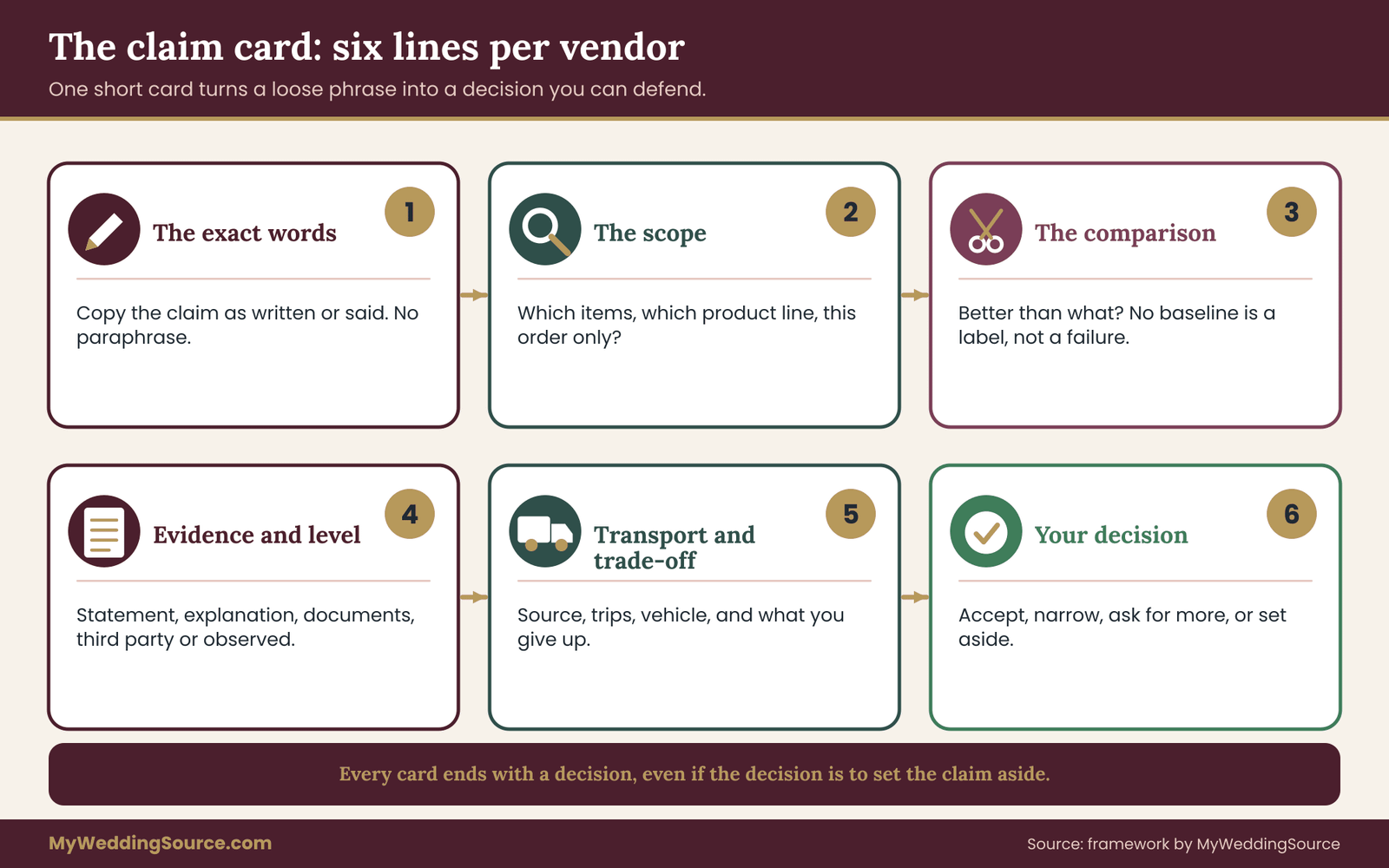
The six lines are these.
Line one: the exact words. Copy the claim as written or spoken. “Sourced from local farms.” “Eco-friendly delivery.” “Sustainable florals.” Do not shorten it.
Line two: the scope. What does the claim cover? All of the vendor’s work, one product line, this proposal only, or a single item? A claim that covers “our seasonal menu” says nothing about the plated dinner you actually ordered if it is not on that menu. Ask, and write down the answer.
Line three: the comparison. If the claim is a comparison, such as “lower impact,” write down what it is compared to. If the vendor cannot say, mark the claim as a statement without a baseline. That is not a failure. It is a label that tells you how much weight to give it.
Line four: the evidence and its level. What did they offer? Nothing, an explanation, documents, a third-party record or something you could see yourself? The next section defines those levels, and you write down the level, not just the fact that evidence exists.
Line five: the transport and trade-off notes. Where does it come from, how does it arrive, how many trips, and what would you give up if you chose it? A trade-off might be cost, flexibility, selection, a date constraint or a taste difference.
Line six: your decision. One of four outcomes: accept the claim as stated, accept it in a narrower form, ask for more evidence before you decide, or set the environmental claim aside and decide on other grounds.
Line six is the one that makes the card a decision tool and not a record of doubts. Every card ends with a decision, even if the decision is “set this aside.”
If you are comparing four or five local wedding vendors in different categories, the cards also keep the comparison fair, since each vendor answers the same six lines.
How long this takes
A card takes about ten minutes during a consultation if you ask the questions as part of a normal conversation. Several of the lines are answered in the first five minutes of a vendor explaining their approach. The rest need one or two short follow-up questions, which you can send in an email afterward. Most couples do not need cards for every one of your local wedding vendors. Make them for the categories where the claim is central to why you chose the vendor, and for any purchase where you are paying a clear premium for a sustainability feature.
Once you have a few cards, patterns across local wedding vendors become easy to see.
An example of a filled card, in prose
Here is how a card reads when you write it in sentences. A florist says, “We use local, seasonal flowers.” Line two, scope: “On the seasonal list, which does not include your requested peonies.” Line three: “Compared with imported flowers, not stated.” Line four: “Explanation given, no documents, level two.” Line five: “Stems come from two farms within about an hour. Delivery in one van. Peonies, if added, would come through a wholesaler.” Line six: “Accept in a narrower form: the seasonal list is local. Treat the peonies as a separate decision.”
That card took a few minutes and changed the outcome in a useful way. The couple did not reject the florist. They separated the part of the claim that was supported from the part that was not, and they made a deliberate choice about the peonies instead of discovering the gap later.
A card for each of the local wedding vendors you shortlist keeps the process light.
Using the card without being adversarial
Some couples worry that asking for evidence will feel accusatory. In practice it usually does the opposite. Small business owners who care about their practices are often glad to be asked, because most clients never do. A friendly opening line helps when you approach local wedding vendors: “We are trying to make a few choices on environmental grounds, and I want to describe what you do accurately, so could I ask a few quick questions?” It makes you a partner in getting the wording right.
If a vendor becomes defensive or dismissive at a polite request to explain a claim, that is also information, though not conclusive. Some people are simply busy. You can gently restate the question once. If it still lands badly, you can decide the environmental part of your decision on other grounds and move on without a quarrel.
The evidence ladder: how much proof a claim needs
Not every claim deserves the same level of proof. “We are located twelve miles from the venue” needs almost none. “Our packaging is certified compostable” needs a good deal, because it describes a material property and a disposal outcome that depend on facilities. The evidence ladder gives you a way to match the proof to the claim.
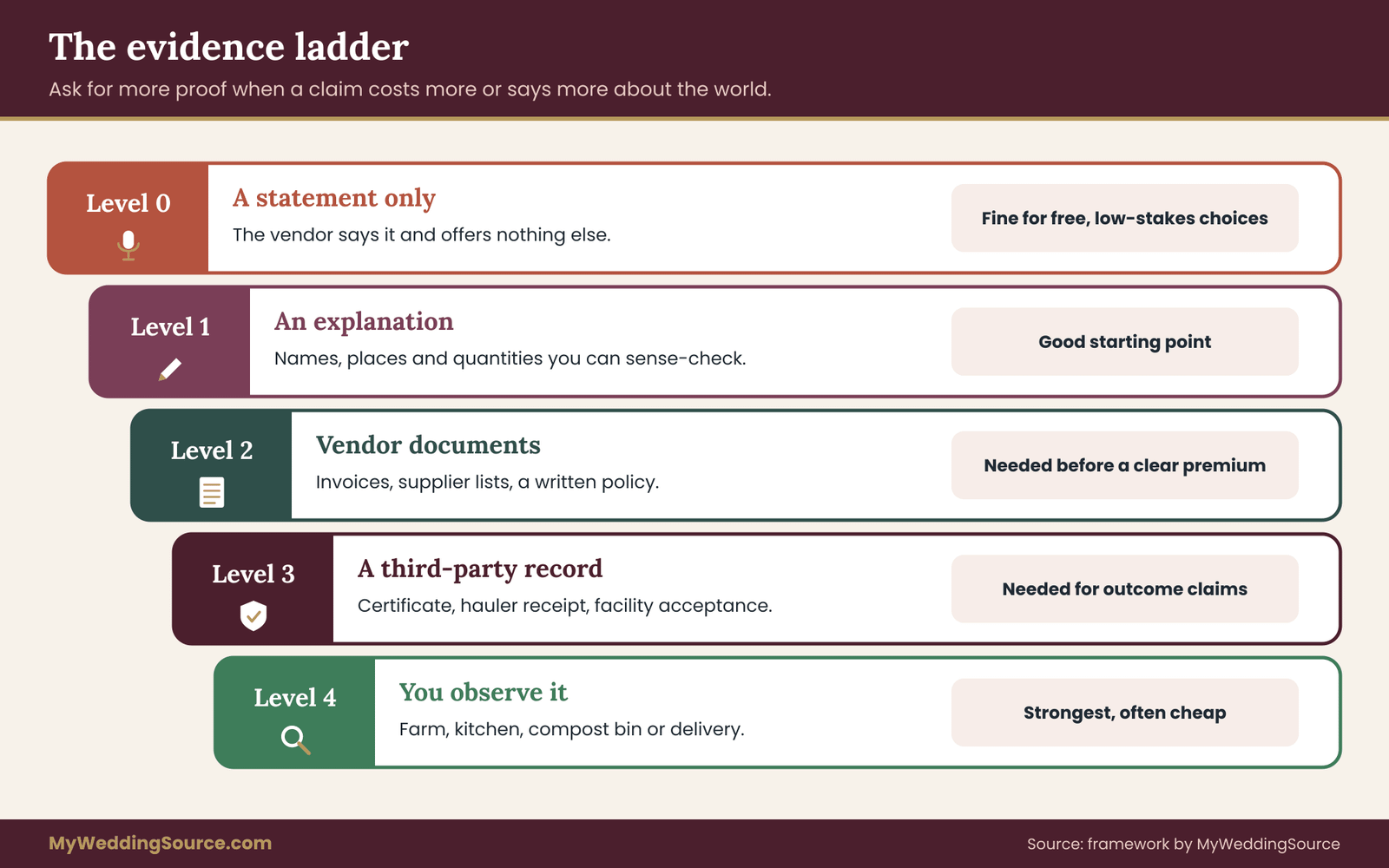
The ladder has five levels. Each level is stronger than the one below it, and each can be asked about.
Level zero: a statement only. The vendor says it and offers nothing else. This is the starting point for most claims. It is not worthless, because many statements are true, but you should not pay a premium on this basis alone.
Level one: an explanation. The vendor describes how and why, with specifics you can check against common sense. “We buy from two farms within an hour and pick up on delivery day.” An explanation takes more effort than a slogan and is harder to fake casually.
Level two: vendor documents. Invoices, delivery records, supplier lists, a written policy or a menu that marks sources. These are the vendor’s own records, so they are not independent, but they show that the practice exists on paper and not just in conversation.
Level three: a third-party record. A certification, an audit, a hauler’s receipt, a facility’s acceptance statement or a regulator’s registration. Someone outside the vendor has looked at it. The strength of this level varies with who the third party is and what they actually checked, so a certificate is a reason to ask what it covers, not a reason to stop asking.
Level four: something you can observe. You see the farm, the kitchen, the compost bin, the delivery van or the return process. For a wedding, this often means a tasting, a studio visit or a walk-through of the venue’s waste area. It is the strongest level because you are the verifier.
Matching level to stakes
The ladder works best with a simple rule: the more the claim costs you or the more it claims about the world, the higher the level you ask for.
- A free or low-cost choice backed only by a statement is fine to accept lightly. If a local baker says the flour comes from a regional mill, and the cake costs the same either way, you do not need paperwork.
- A claim that justifies a clear price premium should reach at least level two, ideally three.
- A claim about a comparison or an outcome, such as emissions saved, waste diverted or a material being compostable, should reach level three, because the claim depends on facts beyond the vendor’s control.
- Anything you plan to repeat publicly, on your website, in a program or on a sign at the reception, should reach the level that would let you defend it if a guest asked.
That last point matters more than it may first appear. If you print a line such as “all flowers today came from local growers” on a sign, you are the one making the claim, and your guests may take it at face value. Match your wording to what you can support. A modest line, “most of today’s flowers came from two farms within an hour of here,” is easier to stand behind and just as pleasant to read.
Local wedding vendors tend to sit at levels one and two for most claims, which is a perfectly reasonable place to start.
What the levels do not do
The ladder does not tell you whether the vendor is good, only how well a particular claim is supported. A florist with a level-four claim about local sourcing might still arrive late or deliver an arrangement you dislike. A florist with a level-zero claim might be a careful craftsperson who simply never wrote anything down. Use the ladder for the environmental part of the decision and keep the other parts, including style, reliability and price, in their own columns of thought. The wedding vendor due diligence checklist covers those wider checks such as licensing, insurance and references, and it fits alongside the claim card without overlapping with it.
With local wedding vendors, a short email is often enough to move a claim up a level.
Moving a claim up one level
Most claims can be moved up a level with a small request, and the request is usually reasonable. If the claim is at level zero, ask for an explanation. If it is at level one, ask for a supplier name or a recent invoice with the pricing blacked out. If it is at level two and costs money, ask whether any outside party has reviewed it. If it is at level three, ask what the certificate covers and what it excludes. If you can reach level four cheaply, a studio visit or a tasting is hard to beat.
Notice that none of these requests asks the vendor to do something unusual. You are asking people to describe their own business, which is a normal part of choosing someone to work with. When local wedding vendors answer these requests readily, that pattern builds your confidence. When they cannot, you have learned where the claim stands, which is exactly what the ladder is for.
Putting the card and the ladder together
Use the two tools in order. First fill in lines one to three of the card to pin down the claim. Then use the ladder to decide how much proof you need and record the level you actually got in line four. Finally use lines five and six to turn what you learned into a decision. The ladder keeps you from over-asking about trivial claims and from under-asking about expensive ones, and the card keeps the result in one place so you can compare local wedding vendors side by side without reconstructing conversations from memory.
The result is a short, honest file on each of your local wedding vendors, which is more useful than a pile of impressions.
The remaining sections apply this to the questions you will actually ask. The next one covers supplier questions by category, and the one after covers transport and delivery.
Supplier questions by category for local wedding vendors
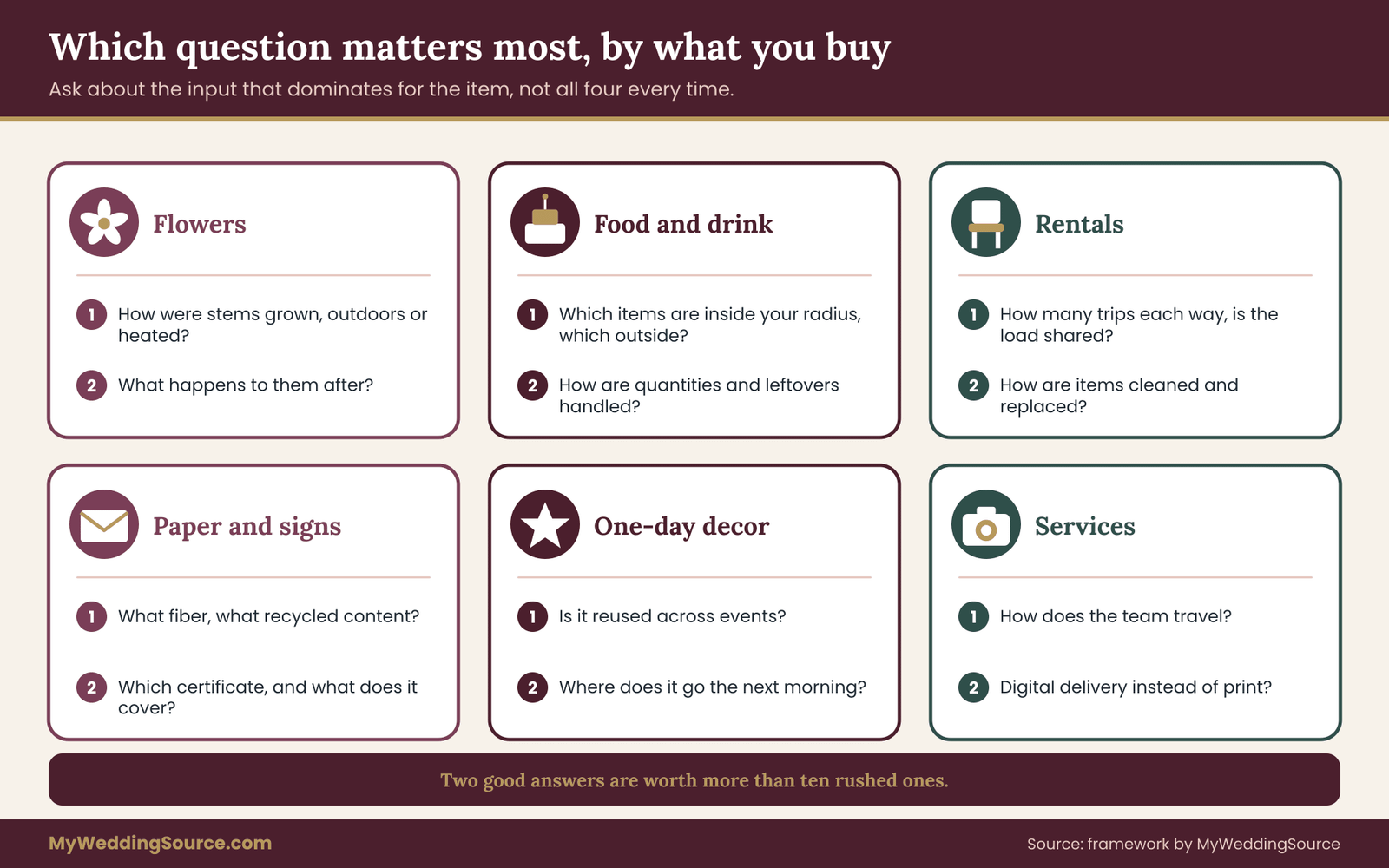
The best questions are short, specific and answerable in a sentence or two. The sets below are organized by what you are buying, because the inputs that matter change with the item. Use the ones that fit and skip the rest. You will not need every question for every one of your local wedding vendors, and a long list read aloud from a page can feel like a quiz.
Flowers and greenery
Floral claims are among the most common and among the least specific. “Local” may describe the florist’s shop, a nearby farm, a flower market that sells a mix of imports and regional stems, or an aspiration for “when available.”
- “Which flowers in this proposal come from farms in your region, and which come through a wholesaler?”
- “Are the local stems grown outdoors in season or under cover with heat?”
- “How did you get the flowers for the last event of this size, and where did they come from?”
- “What is in the mechanics, meaning the foam, wire, tape and containers, and can any of it be reused or composted?”
- “What happens to the flowers after the wedding? Can they go to a composting program, be donated or be picked up?”
The last two questions often matter more than the first. A florist who builds arrangements without floral foam and who has a plan for the leftover stems has a story that holds up whether or not every flower is nearby. If you want more detail on handling leftovers, the wedding waste reduction audit covers what to do with floral and other material at the end of the day, and facilities differ by region, so confirm with your own local composter or hauler.
A fair expectation: no florist can promise that every stem will be local in every season. Peonies in autumn or tulips in late summer will come from somewhere else if they are available at all. A florist who tells you that clearly is being straightforward, and you can then decide whether you want the flower more than the claim.
Food and drink
For catering, the claim is usually about ingredients, but waste often matters as much as origin.
- “What share of the menu, roughly, comes from producers within your stated radius, and what does that include?”
- “Which items come from outside it? For example, protein, dairy, oils, spices or produce out of season?”
- “How do you set quantities? What is your plan for leftovers, and what are the rules about donation or takeaway from this venue?”
- “Can the menu be seasonal, and what would change if the date moves?”
- “Are you using disposables or reusable service ware, and who washes it?”
A caterer’s answer to the leftover question is one of the best indicators of how seriously they take waste. Food safety rules limit what can be donated or taken home after an event, and rules vary by state, county and venue, so ask the caterer and the venue what is allowed, and check with your local health department if you are unsure. The point is to confirm that someone has a plan, not to promise a particular outcome.
Be careful with a specific claim such as “organic,” “grass-fed” or “sustainably raised.” Some of these are regulated terms with defined standards, and others are loose marketing words. The U.S. Department of Agriculture’s organic program publishes the rules for the organic label, and you can ask a caterer which of their products are certified organic and by whom. For terms without an official definition, ask what the term means in the vendor’s own practice and treat the answer as level one.
When you ask local wedding vendors about food, the answers usually split into what they grow or buy nearby and what they bring in.
Rentals: chairs, linens, tableware, furniture
A rental is already a reuse model, which is good for the environment in principle. The questions are about efficiency.
- “How many trips will it take to deliver and collect our order, and can it be one each way?”
- “What vehicle do you use, and is the load shared with other events that day?”
- “How are linens and tableware cleaned, and is cleaning done on site, in your facility or by a contractor?”
- “How often are items replaced, and what happens to retired items?”
- “If we change the count, what happens to the delivery plan?”
If you have not yet worked out what to rent, the wedding rental planning checklist helps you count what you need before you ask a vendor about delivery. A neat order, with accurate counts, is itself an environmental choice, because rentals that go out unused still travel and get washed.
Paper is a category where local wedding vendors and distant printers use the same vague words, so the same questions apply.
Paper goods, signs and printed items
Here the claim is usually about materials.
- “What is the paper made of? What percentage is recycled content, and is that post-consumer?”
- “Are the inks and finishes a type that interferes with recycling or composting?”
- “Where is it printed, and where does the paper come from?”
- “Is there a certification, and could you send me the document?”
Paper claims have their own set of terms, such as recycled content, and the FTC’s Green Guides address how those terms should be used. A printer who can show you the paper manufacturer’s specification sheet is giving you level two evidence, and a forest-management certification number that you can check with the certifier is level three. If you are weighing recycled stationery in depth, a dedicated look at stationery certifications is worth your time, because paper is one of the areas where vague words are most common.
Decor, favors and one-day items
These categories are where “local” is least likely to save a footprint, because the item’s life is short.
- “Is this made to order for us, or is it a stock item you reuse?”
- “How many events will it be used in?”
- “What happens to it after the wedding? Can it be returned, resold, donated or composted?”
- “What is it made of, and can the materials be separated for recycling?”
If a decor item will be thrown away the next morning, the most useful answer to the sustainability question is often to buy less of it, or to replace it with something that returns to the vendor. A locally made item that goes into a dumpster is still a dumpster item.
Whichever category you are in, the aim is the same: understand what the local wedding vendors in front of you actually do.
Services: photography, music, planning, officiants
Service local wedding vendors usually have a modest environmental footprint compared with goods, and their claims tend to be about travel, printing or digital delivery. Ask about travel to your venue, whether they carpool a team, and whether they offer digital delivery as an alternative to printed albums, which you can then decide on for your own reasons. Do not feel obliged to run the full claim card on a DJ. The effort belongs where the materials and the waste are.
Across all of these categories, local wedding vendors tend to give better answers when the question is concrete, so name the item and the date whenever you can.
A short script you can adapt
If you prefer to say less and listen more, this short opening works for almost any vendor category:
“We are trying to choose vendors partly on environmental grounds, and I want to make sure I understand what you do accurately. When you say [their phrase], what does that cover in our order, and what would be outside it?”
Then stay quiet and let them answer. Write down what they say in their own words. If the answer is thorough, you may not need any other question. If it is brief, pick one or two from the lists above that fit the item. Two good answers carry more weight than ten rushed ones.
The same pattern holds across categories: local wedding vendors who track their sources and waste can usually answer in one breath.
What a good answer sounds like
You will be better at hearing a good answer if you know its features. It is specific: names, places, quantities and months. It includes the exceptions, such as “except in January” or “except the cheese.” It distinguishes what the vendor does from what the vendor hopes. It is not defensive about limits. And it often includes a sentence like “I do not know, but I can find out,” which is a healthier sign than a smooth answer with nothing behind it.
A weak answer tends to be general, repeats the claim in other words, avoids numbers and places, or answers a different question. “We are all about sustainability here” is a statement of values and may be sincere, but it does not answer “which items?” Politely ask again, once, and then record what you got.
Treat the quality of answers as a pattern across your conversations with local wedding vendors, because any single answer can be an off day. Three local wedding vendors who each name their suppliers and admit exceptions tell you something about the local market, and one vendor who cannot name a single source tells you something about that vendor.
Transport and delivery questions that tell you more than mileage
Transport is the part of the story that couples understand best, which is why it is worth asking about carefully. The answer is rarely “how far.” It is “how many trips, in what vehicle, carrying what, and what else was happening on those trips.” Local wedding vendors have an advantage here, because they control their own logistics and can describe them honestly.
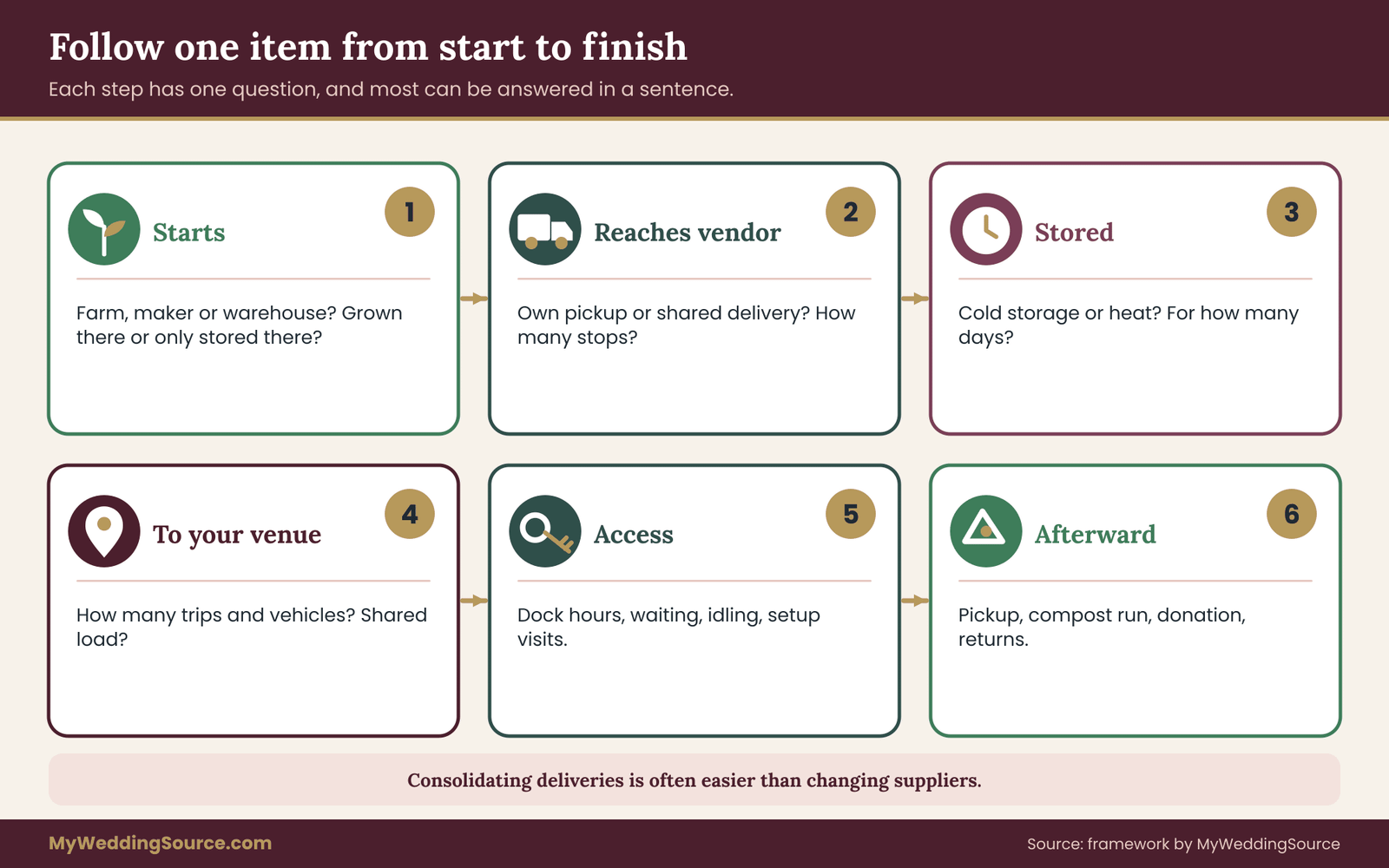
Follow an item from where it begins to where it ends. At each step there is a question worth asking, and most of them can be answered in a sentence.
Step one: where the item starts. For flowers, this is the farm or the wholesaler. For food, it is the producer and the distributor. For a rental, it is the warehouse. Ask the vendor to name the starting point for the main items in your order, and ask whether that starting point is where the item was grown or made, or only where it was last stored. A warehouse nearby does not make the contents local.
Step two: how it reaches the vendor. Some local wedding vendors pick up in their own vehicle, and some receive deliveries. If a florist drives to a farm on the morning of your wedding, that is a round trip with a tiny load for one event. If the farm delivers to a hub where several florists collect, the trips are shared. Neither is automatically better. Ask which pattern applies, because shared trips can beat solo trips even over longer distances.
Step three: storage and conditions. Cold storage, heating and refrigeration use energy. A vendor who keeps product in a refrigerated space for a week has a different footprint from one who buys the day before. This is not a reason to avoid anyone. It is one more reason that a statement like “fresh and local” is incomplete without the timing.
Step four: the trip to your venue. Ask how many trips, how many vehicles, whether the vehicle serves other events that day, and whether setup and breakdown require separate visits. A single delivery with a driver who stays through setup is different from a delivery on Friday, a setup visit on Saturday and a pickup on Sunday.
Step five: access and waiting. Vehicles that idle at a loading dock or circle the block waiting for access use fuel and add trips. If your venue has a loading dock with specific hours, the venue technical walkthrough guide explains how to confirm access routes and time windows before delivery day. A clear delivery schedule is a modest but real efficiency.
Step six: after the event. Pickup of rentals, return of reusable containers, removal of compostables and donation drop-offs are all trips too. A vendor who offers to take leftover flowers to a compost site on their next run is adding no extra trip, while a vendor who sends a second vehicle for a small pickup is adding one. Ask which applies.
Ask each of your local wedding vendors for a one-line delivery plan, and ask your planner or venue to line the plans up.
Consolidation is the quiet lever
For most weddings, the easiest transport improvement is consolidating deliveries, not changing the supplier. If your caterer, rental company and florist are all arriving separately within the same two hours, ask your planner or venue coordinator whether any of the orders can combine. Some caterers also provide rentals, and some rental companies offer linens, tableware and furniture, so a single delivery can replace three.
The trade-off is that one vendor supplying more categories may mean fewer choices in style, and it may reduce the benefit of working with a specialist. A florist who is an expert in your favorite flower may be worth a separate trip. Consolidation is a lever, not a rule.
Transport answers from local wedding vendors are usually concrete, because they drive the routes themselves.
Questions about your own guests’ travel
Guest travel is usually the largest transport factor in a wedding, and it is outside any vendor’s control. The vendor claims you are testing should be kept in proportion to that. A decision to hold the ceremony and reception at one venue, to book a hotel block close to it, or to arrange a shuttle for a day will often matter more than the delivery distance of the centerpieces. The wedding guest hotels guide covers lodging options across budgets and mobility needs, which affects how many separate trips your guests make.
This is not meant to discourage you from asking vendors good questions. It is meant to help you spend your effort where it counts most.
Local wedding vendors in the same area often share routes, suppliers and even loading windows, so a coordinator who knows the area can sometimes combine runs without any change to the order.
Local wedding vendors who share a route or a loading window with another event can often say so, and it is worth asking.
A fair way to compare two delivery plans
Suppose two rental companies quote similar prices. One is close and the other is farther. Instead of asking only for distance, ask each for the delivery plan in a few lines: number of trips each way, vehicle, whether the load is shared, and the time window. Compare the plans, not the addresses. If the farther company makes one shared trip each way and the closer company makes two solo trips, the farther company may have the smaller transport footprint. You cannot be certain without more data, and you do not need to be. You only need to avoid assuming that the closer address wins by default.
A word of caution against overcorrecting. It is easy to start treating every transport detail as a reason to second-guess. Delivery is one input. If a vendor otherwise has strong practices, reusable materials and a good waste plan, do not dismiss them because their van is not electric. Use the transport questions to catch real differences, not to search for flaws.
Worked example: three local wedding vendors, one claim card each
The example below is invented to show the method. The names, places and details are illustrative, and the quantities are chosen for simplicity. They are not drawn from real businesses or from any study. The reasoning is what matters, and you can follow the same steps with your own vendors.
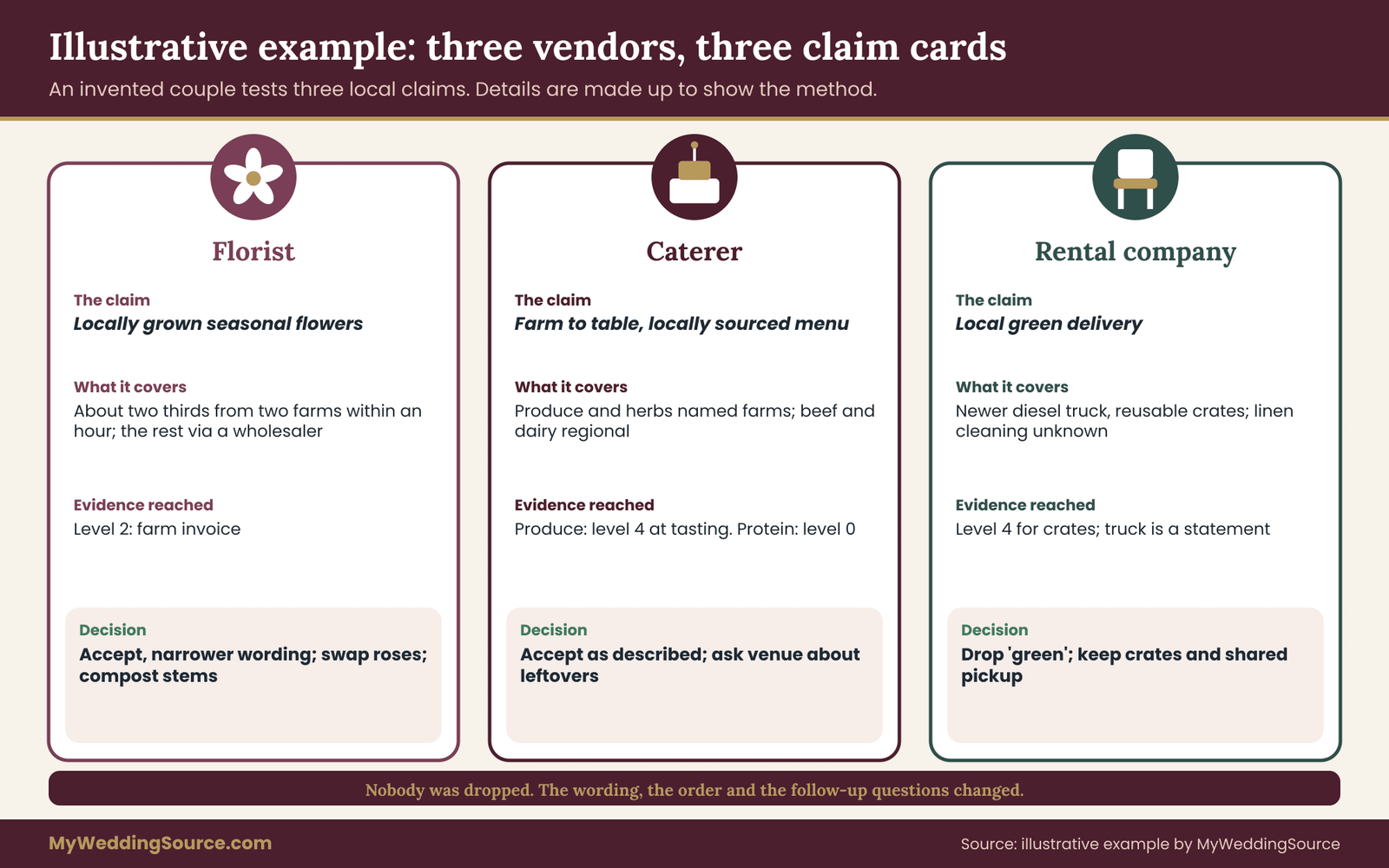
Dana and Marcus are planning a wedding with about one hundred guests at a venue forty minutes from their home. They are shortlisting three local wedding vendors who describe themselves as local: a florist, a caterer and a rental company. They are willing to pay somewhat more for lower impact, but they want the claims to hold up. They use the claim card for each.
Vendor one: the florist
Claim in the florist’s words: “Locally grown seasonal flowers, delivered fresh.”
Scope: After a short email exchange, the florist explains that the claim applies to about two thirds of the stems in the proposal, which come from two farms within an hour. The remaining third is roses and a few specialty items from a wholesaler. The florist does not know the original growing regions of the wholesaler’s stems.
Comparison: None stated. The florist did not claim a lower footprint than anyone else.
Evidence level: Level one for the claim about two farms, since the florist named them and described the pickup. Dana asks for a recent invoice from one of the farms with prices removed. The florist sends one. That moves the claim to level two.
Transport notes: One van, one delivery, with the wholesaler items collected the day before. No separate setup trip. Cold storage for two days.
Trade-off: The roses cost more and are not local. Swapping them for a seasonal local alternative lowers the cost and strengthens the claim, but changes the look.
Decision: Accept in a narrower form. Dana and Marcus will describe the arrangements as “mostly from two farms within an hour,” and choose the seasonal alternative for the roses. They also ask about composting, and the florist offers to take the stems to a compost drop-off on the next run, at no charge.
Vendor two: the caterer
Claim in the caterer’s words: “Farm to table, locally sourced menu.”
Scope: The claim covers the vegetables, herbs and the dessert fruit, which come from farms the caterer names and visits. The beef and the dairy come through a regional distributor. The caterer is candid that “farm to table” is a style description and not a statement about every item.
Comparison: None stated.
Evidence level: Level one for the named farms. The caterer offers a tasting at the kitchen. Dana and Marcus attend, and they see the produce deliveries and the prep area, which is a level four observation for the part of the claim they can see. They cannot observe the distributor’s sourcing, so that part remains at level zero.
Transport notes: Food is prepared at the kitchen and carried in insulated containers. One truck, one trip, with a second small run for hot items.
Trade-off: The menu is seasonal, so the caterer asks them to accept substitutions if a harvest is late. They agree. This trade-off is reasonable and improves the claim, because a fixed menu would force the caterer to buy from elsewhere when the local supply failed.
Decision: Accept as described, with a clear reading: the produce is local, the protein is regional. For the leftovers, the caterer explains that the venue prohibits taking food off site and that unserved food is discarded unless donated through a program the venue allows. Dana asks the venue, and the venue’s answer, in writing, becomes part of the record. The caterer also agrees to prepare slightly less for the final course, based on how many guests did not order dessert at the last similar event.
Vendor three: the rental company
Claim in the company’s words: “Local green delivery.”
Scope: Asked what “green” means, the company says the delivery vehicle is a newer diesel truck, which meets current emission standards, and that it uses reusable crates in place of cardboard. “Local” means its warehouse is in the same county.
Comparison: Not stated.
Evidence level: Level one. The reusable crates are visible and easy to confirm at a warehouse visit, so Dana arranges one and sees them, which is level four for that detail. The truck standard is a statement, and the company offers a registration document if they want it. They do not pursue it, since it would not change their decision.
Transport notes: Two trips originally, one for delivery and one for pickup. The company can make the pickup trip combine with another event’s pickup in the same area on the same Sunday morning, which it does often.
Trade-off: The warehouse is close, but its linens are cleaned by a contractor farther away. The company has no data on that leg.
Decision: Set aside the word “green.” Keep “local” in its address sense. Accept the company for its crates, its shared pickup and its price. Dana and Marcus drop any environmental claim for the rental company from their wedding website.
Each of these three local wedding vendors looked reasonable at the start, and each looked reasonable at the end. What changed was the precision of what the couple knew about them.
In real life, local wedding vendors will not all be this tidy, and gaps in the evidence are normal.
What the example shows
Notice what changed because of the cards. Dana and Marcus did not drop any of the three local wedding vendors. They changed what they said about them, what they asked for, and one item, the roses, that they might otherwise have bought without thinking. They learned that the caterer’s “farm to table” was a style and not a full supply claim, and that the “green” in the rental company’s tagline described crates. Each of those insights took one or two questions.
They also noticed where the evidence stopped. For the florist’s wholesaler items, the caterer’s protein and the rental company’s linen cleaning, they had no information. That is the honest boundary of what they knew, and writing it down meant they would not accidentally describe those parts as verified. The next section discusses how to talk about that boundary, and how to read the badges, certifications and offsets that vendors sometimes add on top of a local claim.
Certifications, offsets and vague words around local wedding vendors
Many local wedding vendors add a second layer to a local claim: a badge, a certification, an offset or a catch-all phrase. Each one can be useful, and each one needs a small amount of reading. This section covers the four you are most likely to meet when you talk to local wedding vendors.
Vague words
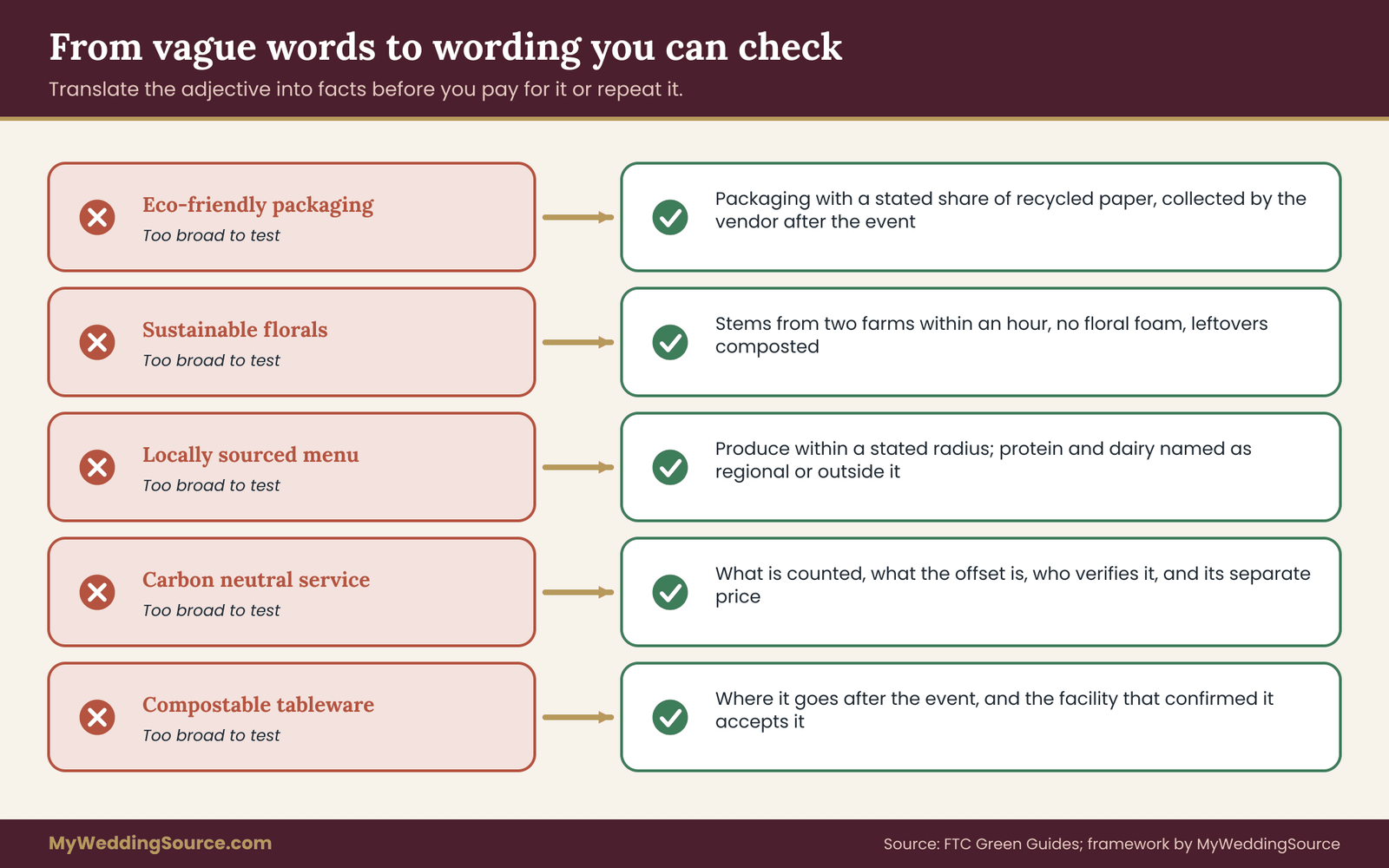
Words such as “eco-friendly,” “green,” “sustainable,” “natural,” “conscious” and “planet-friendly” describe a general benefit without saying what it is. The FTC’s Green Guides advise marketers against making unqualified general environmental benefit claims, because it is hard to prove that a product or service is better for the environment in every respect. That guidance is aimed at the people who make the claims, but it is helpful to you too. When you hear one of these words, you are not required to challenge it. You can simply ask, “what is the specific benefit you mean?” and write down the specific answer instead of the general word.
A useful habit is to translate. “Eco-friendly packaging” becomes “packaging made with a stated percentage of recycled paper, collected by the vendor after the event.” “Sustainable florals” becomes “stems from two farms within an hour, no floral foam, leftovers composted.” The translated version is shorter on adjectives and longer on facts, and it is the version you want to put on your own website if you mention it at all.
None of these four items is a problem in itself, and local wedding vendors use them in good faith more often than not.
If local wedding vendors mention a badge, treat it as the start of a question.
Certifications and seals
Certifications are the most useful form of outside evidence when they are real and when they apply to the item in question. They are also easy to misread. Three quick checks help.
What exactly is certified? A certification can apply to a farm, a facility, a product line or a single product. A caterer who holds an organic handling certification may not be certifying every item on the menu. A paper mill’s forest-management certificate may cover the pulp and not the final printed product. Ask which item and which step.
Who issues it? Some seals come from independent bodies with published standards. Others are created by trade groups, by a single company or by the vendor itself. A self-made seal is a marketing device, which is fine, but it belongs at level zero or one on the evidence ladder, not three.
Is it current? Many certifications must be renewed. Ask for the certificate or the certification number, and look it up with the issuer if the issuer provides a public directory. For organic claims, the U.S. Department of Agriculture publishes the standards and a public database of certified operations, which is the proper place to verify an organic claim.
Vague words are common among local wedding vendors and large companies alike, so the same reading skills apply to both.
Offsets and “carbon neutral” claims
Some local wedding vendors offer to offset the emissions from your event, or describe their service as carbon neutral. These claims have more moving parts than most. The FTC’s Green Guides include a section on carbon offset claims, and the general point is that an offset claim should be supported by evidence, that the offset should not be counted twice, and that the vendor should not overstate what an offset does. In practice, ask four things:
- What emissions are counted, and what is excluded?
- What does the offset consist of, and who provides or verifies it?
- Is the reduction happening now, or is it promised for the future?
- What does it cost, and is that price shown separately?
Often you will find that an offset is a modest add-on that can be priced separately and chosen on its own merits. That is a reasonable thing to buy if you understand it. It is not a reason to treat a vendor as lower impact on the whole. If a vendor cannot explain the offset in plain language, treat the claim as level zero and do not pay extra for it.
Words about waste: compostable, recyclable, biodegradable
These are among the most misunderstood terms in event supplies, because they describe what could happen, and what actually happens depends on facilities near you. A plate marked compostable may need an industrial composting facility that does not exist in your area. A recyclable item may not be accepted by the local program, or may be too soiled with food to be processed. The FTC’s Green Guides discuss how claims such as compostable and recyclable should be qualified when facilities are not available to a substantial share of consumers.
For a wedding, the practical question is simple: “Where will this go after the event, and who has confirmed that facility accepts it?” The EPA’s sustainable materials management pages, listed in the sources at the end, explain the reuse-first thinking behind these choices, and your local waste authority is the proper source for what is accepted in your area.
Endorsements and relationships
One more factor deserves a mention. If a vendor, planner or website recommends a “green” supplier, ask whether they have a business relationship with that supplier, such as a referral fee, a shared marketing arrangement or free services. Such a connection is not wrong, and honest disclosure of it is expected under the FTC’s guidance on endorsements. The point is that a recommendation you know to be a paid referral carries a different weight from one that is independent, and you can weigh it accordingly.
The same rule applies to you: if you later post about your local wedding vendors and received a discount or free service in return, say so.
The same applies to how you describe your local wedding vendors in public, since a thank-you list on a wedding website is also a set of claims.
Writing your own claims modestly
Many couples want to share their choices with guests, on a wedding website, a program or a sign. The same standards apply to you in a gentler form. A few habits keep your wording honest:
- Say what you did, not what it achieved. “We chose flowers from two farms within an hour” is a fact. “We reduced our carbon footprint” is a claim you cannot support.
- Name the limits. “Most of our flowers” is more accurate than “all of our flowers.”
- Avoid comparisons you have not measured. “Greener than a typical wedding” has no baseline.
- Give credit to the vendor in their words, and confirm they are comfortable with the wording.
These habits cost nothing and protect your credibility. They also make your story more interesting, because specific details are more engaging than slogans. Guests respond to “the bouquet came from a farm about thirty minutes from here” more than to “our wedding is eco-friendly.”
Checking claims with vendors and official sources
You do not need an investigator’s toolkit. Most verification is a short chain of requests to the vendor first, and to an official source if the claim is specific enough to look up. This section lays out that chain so you know when to stop.
Local wedding vendors are usually the fastest source for the underlying facts.
Start with the vendor
For nearly every claim, the first step is to ask the vendor for the underlying information. A short follow-up email works well because it leaves a record and gives the vendor time to find an answer. A sample:
“Thanks for the proposal. We are trying to describe our choices accurately. Could you confirm in a sentence or two (1) which items in our order come from your stated local area, (2) how the order will be delivered and collected, and (3) what happens to materials left after the event? If a document or supplier name helps, please include it.”
Most local wedding vendors will reply within a few days. Their reply can then be filed with the claim card as level one or level two evidence, depending on whether documents are attached. If they do not reply, that is also information, and you can remind them once.
Then confirm what can be confirmed
Some claims can be checked with a short search.
- A specific certification: look it up in the certifier’s public directory, if one exists, and confirm that the vendor, product and date match.
- A business registration or license: check with the state or local office that issues it. This is a separate matter from environmental claims but is part of general vendor diligence.
- A waste or compost facility: call the facility or your local waste authority and ask whether they accept the material from an event, how it must be prepared and whether there are fees or time windows.
- A transport claim: if a company mentions a program such as the EPA’s SmartWay, check the program’s public partner information.
- A food term: if a vendor uses an official term such as organic, check the agency standard that defines it. If the term has no official definition, treat it as the vendor’s description.
Know the limits of what a source can tell you
An official source tells you the rules or the status of a certificate. It rarely tells you whether the vendor’s whole operation is lower impact. A certified organic farm is certified organic. That says nothing about how far the product traveled or how it was packaged. The two kinds of information answer different questions, and mixing them up is how well-meant claims turn into overstatements.
Keep a short record
A few lines in a shared note are enough: the claim card, the date, the person you spoke with and any documents. If you later describe your choices publicly or someone asks how you decided, the record lets you answer precisely. It also helps if a vendor changes a menu, substitutes a product or delivers something different from what was discussed. The wedding vendor contract guide covers how to write agreed details into the contract itself, and if a sourcing or delivery detail is important to you, asking the vendor to put it in writing is the most reliable way to keep it.
Checking with local wedding vendors should feel like ordinary due diligence, because that is what it is.
When to stop checking
Verification has diminishing returns. A good rule is to stop when the next question would not change your decision. If you have already decided to hire a florist for style and reliability, and the environmental claim is a pleasant bonus, a level-one explanation is enough. If you are paying a significant premium specifically for a sustainability feature, push for level two or three. If the feature is cheap and you like it, accept it lightly. Match your effort to the stakes, and do not let the checking become more tiring than the wedding itself.
Weighing local wedding vendors against cost, quality and access
By this point you may have a stack of cards with mixed results. Some claims held up, some narrowed and some dissolved. The last step is to fold that information into an ordinary hiring decision, where environmental fit is one factor among several and rarely the only one.
Put the claim in its place
A reasonable order of questions for any vendor is: can they do the job well, are they reliable, does the price fit, and then how do their practices line up with what you care about. Environmental practice is real, and it can be a deciding factor between two otherwise equal choices. It rarely makes sense to hire a vendor you doubt on reliability because their sourcing story is appealing. A missed delivery or a poorly made cake costs the day, and it also creates waste and extra trips.
When two local wedding vendors are close on the basics, the cards become a tiebreaker. Prefer the one whose claims reached higher on the ladder, whose answers were more specific and whose waste plan was clearer. If one vendor’s claim is stronger but costs noticeably more, decide how much the specific benefit is worth to you, using the actual detail and not the label.
When you compare prices from local wedding vendors, keep the comparison on the same scope, with the same counts and the same delivery terms.
Costs: where premiums come from
Some environmental practices cost the vendor money and are passed on honestly. Seasonal local flowers can cost more per stem than imports at certain times. Small farms may charge more per pound than a large distributor. Reusable service ware requires washing labor. A shared, scheduled delivery can save the vendor money, and some local wedding vendors offer a discount for flexibility on timing.
Other premiums are branding. A vendor may charge more for a package labeled eco without the contents changing much. The cards help you separate the two. Ask what exactly the extra money pays for: stems, labor, a certification fee, an offset, a donation. If the answer is a specific cost, the premium is easier to judge. If the answer is “it is our sustainable package,” ask what is in it and compare with the standard package line by line. The wedding budget guide can help you decide how much of your overall budget to give to this kind of choice.
Local wedding vendors also tend to be easier to visit before you sign, which makes level-four evidence cheaper to get.
The best local wedding vendors treat these questions as ordinary and answer them plainly.
Quality and flexibility
A local relationship has benefits that do not show up in any claim. You can visit the shop, taste the menu, see the product and meet the person who will show up on the day. If something goes wrong, a nearby vendor can often fix it faster. These are real advantages and worth counting. They are not environmental claims, and they do not need to be dressed up as one. It is fine to hire local wedding vendors because you like the access and the accountability, and to say so plainly.
The reverse can also be true. A specialty item that is not available locally, a style you love or a service level that nearby options cannot match may point you farther afield. That is not a failure of your values. It is a normal trade-off, and the evidence ladder and transport questions help you choose the farther option with open eyes, for example by asking the distant vendor to ship in one consolidated delivery, to use reusable packaging or to take returns.
Accessibility and inclusion
Some of the best reasons to hire a given vendor have nothing to do with the environment. A caterer who handles dietary needs carefully, a venue that is step-free, a photographer who works comfortably with elderly relatives: these decisions matter to guests. If an environmental preference conflicts with an accessibility need, access should generally come first. The two can usually be reconciled with a little creativity, and a good vendor will help.
In the end, choosing local wedding vendors is a judgment call, and the cards simply make the judgment visible.
Choosing among local wedding vendors on evidence is a reasonable standard to hold yourself to.
Limits of this approach
Any method has limits, and it is better to name them than to pretend otherwise.
It cannot measure a footprint. The card and the ladder help you judge how well a claim is supported. They do not produce a number for your wedding’s emissions. Carbon accounting for events needs defined boundaries and data that most small local wedding vendors do not have. If you want a rough estimate, public tools from agencies such as the EPA offer calculators and guidance, but their results depend heavily on the assumptions you enter.
It depends on honest answers. If a vendor gives you incorrect information deliberately, a few questions will not necessarily reveal it. That is rare. The more common problem is a vendor who believes what they say and has not checked it. The method handles that case well because it separates what the vendor knows from what the vendor assumes.
It cannot see inside supply chains. For many items, the chain extends beyond what the vendor can see. A caterer can name a farm but not the fertilizer supplier. You will always reach a point where the information ends, and the useful thing is to know where that point is.
Facilities and rules change. Composting programs open and close. Venue policies change. Agencies update their guidance. Verify policies and fees locally before you rely on them, and check them again close to the wedding, since an acceptance policy that was true a year ago may no longer hold.
It treats one wedding as one decision set. A single wedding is small relative to the systems around it. The value of careful choices is real, but modest, and it is fine to make a few good ones and let the rest go. Perfection is not the standard, and a calm, documented, honest approach beats an exhausting one.
Your next steps
Choose the two or three vendor categories where the claim matters most to you, and work through them in this order.
- Copy each vendor’s environmental claim in their exact words.
- Send the short follow-up email asking what is covered, how the order travels and what happens afterward.
- Fill in a claim card for each, and record the evidence level you actually received.
- Ask the venue and the local wedding vendors what happens to leftovers, packaging and flowers, and confirm facilities with your local waste authority.
- Decide on each claim: accept, narrow, ask for more or set aside, and put agreed details in the contract.
- Write any public wording about your choices in terms of what you did, with limits stated.
If you have not yet set your wider schedule, the wedding planning checklist shows where vendor decisions fall, and the wedding waste reduction guide covers the audit from catering to cleanup. A calm pass through the cards in the early months leaves you with fewer surprises, and with local wedding vendors you can describe honestly.
The goal throughout is a short list of local wedding vendors you trust, and a short list of claims you can describe accurately.
FAQ
Are local wedding vendors always better for the environment?
No. Short transport helps, but production method, how full the delivery vehicle is and what happens to materials afterward often matter more. A nearby supplier can have a larger footprint than a farther one with efficient shared deliveries and strong reuse. Local also brings non-environmental benefits such as accountability and community spending, so choose it for the reasons it actually delivers and test the environmental part with specific questions.
What does “locally sourced” actually mean?
It has no single definition that applies to every vendor. It can mean the business is based nearby, the ingredients or materials come from nearby, or just that the vendor serves your area. Federal programs have used specific definitions for their own purposes, but those do not govern a caterer’s website. Ask the vendor how far they mean, which items fall inside that radius and which fall outside it.
How do I ask a vendor to prove a sustainability claim without offending them?
Frame it as wanting to describe their work accurately. Say you are making a few choices on environmental grounds and ask what the claim covers in your order, how it travels and what happens to leftovers. Most owners of local wedding vendors welcome the interest. If a vendor cannot answer, ask them to find out or to restate the claim more modestly, then decide the environmental part on other grounds.
Is a certification enough proof?
It is strong evidence for what it actually covers, but check three things: what exactly is certified (a farm, a facility, a product), who issues it and whether it is current. A certificate for one step does not prove the whole supply chain or the delivery. Ask for the document or number and, where the issuer has a public directory, look it up.
Should I pay extra for a vendor who says they are eco-friendly?
Only if the extra cost pays for something specific that you can describe. Ask what the premium covers, such as seasonal local stems, labor for reusable service ware or a verified certification. If the answer is a general package name, ask what is in it and compare line by line with the standard offer. A claim backed only by a statement is a weak reason for a clear premium.
Does buying from local wedding vendors reduce my wedding’s carbon footprint?
It might, but you cannot assume it. The result depends on distance, vehicle and load, how items were made and what happens afterward, and none of that is visible from an address. Guest travel is usually a much larger share of an event’s transport than vendor delivery. Use the vendor questions to find real differences and avoid claiming a reduction you have not measured.
Can I mention my sustainable choices on my wedding website?
Yes, and it is best to describe what you did and where the limits are. Something like “most of our flowers came from two farms within an hour” is specific and easy to stand behind. Avoid broad claims such as “eco-friendly wedding” or comparisons you have not measured, and check that your local wedding vendors are comfortable with how you describe them.
What if the vendor’s claim turns out to be wrong after I have booked?
Raise it calmly and early, with the vendor’s original wording and your notes. Ask what can be changed, such as a substitution, a different source or a revised description, and ask for any agreement in writing. Check your contract for substitution and cancellation terms before assuming you can walk away. Often the practical outcome is a narrower claim, not a dispute.
Sources
- Green Guides, Federal Trade Commission
- Guides for the Use of Environmental Marketing Claims, 16 CFR Part 260, Electronic Code of Federal Regulations
- Endorsements, influencers and reviews, Federal Trade Commission
- Sustainable Management of Materials, U.S. Environmental Protection Agency
- SmartWay, U.S. Environmental Protection Agency
- Waste Reduction Model, U.S. Environmental Protection Agency
- Center for Corporate Climate Leadership, U.S. Environmental Protection Agency
- Agricultural Marketing Service, U.S. Department of Agriculture
- Organic regulations, USDA Agricultural Marketing Service
- Fuel Economy, U.S. Department of Energy and U.S. Environmental Protection Agency