
Reusable signage for a wedding means building your signs in two pieces, a durable body and a changeable face, so the expensive part survives past one evening and the cheap part carries the names, times and wording. This guide gives you a hardware reuse plan, a way to design custom inserts, a storage routine and a cost-per-event model you can fill in with your own quotes.
Treat every sign as three layers: hardware (the easel, frame, stand or hook), the insert (the printed or painted face that changes), and storage (the case, label and home that keep both usable). Choose reusable signage only where the hardware can realistically be used again, by you, a family member, a rental company or a buyer. Divide the total cost by the number of events that will really happen, not the number you hope for. If the honest number is one, rent or print on paper and recycle it.
Most wedding signs have a short life. They are designed for months, displayed for a few hours and then stuffed into a trunk, where the foam board bends and the paint chips. A few weeks later someone asks what to do with the welcome sign, and the honest answer is usually “nothing.” That is a lot of material and money for something that worked for one evening.
Reusable signage is the opposite habit. You decide in advance which parts of each sign are meant to outlast the wedding, you buy or build those parts accordingly, and you make the parts that must change as easy to change as possible. Done with care, it lowers the cost of each use, cuts the number of things headed for the trash, and gives you hardware that can serve a rehearsal dinner, a shower, an anniversary party or somebody else’s wedding.
It can also go badly. Heavy hardware that nobody has room for, a custom piece that only fits one venue, or a “sustainable” sign that is stored in a damp garage and ruined within a year helps no one. This guide is about the practical middle: when the idea pays off, how to design for it and how to count the real cost.
A note on scope. This is general planning information, not legal, tax or financial advice. Venue rules, vendor terms and local recycling options differ widely, so confirm anything that matters with the people who control it.
What reusable signage covers at a wedding
Start with an inventory. Most weddings use more signs than couples expect, and they fall into a few groups that behave differently when you think about reuse.
Arrival and wayfinding. A welcome sign, parking or entrance directions, and arrows to the ceremony, restrooms and reception. These are usually big, placed outdoors and the most exposed to wind and weather.
Ceremony. A program board, a “choose any seat” or reserved-seat marker, an unplugged-ceremony request, a memorial notice or a sign for the aisle. Often small and tabletop or easel-based.
Reception information. A seating chart, table numbers, a bar menu, a dessert or late-night snack sign, a guestbook sign and a gift table notice. These tend to carry names and dates, which means the face changes a lot.
Decor and personality. Neon-style signs, a “Mr. and Mrs.” backdrop, a photo-booth sign, a hashtag or a quote. Some of these are hard to reuse in any context, so they deserve an honest second look.
Now sort each sign by one question: if the wedding were over, would a similar sign be needed at some other event? A bar menu sign is a fine example. The frame and stand work at any party. Only the menu text is specific to your wedding. A “Welcome to the wedding of” sign is the opposite case. The words are fixed to one couple and one date, so the only reusable piece is the board or the stand.
That sort is the core of the approach to reusable signage. It stops you from paying for expensive hardware for a sign that has no second life, and it points you to the signs where the hardware can quietly earn its cost back.
Where reusable signage fits with the rest of your signage plan
Reusable signage is only one part of a full signage plan. Deciding which signs you need at all, where each goes, how guests read them and how they stay legible in low light is a larger question covered in the wedding signage system guide. Read that first if you have not decided what the full set looks like. This article assumes you already know the list and want to build it so that more of it survives.
The broader goal of cutting waste across the whole day, from catering to cleanup, is covered in the wedding waste reduction guide. Signs are a small part of a wedding’s total waste, and honesty about that matters. Reusable signage is worth doing for cost and tidiness as much as for the environment, and the later sections explain how to avoid overstating its benefits.
The sign-hardware reuse plan: three layers
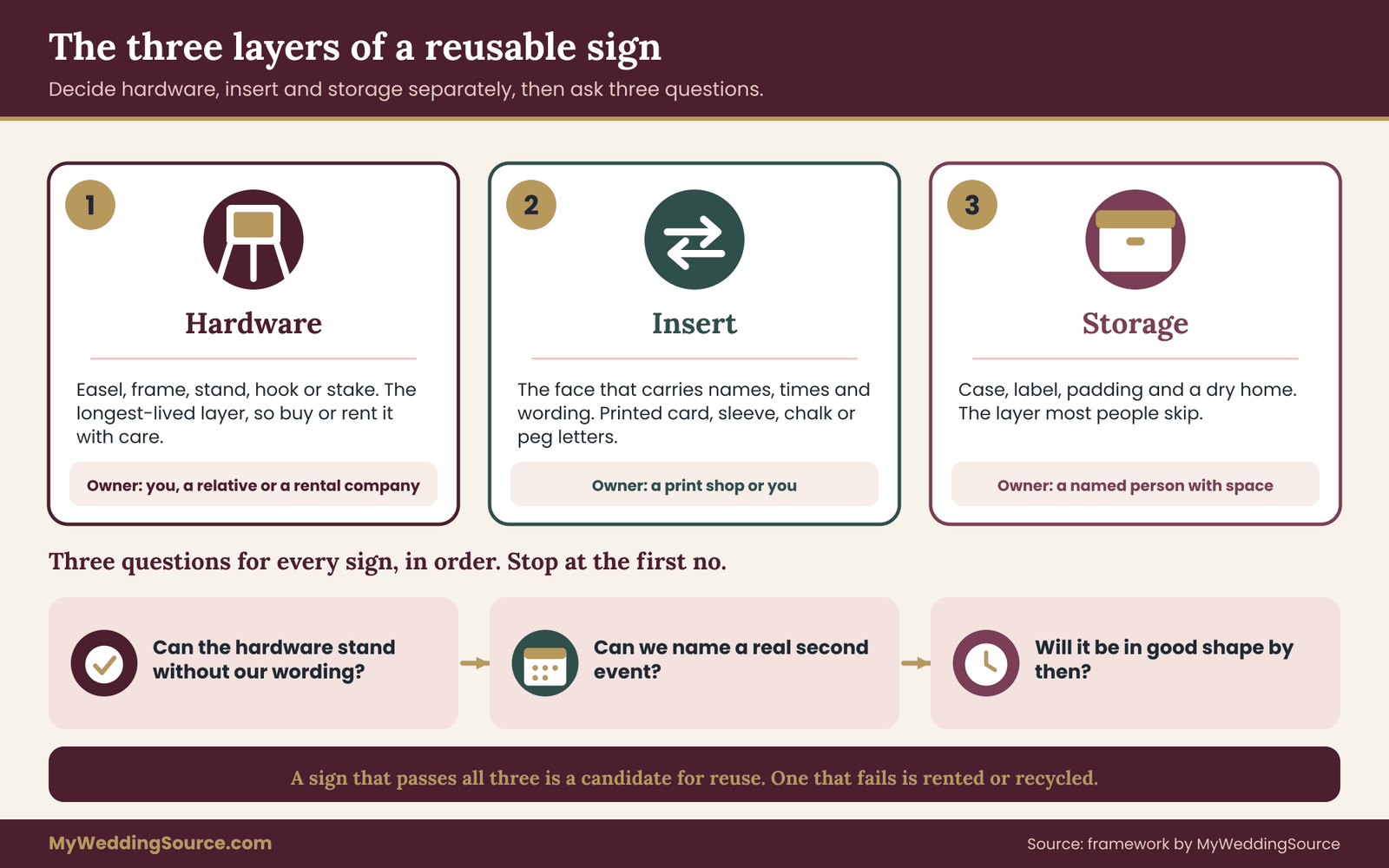
The framework in this guide is deliberately simple. Every sign has three layers, and you make a decision about each one separately.
Layer one: hardware. The physical structure that holds the sign up or hangs it. Easels, frames, stands, brackets, hooks, rails, ties, stakes, clips and weights all belong here. In reusable signage, hardware is the layer with the longest potential life, and it is the layer where buying well pays off most.
Layer two: the insert. The face that carries your wording. It might be a printed card slid into a frame, a vinyl decal on a board, a chalkboard face that is wiped and rewritten, a sheet of paper in a sleeve, or a set of letters that peg into a board. The insert is the layer that changes between uses, so you design it for easy swapping.
Layer three: storage. The case, the label, the padding and the place where the sign waits. Storage is the layer most people skip, and it is why many sign collections die: a good frame left loose in a hot attic does not last.
For reusable signage, each layer has its own cost, its own life span and its own owner. The hardware may belong to you, to a family member or to a rental company. The insert might be printed by a shop. The storage might be a box in your hall closet or a shelf at your parents’ house. Writing those three owners down is what turns a vague wish to reuse things into a plan.
The reuse decision for each sign
Use three questions for each sign on your list. Answer them in order and stop at the first “no.”
First: can the hardware stand on its own without this wedding’s wording? If a sign’s structure is permanently tied to your names, such as a carved wooden piece, the hardware is not reusable in any practical sense, and you can stop thinking about reuse for that sign.
Second: is there a realistic second event? Be specific. Name an event, a date or a person who would use it. “Maybe someday” is not a second event. A rehearsal dinner next week, a baby shower in a sibling’s family, your parents’ anniversary party and a friend’s engagement party are real.
Third: will the hardware be in good shape when that event arrives? This depends on materials and storage, and the sections below explain how to judge it.
A sign that passes all three is a good candidate for reusable signage. Keep that list short and honest, since reusable signage only pays off where the answers are real. A sign that fails the first question is better made as a single-use piece from a material that recycles easily. A sign that fails the second question but passes the other two may still be worth buying if the hardware will resell or be accepted by a rental company, which the cost model section handles.
A quick example of the sort
Imagine a couple with eleven signs on their list. Their welcome sign, seating chart and ceremony program are tied to their names and the date. Their bar menu, dessert sign, parking arrows, restroom sign, guestbook sign and table numbers use frames and stands that work at any party. Their “unplugged ceremony” sign uses a standard frame and a generic message. Their neon-style sign is a custom piece with their names on it.
After the sort, they have six signs with strong hardware reuse, one with partial reuse, three where only a stand or board can be reused and one with no realistic second life. That gives them a plan. They put real money into the frames and stands, keep the inserts cheap and easy to print, and decide to skip or rent the neon piece. The result is not zero waste. It is a short, honest list of what will be used again and what will not.
Why couples choose reusable signage, and what it can honestly deliver
People reach for reusable signage for different reasons, and it helps to know which one is yours, because the reason changes the right design.
Cost per use. With reusable signage, some couples want to spread a purchase across several events. This works when there really are several events, and the cost-per-event section below shows the arithmetic.
Less to throw away. Others want fewer foam-board and printed-poster leftovers. This is a reasonable goal, with one caution: reusable hardware that is stored badly, never used again and discarded later may produce more waste than a recyclable paper sign would have.
Flexibility. Reusable signage built around a frame with a swappable insert lets you fix a typo or a changed time on short notice by reprinting a card, rather than remaking the sign. This is the most practical benefit of all and often the one that pays off on the wedding day itself.
Handing things on. A set of frames and stands can go to a sibling, a friend or a community group after the wedding, or back to a rental company. That is a real second life, and it is the best argument for sturdy hardware.
Appearance. A coordinated set of frames and stands often looks tidier than a mix of one-off signs. That is a design benefit, not an environmental one, and it is fine to say so.
What reusable signage cannot honestly claim is a large environmental effect. Signs are a small share of the materials at a wedding compared with food, flowers, rentals and travel. The environmental benefit of any given sign depends on its material, how far it travels, how long it lasts and whether it ends up in a facility that actually accepts it. The U.S. Environmental Protection Agency’s sustainable materials management pages describe the general idea of using materials across their full life, and they are a sound starting point for thinking about it. Use that idea to guide your choices, and avoid vague green claims in your own messaging.
Language to avoid
Be careful with words like “eco-friendly,” “zero waste” or “sustainable” on a sign, a website page or a vendor’s quote. Unless you can say exactly what you mean and show it, simpler words are safer: “made to be used again,” “rented,” “printed on recycled-content paper” if the paper’s label says so, or “frames will go to a community group after the wedding” if you have arranged it. The Federal Trade Commission’s Green Guides explain how environmental claims are judged in marketing, and the principle is useful even for a private couple: be specific, and do not imply a benefit you cannot support.
Choosing hardware for reusable signage that holds up
Hardware is where reusable signage earns or loses its value. A good easel can serve for a decade. A flimsy one bends at the first outdoor gust and goes in the bin. This section covers the main hardware families, what to check before you buy or rent, and how to decide between owning and borrowing.
The main hardware families for reusable signage
Easels. The most common stand for a ceremony or reception sign. Folding wooden easels are light and easy to store, but thin legs can topple on grass or in wind. Metal easels are steadier and heavier. Tripod designs hold up better on uneven ground than A-frame designs with a narrow footprint. Check the maximum board size and weight the easel is rated for, and compare it with your actual sign.
Frames. A frame with a removable back or a slide-in slot is the best partner for a changeable insert. Look for frames where you can swap the face without tools. Acrylic or glass faces look clean but are heavier and can break or scratch in storage, so consider whether you want to protect them in a padded case. Plain wood frames are forgiving and can be refinished.
Standing boards. Large boards on legs or stands, often used for seating charts and welcome signs. The risk here is size. A very large board is hard to transport, hard to store and often limited to one purpose. A mid-size board with a standard frame can be reused at many more events.
Hanging hardware. Hooks, rails, ribbon loops, clips and cable ties. Venues are often strict about what you may attach to walls, ceilings, trees, railings and fixtures, and many ban tape, nails and adhesive hooks on painted surfaces. Choose hanging hardware that clamps, weighs or hooks over an existing structure without marking it, and ask the venue what it allows before you commit.
Stakes and ground signs. Parking and arrival arrows often use stakes. These suit grass and soft soil only, so check the ground type at your site. Metal H-stakes and wooden stakes can both be reused, but only if you pull them out cleanly and store them dry.
Table stands. Small stands, clips and holders for table numbers and menu cards. These are cheap, compact and almost always reusable, which makes them an easy place to start.
What to check before you buy reusable signage
A short inspection list prevents most regrets.
Footprint and weight rating. A sign on a tall, narrow easel acts like a sail. Ask what the stand is rated for, and think about the venue’s wind, floor and ground. Indoor hard floors and outdoor lawns call for different bases.
Standard sizes. Hardware that fits common sizes, the ones that standard frames and print shops already work with, will be easier to reuse, and common sizes are what make reusable signage portable between events. A custom size locks you into custom printing for every future insert.
Material and finish. Solid wood, powder-coated metal and sturdy acrylic usually survive repeated use better than thin particleboard or hollow plastic. Look at the joints, the hinges and the feet, which are where most hardware fails first.
Folding and assembly. Hardware that folds flat or breaks down into parts is easier to transport and store, which matters more than it seems. Hardware that needs special tools or lots of small loose parts is likely to lose a piece between events.
Surface to carry the insert. If you plan to swap inserts, check how the face attaches. A lip, a slot, a clip, a pocket or magnets all work. Adhesives and permanent glue make the face difficult to change and lock the sign to its first wording.
Own, borrow or rent your reusable signage
Three routes lead to hardware, and each fits a different situation.
Own it. Makes sense when the pieces are small, durable, cheap enough to store, and likely to be used by you or someone you know. Table stands and a couple of good frames are the usual winners.
Borrow it. Friends, family and community groups often have easels and stands in a garage. Borrowing costs nothing and avoids the storage question entirely, though it carries the risk of damage to someone else’s property. Agree who is responsible for repair or replacement before the day, and write the borrowed items on your list with the owner’s name.
Rent it. Rental companies and some venues supply easels, frames and stands. Rental takes care of storage and the second-life problem, which is why renting is a legitimate form of reusable signage, since the pieces go back to the supplier and keep circulating. It can also turn out to be the most reusable path, because the hardware is used by many customers. Ask what the rental includes, how late fees and damage are handled, and whether delivery and pickup are part of the price. The wedding rental planning checklist walks through the questions to ask any rental company.
A mixed approach to reusable signage is common and sensible: rent the large, awkward pieces, own the small durable ones and borrow whatever a friend already has.
A decision rule for large pieces
Large boards and big arches create the most storage trouble. A simple rule helps. If a large piece cannot be taken apart, cannot be carried by one person in one trip and has no named person who will store it, rent it or skip it. Do not buy a large piece on the assumption that “we will figure out where it goes.” Many couples end up leaving oversized signs at the venue, in a parent’s shed or at a recycling center, which defeats the goal.
Wind, weather and safety
Reusable signage has to be safe as well as pretty. A sign that falls on a guest, a child or a vendor is a problem no matter how many times it has been used. Check these points.
Safety comes first with reusable signage, so weight the base of every outdoor stand, and avoid placing tall signs on walkways, near doors or at the edge of a drive. Choose frames whose faces will not shatter into sharp pieces, particularly near children. Secure hanging pieces with hardware rated for their weight, and keep them well away from open flames and heat sources. If you plan candles or string lights near a sign, ask the venue about its fire rules and the sign’s material.
For paper or card inserts used outdoors, plan for moisture. A clear sleeve, a laminated face or a backing board keeps a rain shower from ruining a face. Ask the print shop what finish will survive outdoor use and what it costs.
Designing for swap: the sign-insert system
The insert is the layer that changes, and a good insert system is what makes reusable signage practical rather than just a good intention. If swapping a face takes thirty seconds and costs a few dollars, you will actually do it. If it takes a tool and an hour, the sign will live in a box.
Standard sizes first
Standard sizes are the quiet foundation of reusable signage.
Pick one or two insert sizes and use them across as many signs as you can. A single size for table-level signs and a single larger size for easel signs is often enough. Common sizes work with off-the-shelf frames, with most print shops and with a wide range of future events. A custom size is a one-way commitment.
Think about the shape too, because shape decides which frames your reusable signage can share. Portrait faces work well for menus and seating charts. Landscape faces work for welcome and parking signs. A square face is flexible but less common in standard frames. Choose a shape once and keep to it, so that a single frame can hold different content over time.
Insert types for reusable signage and what each gives you
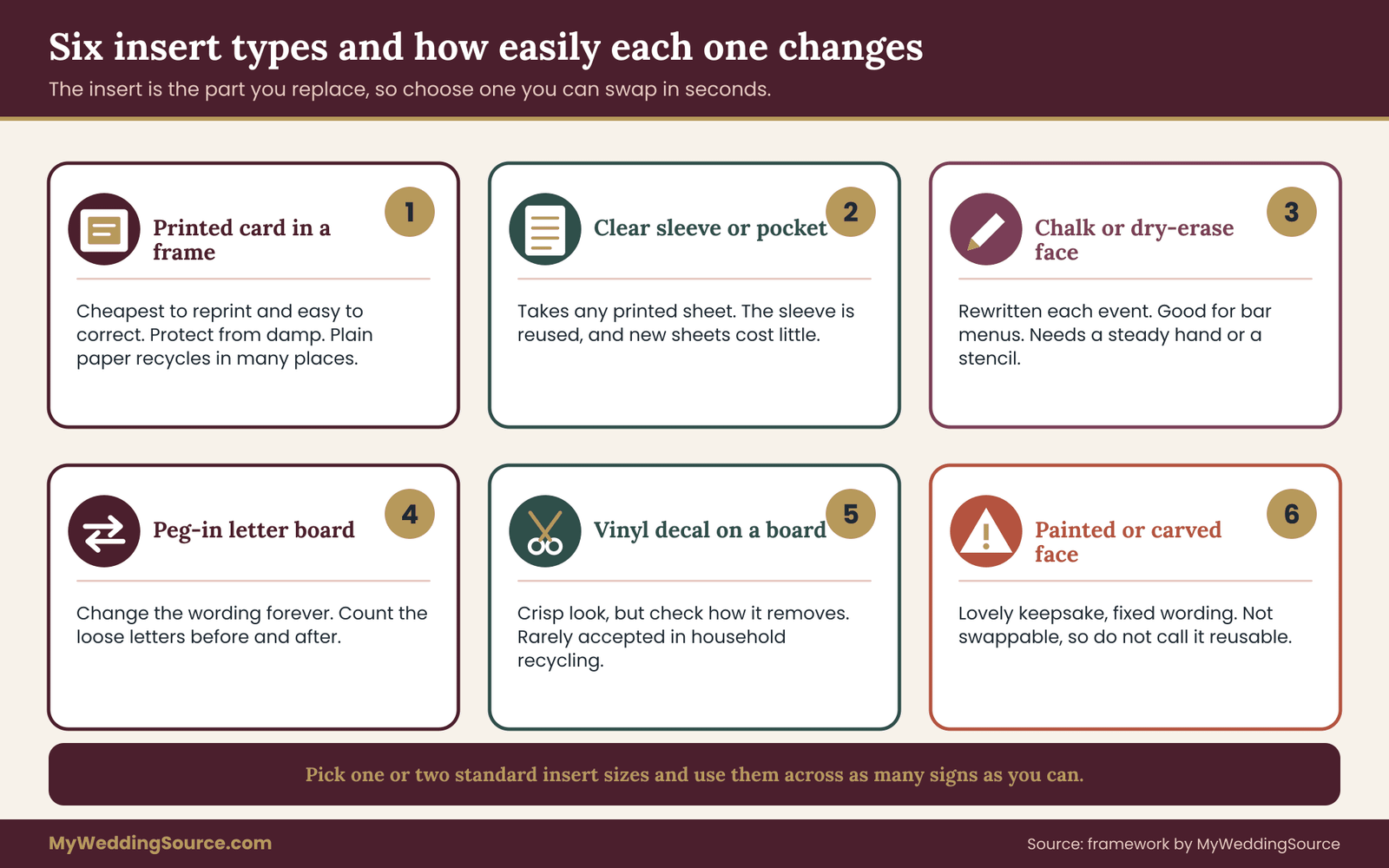
Printed card or paper in a frame. The simplest option. Cheap to reprint, easy to correct and easy to recycle as paper when you are done. Weak against moisture and handling, so protect it with a sleeve or a frame face.
Vinyl or removable decal on a board. Looks crisp, but the adhesive can leave residue or tear the face when removed. Check the manufacturer’s directions for removal and the surfaces it suits. Vinyl is also harder to recycle, so treat it as a sign that will be reused or discarded deliberately, not casually.
Chalkboard, dry-erase or marker boards. The face is rewritten for each event. Great for bar menus and drinks signs, and a good fit if you want the text to change as the night goes on. Handwriting quality varies, so ask someone with a steady hand or use a stencil.
Letter boards with peg-in characters. Each character is a small loose piece, so you can change the wording indefinitely. The weakness is the small parts, which get lost. Count the characters before and after the event and keep them in a labeled container.
Slide-in sleeves and pockets. A hardware frame with a clear pocket takes any printed sheet. This is a nice fit for table numbers, since you can print a new set for each event.
Painted or engraved faces. Beautiful, but they commit the sign to one text. The hardware may still be reusable if the face can be replaced or covered, so design this carefully or skip it for any sign you want to reuse.
Separating the fixed from the variable
For each sign, write the wording down in two groups. The fixed group is whatever would be true at any event: “Please sign our guestbook,” “Drinks,” “Restrooms this way,” “Gifts and cards.” The variable group holds the names, dates, drink names, times and house rules. Only the variable group needs to be on the changeable face.
This sounds obvious until you start designing. A well-planned “Gifts and cards” sign, the easiest piece of reusable signage on any list, needs no name and no date at all, and can be used at any celebration without any change. A seating chart is almost entirely variable. A bar menu is half and half: the heading can stay, the drinks change.
The fixed group can sometimes be part of the hardware itself, like a frame with a permanent header. Be careful here, though. A permanent header makes the sign less flexible, and the saving may not be worth the lost versatility.
Typography, color and finish for repeat use
If you want the frames and stands to suit many events, keep the hardware plain. Neutral wood, black or white metal and clear acrylic fit nearly any decor, which is exactly why rental companies stock them. Bring the personality through the insert, where it is cheap to change. A strong color palette on the hardware ties it to your wedding and shrinks its second-life options.
For the insert itself, follow the legibility basics: large, simple type, strong contrast between letters and background, and matte finishes that avoid glare in photos and under lights. These points are covered in more detail in the wedding signage system guide, and they matter for reuse too, because a sign people cannot read has no value in any event.
Version control for inserts
A common failure is a stack of inserts nobody can tell apart. Label every insert on the back with the sign name, the event and the version. When a time or a name changes, print a new insert and mark the old one “replaced” before you put it away. On the day, give one trusted person the job of checking that each sign shows the latest version. Late changes are exactly when a swappable insert pays for itself, because you can reprint one card rather than a whole board.
The cost-per-event model for reusable signage
Price alone does not tell you whether reusable signage is a good deal. A frame that costs four times as much as a foam board is cheap if it serves four events and expensive if it serves one. The cost-per-event model gives you a way to compare options on equal terms, using your own quotes and your own honest guess of how many times each piece will be used.
The basic formula for reusable signage
For each piece of hardware, work out four numbers.
Purchase cost. What you pay to own it, including tax, delivery and any assembly.
Upkeep cost. What you expect to spend between events: cleaning supplies, touch-up paint, replacement parts, a storage bin, and the shipping or fuel to move it. For many pieces this is close to zero, but for large or fragile hardware it can be real money.
Salvage value. What you expect to recover at the end, by selling it, by returning it to a rental company or by giving it away. Giving it away has no cash value, so count it as zero, even though it has a benefit. Be honest here. Used wedding items often sell for much less than their purchase price, and some do not sell at all.
Honest number of uses. How many events the piece will actually be used at. Count only events you can name.
Then the model is:
Cost per event = (purchase cost + upkeep cost − salvage value) divided by number of uses.
Add the cost of the insert for each use, since the insert is bought again every time. The full cost of a sign at one event is the hardware’s cost per event plus the cost of that event’s insert.
Run the same formula for the alternatives to reusable signage. A single-use sign has one use and no salvage value, so its cost per event is simply its price. A rental has no purchase cost, so its cost per event is the rental fee plus delivery, deposit losses, if any, and any damage charges.
Why the honest number of uses matters most for reusable signage
The formula is simple, and the weak point is always the number of uses. People overestimate it, and reusable signage is no exception. A sign that “we will use for every holiday party” often gets used at the wedding and then never again. Three habits keep the number honest.
Count named events only. If you cannot say “the rehearsal dinner on this date” or “my sister’s shower next spring,” do not count it.
Count the wedding as one, even if it spans two days. A rehearsal dinner and a reception are separate uses only if the hardware is actually used at both.
Run the formula twice, once with your hopeful number and once with a pessimistic one. If the reusable option only wins under the hopeful number, treat it as a gamble.
What a break-even point looks like
The break-even point is the number of uses at which owning becomes cheaper than the alternative. You can find it by dividing the extra cost of the durable option by the saving per use of the cheaper option. If the durable hardware costs more upfront and a single-use sign costs less each time, the break-even is the first use count at which the total for the durable option drops below the total for the single-use option.
The point of the exercise is the answer to one question about reusable signage: how many events must this serve before it is cheaper, and is that number realistic? If break-even needs five events and you can name one, the answer is to rent or print single-use. If break-even needs two and you can name three, buy the hardware and enjoy reusable signage at the next event.
Costs that people leave out of reusable signage budgets
A few costs hide outside the purchase price.
Storage. If you must rent a unit or give up a closet, the space has a cost. If it lives in a relative’s garage, it has a cost in goodwill and a risk of damage. Put a number on it, even a rough one.
Transport. A large sign may need a van, a second trip or a vehicle with a big boot. Ask whether delivery is included for rentals, and who carries the sign for owned pieces.
Time and labor. Setup and teardown take time, and for large pieces that means someone’s hands. If you are paying a planner, a venue coordinator or a vendor for setup, ask whether the sign hardware changes their fee.
Replacement and damage. Rental companies often charge for damaged or lost pieces. Hardware you own may need repair. Allow a small reserve for each.
Disposal. If the hardware ends up with no home, someone has to haul it away. Some facilities charge fees for bulky items, and others will not accept certain materials. Check with your local waste authority before you assume.
Using the model for reusable signage in your budget
Put the results in a simple list. For each sign, write the plan (own, borrow, rent or single-use), the cost per event under the plan, and the number of uses behind it. The wedding budget guide explains how to lay out categories so that signage sits where you can see it. The point is to see the whole signage line at once and to notice when one large piece is eating the budget for little return.
Worked example: a couple compares four ways to make a bar menu sign
The figures below are invented to show the method. They are not prices, averages or quotes. Replace them with real numbers from your own vendors.
Imagine a couple wants a bar menu sign and has four options. They name three events where a bar sign could appear: their reception, a rehearsal dinner a day earlier and an anniversary party hosted by one set of parents the next spring. That gives three named events.
Option A: a custom painted wood board. A purchase price of one hundred twenty dollars. The painted face cannot be changed, so it carries only this wedding’s drinks. Uses: one. Salvage value: zero. Upkeep: zero. Cost per event: one hundred twenty dollars.
Option B: a foam board with a printed poster. A purchase price of thirty-five dollars. Uses: one. Salvage: zero. Cost per event: thirty-five dollars. At the end it needs a recycling route that actually accepts it, which is uncertain for mounted foam board, so check locally.
Option C: a standard wood frame on an easel with printed card inserts. The frame and easel together cost sixty-five dollars. Each printed insert costs eight dollars. Upkeep is a small padded bag at ten dollars. Salvage is estimated at twenty dollars, since a standard frame and easel can be resold or handed on. Uses: three, the three named events. The hardware cost is sixty-five plus ten, minus twenty, which equals fifty-five, divided by three. That is about eighteen dollars and thirty cents per event. Add eight dollars for each insert. The cost per event comes to about twenty-six dollars and thirty cents.
Option D: renting a frame and easel. The rental fee is twenty-two dollars per event, with delivery included. The couple pays an eight dollar insert each time. Uses: three. Cost per event: thirty dollars.
What the example shows about reusable signage
Under these invented numbers, Option C is cheapest per event, but only just, and only because three events are real. If the couple drops the rehearsal dinner, uses fall to two, and the hardware cost per event rises. Run it again: fifty-five divided by two is twenty-seven dollars and fifty cents, plus eight for the insert makes thirty-five dollars and fifty cents. Now Option D, the rental, is cheaper at thirty dollars.
That flip is the whole lesson of reusable signage economics. The better choice depends on one assumption, and you can see exactly where it flips. A couple who knows only one event is certain would rent or print on paper. A couple who is certain of three would buy.
Option A is the most expensive per event and the least reusable, and it is the one that looks most like a keepsake. That does not make it wrong. Some couples want a piece to keep, and that is a fair reason. The mistake is calling it reusable signage when its face cannot change. Call it what it is: a keepsake that is also a sign.

Adding the environmental question without overclaiming
The cost model tells you about money. It does not tell you about environmental impact, and the two do not always point the same way. A rental might be better on both counts, because the item keeps circulating. A purchased frame that sits unused in a closet may be worse than a single paper sign that goes to recycling.
If the environmental effect matters to you, ask three questions. Will this piece actually be used again? What is it made of, and can the material be recycled or reused locally at the end? How far did it travel, and how will it get to us and back? You can seldom answer these perfectly. What you can do is avoid a purchase whose benefit relies on events that may never happen.
The EPA’s materials management resources describe the general idea of keeping materials in use and reducing what is thrown away, and they are a sensible reference. They do not tell you whether a particular frame, vendor or product is better. For that, you have to ask the vendor and check the facilities in your area.
Verification: separating assumptions from confirmed terms
A cost model is only as good as its inputs. Keep two lists as you work on reusable signage: assumptions, and confirmed terms. Move an item from the first list to the second only when you have the answer in writing.
Assumptions that deserve a check
These are the guesses that quietly decide the outcome of reusable signage plans.
The salvage value. Check a resale site, a local buy-and-sell group or a rental company to see what similar used pieces actually fetch, if anything. Then use a conservative number.
The second event. Confirm the date, the place and whether the host wants your hardware. A friend who says “sure, we’d love to borrow it” in conversation may not have room for it in the month you need.
Storage. Confirm that the person who offered to store the pieces has a dry, safe spot and is willing to hold them for the whole period.
The venue’s rules. For reusable signage, confirm what hardware the venue allows, how it allows it to be attached and whether it permits ground stakes, hanging pieces, easels in walkways or candles near signs.
Vendor terms. If a print shop or sign maker says an insert is “reusable,” ask what that means: how many wipes, how many removals, what surface and what temperature.
Written answers worth asking for
Ask rental companies for the item list, the dimensions, the deposit, the damage policy and the pickup window. Ask print shops what materials the inserts are made from, what finish they use and how they recommend recycling or disposing of them. Ask sign makers whether replacement faces and parts will be available later, which matters if you want to reuse a frame after the first set of inserts is gone.
The wedding vendor contract guide explains what to look for in a written agreement, and it is a handy reference for the vendors who supply reusable signage as much as for any other. Keep the answers with the order, so you can find them when the question comes up again.
Venue rules and day-of setup for reusable signage
Even a perfect plan for reusable signage fails if the venue will not let you put the signs where you planned, or if nobody knows who sets them up. This section covers what to ask the venue, how to schedule setup and teardown, and who should own each task.
What to ask the venue
Venues write their rules for decor, and those rules shape reusable signage more than any other factor, over years of damaged walls, tipped candles and abandoned items, and the rules differ more than couples expect. Ask in writing, and ask early enough to change your design.
Attachment. May you hang anything on walls, doors, railings, trees, fences or ceilings? What may you use: clamps, weights, freestanding frames only? Many venues forbid adhesive, tape and nails on painted or historic surfaces, and some forbid hanging anything at all.
Floor and ground. Can easels and stands go on the floor surface? Are stakes allowed in the lawn, and is there any irrigation, cable or utility line underground? For outdoor sites, ask who to contact about marking underground lines before anyone pushes a stake into the ground.
Placement and traffic. Are there rules about blocking doors, exits, aisles, fire equipment or accessible routes? Signs should never narrow an exit path, and the venue’s safety rules usually say so.
Candles, lights and heat. Are open flames allowed? If a sign sits near candles or string lights, ask whether the venue limits what may be placed close to them.
Timing and access. When can you or your vendors enter to set up, and when must everything be out? A sign collection that needs an hour to place requires an hour of access.
Leftovers. What is the venue’s policy on items left behind after the event? Many venues will discard anything not removed by a set time, which is a good reason to plan the removal before the wedding day.
The wedding venues guide has more on questions to put to a venue before booking, and a good time to raise reusable signage rules is when you walk the space for the first or second time.
The setup list for reusable signage
A setup list is a one-page document that says where each sign goes, what hardware it uses, which insert goes in it and who places it. Write one for the day and give a copy to whoever handles setup, whether that is a coordinator, the venue staff, a family member or a friend.
For each sign, include:
The sign name and the number of the insert version it should hold.
The location in plain words: “left of the entrance doors, on the lawn side,” not “near the front.”
The hardware: easel, frame, stakes, weights, clips.
Any special instruction, such as “weight the base with the sandbags in the red bin” or “this sign faces the parking lot.”
The owner of each task, and the time it should be done.
A simple photograph taken during your walkthrough, showing the spot, speeds this up greatly. Attach it to the list. Someone who has never seen the venue can then place the sign correctly.
Roles on the day
Reusable signage, like all signage, often falls between jobs. The planner thinks the venue is doing it, the venue thinks the couple is doing it, and the couple are getting dressed. Name one owner for each phase of the reusable signage plan.
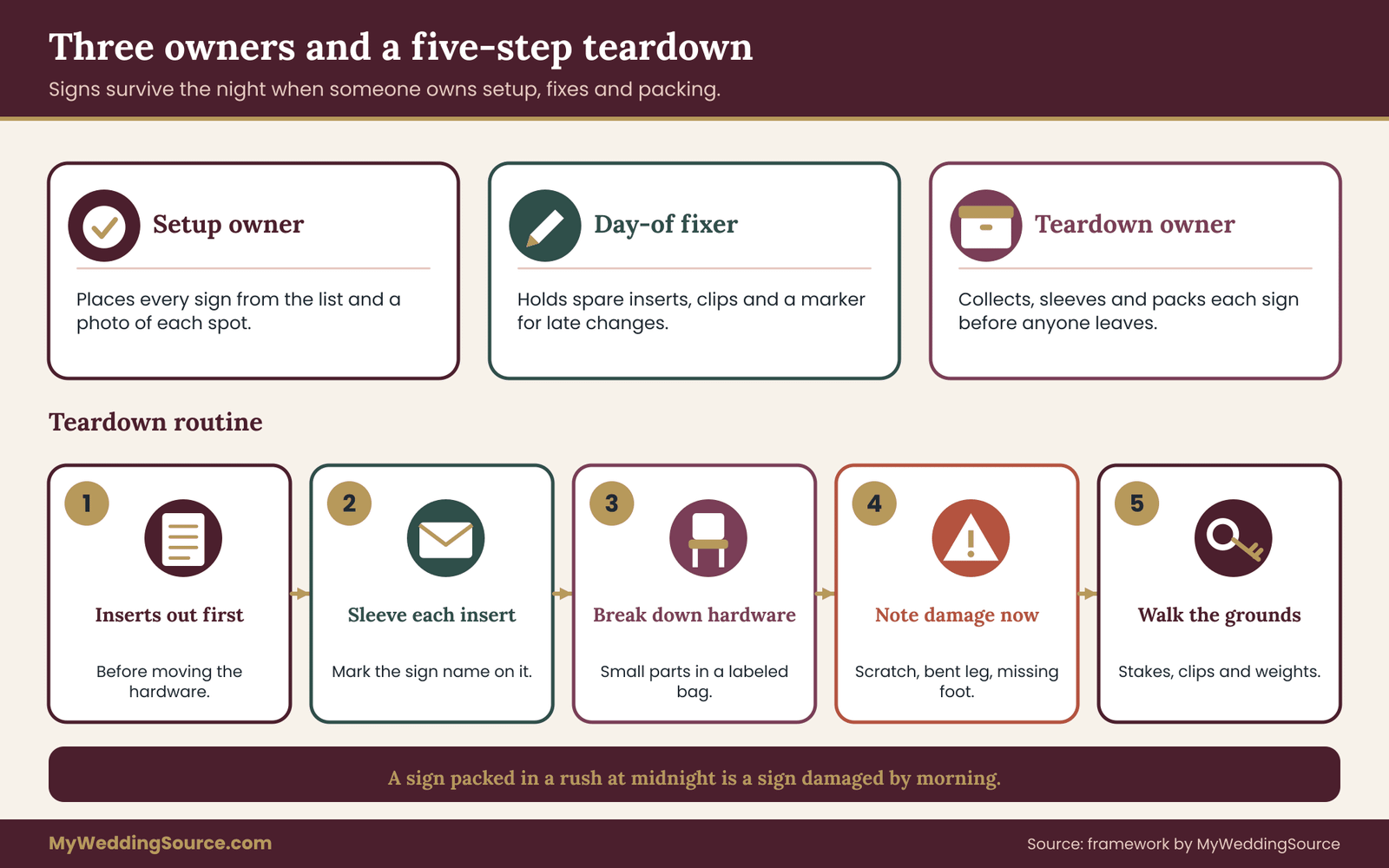
Setup owner. Places every sign and checks each against the list. If you have no planner, pick a reliable friend or relative and give them the list the day before.
Day-of fixer. A different person from the setup owner, who is responsible for corrections during the event: a changed time, a typo noticed too late, a sign that got knocked over. Give this person a small kit with spare inserts, scissors, clips and a roll of painter’s tape for temporary fixes that the venue allows.
Teardown owner. Collects each sign at the end, checks it against the list, puts the insert in its sleeve and packs the hardware in its case. This job is the one that decides whether the reuse plan survives, because a sign packed in a rush at the end of the night is a sign that is damaged by morning.
If your budget includes a planner or day-of coordinator, ask whether reusable signage setup and teardown is part of the contract. The wedding vendor timeline can help you decide when each vendor arrives and leaves, so that no sign is placed before the space is ready or removed after the venue’s deadline.
A teardown routine that protects reusable signage
Teardown is where reusable signage suffers most. People are tired, the venue wants the room back and the cases are in the car. A short routine helps.
Remove inserts first, before moving the hardware. An insert left in a frame can slide, bend or scratch during transport.
Put each insert in a sleeve or between two clean sheets, and mark its sleeve with the sign name.
Fold or break down the hardware, and keep small parts in a labeled bag taped to the main piece or placed in the case.
Check for damage right away and note it on your list: a scratch, a bent leg, a missing foot. Noticing it at the venue means it can be reported or fixed. Noticing it three months later at the next event is too late.
Do a last walk through the room and the grounds. Stakes, clips and weights are small and easy to leave behind.
Weather plans for outdoor signs
If any sign will be outdoors, make a weather plan before the day. Decide the rain version of each sign: a covered spot, a different position or a protective sleeve. Decide the wind version: a lower sign, a heavier base or a position out of the main gusts. Decide who makes the call and when. Waiting until guests arrive is too late, and the hardware you chose is only useful if someone is on hand to move it.
For signs that must stay out in damp conditions, plan for the insert more than the hardware. A printed card can be replaced for a few dollars, while a warped wooden frame is a larger loss. This is another reason to keep the insert cheap and the hardware sturdy, so that a bad weather day costs you a card and not a sign.
Making reusable signage work for accessibility and readability
A sign that guests cannot read is a waste of materials no matter how reusable it is, and reusable signage must be legible first. Readability and accessibility are part of the design, and standard, swappable hardware helps with both.
Height and position
Signs that guests need to read while walking should sit at a height that suits standing and seated readers. A wheelchair user’s eye level is lower than a standing guest’s, and a sign placed too high or surrounded by a crowd is hard to read from a seat. Standing easels that allow a range of heights, or a pair of signs at two levels for important information, help. Keep walkways clear around signs so that a wheelchair, a stroller or a walker can pass.
Contrast and size
Choose large, simple type with strong contrast between letters and background. Dark text on a light, matte background is the safest. Avoid thin script fonts for any information guests must act on, such as the location of the restroom or the table number. A decorative font can be used for a heading while the body stays plain.
The Americans with Disabilities Act and its design standards set requirements for permanent signs in public buildings. Temporary event signs are generally not governed by the same rules, but the principles are good guidance: simple characters, high contrast and non-glare finishes. For specifics that apply to your venue, ask the venue manager or review the U.S. Access Board’s materials. The wedding signage system guide covers readability in more depth, and its advice applies directly to the inserts you design for reuse.
Language and clarity
If a significant number of guests read another language, a bilingual insert is a neat use of the swap system. Keep one hardware set and print a two-language insert, or print the second language on a second card placed side by side. Make sure a fluent reader checks every translation before it is printed, because a mistake on a sign is on display all evening.
Why standard hardware helps
Because reusable signage separates hardware from the face, a late change takes minutes. A guest tells you the font is hard to read in the evening light, or a venue manager asks you to add a safety notice, and you can respond by printing a new insert. With a custom painted board, you cannot. This flexibility is a practical, accessibility-friendly benefit that has nothing to do with the environment, and it is worth including in your reasoning when you decide how much of your signage to build in two layers.
Printing inserts: materials, finishes and what to ask the shop
With reusable signage, the insert is bought again for each event, so its material and printing choices matter for both cost and waste. A good print shop can answer most of the questions below, and a good answer is a sign that the shop knows its products.
Paper and card
Standard paper and card stock are inexpensive and, in many areas, widely accepted by recycling programs when clean and uncoated. Coated, laminated or glittered stock may not be accepted in the same way. Ask the shop what coatings it uses, and check your local program’s rules about coated paper. Many local governments publish accepted-materials lists on their waste or recycling pages.
If an insert will sit in a frame behind a clear face, it needs no lamination. If it will be handled or placed outdoors, a sleeve may do the job better than lamination, because a sleeve can be reused while a laminated card is a single bonded object.
Rigid boards
Foam board, mounted prints and hard boards give a stiffer face for a stand, but mounted layers often combine materials in a way that makes recycling difficult. If you choose a rigid insert, ask the shop what the board is made of, whether it can be reprinted or reused, and what disposal route they recommend. If the answer is vague, plan to keep the board for later events or choose card in a frame.
Vinyl and adhesives
Vinyl decals work well on boards, glass and acrylic but come with removal and disposal questions. Ask about removal methods, surface compatibility and whether the decal can be repositioned. Vinyl generally does not go in household recycling, so treat each decal as something you will keep using or send to ordinary disposal.
Inks, finishes and colors
Matte finishes reduce glare in photos. Ask for proofs in the actual size and in the light where the sign will be used, because a color that looks right on a screen may be too faint on a printed face. Order a small test print before a full run, particularly for dark backgrounds with light text, which are harder to read from a distance.
Quantity and spares
Order a few spare inserts for the signs most likely to change: the schedule, the bar menu, the seating chart. Spares cost little when printed in the same run and save an emergency trip to a shop. Do not overorder, since leftover inserts are waste themselves. A reasonable plan is one spare for each sign likely to change and none for the rest.
Storing reusable signage so it survives to the next event
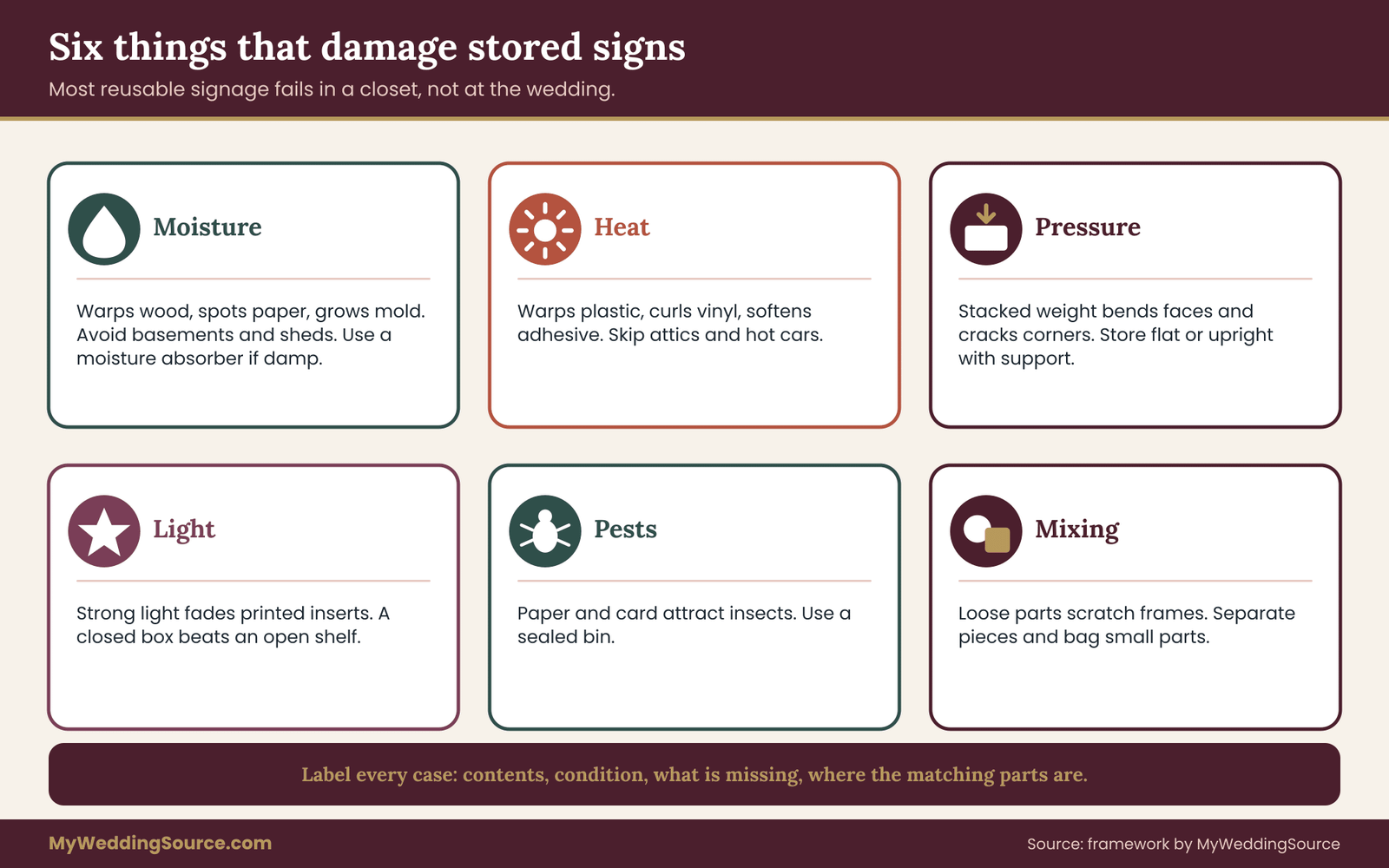
Storage is the third layer, and it decides whether the first two were worth paying for. Most reusable signage fails in a closet, not at a wedding. Heat, damp, pressure and neglect do more damage than any guest. A little care in the first week after the wedding makes a large difference to how long reusable signage lasts over the following years.
What damages stored reusable signage
Know the enemies of each material.
Moisture. Humidity warps wood, swells particleboard, spots paper and encourages mold. Basements, garages and sheds with no climate control are the usual culprits. If a space smells damp, it is not safe for paper or wood.
Heat. Attics and cars in summer can warp plastic, soften adhesive, curl vinyl and make acrylic brittle over time.
Pressure and bending. Stacking heavy items on a frame, leaning boards at an angle or squeezing a case between boxes bends faces and cracks corners. Large flat boards want to be stored flat or upright with support along their length.
Light. Long exposure to bright light fades printed inserts. A closed box in a closet is better than an open shelf near a window.
Pests. Paper and cardboard attract insects and rodents in some spaces. A sealed plastic bin prevents most of it.
Mixing. Loose small parts in a box with sharp hardware scratch each other. Separate items so that nothing grinds against anything else.
A storage kit for reusable signage that costs little
You do not need special equipment. A modest kit covers most of it.
A set of sturdy cases or bins sized for your hardware. For folded easels, a long bag or a tube-shaped case. For frames, a flat box with dividers or a stack of cardboard sheets between each frame.
Soft padding: cloth, blankets, or foam sheets. Reuse what you have from shipping boxes.
Clear sleeves or folders for inserts, plus a rigid board to keep them flat.
Small zip bags or a compartment box for clips, screws, feet and pegs.
Labels, either on tape or on index cards, and a marker. Label the outside of each case and the inside as well, in case the outer label is lost.
Silica packets or another moisture absorber, if the storage space is even slightly damp. Check the packaging directions for how to use them safely, and keep them away from children and pets.
The label that matters most
A label is a promise to your future self, and every case of reusable signage should carry one. Make each label on reusable signage say four things: what is in the case, what condition it is in, what is missing or needs repair and where the matching parts are. A case that says “Bar menu frame, easel and clips. Left foot rubber missing, replace before use. Spare insert in the blue folder” is far more useful than one that says “wedding stuff.”
Photograph the packed case, open, before you close it. The photo takes ten seconds and shows what belongs where when you unpack at the next event.
An inventory sheet
Keep a single sheet, on paper or on your phone, with one line for each piece of hardware. For each, record the name, the size, the material, the owner, the storage location, the condition and the last use. If you plan to hand a piece to someone else later, add their name. When the sheet is complete, take a photo of it and send it to the person who stores the hardware, so there is more than one copy.
This sheet also works as the reuse promise you made at the start. If a piece has had no use in a year and no named next event, it is time to decide whether to pass it on, sell it or release it for recycling. The inventory prevents the slow drift where a collection grows quietly and nothing leaves.
Who stores what
Name a storage owner for each case. This is the person who has the physical space, agrees to hold it and knows how to reach you when it is needed. Write down how long they have agreed to store it. “Until the anniversary party next spring” is a clear period. “For a while” is not.
If you will store all your reusable signage at your own home, be realistic about the space. A first apartment with a small closet may not fit a set of tall easels and boards. In that case, store only the small pieces and rent the large ones, or give the large ones a home with someone who has room, with their agreement.
If the pieces will go with a rental company, confirm what happens after the event: pickup timing, any inspection and whether you are responsible for cleaning. The wedding rental planning checklist covers those questions.
Transport between the venue and storage
Pieces are most at risk while in motion. Plan the vehicle, the route and the packing before the wedding day.
Measure the largest piece and the vehicle’s cargo space. A tall easel that does not fit in a sedan will be driven in a rear seat at an angle that bends it.
Pack heavy items at the bottom, flat items upright between padding and fragile items on top or well cushioned. Strap or wedge cases so that they cannot slide in a turn.
If someone else is driving, give them the packing photo. A packing photo makes a crowded trunk simple.
Plan the unload as well. If the storage spot is up a flight of stairs, plan for two people and a short route, or the load may be dropped.
Using reusable signage again: a second life plan
The point of building reusable signage in layers is to use the pieces again. A second life plan, written before the wedding, turns “we might reuse it” into a list of named events and recipients.
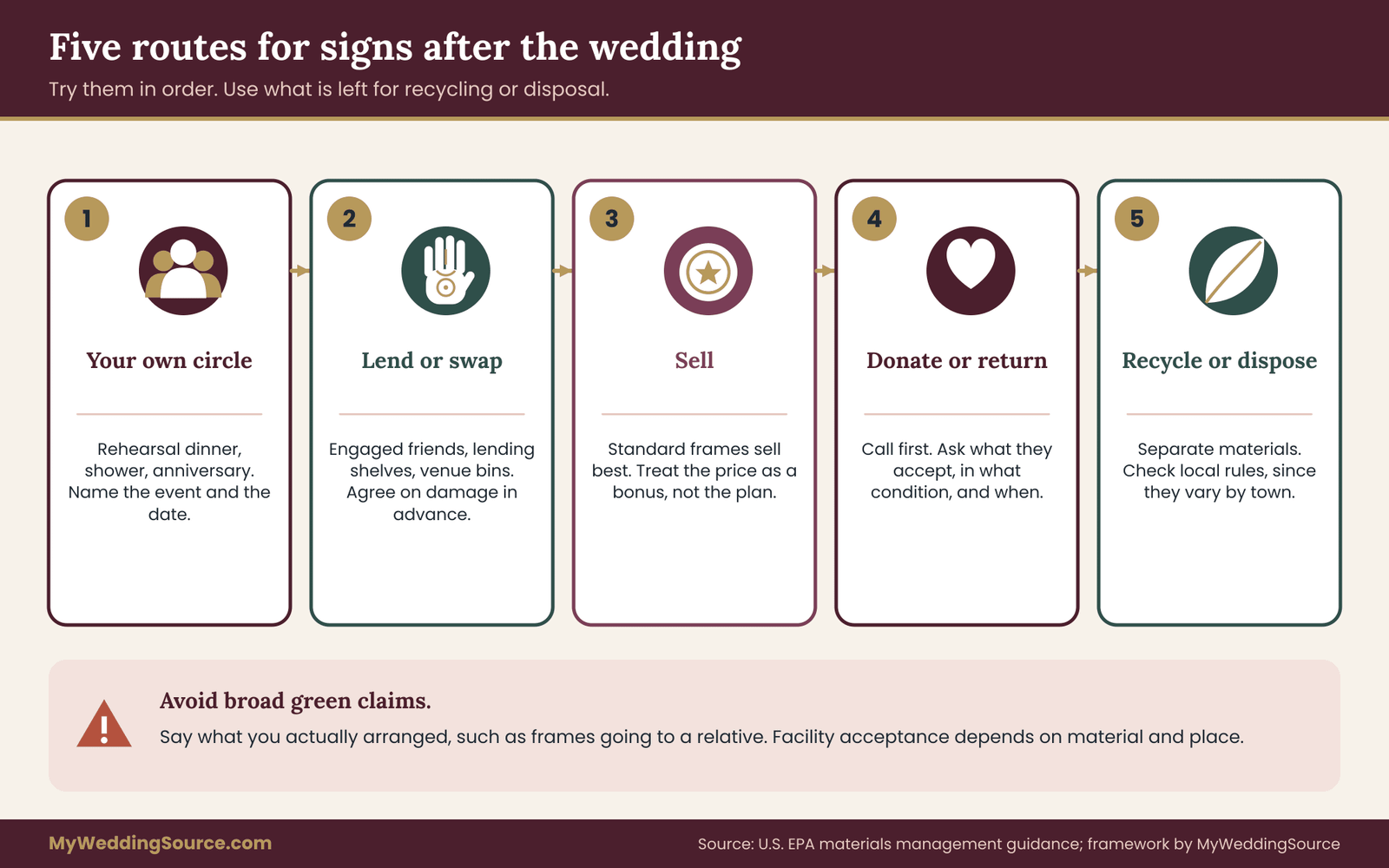
Reuse of reusable signage within your own circle
Look at the events that follow a wedding in a family. A rehearsal dinner, a farewell brunch, a baby shower, a milestone birthday, an anniversary party, a graduation party and a holiday gathering all need a bar sign, a welcome sign, a gift table sign or a guestbook sign. Hardware that is neutral in style fits each of them, which is the practical strength of reusable signage.
Make the offer in advance. A relative who has been told “these frames are available for the anniversary party” can plan around them. Keep a short list of who might use what, and update it when someone’s plans change.
Lending and swapping
Friends who are engaged themselves often want reusable signage and will gladly borrow a set. Lending is a good use, with a small cost to you in time and risk. Agree on a return date, who pays for any damage and who handles the pickup. Use the inventory sheet, so that you and the borrower can check items in and out.
Local groups sometimes run lending shelves or swap events for event items, and some venues keep a bin of leftover decor and reusable signage that couples can take from and add to. Ask your venue whether they have something like that and whether they would accept your hardware afterward.
Selling
Selling reusable signage can recover part of the cost, and the cost model uses your salvage estimate for exactly this reason. Standard frames and stands in good condition are the most likely to sell. Heavily personalized pieces rarely do. List items with clear photos, accurate dimensions, the condition and what is included. Be clear about pickup, and avoid shipping large fragile items unless you have a good way to pack them.
Treat any sale price as a bonus and not a plan. If the cost model only works when the hardware sells for a high price, it does not work.
Donating and returning
Community theaters, schools, churches, senior centers, nonprofits and event rental businesses sometimes accept clean, working frames, easels and boards. Call first. Many groups have limited space and specific needs, and a donation they cannot use becomes their disposal problem. Ask what they accept, what condition they want and whether they can take it on a particular date. Keep it practical: a short phone call or message, a photo and the dimensions.
If you rented, returning items on time and in the condition required is its own form of reuse, since the supplier will place them with the next customer.
When a piece has reached the end
Some pieces will wear out. A broken easel, a cracked frame or a faded board may be past use. At that point the question changes from reuse to disposal, and a useful rule is to separate by material before you act. Wood, metal, glass, plastic and paper each go to different places. Check your local waste or recycling authority for what it accepts, since rules vary from town to town and even from one hauler to another. Many programs do not accept mixed-material items, and bulky items often need a special pickup or drop-off.
The EPA’s resources on sustainable materials management describe the general order of preference for materials: reduce, reuse, recycle and, only then, dispose. Use that order as a guide, and check local rules for the details that matter.
Checking claims about reusable signage before you pay
Many products and vendors describe their signs with words such as reusable, recyclable, eco-friendly or sustainable. Some of those words are accurate and some are decoration. A calm set of questions lets you tell the difference without turning shopping into a research project.
The claim ladder for reusable signage
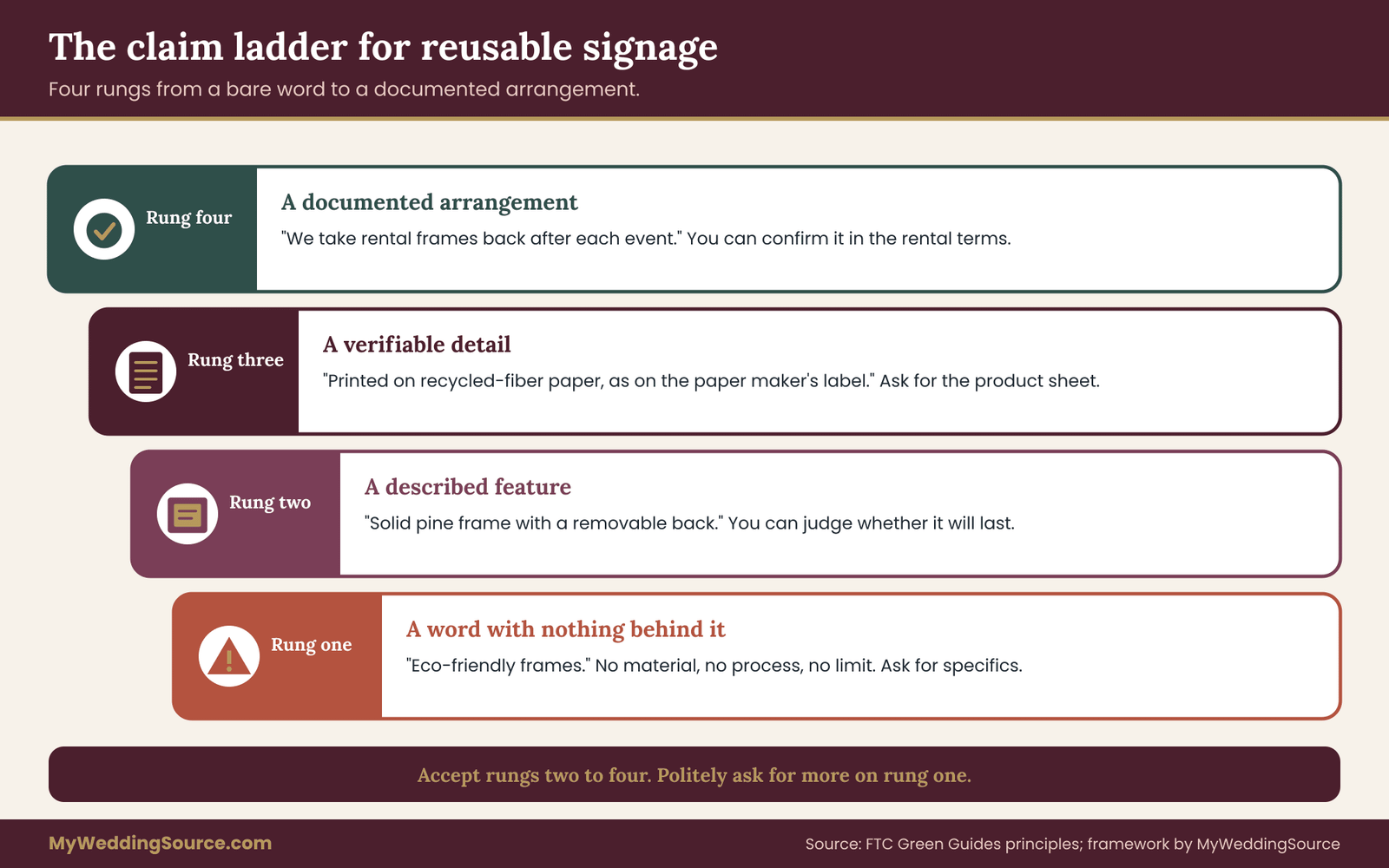
Think of a vendor claim as sitting on one of four rungs, from weakest to strongest.
Rung one: a word with nothing behind it. “Eco-friendly frames.” Nothing is specified: no material, no process, no limit. Treat it as marketing until the vendor tells you more.
Rung two: a described feature. “Solid pine frame with a removable back panel.” You know what it is made of and how it works. You can judge for yourself whether it will last.
Rung three: a verifiable detail. “Printed on paper that contains recycled fiber, as stated on the paper maker’s label.” You can check the label and ask for the product sheet.
Rung four: a documented arrangement. “We take back our rental frames after each event and put them back into stock.” This describes an actual process you can confirm by reading the rental terms.
Accept rungs two through four for reusable signage, and ask politely for more on rung one. Vendors who are proud of their products will usually answer in a sentence or two.
Questions to put to a sign maker or retailer
What is the hardware made of, and what finishes or coatings are on it? Can the face be replaced, and are matching faces and parts available later? How many removals or reprints can the surface take? What is the recommended care and storage? What is the disposal route for each material when it wears out? Is the vendor willing to take back used items, and on what terms?
Write the answers into the order or keep the messages. If a vendor’s description changes between the quote and the invoice, you will have a record.
Questions to put to a rental company
What items are available, in what sizes and condition? What does the price include: delivery, setup, pickup? What are the damage charges and the rules for lost parts? How is the hardware cleaned and stored between customers? What happens at the end of the item’s life? You do not need a sustainability report. You need enough information to know that the item will be used by someone after you.
Questions to put to your local waste authority
For many couples, the decisive question is not about the vendor, but about local facilities. Ask the city, county or hauler’s customer service, or look at its published lists: Which materials are accepted in household recycling? Are coated, laminated or mixed-material items accepted? Are wood, metal or glass frames accepted, and where? Is there a drop-off site for bulky items? Are there fees?
The answers vary widely by place, and a material that is recycled in one county may be refused in the next. The EPA’s materials management resources give general background, but they cannot tell you what your local facility takes. For that, only the local authority can answer.
Avoiding overstatement in your own words
When you describe your choices to guests, on a website or to vendors, keep the language modest and specific. “Our bar and welcome signs use frames we plan to pass on to family” is accurate. “Our wedding is zero waste” is a claim nobody can support. If you have arranged a return to a rental company or a donation, say so, and leave the larger conclusions to others.
The Federal Trade Commission’s Green Guides discuss how marketers should qualify environmental claims, noting that general benefit claims are hard to substantiate. The guide is addressed to businesses, but its message is helpful to anyone writing about a product: be specific about what you mean, and do not suggest a benefit that is not there.
Red flags
A few patterns are worth a second look.
A product marketed as reusable but with a face that cannot be changed, so it can only ever show one message.
Hardware that is advertised as recyclable without any note on material or local conditions.
A vendor who cannot say what a surface is made of or how to remove an old decal.
A rental company that cannot give clear terms for damage and returns.
A price that depends on a resale value nobody has confirmed.
None of these makes a purchase wrong. They are simply signs that the answer is still an assumption, and the cost model should treat it as one.
Limits of reusable signage and when to skip it
A fair guide includes the cases where reusable signage does not help. Reusable signage is a tool, and some jobs call for a different one.
One-off weddings with no second event
If the wedding is the only event you can name, and no relative, friend or business wants the hardware, the arithmetic usually favors renting or printing on easily recycled paper. Buying durable hardware that nobody uses again is the worst result in both money and materials.
Small guest counts and short days
A small ceremony with a handful of signs may need only a welcome card and a menu. The effort to build a layered, swappable system exceeds what the day requires. A simple printed sheet in a borrowed frame is enough, and it is fine to say so.
Very personal pieces
Some signs are meant to be keepsakes: a hand-painted welcome board, a carved sign with your names, an heirloom frame. These are not reusable signage in the sense used here, and they do not need to be. Their value is sentimental, and you can decide where they live in your home. Just avoid labeling a one-way piece as reusable.
Venue-supplied reusable signage
Many venues provide their own easels, frames and stands. If the venue’s own hardware is available at no charge or low cost, using it is often the most reusable path, because those pieces will serve other couples. You then only need to design the inserts. Ask what is available and what size the frames are before ordering anything.
Travel and destination weddings
Weddings that require flying make heavy hardware impractical. Luggage limits and fees can cost more than the hardware. A destination wedding is a good case for flat, light inserts and local rentals, or for signs printed at a shop at the destination and recycled there. Check the destination’s recycling rules too, since they may differ from yours.
Fragile or complex hardware
Hardware with many parts, delicate finishes or specialized lighting, for example a lit neon-style sign, needs care in transport and storage and may need professional handling. These pieces are the most likely to be broken between events. If you want one, consider renting it from a business that handles such items.
When the venue forbids the plan
If the venue bans freestanding signs, stakes, hanging pieces or anything you planned, the design must change. Ask about this early enough to adjust the hardware before you order it.
Sizing your effort honestly
A rough guide to effort: put your thought into the pieces that are large, expensive and long-lived, and treat the small, cheap items simply. A set of table stands deserves five minutes. A large custom board deserves an afternoon of arithmetic. Spending the same energy on both is a waste of your time.
Edge cases and common mistakes
These situations show up often, and each has a straightforward answer.
The sign that must change the day of
A caterer swaps a dish, a vendor drops out or the ceremony time moves by thirty minutes. With a swappable insert, someone reprints a card or uses a prepared blank and a marker. Keep a few blank inserts in the same size as part of the day-of kit. A blank, a thick marker and steady handwriting can rescue a day.
Borrowed reusable signage that gets damaged
Agree in advance on who pays for repair or replacement, and note the condition at handover with a photo. If a piece is damaged, tell the owner immediately and offer to repair or replace it. A clear conversation protects the friendship.
The sign nobody picked up
At the end of the evening, a welcome sign leans against a wall, and everyone has gone home. The teardown owner described earlier prevents this. If you have no teardown owner, name one now.
The hardware that does not fit the insert
You ordered inserts before you bought the frame, and the sizes do not match. To avoid this, buy or confirm the hardware first, measure the opening, and only then order the inserts. Check whether the frame measurement refers to the outside edge or the visible opening, since the two differ.
The vendor who prints but does not return
A print shop may keep your artwork file or charge for reprints. Ask for the final files in an editable format and for the right to reuse them, in writing. A reusable insert system depends on being able to print a new version without starting over.
The stored sign that stopped working
A frame has warped, a foot has gone missing or an insert has faded. Check each stored piece when you bring it out, not on the morning of the event. A quick test a week before leaves time to buy a part or rent a replacement.
The family member who does not want the signs
Not everyone wants a corner of their house taken by your wedding signs. If someone declines, accept it graciously and move on to the next option. Pressuring a relative to keep an item defeats the point of having a plan. A donation, a sale or a return are all fine endings.
A timeline for planning reusable signage
Work backward from the wedding date when you plan reusable signage. The schedule below is a starting point. Adjust it to your own calendar, and treat the lead times as things to confirm with each vendor, because production and rental schedules differ.
Early: decide which reusable signage you need
At the stage when you are building your master list of tasks, add reusable signage as a line. The wedding planning checklist is a good place to see where it sits among the other decisions. At this point, write the full sign list, sort each sign with the three reuse questions and decide the plan for each: own, borrow, rent or single-use.
Choose your insert sizes and frame styles now. This is also the moment to ask the venue about its own hardware and its rules on attachment and placement.
Middle: get quotes and confirm terms
Collect quotes for hardware, rentals and inserts. Run the cost-per-event model for the larger pieces. Move assumptions into confirmed terms, in writing, one at a time: the venue’s rules, the rental terms, the print shop’s materials, the storage owner’s agreement, and the second event’s date.
Order or reserve hardware first and inserts second, so the sizes match. Ask for a proof of every insert in the final size.
Final weeks: finish the details
Complete the wording of each insert and have two people proofread every one, reading names, dates and times aloud. Confirm the setup list, the roles for setup, the day-of fix kit and teardown. Plan the vehicle and the route for transport. Check each owned or borrowed piece for damage and test any parts that move.
The week of: pack and brief
Pack each sign as a unit: hardware, insert, spare insert and any small parts, together in one labeled case or bag. Share the setup list and the photos with the people responsible. Print a one-page contact sheet with the name and phone number of each vendor and the venue contact. Put the day-of kit in the car you will use.
After: unpack, inspect and place
Within a week of the wedding, unpack every case, check the condition and update the inventory sheet. Fix small problems while they are fresh. Deliver borrowed pieces back, hand over pieces promised to others and list anything for sale. Confirm the storage owner has the cases and knows the plan for the next event.
Six months later, check again. A short look at the stored reusable signage for damp, pests or bent frames catches problems early. At the one-year mark, decide whether each piece still has a named next event. If not, sell it, donate it or send it for recycling, using the second life plan from earlier.
Scripts for the conversations that make reuse work
Reusable signage depends on a few short conversations. Having words ready makes them easier.
Asking the venue
“We plan to use freestanding frames on easels and a few stakes for outdoor arrows. Are those allowed, and are there areas where we should not place them? Do you have easels or frames we could use, and can you tell us the sizes?”
Asking a rental company
“Can you send the item list with dimensions and the price for each? Does the price include delivery and pickup? What are the charges if a piece is damaged or a part is lost? How soon before and after the event can we have them?”
Asking a print shop
“We want inserts we can swap in a standard frame. What paper or card do you recommend, and what finish will hold up outdoors? Can you send a proof at actual size? Can we reprint the same layout later, and will you keep our file?”
Asking a relative to store or borrow reusable signage
“We have a set of frames and easels we would love to see used again. Would you have room to store them in a dry spot until the anniversary party? We can bring them, label everything and take them back whenever you like.”
Asking a community group to accept a donation
“We have a set of wooden frames and two easels in good condition. We can send photos and measurements. Would your group be able to use them, and when would be a good time for drop-off?”
Speaking up if a claim is unclear
“Could you tell us what the hardware is made of and how you suggest disposing of it when it wears out? We would like to understand how long it lasts and what happens afterward.”
Keep each request short, specific and kind. People are more willing to help when the request is easy to understand and has an end point.
How reusable signage fits into the wider plan for waste
Reusable signage is a small corner of wedding waste. Food, flowers, rentals, packaging and guest travel usually add up to far more. Think of your reusable signage plan as one useful, low-effort piece of a bigger approach, and keep the effort proportionate.
If you want a complete, honest view of the day’s materials, the realistic audit of wedding waste walks through the areas that tend to matter most and helps you decide where your time pays off. Apply the same habits to other items: ask whether each thing has a second life, who owns each stage, and what the local options are for what remains.
The habits that make reusable signage work are the same habits that make any planning smoother. Decide who is responsible for each task. Write down what you have confirmed and what you have only assumed. Label things. Check the condition of anything before you need it. A couple who does this for signs tends to do it for the rest of the day, and the result is a calmer wedding and fewer surprises.
Your next steps
Start with the sign list for your reusable signage. Write every sign you expect to use, and sort each one with the three reuse questions. Mark the ones that pass as candidates for owned, borrowed or rented hardware, and mark the rest as single-use or keepsake.
Next, run the cost-per-event model for any piece that costs real money, using a conservative number of uses and a modest resale value. Where the model only works under the hopeful numbers, choose a rental or a simple printed sign.
Then send three messages: one to the venue about its rules, one to a rental company or two for quotes and one to a relative or friend who might store or borrow the hardware. Put the answers in writing, and move each assumption to confirmed terms as the answers arrive.
Finally, set up the small things that make reuse possible: the insert sizes, the labels, the day-of kit and the teardown owner. These cost almost nothing and prevent most of the problems that end a signage set in a damp closet. Do these steps and your reusable signage will have a good chance of being used again, and will leave you with a tidy plan to share with the next couple who asks.
FAQ
Is reusable signage worth it for a single wedding?
It can be, but only when the hardware has a realistic second use or a clear resale or return route. If your wedding is the only event you can name, renting hardware or printing on paper that your local program accepts is usually cheaper and simpler. Work out cost per event with an honest count of uses before you buy anything.
What makes a wedding sign reusable?
A sign is reusable when its structure can stand without your wording and the face can be changed easily. Standard frames, stands, clips and slide-in inserts qualify. A painted or carved board with your names permanently on it does not, even though it makes a lovely keepsake. Separate the hardware, the insert and the storage in your plan.
How do I calculate cost per event for sign hardware?
Add the purchase price and your expected upkeep, subtract what you realistically expect to recover by selling or returning it, then divide by the number of events you can actually name. Add the cost of the insert for each use. Compare the result with the cost of renting or printing a single-use sign for the same event.
Should I rent or buy frames and easels?
Rent when the pieces are large, awkward to store, or when you cannot name a second event. Buy small, durable items such as table stands and a few standard frames if you or someone you know will use them again. Borrowing from friends or family is also a sound choice, as long as you agree in advance who covers damage.
How should I store signs after the wedding?
Keep them in a dry, climate-stable space away from heat, damp and light. Remove inserts and sleeve them flat, pad the frames, keep small parts in labeled bags and label every case with its contents and condition. Photograph the packed case and keep a one-page inventory. Check the cases again after six months.
What can I do with signs when I no longer need them?
Offer them first to family and friends with a named event, then to local groups, a venue or a rental company that has agreed to take them. Selling standard frames is an option, though prices are often low. For worn-out pieces, separate materials and check your local waste or recycling authority for what it accepts.
Are reusable wedding signs better for the environment?
Not automatically. The benefit depends on the material, how far the item travels, how many times it is used and whether it ends up in a facility that accepts it. A frame that sits unused may do no better than a recyclable paper sign. Ask vendors for specifics and avoid broad green claims in your own wording.
Can I reuse signs at a venue with strict decor rules?
Often yes, if you choose freestanding frames, stands and weighted bases instead of anything that attaches to walls or surfaces. Ask the venue in writing what it allows for easels, stakes, hanging items and candles, and when you may enter to set up. Some venues also supply their own hardware, which can be a simple way to reuse.
Sources
- Sustainable Management of Materials, U.S. Environmental Protection Agency
- Reduce, Reuse, Recycle, U.S. Environmental Protection Agency
- Recycling Basics, U.S. Environmental Protection Agency
- Environmental Claims: Summary of the Green Guides, Federal Trade Commission
- Advertising and Marketing Basics, Federal Trade Commission
- Guide to the ADA Standards, U.S. Access Board
- ADA Information and Technical Assistance, U.S. Department of Justice
- Fire Prevention and Safety, U.S. Fire Administration
- Consumer Product Safety Commission
- Federal Trade Commission Consumer Advice