

Interactive food stations turn dinner into something guests walk up to, watch and customize, and they only work when guests can tell where to go, how long it will take and what is safe for them to eat. This guide gives you a three-pass check for wedding food stations (footprint, flow and labels) so the room feels generous instead of confusing.
Check every one of your food stations three times before you sign off. First, the footprint: how much floor the table, the queue lane, the cook and the guests holding plates actually need. Second, the flow: how many seconds each guest spends at the station, and how many guests will realistically arrive at once. Third, the labels: a dietary card at every dish that names the main allergens and says what shares a utensil, a pan or a surface. Then walk the layout on paper with your caterer, and fix any station that fails one of the three passes.
Interactive food stations are popular for good reasons. They give guests choice, they keep people moving and talking, and they can show off a region, a family tradition or a chef’s skill. They also move a lot of work from the kitchen to the room. A plated dinner arrives at a table, and the guest does nothing. A station asks the guest to find it, decide, wait, point, answer a question about their diet and carry a hot plate back through a crowd. Every one of those steps is a place where a well-meant idea can stall.
This article is about that gap. It is not a tour of every station idea, and it does not try to rank menus. It focuses on one question: can an ordinary guest, including a hungry one, a shy one, one using a cane or a stroller, and one with a food allergy, navigate your food stations without help? If the answer is yes, most other decisions get easier. If the answer is no, even an excellent menu will leave people standing around.
A note on scope. This is general planning information, not legal, medical or food safety advice, and the rules that apply to your caterer and venue differ by location. Where a rule matters, the article points to the agency that publishes it so you can confirm the current version, and it tells you which licensed professional to ask.
What interactive food stations are, and where they go wrong
For planning purposes, interactive food stations are any serving points where the guest takes an active part in how the food reaches the plate. That covers a lot of ground. A chef-attended pasta station, where a cook sautés each portion to order, is one kind. A build-your-own taco or grain bowl bar, where guests assemble the dish themselves from several pans, is another. A carving board, a dumpling steamer, a raw or composed salad bar, a mashed potato bar with toppings, a sundae or s’mores counter and a mocktail station all belong in the same family.
What they share is a point of contact where choices happen. At a buffet line, a guest mostly walks past food in a fixed order and takes a spoonful of each. At interactive food stations, the guest chooses among options, often talks to a server, and may wait while someone prepares the plate. That is why they feel special, and also why they fail differently from buffets.
If you are weighing food stations against a classic line, the guide to building a wedding menu that works across different ages and dietary preferences covers the broader service-style decision. This article assumes you have already decided to use food stations and want them to run well.
Most failures fall into four patterns. The first is the bottleneck: one popular station draws everyone at once, and the line reaches the dance floor. The second is the dead end: a station tucked into a corner, with one way in and the same way out, so guests collide. The third is the guessing game: nothing is labeled, so guests ask the same questions over and over, and the cook becomes a full-time allergy translator instead of a cook.
The fourth is the invisible station: the room is large, the food stations look alike from a distance, and some guests never find the one that suits them.
None of these patterns is a sign of a bad caterer. They are what happens when food stations are planned as a menu and not as a place. Menus list dishes. Places have floor area, doors, light, noise and people who are standing up with a full plate. The three-pass check in this guide treats each station as a small place first.

The infographic above maps the three passes on one page. You can print it, tape it to your planning folder and bring it to your tasting. The sections that follow take each pass in turn, then combine them in a worked example so you can see how the arithmetic and the judgment fit together.
Why food stations need their own planning method
It is tempting to borrow a rule of thumb from somewhere else and call it done. Couples often hear “one station per fifty guests” or “plan for ten minutes of service per station.” Rules like these sound helpful and are usually wrong for a specific wedding, because they ignore the variables that actually decide the outcome: how long each guest spends at a particular station, how many sides it has, what the caterer’s team can do at once and how the room is shaped.
A chef-attended omelet or pasta station can take close to a minute per guest, because each plate is cooked to order. A self-serve salad bar with large tongs can take well under a minute and may run itself. The same “station” label covers both. Planning by count alone hides that difference. Planning by seconds per guest and by floor area shows it immediately, and it tells you where to spend your effort.
There is also a difference between how a station behaves in a quiet room and how it behaves when two hundred people are released at once. Dinner at a wedding is not a drip. It is a wave. Cocktail hour winds down, the host announces dinner, and the whole room turns toward the food. A station that handles a gentle trickle may jam when the wave arrives. Your planning needs to include the wave, which is why the second pass in this guide is about arrival timing and not only about service speed.
Finally, food stations carry a safety dimension that plated service mostly hides. Open serving means more hands, more shared utensils and more chances for an ingredient to land in the wrong dish. Guests with allergies, celiac disease or religious dietary rules have to trust a system they cannot see. A good plan makes that system visible, with labels, separate tools and a clear answer to the question “what is in this?” The third pass addresses that directly.
The method is deliberately simple. You do not need a spreadsheet, though one helps. You need a tape measure, a floor plan or even a photo of the venue, the caterer’s numbers and a willingness to ask plain questions. The result is a one-page summary for each station that you and the caterer can both sign off on. A station with a summary is far easier to defend if something changes at the last minute, such as a smaller room, a new vendor or a weather move.
The three-pass check at a glance
The check has three passes, always in the same order, because each pass changes the inputs of the next.
Pass one: footprint. Measure the physical space each station needs, from the back of the cook’s work area to the far end of the queue lane. Footprint answers “does it fit?” and “does it block anything?” You do this first because a station that does not fit cannot be fixed by good timing or good labels.
Pass two: flow. Estimate how many guests will use the station, how long each guest takes and how many will arrive at once. Flow answers “how long will people wait?” and “how many hands does this need?” You do it second because flow depends on the number of service points the footprint allows.
Pass three: labels. Decide what information a guest needs at the station, and where it goes. Labels answer “can a guest choose safely and quickly?” You do it last because labels depend on the final menu, the final layout and the final tools.
Each pass produces a short verdict. Use three levels. Green means the station works as planned. Amber means it works with a named fix, such as moving the table one foot or adding a second server for the first ten minutes. Red means it fails and needs a different design, a different location or a different station. A station with any red in any pass is not ready, and a station with two ambers in the same pass deserves a second look.
Put the verdicts on one page, one line per station, with the fix next to each amber. This page becomes your agreement with the caterer and the venue. It is a working document, and it will change as the guest count, the floor plan and the menu firm up, but it forces the conversation to happen in specifics.
One more principle runs through all three passes: design for the guest who has the hardest time. If a station works for someone using a mobility aid, carrying a toddler, reading small print in dim light and managing an allergy, it will work for everyone else with room to spare. That is not a charitable idea. It is the most efficient test available, because the hardest case exposes problems that an average guest will merely tolerate.
Pass one: the footprint of each food station
The footprint is the total floor area a station claims, and it is almost always bigger than the table. Couples tend to picture the serving surface, but the surface is the smallest part. A station also needs a place for the cook or server to stand, a lane for the queue, room for guests to step aside after they have been served and clearance around it for staff to restock without crossing a guest’s path.
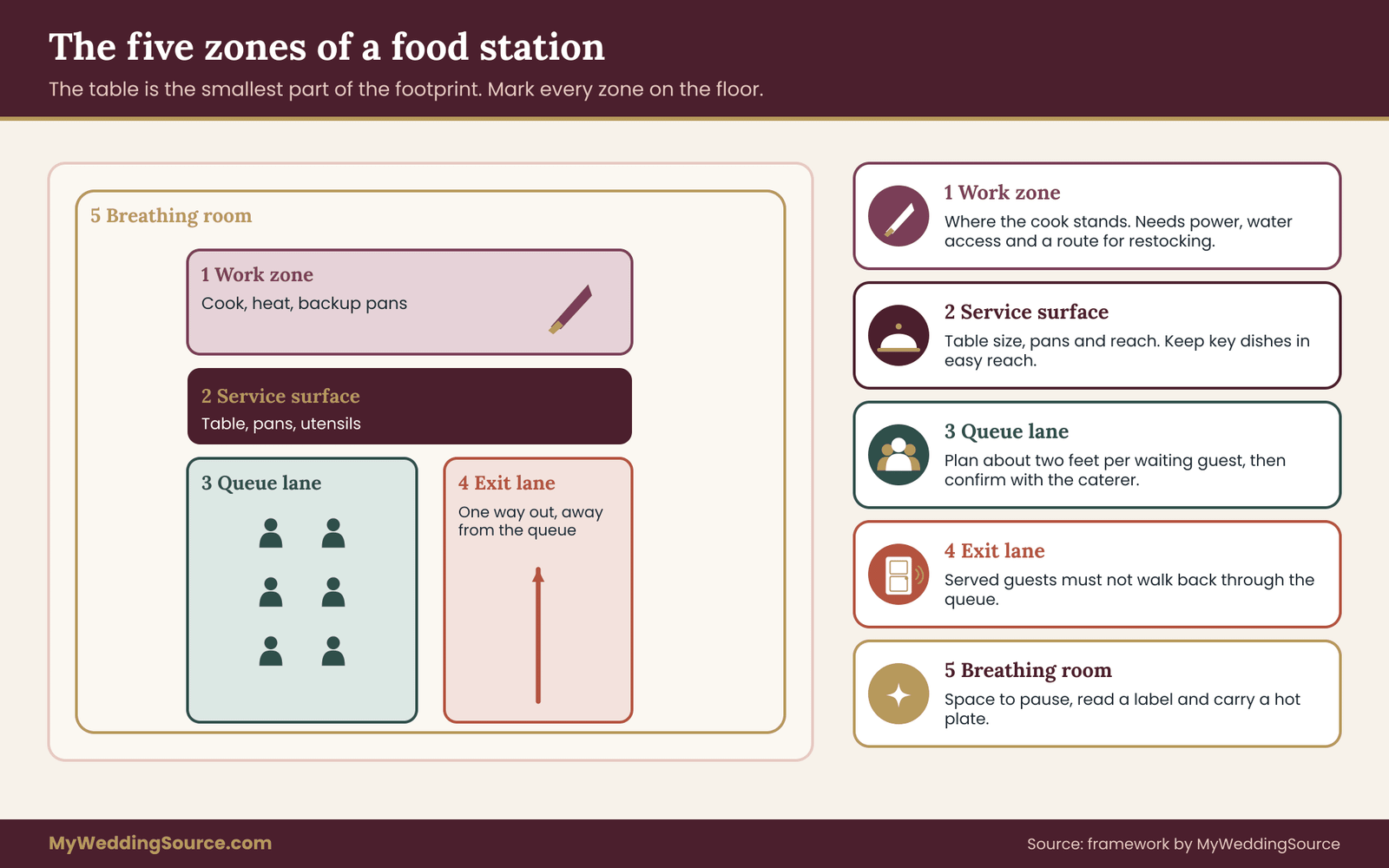
Think of each station as having five zones. The work zone is where the cook or server stands, usually behind the table, with heat sources, refrigerated inserts and backup pans. The service surface is the table or counter the food sits on. The queue lane is the strip of floor where guests wait, in a line, facing the station.
The exit lane is the path a guest takes after being served, which must not run back through the queue. The breathing room is the open space beside and behind the station that lets people pause, read, decide and carry a full plate without bumping anyone.
Measure the zones, not the table
Start with the service surface. Ask the caterer for the exact table size and layout, not a general description. A six-foot table and an eight-foot table with a raised riser are different food stations. Ask where the cook stands, and whether the cook needs space behind the table or can work from one side. Ask how many pans sit on the surface at one time, and how many guests can reach the surface at once. A station that lets two guests serve themselves at the same moment is a different design from one where a server controls every spoonful.
Next, the queue lane. A useful planning assumption is that a guest standing in a single-file line takes up roughly two feet of lane, once you count the person and a little space in front. That is a planning figure, not a standard, and it shifts with the crowd. Dressed-up guests holding drinks and clutches, people with children and anyone using a mobility aid need more. Ask your caterer what figure they use, and use the larger of the two when you are unsure.
Then decide how long a queue you are willing to host. Suppose a station might have eight guests waiting at its busiest moment. At two feet each, that is sixteen feet of lane, in addition to the table and the work area. A twelve-foot table with a sixteen-foot queue lane and a few feet of breathing room on each end is a long footprint.
In a ballroom that is fine. In a tent with a dance floor, a bar and tables at the edges, it may not fit, and you will want a shorter queue, which means faster service or more food stations.
The five zones in a real room
The easiest way to test a footprint is to mark it on the floor. At your venue walkthrough, bring painter’s tape or even chalk if the venue allows it, and outline each zone. If you cannot visit in person, ask the venue for a scaled floor plan, and draw the zones on it at the same scale. Either way, you are looking for overlaps.
A queue lane that crosses the main walkway to the restrooms is a red verdict. A work zone with no clear access to the service entrance is a red verdict, because the team cannot restock. A station whose exit lane runs into the next station’s queue lane is an amber at best.
Distance between food stations matters as much as the food stations themselves. Two food stations placed close together can share a queue by accident, as guests wait in the gap between them and neither line is clear. Leave enough room that a line at one station does not touch the line at the next. Ask the caterer and the venue for their minimum spacing, and confirm it against the venue’s own layout rules and any fire marshal requirements. If the venue has a capacity limit or a required aisle width, those numbers override your preference.
For the broader question of how guests move through the whole reception, including entry, seating, bars and exit, the guide to designing wedding reception guest flow covers the room as a system. The footprint pass here is the station-level piece of that picture. If your venue already has a flow plan, put the station zones on it before you finalize anything.
Utilities, fire and the things nobody mentions
Many food stations depend on utilities. Heated pans often use fuel cans, and some cooking stations use electric induction burners, griddles or propane. Each of these has rules. Electrical load is a common issue: a venue circuit has a limit, and several induction burners plus lighting plus a band can exceed it. Ask your caterer for the power each station needs, and ask the venue where those circuits are and what they can carry.
Open flame and fuel are even more sensitive. Many venues restrict open-flame cooking, flambé, propane or even certain heating fuels indoors or under tents. Fire codes differ by location, and the local fire authority may need to approve a cooking setup. Do not assume a flamed dessert or a live-fire carving station is allowed because the caterer has done it elsewhere.
Ask the venue in writing, and ask the caterer whether they handle the permits or expect you to. The National Fire Protection Association publishes widely used fire safety codes, and your local fire marshal’s office can tell you which version applies to your event.
Other utilities are easy to forget. Water for handwashing and for dishes is a food safety matter, and it is worth asking where the caterer’s team will wash hands and equipment. Ventilation matters for any station producing steam, smoke or strong cooking smells, because a pan of garlic and onions in a closed room can reach the head table.
Floors matter too. Oil and sauce drips on a polished floor are slip hazards, and a mat or a rug can help or hinder. Ask what the caterer puts down, and whether it is secured so it does not curl at the edge.
Reach, height and clear routes
Accessibility belongs in the footprint pass, not as a late addition. A guest using a wheelchair needs an unobstructed route to the station, enough turning space to approach it and a surface and serving point they can reach. The ADA Standards for Accessible Design describe reach ranges and clear route widths, and the U.S. Department of Justice’s ADA site explains them. For a private event the specific obligations depend on the venue and the circumstances, so ask the venue what it provides.
As a planning matter, the principle is simple: leave routes wide enough for a mobility device to pass a person standing, keep key items within a comfortable reach, and make sure at least one way of getting served does not require climbing a step or reaching over a tall display.
Display height deserves its own check. Decorative risers, tiered platters and tall greenery look wonderful in a photo and can push the food out of reach for a seated guest, a child or a short adult. A sneeze guard that sits high may also block access. Ask the caterer to show the station’s real height, and consider lowering the most-used dishes, or having a server hand items across. A station that cannot be reached from a seated position is an amber at best, and a red if it is the only source of an important dish.
The footprint verdict
When the five zones fit, nothing overlaps, utilities are confirmed and the route is clear, mark the footprint green. When something is tight but fixable, such as a table that could shift two feet or a queue lane that could bend around a column, mark it amber and write the fix beside it. When a zone cannot be satisfied at all, mark it red and decide whether to redesign the station, move it or replace it with a simpler one.
Write the verdict in one line with the numbers that justify it. For example: “Pasta station, eight-foot table, work zone six feet deep, queue lane sixteen feet, exit to the left, power from the east wall, green.” That line is short enough to survive an email thread and specific enough that a venue manager can say yes or push back.
A final footprint habit is worth building: always plan one extra square of floor around the busiest station. The station most guests want will draw a crowd, and crowds do not stand in neat single files. A buffer behind the queue lane absorbs the overflow without sending it into a walkway. If the room cannot spare the space, that is a signal to reduce the station’s pull. Either serve it faster, or split it into two matching food stations placed on opposite sides of the room, so the crowd divides itself.
Pass two: the queue and flow assessment for food stations
Flow is the part of planning that feels like math and is mostly honesty. You are estimating how many guests will want each station, how long each one takes and how those numbers collide when the room is released for dinner. The inputs are rough. The outputs only need to be good enough to tell a green station from a red one, and a rough answer that is honestly rough beats a confident one pulled from a rule of thumb.
Four numbers carry the whole assessment, and you can collect all of them in one phone call with the caterer.
The take rate is the share of guests who will actually use a given station. At a dinner where every station is a main course, nearly everyone visits several. At a wedding where one station is a late-night extra or a dessert counter, perhaps only part of the room goes. Ask the caterer how they estimate it for your menu, and write down the number they give you rather than assuming everyone visits everything.
The service time per guest is the number of seconds a guest spends at the station from joining the front of the queue to walking away with a plate. It covers choosing, talking, serving and leaving. A self-serve bar with obvious choices can be quick. A cook-to-order station is slower. A station where the guest has to ask what is in each dish is slower still, which is one more reason labels belong in the plan.
The number of service points is how many guests can be served at the same moment. A single cook with one pan is one point. A table with two matching sides is two. A station that looks wide but has only one server is still one. Count only the points that run independently, with their own tools and their own supply of the food.
The arrival pattern is how the guests reach the station. If everyone is released at once, they arrive as a wave. If tables are released in sequence, they arrive in smaller groups. If food stations are open during cocktail hour, they trickle in over a long period. The same station can be green with a trickle and red with a wave, so you have to choose the pattern on purpose.
The basic arithmetic
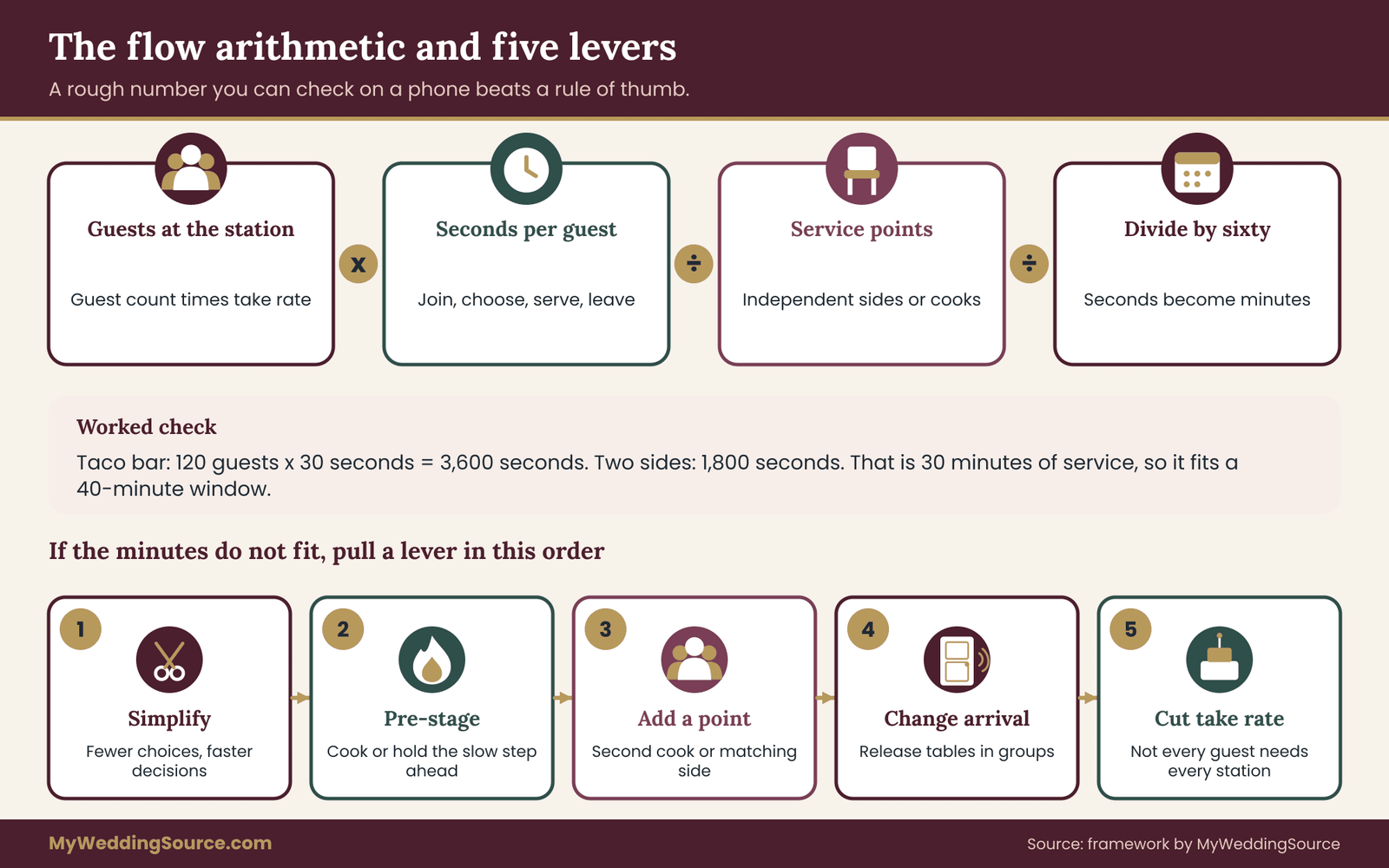
Here is the calculation, stated in words so you can do it on a phone. Take the number of guests you expect to be served at the station, which is the guest count multiplied by the take rate. Multiply that by the service time in seconds. Divide by the number of service points, then divide by sixty. The answer is the total minutes the station needs to serve everyone, assuming it never stops and never starves.
For an illustration with invented numbers: suppose 120 guests will visit a taco bar, each takes about thirty seconds, and the bar has two sides. One hundred twenty times thirty is thirty-six hundred seconds. Divide by two sides and you get eighteen hundred seconds, which is thirty minutes. If dinner service is meant to take about forty minutes, the taco bar fits with ten minutes of slack. If the same bar has only one side, it needs sixty minutes, which is a red.
Now try a chef-attended pasta station with the same 120 guests, but at forty-five seconds per guest and one cook with two burners working in parallel, so two service points. The total is 120 times forty-five seconds, or fifty-four hundred seconds, divided by two, which is twenty-seven hundred seconds, or forty-five minutes. That already exceeds the forty-minute window, so something has to change. You can add a second cook, narrow the pasta choices, pre-cook part of the dish or ask only half the guests to use the station. The arithmetic does not pick the answer. It tells you the question.
These numbers are planning estimates. Real service is bumpier than an average, because guests pause, ask questions and wait for a favorite dish to be refilled. Add a cushion of ten or fifteen percent when you can, and ask the caterer which dishes slow the pace. Do not treat any single figure in this guide as a promise. Replace each assumption with your caterer’s own number as soon as you have it.
From total minutes to the length of the queue
Total service time tells you whether the station can finish. It does not tell you how long any one guest waits. For that, you need to look at the peak. If 120 guests arrive within five minutes at a station that serves four guests a minute, the line builds quickly, and the last guests wait much longer than the first. If the same 120 guests arrive over twenty minutes, the line barely forms.
A simple way to estimate the worst wait is to compare two rates. The arrival rate is the number of guests reaching the station per minute during the busiest period. The service rate is how many guests per minute the station serves. If the service rate is higher, the line stays short. If the arrival rate is higher, the line grows by the difference every minute. Multiply the difference by the number of minutes the surge lasts, and you have the longest queue. Divide that by the service rate, and you have the longest wait.
Suppose a station serves three guests a minute and, in the first five minutes, five guests a minute arrive. The line grows by two guests a minute, so after five minutes it holds ten guests, and the last of them waits about three or four minutes. That may be comfortable. If the surge were fifteen minutes, the line would grow to thirty guests and the last would wait ten minutes, which is not.
You can then check the length of that queue against the lane you measured in pass one. Thirty guests at two feet each is sixty feet. That does not fit in most rooms, which tells you the surge has to be broken up.
Choosing the wait you are willing to host
The decision at the heart of this pass is the longest wait you will accept. It is a judgment about your guests, and you should make it deliberately. Many couples find that three to five minutes feels comfortable if there is something to drink and something to look at. Ten minutes starts to feel like a chore, particularly for older guests, anyone standing in dress shoes and parents holding a child.
Picture the guest you most want to protect and ask what a wait means for them. A guest using a cane or a walker may find a long queue tiring or even unsafe. A guest with a baby on one hip cannot hold a plate and a diaper bag in a line. A guest with a medical need to eat on time cannot wait for the last release.
If these guests are on your list, set a tighter limit, and give them a way to skip the longest queue. That could be a table release that serves their table early, a server who brings a plate or a quiet side where a staff member takes their order. The point is not special treatment. It is to make the system forgiving.
Levers when a station fails the flow pass
When the arithmetic says a station is too slow, you have five levers, and you should pull them in this order, because the early ones are cheaper.
First, simplify the station. Fewer choices mean faster decisions and faster service. A pasta station with two shapes and two sauces moves much faster than one with six combinations. Second, pre-stage the slowest step. If the cook is sautéing every portion from raw, ask whether the protein can be cooked ahead and finished in the pan, or whether the sauce can be held hot. Third, add a service point. A second cook, a second side or a second line shortens everything proportionally.
Fourth, change the arrival pattern. Release tables in groups, open food stations during cocktail hour or stagger which food stations open first. The wedding cocktail hour guide discusses how a first course or a light station during cocktails can take pressure off dinner. Fifth, cut the take rate. If a station is a bonus, such as a dessert counter, you may not need to serve everyone from it.
Do not reach for the last resort, which is to shrink the guest experience by turning an interactive station into a plated course because the numbers were hard. Often the fix is a small one: one more pair of hands for the first fifteen minutes. Ask the caterer the cost of that single change before you give up on a station you love.
Staggering dinner across food stations
A useful design principle for a wedding with several food stations is to avoid sending everyone to the same one first. People tend to visit the station nearest them or the one that looks most exciting. If the room is released at once, the exciting station jams and the others sit idle. You can steer the crowd without announcing it.
Give each table a first station, printed on a place card or told by the host, and let guests roam after that. Assign the busiest station to the tables farthest from it. Open the slower food stations a few minutes early, or put the fastest food stations nearest the entrances to the dining area.
When you send tables in a sequence, think about who is hungry first. Elders and guests with children are often glad to go first. Wedding party members, who may be called away for photos or toasts, sometimes need to go early as well. Whatever order you pick, announce it plainly, and tell the host and the DJ or band leader so that the instruction does not get lost in the noise.
The flow verdict
Record the flow verdict next to the footprint verdict, in one line with the numbers. “Taco bar, 120 guests, thirty seconds, two sides, thirty minutes of service, peak line eight guests, green.” Or “Pasta station, 120 guests, forty-five seconds, two points, forty-five minutes, red until a third point is added.” If you cannot fill in a number, write the question you still need to ask next to the line. An open question is better than a silent assumption, and it will remind you what to ask at the next call.
Pass three: dietary labels that work at food stations
Labels are the quietest part of food stations and often the most valuable. A guest with a peanut allergy, celiac disease, a vegan diet or a halal requirement does not want to interrogate a cook in front of a line of strangers. They want to read a card, decide and move on. A guest without any restrictions also benefits, because a label answers “what is this?” before they have to ask. Every question answered by a card is a few seconds saved at the station and one fewer interruption for the cook.
The goal of this pass is a label standard for your wedding: a consistent set of cards, in consistent places, with consistent wording. Consistency matters more than design. A guest who learns the layout at the first station should be able to read all the others without thinking.
What a station label card should say
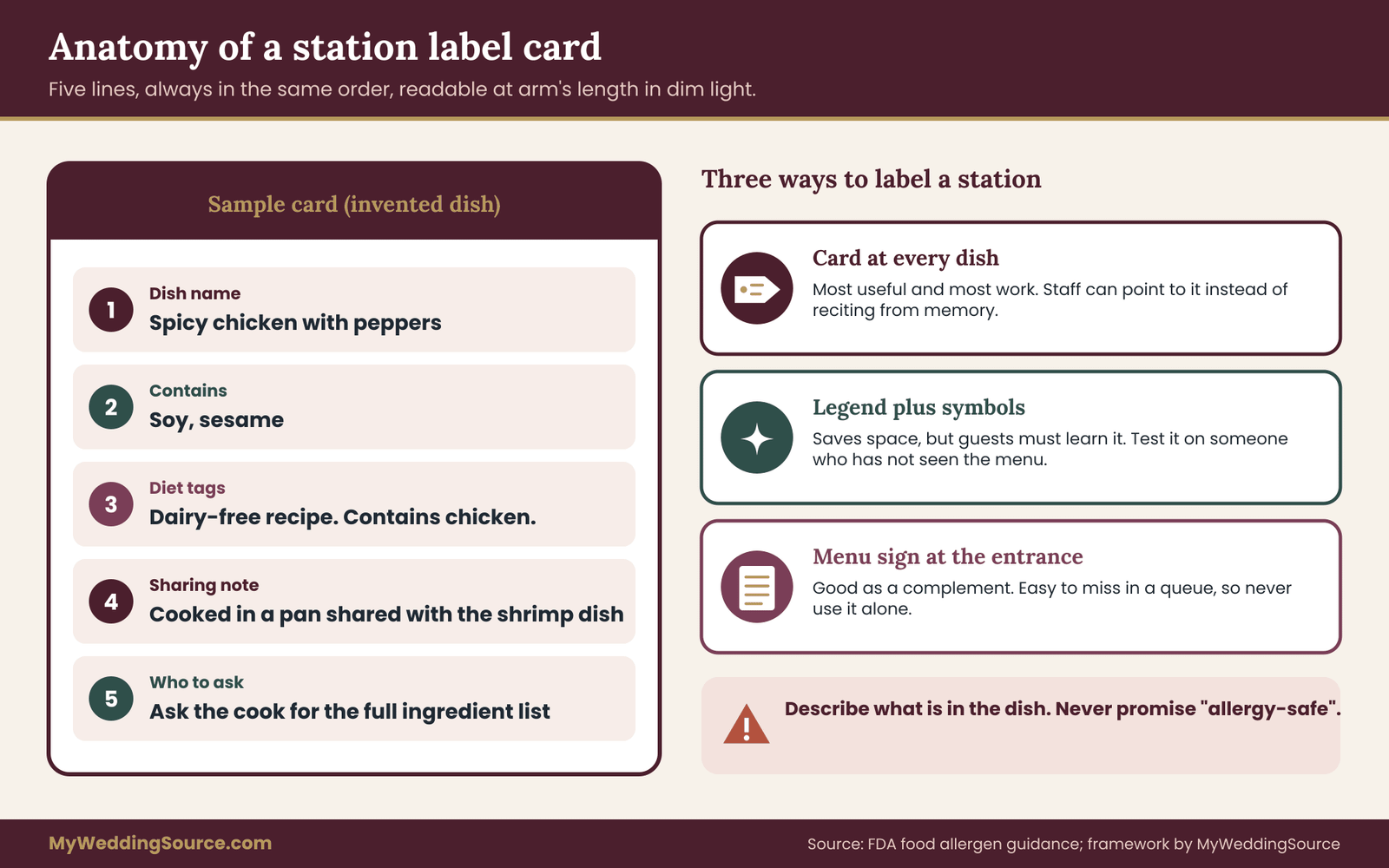
A good card is short and has a fixed order. Think of it as a small answer sheet with five lines.
The first line is the dish name, in plain words that describe the food, not a menu pun. “Spicy chicken with peppers” tells a guest more than a clever title. The second line is the main allergens, using clear words such as milk, egg, fish, shellfish, tree nuts, peanuts, wheat, soy and sesame. These nine are the major food allergens recognized under U.S. federal food labeling law, and the Food and Drug Administration explains them on its food allergies page.
The third line is the diet tags, such as vegetarian, vegan, or contains pork. The fourth line is the sharing note: whether this dish shares a utensil, a pan, a fryer or a surface with something else. The fifth line is a who to ask instruction: “Ask the cook for the ingredient list.”
That last line matters. A card cannot cover everything. Recipes change, a sauce may contain a trace ingredient the card omits and a guest with a severe allergy needs a person, not a sign. The card should tell the guest how to reach that person, and the staff should be briefed to treat the question seriously.
Keep every line short. A card with ten allergens listed in tiny type is no help at all. If a dish has many allergens, list them in order of how likely a guest is to be affected, or use the word “contains” followed by the list. Use a font that is readable in dim light and at arm’s length. Dark text on a plain light background beats cursive on a patterned card every time. The wedding signage system guide covers readability, placement and proofing in more depth, and its checks apply directly to station cards.
Choosing a labeling method
You have three options, and most weddings combine two of them.
Card at every dish. A small card at each pan or platter, with the five lines above. It is the most useful method and the most work. It also helps staff, because a server can point at the card instead of reciting from memory.
Legend plus symbols. A single legend card at the start of the station explains a set of symbols, such as a V for vegetarian or a wheat mark for contains wheat, and each dish carries a small symbol row. It saves space, but guests must learn the legend. Test it on someone who has not seen the menu. If a person has to ask what the symbols mean, the system has failed.
A full station menu at the entrance. A larger sign at the head of the station lists all dishes and their allergens in one place. It can work at a small station, but it is easy to miss and hard to read in a queue. Use it as a complement to dish cards, not a replacement.
Whatever method you use, apply it to every station, including dessert and drinks. Desserts often contain nuts, eggs, milk and wheat, and drink stations may use syrups, cream or garnishes that matter. A guest who sees labels at dinner but none at the dessert counter will assume the dessert is a risk and skip it, or worse, assume it is safe.
Wording that is honest
The most important rule for labels is to describe what is in the dish and what you know, and never to promise more than the kitchen can deliver. A card that says “gluten-free” makes a claim. For packaged foods, U.S. federal rules define that claim, and the FDA explains it. A wedding caterer’s kitchen is a different setting, and not every state applies the same rules to catered food.
A kitchen that handles wheat flour, shares fryers or uses a single pair of tongs for several dishes cannot say a dish is free of cross-contact, even if the recipe contains no gluten.
Safer wording is specific. “Made without wheat ingredients; prepared in a kitchen that also handles wheat” is accurate and tells the guest what they need. “Contains milk” is clear and does not overpromise. “Vegan recipe; cooked on the same griddle as the chicken” is honest. If the caterer will not stand behind a claim in writing, do not put it on a card.
Avoid “allergy-safe,” “allergen-free” and “safe for celiacs” unless a licensed professional has verified the preparation and the caterer is willing to state it. Even then, the better practice is to describe the controls: separate tools, a dedicated prep area, a clean pan. No wedding label should suggest zero risk. Your planning notes and the caterer’s agreement should reflect that, and your guests will feel the difference in tone.
Religious dietary rules need their own check. Halal and kosher requirements involve sourcing, preparation and, in many cases, certification by a recognized authority. A caterer’s description is not the same as a certification. If you have guests who follow these rules, ask the caterer what certification or supervision they can provide, and ask your guests or their religious authorities what they will accept. Label cards for these dishes should state facts plainly, such as “contains pork” or “prepared with alcohol,” and avoid terms the kitchen cannot support.
Collecting the information before the day
Labels depend on knowing who has needs. If your invitation or website asks for dietary information, collect it in a form you can use: the guest’s name, the specific restriction, how severe it is and what they want to eat instead. “Allergic to nuts” tells the caterer little. “Tree nut allergy, carries an epinephrine auto-injector, prefers to be served by a staff member” tells them a lot.
Keep that list in one place and share it with the caterer in writing well before the event. Ask the caterer to confirm in writing how they will handle each case at the food stations. The answer may be that the guest receives a plated dish prepared separately and delivered to the table, which can be the safest approach for severe allergies because it avoids shared tools at the station altogether.
Such a plate should be identified to the server who delivers it, matched to the guest by table and name and never left to chance. The guide to building a wedding menu across ages and dietary preferences goes deeper on collecting and using dietary information, and the station labels here are the on-the-day end of that process.
Be realistic about what a list can do. Plans change: a guest forgets to mention an allergy, a plus-one arrives with a different restriction or a child’s needs differ from a parent’s. The best backup is a cook or manager who is empowered to say, “Let me check,” and to prepare a simple safe plate on request. Ask the caterer whether such a plan exists, and who the person is.
Assigning ownership
One of the biggest label failures is that nobody owns them. The couple assumes the caterer will print cards. The caterer assumes the couple will approve their wording. The venue assumes nobody needs anything at all. A week before the wedding, the cards do not exist.
Decide who writes the cards, who proofs them, who prints them and who places them. In many cases the caterer writes them, because they know the recipes, and the couple proofs them against the menu and the guest dietary list. Ask for proofs at least a few weeks ahead, so that errors can be fixed. Then ask for a final confirmation the day before, since late menu changes happen. Put the name of the person responsible for placing the cards on your run-of-show.
The label verdict
Write the verdict in one line. “Taco bar: dish cards at all eight pans, allergens verified against the caterer’s recipe sheet, separate tongs for the vegan filling, plated alternative arranged for two guests, green.” Or: “Dessert counter: no labels yet, red until cards are proofed.” Check the cards as you would check a proof: read them aloud, compare them to the final recipe list and hand them to a person who has not seen the menu to see whether they can follow them.
Food safety and cross-contact at interactive food stations
Open service raises two food safety questions that plated dinners mostly avoid: how long food sits at a temperature where bacteria can grow, and how easily an ingredient moves from one dish to another. Neither question has a decorative answer. Both belong to the caterer’s licensed professionals, and the best thing a couple can do is ask the right questions and make sure the answers are written down.
Time and temperature
Food safety agencies describe a temperature range in which bacteria multiply quickly. The U.S. Department of Agriculture’s Food Safety and Inspection Service calls it the danger zone, and its consumer guidance says perishable food should not sit out for more than two hours, or one hour when the air temperature is above ninety degrees Fahrenheit. The FDA Food Code, the model that many state and local health departments adopt, uses its own holding temperatures for cold and hot food. Local rules may differ from both, so the correct standard for your wedding is the one your caterer’s health authority applies.
For a wedding, this has practical consequences. A station that opens at the start of cocktail hour and stays open through dinner is open much longer than a station running for forty minutes. Cold items, such as salad toppings, shellfish, dairy, sliced fruit and cold sauces, need ice or refrigeration to stay cold. Hot items need heat that actually holds, not just a decorative flame. A warm room, a sunny tent or an outdoor patio can push food past its safe window sooner than you would expect.
Ask the caterer how they keep each station within safe temperatures and how they check. A professional team will have an answer: a probe thermometer, a log, a schedule for swapping out cold pans and a rule for discarding food that has been out too long. You do not need to supervise the process.
You need to know it exists. Also ask what happens to a pan that has been out too long and has barely been touched. The right answer is that it is replaced or discarded, not topped up with fresh food, since mixing new food into old can compromise both.
Outdoor weddings change the arithmetic. Heat, wind, insects and dust all affect open food. The Centers for Disease Control and Prevention and the USDA publish simple guidance on keeping food safe outdoors, and your caterer should have a plan for shade, covers and ice. If the station is outside, add a rain plan. Water in a pan of food is a problem, and so is a gust that knocks over a stack of plates.
Hands, tools and who touches what
Interactive food stations bring many hands to the food. Guests who self-serve touch utensils, and so does anyone who reaches across. A few small controls reduce the risk. Each dish should have its own utensil, long enough that it does not fall into the pan, and kept in the dish or on a clean holder beside it. Sneeze guards or covers should protect food from guests leaning over it.
Plates should be stacked at the start of the queue, so that guests reach for a plate before the food and never back-track. Hand sanitizer is a courtesy, and the caterer can tell you whether the venue has a place for guests to wash their hands.
Staffed food stations have their own controls. A cook who handles raw ingredients and then ready-to-eat food needs a hand-washing step and a glove or utensil change in between. A server who takes money, touches a phone or clears plates should not also be portioning food without cleaning up. These are practices that licensed food handlers learn, and you can ask whether the staff at your event are trained and whether the caterer holds the permits your local health department requires. The FDA’s food safety pages and your local health department’s website explain what permits and training apply.
Cross-contact, in plain terms
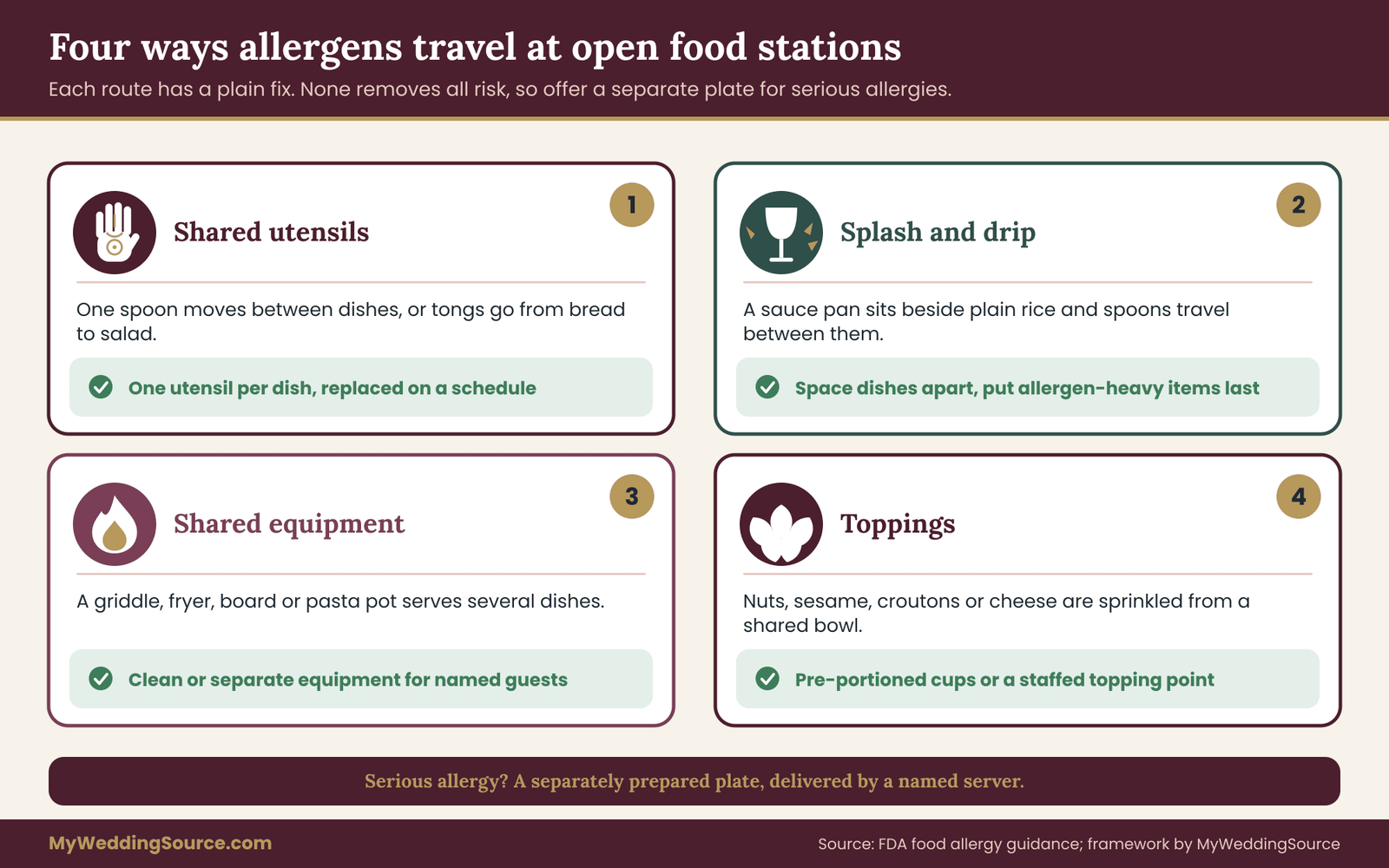
Cross-contact is what happens when a small amount of an allergen ends up in a dish that is not supposed to contain it. It differs from cross-contamination, which usually refers to bacteria. The FDA’s food allergy guidance explains that cooking does not remove the allergen, and that even a trace can be a problem for some people. At food stations, cross-contact tends to happen in four ways.
Shared utensils. A spoon used in a nut-topped dish is dipped into a nut-free dish. A pair of tongs moves from bread to salad. This is the most common route and the easiest to prevent with a rule of one utensil per dish and a replacement schedule.
Splash and drip. A pan of sauce sits next to a pan of plain rice, and guests carry spoons between them. Spacing and a barrier help, and so does arranging dishes by allergen group, with allergen-heavy items at the end of the line rather than the start.
Shared surfaces and cooking equipment. A griddle, a fryer, a cutting board or a pasta pot used for several dishes can carry allergens from one to the next. A caterer who can provide a separate pot, a clean pan or a fresh board for a particular guest is doing the right thing. A caterer who says everything is safe because it was “wiped down” is not.
Toppings and garnishes. Many station designs rest on toppings: crushed nuts on a dessert, sesame on a noodle bowl, croutons on a salad, cheese on everything. Toppings are sprinkled by a guest from a shared bowl, and crumbs travel. If a topping is a major allergen, consider offering it in a pre-portioned cup, or serving it from a staffed point where only a server touches it.
No layout removes all risk. The aim is to reduce it, to be honest about what remains and to give guests with serious allergies an alternative that does not rely on shared tools at the station. The plated, separately prepared plate described earlier is the usual answer. Ask your caterer how they prepare such plates, who delivers them and how the guest knows it is theirs.
Written agreements
Put the food safety and allergen arrangements in writing. A brief addendum to the catering agreement is enough: the caterer confirms they hold the required permits, will keep hot and cold food within the standard they follow, will label each dish, will use dedicated tools for specified allergen needs and will prepare separate plates for named guests. A written note is not a legal shield. It is a shared understanding, and it keeps details from vanishing between the contract signing and the wedding day. The wedding vendor contract guide covers what to look for in the broader agreement.
If you have any doubt about the caterer’s practices, ask for a tasting that includes a station demonstration, and watch how the team handles tools and surfaces. Ask the caterer for references from similar events, and ask whether the kitchen has food safety certifications. A licensed caterer and a food safety professional are the right people to confirm your plan, and your local health department can answer permit questions. Nothing in this guide replaces their advice.
Station types and what each one asks of space, staff and guests
Different kinds of food stations make different demands. This section looks at the common ones through the three-pass lens, so that you can see where each tends to be strong and where it tends to strain. The numbers mentioned are illustrations. Replace them with your caterer’s figures.
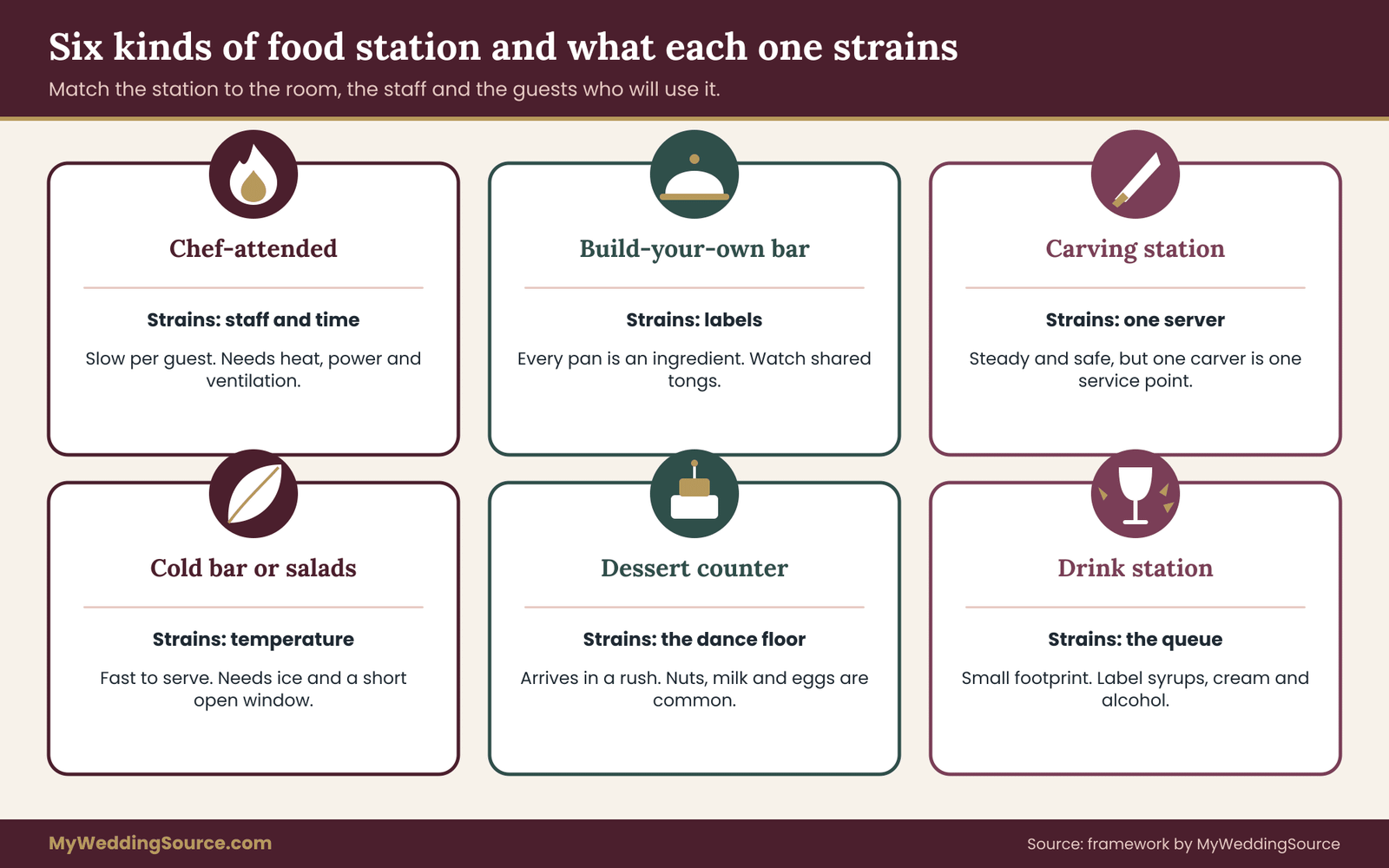
Chef-attended cooking stations. A cook sautés pasta, flips omelets, grills skewers or fries dumplings to order. These food stations produce the strongest sense of occasion and the longest service times. Footprint: a deep work zone with heat, ventilation and power. Flow: slow per guest, so you need multiple cooks or a smaller take rate. Labels: the cook can explain, but cards still help. Risk: oil, flame and cross-contact through shared pans.
Build-your-own bars. Tacos, grain bowls, baked potatoes, sliders and similar. Guests assemble their plates from several pans. Footprint: long, with a clear direction of travel, so the plate starts at one end and finishes at the other. Flow: fast if the choices are few and the pans are full, and slow if guests must stop to decide. Labels: essential, since each pan is its own ingredient. Risk: shared tongs and spoons moving between pans.
Carving and serving food stations. A server carves roast meat or portions a large dish. Footprint: a staffed table with a cutting board and a heat source. Flow: steady, with the server controlling portions. Labels: simple. Risk: the server is the only barrier between the guest and the food, which can be good for safety and slow for service. Meat sauces and glazes should still be labeled.
Cold bars and salads. Composed salads, grain salads, a mezze table or a cheese and charcuterie spread. Footprint: wide, shallow and easy to approach from both sides. Flow: fast, with lots of independent choices. Labels: many small cards, which is where a legend system helps. Risk: temperature, since cold items need ice or refrigeration, and a long open window.
Dessert counters. Sundaes, doughnut walls, s’mores or a pastry table. Footprint: often placed near the dance floor, so a queue can block movement. Flow: arrives in a rush when the cake is cut, and then again late at night. Labels: often forgotten, so include them. Risk: nuts, milk, eggs and wheat are everywhere, and open flame at a s’mores station needs venue and fire approval.
Drink and mocktail food stations. A lemonade bar, a coffee cart or a mocktail counter. Footprint: small, and a queue can form at an awkward point. Flow: fast, if the choices are limited. Labels: syrups, creams and garnishes can include allergens, and guests should be able to tell what is alcoholic and what is not. The wedding bar service planning guide covers the alcohol side.
Not every wedding needs all of these. A realistic mix usually includes one or two chef-attended stations that act as the highlight, a build-your-own or cold bar for variety and one dessert or drink station. The three-pass check will tell you which combinations fit.
Worked example: five food stations for 140 guests
The following example is invented, and it is meant to show how the three passes fit together, not to set a standard. Every number is an assumption that a real caterer would replace. The couple, whom we will call Dana and Marcus, are planning a 140-guest wedding in a rented hall with a tented patio. They want an interactive dinner with five food stations: a carving station, a chef-attended pasta station, a build-your-own bowl bar, a cold mezze and salad table and a dessert counter. Dinner service is planned for a forty-five-minute window, after a cocktail hour.
The inputs
The caterer supplies these planning figures. Carving: one server, about thirty-five seconds per guest, and the caterer expects sixty percent of guests to visit. Pasta: two cooks working in parallel, about forty-five seconds per guest, with eighty percent of guests visiting. Bowl bar: two matching self-serve sides, about thirty seconds per guest, seventy percent visiting. Cold table: two sides, about twenty seconds per guest, ninety percent visiting. Dessert counter: two sides, about twenty-five seconds per guest, seventy percent visiting, but only after the cake is cut, so it is outside the dinner window.
Dana and Marcus also have a dietary list from their RSVP form. Two guests are vegan. One has a celiac diagnosis. One has a peanut and tree nut allergy and carries an auto-injector. One guest follows halal rules. One older guest uses a walker, and two guests will bring toddlers.
Pass two first, to find the problems
In practice, it is often quicker to run the flow arithmetic early, because it quickly shows which food stations need redesign. Using the formula from earlier, the carving station serves 140 times sixty percent, which is 84 guests. Eighty-four times thirty-five seconds is 2,940 seconds, and with one service point that is 49 minutes. That is longer than the forty-five-minute window, so the carving station is red as designed.
The pasta station serves 112 guests. At forty-five seconds, that is 5,040 seconds, and with two cooks it is 2,520 seconds, or 42 minutes. That fits the window with three minutes to spare, but real service is lumpier than averages, so the station is amber.
The bowl bar serves 98 guests at thirty seconds, which is 2,940 seconds, and with two sides it is 1,470 seconds, or about 24.5 minutes. Green. The cold table serves 126 guests at twenty seconds, which is 2,520 seconds, and with two sides it is 1,260 seconds, or 21 minutes. Also green.
The couple and the caterer then adjust. For the carving station, they add a second carver, which halves the time to about 24.5 minutes. The cost is one more staff member, which the caterer quotes as a labor line. For the pasta station, they reduce the choices to two pasta shapes and two sauces, and the caterer pre-cooks the sauces and holds them hot.
That brings the time per guest to about thirty-five seconds. Recalculated, 112 times thirty-five seconds is 3,920 seconds, and with two cooks it is 1,960 seconds, or about 33 minutes. That leaves a comfortable cushion, and the station is now green.
Pass one, in the room
The hall measures roughly eighty feet by fifty feet inside, with a tented patio on one side and a service corridor at the back. Dana and Marcus mark the floor plan with the caterer. They place the carving station and the pasta station, the two that need heat, against the back wall near the service corridor, where the caterer has power and can restock without crossing the room.
They separate them by about twenty feet so their queues do not meet. The bowl bar goes along the long side wall, with the queue running parallel to the wall and the exit lane opening toward the tables. The cold table sits near the tent entrance, where there is ice and shade.
The team then checks each queue lane. At the pasta station, a peak line of about seven guests needs fourteen feet at two feet each, and the layout allows eighteen. At the carving station, the line peaks at about six guests, which fits a twelve-foot lane. The bowl bar is the longest, with a ten-guest peak and a twenty-foot lane, which fits along the wall but narrows the route past the restrooms. The caterer suggests shifting the table two feet toward the wall, and the venue agrees. That is an amber fixed with a written note.
For accessibility, the walker user’s table is placed within a short, clear route of the cold table and the bowl bar, with no steps and no tight turns. The caterer lowers the most-used dishes on the cold table to the front edge, and agrees that a server will carry plates to any guest who asks. These are low-cost changes that make the food stations usable for more of the room.
Pass three, in the labels
The caterer writes a card for every dish at all four dinner food stations and the dessert counter, using the five-line format. Dana and Marcus proof them against the recipe sheet, and they catch one mistake: the pasta sauce listed as dairy-free contains a cheese rind used for flavor. The caterer corrects the card and the recipe note.
The peanut and tree nut guest and the celiac guest are each offered a separate plated dinner prepared in a clean area, delivered by a named server to their table. The vegan guests get a labeled vegan filling at the bowl bar, with a dedicated pair of tongs, and a vegan pasta sauce at the pasta station.
The halal guest receives a plated meal from a supplier whose certification the guest’s family has reviewed. None of these arrangements promises zero risk, and the cards say so plainly: “Prepared in a kitchen that also handles wheat, milk, eggs, tree nuts and peanuts.”
The caterer also agrees to assign one manager as the point of contact for any guest question, with a note on the run-of-show listing that person’s name and where they will stand.
The final one-page summary
After the adjustments, the summary reads like this. Carving: footprint green after the lane shift, flow green with two carvers, labels green. Pasta: footprint green, flow green at two shapes and two sauces, labels green after the sauce correction. Bowl bar: footprint amber (fixed by moving the table), flow green, labels green. Cold table: footprint green, flow green, labels green. Dessert counter: placed away from the dance floor with a clear lane, flow green, labels green.
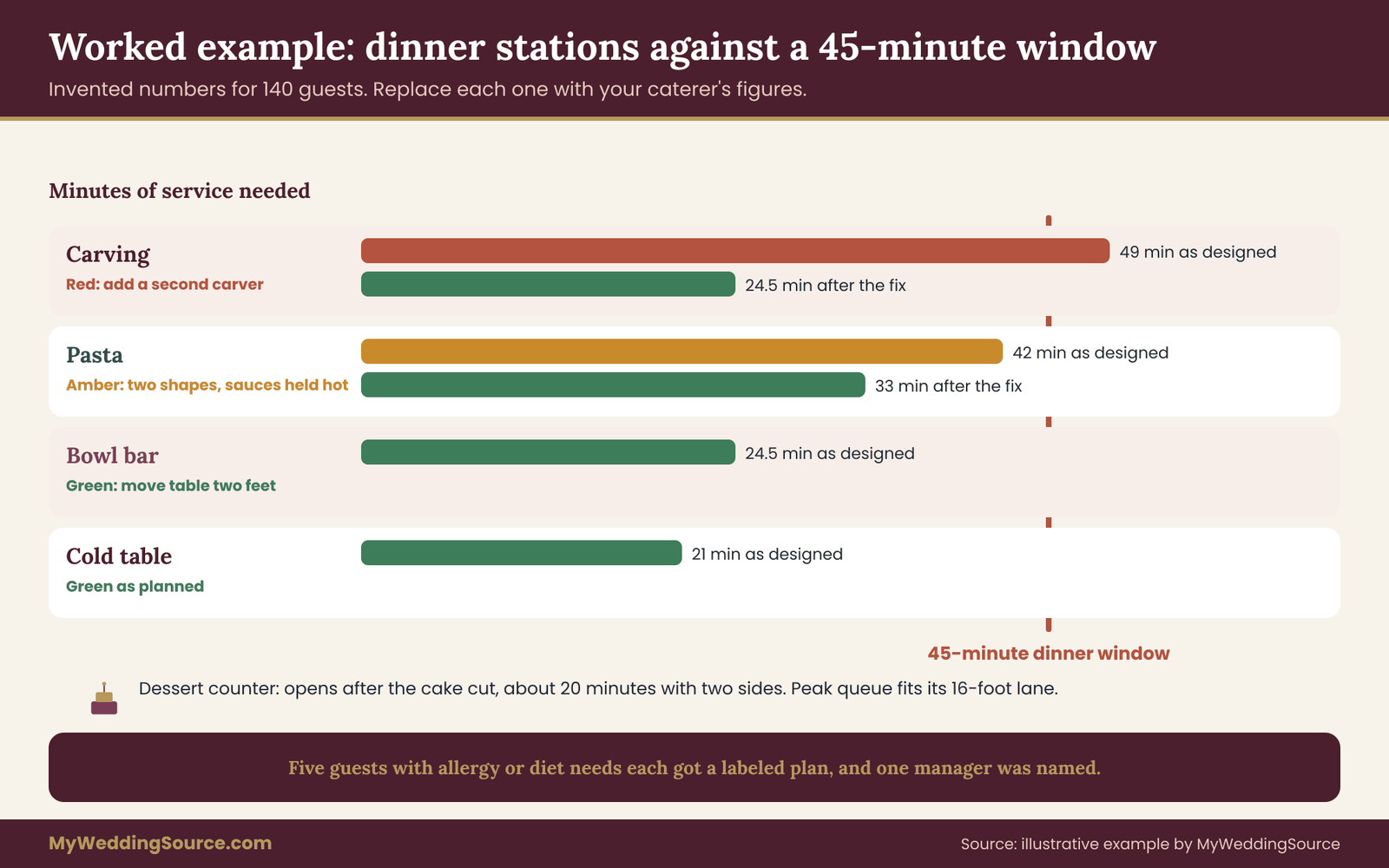
That single page is the real output of the exercise. It records what was decided, who agreed and what remains open. When the final guest count changed from 140 to 150 two weeks before the wedding, Dana and Marcus did not start over. They reran the arithmetic, saw that the carving and pasta food stations still fit the window and added one more server for the first twenty minutes as a precaution.
Placing food stations in the room so guests can find them
Once each station passes on its own, you have to place them together. Placement is the part guests experience as “the layout.” It decides whether the room feels natural or like an obstacle course, and it connects the food stations to the rest of the reception: the dance floor, the bar, the head table and the exits.
Sightlines and orientation
Guests should be able to see at least two food stations from where they sit, and they should be able to tell from a distance what each one is. A tall sign, a distinctive color, a bit of greenery or an item on display, such as a wheel of cheese or a roast on a board, helps a guest identify a station across the room. Simple signs with the station name and a single icon beat clever signs. Hang signs high enough to be seen over a crowd, and light them well enough to be readable at dusk.
Think about the guest who arrives late or who steps out for a phone call. When they return, can they work out which station is which without asking? A one-page station map at each table, or a small sign at the entrance to the dining area, solves this. The map needs only a rough outline of the room and the station names. It can double as the menu card.
Circulation and crossing paths
Plan the major paths first and place the food stations around them. Guests walk from tables to food stations, from food stations back to tables, to the bar, to the restrooms and to the dance floor. If a station’s queue crosses one of those paths, expect collisions. A simple test is to draw the paths on the floor plan with different colors, and look for places where several lines meet. A station placed at that point will be a traffic jam even if the station itself is efficient.
Keep staff routes separate from guest routes. The caterer’s team needs to bring in fresh pans, remove empty ones and carry trash and dirty dishes. If those routes pass through the queue lanes, guests will be in the way, and staff will be carrying hot items through crowds. A back-of-house path behind the food stations, or a clear service corridor, avoids this. Ask the caterer and the venue to show you their intended routes on the plan.
For a full view of how guests move through the reception, including entry, seating, food, bar and exit, see the guide to reception guest flow. The station placement here should fit within that larger design, and any change to one should be checked against the other.
Seating relationships
Where tables sit relative to the food stations affects both comfort and noise. Tables immediately beside a chef-attended station will hear the clatter and smell the food. Tables farthest from the food stations will wait longest to be released and walk the farthest. A balanced layout puts older guests and families with young children at a reasonable distance, close enough to be convenient and far enough to be out of the crush. Give the wedding party and the head table a clear route that does not require them to join a long queue.
If you use table release to control arrival, decide which tables go first and which food stations each group visits first. Write this down and give it to the host and the caterer. A mid-dinner change, such as a delayed toast, can throw off the sequence, so build in a few minutes of slack.
Light, noise and temperature
Stations need enough light to cook, serve and read labels. A dim, romantic room works against a station where a guest has to read an allergen card. Ask the lighting vendor or the venue to add task light over the food stations, and test the cards at the real light level during the walkthrough, or at least at a similar level.
Noise matters as well. A guest who cannot hear the cook cannot ask a question, and a cook who cannot hear the guest may make a mistake. Place food stations away from speakers, and ask the band or DJ to keep the volume lower during the dinner window.
Temperature affects both food and people. A queue lane next to a heater or in direct sun is unpleasant, and a cold draft over a dessert counter melts ice cream faster than expected. Walk the room at the planned time of day, if you can, and note where it gets warm, where it gets windy and where the air is stale. Adjust the layout or the equipment to match.
Backup plans
Things will change. A tent may need to close because of rain. A cook may be late. A station may run out of a key ingredient. Decide in advance which food stations you can combine, shorten or drop if the plan breaks. A list of priorities, with the food stations ranked from “must keep” to “first to drop,” lets the caterer make a quick decision without calling you during the reception. Share that list with the caterer in writing, and leave a copy with the person managing the day.
Running your food stations on the wedding day
A plan only helps if someone runs it. On the wedding day, the couple should not be managing food stations, and a good plan names a person who is. That could be the caterer’s event manager, a venue coordinator or a day-of planner. What matters is that one person has the one-page summary, the dietary list and the authority to make small decisions without finding you.
The timeline for the food stations
Work backward from dinner. Several hours before, the caterer’s team sets up the work zones, tests equipment and checks that power and fuel work. About an hour before dinner, the label cards go out. Someone should walk each station with the final menu and read every card against it, not just place them. Thirty minutes before, hot items come up to temperature and cold items go onto ice.
Fifteen minutes before, the staff gather for a short briefing: which tables go first, who the dietary-list guests are, where the plated alternatives are and who the manager on call is. When the host announces dinner, the food stations are ready and the staff are in position.
During service, a few small habits keep things smooth. A staff member watches each queue, and if one grows beyond its lane, they say so to the manager, who can send a runner or open a second side. Cold and hot pans are checked at intervals, with replacements brought from the kitchen and old pans removed, not topped up.
Empty plates and used utensils are cleared promptly, since a messy station tells guests the food is less safe. The food stations that run longer, such as a dessert counter or a late-night snack, should have a stated closing time and a point at which the remaining food is removed.
The guest who needs help
Plan for the guest who does not find what they need. A guest may not realize the plated alternative is waiting for them. A guest with a food allergy may not know which dish is safe. Someone using a mobility aid may not be able to reach the station. Assign a host or server to check in with the guests on the dietary list shortly after dinner begins, quietly, and confirm that each one has a meal.
A short, low-key check is kinder than a guest sitting at a table with nothing in front of them because they did not want to make a fuss.
Brief the staff on how to answer allergy questions. The right response to “does this contain nuts?” is to read the card, and if there is any doubt, to ask the manager or cook. The wrong response is a guess. A good caterer will have trained staff for this. If yours has not, ask them to run a short briefing before service, using your dietary list.
What to do when something goes wrong
Things go wrong at weddings, and a calm response matters more than the exact fix. If a station runs out of a dish, the manager should replace it or tell guests plainly, and a handwritten sign works.
If a queue becomes too long, the manager can open another side, ask a staff member to take orders along the line or announce the next release. If an allergen mix-up is suspected, the response is immediate and simple: stop service of that item, check the guest, follow the venue’s emergency plan, and call emergency services if the guest shows symptoms such as trouble breathing, swelling or widespread hives.
Make sure the manager knows the venue address and the nearest entrance for responders. This is a safety plan, not a legal or medical instruction, and a licensed professional can tell you more.
What to ask your caterer and your venue about food stations
Most problems with food stations can be prevented by asking the right questions early, in writing, and noting the answers. The following lists are in the form of sentences you can say aloud. They are written for a call or a meeting, so the order matters less than the habit of asking.
Questions for the caterer
Start with the basics. “How many food stations have you run at events of my size, and with this kind of menu?” The answer tells you whether they have a real method or are improvising. Then ask for specifics: “What do you use as the service time per guest at each station, and where does that number come from?” and “How many cooks or servers does each station need, and what does each extra person cost?” These two answers produce the arithmetic in pass two.
For footprint, ask: “What are the dimensions of each station, including the work zone?
What power, water and fuel does each need?” and “What is your minimum spacing between food stations, and what do you recommend for the queue lane?” For labels and safety: “Who writes the label cards, and can I proof them against the recipes?” “How do you keep tools and surfaces separate for allergen requests?” “How do you prepare and deliver a separate plated meal for a guest with a serious allergy?” and “How do you keep hot and cold food within safe temperatures through a long service, and how do you check?”
Then ask about permits and training. “Do you hold the permits our local health department requires for this event? Are your staff trained in food handling and allergen awareness?” Ask for these answers in writing, as part of the agreement or an attached note. If the caterer is unsure, or if the answer is vague, treat that as information.
Ask also about the plan for change. “What happens if the guest count goes up by ten percent, or the weather forces a move indoors?” and “Which of the food stations would you drop or combine first?” A caterer who has thought about this will answer quickly. One who has not may be improvising.
Questions for the venue
The venue controls the space, the utilities and many of the rules.
Ask: “Do you restrict open flame, propane or fuel-burning equipment, and does the fire authority need to approve any cooking station?” “What are the electrical circuits near the room, and what can they carry?” “Is there a handwashing sink for caterers, and where do they dispose of grease and waste?” “What are your rules about flooring protection, rugs and cooking over floors?” and “Do you have aisle width or capacity rules that limit where food stations can go?” Ask whether the venue has an accessibility plan, such as accessible routes, restrooms and parking, and how it applies to your event.
If the venue provides rental equipment or a preferred catering list, ask what is included. The wedding rental planning checklist covers tables, linens, heaters and other equipment that food stations depend on, and it helps you avoid a gap between what the caterer expects and what the venue provides.
Questions to ask yourselves
Before the final meeting, ask your own questions. Which food stations are essential to the experience, and which could go? Who are the guests I most want to protect, and what do they need? What is the longest queue I am willing to see? What would I do if I had to drop one station on the day? Writing the answers makes the decision easier when the pressure is on.
What changes the cost of food stations
Food food stations tend to cost differently from plated or buffet service, and the difference is mostly in labor, equipment and floor space, not in ingredients. Ask for a detailed quote, and compare it line by line with any other service style you are considering. Do not rely on a single per-person price, because it can hide the items that move.
Labor. Chef-attended food stations need cooks, carvers or servers, and each added person is a line item. A station that needs two staff instead of one doubles the labor for that station. This is the most common way a station design gets more expensive, and also the lever that most reliably shortens queues. When the flow pass says “add a second service point,” the cost is usually labor.
Equipment. Induction burners, griddles, warmers, chafing dishes, sneeze guards, risers, linens and extra tables are often rented, and some are charged by the piece. Ask whether the caterer’s quote includes them or whether the venue supplies some. Fuel and power can add a charge.
Space and layout. A station that needs more floor area may reduce the number of tables or the size of the dance floor, which has its own cost if it pushes you into a larger room.
Food waste and portions. Open food stations can waste more than plated service, because pans must look full and guests may take more than they eat. Ask how the caterer calculates quantities, and whether a station can run on a “replenish as needed” basis. A caterer who prepares fresh pans in smaller batches may waste less, though it might need more labor.
Allergen and dietary accommodations. Separate plated meals, dedicated tools and special preparation take time and may cost extra. Ask for the price in advance and decide which guests need which accommodation. Cheap workarounds that rely on guesswork are not worth the risk.
Signage and labels. Printing cards is inexpensive, but design, proofing and updates take time. If the caterer charges for them, decide whether to handle printing yourselves from their text.
When you compare quotes, think in terms of the three passes. A cheaper quote with fewer service points may fail the flow pass, which means a long wait for guests. A quote without labels or allergen handling may fail the label pass. Ask each caterer to price the same plan: the same food stations, the same number of service points and the same dietary arrangements. That makes the difference meaningful.
Common mistakes with food stations, and the fix for each
Some mistakes show up repeatedly, and most can be avoided with a short conversation. Here are the ones that matter most.
Planning by menu, not by place. Couples fall in love with a list of dishes and never draw the room. The fix is to run pass one before the menu is final, even if the draft is rough.
Copying a rule of thumb. “One station per fifty guests” sounds precise and ignores the speed of the actual station. The fix is to calculate with the caterer’s numbers for your menu, and replace any rule of thumb with them.
Releasing everyone at once. A single announcement sends a wave of guests to the nearest station. The fix is to release tables in groups, give each table a first station and open some food stations early.
Hiding the labels. Labels are printed late, placed low or written in tiny script. The fix is to assign an owner, proof in advance and test readability in the real light.
Promising what the kitchen cannot deliver. Cards that say “allergy-safe” or “gluten-free” without supporting practices create false confidence. The fix is to describe preparation honestly and to offer separately prepared plates for serious allergies.
Placing food stations on the main path. A station beside the restroom corridor or the dance floor entrance blocks traffic. The fix is to draw the paths first and place the food stations around them.
Forgetting people who cannot queue. Guests with mobility needs, babies or health conditions cannot stand for long. The fix is an early release, a server who brings a plate or a quiet side route.
Leaving the day to chance. Nobody is in charge, and no one has the summary. The fix is to name a manager, brief the staff and give them the one-page summary and the dietary list.
Leaving dessert and drinks out of the plan. These are food stations too, with queues, labels and allergens. The fix is to run the same three passes on them.
Your next steps
Start with a quick audit of your current plan. List each station on one line. For each, write what you know about the footprint, the flow and the labels, and mark any gap. Then schedule a call with your caterer to ask the questions above, and ask for the service times, the staffing and the allergen process in writing.
At the next venue visit, tape out the footprints, walk the routes and read a sample label card in the room’s real light. Share the one-page summary with the caterer, the venue and whoever runs the day. If you can, ask someone who has not seen the menu to read your cards and tell you what they understand. Fix what they stumble on.
With the three passes done, your food stations should be easier to find, quicker to use and clearer to read. That is what makes interactive food feel generous: guests spend their time eating and talking, not guessing.
FAQ
How many food stations do we need for our guest count?
There is no reliable fixed ratio, because the right number depends on the type of station, the service time per guest and the arrival pattern. Start from the arithmetic: guests who will use a station, multiplied by seconds per guest, divided by service points. If total service time exceeds your dinner window, add service points or food stations. Ask your caterer for their own figures and use those.
How much space does one interactive food station need?
More than the table. Plan for a work zone behind the table, the service surface, a queue lane, an exit lane and some breathing room. A common planning assumption is about two feet of lane per guest waiting, but confirm that figure with your caterer and venue. Mark the footprint on the floor during a walkthrough to see whether it fits.
How do I stop one station from getting a huge line?
Break up the arrival and speed up the station. Give each table a first station, release tables in groups, open slower food stations early and simplify the menu at the busiest one. If it is still too long, add a second service point or split the station in two on opposite sides of the room. Check the final queue length against the lane you measured.
What should a dietary label at a food station include?
Keep it short and consistent: the dish name, the main allergens in plain words, any diet tags such as vegetarian or vegan, a note about shared utensils or surfaces, and who to ask for more detail. The FDA lists the major food allergens on its food allergies page. Proof every card against the caterer’s recipes before printing, and avoid claims the kitchen cannot support.
Can a food station ever be made completely safe for a guest with allergies?
No wedding setup can promise zero risk, so avoid wording that suggests it. Shared tools, splashes and toppings make cross-contact easy at open food stations. For serious allergies, the usual approach is a separately prepared plated meal, delivered by a named server, with dedicated tools and a clean work area. Ask your caterer, and confirm the plan with the guest ahead of time.
How long can food stay out at a wedding?
It depends on the type of food, the temperature and the rules your caterer’s health authority applies. USDA consumer guidance says perishable food generally should not sit out more than two hours, or one hour in hot weather above ninety degrees Fahrenheit. Your caterer should have a written plan for holding temperatures and replacing pans. Ask how they check and what they discard.
Are food stations accessible for guests who use wheelchairs or walkers?
They can be, but you have to plan it. Keep routes clear and wide enough for a mobility device, keep key dishes within comfortable reach, avoid steps and tall displays and offer a server who can carry a plate. The ADA website explains the federal design standards, and your venue can tell you what it provides for private events. Ask early so layout changes are cheap.
Do food stations cost more than a plated dinner?
Often they cost differently. The main drivers are labor, rented equipment and the floor space the food stations take, not the ingredients. A station that needs two cooks costs more in labor than one that needs one. Ask each caterer to price the same plan, with the same food stations, service points and dietary arrangements, so the comparison is fair.
Sources
- Food allergies, U.S. Food and Drug Administration
- FDA Food Code, U.S. Food and Drug Administration
- Food safety, USDA Food Safety and Inspection Service
- Food safety, Centers for Disease Control and Prevention
- FoodSafety.gov, U.S. Department of Health and Human Services
- Americans with Disabilities Act, U.S. Department of Justice
- National Fire Protection Association codes and standards
- Food labeling and nutrition, U.S. Food and Drug Administration