

A welcome speech at a wedding reception is a short greeting that tells guests the party has started, thanks them for coming and hands them to the next part of the evening. Where the welcome speech lands, who gives the cue for it and where guests are standing or sitting when it begins decide whether the room listens or keeps talking.
Choose the welcome speech slot by checking three gates, in order. First, are guests where you want them (settled, not in line, not still arriving)? Second, is service paused (no plates in motion, no bar line, no open door to the kitchen)? Third, can the room hear (music stopped, microphone tested, volume set)? When all three are green, one named person gives a spoken cue, the room hushes, and the welcome speech runs short. When any gate is red, move the slot instead of talking over the problem.
Most couples plan the toasts with care and treat the welcome speech as a throwaway line the DJ will sort out. Then the evening arrives. Half the room is still at the bar, the grand entrance went on a few minutes late, the servers are carrying the first course through the doors, and a nervous parent is standing at a microphone that has not been tested. The words are fine. The moment is wrong. People keep talking, the speaker rushes, and the first real beat of the party is a small embarrassment.
None of that is caused by the speaker. It is caused by a welcome speech that was never given a place in the room’s own schedule. A welcome speech does not live on the printed program alone. It lives at the meeting point of three things: where the guests are, what the kitchen and bar are doing, and who is allowed to say “now.”
This guide treats the welcome speech as a small operations problem, one piece of the wider reception guest flow from entry to exit, and gives it a plain solution. You will get a placement map of five possible slots, a three-gate check for choosing among them, a cue chain with named owners, a worked example with a timeline in relative minutes, and a list of what to confirm with each vendor and what may safely stay an assumption. The words of the speech matter too, and a section near the end covers length and content. But timing comes first, because a good speech at the wrong moment is lost.
A note on scope. This is general planning information, not legal, safety or financial advice, and it does not give any universal occupancy, exit or food-timing rules, because those depend on your venue, your caterer and the local authority.
What a welcome speech does at a reception
A welcome speech has four jobs, and it helps to name them, because each job suggests a different place in the evening.
It announces that the event has started. Until someone says so, guests are in a gray zone. They have arrived, but nobody has told them the formal part has begun. A clear opening tells the room it can stop treating the evening as an extended cocktail hour.
It thanks people. Guests traveled, spent money, took time off and dressed up. A sincere thank-you, said early, sets the tone for everything else. Said late, after two hours of drinks, it lands softer.
It orients the room. Where is the buffet or when will dinner be served? Where are the restrooms, the coat check, the cake, the photo area? A welcome speech is the one moment you may have everyone’s attention at the same time, and a few practical sentences save dozens of individual questions to the venue staff.
It cues the next beat. “Please find your seat” or “dinner will be served shortly” or “please stand and join us for the first dance” moves the room along. A welcome speech that ends without pointing at the next step leaves the room hanging.
What a welcome speech is not
It is not a toast. A toast is a speech designed to end with glasses raised, usually from the best person, a parent or a friend, and it needs a drink in each hand and a room that can stand or lift together. Toasts have their own timing logic, tied closely to course service, and a toast should not be folded into the opening words. Keep the welcome speech separate in your mind. A welcome speech can end with a short raised glass, but it does not need one.
It is also not a blessing or a ritual. Many families open the evening with a prayer, a cultural opening or a ceremonial act, and those have their own owners and pacing. If your evening includes one, treat it as a separate item on the run of show and give it its own slot and its own cue. A welcome speech and a blessing can sit next to each other, with a clear handoff, but they should not be blurred into one long block.
And it is not the announcements list. Fire-lane notices, shuttle times, the photo booth rules and the after-party address are real, and some of them belong in the welcome speech as one or two sentences. A paragraph of logistics read aloud turns the first moment of the evening into an airport gate announcement. Put the long version on a sign, on a card at each table or in a text update and say the short version aloud.
Who gives a welcome speech
There is no rule about who should speak. Common choices are one partner, both partners together, a parent or host, the officiant, the emcee or a family elder. The answer depends on the tone you want and on what the person can handle with a microphone and a busy room behind them.
Two practical points apply to every choice. First, the speaker should be someone who can start on a cue and stop on time. Second, the person who gives the cue to begin does not have to be the speaker. In fact, they often should not be. A speaker who is waiting for a room to settle by looking at it is a speaker whose mind is not on the words. The cue owner’s job is to settle the room, and the speaker’s job is to speak. Section after section of this guide comes back to that split.
Welcome speech timing starts with three gates
Before choosing a slot, understand what actually decides whether a room will listen. Three conditions matter, and each can be treated as a gate because each one is either open or closed at any given minute.
Gate one: where guests are
A room listens when most people are in a place they intend to stay for the next few minutes, with their attention free. That sounds obvious. It is not what happens during arrival.
Guests are not ready for a speech when they are in a line, in a doorway, mid-conversation across a crowded room, carrying a plate, looking for a table or helping a child into a chair. They are ready when they are seated or standing in a settled cluster with a drink and nothing to do for a few minutes.
Gate one is green when you can honestly say: most guests are in the room where the speech will happen, near enough to hear, and not moving. It is red when significant groups are still arriving, are in another room or are queued at a service point.
Gate two: service status
Service status means what the venue and caterer staff are doing. Servers carrying plates, bartenders pouring a rush of drinks, a kitchen door swinging open and closed, a cake being rolled out, an audiovisual tech running cables: each is a source of noise, movement and distraction. Each one also has a clock that does not care about your program.
Gate two is green when service can pause for a few minutes without harm. It is red when stopping would let food go cold or warm, would stack drink orders or would block a pathway someone needs. You do not decide this alone. The caterer or the venue captain does, which is why the questions near the end of this guide begin with theirs.
Gate three: sound
Sound has three parts. Music: is it stopped or lowered so people can hear? Equipment: is the microphone tested, the speaker’s hands free and the volume set at a level that works for the back of the room? Room: do the walls, ceiling and any outdoor wind or traffic make speech hard to understand?
Gate three is green when a person at the farthest table could understand a normal sentence. It is red when anything in that chain is untested. A microphone that works in the sound check can still fail when a speaker holds it too low or too far, so the gate counts a live test with the actual speaker in the actual room.

Why the order of the gates matters
The gates are listed in the order you should check them, and the order is not an accident. Guests come first, because you cannot cue a room that is not there. Service comes second, because it is the gate you control least and the one that often forces the answer. Sound comes third, because it is the gate that is easiest to fix with a few minutes and a quick check.
If gate one is red, there is no point inspecting the others. If gate two is red, ask whether the problem can be moved, such as waiting for the end of a drink rush or a course being delayed by three minutes. If gate three is red, fix the sound before you start. Do not begin and hope.
A welcome speech on a wedding reception timeline is easy to schedule on paper at a given minute. The three gates explain why that minute needs a reason, not just a number.
The placement map: five slots for a welcome speech
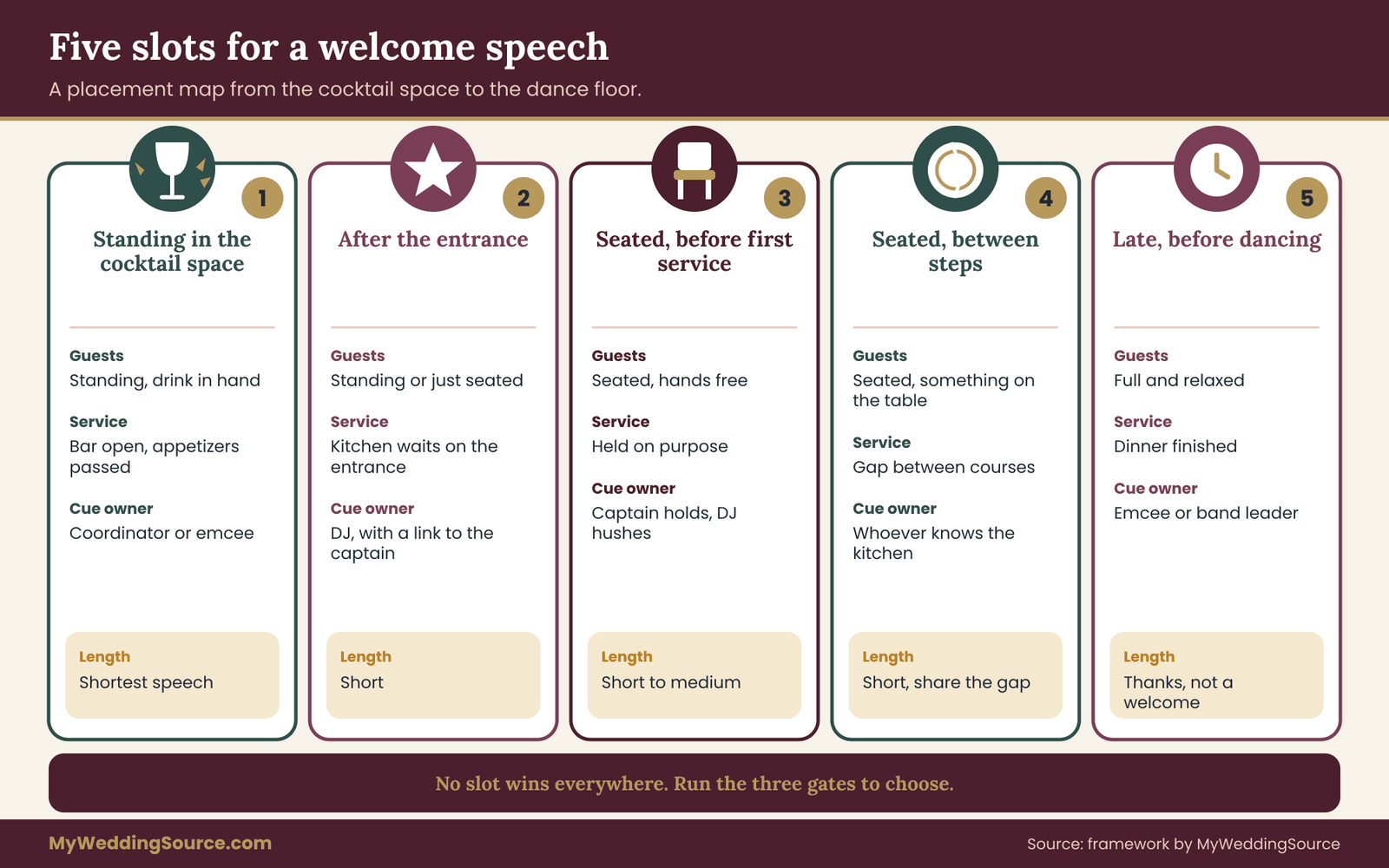
A reception has only so many places where a welcome speech can sit without fighting something else. Think of them as five slots on a line that runs from the moment guests arrive to the moment the dance floor opens. Each slot has a different guest position, a different service status and a different cue owner. The map below names them, and the rest of this section explains how to read it.
Slot one: the standing welcome in the cocktail space
In this slot the welcome speech happens while guests are still in the cocktail area, standing, with a drink or a small plate. The bar is open and passed appetizers may be circulating. It is a warm, informal slot, and it suits couples who want to greet the whole group before anyone sits down.
Guests are usually spread across a large space, so the hardest part is sound. A standing crowd of a hundred and forty people with music playing and glasses clinking is a hard room to quiet. This slot works best when the space is compact, when a short pause in service is acceptable to the bar and when the speaker has a microphone and a decent speaker system, not just a voice.
The cue owner here is usually a coordinator or an emcee who can move through the crowd, and the closing line should point guests toward the dining room: “dinner is about to begin, and your table cards are on the left.”
The main risk is the room’s attention. Standing guests drift, and a welcome speech in this slot has to be the shortest of the five.
Slot two: the entrance-linked welcome
Here the welcome speech follows the grand entrance or the couple’s arrival in the room. Guests may be standing at their tables, clapping, or seated and watching. The couple is already in front of the room, so the speech feels like a natural next beat.
The strength of this slot is that guests have just been asked for attention, and they are still holding it. The weakness is that the entrance is often late, and the speech lands on top of whatever slipped. If the kitchen is waiting for the entrance to begin service, a welcome speech that stretches the entrance by five minutes affects the plates.
This slot needs a clear answer to one question: who tells the kitchen the entrance has happened? Without that, the welcome speech may be running while servers wait at the pass with plates, and the room feels the tension without knowing why.
Slot three: the seated welcome before first service
Guests are seated. Water may be poured. The first course has not yet left the kitchen, or it is being held until the speech ends. This is the cleanest slot for sound and attention, because every guest has a chair, a table and nothing to carry. It is also the slot where service status matters most, since the kitchen is waiting on you.
For a plated dinner, this means the captain holds the first course for a few minutes. For a buffet, it means the table release has not started yet. The slot works well because the room is quiet and the cue owner can see the whole room at a glance. It works badly when the hold is not agreed in advance, because a speech that grows from three minutes to six pushes a kitchen decision onto the caterer in real time.
The seated welcome is often the best default for couples who want a formal opening without a lot of rehearsal, as long as the hold is confirmed.
Slot four: the seated welcome between service steps
Here the welcome speech comes after drinks are poured or the first course is on the table or cleared, but before the main service. Guests are settled in their chairs, there is something in front of them and the room has stopped moving for a short time.
This slot sits right where toasts often go in a plated dinner, so it is the slot most likely to collide with them. If your evening includes toasts in the same service gap, the two items compete for the same few minutes. The simplest fix is to decide which one owns the gap, and a workable rule is one item per gap unless the caterer has confirmed that more fits.
The strength is attention: seated guests with a drink and a small bite are patient listeners. The weakness is that a guest with food in front of them will eat, and the speaker must accept the clink of cutlery.
Slot five: the late welcome before dancing
Some couples hold the welcome speech until after dinner, as a way to open the dance floor, introduce the band or DJ and explain the rest of the night. Guests are full, relaxed and seated or loosely standing.
This slot is the weakest as a welcome. By this point guests have been at the party for hours, and a greeting feels belated. It is a good slot for the thank-you part of a speech and a poor slot for the announce-the-start part. If you choose it, change the language. It is no longer “welcome, we are glad you are here.” It is “thank you for coming, here is what is next.” Many couples do better to give a short welcome in slot two or three and a short thank-you in slot five, and treat them as two separate moments with two separate cues.
Reading the map
No slot is best in every room. The map is a menu, and the three gates from the previous section are how you choose. A few patterns hold across most receptions.
If the meal is plated and the kitchen can hold a course for a few minutes, slot three is the safest. If the meal is a buffet, slot two or three works, with the cue owner coordinating with the caterer about when the first table is released. If the reception is cocktail-style with no seated meal, slot one is the natural home, and the welcome speech should be short, because everyone is standing. If the couple wants the welcome to double as an introduction of family, slot four gives guests time to look at one another.
How guests, service and the cue owner shape each slot
The five slots are easier to compare once you put three columns beside them: where guests are, what service is doing and who gives the cue. Doing so shows quickly why a slot that sounds fine in the abstract fails in a particular room.
Guests: standing, seated, in motion
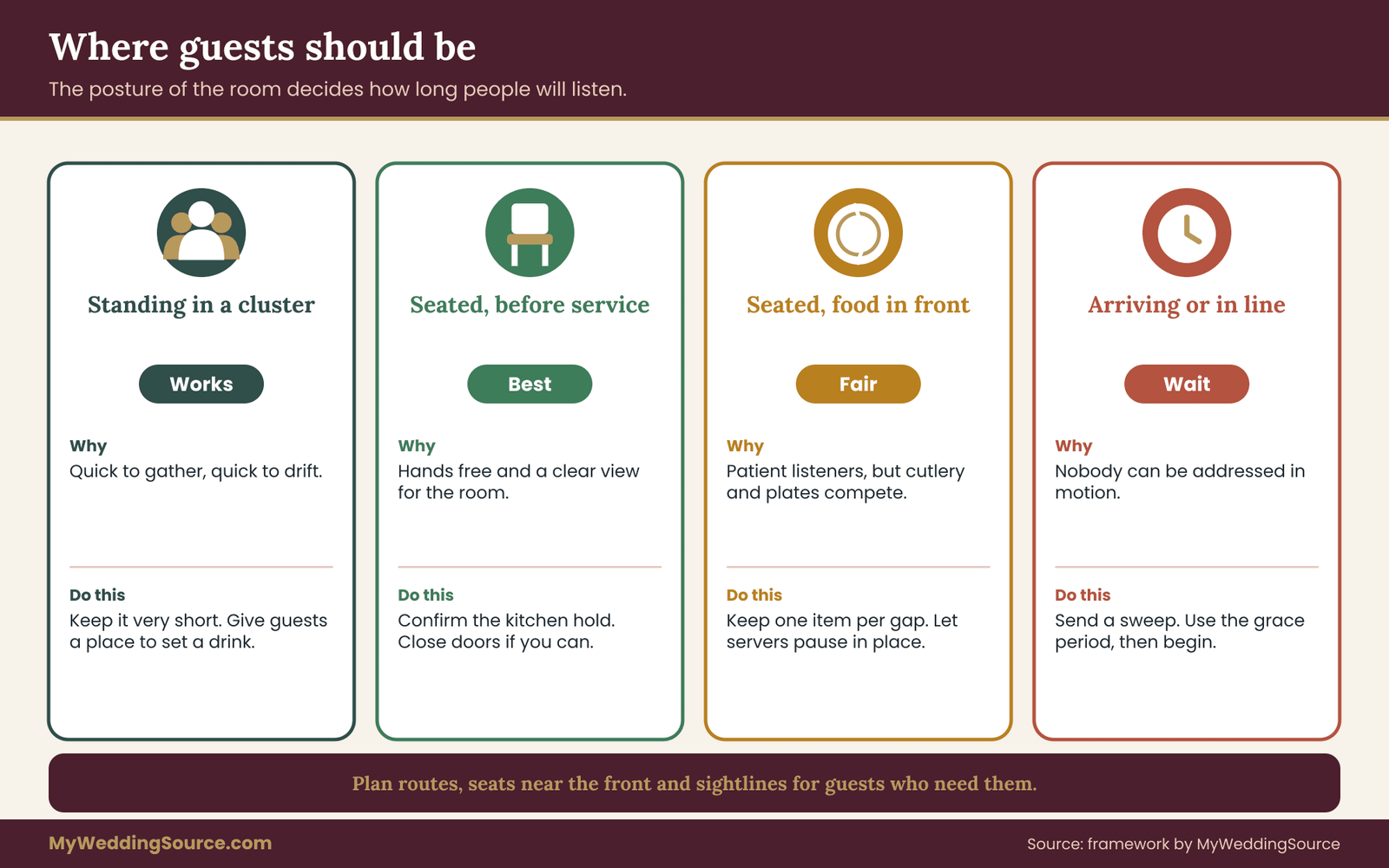
Standing guests are the easiest to bring together and the hardest to keep. They can turn toward a speaker quickly, but they will turn away just as fast, and they lose patience sooner. Seated guests take longer to quiet, because conversation at a table is a closed loop, but they are more likely to stay for the whole message.
Guests in motion, such as those walking to a table, queuing at a bar or finding a seat, cannot be addressed at all. This is why an “in the middle of seating” slot almost always fails. If your seating chart sends guests to tables over an extended time, read the notes in the wedding seating chart guide and then place the welcome speech after the last wave is seated, not during.
Service: three common states
Service status falls into three broad states, and each slot has a natural partner.
Paused. The kitchen and bar have stopped on purpose for a short time. Servers stand at the sides of the room. This is the cleanest state for a welcome speech, and it needs to be confirmed in advance, not assumed.
Idle. Nothing is being served right now because the schedule has a natural gap, such as between the arrival of guests and the first course. No pause has to be arranged. It is a cheap slot, but it can end abruptly if the kitchen is ready earlier than expected.
Active. Plates are moving, the bar line is busy or the cake is being cut. A welcome speech in this state competes with real noise, and the staff may need to keep working. If a slot falls here, either move it or choose a shorter speech.
The cue owner: who has authority in this slot
Every slot needs one person who is allowed to say “we are ready.” In slot one, that is often the coordinator or the emcee. In slot two it may be the DJ, who is already managing the entrance. In slot three it is usually the captain of the service staff working with the DJ. In slot four it is the person who knows what the kitchen is doing at that moment. In slot five it is the emcee or band leader.
A common failure is that two people think they own the cue and both act. The coordinator signals and the DJ signals. The speaker hears two cues in different tones and the room hears two sets of announcements. The cue chain section later in this guide gives a simple way to avoid that, with named owners and a backup for each.
Matching the welcome speech to your meal format
The meal format changes the shape of the evening more than any other choice, so it changes the welcome speech slot too. Here are the usual formats and how they push the slot.
Plated dinner
A plated dinner has a clear start and a clear service rhythm. Slot three, the seated welcome before first service, is the natural fit, and slot four is possible if you have confirmed a service gap. The key conversation is with the caterer, about how long the kitchen can hold the first course. A short welcome speech asks little. A long one needs an agreement.
Buffet or stations
Buffets are tied to release rules. Tables are often released in turn, and guests queue. A welcome speech before the release (slot three) works well, because it gives the room a clear sense of what happens next. A welcome speech after the first wave has started is a poor idea, because half the room is in a line and half is already eating.
If the venue or caterer sets release order, ask how they cue it. Some will cue by table number, some by a signal from the host. Your welcome speech can end with that signal, which turns the speech into a useful handoff. The idea is simple: end the speech with the release instruction, and let the captain run it.
Family-style or shared plates
Shared plates come out in waves and are passed around tables. A welcome speech works best before the first dishes land, because once they do, every table is busy. Plan a short hold at the start and nothing in the middle.
Cocktail reception or heavy appetizers with no seated meal
If guests are standing for the whole event, slot one is the main slot, and there may not be a second. Keep the welcome speech very short, give guests a place to put a drink, and use the closing line to explain what is happening later, such as cake cutting or a dance.
A mix: cocktail hour then seated dinner
This is the most common pattern, and it gives you the widest choice. You can greet guests in slot one near the end of the cocktail hour, move into the room, and add a short seated welcome in slot three if the couple has more to say. Two small moments often beat one long one, provided each has its own cue and neither repeats the other. The wedding cocktail hour guide covers what happens before this transition, and it is worth reading to make sure the handoff from cocktail space to dining room does not leave a gap.
Where guests should be when the welcome speech begins
The title of this guide asks where guests should be, and the honest answer is that it depends on the slot. Still, a few principles apply to every one. Guests should be in the room where the speech happens, in a spot they are willing to stay, turned loosely toward the speaker, with their hands free enough to listen. Everything below is about producing that state without nagging anyone.
Standing or seated: how to decide
Seating guests for the welcome speech is the more controlled choice. It cuts side conversations, helps older guests and anyone with a mobility need, and gives the staff a clear picture of the room. Standing is more social, quicker and better for a cocktail-style event, but it puts more load on sound and on the speaker’s presence.
A useful way to decide is to ask how long the welcome speech will really take. For a speech under a minute or two, standing guests can manage. For a longer one, anything that includes introductions, thank-yous and logistics, ask guests to sit. People cannot hold a standing, attentive posture for long in formal shoes, with a drink in hand, and they should not have to.
The settled-room threshold
When is the room settled enough to begin? Pick a rule in advance and write it into the cue sheet, so that the cue owner is not deciding under pressure with the couple watching.
One workable rule is this: begin when nearly everyone is in the room and seated or settled, and the remaining guests are visibly on their way. The words “nearly everyone” are deliberately loose, because the exact share depends on the event, and no number fits every wedding. What the rule does is stop the cue owner from waiting for the last person in the room, a wait that can add many minutes, while also stopping a start that talks over a doorway full of people.
Two refinements help. First, the cue owner should look for the groups that matter most, such as the couple’s parents, grandparents, the wedding party and anyone who will be called out by name. Starting before they arrive makes the welcome speech feel unfinished. Second, build in a short, agreed grace period, which can be as small as a minute, after which the speech begins whether or not the last few have arrived. Late guests can hear the speech from a doorway. Fifty guests cannot be kept waiting for them.
A sweep before the cue
The best single habit in this guide is a room sweep a few minutes before the cue. A member of the venue staff or a trusted helper walks the edges of the room and checks four places: the restrooms, the outdoor areas, the bar and the cocktail space. Their job is not to herd guests with a megaphone. It is to quietly say, “We are about to begin, please come to your seats,” to anyone they see, and to report back to the cue owner when the number of stragglers drops.
This sounds small, and it saves a great deal. Without a sweep, the cue owner sees the room they can see, which is the seated part. The people who are still outside or in a line are invisible until the speech has started and the doors swing open.
“We are about to start in a few minutes. Please bring your drink and take any open seat at your table. Thank you.”
A line like that, said in a friendly tone by staff or the wedding party, works better than a loud announcement, because it feels like an invitation and not an order.
Mobility, hearing and vision
Some guests need more from a welcome speech setup than others, and the room should be arranged so they do not have to ask.
Mobility. Guests who use a wheelchair, a walker or a cane need a clear route to their seat and a seat that does not block aisles. If the speaker will stand at the front, check that these guests can see and hear from where they are placed. Do not make a speech a reason to ask someone to move at the last minute.
Hearing. A welcome speech is spoken, and some guests will not hear it well. A well-tuned sound system, a speaker facing the room and a few seats near the front for anyone who asks help most.
If a guest uses a sign language interpreter, the interpreter needs a place with a clear view of the speaker and a clear view for the guest, with enough light. The Americans with Disabilities Act sets expectations about effective communication for public places, and your venue or the Department of Justice’s ADA site can tell you what applies. Ask the venue what accommodations they already have, and ask guests who may need them in the RSVP.
Vision. Guests with low vision may need a clear description of where the speaker is and what is happening. A speaker who says “we are glad to have you all here in the garden room, and I am standing at the front near the flowers” gives orientation for free.
Children, older relatives and guests who need quiet
Children are part of many receptions and will not stand still for a speech. If a child table or a kids’ activity space is part of your plan, brief the adults responsible that a short welcome speech is coming, and keep the speech brief. Check your childcare and supervision plan against your timeline so that the welcome speech does not land during a children’s meal service or a bedtime handoff.
Older relatives often prefer a seat to a stand, a quiet corner to a crowd and a speaker whose voice carries. Guests who are sensitive to noise, whether because of health, age or neurodiversity, may do better with a seat at the edge of the room away from the speakers. A speech with a sudden start, a loud cue or a fanfare can be unsettling. A calmer introduction, such as a short, spoken “Can I have your attention for a few minutes, please,” is kinder than a drum roll.
The couple, the head table and the speaker
Where the couple and the speaker are matters too. If the couple is seated at a head table facing the room, the speaker can stand beside them or at a point in the center of the room. If the couple is at a sweetheart table, the speaker usually stands near it or in front of the dance floor.
Three points to settle in advance:
Sightlines. The speaker should be visible from most seats. A pillar, a tall centerpiece or a bar can break sightlines. Walk the room at the walkthrough and check from the farthest tables.
Direction. The speaker should face the room and not the couple. A speaker who turns toward the couple to be warm sends their voice to the wall. Rehearse the angle.
Space for the couple. If the welcome speech includes the couple standing, make sure there is a clear spot where they can stand without blocking service paths or the photographer’s lane.
Guests who are still arriving
Some guests will be late, and a few may be very late. A welcome speech cannot wait for them. What you can do is plan a quiet way for latecomers to join without drawing attention: a host at the door, a table card that does not rely on the room being quiet and a seat near the entrance for anyone who comes in during the speech.
If you know in advance that a particular guest group is traveling in on a shuttle, a delayed flight or a long drive, build their arrival into the plan. A caterer can often set aside a plate for someone who arrives after service starts, and the same principle applies to a welcome: save a short, personal welcome for them in the quiet moment when they arrive, and do not hold the room.
What guests see before the speech starts
One more point about where guests should be: where they look. A room with a clear focal point, such as a lit area at the front, a microphone stand or a couple standing together, tells people where to turn. A room with no focal point leaves them in conversation. A simple measure, such as dimming the cocktail lights slightly, lighting the speaker’s spot or having the couple walk to the front, is a visual cue that the room often reads before it hears the words.
This is also a chance to coordinate with the signs and the layout. If the room has a posted order of events, it can say, in plain words, “Welcome and opening remarks, 6:15.” Keep such signs short and large enough to read from a few steps away. A sign gives guests a heads-up and it spares the speaker from explaining the evening from zero.
Who gives the cue for the welcome speech
A cue is a small signal that says “begin.” In a reception it can be a spoken line, a hand gesture, a text to the kitchen or a dimmed light. Who gives it is one of the easiest things to leave vague and one of the most costly to get wrong. The questions below sort it out.
The cue owner and the speaker are different jobs
The speaker delivers the welcome speech. The cue owner decides when it starts. In small, relaxed events one person does both, and it works. At a larger event, separating the two jobs removes a layer of stress. The speaker rehearses the words and the cue owner watches the room.
The cue owner needs four things: a clear view of the room, a way to reach the sound, a way to reach the kitchen or captain and the authority to say “wait” or “go.” That last point matters. A cue owner who must ask the couple for permission each time, in front of guests, is not an owner.
Who can be the cue owner
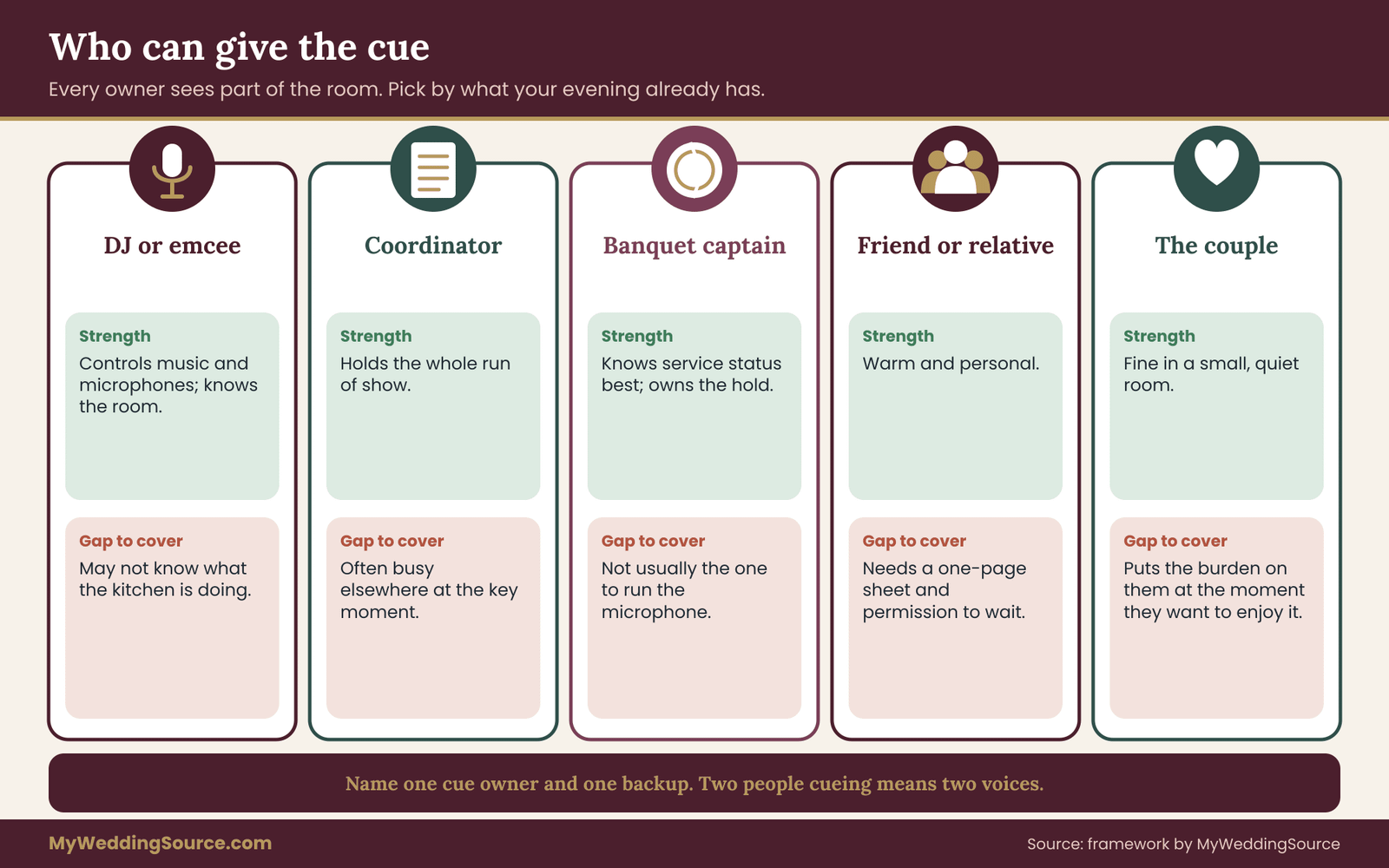
Each possible owner has strengths and gaps. Choose based on what your evening already contains, not on habit.
The DJ or emcee. A professional who is already running the music and the microphones can control sound and set the tone. They usually have a good sense of the room. The gap is that they may not know the kitchen’s state unless someone tells them, so they need a link to the captain.
The bandleader. A live band’s leader can do the same job as the DJ, and a band’s break schedule matters. Band break timing is worth confirming (the reception music planning guide covers it), because a band that is on a break cannot give a cue, and a band that is mid-song may not want to stop on short notice.
The coordinator or planner. Someone who has the whole run of show can sync the kitchen, the DJ and the couple. The gap is that a coordinator is often busy elsewhere at the key moment, so they need a clear reason to be in the room.
The venue captain or catering lead. This person knows service status better than anyone, and often should own the “hold” part of the cue, even when someone else owns the “start” part. They are the safest owner for a speech before a plated meal.
A friend or relative as emcee. Many weddings use one, and it can feel personal and warm. They need a one-page cue sheet, a rehearsed line and a clear connection to the DJ and the captain. They also need permission to be firm.
The couple. A couple who give their own cue, by walking to the microphone and waiting, can do it in a small room with a quiet crowd. In a bigger room it puts the burden on them at the moment they most want to enjoy the room.
Choosing by what is in your evening
If you have a DJ and a venue captain, make the captain the owner of “hold” and the DJ the owner of “hush and speak.” If you have a coordinator, they may sit above both and make the final call. If you have none of these, a friend with a cue sheet and a text link to the kitchen contact is a workable setup, as long as the friend is not also a member of the wedding party with duties elsewhere.
The ceremony earlier in the day may have had its own cue sheet, and the same habits apply here. The wedding ceremony cue sheet guide shows how one page can carry names, order and handoffs, and the reception welcome speech deserves the same one-page treatment.
The cue chain: Gather, Hold, Hush, Speak, Release
A welcome speech that works almost never rests on one signal. It rests on a short chain of five steps, each with a named owner. Call them Gather, Hold, Hush, Speak and Release.

Step one: Gather
Gather means bring the guests into position, using the sweep from the previous section. The owner is usually the coordinator or the staff leading the sweep. The signal is a spoken line to guests, a soft chime or a staff check-in. Success looks like: most guests are in the room and moving toward seats.
Step two: Hold
Hold means service stops for the agreed window. The owner is the venue captain or the catering lead. The signal goes to the servers and the bar: “hold for the welcome.” Success looks like: plates are not leaving the pass, the bar is not pouring a rush and the kitchen door is not swinging.
A hold is a request with a time limit. The captain should know how long it is expected to last and should have the right to cut it short, with a single word to the cue owner, if something requires it. That one-word signal is worth agreeing in advance. A plain “hot” or “tight” is enough, as long as everyone understands it means “wrap up soon.”
Step three: Hush
Hush means the room becomes quiet. The owner is the DJ or emcee, who lowers or stops the music. The signal is a clear, brief announcement, such as “Friends and family, may I have your attention for a few words from the couple.” The gap between the music stopping and the speaker starting should be short. A long silence and the room starts talking again.
Step four: Speak
Speak means the welcome speech begins. The owner is the speaker, who has been told, in advance, that they start when the emcee hands over. The speaker should have the microphone before the hush, not after, so that no fumbling happens in the silence. A short, rehearsed first line helps.
Step five: Release
Release means the welcome speech ends and the room moves to the next step. The owner is the cue owner again, or the speaker’s closing line does it. Release is two things: the room is told what is next, and service is told it can go. A speech that ends with “thank you, enjoy dinner” and no signal to the kitchen leaves staff guessing.
The best releases include one clear sentence for guests and one clear signal for staff. Guests hear, “Dinner will be served now, and the bar will stay open.” Staff receive a nod, a text or a radio word.
What the chain looks like on one line
On a cue sheet, the whole chain can fit on one line. For example: “6:15 Gather (coordinator sweep), Hold (captain, first course held), Hush (DJ stops music, announces), Speak (parent, under two minutes), Release (parent ends with dinner line, captain sends first course).” Writing it this way makes it clear who does what, and it shows gaps. If a step has no name beside it, nobody owns it.
Two cues, one owner
Whatever your setup, only one person gives the “hush” and only one gives the “go.” A second person who also tries to quiet the room adds noise. If the coordinator and the DJ both want to cue, agree in advance that the DJ speaks and the coordinator signals the DJ with a hand sign or a text. The room hears one voice.
Giving the cue: words, signals and backups
A cue chain is only useful if people can follow it in a noisy room. Plan the signals as carefully as the roles.
The spoken cue to the room
The announcement to guests should be short, friendly and clear. It should say who is speaking and roughly what is happening. A good one has three parts: a hook to get attention, an indication of what is coming, and a thank-you.
“Friends and family, may we have your attention? Please take your seats, we have a few words to share before dinner. Thank you.”
Avoid jokes, gimmicks and long preambles. The cue is not the speech. A warm, level voice does more than a loud one, and a request to “please take your seats” does more than a demand for quiet.
The signal to staff
Staff cannot always hear announcements, especially in a kitchen or a service corridor. Agree on a way to reach them. Options include a radio channel for the captain and the coordinator, a text thread among three or four people, a visual signal across the room or a person who physically walks to the pass. Pick one and test it.
The signal should go both ways. Staff should be able to tell the cue owner that the hold is working, the hold is about to fail or a problem has appeared. Without that, the cue owner is guessing.
Backups
Every owner in the chain needs a named backup. The DJ’s backup may be the emcee, or the coordinator may take over the microphone. The captain’s backup is the assistant manager. The speaker’s backup is the second speaker, who has the same notes. This does not need to be elaborate. It needs to be written down.
If music or sound equipment has a technical problem, the backup is a speaker with a strong voice and a clear room, or a hand-held microphone with fresh batteries. Decide who among the people running sound owns the microphone, so that the cue is not stuck waiting for a technician.
When the cue is missed
Sometimes the cue fails. The emcee is in the restroom. The coordinator is in the kitchen. The speaker is not at the table. Do not let the room sit waiting. The backup steps in, even if that means a slightly rougher start. A calm, “We will begin in just a moment” works better than silence, and it buys a minute. If the delay passes two or three minutes, consider moving the speech to another slot with a new cue, rather than forcing it.
A short word on authority
The cue owner’s authority should be stated to everyone who might challenge it. If a relative wants to give a long toast, the cue owner needs permission from the couple in advance to say “after dinner.” If a photographer wants another shot first, the owner needs permission to say “we start in thirty seconds.” Having that permission written down is a kindness to everyone. It keeps the couple out of the middle and lets the cue owner act without apology.
Service status and sound: how the room shapes welcome speech timing
How service status changes welcome speech timing
Service status is the gate you control least, because it belongs to people with their own schedules and their own rules. Food has a clock, ice melts, a bar line builds and a kitchen has to meet a service plan that was set long before you drew up your program. This section explains how to talk about it without asking for something the caterer cannot give.
What the caterer can and cannot promise
A caterer can tell you how their kitchen normally works: when they fire the first course, how long they can hold plates for a short pause, how the buffet releases tables and who calls those moments. They cannot tell you your own evening will run exactly to the minute, because guests, speakers and the room do not behave like clockwork. Treat their answers as inputs to a plan, not as promises about what will happen.
Food safety is part of this. Official guidance, such as the U.S. Food and Drug Administration’s Food Code and the federal food safety site, sets expectations for how long hot and cold food can sit out and at what temperatures. Those rules are for the caterer and the local health authority to apply. Do not set your own food holding limits, and do not repeat a number you have heard. Ask the caterer what hold they are comfortable with and write that down as their answer, not yours.
The same applies to the venue. Some venues have rules about when staff may enter a room, when doors must stay clear and what can happen near a kitchen. Ask what they are, and follow them.
Plated dinner: the hold
For a plated meal, the central question is how long the first course can wait. If the speech runs on and plates are ready, something gives. The caterer might hold, the food might drop in quality or a server might have to ask the room to wait. The better solution is a short, agreed hold that matches the speech length you plan, plus a signal for the caterer to say it is getting tight.
Ask these in plain words. How long can you comfortably hold the first course after the room is seated? What signal tells you the welcome speech is starting and when it ends? What do you do if it runs over? Who do you want to hear from, and how? The answers are the basis for the hold step in the cue chain.
For couples who want the welcome speech and toasts in the same stretch of the evening, the conversation with the caterer about dinner timing is where to settle the gap, and the wedding vendor timeline is the place to record when each vendor arrives and what they need.
Buffet or stations: release and lines
At a buffet, the welcome speech usually belongs before the first release. The question for the caterer is: how will tables be released, and who gives that signal? If the host or emcee gives it, the closing line of the welcome speech can include the instruction. If the caterer gives it, the cue owner needs to tell the captain the speech is over.
A common failure is that guests hear “dinner is open” and rush the line, while the speaker is still finishing. Keep the release instruction as the very last sentence, so that nothing is said after it.
The bar
Bars are noisy and bar lines are the first to grow when a hold starts. If the speech is in a standing slot, guests may be in line for a drink when the cue is given, and a hold at the bar may stop service for guests who have been waiting. Ask the bar manager whether a short pause is acceptable, and whether a quick service just before the speech would help thin the line. The wedding bar service planning guide goes into bar staffing and pacing, which affects how long a bar can safely pause.
If the toast that follows the welcome speech requires everyone to hold a drink, plan the pour. A speech that ends with “please raise a glass” and finds half the room empty-handed is awkward. The usual fix is a quick pour or a water or sparkling option before the speech, so that every guest has something in hand.
Passed appetizers, the kitchen door and other moving parts
Passed appetizers can continue during a standing welcome speech if servers move quietly, but a tray that arrives in front of a guest during the speech draws their eyes and their conversation. Ask the captain to have servers pause in place for a moment. The same goes for any rolling cart, the cake or the dessert table setup.
The kitchen door is a sound source. A door that swings open every minute lets in clatter, and a door propped open in a hallway can be loud. A simple instruction to close the door during the speech, or to use a quieter route, is often enough.
Dietary and children’s plates
Plates for guests with dietary needs and children’s meals often leave the kitchen on a different schedule. If the welcome speech holds the main plates but not the special ones, those guests may be eating while others wait, or the reverse. Ask the caterer how they handle it, and tell the cue owner. For the broader question of designing menus across ages and dietary needs, the menu planning stage is the time to ask the caterer.
Weather and outdoor service
If any part of the reception is outdoors, weather becomes part of service status. Heat, cold, wind, rain and lightning all change where guests can stand and how long they can be asked to wait. The National Weather Service safety pages describe how to respond to lightning and other hazards, and a venue or planner is the right person to apply that guidance to your site. Guests should not be held outside for a speech when conditions are uncomfortable, and a lightning risk is a reason to move everyone indoors without discussion. Keep a plan for moving the welcome speech indoors, and name the person who decides.
Sound, microphones and room readiness for the welcome speech
Even a perfectly timed welcome speech fails when guests cannot hear it. Sound is the easiest gate to open and the one most often left until the last minute.
Choose the microphone for the speaker, not the room
A handheld microphone is simple and familiar. It needs the speaker to hold it at the right distance, which many people do not do. A lavalier or headset microphone frees the hands, which is useful if the speaker holds a glass or notes, but it requires a pack and a test. A podium microphone fixes the speaker to one place and suits formal rooms.
Ask the DJ or AV technician which is best for each speaker, and let the speaker try it. A parent who has never held a microphone may do better with a stand. A partner who gestures a lot may prefer a lavalier.
Test with the speaker, in the room, with the music
A sound check before guests arrive tests the equipment. It does not test the live conditions. Ask the speaker to say their first two sentences into the actual microphone in the actual room, from the actual spot, while someone listens from the farthest table. If the room is hard to hear in, adjust volume, move a speaker or change the position.
Run the check again after guests arrive if anything has changed. A room full of people absorbs sound and may need more volume than the empty room did, though the technician is the right person to say how much.
Feedback, batteries and interference
Feedback happens when a microphone picks up its own sound from a speaker. The fix is distance, angle and volume, and the technician should handle it. Keep spare batteries on hand and ask when they were last changed.
Wireless microphones use radio frequencies, and the Federal Communications Commission regulates how they may be used. A professional with licensed or properly set equipment will know the rules. If you are bringing your own wireless gear, ask the venue about restrictions and check the FCC’s guidance. Do not treat this as a place to save effort.
The room itself
A room with hard walls, high ceilings or many glass surfaces can make speech hard to understand even at high volume. A tent or outdoor space has its own problems with wind and distance. Ask the venue about the room’s reputation for sound, and ask the technician what they plan to do about it.
Background noise matters too. Air conditioning, kitchen fans and outside traffic can mask a quiet speaker. A walkthrough with the technician at the actual time of day is the best check, and the venue technical walkthrough guide shows what to measure and ask during a site visit.
Volume and hearing comfort
Louder is not always better. Very loud amplified sound can be uncomfortable, especially for older guests and young children, and exposure guidelines exist for noise. The National Institute for Occupational Safety and Health publishes information on noise and hearing, aimed mainly at workplaces, and it is a reminder that a speech does not need to be a loud one. Aim for clear and even, not powerful.
The readiness check before the cue
Five minutes before the cue, the cue owner or the DJ runs a quick readiness check: Is the microphone live and tested? Is the speaker at the spot with notes in hand? Is the music ready to stop? Is the captain ready to hold? Is the room mostly seated? If any answer is no, tell the cue owner and delay, even by a minute or two. A short delay is a normal event. A speech that starts and stumbles is much worse.
A worked example of welcome speech timing
A framework is easier to judge when you see it handle a real schedule. The example below is invented for illustration, including the couple, the numbers and the answers from the caterer. Your own answers will differ, and the point is the method.
The setup
Mara and Devon are hosting 130 guests in a hotel ballroom. Guests spend the cocktail hour in the foyer, then move to the ballroom for a plated three-course dinner. A DJ runs music and microphones. The hotel’s banquet captain runs service. A day-of coordinator oversees the run of show. Mara’s father will give the welcome speech, and Devon will add a few words of thanks.
The cocktail hour is due to end at a set time, and the couple wants the welcome speech before the first course. Their goals are plain: nobody talking over the speech, no cold plates and no long wait for dinner.
What the caterer confirmed and what is assumed
The coordinator asks the banquet captain four questions and records the answers with the date.
The captain says the kitchen can hold the first course for a short window after the room is seated, and gives a figure for the example of up to five minutes. This is a confirmed answer, in an email. The captain says servers can pause in place when asked. Also confirmed. The captain does not know how long seating will take, because that depends on the guests. That one is an assumption, and the coordinator marks it as such.
The DJ confirms the microphone choice, a handheld for Mara’s father and a lavalier for Devon, and says a test with both speakers will be done during setup. The venue confirms the ballroom doors can be closed during the speech to cut hallway noise.
So the plan stands on three confirmed items (the hold, the pause, the microphones) and one assumed item (the seating time). The coordinator decides to test the assumption instead of trusting it.

The first draft fails the gates
The first draft of the program puts the welcome speech at the moment the ballroom doors open, in slot one, with guests streaming in from the foyer. The coordinator runs it through the three gates.
Gate one is red. Guests will be moving through doors, finding tables and stopping to look at the seating chart. Gate two is yellow. The servers are in place, but the kitchen is waiting for a signal to begin. Gate three is red. The speaker will be at the front while guests make noise on their way in, and the DJ has not decided whether the music stops during seating.
The coordinator does not try to fix the red gates one by one. She moves the slot. The welcome speech shifts to slot three, once the room is seated.
The timeline, in relative minutes
The team does not set a clock time for the speech. Instead it anchors everything to the minute the ballroom doors open, called minute zero, because the real clock time will move with the day.
Ten minutes before minute zero, the coordinator and two staff begin the sweep: foyer, restrooms, terrace and bar. They say the invitation line to guests.
Five minutes before, the captain confirms the kitchen is ready and the hold is agreed. The DJ confirms both microphones are live.
At minute zero, the doors open, soft music plays and guests find seats.
Around minute twelve, the coordinator checks the room. The assumption was twelve minutes. If the room is mostly seated, she gives the DJ the sign. If it is not, she waits and uses the grace period.
At the sign, the DJ lowers the music and makes the hush announcement. This is the hush step. The captain has already started the hold.
Mara’s father speaks for about two minutes. Devon adds about one minute. This is the speak step.
Devon’s final line is, “Please enjoy dinner, and the bar will stay open.” The captain sees the end, nods to the kitchen, and the first course goes. This is the release step.
The whole welcome speech, from hush to release, takes about four minutes, within the five the captain confirmed.
What happens when the assumption is wrong
On the day, seating takes eighteen minutes, not twelve. A few tables are slow because a group is taking photographs by the foyer. The coordinator, at minute twelve, sees that gate one is still amber. She does not cue. She sends a helper to the foyer with the invitation line.
At minute sixteen, most guests are seated. The grace period the team agreed is two minutes after “nearly everyone.” At minute eighteen she gives the sign. The speech begins about six minutes later than planned. The hold begins when the room is seated, not at minute zero, because the captain’s clock starts when she gives the hold signal. The kitchen is not harmed.
The late-seating result shows why the cue sheet uses cues, not clock times. A schedule anchored to the clock would have started a speech at minute twelve, to a half-empty room.
What if the caterer’s answer had been different
Suppose the captain had said the first course could be held for only two or three minutes. The team has three choices, each with a cost.
Shorten the speech. Cut to Mara’s father alone, for about ninety seconds, and have Devon’s thanks said later, before dessert. This keeps the slot and loses nothing important.
Move the slot. Put the welcome speech in slot two, right after the entrance, before the room has been fully seated, and have the first course fire when the speech ends. This works only if the entrance is on time.
Use a different structure. Say a brief welcome at the end of the cocktail hour (slot one), in the foyer, with a quiet hold on the bar, and keep the dining room free of speeches until after the first course. This asks the most of the foyer’s sound and the least of the kitchen.
None of these is the right answer in the abstract. The right one is the one the confirmed answers support.
The one-page cue line
The coordinator’s cue sheet entry for the welcome speech says: slot three; anchor is room seated; Gather by sweep; Hold by captain, up to the confirmed window; Hush by DJ; Speak by Mara’s father then Devon, about three minutes together; Release by Devon’s closing line and the captain’s nod; backup for the DJ is the coordinator, backup for the speaker is Devon.
It also lists three assumptions: seating time, doors closing and the foyer being clear. The sheet is one page, and it fits next to the larger run of show, and the guide to entry, seating, food and exit as one connected sequence shows where it sits in the whole evening.
Special cases that move the welcome speech
Not every reception has a foyer, a ballroom and a captain. These cases change the answer.
Outdoor receptions and tents
Wind, sun, temperature and background noise all change. A speech outdoors needs a stronger sound plan and a weather plan. Ask what the backup indoor space is and who decides when to move. Provide water if guests are standing in the sun, and keep the welcome speech short if conditions are harsh. In a tent, check how sound carries and where the generators or fans are.
A grand entrance that runs late
Photos often run long, and an entrance can slip. If the welcome speech is tied to the entrance, make sure the cue owner knows how long the slip is and has agreed a limit. If the delay passes the limit, the welcome speech goes ahead without the couple and the entrance follows. The room should not wait indefinitely, and the kitchen should not have to guess.
A cultural or religious opening
Many weddings begin the reception with a blessing, a ritual or a procession. These have their own owners, their own timing and often their own rules about quiet. Give the opening its own line on the cue sheet and its own cue. Decide whether the welcome speech comes before or after, and who steps in to link them. Ask the family elder who leads it how long it takes, and do not compress it to fit.
A bilingual or interpreted welcome
When the welcome speech is given in two languages, the time roughly doubles, and the speaker’s pacing needs to leave room for translation. Decide whether the two languages are delivered back to back or sentence by sentence. If an interpreter is used, make sure they have a clear position and a copy of the text ahead of time.
A very small or very large guest list
A small gathering of thirty or forty may need no microphone and no cue chain, only a friendly voice and a nod from the couple. A very large one needs more of everything: a sweep with several people, a stronger sound system and a more formal cue. The method is the same, and only the scale changes.
No emcee, no DJ
If there is no professional, use a friend with a one-page sheet. Give them a short line to open and a short line to close, a clear way to reach the kitchen contact and permission to wait if the room is not ready. A playlist can be paused from a phone, but test who holds the phone.
A speaker who is missing or nervous
If the speaker is not at the table when the cue comes, the backup takes over. If the speaker is nervous, a printed card with the first two sentences and the last sentence helps. The speaker does not need to memorize a speech, only the way in and the way out.
A late shuttle or a delayed group
If a group of guests will arrive after the planned start, decide in advance whether the welcome speech waits. Usually it does not. Plan a quiet greeting for the group at the door and seat them without comment.
Verifying welcome speech timing: confirmed, assumed and unknown
A welcome speech plan is made of answers, and answers come in three grades. Labeling each one keeps you honest about what the plan stands on, and it tells you what to test before the day.
Confirmed, assumed, unknown
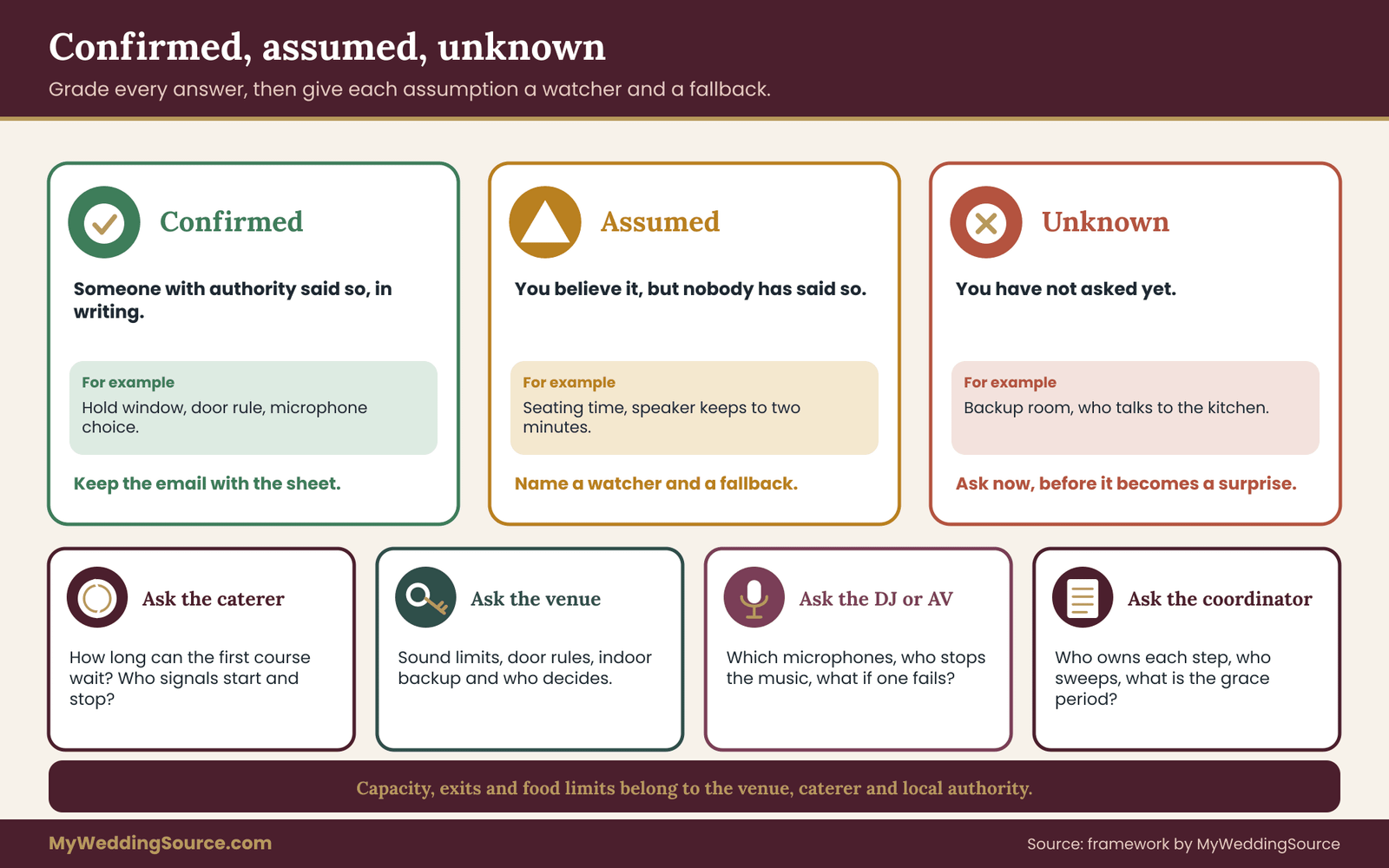
Confirmed means someone with authority told you in writing, and you know who and when. The caterer’s hold window, the venue’s rule on closing doors and the DJ’s microphone choice are confirmed once they are in an email or a signed document.
Assumed means you believe it is true but nobody has said so. How long seating takes, whether guests will quiet on a first request and whether the speaker will keep to two minutes are assumptions. An assumption is not a flaw. It is a flag that says “watch this, and have a fallback.”
Unknown means you have not asked. This is the grade to hunt down early, because unknowns turn into surprises.
Write the status beside each item on the cue sheet. Anything that stays assumed on the day should have a named person watching it and a stated fallback.
Questions for the caterer or banquet captain
Ask how the kitchen sequences the first course and what can be held. Ask who gives the start signal and who gives the stop. Ask how they handle special plates and children’s meals during a hold. Ask what they will do if the speech runs long, and how they want to be told. Ask whether servers can pause in place and whether they will close the kitchen door. Ask how buffet tables are released and by whom.
Record the answer in their words. If the answer is “it depends,” ask what it depends on, and write that down.
Questions for the venue
Ask whether any rules limit where speakers may stand, whether microphones or sound levels are restricted, and whether doors may be closed or held open. Ask about the room’s capacity and exits only to learn the venue’s rules and who is responsible, not to set your own. Capacity, egress and similar safety matters are set by the venue and the local authority, such as the fire marshal, and nothing in this guide replaces their instructions. If a guest count or layout is changing, ask the venue whether the change needs approval.
Ask what the venue’s backup is for an outdoor welcome and who decides to use it.
Questions for the DJ, bandleader or AV technician
Ask which microphones will be used, when they will be tested and by whom. Ask how music will be stopped, who will stop it and what the DJ expects as a cue. Ask what the DJ will say to hush the room and whether they are comfortable giving that line. Ask who runs sound if the DJ steps away. Ask what happens if the microphone fails.
Ask how they handle a speaker who is quiet or far from the microphone. A good professional has an answer.
Questions for the coordinator, family emcee or planner
Ask who owns each step of the cue chain, and who is the backup. Ask who is doing the sweep. Ask who talks to the captain, and by what channel. Ask what the grace period is and who calls the end of it. Ask what happens if the entrance runs late. Ask whether the cue sheet has been shared with everyone involved.
If you are running the day yourselves without a coordinator, a vendor timeline can hold the vendor arrival and contact details, and it gives your helper a single place to look.
What to check with official sources
Some points belong to public agencies and not to vendors, and it is worth confirming them directly. The Americans with Disabilities Act website describes effective communication and accessibility expectations for places open to the public. The Food and Drug Administration and the federal food safety site describe food handling guidance that your caterer applies. The National Weather Service safety pages describe responses to lightning, heat and other hazards. The Federal Communications Commission explains rules for wireless microphones. The National Institute for Occupational Safety and Health provides noise and hearing information. The local fire authority sets rules for crowding, candles, exits and tents in your area.
These sources set rules and guidance that change and differ by place. Check the current version for your location and event, and let the venue and caterer tell you how they apply it.
What this guide cannot tell you
It cannot tell you how many guests your room can safely hold, where your exits are or how long any particular food can sit. It cannot know your caterer’s kitchen or your venue’s house rules. Its timing examples are invented and are meant to show a method. The recommended gap lengths, grace periods and speech lengths are planning judgments, not requirements. When a rule and this guide disagree, follow the rule.
Writing the welcome speech and recovering when the evening runs late
Writing and giving the welcome speech itself
Once the slot is set, the words matter. Many welcome speeches fail by being long, not by being poor.
How long to speak
A short welcome speech often works best, and one to three minutes is a reasonable range for most settings. In a standing slot, aim for the low end. In a seated slot with a quiet room, a little more is fine. If two people speak, plan their combined time, not each person’s time alone. If you have more to say, split it: a short welcome early and a longer thank-you later.
Time the speech out loud, at speaking pace, with the actual words. Most people read faster in their heads than they speak, and nerves often make a speaker either rush or stall.
A simple four-part structure
A welcome speech that follows four parts is easy to remember and easy to cut.
Greet. One sentence that says hello and names the room, such as who is there and what the evening is.
Thank. One or two sentences that thank guests, especially those who traveled, and any family or helpers who deserve a name. Keep the names short, because lists of names bore a room and risk leaving someone out.
Orient. One or two sentences with the practical facts: what happens next, where the bar and restrooms are, when dinner starts, where the cake will be. This is the part guests value most.
Release. One sentence that points to the next step and hands the room back, such as “Please enjoy your dinner.”
If you want a raised glass, put it last and keep it brief. A longer toast belongs to the toast slot.
Delivering it
The speaker should stand where the room can see them, hold the microphone at a steady distance and speak a little slower than normal. A pause after the first sentence lets the room settle. Eye contact with a few tables, spread around the room, makes every guest feel included.
Humor works when it is short and kind. Inside jokes that only a few guests understand can leave others out. Avoid stories that embarrass anyone present.
A printed card with the key words, held low, is better than a phone, which can light up with notifications and draw the eye.
When the evening runs late: recovery rules
Even a good plan will meet a bad hour. The recovery rules below keep the welcome speech from becoming the thing that makes everything worse.
Spend the slack in order
First, use the grace period. Second, shorten the speech, by cutting the thank-you list or the orientation. Third, move the thank-you to another slot. Fourth, if the room is not ready after a few minutes, hold the speech and let service proceed, then add the welcome at the next gap, perhaps before dessert.
Do not talk over a noisy room. A speech heard by half the guests is worse than a speech delayed.
Who decides, and what they say
The cue owner decides, with the captain, in a short exchange of words. Agree the phrases in advance: “Go,” “Wait,” “Wrap up.” The couple should not be asked to make this call during the party. If they are, the plan has not given the owner enough authority.
After the evening
A few minutes of notes the next day help for the next event you host. Write what worked, what slipped and what the room did when the cue was given. If you will have other events, such as a rehearsal dinner or a brunch, the same cue chain applies at a smaller scale.
Your next steps
This week, choose a slot from the placement map and write it in your run of show. Then ask your caterer, venue and DJ the questions in the verification section and record each answer as confirmed, assumed or unknown. Name a cue owner, a speaker and a backup for each, and write the one-line cue chain on a single page. Decide the sweep, the grace period and the first and last sentences of the speech.
Two weeks before the wedding, test the assumptions you can. Walk the room, check sightlines and run the microphone with the actual speaker. The day before, send the one-page sheet to everyone who has a part. On the day, run the three gates, give the cue and let the room settle. A well-timed welcome speech takes about three minutes, and it is the part of the evening most guests remember for how calm it felt.
FAQ
When should the welcome speech happen at a wedding reception?
Pick the slot where guests are settled, service can pause and sound is ready. For a plated dinner, that is usually after guests are seated and before the first course is served. For a cocktail-style event, it is near the end of the cocktail hour. Confirm the hold with the caterer instead of assuming it, because kitchens set their own limits.
Who should give the cue to start the welcome speech?
One named person, such as the DJ, emcee, coordinator or catering captain, should say when the speech starts. Ideally the speaker is not the cue owner, so they can focus on the words. If several people could cue, agree in advance who speaks and who signals, so the room hears one voice and the kitchen gets one clear signal.
Should guests be seated or standing for the welcome speech?
Seated is easier for most rooms and kinder to older guests and anyone with a mobility need. Standing works for a very short welcome during a cocktail hour. If the speech runs past a couple of minutes, ask guests to sit. Whichever you choose, give people a clear route and a place to set down a drink.
How long should a wedding welcome speech be?
Most work well at one to three minutes. Standing guests tolerate less, so keep a cocktail-hour welcome near the short end. If two people speak, count their time together. Practice the words aloud with a timer, because speaking is slower than reading. If you have more to say, split the thanks into a later moment.
What if the caterer cannot hold the first course?
Ask how long they can hold and plan within that answer. If the window is very short, shorten the speech, move it to the entrance or the end of the cocktail hour, or place it after the first course is served. Do not push the caterer for a longer hold than they offer. Food handling decisions belong to them and the local health authority.
Do we need a microphone for the welcome speech?
It depends on the room size and noise. A small, quiet room may not need one, while a ballroom, tent or outdoor space usually does. Test the actual microphone with the actual speaker, in the room, from the farthest table. Ask the DJ or technician what they recommend, and have spare batteries ready.
How do we include guests who are late or hard of hearing?
For late guests, plan a quiet greeting at the door and seat them without interrupting the speech. For guests who are hard of hearing, use a well-set sound system, keep the speaker facing the room and offer seats near the front. If an interpreter is used, give them a clear sightline. Ask on the RSVP who needs accommodations.
What if the welcome speech runs late or the room will not quiet down?
Use the grace period, then shorten the speech, then move part of it to another slot. Do not talk over a noisy room. Let the cue owner and captain decide in a few agreed words, such as “go,” “wait” or “wrap up,” so the couple is not pulled into the decision. A delay of a minute or two rarely matters.
Sources
- Weather safety, National Weather Service
- FDA Food Code, U.S. Food and Drug Administration
- Safe food handling and preparation, FoodSafety.gov
- Americans with Disabilities Act, U.S. Department of Justice
- Wireless microphones, Federal Communications Commission
- Noise and hearing loss prevention, National Institute for Occupational Safety and Health
- Public assembly and event safety resources, National Fire Protection Association
- Event safety and workplace guidance, Occupational Safety and Health Administration
- Government services and local licensing, USAGov