
Wedding dessert service is the handoff that moves sweets from the kitchen to your guests while the music is still playing. This guide shows how to choose between passed, plated and self-service formats, how to keep the dance floor working while dessert arrives, and what to confirm with your caterer, baker and venue before the night.
Choose your wedding dessert service by asking five questions in order: Does the dessert path cross the dance floor? How many guests will be dancing when dessert starts? Do you have enough staff to carry it? Is there a natural seated moment? And does anything, like a venue curfew or an early bedtime, force the timing? Passed dessert protects the floor best, plated dessert suits a seated pause before dancing opens, and self-service works when the stations sit away from the dancers and the line can run for a long window.
A reception can have a beautiful cake, a generous dessert table and a great playlist, and still lose twenty minutes of its best dancing because dessert arrives at the wrong moment. The usual pattern in a weak wedding dessert service plan is simple. The band hits its stride, the floor fills, and then the cake is wheeled out, the lights change, an announcement asks everyone to gather, and the room stops. Half the guests drift to their seats and do not come back.
None of that is anyone’s fault. Dessert and dancing both want the same thing: the middle of the room, the attention of the guests, and the late-evening energy. A good plan treats those as limited resources and decides in advance how to share them. That is what wedding dessert service planning is, and it is mostly a matter of routes, timing and who is holding the tray.
A note on scope. This is general information, not legal, safety or food-safety advice, and it does not replace what your venue, caterer or local authority requires. Nothing here is a universal rule about how many people a room can hold, how people must exit, or how long food can sit out. Those answers come from the venue and the people who prepare the food.
This article is about one narrow job: getting dessert to people without stopping an active dance floor. It does not cover how to design the cake itself or how to run the whole reception. For the larger picture of how guests move through the evening, the reception guest flow guide covers entry, seating, food and exit. For cake production and cutting logistics, see the wedding cake timeline. What follows picks up where those leave off, at the moment the dessert has to meet the dancers.
What wedding dessert service has to solve
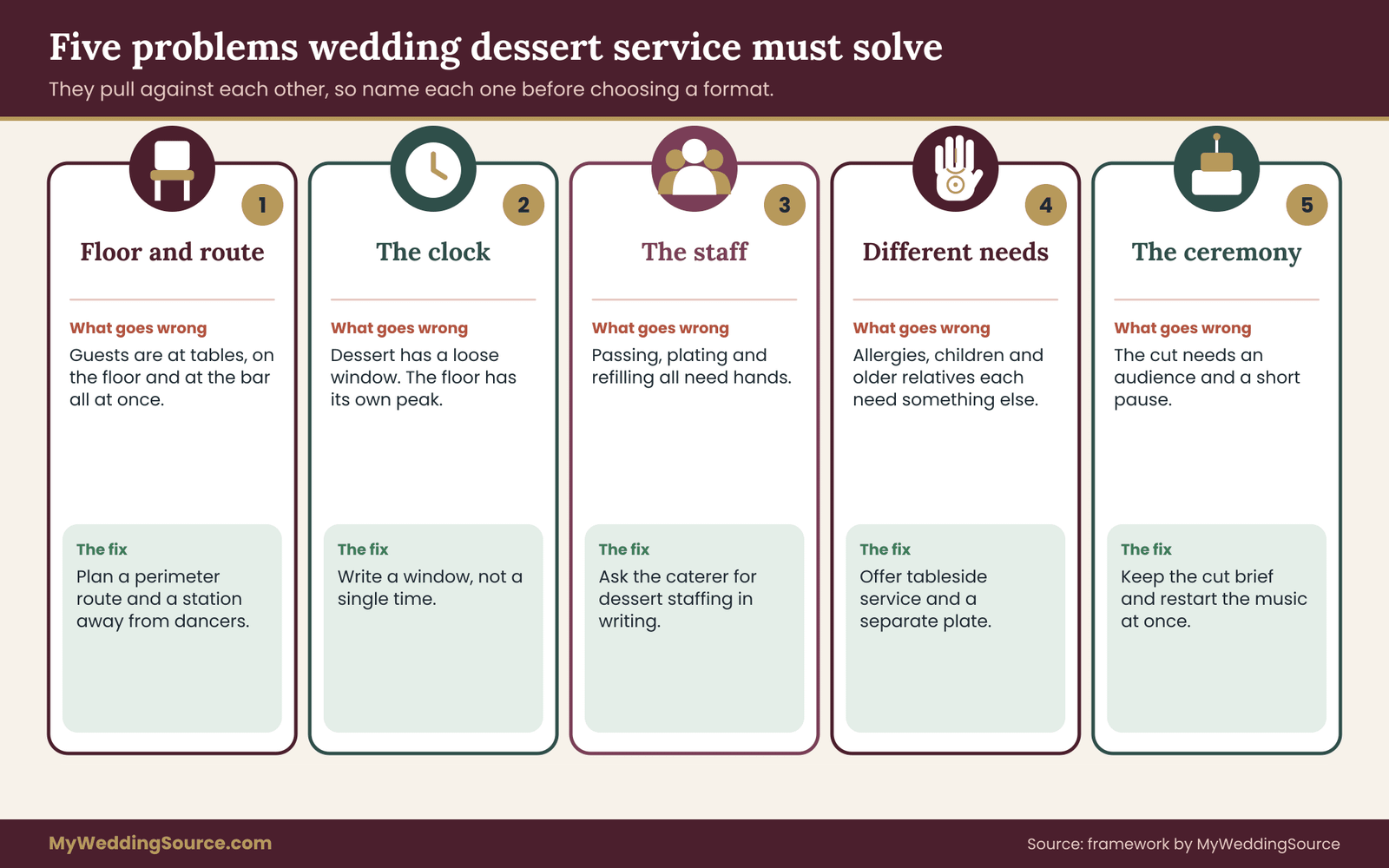
Before choosing a format, it helps to name the problems a good wedding dessert service plan solves. There are five, and they pull against each other.
Problem one: the floor and the route. Dessert has to reach guests, and guests are in three places at once. Some are at their tables, some are on the dance floor, and some are at the bar, outside, or in the restroom hallway. A plan that only serves the tables ignores a third of the room. A plan that gathers everyone at one spot pulls dancers off the floor.
Problem two: the clock. Dessert has a loose window, not a fixed time. Cake that sits too long dries or softens, frozen desserts melt, and chocolate behaves differently in a warm room. At the same time, the dance floor has its own rhythm, with a peak that cannot be scheduled to the minute. Matching the two means building flexibility into the plan rather than a single time on a printed run-of-show.
Problem three: the staff. Passing trays, clearing plates, refilling a table and watching a dessert display all take people. A caterer who quoted you for dinner service may not have planned extra hands for dessert unless you asked. Many dessert plans fail on staffing long before they fail on food.
Problem four: the guests who need something different. Some guests have allergies, some do not eat gluten, some are children who are tired by the time the cake appears, and some are older relatives who cannot stand in a line. The format you choose changes how hard it is to serve each of them.
Problem five: the moment people care about. For many couples the cake cutting is a ceremony of its own, with photos, a toast or a family tradition attached. It needs an audience, and an audience means pausing the music at least briefly. The task is to make that pause short and deliberate, not accidental and long.
The rest of this guide solves those five problems one at a time, and then puts the solutions into a single worked example. The first step is to understand why they collide in the first place.
The idea behind the plan
One idea runs through everything below. Wedding dessert service is not a single event. It is three separate jobs that people often fold into one: the ceremonial moment (cutting or presenting the cake), the distribution (getting dessert onto plates and into hands), and the lingering option (sweets that stay available for people who want them later). Each job has its own best format.
When a couple tries to do all three at once, usually by cutting the cake, serving every guest and closing the dessert table in one block, they create the stop-and-start problem. When they separate the jobs, the dance floor only has to pause for the ceremonial moment, and that pause can be short.
Who this guide helps most
The advice on wedding dessert service is most useful in a few common situations. If you have a lively crowd and a dance-heavy evening, the floor is worth protecting. If your reception room is a single open space where the dance floor sits in the middle, every route crosses it.
If your caterer’s standard package ends the plated dinner and then goes quiet until the cake is served, you may find a gap that nobody is responsible for. And if your reception is smaller or quieter, use this as a checklist and choose the simplest option that works.
Why dessert and dancing collide
The collision is easier to prevent once you can see its causes. There are four that come up again and again.
The room is shaped around the floor
In most reception rooms the dance floor sits in the center or at one end, and the tables ring it. Tables are placed to leave an aisle around the floor for servers and guests. Dessert, which is served from the kitchen or a side station, has to reach those tables. If the kitchen door is on the far side of the floor from many tables, the shortest path for a server is straight across the dancers.
Servers know this, and good ones walk the perimeter instead. But a perimeter walk takes longer, so under time pressure staff cut across, and then dancers are bumping into trays. Before the event, walk the real path from the kitchen door to the farthest table with your caterer and ask which way they would go in a crowded room. That single walk reveals most of the conflicts.
The announcement is the real interruption
Most of the damage does not come from the food. It comes from the announcement. When a DJ or emcee stops the music to say that dessert is being served, or that the cake is about to be cut, the floor empties. People who were dancing sit down because they have been told that something is happening, and many do not return after the moment passes.
An announcement is not always avoidable, especially for a cake cutting. But the length and the framing matter. A fifteen-second cue that says where the cake is and when to gather, followed by a song that keeps playing, is very different from a two-minute speech over silence. The music planning side of this is covered in the reception music planning guide, and it is worth asking your DJ or band how they handle cut-ins.
Dessert arrives when dancing is at its peak
Couples often schedule the cake cutting at a time that looks reasonable on paper, such as shortly after dinner ends, without considering that the first dance set is also scheduled there. Two events land on the same fifteen minutes. The reason is that the planning timeline is built by subtracting from the end of the evening, while the energy curve of the room is not on the timeline at all.
The fix is to plan around the energy curve. Most dance floors have a warm-up, a peak, and a slower stretch. Dessert fits best in a slower stretch, such as just before a high-energy set, or in a break the band or DJ already plans. If your music plan has no slow stretch, build one. A short block of mellower songs lets dessert move without a pause in the music.
Nobody owns the handoff
The last cause is the quietest. In a typical reception, the caterer owns the plated dinner, the baker owns the cake, the DJ owns the music, the venue owns the room and the planner or coordinator owns the schedule. Wedding dessert service falls between them. The baker delivers a cake and leaves. The caterer cuts it only if the contract says so. The DJ announces it only if someone tells them to. If no one is named as the owner of the dessert handoff, then at the moment it matters, each person assumes someone else has it.
Naming a single owner is the cheapest improvement you can make. It can be a coordinator, a catering captain or a trusted friend, but it has to be one person with a clear instruction and the authority to give the cue. The staffing and contract section later in this guide covers what to write down.
The wedding dessert service decision tree
This is the core of the guide. The wedding dessert service decision tree asks five questions in a fixed order. Each question either settles the format or narrows the choices, and the order matters, because the early questions are about the room and the later ones are about preference.
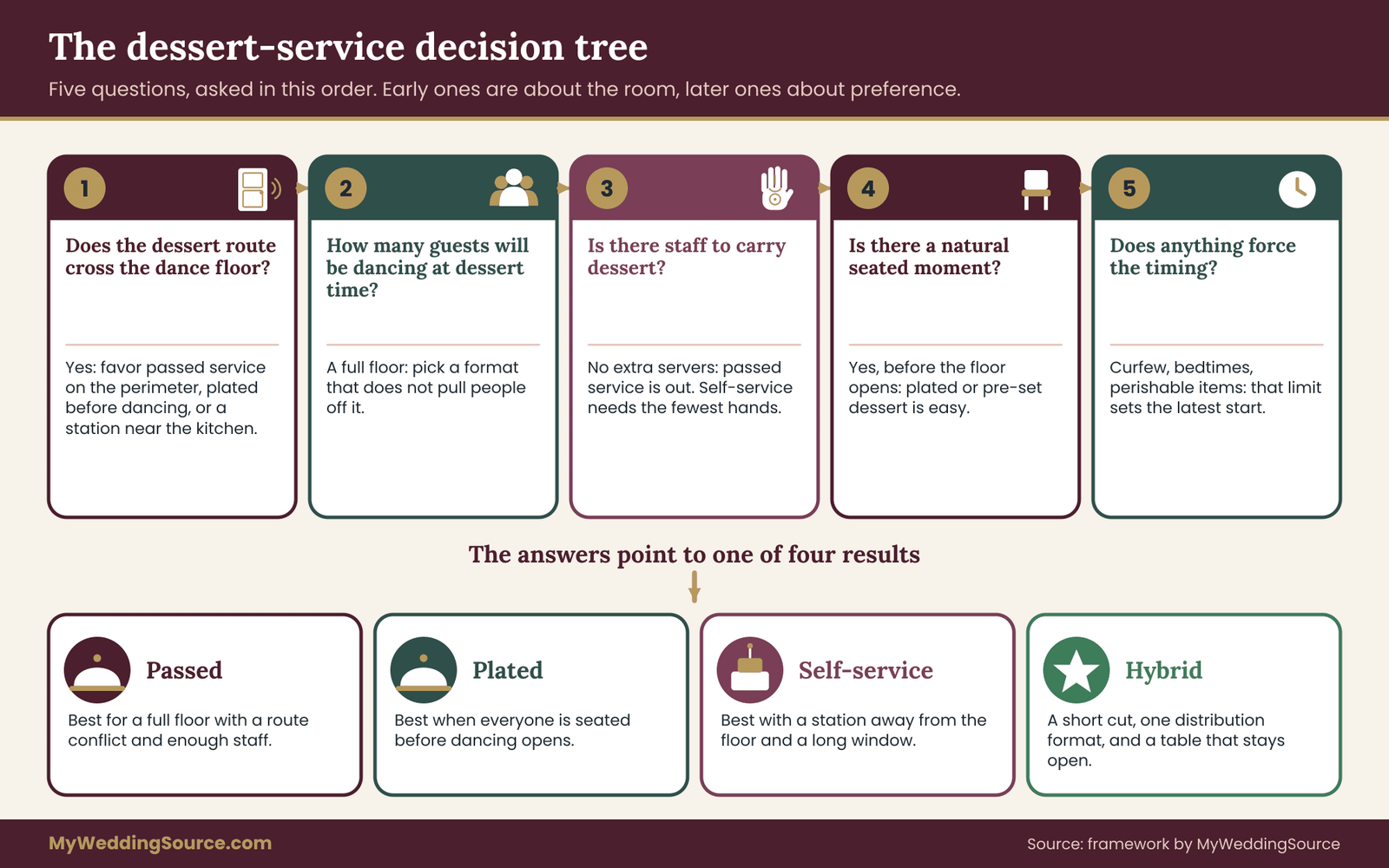
Question one: does the dessert route cross the dance floor? Look at your floor plan and trace the shortest path from where dessert comes out to the farthest table. If it crosses the dance floor, or if the only alternative is a long detour, you have a route conflict. A route conflict pushes you toward passed service on the perimeter, plated service before the floor opens, or a station placed on the same side as the kitchen. It rules out a single central display that everyone has to cross the floor to reach.
Question two: how many guests will be dancing when dessert starts? You cannot know exactly, but you can estimate from your guests and your music. A crowd that dances from the first song will have a full floor at any hour. A crowd that tends to sit through the evening will have a smaller floor that fills later. If you expect a full floor at dessert time, you want a format that does not pull people off it. If you expect a half-empty floor, you have more freedom.
Question three: do you have staff to carry it? Passed and plated service both need people. Ask your caterer how many servers are scheduled for the period after dinner, and whether that number can be raised. If the answer is that dinner staff leave after clearing, passed dessert is not available without a change to the contract. Self-service needs the fewest hands, though it still needs someone to watch the table and refill it.
Question four: is there a natural seated moment? A seated moment is any point where most guests are at their tables anyway, such as just after dinner, during toasts, or during a planned break. If one exists and the floor has not opened, plated service is easy. If dinner runs straight into dancing, plated dessert means interrupting the floor on purpose, which is rarely worth it.
Question five: does something force the timing? Look for hard limits. A venue that ends music at a set hour, a quiet-hours rule, a babysitter schedule, a cake that cannot sit out, a ceremony tradition that requires the cake to be cut at a particular point, or elderly guests who plan to leave early all count. A forced time can override the answers above, and it is better to find that out now than to discover it at nine o’clock.
How the answers point to a format
Use the answers to reach one of four results. The first is passed service, which is the safest choice for an active floor with a route conflict and enough staff. The second is plated service, which fits when there is a seated moment and the floor has not yet opened. The third is self-service, which fits when stations can sit away from the floor and a long service window is acceptable. The fourth is a hybrid, which combines a short ceremonial moment with a distribution format and a late-evening option, and which is what most active receptions end up using.
A useful rule of thumb is to default to the hybrid unless your answers clearly point to a single format. A hybrid sounds complicated, but it simply means the cake cutting stays short and ceremonial, while the actual serving happens by whichever method fits your room. The next sections cover each format in turn, and the worked example later shows a hybrid in detail.
What the tree does not decide
The wedding dessert service decision tree chooses a format. It does not choose a start time, because the start time depends on what the room is doing on the night. That is handled by a separate set of live signals, covered in the section on reading the room. It also does not decide how much dessert to order or what kinds to serve, which belongs to your menu and your baker. The wedding menu planning guide covers how to think about different ages and dietary needs across the whole menu, and the same thinking applies here.
Passed wedding dessert service while the floor stays busy
Passed wedding dessert service means servers carry small desserts on trays through the room and offer them to guests where they stand or sit. For an active dance floor it is the format that interrupts least, because the dessert goes to the guests instead of the guests going to the dessert. It is also the format that depends most on staff.
What passed dessert looks like in practice
The desserts are bite-sized or hand-held: mini tarts, small cups, cookies, truffles, slices cut small, or tiny versions of the cake flavors. They have to be eaten without a fork and a table, or with a small fork and a napkin, because guests are holding a drink, standing near the floor or sitting at a table with the dinner plates already cleared. Anything that needs a knife, a spoon and a flat surface belongs on a plate, not a tray.
Servers move in loops. One loop covers the perimeter tables. Another walks the edge of the dance floor, offering to people who step off for water. A third visits the bar and the lounge area. The best loops are designed ahead of time so that two servers do not offer the same tray to the same table while another table is skipped.
The route is the plan
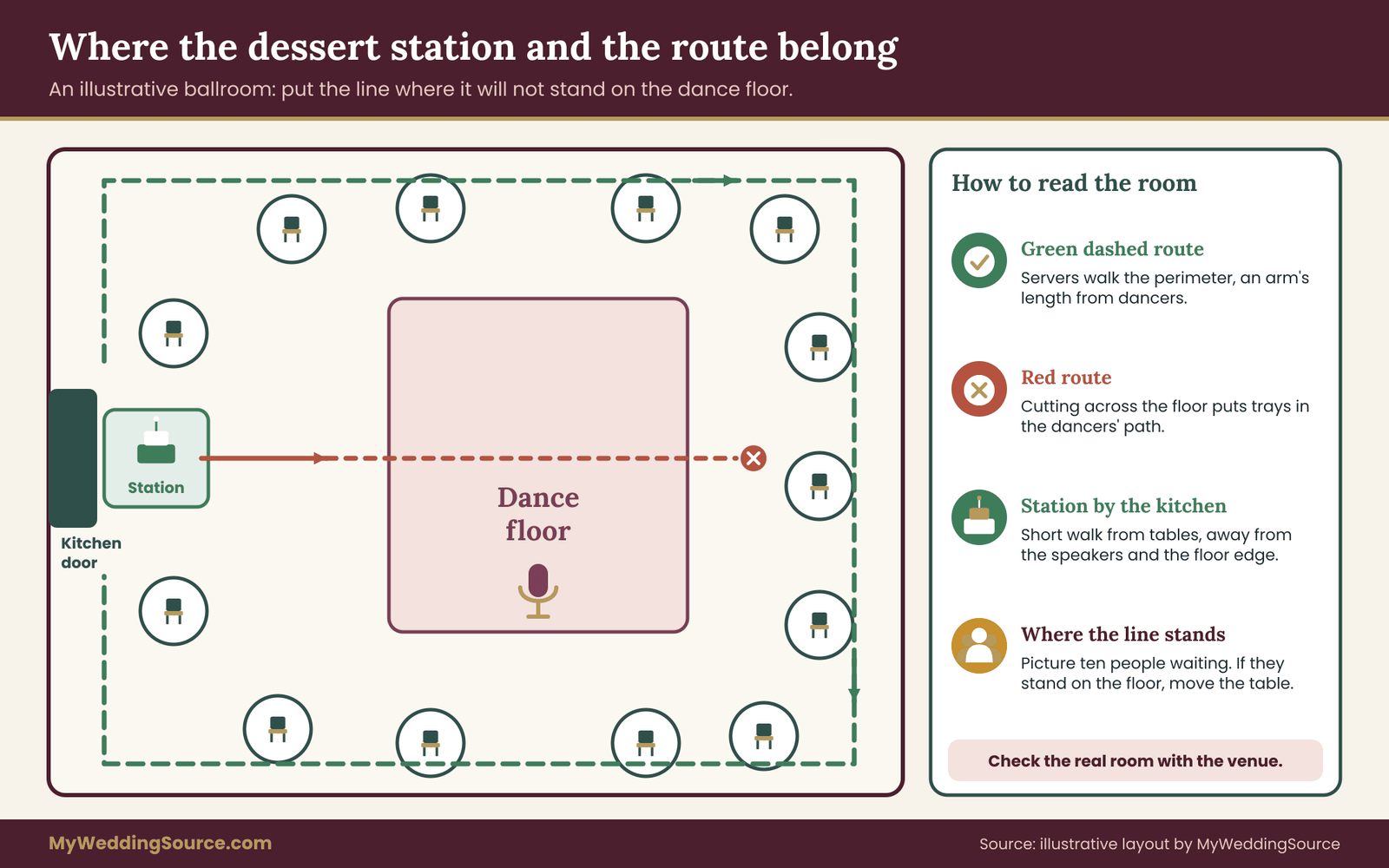
Because passed service lives or dies on movement, the route matters more than the menu. When you walk the room with your caterer, mark three things on the floor plan. First, the path from the kitchen or pantry to the nearest table, so the first tray gets out fast. Second, the path that stays at least an arm’s length from the edge of the dance floor, so that dancers who spin or step back do not collide with a tray. Third, a path that returns to the kitchen without passing through the busiest part of the room.
That second path is the one most often missed. Dancers do not look behind them. A server carrying a tray of small cups at shoulder height near a fast song is a hazard to the server and the dessert. Ask your caterer how their staff are trained to approach a full floor and whether they recommend keeping trays low and offering only at the edge. Do not try to assign the exact behavior yourself. Caterers handle this every week, and the right answer depends on their equipment and your room.
How many servers, and for how long
Staffing is where most passed wedding dessert service plans go wrong. A dessert pass takes more servers than it appears to, because each server can only visit so many guests per minute and every tray has to be refilled from the kitchen. There is no universal number to quote. A reasonable way to work it out is to ask the caterer for a ratio they use for passed items at an event of your size, then ask whether dessert passing counts as a separate service period with its own staffing.
Also ask how long a pass lasts. Some caterers will do a single wave of about twenty minutes. Others will do two shorter waves with a gap. Two waves suit an active floor well, because a guest who is dancing during the first wave can be reached in the second. If your contract only covers one wave, find out what a second would cost before you decide you do not need it.
Pace and the music
Passed dessert works best when the DJ or band plays a stretch that keeps the room relaxed but not empty. A medium-tempo block lets dancers drift to the edge for a bite and drift back. A loud, fast block means servers struggle to be heard and guests do not want to stop. You do not have to schedule dessert to a specific song. You do need the DJ to know that a dessert pass is under way, so they do not cut the music or announce a sudden change halfway through.
A short script to give your DJ or bandleader might read: “Servers will start passing small desserts at around the time we agreed, for about twenty minutes. Please keep the energy medium for that stretch and do not announce it over the music. If the floor is packed, we would rather start a few minutes later than clear it.”
What passed dessert costs you
Passed dessert trades floor protection for labor and some waste. The labor shows up as extra service hours or extra staff. The waste shows up because passed items are made in larger numbers than a plated dessert for the same guests, since not everyone takes one and some take several. Ask your caterer or baker how they estimate quantities for passed sweets, and ask what happens to unserved items. Some may be able to move them to a station, which leads to the next format. The full details on pricing belong in your contract, and the vendor section later in this guide lists the questions to ask.
When passed wedding dessert service is the wrong choice
Passed service is a poor fit in a few cases. If the room is very crowded and narrow, trays cannot move safely. If the dessert requires cutlery and a plate, passing it gets messy. If your caterer cannot add staff, a thin pass leaves some tables unserved and creates a feeling of being forgotten. And if you want a deliberate toast with the cake, a pass will not give you the shared moment. In those cases, one of the other formats, or a hybrid, is better.
Plated wedding dessert service before the floor opens
Plated wedding dessert service means each guest receives a finished dessert at their table, usually from the same servers who delivered dinner. It feels formal and orderly, and it is the format that gives every guest the same experience. For an active dance floor, its weakness is that it needs everyone seated. Its strength is that it can be done at a moment when everyone already is.
The natural window
The best window for plated dessert is the seated stretch right after dinner, when guests are still at their tables, toasts may be happening and the dance floor has not opened. In that window, dessert is part of the dinner block and takes no time from the dancing. If your timeline has the first dance, parent dances and toasts after dinner, dessert can be served during or just after the toasts, so that when the music opens, plates are already cleared.
That timing has a cost. It means dancing starts later than it would if dessert were skipped or moved. For some couples that is fine. For others, especially those who want a long dance block, it is a real trade, and one of the other formats is worth considering.
What goes wrong with plated dessert on a full floor
If plated dessert is scheduled after the floor opens, three things happen. Servers have to find guests who have left their tables. Plates sit at empty seats. And the dessert gets cold or warm in the wrong way. The service that was meant to feel gracious ends up looking like a mistake, because servers are weaving through dancers to reach the tables.
Some couples solve this by calling guests back to their seats with an announcement. That works once, but it is the same stop-the-music problem described earlier, and it often costs more dance time than the dessert does. If you are set on plated service after dancing starts, ask your caterer whether they can hold dessert in the kitchen and serve only guests who have returned, or whether they would prefer to serve a pre-set sweet that is already on the tables.
The pre-set dessert option
A smaller version of plated service is a pre-set dessert, a small sweet placed at each setting before guests sit down, or brought out with the coffee. A pre-set item reaches everyone without an additional service round, and it removes the timing problem, because it is already there when guests arrive. It works well for things that hold up at room temperature, such as a small cookie, a wrapped confection or a covered cup.
The trade-off is that pre-set items are modest. They are a courtesy, not a showpiece. Couples who want a real dessert course often combine a pre-set sweet with a later station or a passed round, which turns the dessert into the hybrid described earlier.
Coffee and the dessert course
Coffee and tea often travel with plated dessert. If you plan a coffee service, decide whether it comes with the plates, afterward, or at a station. A coffee station is easier to place away from the floor and does not require servers to carry hot drinks near dancers. A hot drink carried across a full floor is a good reason to use a station. If your caterer insists on tableside coffee, ask them to time it for the seated window too.
A short checklist for plated service
When you choose plated dessert, confirm these points with your caterer in writing. The seated window and its approximate start and end. How many servers will handle dessert. Whether plates are prepared in advance or plated to order. How servers will treat empty seats. Who clears plates and when. And what happens if the toasts run long, since dessert often gets held until the last speaker finishes. If the speeches overrun, the whole plan slides, so ask what the caterer will do and who gives the signal to start.
Self-service wedding dessert service that stays clear of the floor
Self-service wedding dessert service means guests walk to a table or station and take dessert themselves. It is the lowest-staff format, it gives guests control, and it can run for a long time. For an active dance floor it has one big advantage and one big risk. The advantage is that nobody has to be seated or interrupted. The risk is that the line forms in the wrong place.
Where to put the table
The location of a dessert station decides almost everything in self-service wedding dessert service. A station on the far side of the dance floor from most tables forces guests to cross the floor, and people who are walking through dancing couples are both slowed and in the way. A station right next to the floor draws a crowd of people watching the dancers, which blocks the floor edge. The better position is usually along a wall near the kitchen side, a short walk from the main tables, and away from the DJ speakers so that people can talk.
If the room is large enough, two smaller stations beat one large one. They halve the line and split the room. If the room is small, one station in a corner or an alcove can work. What matters is that the queue has somewhere to go that is not the dance floor, the bar queue or the exit route. Look at the room on the day with a picture of a line of ten people standing in front of the table. Where do they stand? If the answer is on the dance floor, move the table.
The line and the pause problem
A self-service line has a surprising effect on a dance floor. When a dessert table opens, a wave of guests leave the floor together, because dessert feels like a limited event. They return at about the same time, which means the floor empties and fills in a rhythm that the DJ then has to manage. You can soften that wave by opening the table before dancing peaks, by keeping it open for a long window, and by staggering the cue. A table that is simply there, without an announcement, draws a trickle. A table announced over the microphone draws a rush.
For that reason, a quiet opening works better than a loud one for an active floor. Place a small sign, let the staff or a friend tell nearby tables, and let the DJ mention it once in passing. Signs are a form of announcement that do not stop the music. The principles for wedding signs, including readability and placement, are covered in the signage system guide. If you use a sign for the dessert table, it should be readable from a short distance, say what is on offer, and note common allergens if your caterer provides that information.
Staffing a self-service table
Self-service does not mean unstaffed. Someone has to refill the table, remove empty trays, replace used spoons and keep the area clean. Someone also has to watch for spills, which on a dance floor edge are a slipping hazard. Ask your caterer whether a server is included at the dessert table. If it is not, decide whether a friend or family member will take that role, and if so, tell them in advance and give them a short list of what to do. A dessert table with no one watching it quickly becomes a mess, and sticky patches near the floor are the kind of problem that stops dancing.
If the table includes items that require cutting, such as a sheet cake or a tart, someone has to cut and plate. That is an argument for pre-cut portions. Pre-cut items move faster and keep the line from stalling. If you want a display cake that looks whole, ask your baker or caterer whether a back-up sheet cake can be kept in the kitchen for serving while the display stays intact.
Food handling at a station
Some desserts need cold or warm handling, and a station may be out for a long time. This is a safety and quality question that belongs to your caterer, not to you. Ask how they keep items cold or hot, how long they leave items out before replacing them, and whether they replace trays instead of topping them up. Do not assume a number. The caterer follows local health rules and their own procedures, and the answer will depend on what is being served. The federal food safety pages in the sources give general background, but the caterer and the local health department set the actual rules.
When self-service wedding dessert service is the right fit
Self-service suits receptions where guests are mixed in age and comfort, where the room has space for a station away from the floor, and where the couple wants dessert to be available over a long stretch instead of at a single moment. It is also the usual choice when the caterer’s staff is limited. It is less suited to a very formal event, to a room with no good place for a station, or to a crowd that tends to ignore anything not delivered to them.
Cake cutting without stopping the party
The cake cutting is the one piece of dessert that is meant to be seen. It needs an audience, a photographer in position and a short pause in the music. The aim is not to avoid the pause but to make it brief, planned and well placed. A cake cutting that takes four minutes on a good plan can take twenty on a bad one.
Keep the ceremony separate from the serving
The most useful move in wedding dessert service is to separate cutting from serving. Cutting the first slice is a photo moment that lasts about as long as a song’s opening bars. Serving the cake to two hundred guests is a distribution job that takes much longer and should not hold the room still. Once the couple has made the first cut, the cake goes back to the kitchen or to a side table, and the caterer or baker cuts and serves in the background by whichever format you chose.
This separation is how a hybrid gets its shape. The ceremonial moment is brief and centered. The distribution is spread out and quiet. If your cake is a display piece that is not going to be served in full, the baker may provide a smaller cake of the same flavors in the kitchen, which means the guests get what they expect while the display stays intact.
Pick the moment with the floor in mind
Where in the evening should the cut happen? A few options come up often, and each has a different effect on the dance floor.
Right after dinner, before dancing opens. The room is seated and attentive, the cut costs almost nothing and the floor opens afterward with a clean start. This is the easiest option and the one that protects dancing most, though it means the cake appears before the party has built up.
During a planned break in the music. If your DJ or band has a scheduled pause, such as a set change, the cut can sit inside it. This costs no dance time. It does depend on the break existing and on the timing of the cake being flexible enough to meet it.
Between two dance blocks. The cut sits between a high-energy set and the next one, with a brief slow song to gather people. This is a good spot if the floor has had a long stretch and people want a rest anyway. It works best when the cue is short and the next block starts right away.
Late in the evening. Some couples cut the cake near the end, as a send-off. The room is often half-empty by then, and the cut has a small audience, but the floor loses nothing. If you want the cut to be seen, this is a risky choice.
The ninety-second sequence
A simple sequence keeps the pause short. It runs in four steps, and each has an owner.
First, a cue. Thirty to sixty seconds before the cut, the coordinator tells the photographer, videographer and DJ that the cut is next. Second, a gather. The DJ plays a short, recognizable song and says one sentence: where the cake is, and that guests are welcome to come closer. Third, the cut. The couple makes the cut, the photographer gets two or three frames, and there is applause. Fourth, the release. The DJ moves straight into the next song, the cake leaves the floor, and the room is invited to dance again.
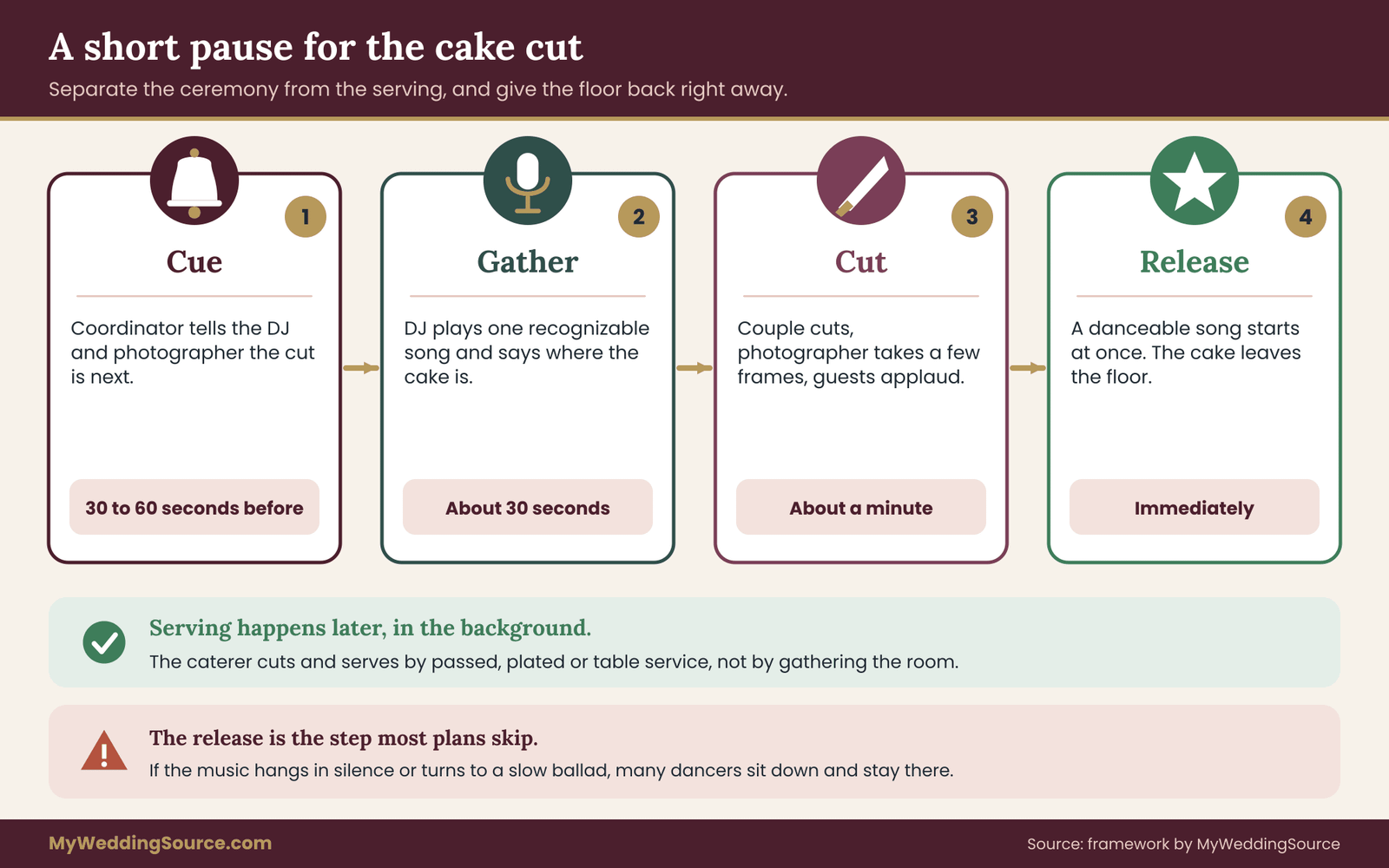
The release is the step that most plans skip, and it is the one that keeps the floor. If the music returns at once and at a high energy, many guests simply turn and keep dancing. If the DJ lets silence hang, or starts a slow ballad, guests drift to their seats. Tell your DJ that the first song after the cut is a dance song, not a wind-down.
Where to place the cake
A cake placed at the edge of the dance floor, on the kitchen side, is visible, easy to reach and easy to remove. A cake in the center of the floor blocks it. A cake on the far side of the room requires guests to cross the floor to see it.
The best position is a spot where the couple and the cake can be seen from most tables and where there is enough clear space around it for photographers to move. Ask your venue about the table, the power and the floor load for the cake stand well before the day, because the venue knows what its floors and tables can bear.
Lighting and sound at the cut
A spotlight or a change in lighting is a strong signal that something is about to happen. It also tells the dancers that the party is pausing. If you want to keep the floor, use a gentle approach: a small light on the cake table, not a full room change. Ask your DJ or lighting provider whether they can add a light on the cake without darkening the floor. Many can. Sound is the same. A short mic announcement is enough. A long toast belongs in the toast block, not here.
If a toast goes with the cake
Some families tie a toast to the cake. If that is your plan, put the toast in the seated block, not at the cut, and keep the cut itself to the sequence above. A toast needs silence and attention, which the dance floor does not provide. If you try to combine them, you will lose the floor and probably the toast too. The separate topic of timing toasts around a plated dinner has its own guide on the site, and the same principle applies: do the speaking while people are already seated.
Reading the room: live signals for wedding dessert service timing
The wedding dessert service decision tree chooses a format. It cannot choose the exact minute, because the exact minute depends on what is happening in the room. That is where live signals come in. They are a short list of things the person in charge watches for, and each one points to a go, hold or pause decision.
Three signals
The first signal is floor density. If the dance floor is full and the people on it are not looking around, the room is at a peak, and a dessert cue will cost you. If the floor is thinning, with people leaving to the bar, the restroom or their tables, the room is in a natural lull, and dessert will fit.
The second signal is music energy. A high-energy block with a loud, fast song is not the time for a dessert pass or a station opening. A medium or slow block is. If the DJ or band is about to shift to a slower stretch, that is the window. Ask your music provider to tell the dessert owner when a slower stretch is coming.
The third signal is seated count. If a large share of guests are already at their tables, a plated or table-side service will land well. If most guests are standing, passed or station service is a better fit. Seated count is easy to read at a glance: look at the tables.
Go, hold and pause
Use these three states as shorthand for wedding dessert service. Go means that at least two of the three signals are favorable: the floor is thin, the music is medium or slow, or many guests are seated. Start the planned dessert action. Hold means that the signals are mixed, such as a full floor with a medium song. Wait five or ten minutes and look again. Pause means that the signals are unfavorable, such as a full floor and a loud block, and that the plan should slide. Tell the caterer and the baker that the cue is delayed, and give them a new estimate.
A hold or a pause is not a failure. It is the plan working. The failure is a plan that has no way to slide, so the dessert comes out on a printed time no matter what the room is doing.

Who watches the signals
One person has to watch them, and it should not be the couple. A coordinator, a catering captain or a trusted friend with a clear instruction can do it. That person needs three things: a copy of the dessert plan, a way to reach the caterer and the DJ, and the authority to say “go,” “hold” or “pause.” If the venue provides an event manager, ask whether they can take this role. If you hire a planner or day-of coordinator, it is part of their job.
If you have no one, the next best option is to assign the role to the DJ or bandleader, who already watches the floor. Be clear about what you are asking, because the DJ’s main job is the music. They can signal when the floor is at a peak or a lull, but someone else has to tell the kitchen.
A window, not a time
For wedding dessert service, on the printed schedule, write a window, not a single time. For example, “dessert window: between the second and third dance blocks, with an earliest start and a latest start.” The earliest start protects your caterer and baker, who need to know when the kitchen has to be ready. The latest start protects the guests, who may have a long drive home. A window gives the coordinator room to use the signals, and it gives the vendors a range they can plan around.
The limit of live signals
Live signals do not override hard limits. If the venue ends amplified music at a set hour, if a babysitter is leaving or if a perishable dessert cannot wait, then the latest start in the window has to be real. Decide that boundary before the night and share it with the coordinator, so the group does not push the dessert past the point where it stops working. The decision tree’s fifth question, about forced timing, is the place where you set it.
A worked example of wedding dessert service in one reception
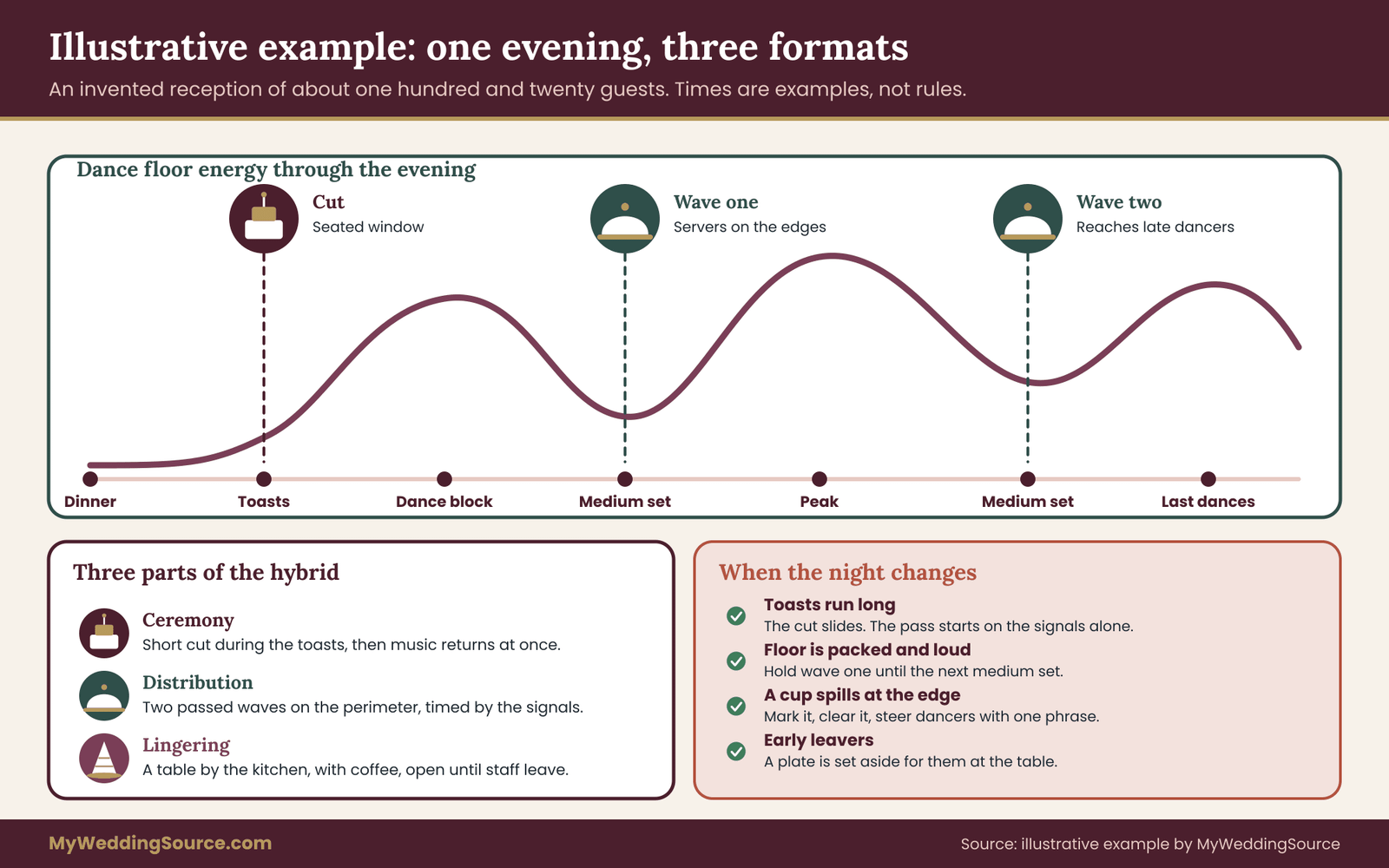
Numbers and names below are invented for illustration. They are not benchmarks, and your room, caterer and crowd will differ. The point is to show the decision tree and the live signals working together on a single evening.
The setting
Tamsin and Luis are planning a reception for about one hundred and twenty guests in a hotel ballroom. The room is a rectangle. The dance floor sits in the middle of the long wall, with round tables around three sides. The kitchen door is at one short end, and the bar is at the other. The DJ is on the far long wall behind the floor. Their guests include many cousins who like to dance, a few older relatives who plan to leave after the cake, and a handful of children who will be tired by nine.
They want a three-tier cake for the photo and the cut, a mix of small desserts for guests, and no long pause in the dancing. They ask the caterer for a staffing quote for dessert and ask the venue for the quiet-hours rule. The venue’s music ends at a set time, and the caterer’s dinner staff are scheduled to stay through dessert but not beyond.
Running the decision tree
Question one, route. The kitchen door is at one end, and the farthest tables are at the other. The shortest path crosses the dance floor, and the long way runs along the short wall and the bar side. Result: there is a route conflict, so a perimeter route is needed, and a station should sit near the kitchen end.
Question two, floor at dessert time. The cousins will fill the floor early. Expect a busy floor from the first song after dinner. Result: protect the floor.
Question three, staff. The caterer can add two servers for a dessert pass but not a full plated round. Result: passed service is possible in two short waves.
Question four, seated moment. There is a short seated stretch during toasts after dinner, but it ends when the dancing opens. Result: a seated window exists but is brief, and the cake cut can fit there.
Question five, forced timing. The older relatives plan to leave after the cake, and the venue’s music ends at a fixed time. Result: the cut should happen early in the evening, and a dessert option should remain open until near the end.
The plan that comes out
The answers point to a hybrid wedding dessert service with three parts. For the ceremonial moment, they cut the cake at the end of the toasts, during the seated window, before the dance block starts. The cut follows the ninety-second sequence: a cue, a short gather, the cut, and an immediate dance song. The cake goes to the kitchen and is cut in the background.
For distribution, the caterer passes small desserts in two waves. The first wave starts at the opening of the first dance block, once the music has moved into a medium-tempo stretch. The second wave starts later, after the high-energy peak, to reach people who were dancing the first time. Servers use the perimeter route and stay out of the floor’s edge.
For the lingering option, a dessert table opens near the kitchen end after the first wave. It holds the pre-cut cake and a few extras, with a small sign. It stays open until the caterer’s staff leave. A coffee station sits next to it, so hot drinks do not travel across the floor.
What the coordinator watches
The coordinator is a friend of the couple who has agreed to take the role and has a copy of the plan. At the end of the toasts she checks the signals: guests are seated, the floor has not opened, and the music is quiet. She tells the DJ and the photographer that the cut is next. The cut takes a little over a minute. The DJ starts a danceable song, and the floor opens.
Twenty minutes later she checks again. The floor is full and the music is loud. The signals say pause, so she tells the caterer to hold the first wave. Ten minutes later the DJ moves into a medium-tempo set. The floor thins slightly. She signals go. Servers begin the first wave at the edges of the floor. The second wave begins about forty minutes after that, when the DJ confirms another slower stretch.
What goes wrong, and how the plan absorbs it
On the night, the toasts run long. The cut, which was meant to happen at the end of the toasts, slides by fifteen minutes. Because the plan has a window and not a time, the coordinator tells the caterer the new estimate and the kitchen cuts the cake later. The older relatives, who planned to leave after the cake, are told ahead that a dessert will be set aside for them at the table. The pass does not depend on the cut, so the first wave begins on the signals alone.
A cousin knocks over a cup near the edge of the floor, and a server places a cone over the spot and clears it. The coordinator asks the DJ to steer dancers away for a moment, using a short phrase and no full announcement. The floor continues.
None of these events required a rewrite. The plan had a window, a hybrid format and a named owner, and each of these made a small problem stay small.
What this example does not prove
The example is not evidence that the plan will work in your room. It shows how the pieces fit. A different room, a different caterer or a different crowd would give different answers to the five questions. If your venue has a hard rule about where food may be placed, or about how close a station can be to an exit, that rule beats the plan. Always check venue and local requirements first, and use the plan inside them.
Staff, vendors and contracts for wedding dessert service
A wedding dessert service plan only works if the people carrying it out know what it is. Most failures come from assumptions between vendors, not from bad ideas. This section lists what to confirm, with whom, and how to write it down.

The caterer
The caterer is usually the center of the wedding dessert service plan, because they own the service staff, the plates and the kitchen. Ask them these things, and ask for the answers in writing, either in the contract or in an email that you save.
How many servers are scheduled after dinner is cleared, and can that number rise for a dessert pass? Is dessert passing a separate service period, and does it carry a separate charge? Who cuts and plates the cake, and is there a cake-cutting fee? What does the caterer need from the baker, such as a cutting guide, and who supplies the knives and plates? How do they hold and serve items that must stay cold or warm? How do they treat items left over from a pass or a table? And what do they need from you to start, such as a cue from the coordinator?
Cake-cutting fees are common and vary by vendor and region. Do not assume one is or is not included. Ask directly, and ask what it covers.
The baker
If the baker is separate from the caterer, they own the cake and anything they deliver with it. Ask when the cake arrives, where it is placed, and who receives it. Ask for a cutting guide, which explains how to slice the tiers into servings. Ask whether the baker can supply a kitchen cake or extra sheet pieces so the display cake need not be cut. And ask how long the cake can sit at room temperature in your type of room, since it depends on the filling and the icing. The baker’s answer is the one to follow, not a general rule.
The DJ or band
The DJ or bandleader needs to know three things: when the dessert window opens and closes, what you want announced and what you do not, and how to signal that the floor is at a peak or a lull. A short written note works better than a conversation. Include the first song after the cut, and the instruction to keep the energy medium during a pass. The dessert note belongs in the same document as the rest of the music plan.
The venue
The venue owns the room and the rules. Ask where a dessert table may be placed, whether there are restrictions on food stations, open flame or sparklers near the cake, and what the rules are about candles. Ask about quiet hours and the end time for amplified music, and about any rule on where staff may carry trays. Ask who sets up the table and who clears it. If your venue has an event manager, ask for the names of the people who will be there on the night and how to reach them.
The planner or coordinator
If you have a planner, the dessert handoff belongs on their run-of-show, with the window, the signals and the owner. If you do not, assign a person. Give them a one-page plan with the window, the order of events, the phone numbers of the caterer, baker and DJ, and the authority to give the cue. The broader approach to vendor scheduling is covered in the wedding vendor timeline, and the dessert plan should fit into it.
A short email to send
A useful email to the caterer might read: “We are planning a short cake cut and then passed desserts in two waves with a dessert table afterward. Could you confirm how many servers will be available after dinner, whether passing dessert counts as a separate service period, whether there is a cake-cutting fee, and who gives the cue to start? We would like a coordinator to signal go, hold or pause based on the dance floor.”
Save the reply. If something changes later, you have a written record of what was agreed.
Safety, venue rules and weather for wedding dessert service
This section covers the parts of dessert planning where someone else’s rules decide the answer. It does not give limits, times or capacities, because those depend on your venue, your caterer and your local authority. It does tell you what to ask, who to ask, and where the general background sits.
Food handling belongs to the people who prepare the food
Desserts range from shelf-stable cookies to cream-filled pastries, frozen items and cakes with fresh fruit or custard. Each has different handling needs, and wedding dessert service has to respect them. The federal food safety agencies publish general guidance on keeping food at safe temperatures and on how long perishable food should stay out, but a general page is not a ruling on your cake. The caterer or baker knows what is in the dessert, how it was made and how it should be held.
Ask three plain questions. Which of the items in our dessert plan need to stay cold or warm? How will they be kept that way while they are on a tray, at a station or on a display? And how will you decide when to replace or remove an item? A good caterer answers these without hesitation, and the answer tells you whether the plan is realistic. If an item is not suited to a long service window, the plan can change: a shorter window for that item, a smaller batch brought out in rounds, or a different item.
Do not publish or repeat a universal rule about how long dessert can sit out. The correct window depends on the item, the room temperature and the local health code. Treat any number you read online as background, not as an instruction.
The dance floor edge is a slip risk
Sugar, frosting, cream and drinks make floors slippery. On a dance floor they also move: shoes carry a sticky spot across the boards in seconds. The practical response is simple, and it applies to every wedding dessert service format. Keep dessert activity at the floor’s edge to a minimum, give servers a way to mark and clear a spill fast, and ask the venue where cleaning supplies are kept and who is responsible.
Ask your caterer whether staff carry a small kit for spills, and whether they have a rule against carrying open drinks across the floor. Ask the DJ or coordinator to have a phrase ready that steers dancers away for a moment without a full announcement. Workplace safety guidance from the federal occupational safety agency covers slips and falls generally, and the venue’s own staff will know how they handle it.
Crowding, aisles and exits are the venue’s call
When a dessert table or a line is placed, it takes up space, and in a crowded room that space can end up in a walkway. Aisles, doors and exit routes are regulated, and the rules differ by building and by local fire authority. You cannot decide this yourself and you should not guess.
Before the day, show the venue’s event manager the planned location of every station, the cake table and any display, and ask whether each position is acceptable. Ask them to mark it on the floor plan. If the venue changes a position on the night, accept it. A table that blocks a doorway is a bigger problem than a line that forms in a slightly inconvenient place. Standards bodies such as the National Fire Protection Association publish codes that local authorities may adopt, but the venue and the local fire official are the ones who apply them to your room.
Candles, sparklers and flame
If your plan includes candles on the cake, sparklers, flambé or any open flame, check with the venue before you assume it is allowed. Many venues limit or ban open flame, require a particular distance from fabric, or require their own staff to handle it. A sparkler that is acceptable outdoors may be prohibited in a ballroom. If the venue says no, ask what substitute it allows, such as battery candles or a lit sign.
Power, lighting and equipment
Dessert stations often need power for coffee urns, warmers, chillers or display lights. Extension cords across a walkway are a trip hazard. Ask the caterer what power they need and where, and ask the venue where outlets are and who may use them. If a chilled display requires power, confirm that the circuit can carry it, and ask what happens if it fails. A backup plan can be as simple as a cooler of ice in the kitchen.
Weather and outdoor dessert service
If wedding dessert service is outdoors, weather becomes part of the plan. Heat affects frosting, chocolate and cream. Wind scatters napkins and light items. Rain forces a move indoors, and a move indoors changes the route, the line and the floor. A hot afternoon is a different problem from a cool evening, and a tent is a different problem from an open lawn.
The National Weather Service publishes safety guidance on heat, lightning, wind and storms, and it is a reasonable place to read about the risks. For your own event, check the forecast in the days before, and agree with the caterer and venue on a decision point: a time by which you decide whether dessert stays outside or moves in. Also agree on who decides. A rain plan that nobody has authority to call is not a plan.
A heat plan can be short. Keep desserts in the shade or inside until needed. Bring out smaller rounds instead of one large display. Use sturdier items when the day is hot. Ask the baker what the cake and filling can handle, and follow their guidance, not a general rule.
Accessibility and the route
A wedding dessert service plan should be usable by guests who use a wheelchair, a walker or a cane, or who find crowds hard. That affects table height, the width of the route, and the surface under the line. A station that can only be reached through a crowd or over a cable is not accessible, and a line that forms on the dance floor is hard for anyone with limited mobility to join. The federal accessibility guidance listed in the sources describes general principles, and your venue will know how its own space measures up.
A simple fix is to offer service to the table for guests who ask. Tell the caterer that you want servers to bring dessert to anyone who cannot reach the station, and mention it to the older relatives and anyone else in your group who may prefer it. This does not require a special plan. It requires a sentence in the instructions.
Alcohol and dessert
If your reception serves alcohol, the bar and the dessert plan interact. A dessert station near the bar can crowd the bar line. Passed dessert reaches guests who are not near either. If the bar closes at a set time, the dessert window should not depend on it. For the bar side, see the site’s wedding bar service planning guide. One point worth sharing with the coordinator is that a dessert and coffee station late in the evening gives guests something to do besides drink, and some couples find it useful for that reason alone.
When someone gets ill or hurt
An emergency is rare, but plan for one in the sense that the coordinator knows who to call. If a guest reports an allergic reaction, a fall or a sudden illness, the coordinator should know the venue’s contact, how to reach staff and where the nearest exit is for an ambulance. A dessert plan does not cause these events, but a clear owner makes the response faster. If you have guests with severe allergies, tell the caterer well before the day so they can separate and label items. The next section covers that in more detail.
Guests who need something different, and other edge cases
A wedding dessert service plan that works for a typical guest can fail for the ones who matter most to you. This section covers the guests and situations that are easy to forget.
Allergies and dietary needs
Allergies are the most serious. A guest with a nut, dairy, egg, gluten or other allergy may not be able to eat a shared dessert table safely, because items touch, utensils cross and labels may be wrong. Self-service is the hardest format for this, since you cannot control what a guest picks up or how a serving spoon travels.
The caterer and the baker must lead here. Tell them the allergies you know about well in advance, ask what they can prepare separately, and ask how they label and serve it. Many caterers can plate an allergy-safe dessert in the kitchen and bring it directly to the guest, which sidesteps the table entirely. If that is the answer, ask who will deliver it, how the guest will know it is theirs and what the signal is. Do not rely on a sign or a verbal assurance alone.
For guests who avoid gluten, dairy, eggs or animal products by preference or belief, the stakes are lower but the courtesy matters. A small number of clearly labeled alternatives is better than a long list that nobody trusts. The same thinking you apply to the rest of the menu applies here too.
Children
Children want dessert early and have little patience. A late dessert for a child who has been up since morning is a recipe for tears. If you have many children, consider a small dessert for them near the end of dinner, a separate table near the children’s seating, or a note to the caterer to serve children first in a plated course. Children also move fast near a dessert table and are the most likely to drop something or run across the floor edge. Ask parents to guide them, and ask a friend or relative to watch the table.
The dance floor is also a place where small children play, and dessert in a small hand near a busy floor is a spill waiting to happen. A kids’ area near the dessert table, away from the floor, solves several problems at once. Your approach to care for children and older relatives more generally is covered in the guest care planning guide.
Older relatives and people who leave early
Older guests may tire early, find a standing line hard, or leave before the cake. If you know that a group plans to leave after a certain point, serve them first or set a plate aside. A small note to the caterer, such as “table nine will leave after the cake; please serve them as soon as the cut is made,” is enough. It is also kind to take a photo with them before they go, since they may miss the dancing.
For guests who cannot stand in a line, tableside service is the answer. A caterer can carry a plate to a table without a special request, as long as someone asks. A line of people with walkers at a dessert table is a design failure, not a guest problem.
Guests who want a doggie bag
Some guests want to take dessert home. This is common and easy to handle if you plan for it. Ask the caterer whether they can provide small boxes or wrap pieces at the end of the night, and who will do it. If you have a dessert table with leftovers, decide in advance what happens: does the caterer take it, does the venue, or do you?
Ask about food handling for items taken home, since they will be eaten later, and ask the caterer for any guidance they give. A pre-wrapped sweet as a favor is a simpler version of the same idea, and it fits well with a quiet dessert plan.
Late-night sweets
Some couples add a late-night snack, such as cookies, donuts, or a second sweet, near the end of the evening. It can restore energy on the floor and give guests something to carry home. It is also another service event with its own staffing and timing. If you include one, treat it like the lingering option: keep it quiet, put it near the exit or the kitchen side, and let the DJ mention it once. Do not stop the music for it.
If the schedule slips badly
Sometimes the evening runs far behind. Dinner takes longer, the toasts overrun, or a delay at the start pushes everything. When that happens, the dessert plan has to shrink, not stretch. Decide in advance what gets cut first. A sensible order is to drop the second passed wave, then the late-night snack, then the formal cut, and keep the table open. The table is the cheapest to run and the most flexible, so it is the last to go. Tell the coordinator this order before the night, so that nobody has to make the decision under pressure.
If the cake is a surprise to the room
A few couples want the cake to be a surprise or a moment of theatre, with a reveal, a flourish or a performance. That is possible, and it can be done without losing the floor, but it is the most demanding version of the ceremony. It needs rehearsal, a clear cue and a team that knows what is happening. If you want it, tell the DJ, the photographer and the caterer early, and keep it short.
If you are not sure at all
If you read the decision tree for wedding dessert service and still cannot choose, pick the simplest option that fits your room: a short cut, a dessert table near the kitchen side, and a coordinator who can hold or go. Add passed service only if the caterer can supply the staff. You can always add a layer. It is harder to remove one once the plan is printed and the vendors are booked.
Your next steps
Work through these wedding dessert service steps in order. Each takes about as long as a phone call or a short email.
- Sketch the room. Draw the dance floor, tables, kitchen door, bar and DJ position, and trace the dessert route from the kitchen to the farthest table. If you do not have a floor plan, ask the venue or caterer for one.
- Answer the five questions. Write down your answers to the route, floor, staff, seated-moment and forced-timing questions, and note which format they point to.
- Choose the shape. Decide how the ceremonial cut, the distribution and the lingering option will work. For most active receptions, that is a short cut, a passed round or two, and a table that stays open.
- Send the vendor emails. Ask the caterer, baker, DJ and venue the questions in the vendor section, and save every reply.
- Name the owner. Choose one person to watch the signals and give the cue, and give them a one-page plan with a window and phone numbers.
- Set the window and the slide order. Write an earliest and latest start, and decide what gets cut first if the schedule slips.
- Walk it on site. If you can, visit the room with your caterer or coordinator and walk the route. If a venue walkthrough is already planned, add dessert to it, and read how it fits into the whole evening in the site’s guide to reception guest flow.
- Brief the team a week before. Send a short note to everyone with the window, the sequence and the first song after the cut, and confirm the final guest and dietary counts.
If your wedding dessert service plan feels bigger than the reception it supports, shrink it. A short cut and a dessert table is a complete plan, and a quiet room with a good cake is better than a complicated plan that nobody can run.
FAQ
How early should I plan the dessert format?
For wedding dessert service, decide the format when you finalize the floor plan and the caterer contract, usually a few months before the wedding, because staffing and service periods are priced into the contract. Waiting until the last few weeks leaves little room to add servers or change a station. You can fine-tune the window and the signals later, but the format and the staffing are best settled early.
Do I have to stop the music for the cake cutting?
You need a brief pause, but not a long one. A short cue, a gather of about a minute, the cut and then a danceable song is usually enough. The music can stay low during the cut and return at once afterward. The pause stays short when the DJ knows the plan and the first song after the cut is chosen in advance.
Is passed dessert better than a dessert table?
Neither is better in every room. Passed dessert protects an active floor but needs more staff and works best with small, hand-held items. A table is cheaper to run and stays open longer, but it can pull dancers off the floor and needs a good location. Many couples use both, with a short cut and a passed round followed by an open table.
Who should give the cue to start serving dessert?
One named person, ideally a coordinator, a catering captain or a trusted friend who has the plan and can reach the caterer and DJ. The couple should not do it. That person watches the floor, the music and the seating, and says go, hold or pause. Without a single owner, each vendor tends to wait for another.
Can the caterer cut and serve a cake I bring from another baker?
Many can, but policies differ and some charge a cake-cutting fee. Ask the caterer in writing whether they will cut and serve an outside cake, what they charge, and what they need from the baker, such as a cutting guide. Also ask who supplies plates, forks and a knife, and who clears afterward, so nothing is left unclaimed.
How do I handle guests with serious allergies?
Tell the caterer and baker early, in writing, and ask what they can prepare separately. A common approach is a plated allergy-safe dessert brought to the guest from the kitchen, because a shared table is hard to control. Ask how it will be labeled and who delivers it. Do not rely only on a sign, and let the guest know the plan.
What if the schedule runs late?
Shrink the plan in a set order. A sensible sequence is to drop the second passed round first, then any late-night snack, then the formal cut if needed, and keep the dessert table open longest because it is the cheapest to run. Agree this order with your coordinator and caterer before the day, so nobody decides under pressure.
Do I need to check food-safety rules for dessert?
Yes, but through your caterer and venue, not by guessing. Ask which items must stay cold or warm, how they are held, and when they are replaced. The caterer follows local health rules and their own procedures. Federal food safety pages give general background, and your local health department can answer questions about your event.
Sources
Check each agency or organization for current rules, guidance and fees, and confirm local requirements with your venue, caterer and local authorities.
- National Weather Service: Weather Safety – heat, wind, lightning and storm guidance for outdoor events.
- FoodSafety.gov – federal food safety guidance on temperatures, handling and serving food.
- USDA Food Safety and Inspection Service – food safety education from the U.S. Department of Agriculture.
- U.S. Food and Drug Administration: Food – food safety, labeling and allergen information.
- CDC: Food Safety – Centers for Disease Control and Prevention food safety resources.
- ADA.gov – U.S. Department of Justice information on accessibility under the Americans with Disabilities Act.
- OSHA – Occupational Safety and Health Administration guidance on slips, trips and falls.
- National Fire Protection Association – fire and life safety codes and standards that local authorities may adopt.
- Ready.gov – Federal Emergency Management Agency preparedness guidance for heat, storms and power outages.