
Extra guests are the people your parents want to add after the guest list already fits the room, and the conversation about them gets tense because it mixes love, obligation, money and a hard physical limit. This guide gives you a four-gate test, a seat-by-seat way to share the count, scripts for the hard conversations and a worked example, so the answer rests on the room and the payment instead of on who argues longest.
Settle the number of seats before you settle the names. Find the real capacity of the room (posted limit, then the working limit for dinner and dancing), subtract the guests who are not negotiable, and split what is left into named pools. Tie each pool to whoever pays for those seats.
When parents want extra guests beyond their pool, offer three honest options: swap a name for a name, pay for a larger setup that the venue and the fire rules allow, or invite those people to something smaller than the full wedding.
Almost every couple meets this problem in some form. The venue holds a certain number of people, the couple chose a list that fits, and then a parent says, with real feeling, that the family cannot leave out a cousin’s whole household, a business partner of thirty years, or the neighbors who watched you grow up. Each request sounds small. Together, the extra guests turn a 120-person dinner into a 160-person problem, and no one in the conversation can say exactly why the number is not allowed to grow.
The site’s wedding guest list guide covers building the list itself, and this guide covers what happens when the list meets the room. The reason is that most families argue about the wrong thing. They argue about who deserves an invitation, which has no objective answer. A better starting point is a question that does have one: how many people can this room safely and comfortably hold, and who is paying for the seats beyond what the couple planned?
Once the number is fixed and the payment is clear, the human conversation about names becomes much smaller. It turns into a trade between pools of seats rather than a verdict on anyone’s importance.
A note on scope. This is general information, not legal, tax or financial advice, and it is not a substitute for the venue’s own written capacity terms or your local fire authority. Where a rule matters, the guide tells you which office or document to ask, so you can confirm the current version yourself.
Why extra guests become a family problem
Parents rarely ask for extra guests to be difficult. Usually they are protecting something: a relationship they have kept for decades, a promise to a relative, their standing in a community where weddings are public events, or a sense that the wedding is also a family milestone they are hosting. For some families the wedding is the one moment that a parent can repay years of hospitality. When that parent hears “we’re full,” what they may hear is “your people do not count.”
Couples, on the other hand, usually protect something different: a room that feels warm instead of crowded, a budget that was agreed upon months ago, the chance to talk to every guest, and the feeling that their own friends are in the room. Both sides are defending something real. That is why simply holding a firm line tends to produce resentment, and simply giving in tends to produce a room that no one enjoys.
Three patterns show up again and again. In the first, the parents are paying part of the wedding and treat the extra guests as a natural consequence of that. In the second, the parents are paying nothing but carry strong cultural expectations about who must be invited. In the third, the couple’s own list has quietly grown, so there is no room left for the parents’ extra guests, and the real conflict is about fairness.
Each pattern needs a different response, which is why the framework in this guide starts with facts about the room and the money before it gets to the people.
The broader question of who gets a vote on extra guests and everything else on which decisions is covered in the site’s guide to wedding decision rights. This guide stays on one narrow piece of that: what to do when the number of extra guests that family members want is larger than the room can take.
The four gates for extra guests, in order
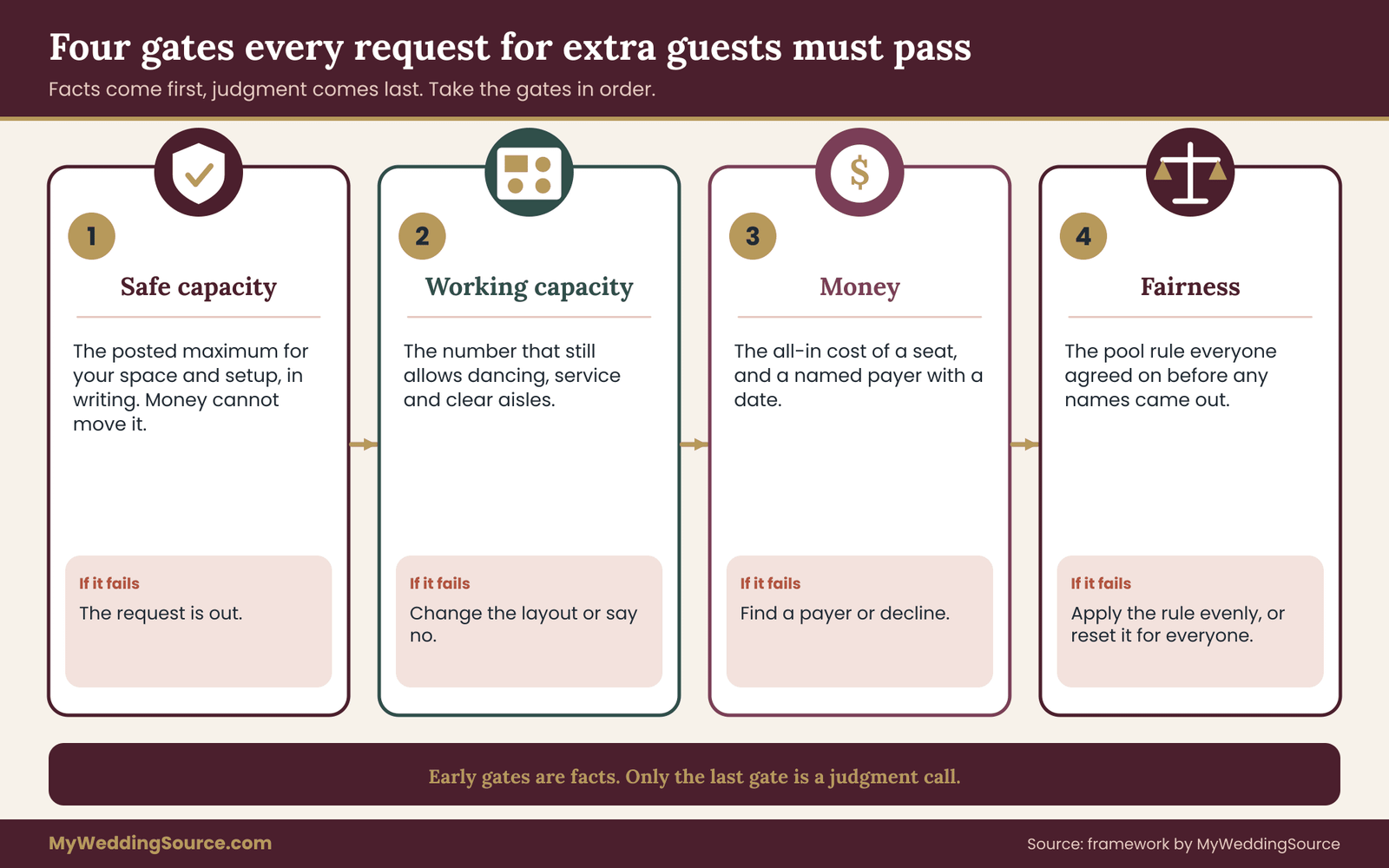
Before anyone debates a name, put each possible addition through four gates, in a fixed order. The order matters because the early gates are about facts and the late gates are about judgment. If you start with judgment, every answer feels personal.
Gate one: safe capacity. This is the maximum number of people the venue is permitted to hold in the space you are using, including staff and vendors in many cases. It is not a preference. It is set by the building’s approved use and by local fire and building rules. No amount of family pressure changes it, and no vendor should be asked to look the other way.
Gate two: working capacity. This is the number of people who can be seated, served, and entertained well in the layout you actually want. It is almost always lower than the safe capacity, sometimes by a third or more, because a dance floor, a stage, a buffet, a cake table, a photo area and aisles all take space.
Gate three: money. Each guest has a cost, and the cost is not only the plate. There are rentals, linens, servings of cake, bar service, staffing, favors, and in many contracts a minimum spend or a minimum headcount. The question at this gate is simple: who pays for the seat, and has that person agreed in writing or in a clear message?
Gate four: fairness and relationships. If extra guests pass the first three gates, the last question is whether adding that person is fair to everyone else who asked, including the couple’s own friends. This is the only gate where reasonable people can disagree, and it is much easier to discuss once the first three are done.
Extra guests that fail gate one are out, full stop. Extra guests that fail gate two need a different layout or a different answer. Extra guests that fail gate three need a payer. And extra guests that clear the first three gates go to a fairness conversation, where the pool system described later in this guide does most of the work.
Gate one: find the real safe capacity
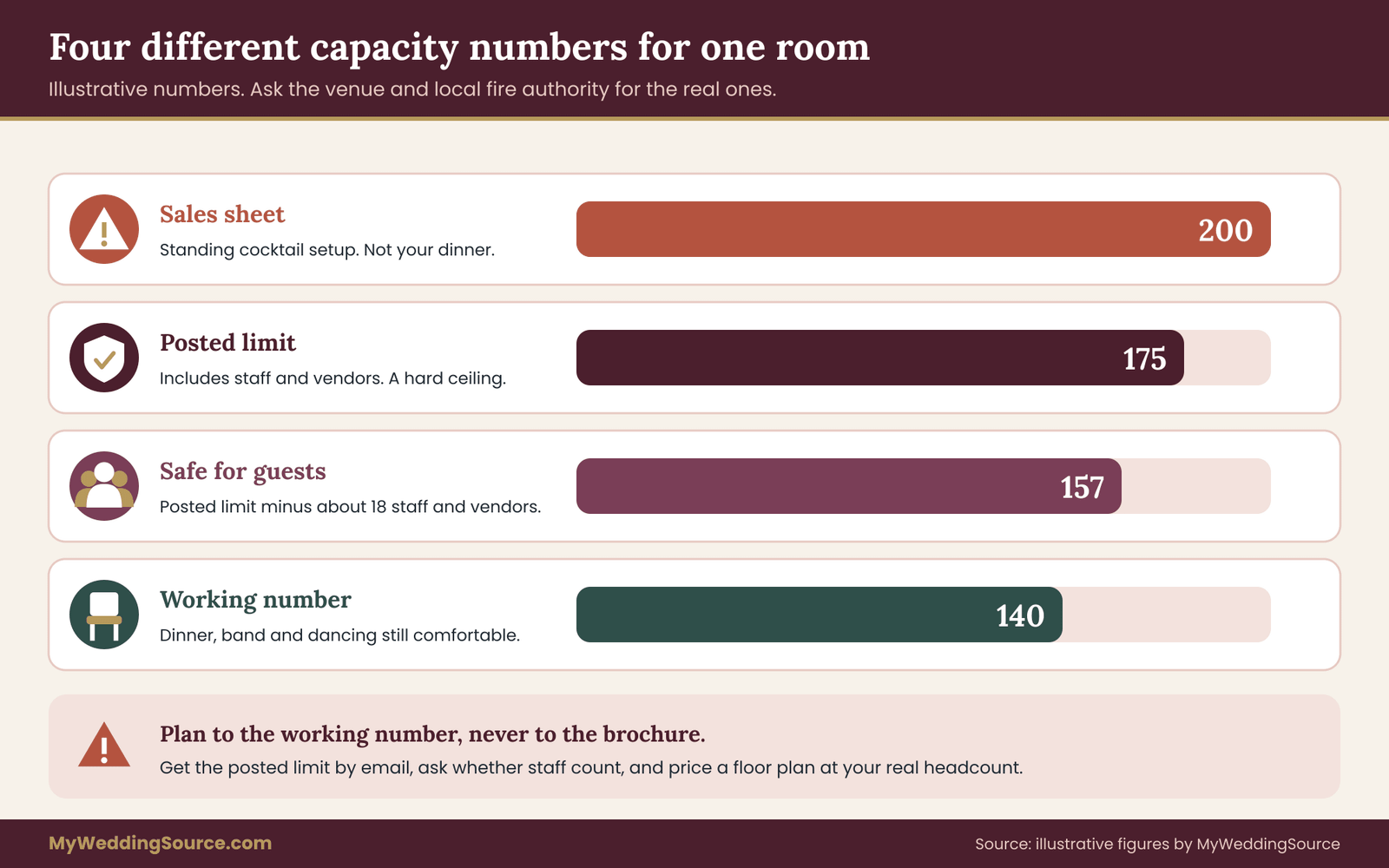
The number printed on a venue’s sales sheet is often a marketing number. It may describe a different setup than yours, such as a standing reception, or it may count the full building when your event uses only one room. The first job is to get the correct figure in writing.
Ask the venue for the maximum occupancy for the specific space and the specific setup you plan to use: ceremony seating, seated dinner with a dance floor, cocktail reception, or any combination across rooms. Ask whether the figure counts only guests, or also includes the couple, the wedding party, the band, the caterers, the photographers and other staff.
Different venues and different local authorities treat staff differently, so do not assume. Ask where the number comes from, for example a posted occupancy sign or a certificate of occupancy, and ask for the answer by email so you have a record.
Occupancy limits in the United States generally come from building and fire codes adopted by states and local governments. Model codes are published by organizations such as the International Code Council and the National Fire Protection Association, but each jurisdiction adopts and amends its own version. That is why the right authority to ask is the venue, and behind the venue, the local fire marshal or building department. A general internet rule of thumb, such as a number of square feet per person, is not a substitute for the posted figure for your room.
For outdoor spaces, tents and temporary structures, the rules can be different again. A tent installed for your event may need its own permit and its own capacity calculation, and the exits, the lighting and the heaters inside it all matter. If your extra guests would only fit under a bigger tent, the right question to ask the rental company is whether the larger structure has been approved for your site and by whom, not whether it can physically be built.
One more point belongs here. If a parent suggests that a few extra guests “won’t be noticed,” treat the suggestion as a reason to go back to the venue, not as a possibility. A room over its permitted limit is a safety problem first, and it can also become a contract and insurance problem if something goes wrong. The couple and the venue are the ones who carry that risk, not the parent who made the suggestion.
Gate two: the working capacity of your layout
Safe capacity is the ceiling. Working capacity is the number at which the wedding is still pleasant. Couples often find the second number by accident, on the day, when the dance floor is empty because it was squeezed to the size of a bath mat.
To estimate it, start from the layout rather than the guest count. List everything that needs floor space: round tables or long tables, the head table or sweetheart table, a dance floor, a band or DJ area, a bar, food stations, a cake table, a gift table, a guest book table, a photo area, and the clear aisles that servers and guests need.
Ask the venue for a scale floor plan, or ask your caterer or rental company to draw one. Place the tables for your current count first. Then add the extra guests table by table and watch what happens to the dance floor, the aisles and the bar line.
Most planners and venue coordinators can tell you quickly how many guests the room handles for a seated dinner with dancing. That number, confirmed with your own caterer and rental company, is a better working figure than any formula in an article. The point of this gate is to make the trade-off visible: each ten extra guests do not merely cost money, they take something away from the room, such as dance floor space, bar access, or a comfortable path to the restrooms.
When you show parents a floor plan with the extra guests added, the conversation changes. It is hard to argue that a room “can fit one more table” when the picture shows the band’s drum kit pushed against the cake. Visuals take the argument about extra guests out of the realm of opinion.
Working capacity also depends on service. A kitchen sized for a certain count, a limited number of servers, or a short window to flip the room between ceremony and dinner can all cap the number of guests long before the walls do. Ask your caterer for the largest count they can serve well at your venue, and ask the venue about any restrictions on the kitchen, the loading area and the timeline.
The broader question of how guests move through the space is covered in the guide to reception guest flow, which is a useful companion when you are testing layouts with extra guests added.
Gate three: who pays for extra guests, and how
Money is where a vague family conversation about extra guests becomes concrete. A seat has a price, and someone has to pay it. Treating that as a plain fact, rather than as an accusation, is one of the most useful moves a couple can make.
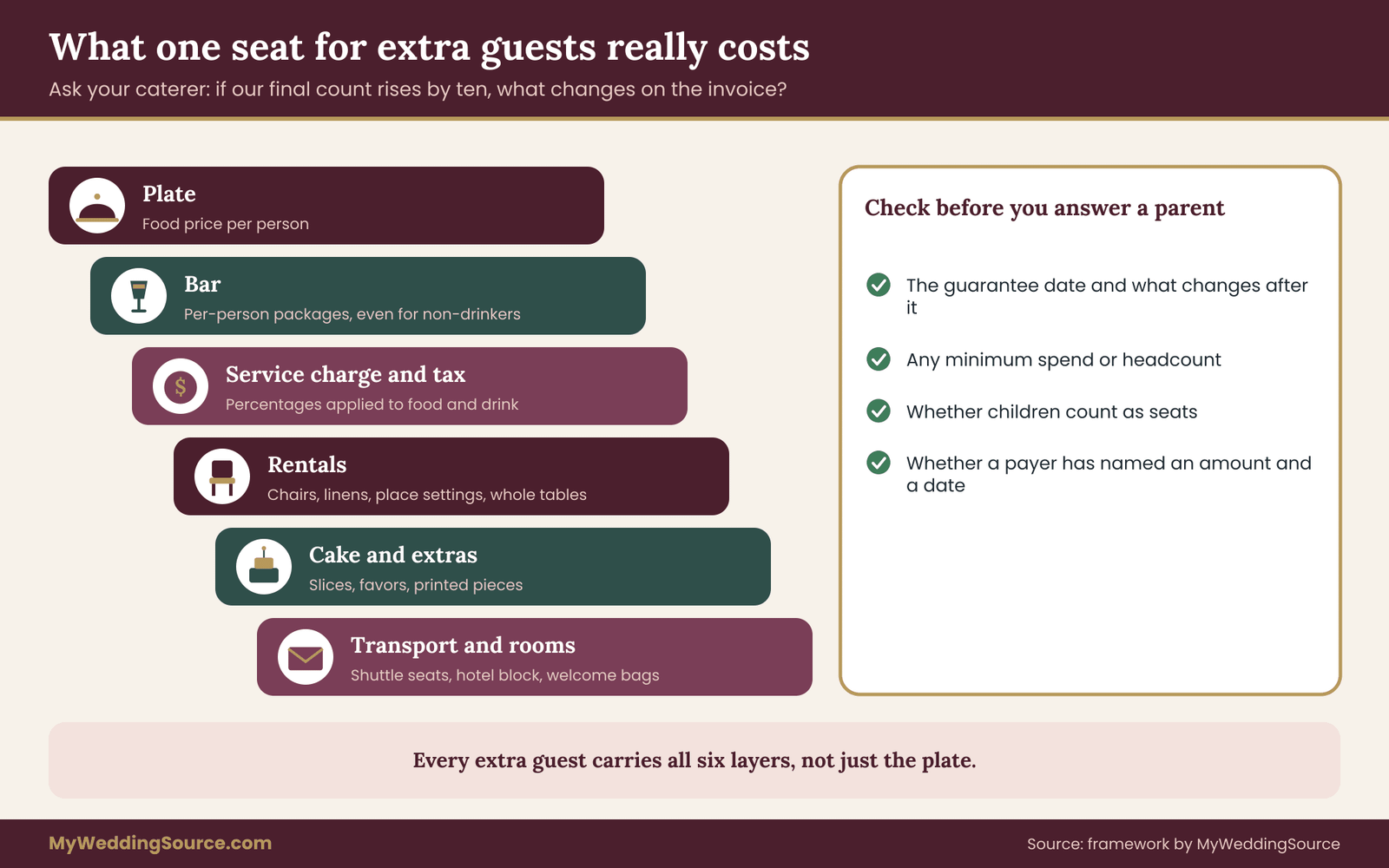
Start by finding the true cost of one more guest, then multiply it by the number of extra guests being discussed. Ask your caterer for the per-person price, and then ask what else changes per person. Common items include the bar package, service charges and gratuity that are calculated as a percentage of food and beverage, taxes, rentals for chairs and place settings, linens, centerpieces, favors, printed items, and cake servings.
The sum is usually higher than the number on the first quote. A percentage-based charge makes every added plate cost more than the plate itself.
Then read the contract for three clauses. The first is the confirmed final count: most caterers ask for a final number several days before the event, and you pay for at least that many. The second is any minimum spend or minimum headcount, which can mean that removing guests saves less than you expect. The third is the process for adding guests after the guarantee: some venues allow small increases at the same price, some charge a premium, and some refuse. Extra guests who arrive after the deadline can be the most expensive of all.
With real numbers in hand, you can ask, about any extra guests, the question that settles most disputes: if extra guests are added, who is paying for them? There are four honest answers.
The couple pays. Sometimes a couple decides that a few extra guests are worth the cost and absorbs it. That is a choice, and it should be a choice made once, with a cap, not an open door.
The parents pay in full. When a parent wants to add guests and will cover the whole cost, including the service charge and tax, the money question is solved, and only the room questions remain. This works best with a written note of what the parent agreed to cover and by what date.
The parents pay a share. In many families the parents contribute to the wedding as a whole. Then it helps to translate the contribution into seats, which the pool system in the next section does. The parent does not “own” the guests in a contractual sense, but the seats are a reasonable way to match contribution to invitations.
No one pays, so no one is added. If the budget cannot absorb extra guests and nobody offers to cover them, the answer is a kind no. A venue that charges per head does not stretch.
Be careful with offers that arrive vaguely, such as “we will help out somehow.” Ask for a number and a date. A parent who is sincere will give one. A parent who cannot give one has not yet decided to contribute, and the couple should not hold seats against an uncertain promise. If your family contributes in several ways, a short written record of who agreed to pay for what prevents the most common later disagreement, which is about what was actually promised.
Per-head costs that surprise couples
Several costs scale with headcount and are easy to miss. Chair and table counts change in whole units, so one of the extra guests can mean a whole extra table of rentals, not one chair. A bar package priced by the person is added for every guest, including those who do not drink, unless the contract says otherwise.
Cake is usually priced by the slice, and a bigger count can mean an additional tier. Invitations, programs and place cards are printed in batches, and a late increase may mean a reprint. A shuttle or a hotel block sized for the original count may no longer fit.
Ask your vendors one clear question: “If our final count rises by ten, what changes on the invoice?” Their answers will list the items you have not thought of. Write the numbers down. When a parent asks for ten extra guests, you can answer with a real figure, such as “that adds this amount to the final invoice, and here is where it comes from,” instead of “we can’t afford it,” which invites argument.
The minimum-spend trap in both directions
Minimum spends work in both directions. If your venue requires a minimum food and beverage spend and your count has already fallen below it, extra guests can cost less than they appear to, because part of the spend is already committed. If your count is well above the minimum, every additional guest is a full-price addition.
Check where you stand against the minimum before you tell anyone that extra guests are “too expensive” or “no big deal.” The site’s wedding budget guide shows how to build a headcount-driven budget line, which is the line that extra guests move the most.
Gate four: fairness among the people asking
When extra guests pass the safe capacity, working capacity and money gates, the question left is whether admitting that guest is fair. Fairness is where the strongest feelings show up, so it helps to describe it in terms that both sides can accept.
Fairness is not equal numbers, and it is not strict proportion to money. It is a rule that the people involved agree on before the names come out. A simple rule is more powerful than a complicated one. Some families agree to split the list into equal thirds among the two partners and the parents.
Others use proportion to contribution. Others agree that the couple’s list comes first and the parents get the remaining seats. Any of these can work. What fails is a rule invented after the first argument, because it will look like it was invented to produce a result.
Two kinds of unfairness around extra guests cause the most damage. The first is secret exceptions, where one parent is quietly allowed extra guests that another parent was refused. Families find out, and the damage lasts longer than the original dispute. The second is changing the rule mid-way. If the rule was thirds, it stays thirds, even when a very sympathetic case turns up.
A third consideration is the couple’s own list. If the couple has already invited a group of friends who were added casually, they will have less credibility asking parents to cut theirs. Before you ask others to trim, check your own list against the same rule. The site’s guide on how to cut a wedding guest list gives practical rules for doing that without a fight, and they work well for the couple’s own side too.
Fairness also includes the guests themselves. A person who is invited as one of the last-minute extra guests will usually sense it, especially if the invitation arrives late or the table is far from the action. Add extra guests only when you can treat them as full guests, with a real seat, a meal and a welcome. If you cannot, a smaller invitation or a later celebration is kinder than a seat at the edge of the room.
A short test for any single request
When a parent names particular extra guests, run four questions in order. Does this person fit within the safe and working capacity once the non-negotiable guests are counted? Is someone paying for the seat? Does the person sit inside the pool of the parent who is asking? And would we be comfortable giving the same answer to every other parent in the same situation? If any answer is no, the request is not a yes yet, but it may still be a “yes, if” with a clear condition.
The value of the test is that it replaces “why won’t you invite him” with “here are the four conditions, and here is the one this request does not meet.” That is easier to hear, and easier to fix.
The seat pool method for sharing extra guests fairly
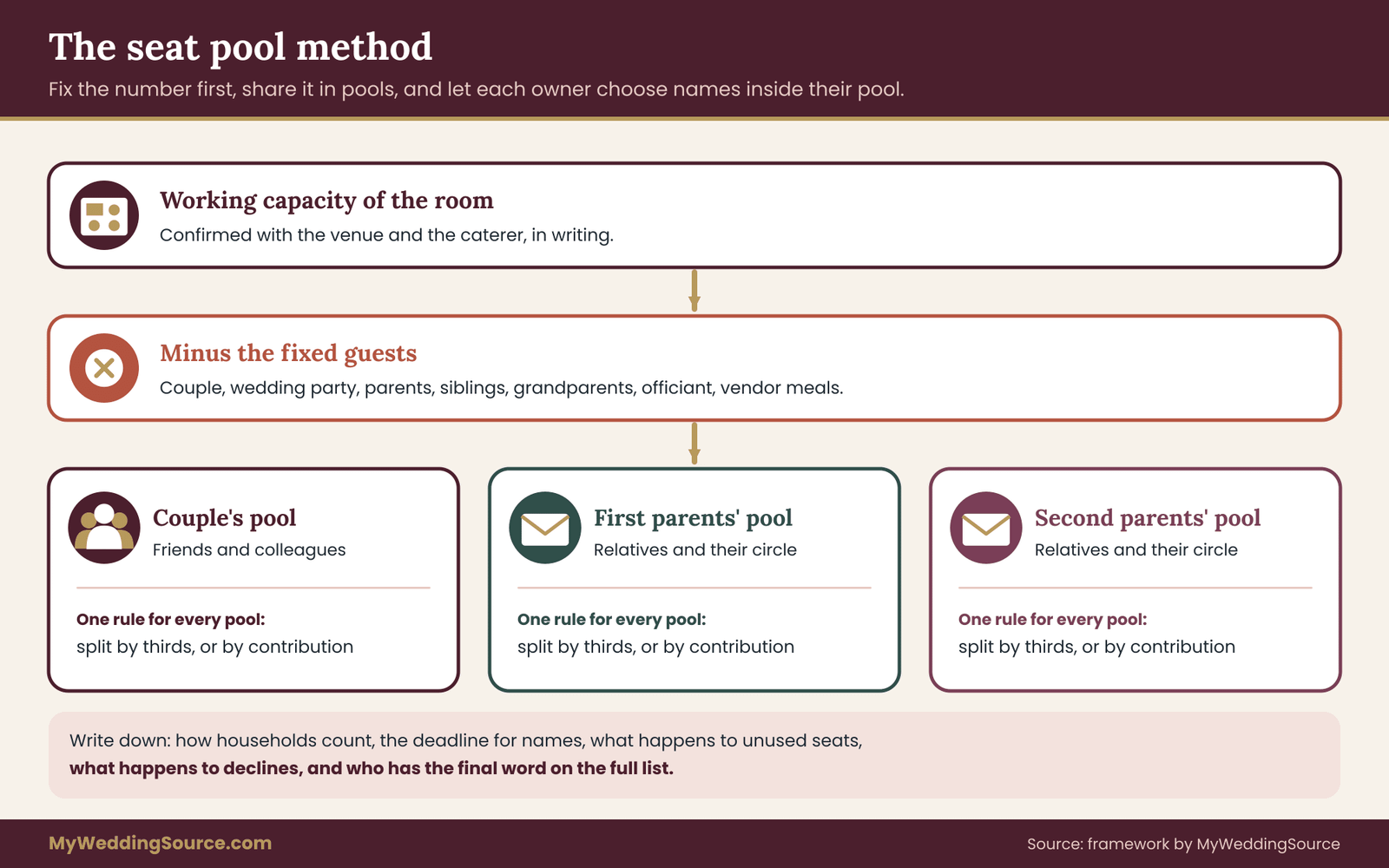
Once you know the working capacity and the cost of a seat, you can stop negotiating name by name. The seat pool method splits the total into named pools of seats, assigns each pool an owner and a payer, and lets each owner choose their own names inside the pool. It works because it turns an argument about extra guests into a budgeting exercise that everyone can see.
Begin with the working capacity from gate two. Suppose the room works well for a given number of seats. Subtract the people who are not up for debate: the couple, the wedding party and their partners, immediate family, the officiant if they are staying for dinner, and any vendor meals that count toward the room. What remains is the pool total, the number of seats available for everyone else.
Divide the pool total into three kinds of pool. The first belongs to the couple, for friends and colleagues. The second and third belong to each side of the family, for relatives, family friends and the parents’ own circle. If you have blended families or several sets of parents, you can add a pool for each, but keep the count small, because more pools mean more small negotiations.
How large should each pool be? Pick a rule from the fairness section and apply it as written. Equal thirds is the simplest. Proportion to contribution is also common, and many families find it feels fair as long as the percentages are stated openly. A third approach reserves a fixed block for the couple and divides the rest between the parents. Whichever you choose, write the numbers down and share them with everyone at the same moment, so no one learns their allocation from someone else.
Why pools reduce conflict
Pools help in three ways. First, they give each person a number rather than a verdict on extra guests. “You have thirty seats” is easier to hear than “we can’t invite all your friends.” Second, they move the hard choices inside the pool, to the person who knows the guests best. A parent knows which of two old friends matters more to the family, and the couple does not.
Third, they make extra guests visible as a cost. Extra guests stop being abstract. When a parent wants to add a name beyond the pool, everyone can see that something else has to leave.
Pools also protect the couple’s own list from extra guests. Because the couple’s pool is fixed from the start, the parents cannot erode it quietly, and the couple has a clear answer when a parent asks, “Could you just make room?” The answer is: “Our pool is full, and yours has thirty seats. Which names would you like to move?”
Rules to write down with the pools
A pool system fails when the details are left unsaid. Write down a short set of rules and send them to everyone who has a pool. Cover these points:
The first rule is how households count. Decide whether a household is one seat or the number of people in it, and whether children count. The most common source of extra guests inside a pool is a name that quietly turns into a whole family. Decide up front whether “plus one” applies to relatives, and say so in plain language.
The second rule is the deadline for names. Choose a date well before invitations are printed, and say that names submitted after that date will be considered only if there are open seats. A deadline protects the couple from a stream of late extra guests and gives parents a clear point at which to make their choices.
The third rule is what happens to unused seats. If a parent uses fewer seats than their pool, do the seats return to the couple, go to the other parent, or fill from a waiting list? Deciding in advance prevents jealousy. A common rule is that unused seats go to a shared waiting list, with the order set by who submitted names first.
The fourth rule is what happens to declines. Once RSVPs come back, some guests will say no, and that frees seats. A rule for this, described in the section on waiting lists, keeps the cascade fair and avoids a scramble. The site’s guide to RSVP etiquette explains how to set response dates that give you time to fill those seats.
The fifth rule is who has the final word. A pool system needs a tiebreaker. In most cases the couple decides, because the wedding is theirs and the venue contract is in their names. Say so kindly and early. A line such as “we will make the final call on the full list, and we will tell you about any change before anyone else hears” gives the parents respect without giving them a veto.
Matching pools to payment
If parents contribute money, you can tie their pool to the contribution in a way that is transparent without being transactional. The idea is simple: the pool size is whatever the contribution covers at the real per-seat cost. If a parent contributes a set amount and the full cost of one seat is a known figure, the contribution divided by that cost gives the number of seats it funds. Add that to the seats the couple already planned for that side of the family.
For example, with invented numbers: if one seat costs a hundred and fifty dollars all in, and a parent contributes six thousand, that contribution funds forty seats. Whether forty is the right pool size is a separate question, but the arithmetic gives everyone the same starting point. If the parent wants forty-five guests, the extra five seats cost seven hundred and fifty dollars more, and the question is whether the parent is willing to add that amount.
This approach has a quiet benefit. It lets a parent see that a contribution does not buy unlimited guests, and it lets the couple avoid sounding as though they are selling invitations. It also keeps the conversation about the room, not about the parent’s character. Some couples are uncomfortable linking money and invitations at all. If that is your situation, a fixed pool by family side, written down and agreed, achieves the same clarity without the arithmetic.
One caution. Do not promise a pool size to a parent before you have confirmed the working capacity and the final budget. Early promises are hard to take back. It is better to say, “We are still confirming the room and the budget, and we will share each family’s number by this date.”
When the couple’s pool is the problem
Sometimes the honest finding is that the couple’s own list is the largest source of extra guests. Friends who were added in the early, optimistic months, coworkers invited out of politeness, and plus-ones for casual acquaintances can crowd out relatives. If that is true, tell the parents. It is far easier to ask for flexibility when you say, “We found we had grown our own list and we are cutting it back too.” Then do it. A shared sacrifice is more persuasive than a rule that applies to one side only.
You can also give the couple’s pool a different name, such as “friends and colleagues,” and ask the same question of it that you ask of the parents’ pools: for each name, would the guest be missed, and would they miss us? That test is not harsh. It is a way to keep the room full of people who will matter on the day, whoever invited them.
Handling households and plus-ones
Households and plus-ones are where extra guests slip in. A single name on a parent’s list may be a couple, a couple with two teenagers, or an adult with a partner nobody has met. Decide one clear policy and use it for every pool: invite households as named on the envelope, count each adult as a seat, and decide separately how children are handled. Written down, this takes a few lines. Unwritten, it produces a dozen small surprises, each of which feels like a betrayal.
For plus-ones, many couples choose a simple rule: partners in a committed relationship are included, and casual plus-ones are not. Whatever you choose, apply it to your own friends too, and say it plainly in your guidance to parents. If you invite single guests without plus-ones, tell the parents so they can handle their own single relatives the same way, rather than discovering the rule from a returned RSVP.
What to say when parents ask for extra guests
A framework is useful only if you can say it out loud to a parent who is disappointed. This section gives you the order of the conversation and sample wording. Treat the wording as a starting point and put it in your own voice, because a script read word for word sounds like a script.
Before the conversation
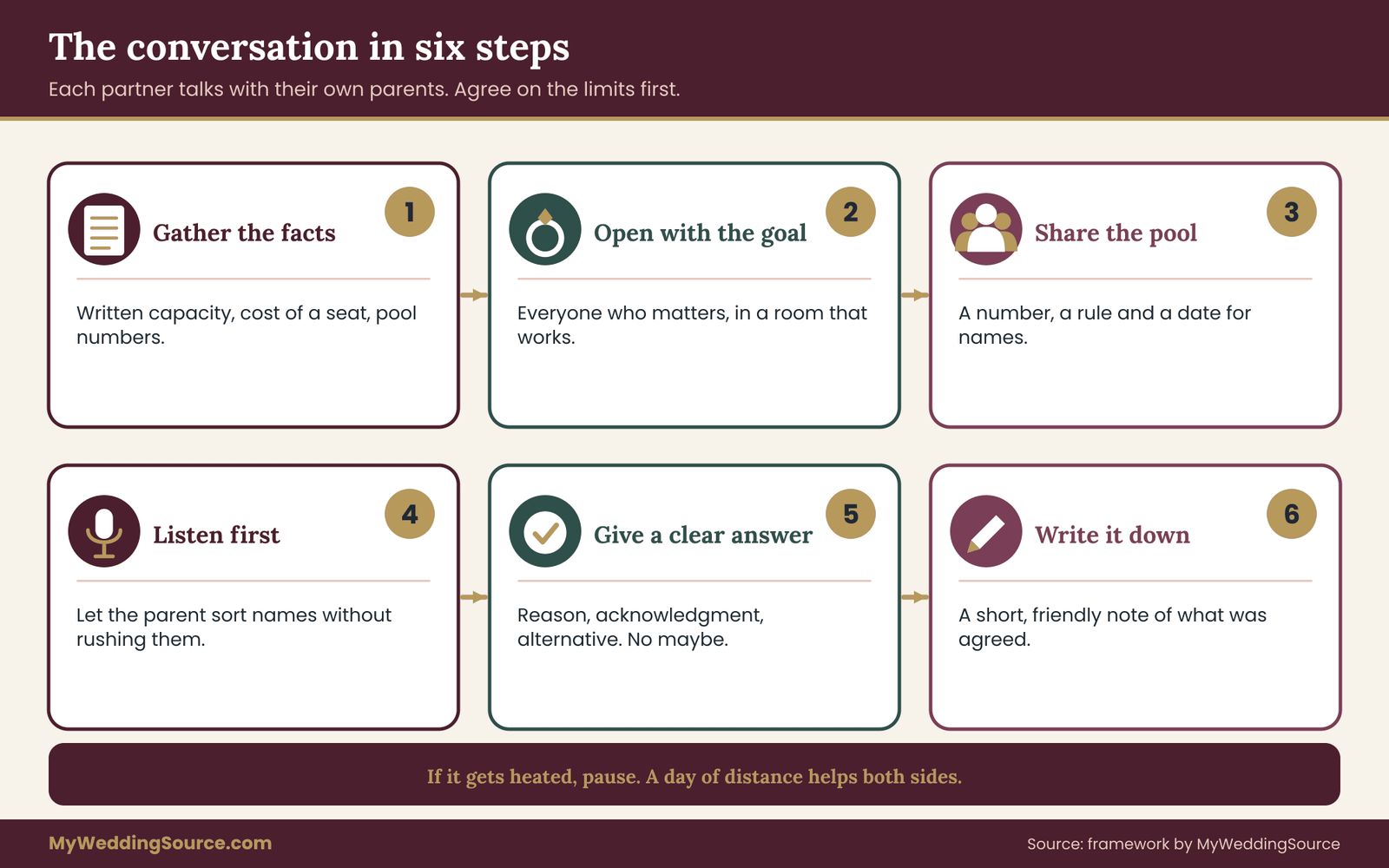
Gather three things first. Have the written capacity figure and a list of the extra guests being requested from the venue, the cost of one added seat from your caterer, and the pool numbers you plan to propose. Decide in advance who will speak to which parent. In most families it works better when each partner speaks to their own parents, because the tone is warmer and the history is shared.
Agree with each other on the limits before either of you says anything, so that neither is surprised by a concession made in a hallway.
Choose a calm setting. A phone call or a coffee is better than a text thread, and much better than a family group chat where several people react at once. If the parent is likely to take the news badly, avoid doing it right before a stressful event, such as a family gathering or a holiday. And plan to listen first. A parent who feels heard about extra guests will accept a limit more easily than one who feels handled.
The opening: start with the shared goal
Open with what you both want, which is a wedding where the people who matter are present and comfortable. Then give the fact. For example: “We want everyone who matters to you there, and we also have a hard limit. The venue’s written maximum for the room is this number, and our caterer’s working number for dinner and dancing is a bit lower. We would like to work out with you how to use the seats well.”
This opening does three things. It tells the parent that their guests matter, it places the limit outside the couple’s preferences, and it invites the parent into the problem rather than presenting a finished decision. If a parent has already shared a long list, do not respond with a number first. Say, “Thank you for writing all of this down. It helps us see who matters to you.”
Presenting the pools
Next, show the pool numbers and the rule behind them. “We have split the available seats into three pools, one for each of us and one for each of you, so everyone has the same kind of number to work with. Yours is this many seats. Please choose the people you most want there, and tell us by this date.”
If the parent is paying a share, add the link between payment and seats: “Your contribution covers this many seats at the cost the caterer gave us. If you would like to add extra guests beyond that, each additional seat costs this much, and we would need to know by this date so we can confirm with the venue.” Say the number. Avoid hinting. A hint leaves the parent to guess, and guesses tend to be generous.
When the answer is no
Some requests for extra guests cannot be granted, and the kindest response is a clear one. Do not say “we’ll see” when you mean no, because it produces weeks of hope and a worse conversation later. A clear no has three parts: the reason, the acknowledgment, and the alternative.
“I know how much these friends mean to you, and I wish we could add them. The room is at its limit for dinner, and we can’t go over it. What we can do is invite them to the dessert reception, or to a lunch the day after, if you would like that.”
Notice what is missing: an apology that opens the door to bargaining, a long defense of the budget, and a comparison with other guests. A short, warm, specific refusal is easier to accept than a long one. If the parent pushes, repeat the core and then stop: “I understand, and the answer is still the same. The room is full.”
When the parent offers to pay
Sometimes the parent answers, “Then I will pay for them.” Money solves gate three, but not gates one, two and four. Separate the issues politely: “Thank you for offering. The cost is only part of it. The room has a limit that doesn’t change with money. If there are seats left within the limit, we can talk about it, but we can’t add people beyond the room’s maximum.”
If there is room, the offer may genuinely help. Ask for the commitment in writing, with the amount and the date it will be paid. A short email is enough. “To confirm: you will cover the cost of eight extra guests at this amount per seat, payable by this date, and we will confirm the names and the count with the caterer on that date.” Ask for a reply, and keep that reply with your wedding records.
When the parent says “but it’s our family”
This is the sentence that makes a couple feel selfish, and it deserves a careful answer. The answer is not to argue about whose family is bigger. It is to agree with the feeling and return to the facts: “We know how important your family is. We want them represented, and we are asking you to pick the people who matter most inside the seats we have. We’d rather have the right people in the room than have everyone in a room that doesn’t work.”
If the parent has a specific person in mind who is truly central, such as a relative who raised them or a lifelong friend, ask whether that person can be placed within the pool. Most parents, once they have a real number, find that their list shrinks on its own as they sort the names into those who are close and those who are expected. That sorting is something the parent has to do, and it will go better if you let them do it than if you do it for them.
What not to say
A few phrases make things worse. Do not say “it’s our wedding, not yours,” because it tells the parent that their love and their involvement are an intrusion. Do not say “we can’t afford it” if the real reason is the room, because a parent may solve the money problem and then feel misled. Do not blame the venue for a limit that is really your preference, because a parent who visits the venue will find out. And do not promise “maybe later” unless you mean it and have a rule for it.
If the conversation turns heated, pause it. “I can tell we are both upset. Let’s stop for today and talk again tomorrow.” A pause is not a defeat. Most arguments about extra guests are not really about the guests, and a day of distance helps both sides separate the two.
Writing it down afterward
After any conversation that changes the numbers, send a short written summary to the person you spoke with. State the pool size, the deadline for names, the cost of an added seat if relevant, and who has the final say. Keep it friendly and neutral. The purpose is not to build a case. It is to make sure that two people who heard the same conversation do not remember two different agreements. This single habit prevents more family conflict than any script, because it replaces memory with a record.
The broader site guide to wedding invitation etiquette covers how to word invitations and handle address and household questions once the count is settled, and it pairs well with the written summary you send to each family about extra guests.
Five honest options for handling extra guests
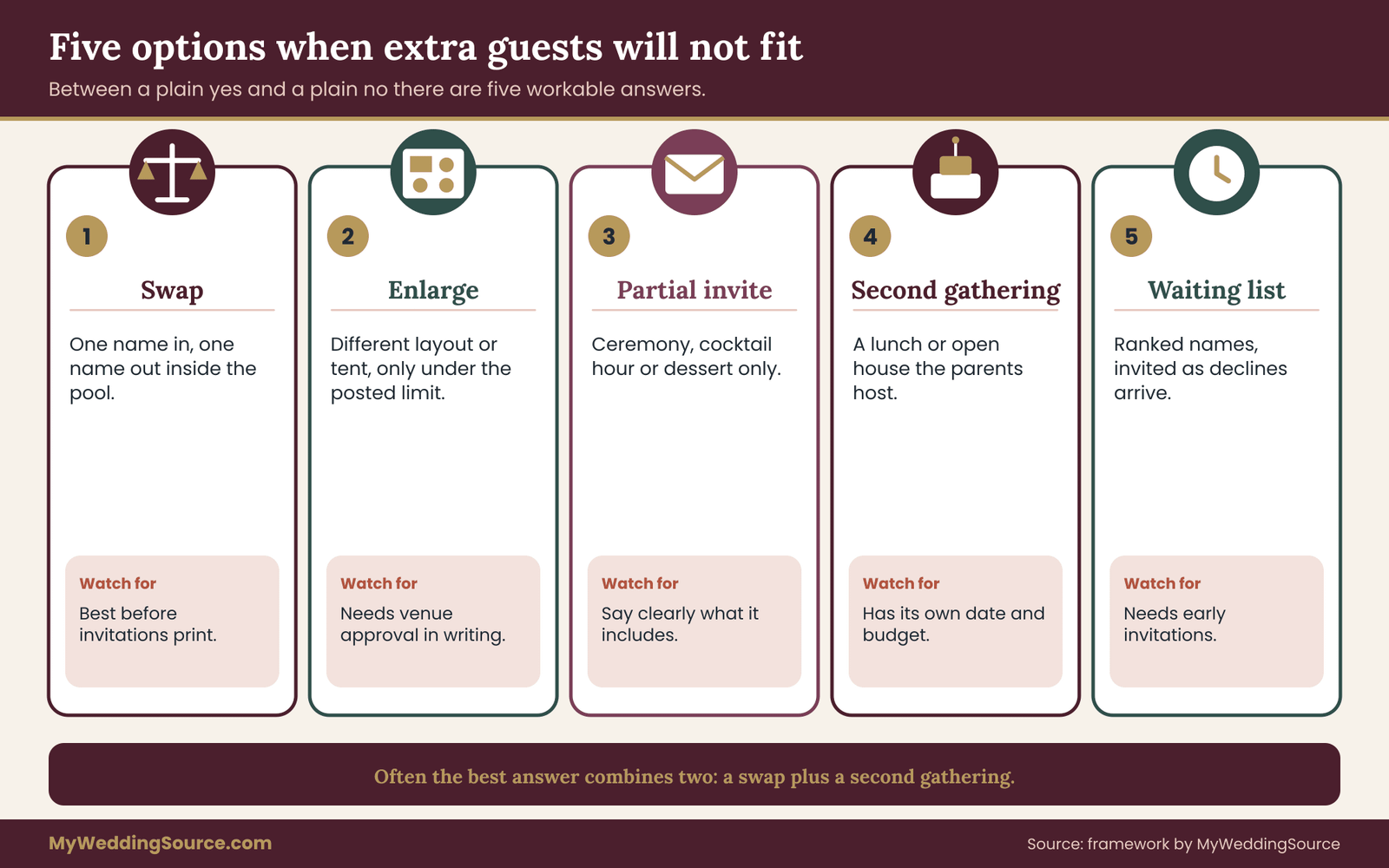
When extra guests cannot all fit, the choice is rarely “everyone or no one.” There is a range of options between those, and each has costs. This section lays out five, so the conversation can move from “no” to “which of these would work for your family?”
Option one: swap a name for a name
The simplest answer to extra guests is a trade. If a parent wants to add someone, they choose someone in their pool to remove. The count stays the same, the budget stays the same, and the parent keeps control over who matters most. Some parents find this hard, because choosing means ranking people. Help by offering a neutral way to sort: guests who knew the couple as children, guests the parent sees every month, and guests the parent mainly sees at events. The people in the third group are usually the easiest to move.
Swapping works best early, before invitations are printed. After invitations go out, a swap means retracting an invitation, which is painful for everyone and should be avoided almost entirely. Set the deadline for swaps well before the mailing date and hold to it.
Option two: enlarge the setup within real limits
Sometimes the room has headroom. The safe capacity may be higher than the working capacity, and a different layout can close part of the gap. Options include replacing round tables with long tables that seat more guests in the same space, moving the band to a corner, using a second room for part of the dinner, or adding a tented area where the permit allows. Each change has a price and a trade-off, and each needs the venue’s written agreement.
Before you present this to parents, test it. Ask your caterer and rental company for a revised floor plan with the larger count. Check that the aisles, the exits and the service paths still work, and confirm that the revised layout stays within the safe limit you got from the venue. If it does, price it. If the extra guests are worth that price to the person who wants them, the option is real. If not, you have saved yourself an argument by finding out early.
Never use this option to get around a posted maximum. An enlarged layout is an answer only when the number stays under the permitted figure for the space.
Option three: split the invitation
Not every one of the extra guests needs the full wedding. A smaller invitation can honor a relationship without taking a seat at dinner. Common versions include inviting people to the ceremony only, to a cocktail hour before the dinner, to a dessert reception after the meal, or to a separate gathering the next day. Each version has its own capacity and its own cost, so check them as you did for the main event.
The key to making this kind of invitation respectful is clarity and warmth. A guest who is invited to the ceremony and the cocktail hour should be told, in the invitation or a personal note, exactly what they are invited to, so that no one arrives at dinner expecting a seat. A guest who is invited to dessert should know that dinner is a smaller event. Said kindly, this is ordinary and understood. Said vaguely, it is awkward.
Be honest about the trade-offs. Some guests will feel they have been placed in a second tier, and some families will see a partial invitation as worse than none. If the parent says so, listen. In some cultures and communities, a partial invitation is a genuine slight, and the better answer may be to keep the main event smaller and hold a larger celebration at another time.
Option four: hold a second gathering
A second event is a good answer when the number of extra guests is large and the relationships are real. This can be a family lunch, an open house at a parent’s home after the honeymoon, an engagement party that happens before the wedding, or a casual celebration held some weeks later. The parents often host it, which gives them a place to invite their wider circle and to be the hosts they want to be.
The second event has costs of its own and needs its own date, space and budget, so it is not automatically cheaper. It is often more relaxed, though, because the parent is not borrowing seats from the couple. Offer it as a real alternative rather than a consolation prize. A line such as “We’d love you to host a celebration for your friends, and we will come” says that the couple values the parent’s circle and is willing to show up for it.
Option five: a waiting list with clear rules
A waiting list, sometimes called a second round of invitations, can bring in extra guests without exceeding capacity, because it fills seats that open when others decline. It works only when it is run honestly and early enough.
The rules matter. Send the first round of invitations with enough time for replies, and set a response deadline that leaves room to send a second round. Rank the waiting list in advance, using a rule that parents and the couple agree on, such as alternating between pools or following the order in which names were submitted. As each decline arrives, invite the next person on the list, and keep the timing tight so that the second-round guests still get reasonable notice.
Be aware of the risks. A guest who realizes they were invited late may feel like an afterthought, especially if the first-round guests have already posted about the event. Late invitations also reduce the time a guest has to arrange travel and childcare. If your wedding involves significant travel, a waiting list may not be fair to the people on it. For a local wedding with a long notice period, it can be a quiet, effective way to use every seat. The guide to wedding invitation etiquette covers timing for the first and second rounds.
Choosing between the five options
No option is correct for every family. A few rules of thumb help.
If the number of extra guests is small and the pools are full, option one, a swap, is usually enough. If the room has real headroom and a payer is ready, option two can work. If the extra guests are acquaintances rather than close relatives, option three, a partial invitation, often suits them well.
If there are many extra guests with real family ties, option four, a second gathering, may be the only answer that respects the relationships. And if the date is far off and the list is flexible, option five can fill the gaps that decline notes leave.
Often the best answer combines two. A parent might swap three names, host a second gathering for twenty others, and place two close friends on a ranked waiting list. Putting options together takes work, but it gives the parent a sense of agency and keeps the room within its limit.
What to avoid
Three tempting shortcuts for extra guests cause trouble. The first is inviting extra guests beyond the number of seats on the theory that some will decline. Declines are not predictable, especially for local weddings where most guests say yes, and the cost of being wrong is a room over its limit or a seat count you cannot honor. The second is adding a “standing” section or a small table for extra guests so they can come without a full seat.
That can work for a cocktail hour, but it rarely works at a seated dinner, and the guests feel it. The third is telling a guest that they are “on the list” when no seat exists. If you cannot offer a seat, say so honestly and offer the partial invitation instead.
When you choose an option, put it in the written summary described earlier. A parent should know exactly what is on offer, by what date, and what it costs. That clarity matters even when the answer is no. It shows that the couple has thought through the request rather than waved it away. If you are also reconsidering the shape of the whole event, the site’s guide to wedding venues explains how room size, minimums and layout interact, which is useful if the venue itself may be the problem.
A worked example: extra guests at the Lindqvist-Moreno wedding
The following example is invented to show the method in numbers. The couple, the families and the figures are fictional, and the prices are placeholders, not benchmarks. Your own numbers will differ, so use the structure and replace the figures.
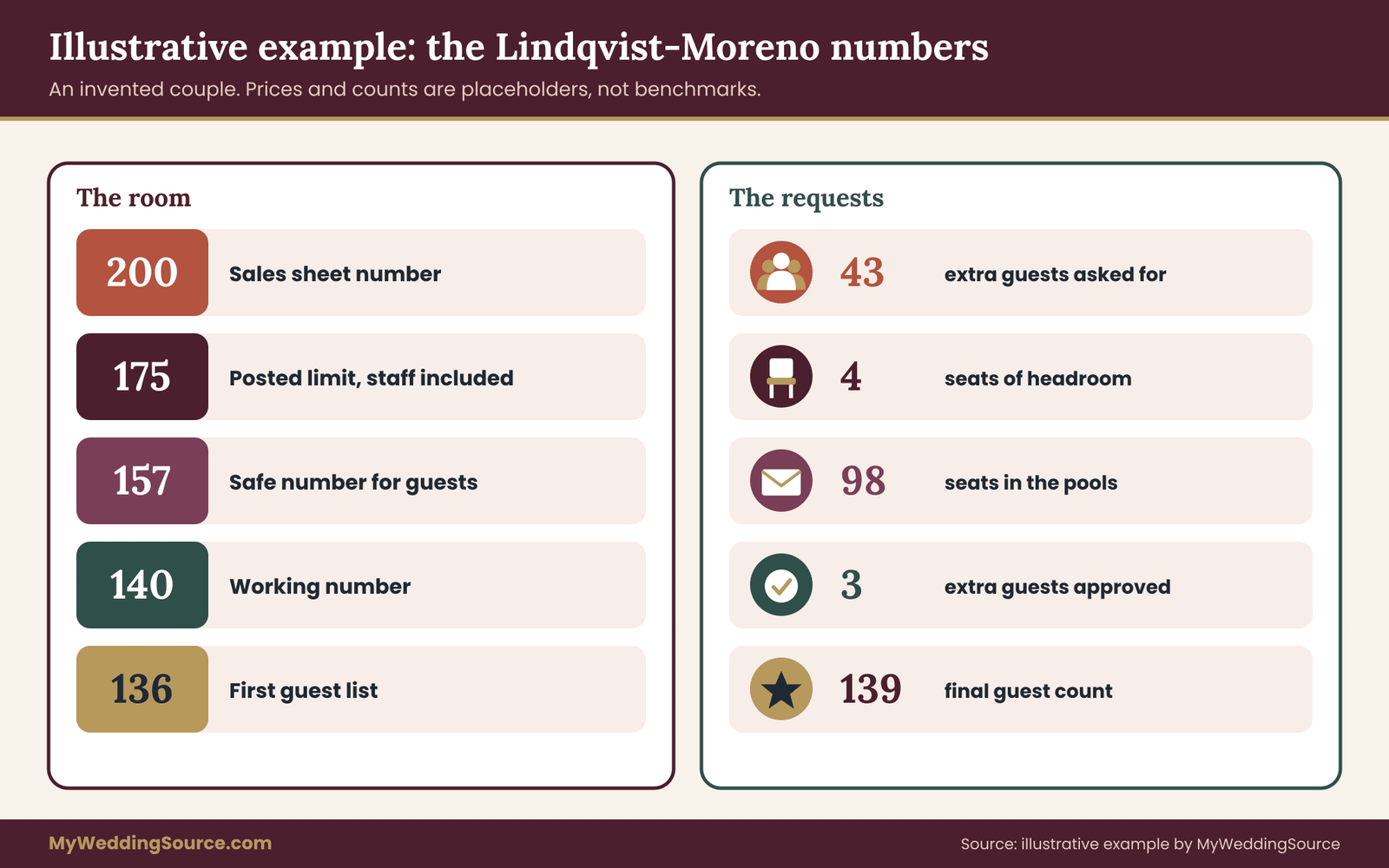
Dana Lindqvist and Marco Moreno are planning a Saturday dinner wedding. They have picked a venue with a main hall. The sales sheet says the hall holds two hundred people. Their first guest list, built over the winter, has one hundred and thirty-six names.
Step one: confirm the safe capacity
Dana emails the venue and asks for the maximum occupancy of the main hall for a seated dinner with a dance floor, and whether staff and vendors count. The venue replies that the posted occupancy of the hall is one hundred and seventy-five people, that the number includes all people in the room, and that the two hundred on the sales sheet refers to a standing cocktail setup. Dana asks where the figure comes from and receives a reference to the posted occupancy and the certificate of occupancy. She saves the email.
The venue also says the caterer’s staff, the band and the photographers will be in the room. Dana counts about eighteen vendor and staff people at peak. So the room has room for about one hundred and fifty-seven guests under the safe limit, not two hundred. The gap between the sales sheet and the posted limit is the first lesson of the example: the number that appeared in the brochure was not the number that could be used.
Step two: find the working capacity
Next, Dana and Marco ask the caterer to draw a floor plan. With a dance floor large enough for their taste, a band, a sweetheart table, a bar at one end and a cake table, the caterer fits round tables for one hundred and forty guests comfortably. Past one hundred and forty, the plan loses part of the dance floor and puts the bar line in the path to the restrooms.
The caterer says one hundred and forty is the largest count they would recommend for a good evening in that room. The working capacity is one hundred and forty, well below the safe limit of one hundred and fifty-seven.
So the couple has headroom of only four seats beyond their first list of one hundred and thirty-six. And now Dana’s parents call.
Step three: the request
Dana’s mother and father want to add thirty-two people: their colleagues, neighbors and several relatives who were not on the first list. Marco’s parents want to add eleven. The couple’s combined requests are forty-three extra guests, and the room has four seats of headroom for extra guests.
If the couple had said yes to every request, the count would be one hundred and seventy-nine, which is above the posted limit of the room even before staff are counted. This is the moment the framework earns its place. Instead of debating forty-three names, the couple looks at four seats.
Step four: cost of a seat
The caterer gives the all-in cost per guest, including food, bar, service charge, tax, rentals and cake. In this example the figure comes to two hundred and ten dollars per guest. The contract has no minimum headcount below one hundred, and the guarantee is due ten days before the wedding.
At two hundred and ten dollars a seat, the parents’ requests would add about nine thousand and thirty dollars, though they cannot be seated anyway. The couple’s own budget has room for room for four extra guests, about eight hundred and forty dollars, but not much more.
Step five: build the pools
The couple decides who is non-negotiable: the couple, the wedding party and partners, grandparents, parents, siblings and their partners, and the officiant. That group comes to forty-two people. Subtracting from the working capacity of one hundred and forty leaves ninety-eight seats in the pool.
The couple proposes three pools using proportion to contribution, since Dana’s parents are contributing a substantial amount and Marco’s parents a smaller one, and the couple is paying the rest. In this example Dana’s parents receive thirty seats, Marco’s parents receive twenty-two, and the couple keeps forty-six. The couple shows their reasoning: the pool sizes follow the share of the budget each party is paying, rounded to whole seats.
Then they send the rules: households count by adult, children are handled separately, names are due on a set date, unused seats go to a shared waiting list, and the couple has the final word on the full list.
Step six: the conversation with Dana’s parents
Dana speaks with her mother. She opens by saying that the couple wants her parents’ friends there, and that the venue’s real limit is lower than the brochure suggested. She shows the floor plan and says the room works best at one hundred and forty. She shares the pool of thirty seats.
Her mother counts the extra guests and says, “But we have forty-five people.” Dana asks her to put the names in three groups: people who have been in the family’s life for decades, people she sees regularly, and people she mainly sees at events. The third group has twelve people, and her mother says, quietly, that the neighbors would probably be fine with an invitation to the dessert reception.
Dana also offers option four: her parents can host a casual lunch on the Sunday for their wider circle, with the couple attending. Her mother says she will think about it. Dana sends a short written summary the same evening with the pool number, the date for names and the cost of an added seat. Two days later her mother replies that she has trimmed her list to thirty-three and asks whether three extra seats are possible.
Step seven: the three extra seats
Now there are three extra guests beyond the pool, against four seats of headroom. But Marco’s parents have not yet used their pool and have only listed seventeen names, so five seats may come back.
The couple applies the four-question test. The three extra guests fit within the working capacity if Marco’s parents’ unused seats return. Dana’s parents are willing to cover the cost, two hundred and ten dollars per seat, so there is a payer. The three people sit inside the parent’s circle and not in the couple’s pool. And the couple would give the same answer to Marco’s parents if they asked. The answer is yes, on the condition that the seats are only confirmed once Marco’s parents submit their final names.
Dana’s mother agrees. She sends a note: the cost for three seats, six hundred and thirty dollars, will be paid by the guarantee date. The couple saves the note with their records.
Step eight: the result
On the guarantee date the count is one hundred and thirty-nine guests, one under the working capacity and well under the safe limit once the eighteen staff and vendors are counted. Dana’s parents hosted the Sunday lunch for about twenty-five of their friends. A few guests from the original list declined, and the waiting list did not need to be used.
The example shows what the framework does with extra guests. It did not decide whose family mattered more. It replaced forty-three names with a four-seat gap, a floor plan, a price per seat and three pools, and then it left the human choices inside the pools to the people who knew the guests.
What the example leaves out
Real weddings are messier. A parent may refuse to trim. A relative may announce a plus-one by text a week before the guarantee date. A venue may tell you that its posted capacity is lower than you assumed. The example is a way to see the order of the steps and the shape of the arithmetic. It is not a promise that every family will respond as Dana’s mother did, and it is not a model of the prices you will see.
One more point is worth making. Dana’s parents did not get everything they wanted. They got a smaller list, a hosted lunch and three extra guests at their own cost. What they did get was a clear number, a clear reason and a part in the solution. Many parents, in the end, care less about the exact number of guests than about being treated as hosts, and a process that treats them as hosts tends to be accepted even when the answer is no.
Edge cases: when extra guests arrive in harder forms
The framework handles most situations, but some come up often enough to deserve their own notes.
Cultural expectations about whole communities. In some families, a wedding is a community event, and an invitation list of several hundred is normal. If your venue cannot hold that, saying no may feel like rejecting a tradition. Name the tradition and respect it, then explain the limit and offer a form of celebration that can hold the community, such as a larger reception at another time or a second event hosted by the parents. The tradition is better served by a gathering that works than by a crowded room.
Parents who are paying most of the cost. If a parent funds most of the wedding, they have a reasonable expectation of a say, and the pool method should reflect that. Even then, safe capacity does not move, and working capacity is still the point beyond which the evening gets worse for everyone, including the parent’s own guests. A generous parent often responds well to the floor plan, because it shows that a larger count would make the party they are paying for less enjoyable.
Divorced or separated parents. Each parent may want their own circle represented, and neither wants to give seats to the other. Treat each parent as a pool with its own number and its own payer. Share the rules with both at the same time. Do not carry messages between them about each other’s guests, and do not agree to a trade that you have not offered to the other.
A late request for extra guests from a relative. A guest list sometimes changes after the deadline because a relative announces a new partner, a family friend becomes seriously ill, or a close colleague changes jobs. The rule you wrote about late names applies. If there is an open seat, a payer and a fair answer, say yes. If not, say no, and keep the tone kind. A single rule applied evenly protects you from the sense that you are making exceptions based on who asks loudest.
Children. Children can add many extra guests quickly. Decide whether children are invited, which ages, and whether they get a seat and a meal. Confirm with your caterer how child seats are priced and whether they count toward the safe capacity. Most venues count every person in the room regardless of age.
Vendors and staff. The photographers, the band, the caterer’s team and any coordinators take up room and sometimes count toward the occupancy limit. A parent who asks you to add a guest in the last week may not know that. Keep the vendor count in your own notes and update it when the lineup changes.
Sudden additions on the day. A guest who turns up without a reply is a hard moment. Decide before the day who will handle it, usually the planner or a trusted friend, and give that person a short rule. If there is a seat, they can say yes quietly. If there is not, they should offer the guest a place at the cocktail hour and a polite explanation. Without a decision in advance, the couple ends up making it in the middle of their own wedding.
A venue that offers to “make it work.” Some venues will say the room can fit a larger count if the layout changes. Ask for it in writing and ask whether the larger count is within the posted limit. If the answer is that the higher number is above the posted limit but “they’ve done it before,” treat it as a refusal and choose another path. Enforcement, insurance and liability fall on the people named in the contract, not on a parent who asked for the favor.
When the conflict is bigger than the guest list. Occasionally the dispute over extra guests is a sign of a deeper problem, such as a long-running conflict between a parent and a partner, or a parent who is using the guest list to assert control. A script cannot fix that. If the conversations repeatedly turn hostile, consider a neutral third party, such as a trusted relative, an officiant or a professional family mediator.
Mediation is a different kind of help from etiquette advice, and a mediator can address the relationship in a way that a guest list framework cannot. If anyone feels unsafe, or if the pressure includes threats, treat that as a safety issue and not as a planning problem.
Your next steps
Start with the facts. Email the venue for the written maximum occupancy of the space and setup you plan to use, and ask whether staff and vendors count. Ask your caterer for the largest count they recommend and for the all-in cost of one added seat. Ask for a floor plan at your current count.
Then build the pools. Subtract the people who are not up for debate, divide the rest by a rule you can explain, and write the rules for households, plus-ones, deadlines, unused seats and the final word. Share the numbers with each family at the same time. Hold the first conversation with each of your own parents, using the opening and the clear no from the scripts.
When a request for extra guests arrives, run the four-question test. Choose from the five options, and send a short written summary of what was agreed. Keep the capacity email, the cost of a seat and any payment commitments in your wedding records. The site’s guide to sharing wedding decisions with family is a good place to go next if the disagreement is spreading beyond the guest list.
FAQ
How do I tell my parents the venue cannot hold their extra guests?
Lead with the shared goal, then give the written capacity figure and the working number from your caterer. Show the floor plan if you have one. Offer a pool of seats they can fill with their own choices. A clear fact from the venue, delivered warmly, is easier to accept than a preference. Follow the conversation with a short written note.
Can I go over the venue’s capacity if only a few extra guests are added?
No. Occupancy limits are set by building and fire rules for the space, and exceeding them is a safety issue and a contract risk for you and the venue. Ask the venue for the posted maximum, in writing, and whether staff count. If the room is at its limit, choose another option for the extra guests.
What if my parents are paying and want to invite more people?
Contribution earns a reasonable voice, but it does not change the safe capacity or the layout. Convert the contribution into seats at the real per-guest cost, and give that parent a pool of that size. Extra guests beyond the pool need a payer, an open seat and a written agreement on the amount and date.
How much does each extra guest add to the cost?
More than the plate. Ask your caterer what changes on the invoice for ten more people: service charge and tax on food and drink, bar packages, rentals, linens, cake slices and printing. Some contracts also have a minimum spend or a guarantee date after which changes cost more. Get the all-in figure in writing before you answer a parent.
Is it rude to invite someone to only part of the wedding?
It is not rude when it is clear and kind. Tell guests exactly what they are invited to, such as the ceremony and cocktail hour, so nobody expects a dinner seat. Some families see a partial invitation as a slight, so ask the parent whether the person would be comfortable with it before you send anything.
Should we use a waiting list for extra guests?
A waiting list works for local weddings with plenty of notice. Rank the list in advance, send the first round early, set a firm response date and invite the next person as declines arrive. Skip it when guests need to travel or arrange childcare, because late invitations feel like an afterthought and leave little time to plan.
What if my parents want to invite people I have never met?
This is common, and it is usually a request to include the parents’ own community. Count those guests in the parents’ pool and let them choose the names. If you want a say, ask for a short conversation about the closest people rather than a veto. A hosted second gathering is another way to welcome that circle.
When should we stop adding or changing names?
Set a date before invitations are printed for names to be submitted, and a date before the caterer’s guarantee for final changes. After the guarantee, changes can cost more or be refused. Tell everyone the dates when you share the pool rules, and apply them evenly, including to your own friends.
Sources
- USAGov, consumer and government information
- International Code Council, building and fire codes
- National Fire Protection Association, codes and standards
- U.S. Fire Administration, Federal Emergency Management Agency
- Occupational Safety and Health Administration, exit routes and emergency planning
- ADA.gov, U.S. Department of Justice, Civil Rights Division
- Consumer Financial Protection Bureau
- Federal Trade Commission, consumer advice
- The Emily Post Institute, etiquette