

Wedding dinner timing is the plan for how many minutes each course takes from the first plate leaving the kitchen to the last plate cleared, and where the speeches and pauses fit in between. This guide gives you a simple course-by-course model, a worked example for 120 guests, and the questions that make a caterer give you real numbers.
For most plated dinners with three to four courses, plan for roughly two and a half to three and a half hours from the moment guests sit until the dessert plates are cleared, speeches included. That range is not a rule. Your own number comes from five inputs: guests served, the kitchen’s plating rate, the servers’ carrying rate, how long guests actually take to eat each course, and the reset gap between courses. Add the speeches as separate blocks, then add about ten percent as a buffer. Ask your caterer for the plating rate, not just the menu.
Couples tend to ask how long a multi-course dinner should take as if wedding dinner timing were a single number. It is not, because the same menu can run ninety minutes in one room and over three hours in another. The difference rarely comes from the food itself. It comes from how many plates the kitchen can finish at once, how far the servers have to walk, how many people want to talk, and how patient the room is by the third course.
This guide treats wedding dinner timing as a small piece of operations planning rather than a matter of taste. You will see how to break a dinner into course slots, how to measure a kitchen’s capacity with a few plain questions, where speeches can sit without stalling hot food, and how to test your plan against the things that go wrong: a late kitchen, a slow table, a special meal that needs separate handling, a venue curfew. A full worked example follows, with every assumption written out so you can replace it with your own.
Good wedding dinner timing is also kind to the people working the room, so it is worth getting right early.
A note on scope. This is general planning information, not legal, tax or financial advice, and the food safety points are a starting point for a conversation with your licensed caterer and your local health department, who set the rules that apply to your event.
If you are still choosing the menu itself, the wedding menu planning guide covers building a menu that works for guests of different ages and dietary needs. This article starts after that decision: you know roughly what will be served and you need a realistic plan for wedding dinner timing.
Why wedding dinner timing is a kitchen problem first
Most advice about dinner length starts with the guests: how long they will sit, when they will get restless, when the band should start. Those matter, but they sit downstream of a harder constraint. A plated course is a manufacturing run. A kitchen has to produce one hundred or more matching plates, move them through a pass, carry them to tables, and get them to every guest within a window short enough that the first plate is still warm when the last one lands.
That window, not the menu, sets the pace of the evening, and it is the heart of wedding dinner timing. A kitchen with one oven bank and four people on the line can only finish plates as fast as it can finish plates. If the main course is a braised dish that was cooked in advance and portioned, the line may move quickly.
If it is a seared protein that has to be fired to order, the same line may move at half the speed. Nobody in the room sees this. They see a pause, a server with an empty tray, and a table that finished eating before the next table was even served.
This is why two weddings with identical menus can differ by an hour. Wedding dinner timing depends on the capacity of the people and equipment behind the swinging door, and you can learn about that capacity before the wedding by asking specific questions. You do not need to become a chef to plan wedding dinner timing. You need four or five numbers.
There is also a plain safety dimension. Hot food that waits too long, or cold food that sits out too long, is a food safety problem as well as a quality problem. The U.S. Food and Drug Administration publishes the Food Code, which state and local health departments use as a model for their own rules, and it sets out temperature control principles for food held hot and cold.
Your caterer works within the version your jurisdiction has adopted. For timing purposes, the lesson is simple: a plan that depends on food sitting around while speeches run long is a plan with a hidden risk, and the fix is to design the dinner so food is not waiting on people.
What a good dinner feels like to a guest
It helps to describe the goal in guest terms before turning it into minutes. A well-paced dinner has a few visible features. Guests at every table receive their plates within a few minutes of each other. Nobody watches a neighbor eat for a long stretch. Plates are cleared at a pace that does not rush anyone and does not leave dirty plates on the table for long.
There is a short, comfortable pause between courses, not an empty twenty minutes. And the speeches, if there are any, arrive at moments when people are not holding a fork over a plate that is going cold.
None of that requires a particular total length, which is why wedding dinner timing is better set by inputs than by a target. A two-hour dinner and a three-and-a-half-hour dinner can both feel well paced. What guests resent is the unpredictable gap, the one nobody told them about and nobody seems to be managing.
What a poorly paced dinner looks like from the kitchen
The kitchen sees different symptoms. Plates are ready before the servers are. Servers are ready before the guests have finished the previous course. A speech starts just as a hot course reaches the pass. A table is still eating when the next course is fired, and the line is deciding between holding food and clearing plates that are not finished. Each of these is a timing failure with a specific cause, and the model in this guide is built to expose those causes before the day. Wedding dinner timing that is planned this way leaves fewer surprises.
The Course Clock: a model for wedding dinner timing
The model has five inputs and one habit, and together they turn wedding dinner timing from a hunch into arithmetic. The inputs are measurable or at least estimable. The habit is writing the numbers down in a single shared document, because the main reason dinners run long is that the caterer, the planner, the DJ or band leader, the photographer and the couple each carry a different private picture of the evening.
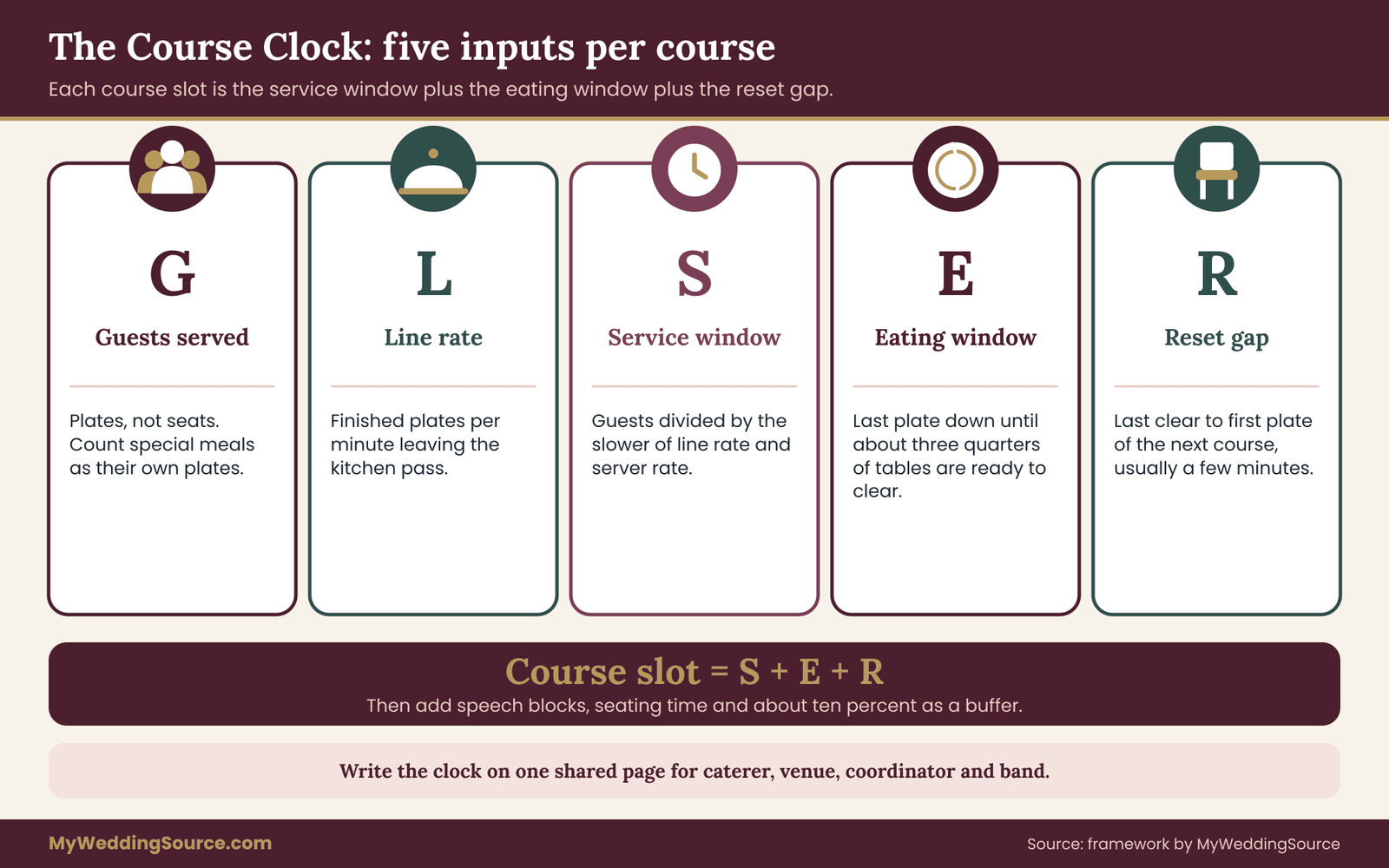
Call it the Course Clock. For each course, you estimate five things.
Guests served (G). The number of plates for that course, including special meals. Count plates, not seats, because a table of ten can hold nine standard plates and one plate that needs a different recipe and a different handler.
Line rate (L). How many finished plates per minute the kitchen can send out for that course. This depends on the dish, the number of cooks on the line, and the equipment. A cold salad that is assembled in advance can be plated quickly. A sauced hot course that must be finished at the last moment is slower.
Service window (S). The time between the first plate reaching a table and the last. It is the guests divided by the slower of two rates: the line rate, and the servers’ carrying rate. If the kitchen can finish ten plates a minute but servers can only deliver six, the room is limited to six.
Eating window (E). The time from the last plate landing to the point where most guests have finished. This is the one number you do not control. It varies by course, by crowd and by how much conversation is going on.
Reset gap (R). The time between the last clear of one course and the first plate of the next. Clearing and plating run in parallel, so this is usually a few minutes, not the full clearing time.
A course slot is S plus E plus R. Add the slots, add any speech blocks as separate lines, add the time guests spend sitting down and being served bread and water before the first course, and then add a buffer.
Why five inputs and not one
A single “minutes per course” number hides the thing you can change. With wedding dinner timing written as inputs, you can see more. If you know the main course slot is forty-nine minutes, you cannot tell whether to add a plating cook, shorten the speeches or serve a lighter dish. If you know that twenty of those minutes are the service window because the line produces six plates a minute, you know exactly where the lever is.
The model also tells you when your caterer’s answer is incomplete. A caterer who says “about two and a half hours for dinner” has given you an outcome. A caterer who says “we plate the main at about six a minute with this crew, and each server can take two plates per trip” has given you inputs. Inputs let you test the plan against your guest count, and outcomes do not.
The habit: one shared clock
Write the Course Clock as a single page with a column for each course and a row for each input. Share it with the caterer, the venue manager and whoever is running the evening’s cues. If your day-of coordinator uses a cue sheet, the dinner block of that sheet should be copied from the Course Clock, not invented separately. The wedding vendor timeline page explains how to line up vendor arrival and service times around a schedule like this, and the Course Clock slots into that larger picture as the dinner block.
You will revise the numbers more than once, because wedding dinner timing changes as facts arrive. After the tasting you will know something about the line rate. After the venue walkthrough you will know something about the carry distance. After your final guest count you will know G. Treat the first version as a rough sketch and expect the later versions to be better.
The rest of this guide takes each input in turn, then shows the model with real arithmetic.
Kitchen capacity: how many plates leave the line per minute
Kitchen capacity is the least visible and most important input in wedding dinner timing. Venues and caterers rarely volunteer it, because it is not a line on the proposal. You have to ask, and you have to ask in a way that produces a number.
The questions that produce a number
Start with the plain version: “For the main course, how many plates can your team finish and send out per minute?” A good caterer will answer with a figure or a range, or will say “I’ll check with my chef and send it.” Both are fine. A vague answer such as “we do this all the time” is a sign to ask again, more specifically: “How many people are on the line for the main, and how many pickup stations will there be?”
Follow with three questions that reveal the structure of the kitchen.
How many cooks finish plates at once? Plating is a pass-the-plate process. One cook might place the protein, another the starch, another the vegetable, a fourth the sauce, and a fifth wipes rims and checks. The rate is limited by the slowest station, not the average of them.
What equipment limits the hot courses? Ovens, warming cabinets, burners and holding space all cap how much can be ready at the same moment. A venue kitchen, or a tent kitchen set up for the day, often has fewer of these than a restaurant. A caterer working in an unfamiliar space may plan a smaller batch size than they would at their own location.
Is the course finished to order, or finished from a held batch? A braise portioned and held in a warming cabinet moves quickly. A pan-seared item that is cooked a few at a time moves slowly. Neither is better. They are different timing models, and you want to know which one you have.
If your caterer is also providing a pre-event tasting, ask them to time one plated course during the tasting, even roughly. It is a fair request: how long did it take from fire to plate for the six portions at the tasting, and what changes at one hundred and twenty?
The difference between a line rate and a batch
Line rate describes a steady flow. Batch size describes a constraint. A kitchen may be able to produce twelve plates a minute for a cold starter, but if the main course is cooked in sheet pans in an oven that fits eighty portions at once, the real unit of production is a batch of eighty with a gap while the second batch finishes. In that case the useful number for planning is not “plates per minute” but “how many plates in the first wave, how long to the second wave.”
For the Course Clock, convert batches into an average rate. If a caterer says two waves of sixty with a six-minute interval, the main course service window is about the sum of the delivery time for each wave plus the interval, and you can write it as a rate of roughly six to eight plates a minute for planning. The point is not precision. It is to avoid the mistake of assuming that a hundred and twenty plates can all appear together.
What changes the line rate
Several choices you make as a couple change the line rate, and some of them are worth knowing before you finalize the menu, since the menu quietly sets wedding dinner timing.
Number of components on the plate. Each added element is one more motion for the line. A main with a protein, a sauce, a vegetable, a starch and a garnish takes longer to plate than the same dish with a protein, a sauce and one side. This is a legitimate design lever: you can ask the caterer how much time a simplified plate saves, and decide whether you want the saving.
Choice of entrée. Offering a choice among two or three mains is popular and often kind to guests, but it multiplies complexity at the pass. Servers need to know which table ordered what, and the line needs to finish different dishes with different timing. A dual-entrée plate (one plate with two items, say a protein and a fish) is a single motion on a longer plate, and some caterers prefer it for that reason. Others prefer a pre-selected entrée count with a table-level seating key. Ask which model they run best.
Special meals. Vegetarian, vegan, gluten-free and allergy-managed plates are almost always handled separately from the main line, and they are often the ones that decide whether a course finishes on time. They are fired in small numbers by a cook who is careful about cross-contact, not fast. If your guest list has fifteen or twenty such meals, the caterer should say how they are handled and when they arrive.
For allergens in particular, the U.S. Food and Drug Administration’s food allergy pages explain the major allergens and why cross-contact matters. Nothing about timing should pressure a kitchen into cutting corners on an allergy plate, and nobody should promise that any plate is free of an allergen in a shared kitchen. Ask the caterer how they verify ingredients and separate preparation, and ask for it in writing.
Course style. A family-style course, a buffet, a station, or a stand-up course that is passed through the room each has its own capacity model. A plated dinner has the strictest constraint because every guest needs a matching plate at roughly the same moment. This article stays with plated and semi-plated service. If you are weighing service styles against each other, the broader guide to building a menu is a better starting point.
Service capacity: servers, stations and the walk
A kitchen can finish plates and still lose time in the room, and wedding dinner timing suffers when either half is ignored. Service capacity is how quickly people can carry those plates to guests, and it depends on staff count, the carrying method, the distance, and the layout.
The server rate
Servers are the second half of the service window. A server who carries two plates per trip, and whose round trip from pass to table and back takes about a minute and a half, delivers about one and a third plates per minute. A team of ten servers working in parallel would deliver around thirteen plates a minute, which is more than most kitchens can finish. These figures are illustrative, and your real numbers will differ. The point is the structure: servers deliver in rounds, and the round time depends on distance.
Many caterers use a team approach, with servers entering the room together and placing plates at a signal so that all guests at a table are served at once. Some use trays and stands to carry more than two plates at a time. Both methods raise the carrying rate. Ask what the caterer’s standard approach is for a dinner of your size and what a typical server-to-table ratio looks like.
It is also reasonable to ask whether the caterer expects any difference for your room, for example a long distance from the kitchen, a staircase, or a doorway that does not allow a tray.
Distance and layout
Distance is the factor in wedding dinner timing that surprises couples most. A kitchen at the far end of a long building, a loading dock route that doubles back, or a tent kitchen on the other side of a lawn adds seconds to every trip, and seconds across a hundred and twenty plates become minutes. If your reception is in a venue where the kitchen is not adjacent to the dining room, ask the caterer whether they have worked in that space before and whether they plan a satellite pass closer to the room.
Layout matters inside the dining room too. Round tables set tightly together leave narrow lanes. A dance floor in the middle of the room can force servers around the long way. A head table on a riser needs its own service plan. The wedding reception guest flow guide looks at how the room’s layout affects how people move, and the same lanes that guests use to reach the dance floor are the lanes servers use to carry plates.
Staffing ratios as a negotiation point
Staffing is where cost and wedding dinner timing meet. More servers can raise the carrying rate and shorten the service window, but they also cost money. The caterer’s proposal normally lists a staff count or a ratio, and you can ask what changes if you add or remove servers. A useful question is: “If we added two servers for the main course only, how much shorter would the service window be?” It turns an abstract cost into a timing result you can weigh.
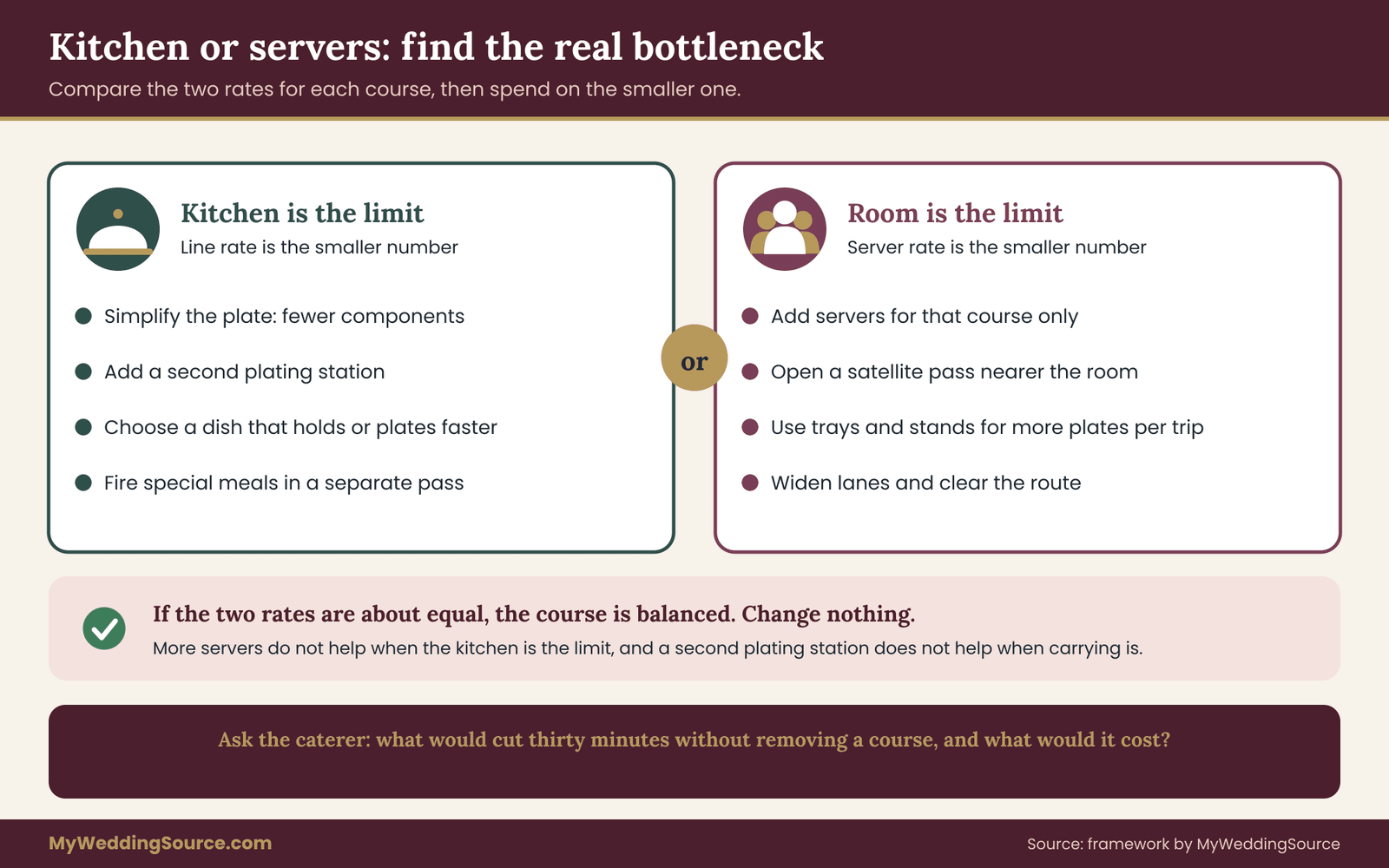
Be careful about assuming that more staff always means faster. If the line rate is six plates a minute, adding servers does not make plates appear faster. It only helps if carrying was the slower of the two rates. Run the numbers first. Compare the line rate with the server rate, and spend money on whichever is smaller.
Where the bottleneck actually is
Here is a small decision rule for wedding dinner timing that works at the planning stage. Take the line rate and the server rate for the course. If the line rate is lower, the kitchen is the bottleneck, and the fixes are a simpler plate, a second plating station, or a different dish. If the server rate is lower, the room is the bottleneck, and the fixes are more servers, a closer pass, or a different carrying method.
If they are about equal, you are balanced and should not change anything. Most couples are surprised to find that the main course is the only one where the kitchen is the limit, and that starters and desserts are limited by servers.
Why you should ask for a trial run
If the venue and the caterer are willing, the best test is a walk-through at the room with the caterer’s captain, not a tasting at the caterer’s office. Ask them to walk the route from the pass to a far table with a plate in each hand and time it. The venue technical walkthrough guide describes what to check on a site visit, and the dinner route is a good item to add to that list. Fifteen minutes spent in the room will teach you more about wedding dinner timing about service capacity than a long email thread.
Eating and clearing windows for each course
The eating window is the one input in wedding dinner timing that nobody controls, and the one most couples guess at. It is also the easiest to bias in the wrong direction. Planners who want a tight evening assume guests eat fast. Couples who imagine a long, convivial meal assume they eat slowly. Both are guesses, so for wedding dinner timing it is better to plan with ranges by course type and to build your buffer from the uncertainty.
What changes how long guests eat
A few factors move the eating window in a predictable direction.
The dish. A starter that is cut and eaten in a few bites finishes quickly. A bowl of soup that arrives hot needs time to cool. A main with a bone, a shell, or a protein that needs cutting takes longer than a pasta dish. Dessert is the most variable: some guests take two bites and move on to the dance floor, and others linger over coffee.
The conversation. A table of old friends who have not seen each other in years will talk through a course. A table of strangers seated together may eat quietly and finish early. You cannot plan this by table, but you can know that a room with a lot of travelers and a long reception line of greetings tends to run slower than a room of locals.
The alcohol and the hour. A dinner that starts at six after a cocktail hour behaves differently from a dinner that starts at eight after a long ceremony. The wedding cocktail hour guide explains how that earlier block shapes appetites, and the practical effect for timing is that guests who arrive hungry eat faster in the first course and slow down later.
Children and older guests. Young children often finish quickly, then need to move. Older guests may take more time and prefer not to be rushed. Neither group is a problem, but a plan should not assume that every table finishes at the same moment.
The slowest-table rule
Here is the rule that keeps a dinner from stalling: a course is finished when most tables are done, and a table is “done” when a clearing server can start without interrupting anyone. Servers watch the room, and a good captain starts clearing at tables that are finished while other tables are still eating. The captain does not wait for the slowest table, and does not clear in front of someone who is still eating.
For planning, write the eating window as the time from the last plate down until roughly three quarters of the tables are ready to clear. The remaining quarter gets cleared as they finish. This keeps wedding dinner timing moving without rushing anyone. This is a real practice, and it gives you a firm number to use in the Course Clock without pretending that every guest finishes together.
Ranges you can start with
Use them as a first draft of wedding dinner timing. You will refine these after the tasting, but a reasonable first draft for a plated dinner looks like this. For a cold starter, a window of twelve to eighteen minutes. For a light second course such as soup or pasta, ten to sixteen minutes. For a main course, twenty to thirty minutes.
For dessert and coffee, fifteen to twenty-five minutes, with the understanding that guests drift away from the table during dessert and the window ends more gradually. These are working assumptions, not measurements, and a caterer who has served your kind of crowd many times will have a better sense than any article can.
The reset gap
The reset gap is the time between the last clear of one course and the first plate of the next. Clearing runs while the kitchen is plating the following course, so the reset gap is not the full time to clear. Good teams aim for the first plates of the next course to reach the room just as the last plates of the previous course leave it.
In practice a reset gap of three to six minutes is common for a well-run dinner, and it can stretch if silverware has to be reset, or if the next course needs a different glass.
Silverware and glassware are quiet timing drivers. If each course needs its own fork, a server has to place it before the plate arrives. If a wine pairing means a different glass, the pour is another task. You do not have to give these up, but you should know that each one adds a few seconds per guest, which adds up across a hundred and twenty guests. Ask the caterer whether the place setting is built so that the flatware goes out with the course or is preset.
Where speeches fit in wedding dinner timing
Speeches are the largest source of uncertainty in wedding dinner timing, and the one thing that does not appear in any caterer’s capacity numbers. A toast of two minutes can become a story of eight. A friend who was told to speak for three minutes may have written five. If the toast lands during the wrong stretch of dinner, it also lands on hot food.
This section is limited to the kitchen side of toasts, not their wording or order: where can speeches sit so that they do not hurt the food, the servers or the schedule?
The three kinds of slot
Think of the dinner as having three kinds of moments for a speech.
Free slots. These are moments when no hot food is waiting and servers are not in motion. Before the first course is served, while guests are seated and bread and water are on the tables, is the clearest example. A short welcome toast here costs no food quality, because nothing is on a plate yet. The cost is only time: the guests are seated and the kitchen is waiting, so the start of the first course is delayed by the length of the toast.
Cheap slots. These are moments when the course on the table is cold or room temperature, and guests are already eating. A starter salad, a cold dessert, or the eating window of any course that holds well can carry a short speech without harm. The cost is attention: people listening are not eating, which can stretch the eating window by a few minutes.
Costly slots. These are the moments when hot food is at the pass or on the table. A speech that begins while main plates are being delivered will pause service, because servers should not walk through the room during a toast. Hot plates wait, or guests eat while someone is speaking, which is awkward for both. The kitchen has to choose between holding food, which has quality and safety implications, and refiring it, which has a cost.
What a pause costs the kitchen
When a speech interrupts service, the kitchen faces a choice with no good option. If food is already plated and waiting at the pass, it begins to cool, and the caterer has to follow the hot-holding practices that apply in the jurisdiction. If food has not yet been plated, the kitchen can pause the line, but a line that stops is a line that has to restart, and the first plates after a pause are often slower.
The U.S. Food and Drug Administration’s Food Code, which many health departments use as a basis for their rules, treats time and temperature as central to controlling bacterial growth. You do not need to learn the detail. You need to ask your caterer how they handle a delay, and whether the dinner is planned so that a long speech never forces that decision.
The simplest approach to speeches in wedding dinner timing is to give the caterer a speech plan and ask them to confirm the “no-speech zones”: the minutes before and during the delivery of a hot course. Hand them the planned order and approximate length, and ask them to flag any block that falls in a costly slot.
A speech plan that protects the food
For safe wedding dinner timing, put the speeches in slots where the kitchen is idle or the food is forgiving. A common pattern is: a short welcome toast before the first course is served; one or two speeches during the first or second course when the food is cold or light; and the remaining toasts during dessert, when the main line is finished and nothing is waiting. The kitchen fires each course on a signal from the captain, so the captain needs to know when a speech starts and ends.
Assign one person to hold the clock for speeches, since a speech overrun is the quickest way to damage wedding dinner timing. This does not have to be the coordinator, but it should be someone who has been told to nudge the speaker, with a hand signal if needed, and who can tell the captain when to fire the next course. If a speech runs over, the captain holds the next course fire by exactly the overrun, and not a minute more.

How long should a speech be
Couples sometimes ask for a number for speech length within wedding dinner timing. The honest answer is that a speech is best when it is short enough that the speaker finishes before the audience notices the time. Plan on a few minutes each, and set a total speech budget for the whole dinner instead of a limit per person. If your total budget is twenty-five minutes, you can decide how to split it. When the budget is a shared resource, it becomes easier to ask friends to trim.
Be kind but specific when you brief speakers. Tell them how many minutes you hope for, say where in the dinner they will speak, and let them know that the caterer is holding hot food. Most people respond well to a practical reason. The music side of the evening matters here too, because a band or DJ who knows the speech block can plan the first dance, and the wedding reception music planning guide covers how those cues connect.
A worked example of wedding dinner timing for 120 guests
Numbers make wedding dinner timing concrete. The example below is invented for illustration, and every assumption is written out so you can change it. It is not a benchmark of any real caterer or venue. Read it as a template for your own arithmetic.
The setup for this wedding dinner timing example
An invented couple, Dana and Marcus, are hosting 120 guests at twelve tables of ten. The dinner has four courses: a cold starter, a pasta course in a half portion, a main course, and dessert with coffee. The room is a single ballroom with the kitchen next door. There are twelve servers. The caterer has given them the following working numbers, which we treat as assumptions.
The starter is assembled in advance and plated at about twelve plates a minute. The pasta is finished from a held batch and plated at about nine a minute. The main course is finished in waves and works out to about six plates a minute. Dessert is plated at about twelve a minute. Servers can deliver faster than the kitchen produces in every course, so the line rate is the limiting number.
Of the 120 plates for each course, a handful are special meals: six vegetarian or vegan plates and four that are managed for allergens. The example adds no extra time for them, which assumes the caterer plates them in a separate pass ahead of the main wave. Treat that as a point to confirm with the caterer, not something to assume.
Course by course
Take each course in turn and write S, E and R.
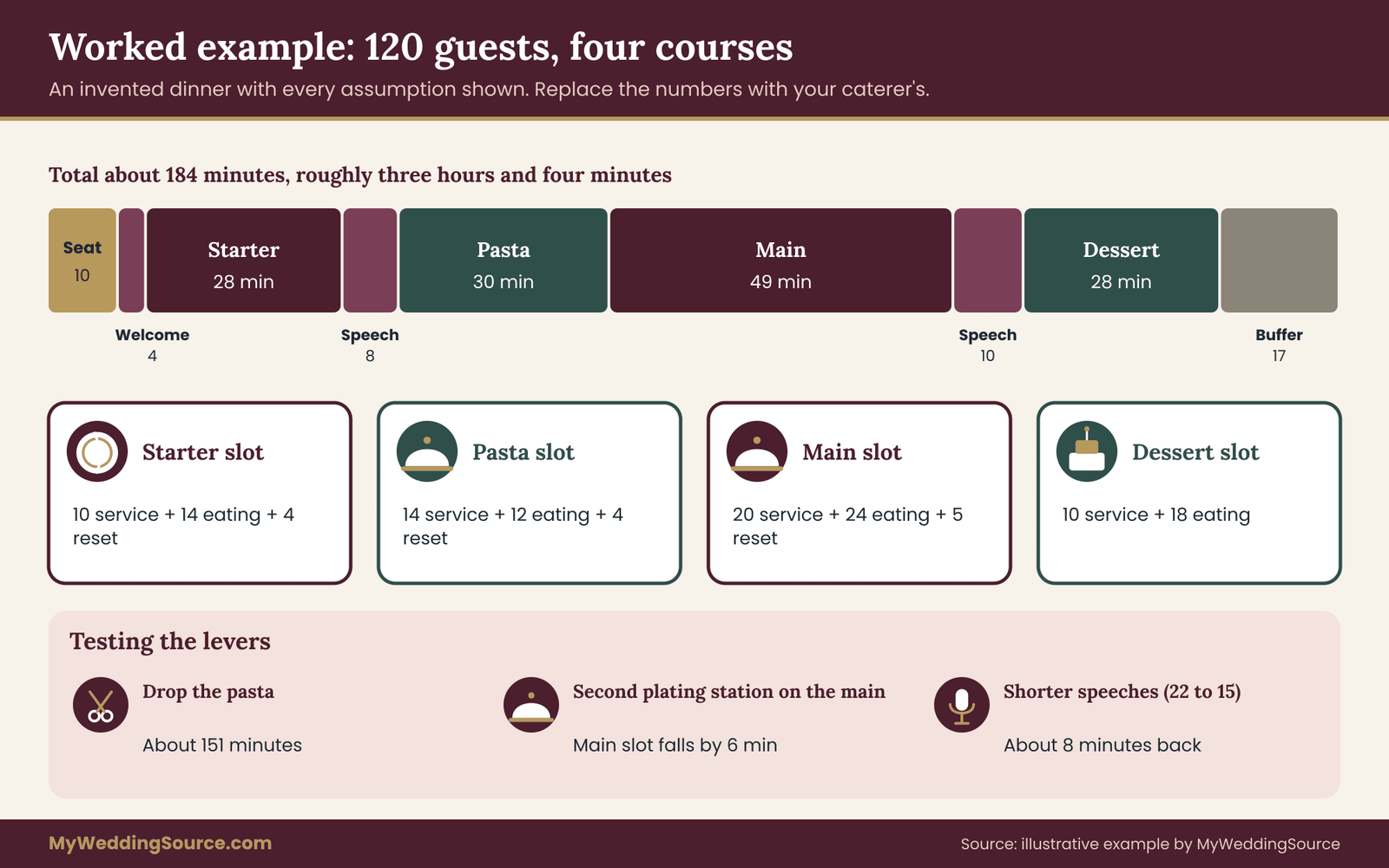
Starter. At twelve plates a minute, 120 plates take ten minutes, so S is 10. Guests eat a cold starter in about fourteen minutes after the last plate, so E is 14. The reset gap is four minutes. The slot is 10 plus 14 plus 4, which is 28 minutes.
Pasta. At nine plates a minute, 120 plates take 13.3 minutes, which we round up to 14. E is 12, because the portion is small. R is 4. The slot is 14 plus 12 plus 4, which is 30 minutes.
Main. At six plates a minute, 120 plates take 20 minutes, so S is 20. This is the longest service window of the evening, and the one most affected by kitchen capacity. E is 24. R is 5, because the main course needs a table clear of pasta plates and fresh flatware before dessert. The slot is 20 plus 24 plus 5, which is 49 minutes.
Dessert and coffee. At twelve plates a minute, S is 10. E is 18, with the understanding that guests will begin to leave the table during this window. R is 0, because there is no next course. The slot is 10 plus 18, which is 28 minutes.
The four slots add to 28 plus 30 plus 49 plus 28, which is 135 minutes.
Adding the parts outside the courses
Three more pieces of wedding dinner timing belong in the clock.
Seating and welcome. Before the first plate, guests find their seats, a server pours water, and bread arrives. The couple has planned a short welcome. Allow ten minutes between “dinner is open” and the first starter plate, which also gives the kitchen time to confirm the pass is ready. The wedding seating chart guide is relevant here, because a clear seating plan with table numbers visible from the entrance can save several minutes of wandering.
Speeches. The couple has asked for three speech blocks. A four-minute welcome toast before the starter is plated. An eight-minute block after the starter is cleared and before the pasta is fired. A ten-minute block during the dessert window, after the main is cleared. The total is 22 minutes. The first block is a free slot, the second is also free because the kitchen holds the pasta fire until the speech ends, and the third is a cheap slot because dessert is not yet fired.
Notice that the dessert E window of 18 minutes would overlap with the third speech in practice. To keep the model simple and slightly conservative, the speech is added as its own block, and the buffer absorbs any overlap.
Buffer. Add about ten percent to the total for the unknown: a slow table, a late plate, a spilled glass. Ten percent is a planning habit, not a rule from any standard.
The total
Add it up. Ten minutes for seating and welcome, plus 135 minutes for the course slots, plus 22 minutes of speeches, comes to 167 minutes. Ten percent of 167 is about 17 minutes. The total is 184 minutes, or about three hours and four minutes from the moment guests are seated to the point where dessert plates have been cleared.
That is a useful number for wedding dinner timing for several reasons. It is derived from stated inputs, so if the caterer later says that the main line is faster or slower, the plan can be changed with a calculator. It can be compared with the venue’s end time and with the music schedule. And it shows the couple where the minutes are: nearly a third of the dinner is in the main course slot, and the service window for that course is the largest single block of kitchen time.
Testing the levers of wedding dinner timing
With the clock written down, each wedding dinner timing decision becomes a calculation.
Drop the pasta course. Without the pasta slot of 30 minutes, and keeping the speech block that preceded it so as not to lose a toast, the total becomes 10 plus 105 plus 22, which is 137. Add a ten percent buffer of about 14, and the dinner takes about 151 minutes, or two hours and thirty-one minutes. The couple saves 33 minutes, and loses a course.
Add plating capacity to the main. Suppose the caterer adds a second plating station and the main course line rate rises from six to nine plates a minute. The service window drops from 20 to about 14 minutes (120 divided by nine is 13.3, rounded up). The slot becomes 14 plus 24 plus 5, which is 43, saving six minutes. The couple can then ask the caterer what that second station costs, and decide whether six minutes is worth it.
Shorten the speeches. If the three blocks shrink from 22 to 15 minutes, the total falls by seven minutes before the buffer, and by about eight after it. This is the cheapest lever, and the one that requires no money, only a conversation with the speakers.
Change the main. A main that holds well in a warming cabinet and can be plated faster might lift the line rate. A main that is finished to order might lower it. For wedding dinner timing, the couple does not need to design the dish, but they can ask the caterer which version of the main fits a faster clock.
What the example does not show
An example of wedding dinner timing hides several things. It assumes that every course finishes cleanly before the next is fired. It assumes twelve equal tables, no head table on a riser, and no children’s table. It assumes no late guests and no mid-dinner emergency. It does not include the first dance, the cake cutting, or any other event that might happen during or after dinner.
Most important, it treats the caterer’s working numbers as true. In reality, the numbers may be better or worse, and the only way to know is to ask, test and revise. The remaining sections take up the cases the example leaves out.
Using the example for your own plan
Copy the structure, not the figures, when you plan your own wedding dinner timing. Write your guest count, then each course with its line rate, then your own eating windows. Do the arithmetic once with your caterer’s best numbers and once with worse numbers, say a line rate one third lower and an eating window five minutes longer.
The gap between the two totals is your real uncertainty, and it tells you how much buffer and how much end-of-evening slack to protect. If the gap between the best and worst case is thirty minutes, plan the music and the venue end time around the worse case, and treat the better case as a pleasant surprise.
Stress tests for wedding dinner timing
A plan for wedding dinner timing that works only when everything goes right is a hope. The point of writing the Course Clock early is to test it against the problems that tend to appear, while changes are still cheap. Each stress test below takes one failure, shows how it moves the numbers, and gives a response you can agree on in advance.
The kitchen runs late
The most common threat to wedding dinner timing is a kitchen that starts the first course later than planned, because the ceremony ran long, the cocktail hour stretched, or a delivery arrived late. A late start does not by itself ruin the dinner. It becomes a problem when the caterer tries to make up time by rushing the courses, which cuts the eating windows and shortens the reset gaps.
Decide in advance what gets cut first. A sensible order is: shorten the speeches, then shorten the reset gap by clearing earlier at finished tables, then ask the kitchen to plate the next course sooner, and only then consider removing or combining a course. Agree on who makes that call. In most weddings the caterer’s captain and the coordinator decide together, and the couple is told afterward, not asked in the middle of dinner.
Write the late-start plan for wedding dinner timing on the cue sheet as a short rule, such as: “If the first course starts more than fifteen minutes late, cut the second speech block and move the cake cutting to after dessert is served.” Rules like this save an argument during the event. A written cue with a named owner is the same idea that ceremony cue sheets use, and it carries over to dinner.
One table is slow
Every room has a slow table, and wedding dinner timing has to allow for it. It might be a table of guests who are deep in conversation, or a table that was served last, or a table with several special meals that arrive after the others. If the captain waits for that table, the entire dinner waits.
The response is the slowest-table rule from earlier: clear and reset around the tables that are finished, and let the slow table catch up while the next course is plated. Servers can signal that a table is still eating, and the kitchen holds a plate for them, or serves them last. If a table is always the slowest, the caterer may suggest seating it near the service door so that its plates arrive sooner. The seating chart can help: if you know a table is likely to linger, avoid placing it where service starts last.
Special meals arrive late
Special meals are the most common cause of “the couple at table seven did not get their food.” They are usually plated separately, and they have to be matched to the right guest. If the matching process depends on a server remembering, it fails.
Ask the caterer how special meals are tracked. Common practices include a place-card marker, a table-level list given to the captain, or a color-coded ticket on the plate. Whatever the system, ask the caterer to describe it, and ask for the final guest list with meal choices to go to the caterer on a fixed date. Verify ingredients and cross-contact controls with the caterer for any allergen plate, in writing, and do not accept an unqualified claim that a meal is “safe” for a given allergy.
The U.S. Food and Drug Administration’s food allergy information describes the major food allergens and the basics of cross-contact, and it is a good reference to bring to that conversation.
For timing, the rule is that special meals should arrive with or slightly before the matching standard plates at the same table, never after. If a guest is the only person at a table without food while others eat, the dinner has failed that guest, regardless of the total minutes. Treat this as a hard constraint on wedding dinner timing rather than a fine adjustment.
Guests with limited mobility
In wedding dinner timing, some guests need extra time to move through the room, and some need a table placed near an exit or a restroom. A person who uses a wheelchair or a walker needs lanes wide enough to reach their seat. Seating those guests near the entrance, and keeping aisles clear for servers and guests alike, solves two problems at once.
For the Course Clock, this matters in two ways. First, narrow lanes slow the servers and push up the service window, so a room that is tight for mobility is also tight for plates. Second, guests who need more time to eat, or who prefer not to be rushed, are better served by an eating window set a bit longer.
The U.S. Department of Justice’s ADA information is the starting point for accessibility rules that apply to places of public accommodation. Your venue is responsible for its own compliance, and a short conversation with the venue manager is the right way to confirm the practical details.
Young children and early eaters
Children often eat faster, and a long dinner is hard on them. Many couples handle this with a separate children’s meal served earlier, or with a simpler plate. The effect on timing is small, but the kitchen needs to know the count and the timing, because a children’s plate served at the start of the starter course is one more motion for the line during a busy pass.
If the children’s meals come first, tell the caterer so the kitchen can plate them before the main wave, and tell the parents so they are seated and ready. Seating, high chairs and booster seats for the youngest guests should be settled with the venue and caterer before the day.
The venue has a hard end time
Many venues have a firm end time that caps wedding dinner timing, set by a lease, a noise ordinance, or a staffing contract. Overtime fees can be high and some venues will not allow it at all. A dinner that runs thirty minutes over eats thirty minutes of dancing time, or triggers a fee.
Work backward from the end time. Subtract the pack-out time the venue requires, subtract the time you want for dancing and the send-off, and the remainder is the time available for the dinner. If the remainder is less than your Course Clock total, you have to cut something: a course, a speech, or a segment of the program. The wedding vendor contract guide is a useful companion here, because overtime terms and hold times are written in the contracts and not on the timeline, and a conflict between them is better found early.
Weather and a change of room
If part of the evening may move indoors because of weather, wedding dinner timing changes. Rain can add minutes to every trip, a tent kitchen can lose capacity, and a room flip between ceremony and reception can delay the start. If you have a rain plan, ask the caterer for a version of the Course Clock for it, with a longer service window and a larger buffer. A second set of numbers is not a lot of work, and it is easier than improvising.

Illness, no-shows and late guests
A few guests may arrive late or not at all. For plated dinners, the caterer usually prepares the final headcount agreed in the contract, so a no-show does not save food, and a late arrival means a plate waits. Ask the caterer how they handle a guest who arrives during the main course. Some will fire a plate when they arrive. Others hold one from the extra plates. Agree on that plan before the day, and write it on the cue sheet.
How to combine the tests
You do not have to prepare for every stress test. Choose the three that apply most to your event, such as a hard end time, a large number of special meals and a long walk from the kitchen, and write a short rule for each on the Course Clock. A few well-chosen rules protect wedding dinner timing more than a long contingency list nobody reads.
Fitting wedding dinner timing into the rest of the evening
A dinner does not exist alone. It sits between the cocktail hour and the dancing, and its start and end times are set by decisions made elsewhere. Getting wedding dinner timing right means looking at the full evening and finding where the dinner can flex and where it cannot.
Work backward from the end
The easiest way to set wedding dinner timing and a start time is to begin with the end of the event and subtract. Write the venue’s end time. Subtract the pack-out period. Subtract the send-off, the dance block, and the cake or dessert service if it is separate. What remains is the latest time the dinner can finish, and the Course Clock total tells you when it must begin.
Suppose a venue requires guests out by eleven, and pack-out takes thirty minutes, so the event ends at half past ten. A thirty-minute send-off and ninety minutes of dancing push the end of dinner to seven. That sends the end of dinner back to half past eight. A dinner that takes 184 minutes then has to start at about half past five, which may be earlier than the couple pictured.
This is the moment to weigh the trade-offs: shorten the dinner, shorten the dancing, or negotiate a later end time. The arithmetic does not decide for you, but it removes the surprise.
The cocktail hour is a buffer, not a gap
The cocktail hour before dinner can absorb some of the variation in the day. If the ceremony runs ten minutes long, the cocktail hour can be ten minutes shorter. If the photographer needs family photos, the cocktail hour is often when they happen. What the cocktail hour cannot do is stretch without limit: guests who wait too long before dinner arrive hungry and tired, and the bar tab grows.
The cocktail hour guide on this site covers how long that block should run and what to serve. For wedding dinner timing, the key move is to agree on a “doors open” time for the dining room and to hold to it, with the caterer ready to fire the first course within a few minutes of that time. A dinner that starts on time is the best protection against a dinner that ends late.
If the evening includes an open bar, the pace of drinking affects the pace of dinner, and the wedding bar service planning guide is where to look. Whatever the policy, serving water and bread early is a simple way to keep the room comfortable while the kitchen works.
Where the photographer and band fit in wedding dinner timing
Photographers want light, and the light has a schedule. A sunset portrait session may need twenty minutes with the couple at a specific time, which could fall in the middle of dinner. Couples handle this in two ways: they leave the table for the portraits and return, or they schedule the portraits before dinner. If the couple leaves during dinner, the kitchen needs to know, because the couple’s plates should be held or plated afterward, and because the couple’s absence changes when the speeches can happen.
The band or DJ has their own cues: introductions, the first dance, the cake cutting, the parent dances. Many couples hold some of these before dinner, so that the dinner is not interrupted by events that move people around the room. Others hold them after the main course. In either case, a single cue sheet that lists the dinner block and the surrounding events lets everyone see the same clock.
Cake, coffee and the end of dinner
In wedding dinner timing, dessert is the course with the loosest edges. Guests may begin to dance before they have finished, and the cake cutting may fall at the start, the middle, or the end of the dessert window. If the cake is served as the dessert course, the kitchen has to cut and plate a cake for 120 people, which takes time of its own.
If the cake is cut for photographs and then taken to the kitchen, the caterer needs to know when it will arrive. The cutting and serving time belongs on the Course Clock as its own line.
Coffee and tea service is easy to forget. If it is expected, it needs its own staff and its own few minutes, and it should be on the clock.
Slack as a design feature
A plan for wedding dinner timing with no slack will run late. You can add slack in three places. The first is the buffer already described. The second is the dance floor: a plan that has the dancing start at a fixed time, whatever happens at dinner, makes the dinner the flexible part, and a plan that has the dinner end at a fixed time makes the dancing the flexible part. The third is the end of the evening: an extra fifteen minutes before pack-out lets the day finish calmly.
Choose which part of your evening you are willing to give up if the dinner runs long, and write it down. If the answer is “the second speech block” or “ten minutes of dancing,” that is a good answer. If the answer is “nothing,” the plan has no room for the ordinary variation that every wedding has.
Questions and scripts for your caterer and venue
Most problems with wedding dinner timing are information problems. The caterer knows the kitchen, the venue knows the room, and the couple knows the guests and the program. Each needs the other’s numbers. The scripts below are plain and short, and you can change the wording.
Questions for the caterer about wedding dinner timing
Ask these in an email so you have the answers in writing, and ask for a call if the answers are unclear.
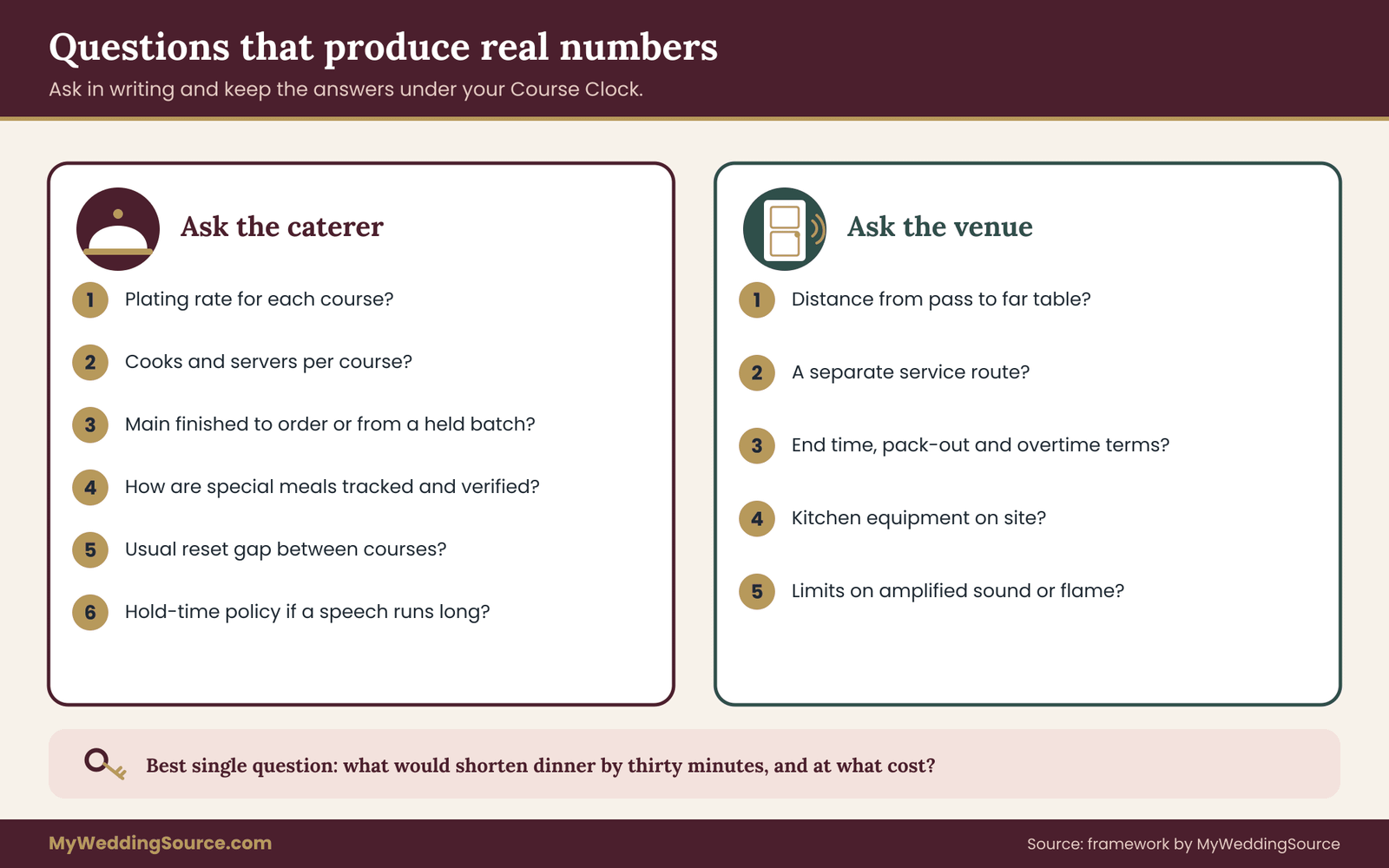
“For a plated dinner of this size, what is your plating rate for each course, and how many cooks and servers are planned for each?”
“Do you finish the main course from a held batch or to order, and does that change if the dinner is delayed by ten or twenty minutes?”
“How do you handle special meals and allergen plates: who prepares them, how are they labeled, and when do they reach the table?”
“What is your usual reset gap between courses, and does it change with a pairing, a different glass, or different flatware?”
“If a speech or event runs long, what is your hold-time policy for plated food, and who makes the decision to hold or refire?”
“What would shorten the dinner by thirty minutes without removing a course, and what would that cost?”
The last question tends to produce the most useful reply, because it invites the caterer to name their own levers.
Questions for the venue
“What is the distance and route from the kitchen or pass to the dining room, and is there a service route separate from the guest route?”
“What is the end time, the pack-out requirement, and the overtime policy, in writing?”
“What kitchen equipment is available on site, and what does the caterer need to bring?”
“Are there restrictions on the timing of music, amplified speech, or candles and open flame during dinner?”
What to say to a speaker
A short note works. “We would love a toast of about three minutes. It will come after the first course. The caterer is holding the next course until you finish, so a short one helps the food arrive hot. Thank you.” This explains the timing reason and sets a length without sounding like a rule.
What to say to the coordinator
“Please hold the Course Clock for the evening. If the first course starts more than fifteen minutes late, cut the second speech block. If any hot course is at the pass when a speech begins, ask the speaker to wait.” Short rules are easier to follow than long explanations, and a coordinator who has them in writing does not have to decide under pressure.
Keep the answers in one place
Collect the replies in a single document under the Course Clock, with the date of each answer and the name of the person who gave it. If the caterer changes the staff count or the venue changes the end time, the document will show what changed and when. Make sure verbal assurances are reflected in the signed agreement, and anything that affects wedding dinner timing, such as staff counts and hold times, belongs there. A planning note saved in your inbox is not a commitment, and a line in the contract is.
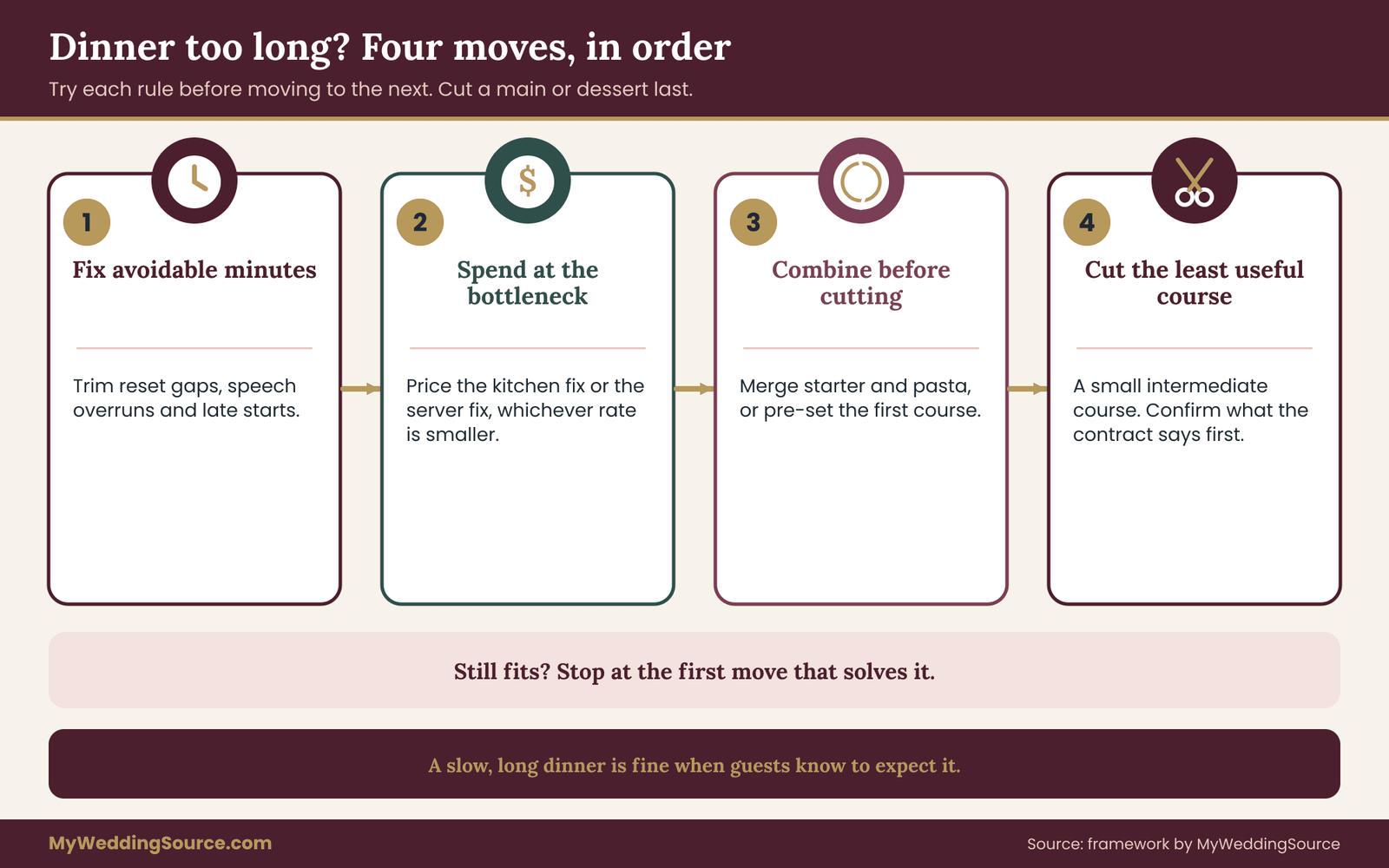
Deciding whether to cut, combine or keep a course
Once your wedding dinner timing shows a total, the next question is whether the total fits the evening. If it does, you are done. If it does not, you have four options, and the right one depends on what you value. Use the decision rules below as a way to talk it through with your partner and your caterer, in order, before you give up a course.
Rule one: fix the avoidable minutes in wedding dinner timing first
Before removing anything, look for minutes that no guest would miss. Long reset gaps between courses are one: if the gap is eight minutes and a tight team could manage four, you save four minutes per course. Speeches that run past their budget are another. A start time that slips by ten minutes because the room was not ready is another. These are fixes that cost almost nothing and do not change the menu. Walk through the clock and mark every minute that is not a guest eating, a server serving, or a speaker speaking on purpose.
Rule two: spend where the bottleneck is
If the dinner is still too long, look at the bottleneck. The earlier section showed how to compare the line rate and the server rate for each course. If the main course service window is twenty minutes because of the kitchen, a second plating station is worth pricing. If it is twenty minutes because of carrying distance, a satellite pass or extra servers is worth pricing.
Spending on the wrong side buys nothing. Ask the caterer for a quote on the specific change, and compare the cost with the minutes saved. Cost logic is simple: take the added fee and divide by the minutes gained. It does not tell you what is worth it, but it tells you what you are paying.
Rule three: combine before you cut
If a course has to go, consider combining two before removing one. A starter and a pasta course can become a single first course. A salad can move to the table before guests sit, as a pre-set plate, which removes its service window entirely. A dessert and a coffee service can be served together. Combining saves most of a course slot, and guests often notice the removal less than they would if a whole course vanished.
The wedding menu planning guide can help you decide which courses carry the most weight for your guests, so that what you remove is the least missed.
Rule four: cut the course with the least function
When none of the above is enough, remove a course. The course to remove is usually the one that does the least work in the meal. An intermediate course that is small and similar in kind to the starter, such as a second light dish, is often a safe choice. A main course is almost never the right one. Guests remember the main and the dessert, and a dinner that drops them feels like a smaller event than it is.
Before you cut, tell the caterer. Some contracts set a minimum spend, a per-person price or a course count, and removing a course may not reduce the bill by the amount you expect. Ask for the revised proposal in writing and compare it with the original line by line.
When to keep every course
A long, multi-course dinner is also a legitimate choice, and slow wedding dinner timing can be intentional. Some couples want a slow evening, with a long table, long conversations and a small number of guests. If the venue’s end time allows it, if the dance block is short or absent, and if guests are told in the invitation or the website what kind of evening to expect, a three-and-a-half-hour dinner can be a pleasure. The failure is not length. It is a long dinner that guests did not expect, with gaps that nobody explained.
If you choose a slow dinner, make it feel intentional. Put a short note on the program or on the wedding website. Let guests know that dinner will be a series of courses, so they can plan a ride home or a babysitter. Add a small moment between courses, such as a toast, a song, or a walk to the next room, so the pauses feel designed.
Your next steps
Here is a short sequence you can follow over the weeks before the wedding.
- Pick a rough guest count and course count. You need a G and a number of courses for the first draft of the Course Clock, and a round number is fine.
- Send the caterer the plating and staffing questions. Ask for the line rate, the number of cooks and servers for each course, the special meal process and the hold-time policy, in writing.
- Write the first Course Clock. One page, one column per course, five inputs each, plus speech blocks, the seating period, and a ten percent buffer.
- Check the total against the venue’s end time. Work backward from the end and see whether the numbers fit.
- Walk the route. At a site visit or the final walkthrough, time the route from the pass to a far table, and note any obstacles.
- Brief the speakers. Give each a time, a position in the dinner and a reason.
- Write the three stress rules. Late start, slow table and speech overrun, each with an owner.
- Put anything that affects timing in the contract. Staff counts, hold times and overtime terms belong in writing.
- Share the final clock. Send it to the caterer, venue, coordinator, band or DJ and photographer, with the date.
Revisit your wedding dinner timing after the final headcount and again a week before the event. Small changes in the guest count can move the main course service window by several minutes.
FAQ
How long should a multi-course wedding dinner take?
For wedding dinner timing, most plated dinners with three or four courses land somewhere between two and a half and three and a half hours, speeches included. Your number depends on guest count, the kitchen’s plating rate, the servers, and how long guests take to eat. Build the Course Clock with your caterer’s numbers, add speech blocks and a buffer of about ten percent, and use that total instead of a general rule.
How many minutes should each course take?
As a working draft, plan roughly twelve to eighteen minutes of eating for a cold starter, ten to sixteen for a light second course, twenty to thirty for a main, and fifteen to twenty-five for dessert, plus the service window and a short reset gap. Treat these as starting guesses and replace them with your caterer’s experience after the tasting and walkthrough.
What is the biggest factor in wedding dinner timing?
For hot courses it is usually the kitchen’s plating rate, meaning how many finished plates leave the line per minute. For cold courses it is often the servers’ carrying rate and the walking distance. Compare the two rates for each course and put money or effort into whichever is smaller. Adding servers does nothing if the kitchen is the limit.
Where should speeches go during a plated dinner?
For good wedding dinner timing, place them where no hot food is waiting: before the first course is plated, during a cold or light course, or during dessert. Avoid the minutes when hot plates are at the pass or being served. Give the captain the speech order and length, and have one person watch the clock so the next course is fired when the speech ends.
What should I do if the dinner starts late?
Agree on a written rule in advance. A sensible order is to shorten speeches first, then tighten the gaps between courses, then ask the kitchen to plate sooner, and only then combine or remove a course. Decide who makes the call, usually the caterer’s captain with the coordinator, so nobody has to improvise during dinner.
How do special meals affect timing?
Vegetarian, vegan, gluten-free and allergy-managed plates are usually prepared separately and in small numbers, so they need a clear tracking method and should reach the table with or before the standard plates. Ask the caterer how they verify ingredients and prevent cross-contact, and get the answer in writing. Do not accept a promise that any plate is free of an allergen.
Is it better to cut a course or shorten speeches?
Shorten speeches and trim the reset gaps first, because they cost nothing and change no one’s meal. Next, look at the bottleneck and consider a second plating station or more servers. If you still need time, combine two light courses before removing one. Remove a main or dessert last, since guests remember those most.
What should I ask my caterer about timing?
To plan wedding dinner timing, ask for the plating rate for each course, the number of cooks and servers, whether the main is finished to order or from a held batch, how special meals are handled, the reset gap, and the hold-time policy if a speech runs long. Also ask what would shorten dinner by thirty minutes without removing a course, and what it would cost.
Sources
- U.S. Food and Drug Administration: Food Allergies
- U.S. Food and Drug Administration: FDA Food Code
- FoodSafety.gov: Food safety information from the federal government
- U.S. Department of Agriculture, Food Safety and Inspection Service
- Centers for Disease Control and Prevention: Food Safety
- U.S. Department of Justice: ADA information and technical assistance
- Occupational Safety and Health Administration
- Federal Trade Commission: Consumer Advice