
A good wedding cake timeline is less about ordering a cake and more about managing a chain of small decisions, each of which depends on the one before it. This guide follows the cake from the final guest count to the first slice, with serving math, bakery contract questions, delivery and food-safety planning, and a day-of cutting plan you can hand to your caterer.
Build your wedding cake timeline backward from the cutting. Fix the serving plan once your RSVPs settle, lock the design and structure with the baker before the final count deadline, confirm in writing who delivers, who assembles and who cuts, and keep anything perishable out of the 40°F to 140°F range for no more than two hours (one hour above 90°F). Ask every baker for their own deadlines, because they differ.
Cakes go wrong in boring ways. Nobody forgets to order one. What happens is that the count the baker built the cake around is out of date by the time the cake is baked. Or the cake is delivered fully assembled to a venue whose door is too narrow. Or the filling needed a fridge, and the fridge was full of the caterer’s salads. Or a guest with a nut allergy was told the cake was “probably fine.”
Each of those problems has the same root. Someone assumed that another person was handling a step, and nobody wrote it down. The point of a wedding cake timeline is to make every step visible, give it an owner and attach a deadline, so you are not discovering gaps on the wedding morning.
This wedding cake timeline guide is written for couples working with a bakery, but most of it also applies if a caterer, a venue pastry team or a friend is making the cake. If a home baker is involved, read the section on verification and local rules before you commit.
What a wedding cake timeline actually covers
Most online advice on this subject is a list of months: book the baker this far ahead, taste cakes that far ahead, confirm the order a few weeks before. That is a useful skeleton, but it hides the part that causes trouble, which is the dependencies. A cake is a set of linked decisions.
You cannot choose tier sizes until you know how many servings you need. You cannot know how many servings you need until you know which guests will actually eat cake and whether you are serving other desserts. You cannot lock the design until the baker has confirmed what structure will hold it up. You cannot schedule delivery until you know where the cake will sit, what temperature the room is, and who is allowed to set it up.
Here is the chain that the rest of this guide walks through, in order.
- Final guest count. The number that everything else depends on.
- Serving plan. How many slices, from how many tiers, plus any kitchen cake or other desserts.
- Design and flavors. Shape, finish, fillings and decoration.
- Structure and support. How the tiers are built to carry their own weight and survive transport.
- Allergens and dietary needs. What goes in, what is labeled and who is protected from what.
- Food-safety plan. How perishable fillings are kept at safe temperatures.
- Delivery and setup. Who moves the cake, when, by what route, onto what table.
- Cutting service. Who cuts, when, and what happens to each slice.
- After the cutting. Leftovers, the top tier, rented stands and cleanup.
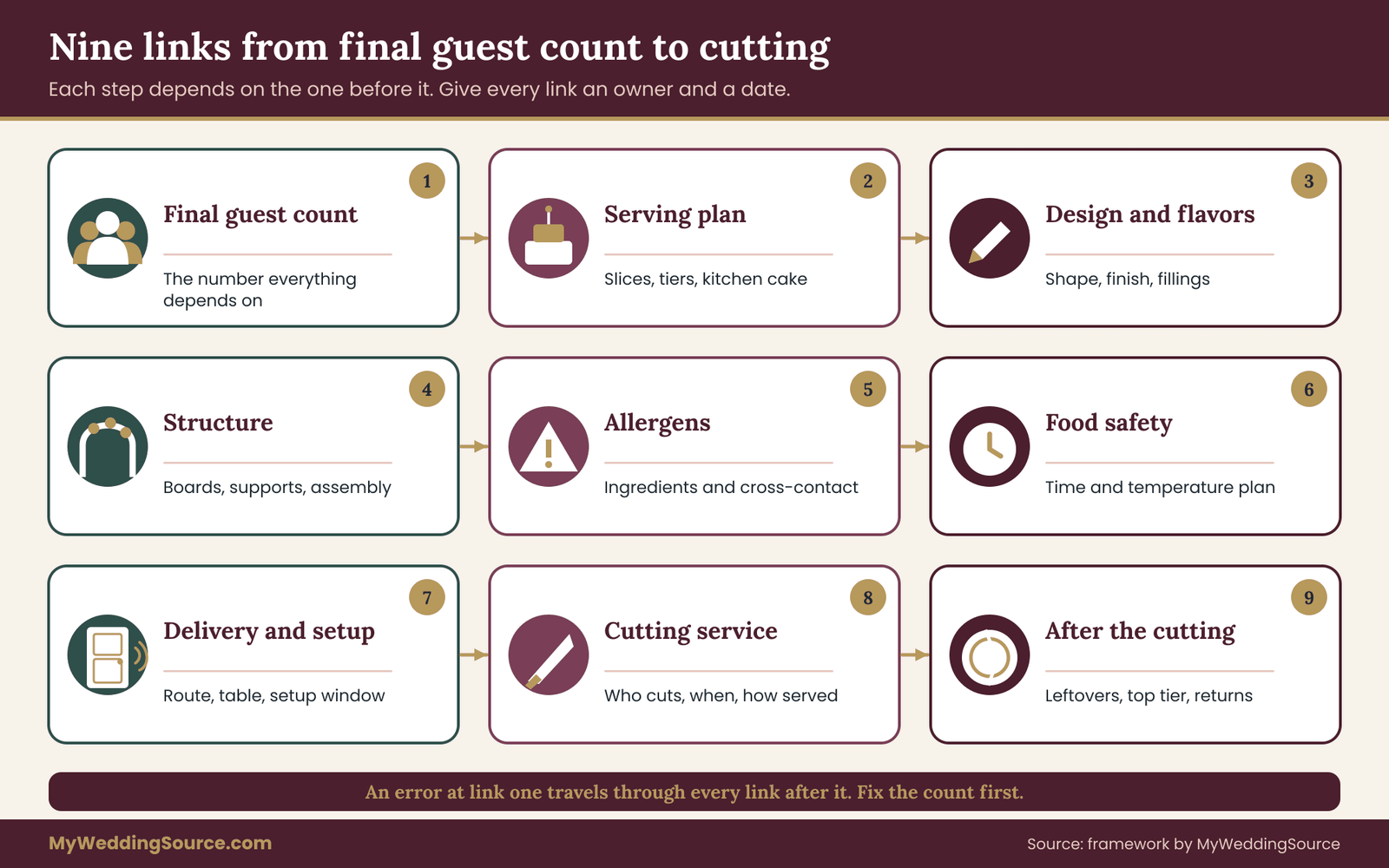
Notice the order. The count comes first because errors there spread everywhere. A cake that is ten slices short is a visible problem on the day. A cake that is thirty slices too large is a quieter one, because you paid for it, but it is just as avoidable.
Who owns each step of the wedding cake timeline
A wedding cake usually has four hands on it: the couple, the baker, the venue or caterer, and sometimes a planner. Problems appear in the handoffs, so each handoff needs a line in the wedding cake timeline and a name beside it.
The couple owns the final count, the design decisions and the approval of the contract. If nobody else is in charge of reconciliation, this falls on you, and the section on serving math shows how to do it in an evening.
The baker owns the production: recipe, baking, structure, allergen information and, if included, delivery and setup. The baker also owns the honest answer to “how many servings will this give?” under their own slicing method.
The caterer or venue owns the room where the cake will sit, the refrigerator space, the table and linen, the plates and forks, and very often the cutting. Many venues charge a cutting fee, and some require that their staff do it. Ask before you assume.
The planner or day-of coordinator, if you have one, owns the schedule: when the cake arrives, when it is set, when the cutting happens, and who calls the photographer to the cake table. If you do not have one, name a person, because someone has to.
Write these four lines on one page and share it with all four parties. It is the most useful single document in the process, and it takes ten minutes.
How far ahead to start your wedding cake timeline
There is no universal lead time for a wedding cake timeline, and anyone who quotes one for every bakery is guessing. Bakers book by capacity, and capacity depends on the day. Peak Saturdays fill first, and a baker who does two or three large wedding cakes per weekend will stop taking orders for a date once those slots are full.
A sensible approach is to ask each baker directly: “How far ahead do you usually book for our date, and when would you stop accepting orders?” Pair that with your venue date and your vendor timeline, and book the baker in the same stretch as your other critical vendors. If your date is on a holiday weekend or in peak season, treat the baker’s calendar as a constraint as strict as the caterer’s.
If your wedding is only a few months away, do not give up. Smaller bakeries, grocery-store bakeries and caterers with in-house pastry teams sometimes have openings, and a simpler design is faster to produce. Just ask about their rush policies and any extra charges.
What to have in hand before your wedding cake timeline starts
Before the first consultation, gather the following, because a wedding cake timeline built on specifics holds up better than one built on guesses. A baker can quote far more accurately with specifics than with a vague idea.
- Your wedding date, venue name and address, and the time the reception starts.
- A rough guest count, with a note on how firm it is.
- Whether other desserts will be served, such as a dessert table, a plated dessert course or late-night snacks.
- Any known dietary restrictions among guests.
- A few photos of cakes you like, and a note on what you like about each: the shape, the finish, the flowers, the color.
- Your budget for the cake, including delivery, setup and any cutting fee.
If you are still working on the budget, the wedding budget guide shows how to allocate money across vendors without letting the cake squeeze other priorities. ## Serving math in a wedding cake timeline: from final guest count to slices
Everything downstream, from tier sizes to price, rests on a number you will not know for sure until the RSVPs close. The way to deal with that is to separate three numbers that people often blur together: the guests you invited, the guests who will attend, and the slices you need to produce.
Invited is the list you sent invitations to. It is the least useful number for the cake. Attending is the number who said yes. Slices needed is attending, adjusted for who will not eat cake, who will eat a slice without being a guest, and how much cushion you want.
What counts as a serving, and why it matters
Before any arithmetic, find out how your baker defines a serving. This is the single most common source of confusion in a wedding cake timeline, because two bakers can quote the same cake with different slice sizes and both be honest.
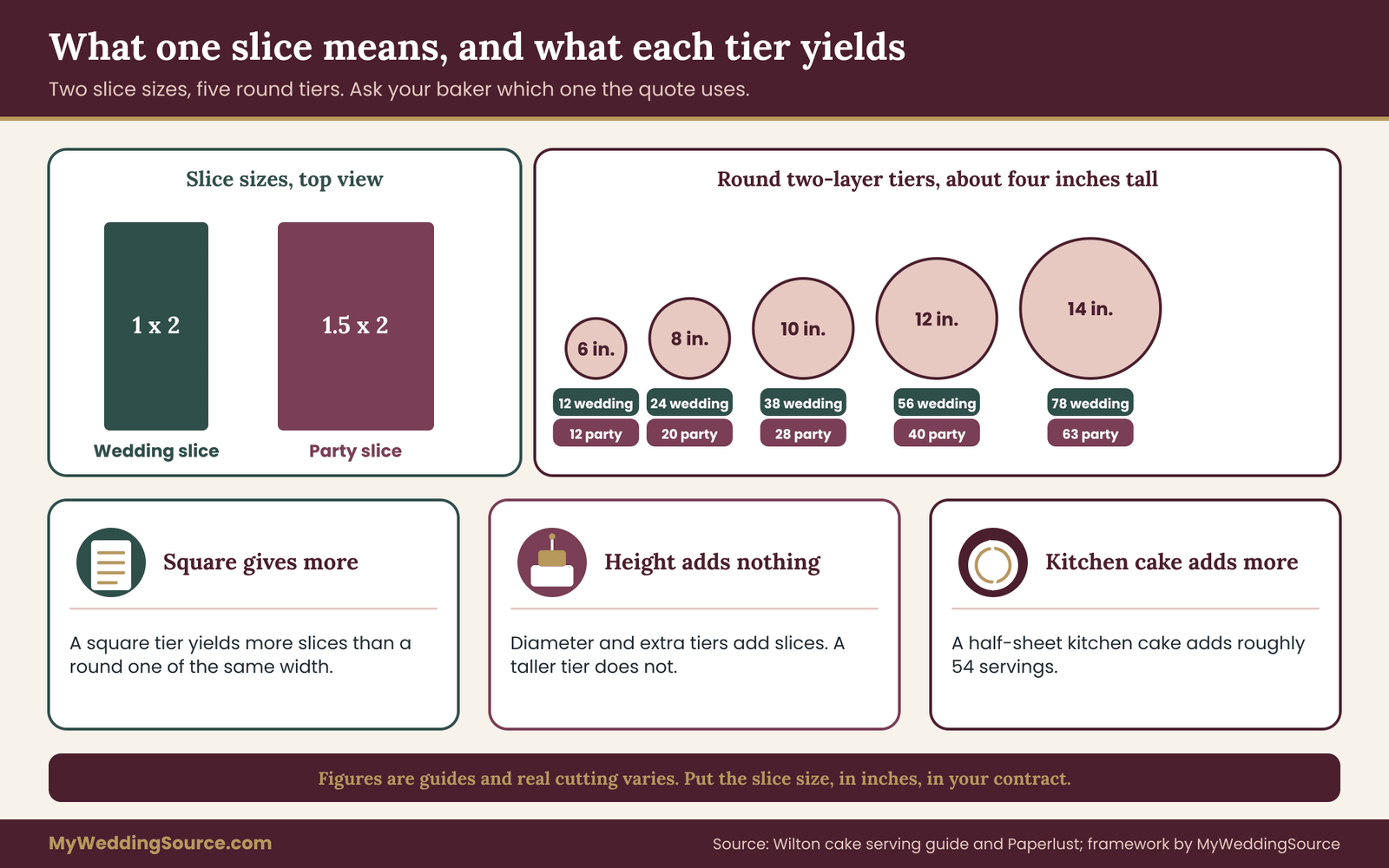
The commonly used measure is the wedding slice, about one inch wide by two inches deep, cut the full height of the tier. A party slice is wider, about one and a half inches by two. Wilton’s serving guide and several wedding sites use these definitions, and the party slice yields noticeably fewer servings from the same cake, roughly a fifth to a third fewer depending on the tier.
For round two-layer tiers about four inches tall, Wilton’s chart lists these wedding servings: a 6-inch tier gives about 12, an 8-inch about 24, a 10-inch about 38, a 12-inch about 56 and a 14-inch about 78. The party-slice figures run lower, for example about 28 for a 10-inch tier and 40 for a 12-inch. Wilton itself notes that these are guides and that real results vary. Square tiers give more servings than round tiers of the same width, and extra height does not add slices by itself. Only diameter and extra tiers do.
So ask the baker three plain questions, and put the answers in your contract:
- What slice size are you using when you say this cake serves a given number of people, in inches?
- Does the serving count include any tier that will not be cut, such as a top tier saved for an anniversary?
- If the real slices come out larger than planned, will you make up the difference, or is that my risk?
You will learn a lot from how the baker answers. A professional who cuts wedding cakes regularly will answer these in a sentence. Someone who hesitates may be quoting numbers from a chart without having tested them on a real cake.
Start from confirmed attendance, not the invitation list
Your guest list will change between invitations and the wedding. Your wedding cake timeline should follow the confirmed count, not the hopeful one. People decline, add partners, bring children or cancel the week before. The number you want is confirmed attendance at the time you place the final order, and a reserve for the uncertainty that remains.
If you are still working on the list itself, the guest list guide explains how to build and trim it. For the cake, the useful point is this: do not order from the headcount you had when you booked the baker. Revisit it at the final-count deadline, with RSVPs in hand.
The reconciliation step of the wedding cake timeline
Here is a method you can run in one sitting with a spreadsheet or a sheet of paper, and it sits at the center of the wedding cake timeline. It is a final-serving reconciliation: a short calculation that ends in one number you give the baker.
Step one: start with confirmed attendance. Count everyone who has said yes, including children, plus-ones and the couple.
Step two: subtract guests who will not eat the cake. This might include guests with allergies or medical restrictions, very small children, guests who have told you they avoid sweets and anyone who will get a separate dessert. Do not guess. Use what you actually know, and be careful about this step: for a guest with an allergy, subtracting them from the cake count is only half the job, because you must also plan what they will eat instead.
Step three: add people who will eat cake but are not guests. That could include a photographer, a band, a planner or venue staff, depending on your contracts. Many vendors are fed a meal, and some are offered cake. Decide in advance and add the number deliberately.
Step four: add a reserve. A reserve covers surprise guests, larger slices, a dropped plate and the pleasure of seconds. One planning guide suggests ten to fifteen percent above confirmed attendance. Size yours according to how reliable your count is: a seated dinner with assigned seats and a confirmed meal choice for everyone needs less cushion than an open-door reception.
Step five: convert to servings. Use the baker’s slice size, in inches. If the baker quotes party servings and you need wedding servings, ask for the conversion in writing instead of doing it yourself.
Step six: compare with what the design provides. Add up the servings from the tiers that will be cut, and any kitchen cake. If you fall short, the fix is usually a kitchen cake, not a bigger display cake.
Step seven: freeze the number. Send the baker one email that states the final count, the slice size and the cutting plan, and ask them to confirm it by reply.
A worked example for the wedding cake timeline (illustrative numbers)
The numbers below are invented to show how the serving step of a wedding cake timeline works. They are not benchmarks for any real wedding.
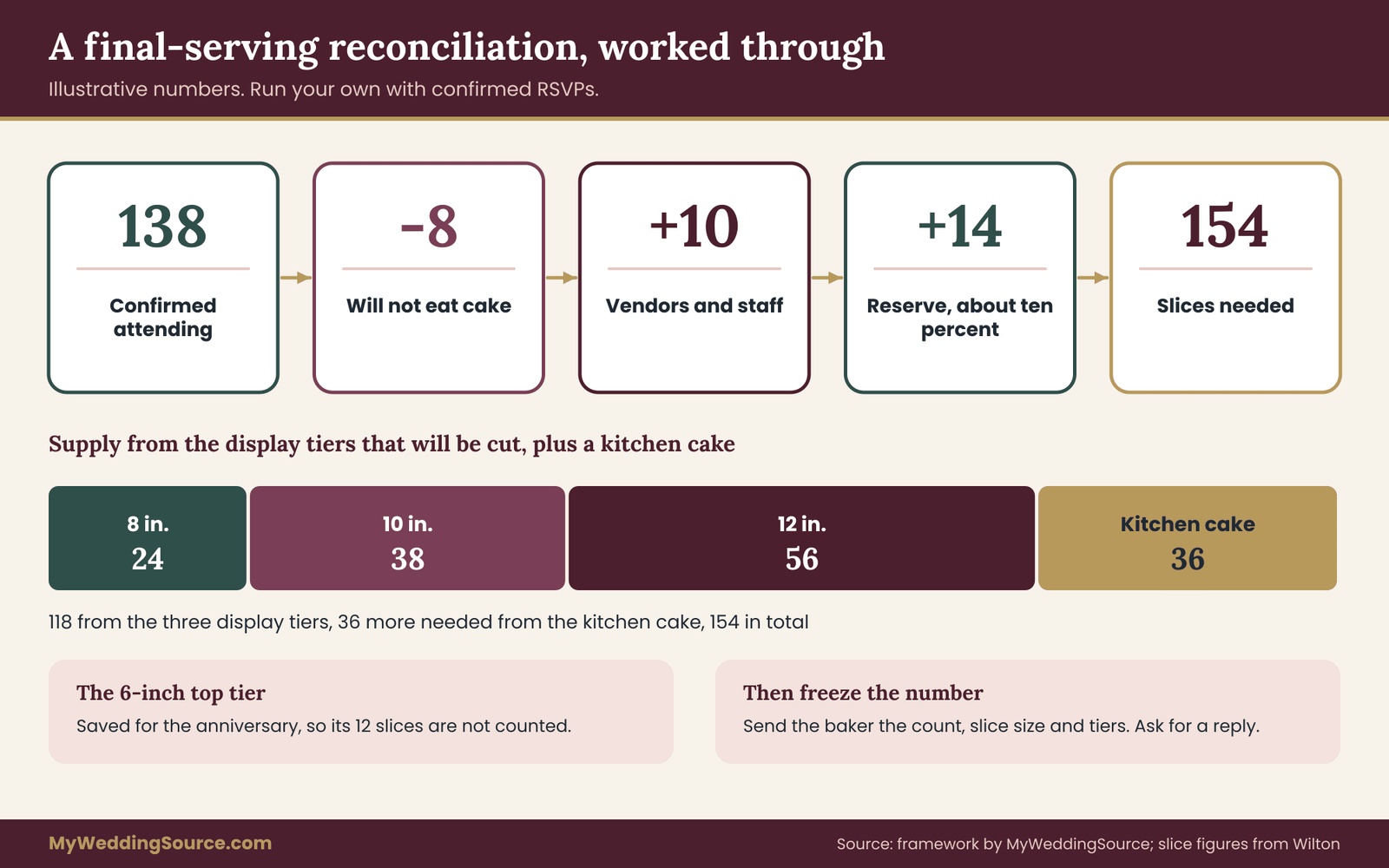
Say a couple invites 160 people and, at the RSVP deadline, 138 have confirmed, counting children and the couple.
- Confirmed attendance: 138.
- Eight guests will not eat the cake: two with allergies who will get a separate dessert, three young children who will get a small treat and three who said they avoid sweets. That leaves 130.
- The caterer and photographer will each get a slice, plus the band: ten more people. That brings the total to 140.
- They add a reserve of about ten percent, or 14 slices, to land at roughly 154 slices.
They want a three-tier display cake with a 6-inch top tier that will be saved for an anniversary. The tiers that will be cut are 8, 10 and 12 inches. At the wedding-slice figures above, that is about 24 plus 38 plus 56, or 118 servings. They are 36 slices short.
Rather than enlarge the display tiers, they ask the baker for a kitchen cake of about 36 to 54 servings in the same flavors, to be cut in the kitchen. The display cake stays elegant and affordable. The couple still cut the first slice from the bottom tier for photographs, and everyone else gets a slice from the combined supply.
The arithmetic is simple. The value is that it was done before the order was finalized, with each assumption visible.
Display cake plus kitchen cake in the wedding cake timeline
Many couples use this approach, and it is worth understanding properly. A display cake is the decorated tiered cake on the cake table. A kitchen cake, sometimes called a sheet cake, is a plainer cake of the same or complementary flavors that is cut and plated out of sight.
The benefit is cost and control. Decoration is where much of a cake’s price comes from, and a smaller display cake plus a sheet cake can cost less than one large decorated cake with the same number of servings. One planning guide notes that a half-sheet kitchen cake adds roughly 54 servings. The trade-off is that guests will see the display cake being cut and may notice that slices come from elsewhere. Most guests do not mind, but if you would rather everyone eat from the cake on the table, say so.
Ask the baker whether the kitchen cake is included in the quote, how it is packaged and who cuts it. Ask the caterer or venue whether they can plate it.
When other desserts change the wedding cake timeline
If the cake is one of several desserts, fewer guests will take a full slice. The size of that effect depends entirely on your guests and the other desserts, and no general percentage can tell you what yours will be. Your caterer has seen many receptions and will often give you a more reliable estimate than any chart. Ask them: “At events like ours with a dessert table, how much of the cake do guests usually take?”
Then plan a margin. It is better to have a few slices left over than to run out at the cutting. A leftover slice can be boxed. A missing one cannot be conjured.
If the count changes after your wedding cake timeline reaches its final date
Counts will change. Decide how you will handle that before it happens, and write the rule into your wedding cake timeline.
- Ask the baker for the last date on which they can change the size of the order, and whether they can make the change upward, downward or both.
- Ask whether the price is per serving, per tier or fixed, and what a late change costs.
- If you are likely to add guests late, order a little more now. Adding a kitchen cake late is generally easier than rebuilding a display cake.
- If you are likely to lose guests, ask whether the order can shrink, or whether you are paying for the cake as booked.
Write the answers in an email or in the contract. Verbal assurances are hard to rely on when the baker is under pressure on a Friday. ## The wedding cake timeline, phase by phase
Months-before checklists are tidy, but they assume every baker works on the same schedule. A wedding cake timeline holds up better when it is built around the order of events instead of fixed dates. They do not. What stays constant is the order of the phases. Your baker will supply the actual dates, and your job is to collect them early and put them in one place.
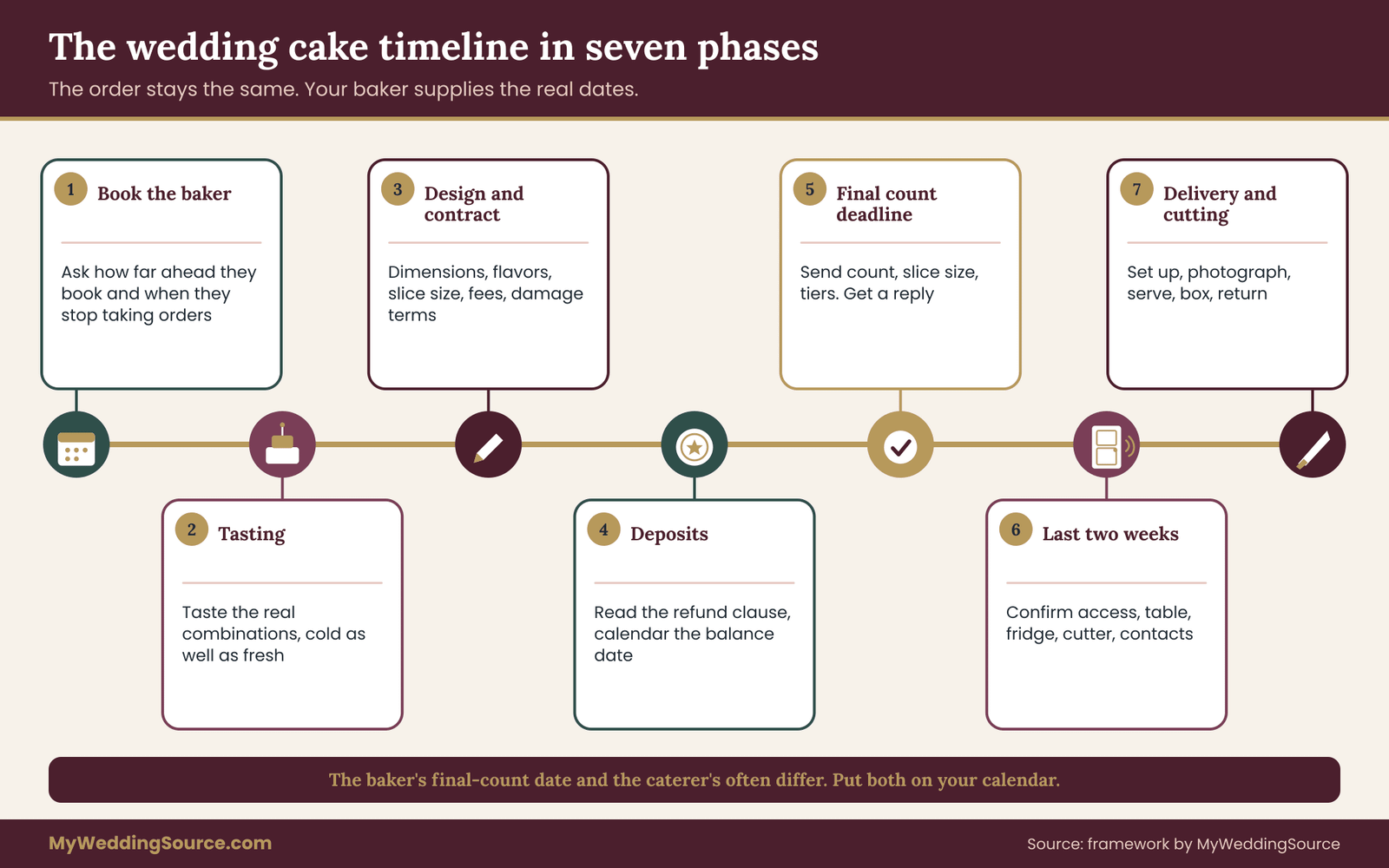
Phase one of the wedding cake timeline: research and booking
This phase is about finding bakers who can take your date and are a plausible match for your style and budget. Collect names from your venue and caterer, who often know which bakers deliver reliably to their space. Local wedding vendors, recent brides and groups of local couples are useful too, but treat any single recommendation as one data point.
Ask each candidate the same short list of questions, so you can compare answers fairly.
- Are you available on our date, and do you take more than one wedding that day?
- What is the minimum order, and what does a cake like the ones we have in mind typically cost, including delivery and setup?
- Do you do tastings, are they free or paid, and is the fee credited to the order?
- By when must we confirm the final count, and what is the final payment date?
- Who will actually make the cake, and who will deliver and set it up?
- Do you have a food-service license or the local equivalent, and do you carry liability insurance?
Take notes in one place. Within a couple of conversations you will notice which bakers are clear and which are vague, and clarity is a decent predictor of how the next few months will go.
Phase two of the wedding cake timeline: tasting and consultation
A tasting is a chance to check three things: flavor, texture and honesty. Flavor is obvious. Texture matters because wedding cakes are made well ahead and often chilled, and some cakes that taste wonderful warm taste dense or dry when cold. Honesty is about whether the baker’s answers match what you see: does the cake hold together, are the layers even, is the filling what they say it is.
Go with specific questions.
- Can we taste the combinations we would actually order, not just a sampler of unrelated cakes?
- How does this cake hold up after refrigeration and a few hours at room temperature?
- Which fillings are shelf-stable and which need refrigeration?
- What is the structure inside the tiers, and how many people will assemble it on site?
- How would you handle a guest with a nut, egg, dairy or gluten restriction?
If you are visiting several bakers, taste in a short window so you can compare. Take plain water or crackers to reset your palate, and take notes right away. Eat nothing rich for an hour before. It sounds fussy, but flavors blur quickly.
Phase three of the wedding cake timeline: design lock and contract
By the end of this phase the cake should exist on paper. That means a sketch or description with measurable details: the number of tiers, the diameter of each, the finish (fondant, buttercream, naked, textured), the colors, the flavors and fillings, and the decoration. If fresh flowers will be on the cake, the baker and your florist need to agree on who supplies and places them, and on which varieties are safe on food. The flower logistics checklist helps you coordinate the florist’s side.
Ask for the design in writing, with dimensions, and ask what changes are allowed after you sign. Some bakers allow minor adjustments up to a set date. Others charge for any change once production planning begins.
What a good bakery contract covers
A contract is not a sign of mistrust, and it anchors the rest of the wedding cake timeline. It is the place where assumptions become promises. A cake contract does not need to be long, but it should answer these points. If any are missing, ask for them.
- Description of the cake: tiers, dimensions, flavors, fillings, finish, decoration and any toppers or stands.
- Serving count and slice size: the number and the size of slice it is based on, in inches.
- Date, delivery window and location: the date, the address, the hour range for delivery and the setup time.
- Delivery and setup: who does it, whether it is included or extra, how far it is, and what happens if the venue is not ready.
- Fees: delivery, setup, a cutting fee if the baker’s staff cuts, and any charge for stands, pillars or boxes.
- Rentals: deposits for stands and other equipment, and when and how they are returned.
- Payment schedule: deposit, balance, due dates, and the accepted payment method.
- Changes and cancellation: what you can change and until when, and what happens to deposits if you cancel or reschedule.
- Ingredients and allergens: a written statement of ingredients and cross-contact practices.
- Substitutions: what the baker may swap if an ingredient is unavailable, and whether they must ask first.
- Damage and liability: who is responsible if the cake is damaged in transport or setup, and what remedy applies.
- Weather and emergencies: what the baker does if there is a storm, a vehicle failure or an illness.
- Contact on the day: a mobile number for the person delivering.
Payment rights and cancellation terms vary by contract and by state, and this guide is not legal advice. For anything unusual, ask a lawyer to read it, or contact your state attorney general’s consumer office if a dispute arises. If your wedding is covered by wedding insurance, read what it says about vendor failures and cancellations before you rely on it.
Phase four of the wedding cake timeline: deposits and payments
Deposits are how a baker reserves your date, and they are often non-refundable. Do not assume. Read the clause, and if it is unclear, ask in an email and keep the reply. Pay the way your contract specifies, and keep a receipt. If you pay by credit card, you may have dispute rights under your card’s terms in some situations, which can be a helpful backstop. Check your own card agreement, because the rules vary.
Put the due dates for the final payment and any rental deposits into your calendar the day you sign. Most vendor problems that look like disputes began as missed deadlines.
Phase five of the wedding cake timeline: the final count deadline
This is the pivot of the whole wedding cake timeline. The baker will give you a date by which you must confirm the final number of servings. After that date, the baker orders ingredients, schedules baking and plans staffing, and changes become difficult or impossible.
Treat the deadline as seriously as the venue’s final headcount to the caterer. Find out whether the two dates are the same. They often differ, and a couple that gives the caterer a number first and the baker a different number later is the one that ends up with a cake that does not match the guest list.
Before the deadline, run the serving reconciliation described above, then send the baker a short confirmation. Something like:
“Confirming our final count for the cake on [date]: 138 guests confirmed, with a planned serving count of 154 wedding slices (about 1 by 2 inches) from the three display tiers plus a kitchen cake of about 36 servings. The 6-inch top tier will be saved. Delivery to [venue] between 2:00 and 2:30 p.m. Please reply to confirm.”
The numbers here are illustrative. What matters is that the message states the count, the slice size, the tiers and the delivery window, so that an error is easy to catch.
Phase six of the wedding cake timeline: the last two weeks
In the last stretch of the wedding cake timeline, your job is to confirm, not to redesign. Check these items.
- Send the baker the final venue contact name and phone number.
- Confirm the delivery window with the venue, and make sure someone at the venue will be there to let the baker in.
- Confirm that the cake table is reserved, sturdy and not in direct sun or next to a heat source. For a fuller look at weather, see our outdoor wedding rain plan.
- Confirm refrigeration space if any part of the cake needs it.
- Confirm who is cutting and plating, and tell the caterer how many slices to expect.
- Give your day-of contact the baker’s phone number.
If something has changed with the venue, such as a different room, a new loading area or a change in start time, tell the baker immediately. Delivery plans are built around those details.
Phase seven of the wedding cake timeline: delivery day and after
On the day, the baker or their team delivers, sets up and leaves. Your coordinator or a trusted friend checks the cake against the written description, photographs it and makes sure the cutting plan is clear. After the reception, the leftover cake, the top tier and any rented stands need to go somewhere. We cover those points in the day-of section below. ## Structure, delivery and setup in the wedding cake timeline
Structure belongs in a wedding cake timeline because a tiered cake is a small piece of engineering. The weight of upper tiers sits on lower ones, the whole thing has to survive a car ride, and the person who finishes it is often working in an unfamiliar room against a clock. Most cake disasters that people remember are structural or logistical, not culinary.
How a tiered cake stays upright
You do not need to be an engineer, but you should know the vocabulary well enough to ask good questions at each step of the wedding cake timeline.
Each tier usually sits on its own cake board, a flat disc that carries it. Between tiers, the baker inserts internal supports, often plastic or wooden dowels or straws, that transfer the weight of the upper tier down to the board below instead of letting it press into the soft cake. Taller or heavier cakes may have a central rod passing through several tiers, and some bakers use a hidden plate system. The details differ, and a good baker will happily explain theirs.
What you want to know is the practical consequence. Is the cake delivered fully assembled, or in sections that the baker stacks on site? Fully assembled cakes need a larger, smoother ride and a clear path into the room, but they save setup time. Stacked on site means moving each tier separately, which is usually safer for tall designs, and it needs a worker who can lift and place carefully in a crowded space.
Ask the baker:
- How will this specific design be supported, and have you built something similar?
- Is it assembled at your shop or at the venue?
- How heavy is the finished cake, and how many people are needed to move it?
- What is the minimum table size and strength you need?
The table, the stand and the room
The cake table is part of the structure, so it belongs in the wedding cake timeline too. A flimsy folding table, a sloped patio or a wobbly stand can cause a failure that has nothing to do with the cake itself. Check the table before the cake arrives. It should be level, steady when you push gently on the corner and large enough that the cake does not sit near the edge.
If the baker supplies a stand, find out the terms: is it a rental, what is the deposit, and who returns it. If the venue supplies the table, ask for a photo and the measurements. If it is a rented item from a rental company, confirm delivery before the cake is due.
Look at the setting too. The cake should not sit in direct sun, near an oven or vent, under a bright spotlight that heats the surface, in a draft that will dry fondant or in an area where guests will brush past. If the table is outdoors, plan for wind, shade and insects.
Heat, humidity and the finish: weather in the wedding cake timeline
Different finishes handle weather differently. Fondant, a smooth sugar covering, tends to cope better with heat than most buttercreams, although high humidity can make it sweat. Buttercream varies by recipe: some types hold up well in warm rooms, others soften quickly. Naked cakes with exposed sides dry out faster. Fresh whipped cream and cream-cheese-based frostings are the least tolerant of warm conditions.
This is why the design conversation and the venue conversation have to happen together. A romantic outdoor reception in July with a soft frosting is a design that the baker needs to hear about. They may suggest a firmer finish, an indoor display, a later setup or a smaller display cake with a kitchen cake kept chilled.
Moving the cake along the wedding cake timeline
Transport is where a good wedding cake timeline pays off. If the baker delivers, ask about their vehicle, which should be clean, climate-controlled and have a flat, non-slip surface. If you or a friend are transporting the cake, one practical guide suggests using a large vehicle with a flat floor, a non-slip mat, air conditioning even on mild days, and a smooth, unhurried route that avoids rough roads and sudden stops. Transport tiers separately where you can, and bring a small spatula and some extra frosting for touch-ups.
Whether the baker or a friend does it, think through the path from the vehicle to the table, because that is the part that is not on the map.
- Where does the vehicle park, and how close can it get?
- Are there stairs, a ramp, an elevator, a narrow door or a gravel path?
- Is the route free of other vendors setting up large items at the same time?
- Is there a cart, a rolling table or extra hands available?
- Who unlocks the door and who tells the baker where to go?
If the venue has a loading dock, a service entrance or specific delivery hours, get the details from them in writing and pass them to the baker.
Setup time and who is in the room
Ask the baker how long setup takes, and then double the time you plan to leave. Give that window its own line in the wedding cake timeline. Add finishing touches such as flowers, cake toppers and a cake knife, and photograph the cake before guests arrive. Decide who has authority to approve it. If the cake looks wrong, your coordinator can call the baker while they are still on site.
One more point. Do not let anyone else add decorations that the baker did not plan for. A well-meant bouquet of flowers, a topper from a relative or a heavy ornament can shift a tier or contaminate food.
Food safety inside the wedding cake timeline: time and temperature
The food safety line of a wedding cake timeline starts here. Most wedding cakes are made of sugar, flour and fat, and they are fairly forgiving. Some are not, because certain fillings and frostings can spoil. Food safety agencies call foods that need temperature control to stay safe “time and temperature control for safety” foods, or TCS foods in the U.S. Food Code that guides state and local regulators. Examples that matter for cakes include fresh whipped cream, custards, cream cheeses, some mousses and fillings made with fresh fruit or dairy.
You are not responsible for deciding which are which. The baker is. What you are responsible for is asking and agreeing on a plan.
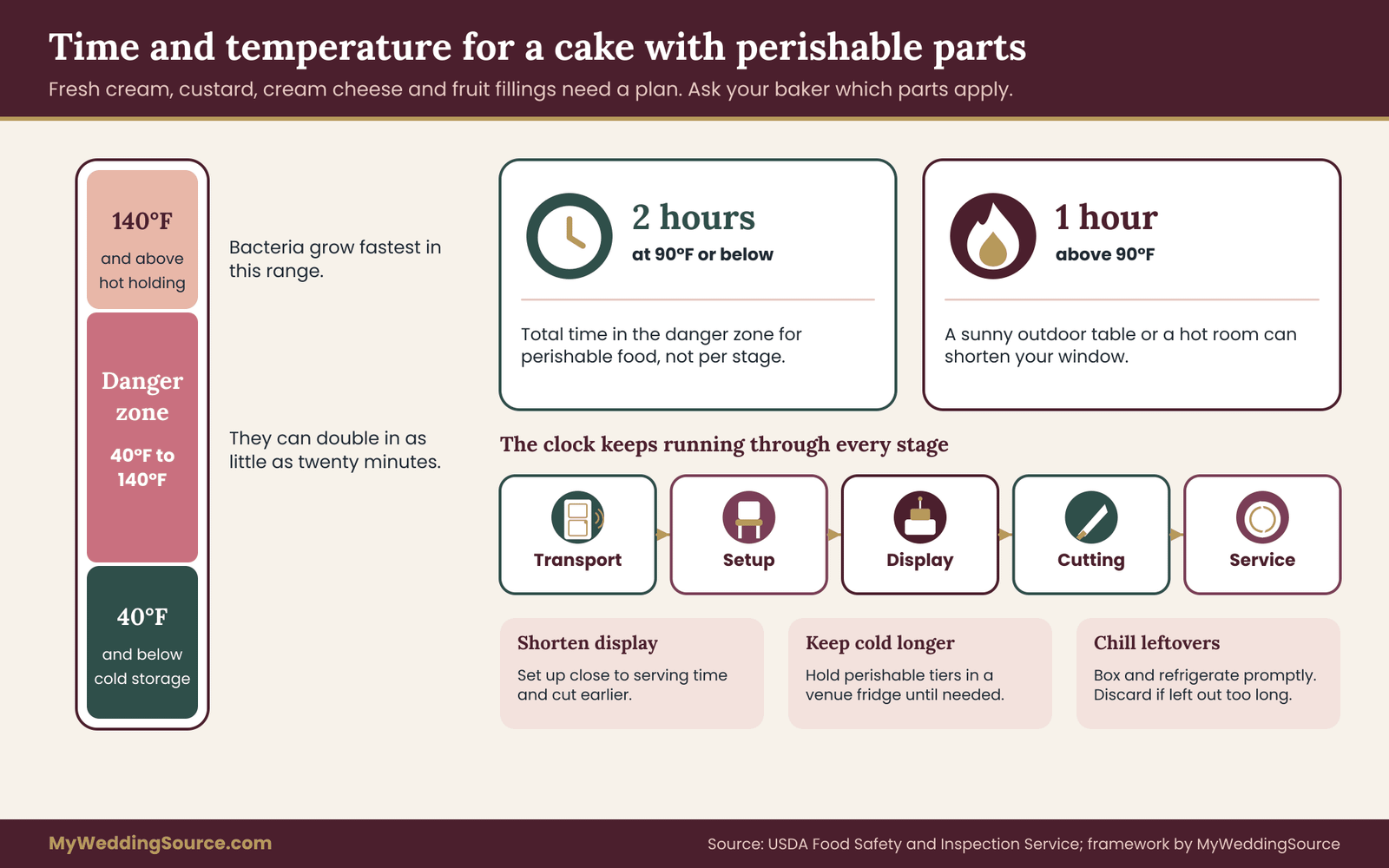
The danger zone and the two-hour rule
The U.S. Department of Agriculture’s Food Safety and Inspection Service describes a danger zone between 40°F and 140°F, the range in which bacteria grow fastest, and notes that bacteria can double in as little as twenty minutes in that range. Its guidance for perishable foods is that they should not spend more than two hours in the danger zone, and that the limit drops to one hour when the surrounding temperature is above 90°F.
Apply that to a wedding cake with perishable parts.
- The clock includes time out of refrigeration during transport and setup, not just time on display.
- On a hot day, an outdoor cake table can exceed 90°F in the sun, shortening the allowed time.
- The cake may sit out through photographs, the first dance and speeches before anyone cuts it. A reception schedule that puts the cutting late in the evening means a long time on display.
Questions to ask the baker
- Which parts of this cake need refrigeration, and which are shelf-stable?
- For how long can the finished cake safely sit at room temperature, based on your recipe?
- How will you keep it cool in transit?
- Do you recommend displaying the whole cake, a partial cake or a decorative cake with a kitchen cake in the fridge?
- What do you advise if the venue is warm?
Write down the answers. Then plan the schedule so the cake is out for as short a time as practical.
Practical ways to shorten display time
- Schedule delivery and setup as close to the planned display time as the design allows.
- Keep the cake in the venue’s refrigerator until shortly before it goes on the table, if the baker agrees it can be moved.
- Choose a display cake that is decorated but made of sturdier components, with perishable parts reserved for a kitchen cake kept cold.
- Place the cake table indoors or in shade, away from heat sources.
- Schedule the cutting earlier in the reception, so the cake is not on display for the whole evening.
- Refrigerate leftovers promptly after serving.
Remember that rules differ by state and county, and health departments inspect and license commercial food businesses differently. This guide cannot tell you which rules apply to your cake. If you have doubts about a vendor’s practices, the next sections cover how to check.
Refrigeration at the venue and your wedding cake timeline
If the cake needs cold storage, confirm it ahead of time and add the answer to the wedding cake timeline. Do not just ask “is there a fridge?” Ask who controls it, how much space is available, whether it is shared with the caterer, what temperature it is kept at, and whether a tall cake box will fit. A walk-in cooler is best, and a small kitchen fridge may not hold even a single tier. Ask the baker to give you the dimensions of the boxes, and ask the venue to measure.
A cheap refrigerator thermometer is a useful tool here. Food safety guidance generally treats 40°F as the upper limit for a refrigerator, which is the bottom edge of the danger zone described above. If the venue’s unit reads warmer, or you cannot check, tell the baker. ## Allergens and dietary needs in the wedding cake timeline
Cake is one of the most allergen-dense foods at a wedding. Flour, eggs, butter, milk, nut flours and almond extract appear in a large share of recipes, and the equipment that makes the cake probably also makes many other things. A guest with a food allergy cannot judge a cake by looking at it, which makes this part of the wedding cake timeline a safety matter, not a style matter.
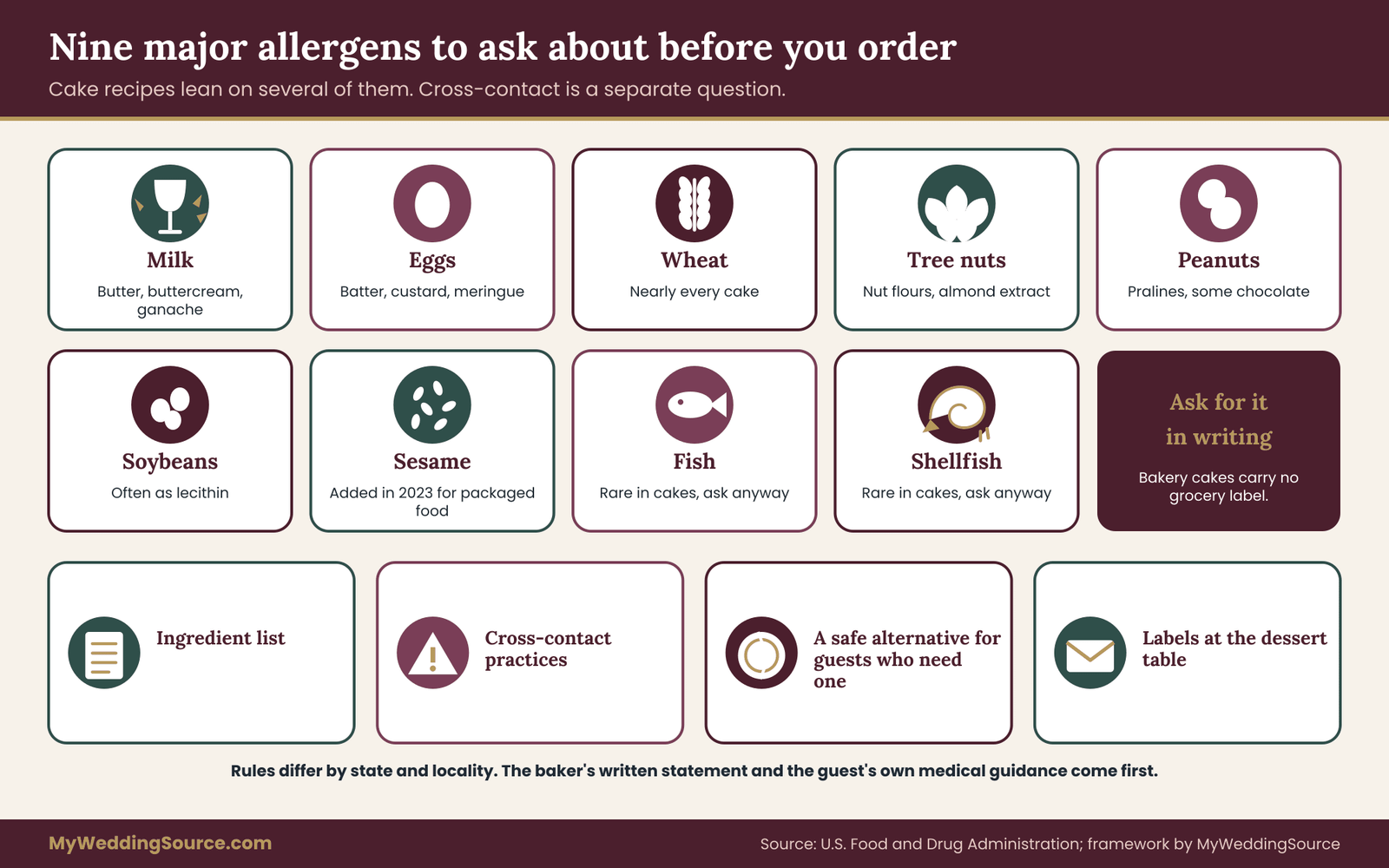
The nine major allergens
U.S. federal law identifies nine major food allergens: milk, eggs, fish, crustacean shellfish, tree nuts, peanuts, wheat, soybeans and sesame. Sesame became the ninth when the FASTER Act took effect, and packaged foods have had to declare it since January 1, 2023, according to the Food and Drug Administration. Those labeling rules apply to packaged foods. A cake made to order by a bakery or a caterer is not a labeled grocery-store product, so you cannot assume a label will tell you what is inside. You have to ask for the information and get it in writing.
For a cake, the allergens that most often matter are these:
- Wheat, in nearly every standard cake and many fillings.
- Eggs and milk, in cake batter, buttercream, custard and ganache.
- Tree nuts and peanuts, in nut flours, pralines, marzipan, almond extract and some chocolate.
- Soy, often in the form of lecithin in chocolate and some margarines.
- Sesame, less common but now more visible, in some bakery items and tahini-based fillings.
Cross-contact is the part people forget
An ingredient list tells you what is in the recipe. It does not tell you what else touched the cake. Cross-contact happens when an allergen travels from one food to another through shared equipment, surfaces, tools, hands or air. A flour-free cake baked on a tray that also held nut cookies is not safe for someone with a severe nut allergy.
Ask the baker how they handle this.
- Do you work in a kitchen that also handles nuts, wheat, eggs or milk?
- How do you clean equipment and surfaces between batches?
- Do you have any separate equipment, a dedicated space or a separate production day for allergen-friendly orders?
- Can you put your allergen practices in writing, with a full ingredient list?
A trustworthy baker will answer clearly, and may tell you that they cannot guarantee an allergen-free product, which is an honest answer and a useful one. Be careful with anyone who says “it’s fine” without describing what they do. The same caution applies to gluten-free cakes: a cake can be made with gluten-free flour and still cause problems for someone with celiac disease if it was prepared on shared surfaces.
Finding out what your guests need
You cannot plan for needs you do not know about. Ask on the RSVP, or on your wedding website, in a way that makes it easy to answer. For example:
“Please let us know about any food allergies or dietary needs we should plan for, including anything that affects dessert. If your allergy is serious, we will follow up so we can make a safe plan together.”
When a guest reports a serious allergy, call or message them. Let them tell you how careful they need you to be. Some guests are content with a labeled option from a certified-free source. Others would rather bring their own dessert, and still others will simply avoid the cake. It is their call and their health, and they will be glad you asked.
Then decide how you will serve them. Options include a separate, individually packaged dessert from a producer who can document the ingredients, a plated alternative prepared by the caterer in a clean area, or an agreement with the guest to bring something familiar. Whichever you choose, tell the caterer who the guest is and how the dessert will be delivered to them, so a server does not hand the wrong plate.
Labels, signs and honest descriptions
If a dessert table or a cake display will hold more than one item, label what is in them, at least for the major allergens. A small card that says “contains almond, wheat, egg, milk” saves guests from asking servers who may not know. Do not use “allergen-free” unless the baker has confirmed it in writing and described their practices. Avoid putting a nut-containing topping on a cake that another guest will be offered unlabeled.
If you offer vegan, vegetarian, halal or kosher options, check the details that are easy to overlook. Some mousses and glazes contain gelatin. Some cakes are soaked in alcohol. Kosher certification involves more than ingredients and is generally something a supervising authority provides, so if it matters to your guests, ask the baker whether they work under supervision and what it covers.
Decorations that are safe to put on food
A cake is food, and what you put on it should be too. Check with the baker about anything that touches the cake.
- Fresh flowers. Not every flower is safe to be near food, and flowers may carry pesticides or sap. Bakers often use flowers sourced for edible use or wrap stems in a barrier so nothing contacts the cake. Coordinate with your florist and ask the baker to approve the varieties.
- Toppers and figurines. Ask about the materials. Heavy toppers can stress the top tier, and unwrapped metal or painted pieces should not rest on the frosting.
- Glitter, metallic dusts and decorations. A “non-toxic” label does not automatically mean a product is meant to be eaten. Ask whether each decoration is edible or only meant to be removed before serving.
- Candles and sparklers. If you plan a flame or a sparkler, check the venue’s rules and keep the cake away from heat and wind.
If someone other than the baker is adding decorations, tell the baker. They may want to approve what goes on or give instructions for placement.
Checking your baker: licenses, inspections and insurance
Vetting the baker is one more line on a wedding cake timeline. You should not have to be a food inspector, but a few checks are reasonable and common.
Commercial kitchens and home bakers
Many wedding cakes are made by bakeries with commercial kitchens, which are licensed and inspected by local health departments. Many others are made by home bakers. In the United States, most states have cottage food laws that allow people to make certain low-risk foods at home for sale with little or no regulatory oversight, according to the National Agricultural Law Center. Those laws differ considerably from state to state, and they target foods that are not considered potentially hazardous. That is significant for wedding cakes, because a cake with a perishable filling or frosting may fall outside what a cottage food permit allows in a given state.
That does not mean a home baker is a poor choice. Many make beautiful, safe cakes under proper permits. It means you should ask which category your baker works under and what that permits.
Questions to ask any baker:
- Are you licensed or permitted in this state or county, and what is the permit number?
- Where is the cake produced, and is that kitchen inspected?
- Do you carry liability insurance, and can you send a certificate?
- Does my venue require proof of insurance from vendors, and can you provide it?
- Do you have a food-handler or food-safety certification?
Then do the check. Many local health departments publish inspection results or permit lookups online. If you cannot find the baker’s information, ask them how you can verify it, and treat a refusal as a flag. The vendor due diligence checklist walks through a broader verification process that applies to every vendor.
Venue and caterer rules
Some venues restrict outside food, require that vendors be licensed, ask for a certificate of insurance naming the venue, or charge a cake-cutting or cake-service fee. Some caterers have exclusive arrangements and may add a fee for outside desserts. Ask both parties early and in writing, so you do not discover a rule in the last week.
The limits of this advice
This guide is general information, not legal or medical advice. Rules about food businesses, permits, allergen disclosure and insurance differ by state and locality and change over time. Temperature, allergens, structural assembly and serving counts are all matters that your specific bakery has to approve for your specific cake. If a guest’s health depends on the answer, defer to the baker’s written statement, the guest’s own medical guidance and your local health department. ## The cutting service: the last stretch of your wedding cake timeline
The cutting is the part guests see, and the part that is least planned. A beautiful cake can stall the evening if nobody knows who is supposed to cut it or where the plates are. Build a plan for this moment the same way you built the rest of your wedding cake timeline.
Decide who cuts in your wedding cake timeline
There are four common arrangements, and each has different consequences for cost and speed. Pick one early so the wedding cake timeline has a name next to the cutting step.
The baker’s team cuts. Some bakers send staff to cut and box the cake, usually for a fee. They know their own cake and its internal structure, which helps with tall or complex designs. Confirm the fee, the hours they stay and whether they bring their own tools.
The caterer cuts. Many caterers handle cutting and plating as part of dessert service, sometimes for a per-slice or flat fee. They know the room and the flow of service, and they are already moving plates to tables. Tell them how many slices to expect and what size.
The venue’s staff cut. Some venues require this and charge accordingly. Ask whether the fee is flat or per person.
A friend or family member cuts. This is the cheapest arrangement and the riskiest. A tiered cake is hard to cut cleanly, and the person needs a sharp, long knife, a pitcher of hot water to clean it, a plan for the supports, and plates and forks. If you go this way, give them a one-page instruction sheet from the baker.
Ask each party what they charge for cutting and what that fee covers. Cutting and service fees are common, and they are often missed in cake quotes. They belong in your wedding budget alongside the cake itself.
Understand the supports before anyone cuts
A tiered cake has dowels, straws or boards inside it. Someone cutting without knowing that can hit one, or send a piece of plastic onto a guest’s plate. The baker should explain how to take the cake apart: lift off the top tier, remove the supports, cut the tier in the pattern they recommend, then move to the next. Ask for a short written guide or a quick demonstration, especially if someone other than the baker is cutting.
Remind the cutting team to remove every support, pick, wire or decoration that should not be eaten before plating. This is a small step that avoids a real hazard.
The cutting moment for the couple
Most couples cut one slice for the photographs and feed each other a bite. That moment needs only a minute, but it needs the right setup.
- Put a cake knife and server on the table, along with a small plate and two forks, napkins and a place to put the knife down.
- Cut from the bottom tier, which is usually the sturdiest, or ask the baker which tier to use.
- Cut a clean slice that can be lifted whole, and cut it in the direction the baker suggests.
- Do the photograph and then step aside so the staff can serve the guests.
Tell your photographer when the cutting is planned, and ask where they would like you to stand. A good schedule has the cake cut when the room is full, the lighting is good and the cake is still looking fresh.
Where the cutting fits in the evening
The best time for the cutting in your wedding cake timeline depends on your reception. A few common patterns:
- After dinner and before dancing. This is the classic pattern. Guests are seated, cake can be served at tables, and the dance floor opens afterward. The cake spends less time on display.
- After the toasts. The toasts finish, the couple cut the cake and dessert goes out. This is tidy if toasts end at a predictable time.
- Mid-evening during dancing. The music pauses for the cutting, and cake is available at a station or passed on trays. This works for lively receptions but needs a plan to bring guests together.
- Late in the evening as a send-off. The cake is cut near the end. This keeps the cake on display longest, and it needs a plan for perishable parts and for guests who have left.
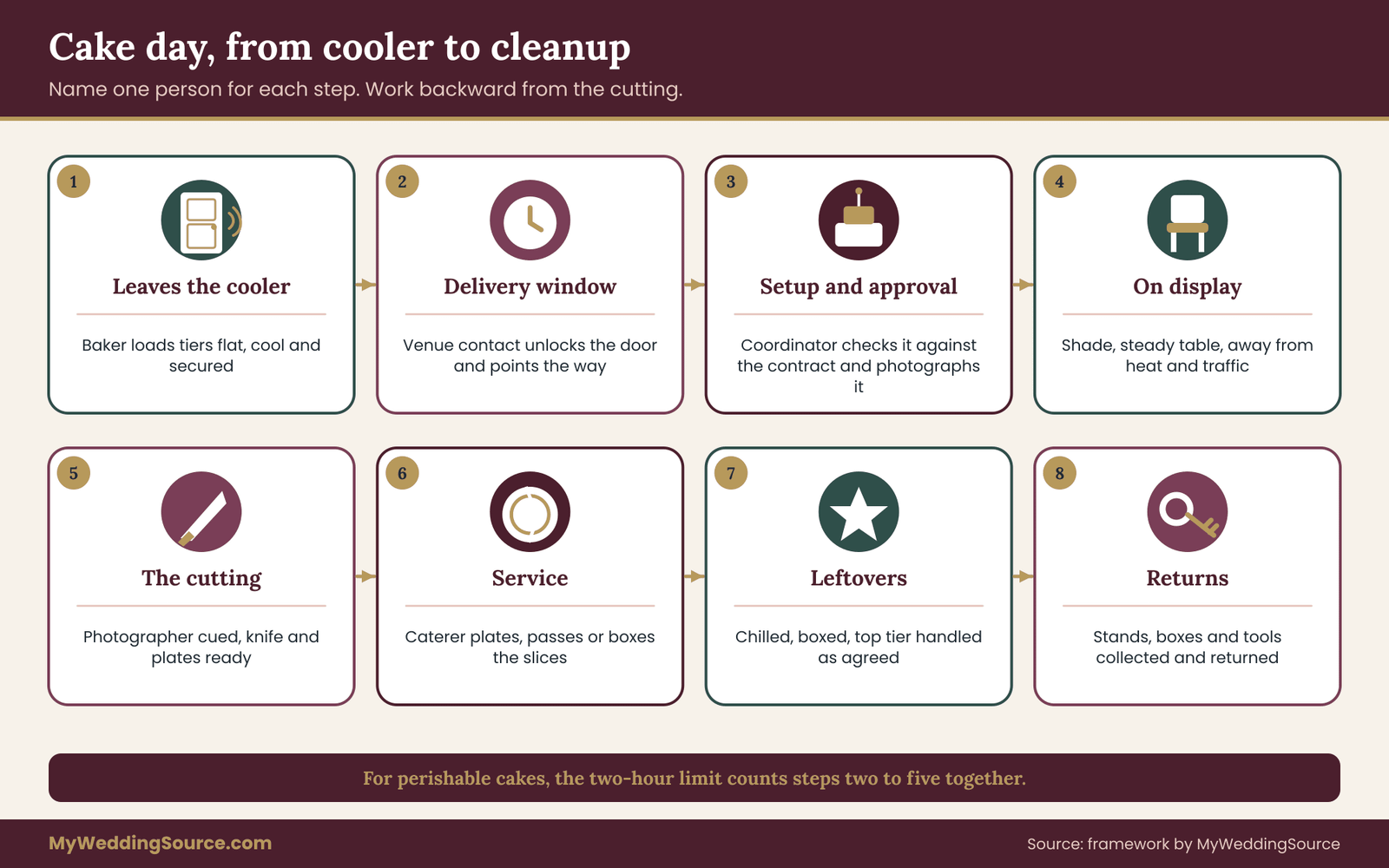
For perishable cakes, the earlier patterns reduce time out of refrigeration, as described in the food-safety section. When you build the full reception schedule, a wedding weekend event plan can help you fit all the pieces together.
Plated, passed or stationed service
How the cake reaches guests changes what you need from the venue and caterer. Settle it before the wedding cake timeline reaches its last two weeks.
Plated at tables. Staff bring slices to each table. It is elegant and orderly, and it needs enough staff, plates and forks. Plan for the time it takes. A large dinner can take many minutes to serve.
Passed on trays. Servers walk the room with small plates or boxed slices. This works well in a standing reception or with a late-night cut.
A dessert station. Slices are placed on a table and guests help themselves. It is the simplest to staff, and it allows guests to choose when to eat, but lines can form.
Boxed to go. Individual boxes let guests take cake home. This is useful if the cutting happens late or guests are leaving. You need boxes, labels and a plan for where they are stored.
Whichever you pick, tell the caterer how many slices to expect and whether the kitchen cake is part of the service. Make sure there are enough plates, forks and napkins, and a plan for trash.
After the cutting
Leftover cake and perishable parts
Slices that have been out for a long time should not be treated as safe to keep. The two-hour guidance (one hour above 90°F) applies to cake with perishable parts, and the clock does not stop when the party does. Decide before the event who handles leftovers and what they do: boxes for guests, refrigeration for the remainder, and a plan to discard anything that has been out too long.
If you want to take cake home, ask the venue or caterer to box it before the end of the night, and put it in a refrigerator promptly. Whatever you plan, assign a person, because after the last dance nobody remembers.
Saving the top tier
Saving the top tier for an anniversary is a custom many couples love, and it has a food-safety catch. Cake kept for a long time may not be at its best in taste or texture. Ask the baker how they recommend storing it, how it should be wrapped and how long it keeps well. Some bakers offer a fresh small cake for the first anniversary instead, which tends to taste better than a year-old frozen tier. Either approach is fine. Just decide in advance and tell the baker, because it affects the serving plan.
Stands, boxes and returns
If any part of the display is rented, such as the stand, the knife set or a cake box, find out when it must be returned, who picks it up and what the deposit covers. Give that task to one person. Late returns and lost items are a frequent source of small charges. The rental planning checklist shows how to track return logistics for everything you borrow.
Thanking the baker
When the cake went well, tell the baker, and consider leaving a review that describes what you liked, such as flavor, reliability or care. Reviews help the next couple more when they are specific. If a problem occurred, raise it politely with the baker first and give them a chance to respond, then use the contract if you need to.
When something goes wrong with the wedding cake timeline
Even with careful planning, problems occur. Having a short plan for each type saves you from improvising under stress, and each fix slots back into your wedding cake timeline. Here are the usual ones and a sensible first response.
The count was wrong and the cake is short. If you realize before the cutting, ask the caterer whether they have extra dessert, a kitchen cake or something they can plate. Cut slices thinner for the first tables and keep a reserve. If it happens at the cutting, serve the cake as planned and offer another dessert to latecomers. Next time, the reserve is the fix.
The cake arrived damaged. Photograph it immediately. Call the baker, who may be able to repair it on site. Decide whether a repair is possible, whether a smaller cake can be substituted or whether you will use the kitchen cake for service. Your contract’s damage and liability clause tells you what remedy to expect.
The cake did not arrive. Call the baker’s mobile number. If you cannot reach them, ask the caterer, venue or a nearby grocery bakery about a replacement. This is rare, and having the baker’s contact and a backup contact on your day-of sheet is the best insurance.
The room is too hot for the cake. Move the cake to a cooler area, delay the display, put a fan or air conditioning on the table and shorten the time before cutting. If perishable parts are at risk, cut early and serve.
A guest has a reaction. Treat it as a medical emergency. Call emergency services if there are signs of a severe reaction such as difficulty breathing, swelling of the face or throat, or fainting. Tell the venue and caterer, and keep the ingredient list on hand for responders. This is why the allergen planning earlier matters.
A vendor misses a deadline. Contact them right away and ask for a revised commitment in writing. If a deadline was missed because you were late, ask what is still possible. In either case, see what your contract says about changes and fees.
The baker closes or becomes unreachable before the wedding. Contact them by every method you have. Check whether they have a business partner, a studio or a social media page with updates. Ask your venue and caterer for emergency options. Keep copies of your contract and payment receipts. If you cannot resolve it, you may have remedies through your card issuer, your state’s consumer protection office or small claims court, depending on the facts. This is another reason to put everything in writing. ## A one-page wedding cake timeline checklist
If you take only one thing from this guide, make it this wedding cake timeline checklist. It lists each dependency, who owns it and what proof you want. Copy it into a note and share it with your baker, caterer and coordinator.
Count and servings – Final guest count confirmed from RSVPs. Owner: couple. – Slice size defined in inches and written into the contract. Owner: baker. – Reserve decided, and any other desserts accounted for. Owner: couple, with caterer’s input. – Final count sent to the baker by the deadline, with written confirmation back. Owner: couple.
Design and structure – Design written down with dimensions, flavors, fillings and finish. Owner: baker. – Support method explained, and assembly plan agreed (stacked at shop or on site). Owner: baker. – Fresh flowers, toppers and other additions approved by the baker. Owner: couple and florist.
Allergens and safety – Ingredient list and cross-contact practices in writing. Owner: baker. – Guests with allergies identified and alternatives arranged. Owner: couple and caterer. – Perishable parts identified and a time-and-temperature plan written. Owner: baker. – Venue refrigeration confirmed, with space and temperature checked. Owner: venue and caterer.
Delivery and setup – Delivery window, address, access route and venue contact confirmed. Owner: baker and venue. – Table size, stability and location approved. Owner: venue and coordinator. – Setup time, who approves the cake and who photographs it. Owner: coordinator.
Cutting and after – Who cuts, when, and with what tools, plates and forks. Owner: caterer, baker or venue. – Serving style (plated, passed, station or boxed) and slice count to the caterer. Owner: couple. – Plan for leftovers, the top tier and rentals, with a named person. Owner: coordinator.
Mark each line with the date it was confirmed. A checklist with dates is a record. If a baker changes the plan later, you can see exactly what was agreed.
Common mistakes in a wedding cake timeline
Most of these are quiet errors, and they repeat across weddings. Each one is a gap in the wedding cake timeline rather than a failure of taste.
Ordering from the invitation list. A cake built for the number invited, not the number attending, wastes money or runs short. Use confirmed attendance.
Not asking what a serving is. Party slices and wedding slices differ, and the cake you think feeds 120 may feed fewer. Ask for inches.
Forgetting the final-count deadline. The baker’s date is separate from the caterer’s. Put both on your calendar.
Assuming the venue has a fridge. Space, temperature and access are three separate questions.
Skipping the contract. A handshake is not a plan when a cake is dropped, delayed or short. Write down what each side promised.
Choosing a design that the room cannot support. Heat, a sloping lawn or a narrow staircase can turn a lovely design into a problem. Match the design to the setting.
Treating allergies as a menu detail. Ask early, plan alternatives and get ingredient information in writing.
Leaving cutting to chance. Decide who cuts and whether that costs money before the day.
Letting perishable cake sit out. Know which parts need cooling and set a schedule that respects the two-hour guidance.
Not naming a person for the day. A cake needs someone responsible for it in the room, from delivery to leftovers.
What this wedding cake timeline does not cover
This guide describes a process. It cannot tell you what your bakery’s recipes require, what your local health department allows, or which servings your baker’s slices will really yield. Prices, fees, deadlines and rules vary by baker, venue and location, and all of them change. Confirm any number or rule in this article with the people who will be responsible for the cake, and adjust your wedding cake timeline to match what they tell you.
If you are also planning a dessert table, late-night treats or a groom’s cake, the same logic applies, but each item has its own serving math, storage and allergens. Treat each as its own small project.
FAQ
How far in advance should my wedding cake timeline start?
It depends on the baker and your date, and the wedding cake timeline follows from that. Bakers book by capacity, and peak Saturdays fill first, so there is no universal figure. Ask each baker how far ahead they usually book for your date and when they stop taking orders. Set your own deadline for the final count based on what they tell you, and put it in your calendar when you sign.
How do I work out the servings in my wedding cake timeline?
Start with confirmed attendance, subtract guests who will not eat the cake, add anyone else who will get a slice, then add a reserve. Convert the result to servings using your baker’s slice size in inches. A wedding slice is commonly about one by two inches, and a party slice is wider, so the same cake yields fewer party servings. Our wedding planning checklist is a good place to track the count alongside the rest of your tasks.
What is the difference between a wedding slice and a party slice?
A wedding slice is narrower, commonly about one inch wide and two inches deep, while a party slice is closer to one and a half inches by two. Because the party slice is wider, a given cake yields noticeably fewer of them. Bakers use different conventions, so ask which one they are quoting and put it in writing.
Does my wedding cake timeline need both a display cake and a kitchen cake?
Not necessarily, but it is a common way to control cost. A smaller decorated display cake carries the look and the cutting photograph, while a plainer kitchen cake is cut and plated out of sight to supply the remaining servings. It works well when your guest count is larger than what an affordable display cake yields. Ask your baker whether the kitchen cake is included and who cuts it.
How long can a wedding cake sit out safely?
It depends on what is in it. For perishable parts such as fresh cream, custard or cream cheese filling, U.S. food safety guidance says to limit time in the 40°F to 140°F danger zone to two hours, or one hour when it is above 90°F. Shelf-stable cakes tolerate more. Ask your baker which parts of your cake are perishable and plan the schedule around the answer.
Who is responsible if the cake is damaged during delivery?
It should be spelled out in your contract, which is a fixed point in any wedding cake timeline. Some bakers take responsibility for transport and setup and will repair or replace, while others have limits. Photograph any damage right away and contact the baker. Read the damage and liability clause before you sign, and ask what remedy applies. If you transport the cake yourself, the risk is usually yours.
What should I ask about allergens when ordering a cake?
Ask early in the wedding cake timeline for a full ingredient list, the baker’s cross-contact practices and whether the kitchen handles nuts, wheat, eggs, milk, soy or sesame. Ask whether they can make an allergen-conscious option and what they can and cannot guarantee. Get it in writing. For a guest with a serious allergy, talk to them directly and follow their lead on what is safe.
Is it safe to order a wedding cake from a home baker?
It can be, but check. Many states allow home bakers to sell certain low-risk foods under cottage food laws, and those laws vary by state. A cake with perishable fillings may fall outside what a given permit allows. Ask which license or permit the baker holds, where the cake is produced and whether they carry liability insurance, and look the information up with your local health department where you can.
Your next steps
Start your wedding cake timeline with three actions this week. First, write your four-line ownership sheet: who owns the count, the cake, the room and the schedule. Second, ask your baker or short-listed bakers for their final-count deadline, their slice size in inches and their allergen practices. Third, put the final-count date and the final-payment date in your calendar.
Then work through the phases of the wedding cake timeline in order: confirm attendance, run the serving reconciliation, lock the design, check the venue’s refrigeration, agree who cuts and when, and write it all into one page. A cake that is planned this way tends to be unremarkable on the day, which is exactly what you want. If you are also working on the vendors around it, our vendor due diligence checklist and vendor timeline fit alongside this plan.
Sources
- USDA urges consumers to keep clear of the danger zone this summer, USDA FSIS
- Food safety information for consumers, FoodSafety.gov
- FDA Food Code, U.S. Food and Drug Administration
- FASTER Act: sesame as the ninth major food allergen, U.S. Food and Drug Administration
- Food allergies, U.S. Food and Drug Administration
- Cottage food laws, National Agricultural Law Center
- Cottage food best practices, Association of Food and Drug Officials
- Cake baking serving guide, Wilton
- Wedding cake serving guide, Paperlust
- Transporting a wedding cake, The Budget Savvy Bride
- Food allergy resources, Food Allergy Research and Education
A tall cake also needs a stable table and a clear delivery plan. See what bakers and venues must confirm for wedding cake support.