
Airline credit can turn a postponed honeymoon from a loss into a plan, but only if you treat every credit as a small contract with its own dates, name and fare rules. This guide shows how to audit each airline credit, set the dates that matter, and book the delayed honeymoon before the value quietly expires.
Before you book anything, list every airline credit you hold and write down three dates for each: the last day to book, the last day to finish travel, and the last day the name on the credit can still be corrected. Confirm who the credit belongs to, whether it can be transferred, and what happens to the leftover value if the new fare is cheaper. Then book the honeymoon in the order the rules allow, and keep every confirmation in one file.
A wedding that gets rescheduled, shortened or simply followed by a honeymoon nobody could take on the original dates often leaves a trail of airline credit behind. One partner has an airline credit from a cancelled flight to the venue city. A parent has a credit from a ticket they never used. A guest who could not travel offered theirs. Each airline credit looks like money, and each one behaves differently once you try to spend it.
The trouble is that people treat an airline credit like cash in an envelope. It is closer to a coupon with conditions printed on the back. It names one traveler. It carries a date. It may only apply to a new ticket on the same airline. It may lose its leftover value if you buy a cheaper fare. None of those conditions is hidden, but they are easy to miss when you are busy with a wedding, and they matter most when the trip you want is months away.
This article is built around one tool, a carrier-specific audit and deadline worksheet, and it keeps the scope narrow on purpose. It does not teach you how to choose a honeymoon destination or compare resorts. It does not cover the full wedding budget. It covers one question: given the airline credit you actually hold, how do you use it for a delayed honeymoon without losing value to an expiration date, a name problem or a fare rule?
A note on scope. This is general information, not legal, tax or financial advice, and airline policies, fees and federal rules change, so confirm every rule with the airline and the U.S. Department of Transportation before you rely on it.
Why airline credit complicates a delayed honeymoon
A honeymoon booked a few months out is easy. You pick dates, you buy tickets, you go. A delayed honeymoon is different, because the delay itself creates the problems that airline credit is meant to solve and then adds new ones.
The first problem is timing. A delayed honeymoon often lands six to twelve months after the wedding, sometimes later. Airline credit has a life span that may be shorter than that gap. If a credit was issued during wedding planning, the clock may already be running by the time the wedding happens. Nobody forgets a clock that is ticking loudly. People forget the quiet ones, and an airline credit is a very quiet clock.
The second problem is identity. Weddings change names. An airline credit issued in a name that is about to change, or in a name that has already changed on your passport but not on the ticket, creates friction at exactly the wrong moment. You do not want to find that out at an airport counter. The honeymoon is the first trip many couples take with a new surname or a pending name change, and the airline credit has to line up with whatever name will be on your identification when you fly.
The third problem is ownership. Wedding planning involves a lot of people buying tickets: parents, attendants, relatives, friends. When a trip falls through, the resulting airline credit belongs to whoever bought or whoever traveled, and that may not be you. A well-meaning offer of a credit from a relative is only useful if the airline lets someone else use it, and many do not.
The fourth problem is value. Airline credit does not always cover the trip you want. A credit worth a certain amount buys a certain fare class on a certain route. Honeymoons tend to involve long-haul or peak-season flights, which cost more than the weekend trip the airline credit was issued for. You may need to pay a fare difference, and if the honeymoon fare is lower than the credit, you may forfeit the rest.
Because these problems pile up, the sensible response is not to hope. It is to audit. The rest of this guide shows you how.
What this guide leaves to other pages
Two neighbors are worth naming so this page can stay focused. If you are trying to keep your whole post-wedding paper trail in order, the broader wedding records guide covers contracts, receipts, certificates and photo archives. If your question is about how a honeymoon fits the money you have left, the wedding budget page is the place to start. Here, the subject is only the airline credit itself.
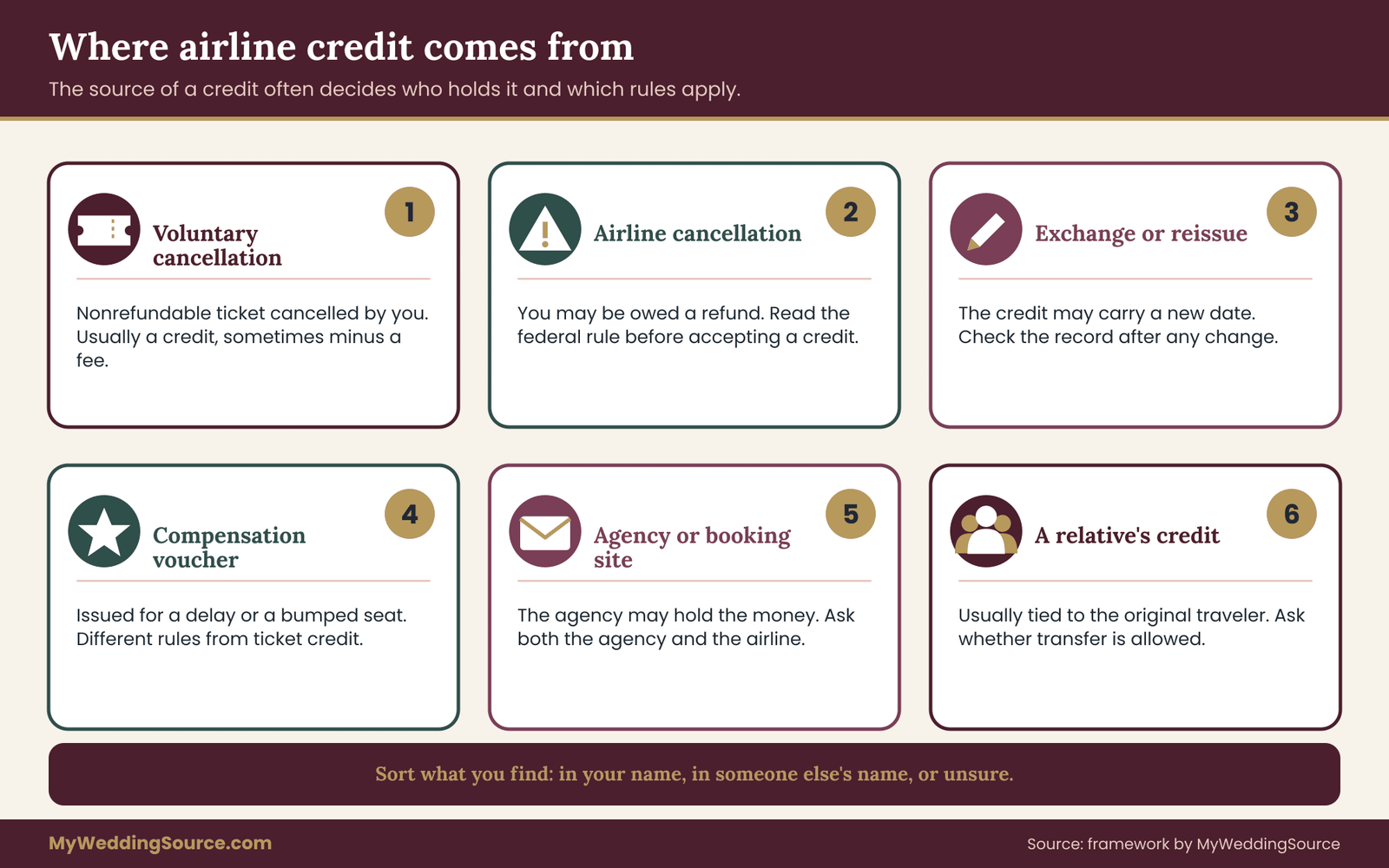
Before you can audit airline credit, you need to know what you are holding. Credits come from several different events, and the source often decides the rules.
A voluntarily cancelled nonrefundable ticket. This is the most common source. You bought a ticket, then decided not to fly. Many airlines will keep the value of the ticket as a credit, usually minus any fee that applies to your fare type. The airline credit is typically valid for a set period measured from the original purchase date or from the date of cancellation, and the airline decides which.
An airline-cancelled or heavily changed flight. If the airline cancels a flight or makes a significant change and you decline the alternatives, federal refund rules may entitle you to money back rather than a credit. The Department of Transportation publishes the current rules on its air consumer pages, and those rules have been updated in recent years. If you accepted a credit when you might have been owed a refund, it is worth reading the rule before you spend it. Sometimes an airline credit is the better deal. Sometimes it is not.
A schedule change you accepted. If you took a different flight, the new ticket may have its own change rules, and a later cancellation of that ticket produces a fresh credit with its own terms.
An exchange or reissue. When an airline reissues a ticket, the credit attached to the original may be consumed, carried forward or replaced. A credit that looks like it should have the original expiration may now carry a new date.
A voucher offered for another reason. Compensation for a delay, a bumped seat or a service failure is usually a different instrument than a ticket credit. It may have different expiration rules and different restrictions on how it can be used. Do not mix the two when you list what you hold.
An airline credit held by a travel agency or booking site. If a third party sold the ticket, the credit may sit with that party and not with the airline. In that case you need to ask both. The agency may hold the money while the airline holds the ticket record, and each has its own rules.
A credit from a family member or guest. Parents and attendants who bought tickets for the wedding may hold credit tied to their own names. Whether they can hand it to you is a question for the airline, and the answer is often no.
Each of these sources produces an airline credit with a slightly different rule set, which is exactly why a single list with one column of dollar amounts is not enough. The worksheet later in this guide gives each airline credit its own row of facts.
The words airlines use for the same thing
Airlines do not use one vocabulary. You may see “eCredit,” “travel bank,” “future flight credit,” “flight credit,” “unused ticket value” or “travel voucher.” Some are tied to a ticket number, some to a customer account, some to a confirmation code. Rather than memorize terms, write down for each airline credit what it is attached to, because that is what you will need to type or read out when you book.
A credit attached to a customer account can sometimes be used online in a few clicks. A credit attached to a ticket number may require a call or an airport desk. An airline credit that sits in a travel agency’s system may require the agency to reissue. The honeymoon you want may be easy to book with one type and awkward with another, so it helps to know early.
A quick sorting exercise
Gather every airline credit you might have, even ones you are not sure about. Search your inboxes for the words “credit,” “voucher,” “refund” and “cancellation,” and search each partner’s email separately. Check the airline accounts you use and any loyalty profile. Ask close family whether anyone is holding a credit that was meant for wedding travel. Then sort what you find into three piles: credit that is in your own name, credit in someone else’s name, and credit you are unsure about.
Only the first pile is clearly yours to plan around. The second pile needs a conversation with the airline and with the owner. The third pile needs a call. Do not add any airline credit to your honeymoon budget until it has moved into the first pile and you have seen the rules in writing.
You will make better decisions if you accept early that some of what feels like honeymoon money is not available. Better to learn that in the first week than the week before you want to fly. Part of an honest audit is subtracting credit that cannot be used, and treating the remainder as the real number. The wedding cash-flow guide is useful here if the honeymoon is competing with other post-wedding expenses and you need to see what cash is available month by month.
One folder, one list
Create a single folder, paper or digital, for every airline credit document. Put a copy of each credit notice, each cancellation confirmation, each receipt and each email thread with an airline in it. Name the files with the airline, the traveler and the date. When a customer service agent asks for a ticket number or an original confirmation code, you will be glad you can find it in seconds, not minutes.
This habit pays off beyond the honeymoon. Airline credit paperwork is one of the easiest kinds of wedding paper to lose, because it arrives by automated email and looks like marketing. A folder is a small defense against that.
The three-date test for airline credit expiration
Most people ask one question about expiration: “When does my airline credit expire?” The honest answer is often “it depends which date you mean.” A single airline credit can carry up to three separate deadlines, and missing any one of them can cost you the value. The three-date test is a way to write all of them down before you plan a single hotel night.
Date one: the book-by date. This is the last day you can use the airline credit to buy a new ticket. After this date, the credit may disappear, even if you intended to fly much later.
Date two: the travel-by date. This is the last day you can complete the trip. Some airlines let you book by the first date and fly any time afterward. Others require the whole journey, including the return flight, to be finished by a certain day. A few require that the first flight leave by the date and allow the return later. The rule varies, and the wording on the notice is not always clear.
Date three: the name or account deadline. This is a less obvious one. If the airline credit is in a name that will change, or in a name that does not match what you plan to use for travel, there may be a point after which correction is harder or impossible. Not every airline has a formal date for this, but you should find out whether one exists and record the answer, even if it is “none stated.”
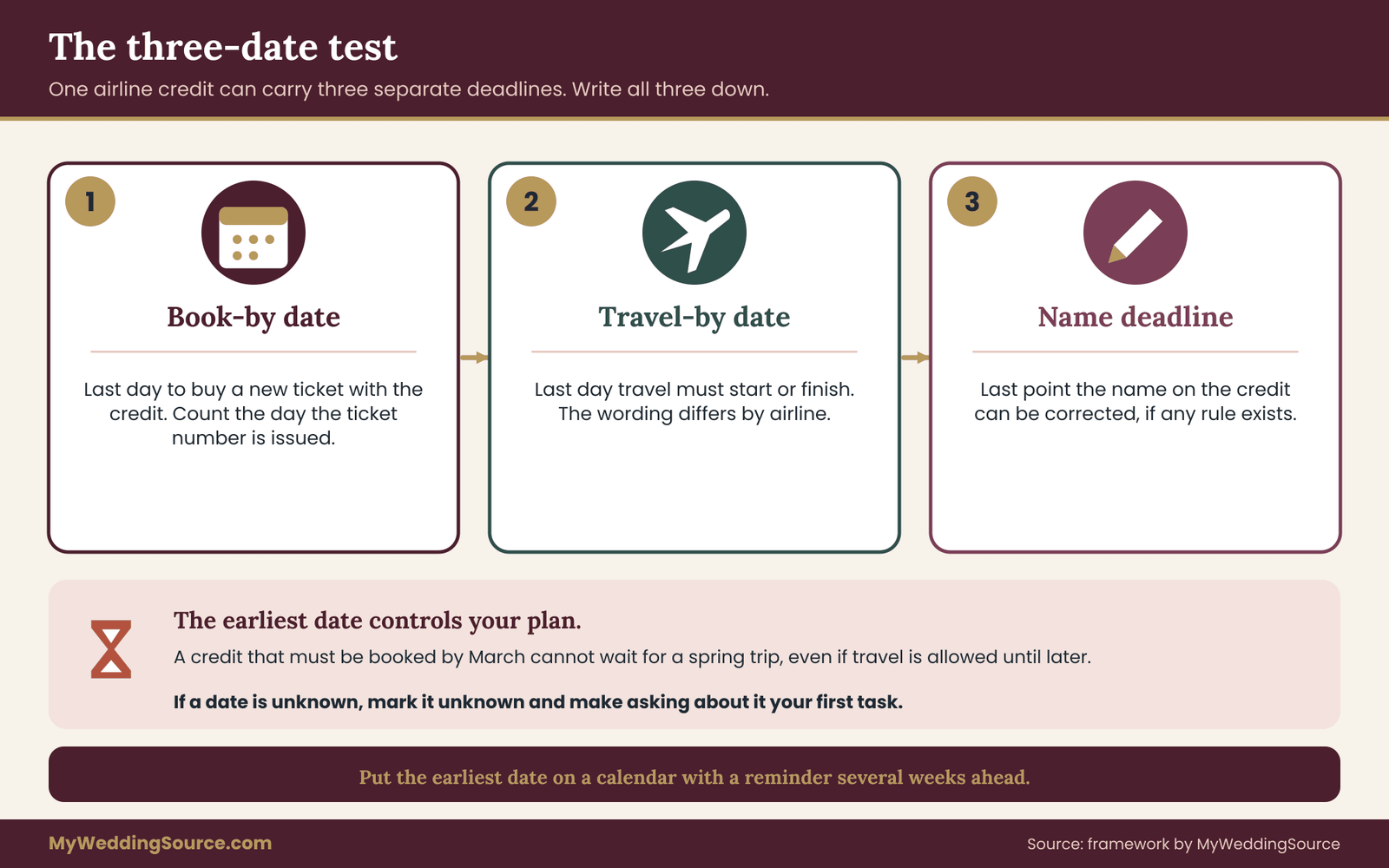
Write the three dates side by side for every airline credit. If one date is unknown, mark it as unknown and make asking about it your first task. An unknown date is not a safe date.
How the dates interact
The dates are not independent. Suppose your credit must be booked by March and travel must be finished by the following March. A honeymoon in the autumn fits both. A honeymoon in the spring after that does not, even though the book-by date is far in the past and the plan feels comfortable. People often read “valid for a year” and plan against the later of the two dates without noticing that the earlier one controls.
Now suppose the rule says the credit must be used to purchase travel by a date, but the trip itself can happen later. That gives you much more room. You could buy a flight early for a honeymoon a year out, if the airline sells that far ahead. Many carriers only open their schedules about eleven months in advance, which can quietly make the book-by date unusable if your preferred honeymoon season is beyond the schedule window. You would then need to either choose an earlier trip or ask the airline how it handles credits that expire before the schedule opens.
This is why a worksheet beats a mental note. The question is never just “is the airline credit still valid?” It is “is there any trip I actually want to take that fits inside all three dates?”
What counts as “using” the credit
Another trap sits in the verb. Does “use by” mean the day you search for a flight, the day you book, the day you pay, or the day you fly? Airlines generally treat an airline credit as used when you complete a booking and the ticket is issued, but you should not assume. If you have a reservation held but not ticketed, or a booking that is pending payment of a fare difference, the credit may still be in play when you think it is safe.
A practical rule: treat the day the ticket is fully issued, with a ticket number in your inbox, as the only day that counts. Do not leave a booking half finished on the last day.
Extensions, and why you should not count on them
During some periods, airlines have extended credit expirations broadly, and many couples remember this from the years of widespread travel disruption. It is reasonable to ask whether an extension is available. It is not reasonable to build a honeymoon plan that depends on one. An extension is a courtesy or a temporary policy, not a right, and it can end without much notice.
If you ask for an extension, ask early, ask politely, and ask in writing when you can. Keep the reply. If the airline grants one, it should be reflected on the credit record, and you should see the new date. Screenshot it, save it, and update the worksheet. If the airline declines, you have learned something useful while there is still time to adjust your plan.
Expiration and changing your mind later
Here is a quieter risk. Say you use an airline credit to book the honeymoon, and later you need to change the trip. If you cancel again, the ticket’s value may return as a new credit. Does that new credit keep the original expiration date, or does it get a fresh one? Policies differ, and some carriers keep the original date. A honeymoon booked close to the end of a credit’s life can leave you with very little room to recover from a second change.
Ask this question before you book, not after: “If I need to cancel or change this ticket, what happens to the airline credit, and does it keep the original expiration?” The answer shapes how much risk you are taking on.
Reading the expiration rules on your airline credit
Knowing that dates matter is one thing. Finding them accurately is another. This section is a practical routine for pulling the real rules out of the paperwork.
Start with the document that issued the credit
Open the original email or the account page that created the airline credit. Look for these items and copy them exactly as written:
- The credit amount and currency.
- The name of the traveler the credit is held for.
- Any ticket number, confirmation code or account number it is attached to.
- A stated expiration date, and what the notice says that date applies to.
- Any phrase such as “must be used by,” “valid for travel completed by,” “must be reissued by” or “non-transferable.”
If the notice gives one date and no explanation, that is a signal to ask. A single unexplained date is the most common source of expensive surprises.
Then read the airline’s own credit policy
Airlines publish policies for travel credits on their websites, often on pages about changes and cancellations or about travel credits and vouchers. These pages explain how credits are created, how long they last, how they are applied and what restrictions exist. Read the page that applies to your fare type, because credits from basic fares can follow different rules than credits from standard ones.
The policy page and the credit notice may not match perfectly. When they differ, the notice attached to your airline credit is the more specific document, but a customer service agent will usually refer to the policy. Save both, and note the date you read the policy page, because pages change. Your worksheet should include the date you last checked each rule, so that a later reader, including you, knows how fresh the information is.
Use the right channel for the right question
Some questions are answered quickly by a website. Others need a human. A rough guide:
- Balance and expiration date: usually visible in the airline account or on the credit notice.
- Whether a credit can be used for a specific route or cabin: a booking tool may show this when you try to apply it, but a phone agent can often confirm in advance.
- Whether the credit can be moved to another name: almost always a customer service question, and often a “no” or a “yes, with a form.”
- Whether leftover value is kept: this belongs in an agent conversation, because the website rarely says.
- Whether an airline credit can be extended: an agent or a written request.
When you call, have the credit notice in front of you, write down the agent’s name or ID, the date and time, and what you were told. If the answer matters, ask the agent to repeat it in a sentence you can write down. Then follow up with a short email or a message in your account so there is a written record.
Beware of secondhand answers
Friends, relatives and online forums will tell you how “airlines work.” They may be describing a rule that changed, a different fare type or a different country’s regulation. A relative who used a credit last year without trouble may have had a different type of credit. For anything with money attached, rely on the issuing airline’s current written rules and the federal guidance for refunds and consumer rights, and treat everything else as a prompt for questions rather than answers.
A short script for the first call
When you reach an agent, a clear opening saves time. Something like this works: “I hold a travel credit from a cancelled trip. I would like to confirm four things: the date by which I must book, the date by which I must complete travel, whether the credit can be used for a ticket in a different name, and whether any unused value stays on the airline credit after I book.” Then wait for each answer and write it down.
Notice that the script does not ask “can I use my credit?” That question invites a short yes. The four specific questions pull out the facts the worksheet needs.
Compare what you hear with what you read
If the agent’s answer disagrees with the written policy, say so, calmly: “The policy page says X. You mentioned Y. Can you point me to where that is written?” Sometimes the agent is right and the page is out of date. Sometimes the page is right and the agent misspoke. Either way, you want the final answer in writing before you build a trip around it.
Dealing with credits you cannot find in an account
Occasionally a credit exists on paper but does not appear when you log in. Common causes include a mismatch in the name or frequent flyer number, a ticket issued through an agency, or a credit that has not yet been posted after a cancellation. Do not wait for it to show up. Contact the airline with the ticket number and the cancellation confirmation, and ask them to locate and confirm the airline credit. Record the reference number of that contact. A credit that cannot be seen cannot be booked, and the expiration clock is not paused while you wait.
What to do when a date has already passed
If you discover a credit that expired recently, it may still be worth a polite request. Some airlines will reinstate an airline credit if the lapse was short, and some will not. The decision is theirs, not yours, so ask without expecting. If the credit was issued because the airline cancelled your flight and you may have been entitled to a refund, you could raise that point with the airline and, if needed, with the Department of Transportation’s air consumer complaint process. Keep the tone factual: what you booked, what happened, what you were offered, what you accepted and what you are asking for now.
Whatever the outcome, record it in the folder. A resolved credit, even a lost one, is a closed row on the worksheet, and closing rows is how you stay in control of the whole set.
Transfer and name rules for airline credit
The second big question after expiration is whose airline credit it is and who can fly on it. This matters more at a wedding than at almost any other time, because your names, your travel companions and your relatives’ offers all shift in a short window.
The default: one credit, one traveler
As a general rule, an airline ticket is issued to a named person, and the credit created when that ticket is cancelled stays attached to that same person. Airlines treat the name on a ticket as part of the contract, and federal security rules require the name on a ticket to match the traveler’s government-issued identification. Because of that, an airline credit is usually usable only for the person it was issued to, even if someone else paid for the original fare.
This default has a practical consequence for couples. If one partner holds an airline credit from a cancelled trip and the other holds nothing, the credit usually covers only the first partner’s ticket. The second partner buys a ticket on a normal fare. You cannot assume that a credit “for the couple” exists unless the original booking was a single record for both and the airline treated the airline credit as covering the whole record. Check, because airlines differ on how they split credit from a two-person booking.
Exceptions and how to find them
Some airlines allow a credit to be transferred or used for another person under limited conditions. Examples that appear in various policies include a transfer to an immediate family member through a form, a transfer for a fee, or a one-time transfer within a corporate account. These are not universal, and the conditions change. If you want to use a relative’s airline credit for your honeymoon, the first step is not to ask the relative whether it is okay. It is to ask the airline whether transfer is possible at all, what documentation it requires, whether there is a fee and whether the original holder has to take any action.
When an airline says no, accept it and plan without that credit. Do not look for a workaround that involves buying a ticket in someone else’s name or traveling under another identity. Airline tickets are non-transferable in most cases, and attempting to use a ticket for the wrong person can lead to denied boarding and loss of the ticket’s value. It is not worth the risk, and it may violate the carrier’s rules.
Credits from guests who could not attend
It is a kind gesture when a guest who cancelled travel offers their airline credit to the couple. Treat the offer with warmth and the facts with care.
Thank them, then explain that you will check whether the airline allows transfers. If it does not, tell them honestly, so they can use the airline credit themselves. If it does, ask them to start the process with the airline, since only the credit holder can usually authorize it. If you plan a registry or honeymoon fund, you might also mention that a contribution toward the trip is a different way to help, and it does not depend on any airline’s transfer policy.
The name on your honeymoon ticket
Honeymoon travel falls in an awkward window for names. You may be using a maiden name, a married name, a hyphenated name or an old passport. The credit holds whichever name the original ticket carried. The new ticket must match the identification you will present when you fly.
Here are the situations that come up most often.
The airline credit is in your current legal name and you will not change it before the trip. Nothing special is needed. Book normally and confirm that the credit applies.
The credit is in your pre-marriage name and your identification will still show that name on the travel date. Again, a straightforward case. The name on the airline credit and the ID match.
The credit is in your pre-marriage name and you will have changed your identification before the trip. Now there is a gap. You need to find out how the airline handles a credit when the traveler’s name has changed. Some airlines require a name correction through a specific process, sometimes with documentation such as a certified copy of the marriage certificate. Others handle it at booking if the name differences are minor. Ask in advance, and ask what documents they accept.
The airline credit is in your pre-marriage name and your passport has not yet been updated. If you travel internationally, your ticket name has to match your passport. A passport issued in the old name is still valid for travel under that name, and the State Department’s guidance explains the options for updating it after marriage. Many couples choose to travel on the old passport and book the honeymoon under the old name, so the airline credit and the ticket match. The point is not to pick a side but to make sure the credit, the ticket and the passport all tell the same story on the day you fly.
The credit is in a name that is misspelled or incomplete. Fix it early. A small error is easier to correct on an airline credit than on an issued ticket, and the correction may be limited by the airline’s rules.
For the legal side of a name change, the certified marriage certificate is the document most agencies ask for, and the usa.gov page on marriage certificates explains how to order copies. Keep one with your honeymoon documents in case an airline asks for proof.

Name changes and timing
One clean way to avoid a name mismatch is to decide, before you use the credit, which name you will travel under, and then keep that name consistent across the credit, the ticket, the hotel booking and your identification. If you change your mind later, the cost may be a change fee or a new ticket.
You do not need to rush a name change just to use an airline credit, and you should not delay one for the sake of a credit either. Treat them as two projects with one shared constraint: the names must match on the day you travel.
Fees and other small traps
If the airline raises a transfer fee, ask for it in writing, along with the exact amount and what it covers. Then compare it with the value of the credit. A transfer fee that eats a large share of a small credit may make the transfer pointless.
Another small trap is the “companion” assumption. An airline credit may be redeemed for a passenger who is not the original traveler only through a process the airline defines. A friend who says “just book it on my account and put your name on it” may be describing a practice the airline does not allow. Do not rely on informal approaches.
Fare rules that decide what an airline credit really buys
An airline credit is a balance, not a ticket. Once you spend it, the fare rules of the new ticket apply, and those rules decide how far the credit goes and how flexible the trip is afterward. This section covers the fare rules that most often surprise people using credit for a honeymoon.
Fare difference and taxes
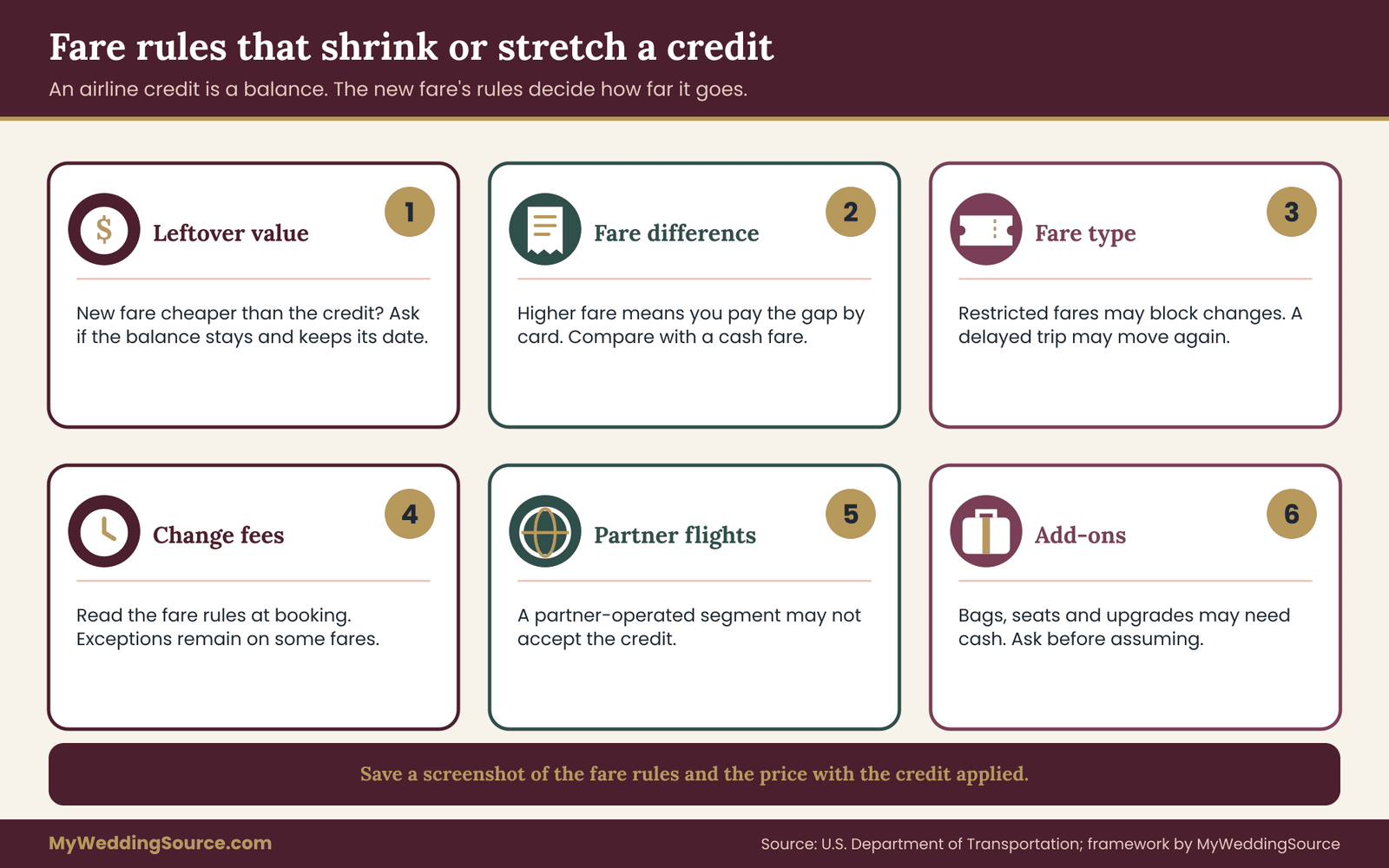
When you apply an airline credit to a new ticket, the airline subtracts the credit from the total price of the new fare. If the new fare is higher, you pay the difference by card. If the new fare is lower, you may keep the remainder as a smaller credit, or you may lose it. The policy varies.
Ask directly: “If my new ticket costs less than my credit, what happens to the remaining value?” The answer can range from “it stays on your account with the original expiration” to “it is forfeited.” Write down the answer next to the amount. Then, when you shop for fares, do not assume a cheaper fare is a savings if it means forfeiting value.
Taxes and fees add another layer. Some of what you paid on the original ticket was government taxes and airport charges, and the way a carrier treats those on an airline credit can differ. For example, a credit may be calculated on the full original amount, or it may hold back certain taxes. You do not need to decode every line. You do need to know the total credit value the airline is willing to apply, which is the figure the booking tool will show, and to compare it with the amount on the original receipt. If the two numbers differ and you do not understand why, ask.
Fare type and flexibility
Airlines sell several types of fare, from the most restricted to fully flexible. The fare you buy with your credit determines whether you can change or cancel the honeymoon later, and for how much. This is especially important when the honeymoon is delayed, because a trip months away is more likely to move again.
Think about what you need. If your plans are uncertain, a more flexible fare may be worth the extra cost even when the airline credit covers part of it. If your dates are fixed, a restricted fare may be fine. The worksheet has a line for this, because the choice of fare is a decision, not a default.
Basic or restricted fares often carry more limits than standard ones: they may not allow changes, may not allow seat selection without a fee, may charge for carry-on bags, and may treat any cancellation as a loss of value or a smaller credit. If your honeymoon involves checked luggage, a special-occasion seat request or a long itinerary, add those costs to the comparison. A fare that looks cheaper by a modest amount can end up more expensive once you add what you need.
Change fees and where they stand
Many large U.S. airlines dropped change fees on most standard domestic fares in recent years, but exceptions remain for restricted fares, some international itineraries and some partner-operated flights. Do not assume your honeymoon fare has no change fee. Read the fare rules shown at booking, and look for the specific line on changes and cancellations.
Routes, cabins and partners
Not every airline credit can be used on every itinerary. Common restrictions include:
- Same airline only. Credit issued by one carrier is usually valid for tickets sold and operated by that carrier, and sometimes its alliance or codeshare partners, but not always.
- Flights operated by a partner. A flight marketed by your airline but operated by another may not accept the credit, or may require the ticket to be on your airline’s own ticket stock.
- Premium cabins. A credit may apply to business or first class, but only after you pay the difference, and some carriers exclude certain premium products.
- Award tickets. A travel credit generally cannot be used to buy points or award flights, though a few airlines allow credits to offset taxes on awards.
- Add-ons. Seat upgrades, extra bags and lounge access may or may not be payable with credit. Ask before assuming.
For a honeymoon, the biggest trap is the combination of an international route and a partner-operated segment. If your destination requires a connection on another airline, confirm that the whole journey can be ticketed with the airline credit before you commit to the itinerary.
The honeymoon-specific questions
Honeymoon trips tend to have features that other travel does not: a single long-haul leg, a destination with a short high season, a hotel booked around specific dates and a strong preference for traveling together on the same flights. Because of that, a few extra questions are worth asking:
- Can both of us be ticketed on one reservation using two different credits? If not, how do we make sure we sit together and share a record?
- If one of us has a credit and the other does not, can we still have a single booking, so that a schedule change affects both of us the same way?
- Can I add special-occasion requests, such as seating together, to a booking made with a credit?
- If the airline changes the schedule after we book, what are our options, and does using an airline credit change them?
The last question matters because the rules that protect travelers from schedule changes apply to tickets, whether paid with cash or credit, but how the airline handles the refund or the new credit may differ. If a schedule change would ruin the honeymoon, you want to know your path before you book.
Keep the fare rules with the credit record
When you find the final fare, save a screenshot of the fare rules and the price breakdown, including the credit applied. Put it in the same folder as the credit notice. If a dispute arises later, you can show exactly what you were told and what you paid. This small step does more for your peace of mind than almost anything else in the process.
The airline credit audit worksheet, field by field
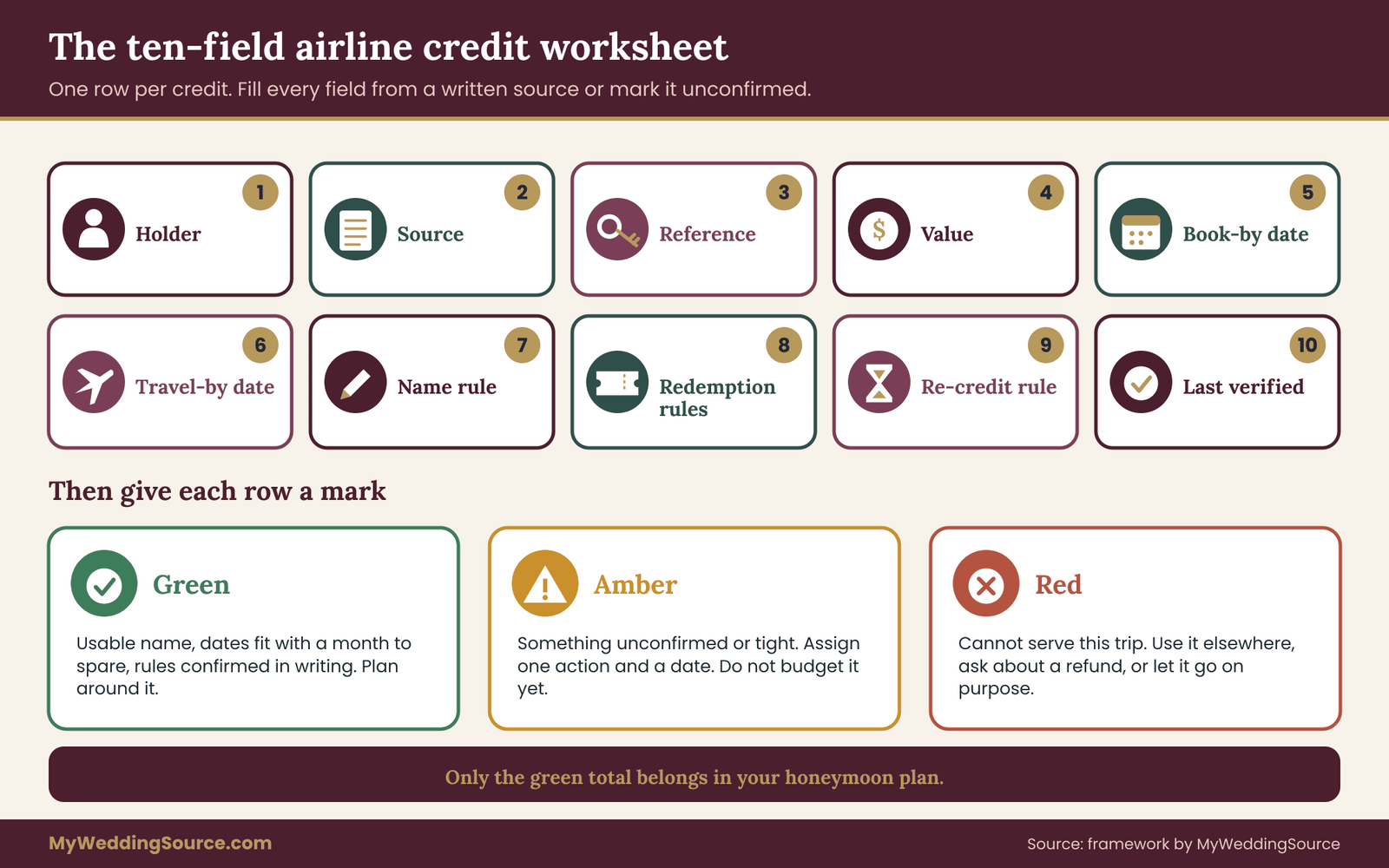
Everything so far feeds a single working document: the audit and deadline worksheet. It has one row per airline credit and a short set of fields. You can build it on paper, in a note or in a spreadsheet. What matters is that every field is filled in from a written source, or marked as unconfirmed.
Here are the ten fields and what to put in each.
1. Holder. The name exactly as it appears on the credit. Include middle names or initials if they are shown. This is the name the airline will look for.
2. Source. How the airline credit came to exist: a cancelled ticket, an airline cancellation, an exchange, a compensation voucher, or a credit held by an agency. The source often explains the rules, and it tells you whether you might have been owed a refund instead.
3. Reference. The ticket number, confirmation code, voucher number or account the credit is attached to. If it is a long number, copy it, do not retype it.
4. Value. The amount shown on the airline credit, and the date you saw it. Note any difference from the original ticket price.
5. Book-by date. The last day to buy a new ticket with it.
6. Travel-by date. The last day by which travel must start, or finish, as the airline defines it. Write which one.
7. Name rule. Whether the credit can be moved to another person, whether it can be corrected for a name change, and what documents the airline asks for.
8. Redemption rules. Where it can be used: airline only, partners, cabins, award tickets, add-ons, phone only or online. Also what happens to leftover value.
9. Re-credit rule. What happens if the new ticket is later changed or cancelled: does the value return as a credit, and does it keep the original expiration?
10. Last verified. The date you last confirmed these facts, who told you, and where the written proof is stored.
That is the whole worksheet. It looks plain, and it is meant to be. The power comes from forcing every credit through the same ten questions, so that the weak ones show up quickly.
A color code for the result
Once a row is complete, give it one of three marks.
Green means the airline credit is in a usable name, the dates fit the honeymoon window with at least a month to spare, and the redemption rules are confirmed in writing. You can plan a trip around a green credit.
Amber means something is unconfirmed or tight. Perhaps the name rule is unknown, or the travel-by date is close to your preferred trip, or the leftover value rule has not been confirmed. An amber credit needs a specific action and a deadline for that action. Do not count it toward the honeymoon budget yet.
Red means the credit cannot be used for the trip you want. It might expire before the honeymoon, belong to someone who cannot transfer it, or require a route you will not fly. A red credit is not a failure. It is a decision: use it on another trip, let a relative use it, ask for a refund if you may be entitled to one, or write it off.
The honest purpose of the colors is to prevent a common mistake: adding up every credit and treating the total as a honeymoon fund. The total of green credits is the honest number. Amber credits are a maybe. Red credits are not in the budget at all.
The deadline stack
The second half of the worksheet is a short list of dates in the order they come due. Pull the book-by and travel-by dates for all credits onto one list, earliest first, and add the dates of any actions you need to take. A line might say “ask about extension,” “send name documents” or “call about leftover value.” Put each action on a calendar with a reminder at least three weeks ahead, because airline responses can be slow.
The deadline stack makes the sequence obvious. The credit that expires first should usually be used first, unless there is a reason to prefer another one. If an airline credit that expires in four months and a credit that expires in nine months could both pay for the same ticket, use the earlier one for the earlier trip. This rule is not complicated, but it is easy to forget when you are focused on the dream of the trip, not the logistics.
How to read the three-date test into the stack
For each credit, the earliest of the three dates is the one that goes on the stack. If a credit has a travel-by date that is later than the book-by date, the book-by date controls your timing, and you should plan to buy by then, even if you will fly much later. If the airline will not sell tickets that far ahead, the book-by date could be impossible to meet for a late trip, and you should ask the airline what happens in that case.
What the worksheet does not do
A worksheet does not make an airline credit more valuable. It reveals the real value and removes surprises. It will not tell you whether the honeymoon should be delayed, shortened or moved. It will not tell you whether using a credit beats paying cash, though the field data you collect makes that comparison easier. And it will not replace a conversation with the airline when a rule is unclear.
Keep the document with your other post-wedding paperwork. The same principles apply here: one place, clear names, a note of when information was last checked and a plan for what to keep.
A worked example of airline credit with an invented couple
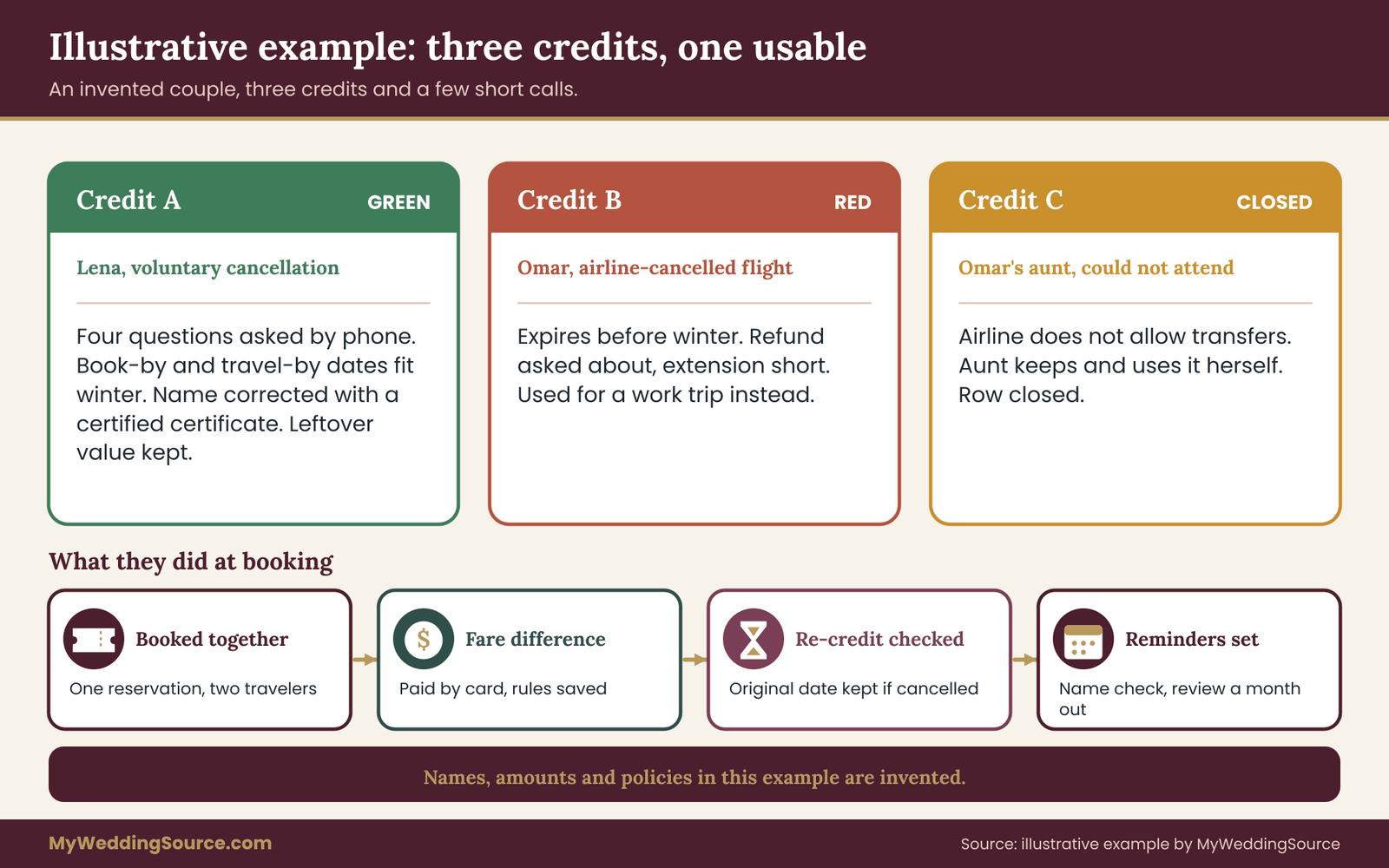
The following example is invented for illustration. The names, amounts, dates and airline policies are made up, and real rules differ by airline and by fare. The point is to show the worksheet in motion.
Lena and Omar married in the spring and put off their honeymoon until the following winter because of work schedules. During wedding planning, three airline credits came into their lives.
Credit A belongs to Lena. She had booked a flight to visit family and cancelled it, receiving a credit on one airline. Her notice says the airline credit must be used to buy a new ticket within a year of the original purchase date, and it does not mention a travel-by date. The credit is in her maiden name.
Credit B belongs to Omar. It came from a business trip that was cancelled by the airline. He accepted a credit when the airline offered it, but he now wonders if he might have been offered a refund. The notice shows an expiration date about eight months after issue.
Credit C belongs to Omar’s aunt, who could not attend the wedding. She offered it to the couple as a gift.
Step one: fill in the rows
Lena and Omar open the worksheet and fill in what the documents say.
For Credit A, the holder is Lena’s maiden name. The source is a voluntary cancellation. The value is moderate. The book-by date is eleven months away. The travel-by date is blank, because the notice does not say. The name rule is unknown. The redemption rules are unknown. Everything else is blank.
For Credit B, the holder is Omar’s name. The source is an airline cancellation. The value is similar in size to Credit A. The book-by date is four months away. The travel-by date is also listed as the same date, so booking and travel must both be finished by then. The name rule is that the airline credit is for Omar only. Redemption is online. The leftover rule is unknown.
For Credit C, the holder is the aunt. The source is a voluntary cancellation. The name rule is unknown. Everything else is partly known from the aunt’s email.
Step two: mark the colors
Credit B is red for the honeymoon. Its dates end well before winter, and the airline will not extend it. Omar looks at the cancellation record and realizes the flight was cancelled by the airline in a way that may have entitled him to a refund. He reads the Department of Transportation’s published guidance, then writes to the airline to ask whether a refund is still available. Whatever the answer, Credit B is not part of the honeymoon plan. He logs the outcome.
Credit A is amber. The dates fit, but the name rule, the travel-by date and the leftover value rule are unknown. Lena also plans to update her name before winter, so the maiden-name issue matters.
Credit C is amber and leaning red. The aunt needs to ask the airline whether transfers are allowed, and the answer may be no.
Step three: ask the four questions
Lena calls the airline that issued Credit A.
She asks the four questions from the script: the book-by date, the travel-by date, the name rule and the leftover value rule. The agent confirms the book-by date, says that travel must begin by a date six months after the book-by date, says the credit stays with the traveler’s name and can be corrected for a legal name change with a certified marriage certificate, and says any unused value stays on the credit with its original date. Lena asks the agent to repeat the leftover rule, writes it down and sends a short follow-up message through her account to create a written record.
The worksheet row for Credit A turns green. The deadline stack now shows a book-by date eleven months out and a travel-by date seventeen months out, both comfortably beyond the winter honeymoon.
Step four: decide what to do with the rest
The aunt contacts her airline and learns that transfers are not allowed. She thanks the couple and uses the airline credit herself. Credit C is closed. Omar’s refund request produces a reply that, because he accepted the credit, a refund is no longer available, but the airline extends the expiration by a short period as a courtesy, to a date still before winter. Credit B stays red. He decides to use it for a short work trip instead, and he notes that in the worksheet.
Step five: book
With one green credit, Lena and Omar look at their honeymoon plan. The credit covers part of Lena’s fare. Omar buys his own ticket. They want to travel on the same flights. They book both on a single reservation so that schedule changes affect them together, with Lena’s ticket applying the airline credit and the fare difference charged to her card. Before they pay, they check what happens to Lena’s ticket if they need to change plans, and learn that a cancellation would return the value as a credit with the original expiration.
They save the confirmation, the fare rules screenshot and the follow-up message in the folder. The worksheet shows each row closed or green, and the deadline stack has two remaining reminders: a check of the name correction after Lena updates her passport, and a calendar date to review the itinerary a month before departure.
What the example shows
Nothing in this story was complicated. Each step was a short call, a note or a decision. What made the difference was doing them in order, in writing, and before any hotel nights were bought. The couple turned three uncertain credits into one usable credit, one refund inquiry and one polite no. That is a fair result, and it is much better than finding out at checkout.
Booking the delayed honeymoon with airline credit: the order of steps
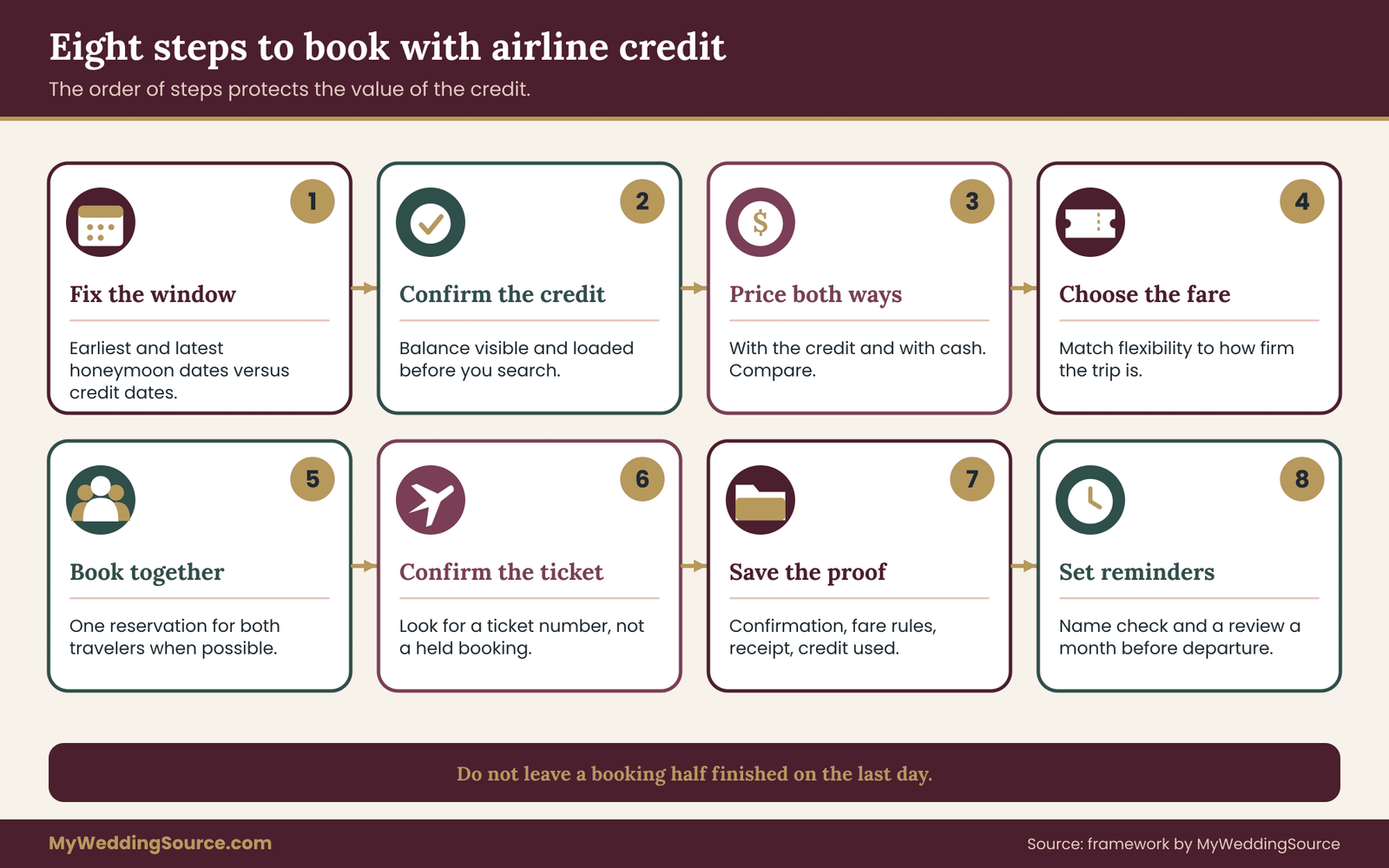
Once the worksheet is complete and at least one credit is green, the next job is to book without breaking anything. The order in which you do things can protect or waste the value of an airline credit, so follow a sequence.
Step one: fix the window before you search
Decide the earliest and latest dates you could honestly take the honeymoon. Compare that window with the book-by and travel-by dates on your green credits. If the window sits entirely inside both dates, you have freedom. If part of the window falls outside, you have just reduced your options, and you should know that before you fall in love with a date.
It helps to be honest about flexibility. A honeymoon in a place with a short season, or tied to a partner’s leave from work, has less give than one you could take any time. The tighter the window, the more important it is to book early while the credit is still safe.
Step two: confirm the credit is still valid and loaded
Before you search for fares, check that the airline credit appears in the account or on the booking tool and that the amount matches the worksheet. If you rely on a phone call to apply it, confirm that the agent can see it. Surprises are cheaper at this stage.
Step three: price the trip both ways
Search for the honeymoon itinerary and note the price. Then work out two numbers: the cost if you apply the airline credit, and the cost if you pay cash. The difference is the actual benefit of the credit, which may be smaller than its face value if applying it limits your fare choices. This step is easy to skip and worth doing every time.
If the credit forces a more restricted fare, ask whether you would have chosen that fare with cash. If not, the airline credit is costing you flexibility, and the real value is lower than the amount shown. Sometimes it is still worth it. Sometimes you are better off paying cash for a better fare and saving the credit for another trip, if its dates allow.
Step four: choose the fare for the risk you are carrying
A delayed honeymoon already had one postponement. If the trip is firm, a restricted fare may suit you. If it is still uncertain, pay attention to what the fare rules say about changes and cancellations, and to what happens to the value if you cancel. The goal is not to spend the least today. It is to avoid a second loss of value.
Step five: book in a way that keeps the couple together
If both partners are flying, book them on one reservation whenever possible. Two separate bookings can be changed independently by the airline, can end up on different flights after a schedule change, and can require two sets of calls to fix. A single booking with two travelers is easier to manage. If one partner uses a credit and the other pays, ask the airline how to combine them. Some booking tools allow multiple forms of payment on one reservation. Others require a call.
Step six: confirm the ticket, not just the reservation
After booking, look for the ticket number or the “ticketed” status. An itinerary that says “held” or “pending” is not complete. Check that the airline credit has been applied and that the amount shown matches what you expected. Compare the final price breakdown with the screenshot you saved before you booked.
Step seven: save and calendar
Save the confirmation, the fare rules, the receipt showing the credit and any messages from the airline. Update the worksheet row for each credit used: mark it as spent, note the new ticket number and note any value left over and its new date. Then set reminders for any remaining deadline, such as a name correction, a seat selection window or a check-in reminder.
Scripts for the awkward moments
Some conversations are easier with a few words ready.
Asking about leftover value: “I understand the new fare is lower than my credit. Before I book, can you tell me what happens to the remaining balance, and whether it keeps the original expiration date?”
Asking about a name correction: “The credit is in my previous name. I am changing my name by legal process. What documents do you need to correct it, and when should I send them?”
Asking for written confirmation: “Could you send me an email summarizing what we just discussed, including the dates and the rule about the leftover balance?”
Asking about an extension: “My credit expires soon, and my honeymoon had to be delayed because of our wedding schedule. Is there any option to extend it, even for a short period?”
Declining politely when the answer is no: “Thank you for checking. I will plan around that.”
None of these needs to be forceful. Calm, specific questions get better answers than frustration, and the agent may be able to help in ways that are not obvious from the website.
When the airline’s system and the agent disagree
Occasionally the website says one thing and an agent says another. If the stakes are small, take the more cautious reading. If the stakes are large, ask for the answer in writing from the airline, and if you cannot get it, consider booking in a way that keeps the airline credit safe, for example by asking for the credit to be held while you decide. When a dispute remains unresolved and you think the airline has not honored its own rules, the Department of Transportation takes consumer complaints about airlines, and the airline’s customer relations page is the usual first step.
Timing relative to hotels and activities
Because the airline credit has rules that are stricter than most hotel bookings, it often makes sense to confirm the flights first, then book accommodations that allow flexible cancellation, and then commit to nonrefundable activities. A hotel night can sometimes be moved without penalty. A ticket bought with credit is less forgiving. Booking in that order keeps the least flexible piece solid and the more flexible pieces adjustable.
There is one exception. If a hotel or venue has limited availability for your chosen dates and a long cancellation window, you may reserve it first with a refundable rate, then buy the flight, then confirm the hotel. The point is to avoid paying for something nonrefundable that depends on a flight you have not yet secured.
When airline credit is not the right tool
Sometimes the best use of an airline credit is not to use it for the honeymoon at all. A calm audit includes the possibility that the credit is the wrong fit.
Cash may be better when the credit limits your choices
If the airline credit only applies to one airline, and that airline does not fly to your destination or flies it at a poor time, forcing the credit onto the trip may mean worse flights or a more expensive route. If the cash fare on another airline is much more convenient, the credit may cost you more in time or stress than it saves in dollars. Compare the whole picture, not only the price.
A refund may be available
If your airline credit came from an airline-cancelled flight, you may have been entitled to a refund, and you may still be able to ask for one. Federal rules require refunds in certain situations when an airline cancels or significantly changes a flight and the traveler does not accept the alternative. The Department of Transportation publishes the current rule and what counts as a significant change. If you accepted a credit and now suspect you were entitled to cash, write to the airline with the facts and ask. They may agree, they may refuse, and you may have additional options through the Department’s complaint process.
Do not assume a refund is available for a voluntary cancellation of a nonrefundable ticket. In that case, a credit is often the airline’s standard offer. Some tickets can be cancelled for a full refund within a short window after booking, and the Department’s guidance describes this. If you are within that window, check the rule, but note that it does not apply to older credits.
Points and miles may fit better
If you have loyalty points, they might cover the honeymoon flight without touching the airline credit. Using points and saving the credit for another trip is sometimes the most efficient use of both, particularly if the credit has a later date than the honeymoon. Points have their own rules and expiration, so compare them in the same worksheet fashion rather than assuming they are more flexible.
Using the credit on a different trip
If the honeymoon dates do not fit, consider whether you could use the airline credit on a nearer trip. A short getaway before the book-by date can consume the credit, leaving the honeymoon to be funded separately. This feels less romantic than putting the credit toward the big trip, but it prevents loss. The goal of the audit is not to force the airline credit into a particular trip. It is to avoid wasting it.
Letting a credit go
Some credits are not worth chasing. If the value is small and the rules are strict, the time and stress of managing it may exceed its worth. It is reasonable to decide to let a small, awkward credit lapse. Make that choice deliberately and record it, so that it is a decision and not an oversight.
Do not let the credit decide the trip
A subtle risk is that a credit starts steering your choices. You pick a destination because the airline flies there, a date because the credit fits, a route because the system accepts the airline credit. A honeymoon is a once-in-a-while trip. If the credit is pushing you toward a trip you would not otherwise choose, step back and check whether the savings justify it. Sometimes the answer is yes, and a modest compromise is fine. Sometimes the answer is that the credit is a gentle trap, and the better move is to book the trip you want and use the airline credit elsewhere.
Think about the total cost, not just the flight
A delayed honeymoon has costs beyond the airfare: hotel, ground transport, food, activities, time off work. A credit reduces only one piece. If the credit pushes you toward expensive travel dates, the savings on the flight may be outweighed by higher hotel rates. The wedding budget guide can help you place the honeymoon among the other expenses, and the vendor contract guide is a reminder that any nonrefundable booking, for a hotel or a tour, deserves the same careful reading as a wedding contract.
Protecting your airline credit from loss and mix-ups
An airline credit can be lost in quiet ways even when you do everything right on the booking day. This section covers the habits and the risks that sit between “I have an airline credit” and “I flew on it.”
Keep the paper trail simple
For each credit, the folder should hold the original ticket receipt, the cancellation confirmation, the credit notice, any messages with the airline, and the screenshot of fare rules at the time you booked. Add the worksheet row as the first page. When someone asks you for a number or a date, the answer should be in one place.
If a credit was issued by a travel agency, add the agency’s contact information and the date you last spoke with it. Agencies sometimes close, merge or change systems, and the airline may not recognize a credit that the agency promised.
Watch the email that carries the credit
Airline credit notices come by automated email, often with a subject line that looks like a receipt or a promotion. Create a filter or a label for the airline names you use, so these emails do not slide into a folder you never check. If you ever lose access to an email account, the airline’s customer service can usually look up an airline credit by name and ticket number, but it is slower. Both partners can save the notices in a shared folder as a backup.
Set a reminder that is earlier than the real deadline
If the book-by date is the fifteenth of a month, put a reminder on the first of the previous month. Airline systems are not always fast. A name correction can take days. A phone queue can take an hour. A small amount of lead time turns a stressful scramble into a routine task. The twelve-month wedding checklist makes the same point about planning tasks generally: the dates that hurt are the ones that arrive during something busier.
Be careful with third-party sellers
If you bought through an online travel agency or a booking site, the airline may not control the credit. The agency may have its own policy, its own fee and its own timeline, and the airline may refer you back to the agency. Make sure you know whose credit it is. If the agency issued the credit, ask them for the rules in writing. If the airline issued it, check that the airline’s system shows it.
Credit that lives with a third party carries an additional risk: if the agency goes out of business, the value may be difficult to recover. For larger amounts, consider asking whether the airline credit can be converted to an airline-held credit, and weigh the cost and delay.
Airline changes you do not control
Airlines merge, rename, change policies and sometimes stop flying. A credit tied to an airline that changes its program may have its terms updated or transferred. Most of the time this is smooth. Occasionally it is not. If you read news about the airline holding your credit, such as a merger, a bankruptcy filing or a change in alliance, check how that affects credits and write to the airline for clarification. The Department of Transportation may publish information when a carrier ceases operations, and a credit card issuer may offer dispute options for tickets bought with a card, which is another reason to keep proof of how you paid.
Payment method and protections
How you originally paid affects your options if something goes wrong. A purchase on a credit card may give you dispute rights under federal billing rules, which have their own deadlines, so the time to ask your card issuer is early. The Consumer Financial Protection Bureau explains how card disputes work. This is separate from the airline credit itself, but it matters if the airline fails to deliver a flight or a promised refund. Save the card statement showing the original purchase with the folder.
Travel insurance and what it may cover
If you buy travel insurance for the honeymoon, read what it says about trips paid with credit. Some policies calculate coverage on the cash value of the ticket, others on the airline credit applied, and some exclude certain reasons for cancellation. Ask the insurer, in writing, how an airline credit is treated if you need to cancel for a covered reason. The answer may influence the fare you choose and the extent to which you rely on a flexible ticket.
Name changes after you book
If you book with a credit in your current name and then change your name before the trip, you will need to address the mismatch. Ask the airline for the process before it becomes urgent.
Most airlines can correct a name on an existing ticket when the change is legal and supported by documentation, but they may require advance notice and a certified marriage certificate. If you are traveling internationally, check that your passport name matches the ticket on the day you fly, and review the State Department’s guidance on updating a passport after marriage. The time it takes to receive a new passport can be long enough to cause trouble, so plan the sequence: decide on your travel name, order certified copies, update documents, then correct the ticket if needed.
For domestic travel, the Transportation Security Administration publishes the identification it accepts at the checkpoint. If your driver’s license and your ticket do not match because of a recent name change, check the TSA guidance and carry supporting documents.
Keep the credit story straight in the wider paperwork
Honeymoon travel produces its own set of records: tickets, boarding passes, hotel confirmations, receipts. A credit used to buy a ticket is part of that story. Put the airline credit worksheet at the front of the honeymoon file, so that if you ever need to explain how a ticket was paid for, you can. The same habits that keep wedding contracts and receipts organized apply here, as described in the wedding records guide.
Special situations with airline credit
The standard path covers most cases. A few situations need extra thought.
Two credits for two people
If both partners hold credits from the same airline, check whether they can be applied to one reservation. Some systems allow multiple credits on one booking. Others handle each traveler separately. If you cannot combine them, you may still book separately and then ask the airline to link the records, which helps if there is a schedule change. If the credits are from different airlines, you may have to choose a single airline for the trip and use one credit, or book one-way tickets on different carriers and accept the additional risk of disconnected travel.
Credit from a one-way or partial itinerary
If you cancelled only part of a trip, the credit may reflect only the unused portion. The value can be calculated in ways that surprise people, particularly when the original ticket was a round trip with different fares for each leg. Ask how the credit amount was calculated, and compare it with the receipt.
Credits issued long ago
An old credit may be governed by older rules. If it was issued during a period when the airline extended expirations broadly, the extension may have ended. Do not rely on a memory that “they said it was fine.” Check the current date on the credit record and ask for confirmation.
A credit in a child’s name or for a companion
If a child or another traveler is on the original booking, the airline credit may be held under their name. For a honeymoon this is less common, but the same rules apply: the credit goes with the named traveler. A credit for a companion who is not coming on the honeymoon is unlikely to help.
International honeymoons
International tickets add several layers. Taxes and fees are larger, and an airline credit may not cover them in the same way. The route may involve partner airlines, which complicates credit use. Passport rules and entry requirements, which the State Department and the destination’s government publish, apply to your trip regardless of how the ticket is paid for. Check the validity of your passport against the destination’s requirements well before you book, and confirm that the name on the ticket matches the passport you will carry.
If you use a credit for an international honeymoon, confirm that the whole itinerary, including any connection, can be ticketed on the credit. A common problem is a partner-operated segment that cannot be paid with the airline credit, which pushes the whole booking to cash.
Credit and the registry or honeymoon fund
Some couples use a registry or a honeymoon fund to cover travel. Credits and gifts are different kinds of money. If guests contribute to a travel fund, the funds are yours to spend on the trip, and the airline credit is a separate asset with its own limits. Keep them separate in your records so that you can tell what was paid by credit, what was paid from gifts and what you paid yourself. That clarity also helps with thank-you notes.
Pregnancy, illness or other life changes
Honeymoons get delayed for reasons that have nothing to do with schedules: illness, family needs, work changes. If something like this affects your plans, tell the airline early, since some carriers have more flexible options for medical situations when documentation is provided. The details vary, and you should not assume an exception exists. A travel insurance policy, if you bought one, may also respond to certain medical events, subject to its terms.
When the credit belongs to your employer or a business account
If a credit came from a work trip paid by an employer, it may belong to the employer, not to you. Using it for personal travel could violate company policy. Ask your employer before you use such a credit for a honeymoon.
The fallback plan
Every plan should include what to do if the honeymoon moves again. Know what happens to the airline credit if you cancel the new ticket, record the answer, and set a reminder for the new expiration date. If the second delay is likely, consider a flexible fare, or consider waiting to book until the dates are firmer, provided the book-by date allows it. A credit that is spent and then lost to another change is the most painful outcome of this whole process, and a few minutes of planning can prevent it.
Finally, remember that a delayed honeymoon is still a honeymoon. The credit is a tool, not the point. If handling it starts to feel like a second job, put the worksheet in order, make the calls you need to make, set the reminders and let the rest rest. Your overall planning checklist can hold the few remaining tasks so they do not crowd your head.
Your next steps
Work through these in order. Each takes a short sitting, and together they turn a pile of notices into a plan.
- Collect every airline credit. Search both partners’ email for credit, voucher, refund and cancellation notices, check each airline account and ask family whether anyone holds credit meant for wedding travel.
- Build the worksheet. One row per airline credit, ten fields, each filled in from a written source or marked as unconfirmed.
- Write the three dates. For every credit, record the book-by date, the travel-by date and any name deadline, then put the earliest on a calendar with a reminder well ahead of it.
- Make the four-question call. Ask each airline about the book-by date, the travel-by date, the name rule and the leftover value, and ask for a written summary.
- Mark each row green, amber or red. Spend only the green total in your honeymoon plan, assign a task and a date to each amber row, and decide deliberately about each red one.
- Choose the travel name. Decide which name each partner will travel under, and make sure the airline credit, the ticket and the identification will match on the day you fly.
- Price the trip with and without the credit. Pick the fare for the risk you actually carry, book both partners on one reservation when you can, and confirm that a ticket number was issued.
- Save and update. Store the confirmation, the fare rules and the receipt, mark the credit as spent, and set a review reminder one month before departure.
FAQ
Can I use an airline credit for a honeymoon that is a year away?
Maybe, but only if the dates allow it. Check the book-by date and the travel-by date separately. Some airlines only require you to buy the ticket before the airline credit expires, and others require the travel to be finished by a certain day. Many airlines also sell tickets only about eleven months ahead, so a late trip may not be bookable in time. Ask the airline how it handles that situation.
Can my partner use my airline credit on their own ticket?
Usually not. Most airline credits stay with the traveler named on the original ticket, because tickets are issued to a specific person and must match identification. Some carriers allow transfers to family members through a form or for a fee. Ask the airline directly, get the answer in writing, and never book a ticket in a name that is not the traveler’s.
What happens if my new honeymoon ticket costs less than the credit?
It depends on the airline. Some keep the remaining value on your account, often with the original expiration date. Others forfeit it. The booking screen rarely makes this clear, so ask before you pay and write the answer down. If the airline will forfeit the balance, compare a slightly higher fare that uses the whole credit against a cheaper fare that wastes part of it.
Does my airline credit change if I change my name after the wedding?
The credit stays attached to the name it was issued under, so a mismatch can appear if your identification changes. Many airlines will correct the name on a credit or ticket with documentation, often a certified marriage certificate, but processes differ. Ask early. For travel, the name on your ticket must match the identification you present, so choose one travel name and keep everything consistent.
Can an airline credit be extended if my honeymoon is delayed?
Sometimes, but treat an extension as a courtesy and not a right. Ask politely, early and in writing, and explain that your trip was delayed by your wedding schedule. If the airline agrees, save the reply and check that the new date appears on the credit record. If it refuses, you will know while there is still time to book another trip or change your plan.
Should I ask for a refund instead of keeping the credit?
If the airline cancelled or significantly changed your flight and you did not take the alternative, federal rules may entitle you to a refund. The Department of Transportation explains when. For a voluntary cancellation of a nonrefundable ticket, an airline credit is usually the standard offer. Read the current rule, then write to the airline with the facts if you think a refund applies.
Is it safe to book the honeymoon on two separate reservations?
It is possible, but a single reservation for both travelers is easier to manage. If the airline changes a schedule, separate bookings can end up on different flights and need separate fixes. If one partner uses a credit and the other pays cash, ask whether the booking tool or an agent can combine them. If not, ask the airline to link the records after booking.
What if the airline credit expires before I can take the honeymoon?
You have a few options. Ask about an extension, use the credit on a nearer trip before it lapses, or check whether a refund applies if the airline cancelled your original flight. If none of these fit, you can let it expire as a deliberate choice and record that decision. Paying cash for the trip you want is often better than forcing the airline credit onto the wrong one.
Sources
- U.S. Department of Transportation, Aviation Consumer Protection: refund rights, flight cancellations and complaints
- U.S. Department of Transportation: federal aviation consumer rules and rulemaking notices
- Transportation Security Administration: acceptable identification and name matching at the checkpoint
- U.S. Department of State, Travel: passports, name changes and entry requirements
- USAGov, Marriage certificates: how to request certified copies
- Consumer Financial Protection Bureau: credit card billing disputes and consumer guidance
- Federal Trade Commission, Consumer Advice: travel purchases and consumer protection
- Electronic Code of Federal Regulations: current federal rules, including aviation consumer protection regulations
- U.S. Customs and Border Protection: international travel documents and entry rules