
Roadside signs for a wedding are the small directional signs placed along public roads to guide guests to a venue that is hard to find. This guide explains who actually controls the ground where those roadside signs would stand, how to get permission in writing, how to keep drivers safe, and how to use a simple approval worksheet before a single sign goes in the ground.
Treat roadside signs as a permission problem first and a design problem second. Find out who owns each spot (state, county, city, a private owner or the venue), ask that owner or agency in writing, and keep the answer. Never attach roadside signs to utility poles, traffic signs or trees, and never place them where they block a driver’s view at a turn. If a spot is not clearly approved, move the guidance to a different tool: a venue-installed sign, a shuttle, a map link or a person with a flag. Use current rules from your city, county or state, because they differ and change.
Most couples picture the sign as the easy part: a painted board, a big arrow, a stake in the grass at the end of a country lane. The board really is easy. The stake is where the trouble starts. The strip of grass beside a road is rarely just grass.
It may belong to the state, to the county, to a city, to a farmer, to a homeowners association or to the venue next door, and each of those owners has a different answer to the same question. Some will say yes in a two-line email. Some will say no, and some will say nothing, which is the riskiest answer because it looks like permission and is not.
Roadside signs also carry a safety job that venue signs do not. A sign inside a ballroom is read by someone standing still. A sign on a road is read by someone doing forty or fifty miles an hour who is also looking for a turn, a cyclist and the car ahead. That changes what the sign should say, where it should stand and how many of them you should use. It also changes the consequences of getting it wrong. A mislocated sign can be removed by a road crew, and a sign that blocks sight lines can contribute to a crash.
This article covers the roadside part of wayfinding, and only that. The broader subject of how roadside and venue signs work together inside and around a venue, including readability, proofing and venue rules, is covered in the wedding signage system guide, and you do not need to read it first. Here the focus is narrower: placement permissions, local sign rules, traffic safety, timing and what to do when the answer is no.
A note on scope. This is general information, not legal advice, and local sign codes, road rules and permit processes vary and change, so confirm each point with the agency or owner that controls the location.
Why roadside signs are a different job from venue signs
A wedding venue sign has a short chain of authority. The venue manager decides, you comply, and the worst outcome is that a staff member asks you to take something down. Roadside signs sit in a different chain, one that you do not control and that you may not be able to identify at first glance. You are asking strangers, many of whom have no connection to your event, to allow a private message in a space they manage for other purposes.
That is the root of every rule in this article. Roads exist to move traffic safely, and the land beside them is held for drainage, utilities, future widening, snow storage and sight lines. A private sign in that space competes with all of those uses. Public agencies generally restrict roadside signs there for reasons that have nothing to do with weddings, and a friendly cause does not change the rule.
It helps to separate three questions that couples tend to merge into one.
Is the land public or private? This decides who can say yes. If it is public, an agency decides. If it is private, an owner decides.
What do the written rules allow? Even an owner’s yes may not be enough if the city or county sign code prohibits temporary roadside signs in that location, or limits their size, count or number of days.
Is it safe? A spot can be allowed on paper and still be a bad idea, for example a sign set at a blind curve or in a place where a gust of wind will push it into a lane.
Venue signs usually need only the first and third answers. Roadside signs need all three, and a weak answer on any one of them is a reason to rethink the spot. This is why the approval worksheet later in this guide is built around separate checks instead of one general approval.
There is another difference, which is the cost of a wrong guess. Moving a sign inside a venue is a thirty-second job. A roadside sign that has to be moved on the wedding morning means a person driving back out, often while they are supposed to be getting dressed or setting up. If you plan to rely on roadside signs, the placement has to be settled early, and the placement needs to be settled with the people who control the ground, not with your own best guess.
Finally, think about who the roadside signs are really for. A guest who has the address and a working phone does not need a roadside sign.
The sign helps the guest whose phone loses signal on the last two miles, the older relative who prefers landmarks, the vendor delivering at seven in the morning with no one to call, and the driver who arrives right after a navigation app sends them to a locked service gate. Naming those readers keeps the sign set small and purposeful.
If you cannot name a decision point where someone might go wrong, you probably do not need a sign there. Keep in mind that roadside signs are a backup layer, not the whole system, and that phone coverage is often weakest on the last miles.
Who owns the ground: the first question for roadside signs
Before you design anything, work out who owns each place you might want a sign. Do it for every location separately, because one drive to a venue can cross four jurisdictions.
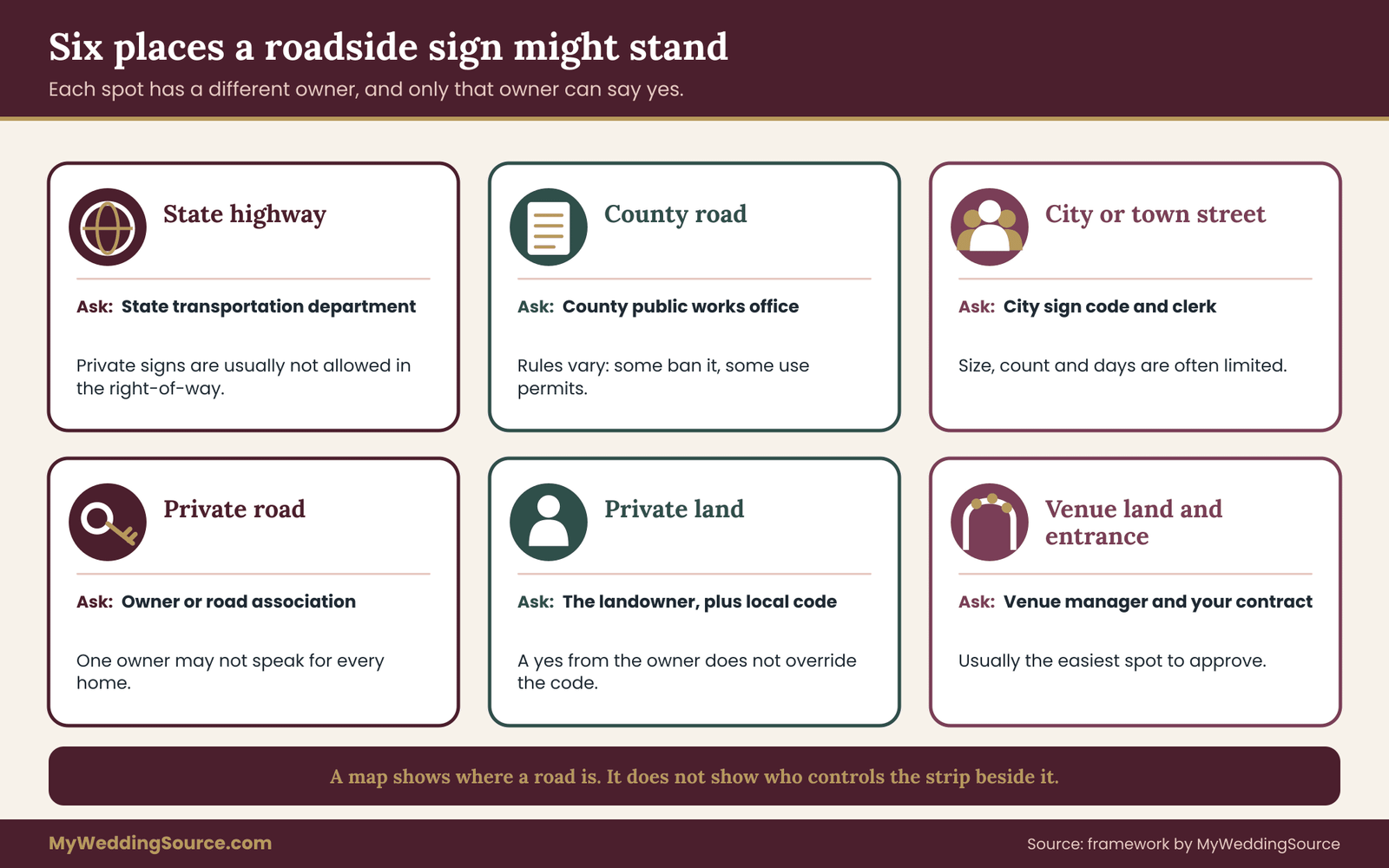
State highways and numbered routes. These are usually managed by a state department of transportation. Private signs are generally not allowed in the public right-of-way along these roads, and the agency may remove them. The right-of-way often extends beyond the pavement and the shoulder, further than people expect, and fences or mowed lawns do not necessarily mark its edge.
County roads. The county road department or public works office usually manages these. Some counties have a permit process for temporary roadside signs, some prohibit them in the right-of-way altogether, and some are relaxed in practice but strict on paper. A call to the county office costs nothing and gives you the real answer.
City and town streets. Municipal sign codes tend to be the most detailed. They may regulate size, height, number, how long a temporary sign can stay and whether it can stand on a sidewalk, a parkway strip or a median. A code may treat a wedding sign as a temporary directional sign, as a general temporary sign, or as something not allowed at all.
Private roads and driveways. The owner or a road association decides. If the road serves several homes, one owner cannot always speak for all of them.
Private property beside a public road. The landowner decides about their own land, but the sign must also comply with local code. A landowner’s yes does not override a code that prohibits the sign.
The venue’s own land and entrance. The venue manager decides, and the venue’s contract may already state what signage is allowed.
A practical way to find the owner is to look at the place itself. Is there a curb and sidewalk, which suggests city control? Is there a mowed verge with a utility box, which suggests a right-of-way? Is there a fence line and a gate, which suggests private land? These are clues, not proof. The proof is a response from the office or person who controls the spot.
Be careful with online maps. Property lines on a mapping site are approximate, and the public right-of-way is often not shown at all. Use the map to form a question, not to answer it. The question to the county or city can be as simple as: “I want to place a temporary directional sign for a private event at this intersection. Is that spot in the public right-of-way, and are temporary directional signs allowed there?”
Many couples also assume the venue knows the answer. Sometimes it does, and the better venues keep a standard approved sign set up at the nearest intersections. Often it does not, and the venue’s answer is “people do it all the time.” That phrase tells you something about habits, not about permission. Ask the venue what it has placed there before, who approved it and whether that approval is still current.
The venue technical walkthrough guide explains how to ask a venue about site access, and the same visit is a good time to ask about the approach roads. Bring a short list: the route most guests will drive, the turns that confuse people, and the exact points where you are considering a sign. Walk or drive the route in the same direction guests will, preferably at a similar time of day, and write down every decision point. Photograph each one from the driver’s seat position if you can do so safely, ideally with a passenger taking the pictures.
By the end of that visit you should have a plain list: each possible sign location, who owns it, and who you need to ask. That list is the starting point for the worksheet later in this guide.
How local sign codes treat temporary roadside signs
Sign codes are local laws, and they are where most roadside signs get stopped. They are usually found in a city or county zoning code, sometimes under headings such as “temporary roadside signs,” “off-premise signs,” “directional signs” or “special event signs.” You do not need to read the whole code. You need to answer five questions, and you can often get the answers by phone.
Is a sign for a private event off-premise? A sign placed away from the event location is generally called an off-premise sign. Many codes treat off-premise signs more strictly than signs on the same property as the event, because they resemble advertising. Some codes allow off-premise directional signs for events only in specific forms or with a permit. Others ban them outright. Ask directly how the code classifies a temporary directional sign for a one-day private event.
Is a permit required, and what does it cost? Some places charge a small fee, some require an application a few weeks ahead, and some have no process at all, which usually means the answer is no. Do not assume the fee, because you cannot verify it from a general article. Ask the office for the current fee and timing.
What are the limits on size, height, number and duration? A code may cap a temporary sign at a certain area, set a maximum height, limit how many can stand in one place and limit how many days before and after an event they may remain. Write down the specific limits. You will design to them.
Where is a sign prohibited? The usual prohibitions are public rights-of-way, medians, sidewalks that block pedestrians, within a set distance of an intersection, on trees, on utility poles and on traffic control devices. These prohibitions tend to be absolute, and permits rarely override them.
Who enforces the code, and how? Some towns enforce on complaint only, which means roadside signs stay until a neighbor calls. Others send staff on a schedule. Others use a road crew that picks up anything in the right-of-way with no notice. Knowing the enforcement style helps you understand the risk, but it does not make a prohibited sign allowed. Do not use “they never enforce it” as a reason. The day they enforce it may be the day of your wedding, and the fine or removal fee will be yours.
When you call, be specific and polite. Say that you are planning a private event, name the road or intersection, and ask for the section of the code that applies so you can read it. Get the name of the person you spoke with and the date, and follow up with a short email that restates what you were told.
If the answer is “no roadside signs in the right-of-way,” ask whether there is an approved alternative, for example a county-run wayfinding program or a tourism-type sign that the venue could apply for. Some venues are eligible for official guide signs on certain roads through a state program, and that process is slow and controlled by the road agency, so it is not an option for a wedding this year, but a venue may already have one.
Federal and state context in plain terms
You do not need to become an expert in outdoor advertising law, but a little background helps you understand the answers you hear. Highway sign standards in the United States follow the Manual on Uniform Traffic Control Devices, which is the national standard for official road signs, markings and signals. Its purpose is to make official signs look and work the same everywhere.
A private sign that looks like an official sign, for example by copying a stop-sign shape or a highway guide-sign color scheme, can confuse drivers, and agencies tend to remove those quickly. This is a practical reason to avoid red octagons, yellow diamonds with warning symbols and green-and-white highway styling on your own roadside signs.
On some federally funded highways, outdoor advertising is regulated further under federal and state law. That body of law mostly concerns billboards and commercial signs, but the same agencies often handle questions about any private sign near those roads. If your venue sits on or near such a road, the state transportation department is the right office to ask, and you can expect a firm answer.
None of this means roadside signs for a wedding are impossible. Many couples use them legally in places where codes allow temporary directional roadside signs or where the owner of the land beside a road gives permission and the code permits it. It means you should confirm instead of assuming.
Reading an answer correctly
People often misread the answers they receive. Here are common replies and what they actually mean.
“We do not allow signs in the right-of-way.” This is a no for any location between the road and the property line. It may still be a yes for a spot on private land set back from the right-of-way, with the owner’s permission, if the code allows it.
“Temporary signs are allowed for up to a certain number of days.” This is usually about signs on the same lot as the event, or about a specific type such as real estate or political signs. Ask whether the rule covers off-premise directional signs for a private event.
“Go ahead, it should be fine.” This is not a permit. Ask whether they can confirm in writing, even by email, and note that an informal phone answer from one clerk may not bind the agency or the code enforcement team.
“We have to look into it.” Treat it as unanswered and set a date to follow up.
“That would require a special event permit.” Ask what the permit covers. Some special event permits cover road closures, parades or street use, and have nothing to do with roadside signs. Others do include temporary signage. The office can tell you which.
The most valuable thing you can collect is a short written answer from the owner or agency that names the location, the sign size or quantity and the dates. It does not need to be formal. A reply email that says “yes, you may place up to two roadside signs at this address from Friday noon to Sunday noon” is enough for most situations, and it is worth printing and carrying on the day in case someone asks.
Private property, owner permission and roadside signs
Because public land is the harder case, many couples turn to private property beside the road: a farm, a gas station, a church lot, a shop, a neighbor’s front yard. This works often, and it comes with its own checks.
Ask the person who can actually decide. A cashier at a gas station cannot approve a sign. The owner, the manager or the franchise holder can. At a church, it may be the office administrator or a board. For a farm or a house, it is the owner of record, who may not live there. Ask for their name before explaining the request.
Ask for something specific. A good request names the exact spot, the size of the sign, the number of roadside signs, the dates and the removal commitment. For example: “May we place one sign, about two feet by three feet, on a stake at the corner of your driveway on Friday afternoon and remove it Sunday morning?” Specific requests get quick answers, and they limit disagreements later.
Offer something simple in return. A thank-you note, a small gift or a promise to leave the spot cleaner than you found it does more than money would. Do not pay for access without writing down what the payment covers, because it changes the arrangement into a rental or license that a lawyer may need to review. If someone asks for a fee, treat it as a business agreement and ask for a written note.
Check that the code still allows it. A landowner can allow a sign on their own land, and the local code still applies. If the code bans off-premise temporary roadside signs, the landowner’s permission does not remove the ban. This is the single most common surprise. The owner says yes, and a week later the town removes the sign.
Check the shared-interest cases. Land owned by a homeowners association, a condominium board, a business park or a church may require approval from a group, not one person. A neighbor’s yard may be rented, in which case the tenant and the landlord may both have a say. When in doubt, ask who else needs to agree.
Confirm underground utilities before using stakes. Driving a stake into the ground is digging, in a technical sense, and many areas have a call-before-you-dig requirement for certain kinds of excavation. A small sign stake is rarely the issue, but if a sign needs a deeper post, a heavy base or an anchor, ask the owner where utility lines run, and consider a freestanding sign with a weighted base instead. The national 811 service exists so that people can find out where buried lines are before they dig.
Agree on the end of the arrangement. Put the removal time in the message. If a vendor, friend or family member is going to remove the roadside signs, name that person and give the owner a phone number. Many “forgotten sign” problems come from nobody being named.
One more point deserves attention: do not rely on a verbal yes from someone who may not be around on the day. If a sign is placed on a Friday and a different employee, a different tenant or a different property manager is there on Saturday, a verbal yes disappears. A printed note signed or replied to by the owner is a better memory than anyone’s recollection.
Finally, be honest about the alternatives. If a landowner says no, that is a normal answer. Thank them, and move on to the next option. Pressing, bargaining or placing a sign “just for the day” after a refusal damages relationships with people who live next to your venue and may have to deal with the neighborhood long after the wedding. The venue also has to keep those relationships, and a venue manager who hears that a client placed a sign after being refused may restrict future couples. This is part of why the venues guide recommends asking about neighbor relations when you tour.
Traffic safety rules of thumb for roadside signs
Permission settles whether a sign may stand in a place. Safety settles whether it should. Even a fully approved sign can cause harm if it distracts a driver, blocks a view or comes loose. The points below are general good practice, not a substitute for the rules of your road agency or the advice of a traffic engineer, and a venue on a busy or fast road may need professional guidance.
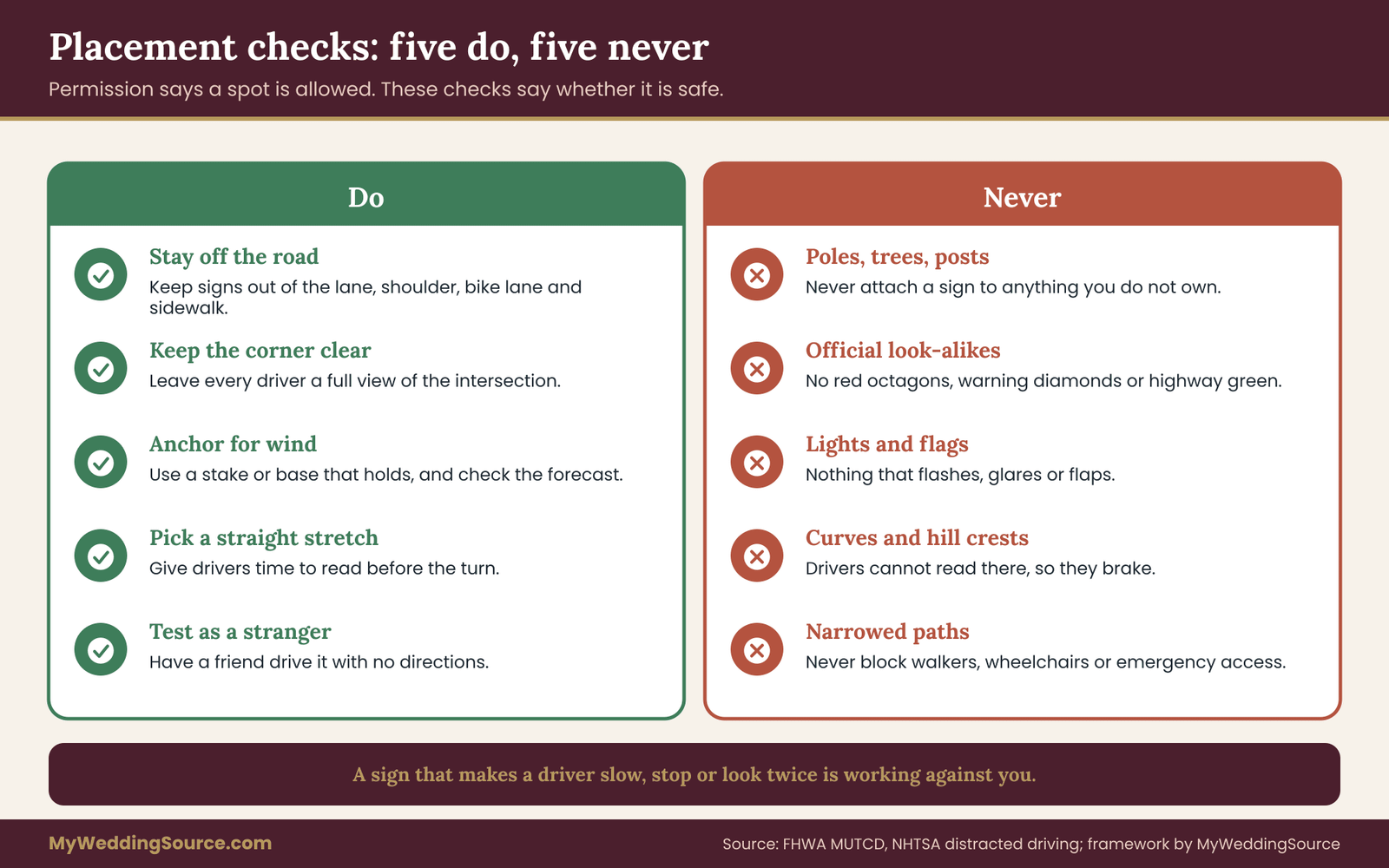
Keep roadside signs out of the driver’s field of view at decision points. The most dangerous spot for a private sign is the corner of an intersection, where drivers look left and right for traffic and pedestrians. A sign that blocks that view, even partly, creates a hazard. Place the sign well back from the corner, on the side where a stopped driver can still see the whole intersection. If you cannot tell whether a spot blocks a view, sit in a parked car at the stop line, with the owner’s permission and without blocking traffic, and look. Or skip the spot.
Keep roadside signs off the roadway, shoulder and sidewalk. Nothing should be in the travel lane, on the paved shoulder, on a bike lane or on a sidewalk where a person using a wheelchair, stroller or walker needs the full width. Accessibility is part of safety. If a sign narrows a sidewalk, someone will step into the road to get around it.
Keep roadside signs away from official devices. Do not attach anything to a stop sign, a speed sign, a signal pole, a guardrail, a utility pole or a mailbox post that belongs to someone else. Do not place a sign so that it hides an official sign or sits close enough to confuse the reading of one. Official devices need to be seen first, and agencies treat interference seriously.
Keep roadside signs from looking official. As noted earlier, avoid shapes and colors that copy road signs. A rectangular sign with a clear arrow and a short name is not likely to be confused with anything official. A red octagon, a diamond or a flashing light is.
Do not use lights, reflective sheeting that dazzles, flags that flap or anything that moves. Moving objects pull the eye. A sign designed to attract attention is exactly what you do not want at a turn. Calm, still, plain boards read better and distract less. The National Highway Traffic Safety Administration publishes information on distracted driving, and the central point is simple: anything that takes a driver’s eyes off the road for even a moment adds risk. Your sign should be readable in a glance and then forgotten.
Anchor for wind and weather. A stake in soft ground may lean after a rainstorm. A lightweight board on a stand can tip over in a breeze and land in a lane. Use a stake or base appropriate to the sign’s size, pick a spot with some shelter where possible, and plan to check the roadside signs on the day. If the forecast shows strong wind, reduce sign sizes or move the sign to a more protected spot. The National Weather Service posts forecasts and wind advisories, and it is worth checking them the day before and the morning of the event.
Never place roadside signs on a curve, a hill crest or a narrow bridge. Drivers do not expect to read there. The reading time is short and the road demands attention. Choose straight, calm segments with good visibility, a bit before the turn, so the driver has time to slow down and make the turn calmly.
Avoid creating a place where people stop in the road. If a sign is hard to read, drivers brake or stop to figure it out. That risk is highest on faster roads. This is one reason to move toward fewer words, larger letters and more roadside signs spaced at helpful distances, instead of one detailed sign that people slow down to study.
Plan for night and low light. If guests will arrive or leave after dark, a sign that works at noon may disappear at dusk. Do not add lighting that could distract. Instead, choose high-contrast colors and consider matte finishes that do not glare in headlights. Test the sign at the time of day when most traffic will pass.
Think about people on foot and bicycles. Not every guest arrives by car. A sign that points cars to the right entrance may leave pedestrians guessing, and a sign that pushes foot traffic across a road without a crossing is a problem you created. If guests will walk from a hotel or a parking area, plan a separate, pedestrian-scale route and keep it on sidewalks and crossings.
Account for emergency vehicles. If the venue is down a long private road, signs must not block the way for an ambulance or fire truck, and the route must be clear enough that a dispatcher can direct a crew. Do not place signs in a way that narrows a turn or a gate entry. Ask the venue about its emergency access route and keep your roadside signs well clear of it.
A quick field test
You can do a simple, honest test of any roadside sign location in a few minutes. Ask a friend who has never been to the venue to drive the route while you ride along. Do not give them directions. Do not tell them where the roadside signs are. Note the following: Did they see the first sign without slowing sharply? Did they read it correctly? Did they know which way to turn? Did they make the turn smoothly? Did any car behind them react? If the answer to any is no, the sign needs to move, shrink, grow or change wording.
The test works best on a similar day and time to the event. It also reveals a common surprise: signs that look obvious to the couple, who know the place, are invisible to someone who does not. Visitors scan the road for a name or a color, and sometimes they scan for a landmark that you forgot to include.
Design and visibility: making roadside signs readable at speed
Reading a roadside sign is closer to reading a billboard than reading a menu. The reader has a few seconds. Good design for roadside signs follows from that fact, and it does not need much artistic skill.
Say less. A roadside sign needs the minimum: where to go and which way. A short name, an arrow and nothing else is usually right. A long sentence, a date, a hashtag, a quote and a decorative border fight each other. The full names of the couple are rarely needed. Many couples use first names or initials, because the guests know whose wedding it is and strangers do not need to.
A privacy-conscious option is to use an event name or a short code the guests know from the invitation, so that passersby do not learn the full names and the date. This is a small privacy choice, but it matters if the venue is near your home or a place where you do not want attention.
Make the arrow the largest element. The arrow does the work. Draw it large, thick and simple, pointing clearly. Place it so that it points in the direction of travel: a right-pointing arrow means turn right at the next opportunity, and an arrow pointing straight ahead means continue. Ambiguous arrows, like a curved arrow or a decorative flourish, confuse readers.
Use big letters. There is no universal size, because the right size depends on speed and distance. As a practical rule, letters need to be much larger than you think, and a sign that looks too big in the garage is often about right at the road.
Test by printing a draft at full size, taping it to a wall and walking away to the distance a driver would first see it. If you cannot read it at that distance, it is too small.
The W3C Web Accessibility Initiative is mainly about digital content, but its contrast and legibility guidance is a helpful reference for any visual information, and the same principles apply: strong contrast, plain fonts, adequate size.
Use strong contrast. Dark letters on a light background, or the reverse, read best. Pale pastels, metallic finishes and script fonts fail at a distance. Avoid thin lines, which vanish. Avoid busy backgrounds, glossy finishes that reflect the sun and colors that look similar to a color-blind reader. A black or dark navy on white or cream is almost always safe. What helps guests with reduced vision helps everyone driving at dusk, and reflective materials such as mirror or acrylic are a poor choice outdoors because glare is a bigger problem.
Choose a plain font. Wedding styling often calls for script. Keep script for the invitation. A sign meant to be read at speed should use a clean, bold, widely spaced typeface, in capitals or in a mix of capitals and lowercase with generous spacing.
Use a consistent look across the set. If the roadside signs share a color, a shape and an arrow style, a guest who spots the first one will recognize the next. This is also a place where the style of the invitation helps: using the same accent color on the roadside signs as on the invitation gives guests a quiet cue.
Repeat, and space the repeats. One sign at the final turn is rarely enough. A sequence works better: an early confirmation sign as guests approach the area, a turn sign at the decision point and a final sign at the entrance. Each sign confirms the one before it and lets the guest relax.
The number of roadside signs depends on the route, and fewer is better if the route is simple. A route with one confusing turn may need only two roadside signs. A route with five turns may need more, but then it is probably worth asking whether another tool, such as a shuttle or a simplified approach, would help.
Match the sign to the surface. Corrugated plastic boards on wire stakes are common because they are light and weather-resistant. Foam board warps in damp air. Wood looks handsome but is heavy and can fall. A sign that is heavy may be safer in wind and more dangerous if it falls. Choose something that will not injure a person or a car if it lands in the road, and anchor it to match.
Include an accessible backup. Some guests will not read a roadside sign at all, because of vision, a rental car, a late arrival or simply habit. Include the written directions on the invitation insert or the wedding website, and describe landmarks in words. If the venue has a street address that a navigation app reads incorrectly, say so plainly on the website with a corrected pin or a note about which gate to use.

The five-gate approval worksheet for roadside signs
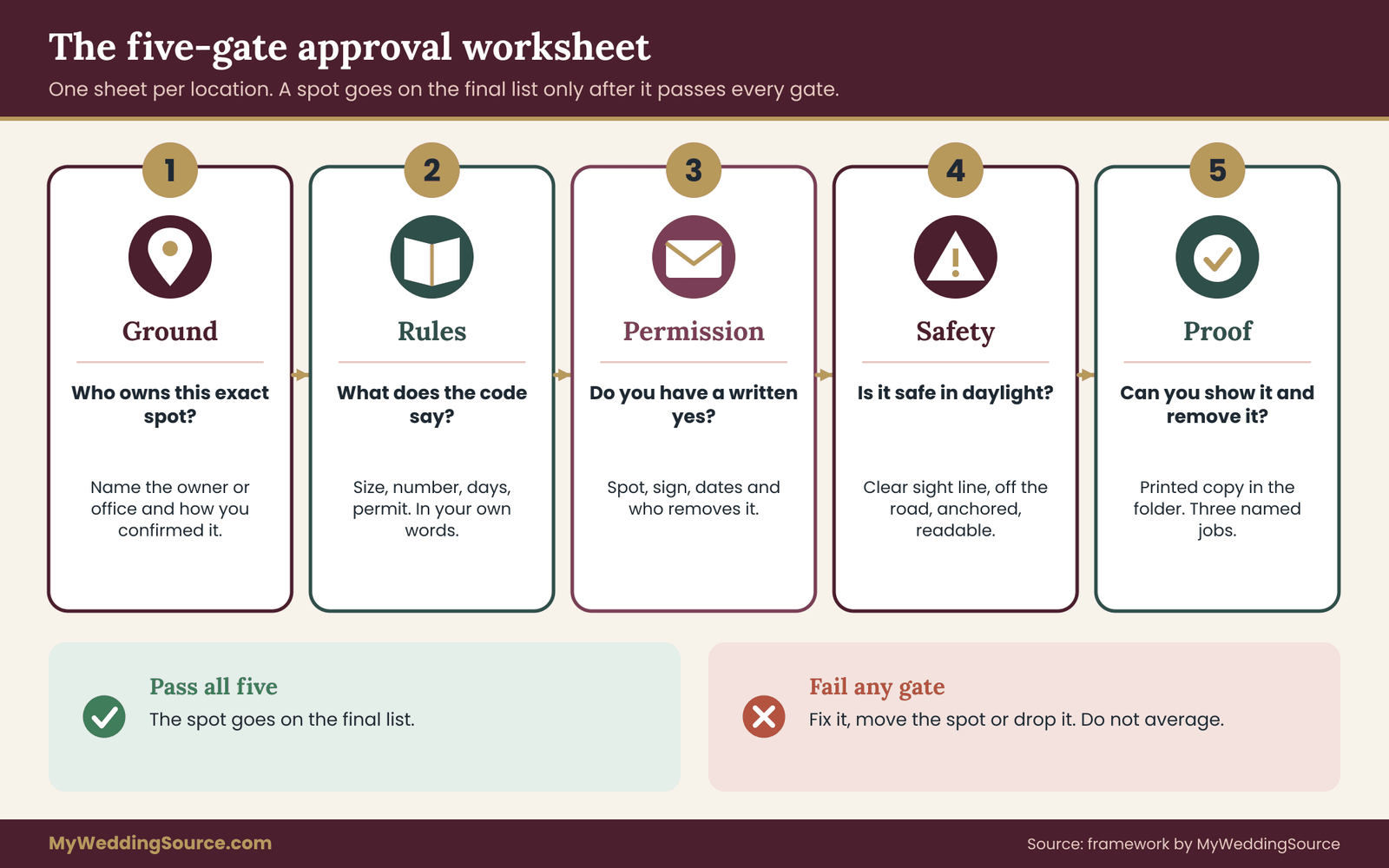
Everything above can be turned into a worksheet that you fill in for each possible sign location. The worksheet has five gates. A location must pass all five before a sign goes there. If a location fails a gate, you either fix the problem or drop the location. This is the original working method of this guide, and it exists to stop one common failure: a couple gets a friendly yes on one question and treats it as a yes on everything.
Use one sheet per location, even if it is a plain page of notes. Give each location a short name, such as “Mill Road and Route 9” or “gas station corner.” Then work through the gates in order, because the early gates save you from spending time on the later ones.
Gate one: Ground
Who owns this exact spot? Write the owner’s name or office, the way you found out, and the date. If you could not confirm it, write “unknown,” and treat the gate as failed until it is confirmed. Note whether the spot is within a public right-of-way, on private land, or on the venue’s property. A spot with a confirmed owner passes this gate. A spot where the owner is a guess does not.
Gate two: Rules
What does the written code or agency policy say about a temporary directional sign for a private event here? Write the rule in your own words, note the section or the name of the person who explained it, and list the limits on size, number and days. Write “permit needed: yes, no, unknown.” If a permit is needed, write the application date and cost as given by the office. A spot passes if the rule allows it or a permit has been approved. It fails if the rule prohibits it, even if the owner is friendly.
Gate three: Permission
Do you have a written yes from the owner or agency, covering this spot, this sign and these dates? Write who gave it, how, when and whether you have a copy. The copy can be a printed email or a photo of a note. Add the name of the person who will remove the sign and the time they will do it. A spot passes with a written yes that names dates and removal. It fails with a verbal answer only, and the fix is easy: send a short email that restates what you heard and ask for a reply of “yes.”
Gate four: Safety
Go to the spot, in daylight, and answer these questions in writing. Does the sign stay out of the road, shoulder and sidewalk? Does it leave the view at any intersection clear? Is it away from official signs, signals, poles and trees? Will the stand hold in wind? Can drivers read it without slowing sharply? Are the approach speed and the road type suitable for a private sign?
Do emergency vehicles and walkers still have room? If you answer no to any of these, move the spot a few feet and test again, or drop it. A spot passes when every answer is yes, and when you took a photo showing the sign position, the sight line and the surroundings.
Gate five: Proof and removal
Can you show, on the day, that the sign is approved, and can you guarantee it will be removed? Print the permission, keep it in the car of the person doing the setup and put a copy in your day-of folder. Write the setup time, the check time and the removal time. Assign a name to each. A spot passes when the paperwork is in the folder and three named people have three named jobs. It fails when removal is “someone will pick it up.”
How to score the sheet
Mark each gate pass, fix or fail. A location with five passes goes on the final list. A location with a fix on any gate stays on a short “pending” list until that gate is cleared. A location with a fail is dropped, or, if the failure is easy to correct, moved to a new spot that you assess from the beginning. Do not average the gates. A strong score on four gates does not offset a fail on the fifth, because each gate protects against a different kind of problem.
The worksheet also produces an honest picture of how many roadside signs you can actually use. Couples often start with a wish list of eight or ten locations and end with three or four that pass. That is not a failure. Three approved, well-placed signs usually do more than ten uncertain ones, and approved roadside signs do not need to be watched nervously on the wedding morning.
What a filled sheet looks like
A single sheet might read like this in a couple’s notes. Location: the corner of a county road and the venue’s lane. Ground: county right-of-way for the road, venue-owned land from ten feet inside the fence, confirmed by the county’s public works office by phone on a named date. Rules: county does not allow private roadside signs in the right-of-way; allows roadside signs on private land set back from the road if they are no larger than the stated limit and removed within two days of the event.
Permission: venue manager agreed by email to one sign on venue land at the lane entrance; email saved. Safety: sign sits behind the fence line, clear of the sight triangle at the corner, anchored with two stakes; visible for about the length of the approach from the north, but the south approach is a blind curve. Proof and removal: printed email in the day-of folder; the groom’s cousin sets it at two o’clock Friday and removes it Sunday at nine.
Notice what that sheet did. It moved the sign from the roadside strip, where it was not allowed, onto the venue’s own land, where it was. It also found a weakness, the blind curve on the south approach, which means guests coming from that direction need a different early warning. That early warning might be a second sign placed earlier on a straighter stretch, or a line on the wedding website saying “coming from the south, the lane is the first right after the church.”
Using the sheet with the people who help you
The worksheet is easy to share. Give each helper a printed copy of the pending spots and ask them to take photos on a site visit. A family member who lives nearby can often do the daylight safety check, make the phone call to the county and place the roadside signs. Put one person in charge of the whole sheet, so that the answers do not end up in four email threads. If you have a wedding planner or day-of coordinator, ask them to own the sheet and to check it against the venue’s own rules, as covered in the vendor timeline guide.
Treat the worksheet as a living document until about two weeks before the wedding, when the final list must be settled. Late changes cause the most trouble, because they reach the printer and the helpers when there is no time to confirm a new spot. If a location becomes uncertain in the last two weeks, drop it and strengthen another layer, such as the website directions or a person at the turn, instead of rushing a permission.
Where the sheet sits among the other signs
The worksheet covers roadside signs only. Signs at the venue entrance, signs on site and roadside signs inside rooms follow the venue’s rules and need their own approvals, which the wedding signage system guide explains as part of the wider approach. Keep the roadside sheet separate so that the more formal permission work does not get mixed into the design work. It also helps to remember that seating displays, welcome signs and menus have nothing to do with road rules, and the wedding seating chart guide is the right place to start on those.
A worked example: a farm venue and four roadside signs
The following example is invented to show how the worksheet behaves. The couple, the roads and the venue do not exist, and the answers they receive are typical of what couples report, not a record of real events. Real answers depend on your location, so use the example for the reasoning, not for the results.
Dana and Marcus are marrying at a farm venue at the end of a gravel lane off a county road, about six miles from the nearest town. Their guests will arrive from two directions. Navigation apps tend to send drivers to a service gate on a different road, and cell coverage drops on the final mile. The couple’s first idea is four signs: one at the highway exit, one at the town’s last traffic light, one at the county road turn and one at the lane.
Step one: list the spots and find the owners. They drive the route on a Tuesday afternoon and note the four spots. The highway exit is a state highway ramp, so the state transportation department controls it. The traffic light is in town, so the city controls it. The county road turn is a county right-of-way beside a field owned by a farmer, and the lane is the venue’s own land. Four spots, four different owners.
Step two: check the rules. Dana calls the city office about the traffic light. The clerk says the sign code does not allow private roadside signs in the right-of-way and that off-premise signs for private events are not permitted on commercial streets. Gate two fails there. She asks whether there is any alternative, and the clerk mentions that businesses on that corner sometimes allow roadside signs on their lots, which would still have to comply with the code. She writes that down as a question for later and does not count on it.
Marcus emails the state transportation department about the highway exit. The answer is a short no: private roadside signs are not allowed in the right-of-way, and roadside signs on a ramp would be removed. That spot is dropped without further effort. They note that the state does run an official wayfinding program, but the process is too slow for this wedding and is something the venue would have to apply for.
The county public works office is more helpful. The staff member says private roadside signs in the county right-of-way are prohibited, but that a sign on private land beside the road is a matter for the landowner and the zoning code, which allows temporary directional signs for events under a certain size for a few days either side of the event. Gate two passes, with limits.
Step three: get permission. The county road turn sits beside a field. The couple asks the venue manager who owns it. It belongs to a neighbor who is on good terms with the venue. The venue manager offers to make the introduction. Dana writes a short message: one sign, about two feet by three, on a stake just inside the fence line at the corner, up on Friday at two and removed Sunday at nine, with Marcus’s cousin named as the person responsible. The neighbor replies with a yes, and Dana saves the reply. Gate three passes.
The venue’s lane is the venue’s own land, and the contract already allows one sign at the entrance. Gate three passes there too, and Dana asks the manager to confirm by email, which the manager does.
Step four: check safety. The couple visits the county road corner on a Saturday morning, when the traffic is similar to the wedding day. They find that the corner has a stop sign and a slight curve to the left. The neighbor’s fence line sits far enough back that a sign there does not block the view of the intersection, but the first approach from the south is on a curve, which means drivers would see the sign late.
Marcus’s cousin points out that a sign placed a little earlier, about a quarter mile before the corner, on straight road, would give drivers time to slow. That spot is on a different parcel, so the couple asks about it too, and the neighbor across the road says yes. A fifth spot appears, and it passes the gates after a second phone call.
They test readability by printing a draft at full size. At their chosen letter height, the first draft is legible only when someone stands near it. They enlarge the arrow and shorten the wording from the couple’s names to the name of the farm, and test again from a car parked off the road. Now it reads from far enough away.
Step five: proof and removal. Dana prints the three emails, puts them in a folder labeled “road signs” and gives a copy to the cousin. The cousin sets a reminder to place the roadside signs Friday at two and check them Saturday at noon, since the forecast shows wind. Sunday morning, a friend collects everything and returns the stakes to the venue.
What the couple ended up with. The original plan was four roadside signs. The final list is three roadside signs, two on private land with the neighbors’ permission and one on the venue’s lane, plus a wedding website note that tells guests to ignore the navigation app’s suggested route, a printed card in the invitation with landmarks, and a volunteer with a flag at the final turn during the arrival window. The two dropped spots, the highway ramp and the traffic light, did not stay empty of guidance. The website note and the card cover those decisions.
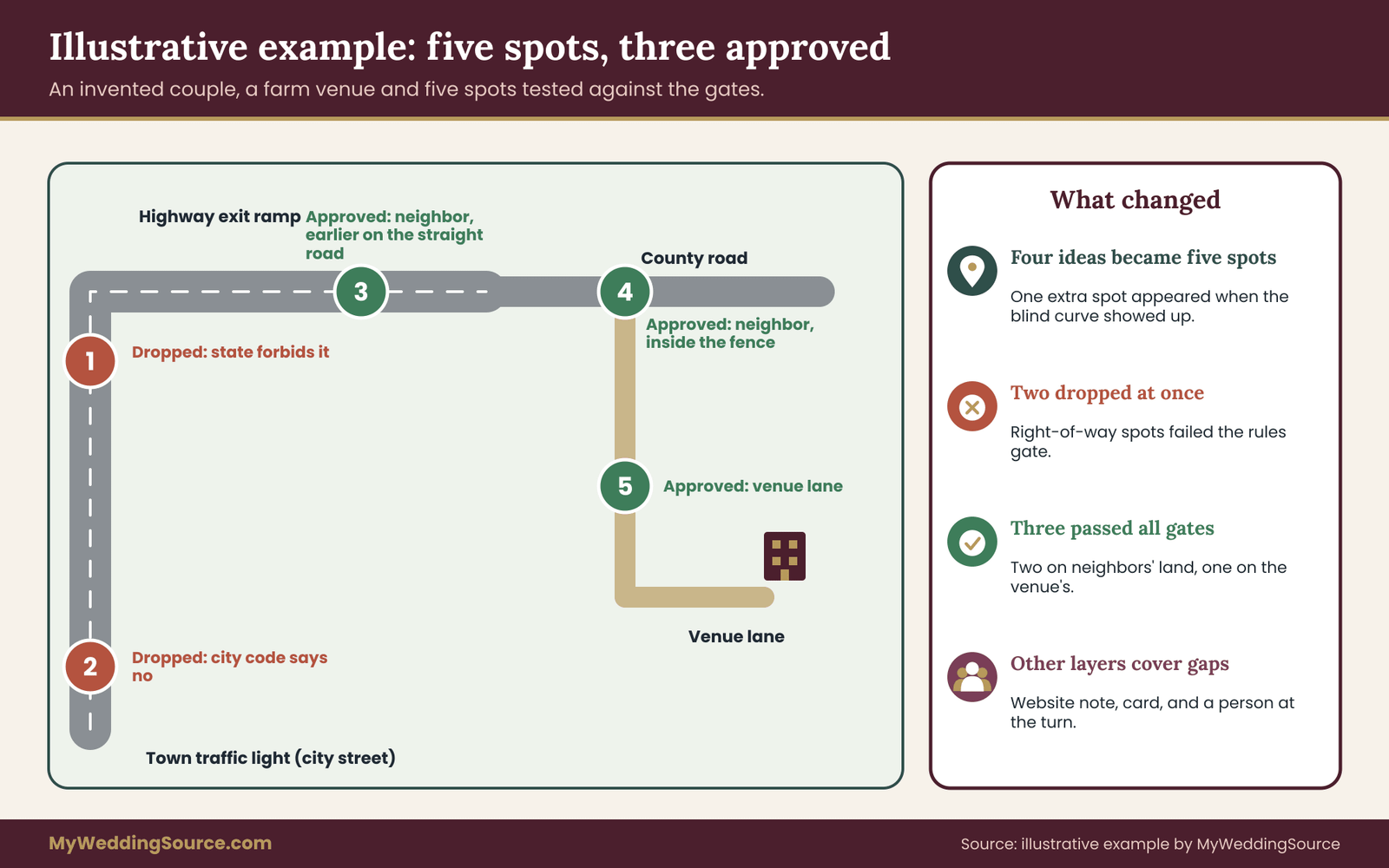
Some points from the example are worth noting. The sign count shrank, and the experience probably improved because the remaining roadside signs were placed where the road really needs them. Phone calls took about an hour in total, spread over a couple of weeks. The step that saved the most trouble was asking early. The step that added the most value was driving the route as a stranger, which found the blind curve.
What the example does not show
It does not show every outcome. A different county may require a permit with a fee and a few weeks of processing. A different neighbor may say no, or may never answer. A different venue may have its own fixed sign set. In a dense city, the best answer may be that no roadside signs are allowed and the entire approach relies on venue staff at the corner. The worksheet works in all of these, because it separates facts from hopes.
Asking well: scripts for the city, the owner and the venue
Many couples delay the calls because they do not know what to say, or fear a refusal. A few short scripts remove most of the friction. Adapt them to your own voice, and keep them brief. You are asking for a small favor or a simple answer, and the person on the other end is often busy.
Calling a city or county office
“Hello, I am planning a private event, a wedding, at an address on this road. Guests will have trouble finding the turn, and I would like to place a temporary directional sign for one weekend. Can you tell me whether temporary directional signs for private events are allowed in this area, and whether the spot I have in mind is in the public right-of-way?”
If the answer is no, follow with: “Is there anything allowed that would help guests find the turn, for example on private land with the owner’s permission, or an approved program through the county?” If the answer is yes with conditions, ask: “Could you send me the section of the code or the permit form so I can follow it exactly?”
Close the call with: “Thank you. I will send a short email so that I have written down what you told me. Please correct me if I got anything wrong.” Then send that email the same day, with the date and the name of the person.
Writing to a landowner
“Hello, my name is [first name]. We are holding a wedding at [venue] on [date], and guests often miss the turn at your corner. Would you be willing to let us place one small sign, about [size], on a stake just inside your fence line from [day and time] to [day and time]? We will remove it ourselves, and [name] will be responsible for putting it up and taking it down. If you would rather we not, we completely understand. Thank you for considering it.”
The last sentence matters. It gives the person an easy way to refuse, which makes saying yes more comfortable. Keep the message short, and avoid pressure or incentives that feel like a bargain.
Asking the venue
“Do you already have approved roadside signs at the road approach, and who approved them? Which locations have worked for past couples? Is there any location on your property or a neighbor’s property that you would prefer or avoid? Does our contract allow us to add roadside signs on your land, and who removes them?”
These questions tend to reveal the venue’s real practice. If the answer is that the venue handles all roadside signs for its clients with a standard set, you may not need your own, and you can use the saved effort elsewhere. If the contract is unclear, the wedding vendor contract guide explains how to ask for a clause or an email that fixes the point.

Confirming in writing
A short confirmation is the most useful message you will send. It can read: “Thanks for speaking with me today. To confirm: you said that [what was agreed or what is prohibited]. If I have understood anything incorrectly, please let me know. Otherwise I will proceed on that basis.” Silence after such a message is not a permit, but it creates a record that you acted in good faith and gives the other party a chance to correct a misunderstanding before the wedding.
When the answer is “it depends”
Some offices will say it depends on the exact spot, the time or the type of sign. Ask what it depends on and who decides. Often the answer is a zoning officer or a code enforcement officer, whose name and number you can then ask for. A short second call with the exact address and a photo can turn “it depends” into a clear answer.
When nobody answers
Follow up once after a week, politely. If there is still no answer two weeks before the wedding, treat the spot as not approved. Silence is not a yes, and a plan that relies on silence will fail at the worst time. Shift the plan to the other tools in the next section.
Timing, setup and takedown of roadside signs
Roadside signs have a short life, and the timing creates its own risks. Put them up too early and you invite complaints, theft or a code violation for exceeding the allowed days. Put them up too late and the first guests, who are often vendors, drive past them. Take them down too slowly and you leave litter and a bad impression with the neighbors who helped you.
Start the permission work early. If a permit is needed, ask when the application is due and how long approval takes. Some offices need weeks. A request made three weeks before the wedding may be too late for a process that takes a month. For permission from a private owner, a couple of weeks is comfortable, and a month leaves room for follow-up. Many couples begin these conversations at the same time they finalize the venue contract, since the same visit shows the approach road.
Finalize the design after the placement is settled. It is tempting to order roadside signs first, because that is the fun part. But the wording, size and number all depend on the approved spots and the limits written in the code or the permission. A sign ordered at the wrong size for a two-foot limit is money wasted. Settle the list, then print. The wedding invitation printing guide explains how proofing and print timing work, and the same habits apply to roadside signs: check a proof at full size and allow time for a reprint.
Set a window for placement. A common arrangement is Friday afternoon for a Saturday wedding, or the morning of the wedding if the owner prefers. Whatever you choose, write it in the permission. If the code limits days, count them and add a margin. If the wedding has a rehearsal dinner or early guests, make sure at least the final-turn sign is up when they arrive.
Assign names to each task. Three tasks need three owners, even if one person does all three: placing, checking and removing. Write each name and time on the worksheet. A named person with a phone number is much more reliable than “the family.”
Check the roadside signs once. Signs get knocked over, turned around by wind and moved by curious children or passing mowers. A quick check about two hours before the first guests arrive catches most problems. Bring a few spare stakes, zip ties, a small mallet and a copy of the permissions. Do not stand on the road to adjust a sign. Park safely, and if the spot is too dangerous to reach on foot, skip the adjustment and tell the venue.
Remove the roadside signs promptly. Put removal on the same checklist as other post-event tasks. The best time is the next morning, because a sign left for a few days becomes a litter problem and a reason for the owner to say no to the next couple. Take the stakes too, and look for fragments, zip ties and tape. If a sign was damaged and you cannot repair it, remove it anyway, and tell the owner if anything needs attention.
Have a plan for a missing sign. If a sign disappears, do not replace it with an unapproved spot. Use a backup layer instead: a person at the turn, a text to guests, or a note on the website. The wedding day digital contingency guide explains how to prepare quick messages for guests when something goes wrong.
Recycle or store the roadside signs. After the wedding, the roadside signs may be useful for an anniversary photo or for a friend’s event. Corrugated boards can often be recycled, while mounted boards may be donated to a school or club. Check what your local program accepts before putting plastic or foam in a bin.
A simple timeline
Four to eight weeks before: list possible spots, find the owners and call the offices. Four weeks before: send written requests and any permit applications. Three weeks before: collect answers, fill in the worksheets and settle the final list. Two weeks before: confirm the wording and order the roadside signs. One week before: print the paperwork and assign the three tasks. The day before or the morning of: place the roadside signs, take a photo of each and check them again before guests arrive. The morning after: remove them and return stakes and borrowed items.
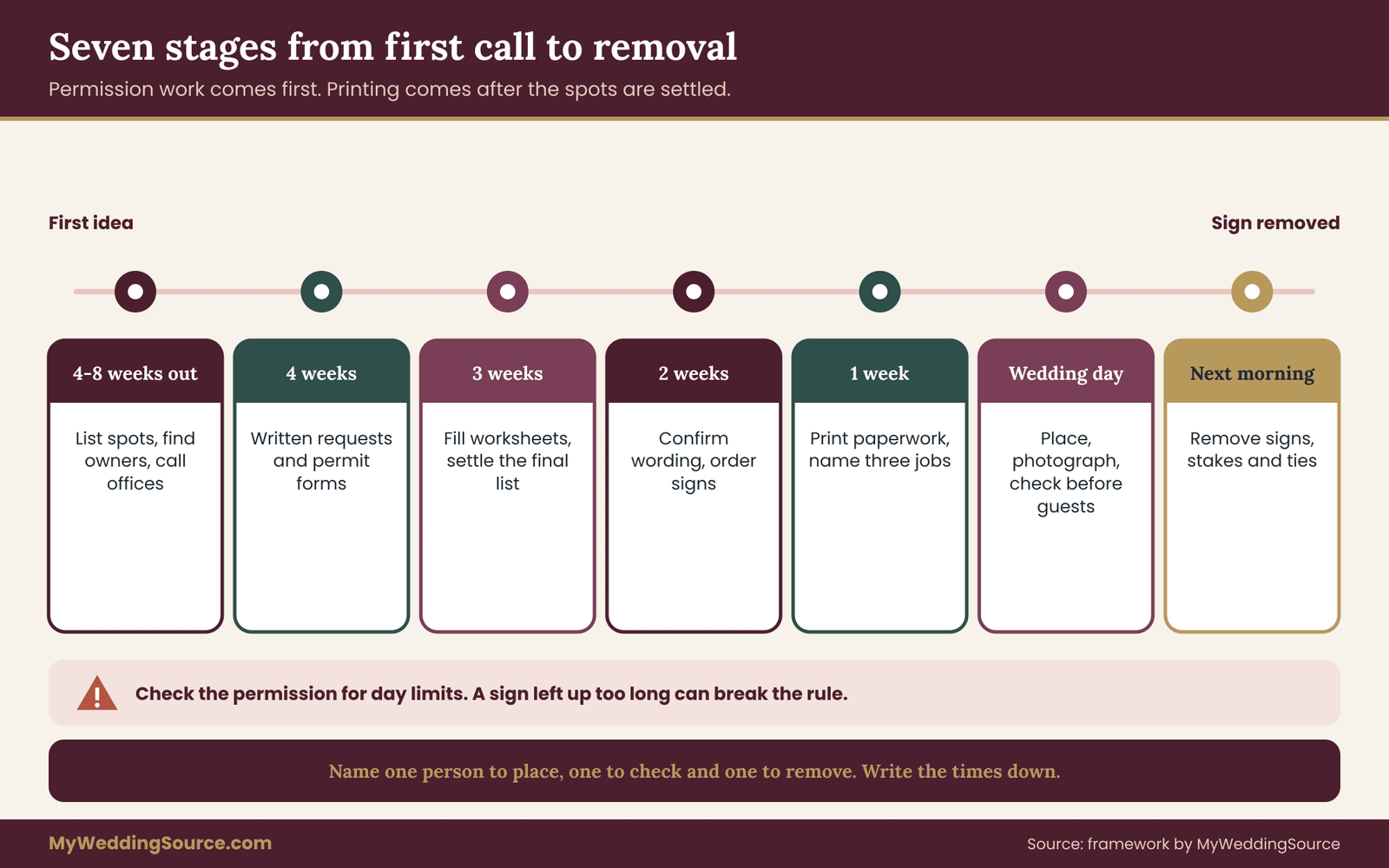
Weather and seasons
Season changes the picture. In summer, tall grass and crops can hide a low sign, and a sign that is clear in April may be invisible in July. In autumn, falling leaves may cover a ground-level board. In winter, snow banks and plowing can bury a sign, or push it into the road, and a road crew clearing snow will not stop to avoid a private stake.
If your wedding is in snow season, ask the road agency how they handle the roadside during storms, and expect that roadside signs near plowed roads may not be practical at all. Rain can make a stake lean and a board warp. Heat can bend plastic. Choose materials and placement for the season you are in, not the season in which you ordered the sign.
When roadside signs are not an option: alternatives that work
Sometimes the worksheet returns zero approved spots. This is more common than couples expect, especially in towns with strict sign codes or on busy highways. It is not a reason to give up on wayfinding. It is a reason to rely on other layers, and often those layers work better than roadside signs in the first place.
Directions that people can use before they leave. The most effective tool is a clear description on the wedding website and the invitation insert. Describe the last few miles in plain words with landmarks: the name of the last town, the color of a building, the turn after a particular bridge. Include the right address for navigation, and say if the app tends to choose the wrong road. Add a note for guests who lose signal, so that they can save the route offline before they go. Give both a primary route and a backup for guests arriving from different directions.
A venue-installed or venue-approved sign. Some venues keep a permanent sign at the entrance or hold an approval for a temporary sign at a nearby corner. Ask the venue to use theirs and add a banner or panel that fits the rules. If the venue has a regular process, it will know the offices and the owners, and may already hold permission.
A person at the turn. A volunteer with a bright vest and a handheld sign, standing safely on private land, can do the work of three roadside signs. They can also answer questions and redirect lost guests. Make sure the volunteer is on private property with permission, is not directing traffic in the road and has a phone with a charged battery.
If traffic management is truly needed, for example for a large event on a busy road, the venue or the local police may need to be involved, and a paid officer or a licensed traffic control service may be required. That is a decision for the venue and the local authority, not something a family member should improvise.
Shuttles and group travel. If the route is difficult, a shuttle from a known point, such as a hotel or a parking area, removes the problem. Guests do not need to find the venue, they need to find the shuttle. This is also the best answer for guests who will drink at the wedding and should not drive. Ask the hotels about their own shuttle options when you book.
A text message or messaging group. A short message sent a day or two before, and again the morning of, with the final turn and a phone number to call, helps. Keep it simple, send it to everyone, and include a pin that points to the right entrance, not the mailing address if the two differ.
Printed arrival cards for the car. A small card with the last three turns in large type and the venue’s phone number can be placed on the car dashboard or handed out at the hotel. It works without coverage and without roadside signs.
On-site signage at the entrance. If you cannot place roadside signs on the road, put more effort into the first sign inside the venue’s boundary. A clear sign at the lane or gate, with the venue’s permission, can reach drivers who are already in the right place and confirm they are in the right place. This is the easiest spot to approve, and it handles the last decision.
Arrival timing for vendors. Vendors are guests who need to arrive early with trucks, and their route may differ from the guest route. Send them a separate set of instructions, including the service entrance, gate codes if the venue allows them and a contact phone. The wedding rental planning checklist covers delivery details that depend on accessible routes.
A map graphic on the website. A simple drawn map showing the last mile, with the turns numbered, is easier to follow than text for many people. Keep it uncluttered and readable on a phone.
No single tool does everything. A good layered approach combines a clear website description, a venue sign at the entrance, a volunteer or two, a message to guests and, where permitted, a small number of approved roadside signs. The combination matters more than any one element, and if one layer fails, the others still work.
Common mistakes with roadside signs
Most problems with roadside signs repeat from one wedding to the next. Knowing them in advance is the cheapest protection.
Treating a friendly yes as a permit. A venue coordinator who says “everyone does it” and a neighbor who says “sure” are being kind. Neither is the agency that enforces the code. Get the code answer and the owner answer separately.
Using utility poles, trees and traffic signs as stands. It is tempting because they are tall and visible. It is also the fastest way to get roadside signs removed, and in some places it carries a fine. Utility companies and road agencies take attachments to their property seriously, and a sign on a pole can endanger a crew member climbing it.
Placing signs on the wedding morning with no checks. The result is roadside signs at the wrong angle, at a blind spot or on the wrong side of a fence. Do the daylight visit and the field test earlier.
Putting too many words on the sign. A sign that tries to be an invitation does not work as a direction. Remove everything that does not help a driver turn correctly.
Using small decorative signs for road use. A beautiful hand-lettered board that works at the ceremony entrance may be unreadable from a car. Keep decorative pieces for the venue and use plain boards for the road.
Forgetting the return trip. Guests leave at night, often tired, sometimes after drinking. A sign that points to the venue does nothing for someone trying to find the way out. Consider a simple “exit” arrow at the lane, and see that the route out is lit and clear. A sober-driver plan or a shuttle is a safer answer than roadside signs for the trip back.
Not telling the venue. If you place signs on or near the venue’s land without telling the venue, you may conflict with its rules or its neighbors’ wishes. Tell the manager the plan and the permissions you have.
Skipping removal. A sign left up for weeks is the most common reason a neighbor or venue refuses the next request. Remove them promptly.
Ignoring accessibility. Signs that block a path, that are placed too low for someone to see from a car, or that require reading a small print fail some of your guests. The U.S. Access Board and the ADA site explain accessibility requirements for public spaces, and while your temporary roadside signs are not official infrastructure, the same principles help people move safely. Keep paths clear, use high contrast and use large type.
Relying on one layer. A wedding with a single roadside sign and nothing else is a wedding where one fallen sign becomes a crisis. Use at least two layers.
Copying advice from a different place. A suggestion from a friend in another state may be legal there and illegal where you are. Verify locally.
Edge cases and special situations
A venue on a private road shared with other homes. The road association or a neighbor may control the entrance. Ask them as you would ask a landowner, and tell them about the guest traffic and the day, because they will notice cars. Offer a contact number.
A venue on a highway with higher speeds. The reading time is short and a stopped car is a hazard. Rely on the venue’s official or permanent signs, a clear approach description and, if the venue allows, a person at the entrance. Roadside signs are the weakest tool here, and drivers who slow suddenly for a sign add risk.
A park, public garden or government property. The agency that runs the property sets the rules, and these are often strict. The permit for the event may state what signs are allowed. Ask the permit office, not the road agency, and read the permit terms.
A rural venue with no cell service. The roadside signs matter more here, and so does paper. Combine approved roadside signs with printed route cards. Test the route offline.
A destination wedding where guests drive rental cars. Guests may be unfamiliar with local road signs and customs. Include the local road name and the last landmark. Avoid assuming that a navigation app will pick the intended gate.
Multiple events in one weekend. If the welcome party, ceremony and reception are at different places, sign sets for each must not confuse one another. Give each event a color or a short name that is consistent across the invitations, the website and the roadside signs, and place the roadside signs only when each event needs them.
A wedding near a busy event or festival. Other roadside signs may crowd the same corners, and traffic may be heavy. Check what else is happening nearby and expect higher enforcement. If the area is crowded, move the guidance toward shuttles and messages.
Cultural or processional events that move on the road. If your event includes a procession on a public street, that is a different matter from roadside signs. It may need a street-use permit and police coordination, and the venue or the planner can advise. Roadside signs do not replace that process.
Signs with the couple’s full names and date near a home. Privacy matters. A sign that shows your full names and the date at the end of your own street tells strangers when your house will be empty. Use an event name, and keep the date off the sign.
Your next steps
This week, drive the route to the venue as a guest would and write down each point where someone might go wrong. Next, find out who owns each spot by calling the county or city office and asking the venue what has worked before. Then fill in one worksheet per spot, starting with the gates for ground and rules.
Over the following weeks, ask for written permission, settle a short final list, test the sign wording at full size and assign the placing, checking and removal jobs by name. Keep the written permissions in a folder and bring them on the day. If any spot stays unconfirmed two weeks before the wedding, drop it and rely on the website, a card, a message and a person at the turn. The best set of roadside signs is a small one, approved, readable and removed the next morning.
FAQ
Do we need a permit to put up wedding directional signs?
It depends on where the sign would stand and what your city or county code says. Signs in a public right-of-way are often prohibited outright, while signs on private land may be allowed with the owner’s permission and within size and day limits. Call the local office that handles signs or zoning, ask how a temporary directional sign for a private event is treated, and get the answer in writing.
Can we put a sign on the grass strip beside the road?
Usually not without checking. That strip is frequently part of the public right-of-way, which belongs to a state, county or city agency, and private roadside signs there are commonly removed. Even if it looks like a neighbor’s lawn, the right-of-way may extend farther than it seems. Ask the road agency whether the exact spot is in the right-of-way before you place anything.
Is a neighbor’s permission enough?
Not always. A landowner can decide about their own land, but the local sign code still applies and may prohibit off-premise temporary roadside signs or limit size, number and days. Ask both the owner and the code office. Get the owner’s yes in writing, naming the spot, the sign size, the dates and who will remove it.
Can we attach signs to utility poles or road signs?
No. Attaching anything to utility poles, traffic signs, signals or guardrails is generally prohibited and can endanger crews and drivers. Agencies remove such roadside signs quickly and may fine the person responsible. Use a free-standing sign on a stake or stand, on land where you have permission, well away from official devices and out of the driver’s sight line.
How many roadside signs do we need?
Usually fewer than couples expect. Place a sign only at a decision point where a guest might go wrong, such as a turn that navigation apps misread or a lane entrance. A simple route may need two or three. If you need many, consider a shuttle, a person at the turn or clearer website directions, because many weak roadside signs do less than a few clear ones.
What should the sign say?
As little as possible: a short name or event name, a large arrow and nothing else. Use big, high-contrast letters in a plain font, and leave out dates, hashtags and quotes. Consider keeping your full names and the date off the sign for privacy. Test a full-size print from the distance and speed at which a driver would read it.
When should signs go up and come down?
Follow the permission or code, which may limit the days. A common choice is the day before or the morning of the wedding, with a check a couple of hours before guests arrive. Remove everything the next morning, including stakes and ties. Name one person for placing, one for checking and one for removal, and write the times down.
What if nobody approves any spot?
Use other layers. Write clear directions with landmarks on the wedding website and invitation insert, ask the venue to use its own entrance sign, post a volunteer on private land at the final turn, send guests a message with the last turns, or arrange a shuttle. Do not place unapproved roadside signs as a last resort, because removal and fines are more likely than help.
Sources
- Manual on Uniform Traffic Control Devices, Federal Highway Administration
- Outdoor advertising control, Federal Highway Administration
- Distracted driving, National Highway Traffic Safety Administration
- Web Accessibility Initiative, W3C
- Americans with Disabilities Act information, U.S. Department of Justice
- U.S. Access Board
- Call 811 before you dig, Common Ground Alliance
- National Weather Service forecasts and advisories, NOAA
- State government directory, USAGov
- Local government directory, USAGov