
An interfaith wedding brings two or more religious or cultural traditions into one ceremony, and the planning problem is rarely about taste. It is about ownership: who decides what happens, who is allowed to do it, and who has to agree before it goes in the program. This guide shows how to settle that early with a simple ritual-consent matrix, confirm the legal side, work with faith leaders, and explain the day to guests so nobody feels like a spectator or a target.
For every ritual you are considering, write down who owns it, who must approve it, whether it needs a particular person to perform it, and whether it has any bearing on the legal marriage. Settle the legal basics first, then ask each faith leader directly what they will and will not do. Choose one ceremony structure, write a script that people from each tradition have read, and give guests a short program that explains what they are about to see.
Most couples planning an interfaith wedding start with an image: a chuppah beside a cross, a mandap next to a processional, two sets of readings, a unity candle. That image is fine as a starting point. The trouble begins when someone tries to turn it into a schedule, and a grandmother, a priest, an imam, a rabbi or a pandit says the picture does not work for their tradition.
Those objections are not usually about stubbornness. Many religious rituals belong to a community and a trained leader, not to the couple. Some require a specific person, a specific place or a specific wording. Others are flexible, but only the faith leader can say which parts. Interfaith wedding ceremony planning is mostly the work of finding out which is which before the invitations go out.
Throughout this guide we use a plain phrase, “ritual ownership,” for that work. A ritual is owned by whoever has the authority to say whether it can happen and in what form. Sometimes that is the couple. Sometimes it is a congregation, a family elder, a clergy member or the law. Naming the owner of each part is the quickest way to stop an interfaith wedding from turning into a negotiation on the morning of the ceremony.
What interfaith wedding ceremony planning actually involves
The phrase covers more than one situation, and it helps to be exact about which kind of interfaith wedding you are planning. An interfaith wedding is a ceremony that joins people from different religious traditions, such as a Catholic and a Hindu, a Jewish partner and a Protestant partner, or a Muslim and a Buddhist. A related but different case is an intercultural wedding, where the partners share a religion but come from different cultural customs. A third is a wedding where one partner is religious and the other is not. The planning questions overlap, but the people who have to be consulted are not the same.
Planning an interfaith wedding means answering a short set of questions, in order:
- What does each of us need from the ceremony, and what can each of us let go of?
- Which rituals are we considering, and who owns each one?
- Does the marriage need to be legally solemnized, and by whom?
- Which faith leaders, if any, will take part, and under what conditions?
- What structure holds the rituals together, and how long will it run?
- How will our families, and then our guests, understand what is happening?
- What has to be done, and by when?
Everything else in this interfaith wedding guide is a way of answering one of those questions. None of it replaces a conversation with the leaders of the traditions you are drawing from. It will help you walk into that conversation prepared and find out quickly where the limits are.
How common interfaith marriage is
You are not planning something unusual. Pew Research Center’s 2015 analysis found that roughly four in ten Americans who had married since 2010 were married to someone in a different religious group, a much higher share than among those who married decades earlier. Pew counted broad categories, so a Protestant who marries a Catholic is included, and many of those couples never describe themselves as having an interfaith wedding. Still, the trend is clear. A large share of couples need to find a way to honor more than one tradition, and a growing number of faith leaders, celebrants and venues have experience with it.
That experience is useful. If you call a venue, an officiant or a caterer and say you are planning an interfaith wedding, most will have worked with one before. The difference is not whether they can help; it is whether they understand the specific traditions involved. Ask about that directly.
What this guide does not cover
This is a planning guide. It does not argue that any tradition should or should not permit interfaith marriage, and it does not explain the theology of any faith. It also does not describe how any one tradition performs a wedding in full. Practices vary between branches, communities, regions and individual leaders, and a short summary will be wrong for somebody. We describe the kinds of requirements that leaders commonly raise, so you know what to ask, and we point to sources written by the traditions themselves.
If you want a full ceremony outline to adapt, our wedding ceremony script templates show the standard parts of a ceremony and where each could change. For the order of events from prelude to recessional, see the wedding ceremony step by step guide. Both are written for general weddings, so you can lay your own ritual choices on top.
Start with each person, not with the interfaith wedding program
The most common planning mistake is to open a shared document and begin listing rituals. Start earlier. Before you list anything, each of you should be able to say what the ceremony needs to do for you, in plain words, without referring to a tradition.
Try this as two separate exercises, then compare.
What would make the day feel wrong? Each of you writes down the one to three things you could not accept missing or present. These might be a particular blessing, the presence of a specific elder, a place of worship, a language, a refusal to take part in something that conflicts with your own beliefs, or simply that the ceremony not be mistaken for the other person’s. Write them as needs, not as demands.
What would make the day feel right? Each of you writes the three moments that would make you feel the ceremony was truly yours. These tend to be smaller than expected: a song, a gesture from a parent, the first line of the vows.
You will probably find that some of your non-negotiables are about belief, some about family and some about aesthetics. Those three layers need different handling.
Three layers behind every interfaith wedding request
Belief. A request that comes from sincere religious conviction, such as “I cannot take part in a ritual that invokes another deity,” deserves a plain, respectful answer. It is not a point to bargain over. The practical question is what form of the ceremony can respect that belief without asking the other partner to give up theirs. Often this means separating who performs a ritual from who watches it, or placing rituals in separate parts of the program.
Family. A request that comes from a parent or grandparent, such as “my mother needs to see the seven steps,” carries weight for different reasons. It is about belonging and about the older generation’s sense that the wedding recognizes where they come from. Family requests are usually more flexible than belief requests, but they are rarely trivial. Ask what the elder is hoping to see and why, then look for a form that gives them that.
Style. Some requests are about how the day looks and sounds: color, music, clothing, the format of the aisle. These are the easiest to trade. Be honest about which of your requests belong here, so you do not spend negotiating energy on them.
When you sort your list this way, you will see where the real tension sits. Most couples find it is in a small number of items, and everything else is easy.
Questions worth asking each other before the interfaith wedding
These conversations are easier with specific questions than with general ones. Try some of the following, preferably over several evenings and not in one sitting.
- Which parts of your tradition feel like yours, and which feel like your family’s?
- What would you want a guest from your tradition to take away from the ceremony?
- Is there anything you would be uncomfortable standing next to, saying aloud or having a guest from your family watch?
- Do you want the ceremony to look like it belongs to both of us equally, or to center one tradition with the other honored inside it?
- If a faith leader says no to something, would you rather adjust the ritual, move it to another part of the weekend or drop it?
- How do you imagine raising the question of children, names or future observance, and does the ceremony need to say anything about it?
- Who in each family is likely to object, and what would help them feel included?
Write the answers down. The goal is a short shared statement of two or three sentences that describes what the ceremony is for. A line such as “We want a ceremony that both our families recognize, with every ritual explained, and nothing that asks either of us to act against our beliefs” will help in every later conversation. Use it as the test for each choice.
The ritual-consent matrix: a method for ritual ownership
Once you know what each of you needs, you can list the rituals. Do not start with a blank page. Start with a ritual-consent matrix, which is a simple grid you can draw on paper or in a spreadsheet. Each row is an interfaith wedding ritual or element you are considering. Each column answers one question about it. The grid replaces a dozen vague conversations with a set of specific ones, and it shows you at a glance where something is unresolved.
The six columns of the interfaith wedding matrix
1. The element. Name each thing as it would appear in the program: processional, blessing of the rings, seven steps, ketubah signing, readings, unity candle, circling, sharing of a cup, a closing blessing. Break compound rituals into parts if different people own the parts.
2. The tradition it comes from. Name the source tradition, and if possible the branch or community. “Jewish” is a start, but a Reform rabbi, a Conservative rabbi and an Orthodox rabbi may answer differently. “Catholic” may be accurate, but your parish priest is the person who can say how it applies to you. Write what you know and mark what you do not.
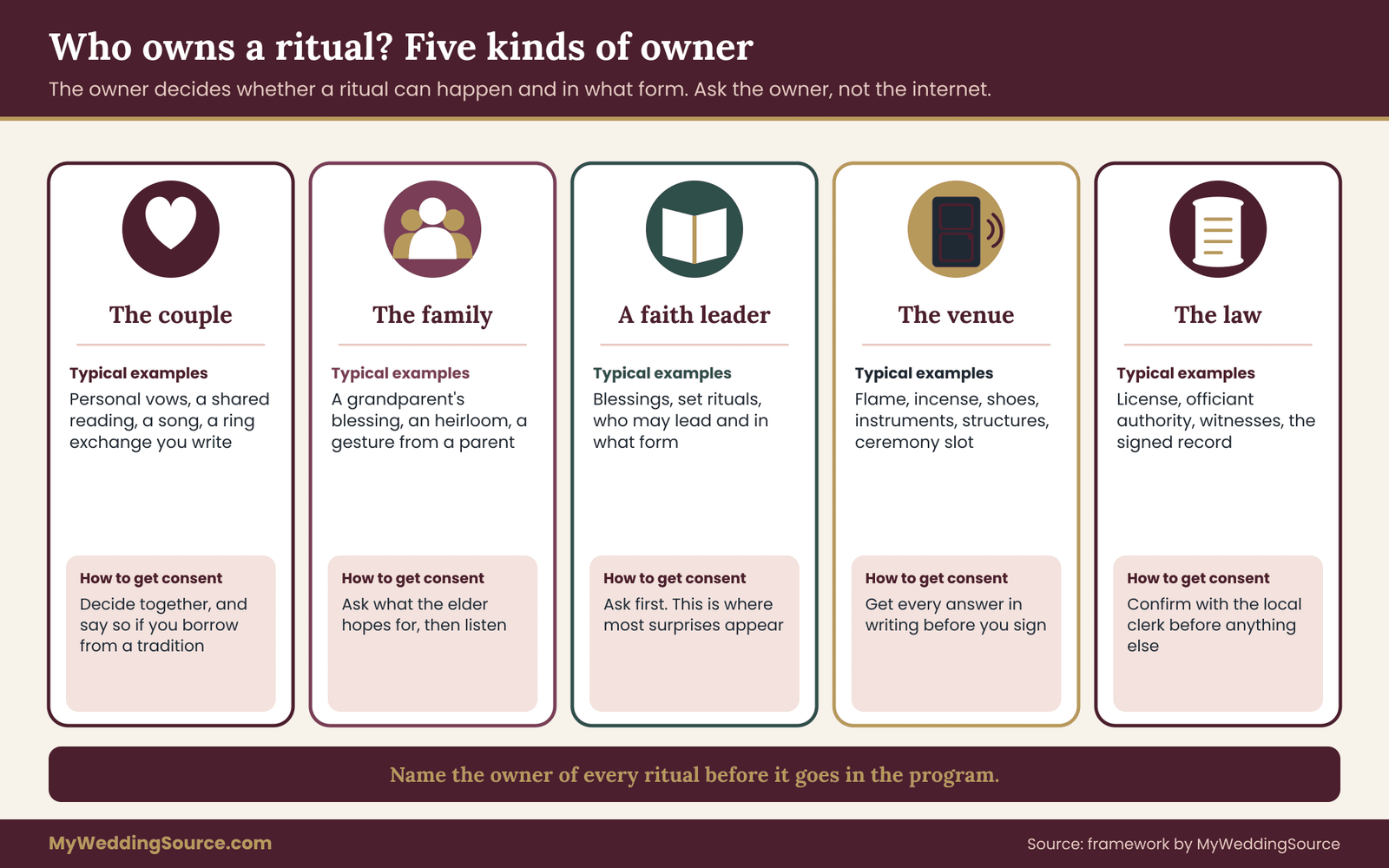
3. The owner. Who has authority to say whether this can happen and how? The categories below cover most cases.
4. Who must consent. List the people whose agreement you need. The two of you, always. Then, depending on the ritual, a specific faith leader, a parent, a grandparent, the venue manager or the person who will perform it.
5. Who performs it. Some rituals can be led by a friend or relative. Others require an ordained person or an elder. Some are done by the couple themselves. Be explicit.
6. Legal weight. Does this element have any bearing on whether you are legally married? Most do not, but the ones that do must be handled first.
The five kinds of owner in an interfaith wedding
It helps to recognize the five kinds of owner you will meet most often, because each one calls for a different kind of conversation.
The couple. Rituals you invent or adapt, such as personal vows, a shared reading, a song or a ring exchange you write yourselves. You can generally include or leave out these elements as you choose. Even so, you may owe someone a courtesy conversation if the element borrows from a tradition.
The family. Customs that are not religious law but carry strong meaning for a family: a particular blessing from a grandparent, an item passed down, a gesture performed by a parent. The owner is the family elder, and consent here is relational. It rarely comes with an official answer. You get it by asking and listening.
A faith leader. Rituals that a trained or ordained person must lead or approve. The leader owns the form, and often decides whether they can take part at all. This is where most surprises appear, so it is where you should ask first.
The venue or community space. Rules about fire, incense, shoes, food, photography, instruments, seating or the use of a sanctuary. A venue might allow a flame but not a fire pit, or a house of worship may permit a ceremony only under its own rules.
The law. The marriage license, the officiant’s authority, the witnesses and the signing. Nothing else in the matrix can substitute for these.
How to fill the interfaith wedding matrix in
Work through it in a set order. The order matters because early answers narrow later ones.
- Fill in the law row first. Confirm what your jurisdiction requires. A later section covers this in detail, but you cannot design anything else until you know it.
- List the rituals each of you hopes for. Do this separately at first, then combine. Include rituals you are unsure about, marked with a question mark.
- Name the likely owner for each. If you do not know, write “ask.”
- Contact the owners. Faith leaders first, then family elders, then the venue. Record exact answers, not summaries.
- Mark consent for each item. Use three states: confirmed, conditional (with the condition written beside it) and declined. Add a fourth, “undecided,” for anything you have not yet asked.
- Resolve conflicts. Use the options in the next section.
- Freeze the matrix at a set date, so that the script can be written from it.
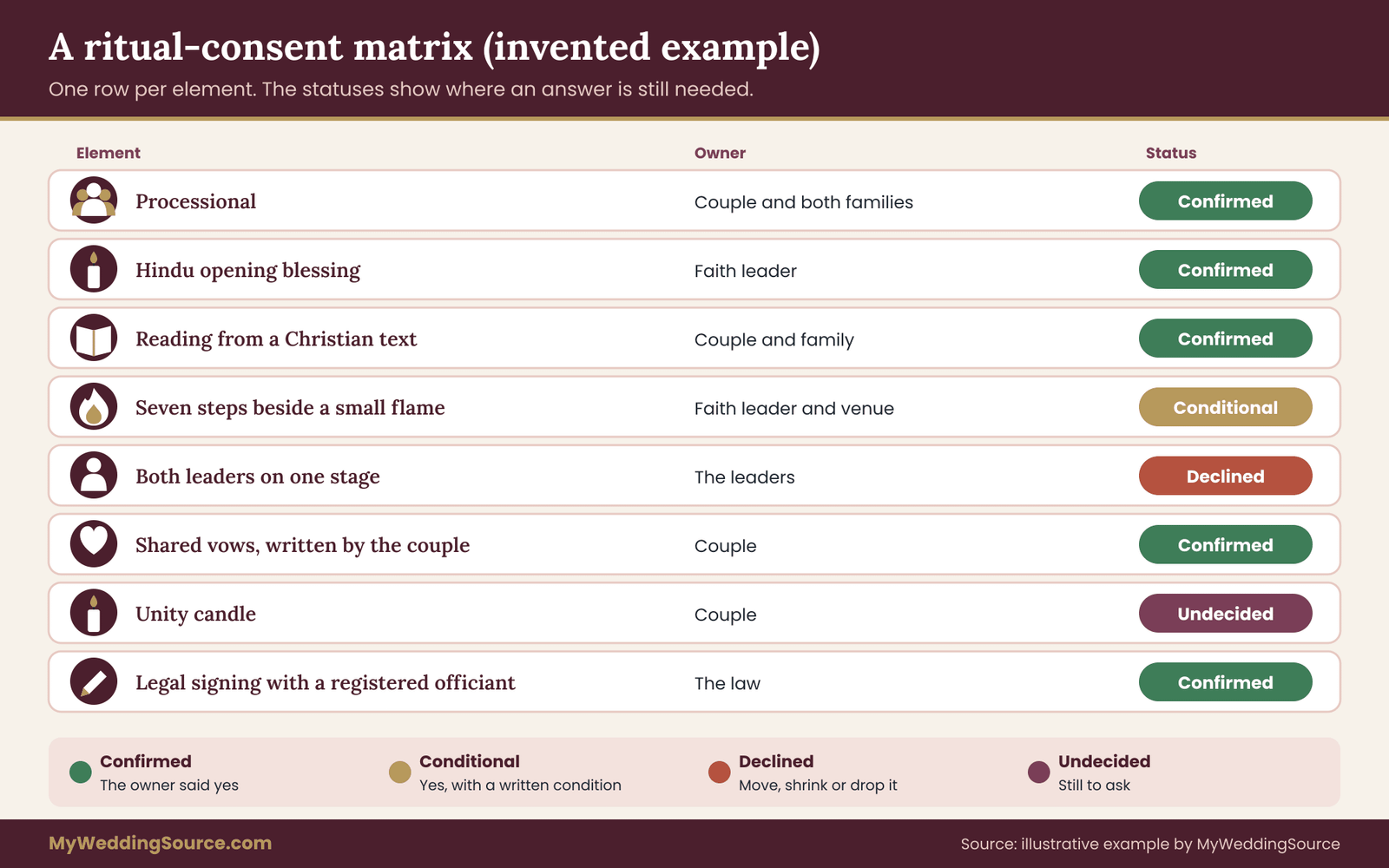
The illustrated matrix above shows an invented couple’s version. It is an example of the format, not a recommendation, and no real tradition’s rules are implied. Your own matrix will differ because your leaders, families and venue differ.
What to do when owners of an interfaith wedding ritual disagree
Conflict will arise: a faith leader will not share a stage with a clergy member from another tradition, or a parent will object to a ritual the other family considers essential. There are only a handful of ways to resolve it, and it is worth knowing them in advance.
- Move it. A ritual that one leader will not perform inside a ceremony might be welcome at a separate event, such as a morning blessing, a prewedding gathering or a tea. Many couples find the weekend has room for rituals the ceremony does not.
- Shrink it. A full ritual may be impossible, while a brief, respectful element is acceptable. Ask whether a shortened form, a symbolic gesture or a blessing can stand in for it.
- Separate it. The ritual stays, but it happens in its own segment with its own leader and no mingling of clergy. This is often the simplest answer to “we cannot share the same space or words.”
- Change the performer. If a ritual is welcome but the person is not, ask whether a family member, a friend or a different leader can do it.
- Assign an observer role. One partner may take part in a ritual from their own tradition, while the other watches respectfully and does not recite words that conflict with their beliefs. Guests tend to read this as dignified when it is explained in the program.
- Drop it. Sometimes the right decision is to leave a ritual out. If you must, say so to the people who cared about it, and explain what you chose to do instead.
When none of these works, return to your shared statement. Ask which option best fits what you said the ceremony is for. If you have written that statement honestly, the answer is usually plain.
Settle the legal side of the interfaith wedding before anything else
Everything beautiful about an interfaith wedding sits on top of one plain fact: in the United States, a marriage is created by the state, and the state sets the rules. A religious ceremony can be deeply meaningful without being legally binding, and a short civil ceremony can create a legal marriage with no religious content at all. If you want to understand that distinction before planning your interfaith wedding in more depth, our guide to the difference between a wedding and a marriage explains the legal and personal meanings.
This section is general information, not legal advice. Rules differ by state and sometimes by county, so always confirm the details with the local clerk.
The three legal pieces of any interfaith wedding
The license. Most places require a marriage license issued before the ceremony. The official federal portal for basic information is USA.gov’s page on marriage licenses, which directs you to the state or local office. Requirements for identification, waiting periods and expiration dates vary. Check them early, because a license that expires before your wedding date is a problem you cannot solve at the last minute.
The officiant. Each jurisdiction decides who can legally solemnize a marriage. Many allow clergy, judges and certain civil officials. Some allow a person to be authorized for a single day. Others require registration, ordination through a recognized body, or specific forms. The details are a common source of surprise for couples who ask a friend or a clergy member from outside the area to officiate. Our guide to wedding officiant requirements walks through what to check, and our note on choosing a wedding officiant covers how to decide who should lead.
The signing and witnesses. Many places require one or two witnesses and a signed record filed by the officiant. The witnesses do not usually need to be anyone special, though some religious traditions have their own rules about who may serve in that role. Ask the clerk what the legal requirement is, and ask your faith leader what the religious requirement is, since they may differ.
What this means for an interfaith wedding
An interfaith wedding creates a few predictable legal wrinkles.
The faith leader may not be legally authorized where you marry. A respected priest, imam, rabbi or pandit may be fully authorized in one state and not recognized in another. A visiting leader may need to register or obtain permission. A leader from abroad may need additional steps. Ask each leader whether they are authorized in your jurisdiction, and do not assume.
The leader may not be willing to sign a civil record. Some will perform a religious ceremony but prefer that a separate officiant handle the legal solemnization. This is not an obstacle. Many couples sign the legal paperwork in a short civil moment before or after the main ceremony and treat the religious ceremony as the celebration. Be honest with your guests if you choose this: say in the program that the ceremony is a religious one and the legal marriage is completed separately, if that is the case.
Two ceremonies may be required, and either may be first. Some traditions regard a marriage as complete only when performed in a particular form. A couple may therefore have one ceremony that satisfies the religious requirement, another that satisfies another tradition, and a legal signing. The sequence matters. Ask each leader whether the order affects their view of the marriage.
A religious ceremony may have consequences within that community even if the law is silent. Some communities treat a marriage as valid only if certain conditions are met. For example, the Catholic Church has rules on the form of marriage and on permission for marriages with non-Catholics, described in the Catechism of the Catholic Church. If a family member’s recognition of the marriage matters to you, ask their leader plainly what is required.
Write each answer into the law row of your matrix, with the name of the person who gave it and the date. If anything changes later, you will know where to look.
Finding and approaching faith leaders for an interfaith wedding
Faith leaders are the most important owners in most interfaith wedding plans, and the first conversation sets the tone. Most leaders have had this conversation before. They tend to respond well to couples who ask honest questions and accept honest answers, and badly to couples who arrive with a finished program and expect approval.
How to open the conversation about an interfaith wedding
Call or write first, and ask for a meeting. Do not send a long email full of ritual requests. A short message is better:
“We are planning an interfaith wedding. One of us belongs to your tradition and one does not. Before we plan anything, we would like to understand what you can do, what you cannot do and what you would ask of us. Could we set up a conversation?”
In the meeting, begin by explaining the shared statement you wrote, then ask your questions. Take notes on what your interfaith wedding needs from them. Ask whether anything you hear is policy of the wider body or the leader’s own practice, since those are not always the same.
Questions to ask every leader about your interfaith wedding
- Will you officiate or take part in a wedding where one partner is not of your faith? If not, can you recommend someone who will?
- Are there conditions, such as preparation sessions, paperwork, promises about children or requirements about where the ceremony takes place?
- Can you share the stage with a leader from another tradition? If so, in what role?
- Which parts of the ceremony are essential, and which can be shortened or adapted?
- Which words, objects or actions must be left unchanged?
- Can another person, such as a friend or relative, do any of the readings or blessings?
- Does this ceremony have legal effect in our state, and will you sign the license?
- What does the ceremony require of the space: fire, a canopy, a sacred text, seating, shoes off, a particular direction?
- What do you require of guests, and what can you ask them to do or avoid?
- How long does the full form take, and what is the shortest form you consider valid?
- What happens if we decide to hold a second ceremony in another tradition?
- Is there anything we should not say in the program or in the invitation about your tradition?
Keep the answers in the matrix. If a leader says no, record the reason and the alternatives they offered. A decline from one leader is not the end of the road. Different branches and communities within a tradition often hold different views.
What leaders from different traditions often say
The notes below describe the kinds of positions couples commonly encounter, drawn from published guidance. They are not a complete or authoritative account of any tradition. Each community, and often each leader, can differ, so use these as prompts for your own questions.
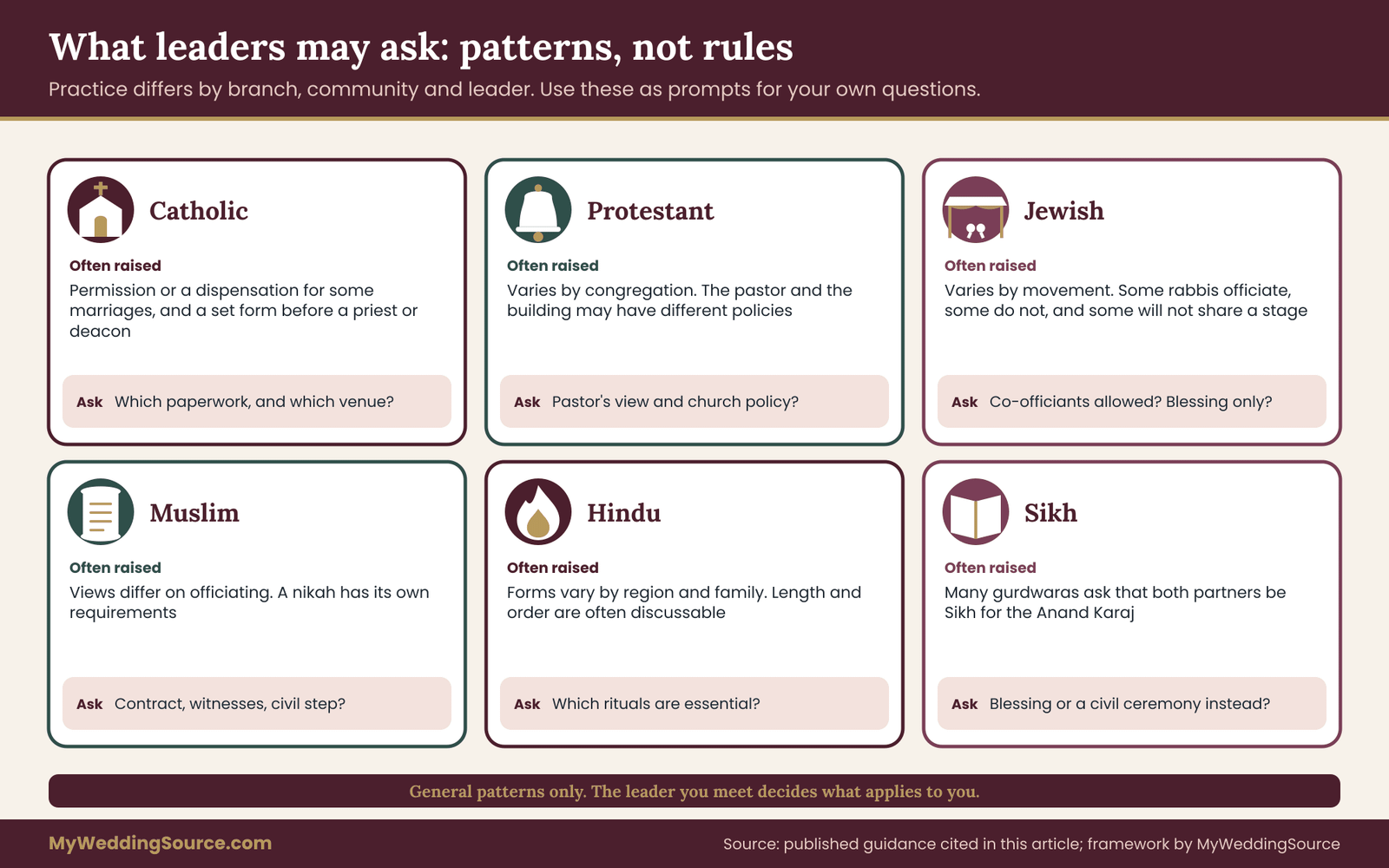
Catholic. The Catholic Church distinguishes between a marriage with another baptized Christian and a marriage with someone who is not baptized. In general, such marriages need the permission or dispensation of the appropriate church authority, and the Catholic party is asked to make certain commitments. The Church also has rules about the form of the ceremony, typically that it take place before an authorized priest or deacon and witnesses, unless a dispensation applies.
The Catechism’s section on matrimonial consent describes mixed marriages and marriages with disparity of cult, and the USCCB’s For Your Marriage site discusses ecumenical and interfaith marriages for couples. Your parish priest can explain how these apply to you and what paperwork is needed, which is one reason to contact the parish early.
Protestant and other Christian denominations. There is wide variation. Some congregations welcome a ceremony in the sanctuary with a pastor and a leader from another faith. Others reserve sanctuary weddings for members, or for ceremonies they view as consistent with their own teaching. The United Methodist Church’s discipleship resources, for example, include guidance for pastors considering whether to offer an interfaith wedding, which reflects that decisions are often made at the local level. Ask the pastor and the church office about both the pastor’s willingness and the building’s policy, since they can differ.
Jewish. Practice differs sharply between movements. Published guidance for couples explains that some rabbis will officiate at weddings where one partner is not Jewish, and others will not, and that conditions can vary. Reporting on surveys of Reform rabbis has found many are willing to officiate at interfaith weddings, though not all will do so alongside clergy of another faith. The Conservative movement has maintained a prohibition on its rabbis officiating at such weddings, and Orthodox rabbis do not. If you hope to include Jewish elements, ask about each movement’s practice, and ask whether a rabbi, cantor or Jewish educator can help you plan elements that the family values, even if a different officiant leads the ceremony.
Muslim. In the United States, many imams have been asked to officiate at weddings where one partner is not Muslim, and a number decline. Religion News Service reported in 2022 that more Muslims are in interfaith relationships while imams willing to marry them remain few. Views within Muslim communities differ on who may marry whom, and on what a valid nikah requires. If your plans include a nikah, speak with an imam you trust about the requirements for the contract and witnesses, and whether a separate civil ceremony is needed for legal recognition in your state.
Hindu. Hindu weddings vary widely by region, language, family tradition and the priest. The Georgetown Berkley Center has published an essay on Hindu-Christian ceremonies that describes the kinds of choices couples face when combining two traditions. Couples often ask a Hindu priest which rituals are essential, which can be shortened and whether the ceremony can be adapted to a modern schedule. Do not assume that a ritual you saw at another wedding is the one your family would use.
Sikh. The Sikh wedding ceremony is the Anand Karaj, conducted in the presence of the Guru Granth Sahib. Published guidance, including sources on Sikh practice, indicates that many gurdwaras ask that both partners be Sikh to take part in the Anand Karaj, and that views on mixed marriages differ in the community. If this applies to you, ask the gurdwara committee what it permits, and whether a blessing or a separate civil ceremony is an option.
Other traditions and no tradition. Buddhist, Jain, Baha’i, pagan, Unitarian Universalist, humanist and other communities each have their own approaches, and many include officiants who are comfortable with mixed ceremonies. If one partner is not religious, the ceremony can still honor the other’s tradition. Our non-religious wedding ceremony script gives a full secular template you can adapt, and our Christian wedding ceremony script shows the traditional Christian order of service so you can see where interfaith adjustments might go.
Interfaith ministers, celebrants and co-officiants for an interfaith wedding
If your leaders cannot take part, or if you want one person to hold the whole ceremony, you have other options.
An interfaith minister or celebrant. These are officiants trained to work with mixed ceremonies and often with couples from different traditions. Ask about their training, their ordination or authorization, what experience they have with your specific traditions and whether they are authorized to sign the license in your state. Ask for references from couples with similar combinations.
Two or more co-officiants. Some couples invite one leader from each tradition to share the ceremony. This is possible when the leaders are willing, and it is less likely to work when either one is bound by rules against sharing a ceremony. Ask early, since co-officiating needs rehearsal time. Agree beforehand on who speaks first, how long each person speaks, whether each uses their own text and who signs the license.
A friend or family member. If the law allows, a trusted person can officiate. This can feel personal and warm, but it carries two risks: the person may lack the knowledge of either tradition, and a religious family may feel the ceremony lacks authority. If you choose this route, ask a leader from each tradition to bless or advise on the elements that matter to your families.
A leader for the ritual and a different person for the law. Some couples ask a faith leader to conduct the ritual, and a judge or a registered officiant to complete the legal part. This can remove tension from the question of who signs.
Choosing a ceremony structure for your interfaith wedding
Once you know who is willing to do what, the question becomes how to put the pieces of your interfaith wedding together. Five structures cover most interfaith wedding ceremonies. Each has strengths and costs, and your matrix will usually point toward one of them.
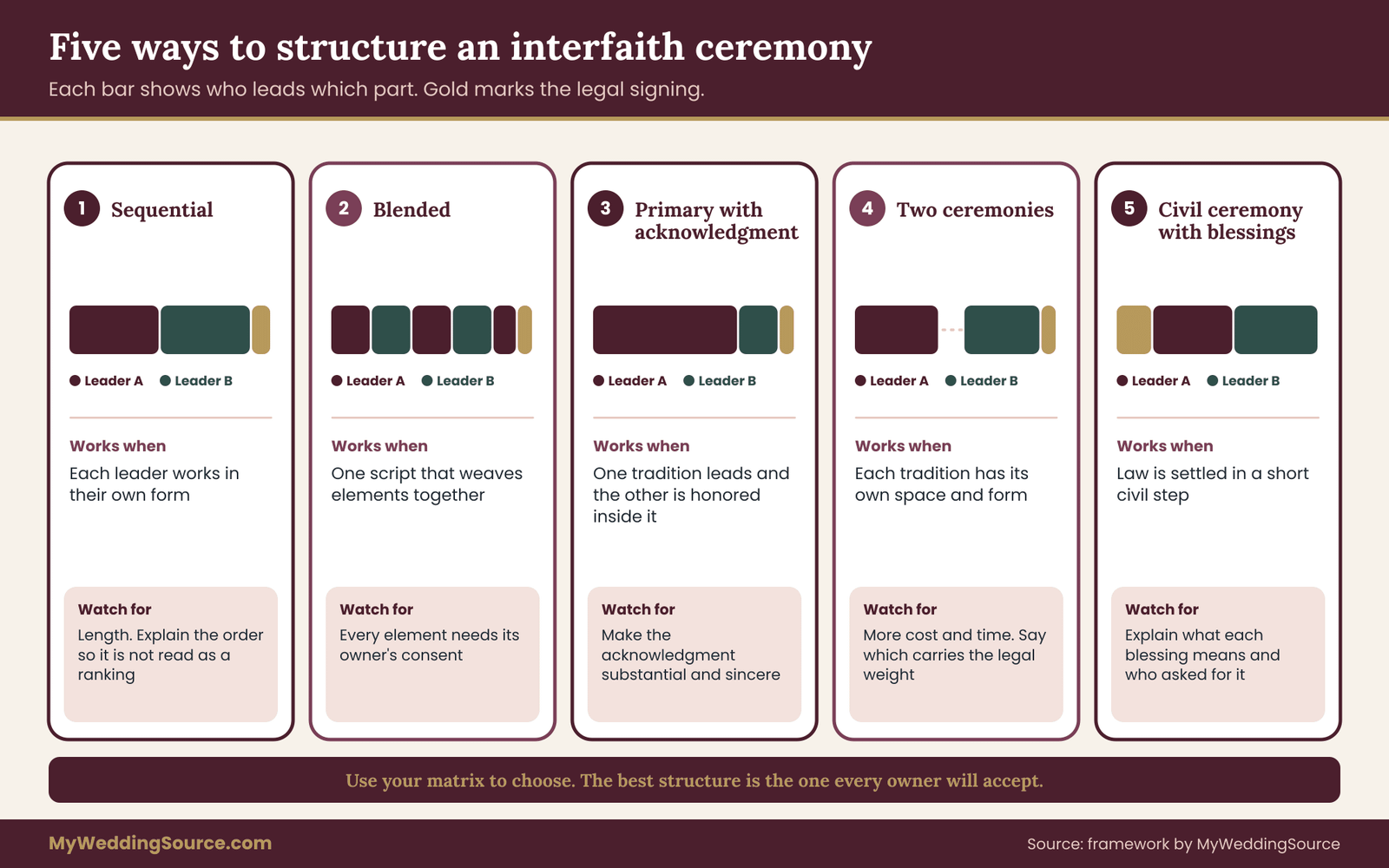
1. Sequential: one tradition, then the other
The ceremony is divided into two parts. The first follows one tradition, led by its leader. The second follows the other. A short bridge, such as a reading by a family member, connects them.
Strengths. Each leader works within their own form, so there is no need to merge texts or shared stages. Guests from each tradition see a complete ritual. It tends to be the easiest structure to approve.
Costs. The ceremony can run long. Guests may feel the two parts are separate events. Because one tradition comes first, you will need to explain the order so it does not look like a ranking.
2. Blended: one script with elements from each
A single officiant, or a pair, leads a ceremony that draws on both traditions. Elements are chosen and woven into one script: a reading from one text, a blessing from another, vows written together.
Strengths. It feels unified and tends to run shorter. It suits couples who want one ceremony that belongs to both of them.
Costs. It requires more careful consent, because each element has to be acceptable to its owner in a new setting. It relies on a skilled officiant. If a leader is uncomfortable with any element, the structure can fall apart.
3. Primary with acknowledgment
One tradition leads the ceremony and the other is honored inside it with a defined moment: a blessing, a reading, a symbolic act or a performance by a family member.
Strengths. It is often the most workable approach when a leader requires that the ceremony follow a fixed form. The acknowledgment is limited in scope, so it is easier to get permission.
Costs. It can feel unequal unless the acknowledgment is substantial and sincerely presented. Talk it through with the partner whose tradition is the guest.
4. Two ceremonies
The couple holds two full ceremonies, one in each tradition, on different days or at different times. This may be a religious ceremony in a place of worship and another at a different venue, or two separate events over a weekend.
Strengths. Each tradition has its own space, leader and form, so there is no compromise on ritual. It gives extended families a ceremony that fits them.
Costs. More expense and logistics, and more of your guests’ time. You need to decide which ceremony carries the legal weight and tell guests clearly.
5. Civil ceremony with blessings
The legal marriage takes place in a short civil ceremony, and one or more religious blessings follow, either on the same day or separately.
Strengths. It removes the question of who is legally authorized from the religious leaders. Blessings can be flexible, and leaders who will not sign a license can still take part.
Costs. Some families may feel the religious element is secondary, so it helps to say what the blessing means in your tradition and who requested it.
Choosing among the interfaith wedding structures
Use your matrix. If several leaders will take part and agree to share a script, a blended ceremony is realistic. If one leader’s rules limit what can be changed, a primary structure with acknowledgment, or a sequential structure, is often the safest. If the rules of two traditions cannot be combined at all, two ceremonies or a civil ceremony with blessings can allow each tradition to be done properly. There is no right answer, only one that your owners will accept and your families will understand.
Talking to your families about the interfaith wedding
Families are the second set of owners. They rarely hold legal or religious authority over the ceremony, but they hold the relationships that make the wedding mean something. A family conversation done well can turn a likely objector into an ally. Done poorly, it can sour the whole planning period.
Decide who speaks to whom about the interfaith wedding
A simple rule works well: each partner speaks to their own family first. Parents hear difficult news more easily from their own child, and explanations about a tradition land better when they come from someone who understands the family’s history. Once each side has had that conversation, bring the families together, or let them meet at an engagement gathering, a dinner or a call. Do not let one family hear about the other family’s rituals through gossip.
When you speak, lead with the shared statement. A parent who hears “we want a ceremony both families will recognize, with every ritual explained” will relax more quickly than one who hears a list of changes.
Ask what the elder is really hoping for
Suppose a grandparent says, “The wedding has to be in a church.” Treat it as a request for information, not a veto. Ask what the church means to them. The answer might be a sanctuary, a priest, a blessing, being able to say they saw the grandchild married properly, or the fear of being embarrassed in front of their community. Each answer leads to a different solution. A blessing in the church might meet the need while the main ceremony takes place elsewhere. A short, clear explanation to the community might ease the embarrassment.
Resist the urge to argue the point. You are not trying to win a debate on theology. You are trying to understand what would help the person feel included. If an elder will not move, you can still decide what you will do and tell them kindly.
Language that helps when families question an interfaith wedding
A few phrases keep these conversations productive.
“We want your blessing, and we want to understand what would make this day feel right to you.”
“We are not leaving anything of yours out by choice. Here is where it fits, and here is what we can’t include and why.”
“The priest has told us this part has to follow a set form. We would like you to read the blessing in your own words afterward.”
“We have asked each leader what they require, and we would like you to hear from them directly if that would help.”
Avoid phrases that frame one tradition as the default and the other as the exception, such as “we’re only adding a few things from your side.” Guests and elders notice the framing.
Boundaries you can keep during interfaith wedding planning
You can respect a family and still keep boundaries. Decide in advance which decisions are open to family input and which belong to the two of you. A useful split is to treat belief-related rituals as matters for the partner who owns them and the leader, family customs as matters for the family elder and the couple, and style choices as matters for the couple. Tell families which category a question falls in.
If a parent insists on something that would cause real harm, such as pressure for one partner to convert, or a demand that a partner act against their conscience, state your position calmly and hold it. You may need to ask a trusted relative, a leader both sides respect or a counselor to mediate. The wedding does not need to be saved at the cost of the people in it.
Including families in the interfaith wedding ceremony
Roles do a great deal to turn an anxious relative into a participant. Ask who would like to do a reading, hold a canopy pole, light a candle, accompany a ritual with a song or say a blessing. Pair a role from each family so that both sides are visible. Make sure the person understands what they will say and do and has seen the script, because a surprise at the microphone helps no one. For more on choosing and placing readings, see our guide to wedding readings.
Choosing the rituals and elements of an interfaith wedding
With owners identified and a structure chosen, you can decide which elements go in. Think in categories, so that you see the whole ceremony and not a pile of separate items.
Opening and gathering
How the ceremony begins sets the tone: the processional, the entrance of the families, a welcome, a gathering blessing or prayer, an acknowledgment of ancestors. In some traditions, the entrance itself is a ritual with a prescribed order. Ask the owner whether the order can change. If you are blending traditions, a short welcome in which an officiant explains who is present and what will happen can help guests settle in.
Words of commitment
The vows and declarations are the heart of the ceremony and the part most tied to the law. The wording may be fixed by a tradition, written by the couple or a mix. Some leaders require particular words for the religious meaning of the marriage, while the law requires only that each partner consent. If you want to write your own vows, our guide to wedding vows offers structures and examples. In an interfaith ceremony, consider whether each partner will speak vows in their own tradition’s form followed by shared words, or write a single set of vows that both can say honestly.
Check each phrase of the vows against your own beliefs. A line that sounds lovely may include a reference to a deity or a promise that one partner does not hold. It is better to find that out in the planning than to say it aloud on the day.
Blessings and prayers
Blessings are among the most flexible parts of a ceremony and among the most requested. They can come from a leader, a relative or the couple. Some traditions have blessings that include particular names of God or specific scriptures. If a blessing refers to a deity one partner does not recognize, ask the owner whether a version exists that fits, or whether it could be given as a separate moment that both partners observe respectfully.
Readings and texts
Readings from scripture, poetry, letters or literature are easy to share between traditions, since a reading by a family member from each side is a clear sign of balance. Pick passages that both partners are comfortable hearing and that guests can follow. If a text is read in a language that many guests do not speak, print a translation in the program, or have the reader give a brief summary. Check the right to use any translated text. Many modern translations are copyrighted, and a short excerpt in a printed program may still need permission.
Symbolic acts in an interfaith wedding
Symbolic acts are the rituals that guests remember: a candle, a cord, a cup, a canopy, a circling, a set of steps, a garland exchange, a ring or a necklace. They are also where the risk of getting something wrong is highest, because each has specific meaning in its tradition. A few principles help.
- Use rituals in the meaning of their tradition. Do not take a symbol from a tradition that is not yours and give it a new meaning you have invented. If you want a symbol that belongs to both of you, create one, or ask a leader how a tradition would use its symbol in a shared setting.
- Ask who may perform it. Some symbolic acts are done by the couple, others require a leader or an elder.
- Ask whether it may be changed. The number of steps, the direction or the order of an action can matter.
- Consider the guest’s role. If guests are invited to participate, explain what they are doing and let people opt out comfortably.
- Don’t add a ritual only because it looks good. A ritual that has no meaning for either of you is a costume. Ask what it adds.
Objects and attire
Attire and objects carry symbolic weight. Some traditions require certain clothing, head coverings, jewelry, colors or items. Others discourage particular colors or materials. Ask each leader about attire for the couple, the wedding party and guests, and whether any item must be blessed before it is used. If guests will be asked to cover their heads or remove shoes, say so in the invitation or program so they can prepare.
Music and language at an interfaith wedding
Music can unite two traditions or divide them, depending on how it is used. Ask whether instrumental music, hymns, chants, recorded music or amplification are allowed in each ritual. Some leaders prefer unaccompanied voices. Some venues limit instruments. If one tradition uses a language many guests do not understand, plan a way for guests to follow, whether through a printed translation, a spoken summary or a short explanation from the officiant.
Closing and sending out
The ending is a natural place for a shared blessing, a communal moment or a recessional that reflects both families. A closing ritual from each tradition, kept short, can balance the ceremony. Decide with each leader whether the legal signing happens inside the ceremony or privately.
A note on borrowing from traditions that are not yours
Couples sometimes want to include a ritual from a tradition neither partner belongs to, because it looks beautiful or seems symbolically fitting. This is where respect and attention matter. If a ritual is sacred to a living community, ask someone from that community whether they are comfortable with its use and whether it can be done properly. If the answer is no, honor it. Creating your own symbolic act is a better choice than borrowing one you do not understand. Consider what the ritual is for, then ask whether something you invent could do the same job, such as pouring two waters into one vessel or planting something together.
Writing the interfaith wedding script together
When your matrix is stable, write the interfaith wedding script from it. Treat the script as the single source of truth, so that every leader, reader and musician works from the same version.
Structure first, words second, in an interfaith wedding script
Start by writing the order of events with names and approximate times beside each. Only then write the words. This protects you from the common problem of falling in love with a beautiful passage and discovering it does not fit. If you need a base text, the ceremony script templates mentioned earlier give the standard parts of a ceremony.
A basic interfaith wedding order might look like this:
- Prelude and seating, including any music or silence the traditions call for.
- Processional, with the order agreed by each family.
- Welcome and opening words, including an explanation of what guests will see.
- A first tradition’s opening blessing or reading.
- A second tradition’s opening blessing or reading.
- Words of commitment and the exchange of vows.
- Symbolic acts, in an order agreed with each owner.
- Ring or token exchange.
- Pronouncement and a closing blessing.
- Recessional.
Treat this as an outline, not a rule. Your leaders may require a different order.
Have each tradition read the interfaith wedding script
Before you finalize the script, send the relevant parts to a person from each tradition for review: a leader, a trusted elder or someone who understands the practice. Ask them to point out errors, awkward wording and anything that might offend. They are not approving your decisions. They are checking your accuracy. A reviewer from within a tradition can catch a mistranslation, a misused term or a gesture that would be read differently than you meant.
Keep a version history
Keep one master script with a date and version number, and send every revised version to everyone who needs it. Mark changes. When a leader suggests a change, record it with their name. This avoids the situation where two readers have different drafts on the day.
Write for the ear
Ceremonies are heard, not read. Keep sentences short. Spell out names phonetically if they are hard to pronounce, and ask the officiants to practice them. Where a text is in a language the reader does not speak, ask someone fluent to record it and help with pronunciation. Time each section by reading it aloud.
Explain without lecturing
A good interfaith script explains as it goes. A brief sentence such as “In this tradition, the couple takes seven steps beside a sacred fire, and each step stands for a promise” gives guests the meaning in a few seconds. Avoid long lectures that turn the ceremony into a seminar. If an explanation takes more than a few sentences, move it to the program.
Dates, calendars and venues for an interfaith wedding
Dates and venues are where religious rules meet logistics. Both can be checked early, and checking early saves the awkward discovery that your preferred Saturday falls on a day one family cannot attend.
Check the religious calendar before you fix the date
Traditions observe days of rest, fasting, mourning or celebration, and some discourage or prohibit weddings on certain days or in certain periods. The rules differ by community, so a single list will not do. Instead, ask each leader which dates to avoid, and consult a multifaith calendar as a cross-check. University chaplaincies and multifaith centers publish them; for example, Loyola Marymount University’s interfaith holiday calendars page collects calendar resources from several traditions.
The kinds of conflict worth checking include:
- Weekly days of rest or worship. Some traditions regard a weekly period as unsuitable for a wedding, or begin their observance on the evening before. This can affect not only the ceremony but the start time of the reception and the schedule for travel.
- Seasons of fasting or penitence. A period of fasting, abstinence or reflection may discourage a celebratory event, or change what the food and drink can be.
- Major festivals. A date that falls during a festival might be busy for the family, impossible for some guests to travel on, or a particularly meaningful time to marry.
- Auspicious dates. Some traditions choose a date through a priest or by tradition, and may recommend a particular time of day.
- Moving dates. Many observances follow lunar calendars or change from year to year. Check the specific year, not a general month.
Present the dates you are considering to each leader and ask for a yes, no or conditional answer. Record the answers in your matrix. When you have a short list, our guide to choosing a wedding date shows how to weigh guest availability, vendor capacity and travel together, so religious constraints are one of several factors rather than the only one.
Questions to ask any venue about an interfaith wedding
An interfaith wedding often places unusual demands on a venue, and those demands should be settled in writing before you sign. Ask:
- May we hold a religious ceremony here, and are there restrictions on religious content?
- May we use open flame, candles, incense or a ceremonial fire? What are the fire regulations?
- Can we bring a canopy, mandap, chuppah or other structure? What are the size, anchoring and setup requirements?
- Is there a place for a sacred text, an altar or a table of objects?
- May guests remove shoes, cover their heads or kneel?
- Are there rules about music, instruments, amplification and chanting?
- Can the venue accommodate two sets of food requirements, such as halal, kosher or vegetarian, in the kitchen or through an outside caterer?
- How long is the ceremony slot, and what is the turnaround before the next event?
- Is there a private room for prayer, for a bride’s preparation or for a ritual that happens before the ceremony?
- Does the venue have a policy that conflicts with any of our traditions?
If your ceremony is in a house of worship, ask about the building’s own rules, which can be stricter than the leader’s. If it is in a secular venue, ask about its rules and also whether any of your leaders have restrictions on where they may officiate.
Timing the interfaith wedding ceremony itself
Rituals take time. A short, blended ceremony may run about 20 to 30 minutes. A sequential ceremony with two full rituals can run an hour or more. A ceremony that includes a full ritual from a tradition with a long form may be longer still. Ask each leader how long their part takes at full length and in the shortest form they consider acceptable, then add time for the processional, readings, explanations and the signing.
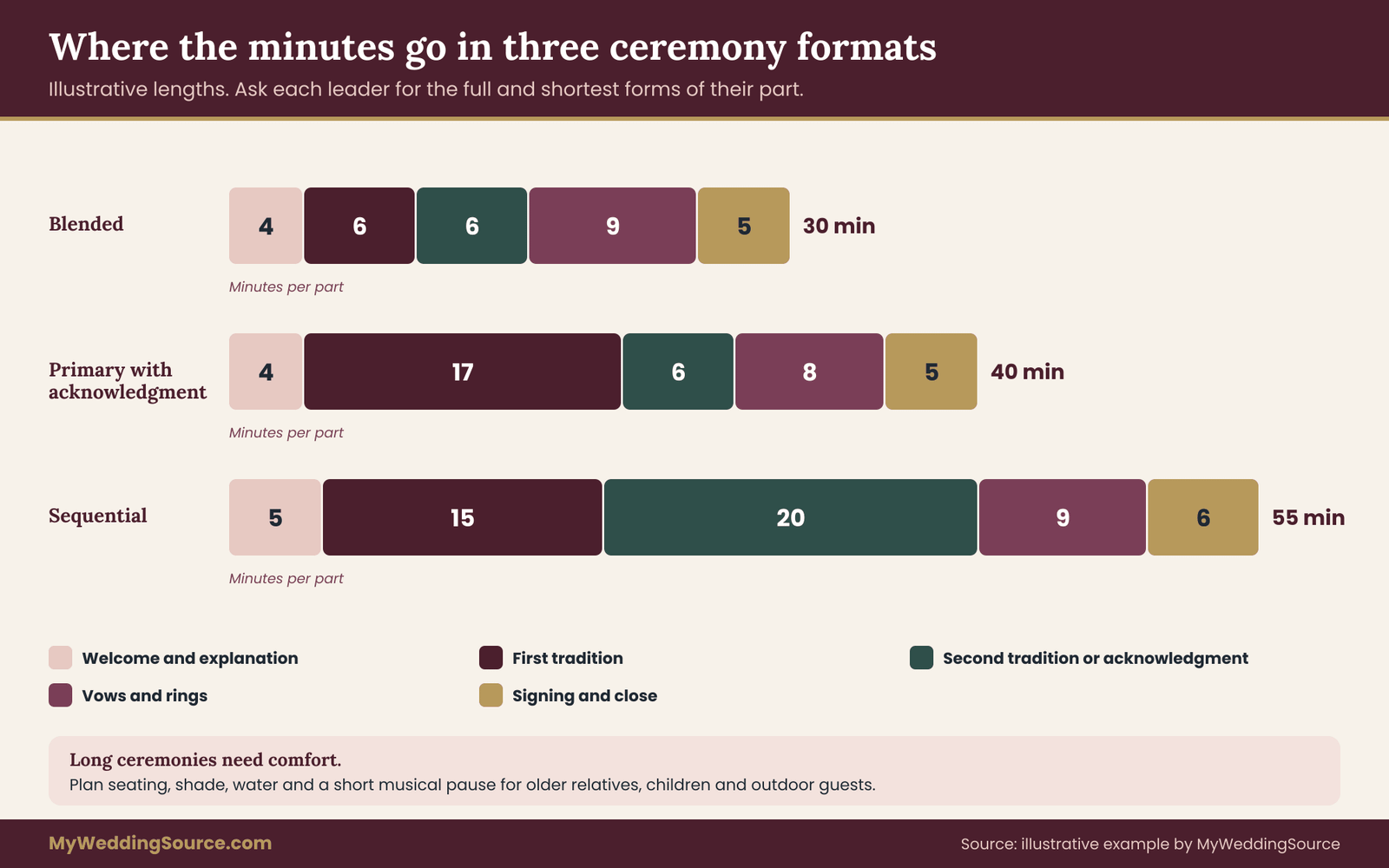
The illustration above shows how an invented ceremony might divide its time in three formats. It is a planning aid, not a standard. Use it to see where minutes go, and decide where you can trim. Guests, especially older ones, children and those standing outdoors, tolerate long ceremonies less well than couples expect. If your ceremony will run long, plan seating, shade, water and a short break or a moment of music so that guests stay comfortable.
For wider planning that connects to the ceremony, such as vendors, deposits and rehearsals, use our wedding planning checklist, and add the interfaith items in this guide to it.
Helping guests follow and feel included at an interfaith wedding
Guests at an interfaith wedding may be seeing a ritual for the first time. Some will be curious and some uneasy. Almost all will feel more welcome if they are told what to expect. A little preparation prevents the common failures: guests who do not know when to stand, who do not understand why something is being done, or who feel excluded because they do not share the tradition.
The program does most of the work at an interfaith wedding
A printed or digital program is the best tool. It should do four things.
- Introduce the people. Names and roles of the officiants, readers and family members.
- Explain each ritual briefly. One to three sentences on what it is, where it comes from and what it means. Credit each tradition by name.
- Tell guests what to do. When to stand and sit, whether to respond aloud, whether to join in a gesture, and what to avoid, such as photography during a prayer.
- Provide translations. Short translations of any text in another language, so guests are not left behind.
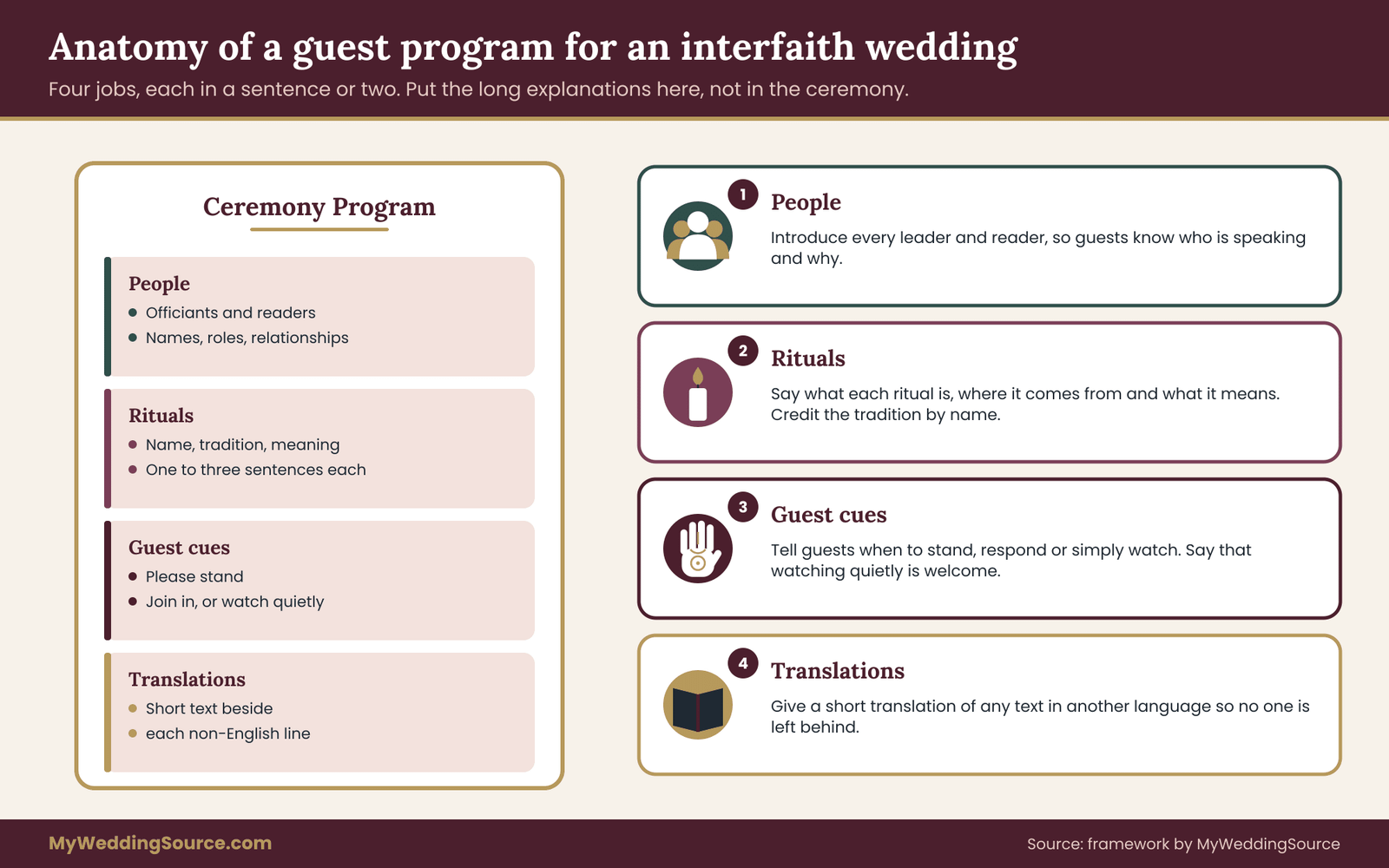
Write explanations in neutral, respectful language. Describe what a ritual means in the tradition, not what it “really” means or how it compares to other traditions. Avoid words like “exotic” or “traditional” used as a label for someone else’s custom. Ask a person from the tradition to read the explanation.
Spoken guidance
Have the officiant tell guests, briefly, what is going to happen. A short welcome that names the traditions present and invites guests to take part as they feel comfortable sets a gracious tone. It is also an opportunity to say that guests are free to stand quietly during a ritual that is not theirs. Many guests worry about participating in a prayer or ritual that conflicts with their own beliefs, and a sentence of permission relieves them.
Seating and sightlines
Seating can be a quiet point of tension. Think about where each family sits, whether elders have places near the front, and whether guests who will need to see a ritual closely, such as a ritual performed at ground level, have a line of sight. If a ritual involves a fire or another element guests should not approach, set boundaries and tell guests. If there are separate seating customs, ask the owners whether they apply.
Guests who need accommodations
Consider guests with mobility needs, those who cannot stand for long periods, those who need to leave for prayer, those who avoid certain foods and those who are sensitive to smoke or incense. Ask guests in the RSVP about any needs. Consider listing the ritual elements that involve smoke, flame, loud sound or standing so that guests can choose how to take part. For the guest list itself, our guide to building a wedding guest list covers how to decide who is invited and how to handle family dynamics.
Photographers and videographers at an interfaith wedding
Tell your photographers about the rituals, their order and any restrictions. Some rituals may not be photographed, or may be photographed only from certain positions. Some leaders ask that no flash be used, or that photographers stay at a distance. Share the script and ask the leaders to tell the photographers directly. This is better than a sudden request during the ceremony.
A timeline for planning an interfaith wedding
The interfaith wedding timeline below assumes you have about a year. If you have less, compress the early steps, because the early steps involve other people’s calendars and approvals.
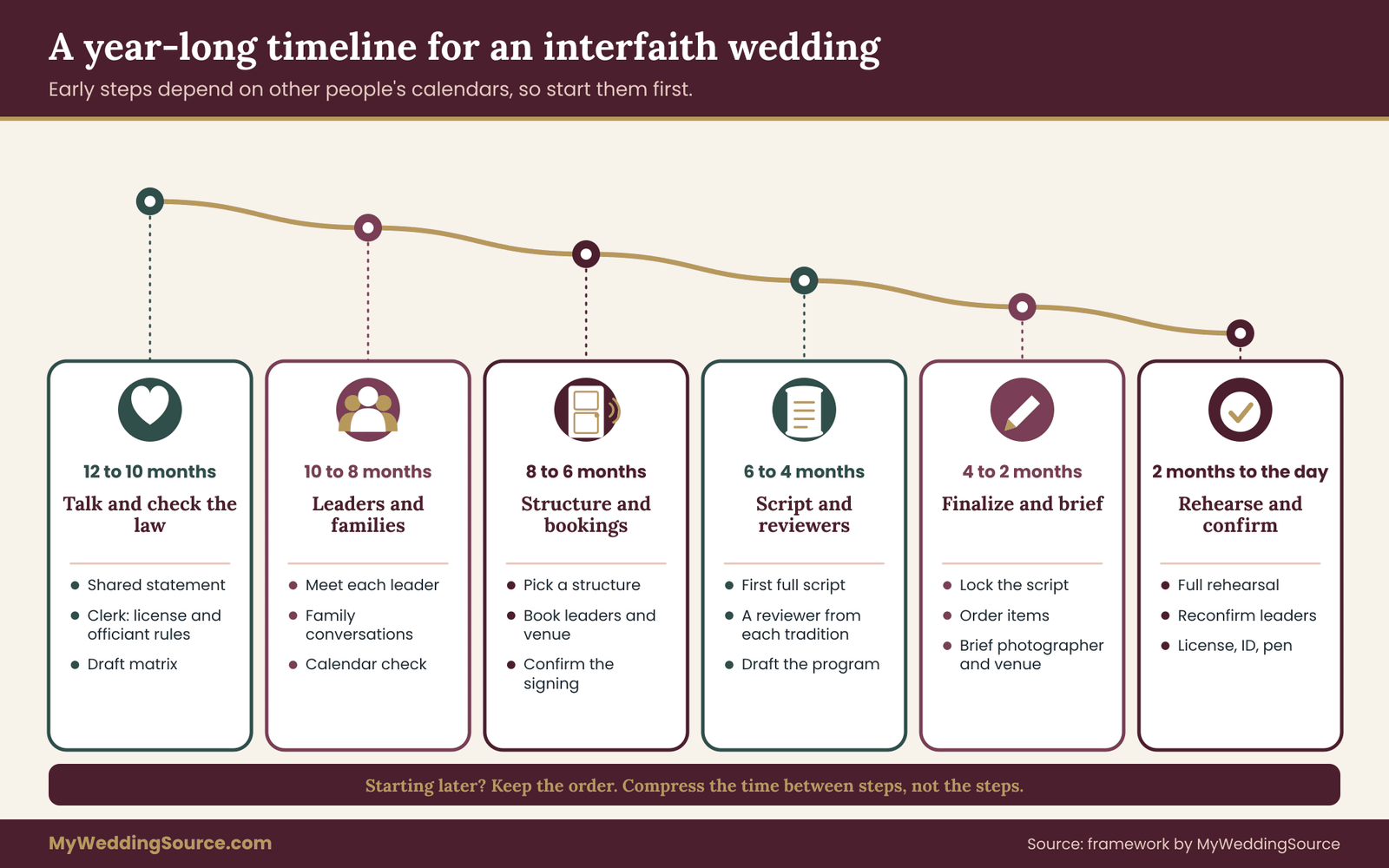
Twelve to ten months before. Hold the conversations between the two of you and write your shared statement. Check the legal basics with your local clerk. Contact the leaders you most want to involve, since their calendars fill quickly. Start a draft ritual-consent matrix.
Ten to eight months before. Meet with each leader and record answers. Talk to the families. Short-list dates and check them against religious calendars. Visit venues with your questions in hand.
Eight to six months before. Choose the ceremony structure. Book the leaders and venue. Confirm who will sign the license and how. Ask each leader about any required preparation sessions or paperwork and schedule them.
Six to four months before. Write the first full script. Send it to a reviewer from each tradition. Choose readers, musicians and ritual performers, and tell them what is required. Start the program and the invitation wording.
Four to two months before. Finalize the script. Order any special items, such as a canopy, garments or ritual objects. Brief the photographer and the venue. Send invitations with any guidance guests need.
Two months to two weeks before. Rehearse. Include every leader and ritual performer if possible, and walk through the signing. Confirm dates with each leader again. Print programs.
The week of the wedding. Confirm the license and ID. Check the venue’s rules once more. Prepare an emergency kit for items specific to your ceremony, such as extra candles, matches approved by the venue, printed copies of the script and a pen for the license.
The day. Appoint one person to coordinate the order of events and the cues. This is not a leader. It is someone who knows the script and can make small decisions while the leaders focus on their roles.
A worked example: Nora and Dev
To see how interfaith wedding planning works in practice, follow an invented couple. Nora was raised Catholic and attends church a few times a year. Dev was raised in a Hindu family and keeps several family practices. They are not real people, and their leaders’ answers here are made up to illustrate the process, not to describe what any Catholic priest or Hindu priest would say. Your own answers will differ.
What each of them needed
Nora’s list of needs was short: a blessing that her grandmother would recognize as religious, and a ceremony that did not make her feel she was performing someone else’s ritual. Dev’s was also short: his parents needed to see the seven steps in some form, and he wanted his grandfather to feel the wedding belonged to the family. Both agreed the ceremony should be under an hour and that guests should be told what everything meant. Their shared statement read: “We want a ceremony both our families recognize, with every ritual explained, and nothing that asks either of us to act against our beliefs.”
Their first conversations
They began with the law. The county clerk confirmed the license and that a registered officiant had to sign it. They decided to ask a judge, a family friend who was a registered officiant, to handle the legal signing in a short moment at the end.
Nora spoke with her parish priest. In this invented example, the priest explained that a wedding with a partner who is not Catholic would need paperwork and permission, and that he could officiate in the church or give a blessing at another venue.
He did not wish to share the stage with another clergy member during the vows, but he was glad to give a blessing earlier. Dev spoke with a Hindu priest his family knew. In this example, the priest said a full ceremony could take several hours, offered a shorter form lasting about thirty minutes and was willing to adapt the order to fit one program. He was happy to take part, but wanted his part to come as a continuous unit.
The matrix, filled in
Their matrix, in simplified form, looked like this. The figure shows the same example as a picture.
- Processional. Owner: the couple and both families. Consent: both families. Status: confirmed.
- Hindu opening blessing. Owner: a faith leader. Performed by the Hindu priest. Status: confirmed.
- Reading from a Christian text. Owner: the couple and family. Performed by Nora’s sister. Status: confirmed.
- Seven steps. Owner: the Hindu priest. Performed by the couple with the priest. Status: conditional on a shortened form and on the venue permitting a small contained flame.
- Joint ceremony on one stage. Owner: the leaders. Status: declined by one leader, so the ritual segments were separated.
- Vows. Owner: the couple. Shared vows written by both and reviewed by each leader. Status: confirmed.
- Catholic blessing. Owner: the parish priest. Status: confirmed for a separate blessing at the start.
- Unity candle. Owner: the couple. Status: undecided, because neither felt it meant anything to them.
- Legal signing. Owner: the law. Performed by the registered officiant. Status: confirmed.
The decisions they made for their interfaith wedding
The declined item forced a decision. They could not have both leaders on the same stage during the vows. They chose a structure with separate segments: a Catholic blessing at the start, a short Hindu ritual segment led by the Hindu priest, shared vows spoken by the couple, and a closing in which both sets of parents offered a blessing. They dropped the unity candle because neither partner had a reason to include it.
Time was their next issue. The Catholic blessing took about eight minutes, the Hindu segment about twenty-five, and the vows, rings and closing about fifteen. With a welcome and a short explanation, the ceremony came to about fifty-five minutes. Nora and Dev decided that was acceptable if guests had seating, shade and a printed program. They asked the Hindu priest whether he could shorten the segment further, and he suggested a version with the key steps and a brief explanation. They trimmed it by five minutes.
What they did about guests
They wrote a program that introduced each leader and every reader. Each ritual had a two-sentence explanation that was reviewed by a person from the tradition. They asked each family elder to read the explanation for their own tradition aloud before it was printed. They placed a note in the invitation that said the ceremony would include a short ritual with a small flame, and asked guests with smoke sensitivity to tell them. At the ceremony, the officiant gave a short welcome that told guests they were welcome to take part in any ritual or to watch quietly.
What the interfaith wedding example shows
Nothing in this example was unusual. The couple asked, recorded the answers and then made choices. Where a leader said no, they used a structure instead of arguing. Where a ritual meant little to either of them, they dropped it. They told their guests what was happening. The result was not a perfect balance of every element, but a ceremony each family could recognize and each partner could say yes to.
Mistakes to avoid when planning an interfaith wedding
Designing the ceremony before asking the owners. A beautiful program that a leader cannot take part in is a wasted effort. Ask first.
Assuming a tradition is a single set of rules for every interfaith wedding. Branches, communities and individual leaders differ. A rule at one temple, church, synagogue, mosque or gurdwara may not apply at another. Ask the specific leader.
Treating one partner’s tradition as the default in an interfaith wedding. When one side sets the frame and the other is a guest, it can create a sense of inequality that families notice. Make the balance visible in the program, in the roles and in the time each tradition receives.
Adding rituals for how they look. A ritual with no meaning for either partner, or one that belongs to a community neither belongs to, is easy to get wrong and may offend. Choose rituals you can explain.
Skipping the legal check. A beautiful ceremony that does not meet legal requirements can leave a couple unmarried on paper. Confirm the license, the officiant’s authority and the signing early.
Leaving the families out until late. Surprises tend to land badly. Involve elders early, and give them roles.
Not rehearsing with everyone present. Leaders, readers and ritual performers should walk through the ceremony at least once, with a script in hand. The first time a leader meets another leader should not be the day of the wedding.
Ignoring practical details. Fire rules, shoes, head coverings, dietary restrictions, seating for elders, shade and sound are not minor. They are the difference between a ceremony that runs smoothly and one that is stressful.
Over-explaining on the day. If every ritual includes a lecture, the ceremony becomes a lesson. Put the longer explanations in the program.
Forgetting each other. In the effort to satisfy everyone, couples can lose track of what they want. Return to the shared statement every time a decision feels heavy.
Special situations in interfaith wedding planning
One partner is religious and the other is not
An interfaith wedding can honor the religious partner’s tradition without asking the other to profess belief. Options include having the officiant describe what a ritual means without asking the non-religious partner to affirm it, assigning the other partner a role such as a reading or a gesture of respect, or using a structure in which the religious elements are a blessing and the vows are secular. Ask the leader what they can do within their tradition. If the leader requires affirmation, the couple needs to decide whether that is acceptable.
Both partners share a religion but differ in observance or branch
Some weddings that resemble an interfaith wedding are interdenominational, such as a couple from two branches of the same faith. The questions are similar to those in any interfaith wedding, since the leader of one branch may have rules about the other’s rituals. Treat each branch as a separate owner in your matrix.
More than two traditions in one interfaith wedding
When a ceremony draws from three or more traditions, the matrix becomes more important. Consider a structure with short, equal segments, and be careful with time. The more traditions you include, the more likely it is that each will receive a thin portion. A weekend with multiple events can give each tradition a fuller expression.
A previous marriage, a divorce or an annulment
Some traditions have specific rules about marriage after divorce or after a previous marriage. If either of you was married before, tell each leader early and ask what documentation or process is required. This can affect timing. Do not assume that a civil divorce settles the matter for a religious ceremony.
A leader who cannot attend or will not take part in your interfaith wedding
If a leader whose presence matters to a family cannot or will not take part, discuss with the family what would help. A private blessing, a visit before the wedding, a letter read aloud or a separate ceremony may meet the need. Avoid presenting the absence as a snub. Explain the situation plainly.
Same-sex couples and faith communities
Faith communities differ in their positions on same-sex marriage, and some leaders and congregations welcome couples while others do not. If this applies to you, ask directly and early whether a leader or community will take part, so that you do not plan around a promise that cannot be kept. Many couples find welcoming leaders through interfaith ministers, affirming congregations or referrals from friends.
Destination and multi-day interfaith weddings
For a destination wedding, check the legal requirements of the place where you marry, which may include residency periods or documents that differ from your home jurisdiction. Check whether your leaders are authorized to officiate there. A weekend can make space for rituals that do not fit the main ceremony, such as a morning blessing, a welcome gathering or a farewell breakfast.
Children and future observance after an interfaith wedding
Some couples want the ceremony to say something about how they will raise children or observe holidays. Others prefer to keep that private. If a leader asks for a commitment, understand what it requires and whether you are comfortable making it. It is better to have that conversation in planning than during the ceremony.
The interfaith wedding day itself: roles and cues
On the day, a ceremony with several leaders, rituals and families needs someone to keep it moving. Give each person a clear role and put it on paper.
A coordinator. One person, who is not a leader, holds the master script and the timing. They cue the processional, make sure objects are in place and handle small problems. This can be a planner, a friend or a family member who knows the ceremony.
Leaders. Each leader should know their cue, how long they speak, what they hand off and to whom, and where they stand. Walk them through the space at the rehearsal.
Ritual performers. Anyone performing a ritual needs the script, the objects and a rehearsal. Confirm who carries what, where objects are placed and how they are cleared afterward.
Readers and musicians. Give each person a printed script with their part marked and a cue. Check that the microphone works for everyone and that musicians know whether to play during a ritual.
The signing. Decide who holds the license, where it is signed, who witnesses and who returns it to the clerk. Write it down. A missing license or a misplaced pen is a common last-minute problem.
A backup plan. Have printed copies of the script, extra programs and a list of leader phone numbers. If weather or a delay changes the plan, someone should be empowered to make a call.
For a general view of how a ceremony flows from beginning to end, the step-by-step guide linked earlier is a useful reference to lay your own order beside.
Interfaith wedding questions couples ask
Do we need an interfaith minister for our interfaith wedding? Not necessarily. If a leader from one of your traditions will officiate and is comfortable with the interfaith elements, you may not need anyone else. An interfaith minister or celebrant is useful when leaders cannot take part, when you want one person to hold a blended ceremony or when you want an officiant who has worked with mixed ceremonies often.
Should our interfaith wedding have two ceremonies? It depends on what your leaders allow and what your families need. Two ceremonies suit couples whose traditions have forms that cannot be combined, or whose extended families will attend one or the other. They cost more in time and money, but they let each tradition be done fully.
How do we avoid favoring one family at an interfaith wedding? Make balance visible. Give each tradition similar time and visibility, offer roles to both families, and explain each ritual in the program with equal care. Rotate which family goes first in different parts of the day.
What if a parent says they will not attend our interfaith wedding? Listen first, then say what you hope for. You can invite them to come and sit quietly, to take part in a limited role or to join another event. If they decline, leave the door open. Many parents who refuse early come to the wedding when they see it is respectful.
Can guests from other traditions take part in an interfaith wedding ritual? Often yes, but ask the leader. Some rituals are open to all. Others are limited to members. Tell guests clearly what is open to them.
FAQ
What is an interfaith wedding?
An interfaith wedding is a ceremony that joins two people from different religious traditions and often includes elements from both. It can be led by one officiant or several, and it can take many forms, from a single blended ceremony to two separate ceremonies. The word describes the couple more than the ceremony, so a plan that honors both people’s backgrounds in a way that suits them counts. Check the local legal requirements for the marriage itself, because a religious ceremony and a legal marriage are not always the same thing.
How do we start planning an interfaith wedding?
Begin with a conversation between the two of you about what each needs from the ceremony, and write a short shared statement. Next, confirm the legal basics with your local clerk. Then contact the faith leaders you would like to involve, ask what they can and cannot do, and record their answers in a ritual-consent matrix. Choose a ceremony structure only after you know what the owners will allow. Start about a year ahead if you can, since leaders’ calendars and approvals take time.
Who can officiate an interfaith wedding?
The answer depends on both law and tradition. Legally, each state decides who can solemnize a marriage, and the options usually include clergy, judges and certain civil officials, with some places allowing a person to be authorized for one day. Religiously, leaders from different traditions have different policies about taking part in weddings where one partner is outside their faith. Some will officiate, some will give a blessing, and some will decline. An interfaith minister or celebrant is another option. Confirm both the legal authority and the leader’s willingness in writing.
Can two religious leaders officiate the same interfaith wedding?
Sometimes. It depends on each leader’s rules and comfort. Some will share a ceremony, with defined roles. Others will take part only in a separate segment, or will decline to appear alongside clergy of another tradition. Ask early, because co-officiating needs coordination and a rehearsal. Agree on who speaks when, which texts are used, who handles the legal signing and how the ceremony will be explained to guests. If it cannot work, a sequential structure or two ceremonies may be the answer.
How long should an interfaith wedding ceremony be?
A blended ceremony with a single officiant often runs about 20 to 40 minutes. A ceremony with two complete rituals can run an hour or more. Ask each leader how long their part takes in full and in the shortest acceptable form, then add time for the processional, readings, explanations and the signing. Consider guest comfort, especially for older relatives, children and outdoor settings. If the ceremony runs long, plan seating, shade, water and perhaps a brief musical interlude.
How do we explain unfamiliar rituals to our guests?
Use a printed or digital program with short explanations of each ritual, written in neutral language and reviewed by someone from the tradition. Include what guests should do, such as standing, responding or watching quietly, and provide translations for any text in another language. Have the officiant give a brief welcome that names the traditions and tells guests they may take part as they feel comfortable. Keep the spoken explanations short, and leave detail to the program.
Is a religious ceremony enough to make us legally married?
Not always. Marriage in the United States is governed by state law, which generally requires a license, an authorized officiant, and a signed record. A religious ceremony can be authorized to solemnize the marriage if the leader is recognized by the state, but some leaders prefer that a separate officiant handle the legal part. Check with the local clerk about what is required and ask each leader whether they can sign the license. This is general information, not legal advice.
What if a family member objects to the interfaith wedding?
Listen to what the person is hoping for or afraid of, since the stated objection is often a sign of something else, such as belonging, tradition or a fear of what the community will think. Offer a role in the ceremony, explain how their tradition will be honored, and separate belief-based requests from family customs and style choices. If the objection cannot be resolved, hold your boundary kindly and keep the invitation open. A trusted leader or counselor can help mediate if the conflict is deep.
Your next steps
To make progress on your interfaith wedding this week, set aside an evening for the two of you. Write what each of you needs from the ceremony and what would make it feel wrong. Turn the answers into a shared statement of two or three sentences, and keep it where you can see it.
Then call your local clerk or check the official site to confirm the license and officiant rules. Contact the leader you most want to involve, ask for a conversation and bring the list of questions from this guide. Start the ritual-consent matrix, with one row for each element you are considering and the owner of each.
Finally, pick a date for freezing the interfaith wedding matrix, and work backward from it. When the matrix is settled, write the script, ask a reviewer from each tradition to read it and begin the program. You will have a ceremony that your leaders can support, your families can recognize and your guests can follow.
Sources
- Interfaith marriage, Pew Research Center
- Marriage license, USA.gov
- Matrimonial consent, Catechism of the Catholic Church, Vatican
- Ecumenical and interfaith marriages, For Your Marriage, U.S. Conference of Catholic Bishops
- Which Jewish clergy will officiate at interfaith weddings, My Jewish Learning
- How to make your interfaith wedding inclusive, My Jewish Learning
- Nearly all Reform rabbis perform intermarriages, but not with non-Jewish clergy, Jewish Telegraphic Agency
- Conservative movement keeps intermarriage ban, The Times of Israel
- Muslims in interfaith bonds are proliferating, imams willing to marry them are not, Religion News Service
- A lifelong religious commitment: Hindu-Christian wedding ceremonies, Berkley Center, Georgetown University
- Anand Karaj, SikhiWiki
- On whether to offer an interfaith wedding, Discipleship Ministries, The United Methodist Church
- Interfaith wedding planning tips, The Knot
- Interfaith holiday calendars, Loyola Marymount University
- Who can solemnize a marriage, LawInfo