
A wedding is a day. A marriage is a legal status and a shared life that begins on that day and, with luck, lasts for decades. This guide separates the two so you can plan, pay for and prepare for each one properly.
Quick answer
In the wedding vs marriage question, a wedding is the ceremony and celebration, while a marriage is the legal, social and personal union that follows. In the United States, the law creates the marriage through a license, a solemnization and a filing. A wedding is optional, a marriage is not. You can have a wedding without a legal marriage, and in a few places you can have a marriage without a wedding.
Most people treat wedding vs marriage as one idea and use the two words as if they meant the same thing. In casual conversation that is harmless. Nobody needs a dictionary to understand “we’re going to their wedding” or “their marriage is strong.” But once you start planning, the wedding vs marriage distinction stops being a point of grammar and starts affecting your money, your paperwork and your expectations.
Couples who understand the difference tend to ask better questions. They ask which parts of the day are legally required and which are only tradition. They ask where the real cost of a marriage sits, which is usually not in the flowers. They ask what they want their ordinary Tuesday evenings to feel like in ten years, not only what the ceremony should look like next June.
This article walks through the wedding vs marriage question from every angle that matters to a couple planning a wedding in the United States: language, law, culture, money, time, preparation and the special cases where the two come apart. It is general information, not legal advice. Marriage law is set state by state, and your county clerk’s office is the final word on the rules where you live.
Wedding vs marriage in one minute
Here is the whole idea in plain terms. A wedding is an event. It has a date, a venue, a guest list, a dress code, a budget and an end time. People attend it, photograph it and talk about it afterward. It is the public moment in which two people declare their commitment, usually in front of family and friends.
A marriage is a status and a relationship. Legally, it is a status that a state recognizes and attaches rights and duties to. Personally, it is the partnership two people build: the shared home, the shared money, the shared decisions and the shared history. It starts at a defined moment, but it does not end when the party does.
The simplest way to remember the wedding vs marriage difference is to ask whether the thing can be finished. A wedding is finished by midnight. A marriage is never finished; it is only continued or ended.
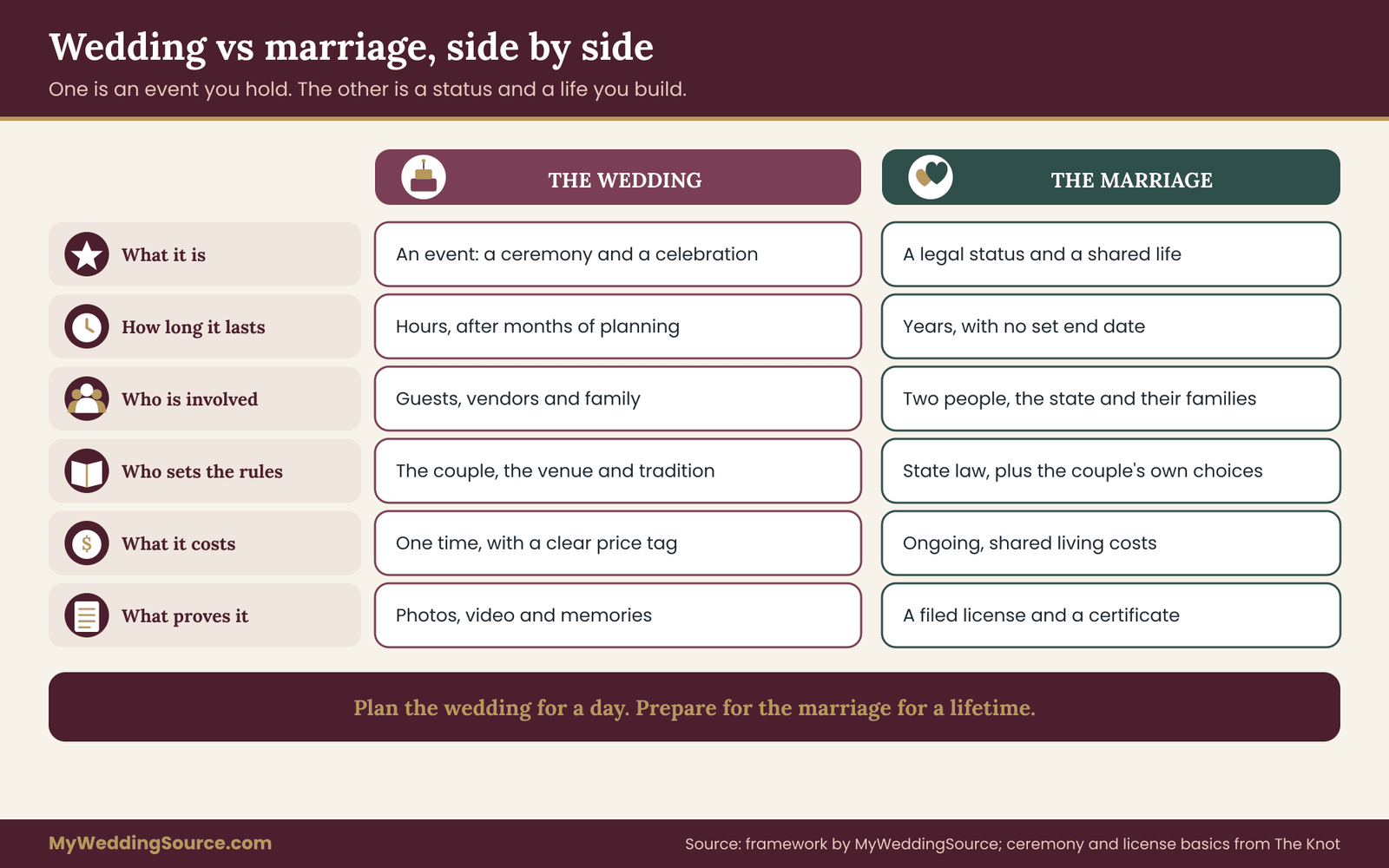
Notice how many of the contrasts above are about time and about who is involved. A wedding invites a crowd for an afternoon. A marriage involves two people, and the institutions around them, for years. That one shift in scale explains why the planning priorities should differ too.
Where the words wedding and marriage come from
The wedding vs marriage distinction is older than it looks, and the history of the word “wedding” is a useful reminder of what the event was originally for.
According to the Online Etymology Dictionary, “wedding” comes from the Old English weddung, which meant a pledge or betrothal, or the act of marrying. It is formed from the verb weddian, “to pledge oneself” or covenant to do something. The earliest idea behind the word was a promise backed by a pledge, in some cases a payment, made to secure a marriage. The meaning shifted to the ceremony itself, the sense we use today, by the early 13th century. The same root survives in other Germanic languages, for example in the German word for a bet.
So the word “wedding” began as a promise and ended up as a party. That arc is worth noticing. The promise is the part that belongs to the marriage. The party is the part that celebrates it.
“Marriage,” by contrast, has always pointed to the state of being married and to the institution that recognizes it. That is why you can say “a happy marriage” but would not normally say “a happy wedding” to describe the same thing. The first phrase describes a long relationship, the second a good party.
Related words worth sorting out
A handful of neighboring terms cause most of the confusion, so it helps to set them side by side.
| Word | What it means | Example |
|---|---|---|
| Wedding | The ceremony and celebration | “Their wedding is in June.” |
| Marriage | The legal status and the relationship | “Their marriage began in June.” |
| Matrimony | A formal or religious word for the married state | “Holy matrimony” |
| Nuptials | A formal word for the wedding ceremony | “The nuptials will be held outdoors.” |
| Ceremony | The portion of the wedding where the couple marries | “The ceremony lasts about half an hour.” |
| Reception | The party that follows the ceremony | “The reception starts at six.” |
| Elopement | A small, private wedding, often without guests | “They had an elopement in the mountains.” |
| Spouse | A person’s legally married partner | “Her spouse signed the form.” |
Two of these deserve a closer look. “Ceremony” is the narrowest term, because it covers only the moment of marrying. If you want the practical order of that moment, our wedding ceremony guide walks through it. “Wedding,” in contrast, is the widest, because it usually bundles the ceremony, the reception and often the days around them.
Wedding vs marriage in everyday English
Language habits explain most of the wedding vs marriage mix-ups. A few patterns are worth knowing.
People attend weddings, but they are not “invited to a marriage.” Invitations are for the event. Saying “I’m going for my friend’s marriage” is common in some varieties of English, but the standard American usage is “I’m going to my friend’s wedding.” The marriage is not an event anyone can go to.
“Getting married” covers both. The phrase can describe the legal act, the ceremony or the whole process. That flexibility is convenient, and it is also why the wedding vs marriage difference rarely comes up until paperwork or money forces it.
“Marriage” can describe quality, “wedding” cannot. We say a marriage is strong, troubled, close or long. We say a wedding is beautiful, expensive, small or fun. If you notice yourself describing a relationship with a wedding word, that is a clue that the day has taken up more of your attention than the life.
Cards and toasts need the right word. A congratulations card to a newly married couple can honor either. “Congratulations on your wedding” speaks to the day. “Congratulations on your marriage” speaks to the commitment. If you are looking for wording that fits, our wedding marriage wishes guide has messages for both.
Why the wedding vs marriage distinction matters in practice
It would be easy to treat wedding vs marriage as a vocabulary lesson. It is more than that, for five concrete reasons.
1. It tells you what is legally required. The law cares about the marriage, not the wedding. A couple can satisfy the legal requirements in a short appointment and then hold any kind of celebration they like, or none at all.
2. It tells you where the money goes. Wedding costs are one-time and visible. Marriage costs are continuing and often invisible: housing, insurance, debts, savings, children, caregiving. Planning only for the first can leave a couple unprepared for the second.
3. It tells you what to talk about. Table linens and seating charts belong to the wedding. Decisions about where to live, how to handle money and whether to have children belong to the marriage. Both conversations are real, but only one of them is usually on the checklist.
4. It protects you from pressure. Many people feel that a “real” wedding must follow a standard script of size, cost and tradition. Remembering that the marriage is the point, and the wedding is the way you celebrate it, gives you permission to design the day around what you actually want.
5. It prepares you for the days after. The first weeks of marriage involve paperwork, name changes, benefits, household logistics and a real reset of routine. Couples who treat the wedding as the finish line are often surprised by how much begins the day after.
Keep those five reasons in mind. The rest of this guide takes each side of the wedding vs marriage question in turn, starting with the one that has the clearest rules: the law.
The legal side of wedding vs marriage
In the eyes of the law, a marriage is a status that a state creates and recognizes. Everything else, including the dress, the venue and the cake, is optional. That makes the legal side of the wedding vs marriage question the cleanest place to start, because the rules here are written down, even if they differ from state to state.
How a marriage is created in the United States
The usual route has the same basic shape everywhere, with local details that change from county to county.
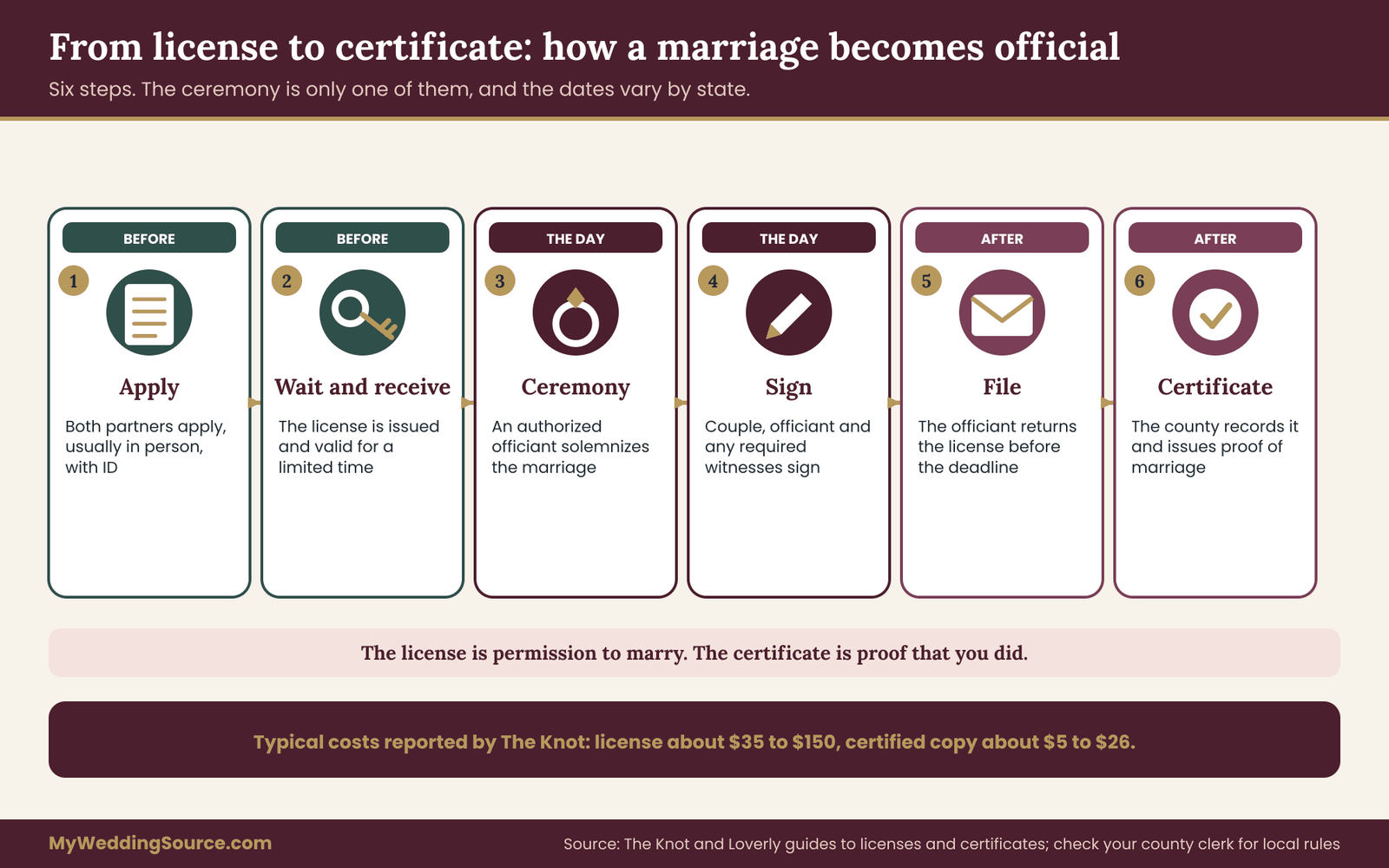
Step one: the marriage license. A marriage license is a permit, issued by a state or local authority such as a county clerk, that confirms there is no legal barrier to the couple marrying. According to The Knot’s guide to licenses and certificates, having a license does not make you married. It has to be presented at the ceremony and signed by the officiant.
Step two: the solemnization. This is the act of marrying, which is usually the ceremony. In many states, an authorized officiant, who may be a judge, a clergy member or a person ordained or deputized for the occasion, leads the couple through a short exchange and declares them married. The exact words required are minimal. Our wedding officiant guide explains who can officiate and what to ask them.
Step three: signing and filing. After the ceremony, the signed license goes back to the issuing office. The Knot notes that the officiant must submit it within a deadline that varies by state, from about 10 days to two months. The county then records the marriage.
Step four: the certificate. The marriage certificate is the official record that the marriage took place. It typically records the date and place and often names the officiant, and it is the document you use as proof for benefits, taxes, mortgages, identity and travel.
License vs certificate: the pair people mix up
The license and the certificate are different documents with different jobs, and mixing them up is one of the most common wedding vs marriage paperwork errors. Loverly summarizes it neatly: a license gives legal permission to marry, and a certificate is proof that the marriage happened.
The practical differences follow from that:
- Timing. You get the license before the ceremony and the certificate after.
- Source. You apply for the license, usually in person, at a local office. The certificate is generated from the filed license, and some states mail it while others make you request a copy.
- Expiry. A license is valid for a limited time that each state sets, and some states have a waiting period between issuing the license and the ceremony. A certificate does not expire.
- Cost. The Knot reports that licenses cost roughly $35 to $150 depending on the state, while certified copies of the certificate cost roughly $5 to $26. Treat those as ranges and confirm the current fee with your county.
If you are marrying in a different state or country from where you live, check where you must apply and whether the rules require both of you to appear in person. The Knot’s guide says both partners usually must apply in person, bring valid identification and, if either was married before, bring proof that the earlier marriage ended. Local rules on witnesses, minimum age and blood relations vary, so this is a question for the clerk, not for a blog.
What the law requires, and what it does not
Seen from the legal side, the wedding vs marriage line is sharp. The law generally requires a few things:
- Both people have the legal capacity to marry, which includes age and no existing marriage.
- Both freely consent.
- A valid license is obtained where required.
- The marriage is solemnized by someone authorized, in the manner the state allows.
- The record is filed.
The law does not require a white dress, a reception, a guest list, a first dance, a cake or a wedding party. It does not require a long ceremony. In many places the legal core of a ceremony takes only a few minutes. Our non-religious wedding ceremony script guide shows how short a complete, meaningful ceremony can be when you keep only the elements that matter.
This is also why a courthouse wedding is a real wedding. It is a legal marriage with a small celebration, and a couple can hold a larger party any time before or after.
A wedding without a marriage
Because the wedding and the marriage are separate, it is possible to have the first without the second. Some couples hold a symbolic or spiritual ceremony with vows, rings, readings and guests, but do not sign a license, or sign it later. Others hold a commitment ceremony because they do not want, or cannot yet obtain, a legal marriage.
That choice has consequences. A ceremony without a license usually does not create the legal rights and duties of marriage. Without the legal status, a couple may not automatically have the protections that come with it, such as inheritance rights, spousal benefits or standing to make medical decisions. If you are planning a symbolic ceremony abroad or a spiritual ceremony at home, find out whether the marriage will be legally recognized, and if not, what you would need to do to make it so.
One especially common version is the destination wedding. Rules for marrying abroad differ widely, and some couples complete the legal paperwork at home before or after a ceremony overseas. If you are in this position, ask both your destination authority and your home county what is needed.
A marriage without a wedding
The reverse also exists. Some marriages are created with no ceremony at all, or almost none.
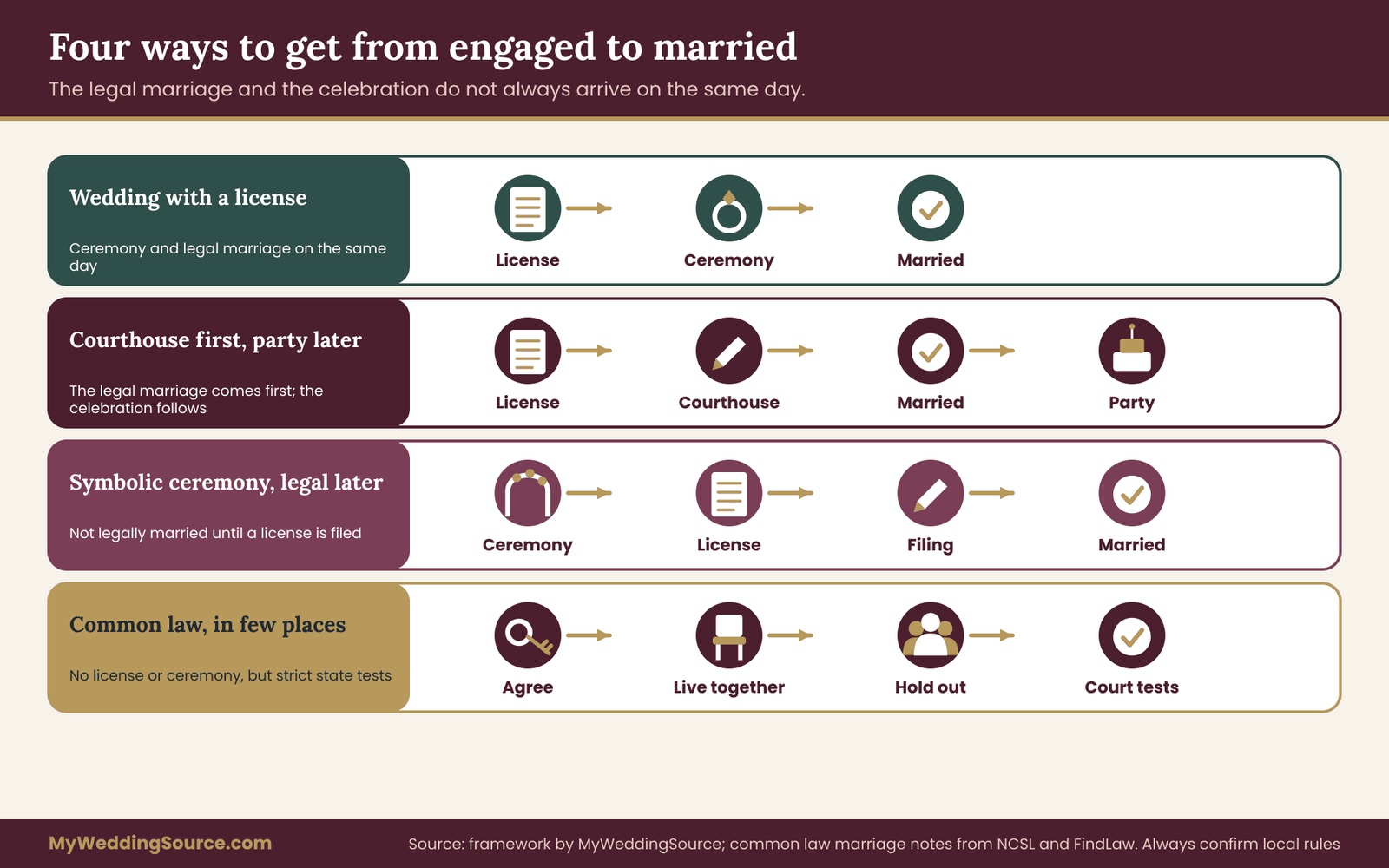
The best-known example in the United States is common law marriage. The National Conference of State Legislatures describes it as a legally recognized marriage between two people who have not purchased a license or had their marriage solemnized by a ceremony. It is a narrow exception, not a general rule, and it is not the same as simply living together for a long time.
Sources differ on exactly how many places recognize new common law marriages. FindLaw reports that common law marriage is recognized in seven states and the District of Columbia, with some further states recognizing it with restrictions, while a 2026 summary from one family law firm counts eight states plus the District. The difference mostly comes from how recent changes are treated. Several other states, including Alabama and Georgia, formerly allowed new common law marriages and now recognize only those formed before a cutoff date.
In the places that do recognize it, couples generally have to show that they agreed to be married, lived together and presented themselves to others as married. Courts decide the question, and the burden is on the couple. FindLaw also notes that under the full faith and credit clause, a state without common law marriage must recognize one validly formed in another state.
The takeaway for anyone weighing wedding vs marriage questions is that this path is real but fragile. Living together does not make you married, and moving from one state to another can change the analysis. If you think this applies to you, talk to a family law attorney.
Rights and responsibilities: what the marriage actually does
If the wedding is the party, this is the substance of the marriage. In legal terms, marriage is a bundle of rights and obligations that touch money, property, family and healthcare.
The federal government itself has counted them. A report from the Government Accountability Office identified 1,138 federal statutory provisions in which marital status is a factor in determining benefits, rights and privileges, as of December 31, 2003. The report itself cautions that some of those laws may not directly create benefits, and that the count does not by itself show how marriage affects people compared with being single. It is best read as evidence of how many places in federal law the word “spouse” appears, not as a precise tally of perks.
In practice, the areas couples most often run into include the following.
Taxes. Married couples can file jointly or separately, and the choice can raise or lower the tax bill depending on income. As a general rule, tax filing status is based on marital status at the end of the tax year, so a December wedding can change that year’s return. Confirm the details with the IRS or a tax professional.
Health insurance and benefits. Many employer plans allow a new spouse to be added within a limited window after marriage. Missing that window can mean waiting until the next open enrollment, so check the deadline with your benefits office soon after the ceremony.
Property and debt. Rules about who owns what, and who owes what, depend on the state. Some states treat property acquired during marriage as jointly owned, while others follow different systems. A prenuptial agreement can change the default.
Inheritance and end-of-life decisions. Spouses often have default rights to inherit and to make medical decisions if the other cannot. These defaults are not a substitute for a will, a health care proxy and updated beneficiary designations.
Immigration and Social Security. Marital status can affect eligibility for certain immigration processes and for Social Security survivor and spousal benefits. These are areas where individual facts matter a great deal, and a specialist is worth consulting.
Name changes. Changing a name after marriage is an administrative process, not an automatic one. According to The Knot, the usual route is to bring a certified marriage certificate, your original birth certificate and your Social Security card to a Social Security office, and then update other records afterward. Not everyone changes names, and any choice is valid.
None of that is created by the wedding. All of it is created by the marriage. That is the clearest argument for treating the paperwork with as much care as the flowers.
Who gets to be married: a short legal note
For same-sex couples in the United States, the right to marry and to have the marriage recognized has an important modern history. The Supreme Court decided Obergefell v. Hodges in 2015, and in December 2022 Congress passed the Respect for Marriage Act, which repealed the 1996 Defense of Marriage Act and requires recognition of marriages that were valid where they were performed. Commentators describe the 2022 law as a backstop that matters most if the Court’s earlier decisions were ever revisited. In short, the legal status of marriage is a settled right for same-sex and interracial couples today, with a statutory safety net behind it.
The wedding vs marriage distinction matters here too. A wedding can be held anywhere that will host it, but a marriage’s legal power depends on being recognized by the state. Couples who plan to travel, move or live abroad sometimes check recognition in advance for that reason.
Questions to ask your county clerk about wedding vs marriage paperwork
The clerk’s office is the one authority on the legal side of wedding vs marriage planning, and a short phone call or website visit answers most of the questions that blogs cannot. Use this list as a script.
- Where do we apply, and do both of us have to appear in person?
- Do we need an appointment, and how far ahead can we make one?
- What identification do you accept? The Knot’s guide suggests bringing at least two forms of ID.
- If either of us was married before, what proof of the end of that marriage do you need? A divorce decree or a death certificate is typical.
- Do you need translations of any documents? Foreign-language documents usually need a notarized translation.
- What does the license cost, and how can we pay?
- How long is the license valid, and is there a waiting period between issuing it and holding the ceremony?
- Who is allowed to officiate here, and do they need to register?
- Do we need witnesses, and how many?
- Who files the signed license, and what is the deadline?
- How do we get certified copies of the certificate, what do they cost and how long do they take?
Write the answers down, and add the dates to the same calendar you use for the wedding. The wedding vs marriage paperwork is small compared with the wedding itself, and it is the part that is hardest to fix after the fact.
If you are marrying in a place where you do not live, ask the same questions of the local office and of your home county, since you may need to register the marriage or update records where you live.
If the law explains what a marriage is, culture explains why we hold weddings at all. Across almost every society, people mark a marriage with some kind of public event. The details vary enormously, but the job is surprisingly consistent.
What a wedding is for in the wedding vs marriage picture
A wedding does several things that a signature at a clerk’s desk cannot do on its own.
It makes the commitment public. A promise made in front of the people who matter to you carries a different weight than one made privately. Witnesses turn a private decision into a shared fact. That is why the wedding vs marriage conversation so often returns to the guest list: the guests are the audience that makes the promise social.
It marks a change of status in a community. In many traditions, the wedding is a rite of passage. Families are joined, roles shift and the couple is treated differently afterward. The ceremony is how a community recognizes that change.
It gives the families a role. Parents, grandparents and friends get a defined place in the day. For many families that is the point. The wedding gives them a way to say yes to the marriage.
It creates a memory. A wedding is a shared story that the couple and their guests can return to for decades. That has real value, and it is a legitimate reason to spend time and money on the day.
Those are good reasons, and none of them requires a particular size, cost or style. A small ceremony in a backyard can do every one of these jobs. So can a large traditional wedding. What matters is whether the event does its job for the people in it.
What a marriage is for in the wedding vs marriage picture
A marriage, in contrast, is a long-term arrangement for building a life. People marry for many overlapping reasons: love, companionship, family, faith, security, legal protection, shared goals. In many cultures, marriage is also an institution that organizes households, raises children and passes on property and tradition.
The personal side of marriage is the part that no ceremony can deliver. A wedding can express intention. It cannot create the daily habits of listening, repairing conflict and sharing a household. Those are built later, slowly and mostly in private.
Therapists quoted by The Knot make the same point in different words. One describes the wedding as a single day of celebration and the marriage as a commitment to build a life and a home together. Another notes that the honeymoon period fades and the wedding becomes a memory, while the daily relationship goes on.
How different traditions frame the difference
Every tradition draws its own line between the wedding and the marriage, and the contrast can be instructive. The summaries below are brief and general. For the real details of any tradition, speak with your own officiant or religious leader.
Christian traditions. Many Christian communities treat marriage as a covenant or, in some traditions such as Catholicism, a sacrament. The wedding service is where vows are made before God and the congregation, but the covenant is understood to last beyond the service.
Jewish tradition. The wedding includes a contract, the ketubah, and a set of blessings under a canopy. The ceremony establishes the marriage, and the document spells out commitments.
Islamic tradition. The marriage is typically established through a contract, the nikah, with consent and witnesses at its center. The celebratory events that follow are distinct and vary widely by culture.
Hindu traditions. The ceremony is often a series of rituals led by a priest or elder, and in some communities the sacred steps around the fire are what formally make the couple married. Celebrations may stretch across several days.
Secular and civil traditions. A civil ceremony focuses on the legal elements, and a humanist or secular celebration adds personal reflection and promises. In both cases the legal marriage and the celebration can be separated by days or years.
For a wider tour of how couples around the world celebrate, our guide to wedding traditions around the world covers dozens of customs and their meanings.
The vows sit on the line between the two
Vows are the part of a wedding that most directly belongs to the marriage. They are spoken at the wedding, but they describe the marriage: what you promise to do and be for each other over time. That makes them a good test of whether a couple has thought about the wedding vs marriage difference.
A vow that says only “I love you and you make me happy” describes a feeling. A vow that says “I will tell you the truth, share the work and keep choosing you when it is hard” describes a marriage. If you are writing your own, our wedding vows guide shows how to move from sentiment to commitment.
The money side of wedding vs marriage
Money is where the wedding vs marriage difference is easiest to see, because the two costs behave so differently. In wedding vs marriage budgeting, a wedding is a one-time expense with a clear price tag. A marriage is a continuing financial arrangement with no end date.
What weddings cost in the wedding vs marriage budget
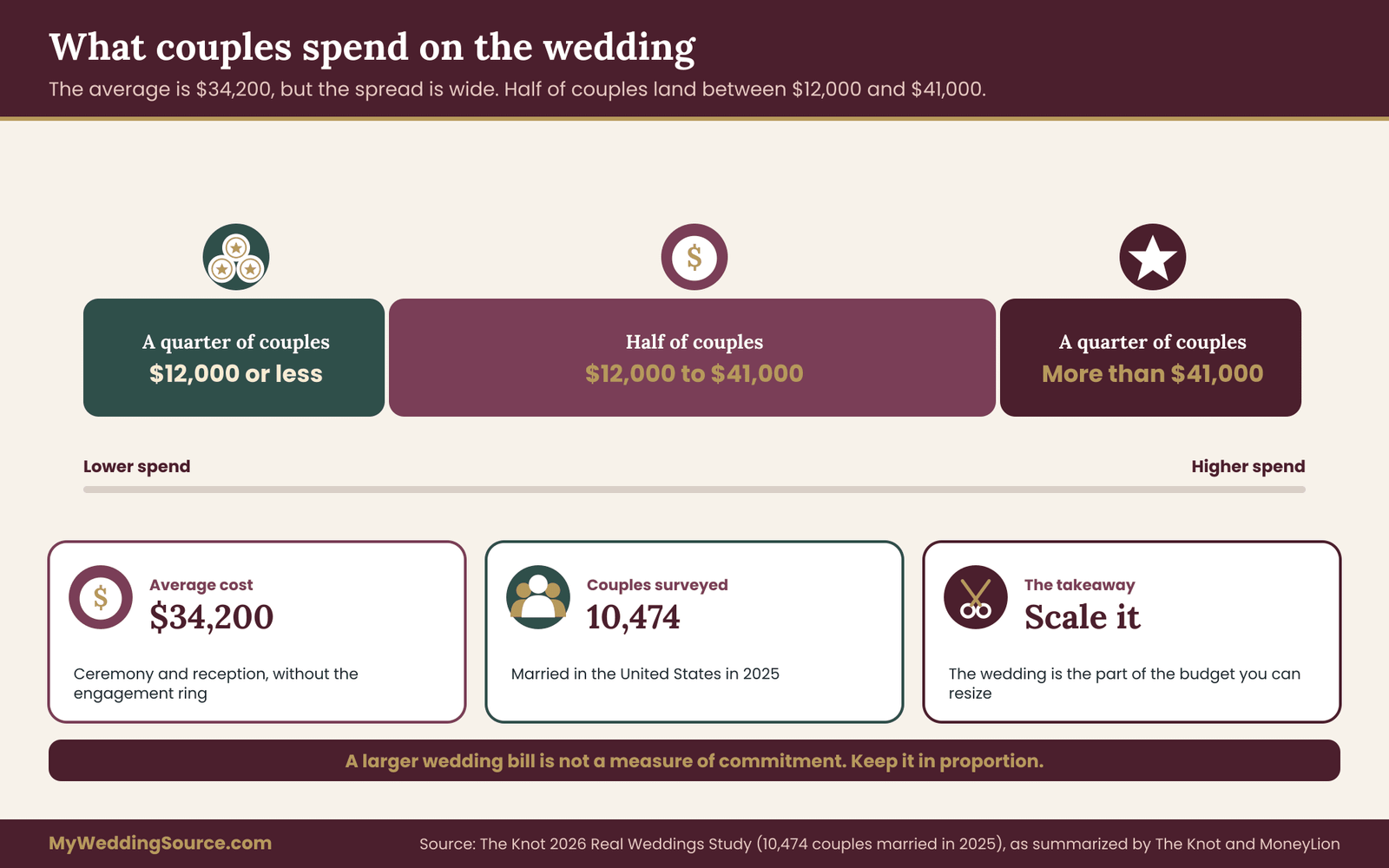
The Knot’s 2026 Real Weddings Study, which surveyed 10,474 U.S. couples who married in 2025, puts the overall average wedding cost at $34,200. That figure covers the ceremony and reception and excludes the engagement ring. The same data shows how wide the spread is. One summary of the study reports that a quarter of couples spent $12,000 or less, half spent between $12,000 and $41,000, and a quarter spent more than $41,000. The study also estimates that nearly 2 million U.S. couples married in 2025.
Averages hide a lot. The Knot itself notes that the number is more meaningful within a type of wedding and a region than across all weddings. A wedding in a high-cost city, with a large guest list and a full-service venue, can cost several times what a courthouse ceremony and a small dinner would.
That variety is good news for planning. Because the wedding is optional in size and style, it is the one part of the financial picture that you can scale to fit your actual priorities. If the budget is under pressure, our guide on how to cut a wedding guest list shows the most direct way to bring the cost down without cutting the meaning.
Does a bigger wedding make a stronger marriage?
It is tempting to assume that spending more shows more commitment. The evidence does not support that assumption.
A widely cited 2015 paper in the journal Economic Inquiry by Andrew Francis-Tan and Hugo Mialon surveyed more than 3,000 ever-married adults in the United States. After controlling for a range of demographic and relationship characteristics, the authors found that marriage duration was inversely associated with spending on the engagement ring and the wedding ceremony. In plain terms, couples who reported spending more tended to report shorter marriages.
This is a correlation, not proof that spending causes divorce. As coverage of the study pointed out, the relationship may reflect other factors, such as financial strain or impulsive decision-making. The sensible reading is narrower: nothing in the data suggests that a more expensive wedding buys a longer marriage, and some of it suggests that financial pressure at the start is a risk.
The practical lesson for the wedding vs marriage question is to keep the budget in proportion. A wedding is worth spending on if it expresses what you value. It is not a down payment on marital success.
What a marriage costs, and why it is easy to overlook
The financial side of a marriage is mostly ordinary life, shared. Housing, utilities, food, transportation, insurance, health care, student loans, credit cards, childcare, retirement and taxes all continue after the wedding, and now they are decided together. Couples often discover that the first year is the first time they have really merged their finances, and that they have never talked about the details.
A short list of money conversations to have before or soon after the wedding includes the following:
- What each of you earns, owes and owns, and how you will share that information.
- Whether you will combine accounts, keep some separate, or use a mix.
- How you will make large purchases and who decides on a limit that requires a conversation.
- How you will handle debt that one of you brought into the marriage.
- What your emergency savings goal is and how you will build it.
- Whether either of you supports other family members financially.
- Whether you want a prenuptial agreement, and what you would want it to say.
These are not romantic topics, and that is exactly why they belong on the list. Money disagreements are rarely about numbers. They are about security, trust and freedom, and talking about them early makes the later conversations easier.
The time side of wedding vs marriage
The wedding vs marriage difference is also a difference of scale in time. A wedding takes months to plan and hours to hold. A marriage takes a lifetime to live, and most of that lifetime happens in small, undramatic moments.
The wedding timeline in wedding vs marriage terms
For a typical wedding, planning stretches over many months, from choosing a venue to the final headcount. The day itself might run six to ten hours, from getting ready to the last dance. The ceremony, the part where the marriage legally begins, is often 20 to 40 minutes. If you want a closer look at what happens in those minutes, our wedding ceremony step by step guide walks through each phase, and the wedding planning timeline shows how to work backward from the date.
The marriage timeline in wedding vs marriage terms
A marriage has no schedule. It has seasons: the first year of adjustment, the arrival or absence of children, career changes, moves, illness, caregiving, losses and long stretches of ordinary routine. Some couples are together for decades, and others separate.
Official statistics give a sense of the scale. The CDC’s National Center for Health Statistics reports provisional 2023 figures of 2,041,926 marriages in the United States, a rate of 6.1 per 1,000 people, and 672,502 divorces across the 45 reporting states and the District of Columbia, a rate of 2.4 per 1,000. It is worth being careful with those numbers. They are annual rates per thousand people in the population, not the share of marriages that eventually end, so they cannot be turned into a simple “half of marriages fail” claim.
What they do show is that marriage is common, that it continues to be a major life event for millions of people each year and that ending one is also a regular part of the picture. For a couple, that is a reason to plan for the long run and to treat the relationship as something that is maintained, not just celebrated.
The gap between the two timelines
Many people describe a letdown or an adjustment after the wedding, when the long build-up is over and the ordinary routine returns. Planning for that moment is easier than being surprised by it. Schedule something to look forward to after the wedding, such as a trip or a project. Agree on how you will spend your first few weekends. Decide in advance when you will send thank-you notes and when you will have the conversation about the first year’s goals. If you need help with the wording, our thank-you card wording guide has examples.
How to prepare for the marriage while planning the wedding
Most couples spend months on the wedding and a few evenings on the marriage. That is understandable, since the wedding comes with deadlines, vendors and invitations, while the marriage comes with none of those. The solution is not to plan less. It is to give the marriage the same kind of structure.
Give the marriage some of the planning time
The Knot’s wedding vs marriage guide offers a simple rule of thumb: for every hour you spend choosing table linens, spend about the same time talking about your dreams for the future and how you hope to build a life together. It is a deliberately lopsided comparison, since linens can take hours. The point is the habit, not the ratio.
Here is one way to make wedding vs marriage planning concrete. Choose one recurring evening each week during planning that is wedding-free. No vendor emails, no spreadsheets, no guest list. Use it for one question from the lists below, or for something unrelated that you simply enjoy. You will protect the relationship from the project, and you will practice the skill of having real conversations on a schedule, which is most of what a long marriage requires.
Seven conversations worth having before the wedding
These topics come up in almost every marriage, whether or not a couple discusses them in advance. They are grouped here so you can take one at a time.
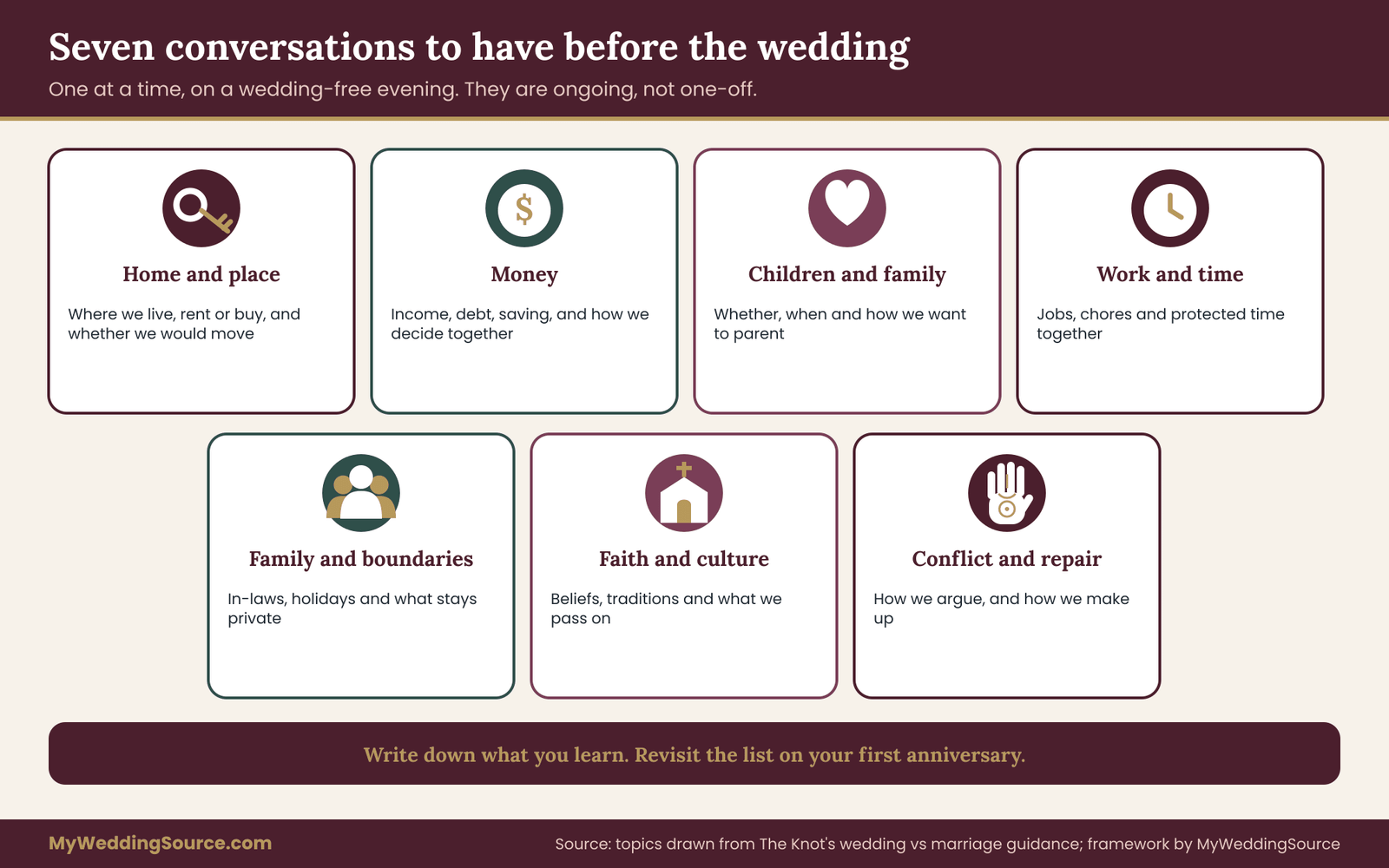
1. Home and place. Where will you live, and for how long? Do you rent or buy? Is either of you likely to move for work or family? A couple who agree on the next three years but not the next ten have the beginnings of a plan. A couple who have never discussed it have a surprise waiting.
Useful questions: What does a good home look like to each of us? How near do we want to be to family? What would make us move? What would make us stay?
2. Money. The earlier section covered the practical list. The deeper questions are about values. How did each of you grow up thinking about money? What makes you feel secure? What do you want to be able to say yes to in ten years, and what are you willing to say no to now?
3. Children and family. Do you want children, and if so how many, and when? What will you do if that turns out to be harder or different than planned? How do you each think about parenting, discipline, religion and school? For couples who already have children, how will the marriage change the household, and how will you respect each child’s place in it?
4. Work and time. How much do your jobs shape your lives? Who does the household work, and how will you decide? How will you protect time together when work is demanding? The Knot’s expert advice includes agreeing on how you want to spend your time together and on the trips and adventures you hope to share.
5. Family, friends and boundaries. How involved will in-laws be? How will you handle holidays, visits and requests for help? What is private between the two of you? Families often matter more after the wedding than before it, because the couple is now a unit that other people have to adjust to.
6. Faith, culture and tradition. How do you each practice or relate to religion, and what traditions do you want to keep? What will you pass on to children? In interfaith or intercultural marriages, these questions are best discussed openly and early, with respect for each side. Our guide to wedding traditions around the world can help you see which customs carry which meanings.
7. Conflict, repair and closeness. How do you each behave when you are upset? Who tends to go quiet, and who tends to push? How do you make up? What does each of you need to feel loved? One therapist quoted by The Knot says that conflict and repair are what build trust, which is a reminder that the goal is not to avoid disagreement but to handle it well.
None of these conversations has to be finished. They are ongoing. What matters is that the first round happens before the wedding, so the habit is in place.
A short list of questions to start with
If a blank page is intimidating, begin with a few prompts and see where they lead.
- What is one thing you hope our marriage will feel like on an ordinary Tuesday?
- What is something your family did that you want us to do, and something you want us to do differently?
- What would make you feel supported when you are stressed?
- When we disagree, what do you need from me in the first five minutes?
- What is a goal you have that I may not know about?
- How do we want to handle it if one of us loses a job or gets sick?
- What does saving mean to you, and what does it protect?
- How do we want to celebrate each other when things go well?
Pick two or three. Write down what you learn. Revisit them on your first anniversary.
Premarital counseling and education: what the research says about wedding vs marriage
Many couples wonder whether premarital counseling is worth it. The Knot’s marriage guide recommends pre-marital counseling with a religious leader or a therapist, and many faith communities require it. The research is more mixed than the advice, and an honest look at it is useful.
A 2010 meta-analysis in the journal Family Relations, led by Elizabeth Fawcett, Alan Hawkins and colleagues, examined 47 studies of premarital education programs. It found that programs did not improve relationship quality or satisfaction when unpublished studies were included, although some studies that followed couples over a longer period reported benefits. The authors concluded that results were mixed and modest, and that there was room to improve the practice.
A separate meta-analysis by Hawkins and colleagues in 2008 looked more broadly at marriage and relationship education, using 117 studies. It found effect sizes for relationship quality in experimental studies ranging from about 0.30 to 0.36, and larger effects on communication skills, around 0.43 to 0.45. In plain terms, programs appear to help with skills such as communication more reliably than they move overall satisfaction.
What does that mean for you? Three practical points follow.
Look for skills, not slogans. A good program teaches specific habits, such as how to raise a difficult topic, how to listen without defending and how to make repairs after an argument. Those are the parts the research supports most.
Treat it as a conversation guide, not a test. The value of counseling is often that it forces topics onto the table. The topics matter more than the certificate.
Match the format to your situation. A faith-based course, a therapist, a workshop and a book you read together can all work. Choose the one you will actually finish.
Family, in-laws and the people around wedding vs marriage
In wedding vs marriage terms, a wedding brings two families into the same room. A marriage keeps them in the same orbit for years. The difference is easy to underestimate.
During wedding planning, family involvement is often about the day: who sits where, who gives a toast, who pays for what. After the wedding, it shifts to the long arc: holidays, caregiving for aging parents, support during illness, help with children and opinions about nearly everything.
A few habits make this easier.
Present a united front. When a parent offers an opinion, the couple should respond together. If one partner always handles their own family, the other can feel left out and the family can feel judged.
Set the boundaries early and kindly. A boundary is a statement about what you will do, not a verdict on what others should do. “We’re spending Thanksgiving with each side in alternating years” is clearer and kinder than a negotiation each November.
Be generous about differences. Families have different habits about money, humor, faith, food and time. Most of those differences are not problems. They are just different, and curiosity goes further than correction.
Keep the couple as the first team. In a healthy marriage, the partnership is the primary relationship, and the extended family is a source of support and love around it. That is not a rejection of anyone. It is the structure that lets the family grow.
Your first year of marriage: the practical checklist
The wedding vs marriage difference is never clearer than in the first weeks afterward, when the day is over and the paperwork begins. This checklist gathers the practical steps that come with the marriage, not the wedding. Dates and rules vary, so use it as a prompt and confirm with the relevant offices.
Within the first few weeks.
- Confirm the signed license has been filed, and request certified copies of the marriage certificate. You will need them for many of the steps below.
- Check the deadline for adding a spouse to employer health insurance, which is often a limited window after the marriage.
- If either of you is changing your name, start with Social Security, then update your driver’s license, passport, bank accounts, employer records and other documents.
- Update your emergency contacts and beneficiaries on insurance policies, retirement accounts and workplace benefits.
Within the first few months.
- Review your tax withholding. As a general rule, marital status at the end of the year determines your filing status, so a change may affect what you owe. Ask a tax professional if you are unsure.
- Decide how you will handle money going forward: shared accounts, separate accounts or a blend. Write the plan down.
- Make or update wills, powers of attorney and health care proxies, especially if you own property or have children.
- Review renters or homeowners insurance, and add each other as needed.
- Send thank-you notes. Our thank-you card wording guide can help, and a short, sincere message is better than a long, late one.
Within the first year.
- Hold a conversation, in the spirit of an annual review, about what is working, what is hard and what you want next year.
- Revisit the seven conversations above. Your answers will have shifted.
- Mark your first anniversary in a way that fits you, which can be as simple as a dinner at home.
None of these steps is romantic, and all of them are part of the marriage. Doing them calmly, together, is one of the quieter ways couples build trust.
The legal moment inside the wedding
One useful way to see the wedding vs marriage difference is to look at the ceremony itself, where the two overlap for a few minutes. Almost everything in a typical wedding ceremony is there for meaning, tradition or beauty. Only a small part carries legal weight.
The pieces that usually matter legally are the declaration that both people are marrying freely, the words or acts that the state accepts as the marriage, the officiant’s pronouncement and the signatures on the license. Everything else, from the processional to the readings to the unity ritual, is the wedding. It is there to make the moment feel like a wedding, and it is worth doing well, but it can be changed freely.
That has a practical benefit. When a ceremony is running late, when a reader cannot come or when rain forces a change of plan, the legal marriage is not at risk as long as the essential parts happen and the paperwork is correct. Ask your officiant to tell you, in plain words, which parts of the ceremony are required where you are marrying. Our wedding ceremony script templates show how the legal beats fit among the personal ones.
Plan the signing as carefully as the entrance. Decide who will sign, where and when. Many couples sign right after the ceremony with the officiant and two witnesses where required, while others sign privately. Make sure the license is in a safe place, that you have a pen that works and that someone is responsible for confirming that the officiant will return it on time. It is the least glamorous task of the day and the one with the longest-lasting effect.
A planning list for the wedding and a planning list for the marriage
The easiest way to keep the wedding vs marriage balance is to keep two lists, side by side, and check both regularly. They do not need to be long.
| The wedding list | The marriage list |
|---|---|
| Venue and date | Where we will live in the next few years |
| Guest list and invitations | How we will handle family, holidays and boundaries |
| Officiant and ceremony | License, filing and certified copies |
| Food, drink and cake | How we will budget, save and share money |
| Photography and music | Insurance, beneficiaries and legal documents |
| Attire and beauty | Work, time and household responsibilities |
| Flowers and decor | Faith, culture and traditions we want to keep |
| Rehearsal and timeline | Plans for the first month and the first year |
If the left column is full and the right column is empty, the planning is lopsided, and that is a useful thing to notice a few months before the date. The fix is rarely dramatic. Usually, it is a few conversations and a few appointments.
Signs you may be planning the wedding more than the marriage
It is easy to slip into wedding mode and stay there. These are a few signs that the balance may have tipped, along with gentle fixes. None of them is a verdict on your relationship. They are prompts.
You can describe the centerpieces but not the next three years. Spend an evening talking about where you want to be in three years and what would need to be true for that to work.
Most of your conversations are about logistics. Set a rule that one meal a week is wedding-free, and use it for the relationship.
You are avoiding a hard topic until after the wedding. Postponing a conversation about money, children or family can feel kind in the moment. It rarely gets easier. If a subject feels hard, consider raising it with a counselor or a trusted mentor so you can talk it through with support.
You feel pressure to match someone else’s wedding. Comparing yourself with a friend, a relative or a social media feed is a sure way to lose track of what you want. Return to the one-sentence purpose you wrote for the day and ask whether the choice serves it.
You are tired of each other. Planning is stressful, and many couples find that it strains them in ways they did not expect. If that is you, simplify the plan, delegate tasks and take a break. The wedding vs marriage difference is a reminder that the relationship is the thing being protected.
What if the wedding does not go to plan? Wedding vs marriage perspective
Weddings rarely go exactly as imagined, and wedding vs marriage thinking helps. A vendor cancels, the weather turns, a relative is unable to attend, a speech runs long. Understanding the wedding vs marriage difference changes how those moments feel, because you can see them for what they are: problems with an event, not problems with the marriage.
If something goes wrong, ask three questions. Does it affect the legal marriage? Almost never, as long as the license, officiant and signatures are in order. Does it affect the people who matter to us? Usually it does not, if the main people are there and cared for. Can we turn it into a story? Often yes, and many of the most affectionate wedding memories are about things that went sideways.
It also helps to decide in advance what the non-negotiables are. For some couples it is a specific person being present. For others it is the vows, the music or the meal. Naming two or three keeps small setbacks small.
What officiants and planners see in wedding vs marriage
Wedding professionals watch the wedding vs marriage distinction play out every weekend, and a few patterns come up repeatedly.
Couples who treat the ceremony as the center of the day, and the reception as the celebration of it, tend to feel more present. The ceremony is where the marriage begins, and when it gets enough time and attention, the rest of the day flows from it. Our wedding officiant guide can help you find someone who will take that part seriously.
Couples who delegate well tend to enjoy the day more. A coordinator, a trusted friend or a family member can take on the details so that the couple can be present for each other.
Couples who stay flexible tend to have the best stories. A rainstorm, a late bus or a missing item is only a disaster if you have decided that the day must be perfect.
Couples who carry the same habits into the marriage tend to find it easier. The skills that make a wedding go well, such as clear communication, shared decisions and a sense of humor, are the same skills that a long marriage needs.
Special situations where wedding vs marriage come apart
Most couples have the wedding and the marriage begin on the same day. Some do not, and the reasons are often practical, personal or financial. These are the situations that come up most often.
Courthouse first, celebration later: wedding vs marriage in two steps
Many couples marry at a courthouse or clerk’s office, then hold a larger celebration months later. The legal marriage begins at the courthouse. The party is a wedding in every sense that matters to the guests, but not in the legal sense, since the legal part is already done.
This approach is popular for good reasons. It can be used to lock in health insurance or immigration timing, to marry before a deployment or a move, or simply to take the pressure off a larger event. If you go this route, think about how you will describe the party so guests understand it. Some couples call it a “wedding celebration,” a “reception” or a “vow renewal style ceremony” with an officiant, and some hold a full ceremony again for the sake of the experience. Any of those is fine, as long as the paperwork is correct.
The wedding first, the license later
The opposite order also happens. A couple may hold a ceremony and then file the license soon afterward, or may hold a symbolic ceremony and take care of the legal steps at a convenient time. If you plan this, be careful with timing. A license has an expiry date, and the officiant’s role in signing and returning it is time-limited. Ask your clerk which signatures are required and when.
A marriage that is legal in one place and not another
Marriage is recognized across the United States, as a rule, if it was valid where it took place. International situations are less simple. A wedding held abroad may need to be registered, translated or legalized for it to be recognized at home. A purely symbolic ceremony abroad may not be recognized anywhere. If you are marrying overseas, confirm with both countries.
Second marriages and blended families
For couples who have been married before, the wedding vs marriage question has a particular edge. Many have already had a large wedding and do not want another. Many have children whose feelings matter. Many have financial arrangements, such as support obligations or property, that a new marriage will affect.
A second wedding can be smaller, more personal and more focused on family than the first. A second marriage deserves the same attention to the practical side: updated wills and beneficiaries, clarity about debts and assets, and a plan for how the household will work. The Knot’s guide to the license process notes that anyone previously married needs to bring proof that the earlier marriage ended, such as a divorce decree or death certificate.
Long engagements and long relationships
Some couples have been together for many years, own a home and share a life before they marry. For them, the wedding vs marriage distinction can feel odd, because the marriage in a practical sense began long ago. The wedding then serves mostly to make it official and to celebrate with family.
If that is you, be careful not to assume that living together creates the same legal protections as marriage. In most states it does not, and common law marriage is the narrow exception covered earlier. Marrying can change taxes, benefits, inheritance and medical decision-making. It is worth thinking about which of those you want and when.
Elopements and micro weddings
An elopement is a small, often private wedding, and a micro wedding is a small celebration with a short guest list. Both are legitimate ways of separating the legal marriage from the large event. They tend to cost less, take less time to plan and focus attention on the couple. Many couples add a casual celebration afterward for friends and family who could not attend.
If you are weighing this path, remember that the legal steps are the same. You still need a license, a qualified officiant and a filing. The difference is in everything around them. Our wedding ceremony step by step guide can help you pare the ceremony down to what matters.
Four ways to get from engaged to married
To bring those scenarios together, the illustration below shows four common paths and what each one does to the timing of the wedding and the marriage.
Myths about wedding vs marriage
A few wedding vs marriage misconceptions come up again and again. Sorting them out is a good way to see the difference in action.
Myth: “A wedding makes you married.” Not on its own. In most places, the legal marriage depends on the license, the solemnization and the filing. A ceremony without those steps may be meaningful, but it may not create a legal marriage.
Myth: “You need a wedding to be married.” You do not. A courthouse signing creates a legal marriage, and in a few places a common law marriage can arise without a ceremony. The celebration is optional.
Myth: “A bigger wedding means a stronger marriage.” The research does not support this. A 2015 study found that higher spending was associated with shorter marriages, and although that is a correlation, it undermines the idea that spending is a sign of commitment.
Myth: “Living together for years is the same as being married.” Not in most states. Without a legal marriage, a couple generally does not have the same default rights, and the exceptions are narrow.
Myth: “The marriage certificate is the same as the marriage license.” They are different documents. The license permits you to marry, and the certificate proves that you did.
Myth: “Once the wedding is planned, the hard part is over.” The hard part, if there is one, is the long middle. The wedding is a project with an end date. The marriage is not.
Myth: “A small wedding means you care less.” The meaning of a wedding does not scale with its size. A ceremony that does its job, which is to make a sincere public commitment, can be done in ten minutes in a living room.
Myth: “Wedding vs marriage is just semantics.” It is a distinction with real consequences for money, paperwork, expectations and preparation, as the rest of this guide shows.
How to talk about wedding vs marriage with family and friends
If you want a smaller or simpler wedding, or you want to put your energy into the marriage, you may meet resistance. Parents, friends and relatives often have strong feelings about what a wedding should look like, and some of those feelings come from love.
A few approaches help.
Start with what the day is for. Explaining what you want the day to express, such as warmth, closeness or a particular tradition, is more persuasive than listing what you do not want.
Offer a role. People accept changes more easily when they have a place in what you are planning. A parent who is not hosting a large party may be glad to give a toast, read a passage or help with the guest list.
Hold the line on the essentials. You can be gracious and firm. “We’re keeping it small, and we’d love to celebrate with you in a different way” is both.
Use the guest list as a tool. A manageable guest list is the single most effective way to protect both your budget and your sanity. If you are working through that decision now, our guide to cutting a wedding guest list has scripts for the awkward conversations.
Choosing where to put your attention in wedding vs marriage planning
Because both sides of wedding vs marriage deserve care, the practical question is how to divide your attention and money between them. These guidelines may help.
Spend on what you will remember and use. A wedding photographer, a good meal and a venue that suits your guests may matter more to you than a large floral installation. Decide what you will want to look back on.
Protect your savings. A wedding paid for with high-interest debt can start the marriage with stress. If you have to choose between the day and a financial cushion, many couples are glad later that they chose the cushion.
Put the legal steps on the calendar. Add the license application, the officiant’s filing and the certificate request to your timeline, with dates. They are easy to forget until they matter.
Plan one conversation per week. Keep the habit of talking about the marriage, not only the wedding.
Plan the first month after. Block time for rest, thank-you notes, paperwork and being together without a project.
Wedding vs marriage vocabulary for toasts, cards and invitations
Wedding vs marriage language shows up in the details of the day. A few small choices make a card, a toast or an invitation fit the moment.
Invitations announce a wedding, so use “wedding” or a related word: “join us for the wedding of,” “our wedding celebration,” “the marriage of” in formal wording. The formal phrase “the marriage of” is traditional, and it is fine to use even though the event is the wedding.
Toasts can speak to either. A toast at the wedding often looks backward at how the couple met and forward at the marriage. The best ones do both, with a story and a wish.
Cards can use “congratulations on your wedding” for a note about the day, or “congratulations on your marriage” for a note about the commitment. For many people, the second is a little more personal.
Anniversary messages celebrate the marriage, not the wedding, and a phrase like “happy anniversary” does the job.
For wording ideas for any of these, our wedding marriage wishes guide has messages for couples, families and friends.
FAQ
What is the main difference in wedding vs marriage?
A wedding is the ceremony and celebration that mark the start of a marriage. A marriage is the legal status and the ongoing relationship that begin at that point. The wedding lasts a day, and the marriage can last for decades. In the wedding vs marriage comparison, the wedding is optional in size and style, while the marriage carries the legal rights and responsibilities.
In wedding vs marriage terms, can you be married without a wedding?
Yes. A couple can marry by getting a license and having the marriage solemnized in a short appointment, with no celebration at all. In a small number of states, a common law marriage can also arise without a license or ceremony if the couple meets that state’s requirements.
In wedding vs marriage terms, can you have a wedding without being legally married?
Yes. A symbolic, spiritual or commitment ceremony can include vows, rings and guests without creating a legal marriage if no license is obtained and filed. Couples in this position should check which rights they would not have and what steps would make the marriage legal.
What is the difference between a marriage license and a marriage certificate?
A marriage license is a permit to marry, issued before the ceremony. A marriage certificate is the official record that the marriage took place, issued after the signed license is filed. You need the license to marry and the certificate to prove you are married.
Does wedding vs marriage matter for taxes and benefits?
Yes, but through the marriage, not the wedding. Taxes, health insurance, inheritance and many federal benefits depend on legal marital status. The size and style of the wedding has no legal effect. Timing can matter, though, because filing status is generally based on marital status at the end of the tax year.
How long does a wedding last compared with a marriage in wedding vs marriage terms?
A wedding day often runs six to ten hours, and the ceremony itself is commonly 20 to 40 minutes. A marriage has no set length. It continues until it is ended by death or divorce.
Does a more expensive wedding make a marriage last longer?
There is no evidence that it does. The Knot’s 2026 Real Weddings Study puts the average U.S. wedding cost at $34,200, and a 2015 study in Economic Inquiry found that higher spending was associated with shorter marriages. That is a correlation, not proof, but it suggests that spending is not a measure of commitment.
Should we do premarital counseling?
It can help, especially for communication skills. Research on premarital education is mixed and modest overall, so the best approach is to choose a format you will finish and to treat it as a guide to important conversations. A religious leader, a therapist or a structured course can all work.
Your next steps
Start with three small actions this week. First, find out what your county requires for a marriage license, and put the application and filing dates on your calendar. Second, choose a recurring wedding-free evening and use it for one of the seven conversations. Third, decide what the wedding is for, in a sentence, and let that sentence guide the budget and the guest list.
Then keep the two lists separate. One list covers the day: venue, guests, ceremony, food, photographs. The other covers the life: money, home, family, work, faith and the habits that keep two people close. A good wedding is a gift to the marriage. It works best when you remember that the marriage is the reason for it.
Sources
- Wedding, word origin, Online Etymology Dictionary
- Wedding vs. marriage: how to prepare for both, The Knot
- A guide to a marriage license vs. marriage certificate, The Knot
- Marriage license vs marriage certificate, Loverly
- Common law marriage by state, National Conference of State Legislatures
- What is common law marriage? FindLaw
- Common law marriage states in 2026, Modern Family Law
- Defense of Marriage Act: update to prior report, U.S. Government Accountability Office
- Federal law recognizing same-sex and interracial marriages, Ogletree Deakins
- Marriage and divorce, CDC National Center for Health Statistics
- The average wedding cost, The Knot 2026 Real Weddings Study
- Despite tight budgets, weddings are not getting cheaper, MoneyLion
- Wedding expenses and marriage duration, Francis-Tan and Mialon, Economic Inquiry
- Do premarital education programs really work? Fawcett et al., Family Relations
- Does marriage and relationship education work? Hawkins et al.