
An anniversary party honors a marriage that already exists, while a vow renewal asks the people in the room to witness new promises. This guide compares the two side by side, shows what changes in the ceremony, gives you invitation wording for each, and ends with a way to choose, including a hybrid that keeps the party and adds a short vow moment.
Choose a vow renewal when the couple wants to say something to each other, out loud, in front of people who are asked to witness it. Choose an anniversary party when the couple wants to be celebrated, toasted and thanked without a formal exchange. If you cannot decide, hold an anniversary party with a short, clearly labeled vow moment. Whatever you choose, let the invitation say which one it is, because guests dress, behave and give gifts according to the words you send.
Couples who have been married for a while often start with a vague wish: “We should do something for our anniversary.” Then the questions arrive. Do we stand up and say vows again? Do we need someone to officiate? Should the invitation say “renewal” or “celebration”? Will people bring gifts? Is a toast enough? The answers depend on what kind of evening you want, and that is exactly where the choice between a vow renewal and an anniversary party shows up.
The two events share a lot. Both can happen in a backyard, a restaurant or a rented hall. Both can include food, music, family and a cake. What separates them is the center of the evening. At an anniversary party the center is hospitality: guests arrive, mingle, hear a few toasts, eat and go home having honored the couple. At a vow renewal the center is a ceremony: guests sit, listen to promises and, in many traditions, respond to them. Everything else follows from that difference in the middle.
A note on scope. This is general planning information, not legal advice. Whether a renewal needs any paperwork, what a faith community expects, and what a venue allows all vary, so the guide points you to the person or office that decides each point.
Vow renewal vs anniversary party: what actually differs
Start with a plain definition of each, because the two phrases get used loosely. A vow renewal is a ceremony in which married partners restate, rewrite or add to their commitment. A vow renewal is not a wedding, and it does not change the legal status of the marriage. An anniversary party is a social event that marks a date or a milestone in a marriage. It may contain speeches, a slideshow, a cake cutting and a dance, but it does not have to ask anyone to witness anything.
Seen from the guest’s side, the difference is easy to feel. At a vow renewal, guests are asked to stop and pay attention for a few minutes, often seated, often silent, often with phones away. At an anniversary party, guests are asked to enjoy themselves. Both are generous invitations, but they carry different expectations about what a guest owes the couple in return.

Five practical differences follow from that center-of-the-evening distinction. They are worth naming now, because the rest of this guide returns to each one.
Who speaks. At a vow renewal the couple speaks to each other, usually from prepared words. At an anniversary party other people speak about the couple: a child, a sibling, a friend. The microphone points in opposite directions.
Who leads. A renewal usually has someone who presides, even if that person is a friend or an adult child. An anniversary party has a host or an emcee who keeps the evening moving. A presider holds a moment; an emcee holds a schedule.
What the invitation promises. “Renew their vows” tells guests to expect a ceremony. “Celebrate their anniversary” tells guests to expect an anniversary party. Mixing those words up is the most common source of confusion, and the invitation section later in this guide covers it in detail.
How the room is set up. A renewal needs a place where the couple can stand and be heard, and seating that faces them. A party needs flow: bars, food, tables where people can talk. Those two layouts compete for the same floor space.
What guests do. Ceremony guests witness. Party guests participate. Witnessing means quiet, attention and sometimes a spoken response. Participating means conversation, a toast and a dance.
Why the distinction is worth settling early
You could treat the label as cosmetic, but it changes concrete decisions. It changes the length of the program, the number of chairs, the sound equipment, who must be asked to take a role, and how a venue or caterer classifies the event on a quote. It also changes how guests feel when they leave. A guest who expected an anniversary party and found a formal ceremony may feel ambushed. A guest who expected a ceremony and found a loud party may feel the moment was cheapened.
Because the label has these knock-on effects, the question is not “which sounds nicer” but “which one matches what we want the room to do.” The next section gives you a short test that turns that preference into a decision.
What the two events have in common
It helps to remember what does not change, so you do not overcorrect. Both events involve a guest list, and the choices in the wedding guest list guide apply to either. Both involve a budget, a date, a place and a few vendors. Both benefit from a printed or shared timeline. And both are optional, which means the couple has more freedom than at a first wedding. Nobody expects a particular tradition, so you can mix elements freely as long as the invitation tells guests what to expect.
If you want a full picture of how a ceremony is structured from beginning to end, the guide to how a wedding ceremony runs step by step lays out the standard order, and many of its parts carry over to a renewal in shortened form. This guide focuses on what shifts when the marriage already exists.
The Promise Line: a test for choosing the format
The simplest way to compare the two events is to ask one question: is there a promise in the middle of the evening? Draw an imaginary line through the event at the point where the couple would speak. Everything before that line is arrival and setup. Everything after it is celebration. The question is how much weight, time and formality the line carries.
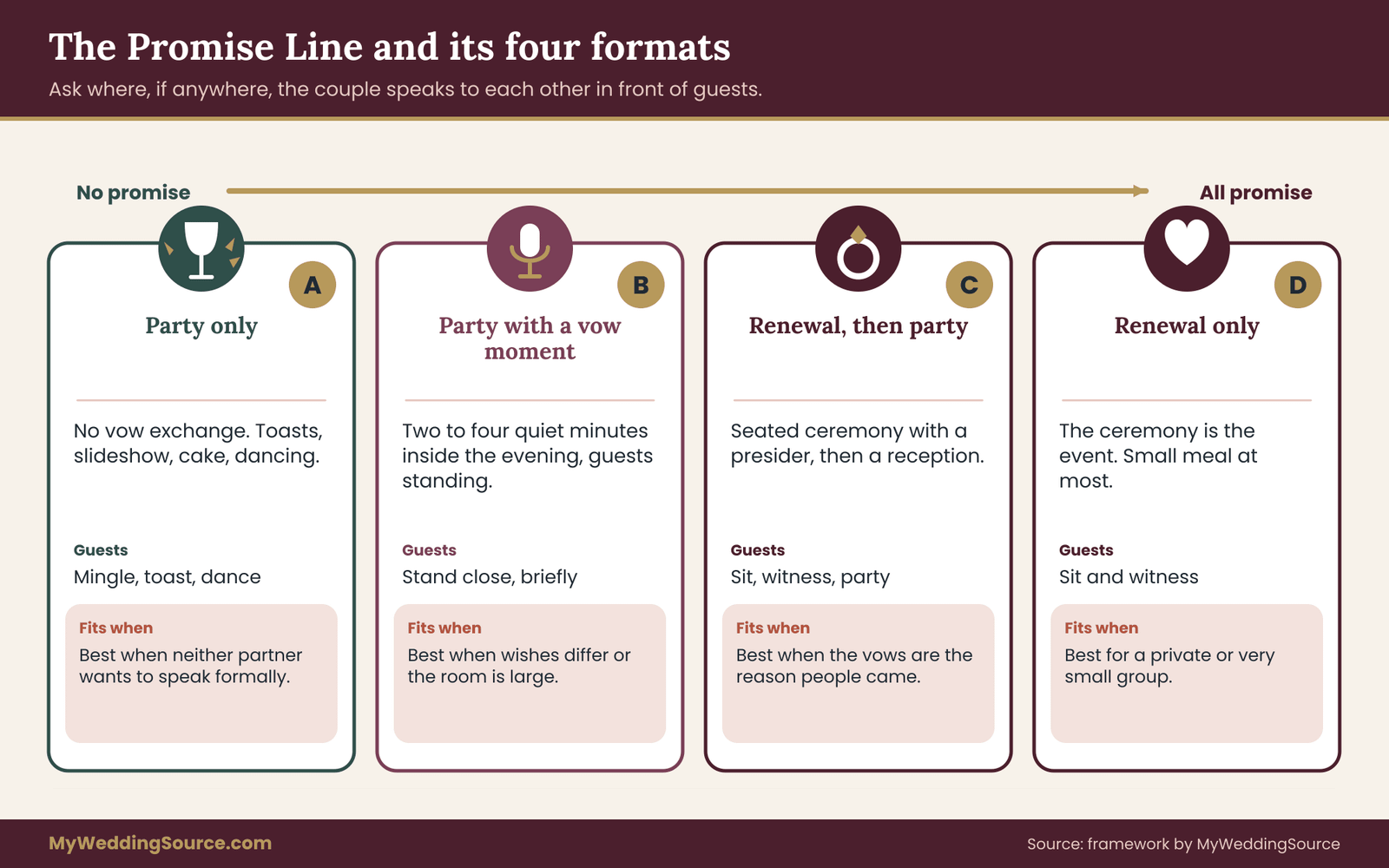
That line gives you four formats instead of two. Most couples assume they must pick one of the extremes. In practice the middle two formats are the most popular reason to ask the question at all.
Format A: anniversary party with no promise line. There is no vow exchange. Toasts, a slideshow, a cake and dancing carry the evening. The couple receives thanks and does not ask anything of the room.
Format B: anniversary party with a short vow moment. The evening is an anniversary party, but at one point the couple speaks briefly to each other, usually for a few minutes, with an easy cue (“we would like to say a few words to each other”). Guests stay standing, drinks in hand, and nobody has to change clothes or mindset.
Format C: vow renewal ceremony followed by an anniversary party. There is a defined ceremony with seating, a presider, a planned exchange and a symbolic act, then a reception. The reception may be the same size as an anniversary party, but the ceremony is the reason people came.
Format D: vow renewal only. The ceremony is the event, perhaps with a small meal afterward. This format suits private or very small groups.
How to place yourself on the line
Ask both partners the same four questions, separately and in writing, before you compare answers. Writing first matters, because the partner who talks first tends to set the answers for the other.
- In one sentence, what do you want to say to your spouse that you have not said in a long time?
- Do you want to say it in front of other people, or only to each other?
- If other people are present, do you want them to respond (applaud, say a blessing, answer a question) or only listen?
- How much of the evening are you comfortable spending in a quiet, structured moment?
If both answers to the second question are “only to each other,” Format A or a private vow exchange plus an anniversary party is probably right. If both want to speak in front of people and want a responsive room, Format C is the honest fit. If one partner wants to speak aloud and the other prefers a quieter moment, Format B often resolves the gap, because the vow moment can be short, optional in tone and easy to keep light.
The mismatch case
Sometimes the two partners land on opposite ends. One wants a full ceremony; the other wants an anniversary party and dreads being on stage. Do not average the answers by splitting the difference at random. Instead, look at what each person is actually protecting. The partner who wants a ceremony is usually protecting meaning. The partner who wants an anniversary party is usually protecting comfort. A short vow moment protects both if you keep it brief, let the shyer partner choose the words, and agree in advance that nobody will be asked to improvise.
The later section on failure conditions returns to this, because a mismatch left unspoken tends to show up on the day, in front of guests.
What changes in the ceremony when you choose a vow renewal
Once you know a ceremony is part of the evening, the question becomes how it differs from the ceremony at a first wedding and from the “moment” an anniversary party might hold. The short answer is that a renewal removes the legal machinery and keeps the human parts, and an anniversary party removes the formal structure and keeps only whatever the couple wants to say.
What a renewal drops
A first wedding contains several elements that exist only because a marriage is being created. A renewal does not need them. There is no license to obtain and no declaration that the couple is now married. There is no legal pronouncement, and the signing of a marriage document is not part of the event. Because the marriage already exists, nobody needs to be asked whether anyone objects. The traditional “who gives this person” question is usually skipped too, since there is nobody to be given.
Dropping these parts shortens the ceremony and removes much of the stiffness. It also removes the safety net some couples rely on without noticing: the legal script supplies a clear beginning and ending. When a renewal drops it, the couple has to write or choose a replacement structure, or the ceremony can feel like it floats.
For the question of who is allowed to lead a legal wedding, the guide to officiant requirements explains the rules that apply to first weddings. Those rules do not generally apply to a renewal, because nothing legal is being performed, but a venue, a religious community or a particular officiant may still have their own expectations. Ask early.
What a renewal keeps
Four parts translate well from a wedding to a renewal and give the ceremony its shape.
An opening that says why people are here. A sentence or two from the presider, or from the couple, that names the occasion. For a renewal this is where the history lives: how long the marriage has lasted, what the couple has been through, and why they wanted to do this now. Keep it short. The couple’s history belongs to them, and the opening only needs enough to orient guests.
The exchange. The vows themselves. Many renewals use new, personal words rather than the original ones, and many couples find that reading what they said years ago, then adding a present-tense promise, works better than trying to start from scratch. A simple structure works well: one paragraph about what has been true, one about what is true now, and a short promise about what comes next.
A symbolic act. Rings are the obvious one, and some couples exchange new rings, add a band to an existing ring or simply touch the rings they already wear. Others light a candle, plant a tree, pour two glasses into one, or sign a keepsake page. The act gives the guests something to see during a ceremony that is otherwise made of words.
A close. A brief statement that the ceremony is over and people may greet the couple. Without it, guests do not know when to move. A single sentence from the presider works.
How a renewal ceremony usually runs
Most renewal ceremonies fit a five-part shape: welcome, story, exchange, symbol, close. The length depends on the format, but the order is steady. A small private renewal might take five minutes in total. A ceremony in front of a large group more often runs somewhere between ten and twenty minutes, though no rule fixes it. Treat those ranges as planning guidance, not a standard.
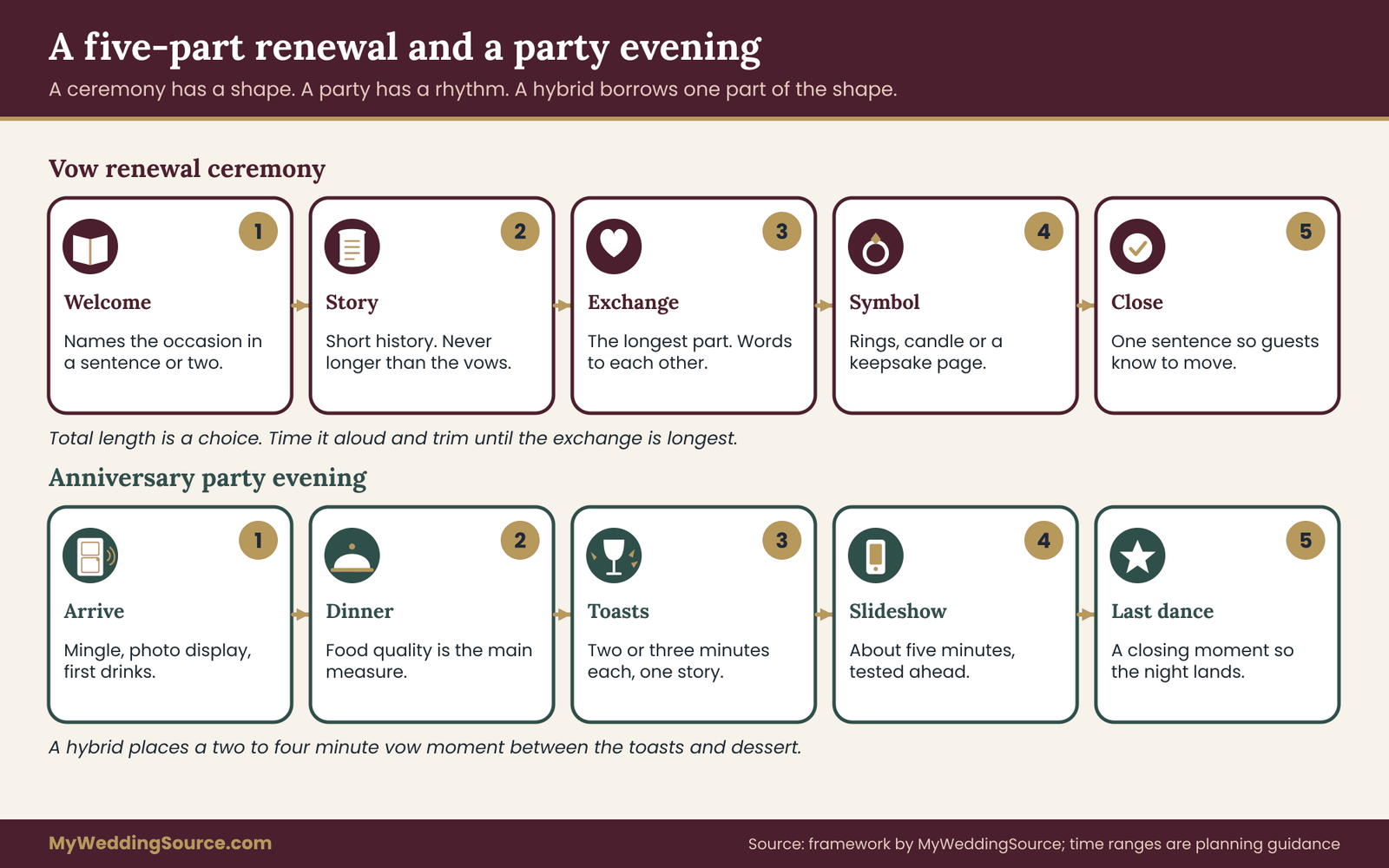
The proportions matter more than the total. If the story part runs longer than the exchange, the ceremony turns into a talk about the couple instead of a promise between them. If the symbol part has several steps, it can crowd the vows. A useful rule is that the exchange should be the longest single part of a ceremony and that no part should be several times longer than another.
Who presides
At a wedding, the person who presides is usually an officiant with a particular legal role. At a renewal, the presider can be anyone the couple trusts to hold a quiet room: a friend, an adult child, a sibling, a religious leader, a professional officiant or a celebrant. What matters is a clear voice, a calm manner and a willingness to follow a script, because renewals invite improvisation, and improvisation is how a ceremony runs long.
If you hire a professional, say plainly that this is a renewal and that you do not need legal language. Some officiants offer renewal packages; others treat it as a custom service. Ask what the fee covers, whether they write or edit the script, and whether they attend a rehearsal. For a ceremony with several moving parts, a cue sheet helps. The ceremony cue sheet guide shows how to write one that the presider, the music person and any readers can all follow.
What the anniversary party’s “ceremony” looks like
An anniversary party has no ceremony in this sense, but it often has a small ritual in the middle: a toast, a cake cutting, a slideshow, a first dance revisited. These moments are cheerful, usually under ten minutes in total, and they run on the emcee’s schedule rather than a script.
The distinction is important because an anniversary party moment does not require quiet. People can keep their drinks, keep talking at the edges and drift in and out. A ceremony asks for the whole room. If you want the whole room to stop, you are planning a ceremony, even if it is two minutes long.
The vow moment inside a party
Format B, the party with a short vow moment, deserves its own treatment, because it is the format that requires the most care in cueing. The risk is a half-ceremony that is neither quiet enough to hear nor casual enough to be comfortable.
To avoid that, use three cues. First, announce it: “In a few minutes we would like to say a few words to each other, and we would love it if you would gather in close.” Second, set the room: lower the music, ask the bar to pause for a few minutes, and put the couple where everyone can see and hear them. Third, end it clearly with a sentence that lets the party restart: “That is all we wanted to say. Please go back to your drinks and your dessert.”
The couple should hold a microphone or stand close to the sound system if the room is large. A vow spoken quietly in a loud room is wasted, and few things are as awkward as a couple saying something tender while guests at the back ask each other what is happening.
Music and processional
A renewal rarely needs a processional. Some couples walk in together, some stand at the front as guests arrive, and some skip the formality entirely. If you do walk in, choose something short. A long processional makes a short ceremony feel like a procession with a ceremony tacked on.
An anniversary party can use music differently: as a guide through the evening rather than as a cue for a single moment. Songs from the couple’s wedding year, a playlist built from the guests’ favorites, a first dance repeated with a slower arrangement. Whatever the format, play the vow moment without background music unless you have a musician who can stay soft under speech.
A caution about copying a wedding script
Couples often take a first-wedding script and strike out the parts that no longer apply. That can work, but it tends to produce a ceremony that sounds like a wedding with missing pieces. A better approach is to build from the five parts above and borrow only what suits you. A renewal is allowed to feel different from a wedding. Its authority comes from the couple’s history, not from the formal language of a first ceremony.
A vow is not a toast
The easiest mistake at an anniversary party is to treat a vow moment as a longer toast. They are different kinds of speech. A toast is spoken to the room about the couple, and it ends with glasses raised. A vow is spoken to one person, with the room listening in. The grammar changes: a toast says “they,” a vow says “you.”
That small shift matters for staging. A toast can be given by anyone, from any spot in the room, over a noisy bar. A vow needs the couple facing each other, close enough to hear their own voices, with the room quiet enough to hear them too. If you put a vow into the middle of a toast sequence, the room will respond to it like a toast, with laughter and clinking, and the promise will vanish in the noise.
So give the vow its own cue and its own pause, even inside an anniversary party. Announce it, quiet the room, let the couple speak, and let the silence after the last word last a beat before anyone moves. The beat tells guests that something different just happened. Then the emcee can lift the room back into the party with a toast, which is the proper place for glasses.
How much time each moment deserves
Rough proportions help you test a program on paper. In an anniversary party that includes a vow moment, the vow itself might take two to four minutes, and each toast two or three. The slideshow, if there is one, takes about five. Dinner and dancing fill the rest. If the vow moment ends up the same length as the slideshow, the party has turned into a ceremony with food. If the toasts together run longer than the whole meal service, the party has turned into a speech event.
Reading the program aloud with a stopwatch is the cheapest rehearsal there is. Most couples are surprised by two things: how short a good vow moment is, and how long five toasts actually take.
Invitation language that tells guests which event they are attending
The invitation is where the difference between a vow renewal and an anniversary party becomes real for your guests. Guests cannot read your mind, and they will fill any gap with assumptions drawn from weddings, retirement parties and birthday dinners. A few well-chosen words close the gap. The wedding invitation etiquette guide covers the general conventions for wording, timing and addressing, and this section adds what is specific to these two events.
Verbs do most of the work
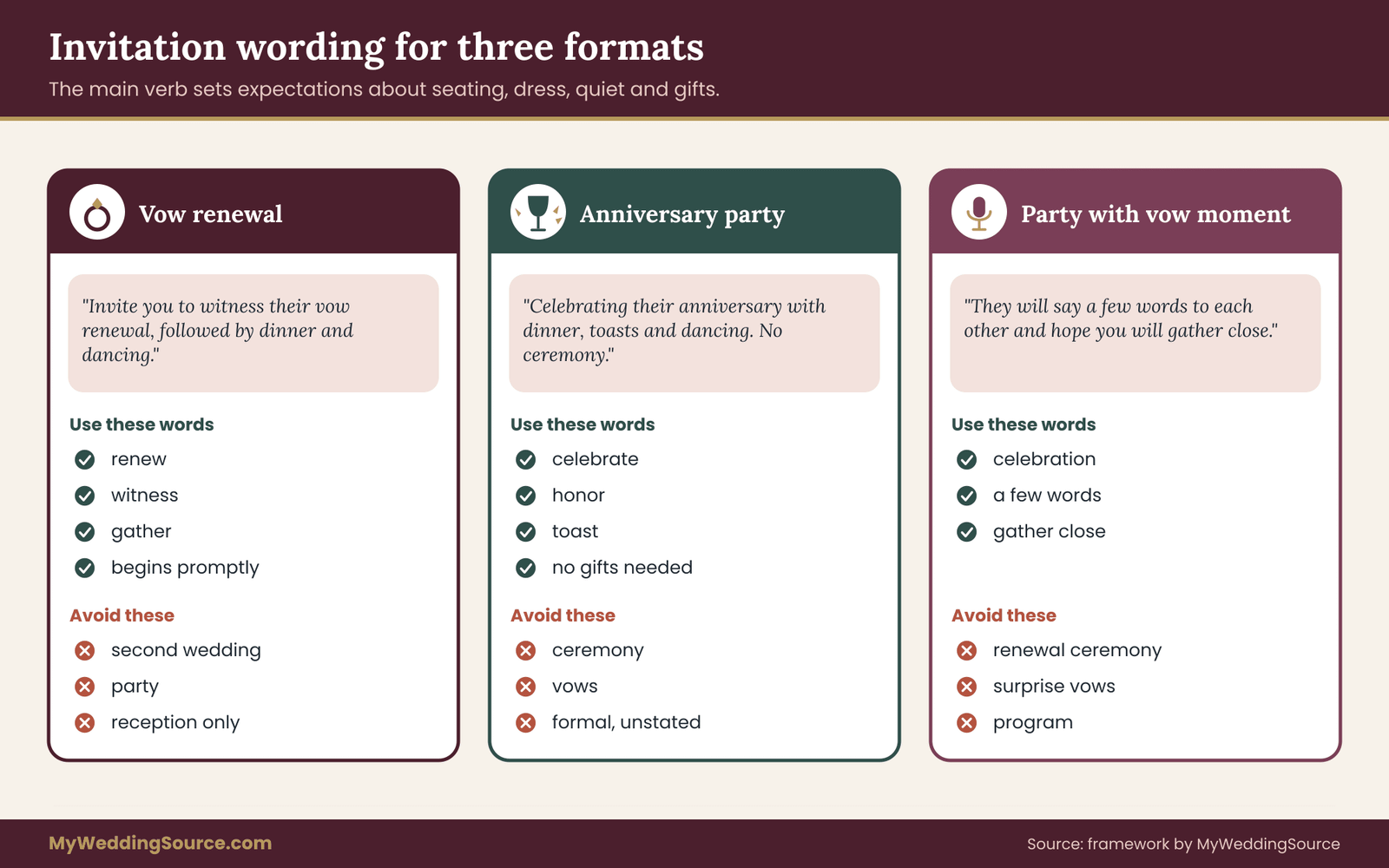
The main verb in the invitation tells guests what the evening is. “Renew” signals a ceremony. “Celebrate” signals an anniversary party. “Join us as we” is neutral and can lead to either, so the verb after it matters.
For a vow renewal, strong verbs include renew, recommit, reaffirm, witness and gather. For an anniversary party, strong verbs include celebrate, honor, toast and mark. Be careful with the word “ceremony” on an anniversary party invitation and the word “party” on a ceremony invitation. Each word carries expectations about seating, dress, quiet and length.
Here are three sample lines, written in plain language and meant to be adapted, not copied word for word. They use invented names and no dates.
Maya and Daniel invite you to witness their vow renewal, followed by dinner and dancing. The ceremony begins promptly at the time below. Please be seated a few minutes early.
Maya and Daniel are celebrating their anniversary and would love to have you at the party. Come for dinner, toasts and dancing. There is no ceremony, and no gifts are needed.
Maya and Daniel invite you to an anniversary celebration with dinner and dancing. During the evening they will say a few words to each other, and they hope you will gather close when they do.
The first is Format C, the second is Format A, and the third is Format B. Read them aloud to a friend and ask what they expect to happen. If the friend’s description matches what you planned, the wording works.
Four details guests need
Whatever the format, four details prevent most of the confusion that follows an invitation.
Start time and ceremony time. If there is a ceremony, say when it begins and ask guests to arrive early. A renewal that starts late because guests treated it like an anniversary party is a common frustration. Include a line such as “The ceremony begins promptly at the time above” if punctuality matters to you.
What happens first. Tell guests whether they will be seated, standing or at a reception from the start. People dress differently for a seated ceremony in a garden than for a standing party in a restaurant.
Attire. Name the level of dress in words rather than assuming: “dressy casual,” “cocktail attire,” “suits and dresses.” Renewals often tilt more formal because of the ceremony, and some couples wear their original wedding clothes or a variation. Say so only if it affects guests. Do not ask guests to match a color scheme unless you want to.
Gifts. This is the one most couples forget. Guests who attend a vow renewal often assume it works like a wedding and wonder whether to bring a gift. Guests at an anniversary party may wonder the same thing. Decide your position and say it kindly. “Your presence is the gift” is common and clear. Some couples ask for donations to a cause, a memory card, or a note instead of gifts. If you would welcome gifts, mention a registry or a simple preference. Saying nothing leaves guests to guess, and guessing is uncomfortable.
Words that cause trouble
A few phrases create confusion more often than others.
“Wedding” on an invitation for a renewal can make guests think a new marriage is happening, or raise questions about whether the first one ended. If your event is a renewal, avoid describing it as a “second wedding.” Use “vow renewal” or “renewal of vows.”
“Reception” suggests a meal and dancing after a ceremony. If there is no ceremony, call the event an anniversary party or a dinner. If there is, “reception” is fine, though “dinner and dancing” is plainer.
“Formal” can mean anything from black tie to a dress shirt. Specify.
“Adults only” on an anniversary party invitation can read as unfriendly if grandchildren are part of the couple’s family. Be clear, give reasons if it helps, and consider how much of the evening needs to be child-free. A short vow moment, for example, is easy for children to sit through. A three-hour formal dinner is harder.
Who sends the invitation
At a first wedding, the couple or their parents send the invitation. At these events, the sender sets the tone. A couple sending their own invitation signals a personal event. Adult children sending it on their parents’ behalf signals a party planned in honor of the couple, which is a common and warm pattern for milestone anniversaries. The invitation should make clear who is hosting. “Hosted by their children” tells guests that the couple is the guest of honor, and that matters because the guest of honor does not usually pay or receive gift requests.
If children are hosting a surprise, the invitation should include a line asking guests to keep the secret and to arrive before the couple. Surprises complicate renewals more than parties, because a ceremony needs the couple’s consent and preparation. For an anniversary party, a surprise is simpler: the couple arrives, and the room says hello.
The RSVP and the follow-up
An RSVP serves two purposes at these events. It gives you a headcount for food and seating, and it gives you a chance to ask about accessibility needs, dietary needs and whether a guest will take a role. For a vow renewal, add a line that invites guests to tell you if they need a seat near an aisle, a place to rest or a quiet room. Guests with mobility needs appreciate not having to ask in person on the day.
A short confirmation message a week or two before the event restates the time, place, dress, and whether children are welcome. Include parking and arrival information. If there is a ceremony, repeat the start time. If there is a vow moment inside an anniversary party, add one sentence so nobody is startled.
Testing the wording
Before printing or sending, test your wording with two people: one who knows the couple well and one who does not. Ask each, “What do you think the evening will be like? What would you wear? Would you bring a gift?” If their answers differ from your plan, change the invitation, not the guest. This ten-minute test is cheap, and it catches the confusion that the couple is too close to see.
Digital or printed
Printed invitations feel more formal and suit a ceremony. Digital invitations are fine for either event and make updates easier. Whichever you choose, the wording rules above apply equally. If you also build a website or a shared page, repeat the same information so no guest has to reconcile two versions.
One more distinction is worth noting. A renewal invitation often benefits from a sentence of context, since guests may not know whether the occasion marks a milestone or something more private. An anniversary party invitation usually needs less context: the number of years or the milestone is explanation enough. Neither needs a long story. The couple’s reasons are theirs to share in person.
What an anniversary party keeps, and what it drops
If the Promise Line test points you toward an anniversary party, you have more freedom than you might expect. An anniversary party has no required parts. That freedom is the main attraction, and it is also the main trap, because an anniversary party with no structure can drift. This section describes what a good anniversary party keeps and what it can safely leave out.
What an anniversary party keeps
Five elements give an anniversary party its shape, even if the couple never names them.
A reason to gather. The date or milestone is the reason, and the invitation says so. This is what makes the evening an anniversary party and not a dinner with friends.
Hospitality. Food, drink and a place to sit. For an anniversary party the quality of the hospitality is the main measure of success. Guests remember whether they were fed well, whether they could hear each other and whether the host made them feel welcome.
A few words about the couple. Toasts are the usual form. A good toast is short, specific and kind. It tells one story, not a biography. Three or four toasts is plenty for most gatherings. More than that and the evening turns into a speech contest.
Something to look at. A photo display, a slideshow, a table with objects from the couple’s life, a timeline on a wall. This gives guests something to talk about, which makes the early part of the evening easier.
A moment that closes the evening. A cake, a last dance, a group photo. Without it, the party fades. With it, guests know the main event has happened and can leave when they want.
What a party can drop
Almost everything else is optional. There is no need for a processional, a presider, a program or a seating chart, unless the venue or the guest count calls for one. There is no need for a symbol, a reading or a script. The couple does not have to prepare words, rehearse or be on stage.
That is why Format A suits couples who are uncomfortable being the center of a ceremony. It lets them be honored without performing. A couple who dislikes public speaking can make a short welcome, thank the guests and let others do the talking.
The first dance question
Couples often ask whether to repeat their first dance at an anniversary party. It is a lovely idea when both partners want to, and an unnecessary ordeal when only one does. If you do it, keep it short, choose a song that fits the energy of the room and invite others to join partway through. A first dance that goes on for four minutes in front of seated guests can feel like a performance. A first dance that opens the dance floor feels like a gift.
Toasts: how to keep them good
Toasts are the closest thing an anniversary party has to a ceremony, and they need some management. A good way to do that is to ask each speaker, in advance, for one story and a time limit. A limit of about two or three minutes per speaker keeps the evening moving without cutting anyone short. Tell speakers whether the microphone will be passed or fixed, and where to stand.
Choose speakers who represent different parts of the couple’s life: a child, a sibling, a longtime friend, a colleague. Avoid a lineup of people who all tell the same kind of story. The couple should not be asked to give a long speech unless they want to. A short thank-you, perhaps one minute, is enough.
If the party includes a vow moment, schedule it before the dinner is over but after the toasts begin to build warmth. The moment works best when the room already feels affectionate and has not yet been drained by a long evening.
The slideshow trap
A slideshow is a favorite feature of anniversary parties and a frequent source of stalled evenings. A few rules help. Keep it under about five minutes. Use photos from across the decades, not just from the early years. Choose music that carries the story and does not demand attention. Test the equipment and the file format before the day, with the same laptop and cable you will use at the party. A slideshow that fails to load stops the evening, and a couple should not have to troubleshoot one at their own party.
Who the party is really for
At a vow renewal, the center is the couple’s promise. At an anniversary party, the center is often the room: the family, the friends, the people who watched the marriage grow. This shapes who you invite. A renewal may suit a small circle of witnesses. An anniversary party can be bigger, and it can include people the couple has known for decades even if they are not close now.
When the guest list is large, the principles in the wedding etiquette guide help with the usual questions: whom to invite, how to handle plus-ones, how to manage family tensions. Those questions look the same at a milestone anniversary party as they do at a first wedding, and the rules of thumb carry over.
Hosting roles
If the couple hosts their own party, they are both host and guest of honor, and that is hard to sustain for an entire evening. Designate a person to handle logistics: greeting vendors, answering venue questions, finding a lost jacket. Hand that person a one-page sheet with times, phone numbers and a short list of “if this happens, do this” notes. The couple should spend the party talking to guests.
If adult children or friends host, the couple’s job is simple: arrive, enjoy, say thank you. The hosts should confirm the couple’s preferences on speeches, photos and dancing before they plan, because a surprise that includes a forced speech can turn tender intentions into discomfort.
Milestone parties and tradition
Some milestone anniversaries carry traditional gift themes, and guests may bring a gift that matches. These conventions vary, and not every guest knows them. If the couple does not want gifts, the invitation should say so. If the couple welcomes gifts, they can name a theme, a charity or a simple preference. Either way, a clear line spares guests from guessing.
A milestone anniversary party often includes a display of the wedding photographs, the original invitation, a piece of the wedding cake preserved in some families, or an item with sentimental value. These are lovely, and they connect the party to the original marriage without requiring a vow exchange.
When a party is the better choice
An anniversary party is usually the better choice when the couple wants to be celebrated by a large group, when neither partner wants to speak formally, when the guest list includes many people who would find a ceremony awkward, or when the couple wants the freedom to change the program on the day. It is also the better choice when the couple has recently been through a hard season and wants warmth without emotional performance, since a ceremony can raise feelings that an anniversary party does not.
A party is less suitable when one or both partners have something they want to say and are holding it back, because the unsaid promise tends to surface in a toast that was never meant to carry it. If that is true, consider Format B, where a short vow moment gives the promise a place to live without turning the evening into a ceremony.
Venue, vendor and budget differences between a renewal and an anniversary party
The two events cost different things for different reasons. The difference is not mainly about price. It comes from what each vendor is asked to deliver, and from how a vendor classifies the event in its own system. A vow renewal needs a ceremony space and a sound plan. An anniversary party needs a flow plan and a food plan. A hybrid needs both, in a smaller version.
The word on the quote matters
Some venues and vendors price by event type. A listing for “wedding” may carry different rules, minimums or fees from one for “private party” or “milestone celebration.” A vow renewal can fall into either category depending on the vendor, and the label may change the cost, the contract language or the hours allowed. Ask each vendor one question in plain words: “How do you classify a vow renewal, and what does that change on the quote?”
Do not assume the answer. One venue may treat a renewal as a wedding and apply its wedding terms. Another may treat it as a private party and apply its standard rental terms. A third may offer a separate renewal rate. None of these is wrong, but the difference changes your budget, so get the answer in writing. Also ask about deposits, cancellation and what happens if the date changes, and get those answers in the same written quote.
What a ceremony needs that a party does not
A ceremony needs a few things that an anniversary party can skip.
Seating that faces a focal point. Chairs in rows, or a semicircle, with a clear view of the couple. A party might use round tables or standing space instead. If the venue must flip the room between ceremony and party, that takes staff time, and the venue may charge for it.
Sound that carries speech. A vow spoken in a normal voice is lost in a room of more than a few dozen people. A small wireless microphone or a lectern microphone fixes this. Ask whether the venue supplies one and whether it is included in the rental. Test it in the room, at the distance of the last row, before the day.
A quiet start. A ceremony wants the room still for a few minutes before it begins. If the room is next to a bar, a kitchen or a loud outdoor area, plan a way to reduce the noise: close a door, move the bar, or schedule the ceremony before food service starts.
A place for the couple to stand. It sounds obvious, but a spot that looks fine empty can look cramped with two people, a presider and flowers. Walk through it with the presider.
What a party needs that a ceremony does not
A party needs flow. People have to find food, a drink, a seat, a restroom and a way to the dance floor without queuing. A guest count that works for a seated ceremony may not work for a standing party in the same room, and the reverse is true. Check the venue’s capacity numbers for both setups, and ask which one governs the fire code. If you are unsure how capacity and seating interact, the same logic that applies to weddings applies here: the stricter number wins.
A party also needs a food plan that matches the length of the event. A two-hour cocktail party and a four-hour dinner are different undertakings. The catering needs, the number of servers and the bar service all scale with duration. The CDC’s general food safety guidance says perishable food should not sit out for more than two hours, or one hour in hot weather. That affects how a buffet or a dessert table is scheduled, especially outdoors.
Budget logic without invented numbers
You do not need to guess prices to build a sound budget. Use a three-part structure.

Fixed costs. These do not change with the guest count: venue rental, sound equipment, a presider’s fee, a photographer’s minimum, flowers for a focal point. A vow renewal has more of these than a party, because a ceremony brings in a presider and sound. A party has fewer.
Per-guest costs. Food, drink, rentals per seat, favors, printed programs. These rise and fall with headcount. A large anniversary party is mostly per-guest cost. A small renewal is mostly fixed cost.
A reserve. Set aside a portion for the unexpected: a vendor who needs an extra hour, a rental that costs more than quoted, weather. Many planners hold back a share of the total; pick a figure that suits your comfort and keep it separate. The wedding budget guide explains how to structure categories and track what you spend, and the same method works at any size.
Then work backward. Subtract fixed costs and the reserve from your ceiling, divide what is left by the per-guest cost, and the answer is the largest guest count you can afford. If that number is smaller than your guest list, you have three choices: raise the ceiling, cut the per-guest cost, or shorten the guest list. A renewal followed by an anniversary party often exposes this trade-off sooner than a party alone, because a ceremony adds fixed costs on top.
Who pays
At a first wedding, who pays is a family conversation with long-standing customs. At a renewal or anniversary party, the options are open and less scripted. The couple may pay. Adult children may split the cost. A group of friends may contribute. A few common arrangements exist, and each one affects who has a say.
If the couple pays, they decide. If children host, the children usually propose and the couple approves. If costs are shared, write down who is paying for what before any deposit is made, because ambiguity about money turns small disagreements into large ones. A short written note, even an email, is enough: who pays which vendor, by when, and what happens if the date moves.
Deposits, contracts and the dispute window
Treat deposits and contracts at these events the same way you would at a wedding. Ask for a written agreement. Check the cancellation terms. Keep proof of every payment. If you pay by credit card and a charge is wrong, the Consumer Financial Protection Bureau explains that billing errors generally have to be reported in writing within a set number of days of the statement that shows them. Check the current rule on its site, and keep the dates in your calendar.
The Federal Trade Commission publishes consumer advice on spotting scams and fake sellers. For a small event it is tempting to book quickly with an unfamiliar vendor, particularly one who offers a low price and asks for payment by an unusual method. Slow down, check reviews from independent sources, and use a payment method that offers dispute rights.
Music, public spaces and permits
If the event is in a public space such as a park, a permit may be required for gatherings above a certain size, for amplified sound or for setting up chairs and tents. The National Park Service and local parks departments publish their own rules; check with the managing agency for your location. Do not assume a free public space needs no permission.
If you hire a DJ or a band, the venue or the performer usually holds the licenses that cover public performance of music. Performing-rights organizations such as ASCAP and BMI explain how licensing works. You rarely need to handle it yourself, but it is reasonable to ask a venue whether its licenses cover live or recorded music at private events.
Accessibility
Think about access for guests who use wheelchairs, walkers or hearing aids, and for older relatives who tire easily. The Americans with Disabilities Act sets requirements for many public venues, and the ADA website explains the basics. For a ceremony, check for a level path to the seating, a place to sit near the front for people with limited hearing, and a quiet space to rest. For an anniversary party, check the same plus the restroom route and the table layout.
Accessibility questions matter more at these events than at many first weddings, since many guests will be older. A good rule of thumb is to ask guests on the RSVP, then confirm with the venue in writing.
Vendors to book, and in what order
Book in the order that constrains the rest. The venue and the date come first. The presider or officiant comes next if you are holding a ceremony, because their availability narrows the time. Then caterer, sound, photographer and any musicians. Flowers, cake and printed items come last, since they depend on the headcount and the layout.
For a smaller event, one person can fill several roles. A friend might read the vows’ opening, a family member might handle sound, and a photographer might also record the vows. This reduces cost but increases the number of dependencies, so a written run-of-show matters more, not less.
What a hybrid costs compared with either extreme
A hybrid anniversary party with a short vow moment adds only a few line items to a plain party: one microphone, a moment of staff attention and perhaps a small clear space. It does not add a presider, ceremony chairs or a room flip. That is why many couples find the hybrid the least expensive way to include a promise in the evening.
A full vow renewal followed by a reception adds the ceremony line items on top of the party line items. If the budget is tight, ask which ceremony items can be borrowed or shared. A friend can preside, the venue’s microphone can serve both ceremony and toasts, and the same flowers can sit at a focal point and later on the dinner table. Sharing items between the ceremony and the party keeps the fixed costs of a renewal closer to those of an anniversary party, without reducing the meaning of the vows.
Ask every vendor to quote the event as you actually plan it, in one version, and then ask what changes if you add or remove the ceremony. Getting two quotes from the same vendor on the same day shows you the true cost of the ceremony more clearly than any rule of thumb.
Legal, faith and records questions to settle first
Two questions come up in almost every conversation about these events, and they are easier to answer early than late: does a renewal change anything legally, and what do the couple’s faith traditions expect?
The legal position
A vow renewal does not replace or change the legal marriage. The couple is already married, and the marriage certificate from the original ceremony remains the record. A renewal does not create a new certificate, and nobody needs to sign a marriage license. In most places no new license is needed, but rules about ceremonies and venues vary, so confirm with the venue and, if you are using one, the officiant.
If you need a copy of your original marriage certificate, for example to display it, to replace a lost copy or to carry out a name update, USAGov explains how to request one. The request goes to the vital records office in the state or area where the license was issued, and fees and processing times vary. Do this before the event if you want the certificate on a display table, since requests can take time.
An anniversary party raises no legal questions at all, other than the ordinary ones about alcohol service, venue rules and permits. If alcohol is served, check that the venue or caterer holds the right license and understand who is responsible for service. That is a venue question, not a marriage question.
One caution: never let the ceremony language imply that a new marriage is being created if you are also planning something legal. For instance, if the couple were married in another country in a ceremony that has not been legally recorded in the United States, a renewal can look similar to a legal wedding without being one. In that case the couple should speak with the issuing office about what the next step is, and treat the event as a separate matter.
Faith customs
Many faith traditions have their own forms for renewing or blessing a marriage. Some offer a formal renewal rite. Some prefer a blessing within a regular service. Some do not mark anniversaries at all, and a couple who wants a ceremony in a place of worship should ask the clergy what is possible, what the building’s rules are and whether an outside presider may take part.
If the couple’s families come from different traditions, the ceremony may need extra care. The guide to planning an interfaith ceremony explains how to assign ownership of each ritual so no tradition is blended by accident or left out by oversight. The same approach works for a renewal: decide which parts are shared, which belong to one tradition, and who speaks for each.
An anniversary party is often the easier choice when families have different expectations, since it does not require a shared ritual. A toast and a meal can include every guest, whatever their faith. If dietary practices matter, confirm them with the caterer and label the food.
Records and keepsakes
Many couples want to keep something from the day. A renewal creates a few keepable items: the vows, a recording, a signed keepsake page, new or reaffirmed rings. An anniversary party creates photographs, a guest book and possibly a video. A few practical choices help.
Decide in advance who records the vows, and whether the recording is for the couple only or can be shared. Ask guests before posting photos of them. Keep one copy of the written vows somewhere safe. A handwritten page in a frame is lovely, but a digital copy in two places protects the words if the frame is lost.
If you want a keepsake that other guests sign, choose a medium that survives handling: a mat with a photo, a wooden board, a bound book. Guests will sign if the pen works and the instructions are simple.
A worked case: an anniversary party with a vow moment
The following case is invented to show how the Promise Line, the four formats and the invitation tests fit together. It is not a real couple and it is not a prediction. Use it as a model for the steps, not as a template for the answers.
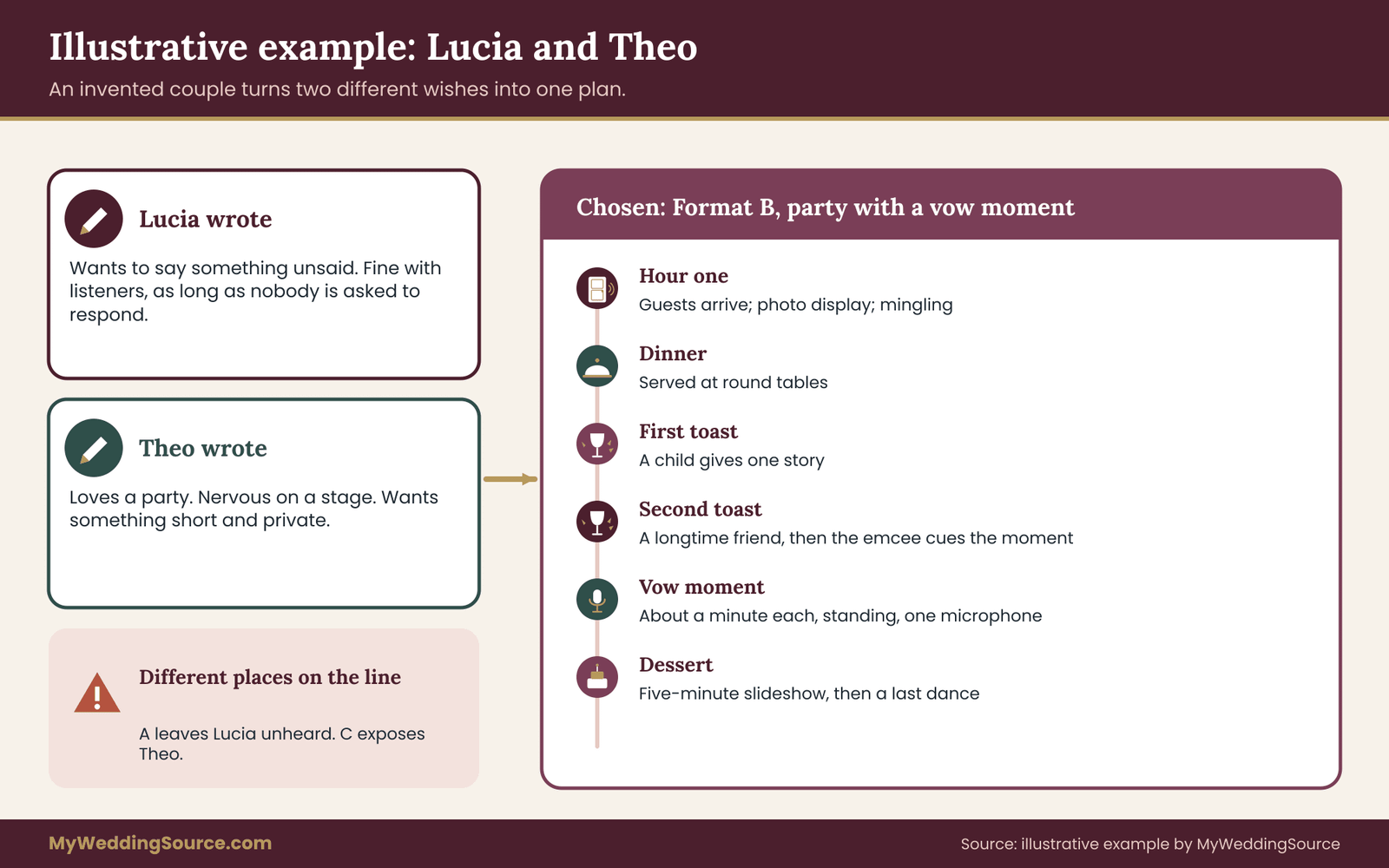
The couple. Lucia and Theo have been married for a long time. Their children are adults. They want to mark the anniversary this autumn with family and close friends, about sixty people in total.
What each partner wrote. Both answered the four Promise Line questions in writing before they compared notes.
Lucia wrote that she wanted to say something to Theo that she had never managed to put into words, and that she did not mind other people hearing it as long as they were not asked to do anything. Theo wrote that he loved the idea of an anniversary party and that he would be nervous standing in front of a seated crowd. He wanted to say something short and private, and he did not want a ceremony.
Placing them on the line
Their answers put them in different places. Lucia leaned toward a witnessed promise. Theo leaned toward an anniversary party. The four formats made the gap visible without turning it into an argument.
Format A would have left Lucia’s wish unspoken. Format C would have put Theo in a position he dreaded. Format D was out because the couple wanted the family together. That left Format B, an anniversary party with a short vow moment.
Checking the five change points
They then checked the five change points, one by one, and wrote a decision for each.
Who speaks. Lucia and Theo each speak for about a minute. Each writes their own words and shares them with no one before the event. A child proposes the first toast, and a longtime friend gives the second.
Who leads. Their eldest child acts as emcee and introduces the vow moment. There is no presider, and nobody wears a robe or a stole.
What the invitation promises. It is an anniversary celebration with dinner. The invitation includes one sentence saying they will say a few words to each other and hope guests will gather close. It says no gifts are needed.
How the room is set up. Round tables for dinner. A small clear space near one wall for the vow moment, with the couple on a low platform or on the floor with a microphone. No chairs are added for the moment, since guests are expected to stand.
What guests do. They listen for about three or four minutes, then return to their seats and their dinner. They are asked to keep phones in their pockets for that stretch only. A friend records it for the couple.
The run of the evening
The couple and the emcee wrote a simple schedule and shared it only with the people who needed it: the caterer, the sound person, the photographer and the emcee.
Guests arrive and mingle for the first hour. Dinner is served. After the main course, the emcee invites the first toast. After the second toast, the emcee says that the couple would like to say a few words and asks guests to gather. Lucia goes first, then Theo. The emcee closes the moment with a sentence that releases the room. Dessert follows. A slideshow of about five minutes plays during dessert. A last dance ends the night.
Cost logic for the case
The couple has a single ceiling and a short list of fixed costs: a room rental, a sound setup with one microphone, and a photographer for a few hours. Per-guest costs are food, drink and rentals. A small reserve covers an extra hour of service. They do not need a presider, ceremony chairs or a flower focal point. Dropping those items offsets some of the cost of the microphone and platform.
If they had chosen Format C, the fixed costs would have included a presider, chairs and a room flip. If they had chosen Format A, they would have saved the sound setup and the platform. Format B sits between the two, and its main cost is attention rather than money: someone has to cue the moment well.
What went wrong in rehearsal
A good worked case includes something that does not go smoothly. In the walkthrough, the couple noticed that the vow space was next to the bar, and the bartender’s equipment was noisy. They moved the vow spot to the opposite wall and asked the bar to pause for those few minutes. They also found that the platform made Theo more self-conscious, so they removed it and used a floor spot with a microphone on a stand.
They also discovered that two older guests would need chairs near the front. They added six chairs at the edge of the space and said nothing in the invitation, since the RSVP question about seating already covered it.
What the case shows
The case shows the pattern that most couples follow when they use the test. First, each partner writes before talking. Second, the format is chosen from the combination of answers, not from the stronger voice. Third, the five change points turn a general preference into specific decisions. Fourth, a rehearsal in the actual space finds the small problems that no checklist predicts.
It also shows that the label on the invitation and the plan on the day must match. The couple used the word “celebration” and described the vow moment in one plain sentence, so guests arrived expecting an anniversary party with a short, tender interruption. That is exactly what they got.
Failure conditions and fixes for each format
Every format has a way of going wrong. Naming those failures before you book is cheaper than meeting them on the day. Here are seven that come up often, with the signal that warns you and a simple fix for each.
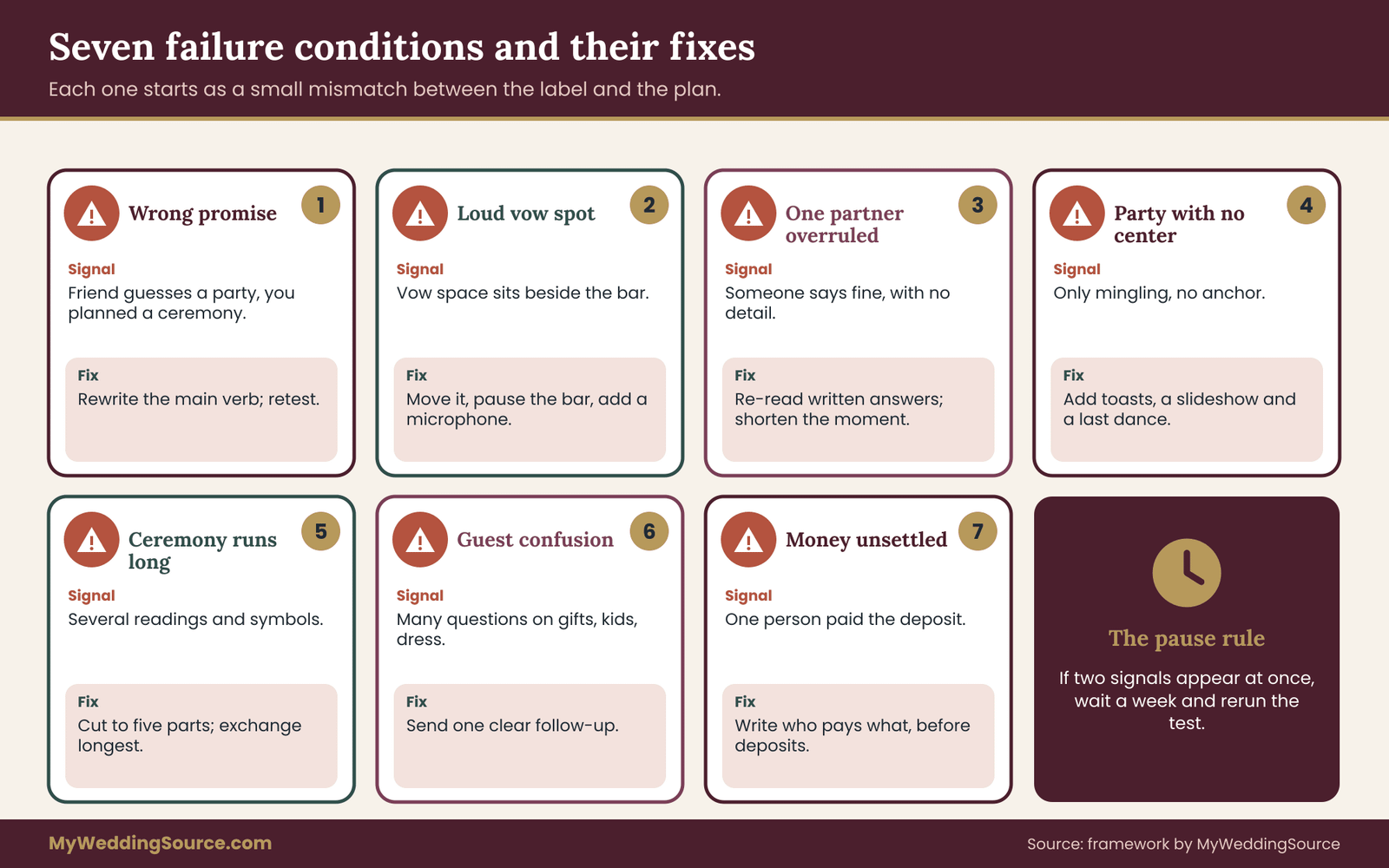
1. The invitation promises one event and the evening delivers another. The signal is a friend’s wrong guess in the wording test: they expect an anniversary party and describe a ceremony, or the reverse. The fix is to rewrite the main verb, add the sentence about what happens, and retest with a fresh reader. If the invitation has already gone out, send a short clarification message with the start time and dress.
2. The vow moment lands in a loud room. The signal is a venue where the vow spot is near a bar, a kitchen, a doorway or a speaker. The fix is to move the spot, pause the bar and music for a few minutes, and give the couple a microphone. Check the sound from the last row during the walkthrough, not from the front.
3. One partner is overruled. The signal is a partner who says “fine” without detail. The fix is to return to the written answers and ask what that person is protecting. If one partner dreads standing in front of a seated crowd, choose a standing vow moment, shorten it, or hold the exchange privately before the party and share a photograph or a sentence afterward.
4. The anniversary party has no center. The signal is a program of only mingling, with no toast, no slideshow and no closing moment. The fix is to add one small anchor: three short toasts, a five-minute slideshow and a final dance. A party with no anchor tends to fade early, and guests leave unsure whether the main event has happened.
5. A ceremony runs long. The signal is a script with several readings, a long story and more than one symbolic act. The fix is to cut to the five-part shape, time the full ceremony aloud and trim until the exchange is the longest part. A short ceremony that lands is better than a long one that tires the room.
6. Guests are confused about gifts, children or dress. The signal is a flood of individual questions after the invitation goes out. The fix is to answer them once, in a follow-up message to everyone, and to fold the answers into the invitation wording for any later batch. Repeated questions mean the first message left a gap.
7. The money conversation never happened. The signal is a venue deposit paid by one person without a note about who is paying for what. The fix is a short written agreement: who pays each vendor, the ceiling, and what happens if the date changes. Do it before the first deposit.
A pause rule
When two or more of these signals appear at once, pause. Nothing is lost by waiting a week to re-run the test and rewrite the invitation. Almost everything that goes wrong at these events starts as a small mismatch between the label and the plan. A short pause costs less than a corrected invitation or a changed venue.
Alternatives when neither format fits
Sometimes neither a vow renewal nor an anniversary party feels right. That is common, and it does not mean the couple has missed something. There are several smaller or different options.
A private vow exchange. The couple says their vows alone, or with only a photographer or a presider, and then holds a dinner or a gathering that does not mention the vows. This suits couples who want the promise without the audience. The dinner can be a plain anniversary party in the sense used in this guide, and the invitation does not need to explain what happened earlier in the day.
A vow exchange at a family dinner. A small group, perhaps ten or fewer, with the exchange as a short moment before dessert. This sits between Format B and Format D. It requires almost no equipment and a short script.
A trip. Many couples mark an anniversary with a journey and an exchange at a meaningful place, with or without guests. This is a vow renewal in practice, with a small cast. Check local permit rules for any public site, and confirm who can take photographs.
A year-long marking. Some couples spread the celebration across the year: one dinner with friends, one family lunch, a quiet moment on the day itself. This avoids the pressure of a single event and suits households with scattered relatives.
A written exchange. The couple writes letters to each other, reads them privately and keeps them. They may read a line or two aloud at a small party. This is the lowest-cost option and one of the most lasting.
A blessing at a service. If the couple belongs to a faith community, they may ask for a blessing during a regular gathering. Clergy can say what is possible. This keeps the focus on the marriage within an existing tradition.
When to choose none of them
Some couples decide, after the test, that they want no event at all. That is a legitimate result. The questions in this guide are meant to help you choose, not to push you toward an event. If the answer to the first Promise Line question is “I just want to tell my spouse this, privately,” the right action may be a letter and a quiet dinner. Nobody else needs to be involved.
Matching the choice to the season of life
The right format changes with circumstances. A couple in good health with a large family may enjoy a large anniversary party. A couple managing illness or mobility may prefer a small renewal at home, where rest is close by and nobody has to travel. A couple that has recently reconciled after a hard period may want a quiet exchange without a crowd, then a simple dinner. None of these is a lesser choice. Each fits a particular moment.
Your next steps
Work through these in order. Most take an evening or less.
- Each partner writes answers to the four Promise Line questions separately, then you compare them.
- Place yourselves on the line and choose Format A, B, C or D.
- Write one decision for each of the five change points: who speaks, who leads, what the invitation promises, how the room is set up and what guests do.
- Draft the invitation, using the verb that matches your format, and test it on two readers.
- Ask the venue and each vendor how they classify the event and what that changes on the quote. Get the answer in writing.
- If you plan a ceremony, read how the order of a first ceremony works in the guide to running a ceremony step by step, then keep only the parts you need.
- If you want a professional presider, ask early about their fee and availability, and review the questions in the officiant guide to see how a legal officiant differs from a celebrant.
- Walk through the space with the presider or emcee, test the microphone from the last row, and fix the noise and seating problems you find.
- Send a short confirmation message with time, dress, gifts, children and parking.
FAQ
Is a vow renewal the same as a second wedding?
No. A vow renewal is a ceremony for a couple who are already legally married, and it does not create a new marriage or a new certificate. A second wedding is a legal ceremony, often for a couple marrying after a divorce or the end of a prior marriage, and it needs a license. Keep the wording clear so guests do not assume a new marriage is taking place.
Do we need an officiant for a vow renewal?
Usually not in a legal sense, because nothing legal is being performed. Many couples ask a friend, a family member or a celebrant to preside, and some ask no one. A presider helps keep a ceremony calm and on time. If you plan the event in a place of worship, ask the clergy about their expectations.
Can an anniversary party include vows?
Yes. This is the format described as an anniversary party with a short vow moment. The couple speaks to each other for a few minutes, the room gathers in close, and then the party resumes. Announce it on the invitation in one plain sentence, set up the sound, and keep the moment short so nobody feels trapped in a ceremony.
What should the invitation say about gifts?
Say whatever is true and say it kindly. Many couples write that guests’ presence is the gift. Others name a charity or ask for a note or a memory. If gifts are welcome, mention a registry or a preference. Silence leaves guests guessing, and guessing causes more discomfort than any clear line, whichever way it points.
How long should a vow renewal ceremony be?
There is no rule. A private exchange can take a few minutes. A ceremony with guests commonly runs somewhere between ten and twenty minutes. Time it aloud before the event and cut until the exchange is the longest part. If the story section or the symbolic act runs longer than the vows, trim them first.
Who should pay for an anniversary party?
Any arrangement can work. The couple may pay, adult children may host, or the cost may be shared. What matters is deciding before the first deposit and writing it down: who pays which vendor, the ceiling, and what happens if the date moves. Hosts who pay should still confirm the couple’s wishes on speeches, photos and dancing.
Can we wear our original wedding clothes?
Yes, if they fit and you want to. Some couples wear the original outfit, a variation of it, or something new. A renewal often leans slightly more formal than a party because of the ceremony. Tell guests the level of dress in words on the invitation, and mention your own choice only if it affects what they wear.
What if one of us does not want a ceremony?
Start from what each partner is protecting. The partner who wants a ceremony often wants meaning, and the other often wants comfort. A short vow moment inside an anniversary party can serve both: brief, standing, no script to perform. Let the more reluctant partner choose the length and the words, and agree in advance that nobody will improvise.
Sources
- USAGov: How to get a copy of a marriage certificate
- USAGov: Official guide to government information and services
- Consumer Financial Protection Bureau: Consumer information on credit card billing disputes
- Federal Trade Commission: Consumer advice on scams and fake sellers
- Centers for Disease Control and Prevention: Food safety guidance
- ADA.gov: Americans with Disabilities Act information and technical assistance
- National Park Service: Park information and special use permits
- ASCAP: How music licensing works
- BMI: Music licensing information