

A save the date misunderstanding with family is usually fixable, and the fix is mostly about order: stop the spread, name what actually went wrong, correct it once and kindly, and move any hard feelings out of the group chat. This guide gives you a repair ladder, a correction timeline, plain scripts and a set of private mediation options for the weeks after the save the dates, emails or texts have already gone out.
Pause for a day before you answer anyone. Sort the problem into one of five types: a wrong fact, a person left off, a tone or channel problem, an assumed role, or a second-hand rumor. Send one short correction to the people who received the wrong information, and make one personal call to the one person who was hurt. If the feeling is bigger than the fact, move to a private one-on-one conversation, then a trusted go-between, and only then a neutral facilitator. Put the next date for any further message in writing, so the repair has an end.
A save the date is a small object with a big job. It is meant to tell people one thing early: hold this date, an invitation is coming. Because it goes out before the details exist, it is also the first place where a family finds out what the couple has decided, what they have not decided yet, and who they thought of. That is why a card with a date and two names can set off a week of phone calls.
The trouble rarely comes from the date itself. It comes from what people read into it. A cousin sees that her brother’s family was on the list and hers was not. A grandmother reads “adults only” into a design with no children on it. A parent hears about the wedding location from a neighbor before hearing it from the couple. A future in-law reads a short, cheerful message as a sign that nobody wanted her opinion.
This guide is about the stretch after the send button, when you cannot take the save the date back. It does not try to tell you how to design or word a save the date from scratch; the wedding invitation etiquette guide covers the stationery side, and the guide to shared decision rights covers how couples and relatives can divide input before things get tense. Here the focus is narrower: what to do once a save the date has caused a misunderstanding.
A note on scope. This is general information about etiquette and family communication, not legal, tax, financial or mental health advice, and you should treat every script here as optional wording to adapt, not a rule.
What a save the date misunderstanding really is
It helps to be precise, because the word “misunderstanding” covers very different problems, and each one needs a different repair. If you treat a factual error as a feelings problem, you will over-apologize and invite a bigger conversation than the situation needs. If you treat a feelings problem as a factual error, you will send a tidy correction to someone who is waiting to be heard, and that will make things worse.
At its core, a save the date misunderstanding is a gap between what you meant to communicate and what a particular person concluded. The gap can come from the save the date, from the way it traveled, or from history that existed long before the wedding. Three ingredients usually show up together.
The first is an information gap. Something in the save the date was wrong, missing or unclear: a date that changed, a city instead of a venue, a line about guests that two people read in opposite ways. The second is a status signal. People read a save the date as a statement of who counts, even when you never meant it that way. The third is an audience problem. The save the date reached someone before you were ready, reached the wrong someone, or reached a group at different times so that one person felt like the last to know.
Notice that only the first of those is about words on a page. The other two are about people, and they cannot be solved by reprinting. They are solved by conversation, and a good conversation has an order.
A useful way to think about it: the misunderstanding has a size and an owner. Size is how many people it touched. Owner is who has to act to fix it.
A typo in the year touches everyone and belongs to you. A hurt feeling touches one or two people, and the repair belongs to you together with them. A rumor that a parent started touches a branch of the family, and the repair may belong to you, the parent and a go-between. Naming size and owner before you do anything keeps you from sending a message to forty people when one phone call would do.
Why save the date problems feel bigger than they are
There are a few reasons a small slip gets large reactions. The wedding is emotionally loaded for everyone, and a save the date is often the first public sign that it is real. Relatives who have been waiting for news may have already formed expectations about the date, the location and their own role. When the save the date does not match, they feel it as a loss, even though nothing was promised.
Timing adds to it. A save the date usually goes out many months before the event, which means the couple has not yet finalized the guest list, the budget or the venue contract. Relatives who see a wedding that sounds settled assume that decisions are final, and any later change feels like a reversal. Meanwhile the couple knows how provisional everything still is, so they are surprised when someone treats a date as a firm promise of an invitation.
Channel matters too. A paper card in a mailbox is private. A group text is semi-public. A post on a shared social account is public. A forwarded photo of the save the date in a family thread can turn a private decision into a public comparison in minutes. People rarely take offense at the wording alone; they take offense at where they learned something and who else saw it at the same time.
What a repair is, and what it is not
A repair is a limited, specific action that restores accurate information and good faith. It is not a renegotiation of the wedding. It is not a promise that everyone will be pleased. It is not a way of proving you were right, and it is not a debate about whether the other person should have felt hurt. Those four things are the most common ways a repair turns into a second, larger conflict.
It is worth deciding at the start what you are willing to change. Some corrections cost nothing: fixing a date typo, adding a missing household, clarifying that a message was not a final guest list. Others involve real trade-offs, such as widening the guest list, which affects budget and venue capacity. You do not have to agree to a request just because someone is upset. You do have to be honest about which parts are open and which are closed, because a vague “we’ll see” is the seed of the next misunderstanding.
The first 48 hours after a save the date goes wrong
The first two days matter more than any later step, mostly because of what you should not do in them. The instinct is to respond fast, explain everything and fix it before the feeling sets. That instinct produces long messages written while upset, sent to the wrong group, with promises nobody checked. A calmer sequence works better.

Hour zero: pause. Do not reply to the first angry call or message in the first few hours unless it contains a safety concern. If someone asks “what is going on?”, you can answer with one honest line: “I saw your message and I want to give it a proper answer, so I will call you tomorrow.” That is a complete reply. It buys time without dodging, and it signals that you take the person seriously.
Hours one to six: gather the facts. Write down what was sent, to whom, by which channel and on which day. If you used a mailing list or a spreadsheet, open it and check the actual recipients rather than trusting memory. Take a screenshot or a photo of the save the date as it was received. Collect the reactions you have heard so far, noting who said them and whether they were said directly or passed along by someone else. Second-hand reports are useful clues but they are often distorted, so mark them as such.
Hours six to twenty-four: decide the type. Using the five types in the next section, decide what actually happened. This is a private step for the two of you. If you are marrying someone whose family is the one involved, agree before anything else on who speaks to which relatives. A parent usually listens more readily to their own child than to a future in-law, and a message from the wrong person can read as taking sides.
Hours twenty-four to forty-eight: make the first contact. The first contact should be small and personal. A phone call to the person who was hurt is better than a text, and a text is better than a group message. The goal is not to settle the whole issue. It is to say three things: I heard you, I am looking into what happened, and you will hear from me again by a specific day.
What to avoid in the first two days
Several habits reliably make things worse. Avoid correcting people in the group thread where the problem started; that turns one conversation into a public exchange and invites everyone to pick sides. Avoid explaining your reasons at length before you know what the person is upset about, because explanations sound like defenses. Avoid asking a third person to “smooth it over” before you have spoken to the person directly, since that can feel like going around them.
Avoid also the quiet decision to say nothing and let it blow over. Silence is sometimes right for a very minor slip, but when someone is hurt, silence is read as agreement that the hurt was deserved. A short, honest acknowledgment costs much less than a month of strained holidays.
A quick check for urgency
Not every misunderstanding needs a two-day process. If the only problem is a typo in the date or a wrong website address, and no one is upset, you can send a correction within the hour, because the cost of leaving wrong information in circulation is higher than the cost of a quick fix. Treat the 48-hour sequence as the path for anything involving feelings, status, or a person left out. Treat the one-line correction as the path for a pure fact error. When you are unsure which one you have, assume feelings are involved until someone tells you otherwise.
One more sanity check before moving on. Ask whether the save the date might have caused a practical problem for anyone, such as a relative who booked flights for the wrong weekend or someone who turned down another commitment. Practical harm raises the priority of a correction, and it is the one case where speed is more important than care. In that case send the correction first, then handle the feelings in a separate, slower conversation.
Sorting a save the date problem into five types
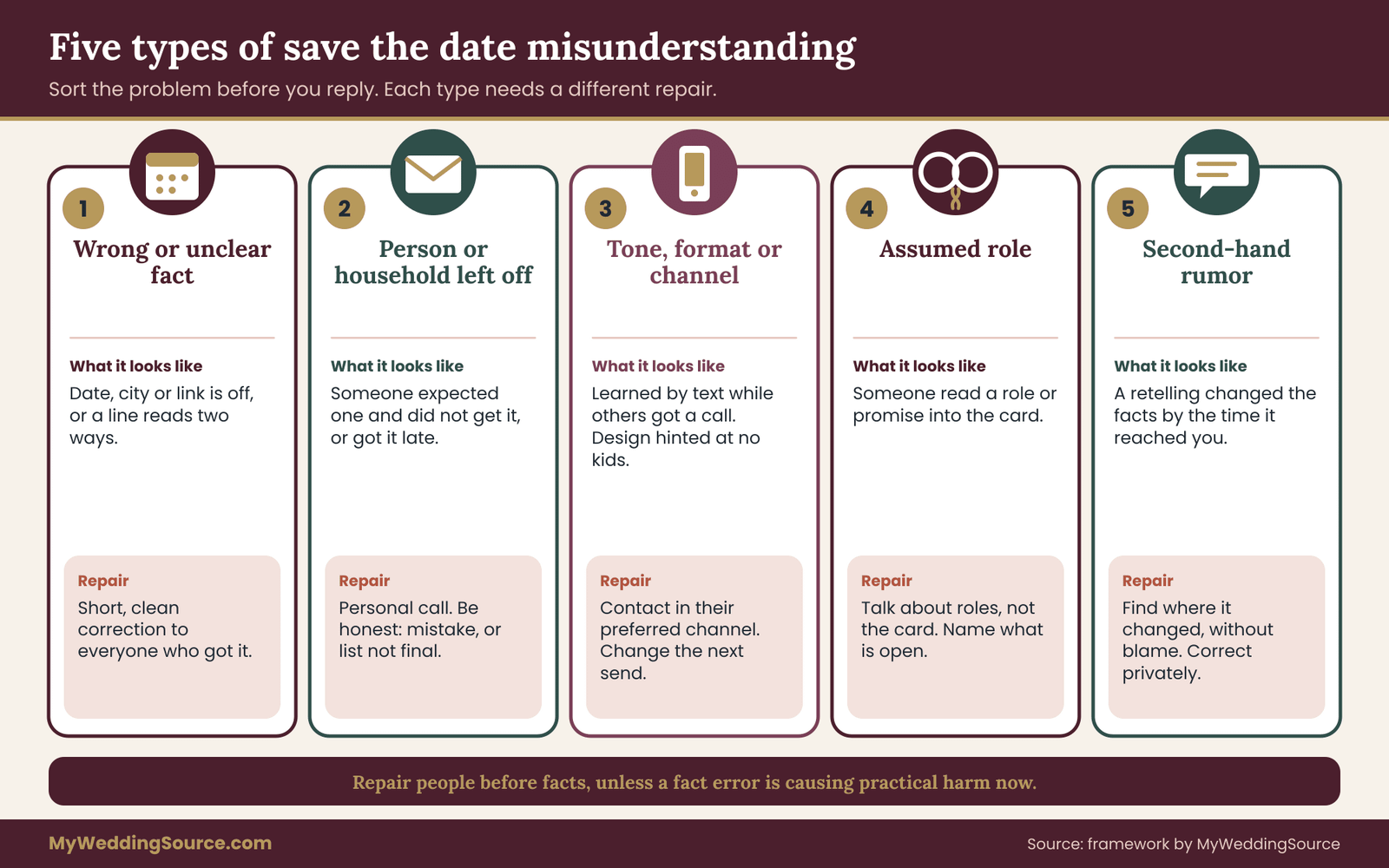
Almost every family misunderstanding after a save the date falls into one of five types. The types are not scientific categories; they are a working tool, a way to stop treating every complaint as the same complaint. Most real situations are a mix, but one type is usually in the lead, and that is the one to repair first.
Type one: a wrong or unclear fact
The date is off, the city is wrong, the website link does not work, or a line such as “and guest” was read as an open invitation to bring anyone. The harm is practical and the person is usually more confused than upset. The repair is a clean, short correction with the right information, sent to everyone who received the wrong version. There is no need for a long apology; one sentence of regret and the right facts is enough.
A useful test for this type: if you gave the person the corrected information, would the problem go away? If yes, it is a fact problem. If the person would still be upset, you are looking at a different type underneath.
Type two: a person or household left off
Someone expected a save the date and did not receive one, or received one later than others. This is the most common cause of real hurt, because it reads as a verdict on the relationship. The person may have been left off by accident, left off because the guest list is not final, or left off on purpose for reasons the couple has not shared.
The repair depends on which of those three is true, and you need to be honest with yourself about it. If it was an accident, say so and send the save the date with a personal note.
If the list is not final, say that, and do not pretend the person is certain to be invited unless you are sure. If it was a deliberate choice, you are no longer in save the date territory; you are in a guest list decision, and the guides on the guest list and on trimming a list are better starting points than a patch-up message.
Type three: a tone, format or channel problem
The information is right and everyone is on the list, but something about the way the save the date arrived hurt. A parent learned by text while a friend learned by phone. The design looked like it excluded children. The save the date was a mass email to a long list with every address visible. An older relative who does not use email received only a digital card.
The harm here is about respect and attention, not facts. The repair is a personal contact in the person’s preferred channel, an acknowledgment of what felt off, and a small change in how later messages go out. Nothing needs to be reprinted. What the person usually wants is to feel that someone thought about them as an individual.
Type four: an assumed role
A relative reads the save the date as confirmation of a role they expected or were promised, or one they had not asked for and now feel pressure about. A sister assumed she would be a bridesmaid. An uncle assumed he would give a toast. A parent assumed that a family venue would be used. A friend feels trapped into hosting something.
This type is about expectations that formed before the save the date. The save the date did not create them, but it exposed them. The repair is a conversation about roles, not about the save the date. You will need to be clear about what is decided, what is open and when you will decide, and you will need to avoid making a role promise just to end the discomfort. Thinking in terms of decision rights is useful here because it helps couples separate decisions that are theirs from those where family input is welcome.
Type five: a second-hand rumor
Someone heard from someone else that the wedding is going to be small, that a particular relative is not invited, that the date was chosen to avoid someone, or that a family dispute is the reason for a venue choice. The rumor may have a grain of truth or none. By the time it reaches you, it has usually been reshaped by two or three retellings.
The repair here starts with finding the source without blaming it. You are not looking for someone to punish; you are looking for the point where accurate information became inaccurate. Often it was an innocent comment that grew. Correct the specifics with the people who heard the rumor, keep your tone factual, and avoid repeating the rumor itself any more than you must, since repetition reinforces it.
How to sort when you are not sure
If you cannot tell which type you have, ask one open question of the person involved. Something like: “I would like to understand what the save the date meant to you when it arrived.” Then listen without defending. People will usually tell you the type in their own words. A person who says “I never got one” is type two. A person who says “I found out from Aunt Ruth” is type three or five. A person who says “I thought I was going to be” is type four. A person who says “the date is wrong” is type one.
Do not ask “why are you upset?” because it can sound like a challenge. The aim is to learn what the save the date meant to them, not to test whether their reaction is reasonable.
Mixed problems and where to start
Often two types combine. A person left off by accident (type two) who also learned about the wedding from a rumor (type five) needs both a personal apology and a factual correction. When this happens, handle the relationship part first. A correct date does nothing for someone who feels forgotten; once they feel heard, the facts land more easily.
A good rule of thumb for ordering: repair people before you repair facts, unless a fact error is causing practical harm right now. People who feel respected tolerate a late correction. People who feel dismissed reject even a perfect one.
The repair ladder for a save the date correction
The repair ladder is the central tool in this guide. It is a sequence of four rungs, each one a little more involved than the last, and the rule is to start at the lowest rung that could plausibly work and climb only if it does not. Many problems end on the first rung. Very few need the fourth.
The ladder works because it keeps the effort proportional to the problem and protects the couple’s time and energy. It also protects relationships, because it avoids escalating before you have tried the simplest and most personal option. Escalating too fast can make a modest hurt feel like a formal dispute, and the other person may become defensive simply because a procedure has started.
Rung one: a short, direct correction
This rung is for type one problems and for small type three problems. It is one message, sent once, to the people affected. It states the right information, acknowledges the slip in a sentence, and tells people where to find updates. It does not explain how the mistake happened unless that explanation helps people act. It does not ask for forgiveness. It is meant to be forgettable.
If there is a practical impact, such as someone who changed plans, add a line offering to help them adjust, and mean it. For example, if the date moved and a relative had already booked travel, a short offer to look at options with them is worth more than three paragraphs of regret.
Rung two: a personal call or visit
This rung is for type two, most type three, and some type four problems. It is a live conversation, by phone or in person, with one person or one household at a time. The structure is simple: acknowledge what happened, say what you understand about how it felt, give the facts and what is changing, and say what happens next and when.
The most important part is the listening. Give the person room to talk for a few minutes before you respond to any detail. If the first thing you say after they finish is a justification, they will feel the call was a performance. If the first thing you say is a restatement of what you heard, they will feel the conversation was real.
Rung three: a trusted go-between
This rung is for cases where the direct relationship is strained, where there is a pattern of past conflict, or where the person involved will not speak to one of you. A go-between is a person both sides trust who agrees to carry information or to sit in on a conversation. A grandparent, a respected aunt, a family friend, an officiant or a member of the clergy can serve.
The go-between needs a clear brief. Their job is not to decide, and not to advocate for one side. It is to help each side say what it means and hear what the other means. Give them specific facts, agree on what they can share, and tell them what you are not willing to change. If the go-between does not know the limits, they may promise something you cannot deliver.
Rung four: a neutral facilitator
This rung is for situations where the conflict is long-standing, where several people are involved, or where earlier rungs have not worked. A facilitator is someone with no stake who is trained to run difficult conversations: a family mediator, a community mediation program, a counselor or a faith leader with relevant training. Later sections describe the options in more detail. The point to note here is that this rung is optional and rare. Many couples never need it, and using it is not a sign of failure.
The one-way rule of the ladder
The ladder is climbed in order but descended in a different way. If a conversation at a higher rung resolves the issue, drop back down. There is no need to keep a facilitator involved once the family is talking again, and no need to keep a go-between in the middle of a relationship that can speak directly. Part of a good repair is returning to ordinary, direct contact as soon as that is possible.

Scripts for fixing a save the date without reopening the fight
Save the date scripts are useful because upset people often find it hard to choose words, and tired couples tend to over-explain. The save the date scripts below are optional starting points. Change the words until they sound like you, because a repair that sounds borrowed will not be trusted. What matters is the structure, not the exact phrases.
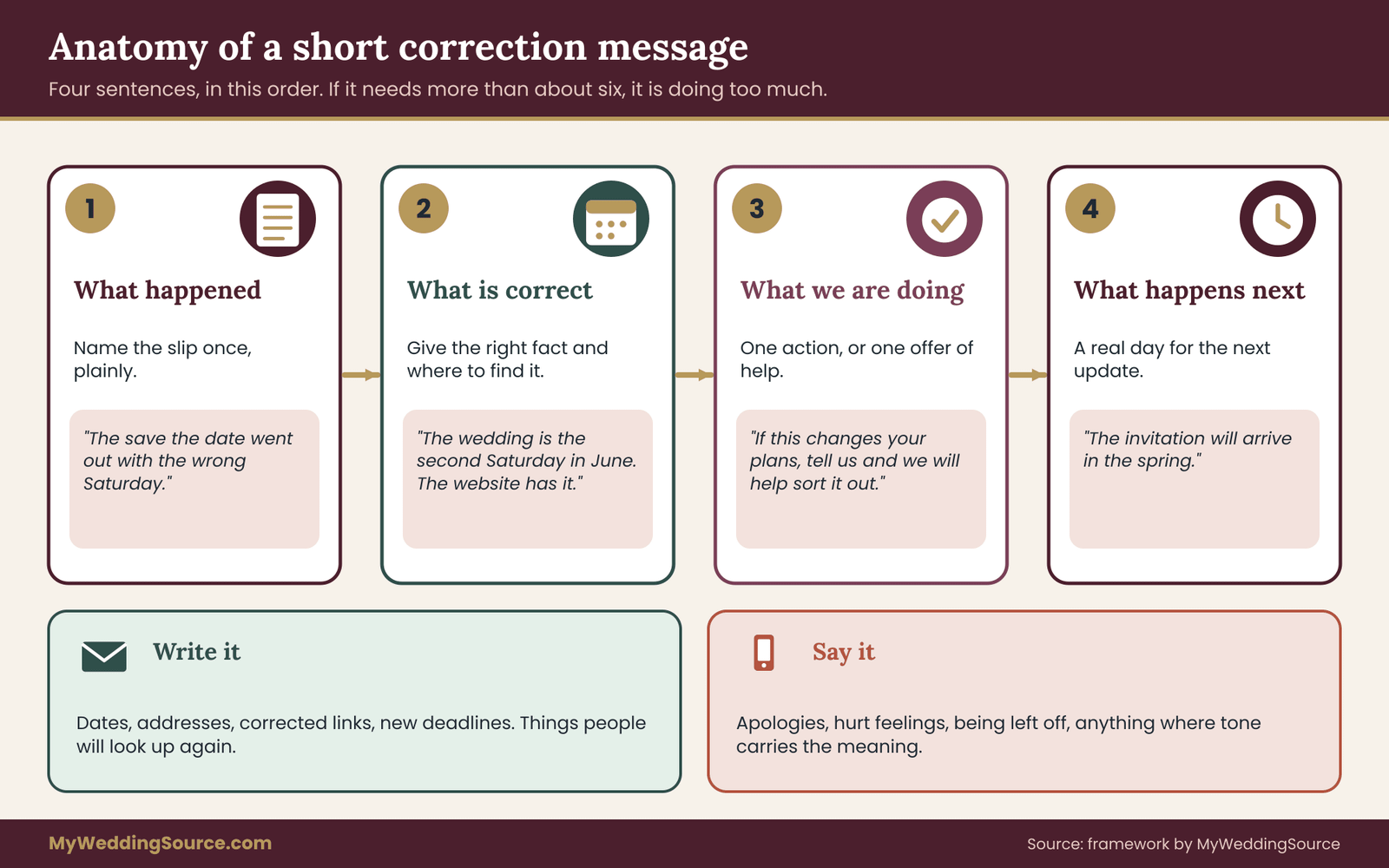
A good correction message has four parts, in this order: what happened, what is correct now, what you are doing about it, and what happens next. Each part can be a single sentence. If a message needs more than about six sentences, it is probably trying to do more than a message can.
A short group correction for a fact error
“Quick correction on the save the date we sent on Tuesday: the wedding is on the second Saturday in June, not the first. We are sorry for the mix-up. The website has the right date, and we will send the full invitation in the spring. If this changes your plans in any way, please tell us and we will help sort it out.”
Notice what is absent. There is no long account of how the printer made the error, no joke that might land badly, and no request for sympathy. The save the date is meant to be read in ten seconds by someone who may already be annoyed. It ends with a practical offer, and the offer is the part people remember.
A personal call script for someone left off
“Thanks for taking my call. I wanted to tell you directly that you did not get a save the date, and I know that probably felt strange. It was not a decision about you. [Choose one: It was a mistake on our list, and I am sorry. / We are still finishing the guest list and have not sent anything to a group of people yet.] I would like you to be part of the wedding, and I will be sending [the save the date / the invitation] by [date]. Is there anything else you want to ask me?”
Use the bracketed choices honestly. If the person is not certain to be invited, do not imply that they are. People can handle “we have not decided” much better than a promise that turns out false. If you do not yet know, say so, and name the date by which you will.
A response to a relative who says the save the date excluded children
“I can see how the design gave that impression, and I am sorry we did not think about how it would read. We have not made a final decision about children yet. We will say clearly in the invitation, and I will tell you what the plan is as soon as it is settled. If your family is thinking about travel, I would rather you ask me now than guess.”
This one concedes the real point, which is that the save the date was ambiguous, without conceding the decision. It also gives the relative something useful: a time when they will know and a way to ask in the meantime. If you have already decided on an adults-only event, say so plainly and kindly, and consider how you can help parents with arrangements. Offering to help parents with arrangements is often what turns a no into an acceptable answer.
A response to a parent who heard it from someone else
“You should have heard from us first, and I am sorry you did not. We told [name] early because [honest reason, if there is one], and we did not think about how it would reach you. I would like to tell you everything we have decided so far, and what is still open. Do you have a few minutes this weekend?”
The honest reason matters. If there is no good reason, leave that part out rather than inventing one. People can tell when an explanation has been constructed after the fact. A plain acknowledgment that you did not plan the order of announcements, and that you will in future, is more convincing than a defense.
A response when someone is angry and you need time
“I can tell this is important, and I want to give it a real answer. I am not in a good state to do that at this moment. Can I call you tomorrow at noon?”
Then call at noon. The promise is worth nothing if it slips. If you must reschedule, do it before the time, not after.
A response to a rumor
“I heard that people are saying [specific claim]. That is not what we decided. What is true is [facts]. I wanted to tell you directly in case you had heard something different.”
Resist the pull to correct the person who started the rumor in public. If you know who it was and it matters, speak with them privately, and ask what they heard rather than accusing them of spreading it. Often the first account was accurate and it changed as it was passed along.
Phrases that tend to help
Some small phrases do a lot of work. “I understand why it looked that way” acknowledges a reading without agreeing that you meant it. “What I can tell you now is” separates what is decided from what is not. “I will get back to you by” turns a vague promise into a commitment. “Thank you for telling me” turns a complaint into a contribution.
Phrases that tend to backfire
Other phrases invite escalation. “You are overreacting” tells the other person that their feeling is the problem. “We never said that” may be technically true and still make someone feel unheard. “It is our wedding” is a fair statement that works poorly as a response to hurt, because it reads as a closing of the door. “I am sorry you feel that way” is an apology for the feeling, not for anything you did, and most people hear the difference.
If you notice that a draft contains any of these, rewrite it. A useful trick is to read the draft aloud as if you were the person receiving it, with the history that person carries. If it sounds defensive aloud, it will read as defensive on a screen.
Written or spoken
A rule of thumb for choosing the channel: facts can be written, feelings should be spoken. A date correction or a revised website address belongs in text or email, where people can refer to it. An apology, an invitation to talk, or a response to hurt belongs on the phone or in person, where tone can carry what words cannot. If you must write about a feeling because the person is far away or will not answer calls, keep it short and offer a call.
When you do write, do not send long messages late at night, and do not send anything you would be unhappy to see forwarded. Assume every message in a family dispute will be shown to a third person.
Keeping a record without keeping score
It is reasonable to keep a simple note of what was sent and when, the corrections that went out, and the promises you made, such as “we will send the invitation by April.” The purpose is accuracy, not leverage. Do not keep a log of other people’s remarks to use later. A record helps you honor your own commitments and avoid contradicting yourself across several conversations, which is a common source of new misunderstandings.
A save the date correction timeline you can follow
A repair needs a calendar as well as a script, because one of the most common ways a fix fails is that nobody knows when it is over. Without end points, an unresolved issue lingers for months and attaches itself to every later decision. A timeline gives you checkpoints, and it gives the family a clear signal about when to expect information.
The timeline below runs in four phases. The days are guidelines, not rules; adjust them to the size of the problem and to how soon the wedding is. If the wedding is far away, you can spread the phases out. If the wedding is close and people are making travel plans, compress them.
Phase one: days zero to two, stop and sort
This phase is the 48-hour sequence described earlier. You pause, gather facts, sort the problem by type and make a small first contact. The only outputs of this phase are a clear understanding of the type and a short note to the person who was hurt that says when you will follow up. If a fact error is causing practical harm, you also send the short group correction in this phase.
At the end of phase one you should be able to answer three questions in a sentence each: what went wrong, who is affected and what the first repair step is. If you cannot, you are not ready to move on, and a conversation between the two of you is the next step, not a message to the family.
Phase two: days three to ten, correct and listen
This phase is for the main repair. You make the personal calls, send the written corrections that belong in writing, and hold any conversation that needs to happen. The aim is to complete the first round of contact with everyone directly affected within about a week.
During this phase keep a short list of open questions: what a relative asked that you could not answer yet, what you promised to find out, what you decided not to change. Close each item or give it a date. Open questions are what turn a one-time misunderstanding into a recurring one.
If a conversation reveals that the problem is bigger than the save the date, as when a parent says this is really about the venue or the guest list, do not try to solve that in the same call. Say that you would like to talk about it properly, and set a time. Trying to settle a larger family issue in the middle of a correction rarely goes well.

Phase three: weeks two to six, repair and rebuild
Once the immediate contacts are done, the work shifts from correcting to rebuilding trust. This is the quiet phase, and it is the one most couples skip. The temptation is to assume that because the call went well, the matter is closed. In practice, a relative who felt overlooked will watch the next few messages closely to see whether anything changed.
Use this phase to do three things. First, keep any promise you made, on the day you named. If you said the full invitation would reach someone by April, send it in the first week of April, not the last.
Second, make one small, visible change in how you communicate, such as sending updates in a single message to the whole branch of the family at once, or adding a phone call for relatives who are not online. Third, check in once, lightly, with the person who was hurt. A short message such as “I wanted to say thank you for talking with me, and to ask if there is anything else on your mind” tells them the door is open without pressing.
If a rumor was part of the problem, this is also the time to see whether it has faded. If it has not, a second, calm correction to the people who still seem to believe it may be needed. Keep it brief and factual, and do not accuse anyone.
Phase four: week six to the invitation, lock it in
The last phase connects the repair to the next real milestone, which is the invitation. By now you should have decided every open question you named earlier: who is invited, whether children are included, how travel and lodging will be handled and what the response deadline is. Put the answers into the invitation and the wedding website in plain language, so that nobody has to guess or ask a relative for the real story.
Treat the invitation as the second half of the save the date repair. A clear, well-timed invitation, delivered the way each person prefers, is the strongest proof that the correction was serious. Wording and timing are customary matters, and the RSVP etiquette guide helps you set the response process so that new confusion does not start at that stage.
What if the wedding is close
Some couples face a misunderstanding only a few months before the event. In that case compress the phases: do the first contact the same day, complete the main repair within a week and skip the long rebuilding phase in favor of a single follow-up call before the invitations go out. Do not drop the listening. A short, attentive conversation is worth more than a long, hurried one.
If a date or location has changed after people have made travel plans, treat that as a practical problem first. Send the correction at once, offer help with changes and look at the lodging side. The guide to guest hotels can help you sort out room options for relatives whose plans have to shift.
What if the wedding is far away
When the wedding is more than a year out, there is more room, and more risk of drift. A save the date misunderstanding left unaddressed can harden. Use the same phases but add a short check-in at the three-month mark, and keep a small list of anything you have told a person is undecided so you remember to report back. Distance gives you the chance to repair thoroughly, and it is worth using.
Private mediation options for save the date family conflict
Most save the date disagreements can be settled with a call or two. Some cannot, because the save the date was the trigger for older tensions, because two relatives will not talk to each other or because a family member is using the wedding to press an old claim. For those cases it helps to know the private options, from the lightest to the most formal, and when each one fits.
“Private” here means outside the public eye: no group threads, no social media and no recruiting of allies. A private process protects everyone’s dignity, including the person you disagree with, and it keeps the wedding from becoming a family referendum.

Option one: the couple and one relative, one conversation
This is the simplest option and it works more often than people expect. You and your partner, or one of you if the family issue involves only your side, sit down with a single relative in a quiet place. You set a start and an end, usually an hour, and an agenda of two or three points. You begin by saying what you want from the conversation: to understand each other and to agree on what happens next.
The key discipline is to keep the conversation to the issue at hand. Old injuries will come up. You can acknowledge them without taking them on: “I hear that this goes back a long way, and I would like to talk about that separately. Today I want to focus on the invitation.” Then offer a time for the other conversation, and keep it.
Option two: a trusted family go-between
When one-on-one conversations keep breaking down, a respected relative or family friend can help. This person is not a judge. Their role is to carry accurate messages, reduce heat and help each side hear the other. The best go-betweens are calm, have credibility with both sides and have no personal stake in the outcome.
Choose carefully. A relative who has a history with one of the parties, who gossips or who wants to be seen as the family peacemaker may make things worse. Before you ask, make sure the person is willing and has time, and give them a short written summary of the facts so they are not relying on memory. Tell them what you are willing to change and what you are not, so they do not promise on your behalf.
Option three: an officiant or clergy member
If you are marrying within a faith community, or you have already chosen an officiant, that person may be a natural neutral voice. Many officiants and faith leaders have experience with family tension around weddings and will offer a conversation as part of their work. They may also be able to meet a relative on ground the relative trusts.
Keep expectations realistic. An officiant is there for the ceremony, not to resolve a family dispute, and some will prefer not to be involved. Ask politely, and accept a no. If the person agrees, be clear about the scope: one conversation about the specific misunderstanding, not an ongoing role.
Option four: a family mediator or community mediation program
When the conflict is deeper, a trained mediator can run a structured conversation. Mediators help people say what they need, find areas of agreement and write down what has been decided. Many private mediators work with families on matters such as estate disputes and parenting arrangements; some are comfortable with wedding-related disputes, and others will say it is outside their practice.
Community mediation programs, often run by nonprofits or local governments, may offer sessions at low or no cost. Availability and fees vary by area, so check the local program directly. National organizations such as the Association for Conflict Resolution and the National Association for Community Mediation keep information about the field and can help you understand what mediation is and how to find a program. Their sites are listed in the sources at the end of this guide.
Mediation after a save the date dispute is voluntary. Nobody can be forced into it, and it works best when both sides want to settle. If one person refuses, do not push; return to a lower rung of the ladder.
Option five: a counselor or family therapist
If the save the date conflict has exposed distress that goes beyond a scheduling or invitation matter, such as grief, estrangement, an old betrayal or a relative’s ongoing hostility, a licensed counselor may be the right resource, for you, for your family or for both. A counselor is not a mediator; their work is about the people and their wellbeing, not about brokering an agreement. Many couples find that a few sessions help them handle family pressure during the engagement.
A counselor can also help if the conflict is affecting your own relationship, for example if you and your partner disagree about how much to give in. That is a common stress point in the months before a wedding, and it is a fair reason to get help.
How to choose among the options
A simple way to decide is to ask three questions. How many people are involved? How deep does the feeling run? And how much time is there? One person and a recent hurt points to option one. A strained relationship with a trusted third party available points to option two or three. Several people, a long history or a need for written agreements points to option four. Distress that goes beyond the wedding points to option five.
Whichever you choose, agree beforehand on confidentiality. Say aloud that what is discussed stays with the people in the room, and that no one will repeat it to the rest of the family. This rule is simple, but it prevents a large share of second-round misunderstandings.
Ground rules for any private conversation
Whichever option you choose for your save the date conflict, a few ground rules make a private conversation safer and more productive. Agree on them at the start, and say them out loud, even if it feels formal.
One person speaks at a time, and the other restates the point before replying. Nobody brings up a new grievance until the first has been heard. The conversation stays on the save the date and the wedding, and unrelated history is set aside for another day. Either person can ask for a break, and a break is not an insult. Nobody speaks for people who are not in the room. And at the end, somebody writes down what was agreed, in two or three plain sentences, and sends it to everyone who took part.
That last step is more important than it looks. Memories of a tense conversation diverge within a day, and a short written summary prevents the second argument, which is about what the first one decided.
When the save the date problem is really about something else
Sometimes a family member’s reaction to a save the date is out of proportion to what happened, and the proportion is a clue. The save the date is not the cause; it is the occasion. Recognizing that early saves you from fixing the wrong thing. You can offer a perfect correction to a relative who is actually grieving, or worried about money, or afraid of losing a place in the family, and it will not help.
Here are patterns that show up often, with a reminder that you can see only what people tell you and what you observe, so hold these as possibilities and not diagnoses.
A fear of being replaced or left behind
A parent or sibling may read the wedding as a sign that they are about to matter less. This can show up as a complaint about a minor detail, such as the order in which people were told, when the real feeling is “you did not think of me first.” The repair is reassurance, not information. A short, sincere statement that the person matters, along with a specific way they will be included, tends to help more than a correction.
Be careful about promising a role to calm the feeling. A promise made under pressure becomes a new obligation and sometimes a new grievance if it is not kept. A better approach is to offer a specific, true form of inclusion that you are happy to deliver, such as time with you before the wedding, a family photo that matters to them or a task they have said they would enjoy.
A money or cost worry
Relatives who are asked to travel, buy clothes or take time off may be reacting to cost. A save the date commits people to a weekend in the future. If the location is far or expensive, the message can land as a demand. The complaint may be phrased as a criticism of the choice of city, while the real concern is how to afford it.
If that seems to be the case, ask directly and kindly. “Is the travel cost a worry for you?” makes it possible for the person to say yes. You do not have to solve it, but you can make it easier: share lodging options at different price levels, suggest ways to share rooms or rides, or let the person know it is fine to attend only part of the weekend. Where you cannot help, being open about that is better than leaving the person to guess.
A long-standing family dispute
If the wedding brings together two people or two branches who are already in conflict, the save the date can become a flashpoint simply by existing. A relative may ask who else is invited in order to decide whether to attend. They may ask for assurance that a particular person will not be there.
This is a decision for you, not a misunderstanding to be repaired. You can listen without agreeing, and you can set out what you are and are not willing to do. For the save the date, the useful point is that you do not owe anyone a commitment about the guest list on the day the save the date arrives, and you can say so kindly: “We are still working through the guest list and will share details when the invitations go out.”
Divided or blended families
When parents are divorced, remarried or on difficult terms, who hears what and when can carry a heavy charge. A parent who is told after the other parent may take offense, and a step-parent who is not mentioned may feel erased. In these families, the order of contact matters, and it is worth planning.
A practical approach is to tell each parent or parent-figure personally, around the same time, using the same facts. Do not carry messages between parents. If one parent asks you to pass something on, you can say, “I would rather you tell them yourself, and I will leave that to you.” The point is not to be cold but to keep yourself out of a role that will cause you harm later.
Disagreement between the two of you
Occasionally the real cause is not the family but a difference between you and your partner about how much to accommodate. One of you wants to smooth everything over, the other wants to hold the line. If the two of you give relatives different answers, each answer becomes a new misunderstanding.
Settle this privately before speaking with family. Agree on three things: which points are firm, which are open and who speaks to whom. If you cannot agree, take that as the first problem to solve, and consider the counselor option described earlier. A united, consistent message is the best protection against repeated rounds of confusion.
When the pattern is not about this wedding
If one relative treats every family event as an occasion for conflict, a repair will not change the pattern, and you should not expect it to. In that case the aim shifts: you are not trying to win the person over, only to protect the wedding and your own peace. That means clear limits, short conversations, no promises made under pressure and a willingness to let the person be disappointed.
It can feel unkind to hold a limit with a relative who is upset. It is worth remembering that kindness and agreement are different things. You can be warm in tone and still decline a request, and you can acknowledge a feeling without doing what the feeling asks.
What to concede, what to hold, and how to decide
A save the date repair often reaches a moment when someone asks for something. Add my cousin. Move the date. Change the city. Put me on the head table. The temptation is to say yes to end the tension, or to say no to avoid being pushed. A better habit is to have a way of deciding (the guide to sharing decision-making with family goes deeper on who decides what), so that answers are consistent and each can be explained.
Here is a simple decision frame with four questions. Use it privately before you reply, and use it again whenever a similar request comes in.
Is it a fact or a favor? A fact request asks you to correct something that is wrong: a date, a spelling, an address. Those are easy to grant. A favor request asks you to change a decision: add a guest, alter a role, move something. Those require judgment.
What does it cost, and who pays? Each change has a price in budget, venue capacity, time or goodwill. Write down the actual cost, even roughly, and who would carry it. A guest added at a catered dinner raises the per-person cost for the whole headcount; a role change may affect other people who were told something different. Without seeing the cost, a request can feel free.
Is it consistent with what you have told others? If you say yes to one relative, will you be able to say no to the next person who asks, and if not, are you willing to say yes to everyone who asks? Inconsistent answers produce new misunderstandings faster than any card.
Can you say yes fully and gladly? A reluctant yes tends to leak out later as resentment. If you cannot give an answer you are comfortable with, say that you need time and name a date. That is more honest than an automatic agreement.
If the answer to all four is positive, say yes warmly. If the answers are mixed, say what you can do instead. If the answer is no, give it plainly, thank the person for asking and do not over-explain. A short, kind no is more respectful than a long, apologetic one.
Offering a partial yes
Many requests can be partly met. A relative who wants a place in the ceremony may be offered a reading or a role in the family photos. A person who wants to host a pre-wedding dinner may be given a night, an area and a budget they set themselves. A cousin who cannot be at the wedding may be invited to a later celebration. A partial yes gives the person a real stake without overturning your plans.
Be careful that a partial yes is something you are glad to deliver and that it does not read as a consolation prize. People can tell the difference between an offer made with warmth and one made to end a conversation.
Writing the decision down
After you have decided, write the decision and the reasons in one or two sentences in a note you keep. When the same question returns from another direction, you can answer the same way. This is not for the benefit of the relatives; it is for you and your partner, so that you do not reargue the same point at midnight and give different answers to different people.
Verifying details and protecting the next mailing after a save the date repair
A repair message that contains a new error is worse than no repair at all. Before any correction goes out, check every fact against the source that controls it, not against memory or an old draft. This is a short, dull step, and it prevents a second round of apologies.
The date and location. Compare the date and place on the save the date with your signed venue agreement or the written confirmation you hold. If you only have a verbal hold, treat the date as provisional and say so in the correction. The vendor contract guide explains what a written confirmation should contain. If the date is not yet protected by a contract, the correction can say that the date is expected but not yet final, which is more honest than implying certainty.
The printed piece. If a printed save the date had an error, ask the printer what the options are before you promise a reprint. Some printers can issue a small correction card or a sticker; some will reprint at a cost; some will point to the proof you approved. Keep the approved proof and the order confirmation handy, since the answer often depends on what was signed off. The guide to invitation print production describes proofing so that the next piece is checked more carefully.
The mailing list. Open the actual list you used. Look for duplicates, outdated addresses, a household that was merged by mistake, a spelled name that is wrong and anyone you meant to include but did not. Fix the list itself before you send a second message, or the same problem will return in the next mailing.
The delivery side. For paper mail, the United States Postal Service explains how forwarding and returned mail work, and you can check a single address with its public tools. For email or text, check that the right addresses and numbers were used, and consider whether a relative who does not use those channels received anything at all. If you need current postal rules or fees for a correction mailing, check them with USPS, since rates and rules change.
The website. If the save the date points to a wedding website, load the page on a phone and a computer. Check the date, the city, any hotel information and the contact method. A website that disagrees with a correction is a ready-made new misunderstanding.
A short pre-send checklist
Before sending any correction, read through these in order. Does every fact match the contract or the source? Is the list of recipients exactly the people who need the correction? Is the channel right for each person? Is the tone one you would be comfortable having read aloud at a family dinner? Does the save the date say what happens next and when? If any answer is no, fix it before sending.
Protecting the next mailing
The invitation is the next real test. Use what you learned. If some relatives felt they heard late, send the invitation to everyone in a tight window and say so. If the design confused people about children or plus-ones, state the plan in the invitation wording and on the website, with the same words in both places. If a household was missed, add it before the list is final. For anyone who was hurt, consider a short handwritten note in the envelope; a few warm lines cost little and mean a lot.
The broader wedding etiquette page covers what is customary, and customs differ by family and community. Treat them as a starting point and adapt to what your relatives expect. Where you cannot tell, a short, friendly question to a respected relative will answer it faster than any rule.
A worked example: the Alvarez and Whitfield save the date mix-up
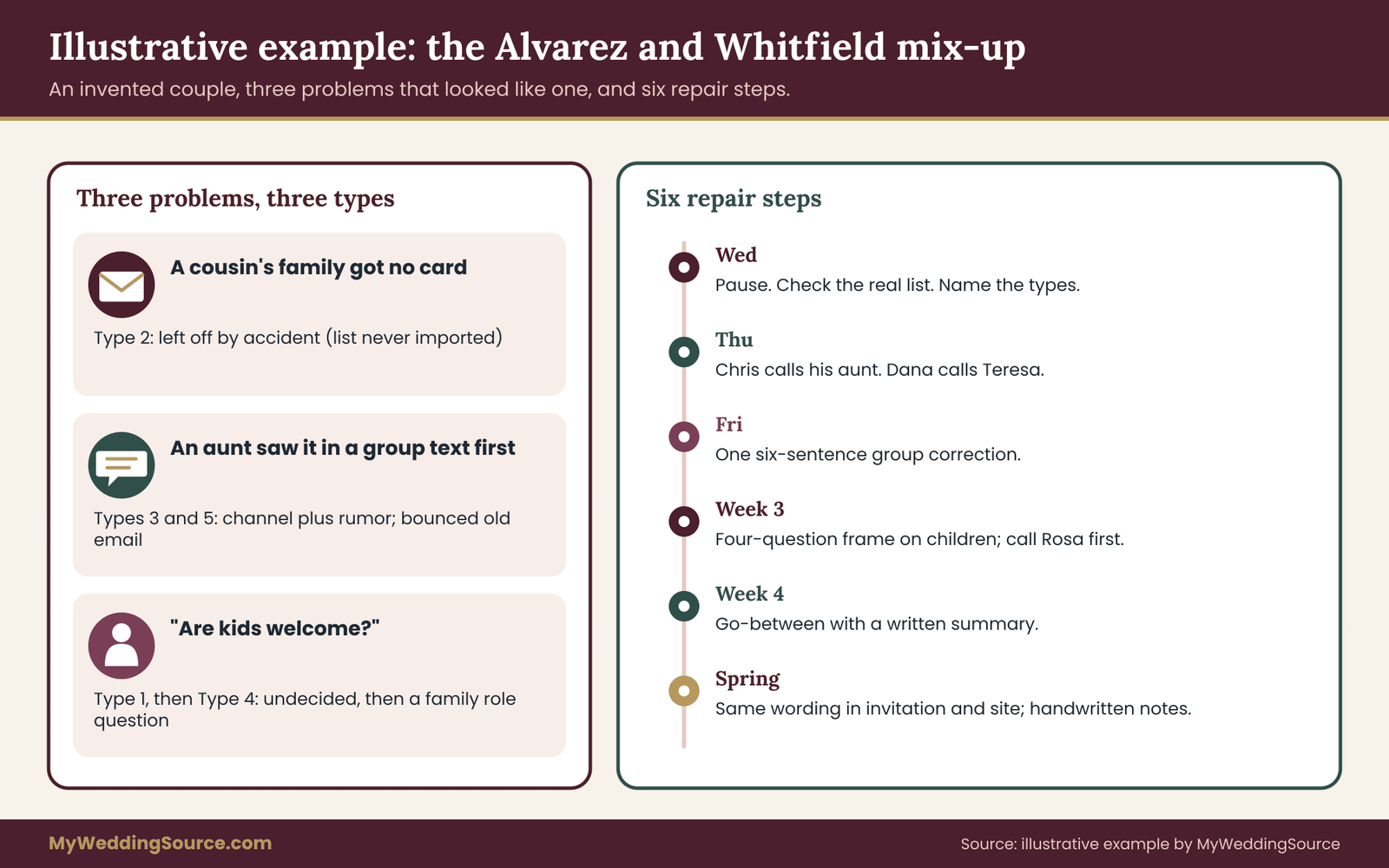
The following example is invented for illustration. The names, facts and conversations are made up, and real families will differ. It is meant to show how the ladder, the types and the timeline work together in one realistic case.
Dana Alvarez and Chris Whitfield email a digital save the date to about eighty people on a Monday evening, fourteen months before their wedding. They use a list that Dana’s mother, Rosa, helped assemble. Chris adds his own relatives by hand.
By Wednesday three things have happened. Chris’s aunt Marlene calls Chris’s father to say that her adult daughter’s family did not receive the save the date, while her son’s family did. Rosa tells Dana that her sister Teresa saw the date in a group text sent by a cousin before Teresa received anything directly. And a college friend mentions in a group chat that the save the date did not say anything about children, and asks whether kids are welcome.
Step one: pause and gather
Dana and Chris decide not to answer in the group chat. They spend an hour on Wednesday evening writing down what was sent, to whom and when. They open the actual list and discover that Marlene’s daughter was on a paper spreadsheet that never made it into the email tool, so that omission is an accident. They find that Teresa’s address was on the list, but she had marked an old email address, and the save the date bounced. And the children question is real: they have not decided yet.
In terms of the five types, Marlene’s daughter is type two (left off by accident). Teresa is a mix of type three and type five: she found out through a cousin and may now believe she was excluded on purpose. The children question is type one, an unclear fact, with a hint of type four if relatives had assumed a role for their kids.
Step two: first contact within forty-eight hours
On Thursday Chris calls his aunt Marlene, since she is his relative. He says: “Your daughter’s family should have received the save the date, and I am sorry they did not. It was a mistake on our list, not a decision. I will send it today, and I would like to write a note with it.” He asks Marlene to tell him if her daughter has any questions, then sends the save the date with a handwritten line.
Dana calls her aunt Teresa the same day. She says: “I want to apologize. You should have heard from us before anyone else. Your email on our list was out of date, so the save the date bounced, and I did not notice. I would like to give you the news properly. Can I tell you what we know so far?” Teresa is quiet for a moment and then says she had felt embarrassed. Dana confirms the date and place and asks for the best phone number for future updates.
Step three: a short group correction
On Friday they send one short message to everyone on the list. It says that the save the date was sent on Monday, that a few people received it late or through another person, that they are sorry about the mix-up, that the plan for children has not been decided and that they will say so clearly in the invitation, which will go out in the spring. It gives the website and invites questions by phone.
They do not explain how the list was assembled, and they do not name anyone. The save the date is six sentences long. Within a day several relatives reply with kind notes, and the children question stops circulating because the answer is now clear: not decided, and coming with the invitation.
Step four: the larger issue appears
Two weeks later, Rosa mentions to Dana that she would like her cousin’s children to attend, and that she was not told earlier that they might not be. Dana realizes that this is the real concern behind a card that “did not say anything about children”: a family question about who is included. This is a type four problem, an assumed role in the family, and a decision-making problem. It is not about the save the date.
Dana and Chris talk privately and use the four-question frame. They decide that they will invite children of immediate family only, because of venue capacity and budget. They plan to tell relatives plainly, in the invitation and in a call to Rosa first.
Dana calls her mother and says: “We have decided to invite the children of siblings and not of cousins, because of the size of the room. I wanted you to hear that from me before anyone else. I know it may disappoint some people, and I would like your help thinking about how to tell them.” Rosa is not pleased, but she thanks Dana for telling her first.
Step five: a go-between for the stubborn part
A cousin of Rosa, Alberto, is angry about the decision and says so to several relatives. Dana tries a one-on-one call and it ends badly.
Rosa, who has credibility with Alberto, agrees to talk with him. Before she does, Dana gives her a short written summary: what has been decided, what is open (a children’s room at the hotel on the wedding night is being explored) and what is not open (the guest list size). Rosa listens to Alberto, passes along that the decision is not about him personally and returns with one useful point: his family would attend if a babysitting option were available.
That is not a promise Dana and Chris had planned to make, but they check the cost and find a way to offer a modest, optional babysitting arrangement at the hotel. They tell Alberto in a call, plainly, and he says he will think about it.
Step six: lock in
When the invitation goes out in the spring, the wording says that the celebration is for adults and immediate family children, that a childcare option is available for guests staying at the hotel and where to find details. Dana adds a handwritten note to Marlene’s daughter, to Teresa and to Alberto. The website repeats the wording exactly. By the RSVP date, the questions have stopped.
What the example shows
Notice the pattern. The first problem was a mailing list. The second was a feeling of being excluded. The third was a family question about children. Each needed a different rung. Fixing the first with a polished correction would not have helped the second, and fixing the second with a promise would have created the third. The couple’s strongest moves were small: calls made within two days, a short group message, a clear internal decision frame and one go-between with a written summary.
It also shows what they did not do. They did not argue in the group chat, did not explain at length, did not promise anything under pressure and did not try to please everyone. They did not need a professional mediator, and they were prepared to consider one if the conflict with Alberto had continued.
Limits, safety and when a save the date problem needs more than etiquette
Everything in this guide assumes an ordinary family disagreement: people who care about one another, who have misread a message and who can be reached by a patient conversation. Some situations are not that. It is better to be clear about the limits than to apply a communication script to a problem that a script cannot fix.
There are no universal family rules. Families differ in what counts as polite, who should be told first, how formal an announcement should be and how much input relatives expect. Nothing here is a rule, and a custom that works in one family may offend in another. Where you are unsure, ask a respected relative what is normal in your family, and follow what you learn. For general etiquette references, the Emily Post Institute publishes advice that many couples use as a baseline, and it is listed in the sources.
A script is not a safeguard. The scripts in this guide are optional wording for ordinary conflicts. They are not a substitute for professional help when a situation involves distress, safety or abuse. If a relative’s response to a save the date includes threats, harassment, stalking, intimidation, or a pattern of control, stop using the repair ladder. Your priority is your safety and that of the people close to you.
In that case, do not try to mediate. Mediation assumes that both people can speak freely and safely, and that assumption fails where there is fear or coercion. Consider telling a trusted person, keeping a record of what was said and done, and contacting an appropriate service. In the United States, the National Domestic Violence Hotline offers confidential support, and the 988 Suicide and Crisis Lifeline offers support for anyone in emotional crisis, including someone who is worried about another person. Both are listed in the sources. In an emergency, call your local emergency number.
Mediation does not suit every dispute. Mediators generally encourage voluntary participation and equal footing. If one party is afraid of another, if there is a legal matter such as a custody order or a protective order, or if a relative is not willing to take part in good faith, mediation may not be appropriate. A mediator can usually tell you whether a case is suitable, and a good one will say so openly. If a legal question is involved, speak with a licensed attorney in your state, because rules differ and this guide cannot address them.
Counseling is not a quick fix. If you or your partner are overwhelmed by family stress, a licensed counselor is a reasonable resource. A few sessions can help, but a counselor cannot repair a family on your behalf, and it may take time to find a good match. Do not wait for a perfect moment to ask for support when a save the date dispute starts to weigh on you.
What you cannot control
You cannot control how a relative reads a message, whether they accept an apology, or whether they attend. You can control the quality of your own communication, the consistency of your decisions and the limits you hold. A save the date repair has succeeded when you have given accurate information, treated the person with respect and left the door open, even if the person is still unhappy. It does not require agreement.
This is worth saying plainly because many couples measure a repair by whether the other person is pleased. That standard puts the outcome in someone else’s hands and can drive you to concede things you should not. A better standard is whether you did what you set out to do and can stand behind it.
Accepting a partial result
Sometimes a relative will accept a correction but stay cool for a while. Sometimes a person will decline to attend. Sometimes a conflict will quiet down only after the wedding. Each of these is a legitimate outcome. Keep your invitation open, send the same information you send everyone and avoid chasing a reconciliation that the person is not ready for. Many families repair after the event more easily than before it, once the pressure of the date has passed.
If a relative declines, a brief, warm response is enough: “We will miss you, and the invitation stays open until the response date. We hope to celebrate with you in some way afterward.” Do not argue the decision, and do not use a third person to pressure them.
Keeping your own relationship steady
Family conflict about a wedding can wear on the two people getting married. Make time during this period to talk about something other than the wedding. Agree on how you will handle the next flare-up before it arrives. If one of you carries more of the family contact, say so, and share the load where you can. The strongest protection against a save the date misunderstanding turning into a longer strain is the steadiness of the two of you.
Your next steps
Start with a single evening and a pencil, because the save the date problem is smaller on paper. First, write down what was sent, to whom, by which channel and on what day, and sort the problem into one of the five types. Second, decide with your partner who will speak to whom, and what is firm, open or undecided. Third, make the first contact within two days, with a short call or note to the person who was hurt and a date for the next update.
Over the following week, send any written correction that belongs in writing, hold the personal conversations and keep a short list of open questions. In the weeks after, keep every promise on the day you named it, make one visible change in how you communicate and check in once.
If a conversation stalls, climb one rung: a go-between, an officiant, or a neutral facilitator. When the invitation goes out, repeat the same facts in the wording and on the website, and add a personal note for anyone who was hurt. Most family misunderstandings after a save the date end this way, quietly and without a formal process.
FAQ
What should we do first when relatives are upset about our save the date?
Pause before replying, and tell the person you will call at a set time. Then gather the facts: what was sent, to whom and by which channel. Sort the problem into one of five types before you respond in detail. A short, personal first contact within two days usually does more than a long explanation sent the same night.
Should we send a correction to everyone or only to the people affected?
It depends on the type. A fact error, such as a wrong date, belongs in one short message to everyone who received it. A hurt feeling or a person left off is better handled by a personal call or note, because a group message can draw attention to a private matter and invite replies from people who were not involved.
How do we apologize without promising something we cannot do?
Apologize for the specific thing you did, such as the late message or the missing household, and state what you can offer. Separate what is decided from what is open, and give a date for anything unresolved. Avoid promising a role, an invitation or a change until you have checked the cost and discussed it with your partner.
What if a relative heard about the wedding through a rumor?
Find where the information changed without blaming anyone, then give the accurate facts to the people who heard the rumor. Speak privately with the person who passed it along and ask what they heard. Keep the correction short and factual, and avoid repeating the rumor more than needed. Repeating it can make it seem more true.
When is it worth using a mediator for a family disagreement?
Consider one when several people are involved, when earlier conversations have broken down, or when a long-standing dispute has attached itself to the wedding. Mediation is voluntary and usually suits situations where everyone can speak freely. Community mediation programs may offer low-cost sessions, so check what your local program provides before hiring a private mediator.
Can an officiant or a family friend act as a go-between?
Yes, if both sides trust the person and the person is willing. Give them a short written summary of the facts, tell them what you are and are not willing to change, and keep the scope to one specific misunderstanding. A go-between carries information and helps each side hear the other; they are not a judge and should not make promises for you.
What if the misunderstanding involves safety or a relative who frightens us?
Stop using the repair ladder. Mediation and scripted conversation assume that people can speak safely. Prioritize your safety, tell a trusted person, keep a record and contact a suitable service. In the United States, the National Domestic Violence Hotline and the 988 Lifeline provide confidential support. In an emergency, call your local emergency number.
How do we keep the problem from returning at the invitation stage?
Use the same wording about guests, children and details in the invitation and on the website, send everything within a short window, and check your mailing list for omissions before sending. Add a brief personal note for anyone who was hurt earlier, and give the response date and contact method plainly so nobody needs to guess.
Sources
- Emily Post Institute: wedding and family etiquette guidance
- United States Postal Service: mail forwarding, returned mail and address tools
- USPS Postal Explorer: mailing standards and current postage information
- Association for Conflict Resolution: about mediation and finding a mediator
- National Association for Community Mediation: community mediation programs
- American Bar Association, Section of Dispute Resolution
- 988 Suicide and Crisis Lifeline
- National Domestic Violence Hotline
- Mediate.com: mediation information and directory