
A wedding morning after pool party is easy to say yes to and surprisingly easy to get wrong. This guide treats the pool gathering as a small event with its own rules: who has permission to use the water, who is watching it, what is poured, where the towels come from, and what happens to the photos. It gives you a five-gate briefing you can finish in an evening and read aloud in three minutes.
Before you invite anyone to a pool gathering the morning after the wedding, get written permission from the property, confirm the hours and capacity, name at least two adults as water watchers who do not drink and do not hold cameras, keep the pool gathering alcohol-free while anyone is in or beside the water, put towels and shade on a list with a named person, and tell guests how photos will work before the first splash. If any gate fails, switch to a dry alternative instead of improvising.
Weddings produce a particular kind of morning. People wake up in the same hotel or rental house, a little tired, still holding the good mood from the night before, and somebody says the pool looks nice. That casual idea is how many a pool gathering begins. It is also how a relaxed breakfast turns into forty people in swimsuits around water that nobody has checked, with half of them running on four hours of sleep and a few still carrying last night’s champagne.
Nothing about this is a reason to cancel the idea. The same courtesy that guides the rest of the weekend, covered in our guide to wedding etiquette, applies here too.
A pool gathering the morning after a wedding can be one of the warmest parts of the weekend. Children get to burn off energy, older relatives sit in the shade and talk, friends who had to share you at the reception finally get an easy hour. The point of this guide is to keep that hour easy. A little structure done in advance means nobody has to be the person who says “everybody out of the pool” at the exact moment the mood is best.
A note on scope. This is general information, not legal, tax or financial advice. Pool rules, insurance terms and local codes vary by property and by state, so confirm the details with the property, its insurer and your local health department before you rely on any of it.
What a morning-after pool gathering is, and when it makes sense
A morning-after pool gathering is a loosely hosted, informal get-together at a pool the day after the wedding. It usually happens at a hotel, a resort, a vacation rental or a private home. It is not the reception, it is not a formal farewell meal, and it is not a party that runs late into the night. It sits in the quiet gap between the wedding and everyone heading home.
It is worth separating this idea from its neighbors, because each neighbor has a different job. A late-night wedding after-party is a continuation of the party, with music and drinks, and this guide leaves it alone. A farewell meal is about food and goodbyes. A pool gathering is about water, and water changes the risk picture in a way a buffet table never does.
The four situations where a pool gathering fits
A pool gathering tends to work well in four situations. The first is a destination or weekend wedding where most guests are already staying at the same property and have a free morning before flights. The second is a warm-weather wedding where the pool is already part of the venue’s appeal. The third is a family-heavy wedding where children are present and the adults want a low-pressure way to keep them occupied. The fourth is a small wedding where the couple knows every guest and can set norms in person.
It works poorly in other situations. If the property restricts the pool to registered hotel guests and half your group is staying elsewhere, the pool gathering has a built-in permission problem. If the weather is cool, the pool is unheated, or the day has a tight departure schedule, the pool gathering will feel like an obligation. If the group is large and mostly unfamiliar with each other, supervising the water becomes a staffing question rather than a social one.
Who is actually hosting
The most important question in the first ten minutes of planning is who the host is. At a wedding, guests assume the couple is in charge of everything, including a pool gathering the couple never formally organized. If a guest slips on the deck or a child is found in water without an adult nearby, the confusion about who was responsible is the real harm, beyond the incident itself.
Decide the host before you decide anything else. In practice there are three arrangements. The couple can host and delegate duties to a few named people. A parent or a relative can host in their own name and take responsibility for the rules. Or the property can effectively host by running the pool with its own staff, with the couple acting as guests who happen to be a large group. Each is fine. What is not fine is leaving it unspoken.
Why this deserves its own plan
Most wedding advice assumes the dangerous moments are logistical: a late vendor, a missing marriage license, a delayed flight. The morning-after pool gathering is different because it brings together several conditions that make water risk higher than usual. People are tired. Some have been drinking recently. Children and adults who swim at very different levels are in the same space. Phones and cameras are out. And nobody is in a formal role, so everybody assumes somebody else is paying attention.
The Centers for Disease Control and Prevention treats drowning as a major preventable cause of injury death, and it stresses layers of protection: barriers, supervision, swimming skills and life jackets where needed. You cannot control the barriers at a property you do not own, but you can control supervision, and you can choose to keep alcohol out of the equation. Those two choices, more than any decor decision, shape how the morning goes.
There is a second reason the pool gathering deserves a plan, which is that the weekend already has a lot going on. The couple is tired, the parents are managing their own emotions, and the wedding party is scattered. A written plan that fits on one page removes the need to make decisions on the spot. It is the same logic as a day-of timeline for the wedding itself, and if you are building one, the wedding planning checklist is a good place to see where a morning-after item belongs in the overall schedule.
The five gates of a pool gathering briefing
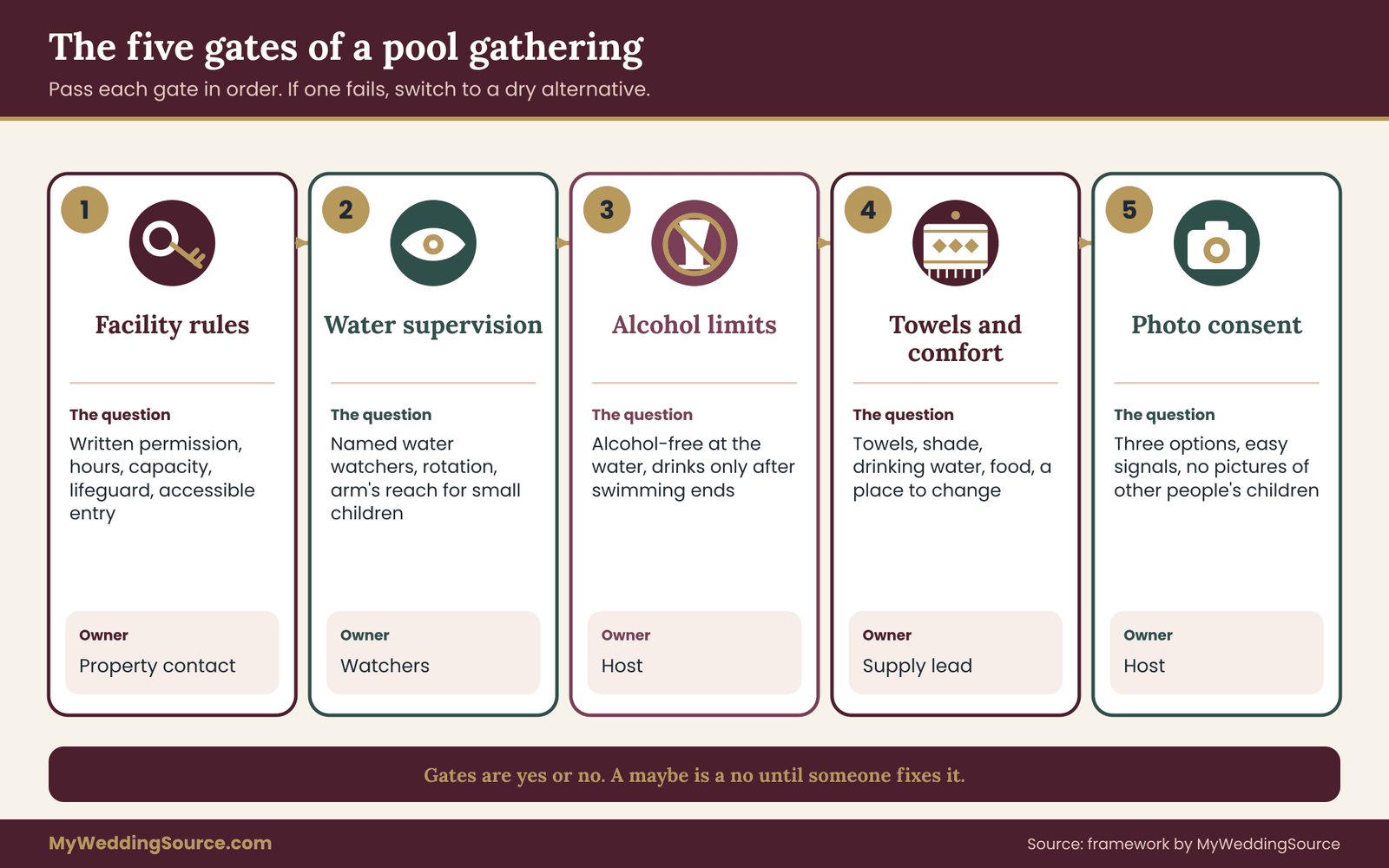
The framework in this guide is a sequence of five gates. Each gate is a yes-or-no question with a clear owner. You walk the gates in order, and you do not move to the next gate until the current one is a clear yes. If a gate cannot be passed, you do not push through it. You choose a different format, which the later sections describe.
The gates are deliberately simple so that anyone can run them, including a tired parent of the groom who has been asked to take charge.
Gate one: facility rules. Does the property permit this group to use this pool at this time, in writing, and under what conditions?
Gate two: water supervision. Are named adults watching the water at all times, with a rotation, a clear position and nothing else to do?
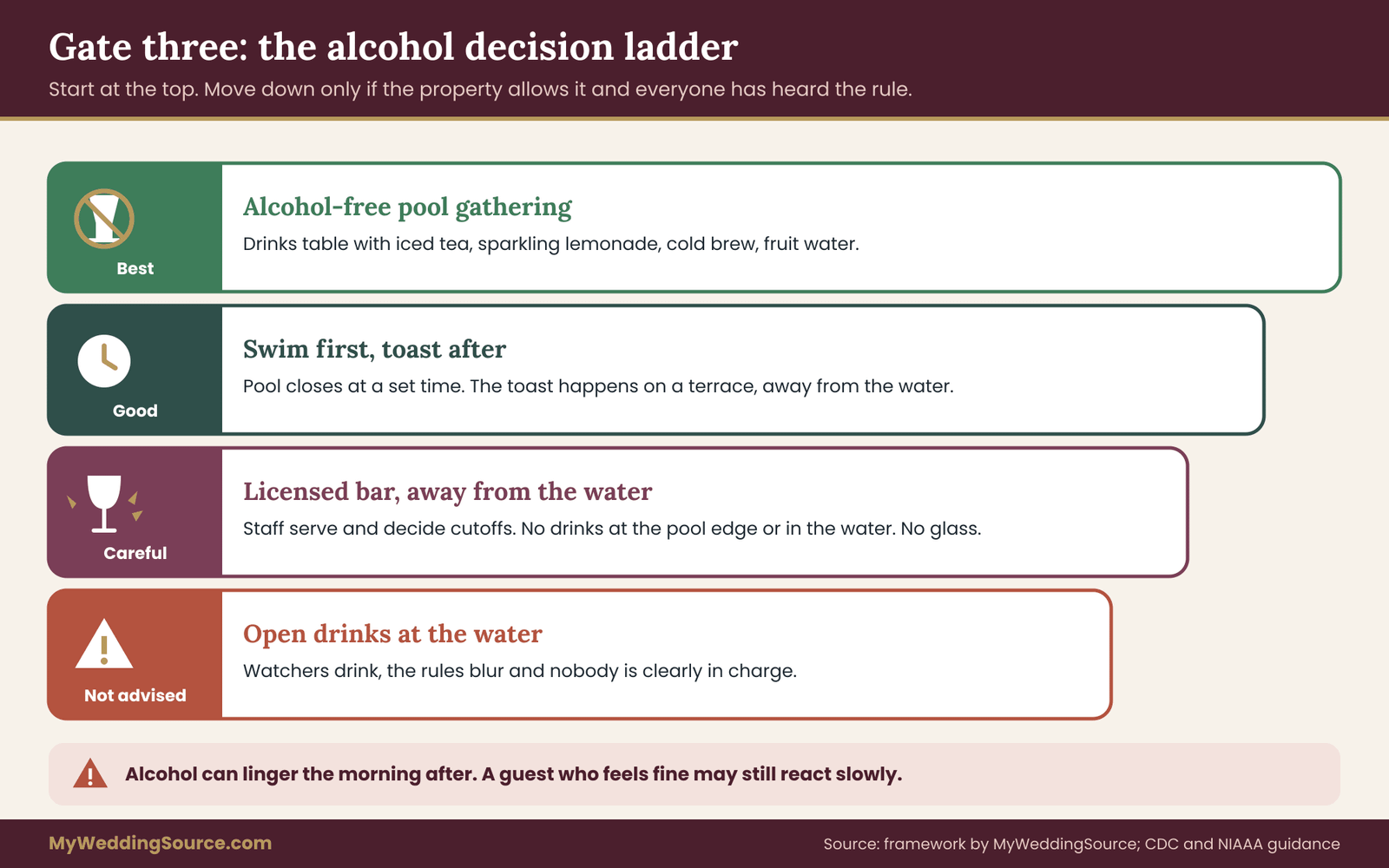
Gate three: alcohol limits. Is the water area alcohol-free, or governed by a rule everyone has heard, for the full time anyone is swimming?
Gate four: towels and comfort. Do people have towels, shade, water to drink, food and a place to change, so that nobody improvises something unsafe out of discomfort?
Gate five: photo consent. Do guests know how photos will be taken and shared, and can anyone opt out without making it awkward?
How the gates work together
The gates are not separate topics. They interact. A missing towel supply, for example, can lead guests to carry beach towels back from their rooms in the middle of a crowded pool deck, which creates a wet floor and a distraction at the exact moment a child is near the steps. An unclear photo rule can pull water watchers toward their phones. A loose alcohol rule can turn a calm gathering into one where the people supposedly watching the water are the ones holding drinks.
For that reason the briefing you give guests is not a lecture. It is a short, friendly description of how the morning will run. It sounds like a host talking, not a notice on a wall. The script near the end of this guide shows what that sounds like.
How long the planning takes
Planning a pool gathering well takes about an hour of real effort spread across a few weeks, plus a ten-minute check on the morning itself. The hour is mostly phone calls and emails to the property, one conversation with the people who will be water watchers, a short message to guests, and a shopping list. If it takes much longer than that, the pool gathering is probably too big or too complicated for the format, and a dry alternative is the better choice.
The rest of this guide takes each gate in turn, then shows a worked example, compares alternatives, covers edge cases, and ends with a short list of next steps.
Gate one: facility rules for a pool gathering
The first gate is about permission, and it is the one most couples skip because it feels like a formality. It is not. A pool belongs to somebody: a hotel, a resort, a homeowners association, a landlord or a private owner. That owner has insurance conditions, local health rules and house policies that decide who may use the water and when. A pool gathering that ignores them can end with staff asking forty people in swimsuits to leave.
For any pool gathering, start with the simplest question: is the pool open to your group at all? Many hotel pools are open to registered guests only, with a limit on how many visitors each room may bring. Some close for cleaning or chemical treatment in the morning. Some are seasonal. A vacation rental may allow the pool for guests listed on the booking but not for visitors. Ask before you promise anything to anyone.
Questions to ask the property, in this order
Call or write to the property and ask a short, specific list. Keep the answers in writing, because a verbal yes from a front-desk employee on one day is not always honored by a different employee on another.
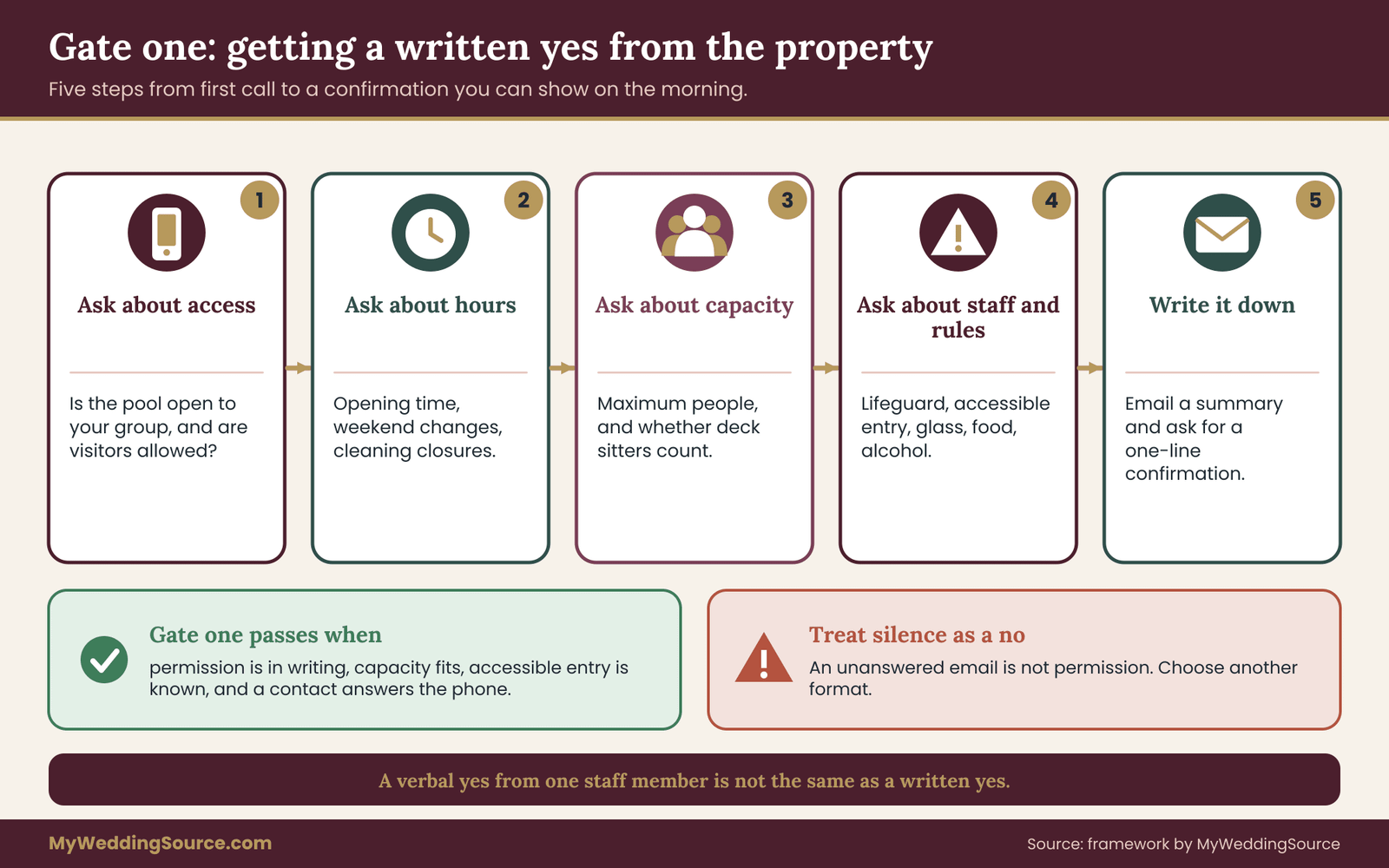
First, ask what the pool hours are on the morning you plan to use it, and whether those hours change on weekends or holidays. Second, ask whether non-guests may use the pool and, if so, whether there is a visitor limit. Third, ask for the maximum number of people the pool area is allowed to hold, and whether that count includes people sitting on the deck. Fourth, ask whether a lifeguard is on duty, because many hotel pools post a sign saying there is none. Fifth, ask what the posted rules say about glass, food, alcohol, music and children.
Those five questions cover most surprises. Then add three more that matter specifically for a group. Does the property require a reservation or a fee for a group over a certain size? Does the property require proof of liability insurance from the host? And who is the named contact on that morning, with a phone number that is answered before nine?
Reading the posted rules
Almost every pool has a sign by the gate. Read it as a contract, because in practice it functions as one. Typical signs list hours, a statement about lifeguard presence, a rule that children under a certain age must be accompanied by an adult, a ban on glass, a ban on diving, and a maximum occupancy. Some include a clause that alcohol is not permitted in the pool area.
Take a photo of the sign when you arrive for the walk-through or on the first evening, and send it to the water watchers. The rules on that sign are the minimum. Your own rules, covered in the next gates, can be stricter, but they should never be looser.
Capacity, and why it is not a seating question
Capacity is where a casual pool gathering most often drifts out of compliance. If the posted maximum for the pool is, say, a number that sounds generous, remember that it often counts swimmers and deck occupants together, and that it was written for ordinary hotel traffic, not for a group that arrives all at once and stays. A group of forty arriving at nine in the morning can fill a small hotel pool and leave regular guests with nowhere to swim.
The practical answer is to stagger. Invite people in two waves, or tell guests the pool gathering runs over a window and they can come and go. That reduces peak load and gives the water watchers a smaller number of people to track at any given moment. It also keeps you on good terms with the property, which matters if you want to return for an anniversary.
Accessibility is part of facility rules
A pool gathering that excludes a guest who uses a wheelchair, walker or cane is not a good gathering, and in many public settings it also raises legal questions. The Americans with Disabilities Act sets accessibility requirements for pools at many public accommodations, including lifts or other means of entry. Your role is not to audit the property. It is to ask whether the pool has an accessible entry, whether it is working, who operates it, and whether there is a step-free route from the lobby and the restrooms to the deck.
If a guest needs that entry, ask in advance. Some lifts need staff to operate them or need to be set up ahead of time, and the morning is a bad moment to discover that the person with the key is off shift. Our guide to choosing wedding guest hotels across different budgets and mobility needs covers the broader question of how to match lodging to what each guest needs, and the same thinking applies at the pool.
The written yes
Once the property answers, summarize the answers in an email and ask for a one-line confirmation. A good summary reads like this.
“Thank you for talking with us. To confirm: our group of about thirty-five will use the pool between ten and noon on Sunday, the pool opens at nine, a lifeguard is not on duty, outside food is allowed on the deck but not glass, and Maria at the front desk will be our contact. Please reply to confirm we have this right.”
A reply of “yes, that is correct” is your written yes. Keep it with your other weekend records. If anything changes, the written yes also tells you exactly what changed and who said so. It takes five minutes and has saved more than one host from an argument at the gate.
A short list of pass or fail checks for gate one
Gate one passes when four things are true. The property has confirmed in writing that your group may use the pool at your time. The occupancy and any guest limits are known and fit your plan. Someone knows how the accessible entry works, if any guest needs it. And you have the name and number of an on-site contact who will answer on the morning. If any one of those is missing, the gate has not passed, and you either fix it or choose another format.
When the property says no, or says nothing
Sometimes the property declines. Sometimes the message goes unanswered for a week. Treat both as a no. A pool gathering built on an assumption that the property will not mind is a pool gathering waiting for a staff member to mind.
If the answer is no for your whole group, ask whether a smaller group of registered guests could use the pool at the usual hours with no organized event. That is a different thing: individual guests enjoying a hotel pool, not a hosted gathering. If even that is not possible, the later section on alternatives offers formats that keep the feeling of the morning without the water.
Gate two: water supervision at a pool gathering
The second gate is the one that matters most, and it is the one a casual pool gathering is least likely to have. Supervision at a pool is not the same as being present at a pool. A parent chatting with a cousin ten feet from the water is present. A person whose only job is to watch the water is supervising.
For a pool gathering, public health agencies and children’s safety organizations consistently describe the idea of a designated “water watcher”: an adult who is assigned to watch swimmers and who does nothing else during that time. They do not read, they do not scroll, they do not drink, and they do not hold a conversation that pulls their eyes away from the pool. The concept is simple, and it works because it turns a vague shared responsibility into a named personal one.
Why shared responsibility fails
In a group of adults, everyone assumes someone else is watching. That assumption is the quiet failure behind many near misses. Ten adults near a pool can produce zero people actually looking at it, because each is socializing and each trusts the other nine.
The fix is not more adults. The fix is a named adult with a clear window of time, a clear place to stand, and an explicit handoff at the end. At a wedding morning, this is easy to arrange, because many guests are glad to take a defined role. People like to be useful, and “you are on water watch from ten to ten-fifteen” is easier to agree to than a vague request to keep an eye on things.
Who qualifies as a water watcher
Choose watchers by condition, not by closeness. A good water watcher is a sober adult who is rested, who can swim, who knows how to call for help, and who is not responsible for a baby in their lap. If your group includes a lifeguard, a nurse, a coach or someone with water-rescue training, those are natural choices, but training is a bonus, not a requirement. Attention is the requirement.
Avoid assigning the role to the people who have the most going on. The couple should not be water watchers. The parents of the couple should not be water watchers if they are also the hosts greeting guests. The photographer, if one is present, is also not a water watcher. And anyone who had more than a little to drink the night before and is still groggy should be offered a chair in the shade instead.
The rotation
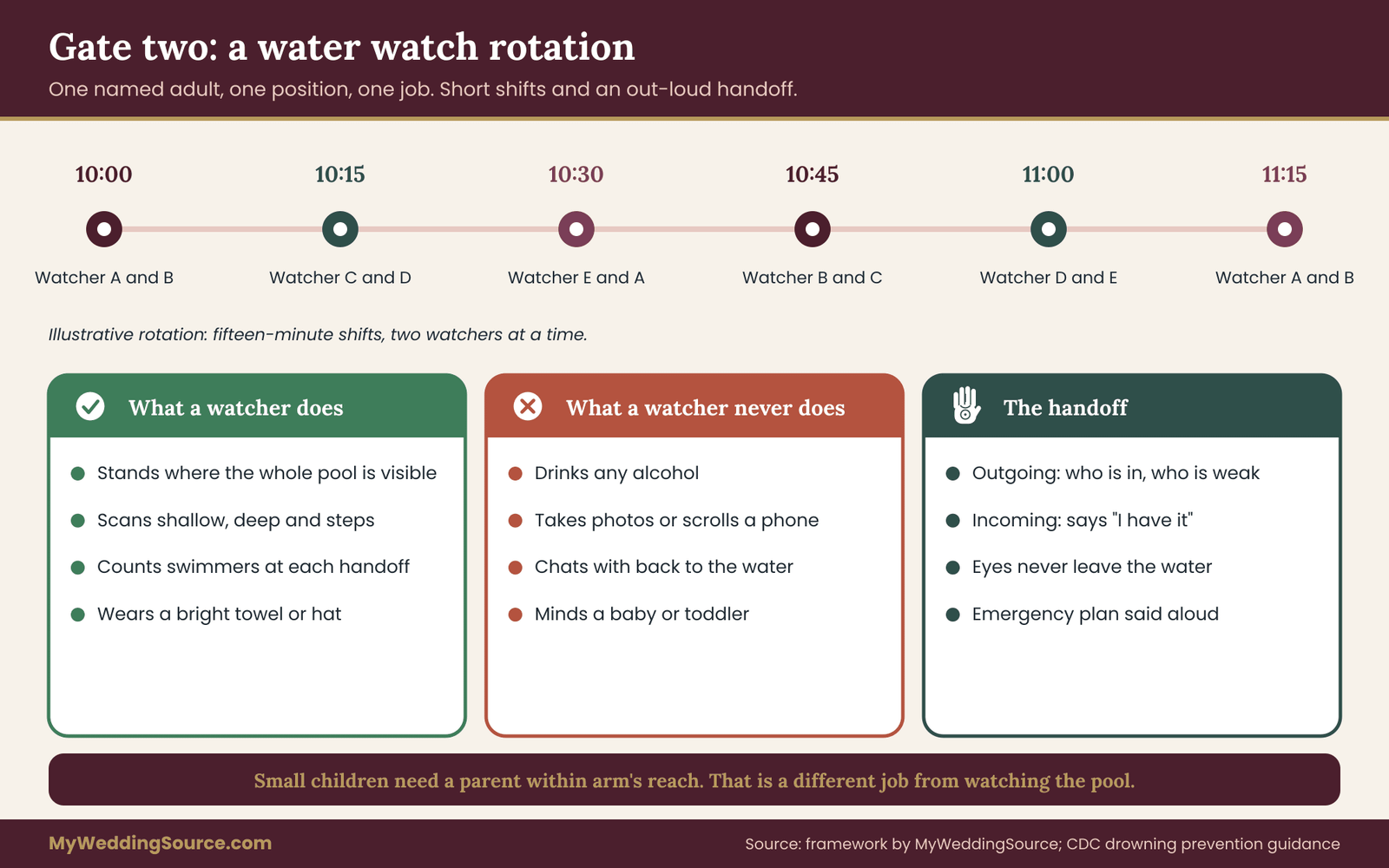
Fifteen minutes is a commonly used length for a watch shift because attention fades. It is a practical rule of thumb rather than a legal standard, so treat it as a sensible default and adjust it if your watchers prefer a different rhythm. With two watchers and a two-hour gathering, a rotation of four or five people gives each person one or two short shifts and a long time to enjoy the party.
Write the rotation on a card or in a shared note. Each watcher knows their time, their position and who they hand off to. The handoff matters. When the shift ends, the outgoing watcher says out loud who is in the water and who is not yet confident, and the incoming watcher says “I have it.” Without that exchange, the gap between shifts is exactly where a lapse happens.
Where the watcher stands
A watcher needs a position with a clear view of the whole pool, including the deep end, the steps and the area under any diving board or slide. That usually means standing or sitting on a raised or open spot, not behind an umbrella or a lounge chair. The watcher should be able to see the bottom of the pool, which means a glare check matters. Bright morning sun can turn the surface into a mirror, and in that case the watcher should move to a better angle.
Give the watcher a visible marker if the group is large: a bright towel, a lanyard or a hat that says “water watch.” It sounds silly, and it works, because guests learn not to start a conversation with the person wearing it.
Children, non-swimmers and the rule of arm’s reach
Children are where a pool gathering needs the most care. Young children can slip under water quickly and quietly, and a splashing, shouting child is often a safer sign than a silent one. Safety organizations advise that a young child who is in or near water should be within an adult’s arm’s reach, with that adult paying attention to the child and nothing else. This is sometimes called touch supervision.
That adult is not the water watcher. This point trips up many hosts. A water watcher scans the whole pool. A parent or guardian staying within reach of a toddler is doing a different job, and should not also be expected to cover the pool. If your guest list includes several small children, the number of adults you need is roughly the number of small children in the water at the same time, plus the watchers.
Our guide on wedding guest care for babies, children and older relatives goes deeper into how to arrange care for children across the whole weekend. For the pool, the practical rules are short. Every child under the age your family or the property sets stays with a named adult. Every child who cannot swim well wears a properly fitted life jacket that is approved by the U.S. Coast Guard, because water wings and pool noodles are toys, not safety devices. And no child enters the water without an adult knowing about it.
Telling swimmers from non-swimmers
At a family wedding, swimming ability varies widely and people are not always honest about it, often out of pride. A simple, friendly way to sort the group is to ask at the start: “Is anyone not comfortable in deep water? Totally fine, we just want to know.” The answer lets watchers pay extra attention to those guests. It also gives people permission to stay in the shallow end without having to explain themselves.
Mark the depth. If the pool has a shallow area, a deep area and a slope between them, say where each begins. Some pools have depth markings on the edge, and some have none. If there are no markings, tell guests plainly where the water becomes deep, and consider asking non-swimmers and children to stay on the shallow side of a line you point out.
Rescue gear and the emergency plan
Before guests arrive, look for the pool’s rescue equipment: a reaching pole, a ring buoy, a phone at the pool, a first-aid kit. If any of it is missing, tell the property and note that it is missing. Do not assume it exists because a sign says it does.
Then agree on an emergency plan out loud with the watchers, in under a minute. Who calls 911? Who is the person that clears the pool? Who stays with the family of the person in trouble? Where does the ambulance enter, and who stands at the gate to guide it? A pool gathering at a hotel is helped by a front-desk contact, but a rental house in a rural area may have a long response time, and that changes how conservative your plan should be.
If someone in your group knows cardiopulmonary resuscitation, quietly ask them to be on hand without making them a de facto lifeguard. The American Red Cross and other organizations teach water safety and first aid, and a short course is a thoughtful gift to yourself and your family long before the wedding. It is not something to learn on the morning itself.
Signs of trouble that are easy to miss
People often expect drowning to look like waving and shouting. It frequently does not. A person in real trouble may be upright in the water with their head tilted back, their arms pressing down on the surface, and no sound at all. Teach the watchers that quiet is not the same as fine. If somebody who was just swimming has gone still, or a child has gone out of sight, the watcher checks immediately.
Make a rule that nobody swims alone in the pool, and that nobody dives without confirming that the water is deep enough and clear. Diving into shallow water is a separate and serious hazard, and many hotel pools prohibit diving altogether. If the property bans it, ban it. If it does not, ban it anyway for a casual group, because a morning after a wedding is not the time to test anyone’s judgment about water depth.
Pass or fail checks for gate two
Gate two passes when you have at least two named water watchers and a written rotation. Every watcher has a position, a marker and a handoff routine. Every small child has a named adult within reach. Non-swimmers have been identified and are either in life jackets or in the shallow end. The emergency plan has been spoken aloud, and the nearest rescue equipment has been located. If any of these is missing, you do not start swimming until it is fixed.
Alcohol limits at a pool gathering
The third gate is the one that makes some hosts uncomfortable, because it asks them to hold back at a celebration. It is also the gate that most changes the outcome. Alcohol and water do not mix well, and the pattern is well understood by public health agencies. The CDC notes that alcohol use is a factor in a substantial share of water-recreation deaths among adolescents and adults, and it affects judgment, balance, coordination and the ability to respond quickly.
The morning after a wedding adds a wrinkle. Many guests are not drinking at the pool, but they may still be affected by the previous night. Alcohol can remain in the body for hours after the last drink, and tiredness compounds it. Someone who feels fine may still have slower reactions than they realize.
The simplest rule: alcohol-free at the water
The cleanest approach is to make the pool gathering alcohol-free. No beer coolers, no mimosa tray, no bottle of champagne passed down the lounge chairs. Replace them with something attractive: iced tea, sparkling lemonade, cold brew, fruit water, a good non-alcoholic spritz. The goal is not to punish anyone. It is to remove the one variable that most turns a calm morning into a risky one.
Say it as a host, not as a regulator. A line like “We are keeping the pool side alcohol-free so everyone can relax and the kids can swim safely, and we have a good drink table instead” works better than a stern notice. Most guests respond well, because they would rather not be the one who made the pool unsafe.
If you decide to allow alcohol
Some couples and families will want to allow a drink, especially at a celebration where a toast feels natural. If you do, put the rules in writing and make them stricter than the property’s, not looser. A reasonable set of rules reads like this: no alcohol until the water is closed or until the watchers say the swimming has ended; no one who has had a drink serves as a watcher; no alcohol in the water or on the pool edge; no glass anywhere on the deck; and no one who appears impaired swims.
Check what the property allows before deciding. Many pools ban alcohol in the pool area entirely, and a host who serves it may expose the property, and themselves, to liability. If the property has a bar at the pool, the staff members are trained and licensed to serve, and the question becomes one of your own rules for your guests. Our guide to wedding bar service planning covers how licensed bar service works at a wedding, and the same principles about licensing, cutoffs and responsibility apply here.
The sequence that keeps the peace
A sequence tends to work better than a flat ban. Run the swimming first, then the drinks. For example, the pool is open from ten to eleven-thirty with non-alcoholic drinks at the water. At eleven-thirty the watchers close the pool, everyone dries off, and the group moves to a patio or restaurant where a toast with a mimosa is fine. This gives people their celebratory drink and keeps the two activities apart. It also gives you a natural end to the swimming, which is useful if some guests want to keep going.
Handling the person who has had too much
At some gathering, one guest will arrive still affected by the night before, or will bring a drink to the deck. Decide in advance who handles it and what they say. The right person is a calm friend or family member who knows the guest, not the couple. The script is short and kind: “Let’s sit this one out and get you some water and breakfast. We will keep you company.” Offer a chair in the shade, food, and a ride back to their room if needed.
If the guest insists on swimming, the watchers do not argue. They tell the person the pool is closed to them for now, and they ask a family member or friend to stay with them. A dignified exit is better than a confrontation. If the guest is a danger to themselves or others, the host calls for help and does not leave them alone.
Medication, fatigue and other quiet factors
Alcohol is not the only thing that affects judgment in water. Some medications cause drowsiness. Some health conditions, including seizure disorders and heart conditions, call for extra care around water. Fatigue, dehydration and heat all matter. Without prying, you can offer a general invitation: “If you have any health concern that makes the pool tricky, let one of the watchers know and we will keep an eye out.” Most people appreciate the chance to say it quietly, and many will not say anything if it feels like an interrogation.
Pass or fail checks for gate three
Gate three passes when the alcohol rule is decided, written and communicated before the first guest arrives. The property’s own alcohol rule has been checked. Watchers have confirmed that they are not drinking. Non-alcoholic drinks are available and appealing. And someone has agreed to handle the guest who is not fit to swim. If your rule allows alcohol, there is a defined point at which swimming ends before drinks begin.
Gate four: towels, shade and comfort at a pool gathering
The fourth gate of a pool gathering looks like the least serious and quietly decides whether the pool gathering is pleasant or miserable. Towels, shade, food and a place to change sound like hospitality details. They are also safety details, because discomfort pushes people to make bad choices. A cold, wet child with no towel wanders. A guest who is overheated and thirsty gets dizzy. A guest with nowhere private to change hovers in a doorway instead of swimming.
Most hotels provide pool towels to guests, usually from a cart or a counter, often with limits. Your group is not a typical guest, and a group of thirty asking for towels at the same moment can empty the cart in minutes. Do not assume the property will stock for you.
The towel question
Ask the property three things. Are towels provided at the pool, and how many per guest? Are towels issued by a room key or a card? And can you reserve a bulk supply for a group, at no cost or at a stated cost? If the answer to the last question is no, plan to supply towels yourself.
There are three workable ways to do that. Guests can bring towels from their rooms, which works at a hotel but creates a laundry cost for the property and sometimes a policy issue. You can buy or borrow a stack of inexpensive towels and bring them as a group set, which costs money up front but gives you control. Or you can rent towels from a linen service, which tends to suit larger groups and rental houses. Each has trade-offs, and the right one depends on group size and budget.
Here is the cost logic without invented numbers. Count the number of people who will realistically swim, not the full guest list, since many will sit out. Multiply by one towel each, then add a margin for dropped or soaked towels, and compare that to the per-towel price of each option. If you are buying, ask whether you can return unused ones. If you are renting, ask about the replacement fee for lost items. Keep the receipts, because a pool gathering expense is still a wedding weekend expense, and our wedding planning checklist is the right place to log it.
Where the wet towels go
A morning-after pool gathering leaves a pile of wet towels, and a plan for the pile prevents a mess. Ask whether the property provides a towel return bin, and where it sits. If not, bring two large laundry bags or bins and name one person to haul them back. Do not leave wet towels over railings or on furniture, and do not carry them through the lobby in a way that annoys the staff. It is a small courtesy that makes the property glad to host you.
Shade, sunscreen and heat
A pool in morning light looks harmless, but sun and heat add up. Ask about shade: umbrellas, a covered patio, trees. If shade is limited, bring a pop-up canopy only if the property allows it. Sunscreen is the guest’s own choice, but a basket of broad-spectrum sunscreen on the drink table is a considerate touch and a good prompt for children. Remind guests that sunscreen that has not been applied in advance needs time to work, and that it wears off in water.
Heat deserves respect. Hot weather and a recent night of drinking add up to dehydration. Keep water visible and reachable, preferably in shaded coolers, and tell the watchers to treat a guest who looks flushed, confused or unusually quiet as a reason to move them into the shade.
Food at the pool
Plan for light, easy food. Fruit, pastries, bagels, yogurt cups, granola bars and a pot of coffee are friendly and sensible. Avoid heavy, greasy or messy dishes, which mix poorly with swimsuits and wet decks. Check whether the property permits outside food at the pool, and whether glass is banned, because it nearly always is. Serve in paper or plastic, and bring a trash bag.
Think about allergies. A pool gathering with a shared food table is a place where a guest with a serious food allergy can be exposed without noticing. Label items and keep nuts separate if any guest has told you about an allergy. If you have used a caterer for the wedding, the food-labeling habits from that day are a good model, and nothing here needs to be elaborate.
Changing, restrooms and privacy
Guests need a place to change, a place to leave bags and a place to use the restroom. If the group is staying at the property, rooms solve that. If guests are coming from elsewhere, ask whether there are public restrooms or changing rooms at the pool. If there are none, tell guests to arrive in their swimsuits.
The Centers for Disease Control and Prevention advises swimmers to rinse off before getting in, to stay out of the water if they have had diarrhea, and to avoid swallowing pool water. These are small, practical habits, and a single sentence in your message to guests covers them. For parents of young children, add that frequent bathroom breaks and swim diapers designed for pools are part of keeping the water healthy for everyone.
Footwear, floors and falls
Wet pool decks are slippery. Slips are one of the most common injuries at a pool, and the combination of tired guests, flip-flops and hurried children raises the risk. Ask guests to walk, not run. Keep towels and bags off the walkways. If the property provides a deck mat or a non-slip surface, point it out. If a spill happens, someone wipes it up or tells the staff right away.
Sound, music and quiet
If you play music, keep it low enough that the watchers can hear a shout, and check the property’s noise rules first. A morning-after pool gathering is generally a gentle, conversational event, not a party. Music that is loud enough to cover a call for help is a safety problem, not a style choice.
Pass or fail checks for gate four
Gate four passes when there is a towel plan with a named person responsible, a plan for wet towels, shade or a shaded retreat, drinking water and food that fit the property’s rules, and a place to change and use the restroom. It also passes when someone has confirmed that guests know to rinse off before swimming. The gate is not about luxury. It is about removing small frictions so that guests have no reason to improvise.
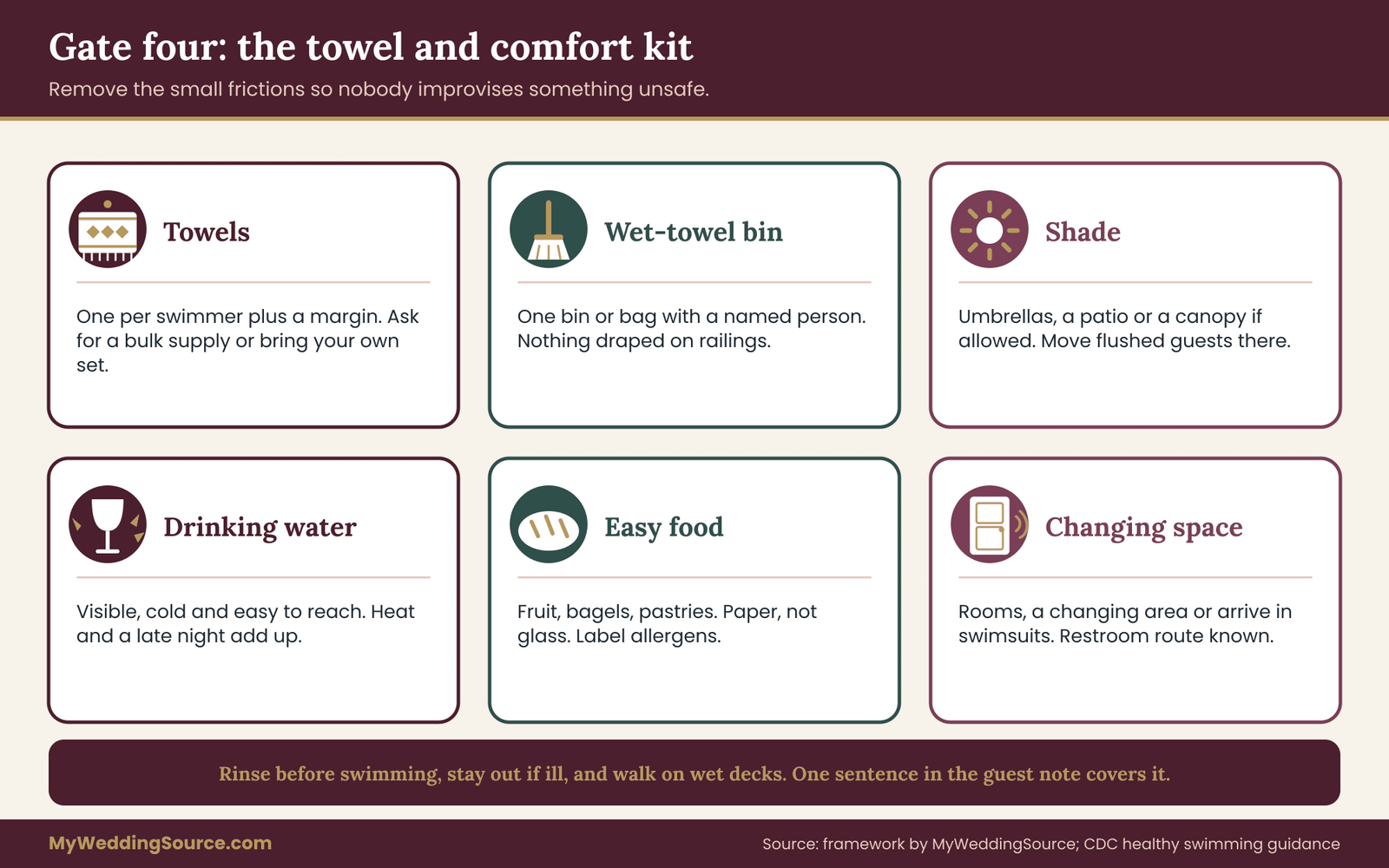
Photo consent at a pool gathering
The fifth gate concerns the moment when phones come out. A pool gathering is a place where people are lightly dressed, wet, relaxed and sometimes self-conscious. A photo that would be fine at the reception can feel intrusive at the pool, especially when it ends up in a group chat, a shared album or a public post. Some guests have reasons for avoiding photos that have nothing to do with how they look, including safety, privacy, a custody situation or a workplace that frowns on certain content.
The broader subject is covered in our guide to wedding photography consent, which explains how to plan guest boundaries and image use across the whole wedding. This section applies the same thinking to one specific setting, where the stakes feel higher because of what people are wearing and who might see the photos.
Why the pool changes the photo question
Three things make the pool different. First, swimwear and wet clothing change what people consider acceptable to share. Second, children are in the water, and many parents are firm about their images being kept private. Third, attention matters for safety. A guest holding a phone is not watching the pool, and a guest filming a child in the water has stopped supervising that child.
For these reasons, a simple rule helps: no photographs or videos of other people in the water or in swimwear without their explicit say-so, and no photographs of other people’s children at all unless the parents have agreed. This is a house rule for the pool gathering, not a law, and a courteous one.
The three-option consent approach
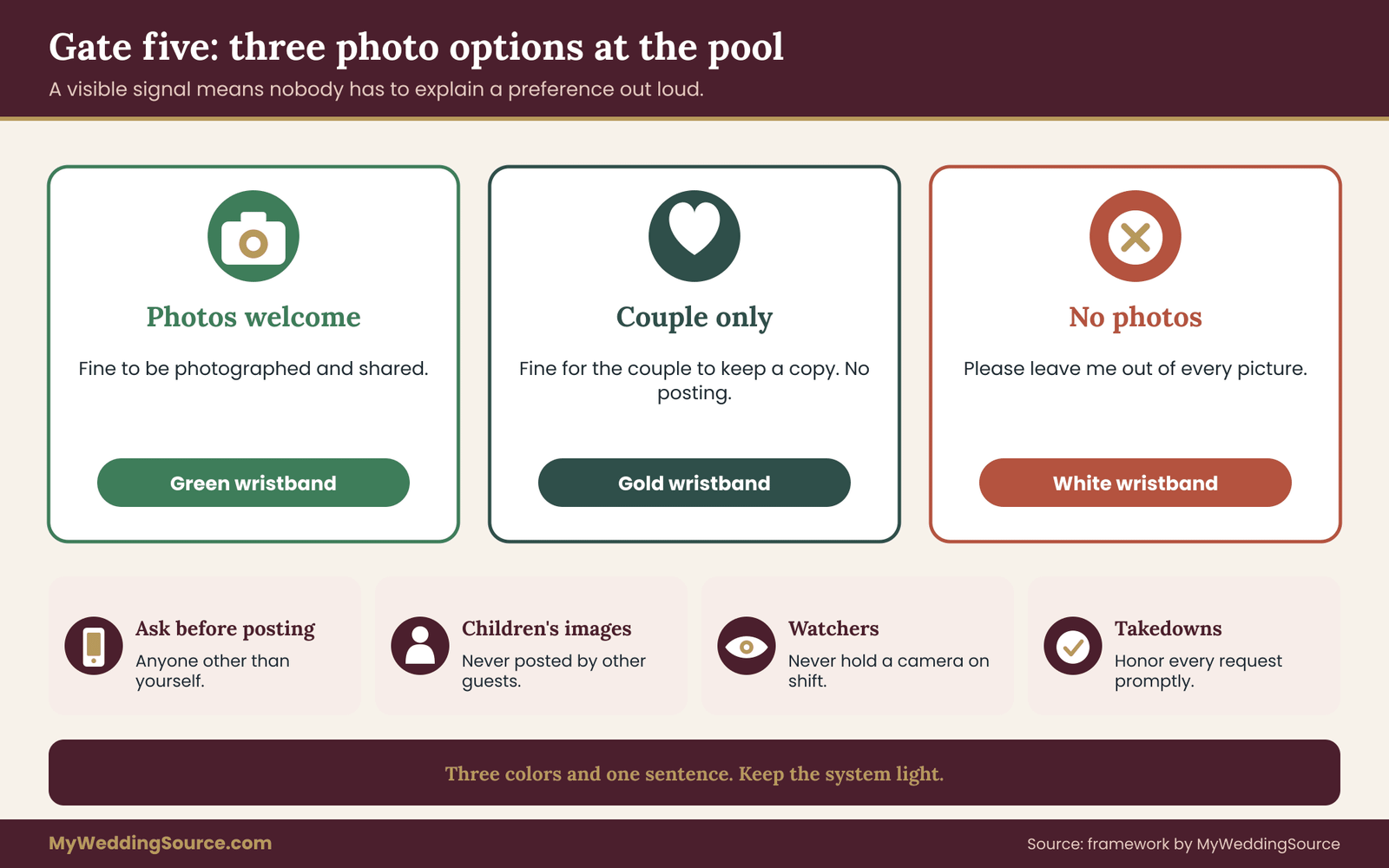
A practical way to apply this is to offer guests three clear options, and to make each one easy to choose without a conversation. The first option is “photos welcome”: guests who are comfortable being photographed and shared. The second is “photos for the couple only”: guests who are fine with the couple having a copy but do not want images posted. The third is “no photos”: guests who prefer not to be photographed at all.
Give each option a visible signal. A colored wristband, a sticker on a towel, a card on a lounge chair, or a simple sign at the entrance all work. The signal removes the need for anybody to explain a preference out loud, and it gives photographers and friends a quick way to check. Keep the system light. Three colors and a sentence of explanation are enough.
Where the photographer fits in
If you have hired a photographer for the weekend, they are probably not planning to cover the pool. If you want them there, discuss it with them in advance, and discuss what you want captured. Many photographers have contract terms about the situations they will and will not cover, and the pool can be one of them because of equipment risk. Check your agreement, and see our guide on reading a wedding vendor contract for what to look at before you ask for an addition.
If a friend will take photos, treat them like a photographer in terms of rules. They follow the same three options, they are not a water watcher, and they do not stand near the water’s edge with a phone while children are in the pool.
Posting, tagging and the group chat
The risk is rarely the photo itself. It is where the photo goes afterward. A photo posted publicly, tagged with names and a location, can expose a child’s identity, a guest’s whereabouts or a person’s private life. Ask guests to wait for the couple to share photos, or to ask before posting anyone else. Keep the request simple: “Please ask before posting a photo of anyone other than yourself, and please do not post photos of other people’s children.”
If you create a shared album for the weekend, remind guests that anyone with the link may see it. Choose an album setting that requires a login or a link that you can disable, and delete anything a guest later asks to have removed. A prompt removal after a request is the single most trust-building thing you can do.
Pass or fail checks for gate five
Gate five passes when guests have been told the photo rules before the pool gathering and again at the pool. Each guest has an easy way to signal a preference. Children’s images are covered by a clear rule. The people holding cameras are not the people watching the water. And you have decided how photos will be shared, and who can ask for one to be taken down.
Inviting guests and asking the right questions
With the five gates in hand, the next job is telling people about the plan and securing the support you need from the property and any vendors. This is where a pool gathering either feels organized or feels like a rumor that spread around the hotel lobby.
Decide who is invited
The first decision for a pool gathering is the guest list. A morning-after pool gathering is almost never a full-wedding event. It is usually the wedding party, close family, out-of-town guests staying at the property, and anyone the couple wants to see once more. Be clear about it, because an unclear guest list creates feelings. If you invite some guests and not others, expect questions, and keep the answer short and warm: “We are keeping the morning small, but we loved having you there last night.”
The general rules about inclusion and tact at wedding events apply here too. If a group like all the cousins or all the college friends is invited, treat the group consistently, so that no one feels singled out. If the pool has a hard capacity, say so honestly, since a limit is an easier reason to accept than a vague preference.
Write the invitation as information, not as an order
The message to guests should be brief and specific. It names the time window, the place, whether the pool is open to non-hotel guests, what to bring, the alcohol and photo approach, and who to contact with questions. It does not need to sound like a legal notice. A short, friendly note works best.
“We are meeting at the hotel pool on Sunday from ten to noon, come for as long as you like. We will have towels, shade, coffee and pastries. We are keeping the pool side alcohol-free and asking everyone to check before posting photos of others. If you or your child is not a confident swimmer, tell any of us and we will help. See you there.”
Send that note in the same channel that guests already use for the weekend, such as a group text, a shared welcome sheet or the wedding website. If you use more than one channel, copy the same wording into each so guests never see mixed messages.
Make it opt-in, with a way out
Nobody should feel obliged to swim at a pool gathering. A pool gathering is an optional extra, and the invitation should say so. Mention that guests are welcome to sit on the deck, bring a book, or skip it. This protects guests who are tired, who do not swim, who have concerns about water, or who simply want a quiet morning. It also protects you from the feeling that the morning is a performance.
Guests who are not staying at the property
If the property restricts the pool to registered guests, outside guests may not be allowed. In that case, ask whether the front desk will issue day passes or visitor wristbands, and whether there is a charge. Do not tell outside guests to simply walk in. A staff member who stops a guest at the gate embarrasses the guest, and you are the one who invited them.
What to ask the venue or property manager
Here is a compact set of questions to ask the property, in addition to the gate one list. Treat them as a checklist for a single phone call or email.
Does the property carry liability insurance that covers guests at the pool, and does a hosted group change that?
Does the property require a waiver or release from guests, and if so, how is it collected? Is a staff member available to open the pool, set out towels or operate the accessible lift? Are there pool areas that are closed during the time of your pool gathering, such as a children’s wading area? Is there a charge for extra staff, cleaning or towel service? And what is the policy if the weather turns, for example if lightning requires the pool to close?
Weather is worth a closer look. Many pools close for lightning and reopen only after a waiting period set by the property. If the pool closes, the pool gathering needs a fallback, and the alternatives section covers some good ones. Tell guests in advance that the plan may shift, and give them a single place to check for updates.
Questions to ask a rental host or private owner
If the pool is at a private home or a vacation rental, the questions change. Ask the owner whether the rental agreement allows visitors and how many. Ask whether the pool has a fence, a gate or an alarm, and whether they work. Ask whether the owner’s insurance covers a pool gathering, because a rental policy sometimes excludes events. And ask whether there are rules about noise, parking and hours that apply to the neighborhood. A pool gathering that irritates neighbors is a pool gathering that may be shut down.
If a vendor is involved, such as a caterer providing breakfast or a rental company providing towels or tents, bring the same level of clarity to those relationships. Confirm the scope and the delivery time in writing, and check whether your existing agreement covers an extra day. A short email beats a verbal assumption, and it connects to the habits that make the wedding itself run well.
The three-minute spoken briefing
On the morning, gather people near the pool for a short briefing before anyone gets in the water. Keep it to about three minutes and say it in your own voice. The structure follows the five gates and sounds like this.
“Good morning, and thank you for coming. A few quick things before we swim. The pool is open until noon and we have the property’s okay. These three people are our water watchers, and they will take turns; if you need help, find the person in the bright towel.
“Kids stay within an adult’s reach, and anyone who is not a strong swimmer, please tell us and use a life jacket or stay in the shallow end. We are keeping the pool side alcohol-free, and there is a good drink table over there. Towels are on the cart, and wet ones go in the bin. And on photos: please look for the wristband colors, and please do not post anyone else’s picture or any child’s picture without asking. That is it. Enjoy yourselves.”
Practice it once, out loud, before the morning. It will take you less than a minute to learn, and it turns a loose crowd into a group with shared expectations.
The one-page card
Put the key facts on one page that can live on a phone or be printed and left at the pool. It lists the pool hours, the water watcher names and times, the emergency contact at the property, the nearest hospital, the alcohol rule, the photo options and the closing time. A one-page card is easy to forward, easy to read and easy to update, and it keeps the morning from depending on one person’s memory.
A worked example: thirty-eight guests at a hotel pool
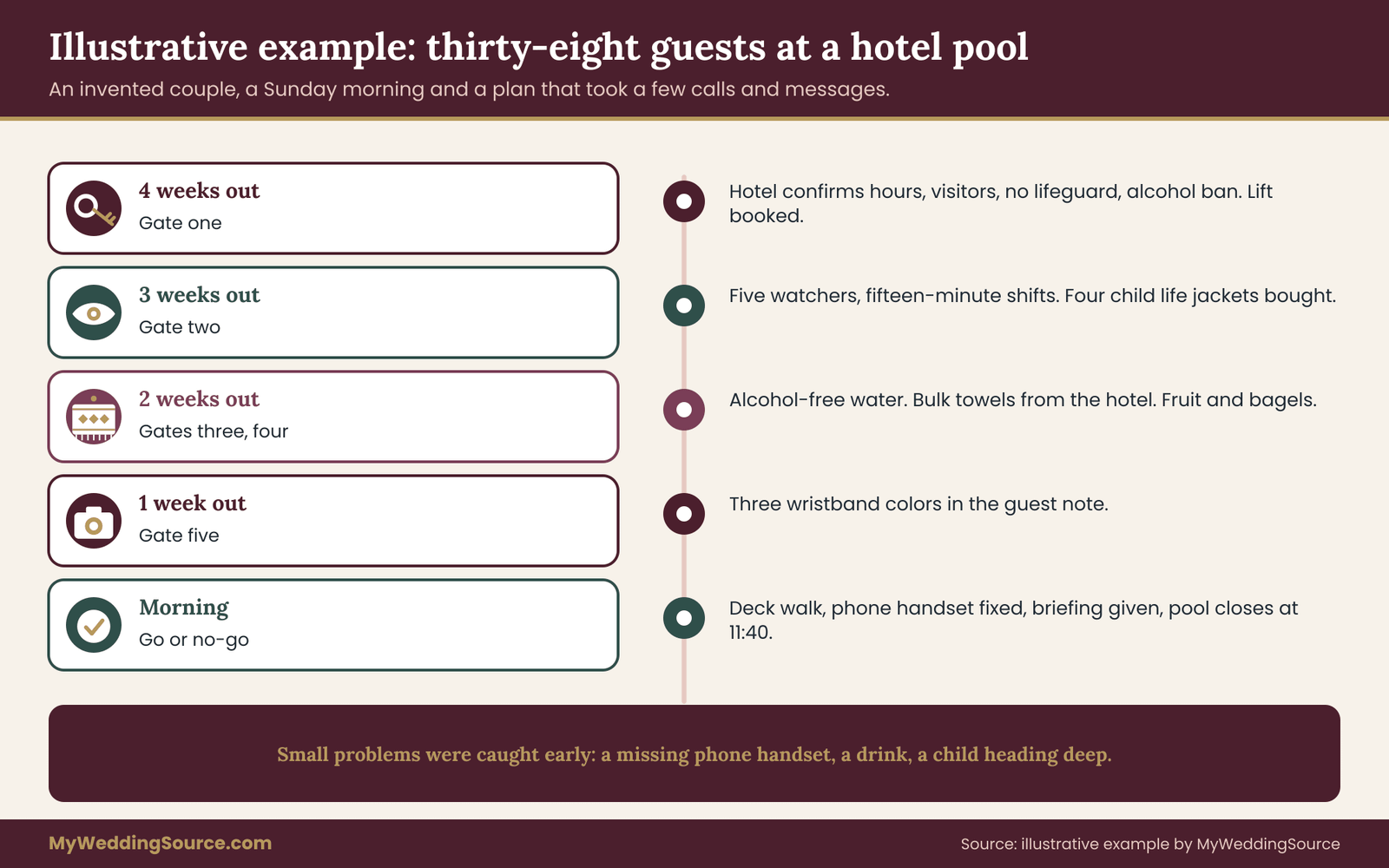
The following example is invented to show how the gates fit together. It does not describe a real couple, and the numbers are illustrations, not benchmarks. Maya and Daniel, planning a pool gathering, are married on Saturday at a hotel in a warm-weather city. About thirty-eight guests are staying at the hotel, including seven children between two and twelve, three grandparents and the wedding party. They want to give everyone an easy Sunday morning before flights that leave in the afternoon.
Four weeks before: gate one
Maya calls the hotel’s event office and asks the gate one questions. The pool opens at nine and closes at eight at night. It is for registered guests only, which fits, since the invited group is all staying there. The posted occupancy is a figure that the hotel manager says assumes a normal mix of swimmers and deck sitters. No lifeguard is on duty. Glass is banned, outside food is allowed on the deck, and alcohol is not permitted in the pool area. Towels are available at a cart, with a limit per room.
She sends a summary email and receives a one-line reply confirming it, plus the name of the weekend manager. She also asks about the accessible lift for Daniel’s grandmother, who uses a cane and a walker. The manager explains that the lift is operated by staff on request, and Maya books it for ten o’clock.
Three weeks before: gate two
Maya and Daniel choose five water watchers from the wedding party and family: two cousins, a friend who coaches high school swimming, Daniel’s older brother and a college roommate. None of them has a camera job, and none is a parent of a child under five. They write a rotation of fifteen-minute shifts from ten to noon, two watchers at a time, so each person has two shifts.
Parents of the seven children agree to stay within arm’s reach of the two youngest. The parents of the older children set their own rules. Maya buys four U.S. Coast Guard-approved life jackets in children’s sizes and brings them for any guest who needs one. She asks for a talk with the five watchers on Saturday afternoon, five minutes long, covering positions, handoffs and the emergency plan. The nearest hospital is noted on the card.
Two weeks before: gates three and four
The couple decides the pool side will be alcohol-free, which matches the hotel’s rule. They plan a toast with sparkling juice and mimosas on the terrace after the pool closes at noon. For towels, they ask the hotel about a group supply. The hotel says it can bring a bulk supply on request for a modest charge, which Maya accepts after comparing it to the cost of buying and carrying towels herself. She adds a bin for wet towels and a basket of sunscreen.
Food is simple: fruit, bagels, pastries and coffee, all from the hotel kitchen. A staff member will set the table at nine-thirty. Maya checks that no guest has told her about a nut allergy and labels items anyway.
One week before: gate five
Maya includes a short photo note in her message to guests: three wristband colors, a request to ask before posting others and a rule about no pictures of other people’s children. She hands out wristbands at the Saturday reception. Daniel’s cousin, who works in a field where public photos can cause problems, quietly chooses the no-photo color. The couple’s hired photographer will not attend the pool, so a friend will take a few casual pictures and follow the same rules.
The morning itself
At nine-forty, Maya and Daniel walk the pool. They check the posted rules, find the reaching pole and ring buoy, and notice that the pool phone is missing a handset. Maya tells the front desk, who send someone to fix it. The two watchers for the first shift are in position by ten. Maya gives the three-minute briefing. The lift is ready.
During the pool gathering, one guest, still tired from the night before, arrives with a cup of champagne. A friend gently says, “Let’s keep the pool side dry of drinks, and I will bring you coffee.” The guest agrees. A child who has just learned to swim is nudged back toward the shallow end by a watcher who saw him heading for the deep side. At eleven-forty the watchers close the pool, towels go in the bin, and the group moves to the terrace for the toast.
What the example shows
Nothing in this pool gathering was dramatic, and that is the point. The planning took a few phone calls and a few messages. The rules were friendly, the roles were clear, and the small problems, a missing phone handset, a guest with a drink, a child heading for deep water, were handled before they grew. The couple did not spend the morning worrying, because the plan already answered the worrying questions.
Notice also what Maya did not do in her pool gathering. She did not try to control everything. She did not hire a lifeguard because the property did not offer one and she judged the watcher system adequate for the group. That is a judgment, and you may reach a different one. If your group is larger, your pool is deeper or your guests are less comfortable in water, hiring a certified lifeguard is a reasonable step, and the property or a local company may be able to arrange one.
Comparing alternatives to a pool gathering
A pool gathering is one way to spend a morning after a wedding. It is not the best way for every group, and a good host is willing to switch. Here are the main alternatives and how they compare in terms of risk, cost and effort.
The dry morning meet-up
A coffee-and-pastry meet-up on a patio, in a lobby lounge or in a rented room gives people the same last-hour feeling without water. It has the lowest risk and the lowest effort. It suits older guests, families with infants, rainy weather and properties that restrict the pool. The cost is the food and drink, and the trade-off is less movement and less appeal for children.
The shallow splash zone or a wading area
Some properties have a wading pool, a splash pad or a shallow beach entry. Small children can play there with an adult at arm’s reach, and the depth makes the risk lower. A pool gathering built around a splash zone is smaller, more child-focused and easier to supervise. It still needs watchers and the same photo and towel plans, but fewer gates are hard to pass.
A lake, ocean or river outing
Open water brings other hazards: currents, cold, uneven bottoms, boats and no clear edge. It requires more careful supervision than a pool, and the CDC and the American Red Cross both publish guidance for open water that differs from pool guidance. For a casual morning-after plan, it is usually better to pick a lifeguarded public beach than an unguarded spot, and to treat the outing as a separate event.
A walk, a park or a games morning
Lawn games, a short walk, pickleball, a sunrise stroll or a trip to a farmers market are low-cost, flexible ways to spend the time. They suit groups that are uncomfortable with water or that want to include everyone. Our guide to wedding etiquette can help you decide how to include guests who prefer a quieter option.
Comparing in prose
If you want a quick rule of thumb, rank the options by how many of the five gates they need to pass. The dry meet-up needs two or three. The splash zone needs four. The pool gathering needs all five. The open-water outing needs all five and more. The more gates an option needs, the more of your time and attention it takes, and the more it is worth saying no to when the group is tired or the property is unclear.
A related point on cost. A pool gathering can be inexpensive if the property supplies towels and the food is simple. Costs rise if you add a lifeguard, a bulk towel supply, a rental canopy or a private room. A dry meet-up often costs about the same as the food alone. Compare your actual quotes, not assumptions.
Edge cases for a wedding pool gathering
Plans meet reality in the unusual cases. These are the situations that most often catch hosts off guard, along with a clear way to think about each.
The weather turns
Thunder, lightning, a sudden cold front or heavy rain can close a pool without warning. Properties usually close the pool at the first sign of lightning and reopen after a waiting period of their own choosing. Do not argue with that rule. Decide in advance that a closed pool means the group moves to the fallback, whether that is the terrace, a lobby lounge or a meeting room. Tell the guests in the first message that the plan can shift and where updates will appear.
The pool is crowded with other guests
A hotel pool on a Sunday morning is rarely empty. Other families will be there, and your group does not own the water. Keep your watchers focused on your own guests but remain polite to others, and keep noise and space use reasonable. If the pool is too crowded to supervise safely, treat that as a reason to shorten the pool gathering or switch to the dry meet-up, not a reason to push through.
A guest becomes ill or injured
A guest may feel faint from heat, scrape a knee on the deck or swallow water and cough. Most of these are minor, and the watchers and hosts know where the first-aid kit is. If a situation looks serious, call 911 and follow the emergency plan. Do not move a person with a possible neck or back injury, and do not leave a child alone. Afterward, note what happened and tell the property staff, since they may need to file a report.
A guest refuses the rules
Occasionally a guest will push back on the alcohol rule or the photo rule. Stay calm and avoid a public argument. A short, private conversation from a trusted friend or family member usually settles it. The rules protect everyone, and the guest who objects is often someone who has not heard the reasons. If a guest persists in unsafe behavior, such as diving in shallow water or bringing glass to the deck, ask them to leave the pool area for now and give them a face-saving way to do so.
Teenagers and older children
Teens are an easy group to overlook because they swim well and look fine. They are also more likely to roughhouse, dive, hold their breath for games or ignore rules. Talk to them as adults. Give them a clear task, such as running the music or setting out snacks, and be direct about the rules for breath-holding games and diving. Water watchers should treat a group of teens like any other group in the water.
Older guests and mixed mobility
Older guests may enjoy sitting by the pool but may not want to swim. Provide chairs in the shade, close to the action, with a clear path to restrooms. Be aware that wet decks are especially risky for guests who have balance problems. A spot near the entrance, away from the pool edge, is often more comfortable. See the earlier section on accessibility for the entry question, and ask each guest quietly what they need.
Guests who cannot or will not swim
Some guests have a fear of water, a medical limitation, a religious or cultural preference about swimwear or mixed-gender swimming, or a simple wish to stay dry. Make the pool gathering open to them without pressure. Offer a shaded seating area, a coffee table and a conversation. A pool gathering where the non-swimmers feel like second-class guests has missed the point, and a pool gathering where they are central to the table has succeeded.
Service animals and pets
Many pools ban animals, including pets, though service animals are generally handled under separate rules. If a guest has a service animal, ask the property how it handles the pool area and where the animal can wait. If guests want to bring pets, check the property’s policy and the other guests’ comfort, and consider leaving pets out of the pool gathering altogether.
A last-minute change of plan
Sometimes the couple, or a guest, proposes an impromptu pool gathering the night before. It can still work if you run the gates quickly. In a short version, call the property and ask the five gate one questions, name two water watchers, decide the alcohol rule, confirm towels and agree on photos. If any one of those cannot be done in the time available, choose the dry meet-up. A rushed pool gathering is the one most likely to skip supervision.
The morning go or no-go check
On the morning of the pool gathering, spend ten minutes at the pool before guests arrive. Walk the deck and look for hazards: broken tiles, wet spots, glass, a missing gate latch, a pool cover left partly on, a cloudy pool where the bottom is not visible. If the water is too cloudy to see the bottom clearly, the pool should not be used until the property confirms it is safe.
Check the weather and the sun angle. Confirm the watchers are present, sober, rested and briefed. Confirm the towels, the drink table and the photo wristbands. Confirm the property contact is reachable. If any of those fails and cannot be fixed quickly, you have a go or no-go decision, and no-go is a perfectly good answer. Switch to the fallback, tell guests warmly, and enjoy the dry version.
Think of this check for a pool gathering as the last of the five gates, applied on the day. It takes ten minutes and often finds one small thing that would have become a larger one. It also gives you a pause, a calm moment before the party begins.
Your next steps
Here is a sequence that fits into the weeks before the wedding without crowding the rest of your planning.
- Decide whether a pool gathering fits your group, using the four situations earlier in this guide. If it does not, choose a dry meet-up and stop here.
- Contact the property and ask the gate one questions. Send a summary email and keep the written yes.
- Choose two or more water watchers, write a rotation and brief them on the day before.
- Decide the alcohol rule and the drinks you will serve instead. Write it in one sentence.
- Make a towel plan, with a bin for wet towels, shade and a small food and drink table.
- Pick the three photo options and the signals, and send guests a short note that includes the rules.
- Write the one-page card and practice the three-minute briefing aloud.
- On the morning, do the ten-minute go or no-go check. If any gate fails, switch to the fallback without guilt.
If you keep a master checklist for the weekend, add these eight items as one line each, and assign a name to every line. Where a task has no name, nobody owns it, and that is where plans tend to fall apart.
FAQ
Do we need a lifeguard for a morning-after pool gathering?
Not always. Many hotel pools hosting a pool gathering have no lifeguard on duty, and the property’s rules decide whether one is required for a group. Ask the property. For larger groups, deeper pools or many children and non-swimmers, hiring a certified lifeguard is a sensible extra layer. Without one, named water watchers with a rotation and a clear position are the minimum you should have.
Can we serve alcohol at the pool the morning after the wedding?
Check the property’s rules first, because many pools ban alcohol in the pool area. The safest choice is an alcohol-free water area with a toast afterward on a terrace or patio. If you allow alcohol, keep it away from the water, never allow people who are watching the water to drink, and make sure no one who appears impaired swims.
How many water watchers do we need?
It depends on group size, pool shape and the number of children, so there is no single number. A common starting point is two watchers on duty at any time for a group of thirty to forty, rotating in short shifts. Add more watchers if the pool is large, crowded or hard to see from one spot.
What if the hotel says the pool is for registered guests only?
Then your pool gathering is limited to guests registered at the hotel. Ask whether the front desk can issue day passes for outside guests, and whether there is a fee. Do not send outside guests to walk in unannounced. If passes are not available, choose a dry meet-up for the full group.
Who is responsible if someone is hurt?
Responsibility depends on the property, local law, the insurance involved and the circumstances, and a lawyer or insurer can answer it for your case. In practice, the host who organizes the pool gathering carries a moral duty to plan well. Ask the property about its liability coverage and any waiver it requires, and keep your written confirmations.
Are life jackets better than floaties for kids?
Yes. Safety organizations advise using life jackets that are approved by the U.S. Coast Guard for children who are not strong swimmers. Water wings, pool noodles and inflatable toys are not safety devices and can give a false sense of security. Even with a life jacket, a child still needs an adult within arm’s reach.
How should we handle photos of children at the pool?
Set a rule for the pool gathering: no photos or videos of other people’s children without the parents’ agreement, and no posting of any child’s image online without asking. Offer parents the no-photo option with a wristband or card. Remind guests that a person filming a child is not supervising that child.
What if guests want to swim after drinking the night before?
Be kind and be firm at any pool gathering. Alcohol and fatigue can linger and slow reactions, so offer breakfast, water and a shaded chair first. If a guest still seems affected, the pool is closed to them for now. A calm friend or family member should handle the conversation privately, without an audience.
Sources
- Centers for Disease Control and Prevention, Drowning Prevention
- Centers for Disease Control and Prevention, Healthy Swimming
- Centers for Disease Control and Prevention, Model Aquatic Health Code
- U.S. Consumer Product Safety Commission, Pool Safely
- U.S. Consumer Product Safety Commission
- American Red Cross, Water Safety
- ADA.gov, U.S. Department of Justice Civil Rights Division
- National Institute on Alcohol Abuse and Alcoholism
- American Academy of Pediatrics, HealthyChildren.org
- U.S. Coast Guard, Boating Safety