
Vow translation is the work of carrying promises you wrote, or promises you will repeat after an officiant, from one language into another without losing the meaning, the tone or the sound of your own voice. This guide explains who should translate wedding vows, how to review what comes back, and how to confirm that every line says what you intend before anyone speaks it aloud.
Choose the translator by the job, not by the title. A professional translator is the safest choice for vows that will be read to a mixed-language room or printed. A bilingual relative can do the work if a second person reviews it. Score every draft against six points: meaning, register, cultural and religious terms, sound when spoken, personal voice and readiness to deliver. Then confirm meaning with a back-translation done by someone who has not seen your original. Machine output is a rough draft at best, never the final text.
Most couples meet this problem late. The vows are written, or the officiant has chosen the wording, and then someone points out that a grandmother, a parent or half the guest list will not follow a word of it. The couple asks a cousin who studied the language for two years, the cousin produces something that sounds stiff, and nobody is sure whether it is wrong or merely unfamiliar. Good vow translation exists to prevent that moment of doubt.
The task is smaller than a full document translation and harder than it looks. A vow is short, which tempts people to treat it as an afternoon’s work. It is also personal, spoken in front of people you love, and often tied to a legal or religious formula that cannot be changed freely. Each of those three features changes what a good translation looks like, and each is covered below.
A note on scope. This is general information, not legal, tax or religious advice. What a marriage license requires, what a faith community permits and what an officiant will accept all differ by state, tradition and person, so where a rule matters this guide points you to the person or agency that holds it.
What vow translation really involves
Translation is not word substitution. A translator reads your sentence, decides what it means in context, and then writes a new sentence in the other language that a native speaker would recognize as natural. For a vow, “context” includes who is speaking, who is listening, how formal the occasion is and what the speaker feels at that moment.
Three different jobs hide under the single phrase vow translation, and it helps to separate them before you ask anyone for help.
Rendering a text you wrote. You have personal vows in one language and want a faithful version in another. This is the most common job and the one where personal voice matters most. The translator must preserve your jokes, your pet names, your rhythm and your restraint, or your lack of it.
Rendering a fixed text. Your officiant, your faith community or your chosen ceremony script supplies standard wording, and you want it available in a second language. Here accuracy to the source and to the tradition matters more than personal style, and the faith leader usually has a say.
Interpreting live. Someone stands beside you and renders each sentence aloud as it is spoken. This is interpretation, not translation, and it is a different skill with different risks. It gets its own section later in this guide, because many couples confuse the two and hire for the wrong one.
Knowing which job you have narrows the list of people who can help. A couple who wrote personal vows and want them heard in two languages needs a different kind of translator from a couple who want a standard blessing printed in the program. The first needs a writer’s ear. The second needs a specialist in the tradition’s vocabulary.
Why vow translation is harder than it looks
Wedding vows combine features that translators handle with care. They are written to be spoken, so they depend on breath, rhythm and the emotional stress of a particular word. They are intimate, so they often use forms of address that do not map cleanly between languages. Some languages distinguish formal and informal “you”; others have no such distinction; others encode respect in verb endings. A sentence that is warm in one language can read as cold or overly formal in another if the translator picks the wrong form.
They also lean on idiom. A line such as “you are my home” or “I will always have your back” does not translate word for word. The translator has to decide whether to keep the image, replace it with an equivalent image from the target language, or state the plain meaning. Each choice is defensible, and each changes the feel of the vow. That is why a good translator will ask you questions instead of simply delivering a document.
What accuracy and personal voice each demand
Accuracy means the translated vow promises the same things. If the original says “I will support your work” and the vow translation says “I will obey your work,” the vow translation has failed, however smoothly it reads. Accuracy also covers register, because a vow that was gentle can become solemn without a single wrong word.
Personal voice means the translated vow still sounds like the person who wrote it. A teasing, short-sentenced writer should not come out in long, formal clauses. These two goals pull against each other at the margins. A literal translation is accurate but may sound foreign. A free translation sounds natural but may drift from the meaning. The review rubric later in this guide gives you a way to judge where a draft sits between the two, so you can ask for adjustments with specific language instead of saying “it feels off.”
Who this guide is for
This guide to vow translation suits couples where at least one partner, or a large part of the guest list, speaks a language other than the language of the ceremony. It also suits couples who plan a ceremony in two languages by choice, and families where a grandparent’s language and the couple’s everyday language differ. If the ceremony itself is interfaith or draws on more than one tradition, the guide to planning an interfaith wedding ceremony covers who owns each ritual, and this one focuses narrowly on the words.
Five people who can translate wedding vows
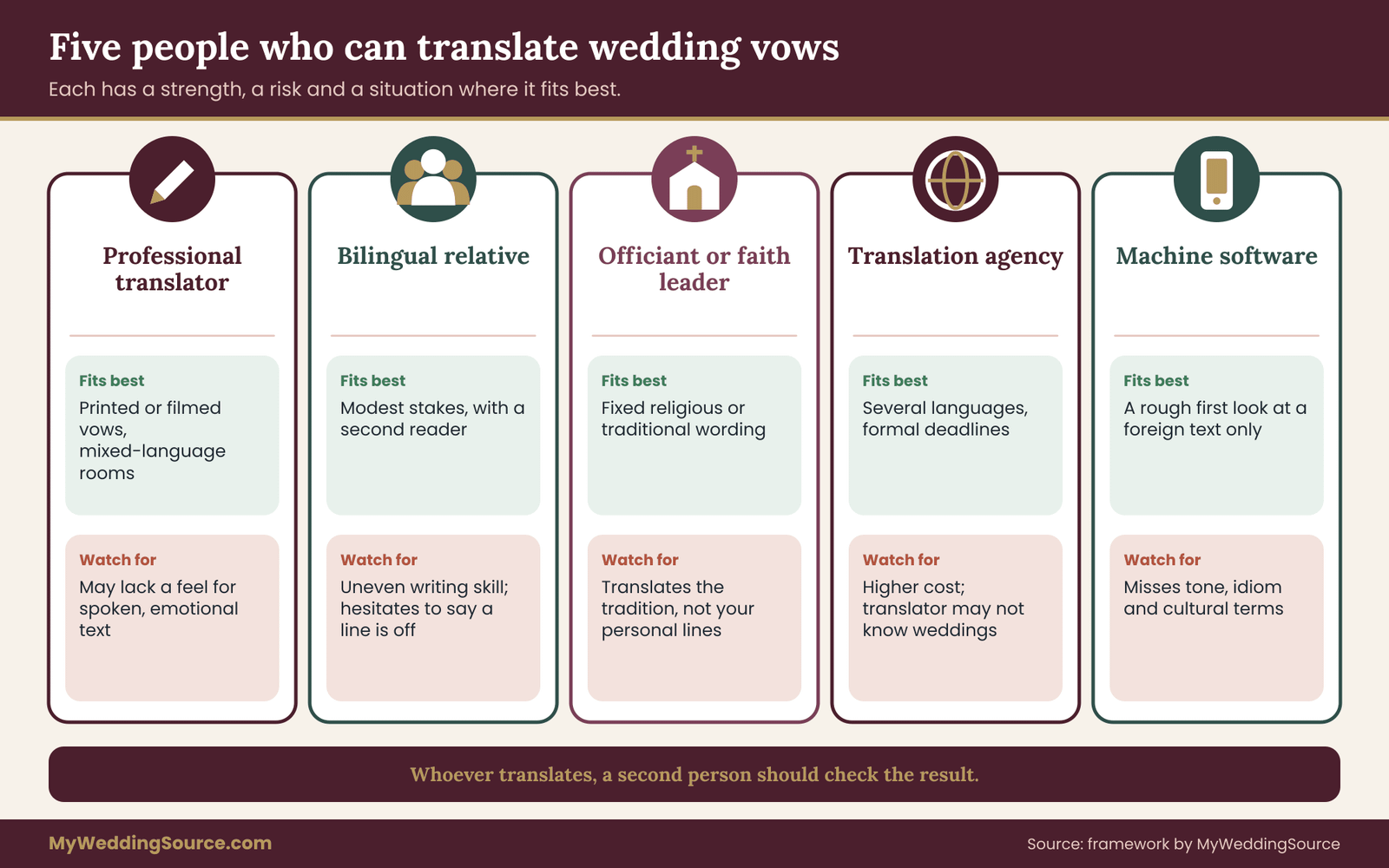
The question of who translates wedding vows has five realistic answers. None is always right. Each has a typical strength, a typical risk and a situation where it fits best.
A professional translator. This is someone who translates for a living, ideally into their native language, and who can explain their choices. The strength is consistency and accountability. The risk is that a translator who works mostly on contracts or manuals may not have a feel for spoken, emotional text, so ask for a sample before you commit. A professional is the best fit when the vows will be printed, filmed for relatives, or read to a mixed room.
A bilingual relative or friend. This person knows you, knows the family and may know the in-jokes. The strength is warmth and context. The risk is uneven skill: being bilingual at home is not the same as writing well in a second language, and a loved one may hesitate to say a line sounds wrong. This option fits when the stakes are modest, when the relative is comfortable writing in the target language, and when someone else reviews the result.
The officiant or a faith leader. For religious wording, this person may be the only legitimate source. A priest, imam, rabbi, pastor, celebrant or elder usually knows the accepted rendering of a blessing in the community’s liturgical or everyday language. The risk is that they translate the tradition, not your personal sentences, so they are the right authority for fixed text and a poor substitute for a translator of personal vows. The wedding officiant requirements guide covers what an officiant must do legally, which is a separate question from what they can translate.
A translation agency. An agency assigns a translator and often arranges a second linguist to review the work. The strength is a built-in review step and a clear process. The risk is cost, and that the assigned translator may not know weddings. Agencies fit best for several languages at once or for documents with a formal deadline.
Machine translation. Free tools produce an instant draft. They are useful for a first look at what a foreign-language text says, and they are poor at tone, idiom, formality and cultural terms. A machine draft should never go to the ceremony unreviewed. If you use one, treat it as a rough sketch that a human then rewrites.
A quick rule for choosing among them
For vow translation, if the vow is fixed religious text, start with the faith leader. If it is personal text and will be heard or read by people who rely on the vow translation, start with a professional. If the budget is tight, a bilingual relative plus a paid second reader often costs less than a full professional job and still gives you an independent check. If time is short, hire a professional for the final review of a relative’s draft instead of for the whole job.
One caution applies to every option: the person who translates should not be the only person who checks. Even professional standards for translation services call for a second linguist to review the work, and a vow deserves the same habit. The checklist later in this guide shows how to arrange that review cheaply.
Cost logic without invented numbers
Prices for vow translation vary by language, by translator and by deadline, so no single figure would be honest. What you can do is reason about cost drivers. Professional translators generally price by word, by hour or by project, and a vow is short, so many will apply a minimum fee instead of a per-word rate. Rush requests usually cost more. Rare language pairs usually cost more. A translator who must also advise on tone, adapt idioms and read your draft aloud is doing more than a word-for-word job, and may price accordingly.
Ask for a written quote that names the word count, the turnaround, the number of revision rounds included and whether a second reviewer is part of the price. Compare quotes on those four points, not only on the total. The cheapest quote that excludes revision rounds can become the most expensive one the first time you want to change a line.
What must stay exact in vow translation
Not every line of a ceremony carries the same weight. Before any vow translation begins, sort the text into three zones. The zone decides who has authority over the wording and how much freedom the translator has.
Zone one: legal wording. Some states require the couple to make a statement of consent in front of the officiant and witnesses, and some officiants use a standard form to meet that requirement. The legal act is the exchange of consent, not the poetry around it.
If the ceremony is in one language and a guest needs a second, the legal statement should stay in the language the officiant and the issuing office expect, with the second language added beside it, not instead of it. Ask the officiant, and confirm the rules with the office that issues your license. The USAGov page on marriage licenses is a sound starting point for locating that office.
Zone two: religious or traditional wording. A blessing, a covenant formula, a reading or a ritual response belongs to a community. Its translation is often settled by custom, and the community may care a great deal about the accepted rendering. Do not let a translator improvise here. Bring the proposed text to the faith leader or to a knowledgeable elder of that tradition and let them approve or correct it. Never assume that a tradition has one standard form: practice differs between communities, regions and generations, and only the people who will actually participate can tell you which one applies to your ceremony.
Zone three: personal wording. Your own vows, the words you wrote or will write, the reading chosen by a friend. This is where the translator has the most creative freedom and where your approval counts most. No authority outside the two of you needs to sign off, though a second reader still helps.

Why sorting the zones helps vow translation
Couples often discover mid-project that a relative expects the traditional wording to be preserved word for word, while the couple wanted a modern paraphrase. Sorting the ceremony into zones early puts that disagreement on the table while there is still time to resolve it. It also tells you how many translators you need. Zone one may need only the officiant. Zone two may need a faith leader. Only zone three needs a translator in the usual sense.
A practical way to do this is to print the full ceremony outline, one line per spoken element, and mark each line with a one-letter code: L for legal, T for traditional, P for personal. Share the marked outline with the officiant and with anyone who has a stake in the tradition. The act of marking often surfaces questions nobody had asked. Is the exchange of rings spoken or silent? Does the officiant read a fixed question and expect a fixed answer? Does a relative expect a prayer in a language the couple does not speak?
What to do when the zones overlap
Sometimes the same sentence is both traditional and personal. A couple may adapt a traditional promise by adding a line of their own, or personalize a blessing with a name. In that case, treat the fixed core as zone two and the addition as zone three. Translate the core by approved wording, translate the addition freely, and make sure the join between them does not create a grammatical or tonal break. A translator who knows the tradition can help with the join. A translator who does not should be told which part is fixed.
When a tradition’s accepted wording exists only in a liturgical or older form of a language, a faith leader may recommend using that form for the formal portion and an everyday form for the rest. That is a legitimate choice, and it is the leader’s to make. Your job is to understand the choice well enough to explain it to your guests in the program.
The rule for the legal line
If you take one rule from this section, make it this one: never let a vow translation replace the legal statement without checking first. The marriage license process is set by state law and administered locally, and the officiant must be able to attest that the required exchange took place. If an officiant does not understand the language of the vows being spoken, they cannot easily confirm what was said. Ask your officiant how they want the legal exchange handled, and ask early, because some officiants prefer to hear the required words in their own language even when the rest of the ceremony is bilingual.
Writing the brief before any vow translation starts
A translator can only be as good as the information they receive. A one-line request, such as “please translate these vows,” forces them to guess about tone, audience and delivery. A one-page brief removes the guessing and reduces the number of revision rounds. Treat the brief as the first step of vow translation, not an optional extra.
A useful brief answers eight questions.
1. What is the source language and what is the target language? Be exact about the variety. Spanish for a family from one country is not identical to Spanish from another, and the same is true of Portuguese, Arabic, Chinese and many other languages. Name the country or region of the listener you most want to reach.
2. Who will hear the vow translation? A grandmother who speaks only the target language needs plain, warm phrasing. A room of bilingual friends may enjoy a more playful rendering. If the audience is mixed, say so, because it affects how much to explain.
3. How will the vow translation be used? Spoken aloud by you, read by someone else, printed in a program, projected on a screen or filmed with subtitles. A line that works on paper may be too long to say in one breath.
4. What is the register? Describe the tone in plain words: formal and solemn, warm and conversational, playful with a serious center. Give two or three example sentences from your own writing that sound like you.
5. Which terms are fixed? List names, nicknames, place names, religious terms and any phrase you want kept in the original language. A couple may want one endearment left untranslated on purpose, because it is the one their family actually uses.
6. Which lines are legal or traditional? Share the marked outline from the previous section so the translator knows where they may not improvise.
7. Who approves the final text? Name the people. At minimum the couple. Often a faith leader or an older relative as well.
8. What is the deadline? Work backward from the date, leaving time for the review, rehearsal and printing steps described later.
An example of a useful brief
Here is how a short brief might read in practice. It is invented for illustration.
“Our vows are about two minutes each, in English, written to be spoken. We want a Portuguese version that my partner’s grandmother can follow in the ceremony. She is from a rural area and uses everyday speech, so please avoid formal literary phrasing. My vows use short sentences and one running joke about burnt toast, which we want kept as a joke. The word ‘amor’ should stay as ‘amor’ in line three. The blessing from our officiant is fixed text and not part of this job.”
“We will read both languages aloud, so please mark any phrase that is hard to say quickly. Final approval is by the two of us and my partner’s aunt, who is a native speaker.”
That brief is under two hundred words. It tells the translator the audience, the register, the protected words, the exclusions and the approval chain. A translator reading it can start work in a few minutes without sending a list of questions. If you take the time to write it, you spend less time on revisions later.
What the translator should send back
Ask for more than a clean final text. A useful delivery includes the translated vow, a list of places where the translator had to make a choice between two reasonable renderings, a note on any idiom that was replaced, and, if you plan to speak the text, a pronunciation guide or a recording. The list of choices is the most valuable part. It shows you where the vow translation departs from the literal meaning so that you can decide whether you agree. A translator who sends only a polished text gives you no way to judge what was changed.
How much of your own writing to hand over
Give the translator the finished vow, not a half-edited draft. Translating a draft and then editing the original creates two versions that drift apart, and the final text may not match anywhere. Lock the source first. If you still want to change the source, make the changes, send the revised version with changes marked, and ask the translator to update only the affected lines. Keeping a single source of truth is the simplest way to keep vow translation consistent, and it is the habit that prevents most late errors in vow translation.
The translator review rubric for vow translation
When a draft comes back, most couples have one reaction: it reads fine, or it does not. That reaction is real but it is not specific enough to act on. A rubric turns a feeling into a list of observations you can hand back to the translator. The rubric below has six criteria. Score each from zero to two, where zero means a problem that must be fixed, one means acceptable with small changes, and two means the draft does the job.
The rubric is a decision framework for vow translation, not a general quality standard. Use it on every draft, from every kind of translator, including a relative who did the work for free.

Criterion one: meaning
Does each sentence in the vow translation promise what the original promises? Read the original and the vow translation side by side, one sentence at a time, and mark any sentence where something was added, dropped or changed.
Additions are easy to miss. A translator who wants a line to sound complete may add a word of emphasis that you did not write. Omissions are harder still, because they leave no trace in the translated text. The only way to catch them is to compare sentence by sentence or to use the back-translation step described later.
Score two if every promise survives. Score one if a minor nuance shifts but the promise holds. Score zero if a promise changes, disappears or appears from nowhere. A zero in this criterion blocks approval no matter how the other criteria score.
Criterion two: register
Register is the level of formality and the emotional temperature of the language. A vow that is tender and plain should not become formal and distant. A joking vow should not become solemn. Many languages mark register with word choice, verb forms or the choice between formal and informal address, so a translator who picks the wrong form changes the relationship between the speaker and the listener.
Ask a native speaker of the target language to read the draft and answer one question: does this sound like someone speaking to a person they love, or like someone reading a document? If the answer is “a document,” the register is off even if the meaning is right. Score two when it sounds like speech, one when it is acceptable but stiff, and zero when it sounds like a legal notice or a greeting card.
Criterion three: cultural and religious terms
Check every word that belongs to a tradition, a region or a family. This includes names for relatives, religious terms, forms of address, references to food, places or customs, and any phrase that carries a cultural meaning beyond its dictionary sense.
For each such term, ask three questions. Did the translator keep it, replace it or explain it? Is that the right choice for this audience? Would a member of the community recognize the rendering as respectful and correct? The third question needs a person from the community, not a general translator. If you cannot reach one, flag the term and ask the faith leader or an elder to review it.
Score two when each term was handled deliberately and a community member agrees. Score one when the handling is plausible but unconfirmed. Score zero when a term was flattened into a generic word, mistranslated or used in a way a community member would find odd.
Criterion four: sound when spoken
A vow is spoken, so it has to work in the mouth. Read the translated text aloud at the speed you will use at the ceremony. Notice where you run out of breath, where a cluster of consonants trips you, and where a sentence runs longer than the original and demands a breath in the middle of a promise.
Length matters more than people expect. Some language pairs produce a vow translation that is noticeably longer or shorter than the source, which changes the timing of the ceremony and the feel of a line. If a sentence that took four seconds in the original takes eight in the vow translation, the pacing of the whole vow changes. A translator can often split or tighten a line without losing meaning if you tell them where it hurts.
Score two when you can read it aloud comfortably, one when it needs two or three small adjustments, and zero when the sentences are too long to say or too hard to pronounce.
Criterion five: personal voice
Compare the vow translation to a few paragraphs of your usual writing or speech. Does it keep your habits? If you write short sentences and use one specific image repeatedly, the vow translation should too. If you are dry and understated, a vow translation full of exclamation and intensity is a different person’s vow.
Look for three things in particular: humor, endearments and repeated phrases. Humor is the most fragile because jokes often depend on word play. A good translator will either find an equivalent joke or tell you the joke cannot travel and propose an alternative. Endearments should be kept or deliberately replaced with the term your partner actually uses. Repeated phrases should stay repeated, because repetition in a vow is rhythm, not clumsiness.
Score two when it sounds like you in the other language, one when it is faithful but generic, and zero when it sounds like a different writer.
Criterion six: readiness to deliver
The last criterion is practical. Is the text final, in a format you can use, with pronunciation help if you need it? Can the person who will speak it read it without hesitation? Is it formatted for the program or the screen it is going on? Has a named person approved it?
Score two when the text is final, rehearsed and approved. Score one when it is nearly there but unrehearsed. Score zero when it has open questions, unmarked changes or no approver.
How to use the scores
Add the six scores for a total out of twelve. The total matters less than the pattern. Use these decision rules.
If any criterion scores zero, stop and send that criterion back with specific notes before looking at the rest. A zero in meaning or in cultural terms is a stop sign. A zero in sound or personal voice is a revision request.
If the total is ten or more with no zeros, the draft is ready for the confirmation checklist in the next section. If it is seven to nine, send it back with notes on the ones, because most of them can be lifted to twos in one round. If it is six or fewer, ask whether the match between translator and text is wrong. It is usually cheaper to change translators after one weak draft than to coach a poor fit through three rounds.
Giving feedback a translator can use
A translator cannot act on “it does not feel right.” They can act on “line four is more formal than the rest of the vow, and my partner would say it more softly.” Use the rubric language in your notes. Name the line, name the criterion and describe the change you want. Keep notes short and put them in the order of the text so the translator can work down the page.
Be open to a no. A translator may explain that a phrase you want cannot be rendered literally without sounding strange, and may propose another. That is part of their job, and a translator who always agrees may not be telling you everything. Ask for the reasoning, and decide whether the alternative serves the vow.
Using the rubric on your own draft
The rubric also works when you or a relative did the vow translation. Score your own draft honestly, then hand the same sheet to a second reader. Where your scores differ from theirs, you have found the places to discuss. Disagreement between two scorers is more useful than agreement, because it marks the lines where the vow translation is a judgment call.
A short habit helps: score on separate sheets before comparing. People who score together tend to drift toward the first opinion spoken. Separate scoring keeps each reader’s judgment independent, and the comparison then shows genuine differences.
Vetting a professional for vow translation
If you decide to hire a professional, the work of vetting is mostly about asking the right questions and recognizing a good answer. You are not looking for a famous name in vow translation. You are looking for a person who translates into their native language, understands spoken and emotional text, communicates clearly and will stand behind the work.
Where to look
Start with professional directories. The American Translators Association maintains a searchable directory of translators and interpreters, and it also runs a certification program for translators in specific language pairs. Certification is one signal of competence in a particular direction, for example from Spanish into English, but it is not a requirement for good work and not every skilled translator holds it. Treat it as a useful data point, not a gate.
If your vows or ceremony paperwork will also be used in a legal setting, such as an immigration filing that includes a translated marriage certificate, a different standard may apply. Federal and state agencies often have their own rules about who may certify a vow translation. Check the agency’s current instructions before you commission anything for that purpose, because the requirement belongs to the agency and not to the translator.
Referrals work too. A faith community often knows who has translated for it before. A multilingual relative may know a professional in their own network. Ask each referral the same questions you would ask a stranger.
The first conversation
A good translator will ask you questions before quoting. They will want to know the audience, the tone, the purpose, the deadline and who approves the text. If someone sends a price within a minute of reading “please translate our vows,” that is a sign of volume work rather than careful work. The conversation is also your chance to listen. Does the person understand weddings? Do they ask about voice? Do they explain things plainly?
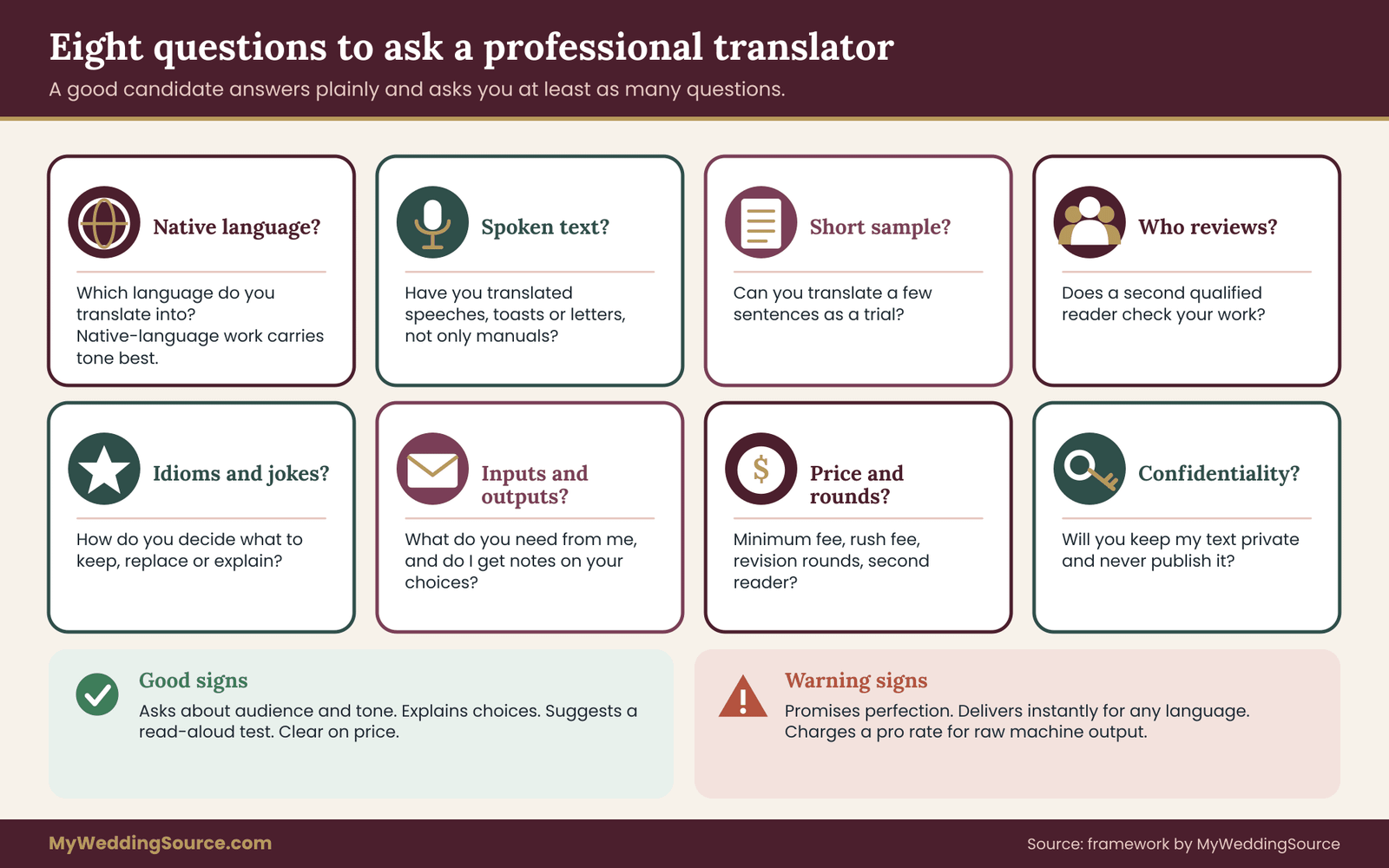
Ask these questions, in roughly this order.
What is your native language, and what do you translate into? Professionals usually translate into their native language, because that is where they command the full range of tone. A translator who works into a language they learned as an adult may be fine for technical text and weaker for emotional text.
Have you translated spoken or personal text before? Speeches, letters, toasts and ceremony texts are closer to vows than contracts or manuals. A translator with this experience will know that a line has to be sayable.
Can you share a short sample? Many translators will translate a few sentences of your vow as a paid or unpaid trial. Compare the trial to the rubric. If a translator declines any sample, ask for a past example of similar work with the client details removed.
Who reviews your work? A second reader is a sign of process. International standards for translation services describe translation followed by a check by a second qualified person, and many agencies and independent translators build that step into their price. If the answer is “no one, because I am careful,” ask whether you can pay for a review by a colleague.
How do you handle idioms, humor and endearments? The answer reveals the translator’s approach. A good answer describes a choice among options and offers to discuss them with you. A poor answer promises a perfect rendering of everything.
What do you need from me, and what do you send back? You want a clear list of inputs and a clear list of outputs, including notes on choices made.
How is the work priced and what happens if I want changes? Ask about minimum fees, rush fees, revision rounds and the cost of a second reader.
How do you handle confidentiality? Vows are private. A professional should be comfortable agreeing to keep your text confidential, and should not post samples of your words without permission.
Reading the answers
A good candidate answers plainly, asks you at least as many questions as you asked them, and is comfortable saying what they cannot do. They separate legal and religious wording from personal text without being prompted. They suggest a read-aloud test or a pronunciation recording. They are clear about price and about what is included.
Warning signs are easy to list. A candidate who promises instant delivery for any language, who guarantees a perfect result, who will not name their working language or who cannot explain why they chose a given rendering is not demonstrating care. A candidate who offers to rely entirely on machine translation and charges a professional rate for it is selling you something you can do yourself. A candidate who insists on keeping the rights to your text or wants to publish it as a sample is asking for more than the job requires.
Putting it in writing
For a short vow translation job, a simple written agreement is enough. It should state the source text and the languages, the deliverables, the price, the deadline, the number of revision rounds, the confidentiality of the text and who has the final say on wording. If you are working with a vow translation agency, the agency will usually provide its own terms, and you can compare them with the general habits described in the guide to a wedding vendor contract. Translation is a small service, but the same questions about deposits, deadlines and what happens if the work is late apply.
Keep the agreement and the final text together with your other wedding paperwork. Years later you may want to know which version was spoken, and who approved it.
Cost logic and how to compare quotes
Because a vow translation is short, a professional may quote a flat fee or a minimum rather than a rate by the word. Compare quotes on equal terms. Write down for each candidate the price, the delivery date, whether a second reader is included, how many revision rounds are included and whether a pronunciation aid is included. A quote that looks high may include a second reader and two rounds of changes; a quote that looks low may include neither. Divide the work into pieces and price each piece instead of comparing totals.
If budget is the main constraint, you have three honest options. You can ask a bilingual relative for the first draft and pay a professional to review it. You can pay a professional for the vow translation and ask a relative to read the result for warmth and voice. Or you can reduce the scope, translating only the lines that matter most to the listener who needs them. All three are reasonable. The one to avoid is skipping review entirely.
The broader habit of checking vendors before you pay them is covered in the wedding vendor due diligence checklist, and the same instincts apply to a translator as to a florist: confirm who is doing the work, what is included and what happens if something goes wrong.
When the translator is also the interpreter
Some couples hope to hire one person to translate the vows ahead of time and to interpret live on the day. That is possible, because many professionals do both, but the two jobs are priced and scheduled separately. An interpreter needs to know the order of the ceremony, to stand where they can hear, and to be briefed on any fixed text. Treat the live role as its own booking and ask the same questions about experience, confirmation of the date and a backup plan if the person falls ill.
The meaning confirmation checklist
A draft that scores well on the rubric is a good candidate, not a confirmed text. The confirmation checklist is the second half of the process: a short series of independent checks that prove the vow translation says what you meant. Each step in vow translation catches a different kind of error, and the order matters because the early steps are cheaper than the late ones.

Step one: freeze the source
Before anything else, decide that the original text is final and give it a version label, such as “source, version three, dated.” Print it or save it as a file that nobody edits. Every later check refers to this version. If you change a sentence in the source after confirmation has started, you must update and re-check that sentence in the vow translation, so make changes before the process begins.
Step two: the side-by-side read
Place the source and the vow translation next to each other and read both, sentence by sentence. If you speak both languages, do this yourself. If you speak only one, ask the translator to walk you through a literal gloss, a plain word-by-word rendering of the vow translation back into your language, with notes where the literal sense differs from the natural one. A gloss is not a second translation; it is a tool for seeing how the target text is built. Mark each sentence as matching, shifted or unclear.
Step three: the independent back-translation
This is the most useful check. Ask someone who has not seen your original, and who is fluent in the target language, to translate the finished text back into the source language. Do not show them the source. Compare their version to your source.
Differences fall into three kinds. Small differences in wording are normal and mean nothing. Differences in tone are worth noting and may point to a register problem. Differences in meaning, where a promise or an image comes back changed, are the ones to fix. When the back-translation says something different from your source, do not assume the back-translator was wrong. Ask both the translator and the back-translator to explain how they read the line, and decide which reading the original supports.
The back-translator should be a different person from the translator. If one person did both, they will tend to remember the source and reproduce it, and the check proves nothing. A professional can do this as a small paid job. A bilingual friend can do it as a favor, provided they have not read the original and are willing to say plainly when a line is awkward.
Step four: the native-speaker listening test
Ask a native speaker of the target language, someone who is not the translator, to listen as you or the translator reads the vow aloud, and to say what they heard. Do not prompt them with the source. Ask three questions. What is the speaker promising? How does the speaker sound? Was anything confusing, odd or unintentionally funny?
The third question catches the errors that paper does not. A phrase that is grammatical on the page can sound odd in the ear, or a word that is correct in the dictionary can carry an unintended meaning in a regional dialect. A listener from the region you care about will notice. If you have more than one regional audience, such as relatives from two countries who speak the same language differently, test with one listener from each.
Step five: names, terms and numbers
Go through the text with a highlighter and mark every name, date, number and traditional term. Check each against a reliable source: the spelling of each name against the person’s own preference, each date against the invitation, each term against the faith leader or community member. These are the details that guests notice most and that no one expects to be wrong. A misspelled name inside a vow is not a catastrophe, but it is easily avoided.
Step six: the authority sign-off
For zone two text, the traditional and religious wording, ask the relevant faith leader or elder to review and approve the final form. For zone one text, ask the officiant. Ask them to confirm in writing, even if the confirmation is a short message saying that the text is acceptable for use in the ceremony. A written note avoids the situation where a later conversation produces a different memory of what was agreed.
If the officiant or faith leader does not speak the target language, ask whether they will rely on the back-translation or on someone from the community whom they trust. Let them choose. It is their authority and their judgment, and offering them a route that suits them is courteous.
Step seven: the rehearsal read
Read the final text aloud, in the full ceremony order, at the speed you will use. If you will speak in two languages, practice the switch. If someone else will read the translated version, let them practice with the real text, not a draft. Record the rehearsal and listen to it once. Most pacing problems, dropped lines and awkward breaths become obvious on playback.
Step eight: the written approval
Finish with a short, dated note listing who approved the final text. It can be as simple as a line at the bottom of the document: “Final, version four, approved by both partners and by the named reviewers on this date.” Save the file with the vow translation, the back-translation and any correspondence. The note matters because last-minute edits are tempting, and a dated approved version gives you a reason to resist them.
How long the checklist takes
The full checklist for vow translation is less work than it sounds. For a vow of a couple of minutes, the side-by-side read takes an evening, the back-translation a few days depending on who does it, the listening test an hour and the sign-offs whatever time the reviewers need. Build in slack for the reviewers, because a faith leader or an elder may not answer immediately. The worked example later in this guide shows each step in sequence.
What to do when checks disagree
Disagreement between checks in a vow translation is information, not failure. Suppose the back-translation shows that a line came out sounding more severe than intended, but the translator says the literal meaning is correct. Both may be right: the meaning is intact and the tone has shifted. The fix is a tonal one. Ask the translator to propose two softer versions and run the listening test on both.
Suppose a relative objects to a term that the faith leader has approved. Take the question back to the faith leader, share the relative’s concern and ask for guidance. Do not try to arbitrate between them yourself, and do not let the louder voice win by default. For ceremony wording, the faith leader’s authority is the one that counts, though a respectful conversation often finds a form everyone can accept.
Suppose two native speakers prefer different words. Ask each why. Often one is thinking of a regional habit and the other of a formal register, and the choice depends on who is listening. Pick the one that serves the audience you most want to reach, note the alternative in your records and move on.
A short script for asking reviewers
Reviewers are more helpful when they know exactly what you want. A message such as this works well: “We have a short vow translation we would like you to check. Please read it without looking at the original, and tell us in plain words what the speaker is promising and how it sounds. Please also mark anything that feels unnatural or unclear. We need your notes by the date below, and we are grateful for any honest feedback, including that a line should change.”
That final sentence matters. Many reviewers hold back criticism because the work is for a wedding and they do not want to spoil it. Saying that honest notes are welcome gives them permission, and it produces better vow translation than a polite nod would.
Worked example: one couple, one set of vows
The following example is invented to show the process in action. The people, the languages and the lines are illustrative. They are not drawn from a real couple, and the choices are not the only reasonable ones. The point is to see how the rubric and the checklist turn a general plan into a series of small, concrete decisions.
Inês is a native Portuguese speaker who now lives in the United States. Tom grew up speaking English. They are marrying in a civil ceremony followed by a reception, and Inês’s grandmother, who speaks only Portuguese, will travel to attend. The couple wrote personal vows in English and want the grandmother to understand every promise. They also want Inês’s vow in Portuguese, and Tom wants to say two lines of his own vow in Portuguese as a gesture.
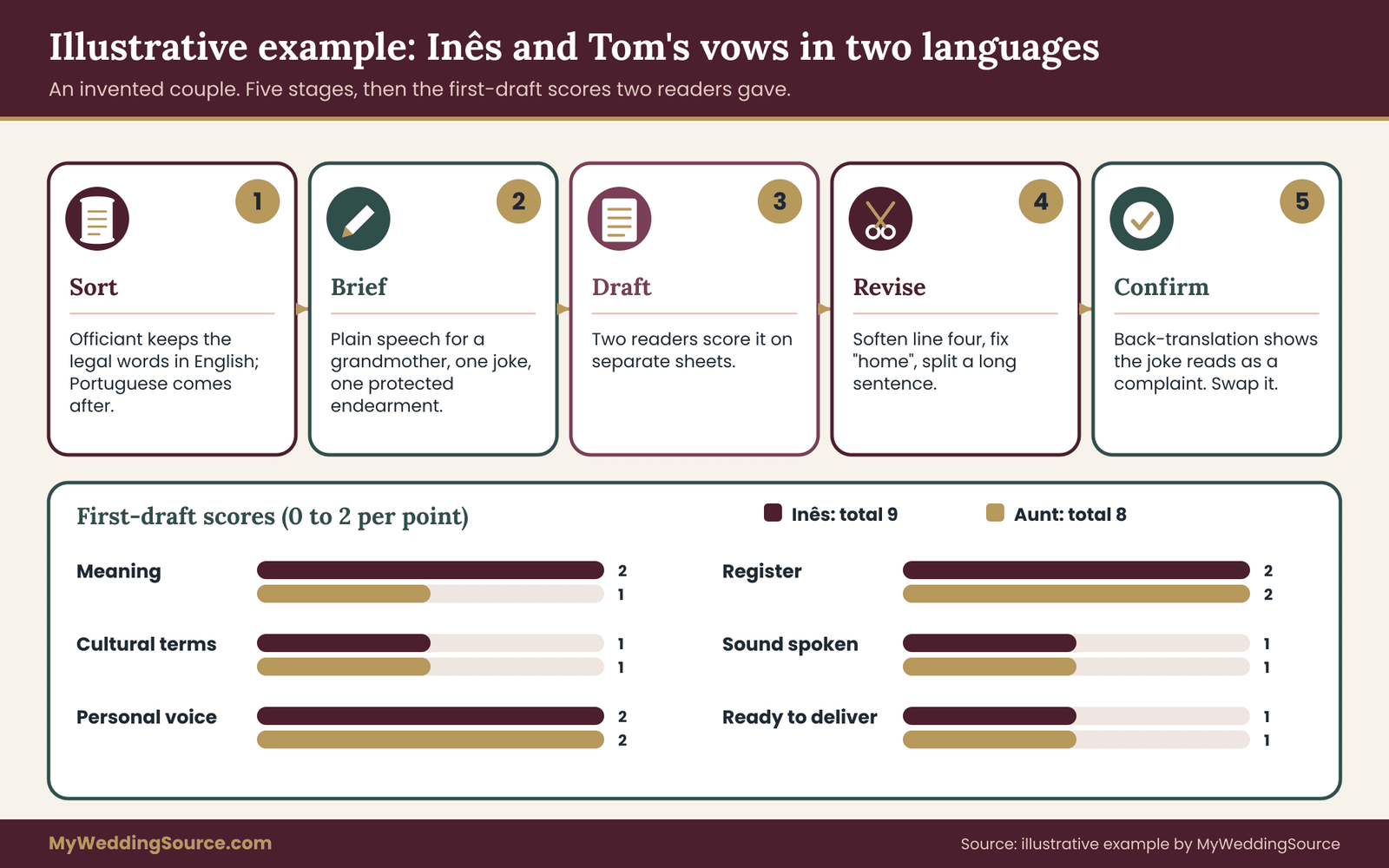
Stage one: sorting the ceremony into zones
The couple marks their outline. The officiant’s required statement of consent is zone one. The reading chosen by a friend is zone three. The vows are zone three. A short blessing the grandmother will say at the reception is zone two, because it is a family prayer in Portuguese that the family wants kept in its usual form.
They ask the officiant how the legal exchange should be handled. The officiant says the required words should be spoken in English, and that the couple may add anything else in any language afterward. That decision places the Portuguese material after the legal act, which is a relief: nothing about the vow translation can affect the validity of the ceremony.
Stage two: the brief
Inês writes a brief of the kind described earlier. She specifies Portuguese for an older speaker from a rural area, plain everyday speech, short sentences and one running joke about a burnt dinner they once shared. She marks the endearment “meu amor” as protected. She states that the grandmother’s blessing is outside the job. She names two approvers: herself and her aunt, a native Portuguese speaker.
She sends the brief to two translators and asks for a short trial translation of the first paragraph of her vow. One returns a literary, formal version full of long sentences. The other returns a plain, rhythmic version and a note explaining that the burnt-dinner joke relies on an English idiom, offering two Portuguese options. Inês chooses the second translator, for the voice and for the useful note.
Stage three: the first draft and the rubric
The full draft arrives. Inês and her aunt score it on separate sheets.
On meaning, Inês scores two and her aunt scores one, because the aunt notices that “I will choose you on the hard days” has become something closer to “I will pick you on difficult days,” which is accurate but less warm. On register, both score two.
On cultural terms, both score one: a reference to “home” has been rendered with a word that means a physical house rather than a feeling of belonging, and both want to discuss it. On sound, Inês scores one, because a sentence in the third paragraph is too long to say in one breath. On voice, both score two. On readiness, both score one, since the text is not yet rehearsed or approved.
The totals are nine and eight. No zeros, so the draft is a good base. The notes go back to the translator in the order of the text: soften line four, find a word for “home” that carries the meaning of belonging, split the long sentence in paragraph three, and keep the joke in the second of the two forms suggested.
Stage four: revision and the confirmation checklist
The revised draft addresses all four notes. The translator explains that the word for “home” was a judgment call between two options and recommends the one that carries the feeling, with a note that a regional variation exists.
Now the checklist begins. The source is frozen as version three. Inês reads the side-by-side with a literal gloss supplied by the translator. For the back-translation, she asks a friend of her aunt, who is fluent in Portuguese and has not seen the English text, to render the Portuguese back into English. The result is close in meaning but turns the burnt-dinner joke into a statement about a disappointing meal, which tells the couple the joke now reads as a complaint. They ask the translator for the other joke option. The second version comes back as a gentle tease, and the back-translator now reports a lighthearted line.
For the listening test, Inês’s aunt listens to a recording and describes the vow as warm and clear. She flags one word as sounding regional to the aunt’s own part of the country, and Inês, knowing her grandmother’s region, decides to keep the word the grandmother would use.
Names and terms are checked. The word for the family prayer is left as the family says it. Tom’s two lines in Portuguese are practiced with a recorded pronunciation guide from the translator.
Stage five: sign-off and rehearsal
The officiant has no objection to additional spoken material after the legal exchange and confirms by message. Tom and Inês rehearse the complete order twice, recording the second. The playback reveals that Tom’s Portuguese lines come too fast, so they add a pause before them. The couple signs off on a final version, dated and saved with the source, the gloss, the back-translation and the translator’s notes.
What the example shows
Three things stand out. First, the zone sort took an evening and removed all legal risk before any translation began. Second, the independent back-translation found a problem the side-by-side read missed, because the joke was accurate word for word and wrong in tone. Third, the translator’s list of choices turned a vague unease about “home” into a clear decision. A couple who skipped the brief, the rubric or the back-translation would have heard a different ceremony.
Which vow translation steps a small budget can keep
If the couple had a very small budget, they could have kept every step except the professional. A bilingual relative could have drafted the vow translation, a second relative could have done the back-translation, and the paid part could have shrunk to one hour of a professional’s time to review the two sheets. The structure of vow translation, with a brief, a score, an independent check and a sign-off, matters more than who fills each role.
Keeping your personal voice through vow translation
A translated vow that is accurate and flat is a poor outcome. The aim is a vow in which your partner and your guests hear you. Voice is a set of habits, and habits can be named, protected and checked.
Name your habits before you hand the text over
Read your own vow aloud and list its habits. How long are your sentences? Do you use questions? Do you repeat a phrase? Do you use a particular image, such as weather, food or a place? Do you lean on humor, or on directness, or on quiet understatement? Write these down in two or three lines and include them in the brief. A translator cannot preserve a habit they have not noticed, and a short list guides every later choice.
A useful test is to read three of your own sentences to a friend and ask them to describe the person who wrote them. Their description is exactly what the translator needs to hear.
Decide what travels and what does not
Not everything in a vow can cross a language. Puns, rhymes, plays on names and idioms rooted in a particular culture rarely survive intact. For each, you have four options. You can keep the original words in the original language, leaving the line untranslated on purpose. You can replace the image with an equivalent from the target culture. You can state the plain meaning and lose the play. Or you can cut the line from the translated version and keep it only in the spoken original.
None of these is a failure. Each is a decision, and the best vow translation is the one where you made the decision deliberately. A joke that does not survive may be worth keeping in the original language, delivered with a short, warm explanation in the program, because guests often enjoy a moment of shared effort.
One language or both
Couples who want two languages in the ceremony have three common patterns for vow translation. They can speak each vow once in the speaker’s native language and print the vow translation. They can speak each vow in both languages, one after the other. Or they can speak the whole vow in one language and let a short spoken summary or a printed text carry the other.
Each pattern has a cost. Speaking twice doubles the length of the vows and can lose emotional momentum. Speaking once and printing the vow translation keeps the ceremony moving but leaves some listeners reading instead of listening. A spoken summary is quick but gives only the outline. Choose by asking what the listener who needs the vow translation most would prefer. A grandmother who wants to hear the words may prefer the spoken version, even if it is longer, while a room of bilingual friends may be content with print.
Speaking a language that is not yours
If one partner will speak a few lines in a language they do not speak well, the principle is simple: a few lines said carefully carry more feeling than a long passage said badly. Pick the lines that matter most, practice them with a native speaker, and work from a recording. Ask the translator for a phonetic spelling written in your own language’s sounds, and for a recorded reading at ceremony speed. Practice until the lines feel like yours, not like a recitation.
Do not worry about perfection. Guests who speak the language will hear the effort and respond to it. They are not grading you, and the gesture usually lands as respect. If you mispronounce a word, the room will forgive it faster than you will.
Protecting voice during revision
Each round of vow translation revision risks sanding the voice away. Reviewers often suggest smoother, more conventional phrasings, and the translator, wanting to please, may accept them. Guard against this by keeping your list of habits at hand during revision and asking, for every suggested change, whether the new wording still sounds like you. If a reviewer proposes a “better” phrase that you would never say in the original language, decline it politely. The vow is yours, and the vow translation should serve it.
Delivery day: speaking, printing and cueing translated vows
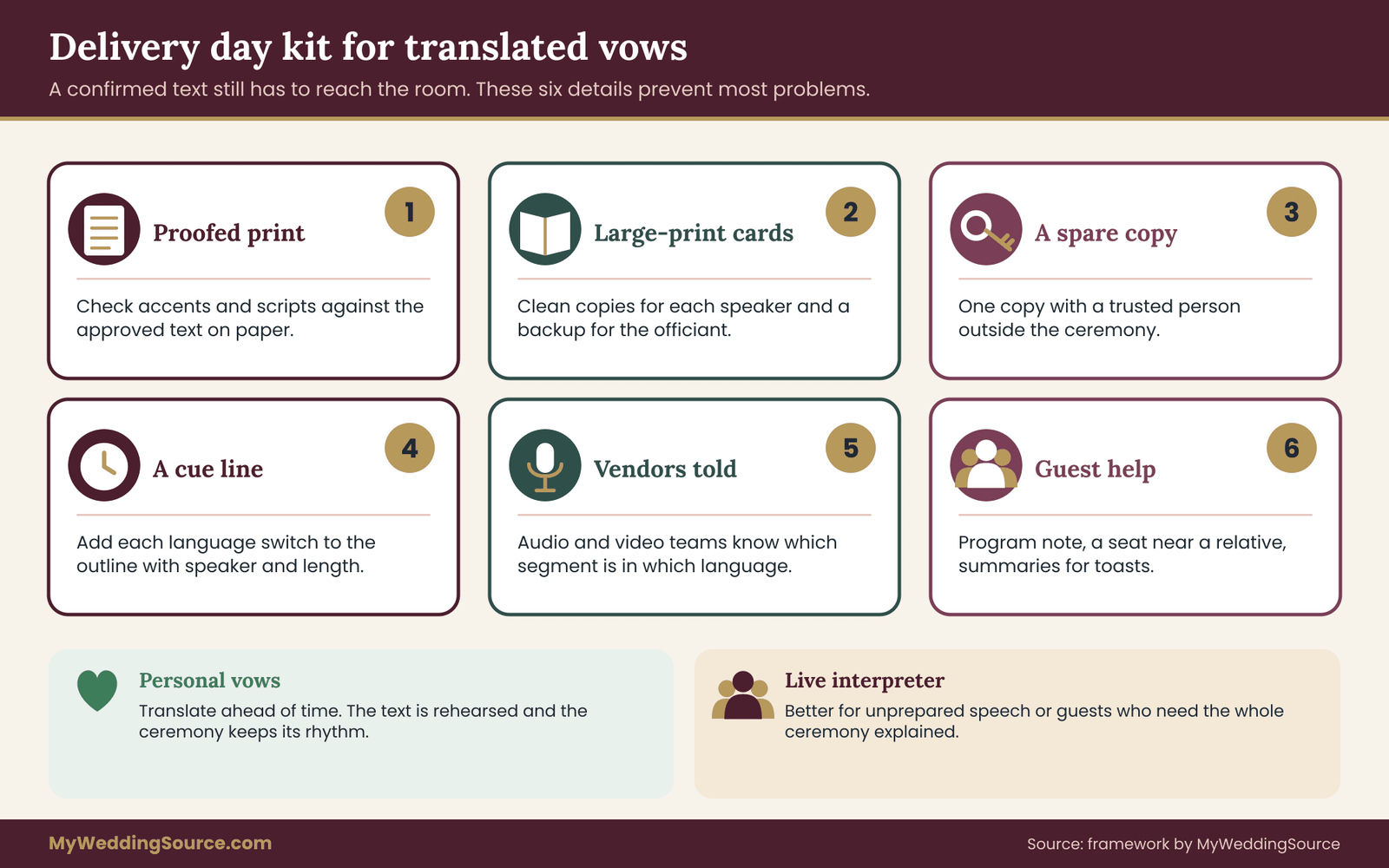
A confirmed text still has to reach the room. Delivery is where careful vow translation either pays off or comes apart, and most of the risk is practical: who holds the paper, who has a microphone, who cues the next line, and what happens if a reader is nervous.
Printing the vow translation in the program
If you print the translated vows, decide how much to print. Some couples print the full text in both languages side by side, others print only the vow translation, and others print a short note describing the vows without reproducing them. Printing the full text gives guests something to hold and keep, but it also removes some of the surprise. Printing a short summary keeps the moment fresh and still helps a listener who needs it.
Proofread the printed version against the approved version, line by line, with a native speaker. Typesetting errors creep in at the last step, especially with accents, diacritics and non-Latin scripts. A misplaced mark can change a word. Ask the printer or designer to use fonts that support the full character set, and check the proof on paper, not only on screen. If the script runs right to left, confirm that the layout and punctuation follow the conventions of that script, and have a native reader check the proof.
Keep the typography readable. A listener who needs the vow translation may be an older relative who will read it in dim light. Use a clear size and a plain typeface, and leave space between lines. The same readability points apply to any ceremony paper, and the planning habits in the wedding ceremony cue sheet guide show how to give each spoken element a time, a speaker and a prop.
Who holds the words
Decide who holds each text and in which format. Many couples memorize nothing, and hold a card or a small book, because emotion makes memory unreliable. Print the vow in a large size on a card or a folded sheet and give a clean copy to the officiant as a backup. If a second language is read by someone other than the couple, give that person their own copy, a marked pronunciation guide and time to practice in the room with the microphone.
Place a spare copy of every vow, including the vow translation, with a trusted person who is not in the ceremony, such as a coordinator, a family member or a friend. If a card is lost, the spare saves the moment. This takes two minutes and costs one extra printout.
Cueing and timing
Add the translated element to the ceremony outline as a separate line with a speaker and an approximate duration. If you will speak each vow in two languages, the ceremony is longer than the outline suggests, and the officiant, the musicians and the photographer should know. The broader sequence of a ceremony is laid out in the wedding ceremony step by step guide, and your translated lines slot into that structure like any other spoken element.
If a vendor is recording audio, tell them which segments are in which language so they can set levels and, if you want subtitles later, prepare for them. A videographer who knows that a segment is in a second language can also keep the camera on the speaker’s face during the spoken lines instead of cutting away to a guest.
Live interpretation versus pre-translated vows
Live interpretation is a different service from vow translation. An interpreter renders speech aloud as it happens, either after each sentence or in short sections. It works well for a ceremony where one person speaks at length, such as a reading or a homily, and less well for intimate vows, where the pause after each sentence interrupts the moment.
For personal vows, a pre-translated text is almost always better than live interpretation. The translator has time to find the right word, the couple can rehearse, and the ceremony keeps its rhythm. Reserve live interpretation for speech you cannot prepare, such as a spontaneous blessing, and for guests who need the whole ceremony explained as it unfolds.
If you do hire an interpreter, brief them as you would a translator. Give them the outline, the marked zones, the fixed text and the names. Show them where they will stand and where the microphone will be. Confirm that they can hear the speaker clearly. And agree a signal for slowing down, so the couple can pause if the interpreter falls behind.
Taking care of guests who rely on the vow translation
Think about the guest’s experience as a whole, not only the vow. A guest who does not speak the language of the ceremony benefits from a short program note at the start, a seat near the front or near a relative who can whisper, and a translated version of any printed text. The wider approach to making sure guests have what they need is covered in the wedding guest care planning guide, and translation is one part of it.
Consider the reception as well. Toasts, welcome speeches and announcements are all spoken text, and the same guests who needed the vow translation may need help there. A short plan for who will summarize a toast for a non-speaking relative is a small gesture that prevents someone from sitting through the evening unsure of what was said.
Edge cases and when vow translation goes wrong
Even a careful process meets surprises. These are the situations that come up most, with a decision rule for each.
The translator misses the deadline. Keep a fallback. If the date is close and the vow translation is not final, the safest option is to speak the vow in its original language and to print or project a vow translation that has been through at least a side-by-side check. A hurried vow translation that skips the listening test can embarrass everyone, while a delayed one costs only the surprise.
Two reviewers disagree about a word. Ask each why, record the answers and choose according to the audience that most needs the text. If the word is traditional, defer to the faith leader. If it is personal, the couple decides. Do not average the two options into a third that neither reviewer likes.
A relative insists the vow translation is wrong, and the translator disagrees. Treat this as a question for a neutral third reader, preferably a professional or a faith leader, who can look at the evidence. Meanwhile, ask the relative what specifically sounds wrong. Sometimes the disagreement is about regional usage, and sometimes it is about a change that was deliberate. Name the choice and explain why it was made.
The vow includes a quotation or a poem. Quoted text carries its own rights and conventions. If the passage is short and from a published work, check how an existing authorized translation renders it before commissioning a new one. A new translation of a poem is a creative work with its own questions, so name the source in the program and ask the translator whether they can adapt it or only reference it.
The language has multiple scripts or standards. Some languages are written in more than one script or standard form, and the right one depends on the audience. Ask a listener from the community which form they read most easily, and tell the translator and the printer.
The partner who will speak the vow translation is nervous. Practice with a recording and with a small, kind audience. Write the phonetic version in the speaker’s own spelling system. Break long lines into short phrases separated by slashes. If the nerves persist, reduce the length of the spoken translation instead of asking the speaker to push through.
A fixed religious text is unavailable in the language you need. Ask the faith leader whether an approved version exists and whether they can provide one. Do not commission a free translation of liturgical wording without their involvement. If no approved version exists, the faith leader may prefer to use the original language and let a printed note explain the meaning.
The vow translation will also be used in a legal or immigration filing. A translation intended for an agency is a separate job with separate requirements, usually including a statement from the translator about their competence and the accuracy of the work. Check the agency’s current instructions before commissioning, and do not assume that a ceremony vow translation will satisfy them. The two documents serve different purposes and may need different people.
The vow changes at the last minute. If either partner rewrites a line after approval, treat it as a new source. Update the vow translation of that line only, repeat the relevant checks on it and record the new version. If time does not allow a check, say the changed line in the original language only.
You discover an error after the ceremony. Do not panic. A small error in a spoken vow is rarely more than a story told later. If the error is in a printed keepsake, a corrected version is easy to produce. Fix the file, mark the date and keep the corrected version with your records.
What not to translate
Some things are better left alone. A single word of endearment that your family has used for years does not need translating, and translating it may weaken it. A phrase that has no equivalent may be best left in the original with a short note. A joke that depends on a pun may be best kept for the reception. Part of good vow translation is the judgment to leave a line as it is.
Your next steps
Start this week with three small actions. First, mark your ceremony outline with L, T and P so you know which lines are legal, traditional and personal, and share it with your officiant. If the ceremony draws on more than one tradition, the guide to planning an interfaith wedding ceremony with clear ritual ownership will help you decide who owns each part. Second, write the one-page brief with the eight answers from this guide. Third, decide who will translate, who will do the independent check and who has the final say.
Then work through the stages shown in the worked example: commission or draft the vow translation, score it against the rubric, run the confirmation checklist, collect the sign-offs and rehearse. Leave at least a few weeks before the ceremony for the whole vow translation cycle, more if you need a faith leader’s approval or a printed program. Keep the source, the vow translation, the back-translation, the notes and the approvals in one folder.
Finally, check the legal and religious points with the people who hold them. Your officiant can tell you how the legal exchange should be spoken, and the wedding officiant requirements guide explains what to ask. Your faith leader can tell you what wording is acceptable. With those answers and a clear process, your vow translation becomes a calm, manageable project instead of a late scramble.
FAQ
Who translates wedding vows?
Any of five people can: a professional translator, a bilingual relative or friend, your officiant or a faith leader for fixed religious wording, a vow translation agency, or machine software for a rough draft only. Choose by the job. Personal vows that others will rely on suit a professional, and religious wording belongs with the faith leader.
How much does vow translation cost?
It depends on the language pair, the deadline, the translator and what is included, so no single figure is honest. Because vows are short, many professionals charge a minimum fee. Ask for a written quote naming the word count, turnaround, revision rounds and whether a second reviewer is included, then compare quotes on those points.
Can I use machine translation for my vows?
Use it only to see roughly what a text says. Software often misses tone, idiom, formality and cultural terms, and it may produce confident sentences that mean something different from your original. If you start with a machine draft, have a person fluent in the target language rewrite it, then run the confirmation checklist on the result.
Do I need a certified vow translation?
Not for spoken vows or a printed program. Certification is one signal of skill but is not required for good work. A certified or sworn translation matters when an agency asks for it, for example with a marriage certificate in an immigration filing. Check that agency’s current instructions before commissioning anything.
How do I check that a vow translation is accurate?
Ask a fluent person who has not seen your original to translate the finished text back into your language, then compare the result with your source. Add a native-speaker listening test and a read-aloud rehearsal. Differences in meaning need fixing, and differences in wording alone are normal.
Should the legal vows be part of the vow translation?
Ask your officiant first. The legal statement of consent is usually spoken in the language the officiant and the issuing office expect, and a second language can be added beside it. Confirm the rules with the office that issues your license, since requirements differ by state.
How do I keep my personal voice in a vow translation?
Describe your habits in the brief: sentence length, humor, repeated phrases, favorite images and endearments. Give the translator samples of your own writing, ask for a list of choices they made, and read the draft aloud. Decline any reviewer suggestion that sounds smoother but not like you.
Is live interpretation better than vow translation beforehand?
For personal vows, a pre-translated text is usually better because the translator has time to choose words, you can rehearse and the ceremony keeps its rhythm. Live interpretation suits unprepared speech or guests who need the whole ceremony explained. If you hire an interpreter, brief them and confirm they can hear clearly.
Sources
- Get a marriage license, USAGov
- How to get a copy of a marriage certificate, USAGov
- Find a translator or interpreter, American Translators Association
- Translator certification, American Translators Association
- National Association of Judiciary Interpreters and Translators
- Federal court interpreters, United States Courts
- ISO 17100, Translation services: requirements for translation services, International Organization for Standardization
- Language access resources, LEP.gov, U.S. Department of Justice
- Translation requirements for foreign-language documents, U.S. Citizenship and Immigration Services
- Consular services and documents, U.S. Department of State